SEPTEMBER / OCTOBER 2026
THE MAGAZINE OF THE MASTER BUILDERS’ ASSOCIATION OF WESTERN PENNSYLVANIA
Washington County
READY TO GROW?
BUILDING COMMUNITY SINCE ’79 For over four decades, PJ Dick has delivered exceptional craftsmanship, driven by the legacy of our founder, Perry J. Dick, and the pride our teams take in every detail. From large-scale institutions to commercial and industrial landmarks, we build structures that stand the test of time and the weight of purpose.
Full-Service Construction • (412) 807-2000 • pjdick.com
OF HELPING TO BUILD GREATER PITTSBURGH
1926-2026
F.J. BUSSE COMPANY, INC. • FJBUSSE.COM • PHONE - 412-921-1231
THE WESTERN PA CHAPTER, NECA
EMPOWERING LIVES & COMMUNITIES SINCE
1946
LEARN MORE AT WWW.WPANECA.COM
#WEPOWERPA
www.volpatt.com
#WeAreVolpatt commercial industrial institutional
EDITOR’S NOTE BEN ATWOOD, BREAKING GROUND MANAGING EDITOR This feature began by tugging on a single thread: why did Butler County grow so much more rapidly than Washington. That’s bothered me for years, both professionally and personally. On a human level, I have an affinity for the place. Prior to the MBA, I lived in a one-bedroom triplex unit in downtown Washington for several years. I was new to the area, had just hit 40, and wasn’t sure how I wanted to play the back nine of my life. Rent was $550 a month. I quit my job and did nothing for a year. Days were spent rucking on the Mingo Creek trail. Evenings I’d traverse downtown. Weekends I’d get a few beers at Jose’s. I loved it. The farms. The colorful characters. The grit. It was just what I needed. For whatever reason, I figured out who I was in Washington. In 2024, I met my now wife for a drink at a bar in Canonsburg. A year and half later, we had a daughter. We celebrated her first birthday at an Airbnb in North Strabane. Every now and then, I take her to Mingo to splash in the creek. All this self-indulgent and unnecessary backstory is to say that if there is a place in Western PA that has a special place in my heart, it’s Washington. Journalistic integrity be damned; I want to see it do well. Professionally, I’ve long been confused why it wasn’t doing better. It’s beautiful and so close to the city (do NOT get me started on how soft you guys are about traffic) and it made little sense to me why Butler flourished and Washington floundered. I realized there must be some kind of structural difference between the two, but never really dove into what. For this edition, I did. And like anything, there is not a single cause. Demographic growth is a system with a million inputs and outputs, but at the most fundamental level, I think it’s fair to say Washington had an industrial hangover that Butler didn’t. Butler county officials also saw which way the steel wind was blowing and perhaps prepared a bit better. Conversations with elected officials in Washington indicate they’ve recognized this and are hyper focused on bringing additional people and businesses to the region. I hope they succeed because the stakes are high. By tugging on the Butler/Washington thread, I inadvertently stumbled upon the demographic tapestry of the entire region. Tracking population loss and migration from the economic core (Allegheny) over the past forty years made me realize we are all in the midst of a great internal migration. And this migration is producing demographic winners and losers. Over the past two decades, Washington has been one of the winners. This is largely due to rapid growth in Peters, Cecil, and the Strabanes. But that masks an aging problem. Washington is quickly getting older. If its growth trajectory doesn’t change, the county will have a real problem on its hands in the coming decades. How this plays out is anyone’s guess, but there’s a lot to like about the county’s prospects. It sits on an ocean of natural gas at a time when energy is becoming the number one domestic issue in the country. It has deep manufacturing capacity during a presidential administration that is hyper focused on reshoring that industry. It has an upscale office park capable of housing existing and outside businesses. There is evidence that more people want to live there, and the only real thing stopping them is the lack of utility infrastructure that would enable development. County officials seemed dialed in on remedying that. There are also signs that in the coming years, Allegheny’s fiscal problems might increase the desirability of the area. And that, my friends, is an issue we will return to very soon.
PUBLISHER Master Builders’ Association of Western PA www.mbawpa.org MANAGING EDITOR Ben Atwood 412-922-3912 ben@mbawpa.com EDITOR Jeff Burd jburd@talltimbergroup.com PRODUCTION Carson Publishing, Inc. Kevin J. Gordon ART DIRECTION & GRAPHIC DESIGN Blink Advertising blinkadvertising.com CONTRIBUTING PHOTOGRAPHY Mascaro Corporation Massaro Corporation Peters Township Kimmel Architecture Rob Benton SPONSORSHIP DIRECTOR Mary Chuderewicz mchuderewicz@mbawpa.org MORE INFORMATION: BreakingGroundTM is published by the Master Builders’ Association of Western Pennsylvania, 412-922-3912 or www.mbawpa.org Archive copies of BreakingGroundTM can be viewed at www.mbawpa.org No part of this magazine may be reproduced without written permission by the Publisher. All rights reserved. This information is carefully gathered and compiled in such a manner as to ensure maximum accuracy. We cannot, and do not, guarantee either the correctness of all information furnished nor the complete absence of errors and omissions. Hence, responsibility forsame neither can be, nor is, assumed.
CONTENTS
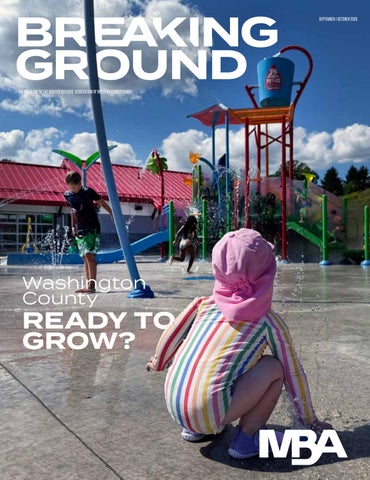
Cover Photography: A toddler enjoying the Rolling Hills Aqua Park
08
23
FEATURES
INDUSTRY
Washington County
08
AI in Construction
77
Project Profile
23
Industry & Community
80
Awards & Contracts
82
New Faces & Places
87
Closing Out
89
Workforce Development
61
Economy
67
The Engine is Primed, Can Washington Turn the Key?
Rolling Hills Aqua Park: If You Stare into the Data Long Enough, It Stares Back at You
Member Spotlight TRE Construction
In Conversation
Jeff Burd Discusses Narrating Forty Plus Years of the Construction Industry
33 39
Get Off Your Work Computer to Build
Burd Bids Adieu
PERSPECTIVES Legal
Two Partners at Fisher Phillips’ Break Down the County’s Parental Leave Proposition
47
The High Price of Used Cars
Legislative
53
Financial
57
Allegheny County Politics Gets White Hot Yenz Good?
Wars and Inflation and Tariffs…Sifting Through the Same Old Mayhem
Correction: Two Turner Construction project awards were inadvertently omitted from last issue’s awards: the $8 million Penn State Deike Building renovation and the $5 million PwC 42nd-floor build-out at One Oxford.
BREAKING GROUND September / October 2026
5
It’s a win-win for our region when labor and business are aligned. At Pittsburgh Works Together, we cover the impact of labor and business on Western PA’s economic health. Access research briefs, data insights and expert analysis at pghworks.com.
Pgh WorksTogether
Pgh_works
PittsburghWorksTogether
PghWorks
Highest Quality. On-Time. On-Budget.
The Mechanical Contractors Association of Western Pennsylvania serves the unique needs of contractors involved in heating, air conditioning, refrigeration, plumbing, piping, and mechanical and related service industries. We provide our members with high-quality educational materials and programs to help them attain the highest level of managerial and technical expertise.
Contact: Rege Claus, Executive Director | (412) 683-3600 | mcawpa@verizon.net 5131 CYPRESS STREET • PITTSBURGH, PA 15224
THE ENGINE IS PRIMED, CAN WASHINGTON TURN THE KEY?
8
MBAWPA.org
WVU MEDICINE CHILDREN’S HOSPITAL, 10TH FLOOR
Starting in the 1950’s, an unusual trend began inside the Pittsburgh MSA. Butler County, then a regional backwater, started picking up residents. What at first looked like a potential anomaly continued uninterrupted for the next 70 years. Since that census, Butler’s population has grown by nearly 100 percent. No county west of Centre even approaches that level of growth.
BREAKING GROUND September / October 2026
9
WASHINGTON COUNTY
INCREDIBLY, BUTLER’S DEMOGRAPHIC BOOM CONTINUED THROUGH THE 1970’S AND 80’S, WHEN THE BOTTOM FELL OUT OF THE STEEL INDUSTRY AND WESTERN PENNSYLVANIA WAS HEMORRHAGING RESIDENTS. EVERYONE KNOWS THAT STORY, BUT THE ORDEAL THIS REGION WENT THROUGH IS ALL TOO EASY TO FORGET. Steel’s decline was essentially a series of economic detonations that obliterated the economies of scores of towns across western Pennsylvania. This had an immediate impact on tens of thousands but also unfolded over the course of several years. In many cases, if you worked at one of these mills, you probably knew it was coming even if you didn’t exactly know when. For hundreds of thousands, there was little incentive to stay in the area. As unemployment skyrocketed and communities deteriorated, people left in droves. But this economic and demographic landslide triggered a massive internal migration that fundamentally reshaped the Pittsburgh MSA. En masse, those who could began leaving steel towns and river communities for the newer suburbs bubbling up around I-79. This effect was quite pronounced north of the Allegheny River. Places like Aleppo, Sewickley Hills, and Franklin all experienced population growth over 100 percent since 1970. Pine, Marshall and Ohio all grew by over 200 percent in that same time. As this corridor developed, growth poured into Butler County, largely flowing into Cranberry, Adams and Jackson. A positive feedback loop was kickstarted by the negative one steel had created: new residents brought money, money brought amenities and jobs, and the live/play eventually brought big employers. Over the decades, what had once been a rural fringe became arguably Western Pennsylvania’s most complete suburb. This internal migration also occurred south of the Monongahela, but at much smaller scale. Town’s adjacent to I-79 like Upper St. Clair, South Fayette, North Fayette, Collier and Robinson all saw notable gains, but not nearly at the levels experienced in the north. Instead, the highway’s real impact was in Washington County. Since 1950, Peters Township has grown by over 660 percent, the strongest levels of growth in Western Pennsylvania. North and South Strabane, South Franklin, Cecil, and Nottingham also experienced population growth near or over 100 percent in that same time.
10 MBAWPA.org
As in Butler County, this triggered a surge of development. A major office park arrived near Canonsburg and new retail blossomed. But these optimistic numbers do not tell the full story of Washington, because while Butler turned its advantages into generations of uninterrupted countywide growth, Washington did not. The county’s current population is about the same now as it was in 1950. That’s curious. Both Washington and Butler benefited from the outward migration of people and development from Allegheny County. Both had access to I-79. Both had large amounts of undeveloped land within commuting distance of Pittsburgh. Why has the population of one dramatically expanded over the past two generations, while the other remained essentially flat? The answer is multifaceted. One obvious reason might be the highways, that there is some inherent advantage Butler gained from being at the nexus of I-79 and I-80. Another factor could be geological. Using elevation data to measure the slopes of the Allegheny Plateau across both counties shows Butler is markedly flatter, with a median slope of 9.8 percent compared with 16.1 percent in Washington. More than half of Butler County’s land has a grade below 10 percent, compared with just 23 percent of Washington County, while nearly three-quarters of Butler is below a 15 percent grade. Flatter terrain generally means fewer grading challenges, more usable acreage and lower costs for roads, utilities and large building sites. Another big reason is likely historic. Back in the 50’s, Washington had nearly double Butler’s residents. There was simply more land to be built on. That population gap was largely due to the heavier levels of industrialization in Washington. The Monongahela shapes the county’s borders, which meant heavier concentrations of economic and demographic growth during the gilded age, but also that the economies of numerous townships were vulnerable in the great downturn. So, unlike Butler, Washington lost residents during the 70’s and 80’s because places like Charleroi and Donora were hit hard by the decline of steel and coal. That left a legacy of brownfield sites and the deterioration of these
WASHINGTON COUNTY
townships and municipalities created capital roadblocks for development. Essentially, Washington had an industrial hangover that Butler didn’t. Of the county’s 65 municipalities, 45 have experienced population declines since the 1970’s. Any coordinated recovery strategy had to deal with issues of blight and poverty that simply didn’t exist in places like Cranberry or Zelienople. And finally, there was a difference in how the two counties prepared for the changing economy. While it is a noteworthy achievement that Washington staunched the demographic bleeding, local officials believe that Butler County was ready for the internal demographic reshuffling in a way Washington was not. “Butler County basically did a better job reading the tea leaves,” said Nick Sherman, one of Washington County’s three County Commissioners. “They looked at long-term comprehensive planning early and were ready when the dominos started falling.” Sherman believes that historically, Washington county has allowed development to dictate infrastructure rather than using infrastructure to guide development. He says that its particularly apparent in housing, sewage and amenities like parks and recreation centers. Asked how Washington County competes against the North Hills for families and investment, Sherman was remarkably candid: “We’re getting our butt kicked.” That assessment is striking because by several measure, Washington County operates from a position of considerable strength. Seasonally adjusted unemployment
rate stood at 3.5 percent in June 2026, below Pennsylvania’s 4.1 percent, while per-capita personal income reached $76,764 in 2024, approximately nine percent above the statewide figure. Washington also retains an unusually deep concentration of industries that build, manufacture, extract and maintain physical assets. Construction accounts for 8.1 percent of county employment compared with 4.5 percent statewide, while manufacturing employs nearly 9,800 people and represents a larger share of employment than it does across Pennsylvania. Energy is an even greater outlier. Mining, quarrying and oil and gas extraction account for 4.1 percent of Washington County employment compared with just 0.3 percent statewide, giving the sector a location quotient of 12.20. And most importantly, its population is growing. Unlike Beaver or Westmoreland, Washington has demographically recovered from the economic impact of steel and is seeing modest levels of gains. But that growth masks a significant shift of Washington’s population composition. Washington’s median age increased from 43.6 in 2010 to 44.5 in 2020, while the population aged 60 and older increased by 12 percent during that same time. Simultaneously, the number of residents between 40 and 49 declined by 18 percent, while the population between 10 and 19 fell by 15 percent.
BREAKING GROUND September / October 2026
11
WASHINGTON COUNTY
So, unlike Butler, Washington isn’t attracting as many families. Without a sustained influx of new residents, Washington will become older, with fewer working residents and children supporting a growing elderly population. As that larger, older generation leaves the workforce, a smaller generation is moving up behind it to replace those workers, taxpayers and households. Without enough younger residents moving into the county, that imbalance compounds: fewer young adults mean fewer families and children, which eventually produces an even smaller working-age generation. Fewer workers create problems for local employers and severely hamper attracting outside businesses. Fewer taxpayers means less money for supporting roads, schools, and municipal services. As those pressures accumulate, communities have fewer resources to invest in themselves, making it even harder to attract the next generation of residents and businesses. The numbers illustrate the risk. The Pennsylvania State Data Center projects Washington County’s population will fall from about 209,000 in 2020 to 188,354 by 2050. This is a loss of roughly 21,000 residents, or 10 percent, in just three decades. That would erase essentially all of the population Washington has regained since the steel collapse and leave the county with its smallest population in generations. County officials are well aware of this and outlined a new recovery plan in their 2023 comprehensive plan. This establishes a ten-year strategy for attracting and then managing growth and development. At its center is an effort to move away from scattered, opportunistic projects toward what the county calls a “targeted development/redevelopment growth strategy.” Washington officials want to concentrate public and private investment in places where transportation, utilities and other infrastructure can support it, while preserving agricultural and rural areas where additional development makes less sense. Aging water and sewer systems and gaps in service can make proceeding on otherwise developable properties too difficult and expensive. “We’ve met with D.R. Horton and Ryan homes,” Sherman said. “And they’re like, ‘Listen, wherever you put sewage in this county, there will be homes popping up right away.” The county is seeking more direct financing mechanisms to accomplish that. The plan recommends investigating the creation of a Washington County Infrastructure Bank that could provide low-interest or gap financing for major municipal infrastructure projects. Potential funding sources include Act 13 impact fees, gaming revenue, liquid fuels funds, PENNVEST, bank financing and bond proceeds. Sherman points to the new $40 million public safety building and the redevelopment of the former Washington Mall as great examples of public/ private partnership, with the county helping fund demolition to make the numbers pencil for developers.
ROSEMARIE MOSTELLER STOCK.ADOBE.COM
12 MBAWPA.org
The Washington Mall redevelopment illustrates that strategy particularly well: the county funded demolition of the obsolete mall, removing a major obstacle to private redevelopment and creating a more family focused region while bringing
TRANSFERING A LEGACY
For decades, Domenic Dozzi’s leadership, vision, and unwavering commitment to quality have shaped Jendoco into one of the region’s most respected construction rms. His contributions have left a lasting legacy of excellence, integrity, and strong client and community relationships. Michael Kuhn, after working his entire professional career at Jendoco and serving as the company’s President since 2015, is honored to assume ownership and carry forward this proud tradition. With deep experience in the construction industry and a clear vision for the future, Michael is committed to building on Jendoco’s strong foundation while continuing to deliver exceptional service, innovation, and value to clients. Domenic will retain ownership of Jendoco Real Estate and related entities and remains committed to supporting the continued success of Jendoco Construction.
WWW.JENDOCO.COM
(412) 361.4500
2000 LINCOLN ROAD - PITTSBURGH, PA 15235
Get the best bank for your business. Your business is on the move. Making things, building things, and growing. At First Commonwealth Bank®, our promise is to help keep your business on the move with confidence. Contact us today to learn how we can be the best bank for your business.
Let’s make it happen, together. Jon Kowalski Regional President 724-778-3971
14 MBAWPA.org
WASHINGTON COUNTY
in an employer who can provide highly competitive wages for blue-collar and retail workers. In effect, Washington and its political leadership are seeking to create a revolving source of capital that could help move infrastructure projects forward when traditional funding falls short. The plan also identifies a mismatch between some of Washington County’s existing commercial real estate and where officials see future demand: manufacturing. The Trump administration is highly focused on reshoring manufacturing and passed a remarkable set of tax incentives to encourage it. This could benefit a myriad of industries, but the major need right now is for data centers. Manufacturing the equipment used by and for the development of these facilities could expand rapidly as they begin to pop up across the region. And there is some data to suggest an uptick in manufacturing activity locally because of it. EOS Energy, U.S. Steel, Lighthouse Electric, Mitsubishi Power, and GE Verona have all signed major leases in industrial properties over the past year. They all deal with power production or components needed to make hyperscaler data centers function. In fact, of the 15 deals larger than 100,000 square feet that were signed since the end of 2024, 11 were for companies producing energy and construction equipment that will likely be needed by the data centers. Lighthouse Electric is expanding its Washington County
manufacturing footprint with a new fabrication and kitting operation at the former Brockway Glass property in Canton Township. The Washington County-based electrical contractor moved into a newly constructed 100,000-square-foot facility along Interstate 70, with another 65,000-square-foot expansion already underway. Lighthouse, which employs approximately 1,000 people, expects employment at the plant to increase from roughly 50 workers to 75 in the near term. The company is also investing approximately $15.4 million in equipment and improvements as it expands its off-site fabrication capabilities, including work serving artificial intelligence, data centers and other power-intensive projects throughout Appalachia. The location is nearly as significant as the expansion itself. The former Brockway Glass plant had sat vacant for years before the Redevelopment Authority of the County of Washington acquired the property, completed environmental testing and remediation, demolished the former factory and constructed infrastructure necessary to prepare the site for redevelopment. The work relied on Washington County’s brownfield program and Local Share Account funding, along with Pennsylvania’s Redevelopment Assistance Capital Program and Business in Our Sites program. Once the public redevelopment work was completed, Crossgates Management took on the private development risk,
BREAKING GROUND September / October 2026 15
WASHINGTON COUNTY
constructing the new facility and leasing it to Lighthouse. Lighthouse may not be finished. Company officials are considering relocating its headquarters from Southpointe and additional fabrication and assembly operations into the former Ross Mould complex in downtown Washington, a project that could ultimately bring several hundred employees downtown. Pennsylvania is supporting the expansion with at least $6 million in RACP and workforce-training assistance. In May 2025, the Shapiro administration announced a $250,000 planning grant intended to begin transforming a former coal mining site in Washington County into a shovel-ready industrial development. The grant went to the Mon Valley Alliance through the first round of Pennsylvania’s new PA SITES program, which was created to help communities prepare large development sites capable of competing for major industrial investment. The Mon Valley Alliance will use the money to conduct a feasibility study for a 542-acre property along the MonFayette Expressway. The site sits above former mining operations, meaning the immediate objective is not construction of an industrial park but determining whether
16 MBAWPA.org
and how the property can realistically be prepared for development. The study represents an early step toward converting the former mining property into a site capable of accommodating future industrial users. State officials framed the project as both a brownfieldredevelopment effort and an economic-development opportunity. The grant also places the Washington County project within a much larger statewide sitedevelopment initiative. For Washington County, the significance is less the $250,000 grant itself than what it could initiate. The county’s Comprehensive Plan had already identified the need for large, pad-ready industrial prope rties located along major transportation corridors. Two years later, the state was funding the preliminary work necessary to determine whether another 542 acres along the MonFayette Expressway could be converted into exactly that kind of industrial inventory. Sherman views himself as a new guard in Washington county politics, taking a more activist approach to getting funding for the region.
WASHINGTON COUNTY
“I inject myself (into Harrisburg) whether you want me there or not,” said Sherman. “I’m going to be there,” he said laughing. “I’m not here to make friends, I want our piece of the pie.” Sherman considers one of his jobs to be aggressively competing for state and federal money that he believes Washington County historically failed to capture. Rather than waiting for opportunities to reach the county, he said he and Commissioner Electra Janis regularly travel to Harrisburg and D.C. to pursue funding themselves. Securing funding is one part of the challenge. Another, more intractable, might be bureaucracy. What frustrates State Senator Camera Bartolotta is that Washington County has many of the ingredients needed for substantial economic growth already in place, but those advantages have not translated into investment as quickly as she believes they should. “We should see industry and manufacturing tripping over itself, rushing to Washington County to utilize this great resource (natural gas) to make their energy costs a fraction of what they could be elsewhere,” she said. In her view, Pennsylvania’s permitting environment has historically been one of the principal obstacles. Bartolotta gave great kudos to Jessica Shirley, the current Secretary of The Department of Environmental Protection, for improving the process, but described the underlying problem as a longstanding bureaucratic culture. “She’s trying to work with a culture of this permitting constipation that we’ve suffered through for years and years,” Bartolotta said.
The Trump administration is extremely open about their desire to see more fossil fuel extraction, and Washington sits on an oceanic reservoir. The national energy market is already showing signs of acceleration. U.S. marketed natural-gas production reached a record 118.5 billion cubic feet per day in 2025, up 5.3 Bcf per day from the previous year, before climbing another 4 percent during the first half of 2026 to 121.3 Bcf per day. June 2026 production was 4.5 percent higher than a year earlier and reached the highest monthly daily rate recorded by the U.S. Energy Information Administration since its series began in 1973. But Pennsylvania is not participating to the same degree, with statewide production increasing just 0.5 percent yearover-year during the first quarter of 2026, although drilling activity has begun to tick upward: 101 new unconventional wells were dug during the quarter, seven more than during the same period in 2025. She believes Pennsylvania should find ways to process permits concurrently, prepare sites in advance and otherwise shorten development timelines without weakening environmental standards. The stakes, she said, are increasingly visible across state lines: “They are using our resource to win the race, when we should be doing it here, and we should be leading.” Bartolotta believes Pennsylvania can aggressively develop its natural gas resources while maintaining strong environmental protections, rejecting the idea that the two goals are inherently incompatible. “Two things can happen at once,” Bartolotta said. “You can be incredibly pro-energy... and the other thing you can do is make sure you’re extremely mindful, demand the BREAKING GROUND September / October 2026 17
WASHINGTON COUNTY
Those numbers, however, don’t tell the full story. “We’re still very busy,” Heckathorne said. “Within the past couple months, I completed six leases, and I have two more out for signature. Four of the six relocated from outside the park. There’s still always a lot going on here.” More important than the vacancy snapshot for a rapidly evolving sector of commercial real estate is that tenants aren’t abandoning the park and relocations are occurring. Heckathorne says that many are rightsizing for their post-pandemic needs, something that is happening globally.
highest regulations, and the best possible outcome for our communities.” For Southwestern Pennsylvania, she sees the alternative as watching investment migrate elsewhere despite the region possessing the resource itself. But Bartolotta’s vision for Washington County is not simply an energy story. Her argument is ultimately that industrial growth provides the economic foundation that allows that pattern to continue: good jobs give younger residents a reason to stay, return, buy homes and raise families in the communities where they grew up. But energy has and likely always will play an outsized role in the local economy. It is a main reason why there’s a white-collar element to Washington as well. The Southpointe Park contains roughly 51 properties and is the heart of the county’s corporate employment, which is a major driver of population growth. But the office market has recently undergone a major shift, thanks to the pandemic. Kelley Heckathorne of NAI Burns Scalo Real Estate, one of the major brokers involved in leasing up numerous properties throughout the park, estimates its vacancy was approximately 16 percent at the beginning of the summer, up from roughly 14 percent in 2025 and 10 percent in 2024.
18 MBAWPA.org
Additionally, recent leasing activity is coming from a surprisingly diverse group of businesses and places. Heckathorne pointed to two engineering firms currently expanding within Southpointe, a software engineering company that relocated from Parkway West into approximately 8,000 square feet, an HVAC company relocated from Lawrence taking 16,000 square feet, GBU relocating from Pleasant Hills into roughly 32,000 square feet and a Peters Township law firm that doubled in size before moving into the park. Another financial company is working on an approximately 9,000-square-foot expansion. Health care may soon provide a significant source of whitecollar momentum. WVU Medicine has taken approximately 92,000 square feet near the entrance to Southpointe, while Allegheny Health Network has acquired land for a major new facility that Heckathorne said will include a hospital and physician offices. Those investments are already attracting interest from additional medical users. If the county manages to expand white collar employment, it could be a real boost for demographic gains. Census data shows that 47 percent of Washington County residents commute 25 minutes or more to work, likely heading into Allegheny’s denser employment nodes. But even more interestingly: census data also shows that 56.6 percent of Washington County jobs are held by people who do not live in Washington County. That is a very deep pool of people who have an existing economic relationship with the county. A major hurdle in converting them is that they might not have a place to live. CoStar shows that Washington County has about 120 market rate multifamily properties containing over five units and only seven that contain over 150 units. Of these seven, five were built after 2010. Their aggregated vacancy rate is three percent, indicating
WASHINGTON COUNTY
that there is pent up demand for additional luxury communities. The most recent project, The Preserve at Peters Township, delivered in 2025. Rents for this community average about $1,929 and CoStar shows the 179-unit property is over 75 percent leased. This is remarkable speed for the entire region, made even more so by the price point. This also lends credence to the notion that pent up demand exists for living in Washington, and why the county plan is hyper focused on connecting utilities like sewer for residential developers. And that demand could be amplified further by existing and upcoming struggles within Allegheny. Allegheny County was, easily, the hardest hit by the decline of steel. The number of people it lost since 1970 is more than all the other counties combined. Allegheny’s population has since stabilized, but its role as the economic engine of the region left it exposed to challenges that Washington and Butler do not have. While Washington’s had a dozen or so steel towns along the river, Allegheny had scores. Just to maintain these locations requires enormous resources. These often soaks
up money, which will become an even bigger problem in the coming years thanks to the office market reshuffle. The downsizing that Southpointe experienced happened at a much larger scale in Allegheny, as downtown Pittsburgh offices experienced a sharp and noticeable decline in leasing activity and property occupancy. The property taxes paid by these offices were a major anchor in the city and county finances. These properties are no longer worth as much and are being reassessed at a lower value. This reduces the amount of money going into the city and county coffers. These revenue pressures are arriving at an especially difficult time for Allegheny, which is also confronting a severely underfunded pension system. A county working group recently estimated that the system’s unfunded liability is roughly $1.4 billion and said addressing it could require approximately $100 million in additional annual contributions for the next two decades. That money has to come from somewhere, and soon, or the county’s pension fund will face severe problems. County and city officials are openly discussing “painful
BREAKING GROUND September / October 2026 19
WASHINGTON COUNTY
choices” that will have to be made to maintain fiscal stability. In 2025, the county increased its property-tax millage from 4.73 mills to 6.43, a jump of 36 percent. In August of this year, a court ordered a full countywide reassessment on property taxes, to replace the current 2012 base-year values. This must begin by July of ’27 and be completed within five years. County Executive Sara Innamorato told the county council at a July meeting that there would be no tax increases in 2027, but it is difficult to believe that can last for much longer.
THE COUNTY DOES NOT NEED TO CREATE AN ECONOMIC REASON FOR PEOPLE TO COME TO WASHINGTON FROM SCRATCH. TENS OF THOUSANDS ALREADY DO.
For Washington, what happens next door matters a great deal. For most of the past 70 years, the dominant
20 MBAWPA.org
demographic story of the Pittsburgh region has been people moving outward from Allegheny County. Butler
WASHINGTON COUNTY
County captured that movement better than anywhere else, transforming within generations.
thousands already do. The challenge is getting more of them to stay.
Washington entered that period from almost the opposite position. Its larger population and heavier industrial development made the collapse of steel considerably more painful. But 50 years later, that old disadvantage looks different. Washington now has something it lacked when the regional reshuffling began: a substantial economic base of its own.
That makes the seemingly mundane questions surrounding sewers, water lines, housing and site preparation considerably more important. If Washington can use infrastructure to unlock residential development around the economic base it already possesses, it has an opportunity to turn workers into residents, residents into families and those families into the next generation of its workforce.
Washington’s existing development is increasingly an asset. Southpointe is already a major employment center. Its energy industry is among the most concentrated in Pennsylvania. Manufacturing investment is arriving, healthcare systems are expanding and more than half of the county’s private primary jobs are already held by people who live somewhere else.
If it pulls that off, a positive feedback loop could result. More people, more income, more taxes, a higher standard of living, more demand. Rinse and repeat. Seventy years ago, Butler was prepared to capture a population on the move. Washington’s future may depend on whether it can now do the same.
The county does not need to create an economic reason for people to come to Washington from scratch. Tens of
engage. grow. lead.
ENGAGE professionals from development, design, and construction as well as transactions, leasing and management. Our members form a dynamic community.
Annual Wine Dinner November 17 PPG Paints Arena
GROW and learn from accomplished women and industry leaders. From large signature events to intimate gatherings, members build meaningful relationships and expand their professional networks. LEAD one of our many committees to expand your skill set and make a difference.
Commercial Real Estate Women
BREAKING GROUND September / October 2026 21
BUILDING EXCELLENCE
CHALLENGING OURSELVES TO EXCELLENCE AND BEING THE LEADER IN THE MECHANICAL CONSTRUCTION INDUSTRY Instagram / Facebook
@mckamish.inc
McKamish Inc.
Phone
412-781-6262
Website
www.mckamish.com
PROJECT PROFILE
ROLLING HILLS AQUA PARK IF YOU STARE INTO THE DATA LONG ENOUGH, IT STARES BACK AT YOU
There are many strange second-order impacts of having a baby. Some are lifestyle related. You become intimately familiar with 3AM, weekends are rendered meaningless, and 8:30 is now late night.
BREAKING GROUND September / October 2026 23
PROJECT PROFILE
Bizarre new skills emerge from the ruins of your old life. You can pack a minivan with military precision, pour six ounces of milk with your eyes closed, and pick up a pacifier with your toes in the dark.
That last one’s real wild. You legit forgot these things existed 25 years ago, now you’re pulling recon missions across the south hills texting your wife updates on “the mulch situation” from the minivan.
Entertainment also changes in unexpected ways. Football is out, Ms. Rachel is in. You have a favorite Frozen song, and playgrounds are suddenly central to your everyday life.
Hays, Trotwood Hills, Morton Fields, Casey’s Clubhouse. You’ve got the pros and cons of each memorized. And while you don’t want to dog on anyone’s hard work, you frequently notice things about playgrounds that you don’t entirely care for.
24 MBAWPA.org
PROJECT PROFILE
The best ones are usually crammed, which means the play can be too rough for chunky little legs. They can also be surprisingly tall, with open platforms and climbing routes that pose real risk to an overconfident 22-month-old.
This particular pad even has a button that your daughter can press which turns the fountains on and off. That makes her scream with laughter, which is just about the sweetest sound in the world. But it brings back zero memories.
There have been a few close calls, so now, your head is always on a swivel. That sucks, and the shade options usually do too. Before the baby, you never really paid the sun any mind. These days, an escape from that celestial blowtorch is required before you even exit the vehicle.
These didn’t exist in 1989. Now you’re curious. So, you sneak out the phone and send a picture of it to the ChatGPT and ask what it is. The AI tells you that thing is called a “splash pad” and shows you a bunch of them in your area. Then it tells you that they’ve been growing in popularity with municipalities over the years because they’re far cheaper to maintain than pools.
Plus, slides get hot. Real hot. That painful memory bursts back into your consciousness shortly after you commenced advanced scouting operations. Others do too, which is actually the coolest second order effect of having a baby: you get to reexperience childhood through someone else’s eyes. The feeling of flying on a swing, how interesting ants actually are, and the ecstasy that comes from getting wet. You’re reminded of that last one at one of these parks, when you notice something that you’ve never seen before: a large concrete pad where a few colorful pipes rise from the ground at odd angles and spray water everywhere.
You tell the machine you didn’t realize pools were expensive to maintain and it says: Oh yes. Surprisingly so. And it’s not the water maintenance, either. It’s labor. There’s a shortage of lifeguards because people are having less kids. The agent now has your full attention. It’s not just lifeguards, it continues. Fewer children means more school consolidations, less retail, and fewer volunteer firefighters. That generally makes an area less desirable and keeps people out. The second order effects of demographic decline, it says, can stack quickly.
Financial Expertise Built for Construction Successful construction companies need strategic financial planning that keeps pace with industry changes and drives growth. HBK’s Construction Solutions helps you maximize company value, optimize shareholder returns, and plan for your financial future.
Let’s build something solid together.
6603 Summit Drive | Canfield, Ohio 44406 | (330) 758-8613
hbkcpa.com
The HBK Construction Solutions Team
BREAKING GROUND September / October 2026 25
PROJECT PROFILE
You look up from the phone, and your daughter is licking a puddle on the concrete pad. Time to go. But on the drive home, you ponder on what the chatbot said. Seven of the ten years that you’ve lived in Pennsylvania were in small cities that have been losing people for decades. Pittston, Scranton, Washington.
melancholy thoughts. Yes, it replies. Decline can be quite sudden and kickstarting growth is incredibly difficult. You can’t manufacture 10,000 families by waving your hands. It takes decades of drudgework planning roads, schools, housing, and parks to build a reputation that draws families in.
These were all fine enough places when it was just you, but they were a little run down. Neighborhoods dotted with abandoned homes. Main streets half-filled with decaying storefronts. More police activity than you’d suspect for such a small place.
A revelation washes over you. Parks, you whisper, are more important than you ever dreamed. Absolutely, the AI replies. And that’s what makes splash pads so interesting. There’s a new one in Peters Township. Massaro built it. That might make a good project profile for the September edition.
You would never move back to any of them with a child.
The word predictor is right. Attracting families to the region was the central theme of your feature piece, and it led you so far down a demographic rabbit hole that you were vibecoding 3D maps of Washington county’s demographic shifts, texting pics to your wife until she asked if you were unwell.
You glance in the rearview mirror at your now sleeping daughter and think about Scranton for the first time in years. These communities didn’t choose what happened to them. Their economies were simply second-order casualties of titanic market forces beyond anyone’s control. They did everything society asked of them and still got run over. That sucks, too. At a stoplight, you tell the GPT your
But you couldn’t stop. It turns out this entire region is in the midst of a great internal migration, a second-order impact
BID. BUILD. PROTECT.
From bid to final payment, MBM Law’s Construction team understands how projects are built and how to successfully resolve disputes. We provide practical, industry-focused counsel based on decades of experience.
Lawrence J. Maiello, recognized in Best Lawyers in America® in Construction 2024, 2025 and 2026.
Keep your next project on solid legal footing. Contact MBM Law 412.242.4400 | mbm.law 26 MBAWPA.org
PROJECT PROFILE
of steel’s collapse. In the 70’s and 80’s, deindustrialization cut like a scythe over the rivers that were once the lifeblood of this region.
And this migration is ongoing and because Western Pennsylvania is not bringing in many outsiders, it is producing clear demographic winners and losers.
People left towns like Midland, Ambridge, and Charleroi in droves. Many left western Pennsylvania altogether. Everyone knows this. Lesser known is that those who stayed (and could) increasingly went to the blossoming suburbs along I-79, effectively changing the entire market.
Before you had even heard of splash pads, you noticed Peters Township was one of the biggest winners. In fact, among western Pennsylvania municipalities with at least 10,000 residents in 1970, Peters is the biggest winner. That surprised you, even though you live five minutes
Minimize Risk. Maximize Potential.® www.seubert.com | 412-734-4900 |
BREAKING GROUND September / October 2026 27
PROJECT PROFILE
from the town. Sometimes you take your daughter to the market district for donuts in the morning, but you’ve never actually gotten off Route 19. So, you tell the GPT to do a deep dive on the place and it pulls decades worth of Peters planning reports. Central to them is sanitary infrastructure. Peters established its sanitary authority in 1964, and major sewer construction authorizations followed in the early 70’s. That timeline screams farm fields to sewer capacity to subdivisions, which is bananas, because when you interviewed a Washington County commissioner for the feature, he wouldn’t stop talking about the importance of sewers. Schools were central, too. A new one seemed to pop up every few years, the most recent being a high school built on the same exact park where the splashpad you are thinking of profiling is. This is too good to be true; you whisper to your little girl as you lay her in the crib. The next morning, you reach out to the township to let them know you’ll be putting their splashpad on the map by describing its build in Western Pennsylvania’s premier construction trade magazine. A confused admin hands the phone off to a man named Paul Lauer, who is the town manager. Paul has worked for Peters since 1984, when your mom was pushing you in swings. He tells you a plaque in the council chambers lists every town manager since the ‘60’s. Paul’s the third. He offers you a guided tour. Jackpot. A few days later you’re meeting Paul and another man named David Brooks, who is the Peters Parks and Recreation Director. Both turn out to be thoroughly likeable dudes. They tell you that the township acquired the land in 2016, when it was a golf course called Rolling Hills.
28 MBAWPA.org
They decided to cut it in half, using one side for the new high school and the other for a public park. Paul tells you that Peters residents are quite interested in park development. It is, he says: a top priority of the municipality. He goes on to say that everyone thought that because this was a golf course, it would be easy to convert. But it didn’t turn out that way. It was quote: difficult beyond belief. First, they built the high school, which really is quite nice. Then they cut a large looping road through the hills, tracing the cart path with the express purpose of creating a backbone from which the rest of the park could one day grow. While the earthmoving equipment was already there, they flattened a 2.5-acre piece of ground for the future build out of the splash pad. So, when construction began in early 2025, the heavy lifting was already done. Now, they could focus on design, safety and speed. As you walk the site, you tell Paul and Dave that the building looks nice. You aren’t being polite, either. It’s surprisingly aesthetic for a small municipal facility. The long low frame settles naturally into the hillside, its strong horizontal lines echoing the broad contours of the surrounding terrain. A bright red standing-seam metal roof pops against sleek but monochrome gray fibercement panels, black accents, and slatted black façade around the entrance. Paul tells you that there has always been an expectation in Peters that services be delivered in a certain way. Your dad brain notices that subtle safety cues permeate the project from beginning to end. The parking field is split by recurring landscaped space islands, which look aesthetic but also keep excited children from plowing from the car door to the gate. One-way routes funnel traffic in a clear
PROJECT PROFILE
designated path, while the walkway leading up to the entry has a crosswalk so large you can practically hear it screaming “PAY ATTENTION.” Walk through the gates and you arrive at the splash pad itself, which is really two playgrounds sharing the same sheet of concrete. The main attraction is instantly apparent. Rising left of center in a riot of primary colors is a play structure of carefully controlled chaos. Children climb a short set of stairs onto a network of small, elevated platforms that offer two possible routes back down. On one end is a pair of broad and insanely bright blue slides, which drop about three feet into a shallow pool. On the other is a much larger enclosed green tube whose descent offers several sick turns. Between the two, children get bombarded with water. Sprayers fire from every angle and gallons spill from elaborate overhead fixtures. Lording over it all is the pièce de résistance: an enormous blue tipping bucket, emblazoned with the Peters Township seal and perched atop a red frame high above the pad. This 55-gallon monument to gravity takes on water until the balance becomes untenable, pitches forward and unleashes its contents onto the screaming children below. Then it rights itself and begins again. Even as a 43-year-old man, you cannot help but whisper: this looks awesome. Paul laughs and agrees. He tells you that at the ribbon cutting, him and Dave celebrated by being the first to get crushed by the bucket. To the right, the experience changes gears. Here the design gives way to a collection of smaller curiosities arranged with generous space between them. Fountains bubble directly from the pavement. Low white mounds rise from the surface and send water cascading down their sides. Nothing towers BREAKING GROUND September / October 2026 29
PROJECT PROFILE
overhead and children are instead free to wander from one encounter to the next, following whatever whims pop up in a toddler’s head. Additional touches within the park highlight the attention to safety. Shade is concentrated in the teensy area and sitting between the two zones are a series of backless curvy colorful low benches. These subtly define the boundary between the two play areas while also allowing parents with children in both age groups to sit between them and monitor the situations. This is really well thought out, you tell Dave and Paul. They agree and credit the architect’s attention to detail. You should talk to him, Paul says. Later on, you will. His name is Martin Kimmel, and he’s the President and Chief Creative Officer at Kimmel Architecture in Blue Bell. You ask how a Philly firm ended up with a Peters’ project. Kimmel tells you his team does plenty of municipal work across the commonwealth, designing town halls, libraries, police stations, and municipal buildings. He says their approach is to always have something that looks upscale and fits into the community, no matter the budget. They have succeeded admirably here. But underneath the pads there must be a complex web of pipes. How does the water circulate, you ask Dave. Oh boy, he says. Before they put the concrete in you had this maze of pipes out there. It was incredible. He forgets the exact footage, but it was quote: more than I would have ever conceived of. He points at a big blue circle on the ground and tells you there are several of these scattered across the pads. They collect the water and send it down to a 6,000-gallon reservoir. From there, it gets pumped back into the filtration treatment room, where it runs through sand and chlorine before being sent back outside. Matt Kuban, Massaro’s project manager for the build, will eventually tell you that this was the trickiest part. They first excavated the area and ran the underground water lines to the precise locations of each planned feature, with individual lines sized and positioned according to what would eventually sit above them. Once the piping was in place, crews filled and graded the site, burying the network beneath the surface. Then the individual splash-pad sections were poured over that, carefully lining the water features up with the pipes terminating below. Only after those pads were in place did Massaro begin pouring the larger concrete deck around
30 MBAWPA.org
them and they were working on water features while pouring the pool deck. Getting concrete to the back corner behind the splash pads was a delicate challenge but the real pain point was the mechanical room, Kuban tells you. Banks of gray piping climb the walls and split into individual branches, each fitted with its own valves, wiring and controls, while larger pipes connect the system to pumps, filtration equipment and the water returning from the pad. Construction took about eight months from start to finish, and the park opened in August of ‘25. The architect, GC, and town were all extremely complimentary of each other, attributing the successful build to mutual respect, high levels of communication, and all parties doing what is right by the town. Paul himself said, quote: it’s a great design. The contractor’s execution was spot on. The town council should get a lot of credit for having the foresight to invest in this kind of project, and the staff who managed the build did the yeoman’s job in getting it up and running. This isn’t a sexy build. You know that. In fact, it was relatively simple. But that ease was a second order effect of tremendous care, attention to detail, and good planning. That last one seems to be a hallmark of Peters. Paul tells you that the township has been growing his entire tenure and they are constantly planning ahead. One nugget stands out: every new house or commercial development pays an impact fee intended to help address the traffic it creates. Lauer says those fees have generated a couple million dollars for transportation improvements, allowing Peters to pursue road and intersection projects that might otherwise be difficult to fund. That’s interesting, you think. Growth is chess, not checkers. It’s one big system with a hundred inputs. Sewers are one, roads another, and parks are strategically important, too. Syncing them can take decades. Two days later, and you can resist no longer. You pack your wife and daughter into the van and head to the splash pad. Upon entry, your wife says quote: oh, this is nice. Within fifteen seconds your daughter is gone, racing around the toddler zone. A few minutes later she has three new friends, and they jump from sprinkler to sprinkler sharing toys and splashing each other. You and your spouse get to sit in the shade and watch men your age stand under the bucket with their kids and get dumped on. Your daughter is too young for that, but you wander over solo and take the hit. It’s everything you dreamed.
PROJECT PROFILE
Your wife comments that this is incredibly relaxing. You agree. All around is the sound of laughter. Screams. And you don’t have to do anything. A fence keeps everyone in; there’s no dangerous deep ends and rowdy play is confined to a single side. Parents eyes surround the area. God be praised, the shade is incredible. One hour of stress-free parenting. It cost $14. You would’ve paid triple that. You tell your wife that Lauer told you that they’ve hit capacity and people had to wait at the gate like it was a New York City nightclub. That Kimmel told you the biggest problem townships have after they build these is that they wish they built them bigger. She says she can see why. You can see your daughter wherever she goes. Occasionally she looks up to make sure you’re still there. You wave. She waves back. Then she runs off again with her new friends. A glimpse into the future. The next ten years have been on your mind a lot more lately. You currently live in Bridgeville, where the population has been steadily declining for decades. It’s nice, you like Bridgeville, but since the birth of your daughter, you’ve noticed some things that trouble you. And at this precise instant, you realize you are not researching the great inmigration from afar. You are living it. So is everyone around you. It is quietly shaping everything about how this region functions and will function in the coming decades. And there will be winners and there will be losers. The quick build enabled the park to open in August. More than 16,000 visitors passed through the gates during the Aqua Park’s first full season, which really only lasted until September. Those are strong numbers. Daily attendance climbed as high as 750. On more than one occasion, the park has gone viral on Pittsburgh mom Instagram. To Lauer and Brooks amazement, guests have come in busses from far off places like Squirrel Hill and Cranberry. The park sold 2,500 day passes to Peters residents. Incredibly, it sold 4,500 to non-residents. Every one of them had to pass grocery stores and restaurants and nice rural neighborhoods to get there, and every one of them would see the sleek and expansive new high school when they pulled in. Later, your daughter works up the courage to enter the big kid zone. BIG STEP she roars as you help her ascend. She howls with laughter and holds tight to your leg as water envelopes you both. Eventually, she works up the courage to take on the blue slide and then immediately exits and you both run back to do it again. Then again. And again. And again. Amidst this chaos, it occurs to you that these might be some of the best moments of your life. Later still, she’s exhausted. Bed-time was a breeze. Now you’re on the couch, figuring out just how to convey the importance of this splash pad in a project profile. You tell your wife you have a crazy idea but you’re not sure if the readers will like it. She tells you to trust your gut but is browsing Zillow and too busy to really engage.
BREAKING GROUND September / October 2026 31
th
26 ANNUAL
NIGHT AT THE FIGHTS
SAVE THE DATE
Thursday, November 12, 2026 5:00 PM - 9:00 PM Omni William Penn Hotel www.CREDApgh.com
MEMBER SPOTLIGHT
SPOTLIGHT ON: It was roughly 250 years ago that a peculiar but brilliant Virginian aristocrat sat down at a Philadelphia desk with his quill, ink, and some parchment. He was tasked with justifying a political dispute that was about to get a lot of people killed, but in doing so, he ended up achieving something far greater. There are a lot of pretty words in that declaration, and the most important pertain to the pursuit of happiness. Essentially, no one has any right to tell you what you can do with your life. You can be whatever you want, and no one can limit your growth. That’s powerful stuff, and it’s why the coda stuck in spite of that gentleman’s many personal shortcomings. It speaks
to both halves of our collective personality, because in this country we celebrate personal liberation and acquisition. Jefferson’s words are the gospel for both. Nearly everything in American history lies downstream from them. It’s why the champions of capitalism, emancipation, labor, women’s suffrage, and civil rights all inevitably cite him to convince the masses of their cause’s righteousness. Think about it. We consistently produce individuals who began with next to nothing and became some of the most successful and influential humans to ever live. Hamilton, Vanderbilt, Douglass, Lincoln, King, X, Whitman, Carnegie, Rockefeller, Twain, Ford, Disney, Davis, Pressley, Springsteen, Winfrey, Jordan, Tyson, Stallone, Jobs, Bezos. Their stories were simply not possible anywhere else, and this country immortalizes its winners. But it can devour the losers. For every Musk, there are a thousand others you’ve never heard of who bet it all and found bankruptcy, broken families, abandoned dreams, and quiet defeat. The pursuit is guaranteed but the outcome is not. It often comes with extraordinary risk and demands tremendous sacrifice. Few industries make the wager more tangible than construction. Firms are often founded with personal savings and loans backed by homes. Before the first invoice is ever paid, payroll, equipment, insurance, fuel, rent, permits, and materials must be financed. One bad estimate can erase months of profit while expenses pile relentlessly. It’s a wonder anyone attempts it at all. But this is America, baby. That is the dream, it is totally irrepressible, and anyone who follows western Pennsylvania construction knows that building a dynasty is more than possible. Our region is filled with them and many trace their origins trace back to a young couple dreaming bigger than they had any right to. Few had formal business training, some could barely speak English. But all shared the same pursuit: building a life with their hands. Tom and Angie Eger are one of the latest Western Pennsylvanian couples to attempt this. They’ve been chasing their dream for over five years now, and it’s rarely been easy. In fact, at some points it’s been downright scary.
BREAKING GROUND September / October 2026 33
MEMBER SPOTLIGHT
But the pair have survived their initial trial by fire and are preparing for expansion. This is their story.
wonder what came next. A child would be nice. But after a few years, they began to wonder if that was in the cards.
The two met in 2010, on Facebook of all places. Angie was 19. Tom was 20. You remember how it was back then. Like a few beach pics, slide into the DM’s, and four years later you’re moving into a home together.
If it wasn’t, perhaps happiness might need to come from elsewhere.
The house was in Imperial, and Tom built it with his own hands. He grew up in the business. His father was a union carpenter who ran a side hustle installing windows and roofing, and Tom was working alongside him at age 10. Angie started in human resources. Over the next decade, she advanced rapidly through increasingly senior leadership roles, overseeing recruiting, employee relations, safety, compliance, and organizational strategy.
At that point, Tom had over a decade in at the Carpenters Union. While he liked most of the crews and companies, he was a superintendent whose skillset had evolved to such a degree that work could feel akin to babysitting, and he began having dangerous thoughts about setting out on his own. Meanwhile, Angie had begun to quietly wonder if the corporate ladder actually went anywhere. A new office. A new title. The same basic function. We’ve all been there.
She’s outgoing. Social. Bubbly. Easy to engage with and understands strategic networking and growth. Tom’ a little more taciturn. He usually only says exactly what he thinks and isn’t overly concerned if you agree. Curiously, he also plays bass in a local band.
So, they began to gameplan it out. What it would require. How they would pay for it. The sacrifice it would require from each. In 2022, talk became action. Days were spent at their real jobs. Nights were for prospecting, bidding small projects, cold calling every GC asking for a chance to prove themselves.
These two are as Pittsburgh as a pair of pickles, and they got hitched in 2017. Like many newlyweds, they began to
“Every night after work we’d sit down on our laptops,” recalled Angie. “And I would email every single general
34 MBAWPA.org
MEMBER SPOTLIGHT
contractor on the union list looking for leads. We’d stay up past midnight, then get up to go to work.” In 2023, they went all in. The pair took out a small business loan and founded TRE Construction. Angie stayed with her full-time job to make ends meet, while Tom turned his attention to the full-time grind. The operation ran out of their home. Tom went months without a paycheck. Making payroll often meant dipping into personal funds. There was little access to credit and no institutional backing. They kept debt low and expenses tight, buying themselves just enough time to stay in the game a few months longer. The first real win wasn’t glamorous. It was drywall finishing on a large multifamily job, but it was bigger than anything they’d handled before. The execution was messy, but the outcome was successful. They hit their numbers, impressed the GC, and proved to themselves they could handle scale. That was enough to get the next call. And the next. More small installs, then bigger scopes. What started as a minor piece of a job turned into full casework across an entire building. When issues came up on site—misaligned windows, gaps other contractors wouldn’t touch—they said yes. Taking that job brought in a million dollars of additional work at Nemacolin Woodlands Resort. They went in expecting a small crew and quickly found themselves managing dozens of workers on ultra high-end installations for a precise owner. It was another step up. More visibility, more pressure; but the chance to prove they could deliver. And they did, so more jobs came. Things started to stack. They relocated operations to an office and hired support staff. Then, back-to-back gamechangers: they won a $5 million bid for a January buildout at the Navy Yard in Washington D.C., and Angie discovered she was pregnant. The two were thrilled. But as any parent knows, the transcendent joy that accompanies seeing a little sonogram heartbeat is soon thereafter joined by a new fear, one born from the stark realization that you are wholly responsible for this little human’s wellbeing, and that suddenly, the stakes of every decision you make are infinitely higher and the consequences of getting it wrong extend well beyond the self. That is terrifying. Tom and Angie experienced this of course, but the grind never stops. A nursery had to be built,
Carhart onesies needed to be purchased, and business couldn’t miss a beat. It was going to be a boy, and he was coming in January. The D.C. job began on the sixth. Cameron arrived on the fifth: healthy, adorable, perfect. He’s got Tom’s eyes and chin, Angie’s nose and brows. They had a couple days to savor the new addition, but it wasn’t looking good in the Capital. “It didn’t start well,” said Tom. “It was a very uncomfortable situation. We had a super on site, but he was 5 hours away with 15 people that he does not know.” “We were doing so bad,” he clarified further. “It was terrible.” The company’s reputation was on the line and at that stage in the game, the risk was catastrophic. They had to adjust quickly to the rules of a federal buildout. The bureaucracy and delays. On a normal project, if someone isn’t performing, you replace them. On the grounds of the Naval Academy, it wasn’t that simple. Every worker required military clearance, a process that took roughly a month. By the end of the month, Tom was making regular trips down, commuting ten hours through the dead of winter to ensure that the business he started to carve his family a slice of the American dream wouldn’t end up as a nightmare. This trial by fire went on for months, with no one save Cameron getting a moment’s rest. “Yeah, it was tough,” said Tom.
BREAKING GROUND September / October 2026 35
MEMBER SPOTLIGHT
revenue, up from $6 million in ’24, and $2 million from their first year. But the grind never stops. Babies and businesses must grow. Tom and Angie are as busy as ever but are now at phase two: expanding intelligently. The two needed executive leadership to lighten their workload, so they pulled in two seasoned veterans: Rich Amberson and Dave “The Wizard” Curry. This pair brings decades of experience. Rich handles the project management. Dave, who promised to get a TRE tattoo if this profile referred to him as a wizard, is in charge of estimating. Both free up hours of time for the Egers to keep their eyes on both the horizon and a toddler. Cam swings by the office every now and then. He’s still learning the ropes but will probably know more about construction than 90 percent of the country by the time he starts grade school. That’s by design.
“Oh my god,” elaborated Angie, who had to navigate those sacred yet sleepless, painful, and all-consuming first weeks of motherhood while simultaneously keeping the backend of TRE functioning. “At the beginning, I probably questioned whether we would be in business. I kept thinking ‘I have this baby now, what if I have to go back to my old job’. If we mess up bad, are we going to lose it all?’” “We threw the kitchen sink at that project,” Tom said. “We had to. I had to. It couldn’t fail. Everything we could think of, we did.” “And we finished strong. Four weeks ahead of schedule. Everyone was happy and we got to bid more with that GC.” The couple acknowledge this success as the moment they realized that they had what it took. They had ventured into the inferno and emerged from the other side, battlehardened and ready for anything. It turned out that their most challenging year was also the most rewarding. Cameron learned to sit, then crawl, then stand. And TRE Construction cleared $10.2 million in 36 MBAWPA.org
“The whole goal behind all this is to become a family legacy. We want to do it for someone to take over and make it better in the future. Most of the local groups started from someone just like us. We look up to them because we want to try and build what they have.” Whether they pull it off remains unknown. Let’s hope so, but it is still entirely possible that Tom and Angie’s pursuit ends in sadness. The dream’s just cold that way. But these two are no longer flailing. They’re battle hardened now. Seasoned, too. And it feels increasingly likely that one day in the distant future, when everyone reading this is long gone, one of Cam’s grandchildren might come across a scrapbook or shoebox filled with old photos and root through them, perhaps shaking her head in wonder as she contemplates what life must have been like in the dark ages of 2023, when her great-grandparents started the family business that brought such prosperity and opportunity to their heirs. Maybe she’ll even come across a photo of Tom and Angie holding her infant grandfather in front of their new office and piece together that this company, their dream, was once hanging on by the thinnest of threads. And perhaps she’ll even think: if they could do it, why can’t I?
Contractors and Local 66 working together to build a better future.
For over 120 years Local 66 in partnership with our Contractors, have been committed to provide qualified and competent Operating Engineers. The most successful companies are union signatories. We will help you to remain competitive and to gain the marketplace advantage. You will keep your employees and we will work with you to provide skilled training; and as you grow and your needs expand, we can provide you with a qualified workforce. This partnership is a positive approach to doing business. Your company must remain competitive during all economic conditions. We bring positive factors to the relationship – training, reliable workforce, safety, quality and a stronger community presence.
“We partnered with the Local 66 in 2011. Since then, we’ve been able to take on many more clients, more difficult work, due to the contribution of their great staff.” J.J. Stefanik - President Stefanik’s Next Generation Contracting Co.
111 Zeta Drive, Pittsburgh, PA 15238
”Mascaro Construction Company is a regional general contractor that’s been around for 33 years. Proud to say that 30 of those years, we’ve had a relationship with the Operating Engineers providing us with skilled craftspeople that run all the equipment that we have.” John C. Mascaro Jr. - President Mascaro Construction “Working with Local 66, we have had employees that have been with us 25-30 years.” Bindy Bucci - Owner Golden Triangle Construction
412-968-9120
www.iuoe66.org
BREAKING GROUND September / October 2026 37
When your Customer Counts,
Count on Eisler.
800-420-8733
EislerLandscapes.com 1031 New Castle Road Prospect, PA 16052 PAHIC#001400
David L. Lawrence Convention Center Planters and pavers by Mascaro Construction
IN CONVERSATION
BREAKING GROUND IN CONVERSATION with Jeff Burd, Former Editor-In-Chief of BreakingGround
FOR OVER TWENTY YEARS, JEFF BURD HAS BEEN DOCUMENTING THE EVOLUTION OF WESTERN PENNSYLVANIA CONSTRUCTION. HE IS THE FOUNDER AND FORMER EDITOR IN CHIEF OF BREAKING GROUND AND DEVELOPING PITTSBURGH. Thanks for sitting down with us. You’ve been narrating the construction industry for decades. Give us a brief bio. Were you interested in construction as a kid, or was it something you gradually became interested in later in life? Construction was never anything I was interested in at all. It happened to be the first job I did out of college. One of my closest college friends was working as a superintendent for a residential contractor. He needed a roommate and I needed a job. I graduated on a Saturday, and at 6:30 on Monday morning I was on the North Side swinging a hammer. My first two “real” jobs weren’t very fun or fulfilling, but 18 months after graduating, I was hired by McGraw-Hill to be a reporter for the Dodge Reports, which kept track of all the projects going on in the market. The idea of working as a reporter and for a big corporation was exciting. It didn’t take very long for the romance of that to wear off. But I was lucky. The job turned out to be fun, even if there was little or no writing, as you or I might think about it, involved. The job was mainly about finding out what was being built early enough in the process so that our customers could act on the information. It was the first time I was exposed to the concept that business was built on relationships. And I was lucky that the job was in Pittsburgh. As you’re probably finding out, people in this part of the world like to talk about what’s going on.
Construction eventually became fascinating to me. What really got me was learning all the different ways companies could make money doing essentially the same thing. One company might focus on a narrow market, charge higher margins and provide a very high level of service. Another might compete aggressively on price, get all its numbers in and then decide how far below them it was willing to go to win the work. Another company might self-perform 30% or 35% of the work—or even more through affiliated companies—and make much of its money by marking up its own labor. I started learning about velocity, margins, overhead and all the different ways contractors approached the same basic business. The game within the game. How did that jump come about. When did you make the leap from being a reporter who was collecting information to becoming more of an analyst—connecting the dots and seeing where the market was going? About two and a half years into the job. I had spent that time talking primarily to architects, engineers, developers and owners about what they had in the pipeline and then following those projects. I moved here in the fall of 1979, just past the peak of a record year for a couple of the steel companies, and it went straight down from there. Every week there was another
BREAKING GROUND September / October 2026 39
IN CONVERSATION
headline: U.S. Steel closing one plant, National Steel shuttering another. This was at a time when real estate was just trashed. Inflation was around 12.5 percent, and interest rates like 20 percent. I started at the end of 1980, and I think rates peaked around 1982, when Paul Volcker squeezed the life out of the economy. But even on the run-up to that, things had started dying. At most of the firms I was talking directly to the partners and principals. I’d sit down with my file of reports and go through them: nothing new, nothing new, nothing new. At that time, they’d ask, “I hear so-and-so is laying off people. What are you hearing?” It made me understand that when you’re miserable, you want to know whether everybody else is miserable, too. You also want to know what else is going on in the market. They’d ask, “How is the market doing? What does next year look like? Is it getting better or worse? Do you see anything changing?” I gradually realized I was in the information-sharing business. There were architects who would go through the pile of reports I brought in, set two or three aside because they wanted to call about them, and then tell me, “So-andso has this one,” or, “So-and-so has that one.” I got way more information out of that exchange than they did, but that was beside the point: it was an informationsharing exercise, and it became obvious that business relationships involve sharing information. And if I’m just calling you and pumping you for information, we don’t have a relationship. But because of where I worked, I could say, “If you tell me what you’re doing, I’m helping you because I’m communicating it to people who can help you.” And it was so much better if I could give you something useful in return: “You know so-and-so? I hear he’s looking for work,” or, “There’s a whole bunch of college work coming. If you’re not chasing college work, maybe you should be. That market is booming.” A lot of what you eventually became known for was finding projects before they were common knowledge. How did you learn where to look? I learned to use all kinds of other sources to get the same information. The job was mostly out of the office. You came in with your information, literally sat at an old typewriter and typed up the reports, put them into production, and the next day you were back out again. 40 MBAWPA.org
But I discovered that you learn about so many things just by being out. You’d see stakes in the ground on an empty site and realize, “Okay, that site is being surveyed. What’s going on there?” You’d go to municipalities and find out what was before the planning commissions, what was happening with zoning and who was seeking zoning variances. You’d call the consultants. The breakthrough was discovering how open the general contractors had to be about sharing information when a project was bidding. I discovered that quite by accident stumbling into the Mellon Stuart plan room one day and seeing the drawings for these projects that we didn’t know were out there. It dawned on me that when a job is bidding, so many people have eyes on it that it really isn’t much of a secret. I tucked that experience away and applied it when I started Pittsburgh Construction News. The interesting dichotomy was that I was well aware—and there was no false humility about this—that everybody’s opinion of what I knew was way higher than it should have been. I did not know what they thought I knew. They thought I knew everything. They thought I knew every project. And how did you go from working for someone else to starting your own publication? Eventually going into sales gave me an off-ramp. The pay was good and I was good at it. That gave me more confidence, and I started thinking seriously about working for myself and even put together a business plan when I was living in Dallas to launch a competitor in Pittsburgh. At the time, though, when I actually ran the numbers, I realized I didn’t have enough money to make it work. So I stayed. But over the next four or five years, the company went through three different management teams, became increasingly unpopular with its customers and failed to adapt technologically. The sales side was deteriorating too. By the end, 44 of 47 sales reps companywide had missed quota, and the compensation system had become so dysfunctional that people could actually benefit from missing quota badly one year and beating a much lower number the next. Eventually the business deteriorated to the point where it became clear that it was time. That’s when I started my own company. That’s a big jump for anyone to make. How did the new venture begin?
IN CONVERSATION
I was surprised to find that we were basically recreating the wheel. Luckily, a lot of the people I had called on were still around, and I had good relationships with them. Some remembered me, and almost all of them were complaining about the group I used to work for, saying that their information wasn’t accurate. That made it helpful for me to be able to say, “We’re not like that. We’re not going to do things the same way.” As I said, we decided, at least at first, that the focus was going to be what was bidding and that the general contractors were going to be a key source of information. We were going to be damn sure our info was accurate. We had an advantage in that we were small and flexible. Our competitor was not. The truth is that the industry was dying to have timely, accurate information. We weren’t inventing something. We just had to make sure we didn’t screw up. I guess we accomplished that. Do you enjoy the information-sharing component more, or do you also enjoy explaining what’s happening—connecting all the pieces that ultimately drive the construction market? It’s both. I really liked knowing things that other people didn’t know. My ego was gratified by that. At times, it felt like I was cheating. But the consolation was realizing, no, this is how it works: they know things I don’t know, but I know things they don’t know. They might know five or six things I don’t, and they know what they know. But that’s true of everybody I talk to, which means anybody I talk to gets the benefit of what everybody else is telling me. The tightrope was that there was also a lot of confidential information. I’ve had countless conversations with longtime relationships—including one yesterday—that start with, “Oh man, I’m NDA’d on that,” and then they tell me anyway. They know I’m not going to tell anybody where I got it, and I got very good at that. I’ve been really lucky to sit across the table from everybody involved in construction from inception through closeout: distributors, subcontractors— especially subcontractors—suppliers, manufacturers, architects, engineers, contractors, estimators, project managers and CFOs. I had a job that put me across the table from all of them, and they were willing to tell me about their businesses: what their problems were, how
they solved them, what challenged them every morning and what their biggest risks were. As you interacted with the business leaders more how did your perception of the industry evolve? I was trained to understand construction in a straight line: an owner has an idea, hires an architect, the architect creates a design with input from manufacturers, it goes out to bid, everybody submits their prices, the owner picks the lowest one, and they build it. It’s much more complicated than that. There’s a set of plans and specifications, so theoretically there should be a prescribed path from the start of work to turning the keys over to the owner. The truth is that there are hundreds of paths to get there. The really effective contractors are the ones who look through the drawings and see ways to get an edge. It might be through a relationship. Or maybe they know they have five really good people coming off one job who they can put on the next one. That’s the level of analysis good companies—and even bad companies—apply to their work. The firms that last also understand the high level of risk in construction and mitigate the risk as best they can. There’s an old adage that it only takes one bad job to go out of business, but usually that one bad job comes after the company has been mismanaging risk for a while.
BREAKING GROUND September / October 2026 41
IN CONVERSATION
How important do you think it is for those setting out on their own to fully understand that side of the business? I feel for people who come into this business without fully understanding how difficult it is, because most of them are really good at what they do. But there are so many layers to success, whether you’re an architect, a general contractor or a developer. You can have the technical skill and reach the point where you don’t need somebody telling you how to do your job. But there’s still that game within the game: all those different paths from Point A to Point B and figuring out which is the most financially successful path. That’s not necessarily something you learn while you’re building or designing. It
42 MBAWPA.org
THIS BECAME HOME. AT THE END OF THE DAY, IT’S THE PEOPLE, BUT IT’S ALSO THE NUMBER OF THINGS THAT ARE HERE— THE RESTAURANTS, THE SPORTS, THE PHYSICAL ATTRIBUTES—THAT ARE SO UNDERRATED.
IN CONVERSATION
would be pretty tough to pick up on the fly if you weren’t prepared for it. You’ll learn a lot of lessons, but they can be expensive lessons. This is an industry where you need to retain a lot of your earnings. Some of it is for rainy days, and some of it is because bad things are simply going to happen.
By 1987 or 1988, less than 10 years into my career, I was providing that kind of information to customers. We had economists working for the company, including a chief economist with an Ivy League education. I read his work and shared it with customers to explain what was driving the construction economy.
The people who last long term are the ones who don’t inflict every unforeseen problem—many of which may be their own fault—on their clients, while still defending their business from those that are trying to get into their pocket. To be successful, you have to figure out a way to do both.
Then I would hear from contractors and manufacturers about how those trends actually affected their businesses. I might present an outlook that I thought was positive, and a company president would say, “That’s great, except those starts in the second half of the year don’t do me any good. My business lags a start by nine to 12 months. I’m still dealing with last year’s problems.”
Where did the finance and economics side of your work come from? Was that something you developed over the years, or did you always have a background in it? I was a history and economics major, so there was a baseline understanding. I understood how the economy should work and how it does work, so I was comfortable with some of the macroeconomic stuff just as a matter of education.
But he also knew that if the forecast was right and his backlog didn’t start improving, his company was doing something wrong. That dialogue taught me how economic information mattered differently depending on the business. It was a master class every day, having really smart people tell me how they used this information.
BREAKING GROUND September / October 2026 43
IN CONVERSATION
Is your interest in economics primarily about understanding the construction industry, or is it also about understanding the world more broadly? I’m curious to understand the world. I’m curious to understand myself better. That includes the world I’m in. Once it became apparent to me that macro- and microeconomics were driving the industry I worked in— as trite as that sounds—I had to stay interested in them. The macroeconomic environment is important, but the microeconomic environment is paramount. That lesson became obvious when I left Pittsburgh in the fall of 1983. The walls were crumbling down here. Tens of thousands of people were losing their jobs every month. Then I moved to Charlotte, which was in the process of growing from about 450,000 to 550,000 people in 18 months. Everywhere I looked, there were tower cranes and people building. I saw the same contrast when I went to Atlanta, Miami, Charleston and Greenville—really, anywhere I went in the South. There was a huge influx of people moving there. That made it very clear to me how different a local economy could be from what was happening in the broader economy. You’ve spent decades writing about Western Pennsylvania, and you don’t do that without developing a deep affection for the area. Love, even. But there’s a flip side to love… which is dealing with something that often drives you crazy. What are those things in Western PA you love and what makes you nuts? This became home. At the end of the day, it’s the people, but it’s also the number of things that are here—the restaurants, the sports, the physical attributes—that are so underrated. And I think that’s also one of our biggest problems. They’re underrated because we underrate them. I don’t know that there are many places in the country where the people, particularly the leaders, talk so badly about themselves publicly. Having served on the PRA, with the Allegheny Conference, on the board of the Public Theater and with a few other institutions, I’ve concluded that we don’t think big enough. The Public Theater did well during a very challenging period after the Great Recession in part because the guy
44 MBAWPA.org
running it still thought big: “We’re going to do great stuff here.” We don’t do enough of that. I was reading about the Downtown TRID today, and I can see both sides. We have an inefficient government with a lot of waste because of the contracts involved and entrenched practices that date back to when Pittsburgh had a lot of money. But I also identify with what Erika Strassburger said: If you don’t take the risks now, when are you going to take them? The bigger risk is doing nothing. I’ve lived in other parts of the country where they built interstate highways to places that didn’t exist because they believed those places eventually would exist. To some degree, that’s what happened with I-279 and the development that followed along that corridor, including what happened in Cranberry and southern Butler County. We don’t do that enough here. I understand why. We don’t really have the money in the state coffers, given the way we spend it, to simply say economic development is going to be our number one concern and we’re going to spend whatever it takes to attract businesses. But we could spend the money we have differently. There are a lot of people entrenched in the way we do business here who aren’t willing to look beyond it. Cutting Pennsylvania’s corporate income tax was a great thing to do. But when it finishes declining to 4.99 percent, it’s still 4.99 percent. The states that are winning are at 1 percent or zero. If you’re trying to invest money the way you did in the ’50s, ’60s and ’70s, or trying to pad the wallets of people who are accustomed to having their wallets padded, you’re not going to compete. We already have disadvantages we can’t change. Yes, it gets cold. Yes, we have to work harder to maintain our roads and bridges. If warm weather matters to you and you’re choosing between here and North Carolina, South Carolina or Florida, we can’t change that disadvantage. It gets cold in Boston and Ohio, too, and those places are, to some degree, doing better.
J.R. Ferry &
J.J. Ferry II cir ca
1998
100 years. 3 generations. 1 team.
J.J. Ferry
68
y circa 19
& J.R. Ferr
As we celebrate our first 100 years, we honor the generations of Ferry Electric Company teammates, customers, and partners whose dedication since 1926 has made this milestone possible. Thank you for being part of our story.
ferryelectric.com
Industry Intelligence. Focused Legal Perspective. Unparalleled Value. HIGH-YIELDING RESULTS.
Construction Litigation
Contracts & Business Services
Workforce Services
Environmental & Regulatory
Energy & Natural Resources
Public Sector
We are critical thinkers who are focused, driven and cost effective in everything we do. Meet our attorneys at babstcalland.com.
PITTSBURGH, PA | CHARLESTON, WV | HARRISBURG, PA | LAKEWOOD, NY | STATE COLLEGE, PA | WASHINGTON, DC
What Did the Board of Health Actually Approve? Under the initial proposal, every employer in Allegheny County would be subject to the paid parental leave mandate – there are no exceptions for small employers. Here’s an overview of the key details: •
Employee Eligibility: 30 days of service with the employer.
•
Leave Length: Up to 18 weeks of paid parental leave.
•
Qualifying Events: Birth, adoption, or
•
Use Window: Within the first 12 months following the qualifying event.
•
Intermittent Use: Permitted, so long as the leave falls within the 12-month window.
•
Two Parents at the Same Employer: May take leave concurrently or consecutively.
•
Rate of Pay: Time is compensated at the same base rate of pay an employee would have earned at the time of their use of Paid Parental Leave.
•
Notice to Employees: Upon initial hiring of an employee and annually thereafter, employers must provide written notice of the Parental Paid Leave requirements.
Two Board members also raised expanding coverage to miscarriage and fetal loss. That language is not in the current draft but may surface in the anticipated revision.
By: Patrick Dennison and Raeann Burgo, Partners at Fisher Phillips
legal placement of a minor (including foster care).
ALLEGHENY COUNTY PAID PARENTAL LEAVE PROPOSAL UPDATE: WHAT EMPLOYERS NEED TO KNOW NOW
Since earlier this year, Allegheny County Health Department (ACHD) has held public hearings on the proposal, extended the comment period, and received more than 1,400 formal comments. The Board of Health is now scheduled to reconvene on September 16, 2026, where it could take final action on a revised version of the proposal. Here’s what employers should know about the status of the amendment and what to watch for at the September meeting.
LEGAL PERSPECTIVE
ALLEGHENY COUNTY IS GETTING ONE STEP CLOSER TO POTENTIALLY FINALIZING NEW REQUIREMENTS FOR ALL EMPLOYERS, REGARDLESS OF SIZE, TO PROVIDE UP TO 18 WEEKS OF JOBPROTECTED AND PAID PARENTAL LEAVE.
BREAKING GROUND September / October 2026 47
LEGAL PERSPECTIVE
What Are the Proposed Changes to Paid Sick Leave in the Initial Proposal? Since 2021, Allegheny County employers with 26 or more employees have been required to permit employees to accrue one hour of paid sick time per 35 hours worked within the county, up to 40 hours per year. Under the new proposed rule, employers of all sizes would have paid sick time obligations, and employees will accrue paid sick time at a faster rate: •
All employees, regardless of the size of the employer, would be entitled to accrue one hour of paid sick time for every 30 hours worked within the county.
•
If an employer has 15 or more employees, paid sick time accruals for each employee would max out at 72 hours per year.
•
If an employer has fewer than 15 employees, paid sick time accruals for each employee would max out at 48 hours per year.
Other Key Provisions The proposed amendment makes additional overall changes, including: •
boosting anti-retaliation protections and specifically defining “retaliatory personnel action” as any threat, discipline, discharge, suspension, demotion, reduction of hours or other adverse action taken against an employee for exercising their rights related to paid sick leave or paid parental leave;
•
obligating employers to provide designated paid and parental leave that accrues and is calculated separately from other paid leave offered by the employer – even if an employer has a paid leave policy that makes available paid sick leave sufficient to meet the rules requirements; and
48 MBAWPA.org
•
requiring an employer to provide written notice to employees prior to any authorized disclosure of health information about an employee or an employee’s family member.
What’s Happened Since May? The Board held a public hearing on June 2, 2026 where it heard in-person and virtual testimony from both supporters and opponents, with many in opposition being small business owners, nonprofits
LEGAL PERSPECTIVE
and business coalitions. Following that hearing and in response to the amount of comments, ACHD extended the written comment and held an additional meeting on July 15, signaling revisions before a final vote. The Board did not take final action on the proposal during the July 15th meeting and instead, Director Dr. Iulia Vann thanked commenters for their input, stating that the department is considering changes to the proposal before it returns for a vote.
identifying concerns with the proposal’s scope, cost, and potential impact on small and mid-sized employers. Issues that have been highlighted by businesses include: •
Length of leave. The proposal’s 18 weeks surpasses the length of leave in the 14 states that currently mandate paid parental leave.
•
Wage replacement rate. The proposal requires 100% wage replacement with no cap, while comparable state programs replace roughly 70-90% of wages and cap benefits at a weekly maximum ranging from about $900 to $1,600.
•
Funding source. The proposal places the entire cost on employers, where existing state program funds paid parental leave through
Business Community Opposition of Current Proposal Business commenters like the Pennsylvania Chamber of Business and Industry and the Allegheny Conference on Community Development oppose the proposal in its current form,
a public insurance pool and not through direct employer payment. •
No small-employer carve-out. The proposal would apply to every employer in the County with no minimum employee threshold. Compare that to the County’s own existing paid sick leave rule, which applies only to employers of 26 or more.
•
Hiring disincentives. Commenters have argued that the 18-week mandate could disincentivize the hiring of employees perceived as more likely to use the benefit.
What to Watch for the September 16 Meeting Public statements at the July meeting strongly suggest that ACHD will introduce a revised proposal for the
Eastern Atlantic States REGIONAL COUNCIL OF CARPENTERS
LEADING THE WAY... Over 40,000 highly skilled Carpenters Over 90,000 sq. ft. state of the art J.A.T.C. Trained in all aspects of Carpentry Commercial | Mill Cabinet | Millwrights | Heavy Highway Pile Drivers | Floor Coverers | Residential
Pennsylvania | New Jersey | Maryland | West Virginia Virginia | Delaware | District of Columbia eascarpenters.org | 412.922.6200 BREAKING GROUND September / October 2026 49
LEGAL PERSPECTIVE
September vote. Based on commenters’ concerns, this could include revisions to the funding mechanism, length of leave, and/or the wage replacement rate. That said, the underlying policy direction, including the absence of a smallemployer carve-out, has strong support from County Executive Sara Innamorato and the Board. Despite potential changes, employers should consider that the proposal continues to move through the Board of Health regulatory track and not through County Council legislation. If the Board of Health approves the revised proposal on September 16, it will then move to County Council for approval before being sent to the County Executive for signature. The policy would take effect 180 days after enactment. What Should Employers Do Now? 1.
Attend or monitor the September 16 Board of Health meeting. The meeting will be held at 5:30 p.m. on Wednesday, September 16, 2026, in the Gold Room (Room 410) of the Allegheny County Courthouse, 436 Grant Street, Pittsburgh. The meeting will also be streamed on the Allegheny County YouTube page. Employers who wish to speak must submit a Public Hearing Participation Form at least 24 hours in advance. Written comments may still be submitted to the Board through the ACHD contact form and will be summarized at the meeting.
2.
Review the anticipated revised proposal. We expect ACHD to release a revised policy in advance of the September 16 meeting. Employers should pay close attention to any changes.
3.
Continue to audit and benchmark your current parental leave policy. Regardless
50 MBAWPA.org
of the anticipated revisions, Employers should evaluate whether their existing paid parental leave benefit meets or exceeds policy and whether it covers all qualifying events. 4.
Identify employees within the County. Identify which employees, including remote, hybrid, and other employees, perform work within the geographic boundaries of the County.
5.
Prepare for multilayered compliance. County employers should prepare for a scenario in which the County rule, a future state law, and the FMLA would all apply to the same leave event.
6.
Look for more detailed updates. We will be monitoring the September 16 Board of Health meeting and any other developments to provide you with the most up-to-date information.
Conclusion Make sure you are subscribed to Fisher Phillips’ Insight System to get the most up-to-date information. If you have any questions, contact the authors of this Insight, your Fisher Phillips attorney, any attorney in our Pittsburgh office, or any member of our Employee Leaves and Accommodations Team. Patrick Dennison is a partner in the Pittsburgh office and a member of the Workplace Safety and Catastrophe Management Practice Group. Patrick defends companies nationwide in various regulatory enforcement and compliance actions in federal, state, and administrative venues. Patrick’s experience is diverse, and he stays abreast of emerging legal developments. Whether counseling clients regarding Mine Safety and Health Administration (MSHA) and
Occupational Safety and Health Administration (OSHA) compliance or helping businesses navigate complex and novel legal issues such as vaccinations or cryptocurrencies and blockchain technologies, Patrick remains thorough and responsive, which he values as a core tenant of service to clients. Patrick’s experience is vast, having represented employers during serious and fatal accident investigations and in litigation involving claims of discrimination and wrongful termination. In addition, he litigates cases throughout the country in proceedings before administrative law judges and in matters ranging from pretrial discovery up through appeals to the United States Courts of Appeal. Patrick has appeared in over twenty cases before United States Courts of Appeals, including the Third, Fourth, Sixth, Seventh, Eighth, Ninth, Tenth, Eleventh, and D.C. Circuits. Raeann Burgo is a partner in the Pittsburgh office of Fisher Phillips with nearly 25 years of experience in labor and employment law. A member of the firm’s Labor Relations Practice Group and Leaves and Accommodations Group, her comprehensive practice spans both traditional labor relations and employment matters. This unique blend of practice experience allows her to work with both union and non-unionized workforces. A national speaker on labor and employment law topics, she presented at the 2024 National SHRM Conference on the intersection of the NLRA, Title VII, and other employment laws.
FULL-SERVICE CIVIL ENGINEERING
Gateway Engineers is a full-service civil engineering and consulting firm that can design and manage your project from concept to completion. For over 70 years, the company has been at the forefront of innovation in the engineering industry. Today, the company effectively and efficiently manages thousands of projects a year for a diverse group of clients throughout the country.
PROJECT MANAGEMENT
SURVEYING
SITE CIVIL
GEOTECHNICAL
LANDSCAPE ARCHITECTURE
MUNICIPAL ENGINEERING
ENVIRONMENTAL
TRANSPORTATION
STRUCTURAL
ASSET MANAGEMENT/GIS
CONSTRUCTION ADMINISTRATION
INSPECTION/ TESTING
PITTSBURGH | BUTLER | SELMA | 412-921-4030 WWW.GATEWAYENGINEERS.COM
52 MBAWPA.org
At this presentation, the Retirement Board was told that the county’s pension system faces a funding crisis. There was, the group stated, a $1.4 billion difference between the assets currently held by the pension fund and the amount needed to cover retirement benefits already promised to county employees and retirees. This shortfall means that without serious new streams of revenue, the fund will exhaust its assets by 2043. At that point, the pension fund essentially ceases to function, and the county becomes legally obligated to pay these pensions out of its own revenue stream every year. That amount would total about $183 million annually, in a pay-as-you-go system, with pension benefits paid largely from current revenues. The
working group projected that the county’s annual pension obligation could jump by roughly $120 million in a single year, potentially forcing substantial tax increases, cuts to county services or layoffs. To reverse that trajectory, the group recommended moving to an actuarially determined contribution of roughly $140 million to $150 million annually for the next 20 years, requiring approximately $90 million to $100 million in additional annual funding from the county and Airport Authority. The Working Group ultimately concluded that Allegheny County cannot solve the pension crisis through investment returns or minor budget adjustments; it needs a new, recurring source of revenue. Its report, shared a few weeks later,
ALLEGHENY COUNTY POLITICS GETS WHITE HOT
LEGISLATIVE PERSPECTIVE
AT ITS JUNE 18 MEETING, THE ALLEGHENY COUNTY RETIREMENT BOARD RECEIVED THE FINAL RECOMMENDATIONS OF A PANEL CALLED THE WORKING GROUP ON PLAN FUNDING AND MODERNIZATION, WHICH WAS ASSEMBLED TO ADVISE THE BOARD ON THE DETERIORATING FINANCES OF THE COUNTY EMPLOYEE PENSION SYSTEM.
BREAKING GROUND September / October 2026 53
LEGISLATIVE PERSPECTIVE
recommends that the county pursue one or more “broad-based, stable revenue options” capable of supporting the actuarially determined contribution and legally dedicate that money to the pension until the system is fully funded. Working with the University of Chicago Center for Municipal Finance, the group evaluated more than 20 potential revenue sources and found only four with a tax base large enough to generate more than $100 million annually: a 0.4 percent countywide sales tax increase, estimated to raise $109 million; a 1.25-mill property tax increase, $103 million; a new 0.2 percent payroll tax on private employers, $101 million; and a new 0.25 percent earned-income tax on wages earned by employees working in the county, $109 million. Of those four, only the property tax increase could be enacted by the county without authorization from Harrisburg; the other three would require changes to state law. The report does not endorse any one of the four, instead recommending that county officials pursue a broad-based solution that spreads the cost of closing a pension funding gap requiring roughly $90 million to $100 million in additional employer contributions each year. None of those options are very pretty for politicians, and the working group’s findings seemed to kickstart a peculiar political chain reaction. In Mid-July, The Allegheny County Council repealed legislation it had approved earlier in the summer that would have asked voters to eliminate that bodies spending limit, to enable councilmembers to hire staff. The referendum was approved and was scheduled to be placed on the ballot in November, but increasing political pressure and a growing awareness of the county’s financial predicament led its backers to
54 MBAWPA.org
backtrack and repeal the referendum. Interestingly, at that same meeting County Executive Sara Innamorato, who is on the Retirement Board and was present for the Working Group’s presentation, addressed the county council and advised that there would be no tax increases in the 2027 budget. Something even more interesting occurred the following week. Allegheny District Attorney Stephen Zappala Jr. issued a blistering public letter on the state of the county’s finances, accusing the pension the board of being politically compromised and calling on the state legislature to take over the whole pension system. Zappala’s central argument was that Allegheny County’s pension crisis was created by more than two decades of deliberate underfunding. The Retirement Board, he said, is dominated by elected officials and political appointees, creating what he sees as an inherent conflict: properly funding the pension would have required substantially more public money, but asking taxpayers for that money could damage political careers. Rather than making the contributions necessary when employees were earning their benefits, successive boards “kicked the can down the road,” allowing the unfunded liability to compound until it reached roughly $1.4 billion. Zappala argues that poor investment decisions then made the underlying funding problem considerably more dangerous. Beginning around 2012, the Retirement Board shifted money from publicly traded stocks into real estate partnerships and private equity investments while employing what he describes as a “swarm” of investment managers. By March 2026, roughly $197 million (or about 20 percent of the pension fund’s
$990 million in assets) was tied up in illiquid investments, leaving only about $800 million readily available. Zappala believes those assets could be exhausted in the early 2030’s, substantially sooner than the 2043 depletion date contained in the working group’s report. In his telling, then, the county is confronting the accumulated consequences of decades of insufficient contributions at precisely the moment when the fund itself is rapidly losing the liquid assets that have allowed that underfunding to continue. Most immediately, Zappala argues that the pension is being consumed by a severe structural cash deficit. The January 2025 actuarial report, he says, showed the fund spending $50 million to $60 million more cash each year than it receives, while annual benefits and expenses are increasing by another $6 million to $7 million and investment income is declining. Zappala’s criticism went considerably further than a disagreement over pension policy. He argues that the Retirement Board’s handling of the fund represents an abdication of its fiduciary responsibilities, alleging that its politically dominated structure created an “inherent conflict” between protecting the pension and protecting the careers of officials who would have been required to ask taxpayers for more money. In his telling, successive boards therefore “kicked the can down the road,” failing to make adequate contributions as liabilities accumulated, while also pursuing investment decisions he now describes as potentially imprudent. Zappala goes so far as to argue that allowing those obligations to accumulate into a liability for future taxpayers was “in and of itself … an unlawful act,” and calls for independent oversight of a board he describes as fundamentally conflicted.
LEGISLATIVE PERSPECTIVE
Most interestingly, he called Innamorato out by name, stating that in the fall of 2024 he met with the County Executive and members of her staff and told them that he believed the pension fund was “badly run and woefully underfunded,” asking the administration to work with him to address it. According to Zappala, that offer was ignored. Later in the letter, he specifically criticizes Innamorato for submitting a 2025 budget without increased pension funding, and this letter was published a few days after Innamorato told the County Council there would be no tax increase in 2027. In a statement to the Pittsburgh Post Gazette, Innamorato implied that Zappala’s criticism was because of her sex, while also pointing out that she did
not create the pension problem. She is quite right about that. This shortfall took decades to build and involved a whole lot of people who should have known better looking the other way. But it might not matter. The seriousness and immediacy of the problem means it will likely be a central issue of her next term should she be reelected in 2027 and likely a topic of debate in the upcoming democratic primary. A month later, Zappala turned up the heat again on the progressive wing of the Democratic party. He said investigators have found evidence that millions of dollars spent under former Pittsburgh Mayor Ed Gainey’s administration may have been improperly accounted for or diverted,
with little or no identifiable work product tied to the contracts. The city recently turned over roughly 7,000 financial documents in response to a March 24 search warrant, which remains sealed because of concerns about witness retaliation, destruction of evidence and the reputations of potential targets. Zappala said the contracts, some involving services for children, seniors and minority communities, date back two or three years and that investigators are examining whether public money was instead used for personal expenses such as bank accounts and credit cards. The investigation involves multiple agencies and is expected to continue for several more months.
BREAKING GROUND September / October 2026 55
ORGANIC
Rooted in Pittsburgh, our client demand expanded the firm’s reach to 19 offices in 10 states. Call us for construction and surety-related questions.
William D. Clifford & W. Alan Torrance, Jr. Included in The Best Lawyers in America 2023 Commercial Litigation, Construction Law, and Litigation-Construction 412-281-7272
56 MBAWPA.org
The trouble began in 2022, when the post-pandemic inflation experienced throughout the world began creeping into the island nation. While inflation itself is not abnormal and can often be desirable, Japan is a bit of an outlier on the world stage in that its economy has experienced almost no inflation for decades. Economists still debate exactly why that is, but most believe several economic forces reinforced one another to create this peculiar condition. After the collapse of Japan’s enormous stock and real estate bubble in the early 1990’s, Japanese households, businesses, and banks spent years repairing their balance sheets rather than borrowing and investing. At the same time, an aging population, sluggish wage growth, cautious corporate behavior, and persistent expectations that prices would remain
flat all worked to suppress demand. Together, these pressures appear to have caught Japan in a low-inflation equilibrium, where weak demand discouraged price increases, and the absence of inflation reinforced the expectation that costs would remain stable. Over time, that became the normal state of the Japanese economy, shaping monetary policy for nearly three decades. But that equilibrium was upended by the pandemic. Like most western countries, Japan injected its economy with liquidity during the shutdown to keep things functioning. The influx of money naturally created some levels of inflation on its own, but this was amplified by the conflicts in Ukraine and Iran. The Japanese are heavily reliant on imports of both food and energy, and these commodities were significantly disrupted by their respective wars.
YENZ GOOD?
FINANCIAL PERSPECTIVE
ONGOING TROUBLE WITH THE JAPANESE YEN PROMPTED AN UNUSUAL INTERVENTION BY THE FEDERAL GOVERNMENT IN AUGUST, WHO ACTED TO STRENGTHEN THE TROUBLED CURRENCY SO AS TO AVOID A PAINFUL MARKET CORRECTION THAT COULD HAVE SPILLED OUT INTO THE BROADER GLOBAL ECONOMY.
BREAKING GROUND September / October 2026 57
FINANCIAL PERSPECTIVE
That means their prices went up, and starting in 2022, Japan began experiencing sustained levels of inflation for the first time in decades. This also happened in the United States and attempts to alleviate this inadvertently placed additional pressure on the yen. Beginning that same year, the Federal Reserve began hiking the overnight rate to combat domestic inflation. But the result was a historically wide gap between borrowing costs in Japan and investment returns available in the United States. Investors could now borrow the yen at ultra-low rates, exchange it into dollars, then put that money into investments offering a much higher yield. This is often called a carry trade and it’s a pretty sweet deal if the yen stays stable, but you can lose your shirt if it doesn’t. That’s because if the value of the yen rises, your return diminishes. Here’s an extremely simplified example: let’s say ¥100 is equal to $1, and you borrow ¥100 billion. You convert that to $1 billion and buy treasuries with a five percent annual yield. One year later, your treasuries are worth $1.05 billion. Not bad, but in that same time frame, suppose the yen has strengthened. Now the exchange rate is ¥80 to $1, and it takes $1.25 billion to purchase your yen back and repay the loan. So, despite earning $50 million on the treasuries, you actually lose $200 million during the currency exchange.
further, more capital will flow into yen-funded positions like carry trades, placing additional downward pressure on the currency, which leads even stronger levels of inflation. And this was, in fact, happening at scale. After 2022, the Japanese yen weakened almost in lockstep with rising U.S. Treasury yields, strongly suggesting investors were responding to the same economic incentive: borrow cheap in Japan and seek higher returns in the U.S. A 2024 Bank for International Settlements (BIS) study found that the widening U.S/Japanese interest-rate gap after 2022 also coincided with a dramatically increased use of the Japanese yen as a funding currency. The BIS estimated that outstanding foreign-exchange swaps, forwards, and currency swaps involving the yen grew to roughly ¥2 quadrillion (about $14.2 trillion) by the end of 2023. Pulling that same dataset now, one can see that the outstanding yen-linked FX derivatives continued climbing after that report’s publication, reaching approximately ¥2.77 quadrillion by the end of 2025.
There’s a flip side to this: Suppose the yen weakens. Your $1 now buys $120 yen. Your billion dollars is now worth ¥126 billion yen; ¥26 billion more than the loan you originally took out. That’s great for you, but at scale its decidedly not great for the Japanese economy.
The most striking finding is not that yenlinked FX derivatives grew rapidly through 2023, but that the trend continued to accelerate afterward. Using the same dataset, outstanding yen-linked FX derivatives expanded by more than 53 percent in yen terms between the end of 2022 and the end of 2025, while the dollar value of those positions also rose steadily each year.
That’s because if enough investors conclude the yen is likely to weaken
So, whatever forces were increasing
58 MBAWPA.org
the yen’s role as a global funding currency did not disappear after the BIS published its analysis; they became even more pronounced, placing additional pressure on the yen itself. And this year, the yen’s value against the dollar reached the point where the Japanese government felt the need to intervene. As the yen fell through ¥160 per dollar in late April, Japan took the rare step of intervening in the foreign-exchange market. The Ministry of Finance sold dollars from its foreign-exchange reserves and used the proceeds to buy yen on the open market. The move briefly strengthened the currency, but the effect quickly faded. Days later, Japan intervened again, spending a record ¥11.73 trillion (about $74 billion) attempting to stabilize the yen. It didn’t work. In July, the yen reached a new 40 year low against the dollar and this is when the United States joined Japan in a rare coordinated intervention. Acting through the Federal Reserve Bank of New York, the U.S. Treasury entered the foreign-exchange market and purchased yen alongside Japanese authorities, marking the first joint U.S.Japan effort to support the currency in nearly three decades.
WHETHER THE COORDINATED INTERVENTION ULTIMATELY SUCCEEDS REMAINS AN OPEN QUESTION.
LEGISLATIVE PERSPECTIVE
Treasury Secretary Scott Bessent later stated that Washington was prepared to “do whatever it takes” to help stabilize the yen. That’s strong language, and by stepping into the market after Japan’s own interventions had failed, Washington was effectively declaring that the stability of the yen had become a strategic interest of the United States.
The International Monetary Fund has also highlighted this risk. Japan’s financial system is deeply intertwined with global markets. As one of the world’s largest holders of foreign assets and government securities, changes in Japanese financial conditions can transmit quickly abroad through bond markets, capital flows, and investment portfolios.
And from Washington’s perspective, the greatest danger was not a weaker yen itself, but the possibility that it could trigger broader financial instability. Bessent also cited the Asian financial crisis as a reminder that severe yen weakness can spill beyond Japan’s borders, making currency stability a strategic interest for the United States.
A disorderly adjustment in the yen or Japanese financial markets could easily ripple into U.S. markets, raising volatility and disrupting the flow of capital between two of the world’s largest economies. Whether the coordinated intervention ultimately succeeds remains an open question. The forces that drove investors
toward yen-funded financing have not disappeared, and the same incentives that existed before the intervention continue to shape global capital flows. Going forward, three indicators should be monitored: the interest-rate gap between the United States and Japan, the value of the yen against the dollar, and the growth of yen-linked funding in global financial markets. If those trends begin to reverse, it suggests the pressure has eased. If they continue moving in the same direction, policymakers may once again find themselves confronting the same forces that prompted one of the most extraordinary, coordinated currency interventions in decades.
Commercial Interior Construction, Exterior Wall Systems, and Prefabrication
PITTSBURGH 412-787-5800 PHILADELPHIA 215-492-5800
www.wyattinc.com BREAKING GROUND September / October 2026 59
™
™
The average price of a new car has risen dramatically in recent years, but the increase is not simply a matter of individual vehicles becoming more expensive. A major part of the change reflects a transformation in what automakers choose to manufacture and what consumers choose to buy. The American new-car market has steadily shifted away from inexpensive sedans and compact cars toward larger, more expensive SUVs, pickup trucks, electric vehicles, and higher-end trim levels. As a result, the average vehicle being purchased today is fundamentally different from the average vehicle that was purchased a decade or two ago. One of the most important forces behind that transition was a change in federal fuel-economy regulations. Historically, automakers had to meet fuel-efficiency requirements across their fleets, which gave them an incentive to sell small,
efficient cars even when those vehicles generated relatively little profit. In 2008, however, federal regulations shifted toward a vehicle’s “footprint,” essentially adjusting fuel-economy requirements according to its size. That reduced the incentive to maintain large numbers of small cars in manufacturers’ lineups and made it easier for automakers to concentrate on larger SUVs and trucks, which generally carry substantially higher profit margins. Vehicles became more fuel efficient within their respective size categories, but the overall American vehicle fleet simultaneously became larger and heavier. The effect can be seen clearly in the disappearance of entry-level models. Ford eliminated vehicles such as the Fiesta, Fusion and Taurus while expanding its lineup with the Bronco, Bronco Sport, Mustang Mach-E and F-150 Lightning. Chevrolet similarly discontinued inexpensive models including the Cruze, Sonic and Spark. The Spark, for example, started at just $13,220, while many of the newer vehicles replacing Chevrolet’s
THE HIGH PRICE OF USED CARS
Our key takeaway was this issue creates a problem that is beyond the scope of the industry to fix. In this edition, we will focus on another such filter: the price of automobiles.
WORKFORCE DEVELOPMENT
IN OUR LAST ENTRY INTO THE WORKFORCE DEVELOPMENT SERIES WE FOCUSED ON THE BIGGEST FILTER FACING THE WESTERN PENNSYLVANIA CONSTRUCTION MARKET: DEMOGRAPHIC DECLINE
BREAKING GROUND September / October 2026 61
WORKFORCE DEVELOPMENT
discontinued cars begin at $30,000 or considerably more. Consumers can still buy relatively inexpensive vehicles, but there are simply fewer of them available. The COVID-19 pandemic accelerated this transformation. Semiconductor shortages and other supply-chain disruptions sharply limited the number of vehicles manufacturers could produce. Faced with scarce production capacity, automakers had an obvious financial incentive to prioritize their most profitable models. Producing a higher-priced truck or SUV generally generated more profit from a scarce semiconductor than putting the same chip into an inexpensive compact car. The pandemic therefore did more than temporarily increase vehicle prices; it reinforced an existing
industry movement toward more expensive vehicles. Electric vehicles have also contributed to the rising average transaction price. Although EV prices have fallen substantially as battery technology has improved and competition has increased, electric vehicles have generally remained more expensive than conventional entry-level automobiles. Their growing share of the market has consequently helped push the average transaction price upward, even while the price of individual EV models has declined. Importantly, however, Consumer Reports argues that this does not mean comparable cars themselves have become extraordinarily expensive. Some long-running models have actually become cheaper after adjusting
for inflation while simultaneously becoming safer, faster, cleaner and more technologically sophisticated. The Toyota Corolla, for example, remained available at roughly $21,500 when the average new-car transaction price was approaching $50,000. The Toyota Camry similarly experienced price increases below the overall inflation rate while gaining new transmissions, infotainment systems and advanced safety equipment. Fuel economy has also improved substantially, reducing lifetime operating costs. The distinction is critical. The enormous increase in the average new-car price partly creates the impression that the price of the same automobile has exploded when something more complicated has happened. Individual mainstream vehicles have certainly
417 Plum Industrial Ct., Pgh, PA 15239 ph:(724)733-5216 www.AceLightning.net 62 MBAWPA.org
WORKFORCE DEVELOPMENT
become more expensive in nominal terms, but inflation explains a significant portion of that increase.
portion of a market increasingly structured around larger, more expensive and more profitable automobiles.
Meanwhile, the composition of the market has changed dramatically. Cheap cars have disappeared, Americans increasingly purchase larger vehicles, manufacturers increasingly concentrate production on highermargin models, and expensive EVs and luxury trim levels occupy a greater share of dealership inventories.
The shift toward larger, more expensive vehicles has increasingly spread beyond the new-car market and into the used-car market. That is because today’s used-car inventory is ultimately the product of what manufacturers chose to build several years ago. As automakers eliminated inexpensive sedans and compact cars in favor of more profitable SUVs and trucks, they also reduced the future supply of affordable used vehicles.
The affordability problem, therefore, is not simply that a $20,000 car suddenly became a $40,000 car. It is that the American automobile market increasingly stopped offering the $20,000 car in the first place. Consumers can still find relatively affordable vehicles, but they must choose from a shrinking
According to Cars.com, used-car inventory from mass-market brands has fallen 44 percent since 2019. The average price of the remaining vehicles has climbed more than 42
percent over the same period, to just over $26,000, even as the average mileage on those vehicles has increased by nearly 10,000 miles. Manufacturers have also found ways to move prices higher without eliminating models altogether. Increasingly, automakers are removing inexpensive base and mid-level trims while emphasizing more profitable, fully equipped versions of existing vehicles. Toyota, for example, eliminated the base LE trim of the Highlander for the 2026 model year, making the more expensive XLE the cheapest available version and raising the model’s effective entry price by nearly $5,000. Cars.com found that higher-end trims increased their share of new-vehicle inventories in 2025, while entry- and
BREAKING GROUND September / October 2026 63
WORKFORCE DEVELOPMENT
mid-level trims lost ground. This represents another subtle change in the composition of the market: even when a familiar model remains available, the least expensive version of it may not. Other costs have risen alongside vehicle prices. Destination charges—the mandatory fees manufacturers add to transport vehicles to dealerships—have increased particularly rapidly. Cars.com reported that domestic-brand destination fees have risen by $581 since 2022 and now average more than $2,000. Individually, these charges cannot explain the broader increase in automobile prices, but they contribute to a larger pattern in which costs are accumulating throughout the purchasing process. Historically, consumers priced out of the new-car market could simply move
into used vehicles. But the used-car market depends upon a steady supply of affordable new vehicles eventually being traded in and resold. As fewer inexpensive cars are produced in the first place, fewer inexpensive cars subsequently reach the used market. The result is a shrinking supply of affordable transportation at precisely the moment when more consumers need it. For the construction industry, automobile affordability is not merely a consumer issue; it is a workforce issue. Construction is unusually dependent on personal transportation because jobsites constantly change, work often begins before conventional transit service is practical, and many projects are located in suburban or exurban areas that are difficult or impossible to reach without a car.
A worker entering the trades therefore faces a transportation requirement that many other workers do not: access to a reliable vehicle is often effectively a condition of employment. As inexpensive new cars disappear and the supply of affordable used vehicles deteriorates, the cost of simply getting to work rises. Higher purchase prices, larger loans, insurance, maintenance and other vehicle expenses consequently function as an additional barrier to entry for younger and lowerincome workers who might otherwise pursue careers in construction. That matters particularly in Western Pennsylvania, where the industry is already attempting to recruit from a shrinking pool of potential workers. Workforce development programs can introduce people to the trades,
POWER ON POWER ON POWER ON 64 MBAWPA.org
provide training and connect them with employers, but they cannot solve the problem if a prospective apprentice cannot reliably reach a jobsite. The automobile affordability problem therefore operates much like the region’s demographic decline: it is an external constraint that the construction industry did not create and has limited ability to control, but one that directly reduces the number of people who can realistically participate in its workforce. As the cost of basic transportation rises, the effective geographic labor pool around every jobsite shrinks with it, making an already difficult workforce-development challenge even harder.
ESWP COMMERCIAL AWARD WINNER
AHN WEXFORD CCHP PLANT
BREAKING GROUND September / October 2026 65
THE NATIONS LEADING SPECIALTY INSURANCE BROKER FOR CONSTRUCTION AND SURETY In the face of increasing complexity, our approach is simple: hire the best people and invest extensively in the industries and clients we serve.
FOR MORE INFORMATION, CONTACT: JAMES BLY, MANAGING DIRECTOR | (422) 522-4529 | james.bly@alliant.com
alliant.com | CA License No. 0C36861 © 2026 Alliant Insurance Services, Inc.
You don’t build great things without a solid plan. Neither do we. When companies want to engage customers, we help build a strategy for success.
BlinkAdvertising.com | 844.321.2565
66 MBAWPA.org
With notable clarity, he argues that corporate revenues and profits are booming, and that boom is spreading beyond AI companies, and stocks are reflecting that strength…but hiring remains extraordinarily weak. This combination is unusual. Historically, if companies are making more money they need more workers. The author is pointing out that AI productivity improvements may be disrupting that relationship. This is incredibly interesting. The author, a chief commentator at the flagship of American capitalism, is pointing at the possibility of a structural break in how the economy works. Companies capable of growing revenue without proportionally growing payroll could see profit margins explode. Capital would become much more valuable relative to labor. A relatively small number of highly productive workers could command
enormous compensation while ordinary white-collar employment gets squeezed. The GDP could look great, while millions of people feel like they’re living through a recession. For months, the University of Michigan’s Consumer Sentiment survey has reflected serious levels of consumer concern. Though the measurement moves up and down, it is hovering at lowest levels of the past fifty years.
ECONOMIC OUTLOOK
IN MID-AUGUST, WALL STREET JOURNAL EDITOR GREG IP PUBLISHED AN EDITORIAL TITLED “THE JOBLESS BOOM HAS ARRIVED”, AND IN THIS ARTICLE HE MAKES A COMPELLING CASE THAT THE ECONOMY MAY BE ENTERING A PERIOD WHERE BUSINESSES CAN RAPIDLY GROW WITHOUT HIRING MORE WORKERS.
Think about that. Lower than the Pandemic, the Great Recession, and the Volker shock of the early 1980’s when annualized inflation was in the double digits. Interestingly, as consumers became increasingly despondent, the unemployment rate has gently trended downwards. During the three aforementioned economic shocks, unemployment peaked in the double digits. Ip posits that this low headline figure is concealing how weak hiring actually is. Boomers are retiring and immigration has fallen sharply. The supply of workers
BREAKING GROUND September / October 2026 67
ECONOMIC OUTLOOK
is shrinking at the same time that companies demand for additional workers is weak. The Fed is noticing this same phenomenon. Their July Monetary Policy Report to Congress, notes that labor-supply growth has slowed to a level that is
“extremely subdued relative to historical norms” and identifies net immigration and labor force participation as the primary causes. The group also described job growth as “soft by historical standards” but noting that layoffs remained subdued.
This has created a weird equilibrium where companies aren’t hiring or firing while simultaneously accelerating productivity. The Fed is more cautious about attributing this to AI, noting that productivity growth since 2019 has averaged about 2.1 percent, a notable acceleration from the 2007-19 cycle, but “modest”. While the Fed notes that technology is enabling workers to produce more, it accurately notes that AI has not been around long enough to explain this change and calls its contributions “modest to date.” But the subject is clearly on their mind. In February of this year, Federal Reserve Governor Michael Barr gave a speech to the New York Association for Business Economics, he outlined three scenarios on how AI will impact the labor market. In one, AI development stalls due to technical or infrastructure restraints. Tools like Claude become ubiquitous in the same way as Gmail and Facebook are, but their impact on day-to-day business is relatively stable. In another, AI is gradually adapted by businesses large and small. This would lead to strong productivity growth comparable to the late 1990’s and early 2000’s. AI becomes increasingly integrated into many existing roles but this integration occurs gradually enough that widespread joblessness is avoided. But his third scenario is quite different. If AI capabilities grow rapidly and adaption picks up significantly, it could usher in a “jobless boom.” This could be
68 MBAWPA.org
ECONOMIC OUTLOOK
quite wild according to Barr, and it’s worth quoting him at length. “AI-centric start-ups with radically new business models displace firms that are unable to adapt, and layoffs soar, leading to widespread unemployment in the short run and declines in labor force participation over time, as a large share of the population is essentially unemployable.” This “would present profound social and distributional challenges. With a vastly more productive economy, but much less demand for labor, society would have to rethink the social safety net to ensure that the gains from unprecedented economic growth are shared rather than concentrated among a small group of capital holders and AI superstars. And there would need to be profound changes in education, training, and workforce development.” And finally: “We should be clear-eyed about how painful these changes could be for affected workers and how challenging it would be for the government and the private sector to successfully manage the fallout.” For the last century, enormous productivity improvements generally created enough new economic activity that displaced labor ultimately found productive uses elsewhere. Barr’s third scenario, which Ip’s article is referencing, points out the ramifications of what happens if that relationship ceases to exist. And Ip’s article is pointing out that economic indicators are showing signs that directionally, that is what is happening. There is additional data to support this. There are two main types of commercial AI, conversational and agentic. The conversational agent lives in your browser and you access it by going to its site to ask it question. The coding agent lives on a program inside your computer and can make applications.
DATA CENTER SPENDING CONTINUES TO CLIMB
It’s the second one to keep an eye on. It enables an individual or team to create their own workflow solutions and drastically expand personal productivity. And there is data to support that use of agentic AI inside corporations is growing rapidly. Anthropic reported in February that Claude Code had surpassed a $2.5 billion annualized revenue run rate, more than doubling since the beginning of the year, while business subscriptions had quadrupled and enterprise customers accounted for more than half of Claude Code revenue. OpenAI reported in June that Codex had surpassed 5 million weekly users, more than six times its level when the desktop application launched in February; notably, roughly 20 percent of users were already non-developers, using the agent for research, analysis, reports, presentations, internal applications and workflow automation. Microsoft reported nearly 140,000 organizations using GitHub Copilot, with enterprise subscriptions nearly tripling year-over-year, while Google reported that 75 percent of its new code was being generated by AI and subsequently reviewed and approved by engineers.
These figures suggest that while the economy-wide productivity effects of AI remain difficult to isolate, adoption of systems capable of actually performing work inside businesses is accelerating rapidly. But a few major hurdle remain, and the attempt to overcome them helps explain some of the oddities in construction and macro data. All of that intelligence requires enormous levels of compute, and that compute requires physical capital. Data centers, electrical generation, transmission, substations, cooling, land, and labor. This has led to a boom of interest in building massive infrastructure scale projects to support the growth of artificial intelligence. This is creating concentrated growth that creates misleading aggregate data for the industry, similar to what Ip argued. Except here, the outcome could be quite different. According to Associated General Contractors of America (AGC), data center construction spending was up 28 percent year over year in April 2026, while all other private nonresidential construction combined declined 2.7 percent. The divergence is visible within individual sectors as well. Overall office construction appeared relatively
BREAKING GROUND September / October 2026 69
ECONOMIC OUTLOOK
strong, but that strength was largely attributable to data centers: data center spending increased 28 percent while conventional office construction declined 5.5 percent. Manufacturing construction was down 18.5 percent.
FOR THE LAST CENTURY, ENORMOUS
PRODUCTIVITY IMPROVEMENTS GENERALLY CREATED ENOUGH NEW
ECONOMIC ACTIVITY THAT DISPLACED LABOR ULTIMATELY FOUND PRODUCTIVE
The result is a construction economy in which a relatively small number of enormous, capital-intensive projects can make the overall market appear healthier than conditions facing many contractors and developers. AGC’s contractor survey reinforces that picture: 65 percent of respondents expected data center opportunities to increase in 2026, compared with only 8 percent expecting a decline, while expectations were considerably weaker across most other construction categories.
USES ELSEWHERE. BARR’S THIRD SCENARIO, WHICH IP’S ARTICLE IS
REFERENCING, POINTS OUT THE RAMIFICATIONS OF WHAT HAPPENS IF
THAT RELATIONSHIP CEASES TO EXIST. A published survey of Associated Builders and Contractors data backs this up. Only 13 percent of surveyed ABC contractors were working on data centers, but those firms had 11.0 months of backlog, compared with just 8.5 months for everyone else. In May, ABC chief economist Anirban Basu explicitly said rising national backlog “largely reflects the massive data center investments” and noted that the boom is disproportionately benefiting larger contractors.
openings reached 305,000 in June, up 36 percent from 224,000 a year earlier, and the job-openings rate increased from 2.6 percent to 3.5 percent. At the same time, the construction hires rate declined from 4.2 percent to 3.9 percent. Taken together, the data suggest that the data-center boom is concentrated among a relatively small portion of the construction market, but its demand for workers is not: firms that never participate in a data-center project can still find themselves competing and paying more for the same labor being drawn toward those projects.
It is also benefitting labor. Construction payrolls are up 82,000 jobs, or one percent, over the past twelve months. Nonresidential construction employment increased 2.6 percent year over year through July, while average hourly earnings for production and nonsupervisory construction workers rose 5.2 percent to $39.24.
The other hurdle is financial. President Trump’s trade war has made a significant impact on prices across the board, as has the administration’s conflict with Iran. Tariffs and the oil bottlenecked at the Strait of Hormuz are the driving factors behind construction prices dramatic increase over the past year.
Labor demand also appears to be tightening: construction job
70 MBAWPA.org
Federal data shows that overall construction inputs were up 7.2 percent year over year in July, compared with the Consumer Price Index inflation of 3.5 percent. Overall final demand Producer Price Index was up nearly 4.7
ECONOMIC OUTLOOK
percent. Goods inputs to construction were up 7.4 percent, while the energy component price index exploded 35.6 percent. Tariff exposed metals also continue their upward trajectory. Aluminum mill shapes are up 40.5 percent on the year, steel mill products are up 22.5 percent, copper and brass mill shapes at nearly 18.4 percent. Building everything, including data centers, is now much more expensive. But the payoff is immense, so the centers keep coming. The Wall Street Journal editorial board argued in MidAugust that this is placing additional strain on the economy.
just as governments are borrowing heavily and investors are demanding greater compensation for inflation and fiscal risk, making financing more expensive throughout the economy. BlackRock Investment Institute reached a similar conclusion in July, arguing that the rise in rates represents a global reset rather than an isolated U.S. phenomenon. Japan provides perhaps the strongest evidence. After decades of deflation and ultra-loose monetary policy, Japanese government bond yields have climbed to their highest levels in decades and are moving closer
to those of other developed economies. If even Japan—the great outlier of the cheap-money era—is experiencing substantially higher rates, BlackRock argues, then the shift is likely structural rather than temporary. That does not necessarily mean economic weakness. BlackRock argues that higher yields have restored meaningful returns to fixed-income investments while strong corporate earnings, particularly those associated with the AI buildout, have continued despite higher borrowing costs.
They believe AI is helping fuel a broader rise in the cost of capital, as technology companies borrow enormous sums to finance data centers, power infrastructure and other investments. According to the Journal, tech companies have borrowed roughly $200 billion so far this year, equivalent to about 25 percent of the U.S. Treasury’s net debt issuance over the same period. That puts some of the world’s largest corporations in competition with the federal government and other borrowers for capital, helping push the returns investors demand for treasuries ever higher. The 30-year Treasury yield recently reached 5.339 percent, its highest level since 2007, while government bond yields in France, Germany and Japan have climbed to levels not seen in well over a decade. The Journal argues that this may be less a bond-market crisis than a return to historically normal interest rates after the extraordinarily cheap-money era that followed the 2008 financial crisis. The problem is that governments, real estate markets and businesses spent nearly two decades adapting to cheap capital. AI investment is now adding another source of demand for money
CONSTRUCTION JOB OPENINGS ARE ON AN UPWARD TRAJECTORY, THOUGH WELL UNDER LEVELS FROM RECENT YEARS.
CONSTRUCTION INPUTS CONTINUE RISING AS THE IMPACT OF TARIFFS AND OIL ROLL THROUGH THE MARKET.
BREAKING GROUND September / October 2026 71
ECONOMIC OUTLOOK
growth in education and health services, leisure and hospitality, financial activities and other services. Construction and manufacturing remain particularly important sectors to watch. Western Pennsylvania may not be capturing many of the hyperscale data centers driving the national construction boom, but the region is increasingly participating in the buildout from another direction: supplying the equipment, materials and power infrastructure required to support it.
But the new environment also makes capital more selective: investors can earn attractive returns from relatively safe assets and therefore demand greater compensation for financing riskier ones. BlackRock expects persistent inflation, heavy government borrowing and rising demand for power and other scarce resources to keep pressure on longterm rates, reinforcing a world in which capital is both more valuable and more expensive than it was during the post2008 era. But these macro-winds take time to reach Western Pennsylvania construction, which remains on solid footing. The Pittsburgh MSA civilian labor force reached 1.255 million in June, with employment rising to 1.208 million and unemployment holding at 3.8 percent. Total nonfarm employment reached 1.213 million jobs. Construction added 1,800 jobs, while manufacturing employment increased by 700. Those gains were accompanied by continued
72 MBAWPA.org
Since the end of 2024, 11 of the 15 industrial leases larger than 100,000 square feet have involved companies manufacturing energy or construction equipment connected to the data center supply chain. EOS Energy, U.S. Steel, Lighthouse Electric, Mitsubishi Power and GE Vernova are among the companies contributing to that emerging industrial cluster. That momentum has continued through mid-2026. Texas-based Protec Equipment Resources opened a regional operation at Leetsdale Industrial Park, providing electrical testing equipment, calibration, repair and technical support to contractors and industrial customers. At Hazelwood Green, Pittsburghbased Hellbender is expanding its headquarters into the Roundhouse while establishing a 60,000-square-foot manufacturing operation at Mill 19. Another potentially significant development is taking shape in Cranberry Township. Westinghouse Electric has confidentially filed for an initial public offering, potentially giving
one of the region’s most important nuclear technology companies access to public capital markets at a moment when electricity demand is becoming a central constraint on AI and data center development. Brookfield Asset Management and Cameco acquired Westinghouse for roughly $8 billion in 2023. The company has not disclosed the size or timing of the offering, but the filing follows an agreement announced last year under which the federal government would help finance and facilitate approvals for at least $80 billion in nuclear reactor projects using Westinghouse technology. Development outside the industrial sector also remains active. The Pittsburgh Planning Commission recently considered residential projects representing nearly 600 housing units or beds, including a 124-unit active-adult townhouse community in Banksville, a 450-bed University of Pittsburgh residence hall in Oakland and a 23-unit townhouse development in the Strip District. Activity is extending beyond Allegheny County as well. In Butler County, Cranberry Township’s Planning Advisory Commission approved preliminary infrastructure plans for North Pointe, a mixed-use redevelopment of the former Doyle Equipment brownfield property. The plans contemplate apartments, retail and other commercial uses while extending American Way to improve connections among Route 228, Dutilh Road and the Streets of Cranberry. The project still requires approval from the township’s Board of Supervisors, with construction targeted for next spring. In Washington County, the Washington School Board approved a nearly $10 million modernization of Washington High School Stadium. The project includes a new field house, replacement of the football field and track, expanded parking, updated locker rooms, athletic
ECONOMIC OUTLOOK
offices and support spaces. The district plans to fund the work through its capital reserve, with construction expected to begin in spring 2027 and conclude in 2028.
Public policy is also beginning to shape the region’s next round of development. Pittsburgh City Council voted 6-3 to approve the Golden Triangle Transit Revitalization Investment District,
advancing a financing mechanism that could ultimately generate as much as $200 million for downtown redevelopment and infrastructure. The plan would begin with a $50 million bond supported by future property tax growth associated with major developments in the Strip District and North Shore. Supporters view the investment as a mechanism for rebuilding downtown’s tax base, while opponents have questioned whether the proposed district boundaries comply with state law. Allegheny County and Pittsburgh Public Schools must still approve the proposal. For contractors and developers, a smaller but more immediate change is occurring within the permitting process. Pittsburgh has launched a permit tracker through its OneStopPGH portal that allows applicants to follow permit status, inspections, reviewer comments and assigned inspectors. The system is part of Mayor Corey O’Connor’s broader permitting reform effort and is intended to make a process that has frequently frustrated the development community more transparent and predictable. Harrisburg could produce more consequential changes over the next several years. The Governor’s Office Regulatory Agenda published in the July 25 Pennsylvania Bulletin outlines a broad series of regulatory revisions expected to advance over the next 12 to 24 months. The agenda is not binding, but it provides a useful roadmap of the Shapiro administration’s priorities and includes several proposals with direct implications for construction and development. Among the most significant are proposed revisions to the Department of Environmental Protection’s sewage facilities regulations. Modernizing decades-old site-suitability and permitting standards could affect the amount of land available for
BREAKING GROUND September / October 2026 73
ECONOMIC OUTLOOK
development, particularly in areas dependent on on-lot or alternative sewage systems. DEP is also pursuing changes involving brownfield cleanup standards, dam safety permitting, drinking water, PFAS, methane emissions and carbon capture. Depending on their final form, those rules could influence everything from redevelopment costs and permitting schedules to industrial site selection and infrastructure investment. The regulatory agenda extends into the construction workforce and professional services as well. The Department of Labor & Industry is reviewing regulations implementing Pennsylvania’s Minimum Wage Act, while the State Architects Licensure Board is developing regulations implementing Act 144 of 2024 governing architects, certified interior designers and continuing education.
THE PRODUCER PRICE INDEX’S DIP IN JUNE WILL LIKELY BE SHORT, AS THE CONFLICT IN IRAN CONTINUES TO DRAG ON.
Local fiscal problems could also make an impact on contractors. Allegheny County’s employee pension system faces a roughly $1.4 billion funding shortfall that, without substantial new revenue, could exhaust the fund’s assets by 2043 and leave taxpayers responsible for approximately $183 million in annual pension payments. A county working group concluded that investment returns and incremental budget changes cannot solve the problem, recommending annual contributions of roughly $140 million to $150 million and identifying property, sales, payroll and earned-income taxes as the only revenue options it studied capable of generating more than $100 million annually.
WESTMORELAND TECHNOLOGY DRIVE Four industrial parks & RIDC Westmoreland Innovation Center. The PennSTART test track site. Excellent connectivity. Westmoreland Technology Drive Industrial Complex is ready for your site-selection needs. PAD SITES! LEASABLE SPACE!
724-830-3061
WestmorelandCountyIDC.com 74 MBAWPA.org
TRAINED.
SKILLED.
SAFE. PRODUCTIVE.
PA LABORERS’ UNION
#12 8TH ST. 6TH FLOOR PITTSBURGH, PA 15222 LABORPARECRUIT.ORG
SCAN TO JOIN THE PA LABORERS' UNION
(412) 391-1712
American Subcontractors Association of Western PA Advocating
Convening
Educating
An advocate for subcontractors, specialty contractors, suppliers and service providers in the construction industry since 1966.
COMING EVENTS
January 15, Monthly Chapter Meeting at LeMont February 19, Pins & Pints Networking at Shorty's
2219 Ridge Road South Park, PA 15129 (724) 538-8227 Erin Joyce, Executive Director erin@asawpa.org
For information about membership opportunities contact ASA of Western PA or go to www.asawpa.org
BREAKING GROUND September / October 2026 75
Designed and Built on Getting Results For more than a decade, DFL Legal has delivered smart, effective solutions for complex construction and engineering disputes. We bring big-case experience with the efficiency and flexibility of a boutique firm—so you get results without the excess. Put our experience to work for you. CONSTRUCTION LITIGATION CONSTRUCTION CONTRACT DRAFTING, NEGOTIATING & COUNSELING EPC CONTRACTS INTERNATIONAL ARBITRATION INSURANCE COVERAGE COMMERCIAL LITIGATION
76 MBAWPA.org
www.dfllegal.com | 412-926-1800
AI IN CONSTRUCTION GET OFF YOUR WORK COMPUTER TO BUILD
Most people are using AI extremely ineffectively. They open ChatGPT once a week and ask a random question, get an answer, then leave. It is my (unresearched) belief that the reason behind this is: most attempts at making AI productive are being done from an individual’s work-computer where the AI is severely restricted in use so as to protect company data. Consequently, many people are only interacting with AI to summarize and draft content in Outlook, Word, and Excel. Oftentimes, the AI being utilized isn’t great because of the aforementioned restrictions.
Since it can’t really do what you want it to do, it becomes easy to assume that its capabilities remain extremely limited, and there is no real cause for concern or need to improve with it. It is my (much more informed) opinion that this is a terrible mistake. Corporate AI policies exist to protect company assets, not promote employee learning. It is extremely wise for a company to not allow its employes full access to a tool capable of wiping out their cloud with a single poorly vibe-coded app. But it is incredibly unwise to let your company’s security policies dictate your personal AI development.
If the majority of your work is done on a computer, there is a very good chance that much of that work will be automated in the next few years. If your company is big enough, they are probably spending money on figuring out how to do this right now. Even if they are not, there are hundreds of well-funded start-ups that employ very intelligent people who are working on automating many of the duties you consider essential to your role. This is a new and unsettling fact of life. Many (including the author) have spent their entire careers operating under the assumption that expertise and institutional knowledge provide a high degree of professional security. The idea that software may soon perform meaningful portions of that work can feel threatening, dismissive, or even absurd.
SINCE IT CAN’T REALLY DO WHAT YOU WANT IT TO DO, IT BECOMES EASY TO ASSUME THAT ITS CAPABILITIES REMAIN EXTREMELY LIMITED, AND THERE IS NO REAL CAUSE FOR CONCERN OR NEED TO IMPROVE WITH IT.
Those reactions are understandable but misguided. Turning 40 is also a new and unsettling fact of life but try as you might, you cannot turn back the clock. You have to lean in and evolve.
IT IS MY (MUCH MORE INFORMED) OPINION THAT THIS IS A TERRIBLE MISTAKE.
That’s why the first step in adapting for the future of your career involves putting
BREAKING GROUND September / October 2026 77
AI IN CONSTRUCTION
Claude Code, Codex, or Cursor on your personal computer. If you don’t have a laptop or PC, buy one. You need to experience what this technology can actually do and what you can actually create. These apps are different from the ChatGPT or Claude that you talk to in your internet browser or phone. These bad boys can work inside of your computer, which means you can build applications with them. These applications can be whatever you want. You could make a personal schedule tracker, meal planner, vacation organizer, budget plan. A website for your side business, a professional grade data analytics tool for your fantasy football league, a dashboard for keeping up with family birthdays and vacations. These can be command prompted into existence in minutes. They are simple and not overly useful, but they serve one extremely important purpose: they show you the light. For the first time, you begin to understand that AI is not merely answering questions, it is helping ordinary people build things that previously required specialized technical skills. Then you can turn your attention to your job. What parts of your current role are automatable. Find them. Tell Claude or Chat “I am trying to automate a component of my job just to see if it can be done” and then build a mock environment from which to do it. Then find another and do it again. After a few, you will start to see the scope of how your current position will likely change in the coming years. Lean into it. Explore what that will free you up to do. Think about what you enjoy about your job and wish you had more time to do. Begin building something to do more of that. Bring your ideas to your boss. She probably shares the same concerns about the future as you do. Tell her you can automate x to do more of y, and that you think you might just be able to automate more of y to finally tackle z. Convince her this is the future and that you are at the forefront of thinking about it. Because now you are.
78 MBAWPA.org
Driving technology forward. Modern IT, serious security, and AI that earns its keep — for Pittsburgh businesses that intend to lead. Pittsburgh-based team
AI enabled
24/7 monitoring & response
724.888.7007
help@pghnetworks.com
pghnetworks.com
BREAKING GROUND September / October 2026 79
INDUSTRY & COM
80 MBAWPA.org
MMUNITY NEWS
BREAKING GROUND September / October 2026 81
PJ Dick is the general contractor for Duquesne University’s new 84,000-sf John G. Rangos, Sr. School of Health Sciences building. PJ Dick is managing the renovation of an eightstory, 96,000-sf building in downtown Pittsburgh located at 933 Penn Avenue. The project includes facade replacement, new windows in new openings, and the fitout of 70 apartments. PJ Dick is the CM at risk for the renovation of Four Allegheny Center, a 225,000-sf,10-story office building, into 225 market rate apartments. The scope includes demolition of existing office space and converting nine 22,00-sf floors into studio, onebedroom, and two-bedroom apartments. The ground floor
Power
Spiral
Mechanical
Partnering with Kimmel Architecture and VMDO, PJ Dick is providing design-build services for a new 123,000-sf, nine-story residence hall for the University of Pittsburgh. The project will transform the existing Ruskin Avenue Lot site adjacent to the Music Building into a vibrant residential community, accommodating approximately 420 firstyear students.
DEDICATED TO INTEGRITY AND CUSTOMER COMMITMENT IN ALL WE DO — ALWAYS.
Sheet Metal
AWARDS & CONTRACTS 82 MBAWPA.org
A.Martini & Co. was awarded the CM/GC role for this 22,000sqft tenant fit out space for S & T Bank in One North Shore, an Elmhurst building. The scope of the project includes new offices, conference rooms, breakrooms, and a reception lobby as well as renovated restrooms on the 4th and 5th floors. NEXT Architecture is the design team.
· Duct Systems · Plate Products · Air & Water Balancing · Fabrication Services
· HVAC · Plumbing · Process Piping · Service · Pipe Fabrication · Design Build
· Nuclear HVAC · Air Systems Products Equipment · Duct Fittings & · Specialty Metal Accessories · Gripple Hanger Systems Fabrication · ASME NQA-1 Program
SSM Industries Inc. • 3401 Grand Avenue • Pittsburgh PA 15225 T: 412-777-5100 • F: 412-771-1118 HARRISBURG
PITTSBURGH
PHILADELPHIA/NEW JERSEY
www.ssmi.biz
LATROBE
and basement will include lobby/leasing and amenity space, including a game room, lounges, basketball/pickle ball court, and a yoga studio.
ATTORNEYS AT LAW
An extension of your team. Lori Wisniewski Azzara
Lisa M. Wampler
lazzara@cohenseglias.com
lwampler@cohenseglias.com
cohenseglias.com
DC DE FL KY NJ NY PA
Washington and Jefferson College has chosen PJ Dick to manage the renovation and addition to Lazear Hall, the home of the college’s expanding health sciences program. The addition consists of a new entryway and elevator, and the building will receive all new the mechanical, electrical, plumbing and fire protection systems. A. Martini & Co was selected to perform the current renovation for the 5th and 6th floor for Buchannan Ingersol Rooney office space in the Union Trust Building. A. Martini & Co was the CM/ GC for the original fit out, and received an MBA award in 2020. Jll as the Client Representative and Gensler awarded A. Martini & Co the office relocation/fit out project for the Gensler move to the 18th floor of the new FNB tower. The design firm is Gensler.
Avison Young creates real economic, social and environmental value as a global real estate advisor, powered by people. Our integrated talent realizes the full potential of real estate by using global intelligence platforms that provide clients with insights and advantage. Together, we can create healthy, productive workplaces for employees, cities that are centers for prosperity for their citizens, and built spaces and places that create a net benefit to the economy, the environment and the community.
Mascaro was awarded the contract for interior renovations at the PNC Bank in Upper St. Clair. Mascaro was awarded the contract for the structural and cosmetic repairs to the 102-foot North Park Tower. The scope of work includes structural repairs, interior and exterior restoration, sandblasting, repainting, and safety upgrades. Dick’s Sporting Goods selected Rycon as the
BREAKING GROUND September / October 2026 83
construction manager to build a new 119,000 sq. ft. House of Sport and Golf Galaxy Performance Center in Toledo, OH. At Pittsburgh International Airport, Rycon will soon start renovation work on American Airlines Hangar 5. Rycon is serving as general contractor for a four-floor office renovation at the 3000 Town Center office building in Canonsburg, PA, for Range Resources. Rycon is completing a 1,300 sq. ft. interior fit-out for a new Panda Express in Fort Bliss, TX. AIMS Construction was awarded a $2.1 million contract for a nuclear medicine renovation at UPMC Passavant McCandless. RM Creative, Inc. is the architect for the project. AIMS Construction secured a $1.2 million contract at UPMC Presbyterian for MRI removal and the relocation of branch services. LGA Partners is serving as architect. AIMS Construction received an $879,000 contract to renovate Labs 218, 220 and 222 in Mellon Hall at Duquesne University. RM Creative, Inc. is the project architect.
84 MBAWPA.org
AIMS Construction was awarded a $409,000 contract at UPMC Passavant McCandless to replace the pharmacy robot with a medication carousel system. CPL Architects & Engineers, Inc. is providing architectural and engineering services. TRE Construction LLC is serving as the General Contractor for the Biology Lab Renovation project at the Community College of Allegheny County’s Boyce Campus in Monroeville, Pennsylvania. The project involves the comprehensive renovation and modernization of existing biology laboratory spaces to create an updated learning environment for CCAC students and faculty. TRE Construction LLC has been selected as the General Construction contractor for the new Maintenance Building at Pittsburgh-Butler Regional Airport in Butler, Pennsylvania. The new facility will replace the limitations of the airport’s existing maintenance building, an older converted hangar that no longer provides adequate space for the equipment needed to maintain the airport and its grounds.
Penn State Greater Allegheny selected Shannon Construction as the general contractor for the GA-Frable-NK Program Relocations project, featuring third-floor renovations to the Frable Building to create specialized laboratories, classrooms, offices, and common spaces for the Radiologic Science and Engineering program. Chaska Properties selected Shannon Construction for the buildouts of regional administrative operations for Circle K and TrueCommerce within Cranberry Business Park. Shannon Construction was awarded the office and laboratory renovation for LANXESS at its North American headquarters in Findlay Township, supporting the specialty chemicals manufacturer’s modernization of its existing space and continued commitment to the Pittsburgh region through 2036. Shannon Construction was awarded the 60,000-square-foot renovation at Mill 19 in Hazelwood Green for Hellbender, a Pittsburgh-based AI hardware company relocating its headquarters and operations to the facility.
Massaro Corporation was the low general contractor on the $2.3 million Union City Aquatic Conservation Center in Erie County Turner was selected by PwC to complete the build-out of the 42nd Floor at One Oxford. This will be the fourth PwC floor completed by Turner. ($5M) Turner was selected by UPMC to complete two projects at UPMC Shadyside – the Plenum AHU Replacement Project and the West Wing AHU-4 Replacement Project ($15M) Turner was selected by Penn State to complete the renovation of the Deike Building, at its University Park campus. ($8M) Turner was selected by the University of Pittsburgh to complete the build-out of space for BioForge. This is a 40,000 fit-out of space within the University’s Cell and Gene Therapy facility at Hazelwood Green. ($30M)
International Brotherhood of Electrical Workers Local Union No. 5 5 Hot Metal Street • Southside • Pittsburgh, PA
For more than 125 years, I.B.E.W. Local 5 has been lighting up Pittsburgh’s sports arenas, its hospitals and its skyscrapers. Acrisure Stadium, PNC Park, Pittsburgh International Airport, PPG Place, UPMC Children’s Hospital of Pittsburgh and the new FNB Tower.
Behind Pittsburgh’s major buildings is I.B.E.W. Local 5. BREAKING GROUND September / October 2026 85
A PITTSBURGH OFFICE FOR 50 YEARS...
...AND OUR FUTURE IS ALREADY TAKING SHAPE. 412-255-5400 turnerconstruction.com/locations/pittsburgh
EXPERIENCE UNMATCHED ANYWHERE ELSE
Metal Framing • Drywall / Drywall Finishing Acoustical • Rough Carpentry Glulam Construction
BRYAN CONSTRUCTION INC.
www.bryanconstructioninc.com 724-794-6003
86 MBAWPA.org
On August 10th, Abby Schenk joined Mascaro as a Project Engineer after recently graduating from Penn State with a bachelor’s degree in civil engineering. She completed two internship rotations with Mascaro. Brad McKosky joined PJ Dick as a site safety manager. Dan Coholich joined PJ Dick as a project manager. Ronald Deasy joins Rycon’s Corporate Information Technology Department as a Systems Administrator with over 18 years of experience.
SEPTEMBER / OCTOBER 2026
THE MAGAZINE OF THE MASTER BUILDERS’ ASSOCIATION OF WESTERN PENNSYLVANIA
Washington County
READY TO GROW?
Reserve your space in the November / December Edition of
Focus on CONSTRUCTION FINANCE
Rycon welcomes Indiana University of Pennsylvania alumnus, Kamden Koziak, as a Business Development Representative.
NEW FACES & PLACES
Maranda Kelly joined Mascaro on July 27 th as a Project Accountant. She recently graduated from the University of Pittsburgh with a Bachelor of Science in Business Administration (BSBA) in accounting and completed an accounting internship with Mascaro last summer.
Austin Resnik, a Slippery Rock University alumnus, joined Rycon as a Project Engineer. With over 20 years of experience, Kimberly ZapfBeatty has joined Rycon’s Corporate Human Resources Department as a Senior Human Resources Generalist.
BREAKING GROUND September / October 2026 87
THE INDUSTRY IN REAL TIME
IN A WORLD WHERE RESILIENCY IS NEEDED MORE THAN EVER, Who will you trust with your next project?
Stay informed with Breaking Ground. Your source for the latest news, trends, and current events impacting builders, developers, and the construction industry as a whole.
+ iwbuildsbetter.com 88 MBAWPA.org
Visit us on the web:
BREAKINGGROUND PITTSBURGH.COM
Thank you. No matter what else I clatter on about here, this message needs to start with my deep gratitude to the people in the construction and real estate industries who made my living possible since 1994. It was 20 years ago when the first edition of BreakingGround was published, starting this final leg of my journey. The symmetry of that prompted me to ask Ben Atwood for the opportunity to write a final piece for the magazine. He graciously agreed. The MBA approached me in fall 2005 about starting a magazine for them after I sold Pittsburgh Construction News. I assured them that it was a bad idea to start a print publication and then spent the next two decades doing just that. Along the way, I met thousands of you and made many lifelong friendships. Those relationships grew further when NAIOP asked me to start what became Developing Pittsburgh in summer 2012. Those relationships, and those that were cultivated during the dozen years that I published the Pittsburgh Construction News, were the reason that it never felt like work after I left McGraw-Hill in 1994. It was a McGraw-Hill executive who unwittingly planted the seeds of my leaving the company to start a competitor with John Nutt. In response to a question that I had about managing some sales activity, the executive recommended I read the book, Growing a Business, by Smith & Hawken founder Paul Hawken. The book left two lasting impressions on me. The first was that I could succeed as a competitor with far fewer resources if I cared deeply about the service I was providing. The second was that what success I might have would come as a result of a community accepting that service, and me. Hawken was emphatic that such acceptance was a privilege for which I needed to remain grateful and for which I had an obligation to repay the community. That concept came back to me as I though about what to say in this Closing Out column. Hawken’s assertion was that your customers and prospects were part of a community that needed to accept what you were offering. He noted that many good businesses fail every day and lots of bad businesses live to fight another day. Hawken was not discounting that fact that you need a good idea, well executed and well managed, to increase your chances of success; however, he believed that a business owner needs to remember that their customers didn’t have to say “yes.”
were working out. For that reason, I tried to say “yes” as often as possible when asked to volunteer or contribute. Because this is Pittsburgh, I was able to have a small impact on the community beyond the magazines. I found myself in rooms that I didn’t belong, sharing my opinions with regional leaders, even though I (and my businesses) were small potatoes in the grander scheme of things. Pittsburgh is an accepting place. If you own or lead a business in this town, please remember that you have an obligation to improve your community and be encouraged by the fact that in Pittsburgh your ideas will be given weight, even if you’re not a corporate giant. There are too many people to whom I owe thanks to mention, not least because I’m certain to omit people that I would not want to omit. With that said, I need to thank Bernie Kobosky, Mike Mascaro, Steve Massaro, and the rest of the MBA’s Marketing Committee, who thought it was a good idea to approach me in 2005. Thanks to Jack Ramage, the MBA’s executive director during the formative years of BreakingGround, and to Dave Daquelente, his successor, who had to manage the transition of the publications. Likewise, thanks to Leo Castagnari, NAIOP’s executive director and a friend, for his role in getting DevelopingPittsburgh launched. Thanks also to the boards and officers of both organizations through the years for their trust in allowing me to tell their industry’s stories. And, of course, thanks to all of you who have read these rags for 20 years. Thanks especially to the many who have sent unsolicited feedback about the magazines’ content. It was great guidance and encouragement. Over the past year, I discovered that I still like working, so you probably haven’t seen the back of me yet. I’m still available to be “America’s guest” so, if your fourth for that golf outing cancels, I’m happy to fill in (especially at Oakmont or Laurel!) But, whether I see you soon at the golf course or this is the last you hear from me, thanks for letting me do this publishing gig. Your acceptance made my life much better than I deserved.
It has been my blessing that more than a thousand businesses said “yes” to me over the past 32 years, including hundreds during this magazine publishing phase of my life over the past 20. On many occasions I found myself surprised that things
BREAKING GROUND September / October 2026 89
2026 MEMBERSHIP LIST
2026 MBA OFFICERS President Michael R. Mascaro Mascaro Construction Company, LP Vice President and Treasurer Alexander G. Dick Dick Building Company Secretary/Executive Director David D. Daquelente 2026 MBA BOARD OF DIRECTORS John P. Busse F.J. Busse Company, Inc. James T. Frantz TEDCO Construction Corporation Michael Kuhn Jendoco Construction Corporation Jennifer P. Landau Landau Building Company Anthony F. Martini A. Martini & Co. Steven M. Massaro Massaro Corporation Jake Ploeger PJ Dick Incorporated John Sabatos Rycon Construction, Inc. Raymond A. Volpatt, Jr., P.E., Past President Volpatt Construction Corporation Neal Rivers (MICA President) Easley & Rivers, Inc.
GENERAL CONTRACTORS A. Martini & Co. AIMS Construction Allegheny Construction Group, Inc. Burchick Construction Company, Inc. Caliber Contracting Services, Inc. Carl Walker Construction, Inc. CH&D Enterprises, Inc. CPS Construction Group, Inc. Dick Building Company, LLC DiMarco Construction Co., Inc. E&G Development, Inc. Elwood Construction Corporation F.J. Busse Company, Inc. Facility Support Services, LLC FMS Construction Company Fred L. Burns, Inc. Gilbane Building Company Higley Construction Independence Excavating, Inc. Jendoco Construction Corporation Kokosing Industrial Incorporated
90 MBAWPA.org
Landau Building Company Mascaro Construction Company, LP Massaro Corporation McCrossin Menard USA Mosites Construction Company Nicholson Construction Company PJ Dick Incorporated Poerio Incorporated Rocky Bleier Construction Group Rycon Construction, Inc. Shannon Construction Company Stevens Engineers & Constructors, Inc. TEDCO Construction Corporation TRE Construction Turner Construction Company Uhl Construction Company, Inc. Volpatt Construction Corporation
SPECIALTY CONTRACTORS 2bn contracting A Crane Rental, LLC A. Folino Construction, Inc. A.J. Vater & Company, Inc. Abate Irwin, Inc. ABMECH Acquisitions, LLC ACE Lightning Protection, Inc. Advantage Steel & Construction, LLC All Crane Rental of Pennsylvania, LLC Alliance Drywall Interiors, Inc. Amelie Construction & Supply, LLC Amthor Steel, Inc. ArchKey Bruce & Merrilees Arsenal Scaffold of PA BrandSafway Industries LLC Brayman Construction Corporation Bristol Environmental, Inc. Bryan Construction, Inc. Build with MD Burke & Company, LLC dba S.P. McCarl & Company Burnham Industrial Contractors, Inc. Buzzelli Group LLC Casework Installation Company, LLC CaseWorks Inc. Centerpoint Painting Systems Century Steel Erectors Co., LP Clista Electric, Inc. Cost Company Costa Contracting, Inc. Cuddy Roofing Company, Inc. Dagostino Electronic Services D-M Products, Inc. Dom DeMarco Construction, Inc. Donley’s Concrete Group Douglass Pile Company, Inc. E2 Landscape & Construction Easley & Rivers, Inc. EMCOR Services Scalise Industries Fay, S&B USA Construction
Ferry Electric Company First American Industries, Inc. Flooring Contractors of Pittsburgh Franco Associates Gaven Industries, Inc. Geo V Hamilton, Inc. Giffin Interior & Fixture, Inc. Gregori Construction Inc. Gumpher, Inc. Gunning, Inc. Hanlon Electric Company Harris Masonry, Inc. Hatzel & Buehler, Inc. HOFF Enterprises, Inc. Howard Concrete Pumping, Inc. Hranec Corporation Hunt Valley Environmental, LLC J.J. Morris & Sons, Inc. JLJI Enterprises, Inc. John B. Conomos, Inc. K & I Sheet Metal, Inc. Kalkreuth Roofing & Sheet Metal, Inc. KELLER North America Kirby Electric, Inc. Kusler Masonry, Inc. L & E Concrete Pumping Inc. Lanco Electric, Inc. Lighthouse Electric Company, Inc. Lisanti Painting Company Manheim Dellovade LLC Marsa, Inc. Massaro Industries, Inc. Master Woodcraft Corporation Matcon Diamond, Inc. Maxim Crane Works, LP McKamish, Inc. Mele & Mele & Sons, Inc. Mohawk Construction & Supply Co., Inc Next 150 Construction LLC Noralco Corporation O. Z. Enterprises, LLC Paramount Flooring Associates, Inc. Pennsylvania Roofing Systems, Inc. Phoenix Roofing, Inc. Pittsburgh Interior Systems, Inc. Precision Environmental Company Pullman SST RAM Acoustical Corporation Redstone Flooring, LLC Renick Brothers Construction Co. Richard Goettle, Inc. Right Electric, Inc. Ruthrauff | Sauer, LLC Saint’s Painting Company, Inc. Sargent Electric Company Schindler Elevator Schlaegle Design Build Associates, Inc. Schnabel Foundation Company Solid Platforms, Inc. Specified Systems, Inc.
Spectrum Environmental, Inc. SSM Industries, Inc. Steel City Scaffolding of Pittsburgh, LLC Stowe Construction, LLC Swank Construction Company, LLC T.D. Patrinos Painting & Contracting Company Tarax Service Systems, Inc. Triple 3 Construction, LLC Tri-State Flooring, Inc. Vee-Jay Cement Contracting Co., Inc. W.G. Tomko, Inc. W.O. Grubb Steel Erection, Inc. Wayne Crouse, Inc. Wright Commercial Floors Wyatt Incorporated
AFFILIATE MEMBERS 4CTechnologies A. L. Harding & Company A.R. Chambers and Son, Inc. ADMAR Construction Equipment and Supply AEC Online Store African American Chamber of Commerce of Western PA Allegheny County Airport Authority Pittsburgh International Airport Alliant American Contractors Insurance Group American Global American Producers Supply Company, Inc. AmeriServ Wealth & Capital Management Aon Atlantic Engineering Services Atlas Wholesale Co., Inc. AUROS Group Babst Calland Baker Tilly Virchow Krause, LLP BDO USA, P.A. Bespoke Metrics Black Diamond Equipment Rental Bowles Rice Bronder & Company, P.C. Building Envelope Consultants and Scientists, LLC Building Point Ohio Valley CAD Construct LLC Cadnetics, Inc. Case | Sabatini Chartwell Investment Partners Chubb Group of Insurance Companies Civil & Environmental Consultants, Inc. Clark Hill PLC Cleveland Brothers Equipment Co., Inc. CliftonLarsonAllen LLP Cohen and Company Cohen Seglias Pallas Greenhall & Furman PC Computer Fellows Inc. Cozen O’Connor CTR Payroll & HR DesignGroup Desmone Architects
Dickie, McCamey & Chilcote, P.C. Dingess, Foster, Luciana, Davidson & Chleboski LLP Dollar Bank DQE Communications DRAW Collective Architecture Eckert Seamans Cherin & Mellott ECS Mid Atlantic, LLC Enterprise Fleet Management Environmental Health and Safety Solutions Inc. EPIC Insurance Brokers & Consultants EquipmentShare Fahringer, McCarty, Grey, Inc. Falk-PLI Engineering and Surveying FASTSIGNS of Pittsburgh FDR Safety, LLC FieldForce Equipment Sales & Rentals, LLC First National Insurance Agency Fisher Phillips Ghise Associates Inc. Graystone Consulting Pittsburgh H2R CPA Henderson Brothers, Inc. Henry Rossi & Co., LLP HHSDR Architects/Engineers Highstreet Insurance Partners Hillis Carnes Engineering Associates, Inc. HUB International Huth Technologies LLC Integrative Staffing Group, LLC Interior Supply, Inc. Intertek - PSI J.S. Held JLL Karpinski Engineering Kehm Oil Company L & W Supply LaFace & McGovern Associates, Inc. Langan Engineering & Environmental Services Liberty Insurance Agency Liberty Mutual Surety Lytle EAP Partners/Lytle Testing Services, Inc. Maiello, Brungo & Maiello MarinoWare Marthinsen & Salvitti Insurance Group McKim & Creed, Inc. McNees Wallace & Nurick LLC Meyer, Unkovic & Scott LLP Meyers Company Michael Baker International Michael Brothers Companies Milwaukee Tool Mobile Air, Inc. Mobile Medical Corporation Monster Smash, LLC Morgan, Lewis & Bockius LLP MSA Safety MSW Supply MultiMetal Inc. NCI - Nursing Corps
O’Donnell & Naccarato Ohio Valley Drywall Supply Omega Security Services, Inc. OnPoint Industrial Services OVD Insurance PenTrust Real Estate Advisory Services, Inc. PGH Networks Philadelphia Insurance Companies Pittsburgh Mobile Concrete, Inc. R.J. Bridges Corporation RBC Wealth Management Reed Building Supply Repco II Republic Services, Inc. RETTEW Associates RJR Safety Inc. Roofing & Exterior Products Services Saxton & Stump Schneider Downs & Company, Inc. Scotti Law Group Seubert & Associates, Inc. Stanley Black & Decker Stephany Associates, Inc. Steptoe & Johnson, PLLC Suburban Propane Sunbelt Rentals, Inc. Susanin, Widman & Brennan, PC Sustainable Building Partners The Amphibious Group The Efficiency Network The Gateway Engineers, Inc. The Huntington National Bank The Reschini Group / Evergreen Insurance The Sherwin-Williams Co. T-Mobile Tom Brown, Inc. Travelers Bond & Financial Products Tri-State Reprographics/Signarama Pittsburgh Triangle Fastener Corporation Triumph Modular Trucordia Insurance Services Tucker Arensberg, P.C. Unified Door & Hardware United Rentals UPMC Work Partners USI Insurance Services W. R. Meadows of Pennsylvania White Cap William Blair Investment Management WNA Engineering, Inc. WTW - Willis Towers Watson Zurich NA Construction
BREAKING GROUND September / October 2026 91
JOIN THE MASTER BUILDERS’ ASSOCIATION!
L EA D I NG T HE IN D US TR Y, BUI L D I N G TH E RE GI ON
Name in in Construction & Contracting RAM Acoustical, Acoustical,aaQuality Quality Name Construction & Contracting Serving Wide Array Clients for over 4-1/2 Decades Serving Wide Arrayofof Clients for over 4-1/2 Decades GroveaaCity College’s Smith Hall Renovation
RAM Acoustical with RAM Acousticalproud proudpartners partners with Shannon Construction on Intervala. Shannon Construction on Intervala.
ͻIntervala, a global electronic & - ͻIntervala, A major $48amillion two-year transformation project. global electronic & electromechanical manufacturer. electromechanical manufacturer.
RAM is a long-time proud partner of Landau Building Company
42 51
nd st
1975 - 2017 1975 - 2026
P.O. Box 908 608 Second Avenue Beaver Falls, PA 15010
92 MBAWPA.org
Phone: 724-846-6800 Fax: 724-846-6033
- ͻLocated The interior was completely & upgraded to accommodate ͻLocated in New Stanton, PA in New Stanton, PA inredesigned a in a technological cutting edge equipment improvements for labs and classrooms. 217,000 217,000 sq. ft. warehouse/office. sq. ft. warehouse/office. ͻHighlights include: new interior ͻ,ŝŐŚůŝŐŚƚƐ ŝŶĐůƵĚĞ͗ ŶĞǁ interior
- The newkitchens, 14,000 square-foot three-story addition connects Smith Hall to the offices, kitchens, restrooms, offices, cafes,cafes, restrooms, College’s STEM HALL creating a scientific hub which now equals 130,000 plumbing, electrical, and fire plumbing, electrical, and fire square-feet. suppression. suppression.
RAM Acoustical continues to build lasting relationships with with RAM Acoustical continues to build lasting relationships
an an expansive network of independent partners & contractors! expansive network of independent partners & contractors!
MICA members are interior contractors who share a common mission: to provide their customers with the highest quality craftsmanship. We partner with the union trades that supply the best trained, safest and most productive craftsmen in the industry. Alliance Drywall Interiors, Inc. Easley & Rivers, Inc. Giffin Interior & Fixture, Inc. JLJI Enterprises J. J. Morris & Sons, Inc.
T. D. Patrinos Painting & Contracting Company RAM Acoustical Corporation Schlaegle Design Build Associates TRE Construction Wyatt Inc.
Ambridge High School Interior contractor: J.J. Morris & Sons, Inc. Another high quality MICA project