INFRASTRUCTURE:
LIFE AFTER THE IIJA

THE WESTERN PA CHAPTER, NECA





























PUBLISHER
Master Builders’ Association of Western PA www.mbawpa.org
MANAGING EDITOR
Ben Atwood 412-922-3912 ben@mbawpa.com
PRODUCTION Carson Publishing, Inc. Kevin J. Gordon
ART DIRECTOR Carson Publishing, Inc.
GRAPHIC DESIGN
Blink Advertising blinkadvertising.com
CONTRIBUTING PHOTOGRAPHY
Independence Excavating Colliers
Master Builders’ Association of Western PA Tall Timber Group Pittsburgh Regional Transit The Pennsylvania Turnpike Commission PennDOT Mascaro Corporation McKamish
SPONSORSHIP DIRECTOR Mary Chuderewicz mchuderewicz@mbawpa.org
MORE INFORMATION: BreakingGroundTM is published by the Master Builders’ Association of Western Pennsylvania, 412-922-3912 or www.mbawpa.org
Archive copies of BreakingGroundTM can be viewed at www.mbawpa.org
No part of this magazine may be reproduced without written permission by the Publisher. All rights reserved.
This information is carefully gathered and compiled in such a manner as to ensure maximum accuracy. We cannot, and do not, guarantee either the correctness of all information furnished nor the complete absence of errors and omissions. Hence, responsibility for same neither can be, nor is, assumed.
20 FEATURE From Windfall to Warning: Western Pennsylvania Faces the Post IIJA Realty 35
Loop 45
Tariffs are No Longer Just a Pricing Problem for Construction, They are Now a Refund, Documentation, and RiskAllocation Problem 47
53 MANAGEMENT PERSPECTIVE The Backlog Trap: Why Your World Class Problem Solvers Might Be Killing Your Company
57 AI IN CONSTRUCTION The Prompt is the Point: A Builder’s Guide to Getting Real Work Out of AI, From the Chat Window to the Agents Coming Next.
61 WORKFORCE DEVELOPMENT Diagnosing Systemic Issues: Untangling a Mess to Clear Up the Workforce Pipeline.
63 INDUSTRY & COMMUNITY NEWS
69 AWARDS & CONTRACTS
69 FACES & NEW PLACES
73 CLOSING OUT
Rich Barcaskey, Executive Director of the Constructors Association of Western Pennsylvania
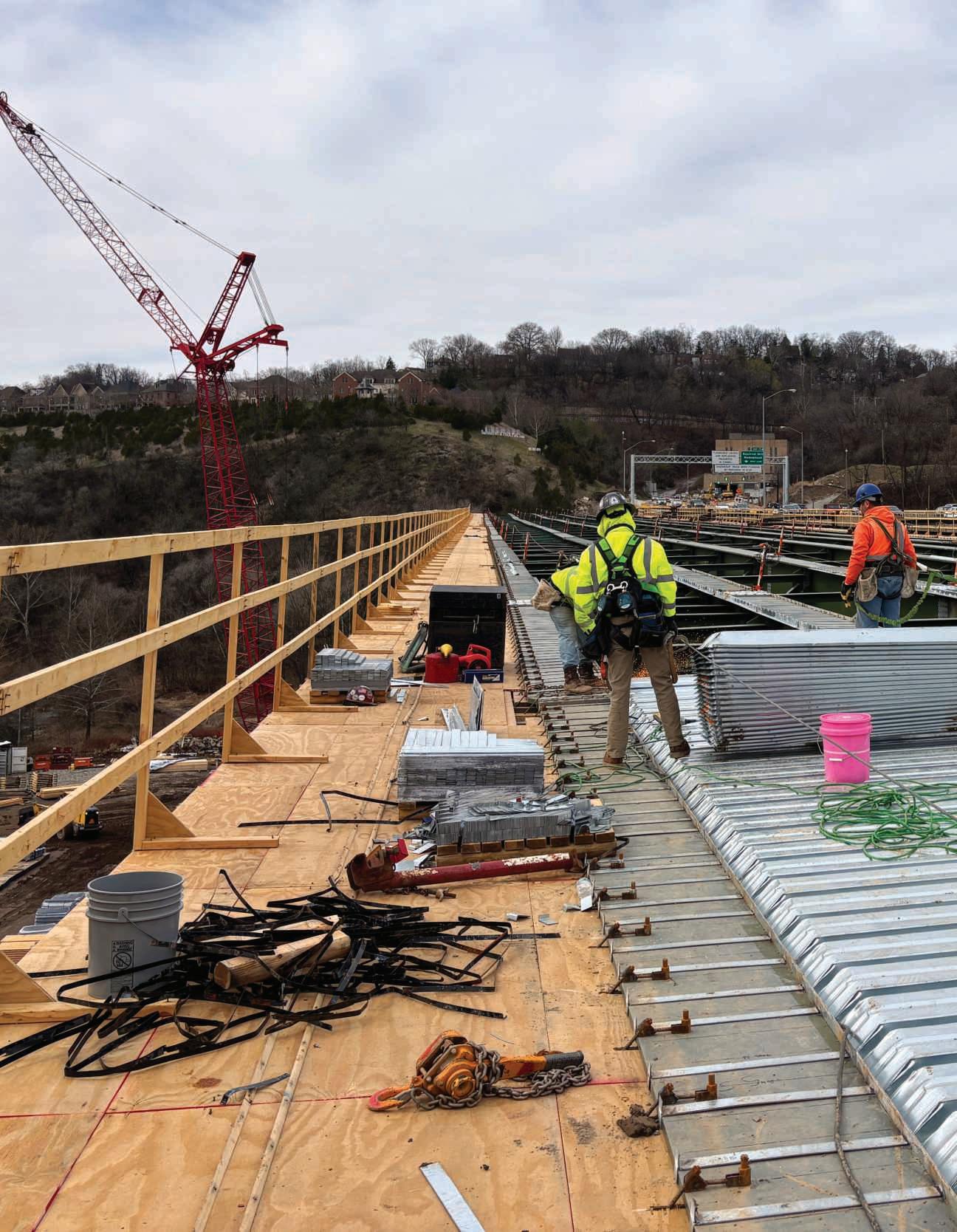
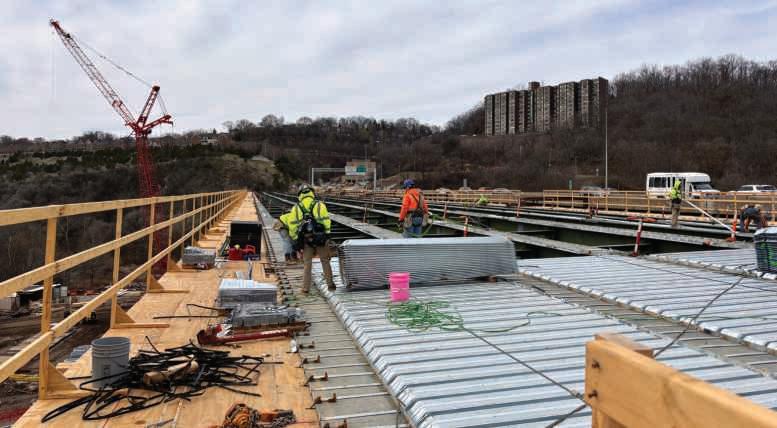
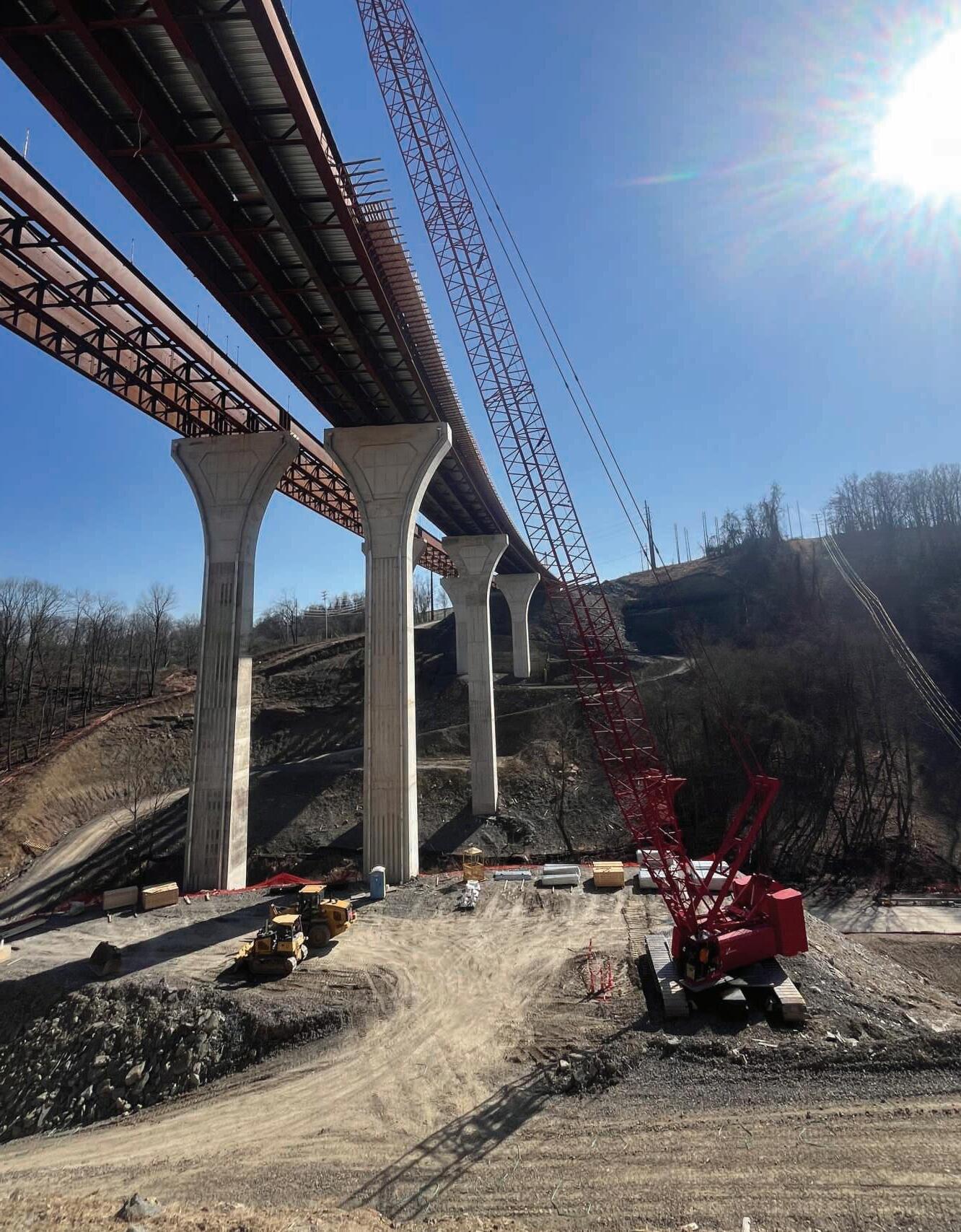
On the cover: Ongoing PennDOT work on the “sliding bridge” upgrade outside the Squirrel Hill tunnel. Image courtesy of PennDOT.



IEDITO R’S NOTE
doubt I am breaking any new ground pointing out that there’s a lot of waste within the federal budget. In fact, I’d be genuinely shocked if anyone disagreed with that statement.
I’d wager fiscal quarrelling is more philosophical in nature: what is waste? What should hard-earned taxes fund versus what they should not.
We aren’t touching that topic with a twenty-foot pole except to point out that few lump infrastructure into that category. For decades, it has had broad support across wide swathes of the electorate. In 2021, one of the most politically divisive years in the history of the Republic, fully 75 percent of Americans supported spending more federal money on infrastructure.
Repairing bridges is not in the same bucket as funding avant-garde theater in Uzbekistan or subsidizing boutique alpaca ranches outside Cheyenne. It’s popular and you can win elections on it. Yet, strangely, securing consistent and adequate funding seems to be an intractable problem.
This may stem from the fact that a huge chunk of the federal infrastructure budget is heavily tied to a per-gallon fuel tax whose rate was set when Neil O’Donnell quarterbacked the Steelers. Changing that rate is political poison, but inflation has eaten away at its value and that fund now ends up $20 billion in the red every year. By the end of 2028, it’s estimated that it will run a $40 billion annual deficit.
Backfilling that shortfall in advance to enable states to plan ahead is one of the main reasons Congress steps in with large transportation bills. The Infrastructure Improvement and Jobs Act is the most recent of these and passed with much fanfare in 2021.
The IIJA doled out $1.2 trillion in funding, giving the states five years of financial framework to build around. It enabled a lot of good infrastructure but expires this September. If a new bill is not passed before then, it’ll likely be months to years of last-minute emergency funding and unproductive drama coming from a body of elected officials whose constituents all pretty much agree that we are in serious need of updating our infrastructure.
Typically during these periods, states tighten their belts. Lettings drop. Instead of building and improving, they maintain. The longer it drags—and again, sometimes it takes years— the less work gets done.
Given the current state of affairs, a gap between the IIJA and whatever comes next seems likely. And I regret to inform you that the forecast gets cloudier. A big part of the IIJA windfall came from an additional $550 billion pulled from the general pool of taxes. This money was injected into the regular infrastructure funding and was a boon for a wide variety of infrastructure projects.
A lot of the regional work over the past few years is the direct result of this cash and probably would not have occurred without it. But even with that extra funding, a lot of the local work was maintenance only.
And this money would not be included in any emergency funding discussions that may occur if the IIJA lapses. Even when a new bill is passed, if that money is not explicitly placed back into said new bill, it evaporates on the first of October.
Complaining about D.C. is a fool’s errand but it’s all so absurd. Pretty much everyone wants this, agrees it’s needed, and there’s plenty of money to do it. Yet here we are, hoping for the bare minimum. Again.
Maybe I am wrong. It’s happened once before. Perhaps a new spending bill will pass, and this pessimistic polemic will prove silly by Halloween. I hope so. Because once the work slows down, it’s harder to get it moving again.


REGIONAL MARKET UPDATE
The latest local employment data showed the Pittsburgh region entered 2026 on relatively stable footing, although total payrolls dipped on a monthover-month basis. Total nonfarm employment stood at 1.19 million jobs in January, down from 1.21 million in December, but still up 0.3 percent compared to a year earlier.
The Pittsburgh MSA unemployment rate stood at 3.6 percent in December, unchanged from November and down from 4.6 percent in August. Overall, the latest figures point to a labor market that remains relatively healthy, but one where growth is increasingly concentrated in a handful of sectors rather than broadly distributed across the economy.
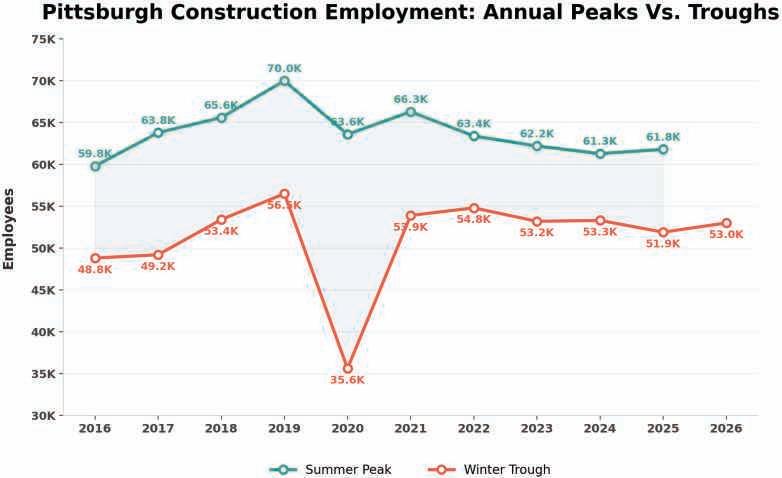
Construction employment came in at 53,000 jobs in January, down seasonally from 56,000 in December but up 2.1 percent from the same month a year ago. Education and health services remained the region’s largest growth sector, with employment up 1.8 percent year-over-year, while financial activities also posted a 1.3 percent annual gain.
first quarter of 2026, with contacts expecting continued modest growth in the months ahead. Manufacturing and commercial construction were among the strongest areas, with multiple firms reporting that data center construction has become a major source of demand, particularly for metal products, electrical components, and infrastructure work. Commercial construction demand also remained supported by senior housing, multifamily projects, and a gradual improvement in office leasing as more firms sought in-person workspaces.
At the same time, contacts described a more uneven broader economy. Consumer spending was generally flat, with retailers, restaurants, and auto dealers reporting that high living costs and affordability pressures continued to weigh on demand. Employment levels were mostly unchanged overall, although some construction and professional services firms added workers while others reduced staff because of soft demand and cost pressures. Wage growth remained moderate, while businesses continued to face elevated costs for insurance, utilities, professional services, food, and materials, with several manufacturers specifically citing tariffs and steel costs as a growing concern.
CHALLENGING OURSELVES TO EXCELLENCE AND BEING THE LEADER IN THE MECHANICAL CONSTRUCTION INDUSTRY










Other sectors continued to show signs of softness. Trade, transportation and utilities employment was down 0.9 percent from a year earlier, while professional and business services slipped 0.1 percent and manufacturing remained slightly negative at -0.2 percent. Information employment continued to weaken, down 3.3 percent year-over-year.
According to the Federal Reserve Bank of Cleveland Beige Book released in April, economic activity across the Fourth District, which includes Pittsburgh, increased modestly in the
Business bankruptcy filings in the Pittsburgh region rose sharply in the first quarter of 2026, increasing more than 21 percent year over year to 62 total cases across the Western District of Pennsylvania, up from 51 in the first quarter of 2025. The mix included 34 Chapter 7 liquidations, 23 Chapter 11 reorganizations, and 5 Chapter 13 filings tied to sole proprietors. Nationally, the pattern is similar: commercial bankruptcies rose 14% year over year, with Chapter 11 filings jumping 37%, reflecting what industry observers describe as a still expanding but increasingly uneven economy where financial strain is building beneath the surface.
Regional banking data suggests that economic activity remains intact, but the underlying tone is shifting. At PNC Financial Services, loan growth remains strong—up roughly 11% year over year— indicating that businesses are still borrowing and projects are still moving forward. At the same time, banks are benefiting from higher lending margins as
Source, BLS
rates remain elevated, reinforcing that credit is still available but not cheap. However, early signs of caution are beginning to emerge beneath the surface: credit loss provisions are ticking higher, and charge-offs have started to rise modestly,
signaling that financial stress is beginning to build even as overall credit quality remains stable.
Recent filings from F.N.B. Corporation indicate that while overall lending activity remains steady, it is no longer broad-based.
According to the bank’s Q1 2026 earnings release, commercial real estate balances declined by roughly $299 million even as commercial and industrial lending increased, pointing to a shift away from new development and toward operating businesses. At the same time, credit metrics are beginning to move modestly in a weaker direction, with slight increases in delinquencies, nonperforming loans, and chargeoffs noted in both the earnings release and accompanying call transcript, alongside higher loan loss reserves.
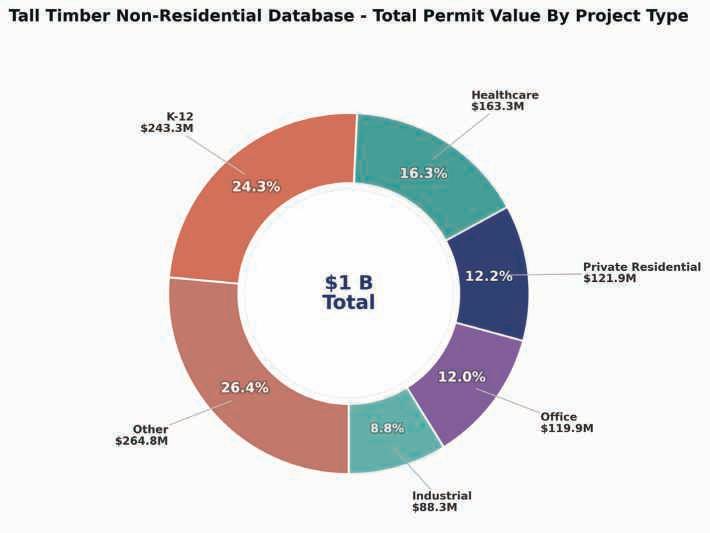
According to April data from Tall Timber Group, the total permit value of projects currently underway in the Pittsburgh region stands at just over $1 billion, with activity concentrated

across several key sectors. K-12 construction leads at $243 million, followed by healthcare at $163 million and private residential at $121 million. Office projects account for $119 million, while industrial development totals $88.3 million. An additional $264 million falls into other project categories, rounding out a construction pipeline that remains active but diversified across sectors.
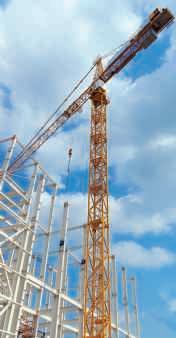
Construction is now underway on the proposed $10 billion Homer City redevelopment project in Indiana County, where crews have moved beyond underground foundation work and begun aboveground construction on what is expected to become the nation’s largest natural gas-fueled power plant. Kiewit Power Constructors Co. currently has roughly
1,200 workers onsite building the 4.4-gigawatt facility and accompanying hyperscale data center campus across the site’s 3,200 acres. While initial plans called for the plant to begin generating power in 2027, project officials now expect the facility to come online in 2028.
Another major power project is beginning to take shape in Western Pennsylvania, although far fewer details are available than with Homer City. In March, the White House announced plans for “South Mon,” a proposed $17 billion natural gas
Source: Tall Timber Group
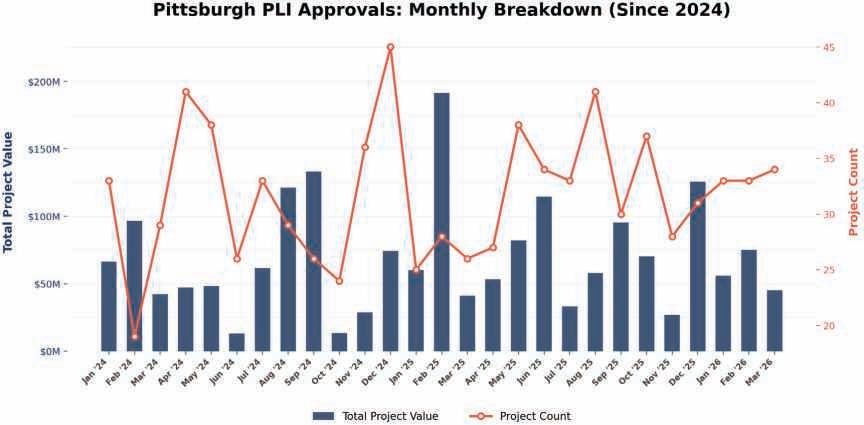
Source: WPRDC
Industry Intelligence. Focused Legal Perspective. Unparalleled Value.



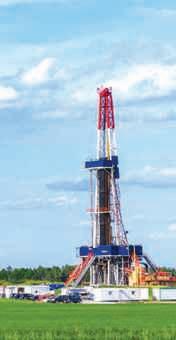

generation hub in Southwestern Pennsylvania that would be operated by NextEra Energy Resources and produce up to 4.3 gigawatts of electricity. The facility is expected to connect into existing Marcellus and Utica pipeline infrastructure and feed power into the PJM Interconnection grid, with the stated goal of supporting rising electricity demand tied to data centers and other large industrial users. No site has been publicly identified, no construction timeline has been released, and major questions remain surrounding permitting, transmission capacity, equipment supply chains, and whether the project can move quickly enough to meet near-term demand growth.
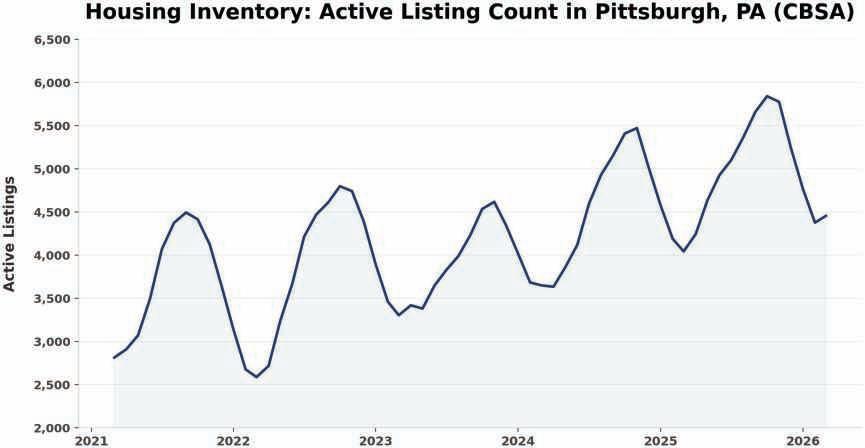
Housing inventory in the Pittsburgh region increased steadily over the past 12 months before easing slightly at the start of 2026. Active listings stood at roughly 4,575 in January 2025 and climbed through the spring and summer, reaching 4,928 in June and more than 5,300 by August. Inventory peaked in October at 5,842 active listings before slipping modestly to 5,246 in December.



City of Pittsburgh permit activity remained active through the first quarter of 2026, although the total value of projects fluctuated considerably from month to month. January saw 33 permits issued with a combined value of roughly $55.8 million, followed by another 33 permits in February worth nearly $74.9 million. March produced 34 permits totaling about $45.1 million. On average, individual project values ranged from roughly $1.3 million in March to about $2.3 million in February.
Looking back at late 2025, permit values were generally stronger, even when the number of permits was similar. December 2025 included 31 permits worth roughly $125.6 million, while September saw just 30 permits but nearly $95.3 million in total value. That suggests that while the overall volume of permit activity has remained relatively steady, the market has been driven by a smaller number of large projects in certain months. According to the latest permit data from City of Pittsburgh, March represented a slower month in terms of overall dollar value even as the pace of permit issuance held relatively steady.
Allegheny County home sales slowed considerably over the past year after a stronger summer and early fall market. Sales peaked at 2,150 transactions in June 2025, with July and August both remaining near 1,850 sales. Activity then began to taper off through the fall, falling to 1,242 by December.
The seasonal slowdown carried into early 2026, with January recording 1,146 sales, February improving slightly to 1,376, and March dropping to just 1,030 sales, the weakest full month of the past year.
The market has tightened again in early 2026, with active listings falling from 4,768 in January down to 4,455 in March. Even with that recent pullback, available inventory remains slightly above where it stood a year ago. That suggests the Pittsburgh housing market is seeing somewhat more supply than it did during the tightest periods of the past several years, although listings still remain relatively constrained by historical standards.
At the same time, median sale prices remained relatively resilient despite the decline in transaction volume. Prices peaked at $290,000 in June 2025 and generally held in the $265,000 to $285,000 range through the second half of the year. Conditions softened in early 2026, with the median sale price falling to roughly $240,000 in March.
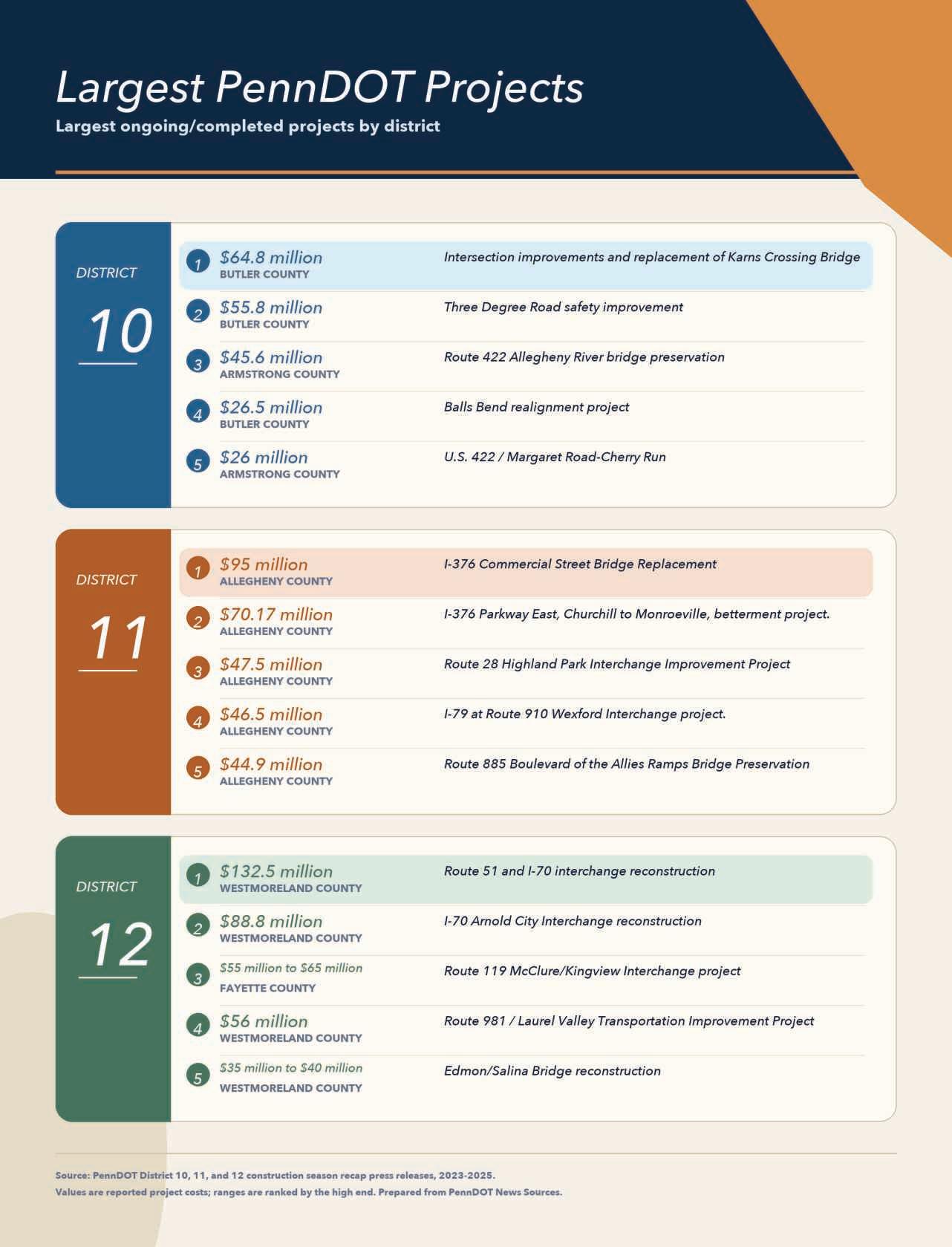
PennDOT released their 2026 lettings plans in early April, which indicate investments of more than $200 million across Fayette, Greene, Washington, and Westmoreland counties in 2026. The work includes 31 new projects, 39 continuing projects, 99 miles of roadway improvements, and 48 bridge projects. The largest projects include the $89 million I-70 Arnold City interchange reconstruction in Westmoreland County, the $53.9 million Route 119 McClure/Kingview interchange project in Fayette County, the $43 million Layton Bridge replacement, and the $40 million to $60 million I-79 preservation project between Waynesburg and Marianna. PennDOT is also putting $6 million into resurfacing and preserving rural roads across the four counties.
Source: St. Louis FRED

Bridge work will remain a major part of the 2026 season. Major projects include the Layton Bridge replacement in Fayette County, the $20 million to $25 million West Newton Bridge rehabilitation in Westmoreland County, the Route 18 bridge replacement over Catfish Creek in Washington County, and the Dunlap Creek bridge rehabilitation in Brownsville. Other work includes paving, drainage improvements, new roundabouts, interchange upgrades, and roadway widening along major corridors including I-70, I-79, and Route 119.
According to the latest data from CoStar Group, Pittsburgh office leasing activity remained relatively subdued entering 2026. The market recorded roughly 647,000 square feet of leasing activity in the first quarter of 2026, down from about 857,000 square feet in the fourth quarter of 2025 and well below the more than 1 million square feet recorded in the second quarter of last year. Secondquarter activity is still early, with about 140,000 square feet completed so far and CoStar projecting a potential fullquarter total of roughly 722,000 square feet. Overall, the latest figures suggest that office leasing demand remains below historical norms even as activity has stabilized from the sharp declines seen over the past several years.
Pittsburgh multifamily construction activity has slowed considerably over the past 24 months. Roughly 8,000 units were under construction in early 2024, but that figure has steadily declined as projects delivered and fewer new developments moved forward. By early 2025, the total had fallen to around 5,500 units, and as of the latest 2026 data, the market has roughly 3,500 units under construction. Demand has by and large kept up with the new arrivals. Pittsburgh’s vacancy rate measured about 6.4 percent in 2024 and is currently hovering at 6.6 percent, indicating that demand for units remains robust. BG
NNATIONAL MARKET UPDATE
THE BIG PICTURE
ational economic indicators remain relatively stable, though there was signs of softening as a fresh geopolitical shock in the Middle East introduced a new layer of uncertainty.
On February 28th, the United States and Israel launched attacks against the nation of Iran after several weeks of threats and military build-up in the region. Iran responded with a barrage of missile and drone attacks across the region, and effectively locking down the Strait of Hormuz, a trade route through which flows one fifth of the world’s oil and gas.
While at the time of this writing, a cease fire had been reached, it can be best described as tenuous. Economists at major financial institutions were quick to model the potential fallout, though estimates vary widely depending on how long the disruption persists and how high energy prices climb.
Even a short conflict is expected to weigh on global growth, though the impact on the U.S. should be less severe than comparable energy shocks in prior decades, according to Wells Fargo. Oil prices reacted sharply to the upheaval, and their baseline forecast calls for prices to settle roughly 30 percent above year-end 2025 levels, dragging global GDP down to 2.9 percent from a prior 3.0 percent estimate.
Wells Fargo economists also expect energy shortages to push inflation above 3 percent in 2026, with risks rising significantly if oil prices approach $130 per barrel. At more moderate levels—around $85 per barrel—the firm estimates the impact on U.S. personal consumption expenditures would be roughly half as severe as similar shocks in the 1980s, reflecting a structural shift in the economy.
Other forecasts highlight the downside risks if the conflict persists. Analysts at J.P. Morgan estimate global GDP could
fall by 0.6 percentage points if disruptions extend beyond 30 to 60 days—a threshold that was quickly crossed. Goldman Sachs similarly projects U.S. growth slowing from 2.4 percent to 2.2 percent if oil reaches $100 per barrel, while increasing the probability of a recession by roughly 25 percent. A PNC report from the same period characterizes the conflict as a “general shock to the system,” though it still expects the U.S. economy to weather a limited engagement.
Across forecasts, the common thread is increased fragility. Slower growth, higher inflation, and rising uncertainty begin to converge, raising the risk of stagflation. Most project slower consumer and business spending, partially offset by increased government and energy infrastructure investment, resulting in fourth-quarter growth of around 1.8 percent.
Meeting minutes from the Federal Open Market Committee’s March 2026 gathering show policymakers opted to hold the federal funds rate steady, signaling no immediate move toward rate cuts despite earlier market expectations.
The discussion reflects a committee increasingly focused on emerging risks rather than a single dominant trend. Participants noted that while economic growth remains steady and unemployment has held relatively stable, inflation continues to run above target, with recent readings showing upward pressure. At the same time, job creation has slowed, with some weakness attributed to temporary disruptions but broader concerns beginning to surface around labor demand.
Much of the board’s conversation centered on uncertainty. Participants pointed to the recent geopolitical conflict and resulting surge in energy prices as a key variable shaping the outlook, with oil price volatility seen as a potential driver of both inflation and weaker global growth. Financial markets responded accordingly, with a higher implied path for interest rates and declines in equity prices, particularly in technology sectors tied to ongoing AI-related disruption.
Views within the Committee were not uniform. While most supported holding rates steady given the current balance of risks, a minority raised the possibility of easing policy, should labor market conditions deteriorate.
A March Federal Reserve report found that tariffs pushed consumer prices slowly rather than all at once, with Chinese imports showing the sharpest increases. Using item-level
spending data from 200,000 U.S. households matched with product-origin details, the study built a Fisher Price Index that closely tracks the official PCE deflator for food, reinforcing the dataset’s credibility. The analysis shows that inflation for imported goods was near zero before April 2025, but after tariff announcements, prices for Chinese goods rose steadily,
reaching about 8.5 percent year over year by December, with at least 30 percent of tariff costs passed through to consumers. The report suggests retailers are still absorbing part of the added cost, which may mean further price increases could continue to emerge over time rather than appearing as a single spikes.
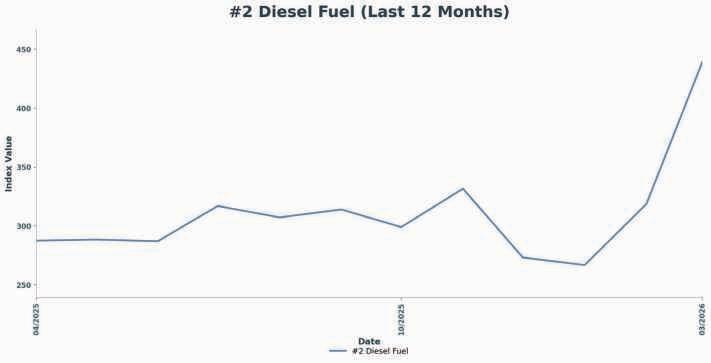
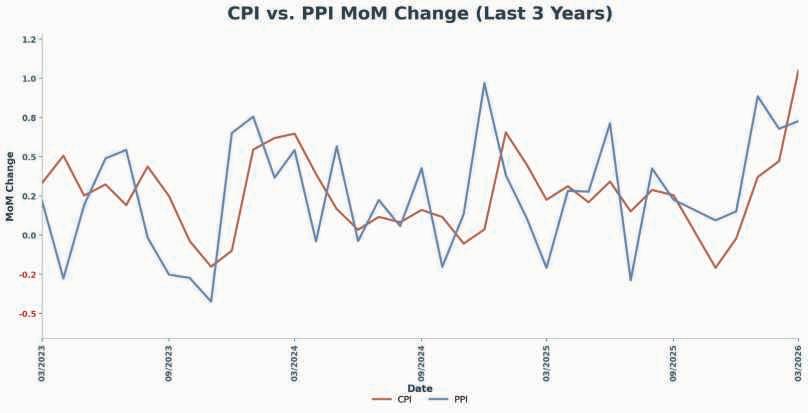
The latest data from the Bureau of Labor Statistics (BLS) indicates the Consumer Price Index has moved by one percent from February to March and is up 3.5 percent year over year. March’s data also reveals that the Producer Price Index has moved by 0.7 percent from February to March and is up four percent year over year.
This surge is largely attributed to a near-record increase in

diesel fuel prices and rising prices for key metals. A report from the Association of General Contractors highlighted the pressure on contractors due to these escalating costs, and Ken Simonson, the association’s chief economist, noting that “the staggering jump in fuel costs only reflects prices as of mid-March,” indicating the volatility the conflict is bringing home.
Gas prices were felt strongly by the consumer. The University of Michigan’s Index of Consumer Sentiment was one of the lowest levels on record, below readings taken during the financial crisis and COVID-10 pandemic. Sentiment fell 6.6 percent from last month and over 4.6 percent from last year.
The BLS March Employment Situation Report showed the economy added 178,000 jobs while the unemployment rate held steady at 4.3 percent. On the surface, the labor market remains stable, but the underlying growth is narrowing, with gains concentrated in a limited number of sectors rather than broadly distributed.
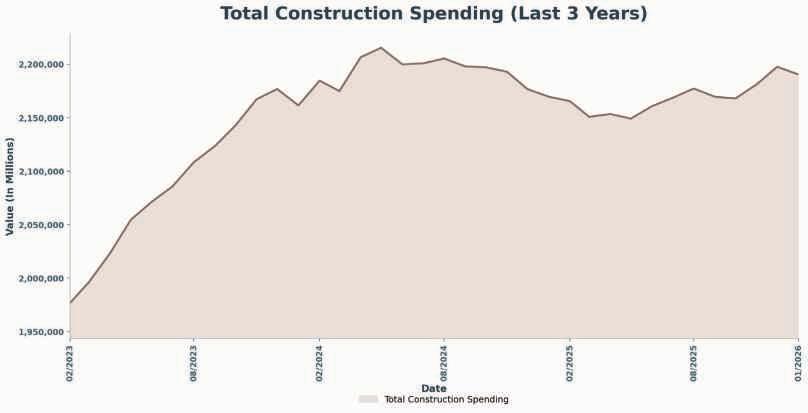
Construction spending picked up at the end of 2025 before easing slightly in recent months.
Source: Federal Bureau of Labor Statistics
Producer Price Index jumped sharply due to spiking oil prices while the Consumer Price Index also rose noticeably. Source: Federal Bureau of Labor Statistics
Health care led the way with 76,000 new jobs, transportation and warehousing added 21,000 jobs, while social assistance contributed another 14,000 positions. Offsetting those gains, federal government employment continued to contract, falling by 18,000 jobs in March and down more than 355,000 since late 2024. Financial activities also declined, shedding 15,000 jobs.
For construction, the report offered a more positive signal. The industry added 26,000 jobs in March after a year of relatively flat hiring, suggesting contractors are still bringing on workers despite elevated borrowing costs, ongoing pressure in commercial real estate, and uncertainty surrounding future federal infrastructure funding. Construction stood out as one of the few major sectors posting meaningful gains, reinforcing the sense that project pipelines remain active even as other parts of the economy begin to soften.
At the same time, wage growth continues to moderate. Average hourly earnings rose 0.2 percent in March and are up 3.5 percent year-over-year, while the average workweek edged down slightly to 34.2 hours. Together, the data points to a labor market that continues holding steady but gradually cooling beneath the surface.
April’s ADP National Employment Report showed privatesector employers added 62,000 jobs in March, reinforcing the view of a labor market that is still growing but at a measured pace. Hiring was led by education and health services, which added 58,000 jobs, followed by gains in information (+16,000) and leisure and hospitality (+7,000).
Elsewhere, the picture was weaker. Trade, transportation, and utilities saw a sharp decline of 58,000 jobs, while manufacturing shed 11,000 positions. Regionally, hiring was negative across both the Northeast and Midwest, pointing to uneven momentum across the country. Growth also remained concentrated among smaller firms. Small businesses added 85,000 jobs, while medium and large employers both reduced payrolls, suggesting that much of the hiring strength is coming from the lower end of the market.
A March report from Associated Builders and Contractors indicates that its Construction Backlog Indicator rose to 8.1 months in February, reflecting a 0.1 month increase from January but a 0.2 month decrease from February 2025. This data comes from an ABC member survey conducted from February 20 to March 6.
The report highlights a sharp increase in backlog for the Middle States, which includes states like Illinois, Indiana, and Ohio, marking it as the only region with higher backlog than one year ago. Furthermore, ABC’s Construction Confidence Index showed improvements in sales and staffing expectations for February, although profit margin expectations declined. All three components remain above the growth threshold of 50.
ABC Chief Economist Anirban Basu noted that while backlog has rebounded from a four-year low in January, it is still low by historical standards, emphasizing the Midwestern region’s unexpected economic growth post-pandemic. He mentioned that contractors engaged in data center projects have longer backlogs (11.2 months) compared to those in other sectors (7.6 months).
Basu expressed cautious optimism regarding profit margins
over the next six months but raised concerns about potential challenges stemming from rising oil prices which could affect hiring expectations that had recently improved, reaching their highest level since March 2025.
A March report from Dodge Construction Network shows that planning activity pulled back at the start of 2026, before construction activity rebounded a month later. The Dodge Momentum Index (DMI)—a monthly measure of nonresidential projects in planning, based on a three-month moving average and typically leading construction spending by one to 18 months—fell 7.3 percent in February to 250.0, down from a revised 269.8 in January.
Commercial planning declined 8.9 percent, while institutional planning slipped 4.0 percent. Dodge Associate Director Sarah Martin noted that “planning momentum continued to normalize… after a surge in activity in the back half of 2025,” suggesting the pullback reflects cooling rather than a broader contraction. Despite the monthly decline, the pipeline remains elevated, with the index up 18.7 percent year-over-year and institutional activity still showing notable strength.
That softer planning data was followed by a rebound in actual construction activity. According to Dodge’s April 17 report, total construction starts rose 12.8 percent in March to a $1.22 trillion seasonally adjusted annual rate. The increase was driven largely by nonbuilding construction, which surged 37.9 percent on the strength of several major electric power and utility projects. Nonresidential building starts rose a more modest 6.3 percent, while residential construction edged up 2.6 percent, supported by multifamily gains even as singlefamily activity declined.
Taken together, the two reports point to a market that is stabilizing rather than accelerating. Planning activity has cooled from late-2025 highs, with broad-based declines across commercial and institutional sectors, while construction starts remain uneven and heavily influenced by large, project-driven swings—particularly in infrastructure and energy. Risks tied to costs, labor availability, and geopolitical uncertainty continue to weigh on near-term confidence, but the still-elevated planning pipeline suggests that stronger construction spending may reemerge further out.
A late April report from the Associated General Contractors of America (AGC) indicates that construction employment increased in 30 states and the District of Columbia between February 2025 and February 2026. Twenty states experienced job growth from January to February 2026. However, association officials noted signs of slowing construction activity in various regions.
For now, the economy remains stable, but underlying distress signals are present. Growth is slowing, risks are rising, and momentum is increasingly uneven across sectors and regions. In construction, that translates to a market that is still active, but more volatile and more selective than it appears at first glance. Further shocks to oil could make a serious impact, so the key variable now is the conflict with Iran. How long it persists will influence its effects on energy prices and global trade. BG
INFRASTRUCTURE BUILT TO LAST
For generations, PJ Dick, Trumbull, and The Lindy Group have built the infrastructure that keeps our region moving forward, from roads and bridges to the spaces where people live, work, and connect.
With a commitment to quality, innovation, and service, we help strengthen the communities we proudly serve every day.
PJ Dick | Trumbull | The Lind y Group

WHAT’S IT COST?
In March 2026, construction pricing showed a mixture of steady trends as well as dramatic increases across certain materials and service categories, largely pertaining to the ongoing conflict in Iran.
Looking first at the overhead economic indicators, the Producer Price Index (PPI) for Final Demand rose by 0.7 percent month-over-month and by 4.0 percent compared to a year ago. This is the sharpest uptick since the summer of 2025, and the third time this has occurred since the Trump administration’s implementation of sweeping tariffs in April of last year.
The Consumer Price Index (CPI-U) increased 1.0 percent on a monthly basis and stood 3.5 percent higher than last year. This is the first time since 2022 that the CPI has risen by over one percent month over month and is likely being driven by the remarkable uptick in fuel prices experienced in March.
Pricing hikes in fuel had a broad impact on construction inputs. Among Construction Indexes and Inputs, Inputs to Construction Industries, Energy recorded sharp increases of 23.5 percent month-over-month and 22.4 percent over the last year. Additionally, #2 Diesel Fuel showed a extraordinary monthly gain of 37.8 percent and an especially large yearover-year increase of 51.2 percent.
Asphalt at Refinery moved up slightly by 0.5 percent month-over-month but declined by 12.3 percent compared to last year. The remaining asphalts series experienced minor month-over-month changes with no significant annual shifts. Truck Transportation of Freight increased by 1.0 percent month-over-month and by 6.2 percent year-over-year.
Turning to Construction Types, Power and Communications Structures increased 2.1 percent from February and posted a 5.1 percent lift over the year. Other construction types demonstrated limited monthly and annual movement.
In the Contractors/Services categories, Concrete Contractors recorded a year-over-year price increase of 5.3 percent and a month-over-month rise of 0.5 percent. In the concrete indexes, Precast Concrete Products rose 1.2 percent month-over-month and 7.9 percent yearover-year, while other concrete products showed limited movement on both monthly and annual bases.
The metals sector showed several prominent gains amongst numerous inputs. Aluminum Mill Shapes rose 1.2 percent month-over-month and 34.1 percent on a yearly basis. Steel Mill Products increased substantially by 2.1 percent month-over-month and 15.4 percent year-over-year. Fabricated Structural Metal for Non-Industrial Buildings and Fabricated Structural Metal Bar Joists and Rebar each gained approximately 2.8 percent month-over-month with mid-teens increases year-over-year, 15.2 percent and 14.6 percent, respectively.
Steel Pipe and Tube rose 0.9 percent monthly and 9.6 percent annually. Fabricated Structural Metal increased 1.9 percent on the month and 7.8 percent year-over-year. Stainless and Alloy Steel Scrap showed a noteworthy 6.2 percent monthly gain but a modest 2.4 percent increase over the year. Fabricated Structural Metal for Bridges declined by 2.1 percent month-over-month and 6.1 percent year-over-year. Sheet Metal Products experienced a 1.4 percent monthly and 6.0 percent yearly rise. BG
INFR ASTRUCTURE:
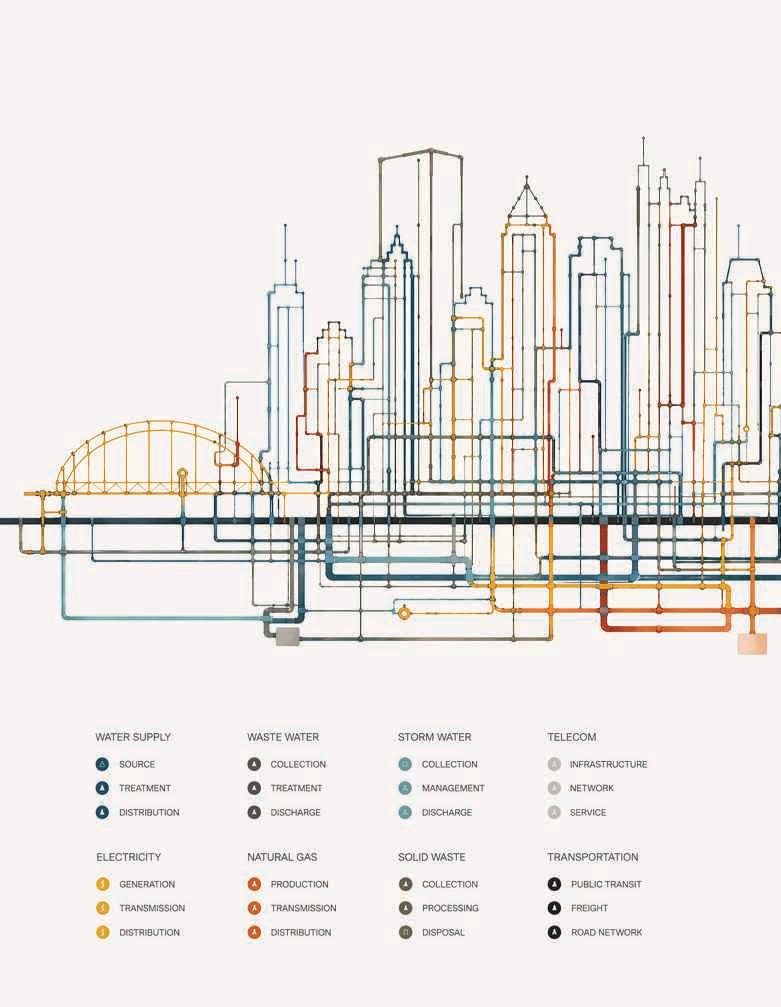
Cautious optimism abounded the last time we touched on the topic of infrastructure in the spring of 2023. Congress had recently unleashed over a trillion dollars via the Infrastructure Investment and Jobs Act (IIJA), allowing the states to update and maintain the mundane yet essential systems that keep the country functioning.




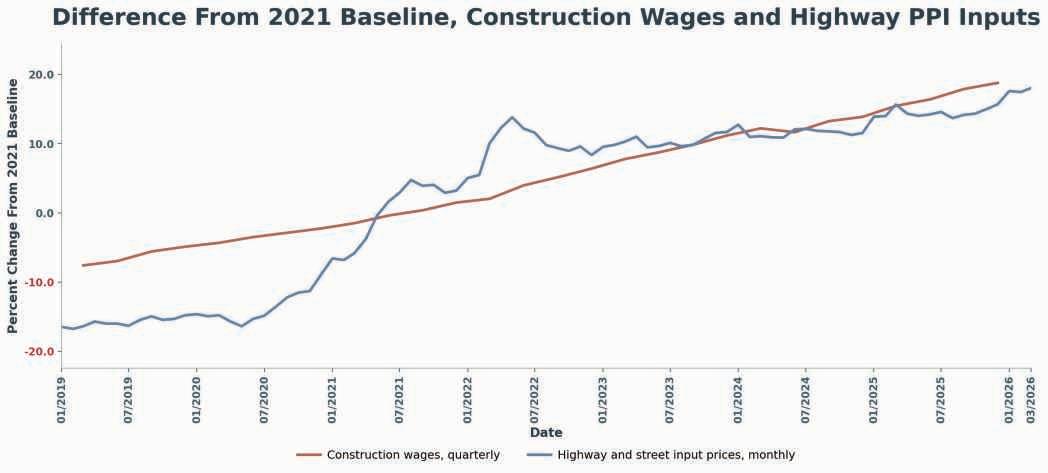
wages and highway construction costs have risen dramatically since the passing of the IIJA. Source, BLS
And while the good vibes were somewhat tempered by real concerns—chief among them inflation— there was still a sense that a new cycle of public works was gearing up. Now, three years later, with the curtain closing on the IIJA, we can look back on what it helped bring to Western Pennsylvania, what’s still to come, and the significant funding issue that will likely arrive in the fall when it expires.
Passed to tremendous fanfare in 2021 after 13 months of emergency funding extensions, the IIJA replaced the expired Obama-era FAST Act. Heralded as a benchmark in infrastructure spending, the new bill allocated roughly $1.2 trillion over the course of its five-year fiscal window. About half of that continued existing surface transportation programs, with a half a billion extra pulled from the general fund for highways, power, transit, bridges, and water.
That type of dough is dizzying and having it locked in like that gave the states the certainty they needed to plan infrastructure projects years in advance. And they did. Over the past five years, thousands were completed. Across the nation, more than $400 billion was put into surface transportation, $86 billion into transit, and billions more into bridges, airports, and energy.
But the impact didn’t land as cleanly as hoped. Getting a major infrastructure build from paper to pavement takes time, which allowed pandemic induced inflation to claim its pound of flesh.
From the start of 2021 to March of 2026, construction costs rose sharply across both materials and labor. A BLS pricing index tracking inputs to highway and street construction increased roughly 26 percent during that time. And over that same period, construction wages rose by just over 20 percent.
A 2025 report by the Urban Institute found the IIJA windfall was seriously dulled by the rising construction costs. When
adjusted for the pricing spikes, the researchers found only a limited increase in additional highway and street infrastructure was achieved, along with evidence of a decline in passenger and freight rail investment.
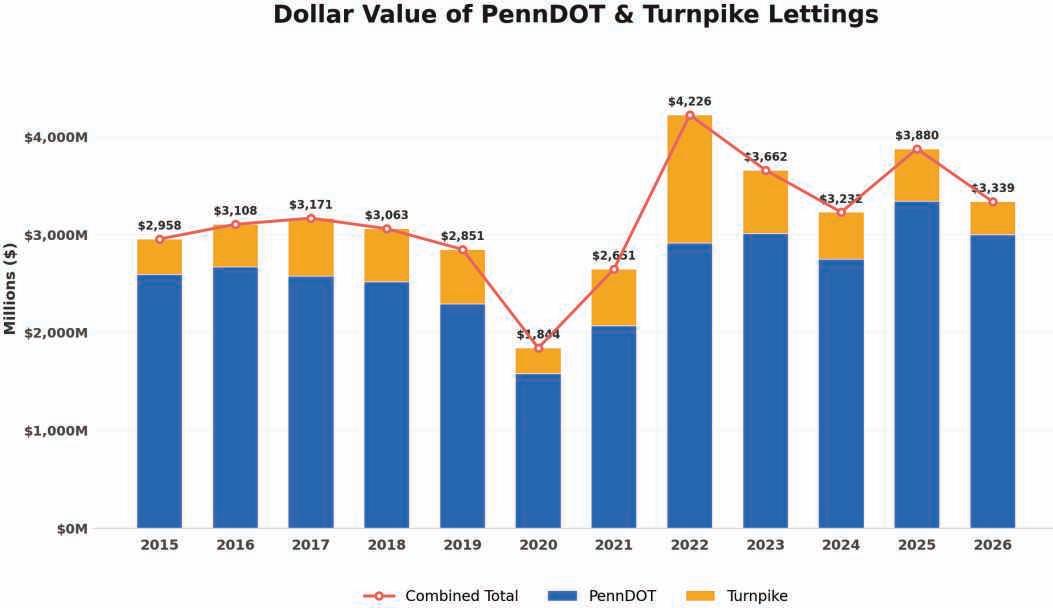
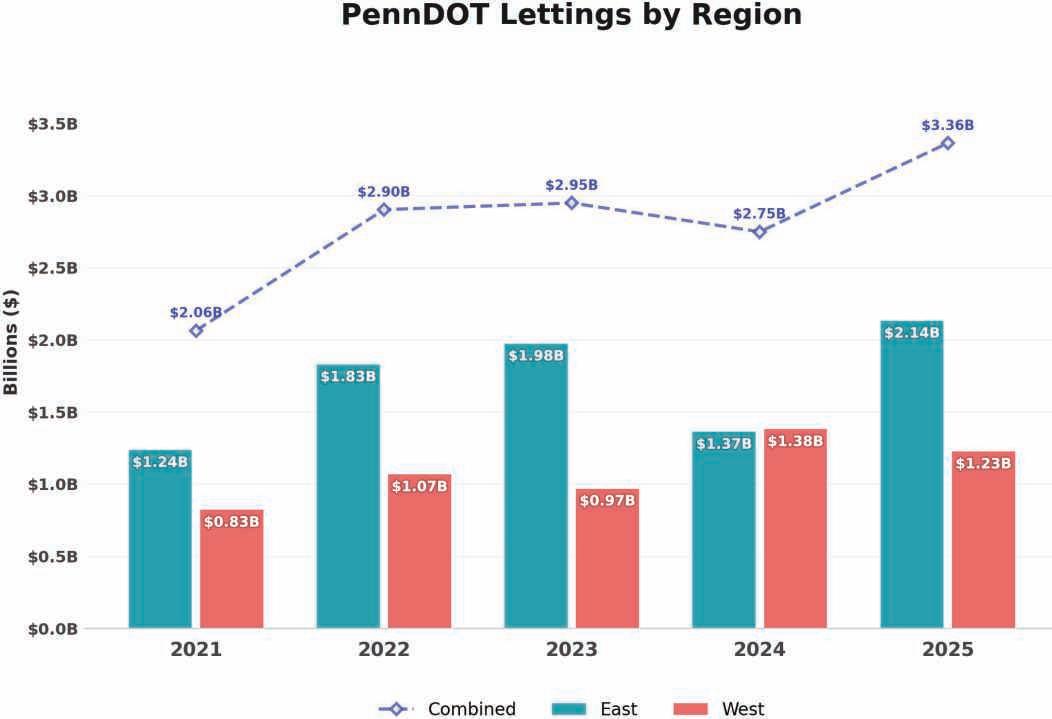
Diluted or not, that money was put to work across Pennsylvania, most notably on its highways. Beginning in 2022, PennDOT lettings jumped dramatically. From 2022 to 2025, annualized highway letting averaged about $3.006 billion, a 19.5 percent jump from the annualized average between 2016-19.
However, just because the spigot is on doesn’t mean everyone gets a full cup.
“When you have historic funding, you try to get big things done,” said Rich Barcaskey, President of the Constructors Association of Western Pennsylvania (CAWP).
And the state did, in fact, do very big things. Mainly in Philadelphia and Harrisburg. Since 2021, roughly 61 percent of all PennDOT highway lettings were focused on the state’s eastern districts. In 2025, it was nearly 65 to 35 percent split. In 2026, the east/west split will be closer to 70-30.
“Is there more money going into PennDOT highway lettings over the last two years,” said Barcaskey. “Yes. Has it all been coming to Western Pennsylvania? No.”
Enough of it came through to get some major road work done. Some brand-new builds, but much of it in unglamorous yet essential maintenance. That is part of the game in infrastructure, says Jason Zang, Executive Director of District 11 for PennDOT.
“It’s like fixing your car. Your car breaks down and you spend $1,200. Then you’re like, ‘What did I get for $1,200. I got the same car.’ That’s what it’s like fixing a bridge sometimes.”
Construction
That quote succinctly describes most of the work done across Western Pennsylvania throughout the IIJA’s tenure. Resurfacing, rehabilitating, and stabilizing major roadways. Essentially, handling a hundred different CHECK ENGINE lights across the system.
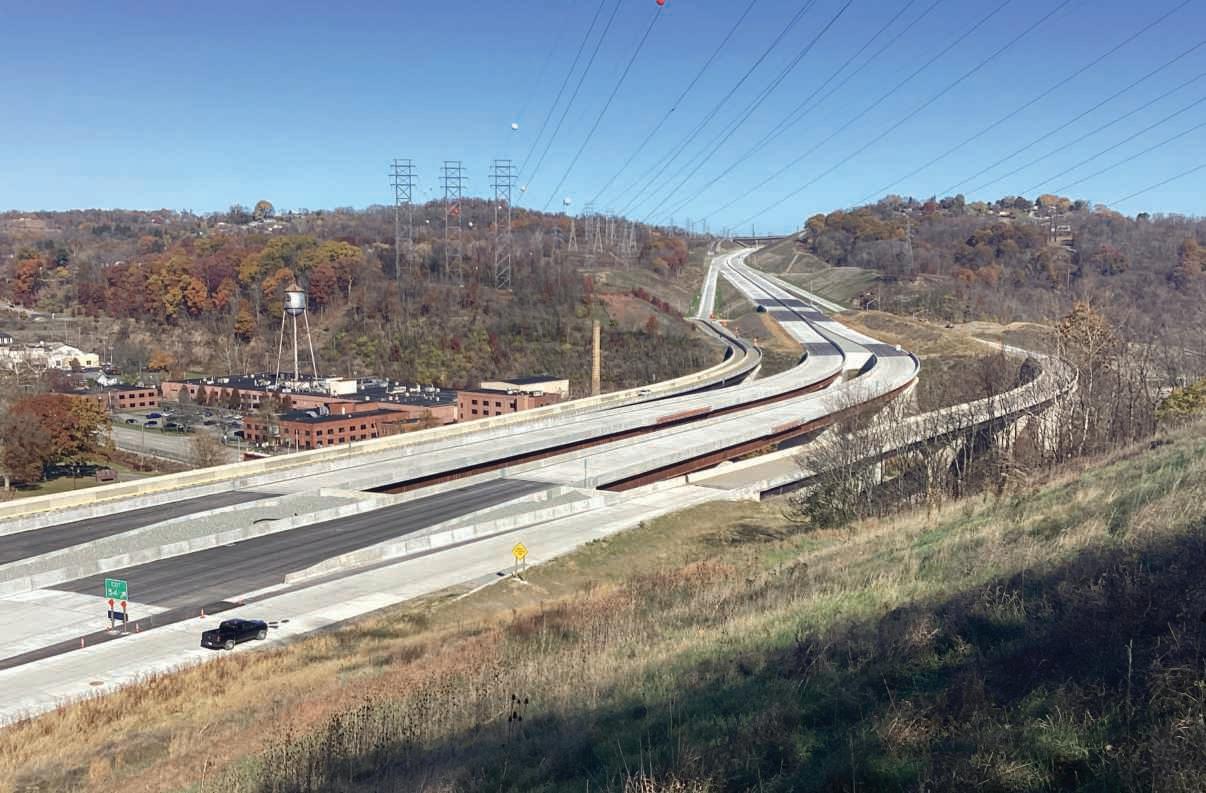
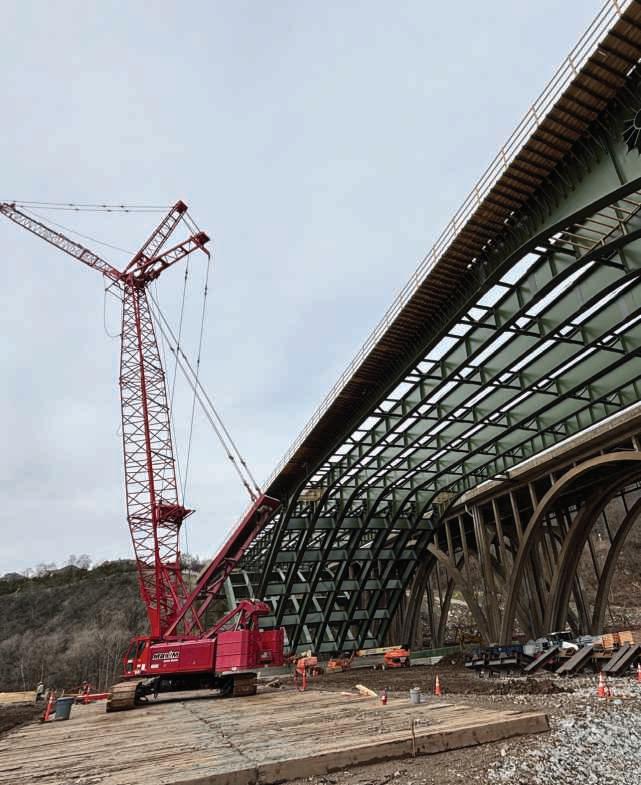
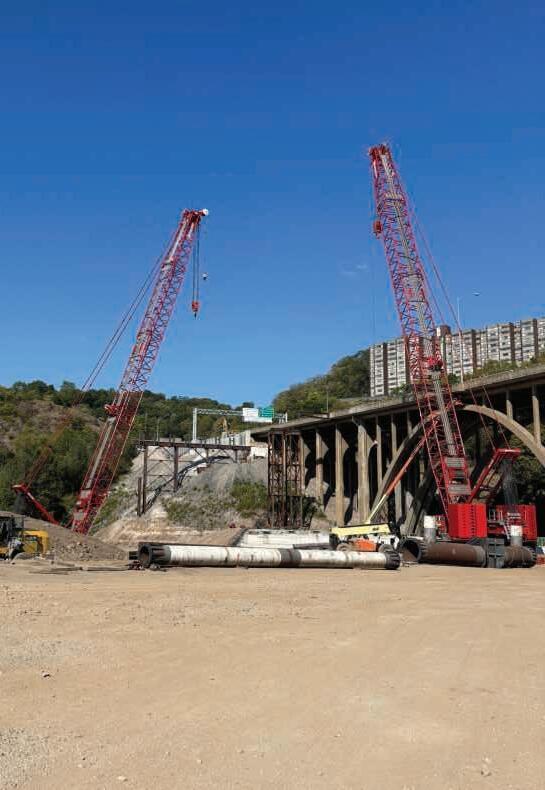
That’s not meant to be flippant about the essential nature of the highway work PennDOT performed, nor the complexity involved in making these projects happen. The slide-in bridge near the Squirrel Hill tunnel is an absolutely incredible feat of engineering, but it is still replacing an old thing with a new one.
Projects like this—or the $36 million “Bathtub” flood mitigation downtown—are not designed to expand the system, but to keep it from failing. These types of crucial projects are what’s in the pipeline in the coming years as well. PennDOT’s five-yar plan shows the upcoming slate is dominated by corridor repairs, bridge preservation, slide stabilization, and targeted safety upgrades across Allegheny, Beaver, Washington, and Fayette counties.
Beyond the purview of PennDOT there was a major expansion of the transportation network. The Mon/Fayette Expressway is a long-running Pennsylvania Turnpike project aimed at reconnecting communities in the Mon Valley that were left economically isolated after the collapse of the steel industry. Built in phases since the late 1980s, the highway currently runs from West Virginia to Jefferson Hills, with construction now advancing north toward I-376 near Pittsburgh.
The buildout is happening section by section, with multiple
active construction zones between Jefferson Hills and Duquesne that include new interchanges and major roadway infrastructure. Even before the full connection to I-376 is complete, each segment is expected to deliver immediate benefits by shortening travel times, improving local circulation, and reducing dependence on inefficient back roads.
But infrastructure isn’t just roadways. Water and power are essential components of what makes West PA run day to day. And some of the largest projects of the past few years have revolved around them.
The Allegheny County Sanitary Authority’s (ALCOSAN) Clean Water Plan represents one of the most consequential infrastructure efforts underway in the Pittsburgh region, with more than $2 billion in investment aimed at addressing a decades-old problem.
The county still relies heavily on a combined sewer system, where storm and waste water share the same pipes. During heavy rain events, that system becomes overwhelmed, sending untreated overflows into the Allegheny, Monongahela, and Ohio rivers. The plan is designed to dramatically reduce those discharges through a combination of expanded treatment capacity, system upgrades, and regional coordination, bringing the system into compliance with federal water quality standards.
The plan hit a major milestone with the completion of the North End Facilities Project at the Woods Run treatment plant. Completed in 2025, the new facility increases the

POWER ON POWER ON POWER ON
Highway and turnpike lettings volume over the past decade. source Pennsylvania Highway Information Association
plant’s secondary treatment capacity from 250 million to 295 million gallons per day, allowing the system to handle significantly higher volumes during wet weather events.
Over the next five years, ALCOSAN will shift into its most complex and capital-intensive phase, centered on construction of a regional tunnel system designed to capture and store excess flows during storm events. This work will be paired with continued upgrades to interceptor lines and conveyance systems to move greater volumes of wastewater to the treatment plant, along with additional improvements to plant operations to handle those flows more efficiently. At the same time, municipalities across the region will continue implementing source control measures, including sewer separation and green infrastructure, aimed at reducing the amount of stormwater entering the system in the first place.
Pittsburgh Water also recently announced they had secured $31.5 million in funding from the Pennsylvania Infrastructure Investment Authority in early 2026 to replace lead service lines in four neighborhoods, while also advancing more than $89 million in water main replacement work across Elliott, Crafton Heights, West End, Hazelwood, South Side Slopes, South Side Flats, and Troy Hill. The 2026–2027 program will replace 11.1 miles of aging water mains, along with 120 fire hydrants, 662 valves, and 1,607 water service lines.
The recent awards are part of a much broader wave of water infrastructure investment occurring across Pennsylvania. In the PENNVEST 2024-2025 Annual Report, they note approving more than $1.08 billion in funding during fiscal year 2024-2025 alone, the largest annual total in the agency’s history. Drinking water projects made up the largest share of that activity, with 74 projects totaling roughly $698 million, while another 46 sewer projects accounted for nearly $295 million.
Another infrastructure component to keep an eye on is power. Construction is now underway on the Homer City data center project, where developers are building a $10 billion, 4.4-gigawatt natural gas-fired power plant alongside a large hyperscale data center campus on the former coal plant site. Roughly 1,200 workers already onsite, and the plant expected to begin producing in 2028. At the same time, the Trump administration recently announced plans for a separate $17 billion natural gas-fired project somewhere in southwestern Pennsylvania that would produce up to 4.3 gigawatts of power.
Both these projects are to feed power to data centers, and artificial intelligence is pushing Pennsylvania’s electric market into a period of major transition. For years, the state benefited from abundant natural gas, a large fleet of coal and nuclear

Highway lettings spike noticeably after the IIJA’s passage, but that money was not evenly split across the state. Source: Constructors Association of Western Pennsylvania


plants, and a relatively stable demand outlook.
But this is changing rapidly as electricity demand is now rising faster than utilities and grid operators expected. Older dispatchable power plants continue to retire, while most new projects entering the pipeline are solar and battery facilities rather than traditional gas-fired generation. Pennsylvania currently has more than 7,100 MW of solar projects and 3,000 MW of battery storage projects waiting in the interconnection queue, compared to only about 372 MW of new natural gas generation.
“As demand for data centers accelerates, we’re seeing a ripple effect across the construction industry,” said Tim O’Brien, CoCEO of PJ Dick – Trumbull – The Lindy Group. “These facilities require complex, large-scale infrastructure, and that translates into more work, jobs, and opportunities for skilled trades in our region.”
But it’s also creating a dilemma for grid planners. Solar and batteries can help meet demand, but they do not provide the same around-the-clock reliability as gas, coal, or nuclear plants. As electricity needs rise, the debate in Harrisburg is increasingly shifting from how much power to add to what type of power the state should prioritize.
Making tough choices on what type of infrastructure to fund could be a reoccurring theme in the coming years, so let’s close out by circling back to the beginning. The IIJA will expire in September. If a new bill is not passed before then, there will likely be a noticeable slowdown on infrastructure work in the coming years.
Here’s why: most highway infrastructure funding comes from the Highway Trust Fund (HTF). This pool of money is dispersed across the nation to fund road construction and surface transportation. Its revenue is generated by a $0.193 cent tax on every gallon of gasoline you purchase, and the $0.28 a gallon truckers pay when filling up their rig with diesel.
Those rates were set in the early 90’s and have proven too politically toxic to raise. The problem is that it is no longer near enough. Over the past thirty years, vehicles have become more fuel efficient and development costs have risen significantly, while inflation has eaten away at the contribution value. The tax would have to rise to $0.41 cents and $0.58 cents a gallon today just to match the 1990’s value. Consequently, the HTF is roughly $20 billion in the red every year and the Association of General Contractors believes that by 2028 the fund will be running a $40 billion annual deficit.
This gap is typically covered by Congress reallocating money from the country’s general fund of tax revenue, which is where things like income and business taxes flow into.
While that gets the job done it fundamentally changes the nature of the program. Since the funds are no longer raised solely by drivers via fuel; political machinations enter the picture. Who gets what and where the backfill money come from. That introduces uncertainty about funding, which keeps states from planning too far ahead.
Bills like the IIJA alleviate most of that, until they expire. Then Congress has to periodically provide emergency funding until the next bill passes. If no new infrastructure spending bill is passed between now and October, the last thirty years provide an unpleasant clue as to what will happen next.
In between each of the last five major spending bills were periods of time, ranging from six months to three years, when Congress kicked the can rather than pass a new bill. Since 1997, the federal transportation funding program has operated on short term extensions for roughly 7.5 years.
In our current political climate, skepticism on the odds of a new bill being passed upon the IIJA’s expiration in the months before congressional mid-terms is quite warranted. If nothing
is done, then core infrastructure spending will continue being funded through extensions, but historically, this has caused a drop-off in lettings.
And there is a significant chance that even if a compromise is reached and congress passes a new bill; it will be significantly less than the IIJA. Rumors out of D.C. from advocacy groups following such things are that a new spending bill is being fleshed out with a value around $500 billion. This heavily tentative figure is about half of what the IIJA sent into infrastructure.
And there’s more. The IIJA was remarkable in part because of a provision called Division J, which allocated hundreds of billions for infrastructure including an additional $184 billion in general funding to the states through the Department of Transportation. This money cannot be extended in the way that funding for the HFT can. It must be re-legislated, and if it isn’t, it evaporates on October 1st of this year.
For Pennsylvania, that will cut off a lot of bridge repair and maintenance funding. The special pool allocated about $26 billion for bridge repair to be given across the states, and the Commonwealth received about $1.6 billion of it. This enabled the Commonwealth to upgrade and provide much needed maintenance on its 3,000 plus bridges in poor condition.
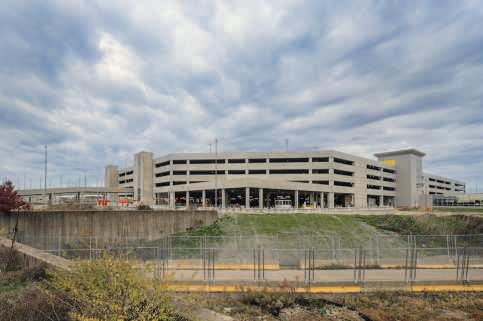
A bridge slide-in outside the Squirrel Hill Tunnel image courtesy of PennDOT

“We rely on those infrastructure bills,” says Zang. “If something doesn’t get passed, that has a direct impact on the projects that can be designed and constructed. It’s always a balancing act. When you direct funding to bridges, there’s less going to the roads.”
The sentiment is echoed by local contractors.
“This past year has been a strong one, with consistent work that’s kept our teams working and projects moving,” said Trumbull Corporation President Mark Gentile. “Looking ahead, a focus on dedicated, focused, and equal funding is needed, which will give us the confidence to plan ahead and invest in our future workforce, so that we can continue to deliver quality transportation improvements.”
Much of the Division J money was doled out in awards, and it wasn’t just highway related. A look at the IIJA awards tracked by the Brookings Institute through 2024 shows that Pennsylvania received about $20.8 billion, with $14.9 billion in additional funding for transportation, $1.6 billion for broadband, and $1.3 billion for flood control and $1.27 billion for clean water.
Allegheny county received over $462 million, with $142 million going to the eastern Pittsburgh multimodal corridor project, $50 million going to the Bus Rapid Transit corridor build in Downtown, and $20 million toward the airport. Beaver county received $858 million for lock and dam work. PennVEST’s annual report explicitly states their increase in water improvement projects have been driven by IIJA awards.
PennDOT appears to be planning for a drop off in funding assistance from D.C. An examination of the planned lettings data in their 12-year plan shows anticipated lettings peaking this year at $16 billion, then dropping to around $12 billion per year into the 2030’s. (statewide_annual_ penndot_lettings_anticipated)
This is a 25 percent baseline percent reduction in the funding used to maintain one of the most complex infrastructure networks in the state. That will be compounded by the likely loss of nearly a billion sent to the western PA region from the Division J funding.
Taken together, the outlook until the next update is now cautiously pessimistic.
After a brief surge of historic investment, the next few years will potentially look far more familiar: less certainty, tighter funding, and a continued focus on sustaining an incredibly complex system. BG


Designed and Built on Getting Results
For more than a decade, DFL Legal has delivered smart, effective solutions for complex construction and engineering disputes. We bring big-case experience with the efficiency and flexibility of a boutique firm—so you get results without the excess. Put our experience to work for you.

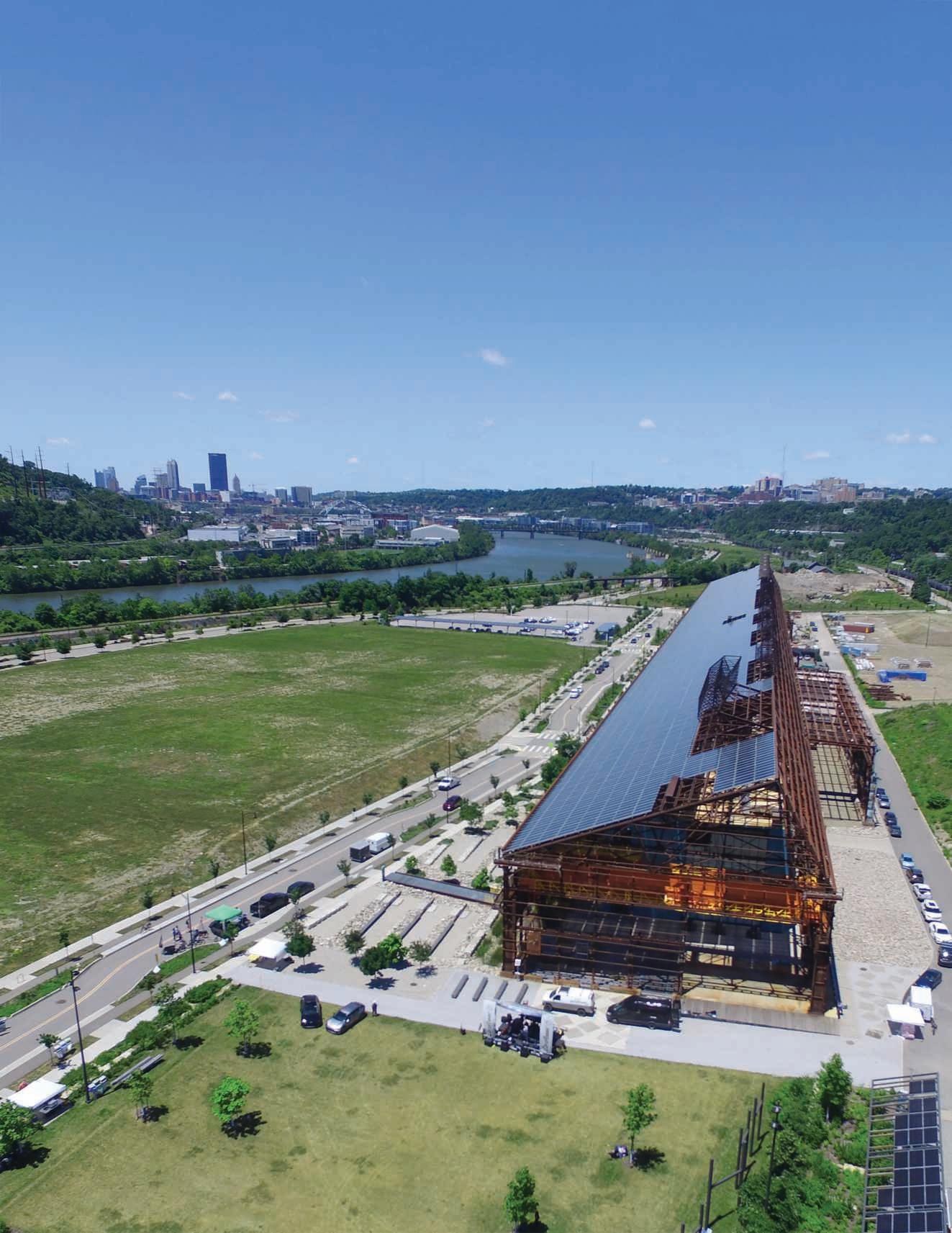
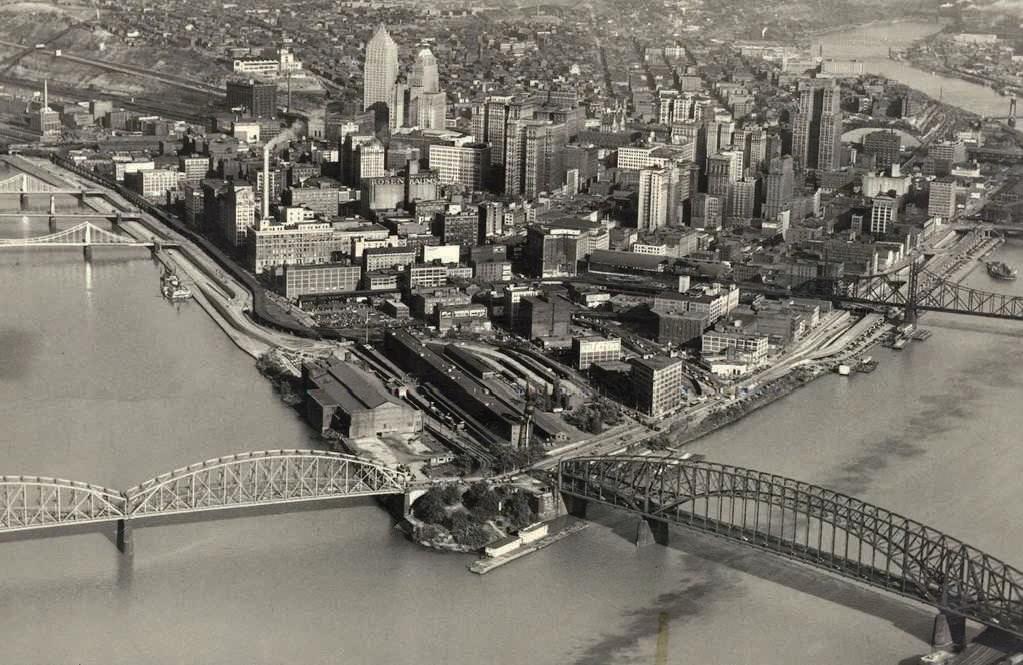
Lifelong locals scarcely notice Pittsburgh’s landscape. Hills. Rivers. Ridges. After a couple years, it’s blasé. But these tranquil features, forged by prehistoric tectonic violence, quietly impact every aspect of how the city functions. Where you can go, what you can build, how you can move.
Their impact is particularly pronounced Downtown, whose hills are wedged inside a narrow interfluve carved out by the Allegheny and Monongahela. Possessive and occasionally temperamental, these ancient Appalachian arteries are why Pittsburgh exists at all.
They carried the barges hauling coke to the mills and their juncture births the Ohio, which brought the steel to the Mississippi, who dispersed it across a nation reforging itself with railroads, bridges, and skylines.
Though it is an ever-fading memory, steel still silently shapes this city. Its barons required riverfront factories, warehouses, rail yards, and terminals to service their mills. They also needed banks, insurers, brokers, and lawyers nearby to pay for it all.
Their real estate needs compounded Pittsburgh’s peculiar geographic constraints further, forcing the city’s roadways into a distorted grid so as to accommodate the large industrial parcels along the water while the inland business core evolved into a tighter street network built around foot traffic.
In that grimy heyday, people without means walked to work. The lower portion of Downtown near First Avenue was filled with small tenements, boarding houses, and rowhomes for workers. The same was true for the neighborhoods surrounding downtown. Places like the Strip, the Hill, and Uptown emerged because they could support laborers daily commute.
And since the mills were filthy and the rivers flooded, those with means wanted distance. Pittsburgh’s early elite emigrated to enclaves like Shady Side and Squirrel Hill. Institutions that serviced (or were founded by) them followed their money, setting up in a place where there was still plenty of room to build: Oakland.
For much of Pittsburgh’s history, there was never really much of a need to efficiently connect the two nodes. Steel was booming, the wealthy enjoyed their isolation, those feeding the furnaces had more immediate concerns, and the universities were respected but not yet globally influential.
That logic no longer holds. Steel is a ghost, and the universities are the economic engines propelling Pittsburgh forward. Oakland is pretty much maxed out on development, and while downtown remains the financial hub, it long ago ceased to be a dense residential hub.
Photo courtesy of Independence Excavating
As streetcars and bridges and tunnels and automobiles arrived on the scene, commuting from further out became easier. People who could leave the Downtown cauldron did. Offices gradually replaced housing until the city became overly reliant on the office sector. Its economy revolved heavily around commuters, property taxes, parking garages, and lunch crowds.
For years, this was a known but manageable concern. City leaders had been nursing downtown’s live/work/play environment back to health since the early 2000’s, and by late 2019, it felt like Pittsburgh might soon stand on its own two feet again.
By spring of 2020, it looked like the city would soon be back on life support. The novel coronavirus was a global tragedy, and its timing for this city was particularly cruel. The widespread and permanent adaptation of remote/hybrid work dealt a body blow to office demand, the prime driver of downtown multifamily and retail. It also immediately ratcheted up the economic pressure, as officials began warning of mounting fiscal issues stemming from post-pandemic property reassessments.
But as this area knows all too well, the only way out of hard times is bulldozing through them. Fortunately, since the problem had been on the radar for decades, a plan was already in the works.
In 2011, the Pittsburgh Community Reinvestment Group pointed out that to properly prosper, Pittsburgh needed much stronger transit links between Downtown and Oakland. If reliable transit between the two nodes were established, a powerful corridor would be created, allowing jobs and housing to evolve within it.

While civic leaders were well aware of what the fix was, the aforementioned existing historical and geographical constraints meant it would be easier to reroute the Allegheny than build new roads or rails. So, what to do?
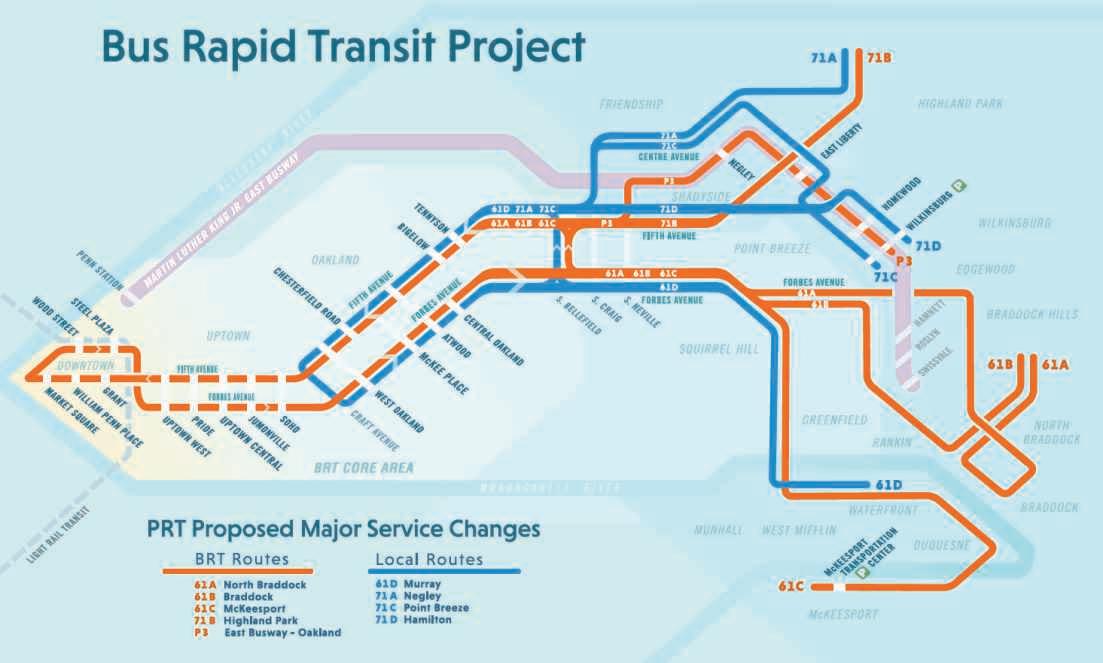
Make the existing transit infrastructure smarter and more efficient, that’s what. And in this city, there’s only one real way to do this: buses. And how do you make busses smarter? Well, this is exactly what the Pittsburgh Regional Transit’s four-phase University Loop aims to accomplish.
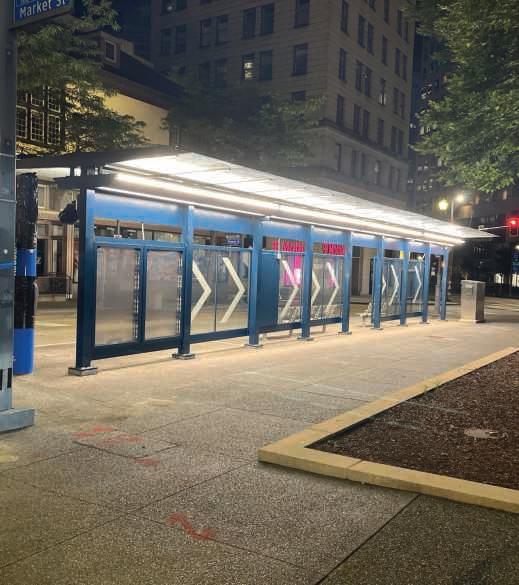
The University Loop is part of the Bus Rapid Transit (BRT) program and has been in the works for nearly a decade. Construction on the first stage Downtown wrapped up in 2025, and work on the second in Uptown has already begun. The final stage will be in Oakland itself, and the end result, hopefully, is a bus system between the two regions that is as smoothly dependable as rail.
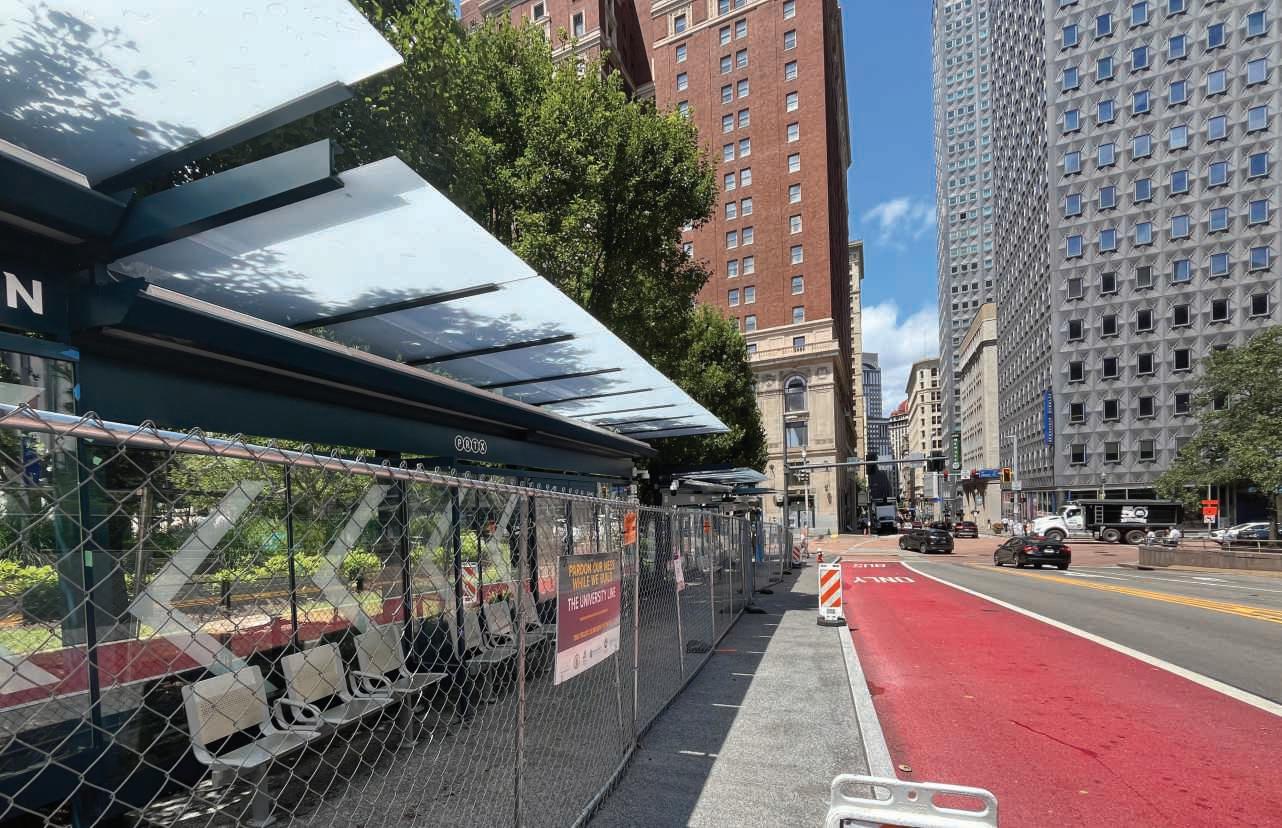
The first step toward that lofty ambition is creating consistency. That required carving out a bus-only lane into Downtown’s streets. The reason is obvious: without a dedicated space of their own it is impossible for a bus to avoid a myriad of traffic induced delays.
These delays create uneven spacing between vehicles on the same route, which is a significant problem. The technical term is bus-bunching and what happens is this: A slightly delayed bus makes more pick-ups as people accumulate at its stops. These extra pick-ups slow it down and create more drop-offs, delaying it further.




But the buses behind it pick up no one and breeze through their routes, eventually ending up a couple lights behind the first bus. That leads to uneven passenger loads and timing degradation, which makes the bus unreliable. So, people avoid it altogether and drive, which creates more traffic, compounding the cycle further.
To remedy this, the new downtown route essentially spliced a one-mile loop through the heart of the city, effectively reversing the flow of bus traffic and streamlining nine downtown routes into a single funnel.
Inbound service now enters on Fifth Avenue near the BNY Mellon building and runs west toward Market Square before turning onto Liberty Avenue and heading to the K&L Gates tower. From there, the buses quickly bounce onto Wood Street before getting onto Sixth Avenue, passing the Duquesne Club and the courthouse before exiting downtown on Forbes Avenue and heading out via Uptown.

to achieve all of this was insane.
Building out the BRT wasn’t a matter of spray painting “bus only” on some downtown lanes and then plugging Claude into some lights and calling it a day. It was heavy duty infrastructure, the unglamourous work of ripping up roads and sidewalk and rerouting massive underground pipes.
A dedicated lane alleviates some of the issues, but it isn’t good enough for what the city needs. In order to set the standard in public transport, the buses must be intelligent. Another major component of this project was the modernization of downtown’s signal systems. Fiber optic cables were to be connected to new signals, linking intersections to an intelligent behind the scenes system that enables them to communicate and operate as a coordinated network rather than as isolated timers.
The result is a shift from static traffic control to one that can respond in real time to live street conditions. Intersections can not only detect buses, they also know how many people are on the bus. They can hold lights longer for a full vehicle and
“The main piece of the job,” said Matt Allanson, a project manager at Independence Excavating, the general contractor for the first phase of the BRT University Loop, “is what you can’t see.”
Independence Excavating is a Cleveland-based heavy civil contractor that has been operating since 1956, specializing in large-scale excavation, site development, demolition, environmental remediation, and infrastructure construction.
The company’s Pennsylvania branch has been involved in major operations across the region for many years, including heavy work on the Southern Beltway, the new airport, and demolishing a Neville Island coal mine. They were certainly not strangers to


when labor and business are aligned. At Pittsburgh Works Together, we cover the impact of labor and business on Western PA’s economic health. Access research briefs, data insights and expert analysis at pghworks.com .

IN A WORLD WHERE RESILIENCY IS
NEEDED MORE THAN EVER,
unique work, but ripping apart urban roads and putting them back together definitely created unique challenges.
The team’s top priority from the outset was safety.
“The streets of Pittsburgh are narrow,” said Allanson. “There’s pedestrians all over the place and traffic’s whizzing by only a foot away from the guys working.”
Maintaining safety in that type of environment required a high level of coordination and planning and attention to detail. Working crews were cramped into tight corridors with live traffic often just feet away, all the while managing heavy equipment inside narrow open trenches adjacent to critical infrastructure tie-ins.
Every movement, whether shifting a lane, setting barriers, or staging equipment, had to be carefully controlled. Traffic, pedestrians, and active bus operations all had to continue while construction moved forward, forcing the team to plan each phase of work with precision.
They established a disciplined communication structure early, with daily field coordination, weekly progress reviews, and consistent engagement with the owner and construction manager. Controlled work zones, clear routing, and constant monitoring allowed construction to coexist with daily city life without compromising timelines or safety.
That rhythm created real-time visibility across teams, allowing issues to be identified early and resolved before they could impact schedule or operations. Leadership also emphasized clearly defined roles, accountability, and open input from the field, creating an environment where problems were surfaced quickly and solved collaboratively.
Perhaps the most dangerous variable lurked beneath the





Photos courtesy of Independence Excavating
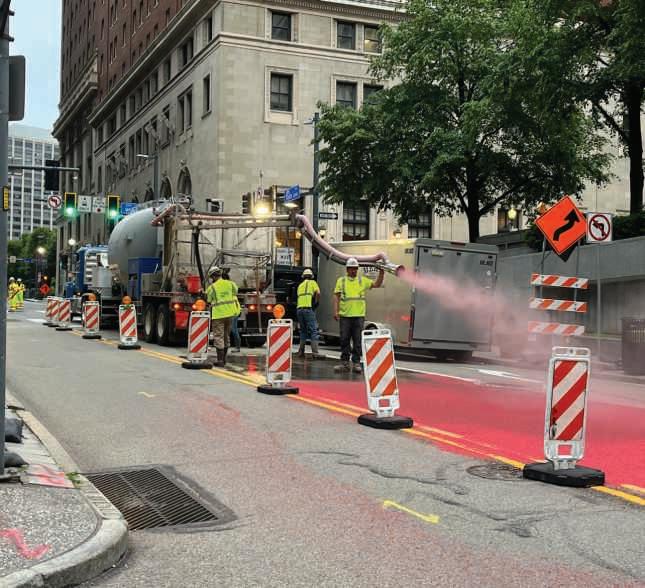
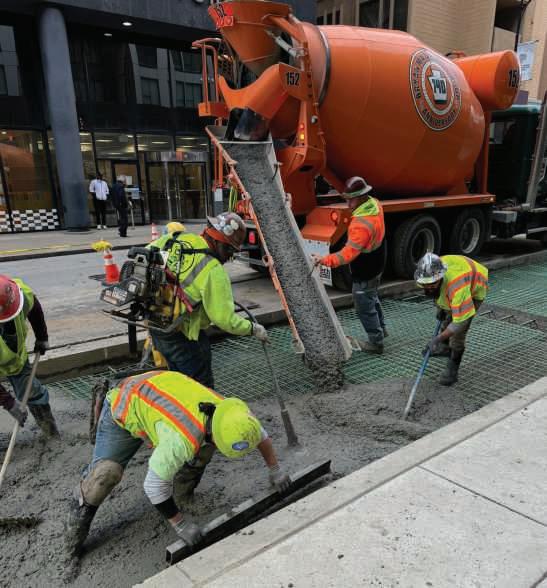
Additionally, the dedicated bus lanes themselves required far more than a fresh coat of paint. Buses exert far greater weight and wear than passenger vehicles, so entire sections of the corridor needed a stronger roadway base before crews could apply the final high-friction red surface treatment that now designated the lanes.
The physical work brought its own challenges. Harsh winter conditions complicated concrete placement, requiring careful scheduling, heated enclosures, and specialized techniques to maintain quality and durability. At the same time, much of the most sensitive work like utility tie-ins and water shutdowns had to be performed overnight, to minimize disruption to surrounding buildings and daily operations. This around-theclock sequencing added another layer of complexity, demanding coordination and a workforce capable of executing critical tasks under tight time constraints.
Incredibly, over the course of roughly 69,000 labor hours, the project was completed without a single incident. Work wrapped up in late 2025, and Independence Excavating was selected as the GC for phase two of the project, which is already underway.
City leaders long involved in nurturing a Downtown renaissance are excited.
“This new connectivity between Oakland and downtown will reduce travel time between the region’s two largest employment nodes from eight to thirteen minutes,” said Aaron Sukenik, vice president of District Development at the Downtown Pittsburgh Partnership.
“But the major opportunity we see is the potential transformational effect over time. We hope to accelerate this transformation of downtown from 66 percent of real estate
square footage being office into a much more mixed-use and balanced live/work/play environment.”
Sukenik nails it. Though a shorter commute is always nice, the real value of the BRT University Loop is not travel time. It’s what the minutes and dependability can build.
In a 2025 report, the Brookings Institution argued that more housing Downtown could help offset some of the pandemic’s financial pressure by bringing more middle-class taxpayers back into the city. If workers and students trust that a clean and safe bus will quickly take them from Downtown to the universities and hospitals and back again, then Pittsburgh’s multifamily demand gets a boost.
New residents would support retail activity, create new streams of tax revenue, and reduce the risk associated with converting dated properties into multifamily. Oakland’s development pressure can begin spilling into the neglected in-between neighborhoods. Commercial opportunities sprout up in Uptown and the Lower Hill. Blossoming areas like the Cultural District and the Strip get even stronger.
Unlike many projects profiled in this magazine, this project’s success won’t be all that visible to the public. It’s not an inspiring church spire to be admired or a classroom that thousands will have memories of sitting in.
Few will remember the years when the city was tearing up its streets or the tough men and women who did the excavating in dangerous conditions through blistering heat and blustering cold. That won’t matter a bit.
If the Downtown Loop helps enable this city to evolve beyond its historic constraints and roll into the future, then this project joins the mountains, rivers, hills and steel as part of Pittsburgh’s DNA. BG

100 years. 3 generations. 1 team.
As we celebrate our first 100 years, we honor the generations of Ferry Electric Company teammates, customers, and partners whose dedication since 1926 has made this milestone possible. Thank you for being part of our story.
Photos courtesy of Independence Excavating
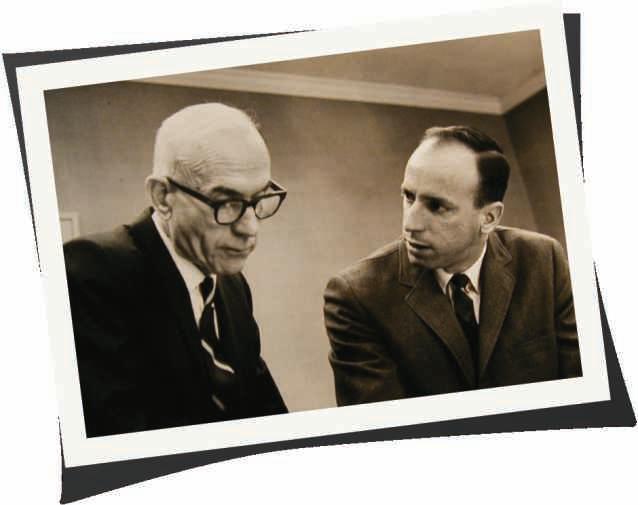
J.J. Ferry & J.R. Ferry circa 1968
J.R. Ferry & J.J. Ferry II circa 1998





TLEGAL PERSPECTIVE
BY RANDAL M. WHITLATCH
he construction industry has spent the better part of the last year reacting to tariffs primarily as a pricing problem—one that disrupted procurement, strained project budgets, and forced a renewed focus on contract language. But since early 2026, the issue has evolved. Tariffs are no longer just a forward-looking risk to be managed. They are now a backward-looking opportunity and, in many cases, a new source of dispute—centered on who is entitled to recover duties already paid and how future exposure is allocated in an increasingly volatile trade environment.
A Shift From Cost Pressure to Cost Recovery



That shift stems from the Supreme Court’s February 2026 decision in Learning Resources, Inc. v. Trump, which invalidated broad-based tariffs imposed under the International Emergency Economic Powers Act (IEEPA). In response to that decision and subsequent rulings in the U.S. Court of International Trade, U.S. Customs and Border Protection (CBP) has begun implementing a formal refund process for duties collected under that authority, including CBP-administered refund mechanisms for unliquidated entries, administrative protests under 19 U.S.C. § 1514, and, where necessary, litigation before the U.S. Court of International Trade.
For construction stakeholders, this development is significant. Unlike prior tariff cycles, when increased costs were simply absorbed or passed through, the IEEPA unwind creates a pathway to recover cash—often at scale. But that pathway is not automatic. It is procedural, time-sensitive, and dependent on customs posture. Most important, it turns on a question the industry has not historically focused on: Who, exactly, has the legal right to claim the refund?
The Importer of Record Problem
In many construction supply chains, the answer is not straightforward. The importer of record—typically the party that filed the customs entry and paid the duties—is the entity entitled to seek a refund from CBP. That party is often not the general contractor, the developer, or even a first-tier subcontractor. It may be a foreign supplier, a domestic distributor, or a specialty fabricator further upstream.
Yet the economic burden of those tariffs was frequently borne downstream, embedded in contract pricing, change orders, or contingency drawdowns. The result is a growing misalignment between who paid and who can recover—a dynamic that is already beginning to surface in disputes.
Why Traditional Contract Tools Fall Short
This is where the construction industry’s earlier focus on tariff-related contract clauses begins to show its limits. Prior
guidance correctly emphasized escalation clauses, force majeure provisions, and Incoterms as tools to manage rising costs. But those tools were largely designed for a unidirectional problem: tariffs increasing prices.
The current environment is bidirectional. Tariffs have been imposed, paid, and, in some cases, invalidated. The question is no longer just how to absorb cost increases—it is how to capture and allocate recoveries.
In many contracts, that issue is simply not addressed. Escalation clauses may allow for upward price adjustments, but they rarely cover whether a contractor must credit the owner if those costs are later reduced through a refund. Procurement terms may define who pays duties at import but remain silent on who benefits if those duties are returned.
That silence can create friction, particularly on large-scale projects where tariff exposure runs into the millions of dollars.
Building Refund Rights Into Contracts
Going forward, construction stakeholders may, and perhaps even should, treat tariff refunds as a distinct category of risk allocation. Contracts may expressly address entitlement to duty recoveries, including whether refunds flow to the party that bore the economic burden, the party that filed the entry, or some combination of the two.
Equally important, agreements may, and perhaps even should, include cooperation provisions requiring upstream suppliers to assist in filing refund claims, provide entry documentation, and pass through recovered amounts. Without that alignment, contractors and owners may find themselves dependent on third parties with little incentive to pursue recovery.
Documentation will play a central role in this process. Refund claims require detailed support, including entry summaries (CBP Form 7501), tariff classifications, country-of-origin determinations, and proof of duty payment. For construction firms that historically treated customs compliance as a back-office function, this represents a meaningful shift.
The same project documentation discipline that applies to change orders, delays, and defective work must now extend upstream into trade data.
Tariffs Are Still Here
At the same time, it would be a mistake to view the invalidation of IEEPA tariffs as signaling a broader retreat from tariff policy. Other tariff regimes remain firmly in place and, in some cases, have expanded. Duties imposed under Section 232 of the Trade Expansion Act of 1962—particularly on steel and aluminum— continue to apply to many construction imports, alongside other trade measures affecting downstream products.
This creates a dual-track environment for construction procurement. On one front, firms should actively identify and pursue refunds tied to IEEPA duties. On the other front, they must continue to manage ongoing tariff exposure through sourcing strategies, contract structuring, and trade compliance.
That includes evaluating whether materials qualify for preferential treatment under agreements such as the United States-Mexico-Canada Agreement, which can eliminate duties for qualifying goods, and ensuring that tariff classifications
are accurate and defensible. Errors in classification or origin can not only increase duty liability but also complicate or foreclose refund opportunities.
A Documentation and Strategy Imperative
The broader lesson is one of alignment. Tariffs, whether imposed or invalidated, expose the seams in construction supply chains—between upstream import activity and downstream project economics, between legal entitlement and financial impact, and between contract language and operational reality.
The IEEPA refund process rewards parties that can trace costs, document payments, and assert claims with precision. It leaves behind those that cannot.
The construction industry is accustomed to managing visible risks—weather events, labor disruptions, site conditions. Tariffs operate differently. They originate outside the project, embed themselves in procurement, and often remain invisible until they surface in pricing or disputes. Today, they also move in reverse, creating opportunities for recovery and exposure.
That opportunity, however, is not selfexecuting. It requires deliberate action, coordinated documentation, and, increasingly, contractual clarity around who owns the outcome. As the construction industry moves forward, the companies that treat tariffs not just as a cost issue, but as a recoverable asset and an allocable risk, will be better positioned to protect margins and avoid the next round of disputes. BG
DFINANCIAL PERSPECTIVE
MANAGING RISK IN THE AGE OF DIGITAL INFRASTRUCTURE:
HOW WESTERN PENNSYLVANIA’S UNION BUILDERS CAN LEAD IN DATA CENTER DELIVERY
BY CHARLIE SALAZAR AND KEN SKAGGS OF AON
ata centers are one of the fastest growing segments of large scale construction, driven by cloud computing, artificial intelligence, life sciences, and always on digital services. These projects are larger, more complex, and more tightly scheduled than traditional commercial or industrial builds.
For contractors in Western Pennsylvania, including members of the Master Builders’ Association, data centers are now part of regional site searches, development pipelines, and bid lists. To win and deliver this work profitably, union contractors and skilled trades must understand how these projects differ, especially from a risk perspective.
Data centers present a strong opportunity for union labor but a risk profile unlike a hospital, office tower, or manufacturing plant. Success requires a disciplined approach to risk across the fully project lifecycle, from site selection and concept design through construction, commissioning, and early operations. Risk cannot be an insurance checkbox at the end; it has to be built into how projects are pursued, planned, priced, executed, and handed over.
Why Western Pennsylvania Is Emerging
Western Pennsylvania is drawing attention for data center development because it combines grid strength with established industrial sites, robust transportation networks, and a deep pool of skilled union labor, making it an attractive alternative to traditional, capacity constrained data center hubs.
The Pittsburgh area sits within PJM Interconnection (originally Pennsylvania, New Jersey, Maryland), a regional transmission organization (RTO) that operates the high voltage grid and wholesale power market across much of the Mid Atlantic and Midwest. For energy intensive facilities that depend on continuous, stable power, access to a large, diversified grid with multiple generation sources and transmission paths is essential.
Local contractors already have experience in complex industrial, healthcare, and infrastructure work, including high reliability power and challenging phasing. These capabilities translate directly into data center delivery when paired with a clear view of risk.
The Power Constraint Challenge
PJM interconnection and local utilities have identified growing strain on transmission and distribution networks. Interconnection queues are longer, and timelines less predictable. For contractors and owners, that can mean:
• Power availability determining whether a project can proceed
• Delays in energization disrupting critical path activities
• Temporary or on site power becoming a significant cost item
Power is not a late stage “owner issue.” It is a central project risk that belongs in pursuit conversations, preconstruction planning, and contract negotiations. Contractors that understand power constraints and help owners build realistic schedules and contingencies will stand out.
That includes knowing how long interconnection approvals may take, what temporary power is realistic for testing, and how phased energization affects schedule and risk transfer. Clear power related assumptions in proposals help prevent disputes if utility timelines shift.
Why Data Centers Are Different
From the outside, a data center may look like any other large, windowless building. From a risk standpoint, it behaves very differently. Data center projects are:
• Capital intensive
• Schedule driven, with go live dates tied to contracts and capacity commitments
• Downtime sensitive, with almost no tolerance for failure once operational
Delays during structure or enclosure can quickly cascade once they affect major equipment deliveries, system integration, and commissioning windows. When substantial completion slips, financial and reputational consequences for owners and tenants can be significant.
Contractors need clear playbooks for escalating issues, documenting impacts, and communicating with partners when critical milestones are at risk.
Complexity Under the Skin
Data center projects involve:
• Dense, highly coordinated mechanical, electrical, and plumbing (MEP) and low voltage systems
• Long lead, critical equipment such as switchgear, generators, uninterruptable power supply (UPS), chillers, transformers, and batteries
• Tight integration between building systems and IT infrastructure
• Multi stage commissioning and systems testing
Commissioning is not a quick punch list exercise. It requires dedicated planning, staffing, and risk management, often including factory and site acceptance testing, integrated systems testing, and staged load testing.
Technology risk appears earlier than on most projects. Building management systems, controls, remote monitoring, and digital commissioning tools may be active well before substantial completion. Failures or compromises can damage equipment, delay testing, and disrupt turnover.
For contractors, this raises coordination demands and exposure to schedule related penalties. It also heightens the need for clearly defined roles, especially around software configuration, network access, and responsibility for control system security during construction.
Western Pennsylvania’s Regional Risk Factors
Western Pennsylvania brings environmental, geotechnical, and legacy site conditions that can materially affect data center delivery. Recognizing these early, and pricing and scheduling for them, is critical.
Flooding
and Water Management
Rivers, steep terrain, and aging stormwater systems make flooding a recurring regional risk. Even elevated sites may
be exposed through access roads, underground utilities, or stormwater backup.
For data centers with mission critical electrical infrastructure, on site water management is a primary concern. Misjudging flood risk can lead to equipment damage, schedule slippage, and questions about long term resilience and insurability.
Key strategies include enhanced grading, raised equipment yards, robust drainage, and coordination with civil designers and local authorities.
Winter Conditions and Severe Weather
Cold weather and freeze thaw cycles affect concrete placement, heavy lift operations, enclosure milestones, and MEP testing. Wind, hail, and lightning can damage stored or partially installed equipment and disrupt power or communications during commissioning. Storm driven outages can interrupt testing and force re testing.
Allowances for weather contingency days, winter construction methods, and protected storage for critical equipment should be built into schedules and budgets.
Legacy
Industrial and Brownfield Sites
Many attractive sites are former industrial properties with legacy utilities, unknown subsurface conditions,

environmental remediation needs, and complex permitting. Addressed early, these risks can be managed and sometimes turned into advantages. Overlooked, they drive cost overruns and claims.
Using Risk Analysis to Improve Outcomes
Risk analysis is most effective when it informs decisions, not just documentation.
Engineering based modeling and scenario analysis can help quantify:
• Potential loss from fire, flood, or severe weather
• Delay in startup tied to key milestones such as switchgear delivery or energization
• Site specific hazard exposure and resilience options
• Power and interconnection single points of failure
For contractors, this supports clearer bid/no bid and margin decisions, stronger preconstruction planning, realistic schedules, and risk aware pricing. It also creates a shared understanding among owners, lenders, and insurers, helping align contingency, contracts, and insurance structure.
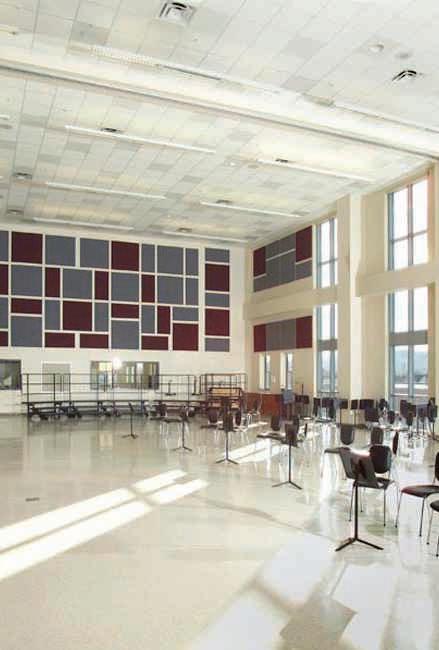
The Value of Risk Engineering
Many of the most significant risks in data center projects occur during construction, commissioning, and early operations phases where contractors carry substantial responsibility.
Bringing risk engineering into the process early, ideally before final pricing, can reduce exposures and improve constructability. Focus areas include:
• Fire protection in high density electrical and battery spaces
• System separation and redundancy aligned with uptime goals
• Commissioning and testing plans, including energization and integration sequences
• Temporary works, logistics, and cold weather strategies
Identifying issues on paper rather than in the field leads to better coordination, fewer late stage surprises, and stronger alignment with insurers and owners.
Aligning Insurance with the Project Lifecycle
Traditional insurance structures draw sharp lines between construction, commissioning, and operations. Data center risk does not.

MICA members are interior contractors who share a common mission: to provide their customers with the highest quality craftsmanship. We partner with the union trades that supply the best trained, safest and most productive craftsmen in the industry.
Alliance Drywall Interiors, Inc.
Easley & Rivers, Inc.
Giffin Interior & Fixture, Inc.
JLJI Enterprises
J. J. Morris & Sons, Inc.
Ambridge High School
T. D. Patrinos Painting & Contracting Company
RAM Acoustical Corporation
Schlaegle Design Build Associates
TRE Construction Wyatt Inc.
Interior contractor: J.J. Morris & Sons, Inc.
Another high quality MICA project
Risk is often concentrated in the transition phase when permanent power is energized, critical systems are tested and integrated, and IT equipment is installed. Coverage gaps are most likely at these points, especially between builder’s risk, delay in startup, and operational property and business interruption policies.
A lifecycle approach aligns coverage across all phases, from site mobilization through early operations. Depending on the project, this may include builder’s risk, delay in startup, operational property and business interruption, cyber coverage for control systems, project cargo, and wrap up liability programs.
Cyber Physical Risk: Where Digital and Physical Meet
As projects rely more on digital systems, cyber physical risk has become a critical exposure: situations where a digital issue leads to physical damage, delay, or safety concerns, such as:
• Compromised building management or control systems causing overheating or shutdown
• Cyber incidents that disrupt commissioning software or remote testing
• Configuration errors in control systems that damage equipment during testing
Managing this risk requires coordination between construction, commissioning, and technology teams; clear responsibility for control system security during construction; and contract and insurance language that recognize cyber physical scenarios, not just traditional IT breaches.
What This Means for Union Contractors
Western Pennsylvania’s union contractors already bring many of the core skills needed for data center work:
• Heavy civil and foundations in challenging terrain
• Structural steel and large scale enclosure
• Complex MEP systems and power distribution
• Industrial scale commissioning and startup
What is different is the intensity of risk and the expectations around schedule, uptime, and performance.
A disciplined approach to risk can help contractors price work with greater confidence, build schedules that reflect real regional and technical conditions, structure insurance and subcontractor programs effectively, and reduce disputes. Contractors that treat risk as a core part of project delivery, not a back office function, will be better positioned to compete and sustain this work over the long term.
Key Takeaways for MBA Members
• Power availability and interconnection timelines are critical project risks.
• Data centers are driven by MEP systems, controls, and commissioning.
• Western Pennsylvania’s regional risks must be addressed early in planning.
• Risk analysis should inform go/no go decisions, pricing, and scheduling.
• Early involvement of risk engineering improves constructability and outcomes.
• Insurance should align with the full project lifecycle.
• Cyber physical risk is increasing and must be managed deliberately.
Contractors who succeed in this space will not be those who simply adapt to data center work, but those who approach it with intention, engaging earlier, asking tougher questions, and being explicit about where risk sits before work begins. Western Pennsylvania has the workforce and experience to compete in this market. The opportunity now is to lead by setting a higher standard for how digital infrastructure projects are planned, built, and handed over. BG
This document is not intended to address any specific situation or to provide legal, regulatory, financial, or other advice. While care has been taken in the production of this document, Aon does not warrant, represent or guarantee the accuracy, adequacy, completeness or fitness for any purpose of the document or any part of it and can accept no liability for any loss incurred in any way by any person who may rely on it. Any recipient shall be responsible for the use to which it puts this document. This document has been compiled using information available to us up to its date of publication and is subject to any qualifications made in the document.
Terms of Use
The contents herein may not be reproduced, reused, reprinted or redistributed without the expressed written consent of Aon, unless otherwise authorized by Aon. To use information contained herein, please write to our team.
The rules are being written.
Be in the room.
Commercial Real Estate shapes Western Pennsylvania. The NAIOP Pittsburgh PAC ensures developers have a seat at the table with the officials who set the rules.
2025 Wins:
Defeated mandatory inclusionary zoning in Pittsburgh. Turned a costly mandate into a voluntary program with flexibility. Advanced permitting reform at the city and state levels, backing Mayor O'Connor's Executive Order and pushing for NPDES reform at PA DEP. Opening doors to State and Local Leadership.




IMANAGEMENT PERSPECTIVE
THE
BACKLOG TRAP
WHY
YOUR “WORLD-CLASS” PROBLEM SOLVERS MIGHT BE KILLING YOUR COMPANY
BY LAWRENCE SMITH
have seen more AEC companies die from indigestion than starvation.
That is a hard pill to swallow in an industry that measures success by the size of a backlog and the number of trucks on the road. We are taught that “busy” is the shield that protects us from the wolves at the door. But as we look at the reality of 2026, that shield is starting to look more like an anchor.
Right now, we are dealing with tremendous uncertainty, and that is unlikely to change. We have headlines about global conflicts. We have interest rate whiplash. We have the very real pain of high gas prices that our employees see every morning while sitting in traffic on McKnight Road. The atmosphere in the construction industry is thick with uncertainty. When you add the anxiety around layoffs and the unpredictability of tariffs and material prices, the natural instinct for any employee is to jump into reaction mode.
But here is the truth you already know: In this environment, “busy” is often a mask for “broken.” Whether you are leading a firm with $10 million in revenue or over $1 billion in revenue, a full backlog of the wrong work isn’t an asset. It is a suicide mission.
or they don’t believe it’s what you really want. But we know that reactivity without strategic insight is just motion without progress. Your team is solving for volume because they don’t have the weekly pulse of what the company actually values. If the person bidding the job or the person running the site doesn’t hear the Strategic Plan reinforced every single week, they are effectively guessing.
As the leader, in times of uncertainty if you haven’t translated your strategy weekly into language every level of the organization understands, you have abdicated your duty. You are letting your most anxious employees set your long-term direction.
The View from the Hot Seat
I know this because I have sat in the chair you are sitting in.
I am a recovering CEO. In my career, I’ve led and quickly grown several middle market companies in the construction and other sectors. Like you, I’ve steered organizations through the types of global volatility that make most leaders want to crawl under their desks. I’ve lived through the full-stop of the Lehman collapse and the supply chain chaos of COVID. I’ve led rapid-scale growth and I’ve navigated turnarounds.




Industry leadership from the region’s largest locally-owned accounting firm.
When it comes to your business, we look at the big picture. And we never forget the importance of a personal relationship. With our wide range of accounting, tax and advisory services, you can count on us to deliver day after day.
To learn more, visit www.schneiderdowns.com/construction
Ted M. Pettko, CPA tpettko@schneiderdowns.com
Mark A. DiPietrantonio, CPA mdipietrantonio@schneiderdowns.com

The reason you are on that mission is because they don’t actually understand where you are going. And in uncertain times, this is a message that needs to be repeated regularly, usually weekly.
The Myth of the “World-Class” Reactor
Let’s give credit where it’s due. The people in your organization are world-class problem solvers. They have to be. In the construction industry, if you can’t react to a 4:00 AM concrete blowout or a sudden 15 percent spike in asphalt prices, you don’t last a week.
But we also know that your team’s greatest strength is often your company’s greatest hidden risk. Because they are “world-class reactors,” they are currently working 60-hour weeks to solve the wrong problems.
We’ve all seen the core issue. It isn’t that they are making “bad” decisions. It is that they are making decisions in a vacuum. Most CEOs have a Strategic Plan, but it is often locked in a drawer living only in the minds of the C-suite or your teams don’t understand how it impacts their daily work. Your teams feel the fear of a shifting economy. They take action they think is appropriate to protect the company. For example, they bid on projects outside your sweet spot because they think “any work is good work” in a crisis.
They are jumping into reaction mode because they haven’t heard a different directive since the last quarterly meeting
I have the scars to prove that the “Backlog Trap” is real, and it is almost always caused by a failure to beat the drum of strategy every single week.
During COVID, we were terrified of a dry pipeline. My team did what world-class construction teams do: they hustled. They won a massive backlog of work. On paper, we were crushing it. But because we deviated from our Strategic Plan, they bid out of a “scarcity” mindset.
When the recovery actually hit and high-margin, ideal-client work started flowing back into the market, we couldn’t touch it. We were full. We spent the next nine months grinding through “junk” work that barely covered overhead while our more disciplined competitors, the ones who heard the strategy weekly and knew exactly which projects to walk away from, were cherry-picking the best projects like the UPMC Presbyterian Tower Expansion. We weren’t growing. We were just paying a fear tax on our past anxiety.
Building Arks and “Cleansing” the System
When we look at world class leaders, they don’t react to headlines. They prepare for cycles.
Warren Buffett has a famous “Noah Rule” that every owner in the construction industry should pin to their wall: “Predicting rain doesn’t count; building arks does.” Everyone can see the rain in 2026. But predicting the rain doesn’t make you a visionary. It makes you a weather reporter.
Your Strategic Plan is the ark. But we all know an ark doesn’t work if the crew only gets a briefing once a year. Strategy isn’t a speech at an annual retreat. It is the conversation your managers have every Monday morning to keep the ark on course. The plan must be the filter that is re-verified weekly to tell your team exactly which projects to walk away from, regardless of how scary the news is. If you don’t have that ark understood down to the last project engineer, you’re just a world-class swimmer waiting to get tired.
Similarly, Elon Musk often views downturns as a cleansing process. He famously noted that recessions are necessary because they stop “money raining down on fools.” While that is blunt, the principle is sound for our industry. Uncertainty is the only time the market forces you to be as efficient as you should have been all along.
If your team is bidding low-margin jobs just to keep a crew busy, they are gambling your company’s entire future on the hope that nothing goes wrong. They are doing this because you haven’t convinced them that you value discipline more than volume. A cleansed company is one where every employee hears every week that we would rather be 20 percent smaller and 100 percent more focused than 20 percent larger and 100 percent more chaotic.
The “Right Tool” for Right-Sizing
The most difficult question we have to ask ourselves as CEOs is this: Can your company scale down 20 percent today?

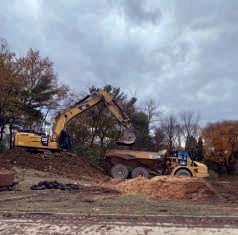
Most of us would instinctively say “no” because we are afraid of losing talent. But this is where we have to challenge the “we’ve always done it this way” mentality. With today’s digital modernization, project management software, and outsourcing tools, a healthy firm in the construction industry should be able to scale its operations up or down by 20 percent within a fiscal year without breaking the culture or the P&L.
This is true whether they are running crews in Oakland or managing a remote site in Morgantown.
The Right Tool for the Right Time during a period of global uncertainty is not a sharper pencil for a low-bid. It is radical, weekly transparency regarding the Strategic Plan.
If you have to bid garbage work to maintain a specific headcount, you have an operational inefficiency problem, not a market problem. Use this time of uncertainty to right-size. Focus on your core competencies. If your team is busy refining their internal processes and sticking to a highmargin “ideal client” profile, you will have the dry powder to scale 100 percent when the recovery hits.
But they can only do that if they understand what “ideal” looks like every single week and believe that you actually mean it. They can only do that if you stop assuming they remember the strategy and start ensuring they see it in your actions today.
Stop Guessing and Start Leading
The patterns of 2008 and 2020 are repeating in 2026. The companies that react out of fear end up serving the market’s whims. They are the ones you see liquidating equipment three years from now. The companies that lead with a disciplined plan, and communicate that plan until they are blue in the face, end up owning the market.
Managing a business becomes a lot lighter when you stop guessing and start making confident decisions based on where you want the company to be in five years. You cannot lead based on what the headlines say this morning.
Your team is waiting for the filter. They are tired of jumping into reaction mode. They are tired of the backlog trap. They are waiting for a leader to ensure they understand, weekly, that busy isn’t the goal. Excellence and focus are the goals.
Give them the plan. Build the ark. And stop bidding like you’re afraid of the dark.
Key Takeaways for the CEO:
• Audit the Weekly Communication: Go to your estimating department today. Ask them: “What is our ideal project for the next 24 months, and why?” Stay silent and listen closely. If their answer doesn’t match your Strategic Plan, or if they joke that you’ll approve a project just to fill the board, you have a communication crisis.
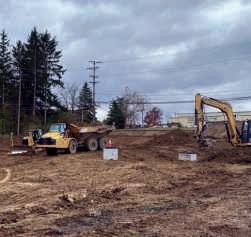
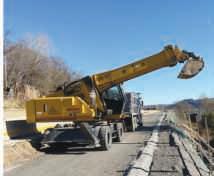

“We
their great staff.”
J.J. Stefanik - President Stefanik’s Next Generation Contracting Co.

• Define the “No” Weekly: A strategy is defined by what you don’t do. Give your team a No-Go checklist and review it in every Monday morning meeting. If a project doesn’t fit your core competency, your geography, or your margin requirements, it is a distraction, not an opportunity.
• Translate the Strategy Daily:Move the Strategic Plan out of the boardroom. Create a one-pager that a superintendent can understand. Everyone should understand weekly how their daily decisions contribute to the five-year goal.
• Modernize for Flexibility: Use the current uncertainty to invest in tools that allow you to scale up or down 20 percent with ease. Efficiency is the only real hedge against volatility. BG
About Lawrence Smith: Lawrence Smith is a recovering CEO and Executive Coach who has scaled companies from start-up to over $200M and led major turnarounds in the manufacturing and construction sectors. As a former CEO and COO, he understands the weight of leadership and specializes in helping AEC owners and C-suite executives identify the “Right Tool for the Right Time” to drive profit and lasting growth. He frequently engages with fellow CEOs for peer-level conversations on navigating growth plateaus and strategic alignment. Connect with him at LSmith@ FocalPointCoaching.com.


PROFESSIONAL. SKILLED. COMMITTED. PROUD.

These are the hallmarks the region’s union construction trades and contractors bring to the jobsite everyday. Our professional tradespeople and contractors bring the dreams and visions of our fast-growing region to life with a dedication that only those who live here, work here, and raise their families here can commit to. It is, after all, our home, our legacy.
We are also committed to providing opportunity for all who share these values and want to pursue a lifelong, lucrative and satisfying career. For more information on building with our union trades and contractors, or to explore career opportunities, please visit www.buildersguild.org where you will find direct links to our Trade Unions, Joint Apprenticeship Training Centers and Contractor Associations.


AAI IN CONSTRUCTION
THE PROMPT IS STILL THE POINT
builder’s guide to getting real work out of AI, from the chat window to the agents coming next.
The gap between getting nothing useful out of AI and getting something genuinely helpful almost always comes down to the prompt. Most builders who have tried ChatGPT once and walked away unimpressed are not running into a model problem. They are running into a briefing problem.
We see this every week in construction firms across the country. An estimator types a half sentence into the chat box, gets a generic response, and writes the whole tool off. Then a project manager on the same team types three paragraphs of real context and the output is immediately useful for an RFI response, a subcontractor email, or a toolbox talk.
Prompting is also changing. The skill used to live entirely inside a chat window, where you typed a request and got a reply. It is now moving into global instructions, meta prompts, and agent configurations that govern AI working across your inbox, your drive, and your project files.
The surface area is different. The fundamentals are the same. Here are the practices that hold up whether you are typing in a chat box or setting up an AI agent to run across your systems.
Give it the context a new hire would need
The most common prompting failure in construction is underbriefing. People type a single line, hit enter, and expect the model to know which project, which client, which trade, and which audience. It cannot guess any of that.
Treat the AI like a capable new hire on day one. Spell out who you are, what the project is, who the output is for, and what a good answer looks like. A prompt that opens with “I am a project manager on a hospital expansion in Western Pennsylvania, responding to an RFI from our mechanical sub about a hanger detail conflict” will beat a prompt that opens with “write me an RFI response” every time.
Role Play: Tell it who to be

A short role assignment changes output quality in a noticeable way. A prompt that starts with “You are a senior superintendent with twenty years of commercial experience, writing a toolbox talk for a steel erection crew on fall protection in cold weather” produces something closer to what a real super would say than a generic safety brief.
Roles work because they compress a huge amount of implied context into one line. You are telling the model what tone to take, what vocabulary to use, and what priorities to
weigh. For safety content, JHAs, or field communication where voice matters, this is the single highest-leverage move you can make.
Use the “Given, do” structure
A clean prompting pattern we teach every client is “Given ABC, do XYZ.” You hand the model the context first, then ask for the output.
In practice that looks like: “Given these notes from today’s OAC meeting and last week’s action items, produce a clean summary with outstanding owners and due dates in a table.” The model does not have to guess at the source material or the format. It reads the context, then executes.
This pattern also maps directly onto agent configurations. When you set up standing instructions for a tool that summarizes meetings or drafts RFIs, you are doing the same thing at scale. You are telling the agent what inputs to expect and what outputs to produce.
Tell it what you want, not what you do not want
A quirk worth knowing: AI models respond better to positive instruction than to prohibitions. If you tell a model “do not sound too casual,” you often get something still casual. If you tell it “write in a professional, measured tone appropriate for a client-facing email,” you get closer to what you actually want.
The same is true for format. “Do not use bullet points” works less reliably than “write this as three short paragraphs.” Lead with the thing you want to see on the other side.
Show it an example
When you need output that matches a specific tone, voice and style, paste in an example. Maybe a toolbox talk you liked, a closeout email you wrote last month, or a scope section from a proposal that read the way you wanted.
One example is usually enough to lock in voice, length, and structure. Two or three is even stronger. This is called fewshot prompting, and it is the fastest way to get AI to sound like your company rather than the internet.
Have a conversation, not a transaction
Most people treat AI like a search engine. They type once, read the output, and move on. That leaves most of the value on the table.
Treat the model like a collaborator. Tell it what worked, what missed, and what to fix. A follow-up like “this is closer, but the tone is too formal for a sub we have worked with for ten years, loosen it up and shorten the opening” will often produce a second draft that is genuinely usable.
ORGANIC
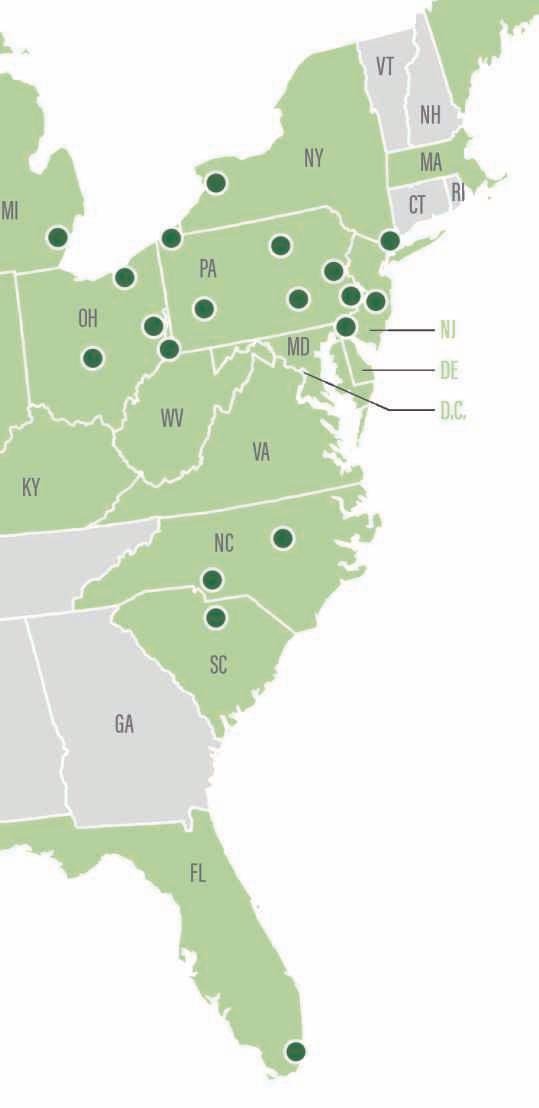
Rooted in Pittsburgh, our client demand expanded the firm’s reach to 19 offices in 10 states. Call us for construction and surety-related questions.

William D. Clifford & W. Alan Torrance, Jr.
Included in The Best Lawyers in America
2023 Commercial Litigation, Construction Law, and Litigation-Construction
412-281-7272
Where this is going
The practices above started in chat windows. They are now the building blocks of something bigger.
Global instructions and meta prompts are the new frontier. These are the standing rules you give an AI tool or agent so it knows how to behave across every task it does for you. A global instruction might say “you are assisting the preconstruction team at a commercial GC in Western Pennsylvania, use measured and professional language, when summarizing meetings always output owners and due dates in a table, when drafting RFIs always include the drawing reference and the date received.”
The agent then carries that context into every interaction. You stop rewriting the same setup every time. The fundamentals do not change.
Context, role, examples, positive framing, and iteration still do all the heavy lifting. They just move upstream, from the individual prompt into the standing configuration of the tool. This is what makes prompting worth taking seriously right now. The people who learn to brief AI well in a chat window are the same people who will be setting up capable agents next year. The skill compounds.
Where to start Monday morning
Pick one workflow you already do every week. An RFI response, a toolbox talk, or a meeting summary is a good starting point. Write a prompt that includes your role, the project context, an example of the output you want, and the format you need.
Run it, review it, and tighten it. Do that three times on the same workflow and you will have a prompt you can reuse. Do it across five workflows and you will have a prompt library that pays you back every week.
That is how prompting stops being a trick and starts being a skill. And it is how builders get ready for what is coming next. BG
Zach Giglio is the CEO and co-founder of GCM, an awardwinning AI implementation company that helps construction firms, associations, and businesses adopt off-the-shelf AI in practical ways. He is a Wharton-certified AI strategist, a TEDx speaker, and a member of the U.S. Chamber of Commerce Institute for Organization Management Curriculum Committee on AI.



WORKFORCE DEVELOPMENT
DIAGNOSING SYSTEMIC ISSUES: UNTANGLING A MESS TO CLEAR UP THE WORKFORCE PIPELINE.
BY BEN ATWOOD
The construction industry is not facing a generalized labor shortage. What is unfolding on jobsites across the country is more specific—and more consequential.
It is a field-level capacity constraint, driven by trade bottlenecks, wage competition, and the steady erosion of experienced labor.
Start with the trades themselves. The shortage is not evenly distributed. It is concentrated in the positions that determine whether a project moves or stalls—electricians, pipefitters, welders.
Demand in these trades has surged alongside data centers, energy projects, and infrastructure work. These jobs are funded and moving, but they rely on specialized labor that cannot be replaced quickly. When that labor is missing, the rest of the job slows with it.
At the same time, labor is not just scarce—it is being pulled. Higher-paying sectors are drawing workers away from traditional construction segments.
Residential builders, in particular, are losing crews to large-scale industrial and energy work where wages are materially higher.
The result is not simply a shortage, but a reshuffling that leaves certain parts of the market understaffed and increasingly delayed.
All of this points back to a deeper issue: the pipeline that produces and develops this workforce is not functioning the way it needs to. There is no shortage of conversation around getting people into the trades, but far less clarity on how that actually happens at scale. Training pathways are inconsistent. Apprenticeship access is limited. Contractors, already stretched thin, are not always in a position to build workers from the ground up. The result is a system that generates interest at the top, but struggles to deliver skilled, job-ready labor to the field.
All of this points back to a deeper issue: the pipeline that produces and develops this workforce is not functioning the way it needs to.
Layered on top of that is the industry’s experience problem. A significant share of skilled tradespeople are nearing retirement, and many are exiting the field altogether. These are not entry-level roles being vacated. They are experienced workers—foremen, specialists, and highly productive crews—whose absence is felt immediately on site. Replacing that kind of knowledge is not a matter of hiring; it is a matter of time, and the industry does not have much of it.
The data reflects what contractors already know. The vast majority report difficulty filling positions, and many say labor shortages are directly delaying projects. Hundreds of thousands of additional workers are needed annually just to meet current demand. But focusing on those numbers alone misses the point.
The issue is not just that labor is short. It is how labor is produced, trained, filtered, and ultimately delivered to the jobsite. That is where the conversation needs to move next. Because behind every open position is a system—or a series of them—that either moves someone into the field or quietly filters them out along the way.
Understanding those systems is the first step toward understanding the problem itself. And that’s what this column will do over the next few years. Over the nest few years, we’ll break down the pipeline piece by piece. Where it starts, where it breaks, and where it quietly filters people out before they ever reach a jobsite. Because if the industry is serious about solving the labor problem, it won’t be fixed in the field alone. It’ll require some upstream work, too. BG


BID. BUILD. PROTECT.
From bid to final payment, MBM Law’s Construction team understands how projects are built and how to successfully resolve disputes. We provide practical, industry-focused counsel based on decades of experience.

Lawrence J Maiello, recognized in Best Lawyers in America® in Construction 2024, 2025 and 2026
Keep your next project on solid legal footing. Contact MBM Law
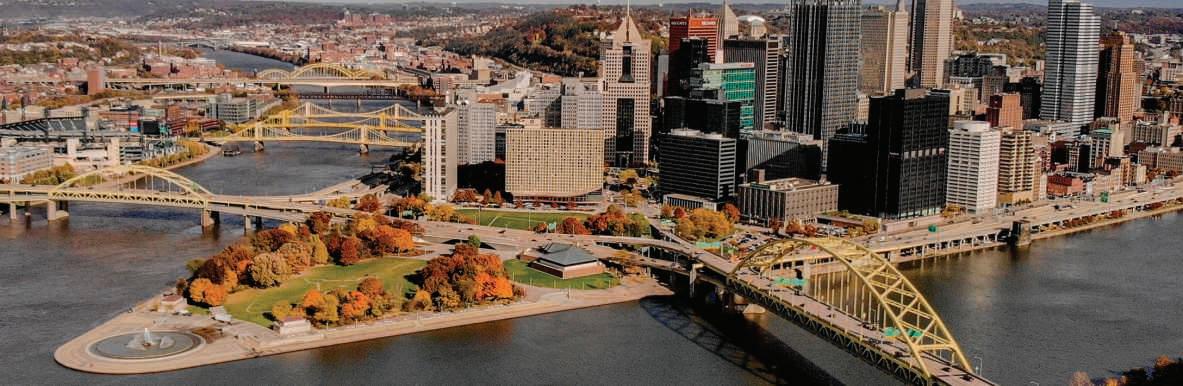
For more than 125 years , I.B.E.W. Local 5 has been lighting up Pittsburgh’s sports arenas, its hospitals and its skyscrapers.
Acrisure Stadium, PNC Park, Pittsburgh International Airport, PPG Place, UPMC Children’s Hospital of Pittsburgh and the new FNB Tower. Behind Pittsburgh’s major buildings is I.B.E.W. Local 5.
INDUSTRY & COMMUNITY NEWS

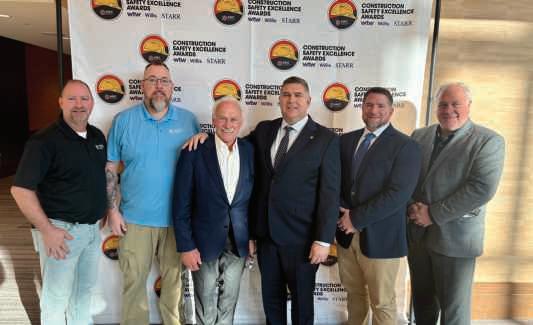
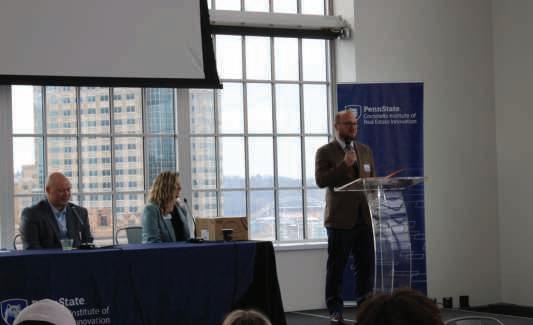
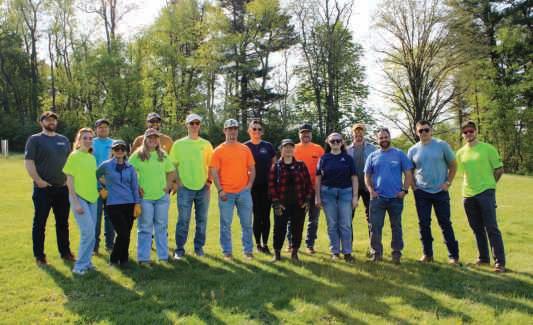
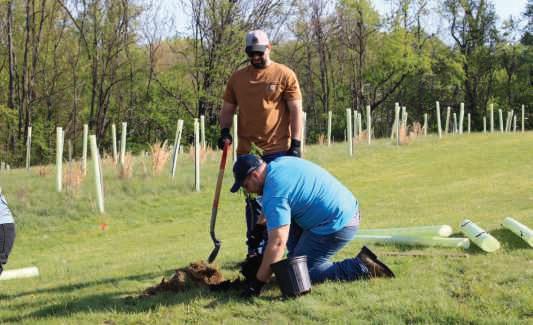
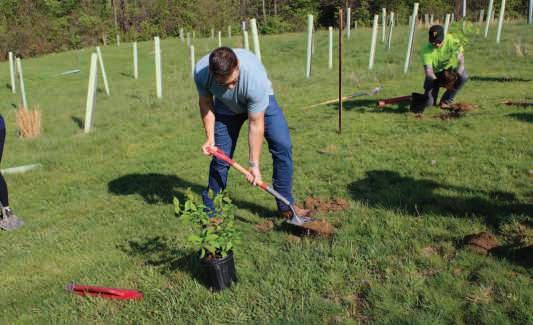
The Mascaro basketball team competed in the 25th annual Alliant Construction Classic, reaching the championship before falling to Schneider Downs.
Dave Daquelente speaking at a local presentation on the Cocoziello Institute at Penn State.
Armand Dellovade of Mohawk Construction checking the work of Zane McShane of Brayman Construction.
The Rocky Bleier team after winning their second Construction Safety and Excellence Award.
The Young Constructors Committee and Green Builders Committee volunteered to plant 150 trees at South Park with the Allegheny County Parks Foundation.
Ethan Yohe of Easley and Rivers hard at work.

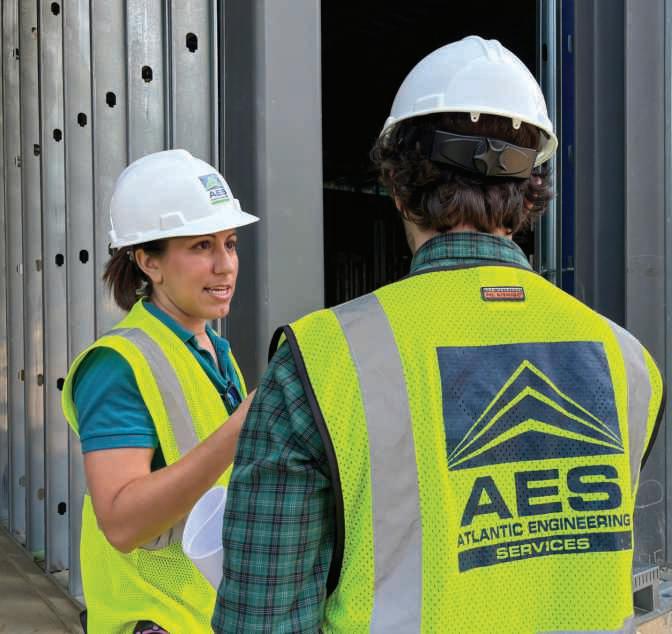







Alec Kinslow of Mascaro Construction Company presenting scholarships to students from Slippery Rock University. The McKamish team hosting a Women in the Mechanical Industry of Western PA, focused on strengthening communication
confidence
the workplace.
McKamish team cooking
serving dinner for families at Ronald McDonald House Charities of Pittsburgh and Morgantown.
Tim O’Brien and Frank Babik of PJ Dick helping prepare the city for the draft in the Pick Up Before Picks campaign.
Zane McShane, Ethan Yohe, Tom Rafferty, David Hanno, Joe Congie at the YC Happy Hour
Dara Collins, Matt Bogan, and Ernie Sciulli from PJ Dick at the YC Happy Hour.


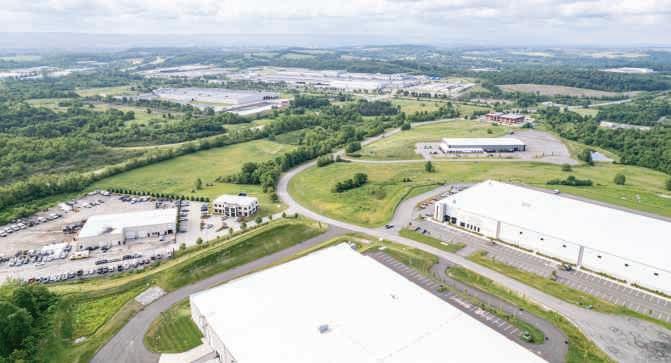






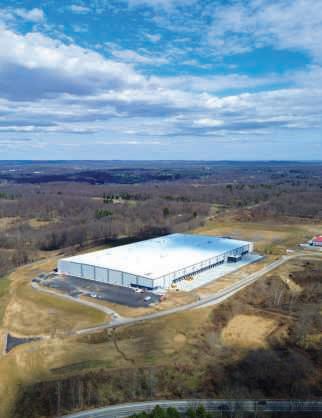
Rycon celebrates the behind the scene administrative assistants who keep the company going.
Tim Macklin and CJ Saylor at the YC Happy Hour.
The Kids at Bethel Park Life Skills helping with the Yinz Good campaign.




AWARDS & CONTRACTS
Fred L. Burns Inc. was awarded the general construction contract for the $3 million North Side Primary School Improvements & Renovations in Ellwood City, PA. The architect is HHSDR Architects & Engineers.
Transportation & Maintenance Facilities in Carroll Township.
Rycon Construction is the general contractor for the $4.5 million expansion of the Dick’s Sporting Goods HQ Child Care Center in Findlay Township.
University of Pittsburgh selected Landau Building Company to serve as General Contractor for the renovation of the Ramos/Shirey Labs in Thaw Hall’s Space Research Coordination Center. Hasenstab is the architect.

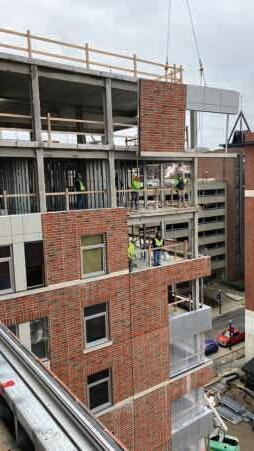




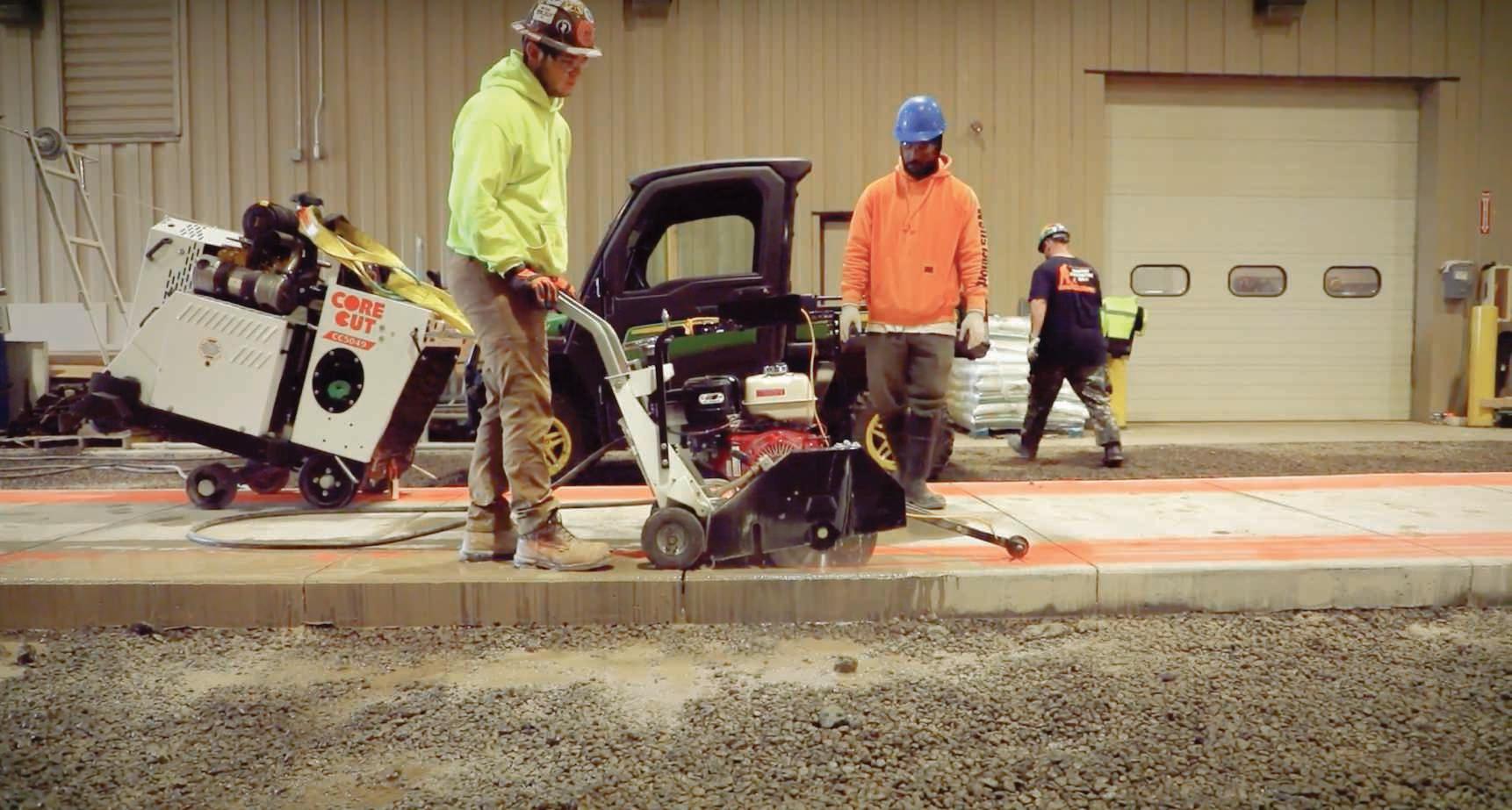

Hempfield Area School District awarded a $72.9 million general construction contract to Massaro Corporation for its $116.7 million addition and renovations to Hempfield Area High School. Crabtree Rohrbaugh & Associates is the architect for the project, which involves a 68,300 square foot addition and renovations to 356,800 square feet of the existing high school.
Massaro Corporation was awarded the general construction contract for South Fayette Township School District’s new $85 million elementary school. DRAW Collective is the architect for the new 176,000 square foot K-2 facility.
Poerio Inc. is the general contractor for the drive-in bay expansion at FedEx’s Findlay Township distribution facility. Larson Design Group is the architect.
University of Pittsburgh selected the design-build team led by PJ Dick to build its $80 million new residence hall adjacent to Ruskin Hall.
Seton Hill University has retained PJ Dick for the construction of a new fieldhouse on its Greensburg campus.
Independence Construction is the general contractor for the new Porsche & Audi dealerships in Marshall Township.
US Postal Service selected LLI Engineering as engineer/ architect for its $100 million renovation of the 475 L’Enfant Plaza 1 MSF USPS headquarters in Washington DC.
Mele & Mele & Sons was awarded the general contract for the $9.9 million Brackenridge Water Filtration Plant Improvements.
Uhl Construction was awarded the general contract for the Ringgold School District’s $9.1 million Ginger Hill
Landau Building Company is serving as General Contractor for the Vivarium Surgical Suite renovation at the Health Sciences Center at West Virginia University.
In Wheeling, WV, Rycon is building the new 122,000 sq. ft. St. Joseph Regional Cancer Complex for WVU Medicine.
In Sisterville, WV, Rycon will soon start construction on Tyler Consolidated Elementary School. The new three-level, 146,000 sq. ft. building will feature a STEM lab, library, media center, and more.
Aquatech International chose Rycon as the general contractor for their 11,000 sq. ft. lab expansion in Canonsburg, PA.
Turner Construction will begin work on Deike Building at Penn State, originally constructed in 1965 and partially renovated in 1998, requires mechanical infrastructure upgrades to meet current code and energy-efficiency standards. While multiple recommendations were provided following completion of a mechanical infrastructure study, this project is currently prioritizing the replacement of all existing steel piping throughout the building. The work will be executed in multiple phases from 2026 through 2030 to maintain building operations and support critical research within the building.
Shannon Construction was recently awarded the contract for WVU - Evansdale Crossing 3rd and 4th Floor Floor Renovations.
FACES & NEW PLACES
Turner Pittsburgh is excited to welcome Kevin Adams, Jr. to our office. Kevin is a graduate of Point Park University, where he earned his Bachelor’s degree in Accounting. He has joined our team as an Cost Accountant in Operational Finance.
Christian Schultz has joined Shannon Construction, representing the 4th generation of family leadership.
At Shannon Construction, Patrick Bruce has been promoted to Senior Project Manager.
Rycon is pleased to welcome University of Pittsburgh alumnus, Cody Conway, as a Project Engineer.
Rycon’s Corporate Human Resources Department welcome Robert Morris University alumna, Angie Van Every, as a Recruiter.
Rycon’s Self-Perform Division gladly welcomes Ryan Kosmer as a Project Engineer with over 3 years of experience.
Megan Kurek has joined Rycon as a Project Coordinator, bringing over 10 years of experience.
Zachary Maund, a Kent State University alumnus, joined Rycon as a Project Engineer.
With over 10 years of experience, Rachel Zarnich has joined Rycon as a Project Engineer.
Andrew Vaughan joined Mascaro as an Estimator. He began his career at a civil construction firm as a laborer and progressed through the company as an operator and site foreman before transitioning into his role as an estimator in 2022.
John Miskinis joined Mascaro as a full-time Health, Safety, & Environmental after completing his spring internship with Mascaro. He is a Safety Science student at Indiana University of Pennsylvania and will graduate in early May.
MBA MEMBERSHIP
2026 MBA OFFICERS
President
Michael R. Mascaro
Mascaro Construction Company, LP
Vice President and Treasurer
Alexander G. Dick
Dick Building Company
Secretary/Executive Director
David D. Daquelente
2026 MBA
BOARD OF DIRECTORS
John P. Busse
F.J. Busse Company, Inc.
James T. Frantz
TEDCO Construction Corporation
Michael Kuhn
Jendoco Construction Corporation
Jennifer P. Landau
Landau Building Company
Anthony F. Martini
A. Martini & Co.
Steven M. Massaro
Massaro Corporation
Jake Ploeger
PJ Dick Incorporated
John Sabatos
Rycon Construction, Inc.
Raymond A. Volpatt, Jr., P.E., Past President
Volpatt Construction Corporation
Neal Rivers (MICA President)
Easley & Rivers, Inc.
GENERAL
A. Martini & Co.
CONTRACTORS
AIMS Construction
Allegheny Construction Group, Inc.
Burchick Construction Company, Inc.
Caliber Contracting Services, Inc.
Carl Walker Construction, Inc.
CH&D Enterprises, Inc.
CPS Construction Group, Inc.
Dick Building Company, LLC
DiMarco Construction Co., Inc.
E&G Development, Inc.
Elwood Construction Corporation
F.J. Busse Company, Inc.
Facility Support Services, LLC
FMS Construction Company
Fred L. Burns, Inc.
Gilbane Building Company
Higley Construction
Independence Excavating, Inc.
Jendoco Construction Corporation
Kokosing Industrial Incorporated
Landau Building Company
Mascaro Construction Company, LP
Massaro Corporation
McCrossin
Menard USA
Mosites Construction Company
Nicholson Construction Company
PJ Dick Incorporated
Poerio Incorporated
Rocky Bleier Construction Group
Rycon Construction, Inc.
Shannon Construction Company
Stevens Engineers & Constructors, Inc.
TEDCO Construction Corporation
Turner Construction Company
Uhl Construction Company, Inc.
Volpatt Construction Corporation
SPECIALTY CONTRACTORS
2bn contracting
A Crane Rental, LLC
A. Folino Construction, Inc.
A.J. Vater & Company, Inc.
Abate Irwin, Inc.
ABMECH Acquisitions, LLC
ACE Lightning Protection, Inc.
Advantage Steel & Construction, LLC
All Crane Rental of Pennsylvania, LLC
Alliance Drywall Interiors, Inc.
Amelie Construction & Supply, LLC
Amthor Steel, Inc.
Arsenal Scaffold of PA
BrandSafway Industries LLC
Brayman Construction Corporation
Bristol Environmental, Inc.
Bruce & Merrilees Electric Company
Bryan Construction, Inc.
Build with MD
Burke & Company, LLC dba S.P. McCarl & Company
Burnham Industrial Contractors, Inc.
Buzzelli Group LLC
Casework Installation Company, LLC
CaseWorks Inc.
Centerpoint Painting Systems
Century Steel Erectors Co., LP
Clista Electric, Inc.
Cost Company
Costa Contracting, Inc.
Cuddy Roofing Company, Inc.
Dagostino Electronic Services
D-M Products, Inc.
Dom DeMarco Construction, Inc.
Donley’s Concrete Group
Douglass Pile Company, Inc.
E2 Landscape & Construction
Easley & Rivers, Inc.
EMCOR Services Scalise Industries
Fay, S&B USA Construction
Ferry Electric Company
First American Industries, Inc.
Flooring Contractors of Pittsburgh
Franco Associates
G. Kidd Inc.
Gaven Industries, Inc.
Geo V Hamilton, Inc.
Giffin Interior & Fixture, Inc.
Gregori Construction Inc.
Gumpher, Inc.
Gunning, Inc.
Hanlon Electric Company
Harris Masonry, Inc.
Hatzel & Buehler, Inc.
HOFF Enterprises, Inc.
Howard Concrete Pumping, Inc.
Hranec Corporation
Hunt Valley Environmental, LLC
J.J. Morris & Sons, Inc.
JLJI Enterprises, Inc.
John B. Conomos, Inc.
K & Sheet Metal, Inc.
Kalkreuth Roofing & Sheet Metal, Inc.
KELLER North America
Keystone Electrical Systems, Inc.
Kirby Electric, Inc.
Kusler Masonry, Inc.
L & E Concrete Pumping Inc.
Lanco Electric, Inc.
Lighthouse Electric Company, Inc.
Lisanti Painting Company
Manheim Dellovade LLC
Marsa, Inc.
Massaro Industries, Inc.
Master Woodcraft Corporation
Matcon Diamond, Inc.
Maxim Crane Works, LP
McCrossin Foundations, LLC
McKamish, Inc.
Mele & Mele & Sons, Inc.
Mohawk Construction & Supply Co., Inc
Next 150 Construction LLC
Noralco Corporation
O. Z. Enterprises, LLC
Paramount Flooring Associates, Inc.
Pennsylvania Roofing Systems, Inc.
Phoenix Roofing, Inc.
Pittsburgh Interior Systems, Inc.
Precision Environmental Company
Pullman SST
RAM Acoustical Corporation
Redstone Flooring, LLC
Renick Brothers Construction Co.
Richard Goettle, Inc.
Right Electric, Inc.
Ruthrauff Sauer, LLC
Saint’s Painting Company, Inc.
Sargent Electric Company
Schindler Elevator
Schlaegle Design Build Associates, Inc.
Schnabel Foundation Company
Solid Platforms, Inc.
Specified Systems, Inc.
Spectrum Environmental, Inc.
SSM Industries, Inc.
Steel City Scaffolding of Pittsburgh, LLC
Swank Construction Company, LLC
T.D. Patrinos Painting & Contracting Company
Tarax Service Systems, Inc.
TRE Construction
Triple 3 Construction, LLC
Tri-State Flooring, Inc.
W.G. Tomko, Inc.
W.O. Grubb Steel Erection, Inc.
Wayne Crouse, Inc.
Wright Commercial Floors
Wyatt Incorporated
AFFILIATE MEMBERS
4CTechnologies
84 Lumber Company
A. L. Harding & Company
A.R. Chambers and Son, Inc.
ADMAR Construction Equipment and Supply
AEC Online Store
African American Chamber of Commerce
of Western PA
Allegheny County Airport Authority -
Pittsburgh International Airport
Alliant
American Contractors Insurance Group
American Global
American Producers Supply Company, Inc.
AmeriServ Wealth & Capital Management
Aon
Atlantic Engineering Services
Atlas Wholesale Co., Inc.
AUROS Group
Babst Calland
Baker Tilly Virchow Krause, LLP
BDO USA, P.A.
Bespoke Metrics
Beth-Hanover Supply Co., Inc.
Black Diamond Equipment Rental
Bowles Rice
Bronder & Company, P.C.
Building Envelope Consultants and Scientists, LLC
Building Point Ohio Valley
Burns & Scalo Real Estate Services, Inc.
Burns White, LLC
CAD Construct LLC
Cadnetics, Inc.
Case Sabatini
Chartwell Investment Partners
Chubb Group of Insurance Companies
Civil & Environmental Consultants, Inc.
Clark Hill PLC
Cleveland Brothers Equipment Co., Inc.
CliftonLarsonAllen LLP
Cohen and Company
Cohen Seglias Pallas Greenhall & Furman PC
Computer Fellows Inc.
Cozen O’Connor
CTR Payroll & HR
DesignGroup
Desmone Architects
Dickie, McCamey & Chilcote, P.C.
Dingess, Foster, Luciana, Davidson & Chleboski LLP
Dollar Bank
DQE Communications
DRAW Collective Architecture
Eckert Seamans Cherin & Mellott
ECS Mid Atlantic, LLC
Environmental Health and Safety Solutions Inc.
EPIC Insurance Brokers & Consultants
EquipmentShare
Fahringer, McCarty, Grey, Inc.
Falk-PLI Engineering and Surveying
FASTSIGNS of Pittsburgh
FDR Safety, LLC
FieldForce Equipment Sales & Rentals, LLC
First National Insurance Agency
Fisher Phillips
Ghise Associates Inc.
GM Equipment Corp.
Graystone Consulting Pittsburgh
H2R CPA
Henderson Brothers, Inc.
Henry Rossi & Co., LLP
HHSDR Architects/Engineers
Highstreet Insurance Partners
Hillis Carnes Engineering Associates, Inc.
HUB International
Huth Technologies LLC
IMA Corp
Interior Supply, Inc.
Intertek - PSI
J.S. Held
JLL
K&L Gates LLP
Karpinski Engineering
Kehm Oil Company
L & W Supply
LaFace & McGovern Associates, Inc.
Langan Engineering & Environmental Services
Liberty Insurance Agency
Liberty Mutual Surety
Lytle EAP Partners/Lytle Testing Services, Inc.
Maiello, Brungo & Maiello
MarinoWare
Marsh
Marthinsen & Salvitti Insurance Group
McKim & Creed, Inc.
McNees Wallace & Nurick LLC
Meyer, Unkovic & Scott LLP
Meyers Company
Michael Baker International
Michael Brothers Companies
Milwaukee Tool
Mobile Air, Inc.
Mobile
& Bockius LLP MSA Safety
JOIN THE MASTER BUILDERS’ ASSOCIATION!


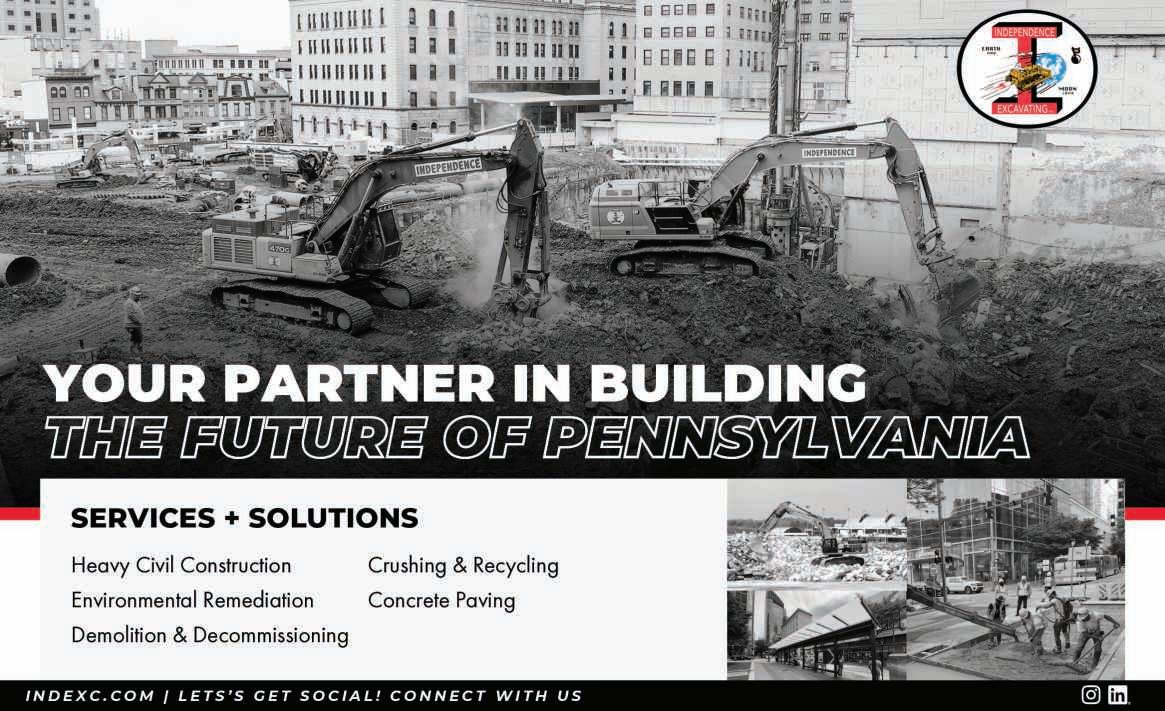
CLOSING OUT
BY RICH BARCASKEY
If infrastructure had a personality, it would be that quiet, reliable friend who never asks for much— until one day they do. And when they do ask, you realize just how much you have been leaning on them all along.
Roads and bridges are exactly that type of infrastructure. They carry our economy, connect our communities, and quite literally support the weight of our daily lives. Yet too often, they are treated as background noise, noticed only when something goes wrong - a pothole here, a weight restriction there, a detour that adds fifteen minutes to your morning commute. These are not inconveniences; they are warning signs.
The truth is simple: infrastructure does not fail overnight. It deteriorates slowly, predictably, and, most importantly, it is preventable. However, prevention requires investment, and investment requires leadership.
Over the past few years, we have seen what leadership can accomplish. The federal Infrastructure Investment and Jobs Act (IIJA) provided a historic infusion of funding into transportation systems across the country, including right here in Pennsylvania. That investment has allowed PennDOT and other agencies to advance critical projects, improve safety, and begin addressing long-standing backlogs. It has supported jobs, strengthened supply chains, and demonstrated what is possible when funding aligns with need.
However, let’s be clear: the IIJA was a down payment, not a permanent solution.
As we look ahead, the upcoming federal surface transportation reauthorization presents a pivotal moment. Congress has an opportunity, and an obligation, to build on this momentum with a another long-term, sustainable funding framework. Short-term extensions and uncertainty do not allow for strategic planning, workforce development, or efficient project delivery. Our industry does its best work when there is predictability, and right now, predictability is exactly what is at stake.
At the state level, the challenge is even more pronounced. Pennsylvania has not enacted a comprehensive transportation funding plan since
Act 89 of 2013. For more than a decade, we have relied on that framework to carry us forward. While Act 89 was transformational in its time, inflation, increased construction costs, and evolving infrastructure needs have significantly eroded its impact.
Meanwhile, a portion of Pennsylvania’s Motor License Fund, which is intended for roads and bridges, continues to be diverted elsewhere. No one disputes the importance of funding the State Police, but every dollar redirected away from highway construction is a dollar not spent on repairing bridges, improving roadways, or enhancing safety for the traveling public.
We cannot continue to do more with less, and we certainly cannot continue to do more with less for long.
The good news is that there is a path forward, but it requires a renewed commitment at both the federal and state levels to prioritize investing in roads and bridges and other types of infrastructure. It requires honest conversations about funding mechanisms, responsible stewardship of existing resources, and a willingness to make decisions that may not be easy but are absolutely necessary.
And it requires recognizing the people behind the work.
Every mile of road improved, and every bridge rehabilitated represents the skill, dedication, and pride of the men and women in our industry. These are careers that build more than our region’s infrastructure. They build communities, families, and futures. Stable, long-term funding ensures not only that projects get built, but that the next generation of skilled workers is ready to build them.
So, as we close out this issue of Breaking Ground, which is focused on infrastructure, let us not treat it as a topic that begins and ends on these pages. Let it be a call to action.
And if we get this right—if we commit to sustained investment, smart policy, and long-term vision— then the only thing people will notice about our region’s infrastructure is that it all works exactly as it should, like that reliable friend.