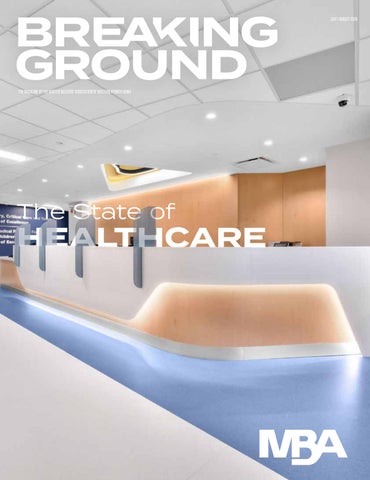
JULY / AUGUST 2026
THE MAGAZINE OF THE MASTER BUILDERS’ ASSOCIATION OF WESTERN PENNSYLVANIA
The State of
HEALTHCARE
Highest Quality. On-Time. On-Budget.
The Mechanical Contractors Association of Western Pennsylvania serves the unique needs of contractors involved in heating, air conditioning, refrigeration, plumbing, piping, and mechanical and related service industries. We provide our members with high-quality educational materials and programs to help them attain the highest level of managerial and technical expertise.
Contact: Rege Claus, Executive Director | (412) 683-3600 | mcawpa@verizon.net 5131 CYPRESS STREET • PITTSBURGH, PA 15224
TRANSFERING A LEGACY
For decades, Domenic Dozzi’s leadership, vision, and unwavering commitment to quality have shaped Jendoco into one of the region’s most respected construction rms. His contributions have left a lasting legacy of excellence, integrity, and strong client and community relationships. Michael Kuhn, after working his entire professional career at Jendoco and serving as the company’s President since 2015, is honored to assume ownership and carry forward this proud tradition. With deep experience in the construction industry and a clear vision for the future, Michael is committed to building on Jendoco’s strong foundation while continuing to deliver exceptional service, innovation, and value to clients. Domenic will retain ownership of Jendoco Real Estate and related entities and remains committed to supporting the continued success of Jendoco Construction.
WWW.JENDOCO.COM
(412) 361.4500
2000 LINCOLN ROAD - PITTSBURGH, PA 15235
It’s a win-win for our region when labor and business are aligned. At Pittsburgh Works Together, we cover the impact of labor and business on Western PA’s economic health. Access research briefs, data insights and expert analysis at pghworks.com.
Pgh WorksTogether
Pgh_works
PittsburghWorksTogether
PghWorks
THE WESTERN PA CHAPTER, NECA
EMPOWERING LIVES & COMMUNITIES SINCE
1946
LEARN MORE AT WWW.WPANECA.COM
#WEPOWERPA
EDITOR’S NOTE BEN ATWOOD, BREAKING GROUND MANAGING EDITOR I spent months worrying that “The Healthcare Market Update” would finally blow my cover as someone competent enough to manage this magazine. Truth be told, I can barely navigate through the actual healthcare system in my personal life and whenever I am forced to do so, it is inevitably a source of frustration and stress. But that ended up not being the case at all, thanks to some sage words from Jeffrey Burd. He said, and I’m paraphrasing here, that “No one wants to build anything. The only reason they do is because their business requires it. Find out why that industry requires a new building and go from there.” In other words: follow the money. That simplified things immensely and that’s what this feature looks at. The healthcare market is distorted by the services it offers, but at the most basic level it remains a system like any other in that it requires money to function. Life-saving treatment is extremely expensive, and few can pay for it out of pocket. The majority of America has healthcare insurance through their employer. Less than ten percent buys individual plans (think entrepreneurs and the like), while about 40 percent are under Medicare or Medicaid. So, a significant chunk of provider revenue comes from the government. Changes made in D.C. and Harrisburg impact how providers are reimbursed, which shifts how they behave. And that landscape was fairly easy to read since it circled back to research done on the One Big Beautiful Bill. President Trump’s 2025 spending package was the subject of our January edition. Writing 3,500 words about tax reform was unpleasant and I hoped to never return to the subject. But it turns out that it also made significant changes to how the federal government will fund or help fund Medicaid, the healthcare program designed to provide insurance for the lowerincome brackets. These changes are unambiguously designed to reduce Medicaid enrollment as well as the levels of federal funding to the states. There was more than enough data from D.C. and Harrisburg to state with a high degree of confidence that a period of belt tightening is here for healthcare systems. If uncertainty about the inflow of cash is a primary prohibitor of construction, then it is logical to conclude that the pipeline will tighten. There’s just no way the OBBB’s changes don’t introduce uncertainty. But it could also force adaptation and streamlining. The systems most vulnerable to the OBBB’s changes are in rural and underserved communities, which make them more likely to be absorbed into larger networks. Typically, these mergers come with millions of dollars in upgrades. The arrival of West Virginia University Medicine in western Pennsylvania could add pressure that boosts bids. It is entirely possible the uptick in competition spurs UPMC and AHN to build/renovate more so as to not lose ground. Advancing technology, notably AI, promises back-office efficiency unimaginable just a few years ago. These tech changes also enable more outpatient surgery centers, opening up the developmental door across the region. The OBBB’s changes are likely the law of the land until the Democrats take control of the House, Senate, and Presidency. And while many large healthcare systems, including UPMC and Allegheny Health Network, operate as non-profits, they still exist in a capitalist society. They might not like the OBBB’s changes, but they have to live with them. How they evolve will be worth monitoring over the next few years.
PUBLISHER Master Builders’ Association of Western PA www.mbawpa.org MANAGING EDITOR Ben Atwood 412-922-3912 ben@mbawpa.com EDITOR Jeff Burd jburd@talltimbergroup.com PRODUCTION Carson Publishing, Inc. Kevin J. Gordon ART DIRECTION & GRAPHIC DESIGN Blink Advertising blinkadvertising.com CONTRIBUTING PHOTOGRAPHY Master Builders Association Mascaro Construction IKM Architecture Landau Building Company Candidly Yours Photography SPONSORSHIP DIRECTOR Mary Chuderewicz mchuderewicz@mbawpa.org MORE INFORMATION: BreakingGroundTM is published by the Master Builders’ Association of Western Pennsylvania, 412-922-3912 or www.mbawpa.org Archive copies of BreakingGroundTM can be viewed at www.mbawpa.org No part of this magazine may be reproduced without written permission by the Publisher. All rights reserved. This information is carefully gathered and compiled in such a manner as to ensure maximum accuracy. We cannot, and do not, guarantee either the correctness of all information furnished nor the complete absence of errors and omissions. Hence, responsibility forsame neither can be, nor is, assumed.
CONTENTS
Cover Photography: Candidly Yours Photography
08
21
FEATURES The State of Healthcare
Does Federal Belt Tightening Lead to Reduced Construction? Not Necessarily.
Project Profile
One Floor, One Deadline, One Growing Healthcare Empire
Member Spotlight
Ferry Electric: A Century of Reinvention
Member Spotlight
F.J. Busse Company: What It Takes to Survive a Century
INDUSTRY 08 21 31 35
Industry & Community
70
Awards & Contracts
72
New Faces & Places
77
Closing Out
81
Trend to Watch
55
Economy
61
Some Editorial Housekeeping
PERSPECTIVES Legal
A Conversation Amongst Experts on the Future of Data Centers
41
Legislative
47
Workforce Development
51
An Institutional Crossroads The Great Filter: Demographics and Workforce Development Strategies
The Iran Conflict Cools as Inflation Heats Up
BREAKING GROUND July / August 2026
5
WHERE CRAFT
MEETS CARE
PJ Dick builds healthcare facilities with the same standard we’d expect for our own family: focusing on quality, safety, and spaces that truly support care. PJ Dick | Trumbull | The Lindy Group
• Full-Service Construction • (412) 807-2000 • pjdick.com
www.volpatt.com
#WeAreVolpatt commercial industrial institutional
8
MBAWPA.org
WVU MEDICINE CHILDREN’S HOSPITAL, 10TH FLOOR
Healthcare is a peculiar market. In economic terms, demand for its services often persists even when purchasing power does not. In layman’s speak, that means people will spend a ton of money they do not have to avoid dying.
BREAKING GROUND July / August 2026
9
THE STATE OF HEALTHCARE
THE STAKES WARP THE NORMAL RELATIONSHIP BETWEEN CONSUMER, SUPPLY, AND DEMAND; WHICH SOUNDS BORING UNTIL YOU REALIZE THE TREMENDOUS FISCAL AND SOCIAL PRESSURES THIS DISTORTION CREATES. This industry is a (if not the) central battleground in our ongoing cultural conflict. And it’s easy to see why. No one wants a child to die of leukemia because her parents didn’t have the right provider plan, just as no one wants to pay for the self-destructive lifestyles of strangers. But few dispute that there should be some assistance. Recent polling from John’s Hopkins shows that upwards of 70 percent of Americans believe that healthcare access is a fundamental right. Medicare, a federally funded insurance program for senior citizens, is completely culturally entrenched. The back and forth largely stems around Medicaid, which is, broadly speaking, federally funded plans for the poor. It’s been around since the 1960’s, but originally was only available for lower income children, pregnant women, parents with dependents, or the disabled. That was the law of the land until 2011, when the Affordable Care Act passed. The ACA changed Medicaid applicability to anyone under 138 percent of the poverty line. The result was a boom in Medicaid enrollment, which climbed from about 55 million in 2010 to 75 million in 2026. The pandemic amplified the program’s expansion. During the early 2020’s, the Federal government increased funding to the states’ Medicaid programs while largely prohibiting them from removing recipients from coverage rolls. At the same time, layoffs and economic disruption pushed millions more Americans into eligibility. The result was one of the largest expansions of healthcare coverage in American history, with Medicaid and affiliated services enrollment climbing to nearly 94 million at the peak. Spending ballooned and many became concerned about sustainability and potential abuse. These concerns were laid on top of long-simmering frustrations with the ACA, and were redressed in the
10 MBAWPA.org
2025 One Big Beautiful Bill, President Donald Trump’s sweeping budget-reconciliation package. The OBBB ended many of the Covid-related subsidies, introduced work requirements for those who wish to remain enrolled in Medicaid, and made very real changes to their ability to leverage internal financing mechanisms that maximize federal fund matching. This lengthy backstory matters a great deal as healthcare construction is tied at the hip to reimbursement stability, which the OBBB just dramatically altered. The main concern of critics is the changes will cause a drastic rise in the number of uninsured. The bill, they argue, will force millions out of Medicaid, and shift a larger share of care into the uncompensated category. That matters a great deal for Pennsylvania. In Medicaid, the states manage and fund the program with heavy subsidies from D.C. For the commonwealth, this means less money is coming in to fund the program. For Pennsylvania’s healthcare providers, this means tighter margins and more uncertainty of payment. For Western Pennsylvania contractors, this could mean less jobs. But the real question for the industry is not simply whether healthcare margins decline, it’s how they will respond. And in Western Pennsylvania, that response could be shaped be a growing competitor from across the state line.
THE STATE OF HEALTHCARE
On the face of it, a serious cooldown in construction seems like a real possibility. Our region’s aging and rural demographics lend itself to high levels of Medicaid enrollment, which the OBBB is explicitly looking to reduce. The counties west of Centre added about 150,000 people to their Medicaid rolls since the ACA expansion. Western Pennsylvania (henceforth defined as Allegheny, Armstrong, Beaver, Butler, Fayette, Lawrence, Washington, and Westmoreland counties) added nearly 90,000 people to the program between 2011 and 2019. Allegheny County currently has about 237,000 residents in the program, while across western Pennsylvania there are about 490,000 enrolled in Medicaid. Harrisburg estimates that 310,000 Pennsylvanians will lose their Medicaid and SNAP benefits (the two are lumped together because of their connection to income) when the new work-requirements go into effect in 2027. If the state’s forecast is accurate, and there are reasons to be
WVU MEDICINE CHILDREN’S HOSPITAL, 8TH FLOOR
skeptical, it indicates that Allegheny Western PA Medicaid enrollment could potentially decline by around 10 percent in the next two years. The scale of Medicaid funding flowing through the region helps illustrate what’s at stake. The federal government’s open-source data on Medicaid provider spending shows that in Allegheny County, nearly $557 million was spent on Medicaid provider spending in 2024. Across western Pennsylvania that total was nearly $773.5 million. A Commonwealth Fund analysis published in September 2025 estimated that mandatory Medicaid work requirements alone could reduce hospital operating margins nationally by roughly 12 to 14 percent by 2027. Rural hospitals were identified as particularly vulnerable because many already operate on thin margins and rely heavily on Medicaid reimbursement to stabilize revenue flows. Additional fiscal pressure will come from changes the OBBB made to the Health Insurance Marketplace. These plans are funded in part by the federal government, and the subsidies they provided were greatly expanded during the
BREAKING GROUND July / August 2026
11
THE STATE OF HEALTHCARE
pandemic. The OBBB ended that expanded assistance and returned baseline subsidies to their pre-pandemic levels. For the consumer this means higher rates and for healthcare providers it means more uncertainty. The concerns here are that the higher costs will push many out of the coverage system entirely or create a surge of insureds on lower tier programs. Unlike the work requirements, these changes began in 2026, so their impact in the data is already visible. At a national level, total marketplace plan selections during the open enrollment period in 2026 were 23.1 million, drop of nearly five percent from 2025. New consumer enrollment weakened even more sharply, falling 12.7 percent year over year from 3.6 million to 3.1 million. Interestingly, this does not seem to be happening (yet) at the local level. Data from Pennie, Pennsylvania’s official health insurance marketplace, shows that while new consumer enrollment fell by about 10 percent from 2025, total plan selection across the state actually increased by one percent in 2026, suggesting demand for individual market-coverage remains strong. But under the stable enrollment figures, the economics shifted. Average monthly premiums rose by 13 percent, while the average premium consumers paid after federal subsidies jumped by 34 percent. Enrollment in Bronze plans climbed by 33.2 percent, which is notable, because they carry increased fiscal risk. While these plans offer low monthly premiums, they can leave patients responsible for thousands of dollars in out-of-pocket costs before coverage fully takes effect. In the case of serious illness, this can be fiscally devastating for the patient and numerous studies have found that higher cost-sharing is associated with increased medical debt, delayed care, and greater financial strain among insured households. A May 2025 Commonwealth Fund analysis examined how reductions in federal Medicaid expansion funding could impact hospital finances. In the study, safetynet and rural providers were again identified as facing significant challenges, and according to the analysis, uncompensated care costs for these facilities could rise more than 80% in some scenarios. WVU MEDICINE CHILDREN’S HOSPITAL
12 MBAWPA.org
BUILDING EXCELLENCE
CHALLENGING OURSELVES TO EXCELLENCE AND BEING THE LEADER IN THE MECHANICAL CONSTRUCTION INDUSTRY Instagram / Facebook
@mckamish.inc
McKamish Inc.
Phone
412-781-6262
Website
www.mckamish.com
Minimize Risk. Maximize Potential.® www.seubert.com | 412-734-4900 |
14 MBAWPA.org
THE STATE OF HEALTHCARE
A third major pressure point from the OBBB’s changes comes from state financing mechanisms. Many states, Pennsylvania amongst them, expanded their Medicaid coverage after the passage of the ACA. To help pay for this, they maximize federal funding for their systems with something called a “provider tax.”
THE QUESTION IS NOT WHETHER PROVIDERS WILL RESPOND, BUT HOW.
Roughly speaking, this is a tax that the state imposes on hospitals and other health care facilities which is used to fund its Medicaid operations. This allows the state to raise large sums of money without taxing its residents more, and this money was heavily matched by the federal government. The OBBB is reducing the amount of money that D.C. will match for money raised in this manner by expansionstates like Pennsylvania. A 2024 report from the Pennsylvania Independent fiscal office indicates that provider taxes generated approximately $2.8 billion in matching federal funds. The cumulative effect of these changes is difficult to ignore. Taken together, it’s hard to argue the industry is not operating in a more challenging reimbursement environment today than just a few years ago. While much of the OBBB’s impact will take years to fully emerge in the data, the uncertainty it has created surrounding the impact on reimbursements could very well act as a downward drag on the construction industry. But that isn’t the only outcome. Healthcare systems have spent decades adapting to changing reimbursement environments. The question is not whether providers will respond, but how.
Historically, many have pursued strategies designed to improve operating margins, including consolidation and outpatient expansion. For contractors, consolidation is probably the big one to watch. This is something that’s been happening throughout the region for decades. During that time, many once independent hospitals and health care networks have been absorbed into the orbit of UPMC and Allegheny Health Network. These two institutions have the resources to absorb tighter margins by centralizing the bureaucracy that manages them while maintaining their own insurance network, streamlining the process further. Over the past decade, both entities have expanded into rural parts of western and central Pennsylvania, West Virginia, New York, Ohio and Maryland. The most recent examples being UPMC acquiring Washington Health System in 2024, and their ongoing acquisition of Trinity Health System in Steubenville Ohio. AHN is doing currently something similar with Heritage Valley Health Systems in Beaver County. For contractors, this matters because these acquisitions/ mergers are often accompanied by significant facility upgrades. For instance, UPMC committed $85 million into upgrading the Jameson facility in New Castle, and $300 million over ten years when they acquired Washington Health systems. AHN committed $40 million over the same time period to Grove City and $115 million to Saint Vincent. In recent years, numerous bids have come about from this. Since 2025, UPMC has moved forward on at least four substantial renovations to the former Washington Health Systems hospitals it acquired in 2024. After absorbing it in 2013, AHN began building out new emergency departments, operating rooms, and surgery suites across the St. Vincent network.
BREAKING GROUND July / August 2026 15
THE STATE OF HEALTHCARE
According to the PA Department of Health data there are currently about 90 hospitals in the 28 counties west of Centre. Of these, over a third are owned (or about to be owned) by UPMC or AHN. Of the remaining centers, a handful are state or federally operated systems, and a handful more are already part of national chains. What’s left are independent chains like Penn Highlands, Conemaugh/ Lifepoint, Meadville Medical Center, and LECOM Health. Additionally, there are several more such systems in eastern Ohio, upstate New York, and western Maryland. This consolidation trend has also caused something quite interesting to happen, and that is the arrival of a new competitor in the market. In 2024, the West Virginia University Medicine system leased 90,000 square feet of office space in the SouthPointe office park, which will become state of the art clinical space. Shortly thereafter, the group announced a merger with Independence Health System, giving WVUM a real foothold in Butler, Clarion, Westmoreland, Mount Pleasant, and Latrobe.
OBBB & THE ACA MARKETPLACE The One Big Beautiful Bill leaves the Affordable Care Act's insurance marketplace in place but changes how many Americans access coverage. The largest change is the expiration of enhanced premium subsidies created during the pandemic. Beginning in 2026, many Marketplace enrollees will pay significantly higher monthly premiums. The law also requires stricter income verification before subsidies are awarded, shortens the annual enrollment period, and limits automatic renewals, requiring more consumers to actively reenroll each year. Changes to subsidy repayment rules could also increase what some households owe if their actual income exceeds their estimate. Supporters say the reforms reduce federal spending and strengthen oversight. Critics argue they will reduce enrollment, increase the number of uninsured Americans, and place additional financial pressure on hospitals already facing tightening reimbursement.
This is the first real challenge to UPMC and AHN’s regional hegemony by an outside group. And WVUM is a real deal competitor hyperfocused on growth. Between 2013 and 25, WVUM went from running five hospitals to 25, expanding through a combination of acquisitions, facility investments, and service-line growth. Also noteworthy is their Peak Health insurance program. Launched in 2023 by WVUM, Marshall Health Network, and Valley health, its creation mirrors UPMC’s strategy of combining a large hospital and physician network with an insurance arm, allowing the organization to provide care and insure patients within the same ecosystem. During this same time, WVUM revenue increased by nearly $4 billion, with leadership publicly describing the organization has having reached “critical mass” after years of expansion. The group has spent over $1 billion in capital expenditures since 2023 and have pledged $800 million in upgrading the facilities they recently acquired through Independence Health. Their arrival could be a real net gain for contractors. The money already pledged will no doubt lead to future construction jobs; Additionally, WVUM’s acquisition of Independence Health finalized after the implementation of the OBBB, indicating that larger systems are confident enough to continue expanding even with greater uncertainty surrounding their reimbursements. Their presence alone could place pressure on both UPMC and AHN to continue building/renovating/
16 MBAWPA.org
THE STATE OF HEALTHCARE
WVU MEDICINE CHILDREN’S HOSPITAL, 9TH FLOOR
expanding. Not just new hospitals, though that’s possible, as AHN’s dormant plans to replace its 104-bedroom hospital in Canonsburg were interestingly kickstarted back to life in June of this year, but for the systems that feed the hospitals. Increased competition could lead to increased capital spending across outpatient centers, MOB’s, oncology expansions, imaging centers and the like. While UPMC has not announced any new hospitals after work wraps up on the $1.3 billion Kamin Tower Expansion at UPMC Presbyterian, there have been numerous notices from the group about an expanding focus on ambulatory services. These are procedures or visits that do not require a stay in the hospital. A 2025 report by the Center for Connected Medicine at UPMC Enterprises argues that the future of healthcare growth is shifting away from large inpatient hospitals and toward networks of outpatient facilities located closer to patients.
Pennsylvania’s Leonard Davis Institute, the shift toward outpatient surgery has evolved from a pandemic-era response into a long-term transformation of healthcare delivery. More than 65% of surgeries in the United States are now performed in outpatient settings, and outpatient surgical volume continues to grow by roughly 6% annually. This could accelerate soon thanks to federal policy changes. The Centers for Medicare & Medicaid Services (CMS) is phasing out its “Inpatient Only” list through 2028, beginning with 285 procedures in 2026. Historically, procedures on this list could only be performed in a hospital inpatient setting. As those restrictions are removed, health systems will have greater flexibility to shift surgical volume into outpatient facilities and other lower-cost care settings. A study from the Leonard Davis Institute noted that this shift has helped reduce the total costs of common surgeries like join replacements by $6,000 - $7,000.
Of particular importance is technological advances which have enabled more and more outpatient surgeries. According to a 2026 analysis from the University of
BREAKING GROUND July / August 2026 17
THE STATE OF HEALTHCARE
WVU MEDICINE CHILDREN’S HOSPITAL LOBBY
According to the Pennsylvania Department of Health, the statewide number of outpatient ambulatory centers has risen from 71 to over 300 from 2000-25. During that same time in Western Pennsylvania, the number of these same types of facilities has climbed from 22 to 76. Whether the OBBB ultimately slows healthcare construction in Western Pennsylvania remains an open question. On one hand, the legislation introduces real reimbursement pressure into a sector already grappling with labor shortages, inflation, and rising operating costs. Hospitals facing thinner margins may become more selective about capital spending, delay major projects, or shift investments toward lower-cost facilities and outpatient models. On the other hand, healthcare systems have repeatedly demonstrated an ability to adapt. Consolidation, ambulatory expansion, and geographic growth are all strategies designed to preserve margins while expanding market share. In Western Pennsylvania, the arrival of WVU Medicine as a serious regional competitor could accelerate those trends rather than slow them.
18 MBAWPA.org
For contractors, that may mean the next decade of healthcare work looks different than the last. Instead of large inpatient towers, opportunities could increasingly emerge through medical office buildings, ambulatory surgery centers, imaging facilities, specialty clinics, and renovations tied to acquisitions and system expansion. The reimbursement environment may be becoming more challenging, but healthcare remains one of the few sectors where demand doesn’t disappear. The question is not whether healthcare systems will continue investing in facilities. The question is where they choose to invest, and which organizations are best positioned to grow in a more uncertain environment.
BID. BUILD. PROTECT.
From bid to final payment, MBM Law’s Construction team understands how projects are built and how to successfully resolve disputes. We provide practical, industry-focused counsel based on decades of experience.
Lawrence J. Maiello, recognized in Best Lawyers in America® in Construction 2024, 2025 and 2026.
Keep your next project on solid legal footing. Contact MBM Law 412.242.4400 | mbm.law
Contractors and Local 66 working together to build a better future.
For over 120 years Local 66 in partnership with our Contractors, have been committed to provide qualified and competent Operating Engineers. The most successful companies are union signatories. We will help you to remain competitive and to gain the marketplace advantage. You will keep your employees and we will work with you to provide skilled training; and as you grow and your needs expand, we can provide you with a qualified workforce. This partnership is a positive approach to doing business. Your company must remain competitive during all economic conditions. We bring positive factors to the relationship – training, reliable workforce, safety, quality and a stronger community presence.
“We partnered with the Local 66 in 2011. Since then, we’ve been able to take on many more clients, more difficult work, due to the contribution of their great staff.” J.J. Stefanik - President Stefanik’s Next Generation Contracting Co.
111 Zeta Drive, Pittsburgh, PA 15238
”Mascaro Construction Company is a regional general contractor that’s been around for 33 years. Proud to say that 30 of those years, we’ve had a relationship with the Operating Engineers providing us with skilled craftspeople that run all the equipment that we have.” John C. Mascaro Jr. - President Mascaro Construction “Working with Local 66, we have had employees that have been with us 25-30 years.” Bindy Bucci - Owner Golden Triangle Construction
412-968-9120
www.iuoe66.org BREAKING GROUND July / August 2026 19
16th Annual Pittsburgh Transportation, Building, & Construction Awards Luncheon March of Dimes will present the 16th Annual Pittsburgh Transportation, Building, & Construction Awards Luncheon to honor the leaders and projects from both the public and private sectors of the transportation, building, and construction industries.
When
Where
Tuesday, September 22, 2026
The Westin Pittsburgh 1000 Penn Avenue, Pittsburgh, PA 15222
Event Schedule 11:30 a.m. 12:30 p.m. 1:30 p.m.
Reception and networking Lunch, program, and award presentation Conclusion
2025 Honorees Industry Leader of the Year Dave Daquelente, Master Builders’ Association, Inc. Local Labor Leader of the Year Bernie Hall, United Steelworkers District 10 Building Project of the Year University of Pittsburgh BioForge Core and Shell, University of Pittsburgh
Infrastructure Project of the Year Highland Reservoir Pump Station, Pittsburgh Water Special Project of the Year Terminal Modernization Program, Pittsburgh International Airport Transportation Project of the Year Goheenville Dip, PennDOT District 10
How Join March of Dimes for the Pittsburgh Transportation, Building, & Construction Awards Luncheon. To learn more about sponsorship opportunities and attending, contact Rebecca Clement at rclement@marchofdimes.org, 412-301-7433 or visit marchofdimes.org/events/ pittsburghtbc.
Event Chair
Jake Ploeger Co-Chief Executive Officer PJ Dick—Trumbull—Lindy Paving
Executive Leadership Team Roger Altmeyer, UPMC Tom Bice, GFT Bob Breisinger, Mascaro Construction Amy Broadhurst, Lee & Associates Jaime Cerilli, University of Pittsburgh David DiGioia, RETTEW James Dudt, Gilbane Building Company Greg Heddeaus, Carl Walker Construction John Mascaro, Jr., Mascaro Construction Co. Amity McClelland, Hasenstab Architects Kelly Noel, UPMC Brian Peglowski, Turner Construction Co. Damon Rhodes, Larson Design Group Mike Schesler, UPMC Matt Sickles, GAI Consultants John Tricini, Michael Baker International
Thank you for our Platinum Sponsors! 2026 Ambassadors The Thomas Family
PROJECT PROFILE
ONE FLOOR, ONE DEADLINE, ONE GROWING HEALTHCARE EMPIRE
Twenty years ago, few people in Western Pennsylvania would have considered West Virginia capable of producing a serious healthcare competitor to UPMC and Allegheny Health Network. PHOTOS COURTESY OF: CANDIDLY YOURS PHOTOGRAPHY IKM ARCHITECTURE
BREAKING GROUND July / August 2026 21
PROJECT PROFILE
Our two goliaths have spent the better part of a generation absorbing hospitals and healthcare systems across the region. The two combined now run around 55 hospitals across the state and employ over 120,000 Pennsylvanians. Demographically, it just wouldn’t make sense for a Mountaineer to show up with a slingshot. The entire state of West Virginia contains about as many people
22 MBAWPA.org
as Allegheny County, and its largest city, Charleston, has roughly the same population as Altoona. Our beloved neighbor to the south also faces structural challenges that western Pennsylvania does not. While the economic histories of our two regions are intertwined, they diverged sharply in the 20th century. Since its inception, West Virginia has essentially operated as an extraction economy. Its workers and barons
PROJECT PROFILE
harvested coal and lumber to sell to manufacturers like the ones in Pittsburgh. Manufacturing creates economic complexity, which creates institutions and new businesses to manage that complexity. These institutions are a direct result of industrial manufacturing wealth and helped provide a cushion for our region when steel began to collapse. While one can clearly see the impact of that industry’s decline in towns across the region, residents who stayed could at least migrate into one of the many different industries. This did not happen in West Virginia. Extraction economies are boom or bust, and its towns were built around coal mines and lumber mills. Additionally, these production centers were not clustered around a river valley but dispersed across isolated mountain communities. As these became mechanized or replaced, local economies cratered. That had a severe impact on the state’s population, particularly with healthcare. And West Virginians are overwhelmingly older, poorer, sicker and rural than
their regional counterparts. This population is scattered throughout the Appalachian Mountains and was largely served by geographically isolated hyper-local hospitals. This created immense healthcare challenges. For much of the 2000’s, regional hospitals struggled mightily to remain solvent and for many families’ facing crisis, a trip to the hospitals of Pittsburgh or Cleveland was simply part of receiving treatment. But the landscape changed with the Affordable Care Act of 2011. The ACA increased Medicaid eligibility and gave the states the option of expanding their own state-run programs. In 2013, then Governor Earl Ray Tomblin did just this, with expanded coverage beginning in 2014. This increased enrollment meant the state’s rural hospitals, often operating at heavy losses, suddenly had government backed reimbursements for a significantly higher percentage of their patients. They were still operationally challenged but they became more viable for absorption.
BREAKING GROUND July / August 2026 23
PROJECT PROFILE
And this is what happened. West Virginia University Medicine, the state’s premiere healthcare system, began rapidly integrating many of these struggling systems into their internal network. By the mid-2020s, WVUM had become the dominate healthcare institution in West Virginia. The system now operates 25 hospitals, employs nearly 40,000 people, and generates roughly $7 billion in annual revenue. It has become the state’s largest employer and, in many ways, a mirrored what UPMC had long been doing in western Pennsylvania. Around this time, nearly 18,000 annual admission and observation cases were flowing through the WVUM system, and the existing pediatric units were routinely stretched past 70 percent capacity. This spurred the 2022 build out of the $225 million WVU Medicine Children’s Hospital. The ten-story facility was a cornerstone of WVUM’s long-term strategy: a pediatric network anchored in Morgantown but radiating outward through affiliated clinics, partnerships, and specialty programs across West Virginia, western Maryland, and, eventually, southwest Pennsylvania.
24 MBAWPA.org
WVUM deliberately left portions of the facility as unfinished shelled space, waiting for the next wave of need. One such space was a 15,000 square foot expanse located on the 10th floor. By 2025, the time had come and WVUM partnered with long-time collaborators Landau Building Company to transform that unfinished floor into a new outpatient pediatric clinic. The space would consolidate specialty services under one roof, complete with sleep study rooms, sensory evaluation spaces, and clinical support areas. On paper, the build seemed straightforward. In practice, there were real operational challenges. The overarching constraint was timeline. With WVUM, schedule is king. “WVUM prioritizes schedule, so we had a substantial completion date before we even started. The dates were basically put in stone,” said Doug Brenneman, the project manager for Landau. This mean that before a single tool was lifted, the real heavy work began with exhaustive preconstruction
PROJECT PROFILE
planning. Landau’s subcontractors were brought on board early; long-lead materials were secured in advance; and the construction documents and drawings were scrutinized to expose potential conflicts before they could threaten the timeline. “When you have a predetermined substantial completion date, you have to dismantle the drawings,” explains Assistant Project Manager Elliot Frank. That meant issuing
a flurry of preconstruction RFIs, interrogating existing conditions, and challenging design assumptions before work began in earnest. The goal was to resolve problems on paper rather than in the field. And this approach proved especially critical in the context of an active hospital. Even minor delays could ripple outward, disrupting not only construction but patient care.
BREAKING GROUND July / August 2026 25
PROJECT PROFILE
COMPLEXITY REACHED ITS PEAK DURING INSTALLATION OF THE NEW CLINIC’S PLUMBING INFRASTRUCTURE. NEARLY EVERY EXAM ROOM, RESTROOM, AND SPECIALTY SPACE REQUIRED NEW PIPING, FORCING THE TEAM TO CORE THROUGH THE FLOOR ASSEMBLY AND WORK DIRECTLY ABOVE OCCUPIED PATIENT ROOMS. This required extensive cooperation between Landau, the architect, and WVUM’s construction manager Scott Burns. “Oh yeah,” said Burns. “There were constant meetings with the site super and project manager. There’s always a lot of coordination, but with this site in particular it was amplified.” The risks in this project were raised by the fact that the ninth floor was the home of WVUM’s pediatric oncology unit. This is where children are treated for cancer, and many of them are undergoing treatments that severely weaken their immune system, and exposure to dust, airborne contaminants, or infection can carry grave consequences.
26 MBAWPA.org
opened its doors.
Cleanliness became a continuous responsibility. Crews cleaned as they worked, not just at day’s end, and transport routes were scrubbed immediately after each delivery. “We could have devoted a person full time to just mopping the floor,” observed Brenneman. Even after construction wrapped, the emphasis on cleanliness persisted. Landau’s crews completed their cleaning, only to be followed by WVU Medicine’s environmental services team, who performed multiple rounds of deep cleaning, equipment preparation, and final touch-ups before the clinic
“Landau provided multiple people, almost every day, trying to keep ahead of the cleaning,” said Burns. “Then we had to clean again. Even after completion, before opening, the room was cleaned three additional times.” Noise control demanded equal vigilance. Core drilling, fastening, and utility routing had to be scheduled around patient care, with teams working closely with hospital staff to identify work windows and minimize disruption to the hospital at large and the children below.
PROJECT PROFILE
Complexity reached its peak during installation of the new clinic’s plumbing infrastructure. Nearly every exam room, restroom, and specialty space required new piping, forcing the team to core through the floor assembly and work directly above occupied patient rooms. Here, improvisation was not an option. To navigate this, Landau and WVU Medicine devised a meticulous, 14-phase construction sequence. Each phase mapped out precisely when a patient room could be taken offline, renovated overhead, cleaned, inspected, and returned to service. “We all knew it was going to be rough,” said Brenneman. “But until we started digging into it, we didn’t realize how tough it was going to be.” The plumbing work dictated the project’s path; while walls could be framed and other tasks advanced, many finishes had to wait until the last floor penetrations and utility tieins were complete. That final push came only weeks before substantial completion, leaving the team to accelerate
finishes, equipment installation, and commissioning in a race against the clock. Each phase was tightly coordinated with hospital staff, environmental services, user groups, and trade partners. Once a room was vacated, crews had a narrow window to complete their work and restore the space to patient use. This logistical ballet demanded constant communication and weekly planning meetings were the norm, bringing together Landau, WVUM, the architect and clinical staff. Beyond the plumbing, the project introduced a series of highly specialized spaces, each designed with the unique needs of pediatric patients and their families in mind. Among the most technically demanding were four overnight sleep study rooms, engineered for both comfort and clinical precision. In these rooms, construction, design, and medicine became deeply interwoven. On the technical side, space in every room was at an absolute premium. So, every component was pre-planned. In some cases, stakeholders
BREAKING GROUND July / August 2026 27
Commercial Interior Construction, Exterior Wall Systems, and Prefabrication
PITTSBURGH 412-787-5800 PHILADELPHIA 215-492-5800
www.wyattinc.com
28 MBAWPA.org
PROJECT PROFILE
assembled full-scale mockups with cardboard cutouts taped against the framework to verify that every component would fit and function as intended before installation began. Equally important were the aesthetics. These are sleep study rooms, built for both monitoring and rest. Every parent knows how challenging bedtimes can be even in the comfort of the home, in a room that the child is unfamiliar with, extra steps must be taken. Step inside one of the new pediatric sleep study rooms and the first impression is one of deliberate calm, with an environment engineered as much for comfort as for clinical precision. A Murphy bed folds down from a seamless wall unit, while a muted blue-and-white flooring curves gently beneath the bed, subtly guiding movement and demarcating zones of use. Overhead, a pair of luminous light fixtures are recessed into a wood-paneled soffit, casting even, shadowless light that softening the room’s geometry without overwhelming sensitive little eyes. Meanwhile, a low, upholstered sleeper chair waits in the corner, offering a place for parents to remain close while the sliding wood door at the rear hints at the room’s acoustic insulation. Step outside the treatment areas and the emphasis on patient and family experience becomes unmistakable. The heart of the new clinic reflects a deep focus on clarity and comfort. The reception desk, built as a gentle curve of pale wood, floats above a ribbon of blue flooring; underlighting lends it a buoyant glow. To the left, a navy accent wall bears the names of departments and benefactors, grounding the space in institutional purpose. To the right, a mural of tree bark and a map motif nod to West Virginia’s forestry heritage. Seating is arranged with intention—wavelike patterns on upholstery, ample space for movement—creating an atmosphere of welcome and ease with plenty of room for young legs to move around. When the outpatient clinic opened on schedule in the fall of 2025, it marked more than the completion of a buildout; it signaled the transformation of dormant shell space into a vibrant center for pediatric care. Specialty services
that had once been scattered across the system were now consolidated, with new sleep study rooms, sensory evaluation spaces, and family-focused waiting areas expanding the hospital’s clinical capacity. For WVU Medicine, the project is another chapter in the ongoing growth of its children’s hospital and the broader pediatric network. It also strengthens the hub whose spokes are now firmly implanted in Pittsburgh. In late 2025, the group leased nearly 90,000 square feet at the South Pointe office park in Canonsburg. In the spring of this year, they announced a merger with Independent Health Systems. This gives WVUM a presence in Butler, Clarion, Westmoreland, Washington, Mount Pleasant, and Latrobe. For many of these residents, the Morgantown hub is as close as Pittsburgh. And like UPMC and AHN, WVUM now operates its own health insurance network. Launched in 2023, Peak Health now covers 52,000 people. For Landau, the build stands as a testament to the planning, coordination, and adaptability required in modern healthcare construction—where the highest priority, always, is the patient But for Doug Brennerman, its more personal. The tight schedules, the complex plumbing, the hyper-focus on cleanliness all paid off at the opening. “When you go to the ribbon cutting, you get to hear from the doctors, the department leaders, and the people who will use the space every day,” Brenneman reflected. “You see what it’s going to do for the community and for the children especially. It makes you feel good. It’s rewarding work.”
BREAKING GROUND July / August 2026 29
J.R. Ferry &
J.J. Ferry II cir ca
1998
100 years. 3 generations. 1 team.
J.J. Ferry
68
y circa 19
& J.R. Ferr
As we celebrate our first 100 years, we honor the generations of Ferry Electric Company teammates, customers, and partners whose dedication since 1926 has made this milestone possible. Thank you for being part of our story.
ferryelectric.com
MEMBER SPOTLIGHT
As we celebrate our first 100 years, we honor the generations of Ferry Electric Company teammates, customers, and partners whose dedication since 1926 has made this milestone possible. Thank you for being part of our story.
ferryelectric.com
SPOTLIGHT ON: On May 2, 2026, Ferry Electric Company held a celebration of its 100th anniversary. As the company marks this milestone, Ferry Electric’s leaders find themselves in familiar territory, making changes to stay ahead of the market. For James J. “Jim” Ferry II, driving change is old hat. The third-generation owner of Ferry Electric, Jim Ferry had a well-thought career plan when he graduated from Purdue University. But, at 31 he was unexpectedly thrust into leading the company his father and grandfather had run for almost 75 years. A decade later, a global financial crisis led Ferry to dramatically reorganize Ferry Electric. Over the next 15 years, the company recovered and thrived by adapting its business to new technology. Now, as Ferry Electric begins its second century in business, a new leadership team from outside the Ferry family is being groomed to continue the company’s evolution. “Our employees have seen a lot of change over the years and have seen successful generational change. When you see change at the highest level of the organization, and it goes well, you’re less afraid of change,” Ferry says.
show what they can do to move the company further. As long as you have a focus on what you’re trying to do and keep a good core group of people around you, then you have a framework to manage those changes.” Adapting to unexpected changes is something that all three generations of James Ferrys have done as owners. James J. Ferry started the business in 1926. With plans to be an accountant, Ferry endured his own wrenching change when his father died, and Ferry began working at Jones & Laughlin Steel’s South Side Works at 17 to provide for his family. Four years later, when he was passed over for a promotion in 1926, he left J & L to start his own electrical contracting business. James J. Ferry saw the opportunity that electrification offered, going door-to-door in South Side to find homeowners and businesses interested in converting from gas to electricity. He incorporated Ferry Electric Company in 1928 and began working with some of the city’s largest residential developers. Then came the Great Depression.
It was while Ferry Electric was scrambling to keep work coming during the Depression that another door of opportunity opened. The devastating flood of 1936 left “It’s amazing how adaptable people are and how, when tens of thousands of homes and businesses without given the opportunity, people rise to the occasion and power. For months, Ferry Electric had crews working almost around the clock to rewire Pittsburgh. The JAMES J. FERRY AND JAMES R. FERRY, CONFERRING IN 1968 work established a solid foundation for the company. Ferry Electric also landed a contract with Duquesne Light’s Range Program, installing more than 20,000 electric ranges as part of the utility company’s program to drive electric use. James R. Ferry joined his father in the 1950s and guided Ferry Electric as the company cultivated relationships with larger commercial and industrial clients. Ferry Electric developed a client base that included many of the region’s general contractors,
BREAKING GROUND July / August 2026 31
MEMBER SPOTLIGHT
JAMES R. AND JAMES J. “JIM” FERRY II IN 1998
developers, and major institutions. In his 50s, however, Ferry saw the economic foundation of the Pittsburgh economy collapse. Although Ferry Electric did not pursue much work in the mills that dotted the riverfronts, the economic impact of the loss of more than 100,000 jobs created difficulties for its clients, some of which did not survive the 1980s. Ferry Electric was forced to re-orient its business. Jim joined the company in 1992, after graduating from Purdue University in 1990 and working for a residential developer in Florida. The eldest Ferry was still coming into the office, giving Jim the benefit of the experiences of two generations before him. Jim Ferry II expected a gradual transition as he learned the business but, in January 1999, James R. Ferry suffered a serious heart attack that expedited the transition. “I left the hospital, came in here the next day and said my father is going to be out of commission for a while so I’m going to be running things,” Jim Ferry recalls. “Again, we’re fortunate to have such a great group of people here in the office and in the field that it was well-supported and went pretty smoothly.” One of those employees who proved to be crucial to Jim Ferry’s successful transition was Bill Puhlman, who joined Ferry Electric a few years ahead of Jim in 1989. Ferry promoted Puhlman to vice president of estimating and project management shortly after taking the reins in 1999. Within a decade, Ferry and Puhlman faced a trio of problems that threatened the well-being of the company. In 2007, a major project at the Veterans Administration began to lose money. A year later, the Great Financial Crisis rocked the economy, dramatically shrinking the market at a time when Ferry Electric needed more opportunities. Then, in 2009, Zambrano Construction failed, leaving two dozen or more specialty contractors, including Ferry Electric, with large unpaid bills. The crisis meant reorganizing the company, but the painful downsizing created new opportunities. “We shrank the company after the financial crisis. In 2012, our revenue was down to $5 million,” Ferry recalls. “Bill and I were the lone soldiers in the office. From there we built our own team, organized it the way we wanted it.”
32 MBAWPA.org
Like many of his peers, Ferry could see that the demographics of the construction industry would mean that finding and retaining skilled workers was going to be a bigger challenge than finding work as the 2010s unfolded. As he and Puhlman re-built Ferry Electric, there was a conscious effort to take advantage of emerging technologies to improve the product the company delivered. One of the technology improvements that Ferry Electric adopted early was prefabrication. Ferry’s education on prefabrication came, surprisingly, on a project the company didn’t land. The successful contractor based its price on prefabricating the entire project. But the job wasn’t planned well and much of the work had to be re-done. Ferry Electric’s management team met vendors that worked on the job to see what lessons could be learned from the project. Their biggest takeaway from the meeting was that the industry was changing. “We had been doing some prefabrication for a number of years, but we went all-in on the Nordenberg Hall project at Pitt,” says Ferry. “On that job, we used the BIM model. We had PJ Dick [the construction manager] go on to the floors ahead of us and lay out the floors. Our crews were the only workers on those floors. We used our BIM model to run our racks down all those halls, offsetting around ductwork that wasn’t going to be there for a couple of months. We dropped stubs down corridor walls that weren’t standing yet.” Prefabrication reduced the number of workers on the job site and allowed far greater certainty in estimating and delivering the project. On major projects, as much as 25 percent of the scope of work is delivered through prefabrication. By the end of the 2010s, prefabrication of some portion of the scope of work was done on 90 percent of Ferry Electric’s projects. As prefabrication became more commonplace, Ferry saw more technological changes coming to the electrical contracting market in Pittsburgh, changes that presented new opportunities and risks. “I saw a bifurcation of the market happening. Our competitors were getting very big and end users wanted the trades to have virtual design and construction (VDC) in
MEMBER SPOTLIGHT
BILL PUHLMAN (LEFT) AND JIM FERRY, REVIEWING DRAWINGS IN 1998
house. We lost a couple of projects and that was a significant part of the feedback we were getting,” Ferry explains.
Ferry says. “When the pandemic happened, we leaned all the way into remote work. And we’re still working hybrid.”
“We decided we needed to build out that VDC capability. The problem with that is the investment in people and technology. You want to just hire the bodies and onboard that technology, but you need work to justify it. Presby was the opportunity to build that capability. That allowed us to build our VDC department and to integrate our prefabrication. We used that leverage to get very good at prefabrication and to learn how much we could push off site.”
Ferry points out that working hybrid only works because of the quality of the people doing the work. He credits his father and grandfather for passing along the value of hiring well.
Opportunities like “Presby,” the $1.3 billion UPMC Kamin Tower, provide the revenue needed to invest in capabilities that facilitate further growth, but those projects also present greater risks. To Jim Ferry, the bifurcation in the market required taking that risk to create the capacity to grow across a broader segment of the marketplace. By the end of 2025, growth had lifted Ferry Electric’s revenues to $44 million. “I thought the division in the market allowed us to chase some of the bigger projects with larger end users that some of our competitors weren’t willing to make the investment to pursue, while maintaining all the service work and smaller work that the larger contractors were not able to pursue,” he says. “That service and small work is in our DNA. We’re a service contractor that has that client-first mentality. We can take care of our clients’ little headaches so that when they have a big headache, we can help. We want to answer the phone and say yes.” During the preconstruction phase of the Kamin Tower, the COVID-19 pandemic hit. Because of Ferry Electric’s embrace of technology, its response to the shift in workplace that resulted from the pandemic was less disruptive.
“They taught me to hire good people, support the heck out of them, and get out of their way,” he says. As Ferry Electric begins its 101st year in business, Jim Ferry is preparing for the next transition in leadership. Bill Puhlman plans to retire at the end of 2027. Ferry’s three children are pursuing careers in fields other than construction. Ferry recently announced the transition plan to his employees, identifying three managers as the next generation of leadership: Scott Ferguson, project manager and manager of Ferry’s Special Projects Division; Dave Wytiaz, chief financial officer; and Bob Madison, chief estimator. “They have agreed to be the next generation of leadership in the office. Over the balance of 2026, we are reassigning Bill’s responsibilities among the three. Bill will manage a few projects for long-term clients in 2027, which makes him happy as a clam,” Ferry laughs. “I will then start offloading some of my day-to-day operational responsibility to step back into just an ownership role and work on strategy and vision,” he continues. “I can mentor these three over the next couple of years on how to think like a business operator and not just an employee. There’s a lot of work in that kind of perspective change and I want to make sure we do it right.”
BILL AND JIM IN 2026
“When COVID hit, I panicked a little, but I saw it as an opportunity not to be wasted. Before the pandemic we already had everybody in the office set up to work remotely. I always thought it was inefficient that a project manager would go from home to the office then to a job site and then back to the office again. It always bothered me that I had to hire an estimator who lived within a 30-minute drive because he had to come to the office,”
BREAKING GROUND July / August 2026 33
OF HELPING TO BUILD GREATER PITTSBURGH
1926-2026
F.J. BUSSE COMPANY, INC. • FJBUSSE.COM • PHONE - 412-921-1231
MEMBER SPOTLIGHT
SPOTLIGHT ON: 1926 was a great year for Pittsburgh. The national economy was roaring and Western Pennsylvania was the epicenter of global industry. The Pirates were just coming off a World Series win and there was a Mellon in the White House, giving the city a direct pipeline in shaping federal policy. In those jazzy years, the money and bootlegged liquor flowed freely, and for a brief period of time, Pittsburghers must’ve felt immortal. A real skyline was taking shape, the Liberty Tunnel had just opened and work was underway on the bridge. The regional trolley system was humming, and more and more people could buy cars on credit. For many, that meant an escape from the industrial core, and suburbs outside the city began rapidly blossoming. Townships like Mt. Lebanon, Dormont, and Green Tree grew at a rate that is unfathomable 100 years later. These new suburbanites needed homes and stores and churches, and for a skilled tradesman the American dream was right there. All one had to do was reach out and take it.
One such young man was a bricklayer by the name of Francis Joseph Busse. He saw what was happening outside the city and wanted a piece of the pie, and in the early 1920’s, he started his own construction firm headquartered out of an Oldsmobile dealership on Noblestown Road. Busse built homes, and somewhat uniquely, bought land in and around the blooming suburbs. A century later, Oldsmobile is long gone, but the facility remains and the Busse family still operates out of it. Building, adapting, and surviving in a world extraordinarily different than the one in which the company was founded. Longevity at that scale is exceedingly rare. Some estimates suggest that fewer than one-half of one percent of American companies reach their centennial. And for good reason: on that kind of timeline, the challenges become biblical. One is no longer competing against the ebbs and flows of minor recessions and leadership turnover, but Great Depressions, World Wars, industrial collapses, terrorist attacks, global pandemics, and dizzying changes in technology. Those who achieve this at a national level often become imprinted into the country’s DNA. Businesses like Levi-Strauss, Hershey, Ford, Coca-Cola are Americana personified. For a local construction firm, it’s no different. Survive that long and your work is part of the city’s fabric. But to get there, every generation must overcome its own unique historic challenges. Francis’s trial by fire began fairly shortly after moving into the Oldsmobile dealership, when the entire economy imploded. While no formal data exists, some sources estimate that Pennsylvania unemployment hit 37 percent by 1933. He scraped through The Great Depression by the skin of his teeth thanks to hard work and partnerships with the Catholic Diocese, which enabled him to become
JOB SITE 1918 PREFOUNDING
BREAKING GROUND July / August 2026 35
MEMBER SPOTLIGHT
deeply involved in church and school construction at a time when parish life and neighborhood development were deeply intertwined. His tenacity enabled his successors to think bigger and put their fingerprints on the city skyline. Francis Joseph’s son, Bob, attended Carnegie Tech and returned to the business as an engineer. His challenge in the post war-boom years was driving the company beyond masonry and residential development into larger institutional and civic work. By the 1960s and early 1970s, he had succeeded. And Bob and his son John would become involved in two projects that shape Pittsburgh’s persona to this day: the Mount Washington overlooks and the Fountain at Point State Park. For John, then stepping into leadership, the challenge was environmental and economic. Their marquee project, the fountain, unfolded during Hurricane Agnes, the most destructive storm in Pennsylvania history. Floodwaters swallowed portions of Point State Park so completely that only the boom of a crane remained visible above the waterline. But both succeeded and are now inseparable from Pittsburgh’s visual identity. Millions see the Busse legacy in NFL broadcasts, tourism campaigns, skyline photography, and nearly every televised aerial shot of Pittsburgh. For the family, Point State Park and the Overlooks became what John’s son, John Paul, described as the “profile projects” of his father and grandfather’s generation. 36 MBAWPA.org
It was also economic. Steel began its collapse in the 1970’s, ushering in a mini-Great Depression across western Pennsylvania. The local economy cratered, and a great outmigration from the region began that took decades to recover from. John Paul, the current steward, entered the company in the mid-1980’s when the worst was over. No special courtesy was given for the boss’s son and heir apparent. Like his father and grandfather before him, he had earn his stripes in the field. “I was a wild young kid. I worked in the field doing labor in the summers. Dad would say ‘hey you’re going here tomorrow,’ and off I’d go.” He spent his high school years performing labor and demolition work learning the trade from grizzled superintendents and battle-hardened (literally) tradesmen from an older generation of Pittsburgh construction tradesmen in the Carpenter Apprenticeship Program. One of the most influential figures during those early years was superintendent Sam Iovino, a World War II vet who had worked on projects including Point State Park. Busse recalls driving from site to site in Sam’s station wagon laying out buildings with transit equipment, pulling lines in the blistering August heat across muddy job sites, learning geometry, grading, and field coordination in real time.
MEMBER SPOTLIGHT
At the time, the work environment was blunt and demanding. Mistakes were called out ruthlessly and often accompanied by colorful profanity. These old timers would have likely belted someone who mentioned sensitivity training, but the years working under men like Sam instilled a deep understanding of how projects were actually built. “I learned my work ethic from these guys,” Busse recalls. “The guys in the field and my father and grandfather. My grandfather came into the office every day until he was injured at 89.” Busse’s transition into leadership happened gradually, and largely out of necessity. He began spending more time in the office when a longtime superintendent became seriously ill. What started as helping coordinate manpower and logistics slowly expanded into project management, estimating, scheduling, and operations. Much of that education happened directly alongside his father and grandfather, both of whom remained deeply involved in the business for decades. The overlap between generations created a form of construction education that extended well beyond technical knowledge. Estimating jobs with his father meant learning how to read scope gaps, manage subcontractors, and navigate the constant unpredictability of scheduling and labor. Years spent in the field had already taught him how projects were physically built. The office taught him how construction companies survived. By the time Busse fully stepped into leadership, technology was dramatically changing the industry. The slower pace of mailed bids and hand-delivered drawings had given way to fax machines, digital plans, compressed bidding timelines, and increasingly aggressive schedules. But many of the underlying pressures remained the same: keeping crews working, maintaining relationships, protecting reputation, and adapting to forces outside the company’s control. Each generation of Busse leadership faced unique challenges shaped not only by business needs, but by the era itself. John Paul witnessed that transition as well, but the defining challenges of his era were different. On a historical scale, that challenge was obviously the Coronavirus. The pandemic delivered an immediate shock to the construction industry, disrupting jobsites, delaying material deliveries, straining labor availability, and forcing contractors to rapidly adapt to new safety protocols and operational uncertainty. Projects slowed, costs climbed, and everyday coordination — from inspections to client
meetings — was suddenly reshaped by distancing requirements and supply chain breakdowns. “The pandemic was crazy,” said John Paul. “I mean they just shut down all our projects. You couldn’t even go into the office to coordinate. It was a long time of not knowing if you are going to sink or swim. Man, I lost 25 pounds during that time,” he said. “Maybe that was because the restaurants were shut down of maybe just stress.” “I don’t think everything is back to what it was before that. So much has changed. The people. The knowledge that we lost. The workforce that walked away from the industry. It was pretty intense.” While many of the immediate restrictions faded, the pandemic left behind lasting effects that continue to shape the industry today, including persistent labor shortages, heightened material price volatility, expanded use of remote coordination technology, and a broader acceleration toward digital tools, flexible workflows, and data-driven project management. On the business side, the big change was adapting to a world being rapidly reshaped by technology. “In the old days, guys would mail their bids. The old-time peers said it all changed with the fax machine,” he said. “Guys were sending their bids out on bid day, ten minutes before it’s due. And so you’re trying to make a decision of like, you don’t have a scope, you don’t know. Okay, you got this low number that’s $100,000 lower than the next guy. What’s his scope?” The fax machine was obviously just the start for this old-school builder. Over John Paul’s tenure at the helm, communication has become instant. Software has supplemented human labor in a myriad of ways that would have been impossible for Francis Joseph to conceive. And this change is about to escalate further with the arrival of artificial intelligence. However, at 59, this could be more of a problem for his successors. When John Paul steps down, for the first time in Busse history, a female will take over. He has three daughters, two of whom, Abigail and Kristen, are in the family business. Abby is learning the ropes as a project manager while Kristen is in the office making finances work. “I actually started in middle school,” laughed Abby. “Answering phone calls in the summer. I’ve been full time for over three years” BREAKING GROUND July / August 2026 37
MEMBER SPOTLIGHT
Abby recently obtained her master’s in civil engineering from Carnegie Mellon. As an undergrad, she obtained a degree in astrophysics. “I knew that I wanted to go to school for engineering, but I fell in love with physics. I wouldn’t say I use astrophysics in my day to day, but the principles behind it, yes. Even though I went to school for very different things, I always thought I would end up here.” Kristen is a recent grad of Robert Morris University, where she majored in business administration. She is learning in real time how a construction business functions behind the scenes. “I didn’t exactly know what my role would be, but I knew I’d end up here. It’s just worked out, though. Sometimes we butt heads” Kristen said, nodding at her father. “I’m set in my ways,” said John Paul, smiling. FJ, BOB AND JOHN 1963
It is impossible to foresee what unique challenges Abby and Kristen will face. Artificial intelligence will certainly reshape the industry far more than the fax machine, and entering a male-dominated field will present its own unique problems. But they have time to learn. While John Paul has begun to think about the next steps, he isn’t ready to retire yet. “Not any time soon,” he said. When asked if their father would be like his father, and showing up at 80, both daughters answered in unison: Yes. “You don’t just walk away,” he cried over his daughter’s groans.
BOB, JOHN AND JP 1996
On that, he is right. A business that started when people still rode horses into town, operating out of a space inside a car dealership for a vehicle that no longer exists, and enabled a family to produce trained engineers and astrophysicists, and shaped the perception of Pittsburgh as much as any skyscraper, does not just get walked away from. It isn’t a business at that point. It’s a member of the family. One that provides strength and continuity. “When I look back on 100 years and everything that’s transpired, to still be in business… there were years where you wondered if you were going to make it through some of that stuff. But you look back and see your family, and they give you some strength. If they could make it through the Great Depression, they can make it through pretty intense things, so can we.”
38 MBAWPA.org
ABIGAIL, KRISTEN AND JOHN PAUL
NAIOP Pittsburgh PAC 2025 Wins:
The rules are being written. Be in the room. Commercial Real Estate shapes Western Pennsylvania. The NAIOP Pittsburgh PAC ensures developers have a seat at the table with the officials who set the rules.
Defeated mandatory inclusionary zoning in Pittsburgh. Turned a costly mandate into a voluntary program with flexibility. Advanced permitting reform at the city and state levels, backing Mayor O'Connor's Executive Order and pushing for NPDES reform at PA DEP. Opening doors to State and Local Leadership.
Your paragraph text
Join the PAC today.
Save The Date
PITTSBURGH CHAPTER
thhAnnual t The 26 26th
Night at Night at the the
FIGHTS
NOVEMBER 12, 2026 at OMNI WILLIAM PENN HOTEL
Industry Intelligence. Focused Legal Perspective. Unparalleled Value. HIGH-YIELDING RESULTS.
Construction Litigation
Contracts & Business Services
Workforce Services
Environmental & Regulatory
Energy & Natural Resources
Public Sector
We are critical thinkers who are focused, driven and cost effective in everything we do. Meet our attorneys at babstcalland.com.
PITTSBURGH, PA | CHARLESTON, WV | HARRISBURG, PA | LAKEWOOD, NY | STATE COLLEGE, PA | WASHINGTON, DC
Pennsylvania’s Competitive Advantage With AI-driven demand accelerating the surge in data centers across the country at an unprecedented pace, what is your perspective on the projects currently under development in Pennsylvania?
But we’re still in a developing area for data centers. Northern Virginia has been at the forefront. Ohio has been very aggressive in offering incentive packages and streamlining and welcoming data center projects to its state. We are facing a wealth of competition. Georgia, Tennessee and other markets are coming up and saying, “If you have a data center project, come here, and we’ll work with you.” When it comes to Pennsylvania’s competitive strengths, No. 1 is our location within the PJM Interconnection, the largest wholesale power market in the country. We are a top net energy
Featuring Babst Calland Attorneys Justine M. Kasznica, Gina Falaschi Buchman, Anna Skipper Jewart, and David E. White
Their conversation highlights how Pennsylvania’s energy resources, industrial legacy, and strategic location are positioning the Commonwealth as a growing player in the national data center economy.
Kasznica: What we’re seeing in Pennsylvania is interesting. At the Pennsylvania Energy and Innovation Summit that Sen. Dave McCormick convened in Pittsburgh last year, $90 billion was announced in new investments for the Commonwealth. Pennsylvania is now the fourth fastest-growing state for data centers and data center development. Pennsylvania has grown from roughly 37 data centers to more than 250, representing nearly 600% growth.
WHAT’S NEXT FOR DATA CENTERS IN PENNSYLVANIA? AN ON-THEGROUND LOOK AT NAVIGATING THE OPPORTUNITIES, CHALLENGES
Four Babst Calland attorneys discuss what it takes to get data center projects across the finish line. The conversation includes Justine Kasznica, who leads the firm’s data center development and emerging technologies practices, Anna Skipper Jewart, whose practice focuses on real estate, land use and zoning and public sector law, Gina Falaschi Buchman, an environmental shareholder in the firm’s in the Washington, D.C., office, and David White, who leads the firm’s construction practice.
LEGAL PERSPECTIVE
DATA CENTER DEVELOPMENT IS ACCELERATING ACROSS PENNSYLVANIA, CREATING BOTH OPPORTUNITIES AND COMPLEX CHALLENGES FOR BUSINESSES AND COMMUNITIES.
BREAKING GROUND July / August 2026 41
LEGAL PERSPECTIVE
exporter in the U.S. with a mix of natural gas, nuclear, and renewables. We’re also well-positioned, close to major East Coast AI development hubs, and we have many brownfield sites. Local Government and Community Challenges We’re looking at a generational economic development opportunity. How do we balance community needs and concerns with that? Jewart: There are more than 2,500 municipalities in Pennsylvania, each of which get to decide if they regulate data centers, how they regulate them, and when they regulate them. Land use regulations, and the people who make those decisions might be entirely different on two sites a mile down the road from each other. Not only are the regulations and decision makers unique from site to site, but the concerns raised by each community are unique to that location. As more data centers come online, they’ll be burdened by the issues, misconceptions or realities of those that came before them. Some of these concerns may be outdated and solved by technological advances in the industry. However, many concerns raised at public meetings are rooted in legitimate questions about community impacts. No matter where you plan to site a data center, it will be located in someone’s backyard, and the future neighbors will raise legitimate concerns about their futures, their livelihoods, their homes, and their children. A developer who will succeed throughout the land use process will take those real concerns into account. They will not dismiss them but will address them. They’ll have representatives who can listen and say, “I understand”, and either “here’s what
42 MBAWPA.org
we’re going to do about it” or “here’s why that’s not an issue with this project.” Kasznica: Can you touch on the economic impact for municipalities? Jewart: While questions remain about
how counties will ultimately assess and tax data centers, no matter what, when you bring something like a data center online, there will be an exponential increase in property tax revenue for the municipality, as well as the local school
LEGAL PERSPECTIVE
district, and county. In addition, these developments do not place a heavy burden on municipal services; they do not bring children with them who require schooling; they do not bring heavy traffic that places a burden on public roads. Therefore, they have the potential to bring significant revenue to a municipality, without significantly increasing public expenditures. Environmental and Permitting Pressures A lot of the opposition is rooted in environmental concerns. What are some key environmental permitting challenges at both the federal and state levels? Buchman: Data centers are resource intensive. We have not found a way around that. They need power. They need a lot of reliable power and often need water. And to use or create those resources, we’ll need environmental permits. With environmental permits, our biggest challenge is time—the time to get the permit, particularly air permits. Data centers want to be online yesterday. This is where a lot of planning, coordination, and ample due diligence really do go a long way. Getting a team of consultants and attorneys together very early can really help with site selection, project scope, and design to speed up the environmental permitting process. Construction and Infrastructure Demands Once approved and dirt starts to move, how do we ensure projects stay on track? White: Once we have all the permits and have addressed any environmental concerns and are moving forward with construction, we must determine which agreements we’ll need for construction. We will almost certainly need owner/design/contractor agreements. We may need subcontractor agreements. We may need a collective bargaining agreement, which is an agreement with the local unions. You might need a community outreach agreement. You might have payment and performance bonds. You might need insurance documentation. There are a number of potential written agreements that you may need for construction. How long are we looking at from the time that construction begins to the time it is functional and operational? White: The dream is one to two years. The reality is that OEM lead times have been expanding significantly. Most hyperscalers want to be up and running by 2028. That’s a real problem.
BREAKING GROUND July / August 2026 43
LEGAL PERSPECTIVE
The Economic Opportunity Ahead What makes Pennsylvania uniquely positioned or uniquely challenged to take advantage of this moment? Kasznica: We hear from those developing data centers in Pennsylvania that they see Pennsylvania as a uniquely interesting area to start building these projects. Developers also view Pennsylvania favorably because state and federal leaders across party lines generally support economic growth tied to data center development. We have a Democratic governor that seems to be aligned with the federal administration on these issues, as well as a Democratic House, a Republican Senate, a Republican senator, and a Democratic senator, and they’re all singing that same tune of economic growth for the Commonwealth.
Jewart: When I walk into a public meeting, I would say there is bipartisan distrust from the community, and that is putting it very, very lightly. So, while we’re getting some leadership coming together on this issue, it’s not necessarily playing out at the community level. We have municipal elections every two years, and municipal ordinances can change much, much faster than legislation out of the general assembly or out of the federal government. To make it even more difficult, there is no standardized depository for local ordinances. There is no obligation for municipalities to put their ordinances online, and the ones that are online are often out of date. This means that the rules can change quickly, and it can be difficult to even figure out what they are.
TRAINED.
Since we started tracking in September 2025, the number of proposed or adopted ordinances regulating data centers has increased from 36 to about 220 currently. This is evidence of a rapid, reactionary response to the industry at the local level. Pennsylvania is energy-rich, and southwestern Pennsylvania is primed for bring-your-own-power projects. On the other hand, we have the challenges of aging grid infrastructure and rising costs facing payers. How do you see the opportunity? White: There are major opportunities for suppliers. I recently read about a new switchgear factory in Beaver County that brought in 200 new jobs; an expansion of facilities producing high voltage grid technology in Westmoreland County with 100 new jobs; and an expansion of
SKILLED.
SAFE. PRODUCTIVE.
PA LABORERS’ UNION
#12 8TH ST. 6TH FLOOR PITTSBURGH, PA 15222 LABORPARECRUIT.ORG
(412) 391-1712
44 MBAWPA.org
SCAN TO JOIN THE PA LABORERS' UNION
LEGAL PERSPECTIVE
a solar manufacturing facility, leading to 700 new jobs. Bring-your-own-power projects can leverage new technologies to generate power to contribute to the grid. How does Pennsylvania’s permitting process factor in? Buchman: What people are trying to do is leverage these new technologies to have lower-emitting projects, which is always a goal, but then also it could allow these facilities to avoid major source permitting, which is the more complicated permitting processes. At the state level, there has been a recognition over the past couple of years that permitting is taking too long. The Department of Environmental Protection created the SPEED program, Streamlining Permits for Economic
Expansion and Development, back in 2024. It’s a process that you pay for, but it can speed up the permitting process. How does southwestern Pennsylvania’s industrial legacy from Westinghouse, and Eaton, Eos Energy Enterprises, MEPPI and Emerson, position the region? Kasznica: If none of the data centers that we talked about came online in Pennsylvania, we still have an amazing opportunity. All these companies are making major investments in manufacturing in this region, and they are further fueled by this AI-driven economy.
of what happens in terms of the hosting of data centers. Western Pennsylvania helped build the modern electric grid, and that legacy continues to position the region for the next generation of energy and technology infrastructure. For more information on the topics discussed in this article or related matters, please contact Justine M. Kasznica at jkasznica@babstcalland.com, Gina Falaschi Buchman at gbuchman@ babstcalland.com, Anna Skipper Jewart at ajewart@babstcalland.com, or David E. White at dwhite@babstcalland.com.
We’re seeing these companies come up with tech-enabled, rapid prototyping and battery storage system solutions that are unprecedented and solve that economic development issue, regardless
Financial Expertise Built for Construction Successful construction companies need strategic financial planning that keeps pace with industry changes and drives growth. HBK’s Construction Solutions helps you maximize company value, optimize shareholder returns, and plan for your financial future.
Let’s build something solid together.
6603 Summit Drive | Canfield, Ohio 44406 | (330) 758-8613
hbkcpa.com
The HBK Construction Solutions Team
BREAKING GROUND July / August 2026 45
POWER ON POWER ON POWER ON 46 MBAWPA.org
This was in response to some campaign literature distributed during Catena’s campaign for an open state House seat in the 45th District. In the closing stretch of the Democratic primary, his campaign issued mailers criticizing opponent Brittany Bloam for receiving support from a group that advocates for transgender athletes. Catena apologized for the message and accepted responsibility for its distribution but it still created backlash on the council. Jordan Botta, Dan Grzybek, Paul Klein, Kathleen Madonna-Emmerling, Lissa Geiger Shulman, Alex Rose and Bethany Hallam announced on May 13th they would support a motion to vacate the chair and hold a new election for Council President. Though he remains on the Council, Catena resigned as its President that same month, ending a six-year run. He was replaced by a unanimous vote by Michelle Naccarati-Chapkris, who represents District Eight, which
includes eastern communities like Plum, Monroeville, Braddock, and Wilmerding. In Naccarati-Chapkris’ official bio, she describes herself as an advocate for the environment and health. Her work has included efforts focused on lead exposure, air quality, land conservation, and municipal planning. She is heavily involved as the Director of Land Protection for the Western Pennsylvania Conservancy for 13 years before becoming the Executive Director of Women for a Healthy Environment since 2009. Women for a Healthy Environment is a Pittsburgh-based nonprofit organization focused on environmental health and the impact of environmental exposures on children, families and communities. The organization advocates for policies related to lead poisoning prevention, radon testing in schools and childcare centers, air quality, drinking water quality, PFAS and other chemical exposures, and the use of pesticides in public spaces. Healthcare became from and center in May, after the Allegheny County Health Department proposed extending paid paternity leave to improve infant and maternal health. The draft would require 18 weeks of paid parental leave with 100 percent wage replacement for birth, adoption or foster placement. Funding
AN INSTITUTIONAL CROSSROADS
In May, Allegheny County Council President Pat Catena stepped down from his role, though he remained on the council representing District Four. He resigned before council could vote on removing him from the position, which a majority of council members had indicated they were prepared to do.
LEGISLATIVE PERSPECTIVE
THERE WERE SOME INTERESTING DEVELOPMENTS IN THE WORLD OF LOCAL LEGISLATION SINCE THE LAST EDITION.
BREAKING GROUND July / August 2026 47
LEGISLATIVE PERSPECTIVE
HEALTHCARE BECAME FROM AND CENTER IN MAY, AFTER THE ALLEGHENY COUNTY HEALTH DEPARTMENT PROPOSED EXTENDING PAID PATERNITY LEAVE TO IMPROVE INFANT AND MATERNAL HEALTH. was to come entirely by the employer; employees would be eligible after thirty days of employment and would apply to all employers regardless of size. The Health Department sent the draft to the Allegheny County Board of Health, which reviewed and voted to release for public comment. Neither the Health Department nor the Board of Health are a part of County Council, they operate under the executive branch. The two groups oversee health department regulations and public health policy. Its members are appointed by the County Executive and confirmed by the County Council, and historically, they deal with things like air quality, restaurant regulations, plumbing codes, sewage, disease control, and similar public health matters. After taking over the County Executive role in 2024, Sara Innamorato replaced all but one of its members. The Board is currently Chaired by Dr. Elizabeth Cuevas, an internal Medicine and Addiction Specialist who is nationally recognized for her work with AHN Center For Inclusion Health. In interviews with Pittsburgh Public Source shortly after their appointment, many described themselves as advocates for reform, promising they would take a
48 MBAWPA.org
more activist role in regional health care. The public comment period on the proposed changes to parental care runs through July 15th of this year. After that, the Health Department will compile comments the Health Board will decide whether to modify the proposal before taking a final vote. If approved, it would then be sent to the County Council to codify. Interestingly, the County Council cannot amend what the Health Board recommends. It can only vote yay or no on the proposal as is. Having the health department regulate parental leave is also rather remarkable. If enacted, it would make Allegheny one of the country’s first to do so. If enacted as is, it would almost certainly face immediate legal challenges. Equally interesting was a June move by the County Council to place two charter amendments on the November ballot that would remove long-standing restrictions on the legislative body’s budget and access to county-funded benefits. The measures would eliminate a charter provision capping council’s annual operating budget at 0.4% of locally levied tax revenue and remove prohibitions on council members
receiving benefits such as health insurance, pensions, district offices and personal staff. The vote passed by two 9-6 votes and exposed a sharp philosophical divide amongst council members over the role and resources of the legislative body. Supporters argued that removing the charter restrictions would give council the tools necessary to effectively oversee county government, analyze budgets, and serve as an independent check on the executive branch. Opponents countered that eliminating spending limits and restrictions on benefits sends the wrong message to taxpayers, particularly following the county’s recent property tax increase, and could create the appearance of the council expanding its own authority and compensation. No member of the council returned our calls inquiring as to what was prompting this proposed change, but from the meeting transcript and in conversations with sources who have worked with or within the group, it appears the debate is over whether the legislative body should remain lean or evolve into a more professionalized institution with the resources to challenge the executive branch. That decision now rests with voters, who will determine in November whether the County Council should continue operating under its current constraints or be granted broader authority over its own resources and operations.
THE NATIONS LEADING SPECIALTY INSURANCE BROKER FOR CONSTRUCTION AND SURETY In the face of increasing complexity, our approach is simple: hire the best people and invest extensively in the industries and clients we serve.
FOR MORE INFORMATION, CONTACT: JAMES BLY, MANAGING DIRECTOR | (422) 522-4529 | james.bly@alliant.com
alliant.com | CA License No. 0C36861 © 2026 Alliant Insurance Services, Inc.
A PITTSBURGH OFFICE FOR 50 YEARS...
...AND OUR FUTURE IS ALREADY TAKING SHAPE. 412-255-5400 turnerconstruction.com/locations/pittsburgh BREAKING GROUND July / August 2026 49
™
™
But like all systems, it is also heavily influenced by inputs outside its boundaries. Demographics, educational systems, migration patterns, public policy, housing affordability, and cultural attitudes all have an immense impact on workforce development. While workforce organizations can influence the former, they have far less control over the latter. That distinction matters because a training program designed to enable more people to enter the construction field may be highly effective, but results can still be constrained by socio-economic factors that it has no capability to solve. For instance: do potential students have a baseline comprehension of the math and reading that the program requires? Do these students have reliable transportation to the jobsite? Do they have internet access to be aware that such a class exists? These socio-economic inputs are far beyond the ability any one group to change, but they can still hold workforce development systems hostage. To a large extent, they are doing so now to western Pennsylvania construction. Labor shortages are consistently mentioned by contractors across the region as one the biggest issues facing the industry, and most are aware that the foundational factor behind that is the region’s demographics. Demographics is not just another input into a workforce development system.
It is the primary one, and for obvious reasons. It represents the size, age, and growth of a population, which define the pool from which every future worker must ultimately be drawn. And in Western Pennsylvania, that input is weak. The latest data from the U.S. Census Bureau shows that the Pittsburgh MSA had a total population of 2.42 million. This makes it the 28th largest in the United States but the region’s issues with population decline are well-known. Between 1980 and 2010, the population of our region declined by nearly 300,000. It mostly stabilized in the 2010’s, but growth since then has been extremely marginal, and a 2026 Census Bureau release estimates that the region declined by 3,160 people (0.13 percent) between July 1, 2024, and July 1, 2025. To put this into scope: Pittsburgh was one of only four metros among the nation’s largest 40 to record an outright population loss. And since 2020, the Pittsburgh MSA has experienced a cumulative population decline. A major reason for this is what the census calls “natural change” and is simply a comparison of births and deaths. This region has recorded more deaths than births every year since the mid 1990’s. Of the nation’s forty largest metropolitan areas, Pittsburgh experiences the most severe rate of natural population decline, losing approximately 3.2 residents per 1,000 people annually through natural change alone. The reason for this all this is pretty straightforward: steel. The collapse of
THE GREAT FILTER: DEMOGRAPHICS AND WORKFORCE DEVELOPMENT STRATEGIES
Some are industry and role specific, for instance: a certain skill set, years of experience, career advancement prospects.
WORKFORCE DEVELOPMENT
WORKFORCE DEVELOPMENT IS A COMPLEX AND MULTIFACETED SYSTEM, INTO WHICH FLOW THOUSANDS OF INPUTS.
BREAKING GROUND July / August 2026 51
WORKFORCE DEVELOPMENT
that industry sent the region into a mini depression, causing substantial outmigration. And the people who stayed through the hard times are aging and had less kids.
inflow of new workers. It’s work often involves being outdoors in unpleasant weather and can be grimy and physically demanding. It also comes with uneven pay and can require a lot of travel.
The median age of the Pittsburgh MSA is 43, which is 10 percent higher than the national figure of 39.2. More than 40 percent of the region is over the age of fifty and between 1980 and 2020, every age cohort under 40 declined, while nearly every age cohort over 60 grew substantially. There are 30,000 more residents between 60-64 now than in 1980, and 143,000 more residents aged 65 and up.
Those challenges have and always will weed out a significant number of people who have a no interest in pouring concrete under the August sun or installing rebar in the January wind. But as times change the workplace itself is also acting like a filter.
This is a real problem for the construction industry. Various surveys and industry groups report that nationally, more than one in five construction workers is already 55 are older. Some workforce studies estimate that roughly 41 percent of American construction workforce could retire by 2031. And, demographically speaking, their replacements just aren’t there. This is true nationally and acute locally. Western Pennsylvania has roughly 100,000 fewer teenagers today than it did in 1980, about 90,000 less children under 10, and about 150,000 less residents in their 20’s. A shrinking workforce pool creates immense waves throughout a workforce development system. Since every industry is looking to develop replacements, the competition between groups gets fiercer. It can stymie a company’s growth and creates pressure on retention. When replacement workers are less abundant, losing a trained and competent one carries a larger cost, not just fiscally but with institutional knowledge. These difficulties are amplified for the construction industry, which has some pre-existing filters already limiting the
52 MBAWPA.org
Construction is a very masculine environment. The complexity, precision, and logistics behind a build demand attention to detail and precision across multiple teams. Mistakes mean lost money and this leaves little time or room for concerns about feelings. Many can’t handle that, either. The gut punch here is that hardly anything can be done about this. Some people will always dislike working outdoors, construction sites
will likely remain gruff, and stopping demographic decline is not feasible for any workforce development system. It’s not even something the government can get its hands around. Even if it could, the turnaround time can be measured in generations. In order to return to 1980 levels, western Pennsylvania would have to add 15,000 residents every year for 20 years. But sunlight is always the best disinfectant and in order to improve the construction workforce system, a clear-eyed view of reality is needed. The construction industry cannot realistically expect a large demographic tailwind. Its growth must therefore come from marginal improvements across a wide range of inputs into its workforce development systems. Exploring those inputs is the purpose of this series. In the next edition, we will take a look at one that is often overlooked but causes real issues: transportation.
BUT SUNLIGHT IS ALWAYS THE BEST DISINFECTANT AND IN ORDER TO IMPROVE THE CONSTRUCTION WORKFORCE SYSTEM, A CLEAR-EYED VIEW OF REALITY IS NEEDED. THE CONSTRUCTION INDUSTRY CANNOT REALISTICALLY EXPECT A LARGE DEMOGRAPHIC TAILWIND.
American Subcontractors Association of Western PA Advocating
Convening
Educating
An advocate for subcontractors, specialty contractors, suppliers and service providers in the construction industry since 1966.
COMING EVENTS
January 15, Monthly Chapter Meeting at LeMont February 19, Pins & Pints Networking at Shorty's
2219 Ridge Road South Park, PA 15129 (724) 538-8227 Erin Joyce, Executive Director erin@asawpa.org
For information about membership opportunities contact ASA of Western PA or go to www.asawpa.org
BREAKING GROUND July / August 2026 53
When your Customer Counts,
Count on Eisler.
800-420-8733
EislerLandscapes.com 1031 New Castle Road Prospect, PA 16052 PAHIC#001400
David L. Lawrence Convention Center Planters and pavers by Mascaro Construction
To overcome these institutional decision-making challenges, project teams can adopt an alternate design framework. By replacing customization with a standardized approach, teams compress the overall project timeline. This model is catered specifically to health systems with established clinical standards and recent projects that set a
From Bespoke Customization to Branded Standardization Historically, community MOBs operated as standalone facilities tailored to the preferences of individual physicians. A single facility might feature distinct suites for cardiology, orthopedics, women’s health, and so on, with each department designed through a series of dedicated user group meetings. Today, health systems use MOB networks as extensions of their main campus, where patients expect the same branding, spatial familiarity, and quality of care. At the same time, providers have shifted away from tailored specialty suites toward flexible, shared clinic layouts to maximize space utilization and patient throughput. In this “timeshare” model, exam and procedure rooms are scheduled to allow multiple specialties to occupy the same physical space throughout the week. The integration of standardized patient areas and shared physician support reduces the overall square footage, time, and budget needed to construct MOBs.
Tami Greene, AIA, NCARB, President, IKM Architecture Ninoslav Samardzic, AIA, NCARB, LEED AP, Senior Project Manager, IKM Architecture
The barrier to rapid project delivery is rarely the time required to produce technical drawings. Instead, momentum often slows as design teams navigate diverse stakeholder opinions to reach consensus. Traditional design processes rely on a high degree of customization, inviting large numbers of end users to shape spaces in a collaborative “big room” setting. This approach frequently triggers late-stage design revisions that disrupt the building model, inflate soft costs, and delay material procurement.
design precedence, leveraging previous decisions to deliver community care faster without sacrificing clinical quality.
AN ALTERNATE DESIGN FRAMEWORK FOR ACCELERATED MOB DELIVERY
According to Northmarq, average medical office building (MOB) occupancy reached 93.5% in 2025, illustrating the sustained demand for these facilities. When a system targets an underserved community with a new MOB, speed-to-market becomes the primary factor in strategic success. By being the first provider to establish an outpatient presence, health systems aim to secure patient loyalty and market share advantage, forcing later entrants to win patients away from an established competitor.
TREND TO WATCH
THE SHIFT OF OUTPATIENT SERVICES FROM TRADITIONAL HOSPITAL CAMPUSES INTO COMMUNITY-BASED FACILITIES HAS CHANGED HOW HEALTH SYSTEMS APPROACH EXPANSION.
For community MOBs, design and documentation can consume many months before construction begins. The framework described below aims to reduce that timeline by 20%, helping one recent project reach construction six
BREAKING GROUND July / August 2026 55
TREND TO WATCH
THE ALTERNATE DESIGN FRAMEWORK LEVERAGES EXISTING STANDARDS AND PRECEDENT FACILITIES TO KICK-START THE DESIGN PROCESS BEFORE THE FIRST PROJECT MEETING, ELIMINATING THE PROGRAMMING PHASE AND ACCELERATING THE PATH TO LAYOUT CONSENSUS AND DOCUMENTATION. PERMIT SETS ARE ISSUED IN PHASES TO OVERLAP WITH CONSTRUCTION, REDUCING THE DESIGN SCHEDULE BY 20% AND COMPRESSING THE OVERALL PROJECT TIMELINE.
weeks earlier. This is accomplished with four key strategies: front-loaded data collection, simplified user engagement, phased permit packages, and early contractor participation. 1. Front-Loaded Data Collection and “SD Lite” The alternate framework accelerates the design process by eliminating the open-ended discovery phase typical of traditional schematic design, where early meetings draw out client preferences for layouts, infrastructure, and finishes. Instead, prior to the first project meeting, the design team distributes a comprehensive data
56 MBAWPA.org
spreadsheet to core stakeholders that organizes facility requirements by a color-coded tier system to prioritize decisions. Urgent site, civil, and structural questions are flagged for immediate resolution within the first two weeks, while interior material selections are deferred to later discussions. By arriving at the initial visioning sessions with critical questions already answered and precedent facilities identified, the design team eliminates the time-consuming programming stage. Rather than developing multiple conceptual options to be reviewed by
all user groups, data from successful projects is incorporated directly into a single “SD Lite” package for review by only key decision-makers. This abbreviated deliverable focuses on the structural grid, building footprint, and engineering narratives, while omitting detailed layouts that risk extensive rework due to the late engagement of users in the design development phase. This approach fast-tracks stakeholder alignment on overall plan and program while conserving design resources for phases where changes carry less risk. 2. Streamlined User Engagement and Early Plan Lock
TREND TO WATCH
The typical engagement approach directly involves all relevant clinicians and staff members, often revealing diverse preferences that can slow progress. In the alternate framework, health system leadership appoints individual department representatives to compile user group feedback and present a unified voice at streamlined design meetings. Once department representatives communicate stakeholder input and reach consensus early in design development, the user group and design team formally “lock” the final layout. This mutual agreement is backed by corporate leadership, providing a barrier against later modifications. Stakeholders can still present requests for evaluation, but changes after plan lock require leadership approval and clear justification. Committing to a locked floor plan allows the design team to advance elevations, ceiling plans, and complex medical equipment integration within the 3D building model with minimal risk of late-stage rework and delays. 3. Early Packages and Phased Documentation The front-loaded decision-making process allows the design team to identify long-lead items, such as air handling units, in the first weeks of the project. The owner can then authorize early procurement packages, preventing supply chain disruptions from delaying the building’s occupancy date. Unlike a traditional linear design timeline, the accelerated framework intentionally overlaps design and construction by breaking deliverables into phased permit sets, such as site/ civil, foundation/structural, core/shell, and interior fit-out. This approach allows the contractor to start onsite preparation and structural foundations
while the design team is still finalizing interior layouts and finish palettes. The concurrent timeline condenses the overall project schedule, allowing the contractor to secure early trade contracts and insulate the owner from market cost fluctuations.
•
Limited Programmatic Complexity: The framework is not recommended for facilities with highly complex environments that are best served by a more customized approach to design. Adding operating rooms or stateof-the-art imaging equipment introduces a higher level of technical coordination that is not accommodated in the accelerated timeline.
•
Enforcement By Leadership: Most importantly, success requires the owner to enforce established standards and design decisions. For health systems without facility standards, a typical linear schedule will accommodate the time and in-depth engagement needed to develop design requirements from scratch.
4. Risk Mitigation Through Unified Project Delivery To facilitate this rapid, phased permitting and implementation, the alternate framework requires day-one engagement of a construction manager or design-build partner who actively participates in weekly design touchpoints rather than waiting for milestone submittals. This unified team structure allows the contractor to perform continuous constructability reviews, quality control, and cost analysis. Involving the contractor throughout the design phases also supports well-developed documentation that minimizes requests for information, expedites the shop submittal process, and allows early finalization of a guaranteed maximum price (GMP). With construction costs locked in, the owner can identify remaining funds early. Leadership can then confidently reallocate those budgets to expand project scope, integrate premium interior finishes, or fund adjacent renovations. Parameters for Successful Implementation The accelerated framework is not a suitable solution for every MOB project. It requires specific institutional conditions to be applied effectively: •
Established Standards: The process is intended exclusively for health systems with defined, system-wide facility standards and recently completed precedent projects to serve as a baseline.
When these conditions are met, the accelerated design framework quantifiably reduces project timelines. On a recent project, the design team applied this approach to deliver design and documentation of a new 40,000-square-foot outpatient facility 20% faster than a previous MOB for the same client. The facility integrates primary care, women’s health, pediatric care, radiology, physical therapy, speech therapy, audiology, and timeshare suites for multiple specialties. One floor of the facility is leased to another healthcare tenant, requiring the design team to integrate two distinct institutions, standards, and workflows in one facility. Despite managing separate stakeholder groups and hierarchies, the design team reduced the design and documentation timeline to seven months, a month and a half faster than the 8.5-month schedule of the precedent MOB. By releasing phased permit packages for site/civil/structural, core/shell,
BREAKING GROUND July / August 2026 57
TREND TO WATCH
and interior fitout, the team allowed site work to begin before design was completed, condensing the overall project timeline. Application and Evolution of the Accelerated Framework This accelerated design approach offers an adaptable framework for highly replicated, communityfacing healthcare services. As patient volumes continue to shift toward outpatient care, service lines such as oncology clinics, urgent care centers, and freestanding emergency departments can be deployed using the same precedentbased logic. To maintain the speed of this framework without omitting valuable clinical input, health systems can implement a postoccupancy evaluation process. Through standardized surveys and reviews conducted several months after a new facility opens, design teams capture feedback on what is and is not working. This data then informs updates to the systemwide facility standards between projects, ensuring that the precedent continuously evolves without disrupting the timeline of the next construction. By committing to a structured framework of rapid decisionmaking and phased implementation, design teams can help health systems outpace market competition and deliver clinical services to their communities when and where they are needed most.
58 MBAWPA.org
EXPERIENCE UNMATCHED ANYWHERE ELSE
Metal Framing • Drywall / Drywall Finishing Acoustical • Rough Carpentry Glulam Construction
BRYAN CONSTRUCTION INC.
www.bryanconstructioninc.com 724-794-6003
BREAKING GROUND July / August 2026 59
60 MBAWPA.org
Energy inputs to Construction industries are up by 18 percent month over month, and a whopping 68.2 percent year over year. Measurements for #2 diesel fuel are equally skewed, with the input measuring as up 20 percent month over month and over 105 percent on the year.
With midterms just a few months away, the Administration is very likely hoping for fuel prices to stabilize across the country. A June release by AAA tracking average national fuel prices shows that a gallon is selling for $4.06, a decline of nearly 50 cents from a month ago, but still up almost a full dollar from June 2025.
The ongoing drama with Iran has overshadowed the impact of tariffs on producer price measurements for now, but these remain stubbornly persistent. Most of the upward pressure is seen in the metals sector, where copper base scrap is up 42 percent on the year while aluminum mill shapes have climbed by nearly fifty percent in that same time.
The spike in gasoline prices is a major reason in why the Consumer Price Index (CPI) rose by 0.6 percent month over month and is now up 4.5 percent year over year. This is significantly higher than the two percent the Federal Reserve’s target rate and the Bureau of Labor Statistics (BLS) attributes the high levels of inflation to surging energy and gas prices. Interestingly, diesel prices remain stubbornly elevated. This could keep the Producer Price Index (PPI) high even if CPI falls over the next couple of months. The latest PPI measurement from the BLS show that inputs have risen by 6.5 percent over the past 12 months and are up 1.1 percent from April to May.
The federal reserve declined to cut rates at their June 16th meeting, the first under new Chairman Kevin Warsh. Warsh is replacing Jerome Powell, who frequently sparred with President Trump over rate cut decisions. With inflation at three-year highs, pressure is now increasing for the Fed to potentially raise the benchmark interest rate, which currently sits at 3.5 to 3.75 percent.
by Author Name, Job Title
ARTICLE TITLE LOREM IPSUM DOLOR SIT AMET, CONSECTETUR ADIPISCING ELIT.
One the deal is signed; the Strait of Hormuz will re-open and the U.S. will lift its blockade. Roughly a fifth of the world’s oil supplies flows through the strait, so the announcement sent oil prices dropping and prompted a surge in stock prices.
ECONOMIC OUTLOOK
ON JUNE 15, 2026, THE UNITED STATES AND IRAN AGREED ON A TENTATIVE AGREEMENT ENDING THE THREE-AND-AHALF-MONTH CONFLICT BETWEEN THE TWO.
The Federal Reserve’s Beige Book notes that the economy continues its modest expansion but cautions signs of strain are visible. Consumer spending remained mixed and heavily influenced by affordability concerns, with middleand-lower income households showing greater sensitivity to rising costs.
BREAKING GROUND July / August 2026 61
ECONOMIC OUTLOOK
Construction Cost Landscape (2026-05)
Construction Cost Landscape
Material OVERHEAD ECONOMIC INDICATORS
MoM
YoY
Since Mar 2020
Producer Price Index (PPI For Final Demand) Consumer Price Index (CPI-U)
1.0 0.6
6.5 4.5
33.8 29.8
Roofing Contractors Concrete Contractors Electrical Contractors Plumbing Contractors Engineering Services Architectural Services
0.2 0.0 0.1 0.9 0.2 -0.0
5.7 5.4 3.8 1.2 2.5 1.0
63.1 39.4 36.8 33.3 20.7 10.5
#2 Diesel Fuel Asphalt (At Refinery) Paving Mixtures
19.9 -5.3 4.7
105.9 15.0 7.0
249.9 48.1 30.4
Architectural Coatings New Nonresidential Construction New Office Building Construction New Warehouse Building Construction New Industrial Building Construction Construction for Private Capital Investment New Nonresidential Building Construction New Health Care Building Construction Construction for Government New School Building Construction Flat Glass
0.4 1.8 0.1 0.1 0.2 0.1 0.1 0.1 0.2 0.1 -0.1
5.1 8.4 4.0 2.6 4.1 3.4 3.5 3.0 3.7 3.6 6.1
56.1 53.5 50.1 46.9 45.5 44.3 42.9 37.7 37.8 37.1 31.3
Plastic Construction Products Lumber and Plywood Truck Transportation of Freight
2.5 0.5 3.4
3.3 4.5 17.3
52.2 29.4 42.9
Copper and Brass Mill Shapes Ornamental and Architectural Metal Work Aluminum Mill Shapes Steel Mill Products Prefabricated Metal Buildings Sheet Metal Products
4.3 0.8 4.2 2.1 1.0 0.8
26.8 8.2 48.8 6.7 6.4 5.4
114.4 117.1 106.1 84.7 69.9 61.5
Concrete Pipe Gypsum Building Materials Concrete Products Cement Brick and Structural Clay Tile
0.0 0.0 0.3 -0.0 0.0
0.6 -1.1 3.0 -0.6 1.3
60.8 50.7 45.0 39.3 34.3
Final Demand Construction Construction (Partial)
0.2 0.3
3.5 3.6
41.9 39.9
CONTRACTORS/SERVICES
ASPHALTS
CONSTRUCTION TYPES
GENERAL METALS
CONCRETE
CONSTRUCTION INDEXES AND INPUTS
62 MBAWPA.org
The book notes that inflation accelerated in most of the Federal Reserve regions, driven primarily by higher energy costs and their spillover effects throughout supply chains. Despite persistent uncertainty surrounding costs and global affairs, most businesses continue to anticipate slow but positive growth over the next six months. Goldman Sachs Research published an updated forecast for rate cuts in mid-June. The firm now expects rates to remain elevated until 2027, citing an economy with strong employment growth and inflation levels which are likely to remain above the Fed’s target rate throughout 2026. Consumers remain quite apprehensive about the current state of affairs. The University of Michigan’s Consumer Sentiment Index rose by five points from April to May, but still remains at 48.9, one of the weakest readings ever recorded. The Conference Board’s Expectation Index was at 74.4, a slight improvement over April, but well under the important threshold of 80, which has historically been associated with increased recession risks. There remains a disconnect between consumer sentiment and employer behavior, however. Unemployment was unchanged from April to May; it currently sits at 4.3 percent and has been sitting in a narrow range between 4.3 and 4.5 percent for the better part of a year. The latest Job Openings and Labor Turnover Survey (JOLTS) from the BLS shows that employers reported 7.6 million job openings, up 10.6 percent from March and 7.3 percent from the prior year. The increase marked the strongest year-over-year reading since early 2024 and marks the first time since last June when there were more job openings than seekers.
ECONOMIC OUTLOOK
This jump largely came from the professional and business services sectors, which added nearly 668,000 openings and accounted for 90 percent of the national increase, leading some to speculate the number was an anomaly that would be corrected in subsequent releases. Strong gains were also seen in the healthcare field, which generated 37,000 new jobs. Construction employment measured at 8.3 million workers, up 9.6 percent from the pre-COVID baseline. It marks the third straight month of industry employment growth, which has climbed every month save one in 2026. According to ADP, private employers added 122,000 jobs from April to May, marking the strongest gains since January of 2025. Healthcare was the
primary driver of job creation, adding 57,000 positions. Trade, transportation, and utilities contributed another 36,000 positions, while construction employment increased by 8,000. The Dodge Momentum Index (DMI),
a leading indicator of nonresidential construction activity, increased 5.9 percent in May to 275.7, marking continued stabilization in project planning activity. Growth was primarily driven by commercial projects, particularly
Eastern Atlantic States REGIONAL COUNCIL OF CARPENTERS
LEADING THE WAY... Over 40,000 highly skilled Carpenters Over 90,000 sq. ft. state of the art J.A.T.C. Trained in all aspects of Carpentry Commercial | Mill Cabinet | Millwrights | Heavy Highway Pile Drivers | Floor Coverers | Residential
Pennsylvania | New Jersey | Maryland | West Virginia Virginia | Delaware | District of Columbia eascarpenters.org | 412.922.6200 BREAKING GROUND July / August 2026 63
ECONOMIC OUTLOOK
construction, which rose 18.6 percent, and nonbuilding projects, which increased by seven percent. Large scale investments in data centers, energy generation, manufacturing facilities, and infrastructure projects continued to fuel growth, while healthcare, office, retail, and education construction also posted gains.
data centers, while healthcare, retail, and office developments also gained momentum. On a year over year basis, the DMI is up 33.8 percent, including a 41.2 percent increase in commercial planning and a 17.7 percent increase in
64 MBAWPA.org
institutional planning. The Dodge Construction Network also published their data regarding construction activity, which increased by nine percent from March to April. The gains were driven by nonresidential
According to ConstructConnect, 16 new data center projects broke ground in April alone, representing approximately $2.4 billion in construction starts. Year to date data center starts reached $49.5 billion through April, nearly four times the level recorded during the same time period in 2025. The U.S. Census Bureau shows that total construction spending reached a seasonally adjusted annual rate of
ECONOMIC OUTLOOK
$2.17 trillion in April, up 0.4 percent from March and 0.9 percent above April of 2025. Spending has now increased for two consecutive months, with momentum driven primarily by residential construction and publicsector investment. But the Census Bureau also reported that housing starts fell 15.4 percent from April to May, marking the slowest pace of new residential construction in roughly six years. Single family starts declined 1.9 percent to an annual rate of 882,000 units, while multifamily construction posted a much sharper decline. The American Institute of Architects’ Architecture Billings Index, a leading indicator of nonresidential construction activity, registered at 48.3 in April, down from 49.8 in March, and remaining
under the growth threshold of 50. Because architectural billings typically lead construction spending by nine to twelve months, the readings suggest that the design pipeline remains soft despite improvements over the course
of 2026. Turning our attention to Western Pennsylvania, where we see a modestly strengthened labor market. The latest BLS data shows that the civilian labor force increased to 1.24 million people
BREAKING GROUND July / August 2026 65
ECONOMIC OUTLOOK
down 4.5 percent from the same month a year ago, representing one of the largest year-over-year declines among major industries even as the broader regional labor market continued to improve.
in April (regional data lags national numbers), while total employment rose to 1.20 million. At the same time, the number of unemployed workers fell to 44,000, pushing the unemployment rate down to 3.5% percent, its lowest level since late 2025. Several major sectors posted gains over the past year, led by Financial Activities (+1.8 percent), Education and Health Services (+1.3 percent), and Professional and Business Services (+0.4 percent). Manufacturing employment was essentially flat, rising 0.1 percent from a year earlier after several months of declines. Construction, however, remained a weak spot. The sector employed 55,300 workers in April,
66 MBAWPA.org
The federal reserve shows that home sale prices ticked up again in May, with the median home listing for the Pittsburgh MSA now at $250,000. The Pittsburgh Permits and Licensing Department issued 34 commercial building permits with a dollar value over $100,000 over the course of May, the highest number of the year and a notable increase from the 25 seen in April. Total dollar value on these projects was $29.5 million and the rolling 12-month average since 2024 indicates that the city is approving about three more permits every month in 2026 then in 2024. While the data does not reflect a drastic jump in city wide permits issued, a larger bump can be seen when examining commercial permits issued that are between $15,000 and $100,000. In this data set, the rolling 12-month average of approvals has jumped by 10 full permits per month since 2024.
Mayor Corey O’Connor made streamlining development a top priority during his campaign, and there are additional signs this is streaming down. At the June 11 meeting of the Urban Redevelopment Authority (URA), housing emerged as the dominant theme. While the board considered several individual projects, URA Board Chairman Yarone Zober used a proposed housing-focused RFI in Larimer to make a broader argument that Pittsburgh’s long-term challenge is not simply economic development, but a lack of residential growth. Citing population loss, vacant land, and a statewide housing shortage, Zober argued that the city must find ways to increase housing production and attract residents back to neighborhoods that have experienced decades of decline. Notably, Zober repeatedly tied that goal to Mayor Corey O’Connor, describing housing growth as a priority of the new administration. He pointed to city-owned land in neighborhoods such as Larimer and Homewood as an opportunity to rebuild population, support local businesses, and strengthen the tax base. The meeting ultimately advanced several housing and redevelopment initiatives, but the larger message from URA leadership was clear: increasing residential development is being viewed as a central strategy for Pittsburgh’s future growth. The University of Pittsburgh is proceeding with a new 420-bed residence hall at 4337 Fifth Avenue in Oakland, a nine-story project that will become the university’s first newly constructed residence hall since 2013. More notable than the building itself is Pitt’s decision to deliver the project through a design-build model, the first such project in the university’s history. University officials said the approach was chosen to accelerate delivery and
ECONOMIC OUTLOOK
allow the residence hall to open for the start of the 2028 academic year. The project team includes PJ Dick, VMDO Architects, and Kimmel Architecture, and has yet to be approved by the city.
Beyond adding student housing, the project offers another indication that Oakland’s institutional growth remains focused on supporting the student experience. The building is
planned to include a public-facing dining component, academic fellow residences, and LEED Gold design standards. For the construction industry, the most significant takeaway may be Pitt’s willingness to adopt designbuild delivery for a major campus project. If successful, the project could provide a template for future university developments where speed, cost control, and collaboration between designers and builders are prioritized from the outset. Outside the city, U.S. Steel announced that planned investment in the Mon Valley Works as part of its acquisition by Nippon Steel has expanded from the previously announced $1 billion hot strip mill to between $2 billion and $2.5 billion in total spending across the Mon Valley system. According to the company, additional engineering and planning work identified opportunities to broaden the scope of the project and related infrastructure improvements. The centerpiece remains a new hot strip mill at Edgar Thomson Works in Braddock that will replace the existing 87-year-old facility at Irvin Works and allow the production of a wider range of steel products. While details of the expanded scope have not yet been fully disclosed, a project measured in the billions rather than the hundreds of millions has the potential to generate years of construction activity throughout the Mon Valley. U.S. Steel estimates the project could support more than 6,000 jobs during a three-year construction period, making it one of the largest industrial investments announced in Western Pennsylvania in recent years. The proposed data center planned for the former Cheswick coal-fired power plant site has been rebranded as Dynamo DC and redesigned in response to community concerns.
BREAKING GROUND July / August 2026 67
ECONOMIC OUTLOOK
Developers unveiled plans for a twostory, 565,000-square-foot facility featuring on-site power infrastructure, backup generators, and a closed-loop cooling system intended to reduce water consumption and environmental
impacts. The project recently secured a key approval from Springdale Borough and is expected to employ roughly 2,000 construction workers over a multi-year buildout, although additional county approvals remain ahead.
ESWP COMMERCIAL AWARD WINNER
AHN WEXFORD CCHP PLANT
68 MBAWPA.org
Project representatives said the redesign includes changes aimed at reducing noise, light pollution, and emissions, including relocating generators, adding extensive landscaping, and modifying site access. While some residents and environmental groups continue to oppose the development, the project remains one of the largest proposed data center investments in the region. Construction is expected to occur in multiple phases over several years as future tenants, including potential hyperscale computing users, are secured.
Designed and Built on Getting Results For more than a decade, DFL Legal has delivered smart, effective solutions for complex construction and engineering disputes. We bring big-case experience with the efficiency and flexibility of a boutique firm—so you get results without the excess. Put our experience to work for you. CONSTRUCTION LITIGATION CONSTRUCTION CONTRACT DRAFTING, NEGOTIATING & COUNSELING EPC CONTRACTS INTERNATIONAL ARBITRATION INSURANCE COVERAGE COMMERCIAL LITIGATION
www.dfllegal.com | 412-926-1800 BREAKING GROUND July / August 2026 69
INDUSTRY & COM
70 MBAWPA.org
MMUNITY NEWS
BREAKING GROUND July / August 2026 71
AWARDS & CONTRACTS
PJ Dick continues its partnership with BNY in the CSC Building, managing the more than 200,000-sf renovation of floors four, five, and six. PJ Dick is managing the full modernization of the Bidwell Urban Farm Greenhouse by integrating new mechanical, electrical, plumbing systems that will support a comprehensive hydroponic grow system from LocalDutch, a Netherlands based agri-tech and food retail company. The University of Pittsburgh has selected Turner Construction for the final phase of the Cell & Gene Therapy project: the 44,000 SF BioForge fit-out in Hazelwood. UPMC has selected Turner Construction for the UPMC SHY Plenum AHU Replacement Project and the UPMC SHY West Wing AHU-4 Replacement Project. Mascaro was awarded the contract for the WVU Camden Clark East Tower Expansion. This new 170,000-square-foot tower will include an outpatient surgery center, imaging center, dietary department, and inpatient bedrooms. Allegheny Conference on Community Development – 11 Stanwix. A. Martini & Co was awarded the General Construction for new 20,000sqft corporate space on the 17th floor. The space includes, a reception area, conference rooms, offices, and a kitchenette. Strada is the Architect/Design firm. Houston Harbaugh, P.C.
72 MBAWPA.org
JULY / AUGUST 2026
THE MAGAZINE OF THE MASTER BUILDERS’ ASSOCIATION OF WESTERN PENNSYLVANIA
The State of
HEALTHCARE
Reserve your space in the September / October Edition of
Focus on WASHINGTON COUNTY
Attorneys at Law – 2 Gateway Center. A. Martini & Co was selected as the General Contractor for the new Pittsburgh 22,000sqft corporate offices to be located on the 19th and 20th floors. The space will include a reception area, multiple conference rooms, offices, and break rooms. Design Alliance and Cintar are the design firms for this space. A.Martini & Co was awarded the General Construction for the new corporate offices for Chicago Title Insurance Company to be located in 1 Gateway Center, on the 6th floor. The scope of work includes a new reception area, offices, conference rooms, and a kitchenette. Cintar is the architect for this space. Caliber Contracting was awarded the Pine Richland School District Capital Improvements Project.
Sheet Metal
Mechanical
Power
Spiral
DEDICATED TO INTEGRITY AND CUSTOMER COMMITMENT IN ALL WE DO — ALWAYS.
· Duct Systems · Plate Products · Air & Water Balancing · Fabrication Services
· HVAC · Plumbing · Process Piping · Service · Pipe Fabrication · Design Build
· Nuclear HVAC · Air Systems Products · Duct Fittings & Equipment · Specialty Metal Accessories Fabrication · Gripple Hanger Systems · ASME NQA-1 Program
PITTSBURGH
PHILADELPHIA/NEW JERSEY
The University of Pittsburgh selected Rycon as the general contractor for the 29,000 sq. ft. renovation of the School of Public and International Affairs within Posvar Hall. Turner Construction was awarded a bid at UPMC Passavant Hospital for their Nuclear Medicine Replacement architect is RM Creative Engineer is FMRW.
SSM Industries Inc. • 3401 Grand Avenue • Pittsburgh PA 15225 T: 412-777-5100 • F: 412-771-1118 HARRISBURG
Rycon will soon begin renovations at a Pittsburgharea hospital for CT and Angio upgrades.
LATROBE
Rycon Construction is the general contractor for the refresh of Golf Galaxy’s 36,000 square foot space at Robinson Court. PJ Dick Incorporated is
www.ssmi.biz BREAKING GROUND July / August 2026 73
AWARDS & CONTRACTS 74 MBAWPA.org
renovating 200,000 square feet on floors 4-6 for BNY. Mascaro was awarded the contract for the WVU Camden Clark East Tower Expansion. This new 170,000-square-foot tower will include an outpatient surgery center, imaging center, dietary department, and inpatient bedrooms. Rycon will soon begin renovations at a Pittsburgharea hospital for CT and Angio upgrades. The University of Pittsburgh selected Rycon as the general contractor for the 29,000 sq. ft. renovation of the School of Public and International Affairs within Posvar Hall. DiMarco Construction was the low general construction bidder on the $3 million SCI-Greene Structural Repairs project in Waynesburg PA. Dynamo DC announced that Turner Construction/ Mascaro JV would be the construction manager for the billion-dollar Springdale Dynamo Data Center DGS awarded a $4.3 million general construction contract to Massaro Corp. for the $8.3 million PennDOT Fayette District 12-0 Maintenance Facility outside Uniontown, PA. PJ Dick is the general contractor for the $60 million apartment project proposed by Walnut Capital Group at the former Club One site in East Liberty.
ATTORNEYS AT LAW
An extension of your team. Lori Wisniewski Azzara
Lisa M. Wampler
lazzara@cohenseglias.com
lwampler@cohenseglias.com
cohenseglias.com
DC DE FL KY NJ NY PA
JOIN THE MASTER BUILDERS’ ASSOCIATION! L EA D I NG T HE IN D US TR Y, BUI L D I N G TH E RE GI ON
MICA members are interior contractors who share a common mission: to provide their customers with the highest quality craftsmanship. We partner with the union trades that supply the best trained, safest and most productive craftsmen in the industry. Alliance Drywall Interiors, Inc. Easley & Rivers, Inc. Giffin Interior & Fixture, Inc. JLJI Enterprises J. J. Morris & Sons, Inc.
T. D. Patrinos Painting & Contracting Company RAM Acoustical Corporation Schlaegle Design Build Associates TRE Construction Wyatt Inc.
Ambridge High School Interior contractor: J.J. Morris & Sons, Inc. Another high quality MICA project
BREAKING GROUND July / August 2026 75
engage. grow. lead.
Join us at our Annual Empowerment Luncheon on August 26th !
ENGAGE professionals from development, design, and construction as well as transactions, leasing and management. Our members form a dynamic community. GROW and learn from accomplished women and industry leaders. From large signature events to intimate gatherings, members build meaningful relationships and expand their professional networks. LEAD one of our many committees to expand your skill set and make a difference.
Commercial Real Estate Women
Eastern Atlantic States REGIONAL COUNCIL OF CARPENTERS
LEADING THE WAY... Over 40,000 highly skilled Carpenters Over 90,000 sq. ft. state of the art J.A.T.C. Trained in all aspects of Carpentry Commercial | Mill Cabinet | Millwrights | Heavy Highway Pile Drivers | Floor Coverers | Residential
Pennsylvania | New Jersey | Maryland | West Virginia Virginia | Delaware | District of Columbia eascarpenters.org | 412.922.6200 76 MBAWPA.org
Four industrial parks & RIDC Westmoreland Innovation Center. The PennSTART test track site. Excellent connectivity. Westmoreland Technology Drive Industrial Complex is ready for your site-selection needs. PAD SITES! LEASABLE SPACE!
724-830-3061
WestmorelandCountyIDC.com
Avison Young creates real economic, social and environmental value as a global real estate advisor, powered by people. Our integrated talent realizes the full potential of real estate by using global intelligence platforms that provide clients with insights and advantage. Together, we can create healthy, productive workplaces for employees, cities that are centers for prosperity for their citizens, and built spaces and places that create a net benefit to the economy, the environment and the community.
Mitch Cook joined the Mascaro Construction Heavy/Industrial team as a Project Engineer on June 15. He recently graduated from Youngstown State University with a bachelor’s degree in civil engineering. Rycon welcomes University of Akron alumnus Hayden Heilman as a Project Engineer. Jendoco Construction Corporation is pleased to announce the promotion of Dan Then to Executive Vice President. Dan began his career at Jendoco as an intern and has been with the company for more than 25 years. In this time Dan has worked in both Estimating and Project Management and has been responsible for all aspects of Jendoco’s Special Projects Division
NEW FACES & PLACES
WESTMORELAND TECHNOLOGY DRIVE
Patricia Decker, AIA joined DRAW Collective as Architect. Patricia earned a Master of Architecture from the University of New Mexico and a Bachelor of Science in City & Regional Planning from New Mexico State University.
Dave Curry has joined TRE Construction as their Wizard of Estimating Rich Amberson joined TRE Construction as their new Project Business Executive Justin Winslow joined Mascaro as a Project Engineer supporting Buildings – Estimating. He is a recent graduate from the University of Pittsburgh
BREAKING GROUND July / August 2026 77
You don’t build great things without a solid plan. Neither do we. When companies want to engage customers, we help build a strategy for success.
BlinkAdvertising.com | 844.321.2565
78 MBAWPA.org
THE INDUSTRY IN REAL TIME
Christopher Blass, a Bowling Green State University alumnus, has joined Rycon as a Project Engineer. Lisa Akscyn has joined Craftworks USA as an Accounting Coordinator with more than 26 years of experience. Craftworks USA welcomes Joe Barton as an Assistant Project Manager, bringing more than 30 years of experience. Alexandra Mamone joined PJ Dick as a project engineer in the flooring division. She previously interned with PJ Dick, working on the University of Pittsburgh Chevron Science Center and Crawford Hall projects. Alexandra is a Kent State University graduate.
Stay informed with Breaking Ground. Your source for the latest news, trends, and current events impacting builders, developers, and the construction industry as a whole.
PJ Dick welcomes Tyler Safranek to the estimating team! He is a 2026 graduate from Kent State University. Alec West, RA joined DRAW Collective as Architect. Alec earned his Bachelor of Architecture degree from The Pennsylvania State University.
NEW FACES & PLACES
and earned a bachelor’s degree in civil engineering, concentrating in construction management.
Visit us on the web:
BREAKINGGROUND PITTSBURGH.COM
BREAKING GROUND July / August 2026 79
ORGANIC
IN A WORLD WHERE RESILIENCY IS NEEDED MORE THAN EVER, Who will you trust with your next project?
Rooted in Pittsburgh, our client demand expanded the firm’s reach to 19 offices in 10 states. Call us for construction and surety-related questions.
+ iwbuildsbetter.com 80 MBAWPA.org
William D. Clifford & W. Alan Torrance, Jr. Included in The Best Lawyers in America 2023 Commercial Litigation, Construction Law, and Litigation-Construction 412-281-7272
Some quick housekeeping announcements: Hopefully you’ve enjoyed the new look of Breaking Ground. This was the end-result of several months’ worth of collaboration with our great design team at Blink Advertising, who put a lot of thought and care into the facelift. If you are a sponsor of the magazine and would like a courtesy upgrade to your artwork, please shoot an email to our marketing coordinator at Ben@mbawpa.org.
Many of these insights will be directly tied to construction but an increasing number will be legislative. While researching the various municipalities, city, county, and state I became increasingly aware of the capabilities of AI to gather insights pertinent to the industry by gathering and then scraping legislative activity in bulk. If you can think of anything in the government that would be worthy of regular updates, please email our political correspondent at Ben@mbawpa.org
Besides the aesthetics, the most notable revamp is to the economy sections. Rather than write three separate pieces, I decided to combine them into a single narrative. It simplifies production on the backend, and I think tells a fuller story when consumed as a whole. We’ll see. If you hate it, please email our complaint department at Ben@ mbawpa.org.
Most importantly, I want to tell more of the stories behind the people and companies building our region. The work this community does every day enriches the region immensely and deserves far more recognition than it often gets. Each interview is a chance to get familiar with our members, share the impactful work they do, and how our neck of the woods is evolving.
Finally, we have launched our website. You can find it at the QR Code below. I love this magazine and think it serves a tremendous purpose, but we are missing out on a lot by only publishing six times a year. By breaking into digital, we can publish daily.
Expanding in the digital space allows that at a much wider scale. If you are an MBA member and would like to chat for an interview or profile, please reach out to me at Ben@ mbawpa.org
We have a cool news feed that aggregates most of the sources used to publish the national and regional economy articles, as well as a nifty data compiler tracking the BLS pricing series you see in “What’s It Cost”. It is my most fervent hope that soon we will begin publishing long-form interviews with people in the industry, updates on new bids and awards, and micro insights into feature trends that appear in the print editions.
As always, thanks for reading. Cheers, Ben
BREAKING GROUND July / August 2026 81
2026 MEMBERSHIP LIST
2026 MBA OFFICERS President Michael R. Mascaro Mascaro Construction Company, LP Vice President and Treasurer Alexander G. Dick Dick Building Company Secretary/Executive Director David D. Daquelente 2026 MBA BOARD OF DIRECTORS John P. Busse F.J. Busse Company, Inc. James T. Frantz TEDCO Construction Corporation Michael Kuhn Jendoco Construction Corporation Jennifer P. Landau Landau Building Company Anthony F. Martini A. Martini & Co. Steven M. Massaro Massaro Corporation Jake Ploeger PJ Dick Incorporated John Sabatos Rycon Construction, Inc. Raymond A. Volpatt, Jr., P.E., Past President Volpatt Construction Corporation Neal Rivers (MICA President) Easley & Rivers, Inc.
GENERAL CONTRACTORS A. Martini & Co. AIMS Construction Allegheny Construction Group, Inc. Burchick Construction Company, Inc. Caliber Contracting Services, Inc. Carl Walker Construction, Inc. CH&D Enterprises, Inc. CPS Construction Group, Inc. Dick Building Company, LLC DiMarco Construction Co., Inc. E&G Development, Inc. Elwood Construction Corporation F.J. Busse Company, Inc. Facility Support Services, LLC FMS Construction Company Fred L. Burns, Inc. Gilbane Building Company Higley Construction Independence Excavating, Inc. Jendoco Construction Corporation Kokosing Industrial Incorporated
82 MBAWPA.org
Landau Building Company Mascaro Construction Company, LP Massaro Corporation McCrossin Menard USA Mosites Construction Company Nicholson Construction Company PJ Dick Incorporated Poerio Incorporated Rocky Bleier Construction Group Rycon Construction, Inc. Shannon Construction Company Stevens Engineers & Constructors, Inc. TEDCO Construction Corporation Turner Construction Company Uhl Construction Company, Inc. Volpatt Construction Corporation
SPECIALTY CONTRACTORS 2bn contracting A Crane Rental, LLC A. Folino Construction, Inc. A.J. Vater & Company, Inc. Abate Irwin, Inc. ABMECH Acquisitions, LLC ACE Lightning Protection, Inc. Advantage Steel & Construction, LLC All Crane Rental of Pennsylvania, LLC Alliance Drywall Interiors, Inc. Amelie Construction & Supply, LLC Amthor Steel, Inc. Arsenal Scaffold of PA BrandSafway Industries LLC Brayman Construction Corporation Bristol Environmental, Inc. Bruce & Merrilees Electric Company Bryan Construction, Inc. Build with MD Burke & Company, LLC dba S.P. McCarl & Company Burnham Industrial Contractors, Inc. Buzzelli Group LLC Casework Installation Company, LLC CaseWorks Inc. Centerpoint Painting Systems Century Steel Erectors Co., LP Clista Electric, Inc. Cost Company Costa Contracting, Inc. Cuddy Roofing Company, Inc. Dagostino Electronic Services D-M Products, Inc. Dom DeMarco Construction, Inc. Donley’s Concrete Group Douglass Pile Company, Inc. E2 Landscape & Construction Easley & Rivers, Inc. EMCOR Services Scalise Industries Fay, S&B USA Construction Ferry Electric Company
First American Industries, Inc. Flooring Contractors of Pittsburgh Franco Associates Gaven Industries, Inc. Geo V Hamilton, Inc. Giffin Interior & Fixture, Inc. Gregori Construction Inc. Gumpher, Inc. Gunning, Inc. Hanlon Electric Company Harris Masonry, Inc. Hatzel & Buehler, Inc. HOFF Enterprises, Inc. Howard Concrete Pumping, Inc. Hranec Corporation Hunt Valley Environmental, LLC J.J. Morris & Sons, Inc. JLJI Enterprises, Inc. John B. Conomos, Inc. K & I Sheet Metal, Inc. Kalkreuth Roofing & Sheet Metal, Inc. KELLER North America Kirby Electric, Inc. Kusler Masonry, Inc. L & E Concrete Pumping Inc. Lanco Electric, Inc. Lighthouse Electric Company, Inc. Lisanti Painting Company Manheim Dellovade LLC Marsa, Inc. Massaro Industries, Inc. Master Woodcraft Corporation Matcon Diamond, Inc. Maxim Crane Works, LP McKamish, Inc. Mele & Mele & Sons, Inc. Mohawk Construction & Supply Co., Inc Next 150 Construction LLC Noralco Corporation O. Z. Enterprises, LLC Paramount Flooring Associates, Inc. Pennsylvania Roofing Systems, Inc. Phoenix Roofing, Inc. Pittsburgh Interior Systems, Inc. Precision Environmental Company Pullman SST RAM Acoustical Corporation Redstone Flooring, LLC Renick Brothers Construction Co. Richard Goettle, Inc. Right Electric, Inc. Ruthrauff | Sauer, LLC Saint’s Painting Company, Inc. Sargent Electric Company Schindler Elevator Schlaegle Design Build Associates, Inc. Schnabel Foundation Company Solid Platforms, Inc. Specified Systems, Inc. Spectrum Environmental, Inc.
SSM Industries, Inc. Steel City Scaffolding of Pittsburgh, LLC Stowe Construction, LLC Swank Construction Company, LLC T.D. Patrinos Painting & Contracting Company Tarax Service Systems, Inc. TRE Construction Triple 3 Construction, LLC Tri-State Flooring, Inc. Vee-Jay Cement Contracting Co., Inc. W.G. Tomko, Inc. W.O. Grubb Steel Erection, Inc. Wayne Crouse, Inc. Wright Commercial Floors Wyatt Incorporated
AFFILIATE MEMBERS 4CTechnologies A. L. Harding & Company A.R. Chambers and Son, Inc. ADMAR Construction Equipment and Supply AEC Online Store African American Chamber of Commerce of Western PA Allegheny County Airport Authority Pittsburgh International Airport Alliant American Contractors Insurance Group American Global American Producers Supply Company, Inc. AmeriServ Wealth & Capital Management Aon Atlantic Engineering Services Atlas Wholesale Co., Inc. AUROS Group Babst Calland Baker Tilly Virchow Krause, LLP BDO USA, P.A. Bespoke Metrics Black Diamond Equipment Rental Bowles Rice Bronder & Company, P.C. Building Envelope Consultants and Scientists, LLC Building Point Ohio Valley CAD Construct LLC Cadnetics, Inc. Case | Sabatini Chartwell Investment Partners Chubb Group of Insurance Companies Civil & Environmental Consultants, Inc. Clark Hill PLC Cleveland Brothers Equipment Co., Inc. CliftonLarsonAllen LLP Cohen and Company Cohen Seglias Pallas Greenhall & Furman PC Computer Fellows Inc. Cozen O’Connor CTR Payroll & HR DesignGroup Desmone Architects
Dickie, McCamey & Chilcote, P.C. Dingess, Foster, Luciana, Davidson & Chleboski LLP Dollar Bank DQE Communications DRAW Collective Architecture Eckert Seamans Cherin & Mellott ECS Mid Atlantic, LLC Enterprise Fleet Management Environmental Health and Safety Solutions Inc. EPIC Insurance Brokers & Consultants EquipmentShare Fahringer, McCarty, Grey, Inc. Falk-PLI Engineering and Surveying FASTSIGNS of Pittsburgh FDR Safety, LLC FieldForce Equipment Sales & Rentals, LLC First National Insurance Agency Fisher Phillips Ghise Associates Inc. Graystone Consulting Pittsburgh H2R CPA Henderson Brothers, Inc. Henry Rossi & Co., LLP HHSDR Architects/Engineers Highstreet Insurance Partners Hillis Carnes Engineering Associates, Inc. HUB International Huth Technologies LLC Interior Supply, Inc. Intertek - PSI J.S. Held JLL Karpinski Engineering Kehm Oil Company L & W Supply LaFace & McGovern Associates, Inc. Langan Engineering & Environmental Services Liberty Insurance Agency Liberty Mutual Surety Lytle EAP Partners/Lytle Testing Services, Inc. Maiello, Brungo & Maiello MarinoWare Marthinsen & Salvitti Insurance Group McKim & Creed, Inc. McNees Wallace & Nurick LLC Meyer, Unkovic & Scott LLP Meyers Company Michael Baker International Michael Brothers Companies Milwaukee Tool Mobile Air, Inc. Mobile Medical Corporation Monster Smash, LLC Morgan, Lewis & Bockius LLP MSA Safety MSW Supply MultiMetal Inc. NCI - Nursing Corps O’Donnell & Naccarato
Ohio Valley Drywall Supply Omega Security Services, Inc. OnPoint Industrial Services OVD Insurance PenTrust Real Estate Advisory Services, Inc. PGH Networks Philadelphia Insurance Companies Pittsburgh Mobile Concrete, Inc. R.J. Bridges Corporation RBC Wealth Management Reed Building Supply Repco II Republic Services, Inc. RETTEW Associates RJR Safety Inc. Roofing & Exterior Products Services Saxton & Stump Schneider Downs & Company, Inc. Scotti Law Group Seubert & Associates, Inc. Stanley Black & Decker Stephany Associates, Inc. Steptoe & Johnson, PLLC Suburban Propane Sunbelt Rentals, Inc. Susanin, Widman & Brennan, PC Sustainable Building Partners The Efficiency Network The Gateway Engineers, Inc. The Reschini Group / Evergreen Insurance The Sherwin-Williams Co. T-Mobile Tom Brown, Inc. Travelers Bond & Financial Products Tri-State Reprographics/Signarama Pittsburgh Triangle Fastener Corporation Triumph Modular Trucordia Insurance Services Tucker Arensberg, P.C. Unified Door & Hardware United Rentals UPMC Work Partners USI Insurance Services W. R. Meadows of Pennsylvania White Cap WNA Engineering, Inc. WTW - Willis Towers Watson Zurich NA Construction
BREAKING GROUND July / August 2026 83
International Brotherhood of Electrical Workers Local Union No. 5 5 Hot Metal Street • Southside • Pittsburgh, PA
For more than 125 years, I.B.E.W. Local 5 has been lighting up Pittsburgh’s sports arenas, its hospitals and its skyscrapers. Acrisure Stadium, PNC Park, Pittsburgh International Airport, PPG Place, UPMC Children’s Hospital of Pittsburgh and the new FNB Tower.
Behind Pittsburgh’s major buildings is I.B.E.W. Local 5.
84 MBAWPA.org
417 Plum Industrial Ct., Pgh, PA 15239 ph:(724)733-5216 www.AceLightning.net
2026 MBA Building Excellence Awards Project Submissions due Friday, September 11
It’ YOUR turn to win a Crystal!
Save the Date: February 25, 2027 FO R MOR E IN F O, E M AI L I N FO @ M BA W PA .OR G