THE MAGAZINE OF THE MASTER BUILDERS’ ASSOCIATION OF WESTERN PENNSYLVANIA
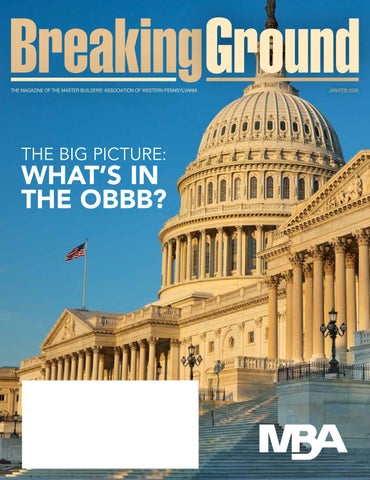
THE BIG PICTURE:
WHAT’S IN THE OBBB?
JAN/FEB 2026
™
BUILDING EXCELLENCE
WE CHALLENGE OURSELVES TO EXCELLENCE AND TO BE THE LEADER IN THE MECHANICAL CONTRACTING INDUSTRY Instagram / Facebook
@mckamish.inc
McKamish Inc.
Phone
412-781-6262
Website
www.mckamish.com
rn
2026
Contents PUBLISHER Master Builders’ Association of Western PA www.mbawpa.org MANAGING EDITOR Ben Atwood 412-922-3912 ben@mbawpa.com EDITOR Jeff Burd jburd@talltimbergroup.com PRODUCTION Carson Publishing, Inc. Kevin J. Gordon ART DIRECTOR Carson Publishing, Inc. GRAPHIC DESIGN Blink Advertising blinkadvertising.com CONTRIBUTING PHOTOGRAPHY Allegheny Conference on Community Development DRAW Collective Massaro Corporation Massery Photography Master Builders’ Association NAIOP Pittsburgh Douglas Rissing Tall Timber Group Turner Construction Company The White House SPONSORSHIP DIRECTOR Mary Chuderewicz mchuderewicz@mbawpa.org MORE INFORMATION: BreakingGroundTM is published by the Master Builders’ Association of Western Pennsylvania, 412-922-3912 or www.mbawpa.org Archive copies of BreakingGroundTM can be viewed at www.mbawpa.org No part of this magazine may be reproduced without written permission by the Publisher. All rights reserved.
On the cover: Cover image by Douglas Rissing
05
EDITOR’S NOTE
49
MANAGEMENT PERSPECTIVE The 2026 NFL Draft: A Transformational Moment for Pittsburgh and Western Pennsylvania
55
TREND TO WATCH Credit Quality is Slipping. Should We Be Concerned INDUSTRY & COMMUNITY NEWS
07 REGIONAL MARKET UPDATE 13
NATIONAL MARKET UPDATE
19
WHAT’S IT COST?
20
FEATURE The One Big Beautiful Bill
33
PROJECT PROFILE The Church of the Ascension
57
41
LEGAL PERSPECTIVE Faulty Wiring: Fraud’s Growing Threat to Construction
63 AWARDS & CONTRACTS
45
FINANCIAL PERSPECTIVE Breaking Ground on Tax Savings: A CFO’s Guide to Building Your Company’s R&D Tax Credit
65
FACES & NEW PLACES
69 CLOSING OUT Mayor Elect Corey O’Connor
This information is carefully gathered and compiled in such a manner as to ensure maximum accuracy. We cannot, and do not, guarantee either the correctness of all information furnished nor the complete absence of errors and omissions. Hence, responsibility for same neither can be, nor is, assumed.
BreakingGround January/February 2026
3
5 HOT METAL STREET
PITTSBURGH, PA 15203
THE WESTERN PA CHAPTER, NECA
EMPOWERING LIVES & COMMUNITIES SINCE
1946
WWW.WPANECA.COM
#WEPOWERPA
2024
EDITOR’S NOTE
Like Governor Shapiro, the incoming mayor is about getting things done. Mayor-elect O’Connor and his closest advisors even hand out pens that have the phrase “getting to yes” on them. That would make an excellent summary of purpose for regional economic development efforts. Heck, it’s simple enough they might even understand it in Harrisburg.
D
o things feel different to you since election day? If your answer is yes, you’re not alone. Since Corey O’Connor was elected mayor of Pittsburgh on November 4th, there has been a palpable lifting of spirits almost across the board in the region. There is a certain symmetry to that phenomenon that goes back 20 years. In 2006, Mayor Bob O’Connor, Corey’s father, kicked off his administration with his “Redd Up Pittsburgh” campaign. While there was a tangible goal of that campaign, to clean up the city’s streets, Redd Up was more about changing two decades of negativity in this region. While the first Mayor O’Connor passed away before he could see that change in attitude, his positive outlook set the tone for the celebration of Pittsburgh’s 250th anniversary in 2008. PNC’s CEO Jim Rohr, who was chairing the Allegheny Conference at the time, distilled that outlook in his speech at the Pittsburgh 250 event, admonishing Pittsburghers for failing to see the transformation that had already occurred in the region. Rohr called out our collective lack of vision as he announced the regional marketing campaign, “Pittsburgh: Imagine what you can do here.” A corny slogan does not make good economic development policy. An upbeat outlook, on the other hand, breeds enthusiasm that others can feel. The economic and demographic facts of life about Western Pennsylvania are clearly not proving to be compelling to businesses looking for places to expand. Perhaps a little enthusiasm would go further than you might think, especially if it is combined with an attitude of getting things done.
There are going to be some serious limitations on what Corey O’Connor can do to bring business to the city. He’s inheriting fiscal conditions in the city that are heading in the wrong direction, with revenues dropping as expenses swell. But the fact that he and members of his team are already talking to developers and builders about what it will take to spur development within the city limits is a good sign. Given that his two most recent predecessors seemed to erect barriers to development, there should be some low hanging fruit to pluck when it comes to “getting to yes.” And there are some tailwinds. The Commonwealth recently passed legislation that allows the City of Pittsburgh to offer 20-year LERTA tax abatement. Pittsburgh’s ugly demographic data hides a not so ugly reality. While population growth is nonexistent, the effect of younger new residents replacing the older ones who die means the 25-to-34-year-old population of the City of Pittsburgh is growing at twice the national rate. Companies considering locating or expanding in Pittsburgh are looking forward. That’s a forward-looking story that can be told. Told with enthusiasm, a forward-looking story might win the day now and again. I believe something as simple as the straightforward message, “imagine what you can do here” was powerful. “Getting to yes” may prove to be powerful too. I heard from developers so many times over the past decade that it felt like the city was working against them, trying to get to no. Corey O’Connor has his work cut out for him, but if he can create a culture of “yes” for the City of Pittsburgh, the good feelings of January 2026 will turn into positive results.
BreakingGround January/February 2026
5
It’s a win-win for our region when labor and business are aligned. At Pittsburgh Works Together, we cover the impact of labor and business on Western PA’s economic health. Access research briefs, data insights and expert analysis at pghworks.com.
Pgh WorksTogether
Pgh_works
PittsburghWorksTogether
PghWorks
REGIONAL MARKET UPDATE
O
n November 4th, Corey O’Connor defeated Republican nominee Tony Moreno to become the 62nd mayor of Pittsburgh.
There was little doubt about the outcome on election night, as Pittsburgh has not had a Republican mayor in nearly a century. O’Connor’s real victory came in May, when he unseated incumbent mayor Ed Gainey in the Democratic Primary. Gainey, who himself unseated Mayor Bill Peduto in 2021, has been criticized by many in the development and real estate communities for a perceived lack of cooperation between his administration and builders. O’Connor made significant reform to the city’s inspection and permitting processes a major leg of his campaign, calling the current structure “fundamentally incapable of meeting our city’s needs.” In his first post-victory interview he stressed the new administration will be heavily focused on encouraging new construction and cutting red tape to ensure that projects are completed in a timely manner. Entering the final weeks of 2025, it appears likely that the industry will outperform expectations. Fourth quarter activity provided more opportunities for contractors to build backlog than seemed likely on Labor Day. Based upon contract awards and building permits through mid-December, Tall Timber Group now estimates that the total nonresidential/ commercial construction contracting and starts for the region will top $5 billion, beating its forecast of $4.8 billion. Bidding and contracting activity mostly followed prevailing market trends. The projects awarded or started were largely in the multi-family, industrial, and the public sectors, with a slight uptick in small college work.
Among the small college projects were Seton Hill’s $25 million field house and the $12 million Lazear Hall renovation at Washington & Jefferson. PJ Dick will be the general contractor for both projects. The largest higher education project in the marketplace as 2026 begins is Pitt’s new 400bed residence hall, proposed for property at Fifth Avenue and Bellefield. The university is in the midst of a design-build procurement process for the $80-to-$100 million new facility. Duquesne University expects to bid its new $68 million building for its John Rangos Sr. School of Health Sciences in February or March. The biggest boost for the industry came from public construction. ALCOSAN awarded contracts for its $407 million Wet Weather Pump Station, and Mascaro Construction was awarded the general construction contract for that major component of ALCOSAN’s multi-billion-dollar Wet Weather Equalization Plan. Additionally, Washington County Transit Authority awarded contracts for its $40.8 million Freedom Transit Bus Maintenance Facility in South Strabane Township. For the full year, bidding on public building construction – including waste and water treatment plants – more than doubled any year in the past decade (excluding the Pittsburgh International Airport Terminal Modernization Program). Bids awarded for publicly owned facilities totaled just under $1.5 billion in 2025. The K-12 market was especially robust. Massaro Corporation was awarded the general construction contract for Seneca Valley School District’s $118 million intermediate high school expansion and renovation. Other K-12 projects of note awarded in the fourth quarter include Mars Area School District’s $21.4 million elementary school, the $19.6 million O’Block Elementary School in Plum, and Elizabeth Forward’s $28 million second phase of its high school addition and alterations program. According to architect Crabtree Rohrbaugh & Associates, two K-12 projects estimated at roughly $130 million each are expected to go out for bid in early 2026. One, the Hempfield Area High School in Greensburg, is a rebid of a project that bid in 2023. The other is the new Park Forest Middle School in State College, PA. The $75 million new South Fayette Elementary School is also expected to go out to bid before spring. In the healthcare sector, Allegheny Health Network (AHN) is procuring construction services for a new $80 million to $100 million outpatient facility in Cranberry Township. Assuming AHN finalizes a site selection for its northern Washington County hospital, construction should start on new facilities that will cost $150 million or more.
Non Res construction spending ends up surpassing the spring forecast. (Source: Tall Timber Consulting)
BreakingGround January/February 2026
7
Pittsburgh PLI Commercial Construction Over $100,000 Approval Count and Value Count
Total Project Value
$200,000,000
50
40
30 $100,000,000 20
Approval Count
Monthly Total Project Value
$150,000,000
A handful of apartment projects over $50 million also got underway. The pipeline for 2026 appears to have a similar number of major projects ready to start, in addition to the numerous rumored data center developments.
Ja n, 20 24 Fe b, 20 24 M ar ,2 02 4 Ap r, 20 24 M ay ,2 02 Ju 4 n, 20 24 Ju l, 20 24 Au g, 20 24 Se p, 20 24 O ct ,2 02 N 4 ov ,2 02 D 4 ec ,2 02 4 Ja n, 20 25 Fe b, 20 25 M ar ,2 02 5 Ap r, 20 25 M ay ,2 02 Ju 5 n, 20 25 Ju l, 20 25 Au g, 20 25 Se p, 20 25 O ct ,2 02 N 5 ov ,2 02 5
In the industrial sector, RIDC selected to $50,000,000 renovate a 110,000 10 square foot second building at the New Kensington Advanced $0 0 Manufacturing Park and is starting construction on a 100,000 square Month foot second building at Pittsburgh’s PLI approvals and total project value approved will align with 2024 figures. (Source: Western Neighborhood 91 near Pennsylvania Regional Data Center) Pittsburgh International Airport. Additional RIDC Much of the increased activity, particularly in the latter part of work commenced at the Westmoreland Innovation center the year, was the result of larger projects getting to the market. in Mount Pleasant, where ground broke on phase one of Four projects over $100 million were contracted or started PennSTART, a $30 million closed loop transportation testing in 2025, including a major expansion of Marathon/MPLX’s facility for autonomous vehicles. Harmon Station cryogenic gas plant in Washington County.
American Subcontractors Association of Western PA Advocating
Convening
Educating
An advocate for subcontractors, specialty contractors, suppliers and service providers in the construction industry since 1966.
COMING EVENTS
January 15, Monthly Chapter Meeting at LeMont February 19, Pins & Pints Networking at Shorty's
2219 Ridge Road South Park, PA 15129 (724) 538-8227 Erin Joyce, Executive Director erin@asawpa.org
For information about membership opportunities contact ASA of Western PA or go to www.asawpa.org
8
www.mbawpa.org
Allegheny County Single Family Residential Sales, Count and Volume Sales Count
Sales Volume
Ja n Fe 20 b 23 M 202 ar 3 Ap 202 r 3 M 20 ay 23 Ju 20 n 23 2 Ju 02 l 3 Au 20 g 23 Se 20 p 23 O 202 ct 3 N 20 ov 23 D 20 ec 2 3 Ja 202 n 3 Fe 20 b 24 M 202 ar 4 Ap 202 r 4 M 20 ay 24 Ju 20 n 24 2 Ju 02 l 4 Au 20 g 24 Se 20 p 24 O 202 ct 4 N 20 ov 24 D 20 ec 2 4 Ja 202 n 4 Fe 20 b 25 M 202 ar 5 Ap 202 r 5 M 20 ay 25 Ju 20 n 25 2 Ju 02 l 5 Au 20 g 25 Se 20 p 25 O 202 ct 5 N 20 ov 25 20 25
Total Sales Count
Total Monthly Residential Sales Volume
United States Steel 1250 $400,000,000 Corporation is putting $1billion into a new hot strip mill in the Edgar 1000 Thomson Works facility in $300,000,000 Braddock. The investment marks a major commitment 750 to the Mon Valley by the company and its new $200,000,000 owner, Nippon Steel Corp. 500 Construction started on an 85,000 square foot new building for Bakery Barn $100,000,000 in Alta Vista Industrial Park 250 in Washington County. Mascaro Construction started construction on $0 0 a $16 million expansion for Hitachi Energy in Mt. Pleasant, Westmoreland Sales volume and average price per transaction continued cool in the Allegheny County housing market County. And Imperial Land (Source: Western Pennsylvania Regional Data Center) Company announced that Old Dominion Freight Lines in construction starts. Although most of this was infill within had purchased property to build a 70,000 square foot terminal existing malls and shopping centers, the total includes at the Fort Cherry Development District in Washington County. the new 115,000 square foot Wegman’s, which Rycon Construction will build in the Cranberry Springs development There was also robust activity in retail construction during in Cranberry Township. the final four months of 2025, with more than $72 million
BreakingGround January/February 2026
9
The regional uptick in activity was also reflected in city data. A pull from Pittsburgh’s Permits and Inspections department indicates that 2025 will end up with roughly the same level of commercial permits approved as 2024. From January to November of this year, the city has approved 347 commercial construction permits whose project value is over $100,000. This averages out to 31.5 approvals per month, roughly the same as 2024. But average monthly approvals trended upwards in the second half of the year. From July to November, the average number of permits issued each month was 33.8, compared to 29.6 from January to June. Total project value also increased in 2025, with the total approved through early December at $76.1 million, compared to the total project value of 2024, which was $62.1 million. Perhaps the most notable new development to break ground within the city was The Esplanade, a $750 million 15-acre multiuse development on the North Side. The project, which aims to be a transformational development, plans on incorporating residential, retail, and a river side Ferris wheel. Groundbreaking was over a decade in the making and was attended by Governor Josh Shapiro and Mayor-elect O’Connor. This step forward for the North Side was coupled with a step back for downtown. Pittsburgh’s large-scale master plans are undergoing major changes as uncertainty swirls around the Lower Hill development after the Penguins’ allowed their development rights around the PPG Arena to expire in October. The $1 billion master plan, which is the site of the newly completed First National Bank tower and a Live Nation concert venue that is currently underway, still has over 20 acres of undeveloped tracts left. The original master plan involved mostly new office property and affordable housing development, both of which are facing considerable market headwinds today. The local office market continues softening. CoStar data shows that at 11.5 percent, office vacancies remain well above the long-term average for the region, but that leasing activity held steady through much of 2025. Net absorption did tick down in the third quarter, with renewals behind many of the top deals of the year. The average size of new leases were 4,800 square feet over the past 12 months, down five percent from pre-pandemic norms but up noticeably from the 2023 average of 3,700 square feet. Pittsburgh’s multifamily market also appears fully capable of absorbing the new supply on the way. A total of 1,650 units were added to the inventory in 2025, on par with 2024’s numbers. And while CoStar’s data shows that some cooling of rents within the market, at nearly two percent year over year gains, local rent growth easily eclipses the national average. Vacancies are still extremely healthy at 5.8 percent, and with over 3,000 units underway the region will experience what, for Pittsburgh, could be considered a surge in housing. Allegheny county data indicates a modest cooling of residential prices but not purchases. From January through November, this year has seen about 9,070 residential homes change hands, compared to 8,786 transactions during that same time in 2024. The average sale price in in 2025 was $321,381 compared to $315,800 the year prior. Interestingly, the average sales price for November of 2025 was roughly $296,000, down from $312,000 at that same time last year, and the average sale price has stayed under $300,000 since September.
10 www.mbawpa.org
Other local economic indicators are harder to come by. The record-setting shutdown of the federal government has led to a substantial delay in economic reporting by the U.S. Bureau of Labor Statistics, whose numbers for the Pittsburgh region, including housing permits issued and key employment figures, are still stuck in August of 2025. But the November Beige Book from the Federal Reserve describes an economy drifting sideways, neither contracting or meaningfully accelerating, with cost pressures and cautious consumers shaping the landscape. Demand across most sectors is flat, margins are being squeezed by rising insurance, utilities, healthcare and tariff driven input prices. Inside the Fourth District, which includes Pittsburgh, the Beige Book indicates that economic conditions were steady with only a slight uptick in overall activity. Manufacturers reported a mixed environment, with some seeing softer demand while others noted increased orders tied to the broader region’s expanding AI related data center construction. Geographically, the western Pennsylvania region has critical advantages for the development of these centers. Its abundance of natural gas can feed their enormous thirst for power; however, political hurdles may impede development. Governor Shapiro has been open about his desire to expedite this process and the first major data center in the works just cleared a major political hurdle in late November when Pennsylvania’s Department of Environmental Protection issued an air quality permit to Homer City Generation, helping pave the way for the gas plant that would fuel the proposed $10 billion data center campus. In early December, a New York investment firm Davidson Kempner Capital Management purchased the former Cheswick Generating station in Springdale for $14.3 million. The firm is seeking a conditional use permit to convert the site into a 565,000 square foot AI and high-density computing facility supported by an additional 200,000 square foot utility building. The Springdale Planning Commission has already recommended approval with conditions, and the council is expected to vote on the project December 16th. If approved, the developer anticipates six to nine months of design work and community engagement before seeking major permits in the fall of 2026, with construction targeted for 2027. Future manufacturing and data center developments could be spurred by changes to the tax code from the One Big Beautiful Bill, which offers a plethora of rebates and tax incentives for developers, with a specific major boost for those building manufacturing facilities. The stronger than expected fourth quarter suggests resilient demand for construction in Western PA heading into 2026, especially given the relative weakness of Pittsburgh healthcare and higher education owners. The macroeconomic climate is unlikely to be provide an incentive for development in the first half of 2026. Whatever changes the incoming O’Connor administration is able to implement will also have an effect later in 2026. The recipe for 2026 appears to be similar to that which worked in 2025: strong local labor markets, numerous major projects, and diversified demand for new space from across the economy. BG
EXPERIENCE UNMATCHED ANYWHERE ELSE
Metal Framing • Drywall / Drywall Finishing Acoustical • Rough Carpentry Glulam Construction
BRYAN CONSTRUCTION INC.
www.bryanconstructioninc.com 724-794-6003
POWER ON POWER ON POWER ON BreakingGround January/February 2026
11
BUILT ON INTEGRITY.
FOR COMMUNITY.
WITH QUALITY.
As a family-owned business, heart is at the center of everything we do—and that’s why we’re drawn to mission-driven work.
Full-Service Construction • (412) 807-2000 • pjdick.com
NATIONAL MARKET UPDATE
C
onfusing crosswinds are carrying the construction industry into 2026. While headline spending and major project starts remain elevated, beneath the surface numerous core nonresidential categories are flat or trending down. Simultaneously, the labor market is weakening. Unemployment is up, job growth is static, and consumer confidence has deteriorated noticeably. Against that backdrop, a 43-day shutdown of the federal government has left a meaningful gap in national economic reporting. Agencies like the Census Bureau and the Bureau of Labor Statistics (BLS) were forced to suspend data collection and publication, and many current pricing and labor figures still reflect September (or earlier) conditions. What’s available shows mixed signals. A November report from the Census Bureau showed total construction spending in August at $2.21 trillion, edging up 0.2 percent from the previous month but down 1.6 percent from August of 2024. Private nonresidential softened further, falling 0.3 percent for the month and down four percent year over year. Manufacturing construction declined for the seventh consecutive month, dropping one percent in August and 8.5 percent from the year prior. Though public construction was flat, it was up 2.7 percent year over year with mixed performance across major categories. If the spending data points to cooling conditions, then the picture shifts when looking at project starts. According to a report by the Dodge Construction Network, total U.S. construction starts jumped 21 percent in October. The report also showed that nonbuilding construction climbed by nearly 60 percent from September to October, as utilities grew
Seasonally Adjusted Net Employment Report (In Millions)
135
by nearly 400 percent thanks to massive LNG and energy infrastructure starts in Louisiana, Texas and Maryland. These projects pushed annualized activity to $1.53 trillion but beneath that headline is a more nuanced picture. The figures are lifted almost entirely by a wave of billion-dollar mega projects that continue reshaping the industry’s topline numbers. Dodge Construction Network reports ten projects over $1 billion broke ground in a single month while residential work slid and categories like hotels, education, and healthcare softened. Year to date, nonresidential starts are up 5.6 percent and nonbuilding up nearly 20 percent, signaling again that public works and high-tech investment are anchoring national growth even as conventional building sectors cool. Taken together, the data shows an increasingly bifurcated industry with broad moderation on one side and an unprecedented megaproject boom on the other. After several months of building momentum, nonresidential planning finally eased in October as the Dodge Momentum Index (DMI) slipped 7.1 percent. The pullback follows a record surge in late summer and early fall, suggesting the pipeline is recalibrating rather than contracting. Dodge analysts still describe the environment as “solid across the board,” but note that part of the recent upward trajectory was inflating by rising labor and material prices, not purely by new activity. As broader macroeconomic risks stack up, forecasters expect planning to decelerate gradually through early 2026.
Even with October’s dip, the year-to-date numbers remain healthy. Overall planning is up 35 percent compared to last year, and the DMI sits 52 percent higher than a year ago. Typically, the DMI is a historical leading indicator of actual nonresidential ADP National Employment Report (Seasonally Adjusted) construction spending by 12 to 18 months, and today’s elevated pipeline suggests 2026 will deliver improved project starts across the country. According to the BLS, construction employment rose in September, reaching 8.3 million workers nationwide, up 19,000 from August and 38,000 year-over-year. The gains were driven almost entirely by the nonresidential sector, which added 16,300 jobs in September and 83,500 positions from 12 months prior.
134
133
132
131 1//2023
7//2023
1//2024
7//2024
1//2025
7//2025
DATE
Payroll processor ADP shows a slight dip in national payroll numbers. (Source: ADP)
The BLS also reported that total nonfarm payrolls increased by 119,000 in September, but unemployment hit 4.4 percent, the highest level since 2021. Job gains were concentrated in health care,
BreakingGround January/February 2026
13
www.treconstruction.net 724.650.5544
14 www.mbawpa.org
The latest JOLTS report covering October 2025 labor market flows across the nonfarm economy reported that job openings held steady at 4.6 percent, while hires were unchanged month to month at 3.2 percent, and total separations stayed flat at 3.2 percent. Within separations, quits totaled 2.9 million (1.8 percent), layoffs and discharges 1.9 million (1.2 percent), and other separations totaled 255,000.
Though not totally reliable due to the shutdown, the Bureau of Labor Statistics Construction Employment series shows an uptick for the month of September. (Source: BLS)
Monthly Payroll Change By Company Size 1-19 employees
20-49 employees
50-249 employees
250-499 employees
500+ employees
300,000
200,000
100,000
0
(100,000)
(200,000) Jan 2023
Jul 2023
Jan 2024
Jul 2024
Jan 2025
Jul 2025
Date
But another caveat: this release is relying on partial and backfilled data. October’s preliminary estimates were collected after the shutdown and produced without the usual alignment to payroll employment, meaning shortterm shifts may be muted or delayed. November’s ADP National Employment Report also showed a decline in employment, including in the construction sector. Private sector employees shed 32,000 jobs, reflecting a weak month across both goods-producing and serviceproviding industries. Losses were led by manufacturing, professional and business services, information, and construction, while education and health services and leisure and hospitality posted notable gains.
According to ADP, small firms saw the sharpest pullback, cutting a combined 120,000 positions, while medium and large employers added jobs. Pay growth continued to cool, as well. Annual wages for job-stayers rose 4.4 percent, and job changers saw pay increases of 6.3 percent, both slightly slower than the previous month.
ADP continues to show employment softening, with smaller businesses shedding the most payroll. (Source ADP)
food services, and social assistance. Declines were seen in transportation, warehousing, and federal government. Most major industries showed little to no movement, reflecting a broader cooling in labor demand. The BLS also released downward revisions to July and August payrolls, showing weaker momentum than initially reported. This data comes with a caveat. September’s figures were delayed by over six weeks due to the shutdown, and the establishment survey includes a mix of normally collected data and electronic self-reports submitted during the shutdown, resulting in an unusually high response rate.
New unemployment claims rose sharply the first week of December according to the Bureau of Labor. Initial jobless applications climbed to 236,000, an increase of 44,000 from the week prior, and above expectations. While some of that movement can be attributed to holiday related distortions, the elevated level of claims underscores the potential softening. Continuing unemployment claims also showed movement,
BreakingGround January/February 2026
15
Amidst the softening labor market, the Federal Reserve lowered interest rates by a quarter point for the third time this year, bringing the federal funds rate to a range of 3.5-3.75 percent. The vote revealed significant internal division, with some officials advocating for holding rates steady while others favored a larger half point reduction.
Long-Run Inflation Expectations, Including Recent Declines, Remain Fully Aligned With Views of Independents
6 Median Long-Run Inflation Expectations %
with 1.84 million Americans remaining on unemployment benefits as of late November, though analysts caution that seasonal factors and eligibility limits can overstate that figure.
All Consumers (3MMA)
5
Independents (3MMA)
4 3
Independents Dec-2025 (monthly)
2 1 2017
All Consumers Dec-2025 (monthly) 2018
2019
2020
2021
2022
2023
2024
2025
Fed officials also revised University of Michigan, December 5, 2025 their outlook for the Long run inflation expectations dropping for independents as well as all consumers. (Source University of economy, projecting stronger Michigan) growth in 2026 alongside slightly lower inflation and a small improvement to though both short- and long-term expectations remain unemployment. Inflation is now expected to fall to 2.5 elevated compared with pre-2024 levels. percent by the end of 2026 while GDP growth was upgraded Skanska, an international construction manager and to 2.3 percent. developer, released a November report looking ahead at the U.S. consumers grew increasingly pessimistic about the commercial construction market for 2026. The group believes economy in November, according to the Conference Board, the sector faces a mixed outlook over the next 12-18 months, a nonpartisan economic research organization. The group which Skanska attributes to uncertainty surrounding interest reported that its consumer confidence index fell to 88.7, rates, shifting tariffs and broader economic policy changes. down from 95.5 in October, marking the weakest reading The report also cites the soft employment figures and slight since April. The survey indicated that Americans are feeling uptick in unemployment as signs of a cooling economic increased pressure from elevated prices and slower job environment, with the lack of recent data adding layers of growth, with views of the labor market deteriorating across uncertainty and hesitancy across the industry. the board. The decline was broad based, with households Skanska also reports that sectors traditionally seen as resilient, across political affiliations reporting a dimmer outlook, and such as higher education and healthcare, are showing signs the sharpest pullback occurring among independents. of slowing. At the same time, the firm points to momentum But December’s University of Michigan’s consumer in technology driven sectors that may stabilize the landscape. sentiment index indicated a slight uptick in confidence. Federal incentives and reshoring efforts are likewise Their figures rose by 2.3 index points, and the modest bolstering semiconductor and pharmaceutical manufacturing, improvement was driven largely by younger consumers, as positioning these industries for sustained investment. overall views of the economic conditions held steady. The industry enters 2026 much as it began 2025: navigating Interestingly, expectations rose noticeably. There was a 13 uncertain conditions with diverging signals. Elevated activity percent increase in expected personal finances, with gains in select sectors continues coexisting with softening elsewhere, appearing across demographic groups. Even so, expected reinforcing a bifurcated landscape. With data visibility still personal finances remain nearly 12 percent lower than limited, distinguishing temporary noise from durable trends at the start of 2025 and assessments of the labor market will remain a challenge in the months ahead. BG remain subdued. The survey also showed inflation expectations easing, with year-ahead expectations falling from 4.5 percent to 4.1 percent, the lowest levels since January of this year and the fourth consecutive monthly decline. Long run expectations also softened to 3.2 percent, matching the January reading,
16 www.mbawpa.org
www.volpatt.com
#WeAreVolpatt commercial industrial institutional
WHAT’S IT COST?
T
he record-setting 43-day shutdown of the federal government came to an end on November 12th, and because of the lapse in appropriations, the Bureau of Labor Statistics (BLS) was forced to halt data collection, processing, and publication of its pricing index series. Consequently, the most recent data from the BLS remains the September reports. Additionally, the next release of many pricing indexes will not come out until January, when the bureau will lump October and November data together. This muddies the waters for those who closely monitor the indexes, especially considering the fourth quarter was when the impact of President Trump’s tariffs was expected to hit consumer and producer pricing. So, even though this latest release paints a fairly healthy and stable state of affairs for the construction industry, these numbers need to be taken with a grain of salt. A scan of the full set of 80 construction related price indexes shows that the vast majority of categories barely moved in
September, with 66 landing within a narrow band of plus or minus 0.4 percent. Only six indexes posted monthly growth greater than one percent, while five recorded declines of greater than that same number. Producer price index (PPI) rose by 0.3 percent, matching expectations, and a 2.7 percent climb from September 2024. However, when food and energy is excluded, the PPI rose by just 0.1 percent. Goods prices were the main driver of the growth, while services held mostly flat. Construction related price measures were also stable. Final demand construction scarcely moved and is up 0.9 percent compared to last September. Pricing for construction serving private capital investment also registered no change, reflecting 0.7 percent increase over the past year. Meanwhile, government related construction pricing moved by 0.1 percent from August, landed 1.4 percent above last year’s mark, and stood 33.4 percent higher than its 2020 measurement. More detailed building-type construction indexes followed the same pattern. Overall construction pricing nudged up 0.1 percent from the prior month, 1.3 percent above last year’s level. New non-residential building construction was flat in September and up 0.8 percent from 2024. School building construction also held steady from August to September, with the index 1.1 percent higher than the prior year. Inputs to construction also saw little movement. Energy inputs rose by 1.2 percent, industrial structure inputs moved up 0.3 percent, and commercial inputs edged higher as well. Other indexes in this group, including goods and services, were essentially flat. Prices for major subcontractor categories also showed little movement overall, with concrete, electrical, and plumbing all essentially steady on the month. Only two trades posted increases: roofing, which saw about a 0.5 percent growth and concrete, which edged up slightly as well. The month’s largest spike in prices came from #2 diesel fuel, which climbed by 1.83 percent monthover-month and is 8.2 percent above its September 2024 value. Aluminum mill shapes climbed 1.74 percent month-to-month and the index sits 26 percent higher than its year over year price. The biggest drop came from copper and brass mill shapes, which declined by nearly 4.5 percent month over month, and is 3.2 percent higher than its year over year figure. Fabricated structural for bridges also declined by more than 2.1 percent from August to September, with prices down over six percent from that same time in 2024. Asphalt (at refinery) dropped by nearly two percent from August to September, though it remains nearly 15 percent higher than 12 months prior. BG
Source: Bureau of Labor Statistics
BreakingGround January/February 2026
19
The Big Picture:
WHAT’S IN THE OBBB? 20 www.mbawpa.org
On July 4th, 2025, President Donald Trump signed into law the One Big Beautiful Bill Act (OBBB), a sweeping tax and economic reform package that his administration hailed as the centerpiece of its economic agenda.
BreakingGround January/February 2026
21
f
ORGANIC
e
a
t
u
r
e
T
he bill is a key component of the President’s overarching push to reshape domestic policy, and its provisions largely align with his ideological priorities. There’s close to $325 billion in additional spending allocated to the military, immigration enforcement, and border walls. There are deep funding cuts for environment protections and social services, too.
There’s also a plethora of significant tax breaks for businesses and individuals. Some are new, but many are renewals of expiring benefits codified during the first Trump administration in the Tax Cuts and Jobs Act (TCJA) of 2017 and set to sunset in the coming years. The OBBB’s passage was met with widespread partisan praise and criticism. It was also greeted with near universal skepticism and cautious pessimism from numerous non-profit tax policy organizations that study such bills. The Congressional Budget Office (CBO) forecasted that the legislation’s tax cuts will reduce federal revenues by an estimated $4.5 trillion and cost $3.4 trillion over the next ten years. The Tax Foundation estimated that the OBBBA will increase GDP by 1.2 percent over the next decade, while increasing the deficit by over $3 trillion.
Rooted in Pittsburgh, our client demand expanded the firm’s reach to 19 offices in 10 states. Call us for construction and surety-related questions.
Succeed or fail, the bill’s provisions will be felt for years, and entire books could be written about the OBBB’s impact on the American and global economy. But that type of analysis is far beyond the scope of this article, which will focus on the legislation’s potential impact on the construction industry and the businesses operating within it. The OBBB’s overarching political and economic ambition is promoting a surge of domestic manufacturing. Its marquee deduction is a radical write-off option for building new manufacturing facilities within the United States, contained in a subsection called 168(n). This provision, brand new to the tax code, allows companies to immediately expense the full cost of construction on the qualified portion of a production facility the year it is placed into service, rather than depreciating its cost over 39 years. An extremely simplified example: say a company called Stupendous Steel builds a new specialty steel plant for $70 million. They spend $50 million constructing fabrication bays, welding areas, blast booths, and $20 million on offices, restrooms, and hallways. Under the new guidelines, Stupendous Steel could expense the $50 million the year the facility is placed into service. If their annual revenue was $60 million, their taxable income becomes $10 million. Pre-OBBB, they would only be able to deduct about $1.3 million in depreciation and would be taxed on $58.7 million of income. If their hypothetical federal tax rate is 28 percent, their bill dropped from $16.2 to $2.8 million.
William D. Clifford & W. Alan Torrance, Jr. Included in The Best Lawyers in America 2023 Commercial Litigation, Construction Law, and Litigation-Construction 412-281-7272 22 www.mbawpa.org
There are numerous caveats and conditions that will apply, and the rules will be argued over by IRS auditors and tax professionals in the coming years. But some of the guidelines are clear: construction must begin after January 19, 2025, and before January 1, 2029. The plant must be operational by January 1, 2031, and remain in production for a decade. The building’s original use must begin with the taxpayer, meaning no build-to-lease allowed. Only the production related portions
f
e
a
t
u
r
e
of the property qualify for the full depreciation. Areas such as fabrication bays, assembly floors, or refining space count; offices, bathrooms, and hallways don’t. This is a significant shift, designed to lower the effective cost of manufacturing construction. By easing financing pressures and improving cash flow early in a project’s life, the OBBB aims to make large scale manufacturing construction and modernization projects more financially attractive and easier to justify to lenders and investors. As such, the OBBB’s passage was advocated for and praised by the National Association of Manufacturers, The Association of Equipment Manufacturers, and the Association of General Contractors (AGC). “I believe that the growth opportunity this presents could be unprecedented,” said Michael Kapics, of HBK CPA’s and Consultants. “As manufacturing companies look to take advantage of this deduction, there will be tremendous opportunities for growth presented to construction companies. Those that stay active in pursuit of manufacturing companies looking to expand should see a significant increase to their revenue and profitability.” The data on whether this construction boom of manufacturing centers is happening remains murky. CoStar, a commercial real estate data aggregator, shows that nationwide the inventory of specialized industrial supply is set to grow by nearly one percent by the end of 2025, the highest level in a decade. However, CoStar’s labeling of manufacturing facilities can be haphazard and that figure should be taken with a grain of salt. The latest federal data present a mixed picture. The Census Bureau reported total construction spending at a $2.21 trillion annualized rate in August, up 0.2 percent from July but down 1.6 percent year over year, with manufacturing construction declining for the seventh straight month and falling 8.5 percent from August 2024. Yet the forward-looking indicators tell a different story. According to Dodge Construction Network, total U.S. construction starts surged 21 percent in October, led by a sharp rebound in nonbuilding activity, which climbed nearly 60 percent month over month as utility projects alone jumped by almost 400 percent — suggesting that while current spending has cooled, the project pipeline may already be shifting. The Yale Budget Lab estimates that there will be a surge in construction and manufacturing but cautions that it will be short-lived. The group forecasts a short-term demand spike so rapid that the Federal Reserve raises interest rates to keep inflation in check. Investors will anticipate the higher borrowing costs, yields on long-term bonds will rise too, adding more upward pressure on rates. Those higher rates will make borrowing for equipment and construction rise, gradually cooling investment. Over time, the cost of financing will outweigh the benefit of the bill’s write-offs. The Bipartisan Policy Center also believes that there will be a short-lived boom in manufacturing construction and add an additional concern about timing. Many factories take
BreakingGround January/February 2026
23
f
e
a
years to build and advanced manufacturing, the kind the Administration is angling for, can sometimes take a decade. This means that the most specialized facilities might not be operational within the bill’s set time parameters. The administration is claiming that this boom is beginning, and there are significant examples of an uptick in domestic manufacturing interest. Apple, OpenAI, Meta, and Nvidia announced in 2025 plans to spend more than $1 trillion combined on increasing their domestic manufacturing capabilities. Scores of additional firms, both domestic and international have also made 2025 announcements signaling significant plans to spend hundreds of billions on manufacturing facilities across the country. Manufacturing success or failure will play out over the next five years, but the OBBB will indisputably provide immediate financial benefits for many in the construction industry. The same levers of accelerated cost recovery are applied beyond factory construction, and the bill contains numerous other depreciation incentives for builders large and small. This was the main reason that the AGC lobbied for the bill’s passage and sent a “Key Vote” letter to sitting U.S. Senators, letting them know that the agency approved of its provisions and advising that its 27,000 members were watching how the Senator voted. “The main win for us in the OBBB was the permanent extension
24 www.mbawpa.org
t
u
r
e
of all those expiring 2017 tax cuts,” said Deniz Mustafa, senior director of infrastructure and finance at the AGC. “If those had gone away, most of our members would have seen a big jump in their tax obligations. It also makes it much easier for businesses to plan ahead. What their tax years are going to look like, whether they want to acquire additional equipment, and whether they can do R&D expensing. It provided certainty and predictability.” One of the main upgrades general contractors will benefit from is a renewal of depreciation benefits in 168(k). Like 168(n), Section 168(k) allows businesses to immediately deduct a large portion of the cost of qualifying assets instead of depreciating them slowly over time. The difference between the two is that the former pertains to production facilities while the latter applies to equipment. First introduced in 2002 as an economic stimulus measure post-9/11, Section 168(k) was supercharged by the first Trump Administration in the TCJA, which raised bonus depreciation to 100 percent for assets placed into service from 2018-2022. The bonus phased down annually and was set to sunset entirely in 2027, but the OBBB reset the rate to 100 percent and made it permanent for qualified property placed into service after January 19th, 2025. Qualified property can include heavy machinery, tools and office gear, manufacturing equipment, and certain interior
f
e
a
improvements. This enables contractors to immediately depreciate costly equiptment purchases, improving cash flow and lowering the effective cost acquisition. Because the deduction is once again a certainty, firms can more confidently plan to replace and upgrade their equipment. Section 179 is the Main Street version of this instant equipment write-off and has long been a small business incentive that encourages contractors, trades and local firms to reinvest quickly in their equipment by allowing them to expense their costs against their taxable income. The OBBB raised the limits of this write off, from $1.22 million to $2.5 million, and the cutoff threshold from $3 million to $4 million. The benefit is limited to smaller businesses by a write-off cap which, when exceeded, comes at a dollar-fordollar reduction loss. So, if a contractor called Craig’s Construction buys $2 million in trucks, trailers, and tools in 2025, they are under the limit and can deduct the full $2 million immediately. But if they grow and in 2026 buy $4.6 million in equipment, they are $600,000 over the threshold and could only deduct $1.9 million. “This is very nice for contractors,” said Brian Kassalen, a principal at Baker Tilly. “Especially for small and mid-sized ones. We have a lot of contractors who are purchasing $2-$2.5 million, maybe more. So, they were previously capped and now they’re going to get the full 179 deduction.” Accelerated write-offs make it easier to spend, but most borrow to build. Section 163(j) is another revised lever of the OBBB, designed to increase the amount of interest a firm can write off. This revision, originally made in the TCJA, expired under the Biden administration. From 2022 to 2024, a firm’s interest deductions were capped at 30 percent of adjusted taxable income (ATI), which was based on earnings before interest and taxes (EBIT). So, if Commonwealth Construction had $10 million in ATI and $5 million in loan interest, they could only deduct $3 million. But beginning in 2025, the ATI is now calculated using earnings before interest, taxes, depreciation, and amortization (EBITDA). Allowing depreciation and amortization back in generates a higher-level ATI, which leads to a larger deduction. Now, if Commonwealth has
t
u
r
e
$500,000 in amortized costs and ten percent depreciation on $1 million worth of equipment, their ATI is $10.6 million, and their deduction rises to $3.18 million. “The ability to add back depreciation and amortization can be significant because it could allow for greater interest expense deductions,” says Mark DiPietrantonio of Schnieder Downs. “Additionally, it could also result in excess taxable income, resulting in the deductibility of past interest expenses that were suspended in prior tax years due to the more limiting EBIT base.”
Union Craftsmen
Building the Region
One Unit at at Time... www.mcawp.com BreakingGround January/February 2026
25
Highest Quality. On-Time. On-Budget.
The Mechanical Contractors Association of Western Pennsylvania serves the unique needs of contractors involved in heating, air conditioning, refrigeration, plumbing, piping, and mechanical and related service industries. We provide our members with high-quality educational materials and programs to help them attain the highest level of managerial and technical expertise.
Contact: Rege Claus, Executive Director | (412) 683-3600 | mcawpa@verizon.net 5131 CYPRESS STREET • PITTSBURGH, PA 15224
f
e
a
The law tightens oversight by requiring “Capitalized Interest”, that is interest rolled into the cost of a project, to be counted toward the deduction limit. In prior years, Commonwealth Construction could roll their $5 million in interest into the total cost of their project. If they were building a $20 million drywall manufacturing facility, they could say its total cost was $25 million and then depreciate that $25 million building over the next few decades. The OBBB ends that loophole and now all interest counts toward the cap. However, it retains flexibility by permitting qualified businesses to opt out of the cap entirely, albeit with a cost. By doing so, a builder forfeits access to the potent bonus depreciation offered to them in section 168(k).
t
u
r
e
returns to reclaim deductions they previously had to defer, potentially triggering meaningful refunds. Larger firms that capitalized costs in 2022 through 2024 can now expense those amounts either entirely in 2025 or split the deduction evenly between 2025 and 26. In practical terms, that means companies that invested heavily in process modeling, energy efficient design, or construction tech development, will be able to free up substantial cash during the next two filing cycles.
For builders of non-manufacturing buildings, this provides extra options. An office developer could choose to deduct all their interest with little to no change in their depreciation deductions. But a company like Stupendous Steel would have to choose between deducting all its interest payments immediately or losing its 100 percent depreciation write-off. “The decision to forgo bonus depreciation was somewhat easier when bonus depreciation was scheduled to be phased out. Now that 100% bonus depreciation is available in 2025 and permanent going forward, the decision to elect out of 163(j) will be more difficult for some”, says DiPietrantonio. These decisions shape the economics of building itself but there are also significant changes to backend expenses that come before construction begins. Of particular significance is a change involving research and development. After the 2022 sunset of an R&D provision in the TCJA, businesses were required to amortize their research and development expenses over five to fifteen years instead of deducting them up front. The OBBB brings back immediate expensing for U.S. based research, meaning that firms investing in things like new construction processes, prefabrication systems, or project management can write them off immediately. Additionally, the change is retroactive and forward looking. Smaller taxpayers, generally those with less than $25 million in gross receipts, can amend their 2022 and 2023
BreakingGround January/February 2026
27
f
e
a
Another TCJA option set to sunset and given new life by the OBBB is the 20 percent 199A deduction. A substantial number of construction firms are not corporations, where taxes are paid by the corporate entity. Rather, they operate as what are called pass through entities. That’s because the profits pass through to the owner’s personal tax return, which the owner is responsible for paying, even though in most cases that income goes directly back into the business. Like personal income, the more business income that is earned the more that income gets taxed, and the 199A is a deduction of that tax. Another extremely simplified example: If Commonwealth Construction is a pass through owned by Bob Smith and earned $1 million in profit after paying all expenses including Bob’s salary. That one million of profit can “flow through” to Bob’s personal tax return as qualified business income, even though it is oftentimes redirected right back into the business. This deduction could enable Bob to reduce the federal tax rate of that $1 million down to 29.6%, saving him $80,000. “This is a significant tax benefit that’s very impactful for all passthrough entities, regardless of size. The 20 percent deduction can reduce the highest federal tax rates on qualified income from 37 percent to 29.6 percent,” says DiPietrantonio. Mustafa echoes this sentiment and says its passage is a major win for the industry.
t
u
r
e
“About 75 percent of AGC members are pass-through entities, so this would have had a major impact on general contractors. If the qualified business income had expired, C-corps would have had a massive tax advantage, and many businesses would have had to restructure to remain competitive.” The reason that most AGC members are pass-through is that the construction industry has an inordinate number of businesses that are family owned, and another one of the OBBB’s impactful tax breaks for is locking in a higher federal estate tax exemption. Family-owned businesses have the business value factored into an owners’ net worth. So, if the owner dies, their estate might be of significantly higher value than their personal wealth. Before the bill, that exemption, essentially the amount of wealth a person can pass on at death before federal estate tax applies, was scheduled to drop to about $5.5 million per individual. Should an owner of a family business suddenly pass, such a drop could be catastrophic for family businesses. “The estate tax isn’t something you can always plan for. If an owner dies unexpectedly the family could have to sell their business just because of the tax liability,” explains Mustafa. The OBBB stops that rollback and instead sets the threshold at $15 million per person starting in 2026, with future increases automatically tied to inflation.
PITTSBURGH’S INNOVATIVE BUILDER SOLVING OUR REGION’S COMPLEX CONSTRUCTION CHALLENGES SINCE 1917 US Steel Tower, 600 Grant Street, Suite 2740, Pittsburgh, PA 15219 412-255-5400 | turnerconstruction.com/locations/pittsburgh
28 www.mbawpa.org
From extensive facilities focused on tackling some of the world’s most challenging issues to intricate interior projects where the minor details are the most crucial, Turner Pittsburgh has the local expertise to complete the region’s most complex projects, with the national resources to enhance the services we provide to our clients. Pictured Above: Westinghouse eVinci Technology Hub, University of Pittsburgh BioForge, and Federal Home Loans Bank Office Fit Out
f
e
a
t
u
r
e
Apple, OpenAI, Meta, and Nvidia announced in 2025 plans to spend more than $1 trillion combined on increasing their domestic manufacturing
capabilities. Scores of additional firms, both domestic and international
have also made 2025 announcements signaling significant plans to spend hundreds of billions on manufacturing facilities across the country.
There is also an additional and related perk within the OBBB regarding passing along family-owned businesses. “Many construction business owners are faced with the concept of developing and incorporating a succession plan, “says Greg Allison, who leads the Gift and Estate group at Schneider Downs. “Many times, that plan involves lineal descendants and moving ownership to some or all those individuals through the gifting of ownership shares. One of the most common hurdles that gets in the way for higher valued businesses is the fact that the owners can only gift so much of the business up to the value of the estate tax exemption. A higher exemption generally affords owners with more capacity to implement this rather straightforward strategy of passing along ownership to the next generation.”
Another consequential provision for developers within the OBBB is the expansion of the exception to the large percentage of completion method (PCM) of accounting for housing development. For decades, developers of large multifamily communities had to pay taxes on income as a project was underway, even if their units were not occupied. Under the old PCM rules, a builder might owe tax on 60 percent of a project’s profit halfway through construction, even though cost overruns, change orders, or delayed draws could wipe out that margin by completion. The OBBB now let’s those contractors to elect a different method called the completed-contract method, meaning income isn’t recognized until the project is substantially finished.
Industry leadership from the region’s largest locally-owned accounting firm. When it comes to your business, we look at the big picture. And we never forget the importance of a personal relationship. With our wide range of accounting, tax and advisory services, you can count on us to deliver day after day.
Big Capabilities. Personal Connections.
To learn more, visit www.schneiderdowns.com/construction
Ted M. Pettko, CPA tpettko@schneiderdowns.com Mark A. DiPietrantonio, CPA mdipietrantonio@schneiderdowns.com
BreakingGround January/February 2026
29
f
e
a
The policy goal is to promote the development of high demand residential housing by removing a tax timing penalty that made long capital-intensive projects less attractive. Multifamily, senior living, and student housing developments often span multiple years and rely on complex financing structures. Additionally, residential does not just apply to single family homes or multifamily projects. Student housing, senior care, military barracks, and prisons all qualify. The OBBB also makes Opportunity Zones (OZ) a permanent part of the tax code. But starting in 2027, the Treasury Department will maintain a rolling 10-year designation cycle for eligible census tracts, allowing Opportunity Zones to update over time as communities evolve rather than freezing old maps in place. At the end of 2026, all areas currently designated as Opportunity Zones will sunset. States must redesignate them, and this redesignation will last for a decade. Governors will have 90 days to nominate new tracts for Treasury approval, and the updated zones become effective for new investments on January 1st, 2027. Governors may designate up to 25 percent of their state’s eligible tracts, or up to 25 total tracts if the state has fewer than 100 eligible.
30 www.mbawpa.org
t
u
r
e
The threshold for qualifying as a “low-income community” drops from 80 percent of median income to 70 percent or meet a 20 percent poverty threshold without exceeding 125 percent of area median income, a new cap which disqualifies many previously qualifiable neighboring tracts to qualify by proximity is eliminated. Investors will now work within tighter definitions of economic distress but will benefit from a simplified five-year gain deferral period, and, for rural investments, a larger 30 percent basis step-up, meaning a greater share of capital gains can be permanently excluded from tax. These provisions and extensions will no doubt save and create wealth for contractors, but it is not all good news. The bill traded long-term tax certainty in exchange for tighter loss limitations and the accelerated phase out of clean-energy incentives, shifting risk toward firms operating in cyclical or capital-intensive segments. “The biggest loss that affects the whole industry is the limiting of excess business losses,” said Mustafa. This means that if a construction company has a significant down year, they can no longer claim all those losses in that
f
e
a
t
u
r
e
tax year, instead they must spread them out over five years. This could provide a painful crunch for many as construction is cyclical by nature, and the instant writeoff of the losses kept some companies afloat during a bad year. This is now permanently removed by the OBBB, and another component that could have a profoundly negative impact on construction is the sunsetting of section 179D’s enhanced deduction structure. For nearly two decades, 179D has served as the construction industry’s flagship incentive for energy efficient building. It allowed building owners to claim a deduction per square foot for installing high efficiency lighting, HVAC, or building envelope systems. It was also supercharged under the Biden administration, allowing for major deductions on projects that achieved measurable energy savings, used prevailing wages, and incorporated domestic materials. The credit’s structure means that everything from K-12 school retrofits and university labs to federal courthouses and corporate offices could recover a significant portion of their upfront efficiency costs through taxes. “That’s billions of dollars in incentives going away”, says Mustafa. “And it has driven a major boom in construction over the past few years.” A quieter change in the bill alters how “beginning construction” is defined and it is one that many will feel in day-to-day work. Projects now have to show real physical progress, not just early spending, and once construction starts, it has to keep moving. This removes a lot of flexibility owners previously had to pause, resequence, or slow work without consequences. In practice, it could raise the temperature on jobsites. Owners now have more at stake, schedules get tighter, and any delay carries more financial weight than before. And while the tax credit sits upstream, the pressure will flow down, likely showing up as more urgency and less tolerance for slippage. Even with these downsides, for the construction industry there’s a lot to like in the OBBB. Though not without tradeoffs, the bill’s practical effects for the construction industry are expansive. By creating and extending a wide variety of tax breaks and incentives, the OBBB delivers substantial and immediate value to contractors of all sizes. Whether it’s far more ambitious goal of reshoring manufacturing and reorienting investment back toward domestic production is successful or generates more construction jobs remains uncertain and will depend on forces well beyond taxes. BG
IN A WORLD WHERE RESILIENCY IS NEEDED MORE THAN EVER, Who will you trust with your next project?
+ iwbuildsbetter.com BreakingGround January/February 2026
31
Industry Intelligence. Focused Legal Perspective. Unparalleled Value. HIGH-YIELDING RESULTS.
Construction Litigation
Contracts & Business Services
Workforce Services
Environmental & Regulatory
Energy & Natural Resources
Public Sector
We are critical thinkers who are focused, driven and cost effective in everything we do. Meet our attorneys at babstcalland.com.
PITTSBURGH, PA | CHARLESTON, WV | HARRISBURG, PA | LAKEWOOD, NY | STATE COLLEGE, PA | WASHINGTON, DC
p
r
o
j
e
c
t
p
r
o
f
i
l
e
PROJECT PROFILE THE CHURCH OF THE ASCENSION
Photo by Massery Photography
T
he Church of the Ascension has served Shadyside’s Episcopal community since 1887. Originally a small wooden chapel at the corner of Ellsworth and Neville, the rapid migration of Pittsburgh’s wealthier families into the East End during the late 19th century enabled a swift upgrade in both size and scope. Designed by famed architect William Halsey Wood, known for his dramatic and deeply expressive Gothic Revival designs, a commanding new stone church was erected in 1898. Its muscular form and handcrafted detailing gave off the aura of a medieval Christian stronghold transplanted into the city’s emerging elite urban fabric. A Parish Hall was added in 1910, and in this form, the church witnessed the rise of automobiles, multiple Pirate’s championships, a world war, a Great Depression, a second world war, steel’s peak and steel’s fall. In 1971, this outpost from another age was added to the List of Pittsburgh History and Landmarks Foundation’s Historic Landmarks and by the early 2000’s, generations of trial and blessing necessitated aesthetic and structural changes.
A hundred plus years of industrial soot had permeated into a significant portion of its façade, and a growing congregation with evolving tastes required more space and an updated look. This is when Jendoco Construction became the congregation’s long-term collaborative partner. The Pittsburgh-based general contractor was hired to build an education wing onto the facility in 2001, and the relationship deepened further in 2008, when the Church decided to purify the exterior. Because of the building’s age and historic import, this cleansing could not be done over the course of a few weekends by congregation volunteers wielding rented power-washers. It took years, and the Jendoco team worked closely with the church to map out, sample, and analyze the mortar of every single stone. They were able to utilize a high-resolution photographic survey of each block and work off that, providing the church with frequent status updates based on this hyperspecific data. “We had such a great experience with them,” said Marilyn Chislaghi, the church’s director of ministry. “We were just really happy with their work.”
BreakingGround January/February 2026
33
50 5050
RAM 50th RAM RAM 50th 50th thth th Anniversary Anniversary Anniversary Olive Olive Olive 1975 - 2025 1975 1975 - 2025 - 2025 Leaf logo Leaf Leaf only: logo logo only: only: 1975- 2025 197519752025 2025
Continuing Continuing Continuing to Build totoBuild Build the the Future theFuture Future withwith with Honesty, Honesty, Honesty, Integrity Integrity Integrity & Reliability! &&Reliability! Reliability! Five Five Five decades of decades HARD ofofHARD WORK HARD WORK WORK We take We We pride take takein pride pride ourinwork inour our and work work always and andalways provide alwaysprovide provide the maximum the themaximum maximum value value tovalue ourtoclients! toour ourclients! clients! decades
50 Years 5050 of Years Years QUALITY ofof QUALITY QUALITY workmanship workmanship workmanship
Building Building Building with INTEGRITY with with INTEGRITY INTEGRITY since 1975 since since 1975 1975
RAMRAM Acoustical RAMAcoustical Acoustical
•We believe •We •We believe inbelieve staying inin staying staying •We remain •We •We remain true remain to true our true founding toto our our founding founding values of values values quality, ofof quality, quality, •We have •We •We worked have have worked on worked many onon wide-ranging many many wide-ranging wide-ranging and and and on the cutting onon the the cutting edge cutting ofedge edge ofof integrity integrity integrity and hard and and work. hard hard work. work. different different different projects projects the projects pastthe 50 the past year past 50 such 50 year year assuch such asas building building building trends trends &trends && •RAM,•RAM, as•RAM, a primary asas a primary a primary construction construction construction company company company in inin local schools, local local schools, colleges, schools, colleges, colleges, churches, churches, churches, businesses, businesses, businesses, remainremain committed remain committed committed southwestern southwestern southwestern PA, hasPA, delivered, PA, has has delivered, delivered, and will and continue and will will continue continue banks, banks, restaurants banks, restaurants restaurants and institutions. and and institutions. institutions. to excellence toto excellence excellence and and and to deliver, toto deliver, top-notch deliver, top-notch top-notch qualityquality services quality services to services our clients. toto our our clients. clients. •Proud•Proud to•Proud continue toto continue continue partnering partnering partnering with many with with many many professional professional professional management management management with with with •RAM:•RAM: delivers •RAM: delivers the delivers highest the the highest standard highest standard standard of craftsmanship. ofof craftsmanship. craftsmanship. top-notch top-notch top-notch generalgeneral contractors general contractors contractors and architects. and and architects. architects. all our all construction all our ourconstruction construction partners, partners, partners, •From •From start •From tostart finish, start toto we finish, finish, are wewe are are detailed-oriented detailed-oriented detailed-oriented on all jobs. onon allall jobs. jobs. RAM RAM RAM Acoustical: Acoustical: Acoustical: celebrating celebrating celebrating the the past, the past, past, •Successfully •Successfully •Successfully completing completing completing over over over 3,500 3,500 projects. plus plus projects. projects. success! success! success! 3,500 plus anticipating anticipating anticipating the the future the future future with with with even even even more more more Southwestern Southwestern Southwestern Pennsylvania Pennsylvania Pennsylvania is our home. is is our our Being home. home. supportive Being Being supportive supportive and active and and active active member member of member our community ofof our our community community is a priority is is a priority aand priority weand are and we committed we are are committed committed to toto strengthening strengthening strengthening friendships, friendships, friendships, servingserving others serving and others others investing and and investing investing in our region. in in our our region. region. RAM Acoustical RAM RAM Acoustical Acoustical Corporation Corporation Corporation is proudisto is proud proud play to anto play important play anan important important role in the role role in in the the region’sregion’s economy region’s economy economy by employing byby employing employing a Unionawork Union a Union force work work generating force force generating generating millionsmillions millions of dollars ofof dollars in dollars wages, in in wages, pensions, wages, pensions, pensions, health benefits, health health benefits, benefits, and state/local and and state/local state/local taxes. taxes. taxes. 0participates 0in ina multitude RAM also RAM RAM participates also also participates in a 0 multitude a multitude of community ofof community community projects. projects. projects.
50 5050
Insert Insert complete/full Insertcomplete/full complete/full 50th 50th 50thth th th RAM Logo RAM RAMLogo Logo 1975 - 202519751975 - 2025 - 2025 P.O. Box P.O. P.O. 908 Box Box 908 908 Phone:Phone: 724-846-6800 Phone: 724-846-6800 724-846-6800 608 Second 608 608 Second Avenue Second Avenue Avenue Fax: 724-846-6033 Fax: Fax: 724-846-6033 724-846-6033 Beaver Beaver Falls, Beaver PA Falls, Falls, 15010 PAPA 15010 15010
Eastern Atlantic States REGIONAL COUNCIL OF CARPENTERS
LEADING THE WAY... Over 40,000 highly skilled Carpenters Over 90,000 sq. ft. state of the art J.A.T.C. Trained in all aspects of Carpentry Commercial | Mill Cabinet | Millwrights | Heavy Highway Pile Drivers | Floor Coverers | Residential
Pennsylvania | New Jersey | Maryland | West Virginia Virginia | Delaware | District of Columbia eascarpenters.org | 412.922.6200 34 www.mbawpa.org
p
r
o
j
e
c
t
p
r
o
f
i
l
e
Photo by Massery Photography
So, when it came time for the church’s most significant expansion since William Wood converted the chapel into a castle, the congregation did not run a competitive procurement process. They simply went back to Jendoco. The congregation had three main problems and the first was logistical. The church’s three buildings; the nave, the parish hall, and the education wing, all connected via a narrow, outdated hall called the ambulatory. Circulation here was so awkward and claustrophobic that the passage became known as “The Crush.” The second was space. As attendance and ministries and services expanded, the church was running out of room. The parish hall was too small for larger gatherings. There were insufficient bathroom facilities. The second-floor offices had become outdated, and safety features like a full sprinkler system needed to be added. The final need was aesthetic. “What the building was communicating about us was not what we felt about our church community,” said Chislaghi. “Namely, it looked like a fortress.” Vibrant life-affirming activity and worship was hidden from the surrounding community by stone. That same exterior blocked light from entering the building, creating a medieval atmosphere inside portions of the building. By late 2019, the group was ready to move forward and contacted Jendoco. The scope was intimidating: connecting
three structures built a century apart on a tight urban site without disrupting services or disrespecting the beloved historical nature of the property. For this, Jendoco needed a design partner they trusted as much as the church trusted them and so they turned to Rothschild Doyno Collaborative. The general contractor and architect firm had partnered on numerous projects in the past, including many on which the design and construction team was assembled before construction documents were completed. Scott Kootz, Jendoco’s vice president of estimating and Melanie Buzgan Dower, principal at Rothschild Doyno, spearheaded the initial stages of preconstruction. Though the process sounded much like a design-build delivery, that was not the case. “We each had a contract with the owner and Jendoco was the construction manager providing a guaranteed maximum price,” said Buzgan Dower. “We work most often in that realm of project delivery. It’s helpful to have the construction manager on board early.” Koontz notes that there are close working relationships between principals of both firms, although he and Buzgan Dower had never worked on a project together. “It became about Mel and I trusting one another,” said Koontz. “When there was an issue, we learned to trust that we would come up with solutions that addressed her concerns and mine.” For her part, Buzgan Dower says that she was able to
BreakingGround January/February 2026
35
p
r
o
j
e
c
t
p
r
o
f
i
l
e
“We had regular design meetings with the owner as we developed the design, and we invited the construction manager so that they could hear the purpose behind the design decisions we’re making. There are social goals that we’re trying to elevate. We knew there are different physical ways to manifest those social goals that have different economic impacts,” she says. “In early steering committee meetings, Scott and [Jendoco President] Michael Kuhn were at the committee meetings with us. As we were presenting design options, they were able to provide cost feedback and insights that would allow us to stay in line with the budget. We found that approach to be successful on several projects, especially those that are nonprofits with committees as the decision-making body. It allows us to seek out meaningful design solutions that balance the economic with the social and physical.” Photo by Massery Photography
successfully present design alternatives she knew would meet the owner’s needs.
Koontz says the process acknowledged the difficulty of decision-making by committee by giving ownership more time to decide. “We are far too often pushing people to make decisions before they’re ready just to keep schedule moving, but as a team we
417 Plum Industrial Ct., Pgh, PA 15239 ph:(724)733-5216 www.AceLightning.net 36 www.mbawpa.org
p
r
o
j
e
c
t
mutually agreed right out of the gate that we would allow the ownership team time to reflect,” Koontz explains. “We allowed them to have a month after schematic design to chew on things because they’re a committee. We did the same after design development. It took a little longer but, in the end, produced a beautiful project.” It’s hard to deny that. The renovations have already won prestigious awards and are nominated for numerous others. Though the project contained numerous elements, the centerpiece was the creation of what the team dubbed “The New Narthex.” A narthex is a church’s entry space, the gateway between the fallen outside world and the inner sanctuary of the Almighty. Typical of older stone churches, the Ascension’s narthex was dark, enclosed, and inward facing. The new narthex replaced that with a two-story glass façade. Slim vertical mullions and broad glass panels give the structure a sense of open weightlessness, visually dissolving the barrier between interior and exterior. An exposed wooden roof adds warmth and material contrast, making the addition feel crafted and inviting, rather than a purely modernist tack-on to a historic building. The New Narthex also links the sanctuary to the parish hall and education wing, eliminating “The Crush” while creating a central gathering point and establishing a welcoming architectural identity visible to the surrounding community.
p
r
o
f
i
l
e
Significant unforeseen conditions also emerged during demolition and construction of the new narthex. The team discovered substantial deterioration in the Parish Hall’s woodjoist floor system, requiring shoring and partial reconstruction to safely connect the 1897 Nave, the 1910 Parish Hall, and the 1999 Education Wing. They also uncovered an undocumented underground electrical conduit bank that interfered with new foundation locations. Perhaps the most complex and disruptive construction challenge came from the city water supply. Although early flow tests suggested a functioning 6-inch line on Ellsworth Avenue, exploration revealed three unexpected water lines, and the correct line was so clogged with mineral build-up that its interior diameter had shrunk to less than three inches, making it unusable for the fire sprinkler system. With work halted, the team partnered with Pittsburgh Water and Sewer Authority to pursue a rare and risky “live tap” into an adjacent 30-inch city main. After procuring specialty materials and developing a rigorous operations plan, the tap was successfully completed in June of 2024. Another tricky renovation involved the doors. The original red wooden doors and the transoms above them were considered a trademark of the church, but they created architectural and experiential problems. They were solid wood, blocking natural light. They also were not code compliant, creating potential safety issues. But replacing these was not a small choice. The red doors
BreakingGround January/February 2026
37
p
r
o
j
e
c
t
PROJECT TEAM Jendoco Construction Corporation Church of the Ascension Rothschild Doyno Collaborative Ramsey Construction, Inc. Climatech, Inc. Manion Plumbing, Inc. Preferred Fire Protection Bruin Roofing, Inc. Cost Company Tom Brown Contracting, Inc. Fox Cluss Glass Company, Inc. Norco Painting, Inc. BLT Contracting, Inc. Greer Tile Company, Inc. Redstone Flooring, LLC Pittsburgh Specialty Cabinet Arimoto Design & Woodworking, Inc. Seech Industries, Inc. Surface Technologies, Inc. Eisler Landscapes
General Contractor Owner Architect Sitework HVAC Plumbing Sprinklers Roofing Masonry Waterproofing Aluminum Storefront & Entrance Painting Abatement Ceramic Tile Carpet Tile Casework Door Woodworking Wood Decking Concrete Polishing Landscaping
p
r
o
f
i
l
e
were central to the church’s identity and there was some controversy surrounding modernizing them. But ultimately the church decided that the building should feel more welcoming, the doors and transoms would have to be updated while remaining true to the original style. Jendoco commissioned an artisan craftsman to hand build each component of the new doors. Every piece was shaped manually in a woodshop by a master craftsman and the door’s surface now features a distinctive hand carved texture, a rhythmic angled pattern that runs vertically, giving the doors a sense of movement and warmth against the heavy masonry. The solid wood transoms above the door were replaced with glass, revealing features that spent a century in the shadows. “It transformed the room,” said Chislaghi. “That space has a beautiful ceiling and now it’s like…wow, we can see it.” Given how the masonry was cut and the irregularity of the stone frames, installing the doors was a painstaking process. “Michael’s team had to scribe all of this wood into the shape of the stone and every perimeter in every one of those openings,” said Ken Doyno, president at Rothschild Doyno. “It was quite a task.” All these complications were overshadowed and compounded by a far more serious one: The Coronavirus. The project’s earliest phases unfolded amidst the shutdown, creating unprecedented uncertainty around material pricing, supply chains, site access and the church’s ability to fund the work. “I think our last service was March 8th,” said Chislaghi. “And of course, our fundraising campaign came to a crashing halt.” Ascension depended entirely on its own capital campaign, which was achieved solely through its parishioners and donations. These same parishioners and donors were dealing with uncertainty about the future of their economic livelihoods. That meant the design and construction teams had to build a plan flexible enough to grow or contract as the capital campaign evolved. With material prices fluctuating weekly, no one knew how much the congregation could realistically commit to.
Photo by Massery Photography
38 www.mbawpa.org
To protect the church’s financial stability, the construction team crafted a system of alternate plans and “levers” that allowed leadership to scale scope in real
p
r
o
j
e
c
t
time. Each week, Jendoco and Rothschild Doyno met with the parish to review exactly how much money had come in and what new components could responsibly be added. Some weeks, the scope expanded, other weeks, it tightened. This high-trust transparent process was so strong that the church was comfortable moving forward with portions of the work even before the final fundraising total was known, at one point carrying an incomplete sketch directly into contract to just maintain momentum. Under normal circumstances, this would trigger a lengthy pause as architects redo drawings and contractors revise the estimate based on those drawings.
p
r
o
f
i
l
e
But perhaps the most telling quote about the level of collaboration came from Chislaghi herself, reflecting on the project’s end. “It’s kind of funny. I looked forward to our meetings. When you finish a project, there’s typically a sigh of relief. This time, there was also this feeling of ‘I’m going to miss these guys.’” BG
But that kind of time could drag expenses even higher, and instead of halting the process, Rothschild Doyno produced a quick conceptual “map sketch” that showed how the scope could be reduced while still preserving the project’s essential intent. Jendoco then translated that sketch into a corresponding cost strategy and presented it to church leadership. This required atypical trust and confidence among all parties, because the sketch was not a fully detailed design. “We mutually agreed to drag some money back out of the site development package and carried that dollar amount and that simple sketch right into the contract,” said Michael Kuhn. But despite the volatility of that terrible year, the parish ultimately raised enough to achieve every goal. The project that opened its doors was not a compromise, but a full vision, entirely funded by the congregation. “It says something that I and Ken handled the construction administration. This wasn’t the largest project that either one of us was working on, but it was certainly a special one that had its nuances and benefited from our direct engagement on a weekly or daily basis,” Kuhn notes. “Ken passed the project on his way to work every day and often stopped by to meet with Rick Reinhardt [Jendoco’s superintendent] and talk through the challenges. Collaboration can be a buzzword but there is no other way to describe how we worked together. Ken and I have a great relationship, both professionally and personally, and that comes through in this project. It’s trust, confidence, and a project-first attitude. Getting on the cover of Architectural Digest is great, but if the project doesn’t serve the owner’s purposes, and we can’t build it within their budget, it’s not so great.”
BreakingGround January/February 2026
39
LEGAL PERSPECTIVE FAULTY WIRING: FRAUD’S GROWING THREAT TO CONSTRUCTION BY MARC J. FELEZZOLA, ESQ. AND RYAN MCCANN, ESQ., BABST CALLAND I. Blueprints for Disaster: Foundational Failures of a Different Kind
IV. Prevention: Practical Safeguards for Construction Companies
n construction, the biggest threat isn’t a faulty foundation, it’s a compromised inbox. Courts nationwide have seen a surge in cases involving fraudulent wire-transfer instructions due to bad actors inserting themselves into legitimate transactions and siphoning funds before anyone notices. Because progress payments routinely travel by wire and project timelines depend on fast, clean transfers, the construction industry is becoming an increasingly attractive target. Understanding how these schemes work, how to guard against them, and what remedies remain once the money disappears is now essential for every member of the industry.
Preventing these schemes takes more than luck—it requires clear processes and vigilance. Employees, especially those handling payments, should be trained to spot suspicious emails, and wire instructions should be verified by phone or require dual approvals. A review of recent decisions contains numerous cases where saving millions of dollars in fraud losses was just one phone call away. Strong email security, including multi-factor authentication and regular monitoring, is critical, as are written policies, segregation of duties, and escalation protocols to prevent any one employee from having unchecked control over wire transfers. But even if all these actions are undertaken, wire fraud may still occur. That’s why it is crucial to understand the potential remedies in the unfortunate event that a construction company falls subject to these schemes.
I
II. How Wire-Fraud Schemes Operate In 2024 and 2025, wire transfers were the payment method most frequently targeted by business email compromise scams. These schemes often unfold quietly: a hacker slips into a company’s email system, studies the back-and-forth between parties negotiating a payment, and waits until transfer of funds is imminent. Then the hacker intervenes— diverting legitimate emails, impersonating one party by using a near-identical address, and sending counterfeit wire instructions in the hope that the recipient won’t spot the subtle switch. Most businesses usually do not become aware of the fraud until it is too late. Additionally, scammers have found success through sending deceptive emails that appear to come from a trusted source to trick recipients into providing sensitive information. Similarly, hackers have also begun sending fake invoices that closely resemble legitimate ones from real suppliers leading companies to wire money directly into the scammer’s account. III. Why the Construction Industry is Uniquely Vulnerable Despite the availability of safeguards, many construction companies operate without them, making the industry uniquely susceptible to the very risks these practices are designed to prevent. Few industries move money with the frequency, speed, and decentralization of construction. On any given project, payments may flow from owners to prime contractors, primes to subcontractors, subcontractors to suppliers, and all parties to equipment rental companies or specialty vendors. To further add to the problem, construction is perpetual, with new projects starting every day, and owners and contractors are continuously answering emails and making decisions while on the move. This creates an environment with several points of entry for fraud. In short, construction companies face a perfect storm: lots of money moving quickly, through lots of hands, via communication channels designed for convenience—not security.
V. Remedies: Laying the Foundation for Recovery Remedies for wire fraud depend on whether the claim is asserted against the banks that sent or received the wire, or against a separate entity whose compromised systems set the fraud in motion. Remedies against the banks are typically covered by the Uniform Commercial Code (UCC). Prior to the enactment of the UCC, every state had its own laws governing commercial transactions. This created significant confusion and complexity for businesses operating across state lines. Thus, the UCC was enacted to harmonize commercial laws nationwide and establish a uniform legal framework across the United States. Coincidentally, Pennsylvania was the first state to adopt the UCC in 1953. There are nine separate articles in the UCC ranging from the sale of goods, bulk sales and auctions, warehouse and shipping transactions, secured transactions and most importantly for this issue: funds transfers. When initiating a cause of action against a bank, parties should look first and foremost to Article 4-A for guidance in bringing and resolving their claims. Article 4-A was added to the UCC in large part due to the drastic increase in wire transfers between financial institutions and other commercial entities in the latter stages of the 20th century. Because it was specifically added to the UCC for the purpose of combatting jurisdictional disputes and a lack of judicial authority, it is intended to be the exclusive means of determining the rights, duties and liabilities of the affected parties. However, this does not mean that it is the only remedy afforded to wire fraud victims. Instead, the analysis is simple: if a provision in Article 4 of the UCC squarely applies to the issue, any other remedies are preempted by the UCC, and Article 4 of the UCC provides the exclusive remedy. However, if the alleged
BreakingGround January/February 2026
41
Minimize Risk. Maximize Potential.® www.seubert.com | 412-734-4900 |
42 www.mbawpa.org
action is not addressed by the UCC, then a plaintiff may seek remedies at common law. Because Article 4A’s scope is both technical and specific, and its application is largely decided on a case-by-case basis, its boundaries cannot be explored comprehensively in a single article. At a high level, Article 4A governs conduct occurring between the moment a payment order is initiated, and the moment the beneficiary’s bank accepts that order. Within this window, the UCC governs disputes involving, among other things: (1) payment orders issued to nonexistent or unidentifiable beneficiaries; (2) situations where a beneficiary’s bank executes a transfer based on an account number that does not match the named beneficiary; (3) whether a payment order was authorized by the originator; (4) payment orders fraudulently issued in the name of a legitimate customer; and (5) customerinitiated orders that were intercepted and altered by a fraudster prior to acceptance.
Be diligent, proactive not reactive, and make sure it is correct the first time around.
By contrast, claims that are based on alleged conduct occurring before or after the funds transfer are not governed by the UCC and therefore are not preempted. Instead, those actions would be governed by common law remedies such as negligence, breach of contract, aiding and abetting fraud, and the like. Thus, the UCC does not apply to: (1) failures to properly verify the identity of an individual opening an account under a false name; (2) failures to adopt reasonable safeguards before allowing withdrawals from an account; or (3) post-transfer actions, such as lifting a freeze on a fraudulent account, permitting the withdrawal of already-misappropriated funds, or a failure of a bank to attempt to retrieve funds after the fraudulent wire has been completed. These common-law claims are viable but not without obstacles. Nevertheless, they remain essential avenues when Article 4A does not apply. Additionally, there is a separate analysis when bringing claims against another entity that was hacked. For instance, suppose a Contractor regularly buys construction materials from a Supplier. The Contractor sends a purchase order to Supplier and the parties engage in negotiations over price via email. During the negotiations, Supplier is hacked and a person purporting to be Supplier sends Contractor fraudulent wire instructions. The parties agree upon the price, and Contractor pays the invoice, but Supplier never receives
the payment. Supplier alleges that Contractor breached the contract because Supplier delivered the goods but was never sent payment. In response, Contractor argues that it met its contractual obligations by paying money according to the instructions it received and that it had no independent obligation to ensure that the instructions were accurate. Thus, according to Contractor, it should be able to keep the goods without further payment. Who is correct? In this scenario, courts have routinely held that the answer depends on which party was best able to avoid the fraud. In the example above, Contractor would argue that Supplier should have employed better security measures to prevent it from becoming hacked. Conversely, Supplier would argue that Contractor should have taken additional measures to ensure the transaction was valid, such as calling Supplier to confirm the transaction and the wire instructions. In short, whoever was in the best position to prevent the fraud will be held liable. This is ultimately a factual question which will be determined by looking at the totality of the circumstances on a case-by-case basis. VI. Reinforcing the Foundation: Staying Ahead of Wire Fraud Whether a company can recover after being victim to wire transfer fraud is a difficult and fact intensive inquiry. The ideal solution is one that mirrors good practice in the construction industry: be diligent, proactive not reactive, and make sure it is correct the first time around. However, anyone familiar with the construction practice knows that mistakes happen. With the fast-paced environment surrounding the construction industry, it is only a matter of time before construction companies are subject to more direct and clever attacks. Thus, while it may be impossible to eliminate fraud entirely, remaining vigilant and ensuring you are employing best practices should help ensure that if fraud does occur, you will not be the party who bears the financial consequences of it. BG Mark J. Felezzola is a shareholder at Babst Calland. He focuses his practice on complex construction-related and environmental matters. Felezzola serves as outside general counsel for owners, developers, design professionals, and construction companies, and frequently represents them in a variety of commercial and construction-related disputes including construction bid protests, construction defect claims, differing site condition claims, delay and inefficiency claims, payment and performance bond claims, mechanics’ lien claims, as well as all other types of payment and contract performance disputes. Contact Mark at 412-773-8705 or mfelezzola@babstcalland.com. Ryan McCann is a litigation associate at the firm. He focuses his practice on complex commercial litigation, environmental litigation, and construction disputes. Contact Ryan at 412773-8710 or rmcann@babstcalland.com.
BreakingGround January/February 2026
43
ESWP COMMERCIAL AWARD WINNER
AHN WEXFORD CCHP PLANT
TRAINED.
SKILLED.
SAFE. PRODUCTIVE.
PA LABORERS’ UNION
#12 8TH ST. 6TH FLOOR PITTSBURGH, PA 15222 LABORPARECRUIT.ORG
(412) 391-1712
44 www.mbawpa.org
SCAN TO JOIN THE PA LABORERS' UNION
FINANCIAL PERSPECTIVE BREAKING GROUND ON TAX SAVINGS: A CFO’S GUIDE TO BUILDING YOUR COMPANY’S R&D TAX CREDIT
BY ROSS ALESSANDRO Introduction
I
n construction, innovation is everywhere – from new building techniques to advanced project management software. Yet, many construction companies overlook a powerful financial incentive: the Federal Research & Development (R&D) Tax Credit. This credit isn’t just for tech giants, manufacturers and pharmaceutical companies; it’s designed to reward any company investing in new processes, technologies, or solutions – including those in construction. Recent legislative changes have made the credit even more accessible, and understanding how it’s calculated can help CFOs unlock substantial tax savings.
•
Designing and engineering unique material transfer or construction systems to accommodate space restrictions on site
•
Designing and engineering temporary support structures used during project implementation
•
Conducting geotechnical and environmental analyses to evaluate land suitability and serve as a design input
•
Redesigning or retrofitting antiquated structures with modern, energy-efficient systems
•
Testing and commissioning of mechanical, electrical, and/or plumbing (MEP) systems
This article provides an overview of the Federal R&D Tax Credit, highlights recent developments, and offers practical guidance for construction CFOs seeking to maximize their company’s tax savings and reinvest in growth.
In addition to the “traditional” construction industry QRAs listed above, there are many potential QRAs related to software development and A.I. activities in the construction industry, including the following:
Background: The R&D Tax Credit – A Brief History
•
Developing or customizing project management, scheduling, or cost estimation software tailored to unique construction workflows
•
Creating or enhancing Building Information Modeling (BIM) platforms or integrations
•
Designing A.I.-powered tools for predictive maintenance, safety monitoring, or resource allocation on job sites
•
Implementing machine learning algorithms to optimize construction sequencing, logistics, or material usage
•
Developing automated quality control systems using computer vision or sensor data
•
Integrating A.I. with drones or robotics for site surveying, progress tracking, or hazard detection
The R&D Tax Credit, formally known as the “Credit for Increasing Research Activities” under IRC Section 41, was introduced in 1981 as part of the Economic Recovery Tax Act (ERTA). Its purpose: to encourage domestic innovation by providing a dollar-for-dollar reduction in federal tax liability for qualified research activities (QRAs). Over the years, the credit was extended 16 times, reflecting its importance to U.S. economic policy. In 2015, the Protecting Americans from Tax Hikes (PATH) Act made the credit permanent and expanded its benefits, allowing eligible start-up companies to offset payroll taxes – meaning some taxpayers don’t even need to be in a taxable position to benefit. The methodologies for calculating and documenting the credit have evolved, but its core mission remains: to reward companies that invest in innovation. Some examples of potential QRAs in the construction industry include the following:
These activities often involve technical uncertainty, iterative testing, and the application of engineering or computer science principles – all hallmarks of qualified research under the R&D Tax Credit.
•
Developing schematic and structural designs
•
Design and development of new roads, bridges, dams or other civil structures
•
Evaluating designs provided by architects or engineers for constructability and identifying potential design improvements during estimating
1.
•
Evaluating alternative materials to improve designs or meet specific project requirements
Permitted Purpose: Improving a business component’s function, performance, reliability, or quality.
2.
•
Developing new or improving existing designs to achieve LEED and green building initiatives
Technological in Nature: Based on engineering and/or the physical, material, and computer sciences.
3.
•
Evaluating engineering and construction methods to improve performance, reliability, quality, or function
Elimination of Uncertainty: Addressing uncertainty in capability, method, or design.
4.
Process of Experimentation: Evaluating alternatives through modeling, prototyping, or trial and error.
Qualifying for the Credit: The Four-Part Test To claim the R&D Tax Credit, construction firms must show their activities meet the IRS’s Four-Part Test:
BreakingGround January/February 2026
45
How the Credit Is Calculated The R&D Tax Credit is based on “Qualified Research Expenditures” (QREs) – the money spent on eligible research activities. QREs typically include: •
Wages for employees directly involved in R&D
•
Payments to third-party contractors for R&D work
•
Supplies used in the research process
Result: ABC Construction would be eligible for a $1,260,000 federal tax credit for 2025. What Does This Mean for Your Company? •
The credit is a dollar-for-dollar reduction in federal tax liability.
•
Unused credits can be carried forward up to 20 years.
The Alternative Simplified Credit (ASC) Formula
•
There are two main calculation methods: the Regular Credit and the Alternative Simplified Credit (ASC). Most companies use the ASC because it’s simpler and doesn’t require extensive historical data.
For start-ups and small businesses, the credit can offset payroll taxes (up to $500,000 annually for up to five years).
Recent Developments: Legislative Changes and Opportunities
The ASC is calculated as follows: Credit= 14% × (Current Year QREs – Average QREs for Prior 3 Years) If the company has no QREs in any of the prior three years, the credit is 6% of current year QREs. Hypothetical Example: Large Construction Company Let’s say “ABC Construction” undertook several qualifying activities in 2025, including: •
Developing schematic and structural designs (QREs: $4,000,000)
•
Developing and testing a new temporary support structure for a complex urban build (QREs: $3,000,000)
•
Evaluating alternative materials and commissioning new MEP systems for a retrofit (QREs: $5,000,000)
•
Developing or customizing project management, scheduling, or cost estimation software tailored to unique construction workflows (QREs: $2,000,000)
•
Designing A.I.-powered tools for predictive maintenance, safety monitoring, and resource allocation on job sites (QREs: $2,000,000)
Total QREs for 2025: $16,000,000 QREs for prior years: 2022: $6,000,000 2023: $7,000,000 2024: $8,000,000 Step 1: Calculate the average QREs for the prior three years: Average QREs = (6,000,000+7,000,000+8,000,000)/3 = $7,000,000 Step 2: Subtract the average from the current year’s QREs:
The landscape for R&D incentives has shifted dramatically in recent years. The Tax Cuts and Jobs Act (TCJA) of 2017 initially required companies to capitalize and amortize research expenditures, reducing immediate tax benefits. However, the passage of the One Big Beautiful Bill Act (OBBBA) in July 2025 restored the ability to immediately expense domestic research and experimental (R&E) expenditures under new IRC Section 174A. Key Provisions for Construction CFOs •
Immediate Expensing Returns: For tax years beginning after December 31, 2024, domestic R&E costs are fully deductible in the year incurred—no special election required.
•
Retroactive Relief for Small Businesses: Companies with average gross receipts of $31 million or less over the past three years can amend 2022–2024 returns or take a catch-up deduction in 2025 (or split it between 2025 and 2026).
•
Accelerated Deductions for Larger Businesses: Firms above the small business threshold can accelerate remaining amortization from 2022–24 over one or two years starting in 2025.
Foreign research expenditures must still be capitalized and amortized over 15 years, but for most domestic construction projects, the new rules mean faster tax savings and improved cash flow. IRS Guidance and Documentation The IRS has issued new guidance (Rev. Proc. 2025-28) outlining procedures for making elections under the OBBBA. Additionally, Form 6765 – the primary vehicle for claiming the R&D credit – has been revised to require more detailed information, including: •
Number of business components and officer’s wages included as QREs
•
Detailed breakdowns of QREs by business component and type (required for 2026)
•
Exemptions for companies with QREs ≤ $1.5 million and gross receipts ≤ $50 million
16,000,000-7,000,000 = $9,000,000 Step 3: Multiply by the ASC rate (14%): $9,000,000×0.14 = $1,260,000
46 www.mbawpa.org
Robust documentation is now more important than ever. Construction CFOs should work with their tax advisors to implement R&D tracking systems and maintain contemporaneous records.
and managers about qualifying documentation requirements.
•
Reduce federal tax liability, freeing up capital for new projects
•
Offset payroll taxes for start-ups and small businesses
•
Improve competitiveness by reinvesting savings in technology and talent
•
Demonstrate a commitment to innovation to clients and stakeholders
Practical Steps for CFOs 1.
Identify Potential QRAs: Review recent and ongoing projects for activities that meet the Four-Part Test.
2.
Engage Project Teams: Educate engineers, architects,
and
3.
Implement Tracking Systems: Use project management software or dedicated R&D tracking tools to capture eligible expenses.
4.
Consult Tax Advisors: Work with professionals experienced in construction R&D credits to ensure compliance and maximize benefits. While the credit can be carried forward for up to 20 years, the statute to claim the credit is generally open for only three years.
5.
File Timely and Accurately: Complete Form 6765 with your original tax return and maintain supporting documentation.
Why Construction Companies Should Care Despite its name, the R&D Tax Credit is not just for scientists in lab coats. In construction, innovation happens on the job site, in the design office, and in the boardroom. By leveraging the credit, CFOs can:
activities
Conclusion Innovation is the foundation of progress in construction. The Federal R&D Tax Credit offers CFOs a strategic opportunity to reward ingenuity, improve financial performance, and build a culture of continuous improvement. With recent legislative changes making the credit more accessible, now is the time for construction companies to take action. By understanding the rules, documenting activities, and claiming the credit, CFOs can help their firms break new ground – both on the job site and on the balance sheet. BG
LET’S BUILD A SOLID FINANCIAL FOUNDATION.
100 PINEWOOD LANE, SUITE 201 | WARRENDALE, PA 15086 (724) 934-5300 | hbkcpa.com WORKING TOGETHER SETS US APART
BreakingGround January/February 2026
47
International Brotherhood of Electrical Workers Local Union No. 5 5 Hot Metal Street • Southside • Pittsburgh, PA
For more than 125 years, I.B.E.W. Local 5 has been lighting up Pittsburgh’s sports arenas, its hospitals and its skyscrapers. Acrisure Stadium, PNC Park, Pittsburgh International Airport, PPG Place, UPMC Children’s Hospital of Pittsburgh and the new FNB Tower.
Behind Pittsburgh’s major buildings is I.B.E.W. Local 5.
PROFESSIONAL. SKILLED. COMMITTED. PROUD. C ATED ~ AFL-CIO, CL
Local Union #9
Local Union #2
RO OF E RPROO ATE FE W R S, R
F
S
Local Union #526
O
F IL I
D NITE UNIO N •U
AF
Local Union #154
These are the hallmarks the region’s union construction trades and contractors bring to the jobsite everyday. Our professional tradespeople and contractors bring the dreams and visions of our fast-growing region to life with a dedication that only those who live here, work here, and raise their families here can commit to. It is, after all, our home, our legacy.
&
LIED WOR AL KE R
Pittsburgh
S
Local Union 66
We are also committed to providing opportunity for all who share these values and want to pursue a lifelong, lucrative and satisfying career. For more information on building with our union trades and contractors, or to explore career opportunities, please visit www.buildersguild.org where you will find direct links to our Trade Unions, Joint Apprenticeship Training Centers and Contractor Associations.
Local Union #37
of Western Pennsylvania
Local Union 27
District Council #57
Local Union #5
Local Union #6
Jeff Nobers • Executive Director • 631 Iron City Drive • Pittsburgh, PA 15205 • 412.921.9000
www.buildersguild.org Builders Guild - January 2018 Ad - Color.indd 1
48 www.mbawpa.org
1/16/19 9:00 AM
MANAGEMENT PERSPECTIVE THE 2026 NFL DRAFT: A TRANSFORMATIONAL MOMENT FOR PITTSBURGH AND WESTERN PENNSYLVANIA
I
BY EDWARD LAWRENCE AND MEGAN JANSEN
n April 2026, Pittsburgh will host the NFL Draft, the National Football League’s (NFL) largest offseason event, and one of the most highly attended fan experiences in American sports. From April 23 to 25, hundreds of thousands of fans are expected to pour into the city, transforming its neighborhoods, riverfronts, and iconic landmarks into a three-day national showcase. As football enthusiasts around the world watch the picks roll in, Pittsburgh will be reintroducing itself on a global stage. Once a symbol of blue-collar industry, the Steel City has reemerged in the past several decades as a growing hot spot for technological innovation, world-renowned education opportunities, and cultural entertainment. Hosting the NFL Draft provides Pittsburgh with a internationally recognized occasion to project its new identity, complemented by the acceleration of key infrastructure investments, to tourists, businesses, investors, and residents alike. Pittsburgh is no longer just a steel or football town: it’s a vibrant region with deeply rooted history, and ready to compete as a global destination for talent, investment, and entertainment. A High-Stakes, High-Profile Event Since the NFL began rotating the NFL Draft among cities in 2015, the event has grown into a major cultural and economic occasion. Attendance figures have shown a consistent upward trend, with Nashville drawing over 600,000 attendees in 2019, Detroit setting a record with 775,000 attendees in 2024. In 2025, Green Bay matched Nashville’s attendance with 600,000 fans over three days, with the slight decline from 2024 being attributed to a smaller venue. The 2025 Draft also attracted over 250,000 out-of-town visitors and generated an estimated $94 million in statewide economic impact and $20 million locally. Television and digital viewership reached 13.6 million, marking an 11 percent increase over the previous year and the second-highest viewership in Draft history. Pittsburgh is preparing to host what may become the largest event in local history, with organizers anticipating between 500,000 and 700,000 attendees over the three-day NFL Draft. This would surpass previous high-profile events such as the 2023 Taylor Swift Eras Tour and the 2022 Backyard Brawl football rivalry, each of which drew over 70,000 attendees per night. The city has a history of successfully hosting major national events, such as the 2005 Bassmaster Classic, which attracted approximately 100,000 spectators, featured live coverage on ESPN and ESPN2, and was hailed by local leaders as a pivotal moment for Pittsburgh’s image. The NFL Draft will take place across multiple venues centered around the North Shore, Acrisure Stadium, and Point State Park. Portions of the North Shore Riverfront Park, the Great Lawn, and key lots near West General Robinson
Street will be closed off and repurposed for stages, festival experiences, and fan zones. The NFL will operate free events for the public, including the NFL Draft Theater, the NFL Draft Experience, and interactive exhibits showcasing memorabilia, games, and even the Vince Lombardi Trophy. Economic Boost: Regional, Not Just Urban The 2026 NFL Draft is projected to generate between $120 million and $160 million in economic activity, stemming from a range of inputs, including hotel nights, short-term rentals, ride shares, public transit, meals, nightlife, attractions, shopping, and infrastructure investments. Downtown Pittsburgh has over 6,000 hotel rooms within walking distance of the North Shore event zone, but demand is expected to exceed city limits. Nearby counties, including Allegheny, Washington, Butler, Beaver, and Westmoreland, will see spillover economic activity in hotels, restaurants, and transportation hubs. Importantly, local leaders hope this economic benefit extends beyond the North Shore and Downtown. State Senator Wayne Fontana (Allegheny County), a member of the Sports & Exhibi-tion Authority, emphasized the opportunity to engage neighborhoods like the Strip District and South Side with auxiliary events, activations, and promotions that can introduce new visitors to the city’s cultural heartbeat. Public Investment and Civic Activation Anticipating and accommodating hundreds of thousands of visitors is a complex undertaking for any metropolis. Extensive logistics coordination, safety planning, community engagement, and key infrastructure improvements must be considered and implemented on an intensely time-sensitive basis. However, these measures also serve as a powerful catalyst for regional upgrades, accelerating investments that might have otherwise remained delayed. Several such infrastructure and placemaking projects in Pittsburgh, which have now been aligned and are underway, include: 1.
Point State Park: $3.4 million in upgrades to Point State Park, including new pathways, lighting, and landscaping.
2.
Arts Landing: Creation of Arts Landing, a new green public park and performance space near Fort Duquesne Boulevard at a cost of $31 million.
3.
Market Square & Cultural District: Ongoing redevelopment of Market Square and the Cultural District at an estimated cost of $14 million to $16 million.
4.
Public Infrastructure: Reinforcement of public safety, sanitation, and transportation systems to accommodate hundreds of thousands of guests. BreakingGround January/February 2026
49
including innovation giants like Google, Amazon, Duolingo, Aurora, and Gecko Robotics. It also remains home to legacy employers like PNC, Nippon U.S. Steel, UPMC, and Highmark.
The clock is winding down to the 91st NFL draft (credit: Jeff Burd)
Pittsburgh’s City Council has allocated $1 million in support for the NFL Draft, along with unspecified in-kind services, likely to include public works and public safety personnel. VisitPitts-burgh, the region’s official tourism site, anticipates an additional $3 million from Allegheny County, although the funding has yet to be officially committed. The private sector has added an additional $5 million in business sponsorships and funding. This multilayered funding approach ensures local government isn’t bearing the brunt of hosting costs alone, and is instead actively assisted by public, private, and nonprofit sectors in preparing the city to entertain an event of this size. Pittsburgh’s Identity on Display For many visitors, especially those traveling from out of state, the NFL Draft may mark their first-ever visit to Pittsburgh. And for some watching from afar, it may be their first extended glimpse at the city since its reinvention. That makes the NFL Draft a spotlight opportunity for civic storytelling, a rare chance to showcase Pittsburgh’s transformation and boldly broadcast its future to a national audience. Long known as the “Steel City,” Pittsburgh has in recent decades become a hub for technology, healthcare, research, and higher education. With over 40 colleges and universities in the region, and nationally ranked institutions like Carnegie Mellon University and the University of Pittsburgh, it is one of the country’s leading producers of STEM graduates. The city’s future-forward attitude has attracted companies in AI, robotics, life sciences, and autonomous vehicles,
50 www.mbawpa.org
Pittsburgh’s cultural scene offers richness beyond sports: the city houses nationallyranked attractions like the Carnegie Museums, Phipps Conservatory, The Warhol Museum, the National Aviary, and the Pittsburgh Symphony Orchestra and Opera. Multiple annual festivals, such as Picklesburgh, the Three Rivers Arts Festival, Anthrocon, and Tekko draw thousands of visitors every year. Neighborhoods like Lawrenceville, the Strip District, and Oakland mix historic architecture with emerging creative energy, each hosting a range of localized entertainment venues, boutique retailers, and eclectic dining options. Another major indicator of Pittsburgh’s mounting momentum occurred in July 2025, when Carnegie Mellon University hosted Pennsylvania’s inaugural Energy and Innovation Summit, convened by U.S. Senator David McCormick. The event brought together national energy experts, government leaders including President Donald Trump and Governor Josh Shapiro, and top executives from the tech and energy sectors. CMU’s role as host was no accident; it reflects Pittsburgh’s growing national stature in artificial intelligence, energy transition, cybersecurity, and sustainability. The Summit reinforced the city’s position as a driver of next-generation innovation, and hosting global leadership in such capacity is yet another powerful example of Pittsburgh stepping confidently into the national spotlight. Pittsburgh’s standing as a rising innovation hub was also cemented in Colliers’ 2025 Global Tech Markets, Top Talent Locations Report, where the city placed among the America’s (North, South & Central) top quartile for multiple performance indicators. Pittsburgh ranked #20 overall, 6 in 10-year Capital Compound Annual Growth Rate (CAGR), #9 in the Teaching and Research Index, and #9 in Productivity. The aforementioned rankings highlight not only strong venture activity within the region, but also the area’s robust convergence of physical engineering, software intelligence, and deep academic infrastructure. Pittsburgh is home to firms like Duolingo, Aurora, Gecko Robotics, and Skild AI,
and visitors may also witness the logos of Google, Niche, Meta, and Microsoft in the area. In 2024, 182 Pittsburghbased companies secured investment funding, a 9.6 increase over the previous year, which witnessed $3.12 billion in tech investment. The region’s prominent existing accolades, coupled with its upward industry trajectory, provide a timely and significant intersection with the NFL Draft’s arrival; the area has been primed for national visibility, and the dividends of regional investment are sure to pay off in April 2026 when the city’s future-forward development is on world display.
Looking Ahead: More Than a Weekend Critics sometimes question the long-term benefit of hosting major events like the NFL Draft. Is it worth the money? Do the crowds return? Is the impact real or temporary? In Pittsburgh’s case, the 2026 NFL Draft is less of an isolated event, and more of a leverage opportunity: the deadline provides a concrete timeline for civic projects, an emotional boost for the region, and a chance to connect economic development, place-making, and tourism into a single narrative. 1.
Media Coverage and branding as a tourism destination.
Regional Accessibility and Infrastructure Strength
2.
Repeat Visitation from first-time guests.
Part of what made Pittsburgh a compelling bid for the NFL Draft is its geographic and infrastructural advantage. The city sits within 500 miles of 11 NFL cities and 35 Division I college football programs, making it highly accessible by car, train, and short-haul flight.
3.
Event-Hosting Credibility for future bids (NCAA, AllStar Games, conventions).
4.
Pride & Cohesion among residents, civic leaders, and businesses.
Pittsburgh’s international airport is undergoing a $1.7 billion modernization project, set to open by the end of 2025, that will enhance the traveler experience, reduce congestion, and increase regional air service. Downtown is served by light rail, bus rapid transit (in development), and robust pedestrian networks, with more investments planned in wayfinding and micro-mobility.
5.
Increased Foot Traffic to legacy businesses and emerging districts.
Opportunities for the Commercial Real Estate and Business Development Community The benefits of hosting such an event for the city are clear enough. But how can the commercial real estate community utilize the NFL Draft as a strategic opportunity to engage,
Contractors and Local 66 working together to build a better future.
For over 120 years Local 66 in partnership with our Contractors, have been committed to provide qualified and competent Operating Engineers. The most successful companies are union signatories. We will help you to remain competitive and to gain the marketplace advantage. You will keep your employees and we will work with you to provide skilled training; and as you grow and your needs expand, we can provide you with a qualified workforce. This partnership is a positive approach to doing business. Your company must remain competitive during all economic conditions. We bring positive factors to the relationship – training, reliable workforce, safety, quality and a stronger community presence.
“We partnered with the Local 66 in 2011. Since then, we’ve been able to take on many more clients, more difficult work, due to the contribution of their great staff.” J.J. Stefanik - President Stefanik’s Next Generation Contracting Co.
111 Zeta Drive, Pittsburgh, PA 15238
”Mascaro Construction Company is a regional general contractor that’s been around for 33 years. Proud to say that 30 of those years, we’ve had a relationship with the Operating Engineers providing us with skilled craftspeople that run all the equipment that we have.” John C. Mascaro Jr. - President Mascaro Construction “Working with Local 66, we have had employees that have been with us 25-30 years.” Bindy Bucci - Owner Golden Triangle Construction
412-968-9120
www.iuoe66.org BreakingGround January/February 2026
51
activate, and position assets for long-term value? Downtown landlords and brokers should view the event as a live-action marketing platform. Local leaders and industry experts agree that the Draft presents a rare and powerful opportunity to reshape perceptions and drive long-term engagement. As Cate Irvin, Senior Director of Economic Development at the Pittsburgh Downtown Partnership, explains: “The Draft places Pittsburgh, and especially Downtown, under a national spotlight. For many visitors, this will be their first time experiencing the city, and how we activate our streets, storefronts, and public spaces will shape lasting impressions. That visibility creates not just a moment of pride, but a powerful opportunity to demonstrate the vibrancy and potential of our urban core. The Pittsburgh Downtown Partnership sees this moment as a launchpad for testing new ideas — whether through pop-up retail, short-term leases, or art-based activations that draw people across districts. These experiments can attract new tenants, build stronger investor confidence, and spark relationships that extend far beyond the event itself. If approached with intention, the Draft can help reset perceptions of Downtown and accelerate momentum that endures well after the crowds have gone.” Retail property owners may consider offering short-term or pop-up leases to capitalize on the surge in foot traffic and
52 www.mbawpa.org
visitor demand, similar to successful activations seen during past Super Bowls and Drafts. These temporary leases can attract national brands, local artisans, and experiential retailers looking to test the Pittsburgh market. Office and mixed-use landlords should explore scheduling property tours, investor meetings, and broker events during the Draft to showcase space in a high-energy, high-visibility environment. Hospitality and food and beverage operators can benefit from collaborative promotions and cross-district activations that draw visitors beyond the North Shore into neighborhoods like the Strip District, Lawrenceville, and the Cultural District. Commercial real estate and business development professionals are encouraged to coordinate with the Pittsburgh Downtown Partnership, VisitPittsburgh, the Sports & Exhibition Authority, and local business improvement districts to align messaging and maximize exposure. With the right positioning, the NFL Draft can serve as a launchpad for new tenant relationships, increased leasing velocity, and renewed investor interest in Pittsburgh’s urban core. BG Ed Lawrence is director of research and business development for Colliers in Pittsburgh. He can be reached at ed.lawrence@colliers.com. Meg Jansen is senior marketing specialist at Colliers. She can be reached at megan.jansen@ colliers.com.
MICA members are interior contractors who share a common mission: to provide their customers with the highest quality craftsmanship. We partner with the union trades that supply the best trained, safest and most productive craftsmen in the industry. Alliance Drywall Interiors, Inc. Easley & Rivers, Inc. Giffin Interior & Fixture, Inc. JLJI Enterprises J. J. Morris & Sons, Inc.
T. D. Patrinos Painting & Contracting Company RAM Acoustical Corporation Schlaegle Design Build Associates TRE Construction Wyatt Inc.
Henne Jewelers Expansion Interior contractor: Easley & Rivers, Inc. Another high quality MICA project
BreakingGround January/February 2026
53
54 www.mbawpa.org
TREND TO WATCH CREDIT QUALITY IS SLIPPING. SHOULD WE BE CONCERNED?
I
n the normal course of an economic cycle – to the degree that economic cycles are normal – credit quality weakens as the economy slows. People lose their jobs. Bills do not get paid on time. Businesses slow down making payments as cash flow and profits erode. When a slowdown deteriorates into a recession, these trends begin to trip up businesses that are floundering and some creditors experience big losses. Sometimes those creditors fail.
There have been recessions triggered by a widespread deterioration in credit. The Great Financial Crisis of 2008 is the most recent example. While the overextension of residential mortgage credit in the mid-2000s was likely to cause a recession at some point, it was the magnification of the mortgage problems by Wall Street that tripped the global financial breakers. Regulations imposed following the 2008 financial crisis are meant to prevent or limit systemic damage from credit weakness in a few sectors of the economy. In recent months, there have been several announcements that raised eyebrows about the extent to which major losses in commercial real estate or an increase in business bankruptcies could ripple out into the larger financial system. Those concerns are magnified by the increased access to private equity debt, which is largely unregulated. Wall Street has barely registered any concern about the first signs that credit is deteriorating. Big banks have been taking write-offs on loans to little banks and private equity. Consumer credit is mostly maxed out. Commercial real estate defaults are rising, as is subprime mortgage delinquency. Banks continue to extend mature loans on properties worth less than the outstanding balance. There is little or no mention of credit problems from the Federal Reserve Bank or the Trump administration. Perhaps the lack of concern is merited. But, for those with fresh memories of the Great Financial Crisis, there is an eerie similarity to 2007 in today’s environment. At the October 16, 2025, earnings call for JP Morgan Chase, CEO Jamie Dimon raised a red flag while announcing a $170 million loss on a loan to bankrupt First Brands. Noting that First Brands had gone under with nearly $10 billion in loans, most of which were made by non-bank private debt funds, Dimon remarked, “…I probably shouldn’t say this, but when you see one cockroach, there are probably more.” The ”cockroaches” Dimon referenced were the first signs of significant credit problems in the U.S. economy. While alarmists are drawing parallels to the global financial crisis of 2008, there is little evidence that rising bankruptcies and the losses in commercial real estate are about to spark another financial crisis. The weakness of the U.S. economy is tipping more companies into losses, however, and it is worth
remembering that alarms about subprime mortgage defaults in 2006-2007 were also easily dismissed as being too isolated to cause concern. By September 2008, those isolated losses became systemic. What triggered Dimon’s warning, and a similar warning from Goldman Sachs CEO David Solomon, were two recent bankruptcies. Both companies, TriColor and First Brands, were in the automobile supply chain and both were heavily financed by private lenders. TriColor’s demise was triggered by charges that it had used the same collateral with multiple private lenders. First Brands was discovered to have $2 billion in off balance sheet loans for which the proceeds were unaccounted. In addition to JP Morgan, Barclays had $150 million in loans to First Brands and Fifth Third had $200 million. As these defaults were rippling through the financial markets, Eagle Bank announced more than $100 million in write-downs because of its commercial real estate portfolio losses. That followed on the heels of similar announcements from Zion Bank and Western Alliance Bank, both of which had relatively high exposure to commercial real estate in their portfolios. These losses at small regional banks appear to be increasing as time goes on without a significant reduction in long-term interest rates. As banks lose patience with extending loans that have matured on properties that are worth less than the outstanding debt, or are forced to write those loans off, concern grows about the strength of private real estate debt funds, which made riskier loans. The share of commercial real estate debt that was held by private lenders has steadily increased since the mid-2010s, to 13 percent of the outstanding loans. Following the sharp increase in interest rates in 2022, conventional lenders found private debt funds to be valuable liquidity partners. Private lenders purchased mortgages that exceeded the debt service coverage or loan-to-value ratios of conventional lenders. Private debt funds also discovered that fundraising for real estate was easier. Moody’s reported in July that 19 percent of all private fundraising was for real estate debt in the first half of 2025. Moody’s analysis of private lending in commercial real estate is that private debt funds will refinance $1 trillion of the $9 trillion in commercial mortgages that will turn in the next five years in the U.S. and Europe. That means private debt is increasing its share of the market at a time when commercial real estate credit quality is weaker. Life insurance companies, another main source of financing for commercial real estate, have also increased their exposure to private debt. According to research by Bloomberg AI, U.S. life insurance companies placed nearly one-third of their $5.6 trillion in assets in private debt funds. That compares to 22 percent in 2015. Insurance companies have long-duration
BreakingGround January/February 2026
55
liabilities that match well to the long-term nature of private lending. The higher yields from private debt repayment, typically above nine percent, are attractive and offer diversification from lower-yielding, low-risk assets. Private debt funds are a systemic risk to the extent to which the funders - insurance companies, pension funds, and 401-K funds in 2026 – have invested in them. Private lenders accurately assert that they can offer better rates than regulated financial institutions, and their higher appetite for risk allows them to finance emerging companies that have trouble checking the boxes that conventional lenders demand. So long as the private lenders remain diligent in their underwriting, operating in slightly riskier waters is good for the overall economy by providing capital to innovative businesses; however, the great risk today is similar to the risk in 2007. If there is more investment capital than prudent underwriting can justify, private lenders feel pressure to find deals. That can lead to investing in opportunities – companies or real estate deals – that are outside the underwriting standards. Portfolios end up with riskier loans than intended.
“On the real estate side, I’m not worried. We estimate that 2025 will have about $400 billion in volume and the norm, from say 2014 to 2019, was about $500 billion. Transaction volume is still 20 percent below what I would consider normal and reasonable,” says Mark Popovich, senior managing director and Pittsburgh co-office head for JLL Capital Markets. “Unlike in 2008, when they were syndicating commercial and residential loans because the rating agencies had no idea what they were underwriting, we have very conservative underwriting discipline now.” “I feel like this conversation could have been had a year and a half ago. I don’t think that this is 2007-2008 level of distress,” agrees Bryan McCann, senior vice president, capital markets at Colliers Pittsburgh. “Even though there are more deals coming back to the bank, lending is also fairly liquid. To me that means there are no systemic issues, just pockets of issues.”
There is enough crossinvestment between the conventional and alternative credit sectors that a significant economic decline would cause systemic losses. For the time being, the red flags being raised by Wall Street in October should get your attention.
When the quality of credit declines, whether because of economic decline or bad underwriting, that additional risk from the rapid growth of private lending is magnified by the derivative financial products that private lenders have created. Like in conventional residential and commercial mortgage lending, private debt is sliced and repackaged with other loans of all kinds to create new financial products. Most private lenders, and Wall Street banks, are also investors in these more complex and unregulated investments. It is the derivative exposure to bankruptcy and default that can turn credit weakness into credit crisis. It is instructive that some of the first alarm bells about the private debt market are coming from public debt competitors, major Wall Street banks, that are explaining losses during quarterly earnings calls. It is a reminder that private debt is not an exclusive, limited investment vehicle for private wealth. There is enough cross-investment between the conventional and alternative credit sectors that a significant economic decline would cause systemic losses. For the time being, the red flags being raised by Wall Street in October should get your attention. Two local mortgage brokers who are paying attention are not yet worried that weakness will give way to crisis because of commercial real estate defaults.
56 www.mbawpa.org
“From 2017 to 2020 you could be a terrible operator, and you made money because of low interest rates. People would give you money because you had a track record. Those days are long gone,” McCann continues. McCann and Popovich point to the real estate market correction on the supply side as a further buffer against a downward spiral in the financial markets. Higher construction and borrowing costs have chilled new development since mid-2022, both nationally and in Western PA.
“With construction costs being where they are, especially in Pittsburgh, it is limiting supply growth. That’s not the case as much in the high growth markets, but those markets, like Miami and Austin, will grow themselves out of even a crash,” Popovich says. “We haven’t had a new office building or hotel built in Pittsburgh in six years. There has been very little industrial development over the past three years. Retail is difficult to do here because of our topography. From peak construction times, in almost every category, we’re off between 20 and 40 percent in deliveries. That’s a huge protection against a bubble.” “Supply has already dried up. We went from a record number of deliveries to having the least number of deliveries in a few years,” says McCann. “Maybe it’s foolish optimism on my part, but it feels like we’re in the latter stages of the down cycle looking to go positive. We’re not at the beginning stages of the cycle where this is the tip of the iceberg.” BG
INDUSTRY & COMMUNITY NEWS
Massaro Corporation held its annual golf outing in honor of late Superintendent Carl Barnhart and raised $30,000 for the Jubilee Kitchen. Picture are (from left) David Massaro, Cheri Latterner, Joe Massaro III, Dan Stitt, Massaro’s director of preconstruction and board member at Jubilee Kitchen, Mark Latterner, executive director of Jubilee Kitchen, Steven Massaro.
Members of Team Massaro raised $34,694 for Alzheimer’s research at the Walk to End Alzheimer’s on October 18.
Jason Malatak of Mosites Construction Company spoke about the importance of employee mental well-being at the Home Builders Association of West Virginia for their Fall Convention at Oglebay Resort.
Jason Malatak of Mosites Construction Company spoke with students about mental well being.
BreakingGround January/February 2026
57
Avison Young creates real economic, social and environmental value as a global real estate advisor, powered by people. Our integrated talent realizes the full potential of real estate by using global intelligence platforms that provide clients with insights and advantage. Together, we can create healthy, productive workplaces for employees, cities that are centers for prosperity for their citizens, and built spaces and places that create a net benefit to the economy, the environment and the community.
The PJ Dick Team’s Halloween Party
ATTORNEYS AT LAW
DRAW Collective’s offices participated in the East End Cooperative Ministry’s Holiday Gift Drive for Children where team members sponsored a local child in need, helping spread holiday cheer.
An extension of your team. Lori Wisniewski Azzara
Lisa M. Wampler
lazzara@cohenseglias.com
lwampler@cohenseglias.com
cohenseglias.com
DC DE FL KY NJ NY PA
58 www.mbawpa.org
YC Committee Members donate toys to the Mario Lemieux Foundation’s Austin’s Playroom (Left to right) Ethan Yohe, Kyra Sarver, Ellianna Saylor, Gia Zampetti.
(From left) Geo’s Laura Sesack, Miranda Anderson from Atlantic Engineering, TEDCO’s Kyra Sarver, and Alissa Dipofi from Cushman & Wakefield at NAIOP Pittsburgh’s Night at the Fights on November 13.
(From left) Derek Markle, Andrew Clifford, Alex Peperak, and Sean Cote from Meyer Unkovic & Scott.
Jendoco’s Marta Dozzi (left) and Meredith Calfo.
BreakingGround January/February 2026
59
(From left) Hoffman Murtaugh’s Shea Murtaugh, Massaro Coorporation’s David Massaro, Michael Larson-Edwards, and Anthony DiDiano at the Allegheny Conference’s Annual Pittsburgh Reception.
To recognize the industry-wide Construction Inclusion Week in October, Turner Construction hosted a series of activities that included volunteer initiatives and worker appreciation lunches, all centered on the theme Building a Workplace for Everyone. Pictured here from left to right are members of our Cell & Gene project team: Jake Zambo, Tyrell Minniefield, Hunter Gregory, Site Medic Dave Congini, Laura Traczynski, and Monica Zaman.
MIS, strives to offer specialty IT services for businesses with high telecommunication, data and security needs. We are able to meet all of your IT needs including all other low voltage applications that are migrating to the Network. (412) 781-5000 Millerinfosys.com 4068 Mt Royal Blvd. Allison Park PA 15101
(left to right) Mike Leo and Brandon Blake accepting a 2025 MBA Safety Award for Safety Excellence and Zero Accidents.
60 www.mbawpa.org
Members of Turner Construction, including Tara Connor and Chris DiLorenzeo, participated in The Salvation Army’s annual Red Kettle Campaign by volunteering as bell ringers outside the U.S. Steel Tower.
Bob Ward of McKamish, Inc. and Dave Meuschke of Burckick Construction at the Young Contractors Christmas Party.
WESTMORELAND TECHNOLOGY DRIVE
The Specified Systems team enjoying the Young Contractors Christmas Party (left to right) Damion Mack, Donald Cook, Ryan Seltzinger, Emily Yukish, Mandi McCurdy, David Atkinson.
Four industrial parks & RIDC Westmoreland Innovation Center. The PennSTART test track site. Excellent connectivity. Westmoreland Technology Drive Industrial Complex is ready for your site-selection needs. PAD SITES! LEASABLE SPACE!
724-830-3061
WestmorelandCountyIDC.com BreakingGround January/February 2026
61
Sheet Metal
Mechanical
Power
Spiral
DEDICATED TO INTEGRITY AND CUSTOMER COMMITMENT IN ALL WE DO — ALWAYS.
· Duct Systems · Plate Products · Air & Water Balancing · Fabrication Services
· HVAC · Plumbing · Process Piping · Service · Pipe Fabrication · Design Build
· Nuclear HVAC · Air Systems Products Equipment · Duct Fittings & · Specialty Metal Accessories · Gripple Hanger Systems Fabrication · ASME NQA-1 Program
LaFace & McGovern at the Young Contractors Christmas Party (left to right) Don Kosanovich, Valerie McKee, Steve Wittingham.
SSM Industries Inc. • 3401 Grand Avenue • Pittsburgh PA 15225 T: 412-777-5100 • F: 412-771-1118 HARRISBURG
PITTSBURGH
PHILADELPHIA/NEW JERSEY
LATROBE
www.ssmi.biz
Jendoco Construction Corporation at Safety Night (Left to Right) Bob Kacin, Meghan Barone, Vince Barone, Justin Herder.
The MBA Young Constructors Committee and MBA staff members (Left to Right) Tim Mackin, Lance Harrell, and Ellianna Saylor, donated eight bicycles to the Promise Center of Homewood.
62 www.mbawpa.org
AWARDS & CONTRACTS AIMS Construction, Inc. has been awarded a contract by UPMC for renovations at 1300 Oxford Drive as part of their CRE Aesthetic Program, the $1.53 million project will be designed by Perkins Eastman Architects, PC Carnegie Mellon selected AIMS Construction, Inc. for HVAC upgrades to the 3100 Wing of Hamerschlag Hall, the contract is valued at $1.18 million, with engineering led by McKim & Creed, Inc. The University of Pittsburgh awarded AIMS Construction, Inc. for multiple improvments to the Forbes Pavillion, including an upper roof replacement, a generator replacement, a fire pump replacement, and sanitary stack replacement. Total project value is $6.47 million. AIMS Construction, Inc. was awarded a contract by Allegheny Health Network for a fire alarm upgrade at Allegheny Valley Hospital. AIMS Construction, Inc. was selected by UPMC Presbyerian Shadyside to install new Hyperbaric Oxygen medical air compressor systems. A.Martini & Co. is the general contractor for the Stevens & Lee TI at PPG Place The Architectural Woodwork Institute conferred the Award of Excellence on the Dickie, McCamey & Chilcote Law Offices to A. Martini & Co with subcontractor Giffin Interior & Fixture Inc. and Perkins Eastman architects. Burchick Construction has been awarded a contract from the General Services Administration for Phases 2 through 5 Renovation of the Federal Courthouse in Clarksburg, WV. The project cost is estimated to be approximately $50 million over a five-year period. The architect is Skidmore, Owings, and Merrill. Burchick Construction has been awarded a contract from Wellspring Church in Bridgeville, PA. The scope of work includes an assortment of interior renovations and improvements. The architect on this project is the Avon Design Group. Burchick Construction has been awarded a contract by Pittsburgh Fire Fighters Local #1 for the construction of a memorial plaza and interior renovations and upgrades at their union hall in the Hazelwood section of Pittsburgh. RSH Architects is the design professional for interior work, and DM Landscape Design is the design professional for the exterior and plaza work. Burchick Construction has been awarded a contract from the McCandless Township - Peebles District Voluntary Fire Company Station 188 for interior renovations of their fire department, including a building addition for their ancillary
equipment. This facility is located on Duncan Avenue in McCandless Township near the LaRoche University Athletic Complex. The architect is the Avon Design Group. Dick Building Co. was selected as construction manager for the University of Pittsburgh’s $4 million Cathedral of Learning Café. The architect is Eskew Dumez Ripple. Findlay Township Municipal Authority awarded a general construction contract to DiMarco Construction for its $1.17 million Findlay-Moon Booster Pump Station. The engineer for the project is KLH Engineers. DiMarco was also awarded the contract for the authority’s new Crescent Drive Storage Garage. South Fayette Township School District awarded the $8.5 million general construction contract to DiMarco Construction for its $11.7 million Maintenance and Bus Transportation Center. DRAW Collective is the architect for the 30,000 square foot new facility. Landau Building Company is serving as the construction manager for the Vickroy Hall Renovation at Duquesne University. This 59,100 square foot renovation of the residence hall involves finish upgrades and improvements throughout all eight floors. The scope of work includes a new lobby, security system, flooring, updated electrical, and fresh paint across corridors, resident rooms, and bathrooms. DRAWcollective is the design professional. UPMC Magee-Womens Hospital has selected Landau Building Company as the General Contractor for the partial renovation and equipment replacement of the third Floor Fluoroscopy Suite. LGA Partners is serving as the project’s design professional, and CJL is the MEP engineer. Landau Building Company will be overseeing the HVAC Controls Upgrades for the Transitional Care Unit and Behavioral Health Unit project at UPMC Northwest Hospital. Allegheny County Sanitary Authority awarded a $363 million contract to Mascaro Construction for the general construction portion of its $407 million Wet Weather Pump Station. Michael Baker International is the engineer. Mascaro’s Client Services Group was awarded the Fort Pitt Commons Renovation project. They will also be performing the renovations to the third floor of the Center for Hearing & Deaf Services. Mascaro’s Client Services Group has also been awarded the UPMC Presby First Floor Radiology Upgrades to Rooms 1 and 3. Mascaro’s Client Services Group was awarded the contract for performing renovations on WVU’s HSC South Elevators 5 and 6.
BreakingGround January/February 2026
63
Massaro Corporation was selected as construction manager for the new $16.5 million Hazelwood Green Community and Youth Recreation Center. The project, which includes new playing fields and an 8,000 square foot building, is being designed by DLA+ Architecture & Interior Design. Massaro Corporation was awarded the $75 million general construction contract for $113 million additions and alterations to Seneca Valley Intermediate High School. Cannon Design is the architect for the 205,000 square foot addition and renovations to more than 143,000 square feet. Massaro Corporation was the successful contractor on Carlow University’s $1.3 million simulation lab renovation Massaro Corporation was the successful general contractor on the $19.6 million O’Block Elementary School in Plum Citizens Bank selected Massaro Corporation as general contractor for its new $4 million, 6,100 square foot branch in Cranberry Township. HLS Architecture is the architect. ChristianaCare awarded PJ Dick the second floor fitout of the Aston medical office building project, currently under construction.
PJ Dick was awarded the CM-Agent contract for the South Fayette Bus Depot project. Dick’s Sporting Goods selected Rycon as the construction manager to renovate a 140,800 square foot vacant anchor store into a House of Sport location in Annapolis, MD. Rycon Construction Co. was awarded the general construction contract for the $29 million second phase of the Elizabeth-Forward High School Addition & Alterations. The architect is McLean Architects. Rycon Construction Co. is handling a LINAC replacement at a hospital in Washington, PA. The University of Pittsburgh chose Rycon Construction Co. as the general contractor to renovate three lab spaces within Eberly Hall. Rycon Construction Co. is renovating a 3,100 square foot space into a showroom for OfficeWorks within 75 Hopper, part of the 3 Crossings campus in Pittsburgh’s Strip District.
Designed and Built to Get Results For more than a decade, DFL Legal has provided companies with the most effective solutions in resolving unique construction and engineering disputes. Our success has been achieved by offering our clients proven, big case experience, along with the efficiencies and flexibility of a boutique firm. Find out how our experience can be put to work for you.
64 www.mbawpa.org
FACES & NEW PLACES A. Martini and Co. welcomed Geoffery Albert as project manager and Jason DePalma in the role of estimator. Landau Building Company welcomed Melissa Bonell as a project manager. She is a graduate of Penn West California University. Dominick Davido joined Gilbane Building Company as a project manager. He is a graduate of Slippery Rock University. Rycon welcomes Amber Chambers as a project manager with over 10 years of experience. Rycon is pleased to welcome Indiana University of Pennsylvania alumna, Alaina Duffy, as a project coordinator. Rycon’s Corporate Information Technology Department is excited to welcome Kevin Vetterly as an IT support specialist with over 10 years of experience. John Paul Anthony, a Franciscan University of Steubenville alumnus, joined Craftworks USA as an assistant project manager.
Nichole Hogan joined Craftworks USA as a drafter. AIMS Construction superintendent
welcomes
Nick
Walter
as
a
Turner Construction recently welcomed Tina Harper as an administration specialist. In her role, she will support both the office and the procurement department. Shannon Construction announced that Tony Kozak was hired as a controller. Sean Fischer joined Higley Construction as project manager. He is a 2005 graduate of Kent State University with a B.A. in Architectural Studies. Craig Bender has taken on a new role as preconstruction manager at Landau Building Company. Craig will lead estimating efforts and support business development. Craig joined Landau in 2023 as an assistant project manager.
WE CONTINUE TO BUILD IN 2026 B U S I N E S S . C O N N E C T I O N S . D I V E R S I T Y. S U C C E S S . CREW Pittsburgh’s Board of Directors reflects our region’s most talented and connected business professionals. President: Edie Hartman, CBRE, Inc. Past President: Nicole Rice, Langan Engineering and Environmental Services, LLC President Elect: Virginia Weida, Virgina Weida Designs Secretary: Susie Slater, P.J. Dick Incorporated Treasurer: Megan Rechenberg, Sisterson & Co. LLP Events Co-Directors: Julie Katora, CBRE, Inc. Tineke Reali, Wildman Chalmers Design, LLC
General Counsel: Maureen Jordan, Dentons Cohen & Grigsby P.C. Membership Director: Sophia Ogiso, CannonDesign Programs Co-Director: Miranda Slomkowski, Menard USA Rebecca Griffith, RM Creative, Inc. Sponsorship Director: crewpittsburgh.org Leah LaFramboise, Frost Brown Todd LLP Communications Director: See you at our 2026 Events! Anne Duggan, KEVCON, Inc. Community Action Director: Leslie Woods, Chicago Title Insurance Company Chapter Champion: Angela Gillot, Piatt Sotherby’s International Realty
BreakingGround January/February 2026
65
MBA MEMBERSHIP 2025 MBA OFFICERS President Michael R. Mascaro Mascaro Construction Company, LP Vice President and Treasurer Alexander G. Dick Dick Building Company Secretary/Executive Director David D. Daquelente
2025 MBA BOARD OF DIRECTORS John P. Busse F.J. Busse Company, Inc. James T. Frantz TEDCO Construction Corporation Michael Kuhn Jendoco Construction Corporation Jennifer P. Landau Landau Building Company Anthony F. Martini A. Martini & Co. Steven M. Massaro Massaro Corporation David P. Meuschke, P.E. Burchick Construction Company, Inc. M. Dean Mosites Mosites Construction Company Jake Ploeger PJ Dick Incorporated Jodi L. Rennie Turner Construction Company John Sabatos Rycon Construction, Inc. Raymond A. Volpatt, Jr., P.E., Past President Volpatt Construction Corporation Neal Rivers (MICA President) Easley & Rivers, Inc.
GENERAL CONTRACTORS A. Martini & Co. AIMS Construction Allegheny Construction Group, Inc. Burchick Construction Company, Inc. Caliber Contracting Services, Inc. Carl Walker Construction, Inc. CH&D Enterprises, Inc. CPS Construction Group, Inc. Dick Building Company, LLC DiMarco Construction Co., Inc. E&G Development, Inc. Elwood Construction Corporation
66 www.mbawpa.org
F.J. Busse Company, Inc. Facility Support Services, LLC FMS Construction Company Fred L. Burns, Inc. Gilbane Building Company Higley Construction Independence Excavating, Inc. Jendoco Construction Corporation Kokosing Industrial Incorporated Landau Building Company Mascaro Construction Company, LP Massaro Corporation McCrossin Menard USA Mosites Construction Company Nicholson Construction Company PJ Dick Incorporated Poerio Incorporated Rocky Bleier Construction Group Rycon Construction, Inc. Shannon Construction Company Stevens Engineers & Constructors, Inc. TEDCO Construction Corporation Turner Construction Company Uhl Construction Company, Inc. Volpatt Construction Corporation
SPECIALTY CONTRACTORS 2bn contracting A Crane Rental, LLC A. Folino Construction, Inc. A.J. Vater & Company, Inc. Abate Irwin, Inc. ABMECH Acquisitions, LLC ACE Lightning Protection, Inc. Advantage Steel & Construction, LLC All Crane Rental of Pennsylvania, LLC Alliance Drywall Interiors, Inc. Amelie Construction & Supply, LLC Amthor Steel, Inc. Arsenal Scaffold of PA BrandSafway Industries LLC Brayman Construction Corporation Bristol Environmental, Inc. Bruce & Merrilees Electric Company Bryan Construction, Inc. Build with MD Burke & Company, LLC dba S.P. McCarl & Company Burnham Industrial Contractors, Inc. Buzzelli Group LLC Casework Installation Company, LLC CaseWorks Inc. Centerpoint Painting Systems Century Steel Erectors Co., LP Clista Electric, Inc. Cost Company Costa Contracting, Inc. Cuddy Roofing Company, Inc. Dagostino Electronic Services
D-M Products, Inc. Dom DeMarco Construction, Inc. Donley’s Concrete Group Douglass Pile Company, Inc. E2 Landscape & Construction Easley & Rivers, Inc. EMCOR Services Scalise Industries Fay, S&B USA Construction Ferry Electric Company First American Industries, Inc. Flooring Contractors of Pittsburgh Franco Associates G. Kidd Inc. Gaven Industries, Inc. Geo V Hamilton, Inc. Giffin Interior & Fixture, Inc. Gregori Construction Inc. Gumpher, Inc. Gunning, Inc. Hanlon Electric Company Harris Masonry, Inc. Hatzel & Buehler, Inc. HOFF Enterprises, Inc. Howard Concrete Pumping, Inc. Hunt Valley Environmental, LLC J.J. Morris & Sons, Inc. JLJI Enterprises, Inc. K & I Sheet Metal, Inc. Kalkreuth Roofing & Sheet Metal, Inc. KELLER North America Keystone Electrical Systems, Inc. Kirby Electric, Inc. Kusler Masonry, Inc. L & E Concrete Pumping Inc. Lanco Electric, Inc. Lighthouse Electric Company, Inc. Lisanti Painting Company Manheim Dellovade LLC Marsa, Inc. Massaro Industries, Inc. Master Woodcraft Corporation Matcon Diamond, Inc. Maxim Crane Works, LP McCrossin Foundations, LLC McKamish, Inc. Mele & Mele & Sons, Inc. Mohawk Construction & Supply Co., Inc Next 150 Construction LLC Noralco Corporation O. Z. Enterprises, LLC Paramount Flooring Associates, Inc. Pennsylvania Roofing Systems, Inc. Phoenix Roofing, Inc. Pittsburgh Interior Systems, Inc. Precision Environmental Company Pullman SST RAM Acoustical Corporation Redstone Flooring, LLC Renick Brothers Construction Co.
Richard Goettle, Inc. Right Electric, Inc. Ruthrauff | Sauer, LLC Saint’s Painting Company, Inc. Sargent Electric Company Schindler Elevator Schlaegle Design Build Associates, Inc. Schnabel Foundation Company Solid Platforms, Inc. Specified Systems, Inc. Spectrum Environmental, Inc. SSM Industries, Inc. Steel City Scaffolding of Pittsburgh, LLC Swank Construction Company, LLC T.D. Patrinos Painting & Contracting Company Tarax Service Systems, Inc. TRE Construction Triple 3 Construction, LLC Tri-State Flooring, Inc. W.G. Tomko, Inc. W.O. Grubb Steel Erection, Inc. Wayne Crouse, Inc. Wright Commercial Floors Wyatt Incorporated
AFFILIATE MEMBERS
4CTechnologies 84 Lumber Company A. L. Harding & Company A.R. Chambers and Son, Inc. ADMAR Construction Equipment and Supply AEC Online Store African American Chamber of Commerce of Western PA Allegheny County Airport Authority Pittsburgh International Airport Alliant American Contractors Insurance Group American Global American Producers Supply Company, Inc. AmeriServ Wealth & Capital Management Aon Atlantic Engineering Services Atlas Wholesale Co., Inc. AUROS Group Babst Calland Baker Tilly Virchow Krause, LLP BDO USA, P.A. Beth-Hanover Supply Co., Inc. Black Diamond Equipment Rental Bowles Rice Bronder & Company, P.C. Building Envelope Consultants and Scientists, LLC Building Point Ohio Valley Burns & Scalo Real Estate Services, Inc. Burns White, LLC CAD Construct LLC Cadnetics, Inc. Case | Sabatini
Chartwell Investment Partners Chubb Group of Insurance Companies Civil & Environmental Consultants, Inc. Clark Hill PLC Cleveland Brothers Equipment Co., Inc. CliftonLarsonAllen LLP Cohen and Company Cohen Seglias Pallas Greenhall & Furman PC Computer Fellows Inc. Cozen O’Connor CTR Payroll & HR DesignGroup Desmone Architects Dickie, McCamey & Chilcote, P.C. Dingess, Foster, Luciana, Davidson & Chleboski LLP Dollar Bank DRAW Collective Architecture Eckert Seamans Cherin & Mellott ECS Mid Atlantic, LLC EPIC Insurance Brokers & Consultants EquipmentShare Fahringer, McCarty, Grey, Inc. Falk-PLI Engineering and Surveying FASTSIGNS of Pittsburgh FDR Safety, LLC FieldForce Equipment Sales & Rentals, LLC First National Insurance Agency Fisher Phillips GM Equipment Corp. Graystone Consulting Pittsburgh H2R CPA Henderson Brothers, Inc. Henry Rossi & Co., LLP HHSDR Architects/Engineers Highstreet Insurance Partners Hillis Carnes Engineering Associates, Inc. HUB International Huth Technologies LLC IMA Corp Interior Supply, Inc. Intertek - PSI J.S. Held JLL K&L Gates LLP Karpinski Engineering Kehm Oil Company L & W Supply LaFace & McGovern Associates, Inc. Langan Engineering & Environmental Services Liberty Insurance Agency Liberty Mutual Surety Lytle EAP Partners/Lytle Testing Services, Inc. Maiello, Brungo & Maiello MarinoWare Marsh Marthinsen & Salvitti Insurance Group McKim & Creed, Inc. McNees Wallace & Nurick LLC Meyer, Unkovic & Scott LLP Meyers Company
Michael Baker International Michael Brothers Companies Milwaukee Tool Mobile Air, Inc. Mobile Medical Corporation Monster Smash, LLC Morgan, Lewis & Bockius LLP MSA Safety MSW Supply Multivista NCI - Nursing Corps Ohio Valley Drywall Supply OnPoint Industrial Services OVD Insurance PenTrust Real Estate Advisory Services, Inc. PGH Networks Philadelphia Insurance Companies Pietragallo Gordon Alfano Bosick & Raspanti, LLP Pittsburgh Mobile Concrete, Inc. ProShare Services LLC R.J. Bridges Corporation Reed Building Supply Repco II Republic Services, Inc. RETTEW Associates RJR Safety Inc. Roofing & Exterior Products Services Saxton & Stump Schneider Downs & Company, Inc. Scotti Law Group Security 101 Pittsburgh Seubert & Associates, Inc. Sprague Energy Stanley Black & Decker Stephany Associates, Inc. Steptoe & Johnson, PLLC STI, Inc. Suburban Propane Sunbelt Rentals, Inc. Susanin, Widman & Brennan, PC The Gateway Engineers, Inc. The Reschini Group / Evergreen Insurance The Sherwin-Williams Co. T-Mobile Tom Brown, Inc. Travelers Bond & Financial Products Tri-State Reprographics/Signarama Pittsburgh Triangle Fastener Corporation Triumph Modular Tucker Arensberg, P.C. Unified Door & Hardware United Rentals UPMC Work Partners USI Insurance Services W. R. Meadows of Pennsylvania White Cap WNA Engineering, Inc. WTW - Willis Towers Watson Zurich NA Construction
BreakingGround January/February 2026
67
Commercial Interior Construction, Exterior Wall Systems, and Prefabrication
PITTSBURGH 412-787-5800 PHILADELPHIA 215-492-5800
www.wyattinc.com
68 www.mbawpa.org
CLOSING OUT BY PITTSBURGH MAYOR COREY O’CONNOR
As I take office, my agenda is simple and clear: overall growth of our city. Our residents deserve a city that works for them and we need strong, inclusive economic development. We need to create job opportunities to support our local families, invest in workforce development, support small businesses, attract new businesses here, and grow our tax base. We will be the city where people choose first to live, to raise their families, to locate their businesses. We are facing a changing economy through technology, innovation, and AI that was born right here. I will be calling ten companies in Pittsburgh to support their growth here and ten companies a week outside of Pittsburgh to tell our story and sell them on the promise of Pittsburgh. When we support business growth, we create more jobs for all. We’ll also work to make sure that Pittsburghers have the skills to be part of the new innovation economy. Downtown Pittsburgh is the front door to our region, so we need to work together to make sure we are filling residential and commercial spaces. By modernizing permitting and zoning regulations, we can spur robust mixed-use development and incentivize first floor activation to improve walkability, increase density, and center intentional placemaking. In addition, we will pay attention to the details like sidewalk repairs, lighting, signage, and more that make a city more livable. We need to invest in our underutilized Downtown corridors. For example, the Boulevard of the Allies welcomes most visitors to Downtown, but it’s treated as a five-lane highway, not a downtown grand boulevard. The Mellon Square storefront on Smithfield Street, which was originally designed to be like Rockefeller Plaza, has long been ignored. We need to activate streetlevel storefronts with businesses that add vibrancy to Smithfield and help to bring activity into the park. With the NFL Draft coming in April 2026 and the support of the Governor, we are seeing momentum in Downtown development especially thanks to partners who have been championing the city’s core. We’ve already seen results like the Cultural Trusts’ Arts Landing and Market Square. But redevelopment can’t end when the NFL leaves and my administration will keep the momentum going by supporting new ideas, working with private and public partners, and creating a fund for Downtown redevelopment.
are our neighborhood small business districts that make our communities vibrant. A strong business district gives entrepreneurs the chance to succeed and neighbors access to mixed-use amenities, goods and services where they live, and the power to support small businesses. We will have staff dedicated to supporting small businesses, helping them through the entitlement process, and supporting their growth and expansion. The best main streets are welcoming, safe, designed well, and lit well. We will partner with communities to invest in streetscape, lighting, vacant lot activation, wayfinding signage, sidewalk repair, mobility solutions, open space improvements, and other enhancements to the built environment to make every main street the ideal place to visit, shop, invest, and open a business. These business districts symbolize the unique character of our neighborhoods, and we must invest in them in a way that enhances small businesses’ ability to attract residents and visitors. I have had the opportunity to talk to lots of people in the real estate, construction, engineering, architecture, and economic development spaces and I know the first step is making sure the city is better able to support businesses. I know that permitting needs reformed. It needs to be customer-forward and customer-focused. I will be addressing this challenge on day one. I am going to bring in permitting liaisons to work directly with applicants to help them resolve issues, answer questions, and ultimately get better results. We have big goals, but we know Pittsburghers work hard. We will need your partnership to make sure that our economic development plans and permit reform work for you, and we will have staff in my office focused every day on economic development and redevelopment to work with you. Together, we can make the changes we need to bring meaningful growth to Pittsburgh. Corey O’Connor
Pittsburgh’s local economy must deliver for its people. Downtown is critical to the regional economy, but so
BreakingGround January/February 2026
69
THE CONSTRUCTION INDUSTRY
Evening of Excellence EAT
DRINK
CELEBRATE FEBRUARY 26, 2026 ACRISURE STADIUM
REGISTER NOW AT MBAWPA.ORG
SPONSORSHIPS AVAILABLE
412-922-3912 info@mbawpa.org