by Den ise M a r kon ish “The universe is both an enigmatic puzzle and a profound mirror reflecting our own existence.” — Nathalie Cabrol, The Secret Life of the Universe: An Astrobiologist’s Search for the Origins and Frontiers of Life, 2024
For more than two decades, the exploration of the invisible has been central to Laurent Grasso’s practice. It is no surprise then that the artist found his way to astrobiologist Nathalie Cabrol, director of the Carl Sagan Center for Research at the SETI Institute in Mountain View, California, where Grasso is an artist in residence. Sagan, the American astronomer who popularized astrophysics in the 1980s through his book and TV show Cosmos, wrote, “We have lingered long enough on the shores of the cosmic ocean. We are ready at last to set sail for the stars.” Cabrol continues this quest to understand the universe and in doing so allows artists like
Grasso to lean into the unknown, to explore wonder and the enigmas of the cosmos. In Grasso’s work, wonder is tinged with a sense of ambivalence and unease. The seductive images he creates of imagined phenomena ultimately focus one’s gaze on mechanisms of power such as land use and scientific discovery, and how they will shape the future. Metaphysical Maze brings together for the first time a vast body of work made over the past fifteen years that explores the artist’s interest in invisible forces and energies. The installation leads visitors through a contemplative yet unsettling journey, where time seems
Laurent Grasso, OttO (detail), 2018. HD film, 21'26". Courtesy of the artist, Sean Kelly, Perrotin, and Pedro Cera © Laurent Grasso, ADAGP, Paris, 2026
suspended. This is evident in MASS MoCA’s Building 5 gallery as visitors move around and through three X-shaped structures placed down the length of the space. Inspired by the geometric works of Sol LeWitt — whose A Wall Drawing Retrospective is on view in adjacent galleries — these architectural elements rotate 45 degrees from one to the next. As visitors move through space, the structures evoke the hands of a clock, transforming the gallery into an immersive time machine. This architecture houses five of Grasso’s films, which exemplify the artist’s fluid use of time, invisible forces, and the limits of our perception. For example, OttO (2018), filmed in the Australian Outback, explores the impact that certain places can exert, while Anima (2022), filmed in Alsace, France, evokes the mythologies and energies embedded in the landscape. The newest film, Cosmic Drive (2026), is Grasso’s first film made in the United States. Shot in northern California near and at SETI’s Allen Telescope Array at Hat Creek, the film references the classic western American road trip, except on this journey the car radio intercepts strange signals, and shimmering mirages appear across the bleak landscape. Through all of Grasso’s films, time is acutely present, though its reality is not one we can grasp. Past, present, and future coexist as we are suspended in a world beyond clocks, a metaphysical space where time is pure phenomena.
Grasso punctuates the exhibition with works across various media that evoke strange events. Gallery windows, sealed with metal panels, appear to have been marked by an unknown source of radiation. Paintings evoke an indeterminate past while incorporating imagery from Grasso’s films. Neons flicker. Sculptures resemble geological specimens and scientific apparatus. Multiple ambient soundtracks blend to form a single experience. In Grasso’s universe, all lines are blurred and time hovers, unfolding before us, creating a carefully orchestrated environment. All these elements come together in an uncanny atmosphere where visual and sensory allure is accompanied by an increasing sense of unease, where the boundaries between what can be observed, measured, imagined, or believed are constantly shifting. “Entering my exhibition,” the artist says, “is like walking into a forest — an imaginary landscape where you wander without trying to identify every species of tree.” Like Sagan and Cabrol, Grasso is interested in creating an experience that allows us to wonder about the universe and revel in the unknown.
Laurent Grasso, Anima (detail), 2022. HD film, 18'14". Courtesy of the artist, Sean Kelly, Perrotin, and Pedro Cera © Laurent Grasso, ADAGP, Paris, 2026
Orchid Island Shot entirely in Taiwan at locations that seem untouched by human intervention, Orchid Island is dominated by the presence of a mysterious, levitating black rectangle that moves slowly across the landscape and casts its shadow over the sites it passes through. Particles emanating from the rectangle’s solid yet misty matter seem to have an impact on the landscape. The nature of this mysterious form remains open-ended, bringing to mind abstract art, a political threat, a futuristic object, or an allusion to climate change. Above all, it is a surface for projection, a catalyst for fantasy and fear. Accompanying Orchid Island is a painting from the series Studies into the Past (described later), alongside Black Rectangle (2023) and Future Herbarium (2026). Black Rectangle uses foundry and forging techniques to alchemically transform a meteorite fragment into a black entity that is rectangular, ultra-thin,
2023
and textured. Set in a black marble frame, this billion-year-old fragment of extraterrestrial matter is like a portal inviting us to travel back in time. The motif of the black rectangle present in the film further connects abstraction to the cosmos through its reference to artists such as Kazimir Malevich with the use of material from space. The Future Herbarium series imagines the possible mutations of a post-disaster herbarium. The work echoes Orchid Island, named for a volcanic island off the coast of Taiwan and its wild orchids. Grasso’s white bronze double-hearted flower thereby becomes a hypothetical species linking the film’s botanical imagery with science fiction.
Laurent Grasso, Orchid Island, 2023. HD film, 20'01". Courtesy of the artist, Sean Kelly, Perrotin, and Pedro Cera © Laurent Grasso, ADAGP, Paris, 2026
OttO Produced in consultation with the Warlukurlangu Artists Aboriginal Corporation and the Aboriginal community of Yuendumu in the Northern Territory of Australia, OttO explores the physical, sensory, and spiritual impact that certain places can exert on those who experience them. Raising the question of what the “force” of a place might be, and suggesting that such a force could perhaps one day be scientifically measured, Grasso filmed sacred Aboriginal sites with thermal and hyper-spectral imaging cameras mounted on drones. The translucent spheres moving across these sacred landscapes become abstractions of secret stories, possible presences, and invisible energies. The title refers to the traditional land owner (an Australian term referring to the Islander Peoples’ ancestral land rights) Otto Jungarrayi Sims, whose silhouette appears in the film, and to German physicist Winfried Otto Schumann, who in the 1950s predicted
201 8
the existence of electromagnetic frequencies circulating between the Earth’s surface and the ionosphere. The film is accompanied by a related painting, OttO (2019), which reproduces the aerial perspective and colored vibrations captured by the drone and thermal cameras used during the filming of OttO. It is also in conversation with a yellow onyx sculpture titled The Owl of Minerva (2022). The sculpture belongs to a broader series in which Grasso recast mythological and ancient symbols into abstract forms. A mysterious light emanates from within the stone, lending the figure a distinctive aura. Echoing the invisible energies in OttO, the sculpture also refers to the Owl Dreaming, an ancestral narrative that links the animal to Pulka Karinya, an Aboriginal sacred site shown in the film.
Laurent Grasso, OttO, 2018. HD film, 21'26". Courtesy of the artist, Sean Kelly, Perrotin, and Pedro Cera © Laurent Grasso, ADAGP, Paris, 2026
Geophonia Geophonia unfolds as a temporal loop inspired by geological cycles. Volcanic landscapes shaped by tectonic forces seem to breathe, their mineral matter oscillating between the deep past and possible futures. As if revealing an energy from the future, luminous particles rise from deep within the Earth toward the sky, while glowing fossils appear to animate the stone with an inner presence. The film’s title refers to the geophone, an instrument that captures the vibrations circulating through the Earth.
2024
of a vegetal or geological form. The work glows, animating the inanimate with an aura that echoes the landscape of Geophonia, where geological transformations and the emergence of life are considered on scales that extend beyond human existence.
Accompanying the film are two sculptures from 2026. The first, also titled Geophonia, is a biomorphic white-bronze form that exists between a measuring instrument and a robotic entity. In the film, these strange objects populate the volcanic landscape serving as sentinels, surveying geological times. The other related work is Light Fossil, a luminous presence that is suggestive
Laurent Grasso, Geophonia, 2024. HD film, 17'33". Courtesy of the artist and the Black Gold Museum, Collection of the Museums Commission, Ministry of Culture, KSA © Laurent Grasso, ADAGP, Paris 2026
Anima Anima unfolds in a dense forest surrounding Mont Sainte-Odile in Alsace, France, a site steeped in history where mythologies, beliefs, and para-scientific practices converge. This charged landscape is the setting for a hypnotic journey into an expanded state of consciousness, where the boundaries between perception and reality blur. For the film, Grasso used a LiDAR (light detection and ranging) scanner, which uses pulsed laser light to create 3D maps. These scans explore what lies beyond the visible, facilitating an interaction between scientific measurement and a place imbued with spiritual significance. The film’s focal point is a historic “Pagan Wall,” a site for apparitions, ranging from animals, ghosts, and mysterious human activities to gaseous and vaporous emanations. Informed by French anthropologist Philippe Descola’s research on animism and by French philosopher Bruno Latour’s “critical zone,” Anima creates an ecosystem
2022
where all entities, human and non-human, living and inanimate, exist on equal footing, dissolving conventional distinctions between nature and culture. Throughout the film, flames and clouds appear, motifs which are also present as neon sculptures (2024 – 2026) throughout Metaphysical Maze. The flames represent a natural phenomenon caused by methane gas seeping up from the depths of the Earth, igniting, and creating “eternal flames.” Intensified by the melting of permafrost, these methane leaks are more than bewildering; they can also evoke the unsettling realities of climate change. Together, the subterranean fire connects with the bodies of clouds in the two neon shapes that move from the exterior façade of the museum through the galleries leading the way to Metaphysical Maze.
Laurent Grasso, Anima, 2022. HD film, 18'14". Courtesy of the artist, Sean Kelly, Perrotin, and Pedro Cera © Laurent Grasso, ADAGP, Paris, 2026
Laurent Grasso, Cosmic Drive (visualizations), 2026. HD film, 22'43". Courtesy of the artist, Sean Kelly, Perrotin, and Pedro Cera © Laurent Grasso, ADAGP, Paris, 2026
Cosmic Drive Cosmic Drive is both a sensory and a metaphysical odyssey that follows a solitary driver across the American western desert to the Hat Creek Radio Observatory, home to the SETI Institute’s Allen Telescope Array. The journey is punctuated by fleeting apparitions and mysterious phenomena that draw the protagonist, played by French actress Megan Northam, into puzzling dialogues. The car gradually transforms into a receiver of indecipherable signals. Cosmic Drive turns the genre of the road movie into an existential exploration. Developed through Grasso’s residency at the SETI Institute and, in particular, his conversations with astrobiologist Nathalie Cabrol, Cosmic Drive brings together several areas of contemporary research, from the search for techno-signatures that could indicate the existence of other forms of intelligence to the possibility that neutrinos could carry information from other civilizations. Space is not conceived here as a territory to be conquered, but rather is a field of metaphysical inquiry. The film thus probes the limits of our instruments and our perceptions, and considers the possibility that certain forms of life or communication may still elude the categories and means of observation available to us. Accompanying Cosmic Drive, a number of works specifically created for the exhibition are placed throughout the gallery referencing the mirage-like visions seen in the film. Time Dust, an oxidized mirror, absorbs and partially releases light, allowing the image of the adjacent glass Iridescent Curtain to appear faintly beneath the mirror’s patina. These works, as well as a glass radio antenna inspired by SETI’s Allen Telescope Array, and a series of what Grasso calls Cosmic Mirrors,
2026
punctuate the windows of the gallery. These hammered stainless-steel panels, placed in the building’s windows, have subtly painted interventions that evoke the optical phenomena produced by gravitational lenses. These lenses bend space and time using gravity, and allow us to see distant objects that would otherwise remain hidden. At MASS MoCA, Cosmic Mirrors functions as a metaphor for the relative nature of perception. The works also contain meteorite powder, which incorporates extraterrestrial material into the fabric of the works. Rather than representing the cosmos, the Cosmic Mirrors become receptacles through which traces of distant events emerge. As often in Grasso’s work, the artworks associated with the film seem to have crossed the screen and taken physical form in the exhibition space, exploring the subtle boundary between the visible and the invisible.
Laurent Grasso, Cosmic Mirror, 2026. Oil painting on hammered stainless steel. Approx. 150 × 80 × 5 cm. Courtesy of the artist, Sean Kelly, Perrotin, and Pedro Cera © Laurent Grasso, ADAGP, Paris, 2026. Photo: Rebecca Fanuele
Studies into the Past
Apparatus
With Studies into the Past, Grasso creates images that seemingly belong to the history of painting, while introducing phenomena that unsettle this assumption. Eclipses, aurora borealis, meteorites, spheres, and clouds appear in landscapes inspired by Renaissance and nineteenth-century paintings. The phenomena depicted in this ongoing, deliberately undated series blend historic astronomical sightings with moments from the artist’s own films. This merger of past, present, and future is intended to produce a sense of confusion in the viewer when it comes to time, as well as to introduce a false historical memory. Appearing throughout Metaphysical Maze, some of these paintings draw inspiration from the Hudson River School, particularly the work of Frederic Edwin Church, while incorporating recurring motifs from Grasso’s visual vocabulary, such as the iridescent curtain that appears in Cosmic Drive.
Throughout his work, Grasso references various historical apparatuses invented to measure invisible frequencies. In his hands, these devices become highly finished objects that suggest the unseen wavelengths within the gallery spaces they inhabit. OLOM (2018) draws inspiration from the MultiWave Oscillator developed in 1930 by Russian engineer Georges Lakhovsky. Exploring the effect of solar storms on plant life, the radiation emitted by animals, and the use of waves to treat human illness, Lakhovsky began to posit in 1923 the idea of the cell as an oscillating electromagnetic circuit that emits and receives signals regulating physiological processes. He devised a coiled metal antenna that produces a curative electromagnetic resonance to restore oscillatory equilibrium to
Laurent Grasso, Studies into the Past. Oil on wood panel. 70 × 100 × 5.5 cm. Courtesy of the artist, Sean Kelly, Perrotin, and Pedro Cera © Laurent Grasso, ADAGP, Paris, 2026. Photo: Rebecca Fanuele
spheres in the film OttO. This constellation of bubbles appears to encapsulate an intangible phenomenon, much like Thomas Edison’s last breath, said to be preserved in a sealed test tube at The Henry Ford Museum of American Innovation in Detroit.
Laurent Grasso, OLOM, 2018. Copper, aluminum, electric oscillator. Diameter of 210 cm. Courtesy of the artist © Laurent Grasso, ADAGP, Paris, 2026. Photo: Claire Dorn
the human body. OLOM combines the strangeness of a modern electromagnetic device with a universal abstract shape. Equipped with real electromagnetic functions, the antenna emits waves that cover a frequency field of 1 GHz to 0.83 MHz, opening up a realm of scientific and fictional possibilities.
Laurent Grasso, Anechoic Wall, 2021. White gold leaf on wood. 100 × 140 × 10 cm. Courtesy of the artist and Perrotin © Laurent Grasso, ADAGP, Paris, 2026. Photo: Hwang Jung Wook © M2 STUDIO
Anechoic Wall (2021) draws on the soundabsorbing walls of recording studios and acoustic chambers which are designed to minimize echoes and reflected sound. Grasso’s work is composed of modules covered with white gold leaf, evoking the spectral dimension of sound and the artist’s interest in the exploration and transmission of invisible signals.
Laurent Grasso, Argon, 2021. Glass spheres, argon gas. Diameter from 10.7 to 29.5 cm. Courtesy of the artist © Laurent Grasso, ADAGP, Paris, 2026. Photo: Claire Dorn
Argon (2021) features spherical glass objects filled with neon gas. These spheres are dispersed throughout Metaphysical Maze in the gallery windows. When electrically charged, the gas inside them emits a reddish or bluish glow. The luminous gas inhabits this enclosed environment, recalling the way immaterial phenomena appear within the
Laurent Grasso, Horn Antenna, 2010. Model in wood, copper, and aluminum, pedestal in wood. 90 × 45 × 45 cm. Courtesy of the artist and Sean Kelly © Laurent Grasso, ADAGP, Paris, 2026. Photo: Jason Wyche
Horn Antenna (2010) is a scale model of the horn antenna that enabled the first detection of relic radiation from the Big Bang. Used in New Jersey in 1964 by the American radio astronomers Arno Penzias and Robert Wilson, the original antenna had been designed for satellite communications. While attempting to identify the source of a persistent background noise, the two scientists unexpectedly discovered what came to be understood as an echo from the early universe. Made of wood and copper, the version presented in the exhibition draws on the aesthetic of nineteenth-century laboratory instruments.
Laurent Grasso, Radionix, 2018. Walnut, amethyst, citrine, aluminum, copper, and silver. Courtesy of the artist © Laurent Grasso, ADAGP, Paris, 2026. Photo: Claire Dorn
Radionix (2018) is inspired by the design and operation of the machines conceived by physician and inventor Albert Abrams. In the early 20th century, he developed “Radionics,” a form of alternative medicine based on the radiation emitted by living organisms. The various components of Abram’s cases — quartz, copper, or wood — function as frequency transmitters and catalysts. In Metaphysical Maze the object becomes an anthropological relic of a dated machine full of parascientific theories and beliefs.
Celestial Events Grasso approaches astronomy as a field in which knowledge, authority, and power intersect. Celestial phenomena are a key part of Grasso’s practice and can be seen in the Cosmic Drive film and related artworks, as well as in the comets that appear in Studies into the Past. Celestial events, while scientifically studied, still remain relatively unknown, which is suggested in an additional series of enigmatic works seen throughout the exhibition. Solar Wind (2026) is an LED screen version of a permanent light installation in Paris that Grasso created in 2016. The work translates real-time data on solar activity and space weather into continuously shifting colored undulations. The data is drawn from scientific institutions and research programmes, including ESA, NASA, the Solar Dynamics Observatory, and Université Paris-Sud. Solar eruptions, though far from Earth, can trigger sudden disturbances in
Laurent Grasso, Solar Wind, 2026. LED screen, transparent tinted glass, metal structure, software translating solar activity based on real-time on data. 103 × 103 × 6 cm. Courtesy of the artist, Sean Kelly, Perrotin, and Pedro Cera © Laurent Grasso, ADAGP, Paris, 2026
the planet’s magnetic field, with major consequences for infrastructure. Solar Wind explores the fascination exerted by distant, invisible phenomena capable of abruptly affecting everyday life. By shifting attention from terrestrial climate disruption to space weather, Grasso questions narratives surrounding the conquest of the skies and outer space, while inviting us to contemplate the forces that lie beyond perception yet nevertheless shape the conditions of life on Earth.
Laurent Grasso, Clouds Theory, 2026. Stainless steel. 120 × 200 × 65.6 cm. Courtesy of the artist, Sean Kelly, Perrotin, and Pedro Cera © Laurent Grasso, ADAGP, Paris, 2026
Clouds Theory (2026) is one of many images of clouds that recur in Metaphysical Maze. This polished steel sculpture, with its reflective surface, becomes a space for projections. Placed on the ground, instead of in the sky, the sculpture causes a sense of displacement. The cloud is a symbol chosen by the artist to evoke the theme of catastrophe, from contemporary scientific concerns over climate changes and known geoengineering practices around cloud seeding. Both poetic and toxic, it carries with it the idea of the disturbance of reality.
Laurent Grasso, 1610 II, 2011. Neon. 200 × 350 cm. Courtesy of the artist and Sean Kelly © Laurent Grasso, ADAGP, Paris, 2026. Photo: Eva Herzog
1610 II (2011) translates one of Galileo’s original drawings of constellations into neon. The work’s title refers to the year the astronomer published the Sidereus Nuncius (The Starry Messenger), in which his observations challenged the geocentric view of the universe. This contributed to the controversy that would culminate in his condemnation by the Roman Catholic Church. Observing the sky is not merely a scientific endeavor: it also involves the ways in which a given era constructs its worldview and determines what may be accepted as true. The use of neon extends this reflection through light itself. Since the light emitted by celestial bodies reaches us only after a delay, looking at the sky means contemplating an image of the past. The work thus links knowledge to a form of time travel.
Laurent Grasso’s projects attempt to capture and restore phenomena invisible to the human eye and mind. Combining the most prospective theories and scientific tools with the oldest beliefs, his works invite us to travel through time and into a collision of worlds. Grasso, born in France in 1972, is the recipient of the Meru Art*Science Award in Bergamo, Italy; the Chevalier de l’ordre des Arts et des Lettres; and the Marcel Duchamp Prize. He is the subject of a major monograph, Time Travel, published by Rizzoli in 2024. Grasso’s work has been shown in solo exhibitions at international institutions including the 798CUBE in Beijing, China; Heredium in Daejeon, South Korea; the Abbaye of Jumièges in France; Tao Art in Taiwan; the Collège des Bernardins and the Musée d’Orsay in Paris; the Centre Pompidou x West Bund Museum in Shanghai; the Jeonnam Museum of Art in Gwangyang, South Korea; the Palais Fesch Musée des Beaux-Arts in Ajaccio, France; the Hermès Foundation in Tokyo; the Kunsthaus Baselland in Switzerland; the Musée d’art contemporain in Montréal; the Jeu de Paume and Palais de Tokyo in Paris; The Bass Museum of Art in Miami; and the Hirshhorn Museum and Sculpture Garden in Washington, D.C., among others. Grasso has participated in numerous international biennials, including those in Langfang, China (2025); Mardin, Turkey (2024); Chengdu, China (2022); Toronto, Canada (2019); Sydney, Australia (2018); Limerick, Ireland (2018); Kochi, India (2014); Gwangju, South Korea (2012); and Helsinki, Finland (forthcoming 2027). Grasso has recently created several permanent installations in public spaces, including Solar Wind on the Paris ring road and a group of sculptures entitled Roots of the Future, installed for the 2024 Paris Olympic Village. He was also commissioned to create
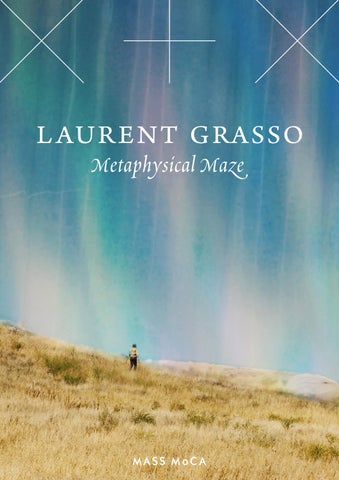
a permanent site-specific installation for the ceiling of the new train station in ChâtillonMontrouge, as part of the Grand Paris project. He is represented by Perrotin, Sean Kelly, and Pedro Cera. Laurent Grasso: Metaphysical Maze November 7, 2026 – January 2028 Curated by Denise Markonish, guest curator Premier support for Metaphysical Maze is provided by Xtina and James R. Parks. Major support is provided by Anne and Greg Avis, Matthew Bliwise and Nicole Deller, Wolf Gordon, Sonance, and Étant donnés, a program of Villa Albertine. Sustaining support is provided by Kelly and Bill Kaiser. MASS MoCA’s Building 5 exhibitions are made possible in part by the support of the MASS MoCA Ambassadors. The artist wishes to thank the SETI Institute for its support through the artist residency, particularly Bettina Forget and Nathalie Cabrol; Caroline and Ivan Rossignol, Nelson Rocher, Carola Jain, and the Art Contemporary Foundation for their generous support; and his galleries, Sean Kelly, Perrotin, and Pedro Cera, for their continued support. The film Cosmic Drive was produced with the support of Étant donnés, a program of Villa Albertine and the Albertine Foundation. Cover: Laurent Grasso, Cosmic Drive (visualization, detail), 2026. HD film, 20'43". Courtesy of the artist, Sean Kelly, Perrotin, and Pedro Cera © Laurent Grasso, ADAGP, Paris, 2026
For further reading:
Laurent Grasso: Time Travel Published by Rizzoli Electa Available in MASS MoCA’s R&D Store and online