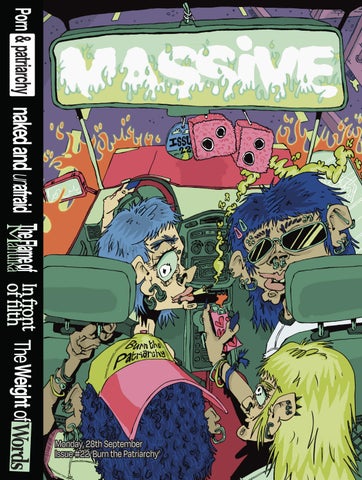
In front of filth
Her, Body, Her Choice —But Who Is It For?
ithin days of their release, the I’m sure most of W campaign sparked backlash you have seen from women—particularly female athletes—who argued that the ads the controversy women in sport. But alongside Euphoria star Sydney sexualise the criticism came another debate: people defending Sweeney and arguing Sweeney is (once that her critics are jealous, hypocritical, again) facing after or simply missing the point. appearing in a series To quote a few of the comments of advertisements under the advertisement on Instagram: • “What happened to her for sports-betting body, her choice?” company Novig. • “Isn’t this what feminists In the adverts, have fought for?” • “Women are just jealous that Sweeney appears they don’t look like this.” completely nude, look, I love a nude woman. I love using various pieces And when women embrace their bodies. of sports equipment I love when women use their bodies to celebrate themselves, challenge to cover herself. expectations and take ownership of
But there is a difference between a woman choosing to be naked and a company choosing to use a woman’s naked body to sell something. And yes, Sweeney chose to do this campaign. She negotiated an equity stake in Novig and helped shape the message behind the advertisements. She is not simply a passive woman who had her body exploited without her consent. But the average person looking at the advertisement doesn’t know any of that. They aren’t going to know about Sweeney’s negotiations with the company. They aren’t going to know what she intended the campaign to say. They aren’t going to stop and consider the nuances of female agency, sexual expression and corporate advertising. They see a naked woman advertising a gambling app. And that’s the point I’ve struggled with throughout this debate.
how they are seen.
NEWS KAWEPŪRONGO Parental Income Test Introduced for Students Seeking Jobseeker Support
4
Updated Curriculums Across Years Zero to Ten Drop Climate Change Studies
7
10
11
Naked and Unafraid
12
13
I Shaved My Legs
14
Expert Calls for University Mathematics Gap to Be Bridged
5
FEATURES Porn & Patriarchy
8
15
The ACT Party Pledges to Cut Students’ Wages
6
AHUATANGA
9
The Flame of Mahuika
16
An advertisement exists to sell something. It is designed to communicate an idea quickly, often within the split second it takes to scroll past it. It isn’t a philosophical debate about choice or a contract explaining Sweeney’s involvement in the campaign. It is a hyper-sexualised image of a woman, placed in the context of sport, being used to sell gambling.
Mother Massive
24 31
18 25
Sexcapades
32
Disclaimer: The views presented within this publication do not necessarily represent the views of the editor.
If unsatisfied with the response, complaints should be made to the NZ Media Council: info@mediacouncil.org.nz
The question isn’t whether Sweeney was allowed to make this choice, because of course she was. The question is what the company is doing with that choice once it becomes an advertisement and what the rest of us are being asked to accept as ‘empowerment’.
Personally? I don’t think putting a woman’s body between a viewer and a gambling product suddenly makes that product feminist. It’s simply another way that the patriarchy has taken something that has historically been used to sell products—a woman’s body—and attempts to label it as feminist.
It doesn’t empower young women. It doesn’t make gambling safer.
Sweeney can do whatever she wants with her body. That is exactly what bodily autonomy means. But we can still ask why a gambling company needs to use a naked woman’s body to sell its product.
17
NZ Media Council: Those with a complaint towards the publication should first complain in writing to: editor@massivemagazine.org.nz
This advertisement isn’t made for Sweeney; it’s made to sell something.
We’ve spent decades questioning the idea that women’s bodies should be used as commercial tools to grab attention. We’ve talked about the way this turns women into objects of attraction, dehumanises them, and uses sexuality to sell products to predominantly male audiences.
QUIZ: Which Girl Boss Anthem Are You?
Massive is largely funded by Te Tira Ahu Pae and the student services levy, however, remains editorially independent.
It doesn’t challenge the objectification of women.
In Front of Filth
19
The Weight of Words
26 33
CENTREFOLD
27
Another Way of Being: Piripi Mackie
HOROSCOPES
34
28 35
To Send or Not to Send
22 29
PUZZLES
36
23TĪWAE
COLUMNS
30
Gig Guide with Radio Control
PANGA
37
MASSIVE MAGAZINE
MONDAY SEPTEMBER 28TH
Parental Income Test Introduced for Students Seeking Jobseeker Support Ellice Lawrie • SHE/HER
T
housands of young students could miss out on jobseeker financial support after a new parental income test will force 18 and 19-year-olds to prove their families cannot financially support them.
The Ministry of Social Development’s (MSD) general manager of welfare system and income support, Fiona Carter-Giddings, said that there will still be other support in place for students who do not meet the new requirements.
Before this change, students could get the jobseeker support student hardship benefit purely based on their own low income. But starting in November, the government will look at how much money their parents make first.
“This includes supplementary assistance (e.g. Accommodation Supplement and Disability Allowance) as well as hardship payments for oneoff essential needs e.g. Special Needs Grants.”
This test assesses parent’s income and parental support gap for 18 and 19-yearolds. If their parents’ combined income is over $65,000, their parents will be deemed capable to support them.
Through MSD, Carter-Gidding said there’s other general support available. This included support to gain a driver’s license, assistance in finding construction and infrastructure jobs, and online courses with LinkedIn Learning.
This test is being implemented as part of the government’s tightening of eligibility for jobseeker benefits.
4
“Additionally, students can use Student Job Search (SJS) to look for work. SJS is a service designed specifically for students.” Massive Magazine
However, Dr Kevin Veale, a Media Studies lecturer at Massey University, was concerned about the lack of awareness about these changes. “With some level of warning, it might be something people can adapt around,” he said. “However, the severity of the problem would be much bigger if people went to do what they’d done in the past only to find the rules had changed.”
On the Jobseeker website there is no indication about the upcoming changes. With the age requirements still stating you must be “18 or older if you do not have dependent children” and “20 or older if you have dependent children”.
NEWS
KAWEPŪRONGO
Expert Calls for University Mathematics Gap to Be Bridged Milly Matthews • SHE/HER
A
new study from Australia’s Swinburne University of Technology found that the gap between high school and university maths is too vast. In a press release, Swinburne’s associate professor of Mathematics, Paul Hernandez Martinez, said that addressing this gap has become critical: “As mathematically demanding disciplines have become increasingly important to modern economies, we need to stop the next generation being deterred from further maths study. “At school, success often comes through recognising familiar problem types and applying well-practised methods. “At university, students are expected to work more independently, justify their reasoning, interpret formal definitions, connect ideas across topics and tackle unfamiliar problems in different contexts with much less guidance.”
However, senior lecturer of Mathematics at Massey University, Dr Richard Brown, disagreed. “Some of what they get asked to do at school is actually quite a bit harder than some of the things we might ask them to do in our first-year courses.” Brown has teenagers currently studying NCEA Maths, and said that the difficulty was “actually fine”. However, he said that this was on a schoolby-school basis: “Maybe schools are just not spending enough time on the more difficult side of things and it’s more about getting students through with achieved, so that’s what I wonder is happening.” Brown also said the difficulty of maths courses has also decreased. “If you took one of our courses now and compared it with what it way in the early 2000s, definitely we’ve dropped content we’ve lowered the difficulty level, because of that phenomenon of students feeling
they have less coming in.” “As time has gone on it feels like it’s gotten worse, with students come in less prepared and with less existing knowledge than they have had in the past.” Brown was unaware of any major differences between Australian and New Zealand maths education. However, Bachelor of Science student, Veeral Patel, agreed with Martinez that the gap is too large, and said that a course which bridged high school and university Maths might help. “I believe if it was introduced as a compulsory course, it would definitely help to solve the issue. Those courses were very helpful for myself personally.” “In one of the introductory courses [at university], we have this app for data visualisation,” he said. “I think if students were taught the app at the high school, it would be a bit helpful for them to go to that level now, but since
ISSUE #22
BURN THE PATRIARCHY
The ACT Party Pledges to Cut Students’ Wages Maya Trotman • SHE/HER
I
f elected, ACT has promised they would freeze the adult minimum wage for three years and cap training wages at 60 percent. Under ACT’s policy, the adult minimum training wage would be reduced from $23.95 to $14.37 per hour. This meant that students going through training would only be paid $14.37 per hour for the first 12 months of their employment. Afterwards, they’d then wait another two years earning $23.95 before receiving a pay rise. Massey student, Abirami Manikandeswaran, studying a Masters of Professional Accountancy, sympathised with students who would be affected by ACT’s proposal. Although this policy wouldn’t directly affect her, she said it would make it harder for under-20s to stay financially independent, let alone cover basic expenses. “Speaking generally about young people, freezing the minimum wage or paying a 60 percent training wage could make things really challenging, given the current cost of living,” she said.
6
PHOTO CREDIT: Stuff
ACT Party leader, David Seymour told Stuff that it was committed to going further to cut costs placed on businesses. “For two long, New Zealand politics has been trapped in zero-sum thinking,” Seymour said. “When a business succeeds, someone else must have lost.”
Massive Magazine
In its policy, ACT said freezing the minimum wage for three years would “give productivity and market wages time to catch up, while giving businesses certainty over one of their largest costs”.
NEWS
KAWEPŪRONGO
Updated Curriculums Across Years Zero to Ten Drop Climate Change Studies Josie Maddox • SHE/HER
D
espite removing the term “climate change” from the updated Science and Social Sciences curricula until Year 11, the Ministry of Education (MoE) says students will continue to learn about the subject throughout their schooling.
The curriculum had been developed with “an experienced climate change scientist and other subject matter experts” to ensure its content reflected current scientific understanding and was appropriate for each year level, she said.
Reworked Science and Social Sciences curricula published in August revealed that explicit references to climate change had been removed from the content for Years 0 to 10. However, the MoE said students would still learn about climate systems, the causes and impacts of climate change, and how communities respond to environmental changes.
The MoE said feedback from consultation and subject matter experts showed climate change was best taught in ways that matched students’ age and stage of learning.
A document summarising feedback on the draft curricula said some submitters argued climate change should not be covered in classes, including Year 5 Geography, because it was “too complex”.
“Students learn how climate systems work and why climate change happens. They also learn about climate change impacts through Social Sciences. This includes topics such as sea level rise in Pacific Islands and New Zealand’s coastal environment, the links between rainfall and flooding, and the effects of tropical rainforest deforestation on climate.”
According to RNZ, Te Poutāhū Curriculum Centre deputy secretary Pauline Cleaver said the Social Sciences curriculum had been updated to include clearer references to climate change.
“While the term climate change may not appear in the curriculum’s content, the science that underpins it is taught throughout the Science learning area,” it said.
The updated curricula describe climate-related concepts as being “embedded” in Science and Social Sciences from Years Four to Ten. Massive Magazine
PHOTO CREDIT: Ipsos| Data Dive: How people feel about climate change and what to do about it
These include low-lying Pacific nations, rainfall and flooding, Pacific tourism, New Zealand coastal communities, climate vulnerability, coastal change and global warming. Cleaver said climate change would be taught in greater detail in Year 11 Science, which will become compulsory from 2028. “All students will learn about climate change before they leave school, having built their understanding through science and social sciences from the primary years onwards,” she said.
7
Burn the Patriarchy
WORDS BY JESSIE DAVIDSON • SHE/HER
8
Massive Magazine
ART BY ELI ARMSTRONG • HE/THEY
Is the patriarchy writing your sexual script? : This article Content warning raphy, sexual discusses pornog violence, rough sex, & sexual degradation.
t that stage, all I knew about sex Porn was becoming part of the sexual The first time A was a very scientific chat from vocabulary of my generation. Kids were Mum after I accidentally walked in on watching it, talking about it, sharing I watched porn, my parents own rendezvous. ideas from it, and carrying those ideas into conversations about what sex was I was 13. Flipping through the pages of my school supposed to look like. library’s lone sex-ed book, the crude Yet to have drawings of nude men and women lying By the time I started having sex nearly on top of each other confused me. My six years later, I didn’t wonder why my my first kiss or health classes were no good either—all partners liked putting their hands around even hold hands I’d learnt was how to not get pregnant. my neck. Or why they wanted to slap me and call me names. with a crush, So, I took my studying online. most of all, I didn’t question I was curious I typed “Sex” into Google, and in a blink of But why I was asking them to do it. to understand an eye, PornHub appeared. That is, until I watched TVNZ’s new Unfortunately, the videos I found—male documentary, What Happened to Sex? what the teachers taking advantage of female students, incestuous storylines—didn’t The series investigates how children hype was help much either. are encountering pornography, and how about. what they see can shape what they So, I turned off my family computer, expect sex to look like. my search history, and found So, I turned deleted all the information I needed in romance It showed that there has been books instead. to what I a generational shift in how we were learning about sex: I didn’t think much about knew best AtwhattheI’dtime, Young men are being taught And I don’t think one —studying. afternoonwatched. of watching porn suddenly that misogyny should be part rewrote the way I understood sex.
The problem was that I wasn’t the only 13-year-old looking and learning from it. Massive Magazine
of sexual desire, while young women are being taught to accept their own degradation.
9
Burn the Patriarchy For university student Rory*, early exposure to porn influenced how they thought they were supposed to have sex. “I think it completely built and formed the way that I have sex with men or AMAB [Assigned Male At Birth] people,” they say. “It’s really hard to know whether I actually like some of the things I do in bed, or it’s just because it’s what I’ve been consuming since I was 12.” What Rory describes is an imposed sexual script—the cultural expectations that tell us who, what, when, where and why we should desire or engage in sex. For Rory, porn became part of that script from an early age, introducing them to BDSM (Bondage, Discipline, Sadism, and Masochism), sub-dom dynamics and consensual violence before they had necessarily developed their own understanding of what they wanted. They believe falling into these scripts online is easy. “PornHub has absolutely no problem presenting really, really graphic hardcore porn right on the main page. You click one video that is like slightly freaky, and it’ll take you directly to something freakier,” they say. “I think anyone, any age, could easily get to a video that is really intense and really hardcore within five minutes. Without even searching for it.” Rory says the influence of porn has been particularly noticeable in how they have sex with men and AMAB people. However, they say it has less of an impact on their sex with women and AFAB (Assigned Female At Birth) people, which they attribute to the kind of porn they were watching during their formative years. “I only started watching queer and lesbian porn, probably more at 17, when I was like discovering that I was queer.” Rory isn’t alone in their experience.
10
For recovering porn addict Frankie*, pornography became their primary source of education about what sex was supposed to look like. “What I was taught at school was the science of sex ... preventing STDs or pregnancy. So, the only thing I really knew about the actual act of sex, apart from what happens on a basic level, was taught to me through watching porn.” Frankie first searched for porn after hearing their friends talk about it at school. What began as curiosity soon became a source of sexual education. Their consumption gradually became more extreme, moving from heterosexual intercourse to rougher and more violent content.
sex rather than romance or connection. “I would date people for the sex because I thought that’s what I really wanted ... But that didn’t ever fulfil me as a person.” Unfortunately, it’s become normalised for people to follow a sexual script that doesn’t serve them. Whether it was formed through watching pornography or how they’ve experienced sex in their formative years, a lot of young people are simply working with the script they’ve been handed. This script can be handed from one person to another. For Massey University student Anne*, she adopted a script from her ex-boyfriend, whose pornography use shaped their sex life.
When Frankie began having sex, porn had already taught them that sex was a performance.
“Porn is quite often like very male centred, and I felt like he projected a lot of that onto our personal sex life.”
“It wasn’t about my own pleasure, but more about giving pleasure to a man,” they say. “That was my goal as a young person having sex, feeling like I wanted to please this man. Being like, I want this man to like me because of how I can perform in bed.”
Anne says her ex was open about having a porn addiction, and over time, she began to notice his expectations of sex seeping into their relationship. This made her feel insecure about her own performance.
That performance extended beyond the bedroom. Frankie says they struggled to recognise when they were uncomfortable because they could still perform sex while feeling uncomfortable.
“He had these weird ideas of what sex should be. He was aggressive, very aggressive,” she says. “It made me feel like I have to act a certain way because this is how he perceived sex to be. I felt like I had to lock in and play the part.”
As they got older, Frankie was watching porn almost every day and felt like they were no longer in control of their consumption.
Despite her ex watching porn almost daily, Anne says this wasn’t what she found upsetting. Instead, she found “how he applied porn in our own lives was disrespectful”.
“I was watching things that I didn’t really even like at all,” they say. “It had gotten to a point where I was watching porn almost every day, and I wasn’t really in control of all of what I was doing.”
While all of this might make it tempting to write pornography off entirely, professor Kirsty Ross, head of Massey University’s School of Psychology, says it’s not that simple.
Porn began to damage Frankie’s selfimage and relationships. Sex became a major motivation for dating, and they found themselves seeking out people for
‘Porn addiction’ isn’t a diagnosis in itself. The ICD-11 does recognise compulsive sexual behaviour disorder, which can include problematic pornography use.
Massive Magazine
Features • Ahuatanga However, Ross says watching porn frequently doesn’t necessarily mean someone has a problem.
watching for around two years.
Instead, the question is whether someone feels unable to control their use and continues watching despite it causing negative consequences in their life.
A 2023 UK report by the Children’s Commissioner found that 45 percent of videos on PornHub contained at least one act of aggression. In 97 percent of those scenes, women were the targets.
What Ross is particularly concerned about is what happens when pornography becomes a young person’s sexual script. “The concern is if pornography becomes part of a young person’s sexual script before they have enough real-world experience, education or information from trusted adults to put what they’re saying into context.” Pornography is adult entertainment, Ross says, not sex education. However, teaching teens that pornography is inherently bad is “unhelpful”. Instead, she believes young people need to learn porn literacy to critically evaluate pornography. “We need to help young people understand pornography is constructed entertainment. Bodies are selected, scenes are performed and edited, and what’s portrayed may be very little resemblance to mutually respectful sexual relationships.” The problem isn’t necessarily that people watch porn. It’s what happens when porn becomes one of the loudest voices teaching them what sex is supposed to be. And it is a particularly loud voice. A 2024 study published in the Australian and New Zealand Journal of Public Health found that 86 percent of male participants and 69 percent of female participants reported watching pornography. On average, young men in the study had been watching porn for just over three years before they first had sex, while young women had been
What young people are seeing matters.
In What Happened to Sex?, University of Auckland psychology professor Nicola Gavey, who researches unwanted rough sex, argues that pornography is not the only place these messages come from. “It feels like what we’re seeing now is patriarchy just kind of coming back with full force,” she says. “And we see it in the manosphere; we see it in American politics; global politics; we see it in the Epstein files, giving the message that men can kinda do what they want.” “If you’re young and you’ve never known anything else, you’re susceptible to kind of buying that. Why wouldn’t you?” That, perhaps, is the uncomfortable part. It is easy to ask why anyone would want to participate in their own degradation. But that assumes everyone enters the bedroom with a fully formed understanding of what they want, separate from the culture around them. None of this means that people who enjoy rough sex, BDSM or pornography are somehow broken, nor does it mean every person who watches porn will reproduce what they see. Desire is complicated, and people can enjoy things that are consensual, healthy and genuinely their own. But if we are asking young people to figure out what they want, we also have to ask what they have been given to want in the first place.
Massive Magazine
Pornography is only one part of that picture. But when it becomes one of the first and loudest places young people encounter sex, it can write their sexual scripts before they have the chance to start writing it themselves. difficult as brought up h y or st is th t: If anything in u can contac periences, yo feelings or ex
support. for free 24/7 Safe to Talk044 334 Text: 4334 Call: 0800 iversity MasseeyinUgnServices: Wellb s: Talk Campu
Health Sexuaolrt Supp :
Burn the Patriarchy
WORDS BY RUBY BARR • SHE/HER • NGĀ PUHI, TAINUI
The vulnerability of being naked in front of a flashing camera as a woman is parallel to having sex with someone for the first time—especially when you’re a teenager. Like a strange time capsule of my body, Fine Arts student (and my best friend) Frankie Simes Foster has taken annual nude portraits of me since I was 16 for her photography projects. Every year brought a different theme as her style progressed. But whether I was in a studio or in her flat’s backyard in the middle of winter —I was always nude. ## 12
PHOTOS BY FRANKIE SIMES FOSTER • SHE/HER
I
n retrospect, this creative ritual put my young body at the mercy of viewers before I even understood it myself. However, it took Frankie trying nude self-portraiture herself to understand just how confrontational it can be to stand bare in front of a lens. She says, “I can’t put my figure on what was driving these emotions, but I felt so uncomfortable and violated in a sense even though I was entirely in control.” This experience as a 21-year-old prompted her to reflect on what my experience as a 16-year-old must have felt like. Massive Magazine
“I knew I felt comfortable enough with you to take photographs of you, and I assumed that you would feel comfortable enough with me to allow me to take photographs of you.” She recognises that without the resources of photographic conversation, research, and academia, our story is a perfectly normal place to start from as a young photographer. But now she struggles to look at these older works without feeling guilty about her practice and ethics at the time.
Features • Ahuatanga
“I don’t really like to look back at them. A, because they are shit photographs and B, because they bring up a whole world of guilt.”
meant getting naked and running around a property taking photos spread-eagled atop a tractor felt like a regular afternoon.
“I feel like I owe you and the other people I took photos of because of my experience of self-portraiture and realising how fucking confronting it is and how vulnerable it is.”
Before and after each shoot, we spent time reflecting on what we were aiming to achieve and how we felt about the finished shoot.
This year, Frankie has used this selfreflection as a chance to engage in her practice in a way that she hasn’t tapped into. For her exhibition project this year, she came to me with a pitch for our next photographic endeavour. Much to my surprise, I was going to be behind the camera. Exploring the power dynamic between photographer and model, Frankie wants to relinquish control as the photographer. Ultimately, she wants to feel as much vulnerability as the model.
This was the first time I had admitted to her that I didn’t always enjoy being in front of the camera. Often, I dread a shoot. Her response was cathartic: “Realising what that must feel like when you’re sixteen, and you’re going through puberty, and everyone hates themselves or has body issues. Of course, I wasn’t going to understand that at the time, and maybe I should’ve, but I didn’t.” Hearing her understanding and unpacking the realities of our prior work pushed us in a creative direction that was completely euphoric for both of us.
“The main thing that I’ve taken away from studying photography is that it has been historically an extremely exploitative and extractive practice.
There is nothing quite like running around “booty cheeks naked”, taking photos with your best friend and rebuilding a trust that was subconsciously broken.
It’s important to note that it is misogynistic and extractive for everyone, not just cis white men.”
The message I sent to her following the first weekend reads: “This weekend really filled my cup.”
Over two weekends at a house in Carterton, Frankie and I were the most creatively collaborative we have been since our high school Art class.
Her response: “It was really nice to make something with you.”
While most women refer to their closest friends as their sisters, Frankie and I have never fit that mould. We’re more like lovers without sexual intimacy. This
Frankie keeps in contact with me throughout her group critiques, sending me voice recordings and excited messages.
However, a recent comment from her classmate grounded the photographs in a way in which neither Fankie or I intended— but still is completely true. In the moment, Frankie and her classmate were having conversations about topics that go deeper than classroom formalities. Specifically, Frankie was talking about her relationship with me. “You were one of the first female friendships where I felt like it wasn’t comparing myself to you, and we could just be and exist together. And how much that meant and how much that opened up my life.” In a paraphrased retelling by Frankie via WhatsApp voice Messages, her classmate had said: “that made a lot of sense looking at our photography because there is so much symmetry.” What started as a time capsule of my body has become something else entirely: a stripped-back retelling of our love for one another. The camera that once made me feel exposed has become a way for us to confront the vulnerability we both carried into the room. These photographs aren’t really about being naked anymore. They’re about trust, intimacy and the strange, uncomplicated love that can exist between two women who know each other deeply. Somewhere between the awkward conversations, booty-cheeked tractor photos and endless voice notes, we found a way to make something together that feels like ours. A time capsule, not of my body, but of our friendship.
Massive Magazine
13
WORDS BY EVA ROCARD
I shaved my legs.
N
ot the whole leg, just the bottom halves. I haven’t seen them hairless since I was a teenager—lost in the weeds of finding identity. It’s been ten years of furry-legged summers and short shower bliss. But when I found a bag of shitty disposable razors in my boyfriend’s bathroom, I started wondering: what if I shaved my legs? With just that thought, an old, familiar and uncomfortable feeling slid over me. My skin crawled. I shivered. The weight of compliance, of conformity, fell on my shoulders. Wow! Easy girl. It’s just shaving. But for me, it was a rebellion that started ten years ago. Desperate to fight the pressures put on women to look any other way than natural, I stopped shaving. I wanted to point at my hairy legs and shout: “Hey look! No one gives a shit, and if they do, F ‘em!” I hated the propaganda that tied a woman’s worth to her looks. But what I hated even more was that these beauty standards make us appealing to men. I was deep in the trenches, ladies. I was pissed off for all of us.
ART BY OLIVE BARTLETT • SHE/THEY
Some girls rave about the freshly-shavenleg feeling. Especially if that feeling is paired with going to bed in freshly washed sheets. But I’d always thought they were lying to themselves. They felt like the propogandist claims that my own hairy legs were fighting against. But who am I to dismiss them without trying it myself? Jumping in the shower, I lathered soap all over my shins and calves. But after I uncapped the razor and eased the head towards my legs, thoughts raced through my head. If I do this, I’ll undermine everything I stand for. If I do this, I’ll become just another cog in the wheel. If I do this, I’ll have to admit that I have surrendered upon the feminist battlefield. The razor lowered and shaved those hairs away. Clean stripes made their way around my legs, leaving them sparkly. My shivers of revulsion began to 180. I felt... satisfied. In full trust, I loved it! Shaving was so fun! I was pampering myself intentionally—and I was enjoying it! I got out of that shower feeling like a giddy kid who’d been playing in a sandpit.
But as I fought the revulsion coursing through me while I glared down a bag of razors, I realised something...
Maybe shaving isn’t all bad. Perhaps it’s not the act of something that confined us, but the meaning we add to it ourselves. I’d always seen it as oppressive, so it had always been oppressive to me.
I didn’t even know if I liked having shaved legs or not.
But I felt freed in that shower.
Massive Magazine
I felt I was caring for myself in a soft, feminine, warm way. It felt like I was giving my angry teenage self a hug. You can care for the world, but you can care for yourself too. But then my legs dried. And I hated it. My legs were naked and afraid. They didn’t look or feel like they belonged to me. I felt like I’d lost a source of my feminine powers. For me, being a woman has always been about listening to my body and feeling—rather than thinking —if something is right. Once my legs dried, my body was very vocal about its distaste of their lack of hair. But while I don’t like being hairless, I was freed from a decade-long dogma that had weighed me down. Most of all, shaving my legs taught me that we don’t have to turn every choice into a declaration of who we are. I spent so long believing my hairy legs were proof of my fight for women kind, but I never stopped to notice the constraints I’d put around myself. It turns out the best rebellion is being curious enough to find out what feels true for yourself.
So, my legs are hairy again. Not because they’re making a statement, but because they feel like me. 15
Burn the Patriarchy
WORDS BY ROSE HAIRA-HARMON • NGĀTI KAHUNGUNU O WAIRARAPA, RANGITANE, NGĀTI WĀHIAO, NGĀTI RANGITEAORERE, NGĀTI WHAKAUE, NGAI TAHU
one day, this quiet is disturbed Mahuika is an atua, B utwhen rangatahi Maui a Tikitiki Tauranga steps into her cavern. a mother, and a grandmother. She “Who are you boy?” stands strong, her Tone raspy and filled with smoke, voice swirls throughout the cave. bare feet planted her Maui stiffens and blurts out: in the whenua, A TIKITIKI” and her head held “MAUI His voice cracks as he creeps into high. The soft the cave. Eyes dart around, seeking the body of the husky voice. But only glow from the the glow of the lava pits find his lava pits of her attention. Taking a step forward, he hisses and falls onto his rear. Looking cave gleam off up panicked and confused, Mahuika her hair, making it steps from the shadows. shimmer different Her head still held high, she casts the ember glow of her eyes upon Maui. shades of ash. She wrinkles her nose wrinkles at the boy on the ground. She enjoys her “Ah, a moko come to visit me. space. Relishes Well, get up boy make yourself known.” the quiet.
16
Massive Magazine
Springing up like a pogo stick, Maui steps forward and gently presses his nose to hers. Expecting another burn, he’s relieved to feel a pleasant warmth that could only come from whanau. They share a breath: In. Out. Maui pulls back, a sheepish grin s tretched across his face. “Kuia,” he begins. “Can I have some fire? Please? The village ran out.” Mahuika raises her eyebrows, then pinches them together. Lips thinning, she considers his request. Then, inhaling deeply, she lifts her hand where ten different hues of flame flicker and dance from each fingernail. Without batting an eye, she plucks out one nail. Her expression remains the same. But the loss of a nail, her life essence, made her body slump ever so slightly. It’s so subtle that you’d miss it if you weren’t paying attention—which Maui was not. Mahuika hands her flame to Maui, but not without a warning.
Features • Ahuatanga
“Straight to the village boy. No tricks. You’ll feel my wrath if you play with my fire.”
What matters is that eventually, Mahuika has only one flame left.
Alas, Mahuika’s warning flew over Maui’s head. As he scampered out of her cave with the flame on a torch, he chuckles and extinguishes the flame using a damn piece of land. Rubbing dirt on himself, he rushes back inside the cave of Mahuika.
One final ember of herself.
Landing on his knees at her feet, Maui speaks with soft, wide eyes and a quivering bottom lip. “Mahuika! I fell and dropped my fire. May I have another?” Assessing him, Mahuika sighs and hands Maui another nail. This time, she gives him a different warning. “You be careful boy. That flame has to get back to your village, remember? Be fast and ensure it gets to it’s destination safely.” Maui grins, nods and rushes off. Mahuika, now down two nails of flame, feels her energy running low. Gravity guides her to a chair, and with a huff she leans back to rest. This time, Maui leaves the mouth of the cave but becomes distracted by a pond. Looking down at his reflection, he giggles and drops the flame into the water. “Oopsie!” He skips back into the mouth of Mahuika’s cave and asks for another nail. And another. And another. Each time, Mahuika gives him one. Each time, another piece of her disappears. The stories differ on exactly how many flames she gives away. Some say the nails are taken from one hand, others from both hands and feet. But the details hardly matter.
The last time that Maui prances back into cave, a sheepish smile lining his face, he speaks up again.
She is a woman pushed to her absolute limits. A woman who gave and gave until there was nothing left to give. A woman whose warnings were ignored until her patience burned down to its final ember. And when that last nail was pulled, she did not disappear.
“Mahuika? I need another nail.”
She became fire.
Barely holding herself up, Mahuika was on her last nail—her brightest flame. Heaving herself out of her chair, she stalked towards the entrance of her home. Her face was a painting of pure anger.
In Atua Wahine, Ngahuia Murphy calls Mahuika “the regenerative fire that activates the womb”. Her fire is not gentle. It is not quiet. It is the fire that sits low in the belly, waiting. The fire that warms, creates and sustains—but can also rage when it is pushed too far.
Realising she’d been fooled, her eyes burn bright. The trust she placed in her mokopuna splutters and diminishes. Using the remains of her strength, she rips out her last nail with a roar. “Maui! You selfish boy! I trusted you with my flames. With my essence! Behind my back you extinguished me for your entertainment. You didn’t heed my warnings. Now, you must feel my WRATH!” Mahuika strikes her flames onto dry whenua. Igniting fast, the flames climb the lengths of the trees and bushes. The hues of flame and smoke shift, swirl and caress each other with each blow of wind. As the flames stand tall among the forest, Mahuika’s body fades among the curling flames and choking smoke. Surrounded by her fire, Maui recites a karakia calling for rain to extinguish the flames lapping at his face. As the drops begin to hurdle from the sky, the flames begin to fall. As the smoke cleared, Mahuika was nowhere to be found. All that is left are her sparks of fire found among the rākau that continues to spread her flame today. Mahuika wasn’t a cranky old lady.
Massive Magazine
Maybe that is why her sparks keep turning up. They flicker in the footsteps of Dame Whina Cooper as she leads the 1975 land hīkoi. They crackle in Hana Te Hemara Jackson’s hands as she carries the petition for te reo Māori up the steps of Parliament. They flare when Hana-Rawhiti Maipi-Clarke rises in the House, tearing the Treaty Principles Bill and letting her voice become a haka. They glow in Kate Sheppard’s fight for women’s right to vote. They burn in Mākereti Papakura, being the first indigenous woman to cross the world to study at Oxford.
Different women. Different fires. Mahuika leaves behind the fire that burns the whenua and the core of Mana Wahine. 17
Which GIRL BOSSANTHEM Are You? What are you drinking on a night out? a) Vodka Redbull b) Sauvignon Blanc c) Tequila Shot d) Pink Lemon Pals
What was your childhood dream job? a) Surgeon b) Life Coach c) Lawyer d) Astronaut
What is your favourite menstrual product? a) Maxipad b) Period Undies c) Diva Cup d) Tampon
What is your go-to type of footwear? a) Platform Docs b) Sneakers c) Boots d) Heels
What time do you normally wake up? a) 1pm b) 7:30am c) 6am d) 9am
What do you do on a Sunday morning? a) Chudding out b) Hot Yoga & Market c) Running d) Hungover Mostly C’s:
Mostly B’s:
Mostly A’s:
Mostly D’s:
Fight Song - Rachel Platten
Run the World (Girls) - Beyoncé
Karma - Jojo Siwa 18
Massive Magazine
Roar - Katy Perry
In front of filth WORDS AND PHOTOS BY LEE JUDI • THEY/THEM
This is an enticement; a loud announcement She lures you in and then alerts you of her vulgar intentions Born in our wet bodies hiding screams in our crevices and folds we must cultivate their fear of our power By owning their disgust for us we can rebuild our visual territories and by virtue melt their definitions of desire Cultivating a dirty protest she stares you down laughs at you mocks your nausea The plastic demur of the past decade was a smokescreen crafted by strangling hands In meeting our contemporary persecutions with an entirely new gaze she will build an insurrection Their grip won’t merely loosen it will disintegrate Beware of the filth She may be in front of you Massive Magazine
19
Features • Ahuatanga
Massive Magazine
##
Burn the Patriarchy
Features • Ahuatanga
WORDS BY JOSIE MADDOX • SHE/HER
ART BY OLIVE BARTLETT • SHE/THEY
Why are an increasing number of young teenagers sending nudes? Reflecting on her experience now at 22, Noa* can see things she couldn’t at the time. Stood alone in her bedroom mirror with an age restricted iPhone, Noa took nudes for the first time. Hitting ‘send’, the photo was meant to go to one close friend. But the next day, everyone in Year 10 had a photo of her bare chest. For the years following, she has battled to feel autonomous within her own body. But Noa isn’t alone.
: Mentions Content warningab of digital sexual use
A
n increasing number of young people online are experiencing image-based sexual abuse—when someone shares, takes or threatens to share intimate or sexually explicit images of a person without their consent. This is often done for bullying, control, humiliation, or revenge. Online sexual abuse is a fast-increasing issue in Aotearoa, as New Zealand youth are some of the heaviest internet users in the world. The 2026 documentary, What Happened to Sex?, found that found that 90 per cent of Kiwi kids are on social media by age ten. A third of these kids spend up to five hours a day online. In 2024, The Wall Street Journal investigation found it took just three minutes for a 13-year-olds Instagram account to receive sexual content. This ranges from suggestive content and nudity to hard-core porn. Sexuality isn’t developed in isolation. Young people learn what sex, desire, masculinity, femininity and relationships are supposed to look like from the culture around them. Online, those lessons can come through pornography, social media, peers and increasingly the manosphere.
Massive Magazine
23
Burn the Patriarchy
“It literally felt like I cracked the code on, like, figuring out how the world works. I thought I would get what I wanted if I was being really sexual” If anything in this article ca you distress, please see theuses Massey Health team of consult the resources below: Support services and information on sexual health: Free STI Testing & Self Testing: Free STI Tests Sent to Your Home: Safe to Talk NZ: Call 0800 044 334 or text 4334 Talk Campus: Student Peer Support Platform for Universities & Colleges Massey Uni Wellbeing Services:
##
In What Happened in to Sex? Dr Samantha Keene, senior lecturer in Criminology at Victoria University, says that niche sexual behavior is seeping into everyday life faster than ever. Because young people are exposed to the pushing of sexual boundaries early, their personal need to increase this push only grows. This is where risky online sexual behaviors can begin to emerge: unsolicited nude sending, pornography engagement, requests for images, sexual coercion and grooming. Sex and relationship therapist, Jo Robertson, says to OneNews that not every young person who is perpetrating sexual harm is cognisant of their harm. If anything, many are leaving experiences thinking “I did the right thing”. Looking back now, Noa says she remembers receiving ‘dick pics’ well before she had sent nudes herself. If anything, her decision to reciprocate was an attempt at control. “It literally felt like I cracked the code on, like, figuring out how the world works. I thought I would get what I wanted if I was being really sexual” “So ... I sent a bunch of nudes.” After the first few exchanges, Noa was hooked, sharing intimate pictures with boys she’d never met. “As time went on, the more they complimented certain features of me. I knew what guys wanted from me, and what they liked on my body. It wasn’t about what I liked.”
Sexting and the sharing of nudes are intimate adult behaviour’s that were once largely confined to private spaces. But now, they’re increasingly finding their way into the lives and experiences of younger people. This means they are experiencing the consequences too. The effects are damaging, leaving complex feelings for years to come. “I’m not going to lie, I still send nudes,” Noa admits. “There is still this feeling of vulnerability, and slight disgust with yourself. It’s this guilt that I feel after where it’s like, I have yet again sexualised myself to get a guy to want me or like me.”
If young men are taught that vulnerability is weakness, they may struggle to communicate desire, rejection and insecurity in healthy ways. If sexual experience becomes a measure of masculinity, they may come to measure themselves—and others—through conquest. When online communities repeatedly frame women as obstacles to male success, equality and consent can become negotiable rather than foundations of a relationship.
Noa’s experience is not only a story about what happens to girls online. It is also a story about what boys are being taught to want.
Aotearoa’s response to online harm is beginning to shift. In August 2026, the Government introduced the Online Safety (Minimum Age and Child Safety Risk Assessment) Bill, proposing a minimum age of 16 for accounts on certain online platforms. The Bill would also require platforms to assess risks to young people, including grooming, sexual extortion, sexually explicit content, bullying and harmful algorithmic design.
These ideas are also reinforced in parts of the online manosphere, where discussions about masculinity, women and sex can become explicitly adversarial.
But legislation can only go so far. Young people are learning about sex in an online environment that adults have struggled to keep up with.
Years later, she is still trying to separate what she wants now from what she had learned to want.
Creators such as Sneako, Myron Gaines and Walter Weekes have built audiences around content that discusses masculinity, dating and sex. Majority of their content has been criticised for promoting misogynistic or sexually entitled views For some young people, interacting with this environment can blur the boundaries between sexual curiosity, pressure, and harm. Without someone to speak with about this content, young people may internalise ideas about sex and relationships before they have the tools to critically understand them.
Massive Magazine
The question is no longer simply whether young people should send nudes. It is whether they are being given the tools to understand desire, consent, power and intimacy before they hit send. 25
Burn the Patriarchy
The meaning of words may evolve, change and even totally uno reverse as time passes. But the weight they once carried never truly leaves them. No matter how many decades pass, words still hold the heat they were born from. Especially when those words were born from malice and hate. Throughout human history, words have been used to categorise, label and dismiss certain groups. For women, words like ‘bitch’ and ‘cunt’ have had the power to reduce us to less than human. While second-wave feminism, ballroom and drag communities have attempted to reclaim these words, they can still sting when they come from the wrong mouth.
M
um and I had our first taste of the complications of reclamation when I was younger, trying to change the meaning around ‘bitch’. Rather than using it to belittle others, we wanted to transform the word into something more positive and uplifting.
Trying it out, Mum exclaimed: “Yeah! You bitch!” Silence. Yeah, nah. Being called a bitch by Mum just didn’t feel right. But this isn’t unusual. Dr Arianna BerardiWiltshire, a lecturer in Linguistics and Applied Linguistics at Massey University, explains that the meaning behind words can never be completely changed, no matter how hard we try.
26
“Reclamation doesn’t mean that the old, derogatory meaning of a word disappears and is replaced by a positive one. Instead, new meanings and possibilities develop alongside the old ones,” she says. ‘Bitch’ and ‘cunt’ have been around for centuries. As they have made their way from mouth to mouth, they have accumulated layers of meaning—and a lot of power. The word ‘bitch’ dates back to Old English, where its definition was simply a female dog. It wasn’t long before it was used as an insult against women. With ‘dog’ already being used to associate women with immodesty, disobedience and shamelessness, the switch to ‘bitch’ was a clear next step. ‘Cunt’ has also been around for a long time. Initially used as a word for female genitalia, it was featured in Captain Francis Grose’s The Classical Dictionary of the Vulgar Tongue, where he classified it as: “CUNT: a nasty name for a nasty thing.” Massive Magazine
That description basically sums up why the word still has such a sting to it. When it became an insult, it reflected society’s demonisation of female bodies and sexuality. It is not just an attack on certain personality traits; it is a direct attack on what is between your legs. Most importantly, it frames what is there as gross, disgusting and nasty. Berardi-Wiltshire says: “Words such as bitch, slut, whore and cunt don’t simply communicate that someone is unpleasant; they can invoke ideas about sexual morality, femininity, the female body, or whether a woman is behaving in a socially acceptable way.” But the shift towards giving these words more positive meanings has been happening for decades. In the 1970s, feminists began rewriting the narrative around ‘cunt’, pushing back against the idea that women’s sexuality and bodies should be viewed as disgraceful or wrong.
Features • Ahuatanga
WORDS BY ELLICE LAWRIE • SHE/HER ART BY BRIANNA GRAPES • SHE/HER
Queer communities played a big role in this shift too—particularly Black and Latine ballroom culture. “Within ballroom, words such as bitch, pussy and cunt, which were derogatory in mainstream culture, were reworked as positive expressions associated with femininity, beauty, confidence and powerful performance.” As the world became more interconnected through technology and globalisation, this shift began to enter the mainstream. What Mum and I were attempting to reclaim had already been happening around us for decades. And yet, while I now feel perfectly comfortable calling my female friends ‘bitch’ and complimenting their ‘cunty’ outfits, why does it still feel belittling to be called the same thing by a man? When a man uses these words—even as praise—why can they still carry that negative weight? Because changing the context in which a word is used doesn’t erase the contexts that came before it. “Bitch can be affectionate or empowering between female friends and still be deeply insulting when used aggressively towards a woman. The word hasn’t changed completely; what speakers can do with it has expanded.” It is one of those cases where two things can be true. A word can hurt and uplift at the same time. Its history can still sting, while its meaning continues to evolve. Maybe reclamation was never about making the weight disappear. Maybe it is about deciding what we want to do with it.
27
Burn the Patriarchy
Another Way of Being: WORDS BY JESSIE DAVIDSON • SHE/HER
Misty Frequency isn’t an alter ego.
A
t least, that’s not how Massey University Fine Arts student Piripi Mackie sees it. “It’s still very much me,” they say. Piripi is an artist and drag performer who has been performing as Misty Frequency for around seven years. The name came from Che Fu’s Misty Frequencies, which Piripi heard while at the Ihumātao land occupation in 2016. “I was there with a friend who also does drag, Bionica. The song came on, and it just kind of all meshed together. In that moment, I was like, yeah, this is what I want to do, and this is what I’m going to name myself.” Since then, Misty has become a way for Piripi to explore identity, gender and the ideas that come with them. But unlike the traditional drag performance of becoming a heightened version of a man or woman, Piripi isn’t interested in choosing either. “Traditionally drag is like, you know, dressing up as a male, female, so it’s still quite gender centric, even though they’re kind of fucking with the gender ideals,” they say.
28
“For me, it’s never been about that.” Piripi describes Misty as a genderless being. Through that freedom, they are able to explore anti-patriarchal ideas without having to play by the same gender rules in the first place. “I’ve given myself freedom to explore these kind of ideas and concepts.” But this freedom doesn’t exist separately from Piripi’s life outside of drag. They were raised mostly by wāhine, with their Nan as the matriarch and “the glue” of the family. At school, they found themselves naturally gravitating towards girls and femmes rather than boys and masculine people. Their work is also deeply connected to their whakapapa. Piripi whakapapas to Ngāti Kahungunu, Ngāti Tūwharetoa, Ngā Rauru, Kāi Tahu and Scotland, and describes whenua as central to their understanding of identity. “We all come from the land, we all go back to the land. We all are kaitiaki of the land. We care for the land and the land cares for us.” That relationship between identity, whenua and queer life is what Piripi is exploring in their Fine Arts practice this year. Massive Magazine
Their exhibition centres around the idea of home, imagining a marae and a gay club merged into one space. In the accompanying video, Piripi appears both in and out of drag. In drag, they become the kaikaranga welcoming people through a pōwhiri. Out of drag, they are the visitor entering the marae. It’s an imagined space where different parts of Piripi’s identity can exist alongside each other.
“I don’t mind what people feel as long as it’s not bored,” they say. Ideally, Piripi wants people to recognise the mana in being takatāpui, while also allowing those who don’t share their experience to see something they might carry into their own lives. “Whether it’s that they can identify that within themselves or whether it opens their eyes to another experience, another person’s experience, they could translate into, you know, those around them.” For Piripi, there isn’t a clean line between their art, activism, drag and everyday life. Misty Frequency isn’t a character they put on and take off. It’s another way of being Piripi.
Features • Ahuatanga
Scandal
Alphabethead, Grecco Romank, Guardian Singles And Living Perfection Fri, 2 Oct Goblin Akl
01 Diesel Jenny - Longbow
(showponi Remix)
02 U-No Juno - Frown 03 mouth - 8Bit 04 LAUGHING STOCK - Terracotta Lilies 05 DJ Hemisphere & Club Tremaine
Lunchtime concert - LAUGHING STOCK Wed, 30 Sept Massey Manawatū Concourse
- No clearance (panel beater edit)
06 Girls Rock Aotearoa - Bare Minimum 07 MOKOMOKAI, Troy Kingi - Brasil 08 Dolly Possum - Cow 09 Jumping The Fucking Shark
- Everybody Be Cool, This Is A Robbery
Neither Do I
10 Car Crash Emy - Skinnest Bitch
Fri, 2 Oct Vogelmorn Upstairs
funlifebreakupsuite - smiley8
30
Art by Brianna Grapes SHE/HER
roke b o s m I’ . a m a M Hey now. t h ig r s s le b jo d n a Help a girl out?
Hey girl!! Unfortunately, I don’t transfer money to my clients. That would be unethical. But I commend your confidence in asking! Keep that up! Instead of begging others for some spare coin, I think it’s time for you to start up a small business. When I was a student struggling to earn some dough, I started up a very successful edibles business! They called me Mother MJ and business was BOOMING. I made all sorts: brownies, cookies, gummies, smoothies, muesli bars—I even dabbled in weed sandwiches! Although, they didn’t taste good whatsoever. That business got me through university with a full belly, paid rent, and a cute wardrobe.
Legally, I can’t endorse selling drugs. So, instead you could always go into vintage reselling, painting, sewing, baking, or theft. I’ve heard any and all of those options work. Maybe have a taste test of each one before you settle. Wish you luck GF! XOX
Mother Massive Massive Magazine
31
I fear feminism has ruined uni hook-up culture for me. I’m currently doing a paper on feminism and, until recently, considered myself a perfectly normal chick who l iked dick.
Then my lecturer started talking about the patriarchy. Now, every time I get close to a man, I have too many questions for it to be healthy. Is he hot? Yes. Do I want him? Probably. Is my attraction to him entirely my own? Or has society spent 19 years teaching me that men are the ultimate prize? Hmm. You can imagine how unsexy this makes things, and it all came to a head recently when I was trying to get cracked mid-party. Objectively, things were going well. He was full of rizz and really hot.
32
Massive Magazine
Columns • Tīwae
Sexcapade submissions provided by
For 20% off yo ur next purchase, enter discou nt Flexing my power (or trying), I said he should go down on me; he refused, and yeah, it was a quickie, but STILL. Anyway, my brain thought, “ah yes, a man, of COURSE he would laugh about not going down on you, but if YOU did that, he wouldn’t be laughing!!” Fuck the patriarchy etc etc.
This poor man had absolutely no idea that while he was trying to have a cheeky quickie, I was mentally writing my next assignment. Now my thoughts are filled with things like:
Instead of being present, I was standing there thinking about how women have historically been expected to centre men’s pleasure.
Do I actually fancy men? Or have I just been told my entire life that I’m supposed to? Can I hate the patriarchy while also thinking some men are extremely hot? Can feminism and a healthy libido coexist?
Okay. But if I genuinely enjoy being with men, is that reinforcing the patriarchy? Jesus Christ.
Honestly, I came to university to get a degree; now I’ve developed a bloody sexuality crisis.
What if I’m actually a lesbian? HELLO???
Massive Magazine
33
Your hard work has paid off and you will be rewarded. Music, sunshine and sunglasses are in your near future. The universe works in mysterious ways, and this week it is blessing you.
Someone has recently reentered your orbit that you once wronged. While they may be easy to forgive you, those around them aren’t. Start planning big, public gestures of your loyalty.
It’s time to change up your vibe. Listen to that itch. A streak of blue in your hair, a new tattoo, piercing, or even just a change in your make-up routine. It’s time to switch it up.
It’s time for a deep clean. The winter months have passed, and your home is well overdue for a scrub. Hibernation is over, throw away your old Uber Eats boxes.
You have recently made friends with a flock of birds. Crazy? Maybe. But don’t let what other people say get to your head. Trust your gut and remain loyal to your friend group of sparrows.
Get out of your head Virgo. Being a thought daughter can only get you so far. Not every situation needs to be psychoanalysed and not everyone secretly hates you. Focus on what’s in front of you.
You’ve been crashing out left, right and centre this week Libra. It’s time to ground yourself. Figure out what you really want before it’s too late and you end up hurt. It’s better to be safe than sorry.
Be wary of your spending this week Scorpio. A new skirt and a sweet treat sounds great in the moment, but the dopamine rush won’t last. Prioritise paying rent and dinner.
There is something that you have been wanting for a long time (something that meows). It’s time you started volunteering at your local cat shelter. Who knows what will come home with you.
Being bored isn’t an excuse to be evil. No one is thinking that your snarky comments are cute or funny. Be nicer to those around you or else they won’t stick around much longer.
Be cautious of purple items this week (and maybe shades of dark blue). They will bring nothing but chaos and carnage into your life. Pink on the other hand will lead to extreme good luck.
You have been following in the footsteps of Robin Hood lately. In return, you have gained the love of your peers. The gifts you have been giving have not gone unappreciated.
Massive Magazine
35
EASY
HARD
36
Equality
Ceiling
Partner
Patriarchy
Mother
House
Feminist
Society
Evolve
Burn
Sexism
Past
Vote
Construct
Present
Misogyny
History
Dynamics
Massive Magazine
FIND PUZZLE ANSWERS ON www.massivemagazine.com 2. Who runs the world? (5)
1. Suffragette’s cause (4)
3. Surname of feminist and co-founder of Ms. magazine (8)
2. Socially constructed roles, distinct from biological sex (6)
5. Test which measures the representation of women in films and other fiction (7)
3. The right to vote in political elections (7)
7. Company Sydney Sweeney promotes in new controversial advert (5) 9. First _____ Second _____ Third ______ (4)
4. Actress with a big hat (7) 6. The political, social, and economic goal of feminism (8) 8. A person who supports women’s rights (8)
11. Mother in French (4)
10. Last week’s issue of Massive (3)
12. First name of Girls creator (4)
14. Sports competition where a competitor wrecently pooed themselves (5)
13. Their body, their ______ (6) 15. Toy that was released at the American International Toy Fair in 1959 (6) 16. First name of Justice Bader Ginsburg (4)
Massive Magazine
37
Albany
Ōkahukura
Lock-and-leave living A short walk from Massey University fletcherliving.co.nz/unitliving
Homes
from
559k
$
Our single‑level unit homes in Albany are designed for effortless lock‑and‑leave living ‑ giving you more time for what matters. With a range of floorplans to choose from, they’re ideal for first‑home buyers or investors seeking low‑maintenance convenience. Perfectly positioned within walking distance of Albany’s popular amenities and Massey University. Explore Unit Living at Albany today.
Refer
and receive
$1,000
Know someone looking for a new home? Refer them and get rewarded with the Fletcher Living Referral Programme. $1,000 for you, a brand new home for them.
* It’s a win-win.
FIND OUT MORE & VIEW T&C’S.
fletcherliving.co.nz/referral
Debbie Dickens 027 203 4802 ddickens@frl.co.nz
*T&Cs apply. See website for details.
Joss Lewis 021 245 5155 JLewis@frl.co.nz
Visit our Show Home 21 Te Ara Tu Para Albany. Open 7 Days.
Centrefold
Massive Magazine
di
by Lee Ju
Cover by Olive Bartlett