A SECOND CHILDHOOD:
Whimsy
brb, I’m just cultivating whimsy
W
hen I was little, I would hunt for fairies in the woods by my house. I’d carefully look through the moss that gathered at the feet of old, creaking pine trees. I would put my ear to the breeze, eager to hear their jingling laughter. I would leave gifts of homemade bread and cookies at the base of Pongas, where the roots and the dirt began to intertwine and play with each other. Eventually, I would get lost playing with the fairies. Before long, it was dark, and Mum had sent my brothers to bring me back inside. Which is a good thing, considering I had convinced myself there were monsters in the dark. Ready to drag me by my ankles down, down, down to some forgotten hell. At bedtime, I would look out the window and say goodnight to the fairies who fought off the monsters. Then, I’d go back and try find them the next day.
You could say, I’ve always been a little bit whimsically inclined. Or maybe, I just have a vivid imagination... if there’s even a difference between the two. Up until a month ago, I would lie in bed and conjure stories in my head. In the star-lit silence of my room, I’d dream up adventures, romances, heartbreaks, and a million other lives that I have never lived. Then, as soon as I woke up, I’d put pen to paper and try and remember it all. But recently, I feel like I’ve lost it. My mornings seem dimmer. My nights are no longer magic. My stories are harder to conjure. My wonder seemed to cease. Which, frankly, is just heartbreaking. Somewhere between childhood and adulthood, we’re told to stop believing in magic. Fairies become fungi. Monsters become unpaid bills and unread emails. Wonder gets replaced with productivity.
Rep Rants
FEATURES AHUATANGA Whimsical Words 102A Aro St
10
11
Growing up isn’t just losing your baby teeth or moving out of home. It’s realising that the moments that once defined your childhood have quietly become memories. The Tooth Fairy stops visiting. Your parents no longer tuck you into bed. You lose a childhood pet. You start worrying about grades and then finding a job. Then, for most us, our hearts get broken one way or another. Eventually, one day, without noticing, you stop checking the woods for fairies. Maybe that’s inevitable. But I don’t think losing whimsy has to be. I don’t think whimsy is necessarily believing fairies are literally hiding beneath Ponga trees. But I think it’s choosing to leave space for the small delights in life. It means being playful, unusual, imaginative and lighthearted. Whimsy is hanging fairy lights up in your room to bring the stars inside. It’s running through a field to feel like
4
Massey Develops Ways to Teach AI Skills to Ensure Students Remain Critical Thinkers
7
Whimsical Words ‘high pub priestess’
12
Whimsical Words
13
Pinky Promise For Matt
A Second Childhood: Saffron Healy
14
NEWS KAWEPŪRONGO
5
Distance Students React to New Info, In-Person Exams
Graduating Massey Students Concerned About Job Market
Massey’s Sustainablitiy Reaches Top 100 Worldwide, Despite AI-Emissions
Massive Brings Music to Palmerston North
8
15
When it All Falls Apart, Play
6 9
16
Massive is largely funded by Te Tira Ahu Pae and the student services levy, however, remains editorially independent.
NZ Media Council: Those with a complaint towards the publication should first complain in writing to: editor@massivemagazine.org.nz
Disclaimer: The views presented within this publication do not necessarily represent the views of the editor.
If unsatisfied with the response, complaints should be made to the NZ Media Council: info@mediacouncil.org.nz
ME FROLICKING
you’re in a Jane Austen novel. It’s painting bumble bees in every piece of art I make. It’s dancing in my bedroom to ABBA, and baking cookies to cheer my friends up. Whimsy is letting yourself imagine impossible things simply because they’re beautiful. So that’s what I’m trying to do. I’m trying to look up again. To write stories that don’t need to go anywhere. To believe that life is still capable of surprising me. To leave little offerings—not of homemade bread, but of attention—to the ordinary moments that might just become extraordinary if I let them. I don’t know if the fairies were ever really there. But I know I was happier when I looked for them. If you can’t find me, I’ll be right back, I’m just cultivating whimsy.
Women & The Moon
17 Letters: My Most Intimate Relationship
Mother Massive
24 31
18 25
Sexcapades
32
19 Your Inner Child is Wating For You
26 33
CENTREFOLD
27
2026 Culture is SO BORING!
HOROSCOPES
34
28 35
My Mum Loves Glitter
22 29
PUZZLES
36
23TĪWAE
COLUMNS
30
Gig Guide with Radio Control
PANGA
37
Whimsy
We heard you loud and clear. A hundred and thirty or so of those in the distance space aired your frustrations with courses withholding or drip-feeding your content this semester. The courses are being chased to open, with at least a quarter already confirmed! There is strength in numbers and we’re here to help see things through. Reach out if you have a big ol’ issue you want us to tackle next, otherwise come catch us at the soon-tobe-advertised distance student forums!
READ THE TEACHING FOUNDATIONS FRAMEWORK:
For the staff reading this (Yes, I’m talking to you), I beg you, just take 5 minutes to read the Teaching Foundations Framework... If I have to watch one more uncaptioned, transcript-free lecture I think I’m going to explode. With love and hope for the bare minimum in accessibility, Alhanis disabilitydistance@tetiraahupae.ac.nz
BOOKMARK
CUT ME OUT!
MASSIVE MAGAZINE
MONDAY AUGUST 10TH
Distance Students React to New Information Surrounding In-Person Exams Ellice Lawrie • SHE/HER
A
fter an article by Massive revealed that Massey University was aware of the disproportionate impacts the switch to in-person exams would have on distance students, the distance cohort are upset but most understand the changes had to be made. The article, which came out two weeks ago, revealed that Massey knew reintroducing in-person exams would force distance students to pay for travel, accommodation and childcare. However, Massey went ahead with the changes after they identified AI was threatening the university’s future. Essentially, Massey knew the change could cost distance students, but decided the risk of students using AI in online exams was a bigger problem. When Massive asked distance students on the Massey@Distance Facebook page for their thoughts, most students felt that the university made an understandable decision. One student commented: “How do students feel that are working hard for their degrees knowing others are barely engaging with any content and submitting all AI written assessments?”
Other students agreed with this and expressed disappointment towards students who used AI and therefore were the reasoning behind the need for in-person exams. “They are to blame for the rushed changes, Massey was just trying to mitigate a risky situation.” Distance student Janine Millington suggested ways Massey could support students who would face financial stress if needing to travel. “Perhaps for those who would incur significant costs getting to their nearest exam venue there might be a grant that could be applied for to contribute to costs,” she commented. She said that students who can’t make it to a venue should be able to sit online proctored exams. One student, Jan Davidson, commented that she was more upset about Massey’s communication with students rather than the switch to in-person exams. “I just feel really let down in how Massey approached the decision and communicated
Massive Magazine
nothing to distance students until it was too late to make our own decisions regarding this change,” she said. Davidson said the way in which Massey approached the issue has left students feeling like “barely an afterthought”. “They don’t even respect us students enough to forewarn that they were strongly considering this as an option.” In a response to Massive, a Massey spokesperson said that both staff and students were consulted through the process of moving to in-person exams. “Student perspectives were considered throughout this work, including through student representatives participating in university committees and working groups.” For students who cannot make it to in-person, a said there may be other options available. “Students who are unable to travel to an examination venue may be considered for individual arrangements on a case-by-case basis.”
5
ISSUE #17
WHIMSY
Graduating Massey Students Concerned About Job Market Milly Matthews • SHE/HER
A
s students across the country struggle to find jobs postgraduation, Massey University students are no exception. Recent figures from Student Job Search revealed that in the past financial year it had 434,000 applications for 53,000 advertised positions on their site. Many students like Madleine CarrWhite, who is in the final year of their Bachelor of Communication, have experienced these numbers firsthand. CarrWhite tried to find a job to support themselves last Summer. But after being unable to find work, they had to go on a WINZ benefit. “I went around [Wellington] and I applied, I mean, everywhere. I looked at baristary, kitchen handing, everything in hospo. Nothing,” CarrWhite said. “I have six years barista experience. If you can’t even get a minimum wage job, how are you meant to get a higher wage one?” They believed the broader problem was young people not being offered hope.
“Everyone is asking me, ‘what are you going to do after October when you hand in your last assignments?’ And I don’t know what I’m going to do after that,” Nixon said. “I don’t know if I want to work in journalism, I don’t know if I can work in journalism. It just feels like there’s no jobs anywhere. Even with public relations, which is my minor, I just don’t know if there’s going to be jobs when I graduate.” She said that the current job market made her feel “pretty hopeless”. “It feels like it’s quite a big responsibility to finish your degree and then have to go and job hunt strenuously. Like, I know some people who have had to wait years to get in the field of their degree.” In response to Massive, a Massey University spokesperson said Massey offered career support for students up to three years after graduation. This support was available on each campus and online, and included career resources, personalised advice on job hunting, interview preparation and more.
“We can’t afford a house. We can barely afford to live. If you’ve got a job, can you get a house deposit? No. You’d have to save up for most of your life.”
The spokesperson said that “individual academics across the university also provide support to students too—as they are well connected to employers both in New Zealand and offshore”.
Another final year Communication student, Amelia Nixon, also felt uncertain about her future.
Massey advised students to “stay open-minded and focus on what you
6
Massive Magazine
can control” and “most importantly, be patient with yourself”. “Don’t assume that a difficult job market means there isn’t a place for you. Many students look at headlines about graduate employment and feel discouraged, but careers are rarely built through a single perfect first job.” They recommended building experience through internships, part-time work, volunteering, student leadership, or industry projects. “A challenging labour market is not a reflection of your ability or potential. The first role after university is just the beginning of a much longer journey, and students who remain curious, proactive and resilient are often the ones who create opportunities for themselves over time.”
Massey’s 2025 Destination Survey found that 81% of Massey graduates go on into full-time or part-time work, 11% become selfemployed, and 33% go into further study.
NEWS
KAWEPŪRONGO
Massey Develops Ways to Teach AI Skills to Ensure Students Remain Critical Thinkers Josie Maddox • SHE/HER
A
s growing numbers of teachers, from primary schools to universities, worry AI is eroding students’ critical thinking skills, Massey University is developing new ways to teach AI and information literacy to both students and staff. In late July, the Education Review Office released a report which found generative AI is becoming part of everyday school life. With this, teachers and principals told the office that they were worried the technology was having a negative effect on students’ critical thinking abilities. The report, Ready or Not: How schools are responding to AI, stated: “More than half of teachers (57 percent) report that AI has had a negative effect on students’ critical thinking.”
It found over 75 percent of high school students admitted to using AI in their schoolwork, with 40 percent admitting to misusing AI in assignments.
“At the same time, other studies show that when AI is used actively and reflectively, it can enhance critical thinking,” they added.
With an increasing number of students who went through high school using AI now entering university, how will Massey ensure these students grow and enrich their critical thinking abilities?
With AI fluency becoming regarded as a basic employability skill, they want to ensure students know how to use AI effectively. This included redesigning courses to “balance the development of AI skills with the development of the essential human skills that will ensure the ongoing relevance of our qualifications”.
In response to Massive, a Massey spokesperson said they are focussing on the development of AI and information literacy skills within their students and staff. They acknowledged that an “increasing number of studies that demonstrate that over-reliance on AI can have a negative effect on students’ ability to think deeply and critically”.
WHAT ARE YOUR THOUGHTS ON MASSEY’S USE OF AI LET US KNOW - EDITOR@MASSIVEMAGAZINE.ORG.NZ
ISSUE #17
WHIMSY
Massey’s Sustainability Reaches Top 100 Worldwide, Despite Unreported AI-Emissions Maya Trotman • SHE/HER
M
assey University’s Sustainable Development Goals (SDGs) have climbed in the global Times Higher Education (THE) Impact Rankings. However, the university still does not measure or report the carbon footprint of its AI use. Massey was recently ranked 96th worldwide in the Times Higher Education (THE) Impact Rankings, which assess universities’ progress towards the United Nations’ 17 Sustainable Development Goals (SDGs). The university addresses its greenhouse gas (GHG) emissions through SDG13: Climate Action, which includes commitments to reducing carbon emissions, increasing renewable energy use, and producing high-performing climate research. However, a Massey spokesperson confirmed to Massive in April that information and communication technology (ICT) emissions are not included in SDG13 Climate Action reporting. AI-related emissions are also not tracked as part of the university’s climate reporting. Despite this, Massey encourages staff to use generative AI tools for learning, teaching, and research. For example, master of Management in Marketing student, Siddhi Joshi, said
8
Massey Albany Campus. Photo: Maya Trotman
AI is becoming an everyday tool for teaching and brainstorming in class. “When used responsibly, it enhances learning rather than replacing it,” she said. A Massey spokesperson said AI-related emissions would eventually form part of the university’s Scope 2 and Scope 3 carbon emissions reporting. Whether they fall under Scope 2 or Scope 3 depends on whether the emissions come from on-site computing and Wi-Fi use (Scope 2) or cloud-based AI services (Scope 3). Massive Magazine
They added that their cloud service providers do not currently supply emissions data that Massey can include in its reporting. “However, we continue to work with them and with carbon reporting bodies to ensure that our carbon emissions are as accurate and consistent as they can be.”
NEWS
KAWEPŪRONGO
Massive Brings Music to Palmerston North Jessie Davidson • SHE/HER
wo weeks ago, four Massey University Wellington T bands brought beats to Palmerston North for the Massive: Out of Control gig. This gig was part of a collaboration between Massey University’s student media teams, Massive and Radio Control. The two groups teamed up with Palmerston North City Council, Holy Grail Bar, Recycle Boutique and GlassHead Records, to put on a night of music for Palmerston North students. Massey bands—Park Flyers, King Hit, TWIAY and Dillon Jo—all took to the stage in Palmerston North for the first time. Over 120 people attended—students and public alike—for a night of dancing, music, and good times.
Highlights of the night can be found on our YouTube channel, Instagram and TikTok.
Photography by Eli Armstrong
Massive Magazine
9
10
Massive Magazine
ART BY OLIVE BARTLETT • SHE/THEY
102A ARO ST
W
hen our craft supplies moved in together
At parties, I practised the art of passing out
the scissor section multiplied.
in the bathtub. To keep a saucerful of air
Clocks held no time as we lined up
over my mouth became my greatest achievement,
to be Spirited Away off the back of the DVD case.
and you’d top up the water up so I never
We beaded beads and sewed sequins
caught a chill, all the while mastering your nihilistic
into the sparkling eternity of our ever-wilder
cool high on our rickety deck.
costume endeavours, measuring each of our completed projects by bottles of wine sunk
When I’d return from work, full of liquor
and we heated red wine on the oil heater
and fake dollar bills, I’d slide in next to you
because we were fancy like that.
in the rising mornings to the reflection of the same Moon movie. Your lullaby.
Positioning a second-hand Spongebob popcorn
My despised homing beacon.
machine at the end of our bed we unearthed
All that vast expanse of pre-existing space
each other’s forms to the haunts
being claimed as territory
of the Boards of Canada, feeding ourselves
by those strange-suited men.
on each other, and the wild kernels of corn that sprung into the sheets to stick between our toes and knots in our hair. We left our room only to cross the street to go to the dairy to replenish the wine cask and buy potato chips.
Massive Magazine
11
‘HIGH PUB PRIESTESS’ I am an angel
open thy heavens
as hymns end
playing amber flutes
for I to incant
and fog clears
weaving through
spellbinding my acolytes
the congregation thins
felled trees
come my lilting lullaby
each meeting their ritual end
and fog plumes
the elders libate me
accepting the tarseal reality
caressing the congregation
per spiritual request
where their destiny lies
with my feathers
firewater wets my throat
waiting between painted lines
an amalgam of lacy flutter
and rouges my forked tongue
the elders wipe their pulpits
and chiming steel
while I sway captive
when vestments call
awaiting their blessings
for your cleanest denim
before I can exit my rite
i choose my tallest spikes
to begin my ascent
and a feline stare this is my masquerade
12
Massive Magazine
PINKY PROMISE FOR MATT I dle hands are a workshop for the Devil
I’ve been touching him to keep the Devil away Our pinkies in a Becket Bend.
Idle lips are the Devil’s mouthpiece of sin
He kisses my waist as though he’ll meet God there. Teach me a kinder way to say my own name. Our mouths, our hands They’ve eloped unbeknownst to anyone Only the sun has come so close. Our pinkies promise to ward him off. You can say anything, I will not leave you. Tell me everything you have done, And I will love you anyway.
Massive Magazine
A SECOND CHILDHOOD: WORDS BY RUBY BARR • SHE/HER NGĀ PUHI, TAINUI
The fairy who swapped your teeth for coins. Your first kiss. The days when everyone in your family lived under the same roof. Once those childhooddefining moments become distant memories, it’s hard not to realise that childhood itself has become a memory. And that’s nothing short of depressing. 14
Unless you’re deeply connected with your inner child, most people don’t get a chance at reliving these moments—but Saffron Healey has found a loophole.
Massive Magazine
P
uffy tiaras, bold stripes, and oversized buttons are the main characters in Saffron’s Third-Year Fashion Design project, Second Childhood. The recent graduate has an affinity for all things nonsensical. Saffron is uninspired by the classic serious motifs that seem to be the driving force behind other university portfolio work. She says, “I personally just avoid serious things. I hate serious things. I would rather just chuck a tea towel on someone’s head and take a photo of them.” However, she makes a point of saying this is not a targeted dig at the more serious topics that art can speak to: “I just like to keep things silly.” Saffron has always drawn on themes of childhood and storytelling during the early stages of creating. “Silliness and childhood and the idea of staying playful have been my number one sources of inspiration.” However, sophistication is not lost in her whimsical scenes. Whether it’s an image of corn being held between teeth or personified pillow forts, Saffron pairs these scenes with stylised subtlety. “It doesn’t need to be overdone. I always think simple is so much better.” Her silly scenes are paired with muted tones of beiges and greys and serene spaces lit by simple streaks of sunlight. Saffron’s Third-Year project, Second Childhood, explores comfort, play, and nostalgia. The garments present the models as walking bedding— padded and soft.
The exaggerated silhouettes are motifs from childhood play: “I wanted to pull on the idea of making huts and pillow forts as a kid.”
A part of the presentation of this work was an introductory speech about the garments, which she used to introduce her
For this collection, Saffron wanted to capture a balance between innocence and sophistication by focusing on surrealist dreamscapes. She would reminisce on her memories of make-believe worlds and then crafted them into reality.
“I did a little heartfelt speech about how I want everyone to look at my work and not to feel pressured to think seriously about it. Have a giggle, just be silly.”
“I wanted to really play with that softer side of childhood and hiding yourself away.” But for the designer, this project began with clear visions of the desired outcome. The vision was so detailed that she had picked out her models before she even started designing the garments.
This curated playfulness comes to Saffron through her mum—the Auckland-based artist, Marrisa Healey “A lot of my mum’s work and her playfulness and storytelling is what I always come back to,” she says.
“I drew them [the models] in my first drawings because I knew that I wanted them involved even before I had asked them.”
Saffron’s mum is a lover and indulger of the arts. Her constant personal expression of creativity that continues to inspire Saffron’s creative pursuits. Even though her home in Auckland is made up of muted tones that might not seem evocative of childlike wonder, Saffron says the subtle silliness is never lost.
But because of her clear creative vision, she often battles with the process of compulsory design iterations.
In Marrisa’s paintings hung around the home, moths, butterflies, donkeys and a cheese-man are some of Saffron’s favourite characters.
“I get really stuck on an idea and bringing it to life becomes the only thing I can focus on.”
“These characters are images that I always go back to in my head as images of my childhood.”
This made it difficult for her to express her vision to peers and lecturers, which resulted in several moments of doubt about bringing her vision to life. However, after a semester of scepticism, she created gorgeous garments that transport you back to the soft, pillowy moments of childhood.
Although camouflaged by tepid tones, Saffron’s designs have a clear message to the mundane that creeps up on you in adulthood—”just be silly”.
I felt really proud of my work for the first time in a while.”
Massive Magazine
While Saffron’s childhood is over, her designs have allowed her to explore the nostalgic scenes she holds the tightest in her mental memory box. Saffron’s designs are a reminder that you too can dip your toes back in the pool of your youth and experience your very own second childhood.
15
• WORDS BY LEE JUDI
16
THEY/THEM
Massive Magazine
WORDS BY LEE JUDI • THEY/THEM
T
he verb ‘surviving’ paints a brutal image in my mind. I think of crusted mud on feet and battle wounds. I think of raging muscle tears and a flicker of dissonance in one’s eye—showing they have truly forgotten what joy tastes like.
Whether nectarine or orange, the fresh tart flavour bursts in her mouth and runs down her chin onto her chest. Searing hot water glazes her hair, and steam breathes into her sinuses. Every sense is engaged in contrasting ways. And yet, all she is doing is simply eating a piece of fruit in the shower.
In reality, this idea of survival is a ruffian construction. We are all surviving right now. Every element of daily life has the term ‘crisis’ tacked on to the end of it—housing, cost of living, education... I could go on.
Ruby says, “Eating fruit and showering are my favourite small pleasures in life. Both at the same time is really unmatched, and I encourage everyone to try! There’s something very primal, feminine, and sensual about it. And it’s mess-free!”
But when I look around, I don’t see homogenous outfits and absent gazes. I see someone’s ear to ear smile as they chat about their newest op-shop score. I watch someone pull out their DIY bedazzled flip phone to call their flatty about a free gig coming up. I see a never ending, all-consuming investment in the little things. When it all falls apart, you may not sink into despair. You might actually start trying new hairstyles or take photos of the sun hitting your morning coffee. Grounded optimism isn’t ignorant or passive. It's an active acknowledgement of our very real horrors but still choosing to appreciate the ocean. These small behaviours which bring us joy are human nature. Ruby, a 20-year-old barista and deepbreath-taker, practices a sensory focused ritual whenever she has the chance. She browses over the fruit bowl, picks the juiciest looking target, strips naked, gets in the shower, and devours.
Ida, a Psychology student and toy-crazy princess, seriously cannot get enough of Pokémon cards. Opposing its malecentred market of investment, she has no knowledge or interest in rarity or prestige. She takes them for the value of beauty that they provide for her. You know my girl doesn’t play about Skitty, Espeon, and Gothorita. The pink and purple darlings of the Pokémon universe create a delight in her impossible to ignore. Her grading system rejects the financial stake of collecting and excites her no matter what others think of her collection. She has now got a baby pink binder for her absolute favourites. “Even though they’re small, the artwork is so detailed, and when they’re all together in my pink binder, they complement each other beautifully. It’s just fun, and every time I add a new one to my collection it makes me happy.” As for myself, I recently invested an entire $4 in two packs of circle stickers, mid-size and small ones of all different bold bright colours. Now practically
Massive Magazine
everything I own is plastered with oneto-fifty stickers with different patterns or statements. Stickering or drawing on my items amuses me for ten minutes and then brings joy to my surroundings forever. It’s a quiet, silly, non-taxing activity that adds a cohesive play to all my absurd memorabilia. A lot of these whimsical activities— whimsivities if you will—are typically individual. You do it quietly and nonperformatively. In fact, you might not have even thought about them too deeply before. But there are others with more intention and more friends! Enlist your lover or a kindred spirit to play ‘colour me happy’. Here, you exchange favourite colours and keep an eye out throughout your day. When you see your game partner’s colour, send them a picture. It’s that simple. No matter how busy I am, this threesecond play lightens the weight of it all and fills the heart over and over again. Adding whimsy to your life doesn’t need to mean overconsumption. Just a few extra minutes of love and care towards play rather than Instagram reels. There’s a massive amount of mahi to be done to turn our crisis into a sustainable life. Not everything needs to be revolutionary. The invitation of a two-second smile means more for the cause than you may realise. The endurance of play, pleasure, and whimsy are proof of hope.
BETTER DAYS ARE COMING
17
Whimsy
W
hen your heart is aching and your direction is scrambled, it is likely you will find your gaze turning towards the sky—finding solace and peace in the moons gentle white light. As she looks down upon you, her bright light forms a path from the heavens down to earth. A bond is tied. Your heartrate slows. Your breathing regulates. Your worries are eased. Throughout time, the symbolic connection between women and the moon has been recognised in a variety of ways. From mythology and folklore to modern scientific research, people have long been fascinated by the relationship between the two. I felt this connection early on. Once a month, both Mum and I—who are normally very sound sleepers— would get up in the morning complaining about a bad sleep. Every time it happened, the moon had been full. Eventually, the obvious explanation became the full moon keeping us awake. Neither Dad nor my brother have experienced this. Whether that pattern was coincidence or not, it made me curious. Across the globe, many cultures have recognised a connection between women and the moon. Here in Aotearoa, Māori traditions tell of Hina, an atua associated with the moon. She is known by many names that reflect different lunar phases, including Hinauri (Dark Hina) and Hinakeha (Light Hina). In some traditions, Hina is closely connected with women, fertility, menstruation, and childbirth, and can be called upon for guidance and protection during birth.
Features • Ahuatanga
Like women, Hina is deeply connected to cycles. Her rhythms are reflected in the changing phases of the moon, the tides, and the natural world. In some Māori traditions, the lunar cycle also represents the cycle of life and death, with the moon symbolising renewal and the journey between worlds. Through connecting with Hina, people may reflect on life’s changing seasons, navigate transitions, and embrace inner strength. Across many Indigenous cultures in North America, the moon is regarded as a grandmother or feminine figure, although beliefs differ greatly between Nations. In Anishinaabe traditions, for example, Grandmother Moon watches over the waters of the Earth. They believe that women share a special relationship with water because of the menstrual cycle. Some teachings encourage women to offer thanks or prayers to Grandmother Moon, particularly during the full moon.
discussed and researched to this day. Recent scientific research shows the clear link between the menstrual cycle and the lunar cycle. Some studies have shown that menstrual cycles will synchronize with the moon’s gravity and moonlight. The connection between women and the moon is still discussed and researched today. While the average menstrual cycle and the lunar cycle are remarkably similar in length, scientists have not reached a general consensus that the moon directly influences menstruation. Some studies have found that certain menstrual cycles may synchronise with phases of the moon or with moonlight under particular conditions. However, other studies have found no consistent relationship. One study concluded: “The nightly moonlight seems to be the strongest clock synchronizer, but the gravitational forces of the moon also contribute to the effect.”
In some Indigenous traditions, menstruation is referred to as ‘Moon Time’ and is regarded as a sacred period of reflection, rest, and spiritual power. Rather than something to hide, it is viewed as a time of renewal and connection.
This month-long cycle means we can connect with the moon and those around us. There is something sacred about how across continents and centuries, so many women looked towards the moon and found pieces of themselves reflected back.
In Chinese philosophy, the moon is associated with yin—the feminine, receptive, and nurturing force—which exists in balance with yang, the masculine and active force. One of China’s best-known legends is that of the moon goddess Chang’e. There are many versions of her story, but in one, she drinks the elixir of immortality and ascends to the moon, where she lives in the Moon Palace.
When you are feeling alone or lost, I hope you can also find some comfort in the moon’s comforting white light. Whether you refer to her as Hina, Yin, or Chang’e, she is there with us. We are on her cycles and she is on ours.
The connection with the moon is something that is still being Massive Magazine
Even when everything else feels uncertain, the moon continues to wax and wane above us— constant in her change, just as we are. 19
/H
E SH • T
ER
T WORDS BY A NE R U B A NN
M
ost people would have words that are banned on Christmas, like swearing and blasphemy. Mine was ‘glitter’.
I was first informed about this bizarre restriction by my Aunty. “Don’t say anything about glitter around your mother.” You would think this childish word could easily be avoided when the youngest person at the function is above legal drinking age. But the reason for the ban quickly became clear. When the word escaped someone’s lips, Mum would explode in excitement. An uncontrollable force would take over the entire room. She would interrupt with gleeful noises, while shaking her hands in anticipation for the microplastics that didn’t even exist in front of her. Cause for concern? Maybe. Did my family do anything except avoid the word? No. Though strange, Mum has always been the most unpredictable, whimsical, and confusing person in my life. Her childish interests have always existed. This was exciting as a kid, but as I entered intermediate school, it started to feel like I was the parent. I would look at other girls with their mums, wishing I could have the normalcy they had. To not have to tell her off for saying inappropriate things or excuse her out-of-context behaviour. To not receive her naïve advice that sounded like the moral lesson from an episode of Sesame Street. In my last phone call with her, I asked how she was doing.
Instead of a coherent answer, she enthusiastically told me she dyed her hair bright red.
Some may find it “difficult to identify their own needs, set boundaries, ask for help or believe they deserve care”.
“I like to be different,” she said before quickly flicking to the next five topics.
However, Ahir-Knight explains that “many people develop empathy, insight, adaptability and a deep commitment to caring for others”.
For some, diagnosis is within reach, and there’s a clear explanation for the madness. But the only thing I have is straight from the source itself. If her head was full of controls, the only working button she’d have access to is the ‘disclaimer’ button, as she refers to herself as “the mad mother”. Honestly, own that shit girl. Though I respect it, the line between quirky traits and serious well-being concerns feels blurred. Maybe it’s being from a smaller town, or my family’s general love for conflict avoidance that taboos the subject. Mental health is starting to enter conversations, but it is still softly spoken in a way to reassure each other that everything’s okay— ignoring the fact that it’s okay not to be. Dr. Snita Ahir-Knight—a trained child and adolescent therapist and lecturer at University of Otago—explains the emotional impacts of growing up with a parent facing mental health challenges vary because every experience is “incredibly diverse”. The reversal of parent-child roles is sometimes described as “parentification”, which can involve either physical or emotional caretaking that ordinarily belongs to an adult. She says, “Not every child of a parent living with mental health challenges experiences parentification, and parentification is not unique to mental health.” The long-term effects of this can shape adults in a range of ways.
Massive Magazine
“It is possible to hold love, compassion, loyalty, and pride for a parent while also acknowledging the impact their struggles had on you.” Although explosive joy towards the word glitter at 57 years of age could be concerning, I’m used to this behaviour. When Mum asks me if I want to see the newest Minions movie, I’m not as embarrassed as my teenage self would’ve once been, but glad she feels safe enough to express herself. And I’m happy to take her.
My mother is glitter. She’s fun, sparkly, and she’s colourful. As a kid, glitter is so much fun. But back then, I didn’t yet know the consequences of having to clean up the mess after crafting. Getting older, glitter isn’t as simple to me. I need it less, yet it is somehow everywhere when you least expect it. On Christmas morning, I tore open an oddly shaped present and laughed. Mad Mother does all the shopping and usually forgets what she buys— anticipation for everyone involved. It was a holographic box of glitter make-up sticks. I couldn’t avoid saying what it was out loud, and we allowed her thrill to erupt. Maybe the woman was on to something the whole damn time.
23
Whimsy
24
Massive Magazine
Features • Ahuatanga
I
wrote my first letter in primary school. Scrawled in my illegible seven-year-old handwriting, my pink gel pen wrote a confession of love to a boy in my class. Written pressed against a Hairy Maclary book, I asked this boy if he’d like to hold hands at morning tea. I gently folded the letter and nonchalantly slid it into his bookbag while the tidy up song rang through the classroom. As expected of an eight-year-old boy, the dramatic outpouring of my heart was torn to shreds. As Mum pulled into the pick up bay I was already in tears. I sniffled and sobbed all the way home, mourning the boy I was supposed to marry. That night, I scavenged paper and writing utensils. As I scribbled angry words of betrayal in black crayon, the weight lifted off my shoulders. Somewhere within my seven-year-old angst, my little crush was redirected. Soon enough, I fell head-over-heels in love with writing letters. I have never found a more intimate, personal channel than a letter. An adorable pink letter adorned with teddy bears reveals the depths of my first queer love. Holding confessions of vulnerability, the love letters I have written to my partner are the most intimate insights into my heart. The ones she has yet to see, even more so. As our relationship develops, my ability to allow myself romantic vulnerability amplifies, and in turn, my ability to love myself.
twinkling echoes of pain. With each skim of the page, the aching in my chest gently lifts. The paper holds my pain, so I may not. My first friendship breakup is enclosed in a white envelope nestled in the depths of my bedside table. Metaphoric, almost, of the settled peace I have made with one of the most difficult truths I’ve had to face. Each milestone of my life is marked with a letter, of love, of pain, of yearning. My timeline is adorned with letter pads and ink covered hands. It seemed only fitting that celebrating my twenty-first birthday would demand that same embellishment. So, I am attempting to write a letter to every person coming to my twenty-first birthday... Holy fuck, I know. As I put pen to paper, I sit in humble gratitude of the sheer love I am surrounded with. Sitting among my entourage of pink envelopes, I reflect on the beautiful hāpori I am held by. The therapeutic nature of writing letters has allowed me to reflect on the privilege it is to love and be loved. Although ambitious, my goal to write a letter to each person at my 21st feels reductive to addressing the love constantly poured into me. This pet project has encouraged introspection and allowed me to reexamine the wonderful relationships I have nurtured in my life. As letter pads and ink covered hands have marked the progression of Kamaia, I expect letters will continue to memorialise the milestones of my entirety. One day I may sit down to write my vows, a letter to my future child, the eulogy of my mother. To that future self I have not met, promise me this... As I lift the pen to the page, may it twinkle with a sparkle of pink. As I choose a letter pad, may they hold faint outlines of lavender. As I lift the paper, may it strain under dried tear stains. Every version of Kamaia is held in a simple letter, all those to come wait in an unopened letter pad.
A tear stained, light brown letter addressed to the first person to break my heart carries Massive Magazine
25
YOUR INNER CHILD WORDS BY JOSIE MADDOX
A
SHE/HER
cross the Remutaka ranges and a handful of streams, I spent my childhood at Willow Tree Cottage. Surrounded by overgrown lavender and daisies, Mum painted the landscape while fulfilling my own odd creative needs.
Home was a place where I was encouraged to be nothing but myself. I spent years debating the reality of unicorns and wearing a glittery cat-eared headband to all my football matches. It didn’t matter what others thought, because I was so sure of the things that made me blissful. But as we grow up and become more self -conscious, we find ourselves avoiding the things that bring us the most joy. If other people don’t like it, why would I? Entering adulthood, I have found myself grasping at anything that brings me that same feeling of bliss I had when I was little. I ask: “What makes me feel like me?” I find the answer in all things whimsical —the small natural joys of life that we typically undermine. It is all the things that bring joy and allow me to be the most natural, curious, and childlike version of myself. Whimsy is when I grin with my crooked teeth or laugh deeply from my tummy. When I sweat my curls out of my straightened hair from sitting in the sun all day and tame them with colourful clips. Whimsy is embracing my inner-child and realising that’s when I enjoy the world the most. So, how do you find those pockets of joy when you don’t know where to look? By viewing the world in a playful way, by no means am I asking you to turn a blind eye to reality. I am simply encouraging you to indulge in the juicy parts of life. Whimsy is a practice, and to be learnt and understood in your own time. Joy is not to be earned—it is our right.
26
Massive Magazine
IS WAITING FOR YOU When we give in to whimsy, the brain and body finally feel safe enough to activate its creativity. By letting go of extreme control and becoming present in each moment, we build self-trust and curiosity. You need to get curious. Asking questions about yourself, about the world, and about others allows you to explore. Trusting your curiosity can lead you to the most wonderful places where your mind and creativity thrive. Indulge in your silly creative impulses without self-judgement, and you might just hear the squeaky voice of little you saying hello. Take photos, dance under the stars, and appreciate the patterns in nature. Keep a plant in your room and watch it grow, feed it, love it. Curate bouquets for your flatmates. Take walks, sit under trees, and perch by the water. Breathe fresh air, deeply. Become present in each moment with the earth— nature is a teacher of play. Become your own muse. You don’t need to think you are the sexiest in the room. Hold gratitude for the features that have stayed with you since primary school: Your birthmark, your dimples, the ringlets that curl at the top of your neck. If you’re struggling for inspiration, tell your friends what you love about them, and listen to what they love about you. Then, learn to love it too. Skip, hold hands, laugh, and fall. The world can be soft, you just need to trust it. Exploring your inner child doesn’t need to happen all at once. The most significant thing about leading a whimsical life is that it only needs to make sense to you. Your joy belongs to only you. Find what makes you feel good, whole, natural, and free. Being yourself can be frightening, but little you is waiting with open arms, asking to be embraced. Massive Magazine
27
OPINION PIECE
WORDS BY GRACE BYRNE • SHE/HER • NGĀTI POROU
2026 CULTURE IS
We are draining the colour from the world around us, choosing expensive perfection over messy memories. I’m not happy about it. 28
T
he contemporary desire to be ‘normal’ is stripping away the heart and soul of humanity. Trends like ‘clean girl aesthetic’ and ‘beige aesthetic’ romanticise the idea of success looks like minimalism, perfection and expensive simplicity. Trends used to invite colour and energy into our lives. Now it’s trending to follow the same, basic blueprint.
Massive Magazine
The roots of the clean girl aesthetic weren’t about wealth or perfection. Long before TikTok, women of colour embraced slicked-back hairstyles, elegant gold jewellery, and natural beauty as expressions of confidence, femininity, and culture. Now, TikTok’s version is dominated by conventionally attractive white influencers selling a carefully curated image of effortless luxury. What was once cultural expression has become consumerism. Instead of celebrating individuality, social media has repackages the aesthetic into something polished, expensive, white and strangely empty. The early 2000s and 2010s were the peak of carefree cringe. The coolest person in the room wasn’t the one with oversized jeans who was desperately trying to prove nonchalance. It was the person with the biggest side part, the brightest blue hair, and a red flannel that definitely didn’t match. The absence of colour in our lives has become so obvious that whenever someone dares to bring it back, people leap at it and latch on. Take Zara Larsson’s recent rebrand. Glitter, rainbows, loud colours and hyper-femininity. Instead of chasing nonchalance, she’s embracing colourful, carefree, and 2012 cringe— and people love it. The ‘clean girl’ aesthetic pushes a version of femininity built on casual perfection. Clear skin, slick backs, vanilla perfume, and looking effortlessly expensive. But sucking the whimsy and individuality out of one’s style doesn’t make you more sophisticated. It just mutes your soul.
This obsession with neutrality doesn’t stop with adults, they’re spreading it to their children too. ‘Sad beige children’—a term coined by comedian Hayley DoRoche— perfectly captures the trend of dressing kids as if they’re tiny, beige, real estate agents. Parenting website, Motherly, argues neutral colours make it much easier to find nice clothes for boys. And while some kids’ clothing deserves prison time, surely there’s a better option than dressing them like decorative potato sacks. Even worse, once they outgrow the potato sack, it’s straight into a tiny White Fox hoodie. Where has the whimsy gone? Kids should still be running around wearing princess dresses over leggings or a Pusheen shirt with cat ears to match. If this keeps going, kids won’t be playing mermaids much longer—they’ll be comparing skincare routines before they lose their baby teeth. The same disease has infected our homes too. Once, we came home to colourful statement walls, sprawling spirals of kitchen tiles, and maximalist decor throughout our living spaces. Now every renovation seems determined to replace personality with fifty shades of greige. The only splash of colour left is the guest bedroom duvet. But why are we becoming so boring? No one wants to be the first to step outside of the box. You’re safe inside the trendy box—as boring as it might be. If you don’t try, you can’t fail.
Massive Magazine
Curated personalities like ‘performative male’ or ‘clean girl’ have led us to lose the art of existing outside of the ordinary. So sometimes, it feels like everyone is competing to appear effortlessly ordinary. These days, culture is constantly asking us to shrink ourselves into something easier to consume. Fashion tells us we’re trying too hard. Trends tell us to cull joy from our lives. Fashion tells us we’re trying too hard. Somewhere along the way, we started treating individuality like an embarrassment instead of something worth celebrating. My distaste for ‘clean girl’ culture goes beyond simply dressing in activewear or cardigans all year round. The root of it lies in its quiet message: that our natural selves need sanding down before they’re worthy of being seen. I don’t feel human when I’m wearing five different skincare brands, slicked back hair, and a curated wardrobe of grey. I feel human when I have dirt under my nails, lipstick on my teeth, and laugh louder than the joke. Imperfections and individuality are the threads that sew us together, and I refuse to let perfection snap the needle.
We’re not meant to be easy to digest. We’re meant to be whimsical, strange, and everything in between. Bring back being fucking weird. 29
Scandal
CHIPFEST 3 With Power Nap, Chem Chain, Slitopia, Raru And More!
01 Watercolour - Loose Ends
Sat, 15 Aug 605 Morningside
03 showponi - 3 rongotai
02 Park Flyers - running out
04 King Hit - post divorce clearance sale 05 Kokoa Nashi - Motherlode 06 Dillon Jo - Good Person
NO GIGS !!
07 Emma Carter - funeral for the living 08 Greatsouth - it’s getting hotti 09 UNCLES - Tino Kino 10 Club Treamine - Hoya
XYZZY Album Release Sat, 15 Aug Space Place at Carter Observatory
30
Bone Chapel - Transmission Gully Outpost
Art by Brianna Grapes SHE/HER
I developed a crush on one of my flatmates. Then my other flatmate broke up with her partner and started sleeping with him instead. Now they’re clearly hooking up but insist they’re “just friends.” To make things worse, he still seems oddly interested in who I’m dating. I love living here, but I feel like the third wheel in my own flat. Do I move out, or keep pretending I believe they’re “just friends”? * *This has been paraphrased because the original submission is an entire essay. For future, please keep submissions to a 30 word limit.
Kia ora darling, Unfortunately, it’s time for a wake-up call: he’s not into you. He likes that you like him, and is keeping you dangling with just enough attention to stroke his ego and keep his options open. In all honesty, I’m not even convinced the flatmate he’s sleeping with is his first choice. Otherwise, he’d be shouting from the rooftops that they’re bonking instead of pretending they’re “just friends”. It’s also not surprising they’re lying to you. Unless you’d explicitly told them you had a massive crush on him, they’re entitled to keep their business private. If you want to stop feeling like you’re being gaslit, tell them you know what’s going on and ask them to cut the act.
As for him acting weird whenever you mention another guy? You’re probably looking too deeply into it. If you aren’t, ignore it. Some people enjoy being wanted, even if they have absolutely no intention of wanting you back. Don’t mistake possessiveness for genuine interest. Whatever you do, don’t move out because of a man. In this economy? Absolutely not. If you love the flat, stay. Let them deal with the awkwardness of sneaking down the hallway every night while insisting they’re platonic. Your best revenge is moving on, dating people who actually choose you, and refusing to audition for a relationship you’ve already lost. XOXO
Mother Massive
Massive Magazine
31
Whimsy
When I say I was deep in my whimsical era over summer, I mean I was DEEPLY in my whimsical era and in a quest to feel like some kind of sexy woodland fairy, I told my bf I wanted to have sex in the forest.
Bless his Sagittarian soul, he was immediately on board. He didn’t even question it and within minutes we were on route to this whimsy patch of trees behind his house. When we found a spot that was private enough, we started making out; I pulled my dress up (panty-free, of course), he rolled on the condom, and we got down to business. I felt like a goddam goddess. Until we were finished and my bf goes: “ummm, where’s the condom?”
32
Massive Magazine
Columns • Tīwae
Sexcapade submissions provided by
For 20% off yo ur next purchase, enter discou nt Now, I’m not on birth control, so this was major, and we immediately started squawking at each other trying to find this bloody condom. We looked EVERYWHERE, but the thing had completely vanished. Lost for words (and ideas on where it had gone) I was literally stretching my head when I suddenly felt something strange between my booty cheeks and screamed. Naturally, I thought it was a spider, so I asked my boyfriend to have a look, and instead of helping, he burst out laughing and told me to stay still because he wanted to take a photo. A PHOTO.
When he finally composed himself and showed me the pic, I immediately understood everything. The missing condom had somehow become lodged between my bum cheeks and had apparently been sitting there for the entire duration of our frantic search effort. So while it might have ruined the whimsy experience, it’s definitely something I’ll never forget.
Massive Magazine
33
Your kindness has paid off, and the people around you have taken notice of your good deeds. It can be easy to ride the wave of others’ gratitude but stay humble this week and keep being kind!
A break! A week of rest is coming to you. People around you will begin to lend you a hand, so remember who has helped you in this time and make sure you return the favour.
Your current health problems are causing you stress about the future—however, this week the stars are in your favour. If you take it slowly, you will begin to feel better day by day.
This week you’re really going to regret that big purchase you made last week. Use this as an opportunity to reflect on your spending habits and to also stop buying ugly clothes.
Brought on by the mid-week solar eclipse, you will experience a change in your personal style. Prepare for the major identity crisis that comes with your new shoes this week.
This week, your impulsive tendencies will cease, giving you some time to breathe between your bad decisions. Maybe reflect on trying to stay out of the storm for a while—you might feel better long term.
With Venus entering your sign this week brings an exciting mix of charisma, charm, and social shifts. With these changes comes deep reflection on personal boundaries.
Past relationships are set to resurface this week. It might be good to keep an eye on your heart and allow yourself to complete a gentle review on these old situations.
You need to stop criticising others both to their face and behind their back. Focus on why you are projecting onto other people and do some soul searching this week.
With a stronger social position, you have been feeling more judgmental of new acquaintances. But your judgment is seen by others, and it’s making people confused about your intentions.
This week, people will feel inclined to spend their money on you, so remember your manners and say, “yes please”. Small gifts and treats are coming your way and finally not out of your pockets.
The cloud that has been fogging old and current relationships is finally blown away this week. Honest exchanges heal past misunderstandings with partners and close friends.
Massive Magazine
35
EASY
36
HARD
Magic
Moonlight
Glitter
Whimsical
Joy
Stories
Trick
Skipping
Stars
Mermaid
Aesthetic
Love
Fairy
Poetry
Wand
Childhood
Massive Magazine
Puzzles • Panga
1. Main antagonist of The Smurfs (8) 3. Surname of famous escape artist & name of Dua Lipa song (7) 6. Slavic witch who lives in a house with chicken legs (4, 4)
2. Polynesian demigod and hero who fished up islands with a magic hook (4) 3. Initials of the author who wrote The Little Mermaid (3)
7. In Rumpelstiltskin, the miller’s daughter spins _____ into gold (5)
4. Taniwha who broke through rocks to open Wellington Harbour to the sea (5)
10. Small, bearded men with pointy hats found in people’s gardens (6)
5. One-eyed giant from Greek mythology (7)
13. Last week’s Massive theme (9)
8. Creature under the bridge in The Three Billy Goats Gruff (5)
15. Popular book genre that blends romance and fantasy (9) 16. Magical school that trains witches and wizards in the UK (8) 17. A magic spell or charm that’s meant to cause harm (3)
9. Fairytale authors, The Brothers ______ (5) 11. Number of completed novels by Jane Austen (3)
Massive Magazine
12. Irish female spirit whose cry warns of death (7) 14. Ring bearer who travels to Mount Doom on a quest (5)
FIND PUZZLE ANSWERS ON www.massivemagazine.com
37
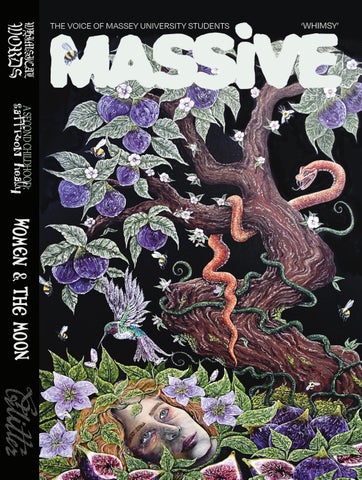
Cover by Jessie Davidson
anna Grapes
Centrefold by Bri
Massive Magazine
ART COMPETITION ALONGSIDE OUR ‘ART’ ISSUE OF MASSIVE. FOUR PIECES OF STUDENT ART WILL BE PUBLISHED IN THE MAG & DISPLAYED AT AN EXHIBITION AT FISHCUBE GALLERY TO ENTER: PRIZES SUBMIT UP TO 3
400MM X 265MM (LANDSCAPE OR PORTRAIT) ARTWORK/S TO:
DESIGNER@MASSIVEMAGAZINE.ORG.NZ
BEFORE 12AM, 11TH SEPT ARTWORK CAN BE ANY MEDIUM, ANY SUBJECT
1ST: MAIN CENTREFOLD SPREAD IN THE MAGAZINE & $100 PREZZY CARD 2ND: REVERSE OF CENTREFOLD SPREAD IN THE MAGAZINE & $50 PREZZY CARD 3RD & 4TH: ONE PAGE PRINT IN THE MAGAZINE