Leaflet
NOVEMBER – DECEMBER 2026 A MASSACHUSETTS HORTICULTURAL SOCIETY PUBLICATION
TABLE OF CONTENTS
3 FROM THE PRESIDENT'S DESK JAMES HEARSUM 4 UPCOMING MHS CLASSES 5 YOUTH PROGRAMS 5 GREEN PARTNER SPOTLIGHT 6 GIANT ADIRONDACK CHAIR ILLUSTRATION BY MARIANNE ORLANDO 7 COLLOQUIA PLANTARUM: INTERVIEWS WITH PLANTS BY SHANNON GOHEEN 15 IN FIRST PERSON WITH BOB HANSS 22 GIFTS FOR THE GARDENER IN YOUR LIFE, OR MAYBE YOU BY REED PUGH 26 18TH ANNUAL FESTIVAL OF TREES 27 FROM THE STACKS BY MAUREEN O'BRIEN 30 NOVEMBER NOTIONS BY JOHN LEE 34 THE AWARDEES OF THE 122ND HONORARY MEDALS CEREMONY
EDITOR-IN-CHIEF Dave Barnett mhsleaflet@gmail.com MANAGING EDITOR Meghan Connolly mconnolly@masshort.org
2 | November – December 2026
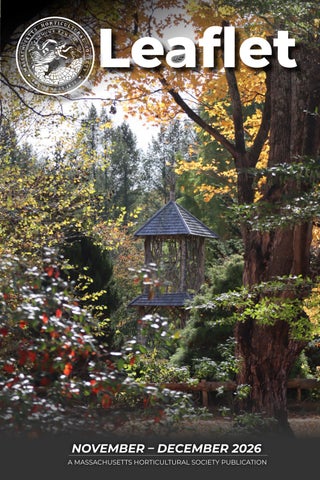
Front Cover: Twig Tower among fall foliage at the Garden at Elm Bank. Back Cover: The luminary labyrinth aglow for the 18th Annual Festival of Trees.
From the DIRECTOR'S DESK Some of the most lasting things we make in gardens are family traditions.
A regular visit, a favorite tree, or an afternoon working together can become something people remember for years. Now with young children of my own, I find myself thinking about how those traditions begin and are sustained for our children.
Bob Hanss’s account in this issue is a lovely illustration. From his grandfather’s fruit farm to working alongside his daughter Catherine, horticulture runs through his family’s life. His story also celebrates the colleagues who have stayed with him for decades. The gardens they build have grown out of enduring collaborations and become places where other families make their own memories. Our recent Honorary Medals Dinner also celebrated people whose influence reaches far beyond their own gardens. Sharon Loving, recipient of the George Robert White Medal of Honor, has helped shape generations of horticulturists during her remarkable career. Drew Schuyler, the first recipient of the R. Wayne Mezitt Medal, is already making his mark through his work at Untermyer Gardens. I warmly congratulate them and all this year’s honorees.
The new medal, our first named medal since 1927, gives particular meaning to that connection between generations. Wayne cared deeply about encouraging younger horticulturists, recognizing their ability and helping them find their place in the profession. His legacy includes the confidence and opportunity he gave others, alongside his extraordinary contribution to plants and gardens. “The awardee should be someone Wayne would have wanted to sit down with over coffee — someone with real dirt under their fingernails, a big horticultural dream, and a desire to uplift others”. Drew exemplifies this and in recognizing Drew’s practical accomplishments and future promise, we are continuing something Wayne valued enormously. It is a fitting way to remember a much-loved friend of MHS.
We each have opportunities to offer that same encouragement. We can make room for someone else in our gardening lives: invite a friend to visit a garden, give a child time to explore, or encourage someone who is finding their feet. These small acts can have consequences we never get to see and may be the beginning of a lifelong interest. As Thanksgiving and Christmas approach, I hope you find time for this. Perhaps a visit to the Festival of Trees will become part of your family’s traditions, or an opportunity to bring a friend to Elm Bank for the first time. Thank you for being part of the MHS community, and for helping us make gardens places where friendships and families can flourish.
James Hearsum President & CEO MHS Leaflet | 3
UPCOMING
CLASSES Drawing and Painting for the Petrified Saturdays, Nov. 14 & 21 9:30am-1:30pm History of Botanical Art Tues. & Thurs., Nov. 17 & 19 10am-12:30pm
© Lara Call Gastinger
Creating and Composing a Full Sketch Page Fri. & Sat., November 6 & 7 9:30am-3:30pm The Botanically Illustrated Recipe November 9, 16 & 23 10am-2pm
Floral Design: Your Thanksgiving Table Saturday, November 14 10-11:30am Dormant Pruning Workshop Saturday, November 14 10-11:30am OR 12-1:30pm
Floral Design: Holiday Splendor Saturday, December 5 10-11:30am Celebrating the Season: Holiday Card Workshop Saturday, December 5 10am-3pm
© Tara Connaughton
Greenhouse Botanicals: Indoor Flowers January 13, 20 & 27, 2027 9:30am-1:30pm Foundations of Botanical Drawing & Painting Starts Mon., February 1, 2027 10am-1pm
EXPLORE ALL UPCOMING CLASSES
4 | November – December 2026
YOUTH
PROGRAMS
Little Sprouts
Join Youth Education Coordinator Kristen at our final Little Sprouts classes of the year, designed for children ages 3-5 and their caregivers. Discover a seasonal theme through a 5-senses garden walk, story-time, a hands-on craft or activity, and a take home kit. My First Winter Hike Bundle up to look for forest treasures! Hiking with children can start small - like this 1/2 mile walk along the Charles River right here at Elm Bank. As we take in our surroundings with our 5 senses and explore all the hidden treasures that the fall season has exposed. Enjoy story and snack time on the trail then an indoor art project. Tuesday 11/10 from 10:30-11:30am Thursday 11/12 from 2-3pm Register Now
Green Partner Spotlight Shop at Green Partner businesses to receive 10% off with your MHS Membership card!
Winchester, MA and more
Medway, MA
Hadley, MA
MHS Leaflet | 5
Marianne Orlando is a landscape architect turned freelance illustrator who loves plants, and does commissioned drawings of homes, pets and people. You can see samples of her work at www.marianneorlando.com.
6 | November – December 2026
Colloquia plantarum Interviews with Plants
By Shannon Goheen When the air turns cooler and we face the inevitability of the oncoming winter, a set of plants bloom that bring a measure of delight. Not that members of this family aren’t blooming throughout the growing season, but they are even more welcome at the end of the season. Their beauty stands out in a less dramatic landscape, and the pollinator action is a marvel. I’m talking about the plant family we call Asteraceae (As-ter-ā-see-ee), or the sunflower family. It is an enormous family of flowering plants with so many interesting members that I could interview them again and again… and I just might do that. But today, I’ve spotted a 3’ beauty with violet-lavender flowers in a cultivated western Massachusetts garden and I’m going to have a chat with this stunner. Me: Your flowers are a feast for my eyes. I can barely shift my gaze anywhere else, not that I’d want to. Ah…I see you are smiling – I can tell. Will you speak with me?
Photo: Possibly a cultivar of Symphyotrichum novi-belgii, New York aster, this plant is standout in the cultivated garden. All photos by Shannon Goheen.
MHS Leaflet | 7
Aster: Should I speak with you?
Me: I would very much like it if you would. Aster: Very well then. You start.
Me: I’m thinking that summer has passed, and I feel a touch of sadness. It’s not that I worship summer because I don’t – not at all. But the start of the change of seasons always brings on a shift in mood. And while I’m feeling this slight discomfort, I’m staring at you and feeling brighter by the minute. I’m floored by your flamboyant blossoms, your stature, and your seemingly effortless command of this garden. Aster: I’ve been here all season, green and growing taller, waiting for my moment. We all await our moments and when we have them, such joy!
Me: There are so many kinds of bees on your blooms, and if I look closely, I can see flies and maybe some wasps collecting pollen. I know that moths and butterflies love you too, but I don’t see them here at this moment. Aster: We live for this. We live for this beautiful exchange. We open to the sun and welcome thousands of fuzzy feet across our faces, bringing pollen from our neighbors and taking ours to them. We bathe in the buzz all day long. Then at night, some weary workers rest quietly, waiting to be warmed by the morning sun. You might think of it as being covered in soft tiny kisses, all day, every day. It is a beautiful pattern, a beautiful life. Photo: Possibly a cultivar of Symphyotrichum novi-belgii, New York aster, this plant is standout in the cultivated garden. All photos by Shannon Goheen.
8 | November – December 2026
Me: I can almost imagine how that would feel but in truth, I’d have a problem with thousands of fuzzy feet walking across my face. I do sometimes enjoy tempting fate while I slowly and confidently place my face next to one of your blooms. I observe that the bees fly away and hover, waiting for me to move. Aster: Not surprising. You appear to possess nothing of interest to a pollinator, whereas we have numerous flowers that make up just one of our faces.
Me: Wait. Numerous flowers that make up your face? I’m looking at one flower, then another on another stem, and another, and so on. Please explain.
Aster: Isn’t it obvious? We have separate parts, the outer attraction part that you might call “ray florets” and the center part that holds the promise that you would call “disk florets.” We hold hundreds of disk florets on our faces and the deeply attractive petal-like rays that you supposed were flowers are advertisement. Me: Oh, that’s brilliant! In one stop, an insect pollinates potentially hundreds of flowers. It’s a grand botanical illusion, to gaze upon your colorful ray florets and to realize that the treasures are all in the center.
Aster: Clever, don’t you think? Speaking of our centers, have you seen my cousins, the sunflowers? A field of cultivated sunflowers in eastern North Dakota
MHS Leaflet | 9
Me: I have seen your cousins! I love to see acres and acres of them, golden heads across the plains that seem to meet the horizon.
Aster: The younger sunflowers follow the sun, their great heads moving in unison to smile into the light. They can contain hundreds to more than one thousand individual flowers on their faces.
△ Ray florets and disk florets that make up Helianthus annuus.
▷ The giant sunflower, Helianthus annuus, showing how efficiently the plant packs the disk florets into the center of the flower head
Me: To look at one giant sunflower is to be transported somewhere else. Their grandeur seems otherworldly to me. I understand that sunflowers in general, Helianthus sp., are among the most used and preferred pollinator plants out there. I was told once that if I could only plant one thing for pollinators, plant sunflowers. 10 | November – December 2026
Aster: Also consider the goldenrods when you are talking about preferred pollinator plants. Me: Absolutely! Goldenrod is stunning and so misunderstood.
Aster: How do you mean?
Me: Many people think goldenrod, or Solidago sp., is responsible for their allergy issues in late summer. There they are, lighting up the landscape and providing essential resources for pollinating insects, while their cousins (and yours) are the likely culprits. I’m Numerous pollinators share this cluster of talking about ragweed, goldenrod blooms. Ambrosia sp. It blooms at the same time as goldenrod and goldenrod is showy while ragweed isn’t noticed. The innocent goldenrod takes the blame. I always thought it was funny that the Greek gods were said to feed on Ambrosia, which essentially indicates something exceptionally delicious and special. It’s such a clash, food of the gods and the main plant behind hay fever. Aster: That’s rather sad all around. Poor goldenrod.
Me: I find I’m perpetually defending goldenrod. I love them, in all their forms. So golden and so gorgeous! You know, the asters are a challenge to identify. Over 40 years ago, I heard a conversation between a couple of people in the Connecticut Botanical Society. One referred to the president of the Society as the “aster master.” The president then referred to his predecessor as the “past aster master.” It still trips off the tongue and lives in my memory even after all these years. MHS Leaflet | 11
△ A bumblebee dangles on a goldenrod (Solidago sp.).
▷ Pollinators waking up in the cool morning air of a nearly-past blooming goldenrod in northern Maine.
Aster: Tongue?
Me: Oh. A tongue is part of the human anatomy that is essential for speaking, forming words, one of the main ways humans communicate.
Aster: Ah. Like our ray florets, how we communicate with our pollinators.
Me: And truthfully, that’s how you communicate with us. We tend to focus on how plants look because we don’t all possess the skill to speak with you as we speak to each other. So, we look at you, admire you, and some of us automatically think about what category to put you in. Aster: Hmm. You would put me into a category? Am I not special enough to simply be?
Me: Yes, and I don’t mean to offend. It’s just that humans like to categorize things. We like to separate and combine, compare and contrast, find
12 | November – December 2026
the duality in things and thoughts. We just do. But I am no aster master. Getting to know all the individual members requires a lot of research and is most fun to do in the company of other plant lovers. Aster: It is true that we are numerous.
Me: You certainly are! The aster family, sometimes referred to as Compositae or the composites, for short, is also called the daisy or sunflower family. It includes more than 32,000 species across the earth. For every 10 flowering plants described earth-wide, one of them is likely to be in the Asteraceae family. Some of the more common plants most of us know or have heard about include chrysanthemum, dahlias, zinnias, coneflowers, marigolds, yarrow, and chamomile. Aster family members that find their way into our diet are sunflowers, lettuce, artichokes, endive, stevia, dandelions and more. And how about thistles and burdocks? It’s interesting to me that seed dispersal among your family happens in different ways, like seeds that are eaten or dropped onto the ground, as with sunflowers, or dandelion-style wind-blown seeds. Burdocks have hooks that attach to people and animals. Oh, and let’s not forget those Bidens sp. super-awful teeny hitchhikers we call beggarticks that are practically impossible to pull out of a dog’s or cat’s coat, or our clothes, for that matter.
△ One of at least five seed dispersal mechanisms employed by Asteraceae, as in this classic dandelion gone to seed.
▽ The lovely but painfully sharp tothe-touch thistle, or Cirsium vulgare.
MHS Leaflet | 13
White wood asters (Eurybia divericata) grow in semi-shaded and dry conditions at the edge of a mown lawn.
Aster: We are alike yet all so different.
Me: What’s more, you grow on six of seven continents across the world. That is simply remarkable.
Aster: Thank you. We have learned to adapt quite well! Our conversation was most entertaining but now I’m going to wish you a good day and get back to my bees. And so, I watched her in silence as she and her sisters, too numerous to count, stood proudly in the afternoon sun with an endless array of buzzing visitors kissing their faces while filling themselves with pollen to share.
Shannon Goheen has been loving plants and designing landscapes, primarily on Cape Cod, for nearly 40 years as Second Nature Gardenworks. She talks about plants and landscape notes on Instagram as @theeveninggowngardener.
14 | November – December 2026
In First Person
Bob Hanss Bob Hanss earned his Bachelor’s Degree in Landscape Architecture from Cornell University, and ten years later founded his own landscape construction business, Robert Hanss Inc., in 1991. Ever since then his company has specialized in residential landscape construction and property management, offering clients the highest level of craftsmanship and service. Headquartered in Chestnut Hill, Bob has worked closely with a number of landscape architects to build exceptional gardens with skill, efficiency and old-world craftsmanship. Several of his projects have won awards from both the American Society of Landscape Architects and the Boston Society of Landscape Architects. Here is Bob’s story in his own words.
Photo: Fun on the farm.
MHS Leaflet | 15
I
grew up in the suburbs of Rochester, New York and attended the local school. I was always active running around with neighbors or cousins. My mom was one of eight siblings. They all grew up on my grandfather’s fruit farm. They all stayed connected and my uncle expanded the farm to 1,000 acres along the shores of Lake Ontario, which moderated the temperature and enabled successful fruit farming of apples, peaches, cherries, strawberries and later crops of cabbage and squash to extend the season. I was part of a farm family and early on knew I had to continue that story and someday own farmland that would be mine. Boy Scouts gave me the opportunity to explore the woods and the Adirondacks for two weeks every summer. I achieved Eagle Scout status along with many of my friends. During high school I ran on the cross country and both indoor and outdoor track teams, running outdoors all year long surrounded by nature.
When it came time for college, Cornell University recruited me for running and I enrolled in the College of Engineering. Luckily two of my dorm mates were in the Landscape Architecture School and I immediately knew that’s where I belonged. There were so many things that I had not been exposed to: design, history of gardens, horticulture, always gardens and the making of gardens. This is what I wanted to do.
Perennial gardens on the slope between the barn and the vegetable garden on the Hanss family farm in Vermont.
16 | November – December 2026
Bob and his two children, Catherine and Eric, in Helen Stoddard's Fletcher Steel Garden in Worcester, MA.
I met my future wife Michele the first week of freshman year. We were inseparable and grew up together. Upon graduation we went to big cities – Michele to New York and I to Boston. Boston soon won out with easy access to the suburbs, parks, mountains and open space in general. I worked for landscape architecture and landscape construction firms and a masonry company, never really owning my own work. So in 1991 I took the leap and started Robert Hanss Inc., with the goal of constructing unique residential gardens. It was a scary time for my wife, with a beat-up old house with a large mortgage, a three-year-old son and just a few projects in the making. I borrowed $3,000 from my father and we were off and running with an old pick-up truck and a wheelbarrow.
Fortunately, during my ten years of working in the field I knew 100 landscape architects, I knew suppliers, and I had access to an experienced labor force. These connections turned out to be critical. In my second year of business, I worked with Doug Reed to create the Children’s Therapeutic Garden, which ended up being recognized by the American Society of Landscape Architects with the President’s Award of Excellence.
My company began to grow quite quickly. After ten years we had a crew of 20 employees. Most of them are still working with me today. This is our perfect size, allowing us to prioritize quality, service, and relationships. The constancy and loyalty of the crews has helped us maintain very high standards for our clients. MHS Leaflet | 17
We have been fortunate to work with creative and innovative landscape architects, collaborating on residential gardens. These include Reed/ Hilderbrand, Matthew Cunningham, Stimpson, Morgan Wheelock, Skip Burck, LeBlanc Jones, Ohme Van Sweden, Gary Kohler, Charles Stick and many others. We have also built projects for MIT and Mount Auburn Cemetery. Left: A garden constructed 20 years ago by Robert Hanss Inc. that Bob's daughter and her family now call home. Below: Birch Gardens fountain area and new interment space at Mount Auburn Cemetery.
18 | November – December 2026
Just when business became predictable, I realized that our gardens will only remain pristine if we provide long term maintenance and oversight. I did not have the energy to start or manage a company like this, so I made a cold call to Michael Piering who had spent 35 years developing and nurturing his maintenance company, Landscape Collaborative. It turns out he was thinking of selling – serendipity! After several months of discussions, we purchased his company and now offer yearround maintenance services, mowing and lawn care, perennial garden maintenance, seasonal containers, ornamental pruning, as well as the coordination of comprehensive property maintenance. Above: Salvaged granite foundation stones repurposed as rustic steps through a woodland garden. Left: A sampling of an architectural gem that Bob's team has been working on for 12 years. The walls are constructed from Barre, MA fieldstone worked on-site with paper thin joints.
MHS Leaflet | 19
I quickly realized that I could not run Landscape Collaborative without help. I recruited our daughter, Catherine, to take over the position of Managing Director and run that part of our newly merged company. Catherine loves plants, loves gardens and garden making, and she now manages a motivated and growing company. It’s a joy working with her and seeing her success.
Our son Eric is a transportation planner in Detroit by day and an urban cowboy and urban gardener all other waking hours. Michele is a park advocate, raising awareness and funds to support our state parks and public lands.
Bob and his daughter Catherine - all smiles as they began to grow Landscape Collaborative. 20 | November – December 2026
The Hanss family's garden and farm in Vermont - eight years of masonry and wall building.
This has been a nice opportunity to reflect on my career and what really makes me happy. It’s horticulture and my family’s involvement and love of it. Our work, our spare time, our vacations – all one gardening experience. Why retire because I wouldn’t be doing anything different! And by the way, I did buy that farm, but that’s another story.
For “In First Person,” Leaflet Editor-in-Chief Dave Barnett interviews people who have made their mark in horticulture and adjacent fields by asking a standard set of questions about their work and career, and then works collaboratively with them to write this column to share their passions and tell their story.
MHS Leaflet | 21
Gifts For The Gardener In Your Life, Or Maybe You By Reed Pugh Do you want to be a gift-giving hero this holiday season to the gardening partner or friend in your life?
I have spent a lifetime trying to put thought into the gifts that I provide for my wife, after giving the same gift for back-to-back birthdays while dating 30 years ago. I was young and not as wise as I am today! Following are some wonderful, quality gifts for the holiday season that will ensure you don’t make a visit to the doghouse.
Hand Pruners
While living in San Francisco over two decades ago, I found Hida Tool. They are an importer of fine Japanese tools. They started with carpentry tools, and soon expanded to gardening and kitchen tools. In nearly 30 years, I have never been disappointed with any purchase. Their Tobisho SR-1 Hand Pruner is my primary pruner. With a high carbon steel blade, it is nearly impossible to damage, and it holds its edge well with just regular honing to keep it sharp. A tool of this quality makes pruning easier and lessens the chance of repetitiveuse injury. The only downside to this steel is that it can rust easily, so a little maintenance with Sap Remover and Camellia Oil will keep it in good shape. Both items are available on their site and can be used with all your pruning tools. All photos by Reed Pugh.
22 | November – December 2026
Hori Hori
A quality digging knife, or Hori Hori, from Hida Tool is an essential tool used in planting, cutting, dividing, weeding, and many other tasks in the garden. I was almost arrested while having one in a briefcase while attending Jury Duty years ago. This is a serious tool, made of high carbon steel, that will last a lifetime with a little care for the wooden handle. This has a 6” blade with one serrated edge. They also have one with a shorter handle and a lighter version made of stainless steel. You will never need to use or break a trowel again.
Home Weather Station
Any real gardener is a little obsessed with the weather. I have an uncomfortable obsession with needing to know what is happening and what will come. I got tired of changing batteries, unsticking the rain gauge, and the weak Wi-Fi signals on an old system, and I am now wildly happy with my Tempest° Weather Station. It is solar-powered with no moving parts. It measures rain, temperature, humidity, wind, lightening, barometric pressure, UV Index, and more. Easy to set up and access information through an app on your phone. This AI enabled system provides weather forecasting and improves its measurements by accessing local weather. Purchase the bird deterrent so that birds don’t trigger the haptic rain gauge on top, and they have a great pole for attaching to a fence post.
Garden Vessel
Every garden deserves a focal point… something permanent to pair with the living garden. Stephen Proctor creates beautiful vessels that add beauty and structure to the garden throughout the seasons. As he says, “reaching for the eloquent gesture that speaks to the psyche and lifts the veil for a moment.” These are sizable and significant vessels
MHS Leaflet | 23
Garden Sculpture
that can transform a space. He has several series of pieces, but also creates works on commission. It may be worth working with a designer to properly locate, light and plant to properly display the vessel’s qualities. If your significant other has thrown a few pots before, consider signing up for one of Stephen’s workshops to learn how to work on a larger scale.
If you want to be a little more whimsical, consider something more creative to provide interest throughout the year. Whitmore Boogaerts is an artist who has been creating sculptures for decades, now out of his studio, WB Sculpture, in Westport, MA. As Whitmore says, “WB Sculpture Studio has created indoor and outdoor sculptures, furniture, wall pieces, mobiles and all kinds of commissions over the past thirty years. These fluid and sophisticated pieces can be found throughout the United States and around the world.” As a gift, you could visit his studio and commission a piece or purchase one from his studio. Afterwards you can go just down the street to The Bayside for a great local seafood meal, then stop in at Sylvan Nursery, a fantastic nursery. Everything is on Horseneck Rd, minutes apart.
Electric Garden Pruner
The new, or not so new, rage is the Stihl Battery Garden Pruner. This battery-powered, hand-held mini chainsaw makes quick work of pruning and cutting of branches. This will save your wrists, arms and shoulders from all the pruning you need to do on bigger wood. The chain moves much slower than a chainsaw. It looks a little scary, but with practice, it is easy to control and it goes through branches like butter without having to handle a heavy and dangerous chainsaw. Adjusting
24 | November – December 2026
and maintaining is easy. This is used best for big cuts, and is not for fine, delicate pruning. It is a power tool and you need to be careful to prevent injury, but it is a significant step down from the bigger chainsaw. With people shifting to battery equipment, in my opinion, Stihl is the brand with the best technology and equipment. You can cross utilize the batteries with different equipment as you add them over time.
Nursery Gift Certificates
Most gardeners have a plant problem, meaning they can’t help themselves and are always buying more plants, myself included. Consider a gift certificate from one of several very special online nurseries: • Swan Island Dahlias, the largest dahlia grower in the US, based in Canby, OR. An unmatched selection of small single to the massive dinner plate dahlias. Great growing resource. • Broken Arrow Nursery, growers of rare and unusual plants in Hamden, CT. They offer an amazing selection of plants online and in their nursery. • Plant Delights Nursery specialize in collecting, creating, propagating and sharing unique, rare and native perennials in Raleigh, NC. Some of the plants sold on the site are not hardy up north, so pay close attention. Hopefully, I have provided some new ideas for holiday gift giving. The companies listed have lots of other wonderful items, too. Finally, I need to say that I receive no compensation for any of these recommendations, they are listed based upon my experience with the products. Reed Pugh is a horticulturist and educator with his company, Barking Dog Gardens. With over 25 years of professional experience working in gardens, he currently spends his time teaching at local public gardens, and consulting with and coaching people to help them get the most out of their gardens.
MHS Leaflet | 25
Celebrate the season with decorated holiday trees, Snow Village model trains, garden lights, and s'mores at the Garden at Elm Bank.
Plan Your Holiday Experience 26 | November – December 2026
Let every soldier hew him down a bough, and bear’t before him, thereby shall we shadow the numbers of our host and make discovery err in report of us.
"
"
MacBeth, Act V, Scene IV.
Collections – Books While reviewing the “Manks Collection,”1 we discovered several unexpected books on horticulture’s role in wartime. These findings led us down a proverbial “rabbit hole” as we began exploring this wideranging topic.
It soon became clear that the topic is complex and often extends beyond the scope of MHS’s collections. The Library holds diverse documents on horticulture during wartime. The Manks’ books on camouflage caught our attention and prompted us to consider horticulture’s role, the Society’s activities and the impact on the public during wartime.
The “Manks Collection” is nick-named after the distinguished MHS librarian, Dorothy St. John Manks (1896-1990). The books in that Collection never made it into our online catalog. In recent years, we have been weeding this collection and oftentimes discover treasures, mysteries and controversial items. 1
“11th Century Camouflage,” Camouflage with Planting, Ralph Rodney Root, Chicago: Ralph Fletcher Seymour, 1942. MHS Collections.
This image depicts the enemy holding tree branches to hide the size of its force while advancing near Birnam Wood in Macbeth, Act V, Scene IV. Camouflage is as old as nature—a natural survival strategy that organisms use to disguise their appearance and blend into their surroundings. Humans have adopted this strategy for both defensive and offensive military purposes.
MHS Leaflet | 27
Horticulture assumed heightened significance during periods of war, both on the home front and in military operations. Patriotic campaigns encouraged citizens to support the armed forces and the nation through initiatives such as victory gardens, which helped to reserve commercial agricultural production for military use. During the World Wars, MHS contributed to the war effort through collaborations with other organizations, free public programs and publications, rentfree meeting space, and proceeds from flower shows. The armed forces used horticulture in their defensive and offensive strategies. Along with other methods, plants provided cover, barriers, camouflage and other forms of protection and deception. With the arrival of air warfare, it was critically important that strategic sites be hidden from enemy fire.
Plants Go to War: A Botanical History of World War II by Judith Sumner. MHS Collections. This book provides a comprehensive examination of plant science at home and abroad. Members may borrow this book from the Library.
A dark side to war time strategies involving plants and the landscape, is their use in an offensive tactic—Ecocide—the destruction of the environment by humans. While this practice goes back thousands of years, it is still used today, causing irreputable harm to ecosystems, the environment and humans. For example, use of defoliants such as Agent Orange and destruction of infrastructure are tactics that have wide spread effect on people, places and the environment. The controversy over these practices is complex and extends beyond wartime acts. It is still under debate. Book Sale at the Library
Continuing through the 2026 Festival of Trees The Book Sale last year was very popular and patrons asked for a repeat at the 2026 Fall Flower Show. The books are primarily landscape, history and horticulture books. Most are priced at $1, $3 or $5. A few gems are also available at higher “bargain” prices. Cash and credit cards accepted. Please bring your own bag! The sale will continue through the Festival of Trees while there are remaining books, open hours are TBA.
28 | November – December 2026
MHS Book Club Book Club meetings take place on the third Tuesday of the month at 1:30 pm in the Dearborn Room in the Education Building. All are welcome to attend. These are the topics for the Club’s upcoming discussions:
November 17, 2026 Tiny Gardens Everywhere: A History of Urban Gardening and The Next Food Revolution by Kate Brown
December 15, 2026 Members will be sharing favorite gardening catalogues and magazines
Library Quarterly Exhibits The Library’s Fall Exhibition is “Herbals of Five Centuries.” This exhibit displays a representative selection of original illustrations in herbals published in the 15th through the 19th centuries. It will run through December.
January 19, 2027 The Once & Future Gardener: Garden Writing from the Golden Age of Magazines: 1900-1940 Virginia Tuttle Clayton (Editor)
The Exhibitions are on view in the entry hall of the Education Building when the Garden is open.
Come Visit! The Library is open on Thursdays from 10 am to 1 pm and on Fridays from noon to 3 pm. The Library is also open by appointment. If you wish an appointment or want to access specific items, please email Library & Archives Manager Maureen O’Brien for an appointment or for other assistance.
MHS Leaflet | 29
November Notions By John Lee
John shares stories of Bert and Brenda and their gardening wisdom. These chronicles feature recipes, tried-and-true gardening practices, and seasonal struggles and successes. Bert and Brenda were first introduced in the March 2022 issue of Leaflet.
About this time of year, the season begins to slow, both Bert and Brenda both grow wistful about how things once were if, in fact, ‘things’ actually were that way. It seems that as the seasons wore on that there is a never-ending tide of work that must be done else one or both of them become buried in their to-do lists (which seems endless from the beginning of April to the end of November). If it’s not getting the gardens 30 | November – December 2026
started, it is getting them put to bed. Indeed, both still find endless satisfaction and joy in their daily and seasonal routines. But what about that was new? As far back as either could remember, November was the month when both could begin to let their hair down and contemplate a crossword puzzle in the evening. November, as October waned, was the goal line when they knew that selfsufficiency still reigned at their
homestead, that their cherished frugality had not dampened their spirits nor deprived them of latewinter nutriment. It is true that Brenda’s preoccupation tended to dwell in the safety of past practice. She had never cut corners in her culinary routines and neither of them (or the occasional dinner guest) had ever gotten sick on anything she had put up or prepared. (The very thought of such embarrassment or responsibility put the fear of God in her.) She did prepare their summer meals regularly on the wood stove in the summer kitchen if there was no canning to be done. In that case, the gas range was the best option although it did heat up the kitchen quite a bit even on a steamy evening with the windows open. What, in fact, gave each of them the most satisfaction was that they had become all but perfectly synchronized. After all the years they worked together, they had become a great team. These days there were few surprises that required major accommodations in their lives. Their ability to foresee the needs of the other was what had
made their marriage strong, stable and (almost always) free of unnecessary stress. Each had their principal domains. Bert welcomed his wife’s input on what to plant when. Brenda was more than grateful that after a long day on her feet in front of the stove, Bert would wash up everything after dinner. He usually put away his washings the next morning while their coffee was brewing. All this worked out because of their long history. In their earlier days, Bert had feigned ignorance (or incompetence) in the kitchen. Cooking made him nervous – keeping track of what went into a recipe when usually made him
MHS Leaflet | 31
upset or frustrated. Brenda liked to cook. It gave her a warm sense of care-giving and fulfilled whatever maternal urges she had that were unsatisfied through no fault of their own. In her mind, being childless (for lack of a better word) was their only disappointment. They had occasionally made up for it by taking in nieces and nephews whose circumstances were less admirable than their own. By doing so, their lives had meaning and intention. It gave both of them an opportunity to share what seemed to be becoming antique arts: self-care and self-sufficiency. They were not troglodytes or insecure about the state of their 32 | November – December 2026
smallish world. They chose to live simply. Their lives were not an anti-social Thoreauvian experiment in doing without. Bert did not save seed; he did have a rototiller. She also appreciated certain modern conveniences like a washing machine (and a drier when the weather dictated). They simply chose to live reasonably simply, having what they needed and finessing what they deemed unnecessary. They saw their lives as a complete organism in the sense that they saw themselves as a whole (an entirety). They had the inputs or skills to thrive much as plants do given a rich soil. Other households they knew
were also communities but they often seemed lacking in certain alternate benefits (like how to do things without what seemed like extraneous inputs that came with self-sufficiency) to truly thrive. They often seemed stressed, some withering in the heat of modern times and obligations. Bert and Brenda thought themselves able to produce the necessary sugars and substrates necessary for growth and succession. They thought themselves truly fortunate even as they knew that their lives were not what many others might choose.
Some of these musings simply came from spending time in their gardens. Care and attention reaped significant rewards. Timeliness seemed next to godliness as inattention meant more work, less harvest. Gardens are not like wildflower meadows – random acts of beauty (despite that their abundance sustains the pollinators which sustain much of everything else). Gardens are natural relationships,
conversations, shared needs and expectable rewards. Marcus Tillius Cicero some 2000 years ago opined that “the pleasures of agriculture are suited to every age and seem to be the very life for a wise man” (from de Senectute with apologies for the translation). If Cicero had, perhaps, cooked for himself, he might have proclaimed similarly about his thermopolium, thought Brenda.
John Lee is the retired manager of MHS Gold Medal winner Allandale Farm, Cognoscenti contributor and president of MA Society for Promoting Agriculture. He sits on the UMASS Board of Public Overseers and is a long-time op-ed contributor to Edible Boston and other publications.
MHS Leaflet | 33
The Awardees of the 122nd Honorary Medals Ceremony On Thursday, October 29, 2026, MHS welcomed 8 awardees, their supporters, and members of the horticulture community to celebrate excellence in horticulture. The ceremony continued a 195year tradition of awarding medals to individuals and organizations for their contributions to horticulture for the public good. The George Robert White Medal of Honor Awarded for eminent service in horticulture in its broadest sense.
Sharon Loving left
Chief Horticulture and Facilities Officer, Longwood Gardens (retired)
The R. Wayne Mezitt Medal Presented to an emerging horticultural leader of exceptional accomplishment and potential.
Drew Schuyler right
Assistant Head Gardener, Untermyer Gardens Conservancy
The Thomas Roland Medal Awarded for exceptional skill in horticulture and lectures.
Timothy M. Boland left
34 | November – December 2026
Executive Director, Polly Hill Arboretum
The Gold Medal Awarded for eminent horticultural accomplishments.
Page Dickey above
Author and Lecturer; Director Emeritus, The Garden Conservancy
Richard G. Hawke left
Gaylord and Dorothy Donnelley Director of Ornamental Plant Research, Chicago Botanic Garden
The New Garden Society above Greater Boston
The Silver Medal Awarded for noteworthy service in horticulture.
Joanne Caccavale
Riji; Director, Sogetsu Massachusetts Branch
Maurice F. Tougas Tougas Family Farm
MHS Leaflet | 35
The Garden at Elm Bank Open April 1-November 24 Classes, Programs Year-round www.masshort.org
Massachusetts Horticultural Society 900 Washington St Wellesley, MA 617.933.4900