Leaflet
JANUARY – FEBRUARY 2026 A MASSACHUSETTS HORTICULTURAL SOCIETY PUBLICATION
TABLE OF CONTENTS
3 FROM THE PRESIDENT'S DESK JAMES HEARSUM 4 UPCOMING MHS CLASSES 5 FESTIVAL OF TREES AT A GLANCE 5 GREEN PARTNER SPOTLIGHT 6 COLLOQUIA PLANTARUM: INTERVIEWS WITH PLANTS BY SHANNON GOHEEN 12 IN FIRST PERSON WITH JOANN VIEIRA 19 JADE PLANT ILLUSTRATION BY MARIANNE ORLANDO 20 FROM THE STACKS BY MAUREEN O'BRIEN 24 A SECOND LOOK AT STUMPS AND SNAGS BY C.L. FORNARI 28 WINTER WISTFULNESS BY JOHN LEE
EDITOR-IN-CHIEF Dave Barnett mhsleaflet@gmail.com MANAGING EDITOR Meghan Connolly mconnolly@masshort.org
2 | January – February 2026
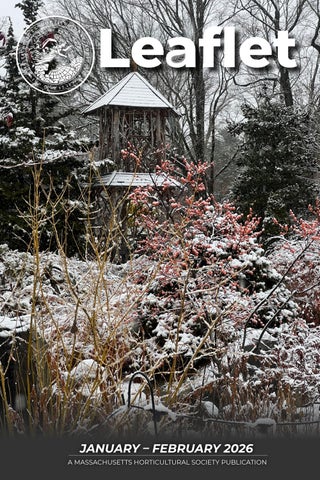
Cover: Twig Tower, yellow twig dogwood (Cornus sericea 'Flaviramea') and orange winterberry (Ilex verticillata 'Winter Gold') in Weezie's Garden under a coat of snow.
From the PRESIDENT'S DESK Dear Friends and Gardeners,
January and February are months that ask for a different kind of attention. In the garden, very little looks active, yet much of importance is quietly underway. The ground is shifting in small, almost imperceptible ways. Roots are adjusting. Buds are already formed, even if they’re not yet visible. Winter isn’t a pause— it’s a period of orientation. That’s very much where Massachusetts Horticultural Society finds itself right now.
As we look ahead to 2026, we’re beginning the early stages of our next planning process. I’m hesitant to lean too heavily on the phrase “strategic planning,” because this stage feels less like setting direction and more like learning how to look again. Gardeners know this instinctively. Before you change anything, you spend time paying attention—to what’s thriving, what’s under stress, and what conditions are shaping the whole system.
The most meaningful gardens aren’t created primarily from plans on paper. They emerge through observation. Organizations are no different. Good planning doesn’t start with answers—it starts with listening. This winter, that’s our focus. Listening—especially to members. To what you value most about MHS as it is today, and to what you hope it might become. In the coming months, you may hear from us with a question or an invitation to share your perspective. Those conversations will shape what comes next, including a more detailed update later this spring. For now, think of this as a quiet marker placed in the soil. Nothing rushed. Nothing forced. Just careful attention—and gratitude for being part of this community.
James Hearsum President & Executive Director MHS Leaflet | 3
UPCOMING
CLASSES
© TARA CONNAUGHTON
© SARAH ROCHE
VIRTUAL
VIRTUAL
HYBRID
Propagating Native Perennials from Seed Monday, January 12 6-8pm
Greenhouse Botanicals: Succulents & Cacti Wed. January 14, 21 & 28 9:30am-1:30pm
Techniques of Botanical Drawing & Painting Starts Tuesday, February 3 10am-1pm
© SARAH ROCHE
© SUSAN FISHER
VIRTUAL
VIRTUAL
VIRTUAL
Style and Purpose in the Native Garden Wednesday, February 25 6-8 pm
Introduction to Vellum: The Spice Palette Starts Monday, March 6 9:30am-1:30pm
Color Mixing for Artists March 16 - 20 10am-1pm
EXPLORE ALL UPCOMING CLASSES VIRTUAL
Creating a Meadowscape at Home Monday, April 13 6-8 pm
4 | January – February 2026
Festival of Trees is our biggest fundraiser of the year, and this year tens of thousands of visitors supported not only a joyful holiday experience, but also the essential work that MHS will carry forward in 2026—strengthening workforce training programs, preserving landmark trees, and deepening connections between people, plants, and gardens year-round.
AT A GLANCE: • •
• •
Over 17,500 guests visited the Garden throughout the Festival More than 100 volunteers gave over 750 hours behind the scenes and on the front lines—welcoming guests, handing out hot cocoa, and keeping the holiday spirit flowing 72 decorated holiday trees donated by families, businesses, and community organizations Snow Village presented by the Bay State Model Railroad Museum, with special thanks to Bill Meagher for the original gift that continues to delight generations
Green Partner Spotlight Shop at Green Partner businesses to receive 10% off with your MHS Membership card!
Billerica, MA
East Falmouth, MA
Palmer, MA
MHS Leaflet | 5
Colloquia plantarum Interviews with Plants By Shannon Goheen 6 | January – February 2026
A curious confluence of events brought me to this month’s interviewee. It’s winter, after all, and wouldn’t it be appropriate to chat up a perfectly gorgeous evergreen? That’s what I was expecting, anyway, and while I was eyeballing likely candidates, I saw an unexpected green sprig wedged against a metal structure in the middle of a dog park. The barren ground around it had been beaten solid by dog and people feet but there, in one small spot not easy to touch, though not hard for the average dog to sprinkle with liquid on occasion, was a dandelion. During that same week, my friend asked if I would like to watch her prepare dandelion roots. I had my interviewee! Me: Dandelion, you are astonishing! Is there anywhere you won’t grow? Oh, excuse me. Would you be willing to chat with me today? I’d like to have a conversation with you because, quite frankly, you amaze me. Dandelion: I daresay that I agree. We are amazing. After all, we’ve been around for something like 30 million years. Do you know anyone else who can claim that kind of longevity? Me: No! 30 million years? Let’s see…that was after the extinction of the dinosaurs and way before humans. To think you’ve been around that long, with all the heating and cooling of the earth in between – wow. Yet here you are in great abundance.
Dandelion: Yes, we’ve held our ground, and we don’t intend to go anywhere. If we can grow in a dog park against a metal pipe and be thriving and green in a New England winter, that tells you something about our tenacity. Left: Dandelion in the dog park. Photo by Shannon Goheen. Opposite: Dandelions in a field. Photo by Micky Carter.
MHS Leaflet | 7
Me: It also tells me that Nature made a near-perfect plant when it created you. Dandelion: Thank you.
Me: You belong to the Aster family, what we call “Asteraceae”. It’s fun to say these names. Ass-ter-ay-cee-ee. And your botanical name is fun to puzzle out too: Taraxacum officinale. I read that the name “Taraxacum” derives from an Arabic word for “bitter herb.” And your common name, Dandelion, is supposedly from the French words “dent de lion” which means “lion’s tooth.” That refers to the lobes or teeth along the edges of your leaves that grow, interestingly, from your base, where you meet the ground. What do you say about that?
Dandelion: We do belong to the Aster family, a huge family that has flower heads that consist of small, separate flowers called florets. And as for names, you can call us whatever you want. We don’t care! But since you asked, here are a few names we’ve heard over the years: blowball, cankerwort, doon-head-clock, witch’s gowen, milk witch, monks-head, priest’s crown, and puffball. You may like this English folk name: pissa-bed. There were good reasons for that name. Oh, and another one you’ll like is heart-fever-grass, a moniker we got because in old Ireland, we were thought to prevent swooning and passions of the heart. Maybe we did. Maybe we didn’t.
Dandelion leaves and roots harvested to eat. The roots are then ground into a fine power to make a hot, nutritious drink. Photos by Mary Ann Agresti.
8 | January – February 2026
Me: Those are good names! And I’m not surprised, given that you have been used by ancient Egyptians, Greeks, Romans, and for over one thousand years in traditional Chinese medicine. I think the most commonly known ways to use you are to eat your young fresh leaves, raw or cooked, and some people make dandelion wine and include your roots in traditional root beer. I have a friend who recently harvested your roots, roasted them to a crisp, ground them with a mortar and pestle, and made a tasty hot beverage. I tried it! Once she added a little milk, I thought it was pretty good!
Dandelion: Yes, in addition to food Dandelion growing at 9,000 feet and medicine, of which we are proud, up in the Colorado mountains, thriving in pure gravel. we can claim a higher honor. We are a Photo by Dave Barnett. generalist species, meaning we thrive virtually anywhere except in the wettest of soil, in the tropics or in polar regions. Otherwise, nothing stops us. And although many humans don’t appreciate us, we are essential for early spring pollinators.
Me: You’re right about that! As it turns out, you aren’t even native to the United States and most likely, you came from Europe, once upon a time. Yet, you are found across the United States and are said to have spread world-wide. I happen to think you are stunning in the spring when you bloom, especially when you cover an entire farmer’s field in an effervescent yellow cloak, or spread golden dots across an untended lawn. Thank goodness you show up for the pollinators!
Dandelion: We are loyal to the pollinators and we are clever. In older times, people looked to us as oracle plants because we could help prophecy the weather by opening our faces to the sun and closing up at night. We do this for almost two weeks and then we become silver orbs of seeds. We wait for the wind to carry our little parachutes off to new places to grow. Our seed dispersal system is effective, hence our colonization of much of the planet.
MHS Leaflet | 9
Taraxacum officinale 2005 © Peter M. Dirk www.minnesotawildflowers.info
Me: And growing everywhere is your talent! I have a lovely old book called “The Manual of Weeds” by Ada Georgia, published in 1923. I looked through it a few times and saw that the one and only pen mark in the entire book is on the page with the heading “Means of Control” of dandelions! Dandelion: We don’t deserve the disdain we receive from humans given all that we provide, but we can resist you and we will likely outlive your kind. Me: I’m inclined to agree. Did you know that as recently as 2025, your seed dispersal mechanism inspired the creation of drones that can power themselves from solar energy and vibrations? Dandelion: What’s a drone?
Me: It’s a little machine that flies…but let’s not get into that. There is also work being done around the world to create dandelion rubber. That milky sap you have is of the same quality as rubber trees. Imagine that!
10 | January – February 2026
Dandelion: We likely have more surprises up our stems. Surely you are not surprised after 30 million years of evolution on earth?
Me: No. Well yes. I am surprised. Not because it isn’t obvious that you would be so highly evolved after all these years but that many of us see you as being so lowly. A lowly weed. And really - you are so magnificent. Dandelion: Thank you for your compliment and your admission. We are very secure in who we are and don’t typically take offense. We actually think that the poisons that are dumped on the earth to get rid of us are ridiculous. And besides, it will never work. We aren’t leaving. We’ll just move along and find some other spot to inhabit. Me: You are considered an invasive species in some places. Denali National Park and Preserve in Alaska, for instance, has a Dandelion Demolition day every year where people dig up your kind to keep you from overrunning the park. Yet in West Virginia, there’s an annual Dandelion Festival. So it just depends I guess! Dandelion: Do you allow us to grow where you are?
Me: I definitely look for you in the spring in my “lawn,” if you could call it that. It’s green, but mostly green weeds. That’s okay with me. Less maintenance. As a younger person, I’ve kicked off dandelion heads, blown on the seeds, and tied stems together to make a dandelion chain. You have always been a part of my life, and I will continue to enjoy your beautiful yellow heads. I have yet to eat your leaves, but I think I’d like to try them sometime. Thank you, Dandelion, for speaking with me. I have so enjoyed our talk! In about 6 months, I’ll see my friends the dandelions again, and I’m looking forward to it. Meanwhile, I’ll sip the drink my friend made from the dandelion roots she roasted and ground. She actually bought dandelion seeds and dedicated a raised planter to them. Next year, I’ll be sure to see that container filled with bright yellow shining faces, open to the sun, and awaiting a harvest in the fall. Shannon Goheen has been loving plants and designing landscapes, primarily on Cape Cod, for nearly 40 years as Second Nature Gardenworks. She talks about plants and landscape notes on Instagram as @theeveninggowngardener.
MHS Leaflet | 11
In First Person
Joann Vieira Joann Vieira is the statewide Director of Public Gardens & Horticulture for The Trustees of Reservations in Massachusetts, where she leads a team devoted to the preservation, restoration, and documentation of 12 public gardens within the organization’s 120+ protected properties. She previously served as the founding Director of Horticulture at New England Botanic Garden at Tower Hill. Joann earned her degree in Environmental Design from UMass, Amherst. Her career has been enriched by involvement in key regional and national horticultural organizations. Her roles have included serving as President of the Horticultural Club of Boston, board member of the Ecological Landscape Alliance, member of the Awards Committee for the American Public Gardens Association, participant on the Public Gardens & Landscape Advisory Committee for The Pennsylvania Horticultural Society, and member of the Cary Award Selection Committee for the Worcester County Horticultural Society (WCHS). Joann’s contributions have been recognized with major awards including the Silver Medal from WCHS, the Silver Medal and the Thomas Roland Medal from the Massachusetts Horticultural Society, and the Beacon Award from the Massachusetts Association of Landscape Professionals. She is a frequent lecturer and contributor to horticultural publications. Here is Joann’s story in her own words: 12 | January – February 2026
I
grew up in a big family in a tiny rural town in central Massachusetts, where nature was not simply a backdrop but instead thoroughly interwoven into every aspect of our daily lives. Ours was a landscape of gardens, fields, brooks, and woods, a landscape that supplied endless joy and exploration as well as very practical skills—my earliest lessons came from nature itself. We grew nearly everything we could. The ½ acre vegetable garden—row after row of beans, cucumbers, carrots, radishes, squash and more—was as essential to us as the kitchen table. In spring we used a garden hoe to create a network of tributaries that drained away excess moisture; picked rocks, worked in lime and fertilizer, planted seeds and watched daily with palpable anticipation as tiny green shoots emerged. In the height of summer, much to our dismay, we had to complete our portion of weeding or picking squash bugs before we could join the neighborhood kids in summer pick-up games. In the fall we spent endless hours canning, freezing and tucking the harvest away in the root cellar like treasure for the long winter. It was practical work, but it also instilled in me a deep sense of connection— to food, to seasons, to the miracle of growth. Pleasure came from the outdoors, too. The backyard fueled a deep respect for botany, and natural history; an unspoken appreciation for beauty and unleashed both childhood glee and imagination. It was a universe of its own: croquet lawn, baseball field, hide-and-seek forest, and—most magical of all—the brook. My mother warned us
Entry garden at Stevens Coolidge House and Garden, North Andover, MA.
MHS Leaflet | 13
away from its slippery stones, but the forbidden has its own pull. The water ran tea-colored from hemlock tannins, a quiet ribbon that fed our imaginations in every season—fishing and floating makeshift boats built from scrap lumber, crooked nails and discarded fabric for sails in spring and summer; skating on the pond in winter.
And when the backyard wasn’t enough to satisfy my dad’s wanderlust and deep curiosity, we would pack into the station wagon, or later a pickup truck with camper in tow, and camp our way across the country. On weekends we would camp in local campgrounds or state parks, or our favorite southern Maine campground - hiking forest trails, scouring tidal pools and sleeping under the stars. On spring evenings, when the light lingered after dinner, my parents would pile us into the car and head down dirt backroads in search of wildflowers. We’d hang out of the windows, shrieking when we spotted a flicker of color—dog-toothed violets with their speckled leaves and magical yellow blossoms, or fleabane creating lavender haze across the fields. We tumbled out of the car and knelt before these plants, guessing at the name and racing on to find more nearby. These backroads were, it seemed, our own private woodland sanctuary. Nature for me was always a safe haven, a playground, a source of endless discovery and joy. And yet, somehow, I never imagined it could be my future.
I initially pursued what I thought was a sensible path—computer science—and took an internship at a water-testing laboratory run by the Army Corps of Engineers. The logic and problem-solving of programming satisfied me intellectually, but the setting slowly suffocated me: 75 feet from a window, sealed behind glass, watching sunlight change but Joann setting up for the never feeling it. Each day I waited for the field Tower Hill Plant Sale in scientists to return—muddy-booted, windthe 1990s. flushed, alive with discovery. Among them was a young biologist whose passion for native plants matched my own budding curiosity. We began to explore the surrounding woodlands after hours – field guides in hand, searching for native plants – thrilled to find a magical slope of hepatica (Anemone americana) with glittering pink, white and purple flowers in spring, along with nearby stands of painted and red trillium. In the summer we admired the brilliant cardinal flower, rose pogonia, and bottle gentians. A date took us to
14 | January – February 2026
LEFT: Red trillium (Trillium erectum) RIGHT: Even on a stroll at the seashore Joann's
husband, John Vieira, can't resist an opportunity to appreciate native plants.
Garden in the Woods in Framingham—a pivotal moment when a seed of an idea about public horticulture was planted in the recesses of my mind. Happily, our relationship grew alongside my desire to leave the windowless lab behind.
A single brochure changed everything. While enrolling at the University of Massachusetts for a computer science degree, I stumbled upon a pamphlet for the Stockbridge School of Agriculture. On instinct I knocked on the dean’s door. Within the hour I had dropped every computer class and registered for horticulture courses. It was a seismic shift—one that clicked so cleanly into place that the idea of a computer career evaporated under the sheer rightness of the choice. I devoured botany, soils, plant propagation, pathology. I transferred into the Landscape Architecture program while continuing every practical horticulture class I could find, cobbling together a cross-disciplinary education that fed both my creativity and my love of plants and science. During this time, I secured a coveted internship at Garden in the Woods in Framingham. Back in the spot where the concept of public horticulture was first illuminated, every day felt like entering a living classroom. Training under mentors like Susie Storer, David Longland, Susan Dumaine and Bill Brumback, I learned not just about native plants, but about the ethos of public horticulture—the idea that gardens could teach, inspire, and connect people to the natural world. I soaked it all in like a sponge and a new path for my future began to emerge. Midway through that internship, on a field trip to a newly acquired property in Boylston—Tower Hill Farm—I first heard John Trexler,
MHS Leaflet | 15
Executive Director of the Worcester County Horticultural Society describe his vision for transforming its meadows and slopes into a public garden. Standing in the afternoon sun, listening to him speak with sweeping gestures about a future botanical garden, I couldn’t imagine the grandeur he envisioned. But I could feel the potential. After graduation, unsure of where I belonged, I applied for an internship at that very property—now New England Botanic Garden (NEBG) at Tower Hill. To my astonishment, I was accepted. That summer was electric. The staff was tiny but mighty; the work was hands-on, creative, and full of promise. Under the guidance of Darrell Probst, I learned what fine gardening truly meant—how to edge a bed so it sang, how to deadhead effectively by understanding and observing the response of plants; how to see a garden not just for the individual plants I was so enamored with but as composition, framed view; and an invitation. Talented colleagues like Karen Perkins, Debi Hogan, and later Dawn Davies and Jim Nicewicz, became my dearest lifelong friends. My early bias toward strictly native plants gave way to a wide, generous love for all of horticulture in its full diversity and color.
When the internship ended, Tower Hill offered me a permanent gardening position. I couldn’t have imagined that I would spend the next 30 years helping to build that garden—literally and figuratively—into a place of regional significance and beauty. The staff grew alongside the collections; the vision unfurled across decades; and I was shaped by brilliant
Karen Perkins, Debi Hogan, Joann Vieira, friends of nearly 40 years. Above pictures the three at Mount Holyoke Bulb Show in 2025; right pictures them at Tower Hill in the 1990s, along with the late John Trexler, founding director of NEBG at Tower Hill.
16 | January – February 2026
mentors and colleagues, lifelong friends, exceptional plantspeople, and a community of volunteers whose devotion still humbles me. My role in the garden’s plant collection, design and awards committees, which were composed of the region’s greatest horticultural minds, yielded lifelong friendships with icons like Gary Koller, Peter Del Tredici, Wayne Mezitt, Al Fordham, Pat Bigelow, Deborah Swanson, Paul Rogers, Dave Barnett, Marco Polo Stufano, and so many more. And that influential biologist from the water testing lab, John Vieira, who helped define this rewarding path, became my husband and most ardent supporter. Those were years of deep purpose, creativity, and meaning. Just when I thought nothing could equal the fulfillment of that chapter, fate intervened again—delivering me to The Trustees of Reservations. The Trustees fabulous historic gardens, spread across the state, were entering a new era under the guidance of Cindy Brockway. I stepped into a magical world which pairs horticultural excellence with a conservation mission which I deeply believe in. I joined a team of talented horticulturists, landscape architects, stewards, and landscape specialists as extraordinary projects were taking shape: revitalized gardens, new landscapes, visitor amenities, light shows, and robust programming meant to welcome and inspire audiences across Massachusetts. Once again, the opportunity to help move a bold vision forward while fueling my passion for creativity and learning, was before me – I leapt in with both feet. Working within historic landscapes while designing new gardens felt like the perfect convergence of everything I had learned. In this role I have had the joy of hiring and helping to shape a statewide horticulture team, documenting living collections, and building systems that will support the gardens for generations. The devotion to excellence in all parts of the organization; the immense talent on staff; the joyful team work and collaboration, and the seamless integration of cultivated and wild is thrilling. It feels, once again, like arriving exactly where I was meant to be. Horticultural Club of Boston members Susanne Lucas, Wayne Mezitt, Bob Hanss, Joann Vieira, Jack Alexander, Deborah Swanson, Gary Koller and Craig Halvorson at Mount Auburn Cemetery.
MHS Leaflet | 17
TOP LEFT: Azalea collection in bloom in Horseshoe Garden at Long Hill in Beverly, MA (2025). TOP RIGHT: Joann and her team of horticulturists at The Trustees (Kaela Robinson, Sally Fowler, Kristyn Stogner, Joann, Stephen Zelno and Kristin McCullin. BOTTOM RIGHT: Cindy Brockway and Joann Vieira at APGA Conference (2023).
Looking back, the path seems obvious—almost inevitable. From a childhood shaped by wildflowers, gardens, rivers, and fields, to a career dedicated to public horticulture, education, and the stewardship of extraordinary places, I have lived a life rooted in the natural world and enriched by the fellowship of like-minded people. What began as simple childhood wonder became a calling—one that has carried me through decades of growth, challenge, collaboration, and joy. And, like so many of my colleagues, this career has never been just a profession. It has been a source of deep satisfaction, enduring joy, and a way of life richer than I could have imagined. For “In First Person,” Leaflet Editor-in-Chief Dave Barnett interviews people who have made their mark in horticulture and adjacent fields by asking a standard set of questions about their work and career, and then works collaboratively with them to write this column to share their passions and tell their story.
18 | January – February 2026
Marianne Orlando is a landscape architect turned freelance illustrator who loves plants, and does commissioned drawings of homes, pets and people. You can see samples of her work at www.marianneorlando.com.
MHS Leaflet | 19
The botanical artist finds himself at once and always in a dilemma: is he a servant of science or of Art? There can, I think, be no doubt that he must learn to serve both masters.
"
"
Wilfred Blunt (1901-1987)
Botanical illustration originated as drawings in medicinal texts and emphasized scientific accuracy to identify a plant. Typically, the illustration depicts all aspects of the plant. Over time, some images became valued as an art form, appreciated for their beauty rather than for scientific accuracy. Collections – Books: Botanical Prints MHS began collecting botanical art in 1829, the year of its founding. The Library maintains botanical art in books, portfolios and prints that date from the 15th century through the 20th century. They are valued as educational resources, historical artifacts and scientific documents.
At Elm Bank, MHS presents courses in botanical art and the opportunity to receive a Certificate in Botanical Art. One of the courses, the “History of Botanical Art” includes the unique opportunity to view rare examples of books and prints from the Library’s botanical art collections. Viewing the prints in person is a sublime experience.
While curating the student exhibit, the advantage that individual prints and portfolios have over bound volumes of botanical art became clear. Many early books of botanical art were originally portfolios that were later bound by their owners. While binding prints into a book is a way to preserve a collection as a whole, it has its downsides. Binding books limits the prints’ longevity and their usefulness as a shared resource. It is difficult to compare prints in a volume, the prints become subject to wear and tear due to handling, and each time a volume is rebound, a piece along the bound edge of the print is lost. In contrast to viewing one page at a time in a book, loose prints offer the opportunity to view them side by side. 20 | January – February 2026
Many of the Library’s prints were painstakingly documented by volunteer Elizabeth Thomas over 10 years ago and digitized on Digital Commonwealth. The Library has additional prints in its collection that are being documented and preserved for future display. Herbals have been indispensable reference books for medical and lay practitioners since ancient times. An important element of herbals was the illustrations that would guide the practitioner.
In 1958, MHS purchased a limited edition of Herbals of Five Centuries, A Contribution to Medical History and Bibliography by Claus Nissen. This portfolio was a joint project of three independent antique booksellers and was created from incomplete herbals. Each edition is unique. MHS’s portfolio contains 50 original botanical illustrations from some of the most important herbals from the 15th through the 19th centuries. The illustrations, often with accompanying text are beautifully mounted and labeled. On the right is hand colored Plate 3 in Herbals from Five Centuries. It is from Gart der Gesuntheit, Peter Schöffler, Mainz, Germany, 1485, the first herbal printed in a modern language, German. It featured hand-colored woodcuts to illustrate its text on medicinal plants, minerals, and other subjects.
Merian, Maria Sibylla, 1647-1717 Anguria citrullus, Melon, (1709 ) Engraver: Sluiter, Pieter, 1675-c. 1713. Print from the Collections of MHS. Merian made significant contributions to both art and science. She began studying insects as a child and later became one of the first entomologists and scientific illustrators. Her art provided the first detailed visual records of the entire life cycle of many insects and their connection to specific host plants.
MHS Leaflet | 21
Bound volumes on display at the student exhibition included examples from Curtis's Botanical Magazine from the 18th through 20th centuries; Mary Vaux Walcott’s, North American Picture Plants, 1935; Jane Loudon’s The Ladies Flower Garden of Ornamental Annuals (1840) and The Ladies' Flower-Garden of Ornamental Greenhouse Plants (1960); William P. C. Barton’s A Flora of North America Illustrated by Coloured Figures drawn from Nature (1821); Asa Gray’s Plates Prepared Between the Years 1849 and 1850 to Accompany a Report on the Forest Trees of North America (1891).
The botanical prints on display were accompanied by descriptive information that included the artist, engraver, lithographer, provenance, type of print and other relevant information.
22 | January – February 2026
MHS Book Club Book Club meetings take place on the third Tuesday of the month at 1:30 pm. All are welcome to attend. These are the books for the Club’s upcoming discussions:
January 20 Gardens of the Arts and Crafts Movement by Judith B. Tankard
February 17 Raising Hare by Chloe Talton
March 17 The Accidental Garden by Richard Mabey
COME VISIT! The Garden is closed from January through March, but the Library is open by appointment.
Please email Library & Archives Manager Maureen O’Brien for an appointment or other information.
MHS Leaflet | 23
A Second Look at Stumps and Snags By C.L. Fornari For many years homeowners have thought that a dead tree, or one that was broken in a storm, needed to be completely removed. This was a good policy if the plant might endanger houses or people, of course, but in many instances stumps and trunks that wouldn’t be hazardous and can be left in place. In fact, leaving the trunks of dead trees, known as snags, or shorter tree stumps in the landscape will provide opportunities for planting, making art, and wildlife habitat. Stumps as Containers A few years ago, my husband arranged for a load of logs to be delivered for firewood. They arrived when we weren’t home, and contained oak trunks that were far too large and heavy for a home chainsaw or splitter to handle. “If you can get them vertical,” I said, “I can do something with them.”
With the help of a neighbor’s son and their tractor, the trunks were pulled upright in a group, and I proceed to turn them into a humanTop: These three hollow logs were planted with stonecrop sedums along with a few random annuals and perennials. This photo shows their third year, when the sedums were beginning to rule the stumps.
24 | January – February 2026
Left: In the early years this stump garden resembled a large fairy garden. Top: In this Cape Cod garden, creative homeowners used the bottom of two large tree trunks to hold a structure overhead that makes this area of their yard into an instant, outdoor room.
sized fairy garden near the woodpile. Some of these trunks were drilled out a bit on top and planted with moss or succulents. I placed fabric Smart Pots on top of the largest two, and covered the non-woven black cloth with slabs of bark. Those Smart Pots were filled with potting mix and are planted with assorted annuals every summer.
Using the logs in this way made a place where I can get creative with summer annuals every year. The logs are also a home to insects and decay, so the grouping has changed over the past fifteen years as the logs have shed their bark and slump toward the ground. Moss completely covers some of the most shaded logs, and the others have become a natural background for the perennials planted around them.
Other stumps on my property required no Smart Pots to hold the soil since they were already hollow. To plant these, all I needed to do was to dump a blend of potting mix and loam inside of the logs. These were planted with stonecrop sedums and a few other plants that survive with only an occasional watering. The first year I added some annuals, but after that the perennials filled the entire top of the logs. Many people have stumps left when a tree is removed because it’s more economical to do so. In fact, some choose to leave trunks that are eight or ten feet tall because it’s less expensive to let more remain. Those taller trunks might feed or house wildlife, as suggested below, but they can also be used to create structures for the homeowner’s enjoyment. Taller stumps can become a base for holding swings or other yard equipment for children. They might serve as the center of a tree house, or the base of a lattice that will shade a hammock or lawn furniture.
MHS Leaflet | 25
Stumps as Art Carving stumps and trunks with chainsaws is a tradition in some parts of the country, and they are routinely turned into bears or fish. Other people carve them into sculptures that are less rustic or traditional. But some choose to leave the stumps natural, making them into bases for sculptures made of other materials. There are pleasing examples of the latter at Bedrock Gardens, in Lee, NH.
Homeowners occasionally place artwork in stumps and snags so that visitors are surprised by faces peeking out of the wood, or by unexpected shapes of colorful metal erupting from the bark. I have seen gardeners who have used stumps and dead trees to hold a collection of birdhouses or ornaments. The reality that the wood breaks down over time is seen as an advantage, since this gives the garden owner the regular opportunity to see the stump and the landscape around it with new eyes. Such displays, like the gardens surrounding them, evolve over time.
Top: I set a small piece of moss on the top of this stump, and placed a shell fragment there to help anchor it while it got established. Four years later, this is what I saw. Eight years later, the moss had enveloped the shell completely. Part of the joy of gardening is seeing how things grow and change over time. Left: A gardener in Atlanta left enough of this dead tree to have fun with it, while removing the parts that might have fallen on the house or nearby driveway over time.
26 | January – February 2026
Snags for Room and Board While we humans can have fun with the trunk of a dead tree, for other species snags and stumps are critical for their very survival. In the Northeast alone that are about 35 species of birds who depend on snags for shelter and food. Woodpeckers will excavate new cavities in a snag, so they are known as “primary cavity nesters.” Other birds such as chickadees, nuthatches, owls, swallows and wrens will take up residence in abandoned cavities that woodpeckers created. Those birds are known as secondary cavity nesters. Birds that eat insects, such as woodpeckers and nuthatches, depend on snags for food as well as shelter. There are many insects that colonize decaying wood, and for insectivorous birds a snag is their buffet table.
Snags are even important for birds that eat small rodents; trunks offer hunting perches that have open views into the surrounding area. Such perches are nearly impossible to replicate in a living tree, since the foliage obscures the landscape.
Top: The top of this pitch pine (Pinus rigida) snapped off in a Nor’easter, and it has since become a buffet table for woodpeckers. Bottom: This stump was only five feet tall, but hairy woodpeckers knew it was the perfect place to raise their kids.
A dead tree, a residual tree trunk, and stumps used to be viewed as an eyesore. Yet viewed through a different lens, we can see that they offer many possibilities for creativity and wildlife habitat. That skag is a beautiful blessing, and the stumps are attractive assets.
C.L. Fornari is a garden writer, speaker, and the host of The Garden Lady radio, heard on WCAI and WGBH. She grows far too many plants on Poison Ivy Acres on Cape Cod, and can be found online at www.GardenLady.com
MHS Leaflet | 27
Winter Wistfulness BY JOHN LEE
John shares stories of Bert and Brenda and their gardening wisdom. These chronicles feature recipes, tried-and-true gardening practices, and seasonal struggles and successes. Bert and Brenda were first introduced in the March 2022 issue of Leaflet.
Bert’s gardens may be unpalatable. No-one liked bitter frozen solid (or so it might melon, not even the new neighbor appear) but Brenda’s kitchen was singing. Winters were when she was in her heaven: all that stuff she/they had put up were now her tools to create tasty meals for the two of them. The only caveats were ‘we gotta make our bounty last ’til spring’ and ‘don’t go overboard, Bert might hate it’. Mostly, they did not grow or put up anything that was unlikely to be
28 | January – February 2026
as far as they knew. Bert could not resist trying something new in the gardens every year and bitter melon was not a big hit. Brenda sometimes thought he might be trying to shame her (‘see what you can do with this!!’). She was, indeed, endlessly creative. But ‘most every year, he did try her patience even though they both agreed upon what was going to be
planted each growing season and she had all summer to figure out what to do with it. However, some wintry evenings what had looked like a good idea that past April or May seemed like an unnecessary burden when the snow was flying. He did like to fool around with unlikely successes, however. Last year it was pink (or fresh) ginger—Brenda thought she’d like the lovely flower as seen in some of those endless catalogues; Bert had heard ginger root was a great tonic. Some of Brenda’s younger friends liked the milder taste as opposed to store-bought dry (or yellow) ginger rhizomes. Late in the season, neither of them were in much of a hurry about much of anything. Ginger could be started early and matured very slowly, it needed little direct sunlight and there was no hurry to harvest. What could be better? A crop that was there when you needed it, wasn’t going to go by and had plenty of alternative uses. Every summer, it seemed like the tomatoes were impending crisis if use it or lose it was your culinary dilemma (which it was). As the red tomato harvest waned
and the fried green tomato season was peaking, there was always time to make chow-chow, relish, chutneys and other condiments but the ginger could wait its turn. Late-season fruits like pears made wonderful chutneys and adding a little fresh ginger (instead of a little jalapeño) spiced things up a little.
This fall, Brenda thought she’d try a couple of variations on fresh ginger conserve. Needless to say at this point proportions were inexact and subject to change the following year.
MHS Leaflet | 29
Fresh Ginger Conserve • • • • •
1/4 - 1/3 cup finely minced fresh ginger 1/2 a sweet red pepper chopped 1 1/2 - 2 TBSP cider vinegar 2 TBSP orange zest (or a little o.j.) 1 TBSP dark brown sugar
Combine all ingredients, bring to a steady simmer and then cool. For a variation Brenda added a couple of seckel pears, thinking it might go well with some cheddar cheese and a cracker or two.
30 | January – February 2026
What Bert looked forward to on a chill winter’s day was bean soup or stew. Baked beans were fine but by February he was already tired of them. It mattered not whether his good wife made them with cranberry beans or kidney beans (which he vastly preferred). What he wanted was what he called ‘pea stew’. Brenda liked it because she could throw pretty much any left-over veggies into the pot and it used some of those Capitano or navy beans they’d tried the year before. She liked the Capitano beans because they were good fresh - creamy, delicious - but they dried and kept nicely also. As often as not, she’d leave the plants out in the gardens until she was pretty sure there might be a hard freeze. Then they’d have to scramble to pull the plants and hang them to dry under a rafter in the back room. They’d pull as many as they needed and shell them in the evening while kibbitzing about the sorry state of world affairs. Some years Bert would trade something (usually invaluable, if friendly, advice) for a few pounds of bacon and Brenda would cosset it for special recipes like her beloved, if not famous, pea stew (never made the same way twice):
Brenda's Pea Stew
• • • • • •
1/3 lb good smoky bacon 2 cups of whatever veggies were going begging in the fridge or root cellar 2/3 lb dry beans soaked over night (usually navy, cranberry or capitano (or all 3)) 2 medium cloves of garlic (minced) 1 8 oz can V-8 juice 3 or more cups water
In a Dutch oven or heavy casserole, chop and cook the bacon until crisp then pouring off and saving most of the fat before sauteeing whatever vegetables served her purposes until slightly softened, add the garlic and cook until fragrant. Then add the V-8, 2-3 cups of water and the beans (“peas”). Add salt and pepper as needed and simmer for about two hours or until the beans have softened and some could be mashed with a fork against the side of the pot.
Most always, she’d throw in a couple of cups each of basic soup stuff (viz. carrots, celery, maybe a potato toward the end). Otherwise, whatever was going begging would find its way into her soupy melange - rutabaga, green beans, a little fennel, even a beet to sweeten the soup a bit. If Bert was feeling adventurous, he might add a little Parmesan cheese or a little of his neighbor, Hazel’s, homemade hot sauce when the soup was served. Were he feeling generous, Bert might exert himself and make a loaf or two of no-rise crusty bread. Then they’d invite the new neighbors down the road, if only to get themselves out of their midwinter rut. As winter crept up around their ears, going anywhere got more challenging and pensive moments out-competed the urge to do much of anything, On a snowy morning, Bert and Brenda had a tendency to digress, recollect and stare into the mists of the unknowable - where do we go from here and why are we still doing this? Heretofore these have been a bit of an academic exercise, usually unspoken. But this year when the mercury hit 14 below before Christmas, these mental meanderings took on an existential air.
MHS Leaflet | 31
“What are we going to do with this farm??” Maybe it was the plummeting mercury; maybe the state of the world as they perceived it. God forbid that they may have felt like they were getting on in years or that farms like theirs were losing their former prominence, or that the younger generations were only intellectually interested in agriculture. Neither of them had any off-spring of their own and no next-of-kin who evinced any interest in saving their life’s work or the history and tradition of caring for the land or raising their own food. Both of them had recently needed help, although neither was willing to admit it. Brenda last year had managed to team up with Ashley (the new nutritionist/cook at the Brickbottom Schoolhouse in the village). The downside of their relationship was that Bert felt the need to grow more good food for the children if Ashley would prepare it. This added responsibility was wearing on him this winter. It was nice to be wanted or appreciated but he now felt the weight of ‘who will pick up the hoe after I give it up’?
Could one or both of them take on an apprentice - someone from an ag-technical school or culinary arts or nutritionist program who might after a year or two take over the farm? What about the house?
32 | January – February 2026
Their farm (in their minds) was a lifestyle choice. Who would want to live the way they did with a summer kitchen, wood-fired range, modest plumbing and the requisite amount of work just to keep body and soul together? Who today understood those rhythms? What would a job description look like if they were to go looking? If there was a shred of good fortune in their calculations it was only that they had no heirs who might have expected some inheritance were the homestead and surrounding acreage be auctioned off to the highest bidder for the highest and best use. What were, then, the questions that needed answering? Could they hold out in hopes of good help? They could give the farm to someone who might want to follow closely in their footsteps, someone they could mentor for a few years (work toward ownership?). Was there an entity like a land trust who could take over the management and institute a training program? Would they be able to stay in their home until the last minute? Would they want to? What really churned in their minds was, particularly in Bert’s case, the question of legacy: the legacy of a generational family farm, the legacy of the land and homestead, the legacy of the inhabitants and the skills bank
that might be lost. What are they leaving behind? This was much more onerous than fretting about one’s eternal rest and how that might be orchestrated. If there is any such thing as legacy, it must have architecture, it needed to be planned and built on a sustainable foundation. What might that look like? Naivete will not be beautiful. Typically, these conversations shed little light on the issues. More over, Brenda wearied of them before Bert. As if to ward off the inevitable indecision that was on the doorstep, Brenda retired to the kitchen to bake two loaves of her friend, Ruthie Lewis’s, Lakota Brown Bread made famous at an old gentleman’s fishing retreat in central Vermont. She’d bake one for them and one to give away.
Lakota Brown Bread • • • • •
1 1/2 cups buttermilk 3 TBSP melted shortening or unsalted butter 2/3 cup molasses 2 tsp baking soda 1 1/3 cup each graham and white flour
Mix and bake at 350°F in a tin loaf pan for 40-50 minutes. Brenda usually doubled the recipe because it was so simple. She liked hers with plain butter but Bert leaned toward cream cheese especially if he could grab a slice or two warm out of the oven.
John Lee is the retired manager of MHS Gold Medal winner Allandale Farm, Cognoscenti contributor and president of MA Society for Promoting Agriculture. He sits on the UMASS Board of Public Overseers and is a long-time op-ed contributor to Edible Boston and other publications.
MHS Leaflet | 33
The Garden at Elm Bank Open April 1-November 26 Classes, Programs Year-round www.masshort.org
Massachusetts Horticultural Society 900 Washington St Wellesley, MA 617.933.4900