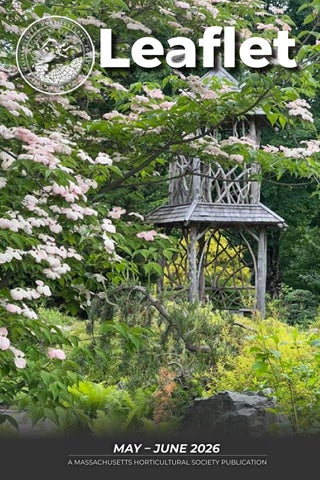
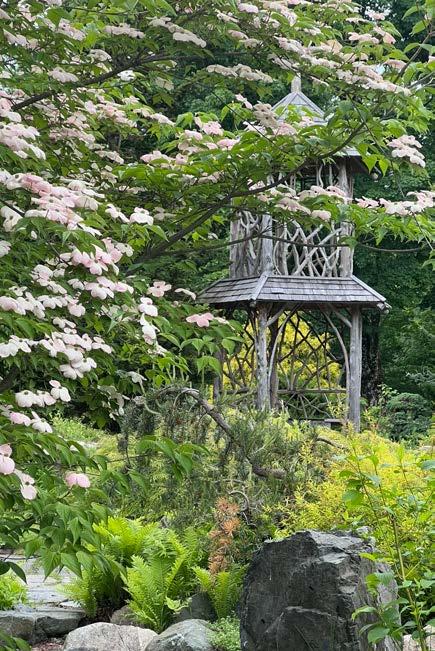
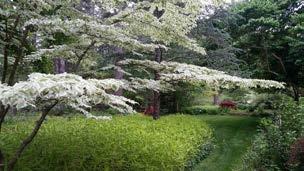
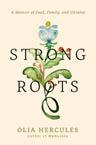
Front Cover: Flowering dogwood (Cornus florida) and Twig Tower in Weezie's Garden for Children
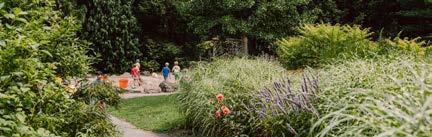
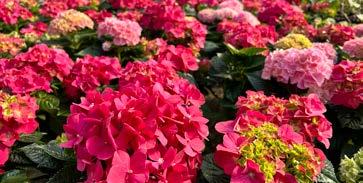
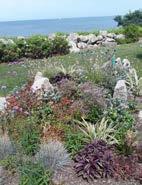
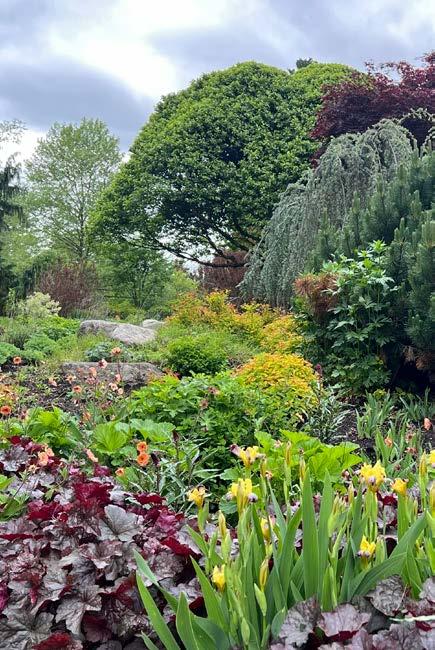
Back Cover: Spring flowers fill Bressingham Garden
From the PRESIDENT'S DESK
One of the things I’ve come to appreciate most about horticulture is that, done well, it is at its heart a shared endeavor.
This issue of the Leaflet brings that idea to life in different ways. We hear about the influence of early experiences, of neighbors, mentors, and communities sparking a lifelong love of plants. We see it too in the way gardeners exchange knowledge, support one another, and build connections that extend far beyond the garden gate.
We also see it in the plants themselves. The mountain laurel reminds us that even the most familiar native plants have rich, complex lives, interacting with light, soil, fungi, pollinators, and time. Our look at hydrangeas offers a lighter, but equally important, lesson: that success in the garden comes from understanding differences. Not all plants want the same thing! Like any relationship, part of the joy is figuring out what works where.
There’s a sense of humility in all of this. Gardening doesn’t reward certainty, it rewards attention. We try things, we learn, we adjust.
As we move through spring and into summer, the Garden at Elm Bank is coming alive in ways that reflect all of these themes. It’s a place where expertise and curiosity meet. Where experienced gardeners and first-time visitors can walk side by side and discover something new.
If you haven’t visited recently, this is a wonderful time to come. The gardens are in bloom, the landscape is full of energy, and there is a sense that something meaningful is growing.
We hope to see you soon.
James Hearsum President & CEO
UPCOMING CLASSES
Drawing from Nature: Exploring New England Flora
Starts Monday May 11 10am-2pm
Long & Low Floral Design Arrangements
Saturday, May 16 10-11:30am
Seasonal Pruning: Late Spring
Saturday, May 30
10-11:30am OR 12-1:30pm
Rethinking Garden Maintenance: Native vs. Traditional Approaches
Sunday May 31 10-11:30am
Building Color and Form: Spring Flowers in Colored Pencil
Starts Tuesday, June 9 10am-2pm
Petals in Parallel Floral Design Workshop
Saturday, June 20 10-11:30am
Understanding Hydrangeas
Saturday July 18
10-11:30am OR 12-1:30pm
Seasonal Pruning: Summer
Sunday, July 19 10-11:30am OR 12-1:30pm
Tangled Beauty: Drawing & Painting Seaweed
Thursday, July 23 10am-4pm
YOUTH PROGRAMS
Little Sprouts
Discover a seasonal theme through a 5-senses garden walk, story-time, a hands-on craft or activity, and a take home kit.
May: Springtime Hike
Tuesday 5/26 at 10:30am & Thursday 5/28 at 3pm
June: Birds
Tuesday 6/23 at 10:30am & Thursday 6/25 at 3pm
July: Pollinators
Tuesday 7/14 at 10:30am & Thursday 7/16 at 3pm
Register Now
Natural Play
Explore, create, and connect with nature in Weezie’s Garden. Let curiosity guide the way with self-guided, exploration-based activities such as fairy house building, nature crafts, and other seasonal outdoor discoveries.
10am Every Thursday from April–September
Plus Fridays 5/22, 6/29, 7/17
Included with Admission
Green Partner Spotlight
Shop at Green Partner businesses to receive 10% off with your MHS Membership card!
Lexington, MA Dighton, MA
Northborough, MA
soil mates
A Lighthearted Look at Hydrangeas
By C.L. Fornari
What if plants had dating apps that would match you to the perfect shrub, tree or perennial for your garden? If ever there was a group of plants that could use such a portal, it’s the genus Hydrangea. Many people have questions about these shrubs and with good reason. They are all hydrangeas, yet their needs and care vary tremendously from species to species. An dating app could match the right variety of hydrangea to the growing conditions in your garden. It could also introduce you to new varieties that have recently become available. Here’s what I’m imagining such an application would tell you.
PaniDate
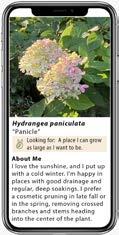
This section of the software would be for varieties of Hydrangea paniculata, aka the panicles. These shrubs come in many sizes, so you’d match the cultivar with the space you have available. Think about it this way: just as you wouldn’t expect that a person will change a key part of their personality once you are in a relationship, you can’t expect a hydrangea that’s genetically destined to grow large to stay under four feet tall. A PaniDate listing demands total honesty about how big a paniculata will grow.
Panicles are sun lovers, so the next criteria listed in their preferences is full sun for at least five hours a day. Many of their profiles will
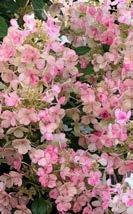
say that they are prone to blushing in the fall, as their flowers can turn various shades of pink. In terms of agreeableness, this species ranks highly because it produces flower buds on new growth. Should a panicle get cut back in the fall or early spring, or if the winter temperatures fall well below zero, there will be no drama, because panicles will still come into bloom.
Petal Me Maybe
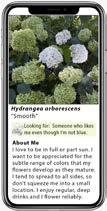
Are you attracted to native plants? Do you live where the winters are cold? Might you prefer a hydrangea that flowers reliably? If so, head to this part of the Hydrangea Shrub Hub and get connected to Hydrangea arborescens. Also called the smooth hydrangea, this plant may claim that Santana wrote the song with that title just for her. And all will go smoothly with this hydrangea if you grow it in full to part sun.
When the variety ‘Annabelle’ is completely honest, her profile will admit that her large flowers are prone to flopping, especially after a rainfall. Pruning and fertilizing tends to make this worse, as it promotes larger flowers not sturdier stems. Should you want ‘Annabelle’ to remain out of the mud, you’ll have to assist her with staking. (Note that breeders are selecting new varieties of arborescens for better stem-sturdiness. See the Fresh to the Garden section of the app below.)
The species smooth hydrangea and a few other selections have lacecaplike flowers, but many varieties have round inflorescences that resemble mopheads. These are usually composed of both fertile flowers and sterile sepals, so they attract pollinators and are also long lasting in the landscape. And if you want flowers that aren’t white, look for the newer introductions that are pink, mauve, or lime green.
Fringe Benefits
Come to this area of the app if you like the lacecap-style flowers that Hydrangea serrata produce. Also called mountain hydrangeas, these blooms would have a badge that indicates High Traffic Area since the center of the inflorescence contains fertile flowers that attract pollinators. These small, pollen-rich blooms are surrounded by a fringe of showy, sterile sepals that pull the insects in.
In a mountain hydrangea’s profile, it would list them preferring afternoon shade and avoiding temperatures that fall below zero Fahrenheit. Although they will live if the winters are this cold, most of them form their flower buds in July or August for the following year, and very cold temperatures zap those buds. Single digits and below are deal breakers for reliable flowering.
You’ll be well matched with one of the many cultivars of Hydrangea serrata if you want a shrub that stays under five feet tall, live in a Zone 6 or above, and have a garden that is shaded in the afternoon.
Swipe Right for Mopheads
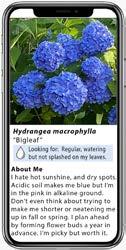
People always fall for the mopheads because of their beauty, but this hydrangea isn’t for everyone. Read the Hydrangea macrophylla profile carefully in order to determine if this shrub is really a good match for your garden. Although a macrophylla, also called bigleaf hydrangeas, will survive if planted in full sun, the flowers will wilt and brown quickly in such locations. These mophead blooms last longest when the plant is shaded from late morning through the afternoon.
Bigleaf’s app listing should also have badges indicating a greater thirst, the ability to change color depending on the pH of the soil, and the absolute necessity for correct pruning. Because these hydrangeas form flower buds in July and August for the next year, a “Hands Off!” symbol should be in the profile when it comes to pruning. It’s impossible to make a bigleaf hydrangea shorter, since they replace their height in one season, and if they are cut down in fall or spring the germ of the next year’s flowers will be removed. This plant details “only remove dead canes” in its listing preferences.
Fall for Me
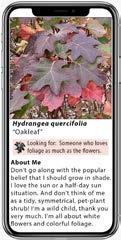
The “OAK-ay Cupid” section of the app will pair you with the perfect Hydrangea quercifolia, aka the native oakleaf hydrangea. Although many people think of this shrub as preferring the shade, it actually thrives and blooms better in full to part sun. More sunlight also assists in allowing oakleaf to strut her stuff in the fall, when the foliage turns brilliant shades of red, orange and burgundy. When it comes to impressive fall color, swipe left when you come to the invasive burning bush, but right for a Hydrangea quercifolia.
Hydrangea Hookups
While some go to a dating app looking for a long-term relationship, others only desire a temporary liaison. Fortunately, hydrangea breeders recognize this and are supplying new plants to satisfy this desire. According to Matthew Dynakowski, Potted Plant Supply Manager at Ball Seed, this is an up-and-coming trend for these plants. “Hydrangea for use as potted indoor plants or in patio containers is becoming very popular in North America,” Dynakowski reports. “These are Hydrangea macrophylla selected for single-season use and are not recommended for landscape planting. They are typically in-flower for Easter and Mother's Day as 'giftable' plants. They would more often be found in floral décor departments, rather than positioned near perennial shrubs or garden products.” So, if a short-term relationship is more your style, look for these gift hydrangeas and don’t feel guilty about a transitory connection.
Hydrangea 'Schroll Red Romance'
Fresh to the Garden
Two of the new plants that fit into this group of indoor hydrangeas are the Baladia Pink and Mulberry Purple from Ball Horticulture. They are short, multi-stemmed plants grown for lifting your heart, not planting in a landscape. Ball Seed works with international breeding partners in order to introduce a curated selection of new hydrangeas each year.
Other plant companies bring new hydrangea varieties to the market as well. Kevin Cramer, Director of Operations at Bloomin’ Easy, knows that the hydrangea market is both crowded and competitive. “With so many impressive hydrangeas on the market,” Cramer says, “we know that we have to release something unique and amazing.” Look to this plant brand for the lime green and white macrophylla called Grin and Tonic, and two small but flower-filled panicles named Dragon Baby and Bubble Bath.
At Proven Winners ColorChoice Shrubs they also seek stand-out plants for their new introductions, with a focus on hydrangeas that solve problems. The Incrediball Storm Proof, for example, is a stem-sturdy arborescens that is covered with flowers that don’t flop after a heavy rain. Gatsby Glow Ball is a quercifolia that is shorter than most oakleaf varieties, and naturally grows into a round, full shaped shrub.
If these new hydrangeas were listed in an app, they would have badges that indicated they are Newly Introduced, a Breeder’s Pick, or Trial Garden Approved.
Whether you’re looking for a hydrangea that’s hot off the propagation bench, bred for short-term enjoyment, or a long-lasting landscape plant, think of the process as match-making. Sure, you might have a meet-cute experience at the local nursery, but if your desire is an enduring relationship, look at hydrangea plants as being as varied in interests and life-goals as people on a dating app. When looking for your soil mates, go beyond that surface attraction and find the hydrangea that’s the best match for your yard and garden.
▷ Hydrangea paniculata 'Little Quick Fire'
C.L. Fornari is the author of Hydrangea Happiness ~ Planting, Pruning, and Blooming, published by Brandeis University Press.
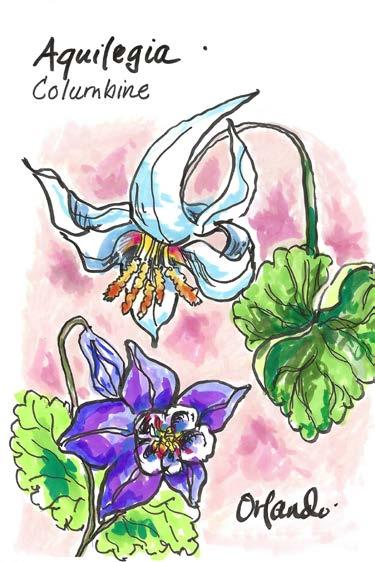
Marianne Orlando is a landscape architect turned freelance illustrator who loves plants, and does commissioned drawings of homes, pets and people. You can see samples of her work at www.marianneorlando.com.
In First Person
Susanne Lucas
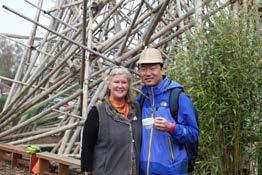
Susanne Lucas has enjoyed a career in horticulture for over forty-five years. As Executive Director of the World Bamboo Organization, she is passionate about bamboo as a versatile and sustainable resource. Susanne has been actively involved in promoting its use in various fields such as an environmental remedy for degraded land, economic opportunity for communities in need, building material, biofuel, fiber, and climate change mitigator. Her contributions to the bamboo industry are significant, including her past presidency of the American Bamboo Society, her public speaking on all things bamboo, and her importation of new-to-cultivation bamboo cultivars through the USDA. She has also published many newsletter and magazine articles, plus a book, Bamboos, published by Reaktion Press London in 2013 which highlights the versatility of bamboo. Her dedication and expertise have made her a respected and influential figure in the world of bamboo, inspiring others to join the effort to build a more sustainable future. She is an active member of The Horticultural Club of Boston and served as its President in 2018-2019. Here is Susanne’s story in her own words:
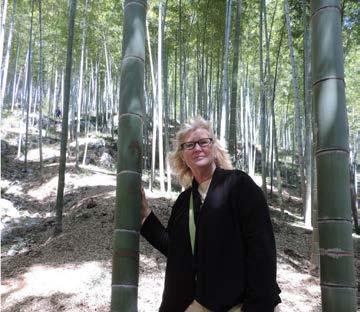
Susanne among a grove of Moso timber bamboo in Zhejiang province of China, 2015.
At age six I moved with my parents and sister from our birth state of West Virginia to Maryland, just outside of Washington, DC. Many of my fondest early memories involve being outside in nature. Our next-door neighbor, Alice, had a beautiful garden in which I spent a lot of time. I also adored her dog, Gypsy. She paid me to collect Japanese beetles (I think she paid me a penny for each beetle), to deadhead roses, and to do various other “gardening” tasks. Looking back, I know Alice had a significant influence on me and the path I chose to follow as a career. One particularly important event in my childhood occurred at age 8, when I brought my classroom’s pet guinea pig home from school for the weekend. Despite my parents’ orders not to bring the guinea pig outside, I snuck it out for some “fresh air” and it escaped into Alice’s yard and into the property-line grove of bamboo. Luckily, I was able to save the guinea pig, but the “giant” bamboo grove must have made quite the impression in my 8-year-old mind.
Later, while in high school, I spent a summer working at a wildlife refuge and “knew” that’s what I wanted to do for the rest of my life. I decided to go to Colorado State University and planned to major in wildlife biology in the College of Forestry. However, when I took my first botany class within the extensive greenhouse ranges, I loved it. I switched my major to landscape horticulture in the College of Agriculture, feeling like even if I couldn’t find a job, I’d have a great hobby! I learned lots of practical horticulture, taking classes in plant identification, floriculture, nursery management, plant propagation, etc. One summer I worked in the greenhouses and trial gardens of CSU under Dr. James Klett. I received a good dose of practical experience, and before graduating I worked as a summer intern at Brookside Gardens in Wheaton, Maryland, where I gained even more woody-plant practical experience.
I graduated in 1982 with no job lined up in Colorado, so I moved back to Maryland to my parents’ home. I found a job at a small nursery specializing in azaleas and dogwoods, owned by a Greek immigrant, where I learned to ball & burlap trees. A couple of years passed and I relocated to Plymouth, Massachusetts.
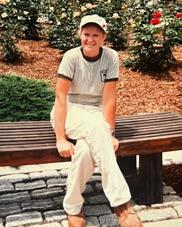
Susanne sitting in the Rose Garden at Brookside Gardens, Wheaton, MD during the summer of 1981.
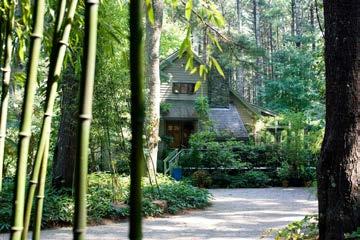
Above: Susanne and Morry's home in Plymouth, MA.
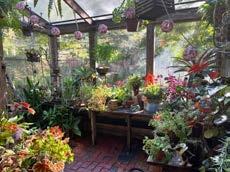
Right: Susanne's home greenhouse.
In 1988, my husband Walter “Morry” Morrison and I built a house on a 1.5-acre property and have lived there ever since. It was a clean slate in a white pine forest, and to fulfill a passion of collecting plants, we began planting! Morry is also a “gardener”, with a background in agricultural economics from Stockbridge and UMass.
For the first few years after moving to Plymouth, I worked together with Morry at his garden center. As a member of the Arnold Arboretum, I saw a notice about a symposium at Harvard’s Graduate School of Design about – believe it or not, bamboo. I thought, “Can bamboo grow in New England?”, remembering the bamboo in Alice’s garden decades before. There I not only learnt that yes, you can grow many species of bamboo in New England, but I also met some very interesting people! One was Gary Koller, at the time Director of Horticulture at the Arnold Arboretum. The other was Chris DeRosa, a garden designer in Rockport with a keen interest in bamboo. Another was David Flanagan of Jamaica Plain, who had studied the craft of creating bamboo fences in Japan. After the symposium was over, a few of us met to talk about forming the Northeast Chapter of the American Bamboo Society. Those friendships have lasted decades.
Fast forward and I was thick into studying everything I could about bamboo. In 1992, I traveled to Japan with a group of Europeans to attend an international conference on bamboo. There is nowhere like Japan for studying how bamboo is used in gardens, and to see it growing wild along roadsides and forests thrilled me. While my landscape gardening practice involved a wide variety of garden styles and plant palettes, my focus on bamboo became increasingly greater. I became Secretary and then President of the Northeast Chapter of the American Bamboo Society, which led to my becoming Secretary, then Vice President and President of the American Bamboo Society.
In 1997 I traveled to southwestern (Yunnan) China. This was eyeopening. Our host was the Southwest Forestry College, and our guides took us to Yulongshan, Cangshan, Lijiang, and south into Xishuangbanna among rural tribal peoples living among bamboos. That trip sealed my fate for wanting to see native bamboos in as many habitats as possible and taught me of the utilitarian aspect of bamboo. I have had the good fortune to travel to places throughout Asia, as well as to South American countries to see a great diversity of bamboo species in-situ.
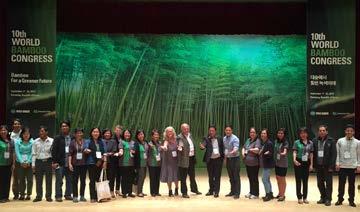
Top: Belgium, 2012. Bottom: 10th World Bamboo Congress in Korea, 2015.
Since that first trip in 1992, I got to know several plantsmen & women in Europe, which provided me with the great opportunity to bring back ex-situ Asian bamboos cultivated in Europe to the United States, introducing about 20 new varieties of bamboo with permission via the demanding USDA import system which includes inspection upon arrival and a one-year quarantine program.
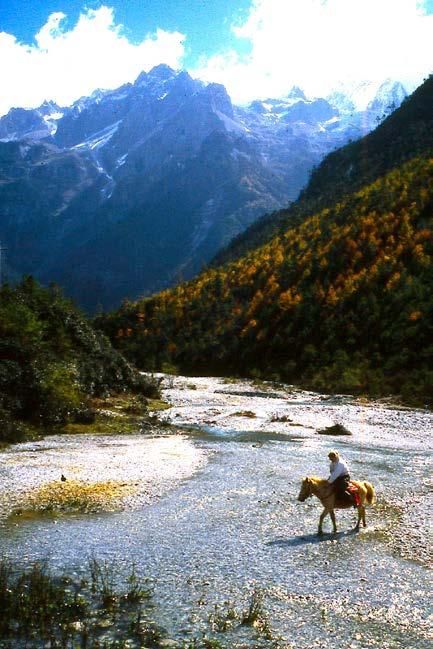
Crossing the river below Yulongshan, Yunnan, China. The mountains here are full of cold-hardy bamboos growing as understory to pines, similar to my home garden in Plymouth.
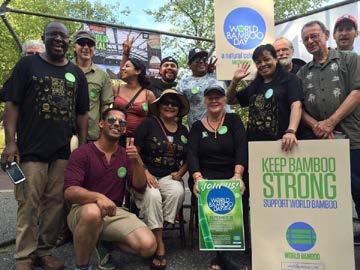
In 2002 I was a founding member of the World Bamboo Organization, and I have been Executive Director ever since. We are a non-governmental organization administered by volunteers. In that role, I do all that I can to advocate for the development of the global bamboo industry, collaborating with individuals, organizations, and governments to promote the benefits of bamboo and its potential as a sustainable resource. For the past 22 years I have been the Chair of the International Organizing Committee for the World Bamboo Congress, which is held every three years in various places around the world.
At a conference in Belgium hosted by the European Bamboo Society, I walked through vast greenhouses of small, uniform bamboos produced in-vitro by tissue culture propagation. It was a huge achievement that led to the mass production of desirable bamboo species with ornamental landscape appeal. It was the nursery of Mr. Jan Oprins, creator of the BambooSelect™ brand, and at that time, the largest producer of ornamental bamboos in the world. I was amazed and said, “Let me know if you want to bring this to the U.S.”. Two years later we were in business together and producing a line of “neighborhood friendly” non-invasive bamboos of the genus Fargesia at a lab in the Pacific Northwest. We don’t often mention our failures – which I enjoy
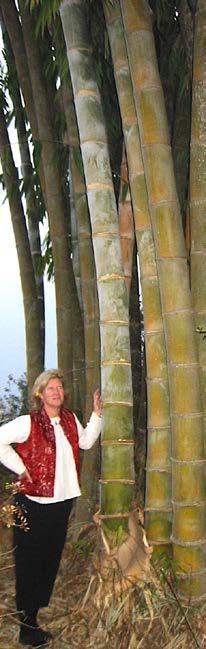
Susanne in Darjeeling, India in 2004 with a giant tropical timber bamboo, Dendrocalamus giganteus.
mentioning – because we learn so much from failure. We overestimated the demand for what we considered a unique ornamental, an “evergreen” grass. That mistake was compounded when the financial crisis of 2008 struck and the economics got the best of us. We shut down production in 2010.
The silver lining of this story is that because I was now in the business of “propagation”, I became a member of the International Plant Propagator’s Society, Eastern Region, an amazing group of people! Anyone who spends their lifetime making more plants for others is a person I can relate to! For just a few years I was amongst them, and it was a wonderful experience.
Top: National Zoo DC, 2016. Bottom: Thailand, 2009.
I am so glad that I chose a career in horticulture. It has allowed me to follow my childhood love for being “outside in nature.” I think what has always been most inspiring and rewarding to me has been meeting and becoming friends with so many other “plantspeople” who share my passion for plants and gardens. I have learned from and been inspired by many professional and amateur horticulturists around the world and across the United States. Horticulturists, yes, who are also “gardeners”, who are “plantspeople” and yes, some are “plant geeks”. We all share a love of the outdoors, of recognizing “beauty” however we see it in nature and in gardens. I am most grateful (and fortunate) for the many horticultural colleagues/friends I have right here in the greater Boston area. Grateful for the opportunities to help a neighbor with their yard, with a landscape architect who needs to understand a plant, and with a client who shares an aesthetic. And I especially feel fortunate to be a member of the Horticultural Club of Boston, whose members are always so willing to share their knowledge and enthusiasm.
I only wish Alice knew the influence she had on me. Kids need neighbors like Alice, and a chance to experience a garden.
For “In First Person,” Leaflet Editor-in-Chief Dave Barnett interviews people who have made their mark in horticulture and adjacent fields by asking a standard set of questions about their work and career, and then works collaboratively with them to write this column to share their passions and tell their story.
Landscapes designed by Susanne.
Colloquia plantarum
Interviews with Plants
By Shannon Goheen
Have you met the Mountain Laurels? They are known as Kalmia latifolia, and in this conversation, I’ll denote the one speaking to me as ‘KL.’
I’m utterly besotted with these beauties. However flowery and archaic that may sound, I mean it. These lovely, statuesque, and heavily blooming native shrubs deserve every adoring word sent their way.
I’m sitting in a quiet forest, my back leaning comfortably against a craggy mountain laurel trunk. The lightest of wind rustles branches far above me but I know this old specimen on the edge of a whole cluster of mountain laurels can hear me. Let’s see what this fine being has to say.
Me: Hello Kalmia!
KL: Greetings.
Me: I can feel a little vibration down here, a slight swaying against my back. But the air around me feels still.
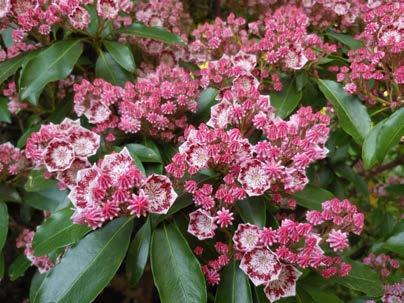
Above: Kalmia latifolia 'Yankee Doodle'. Photo by Dave Barnett.
KL: We seek the sunlight, and in these woods, we often have a long way to grow to reach it.
Me: I thought you were shade-loving evergreens.
KL: That is true. But we need spring’s light to bloom, so we must reach for it.
Me: Mountain laurel hybrids typically grow 8 to 10 feet from what I’ve seen. I’ve heard you grow to double and even taller as you stretch from the wilds of coastal Maine to Mississippi. There are, of course, dwarf cultivars, and they might top out at 3-4 feet and come in interesting colors. The little ones fit better into small gardens but I’d love to have a giant beauty like you in my yard.
KL: We grow tall over many years in these woods, and our need to compete for sunlight sends us ever higher. If you planted us in your yard where we might get more sun, we likely would be shorter, but it would still take us many years to reach a mature height. We have no need to rush.
Me: I love your trunks, or, more appropriately, stems, since you are officially a shrub, and not a tree. I like the way your dark brown stems with a touch of red, twist and bend as they reach higher and higher
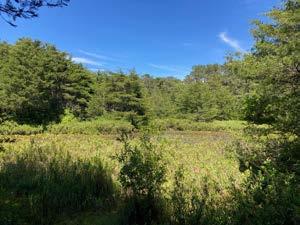
Kalmia angustifolia beginning to bloom in a sunny freshwater marsh on Cape Cod.
Photo by David Fryzell.
and the interesting way that your bark hangs off in long strips. Come to think of it, why am I not surrounded by branches with evergreen leaves? Why is it all trunk down here near the ground?
KL: You might ask the deer that question, but mostly we lack branches at ground level because they are too hard to manage, from our perspective, since we need to put our energy into finding sunlight.
Me: Aren’t you toxic to deer? Your little wetland sisters have a string of common names that all suggest the same thing, like “lambkill,” “sheepkill,” or “calfkill.” I’m guessing you have some of those tendencies too.
KL: You mean my tiny sisters, the sheep laurel, and what botanists call Kalmia angustifolia. Yes, they pose a particular danger to grazing animals. The deer are not quite as susceptible and besides, they don’t chew on us unless there is little else to eat.
Me: Your sisters like moist soil, but not boggy, and grow in large colonies. I’ve heard that they have densely interwoven ground-level stems, not actually roots, that we call “rhizomes.” Those dense communities inhibit
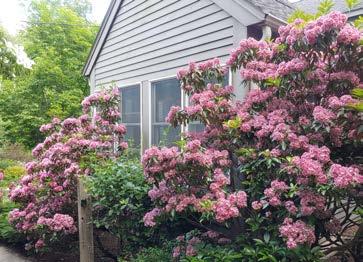
A Kalmia latifolia hybrid. Photo by Dave Barnett.
the growth of other plants, particularly needled evergreens. That’s neat, isn’t it? I always find it exciting to see your sisters’ teensy, distinctive blooms in June. I stop when I’m walking past to touch and talk to them. Do you suppose they hear me?
KL: They certainly hear you. The real question is, can you hear them speaking back to you?
Me: Perhaps I need to slow down a bit and wait. I’m always scurrying off! You know, I didn’t mean to get so off-track. I came here to talk to you specifically, and I have questions. I didn’t ask if you had time to speak with me. Do you?
KL: I spend a great portion of my time setting buds, blooming, welcoming pollinators, standing quietly in the winter and setting buds again. I can take a little time to speak with you now. Thank you for asking.
Me: By the way, what if I bit you? Or chewed on your leaves?
KL: You would be foolish and you would risk becoming quite ill.
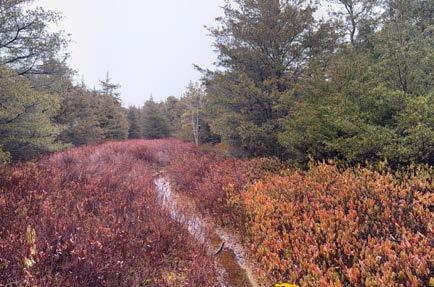
Above: Kalmia angustifolia in a white cedar swamp on Cape Cod in autumn by David Fryxell. Right: Kalmia bud by Shannon Goheen.
Me: I wonder, then, why historically, your wood was used for things like bowls, spoons, pipes and the like. That seems risky, health wise. Some common names for you were “Spoonwood,” and “Calico Bush.”
KL: I’m sure some people suffered when they put our ancestor’s wood into their mouths, but maybe since they weren’t chewing our stems and leaves directly, any minimal poisoning was not obvious. And as for “Calico Bush,” our blooms reminded colonists of the material the women used for dresses, aprons and bonnets.
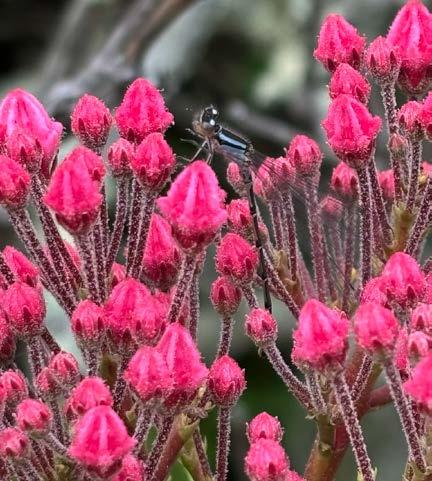
Dragonfly perched upon mountain laurel buds.
Photo by Shannon Goheen.
KL: That is nice of you. We are pleased with our appearance, especially our blooms, though we do not place ourselves on a pedestal above our sisters, our cousins or our other native friends. We believe all our family members are rather attractive.
Me: Oh my goodness. Your family, the heath family, is flat-out amazing. The name we give to the heath family is Ericaceae (that’s eh-rih-KAYsee-ee). Let’s talk about them, and then we’ll get back to your dropdead-gorgeous blooms.
KL: What do you know about my family? We are diverse and spread world-wide.
Me: I know your family contains many of my most favorite plants, the ones I turn to when I’m putting together a native plant landscape, or if I need a near-perfect evergreen groundcover, or when I want to add fruit-bearing plants and even when I need some beauties for shady conditions. Not that all your family members are shade-tolerant, of course.
KL: I assume some of the plants of which you speak include highbush and lowbush blueberries (Vaccinium spp.), Huckleberry (Gaylussacia baccata), Cranberry (Vaccinium macrocarpon), Bearberry (Arctostaphylos uva-ursi), Japanese Andromeda (Pieris sp.), Rhododendron spp…
Me: …and Trailing Arbutus (Epigaea repens), the Massachusetts state flower, plus Wintergreen (Gaultheria procumbens) and of course the heaths and heathers (Erica spp., Calluna spp.). They get me so excited! We could go on and on about your excellent family, most of whom thrive in acidic and infertile soils, can tolerate shade, and are mostly evergreen.
KL: We can thrive in infertile soils because of our fungi partners.
Me: Mycorrhizae? I should have known. They help you take in nutrients and resist environmental stresses. Brilliant! Speaking of brilliant, I recall that your most surprising cousin, in my opinion, is the tiny Indian pipe (Monotropa uniflora) that is one of only about 3000 plants across the world that doesn’t use chlorophyll and is completely white, like a cluster of tiny ghosts in moist, shady spots. The reason I bring that up
is because Indian pipe relies entirely on fungi that relies entirely on a green plant, like an oak tree, for instance. I used to hunt for these with my grandfather years ago, and even now, my heart skips a beat when I discover a clump.
KL: We are proud to have such a unique plant in our family line.
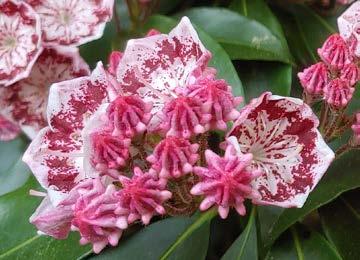
Me: As you should be. Let’s discuss your buds and blooms! I’m endlessly fascinated with them and once I lock onto their beauty, it’s hard to walk away. Your native blooms are softly-colored ranging from white to pink to rose with maroon dots inside. And the shape! Now that’s something to behold.
KL: Our flowers are carefully constructed. We shoot pollen at pollinators who trigger our clever system and will then take our pollen from bloom to bloom. We do this by spring-loading our 10 anthers in 10 pockets in each corolla. Do you know what anthers and corollas are?
Me: I think so. The anthers are the male parts – long, skinny filaments with a blob of pollen on top, and the corolla is the collective unit of petals. In your case, it’s a 10-sided corolla, right?
Kalmia latifolia 'Yankee Doodle'. Photo by Dave Barnett.
KL: You are correct. When a bee, for instance, alights on one of our flowers, the weight of the bee releases the tension in the anthers’ filaments and they catapult pollen onto the bee. Once our flowers have been visited and have released pollen, they are not able to pollinate further. As you humans might say, “one and done,” so it is vital that we shoot our pollen at the right insect.
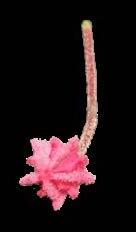
Me: And that’s why the flower buds are so fascinating to look at. They have ten little points before they even open! The pollination preparation starts there. I love knowing that. What an amazing adaptation!
KL: Surely you are not surprised at our ingenious adaptations, given we have well over 4000 members in our family that have been evolving for about 80 million years.
Me: Yes, I heard that among those 4000-plus family members, 212 of them live in North America and about 32 of those occur in coastal Maine. That’s an interesting tidbit, isn’t it? By the way, the states of Connecticut and Pennsylvania both chose you, Kalmia latifolia, to be their state flower, the first in 1907 and the second in 1933. Those calicoclad women from colonial times who admired you then as we do today were largely responsible for your recognition as thousands of them came together to nominate you. They knew what they were doing!
KL: I am pleased to hear that we are so appreciated, revered and honored. I will pass on this happy news to my siblings here in this woodland, those who grow with me.
Me: The ground is feeling damp so I’ll move on and leave you to your sun-seeking. I have loved this talk and I want to thank you for your time and our enlightening conversation.
So I got up, shook myself off, and wandered back through the dried leaves of the forest floor to the path. I looked wistfully through the trees to the clump of shining evergreens, waiting to burst forth when the time is perfect, between May and early July, for both them and their pollinators.
Shannon Goheen has been loving plants and designing landscapes, primarily on Cape Cod, for nearly 40 years as Second Nature Gardenworks. She talks about plants and landscape notes on Instagram as @theeveninggowngardener.
Mercifully
By John Lee
John shares stories of Bert and Brenda and their gardening wisdom. These chronicles feature recipes, tried-and-true gardening practices, and seasonal struggles and successes. Bert and Brenda were first introduced in the March 2022 issue of Leaflet.
Mercifully, ‘it’ has happened again. Life is re-arising from the winter doldrums and the to-get-done-before-the-planting season-gets-under-way is already behind whatever schedule Bert might have slept on. This was not the case for his becalmed wife. Brenda’s issues this time of year tended to be more in line with re-organizing the now-emptied Ball and Mason jars which she (with some help) had so laboriously (if lovingly) filled a few months ago. Frankly, the past several months were those where she could rest on her laurels. Bert’s bounty was in, she had massaged it into all manner meals. Many had been only slightly above pedestrian as Bert claimed to prefer his food simple. But some recipes she had taken a flyer on. This was usually because Bert had misplaced
his specs and mistaken Tbsp for tsp when he was trying to be helpful. Brenda usually appreciated his willingness to pitch in on darkening fall evenings even though sometimes he was no help at all (like when he misread the recipe). In a few weeks, the shoe will be on the other foot. If Brenda puts out the wrong bean seeds or sows the late season eggplant in the south window instead of the early season, the usual questions about incipient decrepitude may no longer be the stuff people make jokes about.
It was the ‘you can’t get there from here’ problem - if you are not clear about where you are starting from, you are unlikely to arrive at the desired destination. Fact of the matter is that neither were as capable as they used to be and, upon occasion, failed to take their failings (much as they denied them) into account. Incipient faculty decline was difficult and both found it challenging to acknowledge. This was pretty inexcusable but perfectly understandable although it could be rather annoying. On the other hand, mistakes are the mothers of invention. A few weeks back, Bert had finished pulling the last of the over-wintered carrots. Brenda had spied what looked like an interesting recipe for a Moroccan preparation in the Ladies’ Aid section of the paper. The recipe called for a teaspoon of cumin. Bert tossed in a teaspoon of coriander. He said the recipe tasted just fine and was a good use for winter carrots. Brenda got over her irritation quicker than she might have. ‘Could have happened to anyone’, she said to herself.
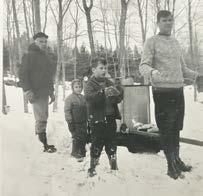
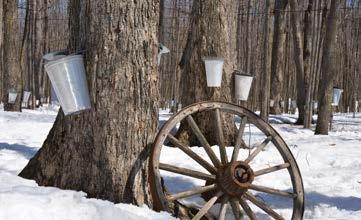
Winter carrots always tended to be big, sweet and woodywhat Brenda’s father had fed to his horses during sugaring season as a reward for a hard day’s work dragging the sap sled though the woods while the children emptied the buckets into pails to be dumped into the tank on the sled. The trees that they tapped around the house were gathered in a
hand-pulled sap sled. The trees in the upper sugar bush were collected in a 100-gallon galvanized steel tank on a horsedrawn pung with steel-shod runners. Gathering the sap had been joyous work except when the gathering pail slipped and a bucket of cold sap emptied itself into your boots. This invariably happened when there was a significant cold snap followed by rapidly rising morning temperature which got the sap running again.
Brenda’s dad annually hoped to earn enough money making ‘fancy’ syrup to pay his property taxes. In those days it was important to gather as much sap as possible and the early runs were always the lightest and preferred. Sap is about 95% water which freezes quickly on a really cold night. On a very cold morning Brenda and her siblings would visit as many of the trees behung with buckets and skim out the ice, leaving the almost pure maple sap behind to be gathered later the next day. Maple syrup is made by evaporating the water from the sap in a giant evaporator pan reducing the volume about 50:1. (Figure a 50-gallon barrel of sap makes one gallon of syrup.) On the other hand, for a modest extra effort, it only takes 3-4 cups of your less-than-best syrup to make 1½-2 cups of ‘wet sugar’ (otherwise now known as maple crème). Brenda had only tried making wet sugar once as a young bride. The process had made so much steam that the wall-paper behind the stove separated and Bert made her promise never to do it again. He hated hanging wallpaper.
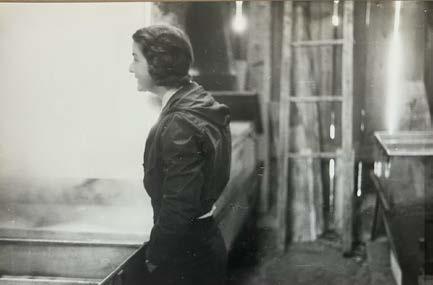
What she remembered about those days was being allowed to sit with the men in the sugar house in the evening. In those days, when there was boiling to be done in the evening, neighbors would sometimes gather and set a while. The evaporator was wood-fired and had to be carefully watched so as not to burn the pan and to make sure the heat was evenly distributed in the 5’-12’ firebox. Nowadays, evaporator pans are fired either by oil or gas and such close attention to the process was no longer necessary. It is no longer the communal event it once was when menfolk could sit around, chew the fat and prognosticate about whatever anybody kind of cared about. Conversations tended to revolve around who was laid up and why, who had a lame cow (was she headed for the freezer?), the price of milk and, of course, the Red Sox. It was often expressed that if the grapefruit league had gone well for the home boys, the regular season held little hope for trip to the World Series. There was no reason for this contrarian view of how the world worked but none of them understood much about baseball anyways.
The warmth of boiling sap over crackling slab wood simply made a day’s work feel a little special. While Brenda never understood why boiling was a men’s moment, she did appreciate some sit-down time with her dad and their neighbors. This was one of the times when community was born, when stories were told. Some seem to be told every year but each time the story was remembered differently depending on who was telling it. This was when the men got to know each other better, shared the news not yet fit to print and prepared themselves hard work ahead. Haying season was just around the corner and putting up enough feed their herds was critical. Often knowing who to rely on in a pinch could make the difference between getting by or needing to trim the herd. A set-to in the sap house was what one might call social insurance that none could afford to be without.
Grand-pères
recipe (or sap-house dumplings):
Brenda’s Quebecois mom simply used her favorite dumpling recipe (flour, baking powder, baking soda, salt (a pinch), buttermilk (to moisten)) or you can use yours(!). She dropped the dollops of dough into gently simmering sap in a covered Dutch oven for about 10 minutes. After retrieving the dumplings, they were served with just-finished hot maple syrup (“sirop”) and whipped cream. Sometimes a tot of rum was added if needed to loosen tongues on a particularly quiet evening.
John Lee is the retired manager of MHS Gold Medal winner Allandale Farm, Cognoscenti contributor and president of MA Society for Promoting Agriculture. He sits on the UMASS Board of Public Overseers and is a long-time op-ed contributor to Edible Boston and other publications.
The Science of Horticulture is based on the knowledge and uses of plants, as conducive to the physical wants or more remote luxuries of man.
John Lewis Russel (1808–1873)
Discourse delivered on the Seventh Anniversary of the Massachusetts Horticultural Society September 17, 1835
Horticulture is a branch of agriculture that is concerned with growing plants that are used by people for food, medicine and aesthetic enjoyment. Horticulturists are professionals who grow, maintain and improve flowers, trees, shrubs and crops.
Horticulture has been the foundation of the Massachusetts Horticultural Society (MHS) throughout its history. While the execution and elements of that foundation changed over the years, MHS remains true to its mission “to promote the art and science of horticulture, while staying true to its founding motto, ‘Commune Bonum,’ for the public good. in scope, purpose and methods of the last 197 years.”
Collections – Horticulture Magazine
Horticulture was founded in Boston in 1904 as a weekly trade publication by William J. Stewart, who was prominent in the Society of American Florist and Ornamental Horticulturists. In 1923, MHS purchased Horticulture
[f]or the purpose of establishing a closer relationship between members of (MHS) and giving to each member the opportunity of communicating the results of his horticultural work and of giving the public the benefit of knowledge of importance in horticulture.
The magazine became the official organ of MHS. MHS improved the format of the magazine with indepth articles, quality illustrations and superior paper. Throughout its history with MHS, the magazine strived to be impartial on a broad range of topics presented through quality materials, features and illustrations. The endeavor was success. Its subscriptions grew as it was recognized as the premier horticultural publication that served a broad audience throughout the country.
In 1981, MHS sold Horticulture to the New Yorker, Inc. and Elliot Wadsworth, owner of White Flower Farm. At that time, the magazine had a nationwide circulation of 100,000. It continued to maintain its offices at Horticultural Hall on Massachusetts Avenue in Boston and it was published "in association with Massachusetts Horticultural Society."
When MHS moved to Elm Bank in 2001, Library space was limited and storage of rarely referenced periodicals at an off-site location was expensive. A decision was made to reduce our holdings of periodicals. In 2002, Chicago Botanic Garden purchased 2000 journals from MHS that included Horticulture.
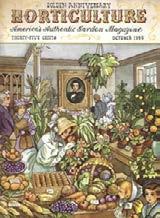
▷ Cover of Horticulture, VOL. XXXIII, No. 10, October 1954. This issue celebrated the 125th anniversary of MHS, organized in February 1829 and the 50th anniversary of MHS’s ownership of the magazine. MHS Collections. While noting changes in horticulture over the years, the Editors emphasized that true to MHS’s purpose it had one aim—“the advancement of horticulture for the common good.”
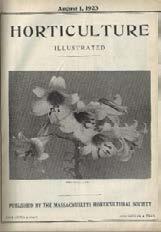
△ Cover of Horticulture, August 1, 1923, Vol. 1, No. 1. MHS Collections. This was the first issue of Horticulture under MHS ownership. The magazine was published biweekly for the horticultural trade, for professional gardeners and enthusiastic amateurs. Its circulation continued to grow throughout the 20th century until its sale in 1981.
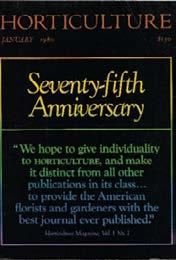
△ Cover of Horticulture, January 1980, Vol. LVIII, No. 1. MHS Collections. This issue celebrated the 150th anniversary of MHS and the 75th Anniversary of the magazine since its inception in 1904.
Recognizing MHS’s history with the publication, the Library’s collection of Horticulture was rebuilt, primarily through institutional and individual donations. Recently one of our volunteers completed an inventory that weeded duplicate issues and highlighted missing issues. It is a delight to see the content and images throughout the years. While content changed, the magazine adapted to changing interests, styles and methods, all the while remaining true to its primary subject—horticulture. The Library has most issues dating back to the first issue in 1923, although there are some gaps in the collection.
We would welcome donations of past issues of Horticulture and donations to purchase current subscriptions to keep our files up to date. Please contact Library & Archives Manager, Maureen O’Brien, and let her know what issues you have to donate or to donate for subscriptions. We will be stocking the Little Free Library outside the Education building with the duplicate issues of Horticulture.
Library Quarterly Exhibits
The Library’s Spring Exhibit, “Elm Bank - The Cheney Era,” is on display in the hallway of the Education Building until the end of June 2026. It features original 19th century photographs of Elm Bank. You can view a slideshow of the history of Elm Bank and 19th century photographs here.
The Summer Exhibit will display Flower Show ephemera from our Archives during July through September 2026.
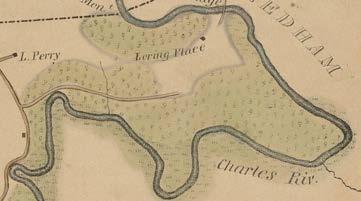
Image: Plan of District of Dover, Norfolk County. Surveyed by William Ellis, 1831.
MHS Book Club
Book Club meetings take place on the third Tuesday of the month at 1:30 pm in the Crocket Garden. In Inclement weather, the meetings are held in the Dearborn Room in the Education Building. All are welcome to attend. Please note the Book Club will not meet during the month of July.
These are the books for the Club’s upcoming discussions:
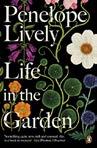
May 19 Life in the Garden by Penelope Lively
August 18
Crossings by Ben Goldfarb
Come Visit!
June 16 Shade by Sam Bloch
September 15 Strong Roots by Olia Hercules
The Library is open on Thursdays from 10 am to 1 pm and on Fridays from noon to 3 pm. The Library is also open by appointment. If you wish an appointment or to access specific items, please email Library & Archives Manager Maureen O’Brien for an appointment for other assistance.