WAYNE LINKLATER
WAYNE LINKLATER
Learning about ourselves and nature from the Kaimanawa wild horses

WAYNE LINKLATER
Learning about ourselves and nature from the Kaimanawa wild horses
For Zoerita and Anneles, that your lives become something you write about.
And Edy, because of you.
Prologue 11
Ends and Beginning 13 Society 63
Stallions 95
Population 129
Mares and Foals 161
Deep Ecology 191 Political Ecology 231 Conservation 269
Epilogue 305
Notes 310
Select bibliography 350 About the author 355
Acknowledgements 356 Index 358
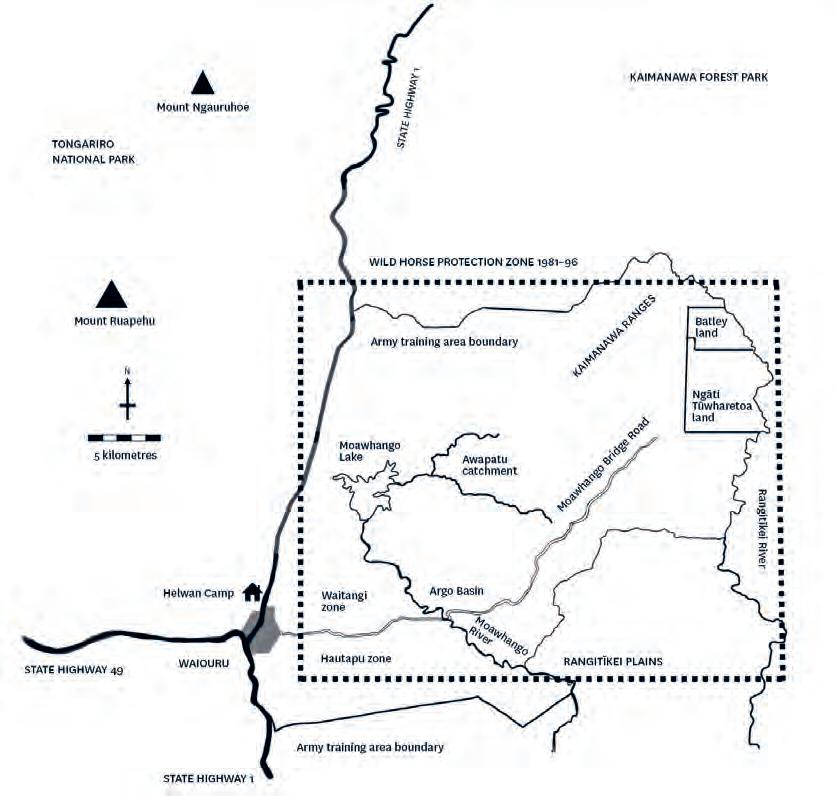
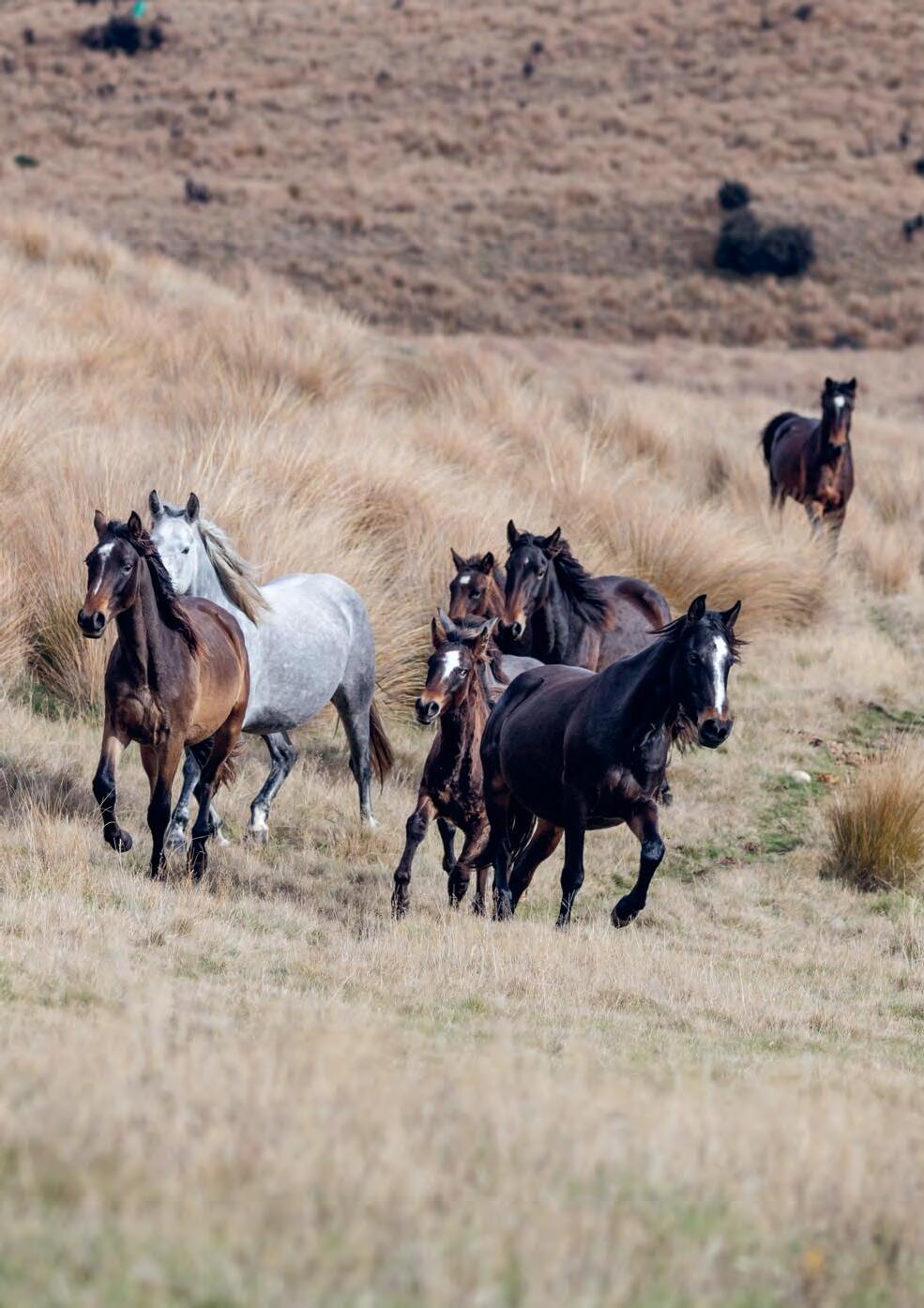
IN 1994, FRESHLY ARMED WITH degrees in zoology and ecology, I enrolled for a PhD at Massey University in Palmerston North. Similarly qualified, my wife Elissa Cameron enrolled for one, too. We were to share a graduate scholarship intended for one as we trialled a new contraceptive on the population of Kaimanawa wild horses that live inside the vast New Zealand Defence Force training area near Waiouru.
We were young, energetic and determined, and this was our once-in-alifetime chance to begin careers in wildlife science and conservation. And so, for the next four years, we immersed ourselves in the lives, behaviour and ecology of wild horses. Hundreds of horses became familiar characters in some of the most intensely focused years of my life.
Like most young trainees of the time, I started out believing implicitly in the objectivity of conservation science, and that its ‘facts’ were beyond criticism. First among those facts was that free-roaming horses were a harmful, invasive species. My years working with wild horses were to teach me differently.
1.LATE ONE AFTERNOON ON AN overcast day in December 1994, I descended into a tight valley and headed back to my truck. I had just a couple of kilometres to go, and thoughts about the next day’s work kept tempo with my stride. As I stepped over the stream that ran along the valley floor, so deep and narrow that it sometimes flowed underground, I saw something large move.
Startled out of my thoughts, I stopped short and glanced down. There, belowground and up to his fetlocks in water, stood a colt. As I had passed above him he’d tried to jump, but he couldn’t clear the stream’s walls. He was held like a crated sow, unable to turn around. Downstream from him was a dark, subterranean channel, but if he backed up, his rump caught the overhanging bank. Lying down in the cold, rushing water was not an option either. He was trapped.
A new foal cannot stand for long before it has to rest, so I guessed that he had been there only a few hours. Perhaps he had fallen into the hole in the dark as his mother moved to graze through the dawn?
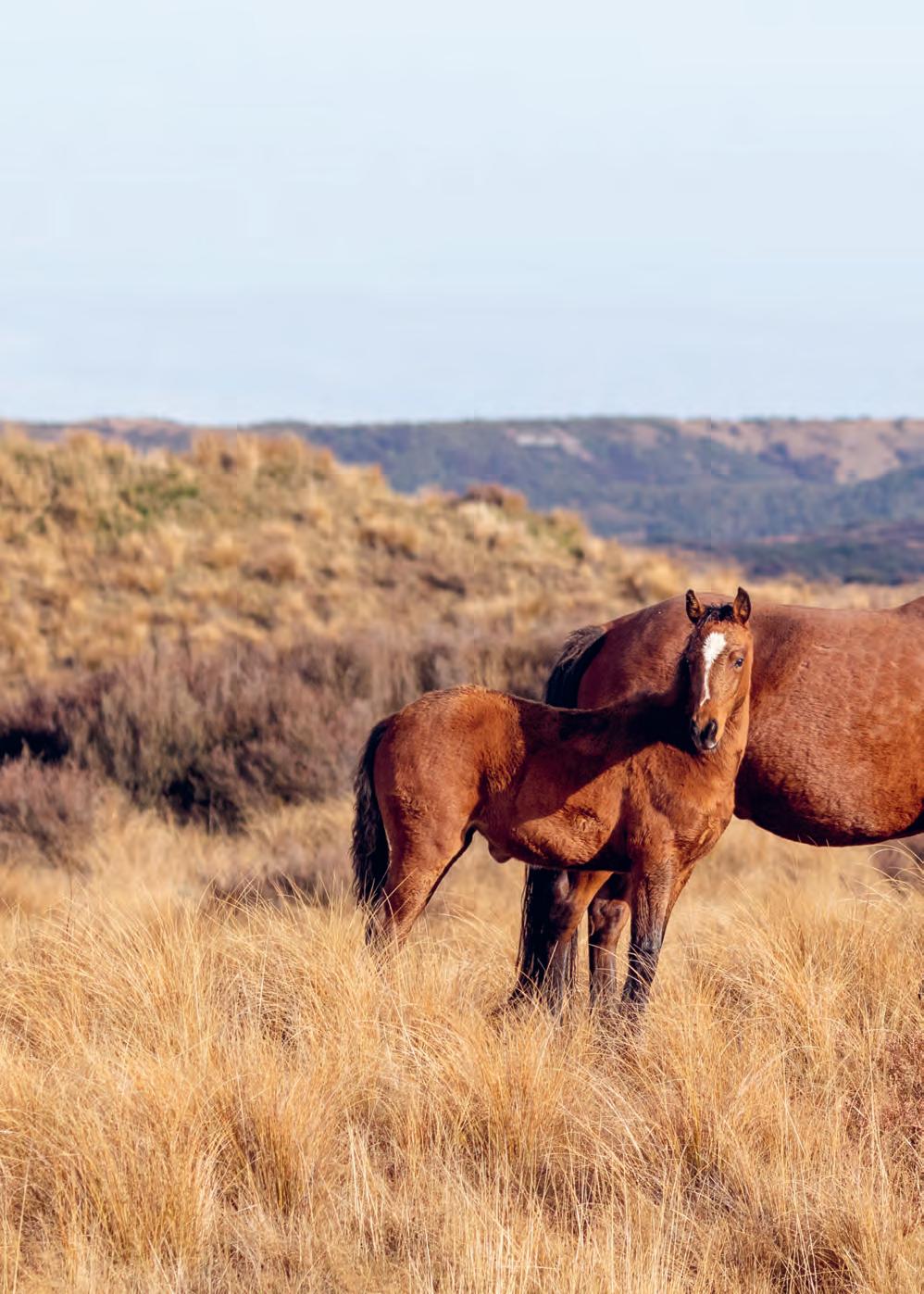
I stepped around the hole so I could see his face. I recognised him at once. I’d first seen him 10 days earlier, and then again just the day before. His mother was the mare we had named Cashew, who lived in the breeding group we called C-band after its magnificent stallion Charley. We had not yet named this young colt.
The ground around what promised to soon be the colt’s grave was heavily trampled. Cashew, and perhaps others too, had clearly fretted back and forth across and around the area, trying to encourage the foal to climb out of the hole. But it seemed they had eventually given up. What causes a parent to know when to stop trying, to give up on their newly born even though they can still see it and hear it move and smell it alive? Somehow, at some point, Cashew had chosen herself and her group over her foal.
The colt and I looked at each other. He seemed concerned that I was about to make his life even worse, but actually I was wondering whether I
should be trying to make it better. I could let him die, taking the opportunity to observe what happens to foals and how they perish in the Kaimanawa mountains, or I could lift him from the hole and help him find his mother. Would I be heartless but true to my scientific purpose? Should I let him die because he was an alien, non-native species? Or might humility and compassion be more important?
FROM THE BEGINNING, AND FOR all our history together, people have been killers of wild horses. Our prehistoric ancestors evolved in the warmth of equatorial Africa, and spread first and fastest eastwards, around the Arabian coast and on to maritime and tropical south Asia. They invaded as far as Australia over 50,000 years ago.1 Although closer to Africa, their colonisation of ice-age Europe and north-central Asia happened much more slowly. It must have been gruelling living in glacial Eurasia. These prehistoric people eventually survived only because the large animals roaming its vast grasslands and savannahs could be killed for their meat and fat and thickly coated hides.
The ice-age megafauna2 — woolly mammoths and rhinoceros; elk and deer, and bison and aurochs (cattle) bigger than ever before or since; horses, lots and lots of horses; and their massive shaggy predators like the cave bear, dire wolf and sabre-toothed lion — lived abundantly there, having adapted to the extreme cold. It was their slaughter that provided the critical nutriment to fuel the global expansion of humans.
An ocean apart from Africa’s early humans, it was in North America that horses, equids, first evolved. The prehistoric people invading Eurasia could hunt horses only because horses had invaded Eurasia, too, but earlier and from the opposite direction. Several times over the previous two million years, whenever sea levels lowered or the Arctic ice cap retreated, equids crossed over into Asia from North America. When humans left Africa for Eurasia, they were lucky to discover horses among the continent’s most common large animals, spread from its Atlantic coast to the Pacific.3
Our big brains with their dense neural networks demand energy- and nutrient-rich foods. Compared to other large herbivores, such as antelope, cattle and sheep, horse meat is rich in minerals, vitamins and protein (good), but is also lean (not so good). Unable to metabolise protein without energy, humans
lost condition on a lean-meat diet. To compensate, human hunters ate the fatty organs, too. Breaking open horses’ skulls and larger limb bones, they cut out the tongues, brains and marrow. The whole of the horse provided the perfect ice-age diet.4
Prehistoric humans eventually spread throughout Europe and advanced into northern Asia. Reaching the eastern shores of Siberia, during the warmer centuries that followed, as the Arctic’s melting ice cap retreated from Alaskan coasts, they crossed into North America, too. Moving rapidly south, their descendants spread through North America 20,000 years ago, and then across the Central American isthmus and into America’s southern-most latitudes — today’s Patagonia — around 14,000 years ago.5 Our species’ world conquest was mostly complete. Only the icebound Antarctic continent, and some large, remote islands, like New Zealand, were not yet humans’ domain.
Being both intelligent and cooperative, humans could fashion weapons and tools to kill and butcher much larger prey. This meant their arrival put the megafauna everywhere en route to extinction.6 Mostly nomadic prehistoric tribes followed their migrating prey, but so plentiful were the big mammals that in some places the humans stayed longer and returned often. Building shelters from mammoths’ bones, tusks and skins, or living in caves, they fashioned tools and jewellery from the bones, teeth and ivory of their prey, and painted cave walls by the light of burning animal fat.7
While these new artists drew themselves only as stick figures, exquisitely detailed mixes of colour and etching were employed to illustrate the animals they hunted. Horses like modern-day Takhi (Przewalski’s Horse),8 with large heads, thick legs, shaggy mealy-brown-red coats9 and upright brush manes, graced the walls of prehistoric peoples’ homes.10 Among the most painted animals in those caves, horses were probably also the most admired and hunted. In the paintings of some horses, spears and arrows hung from bleeding wounds.
Other paintings depicted horse behaviour, and included symbols that described the seasons of horses’ migration and reproduction. These cave paintings are the first known examples of our species engaged in a form of writing and technical drawing.11 With these images as their guides, each generation of our prehistoric ancestors got better at hunting horses.
Then, about 40,000 years ago, instead of stalking and killing individual horses, prehistoric humans learned how to massacre many horses at once. Probably with the help of dogs, they chased groups of horses up against rocky
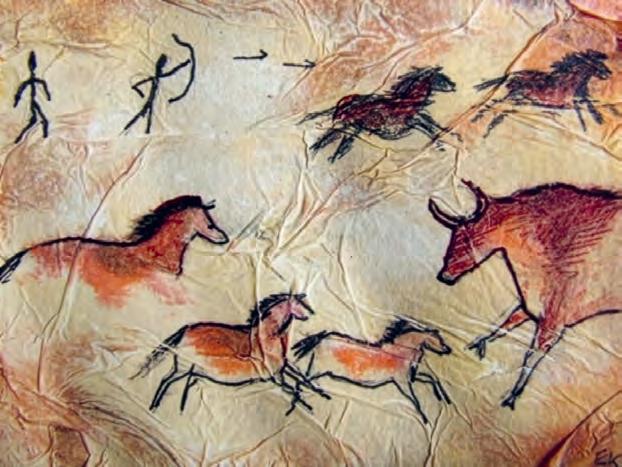
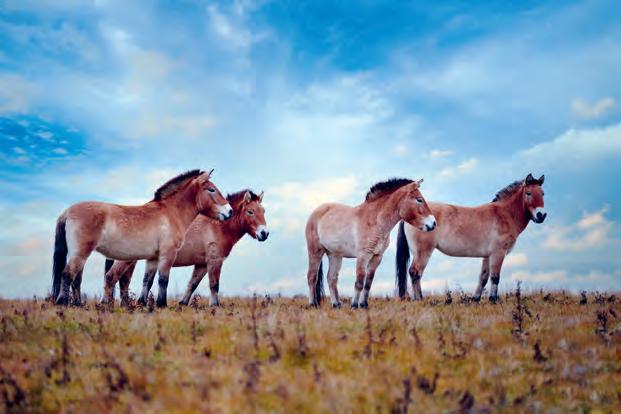
ABOVE: Prehistoric Europeans depicted wild horses (and cattle) and their hunting on cave walls. BELOW: The Przewalski’s Horse, with its pangaré dun-red coat, and upright brush mane, like that on a zebra or ass.
bluffs, or into ravines, dunes and river bends, where they could trap and slaughter them with spears. Those days hunting must have ended with tremendous feasts and phenomenal food waste.12 As a result the numbers of horses declined wherever our ancestors lived. Then life for the megafauna and horses got even harder.
After the last ice age’s final cold snap, 12,900 to 11,700 years ago, our planet’s climate began warming. Average global temperature climbed rapidly, making the Earth’s surface hotter than it had been for a hundred thousand years. Across the north Atlantic, North America and Europe, the average temperature rose a staggering 9 degrees Celsius (15 degrees Fahrenheit) in less than a century.13 While that made the climate more comfortable for our African-evolved ancestors, it was less suitable for the ice-age grasslands and their grazing megafauna, who preferred the dry cold.
Shrubs and trees flourished in the warmer and wetter climate, growing over and into the continents’ grasslands. Human hunting might have sped up the invasion of woody plants, too. With fewer large herbivores to eat these taller plants back — just as grass-loving elephants push over the trees invading African and Asian grasslands today — Eurasia and North America reforested.14
Caught between growing numbers of hungry human hunters and advancing forests, the megafauna collapsed. Surviving as only small populations in the still-cold, far away, but safer, islands and valleys of the subarctic, the last of those magnificent animals died out. None remain. Whittled to precariously small numbers in marginal habitat, the American horse died out, too, but later; the last perhaps only 5600 years ago.15
What contributed most to the extinction of the world’s megafauna and North American horses? Was it the decline of grazing, human hunting or something else? The changing climate may explain why horses became less common, but not why the survivors — climate refugees in the remaining grassland habitats — did not survive in North America as they did in Eurasia. Perhaps because the human invasion of ice-age Eurasia was completed slowly, its horses had enough time to get better at evading human hunters. Not so in North America, where the human onslaught was rapid. Humans are probably at least partly responsible for the extinction of the North American wild horse.16
STANDING AT THE STREAM’S EDGE, I did not agonise for long. Getting scientific research right is important, but I am decidedly not cruel. Lowering myself into the hole, I cradled the trapped colt and began to lift him. He was unexpectedly heavy and threw my balance as he jerked in my embrace. I dropped him and reconsidered the task.
I crouched so that he and I were wedged against the stream’s opposite banks, and then I began to lift him in stages, shifting my hold and catching my breath with each lift. With one last heave I rolled him onto the ground above the stream, where he tried to stand, staggered and then fell. He was still on the ground as I pushed myself up out of the channel. Out of breath, I leaned on my knees. We caught our breaths together.
I lifted the colt to his feet. He whinnied but did not walk. I gave him a shove with my knee, hoping he would run and find his mother by himself. He staggered again, managed to right himself, but he did not move further. Pondering what to do, I suddenly remembered how my Uncle Don used to bend the tails of any calves who dawdled behind their mothers on the way to the milking shed to make them walk faster. I duly gave the colt’s tail a quick twist, but he ignored the discomfort and stayed rooted to the spot. I tried shouting and slapping his rump. Still, he would not move.
Perhaps his legs, bloodless from standing for so long in cold water, were numb. He kept turning to me, his face lifted, searching for comfort and to nurse. ‘I am not your mother!’ I yelled at him as I realised my new predicament. He would not walk, and I could not carry him. How could I move him, carry my backpack and field telescope, and find his mother at the same time? Cashew could be miles away, in any direction. If I did not find the foal’s mother, what would I do? I couldn’t take a two-week-old foal home, but nor could I bear to leave him to fend for himself until his mother found him. If she found him. What had I done? Only prolonged his suffering?
Feeling there was no other option, I placed my thighs either side of his rump, leaned forward to grip his mane and pelvic-thrusted him around the next spur and out into the wide-open river basin where I hoped his mother might more easily find him.
We kept going for a few hundred metres more. By now my back was hurting and I knew I could not keep him moving forward much longer. Where was his mother?
Then the colt whinnied, and a horse answered from somewhere out of view further upriver. Seconds passed in silence. Then I heard hooves approaching. Cashew crested the nearest horizon, ears forward and nostrils full. A moment later, all of Charley’s group crested the ridge. Thundering into view, they accelerated towards us. I needed to leave or I would be caught in the middle, between foal, stallion and dam. I backed away slowly at first, and then, intimidated by the stampede, I spun around and made a dash for it up the nearest steep slope.
Gaining a safe, rocky vantage, I turned back to see dam and foal reunited. Cashew was nuzzling her foal. The others, restless at first, settled to graze about them. The colt, still unsteady on his feet, tried to nurse. I wanted to stay and watch to see whether the rescue was a success but night was approaching; I dared not stay any longer.
I was worn out but invigorated. As I resumed my walk back to the truck, I felt a joyful kick in my stride, as if I could accelerate, run and jump as foals do. When I tried, a sharp pain across my already aching back pulled me up short. I walked off my joy instead.
A week later, we found the colt, still looking thin and weak, and a little uncoordinated, but alive nonetheless and with his mother. Elissa teasingly called my rescue ‘Wayne’s Folly’. But that little horse was not my mistake. His rescue changed me. My relationship with wild horses would forever be different.
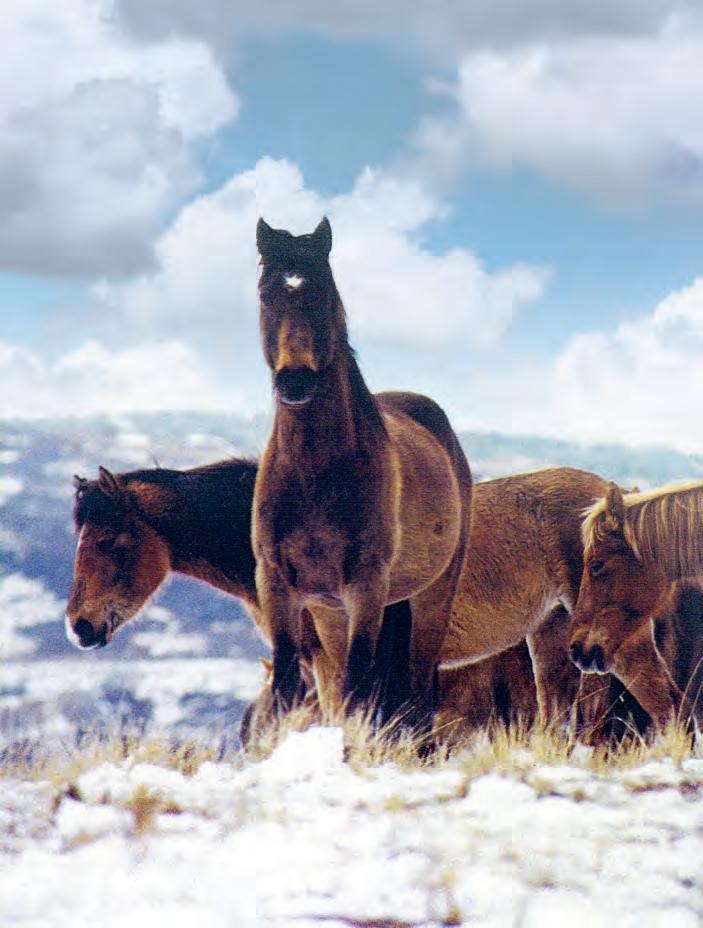
The stallion Charley with his band, C-band, in their thick winter coats, late winter 1994. Little did I know how central they would become to my story.
THE BONES OF SLAUGHTERED HORSES, cut and broken by stone-tool butchery, are commonly found wherever prehistoric Europeans camped, evidence that people continued eating more horses than the equine populations could sustain. Counts of those bones have revealed that horses were eaten more than rabbits and hares, about as often as goats, and somewhat less frequently than pigs and deer.17 All of those other species, being smaller mammals, reproduce faster than horses. Routinely giving birth to twins or to a larger litter after shorter pregnancies, their populations compensate quickly for any deaths to hunters.
But horses foal at most only once each year, and so their populations diminished to extinction. Aurocks, the wild cattle living on the grasslands of Europe, were also hunted, and, having a diet, size and reproductive rate similar to horses, are now also extinct. Tellingly, from the prehistoric era only the forestdwelling goats, deer and pigs, and elusive hares and rabbits, still survive wild in Europe today.
Horses persisted only in the most remote, least hospitable regions of Eurasia; their last lands.18 Forced into poor habitats, their teeth grew larger and bodies smaller as their diets became coarser and less nourishing. How much longer could they endure the human assault?19 The ancestors of today’s horse did not survive because their wildest selves outwitted us (although, no doubt, some occasionally did). Instead, they exist today because their human predators began keeping them as well as hunting them. Domestication proved a timely respite, as humans realised that breeding and raising horses reduced their need to hunt wild horses. Even so, delays to their domestication meant that horses almost did not make it through the maelstrom of human killing.20
Before it can be domesticated a horse must be restrained and made docile; tamed. But with a savage bite and a kick often delivered exactly and fatally, horses are not easily captured and penned. This meant our ancestors domesticated cattle, pigs, goats and sheep thousands of years before they managed to tame
the first horse (or ass). Nonetheless, everything they learned about how to tame and breed other hooved animals was in time applied to the greater challenge of taming horses, and the path to domestication begun.
These early efforts at taming have left hardly a trace in the archaeological record. Simple taming does not require tools and tack, nor changes to horses’ or peoples’ bodies, in the way that breeding and riding do. But we can imagine some of the ways in which a horse was tamed. Perhaps lost, trapped or injured foals — like Wayne’s Folly — were found and kept as pets, much as America’s First Nations people kept the calves of moose and bison. And maybe hunters captured foals or yearlings that were disoriented and exhausted from their pursuit. Walked into a corral ordinarily used for cattle, or hobbled and tethered on pastures near camp, young horses were then grown and fattened for the pot.21
Not long after, perhaps moving between encampments or travelling to trade their live horse meat, someone added a burden to their tamed horse. It was hardly a new idea. Cattle already carried or pulled loads. Perhaps horses lugged cured hides for sleeping and shelter, then a child too heavy to carry but not old enough or well enough to keep up on foot. And just as children chase and ride domestic sheep or climb onto the backs of tethered dairy cows, perhaps they played on the back of a tamed horse. Or, like bronco riding today, perhaps ancient youth tested themselves on the backs of wild horses caught to be raised for meat. Soon a horse’s ability to carry or pull us and our belongings, to help us travel faster, and to assist with herding other stock, became obvious. More horses would be caught, but now kept and tamed as much for work as for later eating.
Almost all of the first-tamed horses were probably already docile mares. While a mild temperament will not prevent a wild mare from breeding, a wild colt must battle to breed. A docile stallion is therefore an evolutionary improbability. Impulsively savage with their teeth and hooves, and fiercer in a fight, stallions could not be corralled and tethered like mares. It was this wildness of stallions that prevented the rapid domestication of horses. People ate, loaded and rode tamed horses, almost exclusively mares, for hundreds of years, perhaps over a thousand, before their true domestication.22
Being unable to tame and domesticate wild stallions, the ancients probably bred their favourite tamed mares by tying them where wild stallions visited, such as near a water hole. Or they hobbled and released mares, knowing that they would wander, mate and be easily re-caught. A filly born the next season was more likely kept, put to work and later bred, too. A colt would be grown for a
year or two as well, but fattened, killed and eaten before it became an unmanageable stallion. Breeding the most docile and eating the least controllable, they cultivated more placid matrilines and started choosing to keep mares for other characteristics, such as attractive coat colours and patterns.
Some mares escaped, and others, being lame or matured pets, were released. Invariably they went on to breed with their wild-living cousins. The foals from those pairings — a mix of humans’ breed preferences and nature’s selections — also bred. That is why scientists have found evidence for taming and domesticity in the Takhi genome. Wild horses, wherever they remained, became an extension of people and their tribes’ tamed horses.23 No wild horses escaped humans’ influence. Hunted, but now also caught alive, tamed and bred, and sometimes released to re-wild, the nature and culture of horses and humans mixed. With this, the prehistoric wild horse was crossbred out of existence.
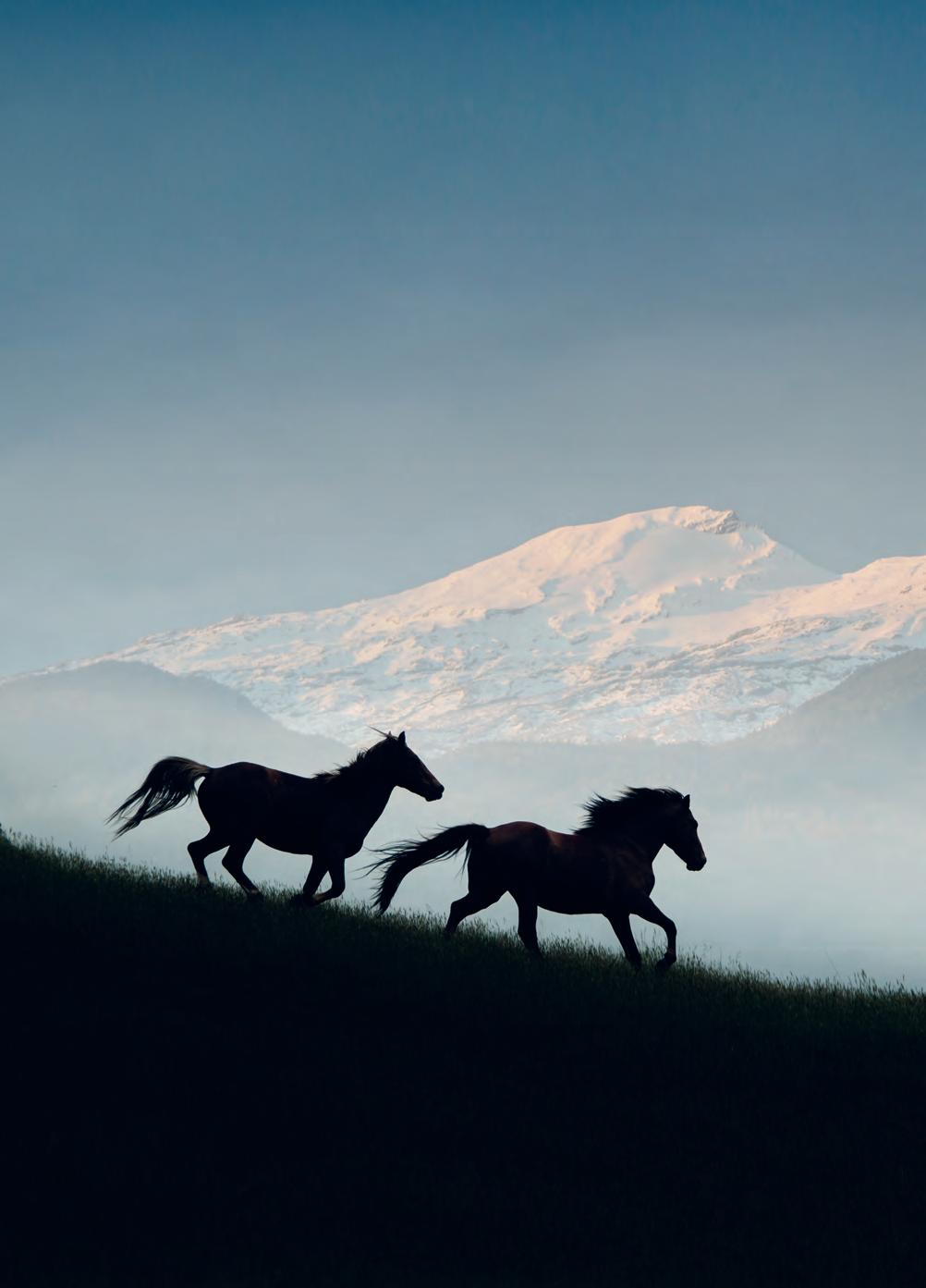
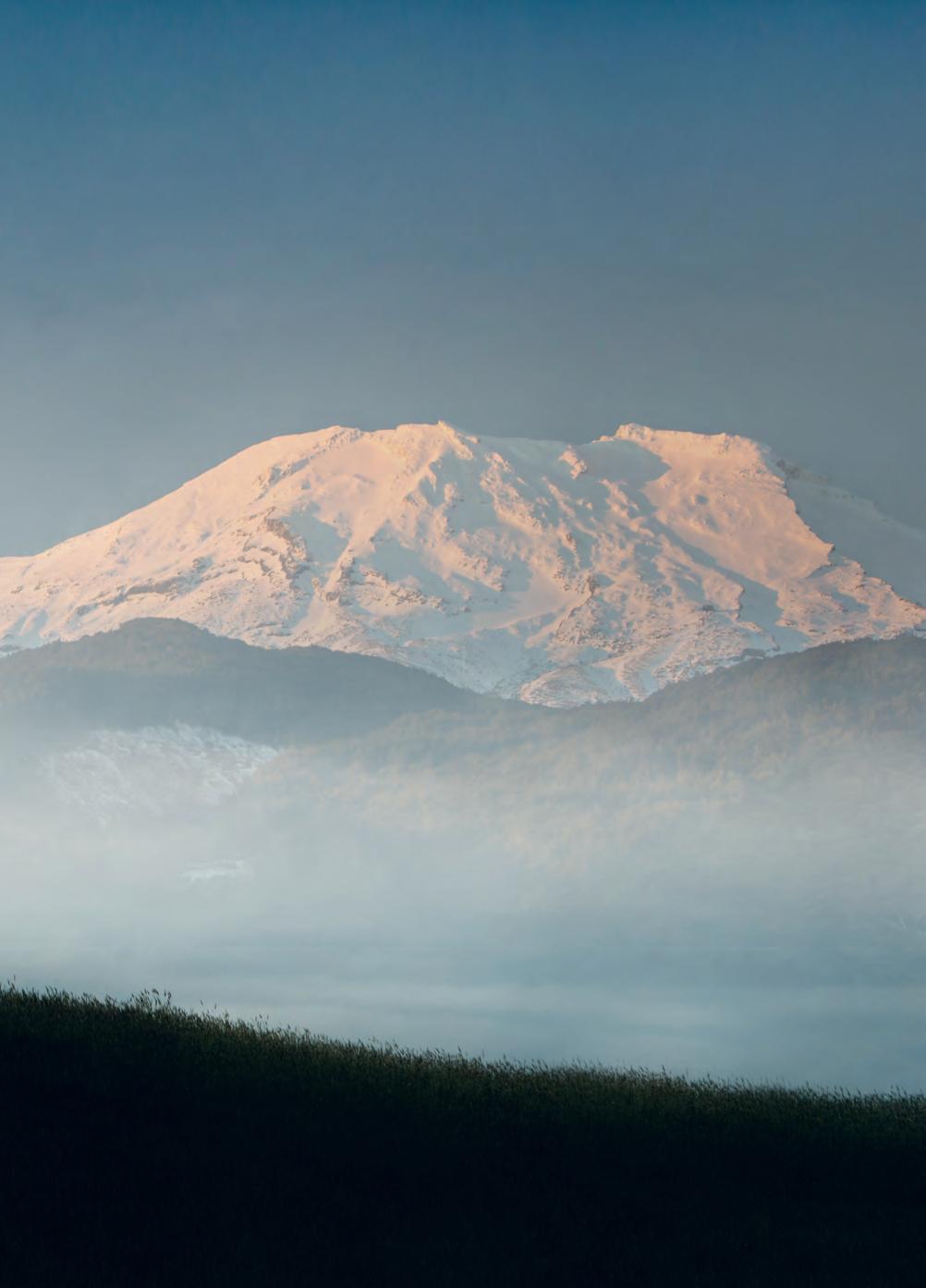
WAVES OF AN ICE-WIND CRASH over Mount Ruapehu, and in my ears; the cloud above us both beaten into a clean, thin canopy. Beyond its cover, my horizons are blue in every direction. Standing with my back to the snow-capped peak, I scanned the land below, the view framed by the balaclava around my face and my gloved hand raised against the cold-white light.
Six hundred years before my ancestors arrived from Europe during the late 1800s, the ancestors of New Zealand’s Māori — its First Nations people — colonised the islands of Aotearoa from Polynesia.24 Their oral histories describe Ngātoro-i-rangi, the descendent of high priests, exploring the heart and height of the North Island to claim it for his iwi. He met Hape-ki-tūārangi, of another iwi, attempting to do the same, and asked him how he had travelled through such a desolate and exposed place. Hape-ki-tūārangi turned into the wind and replied: ‘Ko taku manawa taku kai’ — my breath (manawa) is my food (kai).25 Hence, Kaimanawa is the name of the mountain range ahead of me and the wild horses that live here.
Between the Kaimanawa’s peaks ahead and Ruapehu’s volcanic dome at my back lies the island’s high plateau. Here the earth, rising from the world’s largest ocean, fights its three winds. It breaks the westerly roaring overhead from Australia to South America, is lacerated by winter storms cutting north from frozen Antarctica, and absorbs the deluge of summer cyclones rolling south
Wild Horses of
from the Pacific Ocean’s tropical centre. Every day can be a different season depending on which way the wind blows.
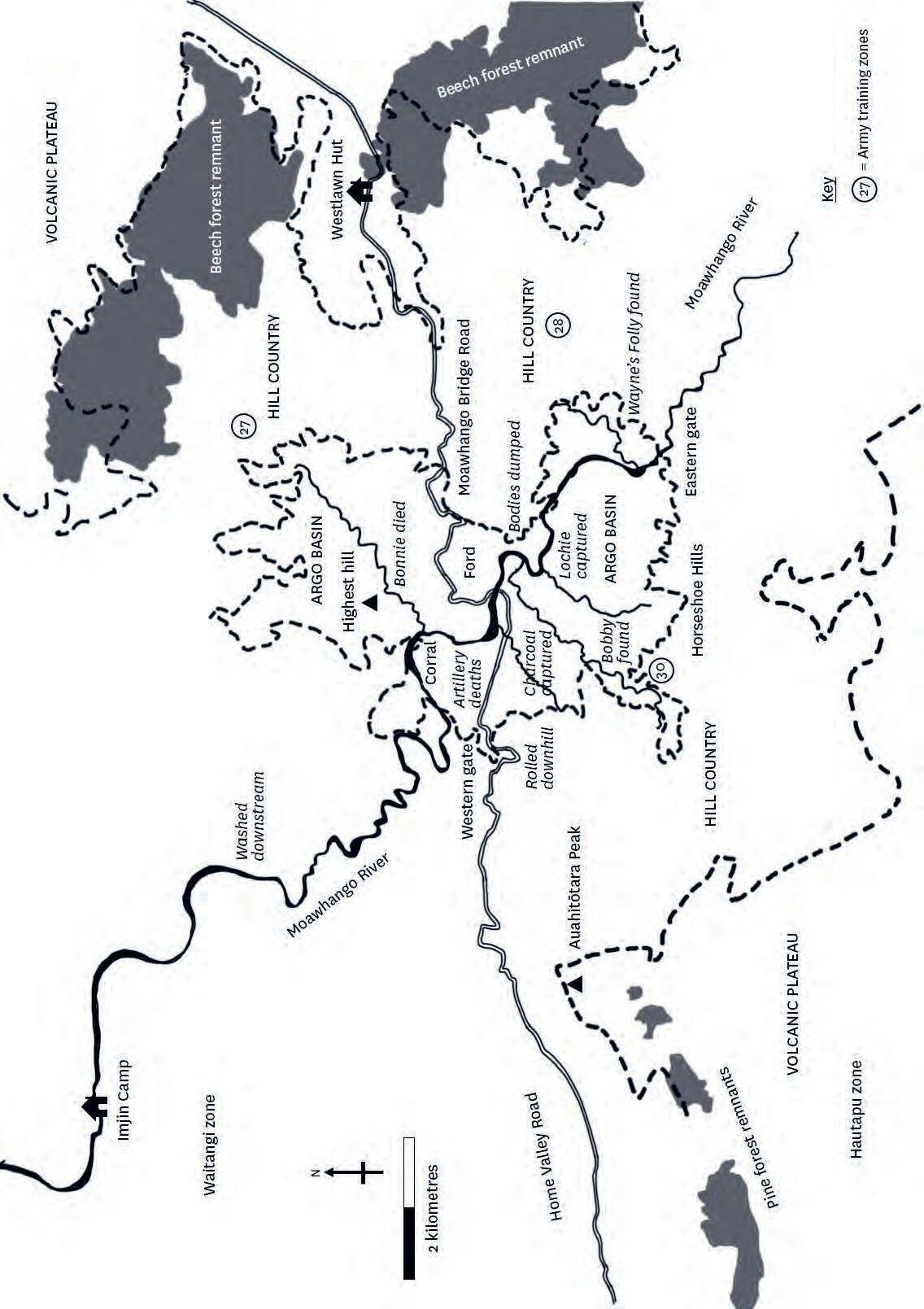
Over the horizons around me, the volcanic plateau’s yellow-clay soils, tall red tussock (bunch) grasses and rusty turpentine shrubs disappear into forever.26 But 450 metres below, between me and forever, small valleys cut by deep, narrow streams — like the one that trapped Wayne’s Folly — converge from all directions to form a bowl in the landscape: the Argo Basin. Its wide, grass-green centre and sheltered terrain appear like a refuge among the hostile mountains and plateau around it.27
West to east through the Basin’s middle, accepting the water from every valley, flows the Moawhango River. It falls into and out of the Basin through two narrow gorges, the front and rear gates to our sanctuary. Through those gates its water churns over large, round boulders packed tightly together like centurions. Shoulder-to-shoulder, shield-to-shield, they easily defend themselves against today’s current. The armoured rapids, tall undercut banks at its slow and silent corners, and the wide riverbed either side of its babbling shallows betray that the Moawhango River was once bigger, stronger and, sometimes, maleficent. But now dammed upstream, its power is captured and harnessed to make electricity, the wild river tamed and broken for work.
Like a disintegrating wall around our sanctuary, fragments of sooty-brown cliff ring the Basin’s high rim below where I stand. Wind billowing and water running over the plateau’s brink have smoothed and caverned its old rock. From the always wet earth below each parapet grows a row of deep green New Zealand flax. Mānuka and kānuka shrubs and small trees break through the crumbling wall and descend narrowing ridgelines towards the Basin’s floor.28 Fingers of green grass from the central Argo Basin rise along narrowing valley floors to meet them, interlacing like the two hands of unlikely friends, holding plateau and Basin together.
The tracks of heavy vehicles, collapsed trenches, discarded fragments of barbed wire and the impact craters of explosives mark the Basin’s floor and surrounding hillsides, reminding me that I am searching for horses in New Zealand’s largest military training grounds. The oldest, deepest injuries, overgrown and smoothed by time, have left permanent scars. A car-wreck, left as a target on top of a distant spur, is now pummelled, rusting and part-buried, like a sharp shard in the land’s skin. The graded road descending into, crossing and then ascending to leave the Basin is a scratch never allowed to heal. Moawhango
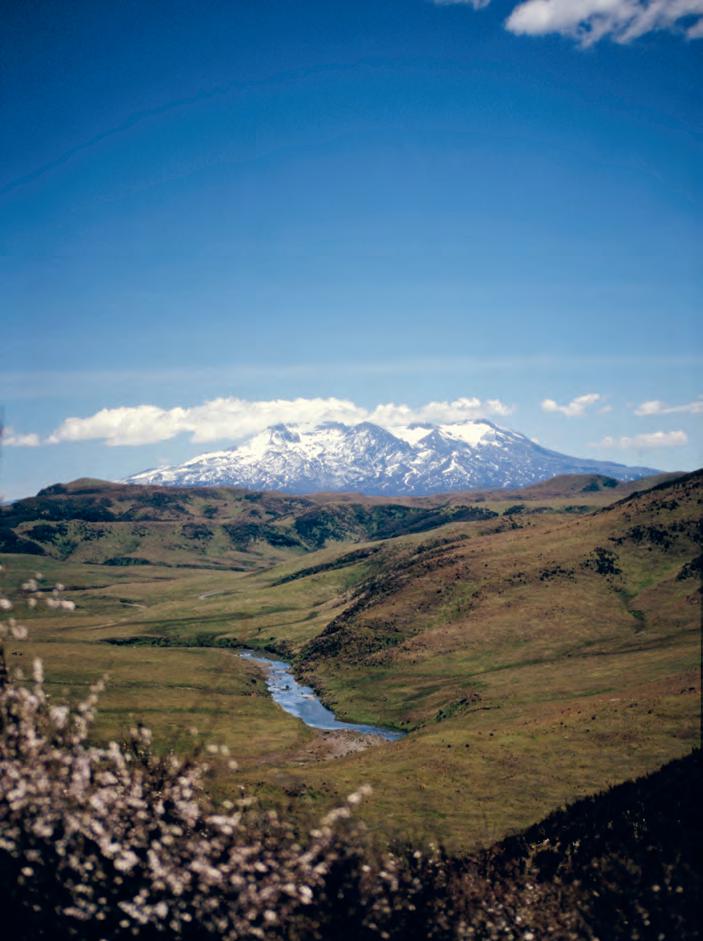
A spring-time view northeast over the Moawhango River, across the Argo Basin, towards Mount Ruapehu.
Bridge Road wounds the deepest where it fords the river at the Basin’s centre. Newly blackened or older bleached shrub and tree trunks show where past fires, mostly war-game infernos, started and stopped.
Some call this a natural place invaded by an alien species. But it is not us they speak of, although we have broken its wild river, inflicted lesions and burns on the land, and left them undressed to scar. They were talking about horses.
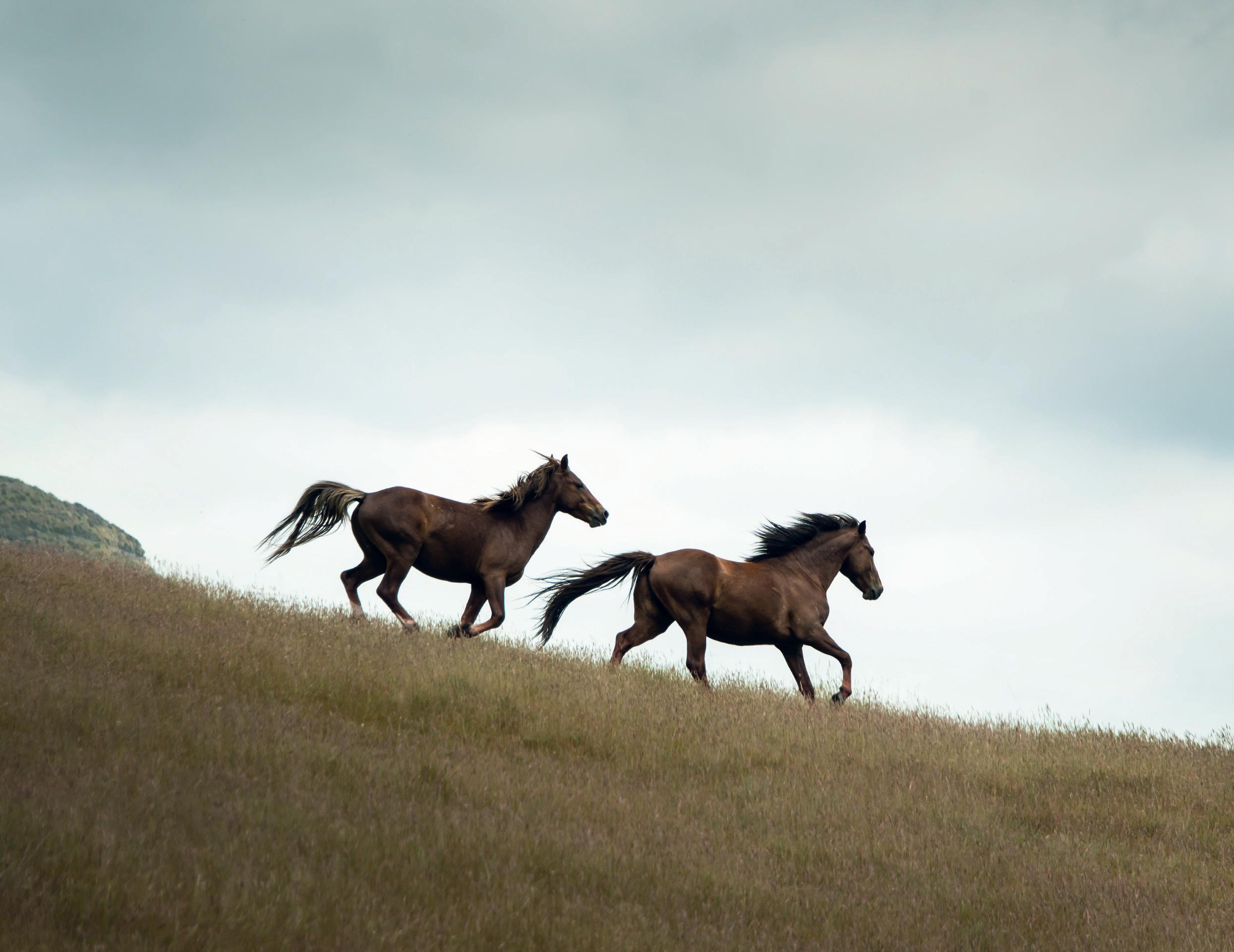
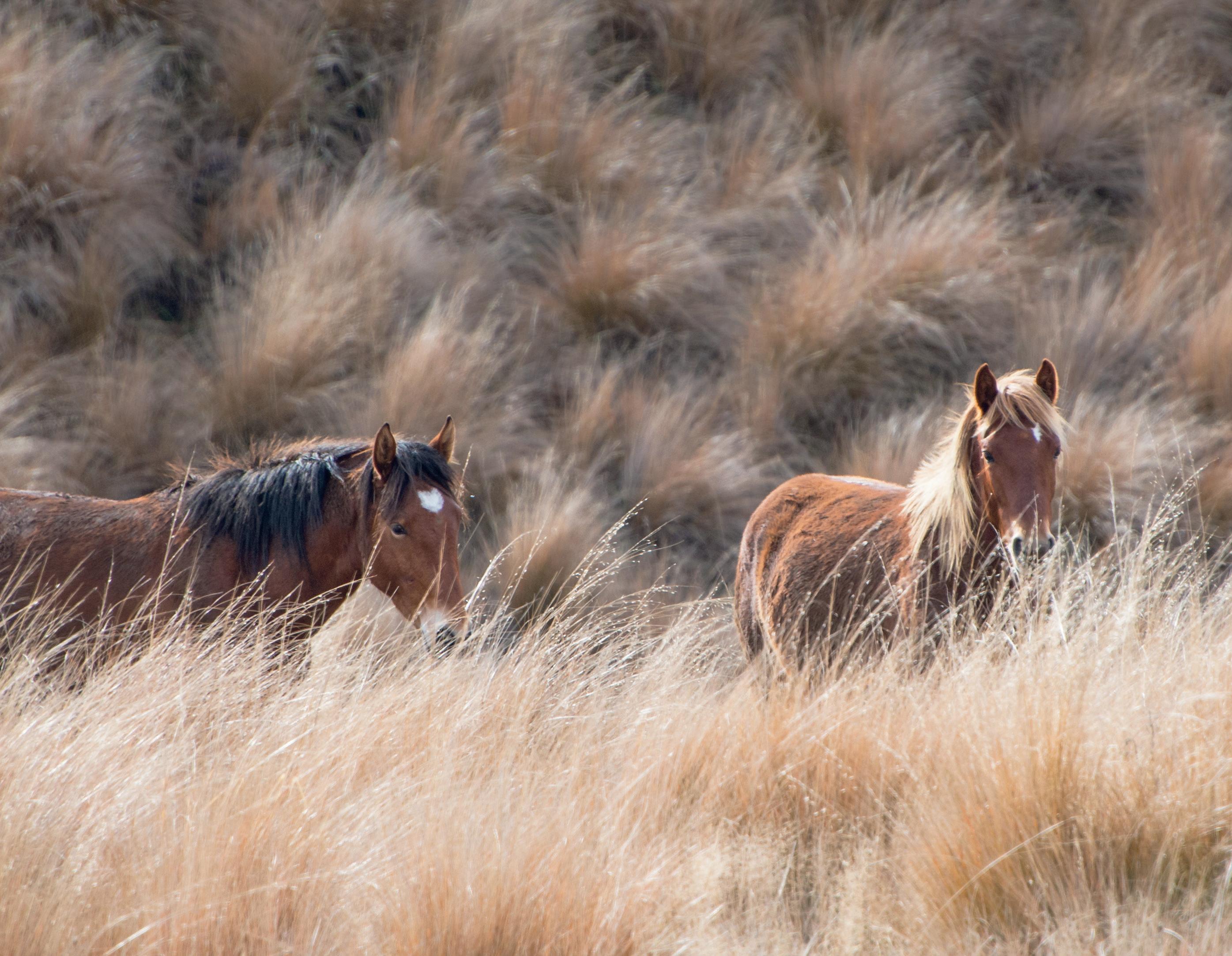
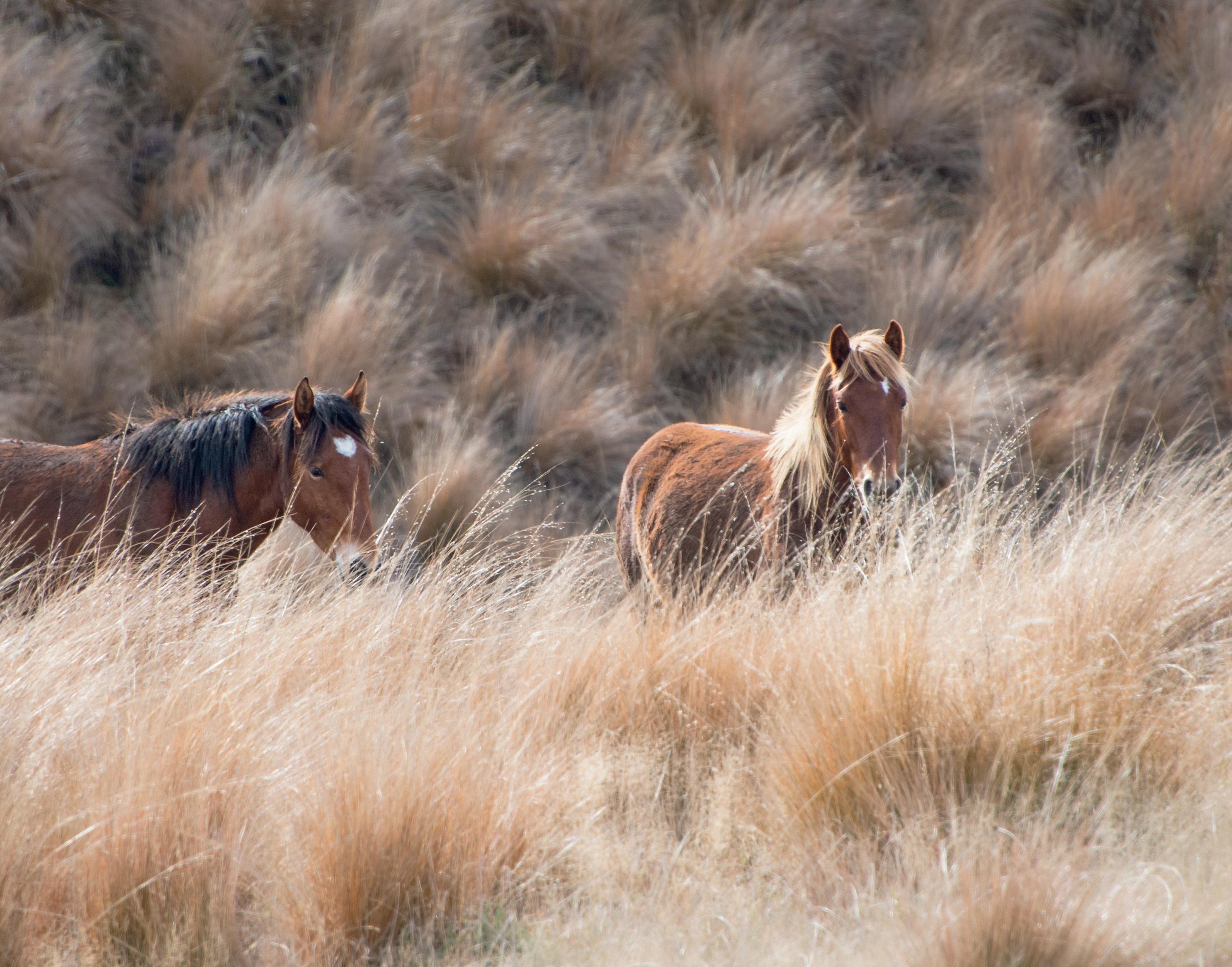
I have been searching for those horses all morning, so far without success. Turning my head slowly, determined to not miss a thing, I scan left to right, top to bottom. Then a shaggy, coffee-coloured foal rising to stand and shake, although half a kilometre distant amongst dollops of mānuka, fixes my stare. Hungry, the foal’s awkward gambol downslope to nurse leads my eye to its mother. Then others rise out of their red-brown background. At last, I have found some of the wild horses of the Kaimanawa mountains, their manes and tails full in the air, eating the wind.
IF THE BIOLOGY AND PSYCHOLOGY of every horse alive today bears humanity’s imprint, then what is a ‘wild’ horse? Certainly, a domestic horse, captive-bred and cared for by people, is not wild. Every other horse, free-roaming and uncared for, must therefore be wild. Simple. Instead, however, we apply a different term to many wild horses: feral — living wild, but descended from escaped or released domestic horses. Although ‘feral’ and ‘wild’ appear to be rational, scientific classifications, their use to describe horses (and many other animals) is a pejorative mess.29
By the nineteenth century, Takhi — the last of the horses that looked like those that prehistoric Europeans painted in their caves — had become so rare that collectors prized specimens, like antiquities. Horse hunters sold Takhi skins to museums for taxidermy or captured the horses alive for the menageries of a few wealthy élites and European zoos. Last captured in central Asia in 1947, only a dozen wild Takhi survived into the late twentieth century. Driven from better grazing by people and their livestock, and sometimes still hunted, the last freeroaming group was seen in 1967, and the last individual in 1969.30
Over the subsequent 20 years, an international breeding programme reproduced enough Takhi to introduce them to central Asian wildlife reserves. Fenced in to prevent them crossbreeding again with other free-roaming horses,