E R
Edited by Linda Tyler
Photographs by Haru Sameshima and Jane Ussher
In 1960, in London, the Tate Gallery mounted a retrospective of the work of Pablo Picasso that was visited by half a million people. In 1967, in Chicago, the University of Chicago unveiled Nuclear Energy (1964–66), a work by the sculptor Henry Moore that was shaped like both a human skull and a mushroom cloud. Just over 3.5 metres tall and 2.4 metres wide, it was installed on the spot where the scientists of the Manhattan Project had built the world’s first nuclear reactor.
Linda Tyler
Picasso and Moore, one French and one British, one 79, the other 69, were the titans of Modernism in the 1960s, and active politically: Moore was a founding member of the Campaign for Nuclear Disarmament when it was established in 1958, and Picasso, whose Guernica (1937), produced during the Spanish Civil War, was seen as a statement against fascism, was politically engaged with Communism.
They were both still producing art in Europe when a young Auckland art student, Terry Stringer, was attending classes at the Elam School of Fine Art at the University of Auckland. ‘Art school for me was overshadowed by Moore and Picasso, artists of the human as subject,’ he says. ‘Their work was all about form — the shaped figure. This was not the improved reality of history; this was the mid-century interest in imposing the artist’s reactions onto the subject, altered figures that are understood by the viewer by knowing what it is to be human.’1
* * *
Terry Stringer was a child of the northern hemisphere. Born in Cornwall in 1946, he arrived in Wellington on the Dominion
Monarch in 1953 at the age of five, his family — his parents, Doris and George, and older brother, Ian — having been, as he describes it, ‘shaken loose from England’ at the end of the war.
‘My father,’ he says, ‘came late out of the army of occupation in Germany into a shortage of job opportunities with the returning army. We left England and my mother’s house on the St Ives sea wall, where I was born, for the colonies: first for South Africa — where tension and danger made life uncomfortable — and then for New Zealand.’
The St Ives of Stringer’s birth was an important artistic hub in Britain: the distinctive quality of its natural light and changing seascapes had attracted artists since J. M. W. Turner, and the art colony at Newlyn, established on the south coast of Cornwall in 1884, developed its own style of Impressionism. Expatriate New Zealand artists such as Frances Hodgkins and Edith Collier visited, and British sculptor Barbara Hepworth and her husband, the painter Ben Nicholson, moved to St Ives in 1939.
The former fishing village became a centre for English Modernism,
attracting artists who were acclaimed for their approach to abstraction based in nature. Francis Bacon used a house on the sea wall overlooking Porthmeor Beach, not far from the house owned by Stringer’s mother, Doris, to produce the work for his first exhibition with Marlborough Fine Art.
George Stringer was an older father, a working-class man from a Liverpool family of nine, already in his forties when his second son was born. After the war he worked as an insurance assessor. He was also a keen photographer — ‘a ready acceptor of change,’ Terry Stringer says. ‘He adopted the latest of innovations in a life that had witnessed horse transport and steam shipping. That and their ability to try a new life and to move on might have meant that my parents were later open to their sons following their interests, whatever those were. My brother became an entomologist and taught at Massey University.’ Both sons have now been made Officers of the New Zealand Order of Merit for work in their respective fields, Ian having saved the Mercury Islands tusked wētā from extinction.
The family moved to picturesque Waiheke Island in 1954. At that time, the island was a very affordable location in which to buy a house, and attractive to many new-immigrant families because of its proximity to Auckland and the semi-rural lifestyle it offered. Stringer describes the streets of Palm Beach, where they purchased, as being lined with mouldering houses behind high hedges.
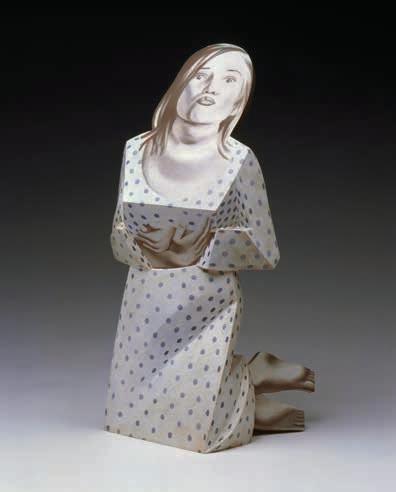
Doris Stringer was a thrifty and versatile homemaker who was also an enthusiast for the performing arts; she made costumes for productions by the island’s amateur theatre group and for the fancy-dress days at Waiheke Primary School. Ian was sent to tapdancing lessons and Terry to ballet class; the absence of other boys guaranteed him a part in the end-of-year concerts. Both parents were extremely tolerant of their sons’ childhood enthusiasms, and Stringer describes his mother as ‘a tireless supporter of family endeavours’. Years later he made an affectionate representation of her as a young woman, Mother as a Girl (1976), which shows her wearing red nail polish, a patterned
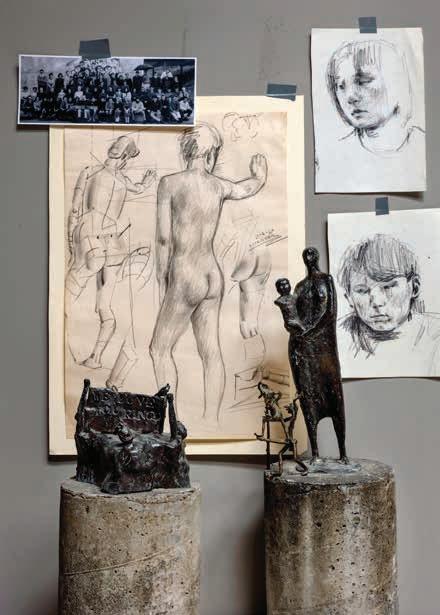
‘The world occupied by people is also a world of objects. When I came to take a holiday from figure-making, I took a look at these surroundings. My dominant eye delivers me a flattened view. So I find enhancing the sense of depth in my sculpture most rewarding. Forcing perspective is alluring.’ TS
Linda Tyler
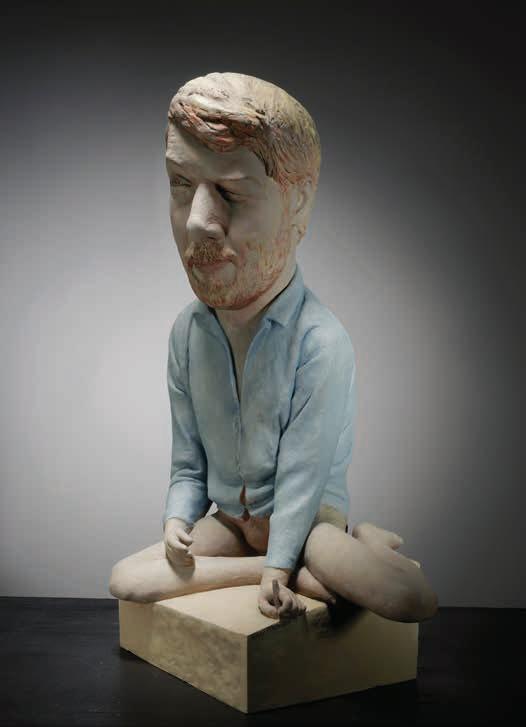
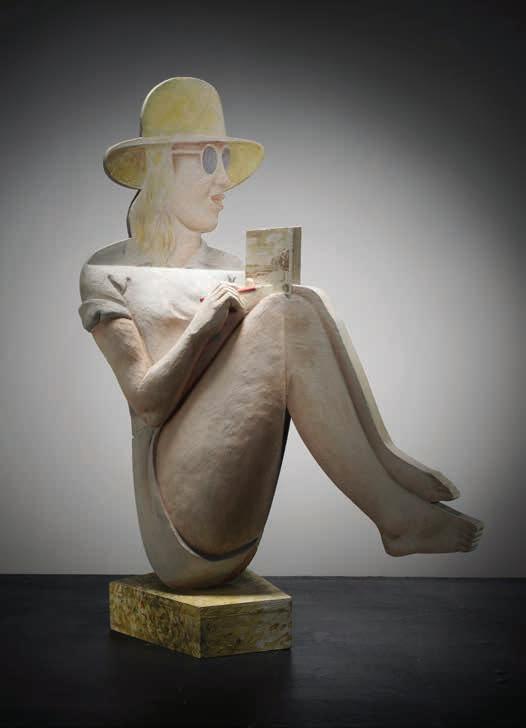
One of Terry Stringer’s earliest works, Buddha on the Beach (1971, page 70), constructed of painted polyester resin, is a self-portrait in three dimensions, drawn while he was seated on a sandy beach in the Coromandel, using the reflection from a pair of sunglasses as a convex mirror. It shows the 25-year-old artist dressed in a blue shirt and brown shorts, holding a pencil in his right hand and pointing to where the work is now signed. His optical device is missing from the left hand, but he closes his left eye to concentrate on exactly rendering the distortion the convexity creates.
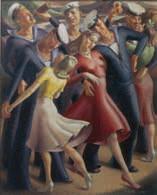
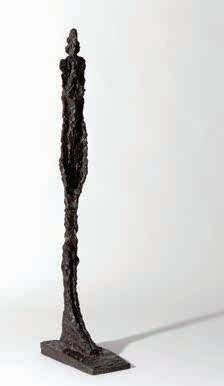
The work lightly gestures to one of art history’s icons, Parmigianino’s Self-Portrait in a Convex Mirror (c.1524), which shows the artist’s hand in the foreground, outsized. Buddha on the Beach is also a retort to the figures created by the Swiss sculptor Alberto Giacometti (1901–1966), in which the feet are enlarged to privilege the sculptor’s view as he looks down. Instead of the extremities of hands and feet, an enlarged head dominates here, as in a conventional depiction of the Buddha, in which the outsized head represents wisdom.
A whimsical expression plays across Stringer’s face, not unlike the serene smile that symbolises the Buddha’s peaceful and calm nature, indicating the humour of the joke being made. Further portraits were to follow, including Charlie Rose in 1970 (page 69) and, more recently, Jacqueline Fahey in 2025 (page 213, shown alongside the Elam piece Fountain Figure, 1967 — the early with the recent).
Another influence on Stringer at this time was Japanese netsuke, the intricate miniature sculptures often carved in ivory that originated in seventeenth-century Japan and developed initially as buttons or fasteners for the
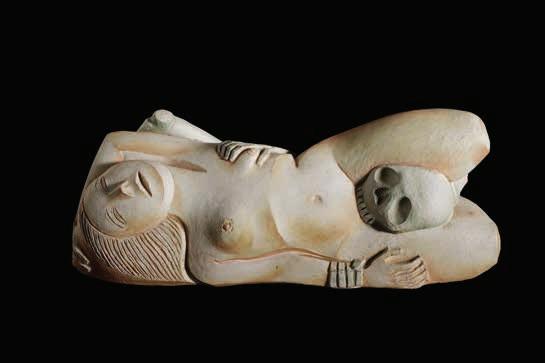
inro boxes worn as purses with kimono. Stringer’s interest in Japanese art was sustained, and a decade later, in 1982, when he was invited by the Barrington Gallery to submit a work to an erotic exhibition, he turned to shunga or erotic art for inspiration. He made a work titled Death and the Maiden (1982, page 73) and a second, figurative work in terracotta that is a homage to The Dream of the Fisherman’s Wife (1814), a shunga woodblock print by Katsushika Hokusai. The female figure in Death and the Maiden was modelled on Rachel Power, the second wife of the painter Philip Clairmont.
Following the Greek myth of Hades, the god of the Underworld, and Persephone, the daughter of Demeter, goddess of agriculture, in the story of Death and the Maiden a young woman — innocent, probably a virgin — is seduced by Death in the shape of a monstrous old man, sometimes depicted with horns, sometimes just as a skeleton. In his work, Stringer wraps Death’s skeleton around the back of the reclining nude Maiden, pushing the skull between her legs to rest on her pubic bone, like the head of a baby being born. The juxtaposition of the two
Haru Sameshima
at Manly, 1974. Oil on resin, 60cm. Haru Sameshima
Left behind is the symmetrical human body, adopted is a distorted painterly vision seen with a dominant eye. TS
The cover of Françoise Gilot’s Life with Picasso showed her close to the camera with Picasso in the background. Picasso’s treatment of the human subject looms in the background to an approach to the figure. Shown here is a copy of an edition that is also held in the collection of Auckland Art Gallery
Toi o Tāmaki. TS
Below: Death and the Maiden, 1982. Oil on terracotta, 8cm. Haru Sameshima
‘As a sculptor it is necessary to learn by seeing actual objects. An education about sculpture from book illustrations and slide lectures meant seeing flat images with the outline dominating the form. My works welcomed this dichotomy — a flat cut-out shape existing in space. My figures were made with panels whole or in part. I built them up in planes and angles, accepting an illusory sense of rounded body.’ TS
Linda Tyler
By 1977 Terry Stringer had developed and changed his practice. He had left behind his sculptures with cut-out panels and now habitually explored forms constructed with planes and a surface of facets that capture light and shade, a repertoire available for use with different subjects.
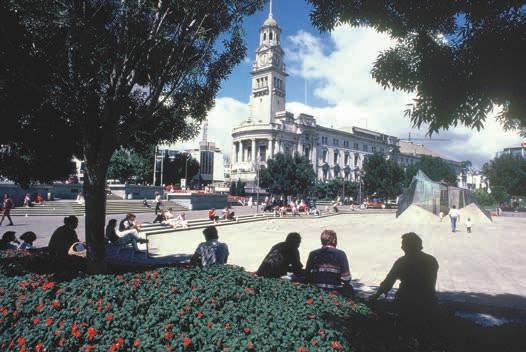
At the end of the decade, a competition was announced for a water sculpture in Auckland’s Aotea Square, sponsored by the Auckland City Council and the Auckland Savings Bank, as a placemaking initiative to centre the civic space that connected Greys Avenue with Queen Street. Tanya Ashken proposed an albatross, Chris Booth skewered rocks (both subsequently achieved outside of Auckland), but Terry Stringer won with a simple concept for a volcano fountain executed in bronze. It was to be his first public commission, and it was a huge undertaking — his father had to find the money for the completion bond.
Stringer turned for help to the architects for whom he was the office cleaner. The well-established firm Rigby Mullan took on the management of the project, treating the sculpture as they
would a building, and nailing a skin of bronze sheets over a batten-and-concrete internal structure.
Erected in 1981, the five-metretall, six-metre-wide sculpture declared its inspiration in Auckland’s geology, appearing as a volcano emerging from subterranean depths to erupt in Aotea Square. A complex arrangement of sharply pointed triangles and folded rectangles, its angularity was softened by streams of water that flowed over a high ledge like a waterfall. In 2009 Mountain Fountain was relocated to the forecourt of the Holy Trinity Cathedral in Parnell, where its forms stood in happy resonance with architect Richard Toy’s roofline.
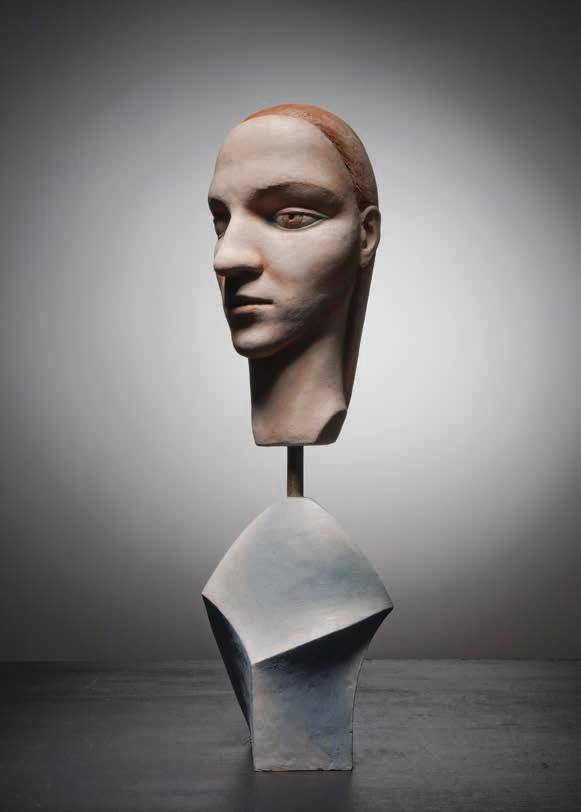
As a series of group exhibitions and his first three solo exhibitions progressed, the faceted surfaces of Stringer’s work became increasingly intricate. The wall-mounted bronze mask Nijinsky (1982, page 82), for example, turns the face of the famous early-twentieth-century Russian dancer into a concatenation of over twenty angles and planes, his high cheekbones, full lips and heavy-lidded eyes transformed into isosceles triangles.
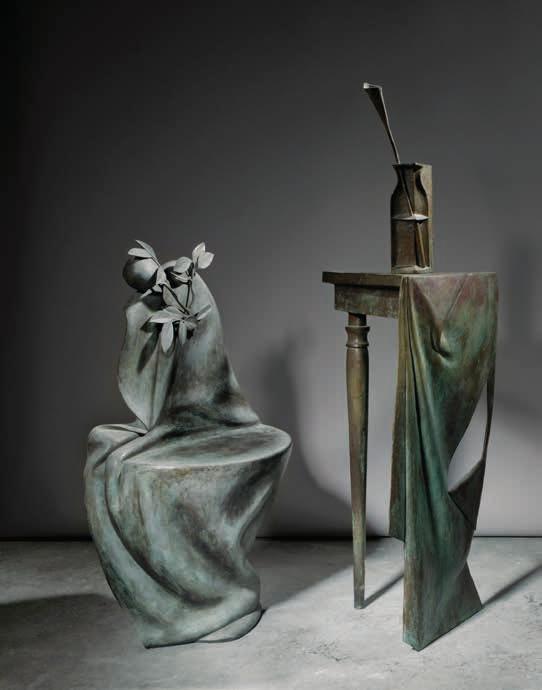
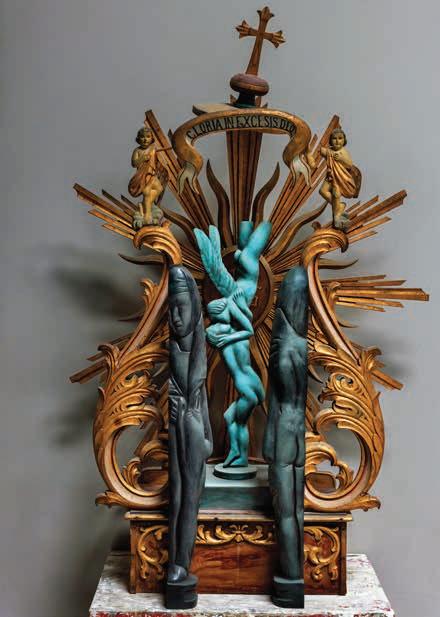
‘Just as there is a far side to the viewed object, so a sculpture should reward investigation with something unexpected. This would exist inside the shape as first seen and share the silhouette. The unexpected can be a change of subject, of scale, of treatment, and can extend the work’s narrative.’ TS
Peter Simpson
At the roundabout on Parnell Road just before Newmarket in Auckland, there is a small triangle of green known as Olympic Reserve, the setting for a monumental, 2.4-metre-tall bronze sculpture, Terry Stringer’s The World Grasped (at right, and see also maquette page 162), installed in 2006. The aspect from the south that is visible to the viewer is of a tall, elegant, nude, life-size male figure seen from behind, his arms raised and carrying on his right shoulder a huge sphere many times larger than his head. One reading is that this is Atlas, in Greek mythology the Titan god forced by Zeus to hold up the globe for eternity in punishment for rebellion.
When approached from Davis Crescent and Broadway travelling north, the sculpture presents different images to the viewer. From one direction the image is that of a boy’s head, enormous in scale, resting on his hand in the classic posture of thought or contemplation. From another the viewer sees a huge, slim-fingered, outstretched hand reaching to pick an apple, its stem towards you. The spherical shape at the top — in a perfect demonstration of the notion of ‘shared
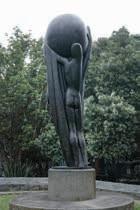
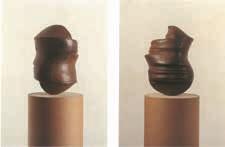
silhouette’ — is a globe or a boy’s head or an apple, depending on the point of view.
The title of the piece, unobtrusively inscribed in the bronze, so small as to be invisible except from close up, comes from a statement by the PolishBritish mathematician and historian Jacob Bronowski in The Ascent of Man (1973): ‘We have to understand the world can only be grasped by action, not by contemplation. The hand is more important than the eye — the hand is the cutting edge of the mind.’1
‘The idea of the work is to engage the passer-by with its changing appearance,’ Stringer had said. ‘The two images of a monumental scale face the traffic in each direction, while a life-sized figure stands on the pedestrian side of the footpath. This makes the work something of a puzzle to encounter in a busy street. The message of the quoted text, written on the side of the piece, encourages the viewer to continue with the experience of the world around them. And with its emphasis on touch, this makes a case for more sculpture to be part of that world . . .’2
This device of multi-angle perspective, involving not only distinctly
different images but also dramatic alterations of scale, according to the direction of vision, and with symbols sharing a common silhouette, became a dominant feature of Stringer’s work in the first decade of the new century.
For Stringer, the 1980s and 1990s were a time with no consistent or orthodox visual art style; abstract, minimal and performance works were all followed and exhibited. An Auckland exemplar was Richard Killeen, who juxtaposed contradictory signs in his cutouts. By the splitting in two (or more) of his subject, Stringer had left behind the study of a single human body. Into the figure with its long history of meaningful form, he introduced an element of multiplicity and ambiguity — an alternative subject was revealed to question what was first seen.3
* * *
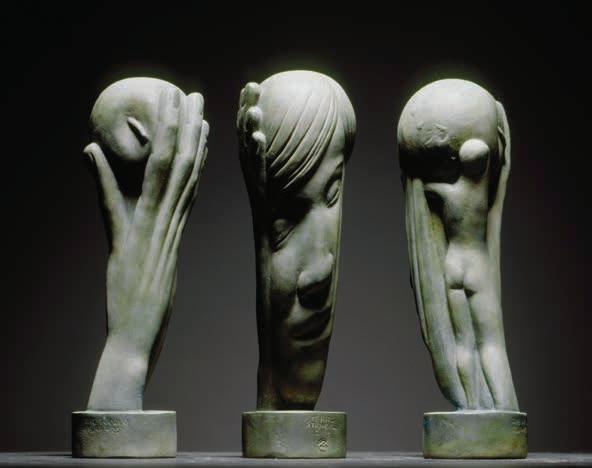
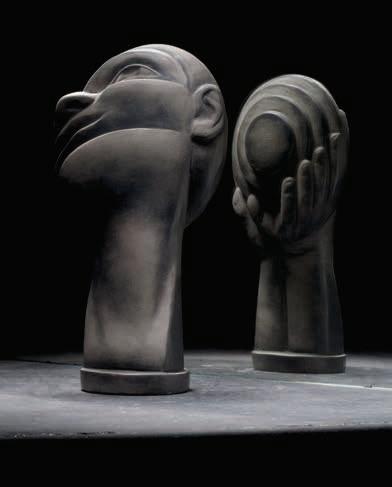
An early example of the tripartite perspective seen in The World Grasped is a small, cast-bronze piece, Seize the Day (1999, page 155). Pyramid-shaped with a roughly triangular base, it can be held in the hand and rotated so that the inscribed text is read sequentially in combination
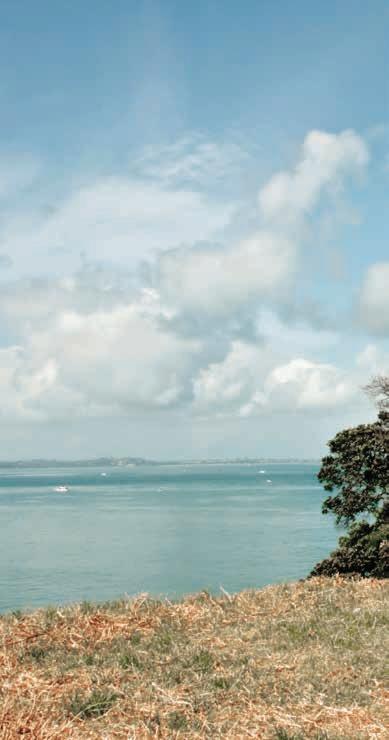
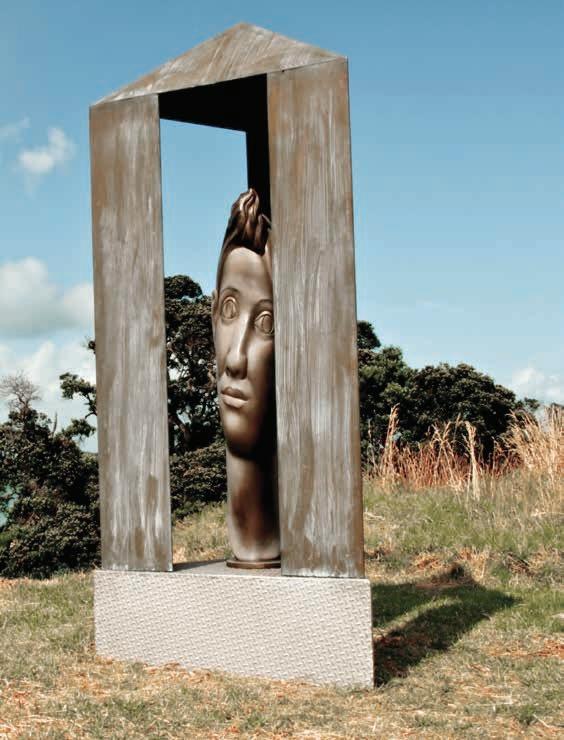
Shrine of the Sea, Soil and Sky, 2012, Sculpture on the Gulf, Waiheke Island. Bronze, 270cm. Gil Hanly
To place a canopy over a subject is to enshrine it, like framing a work for the wall. The structure reveals three images in turn. A sculpture with shared silhouettes has no hierarchy of front and back. TS
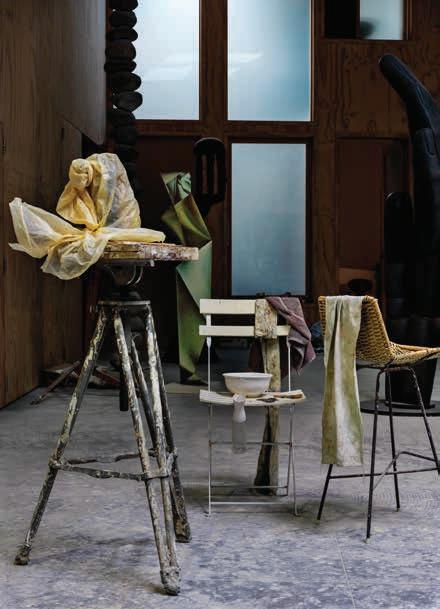
‘Bronze sculpture-making has many stages. This sequence of images showing the evolution of a head of the painter Jacqueline Fahey starts with a drawing and then the clay work. From there it is plaster-moulded in my studio and wax is poured into it before it goes to the foundry. There it is prepared, re-moulded and baked out to create a ceramic shell for the bronze to be poured into. In this manufacturing process the artist starts the sequence and then decides the final presentation. Bronzemaking is a story of life, death and rebirth over several episodes, until the work is finally realised.’ TS
Jane Ussher