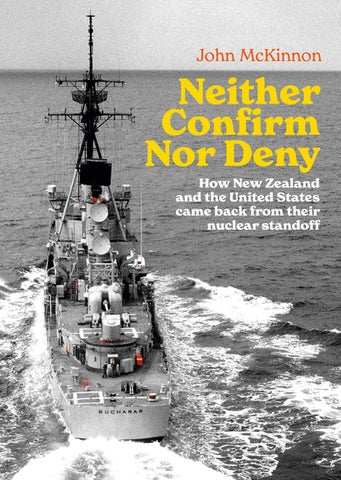
John McKinnon
Neither Confirm Nor Deny How New Zealand and the United States came back from their nuclear standoff
In memory of Avenal And with gratitude to our children and grandchildren
Contents Introduction: Two ships, two decisions
9
Chapter 1: Loyalists to dissidents
19
Chapter 2: The excommunication 1980–1990
41
Chapter 3: The grammar of foreign policy 1990–1993
57
Chapter 4: Unfinished business 1993–1996
91
Chapter 5: There to stay 1996–1999
115
Chapter 6: Friend not ally 1999–2005
131
Chapter 7: Hard floor, soft ceiling 2005–2008
155
Chapter 8: The ice is crushed 2008–2012
175
Conclusion: The law stands, a ship comes
191
Appendix 1: ANZUS Treaty 1 September 1951 Appendix 2: New Zealand Nuclear Free Zone, Disarmament, and Arms Control Act 8 June 1987 Appendix 3: Wellington Declaration 4 November 2010 Appendix 4: Washington Declaration 19 June 2012 Notes Acknowledgements About the author Index
205 209 217 219 225 241 243 245
Introduction
Two ships, two decisions I
n February 1985 the Labour government of David Lange decided that it could not permit the United States naval vessel USS Buchanan to enter New Zealand ports, as to do so would breach New Zealand’s new, proposed nuclear-free policy. In November 2016 the National government of John Key agreed that another United States naval vessel, the USS Sampson, could enter New Zealand waters, in accordance with the legislation that the Labour government had enacted in 1987. That a Labour government took the first decision and a National government the second is not of great moment; after all, National had adopted the nuclear-free policy in March 1990, and Labour had always said that it would welcome American warships to New Zealand’s ports if they complied with New Zealand’s nuclear-free policy and (after 1987) law. Yet one decision said ‘no’ and the other ‘yes’. What happened between 1985 and 2016 to explain that difference? New Zealand is known throughout the world for its embrace of a nuclear-free policy, persisting with it for the last 40 years, even at the cost of its relationship with the United States. Yet, from the day that policy was adopted, New Zealand also never ceased its efforts to rebuild relations with its major ally. This book tells the story of how, and why,
9
Neither Confirm Nor Deny
that rebuilding effort took place. It examines what happens when popular sentiment clashes with realpolitik, how governments and people responded to this dilemma, how the United States responded, and why and how this episode has great significance for New Zealand but perhaps less so for the United States. The initial standoff ended ANZUS — the Australia, New Zealand and United States security partnership — as a functioning alliance between the United States and New Zealand. Even though relations between the two countries were repaired, neither side was interested in returning to the state of affairs that had existed prior. This book reveals the delicate balance between, on the one hand, popular and political support for a policy — being nuclear-free — while on the other hand trying to repair relations with a superpower committed to nuclear supremacy. At various key stages during these years New Zealand media commentary would refer to ‘breakthroughs’ in the relationship, suggesting that many New Zealanders did not find being offside with the United States either satisfactory or stable. But at the same time being nuclear-free had also come to be seen as a symbol of nationhood, a status most New Zealanders did not wish to lose. Aspects of this episode can only be explained in New Zealand terms. Although New Zealand was, to outside eyes, a developed Western nation, it was also situated in the Pacific Ocean, a great distance from the Cold War frontlines of Europe and Asia. This had a threefold significance. First, New Zealand’s strategic outlook was necessarily different from that of the United States, committed as it was to maintaining global predominance over its rival superpower, the Soviet Union, and also from those European countries which found themselves cheek by jowl with the Soviet Union and its Warsaw Pact allies. It even to a degree differed from an Australia which was much closer to Asia than New Zealand was. Admittedly, in the decades immediately after the Second World War Asia was seen as a source of threats to New Zealand, but that sentiment had waned with the end of the Vietnam War and the American recalibration of its presence in the region. For many New Zealanders the Pacific Ocean would have been genuinely peaceful if allowed to be so by external powers. Second, New Zealand was home, indeed the only home, of Māori,
10
Introduction
a Polynesian people, who in 1990, at the beginning of this narrative, made up about 15 per cent of the total population of the country. In the 1990s the impact of this on foreign policy was limited, but New Zealand’s connections with Pacific Island nations to its north, reinforced by growing numbers of Pacific populations in New Zealand, did affect New Zealand’s external relations. And, finally, New Zealand was a trading economy which, following decades of engaging primarily with the United Kingdom, was by 1990 doing so around the globe, buying and selling with allies, with adversaries, and with many countries which were neither. Some of this helps explain why in New Zealand right-of-centre politicians and parties, which in other Western countries could be expected to be stalwart defenders of alliances, the military and national security, were more responsive to nuclear-free sentiment and less troubled by disruption to alliance relationships than might have been expected. As well as the New Zealand-specific elements of this story, this episode also casts light on the broader issues of alliance management. Alliances have existed as long as there have been states, and they have often been asymmetrical, not just because the power disposed of by states in an alliance may be disparate, but also because the interests and the reasons why states enter into alliances may differ fundamentally. This may mean that allies are often at cross-purposes when it comes to judging the value of alliances — there are many examples of this in the narrative that follows. Indeed, it could be argued, and has been, that the fundamental issue in play between New Zealand and the United States between 1985 and 2012 was not whether and how nuclear weapons should enter New Zealand, but rather the nature of the alliance between the two countries, and whether that alliance permitted ‘loyal dissent’, or not. The term ‘loyal dissent’ is useful because it encapsulates how New Zealanders saw the relationship with the United States: not as a relationship in which there was only one source of truth, but as a relationship in which divergent views on issues such as the place of nuclear weapons in military strategy could exist and be accommodated. This was how New Zealand, as a self-governing dominion, had approached its relations with the United Kingdom, and there was thus perplexity among
11
The guided missile destroyer USS Buchanan (DDG-14), commissioned in 1962. Its rejection in 1985 led the United States to suspend its security cooperation with New Zealand. Alamy
Introduction
some (albeit not those who were wishing to see all security links with the United States broken) that the United States did not regard its relationship with New Zealand through that lens. In the first half of the twentieth century New Zealand had been a self-governing nation of the British empire, and had willingly — some notable dissent aside — sent men and money to support Britain in the South African War and in two later world wars. Through that channel New Zealand came to participate in what is now publicly known as the Five Eyes, the grouping of the United States with the United Kingdom, Canada and Australia, that was forged in the Second World War and developed and deepened through the Cold War (1945–1990). The alliance of which New Zealand became a part in 1951 was one of a web of alliances which the United States constructed after the Second World War, when it became evident to policy-makers in Washington that the wartime camaraderie between the United States and the Soviet Union was unworkable in peacetime. The North Atlantic Treaty Organization (NATO) was the first and most important signal of that new approach, in which the United States saw its security as hinged to that of Europe. The outbreak of the Korean War triggered similar commitments in the AsiaPacific region. Alliances change over time, so understanding their genesis is just one part of the analysis, but it is worth noting that from that time onwards, the structure of global security was heavily shaped by the United States; in seeming to challenge that predominance, New Zealand, a long-standing ally, stood out.
This study opens in the year 1990, in the middle of a turbulent two years in which the Cold War came to an end. From this distance, it might be thought, as many did at the time, that this turning point might have meant that the United States–New Zealand standoff was a brief historical episode, for was it not a standoff about the terms of engagement between two Cold War allies? But the standoff was not brief, suggesting that alliances are shaped by internal dynamics as well as by external pressures. The United
13
Neither Confirm Nor Deny
States-led alliance system survived the turmoil of 1989–1991, and so this episode in New Zealand–United States relations in the subsequent years must be viewed in part through the prism of that fact.
For the duration of the period covered in this book I was an official in the New Zealand government, in roles which were either tangentially or directly in contact with the subject matter of this book, so the book is quite naturally informed by those experiences. However, it does not draw directly on information to which I had access at that time and do so no longer. I was a policy adviser, and I am neither an academic nor a politician. I have benefitted from access to Ministry of Foreign Affairs and Trade (MFAT) archives, and interviews with many of those more closely involved in these events. Access to archives was granted to me on the same terms as MFAT grants access to any researcher, and the manuscript as a whole, and my specific references to MFAT files, have been approved by MFAT. In the interviews I always made it clear that although in this work I would be at pains not to misrepresent anything that was said to me, nor could I guarantee that my views would necessarily accord with those of my interlocutors. I am very grateful to those who agreed to be interviewed; the views set out, and the mistakes, are mine alone. The eagle-eyed, and perhaps the not so eagle-eyed, will note that my surname is the same as that of New Zealand’s foreign minister from 1990 to 1999, and it would be fair to say that the dilemma in which that individual found himself in March 1990 was the trigger for this study. How could New Zealand square popular support for the nuclear-free policy with rebuilding relations with the United States? But that was a starting not a finishing point.
The actions of the Labour government in the 1980s have been studied and written about at length, and for that reason I only summarise that period.
14
The guided missile destroyer USS Sampson (DDG-102), commissioned in 2007 and the first US naval ship to enter New Zealand waters for 30 years, in 2016. Wikimedia Commons
Neither Confirm Nor Deny
My story in detail begins in March 1990, and the period since then has not been studied in the same way. Malcolm Templeton’s magisterial work on New Zealand’s nuclear policy concludes in 1990 with the alarming words (alarming for those, like me, who knew Malcolm Templeton personally): ‘Some future historian will have the task of describing developments from 1990 onwards, and of explaining why, contrary to widespread expectation — especially in the United States — the newly elected [October 1990] New Zealand government did not act to modify the anti-nuclear legislation or to take the necessary steps to restore the ANZUS relationship with the United States.’ I have undertaken that task, yet I am very conscious that I have not reached Malcolm Templeton’s level of scholarship. Not all readers will agree with my viewpoint, but if this work prompts more study of this episode, it will have achieved one of its objectives. There are also studies of New Zealand as an exemplar of small-state diplomacy in which the topic of this book is an important component, and there are theoretical constructs and interpretations which enrich our understanding of this episode. If bureaucrats and officials criticise academics for over-interpreting policy development, academics may well criticise those in the policy space (bureaucrats/officials and politicians alike) for not being mindful enough that they are operating within frameworks of which they are scarcely aware.1 This book’s narrative focuses on prime ministers and foreign ministers and how they dealt with this issue,2 because this was an issue on which prime ministers almost alone had to make a call, all the while balancing strong sentiment in the New Zealand body politic with a recognition that New Zealand could not afford to be too far offside with countries such as the United States and Australia. Why? The answer lies in the reach of a small state’s diplomacy. Being dissident is acceptable. But is there a point at which focusing on a single issue undermines the ability of a government to achieve outcomes in other areas? That was the constant anxiety for New Zealand’s prime ministers, and they answered that question in different ways, partly because of personality, and partly because of sentiment in the parties which they led. The story ends in 2012, the year the Washington Declaration put
16
Introduction
the seal on the revival of New Zealand’s security links with the United States, although it would be another four years before a United States naval vessel entered New Zealand waters. Of course, alliance relations, or indeed relations between any two countries, never ‘end’, unless the countries themselves do. So, there is a story after 2012, just as there is one before 1990. But that said, the period between those two dates has its own distinctiveness as a time in which a Western country in the South Pacific repositioned itself in the world, and in which its larger and more influential neighbours had to work out what that meant to them, and how they were to respond.
17
Chapter 1
Loyalists to dissidents
N
ew Zealand was not always the peace-loving nation dedicated to the rule of international law that it is seen to be today. Indeed, in an earlier era, New Zealanders were named the ‘Prussians’ of the South Pacific because of their supposed bellicose disposition. One commentator, writing in 2002, went so far as to say that in the 1980s the Americans had managed to turn a people, historically quick to volunteer for Western wars, into what he described as a defiant nation of nuclear saps.1 The islands of New Zealand, now often known as Aotearoa, lie in the southwest Pacific Ocean, distant from most other lands. Nearest is the island continent of Australia to the west, and the island archipelagos of New Caledonia and Fiji to the north. Even in the days of jet air travel, these are all two to three hours’ flying time away. New Zealand is surrounded by the ocean. When, in 1978, international negotiators agreed that every country could claim an economic zone for its exclusive use and regulation (an exclusive economic zone — EEZ) up to 200 nautical miles from its coastline, New Zealand’s zone only abutted on Australia’s at two points,
19
Neither Confirm Nor Deny
and those were generated by Australia’s offshore possessions of Norfolk Island and Macquarie Island, not by the landmass of Australia itself. Still less did the 200 nautical mile EEZ touch New Caledonia or Fiji.2 Given this isolation, it would not have been surprising if European navigators in the seventeenth century had come across a land uninhabited by humankind. But it was inhabited, by people originally from eastern Polynesia. When, in October 1769, British navigator James Cook sailed the Endeavour into Tūranga (Poverty Bay) he had on board Tupaia, a chief and priest from Tahiti. Tupaia found he could speak to the local people in his own language and be understood, and that he could understand in return. Linguists have subsequently confirmed that the language spoken in New Zealand is closest to the languages spoken in eastern Polynesia.3 These tangata whenua — subsequently known collectively to others and to themselves as Māori — were rich in oral traditions. Those traditions identified their homeland as Hawaiki. Variations of that name are scattered throughout what we now call Polynesia — Savai‘i in Sāmoa, Hawai‘i itself, and many more. But Hawaiki for the people of this land was a concept as much as a physical place, a statement that their ancestors had come from elsewhere and that they themselves would return there after passing away. Those first settlers found a land unlike any other they had known — large, temperate, hilly not to say mountainous, with snow-capped peaks and river-like glaciers. Not all the material culture of eastern Polynesia survived the voyaging, but what was lost was more than compensated for by the riches of the new land. The world of the tangata whenua was Aotearoa. They lived and fought and were born and died there, and their traditions were anchored in that place. Perhaps because of this, there was no name then for the country as a whole. But the two main islands had names — Te Ika a Māui (the fish of Māui, a traditional hero) for the northern island; Te Wai Pounamu (greenstone waters) for the southern — and they were more or less so recorded by Cook in 1769. British and French navigators began to frequent the South Pacific from the middle of the eighteenth century, engaged in both scientific and strategic purposes. This was the age of the Enlightenment in Europe,
20
Loyalists to dissidents
but it was also a period of lengthy rivalry between France and Britain for mastery of the seas and riches of the world. Between 1689 and 1815, Britain and France fought seven wars with each other, and by 1815 Britain was triumphant on both sea and land. But it was Britain’s defeat in the American War of Independence, in which the new republic was supported by monarchical France, that first brought a British settlement to the Pacific. That defeat meant that Britain could no longer ‘transport’ its convicts to the erstwhile American colonies; a new place of settlement had to be found. James Cook’s explorations of the southern seas had not only mapped the whole coastline of New Zealand, but he had also sailed up the coast of what was still called New Holland, the resemblance of that coastline to the inlets of south Wales prompting him to name it also ‘New South Wales’. In January 1788 a fleet of ships made land in Port Jackson on the eastern Australian coast to found the first British settlement in what came to be known as Australia, and with that event the islands of New Zealand came within the orbit of British power. On a number of occasions between 1815 and 1838, the British government asserted quite specifically that these islands were not within the British dominions.4 Yet, even so, London had to take account of the increasing number of British subjects who were frequenting New Zealand, of the lawlessness which had become endemic, and of the likelihood that Māori leaders would be unable to control this influx. The first course of action was to appoint a local British representative, James Busby, and exhort him to establish or at least recognise a local government with which Britain could have dealings and on whom it could lay expectations that ‘peace, order and good government’ would prevail in the land. Busby arrived in New Zealand in 1833 and supported the establishment of the Confederation of the United Tribes of New Zealand two years later — proclaimed as an independent state in He Whakaputunga on 28 October 1835.5 The Confederation adopted a flag so that ships could be registered in New Zealand but had no ability to enforce its decisions, and nor was Busby of any help in that respect. While that first course of action was stuttering, two other forces were at work which, while opposed to one another, collectively impelled the British government to pursue another strategy. On one side were
21
Neither Confirm Nor Deny
evangelical heirs of the abolitionists — those who had campaigned to end slavery. They now turned their attention to the situation of indigenous peoples, the ‘aborigines’, in — or adjacent to — the British empire. On the other side were colonisation societies who could see in temperate New Zealand an ideal destination for people from the crowded cities of Britain and Ireland. Inspired from behind the scenes by Edward Gibbon Wakefield, plans were afoot to land British subjects in New Zealand without so much as a by-your-leave from the British government and not much more from Māori leaders. Accordingly, a second course of action was adopted by Britain: New Zealand would be added to the British dominions, heed would be paid to the concerns of the abolitionists and missionaries that Māori be protected, so a treaty would be negotiated and Māori given all the rights of British subjects. On the other hand, settlement by British subjects from Britain and Ireland would be allowed and they would be permitted to acquire land, but they would be subject to government by the Crown, with settler purchase of land from Māori being strictly controlled. Hence the Treaty of Waitangi, Te Tiriti o Waitangi, first signed on 6 February 1840. The overriding objective of those settlers was to acquire as much land as necessary. For some time, the governors retained control over what was called ‘native policy’, and the Crown monopoly of land purchase continued until 1865, albeit since 1856 exercised by ministers responsible to settler assemblies, whether colony-wide or provincial. Neither provided much protection to the ‘natives’. Yet London’s parsimony did not extend to the despatch of imperial forces to New Zealand. At one point in the 1860s there were 10,000 imperial troops in New Zealand, suppressing a ‘rebellion’ of some hapū and iwi.6 Only towards the end of this conflict were Māori given dedicated representation in Parliament, despite not qualifying under the then land tenure requirements. By 1870, whether through purchase or confiscation, the vast bulk of the land of New Zealand had been acquired by settlers or by the government, and Māori became what they have ever since been, a minority in their own land. The settlers, overwhelmingly from Britain and Ireland, were in control. If British writer Thomas Macaulay’s traveller from New Zealand, apocryphally gazing on the ruins of St Paul’s Cathedral, is Māori,7 from
22
Loyalists to dissidents
about 1880 a ‘New Zealander’ was a settler or a descendant of a settler. The settler success is indirectly attested in the only other colony acquired by Britain in the South Pacific in the nineteenth century — the islands of Fiji. Ceded to the Crown on 10 October 1874, the Colonial Office, mindful of the New Zealand experience, prohibited and enforced external acquisition of land. Admittedly, as a tropical archipelago, Fiji was less attractive to British settlers than temperate New Zealand. Neither European residents nor imported Indian indentured labourers could purchase ‘native’ land, which made up the vast bulk of the islands. That laid up problems for Fiji in later years, but they were not New Zealand’s problems.8
This is history, yet it is relevant. There are two realities in New Zealand. One is the isolation of the land. The other is its close kinship with countries far away. Just as the first has always been present, so has the second, but it came into existence in a new form in the middle of the nineteenth century. The 1990s and 2000s are one chapter in the story of how New Zealanders responded to these two at times conflicting circumstances. Throughout the nineteenth century, the settlers in New Zealand and Australia were far more concerned about the ‘intrusion’ of other European powers into the Pacific than were the mandarins of Whitehall, who were juggling relations with other ‘great’ powers on a global basis. There were Russian scares aplenty in the 1880s and 1890s. The American and German presence in the South Pacific was occasional and intermittent until the end of the nineteenth century, but that changed in 1900, when, in an arrangement crafted on the other side of the world, one part of Sāmoa was assigned to Germany and the other to the United States. That was also the year that the six Australian colonies federated to form the Commonwealth of Australia — and New Zealand did not join. This was a conscious if politically uncontroversial decision. Richard Seddon, ‘King Dick’, was then New Zealand’s prime minister. His political antennae were second to none, and if he had sensed that New Zealanders wished to be part of the Australian Commonwealth he would have led
23