‘Hazel Phillips gives voice to the so-called “weaker sex”, the early women alpine explorers, who mostly remain nameless but were there, pushing limits.’ — ANNA KEELING, PRESIDENT, NEW ZEALAND MOUNTAIN GUIDES ASSOCIATION
‘Filled with courageous women who spring to life on the page, Great Hearts is an accessible and essential addition to outdoor literature.’ — NAOMI ARNOLD, AUTHOR OF 2026 OCKHAM NEW ZEALAND BOOK AWARDS FINALIST NORTHBOUND
‘The extraordinary endeavours of women battling prejudice, sexism, male ego and ill-suited clothing to win their place in New Zealand mountaineering history.’
— SIR GRAEME DINGLE KNZM MBE, MOUNTAINEER AND PHILANTHROPIST
PRAISE FOR FIRE & ICE
‘Aotearoa’s answer to Bill Bryson.’ — DAVID SLACK
‘Diligently researched, excellently presented.’
— TONY ORMAN, COUNCIL OF OUTDOOR RECREATION ASSOCIATIONS OF NEW ZEALAND
‘It’s a damned good-looking book . . . an intelligently told natural history.’ — STEVE BRAUNIAS, NEWSROOM
PRAISE FOR SOLO
‘Solo will inspire you to pull your big girl panties on, as well as tramping boots, and get exploring.’
— CAROLYN ENTING, GOOD MAGAZINE
GREAT HEARTS
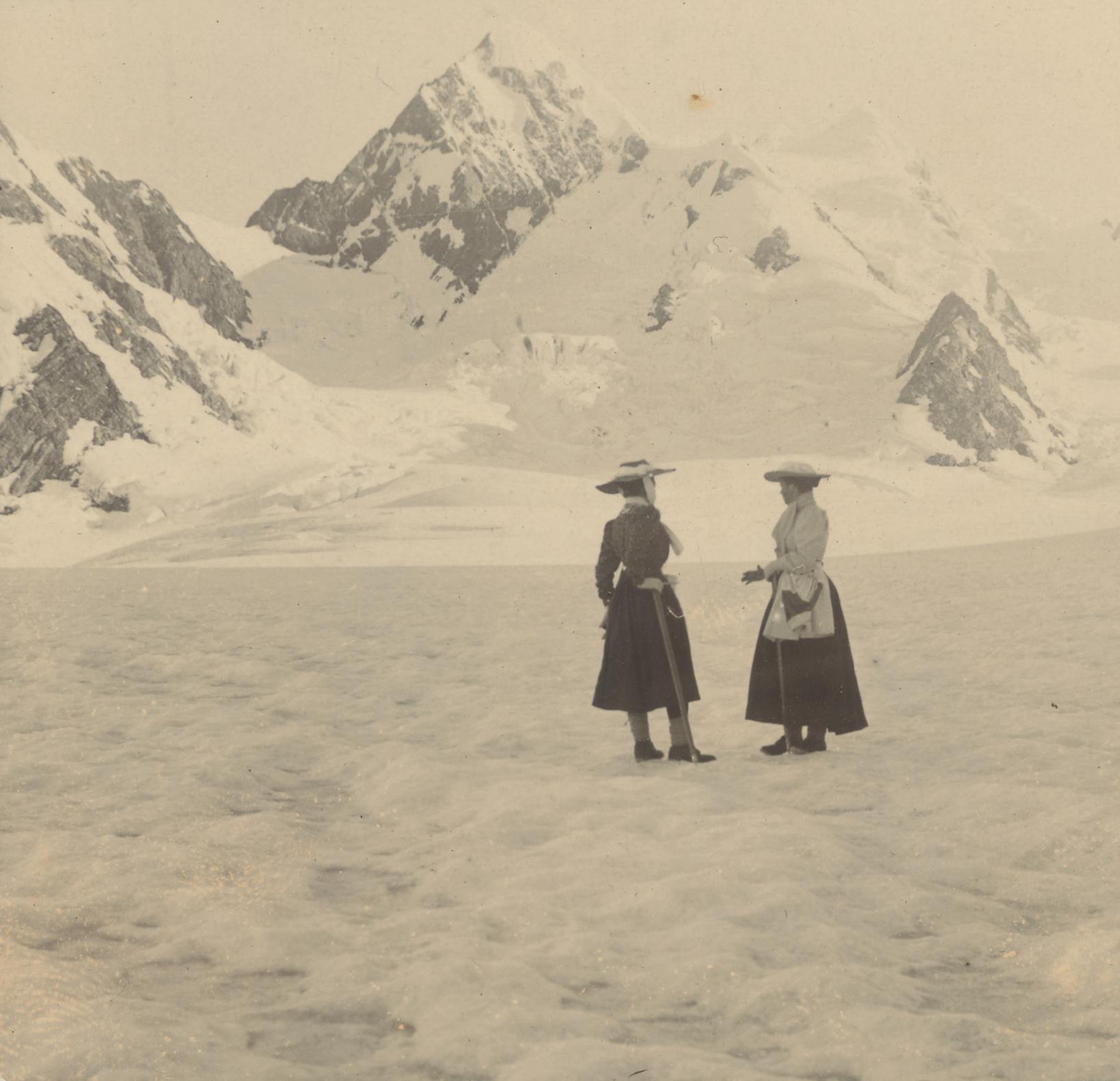
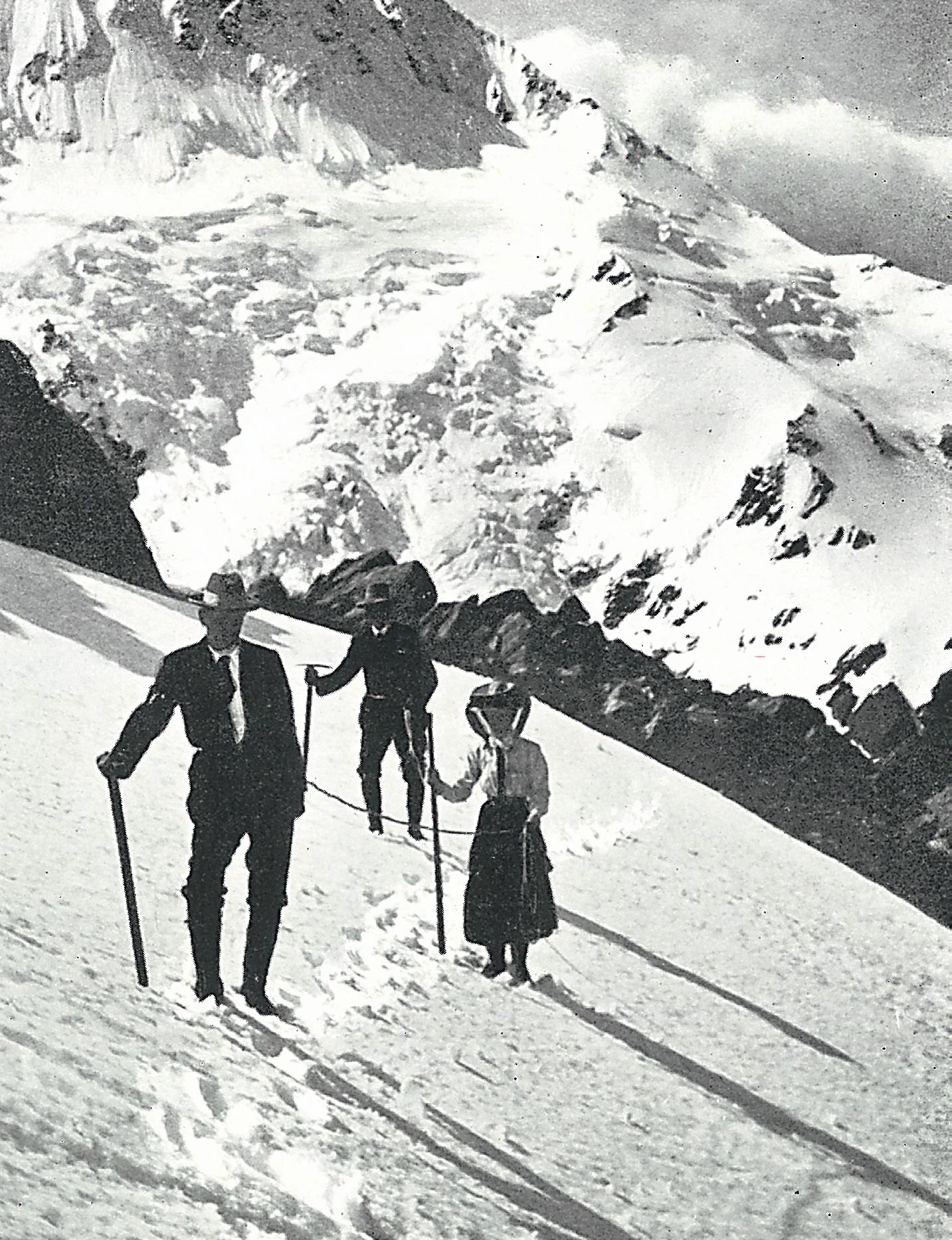
Ladies’ alpine fashions on the Tasman Glacier, date unknown.
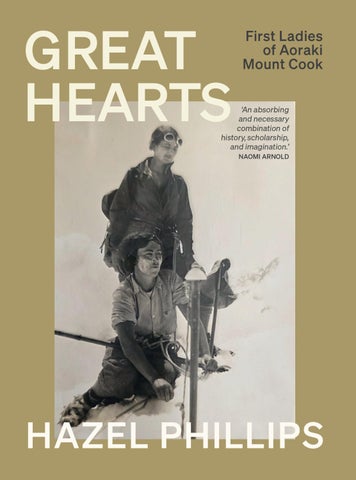
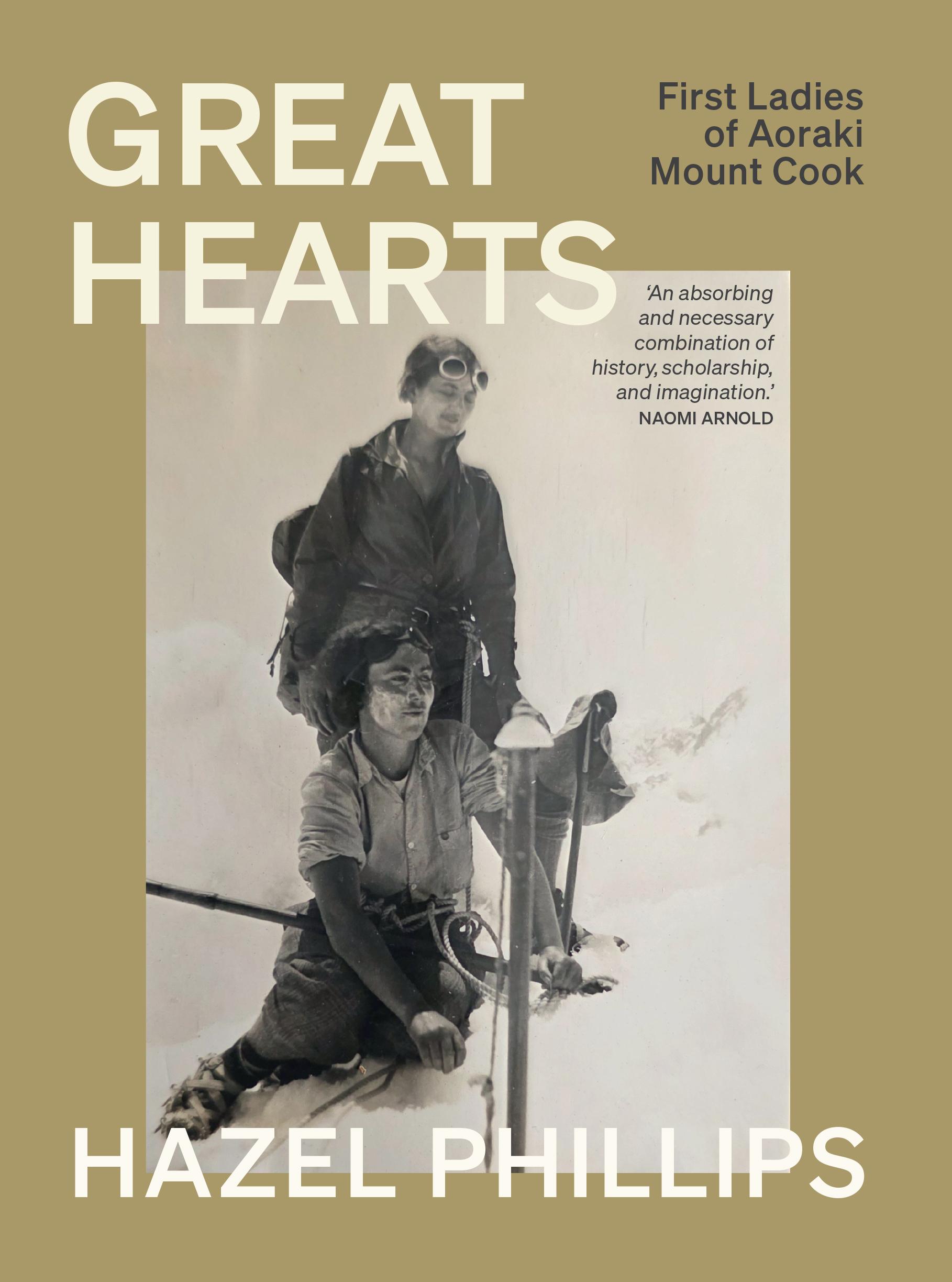
GREAT HEARTS HAZEL PHILLIPS
First Ladies of Aoraki Mount Cook
‘Of course they said Freda was insane. They said I was insane too. All mountaineers are insane, especially women mountaineers.’
— MARIE BYLES
Dedicated to all the women mountaineers, adventurers and fireside climbers — past, present and future, insane or otherwise.
Part 1.
INTRODUCTION FIRST LADIES OF AORAKI MOUNT COOK 10
LADIES ON THE ICE 17
JOANNA HARPER 22
ANNA VON LENDENFELD 34
FORRESTINA ROSS 42
JOANNA TURNBULL 54
MAY KINSEY 62
Part 2. CLIMBING HIGH 71
ROSE MOORHOUSE 76
MAUDE & ELFIE WILLIAMS 82
CONSTANCE BARNICOAT 90
LUCY MANNERING 100
Part 3. A GOLDEN AGE 109
FREDA DU FAUR 114
ADA JULIUS 122
MARGARET LORIMER 130
MURIEL GRAHAM 138
JANE THOMSON 148
Part 4. GIRL GUIDES 159
HILDA HALDANE 162
BETSY BLUNDEN 170
NORAH HAGGITT 180
JUNEE ASHURST 190
Part 5. PARTNERSHIPS AND ‘MANLESS’ CLIMBING 197
GRETA STEVENSON 202
LELLA DAVIDSON 210
ROSAMOND HARPER 222
Part 6. ENDURANCE AND GRIT 233
IDA CORRY 236
KATIE GARDINER 248
RUTH ADAMS 258
Part 7. CAREER WOMEN 271
LOUIE ROBERTS 274
MARIE BYLES 282
ANNE CONYNGHAM 292
Part 8. MOUNTAINEERING MILESTONES 303
GILLIAN JACKSON 308
DOREEN PICKENS 318
MAVIS DAVIDSON 330
TRIBUTE: THE INVISIBLE BELAYERS 340 NOTES ON FICTIVE VIGNETTES 344 SOURCES 348 SELECT BIBLIOGRAPHY 366 GLOSSARY 368 IMAGE CREDITS 369 ACKNOWLEDGEMENTS 372 ABOUT THE AUTHOR 375 INDEX 376
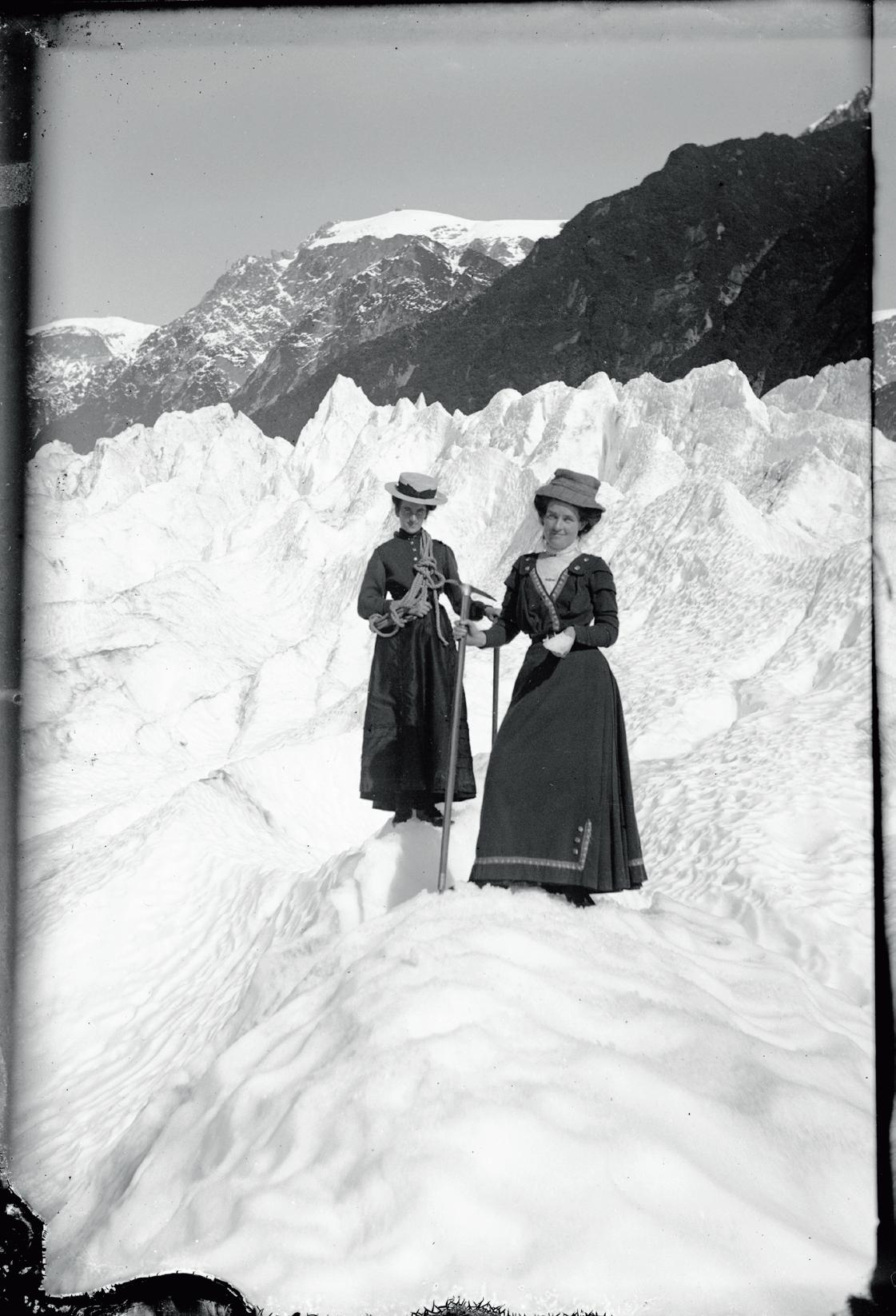
Defying the elements but obeying Victorian decorum, early female alpine adventurers navigated the ice in their Sunday best, but added a hemp rope and ice axe for safety.
FIRST LADIES OF AORAKI MOUNT COOK
In 1911, eight years after she joined the first all-women party to cross Copland Pass, climber Constance Barnicoat wrote a treatise about women and mountains. ‘Among women climbers there are a few Great Hearts, who do well, and who may hold up their heads with most men climbers,’ Constance declared. ‘After this chosen few, there are many Ready-to-Halts, who go on for a few years, perhaps, but not long enough to attain real skill or knowledge of mountains.’ This book takes its name from the former, although its author must admit to belonging to the latter — a Ready-to-Halt, not a Great Heart.
Constance was right, for her time. Many early women climbers made a few daring ascents before vanishing from the mountaineering world. But some became Great Hearts — the First Ladies of Aoraki Mount Cook. Women who pushed boundaries, defied convention and quietly rewrote the rules.
Women like Constance Barnicoat, who shocked even the typically unshockable West Coast population by wearing trousers; Ada Julius, who in one season nearly became the first New Zealand woman to climb Mount Cook; the irrepressible Betsy Blunden, who bluffed her way into a job guiding at the Hermitage. And women like Freda Du Faur, the most luminous name in New Zealand women’s mountaineering, who achieved more than any other woman before her, then walked off the page to climb in Europe and the Himalaya but never summited another mountain ever again.
In the 1943 New Zealand Alpine Journal (NZAJ), mountaineer Marion Scott wrote one of the earliest accounts of New Zealand women climbers. She lamented how hard it was to piece together their stories: ‘The times are not right for connected search or accurate checking,’ she wrote. ‘The wanted books and papers are often stored in inaccessible safes.’ The trail went cold easily. Marriage, for instance, transformed a woman into someone else altogether: Miss Muriel Pringle became Mrs Peter Graham; Miss Gillian Soper, Mrs Barry Jackson; Miss Rose Moorhouse, Mrs Arthur Edgar Gravenor Rhodes. Once married, a woman’s name — and sometimes her story — disappeared.
‘Of these women we hear once and then they vanish into their various ways of life,’ Scott wrote, ‘leaving us wondering, did they
climb again or was once enough?’ Often, marriage put an end to their mountaineering. For some, it was as if they lost themselves entirely. Search their names in the archives and you’ll find not climbing records, but rather social notes: what they wore to a ball, who they stayed with while travelling, or news of an upcoming wedding. Women were valued not for what they did, but for how they looked while doing it.
Many left no record at all. Their perspectives, their words, their inner worlds — gone. That loss is one reason this book bends genres. It is, mostly, non-fiction. But within each chapter you’ll find a short scene of fiction, which I have imagined through the eyes of each woman. These passages are my way of bringing them to life, reimagining them, of glimpsing their days, their thoughts and fears. Some scenes hold traces of truth, and the notes at the end of the book explain what’s real, what’s imagined, and where the two overlap.
A few women — such as Anna von Lendenfeld, the first woman to summit Hochstetter Dome — left behind only a faint trace. No account from Anna exists, and a sketch of her climb by American artist Frederic Schell omits her entirely, showing three men and no woman.
There were other erasures. Climber Guy Mannering, for example, omitted mention of his wife Lucy from his account of discovering the frozen camp of the 1894 Mount Cook expedition encased in the Hooker Glacier. But it had been Lucy who found it, and likely Lucy who began chipping it out of the ice. Even in very recent years, when the name of Rosamond Harper, best known as part of the first all-women ascent of 3151-metre Mount Sefton in 1934, was found in an old log book on the ridge to Mount Wakefield, the media coverage was framed not in terms of what she had achieved but rather in terms of who her father — New Zealand Alpine Club founder A. P. Harper — was.
Mountaineering histories often dismiss early women climbers for their lack of hard ascents. Perhaps, like Rose Moorhouse, or the sisters Maude and Elfie Williams, they’d climbed something considered ‘easy’, such as Wakefield, Annette or Nuns Veil; or, like Joanna Harper, grandmother of Rosamond Harper, they’d merely walked on the glaciers. This attitude ignores the considerable barriers and social
expectations these women had to overcome to be in the mountains at all. On many mixed climbs, it was also expected that the women provide all the domestic assistance required — cooking and cleaning up after the men. Throughout the expedition, of course, the women were generally dressed, according to society’s dictates, in long skirts and petticoats and wide-brimmed hats.
There were other requirements for women. Freda Du Faur wrote in 1915 of having to hire a porter as a chaperone rather than climbing alone with one male guide. From the 1920s to the 1930s female guides such as Betsy Blunden were expected to entertain guests in the lounge of the Hermitage after a long day outdoors, wearing high heels and operating the gramophone. Societal expectations were an additional burden for women to bear.
Some women, thankfully, did leave their voices behind in the NZAJ, in photos and oral histories. These included Doreen Pickens, brisk and self-assured, who thought little of men’s pretensions; Betsy Blunden, clipped and precise, her rounded vowels polished at a private school; and Gillian Jackson, bright, clear and delightfully fun . . . I hope their personalities flicker on the page.
They spoke to me through the fragments I encountered, yet I kept wondering: What were they really like? What did they struggle with, these women who had slept out under the stars, who had led other women on a rope to achieve a first, or who had climbed in order to gather material for their art, painting and sketching by candlelight deep into the night at the Hermitage? Why did they climb — and why did they stop? Could I recreate them on the page?
I struggled to write Freda Du Faur’s chapter. She had already told her own story beautifully in The Conquest of Mount Cook, and her biographer Sally Irwin’s 2000 book Between Heaven and Earth closed off the lingering questions about what happened to Freda after she left New Zealand. What was left to say about her?
I delayed writing her chapter, until Freda appeared to me in a dream in which she told me, quite firmly, that her story had to be written in her own voice, not just a single scene from her perspective. ‘You know
I’m different,’ she told me. ‘I was the first.’ And so Freda, hauntingly, dictated her chapter to me in my sleep.
When I woke up I thought this was madness, and procrastinated yet further. A week later Freda returned, scolding me for not writing her story down as soon as she had delivered her instructions to me. ‘I will as soon as I wake up,’ I promised. And I did.
Perhaps it was just my subconscious untangling a creative knot, but it’s far more exciting to imagine that Freda herself was whispering to me from the afterlife. (She never reappeared to award me a gold star, but that’s not Freda’s style.)
Māori women climbers are absent from this book. New Zealand’s early women mountaineers were almost always European and affluent, with the means to hire guides, pay for accommodation at the Hermitage, and spend time in the mountains, rather than working for a living. There’s inherent privilege in that. Ngāi Tahu writer Nic Low’s excellent book Uprising gives some details of early wāhine climbers, such as Hinetamatea, who crossed Copland Pass. I’m a Pākehā writer, and I take the approach that those stories are not mine to tell. The story of women climbers is told here through an historical Pākehā lens, but with a consciousness of the deeper cultural framework.
Aoraki Mount Cook is more than a geographic feature on a topographical map. For Ngāi Tahu he is the most sacred ancestor from whom the iwi trace their descent, with tapu status and central to identity and whakapapa. Aoraki is embodied in the landscape as a living tupuna, a bridge between the supernatural and natural, holding power over life and death.
These perspectives were not acknowledged by the early women climbers of Aotearoa, and it’s likely they weren’t aware of them. In more recent years, New Zealand mountaineers acknowledge that climbing to the summit of Aoraki is inappropriate and is discouraged. Thinking has shifted.
I’d like to think we no longer look at mountains as something to ‘conquer’, with that world’s connotations of man dominating nature. I’d also like to think most early women climbers didn’t see it that way
either — that their climbing was more about personal challenge than looking to dominate or triumph over a peak.
I want to acknowledge that Aoraki is not a challenge to overcome, but an ancestor to honour and protect, and I applaud efforts to weave pathways of understanding between tāngata whenua and the mountaineering community, and to encourage respectful engagement with a profoundly sacred landscape. I write about it because I love it.
The mountaineering stories of New Zealand women have so far existed only in niche and fragmented places. In writing this book, I wanted to bring their stories together in one place, but also to tell the story of how their efforts contributed to opening up New Zealand’s mountains to women. Mountaineers today owe a debt of gratitude to these women, from Joanna Harper, who walked on the Mount Cook glaciers in 1873, to Mavis Davidson, Doreen Pickens and Sheila MacMurray, who completed the first all-women, guideless climb of Mount Cook in 1953. I wanted to give them back their voices, restore their lost power and write them back into history. •
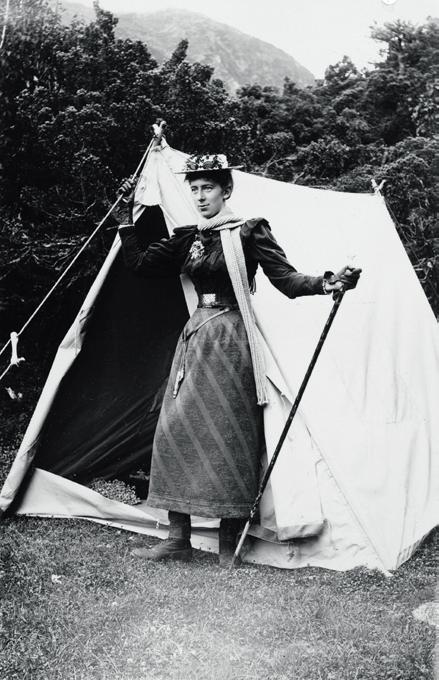
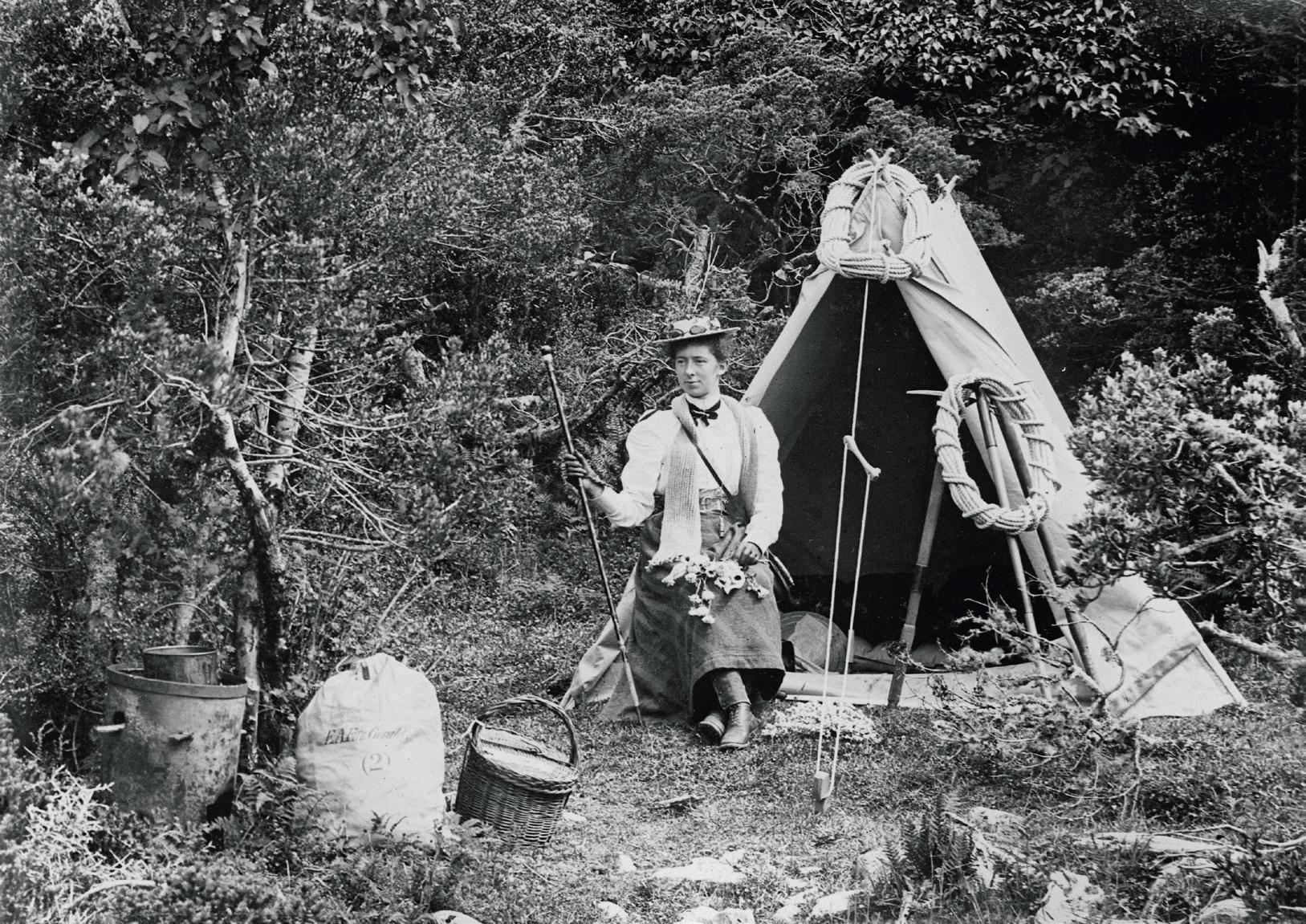
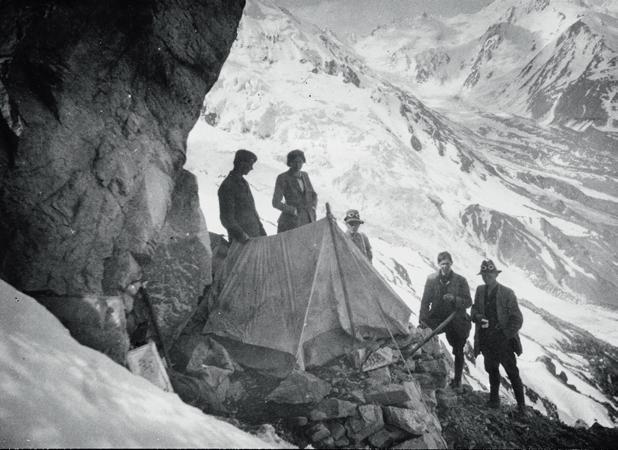
May Kinsey posing outside her tent, holding an alpenstock.
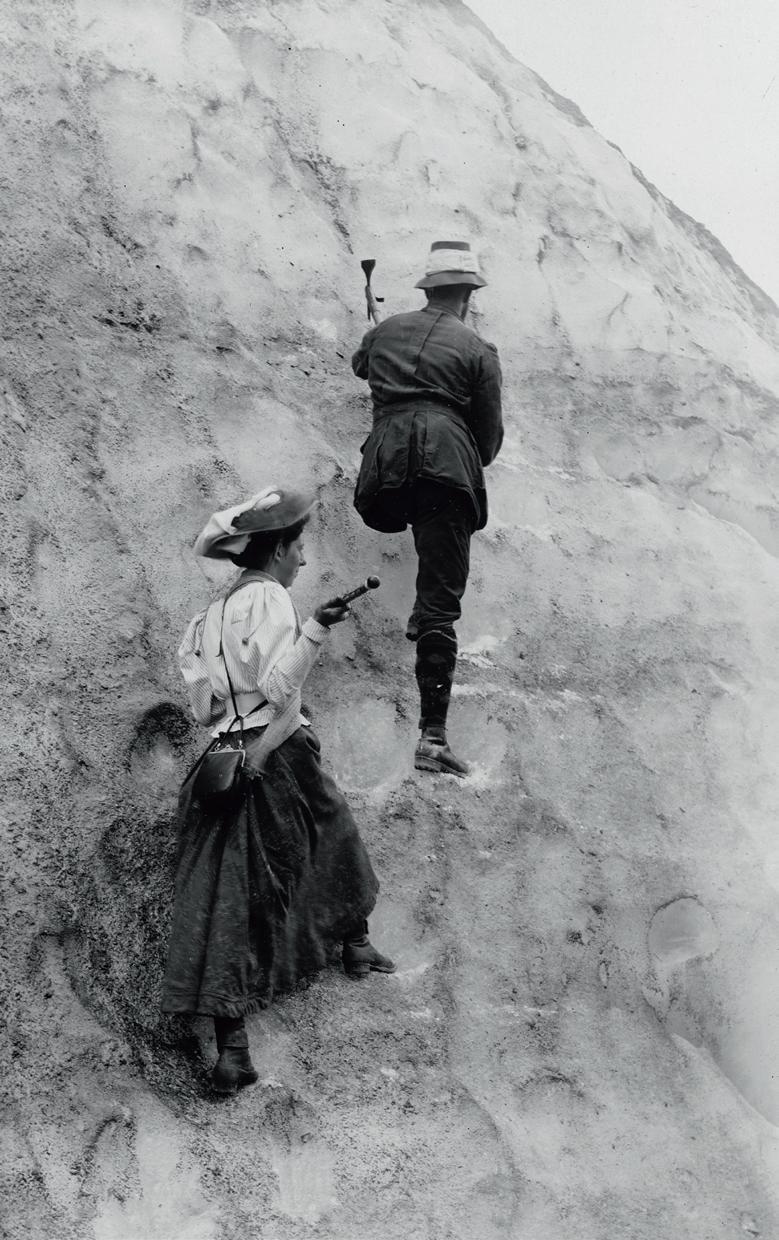
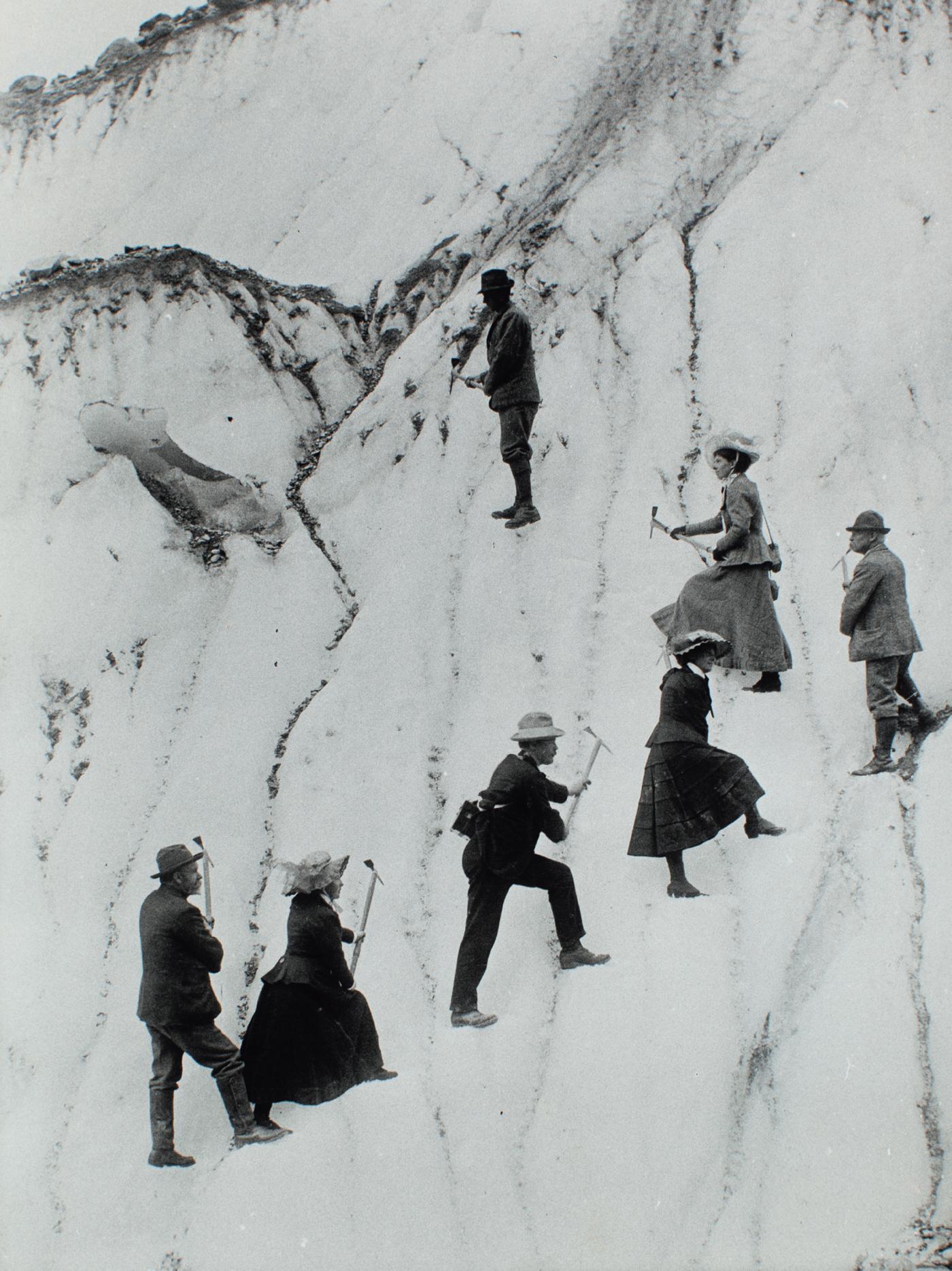
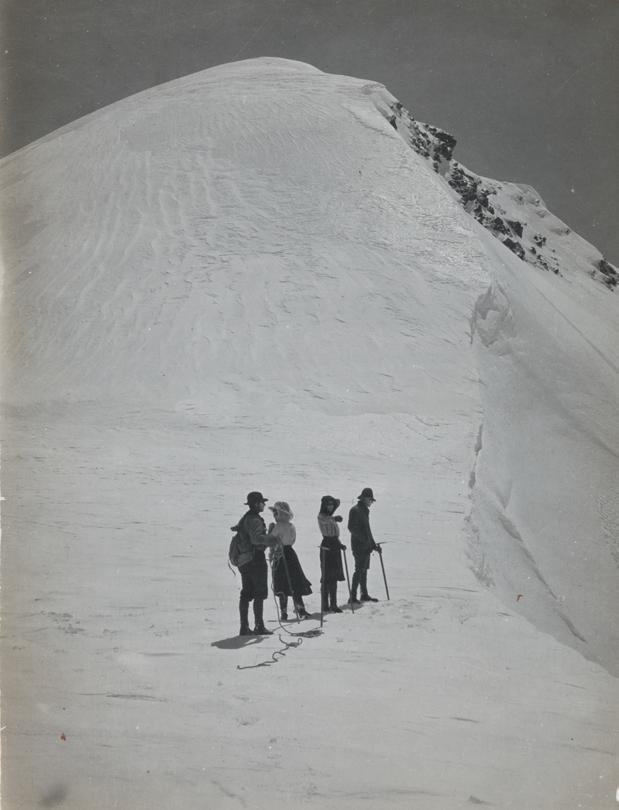
May Kinsey stepping delicately up a vertical ice face.
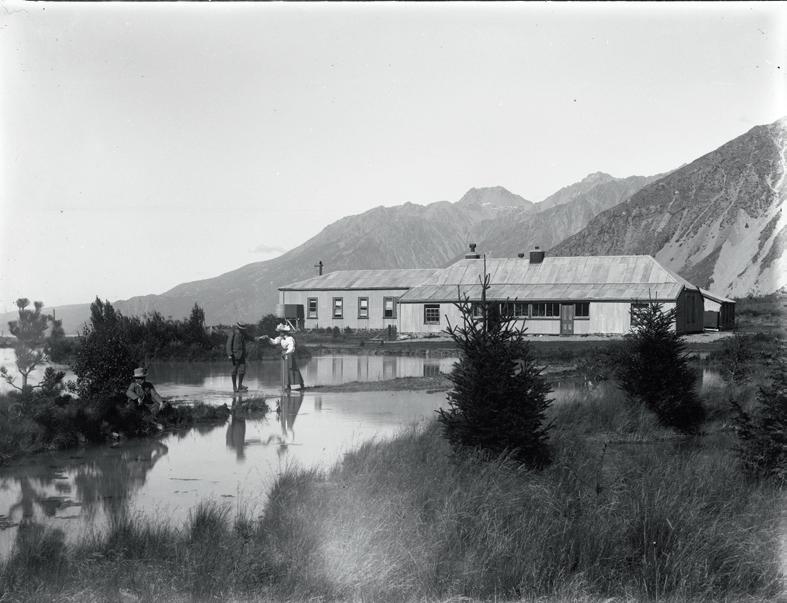
The first Hermitage was a small cob cottage with a pond at the front, sometimes used in winter for ice skating.
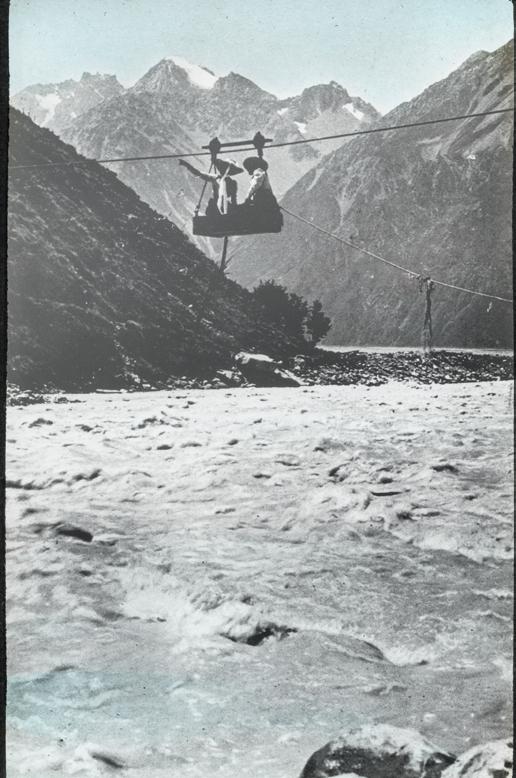
Climbers crossed the Hooker River in a suspended cage, an experience that was terrifying and thrilling in equal measure.
Part 1. LADIES ON THE ICE
JOANNA HARPER
ANNA VON LENDENFELD
FORRESTINA ROSS
JOANNA TURNBULL
MAY KINSEY
In late nineteenth-century New Zealand, ‘lady adventurers’ stood apart, belonging as they did to a class cushioned from the grind of everyday survival. Most settlers were consumed with the basics — raising shelters against harsh conditions, coaxing crops from raw earth, and carving farms out of bush and tussock. But the shadows of England stretched long, carried out on the first four ships to Canterbury. Among the wealthy elite, the rituals of an English social season were carefully maintained: the fashions, the dances, the polished manners and hierarchies of ‘Home’.
For many, England remained the true homeland, New Zealand merely a distant colonial outpost. Newspapers played their part, serving up gossip, fashion notes and reports of Christchurch’s springto-summer season. Now and then, tucked between accounts of soirées and gowns, appeared the names of women who had stepped beyond drawing-room walls and into the hills — reminders that even in colonial society, adventure had a place.
Of course many women worked, thanks to New Zealand’s industrialisation from the 1860s. The Employment of Females Act 1873 protected women’s rights to at least a half day off on Saturday afternoons, during which time they could get into the outdoors, but a working woman going mountaineering was unheard of, given the constraints on time and money. Climbers needed access to wealth and relative independence.
Mountaineering, therefore, was the pursuit of the privileged in this period. Most of those who ventured to Mount Cook, be they Canterbury runholders, visiting scientists or overseas climbers drawn to the challenge, were well off. The women who reached Mount Cook were usually the daughters, sisters or wives of these men. But when they got there the roles were sharply divided: in general, men climbed while women kept camp, or held the fort in the lounges of the Hermitage. Guides carried their gear.
Climber Marion Scott summarised the demarcation in the New Zealand Alpine Journal in 1943: ‘Woman’s place was in the camp, where she cooked large meals, mended large holes, and listened to large tales of daring and danger. Excursions suitable to their supposed powers would occasionally be made.’ Women were expected to nurture — to cook, clean, comfort and applaud, supporting the work of mountaineering but never really being part of it. In short, women were ‘less than’.
The conditions encountered by the earliest lady adventurers were extremely rustic. The first, and very basic, Hermitage hotel was not built until 1884, so the earliest women — Joanna Harper, Anna von Lendenfeld and Annie Lysaght — had to sleep under canvas. Annie Lysaght followed in Joanna’s pioneering footsteps. In late March 1877, aged 25, she camped near a small spring by the confluence of Glencoe and Black Birch creeks, where the Hermitage would later be built. Annie found the tent comfortable but slightly cold, but any hardships were offset by clear weather and arresting views.
For Annie, who had emigrated from England three years earlier to settle in Hawera in the North Island, the experience must have been captivating but also intimidating. Her party had approached from the Burnett family homestead on Mount Cook Station on the eastern side of Lake Pukaki, and had the extra task of fording the swift, icy Tasman River. Crossing the rivers that issued from the glaciers’ terminal faces required either going on horseback or crossing via a wooden cage or cradle on a wire suspended by posts on both sides, swinging 12 metres above the violent, foamy, thundering Hooker River as it rushed to join the Tasman.
In 1890 climber and writer Forrestina Ross called the river vindictive and greedy, and described the experience of the cage as ‘a sort of waking nightmare . . . though I would rather have died than have confessed it’. It was hard work to pull the cage across, and swags went separately from people as the space was so constrained. Voluminous skirts would not cut it. Forrestina wrote: ‘Indeed, any lady in the costume of the early part of this century could not have got in at all.’
In 1897 May Kinsey, who accompanied her father, notable businessman and photographer J. J. Kinsey, on expeditions, described the Hooker as ‘particularly rebellious and unkind’. ‘One feels very small when hung up in mid-air in a box above a surging and a roaring river,’ she wrote in an article featuring her father’s photographs and published in the Weekly Press in 1897.
But, she noted, ‘Very much is often made by visitors of the difficulties in getting across the river by this means, but one soon gets accustomed to it, and even begins to regret when the journey is over, in fact, several of our party made excuses to return for luggage to the other side.’
Access beyond the campsites was minimal, although a rough track led up the side of the Tasman Glacier to the site where the first Ball Hut was built in 1891. The track, formed for a visit by Governor William Onslow, 4th Earl of Onslow, in 1889, was becoming ‘obliterated’ by the time of May Kinsey’s visit in 1895. ‘It was as much as we could do to step from boulder to boulder without falling,’ she wrote in the Weekly Press. In one place, avalanche debris had swept down and blocked their path.
The huts were basic. May described Ball Hut as preferable to tenting, although she admitted that ‘certainly the living is a little hard’. Ball Hut had men’s and women’s quarters and was blessed with an additional door. During wet weather bored visitors spent their days paving the floor with stones from nearby moraines, and eventually a fireplace was built.
Before the luxury of a fireplace, May wrote of having to bring an oil drum inside during a four-day storm — they couldn’t cook outside or the wind would have blown the entire apparatus away. There was no ventilation, and the smoke nearly suffocated them, but hunger won out. ‘The tears ran down our faces but we stuck to our task,’ she wrote. ‘We buried our heads in the bunks, until at last the meat and soup were pronounced done.’ When the temperature dropped below freezing, the group opted not to light the fire again inside the hut. ‘This condition of things will not exist when the fireplace and chimney are built this year,’ May reassured her readers.
Food was plain but heavy: an abundance of hot tea, bread, porridge and tinned tongues — sometimes described as ‘sheep tongue hash’. Occasionally there were luxuries. May mentions tinned lobster, biscuits, strawberry jam, tea and condensed milk at Ball Hut. ‘I enjoyed my meal,’ she said, ‘more than I remember having done in Christchurch.’
Hut entertainment consisted of chess and checkers, learning and teaching knots, shooting kea (then regarded as pests) and monitoring the weather via the barometer and thermometer.
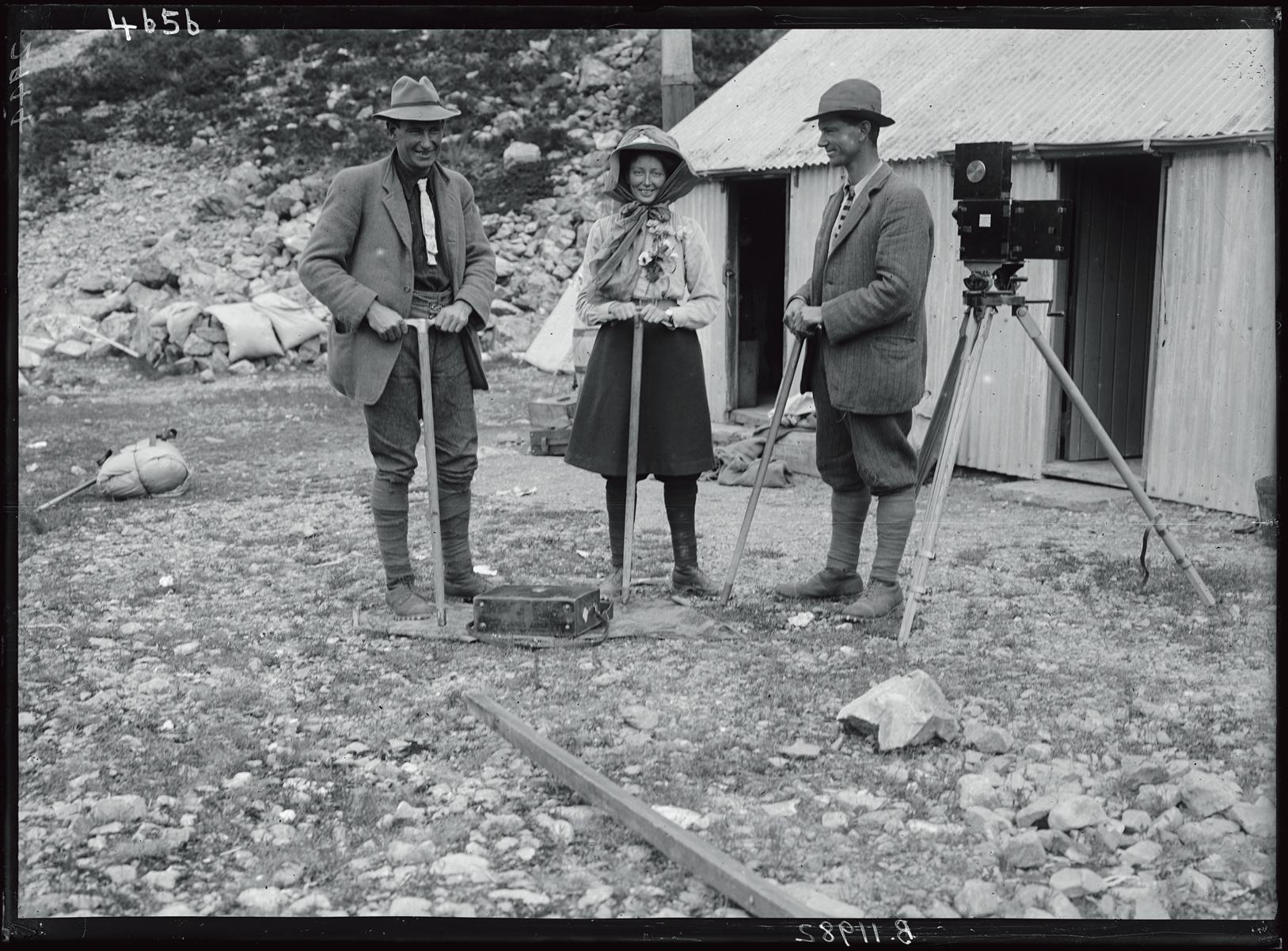
Outdoorsy women were often staunch in maintaining a feminine mode of dress, even when it clearly hindered their climbing. Early photos show adventurers such as Forrestina Ross, Joanna Turnbull and May Kinsey wearing long skirts, blouses with floppy neckties and wide-
brimmed hats with scarves draped over the top and tied under the chin to protect their faces from the sun’s intense heat on the glaciers. Gloves were de rigueur in society but here had a practical application: they also gave protection against the elements — sun, wind and cold.
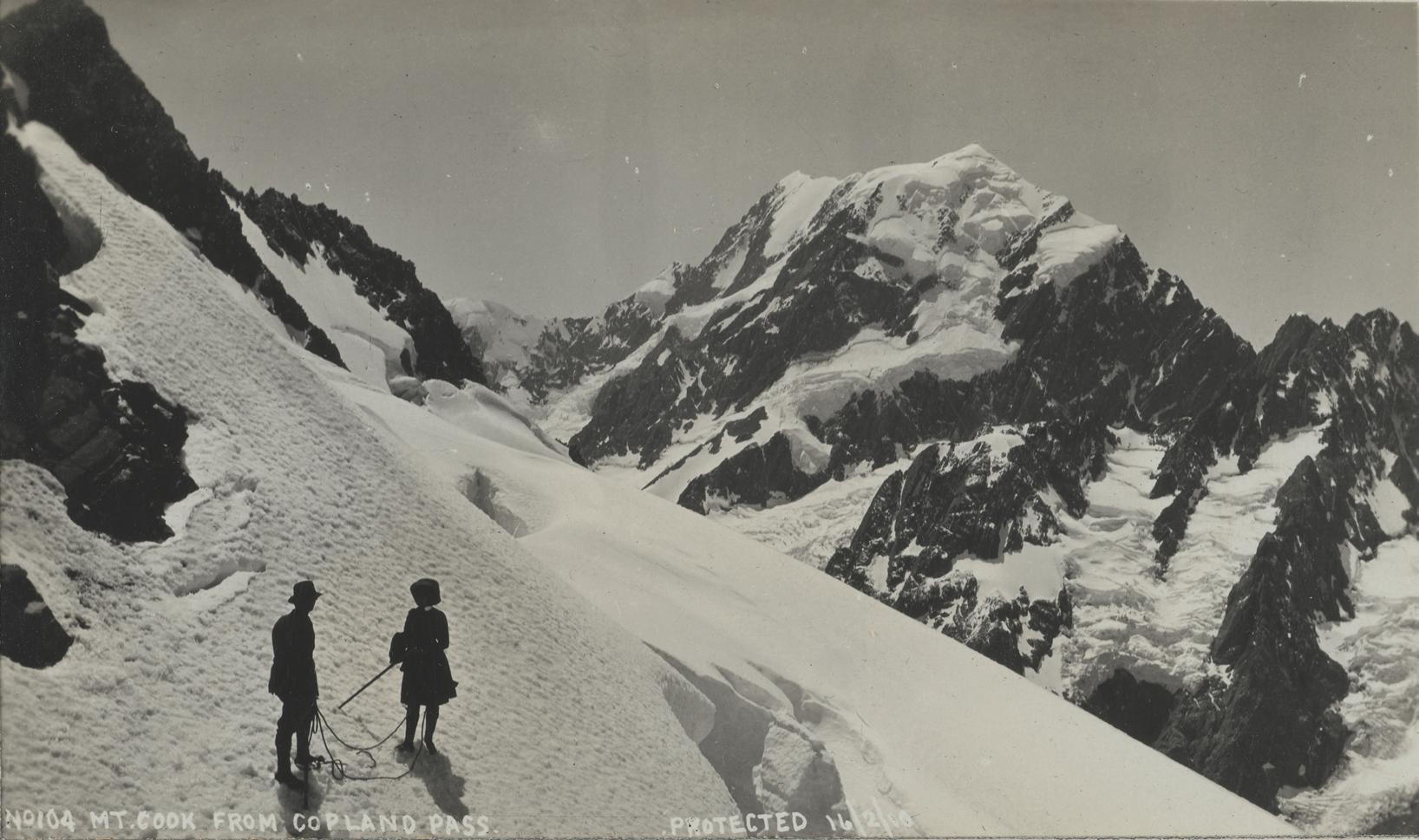
Goggles protected against snow blindness, and sometimes a brooch pinned to the chest or at the throat gave a quick nod to the fashion of the day. Very few women wore trousers or men’s clothing in these early years, and when Constance Barnicoat was spotted wearing pants to cross Copland Pass in 1903, jaws dropped. Anna von Lendenfeld reportedly wore men’s clothing, but only when she was with her husband and their porter.
Most women carried a long walking stick or an alpenstock (a staff with a metal-tipped point for digging into the snow), but some used long-handled ice axes, made from wood and metal, heavy but effective for cutting steps in the ice or anchoring themselves on steep faces.
Even so, in the early mountaineering era around Aoraki Mount Cook, from 1873 to the early 1900s, few women actually climbed. But if most women simply walked on the ice, even that was remarkable for the day. They stepped out and on, if not necessarily up, but we should not dismiss these early adventurers as ‘not climbers’. They had overcome impossible clothing, rigid social codes and the many strictures of Victorian society to even reach the glaciers, and perhaps ascend Hochstetter Dome. We can only wonder what they might have achieved had they not been weighed down by heavy skirts and heavier expectations.
Forrestina Ross, who went on to climb and explore more thoroughly than any other woman of this era, captured the longing perfectly. Writing of her fellow climbers, she confessed her obsession with Mount Cook. ‘Every summer they hear the Alps a-calling,’ she wrote of them, ‘and in the glare of the city have delicious visions of glacier and ice crest, mountain tarn and purple precipice.’
Her words still ring true, an echo from a time when to answer the call of the mountains was, for women, an act of quiet rebellion.
As Forrestina also wrote, ‘Few, if any, who have fallen under the fascination of the mountains ever shake it off.’ •
FORRESTINA ROSS
1860–1936
Forrestina Ross climbing at Mount Cook with her husband, Malcolm, and a guide.
Forrestina Ross was alone on a glacier — or she was about to be. From the camp she stared up the Tasman Glacier to a V-shape where two figures were becoming smaller and smaller. Mountain range on the left, and a moraine embankment as tall as a small building on the right. The two figures — her husband Malcolm and his climbing partner, James Annan — turned and waved their caps. Forrest could hear them give a sort of a cheer but the words were not discernible. She waved back. They got smaller again until one was lost to sight, the other just a dot. Then they were gone. It would be two nights and at least two full days before they would reappear.
For a long time she sat staring at the spot they had vacated. Like the vortex they had disappeared into, she too was squashed between features of nature — precipitous, craggy mountains behind her, in places too crumbling and smashed to contemplate climbing; and beside her endless white ice, slashed over and over by crevasses, like the rips of a knife at a loaf of bread. The campfire smouldered and kea screamed.
Forrest considered the possible dangers: a fire gone out of control; a tramp or stranger entering camp to rob her or worse; or perhaps her own dead body, lying under canvas waiting for her husband’s return.
‘I have tried to paint in the awful loneliness of the great mountains,’ Forrest later wrote in an article titled ‘Sketching recollections & reveries’.
With no sign of life near save the kea, circling, with the flash of its scarlet under-wings, and no sound save the roar of an avalanche, or the rattle of stones down the huge slope of the moraine. Always I fancied this sounded like footsteps, and the sense of aloneness grew so intense that I could not paint nor read, nor do aught except sit and watch the gleaming icefields and the splendid snow-peaks against the blue.
And when the blue turned grey, and the mist crept over the summits, and crawled down the winding glaciers, and veiled the precipices, while a little whining wind began to shake the tent-
flap impatiently, I must own I felt afraid. Of what avail against an alpine storm was one lone lorn female? The veriest bore I had shunned in the whirl of the city, the meanest male I should have fled from in happier times, I should now have greeted with embarrassing enthusiasm.
A brewing storm was darkening the sky. Forrest had 10 precious matches left and little enthusiasm for anything. Still, she dug in and got to work, theorising that the devil made good use of idle hands. She tidied the tents, put more wood on the fire before it went out, then sat down in the sun with her needlework, which she almost immediately set aside in favour of taking in the view. Sun baked the earth. Mountain lilies and daisies danced in the wind and the tussock was a golden smear. Despite the view, she ruminated — not just on her own state, but the safety of the two men.
‘Three days seemed a lifetime,’ she wrote. ‘But two nights an eternity.’
Hours later, Forrest heard voices from afar. Two tiny black figures were silhouetted against the dark grey sky, waving from the ridge. She yelled back, waved with relief and joy, then put the billy on and started a stew. Ross and Annan had turned back because of the coming storm. Back in camp, it soon hit them and whipped up an arduous night. Malcolm told Forrest that if the storm got truly terrible he planned to wrap her in a possum-fur rug and wedge her in between two boulders close to the cliff. Thankfully it never came to that.
What it did come to, however, was Malcolm’s equally novel way of keeping the driving rain off his wife. She lay with her head inside a large biscuit tin while the two men stood sentry during the night, going around the tent at regular intervals to ensure it was still properly tied down. By morning the world had quietened and the three of them went up the valley so Forrest could see the Hochstetter Glacier, with its deep, wide crevasses and towering ice forms. Further up, Malcolm told her he had named a glacier after her for her pluck and endurance — the Forrest Ross Glacier.
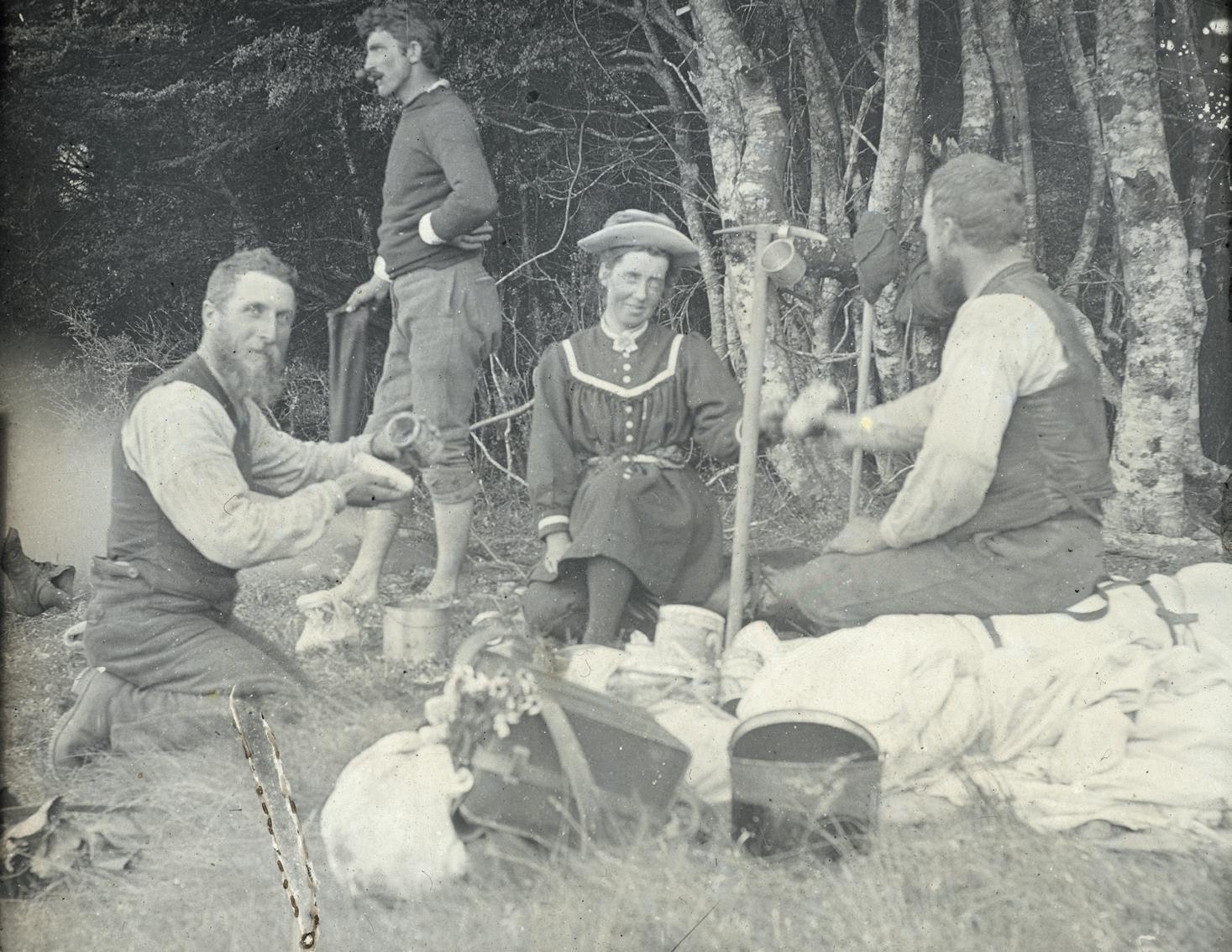
ABOVE From left: Harry Birley, Kenneth Ross, Forrestina Ross and David McConnachie, likely in the Rees Valley.
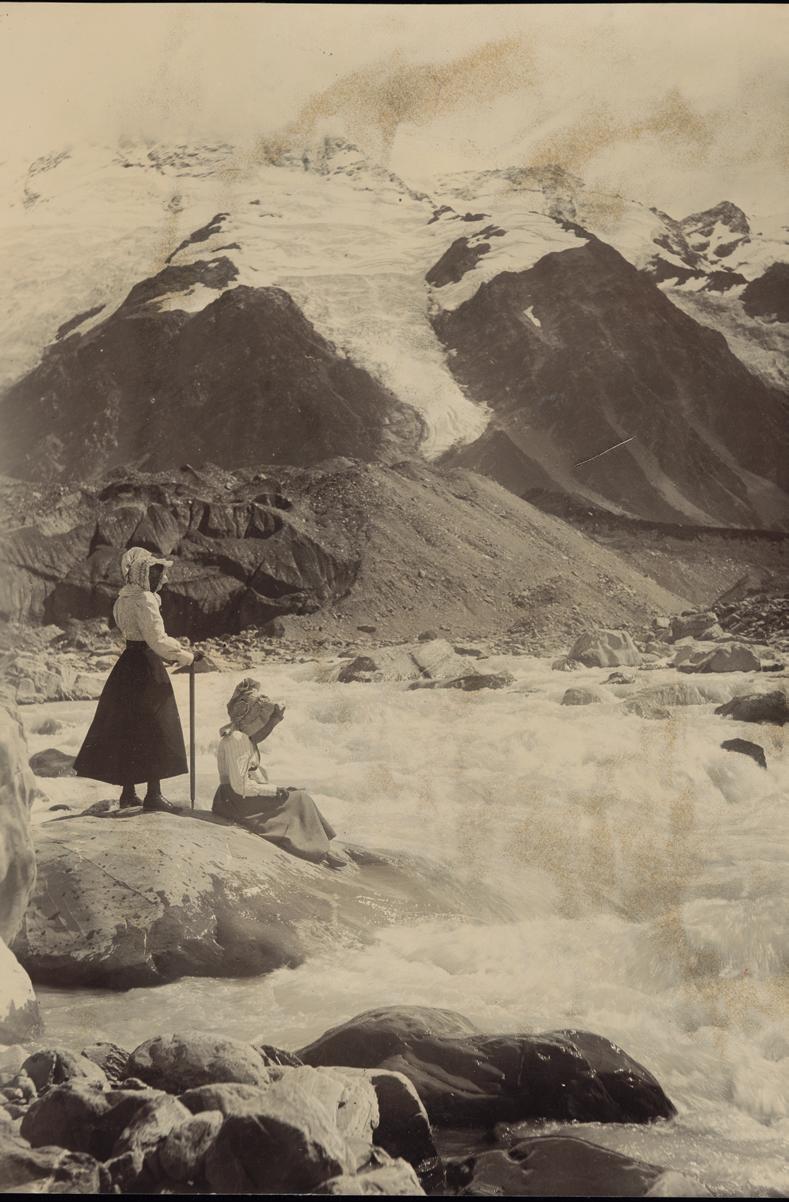
RIGHT Forrestina Ross and Joanna Turnbull by the Hooker River.
OVERLEAF Forrestina Ross and Joanna Turnbull consider the depth of a crevasse on the Tasman Glacier.
1873–1954
A climbing party organised by May Kinsey’s father, Joseph, ascending an ice face in 1895.
May Kinsey, like so many women of her era, was largely defined by the men around her — her father and then her husband. Yet within those constraints, May carved out her own small measure of freedom.
Her father, Sir Joseph James Kinsey, was a prominent leading Christchurch businessman and collector of books and art, who was closely connected to the early Antarctic expeditions of Shackleton and Scott as their Christchurch lawyer. May was her father’s only child and they shared a taste for adventure, philanthropy and photography. Although it wasn’t fashionable to smile in portraits, it seemed that Sir Joseph could never resist: his bright eyes and curved half smile in photos with May hint at a rare kind of father–daughter partnership — one that made room for mischief and mountain air. He was often described as exuberant.
Like most other early women adventurers, May was born into wealth and connection. In the newspaper society pages her identity was stitched together with fabric and colour: ‘Miss May Kinsey, in buttercup silk and mignonette green velvet, was very pretty.’ And yet other photographs, almost certainly staged near the Hermitage, show May standing proudly in her mountaineering garb, and convey the thrill of adventure. One bears the teasing caption ‘Old May in her den’.
May moved easily among the great names of her day: Antarctic explorers Ernest Shackleton and Robert Falcon Scott, aviator Jean Batten, and writer George Bernard Shaw were all guests at her father’s house, Warrimoo, on Papanui Road. Convention dictated that women, even ‘adventurers’, were expected to be chaperoned. May’s father’s endorsement, as an experienced early adventurer around the Mount Cook area, meant May escaped some of the usual scrutiny.
In the summer of 1895 May stayed at the Hermitage with friends and visited the three main Mount Cook glaciers: Hooker, Mueller and Tasman. Late that season she was invited to join her father’s party of mountaineering icons — Arthur Ollivier, Edward Fitzgerald, Matthias Zurbriggen and Jack Clarke. Clarke later said in The Press: ‘Miss Kinsey was the only lady accompanying the expedition, and deserves great credit for her pluck and endurance.’
The publication observed: ‘In our picture the hut presents a better
appearance than usual, from the fact that the party had a lady with them, whose womanly instinct introduced order and insisted upon it being observed in the house.’
‘Miss Kinsey did some sensational climbing on the Southern glaciers,’ the New Zealand Times wrote in January 1897. ‘We believe we are right in saying that the present is the first occasion on which a woman has decided upon sharing the difficulties and dangers of an ascent of any of the peaks of the Southern Alps.’
An article in the New Zealand Alpine Journal in 1993, however, was scathing: ‘Not all women were so energetic, and it was easier to pose as a climber, as May Kinsey seems to have done in 1895–96, than to actually climb.’
Patronising attitudes to women’s achievements were never far from the surface. Perhaps Sir Joseph had May in mind when he described Mount Ollivier, the peak just above the present-day Mueller Hut, as ‘a delightful little climb’ suitable for ladies, comparing it to their hometown peak of Mount Herbert on the Lyttelton Harbour, which was of a similar altitude gain.
May Kinsey was among the early guard of women to step onto the glaciers, and she was tough. She was a keen cyclist, once cycling 80 kilometres into a headwind, climbed hill after hill, trained as a nurse, and passed her St John Ambulance exams.
There’s a quiet clue to her enduring influence on the climbing party. In one still-life photograph of mountaineering equipment, Sir Joseph included May’s straw hat, complete with flowers, alongside ropes and axes. She also appears in several action shots, scaling an ice face. Whether staged or spontaneous, those photographs suggest an acknowledgement that May Kinsey was not merely playing at adventure, but living it as far as the times would let her.
May Kinsey. Ball Hut, 1895
I coaxed the fire back to life with a poker that had once been part of an ice axe. I’d become practised at getting a fire to cooperate. Mr Zurbriggen came over with an armful of damp firewood. ‘Fräulein Kinsey, you make the hut beautiful,’ he said in his thick Swiss accent,
ABOVE May Kinsey, dressed for climbing, outside her tent. Photographed by her father, Joseph Kinsey, in 1895.
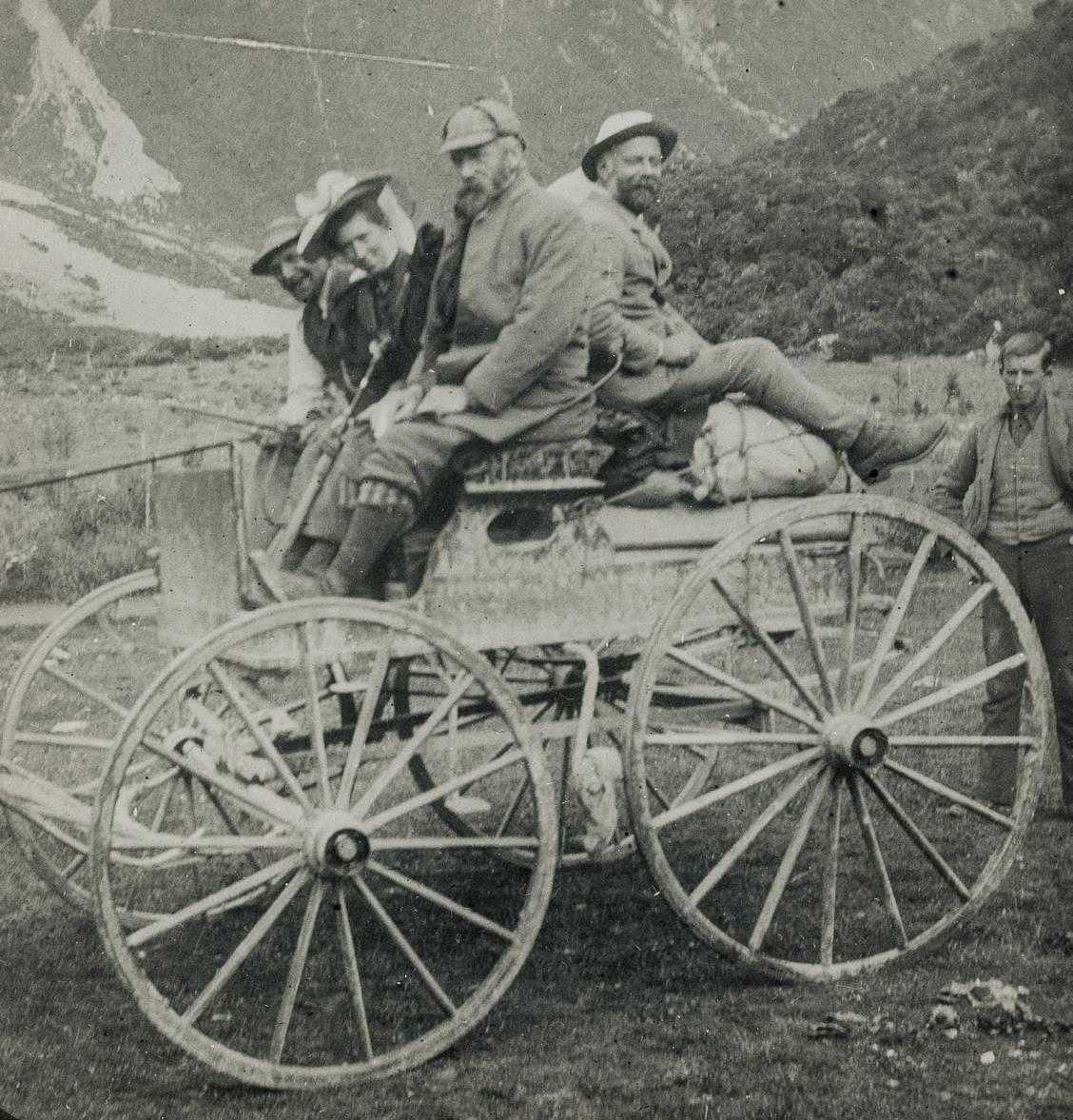
RIGHT May Kinsey and her father leaving the Hermitage by horse and cart in 1895.
The Nuns Veil, in the Liebig Range.
Ada Julius was in the first ascent party of Mount Aylmer.
Ada Julius at Stronechrubie with her friend James Robert Dennistoun.
The Haast bivouac used by the Graham party on their ascent of Mount Cook in 1915.
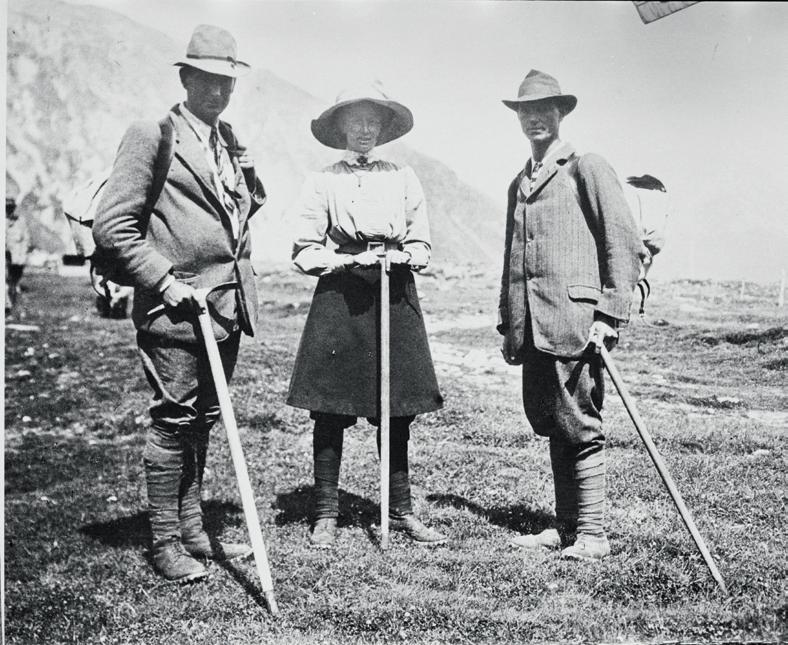
From left: Peter Graham, Muriel Graham, Jack Murrell, Dick Young and Frank Milne. Freda Du Faur with her guides, Alec and Peter Graham.
Part 3.
A GOLDEN AGE
FREDA DU FAUR
ADA JULIUS
MARGARET LORIMER
MURIEL GRAHAM
JANE THOMSON
In December 1925 a writer for The Press painted a glowing picture of the climbing culture at Mount Cook. He exalted the glories of peaks such as Elie De Beaumont, La Perouse, Malte Brun and Mount Tasman, calling them ‘famed amongst climbers far and wide’. The Hooker and Mueller glaciers, he added, were easily accessible ‘even for ladies’. Walks there would be of ‘absorbing interest’, best enjoyed in dry, invigorating air and bright sunshine.
Even for ladies. The message was clear enough: women might enjoy the air, but not the heights. The outdoors could refresh them, but not challenge them.
Yet this view was out of step with what was actually happening in the mountains. A new era in women’s mountaineering had arrived, and female climbers were pushing far beyond the polite limits set for them. Routes such as Hochstetter Dome and Copland Pass, once considered ambitious objectives, were becoming almost routine for women climbers. In fact they were beginning to be seen as tourist outings — an idea that would have horrified early climbers such as Constance Barnicoat.
By 1910 Copland Pass was no longer considered the formidable challenge it once had been. A report in the Dominion that year admitted that although the route was ‘arduous’ and forced climbers to sleep outside, ‘it is not reckoned by expert alpine climbers a difficult pass’.
In 1918 another barrier fell: two women crossed Copland Pass from the Hermitage and back again without a guide. Unfortunately their names were not recorded, but there is speculation that one of them may have been Muriel Graham, wife of chief guide Peter Graham.
Hochstetter Dome also slipped into the category of a tourist objective. Perhaps it was a sign of shifting ambitions that in her 1915 book The Conquest of Mount Cook Freda Du Faur confessed she had tried the Dome several times without success. Dozens of tourists climbed it every season, she wrote, but it had defeated her. With her record of much harder climbs, she decided she wouldn’t waste any more energy on it.
Of course as soon as any peak or obstacle had been achieved by women, its status was immediately downgraded. English mountaineer Albert Mummery observed this exact pattern in his 1895 biography:
All mountains appear doomed to pass through the three stages: an inaccessible peak, the most difficult ascent in the alps, and an easy day for a lady. In other words, once a great peak had been climbed and was no longer deemed out of reach, any ordinary person might have a go — even a woman — and the mountain’s greatness was gone.
The label ‘an easy day for a lady’ slipped into the climbing lexicon as a tidy way of diminishing a climb. There was a sense that if a peak had been climbed by a woman, rather than accept that this meant she was strong, fit and determined, commentators decided that the climb in question must not have been as hard as initially thought. As the superintendent of Tourist and Health Resorts wrote in a report in 1918: ‘That Copland Pass presents no special difficulties is shown by the fact that last April a party including three ladies, in charge of the Government guide, accomplished the trip.’
The golden age for women’s climbing spanned the 1910s and 1920s. It was an era lit up by Freda Du Faur’s historic 1910 ascent of Mount Cook, and by climbers such as Ada Julius, who came only for one season but left behind an impressive record. Ada was the second woman to climb Malte Brun, the first to summit Elie De Beaumont, and part of a party to complete the first ascent of Mount Aylmer at the head of the Tasman Glacier — all achieved with no background in mountaineering, but some stout tramping experience. She was just 29.
Annie Lindon was climbing in the same period. In 1909 she became the first woman to climb the Nuns Veil, a peak in the Liebig Range that became a must-do in any lady climber’s apprenticeship. She was the first woman to do any ‘serious’ high climbing at Mount Cook, and amassed an impressive list of ascents, including becoming the second woman to summit Mount Cook, in 1912, and the first woman on Mount Annette, which — along with the Annette Plateau — was named after her.
Unfortunately, the historical record for climbing in the early part of this period is patchy. The New Zealand Alpine Club was inactive between 1897 and 1914, leaving any achievements thinly documented. Then the First World War took many dominant male climbers
FREDA DU FAUR
1882–1935
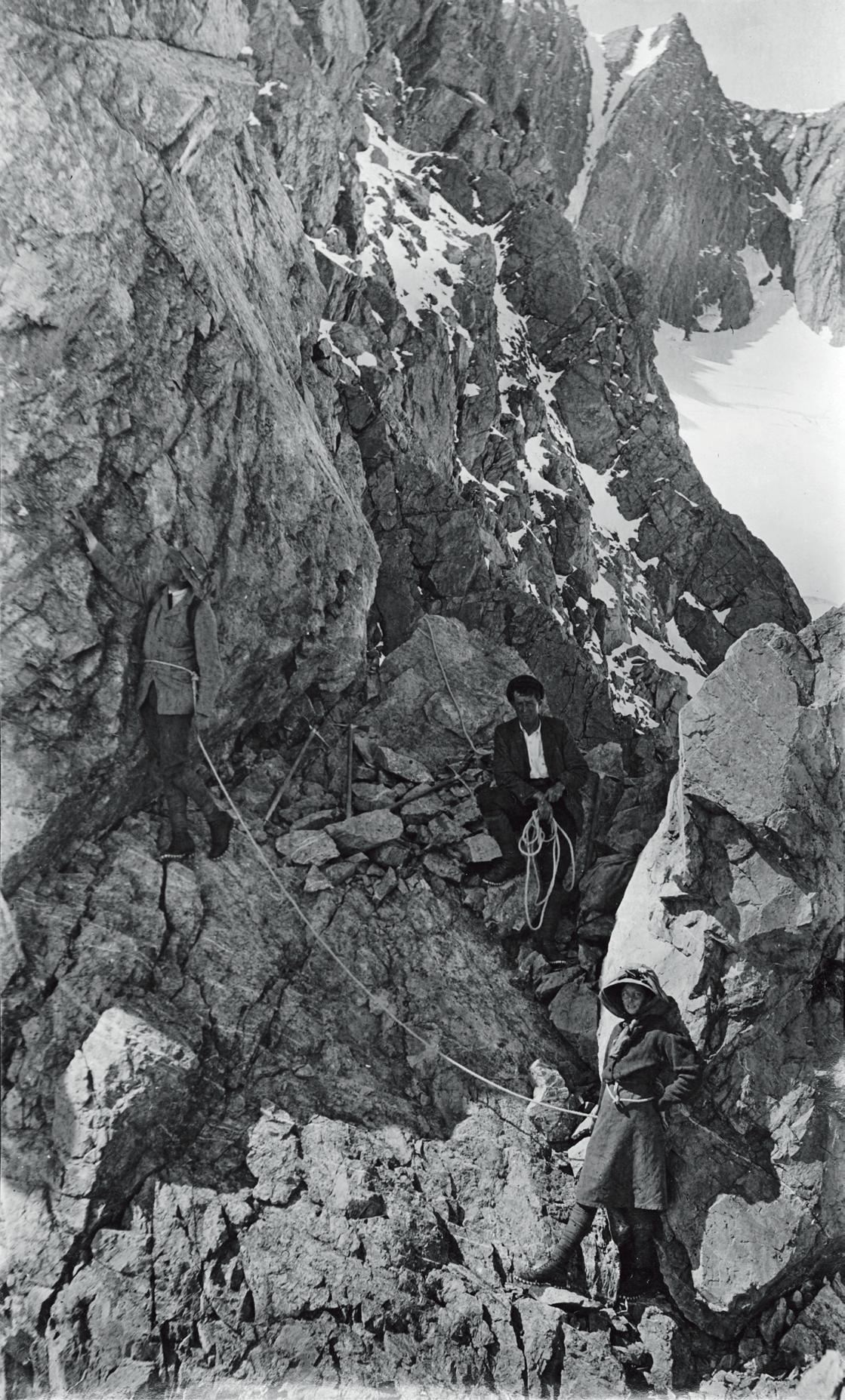
Freda Du Faur climbing Nazomi with Peter Graham and Alec Graham.
You have probably heard of me, the first woman to climb Mount Cook. To say that sounds arrogant, I know, but I am often accused of arrogance and it largely does not bother me. Such accusations usually come from people whose eyebrows are raised at the notion of a woman pursuing ‘a man’s sport’, then having the audacity to write about it.
One man described me as tenacious, feisty and unpretentious, then expressed surprise that I had nevertheless retained my femininity, as he had observed me wearing a long skirt of pink billowy tulle around the Hermitage. As if qualities such as tenacity would naturally cancel one’s femininity; as if the two could not co-exist.
I trained as a nurse, and it ruined me. I knew myself well enough to recognise that I was sensitive and highly strung, and the mental strain of nursing proved too much. No demand in mountaineering could compare with the prolonged pressure of caring for other people, of having to forgo proper sleep, air and exercise. It almost ended in a breakdown, and I gave it up.
I spent summers in the North Island, where I occasionally caught glimpses of Mount Egmont from afar, though never in enough detail to interest me properly. Mountains were foreign to me, but I had taught myself to rock climb in Ku-ring Gai Chase National Park, next door to our estate in New South Wales. I had a long apprenticeship of being toughened up, courtesy of two brothers who called me a ‘girl baby’ if I failed at anything.
After a five-year rock climbing apprenticeship, I had developed a love of exploration and adventure, and a self-reliance that sometimes terrified my parents. This all laid a strong foundation for my mountaineering career.
I never saw a distant range without longing to know what lay on the other side.
After Aunt Emmeline left me an inheritance, blessing me with independence, I travelled in 1906 to the New Zealand International Exhibition in Christchurch, then to Mount Cook to see the Southern Alps. I was enthralled. I went there only to look, not to climb — until I joined a party being led by Peter Graham onto the Sealy Range.
ABOVE Freda Du Faur and her guides, Alec and Peter Graham.
BELOW Freda Du Faur and Peter Graham on Copland Pass.
thinking life there would be better for us both. Muriel intended to train as a doctor, and it would be cheaper and less competitive entry there than in England. Meanwhile I would take up climbing in my home country. None of this eventuated.
I was always at my happiest when exceptionally fit, and climbing in ways that produced a sense of achievement. I did not climb again in Australia. In fact, I never climbed again.
Muriel and I were together for 15 years, and then it all went wrong. In February 1929 she had a mental breakdown and went temporarily insane, making a terrible scene at our boarding house. I took her to the doctor and explained. Muriel was rude to the doctor, who told her that were she not careful, she would end up in a padded cell.
I had nursed Muriel for a year by that point, and had had no sleep the night before. Therefore, I was not entirely myself when I told the doctor that I feared a similar breakdown for myself. The doctor arranged for Muriel to go to a nursing home for a few weeks, and recommended I go with her to take a rest cure.
On arrival at Strathallan Hospital, I arranged entry, went to check the room, and when I got back, Muriel was gone.
For the next week I was in a daze, semi-conscious, heavily drugged, and I took whatever food and medicine I was given. It was deep sleep therapy. I believe we were both kept unconscious for several weeks, though I cannot be sure.
I heard a voice, and it said: ‘You will have nothing of your own any more and never be as before. You have an inverted hedonistic persuasion — will you do as you are told or have eternal pain?’
I was monitored constantly by a nurse who watched me at all times, clad in a white apron and a full veil with a pale blue uniform, stiffened cuffs and white shoes. She sat there in my room. I viewed this as imprisonment.
Eventually I regained control over my state — I do not recall how — and got out of Strathallan. They would not let me see Muriel. Her inverted persuasion was the root of her problems, they said, and the