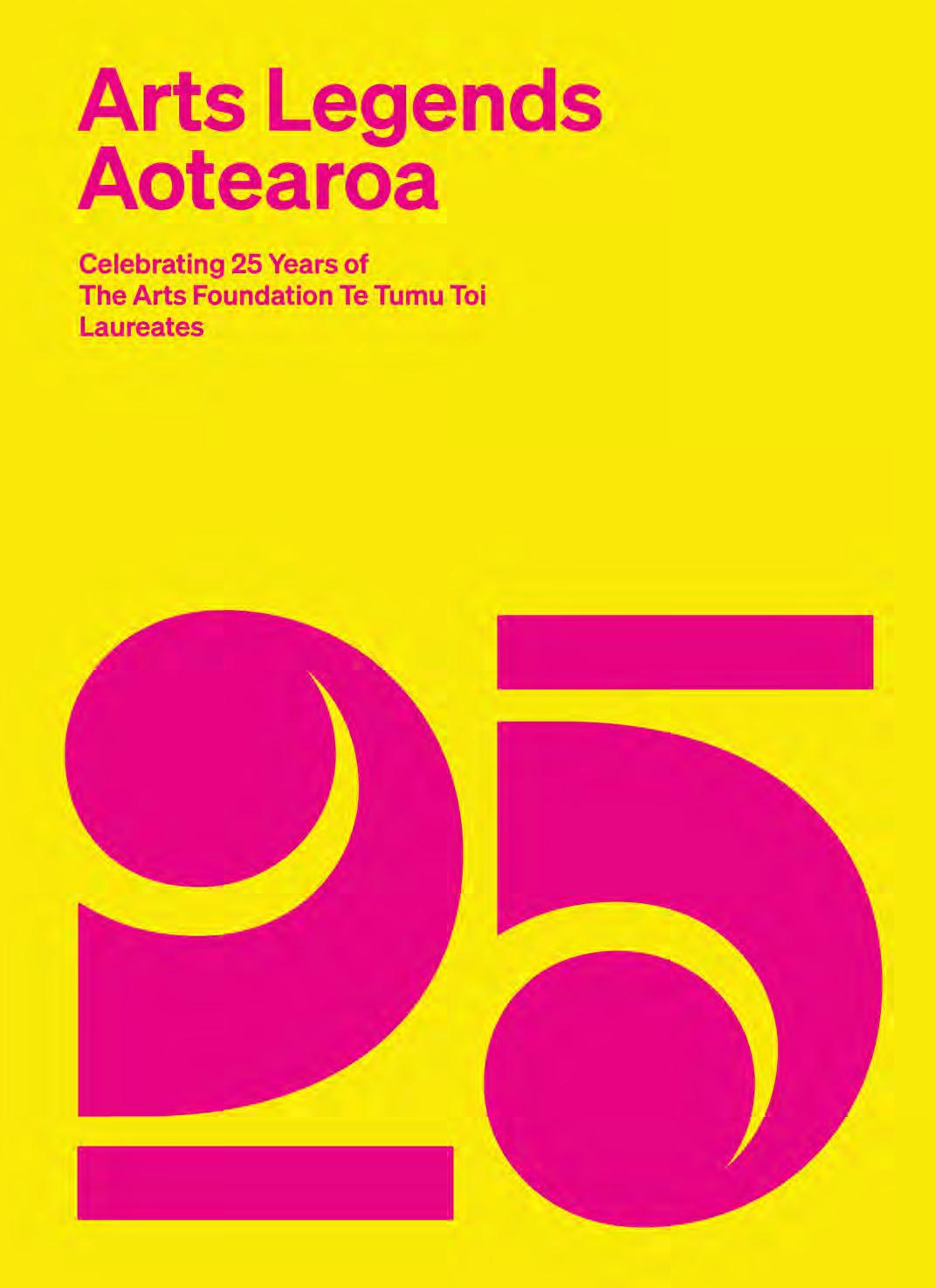

Celebrating 25 Years of The Arts Foundation Te Tumu Toi Laureates
Twenty-five years ago, the Arts Foundation Te Tumu Toi began with a simple but ambitious idea: that extraordinary artists in Aotearoa New Zealand should be recognised, celebrated and supported. Crucially, this acknowledgement would come not at the end of an artist’s career, but in the midst of it — a time when belief, support and a vote of confidence could help propel an artist’s next step, often towards work whose significance was yet to be revealed.
This book is a celebration of that idea.
Within these pages are the stories of the 145 Laureates who have been recognised over the past quarter of a century, artists whose work has challenged us, delighted us, reflected our lives back to us and helped tell the evolving story of Aotearoa. Alongside them are the stories of the people whose generosity has made those awards possible, because this Foundation has always been built on the belief that creativity and philanthropy are partners in the same endeavour.
One of the great privileges we have as cochairs is making the call to tell an artist they have been awarded a Laureate. Again and again, we hear the same response: surprise, gratitude and, sometimes, disbelief. Alarmingly, it’s not unusual to hear the words, ‘I was about to give up’, and each time we find ourselves thinking, ‘Oh no, please don’t!’
It’s a revealing sentiment. It speaks to how hard it can be to sustain a life and practice in the arts; and why recognition matters. The Laureate Award is our way of saying: We see you. Your peers, who selected you, see you. And Aotearoa is culturally richer because of what you make.
Over 25 years, art forms have evolved, new voices have emerged and the ways we connect with each other have changed dramatically. Yet the heart of Te Tumu Toi has remained remarkably
constant. We exist to put artists first, to create opportunities for generosity, and to bring people together through a shared belief that creativity is an essential part of a thriving society. It is a reciprocal relationship.
At the same time, we know that no organisation can, or should, stand still. The core idea behind the Te Tumu Toi is as compelling today as it was 25 years ago. But would we say we’ve done everything we possibly could? Absolutely not. Have we reached the limits of what this movement can be? Not at all. The best is yet to come — and thankfully, this is an organisation that is not afraid of growth, and not afraid to dive deep into the gritty work of understanding who we are as a nation.
Each generation brings new voices, new conversations and new ways of understanding. Our job is not simply to protect what has been built, but to strengthen it, expand it and pass it forward, so that others can make their own mark on it, too.
The Laureates are at the heart of that story, but they are not the whole story. They sit within a wider creative whānau of artists, supporters and advocates whose generosity, belief and imagination continue to shape this unique whānau. This book marks an important milestone, but it is by no means a conclusion. It is a snapshot of a living, evolving community and an invitation to be part of what comes next.
We hope these pages introduce you to artists you already love, artists you are meeting for the first time and the remarkable network of people who believe in the value of backing creativity. Most of all, we hope these pages leave you with the same belief that has always guided the Arts Foundation Te Tumu Toi for 25 years: that recognising and supporting artists is one of the most meaningful investments we can make in the future of Aotearoa.
Chelsea Winstanley ONZM (Ngāti Ranginui, Ngāi Te Rangi) and Hamish Edgar Co-chairs
2000
Briar Grace-Smith ONZM
Douglas Wright MNZM
Elizabeth Knox CNZM
Gillian Whitehead DNZM
Peter Peryer ONZM
2001
Gaylene Preston DNZM
Kate De Goldi
Michael Parekōwhai
Phil Dadson ONZM
Don McGlashan
Helen Medlyn MNZM
Jacob Rajan MNZM
Shona McCullagh MNZM
Warwick Freeman
Humphrey Ikin
Jenny Bornholdt MNZM
John Psathas ONZM
Michael Hurst ONZM
Neil Dawson CNZM
Barry Barclay MNZM
Bill Manhire CNZM
Derek Lardelli KNZM
John Puhiatau Pule ONZM
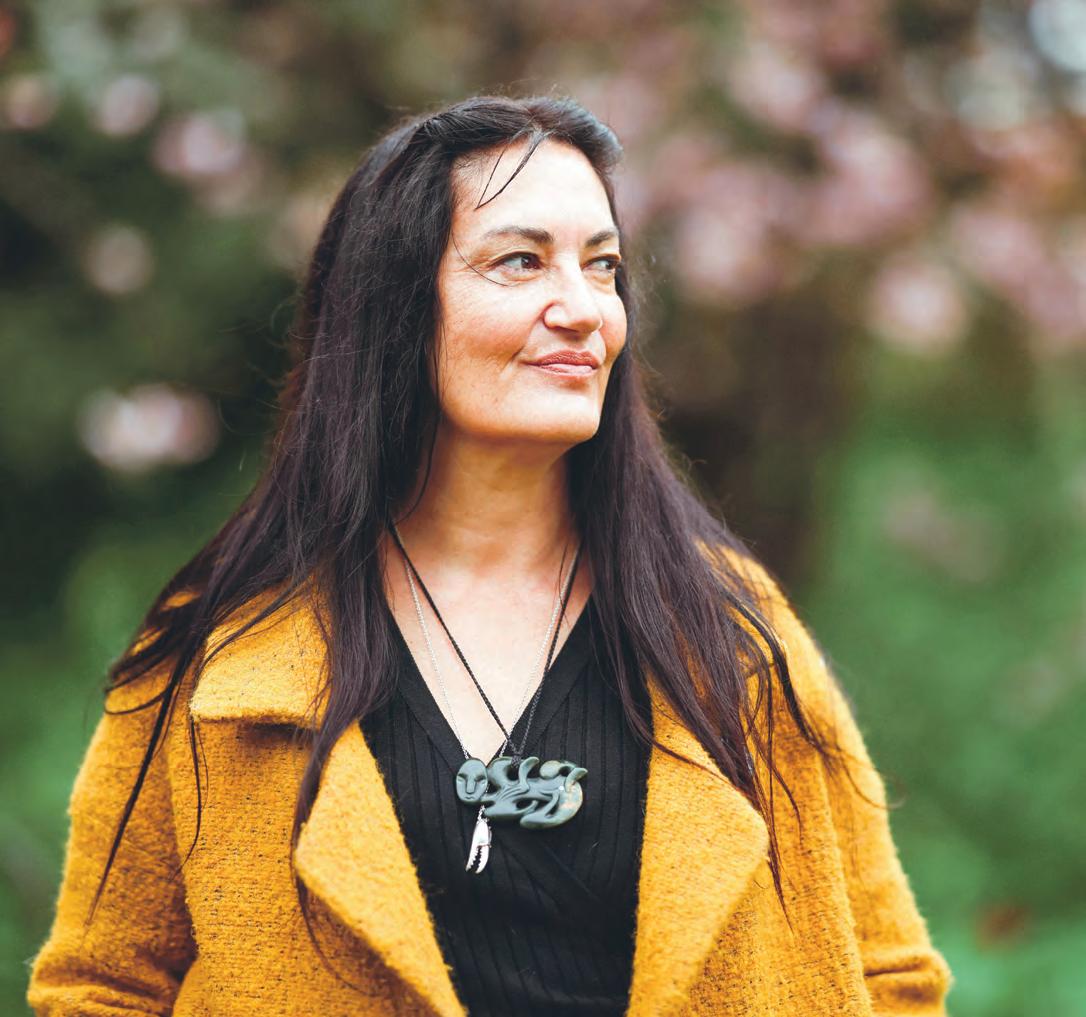
He uri nō te tai tama wahine, ngā tai whakamārie, tai mihi whenua. Ko Ngāti Hau, ko Ngāti Wai, Ko te whare tapu o Ngāpuhi.
When you first meet Briar Grace-Smith (Ngāpuhi, Ngāti Wai; b. 1966), there is an unwavering sense of tau, of a graceful and calm harbour. Sit with her for a while longer and other qualities flicker their way to the surface, reflecting a rich inner life — a naughty joke told with a wry smile, twinkling eyes in the retelling of a hilariously awkward social encounter or ideas shared across a scriptwriter’s story table that hint at magical thinking. She’s hardworking, humble, warm, funny, nerdy, selfdeprecating, nature-loving, contemporary and worldly yet strangely innocent. A strong, witchy Māori māmā, both earthy and ethereal, who can alchemise the chaotic soup of life into art.
Grace-Smith is an edge dweller. She roams wild beaches with black dogs and cohabits with cats who chat with her like she’s kin. She watches us, feeling what we feel, and holds it all. She’s a collector of interesting characters and interesting experiences; she leans into both the light and the dark places, the absurd and the uncomfortable. With words, she cuts new worlds from the fabric of the old. During her three-decade career, she has become one of Aotearoa New Zealand’s most celebrated writers. Hers is a creative life that is unequivocally devoted to story.
There are so many accolades and achievements, award-winning plays, screenplays, short fiction and television scripts. Her plays include Ngā Pou Wāhine (1995), Purapurawhetū (1997) and When Sun and Moon Collide (2000). Her first
feature film, The Strength of Water (2009), was selected for the Sundance Writers and Directors Labs, and premiered at the Rotterdam and Berlin international film festivals. As writer and director of Charm, Briar was one of eight Māori women filmmakers who created the acclaimed anthology feature film Waru (2017), which premiered in the Official Selection at the 2017 Toronto International Film Festival.
Her writing credits for Australia include Grace Beside Me (2018) — nominated for Best Children’s Programme at the 2018 Australian Academy of Cinema and Television Arts Awards — and the Cannes-nominated series Swift Street (2024). In Aotearoa, they include Fish Skin Suit (2000), Being Eve (2001–02), Kaitangata Twitch (2010), This is Piki (2016) and Tangata Pai (2025). Grace-Smith was also the screenwriter, co-director (with Ainsley Gardiner) and a lead actor in Cousins (2021), the acclaimed feature film picked up by multi-platform collective ARRAY and screened on Netflix.
In 2018, she was made an Officer of the New Zealand Order of Merit for her contribution to theatre, television and screen. She and Ainsley Gardiner were awarded the Merata Mita Fellowship for Indigenous Artists at the Sundance Institute in 2019. She was made a member of the Directors Branch of the Academy of Motion Picture Arts and Sciences in 2022.
Briar is an illuminator of others and kaitiaki of Indigenous writing. She has mentored communities throughout Te Moana-nui-a-Kiwa the Pacific, Australia and Canada. In 2024, she was the first Indigenous woman to serve as the présidente du jury at Le Festival International du Film Documentaire Océanien (FIFO) in Tahiti. In 2025, a Salon du Livre writer’s residency in Tahiti allowed her to develop literary work while fostering cultural connections with local communities and Pacific authors — as ever, taking a grounded, inclusive, relational approach that gently nurtures the stories of all.
Briar Grace-Smith’s work is a creative rongoā that heals a broken world. She holds a mirror up for us to peer into, so we can see more clearly who we are and where we need to go.
Kelly Joseph
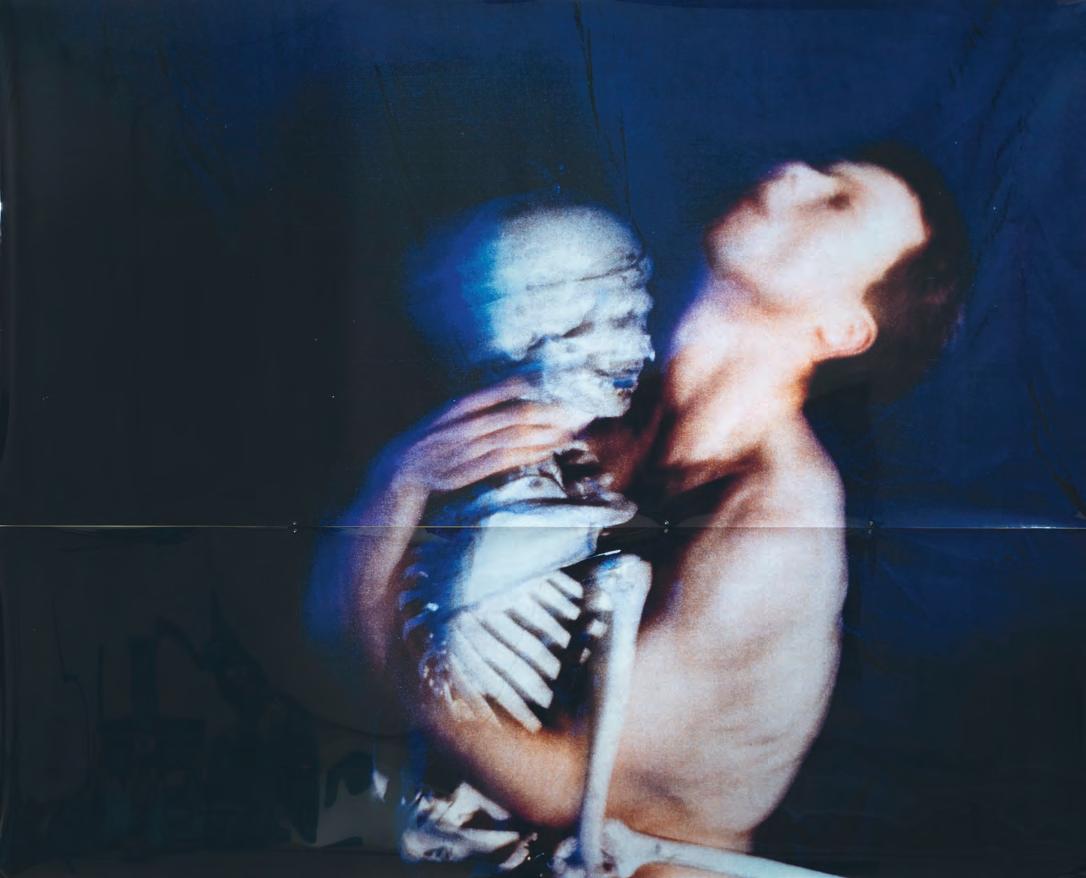
Douglas Wright (1956–2018), dancer-choreographer-comet, streaked light across the sky. ‘Comet’, according to the Merriam-Webster, is ‘a celestial body appearing as a fuzzy head surrounding a bright nucleus with a highly eccentric orbit’. Celestial body? Well, Wright did occasionally refer to his shoulder blades as ‘the place where the wings were once attached’. His head wasn’t in the least bit fuzzy, but it did surround a bright nucleus. He’d have hooted with laughter at ‘highly eccentric orbit’.
Born in Tūākau, Waikato, Wright, a child gymnastics champion, learned how to move the body well. As a precocious reader, he was drawn to the dark secrets of the adult world and devoured the writings of Janet Frame in the local library. (Years later, the two would become friends.)
In Tāmaki Makaurau Auckland, he took dance classes as an adult-beginner, putting his gymnastics training to good use. He joined Limbs Dance Company, then danced for four years with the Paul Taylor Dance Company in New York. After a season with iconoclast director and choreographer Lloyd Newson’s DV8 Physical Theatre in London, he returned to Aotearoa to concentrate on choreographing his own works. His career across the following decades is tellingly captured in an award-winning documentary by Leanne Pooley, Haunting Douglas (2003). You don’t need to be a dance aficionado to sense the heights, depths and consolation offered in his choreography. He shaped good dancers into fabulous artists, creating over 30 works, 14 of them full-length. Their evocative titles include How on Earth (1989), Gloria (1990), As It Is (1991), Forever (1995), Buried Venus (1996), rose and fell (1997), Inland (2002), Black Milk (2006), rapt (2011), The Kiss Inside (2015) and M_nod (2018).
In an inspired move, Russell Kerr, the country’s leading figure in ballet cast him in the title role of Michel (Mikhail) Fokine’s Petrouchka for the Royal New Zealand Ballet in 1993. Kerr claimed that Wright’s presence uncannily evoked dancer and choreographer Vaslav Nijinsky, who first performed the role in 1911.
The compulsion to continue choreographing meant Wright lurched from project to project instead of enjoying the ‘luxury’ of the canopy of his own company, but he somehow persevered. He swore each work would be his last, then, despite major health challenges, always disobeyed himself. Sometimes drowning in grief, or leaping from stepping stone to eggshell, he also triumphed by launching glorious waves of golden-silk-clad dancers into flight. Gravity begone.
Wright was continually drawn to the art of sculptor, painter and friend Malcolm Ross, Frame, Nijinsky, writer Emily Dickinson, musician Patti Smith and painter Bill Hammond. The themes that emerged in his work were deep, serious, shocking; drawn from life, literature, religion, war, peace and music. He’s up there with Pina Bausch, and if that doesn’t put New Zealand on the world dance map, nothing does.
His memoir ghost dance (2004) was awarded the Montana New Zealand Book Awards’ NZSA E. H. McCormick Best First Book Award for Non-Fiction in 2005. His continuing memoir, Terra Incognito (2006), traced his recovery from dark times to the choreographing of Black Milk, revealing what goes into dance-making of such confessional honesty. A striking study of Black Milk by photographer John Savage, each picture telling a thousand words, was published in 2009.
Wright was thrilled to be made a Laureate in 2000. His voice is caught in a memorable RNZ interview with Kim Hill from 2017. His books of poems, cactus fear (2011) and Laughing Mirror (2007), illustrated with his own drawings, share poignant, wry and hilarious insights. His choreography for Gloria, restaged in Wellington in 2026, will outlive us all.
In the set of his drawings held at Auckland Art Gallery Toi o Tāmaki, there are stylised human forms. Although untitled, Wright’s caption insists that these figures are verbs not nouns. Douglas Wright danced with Death, as do we all, memento mori. He danced with Life, as should we all; with verbs not nouns.
Jennifer Shennan
When the angel Xas from Elizabeth Knox’s novel The Vintner’s Luck (1998) comes indoors, his wings brush against the walls, so that his friend, the vintner Sobran, worries ‘that his angel might panic like a bird flown into a room’. But Xas can fold himself to fit the spaces he enters, ‘to rearrange his wings so that their joints were high above his head, like the high shoulders of a perching vulture’. Knox (b. 1959) has a similar ability to fold outsized, otherworldly ideas into fictions that may not be strictly realist but are always realistic.
Outsized, elaborate fantasies filled the mind of Knox from childhood, when she and her two sisters and friends created elaborate fictional narratives set in imaginary worlds. She was born in Te Whanganui-a-Tara Wellington, growing up in the suburbs of Pomare, Wadestown, Waikanae and Paremata, a childhood commemorated in the autobiographical novellas Paremata (1989), Pomare (1994) and Tawa (1998).
The freedoms and dangers of a late-1960s childhood are vividly realised in these novellas, as is the way imaginary games have a reality of their own, both solid and shifting. A wedding becomes a coronation becomes an invasion of enemy territory, drawing on various genre conventions as much as on the children’s understanding of social customs.
From her first novel, After Z-Hour (1987), set in a haunted house during a storm, Knox has combined a gritty material realism with an exuberant facility with genre tropes, and a consciousness of the power of storytelling itself to shape reality. The 14 novels she has written since could be categorised in turn as historical romance (Billie’s Kiss, 2002), gothic (Daylight, 2003), horror (Wake, 2013), young adult fantasy (Dreamhunter Duet, 2005, 2007), epic fantasy
(The Absolute Book, 2019) and dark academia (Kings of this World, 2025).
There is no genre, it seems, that she cannot draw on to build new stories and think through ideas, from the metaphysical to the political, but she allows genres to shift, morph and recombine as she writes. Always, it is the specificity and strangeness of the details — an angel arranging his wings like a vulture to fit into a nineteenthcentury vintner’s parlour — that make any story she invents seem real.
Knox has been granted too many honours to list in their entirety: the Katherine Mansfield Menton Fellowship in 1999, the Michael King Writer’s Fellowship in 2014 and the Prime Minister’s Literary Award for Fiction in 2019. In 2002 she was made an Officer of the New Zealand Order of Merit, promoted to Companion in 2020.
The power of persuasion, storytelling and the manipulation of reality has its dark side, as she herself warns in so many of her novels. What we turn our attention towards involves, always, a turning away from what else we might have attended to; utopian visions can come with unattended costs. At the same time, it is imagination that offers us our best, perhaps our only, chance of salvation.
Talking about the ending of The Absolute Book, which might have seemed a departure from the rigorous realism characteristic of her wildest flights of fancy, Knox described the wish-fulfilment element as a form of political activism. ‘Though there may be no gods, frost-giants and fairies,’ she said, ‘we do have governments, and governments have it in their power to save the world.’
An invasion of enemy territory might become a wedding might become a haunted house might become a post-oil, post-capitalist economy. Readers of Elizabeth Knox’s writing can believe the most unlikely possibilities can be realised in all the visceral strangeness of reality, with all the detailed materiality that allows for every kind of love.
Anna Jackson
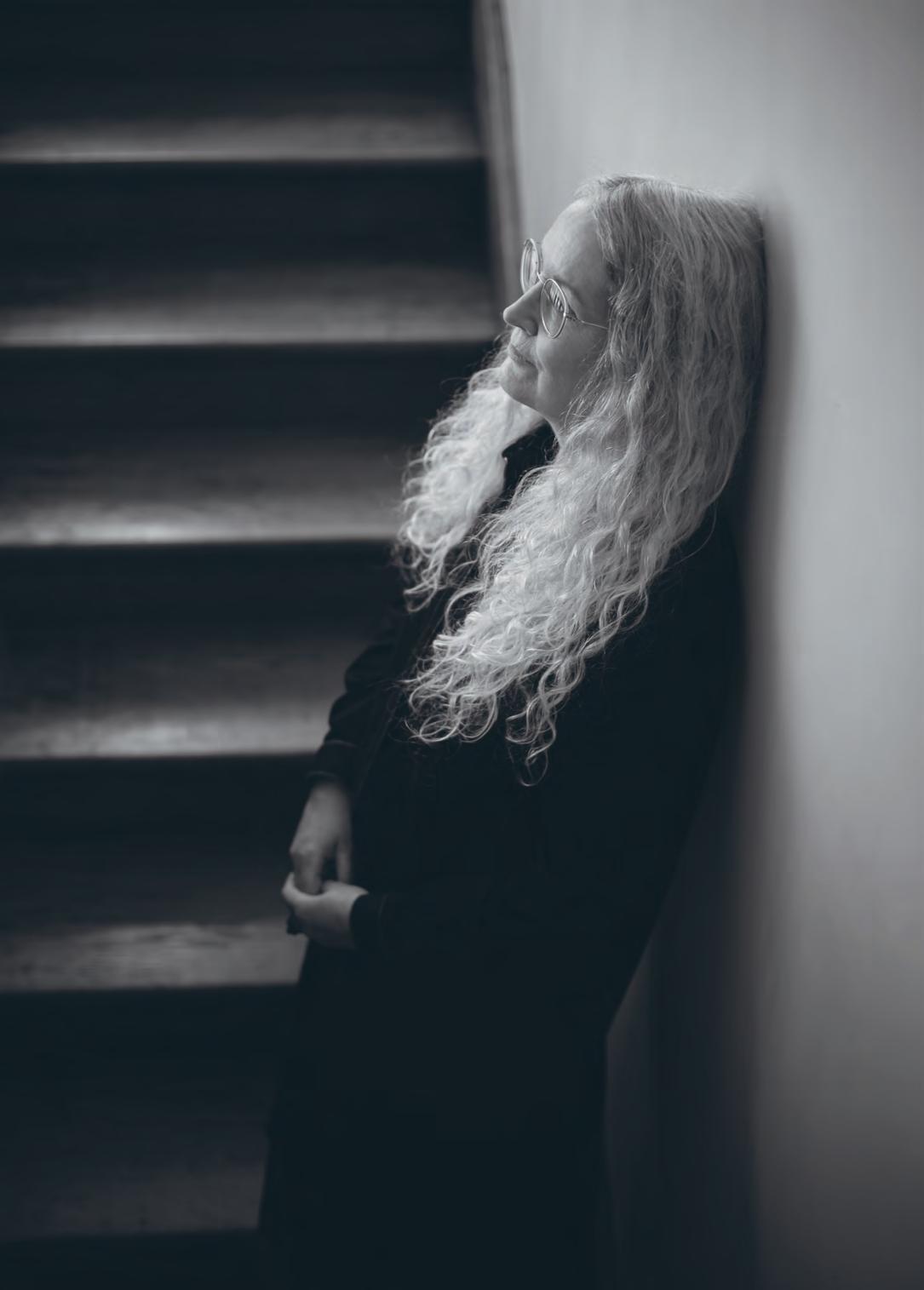
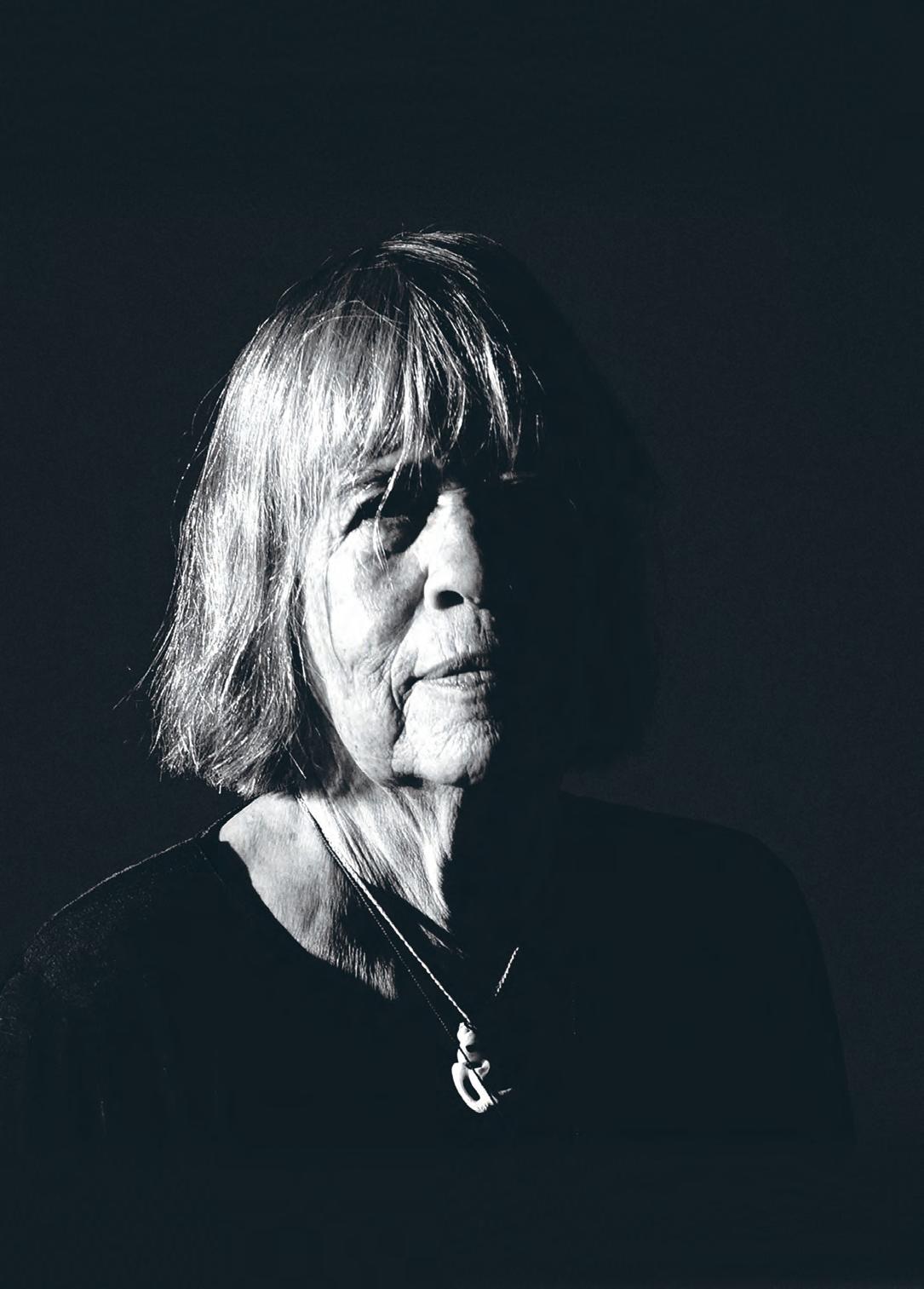
At the end of the 2025 world-premiere performance of Dame Gillian Karawe Whitehead’s moving, dramatic opera Mate Ururoa (2020), the 84-yearold composer joined the cast and musicians on stage to receive applause. A small figure among the performers, her mighty presence brought the audience to its feet.
Her twelfth opera, Mate Ururoa is, like a number of her stage works, a monodrama, composed for small forces and, in operatic terms, of short duration at 45 minutes. And yet, like the composer herself and her prolific musical output, it has an impact both profound and powerful. A small, quietly-spoken woman, Whitehead (Ngāi Te Rangi, Tūhoe; b. 1941) is one of New Zealand’s most outstanding composers. Her skilfully composed and uniquely expressive music is performed by this country’s top chamber ensembles, orchestras, soloists and vocal groups across the motu and internationally.
When she became a Laureate in 2000, she was not widely known by audiences in Aotearoa, New Zealand having spent most of the previous three and a half decades in Britain, Europe and in Australia, where she studied in the 1960s and taught and composed at the Sydney Conservatorium of Music between 1981 and 1996.
During her years as an expatriate, however, Whitehead returned regularly to her homeland, and New Zealand productions were mounted of her theatre works Tristan und Iseult (1976) and The Pirate Moon (1986), both in Tāmaki Makaurau Auckland, and Outrageous Fortune (1998) in Ōtepoti Dunedin, the latter winning her the SOUNZ Contemporary Award Te Tohu Auaha.
Since 2000, she has been mostly resident in Aotearoa, and her Māori heritage has played an increasingly important role in her creative life. She pioneered the use of taonga puoro with Western instruments, working with the late Richard Nunns, a specialist performer on traditional Māori instruments. Her Hineraukatauri (1999) for flute and taonga
puoro was the first of those compositions, inspired by the pūtōrino, an instrument played like a flute or a trumpet, shaped like the female case moth, and embodying the voice of Hine-raukatauri, the goddess of music and dance.
The spiritual quality of taonga puoro in Whitehead’s music is integrated into her imaginative use of timbres. In Mate Uruora, she paints the wartime story with sonic colours, tapped stones accompanying the pūtātara, martial rototoms joining trumpet, sprightly woodwinds imitating birdsong, and hymn-like fragments from string instruments evoking a waiata.
Mate Uruora tells a man’s story, but Whitehead’s many collaborations and the stories she has told in her compositions have often been female. She has worked with artists including the poet Fleur Adcock, with whom she created numerous stage works and music with text, and the painter Gretchen Albrecht, who created huge colourful banners for the dramas Hotspur (1980) and Tristan und Iseult. Her matter frequently centres on female narratives, such as that of the life of writer Robin Hyde in the monodrama Iris Dreaming (2016). But she always pushes aside questions about gender, declaring herself ‘a composer first and a woman after’. In fact, she said firmly in 1989, ‘it’s the wrong question’.
Much more important to Whitehead as a composer is her dual Pākehā and Māori heritage, and she once suggested that the way in which she uses canons, rhythms, prime numbers and the ‘plaiting’ of material has more to do with Māori weaving traditions than a European compositional approach.
Mate Ururoa marvellously pulls together all the threads. It tells a powerful story from New Zealand history, interweaving taonga puoro, Western instruments, te reo Māori and the English language. At a time when the strong, distinctive strands of our cultures need to be carefully intertwined, Dame Gillian Whitehead shows us a way to do so with aroha and pride.
Elizabeth Kerr
For 35 years, Michael Parekōwhai (Ngāriki Rotoawe, Ngāti Whakarongo; b. 1968) has been bending our familiar myths into deranged nationalistic dreams: a giant Captain Cook contemplating his navel, cast in reflective stainless steel; Engelbert Humperdinck’s anthem ‘Ten Guitars’ turned into a set of beautifully crafted instruments; a replica state house, filled with neon light, perched on the tip of Tāmaki Makaurau Auckland’s Queens Wharf.
He is, first and foremost, a sculptor — an artist with a deep sensitivity for the behaviours of his strange objects in real space. But he is also a magician who creates spectacular illusions that flip Aotearoa New Zealand’s egalitarian meltingpot sense of self on its head.
Parekōwhai first emerged into the art world’s consciousness in the early 1990s, making sculptures that lifted art history’s weight with a spiky, postcolonial lightness of touch. After Dunlop (1989) was a copy, carved from wood, of Marcel Duchamp’s famous readymade Bicycle Wheel (1913). The Indefinite Article (1990) transposed the semi-Cubist lettering of Colin McCahon’s I AM (1954) into a massive sculpture, adding the Māori indefinite article ‘He’ to God’s famous declaration of his absolute authority. And Kiss the Baby Goodbye (1994), made at the height of New Zealand’s appropriation debates, turned one of Gordon Walters’ iconic koru paintings into a giant model kitset.
These works lurked on the edge of revelation, evading easy or obvious readings — an approach that became the underlying foundation of Parekōwhai’s career. He is the son of teachers,
his father Māori, his mother Pākehā, and his family and personal history hover as ambiguous but constant presences. In Poorman, Beggarman, Thief (1996), mannequins with the blended features of the artist and his father wear tuxedos and an identification badge that reads ‘My Name is Hori’ — his dad’s name, but also a racist epithet.
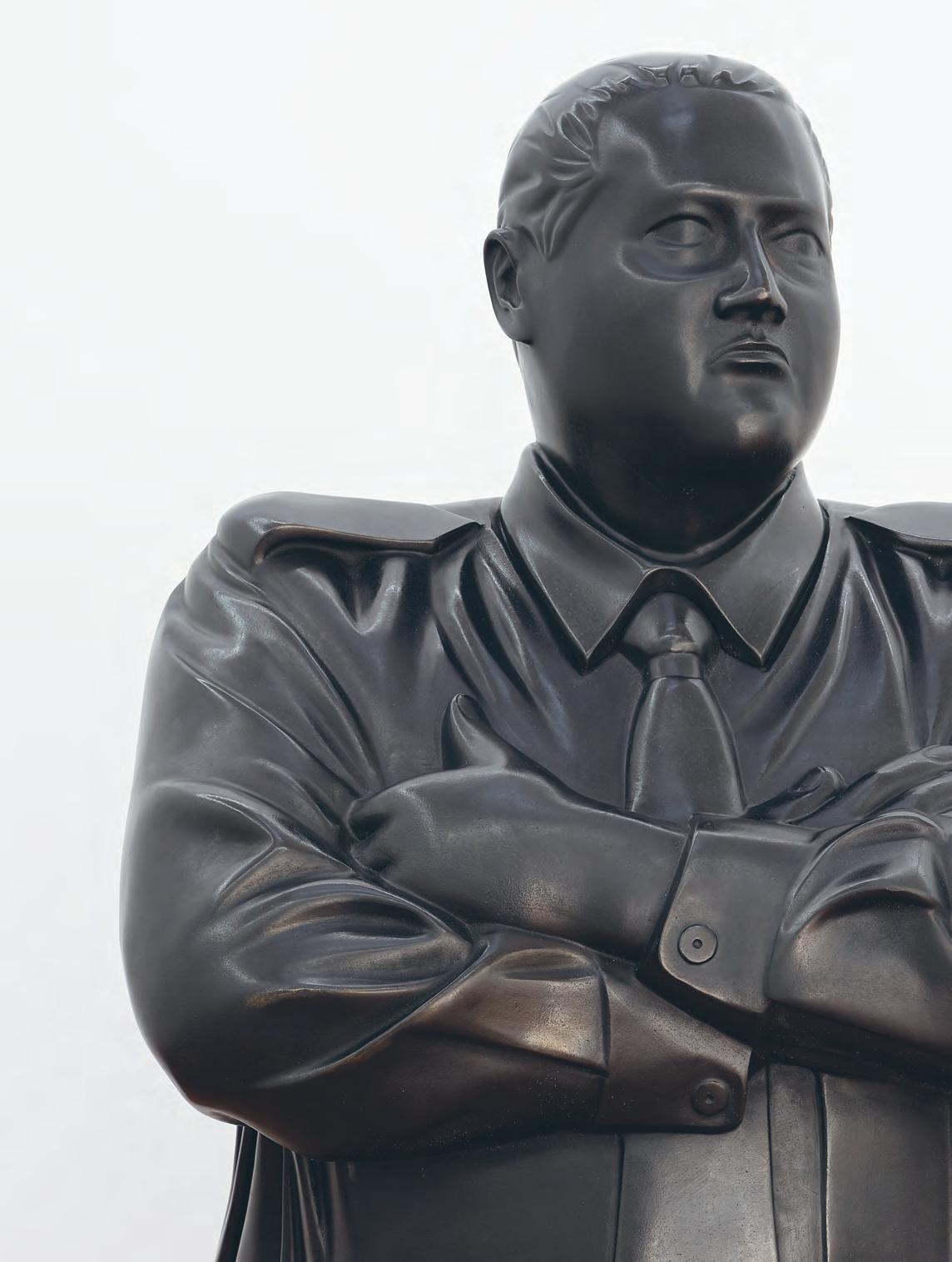
He also makes regular references to the pedagogical games that were used so much in New Zealand’s twentieth-century education system, such as his giant Cuisenaire rod sculptures (the rods have been an integral part of teaching te reo Māori since the 1970s) and his version of Jack Straws, in which the usual pick-up sticks are replaced with objects of colonisation such as axes, guns and saws. His brother Paratene is the model for his ongoing Kapa Haka series of security guard sculptures. And in his exhibition at the Venice Biennale in 2011, Parekōwhai included a pair of bronze-cast Crocs: a loving, easy-to-miss tribute to his own children, and to the brother he lost when he was a boy.
This romantic intensity seems to run counter to the bombast and weird humour of his largescale public commissions and installations: The Lighthouse: Tū Whenua-a-Kura (2017), the state house filled with Wonka-like colour; The World Turns (2011–12), on display at Brisbane’s Gallery of Modern Art, in which an elephant pressing its trunk to the earth encounters a tiny native kuril rat; and his 2018 installation Détour, at the Museum of New Zealand Te Papa Tongarewa, which exploded Duchamp’s La Boîte-en-valise (1935–41) into a surreal journey through New Zealand’s art history. Parekōwhai also has a major place-building project under way in Naarm Melbourne that draws on his sculptural vocabulary as a means to explore shared experiences of colonialism.
Despite the immense public presence of his work, Michael Parekōwhai remains a very private character; someone who stands in the wings while his sculptures perform in the spotlight. But even with this silence, the same voice is always present: talking to us about the lies we tell ourselves and the games we play — personally and nationally — in the pursuit of a collective identity.
Anthony Byrt
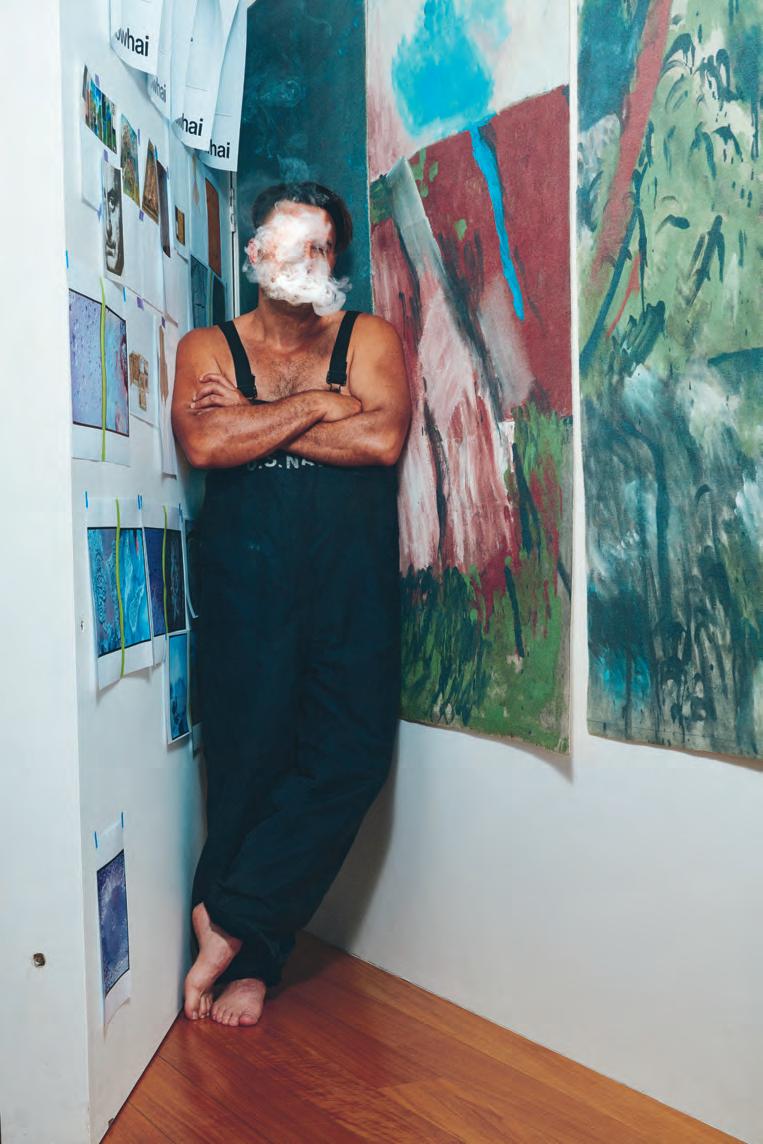
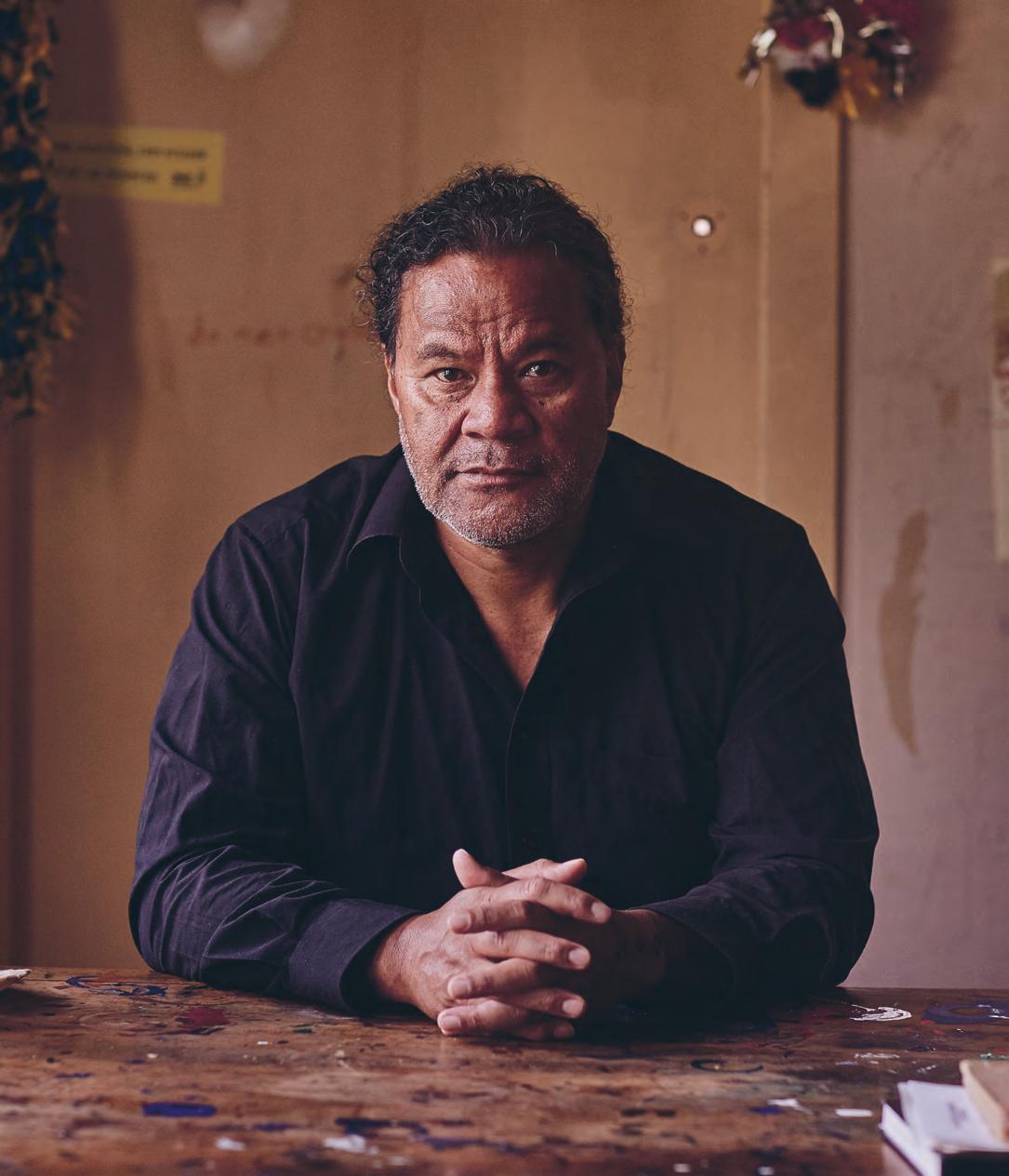
John Pule (b. 1962) was born in the village of Liku in Niue and immigrated to Aotearoa New Zealand in 1964, when he was two years old. Largely selftaught, Pule’s expansive interdisciplinary practice has transformed oceanic imaginaries, offering new ways of understanding the arts, cultures and histories of our region. His strong interest in the history and mythology of Niue continues to inform his work.
As a poet and novelist, many of Pule’s poems summon forth the subtle and intimate imagery, colours and textures that have coalesced in his paintings from the mid-1980s onwards. These visual sensibilities are evident in early artworks, energised by Pule’s focus on hiapo (decorated Niuean tapa cloth) of the nineteenth century. He has likened the unique composition of hiapo to architecture, combining its rough grid structure with personal iconography in ways that politicised tapa. Thematically, these works reflected the devastating impact of missionisation and colonisation in the Pacific. Equally visible is a type of fragility of life, relationships and kinships — further evoked by the poetic nature of He wields taonga Māori as a master of this oral art form. the titles he gave his works, which often reference departures, returns and arrivals.
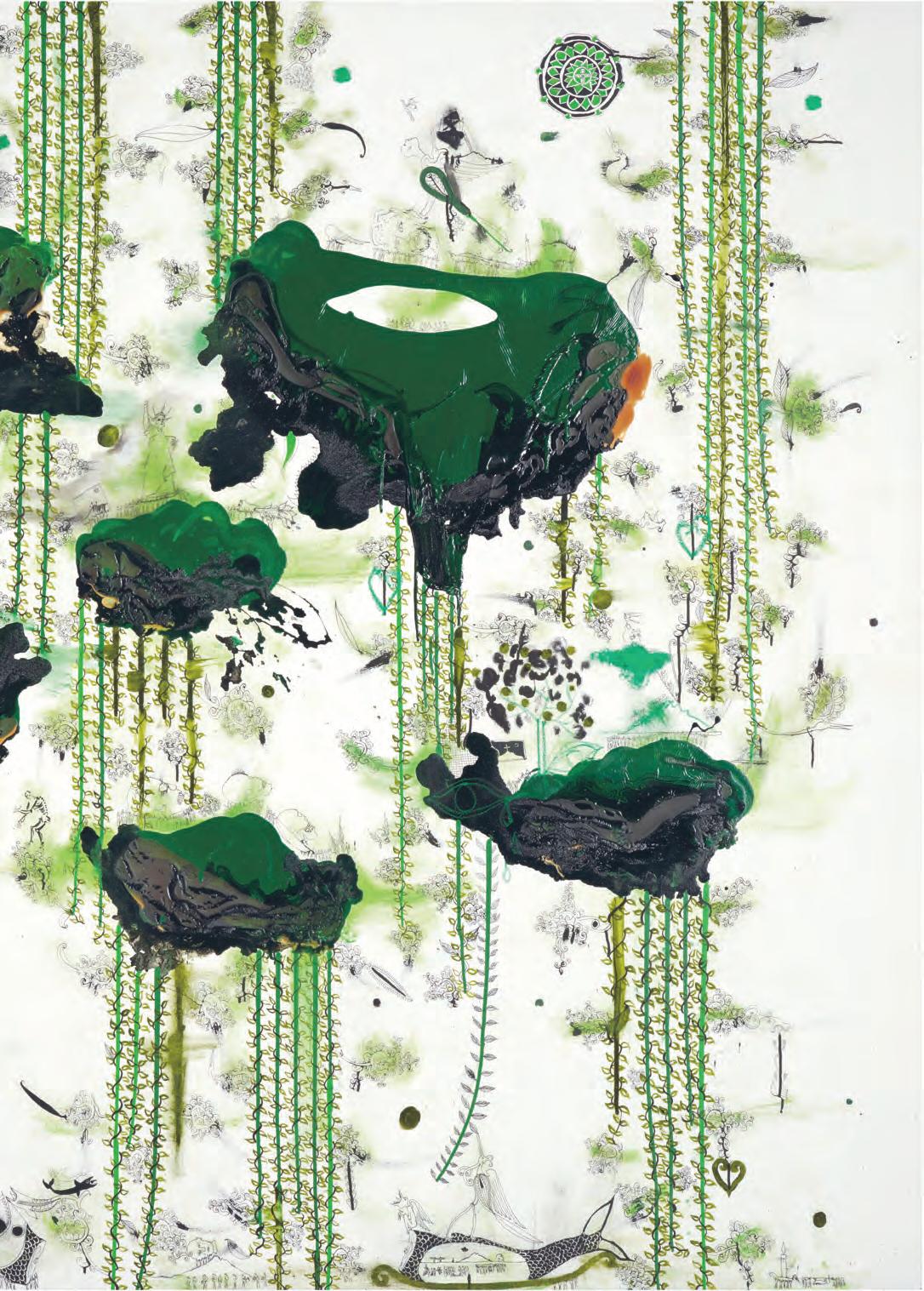
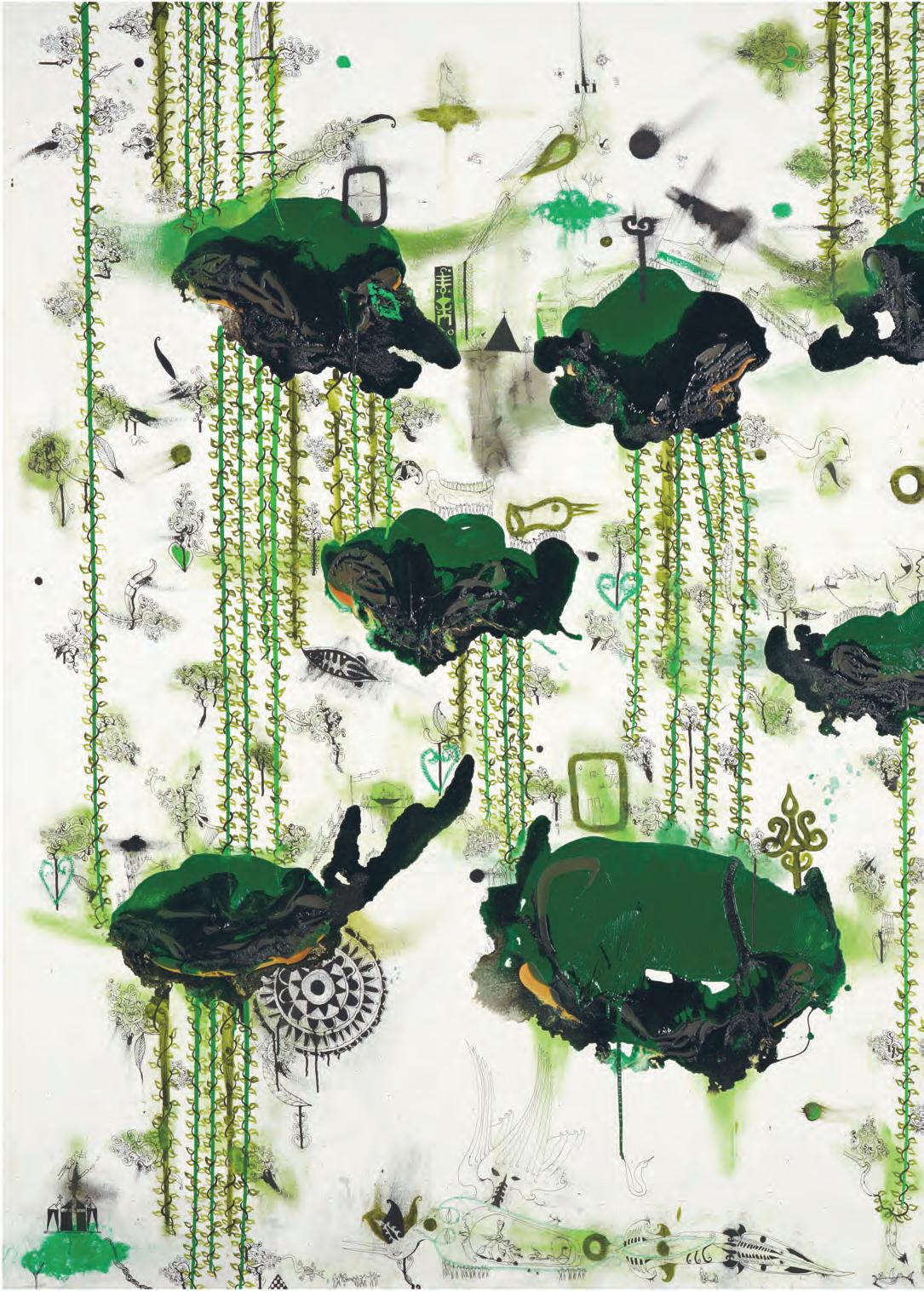
From the 2000s, there was a tonal shift in his paintings, characterised by surreal cloudscapes and often dominated by a single colour. Within these inky, bulbous clouds, Pule filled stories with mythological creatures, Christian symbols and hybrid, voracious beings. Clouds, which could be celestial or nuclear, hover in the sky, dripping with the tendrils of the ti mata alea plant (Cordyline fruticosa), a significant plant in the creation narratives of Niue.
Since moving back to Niue, Pule’s practice has taken a renewed direction, shaped by the surrounding landscape and by family connections
in Liku. In these works, he continues to draw on cultural cosmology, summoning figures such as the young demigods Huanaki and Fao — believed to be the first Niueans — into an ethereal island world where plants stretch from earth to sky, and a dream-like fluidity is heightened by the literal pouring of paint onto the canvas. Pule’s everevolving practice has taken us from the skies to the ocean and across the cosmos; this phase returns us to earth, affirming the islands as sites of flourishing life.
Pule’s stature as one of New Zealand’s most significant artists has been recognised through sustained critical recognition and accolades. Represented by Gow Langsford Gallery since 1994, his work is held in major public collections across Australasia, including Auckland Art Gallery Toi o Tāmaki, the Museum of New Zealand Te Papa Tongarewa, the National Gallery of Victoria and the Queensland Art Gallery.
John Puhiatau Pule’s career highlights include his critically acclaimed survey exhibition Hauaga (Arrivals) in 2010 at City Gallery Wellington Te Whare Toi and the accompanying monograph. In 2012, he was awarded the New Zealand Order of Merit for services to the arts. When Pule became a Laureate in 2004, he was the first of Pacific descent to receive the award, paving the way for generations of Pacific artists.
Ane Tonga
Major Givers Jenny and Andrew Smith in conversation with 2003 Arts Foundation
Te Tumu Toi Laureate Michael Hurst and Kaiwhakahaere Director Arts Foundation
Te Tumu Toi Jessica Palalagi
Jenny and Andrew Smith are major Arts Foundation supporters whose long-standing philanthropy has helped countless artists and organisations to thrive. As one of our nation’s most enduring and dynamic theatre artists, 2003 Arts Foundation Te Tumu Toi Laureate Michael Hurst has spent a lifetime shaping the cultural landscape of Aotearoa New Zealand — on stage, behind the scenes and in the imaginations of audiences across the country.
Jessica: To start us off, Michael — what does it mean to you to be seen and supported in your practice, especially in the context of the Arts Foundation’s past 25 years?
Michael: Being seen in what I do has always, in a sense, been the result of philanthropy — sometimes public, sometimes private. Without that, honestly, I don’t think I’d have had a career. You can look at philanthropy all the way back to ancient Athens. If you were chosen to present the dramas at the festival of Dionysus — Sophocles, Euripides, others — it was a civic honour. You were expected to pay for it. Spending your money on the arts was part of how you served your city. That feels strangely contemporary to me. We still rely on people deciding, ‘This matters enough that I’ll help make it exist.’ On a smaller scale, I’ve had people say, ‘We’ll pay for this costume,’ or ‘We’ll cover that fee.’ You’re shown these concrete acts of belief. It restores your faith.
I remember when I got the call about my Arts Foundation Laureate Award — it came completely out of the blue. There were no conditions. No ‘You must do this piece’ or ‘You must spend it in this way’. It was pure recognition and support. That was incredibly gratifying and, actually, restorative.
At the time, Jennifer Ward-Lealand and I were self-producing a big production of Hamlet — or it might have been Macbeth, we did both around
then — and the Laureate money went straight into the production. There was no moment of, ‘Fantastic, now I have some money to play with.’ It was, ‘Right, this means we can pay people properly.’ That felt absolutely right.
Jessica: Jenny and Andrew, you support a wide range of arts organisations and art forms. How do you think about your role as givers?
Jenny and Andrew: If we want to see Michael and Jennifer on stage and feel that thrill of seeing them perform, we’ve got to help make sure the stage is there. Sometimes, that’s literally a stage — a theatre such as Q. Sometimes it’s an art gallery, or a residency such as McCahon House. We’ve tended to support what we think of as the infrastructure of the arts — the spaces, organisations and frameworks that enable artists to present their work and for us to experience it. That’s why we like the word ‘enabler’. It feels like an alternative to ‘philanthropist’. You’re enabling things to happen that simply wouldn’t happen otherwise.
Thinking about the Arts Foundation specifically and the Laureate Award — your support of artists is absolutely critical. Without the artists, we have nothing. Yes, they need venues and infrastructure, but they themselves are the starting point. It felt extraordinary to us that
there was an organisation dedicated exclusively to supporting artists. That’s why we became donors. There’s no money in the arts, no one gets properly paid, so to receive a Laureate Award out of the blue — the honour of that, plus the financial support with no ties or conditions — that’s unheard of, really, isn’t it?
Michael: It really is a marvellous thing. I got the phone call from Elric Hooper [the former artistic director of the Court Theatre, who was on the selection panel for the 2003 Laureate Awards]. I really wasn’t sure what was coming. And then to sit there over a coffee and hear that news . . . my mouth literally dropped open.
I remember the ceremony as well. It was so celebratory — of nothing but us, the artists. The other Laureates and I just stood there and basked in it, which in Aotearoa is not always easy. You feel as though you should say, ‘Oh, I’m just doing my job, sir.’ That humble thing. But that night was different. That stays with you.
Jessica: We talk a lot at the Arts Foundation about ‘philanthropy’ being a word that can feel oldfashioned or intimidating. Does ‘enabler’ feel like a better frame to you, Michael?
Michael: I love it. ‘Enabler’ is exactly how I experience it. I feel enabled to do the work. As an artist, you do ask yourself, ‘What am I doing this for? Is it ego?’ There is ego, of course — being onstage, being seen — and people assume you love that. And yes, there’s a thrill, but it’s not really, ‘Look at me, look at me.’ It’s more, ‘Let’s have this moment together.’ An electrifying moment, or a tender one, whatever it is.
Who is it for? Ideally, you lift people up, give them a shift of perspective, a thrill or just a laugh. The happy mask and the sad mask are really one face. We all laugh, we all cry. It’s not separate. To be enabled to do that — that’s a gift.
I’ve often said that art brings us closer to what it is to be human in a fuller sense. It can sound a bit highfalutin, but it’s true. Keats says, ‘Beauty is truth, truth beauty.’ By beauty, I don’t mean ‘pretty’. It can be something devastating
but profoundly true. Real beauty, real truth as expressed in art expands us. But people have to be exposed to it.
Jenny and Andrew: We’ve seen, over and over, the impact art has on people. We were part of an Auckland Art Gallery Foundation trip to a Gordon Walters retrospective. People came out buzzing. It was a feeling you don’t get from watching television or flicking through a book. Last week, we went to see that wonderful play
Tiri: Te Araroa, Woman Far Walking (2025) by Witi Ihimaera Smiler and the Auckland Theatre Company. Around 40 per cent was in te reo Māori — we don’t speak te reo — but we still came out thinking, ‘That was a fabulous experience.’
Whether that was the intention or not, I haven’t got a clue and it doesn’t really matter. The impact of that play on the people we were with — it’s lifeenhancing. It really is.
Jessica: One of the tensions we hear from the sector is the pressure for art to be ‘worthy’ — to solve social problems, tick funding boxes, deliver outcomes. How do you see that, especially in relation to philanthropy?
Michael: There’s definitely a shift. A lot of theatre that gets government support now has to prove it’s relevant in quite specific, measurable ways. I’m not against relevance — everything is political, the personal is political — but sometimes it can compound the weight everyone’s already carrying.
The other night, I saw a show called Captain Morrow and the Sands of Time — two actors, one cellist, about 30 characters each. Pure absurd joy. It was brilliant and freeing. Everyone in the audience was howling with laughter, completely abandoned. We absolutely need that. Life’s hard. To sit in a theatre or a concert and feel joy, or catharsis, or wonder — that keeps us sane.
Jenny and Andrew: And that speaks to philanthropy, doesn’t it? Public funding has to answer to policy priorities. Private giving can
sometimes say, ‘We believe in joy. We believe in beauty. We believe this work matters, even if we can’t measure it in a spreadsheet.’
Jessica: We can’t talk about the next 25 years without talking about intergenerational change — in audiences and donors. What are you noticing there?
Michael: There’s a fear that traditional theatre and opera audiences are literally dying off and not being replaced in the same form. That’s confronting when you’ve been in the game for decades. I ask myself a lot, ‘How am I relevant to what’s coming next?’ You look at somewhere like Basement Theatre and it’s a completely different landscape to what it was when I was starting out. Stand-up comedy is huge. Digital work, new forms, different voices. It’s exciting and disorienting. Part of my work now is learning to let go — to say, ‘It’s not all about me,’ and to support younger artists: pay for tickets, turn up, cheer them on.
Jenny and Andrew: We’re seeing change from where we sit, too. There was a big Arts Foundation event recently and we couldn’t go, but we saw the photos. We didn’t recognise anyone! They were all so young. A friend said, ‘I was the oldest person in the room.’ That’s fantastic. It means a younger cohort is coming through as supporters. And as you mentioned, Jessica, you’ve seen more donors bringing their adult children along — to Laureate lunches, for example. That’s where intergenerational giving starts to take root. At the same time, there are big shifts in who’s in the audience. We were at Q once, having dinner before a concert, and there was a Pacific theatre show on. People had come from all over Tāmaki Makaurau into the city because that work spoke directly to them. There are so many communities in Aotearoa now. The question is: Are the arts talking to all of them? And if not, how do we change that?
Jessica: That’s something we grapple with a lot — both at the Arts Foundation and across the sector. But then I think about films such as Whale Rider. People internationally might not know much about Māori culture, but they respond deeply to the relationships, the whānau dynamics. They feel it. For me, art is storytelling in different forms — and those stories have this way of leaping across language, culture, time.
Jenny and Andrew: Exactly. That brings us back to shared humanity. Whatever the work, what we’re really responding to is that deep recognition of ourselves and each other.
Michael: I think that’s important. In the end, it all passes, doesn’t it? We’ll be gone. What do you leave? I don’t want to leave a memory of, ‘Oh, he was . . .’ Obviously I want to be seen as a nice person, but it’s not about that. It’s more about leaving something tangible in people’s minds that changed them somehow. I’m sure the Foundation is similar — it’s about effecting change and keeping up with what’s coming, the new waves that break upon the sand.
Jessica: Enabling shared humanity through art — not a bad job description for everyone in this ecosystem. Thank you all so much.
Julia Morison ONZM
Neil Ieremia ONZM
Ronnie van Hout
Simon O’Neill ONZM
2006
Alastair Galbraith
Alun Bollinger MNZM
Ian Wedde ONZM
John Reynolds
Oscar Kightley MNZM
2007
Colin McColl ONZM
Merilyn Wiseman
Michael Houstoun CNZM
Moana Maniapoto MNZM
Sarah-Jayne Howard
Lloyd Jones
George Winiata Henare CNZM OBE
Ngila Dickson ONZM
Shane Cotton ONZM
Teddy Tahu Rhodes
2009
Anne Noble ONZM
Chris Knox
Lyonel Grant
Richard Nunns QSM
Witi Ihimaera Smiler DCNZM QSM
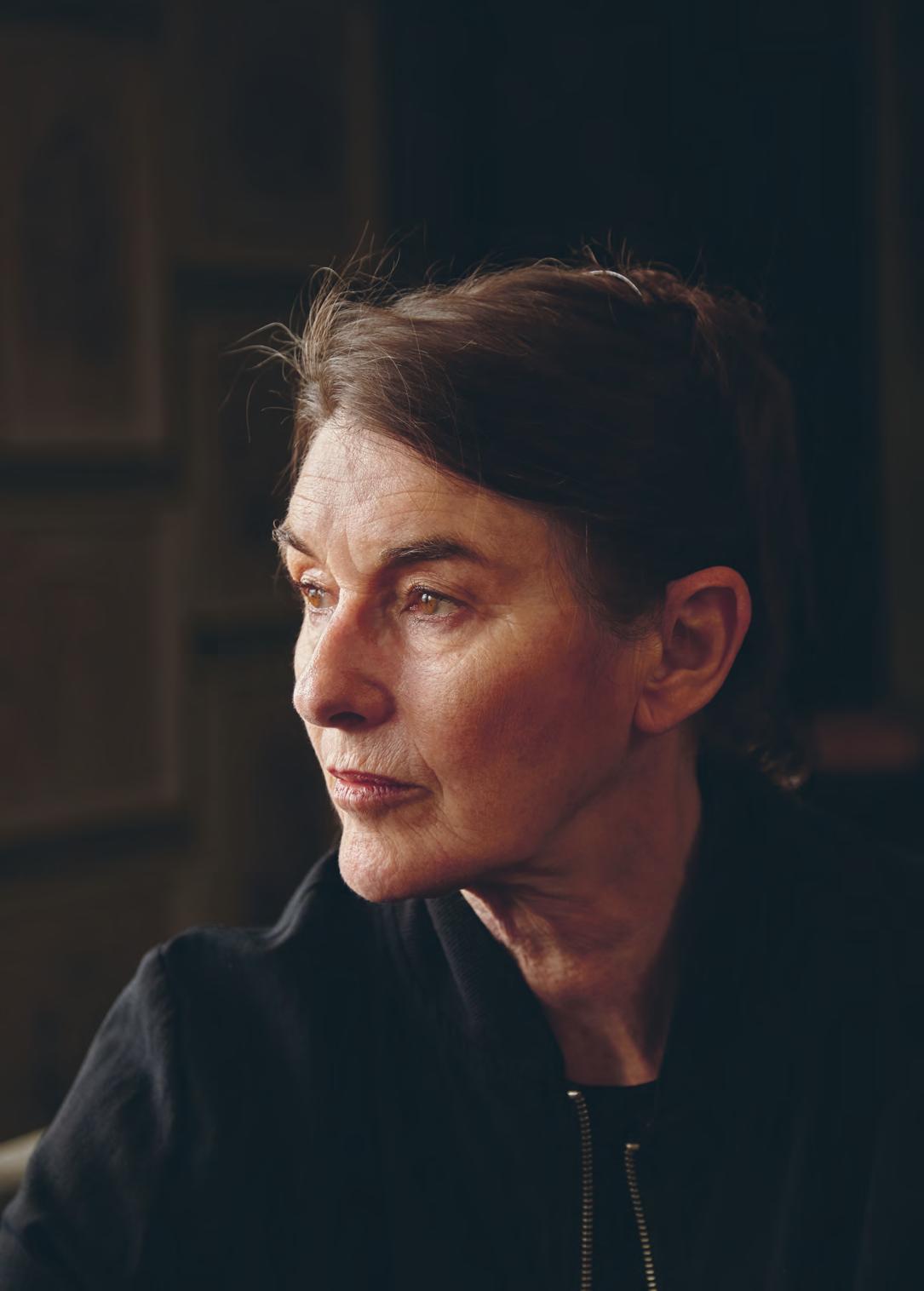
Julia Morison draws the material of the world into her paintings. She reconfigures familiar forms to forge an iconographic language with inimitable depth and complexity. For over five decades, Morison (b. 1952) has turned her rigorous and insatiable intellect to a wide-ranging exploration of visual language, often contained within a set of self-imposed formal, material and numerical parameters. These parameters — such as working in a series of 10, or producing works within a uniformly measured grid pattern — are at times adhered to, and at others disregarded — a contradictory impulse that can be traced across much of her work.
Originally trained in graphic design, Morison gained her Bachelor of Fine Arts with Honours in 1975. Since then, she has worked and exhibited consistently, both nationally and internationally. She has received numerous accolades, from the Frances Hodgkins Fellowship in 1988 to becoming an Officer of the New Zealand Order of Merit in 2018. Following the year-long Moët et Chandon Fellowship in Avize, France, in 1990, Morison spent a decade living in France before returning to Aotearoa New Zealand in 1999. Since then, she has continued to live and work in Ōtautahi Christchurch, lecturing in painting at Te Whare Wānanga o Waitaha University of Canterbury until 2007.
The listing of these achievements may trace the arc of Morison’s career, but they fail to capture the expansive complexity that is evident throughout her work. Drawing reference from idiosyncratic fields of knowledge-production and systematisation, from numerology to esoteric belief systems, her practice consistently engages with the ways that visual language can function to encode meaning. Although she has worked across photography, sculpture and installation,
it is to the field of painting that she continually returns. In her hands, the application of paint to substrate is harnessed as an interrogative site for formal and material innovation.
From the fleshy geometry of Golem (1985) to the spatial dynamism of the Meditations paintings (2024), there is something cosmological in Morison’s painted surfaces. Their sense of scale is at once intricate and vast, her fluid mutability of material, form and pictorial space enacting a continual push–pull on the viewer and filling her paintings with a propulsive and kinetic momentum. But despite the intellectual complexity of her field of references, these are not paintings intended to be encountered on a purely cognitive level. Rather, they are objects marked by a visceral life force, made up of the forms and materials of the world, and intended to be experienced as such.
Whether embedding symbolic icons into the marble floor of a French chapel (Amalgame, 1991), creating modular public sculptures in post-quake Christchurch (Tree Houses for Swamp Dwellers, 2013) or forming monumental paintings designed to be pieced together on the gallery wall (Meditations, 2024), Julia Morison’s work turns both inwards, towards formalism, and outwards, into the referential networks of the world. In her work, the circle may close, but the spiral continues ever onwards — a space of limitless creative potential.
Kirsty Baker
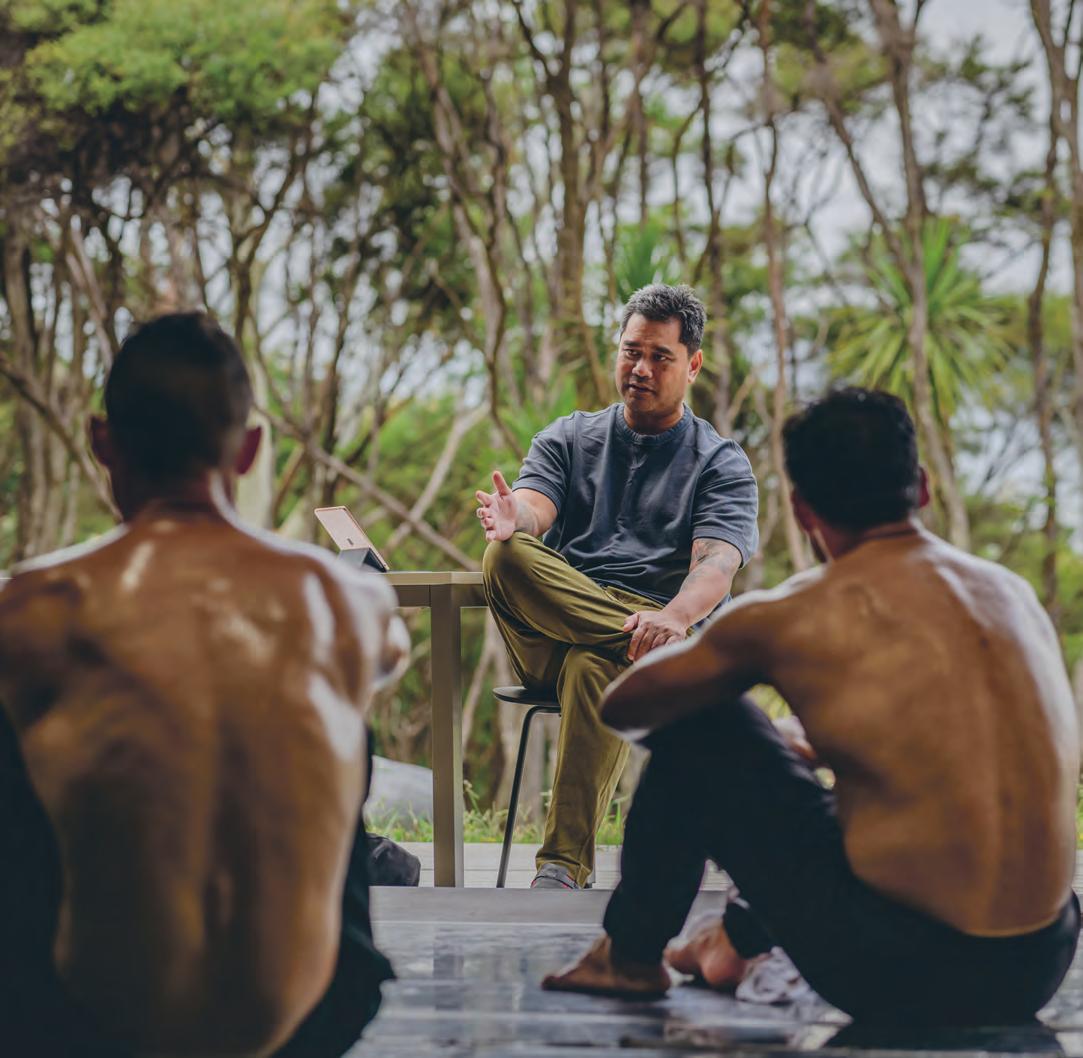
The boy from Porirua had fallen arches and a broken heart. Rheumatic fever, diagnosed at the age of seven, would compromise for life his heart valve but not his dreams. Neil Ieremia (b. 1970) would take those feet, that heart and those dreams and navigate his way far from the binding shores, both literal and metaphorical, to create a singular artistic world that defied expectations and, at times, gravity. ‘Give me a child until he is seven and I will show you the man,’ said Aristotle. The boy from Cannons Creek said, ‘Wanna see my Bruce Lee moves?’
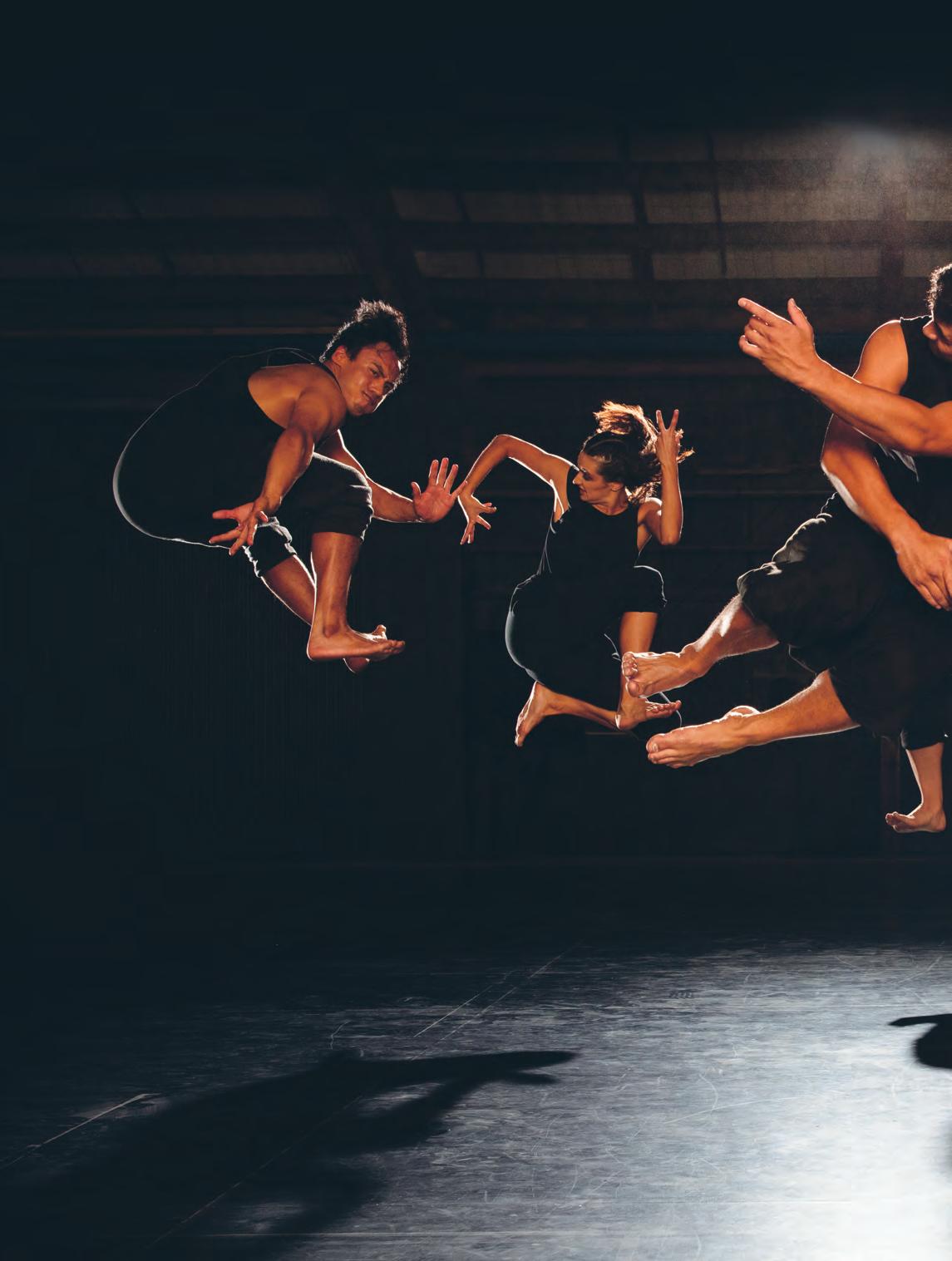
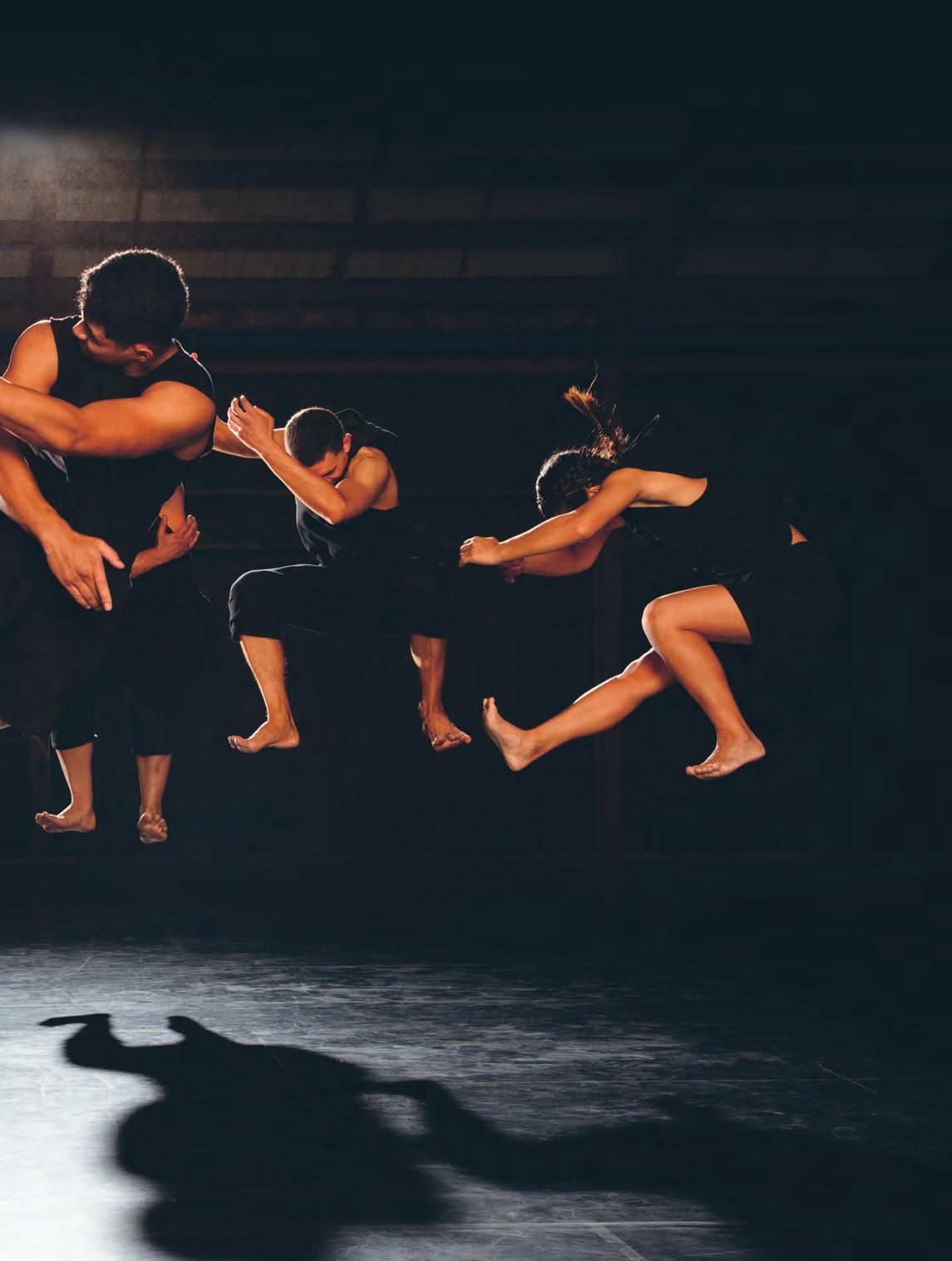
The skinny little kid who took up martial arts to rehabilitate hints at the essence of the tenacious man he would become, and at Black Grace’s underlying bedrock of grit and resilience. Founded by Ieremia in 1995, acclaimed dance company Black Grace is both the personal and the political. The whole messy experience of life, says Ieremia — ‘all the scars’ — informs the movements, the intention, the discipline. The company, which celebrated its 30-year anniversary in 2025, has a rich legacy of challenging cultural and artistic traditions: the tearing of creative muscle for growth.
First, Black Grace was a company of 10 Pasifika and Māori men: a devout Christian, drag queens, a Cannons Creek street rocker, an ex-soldier, a country music lover, an aerobics champion and a Mormon. ‘It didn’t make sense,’ says Ieremia. ‘But somehow it worked.’ The company now includes wāhine and Pākehā/Palagi dancers, and more than 10 times the initial intake have now trained under Ieremia’s leadership. His reputation as a choreographer is formidable. The bar is high, the pace relentless. The experience for the audience is visceral. The exhilarating, streetwise works are internationally acclaimed.
Ieremia left home for Tāmaki Makaurau Auckland at 19. At a Karangahape Road studio, he
was a fish out of water, with no classical training and no dance tights. On his first day, he was told to come back when he had the appropriate attire. A year later, he was asked to join the legendary Douglas Wright Dance Company.
‘I was a dancer for a long time and taught by choreographers, and there’s a difference,’ he says. ‘I make what I want to do and experience as a dancer.’ A complex deep thinker who loathes small talk, Ieremia is ‘in a constant state of reconciliation with myself . . . I grew up in Cannons Creek without a lot of money. We certainly didn’t have theatre, or that experience of going to the ballet and what have you. I’m in the business of putting on shows that a lot of my community wouldn’t necessarily see, so we figure out these crafty ways of getting people in.’
‘Crafty’ in the style of Robin Hood: take from deep-pocketed philanthropists; give to kids in low-decile schools. ‘At that moment in the theatre when they see it and go, “I want to dance”, they can go out and change, move the dial for their family, challenge the stereotypes and gender roles within the culture, and that’s cool,’ Ieremia says.
He also says that Black Grace is not about him. ‘It’s not about the company necessarily. There’s a bigger “us” who benefits from it.’ Ieremia delivered a poem before the 2025 opening of If Ever There Was a Time. If ever there was a manifesto to his people, to art and life, and to the Samoan mother wanting help for her boy in a hospital in the 1970s and who got a terrifying diagnosis from eye-rolling doctors, it is this:
I believe this to my core, and I know that you do too,
One day we’ll all soar
High above the future that they see for us
And we’ll stop being sore and we’ll stop being poor
And we’ll stop being navigators
Who never leave the shore.
Sarah Daniell
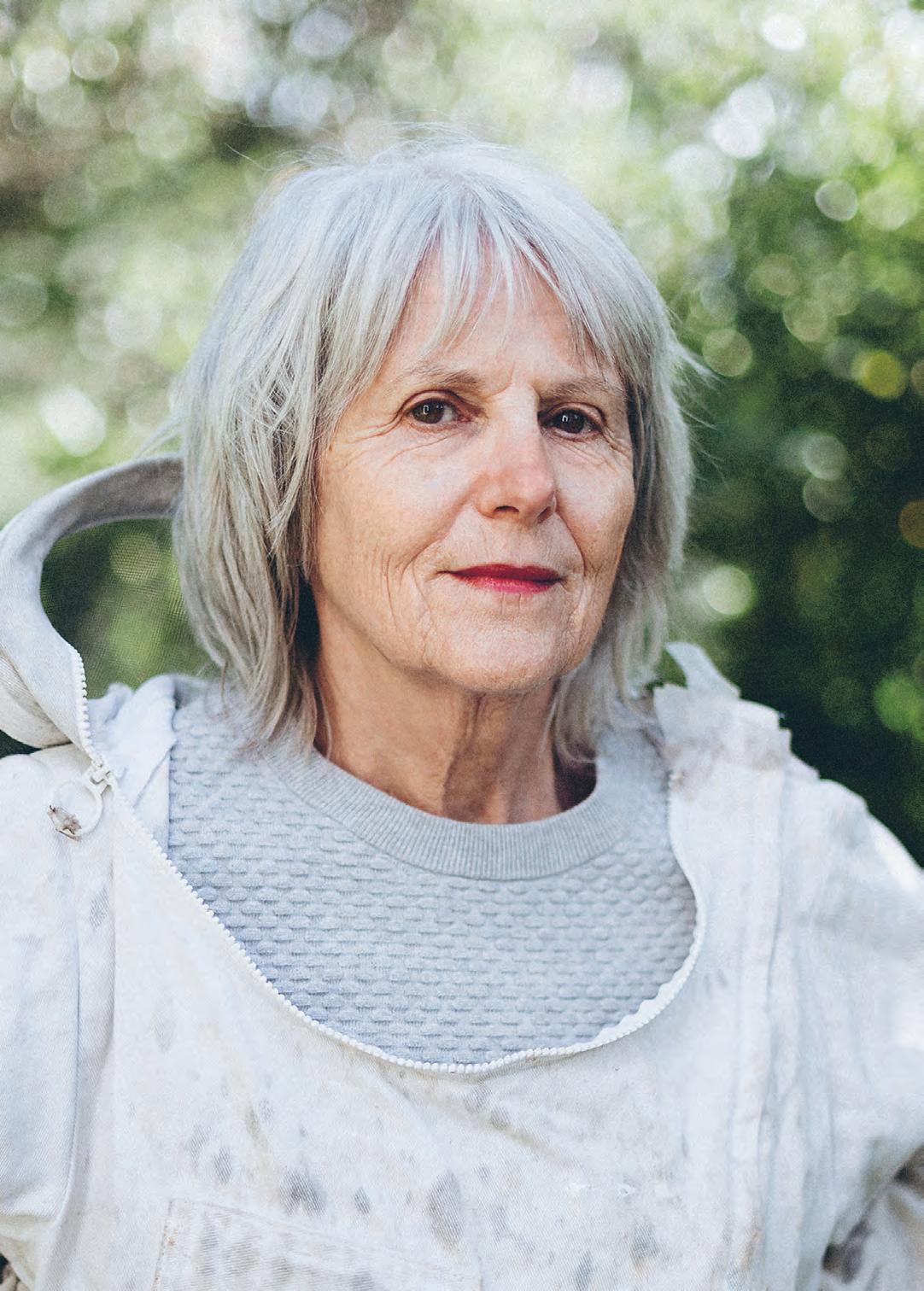
Anne Noble (b. 1954) is dedicated to the photographic medium as a mode of curiosity and discovery — an artistic commitment that has never wavered. Her important achievements rest on a distinctive sensibility: an approach to the world, and particularly landscape, as a morethan-human phenomena; an active embrace of sensory, emotional and spiritual relationships; deep research; and a sophisticated use of the camera and its techniques as an expression of personal consciousness, not just an eye. All these were evident early foundations of her practice and have, over time, intensified.
Noble’s foundational commitment to photography grounded in personal relationships can be felt in the intensity, power and poetry of her depictions of the confluence of people, place and histories along the Whanganui River and its whenua that brought her work to public attention in the early 1980s. In 1990, relationships called her back to track the river’s changes further in The Whanganui River Revisited, and led to kaumātua Bill Solomon’s commission of Te Hīkoi of Kāti Kurī: The Journey of Kāti Kurī (1997), a 40-metre-long work that retraced and reimagined the journey of the people of Kāti Kurī (Kāi Tahu) from Wairarapa to Waipapa, on the Kaikōura coast.
A close personal engagement with, and her feelings for, a subject, whether landscape or people, differentiates Noble’s oeuvre from documentary objectivity or the popularism of photojournalism. Her motivation feels more akin to a homage to, rather than capture of, human and non-human communities. The intimacy of her camera, and hence the viewer, with the languages of bodies and spaces, private relations and memories characterises essays such as Night Hawk (1982); In the Presence of Angels (1988), photographed in London’s Tyburn Convent; Hidden Lives: The Work of Care (1994); Touch Memory (1999), with its thrill in the surfaces of skin; In Memory Field . . . My Father’s Garden (2001), which depicted her father’s passing; and Ruby’s Room (1998–2007), which celebrated and magnified the joy of childhood. Created from light, her images of otherwise unremarkable parts of life are given a gravitas through love, curiosity and reflection.
Over the past two decades, the search for the reverberations of what is meaningful in the world has commanded her focus for lengthy durations. Multiple bodies of work created between 2001 and 2014 stemmed from her repeated visits to Antarctica. Photo series and books including Whiteout (2008–10), Ice Blink (2011) and The Last Road (2017) leaned into questions surrounding environmental crisis, exploration, ownership and extraction, earning Noble the prestigious US National Science Foundation (NSF) Artists Program and Writers Award 2008.
It was inevitable that, as a beekeeper, Noble’s enthralment with the ecosystem of honeybees would surface in her photography. Collaborations in the United States, Europe, Aotearoa and Australia created work using historical methods of imaging, including tintypes and photograms, alongside video, electron microscope images, 3D modelling and installations with living beehives in series including Song Sting Swarm (2012), No Vertical Song (2015), Bruissement (2015–17), Museum: For a time when the bee no longer exists (2018) and Conversātiō: A cabinet of wonder (2018–19). Creative blends of ecology, science and art, these works were aimed at sharing the beauty and intelligence of the hive and the threat of species loss.
The overarching significance of relationships before her art is never more evident than in Noble’s exhibition Unutai e! Unutai e! (2025), which captured multiple narratives about the deterioration of waterways across Kāi Tahu tribal lands and the whānau, hapū and iwi fighting for the exercise of Kāi Tahu rakatirataka. As part of evidence-gathering for the Ngāi Tahu Freshwater Statement of Claim to the High Court, Noble was enlisted to capture and document the catastrophic environmental impact of the Crown’s failure, over many decades, to adequately protect fresh water.
Anne Noble sets the example for how an artist can activate understanding of what matters to others and herself through accessible and beautiful work grounded in ethical, trusted collaborations that feed wider relationships to past and present, here in Aotearoa and the world beyond.
Zara Stanhope