
PERFORMANCE REPORT 2019
MASSACHUSETTS COLLEGE OF ART AND DESIGN
COLLEGE LEADERSHIP 2019-2020
Board of Trustees
Janice M. Saragoni, Chair
Elisa Hamilton ‘07, Vice-Chair
Daren Bascome, ‘93
John Intoppa, ‘23
Foundation Board 2019-2020
Officers
Valentine Talland, Chair
Jennifer Harrington, Vice Chair
Michelle Ingari, Vice Chair
Jeremy Pozen, Treasurer
Marjorie O'Malley, Clerk, VP of Advancement and Executive Director of the Foundation
Directors
Robert Bachelder
Hope Barkan
Henry Biner
Richard Coffman
Nina Fletcher, '91
Deanna Fulp
Robert S. Gatof
Charles Jobson
Alison Judd, '07
Ashley Karger
Fredrick Leichter
Fred Liang
James Mason, ‘81
Roberta Moore
Deirdre Nectow
Paul Pflugfelder
Patricia Rivers
Molly Shannon
Chiara Trabucchi
Elissa Warner
David Webster
President’s Cabinet
David Nelson, President
Karen M. Keane
Denise Korn
M. David Lee
William McQuillan
Designated Directors
David Nelson, President
Peter Nessen, Trustee Representative
Kymberly Pinder, Provost
Chair Emeriti
Trevania Henderson
William Hicks
Tali Kwatcher
Susan Schechter
Clare Villari
Honorary Directors
Aisha Al Riyami
Caroline Collings
Nicholas Greville
Katherine Sloan
Michael Tarnow
Foundation Secretary
Abigail Welty
Corporate Advisory Council 2018-2019
Jennifer Harrington, Chair
Anne Callahan, Vice Chair
Judith Anderson
BK Boley
Duncan Browne
Ellen Carr
Kymberly Pinder, Provost/Senior VP of Academic Affairs
Maureen Keefe, VP of Student Development
Cecilia Mendez-Ortiz, Executive Director of CACP
Marjorie O'Malley, VP for Institutional Advancement
Lyssa Palu-ay, Dean of Justice, Equity, Transformation Office
Peter Nessen
Pamela Parisi ‘67
Linda L. Snyder
Anthony Clayton
Richard M. Coffman
Amy Cueva
Joel Ellzey
Maura FitzGerald
Josephine Holmboe
Sophie Hughes, '08
Jeff Johnson, '86
Wesley Karger
Maureen Keefe
Kathy Kiely, '78
Dusan Koljensic, '05
Tricia Krupa Cha
Elizabeth O. Lowrey
Claire Malagati
Matt McLaughlin
David Nelson
Marjorie O'Malley
Bob Perry
Kymberly Pinder
James Read
Lee Rubenstein
Maryellen Schroeder
Tammy Skuraton
Anne Marie Stein
Valentine Talland
David Valliere
Richard Watson
Robert Perry, VP of Administration and Finance
Katherine Russell, Director of Internal Operations
Susana Segat, Chief of Staff/Secretary to the Board
Lauren Wilshusen, Interim Dean of Admissions/Enrollment
Management
Gina Yarbrough, General Counsel
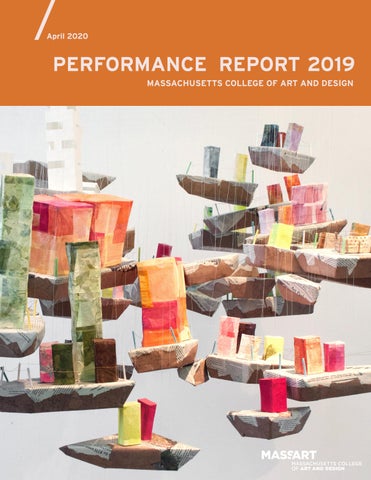
photo by Althea Bennett.
INTRODUCTION
Partnership Renewal Plan
Art College Peer Group
Reporting Periods
Working Toward Our 2023 Strategic Goals
Partnership Renewal Plan
The underlying premise of the MassArt New Partnership Plan is that the college, as a specialized public institution, can and should be held to high standards of accountability and therefore should also be granted substantial freedom to determine how it achieves those outcomes. Legislation contained in Section 634 of the FY04 Massachusetts State Budget authorized the college to establish its own performance standards appropriate to the unique nature of its mission and mandates a report each year. This report provides quantitative and qualitative data on selected performance measures from the performance agreement included in the second Partnership Plan renewal, approved in September 2016, and highlights notable MassArt events, accomplishments, and directions in the past year.
Art College Peer Group
Peer institutions, approved by the BHE in March 2010, are listed below. This group includes colleges that are up to 50% larger or smaller than MassArt in enrollments, offer different configurations of programs and majors, and have varying financial resources; but when considered in the aggregate, average measures for the group provide valid benchmarks for MassArt on most performance indicators. These institutions are used for benchmarks for the key indicators included in the second section of this report.
Art Center College of Design
California College of the Arts California Institute of the Arts College for Creative Studies Columbus College of Art and Design Maryland Institute College of Art Ringling College of Art and Design
Rhode Island School of Design School of the Art Institute of Chicago
The University of the Arts
Reporting Periods
ENROLLMENT Final FY2019, preliminary FY2020
ADMISSIONS Fall 2019, Fall 2018 AICAD
FINANCIAL AID FY2019, Fall 2019
RETENTION AND GRADUATION RATES FY2018, FY2019
TUITION AND FEE REVENUE FY2019
PEER FINANCIAL BENCHMARKS FY2018
Benchmarks use the most recent available peer data.
Working Toward Our 2023 Strategic Goals
In June 2019 the Massachusetts Board of Higher Education approved MassArt at 150, Strategic Plan 2018-2023. Through the strategic planning process, MassArt clearly articulated what we aim to achieve and why it matters for the growth, health, and wellbeing of our community as we approach our 150th anniversary in 2023. A few of our major accomplishments include:
• Renovation of South Building and launch of the MassArt Art Museum
• Raised $12.5 million, surpassing the UNBOUND Campaign’s (for MAAM) $12 million goal
• Welcomed a new Provost and Dean of Graduate Programs
“We pursue a just, compassionate, and equitable learning environment” is the first phrase of our values statement and is the clear driver of our community to ensure that MassArt moves deliberately to be more just and equitable, and to do so with compassion. Recently, we have worked to address retention and completion by:
• Updating our Pronoun and Chosen Name policy
• Establishing the Office of Justice, Equity, and Transformation to promote systemic equity and campus cultural transformation
• Facilitating conversations about race such as the Anti-Racism Dialogues, implicit bias training, Undoing Racism and faculty development workshops
• Removing financial barriers for our Pre-Semester orientation program
• Creating an orientation program to assist students with emotional challenges
As noted above, we established a new Office of Justice, Equity, and Transformation (JET), one of the many ways we organized to implement our plan in ways that would benefit our campus community. JET’s work is shaped by the elements of our strategic plan that focus on justice, equity, diversity, and inclusion, and centers on the cultural transformation necessary to move toward systemic equity and a thriving campus for all. While the JET office leads efforts to transform campus culture, a separate compliance office will concentrate exclusively on managing complaints and is responsible for EO, ADA, and Title IX. The search for the leader of the compliance office is complete and we look forward to welcoming them to campus in 2020.
Other organizational changes made this year in Academic Affairs better aligned our curricula, data analysis, and enrollment goals across MassArt so we can serve all of our learning communities in the best way possible. The Office of Institutional Research, Effectiveness and Planning, and the Office of Admissions and Enrollment Management both now report to the provost, and the Academic Resource Center is now part of the Division of Student Development. Professional and Continuing Education has been integrated into graduate studies and the provost’s office. The position of Executive Director of Youth Pathways and Programs was established, creating more ways in which we deliver our curriculum to provide more pathways to our degrees is our first step towards systemic equity.
The Fiscal Year 2020 budget allocated a separate line item for strategic initiatives and the understanding that funding would be reviewed during two budgetary inflection points in October and February. The President’s Cabinet identified a list of strategies to be advanced in FY2020, including four that were considered essential to the plan’s success thus receiving immediate funding commitments: 1) anti-racism and anti-bias workshops and training; 2) the hiring of additional academic administrative assistants; 3) the purchase and deployment of an advanced space reservation system; and 4) the launch of the Colleague Modernization Project. Progress on these and other strategies can be followed online at Our Vision for the Future, where there is a live dashboard providing an overall update of items, as well as other reports.
KEY INDICATORS
Academic Quality
Access and Affordability
Student Success and Engagement
Service to the Commonwealth and the Economy
Financial Health
ADMISSIONS STANDARDS
First-time First-Year Students
The admission process at MassArt is holistic and considers both academic achievements and artistic potential. For firsttime first-year students, decisions place the greatest weight on high school GPA and the quality of the application portfolio. In Fall 2017, MassArt became part of the Test-Optional pilot and no longer considers standardized test scores in this decision process.
3.48 was the average weighted GPA 84% had GPA of 3.0 or higher 61% did not submit standardized test scores
2.55 was the lowest high school GPA reported
Transfer Students
Providing access to transfer applicants, particularly those from community colleges, is an important priority in MassArt's enrollment plan. The transfer admissions process strives to both maintain high standards and minimize time to degree for transfer students. The average college GPA for entering transfer students was 3.26 in Fall 2019; 72% had a college GPA of 3.0 or above.
ADMISSIONS SELECTIVITY
In Fall 2018, MassArt ranked in the middle of our AICAD peer group for admission selectivity, accepting 67% of completed undergraduate applications. The most selective college in the group was California Institute of the Arts, with a reporting acceptance rate of 23%. The least selective was the Columbus College of Art and Design, at 88%, tied with California College of the Arts. The median acceptance rate was 67%. Fall 2019 data is not yet available for AICAD peers.
FACULTY CREDENTIALS
The current MassArt student to faculty ratio (student FTE to faculty FTE) for the BFA program is 9.7:1, which is less than the peer group average of 10.7. In Fall 2018, full-time faculty made up 59% of the faculty FTE for MassArt’s BFA program, which exceeds our AICAD peer average of 58%. Ninety-two percent of MassArt full-time faculty hold advanced degrees. This is the third-highest percentage in the peer group.
ACCESS AND AFFORDABILITY
ENROLLMENT IN THE BFA DEGREE PROGRAM
Enrollment of ALANA students in the BFA program remained stable between 2018 and 2019 after a decade of steady growth, even in years such as 2014 and 2015 when total BFA enrollment declined. MassArt has experienced the largest increase in Hispanic/Latinx enrollments, with enrollment of Asian students increasing at a somewhat less dramatic rate, and Black/African-American enrollment remaining largely stable. The lower number of students reporting themselves as 'Multiracial' results in part from a change in the way that this data is collected, with a two-question format that conforms to new federal guidelines. In Fall 2019, ALANA students constituted 31% of the US citizens and legal permanent residents enrolled in the BFA program who reported their race and ethnicity.
ALANA includes Native American, African American, Latinx, Asian, Hawaiian, Pacific Islander and multi-racial students; international students and those who did not report ethnicity are excluded from graduation rate comparisons.
BFA ALANA Student Enrollment
URBAN AND COMMUNITY COLLEGE STUDENTS
Providing access to students attending Massachusetts community colleges and urban high schools is an important value for MassArt and can present particular challenges. Many urban schools do not offer substantial curricula in the visual arts; urban students are frequently underprepared academically as well. A variety of recruitment strategies for urban students are in use at MassArt, including partnerships with high schools and community organizations.
Admitted Applicants from Massachusetts Urban High Schools
MassArt has long-standing formal articulation agreements with Greenfield, Holyoke, and Massasoit Community Colleges. These agreements cover only a small number of our community college transfer applications; the majority of community college students enter MassArt through our general transfer admission process. The college continues to work with Roxbury Community College and Bunker Hill Community College to develop programs which align with MassArt curricula and will facilitate transfer to the college. In Fall 2019, 38.5% of incoming transfer students had attended a Massachusetts community college.
Community College Transfer Students Admitted
AND FEE STRUCTURE AND FINANCIAL AID
Student Charges
Family Income of Dependent Undergraduate Students Applying for Federal Financial Aid, Fall 2019
- $60,000
Grant Aid Awarded to Massachusetts Undergraduates
ENROLLMENT IN GRADUATE AND CERTIFICATE PROGRAMS
MassArt graduate programs provide access to advanced professional degrees in design and fine arts. The market for graduate programs has become increasingly competitive over the past several years, and MassArt graduate enrollment has declined.
Certificate programs offered at the undergraduate and post-baccalaureate levels provide preparation and credentials for professional practice or further education in the visual arts.
Our strategic plan includes renewed development of graduate and certificate programs.
STUDENT SUCCESS AND ENGAGEMENT
RETENTION RATE FOR FIRST-TIME FIRST-YEAR
MassArt’s first-year to sophomore retention rate for the 2018 entering cohort was 84%. For the most recent comparative data available, we are the third highest retention rate of our AICAD peers. The fall 2017-to-2018 rate also places MassArt among the top three Massachusetts state universities for fall-to-fall retention with the University of Massachusetts Amherst (91%) and Massachusetts Maritime Academy (86%). Maintaining a high first-year retention rate is a critical element in our commitment to increase both the six-year and four-year graduation rates.
SIX-YEAR GRADUATION RATES
MassArt’s six-year graduation rate for the 2012 entering first-year cohort was 63% — the sixth highest of our AICAD peer group. We returned to a six-year graduation rate of 71% for the 2013 entering cohort. Aside from this anomaly, the six-year graduation rate has remained over 70% for first-year students entering MassArt since 2013. The rate consistently ranks above the median for our AICAD peer group and in the top three of the Massachusetts state universities. The college affirms our commitment to maintain an average six-year rate above 70%, and to increase the number of students who complete their degrees in four years. The four-year graduation rate has increased in recent years, and is 54% for the 2013 cohort.
MassArt First-Year to Sophomore Retention Rate
MassArt First-time First-Year Graduation Rates
Fall 2018 First-Year to Sophomore Retention Rates
MassArt and AICAD Peers
Rhode Island School of Design
Maryland Institute College of Art
Massachusetts College of Art and Design
The University of the Arts
Art Center College of Design
California College of the Arts
School of the Art Institute of Chicago College for Creative Studies
California Institute of the Arts
Columbus College of Art and Design
* Fall 2019 retention data not yet available. This value is for the previous cohort.
Six-year Graduation Rates, Fall 2012 First-Year Cohort
MassArt and AICAD Peers
Rhode Island School of Design
Maryland Institute College of Art
Massachusetts College of Art and Design
Art Center College of Design
California Institute of the Arts
School of the Art Institute of Chicago
Columbus College of Art and Design
The University of the Arts
California College of the Arts
College for Creative Studies
GRADUATION RATE BENCHMARKS
Six-year Graduation Rates, Fall 2012 First-Year Cohorts
MassArt and Massachusetts Public Universities
University of Massachusetts-Amherst
Massachusetts Maritime Academy
West eld State University
Massachusetts College of Art and Design
University of Massachusetts-Lowell
Fitchburg State University
Bridgewater State University
Salem State University
Worcester State University
University of Massachusetts-Dartmouth
Framingham State University
Massachusetts College of Liberal Arts
University of Massachusetts-Boston
Two years ago, NCES began to track graduation rates for students who enter their current institution with prior postsecondary enrollments. MassArt's performance agreement, contained in the 2016 renewed Partnership Plan, specifies measuring graduation rates for incoming transfer student cohorts, using first-year graduation rates as benchmarks. Both groups include only students who attended full-time in their first semester. Since the majority of MassArt transfers enter as first-year students, six years is defined as 150% of the normal time to degree completion and graduation was tracked over that period. Students who entered at the sophomore level generally completed in a shorter period. The chart below presents graduation rates for both firstyear students and transfer cohorts over the past five years. Transfer students typically meet or exceed the first-time firstyear six-year graduation rate.
First-time First-Year vs. Transfer Student Graduation Rates
Entering Cohorts 2009 to 2013
SIX-YEAR GRADUATION RATE FOR ALANA STUDENTS
Graduation Rate Gaps, Fall 2012 First-Year Cohorts
MassArt and Massachusetts Public Universities
University of Massachusetts-Amherst
Massachusetts Maritime Academy
Massachusetts College of Art and Design
Fitchburg State University
University of Massachusetts-Lowell
Salem State University
West eld State University
Bridgewater State University
Massachusetts College of Liberal Arts
University of Massachusetts-Dartmouth
University of Massachusetts-Boston
Framingham State University
Worcester State University
ALANA includes Native American, African American, Latinx, Asian, Hawaiian, Pacific Islander and multi-racial students; international students and those who did not report ethnicity are excluded from graduation rate comparisons.
One of MassArt’s performance goals is to achieve graduation rates which minimize observed differences associated with race and ethnicity. For the entering firsttime full-time cohort of Fall 2012, the graduation rate for ALANA students (60%) was five percentage points lower than that of white non-Hispanic/Latinx students (65%).
MassArt’s ALANA student graduation rate (60%) ranked third among Massachusetts public universities for 2012 entering first-year cohorts, trailing the University Of Massachusetts Amherst and Massachusetts Maritime Academy. MassArt’s 2012 ALANA graduation rate exceeds the rate for white students at six of the other Massachusetts public universities.
Because entering cohorts of ALANA students are relatively small at MassArt and fluctuate in both size and composition from year to year, single year cohort rates vary significantly and can be unrepresentative. A three-year aggregated cohort rate is a more reliable measure of success for this group of students. There is an 11 percentage point gap between the aggregated six year graduation rate of ALANA students (59%) and that of white students (70%) for the MassArt entering cohorts of 2011 to 2013. There was a 10 percentage point gap for the prior three-year aggregated cohort (2010-2012).
ALANA students White students
SERVICE TO THE COMMONWEALTH AND THE ECONOMY
DEGREES
Degrees and Certificates Awarded
Design certificates include Graphic Design, Fashion Design, Furniture Design, and Industrial Design. Post-baccalaureate certificates include Teacher Preparation, Dynamic Media, Photography, and Fine Arts.
Degrees
by Major Program
These are duplicated counts; double majors are included in this table in both majors. The unduplicated BFA graduate count for 2018/2019 is 341.
Degrees Awarded Annually in Design and Media Majors
Degrees Awarded Annually in Teacher Preparation Programs
Graduates of MassArt's programs in design and media serve the labor market needs of the Commonwealth's creative economy. In academic year 2018/2019, 73% of all degrees and certificates awarded were in design and new media majors.
GRADUATE EMPLOYMENT
The number of Art Education degrees awarded by MassArt decreased slightly from the past year. Of these degrees, 83% were awarded to Massachusetts residents. All licensure track graduates passed the MTEL test.
Summary of BFA Responses to the Spring 2019 Alumni Survey -1200 responses
Median Annual Salary Range by Years Since Graduation Employment Relation to Major
Location of Alumni Respondents
Eighty-one percent reported that their current employment is related to their major.
Fifty-eight percent of MassArt Alumni live in Massachusetts and 70% live in all of New England.
FINANCIAL HEALTH
STATE OPERATING SUPPORT
The major underlying premises of MassArt's New Partnership Plan were that by gaining authority to set and retain tuition, accepting an equivalent reduction in the state maintenance appropriation, and actively managing enrollment, the college can maintain financial health at a cost savings to the Commonwealth. Achieving this end requires commitments from both parties to the agreement. MassArt must achieve the enrollment and tuition revenue targets set out in the plan's business model, and operating appropriations from the Commonwealth must be consistent with the model's projections.
From the start of the partnership until FY2013, MassArt achieved enrollments within 2% or less of its annual goals (exceeding them in some years), kept student charges affordable for Massachusetts residents, and steadily increased institutional resources allocated to student financial aid. In FY2014, BFA enrollment began to trend downward; this decline continued in FY2015 and FY2016. Enrollment stabilized through FY2017 and 2018, and Fall 2019 saw an entering class of 491 students. Application volume for Fall 2020 suggests the decline in enrollment has reversed, at least prior to unforeseen impacts from COVID19. We are moving many new student opportunities online and creating other avenues for virtual engagement.
In FY2014 the legislature recognized the acute funding situation of the state universities. MassArt received an additional $1 million in state funding, allowing the college to freeze student charges for Massachusetts residents at the FY2013 level. In FY2015, the appropriation did not increase enough to hold charges for a second year; tuition and fees for MA students increased 8%. Charges increased by 4.5% in FY2016, 4% in FY2017, 4% in FY2018, and 3.8% in FY2019.
UNDERGRADUATE TUITION AND FEES
The combination of increases in tuition and fees as well as enrollment growth in the BFA program has resulted in a significant increase in net revenue from undergraduate student charges. The chart at right shows the growth in retained tuition by student residency status since the start of the partnership agreement.
As specified in our performance agreement, the tuition FTE is defined as the full-time student headcount plus 60% of the part-time headcount, which reflects MassArt's allocation of student charges.
Undergraduate Tuition and Fee Revenue
Retained Undergraduate Tuition FY2012 to FY2019
State
FINANCIAL HEALTH
TUITION DEPENDENCY
Core revenues include tuition and fees; federal, state and local appropriations; government grants and contracts; investment income; gifts; and other operating and non-operating sources. Tuition and fees in these charts include revenue from all programs.
The percentage of total core revenues derived from tuition and fees suggests the degree to which an institution's operations depend on annual student charge revenue. The state operating appropriation makes MassArt less dependent on student charges than our AICAD peers, and has allowed the college to remain affordable for Massachusetts residents. As state appropriations decline, the college's tuition dependency will begin to approach that of some of our private AICAD peers.
MassArt Tuition and Fees as a % of Core Revenues
ENDOWMENT
Since FY2003, the value of MassArt’s endowment has increased by over 450%, from $2.9 million in June 2003 to over $16 million in June of 2018. MassArt’s total endowment is the second smallest of our art and design institution peer group.
At the beginning of FY2018, the average endowment per full-time equivalent (FTE) student for our peers was $47,064 compared to $8,564 for MassArt. Endowment per FTE at MassArt remained relatively the same between FY2017 and FY2018, but this is still well below the average value at AICAD institutions.
MassArt Endowment and Related Investments
AICAD Peers Tuition and Fees as a % of Core Revenues, FY2018
Endowment per FTE, Massart and AICAD Peers, FY2018
PEER EXPENDITURE BENCHMARKS
Peer financial benchmarks use data from the National Center for Education Statistics (NCES) Peer Analysis system for the FY2018 IPEDS Finance Survey. Total core expenditures (E&G) per FTE at MassArt were $40,492 which is approximately $500 less than the peer median expenditures of $40,940 in FY2018.
Core expenditures include: instruction, academic support, research, public service, students services, institutional support, operations and maintenance, and scholarships and fellowships.
Core Expenditures per FTE, FY2018
Rhode Island School of Design
Ringling College of the Arts
College for Creative Studies
California Institute of the Arts
Massachusetts College of Art and Design
Maryland Institute College of Art
School of the Art Institute of Chicago
The University of the Arts
California College of the Arts
Art Center College of Design
Columbus College of Art and Design
Instruction and Academic Support to Core Expenses Ratio, FY2018
Art Center College of Design
Maryland Institute College of Art
The University of the Arts
California Institute of the Arts
School of the Art Institute of Chicago
Ringling College of Art and Design
California College of the Arts
Rhode Island School of Design
Columbus College of Art and Design
Massachusetts College of Art and Design
College for Creative Studies
Institutional support expenditures per FTE at MassArt are the third smallest in our peer group. This category includes most administrative costs.
Both Art Center College of Design and College for Creative Studies tend to be outliers in the percentage of core expenses represented by institutional support costs. The ratio of these costs to the total E&G budget at MassArt is the second lowest of our peer group if Art Center is excluded, and are nearly 50% less than the percentage of E&G budget for Creative Studies.
MassArt’s peer FTE expenditures for Institutional Support are second lowest in the peer group, at $6,105.
Institutional Support to Total Core Expenses Ratio, FY2018
Art Center College of Design
School of the Art Institute of Chicago
Massachusetts College of Art and Design
Maryland Institute College of Art
The University of the Arts
California Institute of the Arts
California College of the Arts
Ringling College of Art and Design
College for Creative Studies
Rhode Island School of Design
Columbus College of Art and Design
Institutional Support Costs per FTE, FY2018
Art Center College of Design
Massachusetts College of Art and Design
The University of the Arts
Maryland Institute College of Art
School of the Art Institute of Chicago
Columbus College of Art and Design
California College of the Arts
California Institute of the Arts
Ringling College of the Arts
College for Creative Studies
Rhode Island School of Design