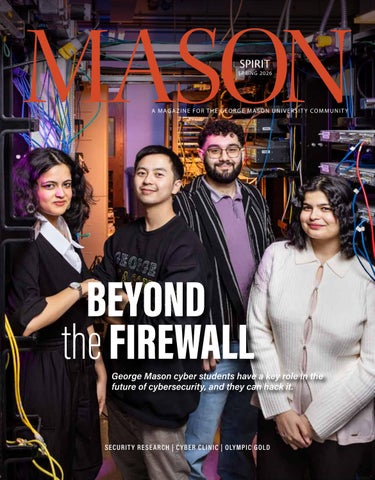
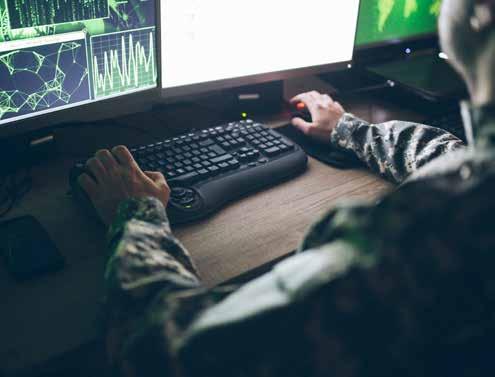
George Mason cyber students have a key role in the future of cybersecurity, and they can hack it.
SECURITY RESEARCH | CYBER CLINIC | OLYMPIC GOLD
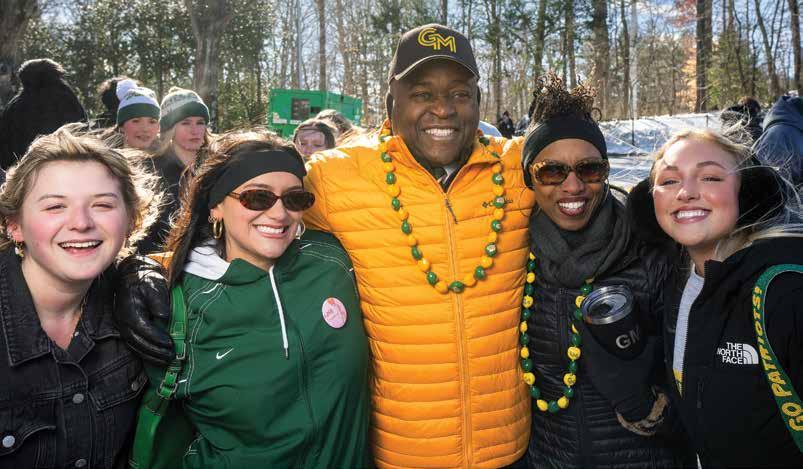
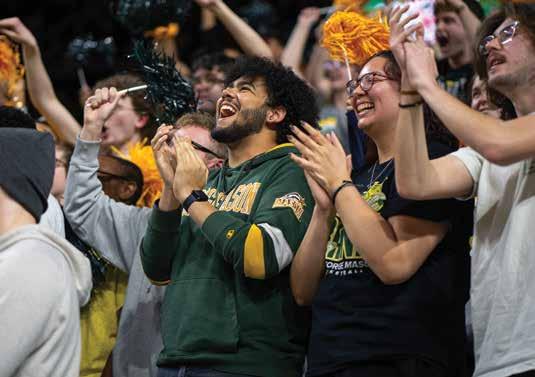
SWISH YOU WERE HERE at George Mason’s 2026 Homecoming celebration, which culminated in a men’s basketball win over Saint Joseph’s.
President Gregory Washington and presidential partner Nicole Washington joined students and alumni
MASON
SPRING SPIRIT 2026
ABOUT THE COVER
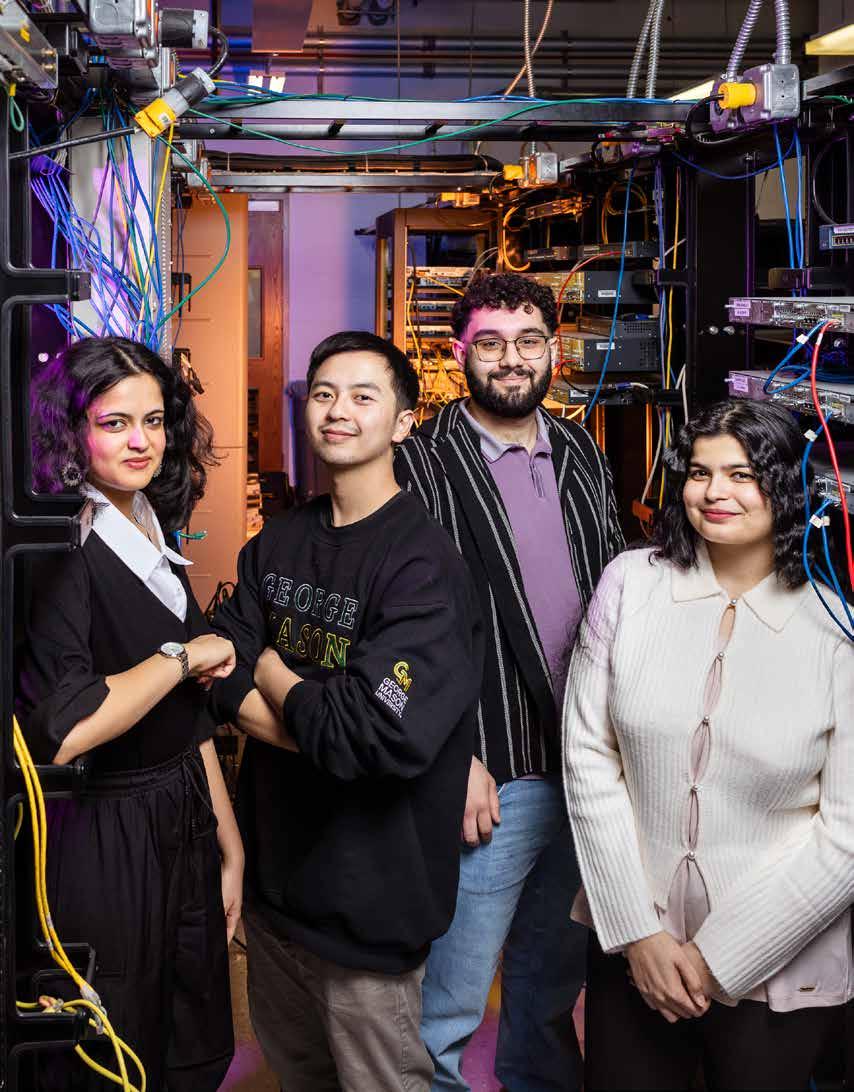
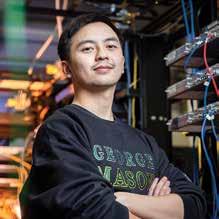
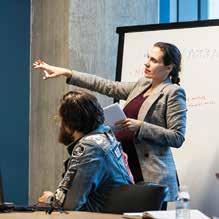
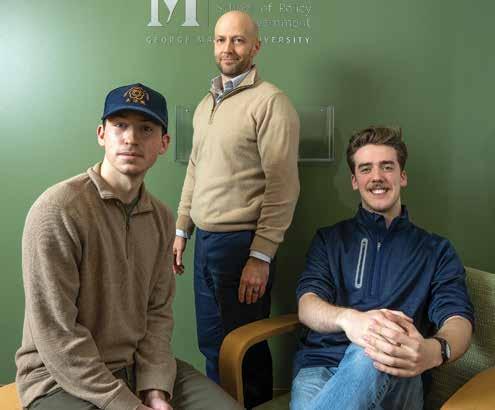
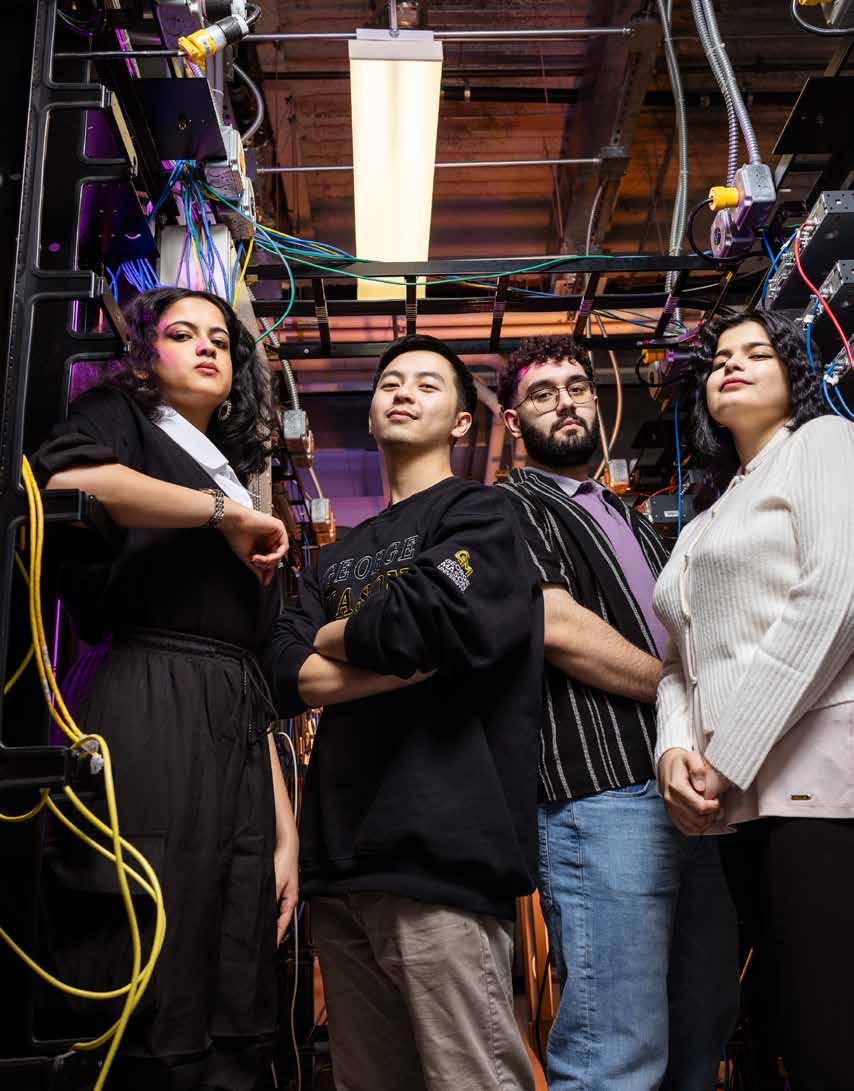
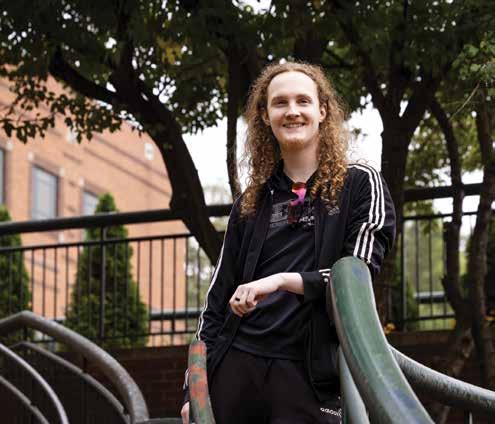
Meet the George Mason students who are advancing in cyber competitions at the national level.
Photo by Ron Aira
CONNECT WITH GEORGE MASON UNIVERSITY
#MasonNation • gmu.edu
@georgemason @georgemasonu
BASKETBALL BLING!
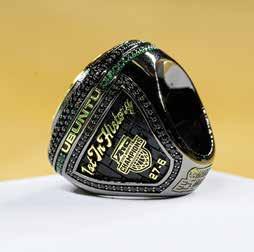
On November 11, the women’s basketball team showed of their championship rings and hoisted their championship banner in EagleBank Arena during their home opener.
Scan the QR codes you’ll find throughout the magazine with your smartphone’s camera app for associated websites
@georgemasonu @georgemasonuniversity with more details.
PHOTO BY EVAN CANTWELL
PHOTO BY ART PITTMAN
TAKE A LOOK
They train, compete, and perform at the highest level—only their arena is cybersecurity. Like top athletes, George Mason’s students prove themselves when the pressure is on.
the Classroom to the Community: Cybersecurity in Action
Guided by experts, students at George Mason and Howard University are delivering tailored cybersecurity solutions to organizations that need them most—while shaping their own futures.
On the Frontlines of Security Research
From integrated sensing to space systems, the nation’s most pressing defense challenges are getting that George Mason touch from faculty who are leading interdisciplinary eforts that connect academia, government, and industry.
GRIT AND GRACE
It was quite a thrill for the Mason Nation to rally around U.S. Olympic figure skater Ilia Malinin during his quest for gold at the 2026 Winter Games in Italy. Students, faculty, and staf packed the Johnson Center on the Fairfax Campus to cheer on their fellow Patriot and exploratory studies major.
Ilia, who helped Team USA win the gold medal, is a singular performer on the ice, as his four U.S. and two World Figure Skating Championships and quadruple axel artistry attest.
But in other ways, Ilia is just like many of his classmates. He was born in Fairfax and attended a local public high school— about 70 percent of our students are from Northern Virginia. Because of his training and competition schedule, Ilia needs flexibility in his course schedule just like our students who squeeze classes around their jobs, families, and military responsibilities.
And just as Ilia competes at the highest level of his sport, George Mason students compete at the highest level of academia. Think about it: They are pursuing a degree at an R1 school—the top research classification—with students from about 130 countries. They attend college in a nation renowned worldwide for its higher education system. And they matriculate at the institution ranked No. 32 nationally among U.S. public universities by the Wall Street Journal. So you might say that all George Mason students compete in an Olympics of their own.
But perhaps the most important way Ilia represents our students is with his grit and determination. As Olympics fans know, Ilia did not follow his Team USA gold medal wit an individual medal. He fell twice during his free skate and dropped to eighth place, a stunning outcome for someone so heavily favored to appear on the podium.
In defeat, however, Ilia set an example of class and courage that I consider to be the greatest and most enduring performance of his young, storied career.
In shocked disappointment and through tears, he sincerely congratulated his competition. He owned his mistakes in interview after interview. He shone a light on how the pressure of sports can adversely afect the mental health of young athletes. And he displayed remarkable resiliency by executing a crowdpleasing performance in the Olympic exhibition gala as he regrouped for the World Championships in March.
Ilia did everything you could ever ask from a young person—really, any person—in showing how to handle disappointment with dignity and grace.
I’m as proud of Ilia in defeat as I ever could have been in victory. Bravo!
Gregory Washington President, George Mason University
Follow President Washington on X @GMUpres
MASON SPIRIT
A MAGAZINE FOR THE GEORGE MASON UNIVERSITY COMMUNITY spirit.gmu.edu
MANAGING
EDITOR
Colleen Kearney Rich, MFA ’95
ART DIRECTOR
Joan Dall’Acqua
ASSOCIATE
EDITORS
Melanie Balog, PhD ‘25
Priyanka Champaneri, BA ’05, MFA ’10
Anne Reynolds
EDITORIAL ASSISTANTS
Katarina Benson, BA ‘24
Zachary Grimm
CONTRIBUTORS
Jennifer Anzaldi
Shayla Brown
Paola Duran
Danielle Hawkins, MPA ‘22
Sarah Holland
John Hollis
Nathan Kahl
Benjamin Kessler
Rebecca Kobayashi
Tracy Mason
Buzz McClain, BA ‘77
Amanda Milewski
Jenn Pocock
Lauren Clark Reuscher, MA ’12
Corey Jenkins Schaut, MPA ’07
Pam Shepherd
Taylor Thomas
Preston Williams
GRAPHIC DESIGN
Claire Brandt
Angel Lee
Jeeun Lee Namgoong
Michaela Reilly, BA ’21
PHOTOGRAPHY AND MULTIMEDIA
Ron Aira
Melissa Cannarozzi, MA ’22
Evan Cantwell, MA ’10
Romulfo Sison
Cristian Torres
PRODUCTION MANAGER
Brian Edlinski
EDITORIAL BOARD
Stephanie Aaronson, BA ‘94
Deputy Vice President for Communications and Digital Strategy
Paul G. Allvin
Vice President for University Branding and Chief Brand Oficer
Trishana E. Bowden
Vice President for Advancement and Alumni Relations
Robin Rose Parker
Associate Vice President for Advancement
Communications and Donor Stewardship
Jennifer W. Robinson, JM ’02
Associate Vice President for Alumni Relations
Mason Spirit is published three times a year by the Ofce of Advancement and Alumni Relations and the Ofce of University Branding. George Mason University is an equal opportunity employer that encourages diversity.
Letters to the editor are welcomed. Send correspondence to Colleen Kearney Rich, Managing Editor, Mason Spirit, 4400 University Drive, MS 2F7, Fairfax, Virginia 22030.
Or send an email to spirit@gmu.edu
Need to change your address or update contact information with us? Or prefer not to receive the magazine in the mail any longer? Just let us know via email at development@gmu.edu The programs and services ofered by George Mason University are open to all who seek them. George Mason does not discriminate on the basis of race, color, religion, ethnic national origin (including shared ancestry and/or ethnic characteristics), sex, disability, military status (including veteran status), sexual orientation, gender identity, gender expression, age, marital status, pregnancy status, genetic information, or any other characteristic protected by law. After an initial review of its policies and practices, the university afirms its commitment to meet all federal mandates as articulated in federal law, as well as recent executive orders and federal agency directives.
Mason Spirit content may not be reproduced without prior written permission. To request permission for any form of reproduction or reuse, please contact spirit@gmu.edu.
@ MASON
PHOTO BY EVAN CANTWELL
PHOTO BY QIAN JUN/MB MEDIA/GETTY IMAGES
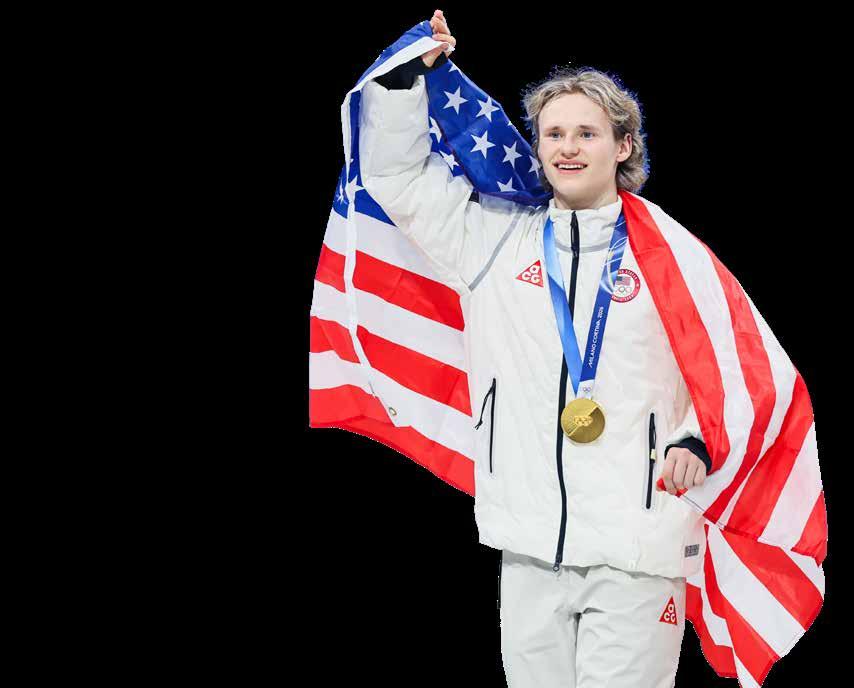
George Mason student and reigning world figure skating champion Ilia Malinin (above) helped power the United States to a team figure skating gold medal at the Milano Cortina Winter Games.
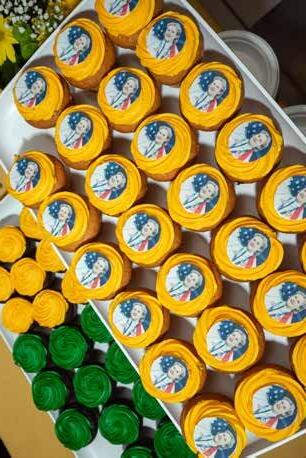
GEORGE MASON’S ILIA MALININ CLAIMS OLYMPIC GOLD
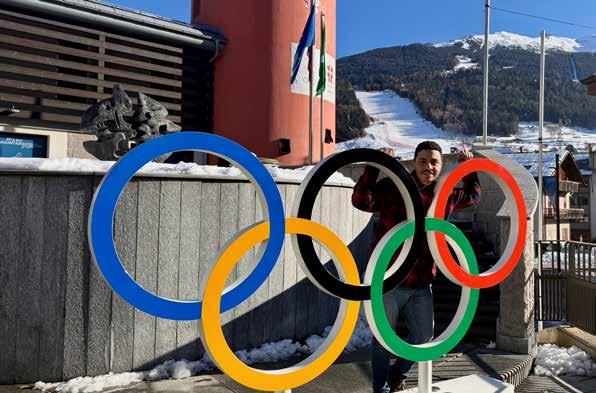
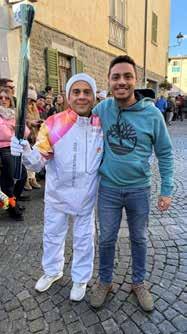
ALL EYES WERE ON ITALY THIS FEBRUARY as the Mason Nation cheered on George Mason student and reigning world figure skating champion Ilia Malinin, as he helped power the United States to a team figure skating gold medal at the Milano Cortina Winter Olympic Games.
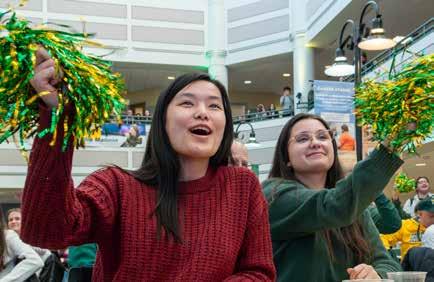
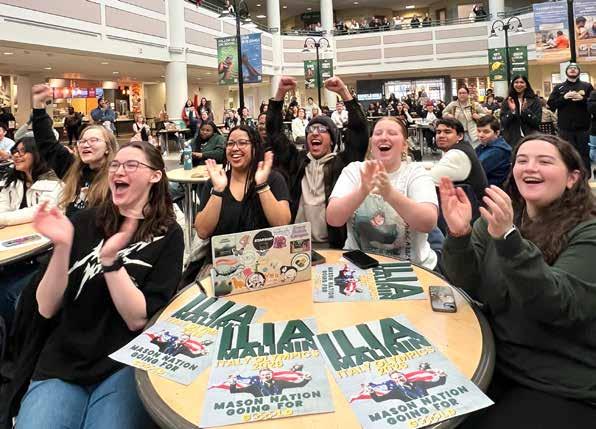
To help cheer Malinin—nicknamed the “Quad God”— the university organized watch parties with large TV screens in the Johnson Center atrium on the Fairfax Campus and in the lobby of Fuse at Mason Square, where the Mason Nation gathered and cheered on one of their own.
In his Olympic debut, Malinin, an exploratory studies major, became the first George Mason student to claim a Winter Olympics gold medal, joining alumni David Verburg, BS Health, Fitness, and Recreation Resources ‘13, who earned a gold medal as part of Team USA’s 4x400meter relay squad at the 2016 Rio Summer Olympic Games, and Mike Kohn, BS Health, Fitness, and Recreation Resources ’97, who earned bronze in the fourman bobsled event at the 2002 Winter Olympics in Salt Lake City, Utah.
A Vienna, Virginia, native and 2023 graduate of George C. Marshall High School, Malinin has been one of the most recognizable figures of the Olympics, known for both his charisma and his ability to push the sport forward through the extreme dificulty of his jumps. He’s the only figure skater to have successfully landed a quad axel in competition, a jump requiring four and a half revolutions.
Malinin hoped to add an individual medal to the team gold he helped secure for Team USA but fell twice during his free skate and finished eighth overall, marking his first loss in any competition since November 2023, and his first time finishing outside the top three since March 2022.
“Honestly, I’m just speechless,” Malinin told reporters afterward. “I’ve been training my whole season to get to this point and skate as best as I can, but it didn’t happen. I’m heartbroken.”
The crowd of several hundred enthusiastic students, faculty, and staf at the Johnson Center’s atrium were also stunned, but their pride never wavered. Kiersten Strassburg, a junior anthropology major from Chesapeake who has followed Malinin’s career for years, remained confident in his future.
“He’s only 21, and he’s still in college,” she says. “He still has his whole career ahead of him. It was disappointing, but I’m not disappointed in him.”
Graduate student Kat Hines arrived early to secure a prime viewing spot in the atrium. Though the outcome wasn’t what she expected, the moment still mattered. “It’s pretty amazing that we have an Olympian going here,” says Hines, a public health major. “This gathering shows what kind of community George Mason has, and it’s nice to see.”
—John Hollis
Left and below:
PHOTO BY EVAN CANTWELL
PHOTOS BY EVAN CANTWELL
WOMEN’S BASKETBALL IS STILL MAKING HERSTORY
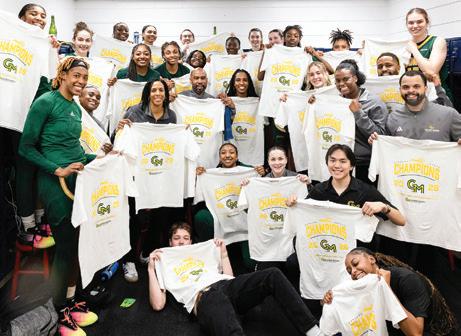
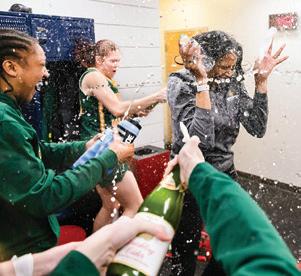
THE GEORGE MASON WOMEN’S BASKETBALL T EAM CAPTURED A SHARE OF THE 2026 ATLANTIC 10 REGULAR SEASON CHAMPIONSHIP —the first regular season conference title in program history. The Patriots closed league play with a program-best 16-2 conference record, marking their strongest conference season ever.
George Mason shares the title with Rhode Island after both teams finished atop the A-10 standings. The 16 conference victories set a new school record and cap one of the most successful seasons in program history. This season also marks another major milestone, as the Patriots secure their firstever stretch of three consecutive 20-win seasons—a testament to the sustained excellence being built at George Mason under Head Coach Vanessa Blair-Lewis.
The team celebrates in the locker room and shows of their championship shirts after capturing their first regular season conference title in program history.
With their regular season finish and conference tie-breaker protocol, the Patriots earned the No. 2 seed and a double-bye in the 2026 Atlantic 10 Women’s Basketball Championship. In the tournament semifinals at the Henrico Sports & Events Center, George Mason clinched a 60-45 win over the University of Richmond but fell to the University of Rhode Island in a close championship game, 53-51.
Their season continued with their second postseason Women’s Basketball Invitational Tournament (WBIT) appearance. The Patriots were selected as the 3-seed and faced Quinnipiac on March 19 at EagleBank Arena.
THE GEORGE MASON UNIVERSITY MEN’S BASKETBALL TEAM WAS SELECTED FOR THE 2026 NATIONAL INVITATION TOURNAMENT (NIT) . This marked George Mason’s sixth NIT appearance in program history and the second in the past two seasons. The Patriots have now made backtoback postseason appearances (NCAA or NIT) for the first time since 200709.
Heading into the postseason, George Mason was the only Atlantic 10 team to defeat the league’s top 3 teams (Saint Louis University, Virginia Commonwealth University, Saint Joseph’s University) during the regular season. It’s the first time the program has accomplished the feat during its A10 era.
Since the start of the 202425 season, George Mason ranks second in the A10 and tied for 3rd nationally in total wins (50). This season, George Mason was one of just 49 programs nationally to have 23+ victories.
George Mason is an impressive 2810 (.737) in its last 38 A10 games dating back to the 202324 campaign. The team had 23 overall wins this season, tied for 5th most in program history.
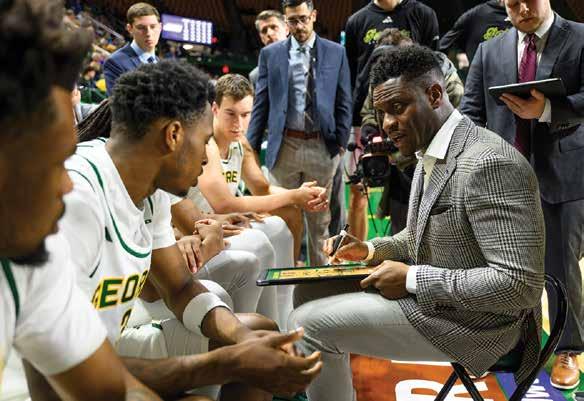
Head coach Tony Skinn, BA Communication ’06, the 2025 A10 Coach of the Year, is the first George Mason head coach in school history to win 20+ games in three consecutive seasons.
In the last game of the regular season, the Patriots surged past #25/24 Saint Louis, 8657, marking the largest victory margin by an unranked team over a ranked team in the nation this season and 14th largest margin for an unranked team over an AP Top25 team since the poll began in 1949.
George Mason alumnus Tony Skinn is the first George Mason head coach in school history to win 20+ games in three consecutive seasons.
FOLLOW ALL THE TEAMS AT gomason.com.
WATCH THE RAISING OF THE BANNER.
go.gmu.edu/ finalfour20
GEORGE MASON MARKS THE 20TH ANNIVERSARY OF ITS FINAL
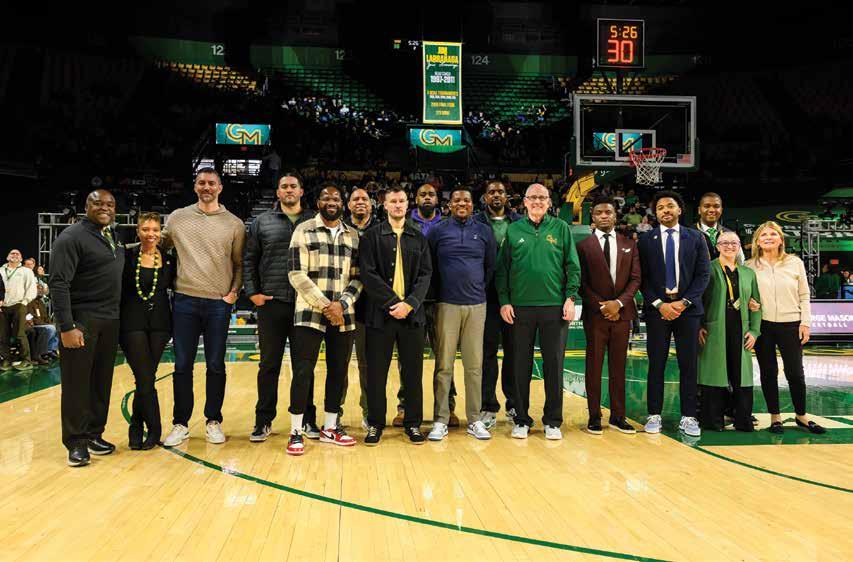
IN DECEMBER, THE GEORGE MASON MEN’S BASKETBALL TEAM honored legendary coach Jim Larrañaga and the 2006 Final Four Team with a 7361 triumph over former conference rival Old Dominion University at EagleBank Arena.
Larrañaga, now retired from college basketball, was honored during a halftime ceremony in which a permanent banner celebrating his storied George Mason career was raised to the rafters. His 2006 team joined him on the court to culminate a nostalgic week of festivities honoring the 20th anniversary of the team’s Cinderella run to the NCAA Final Four.
“We believed in ourselves,” says Larrañaga, who served as head coach at George Mason from 1997 to 2011. “We weren’t hoping to win. We believed we would win.”
FOUR APPEARANCE
The 2006 Final Four Trophy was displayed on the concourse throughout the evening, and fans could take photos with it as part of the celebration. In addition, members of the 2006 team signed autographs following the game.
“It was one of those moments that, when you experience it, it never really leaves your mindset,” says current head coach and member of the 2006 team Tony Skinn, BA Communication ’06. “To think that it was 20 years ago is unbelievable. It’s been a phenomenal past couple days and an even better day today celebrating my former teammates and the best coach George Mason has ever had.”
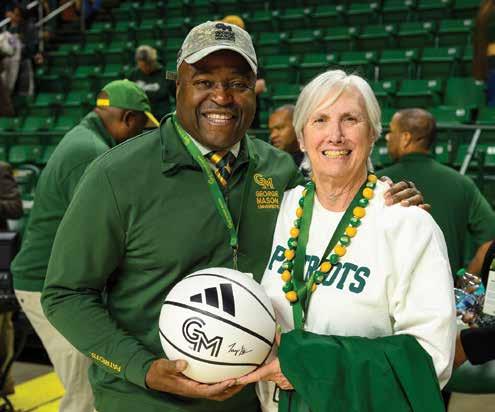
KATHY MCKAY IS ROOTING FOR GEORGE MASON
KATHLEEN (KATHY) MCKAY HAS DEEP TIES TO FAIRFAX, VIRGINIA , her hometown. She grew up alongside George Mason University’s burgeoning Fairfax Campus and was a studentathlete at nearby Woodson High School.
Her parents, James “Smilin’ Jim” and Ruth Averill McKay, were pioneers in the Fairfax business community. Her father opened Jim McKay Chevrolet in 1956, becoming a longstanding institution in the area.
McKay is now the president of Jim McKay Chevrolet and a sponsor for many student activities and sports at George Mason. The heart of her personal connection with the university has been Intercollegiate Athletics. Since the mid1990s, she’s been an avid Patriots fan, attending many men’s and women’s basketball games, often with her daughters and now her grandchildren alongside her.
“I’ve always been a sports person,” McKay says. “I love college athletics. This is something that the athletes really want to do, and so few make it [to this level].”
McKay’s support extends far beyond cheering the team on. She has been a donor to George Mason for nearly 20 years, serving as a member of the Patriot Club Advisory Board and joining the Green Coat Society through her generosity to Athletics.
In 2017, she made a leadership gift to the university’s basketball fundraising campaign, resulting in the naming of the K. McKay Court at the Recreation and Athletic Complex. Her philanthropy has included substantial gifts—in conjunction with the familylinked Richard W. Averill Foundation and Jim McKay Chevrolet—to a variety of George Mason’s teams, including a pledge that touched all 22 sports teams during the university’s annual giving day.
McKay is part of a family tradition of philanthropy and community service. George Mason’s Jim McKay Natatorium in the Aquatic and Fitness Center on the Fairfax Campus bears the name of her father, and she is encouraging a culture of connected philanthropy through her own children. Her daughter, April, and soninlaw, Matt, are active supporters of George Mason Athletics.
“Kathy McKay embodies the spirit of George Mason and the Northern Virginia community,” says Marvin Lewis, assistant vice president and director of Intercollegiate Athletics. “Her loyalty and generosity have touched every corner of our program—from cheering courtside to investing in opportunities that enrich the studentathlete experience. We’re incredibly fortunate to have her in our corner.”
McKay has been there for some of basketball’s biggest moments and has many fond memories of her time in the cheering section.
She remembers being warmly welcomed by the men’s basketball team, including thencoach Jim Larrañaga and his wife, Liz, when she traveled with the team to the ESPN Invitational Thanksgiving tournament in Florida in 2007. That experience led her to attend more away games, including several Atlantic 10 conference tournaments. And she will continue to enjoy as many games and team activities as she can fit into her schedule.
“I love it!” she says. “I’m always looking at the schedule to see who’s playing.”
—Anne Reynolds
This gift is part of Mason Now: Power the Possible, George Mason’s historic $1 billion campaign to advance student success, research, innovation, stewardship, and community engagement.
PHOTO BY ART PITTMAN
MAKING TH E CA SE
This partnership is part of Mason Now: Power the Possible, George Mason’s historic $1 billion campaign to advance student success, research, innovation, stewardship, and community engagement.
METROSTAR PARTNERSHIP WILL FUEL FUTURE TECH TALENT IN THE REGION
MORE THAN TWO DECADES AGO, THREE GEORGE MASON UNIVERSITY STUDENTS launched a company from their dorm room with a belief that technology would drive change in the federal government.
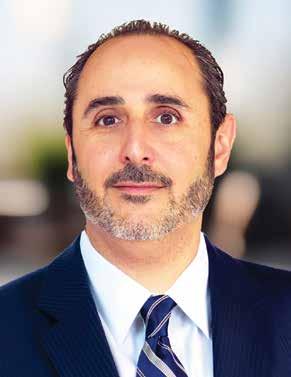
Ali Reza Manouchehri, BA Philosophy ’99, started MetroStar with fellow Patriots Robert J. Santos, BA International Relations ’99, and Pirooz Javan, BS Systems Engineering ’02.
Today, MetroStar—a venturebacked leader in AIenabled services—has come full circle. The company recently announced a multiyear partnership with George Mason, solidifying a shared mission to empower the next generation of leaders in technology and public service.
Through the agreement, MetroStar will support George Mason students and programming across the university and launch two scholarships, one geared toward students minoring in government contracting or management information systems and another for students interested in obtaining a national security clearance.
MetroStar will also support the Dean’s Excellence Funds in the Costello College of Business and College of Engineering and Computing (CEC), becoming a Costello Corporate Partner and a CEC Industry Partner.
The philanthropic commitment deepens MetroStar’s longstanding relationship with its cofounders’ alma mater while advancing workforce readiness and innovation aligned to national priorities.
“This is more than a corporate partnership. It’s a personal return,” says MetroStar CEO Manouchehri. “George Mason is where we built the foundation for MetroStar. We’re investing in students who will one day shape the digital future of government just like we dreamed about doing back then.”
The threeyear partnership creates a new model of agile collaboration between academia and the public sector. It reflects the growing need to build talent pipelines of graduates who are not only technically skilled but clearance ready and public service minded. Focused on mission acceleration and cuttingedge technology, MetroStar equips agencies with the tools and strategies needed to navigate the future of national security, including artificial
intelligence, digital transformation, application modernization, and enterprise IT.
The MetroStar partnership extends into the university’s forwardleaning spaces where creativity, entrepreneurship, and service intersect. It will fuel the Mason Innovation Exchange, a handson incubator for studentdriven ideas, and power university events like PatriotHacks, where students try to solve realworld problems with code and curiosity.
“Our partnership isn’t about oneof contributions but investing in people and the future civil servants who will protect and guide the nation,” says Manouchehri.
“We’re creating deliberate pathways from campus to cleared service, from idea to implementation, and from classroom projects to realworld impact.”
These are big goals that will allow more students to pursue their dreams—all from an alum who himself dreamed a little diferently all those years ago in a George Mason residence hall.
Learn more about Manouchehri, who was the Winter Commencement speaker, on page 45.
MPA ALUMNI ORGANIZE 28TH ANNUAL LOCAL GOVERNMENT NIGHT
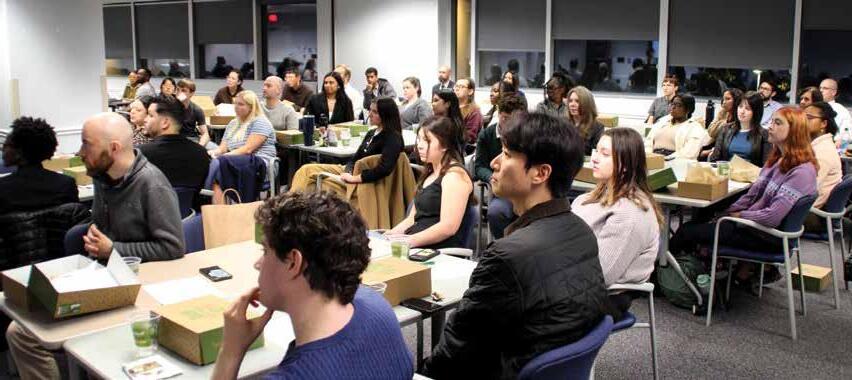
NEARLY 60 CURRENT MASTER OF PUBLIC ADMINISTRATION (MPA) STUDENTS and several faculty members in the Schar School of Policy and Government attended the degree program’s 28th annual Local Government Night at the Fairfax County Government Center in November.
Dianne Hon, MPA ’19, a victim specialist with the Juvenile and Domestic Relations District Court, led the event, which was organized by more than 10 program alumni employed by the Fairfax County government. Their purpose was to bring current MPA students together with graduates who now hold senior positions in local government.
During the evening, Fairfax County Executive Bryan Hill highlighted the career possibilities available in local government—particularly within Fairfax County. As he went around the room asking students about their postgraduation goals, Hill ofered examples of how their interests and expertise could translate into careers in county ofices.
Members of the county’s first responder agencies also talked about their work, including Assistant Chief of Police Eli Cory, MPA ’19, and Deputy Director of Victim Services Sarai Rivera, MPA ’24. Assistant Fire Chief John Walser emphasized his department’s need for graduates skilled in data collection and analysis to help firefighters and EMTs continuously refine best practices for saving lives and property.
The event included a panel of MPA alumni active in the county’s emergency preparedness and response departments—Marwa Hajahmed, MPA ’24, assistant
director of domestic relations in the Juvenile and Domestic Relations Court; Keith Grupposo, MPA ’20, senior social services supervisor with Neighborhood and Community Services; and Maha Martin, BA Sociology ’04, MPA ’16, management analyst IV with the Department of Family Services. They shared how federal challenges, such as furloughs, shutdowns, and budget cuts, afect their ability to deliver services to residents.
Hon presented a session reflecting on the efect the MPA program has had on her career, alongside Yeoanny Venetsanos, BA Biology ’00, MPA ’25, who is an enterprise applications manager for the Fairfax County Park Authority.
“[The MPA Program] is a mile wide and a foot deep— you can see the forest for the trees,” Venetsanos says of his decision to pursue an MPA. “It helps because you’re looking at every single service that a government provides. I want to take my management, leadership, and organizational skills and apply them where I can bring value to the organization.”
The event is just one way George Mason creates networking opportunities within its community while ofering students realworld touchstones for their studies. For Jack Potter, BA Public Administration ’25, a fellow in George Mason’s Center for Energy Science and Policy, the evening was about those connections. “Every single speaker talked about making connections—getting to know people and forging real relationships outside of work.”
—Buzz McClain, BA ’77
LEARN MORE ABOUT SCHAR SCHOOL ALUMNI ACTIVITIES. schar.gmu.edu/ alumni-giving
PHOTO
Noah Reed, Michael Hunzeker, and Joe O’Connor of the Taiwan Security Monitor
RESEARCH PROJECT TURNS INTO A VITAL COMMUNICATION PLATFORM
TAIWAN LACKS ITS OWN CABLE REPAIR
VESSELS, MEANING DAMAGE to underwater cables crucial to the island nation’s international communications and internet connectivity can take six weeks or more to repair. The lack of repair capabilities is a serious resilience risk and a dire national security concern for a country that is in the crosshairs of China.
That unsettling discovery was made by George Mason University student researchers at the Taiwan Security Monitor (TSM), a studentdriven online research initiative housed at the Schar School of Policy and Government.
Directed by founder Michael Hunzeker, associate professor and associate director of the Center for Security Policy Studies, TSM operates with a staf of 18 undergraduate and graduate students who learn to use sophisticated mapping and analytic tools to research Taiwan’s vulnerabilities and strengths.
Hunzeker says the web platform began in 2021 as “an informal research project to create an opensource
PHOTO BY EVAN CANTWELL
intelligence map of the IndoPacific.” The first iteration was created with the help of thengraduate student Sophia Lutz, BA Global Afairs ’20, MA International Security ’22, and several volunteers.
In 2024, TSM relaunched with a higher profile and a social media presence boasting some 25,000 followers on X in just a few months.
“We have had at least two tweets with more than a million views,” Hunzeker says, an indication that the platform is being recognized—and taken seriously.
“We’ve grown from a small team with limited scope to something that compares to think tanks in terms of insight and contributions to discourse on Taiwan,” says senior government and international politics major and TSM’s research director Noah Reed, who has been with the project during his four years at George Mason. He was intrigued not only by the research but by the tools that the TSM employs.
TSM uses opensource intelligence to generate data, visualizations, maps, thematic case studies, and other resources for scholars and policy communities. Its updates on arms sales and deliveries, military movements, and maritime and air activity provide accessible information that supports public discourse and informs decisionmakers charged with protecting the country from adversaries.
“We also provide tailored data and imagery analysis for privatesector companies,” says Hunzeker. “Our work and our researchers have been cited by The Wall Street Journal, Taiwan Plus, CNA/Focus Taiwan, Le Monde, Newsweek, and Taiwan News.”
“We’ve attracted some attention,” says TSM research team lead Joe O’Connor. As a freshman, the international security and law senior discovered the opportunity to work with TSM through the Schar School’s Undergraduate Research Assistant Program, which places students with faculty mentors.
Reed says TSM teaches its researchers a set of skills unique to George Mason. “Not only do we learn how to bridge the language barrier while doing research,” he says, “we get handson experience with things like satellite imagery, geolocation, data visualization, and more. That gives [a student] experience to do anything—from opensource human rights and arms control verification to supply chain risk management.”
—Buzz McClain, BA ’77
MASON LIFE STUDENTS INTERN ON CAPITOL HILL
AT GEORGE MASON, WE KNOW HOW VALUABLE HANDS-ON WORKPLACE EXPERIENCE
can be for all students. An internship can even lead to the experience of a lifetime. During the fall semester, eight Mason LIFE students got to experience one of the ultimate Washington, D.C., area internships— working on Capitol Hill.
The Gregg and Livingston Harper Congressional Internship Program for Individuals with Intellectual Disabilities matches Mason LIFE students with U.S. House of Representatives and U.S. Senate congressional ofices. Gregg Harper, former House Representative from Mississippi, established the program in 2010. The students start their internships in their second year and continue through completion of the fouryear program.
“We’re helping them gain the skills needed to seek a fulfilling career when graduating from the program,” says Linn Jorgenson, director of Mason LIFE, a nondegree educational transition program for students with intellectual and developmental disabilities. An internship is one of Mason LIFE’s core curriculum requirements to support each student’s personal development.
Every Friday, Mason LIFE students and their peer support staf—George Mason students who travel with the students to their workplaces to provide support and guidance—take the Metro into Washington, D.C., complete their internship assignments for the day for their two congressional ofices, eat lunch, and take the Metro back to Fairfax. Students in the program tackle a variety of work for their assigned congressional ofices, including answering phones, researching bills, delivering mail, giving tours, and doing data entry.
“My favorite part is getting to see what happens behind the scenes of the government,” says thirdyear Mason LIFE student and intern Madison Gulley.
Through the internship program, Mason LIFE students learn independence, confidence, and social and cultural competencies. They also build valuable resume skills, and they explore their interests to see if they’re the right fit for a longterm career.
The employer also benefits. “Mason LIFE students bring an important perspective to the ofice,” says Melissa Chabot, employment and community involvement coordinator for Mason LIFE. “Employers get an opportunity to reflect on their inclusivity:
What are the employers doing that helps everyone be successful, and where can they improve?”
For the accompanying student support staf, the joy of watching their fellow students succeed is perhaps the greatest reward of all.
Peer coach Nehal Gundawar, a master’s student in computer science, works with one of the Capitol Hill interns. “[At first] the Mason LIFE students were nervous about interacting with staf and unsure how to approach tasks without guidance... after a few weeks, they began initiating tasks on their own and even asked for additional responsibilities. Their supervisor complimented their improvements,” he says. “Watching them grow into more confident and independent employees was incredibly rewarding.”
The congressional interns see the changes in themselves as well.
“Mason LIFE has changed my life,” says Aryaa Bhole, a secondyear student. “Because of the lessons and skills, I know to stand out and inspire others and to lift them with my voice.”
—Sarah Holland
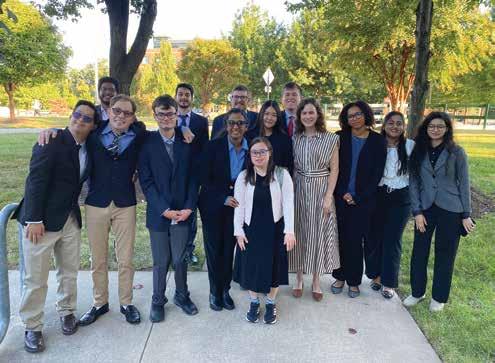
Mason LIFE students and their peer support staf in Washington, D.C.
MASON LIFE MARKS 20 YEARS.
LEARN MORE.
go.gmu.edu/ masonlife20
PHOTO PROVIDED
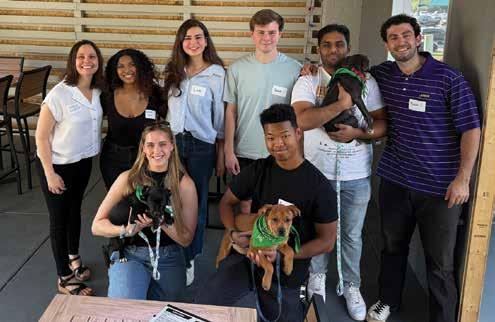
Faculty member Gretchen Hendricks (far left) with students at Lucky Dog Animal Rescue happy hour at Velocity Wings.
COSTELLO COURSE ENABLES STUDENTS TO CHAMPION LOCAL CHARITIES
STUDENTS IN GEORGE MASON’S BUS 303 DEVELOPING PROFESSIONAL SKILLS COURSE had the opportunity to champion causes important to them while honing their skills as they planned and hosted “Humanitarian Happy Hours.”
Gretchen Hendricks, senior instructor of business foundations in the Costello College of Business, brought a new spin to the course with the idea of hosting the happy hours. The events allowed students to put the skills they learned in the classroom into practice, including teamwork, efective communication, problemsolving, networking, and leadership—all while contributing to communityoriented causes.
“The Happy Hour events were designed to bring together individuals with similar interests and ideals in a social forum to learn about and potentially get involved with charitable organizations,” says Hendricks. “The desired outcomes were apparent— to increase awareness, volunteerism, and donations that result in meaningful change for those in need.”
The students worked in teams to research Fairfaxbased charities they were passionate about. Once identified, each team sent a proposal to the organization to persuade them to partner. All four charities—Dulles South Soup Kitchen, Lucky Dog
Animal Rescue, Food for Others, and Britepaths— said yes, and the planning began.
Each team worked directly with the charity to handle tasks including venue selection and logistics, outreach to corporate sponsors, and identifying invitees. In the spirit of keeping things local, four Fairfax restaurants—Honor Brewing Kitchen, Velocity Wings, Oh George!, and Banditos Tacos and Tequila— hosted the happy hours at no cost.
“[This project] was one of the most rewarding experiences I have had during my time at George Mason,” says Grant Goodson, a senior business management student who served as a team leader. “From hurdling unexpected obstacles to coordinating timelines and tasks, seeing the team’s hard work come together in an impactful way and witnessing the diference we made for Food for Others was immensely fulfilling.”
The events raised more than $3,900 in donations for the four charities, but the real win was the power of connection. Each event hosted a mixture of students, staf, faculty, and alumni, as well as representatives from the charities and the community.
Corporate sponsors for the happy hours included Angel Tips, Good Neighbor Exterior Services, TFA Soft Skills, Thompson Greenspon, and VLP Financial Advisors.
Dan Lash, BS Economics ’97, partner and advisor with VLP Financial Advisors, says serving as a corporate sponsor “allowed VLP to continue our support of the university with a broader focus on assisting the community.”
This section of BUS 303 is one of the many experiential learning opportunities at Costello College that support the university’s goal of preparing students for successful careers. Programs like the Patriot Pitch Competition, Career Takeover Days with corporate partners, and Students Run the Show with George Mason Athletics give George Mason students a distinct advantage over other candidates in a very competitive job market.
—Jennifer Anzaldi
MEETMASON NATION THE
For most people, planning for an emergency might only come to mind every now and then. But for Gregg Black, MPA ’13, preparing for emergencies and planning how to protect the Mason Nation in a crisis is part of his day to day.
LEARNING ON THE JOB: Black first arrived at George Mason as a graduate student in 2010. Hoping to find a parttime job on campus, he sent his resume to David Farris, MBA ’07, PhD Education ’16, now the associate vice president of risk, safety, and resilience. Black was hired and eventually got a fulltime job in the Fire Safety Ofice while still working toward his MPA.
NOT A DRILL: Black managed compliance and ensured that the fire safety program was keeping records of inspections and repairing any deficiencies. He continued his education by pursuing certifications in the fire safety industry. “I am particularly proud of how far the George Mason Fire Safety Program has come,” Black says. “When I started, everything was paperbased, and most inspections were completed by contractors.” Today, the program has a completely digitized records management system, and most inspections are performed inhouse.
MAKING THE SAVE: George Mason’s Fire Safety Program is regularly one of the highestregarded programs in the
commonwealth. “This was all done while saving money,” Black says. “[University] leaders are to credit with the investment and trust in employees to improve programs.”
BY
BEST LAID PLANS: Black’s role expanded to include both fire safety and emergency management in 2019. The timing was critical—it happened right before the university needed to respond to the crisis of a generation. “Just as I was getting both programs to a steady level, COVID happened and dramatically changed everything,” Black says. For the next couple of years, he spent most of his time and eforts on the university’s COVID response.
NEVER A DULL MOMENT: In a single day, Black can go from discussing and coordinating security for an event, to partnering with Facilities and Campus Operations on strategies to repair fire safety systems, to planning how George Mason would be a part of a statewide sheltering plan, to coordinating the response to the next snowstorm. But working with a range of people across campuses is what Black likes best about his job. “The Mason Nation is filled with talented and passionate people, and exposure to all of them has taught me so many things.”
—Lauren Clark Reuscher, MA ’12
PHOTO
RON AIRA
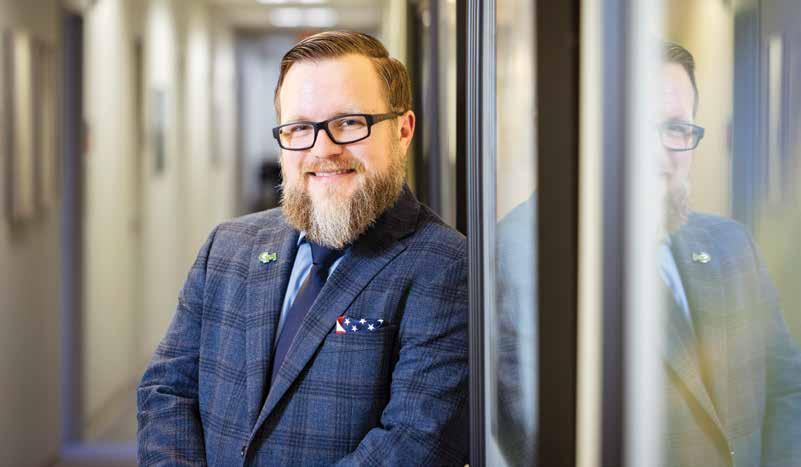
GREGG BLACK
Job: Director of Emergency Management and Fire Safety in the Ofice of Risk, Safety, and Resilience
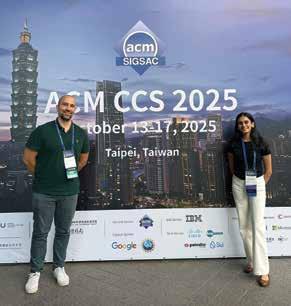
Professor Evgenios Kornaropoulos and PhD student Somiya Chhillar at the Association for Computing Machinery Conference.
MAKING HEALTH CARE DATA MORE SECURE
A GEORGE MASON UNIVERSITY TEAM OF FACULTY AND STUDENTS RECENTLY DISCOVERED a vulnerability with ARX, an opensource data tool commonly used in clinical settings to maintain data privacy.
“Tools like ARX anonymize data so it’s compliant with HIPAA, and then that data can be shared with policymakers, engineers, scientists, and others who will make policy decisions and scientific studies based on this information,” says computer science professor Evgenios Kornaropoulos.
The team presented their findings at the Association for Computing Machinery Conference on Computer and Communications Security, one of the world’s most prestigious security conferences.
Computer science PhD student Somiya Chhillar, lead author on the paper, says that the ubiquity of ARX was a reason the team chose to study it. “We wanted to see how ARX really operates and how the algorithm works.”
Their approach led to a key discovery. “We realized that a few of the steps that it takes are very opportunistic, and because of that, it leaks information that we shouldn’t be finding out by just looking at the anonymized data.”
“For patients, data privacy is not an abstract concern, it’s deeply tied to trust in the health care system,” says paper coauthor Rebecca Sutter, MSN ’01, DNP ’12, director of George Mason’s Mason and Partners (MAP) Clinics. “The integrity of tools like ARX matters because they underpin how we protect patient information while advancing public health research. When anonymization fails, it’s not only a technical vulnerability—it’s a human one.”
Chhillar says that ARX follows a “greedy strategy,” explaining that there is a tension between privacy
POINT OF
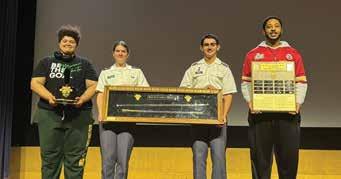
George Mason’s Debate Team won the prestigious West Point Sword at the U.S. Military Academy’s 60th annual National Debate Tournament in October. The sword is one of the most iconic awards in college policy debate, and it was the one elusive national title the George Mason team hadn’t yet won. Communication major Austin Davis also placed individually as the top speaker at the tournament.
and utility. When data is shared, it should be useful without leaking information. The best metric for deciding data usefulness is measured by information loss while the data is being made private. “The algorithm tries to minimize information loss while anonymizing the data, and ideally, we want the least possible information loss. And that’s the greedy aspect of it; it’s not always going for the most private, it’s just going for the most utility.”
The Commonwealth Cyber Initiative’s Securing Interactions Between Humans and Machines program provided grant support to the project, which was a collaborative efort that crossed disciplines at the university. The College of Engineering and Computing partnered with the MAP Clinics in the College of Public Health, which provided the data.
PHOTO
PROVIDED
—Nathan Kahl
BAND ALUM RETURNS TO THE CENTER FOR THE ARTS STAGE WITH HER OWN STUDENTS
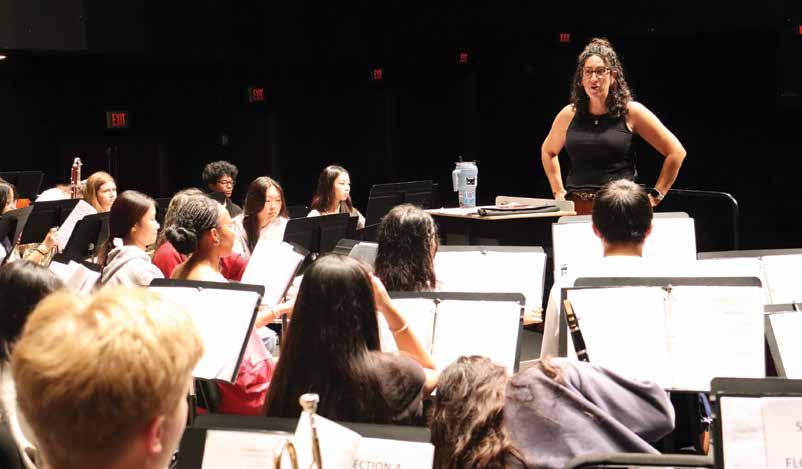
AS A HIGH SCHOOL BAND DIRECTOR, Melissa Hall, MM ‘05, has seen a lot of music ensembles come and go, but one remains dear to her heart: the one she played in at George Mason. It was that connection that brought her back to campus in September for the Mason Bands’ 55th Anniversary Concert. She didn’t have too far to come, since she’s currently the band director at nearby Centreville High School. Hall teaches 175 students and directs a band program that includes symphonic and concert bands, wind and percussion ensembles, jazz groups, chamber music, and a marching band with color guard.
She’s never lost touch with her old ensemble. “I’ve always kept a strong connection to George Mason,” says Hall. “When Dr. [William] Lake became director of concert bands, I reached out about collaborating.”
That relationship led to the special invitation. The fall concert that Hall’s students performed in was part of a yearlong series celebrating the legacy of Mason Bands. Throughout the school year, Lake invited a diferent high school ensemble to perform at each concert. George Mason alumni led three of the featured ensembles.
In addition to sharing the stage with Lake that evening, Hall also reconnected with Anthony Maiello and Scott Casagrande, who is the son of the late George Mason band director John Casagrande.
“Professor Maiello is the reason I came from New York to attend George Mason,” Hall says. “My high school band director introduced us, and I knew immediately I wanted to study conducting with him.”
Performing with Scott Casagrande also held special meaning for Hall. “[His father] John really taught me how to be a high school band director,” she says. “There wasn’t a day I didn’t call him for advice.”
Hall’s ties to the university extend beyond the performance. As a member of the Virginia Band and Orchestra Association, she has hosted the statewide music assessment at George Mason for the past three years. This event brings more than 1,300 students and 25 to 30 bands to campus each spring.
Despite the challenge of preparing her students for a concert so early in the school year, Hall says the experience was unforgettable. “It all just came together,” she says. “It was really a special night and to be able to honor my George Mason story is something I’ll remember for the rest of my life.”
—Shayla Brown
George Mason alumna and Centreville High School band director Melissa Hall rehearsing with her students in the Center for the Arts Concert Hall.
HACK IT OUR STUDENTS CAN
IT
THEY TRAIN, COMPETE, AND PERFORM AT THE HIGHEST LEVELS—ONLY THEIR ARENA IS CYBERSECURITY.
LIKE TOP ATHLETES, GEORGE MASON’S
CYBERFOCUSED STUDENTS PROVE THEMSELVES WHEN THE PRESSURE IS ON.
BY JENN POCOCK
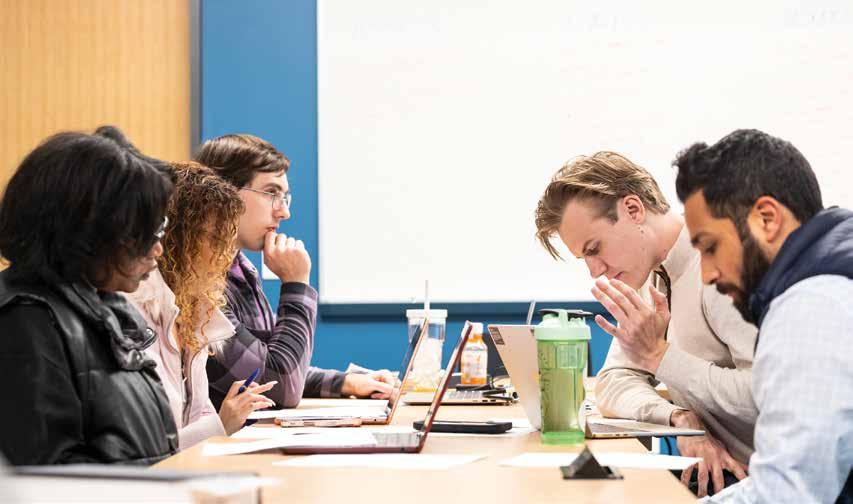
George Mason University students have key roles to play in the future of cybersecurity— and they are rising to the occasion. Over the past few years, the university has advanced as a leader in this rapidly developing field. In the 2025 CountrytoCountry Capture the Flag contest, for example, only 100 finalists were invited from the world over—and five were from George Mason.
“Our students are focused and curious,” says Sai Manoj, an assistant professor in the Department of Electrical and Computer Engineering and advisor to George Mason hackathon participants. “And they’re very interested in participating in hackathons.”
Hackathons, like PatriotHacks and other competitions such as Capture the Flag and Defend the Republic, are considered essential extracurricular activities by many students in the College of Engineering and Computing (CEC). Whether a student is passionate about hardware, software, datasets, AIdriven workflows, puzzlesolving, or flying robots, there is something for everyone.
“These competitions are an important bridge between our academic programs and the evolving demands of the technology and cybersecurity industries,” says Kamaljeet Sanghera, MS Information Systems ’00, executive director of tech talent development and a professor of information technology at CEC who has served as a faculty sponsor to George Mason’s annual PatriotHacks.
Sanghera says these competitions complement students’ classroom education and allow them to gain realworld, handson experience while networking with professionals in settings that encourage innovative thinking.
“Industry involvement definitely enriches these experiences,” says Sanghera of the companies that sponsor these competitions. “Sponsors and mentors introduce students to realworld tools, datasets, and AIdriven workflows, helping them see how their skills apply in professional settings.”
And it opens doors for these students. One George Mason student, Fatima Majid, discovered this
when she placed in the top 10 at the 2025 National Defense Industrial Association (NDIA) Cyber Competition against defense professionals. She so impressed those attending that the NDIA vice president introduced himself afterward, and she had a large group of attendees interested in talking to her.
Sanghera notes that these challenges also set George Mason grads up for postcollegiate success in other ways. “ They challenge students to tackle complex problems under time constraints,” she says “Whether by developing innovative solutions in a hackathon or analyzing and defending systems in a Capture the Flag competition, both experiences help students build technical skills, while also strengthening essential soft skills such as teamwork, communication, problemsolving, and creative thinking.”
These events provide important lessons, too, in learning how to get up again after experiencing dificult setbacks and challenges. The recent George Mason FailaThon encouraged students to “fail forward” by judging them on ambition, creativity, and iteration instead of penalizing for mistakes.
“The goal was to celebrate experimentation and meaningful learning,” says Humaira Akhtari, a term instructor in the Department of Information Sciences and Technology, who judged the event.
Students don’t have to go far to find an opportunity either. The 2025 Raytheon Defend the Republic autonomous blimp contest, for example, took place on the Fairfax Campus in EagleBank Arena.
“George Mason has a very strong background in general in security. It’s not just about the faculty, but also the students and the locality,” says Manoj. “With the government and so many hightech companies nearby, there’s a huge need for security in the area. That means that the students and faculty are seeing a lot of opportunities for growth.”
Meet a few of the George Mason students who are advancing in cyber competitions at the national level.
MAJID
BY RON AIRA
YOUNG, SCRAPPY, AND HUNGRY
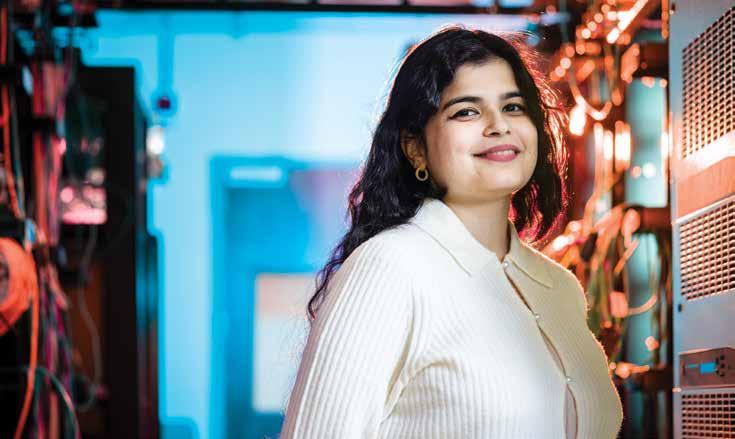
Cyber security engineering major Fatima Majid is certainly not throwing away her shot. The senior has made it her mission to take advantage of every opportunity George Mason has to ofer.
After transferring from Northern Virginia Community College and struggling in her first semesters, Majid persevered, raising her GPA and earning a spot on the Dean’s List. She says her professors were extremely supportive during that time. They helped boost her confidence to keep her in the program.
Majid says one professor especially kept her motivated. “In a class of 90 people, he pointed me out and said, ‘That girl can code! If you have any issues with the work, she can help.’ It changed my mentality. I realized that I could actually do it.”
Soon she was ready to take on the competition. When she joined her first hackathon—the NDIA cyber competition—she thought it was a George Mason student event. Instead, she discovered she was going against professionals in the defense contract industry.
In the end, she was the only oneperson team (and the only student) to place in the top 10, placing 9th out of 51 teams with a project designed to protect against miniature drone strikes like the one that Ukraine launched on Russia.
Majid’s lightbulb moment for her SkyEyes project came at a trafic light while considering the significant network of trafic cameras in the commonwealth. SkyEyes applies an AI model to the live feed of the Virginia 511 camera network, which
provides realtime trafic information to citizens and transportation oficials. Majid was able to demonstrate how a lowcost, AIenabled surveillance layer could diferentiate threats from nonthreats by employing geofencing logic to define safe versus threat zones around sensitive sites.
“I understand how drones work because of the work I’ve done at George Mason’s [Mason Innovation Exchange (MIX)]—and since I know how to build it, I also know how to jam it,” she says.
Majid also credits her summer in Richmond at the Virginia Academy of Science, Engineering, and Medicine’s undergraduate policy program for giving her confidence and exposure to how government works.
Majid says the strong showing at the NDIA competition gave her tremendous exposure to influential professional contacts. She fielded several questions about her simulation and future professional plans from a man she only later realized was Retired Brigadier General and NDIA Executive Vice President Guy Walsh.
“Because he showed interest, after he walked away, a crowd of people gathered around to ask me questions. It was very validating.”
Now in her senior year, Majid is a Commonwealth Cyber Initiative Innovation Scholar and part of a statewide program that ofers a $2,000 professional development award and training in cyber startups. She says that eventually she wants to find a job that’s exciting and fun and isn’t ruling anything out. “I’m taking a bite of everything and seeing where I want to go.”
PHOTO
THE EYE OF THE TIGER
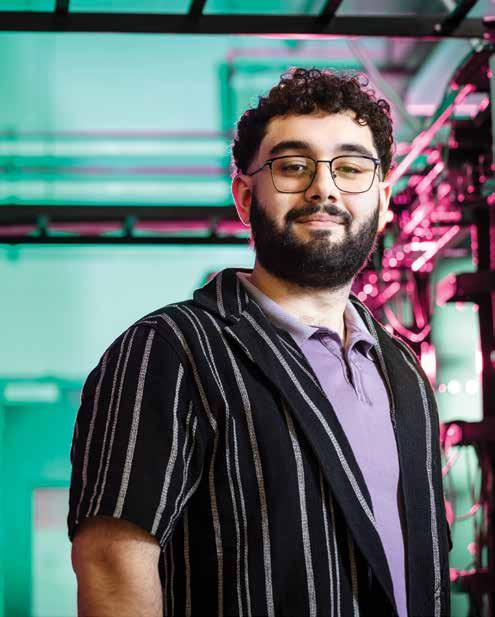
Computer science major Noah Kabiri is no stranger to highadrenaline competition. As an elite coder and winner of hackathons in only his second year at George Mason, this ambitious sophomore performs a balancing act on par with elite college athletes training to go pro.
Kabiri’s passion for cybersecurity started early thanks to television. “I remember always seeing the cool hacker guy on the TV shows,” he says. “He’s typing on his computer and doesn’t stop. As a kid I was like, I want to be that guy!”
Growing up in Springfield, Virginia, Kabiri started teaching himself to code in elementary school, before he really understood what coding was. Then in sixth grade, he tried to make his first app—a calculator in C++. “This app was so bad,” he says with a laugh. At Thomas Jeferson High School for Science and Technology, Kabiri was exposed to handson computer work and niche fields. He continued to teach himself as well, and his skills developed enough to land a software development internship at Seamless Migration in his senior year in high school.
Now Kabiri attends as many competitions and conferences as possible. His hackathon team, which included fellow CEC students, recently took third place at a NDIA hackathon, where they addressed a need in the intelligence, surveillance, and reconnaissance category.
Their product was a SaaS (software as a service) that takes footage and video feeds from anywhere— drone surveillance video, infrared, geospatial satellite images, security cameras, body cams, and more—and analyzes the environment. While the competition only looks for proof of concept over the 72hour project period, Kabiri believes that he can take the project forward.
“I have this really high drive to be successful and
KABIRI
BY RON AIRA want to make as much out of this experience as possible,” says Kabiri. “I want to be as wellrounded as possible, but that means I’m working 40 hours a week along with school.”
For Kabiri, this means taking care that he doesn’t burn out. To help avoid that, he moves his body regularly and takes time to decompress. He does this by attending 6:30 a.m. Brazilian JiuJitsu classes and weekly knitting club meetings—he’s currently making a blanket.
While his rigorous time management and the discipline of a professional athlete allow him to
pursue his goals, Kabiri admits that it leaves him little time for anything else. “I have to stay of of social media, and I miss some things I want to do. I haven’t watched Netflix in forever.”
Since Kabiri is only in his second year of college, he is still figuring out his direction. He would like to use his skills for good—possibly cybersecurity or defense. He likes making things that add value to people’s lives or that they enjoy using. For now, he keeps strengthening his skills and his eye on the prize.
PHOTO
MORE THAN MEETS THE EYE
The knifefish is a predatory fish with a distinctive frilly fin on its underside that allows it to move backward and forward. It’s normally found in South American rivers—so what is one doing wafting through the air in George Mason’s EagleBank Arena?
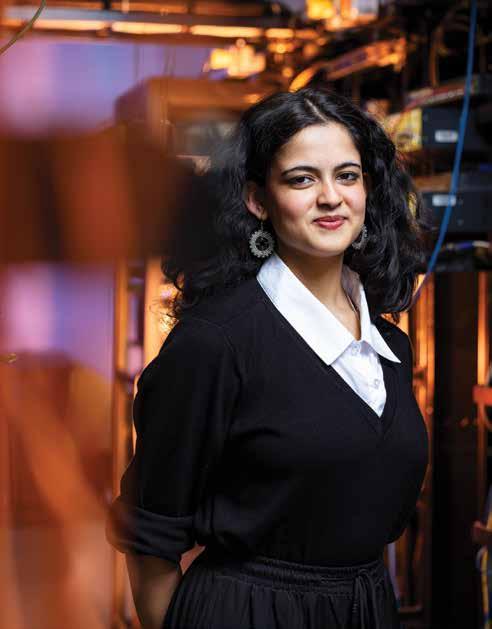
Knifey, a natureinspired blimp based on the knifefish’s movement (with an added ferocious glare), is just one of junior Alexia De Costa’s projects combining art and robotics. “I love any way to get people interested in tech and also understand complicated things visually,” she says.
De Costa played with robotics kits as a kid, then got into Thomas Jeferson High School for Science and Technology, where she developed her skills even further and connected them with her love of nature.
“In high school, I made puppy, guinea pig, and bunny robots that could all do diferent things. I love
figuring out how to make the robots more visually pleasing to make the interactions more appealing to the user.”
When De Costa came to George Mason as an applied computer science major and an Honors College student, she became involved in the MIX. There, she ran a Robot Night workshop, teaching students how to make robots from scratch.
Since then, she has leveraged George Mason resources to power her projects. Through the Research and Interdisciplinary STEM Experiences (RISE) Scholars Program, De Costa hosted a robot blimpmaking workshop for middle school students. She also became involved with the Mason Autonomous Robotics Center (MARC) as a research assistant. This is where she designed and built Knifey, which she piloted in the 2025 Defend the Republic blimp competition in EagleBank Arena.
DE COSTA
In 2025, also through MARC and with support from the Ofice of Student Creative Activities and Research, De Costa led a team of eight students to develop giant art and tech pieces. “It was a series of works to convey very technical information. It blends art and robotics to make these topics engaging to the general public.”
Her current research project harkens back to her high school roots but with a twist. De Costa and her team took second place at Sauceathon 2025, a hardwarefocused hackathon hosted by Open Sauce and the National Havoc Robot League, for their robotic cat.
The challenge began with a $500 combat robot kit and a mission: modify the base design to complete a rescue scenario in an apocalyptic setting. The 24hour event tested De Costa and her team’s endurance and ingenuity.
Against a backdrop of camera crews and livestreams, George Mason’s team stood out for its creativity and adaptability. Even after a latenight power outage forced participants to improvise, the team completed two rescue runs, performing “emergency surgery” with duct tape between rounds.
“Usually hackathons are software focused, so building a robot was so much fun,” says De Costa. “Seeing it succeed was exciting. We’re definitely planning to attend the next one.”
PLAYING THROUGH
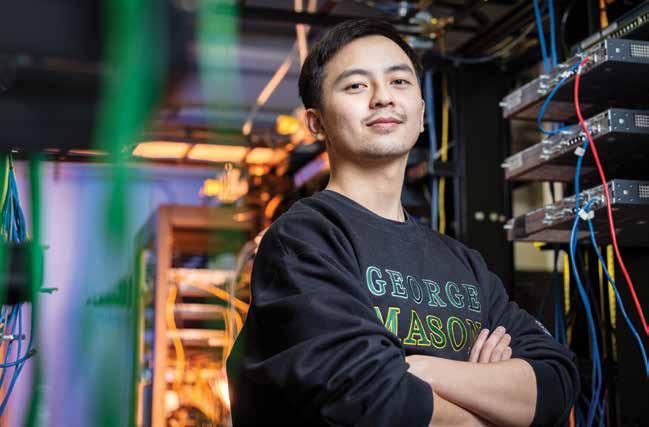
Nhat Le has always loved puzzles. From Rubik’s Cubes to roleplaying games, he plays them all. Now a graduate student in cyber security engineering at George Mason, Le came to his studies “through the back door,” as a hacker might say.
Le moved to the United States from Vietnam six years ago for his senior year of high school. While studying computer science at New Mexico State University for his bachelor’s degree, he was bored and lost in his Linux administration class. To make it easier, he went online to learn in a more fun and handson way.
“I found this website, OverTheWire, that had a game called Bandit, where I had to perform some Linux puzzle tests to get the password to unlock the next level,” he says. “It was so much like gaming that I wanted to learn more. The curiosity, creativity, and puzzle solving hooked me right away.”
He didn’t know it, but that was his first step into cybersecurity. It paved the way for his entry into capture the flag (CTF) competitions. He entered his first as a junior in 2022.
“Capture the flag competitions are usually a way for cybersecurity people to practice their skills,” says Le. “Most people discover cybersecurity first, then find out about CTF as a way to improve. For me, it was the other way around.”
LE
His game training taught him cybersecurity techniques that let him play his way into a new field of study. So when the time came for his master’s degree, he was drawn to George Mason for its stellar top five cybersecurity program ranking. While here, he’s mostly moved on from CTF competitions to practice the real thing. However, in July 2025, Le was invited to the elite CountrytoCountry Capture the Flag finals held in Boston in July. Le was one of five finalists from George Mason and 100 finalists worldwide.
Now, he’s obsessed with application security, which involves finding out how web applications work and trying to reverse engineer them. He also loves penetration testing, or going into other people’s programs and trying to disable them—with their permission and in the name of making them better, of course.
“I love breaking things,” says Le. “I want to know what’s happening under the hood, understand how it works, and figure out how to break it.” Normally, this would be illegal, but when Le does it, it’s through a program called Bug Bounty Hunter. App creators submit their software so that hackers like Le, known as whitehat hackers, can try to expose holes in their security.
His next focus? Learning how to fix what he breaks.
FROM THE CLASSROOM TO THE COMMUNITY:
CYBERSECURITY
IN ACTION
Guided by experts, students from George Mason and Howard University are delivering tailored cybersecurity solutions to the organizations that need them most— while shaping their own futures.
BY DANIELLE HAWKINS, MPA ‘22
From left, Cyber Clinic students Courtney Gill, Isabella Floyd, Michael Niebergall, and Sam Roland working with instructor Ali Jessani.
George Mason University and Howard University have launched a new collaborative efort to prepare the next generation of cybersecurity and artificial intelligence (AI) professionals while strengthening the digital resilience of communitybased organizations.
The Cybersecurity + AI Clinic, a partnership between the National Security Institute’s Cyber and Tech Center (NSI CTC) at George Mason’s Antonin Scalia Law School and the Howard University School of Business (HUSB), welcomed its first cohort earlier this academic year. The one-year program blends rigorous academic preparation with hands-on service, giving students the opportunity to apply what they learn in the classroom to real-world cybersecurity challenges.
Supported by a seven-year, $1 million grant from Google, George Mason and Howard were selected to establish a cybersecurity and AI clinic that provides free support to nonprofits, local agencies, and other under-resourced organizations. As a member of the Consortium of Cybersecurity Clinics, the program engages in faculty-level collaboration, shared learning, and ongoing development of best practices at the intersection of cybersecurity, law, and technology.
“AI is transforming every corner of our national security landscape, and cybersecurity has long been a critical concern for enterprises large and small,” says Jamil Jafer, founder and executive director of NSI and principal investigator for the clinic. “We need leaders who understand both technology and policy and can apply them in practice. That is exactly what the clinic enables students to do. By tackling real challenges faced by our clients, students gain the hands-on, innovation-driven experience needed to lead in a world where cyber and AI touch every part of our society.”
The inaugural class includes 14 students: eight law students from George Mason and six HUSB undergraduates with a mix of computer science and mechanical engineering backgrounds. The cohort reflects George Mason’s bold educational approach to the interdisciplinary nature of today’s cybersecurity and AI landscape by bringing together students who can analyze problems from technical, legal, and policy perspectives.
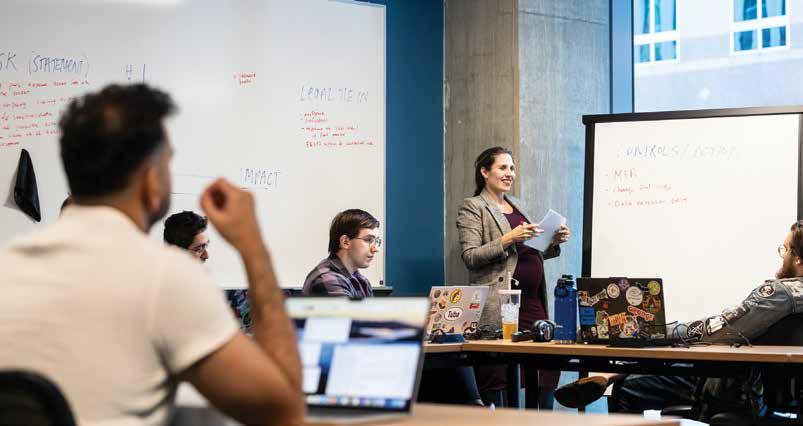
In the fall 2025 semester, Howard students traveled to George Mason’s Fuse at Mason Square to attend class alongside Scalia Law students and gained a strong foundation in cybersecurity, risk management, data governance and privacy, and AI concepts. Two instructors—Kathryn Ciano Mauler, a product counsel attorney at Google, and Ali Jessani, counsel at WilmerHale in privacy, cybersecurity, and AI law— guided the students through their coursework.
The Cybersecurity + AI Clinic has been meeting in the new Fuse at Mason Square in Arlington.
“This clinic is truly a unique experience for students because it provides them with an opportunity to apply the knowledge and skills they learn in the classroom in a real-world setting,” says Jessani. “While some classes ofer doctrinal lessons and others ofer applied skills, this clinic provides students with both.”
“Here they learn not just the nuts and bolts of privacy and cybersecurity, but also the experience of speaking with clients, thinking on the spot, and tying together diverse experiences and issue spotting to provide real-world value in a supervised setting,” says Mauler. “The clinic classroom has brought together a diversity of experience across undergrad and law school students and their perspectives in a rich discussion.”
In addition to coursework, the students have gained professional skills essential for client-facing work, including learning how to conduct client interviews, present technical findings to nontechnical audiences, navigate project challenges, and draft written recommendations.
Scalia Law School student Mike Niebergall says he applied to the clinic because he’s interested in how technologies like AI will afect the entertainment industry and the commercial world in general. “I have a background in music. With no
cybersecurity or computer science background, the clinic has been incredibly eye-opening and has taught me how cybersecurity practices apply across many diferent spaces.”
“I wanted to gain experience learning how to work within legal frameworks to protect business operations and consumers with the rise of AI usage,” says HUSB undergraduate Courtney Gill. “As a senior at Howard University interested in practicing law, [I felt] the class simulated what it feels like to be in a law school classroom.”
“While many of my law classes asked me to consider harms that had already occurred, the clinic challenged me to think about managing risk and preventing legal liability from arising in the first place,” says Scalia Law School student Liam McGettigan. “For anyone interested in learning how to run an organization—and understanding the unavoidable challenges of the digital world—the Cybersecurity + AI Clinic should be on your radar.”
Some students, like law student Tate Kaufman, have been able to immediately apply what they learned in class. “The clinic has provided an invaluable look into the work of cyberlaw practitioners, while enabling me to stay on the cutting edge of AI law,” says Kaufman. “Knowledge from the clinic directly translated to my
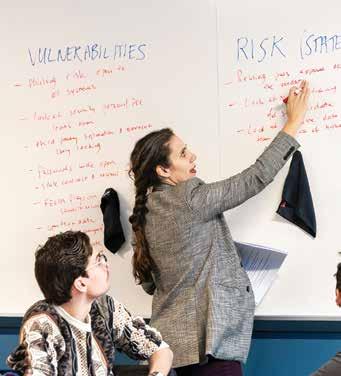
Below and upper right, clinic instructor Kathryn Ciano Mauler leads a discussion during one of the class meetings.
work as a clerk on the Senate Judiciary Committee, where I worked on issues relating to the emergence of generative AI and copyright.”
Entering the spring semester, students transitioned to hands-on client work, a core part of the clinic’s community-focused mission. Working in small groups of three to four students, and supported by expert instructors, each group is partnered with a client organization that may not have the expertise or resources to manage cybersecurity risk on their own.
The first group of clients includes the Arlington Free Clinic, Washington, D.C.-based Bread for the City, Center for Child and Family Advocacy in Arlington, and the charter school Digital Pioneer Academy.
NSI CTC continues to welcome new partners who are looking to strengthen their cybersecurity resilience, and the clinic has a goal of increasing the number of clients served each clinic cycle.
Under the guidance of instructors and the leadership of Clinic Director Jessica Jones, students are providing a range of services for their clients, including conducting cybersecurity risk assessments; mapping organizational vulnerabilities; reviewing or drafting cybersecurity, AI-use, or incident response policies; and providing practical recommendations tailored to strengthen an organization’s overall security posture.
In May, students formally present their findings and recommendations to client representatives. They also present to their fellow students, with each group highlighting project results, sharing real-world challenges they faced, and reflecting on the lessons learned throughout their client engagements. The clinic’s year-long experience is a core part of preparing students for careers in a cyber field that increasingly demands interdisciplinary understanding and practical experience.
Admission to the program is competitive. Howard students apply as rising seniors, and George Mason students currently come from the law school. Applicants are not required to have prior cybersecurity experience—just interest and a willingness to engage. All participants receive a stipend, helping ensure that financial barriers do not prevent qualified students from participating.
Looking ahead, the clinic anticipates welcoming students from a broader range of disciplines and additional George Mason programs, such as public policy, engineering, and business, to strengthen the interdisciplinary preparation needed to address evolving cyber and AI challenges.
About the National Security Institute
George Mason’s National Security Institute (NSI) serves as a platform for research, teaching, scholar ship, and policy development. NSI incorporates a realistic assessment of the threats facing the United States and its allies, as well as an appreciation of the legal and practical challenges facing intelligence, national security, technology, innovation, and cybersecurity communities.
NSI’s Cyber and Technology Center advances U.S. technology leadership and engages policymakers on issues at the intersection of technology and national security through expert dialogue and cuttingedge research.
Students, faculty, and organizations interested in partnering with the clinic or learning more about the program can contact Jessica Jones at jjones76@gmu.edu.
ON THE FRONT LINES OF DEFENSE AND SECURITY RESEARCH
George Mason engineers, scientists, policy scholars, and legal experts are joining forces with federal partners to tackle some of the nation’s most complex security challenges—positioning the university as a trusted leader in defense innovation.
BY PAM SHEPHERD
George Mason University faculty are leading groundbreaking work in defense and security research, bringing deep expertise from across the university’s colleges, schools, and specialized centers to address some of the nation’s most pressing security challenges.
Faculty leaders in the College of Engineering and Computing (CEC), College of Science, Antonin Scalia Law School, and the Schar School of Policy and Government—together with researchers in the Center for Secure Information Systems and the C4I and Cyber Center—are advancing capabilities in integrated sensing, advanced communications, cybersecurity, space, and AI.
These eforts position George Mason as a vital partner to the U.S. Department of War (DOW) and the broader national security community, with George Mason faculty emerging as national leaders in defense and security research. Their work is supported by administrative enhancements in secure computing, facilities, and infrastructure at Fuse at Mason Square, creating an ecosystem where innovation thrives.
Supporting and amplifying this faculty-driven innovation is Sarah Campbell, MS International Commerce and Policy ’11, associate vice president of research for defense and security initiatives. Campbell ensures George Mason faculty expertise is linked to the right national partners by guiding collaborations and forging relationships with such influential organizations as the Naval Surface Warfare Center Dahlgren Division (NSWCDD), MITRE, the National Geospatial-Intelligence Agency, the Defense Advanced Research Projects Agency, and the Ofice of the Secretary of War’s Undersecretary of Defense for Research and Engineering (USD R&E).
“George Mason has the talent, the technology, and the partnerships to be a driving force in advancing our nation’s defense capabilities,” Campbell says. “By working at the intersection of research, innovation, and application, we are paving the way as pioneers in
the academic space by working with the government and industry to build solutions that matter.”
Faculty contributions are already shaping national strategy. In 2024, George Mason secured an inaugural DOW contract to convene the first-ever academic workshop on integrated sensing and communications (ISAC), a transformative field that merges advanced sensing technologies with next-generation communications.
Led by Campbell, members of CEC faculty, George Mason’s Rapid Prototyping Research Center, and Virginia’s Commonwealth Cyber Initiative worked alongside government and industry experts to identify national research priorities to produce a report that is featured on the USD R&E website and is informing current federal strategy.
LEARN MORE. go.gmu.edu/gci
PHOTO BY MILAN JOVIC/GETTY IMAGES
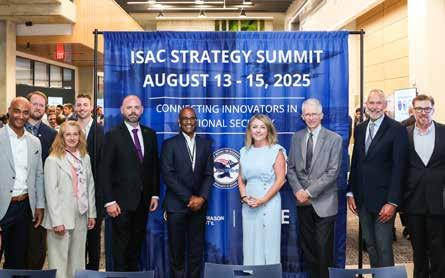
The ISAC Strategy Summit brought more than 300 people to Fuse at Mason Square.
That momentum carried into 2025, when the university hosted a 300-person ISAC Strategy Summit. Faculty members from across disciplines showcased expertise that aligned with the Pentagon’s future generation wireless and Golden Dome missile defense initiatives, which aim to integrate sensing, communications, and defense systems into a unified protective architecture.
“There is a serious gap in the ISAC talent pipeline— not only is there no dedicated curriculum or formal field of study, but the knowledge base is scattered across separate disciplines that need to be integrated,” Campbell says. “This creates an opportunity for George Mason to build an interdisciplinary program that develops the next generation of ISAC experts, creating a community for this nascent technology. Our partnership with the War Department and the work that follows highlight the university’s strength across the full spectrum of sensing capabilities.”
As for the future, Vice President for Research, Innovation, and Economic Impact Andre Marshall emphasizes the importance of George Mason’s commitment to investing in faculty-led research in integrated sensing, advanced communications, AI, space, and cybersecurity, and positioning faculty members as national thought leaders. He noted that by deepening collaborations with federal laboratories, strengthening partnerships with defense contractors, and pursuing major research investments, the university will remain both a pioneer and a leader in advancing critical defense priorities.
“George Mason’s Defense and Security Program exemplifies the university’s ability to align worldclass research with national priorities,” Marshall says. “These initiatives not only expand our impact in defense and security but also elevate the university’s reputation as a premier research institution delivering solutions that matter.”
Marshall says what sets George Mason apart is its ability to bring interdisciplinary teams together— engineers, data scientists, policy experts, and security specialists—to boldly take on the complex challenges facing the United States. Marshall also leads the university’s Grand Challenge Initiative (GCI), which champions these interdisciplinary teams as a way of tackling humanity’s ultimate grand challenge— securing a peaceful, healthy, and prosperous world. GCI is a comprehensive research framework, backed by an initial five-year, $15 million investment, to align university resources, faculty expertise, and educational programs around six interconnected solutions, including driving responsible digital innovation and sustainable infrastructure.
PHOTO BY REMOTEVFX/GETTY IMAGES
“As we engage with initiatives like ISAC and the Golden Dome, we are preparing to shape the next generation of defense technologies, while also training the workforce that will carry them forward,” Marshall says.
A CEC faculty team secured a $3.9 million grant in early 2025 from the National Science Foundation’s CyberCorps® Scholarship for Service (SFS) program to support cybersecurity students who intend to work for the U.S. government after graduation.
With that funding, George Mason’s new Empowering American Government Leadership in Security through Education (EAGLE) Program will support 12 undergraduate students, nine graduate students, and two doctoral students over the next five years, according to the program’s principal investigator Kun Sun.
In addition to financial support, each scholarship recipient is paired with a faculty advisor and will complete a summer internship with one of the government agencies that recruit from CyberCorps SFS programs.
EAGLE is an ambitious initiative aimed at bolstering the cybersecurity workforce within U.S. government agencies, such as the National Security Agency, the U.S. Department of Energy, and military branches, to
address the critical need for skilled professionals in the field.
George Mason is also working with Naval Surface Warfare Center Dahlgren Division (NSWCDD) via cooperative agreements for workforce development activities and technical exchange and research development on complex naval warfare systems, including enhancing cybersecurity information and operations capabilities and leveraging AI to help identify and mitigate threats.
The partnership is connecting George Mason undergraduate and graduate students to real-world DOW projects and creating a talent pipeline for the U.S. Navy. George Mason research faculty exchange technical knowledge with NSWCDD staf and have presented guest lectures at the division. In addition, Liza Wilson Durant, George Mason’s associate provost for strategic initiatives and community engagement, and a team of George Mason systems engineering and cyber security engineering faculty developed a summer course related to cybersecurity for NSWCDD personnel.
“This is the type of innovation ecosystem that ensures George Mason remains a trusted partner for years to come,” says Marshall.
LEARN MORE ABOUT THEIR WORK.
go.gmu.edu/isac
During his CCI internship, Honors College student and cyber security engineering major Connor Wadlin worked with drones and their navigation systems.
CCI Nurtures the Next Generation of Cyber Sleuths
A CYBER-PHYSICAL SYSTEMS TESTBED, cuttingedge artificial intelligence and next-gen network research projects, a cybersecurity apprenticeship program, and a cybersecurity accelerator are just some of the outcomes from George Mason’s role as the Northern Virginia (NoVa) Node headquarters of the Commonwealth Cyber Initiative (CCI).
CCI is Virginia’s main access point for cybersecurity workforce development, innovation, and research. While all their programs address at least two of these three areas, according to Jordan Mason, NoVa Node’s program manager, he emphasized that the NoVa Node is particularly strong in workforce development with a range of traineeships and internships for people at all career levels interested in learning more.
“There are more than 50,000 cybersecurity job openings in Virginia and the existing pipeline of cybersecurityrelated degreeseeking candidates is not enough to fill the demand,” says CCI NoVa Node Director Liza Wilson Durant, an associate provost for strategic initiatives and community engagement at George Mason. “CCI NoVa Node programs widen the pipeline and present new sources of talent, including those with degrees outside of the typical cybersecurity pathway, but with handson skills developed
in the field. Our programs have touched thousands, and we know we are having an impact.”
For example, one cybersecurity traineeship targets people who, at the end of the program, will be ready for fulltime, entrylevel cybersecurity positions. The traineeship builds a bridge for people with nontechnical or noncybersecurity backgrounds, typically either recent graduates or career transitioners looking to enter the field. Participants go through a sevenweek cyber fundamentals boot camp and are then placed in 12week apprenticeship.
“CCI trainees have been placed with Peraton, one of the first adopters of the program, as well as other government contractors and some small businesses,” says Mason. “One graduate from our program landed a position with TikTok and another with Amazon Web Services.”
The NoVA Node also runs a subsidized internship program with a sliding scale determining level of support based on company size. “Small and startup companies have limited resources to support interns and yet they are excellent training ground, providing roles with significant responsibility and opportunities for technical training,” says Durant.
Recognizing the importance of introducing cyberrelated topics before students decide on a career path, NoVa Node runs a summer high school internship program partnering with the Children’s Science Center, part of the Northern Virginia Science Foundation. The competitive application process yielded 45 students in a recent cohort.
Fairfax County Economic Development Authority
President and CEO Victor Hoskins stressed the need for a skilled technical workforce in the region. “We have five times the data center capacity of Silicon Valley and three times the capacity of Singapore. So, when you look at what our global competitors would be, we are way ahead of them in terms of their infrastructure capacity. And when you get ahead in the infrastructure, you also must have the talent to run it.”
—Nathan Kahl
VCC Releases First State ide Climate Assessment
GEORGE MASON’S VIRGINIA CLIMATE CENTER (VCC) HAS UNVEILED the commonwealth’s first comprehensive, peerreviewed climate assessment—a landmark report that provides sciencebased insights into Virginia’s changing climate and its impacts on communities, infrastructure, and the economy.
The first Virginia State Climate Assessment synthesizes decades of research into a single, accessible resource for policymakers, businesses, educators,
and the public. Developed by a multidisciplinary team across the commonwealth and the region, this report establishes a critical baseline for understanding how past, present, and future climate conditions will shape life in Virginia.
“This groundbreaking statewide assessment gives us what we’ve never had before: comprehensive, sciencebased evidence of the risks we face and the information we need to protect our communities, economy, and natural heritage for generations to come,” says Jim Kinter, VCC director and coordinating author of the assessment.
While national and global climate reports provide broad trends, they cannot capture Virginia’s specific vulnerabilities. The commonwealth’s geographic diversity—from coastal plains to mountainous terrain—combined with rapid population growth and economic expansion—create regionspecific risks that require localized solutions.
The assessment addresses these needs by organizing findings across six climate divisions: Tidewater, Eastern Piedmont, Western Piedmont, Southwestern Mountain, Central Mountain, and Northern Virginia. The report also identifies three primary hazards of particular concern for Virginia in the 21st century: extreme heat and rising temperatures, extreme precipitation and shifting seasons, and accelerated sealevel rise.
“This assessment empowers every Virginian, from local planners to business leaders to families, with the knowledge to make informed decisions,” says Kinter. “And as we continue to update and expand this work, we’re building a lasting framework for protecting Virginia’s future.”
—Tracy Mason
With the global rise of Korean culture—from Kpop and film to food and language—George Mason recently launched the Center for Korean Culture and Society at Mason Korea. It is the campus’s first independently operating research center. Directed by Gyu Tag Lee (left), a professor of global afairs and leading expert on Kpop, the center will lead interdisciplinary research and education in media content, Kpop, gaming, sports, and tourism, and foster industry–academic partnerships.
READ THE REPORT. go.gmu.edu/vca
Using AI to Identify Human Traficking Hot Spots
ILLICIT MASSAGE BUSINESSES (IMBs) RUN BY HUMAN TRAFFICKING RINGS ARE RAMPANT IN THE UNITED STATES. A George Mason professor has helped build what may be the best artificial intelligence (AI)driven tool to root them out.
IMBs are one of the most common ways in which exploitive networks operate in plain sight. The Network, an antitraficking nonprofit, estimates that there are more than 13,000 IMBs active in the United States, raking in annual total revenue of more than $5 billion.
Abhishek Ray, assistant professor of information systems and operations management at the Costello College of Business, is part of a growing group of researchers exploring how various forms of AI could help resourceconstrained law enforcement agencies diferentiate between IMBs and the legitimate enterprises they try to mimic. Put to the test in a recent experiment, his ongoing research using graph neural networks has yielded more promising results than rival approaches.
The innovative approach made sense for detecting IMBs, because while they might try to appear aboveboard, they have geographical needs that conventional businesses don’t. “IMBs don’t allow their traficked employees to go out of the parlor,” says Ray, who is working with Lumina Albert and Swetha Varadarajan of Colorado State University on the research. “But since they’re humans, they need sustenance. They have to be near groceries, gas stations, where they can get stuf and come back.”
The researchers combined several graph neural networks into a framework called IMBWatch. The training dataset for IMBWatch comprised publicly available information such as online customer reviews, arrest and raid data for known IMBs, and advertisements from websites promoting illicit activities. The result was a series of snapshots mapping the evolution of the IMB network in a given city or county over a period of time. That data could then be overlaid onto maps to tease out hidden patterns.
To gauge IMBWatch’s performance, the researchers let it loose on a testing dataset alongside four other AI models, which were not as sensitive to the nuanced interplay of spatial and temporal factors. Of the five models, IMBWatch provided the most accurate, precise, and informative predictions. While encouraging, these outcomes require further confirmation with a larger dataset.
“IMBWatch was trained on data from Georgia and Louisiana,” Ray says. “These were small, manageable datasets, but we will now scale up to major states such as New York and California.”
This is not Ray’s first foray into working and thinking diferently while approaching AIfueled antitraficking eforts. Previously, Ray codeveloped a model for improving machine learningbased detection of human traficking activity at transit stations and on fishing vessels.
Law enforcement agencies and other stakeholders are often wary of adopting AIbased solutions. Ray and his coresearchers are currently devising a framework that will clarify how stakeholders can work with tech experts and, more importantly, human traficking survivors to make the best possible use of AI.
—Benjamin Kessler
PHOTO BY ANYABERKUT/GETTY IMAGES
The Brain May Not Be a Muscle, but It Still Needs Exercise
AGE-RELATED COGNITIVE DECLINE CAN INCLUDE memory loss, lapses in attention, trouble performing daily tasks, and confusion, among other signs that could be warnings of Alzheimer’s disease and related dementias (ADRD). But “working out” the mind could help combat those symptoms.
That idea is core to the StrongerMemory program, a rigorous brain training curriculum developed by the Goodwin Living Foundation and tested by George Mason University social workers.
Older adults in StrongerMemory participated in three daily activities for 30 minutes per day: 10 minutes each of reading aloud, writing by hand, and completing simple math problems. The program allowed participants to choose the reading material and writing content. For example, some older adults chose to write letters to family. At the conclusion, participants were interviewed and tested on memory recall, verbal fluency, attention, dates, and location.
Unlike previous cognitive exercise programs, which focused on a single aspect of brain health like memory, the activities of this program were specifically chosen to stimulate multiple parts of the brain with the goal of combating progression of ADRD. Participants were recruited from older adult living communities. They had selfreported cognitive decline but did not have a formal ADRD diagnosis.
George Mason researchers Emily Ihara and Catherine J. Tompkins found that the program’s mental exercises resulted in both selfreported and researcherassessed improvements in key brain health indicators among older adult participants.
“The StrongerMemory program was associated with both objective and subjective improvements in cognitive functioning among older adults,” says Ihara, chair of the Department of Social Work in the College of Public Health. “The components stimulated and strengthened working memory, attention, and decisionmaking processes.”
The results for the study were published in Educational Gerontology. Ihara sees the study as a building block for helping others think diferently about ADRD. “The results can inform practitioners, policymakers, and families about practical, afordable, nonpharmacological ways to possibly mitigate cognitive decline and promote healthy aging.”
—Taylor Thomas
LEARN MORE ABOUT THE RESEARCH. go.gmu.edu/ brainexercise
Recently published works by George Mason faculty and staf
Environmental Policy and Management
Younsung Kim, PhD Environmental Science and Policy ’10, professor and associate chair, Department of Environmental Science and Policy
Cognella, August 2024
The second edition of this book features signifcant updates to ensure students are equipped with the most current information, including readings on the Paris Agreement for global decarbonization, the energy transition from fossil fuels to renewables, and principles and current practices of carbon markets, refecting the evolving landscape of environmental policy and management.
Forty Years of Advice
Philip Wilkerson, MEd Counseling ‘12, employer engagement consultant, University Career Services
Design Marvel, February 2025
Forty Years of Advice ofers a snapshot of where the author has been, what he’s learned, and information about the remarkable people who have helped shape who he is today.
Natural Property Rights
Eric Claeys, professor, Antonin Scalia Law School
Cambridge University Press, April 2025
The book presents a novel theory of property based on individual, pre-political rights. The book argues that a just system of property protects people’s rights to use resources and also orders those rights consistent with natural law and the public welfare. The book challenges leading contemporary justifcations for property and shows how property both secures individual freedom and serves the common good.
Redefining Spiritual Spaces in the Age of Technology
Stacey K. Guenther, assistant professor, Organization Development and Knowledge Management Program, with Xiaoan Li and Michelle A. Scheidt (Eds.)
Springer, August 2025
Through a mixture of philosophy, advocacy, presentation of research fndings, and sharing of practices, this book illustrates technology’s infuence on spirituality and vice versa and its applications to management, strategy, and leadership.
From First Job to Career: Research and Narratives
Graziella Pagliarulo McCarron, associate professor, Higher Education Program, and Steven Zhou, PhD Psychology ’24
Cambridge University Press, August 2025
Paired with a comprehensive review of research in vocational psychology and career counseling, this anthology weaves together inspiring frst-job stories from people across diverse industries and backgrounds, ofering career seekers of all ages the chance to connect with relatable experiences and hard-earned wisdom.
How to Be an Ambassador for Science: The Scientist as Public Intellectual
James L. Olds, Distinguished University Professor, Schar School of Policy and Government
Edward Elgar, August 2025
What does it mean to be a “science ambassador”? This book presents invaluable insights into how professional scientists can transform their careers from working at the bench to becoming public intellectuals. Olds draws on his 30-year career to ofer a guide to the skills required to be an efective advocate for science.
Double Crossing Van Dine
Art Taylor, MFA ‘06, professor, English Department, with Donna Andrews and Greg Herren (Eds.)
Crippen and Landru, August 2025
This anthology features short stories that each break one of the writing rules set out by S. S. Van Dine, a prominent art critic and writer of the 20th century. Taylor contributed a story titled “Dalliances.”
Prohibiting Workplace Sexual Harassment: A Cross-Cultural Analysis
Cher Weixia Chen, associate professor, School of Integrative Studies
Edward Elgar, September 2025
The author analyzes a vast range of data, including national workplace sexual harassment laws across 193 countries, 37 judicial decisions from the highest courts of 10 common law countries, and policies from 30 nongovernmental organizations in six countries and the 50 largest global corporations.
The Brides of War: A Vietnam War Novel
Steve Gladis, MA English ‘84, PhD Education ‘95, senior scholar, Center for the Advancement of Well-Being
Steve Gladis Leadership Publishers, September 2025
In the tradition of Kristin Hannah’s The Women and Margot Lee Shetterly’s Hidden Figures, the novel ofers an intimate, moving portrait of women whose lives were shaped not by the battles they fought, but by the men they loved—and the geography that brought them together. It follows four University of Mary Washington women whose lives intersect in friendship, love, and loss.
You Weren’t Meant to Be Human
Andrew Joseph White, BFA Creative Writing ’19, MFA ’22, financial and academic support specialist, College of Education and Human Development
Simon and Schuster’s Saga Press, September 2025
Described as Alien meets Midsommar, White’s debut adult novel focuses on identity, survival, and transformation amid an alien invasion in rural West Virginia.
A Seat at the Table: A Place for Disabled Entrepreneurs and Innovators
Connie L. McNeely, professor, Schar School of Policy and Government, with Helen Lawton Smith, Jacqueline Winstanley, and Ayşe Seyyide Kaptaner Demirhan (Eds.) Routledge, November 2025
This book addresses how the innovation and entrepreneurship of people with disabilities are supported in diferent national contexts, using case studies from India, Nigeria, Hungary, Türkiye, the United Kingdom, and the United States. The contributions provide a summary and critique of existing legislative and policy approaches.
ON THE FRONT LINES OF COUNTERTERRORISM
Mahmut Cengiz, PhD Public Policy ’10, of George Mason’s Terrorism, Transnational Crime and Corruption Center, is a seasoned expert in terrorism, organized crime, and illicit economies. His work focuses on the dynamics of terrorism, smuggling, and criminal networks and contributes significantly to understanding and combating these global challenges. His latest book, Typologies of Terrorist Organizations: Conceptual Lenses and Counterterrorism Measures (Carolina Academic Press, September 2025), was cowritten with Mitchel Roth and Huseyin Cinoglu.
What inspired you to write this book?
When most people think of terrorism, they picture headlinegrabbing attacks by well-known extremist groups. What they rarely see is the vast and complex web of organizations operating in the shadows. That realization came to me while teaching BIOD 722 Examining Terrorist Organizations at the Schar School of Policy and Government, and it became the spark for the book.
For seven years I served as the principal investigator and incident validator on the U.S. State Department’s Global Terrorism Trends and Analysis Center project at the Schar School. Between 2018 and 2024, I validated more than 50,000 terrorist incidents worldwide. That work gave me a front-row view of how terrorist organizations operate, from their targets and weapons to their organizational structures.
How do you anticipate people using this book?
I set out to create a textbook that bridges theory and practice, designed to serve students, policymakers, and practitioners alike. The book spans 14 chapters, analyzing terrorist groups using the latest conceptual frameworks and classifcations. My hope is that readers will not only understand how these organizations function but also develop the analytical skills necessary to design efective counterterrorism strategies.
Was there anything that surprised you while working on this book?
What surprised me most during the writing process was realizing how broad and evolving the landscape of terrorism has become. While jihadist groups continue to dominate headlines, the growing infuence of right-wing extremists, insurgent networks, and other politically motivated organizations demands equal attention. Connecting incident-level data to broader organizational behavior revealed hidden patterns and trends that are often missing from policy discussions.
—Colleen Kearney Rich, MFA ’95
Recently published works by George Mason alumni
Built by the People Themselves: African American Community Development in Arlington, Virginia, from the Civil War through Civil Rights
Lindsey Bestebreurtje, MA History ’11, PhD ’17
In Built by the People Themselves (University of South Carolina Press, November 2024), the author traces the history of the Black community in Arlington, Virginia, from the frst days of emancipation through the civil rights era in the 20th century, analyzing African American-led community development and its efects on Arlington County.
Bestebreurtje has served as a curatorial assistant with the Smithsonian’s National Museum of African American History and Culture since 2015. Her publications have appeared in the Virginia Magazine of History and Biography and Reviews in American History
Lost in the Crush: A Cape Cod Mystery
Keith Yocum, BA Philosophy ’74
In this psychological thriller (self-published, February 2025), Stacie Davis is about to marry the man of her dreams, but on the night of the wedding rehearsal dinner, a dark secret unravels everything she holds dear.
Yocum is a former journalist and author of 10 novels, including the Dennis Cunningham espionage thriller series set in Australia. He lives in Cape Cod, Massachusetts.
Move Slowly and Build Bridges: Mastodon, the Fediverse, and the Struggle for Democratic Social Media
Robert W. Gehl, PhD Cultural Studies ’10
Move Slowly and Build Bridges (Oxford University Press, August 2025) tells the story of activists, software developers, artists, and everyday people who have built the fediverse—a large, noncentralized, alternative social media system.
Gehl is the Ontario Research Chair of Digital Governance for Social Justice at York University in Toronto, Canada. He also teaches in the department of communication, media, and flm at the University of Calgary.
If You Leave
Margaret Hutton, MFA ’97
In this debut novel (Regal House Publishing, October 2025), an artist opens her home to a near stranger in 1944, irrevocably altering her life. The book follows two mothers and a daughter over three decades.
A native North Carolinian and former environmental reporter, Hutton divides her time between Washington, D.C., and her art studio in Chester County, Pennsylvania. Her fction has appeared in The Sun, South Carolina Review, The Chattahoochee Review, and The Antioch Review.
Walking for Me: Life Reflections
Daniel Walsch, PhD Communication ’11
This memoir (123 Press, October 2025) is the story of Walsch’s nonstop eforts to balance the reality of interacting with others with his innate and powerful need to maintain his own company.
As a semi-retiree, Walsch devotes much of his energy to working with students, writing projects, and connecting with family and friends. He resides in Fairfax, Virginia, with his wife.
Jeferson’s Manual of Parliamentary Practice
Brian Alexander, PhD Political Science ’15
First published in 1801, Thomas Jeferson’s A Manual of Parliamentary Practice has been the basis for the rules of Congress ever since. Now, for the frst time, Jeferson’s manual is printed with all of Jeferson’s additions, along with an introduction detailing the history of the text and tracing the discovery of the revisions (Arcadia Books, November 2025).
Alexander is associate professor of politics at Washington and Lee University. In 2021, he was a fellow at the International Center for Jeferson Studies at Monticello, where he conducted research on Jeferson and parliamentary law. He lives in Lexington, Virginia, with his wife and two daughters.
JAYLIN LOTT
Being an athlete and a competitor fuel Jaylin Lott’s love for volleyball, but it’s the inner serenity she achieves while singing that she treasures away from the court.
AN ALMOST IDOL: Lott experiences the best of both worlds as a defensive specialist for the Patriots women’s volleyball team—who also moonlights as a singer. Her talent of the court took her to the third round of last year’s American Idol tryouts, where she was one of just 15 singers selected from a pool of roughly 300 during an inperson audition in Salt Lake City, Utah.
IT’S A FAMILY AFFAIR: Strong vocals run in the family. Lott’s grandmother, Ava, who passed away in 2020, sang in the church choir and remains her inspiration. Lott began singing around age 13 while competing and lettering in both volleyball and track at Clark High School in Texas. “[Sports and singing] are both ways to escape the stress that naturally comes with life,” Lott says. “They’ve each been therapeutic in diferent ways and at diferent times. I have a deep love for both.”
AT THE END OF THE DAY: Lott says it’s not uncommon to find her singing along to her karaoke machine after a long day of classes and practice. Her musical inspirations include Whitney Houston, Beyoncé, and other artists she credits for shaping her style. “As I’ve gotten older, I’ve looked forward to coming home and singing karaoke,” she says. “It’s kind of been my peace, especially after moving so far away from home.”
YEAR: Sophomore
MAJOR: Business with a minor in sport management
HOMETOWN: San Antonio, Texas
TAKING THE STAGE: She was just a sophomore in high school when she first sang the national anthem before a San Antonio Spurs game, a moment that felt larger than life. “It was pretty big,” Lott recalls. “I was nervous at first, but it was pretty cool.” She has returned to perform at Spurs games many times since and has even sung before a larger crowd at a Dallas Mavericks game.
SINGING HER OWN SONG: Singing is more than a hobby for Lott—it’s a passion she hopes to turn into a career. Lott continues to reach out to NBA teams in the region and in her hometown about national anthem gigs while also eyeing auditions for The Voice. Lott also wrote songs for fun throughout middle and high school, and she has long imagined taking the next step—writing music professionally and eventually recording her own music in a studio. Finding time between school and volleyball has been tough, but she’s determined. “I want to put in the work it takes to have people one day hear my music,” she says. “It’s a peaceful thing for me to do, and it carries my grandmother’s legacy, too.”
—John Hollis
DSS Special Agent Mohamed Hassan, right, by the Olympic rings in Bormio where the alpine skiing competitions were held and below with one of the opening ceremony torch bearers.
Keeping Team USA Safe at the Olympics
Near the Italian town of Bormio, visitors can ride a mountain cable car to take in a breathtaking panorama from a café perched near the peak. Diplomatic Security Service (DSS) special agent Mohamed Hassan, BA Religious Studies ’20, who was a field liaison oficer during the Milan Cortina 2026 Olympic Games, recounts taking a break from supporting Team USA to sip a cappuccino alongside Olympians: “Everyone was really interested in what everyone’s there to do…. Everyone’s motivating one another.”
As a DSS special agent, Hassan is both a federal law enforcement oficer and a member of the Foreign Service. DSS is the U.S. State Department’s law enforcement and security branch, and it led security for the U.S. presence during Milan Cortina 2026. In Bormio, Hassan coordinated with the Italian police, military, and other organizations to help create a safe environment in which U.S. athletes could focus on their competitions.
When Hassan describes the community of that mountaintop café, it echoes his days at George Mason, where he made friends with people from all over the world over potlucks and soccer games. Hassan, who grew up in Fairfax, developed his talents for bringing people together as a Patriot Leader and student advisor.
He says he eventually decided to major in religious studies because of religion’s impact on everything from how people relate to each other to how governments interact. He focused on the Middle East and says his George Mason cohort “knew what I wanted to do and they helped me get there.” He also credits
Nathaniel Greenberg, associate professor of Arabic, for pushing him to hone his existing Arabic language skills.
Hassan knew he wanted to be a part of something important and give back to the country that welcomed his family when they emigrated from Egypt. He took advantage of George Mason’s proximity to Washington, D.C., and enrolled in an internship with the U.S. State Department through the federal Pathways Internship Program, which provides students paid work experience with the possibility of a job. After graduating, Hassan successfully joined the department, and about four years later, he became a DSS special agent.
While working in Bormio, Hassan says he was able to immerse himself in Italian culture, witness ski mountaineering’s Olympic debut, and even hold an Olympic medal. His favorite local Bormio dish was pizzoccheri, which consists of hearty buckwheat pasta with potatoes, cabbage, and Valtellina Casera cheese topped with garlic and melted butter.
While an Olympics assignment is a rare opportunity, Hassan says every day is diferent working in DSS and “the world is your oyster.” And he means it quite literally. In his eight years with the department, Hassan has traveled to more than 30 countries and is eager to see more. With DSS operating at U.S. diplomatic facilities in more than 170 countries, that should be easy. Hassan is already looking forward to a new assignment where he can use his language and culture skills.
—Rebecca Kobayashi
1960s
Michael Alexander, BS Biology ’69, has received the 2025 Tilton Award from the Medical Society of Delaware in October 2025. The award honors his leadership, innovation, and lifelong commitment to advancing medical excellence in Delaware. Prior to his retirement in 2013, Alexander was a physiatrist, a physical medicine and rehabilitation specialty that focuses on patients’ ability to function. He was chief of rehabilitation services at the A.I. duPont Hospital for Children (now known as Nemours Children’s Hospital, Delaware) in Wilmington.
1980s
Terrie Upshur-Lupberger, BS Marketing ’80, is a global coach educator and is considered a pioneer in the coaching profession. Her frst book, Uncommon Wisdom at Work: Bolder Results. More Ease. A Wiser Way to Work and Live, was published in September 2025 by Milna Press.
Jefrey Kerr, BA History ’84, became PETA Foundation’s inaugural chief operating ofcer on September 1, 2025. Previously the longest-serving chief legal ofcer of any animal protection organization, he has been with PETA for 30 years. In 2017, his legal team was named Corporate Counsel magazine’s Best Legal Department.
D. Eric Schansberg, BA Mathematics; BS Economics ’86, is a professor of economics at Indiana University Southeast. He independently
published College 101: What Students and Parents Should Know About Universities in August.
Alan Walker, BA Psychology ’88, MA History ’93, retired in May 2025 after 35 years with the National Archives and Records Administration.
Greg Bicouvaris, BA Sociology ’89, is the owner of GJB Productions & Marketing and GJBTV.COM. He was inducted into the Athletic Hall of Fame of the Lower Virginia Peninsula for broadcasting in August. He has worked both on the air and behind the scenes at the local, regional, and national levels. He is a resident of Newport News, Virginia.
Margaret Ziegler Wirgau, BSN ’89, writes historical fction. Her second traditionally published novel, To Outwit Them All, was published by Iron Stream Media in October 2025. Her frst novel, The Stars in April, was published by Illuminate YA Fiction in March 2021. She writes under the pen name Peggy Wirgau.
1990s
Diane LeResche, PhD Confict Analysis and Resolution ’90, specializes in designing, implementing, and evaluating systems for preventing and resolving interpersonal, small group, and community conficts with a focus on Indigenous populations. At the request of tribes and Native American organizations, she has provided skill workshops and consultations on developing comprehensive tribal justice systems and provided staf advances/retreats. She has also educated groups
Class Notes
about working efectively between populations with diverse cultural and other identities. The founder of the Juneau World Afairs Council, the Alaska Honors Institute, Alaska Future Problem-Solving Bowl, and Multicultural Dialogues in Sante Fe, she has served on many national and community boards, including The Nature Conservancy. An independent contractor, she operates from her ofce in Sante Fe, New Mexico.
Carter Wilbur, BA Area Studies; International Studies ’91, is foreign policy advisor to the commander of U.S. Special Operations Forces–Europe in Stuttgart, Germany. Previously, he served a three-year assignment as deputy political-economic counselor at the U.S. Embassy in Nicosia, Cyprus.
Maureen Boland, MEd Curriculum and Instruction ’93, is an educational leader at Boland Educational Consulting and a clinical coach for George Mason’s College of Education and Human Development. She has been inducted into the Fairfax County Public Schools (FCPS) Alumni Hall of Fame, capping of a distinguished 30-year career in FCPS.
Courtney Hunt, BA English ’93, JD ’96, writes contemporary romances. Her most recent novel, Christmas at Starlight Lake, was independently published in September 2025.
Michelle Smith, BS Psychology ’94, MAIS ’98, is geriatric care manager at Choice Care Navigator in Greensboro, North Carolina. She also is a professional member of the Aging Life Care Association.
Laura Hampton, BA International Studies ’95, earned a doctorate in business administration in leadership from the school of business at Liberty University in February 2025. She is an adjunct professor at Strayer University, teaching project management to MBA students.
Christine Slevin, MSN ’99, is an associate professor and the interim dean of nursing at Northern Virginia Community College.
2000s
Christopher Gafrey, BA Foreign Languages; International Studies ’00, is in the licentiate in sacred theology program at Sacred Heart Major Seminary in
Detroit. He is attending the program thanks to a $50,000 scholarship, where his studies focus on new evangelization.
Preston McLaughlin, MA History ’01, has retired as a visiting lecturer adjunct faculty member at the Washington, D.C., teaching site of Texas A&M’s Bush School of Government and Public Service. He joined the Bush School, where he taught national security and defense policy, after retiring as a colonel following a 27-year career in the U.S. Marine Corps. His last assignment was as chief of staf for the 2nd Marine Expeditionary BrigadeAfghanistan. McLaughlin is a combat veteran of Operations Desert Shield/ Desert Storm and Enduring Freedom. He was awarded the U.S. Army Civilian Commendation Medal in 2022. He has been selected as a 2024–26 non-resident fellow at the Brute Krulak Center for Innovation and Future Warfare at Marine Corps University.
Catherine Wilson Cox, PhD Nursing ’02, is a professor in the George Washington University school of nursing. She has received a 2025–26 Fulbright U.S. Scholar award to support
(continued on page 42)
What’s New with You?
We are interested in what you’ve been doing since you graduated. Landed a new job? Received an award? Started a family? Have a new business? Submit your class notes to alumni.gmu.edu/whatsnew. In your note, be sure to include your graduation year and degree.
Dear Fellow Patriots
Dear Fellow Patriots,
With a grateful heart I write this last letter to you as president of the George Mason University Alumni Association (GMUAA). It has been an honor and a privilege to serve you—the university’s most precious resource. I thank you all—and particularly those who served on the GMUAA board, our regional networks, and in Mason Korea—for everything you do on behalf of the university.
Although my tenure as GMUAA president is ending, I will continue to be involved as your immediate past president for the next two years, as a faculty member in the College of Engineering and Computing and Costello College of Business, and as a member of several advisory boards. For me, being a Patriot is a lifelong commitment, and one that has enriched my life immeasurably.
As we welcome our newest graduates into the alumni ranks, I invite all of you to explore the ways that George Mason has made an impact on your life and livelihood and encourage you to strengthen or reestablish ties to your alma mater.
Not everyone has the time to commit to serving on an alumni chapter board, but there are plenty of impactful ways to be involved. How, when, and why you become involved as an alum is as individual as your unique journey and set of talents. The many voices of our alumni contribute to what makes George Mason University All Together Diferent!
Mason Now, our $1 billion campaign, has surpassed its halfway point. We look to the Mason Nation to partner with us to continue to keep our promise to our community for the next 50 years and beyond.
No farewell letter would be complete without an introduction of my successor. Please welcome Jef Fissel, BS Information Technology ’06, vice president of technology at GP Strategies and the recipient of the 2014 Distinguished Alumni Award from the College of Engineering and Computing. GMUAA is in most capable hands!
Indulge me in one last request—let us celebrate with you! Submit a class note for publication in a future issue of Mason Spirit. Share your good news—a job update, an award, a wedding, or the birth of a future Patriot. Visit our website (alumni.gmu.edu) and navigate to the Submit a Class Note option. Many thanks for all you have done and all you continue to do to make George Mason an institution that changes lives for the better. We couldn’t do it without you!
With Patriot Pride,
Scott Hine, BS Decision Sciences ’85
President
George Mason University Alumni Association
nursing education in Trinidad and Tobago. She is helping to strengthen the University of the Southern Caribbean’s (USC) department of nursing education through curriculum development, faculty training, and research capacity building. Her project, developed with USC leadership, also aims to build sustainable academic infrastructure and foster collaboration between George Washington and USC.
Marian O’Neil, MBA ’03, is Bay Cove Human Services’ chief fnancial ofcer. She has more than 20 years of experience in nonprofts, higher education, the U.S. Department of Defense, and legal industries. Bay Cove, located in Boston, is one of the region’s largest and most comprehensive social services agencies, serving those with mental illness, substance abuse disorders, and developmental disabilities and those who are or at risk of being homeless.
Josh Fudge, MPA ’04, has been elected to the Fort Collins, Colorado, city council, representing the third district. He ran on a platform of increasing afordable housing, protecting parks and the environment, and fxing the city’s budget. He is director of performance, budget, and strategy for Larimer County, Colorado.
Bill Podolski, BM Music Education ’05, was one of 10 fnalists for the 2026 Grammy Music Educator Award. He is director of choral activities at H-B Woodlawn Secondary Program in Arlington, Virginia, where he has worked for 18 years. He teaches more than 100 students each day and codirects the high school and middle school musicals.
LaTasha Durrett, BA Communication ’06, is senior communications manager at the Southern Environmental Law Center (SELC). She is the project manager and writer of SELC’s Plantations to Pollution multimedia storytelling series that traces plantation slavery to environmental injustices. She has also started a wine label and is part of a wine incubator in Charlottesville, Virginia.
MAKING TH E CA SE
PHOTO BY EDUARDO MACEDO
PHOTO BY RON AIRA
Seehorn’s Star Shines Bright
Earlier this year, George Mason University alumna Rhea Seehorn, BA Art (Studio) ’94, won the Golden Globe for Best Actress in a Television Drama for her performance as Carol Sturka in Pluribus on Apple TV. It was both her first nomination and her first win—an achievement that also marked a milestone for George Mason, as she became our first alum to receive a Golden Globe.
Her recognition at the Golden Globes followed a 2026 Critics Choice Award for Best Actress in a Drama Series, also for Pluribus, adding to a growing list of accolades for her work.
Seehorn is widely known for her acclaimed portrayal of Kim Wexler in AMC’s Better Call Saul, a role that earned her two Emmy nominations for Outstanding Supporting Actress in a Drama Series. After years of collaboration, Breaking Bad and Better Call Saul creator Vince Gilligan wrote the role of Carol Sturka specifically for her.
In interviews about Pluribus, Seehorn has often pointed to her time at George Mason as the spark that ignited her passion for acting. On NPR’s Fresh Air, she recalled having to take an elective in the arts outside of her art studio major. She chose to take an acting class with theater professor Lynnie Raybuck.
“This was a hardcore, doyourhomework, script analysis class using practical aesthetics that was developed out of the Atlantic Theater,” Seehorn said.
“I just was in love with the fact that if you work really hard and study, you can incrementally get closer and closer to being good at this and hopefully, one day, great at this.”
With that work ethic and other lessons from the class, she entered Washington, D.C.’s vibrant theater community. She began as a volunteer usher at Woolly Mammoth Theatre Company before quickly earning roles at Woolly, Arena Stage, and Studio Theatre. Her stage career eventually took her to New York City, where she made her Broadway debut in the 2001 production of Neil Simon’s 45 Seconds from Broadway.
Reflecting on her early years in Washington, D.C., she told Fresh Air: “I think some of the world’s best theater is [there], and watching those performers, I was just like, ‘I have to do this immediately. I have to do this for the rest of my life.’”
In 2003, Seehorn moved to Hollywood for the ABC sitcom I’m With Her, which ran for one season and helped launch her screen career.
Seehorn’s journey—from a George Mason art student discovering acting through an elective, to a celebrated performer earning some of television’s highest honors—demonstrates how a foundation of grit and perseverance built at the university can lead to extraordinary creative paths.
Rhea Seehorn won the Golden Globe for Best Actress in a Television Drama for her performance as Carol Sturka in Pluribus on Apple TV.
PHOTO BY JEFF KRAVITZ / FILM MAGIC
Are you an alum who owns a business?
List it in our alumniowned business directory.
Go to go.gmu.edu/ alumnibiz to fnd out more.
Jennifer Kubilus, BFA Dance ’07, was appointed in fall 2025 as an adjunct instructor of dance at the University of Mary Washington in Fredericksburg, Virginia.
Christine Russe, MSN ’07, is the 2025 chair of the Emergency Nurses Association Foundation. In 2016, she was inducted as a fellow in the Academy of Emergency Nursing. She is a self-employed nurse consultant based in Texas.
2010s
Salome Hall, BA Art History ’10, is the founder of Sisters Afrming Sisterhood (SAS) Project, a transgender-led nonproft that provides
“afrming wardrobe access, on-site fttings and tailoring, sewing/upcycling classes, and circular redistribution so people leave with clothes that ft and skills that they earn.” Hall was named a Gold Winner at the 5th Annual Anthem Awards (presented by The Webby Awards) for leading SAS Project. The project’s entry, “Redistribution as Liberation: The SAS Project Model,” documents the project’s framework, which partners can adopt in their own communities. To date, SAS Project has redistributed nearly 10,000 items, served approximately 1,000 people, and has more than 40 community activations in six states.
Eric Lefcourt, MBA ’10, is senior manager of the corporate real estate ofce of the Institute for Defense Analyses, at the Alexandria, Virginia, headquarters.
Tyson Reeder, MA History ’10, is an author and assistant professor of history at Brigham Young University. His book, Serpent in Eden: Foreign Meddling and Partisan Politics in James Madison’s America (Oxford Academic, 2024), has been named the winner of the 2025 George Washington Prize. The award recognizes the past year’s books that focus on the nation’s founding era. The $50,000 award is sponsored by George Washington’s Mount Vernon, the Gilder Lehrman Institute of American History, and Washington College.
Liz Valente, BA Graphic Design ’11, is the graphic designer for CharlottesvilleFamily Magazine, which publishes both print and online issues.
Timothy Hammond, MS Confict Analysis and Resolution ’12, is director of strategic engagement at the National Defense University’s College of Information and Cyberspace, which is the U.S. Department of War’s premier graduate institution focused on the cyberspace domain and information environment. Hammond also is the founder of REGENERINT, where, as a board-certifed quantum biology practitioner, he helps clients optimize health through circadian and biophysics education targeting mitochondrial function.
GEORGE MASON UNIVERSITY ALUMNI ASSOCIATION BOARD OF DIRECTORS 2025–26
Scott Hine, BS ’85, President
Christine Landoll, BS ’89, MS ’92, Immediate Past President
Jef Fissel, BS ’06, President-Elect
Andy Gibson, BA ’02, Vice President, Alumni Engagement
Vacant, President, Scalia Law School Alumni Chapter
Erika Laos, BA ’01, President, Schar School of Policy and Government Alumni Chapter
Vacant, President, Veterans Alumni Chapter
If you would like to become involved in the Alumni Association, please contact the Ofce of Alumni Relations at alumni@gmu.edu.
The Power of Accidental Collisions
When Ali Reza Manouchehri, BA Philosophy ’99, arrived at George Mason University as an undergraduate, he couldn’t know that he would start what would become one of the region’s most dynamic technology companies in his residence hall room.
Manouchehri founded MetroStar in 1999 with fellow Patriots Robert J. Santos, BA International Relations ’99, and Pirooz Javan, BS Systems Engineering ’02.
Headquartered in Reston, Virginia, MetroStar is a digital transformation powerhouse of more than 500 engineers, designers, and innovators that is known for blending technical mastery with humancentered design—an approach that can be traced back to Manouchehri’s years at George Mason.
“George Mason gave us more than degrees,” he says. “It gave us a launchpad.”
Manouchehri remembers the chance encounter that became a defining moment for the company: a dormroom reshufle that resulted in him becoming roommates with Santos.
“That move changed everything,” he says. “We bonded quickly, exchanged ideas constantly, and soon we began building what would later become MetroStar.”
Central to Manouchehri’s George Mason experience was the university’s culture that encourages academic curiosity and diverse perspectives. The blending of disciplines didn’t just shape his thinking— it shaped the DNA of MetroStar itself.
Today, he thinks often about that “accidental collision” of perspectives that sparked a company. And he’s working to recreate those kinds of moments for the next generation. For more than two decades, the company has stayed connected to the university through internships, sponsored courses, hackathons, and other events, and recently embarked on a threeyear partnership with George Mason (see story on page 10).
“What excites us most is creating structured opportunities for students to collaborate across disciplines and experience what we once did organically,” says Manouchehri. “We hope to spark those chance meetings, innovative projects, and unexpected friendships that can turn into startups, solutions, and careers.”
As a leader, Manouchehri has earned wide recognition, including the 2023 Executive of the Year award at the Greater Washington Government Contractor Awards and WashingtonExec’s 2022 Chief Executive Oficer Award. He also serves as cofounder and chair of the software company Zoomph. Still, he remains grounded in the philosophy that launched his journey: stay curious.
It’s the advice he ofers to current George Mason students. “If you’re studying AI, take a philosophy course. If you’re an engineer, take a business class. Meet people outside your major,” he urges. “Some of the greatest breakthroughs come from the intersection of disciplines.”
And at a university where tackling old problems in new ways is part of the ethos, the next key startup really could be right down the hall.
—Anne Reynolds
Winter Commencement speaker Ali Reza Manouchehri with student speaker Ayham Elayan at the 2025 Winter Commencement.
LEARN MORE ABOUT HIS TIME AT GEORGE MASON.
PHOTO BY ROMULFO SISON
Philip Wilkerson, MEd Counseling and Development ’12, was inducted into the Fairfax County Public Schools (FCPS) Alumni Hall of Fame, which, since 2022, recognizes former FCPS students who have signifcantly contributed to their felds and communities. He is an employer engagement consultant in George Mason University Career Services. His book, Forty Years of Advice, was published by Design Marvel in February 2025.
Eric Heare, MEd Education Leadership ’14, an elementary school teacher with Fairfax County Public Schools, and his wife, Nhi, announce the birth of Etienne Atlas Heare on February 13, 2025.
Bill Tortolano, CERB Arts Management ’14, is a Washington, D.C.-based author, arts management consultant, and freelance violinist. His book, Swinging Against the Axis: Glenn Miller’s WWII Army Air Forces Band at Yale, will be published in May 2026 by the University Press of Mississippi.
Keith Ludwick, PhD Biodefense ’16, is president and chief executive ofcer of Stop Scamming Me, an organization dedicated to protecting seniors from scams. His book, Scam Smart: An Expert’s Guide to Spotting Scams and Living the Fraud Free Life, was published in August 2025 by Shine Press. He also is an associate professor of intelligence studies in the American Public University System.
Amir Abu-El-Hawa, BS Confict Analysis and Resolution ’17, was inducted into the Fairfax County Public Schools Alumni Hall of Fame in September. AbuEl-Hawa, a lifetime Fairfax County resident serves in the county government as chief of staf for Jefrey McKay, chairman of the Fairfax County Board of Supervisors.
Tifany Bates, JD ’18, has been selected to serve as a clerk for U.S. Supreme Court Justice Clarence Thomas for the 2026 term. She is an associate at the boutique frm Consovoy McCarthy, where she focuses on constitutional law, administrative law, and commercial litigation.
Lindsey Jackson, BA Mathematics; Spanish ’19, and Leo Rivoal, BS Marketing ’19, were married at the Swann House in Washington, D.C., on September 21, 2025. She is a translations project manager at Clario, and he is senior marketing specialist at Deloitte.
2020s
Sidney Yap, BS Information Systems and Operations Management ’20, MS Management ’21, MBA ’25, competed in the 2025 Southeast Asian Games in Thailand, representing the Philippines in the hammer throw. He was recently promoted to enterprise data analytics consultant at Navy Federal Credit Union, where he began his career as an intern.
Kelly Kogan, MS Nutrition ’21, PhD Health Services Research ’23, works as a nutritionist for the U.S. Department of Agriculture, helping guide What We Eat in America, the dietary intake survey that captures a detailed portrait of Americans’ food habits.
Obituaries
ALUMNI AND STUDENTS
Marguerite Mangum, BA Mathematics ’70, d. October 6, 2024
Linda J. Kohlhaas, BS Business Administration ’72, d. August 15, 2025
Don A. Henry, MEd School Administration ’75, d. August 25, 2025
Thaddeus S. Twardowski, BS Biology ’75, d. August 18, 2025
Elmo R. Acio, BS Medical Technology ’76, d. September 11, 2025
Jane H. Lonsdale, BA Psychology ’76, d. October 18, 2025
Ted M. Cholewicki, BS Business Administration ’77, d. July 27, 2025
Sharon L. Damon, BS Business Administration ’79, d. August 8, 2025
The survey serves as a cornerstone of U.S. nutrition science, informing decades of research and major public health decisions.
Phazhon T. Nash, BS Public Health ’22, is chief executive ofcer of Millennial Motivation, a motivational speaking and public service organization, and operations consultant at Carilion Clinic. He is the youngest person ever elected to the Roanoke (Virginia) City Council.
Alaina Rufn, BA English ’23, is a paralegal in the ACLU’s Human Rights Program. In the fall, she completed a fellowship with the United Nations Ofce of the High Commissioner for Human Rights, the youngest of nine global fellows for the People of African Descent Fellowship Programme. Through the fellowship she traveled to Geneva, Switzerland, to learn about leveraging the United Nations human rights system for domestic racial justice advocacy.
John Stapleton, MA Global Afairs ’24, was appointed and sworn in as the deputy assistant secretary of public afairs in August at the U.S. Department of Veterans Afairs.
Julia Cooper, BS Parks, Recreation, and Leisure Studies ’25, has joined the sorority Gamma Phi Beta as an alumna initiate. She is a graduate student at Frostburg State University.
Melissa Perry, MBA ’25, inaugural dean of the George Mason University College of Public Health, has been named to the list of the top 12 health education innovators by the Washington Business Journal. Perry is a renowned epidemiologist and environmental and reproductive health expert. Under her leadership, the College of Public Health is the frst in Virginia to be awarded accreditation from the Council on Education for Public Health, afrming that the university provides comprehensive, interdisciplinary training critical to educating the next generation of public health leaders.
Jewel Lamica, BS Business Administration ’79, d. August 20, 2025
Brian W. McMahon, BSEd Physical Education ’79, d. August 11, 2025
June Parker, MA Psychology ’79, d. October 27, 2025
Marta A. Oyhenart, BA Economics ’80, d. October 31, 2025
M. Jeanne Steele, BA Philosophy ’80, d. October 10, 2025
Danny M. Brooks, BS Accounting ’82, d. August 22, 2025
Maria M. Laessig, BS Business Administration ’82, d. July 19, 2025
Barbara S. Carter, JD ’83, d. November 15, 2025
Franzine M. Henderson, BSEd Early Childhood Education ’83, d. September 20, 2025
Richard L. Lyons, BA Geography ’83, d. July 15, 2025
Susan H. Beekman, BA Government and Politics ’84, d. August 27, 2025
Noah F. Dellinger, BSN ’85, d. October 25, 2025
Paul G. Seegren, BS Economics ’85, d. October 14, 2025
Carolyn A. Smith, BA Economics ’87, d. November 13, 2025
David S. Gyauch, BS Law Enforcement ’89, d. August 27, 2025
Sandy K. Lewis, JD ’89, d. November 10, 2025
Alberta P. Gearhart, MEd Elementary Education ’90, d. September 21, 2025
Barbara A. Hennessy, BS Accounting ’90, d. July 16, 2025
Kimberley D. Rose, BS Economics ’90, d. July 13, 2025
David R. Polant, BS Business Administration ’91, d. July 29, 2025
Richard M. Gaudiosi, MS Biology ’92, d. August 4, 2025
Michael A. Mazza, BSN ’92, d. October 24, 2025
Anna M. Coley, BA Speech Communication ’93, d. August 8, 2025
Nancy E. Brown, MPA ’94, d. August 22, 2025
Patricia A. Lowry, MPA ’94, d. September 16, 2025
Masako K. Nanto, MAIS ’94, d. September 23, 2025
James P. Chamberlain, JD ’97, d. September 14, 2025
Kathy E. McNamara, BSN ’97, MSN ’02, d. August 1, 2025
Kathleen M. Tyrrell, BSN ’97, d. August 1, 2025
FACULTY, STAFF, AND FRIENDS
Mollie A. Fletcher-Klocek, BS Earth Systems Science ’98, MS Geographic and Cartographic Sciences ’01, d. October 15, 2025
Debra A. Lesko, BS Administration of Justice ’99, d. September 1, 2025
Dianne E. Timblin, MFA Creative Writing ’99, d. September 13, 2025
Kristi L. Kaeppel, BS Psychology ’00, d. October 10, 2025
Kathleen T. Thomas, MEd Curriculum and Instruction ’01, d. July 19, 2025
John C. Sees, PhD Information Technology ’02, d. September 27, 2025
Karen J. Gardner, BIS ’05, MS Technology Management ’17, d. November 2, 2025
David J. Armor, Professor Emeritus of Public Policy, died October 11, 2025, after a battle with cancer. From 1993 until his retirement in 2010, Armor taught graduate courses in the Schar School of Policy and Government on multivariate statistics, culture and policy, social theory and policy, and program evaluation. From 2002 to 2005, he also served as director of the PhD program in public policy. After retirement he continued to collaborate with Schar School students who assisted his research. Before coming to George Mason, Armor held positions at Harvard University, the RAND Corporation, and in the U.S. Department of Defense, where he applied his analytical skills to complex issues of education, defense manpower, and social policy. He also was a longtime vintner, and owned Sharp Rock Vineyards in Sperryville, Virginia. He is survived by his wife of 67 years, their daughter and son, and many grandchildren and great-grandchildren.
John Henry Cooper, Chair Emeritus of Health, Sport, and Leisure Studies, passed away October 16, 2025, at Country Meadows Assisted Living in Frederick, Maryland. He was 100. He coached, taught, and pursued advanced degrees in health education at several academic institutions including Drake University, Eastern Kentucky State Teachers College, and Indiana University, where he earned his PhD. For a time, he served as associate executive director of the American Association for Health, Physical Education, and Dance. In retirement, he was active in the Frederick County Senior Council and sang with the musical group Golden Tones, which performed at hospitals, retirement communities, and senior living facilities. He is survived by his son, daughter, and granddaughter.
Bill Courtney, longtime men’s basketball assistant coach, passed away on January 12, 2026. He was 55. Courtney served on former head coach Jim Larrañaga’s staf from 1997 to 2005, helping lead the Patriots to the 1999 and 2001 NCAA Tournaments and two NIT appearances. He also recruited and mentored a number of the student-athletes on George Mason’s 2006 Final Four team. A native of Alexandria, Virginia, Courtney coached basketball for more
Jorn Dakin, LLM Law and Economics ’08, d. September 24, 2025
Randy M. Casstevens, PhD Computational Social Science ’13, d. October 20, 2025
April Kelley, BA Psychology ’13, d. August 31, 2025
David A. Carlson, BFA Computer Game Design ’15, d. October 29, 2025
Richard Watts, MPA ’17, d. August 26, 2025
Joseph P. Valent, Former Student, d. October 20, 2025
Ryan D. Sitzer, Student, d. October 30, 2025
FORMER FACULTY AND STAFF
Mark E. Helmsing, d. October 5, 2025
DONORS AND FRIENDS
Richard L. Kline, d. June 21, 2025
Sakineh Redjali, d. October 15, 2025
than 30 years, including his eight years with the Patriots and six as the head coach at Cornell University (2010 to 2016).
John H. Crockett Jr., Professor Emeritus of Finance, passed away peacefully on August 17, 2025, at the age of 77. A longtime member of what became the Costello College of Business, he worked at George Mason from 1985 until his retirement in 2017. He served as the area chair of fnance, the academic director of the MS in Real Estate Development Program, and the acting director of the Center for Real Estate Entrepreneurship. Crockett was also the associate dean of faculty academic programs and research. His research focused on real estate and was published in Real Estate Economics and the Journal of Real Estate Finance, among others. Outside of academia, Crockett worked as an economist for the U.S. government. Crockett is survived by his wife of 43 years and their two children.
Yaqub Mirza of the Mirza Family Foundation passed away on December 3, 2025. Mirza was a steadfast friend and benefactor of the development of George Mason’s Islamic studies program, spearheading eforts to establish the International Institute of Islamic Thought (IIIT) Chair in Islamic Studies. His generous gift in 2022 allowed the continuation of Islamic studies under the newly named AbuSulayman Center for Global Islamic Studies. He served as a member of the Dean’s Advisory Board for the College of Humanities and Social Sciences and the George Mason University Foundation Board of Trustees.
Abdulaziz Sachedina, IIIT Chair in Islamic Studies of the AbuSulayman Center for Global Islamic Studies at George Mason, passed away December 3, 2025. He was 83. A globally respected scholar of Islam and author of eight books, Sachedina devoted his career to illuminating the ethical, theological, and pluralistic foundations of the Islamic tradition. His teaching covered a wide range of felds, including Islamic theology (Shia and Sunni), the history of Islamic thought, Islamic bioethics, Islam and human rights, religious pluralism, and comparative Quranic studies.
BY EVAN CANTWELL
Smithsonian-Mason Semester, 2009
LEARN MORE ABOUT THE SMITHSONIANMASON SCHOOL OF CONSERVATION.
In September 2009, during a behindthescenes tour of the Smithsonian’s National Zoo in Washington, D.C., hippo keeper John “J. T.” Taylor brought out a hippo skull for students participating in the SmithsonianMason Semester. During that same visit, the students had the opportunity to feed Happy, a 5,500pound Nile hippopotamus.
In 2000, George Mason and the Smithsonian’s National Zoo and Conservation Biology Institute (SCBI) joined forces to educate the next generation of conservation leaders, and the SmithsonianMason School of Conservation was created. George Mason is one of the few universities to partner with the Smithsonian Institution in this way.
During the SmithsonianMason Semester, students live at SCBI’s 3,200acre campus in Front Royal, Virginia, and learn directly from prominent conservation practitioners and Smithsonian scientists as they engage in handson research that’s critical to saving endangered species and preserving biodiversity.
This summer, thanks to funding from the National Science Foundationfunded Research Experiences for Undergraduates (REU) Program, 10 students from across the country will have the opportunity to take part in fieldbased conservation projects in Front Royal.
PHOTO
You’re already a part of it.
We all share the amazing George Mason journey—from scrappy startup to nationally recognized research powerhouse. We know that our success, like our university’s, didn’t happen on its own. It’s time to honor the shoulders we stood on and say “thank you” to all those who made our success possible. It’s time to pay it forward.
Our power is proven. And—with you—our possibilities are limitless.
Learn about what you can support and how to do it: gmu.edu/masonnow
THANKS FOR THE MEMORIES In December, the George Mason men’s basketball team hosted a 20th anniversary commemoration of the program’s historic run to the 2006 NCAA Final Four. During halftime of the game against Old Dominion University, there was a banner ceremony for former Head Coach Jim Larrañaga. Learn more about the event on page 8. Photo by Art