The Masonic Home of Missouri
Art Glass Restoration Project
History of the Masonic Home At Grand Lodge Annual Communication in the fall of 1875, John C. Ralls introduced a resolution that was adopted recommending: “a select Committee to be appointed to enquire into, and report upon, the expediency and necessity of making suitable provision for the erection of a “Home” for the indigent widows and minors (orphans) of worthy (deceased) Master Masons…to be located in some suitable healthy place.” Various calls for action we made over the next decade. At Annual Communication in October 1885, Grand Master Stevenson forcibly stated the following:
46 Masons were dependent, in whole or in part, upon their respective lodges
101 widows of Master Masons are under similar circumstances
82 orphaned children are receiving some attention from Craft
37 out of the 147 aged persons are reported as only able to attend to personal necessities
“These are your brothers, your widows, and your orphans in charge. If you take them in the manner proposed, duty will not permit you, by acts of omission, to suffer them again to fall upon the cold charities of the world around them. Now is the time to determine what duty requires of you.” The Committee on Masonic Home was formed at Annual Communication that year, with Rev. Dr. C.C. Woods serving as Chairman. The Committee was authorized and directed to visit similar institutions in other jurisdictions, to look into incorporation issues, resources needed, and to generally gather all necessary information to present to the Craft for their careful consideration. In 1886, the Masonic Home of Missouri ceased to be just an idea passionately fought for by its founding fathers; the Masonic Home of Missouri became incorporated under Missouri Laws. The first Board of Directors was elected at Annual Communications with Noah M. Givan elected as President. In addition, the Grand Lodge adopted a resolution
09/09/2014
“that the sum of $10,000.00 be pledged by this Grand Lodge, out of securities now on hand, for the “Masonic Home”.
Special appreciation to Gary Harris and the professional art glass staff at Art Glass Unlimited for their assistance and support during the year long process of restoring the nine panels of art glass. Their knowledge of the chapels and advice about the art glass was invaluable.
412 N. Euclid Avenue Saint Louis, MO 63108 (313) 361-0474 http://artglassunlimited.com
John R. Parson was instrumental in raising funds for the establishment of the Home as Chairman of the Triennial Committee of the Grand Encampment of Knights Templar, which was holding their meetings in St. Louis, Missouri. He organized a Grand Concert held at the Fair Grounds on Wednesday, September 21, 1886, for the benefit of the Masonic Home in Missouri. They raised a generous sum of $35,000.00, which became the nucleus for the Masonic Home building fund. In 1887, President Givan reported to the Grand Lodge that the Lodges, Chapters, Commanderies, and individuals had subscriptions totaling $24,942.00. Grand Chapter has also pledged a sum of $2,500.00. As Brother Givan stated, the funds were now available “for immediate use in securing property for the Home and in putting in operation the long cherished enterprise.” Following Annual Communication in 1888, the committee appointed to select a location for the Home acquired a site at the edge of St. Louis at a price of $40,000.00. The property consisted of fifteen acres near Forest Park which at the time was considered to be in the country. The only transportation to the Home at the time of purchase was the “narrow gauge R.R.” that ran on what would become the Hodiamont Street car tracks. Delmar and Union Boulevards did not exist, and it would be later that Enright Avenue would open. Initially, Enright Avenue would be known as Von Versen Avenue; the name would change to Enright Avenue during World War I. The property had a two and a half story brick mansion with about 20 rooms, a good sized barn and a gardener’s cottage. The grounds extended north to Smith Academy, and contained an apple orchard. The grounds to the west contained a garden and vineyard. It is this area that would later be developed for the “old people’s building” and the power house. On June 15, 1889, the day began with a procession: “the Grand Lodge moved in the usual order, and, after a parade on the streets, with one thousand Masons in line, led by two hundred and fifty Templars, forming a splendid escort, the Fraternity embarked upon the cars
prepared for their accommodation and preceded to the grounds of the Home. Thousands of Masons, citizens and ladies had gathered to witness the ceremonies, hear the addresses, and encourage the new enterprise by their presence.” Grand Master James P. Wood convened a special session of the Grand Lodge to dedicate the Masonic Home. President of the Home, Noah Givan, reported “God smiled upon us by giving us a pleasant day of sunshine without, and joy and gladness within.” John Parson, Chairman along with John D. Vincil, Secretary, was appointed to the committee responsible for soliciting the Lodges to sell tickets and furnish refreshments to sell for the benefit of the Home. With the “earnest and enthusiastic support of all the Masonic Bodies in and near St. Louis, including the Chapters of the Eastern Star” the entertainment provided raised over $7,000.00. For some time after the Home was opened, there were no residents. Then on July 12, 1889, the Masonic Home welcomed its first child into the Home’s family. She was a young girl names Della Gale Farthing, age 12, from Greenville, Missouri. She was admitted on the application of Greenville Lodge No. 446. After a while, those in need began to come in earnest.
History of the Chapels & Art Glass At the 20th Annual Order of the Eastern Star meeting held in Chillicothe in October 1894, Past Grand Master and then current Secretary John D. Vincil, the first Worthy Grand Patron of the Grand Chapter of the Order of the Eastern Star of Missouri, advised those in attendance of the need for a chapel at the Masonic Home. The Grand Chapter appropriated $500 to begin the fund raising efforts. When the members returned home, they reported the need to their chapters and interest was awakened throughout the state. The plans for a chapel with a 500 seating capacity were drawn by Brother G.U. Heimberger, and the cost was $3,533 to build the chapel. At the time of its building, it was the only Eastern Star
Views of the light boxes from front and side. The boxes have backing that are painted white to better reflect that rays of light towards the art glass panels.
Chapel in the world. On October 21, 1897, the Chapel was dedicated by Grand Master B. Tygard and Grand Lodge officers. The following words were spoken by the Worthy Grand Matron in her address at the dedication ceremony:
Photos of the Restoration Process
“It is a building dedicated to God, for the edification and happiness of the orphans and the aged, who are under the protecting wings of the noblest order on earth.�
Photos of some of the windows showing bowed, broken or missing glass.
Cleaning between every piece of glass to ensure proper fitting and a smooth surface for applying clear glue/cement.
Applying a clear coat of cement to help keep the windows from flexing or having pieces of glass come loose.
In 1924, the Order of the Eastern Star built a playground for the 136 children in the Home. That same year the O.E.S. Advisory Board would bring to the attention of the Grand Chapter concerns that the original chapel was having structural issues, such as mildewed walls and a leaking roof, along with natural decay. A letter was sent to each Chapter in the state, and it brought in response the amount of $3,286.61. The Order of the Eastern Star would continue to raise funds to build a new chapel, while also furnishing items needed in the operation of the Home.
Building the frames and light boxes. Most of the larger boxes were made in one of the employees garages, then transported to the shop for staining and finishing touches.
During the Annual Communication of the Grand Lodge in 1928, the new Order of the Eastern Star Chapel was dedicated. All art glass had been carefully removed from the original chapel,
repaired as needed, and installed, along with 7 new pieces. This new chapel cost $85,000-$90,000. It was, again, funded by the Order of the Eastern Star Chapters and Clubs. It was built on the foundation of the original chapel with a seating capacity of 450 a children’s platform of 140. The architect was Brother H.L. Clymer.
The Masonic Home of Missouri’s Board of Directors made the difficult decision to close the facility and relocate the residents living there. The Life Care Program, an asset turnover program, was discontinued. On December 30, 1991 the Masonic Home sold the property to the State of Missouri. When the State tore down the buildings, the Order of the Eastern Star paid $21,000 to remove the art glass from the Chapel for preservation and possible future usage or display. In celebration of the Home’s 125th Anniversary, pieces of the art glass have been restored and are now permanently displayed at the Masonic Complex.
Chaplain’s Window The Chaplain’s Window, depicting the Open Bible on the Alter, was originally restored several years ago at the request of the Order of the Eastern Star. The window was restored and framed in a lighted box by Creed Marriott. There was a stipulation that the window would be permanently displayed in the lower level of the Masonic Complex, where it has remained proudly on display since the Complex was dedicated in 2003. Since that time, the Order of the Eastern Star has built office space in the lower level of the Complex. This beautifully restored window is now on permanent display in that space.
#13
The Shepherd
#12
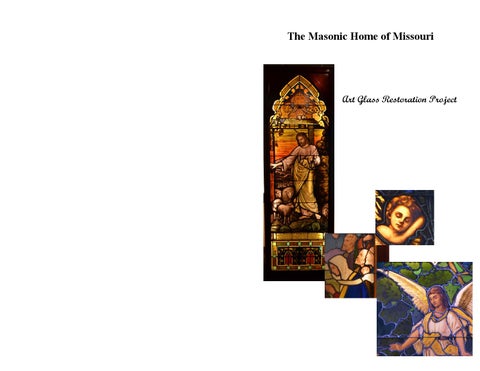
East Gate Chapter of the Order of the Eastern Star originally purchased this art glass window for display in the chapel. The window portrays Jesus holding a lamb. The lamb is an important symbol throughout the Bible, either referring to a sacrificial offering or as Jesus being the Lamb of God. This art glass window measures 27” x 79” and has been graciously restored by Tuscan Lodge No. 36.
Outreach Programs Currently Offered The following four (4) programs provide direct financial support:
The Long-Term Financial Assistance Program provides financial assistance for longer time periods for such things as assisted living care.
The Short-Term Financial Assistance Program provides limited financial assistance, such as help with one-time medical needs.
The Children’s Financial Assistance Program provides financial assistance to legal dependents of Missouri Master Masons or Missouri female members of the Order of the Eastern Star.
The Creating-A-Partnership Program (CAP) is a matching funds program that creates a partnership between the Masonic Home and the Lodges/Chapters to assist children in their communities.
The following four (4) programs provide resource guidance:
The Masonic Family Cares Program helps facilitate connections between lodges, chapters, youth organizations, and the Masonic brothers and sisters in their communities.
The Social Services Program helps individuals locate services throughout the state.
The Widows Program was developed to bring Masonic Widows, the local Masonic Home Representatives and the Masonic Home of Missouri together to recognize and assist our Masonic wives.
The Financial Counseling Program works in conjunction with the Financial Assistance Programs to help our members learn skills, such as budgeting and debt management.
To learn more about our Outreach Programs, please contact the Masonic Home of Missouri at (800) 434-9804 or visit our website at www.mohome.org.
Job’s Daughters What is Art Glass? If you are a church going person, then you are more than familiar with stained glass windows. These pieces make up a huge percentage of religious artwork, and depict scenes from the Bible and important religious figures. They were the photographs of their time, a historical record of important events for all to see. The history of stained and colored glass artwork is long and interesting, dating back to the beginnings of the last millennium. Alas, the first of these windows is lost to history, and their origins can only be debated. Mosaics and jewelry makers are credited with developing the technique that created colored glass art as we know it, which arose during an increase in church construction. However, colored glass had been produced since the days of Egyptian and Roman empires, both of which surpassed others when it came to manufacturing small, stained glass objects. Churches caught onto the beauty of this art in the 4th and 5th centuries during the rise of church building, and many windows from this time period remain. British churches and monasteries began to adopt stained glass windows as part of their décor in the 7th century, when French workmen began to glaze the windows of monasteries. Stained glass reached its peak in the middle ages. It served a twofold purpose. First, it was beautiful to look at and secondly, since most citizens could not read the Bible, the window art served as an illustration of events for the illiterate. The pieces from this era have become known as the “Poor Man’s Bible”. This trend continued into the Gothic Era, when architectural design forced windows to grow larger, giving artists more of a canvas on which to work. The style did not change much through the Renaissance, but the French Revolution and Reformation saw the destruction of many windows, which were replaced with plain glass. This rampage caused the traditional methods of colored glass work to be forgotten until the early 19th Century, when the Catholic revival renewed interest and many works were restored. The revival extended all over Europe, most notably in Britain and France.
Honored Queen
#11
This window most prominently features the Honored Queen of the Bethal, who represents the third Daughter of Job, Keren-Happuch. Keren-Happuch literally means the horn of adornment and is a reference, therefore, to the outward beauty that comes from an inward character. The word Reward is also featured and refers to the third work in the Order’s watchwords. The two windows not found were Junior Princess who represents Job’s first daughter, Jemimah, with the watchword “patience” and the words “of Missouri” and the Senior Princess who represents Job’s second daughter, Keziah, with the watchword “faith” and the work “Job’s”. Together the Art Glass Windows read “Job’s Daughters in Missouri”. Job’s Daughters is based upon the book of Job, with special reference to the 42nd chapter, 15th verse; “and in all the land were no women found so fair as the Daughters of Job and their father gave them inheritance among their brethren.” This panel was restored by Missouri Job’s Daughters.
Esther
#10
Esther was of Jewish descent during a time in when Jews were held in captivity within the Persian Empire. The King searched through the empire to find the most beautiful woman to be a successor to his divorced wife. Esther became the choice and her Jewish heritage was hidden from the King and his court. In time, the King gave an edict to destroy the entire Hebrew race. Upon hearing this, Queen Esther went to the King, defying all edicts of not approaching the King. She bravely requested the King’s audience and requested that he revoke his edict. The King, admiring Queen Esther courage and beauty agreed and the Hebrew people were spared. This window portrays Queen Esther’s beauty and robes of royalty. Her robe of white symbolizes Light, Purity, and Joy. The Lion depicts the Persian Empire. This panel was donated by Nellie D. Hamilton, Past Grand Matron of the Order of the Eastern Star and was previously restored during the
During this same period, John La Farge and Louis Comfort Tiffany applied and received patents for using opalescent glass to create a new form of stained glass windows, and the process extended to lamps, art and other pieces. The 20th Century saw more stained glass tragedies and innovations. World War II left many European church windows destroyed, and artists led in restoring the thousands decimated by bombings. The period also saw slab glass in concrete become popular, as well as modern art styles creeping their way into stained glass art. Now, colored glass art can be found in churches, sculptures, public buildings and businesses all over the world. Art glass windows contain an element of painting in them. The window is designed and after the glass has been cut to shape, paint is applied that contains ground glass, so that when it is fired into a kiln, the paint fuses onto the glass surface. Following this process the sections of glass are placed together and held in place with lead came that is then soldered at the joints. Lead lights and stained glass are manufactured in the same way, but lead lights do not contain any sections of glass that have been painted.
An Overview of Symbolism Art Glass Christ Himself employed symbolism to relate the lessons of the faith contained in His parables, and it is also a device used in the liturgical gospels of the Bible. Additionally, several commonly recognized religious symbols were developed and popularized by the Christian Church. Some of the more widely known symbols found in Catholic stained glass and other types of Christian art are:
Birds: Eagles, doves, and sparrows are all birds mentioned in the Bible. The majestic eagle is used not only as a sign of God’s power, but also of His love since this bird is known for the care it provides to its young. The dove is a symbol associated with the Holy Spirit, while the sparrow is connected with the notion that God watches over even the smallest and least of creatures.
Martha
Grapes and Wheat: These are used to make bread and wine, so it’s logical that they symbolize the food and drink consumed as part of the sacrament of the Eucharist. During The Last Supper, Christ described bread and wine as His body and blood.
Shepherds and Sheep: In the Bible, Christ is described as both the Lamb of God and the Good Shepherd who watches over His sheep and is willing to lay down His life for them. In the latter reference, sheep are usually understood to represent the faithful followers of Christ.
Cross: The cross on which Christ suffered and died is undoubtedly the most recognized of all Christian symbols. It is used to represent the sacrifice made by Christ and the salvation the suffering and death of Christ brought to all of mankind.
Color Symbolism in Art Glass Black- Death Blue- Heavenly love, Virgin Mary Brown- Spiritual death Grey- Mourning, humility Green- Spring, charity, triumph of life over death Purple- Royalty, God the Father Red- Love, truth passion, suffering White/Gold- Innocence of soul, holiness of life Yellow- Jealously or treason
#9
In the Bible, Martha is the one “given to hospitality,” for we read she “received Jesus into her house”- her house, suggesting she was its owner, Then, when Jesus was sent for to hurry to the aid of her sick brother, Lazarus, we read that when Martha heard that Jesus was coming “she met Him,” and bade Him welcome (John 11:20, 30). And the provision of that home meant much to Jesus. One day we have Him saying, “The Son of man hath not where to lay his head,” but the next day, “He came to Bethany… and Martha made him a supper.” As the Matron of the Home, Mrs. Leftwich, would have been hospitable and caring, as she was tasked with the well-being of the children and social hostess for the Home. This previously restored panel has been on display in our museum since its dedication. Mr, Leftwich’s memorial piece is now displayed next to it, reuniting the spouses.
The Good Shepherd
#8
This art glass panel depicts Jesus holding a sheep, which is symbolic of his role as Shepherd of God’s flock. The inscription for this art glass pane states, In memory of Dr. Morris Leftwich First Superintendent of the Masonic Home of MO. 18881898 Presented by the Eastern Star Chapters and Masonic bodies in which he held membership.
Location of Masonic Home of Missouri Art Glass 2 1
Upper Level
Dr. and Mrs. Leftwich valued education, household chores, recreational activities and social obligations. The children that lived in the Home would attend public schools during the day, and then return to the Home to help in the kitchen or with the yard and building maintenance. They went on picnics and to fairs, played games and took up hobbies. Dr. and Mrs. Leftwich raised money for an organ and musical training, beginning the tradition of instruments and music as part of the daily life in the Home. Many of the children participated by singing in a choir and even played in an orchestra. Especially talented children would receive specialized training underwritten by Masonic Lodges and Eastern Star Chapters.
Restored by Marge Carney, Worthy Grand Matron, Grand Chapter of Missouri, Order of the Eastern Star
4 Receptionist
The Board of Directors hired medical director, Morris Leftwich, and his wife, Ella D. Leftwich, as the Home’s first Superintendent and Matron. On April 1, 1889, they moved to the property located on Delmar, bringing with them their much needed expertise to set up and operate the Home. In addition, they furnished the Home with all of their own furniture.
Dr. Leftwich resigned from his position with the Home a few months prior to his passing on December 4, 1898. Their skills and compassion would set a standard in raising children and caring for the Home in the years to come.
3
7
Museum
Elevator
10
Stairs
6
5
9
Lower Level
8
Elevator
Key Stairs
(not to scale)
13 Entrance Doors OES Offices
11
12
125th Restored Glass
Previously Restored Glass Restrooms
The Guardian
#1
Children were an important part of the Masonic Home of Missouri. Several of the restored art glass windows depict small children and reflect the charity’s beginnings as a “Home for Orphans’. This pane of art glass was originally presented by Missouri Lodge No. 1 A.F. & A.M. There is evidence that this window may have been damaged in the past. Look closely at the Angel’s wings. The one that arches to the left is painted in a reverse method where the artist made the entire wing be dark, then removed paint to make it look like feathers. The right wing is painted with feathers, making it darker and more stylized. The faces of the children and angel show the reversed method of painting. Special appreciation to St. Louis Missouri Lodge No. 1 for funding the restoration of this pane of art glass.
Children’s Window
#6
This window was restored in 2002 as part of the museum addition. Presented by the Children of the Home on October 1897, it was the signet window in the original chapel. The symbols pertain to the Order of the Eastern Star. This window is not backlight but rather has natural lighting is supported by columns to help balance the immense weight of the glass. It overlooks the staircase at the Complex and is purposefully set higher than the guardian panes to better duplicate their positions in the original chapel.
Blessing of the Children
#7
With the central theme of children, these three windows attest to the Masonic Fraternity’s love of helping children. Notice the child to the extreme left of the window and how different the face is. It is the belief of the restorers that the face was both damaged and replaced or that harsh cleaning chemicals were used which destroyed the face. It may also be an angel because of the ‘clearness of the skin’. When looking at the pane, it also seems that Jesus is holding infant Jesus. This window was presented by Ascalon Commandery No. 16 Knights Templar in 1897. Through a generous anonymous donor, this window has been reunited with the Signet window.
Reuniting Three Panes
The Gift
While doing research for our 125th Anniversary Book, a photograph revealing the inside of the original chapter was found. It clearly shows the large round Signet window bracketed by two other panes. Upon magnifying the window, it was discovered that the two guardian windows were actually ones that had been chosen for restoration and display. It made sense to reunite the three windows in our current building for all to see.
This memorial pane of art glass was dedicated in the memory of Clifford C. Baker, longtime Superintendent of the Masonic Home. Mr. Baker was Superintendent from 1912 to 1915 and upon his death, his widow, Mrs. Harriet Baker became Superintendent from 1915 to 1918.
#2
With the first child of the Home being a twelve year old girl named Della Gale Farthing, this pane of glass seems to reflect that advent. The young girl is holding a small bouquet token to Jesus.
The Exodus
#5
After they had gone, an angel of the Lord appeared to Joseph in a dream and said “Get up, take the child and his mother and flee to Egypt, and stay there until I tell you, for Herod is going to look for the child and kill him.� This art glass panel shows an inspiring scene of Christian faith, which illustrates Jesus and his family as they take flight to Egypt as they were commanded to do. This pane was originally presented by Moolah Temple A.A.O.N.M.S. to the Masonic Home in 1897. It has been graciously restored through funding by the Moolah Guides, Swing Dance Club, Ceremonial Cast, Noble Lodge No. 684, Gregory Gates and Oliver Steed.
Special appreciation to Bonhomme Lodge No. 45 for their funding to restore this pane of glass.
The Ascension
#3
On the Feast of Ascension, the Orthodox Church does not merely commemorate an historical even in the life of Christ. On this day, the Church celebrates Christ’s physical departure from the work and His glorification with God the Father. For forty days after His Resurrection, Jesus remained on earth. Filled with the glory and honor of His Divinity, He appeared to His Disciples at various times and places. By eating and drinking with His followers and conversing with them about the Kingdom of God, Jesus assured them that He was truly alive in His risen and glorified Body. (The glorification of Jesus refers to His Crucifixion, Resurrection, and Ascension into Heaven. When we speak of Christ’s glorified Body, we refer to its honor, splendor, majesty and visible radiance- it gave off rays of bright light!) This pane of art glass had the most work performed on it due to chemicals being sprayed on it during a past cleaning of the brick at the chapel. If you look closely at some of the faces, you will see what appears to be tears which are actually chemical smear but seem to add to the overall artwork. The face of Jesus in this artwork has an estimated replacement cost of $15,000 if something should happen to it. St. Louis Commandery No. 1, K.T. originally donated this art glass pane. Funding to restore this pane of glass was provided by St. Louis Missouri Lodge No. 1.
The Nativity
#4
This art glass piece portrays the nativity scene or crèche of the birth of Jesus as described in the gospels of Matthew and Luke. Nativity scenes usually depict the infant Jesus, his mother Mary and Joseph. A donkey and an ox are typically depicted in the scene as well. The ox traditionally represents patience and the donkey represents humility and the readiness to serve. This piece of art glass was originally purchased by Tuscan Lodge No. 360. It measures approximately 27” x 79”. Special appreciation to the members of Tuscan Lodge No. 360 for their assistance providing the funding necessary to restore this art glass pane.