The Counselor’s Notebook
VOL. 63 NO. 3 __________
NOV 2026
MASSACHUSETTS SCHOOL COUNSELOR’S ASSOCIATION
Supporting Students through the Holidays By CoryMcGann, MASCA Board Chair As we enter November we are rapidly headed for the holidays, which is always a wonderful time of year especially in New England. The colorful leaves give way to picturesque wintertime landscapes - assuming this is one of the winters we’ll get snow. And obviously all the deliciousness headed our way with roast turkeys, tasty apple pies, and celebrating with family and with close friends who are family. Lots to look forward to and enjoy!
to figure out what is going on in the background. Data points such as an increase in absences, an increase in trips to the Nurse’s office, an increase in disciplinary issues, a decrease in typical grades can all signal something amiss with that child that a professional School Counselor can start to identify and get to the root cause. Second, continue to build relationships with those kids. They may not feel comfortable sharing with you their personal stories the first, second, or third time meeting with them. But at some point you are going to unlock them and help them feel safe with you, safe enough to share those difficult situations. And if it isn’t with you, connect them to someone that they can build a relationship with. A caring School Adjustment counselor, a favorite administrator, a favorite teacher, a coach - any trusted adult will do, even if it isn’t you (don’t take it personally!).
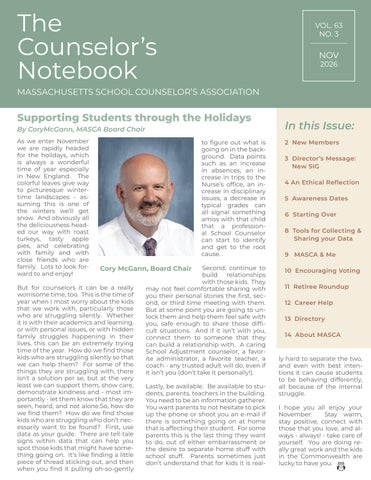
Cory McGann, Board Chair
But for counselors it can be a really worrisome time, too. This is the time of year when I most worry about the kids that we work with, particularly those who are struggling silently. Whether it is with their academics and learning, or with personal issues, or with hidden family struggles happening in their lives, this can be an extremely trying time of the year. How do we find those kids who are struggling silently so that we can help them? For some of the things they are struggling with, there isn’t a solution per se, but at the very least we can support them, show care, demonstrate kindness and - most importantly - let them know that they are seen, heard, and not alone.So, how do we find them? How do we find those kids who are struggling who don’t necessarily want to be found? First, use data as your guide. There are tell-tale signs within data that can help you spot those kids that might have something going on. It’s like finding a little piece of thread sticking out, and then when you find it pulling oh-so-gently
Lastly, be available. Be available to students, parents, teachers in the building. You need to be an information gatherer. You want parents to not hesitate to pick up the phone or shoot you an e-mail if there is something going on at home that is affecting their student. For some parents this is the last thing they want to do, out of either embarrassment or the desire to separate home stuff with school stuff. Parents sometimes just don’t understand that for kids it is real-
In this Issue: 2 New Members 3 Director’s Message: New SIG 4 An Ethical Reflection 5 Awareness Dates 6 Starting Over 8 Tools for Collecting & Sharing your Data 9 MASCA & Me 10 Encouraging Voting 11 Retiree Roundup 12 Career Help 13 Directory 14 About MASCA ly hard to separate the two, and even with best intentions it can cause students to be behaving differently, all because of the internal struggle. I hope you all enjoy your November. Stay warm, stay positive, connect with those that you love, and always - always! - take care of yourself. You are doing really great work and the kids in the Commonwealth are lucky to have you.
The RESILIENCE COUNSELING & TRAINING CENTER In Collaboration with the North American Society of Adlerian Psychology Announces
A unique professional development experience on the continuing evolution of Counseling Practice via the integration of Alfred Adler’s Individual Psychology, Resilience Research, & Wellness Promoting Methods.
Earn 15 CE Credits
(NASAP is an approved NBCC and APA provider)
The Evolution of Counseling Practice:
Integrating Resilience Research & the Wellness Promoting Models
February 5-7, 2027 BOSTON, MASSACHUSETTS Learn via LIVE DEMONSTRATIONS & EXPERIENTIAL PRACTICE! Recommended For ALL Counselors & Mental Health Professionals INSTRUCTORS: William Nicoll, Ph.D. & Monica Nicoll, Ph.D., LCMHC, Resilience Counseling and Training Center, and Bob Zaccheo, LMHC, Project LIFT CEO & Founder. LOCATION: The Bostonian Hotel in the heart of Boston’s historic district! Low Group Room Rates: $139.00 p/king - $159.00 2dbl bd. For reservations, Contact the Bostonian Hotel REGISTERATION FORM & more info available at: www.resiliencecounselingcenter.com
Meet Our Newest MASCA Members! Asanti Andrews Jennifer Bloom Peter Boswell Elizabeth Boucher Lori Brazell Georgia Bressette Christine Brouillard Carly Brousseau Ryan Capuzziello Stephanie Chery Niko Consedine Jordan Cree Jillian Deknatel Elizabeth DiStefano Tara Eldredge Daly Franco Larissa Freitas Avery Gemmiti
Anthony Genualdo Nikki Havey Carter Haydon David Hilfinger Mindy Hoang Clara Kang Laurie Leverone Nichole Litchie Keturah Lockett Catherine Lopez Julia Mahoney Alex Martini Regina McDowell Evans Micaela McQuaide Meredith Oglevee Nathan Pansa Andrea Peak
Cassidy Pleiness Alexis Poladian Meredith Reilly Jacob Rivera Gaby Rodrigues Gianna Russillo Alisha Saini Allison Scott Paola Shaker Ryan Sherman Jill Smith Caroline Stacey Libny Vargas-Miller Dayshjanae Wannamaker Gina Whang Domonique Williams-Marshall Jordan Young Tory Zalauskas
If you know or happen to meet any of our new members, please extend a very warm welcome! Page 2
Counselor’s Notebook
Director’s Message
“micro” communities within which members can network. Counselors of Color and LGBTQ+ are the two current AGs.
New Special Interest Group (SIG)
The first SIG to meet was the Elementary SIG on January 25, 2021 soon followed by the Middle Level, Secondary, Urban and Retirees in February 2021. The Counseling Directors SIG first met on December 8, 2021, while the SAC/SSW SIG had its first meeting in January 2022. The Multilingual Learners SIG became official in April 2023 and the Career/Technical launched in September 2023. The LGBTQ+ AG had its first meeting on October 12, 2023 in conjunction with National Coming Out day while the Counselors of Color AG held its first meeting on February 28, 2024.
By Bob Bardwell, MASCA Executive Director
Bob Bardwell MASCA is experiencing something very exciting, something that has not happened since February 2024. We are about to launch our 10th and our newest Special Interest Group – one focused on supporting specialist counselors who are focused primarily on postsecondary pathways. MASCA currently has nine Special Interest Groups and two Affinity Groups. Special Interest Groups (SIG) are designed to provide forums for members from various networks with shared interests in particular topics to gather to share resources, discuss contemporary issues, and identify strategies for collaboration. Our current SIGs include Career/Technical, Counseling Directors, Elementary, Middle Level, Multilingual Learners, Retirees, SAC/SSW, Secondary and Urban. Anyone can join any SIG meeting, so technically a graduate student can attend the Counseling Directors or a retirees meeting. Affinity Groups (AG) bring together members who have a common, shared identity. Only those who identify with the AG focus can participate. Participants will gather to provide support to one another, share ideas and discuss contemporary issues. AGs nurture the growing diversity within the association by providing small November 2026
Since I run the zoom meetings, I have been to 99% of the meetings. I’m guessing I missed one or two along the way. I meet a whole range of members and the discussions that take place and speakers who share relevant information help me keep a pulse on what is happening in the schools across the Commonwealth. Some groups every month, some quarterly and others 1-2 during the year. Some focus on networking and supporting each other while others always have a guest speaker. Some meetings have attendees in the single digit and others can be 30+ depending on the time, topic and speaker. These meetings are 95% virtual with the exception being that most groups meet in person at the Annual Spring Conference. I highly doubt that they would have been so successful if they launched prior to Covid and before zoom technology was commonplace. I guess we can say that our vibrant and successful SIG/AG initiative is one bright spot that resulted from Covid. MASCA will start a new SIG specifically to support counselors who specialize as a career, college, financial aid, early college, dual enrollment or innovation pathways counselor. This could include counselors who do not have an assigned counseling caseload (i.e.: serving all students) or if they do have a student caseload, they are assigned to students in one of these focused programs. This SIG is needed now as more and more schools/districts are hiring dedicated counselors to focus on postsecondary pathways and support statewide initiatives like early college and innovation pathways. In the 1990s and early 2000s it was very rare for a high school to have a dedicated counselor to only provide student (continued on page 5) Page 3
That Doesn’t Sit Right With Me: An Ethical Reflection
By Alix Levin, Lower School Counselor at The Meadowbrook School of Weston & MASCA Ethics Have you ever worked in a school where you found yourself questioning your own counseling beliefs, values, or approach? Throughout my six years as a school counselor, working in different school environments across New York, North Carolina, and Massachusetts has shaped how I approach my role. I spent the first three years of my career working in Title I schools in New York City and rural North Carolina. I now work at an independent school in Massachusetts. My time in North Carolina challenged me to think about some of the beliefs I had developed through my previous experiences. Adults interacted with students differently, behavior was addressed differently, and the routines and expectations I followed throughout the school day were different. For example, I didn’t expect to be responsible for keeping students silent during lunch, assigning detention, or speaking to students in a tone much harsher than I was used to. These were all parts of my experience working in North Carolina. At first, I struggled to reconcile these expectations with what I had learned and experienced in my previous school environments. Keeping students silent during lunch was one example. I understood that the school wanted lunch to be a calm, structured part of the day. At the same time, I had always viewed lunch as more Page 4
than just a time to eat. To me, it was also an opportunity for students to talk with their peers, build relationships, and practice social skills. I found myself wondering how schools could balance the need for structure with opportunities for students to connect. Assigning detention felt particularly complicated for me as a school counselor. I understood the importance of holding students accountable for their actions, but I struggled with being responsible for sending students to detention without helping them work through the situation or understand the impact of their behavior. The consequences often felt disconnected from what had happened. Students were simply sent to detention without an opportunity to reflect, learn, or make things right. Something about that didn’t sit well with me. It made me question my role as a counselor and reflect on the difference between simply assigning a consequence and helping students take accountability in a way that supports their growth. Then there was the tone adults used when speaking to students. I was accustomed to a calmer approach, so I found it difficult to adjust to a school environment where adults often raised their voices to get students’ attention or address behavior. What surprised me most was that students sometimes seemed more receptive to this approach than to mine. I found myself wondering whether my calmer tone was making it harder for me to establish authority and build rap-
port with students. I was navigating the challenge of staying true to my own approach while trying to understand what helped students respond and connect with me. These experiences pushed me to examine the assumptions I brought with me from previous school environments. I began to recognize that feeling uncomfortable did not necessarily mean a practice was wrong; sometimes, it simply challenged what I was used to. At the same time, being open to different approaches did not mean setting aside my professional judgment. I could try to understand a school’s approach without automatically agreeing with it. I needed to consider where my discomfort was coming from and whether a practice supported students’ needs and aligned with my role as a counselor. I turned to the ASCA Ethical Standards for School Counselors and ASCA’s position statement, The School Counselor and Discipline, to help me think through these questions. The Ethical Standards emphasize our responsibility to support students’ development and treat them with dignity and respect. ASCA’s position statement also helped me think more critically about the role of a school counselor in responding to student behavior. Rather than serving as disciplinarians, school counselors support students in understanding their behavior, developing new skills, and making more (continued page 7) Counselor’s Notebook
Director’s Message: New Special Interest Group (SIG) (continued from page 3)
career development and/or college search and application support. And now with the implementation of MyCAP as a likely new graduation requirement, we see districts adding more of these type positions. In many schools/districts there is often only one person in this role so creating an opportunity to come together to network, learn and support each other is greatly needed. Are you intrigued about this new opportunity? Want to know more or be part of this new SIG from the get-go? Then all you have to do is complete this form no later than Wednesday, November 4. The form also asks if you have name suggestions for this new SIG or even possibly want to be considered as a leader of the SIG. So far the Career, College & Beyond SIG is leading the voting regarding possible names for this new SIG, but followed closely by Postsecondary Readiness SIG and Pathways to Possibilities SIG.
is an interest and appetite for this new group. Not only is this exciting for the organization, but I am eager to see what this group can do given the fact in some ways this is groundbreaking and cutting edge. Are there other SIG/AGs that you think MASCA should explore creating - possibly SIGs for rural counselors, counselors in private schools, those in charter schools or even alternative schools? Or perhaps an affinity group for women in school counseling leadership? If so, then let me know. We will only create a new group if there is a demonstrated need and if at least ten members are interested in leading and/or supporting the new group.
Please reach out to me if you want to discuss this new SIG or other SIG/AG related topics. SIGs/ AGs are a vital component of MASCA’s plethora of activities and member benefits. I encourage you to participate at least one if your schedule allows. They are fun, energizing and can posI believe that the time is right to move forward sibly be a lifeline of support and unconditional with this SIG and since 34 of our colleagues have positive regard that supports you in these chalcompleted the form so far, it appears that there lenging times.
AWARENESS DATES
November 2026
Page 5
Starting Over Without Starting From Scratch: Lessons in Professional Transitions
By Sara Runkle, School Counselor, Abby Kelley Foster Charter School & MASCA Middle SIG After almost 20 years as a school counselor, I found myself preparing to be the “new” counselor once again. Throughout my career, I’ve changed schools, districts, and even states. I’ve moved between middle and high schools, traditional public schools and public charter schools. I’ve worked on counseling teams, been the only counselor in a building, joined established programs, and helped build programs from the ground up. I’ve also learned that going from being an established part of a school’s decision-making to being the new person who hasn’t built those relationships yet can be a more difficult adjustment than I expected. Through all those changes, I’ve learned that while every school is different, I don’t have to figure everything out all over again. There are plenty of things I’ve learned along the way that still work, no matter where I am. So if you’re in the middle of a transition, or see one coming, take heart. Change can be hard, even when it’s good. Here are a few things that have helped me. ● Bring what works, but be willing to adapt. When I started preparing for my latest move this summer, I knew I wanted to introduce myself to students, conduct a needs assessment, and use what I learned to plan my counseling programming. I brought lessons, forms, and other resources I’d developed over the years, but I also needed to understand how things worked in my new school.
Page 6
When an administrator offered me classroom time because a teacher hadn’t started yet, I used it for introduction lessons. I also paired my ninthgrade needs assessment with an already scheduled Upward Bound presentation. I try to look at what’s already happening before jumping in with my own ideas. Sometimes a different approach turns out to be a better one. ● Get to know the people and the way the school works. Over the summer, I met a future coworker for lunch to ask about school culture, expectations, and, of course, what people actually wear to work. Once school started, I spent time looking through shared documents, learning procedures, and getting to know colleagues. I’ve found that explaining what I hope to do and why, then sharing needs-assessment results and plans with teachers and administrators, helps others see the value of school counseling programming. ● Keep the little things familiar. New systems and procedures can make even simple tasks exhausting. I know how to write a 504 plan, but that doesn’t mean I know my way around a new platform. Even finding a policy or figuring out the master schedule takes extra thought. I can’t control all those changes, but I can organize my desk in a familiar way, put up some of the same pictures, and use a similar sign on my door. Keeping my morning coffee, favorite snack, and
a few daily routines consistent means there are fewer things I have to think about. ● Be patient with yourself. Learning takes energy. I sometimes think about how working my dog’s brain through training and problem-solving can tire her out as much as a long walk. Learning a new school can feel that way, too. Switching technology platforms, finding community resources, and learning new schedules and procedures take mental energy. Tasks that used to be automatic now mean stopping, searching, and asking questions. I’ve learned to give myself more time, ask colleagues for help, and accept that some things will take longer for a while. Taking longer to do something doesn’t mean I’ve forgotten how to do my job. It means I’m still learning how this school does it. ● Make room for things you know you’re good at. When much of the day is spent figuring things out, I try to include work that reminds me I have skills to contribute. That might mean creating a Google or Microsoft Form to gather information from students and teachers, organizing notes and student data, or using a favorite counseling resource. Those are things I feel confident doing. I sometimes remind myself, and others, “I’m not new to counseling, but I am new to the building.” ● Stay connected to your professional community. I still reach (continued next page) Counselor’s Notebook
Starting Over (Continued from prev. page)
out to colleagues from previous schools when I want another perspective. MASCA has been a great way to stay connected through conversations, professional learning, and conferences. Those relationships are especially helpful while I’m building new ones. ● Protect your time and energy. This is one I’m still working on. When you’re new to a school, it’s natural to want to be helpful, build relationships, and show the value of your role. That can make it tempting to say yes to everything or treat every request as urgent. And when you’re already juggling so many unfamiliar responsibilities, it’s easy to feel overwhelmed or lose perspective on what actually needs your attention. I’m learning to pause, consider what really needs to happen right away, and check with colleagues or administrators when priorities aren’t clear. Not every request needs an immediate response, and someone else’s urgency doesn’t automatically have to become mine. Being helpful doesn’t mean saying yes to everything. Starting over doesn’t mean starting from scratch. Every transition brings challenges, but it also brings opportunities to grow, learn, and discover new ways of doing familiar work. The experience, relationships, and resources we carry with us don’t disappear when we change schools. They give us a foundation to build on, wherever we land.
November 2026
That Doesn’t Sit Right (continued from page 4)
positive choices. My experience assigning detention, in particular, made me think more carefully about the difference between enforcing a consequence and helping a student learn from an experience. In addition to reviewing these resources, I remember talking with my co-counselor at the time about how uncomfortable I felt disciplining students. I shared that taking on this responsibility didn’t feel right to me as a school counselor, and she agreed with my perspective. She reminded me that it was important to stay true to what felt right to me and to my approach to working with students. That conversation helped reinforce the importance of recognizing when a responsibility conflicts with my understanding of my role as a counselor. It also reminded me how valuable it is to have colleagues I can turn to when navigating situations that challenge my professional values. Looking back, I recognize that ethical practice involves more than adapting to a school’s culture or relying on what has worked for us in the past. It requires us to consider our professional responsibilities, remain open to different perspectives, and think critically about how our decisions affect students. My experience also reminded me that I don’t have to navigate these questions alone. Sometimes, talking with a trusted colleague can help me feel more confident in my judgment while encouraging me to consider perspectives I may not have thought about on my own.
These experiences are a reminder that we won’t always have the answers right away, and we won’t always see eye to eye with the people we work with. Feeling uncomfortable can be an opportunity to pause and examine what is bothering us rather than immediately dismissing a practice or assuming our own approach is the right one. The next time something at school doesn’t sit right with you, it might be worth asking yourself: What is it about this situation that’s bothering me? Is it challenging my personal beliefs, raising a concern about my role as a counselor, or both? What might I be missing? And who might help me think about it differently? We may not always walk away with a clear answer, but being willing to sit with that discomfort and learn from it can help us grow into more thoughtful and well-rounded counselors. References American School Counselor Association. (2022). ASCA Ethical Standards for School Counselors.https://www.schoolcounselor.org/getmedia/44f30280ffe8-4b41-9ad8-f15909c3d164/ EthicalStandards.pdf American School Counselor Association. (2025). The School Counselor and Discipline. https://www.schoolcounselor. org/Standards-Positions/Position-Statements/ASCA-Position-Statements/The-School-Counselor-and-Discipline
Page 7
Three Tools for Easily Collecting & Sharing your Data Submitted by: Kari Denitzio, MASCA Program Review Committee & PDP Coordinator As MASCA’s Program Review Committee continues to visit districts around the Commonwealth, certain questions come up again and again. One of the most common questions revolves around how counselors can more easily collect and share data about their work with students. Often, counselors aren’t even sure what “counts” as data, or how they’d begin to collect it. The truth is that your program “data” can be nearly anything you want it to be. It helps to consider the following two questions: What do we wish our colleagues (or students’ families, or leadership) understood about our work? Sometimes the answer to this has to do with numbers: just how many students you’re interacting with each day. Other times, it has to do with the nature of the issues you’re helping students navigate. How do we know that what we’re doing is actually having an impact on our students? Whether it’s a classroom lesson, a college or career fair, or other special event, we’re always looking for ways to check whether our work led to our intended outcomes for students. Once you have the answers to the questions above, try using these tools for collecting and sharing the data that will help your stakeholders gain a stronger understanding of your work. 1.
An Office Check-In Form
Many counselors already track their daily interactions with students. If your department hasn’t already found a way to centralize that data, try this: Set up a laptop or tablet at the entrance to your counseling office where students can check in using a Google Form. This is an easy way to centralize student visit data without creating an extra burden on counselors to report their individual data. You can set up your check-in form to record whatever demographic data is relevant to you (grade level, reason for visit, level of urgency, etc.). At the end of a week or a month, you’ll have real data to share about your department’s impact. (And as a bonus - this data will help you identify trends in student needs.) Letting teachers and families know just how many students you encountered in the course of a week can shed a lot of light on your impact. Using Canva or another design platform, it’s easy to find a “By the Numbers” template that you can customize and re-use each time you want to share things like the number of students seen individually, how many participated in a particular classroom lesson, or how many families attended a post-secondary planning workshop. TIP: While it may be tempting to rely on a chatbot to do this work, AI-produced flyers all start to look the same and can quickly become the equivalent of white noise in people’s newsfeeds and inboxes. Keep your graphics
Page 8
as human as possible. 2.
A Standardized Email Follow-Up
One day each week, send a follow-up email to students you’ve seen. You can develop a simple script with a few open-ended questions, or a very short survey they can answer to reflect on how your interaction helped them. Whether you use a Likert scale to collect qualitative data, or just ask for anecdotal feedback, you’ve created a data collection tool that provides you with real-time information about your work. Additionally, you’re investing further in your relationship with the students you see and keeping the lines of communication open. Of course, not all information you collect this way will be appropriate for sharing with a wider audience. If you can cull just one or two anonymous quotes from students each week, that’s more than enough to share - either in an infographic as described above, in a department newsletter, or on a video screen in your office or building. TIP: A consistent weekly or monthly schedule for doing your follow-up with students can help with consistency and accountability - but it can also create feelings of panic when the chosen day rolls around and you’re knee-deep in course selection or some other all-consuming task. If adding a weekly to-do feels like too much, keep your use of this tool more casual. 3.
The Recording Device in Your Pocket
Students can tell the story of your impact better than anyone. Photos are great, but videos where stakeholders can hear directly from students are even more dynamic. We’re not talking about slickly produced narrative films! Hosting a Career Day or college fair? Got students working on a project in their guidance seminar? Walk around with your phone and ask students if they’d mind sharing something about their experience. Then simply embed the clips in an email or post on your department’s social media account. And if you or your students aren’t comfortable with video, use voice memos to record stories that can be shared more anonymously. TIP: For those of us who aren’t overly tech-savvy, try involving students themselves in helping you share your data. If your school offers courses in media production or related extracurriculars, there may be an opportunity to partner with faculty colleagues in developing a project where students can use their skills to help you tell your stories. Looking to go deeper with your data analysis? Join MASCA’s Program Review Committee and build your skills in analyzing both qualitative and quantitative data. Email mascaprogramevaluation@gmail.com for more information.
Counselor’s Notebook
Kelly Albrecht School Counselor
Somerville High School, Somerville, MA Why are you a MASCA member? I am a MASCA member because it provides countless networking and professional development opportunities. I have appreciated making meaningful connections with other professionals in our state while learning how to improve my work in the profession. What makes you unique as a school counselor? am a proud of being a first-generation, Salvadoran-American who made a midcareer transition to school counseling. My professional background has allowed me to dedicate 20 years in education focusing on best practices in student services, family engagement, recruitment, and program management. What inspires you about being a school counselor? I am inspired by my students’ life experiences, optimism and personal growth! What career would you be doing if you were not a school counselor? I have an affinity for event planning from planning, running day of logistics, and reflecting on how to improve in the future. I love seeing an idea come to life with community gathering! What is your favorite tool to use in your work as a school counselor? I like to use calendly to have students schedule appointments with me but also share that I have an open door. My students learn they can reach me through multiple ways during the school day. What words do you live by? Take it one day at a time. I like focusing on what is in front of me and not spend too much time worrying about the future especially during any stressful life moments. Why is it important to you to be part of a community of school
November 2026
counselors? I believe that everyone’s personal background is a life experience that can add to a conversation. It is important for me to connect with a community of school counselors because it allows me to learn and grow by sharing thoughts and ideas. How would you describe your job to a 5 year old? I work with students in a school building and help make sure they have good school days while preparing them for their future. How do you decompress/eliminate stress or refuel for the next day? I like to completely disconnect from work when I leave the school building. My favorite way to decompress is a long walk in nature, trying a new recipe, and spending quality time with my family. What brings you joy? Watching students in my caseload walk across the stage each year on graduation day! Share an example of something that you learned from one of your students. I have continued to learn the meaning of resilience from my students who are always willing to share their wisdom and life experiences. What is your favorite dessert? This is a tie between tiramisu and affogato
What is one thing that you are really good at? Finding a good bargain. I never like to pay full price :) What is your coffee order? Vanilla latte with unsweetened oat milk What could you talk about for 30 minutes with no notes? My family! As a proud mom of a 5 and 7 year old, I love having heart to heart conversations about navigating the journey of motherhood. What is your favorite smell and why? The smell of pine and balsam because it reminds me of the mountains and fall vibes. Do you have any hidden talents? Does multitasking count? What TV show are you currently binge watching? Como agua para chocolate What book are you currently reading? Atmosphere by Taylor Jenkins Reid. I am a big fan of historical fiction and romance!
What superpower do you wish you had? Teleportation
What is something you think people don’t know about you? I married into an adoptee family. My husband was adopted from South Korea and my two sibling in-laws who are from South Korea and Brazil.
What is your typical breakfast? Avocado toast with side of fruit
What is your favorite song or artist? Tu Carcel by Los Enanitos Verdes
What is your guilty pleasure? Reese’s Pieces
Page 9
Election Day: Why Encouraging Voting is an Important Job for School Counselors By Fran Frederick, MASCA Government Relations & Advocacy Co-Chair I was inspired to write this article after recently participating in a series of outreach activities. These included standing outside a local grocery store encouraging people to register to vote and calling National Education Association members in battleground states to support pro-education candidates. In both settings, I encountered a surprisingly high number of people who stated—sometimes angrily—“I don’t vote.” A few even told me, “I don’t believe in voting,” and one individual remarked, “I’m too young to vote. I’m only 18.” Shortly after these experiences, I taught a seminar class for high school seniors. I took the opportunity to ask them if they were registered and planned to cast a ballot in the upcoming election. Only about half of the room raised their hands. Driven by these encounters, I researched recent U.S. voting trends and history. Here is what the data reveals: ●
●
●
Voter Turnout Trends: According to the Pew Research Center, voter turnout among eligible citizens was 66% in the 2020 presidential election and 64% in the 2024 presidential election. Voter Registration: U.S. Census Bureau data shows that 73.6% (roughly 174 million) of the eligible population were registered to vote in 2024. Demographic Gaps: Both sources emphasize that individuals who are older, more
Page 10
School counselors are uniquely positioned to bridge these civic participation gaps. By educating students on their rights—such as pre-registration—and dismantling common misconceptions about eligibility, we can help foster a lifetime of active engagement and advocacy.
affluent, and hold higher levels of education are statistically far more likely to vote. Understanding the history of youth voting rights helps clarify why encouraging our students to vote matters. The 26th Amendment to the U.S. Constitution, which lowered the voting age from 21 to 18, was ratified on July 1, 1971. This historic shift was largely a response to the military draft during the Vietnam Era, which sparked the national rallying cry: “If you are old enough to fight, you are old enough to vote.” Beyond military service, the amendment aimed to foster civic responsibility in young adults—the demographic often most impacted by long-term policy decisions. State-level progress has made participation even more accessible. Massachusetts began allowing 16- and 17-year-olds to pre-register to vote in August 2016. Teens who pre-register are automatically transferred to active voter rosters on their 18th birthday, making it simple for many high schoolers to vote before graduation and beyond.
I believe it is essential for school counselors to model civic participation by voting ourselves and encouraging our students to embrace this essential responsibility. To be clear, I am not advocating for candidate endorsements or partisan activities in schools, but rather fostering maximum participation in the democratic process. Here are a few actionable ways counselors can encourage civic participation: ●
Model the behavior: Wear an “I Voted Early” or “I Voted” sticker to school.
●
Provide accessible resources: Display a scannable QR code for voter registration in the counseling office or other high traffic areas.
●
Organize schoolwide events: Collaborate with school administrators, staff, and your local city or town clerk to host a nonpartisan voter registration drive or assembly.
●
Start the conversation: Direct engagement matters—simply ask students age 16 and up if they are registered or need help finding registration resources.
The date to register for the election on November 3, 2026 has passed. You can use this link for future registration: https://www.sec.state.ma.us/ OVR/
Counselor’s Notebook
Retiree Roundup
Holidays at the Newport Mansions! All MASCA Retirees are welcome to join us on Tuesday, December 8th at 11:30 am for “Holidays at the Newport Mansions”. Join us at the “The Breakers” and experience this Newport Gilded Age mansion transformed into a lavish holiday showcase. After our visit, we will head to a local Newport restaurant for lunch. Attendees will need to buy their ticket to the Breakers and pay for their own lunch. To attend, please do the following: 1.
Go to The Newport Mansions Website. Choose “Buy Admissions Tickets”. Buy your ticket to the Breakers for Tuesday, December 8th at 11:30 am. Tickets are $32 each.
2.
Email Ruth Carrigan (rwcmed@gmail.com) or Chris Soverow (csoverow@gmail.com) to let us know that you will be joining us. We will be meeting at the Breakers, 44 Ochre Point Avenue, Newport RI at 11:15 am on 12/8.
We hope you can join us for this festive and fun event. Please buy your ticket soon as tickets to the Breakers often sell out during the holiday season. Counselors from Western MA interested in carpooling are welcome to reach out to Chris Soverow.
MASCA Retiree SIG is pleased to announce a Special One-Day MASCA Conference Strand for Retired MASCA Members:
Retired and Still Making a Difference! If you are a retired MASCA member, we hope you will join us at the annual MASCA Conference on Tuesday, April 6, 2027 for “Retired and Still Making a Difference”, a special one-day conference strand for MASCA Retirees. Retirement does not necessarily mean stepping away from the profession. Many retired school counselors continue to mentor, volunteer, supervise, advocate, consult, coach, support new counselors, or contribute to their communities in meaningful ways. We invite you to explore what the next chapter can look like while staying connected to the profession and to one another. Conference programming on Tuesday, April 6th will include: • Breakfast • Welcome and Keynote - Terri Tchorzynski former National School Counselor of the Year • Counselors Without Calendars: Designing Your Next Chapter Breakout Session • A session immediately following the keynote, focused on exploring purpose, identity, opportunities, and possibilities during the next chapter of life. • Dedicated Retiree SIG Time: Retired and Still Making a Difference • An opportunity for retirees to connect, share experiences, discuss ways they continue to contribute to the counseling profession and their communities, and learn about opportunities for continued involvement. • Awards Luncheon - Special “Retiree” designated seating that will offer an informal opportunity for retirees to connect and build relationships over lunch. • Time to visit the Exhibits We hope you can join us for an energizing and informative day. The cost for the one-day “Retired and Still Making a Difference” strand is $75. Registration will be available on the MASCA Conference website. If you have any questions regarding this retiree programming, please reach out to retiree SIG leaders Ruth Carrigan (rwcmed@gmail.com) or Christine Soverow (csoverow@gmail.com) November 2026
Page 11
Career Help: A Useful Starting Point for Low Barrier Pathways A Review by Jonathan Newell, Counselor’s Notbook Editorial Board
Finding reliable, straightforward career exploration tools for high school students can be a challenge. Career Help (www.career.help) offers a free, accessible platform designed to help students explore postsecondary opportunities, particularly low-barrier career pathways and shortterm training programs.
views, so counselors can help students connect these fields to local MyCAP planning, MassCore alignments, and Chapter 74 Vocational/Technical pathways. This is important because students may already be accruing hours toward trade licensure.
What It Offers
Local Higher Ed & Transfer Programs: While wage and timeline data reflect national standards, counselors can direct students toward local community colleges, state universities, and MassTransfer pathways to see how these credits and certifications translate locally.
Data-Backed Insights: Uses U.S. Bureau of Labor Statistics (BLS) data for nationwide wage estimates, projected job growth, and standard entry-level training timelines (ex: certification programs under 1–2 years).
Licensing Requirements: Trade licensing and certification requirements vary by state. Students exploring specific trades or healthcare roles should be encouraged to verify Massachusetts state specific board licensing standards.
Ad-Free & Student-Friendly: Features a clean, straightforward interface that does not sell highcost bootcamps or require personal registration.
Recommendation
National & Regional Context: Offers general pathways for both U.S. and Canadian options (students simply need to select the U.S. tab). Relevance for Massachusetts Students While Career Help is a great initial launchpad for career research, school counselors should help Massachusetts students bridge national data with local opportunities: State Frameworks & High School Credit: The platform does provide a broad national over-
Career Help is a quick, reliable starter tool for students exploring non traditional postsecondary routes. It would be best paired with local guidance on Massachusetts licensing boards and community college programs to help students map out actionable next steps. Editors’ Note: The Counselor’s Notebook received an unsolicited email from Vedant Singh, a Grade 12 student in Ontario, Canada, about this free resource. We felt it was worth a look, and that it might be of use to the School Counseling community. Well done, Vedant!
REGISTRATION NOW OPEN FOR MASCA’S SPRING CONFERENCE
Page 12
Counselor’s Notebook
MASCA Governing Board and Staff Directory GOVERNING BOARD Chair:Cory McGann School Counseling Dept Head Ashland High School Assistant Chair:Andrea Encarnacao School Counselor, Boston Latin School Board Members Mindy Cripps Director of Student & Family Support, Billerica High School Nychele Clark School Adjustment Counselor Gardner High School Cynthia Esielionis School Counselor Ayer Shirley Reg. Middle School Lori Ford School Counselor Edgartown School, Martha’s Vineyard Ali Robidoux Curriculum, Data, and Assessment Manager, New Bedford Public Schools Jen Pinhal Early College School Counselor New Bedford High School Amanda Ugrinow School Counselor Westborough High School COMMITTEES Conference Ali Robidoux Curriculum, Data, and Assessment Manager, New Bedford Public Schools Ethics Mindy Cripps Director of Student & Family Support Billerica High School Fiscal Oversight Jen Pinhal Early College School Counselor New Bedford High School Government Relations & Advocacy Juliette Coatsworth School Counselor Foxborough Reg. Charter School Fran Frederick School Adjustment Counselor Belchertown High School Culture & Climate Crew Amanda Berg School Adjustment Counselor Granby Elementary School Comprehensive School Counseling Jodi Then School Counselor Snowden Int’l School, Boston Cynthia Esielionis School Counselor Ayer Shirley Reg. Middle School Member Engagement Tama Lang School Counselor Litwin Elementary School, Chicopee Nomination and Bylaws Lori Ford School Counselor
November 2026
Edgartown School, Martha’s Vineyard Professional Recognition Dina Sibilia School Counselor West Springfield High School Tama Lang School Counselor Litwin Elementary School, Chicopee Public Relations Chris Soverow Retired School Counselor Research and Evaluation Christine Shaw Professor Merrimack College School Counselor Pipeline Jessica Almeida School Counselor Quinn Middle School, Hudson Jennifer McGuire College & Career Information Coordinator New Bedford Public Schools Strategic Planning Kerry Bartlett School Counselor Hudson High School Technology Committee Jennifer McGuire College & Career Information Coordinator New Bedford Public SchoolsA APPOINTED POSITIONS Executive Director & Membership Coordinator Bob Bardwell Secretary Julia Cahill-O’Shea School Counselor Hamilton- Wenham Regional HS Counselors Notebook & Tech Jean Atwater-Williams IT Consultant, BizTech Assoc. Mentoring Coordinator Maryanne Margiotta Career Facilitator Southwick Regional High School Program Review Coordinator Kari Denitzio PDP Coordinator Ali Robidoux Curriculum, Data, and Assessment Manager, New Bedford Public Schools LIAISONS Counselor Educator Liaison Megan Krell Associate Professor Fitchburg State University DESE Liaison Lisa Harney MA Dept of Elementary & Secondary Education Emerging Leader Liaisons Cory McGann School Counseling Dept. Head Ashland High School Courtney Royal School Counselor Gloucester High School Graduate Student Liaisons Ryan Beck
Gradudate Student UMASS Amherst Jill Herron Gradudate Student Merrimack College Emerging Leaders Kelly Albrecht School Counselor Somerville High School Christina Borges School Counselor Westport Middle High School Julie Hopkinson School Adjustment Counselor Harry Lee Cole Elementary School, Boxford Aaron VandeKoppel School Adjustment Counselor NE Elementary School, Waltham SIG LEADERS Career/Technical Philippa Siegel School Counselor Putnam Vocational Technical Academy Maryrose O’Neil School Counselor Tantasqua Regional High School Kaitlin Monahan School Counselor Greater Lowell Technical High School School Counseling Directors Jenn Bullard School Counseling Director Dracut High School Marianne Hogan Director of School and College Counseling, Cardinal Spellman Erica Thomas DiGregorio Director of School Counseling Attleboro Public Schools Elementary Lori Ford School Counselor Martha’s Vineyard Megan McShane School Counselor St Columbkille Partnership School Maura Ricardi School Adjustment Counselor East Street School, Ludlow Multilingual Learners Priscila Anderson School Counselor Woburn Memorial High School Matt Baione School Counselor Revere High School Middle Level Dawn Martin School Counselor Qualters Middle School, Mansfield Jackie Lundstrom School Counselor Gibbs School, Arlington Michael Vaughan School Counselor Leicester Middle School Retirees Ruth Carrigan Retired School Counselor
Chris Soverow Retired School Counselor School Adjustment Counselors/ School Social Worker Nychele Clark School Adjustment Counselor Gardner High School Kate Niedel Retired School Adjustment Counselor Anne Thidemann French Retired School Adj. Counselor Secondary Nikki Amara School Counselor Cardinal Spellman Anthony Simmons School Counselor Atlantis Charter School, Fall River Shannon Mastropoalo School Counselor Needham High School Urban Rani Gould School Counselor The Academy at Kiley Middle School Sara Runkle School Counselor Abby Kelley Foster Charter School, Worcester AFFINITY GROUP LEADERS Counselors of Color Jessica Descartes Executive Director of School Counseling, Boston Public Schools Andrea Encarnacao School Counselor Boston Latin School LGBTQ+ Jessica Almeida School Counselor Quinn Middle School, Hudson Mindy Cripps Director of Student & Family Support Billerica High School Julie Walker School Counselor Shepard Hill Regional High School, Dudley Book Club Coordinators Cynthia Esielionis School Counselor Ayer Shirley Regional Middle School Abby Leone-Murphy School Counselor Franklin High School CONTINUING ED TEAM Nyki Clark School Adj. Counselor, Gardner High School Anne Thidemann French Retired School Adj. Counselor EDITORIAL BOARD Jean Atwater-Williams Tech Consultant Kathryn Grande Early College Liaison, New Bedford High School Jonathan Newll, School Counselor, Prospect Hill Academy
Page 13
Mission Statement: The mission of MASCA is to elevate and advance the school counseling profession in Massachusetts through leadership, collaboration, visibility, and professional development to optimize student success. Vision Statement: The vision of MASCA is to equip school counseling professionals with the knowledge and skills needed ABOUT MASCAschool counseling program in their school community. Through an to implement a comprehensive equitable lens, we advocate that all K-12 Massachusetts students have access to a school counselor and the opportunity to become their best selves in school, their personal lives, and their communities. Core values: Advocacy - Committing to center the school counseling profession by highlighting and advancing the core values of school counselors, both individually and as a profession. Equity - Requiring inclusivity, diversity, and accessibility for all school counselors and the students and families they serve Collaboration – Working together with all stakeholders allows school counselors to deliver the highest quality school counseling program for all students. Excellence - Maintaining the highest level of professional standards and advancing the delivery of comprehensive school counseling programs (i.e.: MA Model) for all students. Strategic Objectives: Objective #1 - Advocacy - Position MASCA as a recognized, valuable, and respected voice at local, state, and regional levels by building the awareness of the importance and impact of the work and role of school counseling professionals. Objective #2 - Equity - Position MASCA as a leading organization in dismantling racist, sexist, homophobic, gendered, ableist, ageist, religious intolerance and other oppressive policies and practices while emphasizing the need for diversity and inclusion in school counseling personnel and programming. Objective #3 - Membership - Grow MASCA membership by retaining and engaging current members, and recruiting new members, with an on-going commitment to cultivate a more diverse membership. Objective #4 – Professional Development - Create, provide and/or promote relevant, high-quality, accessible, and timely professional development to meet the needs of our members and support the implementation of comprehensive school counseling programs. Objective #5 – School Counselor Pipeline - MASCA must address the increasing number of unfilled school counselor vacancies and reduction of candidates entering school counseling preparation programs.
Massachusetts School Counselor’s Association PO Box 351 Hampden, MA 01036 Page 14
it bm e u S l rtic a an CN@
to: masc a.org
Counselor’s Notebook