Lexington School Counselor
Honored with State Award
Henry Wan, an elementary School Counselor at the Harrington Elementary School in Lexington, will be honored as the 2026 School Counselor of the Year (SCOY) by the Massachusetts School Counselors Association (MASCA) at a surprise school assembly on Tuesday, January 20, 2026, at 2:00 PM in the Harrington Elementary School cafeteria/gymnasium. Wan will represent Massachusetts as he competes with other state winners from around the country for the 2027 American School Counselor Association’s (ASCA) School Counselor of the Year award later this year.
Nominated by Jackie Daley, Principal of Harrington Elementary School, Mr. Wan’s application packet included testimony from a teacher and a parent who shared that “Henry has a rare talent for fostering trust and openness among students. Whether a student is navigating a challenging time or simply needs someone to listen, they know they can turn to him. His approach is rooted in empathy, understanding, and respect which allows students to feel safe in expressing themselves”.
Ms. Daley (Principal), wrote “Henry Wan, our dedicated school counselor, is a cornerstone of the Harrington community and a trusted advocate for students and families alike. Deeply committed to supporting the academic, social, and emotional well-being of every child, Henry approaches his work with compassion, professionalism, and clinical expertise. His strong relationships with families reflect his belief that collaboration and empathy are key to
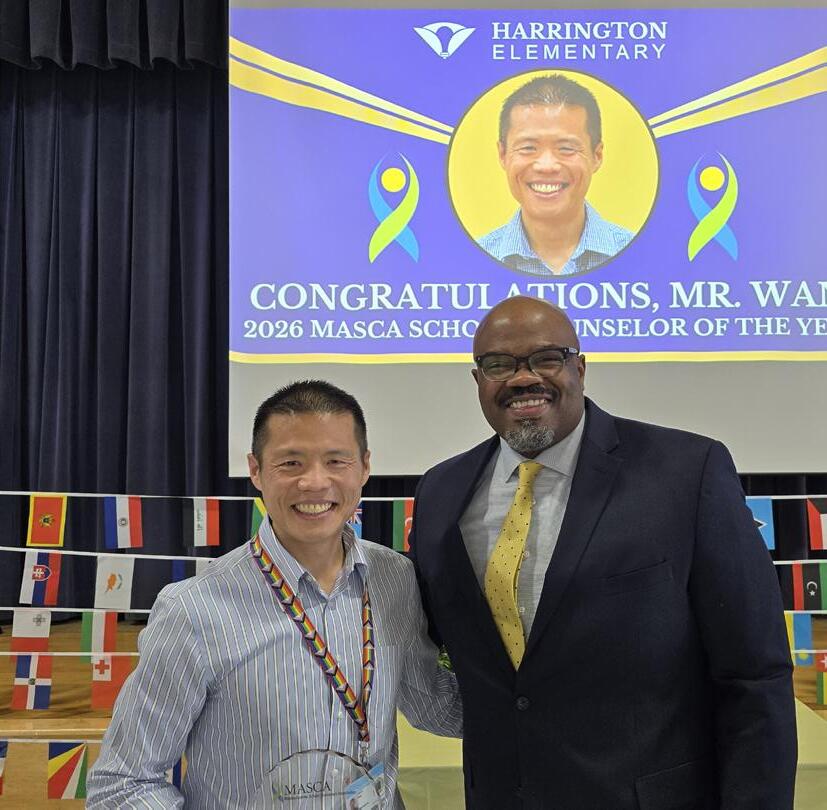
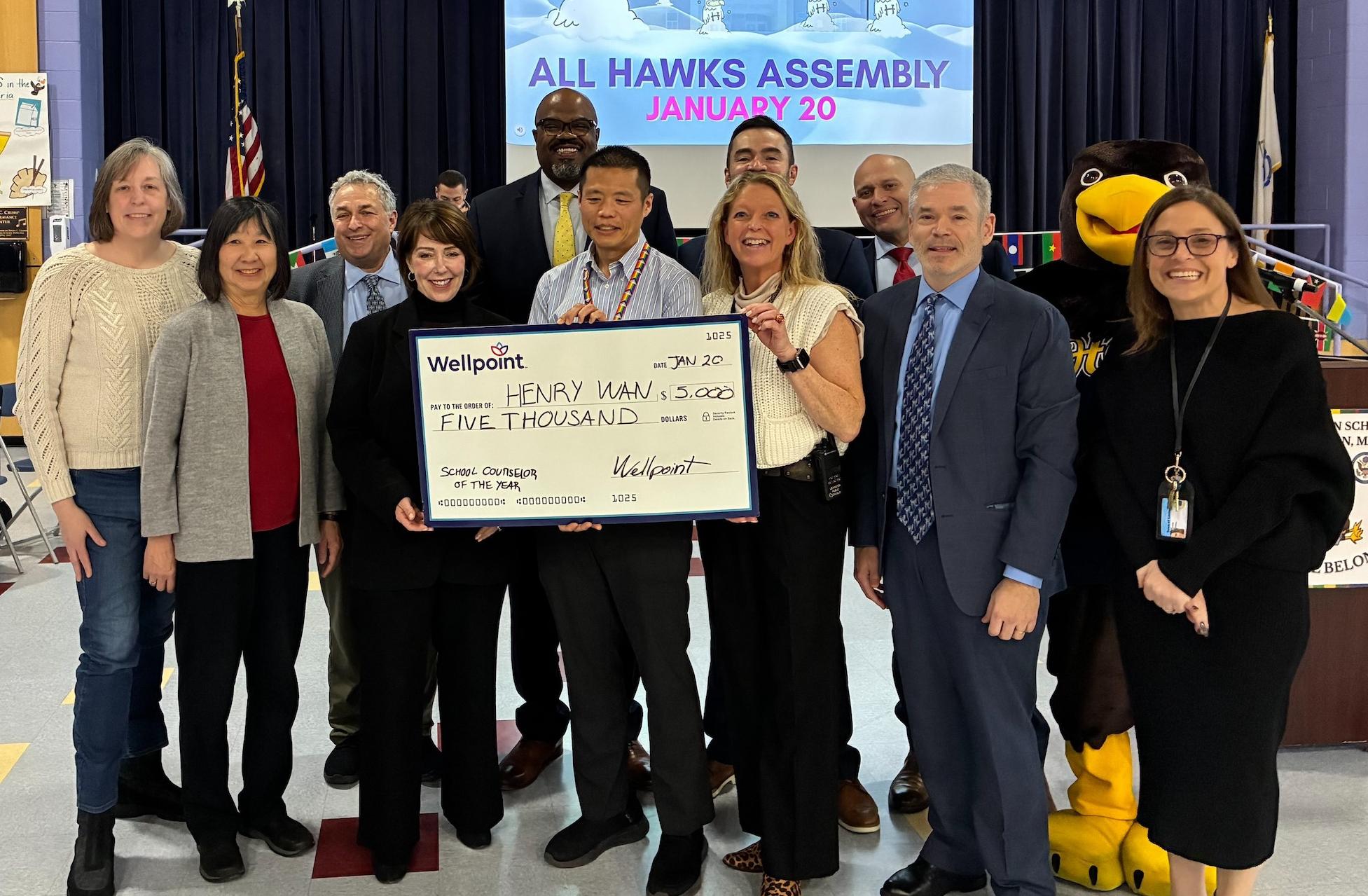
Award recipient Henry Wan with Secretary Patrick Tutwiler.
student success. Beyond his counseling role, Henry is an active presence at PTA events and community gatherings, always ready to lend his time and insight. Henry is the visionary behind Harrington’s We Will Belong project, a powerful initiative that fosters connection and celebrates diversity across the school community. A talented musician, Henry brings creativity and joy to his work, often using music as a tool for healing and connection. Henry’s positivity, deep integrity, and unwavering commitment to equity make him not only an exceptional counselor but also an inspiring leader and colleague.”
The MASCA School Counselor of the Year is sponsored by Wellpoint, a health benefits company based in Woburn. Wellpoint is donating $5,000 to Wan and his school to support programming, equipment, or supplies. “We’re proud to help recognize the exceptional school counselors across Massachusetts who make a meaningful difference in students’ lives,” said David Morales, general manager of Wellpoint. “School counselors play a critical role in supporting students’ mental, emotional, and social well-being, both inside and
(continued next page)
School Counselor
Honored
(continued from previous page)
outside the classroom. As a health benefits company, Wellpoint is committed to supporting educators’ whole health, and we congratulate Mr. Wan and the Harrington Elementary School community on this well-earned honor.”
Liz Class, a 5th grade teacher at Harrington, shared that “ Henry’s commitment to children is evident through his interactions with students and their families. He gets to know his students on a personal level, which allows him to anticipate and meet their needs, whether academic or social-emotional. With both children and adults alike, Henry has a way of bringing out the
best in those around him, even in the most difficult of situations.” Ms. Class added “ I find collaboration with colleagues to be of utmost importance, and Henry’s eagerness to work together makes him a crucial member of our school team. He brings a valued perspective to the work we do together. Above all, Henry is always willing to help out students and staff alike.”
“The recognition of Henry Wan as the MASCA 2026 School Counselor of the Year is a testament to his exemplary counseling skills, resources and professionalism, earning him admiration from students, parents, faculty, colleagues, and the Harrington Elementary School community,” says MASCA Executive Director Robert Bardwell. “Henry Wan is only the sixth male since 2000 to be named school counselor of the year and is the first elementary male school counselor ever to receive it,” said Bardwell.
“Every day, my goal as part of the Counseling Department at Harrington Elementary is to help my students believe that We All Belong. Whether pursuing systemic goals like acceptance and belonging school-wide through the K-5 counseling curriculum and playground lessons, advocating for students with special needs, bringing healing to interpersonal conflicts via restorative justice practices, spearheading the unique initiatives of We All Belong Wednesdays and affinity groups, or collaborating with students through empowering student-led groups, I strive to make this goal a reality” stated Wan.
Wan is an inspirational leader and role model whose compassionate and unwavering commitment to students rightfully earned him the title of MASCA 2026 School Counselor of the Year. Henry not only meets criteria for this award, but sets a new standard of excellence in the school counseling field.

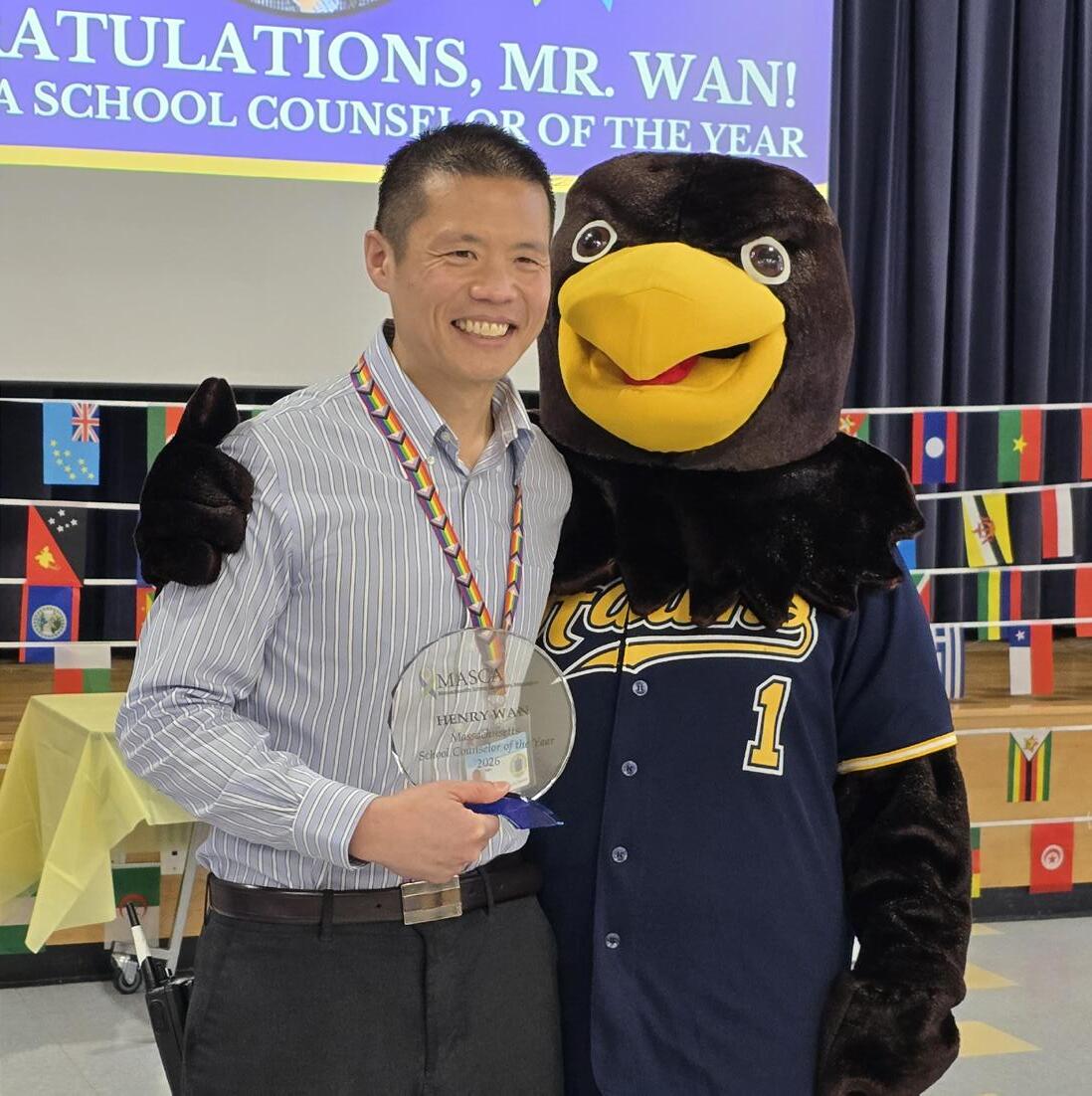
Henry with “Harry the Riverhawk” (above) and together with a team of educators, Wellpoint and MASCA representatives (right).
Director’s Message
By Bob Bardwell, MASCA Executive Director School Counselor of the Year & National School Counseling Week
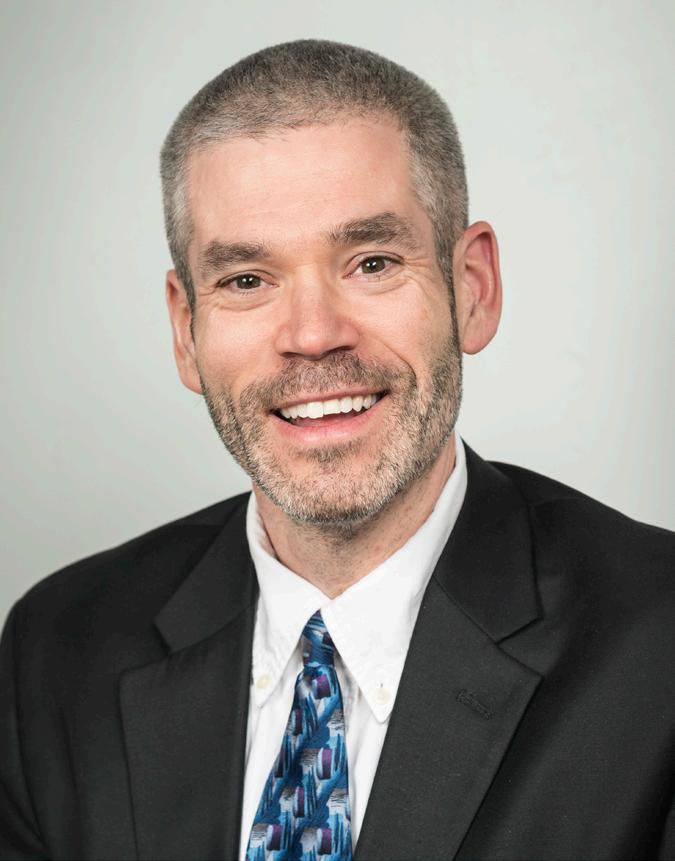
It’s that time of the year again, when we announce our newest School Counselor of the Year (SCOY) as well as celebrate National School Counseling Week (NSCW).
I had the privilege of helping to plan and execute the 2026 School Counselor of the Year presentation, this year to Henry Wan, a school counselor at the Harrington Elementary School in Lexington. As I have done for the past seven years, as soon as the Professional Recognition Committee provides me with the recipient, I immediately begin to work with the recipient’s school leader to plan this surprise ceremony.
So far during those seven years, unless one of them has not been truthful, we have pulled off a surprise, which in itself, is a huge feat as there are dozens of people who are let in on the secret – school colleagues, central office administrators, state workers, dignitaries, members of the local media and even members of the recipient’s immediate family. The fact that we can pull off a surprise event like this certainly makes the ceremony extra special for sure.
This year I had the pleasure of working with Jackie Daley, Principal of Harrington Elementary School and Henry’s nominator. Let’s just say that Jackie and I shared many a text and emails, some that were routine business, some of which were joyful and even a frustrating one or two. Jackie was an awesome partner in crime, even sharing that she was an event planner in a previous lifetime, which makes total sense based
on what she was able to accomplish. We collaborated on creating a meaningful and special ceremony to honor Henry in front of all students in the school. In fact, Henry even played a role in starting the assembly as he was under the impression it was just a regular All-Hawk assembly on a Tuesday instead of a Friday. Little did he know that he would in fact be kicking off his own celebratory event.
On Tuesday, January 20 the ceremony was to start at 2:00 pm. I arrived on schedule and members of the press and other dignitaries soon followed. We were sequestered in the library until the program had already started. We were brought to outside the cafeteria as Henry was doing the introductory activity. Once that was finished, he was told that there were some special guests who would be joining and in came some two dozen members of the press, dignitaries, central office colleagues and of course members of his family. Let’s just say that this year’s SCOY ceremony went off without a hitch. Besides my presentation of the actual award, other speakers included Lexington Superintendent Julie Hackett, Secretary of Education Patrick Tutwiler, General Manager of Wellpoint David Morales, State Representative Kenneth Gordon, Chair of the Lexington School Committee Eileen Jay, District Director of Counseling Stacy Glickman, and Grade 5 teacher Liz Class. Henry (and Harrington) was presented with a $5000 check from Wellpoint to be used for student programming or supplies, as well as citations from both the Massachusetts Senate and House of Representatives. The ceremony concluded with an all-Hawks school song, during which Henry was actively involved. Once students were dismissed, there were tons of pictures taken, a couple of interviews with the press and then a small reception was held in the library for Henry to relax and take it all in.
Planning events in January and February is always a challenge given the potential for inclement weather. This yearly celebration is certainly one of the highlights of my job and it certainly elevates our profession, not only in the recipient’s district but across the Commonwealth.
The annual SCOY presentation is quickly followed by NSCW. This annual celebration, always held the first full week in February, contains three important types of activities – professional development, networking and fun. MASCA has made a habit of coordinating a jam packed plethora of activities. In 2026 we will be sponsoring/coordinating/collaborating 16 activities – six professional development events, two fun and celebratory activities and eight regional meet-ups, happening from the Berkshires to the Cape.
Additionally, we re-open our Merch Store and send communications to school and district administrators
(continued next page)
Bob Bardwell
SCOY & NCSW
(continued from previous page)
to ensure that they know about NSCW and encourage them to take the time to recognize their school counselors at some point during the week. Of course, planning and executing all of these events take a great deal of time and effort but it is well worth it when we provide numerous opportunities to learn, network and celebrate.
The annual SCOY announcement and NSCW program are just two of the many exciting and positive initiatives that MASCA sponsors and coordinates. Regardless of whether you attend NSCW activities or not, the hope is that it makes you feel special and that you get the proper recognition that you deserve from your students, families, colleagues, administrators and community members. Ideally this happens throughout the year, but if not, then at least during the first full week of February.
If you have read this far, either before February 2-6 or after, I invite you to email me to let me know what you think about our NSCW offerings and if you did or will attend any events, what were your impressions. All of the names I receive will be entered in to drawing for fabulous prizes or MASCA merch. The deadline to submit your comments/reactions/takeaways is Wednesday, February 11 so the announcement can be made before we head off for February break. Thank you for sticking with me and most importantly for being a school counselor making a difference for the students and families whom you serve. Our jobs are some of the most challenging in our schools today, but can also be so rewarding. I am hopeful that you get lots of recognition and are able to celebrate. I am truly grateful and appreciative of all that you do each and every day in your schools and communities. You are my heroes.
New MASCA Members
Shannon Berte
Heidi Brosnan
Cynthia Canfield
Leah Carlson
Madison Casey
Danielle Curley
Danielle D’Amato
Tess Dupre
Victor Fan
Daniel Freitas
Carly Gaherty
Rylee Gonsalves
Gillian Granger
Monalisa Handoko
Elicia Harkins
Kim Hatch Kataoka
Caitlin Jacobs
Geoffrey Kromer
Chelsea Liu
Marissa Mayhew
Emily Naff
Colleen Parisi
Kristen Pessa
Natalia Ruffin
Laura Skinner
Keyona Thomas
Thomas Tran
If you know or happen to meet any of our new members, please extend a very warm welcome!
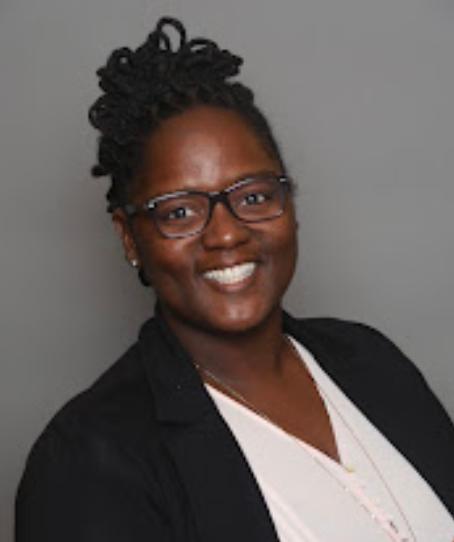
Black History Month: Let’s Learn from Each Other
By Jessica Descartes, MASCA Governing Board member, former Board Chair and School Counselor, Boston Tech Academy
February is Black History Month, and yes, and while it’s a time to celebrate important figures and moments in history, it’s also an opportunity for you to pause and think about something we focus on every day at school: who we are, how we treat others, and how we take care of ourselves. Black history isn’t just something we read about in books. It’s happening right now, all around us.
One of the most important things for students is developing a strong sense of identity. When students see people who look like them doing amazing things, it builds confidence and pride. It sends a simple but powerful message: You belong here, and you can do great things too. For students of all backgrounds, learning about Black history helps build understanding and empathy. It encourages curiosity, respect, and appreciation for differences, skills that help create a kinder and more connected school community.
Black history includes difficult times as well, and it’s very important to acknowledge that. With this, it exudes strength, creativity, joy, and resilience. These stories remind students that even during challenging times, people can rise, they can lead, and they can make change. I often talk with students about handling challenges, believing in themselves,

and not giving up when things get tough. Black history offers so many real-life examples of those very skills in action, but really, we see it every day with our students.
Black History Month is also a good time to remind students that taking care of their mental health is important. Sometimes talking about feelings or asking for help can feel uncomfortable but it shouldn’t. Students should know that
● It’s okay to have BIG feelings.
● It’s okay to ask for help.
● They don’t have to figure everything out on their own.
Building an inclusive school community doesn’t happen overnight, and it doesn’t happen in just one month. It happens through everyday
actions: being kind, listening to others, standing up when something isn’t right, and making sure everyone feels seen and valued.
Learning about Black History doesn’t stop at the end of February. The lessons of resilience, empathy, and community are ones we can carry with us all year long, all day and every day. Together, we can continue building communities where every student feels supported, respected, and confident in who they are.
If you are a counselor of color and you would like to connect with other counselors of color, please join the MASCA Counselors of Color Affinity Group at the MASCA Conference, on Monday, March 16.
Jessica Descartes
How Are You Today? Leading with Self-Care
By Ryan Beck, MASCA Graduate Student Liaison
How are you today? Four words. That is often all it takes to shift the tone of a conversation from threatening to safe. From unfamiliar to comforting. By simply taking the time to ask someone how they are, today, we ground the conversation in the present moment and center the person we are talking to.
In my first week as a graduate assistant in the Career Development and Professional Connections Hub at the University of Massachusetts Amherst, I had a meeting with Joanna Miles, who I quickly learned was heralded by students as “the best career advisor I have ever worked with.” This piqued my curiosity, and I sought to absorb as much knowledge from Joanna before I began meeting with students myself. She told me this:
“I always start my meetings by asking students: how can I help you today?”
With a heavy emphasis on today, I noticed. Our experiences are constantly changing from one day to the next. I may build a relationship with a student one day and begin to think I know how I can help them the next day. But if I were to assume, I would bypass the present moment. I would ignore the complexity of the lives of those I serve.
In a school counseling context, the emphasis on the present moment is even more pertinent. Unlike career advisors, school counselors cover a wide breadth of topics beyond careers. Some students may need social-emotional support. Others may require academic advising, or narrowing down their college and career plans. These only begin to describe the wide array of topics that school counselors work with students on. Therefore, it would be wise not to assume the needs of a student before allowing them to share their needs with you.
To truly understand the needs of a student and build trust takes time. Because of this, finding time to “meet students where they are” is key. When “where they are” is constantly changing, this can be difficult. The day-to-day lives of our students are out of our control. What we can control is how we show up for them every day.
Which brings me to the importance of practicing self-care.
In my graduate coursework, there has been a high degree of importance placed on self-care. We have created multiple self-care plans in classes. Oftentimes, we begin class with a mindfulness exercise, or
by checking-in. These moments have built community and strengthened my resilience.
Applying this to a school counseling practice can be challenging. From what I have observed and experienced on-site, school counselors have competing priorities with minimal time to dedicate to each of them. Time management is critical to success, surely, but what about self-care? Is it selfish to take care of ourselves first? To put our own well-being before our students?
My early inclination is that if we don’t take care of ourselves, it not only leads to burnout, but worsens the effectiveness of our practice. So, how do we practice self-care in a school counseling context? While there are many ways to practice self-care, here are three themes that I have noticed in my own practice of selfcare:
Set healthy boundaries
Set Boundaries, Find Peace was the title of an assigned text for my class titled: Self-Awareness for Social Justice Educators. As school counselors, we can set boundaries by structuring our time intentionally. Instead of choosing to work beyond contract hours, choose to maximize the time spent during them. Respect meeting start and end times, with fellow staff and students. Separate work life from personal life to the best of your ability. Set healthy boundaries, and you will hopefully find peace.
Eat, sleep, exercise
At my most recent physical, my doctor outlined the three areas to invest in to lead a healthy lifestyle: Exercise, recovery, and diet. The key, unsurprisingly, is to practice these consistently. Exercise for at least 30 minutes every day. Stretch before and after a workout. Sleep between 7-9 hours each night. Eat a balanced diet. Drink plenty of water. These are all wisdoms that I have heard, but consistent practice can be challenging. When we make time to fill up our water bottle, have a quick snack, or move around after being sedentary, we are intentionally practicing self-care.
Foster strong relationships
“People need people” is perhaps the simplest of mantras that I have internalized, yet also incredibly descriptive. Intentionally connecting with loved ones and colleagues is vitally important for our well-being. Social connectedness drives belonging, which we know can make a drastic difference in the life of a student. Following our own advice, it seems, is one of the best ways to practice self-care.
When we intentionally practice self-care, we can show up to work in a mindset to be of service to others. This enables us to begin every conversation with the critical question — how are you today? — to deepen our understanding of what our students, and even fellow staff, truly need from us.
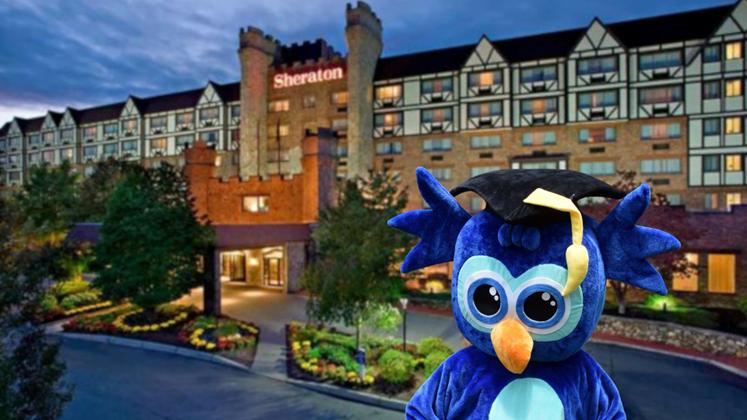
Where’s Ollie?
We did not have a winner for last month’s contest. The correct answer to last month’s Where’s Ollie? challenge is: New England Aquarium. The New England Aquarium is located on the Boston waterfront in Massachusetts, right along Boston Harbor.
It is home to a giant ocean tank that holds about 200,000 gallons of water and is filled with sea turtles, sharks, and colorful fish. The aquarium opened in 1969 and is one of the most popular aquariums in the United States. Visitors can watch playful Atlantic harbor seals in the outdoor harbor exhibit. The aquarium also helps protect the ocean by rescuing and rehabilitating sea turtles.
Ollie has been busy travelling around the state. They are on a break from travelling and are getting ready for the upcoming annual conference. Where’s Ollie? Be on the lookout for them at the MASCA conference at Sheraton Framingham Hotel & Conference Center from March 15-17. Ollie looks forward to seeing you there!
Don’t Miss MASCA’s Spring Conference! For more information or to register, go to https://ncyionline. org/conferences/ mascac/.
FEBRUARY AWARENESS DATES
Ethical Considerations for Measuring the Efficacy of School Counseling Practices
By Aaron VanDeKoppel, M.S. MASCA Ethics Committee
As of late, there’s been an increased call for accountability within the field of education. It’s no surprise that, simultaneously, the school counseling profession has been asking itself “how do we know we are being effective?” Practices like universal screening, SMART goals, progress monitoring, and a general increase in data collection and analysis have provided a positive response to this question alongside improved accountability: we are better equipped to identify the needs of students, measure progress towards goals, implement Multitiered Systems of Support, and assess our school counseling programs.
However, even with these improvements, without deliberate awareness and consideration - perhaps even caution - we run the risk of an over-reliance on quantitative metrics, magnifying their value, and potentially disconnecting from the fundamental meaning behind what we do: improving the well-being of our students and families - something that is notoriously difficult to measure. So, as we’ve been able to leverage data and statistical analysis to our (and thus students’) advantage, it’s important that we ensure a healthy balance between doing the work and measuring it - so that by squinting at the Metrics, we don’t lose sight of the Meaning. This essential debate is not new, and lessons from history can be instructive.
Since its inception a little over 100 years ago, the primary aim of Behaviorism was to make psychology more scientific - that is, abandon the practice of probing subjective experience with introspection, and focus solely on what we can observe: behavior, by way of the scientific method. In large part, their concerted effort, coupled with various technological and mathematical advances along the way, is what allows us today to be able to make any statistical sense of behavior, ranging from sticker charts to standardized psychological assessments; not that it’s all perfect, but it laid the foundational framework for our therapeutic metrics.
Yet, as beneficial as our metrics are, we must also be wary of “Metric Fixation”, a term coined in historian Jerry Z. Nuller’s 2018 book “The Tyranny of Metrics”, where prioritizing numerical goals can lead to, at best, “teaching to the test” or at worst, outright manipulation and a hyperfocus on measurable targets. This conjures up the common paraphrase of both Goodhart’s Law in economics and Campbell’s Law in social psychology: “When a measure becomes a target, it ceases to be a good measure.” And pragmatically, as school counselors, the more data we collect (and process and interpret and report…), the more resources we spend on that endeavor and the less we spend on other aspects that are admittedly more
complex, like relationships and the very thing we aim to improve: human beings’ quality of life.
The Behaviorists were essentially responding to the tidal waves made by Freud, and later influential figures like Carl Rogers; traditional psychotherapy was far from perfect. By way of comparison, consider one of the major critiques levied against Freudian psychoanalysis as well as Carl Rogers’ person-centered therapy: that patients could linger in therapy for decades, guided by theory alone, with no reliable way to measure therapeutic outcomes. And truthfully, we as school counselors can fall victim to this, too. Still, the more Humanist approach was able to address deeper psychological issues causing people distress, with the standard for progress being a decrease in symptoms and improved mood and functioning, which makes sense. And at that same time, there were those in the field of education who worked to find harmony in the tension of these two opposing views.
John Dewey and Maria Montessori were seminal figures who recognized the necessary inclusion of existential meaning within the field of education. While they differed in their approaches - one focused on social cooperation, the other on individual autonomy, respectively - they agreed that education is an active and interactive process, not merely the passive reception of knowledge to be assessed for future living. This even has echoes from 2,000 years ago in the famous Plutarch paraphrase on his critique of education: “The mind is not a vessel to be filled but a fire to be kindled.” So even as the debate waged on, there were those who recognized the need for a balance.
There are other helpful guideposts along the road towards balance. The Nature vs. Nurture debate has been raging for millenia in various forms across cultures, and if you’re looking, it isn’t terribly difficult to see remnants alive and well today. Still, despite the back and forth, overall progress has been made and the dust has seemed to settle on the majority opinion stating “it’s not either/or, but both.” Similarly, in education, strict achievement-based scoring is increasingly giving way to more growth-based metrics to measure academic success, no small thanks to the efforts of psychologists like Angela Duckworth and Carol Dweck. Even school psychologists will recommend caution when interpreting the tried-and-true cognitive testing - we must consider the individual within a larger context.
School counseling is at the intersection of psychology, therapy and education, and we would do well to learn from each fields’ past growing pains in regards to these false dichotomies. Given the increased desire for metrics and accountability, as well as the rapidly expanding research and technology for such data collection, we seem to be
(continued next page)
Ethical Considerations
(continued from previous page)
moving towards a heavier focus on Metrics, understandably. So to ensure we aren’t myopic, we should thoughtfully work to maintain a balance between the Metrics and Meaning. So what are some ethical considerations for striking this balance within our counseling practices? Here are a few ideas:
1. Use multiple measures that utilize both quantitative and qualitative data. The School Health Assessment and Performance Evaluation System (SHAPE) is a fantastic resource for various metrics that can cover both, but also consider utilizing things like student interviews.
2. In developmentally appropriate ways, involve the student in the process of making goals. Even children as young as five can provide amazing insight and perspective towards their own treatment, progress, and well-being. Even the new IEP added a small component of this idea.

3. Strategies from Solution-Focused Counseling or Motivational Interviewing such as having the student frame what better looks like for them, what better might feel like, or what are good first steps to take. There are many valid self-report scales out there - having students drive those can help connect meaning to the data.
4. Making sure to ask students and families (when appropriate) what’s most important to them in the counseling process. This not only incorporates meaning but is culturally sensitive, as well.
5. Ask “what are we trying to change” and why? For example, it’s fairly easy to measure attendance rates. But by implementing strategies to address the underlying causes, there may end up being a better measure than attendance rates that provides more nuance or is simply more accurateor better yet, it may lead us to a more meaningful treatment or support.
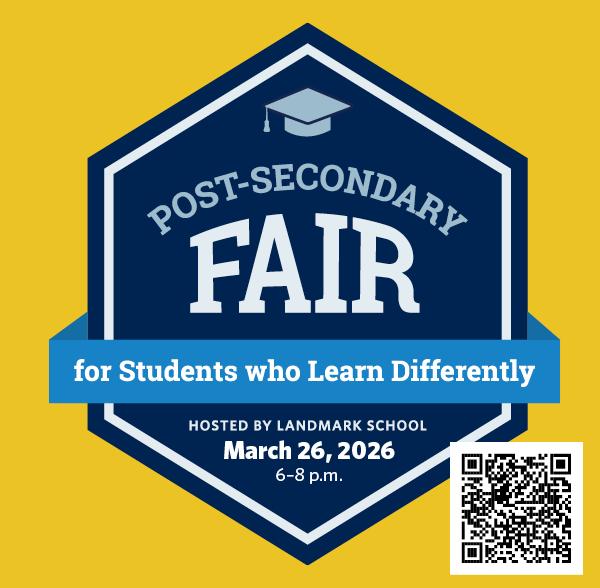
Bridging Hearts and Languages: Communicating with ELL Students from Elementary Through College
By Amanda Berg, MASCA Diversity Fellow
As counselors we lead with heart, it goes into everything that we do. Through our job we listen, reassure, guide and we advocate. When working with English Language Learners (ELLs), that communication must be intentional, culturally responsive, and developmentally appropriate. From kindergarten through twelfth grade, ELL students bring rich stories, resilience, and unique needs into our offices. Our role is to ensure they feel seen, understood, and supported—no matter what language they speak.
As a counselor it’s important to remind students and families that,“Your language is a strength. Your culture matters.” We are honored to support your family and your child’s success.
Here are some Massachusetts resources that can be shared with ELL students and their families:
For Elementary Students (Grades K–5)
At School:
● English as a Second Language (ESL) services provided by your school district
● Small groups or in-class support for reading, writing, and speaking English
● Visual supports, social-emotional lessons, and language-building activities
In the Community
● Public Libraries
○ Bilingual books for children
○ Story times in multiple languages
○ Family-friendly English learning programs
● Ask your local library about:
○ “ESL for Families”
○ “English Conversation Groups”
○ Homework help programs
For Middle School Students (Grades 6–8)
At School
● ESL classes and in-class support for academic subjects
● Help with organization, peer relationships, and adjusting to school routines
● Language support in math, science, and social studies
Extra Support
● After-school homework help
● Library conversation groups
● School clubs and activities (sports, art, music) to build confidence and friendships

For High School Students (Grades 9–12)
At School
● ESL courses that count toward graduation
● Support in academic classes
● Help with:
○ Course selection
○ Graduation requirements
College & Career Support
● Mentoring and college-readiness programs
● Help with applications, financial aid, and career pathways
For Families (All Ages)
Massachusetts Adult Education Help Desk
Find free English classes for adults, GED/HiSET programs, and family literacy services.
1-800-447-8844 www.adultedhelpdeskma.org
Public Libraries
Most libraries offer:
● Free English classes
● Conversation groups
● Bilingual books
● Online learning tools
Ask your local library about ESL programs!
Reimagining Comprehensive School Counseling in Massachusetts
By Cynthia Esielionis, MEd. MASCA Governing Board Member, Co-Chair of the Massachusetts Comprehensive School Counseling Team
While a discussion going back over 100 years in the history of the evolution of professional school counseling may be beneficial for those who don’t know, the focus here is on the last few decades, primarily in Massachusetts. Very simply, the transition from the title of guidance counselor to school counselor was articulated in 1989 to better describe the transition from a reactive service delivery program serving some students to a proactive one, designed in a multi-tiered system providing equitable access to all students. Further, in this new way of thinking, programs would be developed through using data to identify student needs, create desired outcomes and determine program effectiveness (accountability).
For the last 20 years in Massachusetts, the Massachusetts Model: A Framework for Comprehensive School Counseling Programs (MA Model) has helped guide us in our work. The MA Model emerged in response to longstanding concerns about the inconsistent and reactive nature of traditional school counseling practice. Further, the Model was (and is) designed to clarify others’ misunderstandings and misperceptions of the role and function of the school counselor. Historically, school counselors in Massachusetts, and nationally, were often tasked with clerical duties, crisis intervention and “other duties as assigned”, with limited emphasis on systemic programming, measurable student outcomes or accountability (American School Counselor Association [ASCA], n.d.).
The development of the Massachusetts Model was influenced by the ASCA National Model, first introduced in 2003, which reconceptualized school counseling as a comprehensive, developmen-
tal, and data-driven program designed to serve all students (ASCA, 2003). At that time, according to the first MA Model, many states had their own state model. The ASCA framework emphasized equity, prevention, and alignment with academic achievement, career development, and social/emotional growth (ASCA, 2019). Recognizing the need for a state-specific adaptation, the Massachusetts School Counselors Association (MASCA)—in collaboration with the Massachusetts Department Education and Higher Education—developed a model aligned with Massachusetts curriculum frameworks and educational priorities (MASCA, 2005). Originally endorsed in 2005, the Massachusetts Model incorporated the Career Education Benchmarks as curriculum guidelines. At that time, the domains were Academic Technical Development, Workplace Readiness Development and Personal Social Development. The Model fundamentally promotes a tiered approach to service delivery and clarifies the role of school counselors as leaders, advocates, and collaborators within schools to measurably increase students’ skills and achievement in all three domains.
Subsequent revisions, including the latest, Massachusetts Model 3.0 (2020), reflect evolving educational priorities and language such as college and career readiness, social-emotional learning, and mental health supports (MASCA, 2020).This latest model still emphasizes a multi-tiered system of service delivery for all students (MTSS). It includes CASEL frameworks, alignment with the ASCA National Model and DESE’s college, career and civic readiness. The MA Model contin-
ues to promote the role of school counselors in increasing academic success, career readiness, and social-emotional well-being for all students (Massachusetts Department of Elementary and Secondary Education, n.d.).
ASCA revised the National Model again, which was released in the spring of 2025. This prompted the MA Model Committee to begin discussing comprehensive school counseling programs in Massachusetts and the manner in which the Committee should continue to educate and support school counselors. The committee presented information from these discussions at a Governing Board meeting in the fall of 2025. From there, the committee surveyed the members of MASCA about the name of the committee, familiarity with and use of the MA Model as well as how we should move forward in the education and professional development of counselors with respect to creating, maintaining and assessing comprehensive programs.
We received 72 responses which represents about 4 percent of MASCA members.. Fifty (50) percent of the respondents identified themselves as school counselors. After sharing and discussing the results of this survey with MASCA’s Governing Board, a vote was taken to change the name of the MA Model Committee to “Massachusetts Comprehensive School Counseling Team”. Further, (continued next page)
Reimagining School Counseling
(continued from previous page)
through the survey, members expressed interest in assisting the team in reimagining comprehensive school counseling in Massachusetts. This group will come together to assess the current MA Model and other components of comprehensive school counseling within MASCA and bring forward recommendations, resources and strategies to enhance our profession in Massachusetts. It is an exciting time for school counseling in Massachusetts!
References:
American School Counselor Association. (2003). The ASCA National Model: A framework for school counseling programs. Author.
American School Counselor Association. (2019). ASCA National Model: A framework for school counseling programs (4th ed.). Author. https:// schoolcounselor.org/ascanationalmodel
American School Counselor Association. (n.d.). The history of school counseling. https://www. schoolcounselor.org/About-School-Counseling/ History-of-School-Counseling-%281%29
Massachusetts Department of Elementary and Secondary Education. (n.d.). School counseling and college and career readiness initiatives. https://www.doe.mass.edu/ccte/pathways/initiatives/schoolcounseling/
Massachusetts School Counselors Association. (2005). The Massachusetts model for comprehensive school counseling programs. https:// masca.org/dev2/images/stories/Resources/mamodel_comprehensive_school_counseling_programs.pdf
Massachusetts School Counselors Association. (2020). Massachusetts model 3.0 for comprehensive school counseling programs. https://masca. wildapricot.org/MA-Model_3.0
Massachusetts School Counselors Association. (n.d.). Program review for comprehensive school counseling programs. https://masca.wildapricot. org/Program-Review
Massachusetts Staff Development Council. (n.d.). Supporting comprehensive school counseling programs. https://www.mascd.org
Franklin Hampshire Guidance Assoc. Spotlights Franklin and Hampshire County:Showcasing Resources, Best Practices, and Collaborating Together.
To celebrate FHGA’s 65 years as a MASCA Affiliate (1961-2026) and ASCA’s 2026 National School Counseling Week, Franklin Hampshire Guidance Association (FHGA) is continuing its professional development tradition by offering a Spring 2026 workshop series. FHGA welcomes school counselors statewide and their colleagues to join the FHGA PD series Inquiries: Helen O’Donnell, FHGA President helenod@att.net
If you are interested in a NSCW in-person gathering why not join events planned by WMCA, Berkshire County or Worcester County colleagues All NSCW week events and registrations https://masca.wildapricot.org/ NSCW
Save the Date: Monday, Feb 2, 2026 from 2:30-3:15.
Register https://us02web.zoom.us/meeting/register/GuZ46VVdR8iTJw2uafw7ng#/registration
A virtual Tour of CSCORE: The UM Ronald H. Fredrickson Center for School Counseling Outcome Research and Evaluation. CSCORE is “dedicated to improving educational opportunities and outcomes for all children by identifying and developing research-based and effective school counseling practices”.
Claudia Smith, Ed.S.
UM Amherst, Graduate CSCORE Fellow Graduate Assistant, School Counselor Education
Save the Date: Wed., Feb. 4, 2026 from 2:30-3:00.
Register https://us02web.zoom.us/meeting/register/DEvVG1wFSAmAIzUEcuqFCA#/registration
The Career Development Hub: UMass Career Development and Professional Connections Ryan will highlight helpful FREE Development Resources. Ryan Beck, UM School Counseling Graduate Student.
The continuing spring PD series will include informative presentations, networking, and the opportunity to compile certificates of attendance (with submitted post-session exit feedback) to qualify for needed Ed. Evaluation certificates. Suggest additional topics and presenters. Currently proposed presentations include:
-Anti-Racism Curriculum Materials
-Opportunities for HS students and graduates at Greenfield Community College.
-International Baccalaureate School (IBS) Education -Sharing Attendance Initiatives
-Lisa Harney, DESE, K-12 MyCAP initiatives, resources
FHGA in-person PD: April 10, 2026 9-2. Details TBA
When Your Data Talks, Do You Listen? Collecting and Analyzing Data for Program Action Planning
Reminder: The Fitchburg State University-FHGA 3 credit graduate classes will be offered spring & summer sessions. Inquiries: helenod@att.net
-Counselors in K-12 Classrooms: Delivering Curriculum That Supports Academic Achievement and CCR.
-Counselors in K-12 Classrooms: Action Research and Program Assessment
Reducing Burnout in New School Counselors
By Jacki Lundstrom
As I move through my fifth year as a school counselor and entering my new role as an internship supervisor at Salem State University, I have been thinking a lot about how we support the newest members of our field, especially in terms of burnout. In a 2020 article, ASCA reports that 67% of school counselors report some level of burnout. According to the World Health Organization, burnout is defined as “a syndrome conceptualized as resulting from chronic workplace stress that has not been successfully managed. It is characterized by three dimensions: feelings of energy depletion or exhaustion; increased mental distance from one’s job, or feelings of negativism or cynicism related to one’s job; and reduced professional efficacy”. As school counselors, we all know the effect of chronic stress on our students, but I think we tend to forget the effects that it has on ourselves and our colleagues.
A 2018 qualitative study defined three major factors in school counselor burnout: non-counseling duties, high caseloads, and role confusion (Kim & Lambie, 2018). The ASCA and MASCA models clearly define what is a school counseling duty and what is not. However, as we all know many schools are chronically understaffed and many schools do not clearly define the role of their school counselors. This leads school counselors to doing tasks outside of our job description and feeling alone and isolated in our roles. Likewise, ASCA recommends a caseload of 250 students to one school counselor, however the national average is 376:1. It is no surprise then that school counselors report such a high rate of burnout.
Newer school counselors are naturally more at risk for burnout than their peers. Thinking back to my earliest years, it was so easy for me to say “yes” to everything. Wanting to prove myself and the importance of my role, I would take on tasks, some counseling related, some not, that I did not have the time or energy for. At the same time, I was the only trained school counselor
in my building and had no one to guide me in what tasks I should be taking on and how to push back on those expecting me to do tasks outside of my role. There were many days when I would leave my building feeling defeated because I could not get it all done. There were many mornings where I would wake up and dread coming into work because I knew I was going to spend the day on edge and overwhelmed. Honestly, there were many moments where I thought a made a huge mistake going into this field.
In research for this article, I asked new school counselors (in the field for five years or less) in Facebook groups I am in to share their own feelings around their first five years. I was struck by the similarity of their answers. When asked what the hardest part was of starting their role, the vast majority cited lack of support from others in their building and feeling like they had to do the job on their own. Some stated lack of boundaries and being pressured into doing tasks that are non-counseling related, such as disincline. When asked what advice they would give their first-year self, boundaries and learning to accept you cannot do it all was a big theme. Hearing their feedback, it reminded me that I am not alone in my early career struggles and neither are all the countless other counselors feeling that way.
So, new counselors (and maybe some veteran counselors too!), here is some maybe unsolicited advice from a “newish” counselor who had all the symptoms of burnout in here first five years.
1. Say “no”. It is going to be hard, but you cannot physically do it all. Prioritize tasks that align with the ASCA model and will benefit your students the most.
2. Be okay with leaving with tasks not completed at the end of the day. It is impossible
to do everything in our eighthour workdays and that is okay!
3. Find connections to help you process your first few years. These can be counselors in your building, district, connections you make through MASCA special interest groups, or the virtual spaces.
4. Build yourself an identity outside of your role. It is so easy to get trapped in only seeing yourself as a “school counselor”. Find hobbies that bring you joy.
5. Celebrate your victories. There will be more than you think and you are making an impact, even if it doesn’t feel like it.
I want to end with a note to my fellow counselors who have already made it through those first five years. During this National School Counselor’s Week, take some time to connect with the new counselors in your building or district. Eat lunch with them, take some time to do some informal supervision, or just ask how their week is going. Your connection could mean the world to them and help them feel like they belong.
References
American School Counselor Association. (2025). School Counselor Roles & Ratios . Www.schoolcounselor.org; American School Counselor Association. https://www.schoolcounselor.org/About-School-Counseling/ School-Counselor-Roles Ratios
Kee, T. (2020, April). Protecting Your Mental and Physical Health to Avoid Burnout – American School Counselor Association (ASCA). Www.schoolcounselor.org https://www.schoolcounselor.org/Newsletters/May-2020/ Protecting-Your-Mental-and Physical-Health-to-Avoi?st=NE
Kim, N., & Lambie, G. W. (2018). Burnout and Implications for Professional School Counselors. The Professional Counselor, 8(3), 277–294. https://doi.org/10.15241/nk.8.3.277
World Health Organization. (2019, May 28). Burn-out an “occupational phenomenon”: International classification of diseases. World Health Organization; World Health Organization. https://www.who.int/news/item/2805-2019-burn-out-an-occupational phenomenon-international-classification-of-diseases
RETIREES SIG
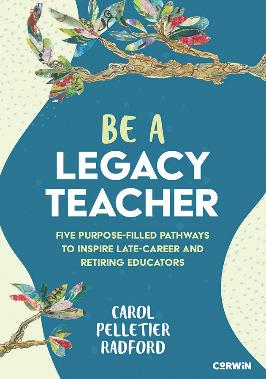
Be a Legacy Counselor! You are invited to an interactive book talk with author Carol Pelletier Radford
Wednesday, March 4 2026 - 3:30-4:30
Carol’s book, Be A Legacy Teacher, offers practical strategies through five purpose-filled pathways to help all educators channel their knowledge and skills into impactful opportunities in retirement. Attend this session to learn how you can intentionally choose your next steps and continue to serve the profession. Free book to one lucky winner!
In this interactive session she will share…
• Her inspiration for writing the book
• Why we should call retired counselors and educators “legacy teachers”
• How we can honor our careers and celebrate our successes
Order her book here
Carol Pelletier Radford is an experienced classroom teacher, university education administrator, certified yoga instructor, and founder of Mentoring in Action. Click here to learn more about her books and access free podcasts, videos, and online courses.
To participate in this meeting, you must pre-register here. For more information, contact Retiree SIG leaders Helen O’Donnell or Anne Thidemann French.
Erica Thomas - DiGregorio
K-12 Director of School Counseling
Attleboro Public Schools
Why are you a MASCA member?
I joined MASCA to be able to connect with other counselors and be part of a community to share ideas, resources, and continue growing professionally through shared learning and best practices.
What makes you unique as a school counselor?
I have a strong ability to connect with the students that I work with, but while always honest with them. I have the ability to be able to call them out without too much fuss from them based on the relationship that is built. It allows me to be able to have real conversations veruses surface levevl converstsioans.
What inspires you about being a school counselor?
What inspires me is the students. All of their stories and experiences, and seeing all their successes as they navigate life. With all that is happening in the United States, being able to listen to the perspective of our future leaders is amazing.
What career would you be doing if you were not a school counselor?
I would probably be a lawyer. That was always my second choice when I was growing up.
What is your favorite tool to use in your work as a school counselor?
My calendar. Truly! If it’s not in my calendar then it doesn’t exist. It helps me stay organized and on task.
What words do you live by?
If you want to change things, you have to change things. This is a quote by Tunde Oyeneyin, one of my favorite fitness instructors but in a world where everything is so complicated this is a very simple motto.
Why is it important to you to be part of a community of school counselors? It’s important because oftentimes school counselors do not feel supported

in their schools and districts, and that support often comes from other counselors. This is mostly because, very often, folks do not understand the impact that school counselors have on their district and schools. That’s why it is important to be part of this community. Counselors supporting Counselors
How would you describe your job to a 5 year old?
I would tell a 5-year-old that my job is to help them feel good when they are confused or sad. And that I also help by getting to know them, so when they need help explaining themselves to other grown-ups, I can help the grownups know them better.
How do you decompress/eliminate stress or refuel for the next day?
I usually exercise and try to practice meditation. I’m big into the Peloton community and it is often where I go to decompress.
What brings you joy?
Cooking! I love to cook and invent things in the kitchen. This bring my family joy as well!
Share an example of something that you learned from one of your students.
Students are teaching me things on the daily, like hat’s the right way to order food at Raising Canes or about how resilient they are, to how they understand things far more then adults give them credit for often.
What is your favorite dessert? Peach Cobbler
What is your guilty pleasure?

I love gummy candy!
What superpower do you wish you had? The ability to fly
What is your typical breakfast? Eggs of some sort
What is one thing that you are really good at?
Cooking
What is your coffee order? Typically Black unless I want something fancy.
What could you talk about for 30 minutes with no notes?
Shopping
What is your favorite smell and why? Old Spice, it reminds of my childhood and my Dad.
What TV show are you currently binge watching?
Murder She Wrote
What book are you currently reading? What is the author?
The Last Devil to Die by Richard Osman
What is something you think people don’t know about you?
I sang in High School was ranked in the Top 5 Altos.
What is your favorite song or artist? Right now it’s anything by Aiyana-Lee
MASCA Governing Board and Staff Directory
GOVERNING BOARD
Chair: Ali Robidoux
School Adjustment Counselor
New Bedford Public Schools
Assistant Chair: Cory McGann
School Counseling Department
Head
Ashland High School
Board Members
Mindy Cripps
Director of School Counseling
Billerica High School
John Crocker
Director of School Mental Health & Behavioral Services
Methuen Public Schools
Jessica Descartes
School Counselor
Tech Boston Academy
Andrea Encarnacao
School Counselor
Boston Latin School
Cynthia Esielionis
School Counselor
Ayer Shirley Regional Middle School
Lori Ford
School Counselor
Edgartown School, Martha’s
Vineyard
Amanda Ugrinow
School Counselor
Westborough High School COMMITTEES
Conference
Ali Robidoux
School Adjustment Counselor
New Bedford Public Schools
Ethics
Mindy Cripps
Guidance Director
Billerican High School
Fiscal Oversight
John Crocker
Director of School Mental Health & Behavioral Services
Methuen Public Schools
Government Relations & Advocacy
Juliette Coatsworth
School Counselor
Foxborough Regional Charter
School
Fran Frederick
School Adjustment Counselor
Belchertown High School
Inclusion, Diversity, Equity & Access
Vacant
MA Model
Jodi Then
School Counselor
Snowden International School, Boston
Cynthia Esielionis
School Counselor
Ayer Shirley Regional Middle
School
Member Services
Tama Lang
School Counselor
Litwin Elementary School, Chicopee
Nomination and Bylaws
Jessica Descartes
School Counselor
Tech Boston Academy
Professional Recognition
Dina Sibilia
School Counselor
West Springfield High School
Tama Lang
School Counselor
Litwin Elementary School, Chicopee
Publicity
Luz Mederos Dorleans
School Counselor
Boston Latin Academy
Chris Soverow
Retired School Counselor
Research and Evaluation
Tim Poynton
Professor
UMASS Boston
School Counselor Pipeline
Jessica Almeida
School Counselor
Quinn Middle School, Hudson
Jennifer McGuire
College & Career Information
Coordinator
New Bedford Public Schools
Strategic Planning
Kerry Bartlett
School Counselor
Hudson High School
Technology
Jennifer McGuire
College & Career Information
Coordinator
New Bedford Public Schools
APPOINTED POSITIONS
Executive Director & Member-
ship Coordinator
Bob Bardwell
Secretary
Julia Cahill-O’Shea
Counselors Notebook & Tech
Coordinator
Jean Atwater-Williams
Mentoring Coordinator
Maryanne Margiotta
Program Review Coordinator
Kari Denitzio
Diversity Fellows
Amanda Berg
ESP, Granby Elementary School
Roz Riggins-DesRuisseux
School Counselor
Snowden International School, Boston
Denise Evans
School Counselor
The Carroll School
JC Topete Martinez
School Counselor
Boston Latin School
PDP Coordinator
Ali Robidoux
School Adjustment Counselor
New Bedford Public Schools
LIAISONS
Affiliate Liaison
Christine Weissman
Family & Community Engage-
ment Counselor
Ware Jr.-Sr. High School
Counselor Educator Liaison
Megan Krell
Associate Professor
Fitchburg State University
DESE Liaison
Lisa Harney
MA Dept of Elementary & Secondary Education
Emerging Leader Liaisons
Cory McGann
School Counseling Department
Head
Ashland High School
Courtney Royal
School Counselor
Gloucester High School
Graduate Student Liaisons
Ryan Beck
Gradudate Student
UMASS Amherst
Rachel Flagg
Gradudate Student
Assumption University
Nicole Ward
Gradudate Student
Boston University
EMERGING LEADERS
Allison Brann
School Counselor
Athol-Royalston Community School
Charlsey Penney
School Counselor
Challenge & Reach Academy, Worcester
Jen Pinhal
Early College School Counselor
New Bedford High School
Sara Runkle
School Counselor
Kiley Prep Middle School, Springfield
Emerging Leader
Anthony Simmons
School Counselor
Atlantis Charter School
SPECIAL INTEREST GROUP (SIG) LEADERS
Career/Technical
Annie McCarthy
School Counselor
Franklin County Technical School
Maryrose O’Neil
School Counselor
Tantasqua Regional High School
Kaitlin Monahan
School Counselor
Greater Lowell Technical High School
Counseling Directors
Meg Clougherty
School Counseling Program
Director
Boston Latin School
Brynn Cooper
Director of Counseling
Weymouth High School
Elementary
Lori Ford
School Counselor
Martha’s Vineyard
Megan McShane
School Counselor
St Columbkille Partnership School
Maura Ricardi
School Adjustment Counselor
East Street School, Ludlow
Multilingual Learners
Priscila Anderson
School Counselor
Woburn Memorial High School
Matt Baione
School Counselor
Revere High School
Olivia Hull
School Adjustment Counselor
Brookline High School
Middle Level
Dawn Martin
School Counselor
Qualters Middle School, Mansfield
Jackie Saunders
School Counselor
Gibbs School, Arlington
Retirees
Helen O’Donnell
Retired School Counselor
Anne Thidemann French
Retired School Adjustment
Counselor
School Adjustment Counselors/
School Social Worker
Nychele Clark
School Adjustment Counselor
Gardner High School
Kate Niedel
Retired School Adjustment Counselor
Anne Thidemann French Retired School Adjustment
Counselor
Secondary
Karen McCrillis
School Counselor
Gardner High School
Anthony Simmons
School Counselor
Atlantis Charter School, Fall River
Rachael Weinhold
School Counselor
Winchendon High School
Urban
Rani Gould
School Counselor
The Academy at Kiley Middle School
Chase Grogan
Student Development Counselor
Community Academy of Science and Health
Sara Runkle
School Counselor
Kiley Prep Middle School, Springfield
AFFINITY GROUP LEADERS
Counselors of Color
Jessica Descartes
School Counselor
Tech Boston Academy
Andrea Encarnacao
School Counselor
Boston Latin School
Aaron Spencer
School Counselor
Nashoba Valley Technical High School
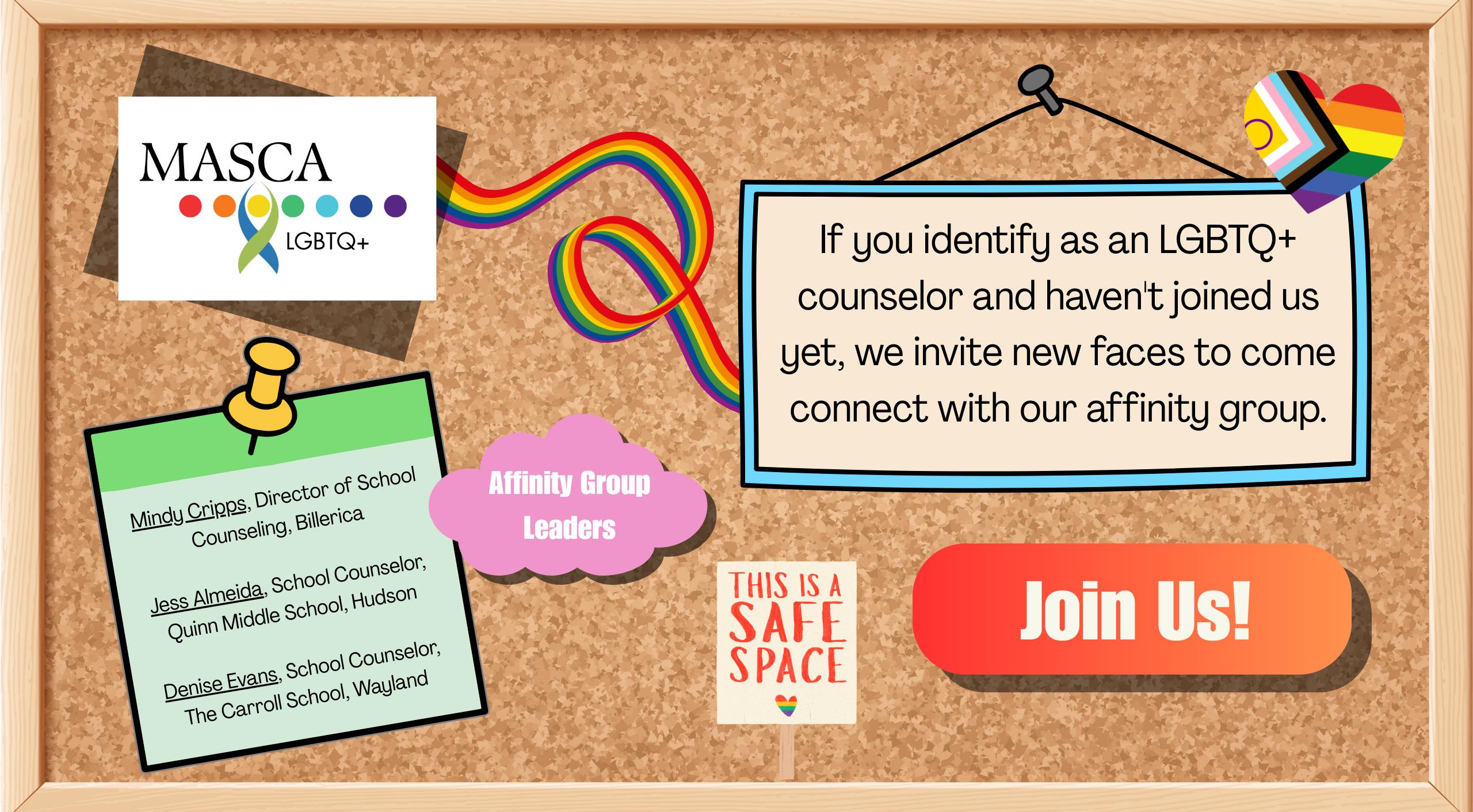
LGBTQ+
Jessica Almeida
School Counselor
Quinn Middle School, Hudson
Mindy Cripps
Director of School Counseling
Billerica High School
Denise Evans
School Counselor
The Carroll School
Mission Statement:
The mission of MASCA is to elevate and advance the school counseling profession in Massachusetts through leadership, collaboration, visibility, and professional development to optimize student success.
Vision Statement:
The vision of MASCA is to equip school counseling professionals with the knowledge and skills needed to implement a comprehensive school counseling program in their school community. Through an equitable lens, we advocate that all K-12 Massachusetts students have access to a school counselor and the opportunity to become their best selves in school, their personal lives, and their communities.
Core values:
Advocacy - Committing to center the school counseling profession by highlighting and advancing the core values of school counselors, both individually and as a profession.
Equity - Requiring inclusivity, diversity, and accessibility for all school counselors and the students and families they serve
Collaboration – Working together with all stakeholders allows school counselors to deliver the highest quality school counseling program for all students.
Excellence - Maintaining the highest level of professional standards and advancing the delivery of comprehensive school counseling programs (i.e.: MA Model) for all students.
Strategic Objectives:
Objective #1 - Advocacy - Position MASCA as a recognized, valuable, and respected voice at local, state, and regional levels by building the awareness of the importance and impact of the work and role of school counseling professionals.
Objective #2 - Equity - Position MASCA as a leading organization in dismantling racist, sexist, homophobic, gendered, ableist, ageist, religious intolerance and other oppressive policies and practices while emphasizing the need for diversity and inclusion in school counseling personnel and programming.
Objective #3 - Membership - Grow MASCA membership by retaining and engaging current members, and recruiting new members, with an on-going commitment to cultivate a more diverse membership.
Objective #4 – Professional Development - Create, provide and/or promote relevant, high-quality, accessible, and timely professional development to meet the needs of our members and support the implementation of comprehensive school counseling programs.
Objective #5 – School Counselor Pipeline - MASCA must address the increasing number of unfilled school counselor vacancies and reduction of candidates entering school counseling preparation programs.

Layout & Design
Jean Atwater-Williams