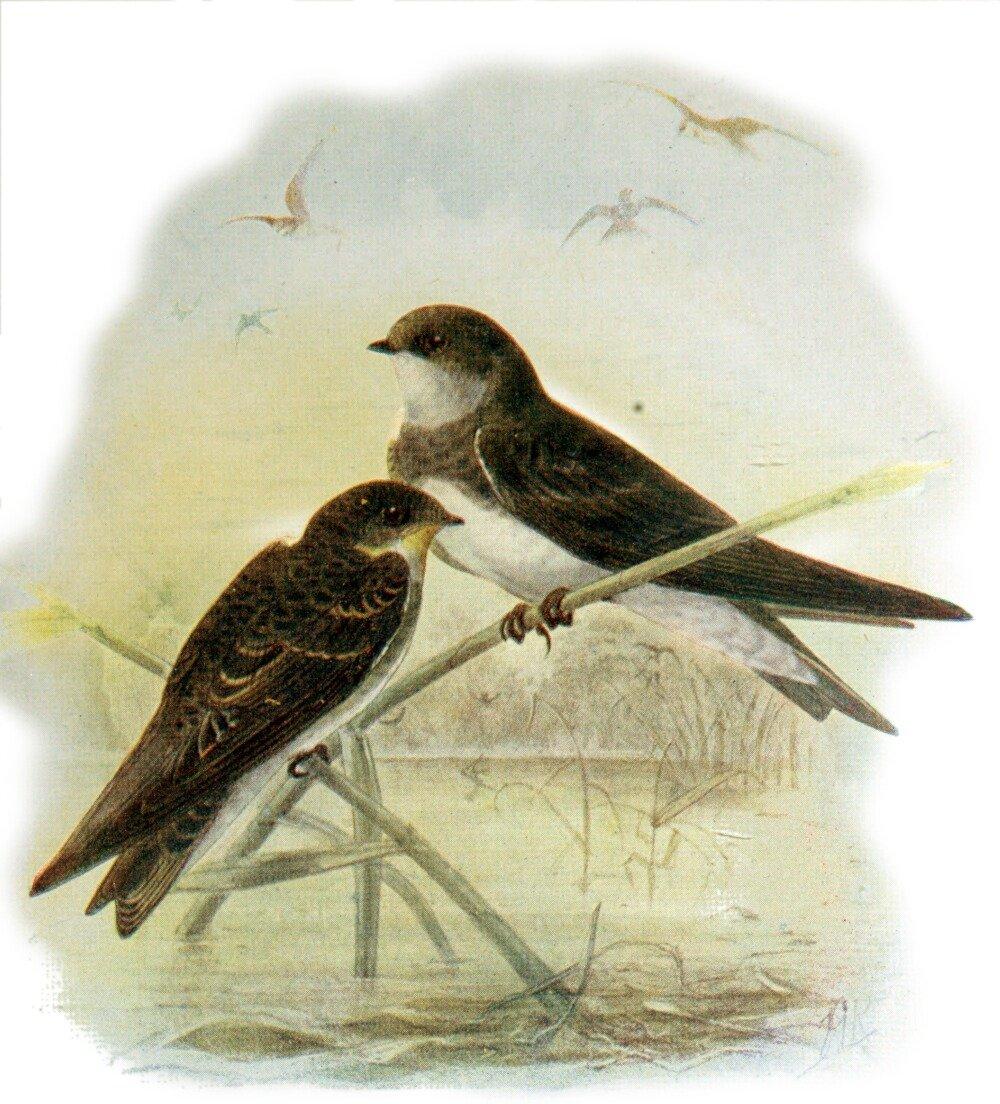
The whole of the upper parts, except the rump, which is white, are glossy blue-black; the under parts, including the feathers on the feet, white. The tail is very slightly forked. The sexes are alike in plumage. The young resemble their parents, but lack the gloss and are consequently brownish. They may also be recognised by having white tips to the inner secondaries. Length 5·3 in.; wing 4·25 in.
SAND-MARTIN
Cotileriparia
Adult (right). Young (left)
THE SAND-MARTIN
Cotile riparia (Linnæus)
This hardy little wanderer, the smallest and dullest of the Swallow tribe, braves our climate ere the March winds have ceased. At first he is generally found in the neighbourhood of water, but he gradually spreads over the country and eventually assembles in the sand-pits or gravel banks, where he makes his home. Though not attaching himself to the dwellings of man, he is a sociable little bird and breeds in colonies, which are in some places very large. They nest in tunnels which they excavate for themselves in the perpendicular face of a sand-pit. These tunnels are straight and narrow with a slightly enlarged chamber at the end. Their length varies from eighteen inches to three feet, and the different passages occasionally meet and may be used in common by two pairs. A slight lining of bents and feathers are added, and the eggs, five in number, are pure white and somewhat pear-shaped. When the breeding season is over they scatter through the country, keeping largely to the courses of large rivers, and by the end of September have almost all departed to other climes.
The sexes are alike and have the upper parts brown. The under parts are white, with the exception of a brown pectoral band. There is a small tuft of buff-coloured feathers above the hind toe. In the young the feathers of the back have pale margins. Length 4·8 in.; wing 4 in.
THE GREENFINCH
Ligurinus chloris (Linnæus)
Were it not so common, occurring abundantly throughout these islands, this bird would be appreciated as one of our prettiest songsters and by no means unattractive in plumage.
The winter is spent in company with other Finches and Buntings in the fields or stackyards, where it feeds on the grain and other seeds, and we must confess that it performs its share in despoiling the farmer of his hard-earned produce, paying at the same time a sort of compensation in the destruction of numerous weeds. It is resident, and towards the middle of April constructs a somewhat untidy nest of twigs, rootlets, and moss, lined with grass, hair, and feathers, usually placed at a moderate height in a hedge, against the bole of a tree, or more rarely among ivy against a wall. The eggs, six in number, are large for the size of the bird and very pale blue, spotted, especially towards the larger end, with pale rust-red spots. During the summer large numbers of grubs and caterpillars are consumed in addition to the usual seeds; the young are fed by regurgitation. The call-note is a long drawn-out “tsweer,” and is uttered with monotonous frequency during the spring and summer months, but it has also a very pretty warbling song full of little trills and modulations which it utters when sitting on a branch or when courting its mate with drooping wings and outspread tail, and every feather on its body quivering with excitement and passion.
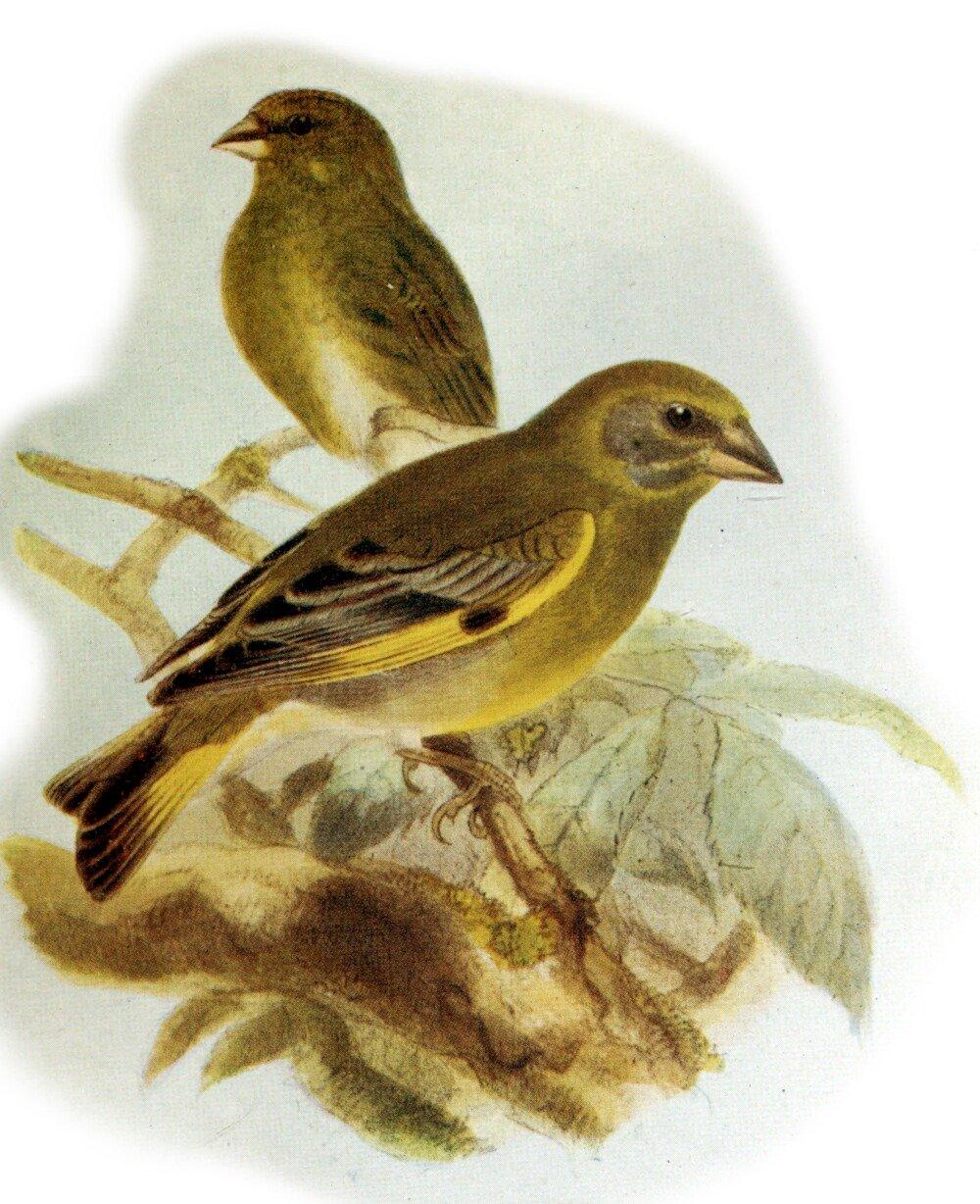
GREENFINCH
Ligurinuschloris
Male (below). Female (above)
The male has the upper parts olive green, rather yellower on the rump and forehead. There is a golden-yellow eye-stripe. The wing feathers are dark brown with bright yellow outer margins. Tail feathers, except the central pair, which are black, yellow at their base with black tips. Under parts greenish yellow, rather darker on the flanks. The females are much duller than the males and very brown on the upper parts in winter. The young are brownish yellow, streaked on the breast with darker brown. The males do not acquire their full plumage till their second year. Length 6 in.; wing 3·5 in.; but some examples are much smaller.
THE HAWFINCH
Coccothraustes vulgaris, Pallas
This fine and handsome species, whose appearance is only marred by the excessive size of its beak, is by no means so rare as it is usually considered. It is found locally in most wooded districts of England, but becomes scarcer in the north and is decidedly rare in Wales. To Scotland and Ireland it is, however, only a rare and occasional wanderer. Extremely shy, avoiding the haunts of man, and keeping to the tops of high trees, its presence is very difficult to detect, and the call-note, which is a weak and high-pitched “sit,” would not attract attention unless specially listened for.
The nest, which is built fairly high up near the top of a tall hedge or in a tree, a tall hawthorn being an especial favourite, is composed of fine twigs lined with rootlets, and much resembles that of a Bullfinch, except that the cup is considerably deeper. The eggs are extremely handsome, being of a bluish green, boldly blotched and streaked with black or olive grey. This bird has one weakness which leads to his destruction, namely, a great fondness for green peas, in search of which, forgetting his usual caution, he will leave his haunts to forage in the nearest garden, where as often as not he pays for his rashness with his life.
His food consists almost entirely of seeds and berries, insects forming a very small portion of his diet. In winter he collects in small family parties and wanders about from wood to wood but seldom strays very far from home.
The male has the back brown, becoming lighter on the rump; the upper wing coverts blackish; median coverts whitish. Wing feathers
117 black with white patches on the inner webs and steel-blue tips, the inner primaries being curiously expanded at their tips. Tail feathers with black bases and white tips. The head is yellowish brown, paler on the forehead; nape grey; lores, chin, and a narrow stripe at the base of the bill black. Under parts brown. Bill deep lead colour in summer, horn coloured with black tips in winter. The female is much duller. The young have the head yellowish; mantle mottled brown; under parts white spotted and barred with dull brown. Length 7 in; wing 4 in.
THE GOLDFINCH
Carduelis elegans, Stephens
A cold autumn day, the clouds hang lowering in the sky; on one side flows the river, sullen, dark, and swollen by the recent rains, on the other stretch wild and bare meadows whose flat level is broken by clumps of nettles, thistles, and other coarse plants distasteful to cattle. One thing alone breaks the general dreariness—it is a flock of Goldfinches, who, as they hang in strange attitudes on the thistle heads, show the bright yellow of their wings, making it appear as though some plant, forgetful of the season, was about to burst into flower. As we approach to get a closer view, first one and then another will rise and in undulating flight move on to another clump and call his companions to a fresh hunting-ground with his little “tiwhit!” His bright colours and the ease with which he adapts himself to cage life have led to a great diminution in his numbers, in addition to which the higher and more scientific methods of farming have sadly restricted his feeding-grounds. Legislation, however, has stepped in, so that, although still a comparatively local bird, he is steadily increasing in numbers, and we have reason to hope that he may long remain a welcome inhabitant of our fields. The whole winter is spent roaming about on waste lands feeding on seeds or berries, and destroying countless weeds which would otherwise overrun the land. In spring the flocks break up, and our friend returns to the orchard or garden where he nested the previous year. He constructs an open cup-shaped nest of moss, bents, and small twigs fairly high up in some tree, often covering the outside with lichen to assimilate better with its surroundings. The lining consists chiefly of hair and thistle-down, and the eggs are blue, spotted and streaked, especially at their larger ends, with reddish brown. The young are fed at first by the regurgitation of half-digested
food from the crops of their parents, and at this time of year a large number of insects are consumed. Two broods are often raised during the season, and then the family party wanders out into the open fields to seek their food, returning at night to the gardens, till they get gradually farther and farther from home and no longer visit their summer haunt till the following spring.
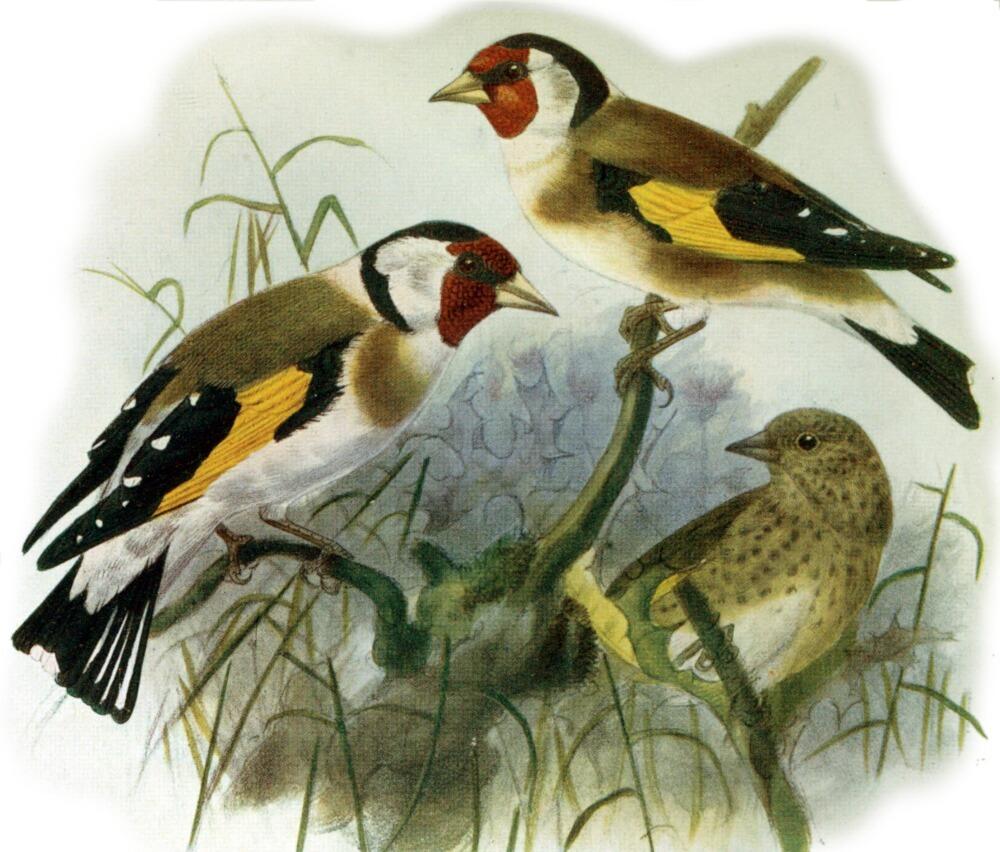
This bird is so well and generally known that no detailed description is necessary. The female may be distinguished by her more slender bill and brownish shoulders, (lesser wing coverts). In the adult male the shoulders are jet black, but young males sometimes show traces of brown.
The young, known as “grey pates,” are greyish brown on the upper parts and lack the characteristic markings on the head. The true Russian Goldfinches are rather larger in size and have a nearly white rump. The true “Siberian Goldfinch,” which is seldom or never imported, lacks the black on the head. Length 5 in.; wing 3 in. Many of the Goldfinches sold by dealers as Russian and Siberian are merely large fine birds of our native species, probably imported from abroad.
GOLDFINCH
Cardueliselegans
Male (left). Female (centre). Young (right)
There are various varieties known to dealers as cheverels, bastard cheverels, pea-throat, etc., which differ from the usual form in having the throat white or partially so. They sometimes command a higher price, as they are said to have a finer song, but this is by no means necessarily the case.
THE SISKIN
Carduelis spinus (Linnæus)
Though nearly allied to the Goldfinch, this bird is very different in appearance, being much smaller and of a yellowish green with black markings. Scotland is its chief home, where it lives among the firtrees, making excursions daily into the open country to seek its food. In winter it wanders through our islands, but is never very abundant and always irregular in its visits. It has occasionally nested in fir plantations in the South of England, but it is only in the north-east corner of Scotland that it may be considered a common breeding species. The nest is placed near the top of a fir-tree or at the end of a lateral branch at some distance from the ground. The materials are similar to those used by the Goldfinch, and the eggs also bear a close resemblance to those of that species, but are slightly smaller. It has a pretty little song, rather more melodious and varied than that of the Goldfinch, and when courting will frequently rise in the air and slowly descend with fluttering wings and outspread tail. Aphides, when in season, form a large portion of their diet, and from this point of view they prove themselves of great service to man; for the rest, any seed or berry is eaten, but from their habit of seeking their food in the open the seeds of weeds and grasses are chiefly consumed.
The general colour above is greenish yellow streaked with black, except for the rump, which is brighter and unstreaked. The head is darker and there is a yellow superciliary stripe. The quills and wing coverts are black with yellowish margins. Tail feathers yellow with broad black tips. Chin black, upper breast bright greenish yellow; rest of under parts yellowish streaked with black, especially on the flanks. The female is much duller, the prevailing tint being greyish green
streaked with dull brown. The black chin of the male is a variable feature. Length 4·6 in.; wing 2·8 in.
THE CITRIL FINCH
Chrysomitris citrinella (Linnæus)
The Citril Finch inhabits the mountainous regions of Central and Southern Europe, migrating southwards in winter. A specimen was taken alive in January 1904 near Yarmouth.
The nape and sides of the neck are greyish; back dull green with dusky streaks; wings and tail black; the whole of the rest of the plumage yellowish green. The female is rather duller. Length 4·8 in.; wing 3 in.
Serinus
THE SERIN
hortulanus,
K. L. Koch
Breeding throughout the greater part of Central and Eastern Europe, there is no great improbability that some, at all events, of the few examples of this species that have been obtained in England are genuine stragglers and not birds that have escaped from captivity. They have mostly occurred on our southern or eastern coasts, with the single exception of one taken near Dublin.
The forehead, rump, throat, and breast are yellow; upper parts and flanks olive streaked with brown; belly white. The female and young only differ from the male in being duller, and in winter both sexes exhibit far less yellow. Length 4·5 in.; wing 2·7 in.
THE HOUSE-SPARROW
Passer domesticus (Linnæus)
Noisy, quarrelsome, and vicious, will perhaps sum up the character of this species. Cunning, crafty, hardy, and omnivorous, he is always literally in clover, and under such circumstances is it to be wondered at that his numbers have increased so as to be beyond all limits? Wherever man settles, there, sooner or later, will he make his appearance, sitting on the roof or in the shrubbery, and uttering, especially in the mornings, his monotonous and impertinent chirp. In spring he pulls up the crocuses, later he turns his attention to young and succulent plants just forcing their way above the ground, or if a new-sown lawn be the object of one’s solicitude he will make it his business to see that the hoped-for grass-plot remains a barren tableland. As summer comes on, the drain-pipes are blocked by his untidy nest a mere heap of straw and hay warmly lined with feathers. If a tree or the ivy against the house be chosen for a site, the nest is better made, and is in fact a substantial dome-built structure with the entrance at the side, but its position is readily betrayed by long untidy bits of straw left trailing outside. The eggs are five or six in number and bluish white spotted and blotched with ash brown. By the end of summer he will have reared two broods of five or six youngsters each, and for a time our gardens are allowed a brief respite, while old and young gather in immense flocks in the harvest-fields, and then following the grain they spend some weeks round the freshly-made stacks in the farm-yard. As winter comes on they return once more to towns and gardens, where, by assuming a cold and starved appearance, they beg and frequently receive our charity, till the blooming of the spring flowers once more enables them to start their round of theft and damage. So much for their relations towards man, and it is to be feared that their relations
123
towards other birds have also no redeeming point, for they are so quarrelsome that none of the more delicate and beautiful of our birds will live near them, and the House-Martin clinging to his home with pathetic persistence is driven away again and again by this impudent marauder.
Is there, however, not one good word to be said for him? He is at least by no means bad-looking—the chestnut of his back, his slateblue head, black and white cheeks, and black throat all tend to add a touch of life and beauty to our gardens which they would otherwise lack; and then in summer he destroys countless noxious insects while feeding his brood, and in towns how companionable he is, hopping about our window-sills or on the roadway, evading the passing traffic with a knowledge born of long practice—surely these at least are compensations that entitle him to some regard.
These arguments, however, all fail. Remove the Sparrow and his place will soon be taken by other birds more beautiful, who will destroy insects, not merely when they have their broods, but throughout the year, and they will soon populate our towns and gardens to as great an extent as the present pest. Remove him? Yes! but how? There’s the rub. Man in the face of the Sparrow is, at present, powerless. True, the bitter war he deserves is not waged on him in this country, but abroad, in Australia and America, relentless persecution is carried on, and though his numbers may be kept in check he is still able to yearly inflict a loss and damage that can only be measured in millions of pounds.
At the same time man is largely to blame for this increase. By careful farming, woods and thickets which should shelter many other species of birds are cut down or reduced, and thereby a similar reduction of their inhabitants is created; grain, the Sparrow’s favourite food, is cultivated in enormous quantities, and birds of prey who might tend to keep the Sparrow within reasonable limits are ruthlessly destroyed. Under these circumstances, then, is it to be wondered at that the Sparrow, having a large number of his
124
competitors for food reduced, his enemies swept away, and unlimited food supplied, should increase beyond all reasonable bounds, especially if added to this we remember that he is exceedingly crafty and cunning, soon recognising and avoiding traps and becoming very difficult to approach in places where he is frequently shot at. He is at the same time adaptable and able to attach himself to the dwellings of man, who supplies him (albeit involuntarily) with a plethora of food; under such conditions his increase is only the result of one of Nature’s first laws, the “survival of the fittest.”
This species is too well known to need a description. The female lacks the black on the throat and the grey and chestnut on the crown, and her colours generally are much duller. The young approach the female in general coloration, but young males often show traces of black on the throat. Length 6 in.; wing 3 in.
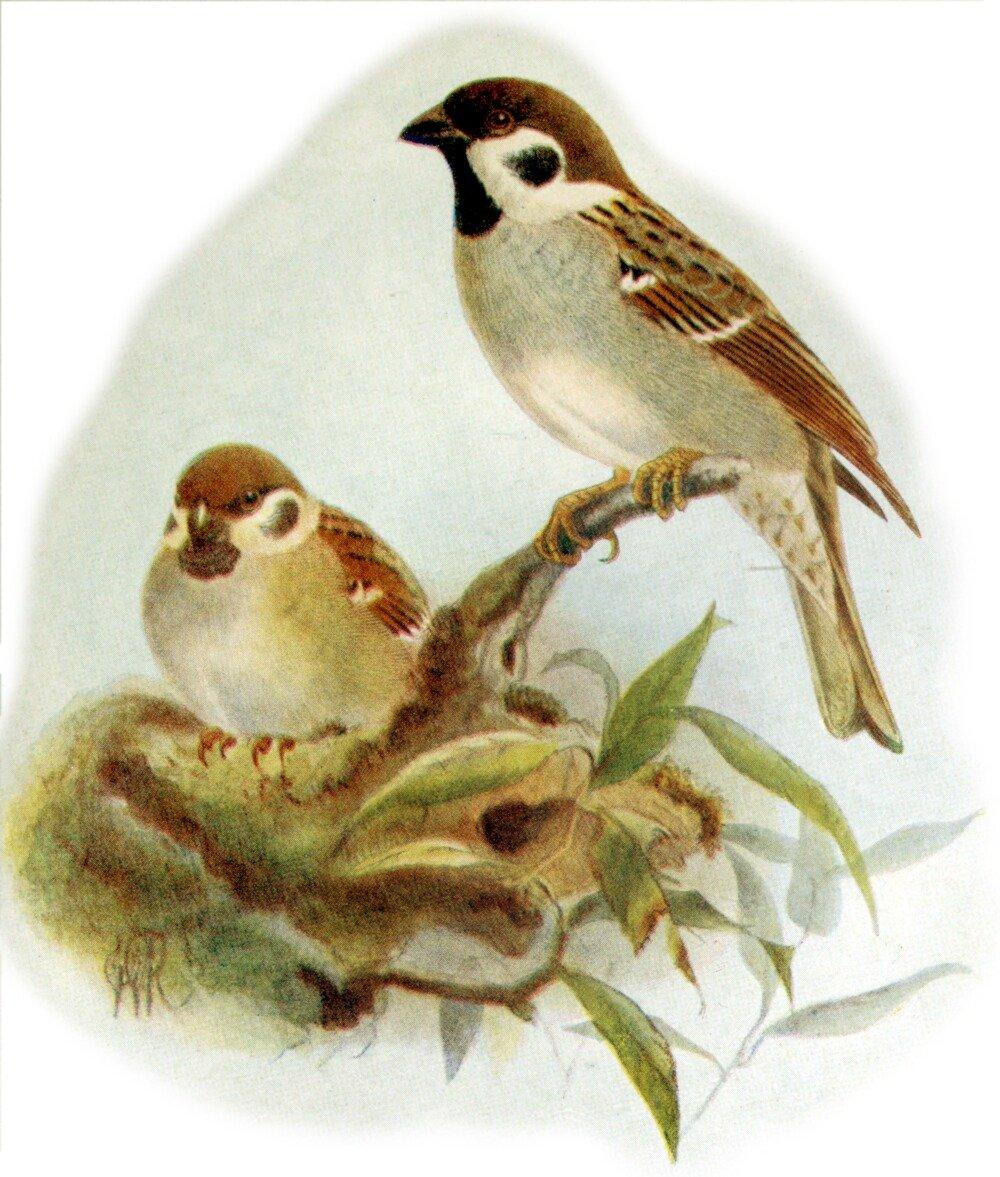
TREE-SPARROW
Passer montanus (Linnæus)
TREE-SPARROW Passermontanus
Although so closely allied to the preceding pest, the TreeSparrow is a bird of very different temperament and habits, and worthy to be numbered among our bird friends. Many spend the winter with us, but it is partially migratory, and their numbers are increased each spring by arrivals from abroad. It is a rather local and scarce bird, but even in places where they are common they are so shy that they are hardly ever seen, and are considered in consequence much rarer than really is the case. It shuns the habitations of man, whether because of the overpowering insolence of its larger relative or not is a debatable point, but the fact remains that if we want to see it we must find some secluded and undisturbed spot. Holes in pollard willows or in some hedgerow tree are generally chosen for a nesting-site, inside which a substantial nest of grass abundantly lined with feathers is formed. Five eggs form the clutch. These are greyish in ground colour, delicately but thickly mottled with brown, and it is an almost invariable rule that one egg of a clutch should be conspicuously lighter than the others. Little is known of the habits of this bird; its food consists chiefly of seeds and berries, but in summer insects form a large part of its diet and the young are almost entirely reared on them. Its notes and song very closely resemble those of its commoner relative but are slightly more musical and less harsh.
The adult has the crown and nape dark chestnut, rest of upper parts chestnut with darker centres to the feathers; upper and lower wing coverts tipped with white and forming two distinct bands. Cheeks white with a triangular black patch in the centre. Chin and throat black; rest of under parts greyish white passing to brown on the flanks. Length 5·6 in.; wing 2·75 in. The sexes are alike in plumage. The young are similar to their parents but duller.
It is a scarce and local species but widely distributed, and doubtless from its retiring habits and resemblance to the House-Sparrow it is often overlooked.
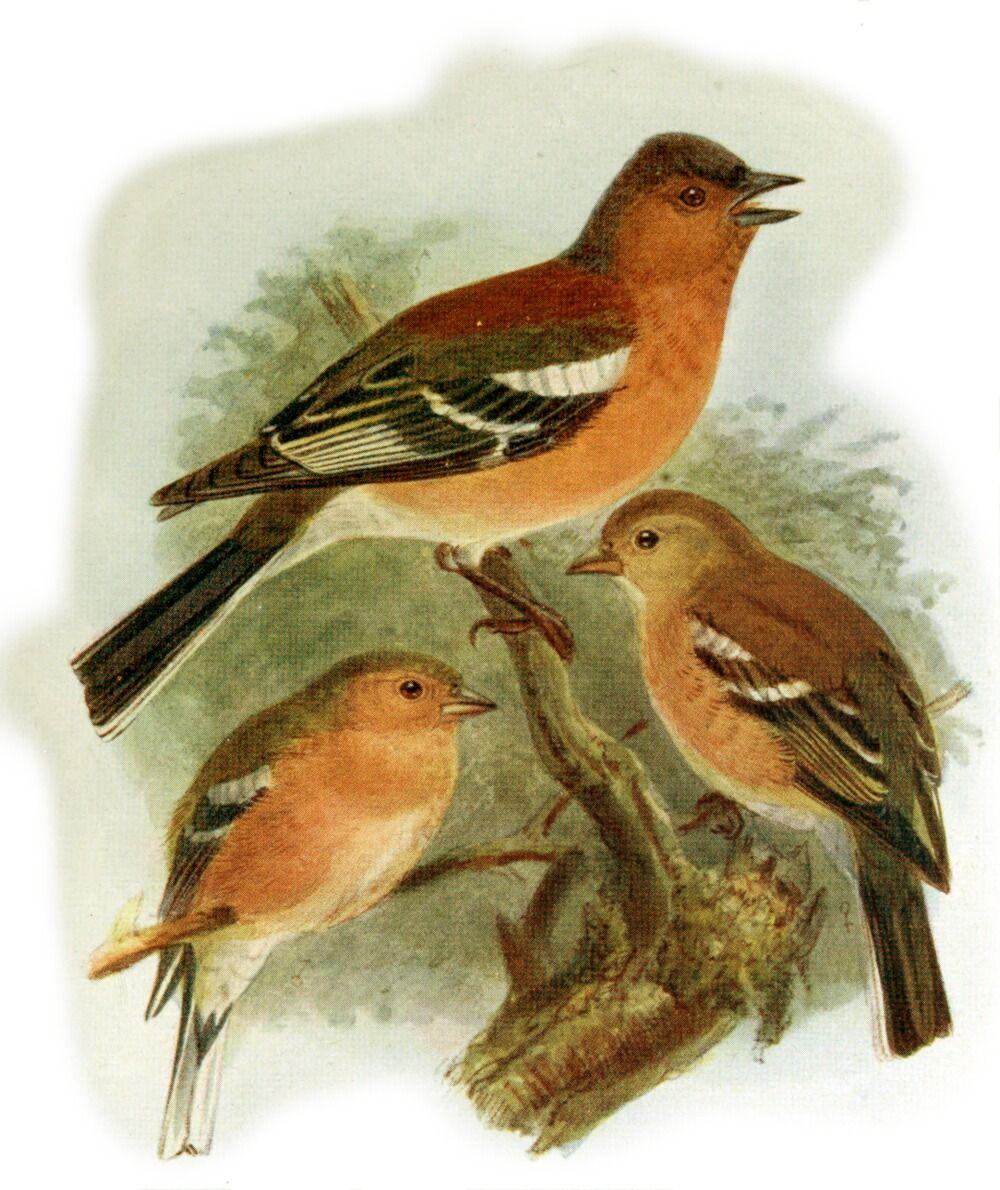
THE CHAFFINCH
Fringilla cœlebs, Linnæus
“Pink, pink!” Who among us does not know the Chaffinch with his bright “pink, pink,” and perky walk, as he goes down the garden path in front of us, or flies into the nearest shelter showing off the white bars on his wings as he does so. No matter how severe the winter or how hot the summer, he is always with us, a constant visitor to our gardens, and when we go into the woods and fields we shall still find him equally at home. Early in February he begins his song, which consists merely of a short run down the scale ending up in the syllables “de-wi.” Pairing takes place early in the season, but some weeks elapse before he thinks of nesting, well knowing that the insects so necessary for his young are not yet born. At the end of April his mate will begin to build the nest, while her lord and master sits quietly by, encouraging her with his song but not deigning to soil his beak or feet with honest toil. The site chosen is very variable; the fork of some giant tree or against the trunk of a hedgerow elm supported by a lateral shoot are the places most frequently used, but it is often situated in a hedge, and sometimes in the ivy against a wall. The nest itself is a beautiful mass of moss, grass, and wool carefully felted together with cobwebs and thickly lined with hair, lichens being often added on the outside to make it assimilate better with the surroundings. The eggs, generally four in number, are greenish blue, spotted and clouded with deep reddish brown, but occasionally the markings are entirely absent.
Welcome to our website – the perfect destination for book lovers and knowledge seekers. We believe that every book holds a new world, offering opportunities for learning, discovery, and personal growth. That’s why we are dedicated to bringing you a diverse collection of books, ranging from classic literature and specialized publications to self-development guides and children's books.
More than just a book-buying platform, we strive to be a bridge connecting you with timeless cultural and intellectual values. With an elegant, user-friendly interface and a smart search system, you can quickly find the books that best suit your interests. Additionally, our special promotions and home delivery services help you save time and fully enjoy the joy of reading.
Join us on a journey of knowledge exploration, passion nurturing, and personal growth every day!