M A RY M O U N T I N T E R N AT I O N A L S C H O O L R O M E
June
Marymount M
O
W
hen the school year began last September, we announced that our goal for the year would be “To encourage and affirm personal growth.” This is the fourth of six goals that lie at the heart of every school in the RSHM network; goals that help us as a school community live and fulfill the Marymount mission. With the school year coming to a close, now is an excellent time to reflect on how successful we were in pursuing and achieving this goal over the last nine months, both as individuals and as a community. Personal growth is specific to each student, and it is our job as a school to provide an array of opportunities that encourage the development of the whole person. For
C O N T I N U E D O N PA G E 2
N
T
H
L
Y
INSIDE THIS ISSUE
First Communion / 5
The Day of Four Popes / 8
IB in Review / 14 PTO News / 21
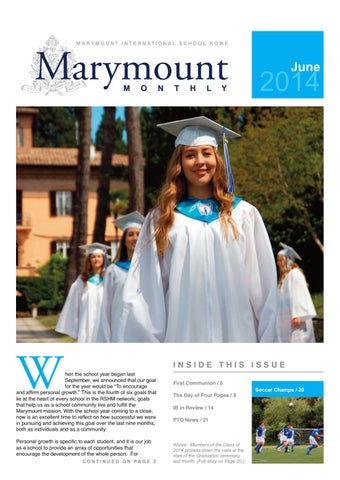
Above: Members of the Class of 2014 process down the viale at the start of the Graduation ceremony last month. (Full story on Page 20.)
Soccer Champs / 20
2
M
A R Y M
O U
N
T
M
O N
T H
L Y
EC2 Visits a Farm On May 14, EC2 visited Fattoria Salvucci. e children, parent helpers, and teachers all had a very enjoyable day. Here is what EC2 said (in their own words) the following day about their trip:
Fr o m th e H e a d o f Sch o o l example, our orientation programs, our celebrations of nationalities and mother languages, and the continuous encouragement by our exceptional and caring faculty are just a few of the ways in which we cultivated selfknowledge and self-esteem among our students.
Clockwise from above: Early Childhood 2 students enjoyed a chance to climb trees during a field trip to Fattoria Salvucci, a local farm. Gloria, the students’ guide at the farm, feeds a half wild boar and half pig named Pippo. Not only did the students learn to make bread and pizza, they got to eat what they made for lunch.
(Continued from Page 1)
We promoted principals of honesty, compassion, truthfulness and respect through the introduction of school rules, anti-bullying campaigns, our commitment to the RSHM mission in Zambia, and activities focused on human rights. We provided opportunities to promote
leadership through participation in the Student Council, NHS, the RSHM Leadership Summit, and the Model United Nations. We encouraged participation in the community through partnerships with the Caritas Soup Kitchen, the Little Sisters of the Poor retirement home, and the Sant’Egidio organization. We promoted physical well-being through numerous after school activities and sports in addition to our regular PE curriculum. We also fostered spiritual growth through preparation for the sacraments, our regular religion classes, and school liturgies throughout the year. We provided opportunities for more general development through our interactions every day in the classrooms and throughout the campus but
PHOTOS: C. TABBRON
Yesterday we went to the farm. We went on a bus. It took a long time. When we got there Gloria (our guide) told us how to make flour and bread. Then we made bread and pizza. We went for a walk to see the animals. We saw ostriches, horses, a rabbit, cows, calves, and sheep. We saw Pippo (half wild boar, half pig). We saw the chickens, and we fed them. We saw a peacock with a big, long tail. We saw ducks. Then we had our lunch. We had pizza that we had made. After lunch we went to a beautiful park. It had three big tractor tires and trees to climb. Then Gloria brought a rabbit for us to touch. Then we got on the bus, and our bread went in the bottom. We came back to school and took our bread home.
also through our emphasis on reading and writing, through our lively performing arts program, and through student retreats. In fact, nearly every article in this month’s issue of the newsletter highlights an event or activity that contributed to the personal growth of our students.
Encouraging and affirming personal growth is a shared responsibility, and I would like to thank all of you for playing a part as well as for helping to make 2013-14 an excellent academic year at Marymount.
We wish our graduates every success, we bid a fond farewell to a number of families and teachers, and we wish everyone a happy and restful summer.
Ms. Maria Castelluccio Head of School
J
u n e
2
0
1
3
4
Kindergarten students learn about the life cycle of frogs
Watching Little Things Grow K
They also brought tadpoles to the classroom, where children eagerly entered each morning and noticed changes in the tadpoles. Some of the tadpoles started to grow little legs! The children also read books about frogs and tadpoles during their Reader's Workshop Centers. One morning, the students, accompanied by Ms. Cameron and Ms. Crossan, took a walk down to the Marymount pond
to release the little frogs back into their natural habitat.
During Writer's Workshop, the students made their own frog life cycle books. The children drew and wrote descriptions about the frog eggs, tadpoles, and frogs. They displayed their books, along with a number of photos, on the classroom bulletin board.
Ms. Mersedeh Ceresoli Kindergarten Teacher
PHOTOS: M. CERASOLI
indergarten students recently had a fun lesson in biology. Ms. Raftery and Ms. O'Connor started by reading a book about the life cycle of a frog.
Top: A tadpole in the Kindergarten classroom has grown into a tiny frog. Bottom: Ms. O’Connor leads the children to a nearby pond to release the frogs.
Kindergarten is Inspired by Nature and Pizza
L
The children and teachers were divided into four groups: the Badgers, Porcupines, Hedgehogs, and Foxes. All four groups went on an excursion to an ancient woodland where they followed a nature trail using their five senses. After the walk the children were hungry, and it was time to
make pizza, and so they did! They made their own pizza and then ate it. It was delicious! After lunch, the children put their memories into a large piece of artwork that is now hanging on their bulletin board. This field trip was a wonderful experience and we hope students will join the Hazelhut again for a fun learning experience practicing our English skills.
Ms. Surya Savo Kindergarten Teacher
S. SALVO
ast month, Kindergarten went on a field trip near the town of Ronciglione. The students visited the Hazelhut, an activity-based camp run by two wonderful English speakers, Ottavia and James.
Above: Kindergarten children make their own pizzas during their field trip to the Hazelhut camp. Below: The artwork the children created based on their experiences at the camp.
4
M
A R Y M
O U
N
T
M
O N
T H
L Y
Sango Rinopa Waneta Seconday Students use their green thumbs to lend a helping hand
“When are they going to be ready?” This was the catchphrase of one of the group’s members, eager to see the fruits of his work. Garden work, especially in a temperate climate, requires and teaches patience. Preparation is key – another valuable lesson for life.
Our efforts to grow flowers were undermined by the archenemy, the snail, and the somewhat erratic climate. This combination of pests and climate change afflicts us all but is felt hardest by the most vulnerable in our world. As I know firsthand from my years in Africa, if it rains too heavily, too little, or at the wrong time, people go hungry. Garden projects can give students an insight into the reality of others.
In May, the hard work of the earlier months bore fruit, including lettuce, peas, garlic, and zucchini. Other perennials such as thyme, lavender, sage, carnations, and cornflower also began to flourish. A group of
I have enjoyed the company of my fellow workers and have been uplifted by their enthusiasm and joy at seeing the progress. As they say in Zimbabwe, “Sango rinopa waneta,” (“he who tries hard gets the rich fruit”).
D. HARKINS
B
students took some of these plants to the Colle Oppio soup kitchen to brighten the place up, and they also sold some of the plants to raise money for Zambia. Even the Sisters enjoyed some of the produce.
Mr. Dominic Harkins Secondary School Religion
I
t’s now been three months that a group of students (including me) under the guide and advice of Mr. Harkins have been working on our school’s garden. During these months we encountered problems, solved them, and learned that we need patience. We tried to be as ecofriendly as possible by recycling bottle caps and reusing plastic bottles and plastic bags. Gardening has been a fantastic experience. I hope that it will continue next year! – Francesca S.
P
ersonally I think these 'gardening' classes have had an immense influence on my life; not only have I learned about plants and gardening skills in general, but I also realized how exceptional it is when your hard work proves to be worth it. After so many hardworking days in which we planted, dug, or watered, we have finally reached a point at which most of our work resulted in an amazing outcome! – Selina B.
M. GUGLIELMI
ack in September, Ms. Gerber took me to see the garden behind the Annex. As I know too well from experience, a garden left for a couple of months can appear a jungle. Rejuvenating and making the garden productive would be hard work. A handful of students expressed a desire to join the Pamoja Club with its primary aim of raising funds for Zambia. These same students worked tirelessly throughout the year to transform the garden.
Top: Members of the Pamoja Club see signs of progress in the garden they planted behind the Annex. Above left: Nat N. and Marisa S. were among those who volunteered to plant new flowers and help beautify the courtyard at the Caritas soup kitchen. Above right: The students and teachers helped to make the ambience of the courtyard more pleasing and welcoming.
I
learned that things don’t always go according to plan and that it is very important to be patient. Recently Mr. Harkins picked out some lettuce, and we gave it the sisters at our school. I am very glad and extremely proud that we are able to give back to the sisters by giving
them the lettuce that we grew ourselves. I would very much enjoy having the opportunity to continue working on the garden next year and make much more progress. – Marta A.
J
u n e
2
0
1
5
4
Students offer prayers before receiving a Sacrament
On May 10, 35 Marymount students joined their families and friends from around the world to celebrate their First Holy Communion in the beautiful church of San Camillo. e students wrote prayers to God before this special day. A few of them are presented here.
Y
our love is everlasting! Teach me to love others like you do, and help me fully understand this important step in my life of receiving Jesus Christ in my First Communion. Thank you for giving me such a loving and wonderful family. – Carlo S.R., 2P
Y
ou are our King. You clean our souls from sins. We are all grateful to you. – Sophie R., 2O
T
hank you for giving your life to all the world. I can't wait to receive your body and blood. I love you. – Luca S., 2O
T
hank you for sharing your body with me. I am very excited to meet you! – Francesco G., 2O
G
od, we ask you for a better world: no more wars, no more violence! We need a peaceful world, full of love and respect. – Camilla F.F., 2O
I
love you because you died on the cross for us. Thank you for the many beautiful ways you have treated us. Give peace and love to my family, protect us, and help us to be good and kind. We love you. – Ludovica N., 2P
Y
ou are the Pearl of Great Price, and our King. I thank you for dying on the cross. I also thank you for giving me a family. – Valentina A.-P., 2P
I
am so proud to receive you! Let me be a good boy. Thank you for your love. – Romano O., 2P
G
PHOTOS: P- SILOBRCIC
First Holy Communion
od, I thank you for giving your light to me at Baptism, and giving your body to me at First Communion. – Edoardo P., 2O
Y
ou are everything that is good. You are almighty and powerful. You are a peacemaker that we won't find anywhere else. – Lorenzo F., 2P
T
hank you God, for you will give me your body on Saturday. I am so happy. I can't wait for that to happen. – Leo F., 2P
T
hank you for giving me toys, food, a house, a family, my life, and yourself! – Nico G.L. De S., 20
6
M
G
A R Y M
O U
N
T
M
O N
T H
L Y
e
ift of the Holy Spirit
P- SILOBRCIC
Students receive the Sacrament of Confirmation after months of preparation
ast month, 38 Marymount students, ranging from Grades 7 to 12, received the Sacrament of Confirmation at St. Patrick’s Church in Rome. The Confirmation Mass represented the culmination of many months of preparation, including regular instruction by Sr. Rosaleen Sheridan.
L
We encourage sacramental preparation and active participation in worship.
from the Goals & Criteria for the RSHM Schools
The reception of Confirmation is necessary for the completion of baptismal grace, since the baptized are more perfectly bound to the Church and are enriched with a special strength of the Holy Spirit. Students freely choose to be confirmed and become true witnesses of Christ willing to spread the faith by word and deed. The seven gifts of the
Holy Spirit – wisdom, understanding, right judgment, courage, knowledge, reverence, and awe – confer on the candidates the grace to realize their witness.
All of the preparation and learning came to a crescendo of important events in the week leading up to the Mass. On May 12, candidates reflected on the spiritual aspects of Confirmation as well as the real commitment that they were making during a daylong retreat held at Marymount Nomentana. On May 14, the annual Saints Museum took place under the umbrella pine trees on the viale. Candidates dressed in
costumes representing the saints whose name they had chosen, told the stories of the saint’s lives, and explained why they admired their chosen saints. On May 17, Cardinal James Michael Harvey, archpriest of the Basilica of St. Paul Outside the Walls, confirmed the Marymount candidates at an evening liturgy. This was the Cardinal’s first time bestowing the sacrament of Confirmation as his previous Vatican duties kept him busy with other concerns. During the Mass, the first and second readings emphasized the role of the baptized in building up the Church, while the Gospel focused on being a disciple of
J
u n e
2
0
1
7
4
Grade 7 Students Reflect on Confirmation
A
O. FOLEY
s I approached the altar with my proxy, I said, “I want to be confirmed Michael,” in a loud voice so that everyone in the church could hear me. The Cardinal responded back while making a cross on my head with the oil, “Michael be sealed with the gift of the Holy Spirit.” I responded with, “Amen.” The cardinal said, “Peace be with you.” I replied, “and with your spirit,” while I was shaking his hand. I was so excited that I received the gifts of the Holy Spirit. The oil on my head was a symbol of this. During the whole mass, I was afraid I was going to mess up because I was so nervous. That day was a day to remember in my religion. I finally felt like a real Catholic. – Jack C.
C
onfirmation was amazing due to all of the practice and extra time we were given for all of the preparation. I’d like to give
a big “thank you” to Sr. Rosaleen for all of the effort she put into this event. Thanks to her hard work and dedication, I felt great that day. – Marcelo R.
M
y Grandmother came from America to be my sponsor. I chose her because she is very religious and because she loves and cares for me very much. There was a lot of excitement in the house while preparing for the ceremony. The ceremony took place on a beautiful spring day. The entire day was filled with wonderful memories. – Margherita C.
N
ow that I have been confirmed I really feel different. I feel the desire to be honest and do my best to make the best decisions I can possibly make and defend what is important. – Martina I.
I
found the Cardinal’s Homily very interesting. It was about how if you saw Jesus you saw God, and how we can see God in other people, and they can see God in us through our kind acts. After being confirmed I felt something different. I could feel the seven gifts of the Holy Spirit come to me. I felt like I had more purpose in this world and I know what to do. I am regretting some choices and making changes for the better.
All in all this was a great experience for me, I have grown mentally and I know what to do in times of trouble, and what choices to make. I can tell right from wrong and I have the courage to turn down bad things. Like the Cardinal was explaining before, we can see God in other people… and I want others to see God in me. – James S.
Fr. Greg Apparcel and Fr. Steve Bossi were invaluable in helping to organize the liturgical celebration. The culminating moment during the liturgy came with the words, “Be sealed with the Gift of the Holy Spirit,” while the anointing with chrism provided the full outpouring of the Holy Spirit as was once granted to the apostles on the day of Pentecost. It was truly a beautiful sacramental moment for the candidates, their sponsors, and their families.
Marie-Catherine Letendre, PhD Campus Ministry Program
P- SILOBRCIC
Jesus. Cardinal Harvey emphasized these themes in his homily.
Above left: Students dressed as their chosen saints and spoke about them during the Marymount Saints Museum, which precedes Confirmation. Above: Cardinal Harvey (center) with the entire group of newly Confirmed students. Opposite page: The Confirmation Mass at St. Patrick’s Church in Rome.
8
M
A R Y M
O U
N
T
M
O N
T H
L Y
The canonization of John Paul II and John XXIII in St. Peter’s Square on April 24, 2014
The Day of Four Popes
History in the Grade 7 students reflect on the recent Making by Maria T. canonization of On April 27, 2014, history was John Paul II and made in St. Peter’s Square. John XXIII Two popes (John XXIII and
John Paul II) were canonized at the same time in the presence of two living popes (Pope Benedict and Pope Francis). This was a very special moment for the Catholic world, and especially for me – to know that something amazing was happening only a few kilometers from where I live was a wonderful feeling. Hundreds of thousands of people traveled hundreds of miles to witness this special ceremony, while I had the luxury of the event happening right in my city! While other world history is very important
to me, this history is more personal and will always hold a place in my heart.
When a pope or religious figure is canonized, that means that they have become a saint – the highest stature in the Catholic Church. However, for that to happen, several steps must take place. A bishop must investigate the religious figure’s life for “evidence of heroic virtue.” Then, a panel of experts and the Congregation for the Cause of Saints assess the religious figure’s life. If the figure passes, then the pope must claim that this person is “vulnerable.” Beautification can only take place when the person is accountable for a posthumous miracle. But for a person to be canonized, a second miracle
must happen. The two canonizations that have occurred this April have been undoubtedly sped up. Pope Benedict disregarded the 5year waiting period before a bishop can investigate a religious figure’s life for John Paul II. Pope Francis disregarded the second miracle for John XXIII. However, no one can deny that the canonization of these two holy people wasn’t undeserved. More than 1 million tourists came to Rome to witness the ceremony and many more watched it on live television. The year 2014 is and will always be a momentous year for me, for the world, and for the Catholic Church. History is made every single day, but we only realize it when pivotal events such as this one
J
u n e
2
0
1
9
4
happen. This event reminds us that God is with us, that He loves us, that miracles will always continue to happen, and that we should trust in God. I am being reminded that I live in a marvelous city and that I should take advantage of it more often because it is a city where saints are made and pilgrims flock. It’s a city with churches galore. It’s a holy city, and the canonization on April 27, was very, very holy and very, very memorable.
Canonization of Two Popes by Gennaro F.
On April 27, 2014, there was the canonization of Pope John XXIII and Pope John Paul II, an unprecedented event in the history of the Catholic Church. For days, Rome was packed with tourists coming from all over the world to witness this dual canonization. What made the ceremony all the more unique, was the fact that two living popes, Pope Emeritus Benedict XVI and Pope Francis, were present for it. The Faithful started arriving in St. Peter’s Square at 5:35am, and by 7:30am the square was already full of pilgrims waiting for the beginning of the ceremony. The youngest pilgrim, named John Paul, was only 3 months old and came from Munich with his parents and brothers. In the end, more than 800,000 people attended this event and another 500,000 followed the proceedings on giant screens set up around Rome. Delegations from more
than 100 countries were also present, including 34 heads of state.
The canonization began at 10am, when Pope Francis exited St. Peter’s Basilica following a procession amidst the cheering of the crowd. During the ceremony he described the two popes as “men of courage” and said that Pope Roncalli was “pope of the docility of spirit” while Pope Wojtyla was “pope of the family.” Later on, Mrs. Floribeth Mora of Costa Rica handed Pope Francis the relic of John Paul II, a vial containing his blood. She claims she was cured of her illness by a miracle attributed to this late pope. A similar relic, this time containing a piece of skin, was presented for Pope John XXIII. After the service, their names were included for the first time in the litany of the saints.
This event not only rewarded the life and work of two incredible men but also proved their popularity among the people. Both popes came from humble beginnings and later rose to become the head of the Roman Catholic Church. Both men were very much loved by the people who called John XXIII “Il papa buono” (the good pope), and cried “Santo subito!” (Saint now!) for John Paul II after his death. I believe the success of these two popes lies in the fact that they helped modernize the Church and brought it more up to date with the XXI century. This is the same path Pope Francis seems to be following so I’m sure he will also become a great pope and one day he might also be made a Saint.
We empower each individual to understand, live and bear witness to her or his faith, in a respectful awareness of others’ beliefs. from the Goals & Criteria for the RSHM Schools
Who were John XXIII and John Paul II? by Margherita C.
John XXIII was the Pope for five years, from October 28 1958 until his death in 1963. He was born Angelo Giuseppe Roncalli in Lombardy, Italy on November 25, 1958. He was the fourth of 14 children. He was ordained a priest on the August 10, 1904. He was made cardinal by Pope Pius XII. On October 28, 1958 he was elected pope and he chose the name of John, which hadn’t been used in more than 500 years. His message to the people was equality between people. He died from stomach cancer. After his death he was beatified in 2000 before being canonized this year. He will always be known as the “Good Pope.” John Paul II was pope for 27 years, making him the second longest-serving pope. He was born in Poland on May 18, 1920. He was ordained as a priest on All Saints Day in 1946 and then was made cardinal on June 26, 1967. He became pope on October 16, 1978. He died on April 2, 2005 and was beatified on May 1, 2011. His intentions were to unite Jews, Muslims, and Christians. He was a person who forgives easily because he forgave the person who shot him (isn’t that great?!). John Paul II is very important for me because he blessed my mum and dad when they were married.
10
M
A R Y M
O U
N
T
M
O N
T H
L Y
A painting by Grade 8 student Ginevra P. based on the book The Boy in the Striped Pyjamas.
The Boy in the Striped Pyjamas
History meets literature meets art in an English assignment for Grade 8
J
ohn Boyne’s novel, The Boy in Striped Pyjamas, ends with the words, “And that’s the end of the story about Bruno and his family. Of course all this happened a long time ago and nothing like that could ever happen again. Not in this day and age.” These words refer to the dreadful events of the Holocaust and were written to educate younger students about the atrocity, albeit in a very implicit way. It is the implied information and use of dramatic irony disguised in a seemingly simple, though very sad storyline, that made the
novel an ideal vehicle for our Grade 8 students to show how they can be independent, curious, and responsive learners.
Working with subtle teacher guidance, the students read the novel while logging their observations. Analysis of events, setting, characters and relationships were naturally a requirement, as were an understanding of the writer’s literary devices and the effect these had on the reader.
However, students also had to demonstrate their own personal reaction to the events
and characters involved in whichever creative way they felt most inspired. Moreover they were encouraged to ask questions about what was really happening and to research the historical background in which the novel has its context. In other words, they could let their minds go in whichever direction they wanted as long as they kept to the basic guidelines and showed what they were learning by keeping a logbook.
The results were stunning, and many students produced work of which they can be very proud. Poems, letters, diary
entries, paintings, models and interviews abounded. Many students reacted strongly to what they were reading, and some found a personal connection through a family story.
Most importantly, they showed a mature understanding and repugnance towards what happened, as well as a better understanding of the author’s last sentence, “…nothing like this could ever happen again. Not in this day and age.”
Fiona Marshall Secondary School English
J
u n e
2
0
1
11
4
My Opinion on the Holocaust
M
by Olivia F.
y mother always tells me that hate is an incredibly strong word. She says she has never actually hated anybody. She tells me not to hate. But it’s really hard when the world gives you so many opportunities to do so. I hate the man responsible for this atrocity. Him along with his followers. They disgust me. I often ask myself, how could someone bring himself to do such a horrible thing to so many people? Six million Jews were despicably killed. Six million Jews were murdered in the course of about 10 short years. Not to mention all the other different people such as the disabled, homosexuals, and dissidents – about 13 million in total. I keep thinking that something was seriously wrong with Hitler. No sane person could have committed such a heinous crime. But crime doesn’t even begin to describe what Hitler did. Genocide. He purposely killed millions of people, for what? Hitler was one who believed in a perfect Germany. You know that saying… “Nobody’s Perfect”? Try telling that to Hitler. He was all about perfect blonde children with perfect blue eyes and perfect little outfits. Who is he to define perfection? I think he was a hypocrite with unreal opinions. My opinion is that he was a fanatic that went absolutely over the extreme. I always keep in mind that he probably felt threatened by the Jews. The Jews were and are still today a very successful community. I have a feeling that Hitler was bothered by this. I have a very strong feeling that he was jealous and he wanted to see “his people” that way.
To conclude I would just like to say that like the book, The Boy in the Striped Pyjamas says, this event occurred a very long time ago, but we need to make sure it will never happen again!
Paintings by Beatrice L. (left) and Isabel R. (right) based on their impressions of the book.
I
wasn’t expecting the book to be this sad and deep, and I think that allowed me to explore all the characters and realize how important it is to pay attention to every detail because everything has a meaning. While working on my logbook, I kept on thinking how to express my ideas, and what I did helped me take all those feelings I had inside and show them in a creative way while still analyzing what was in the story. I am really proud of what I have done because I can talk about what I think – and there’s no wrong answer. – Isabel J.
W
e were reminded throughout that we had to analyze and give our own personal response, and that is what I did. I connected and had so many answers that I just wrote them down. I am really proud of my work and I thank my teacher because she made me like reading and discover a wonderful, wonderful world. – Sofia P.F.
Coldness wasn’t what you found in the air anymore, Coldness was what you found in the heart and soul. A fence, wasn’t something that divided two separate things anymore, It was dividing Hell and Earth, Life and death. Life wasn’t a gift anymore It was a battle. Living didn’t matter anymore, surviving was enough. No smile was given. A friendly hug was to be forgotten. Children screaming, mothers crying, Families separated, Never knowing if they were to be
The book inspired Leonardo T. to create this model using a shoebox, which represents a prison-like, closed space.
The next ones dying. by Jasmine V.
12
M
A R Y M
O U
N
T
M
O N
T H
L Y
Understanding Isolation IB Italian students visit the Museo Laboratorio della Mente
FACULTY
NEWS
Congratulations to Secondary School English and Italian teacher Marianna D’Ezio, whose new Italian translation of Dracula by Bram Stoker was published last month by Giunti Editore. Also last month, Dr. D’Ezio gave a paper at a conference called "Evil, Women and the Feminine" held in Libson and organized by the European Interdisciplinary Network of Studies. Her paper was on 18th-century women writers and their forging ideas of beauty and violence in their novels, in particular Penelope Aubin's novels and Charlotte Dacre's Gothic novel Zofloya.
n April 29, the IB Italian A Language and Literature class, led by Ms. Pantani, shared unique experiences while visiting the Museo Laboratorio della Mente. A guide introduced the students to the origins of the museum, which began as the hospital Santa Maria della Pietà, which is known as the first psychiatric institute for the reclusion of individuals suffering from mental instabilities.
O
Following this introduction, the students participated in a series of auditory and visual experiments that served to intensify emotions and simulate events experienced by individuals who live with altered perceptions of reality, the most fascinating of which being a room created by the American scientist Adelbert Ames. The room was built in such a way as to create an optical illusion of an altered perspective. Inside the museum, the class visited rooms of the insane asylum presented in their original states and in which the patients were treated and kept.
Left: A scan of the human brain. Right: An aerial view of the Santa Maria della Pietà hospital complex.
The final part of the visit focused on interviews with patients and doctors that highlighted the gravity and intensity of situations within asylums.
Among the various ways this visit connected to the IB curriculum was its focus on the role of the minority in social groups. The visit instilled deep emotions in the students and made them reflect on the social reclusion experienced by the original patients of the asylum. Additionally, it helped the
R. EVANS
Students Attend Memorial Day Service
students understand how the hospitals of the time were not actually places of treatment but of isolation from the society, a theme that the students have encountered, for example in the works of Luigi Pirandello.
Giulietta V. Elena L. Alessandra V. Chiara V. Balqis G. Beatrice L. Olimpia C. Grade 11 Students
On May 26, Grade 10 students attended the very poignant Memorial Day service held at the Rome-Sicily Cemetery at Nettuno. This annual ceremony, which features a number of speakers, as well as the laying of memorial wreaths, a firing squad, the playing of Taps, and a benediction, provides the students with a vivid and moving history lesson that relates directly to the curriculum. Among the speakers this year were the mayors of Nettuno and Anzio, David Lane, the US Ambassador to the UN Agencies in Rome, and Vice Admiral Philip S. Davidson, Commander of the 6th Fleet, who very forcefully delivered a longer speech during which he recounted, among other things, a story about a young soldier who was shot three times and continued nonetheless to lead his troops forward to break through the German defenses at Anzio. The soldier was killed and buried at Nettuno.
J
u n e
2
0
1
13
4
W
n April 16, author Giorgia Biasini honored us with her presence in order to describe her experience as a cancer patient who found relief and a cure as result of sharing her emotions through a blog. Our teacher, Ms. Pantani, skillfully organized the interview, which took place in the Secondary School library with Grade 10 and IB Italian Language and Literature students.
A visiting author introduces students to theraputic blogging
ords Can Make Us Well
O
From the discussion we learned a new term: blog therapy, which is the use of creative writing on a digital portal for therapeutic use, resulting in an improvement in patients’ conditions. Ms. Biasini answered our numerous questions regarding the career choices she had made and the reasons why she chose to begin a blog in 2004. She then talked to us about the book adaptation of her blog, entitled Scriverne fa bene. Since a young age, Ms.Biasini found interest and comfort in writing, and when the newly trending concept of blogging came along, she welcomed the opportunity to have a fresh start. After her tumor developed, she used the blog as a way to reach out to patients and interact with people all over the world. Talking to a woman who had the courage to fight and conquer her disease was both interesting and inspiring.
Author Giorgia Biasini (center) speaks with students about her experiences as a blogger.
Cancer is one of the most frightening diseases; there is a taboo surrounding it. Cancer is often associated with death. Cancer is a notion that leaves no hope for its victim. On the other hand, Ms. Biasini chose to embark on a daily journey to defeat cancer. She set a goal for herself, expressing her thoughts and anguishes and relieving her pain through the art of writing. Her journey did not have a solely individualistic scope; she also wanted to help people overcome what she was experiencing. She wanted to inspire women.
As a blog is one of the new means of expression that we are studying in our IB Language and Literature class, we learned from our meeting with Ms. Biasini about new and alternative uses of a blog, such as the idea of a “therapeutic blog.” We are enthusiastic about embarking on new journeys and thinking outside
of the box. We learned that by overcoming initial stereotypes associated with blogs, one may find them to have notable cultural value. After her visit to Marymount, Ms. Biasini dedicating a post on her blog to us:
“Today I went to talk to the Marymount students about my experience, as they were studying blogs, their uses, and how they can be used in our every day world. Their professor had assigned them to read and analyze my blog, and they had prepared questions for me, which I was glad to answer, having some expertise in the matter.
I shared my relationship with writing, and how my passion went from keeping a diary at a young age to keeping an online blog. As I was giving advice to aspiring bloggers, a feeling of nostalgia overcame me, as I
thought back to the day when I decided to start a blog, and typed what was the first of many posts. The relationships I made on the internet, the people I could help through my posts, and the emotion and stupor I felt those day, all came back to me. Almost 10 years went by; it’s hard to believe that so much has changed. As time went by, my inclination to contribute daily to the blog faded, however I regret this. With the increasingly present part that social networks have in our lives, it’s hard to keep up with the traditions that were once dear to us, however, we should learn to hold onto them."
Beatrice O. Patrizio B. Ludovica M. Giulio della P. Costanza C. Martina M. Grade 11 Students
14
M
A R Y M
O U
N
T
M
O N
T H
L Y
IB
in Review
New initiatives add even more strength to Marymount’s IB program
n May 23, students in the Class of 2014 finished their final IB examinations. This brought an end to studies for Marymount’s 28th cohort of International Baccalaureate Diploma Program (IBDP) candidates.
O
Over the last three decades the IB program has become the keystone of Marymount’s high school education. Student results have been consistently well above world averages, and last year one of Marymount’s IBDP candidates achieved a perfect grade of 45, putting him in the top 0.2% of IB scorers worldwide. Still, while recognizing achievement outcomes is important and is a trend in the increasingly knowledge-based global economy, academic achievement is just one of many important aspects of Marymount’s learning community.
Marymount values the development of the whole student as an internationallyminded, principled inquirer who strives to be a life-long lover of learning. This goal is reflected in the school’s new ‘Learner Profile’ and is embodied in the rich, active learning that occurs throughout the school. In addition to myriad opportunities for authentic learning in each IB classroom the school added a number of structural initiatives this year. A few of these are shared below.
NEW INITIATIVES
IB Status Report Last year, we piloted a new reporting system in Grades 11 and 12 to help IB students – and their parents – understand student progress on the IB grading scale (from 7 excellent to 1 - poor). The school formally adopted this
reporting system this year. We send out IB Status Reports in November and May as a supplement to the regular Marymount progress report.
Extended Essay Portfolio This year, we also introduced a new procedure to help students develop their research and writing skills and reinforce academically honest research practice. IB Diploma candidates, with the help of their essay advisors, are required to put together a portfolio of their essay writing process. The portfolio includes written reflections and copies of essay outlines and drafts completed at each of six key stages. IB Student Workshop On June 16 and 17, the school will pilot a mandatory 2-day Intensive IB Workshop for all Grade 11 students. Sessions include a citing and referencing seminar, a pre-registration
J
u n e
2
0
1
15
4
counseling meeting, scheduled time for students to work with their advisors on the extended essay, and additional options for development of internal assessment coursework. The aim of the workshop is to help students develop their 21st century learning skills and reduce the stress associated with Grade 12 final assessments.
PROFESSIONAL DEVELOPMENT IB TEACHING and LEARNING
IB Regional Conference In October 2013, Head of School Maria Castelluccio and IB Coordinator Lucy Alexander attended a 3-day IB conference in The Hague for leaders of IB World Schools. Entitled “Innovate, Educate, Create” the conference focused on ways IB World Schools can become cutting edge innovative institutions. As a follow-up to the conference, we held an assembly for students and a meeting with teachers to present some of the innovations discussed at the conference. This coming year, the IB Regional Conference, which has a projected attendance of 2,000 school leaders, will take place in Rome. Several Marymount students have already applied to take part as student helpers, presenters, and performers. In-House IB Workshop In January, Marymount hosted a two-day IB professional development workshop. During this workshop, 16 teachers received formal skills development training on the Extended Essay from a qualified IB specialist. As a
and subject teachers discussed the requirements of the IB program, and a number of Grade 12 students told their “IB Stories.”
follow-up to the workshop, the school created an Extended Essay Leadership Team to work collaboratively with teachers and students on this important core component of the IB Diploma.
Information meeting In February, we held an IB meeting for Grade 10 parents. During the meeting, which approximately 40 parents attended, we shared information on the IB Program as well as course registration options for students going into Grade 11. We also introduced the new Secondary School Academic Honesty Policy and presented information on the college application process.
STUDENT/FAMILY SUPPORT
IB Assessment Due Date Calendar In order to help students manage their time, we created a calendar of IB assessment due dates for the Class of 2015. This calendar outlines internal due dates for all major assessment criteria that students need to complete from now until their final IB exams in May 2015.
Grade 10 Registration The IB Coordinator met individually with every Grade 10 student and many of their parents to discuss student course selections for next year. This was a follow-up to an IB information meeting that we held for Grade 10. During this meeting, the IB Coordinator
Easter IB Revision Again this year, Marymount teachers offered a number of mini-IB revision courses and supplemental examinations throughout the month of April. These provided IB students additional review on top of revision already conducted in class in the weeks leading up to final examinations. Ms. Lucy Alexander IB Coordinator
MARYMOUNT’S IB RESULTS: 2013
WORLD MMI
MEAN GRADE
ADJUSTED MEAN GRADE*
TOP GRADE
TOP 25%**
PASS RATE
33
34.5
45
49%
91%
29
--
45
79%
--
* Mean score of MMI students admitted into the IBDP with a Grade 10 GPA over 2.9. ** Percentage of MMI students who ranked in the top 25th percentile of world scores.
MARYMOUNT’S IB RESULTS: 15-YEAR AVERAGES* MEAN GRADE MEAN POINT
MEAN PASS RATE
WORLD
29 4.6 79%
MMI
32.5 5.2 92%
* Longitudinal study of Marymount’s mean IB results over a 15-year period.
We enable students to study and research independently, to think critically, to reflect wisely, and to have informed opinions. from the Goals & Criteria for the RSHM Schools
16
M
A R Y M
O U
N
T
M
O N
T H
L Y
What’s Past is Prologue
Retiring English teacher Chris Nace takes a 36-year walk down memory lane still remember the first day of school at Marymount International School, September 1977. The autumn air was still warm, and excitement enveloped the beautiful campus. As I climbed the stairs to Room 203, the room I had been assigned, I felt masses of butterflies causing chaos in my stomach: I was nervous, for my students, all girls, were not much younger than I.
I
This page: English Teacher Chris Nace in the early 1980’s. Opposite page: Ms. Nace today.
I took a deep breath and walked into the classroom that first morning, determined to create a climate of intellectual curiosity and to build a relationship of mutual trust with my students so they would never be afraid to soar, knowing that I would be there
for them. And today, 36 years later, I still walk into my class every day with the same silent promise. Little did I imagine during the first decade of my teaching career that several of the girls in my class would one day be the mothers of my future students.
Hiroko Sasaki (Ryo’s mother), quiet and respectful, awed me with her precision. While her classmates carelessly scratched out errors (no White Out in those days!). Hiroko carefully cut out tiny squares and matched the lines on her paper, then pasted over the error. The correction was near invisible.
Romina Incutti (Alessandro’s mother) was the petite perfectionist of the class. When I gave an assignment, she always wanted to do more! Claudia Del Papa (Riccardo’s mother) as extroverted and studious as her more introverted sister, Stefania (mother of Mavi), were two enthusiastic students. I remember correcting their essays and smiling at their progress. Spelling bees were always fun and something Stefania still remembers.
Chiara Canepa (Lorenzo’s mother) was another quiet presence whose mind, however, was not quiet. She remembers that we sang Negro Spirituals instead of just
J
u n e
2
0
1
17
4
I took a deep breath and walked into the classroom that first morning,
determined to create a climate of intellectual curiosity and to build a relationship of mutual trust with my
they would never be afraid to soar...
students so
reading them, and I remember her face when she got a big smile on her papers.
Jasmin Zarineh (Giorgia’s mother) showed her proclivity for the arts early on. As we studied Virginia Woolf’s To the Lighthouse, she was fascinated by the use of perspective and Lily’s painting in the novel. She, however, remembers the terror of the first vocabulary test! he second decade brought on more staff members. Francesca Fava (Mariam, Robel, and Leah’s mother) holds a special place in my heart. She still claims I suspected her of cheating on a vocabulary test, (which she wasn’t), but we
T
overcame that too, and our journey has been incredibly rewarding, resulting in a close friendship today.
Annamaria Romano came into my class with almost no English, and I distinctly remember reprimanding her father for not speaking to her in English. He brushed it off, with a knowing smile, if I remember. Annamaria was one of the most focused and selfdisciplined students I have had. In one year, she went from ESL to winner of the excellence award in English. I still admire those same qualities in her as a teacher. And Giulia di Ruscio, the reader. I will always remember a meeting with her in my office
because she seemed disengaged and when we started talking about books we never stopped.
he third decade is now coming to an end. In a certain sense, I, like my students, have “grown up” in the Marymount community. I have often told my students that I am the luckiest person in the world because I love my job. My passion for literature and my love for my students make every day special.
T
My 36-year walk down memory lane comes to a close, but my love for what this journey has given me will never leave me.
Ms. Chris Nace Secondary School English
18
M
A R Y M
Happy Retirement!
O U
N
T
M
O N
T H
L Y
our of our school’s long-serving teachers will retire this month, and while we will miss their daily presence, we are grateful that these extraordinary women have devoted so much of their lives to educating Marymount students. They have done so with such passion, grace, and determination that we are reminded why so many of us became teachers in the first place. True to form, English Teacher Chris Nace, whose eloquent recollections appear on the previous pages, and Math teacher Nova Olaco, who has been at Marymount for 23 years, have both decided to see their current Grade 11 IB students through Year 2 of the IB Diploma Program, so we will continue to see them, although less often, through next year. Similarly, Sr. Rosaleen Sheridan, who has spent nearly her entire life at Marymount schools, will retire from her teaching duties but will continue to live on the campus, where we will continue to enjoy her company. EC2 teacher Chris Tabbron, an elegant and unflappable presence in our Early Childhood Center for 18 years, will leave both Marymount and Italy this year as she returns to her native and beloved England. We wish Chris, Nova, Chris, and Sr. Rosaleen much happiness in their retirements and extend heartfelt thanks for all of their years of service at Marymount.
P. ZINZI
F
Retiring teachers Chris Tabbron, Sr. Rosaleen Sheridan, Chris Nace, and Nova Olaco.
National Honor Society News Last month, 18 High School students were inducted into the Romarian Chapter of the National Honor Society, and 11 Middle School students were inducted into the National Junior Honor Society. These students were selected by the faculty based on their demonstrated commitment to scholarship, leadership, service, and character. This year’s new members are listed below.
GRADE 12 Vittoria B. Angelica C. Jiale H. Martina L.
GRADE 11 Menoli D. Tonia N. Gabriel N. Beatrice O. Daria Q. Alice R. Giulietta V. Cristina X.
GRADE 10 Giovanni A. Yasmin B. Simone F. Kyla H. Ruben S. Rachel Y.
GRADE 8 Isabel J.
GRADE 7 Margherita C. Giuseppe F. Maria Adelaide F. Michela R. Giulia S. James S. Maria T. GRADE 6 Cosimo A. Mariam H. Vera S.
Members of the National Honor Society (top) and new members of the Junior National Honor Society (bottom).
J
u n e
2
0
1
19
4
After School Activities fter school activities are a great way to learn a new skill, improve an existing talent, and get to know people from other grades and other schools. This year, our students participated in many activities. In addition to our usual line-up of activities, including Soccer, Basketball, Volleyball, Chess, Drama, and
A
Homework Club, we also offered Academic English, Fencing, Karate, Cheerleading, Table Tennis, Sewing, and Painting. Our soccer and basketball players competed against teams from other schools during the school year. Our karate students took part in
several competitions outside of school as well. Additionally, the drama participants worked hard throughout the year and performed a few terrific short works.
For next year, we hope to have more inter-school events for even more of the activities. Make sure you’re part of it!
Among the after school activities on offer this year were (clockwise from top left): Creative Movement, Fencing, Painting, Soccer, and Basketball.
Royal Voices Choir Performs in Rome
O
n Palm Sunday this year, the Royal Voices Secondary School vocal ensemble sang during the service at Rome Baptist Church in Piazza San Lorenzo in Lucina. The group was featured in three different moments in the service. The standing-room-only congregation was delighted, and the group was overwhelmed with positive feedback. Following the service the group
went to lunch in a nearby restaurant together. Teacher Samantha Harding sang with the group and Coach Ivan came along to hear the performance. The group is under the direction of music teachers Brian Kirby and Rocco Sbardella.
Members of the Royal Voices Choir, which meets after school each week to rehearse, outside the Rome Baptist Church in Piazza San Lorenzo in Lucina.
Karate Kids
Pablo A. took second place and Matteo B. took third in the Spring Cup competition of the Italian Karate Federation on April 27. Pablo and Matteo were the only Marymount students to take part, and they did us proud. Congratulations to both of them and to their coach Daniele Calanchini!
Matteo (left) and Pablo (right) with their karate coach, Daniele Calanchini.
20
M
We are dedicated to the harmonious growth of the whole person through each individual’s physical, emotional, intellectual, social, moral, and spiritual development. from the Goals & Criteria for the RSHM Schools
Awards
Peace Through Knowledge Award Noah Longworth McGuire
Global Citizenship Ambassador Giulia Grierson
European Council of International Schools Award Carolina Silva
The Student Life Award Gabriel Buda
The Faculty Award Samuel Alarco Cantos and Giulia Palmieri
The Marymount Award Damian Vučak
O U
N
T
M
O N
T H
L Y
Graduation 2014
have only recently sat back and thought about the sheer immensity of Marymount’s influence on me.” Thus began the Student Address delivered by this year’s Valedictorian, Yan Han, at Marymount’s graduation ceremony last month.
“I s e n i o r
A R Y M
For Yan and his 50 classmates, graduation day represented an opportunity to simultaneously reflect on the past and look toward the future. In some ways, the ceremony itself embodies this idea as it is framed in traditions such as the cap and gown, Elgar’s Pomp and Circumstance march, and a series of speeches, while these same speeches often make references to the next chapter, new horizons, and life “beyond Marymount.” Such was the case on May 31, as the Class of 2014 received
their diplomas from Head of School Maria Castelluccio and Secondary School Principal Robert Evans during the traditional Marymount graduation ceremony held on the patio. The evening prior, the students and their families took part in the Graduation Liturgy and Banquet, which served as a festive start to the weekend’s events.
On graduation morning, the students assembled in front of the Villa for one last class photo orchestrated by Mr. Zinzi. They then processed along with members of the faculty onto the patio where family and friends had gathered to witness this special milestone. Other students who spoke at the ceremony included Student Council President Noah Longworth McGuire, National
Honor Society President Giulia Grierson, and Salutatorian Samuel Alarco Campos. Journalist and former Rome Bureau Chief for the Associated Press Victor Simpson delivered the commencement address. Mr. Simpson is the father of MMI graduates Michael ’94 and Deborah ’05 and husband of MMI alumna Daniela Petroff Simpson ’63, who is also the current president of the Marymount Board of Regents.
At conclusion of the ceremony, diplomas in hand, the graduates lined up along the front lawn and joyfully tossed their caps in the air in celebration their many accomplishments and of Marymount’s influence. We wish the Class of 2014 every success!
J
u n e
2
0
1
21
4
Meet the Valedictorian Yan Han ‘14
1
2
Each year, Marymount selects the graduating Senior with the highest grade point average to deliver the valedictory address at the Graduation Ceremony. Marymount's 2014 Valedictorian is Yan Han. Though he is Chinese, Yan grew up in Rome, where his father is on the staff of the UN Food and Agriculture Organization. Now 17 years old, Yan joined the Marymount community in 2001 as a student in Early Childhood 2.
3
1. To be named Valedictorian, you must have a strong intellectual curiosity. Is this something that you've always felt, or did it develop over time? I definitely wasn't born with intellectual curiosity; it developed gradually as I found interesting ideas in my classes. In general, as I learned more about specific subjects at school, my interest in them grew; acquisition of knowledge was self-catalyzing.
2. You have been at Marymount since EC2. How have your experiences at the school influenced your desire to learn? By exposing me to a variety of ideas and experiences, my teachers inspired my curiosity and thus my desire to learn. This was especially true in computers, science, English and math classes, where the material we studied was sometimes interesting enough for me to further explore on my own time.
4
5
3. Did any of your teachers serve as a particular source of inspiration or motivation? If so, how? A teacher who was uniquely influential for me is Ms. O'Connor, my Elementary School librarian, who set off my love for reading. By Fifth Grade, I remember taking out several books every visit at the Elementary School library.
PHOTOS 4 & 6: P. ZINZI
4. Our goal for this year is "To encourage and affirm personal growth." In what way has Marymount contributed to your growth as an individual? As my school, Marymount has contributed to every aspect of my personal growth. It is at Marymount that I gained most of my academic knowledge, discovered most of my interests, and made most of my friends.
6
Opposite page: The Class of 2014 gathers for one last photo. This page: 1. The students process along the viale to the patio. 2. As is tradition, the girls wear white gowns, and the boys where blue. 3. The ceremony took place on the patio under sunny skies. 4. Ms. Castelluccio and Mr. Evans award the diplomas. 5. The graduates head toward the front lawn. 6. The joyful tossing of the caps.
5. You are planning to major in computer science at the University of Illinois at Urbana-Champaign. Why did you choose this major and this university? I chose to major in computer science because it is something that I am very interested in and is rich in career possibilities; UIUC's strength in computer science is the main reason I chose to attend it. 6. What is the main message you'd like to convey to your fellow graduates through your speech at the Graduation ceremony? My main message is that our schooling has taught us to value longterm results over short-term discomfort, and that this can be applied to much of our future lives.
22
M
A R Y M
O U
N
T
M
O N
T H
L Y
Go Royals!
T
he Varsity Sports season ended in triumph last month as the Marymount Royals were crowned European Champions in two events. Congratulations are in order to Grade 10 student Riccardo C., who captured the gold medal in the 800m race at the DoDDS Europe track and field championships and to the to the Varsity Boys Soccer team for winning the European Championships for an unprecedented fourth year in a row!
Varsity Champs Sports season ends with record-breaking victories
For Riccardo, last month’s victory marked his first appearance at the DoDDS championships in Germany, and on May 23 and he took first place in the 800m final after a beautiful race in which he sprinted the last 300m and finished with a clear lead. His time for the 800m was 1:59.14 -- a new personal record!
The Marymount Boys Soccer team, meanwhile, defeated AFNorth in the finals of the Division II Championships held in Germany on May 22. The team came to the finals having given up only one point throughout the tournament. They also finished their regular season play here in Italy undefeated, continuing their reign as conference champs.
Last year, the Marymount boys made history as the first team to win the DoDDS European Championships for three straight years. This year, they came out on top once again with a team at the finals composed predominantly of 9th and 10th Grade students.
Clockwise from top left: Riccardo C., winner of the 800m race at the European Track and Field Championship (photo: P. Zinzi). The school turns out to greet members of the varsity boys soccer team as they return from their triumph in Germany. The members of the team who played in the championships. Front row (l-r): Michele M., Marco F., Diego P., Lotanna M., Giammaria M., Leonardo De A., and Matteo B. Back row (l-r): Germano P., Coach Roberto Rossi, Giovanni A., Adriano P., Francesco I., Matteo C., Michele S.-P., Alessandro A., and Athletics Director Karen Valentini. Not pictured: Luca L.
J
u n e
2
0
1
23
4
The PTO caps off a great year with two of its biggest events International
Marymount
Food Day & Mondiale undreds of families came out to enjoy a wide selection of diverse cuisine at Marymount during the PTO's ever-popular International Food Day on May 24. Enjoying exceptionally beautiful weather, participants spread out across the campus as they tasted food from all parts of the world. A big “thank you” to the many parents and teachers who contributed to the success of the event, and, of course, to the members of the PTO whose superior organizational skills and boundless energy made it a wonderful day for everyone.
H
The third annual Marymount Mondiale Soccer Tournament for Elementary students took place the following day, and once again it was an amazing event for all of the participants. In the tournament for Grades 1-3, Marymount's boys teams came in 1st, 2nd, and 4th, while in the tournament for Grades 4-5, MMI came in 2nd
and 4th, behind the winners, AOSR. The tournament also featured three girls teams, all with Marymount students, with the Green team taking 1st, the white team 2nd, and the pink team 3rd.
The entire school community is grateful to the Caltigirone, Danesi, Kahale, and Silva families for their generous and continued support of these events. Thanks also to Rome Segway. A special thanks goes to all of the amazing helpers: Simonetta Riviere, Giusy Montgomery, Silvia Savelli, Rima Basma, Cristina Trivella, nurse Carmen, and, of course, Daniela Acampora. Special thanks to the Ielapi family for the porchetta. Last, but not least, a big thank you to Marco and Daniele, our super coaches who, year after year, continue to run the tournament with efficiency and professionalism, despite the presence of over 220 players.
The Marymount International Dual-Language Cookbook Students, teachers, and parents in our Elementary school have been busy, mixing, pouring, blending, chopping, frying, boiling, and baking delicious treats. Why all this cooking? Well, we’ve been putting together an International Dual Language Cookbook to share our traditional family recipes and celebrate food. All the recipes are presented in the students’ mother tongue and in two or more additional languages so that everyone has a chance to understand and try them out at home. The cookbook is for sale in June, with proceeds going to the RSHM mission in Zambia.
24
M
A R Y M
O U
N
T
Personal Growth is Focus of Junior Retreat L
The focus of the retreat was to give a greater awareness and appreciation of RSHM Goal 4: “To encourage and affirm personal growth”. The retreat activities supported the criteria statements in a variety of ways: personal letters of encouragement, addressing fears and hopes, mimes of what the first three criteria would look like in action, self-
esteem exercises (cozy corner questions, family report card, and who do you know who exemplifies these virtues?), the trust walk (a blindfolded student is lead by another and explains the terrain in a 5
minute walk) then partners switch roles, a guided visit to Sta. Scolastica Abbey, and a vigorous walk to the top of the mountain for a guided visit to Santo Speco where St. Benedict, patron saint of
The Junior Retreat participants enjoy the view from Santo Speco.
O N
T H
L Y
Europe, began the Benedictine lifestyle of ora et labora. Fr. Steve Bossi joined us for the Santo Speco guided visit and the walk back to the Foresteria. He celebrated Mass with the students, and he continued the emphasis of “doing” and “spreading the good news of faith” in his homily.
L. ALEXANDER
ast month, 24 Grade 11 students attended an overnight retreat at Foresteria Santa Scolastica adjacent to the Abbey Sta. Scolastica in Subiaco, located in the peaceful surroundings of the beginnings of the Benedictine Order and of western monasticism (circa 500) with a breathtaking view of the Valle dell’Aniene.
M
In a final exercise, students nominated individuals as good examples of specific virtues. Each student also received encouraging messages from their teachers as we headed back to Marymount refreshed, restored, and certainly more grateful.
Marie Catherine Letendre, PhD Campus Ministry Program
Marymount Races for the Cure
huge THANK YOU to all who signed up for the Race for the Cure, and to those who made it to the Race May 18. This year Marymount was a team of 126 people, and we tied with Ambrit for the largest team from an international school. This year’s race was another record-breaker. More than 60,000 people signed up, including 5,000 "Pink Ladies” – women who are having or have had treatment for breast cancer. Keep up the good work! – Ms. Sally Cameron Elementary School Librarian
You can see more photos from the Race on YouTube. Just search for “MMI Race for the Cure.”
MARYMOUNT
INTERNATIONAL SCHOOL ROME Via di Villa Lauchli, 180 00191 Rome, Italy (+39) 06 362 9101
www.marymountrome.org This newsletter is published monthly by the Development Office for the Marymount community. Designed and edited by J. Dunn Photography by J. Dunn unless noted otherwise. This paper is 100% derived from well-managed forests. PHOTOS: S. CAMERON
A
PLEASE RECYCLE
GET THE MARYMOUNT NEWS APP