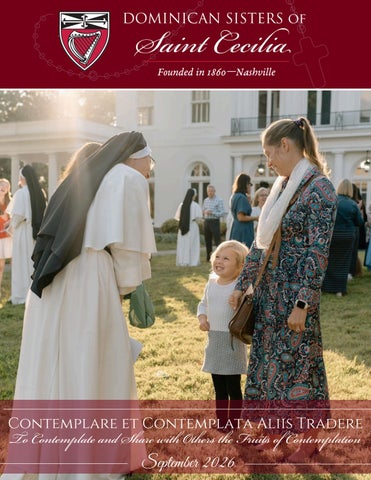
Contemplare et Contemplata Aliis Tradere
To Contemplate and Share with Others the Fruits of Contemplation September 2026
Virtue
The Beauty of Freedom By Sister Miriam, O.P.
A
s a literature teacher, I often help students observe the examples of specific virtues (and vices) in the texts we study, but it’s also important to stop and think more deeply about the concept of virtue itself, starting with what it’s not.
Virtue is not the Catholic version of self-help, nor is it a requirement to be met first before receiving God’s love. Rather, our desire to grow in virtue is a response to God’s invitation. As The Catechism of the Catholic Church explains, “God, infinitely perfect and blessed in himself, in a plan of sheer goodness freely created man to make him share in his own blessed life. For this reason, at every time and in every place, God draws close to man. He calls man to seek him, to know him, to love him with all his strength” (1). Although Baptism infuses the life of grace within us and frees us from original sin, we are still marked by its damage in the darkness of our minds, the weakness of our wills, and the disorder of our emotions. We need repeated exercises to redirect and strengthen these powers so that we can truly live as children of God. When we admire the integrity of certain individuals and note the perfections of the saints, we are drawn to the rightly-ordered use of their human abilities. That is, we seek prudence, right reasoning in action; justice, rightly willing each his due;
fortitude, the ordered response of endurance and attack in the face of threats; and temperance, the ordered response to the delights of our senses. These human virtues, the Catechism explains, “are rooted in the theological virtues, which adapt man's faculties for participation in the divine nature” (1812). The theological virtues, faith, hope, and love, are so called because they come from God and lead us to God. Faith perfects our intellect to believe what God has revealed because He can neither deceive nor be deceived. Our will needs hope to give us direction to heaven by reliance on God’s grace and charity to give it extension, the expansiveness of love for God and our neighbor. Virtues are habits, so they must be practiced, but we aren’t working on our virtues on our own. Let me offer an analogy: consider a skilled ballroom dance couple. There are movements in the sequence when the man may lift or spin the woman; she may appear to be doing nothing at all. However, she is certainly doing something: she is cooperating with the man and focusing her entire attention on the posture required by this action. Likewise, as the soul cooperates with God’s guidance, it is a true teamwork. The person does not become some automaton of virtue. But it is clearly not man’s work alone: after all, how would I know to strive for the goodness of the virtues without the inspiration of the One who is Goodness Himself?
Venerating the relics of St. Carlo Acutis in Assisi, Italy
Similarly, we are not striving after virtue for some selfcongratulatory goal. We seek the freedom virtues bring— the freedom to do good purely and with ease—because this is why God has made us: “For freedom Christ has set us free” (Galatians 5:1). We glorify Him in living our lives and exercising our human faculties to the full: “the glory of God is man fully alive” (St. Irenaeus). And, as St. Paul VI explained in Evangelii Nuntiandi, “the first means of evangelization is the witness of an authentically Christian life....‘Modern man listens more willingly to witnesses than to teachers, and if he does listen to teachers, it is because they are witnesses’" (41). Consider St. Carlo Acutis. He did not become a saint because he created a database of Eucharistic miracles; he became a saint because of his virtue. His growth in faith, hope, and love led him deep into a relationship with God which he desired to share—this bore fruit in his website. His life also manifested the beauty of the cardinal virtues: he tempered his enjoyment of video games by disciplining himself to only one hour a day, he practiced justice by seeking to honor the imago Dei in the homeless people he met, prudence helped him discern the best ways to support his classmates in everyday teenage life, and he bore his terminal cancer diagnosis with great fortitude. What beauty the life of virtue gives to the soul! How good God is to give us His grace each day as we continue to grow throughout the course of our lives: “living the truth in love, we should grow in every way into him who is the head” (Ephesians 4:13). May the saints pray for us as we cooperate with God on this great adventure.
Day in the Life
Contemplation
Becoming a Child Before God By Sister Albertine, O.P.
O
ne of the surprises of becoming a St. Cecilia Dominican was an unexpected freedom to enjoy the good things of creation—chocolate chip cookies, a game of Ultimate frisbee on a spring day. We delight in God’s creation because Jesus did, and everything Jesus said and did was for our instruction and imitation. I have grown to realize how radically our lives are meant to imitate our Bridegroom, the Son of the Father. Jesus teaches us how to be a child of the Father who confidently receives everything from Him and surrenders everything back to Him. This posture is at the heart of how we as St. Cecilia Dominicans also go to the Father, through the Son, in the Holy Spirit – through our life of mental prayer and contemplation. In mental prayer, we address ourselves to God in the inner sanctum of our thoughts. We can thank Him, ask for help, intercede for others, or silently adore Him. Contemplation is turning our attention toward divine truths to plumb ever deeper the unfathomable mysteries of God and His love for us. We rise early each morning so that we have a half-hour for such meditation. Many sisters choose the daily Mass readings as a starting point. Others might be drawn to a particular book of Scripture, such as the Gospel of John or the Song of Songs. The Catechism is also a fine choice. I have found that choosing the “right” passage is not so important as how I arrive to meditation. A posture of receptivity makes the time fruitful. God yearns for our disposition of childlikeness— our confidence that He is present, attentive to our needs, and fully capable of providing for us. In other words, He desires that we become “little children” at his feet. And so the thirty minutes of contemplation (my “morning glory”) is less a mental exercise to make connections between the first reading and the Gospel, and more about whether I am open to receiving God’s love as a Father to His child. Am I small enough to let myself be loved? Do I have faith that God will heal me this morning through His word?
Everything Jesus said and did was for our imitation. What was the first thing Jesus did on this earth—even before his childhood in Nazareth? Jesus spent nine silent months in the womb of his mother Mary. He was totally vulnerable and dependent on the nourishment he received. He did not have any preaching missions to prepare or public miracles to schedule. He did not have to impress anyone. He just had to receive.
When our time of meditation is concluded, often by the small ringing of a bell, we often try to gather the insights gleaned or resolutions made, like picking up scattered flowers into a bouquet, so that we might have a word of encouragement for others that day. Such is the gist of the Dominican motto, “contemplare et contemplata aliis tradere”, often translated “to contemplate and to give to others the fruits of our contemplation.”
And so do we. Our contemplation is like gestation. Enclosed in the womb of Our Lady, accompanied by the Word, we become small enough to peer into infinite truths. We come to realize that our little life is deeply wanted and everything in the universe is ordained through God’s providence. We share a heartbeat with the Word made flesh. We quietly grow, nourished through grace and the Holy Spirit, into the child of God we were created to be—one who resembles Him.
But we don’t pray primarily to become a spiritual “fruit factory.” God is not to be used, but to be enjoyed. Our time of contemplation is our gradual transformation into the person of Jesus Christ and union with the Father. A more faithful translation of the Dominican motto is “to contemplate and give to others that which is contemplated.” In other words, to give Jesus himself.
A man once told St. John Vianney how he prays: “I look at Jesus, and he looks at me.” Contemplation can be as simple as gazing on the face of Jesus or being held with him in the arms of Mary. Words are not always necessary.
And thus by pondering his words in our hearts, we follow in the way of Our Lady—the first disciple who knew that everything Jesus said and did was for her instruction.
Vocation Story
In Service of the
Truth
Sister Elizabeth Marie, O.P.
S
t. Thérèse writes, “O Jesus, my Beloved, who could express the tenderness and sweetness with which You are guiding my soul!” I loved to meditate on these words as a college student, and I see the truth of them even more as I look back on the great work God has done for me.
My vocation story is a conversion story. Although raised Catholic, I wasn’t well catechized and ended up being subtly influenced by feminist ideology, which led me to reject some of the Church’s teachings. I had many arguments with zealous Catholics at my college, but none of these arguments convinced me. It was not until I moved to Rome for a year of study at the Angelicum that I finally accepted the grace of surrender to the fullness of the Church’s teachings. Arriving in Rome without the same clear Catholic identity as my classmates, I found myself in an odd position: studying philosophy and theology at a pontifical university while still being a heretic! Fortunately, Dominicans are experienced at preaching to heretics, and within a month of being there, I was converted by the Holy Preaching of the Order, with a little help from St. Thérèse, whose book I had happened upon while looking to start doing spiritual reading for the first time. Soon after making my “fiat” to the power of the Holy Spirit working in the Church, I began seriously discerning religious life. Having realized the power of God’s grace and the beauty of His Truth, I felt a subtle and growing desire to give everything to Him in service of this Truth. Having witnessed the joy and wisdom of the Dominican friars who taught me, when I visited the Motherhouse the following year all I could think was, “I’m a Dominican!” About six months later, two years after my escape from heresy, I entered St. Cecilia Congregation. Soon, I learned that some of the first Dominican nuns were likely women St. Dominic had rescued from heresy. Having received the saving Gospel from him, they longed to share it with others. I feel similarly called–St. Dominic’s sons preached the Gospel of grace and authentic freedom when I needed it the most, and now I am privileged to preach this same Gospel to all I meet.
Dominican Saint
St. Hyacinth I
of Poland
n 1220, Krakow needed a new bishop. A zealous priest by the name of Ivo was appointed, and when he traveled to Rome for his consecration, he brought his nephews Hyacinth and Ceslaus along. Both were already priests and Canons Regular in Krakow. While in Rome, Ivo met Saint Dominic. Amazed by the poverty, zeal, and joy of the new Order of Preachers, Ivo begged Dominic to send some of his friars to the Church in Krakow. Dominic had long cherished the desire to preach the Gospel in the North, so he was eager to acquiesce to Ivo’s request. The problem: There were no Dominicans who spoke Polish. The solution: Dominic bestowed the habit on Hyacinth and Ceslaus! From his first days as a Dominican, Hyacinth enjoyed the special protection of the Mother of God. She appeared to him in a vision and promised him her unfailing help, and throughout his years of labor in the Lord’s vineyard she was true to her word. Hyacinth traveled all over northern Europe preaching the Gospel and spreading the Dominican Order. In his travels, he was often faced with extreme difficulties. Winters were harsh, and the peoples he encountered were often hostile to the Gospel. Even when they were open, Hyacinth struggled to learn the many regional languages required to communicate with them. Throughout these difficulties, Our Lady stood by him, and the graces flowing from his preaching mission were extraordinary: both spiritual conversions and physical cures. St. Hyacinth is usually depicted holding a monstrance with the Blessed Sacrament in one arm and a statue of the Blessed Virgin in the other. This iconography refers to the most dramatic occasion of Our Lady’s protection of Hyacinth’s life. During the celebration of Mass, the Tartar tribe was attacking the Dominicans’ convent. Hyacinth calmly concluded the Mass before being forced to flee with the other brethren. As he went to retrieve the Blessed
Sacrament and leave the priory, to his amazement, a heavy alabaster statue of Our Lady began to speak to him, begging him not to leave her behind where the Tartars were sure to desecrate her. Hyacinth demurred that the image was too heavy for him to carry along with the Holy Eucharist. “I will lighten the load for you,” Mary promised. Hyacinth made an act of faith and took the image of his Mother in his arms. Miraculously, the statue was easy to carry, and Hyacinth was able to protect both the Eucharist and the Blessed Virgin. As a final sign of her heavenly favor, our Lady promised Hyacinth the grace to die on the feast of her Assumption. His feast day is celebrated two days later, on August 17th. St. Hyacinth is invoked against dangers of drowning and, as jovial Catholic humor would have it, as the patron saint of weight lifters.
An Apostolic Summer Camp Wojytla, Colorado
LifeTeen, Covecrest, GA
VBS, Mount Vernon, IN
APOSTOLIC ADVENTURES SUMMER 2026 Our sisters were able to be present for a number of camps and Vacation Bible Schools around the country. These pictures show the various places we were blessed to visit.
Totus Tuus, Rapid City, SD
VBS, Haubstadt, IN
Perpetual Profession of Vows TOP/ Sister Caterina Joy, Sister Agnes Rose, Sister Evelyn Rose, and Sister Maria Trinity are pictured with Bishop Mark Spalding of the Diocese of Nashville, Archbisop Anthony Fisher of Sydney, and Mother Anna Grace. CENTER LEFT/ The sisters received the sign of peace from the sisters who have made perpetual vows. CENTER RIGHT/ Sister Caterina Joy signs her vows on the altar. BOTTOM/ While the litany of saints is sung, the sisters make a prostration.
Reception of the Habit TOP/ On the feast of St. Dominic, the postulants received the habit and a religious name, beginning their canonical novice year: (front) Sister Diana Gloria, Sister Maria Guadalupe, Sister Theodora, Sister Madelon Marie, (middle) Sister Veronica Caeli, Sister Clare Caeli, Sister Isabel Therese, Sister Josefina Grace, Sister Catherine Elizabeth, Sister Mary Hope, Sister Agnes Victoria, (back) Sister Maria Bosco, Sister Mary Lioba, Sister Kathryn Jane, Sister Helena Anne, Sister Hannah Caterina, Sister Genevieve MIDDLE / Each postulant receives the habit that she sewed. When Mother hands the habit to the postulant, she also pronounces her religious name. BELOW/ The sisters have the opportunity to greet the new novices and learn about their religious names and feast days.
First Profession of Vows
TOP/ Sister Angelina, Sister Catherine Therese, Sister Maria Carlo, Sister Catherine Grace, Sister Rachel Therese, Sister Agnes Collette, and Sister Mary Francis pictured with Sister Mary Rachel, Director of Novices. MIDDLE / After the sisters affirm their resolve to live the vows of poverty, chastity, and obedience, they profess their vows into the hands of Mother Anna Grace. BELOW LEFT / Once the sisters have professed vows, they receive a black veil from Bishop Mark Spalding, Diocese of Nashville, as a sign of their consecration. BELOW LEFT / The Bishop blesses the sisters’ scapulars while they make a prostration.
Postulant Entrance
TOP/ Our new postulants! (front) Sister Sophia, Sister Justina, Sister Carolynn, Sister Mariam, Sister Hailey, (back) Sister Catherine, Sister Sophie, Sister Constance, Sister Margaret, Sister Kathryn Rose LEFT & BELOW / After a three-day retreat, the postulants are pinned with the Dominican cross by Mother Anna Grace.