�� Agriculture as Economic Infrastructure
Part 3: The Plate Layer
Where Agriculture Drives Larger-Scale Economic Activity in The Pasture, Platform, and the Plate Model™
By Mary P. Tate Westman, RN, MBA, JD
The Plate Layer: Where Agriculture Drives Economic Activity
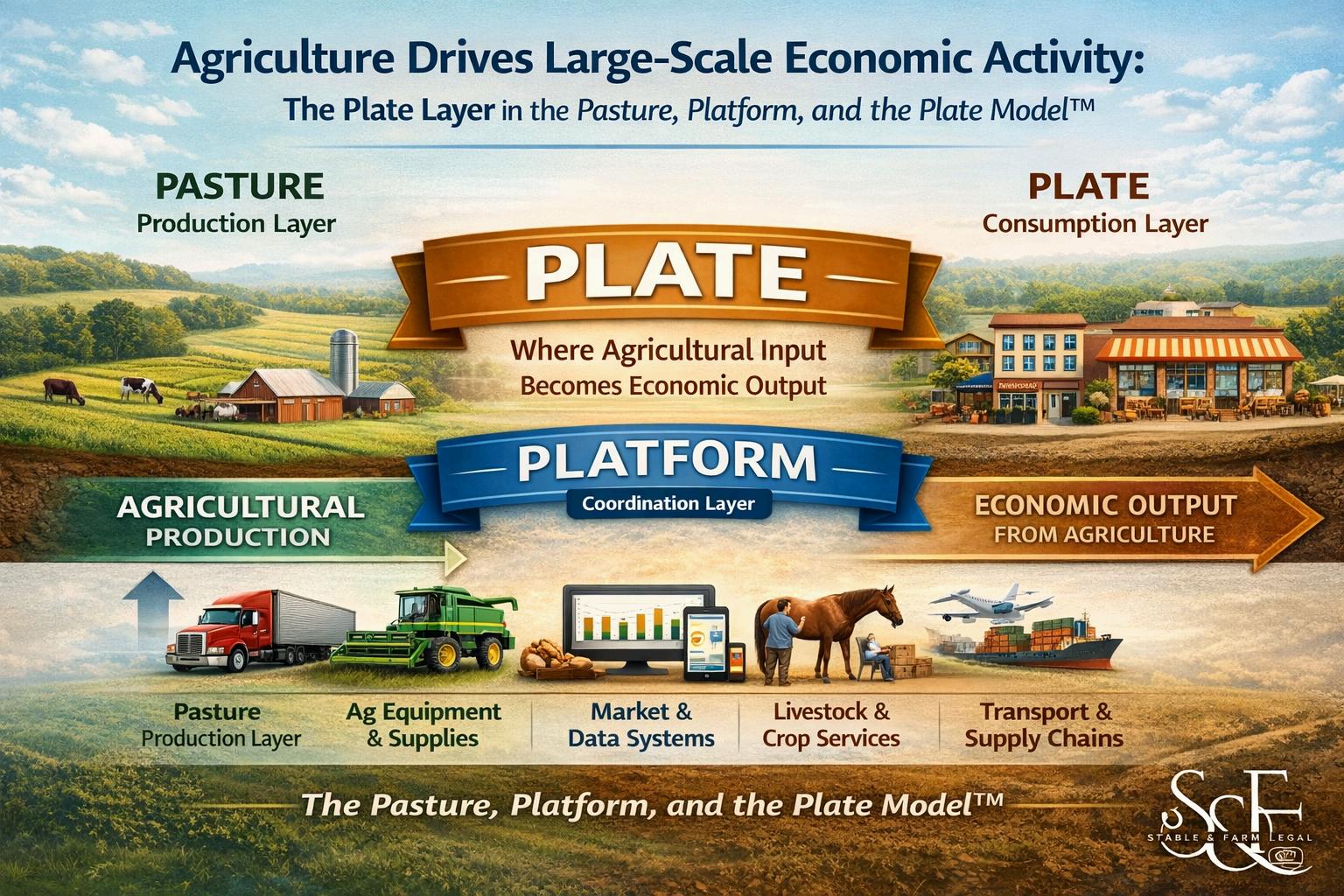
Within The Pasture, Platform, and the Plate Model™, the plate layer is where agriculture becomes the driver of larger-scale economic activity. It is the point at which agricultural production moves beyond raw output and begins to power entire sectors of the economy While production is essential, it is at the plate layer that agriculture’s broader economic significance becomes most visible, as goods are transformed into services, experiences, and sustained economic output
The plate layer encompasses the industries that convert agricultural production into consumer-facing activity Restaurants, grocery stores, food processors, institutional food providers, hotels, and event venues all depend on agricultural inputs to operate These sectors do not simply consume agricultural goods; they build economic systems around them. Hotels and lodging operations, for example, rely on food service as a core component of their business model, supporting conferences, tourism, and daily operations Likewise, performance and entertainment sectors including equestrian events, livestock shows, rodeos, and agricultural exhibitions depend on agriculture both as a resource and as the foundation for the experiences they provide.
This transformation from production to consumption illustrates how agriculture becomes an economic engine Every meal served, every hotel stay supported by food service, and every event built around agricultural activity represents a chain of economic value that originates in agriculture What begins in the pasture layer ultimately drives revenue, employment, and infrastructure across multiple sectors of the economy.
The plate layer also reveals agriculture’s multiplier effect A single agricultural product does not generate value only at the point of production; it creates additional value as it moves through processing, transportation, preparation, and service. By the time it reaches the consumer, it has supported multiple layers of economic activity This expansion of value is why agriculture’s contribution appears modest when measured solely at production, yet becomes far more significant when downstream activity is considered
The hospitality, lodging, and retail sectors provide clear evidence of this relationship Restaurants depend on consistent agricultural supply to operate, while hotels rely on food service to meet guest expectations and support events Grocery stores depend on steady agricultural inputs to maintain inventory, and event venues rely on catering and agricultural-based experiences to generate revenue. These industries are often analyzed independently, but they are structurally dependent on agriculture Their stability and growth are tied directly to the reliability and scalability of agricultural production.
The equine industry provides a particularly compelling illustration of the plate layer in action Equestrian events including horse shows, rodeos, racing, and competitions generate substantial economic activity through lodging, dining, retail, and tourism. Communities hosting these events experience increased demand for hotels, restaurants, and local services, often resulting in meaningful economic impact. Yet this activity is frequently categorized under
hospitality or tourism rather than agriculture, despite being entirely dependent on agricultural production and the systems that support it.
Understanding this dynamic is essential to accurately evaluating agriculture’s role in the economy. When agriculture is measured only at the production level, it appears to be a relatively small contributor to GDP However, when the full system is considered including the plate layer it becomes clear that agriculture supports and drives a much larger share of economic activity. Failing to account for this leads to incomplete analysis, misinformed policy decisions, and regulatory frameworks that do not fully consider downstream impacts
This has important implications for both policy and law. Regulatory decisions affecting agriculture do not remain confined to production; they extend into hospitality, lodging, retail, and service sectors Disruptions at the production level can cascade through the system, affecting supply chains, business operations, and local economies. From a legal perspective, this interconnectedness increases the importance of contractual stability, supply chain reliability, and risk management across multiple industries
Beyond its economic impact, the plate layer also reflects agriculture’s role in community life. Food and agricultural experiences bring people together through restaurants, events, and shared cultural traditions. They support local identity, tourism, and social interaction, reinforcing agriculture’s contribution not only to economic systems but also to community stability and quality of life
Ultimately, within The Pasture, Platform, and the Plate Model™, the plate layer demonstrates that agriculture is not simply a contributor to the economy it is a driver of larger-scale economic activity. It is where production becomes economic output, where goods become services, and where agriculture supports entire industries ranging from hospitality and lodging to entertainment and tourism
The conclusion is straightforward. Agriculture does not stop at production; it drives what comes next When agriculture is strong, the economy expands When agriculture is disrupted, the effects extend far beyond the farm, rippling across industries and communities. Understanding the full economic impact of agriculture is therefore essential It is not merely one sector among many it is the infrastructure that drives and sustains economic activity at scale
This article is provided for educational and informational purposes only and reflects the author’s opinion It is not intended as legal advice, and no attorney-client relationship is formed by its publication or use.
About the Author
Mary Westman is an Oklahoma Ag & Equine Law Attorney to include mediation services; Horse Breeder; and Equestrian Boarding Proprietor with an MBA. A native of West Virginia, she now lives with her husband, David, in Norman, Oklahoma. She can be contacted at mary@stableandfarm legal
© Mary Westman 2026. All Rights Reserved.