
�� Agriculture as Economic Infrastructure
Part 1: The Foundation
Rethinking the Economy Through The Pasture, Platform, and the Plate Model™
By Mary P Tate Westman, RN, MBA, JD
Rethinking Agriculture’s Role in the Economy
This article is the first in a three-part series examining agriculture through a broader and more accurate economic lens Part 1 introduces the foundational concept that agriculture functions as economic infrastructure. Part 2 explores the platform layer the systems, industries, and services that support and move agricultural production Part 3 examines the plate layer, where agricultural output becomes large-scale economic activity across hospitality, retail, and service sectors Together, these articles present a unified framework The Pasture, Platform, and the Plate Model™ to better understand agriculture’s true role in the economy
I was compelled to write this article after attending a recent legal education seminar where I found myself at odds with a prevailing narrative During a discussion on regulatory development, I advocated for taking into consideration the impacts that new laws and companion regulations have on agriculture-based businesses particularly given the central role agriculture plays in both the Oklahoma and national economies That position was met with the assertion that agriculture comprises only a small percentage of GDP approximately 3% and therefore does not warrant heightened consideration in policy development While that statistic is commonly cited, it reflects only a narrow view of agricultural production and fails to capture the broader system that agriculture supports. Because I believe that view materially understates agriculture’s true value and importance, I am compelled to offer a different perspective
Agriculture is often discussed as one industry among many measured, compared, and ranked alongside manufacturing, energy, or technology But that framing misses a more important point Agriculture is not simply a sector of the economy It is the foundation upon which much of the economy is built. When viewed through the lens of production alone, agriculture appears limited in scope When viewed as part of a broader system, its role expands significantly
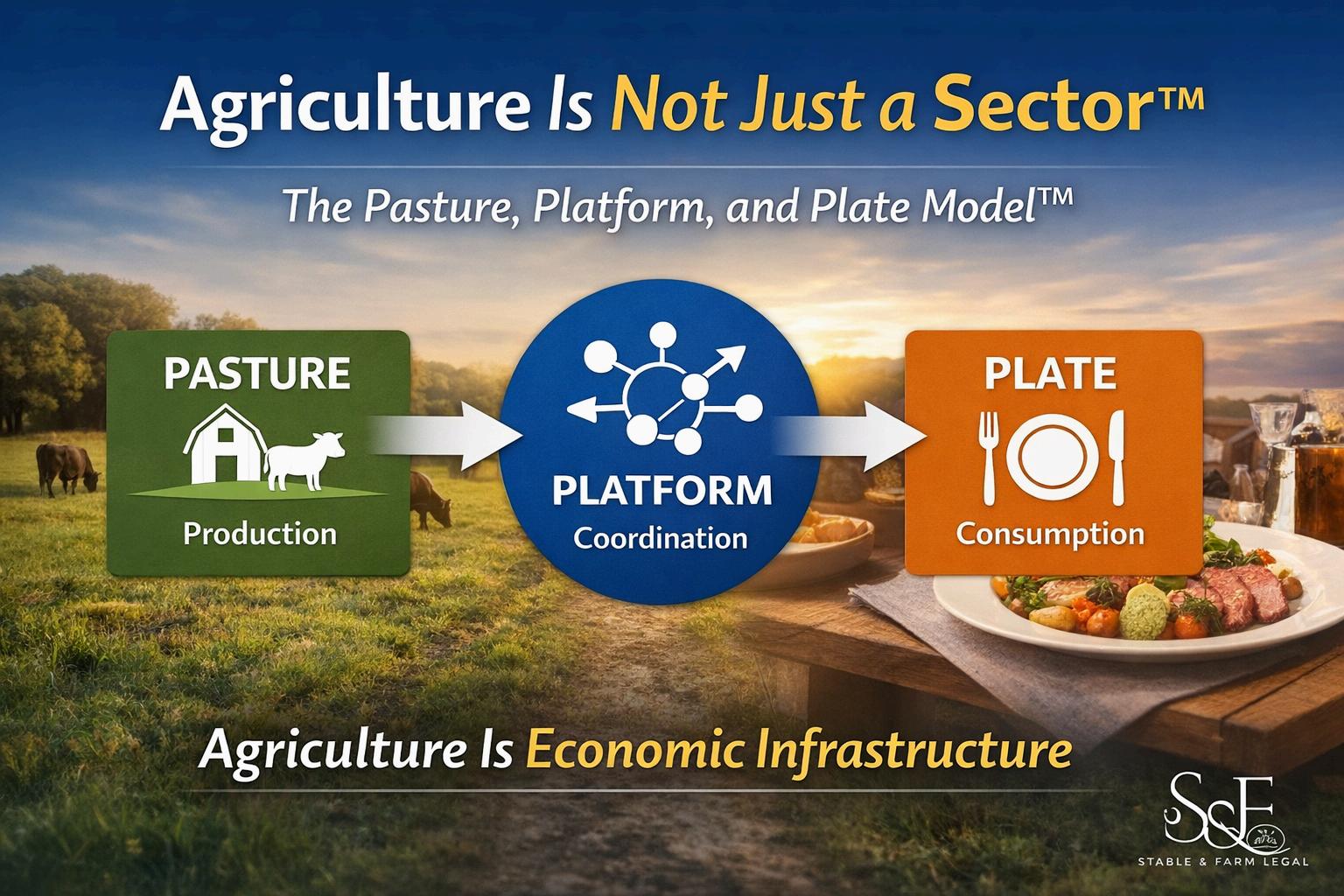
To understand this more accurately, agriculture is best understood not as a standalone industry, but as an integrated system The Pasture, Platform, and the Plate Model™ This framework reflects how agricultural production, coordination, and consumption operate together to support economic activity at scale. The pasture layer represents the production of agricultural goods
1 of 4
through land, livestock, crops, and labor The platform layer encompasses the systems and industries that support, coordinate, and move those goods. The plate layer represents the point at which those goods become economic activity through consumption, services, and experiences Together, these components form a continuous system rather than isolated or sequential stages.
At its most fundamental level, agriculture provides what no other industry can: food Every worker, every business, and every institution depends on a reliable food supply. This is not discretionary consumption; it is a prerequisite for participation in the economy itself Without agriculture, there is no labor force, no productivity, and no economic growth. This alone places agriculture in a category distinct from most other industries
However, agriculture’s role extends far beyond production It operates within a system that includes processing, packaging, transportation, distribution, and ultimately consumption. Restaurants, grocery stores, schools, hospitals, and event venues all depend on a continuous and coordinated flow of agricultural products. The hospitality sector is directly tied to agriculture, as every meal served and every event hosted depends on agricultural inputs.
Traditional economic measurements often fail to capture this broader impact Gross domestic product assigns value to each stage of production but separates those stages into different categories Agricultural production is measured at the farm level, while downstream industries
2 of 4
such as manufacturing, retail, and hospitality are categorized independently The systems that connect these activities logistics, transportation, and market coordination are also treated separately. This fragmented accounting obscures the reality that these sectors are interdependent and that agriculture underpins them all
The equine industry provides a particularly clear illustration of this broader system. Horses originate as agricultural assets, dependent on land, forage, water, and labor From that foundation, a wide range of supporting industries emerge, including veterinary care, farrier services, training operations, transportation, and facility management. As horses are used in competition, recreation, and tourism, they generate economic activity in hospitality, retail, and local service sectors. A single equine event can produce substantial economic impact within a community, yet much of that activity is categorized outside of agriculture, even though it depends entirely on the agricultural foundation that sustains it
Agriculture also functions as infrastructure in a more literal sense. It shapes land use, supports rural economies, and maintains open space In states like Oklahoma, agricultural and equine operations play a significant role in preserving productive land and preventing fragmentation. These contributions extend beyond measurable economic output to include environmental stewardship and community stability factors that are essential to long-term sustainability but are often excluded from traditional economic analysis.
As the economy becomes more complex and increasingly digitized, agriculture’s foundational role becomes even more apparent. Modern supply chains rely on logistics systems, data analytics, and digital coordination to move goods efficiently These systems enhance agriculture’s reach and efficiency, but they do not replace it Technology can optimize distribution, but it cannot substitute for production. Instead, it reinforces agriculture’s central role within the broader economic system
Understanding agriculture as infrastructure has important implications for policy and law. When agriculture is treated as a small or isolated sector, regulatory decisions may be made without full consideration of their broader impact Those decisions extend across the entire system, affecting not only production but also the industries and services that depend on it. A more accurate understanding requires recognizing agriculture as an integrated system that supports economic activity across multiple sectors
At the same time, legitimate concerns regarding environmental impact and animal welfare must be addressed Agriculture is not static, and the industry has demonstrated a capacity for innovation and adaptation. Advances in precision agriculture1 , improvements in soil health
1 USDA Economic Research Service, Precision Agriculture Use Increases with Farm Size and Varies Widely by Technology
3 of 4
practices2 , and ongoing developments in animal care and training reflect a broader shift toward more efficient and sustainable practices. The most effective approach is one that builds on these innovations through collaboration, rather than imposing rigid frameworks that fail to account for operational realities
Ultimately, the central point remains clear: agriculture is not a marginal sector. It is a system that supports economic activity, food security, and community life Its value is not confined to production but is realized through the interconnected processes that move goods from pasture to plate through the platform layer. Understanding this system is essential to making informed decisions about policy, regulation, and the future of the agricultural economy
Disclaimer
This article is provided for educational and informational purposes only and reflects the author’s opinion. It is not intended as legal advice, and no attorney-client relationship is formed by its publication or use
About the Author
Mary Westman is an Oklahoma Ag & Equine Law Attorney to include mediation services; Horse Breeder; and Equestrian Boarding Proprietor with an MBA A native of West Virginia, she now lives with her husband, David, in Norman, Oklahoma. She can be contacted at mary@marywestmanlawcom
© Mary Westman 2026. All Rights Reserved.
2 Natural Resources Conservation Service, Soil Health Principles and Practices.