MARTLET.CA
SEPT 24, 2026 • VOLUME 79 • ISSUE 6
@HUMANSOFTHEMARTLET
@THEMARTLET
@THEMARTLET
THE
MARTLET UVic's independent newspaper
NEWS
CAMPUS
SPORTS
A student’s guide to this year's municipal elections
2026-2027 UVSS board of directors releases strategic plan
UVic to host national men’s rugby championship in November 2027
PG. 5
PG. 9
PG. 3
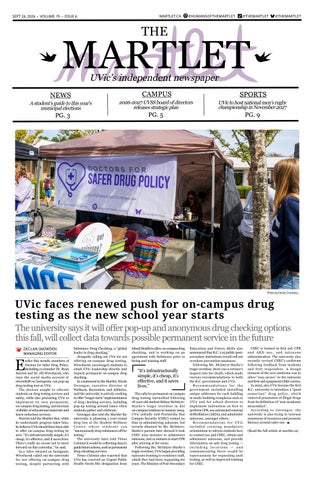
Graphic courtesy of Doctors for Safer Drug Policy.
Photo by Declan Snowden..
UVic faces renewed push for on-campus drug testing as the new school year starts The university says it will offer pop-up and anonymous drug checking options this fall, will collect data towards possible permanent service in the future DECLAN SNOWDEN MANAGING EDITOR
E
arlier this month, members of Doctors for Safer Drug Policy, including co-founder Dr. Ryan Herriot and Dr. Jill Wiwcharuk, who runs the social media account @ streetdrjill on Instagram, ran pop-up drug testing tent at UVic. The doctors sought to educate students on drug testing services and safety, while also pressuring UVic to implement its own permanent, on-campus drug testing, and increase visibility of educational materials and harm reduction services. Herriot told the Martlet that, while he understands progress takes time, he believes UVic should have been able to offer on-campus drug testing by now. “It’s infrastructurally simple, it’s cheap, it’s effective, and it saves lives. There’s really no excuse not to move forward on this yesterday,” he said. In a video released on Instagram, Wiwcharuk called out the university for not offering on-campus drug testing, despite partnering with
Substance Drug Checking, a “global leader in drug checking.” Alongside calling out UVic for not offering on-campus drug testing, Wiwcharuk encouraged students to email UVic leadership directly and request permanent on-campus drug checking. In a statement to the Martlet, Nicole Greengoe, executive director of Wellness, Recreation, and Athletics, said the university is actively working to offer “longer-term” implementation of drug checking services, including pop-up testing around times when students gather and celebrate. Greengoe also told the Martlet the university is planning a year-round drop box at the Student Wellness Centre where students can “anonymously drop substances off for testing.” The university later told Times Colonist it would be collecting data to guide future actions, such as permanent drug-checking services. Times Colonist also reported that UVic has received an Urgent Public Health Needs Site designation from
Island Health to allow on-campus drug checking, and is working on an agreement with Substance prior to hiring and training staff.
“It’s infrastructurally simple, it’s cheap, it’s effective, and it saves lives.” The calls for permanent on-campus drug testing intensified following 18-year-old student Sidney McIntyreStarko’s tragic overdose in her on-campus residence in January 2024. UVic initially told Postmedia that Campus Security (CSEC) wasted no time in administering naloxone, but records obtained by Ms. McIntyreStarko's parents later showed it took CSEC nine minutes to administer naloxone, and 12 minutes to start CPR after arriving at the scene. Following Ms. McIntyre-Starko's tragic overdose, UVic began providing naloxone training to residence staff, which they had been requesting for years. The Ministry of Post-Secondary
Education and Future Skills also announced that B.C.’s 25 public postsecondary institutions would roll out overdose prevention measures. Following Ms. McIntyre-Starko’s tragic overdose, there was a coroner's inquest into her death, which made various recommendations to both the B.C. government and UVic. Recommendations for the government included installing unique addresses for each building in multi-building complexes such as UVic and for school districts to implement instruction on how to perform CPR, use automated external defibrillators (AEDs), and administer naloxone, amongst others. Recommendations for UVic included creating mandatory orientations to inform students how to contact 911 and CSEC, obtain and administer naloxone, and provide information on safe drug testing — including locations — and communicating there would be repercussions for requesting such testing, as well as improved training for CSEC.
CSEC is trained in first aid, CPR and AED use, and naloxone administration. The university also recently revised CSEC’s uniforms following feedback from students and first responders. A design element of the new uniforms was to allow “easy access” to the naloxone and first-aid equipment CSEC carries. In 2025, also UVic became the first B.C. university to introduce a “good samaritan” drug policy, which removed possession of illegal drugs from its definition of “non-academic misconduct”. According to Greengoe, the university is also trying to increase awareness of resources and promote literacy around safer use. (Read the full article at martlet.ca)
NEWS
A student’s guide to this year's municipal elections
Everything you need to know about how to vote in the upcoming general local elections DECLAN SNOWDEN MANAGING EDITOR
OPEN
HOUSE
GOODBYE RENT.
SATURDAYS 1-4 PM
WHAT ARE THE CRITERIA TO VOTE?
Hello Equity. Heritage Inspired Boutique Suites & Townhomes
FROM
$339,900
60% SOLD | MOVE-IN READY!
(plus GST if applicable)
Discover Your Path in Sustainability Virtual Open House | Oct. 28 | 4–5 pm Explore a range of credentials and upskilling opportunities designed to meet the growing demand for green skills in the job market. You’ll get the chance to dive deeper in small group sessions focused on key program areas, including:
LEARN MORE
continuingstudies.uvic.ca/sustainability-path
The elections will include voting for new mayors and councillors, regional district directors, school board trustees, parks boards, and the Islands Trust. The mayor and council are the primary governing body of a municipality. Collectively, they will engage with residents, consult with staff, and move motions that impact life in the city. Municipal councils, like Victoria City Council and District of Saanich Council, are responsible for delivering local services to their residents. On your ballot, you will also have the ability to vote for school board trustees, and, if you’re voting in a municipality in the Capital Regional District (CRD) –– the regional government comprising the
WHEN, WHERE, HOW? Most voting stations will be open from 8 a.m. to 8 p.m. on Oct. 17. There will also be advanced voting prior to Oct. 17, but dates, times, and locations will vary. For details on your municipality ’ s advanced voting, visit their respective webpage. Vote-by-mail is also offered, with details varying by municipality. The MyDistrict page on Elections BC is designed to show individuals their provincial riding but it will also tell you your municipality when you enter your address. Depending on where you live, your municipality may have advance registration. You can call your municipality's local election line to inquire about advance registration and whether you are on the voters list. You can also register when you go to vote. To do so, you will need two pieces of acceptable ID, such as a B.C. driver's licence, services card, Canadian passport, or SIN number card, one of which needs to have a signature. A piece of ID with
proof of residence is recommended. If you do not have a piece of ID with proof of residence (such as an up-to-date driver’s licence with your address on it), or another proof of residence (such as a utility bill) you can make a solemn declaration as a substitute. For more information on acceptable ID visit the B.C. government's 2026 FAQ page, or call your municipality's legislative service or election line.
WHAT IF I’M FROM ONE MUNICIPALITY, AND STAYING IN ANOTHER FOR SCHOOL? Say you’re from Vancouver, but you’re staying in the City of Victoria to attend UVic. Where should you vote? In B.C., you can vote in either (but not both) municipalities, provided you are an eligible voter. For additional information on B.C.’s general local elections, visit your municipality ’ s respective page, the B.C. government's voter guide, local elections 101 brochure, and 2026 local elections FAQ page, as well as Elections BC.
The $72 million project took six years to complete, and remains controversial among some Saanich residents RONIYA SAHIN SENIOR STAFF WRITER
• Climate Action • Ecological Restoration • Spatial Data and GIS
WHAT ARE YOU VOTING FOR?
municipalities of southern Vancouver Island and the Gulf Islands. The CRD board of directors make decisions on matters affecting the whole CRD, and are responsible for services like regional water supply, solid waste, wastewater treatment, regional parks and recreation facilities, and some housing supply. While these roles may not feel as important as mayor or council, they still influence your life in your municipality. For example, many candidates in the last general local elections were anti-Sexual Orientation and Gender Indentity (SOGI), and opposed allowing students in grade school to self-identify using their preferred pronouns, or use washrooms that correspond to their gender identity. Mayor and council also make decisions on major issues such as housing supply, transit, and policing — among others. If you’re a resident of the City of Victoria or the District of Saanich, you will have an additional item on the ballot — a nonbinding question to gather public opinion on the potential amalgamation (merging) of the two municipalities.
Years-long Shelbourne Street Improvements Project marks its completion
MarloweResidential.ca
4201 TYNDALL AVENUE JUST MINUTES FROM UVIC!
2 // SEPT 24, 2026
Reading this in-print? Check out the web version, which has hyperlinks to relevant pages and resources. Voting is an important part of the democratic process. Whether or not you are happy with how your municipality has been tackling the issues facing its residents, you should go out and vote to ensure your voice is heard and your views are represented. Many voters focus solely on federal and provincial elections, but municipal politics can greatly shape how you experience life on a day-to- day basis. On Oct. 17, voting for B.C.’s general local elections will occur. Every municipality in B.C. will be voting in new municipal representatives, including mayors, councillors, school board trustees, parks boards, the Islands Trust, and regional district directors.
To vote, you need to be at least 18 years old, a Canadian citizen, have been a B.C. resident for at least six months, be a resident of the municipality or electoral area on the day you register to vote, and not be disqualified under the Local Government Act or any other act from voting in an election.
On Sept. 14, the District of Saanich finally cut the ribbon, marking the completion of the controversial six-year-long Shelbourne Street Improvement Project (SSIP). The project sought to improve water infrastructure, road safety, and overall accessibility to community members, and saw the installation of new bike lanes, pedestrian safety improvements, transit infrastructure improvements, the replacement of underground utility infrastructure, and renewed asphalt road surface. “I think that the changes that have taken place here not only ensure that everybody
walking, biking, taking the bus, or driving can do so safely, but that there is also the creation of spaces where people can come together, where they can build community,” said Saanich Mayor Dean Murdock at the announcement. “[Everyone] can enjoy all of the rich benefits of the incredible natural spaces, and services and amenities that this valley and its neighbourhoods have to offer. And that is truly the vision behind the plan.” The project was initially part of the Shelbourne Valley Plan, a 30-year strategy focused on improving land use, transportation, climate action, and housing. The SSIP was made possible through funding from Saanich, the Canada Community-Building Fund, B.C.
government, ICBC, and funds distributed by the federal and provincial government. At completion, the total cost of the project was $72.3 million. Cycling advocacy and education group Capital Bike hosted a short celebratory bike ride at the ribbon cutting ceremony. The ride served as an opportunity to demonstrate the new transportation accessways. “It just speaks to the importance [of this project] that the community has deliberately kept moving this forward over such a long period of time,” said Capital Bikes Executive Director Ian MacKichan in an interview with the Martlet. “It’s kind of a once-in-a-generation reconstruction of a road,” he said. The duration of the project, however,
was a point of contention with many community members. Phase one of the project took two years, beginning in April 2020, and saw major water system upgrades that continued into phase two. The second phase started new sidewalk paving and raised bicycle lane construction from North Dairy Road to Pear Street, which took approximately two years as well. The third and final phase focused on continued drainage infrastructure replacements, relocating BC Hydro and Telus lines, the removal of 13 trees, and planting 46 new trees. Stuart Hackett, President of the Save Our Saanich Neighbourhoods Society (SOS), said he shares concerns “seen on social media,” primarily that of barricaded
cycle lanes preventing access for emergency vehicles. “SOS is in favour of changes to roadways to improve safety and flow for everybody,” said Hackett. “But we don’t agree with the way Saanich has implemented some of these changes; we think it’s to the detriment of vehicles [and] emergency vehicles.” Jean Newton from pedestrian advocacy group, Walk On, Victoria, said she is looking forward to safer and improved alternatives to driving in the Saanich area. “[The SSIP] is a good example of improvements being actualized,” said Newton. “It took forever, so it’s not a good example of doing it quickly … but it’s a good example of it finally happening.”
Rishi Sharma runs for Saanich mayor on ‘Save Our Saanich’ slate
Running on the Save Our Saanich slate, Rishi Sharma will be facing off against current councillors Zac de Vries and Karen Harper for mayor DECLAN SNOWDEN MANAGING EDITOR This is the third article in a series covering all of Saanich’s mayoral candidates. Read the Martlet’s article on Zac de Vries and Karen Harper. Rishi Sharma is an experienced public servant, Saanich resident of 46 years, as well as a continuing studies instructor at UVic. Sharma is running as the candidate for “Save our Saanich,” a legally registered elector organization who “advocate[s] and act[s] to enhance and protect Saanich's treasured environments, agricultural lands, and welcoming, human-scaled neighbourhoods for generations to come.” Sharma’s platform includes, amongst others, “balanced development,” prioritizing “family-oriented housing — including 3, 4, and 5-bedroom homes — not just small condos and investororiented units,” protecting “Saanich’s
parks, forests, farmland, coastlines, and natural areas,” and opposing the discussed amalgamation of the City of Victoria and the District of Saanich. Sharma ran for council in 2022, partially due to frustration with the district's administrative processes for building, but ultimately did not win a seat. At the time, Sharma’s frustrations were over how difficult it was to build in the district, though he currently believes the district now has the opposite issue, pushing too many "inappropriate" developments forward. After his campaign in 2022, Sharma completed his Master of Arts in Leadership at Royal Roads University, where he wrote his thesis on building relationships through “uncomfortable conversations.” Sharma said he hopes to bring these learnings to the mayor role in Saanich. He said that, while working on his thesis, he learned how to build relationships, and
that he hopes to bridge discourse on contentious issues. “I’ve been to a couple council meetings where two councillors were butting heads publicly. I think having proactive, safe conversations ahead of time to make sure that doesn’t happen on council,” he said. “It will happen, but I want to really build our relationships so we can move items forward.” On policies for students, Sharma said he wants to hold open office hours as mayor so residents, both younger and older, can come and speak to him on issues important to them. Sharma also told the Martlet that he would like to see a permanent youth council in Saanich. This year, Saanich had a youth council pilot project, which ended in July. The youth council recommended the creation of a permanent youth advisory committee. Sharma also said he would like to “quickly get back to the table” with the
provincial government to discuss a path forward for the 510-bed student housing development, which faces a five-year delay following the B.C. government’s 2026 budget. Sharma said he would like to “see how we can get that moving for UVic, because there is a need.” Sharma said he has created a youth committee inside the Save Our Saanich elector organization, featuring a couple students from UVic. He also said that, as a director in the Ministry of Post-Secondary Education and Future Skills, he and his team fought for opportunities for students, as well as inclusion, equity, and diversity. Sharma also works for the Construction Foundation of BC, where he says he’s working on a health and wellness centre for trades people who may have substance abuse issues and other issues. The centre, according to Sharma, will be in Langford and will service all of southern Vancouver
Island, and he says the foundation is looking at building parallel structures in Prince George and Ontario. Sharma said he is also working on programming to help aspiring tradespeople to get their Red Seal Certification. The initiative uses funding from the federal government, as well as in partnership with Coast Capital, and helps tradespeople who have had difficulties getting their certification achieve it by offering counselling and one-on-one help. According to Sharma, the initiative has an 82 per cent pass rate. Voting for the 2026 local general elections will be held on Oct. 17. The elections will include voting for new mayors and councillors, regional district directors, school board trustees, parks boards, and the Islands Trust. More information on this year's local general elections can be found at elections.bc.ca.
SEPT 24, 2026 // 3
NEWS
“Too decrepit to function.”
New club and course unions software causing frustration among club executives Rubric was rolled out to clubs and course unions, executives are frustrated with lack of communication or support ABIGAIL FISHMAN SENIOR STAFF WRITER *Names of certain individuals have been changed to protect their anonymity. The UVSS is transitioning clubs and course unions (CCUs) to the online club management platform Rubric, and the change is causing friction. Rubric, an Australian software company, is used at over 100 campuses globally, by over 5 000 student clubs. The UVSS began working on implementing Rubric in early July, “in preparation for the Fall 2026 ratification cycle,” Director of Student Affairs Maddy Vanderhooft told the Martlet in a statement. Vanderhooft told the Martlet that direct communication with CCUs regarding Rubric began on Aug. 21, but implementing the software was discussed earlier in CCU meetings over the summer. In both course union and club council meeting minutes, “new software” is mentioned on May 11, and a “Rubric Demo” on Sept. 14. However, some CCU executives report first learning about the transition through emails from Rubric — before the UVSS
announced the change. Sam FitzJames, vice-president of the UVic Stand-up Paddleboard (SUP) club, said in a statement to the Martlet that he learned about the transition on Aug. 19 in an email from Rubric, welcoming him to the platform. This email included various links to create membership, set up events, and more. C* and A*, two humanities course union executives, said they received a nearly identical email from Rubric on Aug 20. Prior to this, C said they had not received any communication about moving to a new platform. “When the email first went out, there was no how-to guide, no guideline on how to set this up, how to navigate [it],” C said. In an Aug. 21 email provided to the Martlet, in which CCU executives were informed by Vanderhooft about the change, the director also said that executives had challenges with the previous system, specifically with communication, form submission, and finding CCU information. Vanderhooft cited Rubric’s success at other Canadian universities such as Simon Fraser University (SFU) and the University of British Columbia Okanagan (UBCO) as a reason the software was chosen by the UVSS.
“This software transition is meant to help make managing your clubs or course unions much easier, efficient, and transparent,” Vanderhooft wrote in the email. However, several execs told the Martlet that they still have concerns. One exec said they have concerns about data privacy — specifically where CCU and user data will be stored. Rubric has data centers in Canada, the United States, Australia, and New Zealand, and offers data residency options in these countries “so customers have more control over where their data is stored.” Vanderhooft said in a statement to the Martlet that the UVSS takes privacy and data protection s e rio u s l y , and “ re c o g ni ze s t h e concerns that have been raised regarding data storage and hosting.” She added that they are actively reviewing Rubric’s privacy and data management practices, but did not directly answer a question about where student data will be stored. In the Aug. 21 email, she also stated that the process of club & course union ratification will now be done through Rubric, "reducing the number of forms [CCUs] will need to complete.” However, several CCU executives said they are still learning how to navigate the new software, and some
said they are concerned about missing the ratification deadline, and having to wait until the Spring semester to ratify. “I just don’t want clubs to get penalized for not being able to work with it,” said Dirk Slot, who is on the executive of multiple clubs. Vanderhooft said their priority is to ensure that CCUs that have made a “good-faith effort” to complete ratification requirements prior to the deadline are “supported through the transition.” She stated that applications submitted with the previous process “are being reviewed” and that the UVSS is “working to ensure that groups are given every reasonable opportunity to achieve ratified status.” Multiple CCU executives told the Martlet they experienced significant difficulties in navigating Rubric’s user interface (UI). A, the humanities course union exec, said he was still able to access many features he was told by the UVSS were disabled. Several CCU executives said they are also frustrated with how changes had been communicated. “We have really hated the transition, and lack of support in the entirety of the process,” an executive from the UVic Global
Brigades club said in a statement to the Martlet, while Fitz-James, the SUP Club exec, said in a statement that his club received little support. He said that the experience was “relatively manageable” for himself, but he could see how the “nonobvious functions of the software” may have caused issues for other CCUs. Vanderhooft said in the statement that “the UVSS has provided a range of supports to assist clubs and course unions during the transition.” She listed written guides and instructions, direct email support, troubleshooting assistance, extended office hours, and dedicated ratification help sessions. “When we reached out, I feel like support was good,” C said, “but it could have been avoided to start with by having some sort of additional information being sent out.”
CAMPUS
2026-2027 UVSS board of directors releases strategic plan The plan outlines each lead director’s goals for their term and strategies to achieve them ABIGAIL FISHMAN SENIOR STAFF WRITER The 2026-2027 UVSS Board of Directors have put together their 2026-2027 strategic plan — a collection of goals and strategies for each lead director to accomplish. The report begins with an executive summary outlining the board’s mission, values, and more; followed by a portfolio from each lead director, containing the director’s role, a summary of their goals, and finally timelines and action plans to achieve those goals. Director of International Student Relations (ISR) Cherop Lyoba outlined three long-term projects aimed at creating more capacity to support international students. Her first goal involves expanding the ISR director role to an “adequately funded,” full-time position, intended to take effect after the current term, which ends in April. Lyoba is building her case by conducting comparative research on other student unions, and creating a funding model that “survives election-cycle turnover.” Lyoba said the ISR director position “is significantly underfunded relative to the other roles.” “I do want to impact students as much as I possibly can, but with those resources and that time constraint … it’s not as feasible,” she said. “It doesn't allow me to fully impact students to the capacity that I would like to.” She initially wanted to make the ISR role
full-time to match other lead directors, but has since shifted away from that goal.She told the Martlet that the UVSS is running a deficit, and persuading the rest of the board to approve increasing the hours and wage for the ISR role might prove difficult. She added that it is generally unrealistic for a student role to be full time, specifically for an international student, who “just can’t afford to only take one course per semester.” For these reasons, Lyoba says that she has turned her attention to her main goal, “which is to make [the position] adequately funded.” Lyoba’s other two goals are to create an international student section within the UVSS annual general survey, and to increase international student engagement with the UVSS. She told the Martlet that both of these goals will support the ISR director in delivering supports to international students. Director of Finance and Operations Mariah Luzon outlined three goals intended to increase student involvement with the UVSS “while delivering something of real value.” According to the plan, Luzon’s top priority is increasing food security on campus. She intends to increase food bank awareness and capacity by running campaigns and identifying “needed” upgrades. Luzon plans to start a recurring free breakfast club through sponsorships and partners in the community, as “a direct way of fighting food insecurity on campus.”
She also aims to increase and promote financial literacy on campus through sessions with “subject matter experts.” Her last goal is to raise foot traffic for SUB businesses. Her strategies include promoting SUB businesses at UVSS events, coordinating regular business campaigns, improving social media content, and tracking sales patterns to review the effectiveness of these initiatives. The Martlet requested to speak with Luzon about her part of the plan, but did not receive a response. Director of Student Affairs Maddy Vanderhooft’s section of the strategic plan includes three goals. Her first two goals are to increase club engagement, and improve club management software and administrative processes. Over the last couple of months, she has been working on the implementation of a new club management software, Rubric, which has caused frustration among some club and course union (CCU) executives. Her last goal is to expand accreditation opportunities for CCU executives as a more formal way to acknowledge the work they do, alongside expanding training and resource offerings. Vanderhooft wrote that CCUs often dedicate significant time and energy to building communities on campus, and she is working to expand accreditation opportunities to recognize these efforts. Additionally, resources will be expanded to include more workshops, updated resource guides, and more opportunities for student leaders. Vanderhooft declined the opportunity
Oak Bay faces critical issues as residents hit the polls this October
What would you ask a mayoral candidate?
The District of Oak Bay faces a $300 million repair deficit for critical infrastructure, poor housing supply, and some of the highest property taxes in the province
In advance of the upcoming municipal elections, the Martlet hit the ground to ask UVic students what they’d ask a mayoral candidate
DECLAN SNOWDEN MANAGING EDITOR On Feb. 19, incumbent mayor Kevin Murdoch announced he would be seeking re-election for the District of Oak Bay. Murdoch was acclaimed to the position in 2022 as the sole person running, and, until recently, it looked like he may be acclaimed again. However, on Sept. 1, Sam Holland — a UVic alumnus, and the founding chair of Better Transit YYJ, announced he will also be running for mayor. As the clock is ticking for this year's local general elections, the two candidates face not only the pressure of winning over the district's residents, but the pressure of addressing the district's many issues as well. Oak Bay is at a critical crossroads. In 2025, Oak Bay passed a massive property tax hike of 11.4 per cent — significantly higher than that of the District of Saanich (8.02 per cent) and the City of Victoria (6.99 per cent) — and again this year, Oak Bay’s property taxes were raised by 8.4 per cent, while Saanich raised theirs by 5.35 per cent and Victoria by 7.28 per cent. One reason for the high property tax hikes year over year is decades of neglect and underfunding to critical infrastructure, such as drainage and wastewater. The result: a projected $1.3 billion in infrastructure spending in the district over the next 100 years, $469.7 million of which is forecast to be spent between 2022–2047. “We have about a billion dollars of cost to replace all our infrastructure, of which about $300 million is really due
4 // SEPT 24, 2026
in the next couple of decades … so that’s the big bubble that we’re facing right away,” Murdoch said in an interview with the Martlet. According to Murdoch, the district is spending “around $18 million a year right now, up from about one and a half [million] eight years ago.” In an interview with the Martlet, Holland acknowledged the district had taken “big steps” toward addressing the infrastructure issue, but had concerns over how rapidly property taxes were being increased. “By putting that all into property taxes, you're putting a lot of pressure on people like seniors on fixed incomes,” Holland said. “There hasn't been any attempt to cushion that blow by widening the tax base, [such as] increasing the number of businesses in Oak Bay [or] increasing the population of Oak Bay through increasing the [amount] of housing.” While housing is a challenge throughout the country, Oak Bay’s path forward is particularly tumultuous. In 2023, the B.C. government issued directives to municipalities across the province to build more housing. Oak Bay and West Vancouver fell significantly behind their year one targets (Oak Bay built 16 of 56 houses), prompting the Minister of Housing and Municipal Affairs to release a statement on the lack of progress, and issue more directives to “streamline” housing production. However, the district said in a release that their completion of 16 houses in year one was a “significant increase from historic levels of approximately two net new units per year” from 2019–2022. Murdoch said Oak Bay largely struggles to hit housing targets due to
RAAMIN HAMID SENIOR STAFF WRITER
Photos courtesy of Sam Holland (left) and Kevin Murdoch (right).
a lack of available land. “We don’t have any vacant land in Oak Bay and the land costs are very high. So any new development requires buying at least one piece of property, often two or three to do land accumulation to make anything higher density,” he said. Both Holland and Murdoch want to bring more density to the district. Murdoch’s platform includes advocating for UVic to develop a high-density project on Cedar Hill Corner, a property owned by UVic that has the potential to hold up to 3 800 housing units in the district. Holland wants to bring more housing and business to the district, particularly in centres like Estevan Village and Oak
Bay Village. He also wants to preapprove designs for small apartments, townhouses, and laneway houses to speed up processes. Beyond tackling these pressing issues, Holland’s platform includes building a community clinic to increase healthcare access, tackling the climate crisis on a local level by offering interest-free loans to replace outdated furnaces and heat pumps, and pushing for more third spaces for arts and culture in the district, amongst others. Murdoch’s platform also includes supporting the arts by propping up the creation of “micro-venues” and supporting local galleries, addressing climate challenges by “ensuring that
anticipated climate change impacts such as sea-level rise are incorporated into long-term engineering and planning decisions,” and “reducing and managing” the deer population, amongst others. Voting for the 2026 local general elections will be held on Oct. 17. The elections will include voting for new mayors and councillors, regional district directors, school board trustees, parks boards, and the Islands Trust. More information on this year's local general elections can be found at elections.bc.ca.
On Oct. 17, municipalities across B.C. will be hitting the polls, electing new or returning mayors and councillors. This means UVic students who are eligible to vote will have the opportunity to engage in the democratic process and ensure their voice is heard. For the fourth time in a row, the Vic Theatre is hosting the mayoral debate for City of Victoria candidates on Sept. 27, prior to the elections. In light of this, the Martlet decided to ask UVic students, “What would you ask a mayoral candidate?” Olivia Druxerman, a first year masters student, said she is not yet well acquainted with Victoria, but is keen to know about recreational programming. She said she would ask a mayoral candidate: “how do you plan to improve … or integrate recreational programming?” As B.C. faces housing shortages across the province and as student housing projects have faced delays, housing supply was
arecurring theme amongst students. First year business student Hana Nozawa said she is particularly interested in how city officials plan to increase housing in an affordable way. Nozawa is from the Langford area, and said she has seen an increase of residents in Langford and Victoria. “[I’m curious] what their housing situation would be, and what they plan on doing to increase housing, just because we're students and then looking into our futures, we need to make sure that there is an affordable way for us to live,” she said. Similarly, Tadakadzwa Pswarayi, a third year mechanical engineering student, wonders how the needs of new residents would be met in Victoria. “Since Victoria's getting a lot of new people moving to the city from different provinces, different countries — how would the mayor [work] to make sure that the new people coming in are catered to. Because things need to change from what Victoria looked like ten years ago to now, since there's
Photos by Sabina Mendoza.
more diverse groups coming in.” When it comes to transit around the Greater Victoria area, Vojtech Tobola, a third year history student, said he would ask about the transit system’s current ability to serve individuals living in and around Victoria well. “I think I'd ask about the transit situation in Victoria and the surrounding regions. Because it’s really, really difficult to get around the greater Victoria area. It's very time consuming. Even [in] North Saanich to get to the ferries, it's quite a time consuming trip … I feel like the transit system that's currently in place isn't really adequate to the demands of the amount of people that are in … and around Victoria,” he said. Sabrina Cain, a first year social sciences student, said she was more concerned about student experiences. “I would … ask what they would do to make changes to better the student life. I guess, I'm not too sure,” she said. Second year mechanical engineering student Tristan S. Shanks said he wants to know more about the municipal budget. “How do they ensure that they're fully utilizing the full budget to support as many people as possible?” Housing issues, affordability, UVic life, and transit are just some of the issues UVic students are apprehensive about heading into the October elections. Voting for the 2026 local general elections will be held on Oct. 17. The elections will include voting for new mayors and councillors, regional district directors, school board trustees, parks boards, and the Islands Trust. More information on this year's local general elections can be found at elections.
to interview about the plan. Director of Outreach and University Relations Matthew Curtis outlined two goals pertaining to awareness and student engagement with the UVSS, as well as one goal to support more student-driven projects. For his first two goals, Curtis plans to run a recurring video series on Instagram titled “Mornings with Matt,” His other plans include tabling, running campaigns and more. Curtis told the Martlet in an interview that his goal with the video series is to “help make people more aware of what the UVSS does for them, in a way that they feel like they can relate to.” To achieve his goal of supporting more student-driven projects, Curtis plans to make himself more available to students for collaboration. Curtis wants to act as a facilitator between students and the groups or individuals that can help develop their ideas. “I do know people, and I can connect them with each other to make the ideas come to fruition,” he said. Mohan Selvarajan, director of events, outlined five goals that largely reflect his role’s portfolio. His five goals are to double free hot lunches, “keep the recurring stuff running smoothly,” “get the big events right,” continue to build with student groups, and “try a few new things.” His section states that free hot lunches have been increased from monthly to biweekly in both the fall and the winter
— “the biggest change in the portfolio this year [which] directly supports food security on campus.” To “keep recurring events reliable” and “get the big events right,” Selvarajan plans to budget for recurring events first each semester, and “start planning early instead of scrambling closer to the date.” To continue building with other student groups, he intends to provide support for other groups’ events without taking them over. Finally, he would like to “test a small batch of cheap, easy-to-explain ideas and see what sticks.” Selvarajan did not respond to the Martlet’s request for comment. Tam Aljundi, director of campaigns and community relations, has three goals that broadly reflect the responsibilities of his role, including increasing student engagement with UVSS campaigns, advancing student priorities through advocacy and community relations, and strengthening student connection to community, supports, and resources. He plans to accomplish these goals by delivering “focused campaigns with clear objectives,” creating opportunities for students to participate, “clearly” representing student concerns, and creating a welcoming environment. Aljundi also did not respond to the Martlet’s request for a comment.
UPCOMING FILMS
TUNER JULY 3 & 4: 5:00 & 7:10
ETERNAL SUNSHINE OF THE SPOTLESS MIND JULY 16: 5:00 & 7:10
Photo courtesy of Pierre ____.
THE DEATH OF ROBIN HOOD
COUTURE JULY 21 & 22: 5:00 & 7:00
JULY 17 & 18: 5:00 & 7:20
SEPT 24, 2026 // 5
ARTS & ENTERTAINMENT
ARTS & ENTERTAINMENT
'The Women of the Fur' Trade is a hilarious, unmissable production
WARA-WARA exhibition opens at the UVic Legacy Art Gallery Downtown
The Belfry Theatre’s season opener is a hilariously anarchic exploration of the Red River Rebellion BRIANNA BOCK SENIOR STAFF WRITER The year is “eighteen hundred something.” Outside a fort on the Reddish River (historically known as the Red River), what will become the Red River Rebellion is brewing. But inside the fort sit three women with nothing else to do but gossip over their celebrity crushes: Louis Riel (played by Aren Okemaysim) and Thomas Scott (played by Jonathan Mason). So opens The Women of the Fur Trade, the latest show put on by The Belfry Theatre. The play immediately defines its style of storytelling by using modern dialogue and slang despite the historical setting. The modern dialogue is used for comedy in the first few scenes to help ease the audience into the world of the play and its internal logic, but is effective throughout. The slang never feels forced in for the sake of being “hip” or “#relatable.” By having modern dialogue and slang, The Women of the Fur Trade explores a common question often asked of historical pieces — why is this relevant today? The linguistic choices of the show represent a blunt approach to that question, but an
effective and entertaining one. While the world is changing outside the fort, Marie-Angelique (played by Kelsey Kanatan Wavey), Cecilia (played by Amanda Lisman), and Eugenia (played by Danica Charlie) are bored. Due to the gendered expectations of the time, these women are expected to sit and wait for their husbands. MarieAngelique, the youngest of the three, is yet to be married, and fantasizes about the perfect man. She has developed a crush on Métis resistance leader and founder of Manitoba Louis Riel, based on all the stories she’s heard about him. The production renders their world is deliberately small, contrasting Marie-Angelique and Eugenia’s straining to be part of something bigger — something that may result in meaningful political change and power as Indigenous women in Manitoba. By contrast, Cecilia, a white woman, is mainly concerned with her and her many children’s safety inside the fort. The limited world that the women operate in is reflected in the set design, which is kept simple. A small wooden fort with no doors opens up to reveal the three of them in their rocking chairs. Occasionally, the fort is closed for scenes that feature Riel
and Scott, and their own strange friendship, neither as noble as Marie-Angelique and Cecilia imagine them to be. The doorless, windowless fort is used for both comedic and dramatic effect. While initially, the fact that the set doesn’t have a door isn’t unusual — it’s a set — until the characters themselves draw attention to it. The play’s humour is strengthened by the genuinely funny dialogue, and a cast that knows how to deliver it. All five actors featured in the show have great comedic timing, and play off each other fantastically well. Wavey, Lisman, and Charlie come across as both close but reluctant friends as the political realities of the rebellion test their friendship. The Women of the Fur Trade is an anarchic and hilarious exploration of Canadian history, and the unresolved threads of the Red River Rebellion that continue to affect our world today. It’s about friendship. It’s about celebrity crushes. It’s about finding the strength to do something while the world irreparably changes, and the actions you have to take. And it’s very fun. The Women of the Fur Trade runs until Oct. 4. Tickets are available on the Belfry Theatre’s website.
The exhibition’s theme and message are a response to the moments of social, political, and environmental uncertainty AMELIA WATSON SENIOR STAFF WRITER
Photo by Peter Pokorny.
The UVic Legacy Art Gallery is hosting WARA-WARA, an exhibition of street art and graffiti from Yogyakarta, Indonesia. The exhibition will be running free of charge from Sept. 16. to Dec. 5. The WARA-WARA exhibition was brought together through the collaboration of Survive! Garage — a community-run alternative space and art shop in Kasihan Indonesia, as well as UVic Professor of Pacific & Asian Studies Dr. Richard Fox, the University of Victoria Art Collections, and 21 participating artists — all from Yogyakarta, and four collectives. Survive! Garage founder Bayu Widodo said they started with 30 or 35 artists, but had to narrow the number down due to not having a large enough space. “We curated [the exhibition] to be 21 artists all with different styles, different characters, and techniques…. The connection between each artist is [that] we work in the same city,” he said.
The exhibition’s title, “WaraWara,” is a Javanese term meaning an announcement, warning or public call. This concept aligns with the exhibition’s theme and message –– a response to the moments of social, political, and environmental uncertainty. “It means announcement, and traditionally in Java, it’s how to call in the happiness and the sadness,” said Widodo. “In this exhibition, we want to show what the city looks like from the street art.” The forms of art featured in the gallery include photographs, tapestries, prints, paintings, and video installations in Javanese, amongst others. The installations and artists in the exhibition explore themes of resistance against oppressive regimes, antiwar movements, environmentalism, and representing power through art and community. A piece exhibited titled “Survive! Attacked” by Patub Porx, also a co-founder of Survive! Garage is a comic, depicting an attack committed
by a religious organization against an event held at Survive! Garage in 2016. The idea to depict the tragedy in the form of a long comic came from Fox, Porx said. “This artwork is not just visual art, but is a kind of archive,” he said. P or x also sh ar e d t h at h e is currently drawing more panels for the project. “We hope … students visit our space to learn about the collective … as well as life in Yogyakarta,” said Widodo. “As artists, we need to be doing what we love, and then we can continue [to develop] more and more as artists.” The WARA-WARA exhibition will be available to visit for free Wednesday through Saturday from 10 a.m. to 4 p.m. at the Legacy Art Gallery Downtown.
What does Kate Bush’s ‘The Dreaming’ have to offer us 44 years later? ‘The Dreaming’ continues to shine as an exemplar of distilled genius in an age of recycled RONIYA SAHIN SENIOR STAFF WRITER Kate Bush’s contentious fourth studio album The Dreaming turned 44 years old this year, on Sept. 13. The album is a precursor to her magnum opus Hounds of Love, and an enduring testament to Bush’s ingenuity. As user Suha on the music review site Album of the Year said, “Hounds of Love was gorgeous, this was … unexpected?” The Dreaming has been described by listeners as manic, erratic, daring, weird, progressive, haunting, awful, and beautiful. It is absolutely clear, however, that nothing sounds quite like it. Even for the wild and kooky Kate Bush, The Dreaming proved to be too strang e upon its re le ase , too original. Pitchfork notes the commercial failure of The Dreaming while recognizing that the album is still uniquely Bush. Mojo ranked the album second in Bush’s overall discography, but Rolling Stone rated it 60 out of 100, or three stars out of five. Very few artists self-produce an album sprinkled with didgeridoos, screaming bleats, and booming drums on their first try — but then again, not everyone is Kate Bush. The Dreaming screams and weeps in all the right
6 // SEPT 24, 2026
moments — an echo chamber of a n a r t i s t t r y i ng t o le g it im iz e herself through sheer willpower, and her peculiar fascination with the Fairlight Computer Musical Instrument synthesizer. Del Palmer’s masterful playing of the fretless Wal bass paired with Bush’s signature dynamic singing style concocted a brazen, angry album that can still stir up emotion. The amalgamation of staccato piano notes, jumpy snare drums, and sweeping bass riffs communicates Bush maturing both her sound and mind through song. Her anger is potent as she laments, “Give me something to show for my miserable life! / Something to take! / Would you break even my wings like a swallow?” in “Night of the Swallow.” Moments of despair feature the singer somberly admitting, “I didn’t want to let them see me weep / I didn’t want to let them see me weak / But I know I have shown / That I stand at the gates alone.” Every sound rolls over in waves of piercing anguish, enrapturing the audience with her on her self-discovery journey. Pain, however, cannot be borrowed, but Bush sure did try. On the title track, Bush attempts to take on the perspective of Australia’s Aboriginal peoples
grappling with the destructive forces of colonization, accompanied by drums and bellowing didgeridoos. Furthermore, “Pull Out the Pin” sees Bush desperately scream “I love life” from the eyes of a Viet Cong fighter fighting American opposition. Through adventurous and creative storytelling lyricism, both tracks raise questions on the limits of an artist’s portrayal of a pain they are not directly party to. What The Dreaming can teach us 44 years later is this — the journey to self-actualization is painful, wretched, and does not always create popular and widely understood content. Few are comfortable with messiness, and certainly not with madness. The Dreaming stands out in the age of pop musicians who create their own replicable brand of originality; it dares to exist beyond the boundaries of good and bad. It just is.
Eiafuawn’s ‘Endless Body’ still feels “fucked up and whatnot” An Offbeat by CFUV Review ANNA KING CONTRIBUTING WRITER Clay Parton’s project Eiafuawn — pronounced ee-uh-fon, and standing for “Everything is all fucked up and whatnot— put out his newest release Endless Body on streaming platforms at midnight on Sept. 11. The release date reflects the themes of his first self-recorded album, Birds in the Ground (2006), which was selfrecorded in Clay Parton’s room over the years following the fall of the Twin Towers in New York with a sense of heartsickness. His post-9/11 melancholy carries into his new project, “call me from the moon / I’m hiding from everything,” his hesitant voice confirms in “Take Me To My Room,” the first track on the EP. Coming 20 years after Birds in the Ground, the release was announced by The Numero Group to mark Parton’s return to the project a day prior. Much like his work with the indie rock band, Duster, the album’s sound oozes with slow guitars, hazy vocals, and the kind of slack-jawed feeling of staring at the ceiling with nothing but Parton’s performance permeating the listening experience. While Birds in the Ground played more on with raw acoustics, Endless Body leans into dreamy muted guitars, kicking off the album by stereo panning into the listener’s right ear. The listening experience shifts away from the bedroom folk sound on Birds in the Ground that placed Eiafuawn alongside the likes of Alex G and Elliott Smith, and into a more distant, shoegazey sound, which fits like a perfect constellation in Duster’s universe. The Endless Body EP opens with “Take Me to My Room,” where resonant acoustic plucking pulls the listener in before the muted, slow marching overdrive kicks in. Across the four tracks, the instruments feel stripped back, while Parton’s reverberating
SEPT 24, 2026/ 7
vocals sound further away, as if recorded in a large, echoing room. In the third track, “Lay Your Head Here in Mine,” the harmonies press close against the chest like a desperate lullaby, while the resonant instrumental sends his call out to space through astral reverberations. The heavy bass especially transports the listener out of the first track's dense haze to the weightless, lighter tone of the second track, which begins as more uplifting. In “People Talk,” Parton’s voice retains the distant, almost whispering tone that gets swept up by the buzzing overdrive once again, but the lyrics ring most clear, in which he asks the addressee to abandon this dimension. Themes of disappearance, hiding away, escapism, and a heavy hesitancy to speak in his lyrics permeates throughout, mirroring the post9/11 listlessness in his first project. Throughout, Parton’s voice reflects the 20-year gap between the last release and change through his other projects. The standout track is the final one, “Incantation,” which features a heavy, gritty opening, and a muddy tone that interplays with Parton’s distorted vocals. The texture is fuzzy, and his melancholic vocals become harder to hear, cutting out rather than lingering like the previous tracks, leaving the project’s end feeling even more fleeting. The instrumentals crowd and close in on the vocals, crashing with his voice. As the most shoegaze-heavy track on the record, it grounds the EP nicely, pulling the listener back down from orbit. This updated production places the EP somewhere between outer space and right here on earth. It’s between Duster’s interstellar slowcore and Eiafuawn’s evolved sound. This project celebrates the quiet return of a comfort cult figure that welcomes slowing down to listen and fade in and fade out with Parton’s heavy din.
NEWS OPINIONS
SPORTS
You should care about local politics
Vikes women play second soccer match of the night at ThunderFest for the first time
Local councils shape our daily lives, yet most students don’t vote for who sits on them. That absence leaves decisions on housing, affordability, and our future to those who do SHANIYA FRASER CONTRIBUTING WRITER
Shaniya Fraser volunteers with the Zac de Vries, Teale Phelps Bondaroff, and Jack Sandor campaigns. On Oct. 17, residents across B.C. will take part in one of the most direct ways to influence their communities: municipal elections. However, if recent trends hold, only around 30 per cent of eligible voters will actually cast a ballot — compared to about 58 per cent provincially and 68 per cent federally. Among post-secondary students, who skew younger, it’s almost certainly lower still. Part of that gap comes down to the cost of being informed. Local races are often less partisan, and lack the party labels that voters often use as shortcuts. It simply takes more research to figure out where candidates stand in municipal elections. And with a provincial election now scheduled for just one week later, voters have even more to keep track of. But when the people elected to local office have such a direct impact on our lives, knowing who will represent our interests is worth the effort. Local governments oversee much of what shapes daily life: housing, transportation, community planning, parks, recreation, roads, emergency
services, and the budgets that fund it all. Students have an enormous stake in these local decisions. Rezoning and permit approvals can determine whether more housing options are created near campus, at a time when the off-campus market is already tight. Transportation plans influence whether we can get to class, work, and home safely, reliably, and affordably. Long-term investments in infrastructure affect how much of the cost of aging infrastructure will be ours to bear. Yet students often have less time to weigh in on these issues. Between school, work, and long commutes for some, few can spare the hours for weekly council meetings. That’s why we need representatives who will carry these issues forward when we can’t be in the room ourselves. Student advocacy from elected representatives has worked before. Last spring, one Saanich councillor brought forward resolutions, calling on the district to lobby the province for a student food bank grant and $10 ferry fares for postsecondary students — both already endorsed by Oak Bay, and pushed by a province-wide student coalition. The majority of Saanich council rejected the motions before they could even be debated. Weeks later, the same ideas went on to pass with broad support at a regional convention. The issue wasn’t the ask; it was whether elected representatives were
willing to ask it. When that will is absent, the interests of those with more time, money, and power fill the gap by default. This can be particularly consequential for housing; where existing residents have both the opportunity and incentive to organize around developments, the beneficiaries of new housing don’t yet live there to speak up for it. Students can be just as affected by these decisions, but with less time and resources to make their voices heard. The consequences of this imbalance are already visible in local housing decisions: Saanich council recently rejected two projects that would have added housing near UVic, including a 349-unit development across from campus and a 77-unit rental project in Gordon Head. Local politics should matter to you because you matter to local politics — even if you’re ineligible to vote. If you care, show that you care. Write to candidates and incumbents, attend an all-candidates debate, or respond to an AMA. Find out where everyone stands by reviewing candidate websites, local news coverage, and non-partisan candidate surveys — such as the one published by Livable CRD. If you’re particularly passionate about an issue or candidate, reach out to local campaigns and see how you can help.
Let’s be more sustainable this fall Decorating for Halloween and maintaining the fall aesthetic hurts both our wallets and the environment RAAMIN HAMID SENIOR STAFF WRITER As fall rolls around, consumerism is once again forced into our faces. With fall fashion trends, the need to decorate with pumpkins, and Halloween coming up, we forget how much we are spending and on what. Often, the things we buy for autumn are perched up on our shelves for only two months out of the year. After the season ends, we either chuck them in the trash or put them under our beds as they await their turn to come out again next year. According to a nationwide survey done by Home Depot, 47 per cent of Canadians planned to decorate for Halloween last year. The survey highlighted that 36 per cent of Canadians wanted more elaborate decorations in 2025, and 58 per cent were wanting to have new decoration arrangements altogether. Additionally, in 2025 Canadians contributed an approximate $154 million USD in the global pumpkin spice market. These statistics show that Canadians are not shy about spending money on the aesthetics of fall. The urge to buy a skeleton to put in your front yard, or to have a nice cup of coffee, is not wrong — but the way we go about it is. As I like to say, awareness is the enemy of enjoyment. Even for those who are already sustainability focused, I urge you to not forget about it when a new season starts, because that is when it matters most. When your friends are going to buy a leather jacket (that is actually plastic) off of Amazon, direct them instead towards a local thrift store.
8 // SEPT 24, 2026
Illustration by Luisa Dela Cruz.
Or, if you know that you are really looking forward to pumpkin spice lattes from Starbucks — and you remember how much you spent on them last year — maybe invest in a nice pumpkin spice syrup that you can add to your coffee at home. There are also tons of places to find Halloween costumes and cozy clothes at thrift stores, like Value Village and the Salvation Army, around Victoria. If you prefer more curated or consignment stores, Cherry Pick Vintage and Upcycle Clothing Collective are my favourites. You can even ask a friend if they have what you are looking for. The point is, we should all be more aware, and ask ourselves questions before falling into the trap of overconsumption this season. This can also mean investing in items and pieces that you actually like, and will last you more than a month or two. Instead of buying three different Halloween costumes for the three
different parties you will be attending, maybe just ask your friends for pieces that you can turn into a costume. You can pretend to be a lot of people by using the clothes you, or the people around you, already have — for example, Lady Diana in biker shorts and a crewneck sweater (if you don’t get that reference, we can’t be friends.) For those who like to knit and crochet particularly in the fall — you don’t necessarily need to buy new yarn. You can recycle it either through pieces you have made before that you don’t wear or use anymore, or by going to the thrift store and unraveling yarn from a sweater or other type of knitwear. Enjoying fall does not have to mean spending bunch of money on things that won’t last, or on items that you don’t actually want, and are only getting because it’s trendy. I hope this encourages you to think more sustainably as you purchase items in the next couple months.
The Vikes walked away with a clean sheet after 0-0 tie against TRU WolfPack, but conversations continue as to whether the women will continue to play the later match of the night AMELIA WATSON SENIOR STAFF WRITER Graphic courtesy of the Native Students Union.
NEWS UNSETTLED | The Canadian ‘Tax-Dollar thieves’: Where do Indigenous people actually get their money? AVERY FEDERSPIEL NSU COLUMNIST You — hardworking Canadian citizen making a steady cheque but barely getting by. Do you feel peeved, perhaps slightly annoyed when you look down at your paystub and see our government took their cut yet again? Your taxes, your income, your livelihood! Where is it all going? ‘The mouths of indians with an insatiable appetite for government handouts, I bet.’ Why yes, my mouth is wide open, and all of your grievances are eaten, processed, and what’s leftover is the indigestible truth: Indigenous people aren’t funded by your tax money. But if Canadian taxes don’t pay for Indigenous communities' needs, where does it come from? The answer is yours truly — from Indigenous people and our stolen land. During the 1800s, colonial settlements were growing rapidly, causing the dispossession of our land, legitimized by the Indian Act and treaties between The Crown and Indigenous communities. The leftover earth was developed, sold, and industrialized. According to the treaties and multiple First Nations legislative acts, a portion of the wealth generated from the land and these processes must be shared with the its’ rightful caretakers. To systemically fulfill this obligation, the Indian Land Management Fund was established in 1858, and held individual accounts funded through land sales, leases, and resource extraction. By 1860, these accounts were consolidated into one trust and handed over to the authority of the Canadian federal government, now known as the Indian Trust Fund. The Indian Trust Fund manages two types of trust moneys—Individual moneys and First Nation moneys. Individual moneys are managed by Indigenous Services Canada (formerly the Department of Indian Affairs and Northern Development) on behalf of an Indigenous minor until they reach age of majority, an Indigenous person found unable to handle their own funds and lives on-reserve, and on-reserve estates of Indigenous members who passed away –– all individuals must be a status indian. First Nations moneys also fall into two categories –– capital and revenue money. Capital moneys come from the sale of Indigenous land, interest from
land sales, and the sale of Indigenous land resources: oil and gas profits, sale of reserve property, timber, and gravel. Revenue moneys are those earned from renewable resources, such as income from leases, permits, rights-of-way, fines, and interest earned over time on the Indian Trust Fund account itself. As of 2021, according to the Yellowhead Institute, the fund holds over $634 million. To access the Indian Trust Funds’ individual accounts, Indigenous people with status must fill out a form through their band, or the federal government website. After, individuals receive a one-time payment with the amount varying from treaty to treaty, and nation to nation. As for other profit, much of it is generated from Indigenousowned businesses on reserves where money is spent and goes back into the community. This is called “own-source revenue” and it was only within recent decades that Indigenous people could have control of their own economic development. Before we were given a small piece of economic autonomy back, communities were considered the sole responsibility of Canada — therefore economic development was heavily controlled until the Indian Act was amended. Presently, bands across so-called Canada have successfully established their own means of significant revenue. Some examples include major shopping malls on Squamish First Nations land, a winery established by Osoyoos First Nation, the Dakota Dunes Casino owned by the Whitecap Dakota First Nation, and more. So, next time someone insinuates that hard-working Canadians give handouts to Indigenous people and you happen to be present, I hope you remember this column. Don’t be shy to correct a fellow nonIndigenous person. We can’t always be around to educate the world, so we must rely on our allies to speak up when our names are on the chopping block. Are you brave enough for the task?
The UVic Vikes women’s soccer team opened the season with a slow, tense match against Thompson Rivers University’s (TRU) WolfPack on Sept. 11., marking their first time playing the second match of the night at the annual Thunderfest games. However, neither team was able to find the scoresheet, ultimately e n d i n g i n a 0- 0 g a me w i t h n o goals. For the first time, the men’s team kicked off the event at 5 p.m. against TRU, and took home the win 4-0. In 2024, multiple varsity athletes shared with the Martlet a feeling that the men’s team, who have historically played the second match of the night, got the “better slot” and more of the fanfare. Vikes goalkeeper Stefanie Mocnik earned her first clean sheet — letting no goals in — of the season, defending all 12 shots made by TRU. Generating goalscoring opportunities was difficult for both sides, as both the Vikes and
the WolfPack both boasted a strong midfield, and the WolfPack kept a tight defensive line. Both sides came close to scoring in the final 30 minutes, but each shot sailed to the side or over the net. In an interview with the Martlet, the women’s team coach Tracy David said, “It's always been something that our players have wanted. “The administration agreed with them, and that's how that happened,” she said. The Vikes reported 5 000 fans in attendance for the evening’s matches, but attendance dropped somewhat between games, and again at half-time. By the second half of the women’s game, Centennial Stadium was reduced to a smaller, but highly energized, group of fans. “I think [emotions] are the same whenever we play ThunderFest, whether we play the early or the late game,” said David. “It’s a big event, and we know there are going to be a lot of people there and a little bit of nerves may be kicking in, then lots of excitement.” “When we play the early game, [we] don’t always have a big crowd
right away, they are trickling in through the gate, so by the time it gets to half, you have a big big crowd. Playing the later game, the big crowd is already there … but then the crowd [left] at about half time,” David continued. David told the Martlet that the switch, which had the women's team playing after the men's team, may revert halfway through the season, if not earlier. However, she also said it’s possible the women's team will continue to play after the men’s for the rest of the year. “Those discussions are on the table … and each has its benefits,” David said. David said she would personally prefer the later start time, since it allows her players to have more time between classes and games to eat, rest, and have downtime before having to perform. The Vikes women’s team reconveined post-ThunderFest on Sept. 16 to debrief the event. “I think there is some sentiment [from the team], because it's the men's game, people are coming to the men’s game and not the women’s game,”
Photo by Justin Morash.
David said. “So now, we need to look at how we can change people’s perception or mindset.” The Vikes Women’s soccer team plays their next fixture against
TRU on Sept. 25 at 5:30 p.m., this time on the WolfPack’s home turf. The game will be livestreamed on canadawest.tv.
UVic to host national men’s rugby championship in November 2027 The McTavish Cup will kick off at Wallace Field and Centennial Stadium, hosting eight premier Canadian university teams GABRIEL LUNN VOLUNTEER STAFF WRITER On Aug. 26, UVic and the Canadian University Men’s Rugby Championship (CUMRC) announced the university would be hosting the 2027 McTavish Cup this November, bringing the country's most competitive rugby teams to Victoria for three nonconsecutive days of elite rugby. “It's the only opportunity in the year where all the top universities from across the country get a chance to measure up against each other,” said Scott Manning, head coach of the Vikes men’s rugby team. “[It’s] the nature of rugby in our country with how big it is.” Manning has led the men’s team as Head Coach since 2021, attending five previous McTavish Cup tournaments. The last time UVic won the McTavish Cup was in 2019. Maria Samson, chair of CUMRC, said in the press release that "UVic has a remarkable rugby history and has played an important role in the vision for a national university championship. We're excited to build on that legacy and bring Canada's leading university men's rugby programs to Victoria." CUMRC adopted the McTavish Cup as its public facing name in 2026. The trophy is named after Spence McTavish, a celebrated UBC Thunderbirds player, coach, and figure in the wider Canadian rugby scene. “We always have our eyes locked
on nationals, and that's what we're always pushing and fighting for,” said Morgan Di Nardo, a fourthyear geography and computer science (geomatics) student who plays the outside back position with the Vikes. Di Nardo competed in two previous McTavish cups, and is also a past member of Team Canada’s Rugby 15’s team, but was absent this past season due to injury. “We play in the men's club league with UBC out here in B.C., which makes us a little different from every other school in the country, because they all play in the university league.” The three non-consecutive day tournament will be played on two fields on campus, Wallace Field and Centennial Stadium, on Nov. 16, 18, and 20. By hosting the tournament, the Vikes receive an automatic pathway into the eight team tournament, which hosts teams from conferences and regions across Canada. “We're always a team that feels like we should be competitive and have the goal of winning a national ch ampi o ns h ip , so t h at d oe sn't really change with us hosting it,” said Manning. “Being able to play in our own city in front of our own friends and family adds extra excitement to the tournament.” Hosting the tournament provides apparent advantages for the Vikes.
Factors such as not having to travel, and getting proper rest and nutrition while remaining at home, may optimize their performance against opposing teams who’ve travelled to get here. Manning also said playing on a field whose condition and surface Vikes players are already familiar with could be advantageous. “A lot of the teams around the country play on turf, on artificial surfaces. Knowing the weather [and] the surface that we're used to and comfortable with I think gives a slight advantage as well,” he said. This year, the tournament is set to be hosted at Trinity Western from Nov. 17 to 21 in Langley. Until 2024, the only teams to have captured gold at the McTavish Cup since it began in 2017 were UVic and UBC. The École de technologie supérieure (ETS) Piranhas won gold in 2024, and the following year, the Guelph Storm won. “I would expect those two past winners to be very competitive this year and next year as well,” said Manning. “It's always UBC and whoever's from Ontario that we're looking out for [and] we're watching [footage] on,” said Di Nardo. Di Nardo also notes the Vikes’ ability to conjure up momentum and effectively build energy when playing against opponents, reflecting on wins in the past spring semester. The Vikes bested
Photo by Justin Morash.
Westshore Rugby Football Club (RFC) 38-17 in the quarter final of the BC Premier League playoffs, and later the UBC Thunderbirds 37-22 in the semi-final, eventually losing to the UBCOB Ravens in the finals. “It's that kind of momentum [that] I think will be in our favour next year when we are hosting and playing in front of our friends and families,” said Di Nardo.
“It will bring everyone's energy up. I think that's what'll really tie us together because we have the players to win. It's whether or not we have the right mindset, but I think having a home crowd and home field advantage will be exactly what we need.”
SEPT 24, 2026 // 9
SPORTS
FUN STUFF
Hosting After Heartbreak
Divided
Fifteen years after the men’s team’s last win, UVic will once again host the U Sports National Soccer Championship this November JACQUELINE MORASSUTTI CONTRIBUTING WRITER It’s early September, which means the ospreys are nesting on top of the stadium light poles while the Vikes men’s soccer team are practicing for their first game of the season. The subject of soccer has been hard to miss this year. The FIFA World Cup games transformed the Canadian cities that hosted them over the summer, and in November, the 54th U Sports National Championship — spanning from Nov. 12 to Nov. 15 — will similarly transform our campus. It’s been 15 years since the UVic last hosted the Championship games in 2011, and it’s been 15 years since the Vikes have won. The Vikes have taken home the Sam Davidson Trophy four other times since the genesis of the league: 2004, 1996, 1987 and 1975. Prior to the National Championship, the Vikes will first play in a gauntlet of
the 12 other teams that make up the Canada West league. From there, the two final teams go on to compete in the quarterfinals at Nationals. “We’ve gotten as close as [we] can,” explained Jag Zaharia, a fourth-year player for the Vikes, in reference to the brutal conclusion of the team’s last season. The Vikes were up 3–2 against their recent rival, the Mount Royal University (MRU) Cougars, until the 90th minute where they tied the game. Tensions in the grandstands rose as a penalty shootout ensued. Both teams matched each other goal for goal. Then it was the goalkeepers’ turn. MRU’s keeper scored, and Callum Weir, the Vikes keeper, missed. “[It] was the most painful experience I’ve ever felt,” said Zaharia. “After the heartbreak of last year, it just makes you want it more…. That’s the drama that comes with sports, which makes it fun, too.”
The weather is the unspoken wildcard here. Anyone who has lived in Victoria these last few years knows that the presence of an atmospheric river has become an all too regular occurrence for locals. Water vapours are shunted through the atmosphere until they eventually sweep over the island mountain ranges and condense into a relentless deluge. The fields at most Canadian colleges and universities don’t have natural grass as a playing surface, instead they have artificial turf. The Centennial Stadium, where the championship games are slated to take place, is one of only three grass pitches amongst the Canada West teams, according to Stefanek. “We probably have the best grass pitch in the country … our groundskeepers are amazing,” Stefanek said, referencing the technical expertise that goes into maintaining a pitch that will undergo the stresses of the 11 games, in three
consecutive days, played by the eight qualifying teams that comprise the National Championship — all while under the threat of a potential flood. Last year’s Championship was held at the University of Toronto. The first two days were played in calm weather, but Sunday’s weather proved to be a significant variable, with teams arriving at the pitch to see a dusting of snow. The bronze medal match between the Université de Montréal Carabins and the Université du Québec à Trois-Rivières Patriotes played through the mixed precipitation. Later that day, the gold medal match between the York Lions and the MRU Cougars had to play in a relentless snowstorm, the snow accumulating on the pitch to the extent that it had to be removed mid game. The gruelling elements made it impossible for either team to progress. The game’s only goal happened in overtime during the 115th
SEE THIS ISSUE'S CROSSWORD ANSWERS MARTLET.CA/CROSSWORD
ATUM BECKETT CROSSWORD WIZARD
minute — the Lions gained the chance to take a penalty kick, and used that opportunity to clinch the win. When I met with Stefanek to discuss the upcoming championship, one of the first things that we discussed was how much the sport has changed since he was a player. “It’s changed a lot…. We have access to a lot more sports science. We know more about nutrition, hydration, recovery, … [and] what we have to do in the gym in terms of strength and conditioning.” In the lead up to the USports Championship, the Vikes will make their way through the Canada West tournament, where they have the opportunity to face off against emerging rivals, the MRU Cougars, who have “gotten the best of [the Vikes]” over the past three years. “We [will] play against them this year at home,” said Zaharia, who is ready to flip the script this October.
SCIENCE & RESEARCH
UVic researchers peer into the solar system’s ancient past Two new studies of trans-Neptunian objects reveal surprising insight into how our solar system formed and evolved ISOBEL BARLOW!BUSCH CONTRIBUTING WRITER For billions of years, icy chunks of rock have been orbiting the far reaches of our solar system, largely undisturbed since they first formed. New observations from the James Webb and Hubble space telescopes are giving astronomers an unprecedented look at these primordial objects, and the results are challenging their ideas about how planets form. Trans-Neptunian objects (TNOs) are ancient, icy bodies that orbit the sun beyond Neptune. Because they have remained remarkably undisturbed, they provide a snapshot into what the solar system looked like in its early history while planets were still forming. However, the small size and distant location of TNOs have made them difficult to detect and study. Until the launch of the James Webb Space Telescope (JWST) in 2021, astronomers were only able to see the biggest members of the population, leaving us in the dark about the smaller objects. Two new papers published on Sept. 8, 2026, in The Astronomical Journal, by a large, international
team of researchers including UVic PhD candidate Marielle Eduardo and Adjunct Associate Professor Dr. Wesley Fraser, used observations from both the JWST and Hubble Space Telescope to study TNOs as small as five kilometres in diameter that have never been seen before. Researchers from around the world submit proposals for time on these space telescopes, which is highly competitive and involves an intense vetting process. Getting permission to use both the JWST and Hubble together is extremely rare, making Eduardo and Fraser’s new publications particularly exciting. The researchers used observations from both space telescopes to answer two related questions: how big are TNOs, and what can their surface colours tell us about their histories? The JWST was used to detect and infer the size of incredibly faint TNOs through infrared light, while the Hubble provided visible-light observations to determine the colours of these objects. The results were not quite what they expected. TNOs can broadly be classified
into two populations. Cold TNOs have fairly circular orbits and are thought to have formed in roughly the same location as they are today. Hot TNOs have more eccentric orbits and are thought to have formed closer to the sun and to have been violently pushed out to their current location during the solar system’s evolution. The researchers anticipated that objects in the hot and cold populations would have different distributions of sizes. “We expected this hot population to have more smaller members because they fragmented into tiny pieces, and the cold population … to just stay where they are,” Eduardo said. But that is not what Eduardo and her collaborators found. In Eduardo’s paper on TNO size, she and her fellow researchers found that both hot and cold TNOs showed remarkably similar distributions of small and large objects, despite their different histories. According to Eduardo, this suggests that whatever happened to hot TNOs during their outward transport was not intense or prolonged enough to fragment them.
Eduardo’s supervisor, Fraser, who has been studying TNOs for approximately 20 years, was surprised by this result. “I expected we’d get a good measurement, and we’d provide new constraints and further refine our models. This is a much more exciting result because it kind of leaves us hanging a little bit,” he said. In the second paper published by Eduardo, Fraser, and their collaborators, the researchers looked at the colours of TNOs to explore a related question: what can the surfaces of these ancient objects tell us about their pasts? The colour of a TNO can provide information about the properties, composition, and history of its surface. This is particularly useful for studying collisions: if a larger object breaks apart, the newly exposed inner material generally has different properties than the surface that has been exposed to space for up to billions of years. If collisions were responsible for producing most of the smaller TNOs, researchers expected the smaller objects would have different surface colours than their larger counterparts.
Instead, the colours of the smallest TNOs were remarkably similar to the larger objects. “What we think is that these smaller TNOs, at least down to five kilometres, are not collisional fragments at all,” Eduardo said. According to Fraser, these small TNOs have likely still experienced some collisions but have somehow been able to maintain their primordial surface chemistry, even though the ice on their surfaces is typically very sensitive to collisions. Looking ahead, Fraser and Eduardo hope to use the JWST to search for even smaller TNOs, potentially detecting objects as small as one kilometre in diameter. These studies offer a glimpse of what’s to come as more researchers gain access to data from the JWST to study the universe, as we enter what Fraser referred to as “the golden age of astronomy.” “The politics of the world [are] pretty negative right now. A lot of people are feeling down, but if the stars are exciting to a person, then now is the time to be looking up,” Fraser said. “I think the romance in the stars is real, and the highest they’ve ever been in humankind’s history.”
Visit https://pondscumgames.blogspot.com for more puzzles like this one!
19+
TRIVIA TUESDAYS
HOSTED BY
MUSIC BINGO
All prices include tax!
MONDAY’S
$11.50 BUFFALO CHICKEN WRAP
LISTEN. MARK.
WIN!
Bring your friends, music knowledge, and get ready to shout BINGO!
WEDNESDAYS LIVE IN THE PUB @ 7:30PM
Grab the mic and own the stage!
THURSDAYS
LIVE IN THE PUB @ 7:30PM
1. Makes like the tail of a dog 2. Amiss 3. Appear 4. Jack in The Great Dictator 5. First episode of most series 6. Gave off 7. Best in battle 8. View 9. Sheet of cookies 10. Tropical greeting 11. Gaining velocity 12. Popular type of tuna in sushi 13. Type of party involving computers 18. Opposite of flow 23. Maple syrup ingredient 25. "The bull" in Spanish 26. Playground fixture 27. “ Cat's in the Cradle” singer Harry 28. Vegetable in an infamous blight 29. Portmanteau to describe yoga pants 33. Sign of a summer baby 34. Ambient musician Brian 35. Inquire 37. Type of test that involves letters 38. Your brother's nephew 39. Apt name for a painter 43. Cleopatra’s killer 44. Gives a good reference 47. Zero rotation 50. Put a new price sticker on 51. Youngest Obama daughter 53. Sudden increase 54. Bar seat 55. Flight estimate; abbr. 58. Another name for a butter bean 59. Bibliography shortener 60. The Sea Lion Pokémon 61. Also 62. Om ___, character in Cut the Rope 63. Pioneering mathematician Lovelace
FELICITAS.CA
SLV 5.50 / JUG 22.75
Domestic Beers $5 Hoyne Brewing Dark Matter & Pilsner
Changed Weekly.
Import Beers $5.50
$12 FRIES SPECIAL SLV 5.50 / JUG 22.75 $10 VEG. OPTION
V.I. Brewing WEDNESDAY’S Broken Islands Hazy IPA & $11 BEEF OR VEGGIE Island Lager
BURGER & FRIES
SLV 5.50 / JUG 22.75
THURSDAY’S
Phillips Brewery Blue Buck & Dinosour
$1 WINGS
FRIDAY’S
TEXTBOOKS CONSIGNMENT
IS YOUR ONE-STOP SHOP ON CAMPUS FOR: LOCAL ART
Arizona Hard Iced Tea $5.25
YOU CAN NOW CHECK OUR LIST OF BOOKS ONLINE!*
SLV 5.50 / JUG 22.75
Granville Island Cypress Honey Lager & Lighthouse Night Watch Coffee Lager
$12 PULLED SLV 5.50 / JUG 22.75 PORK SANDWICH
HI-BALLS 5 SGL / 8.25 DBL
VOLUME 79 EDITOR-IN-CHIEF Ethan Barkley edit@martlet.ca EDITOR!IN!CHIEF Ashlee LevyOPERATIONS MANAGER Rae Dawson edit@martlet.ca business@martlet.ca OPERATIONS MANAGER Anna Alva DESIGN DIRECTOR Sabina Mendoza business@martlet.ca design@martlet.ca DESIGN DIRECTOR OUTREACH COORDINATOR Sie Douglas-Fish Grace Ashdown design@martlet.ca
FLEX funds in The SUB!
Blue Moon Belgian White Ale & Granville Island Cypress Honey Lager
TUESDAY’S
Welcome Back Vikes Comic by Amy Vurdela The Martlet Publishing Society is an incorporated B.C. society and operates based on our Statement of Principles. We strive to act as an agent of constructive social change and will not publish racist, sexist, homophobic or otherwise oppressive copy.
1. Used to be 4. Commentary articles in papers 9. Foundational 14. Dumbfounded feeling 15. Lou Wood of The White Lotus 16. Leader of the wolf pack 17. What frats and sororities live 19. "I'll just dip my ___ __ the water" 20. Part of Venom from Spider-Man 21. Weekend Update host Michael 22. Some colourful pet fish 24. Rogue-like game set in the underworld 27. Tax pro, in short 30. Flight estimate; abbr. 31. Suffix for percent or project 32. Fired bullets, colloquially 36. Musical instruction meaning heavy 40. Capital in the Mediterranean 41. Poor Things director Lanthimos 42. Old-timey slang for a bad boxer 44. Ace played by Jim Carrey 45. Suffix that turns cities into residents 46. ___-Cone (frozen treat) 48. Comic book fight sound 49. Detective films from old Hollywood 52. Grows, in French 56. Word with Red or Dead 57. Moves like a crab 61. Fasteners named for their shape 63. Counterpart of the Roman Venus 64. Marine battle cry 65. Dora the Explorer's cousin 66. Whitman of The DUFF 67. Type of oil found in fish 68. The Fault in Our Stars star 69. Everything
Use your
FELICITA’S KARAOKE $1 (each) Chicken wings. Felicita’s Lager NIGHT IS HERE Mulipltes of 10 SLV 5.50 / JUG 22.75
with food & beverage KARAOKE specials all night long!
Down
DAILY FOOD & DRINK FEATURES
Put your knowledge to the test! Friends, fun, and prizes at FELICITA’S TRIVIA TUESDAYS!
LIVE IN THE PUB @ 7PM
Across
DRINKS & SNACKS
* The list does not include discounted books. Please contact SUBtext store to confirm availability.
STATIONARY
COME VISIT US IN THE SUB, OR CONNECT AT SUBTEXTBOOKS.CA
ISSUE 6
VOLUMEMANAGING 76 ISSUE 2 EDITOR
SENIOR STAFF EDITORS Elias Rice
Declan Snowden info@martlet.ca ASSISTANT MANAGING SENIOR STAFF WRITERS EDITOR Ruby Harris Kristen de Jager, Sydney Lobe DESIGN ASSISTANT VOLUNTEER STAFF WRITER Luisa Dela Cruz Brianna Bock design@martlet.ca SENIOR STAFF EDITOR SENIOR STAFF WRITERS Yo'ad Eilon-Heiber Brianna Bock, Abigail Fishman Raamin Hamid, Roniya Sahin Amelia Watson
VOLUNTEER STAFF WRITERS Gabriel LunnVOLUNTEER STAFF EDITORS Julien Johnston-Brew, Hannah Seaton VOLUNTEER STAFF EDITORS Keila Brock, CONTRIBUTORS Audrey Clark, Keira Holman Nina Jean Schiere Cooper Anderson, Sage Blackwell, Kiera Clark, Mary MacLeod, Aidan Nelson-Sandmark, CONTRIBUTORS Sarah Roberts, Paul Voll Isobel Barlow-Busch, Atum Beckett, Shaniya Fraser, Avery Federspiel, Nicolas Ihmels, Anna King, Jacqueline Morassutti, Amy Vurdela
The Martlet Publishing Society is an incorporated B.C. society and operates based on our Statement of Principles. We strive to act as an agent of constructive social change and will not publish racist, sexist, homophobic or otherwise oppressive copy.
Our paper is written and published on the unceded lands of the Lekwungen peoples, and the Songhees, Esquimalt and WSÁNEĆ peoples whose historical relationships with the land continue to this day. Our paper is written and published on the unceded lands of the Lekwungen peoples, and the Songhees, Esquimalt and WSÁNEĆ peoples whose historical relationships with the land continue to this day.
Newsroom 250.721.8361 Business 250.721.8359 martlet.ca Newsroom |250.721.8361 | Business |250.721.8359
10 // SEPT 24, 2026
||
@TheMartlet | | @TheMartlet Facebook.com/themartlet martlet.ca
SEPT 24, 2026 // 11
Members get $0 Delivery Fee How's that for math?
Save on Uber and Uber Eats Benefits apply on eligible rides & orders only. 3 months free subject to eligibility and member terms, see app for details
3 MONTHS FREE
JOIN TODAY
Eligibility & member terms apply.