MARTLET.CA
OCT 22, 2026 • VOLUME 79 • ISSUE 8
@HUMANSOFTHEMARTLET
@THEMARTLET
@THEMARTLET
THE
MARTLET UVic's independent newspaper
NEWS
CAMPUS
SPORTS
Two UVSS directors resign in the same week
A look inward at the culture of sexualized violence on UVic’s campus
UVic women’s volleyball club makes D1 title but can’t crack varsity
PG. 5
PG. 10
PG. 4
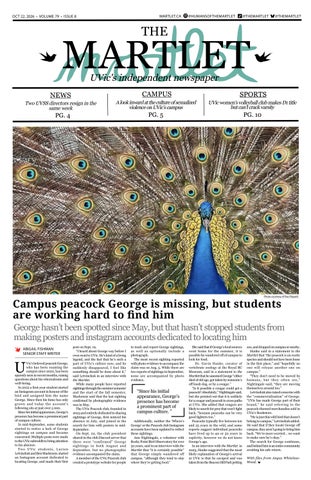
Photo courtesy of Paul Razzell.
Campus peacock George is missing, but students are working hard to find him
George hasn’t been spotted since May, but that hasn’t stopped students from making posters and instagram accounts dedicated to locating him ABIGAIL FISHMAN SENIOR STAFF WRITER
U
Vic’s beloved peacock George, who has been roaming the campus since 2022, has been sparsely seen in recent months, raising questions about his whereabouts and well-being. In 2022 a first-year student started an Instagram account in honour of the bird and assigned him the name George. Since then his fame has only grown and today the account’s following sits at just over 5 000. Since his initial appearance, George’s presence has become a prominent part of campus culture. In mid-September, some students started to notice a lack of George sightings on campus and became concerned. Multiple posts were made to the UVic subreddit to bring attention to his absence. Two UVic students, Lucien Letvinckuk and Ben Mackenzie, started an Instagram account dedicated to locating George, and made their first
post on Sept. 19. “I heard about George way before I even went to UVic. He’s kind of a living legend, and the fact that he’s such a part of UVic’s culture now, and he suddenly disappeared, I feel like something should be done about it,” said Letvinckuk in an interview with the Martlet. While many people have reported sightings through the summer semester and the start of the fall semester, Mackenzie said that the last sighting confirmed by photographic evidence was in May. The UVic Peacock club, founded in 2023 and entirely dedicated to sharing sightings of George, first noticed his absence in July, and joined in the search for him with posters in midSeptember. On Sept. 22, the club president shared in the club Discord server that there were “confirmed” George sightings in both August and September, but no photographic evidence accompanied the claim. A member of the UVic Peacock club created a prototype website for people
to track and report George sightings, as well as optionally include a photograph. The most recent sighting reported with photo-evidence to accompany the claim was on Aug. 5. While there are two reports of sightings in September, none are accompanied by photo evidence.
“Since his initial appearance, George’s presence has become a prominent part of campus culture. ” Additionally, neither the ‘Where’s George’ or the Peacock club Instagram accounts have been updated to reflect these sightings. Ann Nightingale, a volunteer with Rocky Point Bird Observatory for over 30 years, said in an interview with the Martlet that “it is certainly possible” that George simply wandered off campus, “although they tend to stay where they’re getting food.”
She said that if George’s food sources went home for the summer, it is possible he wandered off of campus to look for food. Dr. Gavin Hanke, curator of vertebrate zoology at the Royal BC Museum, said in a statement to the Martlet that he assumed George “either died of old age, got taken by someone’s off leash dog, or by a cougar.” “Is it possible a cougar could get a peacock? Absolutely,” Nightingale said, but she pointed out that it is unlikely for a cougar and peacock to cross paths at UVic. She added that cougars are likely to search for prey that won’t fight back, “because peacocks can be very good fighters too.” Peacocks typically live between ten and 25 years in the wild, and some reports suggest individual peacocks have lived up to 40 or 50 years in captivity, however we do not know George’s age. In an interview with the Martlet in 2023, Hanke suggested that the most likely explanation of George’s arrival at UVic is that he escaped and was taken from the Beacon Hill Park petting
zoo, and dropped on campus or nearby. Hanke said in a statement to the Martlet that “the peacock is an exotic species and should not have been loose in the first place,” and “hopefully no one will release another one on campus.” “They don’t need to be moved by humans, but they often are,” Nightingale said, “they are moving themselves around too.” Letvinckuk also raised concerns with the “commercialization” of George. “UVic has made George part of their brand,” he said referring to the peacock-themed merchandise sold in UVic’s Bookstore. “He is just this wild bird that doesn’t belong to campus,” Letvinckuk added. He said that if they locate George off campus, they aren’t going to bring him back. “We’re more worried… we want to make sure he’s okay.” The search for George continues, and behind him is an entire community awaiting his safe return. With files from Angus WhitelawWood.
“I hate when bikers get on the bus. Like, what is the bike for, buddy?”
NEWS
NEWS
Resumption of BC Transit driver overtime ban is affecting students and community members The strike began on Oct. 5 and it impacts over 16 000 riders a day RAAMIN HAMID SENIOR STAFF WRITER The Victoria Regional Transit System is currently being affected by an overtime ban which started on Monday, Oct. 5. The ban is the result of a lack of agreement after mediation between BC Transit and Unifor Local 333-BC — the union representing Victoria Regional Transit System’s drivers and mechanics. BC Transit has warned riders to expect delays and bus cancellations due to the strike. More than 1 100 buses arrive and leave the UVic bus loop each day, with over 16 000 riders. As a governing body, the sole system that BC Transit runs is the Victoria Regional Transit System. All other transit systems in BC are subcontracted. As such, the Victoria Regional Transit System is currently the only one that has been affected by the overtime ban. “We know that this does have a negative impact on some, but it’s a lot better, we felt, than a complete service withdrawal,” said Gavin Davies, the National Representative for Unifor Local 333-BC. Davies also said that any labour disputes result in inconveniences felt by the ridership. “We appreciate the students not taking their frustrations out on the transit operators who are really not at fault,” he said. “What they’re trying to do is show that the system is broken and that it needs to be fixed.”
Davies said the union appreciates the support from the university student unions during this time. “We always appreciate the support that we get from the public, but especially from the student union groups,” he said. “They understand that workers, like students, have to stand up and push back.” Victoria Mayor Marianne Alto said in an interview with the Martlet that she is supportive of the collective bargaining between the union and BC Transit. “I think that the drivers have every right to do exactly what they’re doing,” she said. Alto said that collective bargaining is important, and when it needs to happen, “it’s important for us to realize, as a society, that if we’re going to protect that right, there are going to be times like this one where there is an impact on service delivery.” But she also understands that this is upsetting for students who are passed by a bus, or if they are late due to transit. “We do know that public transit is a critical service for all communities, but particularly in a densely urban community like Victoria,” she said. Jessie Rousseau-Hanson, a Camosun student, part of the student society, and the student representative on the Victoria Regional Transit Commission (VRTC), said in an interview with — that the student population is a large stakeholder of BC Transit, especially through the UPass contract.
New monument honours the legacies of displaced and interned Japanese Canadians in British Columbia during the Second World War The monument is made up of 100 granite panels with approximately 25,000 survivors’ names etched into them RONIYA SAHIN SENIOR STAFF WRITER
Photo courtesy of BC Transit.
Rousseau-Hanson has been the student representative since the summer, and has attended two VRTC meetings, representing students at UVic, Camosun, and Royal Roads. He said that he supports having a fair deal for workers. He also said that it is important to have everyone back at the table to make decisions that will ensure that students, staff, faculty, and the rest of the community can be on buses. “When we have any form of strain for job action … it directly affects a large population of students,” he said.
Rousseau-Hanson said that well before the strike, BC Transit already had a lack of buses and a lack of funding, leading to a number of buses passing by stops and full buses. The job action is making the issues more apparent, he said, but it’s “an issue that’s been happening well before.” “It's important that we're able to have well-funded public transit, so that it can benefit our entire community and keep us towards the direction we want to be in terms of a sustainable commuting practice,” he said. “The last thing we'd
want is to have students be so frustrated [by] how unreliable transit is that they feel like they need to completely give up and stop taking the bus.” To those students who are currently frustrated by the strike, RousseauHanson said to provide feedback via posters that are put up around the UVic campus, so he can bring issues right to the VRTC, or to submit them to BC Transit directly online via their website. “The best way to put pressure is to just really voice [students] experience.”
A recently unveiled Japanese Canadian Monument, spearheaded by the Japanese Canadian Legacies Society (JCLS), seeks to honour the legacies of displaced, dispossessed, and interned Japanese Canadians in British Columbia during the Second World War. The monument displays the names of approximately 25 000 Japanese Canadians from 195 different communities across B.C. who were displaced during the Second World War. The names are organized by location based on the communities they were displaced from. It sits south of St. Ann’s Academy, between Superior St and Academy Close. Susanne Tabata, CEO of the JCLS, said the purpose of grouping the survivors’ names into the communities they previously inhabited was to “break an old narrative” that there was nothing more to Japanese Canadian history other than being wrongfully interned. “Beginning in the late 1870s, Japanese Canadians moved into B.C., built families, businesses, networks, and communities, and were well entrenched in British Columbia into their second and third generations,” said Tabata, “when in 1942 they were abruptly uprooted, dispossessed, and displaced twice.” The monument consists of exactly 100 tall, door-length panels of granite — slightly spaced to let light
through each gap. The names of approximately 22 000 victims of Japanese Interment Camps are etched into the granite panels, as well as the 3 000 names of children born after displacement. The Monument was designed by architect Bruce Kawabura. Since the opening on Oct. 3, survivors of displacement have travelled from B.C. and Canada to visit the monument. Tabata said the society toured over 1 900 visitors through Oct. 4 to 7, the majority of whom were locals curious about the monument. Now, the JCLS have closed the monument to complete construction, and it is expected to remain closed until the end of November. The concept for the monument started six years ago, Tabata said. UVic helped organize a list of survivors’ names into communities they had inhabited, and created the monument’s website — a comprehensive, interactive public database through which users can search for names of survivors and trace their communities of origin. The original dataset used by the JCLS was supplied by UVic’s Humanities Computing and Media Centre (HCMC), specifically those of the Landscapes of Injustice Project’s research database. The Landscapes of Injustice Project, directed by Dr. Jordan Stanger-Ross, a professor in UVic’s history department, aims to recover and grapple with the dispossession of Japanese-Canadians and the
forced sale of their property in 1942. The database contains the names of Japanese Canadians who were uprooted, and had their property taken from them. HCMC collaborated with UVic students, and spent a year reviewing the database to harvest metadata – data about the data collected from the Landscapes of Injustice Project. According to Tabata, Martin Holmes, a programmer with the HCMC, was the “central figure” in the work done by UVic. “The data we collect in any kind of humanities environment can often be repurposed for other things. The fact that the data had been collected for this one research project presented an opening for the JCLS to invite UVic to take that dataset … that pertained to B.C. and then do more with it,” said Dr. Janelle Jenstad, an English professor and academic director of the HCMC. Djuna Nagasaki, a UVic alumna, was one of the students who worked as a research assistant on the project. Nagasaki primarily worked to help organize over 25 000 names of internment camp survivors, as well as contacting each of the survivors’ families to verify certain information. “It really was an opportunity to … see how many people were impacted and to see when people started changing their names from Japanese to English,” said Nagasaki. “To learn that my own greatgrandfather, who we called John, never actually had that as a legal name. His name was Nobuo, but
Photo courtesy of Rich Lam.
after … his forced uprooting from Vancouver, he started going by John.” The JCLS also intend the monument to be educational, serving as a permanent reminder of B.C.’s racism against Japanese Canadians that is often not talked about, Tabata said. “The silence, coupled with what happened to [the Japanese Canadian] community – through the violence of uprooting, dispossession, and two forms of displacement — has really led to a shattering of identity,” said Tabata. Similarly, Nagasaki worked from
a young age to unveil her family’s history with Japanese Internment Camps, and to articulate her p e rsonal st ru g g le s w ith t hose findings to both herself and her peers. She attended the opening ceremony for the monument with family members across generations, including her baby cousin. “Just to see this little baby hand… touching his name [on the monument] — I think I was really surprised by how much seeing that impacted me,” said Nagasaki, “and to know that this little baby will never know a world where he has to fight for this history to be
A UVic student has created a petition against Carney government’s changes to pesticide act The petition to amend or repeal Bill C-30 was opened on Sept. 25 RAAMIN HAMID SENIOR STAFF WRITER A fourth year political science student is petitioning the federal government to repeal changes passed earlier this year, allowing the federal cabinet to authorize the use of pesticides deemed unsafe by Health Canada. The Pest Control Products Act protects the health and safety of human beings and the environment by regulating pest control products. Bill C-30 is an omnibus bill, which means that it affects several Acts. Its changes to the Pest Control Products Act allow the federal cabinet to authorize the use of pesticides that Health Canada has determined to be risks for human health or for the environment if their use is deemed in the interest of economic or food security, but does not define what those interests may be. The petition calls upon the federal government to amend or repeal the specific provisions allowing the cabinet to override the pesticide risk assessments by Health Canada. The petition has been open for signatures since Sept. 25, and already has over 2 000 signatories at the time of publication. It also calls for pesticide approval decisions to be independent from political influence, and a commitment to full public and parliamentary review
2 // OCT 22, 2026
for future changes to the Pest Control Products Act. The petition was created by fourth year political science student Alena Gavrilenko, who also serves on the UVSS Board of Directors as a director-at-large, and has been sponsored by Gord Johns, Member of Parliament of CourtenayAlberni. In an interview with the Martlet, Gavrilenko said, “[the bill] allows cabinet to override Health Canada and authorize the use of banned pesticides in the interests of economic or national food security, or in response to a seriously detrimental infestation.” Gavrilenko, who hosts gardening workshops in her community in Saanich, said she first heard about Bill C-30 — and the concerns of community members — this summer through the workshops. “I realized that it was actually a very prominent issue, because all of the neighbours then started speaking up against it.” One of Gavrilenko’s main concerns with the bill is its vagueness. “The amendments do not specify requirements for how they will actually be considered.” “Especially under these vague provisions, then you might be able to use these pesticides under anything that the cabinet deems is an emergency,” she said. The main change she wants to see
come from the petition is to take pesticide changes out of the bill and handle reform through a standalone process, through which scientists, farmers, and the public can be heard. The petition currently has over 500 signatories from B.C., more than any other province except for Ontario. Gavrilenko think the petition is attracting attention due to widespread concerns around affordability. “They are promised a golden age where everything is cheap,” she said. “When they see things like this happen, without appropriate consultation, they know that corporate lobbying [is] influencing their well-being and their health.” She also said that this is a broad issue, because it does not only affect certain groups of people. “We all consume this food and we all share the environment,” she said. Gavrilenko said she realizes that a petition alone is not enough. “My goal is to try to spread the word as much as possible about this issue and to mobilize individuals, because simply signing a petition and having Gord Johns present it in parliament is not going to enforce change unless there is broader media coverage.” “I think it’s our responsibility as people to fight for our quality of life as a society and as a collective,” she said. In an emailed statement to the
Illustration by Luisa Dela Cruz.
Martlet, Johns said that Canadians deserve decisions about pesticide safety based on science, not political priorities. “I’m deeply concerned that Bill C-30 gives Cabinet the power to override decisions made by Health Canada when scientific experts determine that a pesticide poses unacceptable risks to our environment,” he said in the statement. Johns acknowledged in his email that
food security matters, but so does the protection of Canadians’ health, farmers, and future generations. He said he chose to sponsor Gavrilenko’s petition to call “on the government to repeal these provisions, and restore public confidence in a pesticide safety system guided by independent scientific evidence, transparency, and the public interest.”
OCT 22, 2026 // 3
NEWS
CAMPUS
Two UVSS directors resign in the same week
A look inward at the culture of sexualized violence on UVic’s campus
Donovan Wood-Gaines, a director-at-large, was elected to replace Mariah Luzon as director of finance and operations ETHAN BARKLEY EDITOR-IN-CHIEF
Two members of the UVSS Board of Directors resigned earlier this month. Mariah Luzon, the society’s director of finance and operations, resigned on Oct. 9. Her resignation was accepted by the board in a last-minute meeting convened that night. The board did not give reasons for Mariah’s resignation in the meeting. Matthew Allen Curtis, director of outreach and university relations, said in a statement after the meeting that Luzon’s resignation was a “personal choice” due to their personal workload and “wanting what is best for the society.” Director-at-Large (DAL) Donovan Wood-Gaines and Pride Collective representative Jayce Kusardi nominated themselves as replacements, and after the two nominees answered questions
COMICS
posed by their fellow board members, the board elected WoodGaines to the position. Wood-Gaines said in the meeting he had previous experience as a DAL attached to the finance & operations portfolio, and had served on some of the same committees. At the society’s scheduled meeting on Monday, Oct. 5, DAL Artem Kuklev also resigned, citing “personal reasons.” Society for Students with a Disability (SSD) board representative Acorn Wasserman also resigned from the position last month, on Sept. 14. The position of SSD board representative was filled by Lauren Wyler. Following Kuklev’s resignation and Wood-Gaines’ appointment as interim finance director, the board now has eight DALs of the requisite 11. The UVSS said in a statement that they will not be holding by-elections to fill the roles due to timing and budgetary constraints, and lack another way to fill the
The Cornell case has sparked major discourse online about sexualized violence, but how is the issue being addressed in male-dominated spaces on campus? ABIGAIL FISHMAN SENIOR STAFF WRITER
This article discusses sexual violence and gender-based violence.
Photo by Sabina Mendoza.
vacancies under existing policy. Curtis said that the resignations had nothing to do with one another. The previous board of directors also saw a significant number of resignations, including three lead directors — Jonah Arnold, Griffin
Foster, and Eva Thompson, shortly after the beginning of her term. Luzon is the only lead director on the 2026–2027 board to have resigned at this point. Curtis said in the statement that Wood-Gaines is “quickly settling
in” due to his prior experience as a DAL attached to the finance and operations portfolio, and will be re ady to p re se nt the socie ty’s budget and last year’s audit at the upcoming Annual General Meeting on Tuesday, Oct. 27.
A former Cornell University student, identified as Jane Doe, filed a lawsuit in September, alleging she was raped by seven members of the university’s Chi Phi fraternity chapter in their on-campus fraternity house in 2024. In the case, which has come to be referred to online as the “Cornell Seven,” Doe alleges that she was pressured into taking substances while highly intoxicated before being raped by the seven men for several hours. Filed as part of the lawsuit are photos that appear to show Snapchat messages sent by some of the defendants sent to a group chat consisting of 57 members, “Chi Phi Actives.” One photo shows a message that reads “free p*ssy in alum.” The lawsuit has sparked massive online and interpersonal discourse about the culture of sexualized violence, extending beyond social media and into the UVic community. “A conversation that we’ve been having in our office is actually the disservice that referring to it as the ‘Cornell Seven’ has, when in reality it should be referred to as the Cornell 57,” said Alessia Servin, the Anti-Violence Project’s (AVP) Peer
Support and Administration Coordinator. The AVP is an on-campus sexual assault resource center, housed in the basement of the SUB, that provides peer-support, education, and advocacy on all forms of violence. Servin said that they understands why people — especially men and masculinepresenting people “in toxic masculine spaces” such as fraternities — may hesitate in coming forward, or calling out their friends, but emphasized the importance of bystander intervention. They provided examples of how individuals can act properly as bystanders, especially when hesitant, such as acting as an anonymous witness or checking in with a friend. “I think it is essential in this context, but also just in everyday practice that we understand how to be bystanders.” Servin said that, while Greek life spaces have changed over time, toxic masculinity still persists in fraternities. “The secrecy, this code of conduct, that a lot of the time is this brotherhood of keeping each other’s secrets and supporting each other, even if that means doing something like the Cornell 57,” they said. Carl Haynes, a volunteer with the AVP, said that “we need to see accountability as a loving thing to do to someone you care about.” Haynes said that, when he was an executive member of Delta Kappa Epsilon (DKE) in 2016, he found out that one of
his frat brothers had raped someone. He said that he was first informed in a meeting of executives after an advocate of the survivor reached out to DKE’s president. Haynes said the DKE executives unanimously voted to remove the brother from the fraternity and provided support to the survivor, who turned out to also be a friend of Haynes’. DKE operates off-campus and independently, as the university and the UVSS do not recognize or sanction fraternities and sororities. Later, Haynes said, he and the survivor entered into a romantic relationship and eventually got married, “so I got a very front row seat to the aftermath of sexualized violence.” “It was very formative for me to see a man in a leadership position, someone I looked up to, really model how to handle these cases,” he said of DKE’s president at the time. However, even though he felt sexual assault cases were handled well at DKE during his time as an executive, the casual misogyny and sexism that are “the underpinnings of rape culture,” weren’t properly addressed, he said. “Rapists aren’t born in a day. It takes a village to raise a rapist.” The call for more men to get involved in sexual violence prevention led Haynes to begin volunteering with the AVP in 2023, where he was later hired on a twoyear contract as an Education and
UVic parking meters officially go cashless The changes began to be implemented over the summer, but until now the campus security front desk has still accepted cash payments AMELIA WATSON SENIOR STAFF WRITER By the end of this month, parking at UVic will be a completely cashless endeavour. “We've been working on the project through the summer,” said Patrick Seward, Associate Director, Commuter & Administrative Services. “As of fall, we are cashless.” While the parking meters used by the university were replaced with cashless models, the front counter of the campus security office, where other parking-related fees are paid, continued to accept cash until the week of Oct. 19.
The campus community can now pay via tap with credit and debit cards or through the Honk mobile app. At the time of publication, no changes have been made to the parking pass system. In a statement released on UVic’s website, Campus Security (CSEC) said the change will make parking “quicker, more convenient … and reduce line ups.” The new meters have received somewhat mixed reception amongst the community. One third-year psychology student said they usually pay by card already, so have little opinion on the change. Sam Follis, a third-year student who also works on campus, told the Martlet he
was frustrated with the rollout of the new meters. “I came to work expecting to be able to use my coins and I felt like there was no notice about [the removal of paying with cash.” “I ended up getting a parking ticket because of that,” he continued. Not everyone wants to pay for everything via card, Follis said, and for students who work in fields where they make tips, paying by cash is convenient for them. Seward said UVic took steps to inform students of this change through newsletters, emails to student societies and departments, along with posting new signage, and updating the parking website. Follis said he wanted to know why the university moved away from accepting cash. “Most of the parking meters on campus were in need of replacement over the next few years,” said Seward in an emailed statement to the Martlet. “Parking Services decided to replace them with tap-to-pay technology and the HONK app.” “[The change] modernizes our parking payment technology, streamlines administration, and is in keeping with current parking trends and practices.” “While it’s too early to have a full picture of the impact of the change, we’ve had less than a dozen requests for assistance, mostly from off-campus visitors who were helped by Campus Security,” the statement continues. “Users who require support through this transition can email parking services at askparking@uvic.ca or visit the Campus Security front desk.”
Research Coordinator and Men’s Wellness Coordinator. Under this role, he began facilitating the AVP Men's Circle, a weekly drop-in session for men and masculine-identifying people that aims to deconstruct toxic masculinity and facilitate conversations about consent, boundaries, and healthy sexuality. “A lot of men are taught that to be a man is to enact your inherent power and control over people…” Servin said, “whereas the Men’s Circle creates a safer space for men to come together and be vulnerable.” DKE president Jimmy Watchell said that about a dozen DKE members have attended Men’s Circles, and that they’d love to be involved more. “When we go to these Men’s Circles, we can definitely be a lot more vulnerable and open with our speech … I would like that it be like that always, but it’s not an easy thing to do,” he said. Watchell said that in recent years DKE has done multiple consent workshops, and that moving forward they will try to make consent workshops a requirement for every new brother to attend. “We take a lot of pride in how we’ve approached this topic in years past and continue moving forward,” he said. Joe Rosette, who is in charge of risk management at DKE, is the “sober brother” at every DKE event tasked with helping anyone who needs it. “Anyone
who feels [un]safe or anything like that, they can come up to me at a party.” Watchell said that before each event, Rosette briefs brothers on potential risks, liabilities, and resolutions. While brothers’ are informed they can go to Rosette for direct support, “he’s also laying out the frameworks and foundations before the events,” Watchell said. Servin wonders what the outcome of the Cornell case might have been if one of the 57 men in the group chat attended a men’s circle. “We really encourage folks to come see us, reach out to us,” they said. The AVP is a free service that is open to anyone in the Greater Victoria region, with talk and text phone lines available Monday through Friday. Though the AVP continues to support survivors, Haynes said that “these resources on campus need more funding.” He said that sexualized violence resources are not available on campus after 5 p.m., or on the weekends. “We are failing students,” he said, “and we need to fund these services much better.” Students seeking support can visit the AVP, UVic’s Equity and Human Rights Office, and UVic’s Sexualized Violence Resource Office. The AVP offers anonymous support hours twice a week, the Men’s Circle, and training on supporting survivors and understanding consent.
UPCOM UPCO MING FILM FILMS
SCHOOL OF ROCK
THE ROOM W/ GREG SESTERO
NOV 10: 5:00 & 7:10
NOV 13 & 14: 7:00
Photo courtesy of Pierre ____.
GIMME TRUTH NOV 18: 5:00 & 7:00
THE STUNT DRIVER NOV 25 & 26: 5:00 & 7:00
Photo by Sabina Mendoza.
4 // MAY 28, 2026
OCT 22, 2026 // 5
ARTS & ENTERTAINMENT
ARTS & ENTERTAINMENT
‘Vibrant Histories’ explores the history of burlesque and drag in Victoria
Local bands Thistle and Two Rats Loving sell out The Coda for album launch show
The exhibit will run October 28 to 30, featuring a performance on the final day BRIANNA BOCK SENIOR STAFF WRITER From Oct. 28 to 30, Intrepid Theatre will host Vibrant Histories, an exhibit highlighting the history of burlesque and drag in Victoria, with a focus on BIPOC (Black, Indigenous, and People of Colour) performers. On the final day of the exhibit, Oct. 30, a burlesque show inspired by the exhibit will take place. Burlesque is a variety show with striptease and dance, and is often incorporated into drag performances. Vibrant Histories will also serve as a fundraiser for the Shade Burlesque Festival in 2027, a biannual burlesque festival that showcases BIPOC performers. House of Cheek, who is organizing the exhibit and show, launched in 2019 with the one-night show, Shade. Cherry Cheeks, the burlesque performer and producer behind Vibrant Histories, said: “I produced Shade because I was
basically tired of seeing all or mostly white casts…. [Shade] was Victoria’s first all BIPOC burlesque show at the time.” Since its debut, Shade has grown into a multi-day festival. Cheeks said that the Vibrant Histories project began during the pandemic. In burlesque, the generations of performers tend to cycle in every five years, they said. New students enter the scene while cultural shifts, such as the pandemic, may prompt older performers to take a break. “It moves very fast. During the pandemic, I started documenting what was around me and what I’d seen since I’ve debuted,” which included producers and performers Cheeks worked with, as well as cultural shifts within the community, they said. Around two or three years ago, Cheeks said they began digging deeper into the burlesque and drag scene in
Victoria, curious about how the art form grew and changed over time. “Back in the day, [burlesque performers] were there as entertainers; your job was to entertain the audience, often seduce the audience,” which was often male-dominated, Cheeks said. In the 90s, that changed with the Neo-Burlesque movement. “That’s what we consider burlesque today,” said Cheeks. Neo-Burlesque prioritizes “empowerment” and encourages performers to “do what you want to do in burlesque, make it feel good to you. The audiences are mostly female, or femme, or AFAB people now, and it’s a very openly queer environment now, where most of the performers, most of the audience, exists on the queer spectrum to some degree.” “I think it’s really easy to feel alone sometimes,” Cheeks said. “I think it’s easy to feel you might be the only or the first person doing something, and so I
originally started looking i n t o documenting the local scene, because I found t he re w e re so many new producers coming up who thought they were the first people doing something.” Cheeks said that, while the 2019 Shade production was i n i t i a l l y advertised as the first BIPOC burlesque show in Victoria, they now call it the first documented BIPOC show. “I want to be disproven, because I would love to see who would have done that before me.” Beyond exploring and documenting the evolution of bu rl esqu e in Vic t o ria, Cheeks said that another of the exhibit’s goals is showcasing solidarity. “I want people to know
Thistle and Two Rats Loving brought masquerade, live dancers, and visual arts to masterful multimedia show at The Coda
Photo courtesy of Intrepid Theatre.
that any challenges they have in life, maybe it’s identity, or feeling like [they are] the only person in burlesque doing something, or the only person of colour doing something … that there [were] probably [people] before you that were equally doing that work.” “The same challenges we face today have existed for
Kelowna band Freeze the Fall wins the Metal & Hard Music Artist of the Year The trio, which formed after the end of middle school, now have two albums under their belt and a third releasing next year BRIANNA BOCK SENIOR STAFF WRITER Kelowna metal band Freeze the Fall won the Metal & Hard Music Artist of the Year award at the 2026 Western Canadian Music Awards. The three piece band consists of Quinn Mitzel (vocals and guitar), Jonah Goncalves (drums), and Aria Becker (bass and backup vocals). They currently have two albums, Thrones and The Red Garden, and are working on a third slated for release in 2027. The next album’s single, “Crescents and the Torch,” recently released on all platforms. Freeze the Fall was not expecting
to win anything at the awards, said Becker, so they didn’t attend the ceremony. “There’s just so many amazing artists who were nominated for this award,” Mitzel said. “But we’re very honoured…. We work with so many local people, especially on our team, so it’s also a big win for them and to just show local people can accomplish something like that. We’re not from Toronto or Vancouver or anything like that. We’re just from Kelowna. It’s pretty cool.” The band formed four years ago, when Mitzel reached out to Becker on their last day of middle school “because we’d seen each other carrying out instruments or
wearing band t-shirts that we thought were cool,” Mitzel said. Goncalves joined the group after Becker saw him playing a solo gig in downtown Kelowna, and invited him to join. Initially, Freeze the Fall performed covers before they began writing original songs. Becker said she was drawn to metal since it was music her dad listened to, and because she started playing bass by learning songs from Bring Me The Horizon. To Mitzel, the spirit of rebellion was a major appeal. “I think there’s such beauty in like rock and metal music in that, it’s similar to hip hop in that the core of it is rebellion, and this love for art and self expression ... I fell
in love with that. “I always wanted to be in a band,” said Mitzel. “It was my dream since I was like, 10 [or] 11 years old, but I k new t h a t I w a n t e d t o w r i t e original music.… We started with covers not because we wanted to be a cover band, that was never something we wanted to do, [but], we didn’t know each other, [and] creating art is a very vulnerable thing. “You’re not just going to go into a room with a stranger and be ‘Okay, here’s my deepest, darkest thoughts and feelings, let’s write about it.’” None of them imagined that they would win a National Award when they started. “When I started
jamming with you guys, the only thing I had on my mind was, ‘I can’t believe I’m playing music with people my age,’ never did I think beyond that. That was enough for me.” Becker said. Goncalves, who has been playing since he was 12 or 13, says he was always playing with older musicians. “I was so lucky to meet them because they kind of had the same level of passion for music that I did at that age,” he said. Those interested in listening to Kelowna’s up and coming metal band can find them on all social media platforms as Freeze the Fall and can sign up for their mailing list on their website.
Photos courtesy of Kat Erica Media.
6 // OCT 22, 2026
Photo by Jordan Mills.
JORDAN MILLS CONTRIBUTING WRITER Local band Thistle’s second album Let the Earth Lay Fallow brings poetry, music, visual arts and mythical realism together, while serving as a tapestry of what they've created since moving to the island. Thistle is a predominantly folk-rockinspired band, created by brothers from Washington, Declan and Aiden McLennan, the latter of whom is currently attending UVic. Their creative and local approach to music aims to create community in a dogeat-dog industry. On Sept. 25, they were joined by Two Rats Loving, a band made of UVic students and alumni Erika Kim, Finlay Macnaughtan, Cam Seward, Noah Jenkins, and Will Ainscough, for their album launch show at The Coda. For the performance, they were also joined by Thistle’s live band members: Leo He, Matt Seale, Dexter Hodgins, and Ryan Keating. The album launch saw approximately 310 attendees, with many more turned away at the door. Patrons came draped head to toe in formalwear, and some even made their own masquerade gear. “I had messages from people being like, ‘We’re making our masks for the show!,” Two Rats Loving manager KC Buzianis said. Macnaughtan said he was “kind of nervous to see how many students would come out in full formal wear.” Beyond the opening band and live members, Thistle’s music gave even more local artists the opportunity to get involved. Videographers, dancers, and artists came together to support their album release. The band’s
costumes were chosen after inspiration hit during a Langham Court Theatre visit with the members of Two Rats Loving. “We rented our outfits both for the concert and for the ‘Over The Garden Wall’ music video, the masks were all made by our artist friends.” Two Rats Loving didn't disappoint with their costumes, either. Jenkins — their vocalist and guitarist — leaned into a naturalistic woodland aesthetic for the performance. “I found a cow pelvis when I was at a house party and I was like, ‘This would make a great mask.’ Then I put it on a hat!” he said. Fellow guitarist Kim went out of her way to make her own costume, a stylized orange and red dress paired with her iconic red cowboy boots. Let The Earth Lay Fallow contains ten songs, each with an individual narrative. Sonically, the album features multi-layered harmonies and earthly instrumentals that pull at your heartstrings. “Watership Down,” a band favourite and the longest song of the album, was inspired by the classic Richard Adams novel of the same name. “We took a lot of the narrative structure of that book and then translated it into a song” Declan said. The song goes through the twisting and complicated yet harmonious story of two brothers, not unlike the McLennans themselves. The main set pieces featured at The Coda included large birch trees and handmade lanterns — painstakingly crafted by friends of the bands. Ivy was draped on the microphone stands, and netting was used throughout the forest set, drawing the audience into a mythical yet familiar garden. One set piece that particularly stuck
out was Thistle’s human-sized puppet, inspired by the “Mr. Krinkle” music video by Primus. The puppet was handcrafted by Declan McLennan out of chicken wire, papier mache, and tinfoil. Dancers were also featured in the performance, donning costumes from the viral “Over the Garden Wall” music video directed by Makian, and proved to be a crowd favourite. Aidan McLennan suggested the symbiotic nature of dance and music played a role in bringing together so many talented individuals. “It's fun to play music, but it's even more fun to play music with dancers. And I’m sure it’s fun to dance, but I'm sure it’s even more fun to dance with a live band,” he said. To Thistle, selling out The Coda with Two Rats Loving is only the beginning. In the last year alone, the brothers have written and recorded a full album, created a viral music video, and toured across North America. “I feel like if you like what we’ve done so far, you’re only going to like what we’re going to do in the future more, because we’ll have more time,” Aiden said. Those interested in seeing Thistle perform may have to wait, as the band is taking a temporary step back to work on larger projects and an upcoming 2027 tour. However, Two Rats Loving, alongside local bands Stank and Zoocreeper, have another themed show, Freak Fest — coming up quickly on Oct. 24. More details on Freak Fest can be found on Two Rats Loving’s Instagram page, and tickets can be found on Gigpit.
How to Manufacture a Legacy: Cameron Winter’s Live at Carnegie Hall An Offbeat by CFUV Review KADEN PERKINS CONTRIBUTING WRITER On Dec. 15, 2025, footage surfaced of Cameron Winter playing a surprise solo show at New York City’s esteemed Carnegie Hall. The Geese frontman, riding the runaway success of 2024’s Heavy Metal and 2025’s Getting Killed, was set to perform on the same stage graced by nearly a century of popular American musicians. Chronically online music fans and film bros alike rejoiced as the footage revealed directors Paul Thomas Anderson and Benny Safdie filming the entire cultural moment with an eye-rollingly conspicuous 35mm film camera. Almost a year later, following a Coachella performance, appearing on Saturday Night Live, and navigating uproarious “Psyop” allegations, Winter’s Live at Carnegie Hall was released to the public, alongside a concert film acquired by The Criterion Channel and Janus Films. At just 24 years old, Winter is undeniably on a generational run. Everything about Winter’s performance seems to push towards a manufactured moment in pop culture. Carnegie Hall performances have shaped the American musical canon for well over a century — American giants like Louis Armstrong, Nina Simone, Miles Davis, Johnny Cash, Jay-Z, and a 20-year-old Bob Dylan have all performed at this same institution. In the 21st century, Carnegie Hall has arguably lost its footing. Since JayZ, Alicia Keys, Nas, and Bilal performed alongside a 40-piece orchestra in 2012, Carnegie hasn’t really had much ammunition for the marketable musical performances its legacy is built on. Winter, following his breakout year, is clearly being championed as a Gen Z musical hero, and the media surrounding this album makes it annoyingly clear that Winter is being planted and propagated as the torchbearer of popular American music. However, all of this pretentious press, Geese’s infection of your coworkers’ playlist, and the overbearing social media discourse diminish the main reason Winter is being championed by the contemporary musical landscape, and taking up the piano at Carnegie
Hall — his songwriting is just spectacular. Live at Carnegie Hall features a mix of tracks from 2025’s Heavy Metal, as well as a few new songs — all stripped to their bare essence. There is something undeniable about the way Winter croons across this record. The impressionistic aspects of his lyrics are front and centre, and his piano arrangements are shockingly lush. The anticipation Winter creates on “The Rolling Stones” is spellbinding; everything stops before a flurry of piano cascades through the room. He manages to hold this same tension on “Drinking Age,” a track from Heavy Metal that seems almost impossible to perform without extra instrumentation, but armed with nothing but a piano, Winter manages to capture the song's elegiac heart in one of the album’s standout moments. It’s easy to see why Gen Z is compelled to worship Winter, beyond the overbearing social media marketing. The energy behind Winter’s performance feels almost physical, as sings about fighting an entire field of cops with a coconut, getting kicked in the mouth, and eating his keys in “Nina / Field of Cops,” all the while manically pounding out chords. It’s equally hard to argue against the tantalizingly agnostic “0$,” where Winter builds up to an uproarious chant of “God is real, God is real / I'm not kidding, God is actually real.” Winter’s strange divine beliefs feel like a worthy subject of Gen Z’s praise. His incoherent faith is infectious, and almost required for a generation facing an incessantly automated, unbearably hot future. The media circus surrounding Cameron Winter’s career thus far is tired and frustrating. At the same time, the music industry at large has been sculpting American pop music for generations. Maybe the internet and social media are just making cultural marketing strategies more transparent. Hearing Cameron Winter: Live at Carnegie Hall cements Winter as a well oiled cog in the American cultural machine, and potentially the greatest songwriter of the 21st century.
OCT 22, 2026/ 7
NEWS OPINIONS
NEWS OPINIONS
Chat, are we cooked?
EDITORIAL | The Cornell Daily Sun did what their university wouldn’t
In the era of artificial intelligence, it’s more important than ever that we all reflect on our own education — and what we really want out of it ABIGAIL FISHMAN SENIOR STAFF WRITER Like so many others I entered my post-secondary education — and adult life — during the age of artificial intelligence (AI). I’ve watched it overtake social media content and discourse, transforming into a part of our daily routines. I have seen people I know and care about become utterly dependent on AI chatbots in their lives. It is looming and unavoidable. OpenAI released ChatGPT for public use in November 2022, and almost immediately it took over. Everyone was in total awe of this new, almost magical chatbot that seemingly held all of the world’s knowledge, and could generate essays in minutes. It was ready to take on the mental load for us, and many of us were ready to let it. I am not innocent in all of this. I first used ChatGPT when I was in the twelfth grade and couldn’t be bothered to decipher the deeper meanings behind the symbolism in George Orwell’s 1984 myself. Ironic, right? I knew that it was a slippery slope, and if I wasn’t careful with my use, it could cause an array of problems. I was under the impression that utilizing it solely as a “learning assistant” — to help me summarize and decipher meaning from texts, but never to do an assignment for me — was perfectly acceptable. After all, everyone else around me was doing it. My classmates regularly
confided in me that they submitted entire essays written by ChatGPT. This was normal, I thought. So, while I justified my own use as miniscule and not crossing the line of academic integrity, I was really inhibiting my own learning. I’ve always loved learning, and so as the AI-craze grew, I took it upon myself to learn more about generative AI — the implications nobody seemed to be paying attention to: literacy, climate, intellectual property, and so on. The more I learnt, the less I used it, and eventually I even became an anti-AI advocate — encouraging those in my personal life to take on the same stance, and advocating for it through journalism. Most importantly, I’ve observed a significant, positive difference in my learning outcomes after quitting AI altogether. While there are many other legitimate concerns about generative AI, its impact on learning remains the biggest concern for me. I am proud of my personal journey with generative AI, and I know that I am not alone in my concerns. However, many others continue to increasingly rely on generative AI in their lives. This fall semester, I returned to campus for my third year of university, and I immediately noticed that many of my peers had ChatGPT open on their laptop screen during lectures. Last week, in a political science lecture, I noticed the student beside me using the audio message feature on ChatGPT to record and upload our
professor's lecture to the chatbot in real time. ChatGPT regurgitated what I assume to be notes on the lecture, and the student copied and pasted the material into their own document — all while scrolling on Instagram, completely disengaged from their surroundings. I spent the rest of the lecture struggling to focus on my own learning while I watched this happen. My first thought pertained to the intellectual property of our professor, which, completely unbeknownst to him, was going straight from his mouth into a generative AI chatbot. My second thought was about how disrespectful this was to both the professor and other students in the room, who attended the lecture with the intention of learning. Finally, I wondered, why are you here? What could you possibly be getting out of this? The answer is nothing. I recently heard someone equate AI use in education to attending the gym and watching others lift weights, then expecting your muscles to grow, even though you didn’t lift anything yourself. This is the perfect analogy. Learning is not easy; anyone who tells you that it is is lying. It is hard, and takes significant effort, but without that effort it doesn’t work. Like the gym, you will only ever get out of it exactly what you put in. The offloading of all of the mental labour that is crucial to learning onto an AI chatbot will be the demise of intellectualism in an
Student journalist Cereese Qusba spent almost two years investigating allegations of rape at Cornell’s Chi Phi fraternity house
Illustration by Luisa Dela Cruz.
already anti-intellectual age. The other week, I was chatting with another student about my heavy workload of readings. She laughed and said “that’s when you use ChatGPT.” The utter shock that came over her when I told her that I don’t use generative AI illustrated to me just how widespread this problem is. She couldn’t fathom how I’m making it through a post-secondary education without the help of ChatGPT, because most people can’t anymore. Beyond student-initiated use, AI is also entering our classrooms in a
manner that is facilitated by educators. Last June the Vancouver school board rolled out Microsoft Copilot accounts for every student over the age of thirteen. As generative AI-use continues to grow in educational spaces, it is important that we all reflect on why we are there, and what we want out of our own education. I am willing to bet that AI is not the omnipotent solution that so many of us think it is.
Graphic by Sabina Mendoza.
RAAMIN HAMID & ETHAN BARKLEY This article discusses sexualized and gender-based violence. The story of the Cornell 57 is leading to vital, long-overdue conversations about the epidemic of sexualized violence on university campuses. It has also highlighted the enduring value of campus newspapers, and the potential we have as student journalists to seek justice, affect positive change, and hold even the most storied and powerful institutions to account when no one else will. In October 2024, seven men affiliated with the Chi Phi fraternity allegedly drugged and sexually assaulted a Cornell student, identified as Jane Doe, in one of the university’s fraternity houses. The men identified in the lawsuit are Matthew Ingalls, Johnathan Newell, Winston Lee, Gillio Lopes, Diego Sarabia, Scott Norris and Scott Kretzschmar. These seven men stand accused of gang-rape, but screenshots made public after the story broke show one member of the group chat “Chi Phi Actives” advertising Doe’s presence in the fraternity house to a group chat of more than 50 other Chi Phi members. The story drew international attention after Doe filed a lawsuit against the Ivy League university in the middle of September of this year,
8 // OCT 22, 2026
stating that the university and other organizations had failed to protect her. The civil complaint also names the seven men, several Greek Life organizations including the university’s Chi Phi chapter and her own sorority, Tri Delta, as defendants. On Sept. 21, Cornell University’s independent student-run newspaper, the Cornell Daily Sun, published an editorial, castigating the university for its lack of transparency and regulation in relation to Doe’s sexual assault case, and perhaps most significantly, naming the defendants. Before that, a student journalist, Cereese Qusba — then a senior editor at the Sun, spent 23 months building a relationship with Doe and her attorney, and interviewing Cornell administrators. When a new editor-in-chief, Sophia Dasser, assumed control of the paper in 2026, Qusba — who was studying abroad in Australia — called her and told her she wanted the story she was working on about the alleged assaults to be a focus of the Sun. Facing a no-confidence motion in his leadership this month, Cornell President Michael Kotlikoff admitted he never followed up on the 2024 report to learn what happened to her, or if any of the accused were punished. Think about that. One student at Cornell, on top of her classes and writing for the Sun, spent nearly two years listening to Doe and working
tirelessly to bring the story to light, when the university’s own president apparently couldn’t muster the curiosity. As campus outlets, we lack the resources, staffing, and reach of larger news organizations. But that doesn’t mean we are toothless. The Cornell Daily Sun, established in 1880 — one of the oldest student newspapers in the United States — is itself a storied institution. According to the Sun, it receives over 16 000 readers per day. Cornell University failed in multiple ways. It failed to provide a safe space in the first place; it failed to put measures in place that would mitigate or prevent violent behaviour like what the Chi Phi members are accused of. It also failed Doe in its response — allegedly allowing the accused perpetrators to write essays as a disciplinary action. Tompkins County District Attorney (DA) Matthew Van Houten told CBS News he never received a transcript of a conversation between Jane Doe and Cornell University’s campus police before his office decided against bringing charges in 2024, while Cornell University said its police department provided the DA with the results of their investigation. The purpose of journalism is to act in the interest of the public. As journalists, we aim to detect and expose crime or misdemeanor, protect public health and safety, prevent the public from being misled
by a statement, organization, or an individual, and communicate matters of public interest. When we become journalists, we learn that we are supposed to be the pillars of democracy. We are supposed to call out institutions, and those in power, when they fail to serve us. Dasser, Qusba, and the rest of their team at the Sun have done exactly that — followed their journalistic duties to uphold values that ensure safety on their university campus, and hold their institutions to account when they fail to meet that standard. And even against what seem like impossible odds, the work of student journalists can lead to change. The editors of the Sun are certainly not to credit for Doe’s decision to pursue civil litigation, knowing that survivors of sexualized violence still face overwhelming stigma, victim blaming, and online harassment grounded in the most vile misogyny; Doe’s family home was recently the target of a swatting attack — a harassment technique involving making a false police report to draw law enforcement to a location, which can often turn deadly. That bravery is hers alone. However, Qusba may be credited for understanding this was a story that needed to come to light, and for her dogged reporting when few others were paying attention. The state of New York has since reopened investigation into the case, and
Governor Kathy Hochul has appointed state Attorney General Letitia James to head up the case as a special prosecutor. We must recognize the bravery of Jane Doe, who was put in a position she never should have been in — seeking justice for herself after her own university failed her. We must recognize the bravery of Dasser to, as the Sun so finely put it, do what Cornell wouldn’t. And we must recognize the bravery of one plucky student journalist, Qusba, who never gave up on bringing Doe’s story to light. But the story doesn’t, and can’t, end here. Sexualized violence doesn’t happen in a vacuum, it is inculcated through years of misogynistic jokes, victim-blaming rhetoric, and excuses for predatory behaviour. When we are too afraid to challenge this rhetoric from our friends, colleagues, and family members, or when we shy away from reporting on it, it spreads like mold under the damp blanket of our cowardice. As journalists, we must seek to root out the pernicious and deeply embedded rape culture in our society with the same fervor we do corruption, malfeasance, and institutional mismanagement. The commitment to accountability and transformative change we embrace when we become journalists cannot be something we leave at the door at the end of the day.
OCT 22, 2026 // 9
SPORTS
FUN STUFF
UVic women’s volleyball club makes D1 title, but can’t crack varsity
Divided
‘These girls work just as hard as some of the U SPORT athletes that we have here,’ head coach Kristoffer La Guardia says AMELIA WATSON SENIOR STAFF WRITER With the fall semester well underway, the UVic Women’s Volleyball Team recently assembled their squad, and are looking forward to facing old rivals in the coming months. However, the team’s regular season looks a little different than many others competing in collegiate sports due to one little hitch — they aren’t a varsity team. Up until 1997, the UVic women’s volleyball team was a varsity team under Vikes Athletics, but it was cut as a costsaving measure. Today, the teams still compete as clubs, but that competition looks vastly different. Not being part of a varsity program means significantly fewer resources, and it also puts many national and international competitions out of reach. Since 1997, they have been unable to compete in Canada’s national (USPORT) tournaments, so they have had to turn south of the border for competition. Both the men’s and women’s teams at UVic now play in the Pacific Intercollegiate Volleyball Association (PIVA), a club-level organization representing university volleyball clubs in the four pacific northwest states and British Columbia. PIVA runs the majority of their tournament in the Spring semester, giving the UVic women’s volleyball club plenty of time to refine their roster and practice. Come Spring, the team will be traveling to Washington, Oregon, Idaho, and Montana to play against other PIVA teams, and compete in PIVA tournaments. The team had the opportunity to go to
the National Collegiate Volleyball Federation’s (NCVF) Nationals competition last year, but the competition was being held in Missouri “It would have meant flying there. That wasn't going to be possible for us,” said fifth-year club player Megan Hands. The club ended their season last year ranking 19th overall in the NCVF Women’s Division I. This was the first time ever in the program's history that they have ranked nationally. Last year, the club beat the Camosun Chargers, who were top four in the Pacific Western Athletic Association (PACWEST), and earlier this month, they took on Capilano University’s team — which currently being coached by the reigning Canada Collegiate Athletic Association (CCA) coach of the year, and has CCA player of the year on their roster — and won. “I want to give everybody that chance to play with people that are better than them and to play with people a little less better than them,” said Head Coach Kristofer La Guardia. “Traveling to [and winning against] Capilano gave them a sense of hope.” “I think we have a pretty good chance of hitting those [NCVF] rankings again this year,” he said. During last season, the women’s club didn’t have a full time coach, and was largely coached and run by the players. “Having a coach … like Kris and our two assistant coaches [Lucas Mafia and Talia Hill] there to critique us is awesome,” said Hands. “This way we can get feedback, and there's no hard feelings because it's a coach-player dynamic instead of playerplayer dynamic.”
SEE THIS ISSUE'S CROSSWORD ANSWERS MARTLET.CA/CROSSWORD
ATUM BECKETT CROSSWORD WIZARD
Photo courtesy of Leflicks.
Like other athletic clubs at UVic, the women’s volleyball club receives athletic club funding. The club also receives funding through Vikes Giving Day (a fundraiser for varsity teams and athletic clubs), and through fundraising they do over the summer and throughout the semester. However, the rest of their expenses, such as additional gear, transportation, hotels, and physio or athletic therapists — unlike varsity teams, the club does not have access to the on-campus varsity sports injury clinic — all come out of the players
pockets. “For physio and athletic therapy, a lot of that is coming out of our own pocket, or if we're lucky enough to have insurance, insurance will cover part of it,” said Hands. “We're still representing the school, so many of us would kill to have access to an athletic trainer to keep our bodies healthy.” “If they felt a little more supported by the athletic administration, they'd be able to relieve that [financial] type of stress and then progress quicker and further,” said La Guardia. “Decisions around varsity sport offerings
are based on a range of considerations, including long-term sustainability, facilities, staffing, and alignment with departmental and university priorities,” said Clarke, director of varsity performance sport at UVic, in an emailed statement to the Martlet. “Women's volleyball has a strong history at UVic, and we recognize the passion that exists for the sport within our community,” Clarke continued. “At this time, there are no plans to add another U SPORTS varsity program.”
Visit https://pondscumgames.blogspot.com for more puzzles like this one!
19+
Two UVic students to run 24 hours straight around track for Movember Last year, Kai Dorin and Nicholas Sakamoto ran from UVic to Nanaimo. This year, they’re hoping to one up themselves DECLAN SNOWDEN MANAGING EDITOR Last November, two UVic students, Kai Dorin and Nicholas Sakamoto, ran 126 kilometres from UVic to Nanaimo hoping to raise money for Movember, a movement raising awareness for men's mental and physical health conditions, such as prostate cancer. This year, the duo is hoping to outshine themselves by running for 24 hours around the Oak Bay Track. The pair set out to raise $2 500 last year, but ultimately overtook their goal, raising over $8 500. Over the summer, Dorin and Sakamoto attended the Movember Awards, where they won the “Going the Distance” award. At the awards, the pair were told they have to “one up” themselves this coming November, so this year, Dorin and Sakamoto are hoping to raise $10 000, and anticipate running 150 to 160 km. The duo chose to run the track this year partly for easier logistics, and a greater opportunity for community involvement. However, finding a track still proved to be a challenge. “It was certainly challenging finding a track that would let us do this because we have to be there
10 // OCT 22, 2026
overnight, too. The Oak Bay School district … they’re very kind to us,” Dorin said. “[But] it’s a lot easier for people to come and watch.” “It’ll be nice to have some more people come out,” Sakamoto said. In preparation for the arduous 24-hour run, Sakamoto — who was recently injured — told the Martlet he has been doing “lots of volume [and] lots of long distance runs.” Dorin told the Martlet that, as part of his training, he has also been preparing for an Iron Man Triathlon. One reason they chose a 24-hour run was to make the goal feel more “crazy.” The duo said that running from one point to another, like they did last year, may not seem as arduous as continually running the same track for a full day straight. Last year, Dorin told the Martlet the run was so physically demanding that it became a “mind over matter” situation, forcing the pair to push through discomfort. “We found last year, once it got dark, the mental [aspect] definitely played a part in the run…. It’s just one of those things that you can’t completely prepare for,” Dorin said. “Thankfully, [Sakamoto] and I have each other for that.” Sakamoto is now in his fourth year of kinesiology, and Dorin is in his fourth year of political
science at UVic. The two met in their first year while living in residence, and have stayed friends throughout their time at the university. Last year, the duo only had themselves and two friends in a support vehicle on the run. This year, Dorin and Sakamoto will not
only be supported by each other, but by their friends and likely members of the community. The run will take place on Nov. 29 at the Oak Bay Track, starting at 10 a.m. and ending at the same time the next day. Dorin and Sakamoto said they are hoping to livestream the event.
Interested community members can visit the duo's donation page, which tracks money raised. They also have an Instagram page, where they will post updates and announcements for the run.
TRIVIA TUESDAYS
HOSTED BY
MUSIC BINGO
All prices include tax!
MONDAY’S
$11.50 BUFFALO CHICKEN WRAP
LISTEN. MARK.
WIN!
Bring your friends, music knowledge, and get ready to shout BINGO!
WEDNESDAYS LIVE IN THE PUB @ 7:30PM
Grab the mic and own the stage!
THURSDAYS
LIVE IN THE PUB @ 7:30PM
1. It's a mix of all coloured wavelengths 2. Go to a restaurant 3. Prepare for a test 4. Perfect score, usually 5. Rage 6. Suffix with host or heir 7. "Sadly..." 8. Saucier’s locale 9. Dancer and actor Fred 10. Wedding garment 11. Word with peace or sole 12. Make sure it gets done 13. Contribute 16. Pastries with shells 22. Prized mushroom 23. Wilson of Midnight in Paris 24. Homer's neighborino 28. Renders useless 29. "I'm ____ __ that idea" 30. Sound of annoyance 31. Word with sports or push-up 32. Fish also known as unagi 35. Hawaiian necklace 36. Place to keep loved ones? 37. "Shut up ___" (Family Guy quote) 39. Hill in a desert 40. Luxury brand founded by Christian 42. Place to keep plants indoors 43. Kendrick Lamar song 45. Like an eye during some movies 47. Enthusiastic 48. New, in Madrid 49. Prefix relating to bones 52. March, but not walk? 53. _____ Doggie, old cartoon character 54. Like a teacher not to be messed with 56. Period for a student or politician 57. Proofreader's "don't change" 60. Attitude, colloquially 61. End of an emergency number 62. Some patriots' letters
TUESDAY’S
Blue Moon Belgian White Ale & Granville Island Cypress Honey Lager SLV 5.50 / JUG 22.75
Domestic Beers $5
Import Beers $5.50
V.I. Brewing WEDNESDAY’S Broken Islands Hazy IPA & $11 BEEF OR VEGGIE Island Lager
BURGER & FRIES
SLV 5.50 / JUG 22.75
THURSDAY’S
Phillips Brewery Blue Buck & Dinosour
$1 WINGS
TEXTBOOKS
Hoyne Brewing Dark Matter & Pilsner
$12 FRIES SPECIAL SLV 5.50 / JUG 22.75 $10 VEG. OPTION Changed Weekly.
FRIDAY’S
CONSIGNMENT
IS YOUR ONE-STOP SHOP ON CAMPUS FOR: LOCAL ART
Arizona Hard Iced Tea $5.25
YOU CAN NOW CHECK OUR LIST OF BOOKS ONLINE!*
SLV 5.50 / JUG 22.75
Granville Island Cypress Honey Lager & Lighthouse Night Watch Coffee Lager
$12 PULLED SLV 5.50 / JUG 22.75 PORK SANDWICH
HI-BALLS 5 SGL / 8.25 DBL
EDITOR-IN-CHIEF Ethan Barkley edit@martlet.ca EDITOR!IN!CHIEF Ashlee LevyOPERATIONS MANAGER Rae Dawson edit@martlet.ca business@martlet.ca OPERATIONS MANAGER Anna Alva DESIGN DIRECTOR Sabina Mendoza business@martlet.ca design@martlet.ca DESIGN DIRECTOR OUTREACH COORDINATOR Sie Douglas-Fish Grace Ashdown design@martlet.ca
FLEX funds in The SUB!
FELICITAS.CA
VOLUME 79
The Martlet Publishing Society is an incorporated B.C. society and operates based on our Statement of Principles. We strive to act as an agent of constructive social change and will not publish racist, sexist, homophobic or otherwise oppressive copy.
1. Highland Terrier, in short 7. Alias letters 10. Certain credit card 14. Targets of many open-ended diss tracks 15. Lent an ear 17. Predecessor to Apple Music 18. Acquired 19. "Just a ___ more please..." 20. Johansson of Her 21. Original form of a word 25. Went up to bat 26. Joey in Winnie the Pooh 27. Be in debt 28. Left page, to an editor 30. Didn't take a taxi 33. Middle of an emergency number 34. William Carlos Williams poem subject 38. Envious colour 39. Certain sibling, in short 40. Name seen on many tractors 41. Dance ____ (music genre) 42. Feeling blue 43. Going to a restaurant 44. Leaves speechless 46. Joke word said after a compliment 47. Twelve months in Tabasco 50. Last word in many stories 51. Smells 55. Dijon and grainy 58. Referee's call 59. Slowly dwindle 60. Loaf around 63. All of us 64. Serving a sentence, in slang 65. Villain in the new The Avengers, in short 66. Got acquainted 67. Mrs. Peacock?
Use your
FELICITA’S KARAOKE $1 (each) Chicken wings. Felicita’s Lager NIGHT IS HERE Mulipltes of 10 SLV 5.50 / JUG 22.75
with food & beverage KARAOKE specials all night long!
Down
DAILY FOOD & DRINK FEATURES
Put your knowledge to the test! Friends, fun, and prizes at FELICITA’S TRIVIA TUESDAYS!
LIVE IN THE PUB @ 7PM
Across
DRINKS & SNACKS
* The list does not include discounted books. Please contact SUBtext store to confirm availability.
STATIONARY
COME VISIT US IN THE SUB, OR CONNECT AT SUBTEXTBOOKS.CA
ISSUE 6
VOLUMEMANAGING 76 ISSUE 2 EDITOR
SENIOR STAFF EDITORS Elias Rice
Declan Snowden info@martlet.ca ASSISTANT MANAGING SENIOR STAFF WRITERS EDITOR Ruby Harris Kristen de Jager, Sydney Lobe
VOLUNTEER STAFF EDITORS VOLUNTEER STAFF EDITORS Keila Brock, Keira Holman, Nina Jean Schiere Julien Johnston-Brew, Hannah Seaton
DESIGN ASSISTANT VOLUNTEER STAFF WRITER Luisa Dela Cruz Brianna Bock design@martlet.ca SENIOR STAFF EDITOR SENIOR STAFF WRITERS Yo'ad Eilon-Heiber Brianna Bock, Abigail Fishman, Raamin Hamid, Roniya Sahin, Amelia Watson
CONTRIBUTORS CONTRIBUTORS Atum Beckett, Spencer McWatters, Jordan Cooper Anderson, Sage Blackwell, Kiera Clark, Mills, Kaden Perkins Mary MacLeod, Aidan Nelson-Sandmark, Sarah Roberts, Paul Voll
The Martlet Publishing Society is an incorporated B.C. society and operates based on our Statement of Principles. We strive to act as an agent of constructive social change and will not publish racist, sexist, homophobic or otherwise oppressive copy.
Our paper is written and published on the unceded lands of the Lekwungen peoples, and the Songhees, Esquimalt and WSÁNEĆ peoples whose historical relationships with the land continue to this day. Our paper is written and published on the unceded lands of the Lekwungen peoples, and the Songhees, Esquimalt and WSÁNEĆ peoples whose historical relationships with the land continue to this day.
Photo courtesy of Kai Dorin and Nicholas Sakamoto.
Newsroom 250.721.8361 Business 250.721.8359 martlet.ca Newsroom |250.721.8361 | Business |250.721.8359
||
@TheMartlet | | @TheMartlet Facebook.com/themartlet martlet.ca
OCT 22, 2026 // 11
New to Uber Eats? $20 off your first 2 orders
Promo code: EATSUNI2026