MARTLET.CA
NOV 19, 2026 • VOLUME 79 • ISSUE 10
@HUMANSOFTHEMARTLET
@THEMARTLET
@THEMARTLET
THE
MARTLET UVic's independent newspaper
OPINION
CAMPUS
SPORTS
Neurodivergent conditions are not adjectives. Stop using them as such.
UVic lecturer becomes first to win teaching awards in two distinct faculties
Undefeated Vikes womens rugby secures historic first national championship
PG. 9
PG. 10
PG. 3
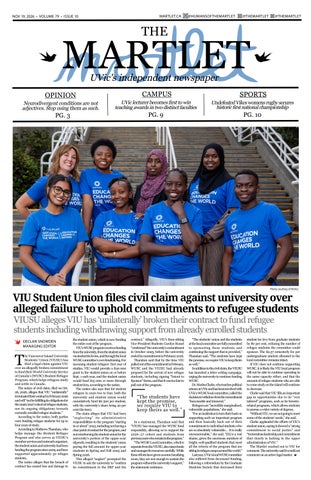
Photo courtesy of VIUSU.
VIU Student Union files civil claim against university over alleged failure to uphold commitments to refugee students VIUSU alleges VIU has ‘unilaterally’ broken their contract to fund refugee students including withdrawing support from already enrolled students DECLAN SNOWDEN MANAGING EDITOR
T
he Vancouver Island University Students’ Union (VIUSU) has filed a legal claim against VIU over an allegedly broken commitment to fund their World University Service of Canada’s (WUSC) Student Refugee Program, which helps refugees study and settle in Canada. The notice of civil claim, filed on Oct. 26, 2026, alleges that VIU “unilaterally” terminated their contract in February 2026 and will “not be fulfilling its obligations for the 2026/2027 cohort of refugee students, nor its ongoing obligations towards currently enrolled refugee students.” According to the notice, both parties were funding refugee students for up to four years of study. According to Mathews Tharakan, who helps manage the Student Refugee Program and who serves as VIUSU’s member services and outreach organizer, the student union and university had been funding the program since 2009, and have supported approximately 30 refugee students. The notice alleges that the breach of contract has caused loss and damage to
the student union, which is now funding the entire cost of the program. VIU’s WUSC program receives funding from the university, from the student union via student fee levies, and through the local WUSC committee’s own fundraising. For incoming student refugees’ first year of studies, VIU would provide a $30 000 grant to the student union on or before Sept. 1 each year, and the student union would fund $15 000 or more through student fees, according to the notice. The notice also says that for student refugees in years two to four, both the university and student union would cumulatively fund $6 500 per student, with the university’s share being 40 per cent ($2 600). The claim alleges that VIU had been “neglecting” its administrative responsibilities to the program “starting in or about” 2022, including not having a clear point of contact for the program, and not reimbursing the student union for the university’s portion of the upper-year stipends, resulting in the students’ union paying the full amount for upper-year students in Spring and Fall 2025 and Spring 2026. This alleged “neglect” prompted the VIUSU to ask the university to “confirm its commitment to the SRP and the
contract.” Allegedly, VIU’s then-sitting Vice-President Students Carolyn Russel “confirmed” the university's commitment in October 2025, before the university ended its commitment in February 2026. Tharakan said that by the time VIU pulled out of the commitment in February, WUSC and the VIUSU had already prepared for the arrival of new refugee students, including signing “Intent to Sponsor” forms, and that it was too late to pull out of the program.
“The students have kept the promise, we require VIU to keep theirs as well.” In a statement, Tharakan said that “VIUSU has managed the WUSC fund responsibly, allowing us to support the 2026–27 cohort and students from previous years who remain in the program.” “The WUSC Local Committee, which is separate from the VIUSU, also raises funds and manages its resources carefully. While these efforts have given us some breathing room, they are not enough to sustain the program without the university’s support,” the statement continues.
“The students’ union and the students at the local committee are fully committed to sponsoring these students and continuing the support that is provided,” Tharakan said. “The students have kept the promise, we require VIU to keep theirs as well.” In addition to the civil claim, the VIUSU has launched a letter writing campaign, urging the university to continue funding WUSC. Dr. Marlea Clarke, who teaches political science at UVic and has been involved with UVic’s WUSC local committee, called the decision to withdraw from the commitment "inexcusable and immoral.” Refugees are “incredibly marginalized, vulnerable populations,” she said. “For an institution to turn their back on supporting such an important program and then basically back out of their commitment to individual students who are so absolutely vulnerable.… It is really unconscionable,” she said. “[It] is a real shame, given the enormous numbers of bright, well-qualified students that meet all the criteria of the program that are sitting in refugee camps around the world.” Last year, UVic’s local WUSC committee also suffered from decreased funding, following a referendum by the Graduate Students Society that decreased their
student fee levy from graduate students by 80 per cent, reducing the number of refugee students the committee could sponsor. The $2.57 semesterly fee per undergraduate student allocated to the local committee remains intact. If VIU does not continue supporting WUSC, it is likely the VIU local program will not be able to continue operating in the same capacity either, and that the amount of refugee students who are able to come study on the island will continue to decrease. Clarke said that VIU fills an important gap in opportunities due to its “very tailored” programs, such as its forestryrelated programs, which allows students to pursue a wider variety of degrees. “Without VIU, we are not going to meet some of the students’ needs,” she said. Clarke applauded the efforts of VIU’s student union, saying it showed a “strong commitment to social justice” and “tremendous leadership and commitment that clearly is lacking in the upper administration of VIU.” The Martlet reached out to VIU for comment. The university said it would not comment on an active legal matter.
NEWS OPINIONS
Neurodivergent conditions are not adjectives. Stop using them like they are. Why do people call themselves 'so autistic' when they're nothing of the sort? Graphic courtesy of the Native Students Union.
NEWS UNSETTLED | What will Bill C-39 and repealing DRIPA solve? AVERY FEDERSPIEL NSU COLUMNIST Bill C-39, AKA the Build Canada Strong Act, has passed its second reading in the House of Commons and is swiftly being presented at a special senate meeting – bypassing the standing committee review process.
Illustration by Sabina Mendoza.
RONIYA SAHIN SENIOR STAFF WRITER To this day, I am still unsure of whether TikTok’s contributions to changing colloquial language are more dangerous or marvelous. That short-form video social media applications contributed to Dictionary.com naming “demure” their word of 2024, “6-7” their word of 2025, and now “maxxing” as the word o f 2 02 6 i s mi n d - b lo w i n g . Language sets up the parameters of our relationships. It allows us to construct bridges of understanding, or burn t h e m. So, what happens when misinformation spread on TikTok causes people to say they’re “so autistic” about s o me t h i n g ? O r t h a t t h e y ’ r e “ a bit ADHD” because they like to bounce from topic to topic. How about when someone says they’re “hyperfixated” on something, but they don’t mean it in the functionally disabling kind? What power do these s t a t e me n t s h o ld ? The Mental Health Commission of Canada defines a neurodivergent person as someone “whose neurological development and functioning d i ffe r fr o m w h a t i s co n s i d e r e d typical.” Neurodiverseaffirming language is an o n g o i n g e n d e a vo ur t o i d e n t i fy and treat certain symptoms. Neurodivergence does not n e ce s s a r i ly e n t a i l a d i s a b i li t y , b ut i t ce r t a i n ly d o e s d i s a b le a person in some capacity. For example, Canada recognizes A D H D , a f o r m o f neurodivergence, as a d i s a b i li t y . As research about different forms of neurodivergence (autism, ADHD, schizophrenia,
2 // NOV 19, 2026
or tourette syndrome, for e x a mple ) co nt inue s t o g r ow in volume, conversations surrounding neurodivergence are bound to be more dynamic. But does it have to come in the form of watering down (often) disabling conditions i n t o q ui r ky i d e nt ifie r s? Unfortunately, there is nothing stronger than the co mb i n a t i o n of t h e d e c line of me d i a li t e r a cy p air e d wit h t h e insatiable greed of the megarich to make ignorance profitable. Healthline released an article in 2024 discussing the dangers of misdiagnosis a i d e d b y T i kTok. In it , e xp e r t s warn of possible detrimental effects from relying on misinformation to diagnose observed behaviours as something they most likely a r e n ’t . The use of medical terminology by non-medical professionals to “diagnose” others can lead to actual diagnoses being downplayed due to a misinformed understanding of their nature. I don’t speak for every neurodivergent person — maybe just the angry ones — but I find it demoralizing whenever I encounter a person adopting neurodivergence whenever they choose, slipping it on like a mask for some laughs and r e la t a b i li t y p oint s. T h e t e r ms and c ond it ions of my neurodivergency make it so that I try to peel off my skin in hopes of alleviating my stressed, overstimulated sense receptors. Executing basic tasks feels like splitting a boulder with my bare hands. I had to learn the hard way that life operates against my innate w o r ki n g s . How do I cope? I hyperfixate.
I develop extremely intense, often detrimental obsessions on c e r t ain t h ing s — b e it a TV show, movie character, pop musician (Kate Bush, I love you) — and it replaces my reality. Developing a hyperfixation, for me, is akin to comfortably drowning in a pit of quicksand made up of all my earthly desires and watching as life passes me by. I am, in ot h e r wor d s, d isable d by it . The language I use to navigate the arduous world of my neurodivergency becomes watered down when people ignorantly try to equate certain words together. Suddenly, people misunderstand the disabling effects of a specific hyperfixation to just be something I’m really passionate a b o u t . Th a t a w k w a r d n e s s y o u experience in an interaction wit h a p e r son you c an’t r e ad ? Must be aut ism ! Neurodiverse language is imbued with helpful frameworks intended to identify how a neurodivergent person might struggle navigating a neurotypical world. When that language is taken out of the mouths of medical professionals and widely appropriated by misinformed people, my chances of getting the help I ne e d d wind le t o z e r o.
This bill, if passed as law, will prioritize any “investments in projects that support jobs and economic growth” to ensure the strength of our settler-colonial state in late-stage capitalism. These investments pertain to projects that, with the help of Bill C-39, will accelerate infrastructure approvals through quick-decision making which undermines Indigenous communities and governance (despite what the government website says). The federal government’s website is quick to say that this act will prioritize Indigenous people, utilizing hot words like “reconciliation” and “Indigenous rights” and “consultation” but the language couldn’t be clearer: this bill prioritizes capitalistic endeavors over the wellbeing of Canadian citizens. Through the power of positive language, the liberal government is skilled at painting Indigenous harm as a national necessity and Indigenous participation/ inclusion as an economic and bureaucratic obstacle. The Conservative Party of British Columbia is in full agreement with this attitude, centering the repeal of the United Nations Declaration on the Rights of Indigenous Peoples Act (DRIPA) in their political campaign during David Eby’s snap election back in October (in which the Conservatives won majority). The potential repeal of DRIPA in B.C. partnered with the fasttracked reading of the Bill C-39 proposal reaffirms that settler systems do not respect Indigenous voices, Indigenous powers, Indigenous rights, or the lands that all Canadians call home. The Assembly of First Nations (AFN) wrote in a letter to the government outlining concerns that are not new. The Government of Canada gave AFN 30 days to respond to the proposed legislation. Given the size of the document, the timeframe was not enough for AFN to respond to all parts of the bill, leading to a month's extension after feedback/ criticism. AFN mentions that inaccessible timeframes are a pattern, mentioning that in 2025, they were only given a week to provide feedback on the One Canadian Economy Act (Bill C-5). These
short timeframes meant for meaningful engagement are treated as a checkbox in the bureaucratic process, instead of an opportunity for authentic relationship-building. Relationship-building is a centered and communal effort in Indigenous ways of doing. To not recognize and reciprocate this effort is a type of disingenuous behavior that’s continuously masked with promises of finding an alternative to settlerIndigenous partnership. Regarding DRIPA, Grand Chief Stewart Phillip recently mentioned in CBC news that the Conservative Party of BC pushed the narrative that DRIPA has been unsuccessful for the province, and there are other ways to commit to working with First Nations groups. DRIPA was unanimously passed in 2019, and acts as a framework for mitigating the uncertainty Doerkson claims DRIPA has caused, as court cases regarding BC land and resources are costly, cause political contention, and developers are less likely to seek approval of First Nations before developing stolen land. DRIPA actively alleviated these issues by providing pathways for mutual respect and benefit, reconciliation, and relationshipgrowing. Without DRIPA, Indigenous groups in litigious situations will fall back on section 35 of the constitution, which protects Indigenous rights and holds governments accountable to their duty to consult. Indigenous groups in BC will not be completely left in the dark if BC conservatives repeal crucial relationship-building legislation, but relationships between government and Indigenous leaders will be strained. Public reactions from that strain are yet to be determined. Lorne Doerkson, the leader of the BC Conservative Party, is committed to economic reconciliation with BC First Nations. However, this is directly contradictory to his commitment to repeal DRIPA, as DRIPA is already a massive step towards reconciliation. Indigenous rights are up in the air right now, which is disappointing but not surprising. Bill C-39 and the repeal of DRIPA will not solve the problems it wishes to mend and will hurt Indigenous communities at large. I agree that the economy is at risk, but any solution that does not involve Indigenous harm is the better solution.
NOV 19, 2026 // 3
“Every time I hear cougar sighted I'm like, 'which department?'”
CULTURE
From Africa to Victoria, Paul Salopek has been walking the world in search of human connection Salopek shared his insights from his travels and about climate and migration at UVic on Oct. 25
Photo courtesy of John Stanmeyer.
Chicago Tribune in Africa, he RUBY HARRIS ASSISTANT MANAGING EDITOR covered war and conflict but felt he Paul Salopek, a National Geographic Explorer and Pulitzer Prize-winning journalist, started walking around the globe in 2013, and arrived in Victoria this October. In an interview with the Martlet, Salopek described the journey he is taking, the Out of Eden Walk, as “a storytelling walk across continents, following the footsteps of the first Homosapiens who spread out of Africa back in the Pleistocene.” Throughout the walk, Salopek writes and takes videos, photos, and recordings to document his findings. By June 2025, he had written more than half a million words online about it. For part of his journey, he will be accompanied by his walking partner, Deddeda White, a Vancouver Island local, as he makes his way toward the tip of South America. The Out of Eden Walk was motivated by a “deep interest in other people.” During the walk, Salopek practices “slow journalism,” an alternative form of journalism that embraces “depth, full context, and human connection.” He moves through communities on foot with an open mind — without forcing a predetermined agenda — to let broader human patterns emerge organically. “I don’t know what’s going to happen ahead, today or tomorrow,” he said. “But I might bump into something that … catches my interest, and that turns into a story.” In a presentation at Cinecenta last month, Salopek described how, while a foreign correspondent for the
was missing important stories. Slow journalism allows him to investigate people’s everyday realities, not just search for headlines. During the presentation, he shared a clip of his walking partner walking backward to alleviate the strain on his knees during a journey through China. Salopek compared the moment to the Out of Eden Walk as a whole — he does not know the landscape, or exactly what he will find as he walks, and relies on chance. Two key themes that have emerged in Salopek's journey are climate and migration. “I bump into [these issues], and I stub my toe on them every single day,” he said in the interview. He noted that everywhere he travels, someone comments on the weather. From Japan, where hotter temperatures are stunting rice crops vital to the local diet, to British Columbia, where rising ocean temperatures are harming oysters — with harm to marine life likely to worsen with this year’s El Niño — the climate emergency is driving severe regional impacts worldwide. In his presentation, he illustrated how climate change manifests in unexpected ways, using the Himalayan Mountains as an example. While accelerated glacier melt has temporarily boosted water flow and benefited local farming, this resource is finite. As these glaciers disappear, the region will soon face severe water scarcity and hardship. Salopek situated himself as a privileged person with resources,
choosing to walk across the world during an age of migration where people must move to live. Through the Out of Eden walk and his career in journalism, he has witnessed how war, conflict, and climate have uprooted people from their homes, and how involuntary migration has changed communities. Salopek continues to explore in his travels why we walk and keep moving. He noted humans were originally nomadic people, and still have that instinct. “Where to find work, to be safe … you have to vote with your feet. And this has been a human survival mechanism, a coping mechanism, from the very beginning going back 300 000 years,” he said. “We’ve sort of forgotten about it since we invented agriculture just 11 000 years ago, and that rooted us to place. But the world’s changing so rapidly now that we might have to dust off these ideas and incorporate them into our lives once again.” In the question-and-answer portion of the presentation, Salopek named home as wherever he can form a connection with people. He said that while he is a nomad, it is always difficult to say goodbye to the people he meets along the way. “If someone carries away anything from all this work, I would say it’s just a gentle reminder that you live in the world, and the world belongs to you. And therefore, don’t be afraid of it. Go out and stake your claim to it in a way that invites connectivity to others. That invites human connection,” he said.
CULTURE
‘You Can See Everything’ is worth the hype Zach Bryan rides the lightning but doesn’t crash on new EP An Offbeat by CFUV review GAVIN SENFT CONTRIBUTING WRITER “If you ride like lightning, you’re going to crash like thunder,” Robin (Ben Mendelssohn) says to Luke Glanton (Ryan Gosling) in the 2012 film The Place Beyond the Pines. These words open the song “Dog Days,” the fourth track of Zach Bryan’s EP Young Manhood and Other Donatable Organs (YM&ODO), released on Oct. 16. While this quote serves as a warning to Gosling’s vagabond character in the film, it could just as easily apply to Bryan himself. YM&ODO comes nearly a decade into the artist’s career, written during his largest tour to date. The album represents a climactic point for an artist all too familiar withlivingtherecklesslife,andtheinfluence of the quote drags through the album. Bryangrewupinpovertyintheaftermath of 9/11. He enlisted at 17, but like many veterans of the War on Terror, Bryan’s viewsonAmericangreatnesshavechanged. The recent actions of the American administration have forced Bryan to confront his own ideals and question what it means to be a so-called “country” singer, following in the footsteps of idols whose work is inseparable from the American identity. After someone at his shows called out his neutrality on ICE’s abductions of American citizens, Zach Bryan became outwardly political in his music, starting with the anti-ICE track “Bad News” on his previousalbumWithHeavenonTop.Since then,hehastouredwithBruceSpringsteen, and stood up against the blacklisting of Macklemore by wearing a “Free Palestine” shirt at Gillette Stadium; small steps in a journey that has seen Bryan become more politically outspoken like his idols before him. He backs up his newfound stance on YM&ODO with the song “Robot Killed the Working Man.” The track opens with a staccato of soundbites, given by “The American Dream” Dusty Rhode in a 1985 WWE promo, on the danger posed by automation to the average worker. By using the words of a famous wrestler, a formerly dominant piece of American culture now fully corrupted by both capitalism and conservatism, Bryan explores how working-class culture has been corrupted by the American right, and his own complex role within that culture. The song suggests that Bryan resents how his genre of choice, Americana, is consideredmusic“byandfor”conservatives, a view that he has repeated time and again in interviews. While still using banjos and six strings in his music, Zach Bryan has shifted his image from typical country star
to a working-class darling. ThealbumbreaksnewgroundforBryan in terms of his political expression, though several of the EP’s tracks continue to tread the old ground of personal strife that has defined his career since it began with DeAnn. Both tracks featuring other artists — “Lies” with Lana Del Rey, and “Plainsman” with fellow Oklahomans the Turnpike Troubadours — revolve around relationships.Theformerisasoftduet,with Del Rey taking on the part of a past partner, as the two sing to each other about the lies they use to keep their relationship afloat. The latter sees Bryan collab with one of his biggest influences, and one of the few groups who can understand his anxiety about leaving Oklahoma for the wider world. Most of the music on the EP is written to be retrospective, with “Plainsman” depicting a conversation between Bryan’s past and present selves. While lyrically, YM&ODO treads similar ground, it also shows off Bryan’s growing musical ability and voice. The lush string production found on past albums like With HeavenonTopremains,butBryanexplores new and incredible avenues sonically on this EP. The computerized fuzz of the opening on “Lodi When,” the digital barks on “Dog Days,” and the sampled movie dialogue peppered throughout represent Bryan embracing aspects of the computer pop trend of the 2020s, while other tracks like “Lies” and “You’ll Get By" bring little new to his musical portfolio. Overall, the album shines in showcasing Bryan’s new direction musically and lyrically, and can be considered a rebirth for an artist struggling to reckon with both genre and his identity. The ideas in YM&ODO can be best summarizedbyitscover,whichdepictstwo Bryans standing across from each other in a misty field, the “new Zach” on the left preparing to kill the old Zach on the right. The image symbolically represents how one must “kill” their old self to grow into a new, better person. For Bryan, it represents how he has become a different artist and person than the one who wrote “Lodi When” at the start of the tour. Newly thirty, sober, and politically energized, Bryan’s efforts on this EP track his career arc up to this point, and prove his artistry nimble enough to ride like lightning and avoid crashing like thunder.
The documentary about disgraced Theranos founder Elizabeth Holmes encapsulates the challenges of seeking answers in the ‘post-truth’ era ETHAN BARKLEY EDITOR-IN-CHIEF This review contains spoilers for the film You Can See Everything. You Can See Everything, the latest documentary venture co-directed by one of UVic’s most famous alums, Nathan Fielder, is well worthy of the incredible hype surrounding its release. Since its mid-October theatrical release, the documentary, co-directed and produced by Fielder and Lance Oppenheim, already became the top-rated film on film rating and social media site Letterboxd with a record 4.8 out of 5 stars. But really, what more could you expect from Fielder, a graduate of one of Canada’s top business schools where he got “really good grades”? Since graduating from the Gustavson School of Business in 2005, Fielder has made a name for himself in the entertainment industry through his This Hour Has 22 Minutes segment “Nathan on your Side,” Comedy Central show Nathan For You, HBO series The Rehearsal, and Showtime series The Curse, among others. At the centre of the film is disgraced Theranos founder Elizabeth Holmes, who Forbes named the youngest and wealthiest self-made woman billionaire in 2015, and her partner, Billy Evans. Theranos took off in the mid to late 2000s following claims it had revolutionized blood testing with the invention of a device she refers to in the film as the “iPod” of medical testing. She was indicted by a
federal grand jury in 2018 for defrauding investors — but was acquitted of defrauding patients — of hundreds of millions of U.S. dollars. She was sentenced in 2022, and her sentence of 11 years and three months in a minimum-security facility in Texas began May 30, 2023. 34 days before her sentence is set to begin, Holmes and Evans invite Fielder, Oppenheim, and their film crew to stay with them at a rented house in Del Mar, California and document the minutiae of their lives in the final month before her sentencing, with the promise that they can “totally see everything.” However, Fielder immediately becomes suspicious that the couple aren’t being as transparent as they promised — a trend that continues throughout the almost three-hour-long runtime. It’s rare for a film to generate this much pre-release hype and be able to meet it. It’s also rare for a documentary to reach such a runtime while answering almost no questions about the supposedly central subject, and it’s even rarer for this to be the case while producing a film that remains genuinely revelatory. I was unfamiliar with the Theranos scandal, and Holmes’s fall from grace, before watching You Can See Everything, and came away with an even fuzzier picture of the details. You Can See Everything is nominally about Holmes; Evans remarks in the film that the purpose of inviting Fielder and Oppenheim is for the world to get to see the “real” Holmes, not the version of her they have assembled from news
‘Wildwood’ is a beautiful spectacle that pushes the bounds of what animated cinema can be The film has over 165 000 frames, and took almost two decades to complete DECLAN SNOWDEN MANAGING EDITOR This review contains a minor spoiler for a single line of dialogue in the movie. Wildwood, directed by Travis Knight and produced by LAIKA, is a fantastic stop motion animated film showing there’s still space for mature animated content in cinema. As an avid fan of animation, I often hear people say something along the lines of “I don’t want to watch kid stuff,” completely brushing off fantastic pieces of art. On the other side of the coin, I’ll hear people say they don’t like adult animation, associating it with crude humour, likely due to shows like Family Guy and South Park. Many filmgoers consider animation to be a “babysitter,” resulting in endless familyfriendly animated films. Of course, these
filmes have their place, and are often fantastic in their own regard, but this “babysitter” perception of animation results in a gap of more mature but not crude films, despite the popularity of animated shows like Adventure Time and Avatar: The Last Airbender, which prove audiences are receptive to mature stories and themes in animation. At the same time, animation (and all art) is under attack. Generative AI is making it incredibly easy for studios to create cheap, soulless slop that plagiarizes the work of real artists. In the film industry, we’re already seeing billion-dollar studios use AI-generated art in their creative processes. Just this year, Supergirl faced scrutiny over AI concept art used behind the scenes, and the official art book for Spider-Man: Brand New Day is alleged by many to contain AI generated content.
Graphic via IMDB.
4 // NOV 19, 2026
headlines and the Hulu biographical miniseries The Dropout. But it’s also about the limits of truth and knowledge, and the dynamics between documentarian and documentee in such an intimate setting. It’s as much a psychological profile of Fielder as it is Holmes. This is reflected in the visual presentation of the film, which, through liberal use of zoom shots framed in a 4:3 aspect ratio, viewers become intimately familiar with the details of Holmes, Fielder, and Evans’ faces. During interviews, the camera holds these shots for minutes at a time, often zooming in during periods of silence. Unlike many documentarians, Fielder isn’t an invisible presence behind the camera, shooting interview footage while the subject sits in the chair. He’s an active presence in the scenes. He moves from room to room, engaging Holmes and Evans directly in their everyday environment. Lingering in the background of shots, and behind corners, he becomes an almost haunting presence in the film — a perception aided by Ari Balouzian’s deeply unsettling, almost horror movie-esque score. It also throws its own central concept into question in a fascinating way. What does it mean to “see everything?” We see Holmes and Evans play with their children, and cook in their kitchen. We see Evans shower in the nude. But as the film goes on, the intrusions upon the promise to Fielder of “seeing everything” become increasingly overt and frustrating. Evans invites him to their home, then seems to
Despite negative perceptions of animation and the ongoing assault ofthe arts,Wildwood is a bold and rare adventure into a mature story told through animation, while relying solely on human creativity and labour. The movie has far too much death and violence for me to call it children's animation. At the same time, it's not overtly edgy or gory. What makes it even more incredible is the animation itself. The film features humongous, epic battle scenes, all done in stop motion. Every detail is deliberate, and every movement required people to manually pose the puppets. It is the culmination of the work of over 1 000 artists, who created 136 sets and 231 puppets. The resulting animation is beautifully expressive in a way that only humans can create. Its dialogue is well-written, and the voice acting isn’t cringy. It does a fantastic job establishing a diverse world, history, and cast of characters without overly relying on exposition as so many modern films and shows do. Writer Chris Butler, alongside Colin Meloy and Carson Ellis, who wrote and illustrated the 2011 novel Wildwood on which the film is based, were clearly confident in their abilities to tell a story without holding the audience's hand. The film has over 165 000 frames, and took almost two decades to complete, with some scenes taking months. It is a love letter to everything that’s great about animation, art, and human creativity, and it is abundantly clear that the creatives, artists, and cast poured their hearts and souls into the film. In the film, one character says to another, “I knew there was something remarkable about you.” That’s exactly how I feel about Wildwood –– remarkable.
Photo via A24 Films.
grow increasingly agitated by Fielder’s lines of questioning, at one point stopping him from interviewing Holmes’ father, a former Enron executive. He later interrupts another scene, demanding they stop shooting, refusing to state the reason for ending the scene until the cameras stop. Ironically for a film with this name, the latter half is marked by scenes you can’t see — things that happened before production began, or interviews in locations where recording is forbidden. Their solution was to film reenactments of the scenes, with Amanda Seyfried (who played Holmes in The Dropout) as Holmes and Christopher Abbott as Evans. In doing so, Fielder and Oppenheim break from the documentary framework they’ve been working in. As audiences, we
want to trust the version of events shown in the reenactments, but in a film where one’s image and who controls it is such a central theme, the deliberate choice to circumnavigate barriers in this is both brilliant and intensely jarring. In many ways, You Can See Everything feels like the perfect film for our time — the era of “post truth” and “alternative facts.” It masterfully walks the epistemological tightrope of trying to understand what’s true in a national scandal of such huge proportions while acknowledging that, for many stories like these, we may never know the full truth. But, as the film shows through Fielder’s own reactions and reflections during the process, it’s intoxicating — even exhilarating — to try.
UPCOM UPCO MING FILM FILMS
THE LAST WALTZ
PRIMETIME
DEC 1: 5:00 & 7:20
DEC 4: 5:00 & 7:10 DEC 5: 2:50, 5:00 & 7:10
Photo courtesy of Pierre ____.
DUNE PART 1 DEC 9: 6:00
THE MUPPET CHRISTMAS CAROL DEC 17 & 18: 5:15
NOV 19, 2026 // 5
The Bald Range fire didn't end when it was extinguished It's been over three months since the Bald Range fire broke out, but communities in B.C.'s interior are still reeling from its impacts RAAMIN HAMID SENIOR STAFF WRITER
Photo courtesy of Noah Russil..
Photo courtesy of Kamloops Fire Centre.
I
t’s Aug. 7, and a raging fire blazes through the Okanagan region. It starts in the afternoon, about 15 kilometres west of the District of Summerland in a community called Faulder, but rapidly grows eastward, reaching Summerland. Within hours, it has burned an estimated 5 000 hectares of land.
By the evening, 20 000 people are forced to evacuate Summerland and the surrounding regions — Summerland is home to 12 042 people alone. The fire was unprecedented, and was exacerbated by extreme winds on a particularly dry and sunny Okanagan day. It also led to the confirmed death of one person, who was trying to rush out of their house. According to a preliminary Post-Wildfire Natural Hazard Risk Analysis (PWNHRA) report, the area of Summerland and its neighboring towns have a long history of wildfire and natural disasters. The cause of the wildfire is still under a multi-agency investigation, including B.C. Wildfire Service, the Compliance and Enforcement Branch, the RCMP, and other law enforcement agencies. The B.C. Wildfire Service says the fire covered 25 163.2 hectares of land — or 251.63 square kilometres — and resulted in the destruction of 150 homes; 110 in the communities of Faulder and Meadow Valley, and 40 in Summerland. As a whole, 2026 has been one of the most devastating wildfire seasons in B.C. for damage to property. The Bald Range fire was declared “held” on Aug. 28, ending a three week-long provincial state of emergency, and was declared officially “out” on Oct. 28. However, the disaster does not simply end once it’s been extinguished. Efforts to rebuild lives and return to a state of normal will be ongoing for some time.
FIRE IN OUR BACKYARD One of the homes lost was of 19-year-old Ava Schrader, a longtime Faulder resident and secondyear student at Capilano University in North Vancouver.
Photo courtesy of Kamloops Fire Centre.
Schrader was home this summer in between semesters when the Bald Range fire broke out. On Aug. 7, as evacuations began, Schrader was on her way to Vancouver to see friends before embarking on a cruise. “Everything was normal until it started,” she said. Around 5:30 p.m. or 6:00 p.m., while stopped at a gas station in the town of Summerland on her way to Vancouver, Schrader received a text from her cousin’s girlfriend mentioning that Schrader’s family had been evacuated. “I called my mom, and she was already driving into [Summerland],” she said. “She was like, ‘the fire is in our backyard.’” At that moment, Schrader knew that her house was gone. “My mom and stepdad saw the smoke right above our house,” she said. “By the time they realized they had to leave, they had 20 minutes to get out of the house and grab everything.”
Schrader said that firefighters were knocking on the doors of her home, telling her mom and stepdad to leave. As she was leaving Summerland, Schrader could see the big cloud of smoke on top of her community of Faulder, and was starting to cover the community of Garnet Valley. “That’s the direction the wind was blowing.” “The conditions of that specific day caused the fire to be so aggressive,” she said. “It was just such a windy day that as soon as the fire caught, it just destroyed the entire neighborhood.” Another of Schrader’s friends texted her on her drive out confirming that “Faulder is gone.” After she returned from her cruise, Schrader moved into an Airbnb with her mom and stepdad in Summerland for a week. Now, she is in a home that they are renting. Schrader said that the community has shown incredible kindness and generosity to those who had to evacuate, and to those who have lost their homes. “In Penticton … volunteers set up a free store for all of the people that lost their houses,” she said. She also said that Capilano University reached out to all the students from the Summerland area and offered emotional support, like the choice to see a counsellor, and emergency funding. Schrader received emergency funding herself which was helpful to her. “There are still things that I’m having to go out and buy because you don’t realize you need something until you lose it. Like, a hot glue gun.” To spread awareness and document the unprecedented fire, the Summerland Museum has arranged The Bald Range Wildfire Collection which includes testimonials, news interviews, and research regarding the fire. Schrader acknowledged that the Okanagan is dry, and because of that the summers are also unpredictable and scary, but she said she also recognizes the impact that climate change had on the Bald Range fire. “Climate change, absolutely, has to do with the conditions that the fire was in, and it was just unlucky for us to be at such a bad time of year, on such an aggressively windy day” she said. Dilynn Scott, a first year student at UVic, was born and raised in Kelowna. She described the winters growing up as always having “at least a foot of snow,” but then slowly as she got older, it became less and less likely that they’d have a white Christmas. “I have younger cousins, and watching them grow up without seeing snow in the winter is really weird.” Scott said that the summers have also been continuously getting warmer, and seeing smoke from fires nearby has been a part of summer “pretty much since I can remember.” Due to the Bald Range fire, the air quality in Kelowna was potentially hazardous, and residents were advised to avoid outdoor activities. Scott said that there were days where you couldn’t go outside because of how heavy the smoke was. She also knows several people with asthma
whose everyday tasks were impacted by the smoke. “There’s a lot of mundane things that get interrupted.” Because fires in the area are so normalized now, Scott has prepared a go bag with essentials packed at all times in case a fire was to arise in her own neighborhood. “We’ve never evacuated, but it’s definitely been like, it could be tonight.” Erik Petersen is another student at UVic, in his second-year studying political science. He comes from the community of Naramata, which is directly across Lake Okanagan from Summerland. “We could see the fires from across the water and the ash would fall directly onto [Naramata],” he said. Petersen was working at a restaurant in Penticton this summer when his boss told him mid-shift that Summerland had been evacuated. “It was just sort of horrible to see all the people who had to evacuate and head into Penticton” where the main evacuation centre was located, he said. On his drive home, Petersen said he could see smoke arising from the fire and its orange haze. “I pulled over while I was driving home because I realized I could see the fire,” he said. “That’s sort of when it clicked in my head, oh, it’s not a small fire, it’s on the town. I could see it getting really close to Summerland.” Petersen said that this fire reminded him and his family of the danger of living in the Okanagan, an area prone to forest fires. “From then on, we made a fire kit and an evacuation plan … we made a plan of what we would do if Naramata got evacuated.” Coming back to UVic, Petersen felt a sense of melancholy. He said that the feeling of passive dread didn’t go away once he came back to Victoria. But he said a good support system helped him through that time. One thing Petersen said people should take away from the fires in Summerland is that “people need to recognize, you might not see the effects because they haven’t happened to you yet, but they will at some point.” “Ignorance is bliss in a sense, but only to a certain point where it becomes detrimental,” he said. “[Climate change is] probably the biggest threat to human existence.” Raja Gupta, a science and math teacher at Summerland Secondary School, told the Martlet that Summerland’s climate has changed in the last 30 years he has been living there. “It used to be quite a dry climate year round, even in the winter, we would get snow but it would be powder,” he said. “Now our rains are heavier and steadier … It doesn’t snow much anymore.” Gupta has been in Summerland since 1997. On Aug. 7, he could see the fire over the hills from where he lives in Lower Town, but he said he originally didn’t think much of it. At around 5 p.m., some of Gupta’s friends who lived elsewhere in Summerland asked if they could come stay at his house because they received an evacuation notice. Around 6:30 p.m., when his friends walked through
his front door, they told him they didn’t have a house to go back to. At around 11 p.m., Gupta said he received a text from a family friend stating the whole town was being evacuated. “It was very surreal,” he said, thinking “‘It’s never going to happen, they’re not going to evacuate the whole town.’” Gupta had about 20 minutes to leave his home. “We were out of our house for about two weeks…. We didn’t know what we would find when we got back,” he said. Gupta ultimately did not lose his home, but he knows others in Summerland who did. Returning to school a month after the fires, Gupta said that everyone in the building knew that some people had lost their homes, including some of their students. The staff were “mindful of and respectful of and understanding of the variety of situations that were taking place,” he said. Gupta says he has a couple students in his class who didn’t lose their homes, but were not in them for an extended period of time, and some who have still not returned to them. “In times of grief, there’s something to be said for trying to provide as normal and predictable of a situation as possible,” he said. In preparation to come back to school, the staff at Summerland Secondary organized a get-together beforehand to catch up, touch base with each other and see how everyone was doing after the fire. In his over 30 year-long teaching career, Gupta has been teaching climate change as part of his curriculum for many years, and has noticed the Okanagan’s climate evolve over those three decades. “When you’re looking at climate over the broader scale, [30 years is] a rapid change,” he said. He said he hopes that this experience impacts his students in how they think about climate change. “But it’s not just the students, it’s the adults.” “From an educational standpoint, [the students] get it,” he said. “I certainly hope the adults get it.”
FIRE ON OUR DOORSTEP Dr. Ian Mauro, professor of environmental studies at UVic and executive director of the Pacific Institute for Climate Solutions (PICS), said in an interview with the Martlet that climate adaptation “is inherently cultural.”
“It is something that requires a combination of humans, insight, research, activation, and real planning,” he said. He said the Okanagan region is increasingly prone to fire due to hotter and drier summers as a result of climate change. “We live in an era where our homes and communities are threatened by this existential and increase in [fires],” he said, and for young people, this is now part of their summer breaks. For youth now, “there isn’t fresh air to breathe.” Dr. Eric Higgs, also a professor in the School of Environmental Studies at UVic, said that a lot of the ecosystems in B.C. are dependent
on fires through cultural or natural fires. He said that there is clear evidence that prescribed burning is critical in changing the climate and restoring balance. “We have to be doing more of it,” he said. But he also said that the most important thing to do right now is to let the communities heal. “I could talk a lot about prescribed fire, but then I think about, well, ‘what if my house was taken out? How would I feel?’” he said. “That process of grieving and support, and getting the community back together is a critical first step,” he said. Izzy Leyshon, a Master’s student at UBC Okanag an in earth and environmental sciences, is specializing in prescribed burning and fire ecology. She told the Martlet that her main concern in the aftermath of a fire like Bald Range would be slope stability, because the same root system does not exist after a severe fire. A landslide occurred in Summerland in late October, after the fire was declared “out.” Leyshon also sees prescribed burning as an important forest management tool. “Fire is a natural part of the landscape throughout British Columbia, and it was used [historically] as a tool for ecological benefits and risk reduction and cultural significance” before it was made illegal under the Bush Fire Act of 1874. In March 2024, changes to Wildfire Regulation were made to allow for cultural and prescribed burning in B.C. once again. The change resulted from engagement with First Nations in the province and the B.C. Wildfire Service. Leyshon said that by integrating prescribed fire as a tool there can be lots of ecological benefits which can help with risk reduction. She also said that there is a decent amount of opportunity now to learn about wildfires at the university through guest lecturers. In an emailed statement to the Martlet, a UVic spokesperson said that the university “offers a range of supports and services to help students navigate the impact of natural disasters and other unexpected crises.” UVic students can receive mental health services financial support, academic advising, and other resources depending on their circumstances. “When significant events such as earthquakes, floods, fires or political unrest affect countries or regions where members of our campus community have family, friends or other connections, the university regularly reaches out directly to impacted students to share messages of support and information about available resources,” the UVic spokesperson said. Leyshon said that overall fire risk is a reality in the community, and is leading to more greater dialogue about fire risk and preparedness at UBCO. “Fire is at the doorstep of the campus,” she said.
Photo courtesy of Kamloops Fire Centre.
6 // NOV 19, 2026
NOV 19, 2026 // 7
CAMPUS
CAMPUS
UVic student celebrates thirteen years of sobriety, recalling hardships along the way
UVic lecturer becomes first to win teaching awards in two distinct faculties
Last month’s fire at the Traveller’s Inn devastated psychology and gender studies student Samten Stobbe, coinciding with the weekend she celebrated thirteen years of sobriety ABIGAIL FISHMAN SENIOR STAFF WRITER Samten Stobbe, a 49-year-old UVic student, has studied at UVic on and off over the last thirty years, persevering with passion through an opioid dependency and a journey to discovering her own gender identity. When Stobbe graduated high school, she wanted to pursue music and took a gap year to study music theory and take saxophone and piano lessons. In 1995, she left Manitoba and arrived at UVic for her first year of university, where she planned to study education or transfer to a jazz-music school. By the end of her first year, Stobbe wanted to pursue classical performance. But in 1996 she opted to take time off of school to travel. Five years later, she returned for her second year. “My second year went really well on paper, but my drug use escalated,” Stobbe said. One week before what would have been her third year, she visited the music building to practice, and found a notice posted on the door of her saxophone teacher’s office informing students that a classmate had died on a camping trip that summer. “It was devastating,” she said. Stobbe
had played in a saxophone quartet with the student during her second year, spending three hours a week with him. She said the resources that are available to students now, such as counselling and outreach, were not available back then. At this time, Stobbe was at the beginning of a physical opioid dependency. Both of these factors, as well as a change in instructor that some students weren’t comfortable with, contributed to Stobbe’s decision to drop out at the beginning of her third year. “It took me a number of years to really figure out that I needed to learn how to grieve for him, and I realized that I dropped out because I was incapable of grieving.” After dropping out, Stobbe’s drug use continued to escalate and she remained with a physical opioid dependency for 11 years, and attended five treatment centers, before surrendering to her parents for help. Her final detox in 2013 was at a rehabilitation facility in Kelowna, BC. She said that harm reduction is intended to lead to total abstinence, which often does not happen. “People are on harm reduction for the rest of
their lives, and I didn’t want to be one of those people. So for me it’s total abstinence.” At eight years sober, Stobbe returned to UVic to resume her degree in her third year. Stobbe wanted to explore “academia proper,” and is now pursuing a general degree in psychology and gender studies, with a minor in music. Stobbe, who identifies as transfeminine, said that assignments for her gender studies classes have helped her understand that her drug use was a way of coping with her repressed gender identity. She recalled moments from her childhood, such as asking to try on her sister's nightgown. “The signs of being transgender were there when I was a child, but it wasn’t as prevalent as it is nowadays,” she said. In the ninth grade, she began using cannabis, and she said that “it was easier to stay stoned than to look at [her] gender identity.” She didn’t begin to learn about queer identity until her adult life, and began expressing her feminine gender more after her successful recovery in 2013. “I went from gender fluid to gender queer to transfeminine.” In her return to UVic, Stobbe has a
goal to pursue counseling. Likening her experience to being a “triple threat” — someone who can sing, dance, and act — in the performance world, “I thought I could be a triple threat counselor because I have direct experience with addiction, and I have direct experience with mental health issues, and I have direct experience with gender issues,” she said. Stobbe said that she thinks direct experience is a valued asset in counselors today. In her own personal experience at treatment centers, Stobbe said that counselors with direct experience always appeared to be the most valued by people in treatment. Over the last two years, she has lived at the Traveller’s Inn, which was destroyed by a fire on Oct. 24. Stobbe lost everything in the fire, including her cat, The Bella Monster, her collection of musical instruments, and all of her academic materials such as flashcards and annotated articles. Though she hasn’t played music much over the last few years, Stobbe said that “losing the instruments was like losing a part of [her]self, losing the ability to connect with [her]self in the way that only happens when you’re
playing.” In the same weekend that the fire occurred, Stobbe was celebrating thirteen years of sobriety, and her parents had come to the island to celebrate with her. “It was serendipitous that they were here when I had to move, because I don’t know how I would have done it without them.” Stobbe has now resettled in a studio apartment that a friend, who is a property manager, helped her locate and apply for. “I was really fortunate to find such an affordable place, and it’s so much better than my room at the Travellers [Inn] was.” Stobbe’s sister has started a GoFundMe to help collect a “fire recovery fund”, which has raised over $15 000 at the time of publication. The Gender Empowerment Center (GEM), which she said is her favorite place on campus, has also planned a bake-sale fundraiser for her. The bake sale will be on Nov. 25 from 11 a.m. to 2 p.m., outside the Michèle Pujol Room in the SUB. “I’m grateful for the outpouring of support,” she said.
Dr. Michael Reed is a continuing sessional lecturer in the departments of art history and visual studies and medieval studies. AMELIA WATSON SENIOR STAFF WRITER Continuing sessional lecturer Dr. Michael Reed is known on campus to continuously go above and beyond for his students. After ten years, many students, and many semesters, Reed is celebrating his decade-long career by becoming the first lecturer at UVic to win two teaching awards in two distinct faculties (Humanities and Visual Arts). Reed is a lecturer in both medieval studies — where he teaches all the core medieval studies courses — and in art history and visual studies. Reed also teaches the Faculty of Humanities’ first-year interdisciplinary courses. He won the Faculty of Humanities Award for Teaching Excellence in 2021. In 2022, he won the Gillian Sherwin Alumni Award for teaching excellence — the highest honour for teaching excellence at UVic for Sessional Lecturers, Lab Instructors, and Senior Lab Instructors. This October, Reed won the Faculty of Fine Arts Award for Teaching Excellence, marking him as the first lecturer to win two teaching awards in two different faculties. “After I won [the Faculty of Fine Arts] award, I strongly suspected that I might be the first person to have won faculty-level awards in multiple faculties. So I had to begin the process of proving it.” Reed’s career at UVic began as an undergraduate student in the Faculty of Education, wanting to become a teacher. “At that time, there was a combined area of history
and art history,” Reed said. “ [But] after doing my first round of practicum courses, [that area] was eliminated by the Ministry of Education.” After his preferred teaching area was removed by the ministry, Reed pivoted and completed an honours degree in art history and visual studies at UVic, followed by a master’s degree in art history and visual studies, also at UVic, and later a PhD from the Centre for Medieval Studies at the University of York, U.K. In 2012, after postdoctoral fellowships at York University and Guelph University, Reed found himself back at UVic as an Associate Research Fellow in the Centre for Studies in Religion and Society. Reed finished his fellowship in 2015, and began teaching at UVic the following spring. "I've always known I wanted to teach.... Since returning to UVic in this role, what I've discovered is that teaching is more than conveying information; it's also a form of knowledge creation, especially if you're a dialectical teacher like I am," Reed said. "My classrooms are very much a conversation, and in the context of the conversation, you're always revealing something new…. The synthesis that comes out of it is what students are going to remember, it's that new kernel of something." Reed began teaching at UVic as a sessional lecturer and is currently a continuing sessional lecturer. The key distinction between the two positions is that Reed now has a
more permanent place at UVic, though still not as permanent as a tenured professor. “I still am a sessional … but the irony is, with the teaching and also the supervision I do with my honours students … I actually have a larger course load than someone who's a regular faculty member,” Reed said. Over the course of his teaching career, as an openly gay man, Reed has prided himself on creating a welcoming and authentic environment for students. “My approach to history is very broad because I like to think that everyone and every voice has a vested interest in understanding the past.… When you make [your scope] as broad as you possibly can, your audience increases, and lived experiences become visible in the historical record,” Reed said. “Because I am an [openly] gay man … I've always made sure my students know that because I bring a lived experience and a perspective that is defined by who I am and how society perceives me,” he continued. Reed hopes that by being an openly gay lecturer, he “encourages people who feel like they're on the periphery to participate.” After years of service to UVic as a sessional instructor, Reed continues to pursue his passion for teaching and providing a welcoming environment for his students. “Teaching needs to receive more respect than it does. I'm still a researcher and I always will be, but what makes my heart sing is being in a classroom,” Reed said. Students in the Medieval Studies
Photo courtesy of Michael Reed.
Course Union organized a letterwriting campaign last year in support of Reed, whom they called “The Venerable Michael Reed,” — a reference to the Venerable Bede, a seventh- and eighth-century English monk, scholar, and later canonized saint — receiving a permanent position at the university.
They clarified in the announcement that Reed was not at all involved in the effort, and it was entirely student-led. “I would be happy if I had a permanent position, but that's so far been elusive. But I enjoy what I do very, very much.”
Meet your new interim director of finance and operations Donovan Wood-Gaines is a second-year business student with plans to change how students can engage with the more financial aspect of student politics RONIYA SAHIN SENIOR STAFF WRITER
Construction and Trade Management Build the skills you need to succeed in a changing industry. Developed with industry needs in mind, gain practical, real-world skills that can be applied immediately to your job or project. Enhance your expertise with individual courses, short micro-certificates, or the full certificate program: Trade and Construction Management (certificate) Contract Bidding and Procurement for Construction and Trades (micro-certificate) Sustainability Skills for Construction Management (micro-certificate) SAFE Design for Built Environments (single-course micro-certificate) Sustainability Planning and Reporting (single-course micro-certificate)
Register today! continuingstudies.uvic.ca/CATM 8 // NOV 19, 2026
Donovan Wood-Gaines is the new interim director of finance and operations for the UVSS, replacing Mariah Luzon for the remainder of the term after her resignation on Oct. 9. Wood-Gaines was previously a Director-at-Large (DAL) on the board before stepping into the role. He was elected by the UVSS board as the interim director after answering a series of questions from the board. “I joined the UVSS to look at different ways to make an impact in terms of advocacy,” Wood-Gaines said in an interview with the Martlet. “[I’m} also looking at how we could utilize the existing infrastructure we have in the SUB” to best benefit students, he said. H e s a i d t ra n s i t w a s a ma j o r subject he ran on, citing the return of the 76 bus line — a direct bus from the UVic bus loop to Swartz Bay ferry that runs for a limited period of time — following UVSS advocacy in 2024, as well as further transparency on what “student fees” actually go to. Wood-Gaines also prioritizes financial responsibility. He said he believes students should be feeling the effects of where their
money is spent. “I think it is really important that we are spending student money properly. The money that students contribute to the [UVSS], there should be the expectation that they’re getting a lot of value back on that.” “Every single dollar that is spent needs to be going towards maximizing the impact on students, maximizing the benefit that [it’s] providing to them.” The change from DAL to director of finance and operations was noticeable to Wood-Gaines. He was still involved in overlapping responsibilities as a DAL during the transition, but now Wood-Gaines will facilitate and be responsible for larger financial and operational decisions. Just two weeks after accepting the role as interim director, he presented the budget and audit at the recent Annual General Meeting (AGM), where all motions put forward by the society passed. Wood-Gaines shared with the Martlet an anecdote that one of the reasons he joined the UVSS was a personal connection to the food venues the society contributes to campus — Wood-Gaines is an avowed fan of The Grill’s double cheeseburger as well as the wings served at Felicita’s Pub.
“Just using the SUB services and realizing how much goes on, and the fact that they’re student-run…. I had a big interest in in being a part of of something that I feel like sometimes not every student feels very connected to.” The main driving factor for him, however, is student engagement in student politics. Wood-Gaines says wants to do things differently. He told the Martlet that he recognized how directors of finance and operations do not typically focus their goals on advocating for student engagement. This term, Wood-Gaines wants to connect with the services the UVSS provides to look for opportunities of “positive change.” He listed the Food Bank, health and dental, the UPASS, and increasing employment opportunities for students as main targets he wants to hit during his time as director. “We are a student-run society, so I think students should be part of all of the things we do here,” said Wood-Gaines. “I want students to know that regardless of their interests, there is a place for their ideas here at the UVSS.”
Photo courtesy of Donovan Wood-Gaines.
NOV 19, 2026 // 9
SPORTS
FUN STUFF
Undefeated Vikes womens rugby secures historic first national championship
Divided
SEE THIS ISSUE'S CROSSWORD ANSWERS MARTLET.CA/CROSSWORD
ATUM BECKETT CROSSWORD WIZARD
Victoria brings the banner home after a long awaited battle at nationals going for gold coast to coast ELLA BAIRD VOLUNTEER STAFF WRITER The UVic Vikes women’s rugby team made history in Guelph, Ont., on Nov. 8, securing the program’s first-ever U SPORTS national championship with a 17–0 win over the UBC Thunderbirds. The gold medal capped off a perfect 10–0 season record, finally breaking a heart-straining streak of meeting UBC in the finals, but walking away without the banner. “That victory was something we had been chasing for three years,” third-year fly-half Elle Douglas said in an interview with the Martlet. “It’s so hard to put into words how amazing it felt.” “My heart, genuinely, I don’t think it could have swelled any bigger. My smile couldn’t have gotten any bigger.… Being able to rush onto the field and hug my teammates like that is something I’ve gone to bed thinking about every single day since we lost last year in Vancouver” UVic’s widely shared strength was reflected not only on the pitch, but on the national stage. Ahead of their championship run, six Vikes were named U SPORTS All-Canadians at the national awards banquet in Guelph. Fourth-year back and Canada West Player of the Year Maddy Grant earned First Team All-
Canadian honours alongside veteran backs Emily Findlay and Olivia Newsome. Captain Maggie Mackinnon, alongside Kendra Cousineau and Piper Walsh, were named Second Team All-Canadians. This nationally recognized team was tested when Victoria’s season hung in the air during a 27–24 semifinal game against Laval on Nov. 6. With the clock winding down deep into extra time, tied 24–24, Douglas stepped into a clear pocket and cleanly slotted a championshipsaving drop goal. “Me and Olly Winser, our assistant [and] backs coach, have been working through moments like that just in case,” Douglas said. “There have been times when I’ve practiced, and they haven't quite gone in between the sticks, but the rugby gods were on my side that day.” The Vikes faced two-time defending national champion UBC in the goldmedal match less than 48 hours later. The final game of the season went scoreless until the 16th minute, when Findlay broke the ice, powering through for a try that handed Victoria a 5–0 lead that held through halftime. “When I did score the try, I kind of just stood up and had a crazy wave of energy,” Findlay said. “It was like, ‘we’re in it, let’s go. Now we just keep going and we don’t let up, and defend
for our lives.’” In the 45th minute, fourth-year player Walsh scored a try, followed by a conversion from Mackinnon, pushing the lead to 12–0. Fifth-year wing Larah Wright sealed the championship title in the 70th minute of the game, blocking a Thunderbirds clearance kick and touching down a try. “When I touched that down, it was kind of like nail in the coffin … I saw everyone running towards me... It was an amazing way to end my Vikes career,” said Wright. Behind head coach Brittany Waters and assistant coaches Olly Winser and Chanelle Edwards-Challenger, every member played their part in lifting the team to the pedestal. “Our coaching staff is unbelievable, and they don’t get nearly enough credit for how much they do,” said Findlay. “To be able to put a title under that and create an image for more young players to want to come to [UVic] is huge.” As the final whistle sounded, tears fell on the field as the team celebrated, reflecting on the community that carried them to that final moment. “You can’t really write the story any better — to be undefeated and then have a shutout in the final,” Findlay said. “It is so special to feel the love in
Photo courtesy of Leflicks.
Photo by Chris Diehl.
our team, but actually to see that it’s built from such great support systems outside of that with everyone’s friends, families and partners,” Mackinnon said. “The impact that it’s made on everybody, not even just our team, is something we should all be very, very proud of.”
For graduating seniors, bringing the national banner home reshaped what is possible for this program. “We’ve set a new standard for this program,” Wright said. “It feels like we’ve broken that barrier, and we have unlimited space to grow.”
SCIENCE & RESEARCH
Visit https://pondscumgames.blogspot.com for more puzzles like this one!
Dr. Rose-Redwood views Trump’s renaming efforts as more than simply symbolic politics, and has co-authored an open-letter for responsible place-naming in response ABIGAIL FISHMAN SENIOR STAFF WRITER On Oct. 5, seven lead authors, including Dr. Reuben Rose-Redwood, a UVic professor in the Department of Geography, released an openletter articulating five principles for responsible place-naming, largely in response to U.S. President Donald Trump’s recent renaming efforts. At the time of publication, the letter has received over 187 co-signatories from over 30 countries, including numerous individuals from the United Nations (UN), a Nobel Laureate, the Executive Director of the Place Name Society of Korea, and more. The idea began with Dr. Frédéric Giraut, a place-name scholar and the UN Educational, Scientific and Cultural Organization (UNESCO) Chair in Inclusive Toponymy at the University of Geneva. Giraut first reached out to Rose-Redwood and other scholars, suggesting the open-letter after Trump's “renamed” Lake Ontario to “Lake America” at the end of August. Giraut, Rose-Redwood, and Dr. Derek Alderman, a professor and scholar of geography and place-names at the University of Tennessee, Knoxville, took lead in drafting the letter, with guidance and input from other authors. The five principles articulated in the open-letter are to “recognize place names as cultural heritage and a shared
10 // NOV 19, 2026
public responsibility”; to “ensure meaningful public participation in naming and renaming places”; to “reject the use of place naming as an instrument of political or territorial dominance”; to “approach commemorative place naming with integrity and avoid renaming for selfaggrandizement”; and to “recognize toponymic plurality as a cultural value rather than a problem to be eliminated.” There is no singular international body that dictates place-names on maps. Rose-Redwood said that the UN has a group of experts on geographical names whose role is to encourage the standardization of place names around the world, but they do not work as an advocacy group nor dictate the terms of place-naming around the world. “Those of us who studied placenaming felt that we had a role to play in trying to articulate these five principles … those of us who have studied this topic, we’ve seen irresponsible acts of place-naming… and we felt that it’s important to create a culture of responsible place-naming.” Rose-Redwood said that there is a long-standing history of powerful individuals renaming places in the interests of power, citing the Canadian history of settler colonialism and the dispossession of Indigenous peoples through attempts to erase Indigenous place-names from maps. “It’s not so much a question of somehow disentangling ourselves from
power relations related to place names. We can’t avoid that. But the question is: how do we want to intervene in power relations? Are there any principles just beyond raw power that should inform how we name places?” Rose-Redwood said that the names we give to places reflect the values of a society or community, citing the “Western practice” of naming places after individuals — often individuals who have committed genocide, oppressed racial minorities, enslaved people, stolen land, and so on. “If we don’t rename those places, then we as the current generation are complicit in perpetuating the legacy of honouring these historical figures.” He said that he sees movements such as the wave of renaming in the U.S. following the 2015 Charleston church shooting as “an effort to reckon with the historical injustices of the past and their ongoing legacies in the present.” He said that some people who support Trump’s renaming efforts argue that these efforts are the same as other renaming efforts, such as those following Charleston. Rose-Redwood said that he sees the values underpinning these renaming efforts to be very different. While previous renaming efforts were “trying to reckon with the legacies of historical injustice that continue to be perpetuated in the landscape,” Trump’s renaming efforts are what Rose-Redwood has coined as
“toponymic narcissism.” He said that Trump’s renaming is an effort to “glorify himself … inflate his own ego, and also an effort to dominate others.” Rose-Redwood said that “it’s not simply changing a label on a map, but it’s an effort to reshape our geographical imaginations,” emphasizing that these efforts are more than symbolic politics.
“It’s not merely a symbolic kind of politics going on here because it has real implications for how we understand the world, how we engage with place, people, and cultures, and it’s part of an expression of our values as a people.”
2027
All prices include tax!
MONDAY’S
$11.50 BUFFALO CHICKEN WRAP
APPLICATIONS ARE OPEN! th nd Battle Dates: February 5 - April 2 , 2027
Applications due: FRIDAY, JANUARY 15TH
1,500 Total cash prizes
Scan below for applications, Or email: Manager@ felicitas.ca
FELICITAS.CA/BOTB
1. Poker prize 2. Place to get a pint of Guinness 3. Spills the beans 4. Word with free or Han 5. Intense enthusiasm 6. Enchanted Anne Hathaway role 7. Amorphous movie monster 8. Descartes' first name 9. Prefix with Saxon or phone 10. Like a candle 11. Acclimates 12. Reason, to a criminal 13. Evaluate 22. Pour liquid clumsily 24. Cleopatra's snake 26. Going steady 28. Puts back in 29. Singer Ono 30. Illusion paintings, in short 31. Samurai swordsmanship 32. Break up 36. Ladies with wool coats? 38. Word with East or West 39. Wintergreen fruit 40. Go to a family-owned restaurant 43. Go bad 44. Type of beach 45. Skillful and clever 46. Modern republican, in short 50. Visual counterpart 54. Shortened word on a sign 55. Equal in French 56. Denis Villeneuve movie 57. Column with a perspective 58. Dismissive response 60. De Armas of War Dogs 63. Option at 2-down
FLEX funds in The SUB!
FELICITAS.CA
Blue Moon Belgian White Ale & Granville Island Cypress Honey Lager SLV 5.50 / JUG 22.75
Domestic Beers 5 Hoyne Brewing Dark Matter & Pilsner
Changed Weekly.
Import Beers 5.50
TEXTBOOKS
$12 FRIES SPECIAL SLV 5.50 / JUG 22.75 $10 VEG. OPTION
V.I. Brewing WEDNESDAY’S Broken Islands Hazy IPA & $11 BEEF OR VEGGIE Island Lager
BURGER & FRIES
SLV 5.50 / JUG 22.75
THURSDAY’S
Phillips Brewery Blue Buck & Dinosour
$1 WINGS
CONSIGNMENT
IS YOUR ONE-STOP SHOP ON CAMPUS FOR: LOCAL ART
Arizona Hard Iced Tea 5.25
YOU CAN NOW CHECK OUR LIST OF BOOKS ONLINE!*
SLV 5.50 / JUG 22.75
$1 (each) Chicken wings. Felicita’s Lager Mulipltes of 10 SLV 5.50 / JUG 22.75
FRIDAY’S
Granville Island Cypress Honey Lager & Lighthouse Night Watch Coffee Lager
$12 PULLED 19+ SLV 5.50 / JUG 22.75 PORK SANDWICH
HI-BALLS SGL 5 / DBL 8.25
VOLUME 79
The Martlet Publishing Society is an incorporated B.C. society and operates based on our Statement of Principles. We strive to act as an agent of constructive social change and will not publish racist, sexist, homophobic or otherwise oppressive copy.
1. Deodorant targets 5. Equid you can't ride 10. Buddhist guru with a long neck? 14. Cookie similar to a Hydrox 15. Talk show host 16. Marriage vows 17. Sow 18. "Come _____ with me" 19. Ink, in short 20. ___-mo 21. Relationship titles 23. Thanksgiving dessert 24. Spa user sounds 25. Devices with rabbit ears 27. Play fight 29. Beam to connect bulls 33. Lakes in deserts 34. Cry softly 35. Most candid 37. No middle ground 41. Like a dire situation 42. Close 44. Desiigner hit song 47. Playground users 48. Spanish feline 49. Early Macedonian capital 51. Trifecta sandwich 52. Buddy 53. Type of cat 58. Head honcho, in short 59. ___ Raton, city in Florida 61. Exhume 62. Salish Sea predator 64. Hunter of 5-across 65. Silly or pointless 66. Word with hygienist or exam 67. Italian volcano 68. Stared grossly 69. Name of a singing crocodile
Use your
TUESDAY’S
$
A day in the RECORDING Studio Headlining your own SHOW!
Down
DAILY FOOD & DRINK FEATURES
19+
Open-letter co-authored by UVic prof responds to Trump renaming efforts with principles for ‘responsible’ place naming
Across
EDITOR-IN-CHIEF Ethan Barkley edit@martlet.ca EDITOR!IN!CHIEF Ashlee LevyOPERATIONS MANAGER Rae Dawson edit@martlet.ca business@martlet.ca OPERATIONS MANAGER Anna Alva DESIGN DIRECTOR Sabina Mendoza business@martlet.ca design@martlet.ca DESIGN DIRECTOR OUTREACH COORDINATOR Sie Douglas-Fish Grace Ashdown design@martlet.ca
DRINKS & SNACKS
* The list does not include discounted books. Please contact SUBtext store to confirm availability.
STATIONARY
COME VISIT US IN THE SUB, OR CONNECT AT SUBTEXTBOOKS.CA
ISSUE 6
VOLUMEMANAGING 76 ISSUE 2 EDITOR
SENIOR STAFF EDITORS Elias Rice
Declan Snowden info@martlet.ca ASSISTANT MANAGING SENIOR STAFF WRITERS EDITOR Ruby Harris Kristen de Jager, Sydney Lobe DESIGN ASSISTANT VOLUNTEER STAFF WRITER Luisa Dela Cruz Brianna Bock design@martlet.ca SENIOR STAFF EDITOR SENIOR STAFF WRITERS Yo'ad Eilon-Heiber Brianna Bock, Abigail Fishman, Raamin Hamid, Roniya Sahin, Amelia Watson
VOLUNTEER STAFF WRITERS Ella Baird VOLUNTEER STAFF EDITORS Julien Johnston-Brew, Hannah Seaton VOLUNTEER STAFF EDITORS Keila Brock, CONTRIBUTORS Keira Holman Cooper Anderson, Sage Blackwell, Kiera Clark, CONTRIBUTORS Mary MacLeod, Aidan Nelson-Sandmark, Atum Beckett, Gavin Senft, Paul Gwyneth Sarah Roberts, Voll Severs
The Martlet Publishing Society is an incorporated B.C. society and operates based on our Statement of Principles. We strive to act as an agent of constructive social change and will not publish racist, sexist, homophobic or otherwise oppressive copy.
Our paper is written and published on the unceded lands of the Lekwungen peoples, and the Songhees, Esquimalt and WSÁNEĆ peoples whose historical relationships with the land continue to this day. Our paper is written and published on the unceded lands of the Lekwungen peoples, and the Songhees, Esquimalt and WSÁNEĆ peoples whose historical relationships with the land continue to this day.
Illustration by Luisa Dela Cruz.
Newsroom 250.721.8361 Business 250.721.8359 martlet.ca Newsroom |250.721.8361 | Business |250.721.8359
||
@TheMartlet | | @TheMartlet Facebook.com/themartlet martlet.ca
NOV 19, 2026 // 11
New to Uber Eats? $20 off your first 2 orders
Promo code: EATSUNI2026