MARTLET THE
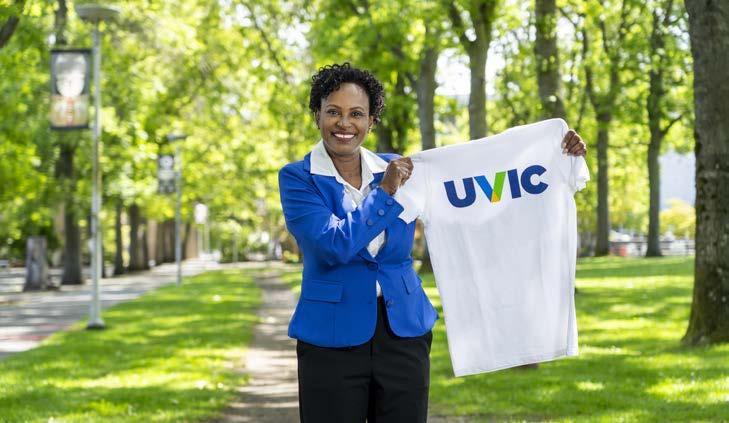

Concluding the exhaustive search for a new leader, the University of Victoria announced on June 2 Dr. Rhonda McEwen will be the next president and vice-chancellor come fall.
McEwen is the current president of Victoria University (VICU), a federated school in the University of Toronto which itself contains Victoria College and Emmanuel College. Her appointment as president was recommended by a committee containing members of the Board of Governors, Senate, faculties, staff, the student body, and alumni.
Victor Marrugat Arnal, director of external relations of the UVic Graduate Students' Society (GSS) said in a statement that a member of their board served on the Presidential appointment committee and advocated for graduate student voices.
Tam Aljundi, director of campaigns and community relations for the UVic Undergraduate Students’ Society (UVSS), stated, "At this moment, UVic needs leadership that reflects the complexity of our time and the diversity of our campus community ... with Dr. McEwen ... I am hopeful that we will be able to work closely
on important issues related to student wellbeing, support, affordability, and the overall student experience.”
McEwen will be the ninth president of UVic, succeeding Qwul’sih’yah’maht, Dr. Robina Thomas, who has served as acting president and vice-chancellor since Dr. Kevin Hall’s unexpected departure in the summer of 2025. Thomas will retire on June 30.
McEwen served as the University of Toronto Mississauga’s inaugural special advisor on Anti-Racism and Equity, and is a champion for diversity and inclusion. She will be the first female Black president in UVic’s 63 year history.
McEwen hails from Trinidad and Tobago, and moved to the United States with her family when she was young. She went on to earn a Bachelors in Sociology and Management from the University of the West Indies, a Masters in Business Administration from City University of London, and a Masters in Telecommunications from the University of Colorado.
After developing a career in technology and communications, she returned to higher education, where she earned her PhD in Information from the University of Toronto studying the role of mobile phones in social networks. McEwen
subsequently took on teaching roles before finding she had a knack for leadership, the Toronto Star reported.
As the current Canada Research Chair in Tactile Interfaces, Communication, and Cognition, McEwen’s interdisciplinary research spans technology, equity, governance, and public impact. Her work particularly concerns “artificial intelligence (AI) and society” and the “social and cognitive effects of technologies,” according to a UVic press release.
"At this moment,
needs leadership that reflects the complexity of our time"
In a video published by the university, McEwen praised UVic in particular for being a “powerhouse for research,” noting she was excited to join a community of “some of the top researchers in Canada.”
McEwen’s appointment comes as the university takes steps to account for generative artificial intelligence. In a Toronto Star op-ed, McEwen recommended incorporating AI into academia, likening the technology to calculators.
Some might also recognize McEwen’s work from her past collaboration with Sesame Workshop, the nonprofit behind the beloved children's program “Sesame Street.”
As a parent to an adult daughter with autism, McEwen served on an advisory committee that devised the newest muppet character, Julia. A four year old with autism, Julia’s portrayal has helped kids and adults alike navigate the realities of neurodivergence in children.
Following the announcement of her appointment, McEwen's peers at Victoria University gave their praise and congratulations in a statement, bidding the leader farewell after a four - year spell at the school.
In her first year, McEwen led the institution through post-pandemic recovery and the announcement of a hard-fought fossil fuel divestment plan, ratified by VICU’s Board of Regents.
That 2030 divestment deadline arose from an 18 day student occupation by activist group Climate Justice U of T, but ultimately drew criticism from students advocating for a faster 2025 target.
McEwen was criticized by some student leaders as being inaccessible and evasive during the protest, the Toronto Star reported.
In a UVic announcement describing her vision for the future, McEwen mentioned growing financial challenges for Canadian institutions, including decreased international student enrollment.
She went on to highlight her previous track record delivering financial stability, as well as her confidence brokering creative solutions for secure funding.
In a video posted on UVic’s social media, McEwen also spoke about being welcomed to Coast Salish lands, as Elders on campus greeted her. She expressed in the video a desire to learn more about the Indigenous peoples of the region, and how the university can “contribute to making sure that we live in one with the land and the people who have taken care of this land.”
Moving from one Victoria namesake to another, McEwen will begin her term October 14. After a recent visit to UVic campus, she has returned to Ontario to close out her role at VICU, where she will be working through the summer.
A UVic spokesperson said the Board of Governors is “working on an interim leadership plan” for the months between Thomas’ retirement and the beginning McEwen’s term, and will share “more details in the coming weeks.”
The sea's past may help inform its future as climate change threatens the seaweed ecosystems
“Feeling like you’re following in the footsteps of … these people from the past was really cool,” said Timmer.
New research from the University of Victoria reports that vast kelp forests around the North Salish Sea vanished decades earlier than previously understood, largely due to warming ocean temperatures.
Brian Timmer, a PhD candidate in UVic’s Baum Lab and collaborator of the Kelp Rescue Initiative, was the lead author of the paper recently published in Ecological Applications.
A decade ago, when the “blob” heatwave struck British Columbia, Timmer witnessed the dramatic die-offs of marine species as a scuba diving instructor in Nanaimo. “In a single year, every single kelp forest, all of my favourite dive sites, disappeared,” he said. Now pursuing his passions as an academic, Timmer’s research centers on both kelp restoration and climate change. When he came across decades-old kelp forest data, donated to the UVic archives by late Biology professor Dr. Alan Austin, he wondered whether any of those same forests remained, prompting the PhD project. In 2023, Timmer and collaborators
— including researchers from the Hakai Institute — meticulously mapped kelp forest size and abundance around the North Salish Sea, including near Comox, Denman Island, and Oyster River.
The team replicated previous aerial photos and scuba diving surveys by referencing old field notes and data.
The project received funding from Fisheries and Oceans Canada, the Natural Sciences and Engineering Research Council, the National Geographic Society and the Royal Canadian Geographic Society’s Trebek Initiative.
They have now published their findings, detailing how “a half-century ago, bull kelp … formed expansive kelp forests in the region” spanning over 550 hectares, a new baseline ten times larger than what experts previously assumed, yet none of them remain.
Satellite imagery showed the majority of the forests were lost in just twelve years, between 1972 and 1984, due to rapidly warming temperatures compared to the early 20th century. Kelp forests are integral to British Columbia’s coast and climate resilience, both capturing carbon and protecting shorelines from erosion.
Dr. Lauren Dykman, a postdoctoral fellow at UVic’s Baum Lab and Restoration Science Lead for the Kelp Rescue Initiative, said in a statement to the Martlet that “kelp are like the trees of the ocean, providing habitat that shelters fish and invertebrates, including juvenile salmon … they form the base of coastal food webs.”
“Kelp forests are disappearing from parts of BC’s coastline for reasons including climate change, marine heatwaves, and imbalances in food webs
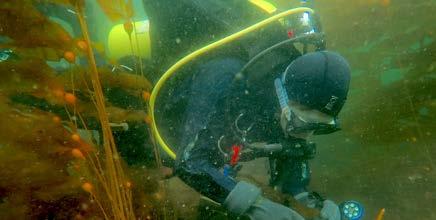
caused in part by human actions,” Dykman warned.
The recent research out of UVic is particularly significant, as it could help forecast future conditions and impacts along the rest of British Columbia’s warming coastline, potentially informing policy on conservation and climate action.
Timmer said that is because “the area that we were looking at has been a rapidly warming microclimate … and has gotten hotter than essentially the rest of the coast has so far.”
While the research has encountered some pushback online from Canadians doubtful of climactic changes, Timmer
expressed optimism that their paper will create respectful and open communication of scientific findings.
“It’s our responsibility as scientists to make sure [our research is] ... shown to the rest of the world and people that are trying to live their regular lives,” he said, especially for those who may not “understand how important it is these changes have been happening over a long period of time.”
In the face of disappearing forests and increasingly warm waters, restoration efforts across the Salish Sea continue to make new breakthroughs by growing and transplanting seaweed.
Timmer said the Kelp Rescue Initiative conducts scientific research on effective kelp restoration to “draw up these blueprints that we can then hand over to … communities and First Nations” as a tool in their toolbox.
He went on to spotlight the many First Nations guardian programs who have been monitoring and assisting kelp forests across British Columbia’s coast over the last decade.
Dykman also shared about one flourishing kelp forest that the initiative restored offshore from Denman Island, where kelp had been absent for 11 years due to marine heatwaves.
Pride Month may almost be over, but the 2SLGBTQIA+ community in Victoria is celebrating all summer
Seven low-barrier classes to try this fall From banned books to Indigenous fashion, these classes are perfect for students in any faculty
KIERA CLARK VOLUNTEER STAFF WRITER
While the time to register for fall classes has opened, it's never too late to pick up a fall elective. Stuck on what classes to take? Here are seven electives to check out this fall.
ASTR101: EXPLORING THE NIGHT SKY
Curious about the origins of planets or the dangers of meteorite impacts?
Astronomy 101 is an introductory course for non-science students to explore the solar system, from eclipses and climatic cycles to the possibility of alien life. Students will also have the opportunity to use the campus telescopes in the Bob Wright Centre.
ASTR 101 is on Tuesdays, Wednesdays, and Fridays from 11:30 a.m. to 12:20 p.m., with two sections running concurrently, one of which is online with some in-person days. Students are also required to register for a lab session, though with nine options to choose from, so you can fit it around your schedule.
HSTR101A: TEN DAYS THAT SHOOK THE WORLD
History 101A introduces students to the field of history through the lens of select historical moments. The specific events discussed each semester may vary based on the instructor, but previous topics have included the crucifixion of Jesus Christ, the fall of Constantinople, the storming of the Bastille during the French Revolution, the bombing of Hiroshima, and 9/11.
This fall, HSTR 101A will be offered asynchronously online, making it a great option that won’t clash with your other courses.
SOCI207: ECOLOGY, SOCIETY AND GLOBAL CHANGE
Curious about how we as humans interact with the rest of the natural world? In this 200-level course, students will survey key environmental issues and theories. Looking at socioecological relationships, the course has a particular emphasis on power, environmental inequalities, and social justice movements for sustainability on both local and global scales.
SOCI 207 will run on Tuesdays, Wednesdays, and Fridays from 12:30 p.m. to 1:20 p.m.
ENSH230: SPECIAL TOPICS IN LITERATURE, SELF, AND SOCIETY: BANNED BOOKS
Since as early as Plato in Ancient Greece, we have been debating issues of literary censorship. This special topics course will survey historical and contemporary iterations of book banning and censorship while reading fiction and non-fiction works by authors like Toni Morrison and Ray Bradbury.
According to the course description, ENSH 230 will “critically explore both the assumption that literature is dangerous and that it is essential and good for us.”
For ENSH 230, you must have either fulfilled your Academic Writing Requirement (AWR) or be concurrently enrolled in an AWR course in the fall.
The course will run on Tuesdays, Wednesdays, and Fridays from 9:30 a.m. to 10:20 a.m.
HLTH251: HEALTHY SEXUALITY
Curious about the role sexuality plays in our existence as humans? In Health 251, students will consider the multifaceted concept of human sexuality and how it is influenced by various biological, cultural, historical, psychological, environmental, and societal contexts.
HLTH 251 will be offered on Mondays and Thursdays from 1:00 p.m. to 2:20 p.m.
AHVS385A: INDIGENOUS FASHION IN THE PACIFIC NORTHWEST
In this Art History & Visual Studies course, students will learn about
various aspects of Indigenous fashion, wearable arts, and body adornment from communities right here in the Pacific Northwest. Students may explore topics such as tattoos and piercings, ceremonial attire, and cultural appropriation.
AHVS 385A will be offered on Mondays and Thursdays from 11:30 a.m. to 12:50 p.m.
SLST450: COLD WAR ON FILM
Looking for one last upper-level elective to complete your degree? Slavic Studies 450 combines history and film studies to examine portrayals of the enemy in Soviet and Western films from before, during, and after the Cold War. This course is taught in English, so no knowledge of Russian is required!
The selection may vary each term, but previous films have included
Mondays from 4:30 p.m. to 7:20 p.m.
None of these courses work for you?
Try one of these three bonus courses with no prerequisites (or just need your AWR fulfilled)!
1. WRIT109: The Writer’s World in Books and Film: Climate Catastrophes
2. GNDR230: Environmental Justice and Gender
3. RCS323A / ENSH323A: Heavy Metal and Religion
in Banfield Park in Vic West at 5:30 p.m. for this free event. Before taking a scenic group walk along the Gorge Waterway, you can enjoy local vendors, food trucks, and dog costume and trick competitions.

PRIDE–A-LICIOUS COMEDY & VARIETY SHOW
On Thursday July 9, get ready to laugh atthe PRIDE-A-LICIOUS Comedy & Variety Show, presented by Gay AF Comedy. Hosted by local drag performer Lilith Cain, the night opens with local stand-up comedian and UVic alum Julya van Der Sloot and social media sensation Nico Marchant. The headliner is writer, entertainer, and showmaker Robert Watson, Canadian Comedy Award winner and host of Gay AF Comedy. Tickets are $23 in advance or $30 at the door, if any remain. Doors open at 6:00 p.m. and the show starts at 7:30p.m.
PRIDE PARADE AND FESTIVAL IN THE PARK
No list of pride events would be complete without Victoria’s Pride
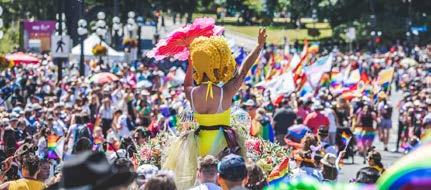
Parade, an annual tradition that began in 1994 and now brings in over 80 000 spectators. This year the parade will be held on Sunday July 12 at 11:00 a.m. in downtown Victoria. After the parade, head over to McDonald Park in James Bay for the Pride Festival in the Park. Exact details are still to come, but in previous years there have been activities for the entire family, including over 130 vendors, local food, both traditional and sober bars, drag storytime, and bouncy castles. Want to enjoy the festival with less stimulation?
The grounds will open at 11 a.m. for anyone who wants to explore before the parade ends.
QUEERS & BEERS YYJ
Since 2022, Queers & Beers YYJ have been hosting social events for 2SLGBTQ+ to enjoy craft beer, wine, spirits, or non-alcoholic beverages
in a welcoming space. Join Queers & Beers for patio season this summer on Thursday July 23 at Herald Street Brew Works, and Tuesday August 18 at Phillips Brewing. These monthly events — which are also offered throughout the year — run from 5:00 p.m. to around 7:00 p.m.
DRAG BRUNCH
If you’re looking to celebrate pride any month of the year, The Vicious Poodle has drag brunch every Saturday and Sunday. Brunch is hosted by a rotating cast of local drag performers like Shelita Cox, Vivian Vanderpuss, and Henrietta Dubet, so check out The Vicious Poodle’s Instagram to find out who is performing. Doors open at 11 a.m. and the show starts at 12 p.m., but tables are limited so make sure to make a reservation!
The Media Studies program is expanding and will now be offering a major, minor, and general degree, in addition to the original certificate
RAAMIN HAMID VOLUNTEER STAFF WRITER
Starting this fall, UVic students will be able to declare a major, minor, or general degree as part of a Bachelor of Arts (BA) in Media Studies.
Students can take a variety of different courses to get an interdisciplinary education through media studies, said Dr. Jentery Sayers, the director of the program, who also teaches as an associate professor in the Department of English.
The first media studies cohort was in September 2023, originally offered as a certificate made up of 10.5 units. The certificate is still available, but the department will simultaneously offer a full BA due to the program's growth.
Sayers told the Martlet that there have already been three groups of graduates with the certificate. “That growth was incredible, and it moved much faster than we anticipated.”
The interest in a media studies department at UVic first emerged in 2017. “We saw a need in that area to bring that research together, and one way to do that is to formalize it as a unit that offers a credential in some way,” said Sayers.
Two years ago, Sayers said, the department conducted a survey to get a better understanding of what students wanted as the certificate program grew. The survey question asked if students would be interested in a Media Studies major
if it was available. Out of 51 responses, Sayers said, more than 70 per cent of respondents said they would be interested.
According to Sayers, one of the appeals of the program from the point of view of a student might be the long list of approved courses offered. “There’s a lot of space … within the program,” he said. Media Studies is best suited for individuals who have an interest in the overlaps of culture and communications, Sayers said, and those who want to combine creative and critical work for communicative purposes.
Sayers clarified that it is not a technical or an arts program.
“Media Studies is slightly distinct … from literary studies that you find in English. Because you’re developing competencies that would be grounded in the multimodal,” he said.
Jacob Maddison, an instructor in the Media Studies department, joined UVic this past spring. He taught MDIA 350: Cultures of the Book this past semester and will be doing the same again this coming fall. He said the course is designed as an experiential bibliography course. According to Maddison, Media Studies offers a combination of a creative and critical lens.
“Unlike a history course, which is backwards looking, I feel like media studies is very forward looking through historical lenses.

That opens up a really lovely way of thinking about the media we’re looking at,” he said.
His course is set in the Farallon Book Arts Lab in the basement of the Mearns Centre for LearningMcPherson Library. Students spend time participating in quill writing workshops, and experimenting with letter press and book binding equipment, among other activities. The course is based on a creative, physical plan that allows participants to understand how things are created, said Maddison. Sayers said that Maddison’s class is really popular because it lets students work offline and learn about media preservation. “With the emergence of generative AI … people are looking for ways to be offline,” he said.
Students can take the course if they have their Academic Writing requirement (AWR) satisfied. Most of the courses in the Department of Media Studies are available to students without any pre-requisites, except for the AWR.
In the next school year, three new courses are being introduced: Haunted Media, Health and the Internet, and Media Activism. According to Maddison, there are plenty of opportunities for students with a degree in media studies to pursue, ranging from information sciences, library sciences, administration, or research.
Sayers said that a lot of the program’s graduates are freelancers, but individuals with a background in media studies can also go into fields like public media and
community archives.
“At UVic … we were already doing, and had been doing for some time, such interesting, compelling, timely work in the space of media: people working with a variety of audio, images, text interfaces,” said Sayers. By participating in the program, students would gain “the people skills of media, communication, and culture,” he said.
“It did seem like it was a shame not to bring that together somehow more formally.”
UVSS forms new working group to consult with a UVic Senate Committee, following year-and-a-half long push for improved accomodations
DECLAN SNOWDEN MANAGING EDITOR
Despite university efforts to improve accessibility and accommodations, some students remain concerned over the implementation of accessibility measures, including extended time for examinations and UVic’s new Centre for Accommodated Assessments.
Evan Maher, a director-at-large for the UVSS who also serves on the Senate, has been pushing for improved CAL accommodations through Senate for a year and a half.
Currently, the university offers an array of accommodations for students with disabilities, as well as utilizing “Universal Extended Time” (UET), which grants additional time for all students, not just those with disabilities or accommodations, when taking examinations.
As of 2025, roughly 20 per cent of UVic students are registered through the Centre for Accessible Learning (CAL), though UET is not used in every class at UVic. According to the university’s accommodated assessments page, “one sixth of in-term [exam invigilation] requests include it.” Maher said he was prompted to push for improvements to CAL accommodations following concerns he heard from students that UET wasn’t meeting their needs.
In an interview with the Martlet, Maher expressed concerns that professors will sometimes not calculate the time needed for an exam properly, resulting in the extended time not being adequate either.
Because the time may be calculated incorrectly, he said, the extended time
may also be inadequate for students who need additional time.
“The challenge [is], if you’re not actually meeting the students' needs, or what they are entitled too, then that’s discriminating against students,” he said. “One of the challenges behind it is, there’s not really clear guidelines as to how to actually measure the universal extended time … and that’s really the university’s fault. You can’t expect a professor to be an expert in this area and to perfectly measure an exam time,” Maher said.
According to UVic’s Teach Anywhere webpage, UET seeks to “reduce access barriers created by time restricted assessments and increase overall accessibility for all students.” The page says that UET does not “‘solve’ all extended time accommodations” and that it may “meet some students’ extended time accommodations but should not be used as a blanket strategy.”
The page also has a checklist for instructors to help assess and implement UET. The checklist includes reviewing and measuring the time of the assessment thoroughly by accounting for the time it takes to review instructions, read questions, answer questions, edit answers, use metacognitive strategies, and take breaks.
The checklist also involves consulting with UVic’s Learning and Teaching Support and Innovation (LTSI), assessing past data on the assessment, or having colleagues review and audit the assessment, among other considerations.
Still, concerns over UET persist.
Hannah Brown, the operations director for the UVic Society for Students with a Disability (SSD), told the Martlet
that UET is good in the sense that it allows accessibility for those who may not have individualized accommodations, but cautioned that it needs to be implemented in a way that is fair to everyone, and does not replace individual accommodations.
Brown said that although they had not personally heard concerns directly from students around UET, there’s anxiety around how professors will determine how long an examination takes, and if the extended time would be adequate.
Maher suggested a few possible solutions, including designing exams for neurotypical students, and then granting neurodivergent students and those with accommodations additional time, designing exams with extra time granted for everyone, and granting additional time for students with accommodations on top of that, and granting a significant amount of additional time, such as 10 hours, though Maher acknowledges there are resource constraints to consider with that option.
According to UVic, UET can “enhance accessibility in assessment design” and “research shows it supports a diverse range of learners, not just those who have extended time as an accommodation.”
In 2024, the university did a pilot program to test universal learning principles, including UET. The pilot program was largely considered a failure by students and faculty, with the UVic Faculty Association, Professional Employees Association, Canadian Union of Public Employees (CUPE) Local 4163 and 951, SSD, UVSS, and UVic Graduate Student Society (among others) undersigning a letter expressing
concerns with the university’s approach.
Brown cautioned people to be mindful that UET and individualized accommodations are separate things — with UET being a tool to improve overall accessibility and accommodations to help those with disabilities have an “equal footing to their peers” — and that one cannot replace the other.
At the June 8 UVSS Board of Directors meeting, Maher gave a presentation discussing UET, and said that the Senate Committee on Learning and Teaching wanted to consult with the UVSS. The UVSS then formed a working group to act as the consulting body.
“I wrote a proposal to Senate to do something about [UET] and it’s been discussed in the committee for a year and a half, and so that’s where we are at now. I can’t go into too many specifics around what the committee is doing, but I can say that they do want to consult with us, the UVSS,” Maher said during his presentation.
The Martlet asked the university if the Senate Committee on Learning and Teaching had any plans to consult the UVSS over UET, or anything else.
A UVic spokesperson said in a written statement that “the Senate Committee on Learning and Teaching has not yet established a communications plan regarding any academic regulations related to Universal Extended Time,” at this time, and that it would be “premature to discuss the matter further.”
Beyond UET, Brown also said they had concerns about the Centre for Accommodated Assessments, which was announced at the end of January.
Expected to open in 2027, the new centre aims to improve “access-centred teaching and assessment practices” and
“strengthen coordination and administrative efficiencies," and would be operated by the Office of the Registrar and Enrolment Management (OREM).
The centre will be housed on the bottom floor of the Mearns Centre for Learning – McPherson Library.
“The university is planning to open a centralized accommodation assessment center … which is an idea that I as a disabled student fully support. However, I think the issue is around the implementation itself,” Brown said.
“There’s been no consultation with the Society for Students with a Disability or such groups to find out what students actually want from such an assessment centre.”
On June 11, Elizabeth Croft, vicepresident academic and provost, said in a statement that OREM and Facilities Management consulted with stakeholders.
A university spokesperson told the Martlet that the consultation was “consistent with the university's approach to renovation (and space allocation) projects … [and was] focused on the operational requirements of the space and on those who are responsible for delivering accommodatedassessment services.”
They said accessibility was a key consideration in the design process. According to the university, the project does not involve “changes to institutional accommodation approaches or processes.”

The Electoral Officer's decision rejected the complaint submitted by graduates affiliated with WUSC UVic, but said the election identified issues with GSS governing documents that should be rectified for the next election
However, Clarke also said WUSC UVic respects the process and the decision of the Electoral Officer.
The Graduate Students’ Society (GSS) Electoral Officer rejected the grounds of a complaint submitted by graduate students associated with the World University Service of Canada (WUSC) UVic chapter over allegations that a referendum question in the 2026 GSS Election was campaigned for in an unfair manner.
In the 2026 GSS election, a referendum question was proposed reducing the funding allocated to WUSC UVic — a student group that sponsors refugee students at UVic — from graduate student fees by $5 to $1 per student each semester.
Voters in the GSS election voted 217 to 132 in favour of reducing the funding allocated to WUSC. The group of graduate students filed a complaint with the GSS Electoral Officer about the referendum process on March 13. Dr. Marlea Clarke, an associate professor of political science at UVic who serves as a faculty advisor to the WUSC UVic chapter, told the Martlet in a statement that she felt that the GSS was in a position of power and it used that power to unfairly campaign for students to vote for the “yes” side.
The GSS Electoral Officer at the time, Semyon Drozdetckii, wrote a letter formally recusing themself from making any decisions regarding the complaint.
“I acknowledge the complaint submitted by WUSC regarding the referendum process and the concerns they have raised about fairness and impartiality. After careful consideration, I have concluded that my personal relationship with a member of the GSS Executive Board, combined with my prior involvement in approving aspects of the referendum FAQ, creates a reasonable perception of conflict of interest and compromises the legitimacy of my decision,” Drozdetckii wrote.
Following Drozdetckii’s recusal, a new Electoral Officer, Samuel Fielder, was appointed. Fielder released a decision about the complaint on April 24, stating that the grounds of the complaint are not upheld, and the referendum result will stand.
“I am not satisfied that the conduct of the referendum process crossed the threshold of significant misconduct or unfairness that undermines the integrity of the electoral process,” Fielder wrote in the three page decision.
“In reaching this conclusion, I have
been informed by the finding that the FAQ published on the GSS website, the primary vehicle through which WUSC alleges bias, was produced by GSS staff independently of the Executive Board and was reviewed and approved by the previous Electoral Officer (2025-2026) before publication,” Fielder wrote.
Fielder also wrote that “no language” in GSS bylaws or the governance manual prohibits members of the Executive Board from taking an official position on a referendum side, only designated neutral parties like the Electoral Officer and Electoral Appeals Committee.
Fielder similarly did not accept the allegation that the FAQ drafted by GSS staff gave the “yes” side a “structural advantage.”
“The standard under Policy 7.13.1 is significant unfairness that undermines the integrity of the electoral process, not any incidental advantage that institutional communication may carry.
WUSC has presented no evidence that the FAQ materially affected the result,” Fielder wrote.
Fielder acknowledged the GSS’ decision to outline the “all-pass” outcome of the referenda rather than enumerate each possible outcome, meaning the outcome of a “no” result on the WUSC question combined with a “yes” result on the other referenda was not clearly
communicated by GSS.
However, Fielder wrote, “the questions were structured and presented as distinct, and each with a yes/no ballot.
Members were not required, instructed, or invited to treat them as a package during the voting.”
Clarke had previously raised concern that the framing of a “cost-neutral” referendum pitted their funding against the increased allocations to UVSS constituency groups.
The five constituency groups similarly told the Martlet in March that they felt the questions were linked, and said they did not request the GSS reduce WUSC’s funding to obtain a fee increase to their groups.
WUSC UVic decided not to appeal this decision. Clarke, who clarified she was speaking solely as a faculty advisor but not a representative for WUSC UVic as a whole, said that they were “disappointed but not surprised” by the result, but that they “respect the process,” as a new Electoral Officer was appointed and upheld the original results. Additionally, Clarke said they did not think it would be a good use of time, as the new WUSC UVic leadership are preparing to welcome the new sponsored students to UVic.
Clarke said it’s possible the campaign rules themselves are the problem.
“WUSC as a club wasn’t allowed to campaign as ‘a club.’ Only grad students involved in WUSC were allowed to campaign. As such, the club itself couldn’t do any campaigning – even though the cuts will deeply affect them,” she said.
Fielder concluded his decision with a recommendation to the GSS to address “issues” in the society’s governing documents.
“In my view, the policies and bylaws governing elections and referenda would benefit from greater explicit language in key areas, and that clearer guidance would better support the Electoral Officer in carrying out their role,” Fielder wrote.
GSS Executive Director Kyla Turner said the GSS Bylaw Policy Committee is currently doing a “total overhaul of [their] elections and referenda bylaws, policies and procedures to address all issues that arose in the Spring 2026 referendum.”
Clarke said that she is confident that WUSC’s incoming leadership will work hard to figure out alternative ways to increase the organization's budget.
“WUSC has an unwavering commitment to accessible education and social justice: we will not let the GSS’s decision to defund refugee support work on campus weaken our work.”



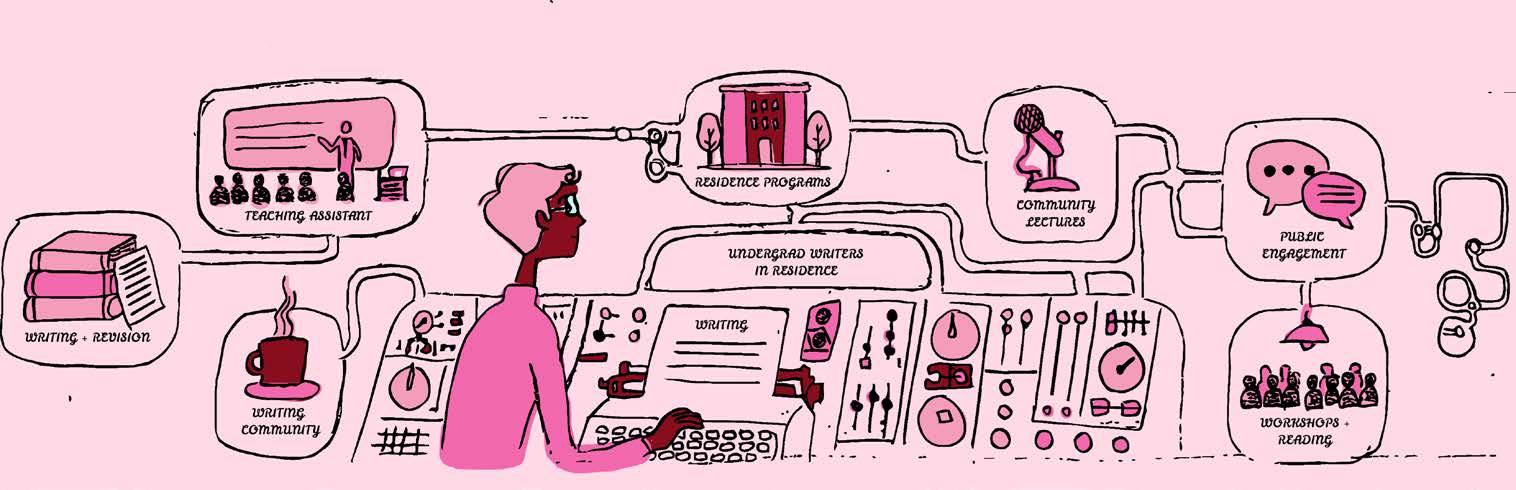
Seven undergraduates in the writing program will be placed in different units across campus, ranging from the Faculty of Engineering and Computer
to the
BRIANNA BOCK SENIOR STAFF WRITER
*Eden Conti is a volunteer member of the Martlet staff. She was not involved in any way with this article beyond the interview.
Writing is often seen as a solitary profession. The popular image of a writer is of one hunched in front of their keyboard, trying to weave sentences and stanzas together. However, like with every artistic field, there is a broader community that exists beyond that image.
One that informs, inspires, and one with which the artist forms a reciprocal relationship.
This is one thing that the UVic Writing Department is exploring with its brand new writers-in-residence program for undergraduate students.
In an email statement to the Martlet , Lee Henderson, the chair of the Writing
Department, explained that a writer-in-residence is typically “offered a space to write, and in return they provide open hours for visitors to come meet them.
They often deliver a public reading and other community programming, such as workshops and roundtables.”
Many libraries, colleges, and universities host visiting authors in this way. The structure itself varies, but the basic idea of a residency is to provide a space for a writer to write in collaboration with the host institution.
As this is a pilot program, Henderson is still figuring out if additional stipends or awards will be offered to undergraduate writers-inresidence in the future.
“I thought it would be a terrific experience for students to have a sense of what a writer in residency role looks like, some of the responsibilities that come
with that. And I thought it would be a really great way for our students to connect with other people across campus and disciplines that are really different from our own.” Henderson said. He said that he had never heard of another undergraduate writer-inresidence program that resembles this one. There is the UVic Fine Arts Ocean Networks Artist Residency, which is open to all kinds of student artists.
“It occurred to me that it would be great if more writing students had dedicated writing spaces on campus and a way to connect with students and faculty studying in other disciplines. It's a kind of real-world experience to serve as a writer-in-residence.”
Henderson said he thought it would be a good experience for fourth year undergraduates specifically, as they are about to graduate,
and are considering the next steps of their writing career, such as graduate school or attending the Banff Center for the Arts.
Partaking in a residency
“can show that you’re not just a writer, but quite serious about community … and [can] give students a little extra opportunity of something they can take away from their degree, and hopefully give them a little extra experience.” Henderson said.
There are a total of seven undergraduate writers-inresidence with each student paired up with a separate unit on campus. They will be provided space in their assigned unit, where they will have office hours in addition to the workspace.
The writers-in-residence will be expected to organize a public event themed around the unit’s research and/or work.
Henderson said he planned
the residences to be more self-directed for the writers, as the students get to plan their events and determine how to tie their writing to the unit’s research on their own.
The units involved are the Institute on Aging and Lifelong Health, the School of Environmental Studies, the Department of Mathematics and Statistics, the Campus Community Garden (CCG), the Faculty of Engineering and Computer Science (ECS), and the Department of Anthropology.
The Martlet is also hosting a writer-in-residence, but has no other involvement in the program.
Henderson explained that he purposefully reached out to departments outside the Humanities and Fine Arts for unexpected results.
"Sometimes I think as writers, even though we don’t always want to be, we live in our heads,” Henderson said.
“We’re really stuck in our head and we sit at our little computers and type, and sometimes I think we forget about how much a change of setting can inspire us, and an introduction to new types of people can be inspiring.”
The residences are set to begin in September, with the exception of the CCG residency, which began on June 2.
Josephine Mills, the writer-in-residence at the CCG, has already hosted an open mic event, which took place on June 2.
“We had a pretty decent turnout, all the readers were amazing, and there was such a variety of work read,” said Mills.
Mills is also starting a community library in the garden for anyone to put their original writing in. Her office is B020 in the Student Union Building, with office hours on Tuesdays 11 a.m.
– 12 p.m., and is open for people to drop off their work for the library.
She has a second open mic planned on July 7 at 6 p.m., also in the CCG.
While most of the residences have yet to begin, the writers-in-residence are already making plans for what their residences will look like.
“I think [writing profiles] would be a more engaging way to interact,” said Eden Conti*, the writer-inresidence with the Institute of Aging and Lifelong Health.
“I want to align my writing with what they’re researching, [bringing] … human faces to the front, because I think that’s what is so often lost in research, and all that jargon — what does it all mean and what is
the impact, so I think, just putting faces to things is nice,” she said. Conti said she enjoys a public facing role. “The idea of having a more public facing role, although intimidating, it’s still exciting, because it’s definitely something I want to do more of, probably in my future, who knows.”
“I think it’s an exciting opportunity to fill a role I have no experience in, and I’m trying to stay focused on that excitement and not the overwhelm of it.”
Alex Mishenko, the writerin-residence with ECS, is thinking of a potential game jam: an event where participants make a video game from scratch either in teams or individually in an allotted time limit.
“I think that’s where a lot of the strength of Computer Science, Engineering and the Arts in general [is], there’s a lot of cool multi-media projects out there.” Mishenko said, citing 17776 by Jon Bois as “one of the best sort of applications of both computer engineering and in general, computers as a form and the internet as a form being able to be combined with narrative and fiction.”
kit-xgwélemc kennedy, of the St'uxwtews Secwépemc First Nation, writer-inresidence with the School of Environmental Studies, expressed an interest in working with non-writing students. As a double major in English and Writing, Kennedy has seen people who are interested in writing, but who are often nervous about accepting feedback, unlike Writing students, who regularly receive peer
feedback as part of workshops.
“I’m hoping I can figure out a way to hopefully get a couple people to be like ‘Let’s try creative writing as well.’”
Kennedy spoke to me online from the Bamfield Marine Science Centre, where he was taking the course, In Pursuit of the Whale, as offered by the Centre to English students. He shared something his professor told him, “It’s very apparent what we have to gain from [the sciences]....
Learning more about the world around us and how it works, you can see how a creative person gets to make these connections to their own work, but it can feel hard on the other side of this cultural exchange, like, what are we offering to them?”
Kennedy said that whether from the humanities or the fine arts perspective, a lot can be offered to the sciences in, as his professor said, this cultural exchange.
Similarly, Henderson hopes the program will help the units involved see themselves as more public facing as a result of their collaboration.
Henderson, who has both a BFA and MFA in writing from UBC, drew on his own experience studying writing to create the new writer-inresidence program. During his undergrad at UBC, he said, the writing department there regularly hosted working writers who would meet with students informally and hold office hours to talk about writing. Libraries across Canada are also frequent hosts to writers-in-residence, he said. When he completed his
undergraduate degree, Henderson said he realized that it was time for him to start helping to create the culture he had previously been in the audience for.
“Not just to be an audience member, but an active participant in the creation of events, because if someone’s not doing it, no one is.… We’ve all got to put in our part, we can’t just be passively entertained. We sometimes need to decide ‘Well now it’s my turn to start organizing.’”
Having spoken to four out of the seven writers-inresidence, it is evident that these students are excited by their upcoming roles not only for the ways they will impact their writing, but for how they will impact the communities they will be working with as well.
“I feel lucky that they trusted me to be one of the first ones,” said Conti, “I’m also really excited to see how everybody else handles it. I mean, I don’t know how closely I’ll get to work with other people during the residencies, how much of a cohort we will become, but I am excited,” Mishenko said he was interested to have the opportunity to offer his sort of perspective as an Arts student to STEM students, and be informed by theirs, as they collaborate.
“[The] information exchange [aspect] is very exciting,” said Kennedy, “I feel like every faculty, every department has something to learn from each other, and like, allowing students to step outside their usual paths of thinking is only a good thing.”
And Mills, whose residency
has begun, said that the more she connects with the community, the more she is inspired to write.
“It’s been very inspiring for my writing process to be able to have support from the community, and being able to then share it back to the community, it’s just so rewarding, and it’s definitely been really inspiring.
“It’s really made me want to write more to that community, and kind of consider nature and food security, and community in my poetry.”
“It’s a big change,”Henderson said. “I think in terms of your psychology as an emerging writer when you realize that you just can’t be passive about everything, you have to sometimes be the active agent of creation, not just for writing, but an art or activities, places to congregate, places for people to meet.
“It transforms your surroundings to be a contributor like that, and you just never know what opportunities are going to come from that.”
Victoria's first mobile bookstore enters its second season this summer
Meant Well Books is a travelling book truck run by a UVic writing grad and her nine-year-old daughter
While exploring Vancouver Island this summer, keep an eye out for a small green truck equipped with custom shelves stocked with books.
Meant Well Books is Victoria’s only mobile bookstore, created by UVic writing grad Melanie Brouwer and her nine-year-old daughter.
Meant Well Books has a rotating inventory of books, including fiction, non-fiction, and children’s books, most of which can be browsed on their website.
The pair launched the book truck in June 2025 using a customized 2006 Suzuki Carry. This season, Meant Well Books expanded their fleet with a book scooter, intended for smaller pop-ups or neighbourhood events.
In an interview with the Martlet Brouwer shared that Meant Well Books grew out of her dream of owning a bookstore, combined with the reality of working a full-time job and being a single mother. After importing the Suzuki from Japan, her brother made and attached the shelves for the truck — and later the scooter — in exchange for having Brouwer babysit her nieces. When Brouwer came across the scooter, she knew she wanted to use it for their business. “The inspiration for the design really came from the community itself and a lot of the little libraries that are so loved around Victoria, so we really wanted to shape it around that,” she said.
Brouwer hopes to use the scooter to give back to the community. With their book scooter’s first trip falling on Father’s Day weekend, a portion

of the proceeds will be donated to a local nonprofit for single parents.
Brouwer has faced some unexpected obstacles while running Meant Well Books. One of the more surprising challenges they have dealt with is the rain. “Being on the West Coast, I would love to do this year-round, but it really has to be a lot more seasonal and just have to always preface to people that it's weather dependent,” she said.
Brouwer’s daughter has played an important part since the start — even their logo was based on one of her drawings.
“Something that she’s done since the very beginning is help me pick out all the kids’ books, so she plays a very active role in that and …
making sure that it’s books that kids actually want,” Brouwer noted.
“I’m a single parent, so it’s often just the two of us, [and] she’s there with me every step of the way. I quite literally wouldn’t be able to do it if I didn’t have her enthusiasm and support,” Brouwer said. “Even before we opened, we were stamping the shopping bags together with our logo in the kitchen.”
Brouwer added that her daughter’s role also includes “bringing the cuteness and the personality” to pop-up events.
In a statement to the Martlet Brouwer’s daughter shared why she enjoys being the unofficial “Head of Kids Books.”
“It’s fun and it’s exciting,” she
wrote. “Every single day I can choose a new book to have there if I want or I can keep them the way they are.... It feels good to help people that are my age find books they enjoy.”
Meant Well Books is a communityoriented business. “For me, a big goal with the book truck is to create opportunities for people to connect through stories,” Brouwer said. “I think what really surprised me is just how naturally the community has formed around books and the book truck.”
Brouwer recalls chatting with a pair of customers, assuming they had been lifelong friends based on their interactions, only to learn they had met at one of Meant Well Books’
events a few weeks earlier.
Some of Brouwer’s favourite events to co-host are their Reading Parties. “We just offer [a] beautiful space for people to come together and read together in communities,” she explained. While reading is often perceived as a solitary activity, Brouwer said their Reading Parties are some of their most successful events in creating opportunities for connection.
Their upcoming Reading Party will take place on Sunday, July 5, in the field in front of St. Ann’s Academy.
Brouwer explained that she has two main goals for their second season: broadening their scope and being intentional with where they pop up with the truck and scooter.
Brouwer and her daughter will bring the book truck and scooter to a variety of locations around Vancouver Island — and will even head to Salt Spring Island this July.
“I’m just a naturally ambitious person and I would love to continue to broaden what we do, so we’re going bigger this summer,” she said. You can find Meant Well Books at one of their upcoming events, including at the Parkside Hotel & Spa on June 27 and July 25, Kid Sister Ice Cream in Esquimalt on June 28, the Malahat Skywalk on Aug. 8, and the Ship Point Market in Victoria’s Inner Harbour on Aug. 16.
Come to the Legacy Art Gallery to experience this unique exhibit for free until Aug. 1
RUBY HARRIS
SENIOR STAFF EDITOR
artist who took undergraduate fine arts courses at the University of Victoria. In an interview with the Martlet, Haq said that through these classes, she discovered that art was her calling. The university also granted Haq access to digital arts equipment, sparking her interest in video and photo-based art, which is prominent throughout the exhibit.
The exhibit title, “Language Like Water,” comes from Haq’s exploration of her first language, Urdu. Haq described Urdu as a language of fluidity, like the ocean. “Urdu emerged not from stillness but from movement,” a description in the exhibit says.
In the mobile tented cities of the Mughal court, many people gathered and hybrid languages emerged, including a shared speech called Rekhta, later named Urdu from ordu, meaning camp.
Like water, Urdu has acted as both an anchor and a guide for Haq. She said the language contains guidance for how to speak and engage within a culture of respect, with protocols embedded in its structure.
“[Urdu] helps me to arrive here on lək̓ʷəŋən territory and to be in conversation with the lands and waters and the people,” they said.
The Urdu portion of the title, “
رواں Aabe-Ravaan,” is not a direct translation of “Language Like Water.” Aab, a Persian word, means water, while e-ravaan means flowing.
For Haq, the idea of flowing water evokes the ocean’s ability to hold everything, as all rivers eventually flow into it.
The newest work in the exhibit- a textile quilt hung at the front of the galleryrepresents all the waterways along which Haq’s family has lived. It features Urdu words connected to places her father has lived in or fled to, immediately prompting a conversation between water and language.
The exhibit showcases works spanning more than 20 years of Haq’s artistic practice. Creating the works included in the exhibit has helped Haq forge and strengthen connections.
For some textile work on display, Haq invited South Asian and Indigenous participants to a community stitching circle where they stitched, discussed poetry, and engaged in rose medicine. Over nine months, Haq hosted 25 stitching circles with more than 50 participants.
Other works feature Haq reenacting her mother’s wedding rituals with the Salish Sea. Haq described how Western feminism initially prevented her from seeing the ways in which her mother is strong and resilient, but by embodying her through art, she has worked to bridge the gap between them and become closer to her.
“I can’t speak for my mother. I can’t make work that represents her, but what I can do is make work that shows how I experience her, and what my transformation has been,” Haq said. The creation of the exhibit also deepened Haq’s relationship with the land around her. Throughout the exhibit, Haq returns to the question: “How do I speak to the land and the water?”
Beside many of the artworks, first-person plaques explain their personal significance to the artist. By sharing her own story with viewers, Haq hopes to create “an intimate conversation.” Though the exhibit is deeply personal and rooted in Haq’s memories, her “aspiration is to always make a work that will resonate and touch the heart of the viewer
Newly formed Canadian Doctor's Orchestra joins the global stage with first charity concert in December

DECLAN SNOWDEN MANAGING EDITOR
Andrew Loe, a medical student in UBC’s Island Medical program who takes music courses at UVic, founded what may be Canada’s first national orchestra for medical students, doctors, and healthcare practitioners such as nurses and psychologists.
be contacted next month, and the concert taking place just five months later in December.

Quirky indietronica quartet Cootie Catcher charms with new patchwork album, 'Something We All Got'
TIEGAN SUDDABY CONTRIBUTING WRITER An Offbeat by CFUV Review
With the release of their third studio album Something We All Got, Cootie Catcher are professing themselves as Canada’s indie pop darlings. Following their 2025 release Shy at First a DIY collage of sounds, the quartet returned in less than a year with their first studio-recorded album — and their first since signing with CarPark Records.
Their lo-fi soundscape remains clear in illustrating a world of pure juxtapositions: acoustic and electric, innocent and self-reflective, saccharine and elegiac. Cootie Catcher’s iconic sound style can be described as a swirling assortment of samples, instruments, and voices, all coming together in a disjointed collection that just works.
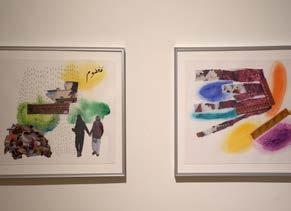
or witness to the work, whether that’s through … a line [of poetry] … or [encouraging them to ask]: What prevents me from seeing my mother or my father clearly? Where have I been hurt? Where have they been hurt?”
“We all have family, we all have these intergenerational pains, and so my hope is that there can be some self-reflection and connection for viewers.… What are the ways they might want to be in conversation with those relationships?”
The exhibit is open Wednesday to Saturday from 10 a.m. to 4 p.m. Those interested in learning more about its themes can join artist Farheen Haq and curator Anahita Ranjbar for a free and public conversation on June 27 at the Legacy Art Gallery from 2 p.m. to 4 p.m.
From a young age, Loe had a passion for music and science, pursuing both concurrently and eventually completed an undergraduate degree in Biochemistry (with a minor in music) at UVic. Based on a recommendation from a professor, Loe looked into joining the World Doctors Orchestra, only to discover there was no Canadian affiliate.
However, that didn’t stop him.
“I looked for [the Canadian Doctors Orchestra], but it didn’t exist, so I then thought, what the heck, let’s see what it takes to do this,” Loe said. After getting advice from the founders of other national doctors’ orchestras, Loe set out to start the Canadian Doctors Orchestra, initially just reaching out to colleagues and friends. However, the project soon snowballed into something much larger.
Now, the Canadian Doctors Orchestra is preparing for its first concert, with roughly 170 musicians signed up to audition at the time of publication.
“I was told in high school [that] once you’re in university, you won’t be able to [play music] anymore. You’re going to have to choose,” Loe said. “But I think, for me, I just love music. It brings me so much joy.”
Founded in March, the Canadian Doctors Orchestra is running on a tight timeline, with musicians to
The orchestra will meet for a “weekend intensive” meeting, where all the musicians will come together to practice as a group before the concert, though they will receive the music to learn ahead of time. Loe told the Martlet that the concert’s program has not yet been set, but that he thinks it would be “amazing” to feature some original compositions, and underrepresented composers, such as women or people of colour.
The orchestra will be conducted by Dr. Ajtony Csaba, an associate professor at UVic’s School of Music.
Csaba is the director and conductor of the UVic Symphony Orchestra and the chief conductor of the Central European Chamber Orchestra in Vienna, Budapest, and Bratislava. He is the artistic director of SALT New Music Festival, jointly hosted by UVic and Open Space, and has won prizes for his music in Hungary, Austria, Canada, and Germany.
“The newly formed doctors’ orchestra is a mixed formation and will have equally professional players as well as advanced amateurs … so it is required to have a professional conductor spearheading the ensemble,” Csaba said. “They honoured me with their confidence that we will do some great things together, and I am very, very happy to join them.”
The newly formed orchestra will provide healthcare professionals, many of whom live stressful lives, an opportunity to be creative outside work.
Csaba, a cellist and pianist himself, strongly believes in the social and therapeutic power of music. “It’s a fun historic fact that in the nineteenth century, people gathered for Sunday afternoon
coffee, but instead of drinking coffee or eating, they played string quartets … and that was considered to be an elevated conversation for several decades,” Csaba said.
“So practicing music is a very, very effective and efficient outlet for anything that accumulates through the week [or] through the months.”
Csaba said he hopes the orchestra’s members gain connections from the experience.
“Music is part of the fabric of social life and it is a connecting tissue that connects us all in one way or another.”
The orchestra has a “triple mandate”— to use music philanthropically as a tool for social good, to provide a creative outlet to high-burnout healthcare professionals, and to celebrate the diversity of the Canadian medical community and promote panCanadian cultural exchange.
The Canadian Doctors Orchestra will have its inaugural weekend intensive from December 18 to 20, followed by the charity concert on the 20, which will be hosted at UVic’s very own Farquhar Auditorium. Csaba said he is happy to have UVic at the “epicentre” of the initiative and was grateful to host the concert at the university.
“Nothing to me feels as amazing as working really hard with a group of really talented musicians,” Loe said. “There’s a lot of tough situations that you are forced to be in [in healthcare] sometimes, and I think this is a great opportunity for people to come and … play [their] heart out.”
The band formed as a duo in 2021, with Anita Fowl (vocals, bass) and Nolan Jakupovski (vocals, guitar) as its core founders. Joined by Sophia Chavez (vocals, synths) and later Joseph Shemoun (percussion), the four have formed a group heralding the twee revival of the 2020s. Now associated with the laptop twee movement featured in the Pitchfork article “The Top Five Musical Rabbit Holes of 2025,” Cootie Catcher is reinventing samplepop of a bygone era. Their merging of crafty aesthetics with stock samples recalls an optimistic embrace of DIY indie pop with nearly antiquated electronic sounds.
As each identifiable piece presents itself, whether that be a toy piano or a sample of compressed speech as featured in “Quarter Note Rock,” each member contributes the auditory equivalent to a trinket on a shelf. Much in the same way, each fully realized song forms a square on the musical quilt of Something We All Got — a quilt that brings you back to childhood, and makes you all the more prepared to face adulthood.
Lyrically, the language is simple, but backed with airs of melancholy. The band holds an air of hopeful and heartfelt, culminating in songs that explore the coming-of-age in early adulthood. Observations of a deteriorating relationship are drawn
out in their single “Gingham Dress,” released in November of last year. The final verse ends with “Pseudo wife, I tried my best / Convalescence next,” matching the underwhelming feelings of defeat to a cautious optimism for what’s to come. Materiality is key to Cootie Catcher’s ethos. The clear distinction of instruments both electronic and acoustic celebrate each member’s skill with supporting samples. Altogether, the sound direction builds an imaginative and playful world, where the electronic can sound organic. Songs such as “Quarter Note Rock” unravel with a clearly human grasp on the instruments, with Shemoun ending the track through an emotive drum solo backed by everpresent programmed drums. These recurring electronic samples, like the fluttering percussion on “Rhymes with Rest” or the choppy vocal samples near the climax of “Puzzle Pop,” creates a paradoxical organism in the chorus of indietronica. This aggregation of materials, from digital to physical samples, delightfully parallels the thematic mess of emotions that run throughout.
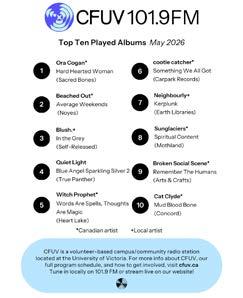
In the sweeping storm of their album release, Cootie Catcher has attained significant prominence in the music world. Recently, Something We All Got was announced on the longlist for the 2026 Polaris Music Prize, alongside acts like Angine de Poitrine, Men I Trust, and PUP. Having performed with fellow indie groups Phoebe Rings and Good Flying Birds, the group also made a significant appearance supporting twee pop legends Heavenly in Toronto this April. Accolades for Cootie Catcher resound across North America, with the new album being featured on CFUV’s charts as well as “Puzzle Pop” being the number 1 track of 2026 for New York University’s campus station, WYNU.
Cootie Catcher will be playing in Victoria at Friendship Hall, run by the Victoria Native Friendship Centre, as part of their North America tour on June 27, 2026, presented by the Action Index. Victoria bands Savy and Shoplifter will be supporting them.
a thirteen-year-old really need an AI chatbot account in school?
The Vancouver School Board is rolling out Microsoft Copilot AI chatbot accounts for students aged 13+ and provides little explanation to back the move

SENIOR STAFF WRITER
At the beginning of June, the Vancouver School Board (VSB) rolled out Microsoft Copilot AI chatbot accounts for every student aged 13 and up. But what process went into making such a bold step so quickly?
A recent MIT study showed that excessive reliance on generative AI may contribute to cognitive atrophy and the shrinking of critical thinking abilities.
The study also showed that individuals who used the AI chatbot to assist in writing their essays remembered little of their own work, reflecting a bypass of the deep memory process.
AI is a new technology that has proven to interfere with the process of learning, so why does it have a place in Vancouver classrooms?
In a statement to the Martlet, the VSB said that they have taken this measure to “support student learning and readiness for a rapidly evolving, technology-rich world.” Some B.C. parents have already raised concerns about kids relying on AI at school.
The VSB said that their approach is “to set up parameters that empower students to utilize AI safely and responsibly in a District-supported learning environment.”
In an attempt to better understand Microsoft Copilot and how it may aid learning, I decided to run an experiment. Without creating an account, I entered a simple prompt into the chatbot: “I have to write an essay for my social studies class, can you help me?”
experiences that we compare our ideas to, contrasted to a child’s lack thereof, at least in a visual context.
Colonization isn’t a singular event, or a concept simple enough to be understood through a small blurb in a textbook or article page; it’s an everyday experience and it’s complex.
I think, or at least hope, that many of our non-Indigenous readers already understand this or have come across this conversation.
It is important to read Indigenous history and authors. However no words on a page will be able to convey the feeling of having Indigenous historical traumas embedded into the gene codes that make up our biological processes (epigenetics).
I guess the idiom: “it goes in one ear and out the other” is a little more scientifically based then one would like to think.
Given this study, I think it’s important to always be aware of what was taught to us as children and to always question that knowledge, never stop.
Ask yourselves: how has exposure to the colonial reality of so-called ‘Kanada’ really affected Indigenous and nonIndigenous kids during peak GABA concentration?
Vikes wings Larah Wright
ELLA BAIRD CONTRIBUTING WRITER
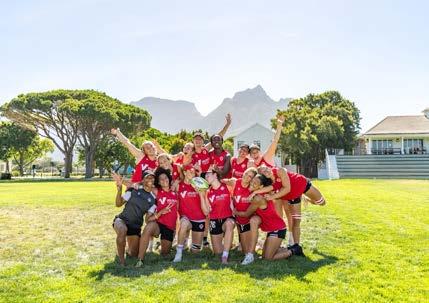
University of Victoria wings Larah Wright, entering her final year, and rookie Eden Kilgour are returning to campus with a historic bronze medal, representing a far larger triumph for Canadian collegiate rugby.
On June 7, 2026, Canada’s national team captured the bronze medal at the HSBC SVNS World Championships in Bordeaux, France. After a devastating 19–17 loss against New Zealand in the semifinals, the team bounced back just hours later, defeating the United States 21–19 in the thirdplace playoff game.
“UBC, UVic, that is the biggest rivalry, but now we’re the best of friends,” said Wright, reflecting on her friendship with UBC nemesis Savannah Bauder. “Getting to play on the national team together, that's brought us closer.”
The international experience has fueled Wright’s vision for leadership as she enters her final year of eligibility with the Vikes. Representing Canada has provided her profound perspective on the rising momentum of women’s sports in Canada. For Wright, wearing the Maple Leaf is about much more than athletic achievement — it is about inspiring future athletes, establishing positive leadership, and embracing hard work.
When Wright plays in the national jersey, she thinks of her younger sister.
“I think it's the coolest thing that she is growing up in a world where women’s sports is dominating, especially in Canada,” said Wright.
“I’m very privileged and fortunate to be a part of that movement.”
I think a consequential idea I see Indigenous and nonIndigenous folks regularly battle is the notion that ‘Indigeneity is far away from us historically’.
The podium finish represents more than an international accolade, with the team showcasing a unique sense of unity. Wright and Kilgour played alongside athletes from their U SPORTS rivals from the University of British Columbia (UBC) and Queen’s University, as a united force for Canada. The rivalry between the UVic Vikes and the UBC Thunderbirds is historically tense, often defining the national standings. Yet, in Bordeaux, these rivals shared the same jersey on the pitch.
This deep sense of unity is stitched into the fabric of their game, with the phrase “one squad” embroidered on the collars of their jerseys, symbolizing a family where everyone has each other's back. Wright explains that the Maple Leaves on the jersey represent a family tree, where every individual leaf is connected to a single, supportive
stem of community. As she returns to Victoria, Wright is hoping to grow this culture of community with the Vikes, ensuring the varsity team continues to operate as not just a squad, but as a family.
Though I had not explicitly asked the chatbot to write the essay for me, I watched it generate an entire essay for me in response. This is a tool being implemented into classrooms to “support student learning.” How is a student supposed to learn to write an essay when their work is done for them, without them even asking for it?
Like any skill, writing skills are developed through practice. From sixth grade onward, I was writing essays and other assignments regularly, and I was writing them myself.
I now study writing at UVic, and practice the skill in my career. If I had access to an AI chatbot in seventh grade, I likely would not have developed those skills and be where I am.
Surrey School superintendent Mark Pearmain told CBC that “students are using ChatGPT or Claude or other platforms outside of the school district time,” and that they “just want to ensure that they know how to safely use that and how to safely use the platform in a morally positive way and ethically.”
The VSB has not yet made clear exactly how Copilot will be used in the classroom and what role it will play in student learning. While there is obvious value in teaching youth how to use AI safely and ethically, the district did not elaborate on how this will be done.
The chatbot sent back a lengthy response outlining the essay-writing process and asked for my topic, the essay style, and my word count. I responded again: “It's about the black death and it’s 800 words argumentative.”
In grades six through twelve, I had an annual lesson on cyber-safety. But I was never given an Instagram account by my school district. My educators were able to successfully teach me how to safely navigate the digital world without putting those tools in my hands.
Many students had social media accounts by that time, and actively used them in and out of school time. But the decision to have an account was completely left to the student and their guardian.
A group called Parents for AI Caution in Educational Spaces (PACES) Vancouver launched a petition demanding that “the Ministry of Education and Child Care enact a twoyear pause on AI in classrooms.” Copilot 13+ includes safeguards that protect student data, filter out harmful content, and it does not use the chats to train AI models. The VSB said that families with concerns about Copilot 13+ are encouraged to speak with their child’s educator and administrators. However, the board did not comment when asked about whether parents will have the ability to opt their child out of Copilot 13+. AI safety could be taught to students in the same way that cyber-safety is. Provide youth with real-life examples of misuse and the consequences of it. Continue to teach academic integrity, and how it is evolving in an era of AI. AI is everywhere. There is no denying that it is a part of our world, and children should be taught to navigate it, but there are other ways to do so before handing them access to an AI chatbot.
There is no denying that AI safety is an important skill to teach youth — it is no different from cyber-safety or sexual education, both of which we are taught in school. Beyond academic pursuits, schools are places where youth are prepared to lead safe lives in the real world.
I think about children, and how curious they are. Children have a very important role in communities across so-called ‘Kanada’ because they are expected to learn and carry knowledge taught to them throughout their upbringing, so it’s later taught to their children, and their children, and so on. Young people are treated as the future – because they are –and knowledge is circular so it must go around.
This shared cyclical understanding ensured the survival of over 70 Indigenous languages carrying immemorial amounts of knowledge, history, lessons, cultures, and elements of our identity that are continuously stolen from in this country.
Humans learn easiest at a young age, and I believe this was well understood by Indigenous people long before the science behind it was discovered.
In 2022, a team of researchers based at Browns University discovered that children exhibit a higher concentration of y-aminobutyric acid, aka ‘GABA’, when using visual learning methods. GABA is responsible for solidifying information in the brain for later use, allowing children to learn more efficiently than adults even if underdeveloped.
For adults ages 18-35 years old, GABA concentration levels remained unchanged during and after the learning process, juxtaposed to children whose brains acted quickly to stabilize any new knowledge consumed.
This suggests that what’s previously unknown or not understood to developed people is more susceptible to being forgotten or not fully comprehended due to the consolidation of our previous
That it is a step removed from what we are today. Yet every time someone mentions when the last residential school shut down, people are surprised how close events with generational consequences are to the present.
I’ve also witnessed reflections in Indigenous and nonIndigenous spaces on where our goals for the future come from.
As students, a good chunk of us aspire to acquire a job post-grad that provides enough capital to hopefully own property some day or fund lifestyles we were promised if we laboured enough.
But what is the root of this idea?
Read John Locke’s On Property and see what he says about Indigenous people, then tell me if we should still consider his ideas as worthy of manifesting in our systems.
Scientifically-speaking, it is harder to re-learn what we must do to act better, to act right. But when we bring our new knowledge to the future generation, we can find solace in knowing they’ll learn it more efficiently, picking up the cycle that kept us surviving for decades into time beyond.
Everyone in this country will stumble upon Indigeneity and what happens when you do matters. So what do you know? What do you need to know? What will you say to the future?
To close this off, I’ll leave you with two values from my home community: Ohnîrhpa nîchiyek, Wogidâ ya/Don’t be discouraged and keep going.




ACROSS
1. Tosses up, in volleyball
5. Backup crew
10. Pus-filled sac
14. "Don't worry, I'm_ _"
15. People from Egypt or Morocco
16. Word with sticky or pad
17. Norse trickster god
18. "I'll give you two wheat for a sheep"
19. Set ablaze
20. Alike
21. Like many a sweater
22. "It was Professor Plum in the study"
23. "I'm attacking you in Australia"
24. Word after self or high
27. Way too much, abbr.
28. Common antidepressant; abbr.
30. Barrymore and Carey
32. Equip with weapons
35. "_ _ your last point..."
37. Queen of soul Franklin
40. Panel of company directors
42. Frodo's companion
44. Word with winter or summer
45. Set up tents, etc.
47. Made a rip
49. The sixth sense, in short
50. "Checkmate"
52. Junction in computing
54. "_, Humbug!"
56. Pokemon that can change their form
58. "I'll take this blue tile"
62. It's about 44 million square km
64. Spits fire
65. Wheel
66. Practice fighting
67. Greek yogurt brand
68. Dead tree that's still standing
69. __-a-__: Head-to-head
DOWN
1. Renewable type of power
2. Small, white mushroom
3. Polynesian carvings
4. Reeks
5. Kickstarter supporters
6. Ford delivery vans
7. Weird Al's parody of an MJ hit
8. Eased up
9. Web portal that uses Bing; abbr
10. Financial cable network;abbr
11. "Can we go back a bit?"
12. Walk with confidence
13. Christopher Nolan time-bending flick
25. Career chapter, to Taylor Swift
26. Didn't stay in your lane?
29. 28-across, colloquially
31. "Aren't __ __ cute couple?"
32. Homer Simpson's dad
33. Red-haired wizard
34. Espresso drink with a splash of milk
36. Gluten tree flour source
38. “___ just not that into You"
39. Widely believed to be Cleopatra's cause of death
41. Sports tan cheer
43. "I'll build a hotel here"
46. 65-across reading; abbr.
48. Body of water called "the last ocean"
51. A long step
53. Devours
54. Spoon butter onto a cooking steak
55. Type of tree, or a city in Colorado
57. Liam Neeson action series
59. Witty insults
60. Eurasian mountains
61. The real deal
63. Paramour of Aphrodite
67. Mature acorn Visithttps://pondscumgames.blogspot.comformorepuzzleslikethisone!

70. Singer with 16 grammy awards
71. Fruit also called Jamaican tangelo
72. Grandson of Adam
73. Nairobi is its capital
74. "Hey, over here"
Keira Holman
CONTRIBUTORS
Ella Baird, Atum Beckett, Sie Douglas-Fish, Avery Federspiel, Raamin Hamid, Vithória Konzen Dill, Avery Treadwell