CONTEXTS
Stories and inspiration for 2027 Issue 2 | Autumn 2026
2
From the editor Welcome to the second edition of Contexts. When we launched this magazine, our aim was to create a publication that reflected the curiosity and scholarship at the heart of Martin Randall Travel. Not simply somewhere to promote new tours, but a place to shine more light on the stories and ideas that give them meaning. To this end, it’s my view that images are as important as words. They inform our understanding of the past just as strongly as texts do. This issue celebrates that idea in different ways. Our founder, Martin Randall, reflects on the remarkable collection of historic prints that has helped define the visual identity of the company for more than four decades. Elsewhere, the beautifully observed drawings of a participant on a tour to Extremadura remind us that travel is as much about personal observation and interpretation, as it is about gleaning the bigger picture from experts. Images are only one way of putting that method into practice. We return, throughout, to an idea that lies at the heart of every MRT journey: that history is best understood not in isolation but in relation to what surrounds it. Whether exploring Europe’s great rivers, tracing the maritime world of ancient Greece or discovering the cultural landscapes of Southeast Asia, history, art, music and architecture are never separate from the landscapes in which they evolved; context is key. We hope the pages that follow offer not only inspiration for future journeys but fresh perspectives on the destinations you may already know. With best wishes,
Charlotte Crow
Contents MRT news ......................................................4 History & Art on the Danube: a photo story ...............................................6 The Rhine: Empire, Reformation & Romanticism .................................................8 In Pursuit of Print ........................................10 In the Field: At Chalke History Festival ......14 On the History Trail ....................................16 A Taste of Culinary Europe ........................18 Extremadura: On a Plate.............................22 New Tours for 2027 ...................................24 The World the Bauhaus Made....................28
Algeria: Outposts of Empire .......................32 Thailand & Laos: A Quest through Buddhist Heartlands ..................................................35 Empire by Water .........................................38 Greece from the Sea ...................................40 Monteverdi in Venice ..................................42 In Conversation with: I Fagiolini..................43 Celebrating Music & Place in 2027 .............45 Composed for Small Groups ......................46 Tour calendar...............................................48 How to book ...............................................51
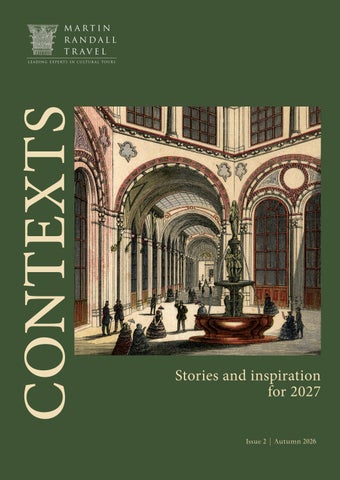
Front cover: Vienna, Palais Ferstel, wood engraving 1890. Inside cover: Taken on History & Art on the Danube, July 2026, © Sam Walker Layout and design: Alice Bzowska Contributing Editor: Kent Pringle
Subscribe to our weekly e-newsletter at www.martinrandall.com
3
MRT NEWS What’s been happening in the world of Martin Randall Travel Charity of the Year: Orchestras for All MRT has chosen Orchestras for All as its Charity of the Year. The charity exists to make orchestral music open to any young person who wants to play an instrument, whatever their circumstances, and given how many of us at MRT grew up with music as a formative part of our own lives, its aims struck a chord across the office. OFA began 15 years ago, when its founder, Marianna Hay, was teaching in a state school in north London and saw how little opportunity many of her students had to make music together. She started getting instruments into the school and pupils playing as an ensemble, and that early initiative grew into the National Orchestra for All (NOFA), which now runs residentials, regional workshops and online sessions for 11- to 16-yearolds across an 18-month season, open to anyone regardless of ability or means. Three further programmes have since taken shape alongside it: Modulo, which sets up music-making
in schools and community settings; Music Leadership Training; and Youth Leadership. Behind the programmes are some striking figures – last season, Modulo reached 597 young musicians across 38 schools, and more than a third of NOFA’s current members are neurodivergent – but it’s the individual accounts that really convey what the charity does. One NOFA member described joining during a lonely and difficult period, and how the orchestra gave them the confidence to return to education. A parent spoke of their child finding, for the first time, “a space that is inclusive,” somewhere being different simply wasn’t an issue. A teacher on the Modulo programme recalled a pupil who, months later, still talked about the “magic in the air” felt in the silence at the end of a piece.
MRT has set the office a staff target of raising a minimum of £1,000, which the company will match – and will match again, whatever we raise beyond that. We will invite clients who wish to join in too. Within days of announcing to the company, several colleagues had volunteered to run a Charity Committee to steer the fundraising. Meanwhile we are looking forward to an autumn visit from OFA alumni who will visit the office, giving us the chance to meet some of the young musicians whose experience we’ve been reading about. orchestrasforall.org
4
Writers in Whites
A Day by the River The entire MRT team gathered in July at the Bingham River House overlooking the Thames in Richmond for our annual summer away-day. Sun on the terrace, cake on the tables, and a lovely garden set the scene for a day of brainstorming and conversation. In small groups dotted about the lawns, and in the shade of the fig tree, we traded stories to trace the values that run through MRT, both the ones our clients see and the ones that shape how we work together: intellectual curiosity, a willingness to go beyond what’s asked, and a commitment to doing the right thing. In the afternoon, a dedicated session on artificial intelligence gave us a practical and relevant introduction so we could consider what it means for the business, and how, it can be a explored in sensible ways and seen as an ally rather than a threat.
Ollie Randall has tour managed for MRT for 14 years. Earlier this year, shortly after completing his doctorate, he published his first book. Writers in Whites traces a remarkable network of literary figures – among them Arthur Conan Doyle, P.G. Wodehouse, Evelyn Waugh and Michael Morpurgo – who played cricket together over 80 years, leaving their mark on British culture in the process. Appealing to anyone with even a passing interest in cricket, literary history, or both, The London Review of Books praised the way Ollie charts the game’s cultural decline “with just as much brilliance and assiduity as he chronicles its rise.” His second book, Lords and Maharajas, follows in October. It tells the story of the political intrigue and imperial upheaval surrounding the first official Indian cricket tour of England, in 1932. Next year Ollie returns to managing MRT tours. In between, he hopes to write about something that has nothing to do with cricket.
We finished the day with Pimm’s and a barbecue, before the team headed off to watch England’s final game in the 2026 World Cup.
5
A private reception at the Upper Belvedere, Vienna.
Kunsthistorisches Museum, Vienna.
HISTORY & ART
ON THE DANUBE
Dürnstein Abbey.
6
Up on deck aboard the MS Amadeus Nova.
“
Well organised, excellent MRT staff, super ship with lovely staff on board and delicious meals.
Our inaugural History & Art on the Danube cruise traced the river between Budapest and Passau, following the imperial artery that bound the Habsburg lands. Participants explored medieval fortresses on the Hungarian frontier, Baroque abbeys raised after the Ottoman wars, and monasteries above the Wachau vineyards. An after-hours visit to the Belvedere enabled a private view of Klimt’s The Kiss, alongside works by Schiele and Kokoschka. Visits included Budapest’s Hungarian Parliament and an optional excursion to Český Krumlov, home of Europe’s best-preserved Baroque theatre, its original stage machinery and costumes intact. Three speakers – Gavin Plumley, Veronica Buckley and Philipp Blom – illuminated a rich history that culminated in Vienna and Budapest’s transformation into imperial capitals.
Admiring Klimt’s ‘The Kiss’ during a private visit to the Upper Belvedere.
A stretch of the Danube by Dürnstein Abbey.
7
“
Ulrike Ziegler is outstanding: clear, comprehensive, concise, friendly and an absolute pleasure to travel with.
Tracing Tracing Europe’s Europe’s transformation transformation along along its Tracing Europe’s transformation along its greatest its greatest river – from riverBasel – from to Basel Amsterdam to greatest river – from Basel to Amsterdam Amsterdam 12–19 September 2027 • 10 days 12–19 September 2027 • 9 days 12–19 September 2027 • 10 days Tom Abbott Tom Abbott Tom Abbott Dr Hugh Doherty Dr Hugh Doherty Dr Hugh Doherty Dr Jarl Kremeier Dr Jarl Kremeier Dr Jarl Kremeier Dr Jean-Michel Dr Jean-Michel JohnstonJohnston Dr Jean-Michel Johnston Dr Ulrike Ziegler Dr Ulrike Ziegler Dr Ulrike Ziegler 8
THE RHINE: EMPIRE, REFORMATION & ROMANTICISM
Where the Danube journey traced the Habsburg story from Budapest to Passau, our next History by River cruise turns to Europe’s other great waterway, one that carried armies and ideas just as decisively: the Rhine. This new nine-day cruise, from Basel to Amsterdam aboard the exclusively chartered MS Amadeus Queen, follows eight centuries of change – dynastic, religious and artistic – from the Holy Roman Empire to Romanticism. At Speyer and Worms, we uncover the Rhineland’s role as heartland of empire, medieval Jewish culture and
the Reformation – Worms is where Luther defended his beliefs before Charles V. In Mainz, the Gutenberg Museum shows how movable type let reform spread faster than any emperor could contain it. Heidelberg’s castle, the setting for a private evening event, embodies the layered history – stronghold, Renaissance court, Romantic ruin – that the Middle Rhine’s castlecrowned banks would come to symbolise for a later generation of poets and painters.
Cologne’s Gothic cathedral, Xanten’s Roman frontier, and Colmar’s Isenheim Altarpiece extend the story beyond the river’s German stretch. Five expert speakers, including Tom Abbott and Jean-Michel Johnston, lecture throughout the voyage, weaving these sites into a single account of how the Rhine propagated ideas and movements that would come to shape Europe as we know it.
9
IN PURSUIT OF PRINT
Long before he founded Martin Randall Travel in 1988, Martin Randall was collecting antique prints – etchings, engravings, lithographs, woodcuts – bought from backstreet bookshops and print fairs. It was this private passion he eventually turned to when the young company needed images for its publications: rather than use stock photographs, he reached for the print room, where an image can be a historical document as much as a work of art. The result was a visual identity unlike any other in the travel industry, one we still delight in today. Here, we ask him how it came about. Where did your interest in prints begin? With a shop called Suckling & Co in Cecil Court – the narrow alley connecting Charing Cross Road and St Martin’s Lane in London. I was 16, writing an essay on Lord Burghley, Elizabeth I’s chief minister, for a school history prize. I went in search of an engraved portrait of him. I didn’t win the prize. But prints became a passion, and I went on to
10
form a collection – small and motley, scoured from the damp basements of backstreet antiquarian bookshops and minor antique markets. I still have the invoice and correspondence from my second purchase: 22 May 1972, prints of Mary Herbert, ordered by telephone from Suckling & Co at around 4.15 in the afternoon. Four prints arrived on approval the following day; I kept two, priced at 25p and 15p, and returned
“
I remember the moment of epiphany: I leapt out of bed and rootled in the lower regions of the wardrobe where my precious prints were stored.
the others with a 43p postal order. Postage was 3p. A different world. How did a personal passion become part of the company’s identity? About 20 years after that first purchase, it dawned on me that we could use antique prints to illustrate our marketing publications. We had no budget for professional photography or reproduction rights, and my view was that amateur photographs wouldn’t adequately evoke the exceptional experiences we were trying to sell. The solution came to me in the night, literally: I leapt out
of bed and went rootling in the lower regions of the wardrobe where my precious prints were stored. There weren’t many relevant topographical views in my personal collection, so the firm would have to start buying – with very slender resources. I remember looking longingly at an Edwardian etching of Santa Maria della Salute in Venice and walking away because it was £16 and our agreed maximum was £14. Happy ending: it was still there a year later. I bought it, and it has done sterling service ever since.
11
12
What makes this approach genuinely distinctive? ‘Unique’ is a word to treat with caution, but it can be used with confidence here. No other travel company illustrates its publications with original prints – and our visual identity acquired a distinctiveness that is acknowledged as exemplary by professional designers and marketers. The prints are also apposite in other ways: they show the places our travellers visit, and they are remarkably economical to reproduce. With an out-of-copyright image there is no owner or artist’s estate to pay. How large did the collection become? There are about 5,000 loose prints and an uncountable number of engraved images bound into some 600 volumes – among them Edwardian travel books illustrated with beautifully reproduced watercolours. I should record that we have never ‘broken’ a book – ripped out the prints and discarded the rest – which is a regrettably common practice in the antiques trade. Wherever I travelled I hunted for print shops: Boston to Belgrade, Stockholm to Seville, Cardiff to Kolkata. I came eventually to the view that London remains by far the best city for collectors, even as the number of specialist dealers has declined, more precipitously than their counterparts in second-hand books.
How does the collection serve the company today?
And Cecil Court – where it all started?
The prints continue to appear across everything we produce – brochures, advertisements, the website – and the archives are trawled constantly for images that extend the range. The distinct visual character they give us is as valuable as it ever was; if anything, the best prints can be appreciated more fully now, reproduced at the quality modern print and screen allow. All the staff have their favourites and as fresh images surface there is delight from various quarters. The ones illustrated in this feature are among the finest in the collection.
A few print dealers survive there still; it may be the only street in central London consisting entirely of independent antiquarian and artistic specialist shops. That they endure is largely thanks, I’m told, to an enlightened landlord – one who tolerates the idiosyncratic ways in which such businesses are run and whose office is prepared to cope with them. That landlord is the Marquess of Salisbury: a direct descendant of Lord Burghley, subject of the very first print I ever bought.
Previous page, L–R: William Cecil Lord Burghley, engraving 1832 by H.T. Ryall (1811–67); Santa Maria della Salute, etching c. 1900 by A. J. Finberg; Venice, vue d’optique, hand-coloured copper engraving c. 1774.
L–R: Smyrna, camels; Autun, wood engraving c. 1860; Istanbul, watercolour by R. Hichens,1911; Japanese woodblock; Rome, Belvedere courtyard; copper engraving 1750 by T. Bowles; Amritsar, The Porcelain Dome, watercolour by Mortimer Menpes, 1912; Ypres Cloth Hall, Belgium.
13
IN THE FIELD: at Chalke History Festival
Charlotte Crow reports on MRT’s debut at the Chalke History Festival this summer, an event which left us highly stimulated with new friendships, fresh ideas and a keen determination to return. The Chalke History Festival has established itself as one of the most distinctive gatherings in the British cultural calendar: talks, panels and conversations held in a giant marquees, drawing speakers and audiences united by a genuine enthusiasm for the latest thinking and ideas. I had always wanted MRT to be there, and it was exciting to cement a new partnership. Graham Horner, our CEO, joined us for our sponsored talk before travelling on to our Rhine Piano Festival; over the next five days each member of the Marketing team attended at some point, a bonding experience for us all. As Kent Pringle, MRT Brand & Campaigns Manager, observed: “There’s something wonderful about being deep in the Wiltshire countryside, songbirds and lowing
14
cattle giving way to the hubbub of a thousand history enthusiasts gathered together.” Choosing our sponsored talk wasn’t difficult. Tom Holland needs little introduction as one of Britain’s most widely read popular historians, while Paul Cartledge – Professor Emeritus of Greek Culture at Cambridge – is among the foremost authorities on the ancient Greek world. A conversation between them on the life and legacy of Pericles, timed to spotlight Paul’s new book, was an excellent fit given our range of Classical tours. Having worked with both before on MRT’s history symposia, introducing them to an audience of nearly 500 was an added pleasure. Our presence confirmed something we have long felt: that the people
who travel with us, and the people who might, are not defined by a single interest but by a quality of curiosity. Across the festival, we met prospective clients whose enthusiasms ranged beyond history into art, architecture, music and the wider cultural world – the terrain MRT has navigated for nearly four decades. Some had travelled with us before; some knew our name but had never taken the plunge; some were encountering us for the first time. The conversations, in every case, were warm and substantive. The wider programme offered plenty beyond our own evening. Katja Hoyer on Weimar Germany, Philip Mould on
Churchill the painter and Dr Melanie Giles on bog bodies were varied highlights of a characteristic Chalke mix: subjects and speakers familiar to us, others opening new doors. It was a pleasure to catch up with Charles Saumarez Smith, who leads our Vanbrugh’s Greatest Houses tour, on a panel marking the tercentenary of Vanbrugh’s death – a timely encounter given the tour’s departure the following week. For Katy Schramm, Senior Marketing Executive, the breadth of the programme was the revelation: “The range of topics and speakers was inspiring and got us all thinking about new topics and destinations we could add to our tour programme,” she says. “I was particularly excited to hear some of the younger female speakers, including Hannah Lucinda Smith on Europe’s Unfinished
Frontiers – very relevant and timely given current events.” Anthony Beevor drew the crowds you’d expect; the less widely known speakers proved as compelling. Valentin Boulan, our Digital Manager,
was particularly struck by a Sunday panel on the complexities of Second World War remembrance. “It was a powerful reminder that beyond facts and figures, history is often fluid, layered, and even deeply personal,” he reflects. “The panel – bringing together descendants of both Allied and Axis generals – illustrated this paradox with striking clarity. Their conversation showed how memory, identity, and inherited narratives can coexist in tension, yet still open space for understanding.” Alice Bzowska, Marketing Executive, spent much of the festival behind a camera, documenting the days extensively for MRT’s social channels. “It was great fun to experience the jolly spirit of the Chalke History Festival,” she says. “From musicians performing on ancient instruments to dedicated re-enactors bringing the past to life, I enjoyed soaking up the festival’s unique atmosphere.”
15
15
On the history trail The Making Of Argentina 19–30 November 2027 12 days • Chris Moss How a remote ranching outpost became the “Paris of South America” – and how Perón, Evita and military rule undid its promise. A private tango show in Buenos Aires, arranged exclusively for our group. Cacti forests, red-rock canyons and vineyards at altitude through the Calchaquí Valleys. High-altitude Malbecs tasted at Bodega Colomé, where owner Donald Hess has built a James Turrell museum of light and space.
Roman Britain: The South 1–10 September 2027 8 days • Professor Will Bowden Roman Britain at its most opulent – great villas, magnificent mosaics and thriving cities that rivalled those of the Mediterranean world. The palace at Fishbourne; the Cotswold villas of Chedworth and North Leigh, with mosaics among the finest Roman art in Britain. Saxon Shore forts at Pevensey, Portchester and Richborough; the remarkably preserved town walls of Caerwent and Silchester. Some of Britain’s most historic towns set in beautiful countryside.
Norman Conquest & Plantagenet Power 29 June–2 July 2027 4 days • Marc Morris Some of England’s most magnificent Norman buildings, their historic significance and context. England’s medieval world view, through the prism of the populace, monarchs and bishops, merchants and knights. Breathtaking spring countryside, with two nights in Canterbury and at a country hotel near Battle.
16
Bulgaria’s Buried Empires 1–11 October 2027 11 days • Dr Nikola Theodossiev Bulgaria’s archaeology and art span 40,000 years, from prehistory to the modern era. Six UNESCO sites, including Thracian tombs and Boyana Church’s frescoes, punctuate a journey through Sofia, Plovdiv and the Black Sea coast. Highlights include Varna’s fifth-millennium-bc gold treasure and Philippopolis’s Roman theatre, backed by the Rhodope mountains.
Cold War Berlin 21–26 April 2027 6 days • Dr Timothy Phillips Where the clash of ideologies met a clinch of superpowers, Berlin was the Cold War’s most electrifying stage – a divided city whose politics, spies and astonishing human stories we bring vividly to life over five unforgettable days. Visits include the Stasi prison at Hohenschönhausen, the Teufelsberg listening station, and Glienicke Bridge – scene of Cold War prisoner exchanges.
Athens & Attica 15–22 February 2027 8 days • Dr Nigel Spivey Athens’s making as a city, sanctuary and sea power unfolds across the Acropolis, the Agora and the Attic hinterland. Beyond the Parthenon and Erechtheion, the tour reaches Eleusis’s mystery cult, Marathon’s battlefield, and Aegina’s Temple of Aphaia. A private evening visit to the Acropolis Museum caps a February itinerary timed for temporate weather and empty sites.
17
A TASTE OF CULINARY EUROPE
Behind every MRT gastronomic tour is a series of producers, delicacies, dishes and stories. Here, experts Marc Millon and Victoria Daskal savour highlights from two of their favourite regions.
Piedmont Wine, food and travel writer Marc Millon has been developing and leading MRT gastro tours for over 15 years. He has helped create nine different itineraries primarily in Italy, but also in France and England. Gastronomic Piedmont is one of my favourite tours and I am delighted to be leading it again in 2027. There are so many highlights in what I consider to be one of Italy’s greatest regions for gastronomy and wines. Not only is this the home of wines such as Barolo and Barbaresco, as well as the seasonal source of one of the world’s rarest and most sought after gastronomic delights, the tartufo bianco d’Alba – white truffle of Alba – it is also a region where history and culture combine effortlessly with food and wine. One of the standout lunches is at Guido Ristorante
18
on the Fontanafredda wine estate in the heart of the Barolo hills. Not only does Chef Ugo Alciati prepare for us an utterly classic meal of the Le Langhe region, paired of course with the estate’s fabulous wines, the setting is historic, too, for the restaurant is set within the villa that Italy’s first King Vittorio Emanuele II had built for his mistress Rosa Vercellano in the 1870s. Their son, Emanuele Alberto Guerrieri, Count
of Mirafiore, founded Casa E di Mirafiore in 1878 and the wines are once again being produced today. A bite of agnolotti al plin – a handmade, small, meat-stuffed pasta – a sip of Casa E di Mirafiore Barolo ‘Lazzarito’: this is the taste of history. ‘Gastronomic Piedmont’, with Marc Millon, departs from 16–22 October 2027.
Langhe terraced vineyards with Grinzane Cavour castle in the centre.
The Loire Victoria Daskal, wine expert and consultant describes some favourite moments from a tour she leads to perhaps France’s most famous wine and gastronomic region. Discovering Saumur from the inside out, and seeing how deeply the region is shaped by the earth beneath it, is one of the great pleasures of this tour. Here, the luminous local limestone, tuffeau, has defined the landscape for centuries, carved out to build the châteaux and elegant buildings that still give the Loire its grandeur – including the historic property where we stay. The spaces left behind have their own story: the region’s troglodyte caves have sheltered people, grown mushrooms and cellared wine, and we experience each of these threads during our time in Saumur.
A vineyard in the Loire Valley, France.
limestone where bottles and barrels rest, vines grow directly into the tuffeau, producing wines with unmistakable freshness, energy and minerality. It all comes together over dinner in a historic cave restaurant, candlelit and atmospheric, with wood-fired fouées – the little local breads immortalised by François Rabelais, Renaissance writer, Loire local and great gourmand, in Gargantua.
The Loire remains an important centre for mushroom production; its numerous mushroom caves producing varieties from champignons de Paris to shiitake. We explore the cellars that make Saumur the hub of the Loire’s sparkling wine, their cool, humid conditions allowing bottles to age slowly, much as they do in Champagne.
Another highlight is meeting the people behind the wines: the producers and families who have worked this land for generations. Just outside Nantes, we visit one of Muscadet’s most important producers, Famille Lieubeau, a pioneering estate now in its sixth generation.
Most fascinating is the connection between the caves below and the vineyards above: in the same
They work with old vines, organic viticulture and a deep understanding of Muscadet’s varied soils, showing how far this once-modest wine can
Les Caves de Marson, Loire.
travel – from the zippy aperitif poured with local oysters to complex, ageworthy crus shaped by single sites and meticulous winemaking. We walk the vineyards, taste wines from different soils and sites, and see how Muscadet expresses precision, texture and place. Afterwards, lunch in the vineyard brings together the landscape, the wines and the people who make this region so memorable, over seasonal vegetables, cheeses and local specialities. ‘Gastronomic Loire Valley’, with Victoria Daskal, departs from 30 August–5 September 2027.
Villandry Castle, Loire.
19
On Etna’s Slopes – Gastronomic Eastern Sicily Product Manager Nia Kile shares the key ingredients that make for a winning gastronomy tour, and the recce that underpins our newest itinerary. At the centre of every meal, there is a recipe. Whether precise and tothe-letter, or “a little bit of this” and “a handful of that,” ingredients and techniques combine with delicious results. Devising an MRT gastronomic tour is not dissimilar: we consider flavours, produce, dishes and experiences to create a rich journey to delight the senses. Earlier this year during the drizzly spring, I looked to sunnier climes to develop our newest gastronomic tour, based in Eastern Sicily. Working with Italian expert and award-winning
20
sommelier Cynthia Chaplin, we began, as any good cook does, with what the region itself provides. In Eastern Sicily, where Mount Etna looms large on every horizon, we knew we had to consider pistachios, specifically the prized Bronte variety. On our April prospecting trip, we saw skeletal trees covering the dark, volcanic soil on Etna’s slopes, and tasted the verdant nut transformed into creams, biscuits and nougat. Venturing south to Vittoria, chalky red soil and dry air replaced the mountain’s green fertility, creating the perfect climate for the grapes behind Cerasuolo di Vittoria, the island’s only DOCG wine. Chocolate from Modica, sweet and sour citrus, and salty bottarga made from prized tuna followed, and our list grew. Next came the question of how it’s all transformed into something you can taste. On an MRT gastronomic tour, this happens through the visits that bring you face-to-face with the region’s produce. A highlight of our research was a dairy in the Iblean
mountains near Ragusa, where Leandro and his family use net-zero farming techniques to produce the centuries-old “Modica” cheese, crunchy with salt crystals. Walking through the barns, watching the cows go for milking, and tasting the morning’s ricotta, it was clear the farm would be essential to the tour. We also toured a winery with an original palmento, a traditional gravity-fed winemaking system, set against vines crisscrossing the foothills of Etna. From humble, traditional experiences to the elevated and curated, these visits bring you closer to the people and culture of the region. The final element of a good recipe is balance: the squeeze of lemon that lifts a dish, the cream that ties a sauce together. We look for that same elevation across a tour, weighing the spread of meals from humble beginnings to a celebratory finale, asking ourselves whether there are too many wineries, or not enough visits to producers. Cynthia and I
“
On an MRT gastronomic tour, our ingredients are transformed through the visits and experiences that bring you face-toface with the region’s produce.
You might also like to sample ... Gastronomic Lombardy
Cynthia and Nia.
drove over 1,000 kilometres on our journey – up Etna, along the coast, into the rolling hills – which showed us just how much ground there is to cover, and the need to balance longer coach journeys with shorter excursions. Basing the tour in three hotels achieves this: two in the Sicilian countryside, one in Etna’s shadow, the other a newly renovated farm still producing citrus and olive oil; a short stay in Ortigia, by contrast, grants access to its lively morning market and pretty piazze.
Gastronomic Eastern Sicily is the result: a rich culinary tour of just one area of the Mediterranean’s largest island. From rustic farm lunches and private wine tastings to three restaurants holding Michelin stars, each championing the region’s culinary traditions, what makes it unique is the contrast – from the fertile soil of Etna producing upand-coming grapes, to a sea whose fish and seafood are prized fresh, to the hot, dry south and its bountiful fruit and vegetables. A multi-course meal, served in the form of a tour. ‘Gastronomic Eastern Sicily’ with Cynthia Chaplin departs from 26 October–2 November 2027.
19–25 April 2027 Christine Smallwood Savour multiple tastings of wine, olive oil and local delicacies, lunches in family-run osterie, and a Michelin-star dinner.
Gastronomic Galicia 6–13 September 2027 Gijs van Hensbergen Experience three Michelin-starred meals by the pioneering Grupo Nove chefs, whose innovative cuisine is inspired by Galicia – a captivating region of mythology and dramatic landscapes.
Gastronomic Basque Country 24–31 May 2027 Gijs van Hensbergen Explore one of the world’s most renowned gastronomic destinations, based in the vibrant cities of Bilbao and San Sebastián.
The red soil of Vittoria.
COS Winery.
EXTREMADURA:
ON A PLATE
Edmund Dy – a participant on our recent Extremadura tour – returned with a sketchbook of exquisite pen-and-watercolour drawings recording the places, monuments and the food he encountered along the way. A selection is reproduced here.
22
“
Our fantasy olive garden picnic at the Molina Zafra was a delightful way to break up the church and castle routine.
‘I have a day job as a psychiatrist, so travel and horses are my break from work,’ says Wisconsin-based Edmund Dy. He has been keeping illustrated travel diaries for years, finding in them a record that outlasts memory in ways a camera cannot. ‘Whenever I visit a place I make a travel diary with illustrations of the people, places and foods. It’s amazing – after 10 or 20 years you forget a lot, and when you look back at the travelogues, memories suddenly come back and details you had forgotten return.’
Edmund travelled on ‘Extremadura: Landscape, history and food in rural Spain’, departing again 1–10 April 2027, led by Chris Moss.
Edmund Dy.
23
NEW TOURS FOR 2027
Gardens of the Italian Lakes Maggiore and Como 22–28 April 2027 7 days • Amanda Patton
The gardens of Lake Maggiore and Lake Como range from formal, terraced retreats to sprawling landscaped estates, once home to Austrian aristocrats, Napoleonic grandees and bel canto composers. Highlights include the Borromean Islands’ Isola Bella and Isola Madre, Villa Taranto’s exuberant planting, and Villa Balbianello on its Como headland. Stay in Stresa and Varenna, with mountain scenery that inspired Bellini and Stendhal.
Renaissance Paris: The Age of Francis I 4–8 March 2027 5 days • Glenn Richardson Royal power, artistic patronage and the making of a Renaissance capital underpin this five-day tour. We explore how Francis I transformed Paris into Europe’s largest city and the Valois court’s cultural heart. Visits take in the Louvre, Hôtel de Ville, Chantilly, Écouen’s Musée de la Renaissance, and Fontainebleau – the palace Francis called “chez moi”. The tour finishes at Saint-Denis, burial place of Francis and his successors.
Celebrating Rubens October 2027 5 days • Speaker to be confirmed On the 450th anniversary of Ruben’s birth, this tour brings together the art, life and legacy of Flanders’ greatest painter across Antwerp, Mechelen and Brussels. Alongside exceptional churches and museums, visit the major anniversary exhibitions, complemented by insights from curators and expert guidance from a former director of the Rubenshuis.
China’s Silk Roads 9–22 September 2027 14 days • Freddie Matthews This epic tour traces the crossroads where China met Inner Asia, India and Persia, from imperial Xi’an to the oasis towns fringing the Taklamakan Desert. Chinese, Tibetan, Uyghur, Mongolian and Central Asian influences meet in the region’s architecture, art and customs, still visible in monasteries, markets and remote settlements. Highlights include spectacular cave sanctuaries, museums, archaeological sites and living centres of Tibetan culture in mountain landscapes.
25
Islamic Cairo 23–29 March 2027 7 days • Dr Peter Webb For over 500 years Cairo stood at the heart of the Muslim world, and this seven-day tour explores the Fatimid and Mamluk monuments that shaped it, from al-Azhar mosque to the mosque of Ibn Tulun and the funerary complex of Sultan Qaitbay. At Saqqara, we have private access to Djoser’s underground tomb, Egypt’s earliest example of monumental art. Led by Dr Peter Webb, Lecturer in Arabic at Leiden University.
Roads to Rome: The Via Flaminia September 2027 5 days • Patrizia Sfligiotti The Via Flaminia carried Romans, Byzantines, Lombards and Grand Tourists from Rome to Rimini. This tour follows it through Umbria, based mainly in Spoleto, capital of a Longobard duchy for seven centuries. Highlights include Narni’s Ponte di Augusto, Gentile da Fabriano’s frescoes in Foligno’s Palazzo Trinci, and the Tempio Malatestiano in Rimini, designed by Alberti.
20th-Century Czechoslovakia 24 September–1 October 2027 8 days • Martina Hinks-Edwards Czechoslovakia existed for just 75 years, from its founding in 1918 to its peaceful dissolution in 1993, spanning Nazi occupation and Communist rule. This eight-day tour, based in Prague and Brno with an excursion to Plzeň, traces the architectural legacy of that turbulent century, from Adolf Loos’s Villa Müller to Mies van der Rohe’s Villa Tugendhat. Led by Prague native Martina Hinks-Edwards.
26
DANTE’S DIVINE ITALY
Heaven & Hell in Dante’s Italy The Divine Comedy in text and art, from Florence to Ravenna 18–25 April 2027 • 8 days • Dr Michael Douglas-Scott & Stephen Parkin For the first time ever, we have designed a tour that focuses on Dante Alighieri (1265–1321), the Florentine poet whose Divine Comedy did more than any other work to shape the medieval imagination of Heaven, Purgatory and Hell. This may seem like a significant gap, but literature is a tricky subject for a tour, and can so often turn into a whistlestop tour of the places a literary figure lived, worked, and died. With this new tour we solve this problem by cleaving close to the
physical nature of the text, charting its journey from scattered medieval manuscripts to the standardised print text, and analysing Dante’s influence on Italian art. Our two lecturers build on the partnership they began on their popular Printing Revolution tour. Under former British Library curator and printing specialist Stephen Parkin’s stewardship, we enjoy private access to Italy’s major historic libraries, home to some of the most
interesting early Dante manuscripts and books, many beautifully illuminated or illustrated. Meanwhile, in the mosaic-lined churches of Ravenna and the frescoed chapels of Florence and Bologna, art historian Michael Douglas-Scott explores the works that helped form Dante’s vision of the afterlife, and charts the influence he had on later artists through representations of the three realms of the afterlife.
27
THE WORLD THE BAUHAUS MADE
Berlin-based Tom Abbott is one of MRT’s most soughtafter lecturers, with a range of architectural and historical knowledge spanning the 17th to 20th centuries, Germany, Italy and the US. Here he talks to Charlotte Crow about his two German modern architecture tours and why, after more than two decades, the buildings still inspire him. 28
And in Dessau?
Windows of the Bauhaus in Dessau ©Jens Teichmann.
Your portfolio spans Baroque Germany, Frank Lloyd Wright, King Ludwig II – and now the modern. Is there a thread that connects it all?
proportion and material, with no decorative elements. We work in offices designed to promote focus and harmony. More ventilation in buildings is a direct result of Bauhaus thinking. This is not abstract history; it is the texture of daily life.
The thread is always the same question: what am I seeing, and why? What does this building, this object, this space tell us about the people who made it and the world they inhabited? That question works whether you are standing in a Rococo church in Bavaria or a Bauhaus workshop in Dessau.
How do you bring that to life on your Bauhaus tour?
I came to Germany before the Wall fell. I was working in something entirely different, but I was watching everything that was happening around me – one of the most extraordinary moments in modern European history. That experience of witnessing a country remake itself stayed with me. Eventually I went to university in Berlin to study architectural and art history formally, but the curiosity came first. It always does. Let’s focus on the Bauhaus. It’s often described as an architectural movement, but you resist that framing.
We begin with objects. In Weimar, at the new Bauhaus Museum, we start with a chess set: made of unvarnished wood, each piece composed of three geometric forms – a sphere, a cone, a cube. From that single object you begin to understand how the Bauhaus was renewing our spatial memory, our relationship to geometry, to form. Then we move to the weavings. Weaving was central to the Bauhaus in a way people don’t always expect. Unlike embroidery, which is flat and courtly, weaving has relief and material presence. In a Bauhaus weaving, human craft, material and design are completely unified. Function and decoration are inseparable – and that is a fundamentally Bauhaus idea.
Dessau is where Gropius had his chance to build. The school building he designed there is flooded with light. You can walk through the workshops and know exactly what was made where. Stay long enough and you can watch the external light ebb and flow through the building. That, for me, is nearly metaphysical. We also walk to the Masters’ Houses – where the professors lived — and into the studio of Kandinsky. To stand in the space where he made his abstractions is extraordinary. In Berlin, one building encapsulates the entire history of the Bauhaus: the Neue Nationalgalerie, Mies van der Rohe’s final building. Van der Rohe was the third and last director; he moved the school to Berlin for its final nine months after funding was cut in Dessau, and the Nazis closed it in 1933. That building proclaims everything the Bauhaus had stood for: a new design for a new nation, a new way of being. Your other tour, Building Modern Germany takes that story forward into the post-war decades and the present. What does Germany offer that no other country can? No European country has, in the last hundred years, experienced a comparable degree of turbulence and reversal of fortune – nor seen the same intensity of innovation, reaction, destruction and renewal. Germany is always in a moment of reckoning, and that reckoning is communicated
People look at a building and say, that’s Bauhaus. But the Bauhaus was primarily a school of art and design – architecture came later, and only partially. What Walter Gropius founded in Weimar in 1919 had a far more ambitious intention: to design a new way of living, and through that, a new way of being. These ideas don’t shock us today the way they shocked people in the 1920s – precisely because the Bauhaus succeeded. We sit on chairs whose beauty lies entirely in
Bauhaus chess set designed by Josef Hartwig in 1923.
29
will be new in that space for me. That is what gives me the energy. I wake up each morning and ask the question: what will we discover today? That question never loses its force. I also think the tours have grown with me. When I look at the programmes I lead that relate to the modern – from Frank Lloyd Wright and the American Modern, through the Bauhaus, through Building Modern Germany – I see a coherent arc that has developed in a very organic way. I’m not certain Martin planned it that way. But it has worked out beautifully. Is there a single question that unites all of this? A house in the Weißenhofsiedlung ©Dietmar Rauscher.
visually, through architecture. In Stuttgart we visit the Weißenhofsiedlung – the 1927 housing exhibition in which van der Rohe, two years before becoming Bauhaus director, invited architects from across the world to create built manifestations of their principles. Its centenary falls in 2027, the very year of the tour. In Ulm, the Hochschule für Gestaltung, founded in 1953 and directly descended from the Bauhaus in its ambitions, extended those ideas into what we would now call media design – the design of information and communication. Everything we interact with visually in daily life has a lineage that passes through Ulm.
Olympiapark München © Framalicious.
30
Munich is the most complex stop. The NS-Dokumentationszentrum stands on the exact site of the Brown House, the Nazi Party headquarters – a building of remarkable restraint and intelligence placed in direct confrontation with the Führerbau opposite. Elsewhere the Olympic complex of 1972, designed by Frei Otto, literally rose from mounds of wartime rubble, its great tent roof one of the defining architectural gestures of the century. You’ve been leading tours for Martin Randall Travel for 26 years. What has kept you coming back? Every day on tour I know what we are going to see – but I never know what
Yes – of every place we visit, I want to ask: does this change the way we live today? When the answer is yes, and on these tours it almost always is, then the experience of being in that space with a group of people discovering it together becomes something quite rare. I have the great luck of being able to communicate my love of beauty, and by doing so I hope to create not just sightseeing, but a joy of discovery – and perhaps inspiration.
Tom Abbott leads Building Modern Germany (3–9 August 2027) and the Bauhaus tour (10–15 August 2027). Both tours can be taken consecutively.
Building Modern Germany: Bauhaus to the Present 3–9 August 2027 7 days • Tom Abbott Stuttgart, Ulm and Munich trace a century of German architectural upheaval: Bauhaus idealism, crushed by Nazism, then reborn in postwar democratic design. Visits include the Weißenhofsiedlung’s 1927 centenary, the 1972 Olympic complex, and the NS-Dokumentationszentrum on the site of the Brown House, alongside new work by Herzog & de Meuron, Foster + Partners and Coop Himmelb(l)au.
Bauhaus: the birth of modern architecture and design 10–15 August 2027 6 days • Tom Abbott Weimar, Dessau and Berlin trace the Bauhaus’s brief, turbulent life: founded in 1919, expelled to Dessau in 1925 after nationalist pressure, crushed by Nazi stormtroopers in Berlin by 1933. Visits take in Gropius’s college buildings, the Masters’ Houses, the Törten Estate, and the 2019 centenary museums, alongside surviving work by Mies van der Rohe, Breuer, Klee and Moholy-Nagy – insight into a school whose closure only accelerated its influence worldwide.
Copenhagen Modern 13–17 May 2027 5 days • Prof. Harry Charrington Copenhagen’s design tradition unfolds from Renaissance brick to Nordic Classicism to humanist Modernism, explored through Utzon’s Bagsværd and Fredensborg houses, Jensen-Klint’s expressionist Grundtvig Church, and Arne Jacobsen’s SAS Hotel with its surviving Room 606. Along the Øresund shore, discover the Louisiana Museum, Ordrupgaard’s Impressionists, and Bjarke Ingels’ Maritime Museum and Amager housing.
31
Domenico Laneve, Product Manager for North Africa, travelled to Algeria to assess its potential ahead of reviving our tour programme there. At Djemila, Timgad and Tiddis he found Roman provincial life preserved on a scale unmatched elsewhere in the region – and almost no other visitors.
ALGERIA Outposts of Empire
Djemila.
32
Like all civilisations, Algeria’s history is one of layered cultural encounters. Its indigenous peoples, the Amazigh (commonly known as Berbers – a name derived from “barbarian,” whereas “Amazigh” means “free people), still live predominantly in the south today. Phoenician traders established coastal settlements; Rome turned the region into one of its most prosperous provinces; Arab-Islamic culture then shaped its language, architecture and identity; finally, the Ottoman Empire and French colonialism added further layers. It is the Roman legacy, however, that sets Algeria apart from other North African destinations. Cities such as Djemila, Timgad and Tiddis were thriving provincial towns built for everyday civic life. The remarkable preservation of these sites offers a vivid sense of Roman life, far from the traditional focus on Rome itself, the centre of the Empire. Today Algeria is almost an outcast among the great North African giants of tourism – Egypt, Morocco and Tunisia – seemingly doing little to attract outside attention. Yet for me that is part of its appeal, and there are also signs that this may slowly be changing.
I began my journey in Algiers, a city visibly shaped by distinct and often irreconcilable historical layers: Berber, Roman, Ottoman, French colonial, and the new Algerian identity still taking shape. On the drive from the airport, the first striking landmark is the imposing minaret of Djamaa el Djazaïr, the tallest in the world at 265 metres. Shortly afterwards, the striking white buildings of the city appear, clinging to the hills above the harbour – ‘Alger la Blanche’, the French called it. Visible from almost every neighbourhood is the Brutalist silhouette of the Martyrs Memorial built to commemorate the Algerians who fought and died in the War of Independence against France between 1954 and 1962. Walking through the Casbah, domestic and public spaces blur constantly: doorways open directly onto alleys, workshops lead to large family homes, rooftop cafés offer sweeping views of the harbour. The walls are layered with murals celebrating independence martyrs and modern passions – football above
all. Framing the Casbah and extending into the city centre, the French colonial buildings create a curious juxtaposition with everything around them. We stopped at a small kiosk where a young man showed us how tea is prepared in the traditional Tuareg way – pouring the infused liquid repeatedly between two teapots to create a light foam on top. The leaves need to boil at least three times, he explained; otherwise the tea is packed with tannins and unbearably bitter. From Algiers I travelled through Algeria’s extraordinary Roman sites –
Timgad, Algeria.
33
“
What strikes you throughout the country is not only the scale and preservation of these sites, but the near-total absence of other visitors.
among the most impressive in North Africa. Tipasa, on the Mediterranean coast, was founded by the Phoenicians and later became a flourishing Roman commercial centre, its ruins now inseparable from the shoreline that surrounds them. Djemila and Timgad, both UNESCO World Heritage sites, were established as colonies for discharged veterans of the III Augusta Legion: Djemila folded into the Kabyle mountains, Timgad laid out with extraordinary grid-like clarity on the high plateau. Together they stand as proof of what a Roman provincial city actually looked like – not an imperial capital designed to dazzle, but a working city built for its citizens. Tiddis, by contrast, is smaller and more intimate, its streets and forum emerging from the surrounding hills almost accidentally.
A colourful door in Constantine.
34
When I arrived in the early afternoon the only other visitors were a young Algerian family – parents and three children – enjoying a quiet picnic in the shade of the ruins. I offered to take a photograph, which they accepted warmly. In return, they pressed on us a piece of homemade mouskoutchou, the traditional citrusinfused Algerian sponge cake, the children smiling with delight at the unexpected encounter. What strikes you throughout the country is not only the scale and preservation of these sites, but the near-total absence of other visitors. On the road to Timgad, as the landscape slowly began to shift towards the desert without quite reaching it, my guide, the lovely Mr Toufik, shared something of his own story in those wild lands. A friend of Amazigh origin had once asked him to spend time in a remote desert village teaching mathematics to children. The desert knows neither borders nor the conventions of modern societies, he reflected. Out there, boundaries dissolve – it is neither Algeria, nor Morocco, nor Libya. To its people, it is not even Africa. I loved the changing landscapes as I travelled eastwards. Constantine is vertiginously striking: a natural fortress-city perched above gorges and cliffs, spanned by spectacular bridges. The Ahmed Bey Palace, unassuming from the outside, conceals wonderful tilework, elegant courtyards and lush gardens within.
Martyrs Memorial, Algiers.
Emerging into the busy Casbah, Algiers.
My journey ended in Annaba, ancient Hippo Regius – once one of the great port cities of Roman Africa – forever associated with Saint Augustine, born to a Berber family in Numidia in c.354, who served as bishop here from 395 until his death in 430. Walking through the Ruins of Hippo, I looked up to see the Basilica of Saint Augustine rising above them on the hillside. It struck me as a fitting conclusion to what the country had revealed throughout: Amazigh, Roman and Christian heritage alongside its Arab-Islamic fibre, French colonial imprint, modern identity, and gracious hospitality all coexisting between the sea and the hills, within a single moment.
‘Roman Algeria: Outposts of Empire’ departs 3rd–11th May 2027, led by historian and writer Barnaby Rogerson.
THAILAND & LAOS A quest through Buddhist heartlands
From the deserted temples of Si Thep to the monasteries of Luang Prabang, Tour Operations Director Sarah Pullen traces the spread of Buddhism through Thailand and Laos prospecting a new destination. Each of Thailand’s former capitals belongs to a different kingdom, and each speaks its own artistic language. Travelling north through the country this spring, with my colleague Antonia Holle to scope out an exciting new tour, I found these places functioning less as isolated archaeological sites than as chapters in a single, unfolding civilisation – political change, regional influence and artistic evolution laid out city by city. Perhaps nowhere captures this better than Si Thep. Recently inscribed as a UNESCO World Heritage Site, it remains remarkably little visited. Arriving in the afternoon, we encountered only a handful of other visitors, and for long stretches it felt as though we had the site almost entirely to ourselves. The site is among the earliest Buddhist centres
in mainland Southeast Asia, where beautifully preserved stucco carvings survive after 15 centuries – evidence of the arrival of Buddhism and Hinduism in the region. The contrast with later capitals could hardly be greater. At Sukhothai, often regarded as the first Thai kingdom, elegant lotus-bud chedis rise above tranquil lakes, while the seated Buddha of Wat Si Chum demonstrates Sukhothai sculpture at its height. Further north, Chiang Mai introduces another tradition: the temples of the former Lanna kingdom display richly carved wooden halls and layered roofs, shaped as much by mountain forests as by royal courts. What fascinated me throughout was the relationship between these sites and Thailand’s living Buddhist
tradition. The ruined capitals are not museum pieces; they provide the context for understanding the active monasteries and temples that continue to shape daily life. Visiting an ancient temple in the morning before removing one’s shoes to enter a working monastery makes clear that Buddhism here is not simply of historical interest but an everyday presence. Architecture became my guide to understanding this continuity. From early Dvaravati sculpture at Si Thep to the monumental stupas of Ayutthaya and the intricately decorated temples of Chiang Mai, each period developed its own artistic
35
identity while remaining connected by a shared religious tradition. The changing forms of Buddha images, temple plans and decorative carving reveal political change, regional influences and evolving expressions of faith as eloquently as any written history. Crossing into Laos extends this story rather than interrupting it. Luang Prabang, the former royal capital of the Lan Xang kingdom and another UNESCO World Heritage Site, has an altogether different atmosphere. Set between the Mekong and Nam Khan rivers, its monasteries, wooden houses and surviving French colonial architecture create one of Southeast Asia’s most harmonious historic towns. Here, too, Buddhism remains woven into everyday life, with saffronrobed monks moving through streets where centuries-old temples continue to serve their communities. The narrative then passes to the Khmer Empire, whose influence spread northward from Angkor from around the 10th century.
Nowhere is this more apparent than in northeast Thailand, where the temple of Phnom Rung commands views across the plains. Its companion site, Phimai, blends Buddhist and Hindu iconography, reflecting the complex religious politics of the Angkorian period. Both fell victim to antiquities smugglers during the chaos of the 1960s and 70s; both have since benefited from repatriation efforts that have returned stolen sculptures to their original contexts, lending visits a particular resonance today. Our route culminates in Bangkok, where the splendour of the Grand Palace and Wat Arun suddenly makes sense in the context of everything that has come before. The modern capital inherited artistic traditions, religious practices and royal ideals developed across the earlier kingdoms of Dvaravati, Sukhothai, Ayutthaya and Lanna – the final chapter in a much longer narrative. We are very lucky to have Dr Stephen Murphy as our expert lecturer for this tour. He is Director of the Centre of
Southeast Asian Studies at SOAS and specialises in the art and archaeology of Buddhism and Hinduism, with a focus on Thailand and Laos. Fluent in Thai, he has spent many years in the country and has been instrumental in recent repatriation efforts. The journey offers more than archaeology: excellent museums, superb regional cuisine, elegant hotels and landscapes ranging from the fertile central plains to the mountains of northern Thailand and the river scenery of Laos. But what stayed with me was the sense of travelling through an unfolding history. Thailand deserves to be known not only for its beaches but as one of Southeast Asia’s great cultural destinations – and following the thread of its ancient capitals is perhaps the finest way to discover it.
Visit Thailand & Laos from 29 December 2027–11 January 2028. Book now on our website.
“
Visiting an ancient temple in the morning before removing my shoes to enter a working monastery brings home that Buddhism here is not simply of historical interest but an everyday presence.
Wat Mahathat, Ayutthaya.
36
Antonia and Sarah at Tad Fane Waterfall, Laos.
Further details: 29 December 2027– 11 January 2028 Buddhist Kingdoms of Thailand & Laos – from Dvaravati to Lan Chang, four kingdoms and their repatriated heritage An overview Journey through the rich cultural heritage of Thailand and Laos, visiting four UNESCO World Heritage Sites, and discover Thailand’s earliest Buddhist centres before venturing into lesservisited northeast Thailand to explore the magnificent Khmer temples.
The speaker
A reclining Buddha at Wat Pho, Banhkok.
Dr Stephen A. Murphy is a scholar of Buddhist and Hindu art and archaeology in early Southeast Asia, focusing on Thailand, Laos, and maritime links with Tang China. Formerly Senior Curator at Singapore’s Asian Civilisations Museum, he curated major exhibitions including the Tang Shipwreck Gallery before joining the SOAS University of London’s School of Arts in 2020.
37
“
Freddie Matthews was a complete delight in every way. He is extremely knowledgeable and imparts his knowledge lightly for those of us who know much less than he.
Tracing Tracing Europe’s Europe’s transformation transformation along along its
Cambodia by–river River greatest its greatest river from –Basel from to Basel Amsterdam to Amsterdam From the Mekong Delta to the 12–19 September 2027 • 10 days city of 12–19 AngkorSeptember 2027 • 10 days Tom Abbott Tom Abbott 12–26 March 2027 • 15 days Dr Hugh Doherty
Dr Hugh Doherty Freddie Matthews Dr Jarl Kremeier
Dr Jarl Kremeier Dr Jean-Michel Johnston Dr Ulrike Ziegler Dr Ulrike Ziegler
Dr Jean-Michel Johnston
38
EMPIRE BY WATER
Cambodia’s history is written in water. From May, Himalayan meltwater reverses the flow of the Tonle Sap and triples the size of its lake, flooding rice fields that still feed a largely rural economy – much as they did when Khmer engineers built the channels and reservoirs that sustained an empire. This tour follows that water on an exclusively chartered river cruiser, sailing from the Mekong Delta to Siem Reap over seven nights, through mangrove sampan trips, floating villages and the confluence of three rivers at Phnom Penh.
Six further nights in Siem Reap allow the temples of Angkor to unfold at their own pace. Angkor Wat is visited twice, at dawn and dusk, to watch its sandstone change colour with the light; a private evening is spent among the reliefs of its inner sanctuaries, in areas not usually open to the public. At Angkor Thom, the Bayon’s towers carry the Buddha’s face fifty-nine times over; at Ta Prohm, strangler figs still grip the walls of a temple once run as a hospital. Beyond the main sites lie temples that rival their atmosphere without the crowds: Beng Mealea, its ruins threaded with
raised wooden walkways; Banteay Chhmar, rescued only recently from the forest. A boat crossing of the 11th-century West Baray reservoir leads to a private dinner among rice paddies and spice gardens. Phnom Penh supplies the counterpoint: a capital forcibly emptied under the Khmer Rouge, its history confronted directly at Tuol Sleng and Choeung Ek. On land, we stay at five star hotels, while our vessel for the river segment is the spacious and comfortable RV Mekong Pandaw.
39
GREECE FROM THE SEA Two small-ship cruises through the landscapes of ancient Greece. Greece was made as much by water as by land. Its scattered islands and deeply indented coastline gave rise to a maritime civilisation, while the Aegean entered the Western imagination as Homer’s ‘wine-dark’ sea: at once mythical and real, carrying travellers, traders and ideas between shores that would shape one of the world’s most influential civilisations. For much of its history, Greece was experienced first from the sea, and to explore it in the same way is to begin to understand the profound relationship between geography, history and culture. Long before modern roads crossed the mountains, merchants, pilgrims, settlers and seafarers approached Greece by ship, finding a landscape in which the sea united what the land divided. The islands were stepping
stones rather than destinations in themselves, linking Crete, the Cyclades and the mainland in a network of exchange that fostered trade, colonisation and the spread of ideas. Seen from the water, the story of ancient Greece unfolds in a way that is both coherent and deeply evocative. Our two small-ship cruises each illuminate a different chapter of that story. The Aegean: Shaping the Greek World follows the maritime routes that connected Bronze Age Crete, the Cyclades and the Greek mainland, visiting sites that chart the emergence of the Minoan and Mycenaean civilisations before the flowering of Classical Athens. Travelling by sea restores these places to their natural setting, revealing how closely their histories were intertwined.
“
Excellent! It was everything we had hoped for in an Aegean cruise..
Sailing the Peloponnese offers a complementary perspective, tracing the shores of the great peninsula whose sanctuaries, citadels and cities became the heart of ancient Greece. From Mycenae and Olympia to Delphi and Athens, each landfall explores a different facet of Greek civilisation, while the return through the Corinth Canal provides a striking reminder of the enduring strategic importance of Greece’s waterways. Aboard the comfortable Variety Voyager, chartered exclusively for these cruises, the rhythm of travel
Discovering Greece by ocean is as important as the destinations themselves. Carrying no more than 60 passengers, she is able to enter smaller ports beyond the reach of larger ships, allowing time to absorb both the landscapes and the history they contain. Accompanying each cruise are two expert lecturers, whose scholarship transforms every day on board into an opportunity for discovery. This year’s departures feature distinguished classicists and historians; Dr Christina Hatzimichael-Whitley and Professor James Whitley on the Aegean and Dr Nigel Spivey and Dr Peter Haarer on the Pelopponese, whose lectures bring fresh insight to the archaeology, literature and history of the ancient Greek world.
The Aegean: Shaping the Greek World 13–22 October 2027 Revered as the birthplace of Artemis and Apollo, we visit the small island of Delos – the most important religious sanctuary of ancient Greece. Today uninhabited and visited entirely on foot, it is one of the most atmospheric and alluring of ancient sites with remains of several temples and assorted structures and the famous lions sculpted in the 7th century bc.
Together, the intimacy of the ship and the calibre of the accompanying experts create an experience that is as intellectually rewarding as it is enjoyable.
Our Ship: The Variety Voyager Variety Voyager is a comfortable, 36-cabin ship launched in 2012 and renovated in 2023. Facilities are equivalent to a 4-star hotel, while the multinational crew is dedicated to the highest standards of service..
Sailing the Peloponnese 1–10 September 2027 Discover the Mycenaean civilisation of the Argolid Plain, the Greece of Homer’s heroes, with a visit to Tiryns, a citadel with massive Cyclopean walls of masonry. we visit Mycenae, reputedly Agamemnon’s capital, with the Treasury of Atreus (finest of beehive tombs) and Acropolis (Lion Gate).
41
MONTEVERDI IN VENICE An festival of his finest works, in glorious historic buildings 12–17 November 2026 • 6 days • Professor John Bryan
Lizzie Watson, Artistic Director, on the thinking behind our forthcoming Monteverdi Festival. The artistic foundation of every MRT festival is to match music and place, and Monteverdi in Venice makes that premise plain. Monteverdi arrived in 1613 as maestro di cappella at the Basilica di San Marco and spent his final 30 years in the city, composing in surroundings as theatrical as his own music. My aim is to put the music back where it belongs, not in
42
a concert hall but in the fabric of the city itself. L'Orfeo is performed in the Scuola Grande di San Rocco, its upper hall covered floor to ceiling in Tintoretto's canvases. The 1610 Vespers is performed in the Basilica di Santa Maria Gloriosa dei Frari, where Monteverdi is buried and Titian's Assumption blazes above the altar. L'incoronazione di Poppea, his final opera, completed in 1643, a work in which ambition drives every scene, gets a fitting outing too. The ensembles match the occasion: the Academy of Ancient Music under Laurence Cummings perform Poppea
and a programme of madrigals; I Fagiolini, directed by Robert Hollingworth, take on L'Orfeo and the Vespers (read more in my interview opposite); Concerto Italiano and Odhecaton complete the line-up, alongside soloists Anna Dennis, Ed Lyon, Nicholas Mulroy and Matthew Long. Professor John Bryan gives daily talks so the music can be appreciated in full context. There is something special about a city as loved as Venice yielding performances in places that transform how you experience them – and that you couldn't find alone.
IN CONVERSATION WITH... I Fagiolini, the vocal ensemble Robert Hollingworth founded at Oxford in 1986, celebrates its 40th anniversary this year with a new recording of Monteverdi's Vespers – and a performance of the same work on their actual birthday, at MRT's Monteverdi in Venice Festival. Lizzie Watson finds out more. LW: When you look back to the start of I Fagiolini, what was your original vision, and how do you feel it's evolved over these 40 years? RH: At the start there was no vision at all – simply, we were going to do a concert. I'd already run a quartet of school friends for three or four years before university, and we did a lot of busking, which is a brilliant way to learn repertoire fast. By the time I got to Oxford I wanted a mixed-voice group instead, and I had a lot of music I wanted to look into. I'm quite sure the secret of the group's successes, and its failures, is that I've never planned terribly far ahead. The fiveyear plan depends so much on other people that it's almost pie in the sky. What I liked doing then, and still like doing now, is sharing repertoire with people and saying: this is a brilliant piece, isn't it? Listen to this! LW: What sets I Fagiolini apart, I think, is combining musical excellence with real playfulness, and often a strong visual concept. Where do those ideas come from? RH: It starts with trying to think of things from the audience's point of view – I've spent 40 years thinking about how audiences receive music,
as opposed to how artists want to perform it. Most of my good ideas are someone else's. The film, The Full Monteverdi was entirely John La Bouchardiere's concept; I just helped bring it to fruition technically. Tallis in Wonderland was mine, and only half an idea, but a nice half idea. People got quite cross about that title – they thought we weren't taking it seriously. In fact it was the opposite: it's easy to have a superficial relationship with a composer like Tallis, responding just to the noise he makes rather than the music itself. My mother always said she liked watching Torvill and Dean because they danced the music, whereas other people just moved while the music happened to be playing. That's what we're trying to do too. LW: You've mentioned needing people to feel comfortable enough to take risks. Which musical risks do you think are worth taking – and which aren't? RH: I'd encourage risk in rehearsal, while still chasing something very exact – acoustically pure intonation, a major third sitting precisely where it should, which is nowhere near where a piano puts it. In performance,
singers need the confidence that imperfection is fine, because what makes a performance interesting is them. All my singers are handpicked for that reason: Matthew Long's Orfeo will differ from Nicholas Mulroy's Orfeo, and it should, because it carries something of the singer in it. I think audiences respond to that bravery. Traditionally, singers in ensembles aren't encouraged to be very expressive – partly because of a fashion for a particular blended sound – and I think that's a shame. LW: How do you decide what to record, given it becomes part of the group's legacy? RH: I'm remarkably unbothered about legacy, but I've nearly always recorded things that hadn't been done before – English music from the early 16th century, then two discs of William Byrd motets, prompted by my old tutor John Milsom asking why everyone records the Byrd masses and ignores the motets. Venetian carnival music from the 1590s. The first recording of Tompkins' 1622 partbooks. More recently, Orazio Benevoli's multi-choir masses – we recorded only the four best of a much larger set, because the rest weren't as strong. There's no point doing something unrecorded if it isn't good. I'm not good at five-year plans, but I am good at telling one piece of music from another. LW: And the Monteverdi Vespers recording, to mark your anniversary – what's new in how you're approaching it?
43
RH: Partly it's a snapshot: here's how we do the Monteverdi now, with colleagues who are real experts in it. But there's also new information about pitch and instruments. There were hundreds of different pitch standards across Italy in this period – sometimes different pitches within the same town – so the idea that anything in the 16th century was fixed or standard is a joke. Bruce Haynes's research on Italian organ pitch has been invaluable there. For our recording, rather than simply performing everything a tone higher to match Monteverdi's written pitch, we're using tuono corista – the period practice of keeping instruments like cornetts and violins at their brilliant higher pitch while transposing certain movements down for the singers, exactly as would have happened at the time. Two movements, the Lauda Jerusalem and the Magnificat, I'm convinced Monteverdi meant a fourth lower than written – the clefs imply it. If you leave them where they sit just because you like them up there, why not treat all music that way? LW: Do you feel we should be trying to recreate a historically "authentic" listening experience, or is that the wrong ambition? RH: We're not 16th-century listeners, and we shouldn't pretend to be. We like the idea of something curated and cared for – that's a modern habit, not a period one. Ravi Shankar was delighted, on his first visit to England, that audiences listened to him in total
“
We shouldn't be too hard on our own traditions. But I do think if you're going to call yourself a historically informed group, you should actually be one. silence, because in India people talked over the music. We shouldn't be too hard on our own traditions. But I do think if you're going to call yourself a historically informed group, you should actually be one – you work with the composer's own material, row downstream with the music rather than against it, and then bring your own musicality to what's left. LW: Looking back over I Fagiolini's history with MRT, is there a performance that particularly stands out? RH: Individual years tend to merge into a glorious sunlit churchyard. But I remember specific things – staging Vecchi's L'Anf iparnaso, the masked madrigal comedy, with Simon Callow. And a concert on a hilltop above Florence, in a building somewhere between a church and a folly, right after a thunderstorm: as we opened the
44
doors and started singing, sunlight poured through, and rain was still falling through a hole in the roof into a pool below. What I'd say about touring with Martin Randall specifically is that these are always the least stressful programmes we do abroad, because we're so well looked after – food, water, somewhere to change, even if it's an offering of the Uffizi. That matters enormously. It means we can just do our job. LW: Is there anywhere you haven't performed yet that you'd love to? RH: Two places I've only ever visited as a tourist: the Vespers in the Venetian friary where Monteverdi is actually buried, and Orfeo in the Scuola Grande di San Rocco. Both will be extraordinary and I am very much looking forward to your Monteverdi Festival. LW: I had a thought recently that art is how we decorate space, and music is how we decorate time. RH: That's brilliant. And it's true – that's the glorious, chimeric thing about music. It doesn't last. It's only there for a minute and you can't recreate it. But that's exactly why those who are there, on a Martin Randall tour, experiencing it in that place, in that moment, have something that will never be repeated. It's an entirely unique experience. I Fagiolini perform on their 40th Anniversary at our 'Monteverdi in Venice' festival, from 12–17 November 2026.
Celebrating music & place in 2027 Beethoven along the Rhine 5–12 May 2027 Marking 200 years since his death, with a rare opportunity to hear his complete String Quartet Cycle across two immersive days by three outstanding quartets.
Music in Palladian Villas 7–12 June 2027 Exquisite Italian Early Music in some of the finest Palladian masterpieces in the Veneto, including the breathtaking Teatro Olimpico.
Music along the Danube 8–15 July 2027 A celebration of music and place, visiting the locations where some of the greatest composers of the Western classical tradition lived or worked.
The Divine Office in Oxford 27 September–1 October 2027
Hear the complete Divine Office within the span of a single day between 1.00am and 10.00pm. A truly extraordinary musical, architectural and spiritual experience.
Music in Toledo 16-21 October 2027
A rich tapestry of Spanish music, from Renaissance polyphony to Sephardic traditions and Latin American Baroque, in the UNESCO World Heritage city of Toledo.
Opera in Sicily
4–9 November 2027 A range of works, set in bewitchingly beautiful historic theatres, unknown to many and tucked away in some of the loveliest towns in Sicily.
45
COMPOSED FOR SMALL GROUPS
Early Music in Northern Italy – museums and private collections, with recitals 19–23 November 2026 • 5 days • Professor Robert Adelson "When participants on my tour asked for a book on the subject, I found none existed. So I wrote one myself, drawing on our stimulating discussions in Milan, Cremona and Bologna." So says Professor Robert
46
Adelson, expert lecturer on Early Music in Northern Italy, our tour of historic instrument collections returning in 2027. The result, In the Music Museum, was published in 2025 by Oxford University Press – a fitting
reflection of a tour that explores rare, playable harpsichords and other instruments across these three cities, hearing the sounds of many as they were meant to be heard, and bringing their contexts thoughtfully to life.
A selection of small group music tours for 2027 Valletta Baroque Festival 18–24 January 2027 6 days • Professor John Bryan
Mozart in Salzburg 22–22 February & 23 February–1 March 2027 5 or 7 days • Dr Michael Downes & Dr John Allison
Opera in Paris 18– & 26–31 January 2027 7 days • Richard Wigmore
Baden-Baden Easter Festival 24–29 March 2027 6 days • Richard Wigmore
Opera in Vienna 30 March–4 April 2027 6 days • Dr John Allison
Music in Berlin 21–26 April 2027 6 days • Dr Paul Max Edlin ©Staatsoper Unter den Linden / Marcus Ebener.
47
Tour calendar | 2026 & 2027 October 2026
December 2026
1–10 2–8 2–12 5–10 5–11 5–12 5–16 5–17 8–20 12–18 13–19 14–20 14–22
16–27 21–28 21–28 21–28 21–28 21–28 21–28 28–3 29–4
15–22 16–22 17–23 18–23 19–25 19–26 19–26 19–27 19–28 19–29 19–31 21–28 22–29 22–3 23–2 26–31 28–1 29–9
Sailing the Dalmatian Coast (mm 200) Dr Mark Thompson Modern Art on the Côte d’Azur (mm 192) Monica Bohm-Duchen Bulgaria (mm 191) Dr Nikola Theodossiev Martin Randall’s London (mm 189) Martin Randall Connoisseur’s Prague (mm 194) Martina Hinks-Edwards Walking in Southern Tuscany (mm 184) Dr Thomas-Leo True Art in Japan (mm 195) Dr Monika Hinkel Civilisations of Sicily (mm 196) Dr Mark Grahame Central Anatolia (mm 198) Jeremy Seal Raphael, in celebration (mm 199) Dr Michael Douglas-Scott Essential Rome (mm 201) Christopher Garibaldi Art in the Netherlands (mm 202) Desmond Shawe-Taylor Two Spains: the Spanish Civil War & its aftermath (mm 193) Giles Tremlett Cruising the Douro (mm 218) Dr Gerald Luckhurst & Martin Symington Roman & Medieval Provence (mm 214) Dr Alexandra Gajewski Gastronomic Piedmont (mm 203) Cynthia Chaplin Monet & Impressionism (mm 219) Prof. Frances Fowle World Heritage Malta (mm 204) Juliet Rix Footpaths of Umbria (mm 211) Dr Thomas-Leo True Milan & Medieval Lombardy (mm 216) Dr Luca Leoncini Cyprus: stepping stone of history (mm 212) Ian Colvin Castile & León (mm 205) Gijs van Hensbergen Essential Andalucía (mm 215) Dr Philippa Joseph Traditions of Japan (mm 206) Prof. Timon Screech Gastronomic Campania (mm 220) Marc Millon Istanbul Revealed (mm 208) Jeremy Seal Samarkand & Silk Road Cities (mm 213) Dr Iain Shearer Oman: Landscapes & Peoples (mm 209) Dr Peter Webb Palladian Villas (mm 210) Dr Michael Douglas-Scott Opera at Wexford Dr John Allison Pharaonic Egypt (mm 217) Reverend Prof. Lloyd Llewellyn-Jones
November 2026 3–8 3–10 4–8 4–9 5–16 6–10 6–11 7–14 12–17 14–23 15–26 16–23 16–23 16–27 16–2 18–24 18–1 19–23 20–22 23–29 23–30 30
48
Palermo Revealed (mm 221) Christopher Newall Connoisseur’s New York (mm 222) Gijs van Hensbergen Art in Madrid (mm 225) Dr Xavier Bray Music of the Czech Lands (mm 223) Prof. Jan Smaczny & Martina Hinks-Edwards Japanese Gardens (mm 224) Yoko Kawaguchi Venetian Palaces (mm 228) Dr Carlo Corsato Venice Revisited (mm 229) Dr Susan Steer Ancient & Islamic Tunisia (mm 226) Prof. Ben Russell MONTEVERDI IN VENICE (mm 230) Prof. John Bryan The Ring in Paris (mm 253) Barry Millington Morocco (mm 240) Prof. Alex Metcalfe Caravaggio (mm 231) Dr Lucy Davis Winckler Celebrating Gaudí (mm 239) Gijs van Hensbergen Pharaonic Egypt (mm 241) Dr Silvia Zago Patagonia (mm 223) Chris Moss Titian, Tintoretto, Veronese (mm 237) Dr Michael Douglas-Scott Great Cities of Northern India (mm 232) Dr Giles Tillotson Early Music in Northern Italy (mm 238) Prof. Robert Adelson Chamber Music Event: William Howard & the Carducci Quartet (mm 234) William Howard Pompeii & Herculaneum (mm 235) Dr Mark Grahame The Art of Florence (mm 236) Dr Flavio Boggi Advent Choral Day (mm 242)
Christmas in Japan (mm 251) Reverend Prof. Lloyd Llewellyn-Jones Dresden at Christmas (mm 246) Dr Jarl Kremeier Hamburg at Christmas (mm 245) Tom Abbott Naples at Christmas (mm 249) Dr Michael Douglas-Scott Prague at Christmas (mm 244) Martina Hinks-Edwards Turin at Christmas (mm 248) Dr Luca Leoncini Venice at Christmas (mm 247) Dr Susan Steer Marrakech at New Year (mm 252) Dr Richard McClary Paris at New Year (mm 255) Desmond Shawe-Taylor
January 2027 5–17 16–23 16–30 18–24 18–24 20–1 22–27 26–31
Pharaonic Egypt (mn 261) Reverend Prof. Lloyd Llewellyn-Jones Early Christian and Medieval Rome (mn 265) Dr Hugh Doherty Kingdoms of Southern India (mn 264) Dr Peter Webb Florence Revisited (mn 267) Dr Michael Douglas-Scott Valletta Baroque Festival (mn 266) Prof. John Bryan Pharaonic Egypt (mn 268) Reverend Prof. Lloyd Llewellyn-Jones Mozart in Salzburg (mn 270) Richard Wigmore Mozart in Salzburg (mn 271) Richard Wigmore
February 2027 1–7 8–12 8–15 15–18 15–22 17–21 18–22 22–28 22–1 23–1 23–1 27–11 28–5
Pompeii & Herculaneum (mn 272) Dr Konogan Beaufay Caravaggio in Naples (mn 274) Dr Josephine Neil Granada & Cordoba (mn 275) Gijs van Hensbergen Opera in Helsinki (mn 277) Dr Michael Downes OBE Athens & Attica (mn 276) Dr Nigel Spivey Art in Madrid (mn 278) Claudia Hopkins Opera in Paris (mn 279) Dr John Allison Palaces & Villas of Rome (mn 281) Dr Michael Douglas-Scott Florence & Venice (mn 282) Desmond Shawe-Taylor Essential Rome (mn 283) Dr Thomas-Leo True Opera in Paris (mn 280) Dr Michael Downes OBE Vietnam: History, People, Food (mn 284) Dr Dana Healy Hamburg: Opera & ‘Elphi’ (mn 285) Dr John Allison
March 2027 2–7 4–8 6–11 8–18 9–13 9–15 9–20 10–14 10–22 12–26 13–19 15–22 19–25 23–29 24–29 26–3 30–4 30–6 30–6
Venice Revisited (mn 286) Dr Susan Steer Renaissance Paris (mn 287) Prof. Glenn Richardson Gardens of Madeira (mn 289) Dr Gerald Luckhurst Essential Andalucía (mn 288) Dr Philippa Joseph Venetian Palaces (mn 294) Dr Michael Douglas-Scott Modern Art on the Côte d’Azur (mn 293) Mary Lynn Riley Indian Summer (mn 290) Raaja Bhasin Art in Madrid (mn 291) Dr Akemi Luisa Herráez Vossbrink Pharaonic Egypt (mn 295) Dr Ellie Jones Cambodia by River (mn 292) Freddie Matthews Genoa & Turin (mn 298) Dr Luca Leoncini Celebrating Gaudí (mn 300) Gijs van Hensbergen Val d’Orcia & the Sienese Hills (mn 305) Prof. Fabrizio Nevola Islamic Cairo (mn 296) Dr Peter Webb Baden-Baden Easter Festival (mn 307) Richard Wigmore Minoan Crete (mn 312) Dr Christina Hatzimichael-Whitley Opera in Vienna (mn 313) Dr John Allison Essential Puglia (mn 310) Dr Richard Plant The Heart of Italy (mn 314) Dr Michael Douglas-Scott
Dates listed for tours which are not yet available to book (those listed without a code) are subject to change. Please e-mail info@martinrandall.co.uk to register your interest in these events..
31–7
Romans & Carolingians (mn 316) Dr Hugh Doherty Chamber Music Event
April 2027 1–7 1–10 2–8 3–12 5–11 5–17 7–15 10–18 10–19 12–18 12–18 13–25 14–22 14–23 15–22 15–27 18–23 18–25 19–23 19–24 19–25 19–25 19–1 21–26 22–28 22–29 23–29 26–5 28–5 29–5 29–8
Medieval Toulouse and Languedoc (mn 315) Dr Han Tame Extremadura (mn 317) Chris Moss The Ligurian Coast (mn 320) Dr Luca Leoncini Classical Greece (mn 321) Dr Nigel Spivey The Art of Florence (mn 322) Desmond Shawe-Taylor Civilisations of Sicily (mn 323) Dr Philipa Joseph Two Spains: the Spanish Civil War & its aftermath (mn 335) Giles Tremlett Essential Jordan (mn 330) Felicity Cobbing Cities of Catalonia (mn 325) Gijs van Hensbergen Ancient Rome (mn 328) Mark Grahame Lucca & Vicinity (mn 327) Dr Flavio Boggi Shōguns and Samurai (mn 329) Reverend Prof. Lloyd Llewellyn-Jones The Cathedrals of England (mn 331) Tom Nickson Albania: Crossroads of Antiquity (mn 332) Carolyn Metkola Gastronomic Provence (mn 334) Victoria Daskal Samarkand & Silk Road Cities (mn 333) Dr Peter Webb Monet & Impressionism (mn 336) Prof. Frances Fowle Heaven & Hell in Dante’s Italy (mn 324) Dr Michael Douglas-Scott & Stephen Parkin Cold War Berlin (mn 326) Dr Timothy Phillips Pompeii & Herculaneum (mn 338) Dr Mark Grahame Gastronomic Lombardy (mn 318) Christine Smallwood World Heritage Malta (mn 339) Juliet Rix Traditions of Japan (mn 337) Prof. Timon Screech Music in Berlin (mn 343) Dr Paul Max Edlin Gardens of the Italian Lakes (mn 340) Amanda Patton Gardens of the Riviera (mn 353) Colin Crosbie Roman & Medieval Provence (mn 319) Dr John Merrington Medieval Saxony (mn 342) Dr Ulrike Ziegler Gastronomic Campania (mn 346) Marc Millon Art in the Netherlands (mn 344) Desmond Shawe-Taylor Sailing the Dalmatian Coast (mn 345) Dr Zoe Opačić Chamber Music Event
14–21 14–23 16–23 17–21 19–26 19–27 20–30 20–1 22–31 24–31 24–5 26–1 27–3 28–4 31–6
June 2027 1–6 1–6 1–12 4–12 7–12 7–22 9–20 12–17 14–18 14–20 14–21 16–23 18–26 21–27 21–29 22–27 24–2 29–2 30–8
May 2027 3–11 4–9 5–12 5–13 6–12 7–16 10–14 10–16 10–19 10–22 11–17 12–16 12–21 13–17 13–22 13–25 14–20
Roman Algeria (mn 347) Barnaby Rogerson Gardens of the Campagna Romana (mn 348) Amanda Patton BEETHOVEN ALONG THE RHINE (mn 350) Prof. Laura Tunbridge The Cathedrals of England (mn 349) Dr Steven Brindle Walking the Rhine (mn 351) Richard Wigmore Classical Turkey (mn 352) Reverend Prof. Lloyd-Llewellyn Jones Ravenna & Urbino (mn 354) Canon Nicholas Cranfield FSA Walking Hadrian’s Wall (mn 355) Dr Matthew Symonds Castile & León (mn 357) Gijs van Hensbergen Civilisations of Sicily (mn 356) Dr Luca Leoncini Gardens of Sicily (mn 358) Helena Attlee Art in Switzlerand (mn 362) Mary Lynn Riley Tuscany Revealed (mn 359) Dr Flavio Boggi Copenhagen Modern (mn 375) Prof. Harry Charrington Sailing the Dalmatian Coast (mn 363) Prof. Cathie Carmichael Samarkand & Silk Road Cities (mn 360) Dr Richard McClary Prague Spring Dr Michael Downes OBE
Courts of Northern Italy (mn 366) Dr Michael Douglas-Scott Scotland: History & Heritage (mn 365) David Forsyth Istanbul Revealed (mn 367) Jeremy Seal Arts & Crafts in the Lake District (mn 368) Janet Sinclair Great Gardens of Southern England (mn 372) Louisa Allen Aragón: Hidden Spain Giles Tremlett Moldavia & Transylvania (mn 373) Dr Shona Kallestrup Samarkand & Silk Road Cities (mn 374) Dr Peter Webb Macedonia: from Alexander to Byzantium (mn 377) Dr Christina Hatzimichael-Whitley Gastronomic Basque Country (mn 341) Gijs van Hensbergen Central Anatolia (mn 378) Reverend Prof. Lloyd-Llewellyn Jones Opera & Music in Dresden (mn 380) Barry Millington & Dr Jarl Kremeier The Hanseatic League (mn 381) Dr Carsten Jahnke Treasures of Moravia (mn 382) Martina Hinks-Edwards Austria: Abeys & Organs (mn 386) Simon Williams At Home in Weston Park Anthony Lambert
Palladian Villas (mn 390) Dr Sarah Pearson Venice: Scarpa & Others Charlie MacKeith Walking to Santiago Dr Rose Walker Sardinia Mauro Puddhu MUSIC IN PALLADIAN VILLAS (mn 400) Professor John Bryan Eastern Turkey (mn 393) Ian Colvin Galleries of the American Midwest (mn 395) Venetian Hills (mn 402) Dr Carlo Corsato Great Private Houses of Norfolk (mn 404) Dr Andrew Moore Italian Design & Modernism (mn 403) Dr Philippa Joseph Great Swedish Houses (mn 401) Ulrica Häller Roman Britain: the South (mn 405) Prof. Will Bowden Medieval Burgundy (mn 406) Dr Hugh Doherty Connoisseur’s Vienna Dr Jarl Kremeier Great Houses of the North (mn 410) Christopher Garibaldi Flemish Painting (mn 412) Dr Nicholas Flory Finland: Aalto & others (mn 415) Prof. Harry Charrington Norman Conquest & Plantagenet Power (mn 417) Dr Marc Morris German Gothic Dr Ulrike Ziegler Gardens of Northern Portugal Dr Gerald Luckhurst Great Irish Houses Anthony Lambert Leipzig Bach Festival Prof. John Butt OBE Versailles: Seat of the Sun King Dr Jonathan Spangler
July 2027 3–8 4–11 5–11 6–12 7–14 8–14 8–15 8–15 12–17 16–25 20–24 29–5
King Ludwig II (mn 420) Tom Abbott The Lofoten Festival Dr Michael Downes OBE French Gothic (mn 423) Dr Jana Gajdošová Orkney: 5,00 years of culture Cave Art of France (mn 426) Dr Paul Bahn Early Spain: Asturias & Cantabria Dr Hugh Doherty MUSIC ALONG THE DANUBE (mn 422) Dr Katy Hamilton Walking the Danube (mn 421) Richard Wigmore In Churchill’s Footsteps Dr Katherine Carter The Ring in Munich Barry Millington Savonlinna Opera (mn 430) Simon Rees The Hanseatic League (mn 434) Andreas Puth Glyndebourne Opera Festival Vanbrugh’s Greatest Houses Sir Charles Saumarez Smith
49
August 2027 3–9 10–15 16–20 19–31 29–6 30–5 31–5 31–6
Building Modern Germany: Bauhaus to Present (mn 440) Tom Abbott Bauhaus (mn 445) Tom Abbott The Age of Bede (mn 448) Imogen Corrigan Silk Roads of Central Asia Dr Peter Webb Germany’s Hidden Heart (mn 454) Dr Jarl Kremeier Gastronomic Loire Valley (mn 453) Victoria Daskal Pompeii & Herculaneum (mn 455) Dr Nigel Pollard Walking in Southern Bohemia (mn 456) Martina Hinks-Edwards Iceland’s Story Dr Chris Callow Maritime England Dr James Davey The Schubertiade Dr Katy Hamilton Verona Opera
September 2027 1–6 1–9 1–10 2–9 2–14 5–12 5–12 6–13 6–13 6–13 7–11 8–12 8–15 9–22 10–16 12–19
13–19 13–20 13–25 14–22 15–23 15–24 19–23 19–24 19–25 22–27 24–1 25–3 27–1 27–7 28–5 30–9
Vienna’s Masterpieces (mn 457) Tom Abbott The Cathedrals of England (mn 549) Dr Meg Bernstein Sailing the Peloponnese (mn 458) Dr Nigel Spivey & Dr Peter Haarer Courts of Northern Italy (mn 461) Prof. Fabrizio Nevola Samarkand & Silk Road Cities (mn 460) Dr Richard McClary Art in Le Marche (mn 463) Dr Thomas-Leo True Medieval Alsace Dr Richard Plant Gastronomic Galicia (mn 465) Gijs van Hensbergen The Art of Naples Dr Michael Douglas-Scott The Heart of Italy (mn 464) Prof. Donal Cooper Budapest Gavin Plumley Art in Switzerland (mn 468) Mary Lynn Riley Gardens of Normandy (mn 467) Amanda Patton China’s Silk Roads (mn 476) Freddie Matthews Gastronoic Emilia-Romagna Cynthia Chaplin The Rhine: Empire, Reformation & Romanticism (mn 472) Tom Abbott; Dr Hugh Doherty; Dr Jean-Michel Johnston Dr Jarl Kremeier & Dr Ulrike Ziegler The Imperial Riviera (mn 471) Dr Mark Thompson Roads to Rome: The Via Flamina Patrizia Sfligiotti Civilisations of Sicily (mn 473) Dr Zoe Opačić Normans in Southern Italy Canon Nicholas Cranfield FSA The Cathedrals of England (mn 474) Dr David Robinson Albania: Crossroads of Antiquity (mn 475) Carolyn Metkola Châteaux of the Loire (mn 481) Dr Sarah Pearson Isambard Kingdom Brunel Anthony Lambert Art in the Netherlands (mn 482) Desmond Shawe-Taylor Arts & Crafts in the Cotswolds Janet Sinclair 20th Century Czechoslovakia (mn 488) Martina Hinks-Edwards Gastronomic Navarra (mn 940) Gijs van Hensbergen THE DIVINE OFFICE IN OXFORD Essential Andalucía (mn 492) Dr Philippa Joseph Walking in Northern Tuscany (mn 494) Dr Thomas-Leo True Sailing the Dalmatian Coast (mn 496) Dr Mark Thompson Beethoven in Bonn Barry Cooper The Duchy of Urbino Luca Leoncini Ireland: History & Heritage Dr John Brady Le Corbusier Prof. Harry Charrington Royal Residences Dr Steven Brindle Samarkand & Silk Road Cities The Norman Transformation of East Anglia Dr Marc Morris Turner & Constable Dr Jacqueline Riding
October 2027 1–8 1–9 1–11
50
Courts of Northern Italy (mn 499) Dr Sarah Pearson Ottoman Turkey (mn 498) Dr Richard McClary Bulgaria (mn 497) Dr Nikola Theodossiev
4–11 5–10 5–10 5–11 5–16 11–16 11–18 12–16 12–18 12–19 13–22 15–19 16–21 16–22 18–22 18–22 18–30 18–30 21–25 21–28 23–29 25–3 26–2 26–4 27–4
Footpaths of Umbria (mn 513) Nigel McGilchrist Palaces of Piedmont Dr Luca Leoncini Palladian Villas (mn 504) Dr Michael Douglas-Scott Modern Art on the Côte d’Azur (mn 502) Monica Bohm-Duchen Art in Japan (mn 503) Prof. Timon Screech Friuli Venezia-Giulia Dr Carlo Corsato The Douro (mn 512) Martin Symington Gastronomic Madrid Gijs van Hensbergen Essential Rome (mn 514) Christopher Garibaldi Renaissance Rivals Dr Michael Douglas-Scott The Aegean: Shaping the Greek World (mn 519) Prof. James Whitley & Dr Christina Hatzimichael-Whitley Connoisseur’s Pompeii Dr Konogan Beaufay TOLEDO FESTIVAL Gastronomic Piedmont (mn 521) Marc Millon Celebrating Rubens Ben van Beneden Ravenna & Urbino (mn 525) Dr Luca Leoncini Traditions of Japan (mn 524) Dr Richard McClary China: From First Emperor to Modern State (mn 526) Prof. Kerry Brown Art in Madrid (mn 527) Dr Marta Cacho Casal Istanbul Revealed (mn 522) Jeremy Seal Gastronomic Puglia Christine Smallwood Essential Sicily (mn 534) Dr Mark Grahame Gastronomic Eastern Sicily (mn 535) Cynthia Chaplin Oman: Landscapes & Peoples (mn 530) Dr Peter Webb Spain1492 (mn 533) Giles Tremlett Cyprus: stepping stone of history Eastern Turkey Gardens of the Italian Lakes Amanda Patton Pharaonic Egypt Revernd Prof. Lloyd-Llewellyn Jones Samarkand & Silk Road Cities Wexford Opera Festival Dr John Allison
November 2027 2–6 4–9 4–15 8–14 8–14 9–14 10–16 11–19 13–16 15–22 19–30 22–28 22–28 24–6
Venetian Palaces (mn 538) Dr Michael Douglas-Scott OPERA IN SICILY Japanese Gardens (mn 539) Yoko Kawaguchi Art History of Venice (mn 542) Dr Susan Steer Picasso in Spain Gijs van Hensbergen Palermo Revealed (mn 544) Dr Philippa Joseph World Heritage Malta (mn 545) Juliet Rix Roman Algeria Barnaby Rogerson Siena & San Gimignano (mn 547) Dr Michael Douglas-Scott Caravaggio Dr Lucy Davis The Making of Argentina (mn 549) Chris Moss Pompeii & Herculaneum (mn 551) Dr Mark Grahame The Art of Florence (mn 550) Dr Flavio Boggi Great Cities of Northern India (mn 552) Dr Isabella Nardi Morocco Chamber Music Weekend Ancient & Islamic Tunisia
December 2027 29–11
Buddhist Kingdoms of Thailand & Laos (mn 566) Dr Stephen Murphy Pharaonic Egypt with Nile Cruise Dr Ellen Jones Pharaonic Egypt with Nile Cruise Revernd Prof. Lloyd-Llewellyn Jones
We usually offer around seven tours over Christmas and New Year. Please note the details listed in our calendar are subject to change.
How to book Either: on our website Click ‘Book now’ on any tour page. Fill in your details, consent to the booking conditions, and pay the deposit (15% of the total booking price) or full balance if booking within 12 weeks of departure.
Or: by telephone or e-mail Call or e-mail us to make a provisional booking, which we hold for up to 72 hours. Within that time, we require you to pay the 15% deposit, or full balance if booking within 12 weeks of departure.
Confirming your booking Once you have completed the above, we will send a formal confirmation. Your deposit is then non-refundable except under the special circumstances mentioned in our booking conditions.
Booking conditions It is important that you read these before committing to a booking. We will direct you to these when you book, but you can also find them online: www.martinrandall.com/terms
Fitness Ensure also that you have read ‘How strenuous’ in the ‘Practicalities’ section of the tour description.
Giza, chromolithograph c. 1870 by David Roberts RA.
51
Honf leur, France, wood engraving c. 1880.
“
Superbly organised, top-notch curation of sights and activities and great teams to look after us.
Martin Randall Travel Ltd 10 Barley Mow Passage, London W4 4PH Tel +44 (0)20 8742 3355 info@martinrandall.co.uk From North America: Tel 1 800 988 6168 (toll-free) northamerica@martinrandall.com ATOL 3622 | ABTOT 5468 | AITO 5085
“
It’s wonderful to travel to out-ofthe-way places with experts on the art, sculpture and architecture.
www.martinrandall.com