National Criminal Justice Training Center
SUMMER TRAINING
Connect with us!
Fox Valley Technical College
www.NCJTC.org Missing & Exploited Children Cases TOP TEN Things You Should Know page 1
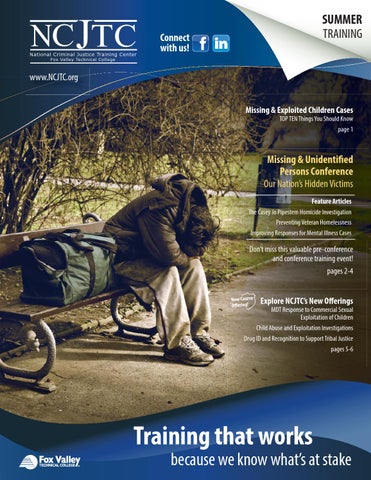
Missing & Unidentified Persons Conference Our Nation’s Hidden Victims Feature Articles The Casey Jo Pipestem Homicide Investigation Preventing Veteran Homelessness Improving Responses for Mental Illness Cases
Don’t miss this valuable pre-conference and conference training event! pages 2-4
Explore NCJTC’s New Offerings MDT Response to Commercial Sexual Exploitation of Children Child Abuse and Exploitation Investigations Drug ID and Recognition to Support Tribal Justice pages 5-6
Training that works because we know what’s at stake
Missing & Exploited Children Cases
Connect With Us Today! From registration questions to training curriculum development, our specialists are ready to assist you. With offices in New Hampshire, Washington DC, and Wisconsin, NCJTC's national presence ensures your needs are met promptly.
TOP TEN things law enforcement should know A recent AMBER Alert roundtable identified the major concerns families had when their children went missing. Here is what they want you to know:
1 Ask for additional help. 2 Get a family advocate early.
Our office hours are 7:00 am – 6:00 pm Central Time. Connect with us today!
(855) 866-2582
Consider getting additional help when you are beginning your initial investigative strategy.
info@ncjtc.org
Advocates can provide logic and understanding for the actions of law enforcement, media, rumors and other dynamics confronting the family. don’t Communicate how long they can help and what happens if a new advocate needs to be appointed. Families want a “swinging door” of advocates involved.
facebook.com/ncjtc linkedin.com/company/ncjtc
Make sure the advocate has the proper training and background.
3 Be consistent between disciplines.
Families will sense if various agencies involved aren’t on the same page or are not working together. This cause a huge credibility issue for everyone involved.
can
Simple Steps to Online Registration
4 Communicate – OFTEN!
n Families need to stay involved. Inform them on case status and why. Suggestions include victimology informatio ion. investigat the of ce requests, updates on case progress, and giving the family something to do in furtheran
5 Know about long-term resources.
Help identify counseling resources to help them deal with loss and improve the ability to assist with the long-term investigation.
6 Identify a point of contact. 7 Improve tele-communicator training. 8 Target training to exact threat. Improve first responder training. 9
Find a class. View the upcoming training events and conferences to determine what best fits your training needs. Each scheduled training will feature a class number.
Ensure your agency appoints a contact who can be a consistent source of information.
Make sure those who are taking intake calls for child kidnappings are properly trained. s.
Focus on methodologies for assessing exactly what the potential threat to the child the situation represent
along Improve communication with family members and make informed assessments of the nature of the call, with what the immediate response should be early in the investigation.
10 Create a communications plan.
Develop a short and long-term detailed plan for how the police and family will maintain communications. Alleviate the breakdown in communication between law enforcement and the victim’s family. Download TOP TEN infographic
1 | National Criminal Justice Training Center of Fox Valley Technical College
Visit NCJTC’s Training & Services website at www.ncjtc.org/training
Add to cart. Once you have identified a training, click on the register or class number link. This will bring you to NCJTC’s online registration system, hosted by Fox Valley Technical College. Click add to cart and then click check out. Complete registration. If you have never attended an NCJTC or FVTC training, follow the prompts to create a new account. If you have an existing account, sign-in using your student ID and password to complete your registration.
inthe
MURDERS MIDWEST The Casey Jo Pipestem Homicide Investigation
It is January 2013 and a suspected Oklahoma serial killer sits behind bars for the sole murder of a Mississippi woman. Convicted in 2005, John Robert Williams was arrested for one count of murder but was suspected of killing more than a dozen women at truck stops along I-40. One of those suspected victims was Casey Jo Pipestem.
“He actually bragged that we wouldn’t find any DNA because he didn’t have sex with them in the traditional sense,” said Hallmark, who interviewed Williams several times. 2 Williams was sentenced to life in prison for the murder of one of his victims, while his accomplice, Rachel Cumberland, was given a 20-year term.
Police believe Casey Jo Pipestem was murdered in January 2004 after being abducted from an Oklahoma City truck stop. The disappearance of the 19-year-old Native American from the Seminole tribe was thought to be tied to a number of serial murders in the Midwest involving prostitutes.
Family Seeking Justice In January 2013, nine years following Casey Jo’s murder, her suspected killer still had not been charged for her murder. Her family members spoke out about the lack of a conviction and, most of all, closure.
“Within a seven month period of time, we had seven victims. Casey Jo was the 7th victim,” said Terri Turner, Criminal Analyst, OSBI, Investigative Division. “I kept a large poster on the wall with each one of the girl’s pictures on it, and every morning when I would come in, that is what I would see,” Turner recalls. 1
"She was beaten, raped, strangled and thrown off a 37-foot bridge naked," Pipestem's older sister Taffney Harjo said. Harjo says no more than 24 hours after her sister was kidnapped from a southwest Oklahoma City truck stop, her body was found 200 miles south in Grapevine, Texas. "It happened to us, and not only us, but 13 other families," Harjo said.3
During her investigation, Turner inquired with the FBI’s Violent Criminal Apprehension Program, which maintains the agency’s crime database. On file, they found hundreds of roadside female crime victims suggesting patterns in the violence. It was the break she was looking for. Turner’s suspected killer was identified as John Robert Williams, a 28-year-old trucker.
Following these statements, Williams was finally charged with Pipestem’s murder in July 2013. Later that year, Rachel Cumberland was released from prison, having served only 40 percent of her sentence.
Following this discovery, the FBI created a separate database and started the Highway Serial Killings Initiative. The initiative has since raised awareness among law enforcement agencies, truck drivers and the general public and has helped solve many cases.
Want to Hear More About Casey Jo’s Story? Taffney Harjo, Casey Jo’s sister, will share her story and provide a family perspective in resolving missing person’s cases at NCJTC’s 9th
Big Rig Killer Convicted in 2005 Dubbed the “Big Rig Killer”, Williams was believed to be behind the murders of several truck stop prostitutes starting in 2002, along two major interstates. Following the airing of a TV’s America’s Most Wanted episode, police finally caught up to the murder suspect. During subsequent interrogations, police said Williams confessed to more than a dozen slayings - including many of the cases Turner had been investigating. Williams provided detailed accounts of how the crimes had been committed, such as by manual strangulation or with the use of a ligature. He explained how some had been sexually assaulted, in some cases after they were dead.
Annual National Conference on Responding to Missing and Unidentified Persons in Atlanta, September 15-17, 2015. You’ll learn best practices and how to best serve the families of missing victims. Lieutenant Larry Hallmark will join Harjo and share his experience with the case, handling high risk populations, enforcement against prostitution, and a program that led to the development of the Highway Serial Killing Initiative.
Footnotes 1 http://www.kjrh.com/news/osbi-investigator-inspires-serial-killing-database, January 26, 2011 2 http://articles.latimes.com/2009/apr/05/local/me-serialkillers5/2, April 5, 2009
William has since recanted his confession and there is no DNA linked him to any of the slayings. But Sgt. Larry Hallmark of the Grapevine, Texas Police Department said he and other investigators do not believe that Williams’ confession was bogus.
3 http://www.news9.com/story/20586724/victims-family-frustratedover-justice-delay-for-suspected-serial-killer, January 14, 2013.
Visit www.NCJTC.org for additional training information and to register online! | 2
Home But Homeless Preventing Veteran Homelessness He spent 30 years in the U.S. Military, earned three graduate degrees and eventually worked his way to the Pentagon before retiring- but today, former Air Force Col. Robert Freniere, 59, is living out of his van and filling out job applications on public computers in the library. Homelessness doesn’t discriminate based on chain of command; it can affect top brass just as much as rank and file. How could this have happened? Many veterans face countless challenges when they re-enter civilian life. After retiring, it took Freniere a year to get a job with a defense contractor. When the work dried up, it was hard to find a civilian job that complemented his background in intelligence. A divorce, the cost of two kids’ college expenses and struggles with dyslexia left Freniere calling his van his home.1 According to the U.S. Department of Veterans Affairs (National Coalition for Homeless Veterans, www.nchv.org), about 12% of the Nation’s adult homeless population are veterans. They are predominantly male, single, live in urban areas, and suffer from mental health disorders, substance abuse, or co-occurring disorders. Furthermore, according to the Veterans Administration: • 51% of homeless veterans have disabilities • 50% of homeless veterans have serious mental health issues • 70% of homeless veterans have substance abuse problems These statistics are alarming and the message is clear. Veterans and returning service members are confronted with many challenges, including unemployment, devastating wounds, homelessness, mental health issues, and educational needs. Struggles with Post Traumatic Stress Disorder (PTSD) come into play, while others walk away from their homes,
Improving Responses For Mental Illness Cases Dennis Shepherd was an energetic personal assistant living with his girlfriend in Port Washington, NY until he fell into a spiral of paranoia, suspecting everyone of conspiring with the FBI to investigate him. The imaginary probe he suspected became reality when he later went missing. The 47-year-old took off running the moment he stepped out of a vehicle from Stony Brook University Hospital’s psych unit, where he was involuntarily committed for a month. Despite extensive search and local news coverage, he remained missing.
“I understand it’s a very difficult situation for a family or loved ones of someone who’s missing that they felt that there’s always more that the police department could be doing,” Deputy Chief Kevin Fallon stated. Any missing case we take very seriously because we always realize that not only the person could injure themselves, but a person may in fact be a victim of some kind of crime and we always approach it that way.” 3 According to the National Alliance on Mental Illness, nearly 1 in 25 (approximately 13.6 million) adults in America live with a serious mental illness. At the outset, mental illness is not, in and of itself, a police matter. However, a number of challenges associated with
3 | National Criminal Justice Training Center of Fox Valley Technical College
family, or jobs. Some return to find that their families have abandoned them or that their children, facing tremendous struggles, have run away from home themselves. Often times communities are not equipped to help returning veterans reintegrate into their family or community, making the transition and challenges even more difficult. Alicia Watkins, a retired Air Force sergeant who proudly served in Iraq and Afghanistan also faced challenges upon re-entry to civilian life. She risked her life for the freedom of others, survived the 9/11 attack at the Pentagon, and watched her colleagues die only to retire from the military and find herself homeless. “I have to acknowledge that I am a casualty of war. I had a traumatic brain injury, I have PTSD, I have a spinal cord injury,” she says. “It’s a hard road; I would love to be able to work today. I have offers, I have people that are willing to help me, but they have to take a backseat to my health. “ 2
Want to Learn More? Attend the Veteran Homelessness: Preventing Homelessness & Reducing the Risk session in Atlanta. Understand veteran’s needs and how communities can assist them. Learn how to build a safety net around veterans to prevent a slide into homelessness and into the “missing” and “unidentified”.
people with mental illness can pose significant concerns for law enforcement. These challenges can include individuals with mental illness who are vulnerable and at risk to go missing. The traditional police response has often been perceived as ineffective. As a result, Crisis Intervention Team (CIT) programs are being developed and implemented across the country. CITs promote collaboration and create more effective interactions among law enforcement, mental health professionals, individuals with mental illness, their families, and the community. In 1988, Memphis Police Department launched a CIT after discovering that their officers lacked the skills needed to deal with mental health crisis situations. After launching the program, personal interactions between individuals with mental illness, their families, mental health professionals and police improved tremendously. Memphis has also lowered injuries to police officers, developed a crisis assessment system for people with mental illness, reduced arrests and improved community relations.
{ FACT In January 2013, on a single night, there were 610,042 people experiencing homelessness in the U.S. and 57,849 were homeless veterans. 60% of homeless veterans were located in shelters or transitional housing programs, and 40% were in unsheltered locations. Under 8% (4,456) of homeless veterans were female. Department of Housing and Urban Development, 2013 Annual Homeless Assessment Report to Congress
SEPTEMBER 15–17, 2015 | ATLANTA, GA 9th Annual National Conference on Responding to Missing and Unidentified Persons
OUR NATION’S HIDDEN VICTIMS C0NFERENCE DESCRIPTION Every day more than 2,300 Americans are reported missing. While abductions and kidnappings gain media attention, those who wander off, run away, or are homeless go unreported. These are our hidden victims. Communities, like yours, need to have the right response when dealing with these cases. We can help. Join us and collaborate with other professionals and experts to improve responses and outcomes of special populations of missing person cases. Identify new ways to locate and protect missing persons. Learn effective strategies to best serve hidden victim populations and their families.
HIGHLIGHTED SESSIONS • Searching for Missing Persons with Mental Health Disorders • Cultural Considerations: Working in “Closed” Communities • Missing Veterans: Preventing Homelessness and Reducing the Risk • Critical Incident Stress Management
• Social Networking Investigative Strategies • Navigating Legal Issues and Challenges • Understanding your Own Reaction and Response • Long-Term Missing Cases: Keep the Media Alive
COME EARLY FOR THE PRE-CONFERENCE!* Case Management for Long-Term Missing Persons Investigations
Want to Learn More? Attend the Searching for Missing Persons with Mental Health Disorders session in Atlanta. Explore how CITs identify individuals with serious mental illness and create a specialized plan for your community. Understand the impact of mental illness on missing persons and coordination efforts with the mental health treatment system.
Visit the Website! Additional conference information is available at: www.ncjtc.org/hiddenvictims.
Start and maintain an investigation into a long-term missing or unidentified remains case. Learn investigative techniques, dynamics, and the best practices to address key factors that impact cases, current forensics analysis, legal concerns, and agency experience in reconstructing cases. This highly interactive session, specifically designed for law enforcement professionals only, will provide the tools needed to improve the investigative response to long-term missing person cases. * Open to law enforcement only.
LOCATION Sheraton Atlanta Hotel 165 Courtland Street, NE, Atlanta, GA (404) 659-6500 | sheratonatlantahotel.com
CONFERENCE INFO Footnotes 1 “Homeless former colonel’s story illustrates broad problems facing U.S. vets”, Ross Tucker, 1-9-2014 news.yahoo.com/retired-colonel-now calls van home-155925743.html 2 “Alicia Watkins Was A Homeless Veteran 5 Years Ago”, 3-25-15 http://www.huffingtonpost.com/2015/03/25/alicia-watkins-homeless-veteran-harvard_n_6933380.html, 3-25-15. 3 “Lost Not Found: How Some Missing Mentally Ill Never Return” Timothy Bolger, 5-1-13 Longislandpress.com/2013/05/01/lost-not-found-how-some- missing-mentally-ill-never-return/
Visit www.ncjtc.org/hiddenvictims for pre/conference agendas, registration and lodging, scholarship opportunities, and sponsorship or exhibitor information. Event
Start
End
Day(s)
Time(s)
Location
Fee
Class No.
Pre-Conference
9-14-15
9-14-15
M
8:30 am−4:30 pm
Atlanta, GA
$99
50273
9-15-15
9-17-15
Tu W Th
8:30 am−4:30 pm
Atlanta, GA
$375
50068
9-15-15
9-17-15
Tu W Th
8:30 am−4:30 pm
Atlanta, GA
$400
50069
9-15-15
9-17-15
Tu W Th
8:30 am−4:30 pm
Atlanta, GA
$350
50272
law enforcement only
Conference on or before July 1
Conference after July 1
Group Registration 3 individuals or more
Visit www.ncjtc.org for additional training information and to register online! | 4
Multi-Disciplinary Team Response to Commercial Sexual Exploitation of Children www.ncjtc.org/mec Gather information on how to more effectively combat the commercial sexual exploitation of children (CSEC). Learn the importance of using a multi-disciplinary team approach in providing resources and assistance to CSEC victims and when investigating and prosecuting traffickers of minor victims. Identify preferred practices, programs and resources to help teams generate a custom plan of action to implement.
Cost There is NO FEE to attend training; however, pre-registration is required. 07-13-15
07-16-15
M Tu W Th
8:00 am – 5:00 pm
Portsmouth, NH
41121
32
08-24-15
08-27-15
M Tu W Th
8:00 am – 5:00 pm
Bellevue, WA
53836
32
Child Sex Trafficking: Law Enforcement Response www.ncjtc.org/amberalert Examine the dynamics of trafficking and exploitation to improve skills related to interviewing the victim and interrogating the trafficker. Learn more about tactical implementation designed to identify human trafficking and exploitation and conduct enforcement operations. Review the roles of non-profits, probation and parole.
Cost There is NO FEE to attend training; however, pre-registration is required. 07-15-15
07-17-15
W Th F
8:00 am – 5:00 pm
Medford, OR
41292
24
Drug Identification and Recognition to Support Tribal Justice www.ncjtc.org/iasap Learn to recognize drug influence through a systematic approach using the 7-step drug recognition process. Hands-on instruction will help students develop the skills necessary to recognize the signs and symptoms of persons under the influence of stimulants, hallucinogens, opiates, marijuana, alcohol, depressants, and inhalants.
Cost There is NO FEE to attend training; however, pre-registration is required.
07-21-15
07-23-15
Tu W Th
8:00 am – 5:00 pm 8:00 am – 12:00 pm
Albuquerque, NM
41235
20
08-25-15
08-27-15
Tu W Th
8:00 am – 5:00 pm 8:00 am – 12:00 pm
Spokane, WA
54081
20
09-22-15
09-24-15
Tu W Th
8:00 am – 5:00 pm 8:00 am – 12:00 pm
Tulsa, OK
54082
20
Reid Technique of Interviewing and Interrogation www.fvtc.edu/mytraining | www.wilenet.org* Improve interview and interrogation skills by applying the Reid technique style, appearance and approach. Examine differences in verbal and non-verbal behavior. Review a structured set of non-accusatory behavior-provoking questions and the nine-step approach to successful interrogation.
Cost $420 per participant. 07-21-15
07-23-15
Tu W Th
8:00 am – 3:00 pm
Appleton, WI (PS Training Center)
40101
18
Reid Advanced Techniques of Interview and Interrogation www.fvtc.edu/mytraining | www.wilenet.org* Learn about profiling suspects psychologically for interrogation. Discover how to make suspects listen, tactics used to get a suspect to confess, and procedures for evidence implications.
Cost $175 per participant. 07-24-15
07-24-15
F
8:00 am – 3:00 pm
Appleton, WI (PS Training Center)
40102
6
* To register or to learn more about this training, visit www.fvtc.edu/mytraining and search by the class number(s) provided. Wisconsin law enforcement members may obtain additional information at www.wilenet.org.
5 | National Criminal Justice Training Center of Fox Valley Technical College
Investigative Strategies for Child Abduction Cases www.ncjtc.org/amberalert Learn how to recognize and investigate cases involving missing and abducted children. Develop abduction case management skills including initial response, interviewing and interrogation techniques, evidence collection and processing, suspect profiling, and legal issues related to search warrants and interrogation.
Cost There is NO FEE to attend training; however, pre-registration is required. 07-28-15
07-31-15
Tu W Th F
8:00 am – 5:00 pm
Glendale, AZ
40952
32
08-24-15
08-27-15
M Tu W Th
8:00 am – 5:00 pm
Southlake, TX
53767
32
Child Abuse and Exploitation Investigations www.ncjtc.org/mec Gather up-to-date information for the investigation and prosecution of all types of child abuse cases. Learn the importance of using a multi-disciplinary team approach when investigating and prosecuting child abuse, child sexual abuse and exploitation cases. Identify the preferred methods of interviewing children and suspects, evidence collection, case management and current legal issues.
Cost There is NO FEE to attend training; however, pre-registration is required. 08-03-15
08-07-15
M Tu W Th F
8:00 am – 5:00 pm 8:00 am – 12:00 pm
South Burlington, VT
41125
36
08-31-15
09-04-15
M Tu W Th F
8:00 am – 5:00 pm 8:00 am – 12:00 pm
San Antonio, TX
53846
36
09-21-15
09-25-15
M Tu W Th F
8:00 am – 5:00 pm 8:00 am – 12:00 pm
Columbus, OH
53847
36
Basic Forensic Response to Missing & Abducted Children www.ncjtc.org/amberalert Enhance your forensic skills to improve crime scene investigations including missing and abducted children cases. Topics include: pre-planning, chain of custody issues/evidence security, crime scene identification and preservation, crime mapping and photography, trace evidence, finger/palm prints, DNA/body fluids, composite sketching/forensic art and electronic evidence. A laptop computer containing Windows 98 or later version will be needed for Identi-Kit certification. Upon completion, a free six month license for Identi-Kit software will be offered.
Cost There is NO FEE to attend training; however, pre-registration is required.
09-14-15
09-16-15
M Tu W
8:00 am – 5:00 pm 8:00 am – 3:00 pm
Waterloo, IA
50378
22
Wisconsin Serving Victims of Crime Conference www.ncjtc.org/wsvoc Learn about innovative victim assistance programs and resources for servicing crime victims using a multi-disciplinary approach. Attend workshops that address the relevant topics and issues facing victims of crime and service providers. Network with others to strengthen interagency relationships and best serve your community.
Cost $125 per participant. Group discounts available for team registrations; see website for additional information. 08-19-15
08-21-15
W Th F
8:00 am – 5:00 pm 8:30 am – 12:00 pm
Wisconsin Dells, WI
50367
16
Advanced Investigative Strategies for Child Abduction Cases www.ncjtc.org/amberalert Join other experienced Investigative and supervisory professionals with case management responsibilities involving abducted, kidnapped, exploited, or murdered children in this advanced training. Legal issues, understanding DNA, computer forensics, cellular technologies, the impact of human trafficking in child exploitation, cold case investigative strategies, and the methodologies of data mining and Fusion Centers information acquisition will be explored.
Cost There is NO FEE to attend training; however, pre-registration is required. 09-21-15
09-24-15
M Tu W Th
8:00 am – 5:00 pm
Southlake, TX
53778
32
Visit www.ncjtc.org for additional training information and to register online! | 6
Don’t miss the opportunity to learn from an expert! PUBLIC SAFETY TRAINING CENTER
FAMOUS CASES REVISED BY DR. LEE
October 27, 2015 | Appleton, WI NEW CONCEPTS FOR
CRIME SCENE INVESTIGATION (CSI)
October 28, 2015 | Appleton, WI
DR HENRY LEE, Forensic Scientist Join us to welcome Dr. Henry Lee, one of the world's foremost forensic scientists. Lee's testimony in high profile cases, such as the OJ Simpson case, has established him as a landmark in modern-day forensic sciences. www.fvtc.edu
Contact Us! Fox Valley Technical College Public Safety Training Center W6400 County Road BB Appleton, WI 54914
For additional PSTC information or to schedule a training, contact: Jeremy Hansen Public Safety Training Center Director (920) 225-5954 | hansenj@fvtc.edu
www.fvtc.edu/pstc
BUILDING SOLUTIONS THAT ADDRESS YOUR UNIQUE TRAINING REQUIREMENTS When travel time is limited but your staff requires critical training, NCJTC is available. With a combination of nationally recognized training programs and expert instructors, creating a customized program to fit your needs is simple. Save time and money by allowing NCJTC to train YOUR staff in YOUR facility.
Connect with NCJTC today! (855) 866-2582 | info@ncjtc.org
Keeping communities safe. It’s your goal. It’s ours too. At the National Criminal Justice Training Center, it’s our mission to equip you with the right training and tools to affect positive change in your community. You’ll find child protection training in missing and endangered children, child abuse, human trafficking and Internet crime investigations that will inspire and empower you to take action.
Together, we can keep communities safe and make a difference− because we know what’s at stake.
Contact us to get started today. (855) 866-2582 | info@ncjtc.org | www.ncjtc.org