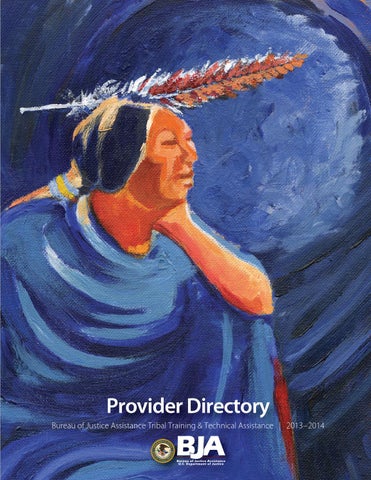
Provider Directory Bureau of Justice ce Assistance Tribal Training & Technical Assistance | 2013−2014
Bureau of Justice Assistance U.S. Department of Justice
This publication was designed and produced by National Criminal Justice Training Center at Fox Valley Technical College.
National Criminal Justice Training Center at Fox Valley Technical College 1825 N. Bluemound Drive P.O. Box 2277 Appleton, WI 54912-2277
Phone (888) 370-1752 | Fax (920) 831-5400 | Email cjgrants@fvtc.edu | Web NCJTC.org
On the cover Blue Moon by Gregory Maki
This project was supported by Award No. 2010-AC-BX-K001 awarded by the Bureau of Justice Assistance, Office of Justice Programs, U.S. Department of Justice. The Bureau of Justice Assistance is a component of the Office of Justice Programs, which also includes the Bureau of Justice Statistics, the National Institute of Justice, the Office of Juvenile Justice and Delinquency Prevention, the SMART Office, and the Office for Victims of Crime. Points of view or opinions in this document are those of the author and do not represent the official position or policies of the United States Department of Justice.
Introduction Letter from BJA
Table of Contents BJA Overview .......................................................................................................................................................................................................................................................................2 Federally Recognized Tribes........................................................................................................................................................................................................................................4 Federally Recognized Tribes of Alaska...................................................................................................................................................................................................................8 Training Overview
Online Training...........................................................................................................................................................................................................................................................10
Onsite & Blended Training..................................................................................................................................................................................................................................10
Conferences.................................................................................................................................................................................................................................................................14 Webinars........................................................................................................................................................................................................................................................................18 Academies....................................................................................................................................................................................................................................................................18 Technical Assistance By Provider...............................................................................................................................................................................................................................20 Resources.................................................................................................................................................................................................................................................................................22 Additional Resources........................................................................................................................................................................................................................................................27 Agency Descriptions
American Probation & Parole Association (APPA)................................................................................................................................................................................28
Center for Court Innovation (CCI)...................................................................................................................................................................................................................29
National Alliance for Drug Endangered Children (NADEC)............................................................................................................................................................30
National American Indian Court Judges Association (NAICJA)....................................................................................................................................................30
National Center for Rural Law Enforcement (NCRLE).........................................................................................................................................................................31
National Criminal Justice Association (NCJA)..........................................................................................................................................................................................32
National Criminal Justice Training Center at Fox Valley Technical College (NCJTC)........................................................................................................33
National Reentry Resource Center (NRRC)................................................................................................................................................................................................34
The National Tribal Judicial Center at The National Judicial College (NTJC)........................................................................................................................34
Center for Evidence-based Policy at Oregon Health & Science University (OHSU).........................................................................................................35
Tribal Judicial Insitute at University of North Dakota School of Law (TJI)..............................................................................................................................36
Tribal Law & Policy Institute (TLPI)..................................................................................................................................................................................................................37
Upper MIdwest Community Policing Institute (UMCPI)...................................................................................................................................................................38
Western Community Policing Institute (WCPI)......................................................................................................................................................................................38
Other TTA Provider............................................................................................................................................................................................................................................................39
Provider Calendar | 2012-13 Trainings
BJA | Overview
BJA | Bureau of Justice Assistance Overview About bja The Bureau of Justice Assistance (BJA), Office of Justice Programs, U.S. Department of Justice, supports law enforcement, courts, treatment, victim services, technology, corrections and prevention initiatives that strengthen the nation’s criminal justice system. BJA provides leadership, services, and funding to America’s communities by
Points of contact
Bureau of Justice Assistance Office of Justice Programs 810 Seventh Street NW Fourth Floor Washington, DC 20531
• emphasizing local control
www.bja.gov Toll Free (866) 859-2687 | F (202) 305-1367
• building relationships in the field
Denise E. O’ Donnell, Director
• developing collaborations and partnerships
Ruby Qazilbash, Associate Deputy Director P (202) 305-6982 | Ruby.Qazilbash@usdoj.gov
• promoting capacity building through planning
Julius Dupree, Policy Advisor for Corrections P (202) 514-1928 | Julius.Dupree@usdoj.gov
• streamlining the administration of grants
Norena A. Henry, Senior Policy Advisor for Tribal Affairs P (202) 616-3205 | Norena.Henry@usdoj.gov
• increasing training and technical assistance
Trish Thackston, Policy Advisor for Substance Abuse and Mental Health P (202) 307-0581 | M.Patricia.Thackston@usdoj.gov BJA Tribal Team The BJA Tribal Team consists of representatives of the Policy Division, Program Division, and Planning Division to coordinate tribal affairs and resources from grants, training and technical assistance to new initiatives.
• creating project accountability • encouraging innovation • ultimately communicating the value of justice efforts to decision makers at every level. BJA works with the Office of Tribal Justice, the Office of Justice Program’s American Indian and Alaska Native Affairs Desk, and other federal agencies, in addition to many culturally appropriate organizations, to maintain focus with the field and to ensure the program’s goals and objectives are achieved. Tribal Justice Programs BJA administers five tribal justice programs. Eligible applicants under the following programs are limited to federally recognized tribal governments, including Alaska Native villages and corporations, authorized tribal consortia, and coalitions.
2
Bureau of Justice Assistance Tribal Training & Technical Assistance
Correctional Systems & Correctional Alternatives on Tribal Lands Program The Correctional Systems & Correctional Alternatives on Tribal Lands Program is designed to assist tribes with • identification of justice system needs and the planning process for renovating and constructing correctional facilities, multi-purpose justice centers, or correctional alternative facilities. • renovation and construction of correctional facilities, multi-purpose justice centers, or correctional alternative facilities. • development, implementation, or enhancement of community-based correctional alternatives to address the incarceration and rehabilitation of juvenile and adult offenders subject to tribal jurisdiction. “Community-based correctional alternatives” refers to initiatives or programs which address offender needs outside of an institutional setting. Community-based correctional alternatives may include diversion programs, substance abuse and mental health treatment programs, holdover/sobriety centers, and problemsolving strategies. The CSCATL TTA program is authorized under the Violent Crime Control and Law Enforcement Act of 1994, Title II, Subtitle A, Public Law 103-322, 105 Stat. 1796, as amended, 42 U.S.C. 13701 et seq. The Tribal Law and Order Act (TLOA) of 2009 amends Section 20109 of the Violent Crime Control and Law Enforcement Act of 1994 (42 U.S.C. 13709) by expanding the scope of the Correctional Facilities on Tribal Lands (CFTL) Program.
Indian Alcohol and Substance Abuse Program The Indian Alcohol and Substance Abuse Program (IASAP) was created by the FY2001 Consolidated Appropriations Act to provide funding and technical assistance to federally recognized tribal governments to plan, implement, or enhance tribal justice strategies to address crime issues related to alcohol and substance abuse. Key objectives of IASAP include • establish a multidisciplinary advisory team to plan, implement, and monitor the proposed strategy. • identify, apprehend, and prosecute individuals who illegally transport, distribute, and use alcohol and controlled substances in tribal communities. • prevent and reduce alcohol- and substance abuse-related crimes (with a priority on methamphet-
amine), traffic fatalities, and injuries. • increase coordination among all levels of tribal government, law enforcement, the tribal criminal justice system, and tribal support services. • integrate federal, state, tribal, and local services and culturally appropriate treatment for offenders and their families. Tribal Civil and Criminal Legal Assistance Program The goal of Tribal Civil and Criminal Legal Assistance Program (TCCLA) is to • enhance the operations of tribal justice systems and improve access to those systems, and • provide training and technical assistance (TTA) for development and enhancement of tribal justice systems. The purpose is to provide quality technical and legal assistance and to encourage collaboration between grantees, organizations Indian tribes and the tribal justice community. Grantee objectives include providing procedural justice in tribal civil and criminal legal procedures, legal infrastructure enhancements, public education, and TTA for the development and enhancement of tribal justice systems.
recognized tribal governments that are interested in engaging in comprehensive strategic planning to improve tribal justice and public safety. Training and technical assistance is available to these tribes to engage in a data-informed planning process to develop a written strategic plan that will guide justice system development to promote public safety and effective justice system operations. The planning process will map jurisdiction with Federal and state justice systems and assess indigenous components such as family, social systems, and cultural values to determine which traditional resources can be leveraged to assist with justice system planning efforts. intergovernmental collaboration initiatives The Tribal Law and Order Act (TLOA) directs the Attorney General to provide technical assistance on strategies to promote intergovernmental collaboration and relationships among state, tribal, and local partners that effectively combat crime in Indian Country or Native Communities and nearby communities. To offer assistance in these efforts, BJA continues to work with other federal partners and TTA partners.
comprehensive strategic planning program For FY12, a new purpose area entitled Comprehensive Planning and Demonstration Project (Purpose Area 2), was included in the Coordinated Tribal Assistance Solicitation (CTAS). The Comprehensive Strategic Planning Program provides assistance to the Purpose Area 2 tribes and other federally
Provider Calendar | 2012-13 Trainings
3
BJA | Overview
Tribal Courts Assistance Program The Tribal Courts Assistance Program (TCAP) is one of the U.S. Department of Justice’s primary initiatives for providing court-related support to tribal justice systems. Initially authorized under the Indian Tribal Justice Technical and Legal Assistance Act of 2000 (25 U.S.C. § 3681), the program is sponsored through the Department’s Indian Country Law Enforcement Initiative, which provides federally recognized American Indian and Alaska Native communities with resources (funding, technical assistance, etc.) to develop, implement, enhance, and continue the operation of tribal judicial systems. This flexible funding resource for tribal courts enables tribal courts to plan, implement, and enhance court services and programs that meet the unique needs of their respective communities.
Tribes A-F
Tribes | Federally Recognized A
C
Confederated Tribes of the Chehalis Reservation
Absentee-Shawnee Tribe of Indians of Oklahoma
Cabazon Band of Mission Indians, California
Confederated Tribes of the Colville Reservation
Agua Caliente Band of Cahuilla Indians of the Agua Caliente Indian Reservation, California
Cachil DeHe Band of Wintun Indians of the Colusa Indian Community of the Colusa Rancheria, California
Confederated Tribes of the Coos, Lower Umpqua and Siuslaw Indians
Ak Chin Indian Community of the Maricopa (Ak Chin) Indian Reservation, Arizona Alabama-Coushatta Tribe of Texas (previously listed as the Alabama-Coushatta Tribes of Texas)
Caddo Nation of Oklahoma Cahto Tribe of the Laytonville Rancheria
Alabama-Quassarte Tribal Town
Cahuilla Band of Mission Indians of the Cahuilla Reservation, California
Alturas Indian Rancheria, California
California Valley Miwok Tribe, California
Apache Tribe of Oklahoma
Campo Band of Diegueno Mission Indians of the Campo Indian Reservation, California
Arapaho Tribe of the Wind River Reservation, Wyoming Aroostook Band of Micmacs (previously listed as the Aroostook Band of Micmac Indians) Assiniboine and Sioux Tribes of the Fort Peck Indian Reservation, Montana Augustine Band of Cahuilla Indians, California (previously listed as the Augustine Band of Cahuilla Mission Indians of the Augustine Reservation)
B Bad River Band of the Lake Superior Tribe of Chippewa Indians of the Bad River Reservation, Wisconsin Bay Mills Indian Community, Michigan Bear River Band of the Rohnerville Rancheria, California Berry Creek Rancheria of Maidu Indians of California Big Lagoon Rancheria, California Big Pine Paiute Tribe of the Owens Valley (previously listed as the Big Pine Band of Owens Valley Paiute Shoshone Indians of the Big Pine Reservation, California) Big Sandy Rancheria of Western Mono Indians of California (previously listed as the Big Sandy Rancheria of Mono Indians of California)
Capitan Grande Band of Diegueno Mission Indians of California: (Barona Group of Capitan Grande Band of Mission Indians of the Barona Reservation, California; Viejas (Baron Long) Group of Capitan Grande Band of Mission Indians of the Viejas Reservation, California) Catawba Indian Nation (aka Catawba Tribe of South Carolina)
Confederated Tribes of the Goshute Reservation, Nevada and Utah Confederated Tribes of the Grand Ronde Community of Oregon Confederated Tribes of the Umatilla Indian Reservation (previously listed as the Confederated Tribes of the Umatilla Reservation, Oregon) Confederated Tribes of the Warm Springs Reservation of Oregon Coquille Indian Tribe (previously listed as the Coquille Tribe of Oregon) Cortina Indian Rancheria of Wintun Indians of California Coushatta Tribe of Louisiana
Cayuga Nation
Cow Creek Band of Umpqua Tribe of Indians (previously listed as the Cow Creek Band of Umpqua Indians of Oregon)
Cedarville Rancheria, California
Cowlitz Indian Tribe
Chemehuevi Indian Tribe of the Chemehuevi Reservation, California
Coyote Valley Band of Pomo Indians of California
Cher-Ae Heights Indian Community of the Trinidad Rancheria, California
Creek Reservation, South Dakota
Cherokee Nation Cheyenne and Arapaho Tribes, Oklahoma (previously listed as the Cheyenne-Arapaho Tribes of Oklahoma) Cheyenne River Sioux Tribe of the Cheyenne River Reservation, South Dakota Chicken Ranch Rancheria of Me-Wuk Indians of California Chippewa-Cree Indians of the Rocky Boy’s Reservation, Montana Chitimacha Tribe of Louisiana
Crow Creek Sioux Tribe of the Crow Crow Tribe of Montana
D Death Valley Timbi-sha Shoshone Tribe (previously listed as the Death Valley Timbi-Sha Shoshone Band of California) Delaware Nation, Oklahoma Delaware Tribe of Indians Dry Creek Rancheria Band of Pomo Indians, California (previously listed as the Dry Creek Rancheria of Pomo Indians of California) Duckwater Shoshone Tribe of the Duckwater Reservation, Nevada
Big Valley Band of Pomo Indians of the Big Valley Rancheria, California
Citizen Potawatomi Nation, Oklahoma
Bishop Paiute Tribe (previously listed as the PaiuteShoshone Indians of the Bishop Community of the Bishop Colony, California)
Cocopah Tribe of Arizona
Eastern Band of Cherokee Indians
Coeur D’Alene Tribe (previously listed as the Coeur D’Alene Tribe of the Coeur D’Alene Reservation, Idaho)
Eastern Shawnee Tribe of Oklahoma
Cold Springs Rancheria of Mono Indians of California
Elk Valley Rancheria, California
Colorado River Indian Tribes of the Colorado River Indian Reservation, Arizona and California
Ely Shoshone Tribe of Nevada
Blackfeet Tribe of the Blackfeet Indian Reservation of Montana Blue Lake Rancheria, California Bridgeport Indian Colony (previously listed as the Bridgeport Paiute Indian Colony of California) Buena Vista Rancheria of Me-Wuk Indians of California Burns Paiute Tribe (previously listed as the Burns Paiute Tribe of the Burns Paiute Indian Colony of Oregon)
4
Cloverdale Rancheria of Pomo Indians of California
Comanche Nation, Oklahoma Confederated Salish and Kootenai Tribes of the Flathead Reservation
E
Elem Indian Colony of Pomo Indians of the Sulphur Bank Rancheria, California
Enterprise Rancheria of Maidu Indians of California Ewiiaapaayp Band of Kumeyaay Indians, California
F
Confederated Tribes and Bands of the Yakama Nation
Federated Indians of Graton Rancheria, California
Confederated Tribes of Siletz Indians of Oregon (previously listed as the Confederated Tribes of the Siletz Reservation)
Forest County Potawatomi Community, Wisconsin
Bureau of Justice Assistance Tribal Training & Technical Assistance
Flandreau Santee Sioux Tribe of South Dakota
Fort Bidwell Indian Community of the Fort Bidwell Reservation of California Fort Independence Indian Community of Paiute Indians of the Fort Independence Reservation, California Fort McDermitt Paiute and Shoshone Tribes of the Fort McDermitt Indian Reservation, Nevada and Oregon Fort McDowell Yavapai Nation, Arizona Fort Mojave Indian Tribe of Arizona, California & Nevada Fort Sill Apache Tribe of Oklahoma
G Gila River Indian Community of the Gila River Indian Reservation, Arizona Grand Traverse Band of Ottawa and Chippewa Indians, Michigan
K
Lummi Tribe of the Lummi Reservation
Kaibab Band of Paiute Indians of the Kaibab Indian Reservation, Arizona Kalispel Indian Community of the Kalispel Reservation Karuk Tribe (previously listed as the Karuk Tribe of California) Kashia Band of Pomo Indians of the Stewarts Point Rancheria, California
Lytton Rancheria of California
M Makah Indian Tribe of the Makah Indian Reservation Manchester Band of Pomo Indians of the Manchester Rancheria, California (previously listed as the Manchester Band of Pomo Indians of the Manchester-Point Arena Rancheria, California)
Kaw Nation, Oklahoma
Manzanita Band of Diegueno Mission Indians of the Manzanita Reservation, California
Kewa Pueblo, New Mexico (previously listed as the Pueblo of Santo Domingo)
Mashantucket Pequot Indian Tribe (previously listed as the Mashantucket Pequot Tribe of Connecticut)
Keweenaw Bay Indian Community, Michigan
Mashpee Wampanoag Indian Tribal Council, Inc. (previously listed as the Mashpee Wampanoag Tribe, Massachusetts)
Kialegee Tribal Town Kickapoo Traditional Tribe of Texas Kickapoo Tribe of Indians of the Kickapoo Reservation in Kansas
Match-e-be-nash-she-wish Band of Pottawatomi Indians of Michigan
Kickapoo Tribe of Oklahoma
Mechoopda Indian Tribe of Chico Rancheria, California
Greenville Rancheria (previously listed as the Greenville Rancheria of Maidu Indians of California)
Kiowa Indian Tribe of Oklahoma
Menominee Indian Tribe of Wisconsin
Klamath Tribes
Grindstone Indian Rancheria of Wintun-Wailaki Indians of California
Koi Nation of Northern California (previously listed as the Lower Lake Rancheria, California)
Mesa Grande Band of Diegueno Mission Indians of the Mesa Grande Reservation, California
Guidiville Rancheria of California
Kootenai Tribe of Idaho
H Habematolel Pomo of Upper Lake, California Hannahville Indian Community, Michigan Havasupai Tribe of the Havasupai Reservation, Arizona Ho-Chunk Nation of Wisconsin Hoh Indian Tribe (previously listed as the Hoh Indian Tribe of the Hoh Indian Reservation, Washington) Hoopa Valley Tribe, California Hopi Tribe of Arizona Hopland Band of Pomo Indians, California (formerly Hopland Band of Pomo Indians of the Hopland Rancheria, California) Houlton Band of Maliseet Indians Hualapai Indian Tribe of the Hualapai Indian Reservation, Arizona Iipay Nation of Santa Ysabel, California (previously listed as the Santa Ysabel Band of Diegueno Mission Indians of the Santa Ysabel Reservation) Inaja Band of Diegueno Mission Indians of the Inaja and Cosmit Reservation, California Ione Band of Miwok Indians of California Iowa Tribe of Kansas and Nebraska Iowa Tribe of Oklahoma Jackson Rancheria of Me-Wuk Indians of California Jamestown S’Klallam Tribe Jamul Indian Village of California Jena Band of Choctaw Indians Jicarilla Apache Nation, New Mexico
Mescalero Apache Tribe of the Mescalero Reservation, New Mexico Miami Tribe of Oklahoma
L La Jolla Band of Luiseno Indians, California (previously listed as the La Jolla Band of Luiseno Mission Indians of the La Jolla Reservation) La Posta Band of Diegueno Mission Indians of the La Posta Indian Reservation, California Lac Courte Oreilles Band of Lake Superior Chippewa Indians of Wisconsin
Miccosukee Tribe of Indians Middletown Rancheria of Pomo Indians of California Minnesota Chippewa Tribe, Minnesota (Six component reservations: Bois Forte Band (Nett Lake); Fond du Lac Band; Grand Portage Band; Leech Lake Band; Mille Lacs Band; White Earth Band)
Lac du Flambeau Band of Lake Superior Chippewa Indians of the Lac du Flambeau Reservation of Wisconsin
Mississippi Band of Choctaw Indians
Lac Vieux Desert Band of Lake Superior Chippewa Indians of Michigan
Mohegan Indian Tribe of Connecticut
Las Vegas Tribe of Paiute Indians of the Las Vegas Indian Colony, Nevada Little River Band of Ottawa Indians, Michigan Little Traverse Bay Bands of Odawa Indians, Michigan Lone Pine Paiute-Shoshone Tribe (previously listed as the Paiute-Shoshone Indians of the Lone Pine Community of the Lone Pine Reservation, California) Los Coyotes Band of Cahuilla and Cupeno Indians, California (previously listed as the Los Coyotes Band of Cahuilla & Cupeno Indians of the Los Coyotes Reservation)
Moapa Band of Paiute Indians of the Moapa River Indian Reservation, Nevada Mooretown Rancheria of Maidu Indians of California Morongo Band of Mission Indians, California (previously listed as the Morongo Band of Cahuilla Mission Indians of the Morongo Reservation) Muckleshoot Indian Tribe (previously listed as the Muckleshoot Indian Tribe of the Muckleshoot Reservation, Washington)
N Narragansett Indian Tribe Navajo Nation, Arizona, New Mexico & Utah Nez Perce Tribe (previously listed as Nez Perce Tribe of Idaho)
Lovelock Paiute Tribe of the Lovelock Indian Colony, Nevada
Nisqually Indian Tribe (previously listed as the Nisqually Indian Tribe of the Nisqually Reservation, Washington)
Lower Brule Sioux Tribe of the Lower Brule Reservation, South Dakota
Nooksack Indian Tribe
Lower Elwha Tribal Community (previously listed as the Lower Elwha Tribal Community of the Lower Elwha Reservation, Washington) Lower Sioux Indian Community in the State of Minnesota
Northern Cheyenne Tribe of the Northern Cheyenne Indian Reservation, Montana Northfork Rancheria of Mono Indians of California Northwestern Band of Shoshoni Nation (previously listed as the Northwestern Band of Shoshoni Nation of Utah (Washakie)
Provider Calendar | 2012-13 Trainings
5
Tribes F-N
Fort Belknap Indian Community of the Fort Belknap Reservation of Montana
Tribes N-S
Tribes | Federally Recognized N
Port Gamble S’Klallam Tribe (previously listed as the Port Gamble Band of S’Klallam Indians) Potter Valley Tribe, California
Robinson Rancheria Band of Pomo Indians, California (previously listed as the Robinson Rancheria of Pomo Indians of California)
Prairie Band Potawatomi Nation (previously listed as the Prairie Band of Potawatomi Nation, Kansas)
Rosebud Sioux Tribe of the Rosebud Indian Reservation, South Dakota
Oglala Sioux Tribe (previously listed as the Oglala Sioux Tribe of the Pine Ridge Reservation, South Dakota)
Prairie Island Indian Community in the State of Minnesota
Round Valley Indian Tribes, Round Valley Reservation, California (previously listed as the Round Valley Indian Tribes of the Round Valley Reservation, California)
Ohkay Owingeh, New Mexico
Pueblo of Cochiti, New Mexico
(previously listed as the Pueblo of San Juan)
Pueblo of Isleta, New Mexico
Omaha Tribe of Nebraska
Pueblo of Jemez, New Mexico
Oneida Nation of New York
Pueblo of Laguna, New Mexico
Oneida Tribe of Indians of Wisconsin
Pueblo of Nambe, New Mexico
Onondaga Nation
Pueblo of Picuris, New Mexico
Otoe-Missouria Tribe of Indians, Oklahoma
Pueblo of Pojoaque, New Mexico
Ottawa Tribe of Oklahoma
Pueblo of San Felipe, New Mexico
Nottawaseppi Huron Band of the Potawatomi, Michigan (previously listed as the Huron Potawatomi, Inc.)
O
Pueblo of Acoma, New Mexico
Pueblo of San Ildefonso, New Mexico
P Paiute Indian Tribe of Utah (Cedar Band of Paiutes, Kanosh Band of Paiutes, Koosharem Band of Paiutes, Indian Peaks Band of Paiutes, and Shivwits Band of Paiutes) (formerly Paiute Indian Tribe of Utah (Cedar City Band of Paiutes, Kanosh Band of Paiutes, Koosharem Band of Paiutes, Indian Peaks Band of Paiutes, and Shivwits Band of Paiutes)) Paiute-Shoshone Tribe of the Fallon Reservation and Colony, Nevada Pala Band of Luiseno Mission Indians of the Pala Reservation, California Pascua Yaqui Tribe of Arizona
Pueblo of Sandia, New Mexico Pueblo of Santa Ana, New Mexico
S Sac & Fox Nation of Missouri in Kansas and Nebraska Sac & Fox Nation, Oklahoma Sac & Fox Tribe of the Mississippi in Iowa Saginaw Chippewa Indian Tribe of Michigan Saint Regis Mohawk Tribe (previously listed as the St. Regis Band of Mohawk Indians of New York) Salt River Pima-Maricopa Indian Community of the Salt River Reservation, Arizona Samish Indian Nation (previously listed as the Samish Indian Tribe, Washington)
Pueblo of Santa Clara, New Mexico
San Carlos Apache Tribe of the San Carlos Reservation, Arizona
Pueblo of Taos, New Mexico
San Juan Southern Paiute Tribe of Arizona
Pueblo of Tesuque, New Mexico
San Manuel Band of Mission Indians, California (previously listed as the San Manual Band of Serrano Mission Indians of the San Manual Reservation)
Pueblo of Zia, New Mexico Puyallup Tribe of the Puyallup Reservation Pyramid Lake Paiute Tribe of the Pyramid Lake Reservation, Nevada
San Pasqual Band of Diegueno Mission Indians of California
Passamaquoddy Tribe
Quartz Valley Indian Community of the Quartz Valley Reservation of California
Santa Rosa Band of Cahuilla Indians, California (previously listed as the Santa Rosa Band of Cahuilla Mission Indians of the Santa Rosa Reservation)
Pauma Band of Luiseno Mission Indians of the Pauma & Yuima Reservation, California
Quechan Tribe of the Fort Yuma Indian Reservation, California & Arizona
Santa Rosa Indian Community of the Santa Rosa Rancheria, California
Pawnee Nation of Oklahoma
Quileute Tribe of the Quileute Reservation
Pechanga Band of Luiseno Mission Indians of the Pechanga Reservation, California
Quinault Indian Nation (previously listed as the Quinault Tribe of the Quinault Reservation, Washington)
Santa Ynez Band of Chumash Mission Indians of the Santa Ynez Reservation, California
Paskenta Band of Nomlaki Indians of California
Penobscot Nation (previously listed as the Penobscot Tribe of Maine) Peoria Tribe of Indians of Oklahoma Picayune Rancheria of Chukchansi Indians of California
Q
R Ramona Band of Cahuilla, California (previously listed as the Ramona Band or Village of Cahuilla Mission Indians of California)
Pinoleville Pomo Nation, California (previously listed as the Pinoleville Rancheria of Pomo Indians of California)
Red Cliff Band of Lake Superior Chippewa Indians of Wisconsin
Pit River Tribe, California (includes XL Ranch, Big Bend, Likely, Lookout, Montgomery Creek and Roaring Creek Rancherias)
Redding Rancheria, California
Poarch Band of Creeks (previously listed as the Poarch Band of Creek Indians of Alabama) Pokagon Band of Potawatomi Indians, Michigan and Indiana Ponca Tribe of Indians of Oklahoma Ponca Tribe of Nebraska
6
Red Lake Band of Chippewa Indians, Minnesota Redwood Valley or Little River Band of Pomo Indians of the Redwood Valley Rancheria California (previously listed as the Redwood Valley Rancheria of Pomo Indians of California) Reno-Sparks Indian Colony, Nevada Resighini Rancheria, California Rincon Band of Luiseno Mission Indians of the Rincon Reservation, California
Bureau of Justice Assistance Tribal Training & Technical Assistance
Santee Sioux Nation, Nebraska Sauk-Suiattle Indian Tribe Sault Ste. Marie Tribe of Chippewa Indians, Michigan Scotts Valley Band of Pomo Indians of California Seminole Tribe of Florida (previously listed as the Seminole Tribe of Florida (Dania, Big Cypress, Brighton, Hollywood & Tampa Reservations)) Seneca Nation of Indians (previously listed as the Seneca Nation of New York) Seneca-Cayuga Tribe of Oklahoma Shakopee Mdewakanton Sioux Community of Minnesota Shawnee Tribe Sherwood Valley Rancheria of Pomo Indians of California Shingle Springs Band of Miwok Indians, Shingle Springs Rancheria (Verona Tract), California
Shoalwater Bay Indian Tribe of the Shoalwater Bay Indian Reservation (previously listed as the Shoalwater Bay Tribe of the Shoalwater Bay Indian Reservation, Washington) Shoshone Tribe of the Wind River Reservation, Wyoming Shoshone-Bannock Tribes of the Fort Hall Reservation Shoshone-Paiute Tribes of the Duck Valley Reservation, Nevada
Three Affiliated Tribes of the Fort Berthold Reservation, North Dakota Tohono O’odham Nation of Arizona Tonawanda Band of Seneca (previously listed as the Tonawanda Band of Seneca Indians of New York) Tonkawa Tribe of Indians of Oklahoma Tonto Apache Tribe of Arizona Torres Martinez Desert Cahuilla Indians, California (previously listed as the Torres-Martinez Band of Cahuilla Mission Indians of California)
Sisseton-Wahpeton Oyate of the Lake Traverse Reservation, South Dakota
Tulalip Tribes of Washington (previously listed as the Tulalip Tribes of the Tulalip Reservation, Washington)
Skokomish Indian Tribe (previously listed as the Skokomish Indian Tribe of the Skokomish Reservation, Washington)
Tule River Indian Tribe of the Tule River Reservation, California
Skull Valley Band of Goshute Indians of Utah Smith River Rancheria, California Snoqualmie Indian Tribe (previously listed as the Snoqualmie Tribe, Washington Soboba Band of Luiseno Indians, California Sokaogon Chippewa Community, Wisconsin Southern Ute Indian Tribe of the Southern Ute Reservation, Colorado Spirit Lake Tribe, North Dakota
Tunica-Biloxi Indian Tribe
Turtle Mountain Band of Chippewa Indians of North Dakota
St. Croix Chippewa Indians of Wisconsin
Upper Sioux Community, Minnesota
Standing Rock Sioux Tribe of North & South Dakota
Upper Skagit Indian Tribe
Stillaguamish Tribe of Indians of Washington (previously listed as the Stillaguamish Tribe of Washington)
Ute Indian Tribe of the Uintah & Ouray Reservation, Utah
Swinomish Indians of the Swinomish Reservation of Washington Sycuan Band of the Kumeyaay Nation
T Table Mountain Rancheria of California
Ysleta Del Sur Pueblo of Texas
Z Zuni Tribe of the Zuni Reservation, New Mexico
W Walker River Paiute Tribe of the Walker River Reservation, Nevada Wampanoag Tribe of Gay Head (Aquinnah) Washoe Tribe of Nevada & California (Carson Colony, Dresslerville Colony, Woodfords Community, Stewart Community, & Washoe Ranches)
Te-Moak Tribe of Western Shoshone Indians of Nevada (Four constituent bands: Battle Mountain Band; Elko Band; South Fork Band and Wells Band)
Wichita and Affiliated Tribes (Wichita, Keechi, Waco & Tawakonie), Oklahoma
The Modoc Tribe of Oklahoma
Yomba Shoshone Tribe of the Yomba Reservation, Nevada
Utu Utu Gwaitu Paiute Tribe of the Benton Paiute Reservation, California
White Mountain Apache Tribe of the Fort Apache Reservation, Arizona
The Choctaw Nation of Oklahoma
Yocha Dehe Wintun Nation, California (previously listed as the Rumsey Indian Rancheria of Wintun Indians of California)
Ute Mountain Tribe of the Ute Mountain Reservation, Colorado, New Mexico & Utah
Tejon Indian Tribe
The Chickasaw Nation
Yerington Paiute Tribe of the Yerington Colony & Campbell Ranch, Nevada
U
United Keetoowah Band of Cherokee Indians in Oklahoma
Susanville Indian Rancheria, California
Yavapai-Prescott Indian Tribe (previously listed as the Yavapai-Prescott Tribe of the Yavapai Reservation, Arizona)
Twenty-Nine Palms Band of Mission Indians of California
Squaxin Island Tribe of the Squaxin Island Reservation
Suquamish Indian Tribe of the Port Madison Reservation
Yavapai-Apache Nation of the Camp Verde Indian Reservation, Arizona
Tuscarora Nation
Spokane Tribe of the Spokane Reservation
Summit Lake Paiute Tribe of Nevada
Yankton Sioux Tribe of South Dakota
Yurok Tribe of the Yurok Reservation, California
Tuolumne Band of Me-Wuk Indians of the Tuolumne Rancheria of California
United Auburn Indian Community of the Auburn Rancheria of California
Stockbridge Munsee Community, Wisconsin
Y
Wilton Rancheria, California Winnebago Tribe of Nebraska Winnemucca Indian Colony of Nevada
The Muscogee (Creek) Nation
Wiyot Tribe, California (previously listed as the Table Bluff Reservation—Wiyot Tribe)
The Osage Nation (previously listed as the Osage Tribe)
Wyandotte Nation
The Quapaw Tribe of Indians The Seminole Nation of Oklahoma Thlopthlocco Tribal Town
Provider Calendar | 2012-13 Trainings
7
Tribes S-Z
Shinnecock Indian Nation
A-N
Tribes | Federally Recognized Tribes of Alaska
Tribes of Alaska
A
H
Native Village of Cantwell
Agdaagux Tribe of King Cove
Healy Lake Village
Native Village of Chenega (aka Chanega)
Akiachak Native Community
Holy Cross Village
Native Village of Chignik Lagoon
Akiak Native Community
Hoonah Indian Association
Native Village of Chitina
Alatna Village
Hughes Village
Algaaciq Native Village (St. Mary’s)
Huslia Village
Native Village of Chuathbaluk (Russian Mission, Kuskokwim)
Allakaket Village
Hydaburg Cooperative Association
Angoon Community Association
I
Anvik Village
Igiugig Village
Arctic Village (See Native Village of Venetie Tribal Government)
Inupiat Community of the Arctic Slope
Asa’carsarmiut Tribe
Iqurmuit Traditional Council Ivanoff Bay Village
Atqasuk Village (Atkasook)
K
B
Native Village of Council Native Village of Deering Native Village of Diomede (aka Inalik) Native Village of Eagle Native Village of Eek Native Village of Ekuk Native Village of Elim Native Village of Eyak (Cordova)
Kaguyak Village
Native Village of False Pass
Kaktovik Village (aka Barter Island)
Native Village of Fort Yukon
Kasigluk Traditional Elders Council
Native Village of Gakona
Kenaitze Indian Tribe
Central Council of the Tlingit & Haida Indian Tribes
Native Village of Gambell
Ketchikan Indian Corporation
Chalkyitsik Village
Native Village of Georgetown
King Island Native Community
Cheesh-Na Tribe (previously listed as the Native Village of Chistochina)
Native Village of Goodnews Bay
King Salmon Tribe
Native Village of Hamilton
Klawock Cooperative Association
Native Village of Hooper Bay
Knik Tribe
Native Village of Kanatak
Kokhanok Village
Native Village of Karluk
Beaver Village Birch Creek Tribe
C
Chevak Native Village Chickaloon Native Village Chignik Bay Tribal Council (previously listed as the Native Village of Chignik)
Koyukuk Native Village
Native Village of Kiana
L
Chignik Lake Village
Native Village of Kipnuk
Chilkat Indian Village (Klukwan)
Levelock Village
Native Village of Kivalina
Chilkoot Indian Association (Haines)
Lime Village
Native Village of Kluti Kaah (aka Copper Center)
Chinik Eskimo Community (Golovin)
M
Native Village of Kobuk
Chuloonawick Native Village
Manley Hot Springs Village
Native Village of Kongiganak
Circle Native Community
Manokotak Village
Native Village of Kotzebue
Craig Tribal Association (previously listed as the Craig Community Association)
McGrath Native Village
Native Village of Koyuk
Mentasta Traditional Council
Native Village of Kwigillingok
Metlakatla Indian Community, Annette Island Reserve
Native Village of Kwinhagak (aka Quinhagak)
Curyung Tribal Council
D Douglas Indian Association
E
N
Native Village of Larsen Bay Native Village of Marshall (aka Fortuna Ledge)
Naknek Native Village
Native Village of Mary’s Igloo
Egegik Village
Native Village of Afognak
Native Village of Mekoryuk
Eklutna Native Village
Native Village of Akhiok
Native Village of Minto
Ekwok Village
Native Village of Akutan
Native Village of Nanwalek (aka English Bay)
Emmonak Village
Native Village of Aleknagik
Native Village of Napaimute
Evansville Village (aka Bettles Field)
Native Village of Ambler
Native Village of Napakiak
Native Village of Atka
Native Village of Napaskiak
Native Village of Barrow Inupiat Traditional Government
Native Village of Nelson Lagoon
G Galena Village (aka Louden Village) Gulkana Village
Native Village of Belkofski Native Village of Brevig Mission Native Village of Buckland
8
Bureau of Justice Assistance Tribal Training & Technical Assistance
Native Village of Nightmute Native Village of Nikolski Native Village of Noatak
Native Village of Nunam Iqua (previously listed as the Native Village of Sheldon’s Point) Native Village of Nunapitchuk Native Village of Ouzinkie Native Village of Paimiut Native Village of Perryville Native Village of Pilot Point Native Village of Pitka’s Point Native Village of Point Hope Native Village of Point Lay Native Village of Port Graham Native Village of Port Heiden Native Village of Port Lions Native Village of Ruby Native Village of Saint Michael Native Village of Savoonga Native Village of Selawik Native Village of Shaktoolik Native Village of Shishmaref Native Village of Shungnak Native Village of Stevens
Village of Bill Moore’s Slough
Organized Village of Kake
Village of Chefornak
Organized Village of Kasaan
Village of Clarks Point
Organized Village of Kwethluk
Village of Crooked Creek
Organized Village of Saxman
Village of Dot Lake
Orutsararmuit Native Village (aka Bethel)
Village of Iliamna
Oscarville Traditional Village
Village of Kalskag
Native Village of Tatitlek
Village of Kaltag
P Pauloff Harbor Village
Village of Kotlik
Pedro Bay Village
Village of Lower Kalskag
Petersburg Indian Association
Village of Ohogamiut
Pilot Station Traditional Village
Village of Old Harbor
Platinum Traditional Village
Village of Red Devil
Portage Creek Village (aka Ohgsenakale)
Village of Salamatoff
Pribilof Islands Aleut Communities of St. Paul & St. George Islands
Village of Sleetmute Village of Solomon Village of Stony River
Q Qagan Tayagungin Tribe of Sand Point Village Qawalangin Tribe of Unalaska
R
Village of Venetie (See Native Village of Venetie Tribal Government) Village of Wainwright
W
Rampart Village
Wrangell Cooperative Association
S
Native Village of Tanacross Native Village of Tanana
Village of Atmautluak
Organized Village of Grayling (aka Holikachuk)
Native Village of Scammon Bay
Saint George Island (See Pribilof Islands Aleut Communities of St. Paul & St. George Islands)
Y Yakutat Tlingit Tribe
Native Village of Tazlina
Saint Paul Island (See Pribilof Islands Aleut Communities of St. Paul & St. George Islands)
Yupiit of Andreafski
Native Village of Teller
Seldovia Village Tribe
Native Village of Tetlin
Shageluk Native Village
Native Village of Tuntutuliak
Sitka Tribe of Alaska
Native Village of Tununak
Source Department of the Interior Bureau of Indian Affairs
Skagway Village
Native Village of Tyonek
South Naknek Village
Native Village of Unalakleet
Stebbins Community Association
Native Village of Unga
Sun’aq Tribe of Kodiak (previously listed as the Shoonaq’ Tribe of Kodiak)
Native Village of Venetie Tribal Government (Arctic Village and Village of Venetie) Native Village of Wales Native Village of White Mountain
Dated: April 24, 2013
T Takotna Village
Nenana Native Association
Tangirnaq Native Village (formerly Lesnoi Village (aka Woody Island))
New Koliganek Village Council
Telida Village
New Stuyahok Village
Traditional Village of Togiak
Newhalen Village
Tuluksak Native Community
Newtok Village
Twin Hills Village
Nikolai Village
U
Ninilchik Village
Ugashik Village
Nome Eskimo Community
Umkumiut Native Village (previously listed as Umkumiute Native Village)
Nondalton Village Noorvik Native Community
Tribes of Alaska N-Y
O
Native Village of Nuiqsut (aka Nooiksut)
This published list includes 566 tribal entities recognized and eligible for funding and services from the Bureau of Indian Affairs by virtue of their status as Indian tribes. The list is updated from the notice published on August 10, 2012 (77 FR 47868). For more information, contact: Gail Veney Bureau of Indian Affairs, Division of Tribal Government Services Mail Stop 4513–MIB 1849 C Street NW Washington, DC 20240 P: (202) 513–7641
V
Northway Village
Village of Alakanuk
Nulato Village
Village of Anaktuvuk Pass
Nunakauyarmiut Tribe
Village of Aniak
Provider Calendar | 2012-13 Trainings
9
Online, Onsite & Blended Training
Training Overview | By Discipline ONLINE
Provider
Criminal Jurisdiction in Indian Country
This training is to help Tribal Court Judges understand, analyze and apply Indian Country jurisdictional law in criminal cases.
Native Voices - Training for Law Enforcement & Victim Advocates
The Native Voices film project will provide domestic violence and sexual assault intervention and response training for law enforcement, prosecution, tribal councils, and advocates. This film series features Native American actors and specific nuances of working in Indian Country and Alaskan villages.
Sexual Violence Cases in Tribal Court
This is an overview of the complexity of sexual violence crimes; informing strategies that support the court’s efforts to meet the needs of victims and defendants, while protecting their respective rights.
Supporting People with Disabilities in Tribal Court Systems
To provide tribal court judges and their support personnel information to appropriately respond to American Indian/Alaska Native people with disabilities in the tribal court system.
Institute for Native Justice Institute for Native Justice Institute for Native Justice Institute for Native Justice
ONSITE & BLENDED Advanced Human Trafficking Investigations
This course is designed for Law Enforcement Officers, Investigators, and Human Trafficking Task Force members who are assigned to investigate human trafficking cases through advanced intelligence collection, development and dissemination.
UMCPI
Advanced Tribal Bench Skills
This four-day course is highly interactive and designed to give tribal judges more confidence in handling all aspects of trials. Judges will participate in daily workshops on professionalism, ethics, the role of the judge, and techniques for maintaining control of the trial process. Each participant will preside over parts of a simulated trial. Judges will have the opportunity to examine and reflect upon their demeanors and practice various approaches used to maintain control of the trial process. After attending this course, participants will be able to preside over fair and impartial trials; create an appropriate trial environment; articulate and enforce ground rules for trial conduct by advocates; and efficiently handle unexpected events that frequently occur during a trial.
NJC
Advanced Tribal Court Management
This course will provide tribal court judges and court administrators with a more in-depth examination of the business of managing a court. After attending this course, participants will be able to: discuss external and internal jurisdictional cooperation; recognize the fundamental goals of access to justice and the establishment of stare decisis in the tribal court; implement proficient data collection, data reporting and data analysis procedures; design internal controls and develop policy for enhanced court operation; discuss delegation of judicial responsibilities and judicial oversight; assess ethical issues; and evaluate the impact of tradition and custom on court operations. Chief Judges and Court Administrators are invited to attend as a team. Participants should attend Court Management for Tribal Court Judges and Personnel as a prerequisite.
APPA Annual Training Institute
APPA conducts the largest national training institute for community corrections offering workshops, special sessions, resource expo, and networking opportunities tailored to your needs.
NJC
APPA
Appellate Skills for Tribal Judges
This course is designed to enhance the skills of tribal appellate judges. Participants will benefit from an examination of current federal case law and its impact on the jurisdiction of tribal courts as well as learn principles and techniques to improve their skills in the areas of group decision making, legal reasoning and analysis and opinion writing. After attending this course, participants will be able to evaluate how the structure of the appellate court and their personal activities might affect public trust and confidence in the tribal justice system; define jurisdictional boundaries for criminal and civil actions that arise in Indian Country; practice techniques that improve leadership in developing positive, collaborative relationships with their colleagues on the appellate bench; and analyze appellate issues in a logical and well-thought-out manner.
10
Bureau of Justice Assistance Tribal Training & Technical Assistance
NJC
Court Staff
Victim Services
Probation
Law Behavioral Grant MultiMultiEnforcement Health Administration Disciplinary Jurisdictional
Fee Based No No
No
No
No
Yes
Yes
Yes
Yes
Provider Calendar | 2012-13 Trainings
11
Online, Onsite & Blended Training
Specialty Courts
Onsite & Blended Training
ONSITE & BLENDED (CON’T.)
Provider
Case Management Practices for Tribal Probation Personnel
This training is a blended learning opportunity coupling web-based learning with on-site training to develop and/or enhance skills around Motivational Interviewing, Engaging Families in the Supervision Process, and Case Planning. The on-site training provides an opportunity to build and enhance officer skills through real plays and coached exercises. This training provides scholarships to cover travel and lodging.
Community Analysis for Planning Strategies (CAPPS)
The CAPPS training will assist tribes in learning a process for planning. During the training, attendees will learn to clearly define the intended outcome for a project and then develop an action plan that outlines a framework for success.
APPA
NCJTC
Core Drug Endangered Children Awareness
Ignored, abused, and abandoned–these are some of the chronic conditions experienced by children raised in environments where there is illegal drug use, manufacturing, cultivation and distribution. Raise awareness regarding the problem of drug endangered children, describe the opportunities to identify children living in dangerous drug environments and encourage intervention at the earliest possible point when endangerment is suspected to reduce physical and psychological harm to children.
NADEC
Court Management for Tribal Court Judges and Personnel
The efficient administration of modern tribal justice systems requires a team of competent court personnel with knowledge and skills to conduct a complex array of operational activities. This course will enhance the ability of judges and court administrators to evaluate the performance of their court in key performance areas (such as budgeting, calendaring, case management, and personnel administration) and develop practical approaches for making improvements. Judges and court administrators are encouraged to attend as a team.
NJC
Crime Data Collection and Reporting
Participants learn how to collect and report crime data to the FBI, benefits in reporting, and methods.
Defensive Tactics
This hands-on course is designed for Tribal Probation Officers and Court Bailiffs who may encounter a violent or resistive offender during the course of their duties. Often, PO’s and Bailiffs have very few options for carrying defensive weapons. This course will provide instruction on self-defense without the use of weapons. Specific topics will include strikes, shielding, ground defense, personal defense, surviving a sudden attack, edge weapon defense, surviving escapes and grabs.
NCJTC
Drug Identification, Recognition and Legal Update
This course was developed to meet the ever-increasing needs for professionals to remain current on the most abused drugs in today’s society. Participants will learn to recognize drug influence through a systematic approach using the 7-step drug recognition process. The hands-on instruction will help students develop the skills necessary to recognize the signs and symptoms of persons under the influence of stimulants, hallucinogens, opiates, marijuana, alcohol, depressants, inhalants, and dissociative anesthetics.
Essential Skills for Tribal Court Judges
Essential skills for tribal court judges.
Handling Domestic Violence Cases in Tribal Court
This course will empower you, as a tribal court judge, court administrator or other court related personnel, with skills to manage domestic violence cases with greater ease and confidence.
NCJTC
NJC NJC
Highly Effective Grant Program Management
This training provides the grant coordinator or manager with tools to build skills and develop techniques needed for successful implementation of grant programs. Participants will learn about effective grant coordination from the ground up and will help them more effectively work with advisory teams, local agencies and community members.
NCJTC
Human Trafficking in Native American Communities
Enhance tribal understanding of the crime of human trafficking (HT) by delivering a comprehensive, culturally sensitive, victim-focused HT awareness and investigation training and technical assistance initiative focused on tribal law enforcement that includes tribal leadership, elders, multiple community stakeholders, victim service providers and youth.
UMCPI
Human Trafficking Training for State Judges
This training will assist trial judges in understanding the Trafficking Victims Protection Act (TVPA), human trafficking in the U.S., state laws regarding human trafficking, perpetrators and victims, immigration issues, penalties, sentencing issues, restitution and forfeiture.
12
Bureau of Justice Assistance Tribal Training & Technical Assistance
UMCPI
Court Staff
Victim Services
Probation
Law Behavioral Grant MultiMultiEnforcement Health Administration Disciplinary Jurisdictional
Fee Based No
No
No
Yes
No No
No
Yes No
No
No
No
Provider Calendar | 2012-13 Trainings
13
Onsite & Blended Training
Specialty Courts
Onsite & Blended | Conferences
ONSITE & BLENDED (CON’T.)
Provider
Human Trafficking Training for State Prosecutors
The purpose of this training is to provide an overview of human trafficking to state and local prosecutors, emphasizing the prosecutor-led task force model, enforcing the victim-centered approach to investigation and prosecution, and inspiring them to lead investigations and bring prosecutions under their state laws.
UMCPI
ICRA: Protecting Rights in Tribal Court
This course will discuss the civil rights of criminal defendants in a tribal court, and the ways in which performance of routine duties by the various components of the tribal justice system affects the civil rights of criminal defendants.
National DEC Multi-Disciplinary Collaborative Response
NADEC focuses on the formation of multi-disciplinary partnerships that take advantage of existing agency personnel, resources, and responsibilities and coordinate their mutual interests and duties to meet the specific needs of these children. This session will look at overcoming the challenges in aligning systems responsible for preventing, intervening, and treating these issues to achieve common outcomes.
NADEC
Practical Approaches to Family Issues in Tribal Courts
This four-day course provides strategies for handling some of the most challenging cases facing tribal judges: family law and dependency cases. After attending this course, participants will be able to design appropriate parenting plans; manage family law cases effectively with appropriate intervention; efficiently handle self-represented litigants; and recognize the dynamics involved in dealing with high-conflict people and manage those cases with confidence. Judges, court administrators, social workers and other court related personnel who deal with these types of cases may attend, preferably as a team. A judge must be a member of any team attending.
NJC
Preventing and Addressing Sexual Abuse in Tribal Detention Facilities: The Impact of the Prison Rape Elimination Act
The one-day training events are designed to provide front line detention officers and line supervisors in tribal detention facilities with the information and skills they need to appropriately prevent and respond to incidents of sexual abuse and violence within the jail environment.
APPA
Tribal Drug Endangered Children
Ignored, abused, and abandoned–these are some of the chronic conditions experienced by children raised in environments where there is illegal drug use, manufacturing, cultivation and distribution. Raise awareness regarding the problem of drug endangered children, describe the opportunities to identify children living in dangerous drug environments and encourage intervention at the earliest possible point when endangerment is suspected to reduce physical and psychological harm to children.
Tribal Healing to Wellness Court Enhancement Training
This training will provide overview and best practices for Tribal Healing to Wellness Courts. Topics will include the tribal 10 key components, role responsibilities, policy and procedure development, and much more.
NADEC
TLPI
Writing for Tribal Judges
Tribal judges must be able to write well-reasoned, well-articulated decisions. After attending this course, participants will able to articulate the position of both legal and traditional reasoning in tribal common law, explain the difference between inductive and deductive reasoning, identify the audience as well as the purposes and constraints of written judicial opinions, and improve the skills necessary to edit and revise opinions with greater confidence.
NJC
CONFERENCES Advanced Clerks Certification Training
This training is designed to provide advanced training to Court Clerks on issues such as role of the judiciary, ethics and customer service, court administration, case manegement, court procedures, finances and budgets as well as development of manuals.
TJI
American Indian Justice Conference (AIJC)
Ignored, abused, and abandoned–these are some of the chronic conditions experienced by children raised in environments where there is illegal drug use, manufacturing, cultivation and distribution. Raise awareness regarding the problem of drug endangered children, describe the opportunities to identify children living in dangerous drug environments and encourage intervention at the earliest possible point when endangerment is suspected to reduce physical and psychological harm to children.
14
Bureau of Justice Assistance Tribal Training & Technical Assistance
NCJTC
Court Staff
Victim Services
Probation
Law Behavioral Grant MultiMultiEnforcement Health Administration Disciplinary Jurisdictional
Fee Based No
Yes
No
No
No
No
No
Yes
No
No
Provider Calendar | 2012-13 Trainings
15
Onsite & Blended | Conferences
Specialty Courts
CONFERENCES (CON’T.) Basic Clerk Certification Training
This training provides Court Clerks with training on such issues as the hirstory and overview of Tribal Courts, ICWA, ICRA, Major Crimes, customer service and professional ethics, Role of the Clerk, case and records management, and rules of procedure.
Conferences
Court Administrator Training
This training is intended to provide instruction to Court Adminstrators on issues such as understadning the role of the administrator, budgeting and finance, records and case management, and personnel management.
Provider TJI
TJI
Crimes Against Children in Indian Country Conference
The Crimes Against Children in Indian Country (CACIC) Conference was formed in response to the often unmet needs of Native youth. An important goal of the conference is to strengthen relationships between various agencies, tribes, and states, to promote a multi-disciplinary, multi-jurisdictional approach to serving Native young people.
Enhancing Tribal and State Collaborations to Address Criminal Justice Issues in Indian Country & Native Communities
This course is designed to be a proactive, comprehensive, training experience that fosters collaboration among tribal, state, federal, and local governments.
Improving the Prosecution of Child Sexual Assault Cases in Tribal Communities
This training is designed to provide instruction to prosecutors as well as members of child protection teams and multi-disciplinary teams on strategies, rules, and laws that can improve the prosecution of child sexaul abuse cases in tribal communities.
NCJTC
WCPI
TJI
Improving the Prosecution of Domestic Violence Cases in Tribal Communities
This training is designed to instruct prosecutors, first repsonders, victim advocates and other tribal community professionals on the dynamics of domestic violence in tribal communites, existing tribal and federal laws and rules of evidence, as well as multi-discplinary approaches all of which can improve the prosecution of such cases.
Improving the Prosecution of Driving While Impaired Cases in Tribal Courts
This training will highlight the scope of this problem and will provide instruction on legal forums, mechanisms, rules and procedures that may be employed to improve the prosecution of such cases.
Indigenous Justice Methodologies
This event will provide information relevant to the incorporation or inclusion of indigenous justice methodologies, practices and programs that Tribes are developing or implementing as a means to resolve disputes and administer justice.
TJI
TJI
TJI
Multi-Jurisdictional Law Enforcement Conference
Attend this national training conference to develop skills, obtain information, and gather resources that will assist you in addressing the most critical jurisdictional, security, and safety concerns faced by criminal justice and community professionals. Information will relate to rural, reservation, and urban crime; violence, and substance abuse. Additional sessions will focus on victimization, community violence, school safety, and tribal probation.
National Association of Drug Court Professionals Association (NADCP) National Conference
The Tribal Track of this national conference will provide trainings on tribal-specific topics, including the tribal 10 key components, integrating culture, and fetal alcohol syndrome.
NCJTC
NADCP
The Role of the Prosecutor in Tribal Healing to Wellness Courts
This training event is designed to offer instruction of the development of healing to wellness courts, program components, and the role of the prosecutor in the diversion of cases as well as the implementation of the healing to wellness court. Specific discussion will be had on privacy and ethical considerations for prosecutors as well.
TLOA and Enhanced Sentencing
This training will provide instruction on the basic provisions of the 2010 Tribal Law and Order Act and will further provide instruction related to the enhanced sentencing provisions of the Act.
Tribal Inspired Leadership Training
This course provides fundamental concepts in leadership. It is designed to train and equip executives with the skills necessary to make leadership decisions, for the purpose of implementing and administering community policing programs in their community.
16
Bureau of Justice Assistance Tribal Training & Technical Assistance
TJI
TJI
Court Staff
Victim Services
Probation
Law Behavioral Grant MultiMultiEnforcement Health Administration Disciplinary Jurisdictional
Fee Based No
No
Yes
No
No
No
No
No
Yes
Yes
No
No
No
Provider Calendar | 2012-13 Trainings
17
Conferences
Specialty Courts
WEBINARS
Provider
Webinars | Academies
Human Trafficking for State Judges
By participating in the webcast, judges will be able to: 1) Describe how the Trafficking Victim Protection Act of 2000 and subsequent state laws that it has inspired have changed previous definitions of slavery; 2) Define how force, fraud, and coercion are employed against victims in modern human trafficking cases; and 3) Apply human trafficking statutes to case studies.
UMCPI
Tribal Law and Order Act
Among other features, the Tribal Law and Order Act (TLOA) permits the expansion of tribal sovereignty in the form of enhanced sentencing. However, before tribes can enjoy that increased sovereignty, the tribal justice systems must first comply with Congressional designations of due process. Two webinars will be delivered on enhanced sentencing under TLOA, including a basic informational guide on the enhanced sentencing provisions and Tribal Bar development.
TLPI
Tribal Legal Studies
The Tribal Legal Studies Series consists of 3 textbooks – Introduction to Tribal Legal Studies; Tribal Criminal Law and Procedure; and Sharing our Stories of Survival: Native Women Surviving Violence. A fourth title is currently under development: Tribal Constitution Development. This webinar will provide an overview of the series and the instructor guides that accompany each volume. Participants will learn how these volumes can be used in trainings and/or college classes.
TLPI
Tribal - State Collaborations Utilization of Court Forums to Address Tribal-State Court Collaboration
Tribal-state court forums have been used across the country to address areas of common concern to both jurisdictions, such Indian child welfare, domestic violence and offender re-entry. This webinar will cover the who, what, why, where, when, and how of utilizing tribal-state court forums to address a wide range of tribal-state court collaboration issues. It will include both a general history of these court forums, the resources available through the Walking On Common Ground website www.WalkingOnCommonGround.org, and presentations from both state and tribal court judges involved in these forums.
TLPI
Violence Against Women Act (VAWA)
The Violence Against Women Reauthorization Act of 2013 included provisions for expanded tribal jurisdiction, including specifically special domestic violence criminal jurisdiction. This webinar will review these provisions, along with relevant provisions of the enhanced sentencing under the TLOA. Participants will gain insights from tribes that have successfully implemented the TLOA enhanced sentencing provisions.
ACADEMIES Basic Tribal Probation Academy (TPA)
The Basic Tribal Probation Academy (TPA) is a comprehensive training academy that provides an opportunity for new and experienced probation officers to obtain up-to-date information and critical skills needed for effective case management, officer safety, and career development. TPA training provides tribal probation officers with current information on topics relevant to their work in the field.
18
Bureau of Justice Assistance Tribal Training & Technical Assistance
NCJTC
Court Staff
Victim Services
Probation
Law Behavioral Grant MultiMultiEnforcement Health Administration Disciplinary Jurisdictional
Fee Based No
No
No
No
No
No
Provider Calendar | 2012-13 Trainings
19
Webinars | Academies
Specialty Courts
Technical Assistance By Provider
Technical Assistance | By Provider Technical Assistance Subject Matter
Provider
Ask an Expert | Request TA WCPI | pg. 38 Law Enforcement/Emergency Medical Services/Fire Service/Communications Services/Public Works & Public Utilities/Government Administration/Public Safety/Health Care & Private Sector Executives/Education/Emergency Managers/Community Leaders/Community Stakeholders Tribal assistance on issues Tribes may face. Certified Tribal DEC Trainer Technical Assistance | Request TA All Certified Tribal Core DEC Trainers National DEC provides leadership and other technical assistance to the Certified Tribal Core DEC trainers through emails, phone consultations, conference calls, virtual meetings and our online Ask an Expert feature.
NADEC | pg. 30
Community Capacity Building, Development, and Assessment | Request TA Community Stakeholders/Advisory Board Members/Program Coordinators This training will assist tribes in learning a process for planning. During the training, attendees will learn to clearly define the intended outcome for a project and then develop an action plan that outlines a framework for success.
NCJTC | pg. 33
WCPI | pg. 38 Class Resources | Request TA Law Enforcement/Emergency Medical Services/Fire Service/Communications Services/Public Works & Public Utilities/Government Administration/Public Safety/Health Care & Private Sector Executives/Education/Emergency Managers/Community Leaders/Community Stakeholders Assistance to further the Class room material. Crime Data Collection and Reporting Video and Electronic Manual | Request TA Criminal Justice Practitioners Online video and manual to assist tribes with crime data reporting.
NCRLE | pg. 31
Data Collection and Measurement | Request TA
NRRC | pg. 34
DEC Alliance Development (Tribal, State, Local) | Request TA Law Enforcement/Medical Providers/Courts & Drug Courts/Child Protective Services/Juvenile Services/Probation & Parole/Community-based Services/Law, Nursing, Substance Abuse Services/Home Visitation/Education We provide leadership, strategic planning, and technical assistance to our alliances. Our resources and services include DEC alliance operations guidelines and assistance with stages of development; monthly conference calls and information-sharing; an annual conference; and regular networking opportunities. These are all designed to help build the capacity and infrastructure of the tribal, state and local DEC efforts.
NADEC | pg. 30
Diversionary Court Planning and Implementation | Request TA This technical assistance is offered as a means to support tribal communities during the planning or implementation stages of the develpment of a Diversionary Court. Such assistance may involve the provision of resources and tools online, via conference calls or on site visits.
TJI | pg. 36
Drug Identification, Recognition and Legal Update | Request TA Law Enforcement/Judicial System/Education/Social Services/Counseling/Probation & Parole/Health Care Administration/Juvenile Services/Security/Corrections/Rehabilitation/Treatment This course was developed to meet the ever-increasing needs for professionals to remain current on the most abused drugs in today’s society. Participants will learn to recognize drug influence through a systematic approach using the 7-step drug recognition process. The hands-on instruction will help students develop the skills necessary to recognize the signs and symptoms of persons under the influence of stimulants, hallucinogens, opiates, marijuana, alcohol, depressants, inhalants, and dissociative anesthetics.
NCJTC | pg. 33
Effective Collaborations | Request TA
NRRC | pg. 34
20
Bureau of Justice Assistance Tribal Training & Technical Assistance
Provider
Explore, Develop, and/or Enhance Correctional Options in Tribal Communities | Request TA Tribal Communities Designed to work with up to 20 tribal communities to explore, develop, and/or enhance correctional options/ alternatives to incarceration.
APPA | pg. 28
Funding and Sustainability | Request TA
NRRC | pg. 34
Gap Analysis | Request TA WCPI | pg. 38 Law Enforcement/Emergency Medical Services/Fire Service/Communications Services/Public Works & Public Utilities/Government Administration/Public Safety/Health Care & Private Sector Executives/Education/Emergency Managers/Community Leaders/Community Stakeholders A form to help solve issues using the GAP Analysis Process. Good Faith Agreements | Request TA WCPI | pg. 38 Law Enforcement/Emergency Medical Services/Fire Service/Communications Services/Public Works & Public Utilities/Government Administration/Public Safety/Health Care & Private Sector Executives/Education/Emergency Managers/Community Leaders/Community Stakeholders Examples of Good Faith Agreements. Grant Program Management | Request TA Grant Coordinators/Advisory Board Members/Financial Management Staff/Grant Administrators Grant Writers This training assists grant coordinators or managers with tools to build skills and develop techniques needed for successful implementation of grant programs. Participants will learn about effective grant coordination from the ground up and will help them more effectively work with advisory teams, local agencies and community members.
NCJTC | pg. 33
Justice Information Sharing Needs Assessment | Request TA Tribal Criminal Justice Practitioners Online survey designed to assess TTA needs that will enhance a tribal agencies justice information sharing capabilities.
NCRLE | pg. 31
Justice Systems Needs Assessments & Strategic Planning | Request TA Tribal Court Judges/Court Administrators/Prosecutors/Defense Attorneys/Police/Probation/Corrections/Partner Agencies The Center provides on-site and long-distance technical assistance to tribes seeking to plan or implement problem-solving court initiatives, such as healing to wellness courts, community courts, domestic violence courts, youth (teen) courts, and other innovative, restorative approaches to justice.
CCI | pg. 29
Mentoring | Request TA Tribal Law Enforcement Mentoring for newly appointed tribal chiefs of police or public safety directors.
NCRLE | pg. 31
Methamphetamine and Other Drugs in Indian Country | Request TA Training can be customized to meet the needs of the tribe.
NCJTC | pg. 33
MOU Partnership Documents | Request TA WCPI | pg. 38 Law Enforcement/Emergency Medical Services/Fire Service/Communications Services/Public Works & Public Utilities/Government Administration/Public Safety/Health Care & Private Sector Executives/Education/Emergency Managers/Community Leaders/Community Stakeholders Examples of MOU’s and fillable templates. Office-Based | Request TA Tribal Courts Technical Assistance may include dissemination of forms, assistance with research or help with identifying a partner agency who may be able to provide broader assistance.
Provider Calendar | 2012-13 Trainings
NTJC | pg. 34
21
Technical Assistance By Provider
Technical Assistance Subject Matter
Technical Assistance By Provider
Technical Assistance Subject Matter
Provider
Prescription Drug Abuse | Request TA Law Enforcement/Education/Social Services/Counseling/Probation & Parole/Security/Health Care/Juvenile & Youth Services According to the National Institute on Drug Abuse, approximately 7 million people in 2010 used prescription drugs for non-medical purposes, representing 2.7% of the U.S. population. The most commonly abused prescription drugs include: opiates, stimulants, and depressants. This one-day training will provide an overview of the most commonly abused prescription drugs and trends.
NCJTC | pg. 33
Problem-Solving Court Planning & Implementation | Request TA Tribal Court Judges/Court Administrators/Prosecutors/Defense Attorneys/ Police/Probation/Corrections/Partner Agencies The Center provides on-site and long-distance technical assistance to tribes seeking to plan or implement problem-solving court initiatives, such as healing to wellness courts, community courts, domestic violence courts, youth (teen) courts, and other innovative, restorative approaches to justice.
CCI | pg. 29
Project Safe Neighborhoods: Gun & Gang Violence | Request TA State/County/Tribal Communities For grantees seeking assistance with enhanced sentencing, federal concurrent jurisdiction, and/or indigent defense issues.
APPA | pg. 28
Restorative Justice | Request TA Throughout the world there is an ever-increasing yearning for peace. In Indian Country, there is a strong desire to return to the indigenous philosophy of justice. This training/technical assistance will guide communities in reconstructing their systems of justice that will give light to the journey home, to hope, to peace, to healing and to restoring indigenous thought and clarity for individuals and communities.
NCJTC | pg. 33
Risk-Need-Responsivity Model | Request TA Ensuring that risk and need assessments are used to match each individual to interventions, services, and supervision strategies that address their criminogenic and other pressing needs.
NRRC | pg. 34
S.A.R.A. Problem Solving | Request TA WCPI | pg. 38 Law Enforcement/Emergency Medical Services/Fire Service/Communications Services/Public Works & Public Utilities/Government Administration/Public Safety/Health Care & Private Sector Executives/Education/Emergency Managers/Community Leaders/Community Stakeholders A form to help solve issues using the S.A.R.A. Problem Solving Process. Team & Consensus Building | Request TA Program Coordinators/Project Leaders/Non-profit Directors/Boards of Directors/Committee Volunteers Facilitators Effective teams and advisory boards can maximize the output on any project-that is, of course, if you have the right team for the job! Effecitive leaders will learn to recognize and leverage the strengths of each team member, understand the stages of group processes and work together to reach goals with tools for consensus.
NCJTC | pg. 33
TEAM Pilot Site | Request TA State/Tribal Courts On-site technical assistance to one pilot site that has expressed intent to work on tribal, state, and/or local jurisdictional collaboration. The pilot initiative will be offered on a competitive concept paper basis.
OHSU | pg. 35
Tribal Capacity Building | Request TA APPA | pg. 28 Tribal Probation/Tribal Justice Agencies This opportunity provides training and technical assistance for tribes seeking assistance with their pretrial, probation, and reentry strategies/programs. Tribal Civil and Criminal Legal Assistance | Request TA Tribal Governments/Tribal Justice Systems/Tribal Public Defender/Civil Legal Assistance Organizations This project is designed to assist grantees seeking to enhance their civil and criminal court processes with training and technical assistance to fit their unique needs and circumstances through on-site and office-based technical assistance.
22
Bureau of Justice Assistance Tribal Training & Technical Assistance
APPA | pg. 28
Provider
Tribal Correctional Options | Request TA This project is designed to deliver on-site technical assistance to up to 20 tribes seeking to explore, develop, or enhance alternatives to incarceration/correctional options (such as probation programs, day reporting/day treatment programs, work/school release or community service programs, etc.). APPA is also able to deliver officebased (via telephone, email, or online) technical assistance to tribes interested in alternatives.
APPA | pg. 28
Tribal Courts Assessments | Request TA These assessments are designed to be strength-based and will involve a site visit wherein specific information will be collected and compiled. Afte rthe site visit recommendations will be drafted to provide suggestions realting to the imprvement of Court Operations.
TJI | pg. 36
Tribal Court Planning and Implementation | Requeset TA TJI | pg. 36 This technical assistance is offered as a means to support tribal communities during the planning or implementation stages of the develpment of a Tribal Court. Such assistance may involve the provision of resources and tools online, via conference calls or on site visits. Tribal Criminal and Civil Legal Assistance | Request TA Tribal Justice Systems/Tribal Public Defenders/Civil Legal Assistance Organizations Intensive, customized onsite technical assistance to be delivered to TCCLA Category 1 Criminal Legal Assistance and 2 Civil Legal Assistance grantees.
NAICJA | pg. 30
Tribal Healing to Wellness Court On-Site | Request TA Tribal Healing to Wellness Courts, either already in existence or in the planning stages. TLPI will send 1-2 Healing to Wellness Court consultants to your Tribal Healing to Wellness Court to train staff onsite, observe court proceedings, assist in the development of any court documents including policies and procedures and team action-planning, and develop a report of observations and recommendations for the use of the team.
TLPI | pg. 37
Tribal Healing to Wellness Court Off-Site | Request TA TLPI | pg. 37 Tribal Healing to Wellness Court team members. TLPI will attempt to answer any questions over email and phone, including conducting any research, and/or connecting a Tribal Healing to Wellness Court team/member to a Healing to Wellness Court consultant. Tribal Law Enforcement Training | Request TA Training can be customized to meet the needs of the tribe.
NCJTC | pg. 33
Tribal Probation | Request TA Training can be customized to meet the needs of the tribe.
NCJTC | pg. 33
Tribal Share | Request TA Tribal Criminal Justice Practitioners Listserv
NCRLE | pg. 31
Tribal State Collaborations | Request TA Tribes and States On-site visits for tribal – state collaborations under development.
TLPI | pg. 37
Tribal State Collaborations | Request TA State and/or tribal court personnel TLPI will send state and/or tribal court personnel with experience in successful tribal-state court forums to assist in the development of a forum.
TLPI | pg. 37
Provider Calendar | 2012-13 Trainings
23
Technical Assistance By Provider
Technical Assistance Subject Matter
Resources A-I
Resources | Additional Information A
C
APPA Annual Training Institute
APPA conducts the largest training event for community corrections professions with two national training institutes per year. Each institute features 50-75 workshops on topics central to community corrections, special issues committees (i.e. juvenile justice issues, victims issues, gender issues, technology, tribal issues), a vendor exhibit hall with over 150 vendors demonstrating tools specific to supervision, and prime networking opportunities. APPA formed the Tribal Issues Committee, a specialized committee designed to provide tribal, state, county, and federal probation officers, as well as other interested individuals a forum to identify, discuss, and address issues related to community supervision in Indian Country. This committee meets in –person at each of the APPA Training Institutes and conducts business between in-person meetings via email and webbased meetings. This committee recently released a position statement espousing the need for tribal justice professionals to have access to NCIC databases.
APPA Probation Forms, Policies & Procedural Examples APPA has a variety of examples of probation forms, MOU’s/MOA’s, and policies and procedures for tribal probation departments.
Adults with Behavioral Health Needs under Correctional Supervision: A Shared Framework for Reducing Recidivism and Promoting Recovery
The report is written for policymakers, administrators, and service providers committed to improving outcomes for the large number of adults with mental health and substance use disorders that cycle through the criminal justice system. It introduces an evidence-based framework for prioritizing scarce resources based on assessments of individuals’ risk of committing a future crime and their treatment and support needs.
24
Case Management Practices for Tribal Probation Personnel A skill building training to enhance the motivational interviewing, family engagement, and case planning strategies of tribal probation personnel.
Center for Court Innovation Publications
The Center for Court Innovation offers dozens of publications, including practitioner guides, toolkits, research reports, interviews, videos, and other resources for free download on its website.
Children of Incarcerated Parents: An Action Plan for Federal Policymakers
This report reviews both federal and state barriers to identifying and serving children of incarcerated parents and offers policy recommendations for federal, state and local governments that can facilitate and complement federal initiatives and result in better responses to this population.
Criminal Justice/Mental Health Consensus Project
The Criminal Justice/Mental Health Consensus Project is an unprecedented, national effort to help local, state, and federal policymakers and criminal justice and mental health professionals improve the response to people with mental illnesses who come into contact with the criminal justice system.
D Desktop Guide for Tribal Probation Personnel: The Screening & Assessment Process
A desktop guide for tribal probation on the importance of screening & assessment; how to use information garnered from screening & assessment; how to choose a tool for their community; and a directory of available screening & assessment tools.
Bureau of Justice Assistance Tribal Training & Technical Assistance
Five Emerging Practices in Juvenile Reentry
By Shay Bilchik, Director, Center for Juvenile Justice Reform, Georgetown University Public Policy Institute; Chair, National Reentry Resource Center Advisory Committee on Juvenile Justice.
G Get the Facts on Dating Violence
Fact Sheet on Dating Violence with statistics and national resources.
Get the Facts on Sexual Assualt
Fact Sheet on Sexual Assault with statistics and national resources.
Get the Facts on Stalking
Fact Sheet on Stalking with statistics and national resources.
Grant and Tribal Court Resources
Written resources are available on the Tribal Judicial Institute website pertaining to grants and tribal courts.
H Healing to Wellness Courts: A Preliminary Overview of the Tribal Drug Courts
Healing to Wellness Courts: A Preliminary Overview of Tribal Drug Courts, is a TLPI publication aimed to provide a brief overview of the Drug Court movement, the development of Tribal Healing to Wellness Courts, and unique issues that Tribal Healing to Wellness Courts face. An update is forthcoming in Summer 2013.
I Improving the Administrative of Justice in Tribal Communities through Information Sharing & Resource Sharing A document resulting from a focus group of 3 tribal jurisdictional teams of federal, state/county, and tribal probation discussing challenges and solutions to information and resource sharing.
Lessons Learned: Planning and Assessing a Law Enforcement Reentry Strategy Created with support from the U.S. Department of Justice’s Office of Community Oriented Policing Services (COPS), the report highlights how four law enforcement agencies engaged in local-level reentry partnerships in order to reduce crime and increase public safety in their jurisdictions.
N National Center for Rural Law Enforcement Resources
Site includes model policies; sample job descriptions; sample work schedules; and sample mutual aid agreements.
National DEC Annual Conference
Since 2004, National DEC has proudly hosted an annual conference where both practitioners and community members can hear from the nation’s experts on substance abuse and child abuse. The conference is held in a different state each year in partnership with one of our State/Tribal DEC Alliances. The Conference offers people a way to learn more about DEC issues, network with peers, and continue their professional development. Thousands of practitioners from all over the country have attended this annual event and helped to raise awareness and develop local initiatives to save drug endangered children.
National DEC Monthly Webinar Series
National DEC also offers monthly webinars at no cost on topics generated by professionals in the field. The webinars are available on our Web site for later viewing.
National DEC Resource Center
National DEC’s Resource Center features a searchable library of hundreds of research reports, articles, training presentations, protocols, and more. We are continually searching for the latest information to share with practitioners and community members and have more than quadrupled the number of resources in the library.
National DEC Working Groups
National DEC’s working groups are composed of experts from the field whom we call upon to conduct research, evaluate practices and procedures, and provide accurate advice and information regarding the many needs of drug endangered children. Working group members produce fact sheets and protocols, provide sample answers to frequently asked questions, respond to “Ask an Expert” inquiries, and present webinars on current topics. They also help develop effective responses to the challenges faced by drug endangered children and the practitioners who work with them.
National Tribal Judicial College Publications
NTJC has a variety of publications available for download on the website.
O Overview of the Bureau of Justice Assistance’s Tribal Civil and Criminal Legal Assistance Program and Resources
This e-publication identifies resources and eligibility guidelines for tribes seeking to obtain or provide civil and criminal legal assistance for their communities, explores program sustainment strategies, and outlines several promising practices for the provision of indigent legal assistance in tribal communities.
P Perceptions of Methamphetamine Use in Three Western Tribal Communities: Implications for Child Abuse in Indian Country
Perceptions of Methamphetamine use in three Western Tribal Communities: Implications for Child Abuse in Indian Country, is a TLPI case-study the examines the use of methamphetamine in certain tribal communities.
Preventing and Addressing Sexual Abuse in Tribal Detention Facilities: A Policy Development Guide
Preventing and Addressing Sexual Abuse in Tribal Detention Facilities: A Training Curriculum
A full training curriculum including facilitator guides and participant handbooks to train tribal detention staff on PREA.
Preventing and Addressing Sexual Abuse in Tribal Detention Facilities: Brochure Preventing and Addressing Sexual Abuse in Tribal Detention Facilities: Bulletin Promising Strategies: Public Law 280
This resource highlights several programs in Indian country that have successfully overcome barriers created by Public Law 280 jurisdiction. Contact information is provided so that readers can reach out to program staff for more information.
Promising Strategies: Tribal-State Court Collaboration
This resources highlights several court collaborations between tribal and state partners. Contact information is provided so that readers can reach out to program staff for more information.
R Recidivism Reduction Checklists
These checklists can help familiarize state leaders with key issues related to recidivism reduction, and help them honestly evaluate strengths and weaknesses in their reentry efforts through enhanced communication and coordination. There are three checklists, each tailored to a specific audience: executive and legislative policymakers, state corrections administrators, and state reentry coordinators.
Repaying Debts
This publication discusses how policymakers can increase accountability among people who commit crimes, improve rates of child support collection and victim restitution, and make people’s transition from prisons and jails to the community safe and successful.
Provider Calendar | 2012-13 Trainings
25
Resources L-R
L
Resources R-W
R
Tribal Healing to Wellness Courts: The Judge’s Bench Book
Report of the Re-Entry Policy Council
This report addresses core challenges in reentry and offers policy recommendations. The publication is the result of a series of meetings among 100 of the most respected workforce, health, housing, public safety, family, community, and victim experts in the country.
T Technology Self-Assessment Forms
Downloadable forms for agencies to perform a technology self assessment.
Top Ten Things Tribal Court Judges Should Know About Domestic Violence A bench card for Judges about domestic violence.
Tribal Code of Judicial Conduct Samples Tribal Court Clearinghouse: Tribal Drug Court Page
The Tribal Court Clearinghouse is an online resource that includes publications, webinars, and multitudes of other resources relevant to tribal judicial systems. The Tribal Drug Court page includes links to a wealth of information concerning Tribal Healing to Wellness Courts, including publications, webinars, and PowerPoints of past trainings. A new website, WellnessCourts. org is forthcoming in Summer 2013, and will include all of these resources and more, including links and descriptions of active Tribal Healing to Wellness Courts.
Tribal Healing to Wellness Courts: Program Development Guide
Tribal Healing to Wellness Courts: Program Development Guide, is a TLPI publication the examines the necessary step a team must take to successfully build and maintain a successful Tribal Healing to Wellness Court.
26
Tribal Healing to Wellness Courts: The Judge’s Bench Book, is a TLPI publication the examines the unique role a tribal judge plays in the functionality and success of a Tribal Healing to Wellness Court. An update is forthcoming Summer 2013.
Tribal Healing to Wellness Courts: The Key Components
Tribal Healing to Wellness Courts: The Key Components, is a TLPI publication the examines each of the key components of a Tribal Drug Court, in depth. Analysis includes an overview of the components, evidence-based best practices, and examples of the components’ utilization in an actual Tribal Healing to Wellness Court. An update is forthcoming in Summer 2013.
Tribal Healing to Wellness Courts: Treatment Guidelines for Adults and Juveniles
Tribal Healing to Wellness Courts: Treatment Guidelines for Adults and Juveniles, is a TLPI publication the examines the best practices for treatment concerning both adults and juveniles.
Tribal Healing to Wellness Court Training Calendar The TLPI Training calendar includes descriptions, dates of events, and links to all relevant Tribal Healing to Wellness Court trainings, including national, regional, local, and webinars.
Tribal Justice Information Sharing Systems Website Online course registration and access to resources.
Tribal Probation: An Overview for Tribal Court Judges A brief publication designed to educate tribal judges on the role of probation and how they can support probation more effectively.
Bureau of Justice Assistance Tribal Training & Technical Assistance
V Various Publications on Tribal Justice Realted Topics
The TJI has developed a variety of written resources which are all made available online and are updated as new resources are developed.
W Walking on Common Ground
A website that provides resources for promoting and facilitating tribal, state and federal collaborations.
Additional Resources
Additional Resources
Provider Calendar | 2012-13 Trainings
27
APPA
APPA | American Probation & Parole Association professions with two national training institutes per year. Each institute features 50-75 workshops on topics central to community corrections, special issues committees Overview (i.e. juvenile justice issues, American Probation victims issues, gender & Parole Association issues, technology, tribal (APPA) is a national issues), a vendor exhibit membership organization hall with over 150 vendors for community corrections demonstrating tools professionals whose specific to supervision, constituency includes and prime networking federal, state, county, opportunities. and tribal community APPA formed the Tribal corrections professionals. Issues Committee, a APPA provides membership specialized committee opportunities, training designed to provide tribal, opportunities, and state, county, and federal resources for professionals probation officers, as well as to stay abreast of the other interested individuals newest practices and a forum to identify, innovations in community discuss, and address issues corrections. related to community supervision in Indian APPA conducts the Country. This committee largest training event for meets in -person at each community corrections of the APPA Training
28
Institutes and conducts business between inperson meetings via email and web-based meetings. This committee recently released a position statement espousing the need for tribal justice professionals to have access to NCIC databases. APPA develops a variety of resources each year, including publications, bulletins, audio-teleconferences, guidebooks, on-line and site-based training, and provides on-site and office-based technical assistance to state and tribal jurisdictions related to all aspects of community corrections. Services provided APPA hosts two national training institutes per year and develops a variety of resources specific to community corrections
Bureau of Justice Assistance Tribal Training & Technical Assistance
American Probation & Parole Association www.appa-net.org
PO Box 11910 Lexington, KY 40578-1910 Kimberly Cobb, Research Associate P (859) 244-8015 | kcobb@csg.org Tracy Mullins, Deputy Director P (859) 244-8215 | tmullins@csg.org
including publications, web based and classroom based training, & webinars, and provides technical assistance to state and tribal jurisdictions. Target audience Federal, state, county, and tribal community corrections professionals.
the justice system.
Overview The Center for Court Innovation’s Tribal Justice Exchange provides training and technical assistance to tribes seeking to develop or enhance their justice systems. The Tribal Justice Exchange is designed to promote tribal-state collaboration and the sharing of promising tribal justice practices between jurisdictions. The Center for Court Innovation was founded as a unique public-private partnership designed to test new ideas for improving the justice system. The Center has developed dozens of real-world demonstration projects in partnership with the New York State court system that seek to reduce crime, aid victims, strengthen communities, and improve public trust in
In 2008, the Center launched the Tribal Justice Exchange, an initiative that provides technical assistance to tribal communities seeking to develop or enhance their tribal justice systems. The Tribal Justice Exchange has three major goals: 1. ensuring that tribal communities have access to training and ongoing technical assistance about problem-solving community-based practices; 2. encouraging formal collaborations between traditional tribal justice systems and state and local court systems; 3. identifying and disseminating best practices developed in Indian country that could help strengthen public safety initiatives elsewhere in the United States.
CCI
CCI | Center for Court Innovation
Center for Court Innovation Since 2008, the Tribal Justine Exchange has visited dozens of tribes, providing intensive, on-site assistance with planning and implementing new tribal justice initiatives. In addition, it has partnered with Native American tribes across the country to develop a pilot peacemaking program in the New York State court system. This program, located in the Red Hook neighborhood of Brooklyn, is believed to be the first program of its kind in a state court system, and it is helping to raise awareness of traditional Native American approaches to justice and improve the court system’s ability to handle disputes in a restorative manner. Services Provided The Tribal Justice Exchange offers on-site technical assistance for the planning and implementation of problem-solving court initiatives. In addition, it assists tribes in conducting
www.courtinnovation.org
520 8th Avenue, 18th Floor New York, NY 10018 Aaron Arnold, Director Tribal Justice Exchange P (315) 266-4331 | arnolda@courtinnovation.org Brett Taylor, Deputy Director National Technical Assistance P (646) 386-4463 | taylorb@courtinnovation.org
justice system needs assessments, strategic planning, community engagement, program research and evaluation, and technology assessments. The Center’s Tribal Justice Exchange will offer free on-site training and technical assistance to tribes seeking to develop or enhance their justice systems. Interested tribes should contact the Center by telephone or email. Target audience The Tribal Justice Exchange works with all tribal justice system players, including courts, prosecutors, defense attorneys, probation, corrections, and police. In addition, it works to promote the inclusion of other stakeholders in the justice system, including schools, tribal agencies, private service providers, and regular community members.
Provider Calendar | 2012-13 Trainings
29
NADEC | National Alliance for Drug Endangered Children
NADEC | NAICJA
other professionals in a collaborative approach to protect drug endangered children.
Overview National Alliance for Drug Endangered Children provides training to law enforcement, child welfare, medical, prosecutors, probation, teachers &
Services provided National DEC provides training, technical assistance, an on-line Resource Center, monthly webinars, E-Update Newsletters, Tribal, State & Local DEC Alliance development & support,
and convenes an annual national conference. Target audience National DEC’s mission of Children + Drugs = Risk applies to the work of all professionals with the opportunity to recognize a drug endangered child and the ability to make a difference in that child’s life to break cycles of neglect and abuse.
NAICJA | National American Indian Court Judges Association systems through education, (telephonically and via information sharing, and email), and three onsite advocacy. TTA.
Overview The National American Indian Court Judges Assocation (NAICJA) is an IRS 501(c)(3) organization and national association comprised of tribal justice personnel and others devoted to supporting and strengthening tribal justice
30
Services provided NAICJA’s National Tribal Justice Resource Center is its training and technical assistance arm and provides training and technical assistance (TTA) to tribal justice systems through: federallyfunded projects (two national/regional training sessions, publications), a webinar series, referrals
Target audience NAICJA and its Resource Center work with modern and traditional tribal justice systems and their staff including tribal judges, court adminstrators, court clerks, prosecutors, public defenders, probation officers, Guardian Ad Litems and more.
Bureau of Justice Assistance Tribal Training & Technical Assistance
National Alliance for Drug Endangered Children www.nationaldec.org
9101 Harlan Street, Suite 245 Westminster, CO 80031-2926 Chuck Noerenberg, President P (612) 860-1599 | cnoerenberg@nationaldec.org Lori Moriarty, Vice President P (303) 413-3066 | lmoriarty@nationaldec.org Susannah Carroll, Director DEC Network Services P (303) 413-3063 | scarroll@nationaldec.org Eric Nation, Training & Development Coordinator P (641) 521-7220 | enation@nationaldec.org
National American Indian Court Judges Assocation www.naicja.org
3300 Arapahoe Avenue Suite 206 Boulder, CO 80303 Tina M. Farrenkopf, Executive Director P (303) 449-4112 | tina@naicja.org Catherine A. Bryan, Associate Director P (303) 449-4112 | catherine@naicja.org
Overview The Tribal Justice Information Sharing System (TJISS) is administered by the National Center for Rural Law Enforcement, a center within the Criminal Justice Institute, a division of the University of Arkansas System. The TJISS program provides training and technical assistance to tribal law enforcement and tribal criminal justice practitioners. A two day hands-on course titled Crime Data Collection and Reporting is delivered at tribal locations nationwide. Technical assistance is available on-line from the program website at www.tjiss.net or by calling (800) 635-6310.
Numerous resources for tribal law enforcement agencies are also available by request from the program website. Tribes interested in hosting the crime data collection and reporting training should contact the program administrator by e-mail or call the toll free help desk. Services provided The Crime Data Collection and Reporting training instructs tribal criminal justice practitioners how to collect and report crime data to the FBI by use of UCR/NIBRS; how reporting benefits the tribe; classifying crime data; preparing for the reporting process; and the different methods available in reporting crime data. A blended learning approach incorporates instructor-led
classroom lecture with hands-on lab exercises by use of a mobile computer training lab. Resources available includes: a Crime Data Collection and Reporting video tutorial and an electronic manual that serve as guides to assist tribes in collecting and reporting crime data; law enforcement model Policies and Procedures; sample job descriptions; work schedules; mutual aid agreements; and a mentoring service for newly appointed chiefs of police or public safety directors. A tribal share list serv facilitates information sharing between tribes, and a Tribal Justice Information Sharing Training and Technical Assistance online needs survey collects information from tribal criminal justice
NCRLE
NCRLE | National Center for Rural Law Enforcement
National Center for Rural Law Enforcement www.tjiss.net
26 Corporate Hill Drive Little Rock, AR 72205 Dr. Cheryl May, Director P (501) 570-8052 | cpmay@cji.edu Jimmy Nobles, Program Administrator P (501) 570-8058 | jwnobles@cji.edu
practitioners regarding their training and technical assistance needs that will serve to enhance their tribe’s justice information sharing capabilities. Target audience The target audience includes law enforcement personnel, sworn or nonsworn; Prosecuting attorneys and their staff members; Judges and judicial (court) personnel; Probation and Parole; other criminal justice practitioners; and individuals working for community based organizations that work with criminal justice agency personnel on crime and justice issues.
Provider Calendar | 2012-13 Trainings
31
NCJA
NCJA | National Criminal Justice Association
Overview Based in Washington, D.C., the National Criminal Justice Association (NCJA) is a nonprofit membership organization representing state, tribal and local governments on crime prevention and crime control issues. Its members represent all facets of the criminal and juvenile justice community, from law enforcement, corrections, prosecution, defense, courts, victim-witness services and educational institutions to federal, state and local elected officials.
32
The NCJA is a national voice in shaping and implementing criminal justice policy since its founding in 1971. As the representative of state, tribal and local criminal and juvenile justice practitioners, the NCJA works to promote a balanced approach to communities’ complex public safety and criminal and juvenile justice system problems. The NCJA recognizes the importance of interrelationships among criminal and juvenile justice agencies and between these agencies and the community and the strong, steady advocacy necessary to achieve comprehensive planning and policy coordination goals.
Services provided The intergovernmental collaboration TTA project is a joint project of the NCJA and the National Congress of American Indians (NCAI). Target audience The pilot trainings will bring in teams from state and local governments and tribe in a state aimed at enhancing collaboration on law enforcement and other criminal justice issues specific to each state. Tribal and state jurisdictions will be able to compete for these training opportunities. The selection of sites will be done in consultation with BJA, tribes, states, and the NCJA-NCAI project team. The state teams will include the State Agency
Bureau of Justice Assistance Tribal Training & Technical Assistance
National Criminal Justice Assocation www.ncja.org
720 Seventh Street, NW Third Floor Washington, DC 20001 Cabell Cropper, Executive Director P (202) 628-8550 | ccropper@ncja.org Mark Carter, Legal Fellow National Congress of American Indians P (202) 446-7767 ext. 242 | mcarter@ncai.org www.ncai.org
Administrator (SAA) as lead along with other key stakeholders including local law enforcement, courts, substance abuse treatment providers, and other appropriate justice practitioners. The tribal teams will include tribal leaders and tribal law enforcement, courts, treatment and service providers, and other tribal justice practitioners. Training and technical assistance is not limited to tribes that have been awarded federal grants such as CTAS.
Overview Fox Valley Technical College (FVTC) is one of the leading national trainers and educators in law enforcement today. Through its criminal justice centers and programs, FVTC has delivered bestpractice training and technical assistance since 1983. To better serve its customers including law enforcement, corrections and courts, FVTC recently reorganized these programs and centers of the college to structure them within the new National Criminal Justice Training Center (NCJTC). The programs implemented through NCJTC encompass federally funded training and technical assistance programs and services, contract and cost recovery training. Each operation within NCJTC specializes
in a particular set of issues critical to the criminal justice field. The training and technical assistance programs are dedicated to improve the knowledge, skills, capability, capacity, and leadership potential of our nation’s criminal justice professionals and systems.
and agencies throughout the country. We help tribes work to enhance their justice-system collaboration internally, with other tribes, with local non-tribal jurisdictions, and with state/federal partners and agencies.
Subject-matter expertise includes: child protection, tribal courts, community corrections/probation, sex offender registration and management, drug identification and recognition, and community policing. A wide array of training and Tribes can come to us for assistance opportunities assistance with problemare available, including solving and for specialized topics that relate to training topics; their needs program development or are met through a highly enhancement as well as skilled cadre of staff and to building partnerships subject matter experts who and relationships for have worked extensively community safety. throughout Indian country. Assistance is available in a Many programs offer variety of formats, including financial assistance or local, regional and national grant-funded support to training and conferences; meet community and subject-matter technical agency needs. assistance, meeting facilitation, event planning, We have long-standing and support for strategic partnerships with tribal planning. organizations, universities Services provided NCJTC offers a large number of training and technical assistance opportunities that support tribal justice program development or enhancement.
NCJTC
NCJTC | National Criminal Justice Training Center at Fox Valley Technical College
National Criminal Justice Training Center at Fox Valley Technical College www.fvtc.edu/tribal
1825 N. Bluemound Drive PO Box 2277 Appleton, WI 54912-2277 Lynn Chernich, Project Specialist P (920) 225-5906 | chernich@fvtc.edu Kristina Mahloch, Project Coordinator P (920) 735-2431 | mahloch@fvtc.edu Dawn Rall, Project Coordinator P (920) 225-5905 | rall@fvtc.edu Justine Souto, Project Specialist P (920) 993-5175 | souto@fvtc.edu
Target audience Building upon nearly 20 years of training and technical assistance to over 130,000 professionals across America, NCJTC offers services for federally recognized tribes to: • improve tribal justice and public safety programs through comprehensive planning; • create programs that prevent, address and reduce alcohol- and substance abuse related crime; and • assist tribal governments to build the capacity to operate alternatives to incarceration and community corrections (probation and/or parole) programs.
Provider Calendar | 2012-13 Trainings
33
NRRC | NTJC
NRRC | National Reentry Resource Center Overview The National Reentry Resource Center (NRRC) provides technical assistance to agencies and institutions working on prisoner reentry. The NRRC is administered by U.S. Department of Justice’s Bureau of Justice Assistance.
Services provided Operated by the Council of State Governments Justice Center, the NRRC offers training and distance learning events, opportunities for peerto-peer learning, and an online library of materials pertaining to reentry.
Target audience The NRRC works with states, tribes, territories, local governments, service providers, nonprofit organizations, and corrections institutions that are developing or implementing programs on prisoner reentry across the U.S.
NTJC | The National Tribal Judicial Center at The National Judicial College
Overview In 2002, The National Judicial College (NJC) established the National Tribal Judicial Center (NTJC), a division of the College designed to address the special needs of tribal judiciaries and justice systems. NTJC has become an integral part of NJC, a well-respected and nationally acclaimed institution that has been educating judges for 50 years. In 2010, NTJC became the lead Tribal
34
Courts Assistance Program (TCAP) Technical Assistance provider for BJA. We are privileged to continue to work in partnership with tribal technical assistance partners across the nation, especially the Tribal Judicial Institute at the University of North Dakota and the National Criminal Justice Training Center at Fox Valley Technical College. NTJC offers national education and training programs specifically designed for tribal judicial officers, court staff, and other justice system personnel. NTJC has modified several courses to address a more holistic approach to teaching tribal justice systems. The goal is to get more inter-
agency cooperation at the tribal level for those cases involving families and individuals facing situations of domestic violence, drug and alcohol abuse and other problem solving areas. NTJC has a dedicated staff, solely focused on providing innovative, professional and culturally relevant educational experiences for tribal judges and court personnel. Services provided NTJC provides in-person courses, a web-based curricula, office-based technical assistance as well as access to publications and other resources.
Bureau of Justice Assistance Tribal Training & Technical Assistance
National Reentry Resource Center www.nationalreentryresourcecenter.org 100 Wall Street 20th Floor New York, NY 10005 Stephanie Joson, Program Associate P (877) 332-1719 info@nationalreentryresourcecenter.org
The National Tribal Judicial Center at The National Judicial College www.judges.org/ntjc
MS 358 Judicial College Building Reno, NV 89557 Christine Folsom-Smith, Director P (800) 255-8343 | cfsmith@judges.org Pat Lenzi, Program Attorney P (800)255-8343 | plenzi@judges.org Jennifer Leal, Program Manager P (800) 255-8343 | jleal@judges.org
Target audience NTJC’s target audience is judges, court administrators, court clerks. NTJC also trains lay advocates, tribal prosecutors, public defenders, and peacemakers. In addition, NTJC offers course to multidisciplinary teams that may consist of the judge, court staff, probation officers, law enforcement personnel, social services staff, and treatment professionals.
Overview The Center for Evidencebased Policy is a national leader in evidence-based decision making and policy design. We work with federal, state and local policymakers to use high-quality evidence to guide decisions, maximize resources and improve health outcomes. Established in 2003 by Oregon Governor John Kitzhaber, M.D., the Center works with a wide range of stakeholders to improve public policy through innovation, collaboration, and use of best evidence. In fulfilling its mission, the Center: • Identifies existing research relevant to the needs of decision makers in government and nonprofit sectors;
• Works with researchers to conduct original research that provides evidence-based answers to policy questions;
2. Improve site understanding of and readiness to collaborate with jurisdictional partners;
• Facilitates collaborations of like-minded parties interested in using evidence in decisionmaking;
3. Enhance site capacity through tool development and ongoing support of collaboration efforts; and
• Engages diverse and relevant stakeholders in policy development. Services provided Through the TEAM project, the Center seeks to 1. Assist tribes, state, and local governments with developing collaborative initiatives to improve client outcomes and make more effective use of jurisdictional resources;
4. Engage in widespread dissemination of a “how-to” manual to foster collaborative efforts between tribal and non-tribal entities. Target audience TEAM project staff will document the collaborative work of the Leech Lake/ Band of Ojibwe Cass County Joint Jurisdictional Court, develop a “howto” manual for replicating
OHSU
OHSU | Center for Evidence-based Policy at Oregon Health & Science University
Center for Evidence-based Policy at Oregon Health & Science University www.ohsu.edu/policycenter
3455 SW US Veterans Hospital Road SN-4N Portland, OR 97239 Allison W. Leof, PhD, Research Associate P (503) 494-3805 Scott Warnick, Deputy Director P (503) 494-2182
similar collaborations, and provide onsite training and technical assistance to one pilot site that has expressed intent to work on tribal, state, and/or local jurisdictional collaboration. Lessons learned will be disseminated through web site posting of the “how-to” manual, webinars, and conference presentations. Examples of collaboration may include joint-jurisdictional courts, restorative justice sentencing circles, avoiding double prosecution of defendants, issues of community and social determinants of health, and others.
Provider Calendar | 2012-13 Trainings
35
TJI
TJI | Tribal Judicial Institute at University of North Dakota School of Law
Overview The Tribal Judicial Institute (hereinafter “the Institute”) was established in 1993 with an award from the Bush Foundation, to provide training and technical assistance to twenty tribal courts in North Dakota, South Dakota and Minnesota. Since then, the Institute has expanded to become a national institute providing training and technical assistance to Indian Tribes and their justice and attendant systems. In 2001, the Institute was asked by BJA to coordinate the delivery of training and technical assistance for the Tribal Court Assistance Program, a service the Institute has continued to provide to date. As a technical assistance provider, the Institute has provided education, training and assistance to tribes for projects funded by BJA, OVC, OJJDP, OVW and other grant initiatives. Over the past 20 years the Institute has worked with over 300 Indian tribes in tribal justice, peacemaking, youth, child welfare, victim assistance, environmental, consumer, housing and other initiatives. Experienced personnel who have actively served 36
as tribal judges, attorneys and prosecutors, staff the Institute. It is the mission of the Tribal Judicial Institute to promote and assist in the development of tribal justice systems through education and training that supports the planning, implementation and enhancement of the same. Services provided The Tribal Judicial Institute provides a wide variety of services as a training and technical assistance provider. The Institute plans and delivers conferences and trainings to national, regional and local audiences. In the more than 20 years that he Institute has been involved with tribal justice system development and education, efforts have focused upon both multidisciplinary training and multi-jurisdictional training on such topics as: • tribal court planning and implementation • specialty court planning and implementation • diversionary court planning and implementation • tribal constitution, code, and ordinance development • trial skills for tribal prosecutors and lay advocates • judicial development and enhancement
• violence against native women and children • juvenile offenders • child protection and ICWA • elder abuse • criminal offenders and criminal justice systems including sentencing alternatives, diversionary courts, and multidisciplinary approaches • sex offender registration and notification • court clerk and court administrator certification training • grant administration • child support enforcement programs • tribal drug courts • Tribal Law and Order Act compliance training The Institute also provides on-site services as well as distance-based technical assistance services to support tribes. Examples of such services include but are not limited to: • court/justice system assessments • legal research for court personnel and justice system planners • individualized training to support tribal justice system planning, implementation or enhancement • code and policy drafting
• juvenile justice • indigenous justice/ peacemaking
Bureau of Justice Assistance Tribal Training & Technical Assistance
Tribal Judicial Institute www.law.und.edu/TJI
Tribal Judicial Institute 215 Centennial Drive, Stop 9003 O’Kelly Room 316 Grand Forks, ND 58202 BJ Jones, Director P (701) 777-6176 | hon.bj.jones@gmail.com Michelle Rivard Parks, Assistant Director P (701) 777-6192 | michelle.rivard@email.und.edu Melissa Aaker, Administrative Associate P (701) 777-6306 | melissa.aaker@email.und.edu
Target audience Existing project funding enables the Tribal Judicial Institute to provide training, technical or education services to federally recognized tribes, individuals employed by federally recognized tribes, and officials working across jurisdictional boundaries including but not limited to: • Tribal leaders and elected officials • Tribal judges and peacekeepers • Tribal prosecutors • Tribal Attorneys • Tribal Probation and Parole • Court Advocates • Victim Advocates • State/Federal justice system officials
active in their own Tribal communities.
Overview The Tribal Law and Policy Institute (TLPI), is a 100% Indian owned and operated non-profit corporation established in 1996 to design and deliver education, research, training, and technical assistance programs which promote the improvement of justice in Indian country and the health, well-being, and culture of Native peoples (www.tlpi.org).
TLPI’s mission is to enhance and strengthen Tribal sovereignty and justice while honoring community values, protecting rights, and promoting well being. TLPI’s vision is to empower Native communities to create and control their own institutions for the benefit and welfare of all community members now and for future generations.
Services provided On-Site Training Design, development, and delivery of on-site training and technical assistance which is a cost effective method for providing The staff, consultants, Board training and resource of Directors, and Advisory materials designed to meet Board of the Tribal Law the specific needs of the and Policy Institute have individual community. a wealth of experience and expertise concerning Tribal Court Tribal governments, Tribal Development justice systems, and Indian Tribal court development child welfare programs. technical assistance TLPI’s Board of Directors services including, tribal are all enrolled members court development training of Federally recognized sessions, tribal court Tribes who have extensive advocate training, tribal bar experience and expertise examination development, concerning Indian child traditional/peacemaker welfare programs and are court development,
TLPI
TLPI | Tribal Law & Policy Institute
Tribal Law & Policy Institute tribal appellate court development, policy development assistance, program development/ capacity building, tribal code development, and long term planning/ development. Tribal Court Review Services Evaluations of tribal judicial systems (and other tribal governmental institutions) to determine operational strengths and weaknesses and to make recommendations for improvements along with the necessary information and resources to implement these improvements. Tribal Code Drafting & Revision Tribal code drafting and revision services for tribes and tribal courts. Grant & Proposal Writing Grant and proposal writing services, including technical assistance with fundraising strategies, grant and proposal writing training sessions, and assistance with drafting of specific proposals.
www.tlpi.org
8235 Santa Monica Blvd. Suite 211 West Hollywood, CA 90046 Jerry Gardner, Executive Director P (323) 650-5467 | jerry@tlpi.org Heather Valdez Singleton, Program Director P (323) 650-5467 | heather@tlpi.org Lauren Frinkman, Tribal Law Specialist P (323) 650-5467 | lauren@tlpi.org Chia Halpern, Tribal Court Specialist P (323) 650-5467 | chia@tlpi.org Jessica Allen, Operations Director P (323) 650-5467 | jessica@tlpi.org
Tribal Court Website Development Computer and Internet services, including tribal court web site development. Target audience TLPI seeks to facilitate the sharing of resources so that Indian Nations, Tribal justice systems, and Indian social service and child welfare programs have access to low cost resources that they can adapt to meet the individual needs of their communities. TLPI seeks to establish programs which link Tribal justice systems, Social service systems and Indian child welfare programs with other academic, legal, and child welfare resources such as law schools, Indian law clinics, Tribal colleges, Native American Studies programs, national resource centers, and other institutions.
Provider Calendar | 2012-13 Trainings
37
UMCPI | Upper Midwest Community Policing Institute
UMCPI | WCPI
effectiveness of law enforcement agencies and the communities they serve.
Overview The Upper Midwest Community Policing Institute (UMCPI) is a 501(c)(3) non-profit organization dedicated to enhancing the
supporting positive change.
Target audience UMCPI offers uniquely designed programs Services provided UMCPI provides customized for policing agencies facing the challenges of training, mentoring, managing and leading in coaching and technical today’s rapidly changing assistance focused on environments, with a building leadership special focus on tribal capacity, fostering policing. team development and
WCPI | Western Community Policing Institute Overview Western Community Policing Institute (WCPI) was established in 1996 as one of the national networks of Regional Community Policing Institutes (RCPI). Located on the campus of Western Oregon University in Monmouth, OR, WCPI maintains the highest standards of training development by delivering national training courses that adhere to the adult learning principles, including problem-based learning.
Existing training topics include: • Homeland Security • Intergovernmental Collaboration • Community Policing
Services provided WCPI provides national training and technical support on issues vital to community safety. Target audience
• Ethics
• Public safety personnel
• Crime Prevention
• Governmental and non-governmental organizations
• Weed and Seed • Tribal Youth Leadership • Tribal Policing • Developing Teams • Domestic Violence Prevention
• School and postsecondary education officials • Medical professionals • Tribal leaders • Community members • Criminal justice personnel • Judicial personnel
38
Bureau of Justice Assistance Tribal Training & Technical Assistance
Upper Midwest Community Policing Institute www.umcpi.org
1951 Woodlane Drive Suite 200 Woodbury, MN 55125 Dennis Cusick, Executive Director P (651) 917-2259 | dcusick@umcpi.org
Western Community Policing Institute www.westernrcpi.com www.tribaltraining.com
345 N. Monmouth Avenue Monmouth, OR 97361 Brian Kauffman, Executive Director P (503) 751-4008 | kauffmab@wou.edu Ashley Jackson, Administrative Assistant P (503) 751-4011 | jacksona@wou.edu
Other T/TA Provider
Other T/TA | BJA Provider national indian justice center 5250 Aero Drive Santa Rosa, CA 95403 Kelly Myers P (800) 966-0662 | nijc@aol.com www.nijc.org
Provider Calendar | 2012-13 Trainings
39
Bureau of Justice Assistance U.S. Department of Justice