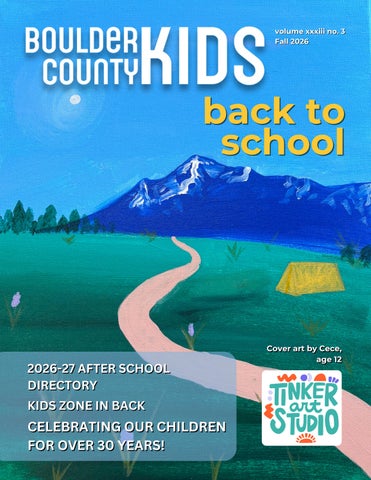
volume xxxiii no. 3 Fall 2026
back to school
2026-27 AFTER SCHOOL DIRECTORY KIDS ZONE IN BACK
CELEBRATING OUR CHILDREN FOR OVER 30 YEARS!
Cover art by Cece, age 12
FALL INTO PLACE The days are getting shorter, backpacks are coming out of storage, and a brand-new school year is beginning to fall into place. Fall always brings a welcome return to routine, but that doesn’t mean the fun of summer has to disappear completely. In this issue, The Kiva Center shares ideas for keeping that summer spirit alive throughout the school year, while Julie Fernie highlights local peaks that even young children can enjoy as the leaves begin to change. You’ll also find Oak Thorne’s beautiful reflection on the signs of autumn, singable book recommendations from the experts at Grandrabbit’s, and plenty of cozy crafts and recipes to help your family settle into the season. And, of course, our newly updated After School Directory is here to help you find the right activities, classes, and programs for those busy post-school hours. Here’s to new routines, crisp mornings, colorful leaves, and watching the pieces of a new school year fall into place. Welcome back to school, Boulder County!
Isabella & Annie (& our mascot Junie)
Follow us on: Contact us! (303) 728-4798 info@bouldercountykids.com
Paper Boy has been a BCK mascot for over 25 years!
WHAT’S INSIDE Fall 2026
FALL INTO PLACE
articles & columns
5 Front Cover Superstar
15 KIDS’ Planet with Thorne Nature Experience: Signs of Autumn
9 Fall Crafts 13 Fall Recipes
17 First Summits: Local Peaks for Young Children
24 After School
19 Set Your Kids Up for Success in School (and Beyond) with Singable Books
32 Child Care & Preschool
21 Keep Summer Alive Throughout the School Year
37 Private School
23 Inclusion Corner with Miss Katie
directories
39 Birthday Party kids zone
41
Coloring Page
42 Fall Word Search
BOULDER COUNTY KIDS is a division of Martin House Publications, Inc. Published quarterly in February, May, August, and November. Mailing address: 1464 E. Easter Cir. Centennial, CO. 80122. Phone number: (303) 728-4798. Copyright 1995 to 2026 by Boulder County Kids. All rights reserved. Reproduction in whole or in part without written permission prohibited. Boulder County Kids encourages your submission of articles, photographs, and ideas. We reserve the right to edit all submitted material. All submissions will be considered for publication. Viewpoints of the articles are not necessarily the viewpoints of Boulder County Kids. Materials will not be returned. Advertising is accepted at the discretion of the publisher. Please go to www.bouldercountykids.com for more information.
Special thanks to: Jennifer Martin & Indie Darlene Mueller Morse Leroy & Holly Schutz Carl & Marybeth Gieser
bouldercountykids.com • 4
front cover
SUPERSTAR
This issue’s cover art was created by 12-yearold Cece, a seventh grader who loves working with paint. For her untitled piece, Cece lightly sketched the scene in pencil before bringing it to life with acrylics. The finished artwork features a mountain skyline and a tent tucked into the landscape, capturing the cozy, adventurous feeling of fall in Colorado. Fall is one of Cece’s favorite seasons, thanks to the perfect sweatshirt weather, her October birthday, and the chance to browse Boulder County’s cute shops for trinkets and cozy clothes. Some of her favorite fall memories are spent golfing with her grandpa and dad. At school, Cece especially enjoys math and is looking forward to a new program this year that includes additional math classes and online learning. She also loved gardening last year, particularly getting outside to plant tulips. Outside of art and school, Cece plays tennis and prefers doubles over singles. At home, she has two Shih Tzus named Eddison and Walter, as well as an older sister and a younger sister. Her favorites include Modern Family, pop-country singer Ella
Langley, periwinkle and dark royal blue, moussebased chocolate cake, and the cookie skillet at Manning’s Steak & Spirits. Cece hopes to become a flight attendant when she grows up because she loves flying and exploring new places. She has already traveled to Greece, London, and Paris, with a trip to Tokyo planned for next year. We’re so excited to feature her beautiful mountain scene on our Fall cover!
Left: Cece, 12
Above: our Fall 2026 Cover Art winner.
Tinker Art Studio partners with us to provide each cover artist winner a $50 prize. Thank you, Tinker Art Studio, for supporting young local artists! For more information about Tinker Art Studio, please head to their listings in the After School and Birthday Party Directories. 5 • bouldercountykids.com
honorable mentions
Leah, age 11
Cassidy, age 8
Miranda, age 9
Max, age 11
Lydia, age 13
SUBMIT YOUR CHILD’S ARTWORK TO BE CONSIDERED FOR THE FRONT COVER OF BCK AND TO WIN A $50 PRIZE! EMAIL YOUR ARTWORK TO: INFO@BOULDERCOUNTYKIDS.COM
7 • bouldercountykids.com
303-386-3251
fall crafts:
PLAY WITH YOUR FOOD Let your kids play with their food, without eating it! Create beaded corn, bean-and-seed creatures, and cozy fall-scented play dough with these simple seasonal crafts.
BEADED CORN
kidskubby.com
What you need: 8 pipe cleaners in brown, yellow, or orange Assorted pony beads in fall colors, such as brown, yellow, orange, white, and red Scissors, optional What you do: 1.Gather eight pipe cleaners and twist them together at one end to form the base of the corn. For a more natural look, trim a few pipe cleaners to different lengths. 2.Slide pony beads onto each pipe cleaner, mixing and alternating colors to create the corn kernels. Leave a small section of each pipe cleaner uncovered at the top. About 20 beads per pipe cleaner works well. 3.Once all the beads are in place, twist the uncovered ends together to hold the beads securely. 4.Gently shape the beaded pipe cleaners into an ear of corn, then spread the twisted ends outward to resemble the husk.
BEAN SNAILS & BUTTERFLIES What you need: Recycled cardboard Dried beans, seeds, or grains School glue Small sticks, twigs, or other nature finds Scissors Printable snail and butterfly templates, optional String or long craft sticks, optional
9 • bouldercountykids.com
woodlarkblog.com
What you do: 1.Cut snail and butterfly shapes from recycled cardboard. When using a printable template, print it at 100% scale before tracing and cutting. 2.Arrange dried beans, seeds, or grains on each cardboard shape to create colorful patterns and textures. 3.Glue the pieces in place, then add small sticks or twigs for the snail’s tentacles or the butterfly’s antennae. 4.Let the artwork dry completely. 5.Display the finished mosaics as-is, string several together to make a bunting, or attach them to long craft sticks to create wands.
ADS
FALL RECIPES:
s p o o k y s n a c ks Two frightfully fun treats, no tricks required! Whip up creepy banana sushi eyeballs and frosty yogurt ghosts for a playful Halloween snack spread kids will love.
BANANA SUSHI ROLLS omgchocolatedesserts.com
Ingredients: large tortillas 1 heaping Tablespoon of peanut butter (for each tortilla) 1 heaping Tablespoon of strawberry jelly (for each tortilla) one large banana (for each tortilla) candy eyes toothpicks Directions: 1.Spread peanut butter over tortilla. 2.Spread jelly over peanut butter. 3.Place peeled banana on tortilla and roll up as tightly as you can. 4.Cut in 3/4 to 1 inch slices and secure each slice with toothpick. 5.Garnish with candy eyes before serving.
YOGURT GHOST POPS
colleenshealthylife
Ingredients: Greek yogurt, vanilla, plain, or a mixture of both Melted chocolate Popsicle sticks Directions: 1.Place ghost drawings or printed templates underneath a sheet of parchment paper. 2.Spoon the Greek yogurt into a zip-top or piping bag. Snip a very small hole in one corner. 3.Position a popsicle stick in the center of each ghost shape. 4.Trace each ghost outline with the yogurt, then fill it in. Smooth the surface gently with a spatula. 5.Freeze for about 1 hour, or until firm. 6.Pipe on the eyes and mouth with melted chocolate. A toothpick dipped in chocolate also works well for smaller details. 7.Carefully peel the frozen yogurt ghosts away from the parchment paper and enjoy. 13 • bouldercountykids.com
YOUR AD HERE! Reserve this space to reach families all over Boulder County! Visit bouldercountykids.com or email us at info@bouldercountykids.com to learn more!
Kids’ Planet with Thorne Nature Experience
SIGNS OF
AUTUMN
by Dr. Oakleigh Thorne, II
One of the clear signs of Autumn is the changing color of leaves. Have you ever wondered why they change and what actually happens that causes it? When we get cooler nights in the fall, for example, trees will stop making chlorophyl, which is green and makes their leaf-color green. Chlorophyl is, however, very unstable, so the bright sunlight will cause it to break down and loose its green color. What’s left are just yellow carotins, so without chlorophyl, the leaves turn yellow. This is true of Aspen and Cottonwoods. In the high country, the yellow of Aspen against the dark green of the evergreen forest (Pine, Douglas fir, and Spruce) presents a wonderful contrast. Some trees or plants will not only stop making chlorophyl in the fall, but will start making xanthophyl, which is a red pigment.
Sandhill Crane
This red, mixed with the yellow that’s already there, will give orange leaves. Sugar Maples are a good example. If the tree produces a lot of red xanthophyl, the leaves will turn red, as in Red Maples. In Boulder, there is a beautiful Red Maple tree near the corner of the old Mapleton School on 9th Street. I always try to drive by it when it’s in full color. A friend of mine pointed out that one of the signs of Autumn to him is the sun getting lower in the sky, which causes more colorful sunsets (and sunrises). The days getting shorter, of course, is a super sign of Autumn. The Fall Equinox is usually around September 21st each year, but can vary slightly. It is when the sun is exactly overhead at the Equator. Bird migration is an obvious sign of Autumn (and Spring). There are so many species of birds that migrate. I always listen for the cries of Sandhill Cranes flying over Boulder heading south in the Fall. Dark-eyed Juncos migrate vertically from high altitude near the tree-line down to the Boulder area where they spend the Winter months. The American Tree Sparrow nests in northern Canada, then migrates in the Fall down to the United States, so it becomes one of our favorite Winter birds.
My dad was a duck hunter, so I would often go hunting with him. The official duck hunting season was always in the Fall. We had a family boat that my Dad designed that had seven bunks for sleeping. We would go out on the Great South Bay, off the South Shore of Long Island, where we would set out about forty duck decoys, usually where the water was fairly shallow. We also had a very small boat called a scooter in which we could lie back out of sight and wait for the ducks to come in, attracted by the decoys. We then had to sit up in order to shoot. What I remember most, however, were the beautiful sunrises. Those really connected me to nature! Another good friend of mine pointed out that seeing new snow up on the high peaks is to her a very important sign of Autumn. It’s also telling us that it is already Wintertime up there, even though it still feels like Summer to us down here in Boulder. Altitude makes a big difference, doesn’t it? I love being aware of the various signs of seasonal change. It’s certainly important to me. I hope that you will also develop the same keen awareness. I feel that it is a key part of being a true nature person.
Sunset in Boulder
Dr. Thorne is founder and honorary president of Thorne Nature Experience (formerly Thorne Ecological Institute), a nonprofit organization headquartered in Lafayette (a suburb of Boulder). For 72 years they have helped “connect youth to nature!” For information about their programs, please check their website at www.thornenature.org or email info@thornenature.org or call (303) 499-3647, EXT. 100.
American Tree Sparrow
bouldercountykids.com • 16
By Julie Fernie
FIRST SUMMITS:
LOCAL PEAKS FOR YOUNG CHILDREN F rom Longs Peak to South Arapaho Peak and Mount Sanitas to Bear Peak, our local skyline is dominated by soaring summits. Seeing the mountains each day can beckon adventure. These local peaks combine the challenge of both distance and elevation gain, but even trails rated as "easy" can be very challenging for children. Here are five hikes to a summit in rough order of increasing difficulty. Each of these hikes is 4 miles or shorter and has less than 1,000 feet of elevation gain.
Bald Mountain (1.1 miles roundtrip, approximate gain 200 feet, ideal for ages 2+)
Sugarloaf Mountain (1.3 miles roundtrip, approximate gain 450 feet, ideal for ages 5+)
Parking: Bald Mountain Scenic Area Trailhead off Sunshine Canyon Drive. Port-a-potty and picnic tables.
Parking: Sugarloaf Mountain Trailhead off Sugarloaf Mountain Road. No restroom facilities.
Two trails leave from the trailhead but join shortly thereafter. Take either trail, hike 0.2 miles to the trail fork and take the left fork. Continue 0.2 miles to the summit where a bench offers great views. Continue along down the trail. Once the trail bends to the right, it gets much flatter. Continue downhill to return to the trailhead. This hike is a gem and is my go-to trail when introducing friends to hiking with young children.
17 • bouldercountykids.com
At the junction of Sugarloaf Mountain Road and the gravel parking lot, an unmarked trail proceeds northeast up a steep hill. This wide trail then levels out slightly and continues uphill for 0.6 miles to the summit. A bench sits about halfway up the mountain. The peak obscures the view of the surrounding mountains until the trail emerges onto the summit. On a windless day, this wide summit is an excellent spot for a picnic. Return to the trailhead via the same route.
*Image top right: Julie’s son at Bald Mountain
Point 6575 via Chapman Drive Trailhead (3.5 miles roundtrip, approximate gain 775 feet, ideal for ages 8+)
Kruger Rock (3.7 miles roundtrip, approximate gain 850 feet, ideal for ages 10+)
Parking: Chapman Drive Trailhead off Boulder Canyon Drive. No bathroom facilities available.
Parking: Kruger Rock Trailhead in Hermit Park Open Space. Requires Larimer County Open Space permit or daily access permit. Pit toilets available.
From the parking lot, follow the wooden steps up to the wide Chapman Road trail. Turkeys frequent this area, so keep an ear open for gobbling! Enjoy the forest along this trail for 1.5 miles to a signpost for the Tenderfoot Trail. Turn left onto the Tenderfoot Trail. After 0.2 miles, turn left again at the trail junction for a short but steep section up a series of steps to the top of the peak. This secluded, quiet peak has soaring views. Return to the trailhead via the same route.
Green Mountain via West Ridge (4.0 miles roundtrip, approximate gain 450 feet, ideal for ages 8+) Parking: Green Mountain West Trailhead - very limited street parking along Flagstaff Road. No bathroom facilities available. Off Flagstaff Road, a bike rack and Boulder County Open Space sign marks the start of the Green Mountain West Ridge Trail. After 1.0 mile at the junction with the Green Bear trail, a wide flat meadow offers excellent views for a snack. Continue on the Green Mountain West Ridge Trail 0.8 miles to the junction with the Ranger Trail. The trail gets significantly steeper at this point as it climbs up rocky stairs for 0.2 miles to the summit.
From the trailhead, follow the Kruger Rock Trail up the meadow 0.4 miles to the junction with the Limber Pine Trail. Continue straight to stay on the Kruger Rock Trail. The trail continues for 1.4 miles to Kruger Rock. After cresting over a gentle saddle, expansive views of the Estes Park valley open up. Near the summit, the trail passes through a burn scar from a forest fire. The trail tops out on a wide rock with great views. To the left, a large split in Kruger Rock creates a scrambling route up to the top of Kruger Rock. Whether looking out from the base or the top of Kruger Rock, the views are sure to captivate. Return back to the trailhead via the same route.
HAPPY TRAILS Julie Fernie has a master’s degree in Health and Exercise Science from Colorado State University and works as a pediatric clinical exercise physiologist. She has hiked all but a handful of trails in Rocky Mountain National Park, the Indian Peaks Wilderness and Boulder County. Julie enjoys countless trail giggles and snacks while out hiking with her husband and young son.
*Image left: Boys Sugarloaf Trail bouldercountykids.com • 18
Set Your Kids Up for Success in School (and Beyond) with
SINGABLE BOOKS by the book experts at Grandrabbit’s Toy Shoppe What’s a singable book, you ask? “A…picture book or board book that’s musical in nature, due to its repetitive, rhythmic, and/or rhyming format.” – Rachel See, Board Certified Music Therapist
Here at Grandrabbit’s, we’ve been reading a lot of children’s librarian blogs lately, and, as you might guess, these passionate professionals talk a lot about story time and the lengths they’ll go to keep kids engaged. Babies and toddlers are suckers for a rhythmic storybook with bright, engaging pictures, but if you want a real standout experience at home, librarians recommend books that parents and caregivers can sing to them. You may be familiar with the popular board book Brown Bear Brown Bear, What Do You See? (sung to the tune of “Twinkle, Twinkle Little Star”). Widely considered a classic, this book, along with others of its kind, provides a host of literacy-building tools, while also being entertaining, playful and fun. We recommend you enter some of these stories into your daily rotation, and you’ll ensure your child is well set up for literacy success down the road. But don’t take our word for it. A June 2025 Harvard study discovered that literacy begins to develop by birth, and early literacy experiences (i.e. reading aloud together) should begin from the very start of life. Singable books make a great choice for even newborns because infants (as well as toddlers) are highly responsive to melody and rhythm and often engage more easily (and enthusiastically!) when language is sung rather than spoken alone.
19 • bouldercountykids.com
The greatest advantages of books such as Ten in the Bed and Car, Car, Truck, Jeep (sung to the tune of “Baa, Baa Black Sheep”) can be found in how well they support early language development. Songs naturally include repetition, not to mention predictable patterns and words that rhyme, which help babies recognize sounds as they begin to understand language structures. Through familiarity, infants are exposed to the same vocabulary again and again, strengthening their listening and comprehension skills. And over time, babies will start to anticipate words and sounds, laying the groundwork for their future speaking and reading abilities. Books like The Wheels on the Bus and The Itsy Bitsy Spider also encourage active participation, encouraging kids to clap, move, gesture, and interact along with their grownups while listening to a story. This shared experience helps to create meaningful connections between words, actions, and ideas, and this multisensory approach aids in strengthening memory and cognitive development. You’ll also be fostering emotional connections, and in creating joyful early literacy experiences, you’ll be building positive reading habits that will last a lifetime. And don’t worry if you think you’re not a great singer. “Children don’t care if you can’t carry a tune, so sing out!” encourage the folks at the Musically Minded blog. “They’ll simply love that you are spending time having fun together.” At the same time, you’ll be creating a rich, multisensory environment that supports their literacy development and future school success.
The staff at Grandrabbit’s Toy Shoppes is on hand to support your efforts in seeking superior playthings to enhance your child’s development. For a curated selection of toys, games, and books, please stop by our Boulder or Broomfield locations, or visit www.grtoys.com.
bouldercountykids.com • 20
Keep Summer Alive Throughout the School Year by Kasey Schelling, The Kiva Center
for many families, when the school year begins, outdoor adventures often get replaced by busy schedules, increased screen time, and shorter days. However, no matter the age or type of school your child attends, you can easily keep the joyful, adventurous spirit of summer alive by making time to step outside together every single day. If finding the time feels like a chore in an already full day, you can unlock a world of discovery right in your own backyard using two simple, accessible practices: Sit Spots and Listening to Bird Language. These nature-connected activities help both you and your child find a shared state of calm, curiosity, and inspiration.
What are Sit Spots and Bird Language?
Understanding the 5 Voices of Birds
A Sit Spot is a regular outdoor space where you and your child can go to sit and connect with nature. Ideally, you visit this spot daily or a few times a week. Over time, the surrounding greenery, insects, and birds start to feel like familiar neighbors, each with their own unique story to tell.
Long ago, our ancestors listened to bird language for safety and survival. Today, learning this language still gives us a fascinating peek into the natural world. In his book What the Robin Knows, author Jon Young outlines five distinct vocalizations that birds use to communicate:
Bird Language is the natural communication expressed through bird sounds and physical movements. Tuning into these sounds helps children ground themselves, find a sense of calm, and connect deeply with the ecosystem in their own neighborhood.
1.Songs 2.Companion Calls 3.Territorial Aggression 4.Adolescent Begging 5.Alarms These vocalizations establish a habitat's "baseline"—the normal, relaxed environment of the area. When a predator or loud disturbance occurs, the birds break baseline and use intense alarm calls (which sometimes can sound like a mini police siren) to warn others. When you hear an alarm, it’s a fun guessing game for the family: Are the birds reacting to you, or is there a neighborhood cat or hawk nearby? Other vocalizations tell stories of nesting, feeding, and defending territories.
5 Easy Steps to Get Started 1. Choose Your Spot: Find a place that is naturally appealing and less than a two-minute walk from your doorstep, such as a favorite backyard tree or a cozy park bench. 2. Visit Frequently: Consistency is key! Even visiting for just five minutes a day will help you notice seasonal changes. Try to gradually build up to 20–30 minutes, which is the time it takes for nature to settle back to its normal baseline after a human arrives. Visiting near dawn or early morning is a beautiful, bustling time of the day for our animal neighbors. 3. Activate Your Senses: Wake up your family's sensory awareness. Have everyone close their eyes for a few moments and focus entirely on tracking every single sound they can hear. 4. Meet the Locals: Identify the three most common bird species living near your spot. Grab a simple field guide, use binoculars, or put up a backyard bird feeder to invite them closer and foster a love for the practice.
5. Play a Listening Game: Challenge your kids to recognize the voices of your three local species by sound alone. Can they tell the difference between a robin, a chickadee, and a finch without looking? Try recording the audio on a phone to help train your ears together. With just a little bit of planning and a healthy dose of curiosity, your family can easily bring the wonder of the outdoors into your daily school routine and keep summer alive all year long! Kasey Schelling is the co-founder and executive director of The Kiva Center, a nonprofit dedicated to providing nature-connection experiences for children ages 5-18, through vibrant homeschool enrichment, summer, multigenerational, and professional development programs. The Kiva Center is located in Lefthand Canyon within ten minutes of Boulder. Learn more at www.thekivacenter.com.
bouldercountykids.com • 22
INCLUSION CORNER with Miss Katie As cooler weather rolls in and backpacks come out, fall brings a fresh start—and a perfect chance to recommit to inclusion, kindness, and connection in our schools and communities. Whether it’s inclusivity, empathy, or just plain old kindness, this season is full of opportunities to model and teach our children what it means to be welcoming to all.
Inclusive Ideas for a New School Year Meet the Teacher (and the Team): If your child receives special education services, use the beginning of the year to introduce yourself to the full team. Teachers, aides, therapists, and front office staff. A friendly email or quick hello can go a long way in creating collaboration and trust from day one. Build a Routine That Works for Everyone: Fall schedules can be a big shift. Using visual calendars, social stories, and quiet morning routines can help ease anxiety and create smoother transitions for all.
Books to Kick Off the School Year Books are a simple and powerful way to start conversations about inclusion at home. For younger readers. These stories don’t just reflect the world we live in, they help shape a more accepting one, too. All Are Welcome by Alexandra Penfold: Discover a school where all young children have a place, have a space, and are loved and appreciated. Readers will follow a group of children through a day in their school, where everyone is welcomed with open arms. A school where students from all backgrounds learn from and
celebrate each other's traditions. A school that shows the world as we will make it to be. A Kind of Spark by Elle McNicoll: Award-winning and neurodivergent author Elle McNicoll delivers an insightful and stirring debut about the European witch trials and a girl who refuses to relent in the fight for what she knows is right.
Resources for Families Navigating the school system and the services it provides can feel overwhelming at times. Here are some local and statewide resources that can support families and educate them on educational services: Parent to Parent of Colorado: Offers one-on-one parent mentors, online groups, and statewide workshops to connect and empower families: p2pco.org Boulder County Autism Society: Hosts family events, education nights, and community meetups to help local families feel supported and seen: bouldercountyautism.org What is a better way to begin the school year than by building a more inclusive world, one small act at a time? Here's to a season of learning, growth, and community for every child. Until next time!
Katie Buckley is a high school special education teacher who teaches in a program for students with cognitive disabilities. She was born and raised in Denver, Colorado, before going to Texas to get her Bachelor‘s and Master’s in Special Education from Texas Christian University. 23 • bouldercountykids.com
after school programs
bouldercountykids.com • 24
25 • bouldercountykids.com
bouldercountykids.com • 26
27 • bouldercountykids.com
bouldercountykids.com • 28
29 • bouldercountykids.com
bouldercountykids.com • 30
31 • bouldercountykids.com
PC: Mikhail Nilov
directory CHILD CARE & PRESCHOOL directory
bouldercountykids.com • 32
child care & preschool directory
33 • bouldercountykids.com
child care & preschool directory
bouldercountykids.com • 34
child care & preschool directory
35 • bouldercountykids.com
child care & preschool directory
bouldercountykids.com • 36
PC: Thirdman
PRIVATE SCHOOL directory
37 • bouldercountykids.com
private school directory
bouldercountykids.com • 38
BIRTHDAY PARTY directory
39 • bouldercountykids.com
birthday party directory
bouldercountykids.com • 40
BCK FALL 2026
COLORING PAGE
find more at crayola.com
BCK FALL 2026
WORD SEARCH
1. ASPEN 2. ACORN 3. APPLE 4. BOULDER 5. BOOTS 6. CAMPFIRE
7. CIDER 8. CORN 9. COSTUME 10. CRISP 11. ELK 12. FOOTHILLS
13. HARVEST 14. HAYRIDE 15. HIKING 16. LEAVES 17. MAPLE 18. MOUNTAINS
19. OWL 20. PUMPKIN 21. SCARECROW 22. SWEATER 23. TRAIL 24. TURKEY