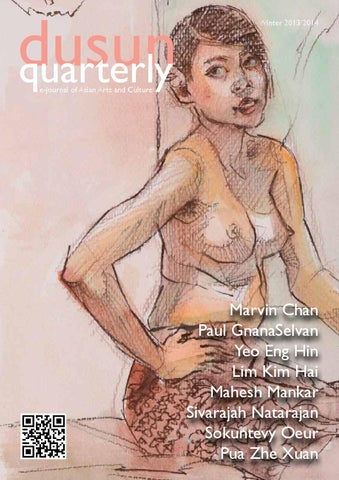
dusun quarterly
Winter 2013/2014
e-journal of Asian Arts and Culture
Marvin Chan Paul GnanaSelvan Yeo Eng Hin Lim Kim Hai Mahesh Mankar Sivarajah Natarajan Sokuntevy Oeur Pua Zhe Xuan 1
Dusun Quarterly 1 cover by Marvin Chan
2
Editor Martin A Bradley email martinabradley@gmail.com Dusun TM Published by EverDay Art
t Studio and Educare January 2014
dusun quarterly e-journal of Asian Arts and Culture
Dusun remains an entirely free and non-associated publication concerned with bringing Asian arts and culture to everyone
3
inside....
6
Editorial
Marvin Chan, Scent of Bali
20 30 48 4
9
Sivarajah Natarajan, Ahimsa
Paul GnanaSelvam, Latha’s Christmas
28
Lim Kim Hai, Optical Optimism
36
Yeo Eng Hin, Rediscover Angkor
56
Malaya Booked, what others wrote..
Zhe Xuan Fine Art Gallery
Winter2013/2014
68
Poem - In the Buddha Garden
Postcards from Cambodia
98
72
Sokuntevy Oeur, Secrets
Mahesh Mankar, Watercolours
108
The Launch of Uniquely Toro
130
68 Poem - In the Buddha Garden
122 137
In Search of Lost Christmas
Doraemon
On the Streets in Cambodia
146 5
dusun quarterly e-journal of Asian Arts and Culture
editor’s note It doesn’t seem that very long ago that my waist was a slender 28 inches, my hair was a succulent dark brown and anything I ate was burned off instantly, leaving me trim and thin. Sad to say, that is no longer the case. One year melds into the next to so surreptitiously that I can hardly distinguish the one from the other. January, and all that January might mean for you and I, has popped its newly born head up above the equator, bringing with it the new Dusun Quarterly. To better serve its readers and supporters, and to bring wider content into an e-magazine already brimming with delight and delectation, Dusun moves from bimonthly to quarterly. This move will only go to enhance Dusun’s reputation as being in the vanguard of Asian arts and culture e-publications. Dusun certainly is unique..........it is free! This issue is as chock full as Forest Gump’s box of chocolates, mixing hard and soft centres to tease and satiate your tastes. Cambodia, India, Malaysia and the Philippines spill their secrets and lay their wares at your feet. There are reviews, insight and flavours of strange street food to digest, and hopefully have you coming back for more.
Martin Bradley Editor.
6
7
M
alaysia...
8
Anggiy #3
99
S
Gallery Dusun
cent of Bali
Marvin Chan
Yunda #1 & #2 (opposite)
10
11
Yunda #5
12
Anggiy #1
I believe that when an opportunity arises, I am never prepared to deal with it other than to accept it as a means to question my current thinking from a new aspect. In dismantling old methods we get to redesign ourselves and possibly make the way we do thing
13 13
Anggiy #2
14
Visitor
15 15
Nita #3
16
Nita #4
Changes that arise within my comprehension play a large role in my work, because of how these incidences impact my identity. The brush strokes sometimes mimic a murmur, a scream or even a song, and my work is like a silvertone, recording what I feel. I am chasing a sense of what I feel, in my work. 17 17
Yunda #3
18
Yunda #4
19 19
Press Release Dusun
Ahimsa Sivarajah Natarajan. A singular vision in a dream changed Sivarajah Natarajan’s view of animals and their suffering in relation to humans. It was a macabre vision of hell’s purgatory of which the victims were animals. Tortured, maimed and decimated, they made an everlasting nightmarish impression that has haunted Sivarajah ever since. Their pitiful screams and howlings rankled the dank air as they were dragged to the slaughter house in an Auschwitz manner. Worst, Sivarajah’s beloved Sutra pets passed by in Dante-esque file, spoke with human voice, chastising and cursing him for his corroboration. Sivarajah woke up with a start. From then on he became intensely sensitive to the mute creatures around him. He realises that they are not unfeeling entities to be discarded and be simply taken for granted.They are in fact intensively aware and are special God’s gifts, beings who are every bit capable of feeling emotions as we humans are. Images of their suffering from his nightmare return whenever he sees them – a passing stray dog or cat, birds in flight, helpless caged animals about to be slaughtered resigning to their impending doom, those in the wild, and those in plight of a precarious survival in a material world – the complex situation of balancing the eco- existence of man with his fellow creatures became an unresolved paradox, a knotted conundrum that hovers within his mind.
Clown of God
Sivarajah developed abhorrence for meat and aversion to the killing of animals for food. He became a vegetarian. Ahimsa was born from the above revelation. Sivarajah’s latest series of paintings, Ahimsa, is a bold
20
Crossing Zebra & Semar
Beauty & The Beast (iv)
21
Avatar,The Wild Boar departure from -- but at the same time, a continuation of -- his former works. In Ahimsa, Siva grapples with a different subject matter. He is no longer dealing with the human form caught in the ecstasy of dance – a subject which has been his forte. He is now in the realm of a much more complex subject of expressing his compassion of the need for a common ground of the two seemingly divergent and disastrous destinies – of human and fate of animals. At the same time, he communicates his message with the flat two-dimensional pop art – an approach which has been the hallmark of his last few series. The word Ahimsa (originated from Sanskrit) became the Hindu and Buddhist doctrine of renouncing from hurting any living being. It is one of the virtues of ancient Hindu views. It may have originated as a protest against nomadic Aryan blood sacrifices and was later directed against capital punishment, and then later adopted by Buddhists and Jains as a moral code against war.The word’s association with austerity, charity and it’s declaration that non-injury and truthfulness are inseparable, is known to us.Whilst the credit belongs to the Upanishads, its dissemination and
22
practical application belong to the Jains and Buddhists and to Emperor Ashoka. Sivarajah’s adopted message in his exhibition Ahimsa is veiled in a Zen koan of sort. His visual enigmatic commentary poses a non-answer of a different kind. Nothing is as simple as it seems. He does not provide us with a simplistic solution. Words are often inadequate in our quest for simplistic answers to the truth of Life’s riddle. Through his images, Sivarajah makes us think of the universal paradox of complementarity and of duality; what is exactly perceived by our limited senses as good and evil, yin and yang, sophisticated and raw, cultured and wild, beautiful and ugly? Do not all beings in planet Earth have equal rights to live? Do we truly fathom that we are inseparably connected in our destinies and that a break in the fragile chain of this
Guardian of the Golden turkey
23
interconnectivity is a fracture in our collective consciousness that would eventually rupture the eco-balance and be a threat to our own survival - physical, social and psychical? Japanese-inspired print blocks of opera characters, such as of the legendary Madame Butterfly, sleepy-eyed geishas in full regalia, samurai warriors and gawky wayang kulit wise-clowns are pitted against a myriad of creatures: the crow, the cat, the dog, the rooster – images which dwell in the elusive maya of “tangible things in intangible dynamic spaces”. These spaces occupy our everyday lives in ambiguous ebbs and flows, in interstices of our conscience and in inexplicable layers of excuses, hypocrisy and values. Sivarajah prods our conscience with the juxtaposition of the artifice of the homo sapiens with the innocence of animals, domesticated or wild, and their helpless sufferings and fate. The sophisticated and the cultured are brought in close proximity with the raw, resulting in a menacingly incongruous and enigmatic encounter. Sivarajah’s device of light and pop-art enthused hues and his grid-like background suggesting both movement and imprisonment allude to his subjects’ seeming detachment, surviving in different realities from each other; his abstract, daring forms are on occasion complete and at other times fragmented. The genres in which his images are culled operate in subtle yet salient visual semantics compelling us to stop in our tracks to ask ‘why, why!’? Sivarajah Natarajan, one of Malaysia’s most compelling visual artists of the human form, has explored numerous genres of dances including odissi, bharatanatyam, gotipua (boy-dancers of Odisha), Balinese and Javanese court dances, contemporary modern dances and the traditional Malaysian theatre forms of makyong, menora and main petri. Simultaneously for two decades, he has closely pursued his professional voyage from being a visual artist to an award-winning light-and-stage designer. As a visual artist, Sivarajah has successfully seized and interpreted the tension between the ecstasy and energy of movement couched within the divine madness of the dancer’s spirit in his emotional outbursts. In his capacity as lighting designer in Sutra’s numerous productions in some of the world’s major theatres, Sivarajah paints eloquently with his lights. In Ahimsa, Sivarajah consolidated the sum total of his experience, baring his thoughtful and philosophical attitude to life in a veiled message, yet screaming his Petrushka’s cry for affirmation of the human compassion for his fellow creatures.
Tribute to Gundu - The Guardian of Wealt
Sutra. Sivarajah Natarajan Born and raised in Kuala Lumpur’s own Brickfields, Sivarajah Natarajan graduated from the Malaysian Institute of Arts with a degree in The Fine Arts in 1992. Known as the “dancers’ painter” who deftly captures the fluid lines of the dancer’s silhouettes and dynamic movement on canvas, Sivarajah Natarajan expands the use of his keen eye and instinct to conjure compelling lighting and set design onstage for Sutra Dance Theatre. This lighting and set designer, technical director and curator of Sutra has for over twenty years prepared and projected the mystical and sacred sites that Sutra performers recreate on stage and on canvas
24
Sadhu & Ancient Fish
th
as he blurs the lines between illusion and reality by the careful crafting of mood and atmosphere. A heightened sensitivity for aesthetics refines his vision which he also immortalises in photography, completing his integrated approach to the visual and performing arts. While Sivarajah’s experience in bharatanatyam, odissi, makyong, main petri, menora, gotipua and chhau productions (amongst others) feeds his subject matter, his painting repertoire has expanded into subjects as diverse as figures in motion to ahimsa (non-violence and compassion towards fellow creatures). His openness to the arts and self-determined quest to be true to his calling ensure that his art and style continuously evolve. His natural talent and devotion to the disciplines secured him national recognition for the Best Set Design (2005) and Lighting Design Award (2010) at the BOH Cameronian Annual Awards. As an artist, Sivarajah has successfully seized the moment and interpreted his artistic milieu, digesting these experiences and expressing them in nuggets of compelling images for us to contemplate. An artist who functions professionally in both the visual and performing arts, Sivarajah is a rare ‘integrator’ in the Malaysian artistic scene who shares his sensitive outpourings in the visual and performing arts with an individualistic and distinctive Sutra hallmark. “I think I would’ve chosen the same path if I could turn back time. I have this primal creative instinct which tells me that I am happiest when I am creating something. Being an artist fulfills an inner hunger within, and although I have a great respect for the Sciences which has its own calling, I believe an artist is essentially a creator. The work an artist produces is or should be unique as it is his or her life statement. “I want my work to amplify physical reality. As such, movement becomes the most apt subject matter to reflect this intense experience. The physicality of the dancer’s body becomes the human metaphor for striving for perfection in composition, design and content on the canvas. I try to keep evolving and experimenting. New revelations are discovered as I grapple with each challenge to capture the metaphor to fathom Life’s quest.” Sivarajah Natarajan.
While The Gods Play (II)
25
26
27
Literary Dusun
Latha’s Christmas and Other Stories By Paul GnanaSelvam
he rring to t fe e r r, e n n ith the uiet ma ’s End ontrast w id in a q c a s in n d a o A Journey p o a t g the eep red s u,” Thang lly among d n a a e ic s m o o t m h s e g w h t in “C dus n stand umulus of o he’d see h w s r a r billowing c a e port.” ke f the vellaik d bullock carts at th the drought and ma o s e y e e blu s an ape ntail ople, truck ‘land of gold’ to esc at would e h t ip h s d , r mass of pe ere to this g the danger and ha am, malaria r h a e b m m a a c d e y The iots nowin he Che nes, not k he racial r y aboard t t u e t d n r r n u fo a , jo e ir s s e e u h t uo pan or : The ard easts, the invading Ja the endeav b w. s it all. his land no and variou d s s e a r a iv w v o r b is u h d s T il w had hing. 1969. They Everyone was watc . of on May lour? “ p n’t give u gth and va ld n u e r o t c s e is h h l, t Stil to tes ld it want Why wou e was a plac It . im h d e u oay repuls Teow, Sat how the k od court” y n a fo e o “ e K d s r r d o a a w h h C he He r ‘big’ ention of t they sold. t bowls fo ith n e m e r u The very m easured everything s a oil, w re me ym too much , there we t h s it ir w F where the . d d ie ie taugeh e was fr s were fr a pinch of d n a , g teow ther antities. The noodle g e ed ere dump h cake, an qu s w ’ fi ll y f a e o m h s t ‘s e , c y d an the ur pie . Finall taste, like prawns, fo no kerang r o d n n a e ) c e n a iv two puny r ens er frag hai is exp gave neith t a h t (since kuc s e x tyrene bo into polys f did. banana lea em brought th e h d n a s palm ause int. All bec lines on his fa e d h n t a o d t e See- Saw k d he tion shifte ed, so croo ked beside appa in t n g e g t t ja a o ’s S s . a e Niv is nos r wor riving he tip of h o school, o y sell better than d t e n o g e closer to t v ha ed. The ng! Should remember e h , s of Ah Keo if t o p to say that elf. can make n s I o . im t y h n r e e t ld w t o o t It p , he would ening. Ah Keong was threat the clay properly, he e ic o v lorries for ’s r into e, his fathe his finger ip d d …This tim n a n end dow he didn’t b right shape.” the never get r. She not fail he id d s r e g y y n e om’s famil ime, her fi the Journ t o r r g is o h f e T h . d t e r f i n A B abit o he pho is Indian h icked up t h p T . !” la y a a s m a o t K “ is century ted h n t a s w d n e e h s It t stop. knew wha e’s had to id r b e h t n picking o
28
e was shed, ther g n u r u k a the baju sage l muscles, d s a n a r a M o t ff c n o e o o p d s e Mon had ash also make-up w a’s naked self. Reza y hair. He d o b is h z ff e “With the ine on R r noted as d shaved o a a in h m m u e fe h K , g e d r in il e h not ke ble wh mall bu would ma y and stub ” for his s t g d a n o h t u b h e d “ k e r li n e o t th anted to, es. A penis w iz He was ra a s . z f is e o n R e n p if o a had mparis hildren mental co en make c v a e e d ld a u o m c he y…it happy. Wh a woman umar.” thought K that empt hair k n u , g n o L a pearance: tattoo of stmas p i a g r h in ’s C d y h fa ’s t a r e h u Lat in. M hirt, th ardfear crept ld worn s are of a h t o s w e is g n h in , a c t r u … c ie “ to the p not afford chest and y n w a r he could r c s too busy fo a criminal. er on his s ig is t a t ld g r u in o o c w n a im pr kh hole ol! would mar and, why, even the w the children in scho t d bitten man r u n la d a job, p t cocoa fo n o fi een of Eng h u o d G Q n “ a e . y t h s h T … Murt r breakfa e had told and jam fo r e t t u all this,” sh b give them That would supper!” s must many time w o H . e e s friend cam ut with her, you com le r d u n o a y C w 0 o 0 1,0 st n go o . Girl ther said ju er? Every time you not twelve , n e e t n e h “Your bro v s e neighbour you are s t to friend e o … h n h t , a u n ld o u y u Y o ll h I te hat w ng. A . Say ke a samse at night. W d things about you . a back late li t not stay out late marry you ther. Say b s u fa o t m r s u e t o g n y a a d r w you body me an ly. Then no will blame r y e e p h o r T p ? y p a s uu her. r bring yo d her mot that I neve o the family!” warne et Bring sham es. d. w d the nois r o a ll e i h P I and hushe g t d n h i e g b u ffl b u o o h S m t , I t e Th ight, e nigh t to one such n e fortnigh iddle of th m m e a h t k o in o t e t “ Then, on came aliv clearer. It hem abou y t ll d a n o u t a s g u r e in y d e lk u Th …..Ta me lo idn’t ing to me they beca er, and I d , lk t y a t ll t e a b d u l t e e n e e d fe v E re in de me t they we orning ma m e h t f realize tha o s wee hour you till the e sleeping pills.” or need any m
Malaysian writer Paul GnanaSelvam began writing in 2006; his letters to editors and personal reflections have appeared in the Starmag section of Malaysian English language daily The Star. To date, he has published short stories and poems in e-magazines Dusun and Anaksastra. His works can also be found in the anthologies Write Out Loud, Urban Odysseys, Body 2 Body and the biannual literary journal ASIATIC and the Lakeview Journal of Arts and Literature. He has read his works at events such as Seksualiti Merdeka, Readings, Northern Writers and Colors of Cambodia. Latha’s Christmas and Other Stories is his first book.
29
MALAYA BOOKED A fuddle of fiction written about the mystical Orient that was Malaya In fiction, the Malayan archipelago was ridden with dark, almost impenetrable, jungles. The sweat of intrepid travellers, or sex starved barmy planters, broke out in rivulets which stopped only when cascading off leeches, clinging like silent vampires to unprotected white western legs.
Fleischman, 1954). For explorers, Malaya was a place to either conquer and grow tea and rubber, or a place in which lived a variety of races, some of whom abided by a western work ethic and many who didn’t - they were to be termed ‘lazy’ and ‘native’.
There were rich and patronising Malaya was a deeply foreboding stories of Pigou, a Malay boy by place where young men travelled William Gardiner (1833), stories of never to return. It was full of being trapped and held captive by cut throat pirates (according to war-like Malays (G.Manville Fenn, G.A Henty, 1905), and luscious 1907) and Malayan fables featuring lovelies who would seduce and talking birds and mouse-deer then discard lonely men (A.S. (Kate Douglas Wiggin and Nora Archibald Smith, 1911), and there were wily tricksters going under the name of Kling (W.Carlton Dawe, 1895). For some, Malaya was a place of G & T or Singapore slings, or there again a bottle of Tiger Beer. It was lusty but forgotten. It was a dank prison where linen wearing planters eyed each other’s wives and conscripted soldiers, when not abed with local prostitutes, were sent to fight un-winable wars against local inhabitants, to preserve an empire which was quite obviously disintegrating. Malaya was a place where jungles
30
31
G R E
Y C N E
M E 32
EMER
GENC
Y
33
from classic to pulp
it’s what th thoug it knew
MALA 34
were seldom neutral. It was a place for ‘camping and tramping’ (Ambrose B.Rathborne, 1898). It had pagan tribes (Charles Hose, 1912), and wild tribes (Pierre Etienne Lazare Favre, 1865). For some it was an idyll ) Isabella L.Bird, 1884) but for many a schoolboy it was simply a place where fathers were lost due to some fracas called, laughingly, an Emergency. Malaya was a place of tin and of rubber, and whose fortunes rose and fell with trading. But when Malaysians began writing about their dilemmas, factories and rain, they were to tell a very different story to those told over 100+ years by visiting white people......
he world ght about
AYA 35
Art Article Dusun
69 Fine Art Gallery Kuala Lumpur
OPTICAL OPTIMISM Lim Kim Hai
On White Cloth
36
OPTICAL OPTIMISM Curated by Betty Bui (France) Exhibition: 23 November – 21 December, 2013 Venue : 22 Jalan Bruas, Damansara Heights, Kuala Lumpur Opening hours: by appointment only Contact no: 019 301 2569 Email: info@69fineart.com
At 63 years old, Lim Kim Hai is a very prominent Malaysian painter who has gained international recognition. Highlights of his achievements include: Golden award from Salon des Artistes Français (Paris, 1982), Silver Award from Salon International du Val dʼOr (1984, France), Award of Prix Henri Lehamann (peinture) from Institut de France – académie des Beaux- Arts (Paris, 1986), and Golden and Public awards from 52nd Salon des Beaux Arts, Enghien les Bains (1987) and numerous important solo and retrospective shows throughout the world (from France to Russia, China, Vietnam, Taiwan, Thailand, Singapore and his native Malaysia). Born in 1950 in Selangor, Lim began his training at the Nanyang Academy of Fine Arts in Singapore. In 1975, he left South East Asia for Paris to study modern and contemporary painting at lʼEcole Supérieure des Beaux Arts. Lim belongs to a group of
« overseas » Chinese painters who merged Chinese and European philosophy of art and aesthetics by inventing his own language. Having established himself quite well in France, he found resonance in the creative journeys of Renaissance artist Augustin Henckel, PostImpressionist Cezanne, Abstract Expressionist De Kooning and Realist Impressionist Manet through his long visits to the Louvre and other local museums. Lim found his own artistic language in representing apples. Feeling quite lonely in Paris, on a subconscious level, apples became his friends. They represent human beings, as varied and different with various sizes, shapes, colours and personalities as people can have. His realist yet very fantastic style of painting leads us to a form of artistic expression that transcends East and West. This is not Asian painting. This allows us to perceive ʻfeelingsʼ and have a pure and direct sensation about Limʼs work. (From Press Release)
Images from the opening night
37
Harmony & Peace
38
39
In Motion
As we jovially walked down that antediluvian equatorial brick staircase, moss and tree ferns grew silently in the romantically dim gardens of 69 Fine Art Gallery. Anticipating the exhibition, I recalled the hazy, golden, apple orchards of my youth. At age 10, I had run free through hundreds of acres of apple trees whose names, except a few, have returned to the teacher. I slowly grew amidst Cox’s Orange Pippin, Discovery, D’Arcy Spice and so many more varieties of Eve’s fruit. Apples framed my pubescent years. Rotting, cider bound fruits scented my growth, just as they had scented the insides of Tolkien’s Hobbit barrels. Apple blossom graced my summers. I was too young for Rosie and cider. I was just some Arthur Ransome character wannabe, all apple bound and confined by creeping Englishness. In my latter years apples became designed by The Fool (Dutch artists Simon (Seemon) Posthuma and Marijke Koger), for The Beatles, and by Rog Janoff - as a logo for that infamous computer company. Back in the tropical warmth of Malaysia, and exiting those exquisitely rambling nightly gardens, inside 69 Fine Art Gallery we were welcomed by bright lights and cool air conditioning. Having been washed by gallery currents, I nearly passed out (Tomber dans les pommes) as we were welcomed by a triumvirate of charming French expatriates. Firstly, a most seductively inviting Frenchman who could put Charles
40
Power of Unity
Aznavour to shame, smiled as wide as any Cheshire cat, and was accompanied by two even more enchanting and alluring French women - my mind swept to Catherine Deneuve and Jeanne Moreau, me being of that age. The evening had begun very well. We were there, at the opening of an exhibition by Chinese Malaysian artist Lim Kim Hai, aka the Apple Man for reasons which shall become obvious. I had been introduced to his work some time previously, in some small selling gallery in the wilds of Kuala Lumpur. I had been curious as to why a Malaysia artist had taken apples as his subject. The answer was in this exhibition.
continued on page 33
Lim Kim Hai initially had studied in Singapore’s Nanyang Academy of Fine Arts, before heading off to France’s ecole Nationale Superieure Des Beaux Arts, in Paris. There was a moment of ‘eureka’ as I realised that France, an apple producing country, has nurtured artists with a great love of painting apples (pommes). Two exceptional French artists - Chardin and Cezanne had both delighted in still life paintings of apples.You might recall Dish of Apples by Paul Cézanne (Aix-en-Provence)1876–77, Still Life with Jar, Cup, and Apples (Aixen-Provence) 1877 or Still Life with Apples and a Pot of Primroses (Aix-en-Provence)1891–92. Likewise Chardin’s series of Apples (and Oranges), combining modernity and sumptuous beauty in one of the most important still lifes produced by the artist in the late 1890's. Even neighbouring Belgian Surrealist painter René Magritte, in Son of Man
41
Harmony n Peace
42
43
Feast to the Eyes
Three Apples
No War
44
Joyful Living (1964), had a shot at painting that pomaceous fruit. As we sauntered the gallery, walls of apples tumbling, falling, rising, sitting as subjects made me think of Bilbo, The Hobbit and LakeTown, though not necessarily in such a negative sense as Fili (from the book, not the film). Though Malaysia had never been known for growing apples, it being too moist and far too hot,
the Sarawakians in Ba’kelalan have laboured long and hard to, at last, bring Eve’s fruit to Malaysia. So maybe it is timely that a French art gallery founder (Patrice Vallette), in Kuala Lumpur, should also present apples to the equatorial public. Perhaps, then, it is timely to bring a Malaysian artist, who has revelled in painting apples as his subject during his lengthy sojourn in France, to a Malaysian audience becoming increasingly familiar with the fruit.
45
Golden Joy
46
47
Art Article Dusun
Zhe Xuan touched my arm, fascinated with my hairiness. He stoked my arm as he would a kitten. I was puzzled. Seventeen-year-old Zhe Xuan normally barges past me, lost in his autistic world, still unable to speak, rushing to grab colours and canvas for painting. Today, he stopped, grinned his hard won grin and rubbed his hand over my hair. I have known Zhe Xuan for two years, ever since I first visited the centre. It has taken two years for him to brave physical contact with me. I was thrilled. His mother normally requests Zhe Xuan to say hello Martin. Sometimes he does, sometimes he is too eager to get started. Mostly all I get is a quickly muttered something, his mother’s stern face and her apology. I’m grateful for anything really. Family Pua have turned negativity into positivity. Pua Zhe Xuan was born with autism. His early life
48
Trees in the Jungle
49
The Market was a struggle to communicate. Zhe Xuan's parents soon noticed their son's aptitude for art, and supported him in his endeavours to communicate visually that which he was unable to communicate in speech.
pioneer modernist painters. His intently on his work singing artworks exude magic, symbolism ‘Twinkle Twinkle Little Star’, over and spiritual energies in abundance. and over as he drew.
His acrylic paintings reflect the intensity of Paul Klee and the naive playfulness of a newly discovered Henri Rousseau. Zhe Xuan Today it rained a lazy equatorial simplifies what he sees, there is rain. Not enough to water the little need for ornament, he grasps thirsty lemongrass outside the the essences and presents them centre, but enough to take some to his audience, one which is ever of the heat from the air, and crowd growing. the outside of the tuition centre with shoes and umbrellas. The end Zhe Xuan has a launch of his new of the week is always like that - artworks at the end of November. droves of parents depositing their He is still painting in his unique children, multiple shoes on shoe style, assisted by Teacher Honey racks - hampering stray dogs intent and his mother May. Without their on playing with them, and today - a guidance Zhe Xuan would linger Jenga of umbrellas. over one image, drawing and redrawing that image for the entire Zhe Xuan has worked hard two hours of his art class.Today he these last few months. He paints continued with Malaysia’s Petronas on much larger canvases now, towers. A light blue and washed painting and drawing the Kuala green formed his background, Lumpur landscape. His is a unique over which he drew the outlines perspective, flat, bringing to mind in black magic marker. He focussed
50
The opening of his latest exhibition coincides with the initiation of his own gallery in Cheras, just outside Kuala Lumpur. It has been a long time coming, but Zhe Xuan has finally arrived on the Malaysian art scene with his simply scintillating imagery. Born in Klang, Zhe Xuan is a local boy making good. He has not let autism hamper his zest for life, or his passion for painting. Zhe Xuan reflects our world back to us, and by so doing enriches our knowledge and our hearts. Martin Bradley
Plants with KLCC
51
The Landscape
52
53
Twin Towers
54
The Beauty of KLCC
55
Art Article Dusun
Yeo Eng Hin
Bayon at Sunset
56
Buddha Pagodas of Bayon Temple
57 57
There is an intriguing interiority and an exciting exteriority to the recent paintings of Yeo Eng Hin. Intimations of French Impressionism and nuances of an emotional, and spiritual, Expressionism grace the acrylic and oil (mixed media) canvases of this gentle man painter. Yeo captures the essences of his subject well, and transports us, his viewers, into a land both venerable and seemingly superbly supernal - that of Cambodia’s ancient Angkor. The imposingly graceful Angkor, magnificent city of hewn stone temples, was created by skilled craftsmen during Khmer (Cambodian) Empires from the 9th to the 15th centuries. It was revisited by French naturalist and explorer M.Henri Mouhot in 1860, and noted in his travel journals. Angkor is an imposing city comprising of Hindu and Buddhist temples which cover 400 glorious square kilometres,outside Siem Reap,Cambodia.
Blessing a Good Day
58
Impressions of Bayon Temple The intrepid painter Yeo has sojourned in Angkor numerous times to internalise, and reveal, the gentleness, tranquillity and deep seated spirituality of that wondrous city. Angkor has the sagacious reputation of turning writers into poets, adventurers into acolytes and painters into masters, and such is the case with Yeo Eng Hin. So seldom does the rendering of a subject fuse so perfectly with the psyche of the subject itself. It is as if Malaysian painter Yeo has absorbed some of the peaceful tranquility from that great Khmer city and rendered it, and his reflections upon it, for we exhibition visitors to marvel at. And marvel we do. Nanyang (Singapore) and Paris trained Yeo has evidently come of age in his astute Angkor paintings. Skilfully blending an ethereal, impressionistic, haziness, acute architectural perspective with splash painted Expressionistic texturing, Yeo brings all the grace and otherworldliness of ancient city of Angkor alive. Drifting cantaloupe coloured monks stray like benign spectres amidst aged and ancient stone. We onlookers become uncertain if these monks are unsubstantial echoes, ghosts in time, or present day samaner (novice monks), wandering in silent magnificence. As we gaze, we can feel the immense solidity of weathered stone cubes, hand carved, crafted to form pillars, now beset with all colours of aged lichen. Yeo’s painterly skill reveals the grace of balletic Apsaras and scalloped Buddhas; their hands pressing palm against palm in the sampeah - a welcoming salute to we who view. These Angkor paintings are no mere capriccio, but a Turneresque dream of Eastern enlightenment and sublime enchantment. We witness and wonder, as Yeo skillfully blends cool and warm colouration to enhance our experience of the grandeur, and humbleness of his noble subject.As we stand before these paintings we become gently lulled, as if in a smoky miasma, drawn into a peaceful serenity greatly uncommon in the hustle and bustle of Malaysian modernity.
59 59
East Gate of Bayon Temple With an artist’s vision more acute than digital photography, Yeo Eng Hin, as visionary painter, presents us with both impressions and with expressionistic feelings. Feelings are invoked by the skill of the adept painter, his masterful layering, sleek stroke-making, poignant paint splashing. Light and dark are woven,‘manipulated’, to give birth to the illusion of depth and the depth to illusion. Bright, dark or sunrising skies bring warmth or cool to our perceptions of the painter’s Angkor. Impressions are rendered in fleeting glimpses of mid-ground and background, seemingly inconsequential trees, and brisk bushes. Our vision becomes constantly guided. Yeo is our painter tour guide. He leads us into his perspectives, as we become unhurriedly herded by his skilful brushwork. In the land Yeo has created, ethereal monks and mysterious gateways arouse our curiosity. They become revealed by Yeo’s thaumaturgic, painterly, enchantment and suddenly appear to delight and astound. If there were to be criticism of these works, it would of scale. I should delight in much larger works, works to truly get lost in - like some aging Alice in dream that is a Cambodian wonderland.
60
Untitled
61 61
Ruins of Bayon Temple
62
Encountering Buddha
63 63
Untitled
64
The Ruins of Angkor
65 65
Sunshine at Ancient Angkor Wat
66
67 67
In the
Buddha garden I
sit silent and
birds
the Jasmine
they
smell
as
watch
wing
orange clad
rest
the
glide in
their
then I
centre
myself
serenity
knowing
the
peace
hear
sweetness of
that
comes from
within the
morning sun's
68
rays
bless me as I
bless all
living
beings
they come to rest in me as one
in the Buddha garden
Martin Bradley 69
C
ambodia
70
Take a minute for yourself
Roosters waiting to fight
71 71
Travel Dusun
m o r f s d r a postc
Cambodia
Martin Bradley journeys to Cambodia with the charity Colors of Cambodia, and shares his thoughts and feels as he and his wife Pei Yeou go about the business of teaching and bringing art and education to children in Siem Reap, Cambodia
We wait on flight AK1480, there is the distinctly British sound of Artic Monkeys being played as we wait.A conglomeration of red bedecked flight attendants flutter carefully mascaraed caterpillars, and pout abnormally red lips while gossiping and tinkering with plastic trays.
backed by the main (old) Siem Reap market. A bubbling group of U.S twentysomethings display their contempt for restaurant staff by shouting across the not large dining room “Here, beer” then laughing amongst themselves as if their inability to communicate with hard-working local life is The red gantry is eventually humorous. It seems that ignorance withdrawn and the ‘girls’ announce travels as much as insight these departure. My wife cuddles the days. small pillow that we had bought from home, and sleeps. The Outside of Serge’s Champey uneventful flight takes its one Restaurant the emaciated, hundred and twenty minutes tattooed, fire eater performs to an (approx) and begins its descent all white ensemble of onlookers, towards water logged, green, brushing his lithe body with fire and Cambodian fields. threatening to flambé his nether region too. On the conclusion Siem Reap has waited for my of his performance he produces return. It is a fraction cooler. It is a black bag and approaches his December, but nevertheless still audience. As one they find interest damn hot, and damp. It is the rainy in each other, the local shops, the season, with previously parched sky or just about anything other land now drenched. Like most than the man they had been times of year for Siem Reap, it is still watching so avidly, save one tourist also tourist season, with (mostly) with a white goatee beard. He Western travellers flooding into withdraws his wallet and proffers this, the fastest growing city in a note. The fire eater pockets that Cambodia. note and collects his paraphernalia We take succour at an eatery together, to begin again elsewhere.
72
A comfortable coach draws up and whisks the tourists away. Fried ‘minned’ pork does indeed turn out to be fried minced pork, luckily. The misspelling brings memories of Peter Sellers, Spike Milligan, Harry Secombe and Michael Bentine - The Goons and the eccentricities of the English. It A small Khmer boy appears with a large light blue bag. He poses against one of the restaurant’s posts for a while, then continues his quest for plastic bottles, which he scrunches and crunches into his bag. Shortly after, a small Khmer girl bounces up to us - “one dollar ten, ten for one dollar”. She sticks out a thin hand and offers rattan bangles. Like a novice tourist, I buy those brown and turquoise objects, much to my wife’s surprise, and place them on her waiting arm.The girl, seemingly satisfied, wanders off into the rain bespeckled Siem Reap street. The pensioned of all nationalities seem to impose themselves on gentle Khmer residents. The retirees rub reddening shoulders with browned backpackers who
Colors of Cambodia Gallery in Siem Reap
click merrily away at large red vans bearing the legend “Coca Cola” as if it were something unthinkable that the American brand should have reached the depths of South East Asia. A blonde patron, having finished her burger, fries and coke, beckons the waitress in the age old fashion of pretending to write a cheque in the air. She puts away her digital tablet ready to rejoin the alien throng on the streets where, no doubt, she will be hassled by the nearest tuk tuk drivers to the extent that she would eventually succumb to their proffering or, frazzled, walk briskly away. The much photographed Siem Reap has all the appearance now, of a pleasure weary mistress who is a little heavier around her waist, and perhaps a little sadder around her mascaraed eyes too. Like a true pro she has partied until she dropped and then picked herself
up, and partied some more. But, her hand woven cotton sampot reveals its, and her, wear and tear, and the lines around her eyes have become deeper with each tourist filled year. And still the tourists come, ready to use this aging maiden, laden with their weighty wallets and hefty telescopic lenses, expecting to be continuously entertained. Tiredness is still blowing through the windmill vanes of ours minds. Reluctantly we arise to catch a breakfast that we really wish we had not, at the hotel, before heading off in a rickety tuk tuk to a school we help sponsor, near Siem Reap airport.
“Siem Reap has waited for my return. It is a fraction cooler. It is December, but nevertheless still damn hot, and damp. It is the rainy season, with previously parched land now drenched. “
73
follow artist Honey Khor as she sets out to volunteer for the charity - Colors
Every so often a book appears that reveals and illuminates a project that might otherwise remain largely unknown by the outside world: ‘Colors of Cambodia’ is such a book. This is a highly personal and passionate account written by Martin Bradley and illustrated by Pei Yeou Bradley of her encounter with a remarkable art-based project in and around Siem Reap in Cambodia, and how she was drawn into practical involvement with the children for whom the project exists. Richard Noyce, Artist, Wales 2012
74
s of Cambodia, for the first time
written and designed by Martin Bradley
on sale from cocthebook@gmail.com https://www.facebook.com/ groups/138402846288849/ http://colorsofcambodia.org/
proceeds from all sales go to the education of children in Siem Reap, Cambodia
75
Deux Jours 76
Breakfast at Tan Kang Angkor hotel is a most unusual mixture of impoverished British seaside B&B, and an equally impoverished, not to say forlorn, Chinese eatery, where customers had long since ceased visiting. The kindest thing I could say about the hotel breakfast was that it was just, barely, edible if you were desperate enough to consider doing so.
break when we visit, but the art class children come as usual, and a couple of dozen children mill around helping to clean the school grounds. While my wife diligently helps Colors of Cambodia art teacher Narong teach the children the wonders of ‘sand art’, I take photographs for our records and wander at will around the very functional shoebox-like school.
It is the usual Cambodian journey, past roadside sellers of bottled petrol, mushrooming hotels and posters proclaiming this or that political party to be the one choice for the people of Cambodia. Thai Zo school is down a dirt track off the main road. It was built by a Japanese company to educate children in that very rural area. The children are having a school
It is the rainy season. It rained when we arrived. It rained the previous lunchtime and evening. Rain had accompanied our breakfast with large drops splashing into the dolphin tiled swimming pool. This slightly delayed our start, but at the school all we experience are grey clouds and a distinct lack of sun. It is just as well, as the tuk tuk ride would not have been as pleasant
Thai Zo School, rural Siem reap
77
in rain. The overall temperature end of the school playing field. I is much cooler than my previous remind myself of the differences in visit, almost bearable. school life in Cambodia, Malaysia and in Britain - where few city I snap away at all that need to snap children had actually seen a cow, away at, I sit with the two school let alone four within their school’s Headmasters (elementary and playing fields. secondary), a collection of teachers and our guide/interpreter Saroeun. Idly, as Sarouen translates, I watch a small group of girls playing Lort Koe Su. Lort Koe Su (Khmer) is a jumping game where the jumper has to kick a stretched string, or elastic, held aloft by two children. The string gets higher and higher until it is eventually held at arms length, and the jumpers leap to touch it. The girls are of all sizes, big and small, younger and older, but it is one small girl, her rubber slippers in hand and ponytail lashing out as she jumped, who eventually beats all the others. The game winds down. Those children disperse. Some wander off to the classroom where my wife has been volunteer teaching, on and off, for over five years now. Other children continue to tidy the grounds, unsupervised, in-between bouts of play.Within minutes some of the girls return.They press their treasures - packets of ‘sand art’, to their immature chests while chatting furiously, and beam radiant smiles at each other. As I sit, the teachers draft proposals for things the school is in need of - a new floor for classrooms, computers for when electricity eventually reaches the school and playground equipment for the elementary school, which has none. As I am digesting the school’s needs, I watch as a cowherd saunters through the school grounds, bringing three white Asian cows with him. He is on his way to collect the fourth, which has been laying at the far
78
Thai Zo School Siem Reap
79
Trois Jours 80
Family visit, rural Siem Reap Under the brightest of Cambodian morning skies, our three Malaysian Chinese princesses arrive.They are a little bleary-eyed after their early morning flight, but nevertheless game to begin their new journey into volunteering. My intrepid wife, and her not so intrepid husband, guide the three Chinese belles through the scooter/tuk tuk laden streets to our usual watering hole, at the rear of the old market, in Siem Reap. From there it is a short hop and a step to the gallery Colors of Cambodia, Mundull 1 Village, Sway Dong Kum Commune. The gallery has changed a little since our last visit. The front has been let to a company producing and selling striking black lacquer work, which augments the paintings by the Colors of Cambodia students, and teachers, nicely.There is a very nice art/craft feel to the building now, and many foreign visitors stream in to see both crafts and paintings. Of course the two Cambodian beauties selling the lacquer work only enhance the inherent attractiveness of the place.
around holes filled with recent rains, past water buffalo drying in the sun, past white cows, their backbones prominent and past oh We pick up Seney, a Cambodian so many acres of tall paddy. artist and art teacher for Colors of Cambodia, and Sarouen, the gallery My wife has signalled a stop. We manager and tourist guide, and dismount. Me with a little difficulty, head for rural Siem Reap aboard but Seney is patient. It is a photo slim, fragile looking motorcycles. op. We have come to rest at a Seney has the unenviable task of rice paddy field, where a whole transporting my largeness, but he Khmer family are busy harvesting copes well, despite the mud sliding their crop. Despite their need to and near collisions on the journey quickly gather the rice before too to see the homes of the children much rain falls and ruins it, they stop their work and allow us to we sponsor. take pictures. Husband and wife Firstly we head to Thai Zo school both pose for photographs, the to pick up the Elementary School children continue working. The Headmaster (Director), as our wife demonstrates cutting paddy guide, then off onto very narrow to my wife. She hands her a small dirt tracks entirely unsuitable for scythe, and advises her with body any other form of transport save language how not to cut her legs motorcycles, cycles or pedestrians. off as well as the rice. There is no The houses of the sponsored major blood letting incident so we children are several kilometres continue, having thanked the family along the tracks, and too far for profusely. us to walk. For a while we travel adjacent to a muddily brown canal. Smiling Khmer children, their bodies immersed in water, gather blue water hyacinth and lotus seed pods. We travel on, over ruts,
Despite a small detour - it is was when Seney and I lose sight of the others and continue in the wrong direction, we eventually arrive at the first of the homes for visiting.
81
Rural village
82
Subsistence farmer, rural Siem Reap simple wooden structures, some on stilts, some on the ground with earth as a flooring. Most have but one simple room for the family to do everything save cook. Cooking is performed in an outhouse - a lean too with a corrugated iron roof. Many are families of twelve, or ten, eking out a living in the best way they can. They lay traps and catch fish, eels, crabs from the flooded fields, grow their own rice, vegetables, spices and herbs. For the one house with electricity, it is provided by someone else's Some of the houses we visit have generator, for which they have to electricity, many do not. All are pay. Colors of Cambodia assists It all appears very idyllic. There are tall, waving green stalks of rice. There is a mid-blue of the sky and a wooden house on stilts in the midground. It is a December morning, and cool. A photographer’s masterpiece. It is all practically meditative. The rural silence speaks volumes of simplicity and contentment, but we are cautious not to let that glimpse of paradise fool us into believing in ‘Noble Savages’, but rather of honestly diligent Cambodian peasantry.
those children of poorer families with their education, by giving them the barest of essentials for them to attend school, but cannot help them with the six kilometres they have to walk to school.
83
Quatre Jours 84
It is Monday. The Cambodian sun shines. Skies are once again blue. A troupe of tuk tuks potter out of Siem Reap city heading for the countryside. Again the roads are dusty. One of my Chinese companions manipulates her green checkered Cambodian scarf, wedges it behind her large sunglasses, and masks the dusty, warming air. The further out we go from Siem Reap, the worse the roads are. The stretch of road immediately before the school we are visiting today, is laden with craters, it’s like we are riding moon-buggies, but tuk tuks have little or no suspension.We bounce with every bump, slide with every swerve, and truly experience the questionable delights of
Cambodian road transport. Khnar Char School is an old friend to Colors of Cambodia, My wife, previously known as Honey Khor (long story) has been teaching there as a volunteer, for years, but it is a new one for the sponsoring of children’s education. Recently taken on, Colors of Cambodia now supports 77 children at the school. Today we come to see those children and give them blue ‘goodie bags’ full of school equipment and clothing. Firstly, a classroom is organised. The children line up in two rows - girls and boys. They wait patiently in line, some wearing shoes, some not. White blouses and white shirts are no longer white, but grey or browning with
Rural fish catching stain from the reddened earth. Blue shorts are loose, threatening to drop with each step, or simply by waiting in line. One girl has a prosthetic leg.The children all have identically coloured hair and eyes.
Khnar Char School children queue
The children are led into the classroom, seated. Colors of Cambodia volunteers help the children place their names on ‘thank you’ cards that have their photo, ready to send to the sponsors. Seney, our art teacher, writes what is required of the children on the blackboard, encourages the children to colour in small pictures and to add stickers, to make it all more personal. Eager children dive into their given bags, pull out small bags of school equipment rubbers, rulers, coloured pencils etc. They investigate the clothing, comparing them, looking at others, seeing what they have. Everyone is busy with their bags, too busy to notice the growing crowd of children peering through the iron bars at the school windows. Those children are not sponsored and therefore ineligible for such bags, and attention.
85
dusun nurture yourself with
asian arts and culture emagazine
86
remembering whiteness & other poems
by martin bradley
downloadable as a free pdf from http://correspondences-martin.blogspot.com/2012/04/open-publication-free-publishing-more.html
87 87
Outside it is break-time for some children. A group of boys play kickfighting in the dusty, leaf strewn playground, emulating films, TV. They smile, happily, under the imposing Cambodian sun. Mostly the children play barefoot. Rubber slippers are discarded all over the patch of grassless ground, to be collected before class for those that have them. Towards the rear of the ‘school yard’ are vegetable beds, neatly placed into rows with shoots just visible as plants. Elsewhere around the school are raised beds with some small bushes and flowering shrubs. It is all very basic, simple, easy to maintain.A small ‘tuck shop’ is adjacent to the last classroom. Like those in other Cambodian schools we have visited, it is staffed by a woman with small children. It sells some Western items - crisps of many varieties, and locally made jellies and other morsels or savoury snacks for momentarily hungry children. I sit and watch young girls playing.
88
They sport small gold looking earrings, ‘Hello Kitty’ embroidered blouses, and one - a small craft made bag. She is a little smaller than the others. Her eyes are bright, intelligent. As I sit on a concrete seat, in the playground, she approaches me. Other children gather too, and watch as I write. She starts to read my writing, aloud, in English, stopping for me to prompt her when she had difficulty, not with English, but with my handwriting. The others copy her. Soon I have a large group of small children gathered around me, reading what I write. I write more carefully to help them read. That young girl presents me with a thin green book. In good English she asks me to read to them all. I am a little overcome with emotion. The moment is too beautiful for my clumsy words.
girl thanks me most politely in English then Khmer. Another child places a small bunch of picked yellow flowers on my thigh, as I sit. Another, a boy, not to be outdone, goes off and comes back with a mixture of small yellow and pink flowers, which he has inserted into a straw to make a posy. He presents it to me and I almost cry, it is so touching. The school bell rings and the children have to go to class. I walk back to the waiting tuk tuks wearing the small posy The book - Reading Books in my hatband. My friends and my 2011 - The World of Stories - wife have many questions. I tell Phnom Doh Kromon is in dual them this story. language - Khmer and English. The children listen intently as I read to them, correcting me when I mispronounce the Khmer names, repeating after me as I read the English. When I stop, the
Sponsored children say ‘Thank You”
89
Cinq Jours 90
It is a quiet day. I am interrupted only by the Tan Kang hotel maids stirring the insidious Cambodian dust around the room, and rearranging the inadequate bedding to make it look smarter, not cleaner. I spend the morning writing, such as I can, with a constantly interrupted internet.
learning side too.The ‘workers’ are having lunch, so we are able to see only resting sewing machines, limp lines of cotton thread and material awaiting loving hands. Those old machines instantly remind me of my mother, and the days she would spend sewing curtains, shirts or her skirts on her Singer treadle sewing machine, at home, in Essex. I sigh. Times change and Clive, his wife and I are a along way away from the London were we born in, both in time and in so many miles. We agree to consider the Life and Hope Association making some of the equipment we normally buy from outside, for the children in the schools Colors of Cambodia helps sponsor. There are cost considerations, but also ethical ones. By working with the Life and Hope Association we could be helping more Cambodians find work - something which in short supply in Cambodia.
In time, my hard working, racing, wife returns from guiding her Malaysian Chinese chicks (20+ now) hither and thither across the outskirts of Siem Reap. I board the bus they travelled in, which reminds me not of American and Malaysian school buses, but of the colour of the Beatles’ Yellow Submarine. We head off to Wat Damnak temple to witness the Buddhist monks having dana (lunch). Daily, early in the morning, the monks exit the temple with covered bowls and satchels. People give either food - in the bowls, or money - in the satchels, to sustain the monks for that day. It is a pleasant, welcoming, trip to the other side of the river. Sadly to We briefly meet Director the say not all visits to other NGOs Venerable Somnieng Hoeurn, who are as pleasant, nor as welcoming. guides us to where the orange In the evening we escort the draped monks are sitting, cross Malaysian Chinese visitors to a legged, waiting patiently for their small local orphanage. Siem Reap food. A chanting in Pali begins, first is full of orphans, and orphanages, from the monks, then from the some larger, some smaller, but all visitors offering dana (which might concerned with children’s welfare. be translated as giving, offering or I am looking forward to this walk. alms). The food is distributed. The I have not been to this particular Venerable hastens off to get his. orphanage before, my wife has. We We wander from the temple to the troop in the dark, balmy, evening Life and Hope Association project by the side of the Siem Reap river, set up by the Venerable Somnieng along the dusty road, past the usual Hoeurn and established in 2005. It sellers of bottled petrol, and past started as a singular project - Food empty, resting,tuk tuks. for Education, and eventually grew into six. We walk a little further than any of us thought, guided by the light A fellow Englishman - Clive Butler from my small torch, attached to (Organisational Development my house key ring. Eventually we Director), and his wife, have taken reach the poorly lit orphanage. over the reigns of the sewing project and oversee the language We slide back the gate grill. It
takes a little effort because of the build up of dust and debris, and enter the small compound. We are immediately confronted by two young, white, women who, evidently, are far from pleased to see us. True we have come outside of the normal visiting hours, but we had to wait for our visitors to use bathroom facilities before marching off with bags laden with goodies for these orphan children. We initially fear that we were being turned away after our walk. Perhaps we would have been, save for the smiles and the evident caring of a young male Khmer, who doubles as both a security guard at night and accountant during the day. Unlike the foreign volunteers, the Khmer (Cambodian) is most welcoming. He allows us to sign the visitors register and motions us to visit with the children. One
Monks at Dana
91
Rice for orphans foreign volunteer seems unhappy with this decision. He stands, folding his arms before him, closed off, unwilling to engage. As we approach the small area where the children are sitting with other foreign volunteers, we notice a lack of interaction between the volunteers and we visitors. The volunteers appear to be holding the children back from coming to greet us. There is no eye contact. Nevertheless, and because we are there for the children - not the volunteers, we distribute the
92
toys, gifts and sweets to whoever manages to reach us, and give the rest to the Khmer guard/ accountant to distribute later. We stay a short while. Those children who dare interact with us, do so, laughing and playing.As we leave, we ask the one approachable member of staff what the orphanage really needs - he says rice. They always need rice, and perhaps pork, but rice first and foremost. We leave, promising to deliver a bag of rice for the next day.
93 93
Pub Street, Siem Reap
94
Six Jours 95
Artist Honey Khor hard at work
We arrive, and immediately want to sort out accommodation. We need somewhere to lay our weary bones, stretch a little and generally get the kinks of travel out of our racked bodies. We ask art teacher Seney, who is along for the trip, to help us, and end up in a It is our first day in Phom Penh. small hostelry called the Sinh Foo We survived the mammoth seven Guesthouse. hour bus journey from Siem Reap, the narrow cratered roads and the Sinh Foo Guesthouse is right by rigours of that vehicle's narrow the river. Our room has a stunning chamber of torture, laughingly view of that river and strolling tourists but, sadly, no tea and referred to as a toilet. coffee making facilities. The room To save us all from terminal is two flights up, threatening to give boredom, or is that sleep, the bus me daily exercise, and make me crew bombards us with a selection healthier. I shiver at that possibility. of films, shown on a single screen, at the front of the bus. Due to the All I seek is a simple burger. My rockiness of the roads, and the tongue needs a break from fish quality of the videos/video player, Amok. The allure of escargot all we eventually get is a succession (snails) and the other Cambodian night food, drag me to sit down of half viewed Jackie Chan films. at the roadside, under a partially Snail shells shine in the unshaded nightly light. The remains of a deep fried frog lay greedily on the small red plastic plate, and the egg embryo I just ate is working its eggy way down my gullet, to be digested.
96
open green tarpaulin. The blue hatted proprietor seemingly enjoys practicing his English on us. He is extremely helpful and jovial, this is why I sit with empty snail shells, remains of some bird embryo and deep fried frog on various small dishes before me. My wife, as usual, gathers attention by watercolour sketching. Neighbours, staff and passersby all stop to watch her weave her painterly magic. Soon a crowd has gathered to watch, chattering away in Khmer. One small girl, with silver coloured bangles, is fascinated with the rhythm of brush to water, to paint to paper. Eventually, the crowd began to disperse. Staff go back to work, others leak away into the night, including the two blonde English girls wanting a supper of snails. We are here to attend meetings,
to discuss sponsorship for our charity Colors of Cambodia. A friend has very kindly given us contacts for tomorrow. In the very slight cool of the Phnom Penh evening we walk back, then across the busy road to perform a romantic promenade by the riverside. Five minutes breathing in the river's stench and we high tail it back to our hotel for a night without tea or coffee. In the morning, a rising sun paints the immediate sky a pastel pink, and washes the whole riverside in Van Gogh blue. At breakfast we are kindly reminded - one more cup of coffee not free. Martin Bradley
Me Kong river Phnom Penh
97
Sokuntevy Oeur New works by Oeur Sokuntevy 4 December, 2013 – 12 January, 2014 Java Café | Arts, Phnom Penh, Cambodia Continuing her exploration of subconscious and dream imagery, Oeur Sokuntevy exhibits a new series of paintings that playfully investigate personal secrets. Shifting away from personal story-telling, social and gender commentary move to the forefront of this series of twelve paintings featuring scenes and portraits of fictionalized characters. Through satirical gestures—the shift of the eye, hand signals, a “shushing” finger—we know there is more going on below the surface. Throughout the series, Oeur explores feminine iconography and represents them in exaggerated forms. A women’s body becomes a defining part of her identity, with breasts exposed and featured. While textiles, like traditional sarongs, are depicted with intricate details and spread across the canvases in liquid folds. A flower, whether a tattoo, or part of a child’s shirt, is enlarged and amplified to the point of becoming a character in scene. The ever-present flower takes on a different manifestation in every piece, and accordingly determines the title. The characters that appear on the canvases are often hidden or distorted, remaining anonymous while their secrets are alluded to through coded imagery. The characters are drawn from pop media, personal histories and anecdotal research and imitate the social strata of a rapidly evolving contemporary culture. In one painting a family is seen on a picnic in the countryside dressed in Western clothing with the father drinking whiskey and smoking a cigar—all symbols of a “rich lifestyle.” While in another, two figures stand in a doorway of a wooden, country home, dressed in traditional textiles with parts of their body forming the clothing and their feet “melting” to a magnolia blossom below. Despite the many social and economic backgrounds represented, they are unified by a common thread of “desire.” Although it is secreted away, desire asserts itself as part of the human condition—a universal experience—playing a role in each individual narrative. Oeur Sokuntevy (b. 1983, Battambang, Cambodia) studied painting at the Phare Ponleu Selpak in Battambang and moved to Phnom Penh in 2007. Sokuntevy has had much interest in her work as one of the few female contemporary artists currently showing from Cambodia. Solo exhibitions include Love, Death and Dreams at Utterly Art (Singapore), Love to Death at the French Cultural Centre, I Curl in Memory’s Belly at Java Gallery in 2010, and Star Signs at Hotel De La Paix in 2008
98
..........Secrets
Artists Honey Khor and Seney Ney admiring the exhibition in Java Arts
99 99
Bird Nest
100
Parakeets (Cambodia). Group exhibitions include Me Love you Long Time at Boston Centre for the Arts, 2013 (USA), Sightlines at Noel-Baza Fine Art Gallery, 2010 (USA), Incheon Women Artists’ Biennale (Korea) in 2009, The Art of Survival, Meta House Gallery, 2008 (Cambodia) and more. Sokuntevy’s work is included in art collections of the Singapore Embassy (Cambodia) and the Singapore Art Museum. Her work has appeared in magazines and newspapers including Art Asia Pacific, Asialife, Cambodge Soir, Phnom Penh Post, The Cambodia Daily and the Southeast Asia Globe Magazine.
101
Picnic in the Grass
102
103
Purple Hibiscus
104
Amaryllis
105
I
ndia...
106
Sivangoan-Nagpur
107 107
M a h e s h M a n k a r 108
Morning News
109 109
Ghat-4
110
Ghat-5
111 111
Ghat
Nagpur 1
112
Ghat-3
Nagpur
113 113
Rickshaw
114
Watercolour Landscape
115 115
Balconies
116
Street Scene
Landscape
117 117
Umbrella on Bicycle
Mahesh M. Mankar is a young Indian painter who lives in Maharashtra, India. He graduated with a Government Diploma in Art [Drawing & Painting (from Shree. D. C. Mahavidyalaya, Nawargaon Dist. Chandrapur (2003-07] and has since has a number of exhibitions of his work throughout India.
118
Railway Junction
Nagpur Street
119 119
P hilippines
120
Chestnuts roasting with coffee beans
121
In search of Travel Dusun
Christmas lost.
Martin Bradley
For six plus years a 'proper' Christmas was denied me. I wallowed in the lushly green and buffalo ridden heartlands of Malaysia. It was a very Muslim place, with nary a mincepie to espy or sausage roll to feed this yule starved Englishman. It was nearly enough to send this Christmas lover all Christmas crackers. Last year, in a small town in outer regions of Penang, I set about recreating my ideal Christmas. I was with my wife, oven roasted chickens and nonroasting Chinese relatives on a cookery morning in a kitchen which was as hot as any Turkish wrestler’s jock strap. I got pretty close to rediscovering Christmas there, what with sherry trifle, Bisto/Oxo gravy and Paxo stuffing to accompany my home cooked Christmas fare. But it was one hell of a lot of cooking for me and I lay exhausted, unable to entertain. This year, a whole twelve exciting months later, Christmas was being spent in a Christian country - the Philippines. It was there that I had severely hoped to be swept off my feet by a welcome wave of yuletide bonhomie, welcoming wassailing and good ole Christmas cheer. But I wasn't.
Despite being a seriously Catholic country, the Philippines, at least that presented via Makati and Manila, felt less like Christmas than my new home - Muslim Malaysia. In the marvellously materialistic Makati Greenbelt mall, the Christmas trimmings were there, but the heart appeared to be absent. Desperately in need of some familiar festive fare, I had dragged my poor Buddhist wife into Marks and Spencer, now rebranded as a cool M&S. We hastened to the food section for me to buy luxury mince pies, Christmas pudding, sausage rolls and perhaps mulled wine. I like to do things properly at Christmas. No half measures.
122
Chinatown, Binondo Oh calamity, as an aged American comedian was wont to say. Nary a one was there. No mince pies, no sausage rolls and no figgy pudding either. We looked and looked, but no yule log was evident. The only vague remnant of an English Christmas, in M&S, was a tin of Scottish shortbread. But what could I have expected in a country of cock-crow church mass (Misa de Gallo - 4am), roasted pork (lechon) instead of turkey and Christmas cheese.Yes, you read correctly - Christmas cheese, eg Edam, all nicely round and waxed red. Our visit had, thus far, teetered between the sublime and the ridiculous. The ridiculous being the service and breakfasts of the BSA Tower hotel in Makati, where cold egg, cold sausage, toast with no butter and stewed coffee arrives some time, up to 45 minutes, late. The sublime was the caterpillar clad, rosette lipstick wearing Filipina models who mock flirted with me for photos during my book launch. Perhaps the lack of Filipino Christmas enthusiasm came as an aftershock, a tremor visa vie post tragic tornado and post viscous gun attacks, leaving many dead, right there in Manila. Or, perhaps, it was my unrealistic expectations, and the fact that Christmas there is a family thing and we had no family other than those we took with us. I was suffering the acutest attack of high humbug. It was never going to be Thomas’ A Child's Christmas in Wales, or a merry Dickensonian romp ending all smiles and sloshing Harvey’s Bristol Cream around the fireplace. Maybe Christmas, once you stop being a child, is like that. Maybe Christmas is forever a disappointment. But my naive English optimism imagined something much, much more from a land brimming with countless confirmed Christians. Christmas Day emerged from out of a bottled margarita fuelled haze. Orchid Gardens Suites, in Malate, Manila, had released their barman early for Christmas.There was no alcohol to be had there on Christmas
Candles in Santa Cruz Church, Binondo
123
Breakfast, Orchid Gardens Suites Eve. Luckily our friends had bought a bottle of margarita, which we hastily consumed in the hotel lobby, in lieu of the Southern Comfort on the rocks I really wanted. It was all getting quite out of hand, and a teansy weansy bit bizarre. Christmas breakfast in our new hotel consisted of two types of cooked fish (one smoked), Chinese style salted egg, Tagalog (Filipino) Beef, an assortment of fruits (including banana), veggies and a waffle replete with a very smooth peanut butter and marmalade. Needless to say, it would not have been my usual Christmas breakfast, but it was leaning towards interesting. I thanked whichever deity for the hotel lobby pseudo Christmas tree. It had baubles and tinsel. I also thank the caterpillar clad eyes, and roseate lips which uttered Merry Christmas sir, as a timely reminder that it was, in actual fact, a Merry Christmas. We sat, the two families and I, some time after 11am, Christmas morning, in Starbucks, at the Harbour Square, Manila. My wife was sketching - it’s what artists do apparently. There was one stepson reading, the other playing a game on his mother's iphone. One friend was sending text messages, another rustling in her handbag. One of their sons was drawing on their ipad, another drawing on paper and the final son gaming, also on his hand phone. I sat writing, disconnected from our group, but also totally aware of my surroundings and the predominance of elder white men, escorting much, much younger, Filipina women. I idly wondered who was whose trophy. The ‘real’ Manila had revealed itself in the jeepney crowded streets and the exhaust fume nightmare which had been Chinatown, Binondo, Manila. Binondo Church, also known as the Minor Basilica of St. Lorenzo Ruiz stood as a crumbling relic amidst the grotesquery of ‘modern’ Editor Martin Bradley, in Binondo
124
Santa Cruz Church, Binondo
125
Tricycles, Binondo architecture. Street living poor crowded urine soaked streets outside Mc Donald's and Starbucks.Thoroughfares were a cacophony of jeepney horns and belches of black smoke, as cycle rickshaw (trisikad) riders pounded pedals into the smoky morass which could have doubled for one of the outer regions of a Christian hell. Right there, right then Christmas seemed further away than ever. Later, sitting on the remains of Fort Santiago wall, I watched a pernicious tugboat ease its way up the Pasig River, sending pink, grey and blue waves against the citadel, creating sleek water sculptures with its wake. The Filipino sun was setting on our last day (Christmas Day) in Manila. Firecrackers sent salvos across the river as green galleon islands of water
126
the burden of those step dwellers, if only for a day. Between our two families we bought eight packs of KFC ‘Streetwise Box’, each box containing six pieces of chicken, and took them to those brave souls, the survivors of tornado Haiyan. It was all we could do, but at least it was something and it revealed Christmas in the giving, not the expectation or the taking but right there, on those steps, in Manila, in the hearts of my Buddhist Chinese friends (and wife). After note, I did approach the day manager of the Harrison Plaza Village Square branch of KFC, and told him what we were doing, but he said it was company policy not to be involved in such charitable undertakings - this was on Christmas Day, in a Catholic country, but that’s alright because it is company policy.
hyacinths floated by. Christmas had sunk in the area in which a Muslim Raja (Sulaiman) had once reigned. It was a lesson in expectations, mine had been high in that Catholic country, and they were dashed. Christmas, of course, was not out there but in here (he says pointing to his heart). I carried Christmas with me. It was revealed in the kindness of others - our travelling companions. It was revealed
in their thoughtfulness, their kindness and their consideration for others. On Christmas Day, we passed survivors of the tornado Haiyan (seabird) living on steps not far from our hotel. There were several whole families living there, women, children, babies all dirt covered and trying to exist somewhere, anywhere. As we sat in KFC, we decided to do at least a some very small thing to relieve
Malati, Christmas
Jeepney
127
Uniquely Toro
is the story of a remarkable artist known only as Toro. He has diligently tested the norms and conventions of artistic ‘society’, and shaken a poignant fist at corruption and prejudice. It is a bold book about temerity and bravery written and designed by Martin Bradley Available through Waters Publishing House, Manila,The Philippines
128
129
Author/designer Martin Bradley with artist Toro and artist agent Ignatius Yeo
The Launch of Uniquely Toro Artists throughout the ages, including Hieronymus Bosch in the 15th century, have reflected their societies back to themselves in a variety of different ways.They have used many, and varied, signs, symbols and metaphors within their artworks to reflect the world in which they live. This is where a pipe is seldom just a pipe. In this complex land of meanings and double meanings, the 21st century artist known as Toro proves to be no exception and , furthermore, no disappointment to the enquiring mind. Sometimes, as in his diligently executed ‘action paintings’, Toro allows the viewers’ minds to discover their own forms within his structures. At other times Toro presents images to disturb and provoke, challenging the viewer to tease deeper meanings from his works, such as Over Carbs, Zǔ and more especially Chinaman where Toro boldly reveals deep-seated racial prejudices against people of Chinese origin. Even within these thought provoking works Toro continues to link back to his action painting via splashes of paint framing images taken from early cartoons. Toro constantly acknowledges his debt to American ‘action painter’ Jackson Pollock and to the French style of ‘Abstract Impressionism’ - Tachisme, as it has been reflected in the works of Paul Riopelle and Alfred Otto Wolfgang Schulze (Wols), among others. Toro continues to break fresh ground with his undoubted artistic energy and his continuing zest for life which spills his style into new areas. At times Toro experiments with video, but not the 5 hour plus epics of Andy Warhol, but rather the manageable video shorts which live in YouTube. Toro, though serious about his work, does not shy from innuendo, or humour. He brings his action painting into many materials - armchairs, dresses, purses, handbags, shirts and ties which take on potent symbolic lives of their own. Toro’s imagination knows no bounds. This he demonstrates by carefully laid out displays of wooden carved bull penises, splash-painted to unite imagination with symbolism as in his display Zǔ - concerning ancestry and delicate plays on words.
130
As a contemporary ‘Renaissance’ artist, Toro is open to use which ever material springs to mind. He uses materials which assist with telling which ever artistic narrative suits his communicative purpose. ‘Action painting’ on canvas, using acrylic paints has enabled Toro to emote in very expressive ways (exhibitions - Transitions, Transcendence; Of Memories and Places, Madness of Toro, Toro’s Temerity). Those canvases have spoken directly to the emotions of his ever growing number of collectors, as has been recognised with Toro’s art auction successes.The celebrity ‘portraits’ shown during his Over Carbs exhibition - a blending of background splash painting and foreground, caricatured, portraiture reveal another dimension to Toro, as do the ‘visual essays’ Chinaman (using comic panel representations) and Zǔ (with carved representations of bulls’ penises) and his YouTube video making. From one manifested idea springs another. Action paining on canvas begets a range of merchandising from painted armchairs to standard lamps, a preserved bull’s penis provokes a display of carved bull penises, coloured with action painting. There is no enigma, nor dilemma concerning the works of Toro. Toro advances as a creative individual, learning, enquiring and practising his art as he grows into the role of artist, as many have done before him.
Fresh from the press
131
Oh! what a lovely launch!
132
Aha, it’s the tie, not the guy 133
Exhibition Dusun
134
135 135
136
Doraemon is a Japanese children's manga series created by Fujiko F. Fujio (the pen name of Hiroshi Fujimoto and Motoo Abiko) which later became a animated television series and was created on film in 1979. The series is about a robotic cat named Doraemon (built September 3, 2112) who travels back in time from the 22nd century to aid a schoolboy, Nobita Nobi. The name of Doraemon comes from 'Doraneko' meaning stray cat and 'Amon' ending which is part of traditional Japanese names. Doraemon is sent back in time by Nobita Nobi's great-great grandson Sewashi to improve Nobita's circumstances so that his descendants may enjoy a better future. In the original time-line, Nobita experienced nothing but misery and misfortune manifested in the form of poor marks and grades, physical disasters, and bullying throughout his life. This culminates in the burning down of a future business he set up which leaves his family line beset with financial problems. In order to alter history and better the Nobi family's fortunes, Sewashi sent him a robot called Doraemon. Doraemon has a pocket from which he produces many gadgets, medicines, and tools from the future. The pocket is called yōjigenpocket (lit. fourth-dimensional pocket). Some of the gadgets (dōgu) are based on real Japanese household devices with fanciful twists, but most are completely science fiction (although some may be based on folklore or religious stories). Thousands of dōgu have been featured in Doraemon. The number of dōgu has been approximated at 4,500. It is this constant variety which makes Doraemon popular even among adult readers/viewers. In the series, the availability of dōgu depends sometimes on the money Doraemon has available, and he often says some dōgu are expensive in the future. The more famous ones include the "bamboo-copter" (very similar to the ones that appears on the older series of Beany and Cecil), a small head accessory that
allows flight; the "Anywhere Door", a door that opens up to any place the user wishes; and the "Time Machine". Some of the recurring dōgu appear also in Fujiko F. Fujio's other works such as 21-emon, Kaibutsukun, Kiteretsu Daihyakka, Mikio to Mikio or Pāman. Although he can hear perfectly well, Doraemon has no ears: his robotic ears were eaten by a mouse, giving him a series-long phobia of the creatures. The only main female character is Shizuka Minamoto ( Minamoto Shizuka?), who serves as a semi-romantic girlfriend of Nobita, but otherwise a supporting, minor character. Nobita's main human friends include Takeshi (sometimes named Jiian in the Indian versions but sometimes his name is mistaken as Takeshi by his mother), a consummate bully and Suneo,a cunning, gloating,
137 137
Doraemon is a Japanese children's manga series created by Fujiko F. Fujio (the pen name of Hiroshi Fujimoto and Motoo Abiko) which later became a animated television series and was created on film in 1979.
of dōgu have been featured in Doraemon. The number of dōgu has been approximated at 4,500. It is this constant variety which makes Doraemon popular even among adult readers/viewers. In the series, the availability of dōgu depends The series is about a robotic sometimes on the money cat named Doraemon (built Doraemon has available, and September 3, 2112) who he often says some dōgu are travels back in time from expensive in the future. The the 22nd century to aid a more famous ones include the schoolboy, Nobita Nobi. The "bamboo-copter" (very similar name of Doraemon comes from to the ones that appears on 'Doraneko' meaning stray cat the older series of Beany and and 'Amon' ending which is part Cecil), a small head accessory of traditional Japanese names. that allows flight; the "Anywhere Door", a door that opens up to Doraemon is sent back in time any place the user wishes; and by Nobita Nobi's great-great the "Time Machine". Some of grandson Sewashi to improve the recurring dōgu appear also Nobita's circumstances so in Fujiko F. Fujio's other works that his descendants may such as 21-emon, Kaibutsuenjoy a better future. In the kun, Kiteretsu Daihyakka, Mikio original time-line, Nobita to Mikio or Pāman. experienced nothing but misery Although he can hear perfectly and misfortune manifested in well, Doraemon has no ears: the form of poor marks and his robotic ears were eaten by a grades, physical disasters, and mouse, giving him a series-long bullying throughout his life. This phobia of the creatures. culminates in the burning down of a future business he set up The series first appeared in which leaves his family line December 1969, when it was beset with financial problems. In published simultaneously in order to alter history and better six different magazines. In the Nobi family's fortunes, Sewashi sent him a robot called Doraemon. Doraemon has a pocket from which he produces many gadgets, medicines, and tools from the future. The pocket is called yōjigen-pocket (lit. fourth-dimensional pocket). Some of the gadgets (dōgu) are based on real Japanese household devices with fanciful twists, but most are completely science fiction (although some may be based on folklore or religious stories). Thousands
138
continued on page 94
139 139
140
It was a MUST for all Doraemon fans and an introduction for others
141 141
An intriguing array of Doraemon gadgets
142
Full-sized models, cut-outs and Manga to tickle the senses
143 143
total, 1,344 stories were created in the original series, which are published by Shogakukan under the TentĹ?mushi ,manga brand, extending to forty-five volumes. The volumes are collected in the Takaoka Central Library in Toyama, Japan, where Fujiko Fujio were born. Doraemon: Nobita's Dinosaur 2006 (The 26th film in the franchise) got a private screening in Washington D.C. in November 2008. Doraemon was awarded the Japan Cartoonists Association Award for excellence in 1973. Doraemon was awarded the first
144
Shogakukan Manga Award for children's manga in 1982. In March 2008, Japan's Foreign Ministry appointed Doraemon as the nation's first "anime ambassador."
Doraemon Expo launch 2014, Kuala Lumpur
145 145
Food Dusun
On the Streets in
Cambodia with Martin Bradley
Spatchcock chicken freshly grilled
Snakes have never been my favourite creature.When I was living in rural Malaysia I was fairly inundated with them. There were big yellow snakes, small green snakes with pointy heads and the irascible brown cobras of various sizes. They all came visiting my green garden at one time or another. Let me make it absolutely clear that it was not revenge. My dislike of that particular reptile species had little, or nothing, to do with what happened. It was fate, coupled with odd circumstances which had led us to the Art Deco Psah Thom Thmey, (New Grand Market), in Phnom Penh. I was researching for this very article concerning Khmer street food and Seney, art teacher, friend and ‘knower’, led us to the Central Market aka Psah Thom Thmey. The bulk of the market was awash with all the usual tourist tat - pseudo Starbucks T shirts, even faker watches, paste jewellery and all kinds of imaginable, or unimaginable items to tickle fancies or bore you to a premature death. However, one section drew our undivided attention and that was, yes you have guessed it - the food section. Green gelatinous substances, which may or may not have been grass jelly, shone in the rayed sunlight. Glints of light bounced from the backs
146
of some of the hugest freshwater prawns I have ever seen. A myriad crabs, purple or blue or that deep green mud colour were tossed with bright red chillies. Squids and orange prawns were caught between wooden sticks and grilled. Blue Water Hyacinth flowers lay bunched with Khmer leaves of all varieties, ready for salads. Eggs of all sizes, and a variety of colours, nestled on plates. I later learned that none of those eggs were chicken eggs, but duck, turtle and, the larger white eggs - swan.
Very sweet glazed donuts
Pastries, perhaps hailing from the days of the French or Portuguese, were stacked, their sugar glinting in what sun penetrated that market. Small sweet donuts, their centres missing, lay next to orange fried doughs lavished with sugary coating and sprinkled with desiccated coconut. Rounds of fried batter, tasting like the centre of a South Indian Appom and possibly Vietnamese, were being freshly cooked, and deliciously so. Baguettes poked out everywhere as did You Tiao, or Chopstick Cake, make from deep fried dough, perhaps a remnant of Chinese immigration. There were packets of different
Vietnamese fermented pancakes
Cooked blue crab
147
Market parcels galore
148
149 149
Honeycomb with bee larvae sizes, wrapped in a variety of leaves for steaming or roasting. Some contained glutinous rice, others were either savoury or sweet. Some looked like Chinese Khang, others like Malay leaf parcels, but the contents were unguessable. Seney just scratched his head with a ‘your guess is as good as mine’. One thousand and one things were being displayed at that market to eat, or to cook. Eventually we exited Central Market, satiated with Cambodian Appam and sweet, creamy Vietnamese coffee. We dodged across the road in between racing Honda Scoopy (i) scooters and all manner automobiles owned by the extremely well-heeled - the market is not just a place for the working poor. My vehicle dodging over, and my eye was caught by a street vendor. Her bicycle box had a variety of edible objects but it was the red coloured coils that drew my attention. Oddly enough, I had been only been reading about these the day before on the internet, and to date had never seen edible snakes (prolith) for sale in Cambodia.
Fried crickets
During our travels in Cambodia I had seen many dried, crispy beetles, crickets and other forms of insect for sale. On the way to Battambang, once before, I had even tried fried grasshoppers, which were crispy and crunchy but a little unremarkable. I had noticed honeycomb (with dead bee's larvae still in), being sold as a dessert delicacy, on the way to Phnom Penh, but could not bring myself to taste it. Frogs, snails and duck egg embryos sold in Phnom Penh, are pretty much de rigueur these days. There was a moment when I could have turned away, walked off and simply forgot all about the eating of reptiles. Nevertheless I was caught
150
Fried beetles
Dried coiled snake
Yummy, not! in that moment, and the more I looked the more curious I became. The small thin snakes were skinless and dried. Their skins were flattened, and to be bought separately. Amidst stares of disbelief from some, smirks from others and outright laughter from some of the local Khmer, I bought two rounds of dried snake. The vendor immediately put them onto a grill, burnt each side of each and then put them through a mangle to flatten them. It was with huge trepidation that I ventured to put that burnt, mangled, dried snake into my mouth. I need not have worried, that former reptile just had a dried, burnt, mangled taste - that was it. Nothing to make any kind of fuss over, and maybe a tad boring if it wasn’t for the fact that I had just eat snake, and not the other way round. I gave the second snake coil to a street boy who seemed happy to receive it.
151
Salt grilled fish
152
153 153
Pong tea khon - fertilised duck egg
154
......and SNAILS
all photographs taken in situ by Pei Yeou and Martin Bradley
155
156
157
158
http://www.amazon.com/Buffalo-Breadfruit-Unwary-Malaysia-ebook/dp/B008BHM91C