news A9
December 24, 2025
The year in review Offshore wind makes waves
O
ne of the biggest stories for the Island this year — and many years to come — is offshore wind. From the very beginning of this year, it has felt like the industry itself is twisting in the wind. On Jan. 20, President Donald Trump issued an executive memorandum that directed federal agencies to suspend all new leases for wind projects before a large assessment of the approval process. That same day, the then–acting secretary of the interior issued a written order that suspended for 60 days (a period that’s long passed) the authority for federal agencies to issue wind approvals. An eddy of stop-work orders and lawsuits from the federal administration, stemming from Trump’s initial memorandum, have marred the industry that promises alternative energy in an age of increasing electricity demand. But a few weeks ago, a federal judge overturned that action by the acting secretary, and ruled in favor of a lawsuit by Massachusetts and several other states that challenged the current administration. The ruling doesn’t guarantee the authorization of new projects but says federal agencies have to go through the approval process, affirming the rights of states and developers and
potentially creating a path for new wind projects to move forward. Though the nine wind farms currently planned for off the coast of the Vineyard — all of which are in different stages, from finished to under construction to not fully permitted, and some even wrapped up in legal turmoil from the federal government — are in federal waters, impacts on the viewshed, fisheries, and electricity bills are points of contention for some Islanders. The Island’s only commu-
JENNETTE BARNES CAI
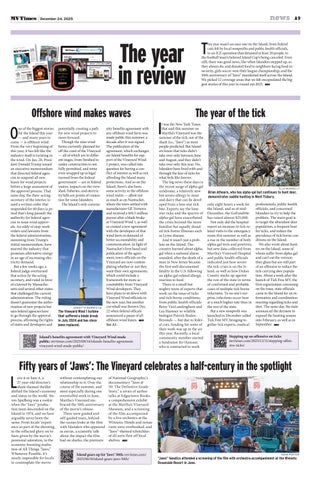
The Vineyard Wind 1 turbine that suffered a blade break in July 2024 and has since been replaced.
nity benefits agreement with any offshore wind farm was made public this summer, a decade after it was signed. The publication of the agreement, which exchanges on-Island benefits for support of the Vineyard Wind 1 project, was called into question for having a conflict of interest as well as not affording the Island many protections. And so on the Island, there’s also been some activity in the offshore wind realm — albeit not as much as on Nantucket, where the town settled with manufacturer GE Vernova and received a $10.5 million payout after a blade broke at Vineyard Wind 1, as well as created a new agreement with the developers of that wind farm in demand of better accountability and communication. In light of Nantucket’s firm hand and publication of the agreement, town officials on the Vineyard are now contemplating whether or not they want their own agreements, which could include a framework for more accountability from Vineyard Wind developers. They have plans to sit down with Vineyard Wind officials in the new year, but another curveball was thrown Dec. 22 when federal officals announced a pause of all offshore wind leases. See A1.
Island’s benefits agreement with Vineyard Wind made public: mvtimes.com/2025/08/14/islands-benefits-agreementvineyard-wind-made-public/
I
T
his year wasn’t an easy one on the Island, from federal cuts felt by local nonprofits and public health officials, to an ICE operation that detained at least 20 people, to the football team’s beloved Island Cup’s being canceled. Even still, there was good news, like when Islanders stepped up, as they always do, and donated food to neighbors facing food insecurity, girls soccer won their league championship, and the 50th anniversary of “Jaws” manifested itself across the Island. We picked 12 coverage areas that we felt encapsulated the biggest stories of this year to round out 2025.
The year of the tick
t was the New York Times that said this summer on Martha’s Vineyard was the summer of the tick, not of the shark (i.e., “Jaws”) as most people predicted. But Islanders know that ticks didn’t take over only between June and August, and they didn’t take over only this year. No, Islanders have lived with and through the fear of ticks for what feels like forever. The big news these days is the recent surge of alpha-gal syndrome, a relatively new but severe allergy to meat and dairy that can be developed from a lone star tick bite. Experts say the lone star ticks and the spectre of alpha-gal have exacerbated the crisis beyond the more familiar but equally dreaded tick-borne illnesses such as Lyme disease. And it wasn’t just a problem on the Island. The country learned about alphagal when a national alarm sounded, after the death of a man in New Jersey became the first well-documented fatality in the U.S. following an alpha-gal-related allergic reaction to food. There is a small but mighty team of experts that work on the issue of ticks and tick-borne conditions, from public health officials Betsy VanLandingham and Lea Hamner to wildlife biologist Patrick RodenReyonds — but due to federal cuts, funding for some of their work was up in the air this year. Recently, a local community member started a fundraiser for Hamner, who is contracted to work
ELLA MUNNELLY
Brian Athearn, who has alpha-gal but continues to hunt deer, demonstrates saddle hunting in West Tisbury.
only eight hours a week for the Island, and as of midDecember, the GoFundMe has raised almost $25,000. Not only did the hospital report an increase in tick-related visits to the emergency room this summer as well as a rise in the number of both alpha-gal tests and positives, but new data collected from Martha’s Vineyard Hospital and public health officials indicated just how severe the tick crisis is on the Island, as well as how Dukes County stacks up against the rest of the state in terms of confirmed and probable cases of multiple tick-borne infections. To no one’s surprise, infections occur here at a much higher rate than in the rest of the state. But a new nonprofit was launched in December called Tick Free MV, bringing together tick experts, medical
professionals, public health officials, and concerned Islanders to try to help the problem. The main goal is to target the abundant deer population, a frequent host for ticks, and reduce the prevalence of tick-borne conditions on the Island. We also wrote about hunters on the Island, some of whom suffer from alpha-gal and can’t eat the venison they glean but are still part of an offensive to reduce the tick-carrying deer population. About a week after the launch of Tick Free MV, the first organization convening on the issue, state officials came to the Island for an information and coordination meeting regarding ticks and deer. The same day, the state announced the decision to expand the hunting season into February, as well as in September.
Stepping up an offensive on ticks mvtimes.com/2025/12/11/stepping-offensive-ticks/
Fifty years of ‘Jaws’: The Vineyard celebrates a half-century in the spotlight
L
ove it or hate it, a 27-year-old director’s shark-themed thriller shifted the Island’s economy and status in the world. Steven Spielberg was a rookie when the “Jaws” production team descended on the Island in 1974, and we have arguably never been the same. From locals’ experience as part of the shooting, to the reflected glory we’ve been given by the movie’s perennial adoration, to the economy-boosting exaltation of All Things “Jaws,” Whenever Possible, it’s nearly impossible for locals to contemplate the movie
without contemplating our relationship to it. Over the course of the summer, and most especially during one overstuffed week in June, Martha’s Vineyard embraced the 50th anniversary of the movie’s release. There were guided and self-guided tours, behindthe-scenes looks at the film with Islanders who appeared as extras, a scientific talk about the impact the film had on sharks, the premiere
of National Geographic’s documentary “Jaws @ 50: The Definitive Inside Story,” a series of author talks at Edgartown Books, a comprehensive exhibit at the Martha’s Vineyard Museum, and a screening of the film accompanied by a live orchestra at the Winnetu. Hotels and restaurants were overbooked, and “Jaws”-themed tchotchkes of all sorts flew off local shelves.
Island gears up for ‘Jaws’ 50th: mvtimes.com/ 2025/06/18/island-gears-jaws-50th/
DENA PORTER
“Jaws” fanatics attended a screening of the film with orchestra accompaniment at the Winnetu Oceanside Resort in June.
A10
news
December 24, 2025
THE YEAR IN REVIEW
Islanders step up to help fill gaps
Island sports took center stage
W
e upped our Islandwide and high school sports coverage at The Times this year with a new monthly newsletter, the MV Sportsletter, and there was no shortage of athletes or teams to write about. The highlight of our coverage was when the high school’s girls varsity soccer team, which celebrated an overall historic season, won a league championship for the first time since 1999, after defeating the Nantucket Whalers away in October.
sociation playoffs, scoring 21 penalty shots to the Hornets’ 20. The shootout advanced the Vineyarders to the quarterfinals, where the girls fell in a heartbreaking game to the Tewksbury High School Redmen. The boys varsity soccer team also reversed its fate and recovered the Golden Anchor trophy from the Nantucket Whalers in October, after defeating the rivals in a shootout 4-2. It wasn’t all good news, though. In football, the
wing-foiled around the Island for the second time, cutting his time by over an hour from the previous year, and raising over $50,000 for Martha’s Vineyard Community Services. Elsewhere on the waterfront, Hurricane Erin’s winds forced many of the Vineyard’s southern beaches to close down, but not everyone steered clear of the shoreline. The powerful swells ignited the hearts of local surfers, who took to beaches like Mon-
T
he United States saw a new administration at her helm this year; the rudder has turned in new directions, and at times, into uncharted waters. Trump introduced more executive orders during his first year in office than any other sitting president in U.S. history. And some of those orders, bills, and federal policies have affected Island residents directly. Town library administrators were left reeling from funding cuts in the early summer, when an executive order reduced federal funding to libraries across the country. Nonprofits worried if they’d need to rethink their business models in the face of the executive acts, and some, like the Yard, even shut down temporarily. Local veterans were af-
fected after federal funding to PTSD treatment services was slashed. Tick research and illness prevention was under threat after health professionals salary funding was cut. And scientists in Woods Hole were left to pick up the pieces after a quarter of the Oceano-
graphic Institute employees lost their jobs in the spring. Then, substantial federal cuts came in the form of the “One Big Beautiful Bill Act,” a comprehensive spending initiative that hit local nonprofits and targeted social services. It also terminated tax credits for
NICHOLAS VUKOTA
Vinnie Padalino, Noli Taylor, and Merrick Carreiro from Island Grown Initiative with Mike Bellissimo from Harbor Homes at the food pantry.
New high school project amidst many leadership changes NICHOLAS VUKOTA
Girls soccer players dump water on Head Coach Matt Malowski to celebrate winning the Golden Anchor trophy.
The rivalry game against Nantucket, hailed as the coveted “Battle of the Atlantic,” also earned the Vineyard girls soccer team a third consecutive year with the coveted Golden Anchor trophy. To round out the memorable season, the girls soccer team also won a record-breaking penalty shootout against the North Reading High School Hornets in the second round of the Massachusetts Interscholastic Athletic As-
famous Island Cup against Nantucket, set to take place in November, was canceled after numerous injuries and multiple players’ suspensions for off-field infractions resulted in a severely reduced roster. Meanwhile, local athletes pushed themselves to raise money for local communities and educate the youth. In September, Hall of Fame windsurfer and Islander Nevin Sayre
drian House to catch the big waves. Also in September, a surf camp at Long Point Beach invited 13 eager sixth graders to learn the basics of catching waves under Garrett McNamara, a worldrenowned big-wave surfing pioneer and the main focus of HBO’s documentary “100-Foot Wave,” as part of a new pilot program aimed at educating youth about the power and peace of the ocean.
Girls soccer claims first Cape and Islands championship: mvtimes.com/2025/10/28/girls-soccer-claims-first-capeislands-championship/
of the immigrants detained in ICE’s processing center in Burlington, who described a harsh and unsanitary hold(ICE) conducting operations ing environment and an unhis has been a year of fear and uncertainty for on the Vineyard, but that certainty about what might many in the immigrant changed in May. happen to him. Federal agents conducted community, after intense Some detained immicrackdowns from the top of a broadstroke sweep of the grants were deported back to Vineyard, halting work trucks their countries, while others the federal government. In and checking for paperwork. late January, a false rumor fought to stay in the U.S. The operation led to at least that federal immigration Many in the Island’s Brazilenforcers were on the Island 20 people, nearly all Brazilian ian community found solace left many workplaces devoid immigrants, being detained through their church comon the Island and transported munity, but there was an of their usual employees, elsewhere by the Coast Guard. upswell of anxiety when ICE who were worried they The raid outraged many would be swept up by the threatened to implement Islanders, some of whom intensifying deportations. its Patriot 2.0 operation in Parents were worried wheth- directly confronted ICE Massachusetts in September. agents while they were on the While there wasn’t another er their children would Vineyard. Bits of information hit on the Vineyard, the be taken away at school. came out following the raid, owner of an Island restauMonths passed without the and one of our reporters was rant was detained by federal United States Immigration able to get in touch with one and Customs Enforcement agents in Falmouth.
S
tudents, teachers, and administrators in schools across the six Vineyard towns have had a transformative year, to say the least. Leadership changes were a common occurrence, Martha’s Vineyard Regional High School (MVRHS) is planning the most costly building project in Island history, immigration raids resulted in a decline in attendance, and administrators pleaded with lawmakers to pass affordable housing initiatives because of difficulties hiring staff. Childcare and the education of the youngest Islanders were found to be
in the midst of an extreme shortage, with costs out of reach for many families and waitlists spanning years. One preschool closed its doors, while others are hoping to expand. The high school has seen the most changes of all. Sara Dingledy, the principal of MVRHS, announced her move to an administrative position during the summer, and Sean Mulvey, a school counselor, was appointed in an interim capacity to the role. But while many hoped Mulvey would be the permanent principal, it was announced in December that he will return
to counseling after this school year. So, the search for a high school principal begins again. And that’s not the only turnover for local teenagers. The head of the Charter School, Peter Steedman, announced he will move off-Island after school is out in June. The superintendent of all Island schools, Richard “Richie” Smith, also shocked some educators and community members, when he said he’d be retiring, also in June. To top it off, the MVRHS building is in significant decline, with mold in the
Inside MVRHS: Asbestos, mold, and leaking pipes: mvtimes.com/ 2025/09/25/inside-mvrhs-asbestos-mold-leaking-pipes/
Fear among immigrants
T
ROBYN TWOMEY
U.S. Immigration and Customs Enforcement agents, with assistance from other federal agencies, detained at least 20 people on the Island in May.
ICE agents detain 20 people on Vineyard during Island’s sweep: mvtimes.com/2025/05/27/ice-agents-make-arrests-vineyard/
news A11
December 24, 2025
THE YEAR IN REVIEW
created by federal funding cuts wind and solar projects years earlier than planned, possibly slowing the development of offshore wind and shrinking the number of solar energy installations. Executives from the food pantry, the only winter shelter for unhoused people on the Island, and health services raised concerns about the bill this summer and the impacts federal cuts could have on Islanders. “This is a time that’s going to require a lot of creativity. We’re going to need community solutions, and we’re going to need neighbors helping neighbors. We live in such a caring community — [but this is] going to ask a lot of us,” Noli Taylor, co-
executive director of Island Grown Initiative, which runs the food pantry, said. Just a few months later, Supplemental Nutrition Assistance Program (SNAP) cuts hit local residents, and Taylor’s prediction stood the test of time. Farmers and business owners across the Island stepped up to provide free food services when over a thousand locals lost their food stamps for the month of November. Around the same time, this fall, changes to the health insurance market began because of the One Big Beautiful Bill Act, and a partisan divide in Capitol Hill over Obama-era insurance
subsidies caused the longest government shutdown in history. Local residents were affected in a few ways: Lawful immigrants lost state coverage completely, small business owners were disproportionately impacted by subsidy cuts, and many of the changes have remained largely unresolved, even after the government reopened. Still, Islanders prevailed. Nonprofit organizations stepped up with free food initiatives, scientists rallied to keep research funded, community events sparked joy, and neighbors sat down at the same table, passing warm homemade food to the person next to them.
Homelessness, food insecurity could rise with federal cuts: mvtimes.com/2025/08/04/homelessness-food-insecurity-rise-federal-cuts/
NICHOLAS VUKOTA
A student hugs her teacher on the first day of school in September in West Tisbury.
walls, asbestos under floorboards, and leaking pipes. But some controversy has been sparked over the high price tag on a planned
building project to address those concerns. Despite challenges, students engaged with the community and each other.
Teachers held down the educational fort and got cost-of-living raises in this year’s contract while doing it, something they had been advocating for in the past few years. School committee members met weekly to keep administrative wheels turning. Everyone involved in the high school building project planned, crunched numbers, and started to put some of the significant pieces of the puzzle together. The education of the next generation was taken seriously by those tasked with it, and many young community members celebrated successes and daily wins. Arthur Shoenherr, a first grader outside of the West Tisbury School on day one of this school year, encompassed the most important takeaway of all: “I have a good feeling I’m gonna make new friends,” he said to The Times with a smile.
DENA PORTER
One way Islanders have dealt with the housing crisis is through intergenerational living and building additional units on their property.
H
Home is where the Island is
ousing on Martha’s Vineyard has endured some significant ebbs and flows this year. From new affordable developments to cleared unhoused campsites, from overcrowded living conditions to new state tools for addressing the low housing supply and affordability, the stakes have been high. The year began with ballooning homeowners insurance premiums. Some Vineyard residents cited over 300 percent increases in yearly rates after multiple companies refused to continue covering homes in a place they deemed susceptible to storms. The only winter shelter for unhoused Islanders moved from its location at Martha’s Vineyard Community Services due to a planned demolition of the campus, and continues to struggle to find a permanent residence. Meanwhile, the number of unhoused Islanders has only increased. The nonprofit Harbor Homes reported that 341 people on the Island, that they know of, don’t have a home. Some hopeful action came in the form of hous-
ing initiatives by state and local governments. The Island received a seasonal communities designation, which opened up multiple paths that weren’t available before, such as residential tax exemption increases for year-rounders. Housing production plans, which each town drafted throughout the year with community input, are being finalized. The reports contain actionable five-year plans for town representatives to work toward a better housing landscape for their residents. Housing bank efforts are underway again as well, with representatives from schools, healthcare, nonprofits, and government advocating for the creation of a funding source for future housing initiatives — one that would operate similarly to the Land Bank. And another effort to bolster supply came from the state. The right to build accessory dwelling units, also known as ADUs, was passed as by-right legislation by Gov. Maura Healey’s administration, and then by each town in meetings last spring. While not a silver
bullet, the ability to build accessory units has worked well to add stock in housingstrained communities across the country. But the reality of housing on the Vineyard is that high costs, seasonality, and shortterm rentals have created barriers to progress for lowto middle-income families. Some have found themselves living in overcrowded conditions because there’s been nowhere else to stay. Others live in tents and yurts in the summer due to a lack of year-round rentals. Island residents have raised their voices all year about their housing needs. Some described the “Island shuffle,” a term that describes frequent seasonal moves. Others navigated outdoor living with their families, and the fear of tick-borne illness. Creative solutions were constant, and many locals had to think outside of the box in order to find shelter. But across dozens of interviews, Islanders described a love for the land, the community that resides on it, and a pervading desire to lift each other up through difficult times.
Accessory dwelling units: An intergenerational tool for housing challenges: mvtimes.com/2025/05/15/accessory-dwelling-unitsintergenerational-tool-housing-challenges/
A new age for the Steamship Authority
T
his year was busy — from a new ferry to union agreements — for the Steamship Authority, but the biggest change going into the new year is a transition at the top of the organization: the next general manager. In November, the Steamship Authority Board offered the general manager position to Alex Kryska, a ferry executive from San Francisco. Kryska beat out internal candidate and current Steamship chief operations officer
Mark Amundsen and finalized a $225,000-a-year contract earlier this month. Kryska will start his new role in January, replacing longtime Steamship General Manager Bob Davis, who announced last fall he’d step down from the position, following heavy public criticism of how the ferry line was being run. Finding a new leader was an arduous search for the Steamship Authority. Throughout the process, members of the board
Steamship offers top manager job to external candidate: mvtimes.com/2025/11/13/steamshipoffers-manger-job-external-candidate/
underscored how they had one shot to make the right choice in choosing a new leader. While over 130 candidates were reviewed, the board noted that scrutiny of the ferry line led some individuals to withdraw their applications. But that’s not all for the Steamship Authority. It welcomed a new freight vessel into its fleet and reached an accord with unions after months of negotiations. And as the year wraps up, there has even been a report on the waste of public funds involved in the Steamship’s website redesign project. See A1.
MV TIMES
As the Steamship Authority prepares to bring on a new general manager, the ferry line was hit by a report from the inspector general saying it had wasted millions of dollars.
A12
news
December 24, 2025
THE YEAR IN REVIEW Island Music’s closing and its downstream reverberations
T
his past year saw the closure of a startling number of established Island businesses. Longevity is a perennial challenge for restaurants and boutiques in resort communities, but the recent slate of Vineyard closures is notable because it includes downtown anchor businesses, such as Leslie’s Drugstore in Vineyard Haven (in late 2024) and Phillips Hardware and Benito’s Hair Styling in Oak Bluffs. The closing of Island Music (Main Street, Vineyard Haven) creates particular hardships because of the store’s unique, multigenerational contribution to the quality of life for year-round students as well as musicians and oth-
ers. Aside from being the Island’s only local source for instruments and gear, the store offers music lessons and repairs and hosts open-mic nights. Beyond this, however, Island Music facilitates the rental to Island school children of orchestral, wind, and percussion instruments through Music and Arts, a national rental agency affiliated with the Guitar Center. Andy Herr, who hosts open mic nights there in winter, said, “One of the most important services that the music store provides is not just renting the instru-
ments to the kids, but being able to have one on hand for them to have continuity in their music education, their music programs in the schools. To me, that is an invaluable thing that can make the difference between a kid continuing or not continuing to do something that can be their life’s passion. Enabling that makes it very valuable to a whole generation, to multiple generations of people.” The Vineyard Haven Harbor Cultural District is leading the charge to find ways to save the iconic and muchneeded shop.
Island Music on the rocks: mvtimes.com/2025/11/03/island-music-rocks/
MV TIMES
Longtime store manager Becky Williams, founder Ed Griggs, and Andy Herr at Island Music, which is only one of many Vineyard mainstays to close or announce closing this year.
COURTESY SUSAN NABRESKI
Capt. Bob Douglas, who made a lasting contribution to the Vineyard Haven waterfront, is one local legend the Island lost this year.
T
Remembering those we lost
he Island lost a beloved icon in April of this year: Captain Robert (“Bob”) Douglas, a beloved waterfront legend who sailed Vineyard seas aboard his tall ship and founded the Black Dog Tavern. Originally from Chicago, he developed a fascination with sailing during his summers on the Island. After his time in the United States Air Force, Douglas worked as a deckhand in Maine, where he later constructed the topsail schooner Shenandoah, and sailed to the Vineyard in 1964. Douglas is widely credited for making Vineyard Hav-
en’s working waterfront into the world’s wooden-boat mecca, with the Shenandoah standing tall to greet those who enter the harbor. But he is also remembered for his mentorship of young Islanders, leading many to have cherished summertime memories of being aboard the Shenandoah in fifth grade. Family and friends gathered in September to remember the irreplaceable member of the community with a final sendoff for Douglas. Words can never perfectly capture the intricate lives led by the many memorable souls who de-
part the Vineyard, and this year is no exception. Sam Feldman, a visionary Island philanthropist and entrepreneur who helped bring various beloved institutions like the Martha’s Vineyard Public Charter School and the Martha’s Vineyard Film Center, died in January. Dr. Michael Jacobs, who brought laughs to patients and was adamant on having a dedicated health center on the Vineyard, died in August. Peter and Cora Weiss, who led inspiring lives of service to others in a mission for peace, died in November and December, respectively.
Capt. Robert Douglas, waterfront legend, dies at 93: mvtimes.com/2025/04/23/capt-robert-douglas-waterfront-legend-dies-93/
Celebrating the working waterfront
B
efore there was “Jaws,” before there was tourism, before there was a seasonal economy — before there were European settlers, even — there was the sea. The Island’s identity is by definition maritime, and in 2025, The Times has especially celebrated the role of fishing, boat-building, and other open-water industries in its reporting. The charter of the Fishermen’s Preservation Trust is, in its own words, “safe-
guarding Martha’s Vineyard’s fishing heritage and future by supporting the Island’s small-boat, owneroperated fishing fleets and their sustainably harvested catch.” To promote their message and inspire engagement, the Trust, along with Catherine Walthers, created a beautiful and eye-opening book, “Sea to
Table,” full of stories, recipes, and information about the mission to sustain the working waterfront. As well as the fishing and shellfish industries, we lifted up the world-renowned wooden boat builders Gannon & Benjamin, as they take stock of their long history and turn their attention to the next generation.
From sea to table: mvtimes.com/2025/11/28/from-sea-to-table/
LUKE DIORIO
Meet the Fleet, an annual event by the Martha’s Vineyard Fisherman’s Preservation Trust in Menemsha, showcases the Island’s commercial fishing industry.
BECOME AN MV TIMES MEMBER TO SIGN UP SCAN QR CODE OR VISIT MVTIMES.COM/MEMBERSHIP/ Join the MVTimes as a member today and make the pledge to support independent, local journalism. Choose any of our three tiers of membership and become a valued part of our community-supported news organization. Each level includes an opt-in to receive the weekly print edition and/or access to our daily online coverage.