Martha’s Vineyard
ARTS IDEAS &
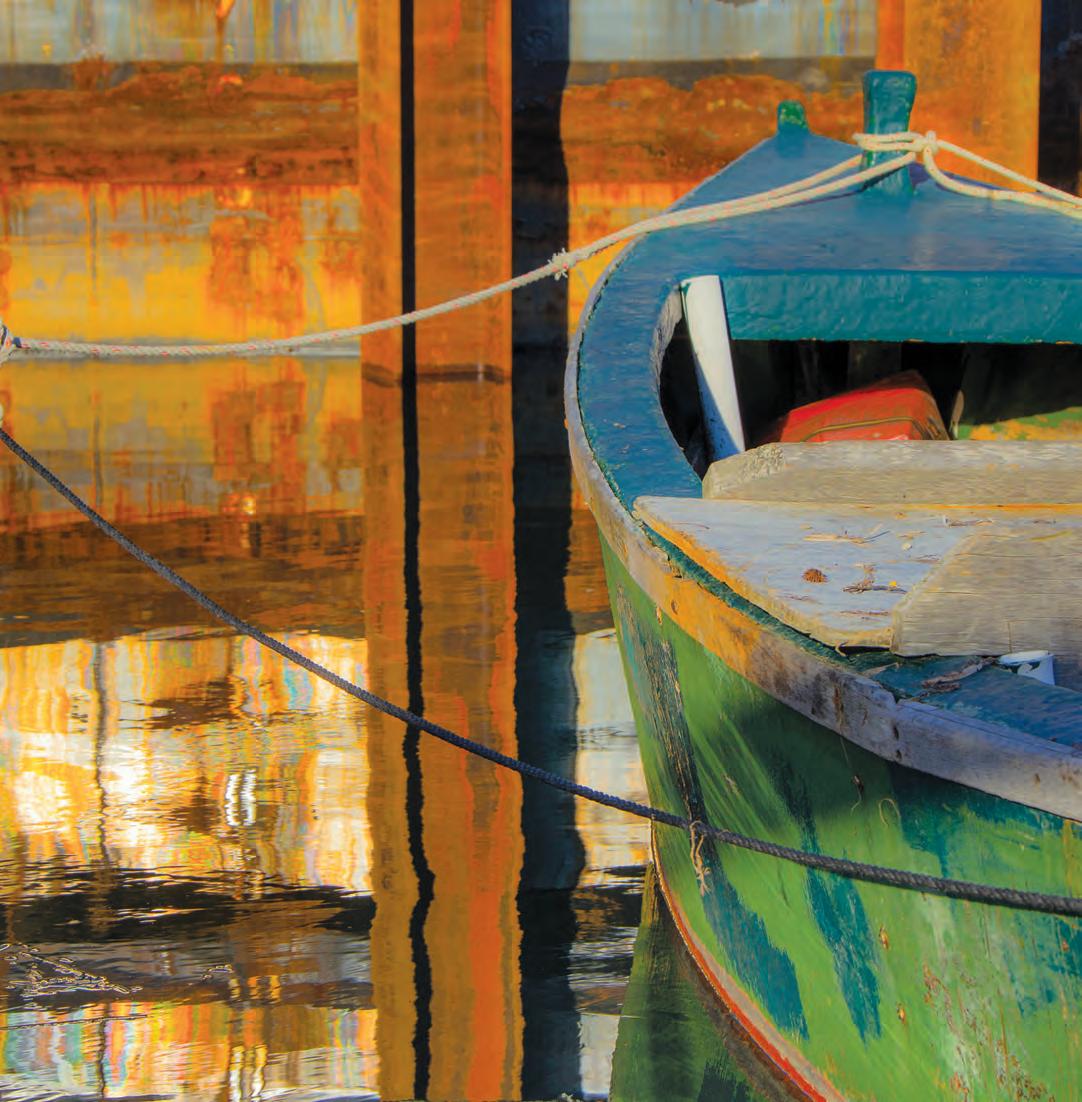

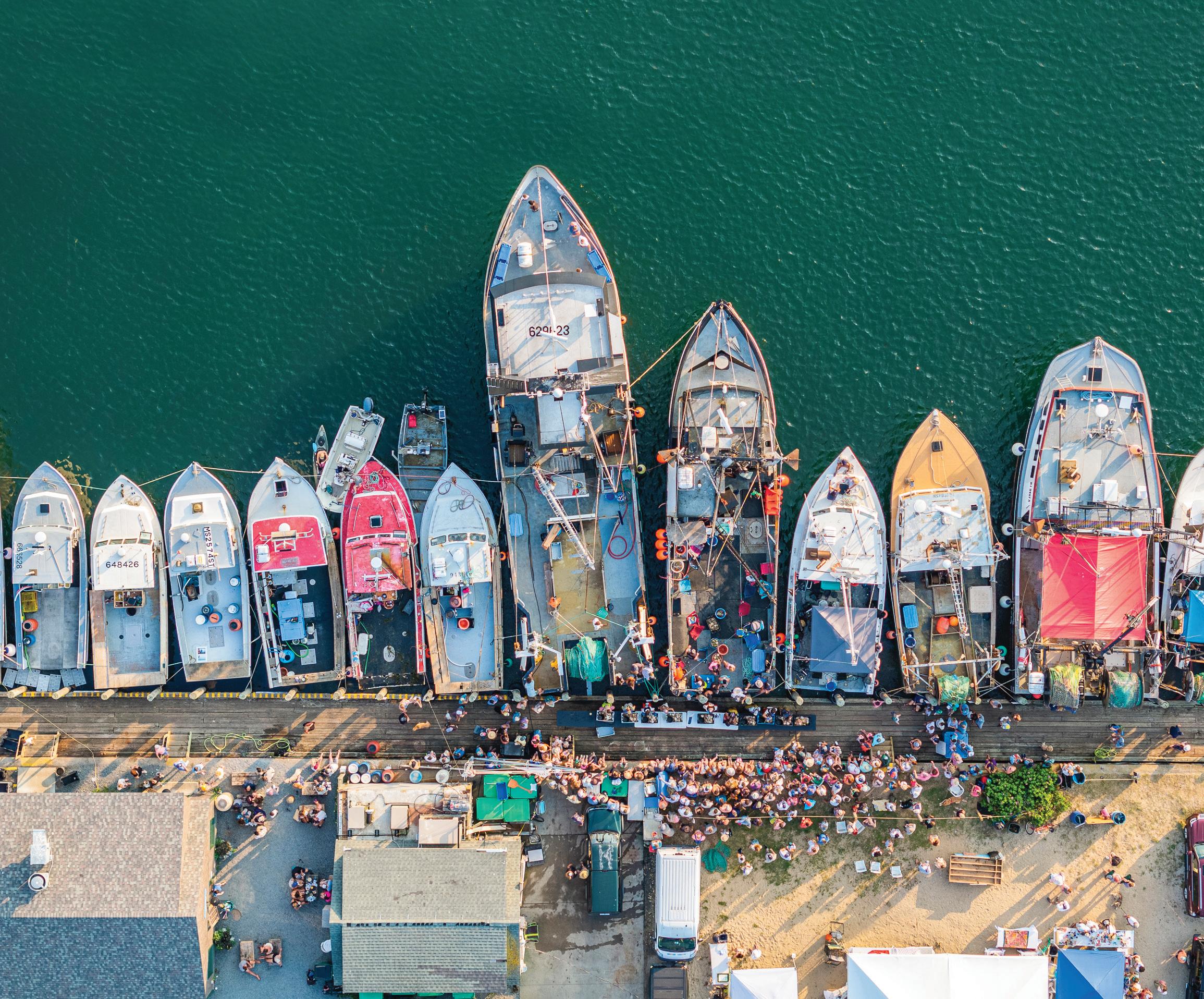
The working waterfront
By Hayley Duffy
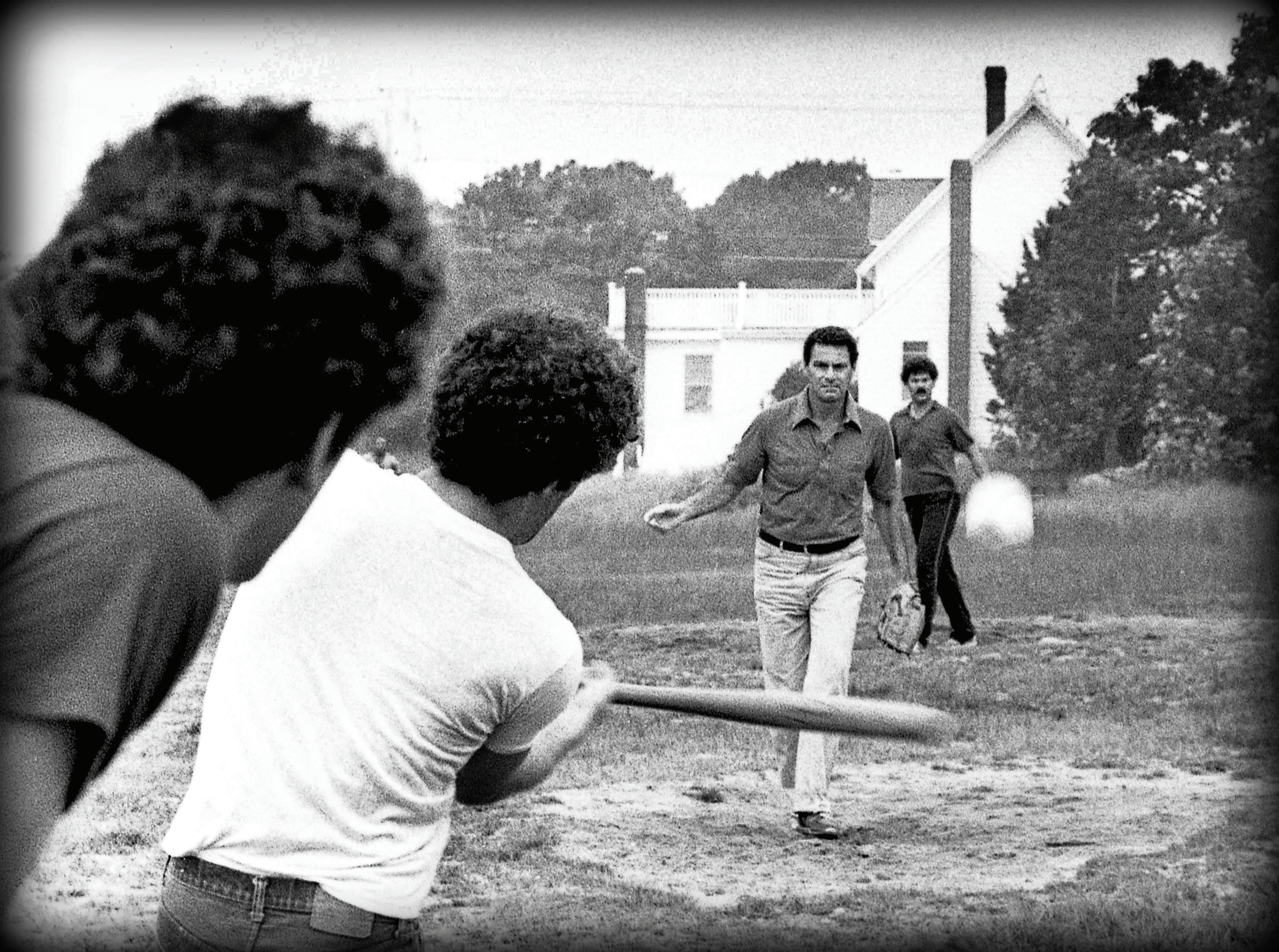
100 years of softball
By Sig Van Raan
Art at MV Hospital
By Abby Remer
508.645.2628

Notable Estate in Pilot Hill Farm, Vineyard Haven
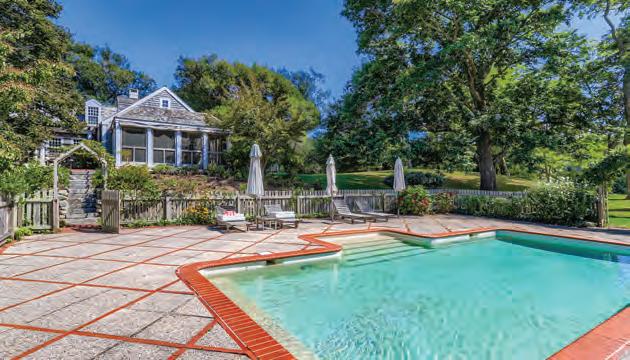
For the first time in 37 years, an extraordinary property within Pilot Hill Farm is for sale. Set on nearly 8 acres, this unique estate features a meticulously renovated historic farmhouse, two artist studios, a converted barn/3 car carriage house, and a spacious pool house. Surrounded by meadows, gardens, a pond and brook the grounds evoke a peaceful, arboretum-like retreat. Private beach, conservation trails, and association farm access. Exclusively offered at $6,495,000.


TURPENTINE GALLERY
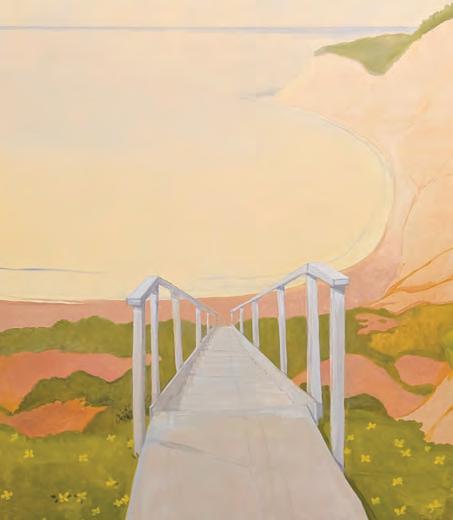
Featuring Fine Art by Mitch Gordon and Steve Lohman
554 State Rd. West Tisbury · 508 693-5963
Celebrating the majesty and wonder of island life



“Penumbra” Oil on canvas 72 x 48 by Mitch Gordon


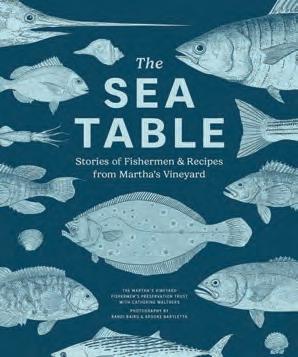


From Vineyard Waters to Island Tables
The Sea Table is more than just a cookbook. It’s a tribute to the waters that surround Martha’s Vineyard and to the fishermen who work hard to bring seafood to our tables.
It features 75 recipes curated from Island cooks, chefs, and fishermen; involves 19 seafood species found in Vineyard waters — from bay scallops, to fluke, to yellowfin tuna; profiles 21 local fishermen; and invites you into a world where fresh, sustainable seafood is a way of life. Whether you’re a seasoned cook, a seafood lover, or just someone who cares about where your food comes from, this book offers an inspiring — and delicious — way to eat locally.
SUPPORT OUR ISLAND STORES, BUY LOCAL!
Find The Sea Table at: Alley’s General Store, Beetlebung Farm, Bunch of Grapes, Copperworks, Edgartown Books, Larsen’s Fish Market, LeRoux, Menemsha Fish Market, Menemsha Texaco, and Seven Sisters.

Martha's Vineyard
ARTS IDEAS &
Publisher Charles Sennott
Managing Editor Nicole Galland
Features Editor Allison Roberts
Creative Director Kristófer Rabasca
Contributors
Abby Remer, Dena Porter, Joshua Robinson-White, Robyn Twomey, John Battelle, David PB Stephens, Roberta Kirn, Brian Ditchfield, Jack Fruchtman, Brooke Bartletta, Claire Callagy, Larry Glick, Randi Baird
Production Manager
David Plath
Copy Editor
Jessica Leaman
Ad Sales
Chesley Wiseman, adsales@mvtimes.com
Contact
Martha’s Vineyard Arts & Ideas
The Martha’s Vineyard Times P.O. Box 518
30 Beach Road
Vineyard Haven, MA 02568
MVArtsandIdeas.com
MVArtsandIdeas@mvtimes.com
Facebook: facebook.com/mvartsandideas
Twitter: @mvartsandideas
Instagram: mvartsandideas
Martha’s Vineyard Arts & Ideas magazine is published by The Martha’s Vineyard Times, a media group that includes the daily newsletter The Minute, Vineyard Visitor and the websites MVTimes.com and VineyardVisitor.com.
You can see the digital version of this magazine at mvartsandideas.com. A&I is available at newsstands, galleries, and bookstores, free of charge. Back issues are available for $10 each.
Please inquire at mvartsandideas@mvtimes.com about subscriptions by mail.
On the Cover
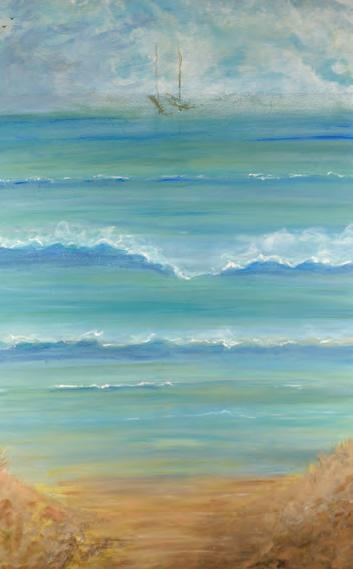
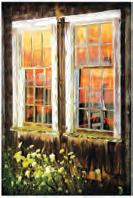
'Reflections - Menemsha' photograph by Gwen Norton
HA NOTE FROM THE PUBLISHER
The Island’s Living History
istory is like the shoreline: constantly changing and evolving based on both gradual processes and sudden, dramatic events. History, and the way it is recorded here on the Island, lies at the center of this edition of Arts & Ideas. The phrase “living history” has always been enticing for me, one that breathes with a wonderful double entendre. On one side of the phrase, we are indeed living through history, especially these days, when we find ourselves in a truly historic moment for the Republic of the United States, as Jack Fruchtman writes in his piece about this summer’s 250th anniversary of the Declaration of Independence. And on the other side, history itself is living, and constantly being interpreted and reinterpreted by the writers, artists, photographers and all others whose work is honored in this magazine.
The centerpiece of this issue is “Sea to Table,” a beautifully written essay by Hayley Duffy, our environment reporter and news editor, about the history of the Island’s fishing industry. Duffy takes you inside the ramshackle docks of Menemsha to introduce you to the fishermen, young and old, who navigate the waters of an industry that has always been vital to Martha’s Vineyard, from the Wampanoag culture dating back thousands of years, through the 19th century heyday of whaling ships, to today.
A tribute to the late fishing boat captain Roy Scheffer is a contribution by Will Sennott, a freelance writer who works on fishing boats himself.
Another sweeping piece that tells the story of the Island through time is about the
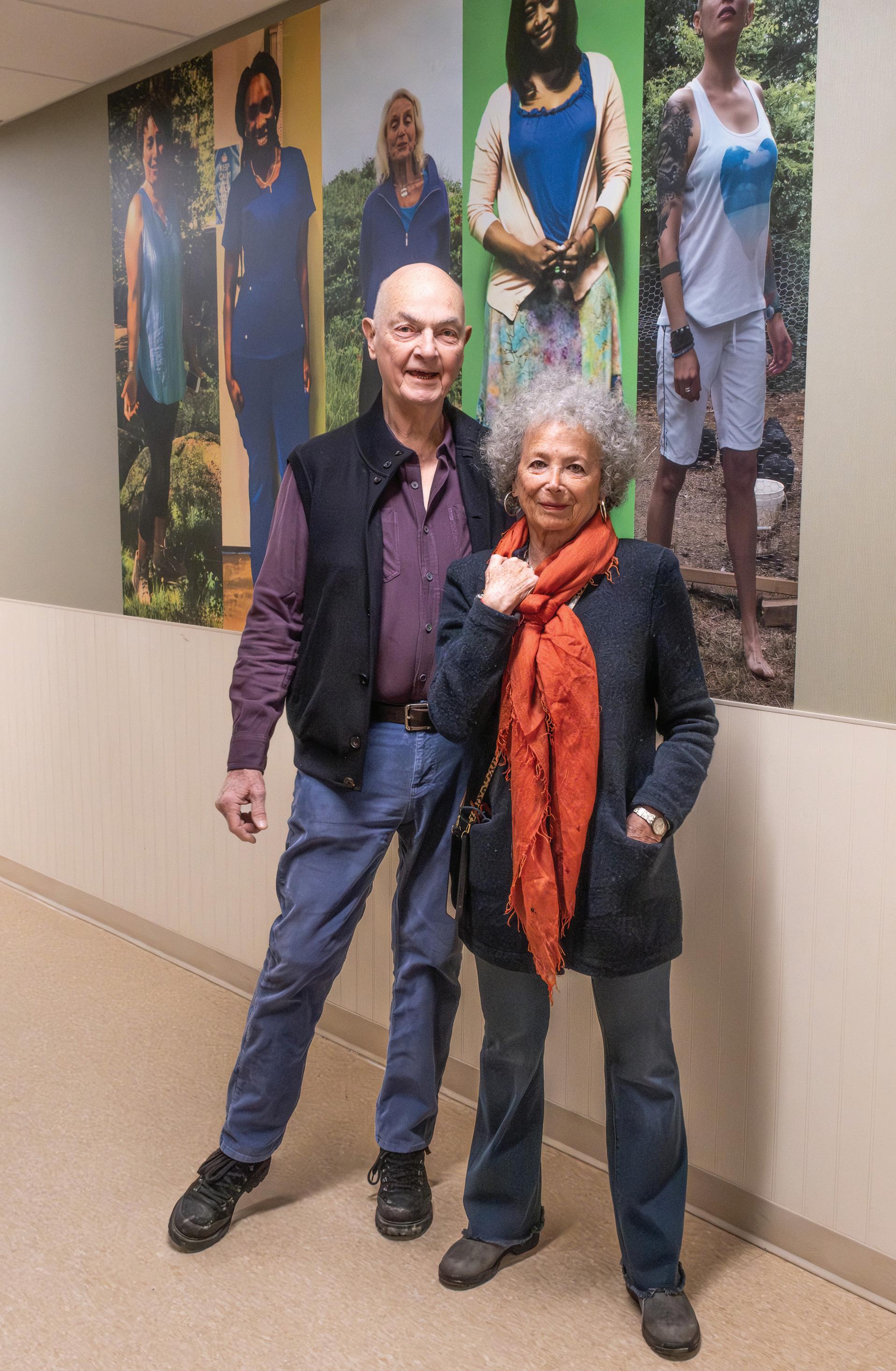
art museum that winds its way through the corridors of the Martha’s Vineyard Hospital. This collection is the labor of love of Chilmark residents Edward Miller and Monina von Opel. As our lead arts writer, Abby Remer, shares, Miller and von Opel believe
deeply in the healing power of art and have made it available to all of us. Patients and their families, as well as medical staff, are blessed to have this extraordinary collection to explore. The works are largely by Island artists, and in many ways the art itself tells the living history of our community of painters, sculptors, and photographers.
Some of those outstanding artists are also featured here in written profiles, like
painter and sculptor Tom Maley and photographer Michael Johnson. Both artists have provided us with works that stand as iconic symbols of the Island – Maley’s joyous figures dance with sublime joy in the fields of West Tisbury, and Johnson’s compelling images trace the history of art and culture in the community of Oak Bluffs, and embody the Black heritage that shapes the shoreline of Inkwell Beach.
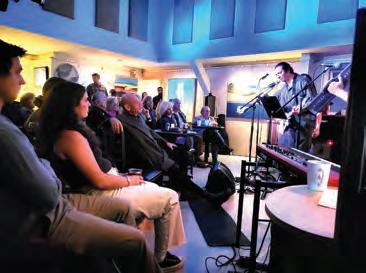
There are other forms of expression celebrated in this magazine, as well. Circuit Arts director Brian Ditchfield contemplates the historical moment for Island theatre as two institutions merge to become greater than the sum of their parts. The Times’ managing editor of features, Nicole Galland, covers the spirit of the all-inclusive and whimsical dance festival Built on Stilts. David PB Stephens celebrates the timeless fiddling of the Flying Elbows, and John Battelle takes us down into the underground rock of a hidden radio station in Tisbury.
And then the magazine brings it all home with a poetic ode to Chilmark’s storied softball league, which may be one of the oldest pickup games in the country. Sig Van Raan, who is among those who lay claim to the title “commissioner,” writes an elegiac piece about a century of tradition. No one is sure when exactly it started, back in the 1920s or perhaps early ’30s, but softball was born of the Great Depression as a fun way for families to gather, celebrate “America’s greatest pastime,” and endeavor to forget about the economic forces – and vast disparities of wealth – that were grinding at the time. Sound familiar? Yes, these days are filled with history repeating itself, a living history that every day is shaping our Island in new ways and old.
We hope you enjoy taking a walk along the shoreline of history with Arts & Ideas.
Best always, Charlie

Charles M. Sennott, publisher
The Martha’s Vineyard Times
“Nature’s Treasures,” Sandra Pimentel.
By Charles Sennott
Abby Remer
By Hayley Duffy
Working
By Sig Van Raan
6 Michael Johnson
By Abby Remer
A conversation with “that guy” behind the photographic ode to joy and other images frm the Inkwel.
30 The legend of Roy
By Will Sennott
A remarkable life and legacy from the working waterfront. 32 Playing the field
By Abby Remer
The life, times, and labors of the irrepressible Tom Maley, the Field Gallery’s joyful visionary.
38 The math of a merger
By Brian Ditchfield
Two iconic arts organizations join to become more than the sum of their parts.
46 The Revolutionary War and the Island of Martha’s Vineyard By
Jack Fruchtman
An imperfect reflection of mainland politics.

Going underground By John
Battelle
Meet the rogue music lovers at WVVY.
Nicole Galland
Abby Bender and the radical inclusivity of the annual Built on Stilts dance event.
GALLERIES
& STUDIOS 45 Island list of galleries and studios

Michael Johnson knew he was witnessing something special when he first encountered the Oak Bluffs Polar Bears at Inkwell Beach in 2010. His iconic black-and-white photograph of about 20 participants standing breast-deep in calm waters, arms raised in a sacred salutation, exemplifies the essence of its title, “JOY.”
The photograph embodies the spirit of the beloved Inkwell Beach ritual, which began in 1946. The Polar Bears’ early morning water exercise class was created as a haven for Black swimmers during segregation.
“The Inkwell” became a popular spot for Black people in Oak Bluffs in the late 19th century, as more African Americans arrived for religious revival, for work, for vacation, and to buy property. “Inkwell” was originally a pejorative nickname for the beach, referencing the dark skin of the sunbathers. Over time, the African American community reclaimed the name, turning a racist slur into a badge of pride in their presence and community.
Johnson first heard the term “Inkwell Beach” in 1994, but he says it wasn’t commonly used until around 2008. “I knew the history of it as a beach frequented by Black people, but it didn’t have this whole association of being Martha’s Vineyard’s Black beach until more recently.”
imagined, leading to the monikers ‘The People’s Photographer’ and ‘That Guy!’ It has been placed in public areas to the point of ubiquity, acquired innumerable times, and gifted to visiting luminaries, including baseball legend Hank Aaron and Supreme Court Justice Ketanji Brown Jackson, at public events. I am the sole artist focusing on that historic spot consistently and long-term.”
Johnson reflects the diversity of those who visit Inkwell Beach, which, like Oak Bluffs itself, is filled with people of all ages, backgrounds, and races. He believes it’s important to show this reality, because, he says, “The media is putting in people’s minds that [these places] are exclusive to Black people. Inkwell Beach is always one that Black people have frequented, but it’s a town beach.”
Michael Johnson at the Inkwell
A photographic ode to joy.
BY ABBY REMER
Johnson began photographing landscapes at Inkwell Beach in 2009, but it was the following year that he first experienced the Polar Bears, at his friend Carleen Cardwell’s urging. “One morning, I had a couple of hours and went down to see what the Polar Bears were doing.” He recalls the magical moment when he saw the first two ladies start to wade into the water: “It was very flat and calm. I photographed them, and it just hit me: What they are doing is really important, and this is something I need to photograph and be involved with long-term.”
Johnson continues, “Since I created ‘JOY,’ it hasn’t just opened but kicked down countless doors of opportunity and led to a level of professional and personal popularity that I never could have
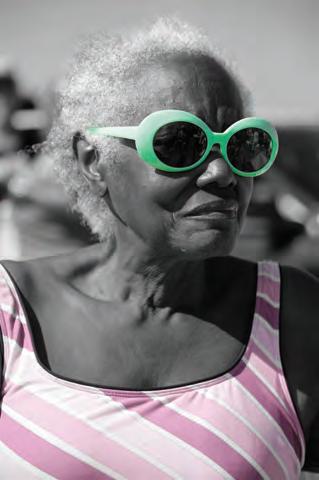
Johnson is a master at capturing his subject’s essence in a single moment. He moves in close in his portrayal of the Rev. Deacon Gloria Wong at 95 and a half, the oldest living Polar Bear at the time. The garlands encircling her head and around her neck frame her beatific countenance, radiating a kind soul.
Johnson creates a dynamic diagonal in “Dr. Lorna Andrade — Polar Bear — 2018.” As our gaze travels from the lower right upward toward the left, we stop halfway at Dr. Andrade’s elegant hands, which appear as if in prayer. Shaded by a floppy hat, she holds an umbrella decorated with a Monet painting in which a woman in a bonnet holds her own parasol.
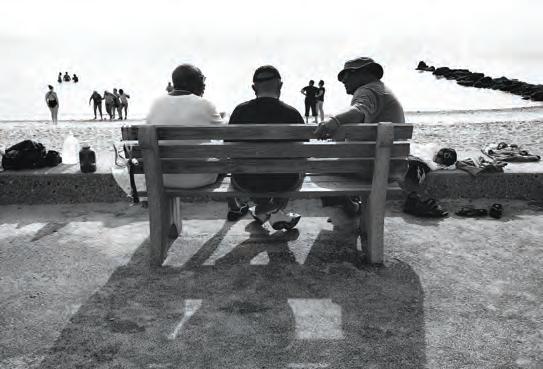
Johnson creates an intriguing play of shadows right at our feet in his “Polar Bear Men Converse.” Three friends sit with their backs to us, silhouetted by the calm waters dotted with bathers, including a small trio in the far distance on the left and a receding jetty to the right.
In 2017, Johnson created signs honoring Inkwell Beach and the Polar Bears and surreptitiously installed them at 3 am. “That morning, everyone was stunned and happy to finally have something publicly representing their beach and the Polar Bears. People loved it and took photographs with the signs.” Although the
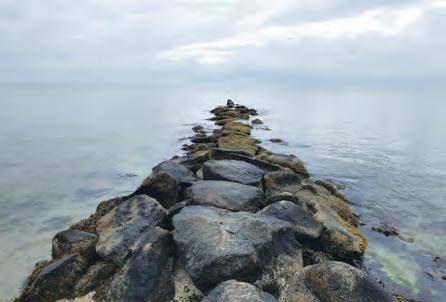
“Inkwell Jetty.”
PHOTOS: MICHAEL JOHNSON
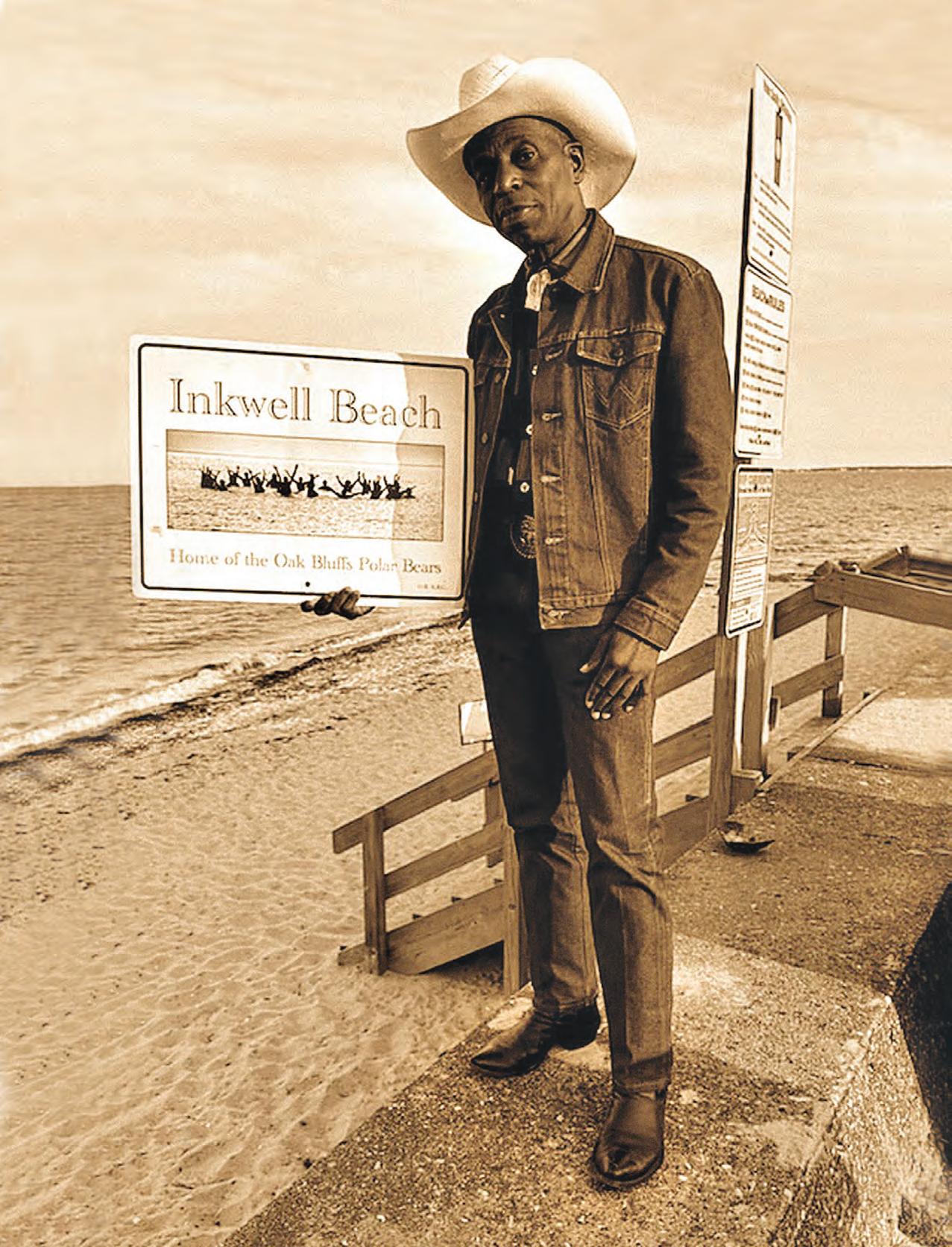
“‘That Guy' —Standing Tall”
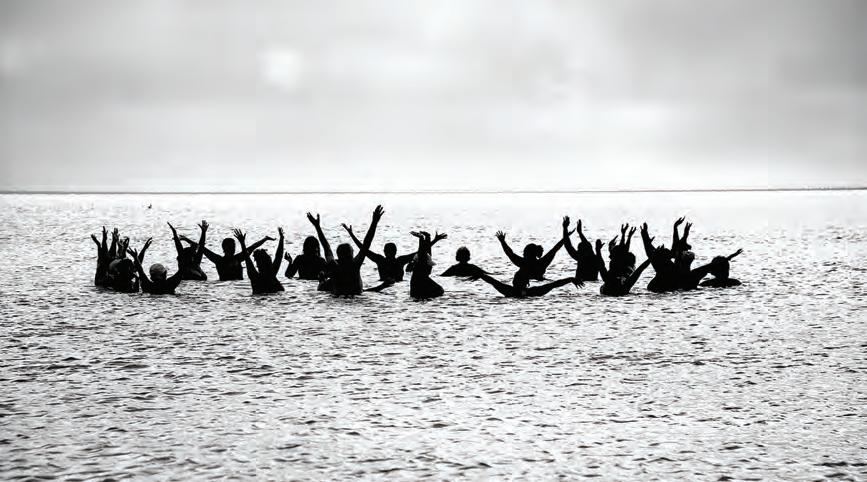
“JOY.”
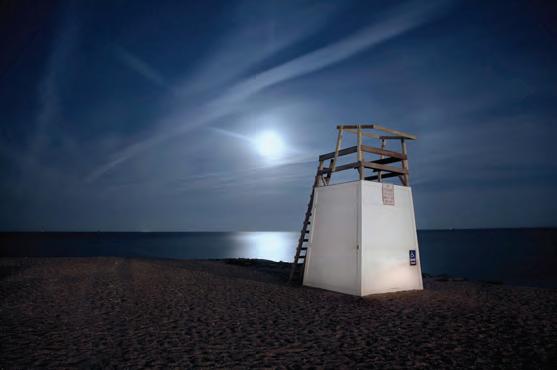
“Inkwell Nocturne.”
authorities allowed the signs to remain that season, he did not win permission the following summer.
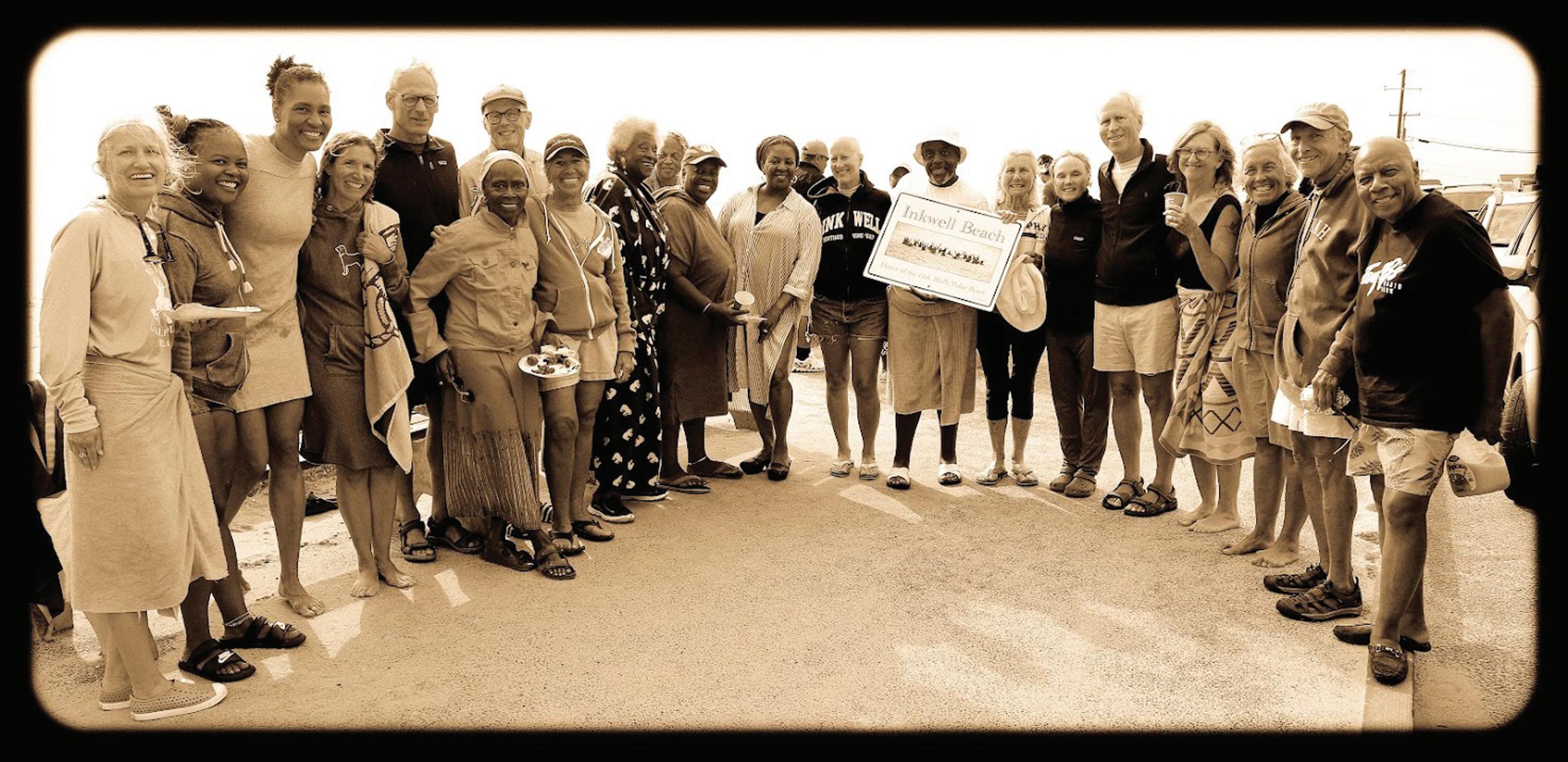
On Juneteenth 2024, Johnson launched a new series, “Inkwell Folks,” photographing diverse people holding the sign. The warm sepia tones in the photos add both a historic connotation and a softening of the image. “When I started processing them, I thought, ‘Color just won’t do it. It’s not documentary and artsy enough for my sensibilities.’ In black-and-white, they felt too cold. The sepia gives it an old-school feel and a sense of nostalgia, making it eternal — past, present, and future at the same time.”
We can see Johnson, too, in one of the “Inkwell Folks” series. He stands out anywhere as a consistently natty dresser, attired in his signature Italian-made cowboy boots and a stylish hat. He shares, “As a kid, my mom taught me that you had control over how people perceive you by your dress. I’m as much my palette as the photographs.”
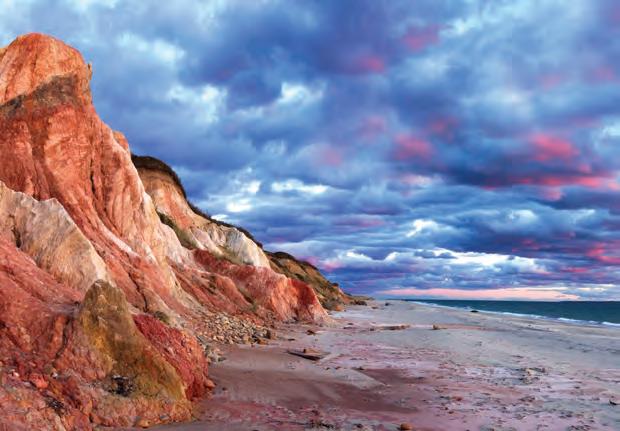
Johnson is also a master at landscapes, as seen in his stunning images of Inkwell Beach and those around the Island, including
“My photography of this beach and its people is an excellent conversation starter for many topics of history and culture on M.V. and in the wider world.”
–MICHAEL JOHNSON
his breathtaking “Red Clay and Clouds” of the Aquinnah Cliffs. “People always ask how I got the pink in the clouds. I say, ‘That’s how it looked. We don’t do AI here.’”
In 2012, Johnson opened his little gem of a gallery, nestled away off the beaten path behind Claudia Jewelry in Vineyard Haven. The brightly painted pink interior brims with gorgeous photographs of the Vineyard, made all the more luscious by the breeze and dappled sunlight streaming in from the patio and garden oasis.
“At my gallery, we also share about the history and culture of
“Johnny — Polar Bear.”
“Polar Bear Men Converse.”
PHOTOS: MICHAEL JOHNSON
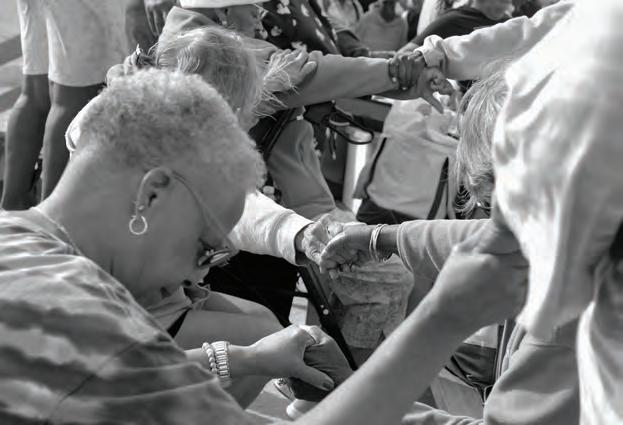
“EverybodyTouch Somebody.”
Inkwell Beach and Martha’s Vineyard, both of which I have read about and studied in depth. My photography of this beach and its people is an excellent conversation starter for many topics of history and culture on M.V. and in the wider world.”
Today, Inkwell Beach is bustling with Polar Bears wading in the water and many people taking part in yoga classes on the beach. Johnson is there with his camera, capturing the daily rituals, memorials, prayer vigils, birthdays, and celebrations of all kinds as people come and go. “The attraction is to document that history. I have photographed Inkwell Beach since 2009, and it will be an ongoing project until I’m pushing up daisies.”
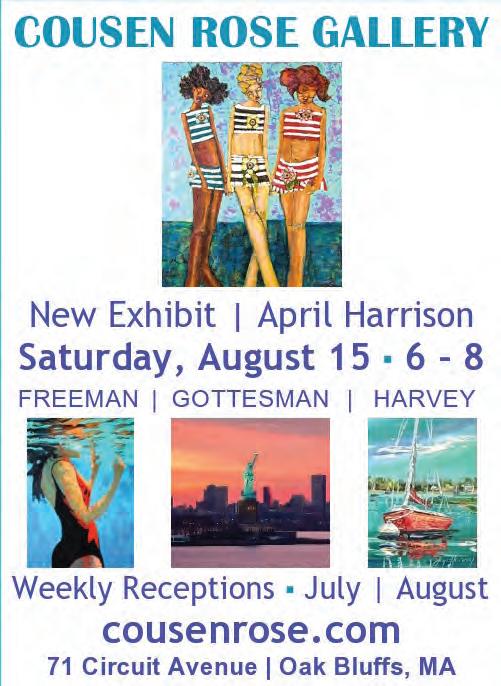
Michael Johnson’s work can be seen at the Michael Johnson Photo Gallery, 34A Main St., Vineyard Haven (next to Nat’s Nook), and the Cousen Rose Gallery, 71 Circuit Ave., Oak Bluffs. He also organizes the free weekly Photographers Salon at Featherstone on Tuesday evenings during the summer.

Davis House Gallery
985 State Rd., West Tisbury · 508-693-4691 · www.allenwhiting.com Gallery Open July 5 - Sept. 6 Saturdays & Sundays from 1-6 pm AND by Appointment

MICHAEL JOHNSON AT THE INKWELL PROFILEE
“Red Clay and Clouds.”
Going underground
Pirate radio goes legit at WVVY.
BY JOHN BATTELLE
Every Islander knows the drill: stuck in a line of traffic, slowly navigating one of the inescapable left-turn-fueled bottlenecks that bedevil our Island. Bored and possibly annoyed, we turn to our radios, hoping for a distraction to help pass the time.
This was my plight a few years back, crawling toward Cronig’s Market in Vineyard Haven in my old Jeep. Summer congestion at least affords an opportunity to explore the dial.
I gambled with the scan button, prepared to be disappointed. There must
be something worth listening to. That exhausting clutch of NPR stations clinging to the bottom frequencies, rich in catastrophe and impotent complaint? Skip. The predictable treacle of corporate rock stations, the incidental banter of sports talk radio — skip and skip.
Then … magic. The scan function settled on a tune that caught my ear.
“I am waaaiting,” an unmistakable voice pleaded. “I am waaaaiting.” I couldn’t quite place it, but the song had all the trappings of a Stones deep cut, replete with dulcimer, harpsichord, and Charlie Watts’ signature backbeat.
“Damn right I’m waiting,” I chuckled to myself, pausing the scan to hear the rest of the tune. We’re all waiting at this particular corner of State Road. Curious, I grabbed my phone and launched the music-finding app Shazam, all the while edging my Jeep past Look Street and toward Cronig’s.
I was right — it was the Stones, and it was a very deep cut: “I Am Waiting,” the tenth tune on “Aftermath,” the 11-track album that the band recorded in 1965.
I eyed my radio’s dial. For the very first time, it rested on an unfamiliar frequency: 96.7 FM. No call letters, just “96.7” — prime
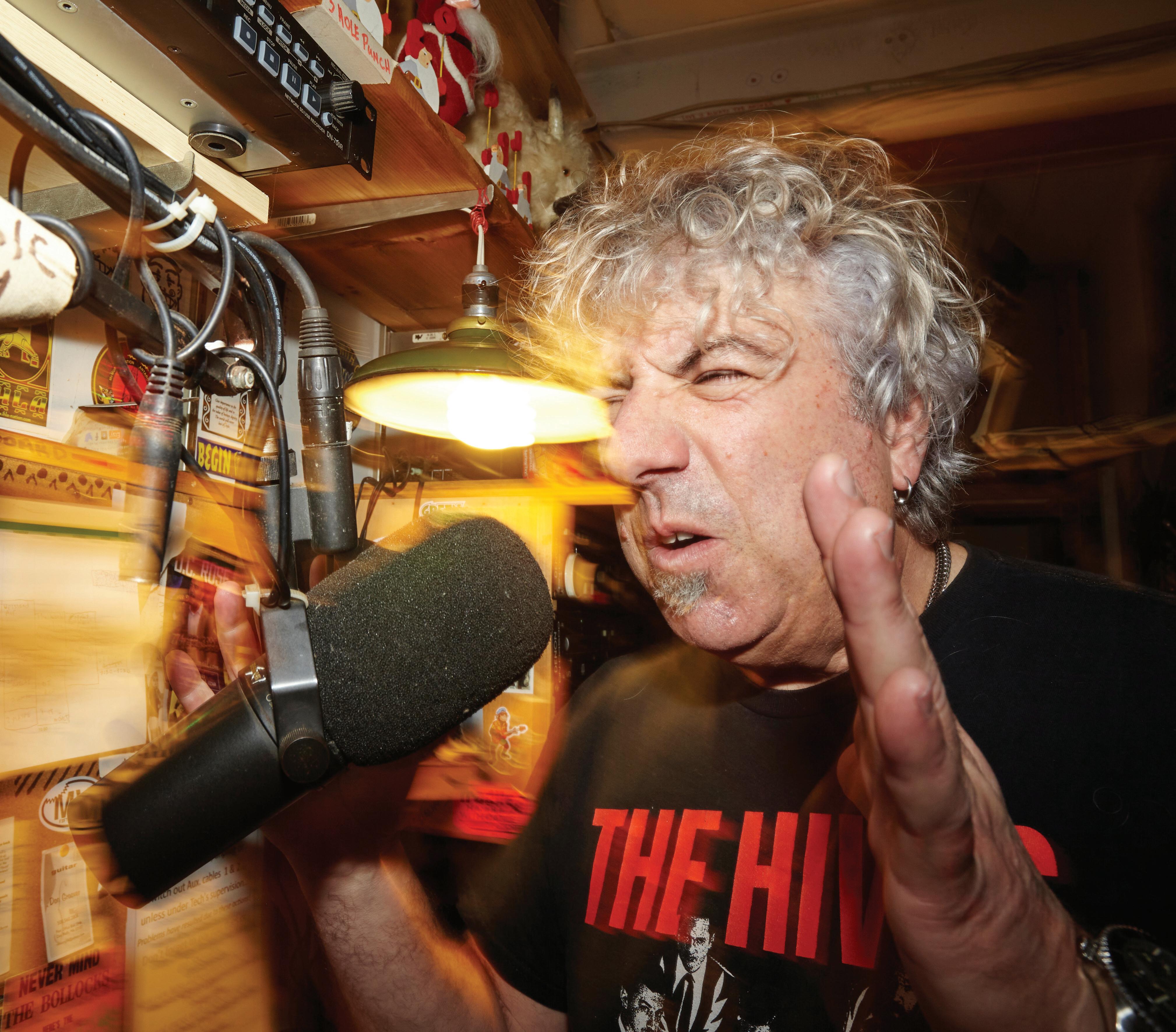
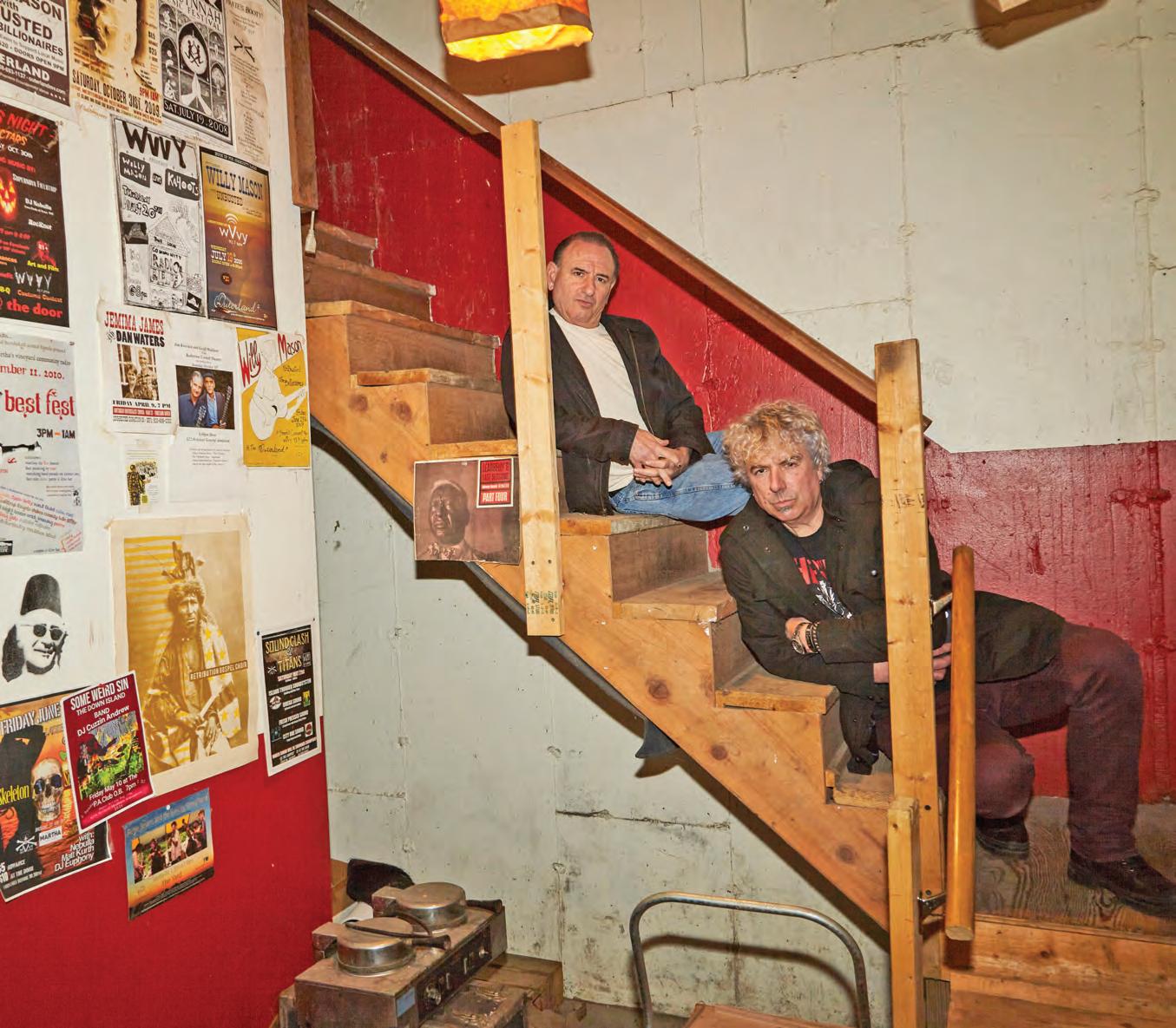
Community radio station WVVY in Tisbury: Richard Fischer, left, and Rick Padilla, a.k.a. “Rock ’n’ Roll Rick.”
radio real estate. Who plays deep Stones cuts in the middle of the day — on this Island?
The next tune came on, a jarring, postpunk tangle that felt vaguely familiar. Shazam told me it was “Rat Trap” by the Boston Spaceships. Not exactly a hit. Who’d ever play this song?
I decided to wait in my car, figuring a DJ would offer me some much-needed context. But the next song was a blues cut so obscure that even Shazam couldn’t find it. On and on it went — a B-side from the Beach Boys, an old Michael Hurley folk track.
For 15 minutes, no DJ came on, and no ads played, either. This station simply made no sense. It was as if some grinning trickster had hijacked the airwaves with a giant jukebox containing thousands of completely unrelated tunes.
Was there an underground radio station in the heart of our little Island?
As with nearly everything worthwhile on the Vineyard, I found the person responsible for the station — call letters WVVY — through word of mouth. He was a longtime Island contractor named Jim Glavin, a musician friend told me after I related my first contact with the station. But Glavin was reluctant to speak, and through intermediaries he pointed me to Richard Fischer, a former stockbroker and passionate music aficionado who moved to the Island years ago and now serves on the WVVY board.
A Long Island native weaned on vinyl and FM radio, Fischer told me that indeed, most of the station’s airtime is filled by an automated jukebox computer system affectionately named “Otto DJ.” Otto was set up around the time the station launched in 2008, and it’s run continuously ever since. Fischer wasn’t sure how many songs are on the computer’s hard drive, nor was he certain of their provenance, but he estimated Otto has roughly 4,000 tunes to choose from. “Certainly could be more,” he added.
Most of the music is vintage — prestreaming, as it were. The balance of WVVY’s airtime is peppered with two- to three-hour shows hosted by an eclectic group of volun-
Fischer said he’d put in a good word to Glavin, and we agreed to meet at the station a few days later. I asked if Glavin might be there. “Hard to say,” Fischer replied. Apparently, you never know with Jim. WVVY’s headquarters is nestled in the sub-basement of a funky “multipurpose” building at the end of a quarter-milelong dirt track off State Road in Vineyard Haven. Fischer told me that Glavin built the place himself. Besides the station, the structure houses both yoga and art studios, as well as a dojo and an atelier space where, I’m told by a reliable source, countless hangovers have been nursed. There’s also a large band room and a private music
It was as if some grinning trickster had hijacked the airwaves with a giant jukebox containing thousands of completely unrelated tunes.
teer DJs, all of whom found WVVY through word of mouth. There’s “World According to Music” with Hocine, “The Rock and Roll Rick Double Hour” with Rick Padilla, “The GG Spot” with Gimili Glavin, Jim’s daughter. Fischer himself hosts the “Electro Lounge,” a three-hour show on Friday nights that features cutting-edge techno and house music. “I put in 15 hours each week to make that show,” he told me. “It’s a labor of love.”
After our initial conversation,
studio used by Glavin’s son — an accomplished musician who sometimes plays with the Lemonheads. A narrow spiral staircase fashioned out of wood and stone — reminiscent of Gaudi’s Sagrada Familia — connects each floor.
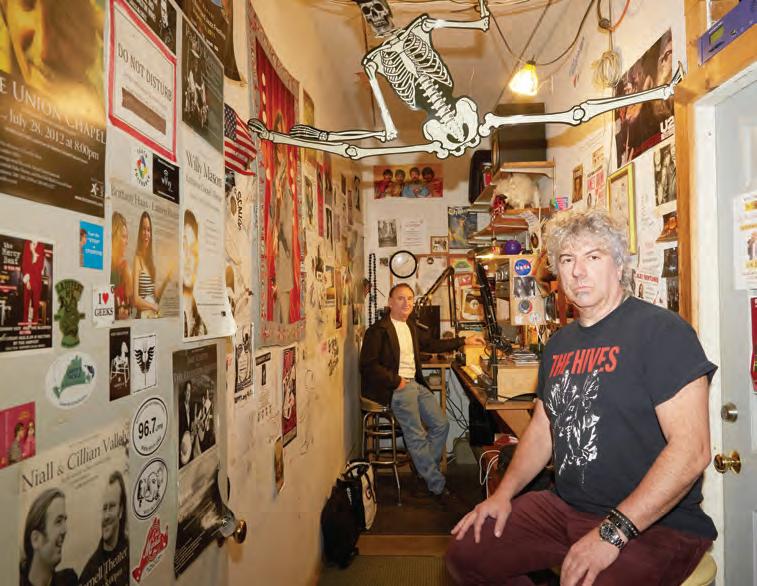
Fischer and I descended two floors to the sub-basement to find WVVY’s beating heart: a 100-square-foot closet littered with the happy detritus of radio history — the home of Vineyard under-
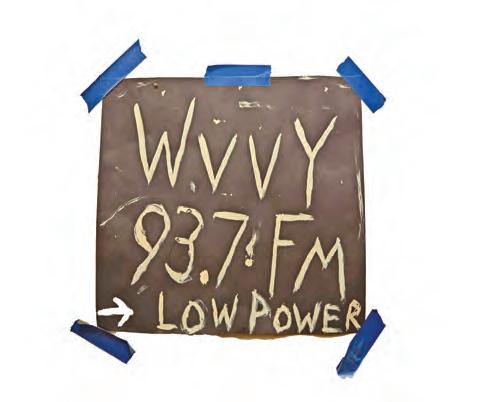
The place drips with mystery and untold stories, and as Fischer began to relate his own, a softspoken, gap-toothed Cheshire cat of a man appeared. His reserved demeanor and chimney-shaped woolen cap evoked a Suessian vibe. Was this the Vineyard’s Onceler? To tell his story, would he demand 15 cents, a nail, and the shell of a great-greatgreat-grandfather snail?
Glavin leaned against a corner of his closet-sized studio. Its walls are covered with street art — posters from secret shows, handdrawn cartoons, a hagiographic print of John Lennon strumming an acoustic guitar.
“Well, there’s Jim!” Fischer exclaimed. “He’ll tell you the history of this place.”
Padilla and Fischer in the studio.
First, Glavin made it clear that he didn’t trust journalists: “Every time I spoke to newspapers, they misquoted me or lied.” But with Fischer’s encouragement, he began to tell the origin story
The year was 2007 or 2008, he recalled; he’s not one to be pinned down to specific timelines. “I was taking off from the airport one evening,” he said, adding that besides contracting, he’s also a licensed pilot. “And there was music on the tower frequency! I said to the tower, ‘Yeah, I like the entertainment, but really …’”
Turns out a rogue pirate radio station had set up an unlicensed antenna in the woods near the airport, and its signal was interfering with tower communications. Over his headset, the tower told Glavin they were working on getting it shut down.
“That was the last of it,” Glavin said. The interference disappeared, and Glavin forgot about it. But sometime later, a friend called and asked for a favor. He and a few buddies had started a pirate radio station, and they’d recently been shut down by the FCC. They needed a new home. Did Glavin have any room in his building?
Recalling his experience with the airport tower, Glavin told his friend — an Islander by the name of Bob Lee, now deceased — that he could set up in his sub-basement, but on two conditions. First, Glavin was going to be on the board of the new station, so he could keep tabs on the operation. And second, “We were going to do everything right.” No more run-ins with air traffic control.
Lee told Glavin that when they shut him down, the FCC mentioned a relatively new set of licenses called “Low Power FM Radio,” designed to encourage small-scale, non-commercial voices on the airwaves. The signal would be line-of-sight and travel no more than 10 miles, at best, but it was legit. To apply, they’d have to set up a proper nonprofit and find a way to scrape together enough donations to get the equipment they’d need. They applied for a license, got approved, and with that, the pirates went legit. WVVY was born.
The longest continuously running DJ on WVVY almost missed his shot to get on the air. “Rock ’n’ Roll” Rick Padilla’s signature show on Wednesday evenings is an homage to legendary American DJ Wolfman Jack, but Padilla, a Cuban-American musician born in Miami, also brings the manic energy of Andrés Cantor, the famous Argentinian soccer announcer. His show mixes nearly every genre of rock, from classic Doors tunes to new music from bands like the Hives.
Padilla, 59, followed an Army buddy to the Island nearly 40 years ago. He established a painting business, where he met Bob Lee back when Lee was still running the pirate station. Lee invited him to host a show, and Padilla was on his way to his first ever gig as a pirate DJ when the station was summarily shut down. He followed Lee to WVVY, and has been on the airwaves ever since.
“I bring an iPod, bags of CDs, and my computer,” said Padilla. The equipment
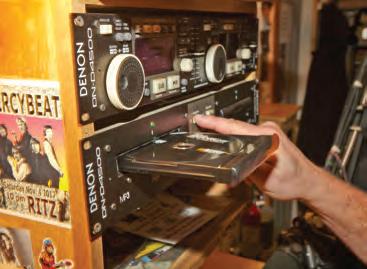

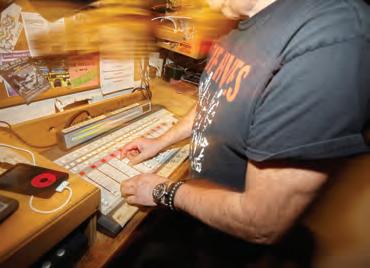
fails on the regular, he added, which seems part of the WVVY charm. “Sometimes the signal is low, sometimes the CD player is broken,” he said cheerfully. “I gotta go with the flow.”
WVVY’s nonprofit arm runs on a “sub-five-figure” budget, Glavin told me. DJs are encouraged to toss a sawbuck into a donation box to cover electricity costs. When I asked Glavin if he’d like more donations, his eyes lit up. He’s got bills to pay, and everyone at the station would love to upgrade the equipment, buy a recorder so shows could be rebroadcast, and modernize the website. WVVY pays royalties to ASCAP “when we have the money,” Glavin said. The station doesn’t have the technology to keep formal records of what songs they play, nor do they have much of an idea of how many people are listening. Any fees paid are at best an estimate. The place feels a bit like an anarchic collective, and one gets the sense Glavin likes it that way.
That doesn’t mean the folks behind WVVY don’t encourage donations. Glavin made a point of reminding me to get the station’s address right so folks can mail in checks: P.O. Box 1989, Tisbury, MA, 02568. The easiest way to give is found on the website: wvvy.org.
The best part of WVVY, Padilla and others asserted, is the freedom it provides. DJs can play whatever they want, and say whatever they want, as long as it doesn’t veer into politics, curse words, or negativity. “The only rule I have,” said Glavin, “is, whatever you say on the radio, it’s got to be positive.”
So the next time you’re stuck in traffic, hoping for a miracle on your radio dial, give WVVY 96.7 a shot. You never know what might be playing, but one thing’s certain: It won’t be boring, and it won’t be a downer. The world could use a bit more of that kind of energy these days.
John Battelle is an Island-based author, entrepreneur, and professor. The founding managing editor of WIRED magazine, Battelle also serves on the advisory board for The MV Times.
PHOTOS: ROBYN TWOMEY
Changing the tune — literally.
Old-school analog set list.
Rock ’n’ Roll Rick at the helm.






Free for all
The radical inclusivity of Built on Stilts. BY
NICOLE GALLAND
PHOTOS: ROBERTA KIRN
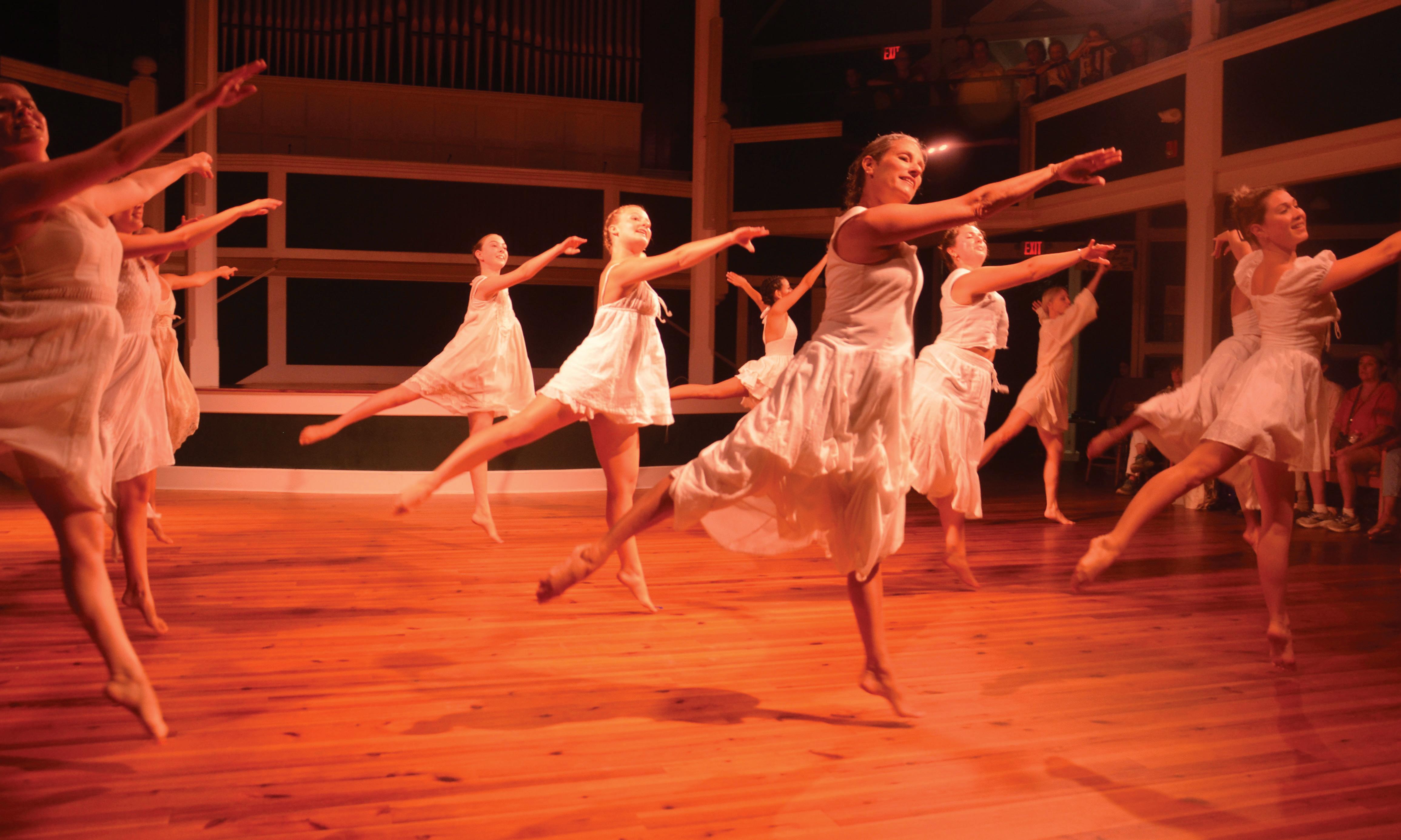
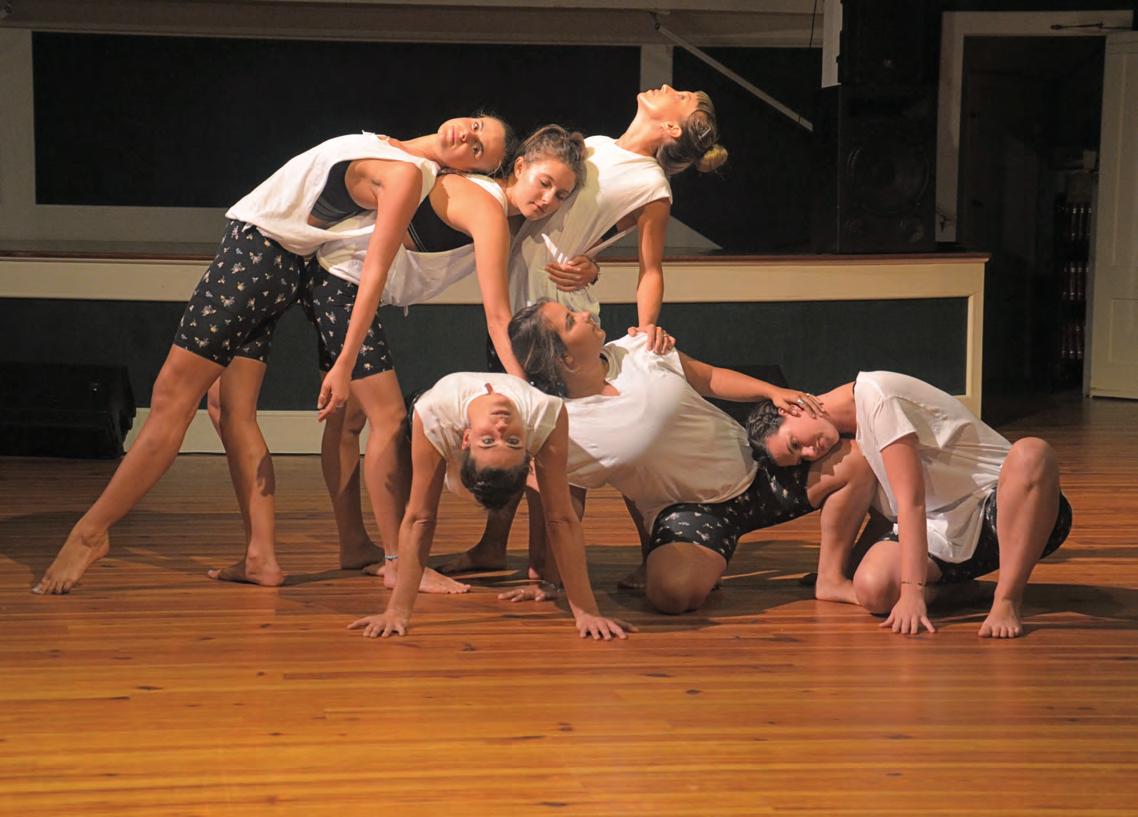
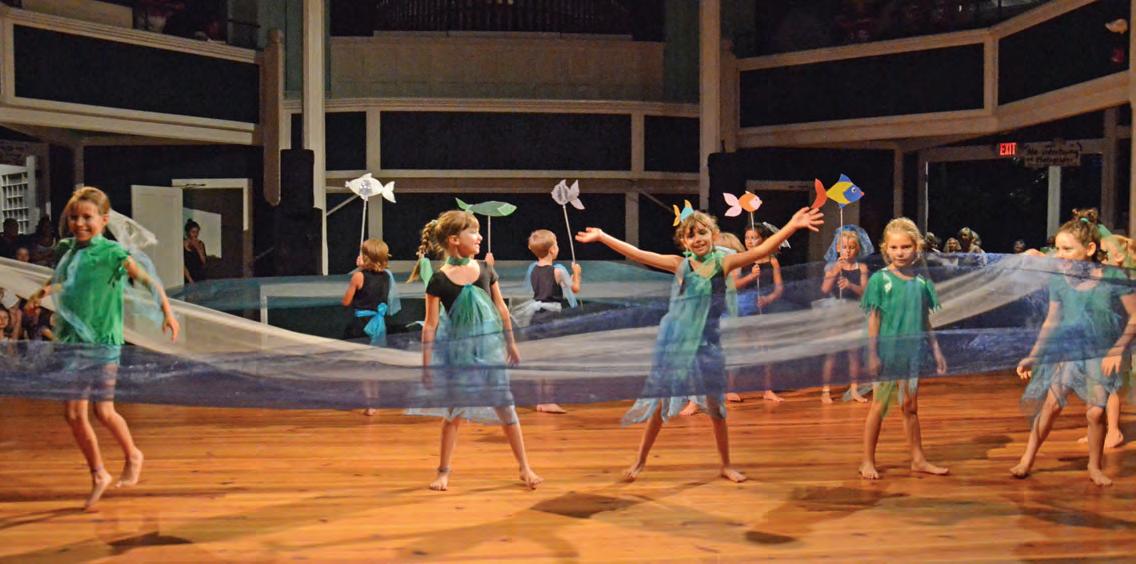
A group dance from 2019.
Stiltshop, 2019.

Serendipity, some say. Inspiration, say others. A feeling of belonging. Intimacy. Support.
Inclusivity and openness. A magical experience. Like coming home. Unmatched and overwhelming in the best way. The bomb-diggity. There really is nothing like it! It is still the way it was 30 years ago!
If you aren’t one of the 1,300 artists or more than 40,000 audience members who’ve experienced the exuberant performances at Built on Stilts over the past 30 years, these accolades might strike you as over-the-top. Otherwise, you know they barely scratch the surface.
The festival is the brainchild of Abby Bender and Anna Luckey, dance majors from Bard College. Its origin story is almost as whimsical as the event itself.

Through family connections, both women were able to spend the summer in Oak Bluffs in 1997, a few years after graduating. They longed for opportunities to dance, so they decided to pull together something close to home. Very close to home. Bender recalls, “We were sitting on the porch and looked [across the street] at Union Chapel and thought, ‘How about right here?’”
They found the sexton in the phone book; he lived right across from them, so they went over and signed a contract at his kitchen table. It was a propitious start to whatever it was that was about to happen.
They put up posters inviting anyone interested to join them; that initial event lasted just one night, and featured eight dancers. But it immediately garnered so much interest that within three or four years, it had expanded into a multi-day
festival accommodating everyone who wanted to join in on the fun. And now, for 30 years, the event has sustained the collectivist ethos of an earlier era, even as the Vineyard has become a place of increasingly high prices and exclusivity.
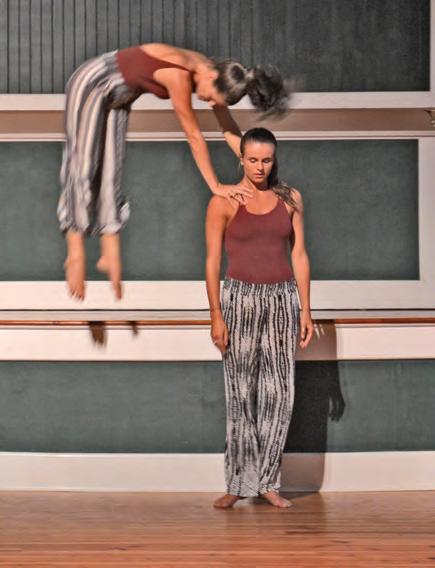
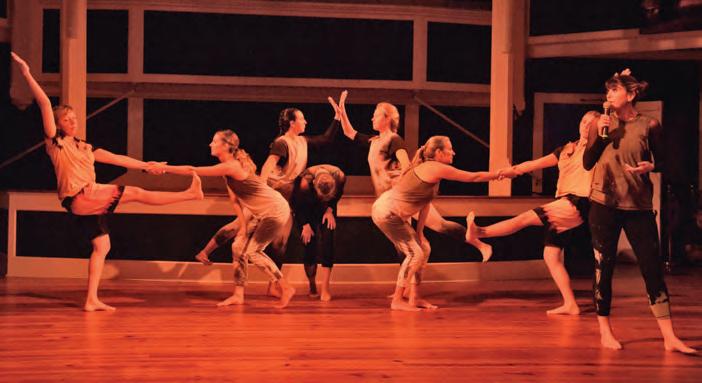
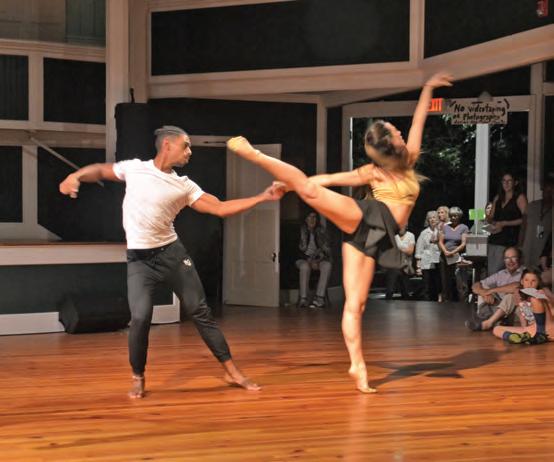
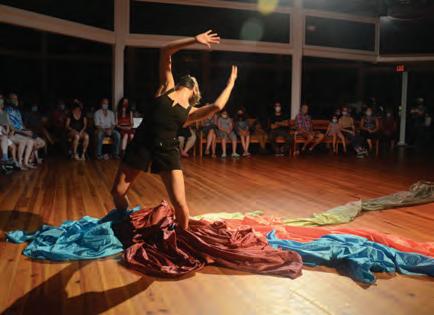
Literally anyone of any age, experience, or skill level can perform in Built on Stilts, in whatever format they wish to — dances of all genres, music, comedy, mime, performance art — as long as there’s no swearing or nudity, and it doesn’t run over seven minutes. Every show since Day 1 has begun with a drumming circle to warm up, and a typical year can include drag, tap, hip-hop, ballet, modern dance, jazz, poetry, singersongwriters, structured improv, audience participation, line-dancing senior citizens, and adorable kids. “The broader it is, the more fun it is,” says Bender. “It’s not about
Karam Belly Dance, 2016.
Work by Laura Sargent Hall, 2019.
Marta & Teo Azzollini, 2015.
Work by Abby Bender (Bender on right), 2023


being wowing and super-professional.”
All performers are responsible for their own rehearsals, costumes, props, and music; Bender doesn’t even see any piece until tech rehearsal. Participants from all backgrounds adore the experience for its mixture of professionals, amateurs, firsttimers, and seasoned vets.
Christina Reppert, who first participated as a child, is grateful that now that she has children of her own, the stage is still open to her. “[It’s] a performance by a non-hierarchical community of people with diverse abilities and gifts. Every individual and their piece is made to feel like it belongs there. The intimacy and support is a magical experience.”
Bender, who increasingly works humor into her performances, loves almost everything about the experience. When pressed, one particular thing stands out: She gives the introductory spiel each evening, and so, “I
“Every individual and their piece is made to feel like it belongs there. The intimacy and support is a magical experience.”
–CHRISTINA REPPERT
often leave the warmup 30 seconds before everyone else — and I just sit back and watch, and it’s incredibly rewarding. I’ve never experienced anything quite like that feeling: the coming-together of our community.”
Over the course of 30 years, of course, there’ve been a few thorns in the bountiful bed of roses. But what starts out as a problem can actually add to the moment. “One year when the power was out, we prepared — the show must go on! We told everyone to go home and get their flashlights,
and we had a boombox ready.” The lights came back on before start time, but still, the urgency of the moment added something to that show.
“Across Built on Stilts’ history, there are four people who’ve been involved every year,” Bender says, including fellow dancer Laura Sargent Hall, technical director Brent Alberghini, and drum circle leader Scott Hershowitz. “The drum circle warmup is an iconic part of the process. It brings us all together, gets our heartbeats in sync — and it tells passersby, ‘Hey, there’s something going on here.’”
Although the scope of Built on Stilts grew quickly, and has continued to stay strong, Bender isn’t interested in growth for growth’s sake: “I’m creatively ambitious, but I don’t think it needs to grow. It’s grown substantially over its 30 years and has hit a steady rhythm by now. It’s pretty self-sustaining. Of course, I’m always excited [when] there’s new work, and new artists engaging.”
Sargent Hall summarizes much of what the entire cohort feels: “Built on Stilts is a family that grows and changes every year, made up of creative performers … I am so grateful to Abby Bender for creating such a safe space for me to choreograph and dance for 30 years. Hard to believe it’s been so long! I remember the first show … we had no idea it would become an Island tradition.”
Jones Haywood Dance School, 2015.
Diego Gonzalez and Giorgia Nobili, 2019.
Jesse Jason, 2021.
Holly Pretsky, 2018.
PHOTOS: ROBERTA KIRN


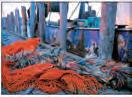
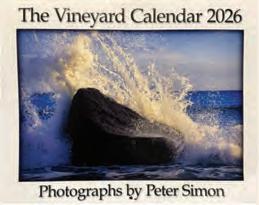
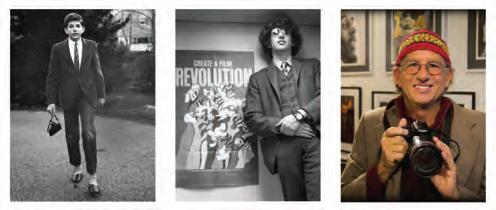
PETER SIMON GALLERY


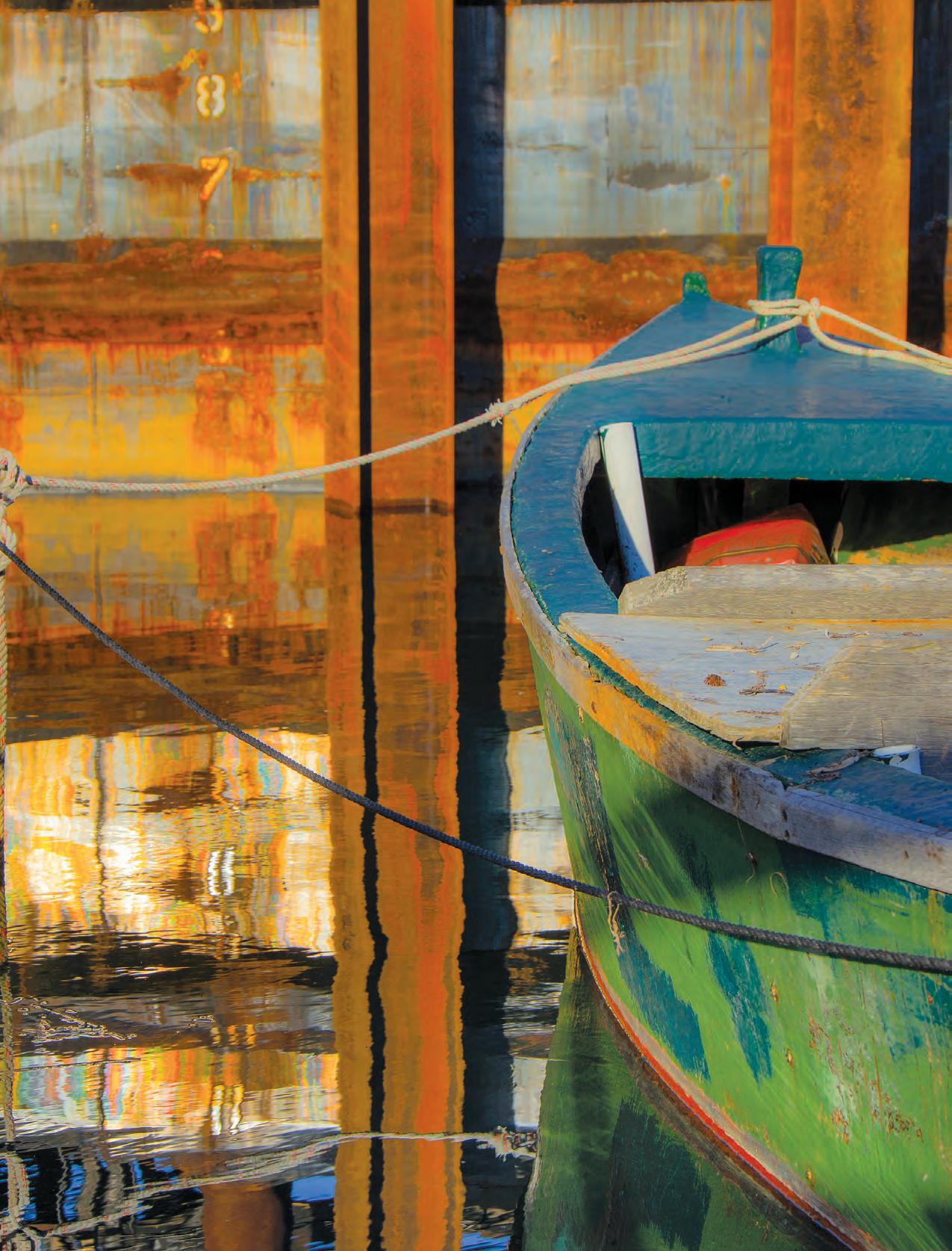
“Reflections — Menemsha,” Gwen Norton.
The Art of Healing
The Edward F. Miller and Monina von Opel Art Collection.
BY ABBY REMER
Art has the power to move us. It can soothe our souls and shift our perspectives. Not surprisingly, then, research reveals that art has a positive effect on health. We on the Island are fortunate to experience this firsthand at Martha’s Vineyard Hospital, which boasts a unique collection of artwork. Every one of the more than 1,000 pieces in the Edward F. Miller and Monina von Opel Art Collection was created by an artist connected to the Island. All were donated, most often by the artists themselves, creating a collection grounded in the community.
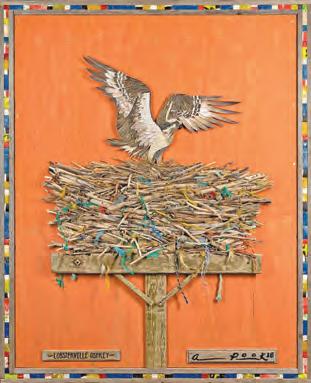
According to the American Congress of Rehabilitation Medicine, studies have shown that simply observing art can boost serotonin and increase blood flow to the brain. You can immediately feel this effect when walking into the hospital’s main entrance. Soaring just above to the right is Abraham Pieciak’s “Lobsterville Osprey.” Set against a bright orange background, the regal creature spreads its wings in welcome. Pieciak fashioned the large work from driftwood, buoys, and netting, literally incorporating pieces of the Vineyard into his art.
From the lobby onward, art fills every nook and cranny. We see it on the walls of the laboratory waiting area, radiology, offices, exam and patient rooms, hallways, and even the bathrooms. There are still lifes, landscapes, portraits, and abstracts. In addition to painting and mixed media, there is photography, drawing, collage, sculpture, and a two-story mural of local marine life by Margot Datz, in the conference room, transporting us on an underwater journey.
All the art is visually stunning and helps us see in new ways. Gwendolyn Norton creates a sense of mystery in her captivating photograph “Reflections — Menemsha,” which hangs at the intersection of the old and new hospitals. The quiet scene raises more questions the longer we look. Where does the dock end and the water begin? What time of day produces the luscious colors? And how does Norton create such a painterly quality with her camera?
Lucy Mitchell’s large “Beach Collection — Medicine Cabinet” reminds us of the healing that can happen simply by walking along the shore. Each branch, shell, rock, and bird’s nest has a beauty of its own,
which is amplified when they are taken together in this giant glass “medicine cabinet,” located in the hallway across from the entrance to the David Family Roof Garden.
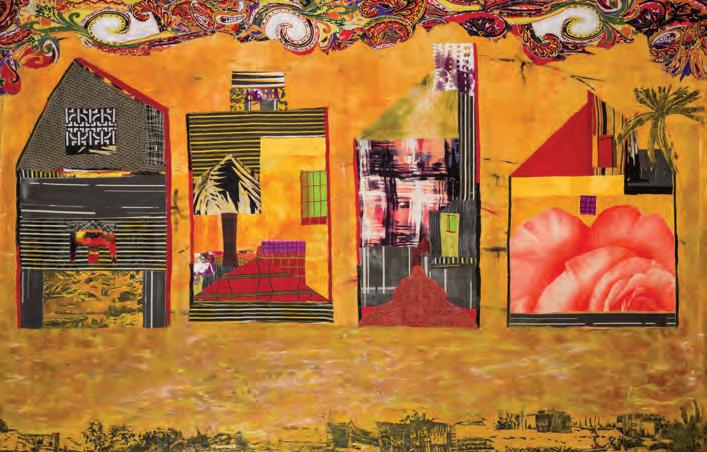
Martha Mae Jones creates an entrancing composition that shows us new ways to combine media in “Heart Is Where the Home Is,” which hangs in the internal medicine waiting room. Jones’ gorgeous swathes of textiles create exquisite visual complexity in her simple composition of four stately houses lined up across the picture frame.
Patients, visitors, and staff alike find delight and comfort in the collection, the exact result Monina von Opel and Edward Miller always desired for their impressive undertaking. The collection was born in the boardroom when Miller, then a board member, and Tim Sweet, then vice chair, were reviewing plans for the main building on the Martha’s Vineyard Hospital campus in 2009.
Miller recalls the architect presenting a portfolio of abstract color works, wishing to avoid any strong reaction in viewers. “I turned to Tim and said, ‘One, we can do a lot better than this on our Island with all our artists, and two, I want people to feel something.’ Tim said, ‘You’re absolutely right, and you’re in charge.’”
Miller immediately enlisted his wife,
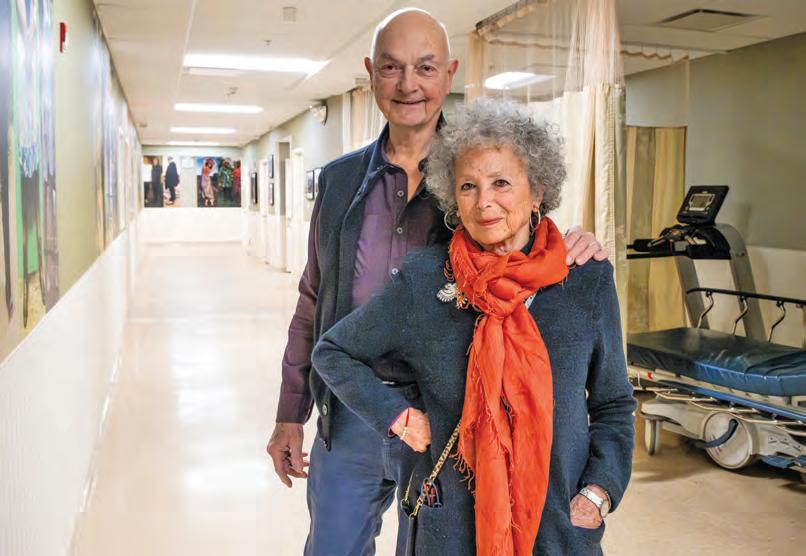
The artwork Monina von Opel and Edward Miller have curated at the Martha's Vineyard Hospital is uplifting and is a delight to see!
“For many patients, coming to the hospital can be stressful. Seeing familiar faces and scenes from around the Island in our artwork offers a sense of comfort and belonging.” —CLAIRE SEGUIN
von Opel, as curator. The couple had long been passionate art collectors. At the time, neither they nor Sweet was aware of any research on the positive effects of art in hospitals. Miller shares, “I think in the back of our minds, we just intuitively thought it was a good idea to connect the community with the hospital and have patients, staff, and visitors stimulated by the art.”
It turns out their intuition was correct. Research confirms that art in hospitals provides significant health benefits, reducing patient stress, anxiety, and pain, promoting healing, improving mood, shortening hospital stays, and lowering medication use. The World Health Organization has published significant reports, notably a 2019 review, that detail the extensive healing effects of the arts, including visual art in hospitals, showing they improve both mental and physical health by reducing stress, boosting immunity, and managing chronic diseases, among other benefits.
Stanford Medicine and Penn State Health research also reveals that art in
hospital rooms significantly aids the healing process by reducing anxiety, lowering pain perception, improving mood, shortening hospital stays, and boosting overall patient satisfaction through positive distraction and a connection to the artwork.
The hospital’s president and chief
operating officer, Claire Seguin, has seen the impact of the collection firsthand.
“For many patients, coming to the hospital can be stressful. Seeing familiar faces and scenes from around the Island in our artwork offers a sense of comfort and belonging — it reminds people that they’re still connected to home. You can see it every day, as patients, visitors, and staff pause in the hallways to take it in. Those small, quiet moments help people feel grounded and connected, even during difficult times.”
Miller and von Opel began their endeavor by approaching Alison Shaw and Janet Woodcock to request photographs for the private in-patient rooms, which would be on display at the February 2010
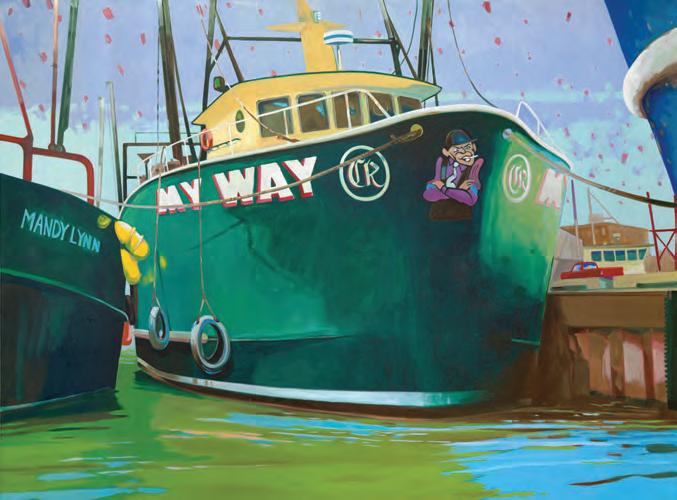
“My Way,” Rez Williams.
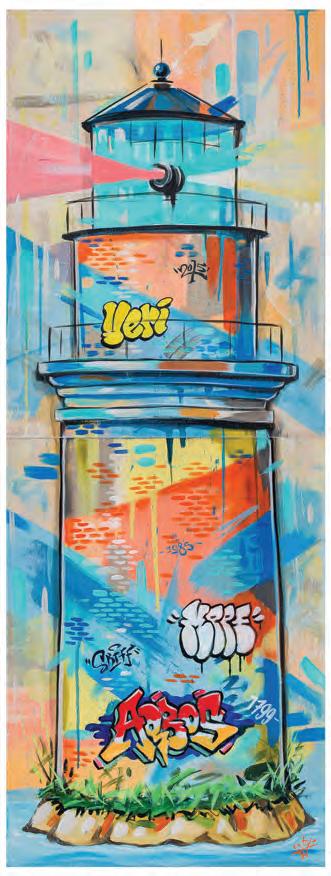
“Gay Head Lighthouse,” Jack Yuen.
“Lobsterville Osprey,” Abraham Pieciak.
ribbon-cutting ceremony for donors and press. It was a great success, and Miller says, “From then on, Monina was the ferret-in-chief, going around and finding artists. We wanted to build up the collection so that artists felt it was important to have their work included. Once we added several
well-known artists, such as Allen Whiting, Kib Bramhall, and Rez Williams, it became easier. And we were supported all the way through by the hospital management.”
Von Opel recalls spending endless hours visiting artists’ studios. “Or somebody would say, ‘Oh, my nephew is really good,
you should see his work,’ or, ‘My uncle just died,’ and off I’d go to see what he had. I never knew what I was going to find. And one thing leads to another. It was a treasure hunt.”
Von Opel says that when installing, “It was fun to see how the staff got curious when they saw us coming with our hammers and nails. They started to say, ‘Oh, I’d love to have that in my office.’ It got everyone excited and made them feel they had input and were part of the whole thing. We would try to make sure everybody had something they loved.”
She continues, “Many people who come to visit sick friends or family have told me what fun it is to walk around with the sick person instead of sitting in a corner of the room. So, that’s healthy for everyone. Also, many rooms in the building don’t have windows. Art can create a view. Could you imagine sitting in the infusion center rooms with nothing on the walls?”
Photographer and gallery owner Michael Blanchard recalls getting lost in thought as he viewed one of Shaw’s photographs in his hospital room in 2024. He shares, “I sent
“Light Explosion,” Anne Grandin.
“What a Guy,” Lisa Gizara.
her a nice note saying thanks for having this here. It meant something. I thought it was beautiful. There are so many little things like that that make this place different. To wander the hallways and see all this beautiful artwork, it’s just a different feel.”
In a similar vein, shortly after the collection was installed, the volunteer

director, Angela Roderick, put a selection of the artwork on iPads and shared it with inpatients. With their interest piqued, volunteers then helped patients go to view the pieces in person. “It was a nice way for them to get out and about to see the art installation,” Roderick says.
Von Opel strongly believes it’s also important to place art where the public does not normally go, such as in the hallways between the radiology rooms. The idea came from photographer Alida O’Loughlin. Von Opel explains, “She came to me and said, ‘Listen, I’ve been wheeled down that hallway, and it is depressing. I need something at eye level with my gurney that will cheer me up. It’s scary going down there.” As a result, von Opel hung works by O’Loughlin, as well as Paul Lazes’ largerthan-life-sized photographs “Tough Chicks of Martha’s Vineyard: Strong Women Who Strengthen Our Lives.” Some of the women may be immediately recognizable. You’ll see Featherstone’s Ann Smith and her mother, Francine Kelly; Chilmark Writing Workshop founder Nancy Aronie; the Steamship Authority’s Bridget Tobin; and author, poet, and activist Rose Styron, as well as others who may be unknown to us. All radiate that Vineyard spark of individuality.
Von Opel shares, “People come up to us all the time, at the movies or in aisle 6 at Cronig’s, to tell us how much better it
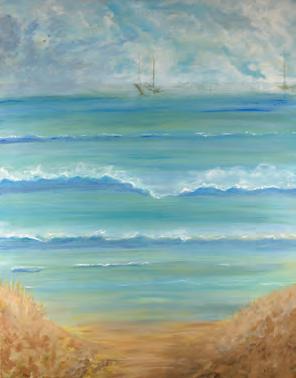
“Nature’s Treasures,” Sandra Pimentel.
made them feel just looking at a painting that was not like a motel poster. They frequently know the artists, which helps bind the community. And so many people have told us that the art just lightens them up. It’s visually stimulating, and it takes your mind off of what’s ahead.”
The collection is a living, breathing entity. Seguin says, “We continue to receive interest from artists who want to be part of the collection, with each submission thoughtfully reviewed by our art committee. As the hospital grows, we are committed to ensuring this cherished collection remains a vital part of the hospital’s healing culture.”
For a visual index of the hospital’s collection, visit https://mvhospital.org/healing-spaces/ permanent-art-collection/.
“Lyfe,” Alessandra Petlin.
“Stars on Lucy Vincent Beach,” Vincent Chahley. “Heart Is Where the Home Is,” Martha Mae Jones.
5.3
8.30
9.27














From sea to table
A new generation seeks to revitalize a historic industry.
BY HAYLEY DUFFY
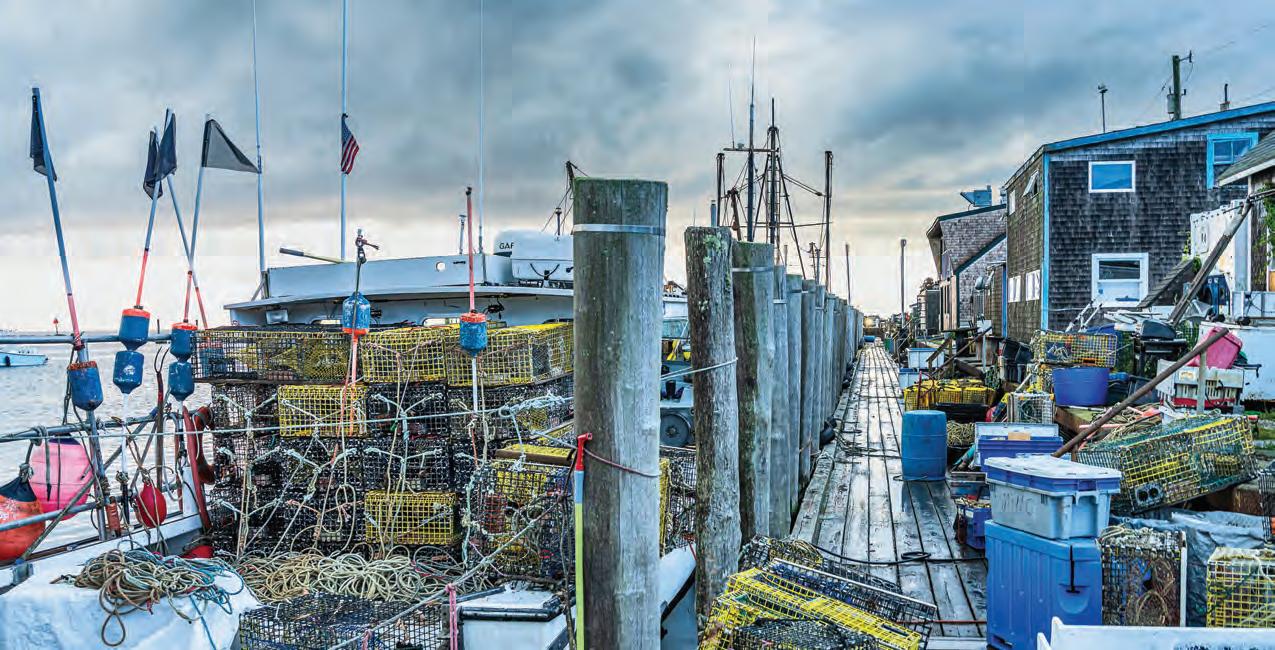
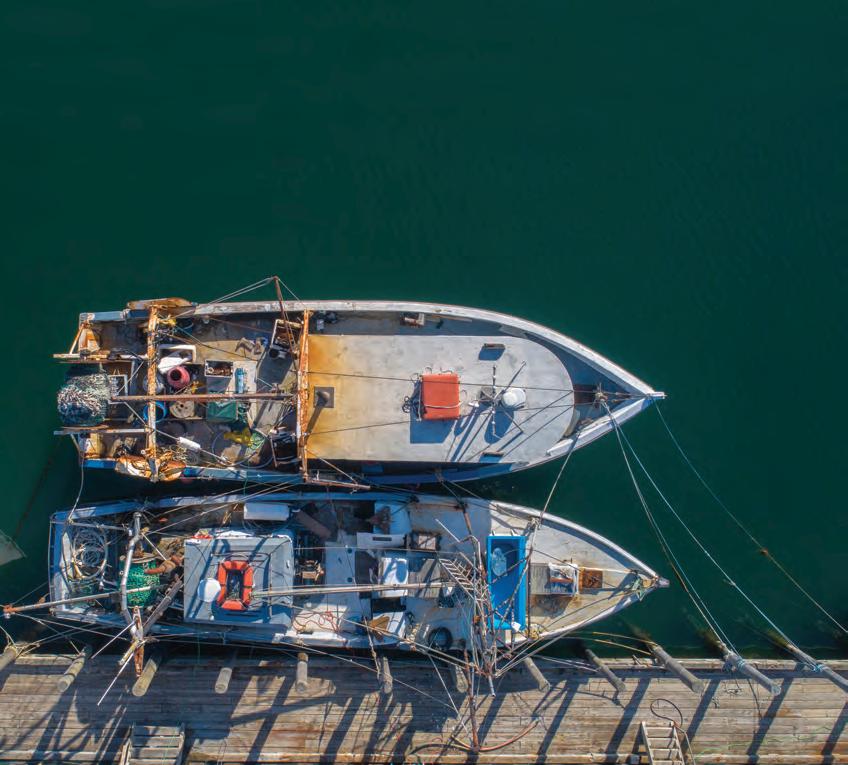
Stacks of lobster traps line the corridor of Menemsha Harbor, and gear is piled haphazardly so high among brightly painted buoys and plastic totes that it reaches to the roof of the shacks that skirt the edge of the shore. Copper streaks bleed
from the edges of old nails on wooden traps, and on the ground, lines of rope are coiled like snakes. A weathered sign from 1994 proclaims Chilmark’s tricentennial, a piece of history that harkens back to a milestone in an even longer history. Menemsha often resembles a stage set of a quaint New England village — but
it is, in fact, a lively port that lives and breathes, and has found a way to not only survive against adverse economic forces, but continually adapt and discover new approaches to sustain a vital industry and keep local seafood on the menu.
This port stands apart as the rest of Martha’s Vineyard becomes more developed and
PHOTOS: LARRY GLICK
attentive to tourism. Edgartown Harbor, which initially rose to prominence in the whaling days, used to be chock-full of schooners; now, most dock access is reserved for a fiberglass fleet. Many Vineyard Haven and Edgartown fish buyers are now long gone, and so too are the boatbuilders and shore engineers who supported a much larger industry. There is a small but strong fleet of commercial fishing boats in Edgartown and Oak Bluffs, though they are hard to find amid the swell of sports boats and pleasure craft that lap into the harbor through the summer.
“When I first came here, 47 years ago, the O.B. harbor was packed with draggers,” said Johnny Hoy, who’s worked on the water since his teens and earned a place as an experienced fisherman, as well as a legendary local bluesman. Peter Jackson, whose family was around when whale oil harvests financed the Island, said he used to swordfish for 15-to-20-day stints, 18 hours east of the Island, for two decades. Now, the dock in Edgartown can’t even be used anymore, he said.
But Menemsha remains an anchor to the past. Once called Creekville, or “Crickville” to locals, the harbor was dredged around 1900, and the village rebuilt after the “Great New England Hurricane” in
1938. Before that, fishermen used seasonal communities, like Lobsterville, Squibnocket, and Nomans Land, as their base. Those gradually faded from memory as Menemsha rose in prominence during the mid-20th century. In that era, inshore and offshore vessels were tied two or three deep at Menemsha wharfs; Islanders’ fish traps circled the coast, and fishermen harpooned and longlined out in Georges Bank and as far as the Grand Banks.
The Island’s current commercial fleet doesn’t resemble what it once was, all those decades ago; notably gone even more recently are the draggers Unicorn and Quitsa Strider II, iconic fixtures on Dutcher Dock for decades and owned by brothers Gregory and Jonathan Mayhew, respectively. The 70-plus-foot vessels were sold in the early 2010s as pressures from high costs, stringent regulations, changes in climate, and foreign competition became relentless and forced many to leave the industry, especially as on-Island wholesale buyers closed their doors. Soon, owner-operated Island fishermen were rare, just like the species they were increasingly prohibited to catch.
But, years later, despite the empty slips on commercial docks, there’s a persistent thrum of energy in the village as well as some other pockets of the Island where the
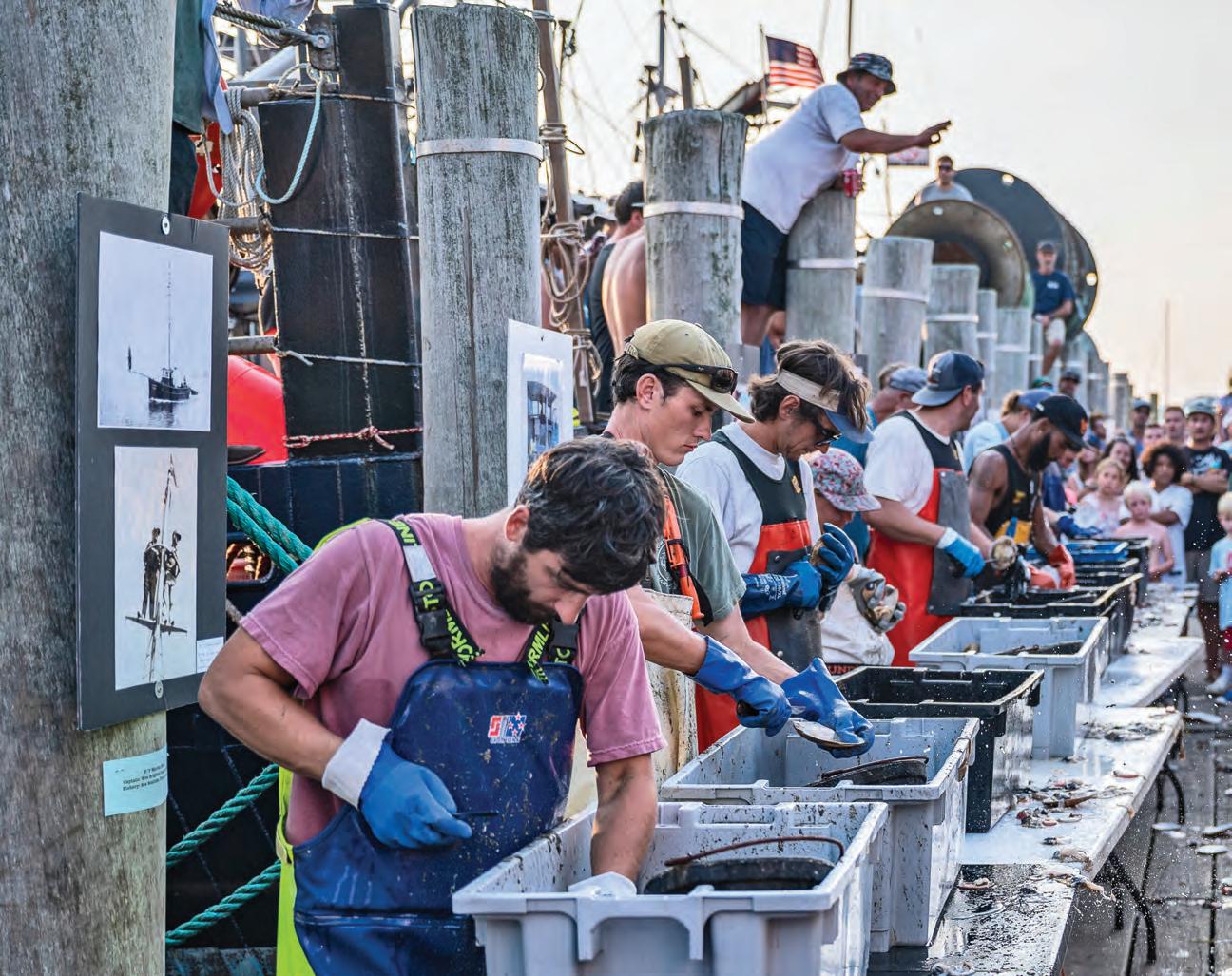
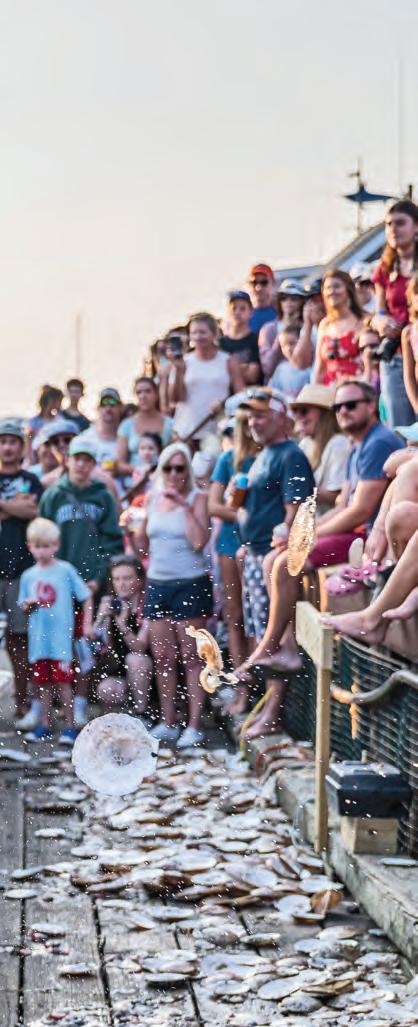
Meet the Fleet scallop-shucking contest.
Stormy Menemsha.
industry prevails, and the faces along the docks are encouragingly young. There have been different iterations of commercial fishing over the years — depleted and rebuilt stocks, various federal and state management regulations, and many technological advancements. But through all that, the trade on the Island was never lost. Through resolute adaptation and innovation, Menemsha held out, and offers a glimpse of what a sustainable future looks like — one that bolsters local fishermen and their harvest.
These days, aquaculture is a lucrative job, and there are dozens of farms around the Island, all spurred by a group of fishermen, displaced by commercial regulations, who turned inshore. Among that group was the late Roy Scheffer (see sidebar), whose youngest daughter, Martha, now runs his farm; his sons Isaiah, Jeremy, and Noah also continue the tradition in different aspects of the aquaculture industry.
In 2011, a nonprofit corporation was established to safeguard the industry’s heritage and future. It’s called the Martha’s Vineyard Fishermen’s Preservation Trust (MVFPT) and supports the smallboat, owner-operated fleet and catch of
the Island. That is how the gritty, bluecollar industry now manages to stay afloat through tides of change far beyond their control. The trust works primarily behind the scenes: It processes and donates seafood to food security groups on and off the Island, facilitates scientific research, and creates payment plans to help local
fishermen secure expensive permits; the group even runs a seafood market called the Martha’s Vineyard Seafood Collaborative, which purchases and distributes hundreds of thousands of pounds of local seafood from Islander fishers to on- and off-Island buyers year-round.
“Nothing is easy in the fishery world,”
Commercial boats in Menemsha.
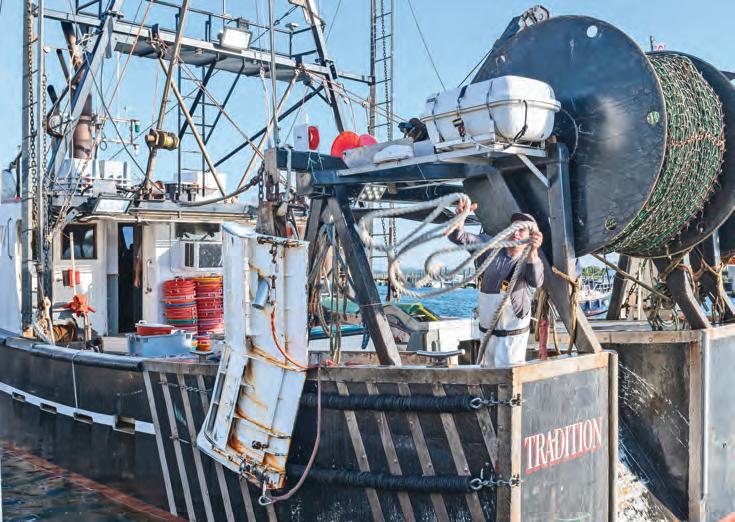
The F/V Tradition.
PHOTOS FROM TOP LEFT: LARRY GLICK, RANDI BAIRD, LARRY GLICK, CLAIRE CALLAGY
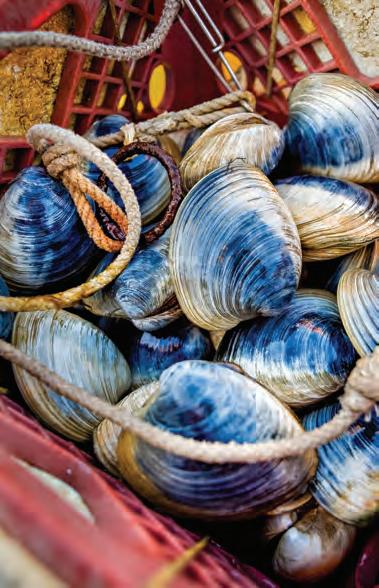
Hardshell clam/ quahog harvest.
Shelley Edmundson, executive director of the MVFPT, said. “It’s easy to think every boat out there is just taking whatever they want, but in reality, they’re really being careful, and they’re following rules that have been set from scientific guidelines and regulations.”
And the truth is, the demand for local seafood on the Island isn’t always there. It was Edmundson who helped spearhead one of the most recent ventures for the MVFPT: the production of “The Sea Table,” a cookbook by the trust and Catherine Walthers that not only encourages and teaches the importance of local seafood, but also preserves in print the faces of the industry, whose livelihoods depend on the demand for fresh fish.
Warren Doty, former Chilmark Select Board chair, was one of the first faces connected to the MVFPT as a founding board
member and board president. He died in early March 2026, and he is remembered for his immense advocacy work for the industry. Doty, who was a wholesale buyer, often coordinated Island fishermen and off-Island buyers in the months when local fish markets were closed. That remains a significant part of the trust’s efforts today.
Part of the seafood market was reinvented to be of the same service to fishermen, especially when there isn’t a lot of demand on the Island in the off-season.
Last summer and through the winter, the trust began to ship the catch of Island fishermen to off-Island markets and buyers in a consolidated effort. Through the shipments — once a week in winter and three times a week in summer — the trust removes the need for 20 fishermen to take their trucks off-Island to make money. The streamlined process, made possible by a generous grant,
is both environmentally and fiscally efficient, Edmundson said, and was especially used by oyster farmers and wild oyster harvesters in the colder months this past year.
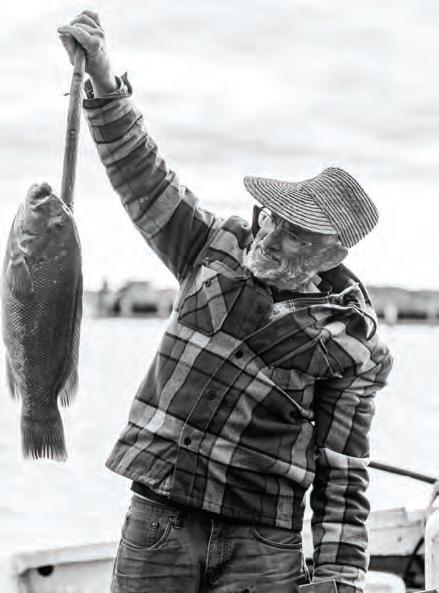
Otto Osmers is a 26-year-old commercial fisherman who scalloped all last summer on the Martha Rose and other vessels, and then harvested wild oysters as the seasons changed and other fisheries closed. He was happy to know the trust could ship his catch off-Island when demand wasn’t as high on the Island, since he still needs to make an income. Wild oysters were abundant this year, and Osmers and his business partner, 21-year-old Kent Healey, were able to get $30 for a bag of 100 oysters from Red’s Best, which has a facility in New Bedford; they were each allowed to harvest 800 oysters a day.
The trust is staunch in the effort to keep young fishermen in the trade, where
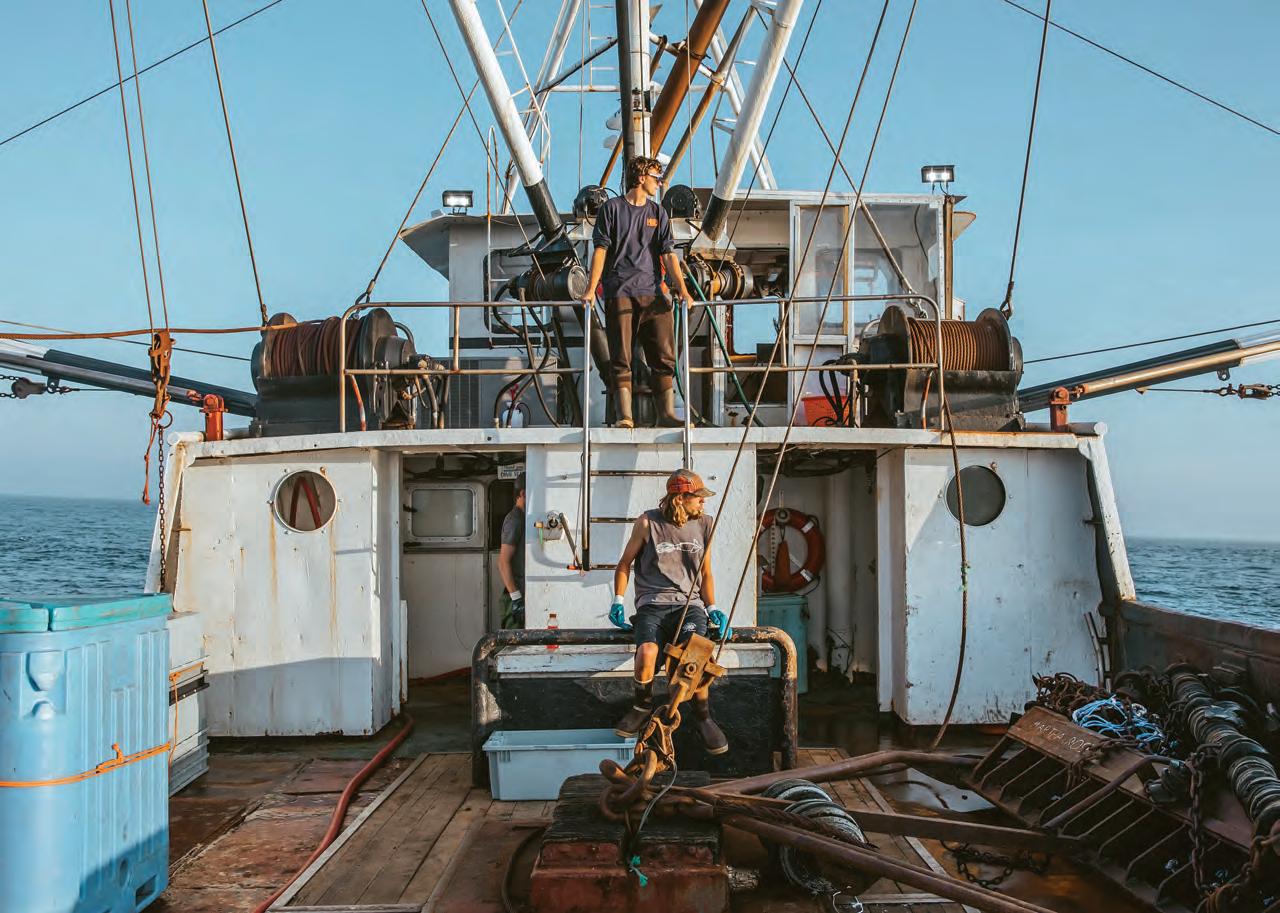
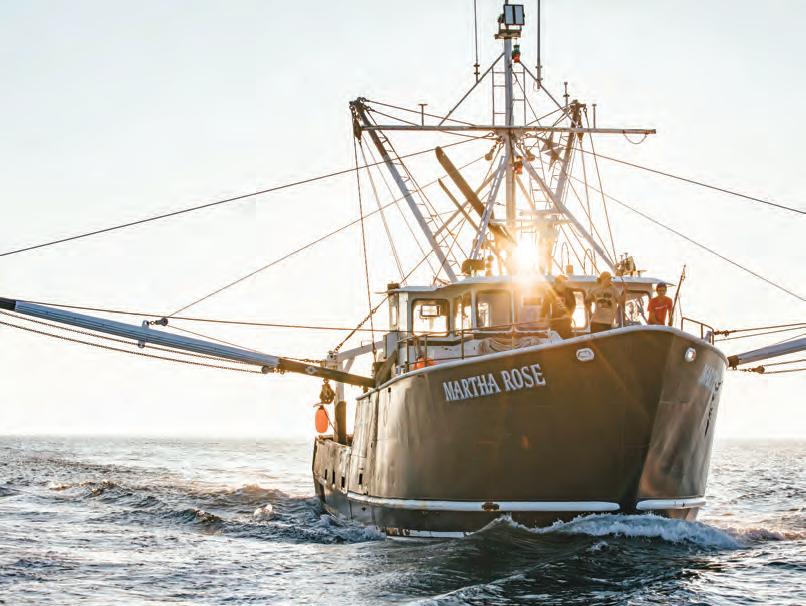
Ian Andres and Otto Osmers aboard F/V Martha Rose.
the barrier of access discourages those who can’t afford or endure the inconsistent whims of Mother Nature. It’s expensive to buy a boat, let alone pay thousands of dollars for permits to go out and catch what can be empty promises.
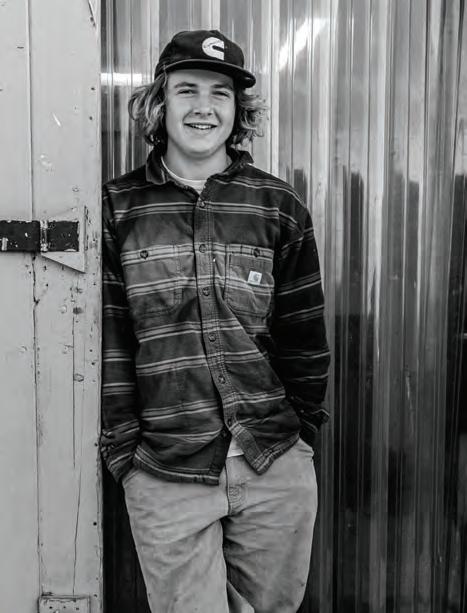
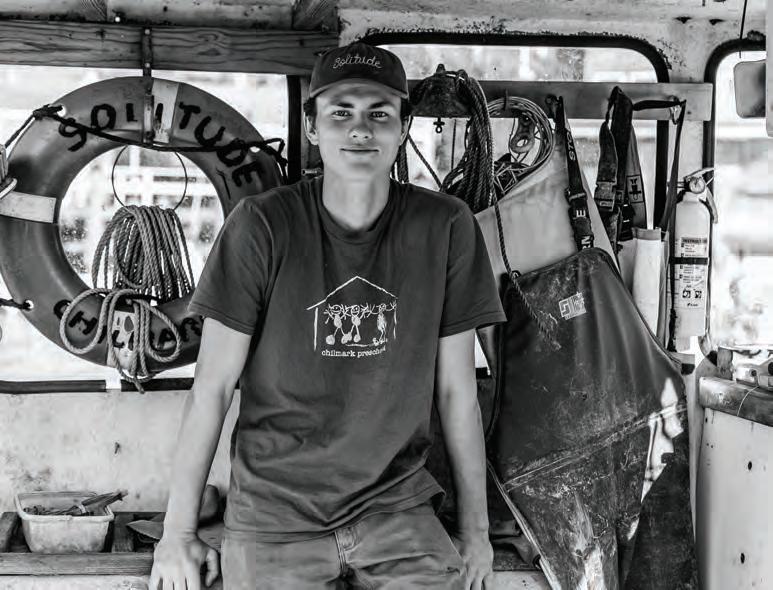
Tegan Gale, the youngest commercial fishermen on the Menemsha docks, has fished his entire life; at 19, he’s also the youngest in the state to have a lobster permit, he said. His father and grandfather worked the water before him, and Gale began practically at birth; at 10 days old, he was out on the boat while his father culled lobster pots. He said he slept in his baby carriage tucked inside a fish tote; he ran his father’s old lobster boat, the Watch Out, at 15 years old. If his family wasn’t involved, however, he isn’t sure he’d have been able to become a commercial fisherman.
“It’s borderline impossible” to enter the commercial fishing industry, he said.
Now, Gale harvests lobster, oysters, sea bass, bonito, and conch — a unique and prosperous fishery that caters mostly to foreign markets — much of which he does on his own, out of Menemsha Harbor. “Who knows if it’s a good business to be in, but we’ll see,” said Gale. Still, fishing is what he knows how to do.
Gale estimated that he’s put in around $70,000 to join the industry — from gear to permits to boats. “The money is the most
difficult part, the initial investment, all the other stuff, coming up with all the funds for permits and boats,” he said.
Besides the fixed costs — a boat and permits — the price of fuel and bait is always on the up, and still, the market price for lobster remains mostly the same. Edmundson said that as part of the reinvented shipping program, they are able to bring back supplies and bait for Island fishermen. There was a bait shortage last year because, as fewer and fewer draggers go out, access to skate, used to bait lobster pots, lowers.
Gale is among approximately 50 Island fishermen who harvest for and use the trust. There’s still a solid older, more
“Pay it forward, that’s my theory ... Everyone deserves a shot.”
—CHRIS MAYHEW
seasoned cohort — Stanley Larsen, Wes Brighton, Wayne Iacono, Johnny Hoy, Tom Turner, and many others — but Edmundson said the demographic’s started to trend younger. Gale, Osmers, Walter Greene, Matteus Scheffer, and Chris Mayhew, among others, have taken up the flag.
Greene, in his “Sea Table” essay, says, “The hope is that seafood stays local and
becomes more appreciated for where it’s caught, and valued for the effort put in. Sure, you can find cheaper fish; you can buy tilapia or farm-raised fish. But helping people to realize the quality of what they’re getting where they’re buying local seafood … they’re getting it direct, sea to table.”
“They’re just all great guys that I feel are super-collaborative with each other and just supportive of conservation and have pride in what they do,” Edmundson said. They bring new perspectives and energy, she added. Gale was one fisherman who decided to try the new green crab fishery, which seemingly no other Islander takes part in, at least not to harvest for the culinary market, as green crab is both invasive and mostly used for bait.
Two of Gale’s most recent investments in the fall included a $12,000 sea bass permit, which the trust helped finance, and $25,000 for his new boat, the Solitude, which he bought from Chris Mayhew.
The Solitude was built in 1984 and has made berth in Menemsha her whole life. Before she was Mayhew’s boat, she belonged to Pat Jenkins, or as the new generation of fishermen call him, Old Man Pat. Mayhew, like Gale, began lobstering through a state program that subsidizes 25 pots to students. Now 27 years old, Mayhew’s upgraded to a bigger boat and passed along the Solitude.
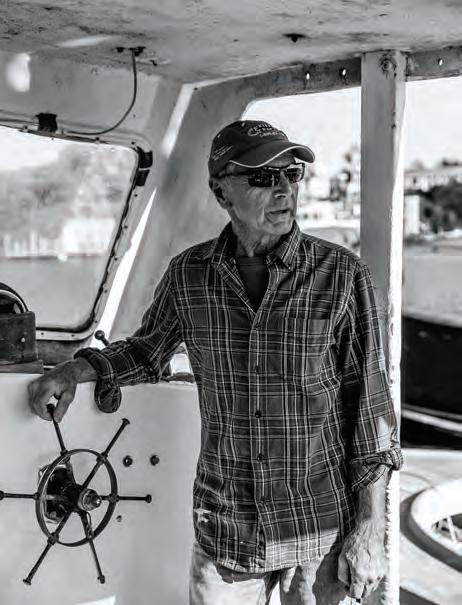
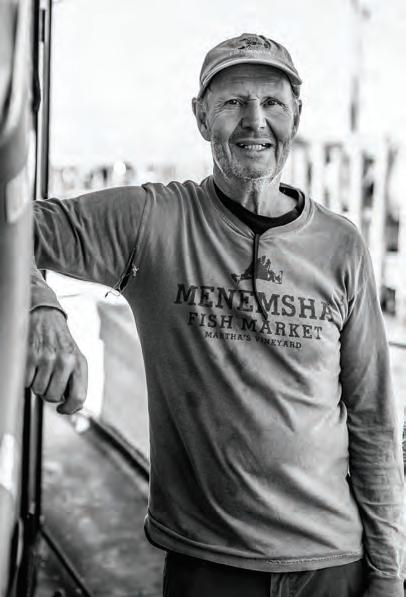
Tegan Gale.
Wayne Iacono.
Stanley Larsen.
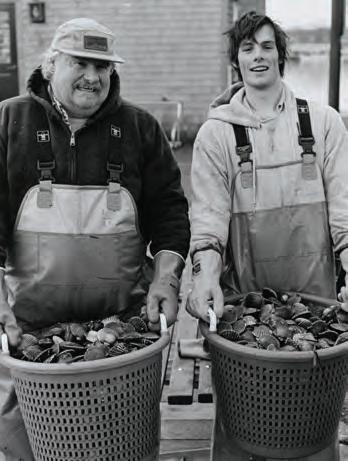
“Pay it forward, that’s my theory,” said Mayhew. “[Tegan] wanted the same opportunity I got. Everyone deserves a shot.” Mayhew primarily harvests lobster, and switches to conch seasonally, though the winter is reserved for “odd jobs.” He also catches sea bass for the collaborative, but typically sells lobster to Edgartown Seafood, owned by his former classmates Crockett Cataloni and Jimmy and Andy DiMattia.
Fishermen need an extensive skill set to be successful. They need to be able to track water temperatures and tides, notice species’ behavioral shifts, examine gut contents, haul gear, repair leaks,
manage wounds, splice wires, adapt to the weather, and much more. In the preface to “The Sea Table,” Edmundson called a fisherman the equivalent of a “human Swiss Army knife.”
All of this and more is illustrated in “The Sea Table,” written mostly by Walthers, an Island resident and former journalist turned private chef who wrote for Martha’s Vineyard Magazine for 20 years. “The Sea Table,” on the surface, is a hardcover with stunning photography and luscious seafood recipes, some Walthers’, others collected from Island fishermen, chefs, and friends. But beneath these is an advocacy project for
the centuries-old working waterfront. By profiling fishermen, species, and the labor behind each local catch, the book documents a corner of the Island that’s often taken for granted. It’s about preservation, but also industry, history, and culture. It’s a tribute to the Atlantic waters that surround us and the fishermen who work hard to take food from the sea to local tables.
“It’s a cookbook, but it’s also about fishing, so I love that it has the essays from the fishermen in it, because that really just goes full circle. And you talk about where your food comes from, and this is right from the source and right from their words,” Walthers said.
“It’s often hard for people to see and connect to our fishing community, because unlike a farmer, we can’t drive by a field and see them at work close up, or go talk to them,” said Edmundson. “I’m hoping that this kind of brings the fishing community to the general public, and helps them understand, feel more connected to each person and everyone’s uniqueness. To understand why they do what they do, and feel that connection and appreciation for their craft.”
The book features 75 recipes using 19 different local species, and each book purchase supports the Martha’s Vineyard Fishermen’s Preservation Trust’s mission to ensure that sea-based culture, livelihood, and food remain strong on the Island.
Chris Mayhew.
The F/V Martha Rose.
Johnny Hoy.
“Behind each local fish, there’s a person or a family and someone working hard to go out and harvest that food for them,” said Edmundson.
Walthers said that as she collected and created the recipes in the book, she wanted to use ones for this “point in time.” In his essay, Osmers said: “Fisheries in a lot of ways are cyclical, both the markets and the actual fisheries.” Walthers wanted to make sure these were recipes for the locally caught fish now, instead of recipes that have been used for decades. People tend to cook what they know, which is often swordfish, salmon, or shrimp, Walthers said. But this book attempted to highlight less popular but locally caught options, such as, surprisingly, quahog clams, fluke, and bluefish.
“The Sea Table” quietly frames the argument that the future of the Menemsha waterfront is already here, though it may not look — or taste — the same as before. It’s a snapshot of an industry that constantly evolves, and is a testament to those who chart a path forward for this way of life.
“Every one of them was drawn to be a fisherman, to harvest from the sea,” Edmundson said. “It seems like once it’s in you, there’s no turning back.”
Hayley Duffy is a Martha’s Vineyard Times staff reporter covering oceans and energy. Freelance reporter for The Times Ella Munnelly contributed to this story.
The legend of Roy
A captain who defined the Vineyard’s fishing
history. BY WILL SENNOTT
Roy Scheffer’s hands mapped a different era of the Martha’s Vineyard waterfront. Etched by decades of running thick, tar-treated longline and calloused from the rough skin of swordfish, Roy was at the helm of the Island’s heyday of commercial fishing, and later pioneered its rebound in aquaculture. It was a pursuit that spanned thousands of miles of open ocean, chasing the horizon to land heroic hauls before circling back to end his career where he started in his youth: hunting for scallops in the bountiful waters of Edgartown’s Cape Pogue.
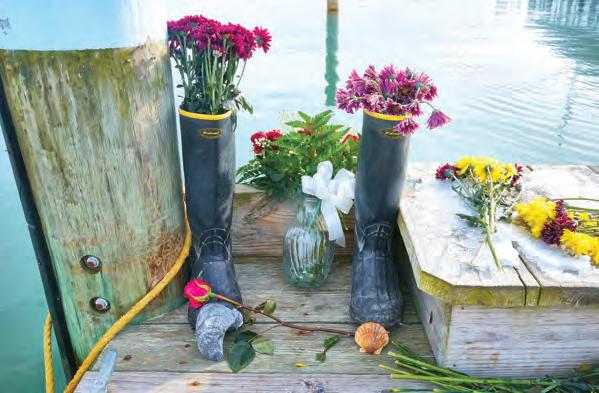
Roy made his final tow on New Year’s Day. He and his longtime partner Patricia Bergeron were scalloping a half-mile off Cow Bay when they were caught in an erratic winter squall. Their skiff capsized, and both died. Roy was 77, and Patricia was 69.
For those who have worked on the waterfront, Roy is remembered for his storied commercial fishing legacy. That includes his family, many of whom have followed the trail he blazed in aquaculture, and countless former deck hands. In interviews, they reflected on how Roy’s
life at sea traces the trajectory of the commercial fishing industry. For Roy, they said, the ocean was a vast frontier, and he was something akin to a prospector.
“He was always pushing new domains,” said Roy’s grandson, Matteus Scheffer, 25, who worked on Roy’s oyster farm for years, and now scallops and runs his own lobster boat out of Menemsha. “Whether it was the Grand Banks or the Edgartown Harbor, he loved fishing where no one else had gone.”
Roy’s earliest memories involve the Island’s inshore fisheries, he recalled in a 2025 interview with Indaia Whitcombe, an oral historian for the Martha’s Vineyard Museum. Roy was raised by his aunt, Edie Bennett, from the age of 12, after his mother died. The family lived in downtown Edgartown, and were among the 150 people scalloping in Edgartown, he recalled. Roy started shucking scallops at 12 years old. “Right after school we would run over and cut until suppertime,” he told the museum.
1. Rubber boots filled with flowers and adorned by seashells honor Scheffer and Bergeron at the Edgartown Harbor docks.
2. A photo of Roy Scheffer on an Edgartown Harbor dock post.
NICHOLAS VUKOTA
Roy Scheffer with his grandson Matteus and two bushels of bay scallops.
After high school, he too ventured out into the bay for a day's pay in scallops.
When he was 21, Roy was offered his first trip offshore. He was soon to marry his first wife, Kristine Larsen, and their first child, Kimberly, was on the way. It was the late 1960s. Times were changing in Menemsha. The old world of wooden hulls and harpoons was giving way to a bold new generation of fishermen. The Larsen family at the time ran two successful swordfish boats out of Menemsha — retrofitted Southern shrimp boats — and had pioneered the industry by developing a form of fishing known as “longlining.” The fishery, which requires rigorous understanding of the ocean’s currents, involves setting one line, often miles long, baited with hundreds of hooks, and buoys to keep the line afloat.
“My first trip, I said, ‘I’m never doing this again,’” Roy recalled in the museum’s interview. But that didn’t hold. Instead, it spawned a 27-year career offshore, fishing from the Grand Banks to the Gulf, from the Azores to Hawaii. Within three years of his first trip, Roy had earned his spot as captain of the Larsens’ sword boat. “I had the best teacher,” he said of his father-in-law, Louie Larsen. He learned the trade with relentless curiosity.
“Roy would say: ‘I don’t like this drag, I’m going to invent a new one,’” recalled Donny Benefit, who fished as first mate with Roy on both sword boats and groundfish draggers for 15 years. “He loved the hunt and taking a big chance for the big reward.”
He brought Isaiah on trips dragging for flounder when he was as young as 11, and had him make his first tow at 13. “He put a lot of faith in me,” said Isaiah, who is now the Chilmark shellfish constable. “I was a kid, but he wanted me to learn that I could do the work of any crew member.”
Those who worked on deck with Roy for any length of time are filled with stories of their voyages. Some recalled trips in the Grand Banks stretching as long as 54 days, and others where they pursued schools of swordfish as far as 1,700 miles from port, sometimes ending up closer to Ireland than the Vineyard. Some remember the quiet moments, like the five-day steam to the fishing grounds, with Roy’s feet kicked up at the wheel, playing cribbage and listening to
Jefferson Airplane. And there were moments as far from that calm as possible. In one harrowing account, Doug Benefit remembers Roy clutching the wheel for 18 hours straight as he navigated a fierce October hurricane on the Grand Banks. At one point, he said, the boat rolled hard on its side while climbing 35-foot waves. He remembers walking on the wall and steadying his hand on the floor as he rushed to inspect the boat’s stabilizer arm, which had snapped off its link and was stuck upright in the mast’s wires. Somehow, maybe by a crossing wave, the boat righted itself and the arm came crashing down, wrapping itself over the rail. When the weather finally cleared, they continued to fish for 12 more days.
There were also clashes almost as fierce with the Coast Guard. When Roy first started fishing, the only ocean boundaries were the ones created by nature: shoals, currents,
and different types of bottom. But in the mid-1980s, in response to depleting fish stocks, authorities made efforts to regulate the fisheries. They did so by setting consistently declining quotas and carving the ocean into nationalized territories — artificial borders like the Hague Line, which partitioned Georges Bank between Canada and the U.S. The once boundless ocean was closing in, and the relationship between fishermen and the government was beginning to sour. Like many fishermen at the time, Roy was defiant. The Canadian Coast Guard seized his father-in-law’s groundfish boat for towing over the newly established line. Authorities wanted to make an example out of him by imposing a large fine and holding him in a federal prison. The profit margins in the fishery were rapidly thinning at the time, and the boat was locked up for months,
though the charges were later dismissed.
After years of ratcheting regulation, in 1996, Roy decided to get out. “When the government told me I couldn’t go fishing, or I couldn’t catch the amount of fish that I wanted to catch, that I’m able to catch, I said, ‘Well, this isn’t for me anymore,’” he said in his interview with the museum. But his pioneering spirit didn’t stop. He took the same ingenuity inshore. Working on a grant through the Island’s shellfish group to create jobs for displaced fishermen, Roy and others experimented with different shellfish that could grow in shallow waters like Katama Bay. They tested quahogs, mussels, and scallops. But it was oysters that showed the most potential for aquaculture. “They just started growing. I mean, every time I picked them up, they’re bigger and bigger,” Roy recalled. The equipment didn’t exist yet, so Roy took to welding cages that were the model of the plastic-coated wire cages used today, and introduced all sorts of hydraulic equipment to assist him in the backbreaking work.
“He was really the first. It was his success that convinced people, fishermen, they could make a go of it growing oysters down there,” said Jack Blake, who also pioneered the industry alongside Roy in the 1990s.
Today, oysters have evolved into a multimillion-dollar industry and a stable career on the water for many fishermen, with dozens of farms across the Island. Roy’s legacy offshore is one now remembered mostly through old photos, through relics like the swordfish logo on Larsen’s Fish Market, and in the absence of the large, rusted rigs that once lined the Menemsha Docks. But his legacy inshore persists. Roy’s children and their sprawling, extended families continue to harvest shellfish — scallops, lobster, conch, quahogs, and steamers — from all corners of the Island. Two of his sons, Jeremy and Noah, operate their own oyster farms in Menemsha Pond and Katama Bay. Roy’s youngest daughter, Martha, who worked alongside him for the past 20 years, will run the oyster farm this year. She said she would continue to market the product as “Roysters.”
“I learned so much from him,” she said. “I feel so lucky to have been able to be out there with him all these years. There’s nothing he loved more.”
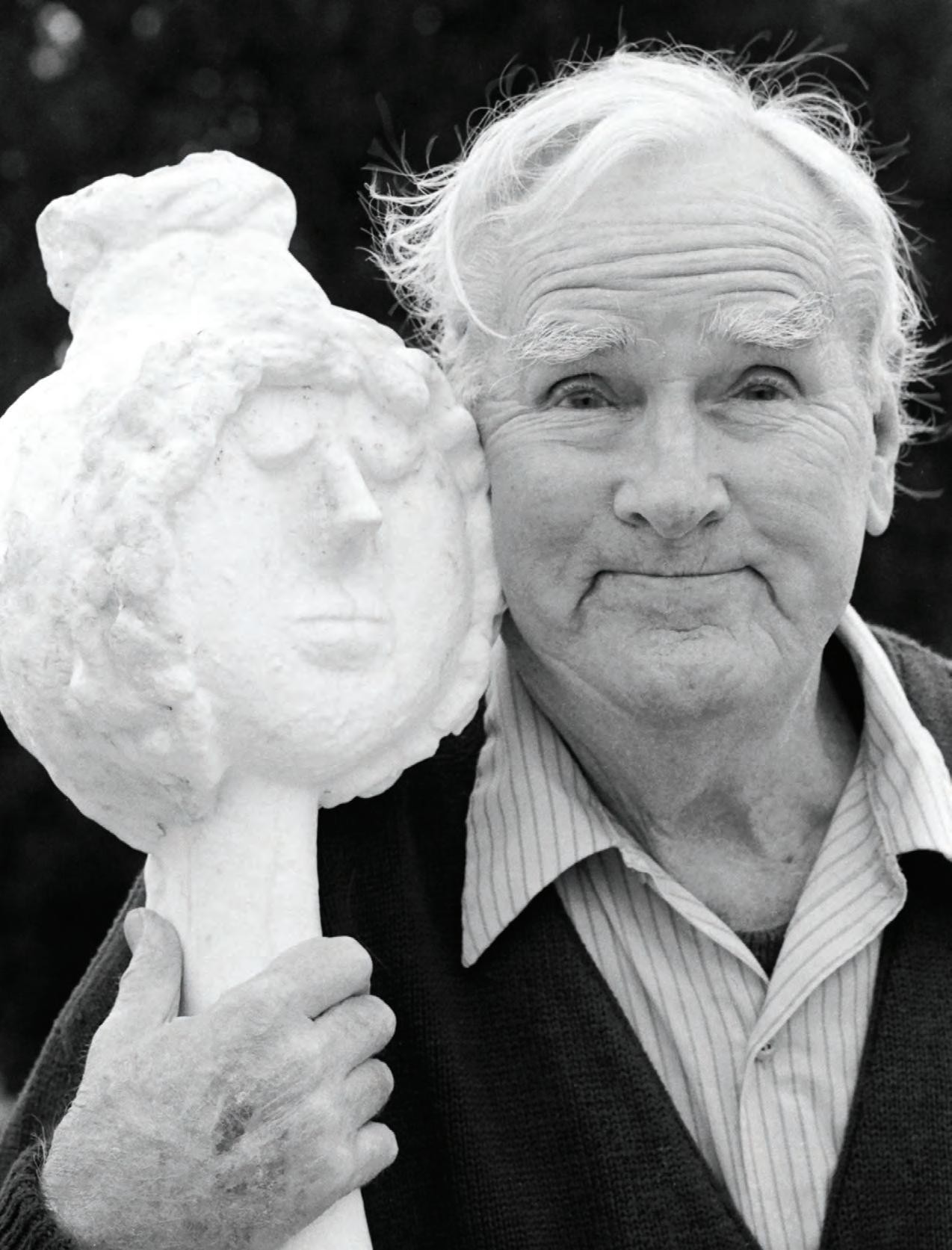
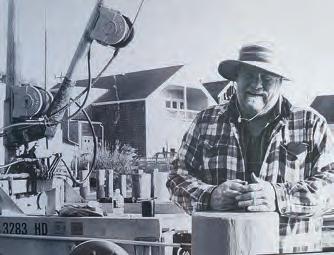
Photo by Alison Shaw of Tom Maley, 1992.
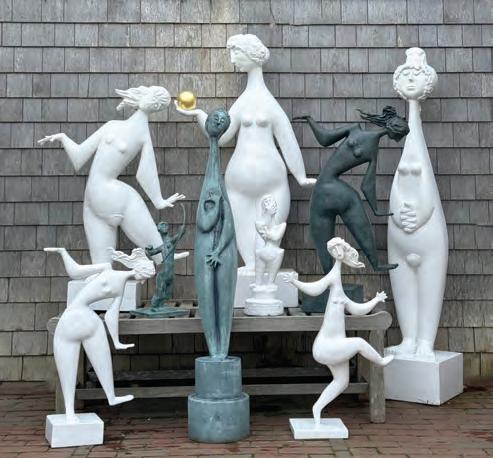
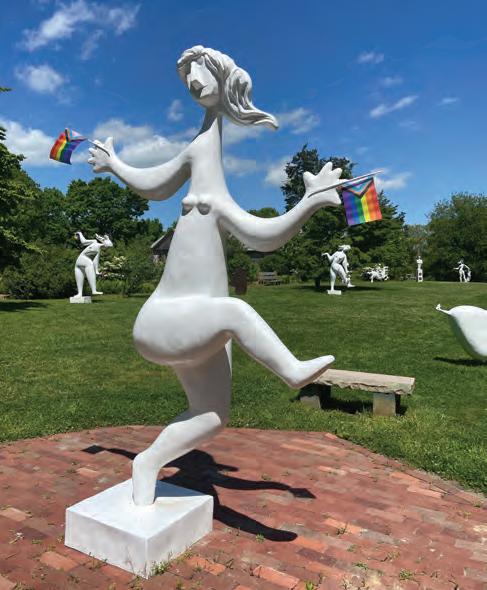
Tom Maley’s larger-than-life, frolicking white sculptures have brought joy to countless people since he displayed the first figure in front of his home and studio in 1970, in a meadow where the Field Gallery now stands. They reflect not only the essential spirit of the man himself, but also the spirit of the time and place, and community, he worked in.
The works, which gambol about the lawn, are synonymous with the gallery. To walk among them is to immerse yourself in decades of West Tisbury’s artistic zeitgeist.
In an essay for a 1990 Field Gallery catalog, Maley recounted how the whole thing started, when he stood with three other artists — Eleanor and Max Kahn, and Robert Schwartz — looking out at the field next to his house. “One of us … said it would be a fine spot on which to build a gallery. And like St. Peter choosing the rock upon which to build his church, we all decided then and there that it would be the chosen spot. The very next morning after this almost mystical experience, Robert Schwartz, the architect among us, arrived with a cardboard model of our gallery-to-be, much as it is today. And as soon as you can say ‘Jackson Pollack,’ there arose a dizzying show of hammers, shovels, tape measures, and saws; the foundation, framing, roofing — all the necessary parts of a building were underway.
“We saw to it that there were extra shovels, saws, hammers (and Band-Aids) so that any hapless person who happened by, out of curiosity, would find himself or herself with a hammer or saw in his or her tender hand and hard at work.”
Allen Whiting, a young artist at the time who assisted in building the gallery, remembers, “It was a community effort.”
The four founders opened the gallery to other artists over the years, including Whiting, Peter Simon, Alison Shaw, and Doug Kent. But their commitment to the community went further. Maley wrote, “We also hoped, without any profit to ourselves, to benefit the Island in as many ways as possible. Aside from a gallery to exhibit works of art,
the surrounding field would be used for plays, dance recitals, weddings, early morning yoga classes, political speeches, and even Easter egg hunts, and a nice place to eat your lunch.”
Of his commitment to supporting other artists, Whiting recalls, “Tom was so inclusive. He had a drawing group in his living room. Everybody paid their 10 bucks, and we drew for a few hours.”
Behind Maley’s good humor was an intense dedication to his art, which began in childhood. He drew caricatures of his high school teachers, which got him in a good deal of trouble. “I filled the yearbook with caricatures. Some I regret a little bit. I was kind of mean to them, and it was always the ones I was meanest to who were the nicest and most appreciative.”
After college, while working at a commercial photography studio, Maley started painting. He referred to his style as primitive. “There are two kinds of primitive. One is a euphemism for incompetent, and the other is carefully, beautifully done. Mine were the first kind. But in spite of yourself, you gradually improve and get better.”
Playing the field
Tom Maley, the Field Gallery’s playful visionary. BY ABBY REMER
Just after the war, he also briefly attended the prestigious Arts Student League in New York. “It was full of GI Bill recipients, and I only got a place out in the hall to set up my easel where I could just see the shoulders and head of the model in the other room.” He speaks of the esteemed institution, swarming with veterans, as a madhouse. “So I decided you couldn’t learn anything in art school. I still believe that. You can read books about materials and look at pictures in museums, and that is what I did constantly.” He began to earn prizes in New York’s Westchester County and won a national award for a painting of two Vineyard girls, attributing winning to being “better than at least one other person in the exhibit.”
Although he was best known for his cavorting sculptures, painting was Maley’s first love. He had a breadth of styles reflecting his penchant for soaking in art from many sources. “He was a learned man,” Whiting recalls. Just a few influences might include Cézanne in his landscape “Turkish Village,” Modigliani in his portrait of a young man, Matisse in a seated nude
Maley's "9 Dancing Ladies" sculptures.
DENA PORTER
“Tom said the greatest sin someone could commit is to be boring. And he really wanted to cheer people up.” –ALLEN WHITING
figure, and his own self-portrait, which carries hints of Thomas Hart Benton. Mythological subjects were a frequent muse, as seen in “Europa with Bull.” Once asked if there was a particular period he liked best, Maley responded, “Only at the time I’m doing it … There was always someone many years ago who had already done it better, but you have to learn to stop competing with anybody.”
While he also painted some still lifes and seascapes, the vast
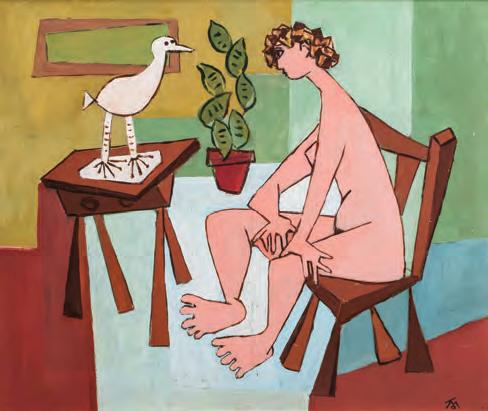
majority of Maley’s art is figurative, whether in oils, watercolors, or acrylics. He said, “There is only one approach, figurative, though not literal. I’d like it not to be, but the paintings are always figures and represent something that you care about less and less at the end. But it is hard to get away from it.”
It is unsurprising, then, that Maley focused on the human form in his sculpture. Starting in the 1950s, he experimented with various media. “I began to make little figures out of wax, then covered them with a mysterious material, partly potato flour and plaster of Paris, smothering the whole thing. Then I put it in the oven, which stunk up the kitchen, but the wax melted and oozed out of a little hole left in the plaster. Then you could pour another material into the mold, and when it sets, break the plaster and have a figure.”
Maley made his first larger-than-life figure in the mid-1960s in the field by his driveway. With the first one, he fashioned the figure from Styrofoam and then covered it with polyester resin. “I stood and watched as it started to smoke and melt great big holes in the figure. It was weird.”
Eventually, with the help of his son Tim, he found a more durable way to make them. “He would take a sheet of plywood and draw out the figure, which became the armature,” Tim recalls. “We would insert steel rods so they could be embedded in a concrete base later. Over this, we’d epoxy on blocks of urethane foam, and he would make the figure out of that. Then I would do the fiberglassing. Then there was a lot of sanding, painting, and finally putting them into the concrete base. You sometimes had to tie the sculpture up to a tree while the concrete was setting.”
Maley also designed similar tabletop figures, cast in white resin and verdigris bronze, in limited editions. But he said, “The truth is, I would much rather paint. I like it better. It’s so cozy for me to sit by the easel next to the window in the gallery in the wintertime and paint … Painting is quicker and has an immediate effect; otherwise, the feeling is gone. I have some pieces of sculpture that I started three years ago and never finished because I lost interest, forgot what I intended to do. That is one thing painting takes care of; you can finish a painting in half an hour if you have a mind to. That doesn’t lessen its quality or value. Some of [the sculptures] take forever. You keep plastering over it.”
Maley worked nearly until the day he died, in August 2000, at the age of 89. His art lives on, though, in his paintings and spirited sculptures, which bring laughter and a sense of playfulness to people of all ages. As Whiting shares, “Tom was a delight and a funny man. If he took any risks in the art world, I think it was making whimsy. Tom said the greatest sin someone could commit is to be boring. And he really wanted to cheer people up.”
Tom Maley’s work can be seen at the Field Gallery in West Tisbury, and in the exhibition “Tom Maley: Dancing in the Field” at the Martha’s Vineyard Museum in Vineyard Haven through September.
Untitled painting.
In the Field Gallery yard is a collection of Tom’s sculptures, including “He Loves Me” in the foreground.
PHOTOS: DENA PORTER

Pa waysArts
Curating and catalyzing creative projects in the arts, writings, dance, film and collaborative forms on the island of Martha’s Vineyard

“KeepingalightoninChilmark”
November - April Residency
9 State Rd @ The Chilmark Tavern
LiteraryArts curated by RonSlate
LiveMusic in our Listening Room
WEDance Performance, Classes and DJ Dancing for all ages
OngoingCollaborations
Vineyard HavenFirst Fridays June - October, 2026
Silent DJ Dance Party at Dark
Featherstone&PathwaysARTSPresent
On the Featherstone Campus: In Celebration of their 30th Year PathwaysARTS’Silent DJ Parties
April 30th & June 28th, 2026 (Open House)
LiteraryArts
NaomiShihabNye Palestinian American Poet & Novelist
Wednesday, June 3rd, 2026
PoetBillyCollins Former U.S. Poet Laureate
September 26th, 2026

Dr. MarianneGoldberg (1952 - 2015)
Founder of PathwaysARTSin2010



PathwaysARTS is a registered 501c3 non-profit


Donations accepted to Pathways Projects Institute Ltd. P.O. Box 437 Chilmark MA. 02535 • PathwaysMV.org PathwaysProjectsEvents@gmail.com


Not just fiddling around
The musical history of the Flying
Elbows.
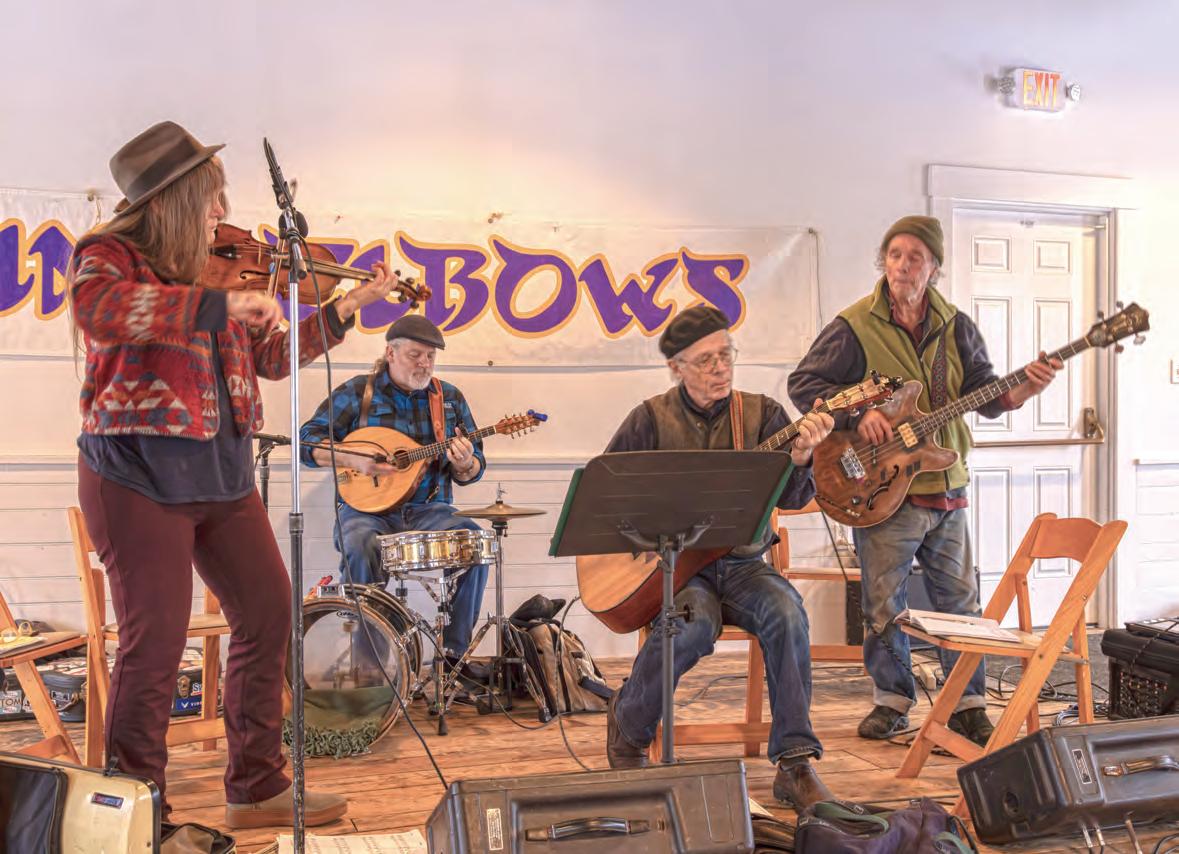
The Flying Elbows is a footstomping string band that has kicked butt around Martha’s Vineyard for the past halfcentury. Its roots go back to Gale Huntington.
Huntington is a legend among Vineyard musicians for his lifelong fascination with sea chanteys and fiddle tunes. Starting in 1928, an up-Island group of fiddle aficionados, helmed by him and including Artie Look and Hollis Smith, played square dances, parties, and weddings. As time passed, others joined in — even Thomas Hart Benton, when he wasn’t painting. They all played together through the decades.
BY DAVID PB STEPHENS
When he was 18 years old, Bob Hammond, who plays banjo and fiddle, watched Peter Huntington as part of a band called the Menemsha Bighters. “They were playing at a party up in Chilmark,” Hammond recalls. “It would have been around 1970.”
Nancy Jephcote, the fiddler, nods and says, “This band has a lot of roots from previous bands. We knew we were continuing something that had been here before us. And those who were alive knew about us, and were glad that it was being perpetuated.”
Guitarist Tom Hodgson says, “Coming up, I heard Gale playing with Mike Athearn and Ernie Correllus. They were the Flying Elbows of their day. That’s our folkloric link to the past here.”
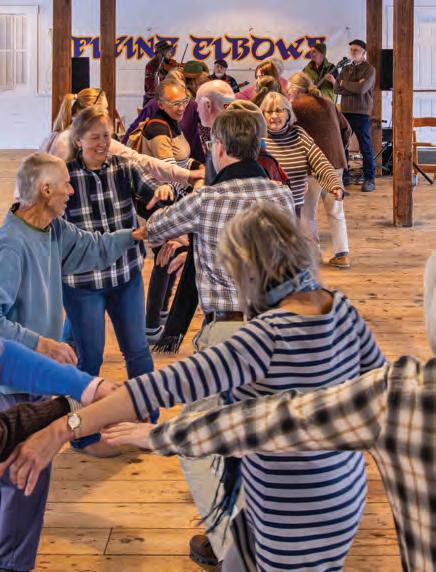
The Flying Elbows still play contradances, like this one at the Grange. From left, Nancy Jephcote, Brian Weiland, Tom Hodgson, and Paul Thurlow.
Contradancers enjoying the band.
Martha’s Vineyard in the 1960s and ’70s, still largely undiscovered by vacationers, celebrities, and real estate moguls, was a refuge for artistic off-Islanders of all talents, who landed here without fame, connections, or status. They included woodworkers, pottery throwers, avant-garde painters, freeform dancers, stained-glass window crafters, and musicians.
Lots of musicians. Hodgson remembers, “In the early 1970s, there was this whole wonderful music scene that I started getting involved with. I grew up participating in the up-Island tradition of ‘musicales.’ We would get together to play two, three, four times a week.”
If you wanted to play, there were lots of opportunities. Bassist Paul Thurlow played in a rock band with his brother and some friends. Their first gig was a dock dance in Edgartown around 1969. “We used to play at the Sea View back in the late 1970s. It was a great scene. The thing about the scene back then was that everybody took what they could get. We were playing bebop and Mingus, and people got up and danced.”
Brian Weiland, percussion and mandolin, recalls, “I played every band I could get invited to.”
Island life was not cushy in that era. The unemployment rate was high; people took whatever work they could and held on tight to it, doing what they had to in order to pay the bills.
But they lived for their art. Jephcote remembers, “My first job was at Morning Glory Farm as the greenhouse manager. I was a marginal young person trying to get by on as little work as possible so I could be the creative individual that I wanted to be in my life. Work was not my focus.” Hammond was a carpenter, who played when he could steal the time. Thurlow painted houses. Hodgson did too, until he trained in signcarving and painting. Then his hard-earned self-employment gave him the freedom to adjust his schedule. “I think there are a lot of people on Martha’s Vineyard, they may have other passions, but they are here because they can be independent, work for themselves, and do what they love,” he says. “That kind of independence has always made a sane life possible for me.”
Weiland taught at the Oak Bluffs School: “I think most year-round Vineyarders choose a certain quality-of-life experience, often of a time-honored vein, at the expense of serious modern professionalism.”
Out of that swirl of talent and commitment came the Flying Elbows.
Bob Hammond, the sole remaining original Elbow, remembers, “I started playing with a group of musicians one summer, and we called ourselves the Flying Elbows. We started jamming at the Ritz with whoever showed up. The name stuck, but the people changed all the time. It was a wild scene. I learned late, and was just playing with a lot of good musicians coming through the Island. It was an opportunity to learn from them and play tunes, and then it morphed into the [contra]dances.”
The ebb and flow of Elbows meant an inconsistency of fiddlers. So when Jephcote, a fiddler, moved to the Island in 1984, “I was immediately adopted into every upIsland band because I wasn’t just a guitar
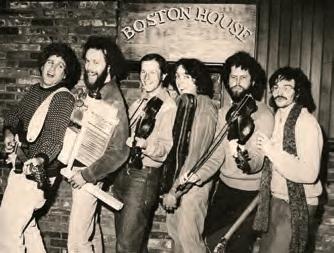
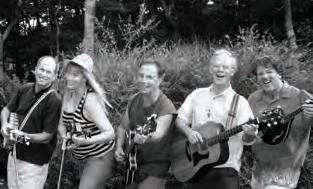
up onstage. I played a tune.” That fiddle contest, profiled on NPR, almost immediately became a mecca for mainland musicians. “Off-Island fiddle groups were given permission to camp at the Fisher Farm [Flat Point Farm], which made for great all-night sessions around the fire!” says Jephcote.
Meanwhile, Hammond and David O’Brien, another early member of the group, asked Jephcote to play dances with them, “so I became an Elbow. Our most regular gig in those days was playing the monthly Saturday contradances, up at the Chilmark Community Center.”
“The contradance was a big part of the next step in our development,” Hammond agrees. “We played every month regardless of whatever else was going on. We weren’t looking for work. We all had these other lives. Bars weren’t really our scene. We weren’t playing popular music and cover music. It had to be people who wanted us, specifically.”
The Flying Elbows remain true to their lineage. Jephcote defines them as “an agricultural niche band.” They play the Pumpkin and Strawberry festivals at Morning Glory Farm, the Felix Neck Fall Festival. They welcome people who want to learn. Jephcote teaches fiddle and other bowed instruments; Hammond oversees free old-timey music sessions on Tuesday nights. Of course, they still play the contradances. Jephcote would love to “bring a bunch of us together into an informal contradance ‘orchestra’ of sorts … This way, some potential dance fiddlers could get their feet wet without exhaustion, and possibly get a taste for it.”
This Island is not what it was in Gale Huntington’s days. There are fewer, if any, all-night camping jam sessions around farmland bonfires. Yet, dotted across the Vineyard, little pockets of fiddlers still gather. “We fiddlers all know each other. We are part of a culture of traditional music on the Island,” says Jephcote. From Chilmark to Chappy, musicians of all levels come together, rarely belonging to a single group.
player. Everyone was playing the guitar in those days, and the fiddle player was glommed onto. The following summer, I saw the fiddle contest [which Hammond had created, at the fair], and I grabbed my fiddle and got
Fifty years ago, Gale Huntington dropped a fiddle-shaped rock into the becalmed musical waters of Martha’s Vineyard. Those ripples still expand, on and on.
The Elbows still fly.
COURTESY THE FLYING ELBOWS
ABOVE: First known photo of the Flying Elbows, 1979. BELOW: Flying Elbows, 2009: From left, Bob Hammond, Nancy Jephcote, Paul Thurlow, Tom Hodgson, and Brian Weiland.
The math of a merger
When 1 + 1 = 3.14159 …
BY BRIAN DITCHFIELD
After graduating from theater school, I never imagined my career in the arts would require so much math. To my surprise, I learned to love the numbers. They offer another lens for seeing the story, understanding what has happened, and anticipating what may come next. Numbers create evidence for what can otherwise feel intangible.
After college, I worked with theater companies and in film production, and I discovered that numbers were another way in. In a room full of artists, I was often the only one unafraid of them. I was bilingual: I could speak art and math. I could talk passionately about what we were creating, then tell the same story through budgets, audience reports, and marketing data.
That skill led me from working as an administrative assistant at a theater company to serving as financial manager for a nonprofit in Chicago, and eventually, after moving back to Martha’s Vineyard, to becoming business manager of the Martha’s Vineyard Playhouse, and later, managing director of the Martha’s Vineyard Film Festival.
Now, as executive director of Circuit Arts, I rely on math more than ever. I trust it to reveal our successes and teach us from our failures. I trust it in the editing room, where pacing is measured down to the frame, each one 1/32 of a second. I trust it when blocking a play, where geometry meets logic and story.
I trust in the art. I trust in the numbers.
equals twice as much. The optimists say that when a merger is right, 1 + 1 = 3, or together, with synergy, we become more than the sum of our parts. But I think the equation is actually 1 + 1 =
The formula I was looking for is complicated and impossible to calculate fully. It requires two institutions with proud histories to relinquish a measure of independence in service of something larger. It asks artists, staff, board members, audiences, and donors to imagine continuity and change at the same time. It is complex and demands trust. Circuit + Playhouse =
Pi is not neat addition or predictable multiplication. It is transformative, circular, continuous. It is a relationship.
My relationship with the Martha’s Vineyard Playhouse goes back to childhood. MJ Bruder Munafo, its recently retired artistic director, taught me for many years in theater and improv classes. I performed in plays in the amphitheater and on the Patricia Neal Stage, and I worked as a camp counselor at the Playhouse as well. During my time at Boston University’s College of Fine Arts, I returned home

with classmates each summer to perform and work at the theater. Years later, I became a full-time employee. Like the endless digits of pi, my relationship is only one in a long sequence of connections that must be taken into account.
So when our board began discussing a potential merger with the board of Martha’s Vineyard Playhouse, I knew what I had to do. I went to work on the numbers.
A lot of math goes into a merger between two organizations: cash flow projections, pro forma budgets, and balance sheets, all of which help shape a strategic plan to streamline operations and expand programming.
As helpful as they were, the spreadsheets got us only so far. I realized I needed a different equation.
Most people would say a merger is 1 + 1 = 2, or mine plus yours
What I love about pi is that it is irrational and infinite, never settling into a repeating pattern.
When organizations come together, they do not snap into place like puzzle pieces. Culture is not divisible by two. History does not conform to the logic of a spreadsheet. Integration unfolds through subtle conversations, trial and error, moments of friction, and moments of breakthrough. The process does not end just because a legal document is signed. There is no final digit that signals completion.
Work, art, and community are dynamic.
We must embrace that ever-changing nature. Nonprofit
organizations are especially prone to settling into patterns. In small communities, it is easy to become attached to “the way it has always been.” As a nonprofit in a small community, we must be even more vigilant against that kind of stagnant thinking.
The Martha’s Vineyard Film Festival began as a three-day event, but over time, it has evolved into something much larger. We added education programs, a filmmaking team, a camp, the Drive-In at the YMCA, live theater, live music, and eventually a year-round home at the Grange Hall. Circuit Arts was formed as the umbrella for all of this activity, while keeping the spirit of that very first Martha’s Vineyard Film Festival at its core.
No matter how big or small a circle gets, the ratio between its diameter and circumference remains the same. That constancy is what makes geometry dependable.
A merger should work the same way. Scale changes, budgets increase, staff structures evolve, programming expands, and geographic reach widens. The radius grows, but if the underlying ratio, the mission, the core values, and the commitment to community and artistic excellence remain intact, then the circle holds its shape.
The irrationality of pi is not a flaw. It is a reminder that complexity is inherent in anything living and meaningful.
And that is especially true on Martha’s Vineyard, where arts organizations do not exist in isolation. We share audiences, artists, students, donors, volunteers, and stages. A person who discovers one institution will deepen their relationship to the Island through all of them. This merger is not about erasing identities. It is about recognizing the ecosystem that already exists and building a stronger structure to support it. When we work with that reality instead of against it, we create more possibilities for artists, more access for audiences, and more resilience for the cultural life of this Island.
We often rely on approximations of pi, like 3.14 or 22/7, because they work well for most calculations. We know they are not perfect, but they are useful. The same is true of the financial models, pro formas, and strategic plans that guide a merger. They are approximations of a future we cannot fully see. They help us project savings, identify efficiencies, and measure potential growth. But they do not capture the value of shared creative energy. They cannot quantify the spark that occurs when artists from different disciplines and traditions collaborate. They cannot assign a precise number to audience enthusiasm or to a donor’s confidence when institutions align. The real impact of a merger, its cultural resonance, emotional power, and potential, exceeds any spreadsheet. Like pi, we can approach it with increasing precision, but we cannot calculate its full depth.
1 + 1 = 3.14159 … is a formula that recognizes mergers are complex and continuous. It acknowledges that integration will never be perfectly tidy, that growth will require courage, and that the true measure of success will not be captured in a single fiscal year.
If we remain faithful to the constant of our mission and values while allowing the radius of our ambition to expand, the circle we are drawing together will not only endure, it will carry more weight, invite more voices, and create more art than the arc of either organization could have sustained alone.




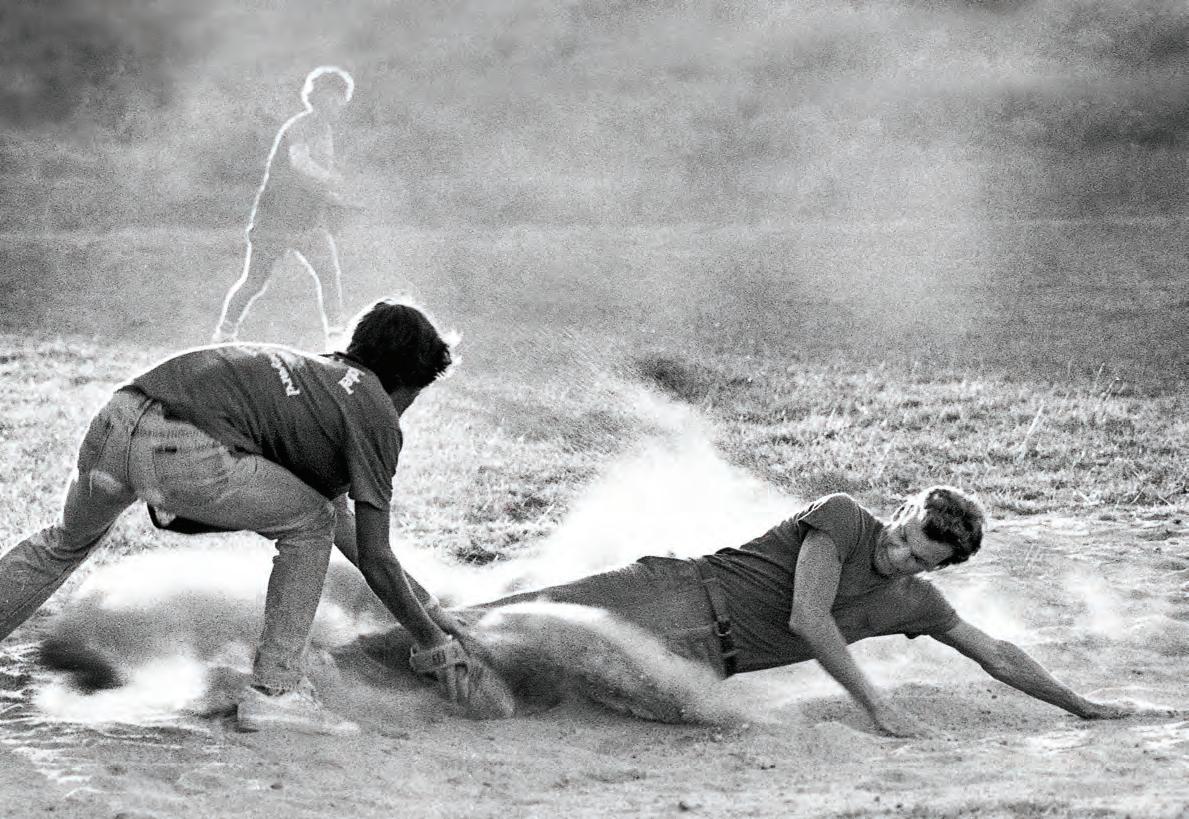
Gloves in!
A century of Sunday morning Chilmark softball.
BY SIG VAN RAAN
Travel back 100 years ago to Martha’s Vineyard. It’s the end of the Roaring Twenties, which will soon collapse into the Great Depression.
The Island population is under 5,000, and by the early 1930s, one-third of the population is on some form of government relief under Roosevelt’s New Deal.
In this uncertain and relatively idle time, people pulled together for Sunday gatherings, and a new game called softball was just becoming popular. The lore is that the game was invented in 1887 on Thanksgiving Day, when a Princeton student rolled up a boxing glove and threw it at a Harvard
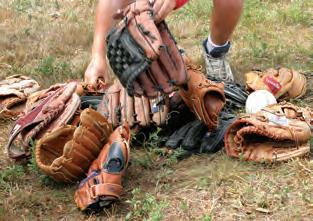
student, who hit it with a broomstick. And softball, which was sometimes called “indoor baseball,” was born. It became a way to keep baseball skills sharp through the winter. It officially adopted the name
“softball” in 1926, and grew in popularity during the 1930s.
During those early years of its history, the Chilmark softball game was established in the backyard of the Flanders family in Menemsha as a Sunday morning neighborhood pickup game. Following church services, families would gather, choose sides, and play until lunchtime. When the game outgrew the Flanders’ backyard, it wound up in Muriel Toomey’s expansive yard off the road to Gay Head, now Aquinnah.
Fast-forward half a century to the mid1980s. Toomey’s field was sold, and the new owner planted multiple trees in what had been the ball field. The diamond moved to the softball field of the West Tisbury School,
“Dust Bowl.”
Teams are chosen at random by splitting up the gloves.
PHOTOS: PETER SIMON
and then to behind the West Tisbury fire station. Here it remained for a decade.
During this time, photographer Peter Simon took on the unofficial role of softball manager. He and Jim Brooks, team captains, would choose sides. This was known as “The Era of the Chosen.”
It was in 1984 that this writer first started playing. By the seventh inning of my first game, I was hooked. Those games were serious and competitive — or so it seemed until the kibitzing began. There were arguments about everything. Sometimes the arguments almost took over the game. But Bill Edison, the longtime commissioner, would stop the game when the quarreling got out of hand and consistently remind everyone: “Time is running short — play the game! Summer is fleeting.”
Around 2002, the game moved back to Chilmark, to a field off Peaked Hill Road. This was accomplished through the efforts of longtime players David Flanders, Billy Meegan, and Peter Simon, and of course Edison, among others. Some of these legends
have passed on, but their spirit remains, and the game remains, too — with opening day set, as always, for the Fourth of July.
Chilmark softball has a unique longevity as a pickup game — an informal gathering of players who come together and choose sides. It may well be the longest continuing pickup softball game in the country.
The custom now is for all the players to throw their gloves in a pile; the gloves are randomly separated, and that is how the teams are decided. “Gloves in!” is the way each game starts.
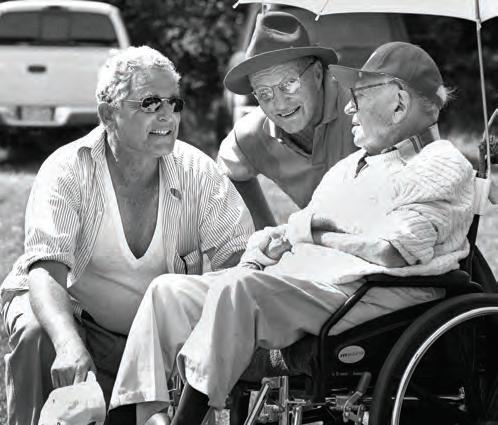
Once the game was moved back to Chilmark, it took on a gentler and much-improved culture. Long-standing player Jason Balaban remarks: “Although we were all trying our best, there was always something larger than wins and losses. Comradery, friendships, history, dreams were all being formed or played out in this universal summer game. It was and still is an instrument transmitting and transferring us to our childhoods. There’s a reverence for the simple act of playing ball on a field with friends.”
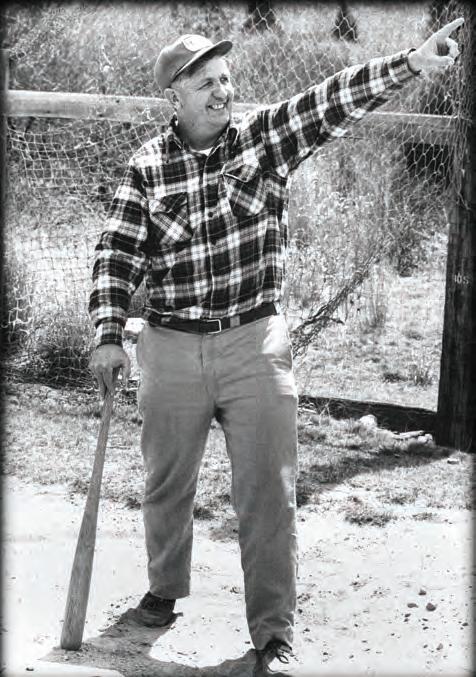
On July 5, 2009, the field was dedicated as Flanders Field to the memory of legendary Chilmark player David Flanders, who had died the year before. The dedication ceremony began with a bagpiper in full Celtic regalia playing “Take Me Out to the Ball Game,” followed by informal comments by several long-term players. These included commissioner Edison, Hans Solmssen, Peter Simon, and Peter Neuman.
Solmssen, our oldest player at 89, reflects on Flanders as one of the true founding fathers of the game: “What I vividly remember is David Flanders stepping up to bat. All the infielders would drop their gloves, because we knew David would drive the ball into the pine trees for a home run.
“A Chilmark fire engine was visible in deep right field. The new scoreboard sign was christened with a bottle of champagne. Fran Flanders, David’s daughter, tossed out the ceremonial first pitch.
“It’s not Fenway Park. But in the early years at Peaked Hill, there was a big ugly boulder in left center field with poison ivy growing around it. It was referred to as the Green Monster. The field had its ups and downs and dips that could be lethal while tracking down a long high fly to center field. If a fly ball hits the dirt road beyond right field, it’s referred to as a Kerouac. Why? Because it’s On the Road!
“Our present-day first baseman, Ed Eger, has set records with his majestic Kerouacs. He refers to that ‘lumpy, pockmarked field of dreams’ where the focus is ‘to have fun, have some laughs, play some softball, not take ourselves too seriously, always be a good sport, and make lifelong friendships.’ Those are also guideposts for life. It’s important to be reminded of these things every summer, to help me get through the winter.”
Although there is no official dugout, there is a large players’ bench: the Tony Horwitz Honorary Bench, a tribute to the late Pulitzer prizewinning author who was one of our most enthusiastic players, as well as the in-game scribe.
Chilmark softball may not have had Babe Ruth visit, but still, it has a storied history.
David Flanders.
Irv Petlin, Jerry Kohlberg, and Rabbi Weiss.

One of the more searing memories is of Hall-of-Famer Jackie Robinson, who attended one game back in the early ’60s as the guest of Peter Simon and his mother, Andrea. In the ninth inning, with men on base, Bob Crichton stepped back from the plate and announced, “Now batting for Crichton, Jack R. Robinson.” He handed the nearly blind Robinson his bat and stepped away. Robinson fondled the bat and peered out toward the pitcher. He clearly wanted to give it a try, but then he handed the bat back. What followed was the silence of respect that no one else was ever accorded on the field.
Those longtime umpires were memorable, too, Kaplan continued: “Roger Baldwin, who founded the American Civil Liberties Union, ruled ‘with the thundering authority of an Old Testament prophet.’ Rabbi David Weiss of Philadelphia had a strike zone that extended unto the heavens.”
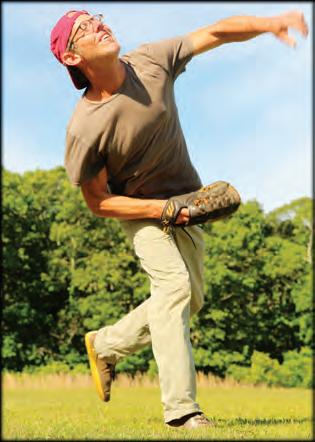
“Time is running short — play the game! Summer is fleeting.”
—BILL EDISON
“There were Bunyanesque figures out there,” wrote Jim Kaplan in the Vineyard Gazette in May of 2006. “Chilmarkers such as David Flanders who hit tape-measure homers, Ozzie Fischer, who came off the UMass varsity to hit line drives, machine-like, over the shortstop’s head, and Dan Cabot of West Tisbury, who caught errant throws that seemed to sail halfway down the line. There was Peter Simon of Chilmark, always barefoot, pitching or making underhand throws from the outfield.”
Jerry Kohlberg, “a bald little guy with a red elf’s hat,” participated in perhaps the most unusual double play in Chilmark history when a ball bounced off his head toward Peter Neuman, who caught it.
The game became fast and competitive. Filmmaker and summer resident Spike Lee appeared in uniform, and was part of the first and only triple play in the almost hundred-year history of the game. Here’s how this writer remembers it: T here are runners on first and second, no outs. Lee, at first base, snares a line drive and tags first base before the runner gets back for the second out, then whips the ball to the third baseman to snag the runner who’s taken off at the crack of the bat. The celebration is astounding on all sides. Highfives, low-fives, hugs all around.
The late Bill Edison believed the game needed to revert to being a true pickup game. He introduced the notion, still used, of 20 to 30 players throwing their gloves in a heap, and letting the youngest player randomly fling the gloves into two piles. Thus, two teams were randomly created each time. If the randomness resulted in top-heavy lineups, there would be some negotiation so that the lineups were more evenly divided.
Edison’s most profound contribution to

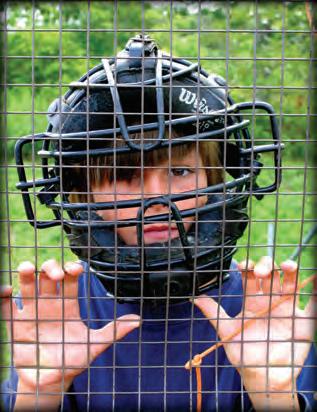
Group shot, with photographer Peter Simon in the middle.
Lexi Roth in the field.
The late Tony Horwitz, scribe of the game.
“On the Outside Looking In,” 2010. LEXI ROTH
JOYCE CARLSON FRIEDMAN
the reestablishment of the game in Chilmark was the promotion of friendships, good sportsmanship, and high-spirited fun.
Conversations with his daughter Miranda reveal his long-standing friendship with Lawrence Ferlinghetti and his affinity for the San Francisco Beat era of the ’50s and ’60s. Edison served as Ferlinghetti’s part-time bartender at El Matador; this was the bar next to City Lights, the celebrated bookstore frequented by all the great writers and jazz artists of the time. He got to know Jack Kerouac and William Saroyan, as well as Allen Ginsburg. In the early to mid-’50s, Edison and his wife Lydia started spending their summers at their magical cottage in Menemsha. The late Peter Simon reflected on those years, writing, “[Bill] was the informal coach for all the younger players, and he taught me the nuances of the sport … I’ll always be grateful to him for taking me seriously and showing me how to play to my strengths. He used sports as a life lesson and got kids to believe in themselves.”
Hustle Award for the most infield hits.”
“There’s a reverence for the simple act of playing ball on a field with friends.”
—JASON BALABAN
As the weekly turnout of players increases dramatically, especially during August, the commissioners try to implement rules involving safety: limiting the number of outfielders, calling balls and strikes, establishing ground rule doubles, etc. But after only two games of the “season of the rules,” the rules — particularly on called balls and strikes — begin to slowly be disregarded. The one rule that persists, however, is the rule of coaching a youngster who may be on base and making sure that younger player does not get hit by foul balls or errant throws.
Peter Simon died unexpectedly in November 2018. He hadn’t been able to play much in his later years, but he’d had almost 50 years of Chilmark softball. In his great collection of photos “To Everything There Is a Season,” he included an entire section to the softball game. He would recall: “Playing softball on the Vineyard has allowed me to be the kid I never was able to be.”
game so special is the spirit that has developed but that remains similar in its formula to those early days almost a hundred years ago. It’s about families — moms and sons and dads and daughters. It’s a social event where friendships have formed and exuberance and joy accompany a well-played game. It’s the game of summer.
Players have come and gone. The famous, the not-so-famous, the year-round Islanders and the summer folks. Hedge fund founders and hedge trimmers, fishermen, artists, writers, carpenters, architects, teachers, doctors, lawyers, psychiatrists, surgeons, pilots, writers, poets, photographers. Moms and sons and dads and daughters. All playing a game that has no clock. It’s the timeless game and we’re all just kids again.
Heading out to Peaked Hill on Sunday mornings this summer, we will recite the resonant words of Bill Edison: “Time is running short — play the game! Summer is fleeting.”
Three commissioners meet near the end of the season to determine awards such as the vaunted Howie Hustle Award, named after Howie Bromberg, long-standing catcher. He would wear a mask and kneepads and run to first base on every ground ball to back up an errant throw. Howie, of course, was the first recipient of this award, and to this day he hands out the award to the season’s player who represents good sportsmanship — and of course, hustle.
Paul Iantosca recalled taking his sonin-law to the game, assuming he himself would just watch it. But “everyone was warm and welcoming. I watched players from 14 to 84 just out on the field having an inordinate amount of fun and laughter. Everyone was enjoying the game as if they were kids again. I was hooked, and threw my glove into the pile for the second game. What I realized as the morning progressed was that I was amidst a group of the kindest and warmest people I had ever experienced. I won an award that year, the Howie
At the end of the day, what makes this
Retired psychotherapist Sig Van Raan has been playing Chilmark softball since 1984. He has three grown children and a growing brood of grandchildren who are regular visitors to his home in West Tisbury, where he lives with his wife, Susan Dickler.
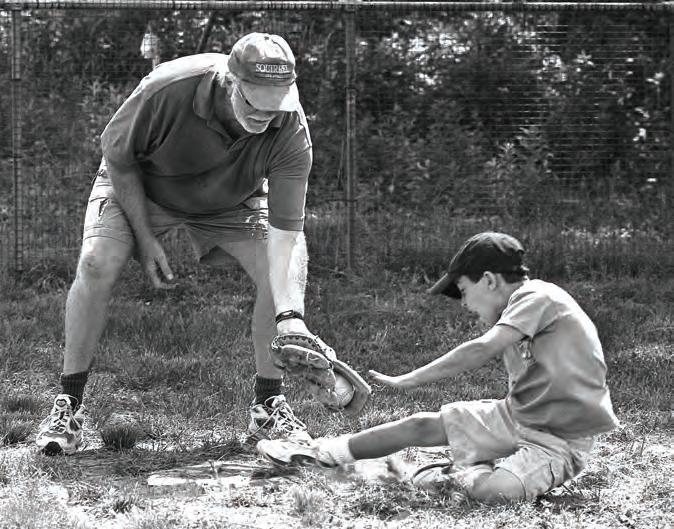
Writer Sig Van Raan tags the next generation.
$100/YEAR
√ Weekly on-island delivery of print edition
√ Digital access 24/7 to mvtimes.com
√ Ability to add digital access for 3 other people of your choice
√ The Minute newsletter delivered daily to your inbox
√ Access to four monthly newsletters such as The Grapevine, Islanders Write, Voices, and MV SportsLetter
√ Opportunity to provide comments and feedback to stories
√ Special invitation to attend Islanders Write and our 2026 Speaker Series
√ Weekly on-island delivery of print edition √ Digital access 24/7 to mvtimes.com √ Ability to add digital access for 5 other people of your choice √ The Minute newsletter delivered daily to your inbox
√ Access to four monthly newsletters such as The Grapevine, Islanders Write, Voices, and MV SportsLetter
√ Opportunity to provide comments and feedback to stories
√ Special invitation to attend Islanders Write and our 2026 Speaker Series
√ VIP Access to our 2026 Speaker Series
√ Admission to our newsroom to join our 2026 quarterly readers’ forum




Galleries + Studios
AQUINNAH
Seawed Art Gallery
2 Mariners View Lane, 415-887-8456
seaweedartist.com
CHILMARK
Kara Taylor Gallery 24 South Road, 508-332-8171 karataylorart.com
Ruel Gallery
31 Basin Road, 508-955-9057
ruelgallery.com
EDGARTOWN
The Christina Gallery
5 Winter St
508-627-8794 christina.com
The Edgartown Art Gallery
27 South Summer St., 508-627-5991 edgartownartgallery.com
Eisenhauer Gallery
38 North Water St
508-627-7003 eisenhauergallery.com
North Water Gallery
31 North Summer St.
508-627-6002 northwatergallery.com
Old Sculpin Gallery
58 Dock St.
508-939-4092 oldsculpingallery.org
Untamable Gallery
10 South Summer St., Edgartown 774-549-5987 untameablegallery.com
Winter Street Gallery (temporarily closed)
22 Winter St., Edgartown 401-602-1702
winterstreetgallery.com
OAK BLUFFS
Alison Shaw Gallery
88 Dukes County Ave., 508-696-7429 alisonshaw.com
Cousen Rose Gallery
71 Circuit Ave. 617-939-3012 cousenrose.com
Crossroads Gallery
93 Dukes County Ave., 617-448-3934 blanchardphotomv.com
Galaxy Gallery
99 Dukes County Ave., 508-693-5444 galaxygallerymv.org
Featherstone Center for the Arts
30 Featherstone Lane, 508-693-1850 featherstoneart.org
Harry Seymour Studio (by appointment only)
66 Pondview Drive, 413-531-1084
hseymour.artspan.com/home
Moore Family Gallery
11 Martha's Park Road, Oak Bluffs
508-693-8548 moorefamilygallery.com.
Periwinkle Studio (by appointment) 92 Dukes County Ave., (508)-494-2433 judithdrewschubert.com
Washington Ledesma Gallery (Appointment is optional for Washington Ledesma Gallery) 5 Murrant Ave. 508-693-1823 washingtonledesmamv.com
VINEYARD HAVEN
51ART Gallery 4 Union St., Vineyard Haven 508-338-7703 theshoppewiththereddoor.com
Althea Designs
34 Beach Road, Vineyard Haven 802-777-5137 altheadesigns.com
Creekville Art & Antiques 9 Main St., 617-777-3843 https://suziepachecoart.com/
Louisa Gould Gallery 54 Main St., 508-693-7373 louisagould.com
Michael Johnson
Photo Studio
34-A Main St., 415-238-7572 michaeljimage.com
Jess Pisano (by appointment only) 508-560-0706 jessicapisano.com
WEST TISBURY
Ashley Medowski Gallery (Appointments are optional)
367 Lambert's Cove Road, 774-563-5112 ashleymedowskigallery.com
The Davis House Gallery
985 State Road, 508-693-4691 allenwhiting.com
Field Gallery
1050 State Road, 508-693-5595 fieldgallery.com
The Granary Gallery
636 Old County Road, 508-693-0455 granarygallery.com
Turpentine Gallery
554 State Road, 508-693-5963 turpentinegallery.art
Vineyard Glassworks
683 State Road, 508-693-6026 mvglassworks.com.
The Revolutionary War and the Island of Martha’s Vineyard
An imperfect reflection of mainland politics.
BY JACK FRUCHTMAN
Vineyarders active during the American Revolution have names sounding familiar to 21st century ears: Mayhew, Daggett, Norton, Look, Smith, Cottle, Bassett, Athearn, and Manter. Some Islanders were sympathetic to the rebel cause, others were loyal to the Crown, and some were unpersuaded either way.
The same was true for all Americans: Many remained loyal to the Crown, and some were just uncertain. In 1776, America was a backwater land of merchants, farmers, artisans, and of course many owners of enslaved Black people (slavery was legal in Massachusetts until the 1780s). The colonies were hardly unified as a nation with an organized continental government, and there was no established military force. This was especially onerous given that Britain possessed the largest, most well-trained military force in the world. Each of the 13 colonies was a distinct entity with its own militia, ruled either by a royal or proprietary governor, and all were beholden to the British Crown and often jealous of their neighbors.
Rebels, Loyalists, and neutrals lived in the Island community. In his book “The History of Martha’s Vineyard,” Island historian Arthur Railton contends that “the issues that had brought [Sam] Adams and his rebels to the boiling point had never meant much to Vineyarders. They had never seen British redcoats marching through their villages demanding housing. Such ‘nuisances’ as duties and taxes didn’t bother mariners … It is no wonder that Vineyarders had little enthusiasm for the rebellion, isolated and vulnerable as they were.”
In this sense, Americans fought Americans in a civil war between Loyalists and rebels, even on Martha’s Vineyard.
The staunchest Island Loyalist was William Jernegan of Edgartown, a delegate to the Massachusetts General Court, the colonial (soon state) legislative assembly. To the consternation of those opposing
British policy toward the colonies, he, along with Matthew Mayhew, another legislator, declined to join Samuel Adams in opposing some of the oppressive taxes that the British Parliament imposed on the Americans.
For mainland Americans, the war began well before the battles of Lexington and Concord in April 1775. These incidents hardly affected those living on Martha’s Vineyard, because the fighting was relegated to the mainland. But the British had their reasons for levying a long series of taxes on the Americans, beginning with the Stamp Act of 1765. Britain had fought several wars against its historic rival, France, and needed money. The most recent conflict was the Seven Years’ War (1756–1763), known in the colonies as the French and Indian War. Britain figured the Americans should pay for their protection from attacks by the French or the Indian tribes after the war ended.
But that argument did not assuage the colonists. They claimed they had no say in the passage of these taxes. This was known at the time by the famous phrase summarizing the rebellion, “No taxation without representation,” which Vineyard historian Thomas Dresser contends was coined by the Rev. Jonathan Mayhew. Born and raised in Chilmark, Mayhew preached at the Old West Church in Boston. In his biography of John Adams, however, Island historian David McCullough points to Adams as using the phrase in his 1765 “Braintree Instructions.” Others claim the phrase was often used in Ireland in the 17th century. At any rate, many Americans were incensed that they had no say in the passage of these measures, since no Americans were elected to the British Parliament.
According to Island historian and surgeon Charles Edward Banks, who published an iconic three-volume “History of Martha’s Vineyard, Dukes County” in 1911, the population in 1776 was only 2,881 residents (depending on who was being counted at the time). By mid-1776,
A reconstruction of the Liberty Pole.
Island had a military force of some 250 militiamen to protect the community from British incursions, and even to harass His Majesty’s warships passing along Vineyard Sound. But in 1777, most able-bodied men moved to the mainland to fill the quota required to round out the militia of the Massachusetts General Court. The Island was on its own for protection. According to Banks, “It would be no more than human nature for the people of the Vineyard to resent their abandonment by the authorities to the tender mercies of the enemy.”
Numerous rebel patriots lived on the Island. One story commemorated on a plaque on a flagpole outside the historic Samuel Mayhew Schoolhouse on Main Street in Vineyard Haven (at the time known as Holmes Hole) relates to the heroics of three young women. A captain of a British warship lost his mainsail in a storm off the coast of the Island. He demanded that the Vineyard supply him with a large tree for a new spar. One such tree had been transformed into a Liberty Pole, but three young women, Parnell Manter, Maria Allen, and Polly Daggett, decided that the captain would not have it. The night before the pole was to go to the ship, they poked a large hole in it, stuffed it with gunpowder, and blew it into pieces.
The Revolutionary struggle was a long, hard slog. But fighting took place mostly on the mainland. The Vineyard avoided much of the violence. Many Vineyard men fought off-Island in the Massachusetts regiments, and many engaged in privateering, seizing British ships, while others were involved in minor skirmishes on the Vineyard and the Elizabeth Islands. One notable skirmish occurred in September 1777 in a gunfight in Gay Head (now Aquinnah). The Islanders suffered one death when Sharper Michael, a Black man, was killed.
Perhaps the most monumental Vineyard incident, Grey’s Raid took place in 1778. A large British contingent of soldiers, some 6,000, were stationed at Newport, R.I., but they were short of provisions. The commanding officer, General Henry Clinton, sent General Charles Grey to the Holmes Hole harbor, “on a foraging party of great strength to relieve the situation,” as Banks puts it. The force consisted of over 4,000 men, convoys of a dozen ships of the line, and a score of transports. It was a devastating invasion for Island residents. The British demanded tons of provisions, including 10,000 sheep, 300 oxen, tons of hay to feed them, and food for the men to eat. What they did not seize, they destroyed. They also wanted everyone to submit their armaments and public funds, amounting to £7,923 sterling. Banks writes, “Although [the captain’s] mission was hardly of a warlike character, under the circumstances, it might have been accompanied by casualties, if resistance were offered.” British officers detained several Island leaders and imprisoned them on their frigates or in homes, especially after several of them declined to surrender their arms. If anyone refused to open their homes to allow redcoats to loot their cupboards and cabinets, they broke in and
destroyed furniture, split doors into pieces, and rummaged through personal belongings.
The whole matter took four days, after which, finally, “the hostages were set at liberty.” Dresser adds that Grey’s men destroyed so many Vineyard vessels that privateering from the Island effectively ended. Before the redcoats sailed off, they spent a few days destroying more buildings, including a salt mill and several vessels. The final losses included 10,574 sheep and 315 cattle — but these provisions offered the British food for just four weeks. The raiders took no sheep from the Wampanoags, possibly because the British questioned whether tribal members were citizens. Meantime, General Grey originally promised to pay for anything his men took, but he never did. Island leaders led by Beriah Norton of Tisbury petitioned the British to reimburse them for their considerable losses, but the military commanders declined. After petitioning directly to the ministry in London, the Island was finally promised in 1782 an amount of £3,000 sterling — less than one-half of what was owed.
Soon, the war moved south, effectively ending in 1781 with Washington’s defeat of General Charles Cornwallis at the battle of Yorktown in Virginia. Underlying the suffering and cruelty of it all were American republican ideals: to establish a government of their own ruled by their citizens, as “citizens” were defined, which failed to include enslaved or free Blacks, women, and Native Americans. For those people left out despite the ideals, the Revolution was a deep disappointment.
“The Liberty Pole, on Main Street in Vineyard Haven, commemorates the defiance of three young women, in one of the Island’s best-known stories from the Revolutionary War.”
The great 18th-century writer Dr. Samuel Johnson understood this hypocrisy. In 1775, in a nod toward orator James Otis’ statement “Taxation without representation is tyranny,” Johnson wrote in his book “Taxation No Tyranny,” “If slavery be thus fatally contagious, how is it that we hear the loudest yelps for liberty among the drivers of Negroes?”
Abigail Adams, writing to her husband John while he was at the Second Continental Congress, made the argument for women’s rights, echoing the American demand for equal representation. In a March 31, 1776, letter, she wrote, “I desire you would remember the ladies, and be more generous and favourable to them than your ancestors. Do not put such unlimited power into the hands of the husbands. Remember all men would be tyrants if they could. If particular care and attention is not paid to the ladies we are determined to foment a rebellion, and will not hold ourselves bound by any laws in which we have no voice, or representation.”
Americans today should applaud the willingness of so many to fight for ideals of justice and liberty while undergoing terrible costs, suffering, and sacrifice, even if it may take yet another 250 years to reach the goal.
This is true for Vineyarders as well as all Americans.
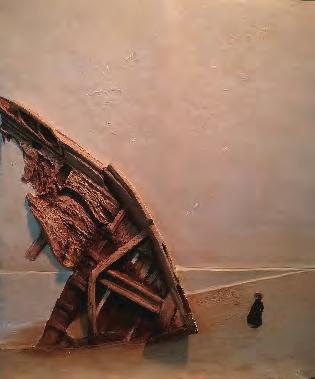
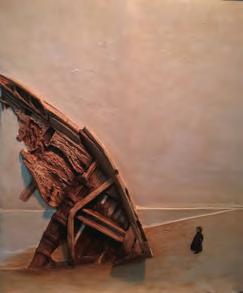
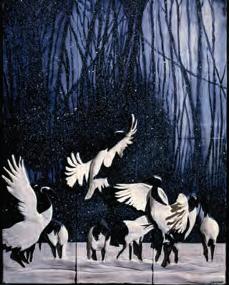

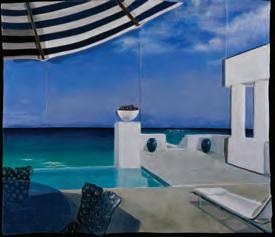

Clay-Fired Relief, Both Sculpture & Painting!
Clay-Fired Relief, Both Sculpture & Painting!
“Your work proved to be the highlight of the Art in Embassy program”
“Your work proved to be the highlight of the Art in Embassy program”
U.S. Dept. of State. Inquires: Juliet.ehrlich@gmail or (502)936-3599
U.S. Dept. of State Inquires: Juliet.Ehrlich@gmail or (502)936-3599



Paris, Steiglitz tribute. Clay relief —Juliet Ehrlich
Bronze Goose Detail