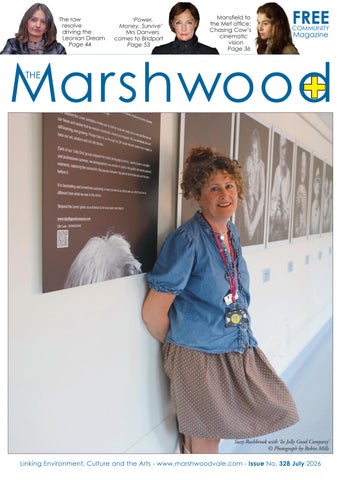
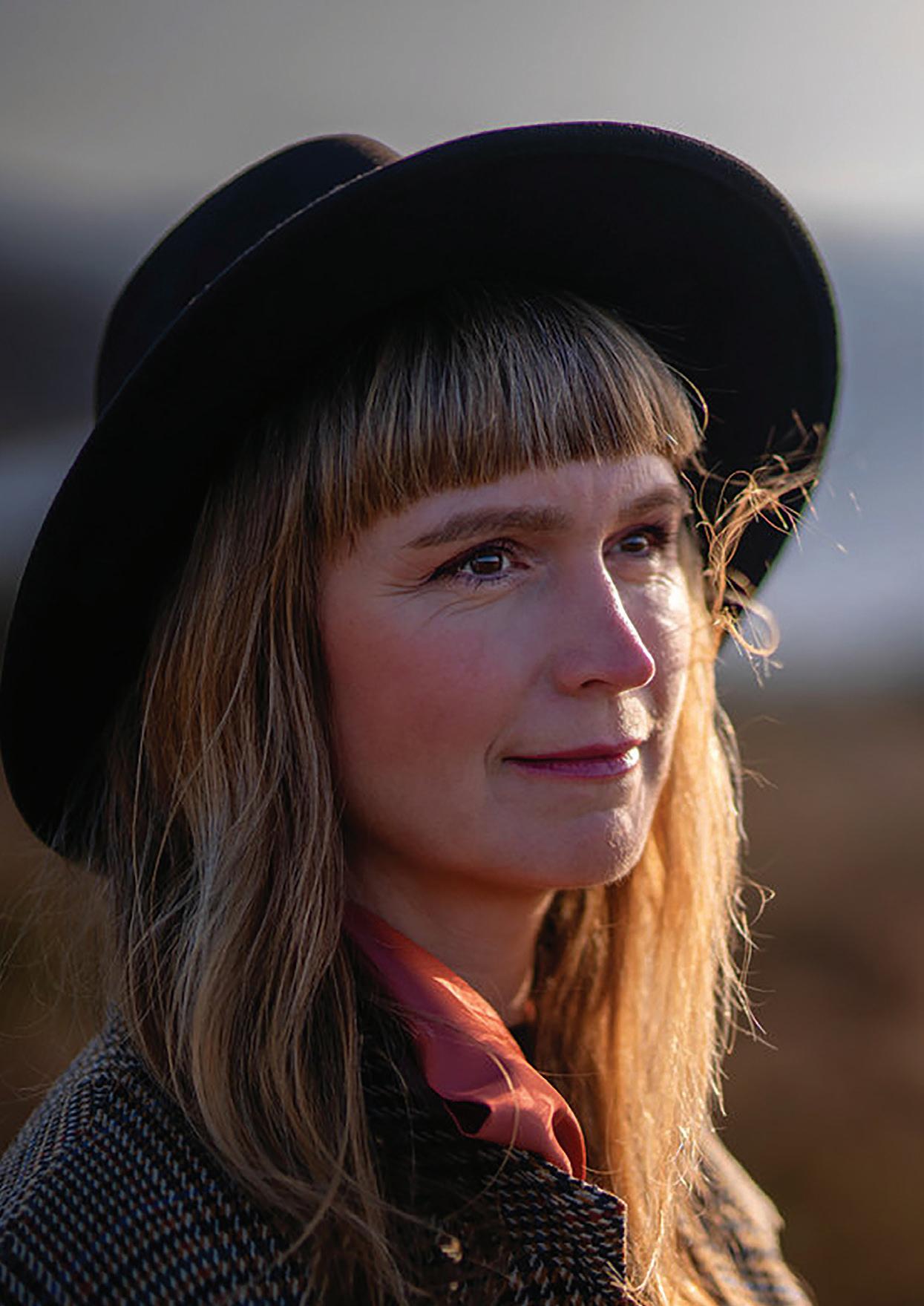
M’y parents moved to Piddletrenthide a month before I was born. My dad was a marine engineer working deep sea for years, then when my mum was expecting me, he got a job with Sealink Ferries in Weymouth, on the Channel Island and Cherbourg crossings, and they made Dorset their home.
I didn’t enjoy school. Although reasonably capable, I just wasn’t engaged. I was creative but not “good at art”, so never seemed to fit. It took a long time to realise that I was a curator.
Apart from time spent travelling when I was younger, I’ve almost always lived here, but it’s probably true that if you live in the country you spend your teenage years trying to get away and your thirties trying to get back. Aged 23 I went to the University of East London as a mature student, taking a degree in History of Art and Material Culture. It was absolutely fascinating and I’d do it all again if I could. I enjoyed the experience of London, but it made me realise I’m a country girl at heart.
My travels took me back and forth between Dorset and many other places in the world, often returning penniless to my parents’ home. Mostly I worked in bars, picking fruit or cleaning, and taught English in Vietnam for a while, but my earnings were always to fund the next trip. I was having adventures, seeing the world, and I’m hugely glad I did. Now that I’m older, I can say with pride I went places and did stuff.
I moved back to Dorset properly at 28 and finally embarked on a career. After volunteering at the Russell Cotes Art Gallery and Museum in Bournemouth, I got a job at Dorset County Museum, initially as Front of House and Shop Manager. When I left school, and later as a student in London, I worked for Monsoon, so had retail and display experience. The curator at the museum at that time, Judy Lindsay, knew I wanted to get into managing exhibitions and gave me a chance as Temporary Exhibitions Manager; that was my first career job. On the temporary exhibition committee was Vivienne Light, an amazing artist and curator who was a great mentor to me. The job gave me experience of working with many artists, writing their biographies, and understanding what they were trying to achieve - all in the context of Dorset, which is important to what I do now.
I worked at the Museum for 5 years, then was unfortunately made redundant along with most of the curatorial staff. I was expecting my first child at the time, so with the redundancy payment was able to take a year off when my son Mylo was born. I then got a job with Dorset Art Weeks as programme curator, working with Jem Main for almost 10 years, another great mentor. As Art Weeks happens every other year, we would do a separate project in between. In 2017 we produced a publication and big exhibition called Making Dorset, in Wolfeton Riding House, a wonderful 16th C barn in Charminster (the oldest equestrian riding school in England).
Then I got a call from an old colleague who had worked in marketing at the Museum and was now working for the hospital charity. There has been an arts programme at Dorset County Hospital for nearly 40 years and following a hiatus in management she asked if I would come in as a freelancer to get the exhibitions up and running again. I was craving something new and a bit of a challenge, so I said yes. After a year, and in the midst of Covid, I was offered a contract, and I’ve been Arts in Hospital Manager ever since.
It’s never a boring job; there’s something new and different happening all the time. Due to my previous roles, I know quite a lot of Dorset artists, and I also work for Evolver Magazine, which keeps me in the loop. Sometimes I’ll see someone’s work which I think would be great to show in the hospital, but because I’m managed by a steering group consisting of hospital trustees and representatives from different areas of hospital management, I have to propose everything to them first, but it’s a process which works. The artists know the hospital’s not a prime selling space, but that’s not what it’s about; sometimes works do sell though.
The programme I manage is threefold: there’s a curatorial role, there’s design and environment, and there’s participation. I curate the collection and work with the artists on designing interior spaces, but for the participation with patients and staff I bring in a colleague, Caroline Barnes. She goes onto the wards, with volunteers, and does art activities with the patients. The benefit to patients, if measured as
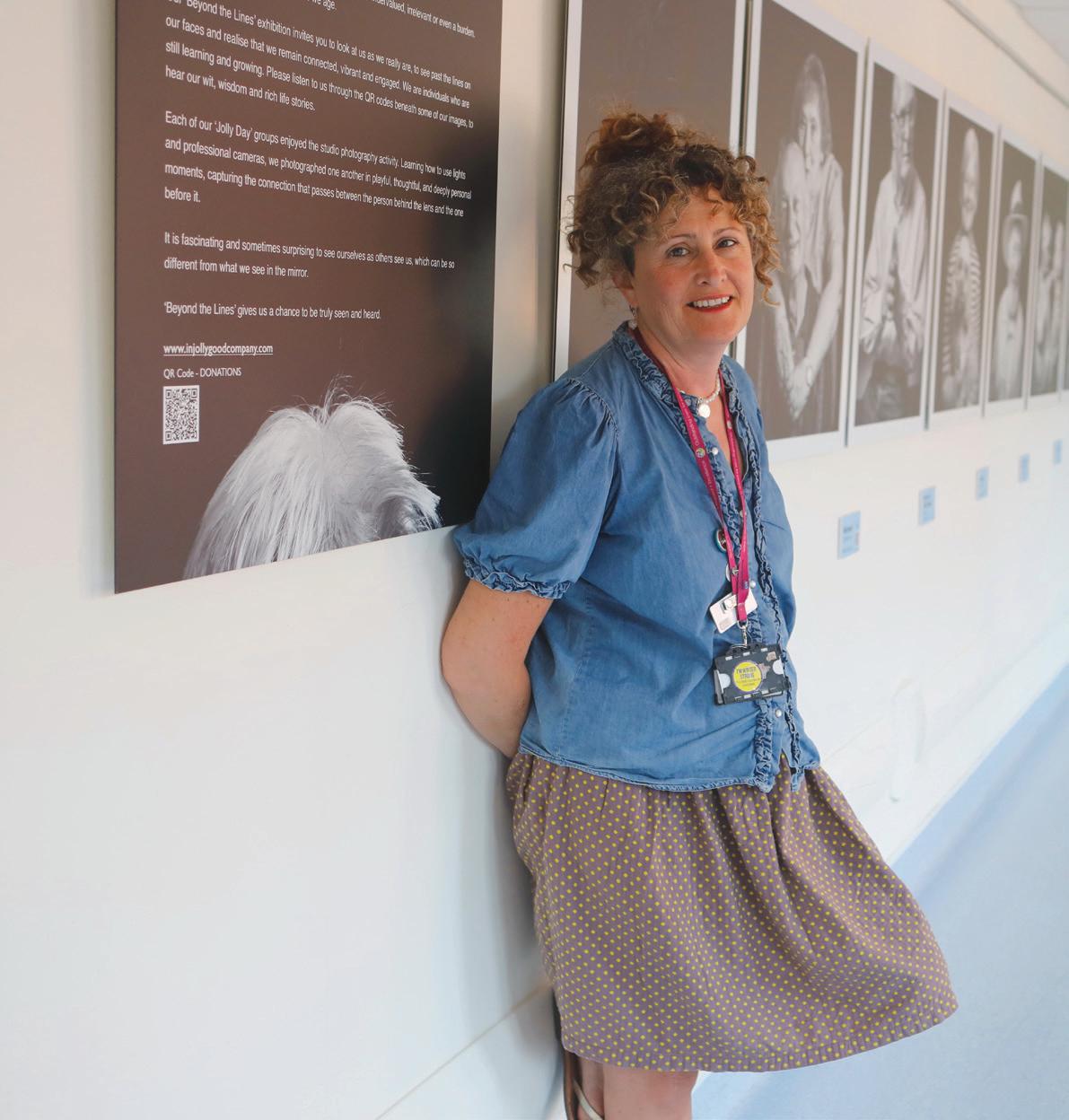
return on investment (in what they now call Creative Health rather than Arts in Hospital), is consistently shown to be overwhelmingly worthwhile. For example, I have recently been working with a group called “In Jolly Good Company” who run weekly dementia-friendly sessions for individuals to engage in creative and fun activities. It gives them a new social network and an opportunity to share experiences with people in similar situations, activities which potentially stop them visiting the GP so frequently because of loneliness or isolation. Our mission is to expose people to creative activities while they’re in hospital, in the hope that they’ll continue with them afterwards, which can help patients with their basic needs, such as the use of motor skills and decision-making. We also hope to give them a sense of agency which has often been lost. It’s all about giving people a better quality of life while taking pressure off the NHS. We’re also currently running an outreach programme at the Arts Centre in Dorchester called Art for Memory, for people with early-onset dementia, which offers all the above benefits. It happens that this week is Creativity and Wellbeing Week, a national celebration of every aspect of Creative Health, and I’ve been lucky enough to have had an article accepted for the Big Issue. I really enjoy writing and I’d like to do more. I always enjoyed writing exhibition interpretation and doing the research; I’ve helped with Evolver for over 7 years, and I contribute to the Sherborne Times. When writing about art, you try and aim it at an educated audience—I try to avoid unintelligible “artspeak”—but written interpretation for art in hospital is an interesting challenge; the audience haven’t made the decision to see this art, which is very different to choosing to visit a gallery. I’m trying to spark an interest in the art that patients, staff and visitors see within hospital, and in doing so perhaps stimulate a welcome distraction from the reason they’re there. It may even be a start in their journey of being interested in art and culture. The work I’m putting in the hospital is work that the community can relate to, most of which also relates to our local environment, landscapes, and seascapes. I like to include archaeology which can be of interest to people like farmers who have worked the land all their lives and always been curious about what has shaped their landscape.
It’s fair to say my job is completely up my street. It’s perfect for all the things I’m interested in. I’ve always loved interior design so I can bring that element into my work, and because I did Material Culture as part of my degree I’m into the history of photography, fashion, and book illustration, and I love that I can bring all of those skills into the job. I’m constantly having ideas about things I want to do, but there’s never enough time, never enough money. I’m always inspired, never stale. I enjoy producing small publications like our Art Map; and of course, I adore working with artists and hanging their exhibitions. There’s so much depth and opportunity in what we do. If I had to go back to any of my previous jobs, I’d just be bored. ’
It’s nearly twenty years since Facebook moved from a university-only application to being available to a global audience, i.e., anyone over 13 with an email address. Its extraordinary rise from a sharing app to a global kingmaker has helped millions of users, whether by developing digital community groups, creating business opportunities, or bringing friends and family together. However, along with other social media operations, the company now faces a ban in the UK for users under 16. Some question whether this ban is enough to rein in a business model that benefits from addictive psychological hooks and reward mechanisms that encourage excessive, compulsive use. In the introduction to the book Careless People, Sarah Wynn-Williams’ damning account of her time at Facebook, Naomi Alderman, winner of the Women’s Prize for Fiction, points out how powerful people use the law to block whistleblowers. She explains that Sarah Wynn-Williams, after nearly 7 years as a global policy director at Facebook, has been blocked from talking about her book. Among many other shocking allegations, Wynn-Williams writes that Facebook helped fuel violence in Myanmar, contributing to real-world genocide; offered censorship tools for China in order to access that market; and offered advertising specifically targeted at vulnerable teens. Facebook’s owner, Meta, has issued a statement saying the book makes ‘out-of-date’ claims and ‘false accusations’ and has taken out an injunction banning the author from promoting it. This led to a hysterical situation in which Wynn-Williams appeared at the recent Hay Festival but sat on stage in silence while others discussed the book. If ever there was a personal account that proves the need to police social media rather than just ban it for certain sections of the population, Careless People is it.
Fergus Byrne
Contributors
DONATIONS
If you missed our Crowdfunder and would still like to donate to support the Marshwood Vale Magazine, please send donations either by cheque to Marshwood Vale Limited (address below) or direct to Marshwood Vale Limited at Monzo Business Sort Code 04-00-06 - a/c number 65919314 - Ref: Donation Nicky
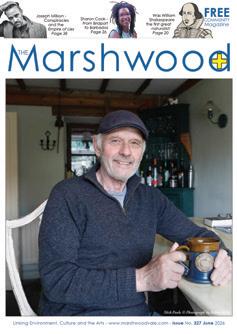
CATCH UP ON OUR JUNE ONLINE COVER STORY
Robin Mills met Nick Poole in West Milton, Dorset
Growing up at Kings Farm on the side of Eggardon Hill in the late ‘50s I can remember us not having electric. Father had to prime all the Tilley lamps before going out milking in the winter, but when I was about four he bought a 4 KW generator to power the milking machine; if you boiled a kettle the lights would all dim.
The bad winter of ’63 pretty much wiped him out financially, which meant employing staff was out of the question, so us kids had to help more and more with the work of a herd of around 40 cows. My brother was keener than me on the farmwork. We had two deep litter houses, so he and I had to collect eggs every morning from the 1600-odd chickens, then help clean them, and at weekends there were always jobs to do around the farm. All that work meant little time for meeting friends, but at least growing up on a farm teaches you how to graft.
hand movements in loading the trowel with muck then placing it with precision where it’s needed, over time I learned the skills for myself, and I loved that process. However, I do have quite a low boredom threshold, so although I could do brick and block-laying, I enjoyed carpentry rather more. In the early 1980s there were TOPS schemes to help people retrain, and I did a 6-month carpentry and joinery course at Gloucester which enabled me to join the carpentry gang of the building firm I worked for.
I was working at the Marquis of Lorne from the age of 13 whilst still at Colfox school. I had no idea of a plan for my life, but someone suggested catering, which I did enjoy, so after O levels I enrolled on a brilliant OND course at Weymouth College. I could get the train from Powerstock station to Maiden Newton, and then to Weymouth. I finished in ’75, which was when the railway line closed, but I had a motorbike by then.
I spent the next four years working in hotels in middle management. Part of the college catering course was classic French cuisine, and that skill has stayed with me for life. I still cook and still love it. But after about four years in the hotel trade, I decided it wasn’t the life for me, came home, and fairly quickly walked on to a building site in Bridport. I got a job as a labourer earning half as much again as I had been for a lot less hours. However, the skills I learned in hotel management, dealing with people and book-keeping, came in useful in later life when I set up my own building firm.
Around that time, I met Dawn, my wife. We spent the best part of a year travelling in France, then a back-packing tour of Asia, all quite an adventure in pre-internet days, using Lonely Planet guides and only finding places to stay on arrival. Back home, I had done a carpentry course and carried on with the building work. I had realised quite early on I’m a practical person. I like working with my hands and solving problems practically, and I would watch closely how skilled tradespeople worked; noting a bricklayer’s
Three years later I started on my own, as a jobbing carpenter. As the jobs got bigger I employed other tradespeople plus a lot of subcontractors. I particularly loved renovating some of the older properties round here, where you would discover their history in the process, sometimes finding items hidden away for centuries. And it’s a lovely thing to make an old property into a nice place to live, without losing its character, but we built many extensions and new houses as well.
In 2000 I took up cider making. We were renting some fields here in the village which included an orchard, and Dawn said we can’t just leave the apples on the ground because there were horses grazing. We were told they were cider apples but had no idea what variety. I took out books from the library on cider making, then got together with a few people in the village to form a cider club which is still going today. Cider making opened up a whole new world to me, and although I was still running the building firm, it was a fascinating universe of new and interesting things which completely absorbed me.
Although West Dorset has a long history of cider making, it never really got off the ground commercially like Somerset or Herefordshire. Dorset had 10,000 acres of cider apples in the 1790s orchard survey, about half that of Somerset, but sales were mostly over the farm gate. In 1886 the Truck Act stopped the payment in kind of cider in lieu of wages, etc., before which almost every farm would have made cider. But by the end of the 19thC the quality of the product in the West Country had become very poor, which was why the government-funded Long Ashton research centre, also called The Cider Institute, was set up in 1905.
Over 20 years ago Liz Copas, a pomologist working at Long Ashton, and I set out to find and identify old cider apple trees locally. Initially we researched trees in old orchards and hedgerows to try and identify the varieties, make cider with them and, after tasting,
decide which were worth propagating for new orchards. Some of the best historic orchards we researched were here in West Milton, where we found good quality varieties like Dabinetts, Chisel Jerseys, and Yarlington Mill. So, somebody in West Milton about 100 years previously must have been keen to produce higher quality cider. In 2012 Liz and I published our first booklet called the DATA Project, then followed it up in more detail in 2022 with a book, called The Lost Orchards
The success of a cider tasting we ran in our cider shed led me to run another event at the Powerstock Hut, which we put on as a food festival thinking that cider alone might not attract enough interest. The first night there was a lengthy queue, and they weren’t much interested in the food. Five years later, I was getting up to 30 cider makers from all over the country taking part in the Powerstock Cider Festival, mostly small-scale craft makers. It was popular because you could meet and talk to the producers while sampling the cider, but we ended up having to limit numbers because it began to get a bit out of hand. It also was just at the time, around 2005, when cider sales generally were beginning to take off. Along with the slow food movement, people were interested in local provenance and
distinctiveness. In about 10 years we went from no cidermakers in Dorset to about 20, and the Festival won an Achievement Award at the Bath and West Show.
I had been making bottleconditioned cider similar to the Normandy tradition, and in 2009 I won a competition in Normandy with my cidre bouché, which was a huge shock both to me and my French hosts. By then I had my own premises and was selling my cider part-time, but by 2014 I was getting a bit jaded with the building business, so I decided to retire from that and go full time into cider making. Dawn and I spent 10 years wholesaling and selling at shows, regularly producing about 25,000 litres. I planted my own orchard, but much of my apple supply came from Rupert Best at Melplash, a great enthusiast who ran 55 acres of cider apples started by his father in the 1920s.
In recent years we’ve scaled right back, but this year I’ve made 10 single varieties in small barrels, some of which will go into the Bath and West competition, the biggest in the country. In 2017 we won Supreme Champion with our cidre bouché, Lancombe Rising. Everything about cider making has been such an enjoyable process.
Hinton St George Open Gardens 11-4pm £8 one day ticket, £12 weekend ticket – proceeds for St Margarets Hospice. Tickets, Parking, Toilets and Refreshments in Village Hall
Visit nine unique gardens in this picturesque village. Hinton St George is the quintessential English village with honey coloured ham and local stone houses, a Grade I listed church, community shop and pub. The gardens showcase a variety of styles and features, including cottage gardens, contemporary gardens, classic English country house borders, water features, courtyard gardens, parterres, specimen trees and historic protective walls. You will receive a map when you purchase your ticket at St George’s Hall, Merriott Road, TA17 8SL. Refreshments will also be available in the village hall. For more information email gloriousgardens@stmargarets-hospice.org.uk.
Sarurday, 27 June - 5 July
The 29th Beaminster Festival kicks off with hilarious al fresco theatre at Beaminster Manor by The Pantaloons and closes with Bijou Opera’s chamber production of Le Notte di Figaro. There is a huge range of music from the Fibonacci String Quartet to ‘Not the Rolling Stones’, together with literary events, (Nigel Planer, Chris Chibnall, John Kampfner) and ‘Talent in the Town’, a hobbies exhibition. With almost 100 volunteers involved, you will receive a warm welcome to this picturesque, charming, little West Dorset town. St Mary’s Church, Beaminster, 11.30am, 2.30pm, 7.30pm, £12-£26. beaminsterfestival.com or 0333 666 33 66.
Sunday, 28 June
Singing Bowl Soundbath 2-3.30pm Oborne Village Hall, Oborne, nr. Sherborne, Dorset DT9 4LA. £17 ‘I’ve been to many soundbaths, and that was...amazing. As a musician you obviously know what you’re doing not just ‘blazing away like so many’...Bob, musician ‘I’ve been to soundbaths all over the world-yours are the best!’-visitor from USA. Booking 01935 38655 ahiahel@live.com.
Jazz by the Sea at the Marine Theatre, Lyme Regis. 8pm. Eddie Gripper Trio. Performing music from his second album ‘Americana’, pianist Eddie Gripper tells the story of an 8,000 km hitchhiking journey from Alaska to California, completed in under two months during the summer of 2022. The music captures the vast landscapes and unforgettable moments along the way - from sleeping in the Alaskan wilderness to cycling down Santa Monica Pier - offering a vivid, hopeful, yet unflinching reflection on American life. Marine Theatre, Church St, Lyme Regis, Dorset DT7 3QB. £16 advance £18 on the door. Tickets available at www.
marinetheatre.com. You can also purchase tickets from the Lyme Regis Bookshop and Bridport TIC (01308 424901). Mozart, Bach, Elgar, Barber: Allington Strings at Crewkerne Methodist Church. 50th Anniversary Concert at 3pm on Sunday. Celebrating the greats of String Orchestra Repertoire: Mozart’s Eine Kleine Nachtmusik, Bach’s Brandenburg Concerto Number 3, Elgar’s Serenade for Strings and Barber’s Adagio for Strings. A truly fantastic concert of phenomenal music. Advance tickets £10 adults | £4 children, available from Delilah Petal, Crewkerne (cash) or via allingtonstrings@outlook.com (card), or on the door at £12/£5 (cash & card).
Wednesday, 1 July
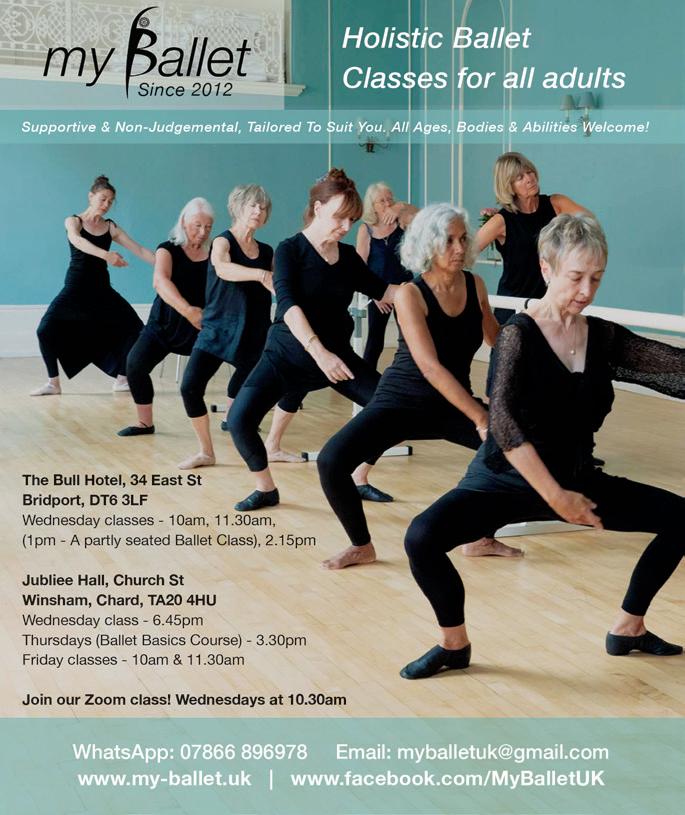
My Ballet since 2012 Holistic ballet classes for all adults Supportive & Non - judgemental classical ballet to fabulous music. For posture, flexibility, strength, balance, fitness, friendship. Join the fun and feel good. 10am,11:30am, (1o’clock for 1;15 part seated) & 2:15 Bull Hotel ballroom, 34 East St, Bridport DT6 3LF at the Bull Hotel. Whatsapp 07866896978. email: myballetuk@gmail.com www.myballet.uk
My Ballet 6:45pm to 8pm Jubilee Hall, Church Street, Winsham, Chard, TA20 4HU - Whatsapp 07866896978. email: myballetuk@gmail.com www.my-ballet.uk
Wednesday, 1 - 14 July
Summer of Sweet Peas A display of sweet peas growing on wigwams in the kitchen garden. 10:30 am – 4pm. Forde Abbey TA20 4LU. Free entry to the Kitchen Garden for all visitors to see the sweet peas. Usual entry fees apply to see the main gardens.
Thursday, 2 July
Forde Abbey Concert The Kyan Quartet: This young string quartet brings together musicians from Britain, America, China and France. First Prize winners in this year’s Salzburg Chamber Music competition, they will play the quartet in Eb by Fanny Mendelssohn, Mozart’s Quartet K421 in D minor and Beethoven’s late Op.132 quartet. 7:30pm, Forde Abbey, TA20 4LU. Tickets: £24. To book: www.fordeabbey.co.uk. Colyton Town History Walk leaving Colyton Dolphin Car Park at 2 pm - Guided walk approximately one hour. Cost £5, children under 16 free. No booking required, all weathers. Group Bookings by arrangement - contact 01297 552514 or 01297 33406.
Beaminster Museum throughout July: Our summer exhibition Fire Flood Frost explores how Beaminster and
the surrounding villages have battled the elements – from floods and violent storms to bitter freezes – along with the three great fires that devastated the town. The exhibition tells the story of how local people pulled together in times of crisis and learned lessons for the future. Visitors will also find exciting new Pre-history and Geology displays, along with eye-catching accompanying graphics. The Museum is open Tuesdays, Thursdays, Saturdays and Bank Holidays, 10.30am – 4.00pm, Sundays 2.00pm – 4.30pm. Admission is free, but donations are very welcome. Whitcombe Rd, Beaminster DT8 3NB. www.beaminstermuseum. co.uk.
Friday, 3 July
Move and Groove 10.15am to 11.15am - a dance group for ages 55 to 90 years - exploring movement and dance in a friendly and creative environment. Classes take place at Steps studio, Crepe Farm Business Park, Symondsbury. For more details and to enrol contact Nikki Northover at nikkinorthover43@gmail.com @ gmail.com.
Film: My Mothers Wedding (15) 96 mins 7:30pm, Bridport Electric Palace, DT6 3NY. Tickets from £9 adv. To book electricpalace.org.uk. My Ballet Holistic ballet classes for all adults
Supportive & Non - judgemental classical ballet to fabulous music. For posture, flexibility, strength, balance, fitness, friendship. Join the fun and feel good. Everybody welcome! Do get in touch and come for a dance! Winsham Jubilee Hall, Church St, Winsham, Chard, TA20 4HU Fridays 10am and 11.15am Whatsapp 07866896978. email: myballetuk@gmail. com www.my-ballet.uk
Friday, 3 - 5 July
Tree of Strings festival will take place in Abbotsbury. Curated by Artistic Director (and locally based, internationally renowned cellist), Adrian Brendel, the inaugural programme spans genres and centuries - from classical chamber music to jazz, folk and contemporary collaborations. The programme is stamped with his original style, showcasing Tree of Strings’ intimate, adventurous and welcoming ambitions across a wide spectrum of music. For more information and to book tickets visit: https:// treeofstrings.org.
Saturday, 4 July
Bridport & West Dorset Rambling Club 7 mile walk from Abbotsbury. For further information please ring 01308 898484 or 01308 863340. New members/visitors welcome. Dalwood Music Day 11.30 - 8.00pm. All styles of music in 4 venues. close to the car park. Jazz ensembles, 60s Band, Choirs, Folk & Country groups, Sea Shanties, World music, Saxophone choir, Popular songs. Free parking and Programme: BBQ, Bars, Teas. All Day Stroller £17.50 purchased on arrival: Dalwood, Near Axminster, EX13 7EG. info at: www.dalwoodvillage.co.uk contact: t.mackenney111@btinternet.com.
The Friends of Weymouth Library (F.O.W.L.) speaker at 10-30a.m. will be Dorset resident Beth Wilson, talking about her collection of 1930 ceramics; also the history of the heart of the industry, the life of the “Pottery Ladies”, and what remains of the industry in the 21st. century. So come to Weymouth Library and take a trip down memory lane to “Potter around with Pots” with Beth. Everyone welcome, £3 on entry. Any enquiries phone 01305832613. Film: Savage House (15) 114 mins, 7:30pm, Bridport Electric Palace, DT6 3NY. Tickets from £9 adv. To book electricpalace.org.uk.
Sunday, 5 July
Screening: NTL: Les Liasisons Dangereuses (15) 180 mins, 7pm, Bridport Electric Palace, DT6 3NY. Tickets from £17.50 adv. To book electricpalace.org.uk.
on the memoir by Helen Macdonald, H is for Hawk follows Helen (Foy), who, after the sudden death of her father (Gleeson), loses herself in the memories of their time birding and exploring the natural world together, and navigates her profound loss by training a wild goshawk named Mabel. “It’s a career-best for Foy, who will doubtless win many awards. I hope the unnamed bird gets one too”. Spectator. Doors and bar open 6.45 film start 7.15 at Kilmington Village Hall EX13 7RF. Tickets £6 (Cash Only) can be ordered by contacting: John at wattsjohn307@gmail.com or Tel: 01297 521681. My Ballet since 2012 Holistic ballet classes for all adults Supportive & Non - judgemental classical ballet to fabulous music. For posture, flexibility, strength, balance, fitness, friendship. Join the fun and feel good. 10am,11:30am, (1o’clock for 1:15 part seated ) & 2:15 Bull Hotel ballroom, 34 East St, Bridport DT6 3LF Bull Hotel. Whatsapp 07866896978. email: myballetuk@gmail.com www.myballet.uk
My Ballet 6.45pm- 8pm Jubilee Hall, Church Street, Winsham, Chard, TA20 4HU Whatsapp 07866896978. email: myballetuk@gmail.com www.my-ballet.uk
Thursday, 9 July
Tabletop Sale 9.00 to 12 noon on the Minster Green, Axminster. Browse through plants, costume jewellery and bric-a-brac. Enjoy coffee and cake. Proceeds in aid of Holy Cross Church. Enquiries 01297 598953.
Film: Tuner (15) 107 mins, 7:30pm, Bridport Electric Palace, DT6 3NY. Tickets £9 adv. To book electricpalace.org. uk.
Colyton Town History Walk leaving Colyton Dolphin Car park at 2 pm - Guided walk approximately one hour. Cost £5, children under 16 free. No booking required, all weathers. Group Bookings by arrangement - contact 01297 552514 or 01297 33406.
Kilmington Film Matinee “H Is For HAWK (12)” (See 8th July. Doors open 1.45pm film starts 2pm. Tickets £6 (Cash Only), cream-teas @ £4. served during the interval but must be pre-booked with your seats see above and www. kilmingtonvillage.com/other-organisations.html for more information.
Friday, 10 July
Move and Groove 10.15am to 11.15am - a dance group for ages 55 to 90 years - exploring movement and dance in a friendly and creative environment. Classes take place at Steps studio, Crepe Farm Business Park, Symondsbury. For more details and to enrol contact Nikki Northover at nikkinorthover43@gmail.com @ gmail.com.
My Ballet Holistic ballet classes for all adults Supportive & Non - judgemental classical ballet to fabulous music. For posture, flexibility, strength, balance, fitness, friendship. Join the fun and feel good. Everybody welcome! Do get in touch and come for a dance! Winsham Jubilee Hall, Church St, Winsham, Chard, TA20 4HU. Fridays 10am and 11.15am.
The Dorset Ceramics Market featuring over 25 potters and ceramic artists, will take place at Dorchester Arts’ Corn Exchange, Dorchester, from 10:00am–4:00pm. Dorset Clay Cooperative is bringing together a one-day market celebrating the variety and versatility of contemporary ceramics, with makers from across Dorset and further afield, including the 2026 winner of channel 4’s The Great Pottery Throwdown, Fynn Allen. Diana Parker (a Dorset potter who was a semifinalist from series 8 of the same programme) is also joining the market with her porcelain and stoneware decorated pottery.Visitors can browse and buy work spanning sculpture, homewares, ceramic art, jewellery, garden pottery and functional tableware—made using a range of methods and firing techniques. The market will include established makers who regularly exhibit around the UK, alongside newer artists hosting their first-ever stall. Entry is free.
Bridport & West Dorset Rambling Club 7.5 mile walk from Maiden Newton. For further information please ring 01308 898484 or 01308 863340. New members/visitors welcome.
Music: Oas-is, 8pm, Bridport Electric Palace, DT6 3NY. Tickets £19 To book electricpalace.org.uk.
Beaminster Museum: Finds Day. From 12 noon to 2pm, when Dorset Council’s Finds Liaison Officer, Ciorstaidh Hayward Trevarthen, will be on hand to help identify and record any archaeological (not geological) items found within the county boundaries. Admission is free, but donations are welcome. Whitcombe Rd, Beaminster DT8 3NB. www. beaminstermuseum.co.uk.
Wednesday, 15 July
Coffee Morning including cakes, scones & savouries, and bacon/egg rolls (made to order), 10.30am – noon; all welcome. Clapton & Wayford Village Hall. More details from Julia (01460 72769).
Colyton & District Garden Society ‘Colour in the Garden’ by Ben Candlin. Owner of an online shop : ‘Adventurousplants.co.uk’ Venue : Colyford Memorial Hall, Colyford. EX24 6QJ. 7.30 pm. Plenty of parking in the hall car park.
My Ballet since 2012 Holistic ballet classes for all adults Supportive & Non - judgemental classical ballet to fabulous music. For posture, flexibility, strength, balance, fitness, friendship. Join the fun and feel good. 10am,11:30am,(1o’clock for 1:15 part seated) & 2:15 Bull Hotel ballroom, 34 East St, Bridport DT6 3LF Bull Hotel. Whatsapp 07866896978. email: myballetuk@gmail.com www.my-ballet.uk
My Ballet 6:45 - 8pm Jubilee Hall, Church Street, Winsham, Chard, TA20 4HU Whatsapp 07866896978. email: myballetuk@gmail.com www.my-ballet.uk
Thursday, 16 July
Colyton Town History Walk leaving Colyton Dolphin Car Park at 2 pm - Guided walk approximately one hour. Cost £5, children under 16 free. No booking required, all weathers. Group Bookings by arrangement - contact 01297 552514 or 01297 33406.
Friday, 17 July
Film Night Milborne St Andrew Village Hall. Residents of our neighbouring villages are warmly invited to join us for our next Village Hall Film Night, where we’ll be screening Fackham Hall — a brand-new British comedy that brings back the joyful chaos of classic farce. Doors open at 7pm, giving everyone time to settle in, enjoy a chat, and choose your seat. The film begins at 7.30pm. Tickets are £6.50, which includes a drink or an ice cream.
Move and Groove 10.15am to 11.15am - a dance group for ages 55 to 90 years - exploring movement and dance in a friendly and creative environment. Classes take place at Steps studio, Crepe Farm Business Park, Symondsbury. For more details and to enrol contact Nikki Northover at nikkinorthover43@gmail.com @ gmail.com.
Film: Disclosure Day (12A) 145 mins, 7:30pm, Bridport Electric Palace, DT6 3NY. Tickets £9 adv. To book electricpalace.org.uk.
My Ballet Holistic ballet classes for all adults Supportive & Non - judgemental classical ballet to fabulous music. For posture, flexibility, strength, balance, fitness, friendship. Join the fun and feel good. Everybody welcome! Do get in touch and come for a dance! Winsham Jubilee Hall, Church St, Winsham, Chard, TA20 4HU Fridays 10am and11.15am Whatsapp 07866896978. email: myballetuk@gmail.com www.my-ballet.uk
Saturday, 18 July
Bridport & West Dorset Rambling Club 7.5 mile walk from Ringstead. For further information please ring 01308 898484 or 01308 863340. New members/visitors welcome.
The Sound of Blue Note A show celebrating the sound of Blue Note Record label which came to define the sound of jazz in the 50s and 60s. Five fine musicians weave their magic to tell the story of this pivotal moment in the history of jazz. 3.00pm. Bridport Electric Palace, DT6 3NY. Tickets: £16. Book online or on 01308 424901.
Cream Tea and Fancy Dress Show 2.30 - 4.30pm. Featuring St. Swithun’s Brass Band, raffle, tombola, fresh produce stall, teddy bears tombola plus lots of fun and games for all the family. Extra parking at Amsafe, all welcome. St. Swithun’s Church, Allington, Bridport DT6 5DU. Contact 07741457505.
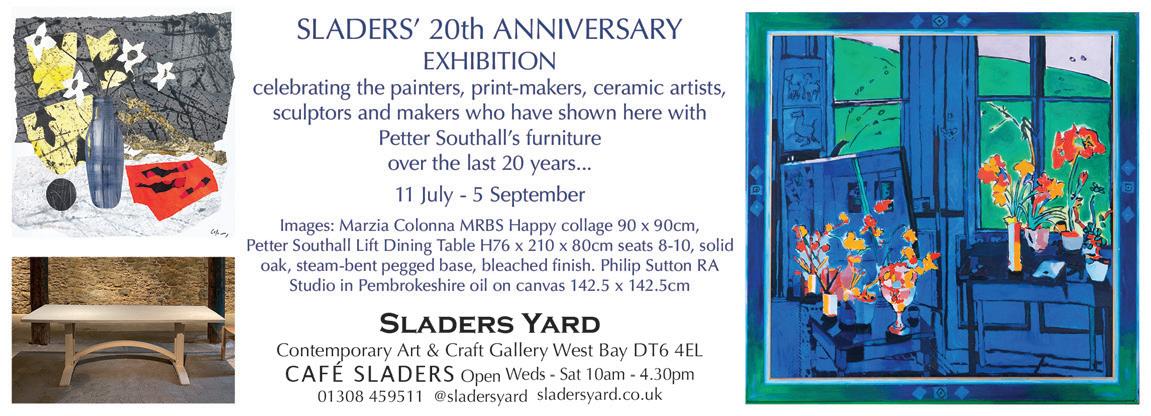
Sladers Jazz Club presents Alan Barnes (sax/clarinet), David Newton (piano), Ian Smith (trumpet), Ashley John Long (bass). Jazz from 8pm. Dinner from 6.30pm. Tickets from Sladers Yard 01308 459511.
Music: The Sound of Blue Note (afternoon Jazz) 3pm, Bridport Electric Palace, DT6 3NY. Tickets £16 adv. To book electricpalace.org.uk.
Sunday, 19 July
Stoke Abbott Street Fair 2-5pm One of the region’s most popular events, the traditional Stoke Abbott Street Fair will open at 2pm on Sunday 19th July with the historic Sick Club Parade. There’s fun for all the family with enticing stalls, live entertainment, ferret-racing, cream teas, the everpopular Book Barn and more. Highlights for 2026 will include The Big Foolini Magic Show at 3pm together with the Discover Farming team, who will have hands-on rural activities for all ages too. This year, proceeds will go to support the Beaminster’s Foodbank as well as St Mary’s church and the village hall. Free parking from the Beaminster end. Entry £3 per adult, children under 16 free. The Cattistock Countryside Show is now the official home of Dorset Knob Throwing. Nestled in Dorset’s rolling hills, this is probably the prettiest traditional family country show you could hope for, boasting events for horses, dogs, ponies and Knob throwers. Book tickets online at: https://www. cattistockshow.co.uk/tickets.
Tuesday, 21 July
Turn Lyme Green Talk ‘Recycling: Where does it go?’ Marten Gregory of Dorset Waste
Services will give a round up plus a review of national policies.’ 7pm Driftwood Cafe, Baptist Church, top of Broad Street, Lyme Regis. Free. Refreshments available.
Foyer Sessions: Aidan Simpson & Oliver Jessop, 7pm, Bridport Electric Palace, DT6 3NY. Tickets £15 To book electricpalace.org.uk.
Wednesday, 22 July
My Ballet since 2012 Holistic ballet classes for all adults Supportive & Non - judgemental classical ballet classes to fabulous music. For posture, flexibility, strength, balance, fitness, friendship. Join the fun and feel good. 10am,11:30am,(1o’clock for 1:15 partly seated) & 2:15. Bull Hotel ballroom, 34 East St, Bridport DT6 3LF Bull Hotel. Whatsapp 07866896978. email: myballetuk@ gmail.com www.my-ballet.uk
My Ballet 6:45pm to 8pm Jubilee Hall, Church Street, Winsham, Chard, TA20 4HUWhatsapp 07866896978. email: myballetuk@gmail.com www.my-ballet.uk
Thursday 23 July
Wild Arts An Evening of Opera: Returning to the stunning surrounds of Forde Abbey for an outdoor performance of their acclaimed show An Evening of Opera. Semi-staged, follow the characters through 75 minutes of spell-binding music filled with dramatic intrigue, jealousy, comedy, idealism, and true love. 7PM, Forde Abbey, TA20 4LU. Tickets: £55, under 25s £25.00. To book: www.fordeabbey. co.uk.
Colyton Town History Walk leaving Colyton Dolphin Car Park at 2 pm Guided walk approximately one hour. Cost £5, children under 16 free. No booking required, all weathers. Group Bookings by arrangement - contact 01297 552514 or 01297 33406.
New Arts Group Punch and Judy! Speaker: Bertie Pearce Bridport Town Hall 1.30 for 2.00pm . All welcome £10.00.
Friday, 24 July
Move and Groove 10.15am to 11.15am - a dance group for ages 55 to 90 years - exploring movement and dance in a friendly and creative environment. Classes take place at Steps studio, Crepe Farm Business Park, Symondsbury. For more details and to enrol contact Nikki Northover at nikkinorthover43@gmail.com @ gmail.com.
Saturday, 25 July
Powerstock Fete 2.00 - 5.00 pm. Dog show, children’s entertainment and games, tug of war, silent auction, teas, bar and barbecue, numerous
stalls including crafts etc. In aid of Powerstock Church. Contact: angelica@riskkennard.co.uk.
Bridport & West Dorset Rambling Club 7 mile walk from West Milton. For further information please ring 01308 898484 or 01308 863340. New members/visitors welcome.
Film & Music: Joe Strummer: The Future is Unwritten screening + Q&A + DJ set from Scratchy, 15+, 7:30pm, Bridport Electric Palace, DT6 3NY. Tickets £15 adv. To book electricpalace. org.uk.
Sunday, 26 July
Singing Bowl Soundbath 2-4pm Oborne Village Hall, Oborne, nr. Sherborne, Dorset DT9 4LA relax reset detox 01935 389655 ahiahel@live.com £17.
Wootton Walks 12 curated walks to choose from, including kids walk, 3 mile Guided Louma vineyard tour and 5 mile Lamberts castle route. Starting and finishing with bacon rolls, cream teas and cake. Starting from 9am. Tea served til 4pm at Wootton Fitzpaine Village hall. Enquiries Teresa 07774 057687.
Repair Cafe 10:00-12:00 at Netherbury Village Hall, DT6 5LR. Bring your items along for repair and our team of expert repairers will do their best. Remember to bring any spare parts if they are needed. As always, we have a selection of lovely homemade cakes and good coffee and tea. Lisa Willis on 07870 950 666 or info@ repaircafenetherbury.org www.repaircafenetherbury. org.
Tuesday, 28 July
Folksy Theatre A Midsummer Night’s Dream: Love, laughter, and a little bit of lunacy — enter a world where fairies meddle, lovers quarrel, and magic runs wild! This summer, join us for a breathtaking open-air performance of William Shakespeare’s beloved comedy. 7pm, Forde Abbey, TA20 4LU. Tickets: £21.42, Child (3-16years) £14.11. To book: www.fordeabbey.co.uk.
Bridport U3A talk starting at 2.00 pm. Bridport United Church Hall, East Street, Bridport, DT6 3LJ. Speaker is Sally Smith, The talk is entitled, ‘The Woman Who Went round the World’ Talk lasts for 1 hour followed by Q&A, then refreshments. Members free, Visitors pay £ 3.00.
Thursday, 30 July
Colyton Town History Walk leaving Colyton Dolphin Car Park at 2 pm. Guided walk approximately one hour. Cost £5, children under 16 free. No booking required, all weathers. Group Bookings by arrangement - contact 01297 552514 or 01297 33406.
Film: Virginia Woolfs Night & Day (12A) 9 mins, 7:30pm, Bridport Electric Palace, DT6 3NY. Tickets £9 adv. To book electricpalace.org.uk.
Friday, 31 July
Music: Tony Christie The Great Farewell, 7:30pm, Bridport Electric Palace, DT6 3NY. Tickets from £32 adv. To book electricpalace.org.uk.
Saturday, 1 August
Uplyme and Lyme Regis Horticultural Society. Summer Flower and Produce Show. Competition marquee; cream teas and refreshments; gardening advice; stalls and exhibits. This year celebrating Pollinators. Uplyme Village Hall and Playing Field 2-5pm. Entry £1 adults, 16 and under free. Loders fete 2-5pm, near Bridport in the idyllic grounds of Loders Court (DT6 3RZ, next to Loders Church). Stalls include tea tent, bar, BBQ, grand raffle, tombola, coconut shy, games, fresh produce and preserves, cakes, plants, books, silent auction and more – there will be magic and mayhem from children’s entertainer Count Backwards, Punch and Judy, music from Lyme Regis Town Band, a dog show and a classic vehicle display. Entry: Adults £2, U12s free. Parking free.
EVENTS IN AUGUST send your event details to info@marshwoodvale.com BY JULY 14th
Treasures from deep beneath Dorset
Fanny Charles goes on a successful treasure hunt in Dorchester
DORSET is rich in treasures from the deep—the Jurassic coast is the source of some of the most remarkable fossil and paleontological finds in the world, and many of them were creatures which originally swam in prehistoric waters. But the county is also rich in archaeological finds, and many of them are on show in a thrilling new exhibition Treasure! Lost and Found, at the Dorset Museum & Gallery in Dorchester, until 13th September.
From the Early Bronze Age to the pre-Norman period, this exhibition showcases the astonishing skill and creativity of ancient people, and sheds some light on the daily lives of ordinary people of the Iron Age in Dorset. Some items, such as the intricate masterpieces of silver jewellery, date from the period that used to be called the Dark Ages and that we now know was a time of huge change in Britain, from which many different groups—including Anglo Saxons and Vikings—have left artefacts of staggering beauty and skill.
Keeping things relevant and accessible, particularly for younger visitors, there are exciting exhibits created by the talented students of Arts University Bournemouth. These include Lucius, an avatar of a Roman legionary of the first century, made using gaming technology. You can talk to him and ask him questions about his life—he will tell you he comes from Macedonia and will describe life as a Roman soldier in the land of the Durotriges (the tribe that lived in Dorset).
At the other end of the technical scale, the AUB students have also created a walk-in Iron Age roundhouse, Iron Age-inspired costumes using recycled textiles, typical Iron Age domestic artefacts, and a series of boxes which can be opened to give the eager nose a sniff of Iron Age smells from daily life and death. Sure to be a hit with young visitors.
Exhibition curator Jon Marrow explained to guests at the preview that it is a celebration of Dorset, drawing on the museum’s impressive and nationally important objects across several thousand years, from the Early Bronze Age to the post-Roman, pre-Norman era. There are also significant items on loan from the Potteries Museum & Art Gallery—the Staffordshire Hoard—and Lancashire County Museum Service—the Silverdale Hoard of Viking treasures, including intricately decorated silver bracelets and rare silver coins dating from 880-900CE.
Many of the exhibits were found by detectorists. The Dorset finds include an exquisite Early Bronze Age mirror which is the image for the exhibition, which was found in the burial site of a young woman—probably a member of a high status family—at Langton Herring. It is an outstanding example, as Jon Marrow said, of the “sophistication of these people.” Another Dorset find is the Tarrant Valley lunula, a crescent-shaped gold collar,
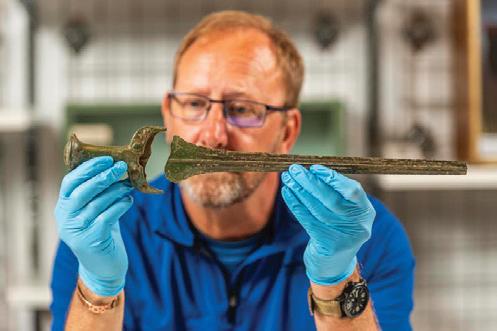
also dated to the Early Bronze Age, more than 3,000 years ago. Items on display for the first time include a uniquely preserved Middle Bronze Age rapier buried with an axe head and a beautifully incised bronze bracelet dated around 1400-1275 BCE, which were found in a field near Stalbridge.
The Victorian archaeologist, Edward Cunnington, excavated 46 barrows in Dorset. Some of his finds, several accompanied by his watercolour paintings, are on show. His many important discoveries included objects in gold, amber and jet. In 1882 he excavated Clandon Barrow, near Martinstown, discovering the most richlyfurnished Bronze Age burial in Dorset. The treasures suggested wealth or great exploits in distant travel and trade by people living on the South Dorset Ridgeway.
The first of the exhibition’s four sections is What Lies Beneath, showing how ancient objects ended up in the ground—these include grave goods or items lost due to violent historical or natural events. The second focuses on how these objects were brought to light, either through archaeological excavation or metal detecting.
In the third area, visitors explore how the definition of ‘treasure’ has changed through time—the famous AngloSaxon ship discovered at Sutton Hoo in Suffolk was not considered a ‘treasure’ under the Treasure Trove law of the time (1939) because it was technically a burial and had not been put into the ground with the intention of retrieving it at a later date.
The exhibition concludes with a focus on the importance of displaying archaeological finds in museum, showing how continued research and new technologies help experts to reconstruct ancient lives, enabling us all to continue learning about our past. New scientific research shows changes in our thinking about the early peoples of the British islands.
Treasure! Lost and Found is at Dorset Museum and Art Gallery, High West Street, Dorchester until 13th September 2026.
y first reaction, as I walked into the meadow, was curiosity: are there really nine species of orchids in this one field? And then it changed to surprise, and then delight, as bloom after bloom appeared, some of them in huge numbers. Hundreds of common spotted orchids there were, hundreds of pale purple flower spikes, exquisitely beautiful, catching the sunlight across the grassland, and around and amongst them were the colour flashes of the southern marsh orchids and the pyramidal orchids which were just starting to appear.
There were also the yellow-green flowers of common twayblade, somewhat less spectacular, but further up the slope were the real prizes, the ‘insect orchids’. There were the slender white towers of greater butterfly orchid, whose only passing resemblance to butterflies takes nothing away from their loveliness; and then there were two more which are true insect mimics. Bee orchids, which look for all the world as if a fat bumblebee is crawling into the pale violet flower head, seem to be many people’s favourite wild flowers, and finding one is an occasion of great excitement; here they were all over the place.
Even more special to me, though, were the much less common fly orchids, slender stems amongst the grasses, each bearing up to half a dozen perfect insect imitations. Both bee and fly belong to the genus Ophrys, all of whose species have a resemblance to wasps or bees, the purpose being to attract the real insects to attempt to mate with them, and then accidentally pollinate the flowers. The ‘fly’ of the fly orchid really does look like the real thing, complete with wings and antennae; I felt I could gaze on it for hours. Even more, I felt I could spend an age in the meadow itself: orchids are the most dazzling of our native flora and here was a corner of the earth quite exceptional not only for their abundance, but also for their diversity. For besides the seven species listed above, which I saw that day in the first week of
An incomer’s discovery of the natural world in the West Country
June—orchid peak time—the meadow holds two more: the honey-brown-coloured and rare bird’s nest orchid, hidden in the hedge which I did not find, and early purple orchid, which flowers in April.
I’m still shaking my head in wonderment. Hay meadows, ninety-seven per cent of which we have lost in the last century, can be the most species-rich of all our wild flower habitats, and I’ve seen some terrific ones, but never one quite like this. It sits on the chalk scarp, the steep slope where the mid-Dorset chalk downland abruptly ends and gives way to the clay of the Blackmore Vale, and it sort of belongs—appropriately, one might say, for its heavenly nature—to the Lord.
For the meadow is part of the estate of Hilfield, the Friary run by the Anglican Society of St Francis, half way between Dorchester and Sherborne; and it is an estate which Brother Hugh (they don’t do surnames) and his fellow Franciscan brothers, and the lay members of this flourishing religious community, led by the land manager, Richard Thornbury, are trying to farm in the spirit of their medieval patron. St Francis of Assisi is a remarkable historical figure, because in the two thousand years of the existence of Christianity, the 13th century Italian mystic was the sole prominent member of the church to call for true love and respect for nature and the natural world (the orthodox Christian position, until recently, being that it was all put there for us to use and exploit.)
Hilfield in fact manages four wild flower meadows, but the orchid meadow with its nine orchid species is the most special, and gazing on it that day in June, I felt that St Francis himself would have rejoiced to see such a wonderful example of the benevolent stewardship of nature. I certainly did.
Recently relocated to Dorset, Michael McCarthy is the former Environment Editor of The Independent. His books include Say Goodbye To The Cuckoo and The Moth Snowstorm: Nature and Joy.
“Tae Scots yer mair than just a flower, Yer a symbol o’ great strength an’ power, Wrapped in shades o’ purple an’ green, Yer the bonniest flower this land has seen. Some folks say yer jist a weed, But we Scots ken yer a mighty breed.”
From ‘Tae a Thistle’, author unknown.
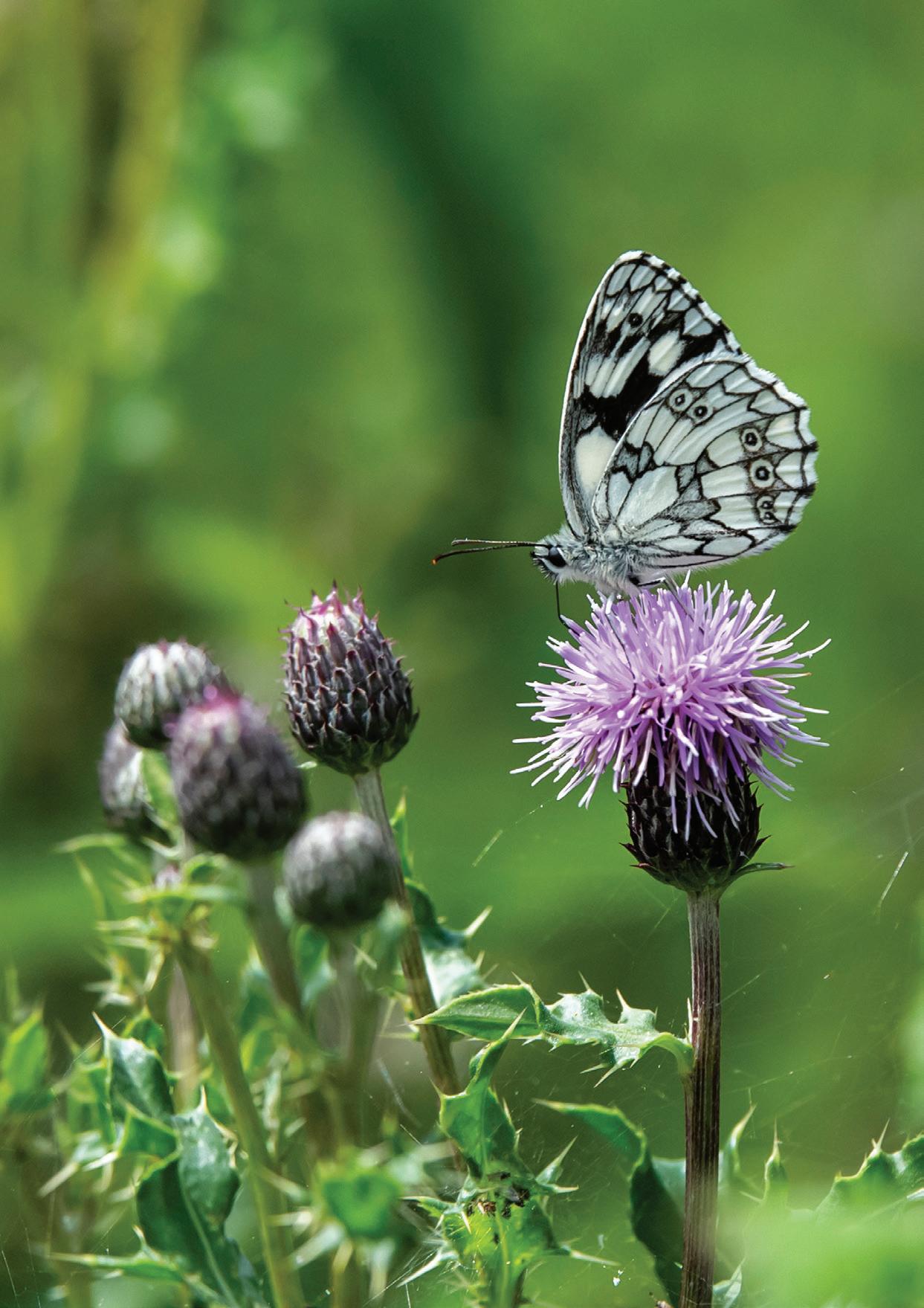
Marbled Wilte Butterfly feeding on a thistle flower.
As every farmer and gardener knows, the thistle is not confined to its cultural home over the border (Scotland, not Somerset), and to many it is a thorny issue—pardon the pun. There are 12 true native species of thistle in the UK, belonging to three specific genera within the daisy family (Asteraceae). They have splendid names, including the woolly thistle, marsh thistle, tuberous thistle, welted thistle, musk thistle, slender thistle, carline thistle and my personal favourite the melancholy thistle.
But there are two which are the scourge of farmers, creeping thistle, and spear (or bull) thistle. Both are legally classified as so-called “injurious weeds” under the UK Weeds Act 1959 due to their aggressive ability to suppress establishing grass swards, and I will come back to them later on.
So why are we talking about thistles in the R-Word? Well their strength as a prolific and vital early to mid-stage pioneer species when arable land is being ‘reverted’ to nature, means that they often turn up in conversations about rewilding, and also in rewilding locations. In my ‘go-to’ book, Wilding, Isabella Tree describes the ‘Thistle Crisis’ at the Knepp Estate. While facing pressure to use chemicals to get rid of a vast 60 hectares of creeping thistle, Charlie and Issy held their nerve and millions of Painted Lady caterpillars arrived to destroy the infestation restoring balance to nature. This was a risk, but it was ultimately a good call and successfully reduced the thistle numbers without chemicals. There are still creeping thistles at Knepp, but not in the same quantity, and they are seen as the brilliant providers of natural services that they are.
So what is it that thistles do for nature (and for us)?
Soil health: The deep taproots of the spear thistle delve deep into the subsoil, drawing up locked-away nutrients, and breaking up compacted soils allowing water to permeate—leading to increased organic matter lower down the soil horizon. Creeping thistles have rhizomes, that spread laterally in the soil increasing organic matter which can break down into nutrients;
Biodiversity: Thistle flowers are incredible nectar sources for a variety of pollinators, including bees, butterflies, and hoverflies, and the marsh thistle has been officially ranked as the UK’s single top nectarproducing plant (UK Insect Pollinators Initiative). The leaves also serve as essential feeding grounds for the caterpillars of several butterfly species, such as the Painted Lady, referred to above.
Food and nesting materials for birds: Once the flowers go to seed, they become a primary food source for seed-eating birds like goldfinches, linnets, and siskins—it wonderful to see a flock of goldfinches bustling around a thistle patch. Many of these same bird species also use the last year’s fluffy thistledown to line and insulate their nests.
Natural tree protection: In areas where trees are being allowed to grow naturally, such as many rewilding projects, thistles act as natural tree guards, with their
sharp spines deterring large herbivores such as deer, and creating protected micro-habitats for young trees to thrive. You will have heard of ‘the thorn as the mother of the Oak’, well this is the same thing but closer to the ground.
Over-wintering habitats: Even after the plant dies back in autumn, the dry, sturdy stems and bulbous thistledown dominated heads provide crucial shelter sites for insects, larvae, and other invertebrates.
To add to this, thistles can be beautiful and are a source of inspiration for artists, not just in Scotland—just have a look on Etsy at the amount of thistle art! From my own perspective I have probably taken hundreds of photos of thistles in flower, and I love both the variety of flowers and of the shape of the stems.
However, coming back to the baddies of this tale, there are the injurious weeds mentioned above. The ominously-named creeping thistle forms massive, dense clonal patches that can expand many metres per year, quickly outcompeting and smothering young grasses and wildflowers, and is hard to prevent because each fragmented root piece can lie dormant or actively sprout into a new shoot. Whereas the spear thistle form ground-hugging rosettes, which can expand significantly to the detriment of other species. It is triggered by ground disturbance—one of the three Ds of rewilding (Disturbance, Dispersal, Diversity) and can be problematic to fully remove.
You can see why some thistles may be problematic to those who manage the land, particularly on ‘improved’ pastures, or even for wildflower meadows, and why they would want to keep numbers down or eliminate them entirely. I can understand that, but as ever, it is about the right thing in the right place. Yes, clear them from the main parts of the fields that are fertile and good to farm—keeping some in the edges of course— but allow more to develop in the marginal fields, to provide the natural services described above for soil, biodiversity and to the ecosystem at large.
For gardeners, no harm in a few stunning thistles to add a “shade o’ purple an’ green” to your edges, but as usual, a balance is needed. In my front garden wilding patch the creeping thistle has taken hold, but if the painted ladies don’t come (very unlikely for such a small area), I shall try to borrow a goat for a day to restore a bit of balance—that is, of course, after the flowers have gone over and the birds have had their fill… and then I shall hold my nerve and see what nature does next!
Dr Sam Rose is a photographer and podcaster about nature and rewilding—see his website at whatifyoujustleaveit.info and increasingly out of date podcast “What if you just leave it?”. He also heads up the charity West Dorset Wilding (westdorsetwilding. org) and the Brit Valley Project (britvalley.org) but the views expressed here are personal and are not said on anyone else’s behalf.
MARINE MIGRATION
With rising ocean temperatures reshaping the ecosystem of the English Channel, Bob Ward suggests that shoppers and supermarkets should take sustainability into their own hands.
Climate change is adding to the pressures from overfishing and removing some of our favourite sea food from Dorset’s waters and shops.
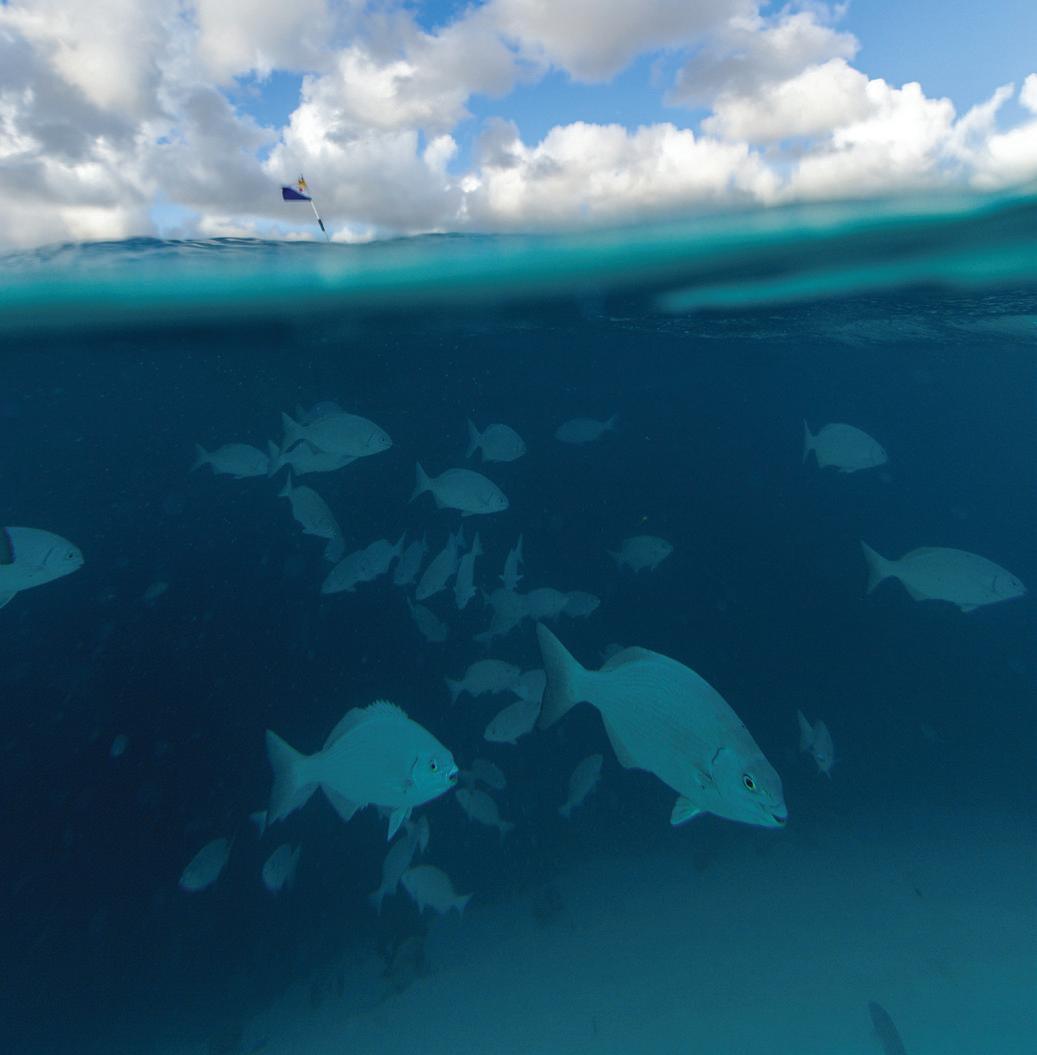
Specially designed lerret boats were used to catch mackerel with seine nets off the coast of Dorset for many centuries, but the abundance of the fish has severely declined in recent decades.
Earlier this year, Waitrose announced that it would stop stocking North East Atlantic mackerel because they could no longer be caught sustainably. The supermarket took action after the UK along with Norway, Iceland and the Faroe Islands decided to ignore the advice of scientists to drastically cut catches of mackerel because of a decline in numbers.
In September last year, the International Council for the Exploration of the Sea (ICES) recommended that North East Atlantic mackerel catches in 2026 should be cut by 77% compared with last year to help allow its populations to recover. It also recommended that
there should be no catches of horse mackerel because its stock is severely depleted.
ICES is an intergovernmental network of almost 6,000 scientists from over 700 marine institutes in 19 member countries, including the United Kingdom. It warned that current stocks of mackerel are at their lowest level for more than 20 years. ICES pointed out that the annual quotas for mackerel granted by individual countries since 2010 has resulted in catches that have exceeded the level advised by scientists by 39%, on average.
However, the governments of United Kingdom, Norway, Iceland, and the Faroe Islands decided in December not to listen to the experts and instead set total allowable catches of North East Atlantic mackerel 72% higher than the threshold suggested by ICES.
While overfishing is the main driver of declining stocks of mackerel, climate change is also having a growing impact on the species.
The most recent assessment by ICES noted that mackerel in the North-east Atlantic seem to be migrating northwards into cooler waters, making it more difficult to estimate the size and sustainability of stocks. This poleward movement by many plant and animal species to occupy the same climatic zone as the Earth warms has been recorded on land and in seas around the world.
A study published in 2023 by Spanish researchers found that North East Atlantic mackerel have been migrating further north to reproduce in response to the warming oceans. They prefer water temperatures of between 9 and 16 degrees Celsius to spawn. Mackerel are usually seen close to shore in Dorset during the summer months. They start to migrate to shallower inshore waters in May to feed on microscopic zooplankton and small fish, particularly sand eels.
In autumn they migrate usually southwards to the Bay of Biscay, Celtic Sea and Irish waters to spawn between March and June. The warming seas mean North East Atlantic mackerel are often not migrating as far south, and start spawning later. Horse mackerel also follow the same pattern but seem to be struggling more to adapt to the higher water temperatures. The combined impacts of overfishing and climate change mean that mackerel stocks in the English Channel could become as depleted as those of cod. Estimates of cod populations in the southern North Sea and English Channel have been so low since 2017 that scientists fear they will not recover. The ICES experts have recommended that there should be no catches of cod from any part of the North Sea and English Channel in 2026 because of the critically low levels of stocks.
Again, climate change is making the impacts of overfishing more severe. Cod prefer cool waters of less than 9.6 degrees Celsius to spawn. But warming waters now threaten to eliminate the species from Dorset’s waters.
A team of researchers from the UK and Norway warned three years ago that climate change could cause Atlantic cod to disappear from the English Channel over the next few decades as the species moves northwards.
However, the tendency for fish species to migrate north in response to climate change also means that some southern species are appearing in our waters in greater numbers. Atlantic bluefin tuna can now be seen off Dorset’s coast after largely disappearing during the middle of the last century. The species primarily inhabits and spawns in temperate and subtropical waters of the Atlantic Ocean, Gulf of Mexico, and the Mediterranean Sea. They migrate north to feed.
An international team of researchers earlier this year published the results of a study projecting that bluefin tuna will respond to climate change by moving further north for both spawning and feeding. The species used to be present in British seas until the end of the last century when overfishing caused stocks to decline. It is not clear that populations have recovered, as unsustainable levels of catch continue, but the species is now more likely in our waters due to climate change.
‘But warming waters now threaten to eliminate the species from Dorset’s waters.’
Mackerel, cod and tuna are not the only fish species that are being affected by climate change. A recent study indicated that British waters are becoming increasingly suitable for European seabass, sardine and anchovy, but more hostile for wolf-fish and saithe, also known as coalfish. But overfishing continues to be the main driver of the abundance of these species.
Other sealife is also responding to the warming waters. The common squid was once limited to the English Channel but is now found in increasing numbers in the North Sea
Dorset shoppers can help our favourite species by paying attention to where our fish come from. The Marine Stewardship Council, and international nonprofit organisation, provides a certification scheme to help consumers when choosing which fish to buy. It only certifies fish with its blue label that have been caught in places where catches are currently sustainable. Most supermarkets now stock fish that have been certified in this way.
The Marine Stewardship Council has not provided blue labels for North East Atlantic mackerel since 2019, and does not certify any cod that is caught in the North Sea or English Channel.
And the people of Dorset can also contact their local MP to ask them to put pressure on the Government to stop ignoring scientific advice about the size of catches before our favourite fish species are wiped out forever.
Bob Ward FGS FRGS FEI is Policy and Communications Director at
the Grantham Research Institute on Climate Change and the Environment at the London School of Economics and Political Science.
GOING UNDER COVER
Fergus Dowding talks about successional sowing, smart watering and organic controls
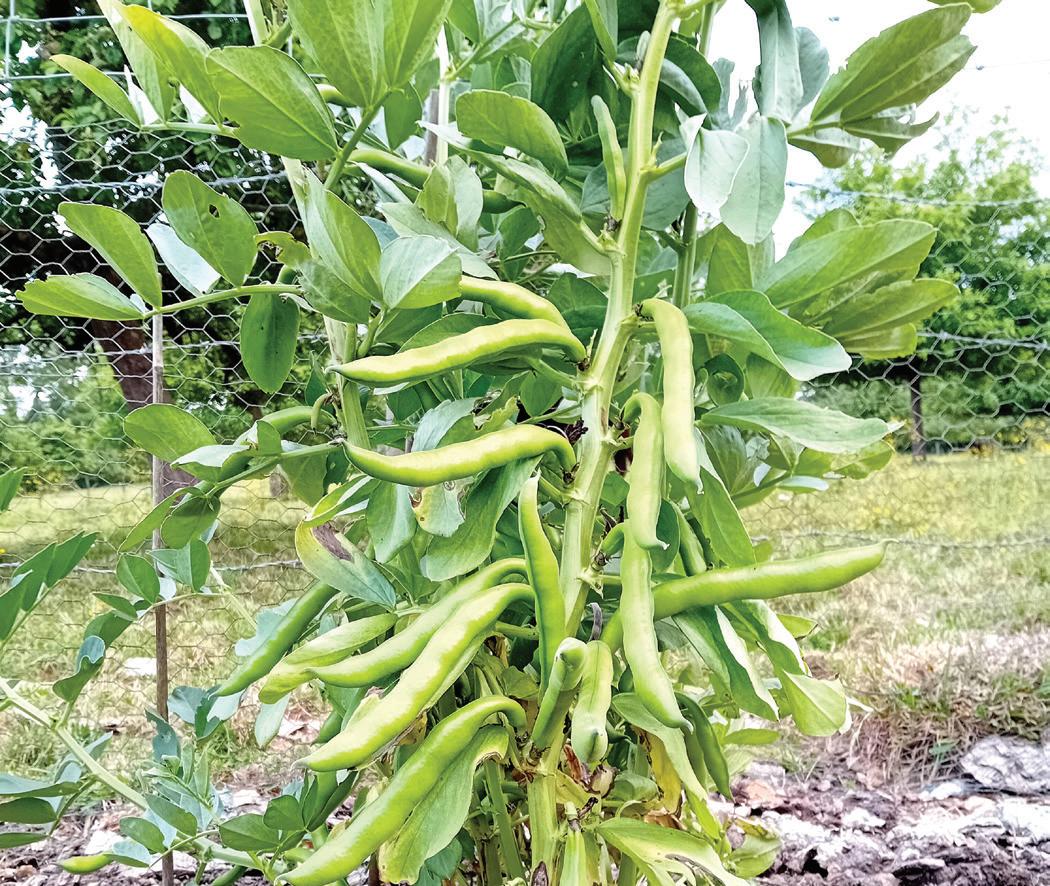
My overwintering broad beans sown in November cropped in May rather than June this year, our first taste of summer. Every plant cropped as heavily, after a combination of healthy, well composted soil and favourable weather.
Lots to pick, lots to sow. In July you can sow lettuce, endive, chicory, beetroot, carrots, savoy cabbage and bulb fennel. At the end of the month and into August true spinach, rocket, oriental leaves (which will all last through the winter) and turnips.
Our brassica crops are under 20 year old veggiemesh. It is possible to grow them without this ugly stuff but there are so many pests interested in eating our brassica before we do that mesh is best. They grow so well under it, some sort of ecosystem seems to develop. Otherwise you can spray DiPel on cabbages, this contains Bacillus thuringiensis, a bacteria that finish off cabbage white caterpillars. It does the same to box moth which has been causing such havoc this year.
Mesh can be used on carrots too. They grow bigger and it keeps root fly off. Last year we had no fly damage even without using mesh, although they were seen laying eggs on them, the soil was too dry for the fly maggot. You never know how much or when they will damage your roots, but mesh keeps them off as do organophosphate
sprays, which latter also helps to kill you—another reason for being organic.
Tomatoes take a lot of time but the family think it worth it. We grow all ours indoors for more dependable cropping, Sungold and Black Cherry from June and Alicante and Golden Sunrise from July. We water every other day to prevent fruit split and blossom end rot. Cut off all flowers from mid August as they never get to ripen before winter. Blight is another issue, it helps to keep them healthy and stress free. Take the lower leaves off to allow air flow, which prevents the spores settling on the leaves.
Keep your beans and courgettes well watered at flowering time to help the flowers set fruit. Many people ask why their courgette isn’t fruiting well in a pot. They are greedy plants and need a lot of space, feed and water. For continuous cropping we sow three or four lots of dwarf French beans, variety Sonesta. First in April in the tunnel, outdoors in May and June, finally a crop in the tunnels sown in July. And what do you call a Frenchman in sandals? Phillipe phollope.
AJULY IN THE GARDEN
By Russell Jordan
t the time of writing, we’ve had a decent amount of rain, so far, this summer to allow garden plants to grow and flourish pretty ‘normally’. As mentioned last month, traditional planting schemes, based largely on the concept of the ‘herbaceous border’, relied on plants, such as stately delphiniums, which peaked in June and there could be something of a ‘flowering gap’ in July. A lot of the early summer herbaceous material can be cut back after the initial flowering, herbaceous geraniums particularly benefit from this to control their sprawling nature, so that’s something to be done as a timely task. With the planting palette in modern gardens leaning more towards, ‘Oudolf style’, new perennial plants, many borders now peak later and keep flowering for longer using genera such as Helenium, Rudbeckia, Sanguisorba, Thalictrum, Veronicastrum, Agastache, Echinacea and numerous ornamental grasses.
Ornamental grasses are really only just getting into their stride, this month, and, certainly the indestructible Miscanthus, can provide a real ‘backbone’ to the mixed border as their foliage adds the kind of ‘weight’ and contrast, to flowering plants, that shrubs might perform in a more traditional scheme. Smaller, more ephemeral, grass specimens, such as Stipa tenuissima or Imperata cylindrica ‘Rubra’, can be woven through the front of borders, acting as a foil to the flowering plants and tying the scheme together.
On the subject of ‘foils’; the lawn is traditionally the foil to the planted areas of a garden as it provides a stable, uniform, shape and colour compared to the dynamic, constantly changing and evolving, ornamental plants in beds and borders. I’m sure I write this every year but it’s always worth reiterating; if we have a drought period, and the grass threatens to turn brown, you should resist the urge to waste loads of water, using lawn sprinklers to keep it wet, because water is a precious resource and lawns will always green up again once it rains. Raising the cutting height of the mower blades, allowing the lawn to grow a little longer, is one way to reduce stress when water is scarce. If we are having a decent amount of rain, now is probably the last chance to do major lawn improvements, such as moss removal, weeding and feeding, while there’s still enough growing time for the lawn to recover before the autumn.
A timely task, which tends to pop up as needing to be done in July, is the summer pruning of wisteria. After flowering wisteria tends to put on a lot of ‘whippy’ growth. This can get really out of control if not removed before it entwines everything within several metres of the offending plant! On young specimens, which have yet to fill their allotted space,
generally a wiring system attached to a wall or pergola, some of the new growth can be tied onto the supporting wires to fill any gaps that remain. Established plants tend to more than fill whatever area they are meant to cover, growing up under the eaves of a house and under slates or into the roof void, so keeping control of the excess extension growth is essential. The aim, of this summer prune, is to shorten all the extension growth to just a few leaf nodes, the portion of stem where the leaves attach to the stem, so that these can be shortened further, traditionally in February, when the stems are leafless and you can see what you’re doing. With a really rampant specimen I’d probably not bother with leaving any leaf nodes, on completely out of control stems, and I’d remove them in their entirety. Too much whippy growth just puts a huge amount of strain on the wired support system and the weight can, literally, peel the whole plant off its supports and damage anything underneath. Stems twining around, behind, even into, downpipes are particularly troublesome as they get fatter and fatter every year until they force the pipework off the wall; prompt intervention is paramount.
Elsewhere in the garden the continuous cycle of deadheading will help to keep floral displays performing well into the autumn. Plants in pots and containers will require watering and feeding, even if we do get some rain, as they rely on you to provide for their every need and any feed that was in the original potting compost will have been exhausted by now. I generally use a ‘slow release’, granular, fertiliser whenever I plant up containers. In older ones a liquid feed when watering (follow the dilution and timing advice on your chosen brand) is necessary to keep annuals and tender perennials flowering reliably for the whole season. Watering is a good time to look out for any pests or diseases that might be getting going and doing whatever you need to do to nip these problems in the bud (as it were).
With high light levels and enough time passed to have ‘ripened’ the plant material, July is a good time to experiment with taking cuttings of all sorts of garden plants. Search the internet, or seek out a good handbook, for any specifics of taking cuttings but the general method I’ve always used is; Take non-flowering shoots where possible, thick enough to withstand pushing into loose compost, and to trim them up so that they are at least finger length, with a couple of leaves at the shoot tip, and denuded from the tip down. Always trim below the lowest leaf joint with a sharp knife, preferably a craft blade, and additionally reduce the tip leaves too if they are over large.
I get the best results from using a multipurpose compost ameliorated by the addition of at least 50% grit / perlite to
keep the mixture ‘open’ (full of air and free draining). Your compost should only be lightly firmed into the pot, not rammed hard, to ensure that there is still plenty of air left in it. I think it’s trickier these days, with peat-free formulations, as composts now tend to dry out too quickly so you may have to experiment—maybe use vermiculite instead (although I now note that some people frown on using additives like perlite / vermiculite—it’s almost as if they want you to fail!).
Insert the cuttings around the outside of the pot, rooting tends to be quicker in cuttings at the edge of the pot rather than in the middle. Water well with a fine rose watering can. Finally, to maintain a humid atmosphere around the cuttings,
place a polythene bag over the whole ensemble and tie at the top. A length of cane pushed into the centre of the pot keeps the bag off the cuttings and gives you something to tie against. Tender perennials propagated at this time of year should root readily, under their own steam, but hormone rooting powder may help in slower rooting specimens and can guard against rotting as it also contains fungicide. Place somewhere inside, such as a light windowsill, but not somewhere where they will roast in the noonday sun.
I think that should give you enough to be getting on with and, hopefully, at some point you’ll remember to actually sit down and just enjoy being in your garden!
PROPERTY ROUND-UP
Property Picks to Buy in July
CHARD JUNCTION GUIDE
£495,000
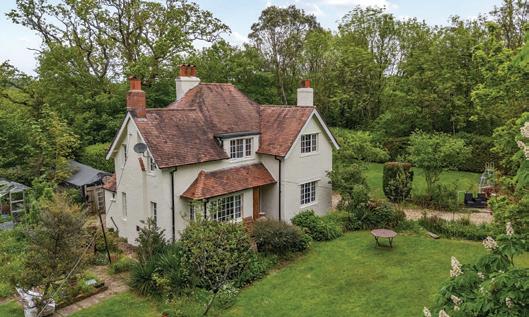
A substantial and well-proportioned four-bedroom detached house set within approximately 0.3 acres of beautiful gardens with double garage. Semi-rural position on the Somerset/Dorset border. The attractive grounds are further enhanced by a variety of mature fruit trees.
Greenslade Taylor Hunt: 01460 238382
AXMINSTER GUIDE
£875,000
SHERBORNE GUIDE £1,250,000
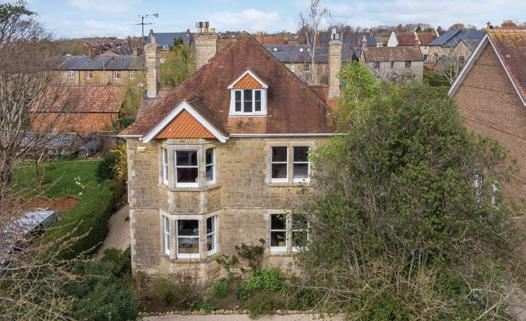
A rare opportunity to acquire a substantial, detached 5 bedroom Edwardian family home in a sought-after location in one of Sherborne’s most favoured roads. This fine home combines period elegance with superb accommodation and flexible living spaces.
Greenslade Taylor Hunt: 01935 813577
Tucked behind a walled garden, this substantial detached period home offers privacy and convenience near the town centre. Four reception rooms, 4 generous bedrooms, beautiful gardens, ample parking, and solar panels, it combines character, space, and modern efficiency. Gordon Rumsby: 01297 553768
BRIDPORT OFFERS OVER £1,000,000
A substantial and versatile family home with 5 bedrooms and 3 bathrooms, incorporating superb retail premises with income. Delightful gardens and a range of outbuildings. Ideally positioned in the heart of this thriving market town. Jackson Stops: 01308 423133
TOLLER PORCORUM OFFERS OVER £800,000
With 4 bedrooms and 4 bathrooms Frogmore Lodge sits quietly along a country lane on the edge of Toller Porcorum, combining the character of a traditional Dorset cottage with the ease of modern living.
DOMVS: 01305 231979
BRIDPORT GUIDE £1,200,000
A fantastic detached period property with four bedrooms and a one bedroomed annexe. With sea views and a short walk from Bridport and the coast it offers hugely flexible accommodation to suit most families’ needs.
Jackson Stops: 01308 423133
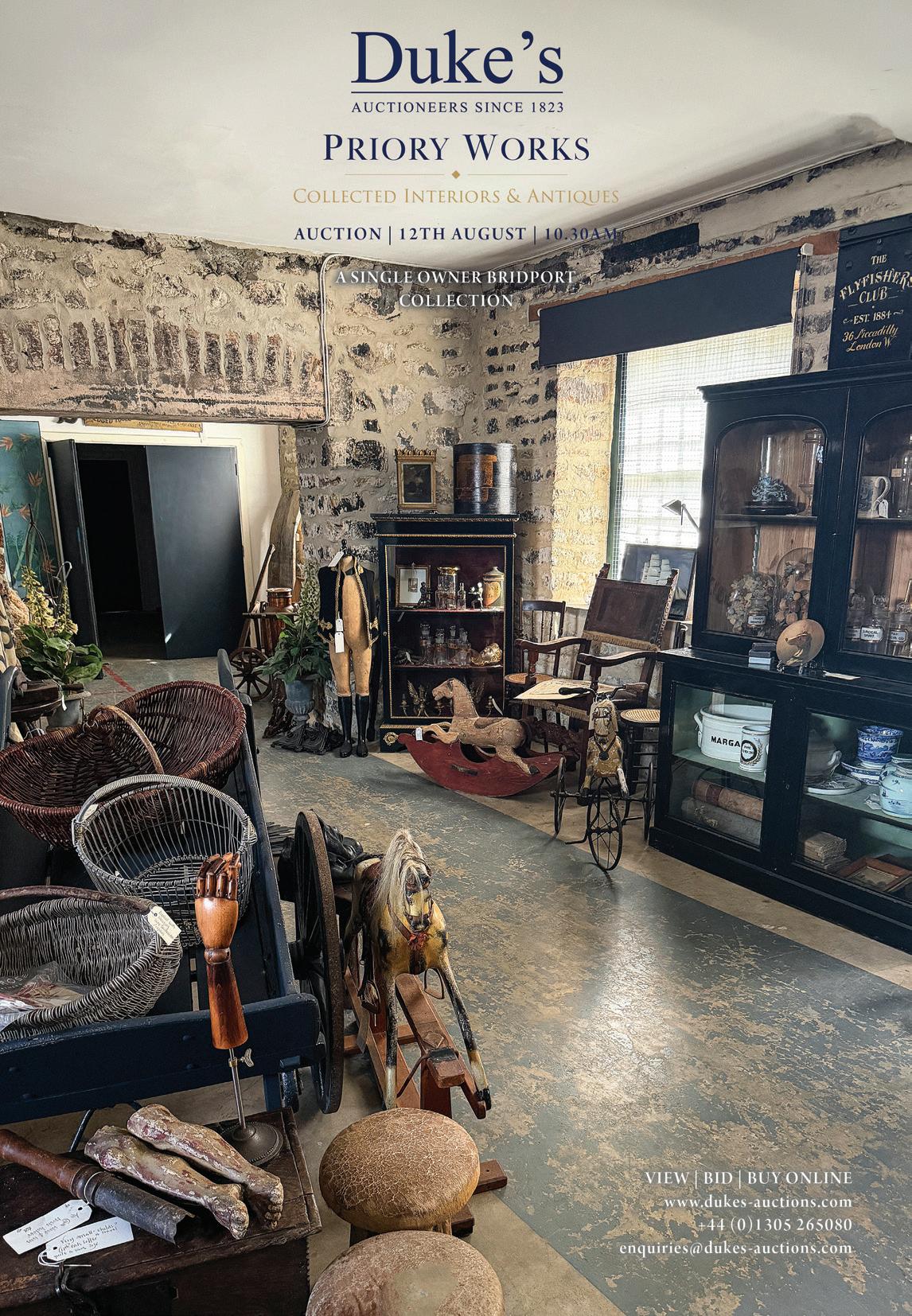
Priory Works collection to come up for auction
Duke’s Auctioneers has announced a sale celebrating the shared passion, vision, and collecting journey of Michelle and Stuart Fraserclarke.
For many years, Michelle and Stuart carefully assembled a distinctive collection of antiques, decorative objects, furnishings, and curiosities, each piece chosen for its character, history, and charm. Originally intended as the opening stock for an ambitious new antiques destination at Priory Works in Bridport, this collection now forms the centrepiece of a unique auction marking the end of one chapter and the beginning of another.
Stuart enjoyed a long and distinguished career as a professional stuntman, spanning almost four decades. Beginning in 1986, he worked on some of cinema’s most celebrated productions and was privileged to serve as Russell Crowe’s stunt double in films including Gladiator, Master and Commander, and Cinderella Man. While his career was defined by extraordinary action sequences and demanding stunt work, friends often note that one of his most recognisable contributions is the famous hand passing through the cornfield in Gladiator
Following his retirement due to ill health, Stuart embarked on a new adventure in Bridport alongside Michelle, whose lifelong passion for antiques inspired a shared dream of opening an antiques business at Priory Works. The pair acquired the building with the intention of transforming it into a destination for collectors and enthusiasts. However, after more than a year of unsuccessful planning applications to change the property’s use from storage to retail, the project became increasingly challenging. Combined with personal circumstances, these difficulties ultimately led Michelle and Stuart to make the difficult decision to part ways and begin new chapters in their lives.
The sale therefore represents not only a collection of antiques, but the culmination of a shared vision. Every lot has been selected with enthusiasm, knowledge, and affection, reflecting years of collecting and a genuine appreciation for craftsmanship, design, and social history.
For Michelle, whose particular interest lies in the stories objects tell about everyday life, the auction is especially poignant.
Stuart and Michelle
‘My passion has always been social history, and for many years I have dreamed of opening my own antiques shop. This collection was intended to become the foundation stock for Priory Works. Sadly, that vision did not come to fruition, and the last two years have been both challenging and emotional. However, I firmly believe in looking forward.’
A devoted member of the Bridport antiques community, Michelle has already established herself at the Alleyways Antique Centre, where she has enjoyed becoming part of a thriving and supportive team. Looking ahead, she plans to open a smaller antiques shop in the town and continue sharing her passion with fellow collectors and customers.
‘Bridport has been incredibly welcoming and kind, and it remains a wonderful place to call home. My hope is that the pieces in this collection will find new homes with people who appreciate them as much as we have. Letting them go is not easy—I am known for becoming attached to my treasures—so there may well be a few tears on auction day.’
The live auction will take place on Wednesday 12th August at 10.30am in the Duke’s Dorchester Fine Art Saleroom. Viewing and collection will be in Bridport.
For further information, catalogue information, and bidding details, please contact Duke’s directly enquiries@dukesauctions.com. Tel: 01305 265080. www.dukes-auctions.com.
THIS MONTH
IN THE NOT TOO DISTANT PAST
Breaking out in
July
1936, John Davis looks back on the devastation of the Spanish Civil War
It is morning in a small town in Andalusía, southern Spain. A man appears sheepishly from the door of his small stone house in a narrow backstreet. He is forced to shield his eyes with both hands as the sun climbs high into the sky. It is too white, too bright, too intense and it will take time to get accustomed to the glare again. He stumbles down the cobbled street, unsure of his footing as his outstretched hands continue to cover his eyes. The man, let’s call him Xavier, is a ‘mole’ (topo). This is the name given to Republican supporters during the Spanish Civil War who finished on the losing side and were forced to go into hiding, some for over 30 years, until the Spanish government issued an amnesty exonerating them. When the Nationalist faction led by Francisco Franco won the Spanish Civil War in 1939, Republican left-wing adherents, trade unionists
and local officials were brutally purged. Many were executed, some barbarically without trial, or sent to concentration camps. To escape what became known as the “White Terror” many individuals dug secret compartments in their own homes beneath floorboards, behind false walls or inside bricked-up basements. For years, emerging inside their homes only during the hours of darkness, they were entirely reliant on close family to maintain their secrecy and keep them alive. Many remained buried for decades hoping the Franco regime would collapse. Their womenfolk were forced to buy extra food without arousing the suspicions of neighbours or Fascist authorities, enduring an all-pervading threat from betrayal and constant house searches.
One of the most famous of these ‘moles’ was Manuel Cortes Quero, known as The Mole of Mija.
He was the last Republican mayor of Malaga. He returned home in 1939 and hid in his wife’s home for some thirty years until he was finally granted amnesty in 1969. Another former socialist major, Protasio Montalvo spent thirty-eight years hidden in a basement in the Madrid region before he deemed it safe enough to emerge.
The Spanish Civil War, often eclipsed in the history books by the great worldwide conflagration that was soon to follow it, broke out in July 1936 and lasted for almost three years.
The spark that ignited the conflict came when military generals including Franco launched a coup against the democratically elected Second Spanish Republic. While the coup failed to take over the whole country, it split the nation in two and plunged Spain into a three-year war.
The left-wing Republicans including leading socialists and trade unionists attracted the support of the Soviet Union and its ranks were also swelled by international brigades, volunteers from over fifty different countries including many from Britain and the United States. Among their ranks were well-known writers like George Orwell (Homage to Catalonia) and author-journalist Ernest Hemingway who used the conflict in Spain as the setting for some of his best-known novels including For Whom the Bell Tolls and Death in the Afternoon. Many other novelists, poets and artists gave their support as non-combatants. These included Pablo Picasso whose artistic depiction of the saturation bombing of Guernica in the Basque country, has become a priceless masterpiece. It is now owned by the Spanish government and is on display at the Museo Reina Sofia in Madrid.
The Nationalists, with strong Fascist leanings, were backed by Hitler’s Germany and Mussolini’s Italy and included many seeking a return to the monarchy and hard-line followers of the Roman Catholic Church. Franco flew from his base in the Canary Islands to Morocco to take command of the ‘Army of Africa’ at the outbreak of the war but without the assistance of German equipment might never have been able to transport his troops across the Straits of Gibraltar. Involvement in the war also permitted the German military to fine tune its logistics and hone its tactics both on the ground and in the air. Their fighting force became known as The Condor Legion and initially numbered some 7000 personnel. It sharpened their capabilities and would play an important part later in the highly successful and rapid invasions of Poland, the Low Countries and France in the early years of the Second World War. In an apparent about face
however and much to the chagrin of both Hitler and Mussolini, Franco reneged on his promise to join the Axis powers at the start of the Second World War in September 1939. He demanded large territorial and military concessions and was so heavily reliant on Allied food and oil that he maintained a practical, defensive neutrality.
In total the Spanish Civil War claimed some half a million lives and devasted the whole country fostering resentments that
lasted decades.
In total the Spanish Civil War claimed some half a million lives and devasted the whole country fostering resentments that lasted decades. While Franco, with superior military force, consolidated absolute power over the Nationalist forces, the Republicans suffered from bouts of in-fighting between its various factions. By early 1939, the Nationalists had captured much of the land held by the Republicans and the fall of Madrid in March 1939 effectively brought hostilities to a close. In addition to the death toll, the war resulted in massive displacement and emigration with up to half a million refugees fleeing to neighbouring France where many were later interned following the Nazi occupation. In Spain, Franco established a strict authoritarian regime, ruling as Caudillo (military leader/political strongman), until his death in 1975 when he was replaced by the return of the monarchy, Juan Carlos, and democratic government.
One of the most accurate depictions of the conditions that ‘moles’ were forced to live under is shown in the Spanish/French film The Endless Trench (La Trinchera Infinita). It was released in 2019 and is directed by Jon Garano, Aitor Arregi and Jose Mari Goenaga. The film can be streamed on Netflix.
Semi-retired and living in Lyme Regis, John Davis started working life as a newspaper journalist before moving on to teach in schools, colleges and as a private tutor. He is a history graduate with Bachelors and Masters degrees from Bristol University with a particular interest in the History of Education and Twentieth Century European History.
PRIME RIB STEAK BURGER
By Mark Hix
Next month, I’m introducing a prime rib steak burger to Marks’ pop-up in Lyme. It’s going to be a proper one, with a 200g prime rib steak with the right amount of rib fat to keep it moist during cooking. Long gone are the days when a proper burger was a cheap dish using meat that you have no idea where it comes from, and lots of stuff added to it. You can make these hamburgers as large or as thick or as thin as you wish. Obviously, cook them to medium rare if you wish, as the risk is yours, but do make sure that any dark exterior meat from where the meat has been hung is sliced off, as it doesn’t really taste good either. Toppings are completely up to you. Some like sautéed onions or a fried egg and melted cheese doesn’t go amiss. Once you have your good-quality beef patty, pimp it up and bespoke it.
INGREDIENTS
Hamburger
• 1.4 kg good-quality minced rib steak or chuck, including 20–30 per cent fat
• Sea salt and freshly ground black pepper
• A little vegetable or corn oil for brushing
• 8 good-quality baps
• 2 medium red onions
• 8 large sweet pickled gherkins
• 2 beef tomatoes
For the club sauce
• 80 g American mustard
• 320 g tomato ketchup
Serves 4
DIRECTIONS
• Mix the mince to ensure that the fat is evenly distributed throughout, then mould it into 8 balls and shape it either with a burger press, if you possess one, or by pushing the meat into a pastry cutter. Then put the hamburgers into the fridge to set the meat before cooking. Whisk together the tomato ketchup and American mustard for the hamburger sauce.
• Lightly toast the baps and keep them warm until you have cooked the burgers. The hamburgers are best cooked on a hot barbecue or griddle plate but a smoking hot cast-iron pan will do: this seals in the juices and will give a nicely cooked rare or mediumrare burger in a couple of minutes without the juices running out. Don’t cook them under the grill unless you have a red-hot American-style one, as this tends to boil the meat and it becomes dry and lacks flavour.
• Serve the hamburgers in the baps with slices of red onion, gherkin, beef tomato and the hamburger sauce.
Return of the Native
WIDELY regarded as one of Thomas Hardy’s greatest novels, The Return of the Native is one of the least often staged. Hotbuckle Theatre comes to Dorchester Arts at the Corn Exchange with an imaginative theatrical adaptation on Thursday 2nd and Friday 3rd July at 7.30pm.
Set against the wild and haunting landscape of Egdon Heath, this powerful story explores the forces of fate, society and nature that shape human lives.
At its heart is Eustacia Vye, a passionate and restless young woman whose yearning for escape and fulfilment drives the narrative towards its unforgettable and tragic conclusion.
Packed with drama, romance, comedy and compelling characters, The Return of the Native offers a fresh perspective on Hardy’s tale while remaining faithful to the themes that have captivated readers for generations.
The memorable characters include Clym Yeobright, the “native” of the title, who returns from a glamorous life in Paris to become a school master to the poor; the charming but fickle Damon Wildeve, landlord of the Quiet Woman , caught in a love triangle with Eustacia and his wife; and Diggory Venn, who in many ways is the real hero of the story, a resourceful young man, who works as a reddleman (travelling seller of the red chalk used to mark sheep), who loves Eustacia and tries to protect her.
Presented in Hotbuckle’s distinctive style, this energetic production combines live music, inventive storytelling, humour and multi-role performances to create an engaging theatrical experience for audiences of all ages. Tickets from: https://www.dorchesterarts.org.uk.
Multi-role performances in Dorchester
Heightened Present
Fergus Byrne meets some of the talented people behind Chasing Cow Productions
Apopular café in the heart of a West Dorset light-industrial trading estate may be the ideal backdrop for a conversation covering empathic vision alongside state and corporate manipulation.
Cappuccinos arrive, the sun shines, and the bubble of Mercato Italiano in Bridport glows brightly as I meet Grace Crabtree and Fred Warren to hear about their new project, Elecampane, a film in which medieval cosmology and folk custom collide with climate breakdown. In their words, it’s a fragmentary portrait of, not just a political uprising, but a spiritual one.
Far from the usual hubs of the British film industry, Fred and Grace are preparing to make their most ambitious work yet. Co-written with fellow Chasing Cow member Bryony Moores O’Sullivan, Elecampane is to be a feature-length, dark-folk road movie about climate breakdown, medieval wall paintings, and the fragile threads that hold communities—and reality—together.
Formed in 2019 by a group of friends who grew up locally, left for university, and then returned, Chasing Cow Productions has already built a reputation for inventive, landscape-driven films and cross-disciplinary projects.
‘We’d done all sorts of different degrees, but we wanted to make creative, collaborative projects,’ Grace explains. ‘And so we thought we’d form together and let our different interests be the guiding point for all of that.’
Those ‘different interests’ have since produced a quietly impressive body of work, beginning with the silent film Brink by Brink, which won Best Mid-Length Film at Derby Film Festival. Among other productions, the group also made the recycling-centre-set short film, Refuse; documentary commissions on hemp and flax; a radio play based on a Soviet poem accompanied by a scholarly booklet; some very impressive videos for local singer-songwriter Aidan Simpson, and the zine Matter Out of Place (MOOP), created during the pandemic when filming was difficult.
Although it wasn’t planned that way, both Grace and Fred point to the landscape of West Dorset as the inspiration for much of their work. Grace, a painter, sees her work as ‘very much landscape and geologically rooted.’ She describes it as a way of thinking through the world, an ‘artistic lens’ that looks at ‘deep time through the landscape.’
Fred agrees. He sees the area as a ‘fertile place’ to create ‘fictional space.’ As many larger production companies have discovered, the area ‘has different identities in the landscape. It’s not just like one thing—you’ve got the coast and then these dramatic valleys and villages.’
a folk ritual. They’re coming to this countryside in a state of crisis, and they’re seeing this drought-blasted landscape.’
Grace picks up the thread: ‘It’s a road movie. We’re following the characters, and they only pick up these things in fragments while they’re in the car. There are often bits of reports coming through the radio. The government keeps shifting the narrative about what’s going on.’ Hattie and Jeff become aware of a groundlevel rebellion that’s bubbling up. ‘And the state is getting increasingly concerned and trying to quash it.’
The internet exists in this world—until it doesn’t. Fred adds, ‘If Google Maps turns off and you don’t
‘People are once again grasping for images and rituals that might help them live through a world in flux’
After many years of working together and producing an eclectic mix of projects, it’s inevitable that this inspiration and creative energy have pushed the collective to go up a gear. Now, after years of shorts, mid-length experiments and commissions, they’re trying to raise funds to shoot their first fulllength film next summer.
The new film, Elecampane, is fictional, and sits in what Fred calls ‘roughly the genre of climate fiction,’ though what they’re making is subtler, stranger, and more grounded than most disaster narratives.
‘It’s a dark-folk indie road movie,’ Fred says. ‘And it’s set in a sort of heightened present… during this long summer heatwave which is destabilising social relations, and things are becoming a bit frayed.’
The central characters, Hattie, on a research trip to a series of neglected parish churches, and her reluctant companion, her brother Jeff, whose mother is trying to get him out of the house and off his phone, are steadily drawn into the effects of a countryside blighted by drought and contaminated water. Outbreaks of pageantry, protest and misrule intermittently shatter the “business as usual” illusion the state is desperately trying to maintain.
As they travel, the pair find themselves drifting into the path of something larger and more unsettling. ‘Alongside it, there’s this sort of civil unrest, something’s going on, which they are coming across in fragments,’ Fred says. ‘They’re seeing all these pageants. And it’s unclear whether it’s a protest or just
know where you are, that’s dislocation. So, yeah, it’s kind of harking back to a time when people were a bit more beholden to the natural world.’ Threaded through this contemporary crisis is a deep historical resonance. The medieval wall paintings Hattie studies aren’t just a backdrop: they are clues, mirrors, and omens. Images of the past begin to serve the urgent present.
‘These are kind of relics of an enchanted landscape,’ Fred reflects. He points to the 14thcentury era of plague and ‘societal unrest.’ In those centuries, wall paintings of saints and strange apocalyptic visions helped people make sense of upheaval. Now, in the film’s present, people are once again grasping for images and rituals that might help them live through a world in flux.
Water becomes the film’s most charged symbol— and battleground. ‘A narrative running through the film,’ Grace explains, ‘is this failing water company which gets taken over by an asset management firm. And then there’s a lot of fear around how that’s getting managed or mismanaged, and controlled in a way that people are getting concerned about.’
Fred adds, ‘Water is a very emotive issue for a lot of people. And it’s easy to see how that could develop into more of a kind of paranoia and unrest more broadly, because it’s essential for life.’
The film plays with rumours of contamination, shifting corporate statements, online speculation, and more spiritual responses. Crucially, the producers are keen to avoid another grim, grey
dystopia. Fred says they are trying to make it colourful to ‘move away from the folk horror kind of thing. There’s some dark and slightly scary elements, but it’s not like a Wicker Man .’
Grace sums up their approach: ‘That’s why we’re calling it a heightened present rather than dystopia, because it’s now, just slightly more extreme.’
If all goes to plan, the team will work on art direction and initial shots this year with the main filming to be done next summer. The budget will still be tiny by industry standards, but huge for a grassroots collective that has previously worked on a low or no budget. ‘It’s still working on a shoestring,’ says Grace. ‘Yeah, more would be good.’
For all its national and even global resonance— climate crisis, water wars, media fragmentation—the film grows from the same soil as all of Chasing Cow’s work: West Dorset.
‘I think the one constant that we always come back to is the West Dorset landscape,’ Grace says, ‘being just a very core part of how we all want to navigate the projects… the landscape became a real character.’
Fred puts it simply: ‘We quite like that challenge of creating a sort of fictional space out of these areas that we know so well.’
That rooting in place has been more than aesthetic; it’s practical and emotional, too. ‘We’ve just been really blessed and really lucky to have come back to such a fertile area for creative work,’ Fred says. ‘Everyone has been great… It’s never really been a barrier. It’s more like people have always been like, How can I help?’
Grace hopes their example might encourage others: ‘Hopefully it’s interesting or exciting for other people to see that you can do really interesting projects without thinking, Okay, I have to move to London or a city, because that’s where all the things are. You can try and grow them from the ground up, and then, you know, reach out more widely from there.’
A feature film about drought, climate issues and a country on the brink is a bold way to test that belief. If they can pull it off, Chasing Cow Productions may prove that some of the most urgent stories about our shared future are being written—and filmed—far from the usual centres of power, on uncertain ground where landscape, community and imagination converge.
To learn more about Chasing Cow Productions visit: https://www.chasingcow.co.uk.
The team would love to hear from anyone who might like to support the film—contact them at elecampanefilm@gmail.com
Above: stills from Brink by Brink, Refuse and The Wind Blows. Below: stills from the Elecampane test scenes (2025).
1 - 31 July
Kit Glaisyer presents an exhibition of his current series of paintings inspired by the ancient Hill Fort of Lewesdon Hill. You can also enjoy his Oil Sketches, Drip Figures, and his popular Café Royal paintings The gallery is open on Saturdays 10am - 3pm or by appointment. Bridport Contemporary, 11 Downes Street, Bridport, Dorset DT6 3JR. 07983 465789 www.kitglaisyer.com @kitglaisyer.
Until 4 July
Beyond words In a celebration of Dorset and the artists who thrive here, beyond words brings the brilliance of Alex Lowery’s paintings together with the quiet beauty of Yo Thom’s latest pottery and the lean, lovely lines of Petter Southall’s furniture to the galleries at Sladers Yard. A strong group show in the Café gallery includes paintings by Martyn Brewster ARE, Vanessa Gardiner, Frances Hatch RWS and wood engravings by Howard Phipps ARE RWA SWE. We also feature an ongoing show of leading ceramic artists and other designer makers. Sladers Yard, West Bay Road, West Bay, Bridport Dorset DT6 4EL. gallery@sladersyard.co.uk. Tel. 01308 459511. https://sladersyard.co.uk.
A Life in Art: Roger Fry a major new exhibition exploring the life, work and influence of one of the most important figures in 20th-century British art. The exhibition comes to the Museum from Charleston, Sussex, home of the Bloomsbury Group. Roger Fry (1866–1934) was a curator, critic, painter and designer, who transformed British art. He was a member of the Bloomsbury Group, the influential circle of artists, writers and thinkers that included Vanessa Bell and Duncan Grant. Fry’s ideas helped to reshape artistic thinking in Britain and beyond. He is perhaps best known for introducing post-impressionist art to England. His groundbreaking exhibitions of 1910 and 1912 shocked, surprised and inspired
the public and changed the direction of British art forever. The Museum of Somerset, Taunton Castle, Castle Green, Taunton TA1 4AA. Book tickets at: museumofsomerset.org.uk.
Until 8 July
Constable - Generations is a multi-generational exhibition of the Constable family. 2026 marks the 250th anniversary of the birth of John Constable RA, inspiring exhibitions nationwide celebrating one of Britain’s most beloved landscape painters. In 1816, Constable and his wife Maria Bicknell spent part of their honeymoon in Osmington, Dorset, establishing a lasting family connection with the county. Generations brings together works by John Constable’s descendants: the late Richard Constable, his daughter Sasha Constableand her son Valya Constable, alongside selected pieces by other family members. The exhibition celebrates a remarkable artistic lineage, their Dorset connections and the enduring creativity of the Constable family across generations. Dorchester Arts, High East St, Dorchester DT1 1HF.
Until 10 July
Painting India over Time Tobit Roche. The seventh exhibition of paintings by Tobit Roche at The Art Stable, and it is always a great pleasure to be surrounded by Tobit’s beautiful and romantic work. In this exhibition the focus will be on India where Tobit lived as a teenager and where he continues to visit regularly. Also included will be plein air paintings from Nepal and Pakistan, as well as remembered and reimagined pictures painted in the studio. The Art Stable, Kelly Ross Fine Art, Child Okeford, Blandford, Dorset DT11 8HB. https://www.theartstable.co.uk.
Predictions Alexander Massouras. A series with diverse imagery, spanning windows, flowers and falling figures,
whose connections are tenuous to the point of being almost nonsensical. Like previous work, Alexander plays with the boundaries between representation and abstraction, between order and chaos. The Art Stable, Child Okeford, Blandford, Dorset DT11 8HB. https://www.theartstable.co.uk.
11 July - 29 August
Printmaking Tradition and Transformation Exhibition celebrating 30 years of the Double Elephant Print Workshop featuring stunning contemporary works by Double Elephant members showcasing printmaking processes. Tuesday to Saturday, 10 to 5. Thelma Hulbert Gallery, Dowell St, Honiton EX14 1LX. thelmahulbert.com / 01404 45006. Free admission.
11 July - 5 September
To mark their 20th Anniversary Sladers Yard Gallery is showing work by the painters, ceramic artists, printmakers, sculptors and furniture maker Petter Southall who have all contributed to make it the artistic community that it is. The gallery wants to thank everybody who has supported it and its artists over the years with a celebratory selling exhibition that brings everyone together from David Inshaw to Philip Sutton and from Richard Batterham to Gabriele Koch. Including collages by Marzia Colonna, paintings by Frances Hatch, Vanessa Gardiner, Alex Lowery, Tim Nicholson, Janette Kerr, Julian Bailey, Simon Quadrat and many more, prints by Sally McLaren, Martyn Brewster, Merlyn Chesterman and Howard Phipps, sculpture and drawings by Clare Trenchard, ceramics by Yo Thom, Björk Haraldsdóttir, Emily Myers, Lise Herud Braten and more it will be a voyage of discovery and re-discovery. The Georgian flax warehouse, Sladers Yard was converted into an art gallery in 2006 by Petter Southall and Anna Powell who have run it with a great team ever since. The Café opened in 2007 and is now an acclaimed and award-winning seafood restaurant. Sladers Yard Contemporary Art & Craft Gallery, West Bay, Bridport, DT6 4EL. Open Wednesday to Saturday 10am – 4.30pm Tel: 01308 459511 Website: sladersyard.co.uk. www.instagram.com/ sladersyard.
23 July to 2 August
Kaleidoscope Eight artists, all living within 15 miles of Eype, have come together to celebrate the colours and landscapes of the Jurassic Coast in a new exhibition. Wessex Artists will present their work at Eype Centre for the Arts. It features original prints, paintings and drawings by Alison
GALLERIES IN AUGUST
send your gallery details to info@ marshwoodvale.com BY JULY 14th
Boyland, Sally Bowsher, Richard Corbett, Jane Coxhill, Deborah Harris, Tash Hayball and Hank Harp. Kaleidoscope is on daily from 10:30am - 4:30pm at Eype Church, near Bridport, DT6 6AR. Artists will be there every day and art is for sale priced from £50 - £1000.
24 July - 5 August
Landmarks 2026: the Colours and Patterns of Dorset – an exhibition of vibrant paintings by Hilary Buckley. After three previous successful shows, this will be the fourth solo exhibition of vibrant paintings by Hilary Buckley, a Lyme-Regis-based artist, who specialises in depicting the local Dorset landscape in her own colourful style. For more information visit dorset-artist.uk The Malthouse Gallery, Town Mill, Lyme Regis DT7 3PU. Daily 10.00am to 5.00pm. Free admission. Contact: 01297 444111.
Until 15 August
Many Worlds, One Mind Gordon Cheung. The exhibition brings together key works from across Cheung’s practice, exploring his distinctive approach at the intersection of art history, global economics, and technology. Influenced by Chinese philosophy and European painting, Cheung’s work reflects a cross-cultural perspective shaped by his London upbringing and Hong Kong heritage. CLOSE Gallery, Hatch Beauchamp, Somerset TA3 6AE. Thursday 11-4. Friday 11-4. Saturday 11-3. Or by appointment, please email info@closeltd.com.
Magic Happens Under this Roof
A place where stars battle with thunderstorms, Bridport’s Lyric Theatre tries to get watertight and safe for future generations
The Lyric Theatre, Bridport has survived for nearly 250 years because generations of people cared enough to keep it alive. Built as a Chapel, it has been a Temperance Hall, Liberal Hall, Bridport’s first cinema and the Bernard Gale School of Dancing. Since 2010 it has been a unique, artist-led resource providing a professional, working base for the community and artists to create performances at any stage of their career. Its cultural offer provides a vital space for everyone to learn performing arts, bring ideas, experiment & stage their own work supported by professionals and complementing its professional programme.
The Lyric is a vital cultural hub, rehearsal venue, workshop, creative studio, puppet-making space, creative space for young people, home for artists and performers. It hosts performances, residencies, workshops, youth programmes, and
collaborations with schools, local organisations, and touring companies.
However The Lyric’s historic roof is damaged after years of coastal weather and urgent repairs are needed to prevent further damage.
Thanks to an incredible £170,000 award from Arts Council England’s Creative Futures Fund, major improvements to the building are planned. But the Arts Council funding is dependent on The Lyric securing the remaining £100,000 needed for urgent roof repairs. Without a safe, watertight roof, the wider restoration project cannot move forward. They have launched a fundraiser which is absolutely vital to unlocking the full investment in the building’s future.
Please give generously and help save The Lyric for the future: https://www.crowdfunder.co.uk/p/ under-this-roof-emergency
Gallery celebrates 20 years
JULY marks a special 20th anniversary for Sladers Yard Gallery and Cafe in West Bay. The Gallery opened in 2006 with an exhibition of Alex Lowery’s paintings. The warehouse had been converted by furniture maker Petter Southall into an art gallery and showroom for his furniture. Petter’s sensitive conversion provides a stunning backdrop, with his furniture enhancing every exhibition. Combining boat-building with fine cabinetmaking, he creates practical, original pieces from ethically sourced solid timber, built to age beautifully.
Artists who came to that first show included David Inshaw, whose spectacular paintings of West Bay made an extraordinary solo show in 2007. Both David and Alex Lowery have continued to work with the gallery ever since, and both have solo shows this year. In 2014, Philip Sutton RA moved to Bridport and held his first Sladers Yard solo show that year. His sixth solo show at Sladers Yard will be in 2027, when he will be 98.
The acoustics of the timber and stone interior are exceptional, and live music performances with dinner have been a highlight. The jazz quartet, including the legendary Alan Barnes, David Newton and Ian Smith, has played at Sladers more than any other and returns on Saturday the 18th of July for another memorable evening. A celebratory exhibition bringing together work from many of the artists who have exhibited there over the last twenty years opens on the 11th of July. For more information, visit: https://sladersyard.co.uk.
Philip Sutton RA Studio in Pembrokeshire 142.5 x 142.5cm 1991
Sally McLaren RE Plough and Stubble A-P c.1980 41 x 65cm 60.5-x 85cm - Line etching with aquatint
Marzia Colonna West Bay 20 x 20
Martyn Brewster Night Walk Carborundum print
Leonian Resolve
Setting out on a shared musical journey Leonie Prater talks to Fergus Byrne about the challenges and the joys of collaboration
In a world where democracy often appears to be under threat, the benefits of the democratic processes required to be part of a rock band are not something many people might consider. However, Leonie Prater, the frontwoman of the Westcountry-based band Leonian Dream, highlights how a new set of artistic hurdles created by moving from a solo artist to sharing writing and composing with other musicians can have lasting benefits.
Reflecting on how her musical direction as a solo singer-songwriter has changed since forming a band, she says, ‘Musically, it’s definitely shifted, because we all bring different influences, and it’s adding a completely different dimension to the sound and what we want to achieve’. Most importantly, she recognises that collaboration opens up new horizons for musical output. ‘It’s very much becoming our sound, as a band.’
However, democracy doesn’t come easily. ‘You’ve got more people involved, you’ve got more opinions, you’ve got more ideas,’ Leonie admits. ‘So you have
to find the balance.’ While she admits that constant dialogue can be challenging, she says the band works really well together. ‘Because everyone’s bringing in their input, and everyone is sort of open to change. And that can be sometimes really good—and sometimes also not so easy.’
If ever there were a metaphor for collaboration rather than division, perhaps musical combos might be it.
It’s been many years since I first spoke with Leonie. The pandemic lockdown was in full swing, and she had just completed a highly personal, stripped-back acoustic solo record, Metamorphosis—a body of work forged during a period of personal transition and grief as she navigated losing her mother and looked towards an uncertain creative path. Today, wearing a casual black hoodie and a warm smile she engages with a subject that no doubt consumes her life.
That creative path has undergone a profound change. Somewhat like a metamorphosis, Leonie has moved towards a collective and shared identity.
Leonian Dream began as a two-piece with guitarist Thomas Rogers, then with bass player Megan Greenland and drummer Harry Sibley. But, she explains, ‘Meg and Harry left—Harry became a Dad and Meg got married’. Today, the line-up has changed to Leonie on guitar, violin, and vocals, along with guitarist Thomas Rogers, bassist Bran Pick, drummer Toby Irlam, and Ben Webster on keyboards.
The line-up evolved when Leonie and Tom recorded an EP with producer John Robertson, featuring songs Leonie had written. The first single, Gloomy Room, shows Leonie remaining intensely vulnerable, even as her narrative focus has expanded. She fearlessly confronts heavy societal and personal themes. ‘The EP was very much a mixture of topics that I was writing about,’ she says. ‘It sort of touched on personal experiences with—and this is hard to talk about, but I’m happily open to talking about it—sexual assault and women who go through that. That was one thing that I wanted to get in there with Gloomy Room.’ She sees it as a ‘core message’ that is ‘important for me.’
Other tracks balance this darkness with profound light. ‘Greenhouse—I wrote that in the actual greenhouse,’ she tells me. She sees it as offering hope, ‘like there’s better, better things ahead.’ Meanwhile, the track Red Water Lily emerged from the ashes of a difficult breakup, written during a transitional period of solo travel in Wales.
The new collaborative friction has pushed Leonie to approach her craft from entirely fresh angles. On the band’s upcoming material for a planned album, songs are no longer born solely on an acoustic guitar. ‘There’s one track on the new demos, which Tom actually wrote a whole musical arrangement for, and then I set my lyrics to the song. It’s nice to have other people’s input and do it together.’
Leonie is also pushing her own instrumental boundaries. As a classically trained violinist, taking up the guitar in a rock format was daunting. ‘Tom’s a really established guitarist, and I’m still sort of finding my feet when it comes to guitar playing—I’m a violinist. So it’s challenged me in a really good way.’
As for the highly anticipated upcoming album? Leonie is keeping the finer details under wraps for now, but hints at a somewhat flexible narrative thread. ‘We are seeing a certain concept, mood boards that we want to follow. I think when we go into the studio, it might change again, or we might think, “Oh, actually, it’s more about this.”’
Having said that, the band is leaving no room for hesitation. In July, they will head to the prestigious Somerton Castle studio for a seven-day locked-in residency to record the new album. They are partnering with acclaimed producer Steve Grainger, known for his work with northern artist Lizzie, who made waves at Boardmasters and Glastonbury.
Some of the new material has already had a live testing. Following a self-organised UK tour last year, which Leonie calls ‘a really big learning curve,’ the band has been gradually road-testing the new material, including a recent gig in Seaton.
‘...for
them to grow in confidence, for them to be able to face difficulties or mental health issues. I just think it’s such a vital part of everyone.’
Audiences will get a prime opportunity to witness this evolution firsthand via a high-profile, threedate residency at the Bridport Art Centre this year. Dubbed Leonian Dream Presents, the band has completely curated the lineups for July 17th, September 26th, and November 21st, selecting premier talent from the Southwest music scene to join them, including Saf Juno, Lotta, Cosm, and Rattrap. The November date will also serve as the grand finale to a mini-tour that will see the band play London and Oxford for the very first time.
Hearing Leonie speak, it becomes undeniably clear that music is not just a career path or a hobby—it is a vital lifeline. I remind her of Sir David Attenborough’s famous assertion that ‘music is not a cultural construct, it’s a biological necessity.’ Leonie stops, visibly moved. ‘Wow. What a great comment... I would agree. Within everyone, really, you know, it’s there.’
Her relationship with music is woven into her identity, anchoring her through an international upbringing that includes a late Swiss mother from Zurich, time spent in foster care in St. Gallen, and a multicultural heritage connecting her to Sri Lanka and Malaysia. Today, alongside her ascending rock career, she also works on the front lines of musical education as a teacher.
Teaching music helps her see its value in many forms. She says she can see ‘what a difference it can make to those children… how beneficial it is, not just listening to it, but also for them to grow in confidence, for them to be able to face difficulties or mental health issues. I just think it’s such a vital part of everyone.’
With an album on the horizon, a residency booked, and a collective sound locked in, the dream is no longer just a concept for Leonie. It’s an unfolding reality.
Leonian Dream Presents will take place at the Bridport Art Centre on July 17th, September 26th, and November 21st. Tickets are available now from https://www.bridport-arts.com.
Physics to Punk
Adrian Boot’s legendary lens brings punk icons to Bridport
Few photographers have documented the soundtrack of our times quite like Adrian Boot. Now based in Bridport, his journey began unexpectedly in 1970 when a teaching post in Jamaica—physics, of all subjects—drew him into the heart of the island’s vibrant musical world, a connection he has never let go. Returning to Britain, Adrian forged a prolific freelance career behind the lens, his work appearing in the pages of NME, Melody Maker, The Times, The Guardian, and The Face.
He was the chief photographer at some of the twentieth century’s most defining moments: Live Aid, Nelson Mandela’s Freedom at 70 concert, and Roger Waters’ The Wall—Live in Berlin
Equally at home in the archive and on the road, Adrian has authored several photography books and taken his exhibitions to audiences across the world, from the Punk exhibition and Songs of Freedom to Bob Marley: The Ultimate Experience, a Jimi Hendrix retrospective, and Reggae Xplosion. He also worked on the production of the Elvis Presley photo archive and permanent display at Graceland, Memphis. His most recent projects reflect an enduring relevance: a contribution to the Beyond the Baseline exhibition at the British Library, and an ongoing role in The Music is Black: A British Story, a major exhibition at V&A East in 2026. Adrian is the co-founder of urbanimage.tv.
A selection of Adrian’s photographs will be exhibited in Punk Bridport at Bridport Arts Centre, 4 July – 22 August 2026 in the Allsop Gallery at Bridport Arts Centre. Admission is free (voluntary donation to Bridport Arts Centre). For more visit: https://www.bridport-arts.com.
Rhythm by the Coast
The Unmissable Magic of Bridport Folk Festival
While Bridport is no stranger to great folk musicians and singers, the town comes alive at the end of July to celebrate the genre in style. With venues such as the Millennium Green Marquee, The Dagger Stage at Bucky Doo Square, Colmers Stage at Burrough Gardens, The Ropemakers and the Town Hall. there is much for folk fans to enjoy this year.
Dubbed the ‘Friendliest Festival’, Bridport shows off its best with over 40 music acts and 16 Dance sides. Headliners include True Foxes at Millenium Green on Friday 24th and the Sam Kelly Trio at the same venue on Saturday 25th. For the full lineup which inlcudes Clementine Lovell, Wickenwood, Quinns Quinney Skiffle and many others visit: www.bridportfolkfestival.com.
Above: The Sam Kelly Trio. True Foxes and Bridport’s Millenium Green. Opposite page Clementine Lovell
PREVIEWJuly
Unearthing remarkable women DORCHESTER AND POOLE
A NEW play by Stephanie Dale, writer of two of Dorset’s successful community plays, uncovers stories of some of the remarkable women from Dorset’s past. Unearthed has its premiere with Dorchester Arts at the Corn Exchange on Friday 24th and Saturday 25th July, followed by two more performances at Poole’s Lighthouse arts centre on Friday 31st July and Saturday 1st August.
Months of research, writing, workshops and casting have gone into the production, by the theatre collective Women of Dorset. Now the cast of 45 women, aged between eight and 82 are preparing to bring it to the stage. It is the story of Sam, a contemporary young woman who finds herself caught up in an extraordinary party. Plied with cake and tea by women from Dorset’s past, she comes to realise that her life is perhaps not as drab and unfulfilling as she previously thought.
Stephanie Dale wrote the 2023 Dorchester community play, Spinning the Moon, set at the end of the Wars of the Roses; and the Poole play Salt (also 2023) which was set between 1681 and the present day, highlighting the historic relationship between Poole and Newfoundland.
With this new work she has created a play that aims
“to celebrate women who have lived, survived and thrived from across our county.”
Unearthed is directed by Penny Levick, an experienced community play director. She says: “It is inspiring to see the play take shape and come to life off the page.” The designer is photographer Jayne Jackson and the costumes are being made by Arts University Bournemouth students.
Tilda Samson, who takes the pivotal role of Sam, recently took her A levels at Thomas Hardye School in Dorchester: “It’s a big (and slightly scary) project but I’m looking forward to it. I see a lot of myself in Sam, especially her worries about our modern world and her overall sense of humour and attitude. While, unlike the others, Sam’s not yet lived her big moment, she is vital in bringing all the women (and the story) together.”
Stephanie said: “We want to illuminate the stages and streets of Dorchester and Poole with the faces of women past and present and celebrate their achievements—and we are hoping people will help us achieve this. Donations will ensure that the community benefits from the highest production values and works with a professional creative team.” A crowd-funder has been launched by Women of Dorset to enable the cast and crew to put on the best possible show.
Performances at both venues are at 7.30pm, with a 2.30 Saturday matinee at Dorchester (25th July).
More than 40 women from all over Dorset are taking part in Unearthed
Murder, mayhem and masterpieces
Sidmouth
PICTURESQUE Sidmouth is not only a delightful seaside resort and home to the country’s oldest folk festival, it also has the longest-running traditional summer rep season, at the Manor Pavilion theatre, this year continuing to Saturday 19th September.
For three months, with a week out for Sidmouth Folk Festival, the theatre has a weekly professional rep, including, in July, Alan Ayckbourn’s dark comedy Neighbourhood Watch (to 4th July), Francis Durbridge’s Sweet Revenge, from 6th to 11th July, and a stage adaptation by Jeremy Sams of the much-loved television series, The Good Life, from 13th to 18th July.
Neil Simon’s classic comedy, Plaza Suite, runs from 20th to 25th July, followed by Hugh Janes’ The Haunting, a dramatisation of some of Charles Dickens’ ghost stories.
The rep season continues after the folk festival, from 10th to 15th August, with Changing Rooms, a farce by Marc Camoletti, best known as the writer of Boeing Boeing.
The mood turns darker with James Cawood’s Stone Cold Murder, from 17th to 22nd August. And then there is one of the perennially popular comedies of the last 50 years, Richard Harris’ Outside Edge, a classic comedy look at the ups and downs of life on and off the cricket pitch.
Over the years, the programming at Sidmouth has moved on from the typical farce and mystery fare to include much more challenging and contemporary plays. This year’s festival includes Joe Orton’s Loot, a dazzling and satirical black comedy about what happens when two thieves hide stolen money in a coffin, after removing the corpse. Loot is on from 31st August to 5th September, and is followed, from 7th to 12th September, by Daphne du Maurier’s drama of love, jealousy and family loyalties on the coast of Cornwall.
The season finishes with one of Noel Coward’s funniest and most popular plays, Blithe Spirit, the story of a selfish man, his new wife, his late wife, and a medium who raises more spiritual mayhem than she expected. End the Manor Pavilion play festival on a note of high laughter, from 14th to 19th September.
All the world’s a stage LYME REGIS
A FEW miles east along the Jurassic coast, the Marine Theatre at Lyme Regis also has a summer play festival, featuring the professional Gilroy Theatre Company, in a six-week season, from 28th July to 28th August. The first of the five plays, is The Late Edwina Black, a classic and very atmospheric Victorian-set thriller by William Dinner and William Morum, running from Thursday 23rd July and Friday 24th to Monday 27th, Tuesday 28th and Wednesday 29th (this is the running period for all five plays; there are concerts and other
events at the weekends).
Set in 1895, this murder mystery, which opened in London in 1949, takes place the day before the funeral of Edwina Black, a domineering woman whose sudden death is discovered to have been caused by arsenic poisoning. Inspector Martin calls to interview her husband Gregory, her companion Elizabeth, and her housekeeper, Ellen. Gregory has long endured the domination of his wealthy wife, but is in love with Elizabeth. Edwina’s death gives them freedom, but at what cost?
Alan Ayckbourn’s time-travelling, black comedythriller, Communicating Doors, runs from 30th July to 5th August, followed by George Bernard Shaw’s Arms and the Man, from 6th to 12th August. This is the classic comedy of the “chocolate cream soldier.” In this play, subtitled An Anti-Romantic Comedy, Shaw makes fun of romantic ideals of love and warfare, satirising conventions of love, military honour and class.
Dead Guilty, by Richard Harris, from 13th to 19th August, is a tense psychological study of guilt and obsession. And the season ends with Ladies Day, Amanda Whittington’s funny and poignant story of four fish-filleting women who head for Ladies Day at Royal Ascot, the year it relocated to York. It runs from 20th to 26th August.
Mapping the folk scene
BUCKLAND NEWTON AND VILLAGES
RENOWNED folk singer, cellist and viola player Rachael McShane comes to Dorset for three dates in July, including Sunday 23rd at Buckland Newton village hall, with her band, The Cartographers.
Hailing from the north east of England, McShane rose to prominence as a founding member of the award-winning folk big band Bellowhead. Alongside her work with that internationally acclaimed ensemble, she has built a successful solo career, releasing her debut album No Man’s Fool in 2009 and later signing to the prestigious Topic Records, the world’s oldest independent record label.
The Cartographers are guitarist Ian Stephenson (Kan, Baltic Crossing) and melodeon player Julian Sutton (who has performed with artists including Kathryn Tickell and Sting). Together, the trio creates a rich and vibrant sound, combining expressive vocals with intricate instrumental arrangements.
Blending traditional folk roots with contemporary influences, their music is both powerful and playful, bringing new life to familiar material while introducing original compositions full of energy and warmth. Known for their engaging stage presence and musical chemistry, The Cartographers have built a loyal following through live performances and critically acclaimed recordings.
The other performances are on Saturday 18th at Studland village hall and Sunday 19th at Marnhull.
Baroque delights with Ceruleo CONCERTS IN THE WEST
MUSIC by some of the lesser-known baroque composers, including Barbara Strozzi, feature in July’s series of Concerts in the West, when Ceruleo ensemble come to Bridport Arts Centre for the coffee time concert at 11.30am on Friday 10th July, Ilminster Arts Centre at 7.30pm that evening and Saturday 11th at 7.30pm at Crewkerne Dance House.
Described as a group that “feels more like a Baroque chamber ensemble than voices and accompaniment,” Ceruleo are two sopranos, Jenni Harper and Emily Owen, and three instrumentalists, Kinga Gáborjáni, viola da gamba, Satoko Doi-Luck, harpsichord, and Toby Carr, lute and guitar.
Formed in 2014 at The Guildhall School of Music and Drama, Ceruleo create dramatic programmes using spoken text alongside music for two sopranos and continuo. Every member of the group performs as a soloist, and they use all available combinations of instruments and voices to create innovative and captivating performances. They specialise in the music of Restoration England and 17th century Italy.
The programme for their July series includes several pieces by Barbara Strozzi, and works by Girolamo Frescobaldi, Tarquinio Merula, Alessandro Piccinini and Biagio Marini.
Ceruleo’s most recent project, Burying the Dead, funded by Arts Council England, was a staged show about Henry Purcell, by scriptwriter Clare Norburn and directed by Thomas Guthrie. It was performed at several festivals including Buxton International, Lake District Summer Music, Baroque at the Edge at LSO St Luke’s, and early music festivals at Brighton and York.
They released their first album of the music of Henry Purcell, Love Restor’d, on Resonus Classics in 2022.
Jazz Jurassica at the EP BRIDPORT
BRIDPORT’s glamorous Art Deco theatre, the Electric Palace, hosts a Jazz Jurassica event on Saturday 18th July at 3pm, that will be a treat for fans of the Blue Note sound and the history of jazz.
The Sound of Blue Note—the band—takes its name from a sound that shaped jazz history. It’s a sound that jazz buffs will recognise straight away— catchy, stylish and full of swing. The sound comes from the legendary Blue Note Records, the label that, in the late 1950s and early ’60s, captured a style that still feels fresh today.
This show brings the two together—a band named after the sound, playing the music that defined it. The repertoire draws on some of the great names of the
label—Horace Silver, Art Blakey, Freddie Hubbard and Hank Mobley. It’s music that is direct, expressive and built to swing, a defining moment in jazz history. The musicians are Andy Urquhart, trumpet, Terry Quinney, saxophone, Phil Doyle, piano, Ben Taylor, bass, and Andy Chapman, drums.
The original Blue Note sound still matters because it set a standard and backed artists who shaped modern jazz. It valued originality as much as technique and created recordings with a balance of discipline and freedom that became part of the language of jazz.
Blue Note still records new artists and new music— musicians such as Robert Glasper, Gregory Porter and Norah Jones carry that legacy forward, blending new influences with the label’s roots in jazz, soul and groove.
Summer music at the manor DORCHESTER
WHITCOMBE Manor, the beautiful home of bestselling crime and historical novelist Minette Walters, and her husband Alec, is the venue for the annual Dorchester Arts summer party with music, on Sunday 19th July from 1pm.
The entertainment will be provided by the acclaimed vocalist Liza Pulman. Following her sold out appearance earlier this year at Dorchester Corn Exchange, audiences will again be able to enjoy Liza’s effortless vocals and distinctive musicianship.
She is joined by award-winning jazz pianist, guitarist and composer Gareth Williams, for what will be a relaxed and elegant summer experience in beautiful surroundings.
As always, tickets include a complementary glass of bubbly and a delicious picnic lunch—everything you need for a perfect Sunday afternoon of food, fun and music!
Back and bigger than before HONITON
POPULAR Cornish bluegrass band Flats & Sharps are back, with an expanded programme, coming to the Beehive Centre at Honiton on 17th July at 7.30pm.
Born on the coast and raised on the road, the high energy quintet have built a reputation for lightning-fast picking, pristine vocal harmonies and an electrifying live show. With deep roots in Cornwall and fans across the globe. Flats & Sharps are driving their sound into an exciting new era.
For more than a decade, since their humble beginnings busking on the rainy streets of Penzance as teenagers, the band now plays sell-out shows world-wide, at venues including the Royal Albert Hall and major festivals.
Known for their mix of traditional bluegrass and original song-writing, their live shows are a blend of virtuosity, humour and passion. With new music in the works, fresh collaborations and tours planned at home and abroad, Flats & Sharps are dedicated to bringing their music to new audiences while keeping their long-term fans dancing, laughing and singing along.
Surviving impossible odds
BRIDPORT
MRS Danvers is a name that tends to strike fear if you only know her as the terrifying housekeeper in Daphne du Maurier’s Rebecca. But for actress and writer Heather Alexander, she is a woman who is determined to survive against impossible odds, a story told in her solo show, Becoming Mrs Danvers, at Bridport Arts Centre on Saturday 18th July, at 7.30pm.
Mrs Danvers’ mantra is: “Power. Money. Survive” This is a dark, new theatre work that fuses a contemporary interrogation of mental health with the tension of a psychological thriller. Sinister, intimate and relentlessly gripping, the piece draws audiences into a world of locked doors, secret rooms and fractured realities, where money, power and manipulation determine who is heard and who is erased.
At its heart is a young woman trapped within a system that has shown her no mercy. As she bucks against institutions designed to control and silence, she finds increasingly inventive ways to beat the system. Through role play, creative writing and fantasy, she claws back her humanity; but what begins as resistance skews into obsession.
Heather Alexander’s previous solo plays include Havisham—The Story that Dickens Left Out, and Room—A Journey into the Creative Mind of Virginia Woolf Becoming Mrs Danvers is directed by Tina Pelini.
Music under the Giant’s gaze
CERNE ABBAS
THIRTY five years ago, the Dorset born clarinettist Richard Hosford and the internationally renowned Gaudier Ensemble founded the Cerne Abbas Music Festival. The musicians have been returning every year since then delighting audiences with an unrivalled breadth of Chamber music from the 18th century to the present day. This year’s festival, now scaled back to one weekend, takes place at the village’s St Mary’s Church from 9th to 11th July.
Becoming Mrs Danvers is at Bridport Arts Centre in July
Screen Time
with Nic Jeune
Top Six at the Flix
Bridport Arts Centre
Amelie (2001) 25th Anniversary Re- release. Thursday 2nd July 7.30 pm. This is a film that will put a goofy grin on your face from the opening frame, through to the credits. Film Threat. Ross Williams.
Bridport Electric Palace
Tuner (2025) Thursday 9th July @ 7.30 pm. Tuner is a small film, but one that will leave a big impact. It truly is one of the most delightful surprises of the fall and deserves to be seen on a big screen with the loudest sound possible. Screen Rant. Graeme Guttmann.
Disclosure Day (2026) Friday 17th July @ 7.30 pm. This movie is made for a world that has us spending most of our time looking down, whether metaphorically, heads buried in our own work and struggles, or literally, absorbed by the phones that have overtaken our lives. Screen Rant. Alex Harrison.
Marine Theatre. Lyme Regis.
The Christophers (2025) Saturday 4th July @ 7.15pm. With Ian McKellen in superbly crotchety form and Michaela Coel exuding chilly cunning. The Daily Beast. Nick Schager.
Weymouth Pavilion
Toy Story 5. (2026) Sunday 19th July –Thursday 23rd July, various times. Pixar Chief Creative Officer Pete Docter, who was a writer and animator on the original movie, recalled how Toy Story was a makeor-break project for the studio. ‘We showed them a screening. And they said, “This is just not working. Shut it all down, fire all your animators,” Luckily, somebody wisely said, “Give us one more shot.”’
Virginia Woolf’s Night and Day (2026) Monday 13 July & Wednesday 15 July, various Times. It is such a sweet story and guilelessly eccentric – a butterfly fluttering just beyond the wheel of realism. The Guardian. Peter Bradhsaw.
Artistic director Richard Hosford creates concert programmes ranging from intimate solo performances to mixed ensemble work, featuring not only established international colleagues but also outstanding young professionals at the start of their careers and students who comprise the next generation of professional musicians.
This year’s ensemble includes names that will be familiar from previous Cerne Abbas festivals, from Concerts in the West and from other chamber music concerts. They are: Scottish pianist Alasdair Beatson, violinist Stephanie Gonley, the leader of the English Chamber Orchestra and the Scottish Chamber Orchestra, and a soloist with many leading orchestras, Richard Hosford, clarinet, Dutch viola player Iris Juda, cellist Sally Pendlebury, a member of the Chamber Orchestra of Europe and the Vellinger String Quartet, Stephen Stirling, horn, principal horn player with several chamber orchestras, including the Academy of St Martin in the Fields, and double bass player Stephen Williams, who has been a guest principal with the LPO and the BBC Symphony Orchestra, has recorded with the Tippett Quartet, and worked with Adele, Billie Eilish and Josh Groban. He plays an ltalian bass made in the 16th century.
The festival programme is: Thursday 9th—St Mary’s Church, 6pm, Crusell, quartet in C minor for clarinet and strings, Brahms’ trio in E flat major for violin, horn and piano, and Schumann, quartet in E flat major for piano and strings;
Friday 10th—6pm, Schubert, string trio in B flat, Mozart, quartet in G minor for piano and strings, Dohnanyi, sextet in C major for piano, clarinet, horn and string trio;
Saturday 11th—3pm, Schumann Fantasy Pieces for clarinet and piano, Bruch, Four Pieces for clarinet, viola and piano, Schubert, Trout Quintet
Surviving the Titanic DORCHESTER
THE story of the sinking of the Titanic is one of the bestknown in maritime history. A remarkable one-man play, coming to Dorchester Arts at the Corn Exchange on Tuesday 14th July at 7.30pm. tells a less familiar tale—told through the voice of a stoker who survived the horror of the heat and freezing Atlantic waters below deck.
Charlie Sheepshanks plays Frederick Barrett in Boiler Room Six: A Titanic Story , written and directed by Tom Foreman, based on the evidence and testimonies Barrett gave to the official inquiries immediately following the disaster. This harrowing true account pays tribute to the working men who sacrificed their lives to keep the ship’s lights and pumps running.
Frederick Barrett was the lead fireman stationed in Boiler Room Six. On the evening of 14th April, 1912, as the Titanic struck the iceberg, his boiler room suddenly ripped open, causing the freezing Atlantic water to come crashing through. He and his crew fought in 50-degree heat to shovel coal, keep the boilers running and manage the steam to power the ship’s electrical dynamos. Their efforts ensured the ship’s distress signals were sent and delayed the sinking, allowing hundreds of passengers to escape.
Barrett eventually managed to escape the flooding below decks, reached the upper decks, and was placed in charge of Lifeboat No. 13, surviving a terrifying launch. GPW
The Young Lit Fix
The Lions’ Run By Sara Pennypacker
Cover illustration and header art by Jon Klassen
Published by Hodder & Stoughton Ltd
Hardback £14.99
Review by Nicky Mathewson
SET in Lamorlaye, Chantilly, in occupied France in 1944.
Lucas is a local orphan who is being raised at the abbey until he is of age to be called upon by the Germans to work or fight for them.
He attends classes and makes deliveries for the greengrocers and he craves a few moments solitude, away from the clamour of boys or German boots.
After rescuing some kittens from drowning Lucas needs to find a place to hide them and comes to an abandoned stable, at least that’s what he thought. There’s a teenage girl there who is also using the stable to hide something. Her name is Alice and her secret is a beautiful and majestic horse named Bia. Whilst delivering to the local maternity hospital called a Lebensborn, Lucas discovers more secrets. Not everything is as it seems at the Lebensborn and Lucas finds himself in some deep trouble. Can his new friend Alice help him to hide a secret? One that could risk both their lives?
Sometimes you find a book that is simply perfect. This is that book.
Historical fiction at its best, full of action and tension, love and loss. I adored it. Perfect for confident readers age 10+.
Boiler Room Six: A Titanic Story comes to Dorchester in July
LUCY WORSLEY INVESTIGATES: THE AMERICAN REVOLUTION
Review by John Davis
Lucy Worsley Investigates: The American Revolution.
Two-part mini-series available on BBCI/Player. Directed by Craig Collinson and Tim Niel.
I WAS REMINDED the other day about the huge developments that have taken place in broadcasting programmes on historical themes when I viewed a short series called The War Lords (BBC 1976) given by one of the doyens of the medium, A.J.P. Taylor. In it he appraised the lives, motives and legacies of six pivotal leaders who directed the fundamental operations of World War Two. Taylor delivered his lectures straight to camera without, I understand, notes or autocue. It was a hallmark of his style, conversational story-telling in which complex political and military issues were made so eminently comprehensible. No benefits of catch-ups or streaming here.
Ms Worsley, a frequent face on screens these days and with all the advantages of modern technology at her disposal, gave us The American Revolution in this two-part mini-series, very apt since the Declaration of Independence occurred on July 4th, 250 years ago.
She provided us with colourful filmed sequences of relevant locations worldwide, the views of fellow experts and the dramatization of key
events and characters to reinforce her own insight and analysis. Not quite sure why so many of the location shots focussed on her fashion in footwear and handbags or why Benjamin Franklin (a shrewd, political operator apparently) dominated the characterisations while George Washington was not thought deserving enough to be included and poor George III never stopped frowning and pacing about. He did have a lot on his mind though.
Ms Worsley assured us that she would provide the ‘untold version’, that she would be ‘searching the evidence for clues’ and that she intended to ‘get closer to the truth’. I’m no expert on the period but I am sure many of these goals were achieved. There was certainly information that I had not been aware of including the terrorist bomb attack on Portsmouth Dockyard, British spy Edward Bancroft, the 007 of the times, and King George’s threat to abdicate and decamp back to Germany to get away from it all. A snapshot of a key event in Britain’s history all very stimulatingly presented.
In the end, it materialised, the thirteen original states of the United States of America just got fed up of paying taxes to service Britain’s massive debts. They were not against taxation per se but they wanted to decide on their own methods of collecting it and using it and in the process more freedom to carve out their own destiny.
YOU ARE THE FUHRER’S UNREQUITED LOVE
Review by John Davis
You Are The Fuhrer’s Unrequited Love by
Jean-Noel Orengo.
Translated from the French by David Watson.
OXYMORONS have become an accepted part of our conversational language. These are phrases where diametrically opposed words are used to emphasis a point or reveal a deeper truth. A book is ‘awfully good’, for example, or information has been ‘clearly misunderstood’.
The relevance here is that this book’s subject, Albert Speer, is often described as ‘the good Nazi’ but can anyone have any virtue if they were incontrovertibly embroiled in one of the most evil and barbaric regimes of European history?
Speer, a budding young architect during the 1930s, became a favourite of the Third Reich hierarchy and eventually Hitler’s blue-eyed boy. Almost the talented son he never had. Cutting his teeth on the staging of the Nuremberg rallies, Speer graduated to projects like Berlin’s new Chancellery building while sharing the Fuhrer’s dreams of the future Germania, if only in balsa wood and papiermache models. When Fritz Todt who served as Reich Minister for Armaments and Munitions, was killed in 1942, it was Speer to whom Hitler turned to ramp up the war effort.
Orengo has condensed his assessment of Speer into 250 erudite pages. It falls somewhere between a novel and a biography, often called autofiction, and is absorbingly readable with imagined interactions between the main characters. The first two thirds of the narrative deals with Speer’s career. The final third is based around interviews Speer had with Gitta Sereny, author of Albert Speer: His Battle with
Truth and gives Orengo, perhaps less effectively, the chance to air his own philosophical slant on what transpired.
Ex-colleagues of Speer unrepentantly blustered throughout the Nuremberg trials maintaining they were only obeying orders, while Speer was more apologetic, claiming he was ignorant of many of the atrocities, thereby being collectively responsible but not individually guilty. His persuasive arguments resulted in a twenty-year prison sentence instead of the gallows. No use of legal principles then like guilt by association or joint enterprise. In prison he wrote his bestseller Inside the Third Reich and followed it with Spandau: The Secret Diaries. Both books made him a wealthy man.
Since his death in 1981 opinion has shifted about the veracity of the protective wall of mythology that Speer constructed around himself. Some historians, including Sereny, were genuinely sceptical at first but recent evidence and research suggest his remorse was largely a calculated survival strategy fabricated to save his own life initially and then to preserve his legacy. As the falsehoods have mounted up a quote from Nietzsche rings true. “I’m not upset that you lied to us, I’m upset that from now on we can’t believe you.”
Footnote: The title of the book comes from a quote attributed to SS officer, Karl Maria Hettlage, who, noting the close bond of admiration between Speer and Hitler when working together remarked to the architect, “Do you know who you are Speer? You are Hitler’s unrequited love.”
Published by Penguin Books
VAX Platinum
Power Max upright carpet washer. Little used second machine. £75. 075817 49564 (Dorchester)
Metal Tower Scaffold £160. Phone 07989 927797
Multi music system, as new condition, play’s CDs, Tapes, LPs, 45s
RESTORATION
FURNITURE.
Antique restoration and bespoke furniture. Furniture carefully restored and new commissions undertaken. French polishing and modern hand finishes. Phil Meadley. 01297 560335. phil. meadley@btinternet. com May 26
etc. Little used. Cost over £200. Will accept £75.00 No offers. 01308 863738. For sale approx 7ft walnut table, turned legs, price £300,- and 6 vintage G plan dining chairs, £300,-. telephone number: 01297630749.
Old Tupton bear with pointsetta £8 also 2 miniature teapots collectable
FOR SALE
£6 each one teapot with Peter rabbit on and one with Jemima puddleduck ring Julia on 07814537404
2 Hartman green high back chair cushions unused £15 Tel 01297 489414 after 5pm.
4 pointed half-round fencing posts, size 180cm x 4cm. New/ unused £20. Metal bolt down fence support, size 5cm x 5cm, plus
WANTED
WANTED: Vintage
collections, job-lots & estate items. (Antique, wartime, toys, Motoring, advertising, Curio & interesting items) Seeking larger collections (typically £300+ in value). Fair offers & instant cash payments. Friendly approach, no obligation & Free Home Visits. Discrete Local Buyer. Darren 07875 677 89 May 26
To advertise here email: info@ marshwoodvale.com Ex Display sheds. Stables, Fieldshelters, Garages, Summerhouses, Offices, Workshops, Agricultural. 01935 891195
WRITING
Budding Authors. Writing an interesting story, the past achievements of an organisation or a family history for self-publishing and need some advice with style, layout and editing? Contact freelance author and editor John Davis on johndavis77@ btinternet.com.
Dave buys all types of tools 01935 428975 Jan 27
Coin & Stamp Collections Wanted Discerning collector / investor seeks pre-war collections of stamps and coins. Individual items considered. Tel Rod on 07802261339. Sept 26
post level gauge.
£5. Collection from Chaffcombe, Chard. lyn.lowe350@gmail. com or 01460 68629. Garden iron table with marble top, needs some TLC. Bridport 01308 423680. Flymo + easi reel. vision compact 330. Very Little Used. £45.00. Tel 01297 678602.
Vintage & antique textiles, linens, costume buttons etc. always sought by Caroline Bushell. Tel. 01404 45901. Dec 26
SPECIALIST BUILDING
DISTRIBUTION
AN EXHIBITION at Bridport Museum showcasing the area’s rope and net-making industries is coming to an end on the 16th of July.
Entitled Short Ends, the exhibition by local artist Carrie Mason features contemporary sculpture, drawing and installation, inspired by the museum’s internationally significant Rope and Net collection, the Sanctuary Collection, which includes historic net-making machines.
The exhibition follows Mason’s 2025 residency there, during which she researched objects and materials connected to the town’s rope- and netmaking heritage—industries that have shaped Bridport for more than 800 years. It also includes samples of rope, twine and net.
Bridport Museum features interactive displays and engaging stories that explore Bridport’s history and culture. The Museum is open 10am – 4pm, Tuesday to Saturday. Admission to the exhibition is included in the price of an annual pass, which costs £5 for the year.