Gardening for climate change Page 30
Multi-talented all round musical treat Page 50
The power of creative connection Page 40
FREE COMMUNITY
Magazine
Marshwood + THE
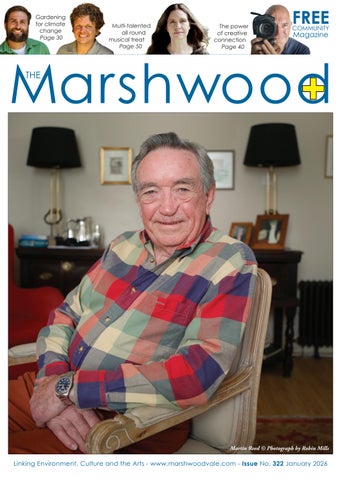
Martin Reed © Photograph by Robin Mills
Linking Environment, Culture and the Arts - www.marshwoodvale.com - Issue No. 322 January 2026
COVER STORY Robin Mills met Martin Reed in Cerne Abbas
’I
Martin Reed © Photograph by Robin Mills
seem to have mostly lived in small communities, perhaps it’s in my genes as my father came from farm labourers in Comberton, and my mother was brought up in Selsey. After my family were bombed out of our home in Portsmouth during the war we ended up living in a tiny village called Catherington, near Horndean. Then when I went to sea, ship-board life was of necessity closely communal, and now we’re living in another village, well known for its wonderful community. After the bombing, we moved into digs, putting the furniture in store. The Luftwaffe got the digs and the store as well, so with no possessions the Navy billeted us on a retired admiral at Catherington. My dad had joined the RN as a boy sailor, ending up a Chief Gunnery Instructor; Mum was a nurse, bringing up my elder brother Roger, and myself, after they divorced. At Portsmouth Grammar School, I enrolled in the Combined Cadet Force. I was good at shooting, qualifying as a marksman with the Army. We also had a 25lb field gun—great fun—I became a Bombardier. The Army wanted to sponsor me to go to Mons Artillery School at Aldershot, to be trained as a gunnery officer. Then I found a prospectus for the School of Navigation at Warsash, so I had the choice of either Salisbury Plain or seeing the world. That decision was easy. After a year at Warsash, I applied for a 3 ½ year apprenticeship with P&O and was accepted. My first year’s wages came to Tel. 01308 423031 The Marshwood Vale Magazine January 2026 3
Martin Reed
the grand total of £149, of which I was only allowed to draw £10 per month; but I progressed up the ranks, sailing on both cargo and passenger vessels. In 1972 I became First Officer on a new passenger ship, the Spirit of London, the first ship the company had built specifically for cruises, a major shift away from the liners which sailed to Australia and the Far East. She was a lovely ship, carrying 700 passengers, one of three vessels which we cruised successfully along the West Coast of the USA. I particularly loved Alaska for the wildlife and scenery, getting to know the humpback whales which we saw every trip. There was one which had something wrong with its blowhole, sounding rather like a loud fart, so we knew immediately when it was in the area. On the liners and in the early days of cruise ships, passengers and ships company would create their own entertainment. A liaison officer would make sure the passengers got what they wanted; there were no professional entertainers, but the ships company would help out, putting on concerts, sketches, etc. Later, musicians and dancers were provided, but there was still a link between passengers and ships company, and we all got to know each other well during a voyage. We loved it, and so did the passengers. I joined SS Canberra in1981 as Chief Officer. She was much bigger than my previous ships, 44,000 tons and carrying 1600 passengers. In March1982, we were homeward bound after a world voyage, due to replenish at Naples before the last leg to Southampton. A Catholic priest on board, with a contact in the Vatican, arranged a private audience with the Pope for 40-odd members of the ships company. His Holiness’s welcome was an unforgettable experience, and I had to make the thank you speech. The night we left Naples, we received a signal saying, “be prepared for a change of plan”. We were diverted to Gibraltar. After a private phone call, the captain gathered we five senior officers and told us we were being “taken up from trade”, requisitioned by the MoD to be part of the fleet sailing for the Falklands. Neither the ship’s company nor the passengers were allowed to be told. On the night we arrived at Gibraltar I was taking part in an entertainment for the passengers, so dressed in top hat and tails I was obliged to take the ship into Gib and pick up the military advance party from a boat. On the way back to Southampton I had to measure for the installation of two flight decks for helicopters and send the figures ahead so that the decks could be designed and the steel cut in advance. We told the passengers on the last day. In Southampton the decks were installed, and we loaded 2000 tonnes of military cargo, embarked 2000 troops, plus 74 naval personnel to help us run the ship—all in three days. To fit everyone in, we doubled up many of the 2-berth cabins to 4-berth. We set sail on 9th April. Our orders stated that “it was not Her Majesty’s Government’s present intention to place the Canberra in an area of risk.” We were to learn later what the meaning
of “present intention” was. Ascension Island, halfway to the Falklands, was a crucial staging post, where we spent 3 weeks. Before we left there, our forces had retaken South Georgia, so we now realised this wasn’t going to just blow over. Heading for the South Atlantic the weather and the seas got rougher. There’s no land to slow down the gales. On D-Day, 21st May, anchored in San Carlos Water, Canberra landed troops from 3 Command Brigade. HMS Ardent, which had been our escort, was attacked by Argentine aircraft and eventually sunk. Suddenly we were taking on board their survivors—they lost 22 crew. Canberra, known as “The Great White Whale”, was a sitting target for Argentine air attack. Although some of their pilots believed it to be a hospital ship and left us alone, others didn’t! We had machine guns fitted by the troops in case we needed to defend the ship, and Blowpipe shoulder-launched anti-aircraft missiles. When an Argentine aircraft suddenly appeared around a headland, flying on its wingtips and firing rockets and cannon, we were the first ship in the anchorage to open fire. He quickly changed course when our tracer bullets came streaming up, but that was the start of a very long day. After the Argentine surrender, we had to take their troops home. We carried 4144 of them, in one lift. They were in a sorry state, cold, wet, and miserable. They hadn’t been fed properly, and some hadn’t washed for two months, but they were pleased to be warm and dry. We returned to the Islands to pick up our Marines and sailed for home. It did everyone a world of good to come home by sea, because it gave everyone time to decompress, relax and sit in the sunshine after the winter weather of the Falklands. Many of the lads hadn’t had dry feet for a month. Docking at Southampton, after a massive and emotional welcome, a team took over the ship so that we could go straight home. Which was a wrench, to leave the ship in a hurry after all we’d been through together. After 6 weeks, we were off on another cruise, then another world voyage. A year later, I was working on other ships, back to the West Coast of the USA. My late wife Sue and I lived in Chinnor, Oxfordshire. We had two boys, Charlie and Nick, and now four grandchildren. After Sue died in August 1998, my great friend, Peter Mayner, the medical officer on Canberra, and Dee, a nurse he had worked with, decided to call me to cheer me up. Dee says it took me three months to return the call, but then we started to see each other about a year later, and eventually we married. And following her ambition to grow old in Cerne Abbas after a memorable visit here many years ago, here we now are. The music master at my Grammar School was also the organist at Portsmouth Cathedral. Aged 11, I was recruited into the Cathedral choir, where my singing improved, and I became head chorister—until my voice broke, and singing stopped—then 65 years later, I’m a soloist in our village men’s choir. We’re The Men of Cerne.
4 The Marshwood Vale Magazine January 2026 Email info@marshwoodvale.com Tel. 01308 423031
’
UP FRONT
THIS MONTH i n yo u r M a r s h wo o d Va l e M a g a z i n e
Although I spend most of my time trying to understand and highlight other people’s lives, like many writers, I also spend a lot of time inside my own head. I happened to be rummaging around in there recently—initially trying to release a song that had been stuck in the doorway for several days—when I came across an old memory hidden behind years of dust. It was a photograph of my mother, taken by the recently deceased photographer Martin Parr—one of his iconic seaside images from a commission for work to be displayed in Dorset County Hospital. My mother never knew about it. She was asleep on Weymouth beach when the photograph was taken and passed away in the same hospital long before any of us knew it existed. The same image had been used on an album cover by a band called the Saw Doctors. Although his work might have elicited a Marmite effect, Martin Parr has left an extraordinary legacy. In the documentary I Am Martin Parr, Grayson Perry described him as having ‘inveigled his way into our visual unconscious’. Martin said he simply photographed ‘the yin and yang of British society’ as he found it. In this month’s issue on page 36, we highlight some of the images made by visitors to the Harmony Centre in Bridport, where local photographers showed how time with a camera could help ease some of the challenges felt by those visiting the centre. The results were fascinating and uplifting. One of the participants in the workshops commented that ‘just a little validation or encouragement can work wonders with someone’s self-esteem and confidence.’ It reminded me of a slightly mildewed saying that my mother enjoyed— ‘Why not encourage someone today?’ Trite, banal, cliched, call it what you will, but the sentiment is well worth adding to 2026 New Year resolutions. Fergus Byrne
Published Monthly and distributed by Marshwood Vale Ltd Lower Atrim, Bridport Dorset DT6 5PX For all Enquiries Tel: 01308 423031 info@marshwoodvale. com
Editorial Director
3 8 10 21 24
Cover Story By Robin Mills Jill Butler By Robin Mills Events Nature Studies By Michael McCarthy No Good Crying over Spilled Lithium By Christopher Roper
26 26 28 30 32
House & Garden To Soil or not to Soil By Fergus Dowding January in the Garden By Russell Jordan Gardening in a Changing Climate By Seth Dellow Property Round Up
34 36
This Month By John Davis Fact or Fiction By Bob Ward
38 38
Food and Dining Whipped Squash with Goat’s Curd and Walnuts By Mark Hix
40 40 46
Arts & Entertainment Creative Connection By Fergus Byrne Galleries
48 52 53 54
Preview By Gay Pirrie Weir Screen Time By Nic Jeune Young Lit Fix By Nicky Mathewson The Box By John Davis
55 56
Health & Environment Services & Classified
D O N AT I O N S If you missed our Crowdfunder and would still like to donate to support the Marshwood Vale Magazine, please send donations either by cheque to Marshwood Vale Limited (address below) or direct to Marshwood Vale Limited at Monzo Business Sort Code 04-00-06 - a/c number 65919314 - Ref: Donation
Fergus Byrne
Contributors
Deputy Editor
John Davis Seth Dellow Nic Jeune Russell Jordan Michael McCarthy
Victoria Byrne
Design
People Magazines Ltd
Advertising
Sarah Hill info@marshwoodvale.com
Nicky Mathewson Robin Mills Christopher Roper Bob Ward Gay Pirrie Weir
Instagram marshwoodvalemagazine
6 The Marshwood Vale Magazine January 2026 Email info@marshwoodvale.com Tel. 01308 423031
The views expressed in The Marshwood Vale Magazine, Marshwood+ and People Magazines are not necessarily those of the editorial team. Unless otherwise stated, Copyright of the entire magazine contents is strictly reserved on behalf of the Marshwood Vale Magazine and the authors. Disclaimer: Whilst every effort is made to ensure the accuracy of dates, event information and advertisements, events may be cancelled or event dates may be subject to alteration. Neither Marshwood Vale Ltd nor People Magazines Ltd can accept any responsibility for the accuracy of any information or claims made by advertisers included within this publication. NOTICE TO ADVERTISERS Trades descriptions act 1968. It is a criminal offence for anyone in the course of a trade or business to falsely describe goods they are offering. The Sale of Goods Act 1979 and the Supply of Goods and Services Act 1982. The legislation requires that items offered for sale by private vendors must be ‘as described’. Failure to observe this requirement may allow the purchaser to sue for damages. Road Traffic Act. It is a criminal offence for anyone to sell a motor vehicle for use on the highway which is unroadworthy.
CATCH UP ON OUR DECEMBER ONLINE COVER STORY
’I
Robin Mills met Jill Butler in Colyton
was very lucky because I grew up on training young people to become countryside the edge of one of the big Commons rangers, but I found it quite a challenge. I in Surrey—Horsell Common, part of wasn’t really born to be that sort of teacher. Chobham Common. My parents’ house Then I saw a job working with the was about 300 meters from the edge of Woodland Trust and joined them as a site the common, and I used to be out there manager for the Berkshire, Buckinghamshire, an awful lot.. I think people often say that and Oxfordshire area. This was truly when those who experience such things early in I became focused on trees. Very soon, I felt life carry them with them forever, and it that I was managing the woodlands based certainly stayed with me. on a forestry recipe rather than an approach My father was a draftsman designing based in biodiversity. I started to think, “What rubber seals for machinery, and my mother is the very best way to manage woodlands was a stay-at-home mum. At the time they from the biodiversity point of view?” Jill Butler didn’t have any interest in the countryside, I had another huge bit of luck when a © Photograph by Robin Mills so I was very fortunate to have this good friend, Ted Green, was developing and heathland on my doorstep. I just knew it pushing the Ancient Tree Forum (ATF). was somewhere special. I was deeply involved in all of that, even though I When I went to university, I studied a biology degree. didn’t manage many ancient trees as a site manager I was interested in biology at school, and I think another because they don’t generally occur in closed canopy very influential factor was a good friend of mine who woodlands— in these settings the old trees will be killed encouraged me to spend a week volunteering at an by lack of light from surrounding competition. RSPB reserve with her. All of these experiences helped Ted happened to bump into two Dutch boys shape my desire to be involved in that world. who talked about Frans Vera. Vera’s research, later I think my biggest break was at the end of my published in his book Grazing Ecology and Forest degree when my friend Judy suggested I do an MSc in History, was a game-changer. He suggested that Landscape Ecology, Design, and Maintenance at Wye Biołowieża (in Poland), a non-intervention site, College, part of the University of London. She was was not the template for forest management. He right because it was something that set me up in terms put forward the Vera hypothesis: you need large of my career in countryside management. Not only grazing animals to keep big, mega plants in check did I get a place on that course, but I also got one and provide the balance. This is crucial because of the three government grants available at the time, many of our most important biodiversity plants, like making it an even greater stroke of luck, and it was a flowering shrubs, need light to survive, flower, and fabulous course. be available for insects. Ancient trees are evidence in After university, I went travelling to Latin America support of this idea. in the ‘70s with another student who was keen on I was very lucky because the visionary Chief travelling. That was a great experience too, travelling Executive of the Woodland Trust, Mike Townsend, along the “gringo trail.” It was a wonderful break appointed me as an Ancient Tree Specialist. I before starting my first job in Kent working for the moved from being a site manager to being their Rural Community Council. I buzzed all over the county, Conservation Advisor for Wood Pasture, Parkland, talking to village communities, helping them plant trees and Ancient and Veteran Trees, which I did for over and manage volunteers. 20 years before retiring. Then I applied for a job in Wokingham District I ended up in Colyton, East Devon, because my Council as their Countryside and Country Parks parents bought a house here overlooking Woodend Manager. I managed two country parks: California Park, one of the top wood pasture ancient tree sites, Country Park, which was an old, heathy common, and host to the King John’s Oak. I’m still carrying on with Dinton Pastures Country Park, which was much larger the work, giving advice to people about their trees and and brand new, built on old gravel workings. It was a policy work for the ATF. startup project and quite diverse; we aimed to engage My current philosophy is rooted in the recognition the public with sailing, fishing, and wildlife areas. of old growth in the UK—the special wildlife Next, I worked at Merrist Wood College near community associated with old trees. This includes Guildford as their Head of Countryside Department, plants, invertebrates, lichens, and fungi, a whole suite
8 The Marshwood Vale Magazine January 2026 Email info@marshwoodvale.com Tel. 01308 423031
of specialist species that only exist we were looking for someone to do a because of the old trees. This is wood Dutch-style wilding project in Britain. pasture and parkland, a landscape we I’m now involved in projects like have been slow to properly recognise the Forest of Selwood. My focus is compared to most ancient woodland, on highlighting that the trees we plant which is special for its plants and soils should be open-grown. Planting trees but typically has younger trees. Spain close together for straight trunks (like and Transylvania have more extensive a plantation) creates a closed canopy areas of old trees, but the UK has and loses the 360-degree hemisphere absolutely astounding areas like the of habitat that an open-grown, mature New Forest, Sherwood Forest, and tree provides. Open-grown trees are Windsor Great Park—the top site in biodiversity hubs—20 times the leaves, the world for ancient oaks. 20 times the flowers, nectar, and pollen The vision of the Ancient Tree compared to plantation trees. We need a Jill Butler © Photograph by Robin Mills Forum is that all of these trees lot more open-grown trees. should be valued in so many ways, I believe that the Ancient Tree not just for biodiversity. They give Forum has punched very much above a great sense of place and have their own identity, its weight. We have really made people aware of living for centuries beyond a forestry felling age. We ancient and veteran trees. Ancient trees are old for need to protect them and look after them properly, their species (beyond maturity) and have old, decaying especially their root systems, which are often shallow wood characteristics; veteran trees are mature trees and easily damaged. We also must ensure that the values that have those same characteristics. To be involved we recognise in these trees are taken forward into the in this work, at the cutting edge of something so future by safeguarding the next generation. rewarding and very exciting. I’ve also been involved in the wilding movement. I consider myself extremely lucky because I’ve had a Ted Green and I organised a visit for Charlie Burrell life and a career in countryside management, enjoying (of Knepp Estate) to see the great wilding projects wildlife and at the same time, trying to do something to in the Netherlands, which he called one of the most benefit how we look after the countryside and benefit life-changing experiences he’d had. That was destiny— the wildlife that I enjoy.
’
Tel. 01308 423031 The Marshwood Vale Magazine January 2026 9
January EVENTS
Tuesday, 23 December
Carols round the Christmas tree at 7PM (19.00). The Rotary Club of Lyme Regis welcome you to a wonderful start to the Christmas activities, ‘Carols round the Christmas Tree’ in Broad Street Lyme Regis. The Lyme Regis Town Band will play a selection of Christmas Carols for all to sing along! The Mayor will be in attendance with the Town Crier acting as MC. The collection being made by the Rotary Club will be for the Children’s Hospice South West.
Wednesday, 24 December
1st Mass of Christmas 6.00pm Followed by mince pies and mulled wine, all welcome At St. Swithun’s Church, Allington, Bridport DT6 5DU Contact 07967205302
Sunday, 28 December 2025
Singing Bowl Soundbath 2pm Oborne Village Hall Sherborne DT9 4LA £17 Lie down, relax, and allow the Pure Sounds of a crystal and Tibetan bowl soundbath plus sacred vocal overtoning give you a sonic deep-tissue massage, taking you into the deeper brainwave states of ‘the relaxation response’, while charging and balancing the aura and chakras of the subtle body, and detoxing the physical body. Bookings: 01935 389655 ahiahel@live.com
Thursday, 1 January 2026
The Lyme Lunge 1pm Sandy Beach. The iconic Lyme Lunge will return to Lyme Regis beach on New Year’s Day, and a fancy dress dip in the balmy waters of Lyme Bay is just the thing to lift your spirits the morning after. Organised by the Rotary Club of Lyme Regis, the Lunge has raised more than £40.000 for local and national charities over the past 15 years. This year’s Lunge will be raising funds for The Rainbow Trust and Well Child and Rotary Charities. Hot Soup served for all Lungers (Courtesy of The Harbour inn). Full details and sponsorship forms will be available at www.lymeregisrotary.org , find us on Facebook and Instagram. The Symondsbury Mummers performing the oldest & most complete mumming play in England. Festive fun for all the family. The Ilchester Arms, Symondsbury 7.00pm.
Friday, 2 January
Film: The Choral (12A), 7:30pm, Bridport Electric Palace, DT6 3NY. Tickets £8.50. To book electricpalace.org.uk.
Saturday, 3 January
Bridport & West Dorset Rambling Club 7.5 mile walk from Winsham. For further information please ring 01308 898484 or 01308 863340. New members/visitors welcome.
Friends of Weymouth Library Our first talk in 2026 will be by Graham Perry, beginning at 10-30a.m. in the Library. He will tell us about a fine pair of Georgian townhouses built in 1795 in St. Thomas St., Weymouth. In subsequent life they have been connected with some of the town’s most popular entertainment venues. Tickets for the talk can be obtained at the Library, priced £2 for members and £3 for non-members. For further information phone the Library on 01305762410 or else 01305 832613. Film: Wicked: For Good (PG), 7:30pm, Bridport Electric Palace, DT6 3NY. Tickets £8.50. To book electricpalace.org.uk.
Sunday, 4 January
Screening: Merrily We Roll Along (15), 2pm, Bridport Electric Palace, DT6 3NY. Tickets from 11.50. To book electricpalace.org.uk
Monday, 5 January
Scottish Dancing in Chardstock An evening of Scottish dancing in Chardstock Village Hall EX13 7BJ. 7.30 - 10.00 p.m. Tea and coffee provided but please bring your own mug if possible and wear soft soled shoes. No partner required. Cost £3.00. For more information contact David on 01460 65981. www.chardscottishcountrydance.co.uk. Hawkchurch Film Nights, in association with Moviola.org, proudly presents ‘The Roses’, 105 mins, Cert.15 (very strong language, strong sex references, drug misuse). Doors open 6.30pm, film starts 7.00pm at Hawkchurch Village Hall, EX13 5XD. Ticket reservations £6.50 from csma95@gmail.com or leave a message on 07753 603219; tickets also available in advance for £6.50 from Hawkchurch Community Shop or on the door for £7.00 (cash only). Subtitles for hearing-impaired patrons provided if available. Home-made cake, teas, coffees, soft drinks, wine and other refreshments available.
Tuesday, 6 January
Scottish Country Dancing. New Beginner’s class starting at Horton Village Hall TA19 9QR 6.30 to 7.30 pm only £3.00 per session. Learn a new skill, make friends, keep fit and have lots of fun. General class from 7.30 to 9.30 pm. For further information contact Anita on 01460 929383 email anitaandjim22@gmail.com or visit our web site at www. ashillscd.wordpress.com. Bridport Film Society Perfect Days by Wim Wenders Japanese with English subtitles. Wim Wenders makes a strong case for simple living with this achingly lovely tale. 7.45pm Bridport Arts Centre. Members and Guests (£5) only.
10 The Marshwood Vale Magazine January 2026 Email info@marshwoodvale.com Tel. 01308 423031
Beaminster Museum Winter Talk: ‘Hedges and ditches and a few red herrings’. Join Freda Hennessy for an appreciation of field boundaries, especially those that have shaped West Dorset’s beautiful patchwork landscape. Tickets are £5 on the door. Beaminster Museum, Whitcombe Road, Beaminster DT8 3NB. www.beaminstermuseum.co.uk.
Thursday, 8 January
Graffiti Classics Artsreach & Wootton Fitzpaine Village Hall presents The Comedy String Quartet at 7.30pm Tickets from 01297 560948 or online at artsreach.co.uk A: £14 U18:£6 Fam: £36 A cabaret that will leave you wanting more” The Daily Mail. www.artsreach.co.uk. Driving Mum (2022, Iceland, 12A, 113 mins, Director Hilmar Oddsson) Hilmar Oddsson’s darkly comedic road movie is a bewitching 1980-set odyssey of self-discovery and acceptance across the beautifully photographed landscapes of Iceland. Doors 7:00 pm, 7:30 pm start. Clapton & Wayford Village Hall (TA18 8PS). Membership £30, guests £5 per film. For more information/book guest tickets, please email mickpwilson53@btinternet.com or k_everard@live.com. Alternatively, ring Mick Wilson on 01460 74849 or Julia Borland on 01460 72769. Chard History Group History of the Post Card by Nigel Sadler of Axminster Museum. 7 for 7.30pm. Chard Guildhall, upper room, lift available. £2.50 for members and £3.50 non members. Annual Subs will be due and a very short AGM will take place. For further details contact Tessa on 07984481634. Bridport History Society will be welcoming Charlotte Nickels who will give a talk titled ‘History of Paper.’ The talk will be held at the United Church Hall on East Street, Bridport. Doors open at 2.15 for a prompt 2.30 start. All are welcome. Members £1pp and visitors £5pp. Bridport History Society meets on the second Thursday of each month (except July and August). Membership is open to all (£12 individual/£18 couple). For more information visit https:// www.bridporthistorysociety.org.uk. Seaton Garden Club A Talk by: Steve Maclure. Green Recycling, What happens to Green Waste? 2.30p.m. Seaton Masonic Hall. Members free visitors £2.00 plus refreshments. Contact 01297 22869 for details. Film: The Choral (12A), 2pm, Bridport Electric Palace, DT6 3NY. Tickets £7.50. To book electricpalace.org.uk. Film: Anemone (15), 7:30pm, Bridport Electric Palace, DT6 3NY. Tickets £8.50. To book electricpalace.org.uk.
Friday, 9 January
Move and Groove Adult dance with Nikki Northover at Steps studio, Crepe Farm Business Park. Every Friday at 10. 15am to 11.15am. Move and Groove focuses on enhancing creativity and dancing for well being. Enquiries and to book please contact Nikki Northover at nikkinorthover43@gmail.com. Film: Wicked For Good (PG), 7:30pm, Bridport Electric Palace, DT6 3NY. Tickets £8.50. To book electricpalace.org.uk.
Saturday, 10 January
Bridport & West Dorset Rambling Club 7 mile walk from Hardy Monument. For further information please ring 01308 898484 or 01308 863340. New members/visitors welcome. Model Railway Exhibition Beaminster Public Hall. The Bridport and District Model Railway Club will be holding their annual Winter exhibition in the Public Hall, Fleet Street, Beaminster, Dorset DT8 3EF from 10am until 4pm. Visitors will be able to view a wide variety of layouts in various gauges and themes, from both local exhibitors and those coming from farther afield. Admission price is Adults £5, children under 16 years and accompanied are free. Car parking is available in the Yarn Barton car park. Beaminster Museum Ciorstaidh Hayward Trevarthen, Dorset Finds Liaison Officer for the Portable Antiquities Scheme, returns for another drop-in session. If you’ve stumbled across something of archaeological (not geological) interest on a walk, in the garden, or with your metal detector, bring it along between 12 noon to 2.00pm. Entry is free. Beaminster Museum, Whitcombe Road, Beaminster DT8 3NB. www. beaminstermuseum.co.uk. Film: Nuremberg (15), 7:30pm, Bridport Electric Palace, DT6 3NY. Tickets £8.50. To book electricpalace.org.uk
Monday, 12 January
Scottish Dancing in Chardstock An evening of Scottish dancing in Chardstock Village Hall EX13 7BJ. 7.30 - 10.00 p.m. Tea and coffee provided but please bring your own mug if possible and wear soft soled shoes. No partner required. Cost £3.00, For more information contact David on 01460 65981. www.chardscottishcountrydance.co.uk. Art History for January: ‘Reflecting on American art’, art history lectures in Bridport from Monday: 12th January, 2pm-3.30pm. The same lectures run on line on Fridays from the 16th January 2pm. Artists include Grant Wood, Mark Rothko, Andrew Wyeth, Edward Hopper, Langston Hughes, Fra Dana, Jaune Quick-to-See Smith, Richard Prince, Kerry James Marshall, The Stettheimer sisters, Carrie, Florine, & Ettie, photography from William Eggleston and Vivienne Maier. Venue: United Hall Bridport, East Street, DT6 3LJ. Fee: Full course, 6 lectures, £65, Fridays on line, 2pm start, 6 lectures £60. Individual lectures, £13 per lecture per person. The course is booking now if you would like to reserve a place chris.pamsimpson@btinternet.com Tutor: Pam Simpson MA, Pam spent her career working in London Art Colleges and universities.
Tuesday, 13 January
Scottish Country Dancing. New Beginner’s class starting at Horton Village Hall TA19 9QR 6.30 to 7.30 pm only £3.00 per session. Learn a new skill, make friends, keep fit and have lots of fun. General class from 7.30 to 9.30 pm. For further information contact Anita on 01460 929383 email anitaandjim22@gmail.com or visit our web site at www. ashillscd.wordpress.com.
12 The Marshwood Vale Magazine January 2026 Email info@marshwoodvale.com Tel. 01308 423031
The Lyme Regis Society presents a talk: For The Love of Railways by Barrie Hedges: the Axminster Model Railway Society 2pm at Woodmead Halls, Hill Road, Lyme Regis. DT7 3PG. All Welcome. Members Free. Visitors £3.00. Refreshments Included. Social distanced seating available if desired. Please check website for further information: http//lymeregissociety.org.uk.
Wednesday, 14 January
Kilmington Film Night “Downton Abbey The Grand Finale” (PG). Doors and bar open 6.45 film start 7.15 at Kilmington Village Hall EX13 7RF. Tickets £6 can be ordered by contacting: John at wattsjohn307@gmail.com or Tel: 01297 521681
Thursday, 15 January
New Arts Group. A Marvelous Material: The Glass of Tiffany and Lalique. Speaker: Dr Justine Hopkins. Bridport Town Hall 1.30 for 2.00pm. All welcome £10.00. Kilmington Film Matinee “Downton Abbey The Grand Finale” (See 14th January). Matinee, doors open 1.45pm film starts 2pm, cream-teas served during the interval but must be pre-booked with your seats @ £4. see above and www. kilmingtonvillage.com/other-organisations.html.
14 The Marshwood Vale Magazine January 2026 Email info@marshwoodvale.com Tel. 01308 423031
South Somerset RSPB Local Group Hello Somerset. We welcome Jonathan Owen, new Site Manager at Ham Wall RSPB reserve, who previously worked on Brownsea Island for the DWT. He will share his conservation experiences with us of both reserves, illustrated by his many photos and anecdotes. 7.30pm The Millennium Hall, Seavington St. Mary, Ilminster, TA19 0QH. Entry: Group members £4, non-group members £5, under 25’s Free. Tea/coffee & biscuits included – Wheelchair access. Further details from Denise Chamings on 01781473846 or www.rspb.org.uk/groups/ southsomerset. Everyone welcome. The Bridport and District Gardening Club are looking forward to hosting a talk 7:00pm for 7:30 pm. The speaker will be Colin Varndell. Colin is a Dorset based natural history photographer best known for his evocative images of animals, birds, insects, wildflowers and landscapes. We meet at the Women’s Institute Hall in North Street Bridport. Entrance to the talk is free for members and £2 for non-members. For more information, visit www. bridportgardeningclub.co.uk/ Screening: The World of Hans Zimmer – A New Dimension, 7:30pm, Bridport Electric Palace, DT6 3NY. Tickets from £11.50. To book electricpalace. org.uk.
Tel. 01308 423031 The Marshwood Vale Magazine January 2026 15
Friday, 16 January
Milborne Movies & More at Milborne St Andrew Village Hall. Milborne Movies & More is delighted to start the new year with a wonderfully feel-good screening of Bridget Jones: Mad About the Boy, the latest instalment in the much-loved Bridget Jones story. Doors & Bar Open: 7:00 pm Film Starts: 7:30 pm Tickets: £6.50 (includes the film plus your choice of a drink or ice cream). Do come along for an enjoyable evening with friends and neighbours. As always, everyone from the surrounding villages is very welcome. Why not start the year with a good laugh and a great community night out? Film: Blue Moon (15), 7:30pm, Bridport Electric Palace, DT6 3NY. Tickets £8.50. To book electricpalace.org.uk
Saturday, 17 January
Bridport & West Dorset Rambling Club 7.5 mile walk from Langdon Wood. For further information please ring 01308 898484 or 01308 863340. New members/visitors welcome. Comedy: Mark Watson - Before It Overtakes Us, 7:30pm, Bridport Electric Palace, DT6 3NY. Tickets £24.50. To book electricpalace.org.uk
Sunday, 18 January
Dalwood Jazz Club presents Zoe Lambeth’s “Vintage Jazz Collective” with Zoe Lambeth - clarinet, sax & vocals, Steve Dow - guitar & vocals, Martin Jenkins - keyboard, Jim Rintoul - double bass and Gary Evans - drums. 3.pm Dalwood Village
Hall, EX13 7EG (near Axminster). Bar for beer/wine/soft drinks and tea/coffee/cake etc. Parking at the Village Hall. £12.50p If possible, please book in advance and pay (cash or card) at the door. Singing Bowl Soundbath 2pm Bridport Unitarians, 49 East Street, Bridport, DT6 3JX £17 Lie down, relax, and allow the Pure Sounds of a crystal and Tibetan bowl soundbath plus sacred vocal overtoning give you a sonic deep-tissue massage, taking you into the deeper brainwave states of ‘the relaxation response’, while charging and balancing the aura and chakras of the subtle body, and detoxing the physical body. Please book 01935 389655 ahiahel@live.com. Screening: ROH – La Traviata (12A), 2pm, Bridport Electric Palace, DT6 3NY. Tickets from £11.50. To book electricpalace. org.uk
Monday, 19 January
Scottish Dancing in Chardstock An evening of Scottish dancing in Chardstock Village Hall EX13 7BJ .7.30 - 10.00 p.m. Tea and coffee provided but please bring your own mug if possible and wear soft soled shoes. No partner required. Cost £3.00. For more information contact David on 01460 65981. www.chardscottishcountrydance.co.uk.
Tuesday, 20 January
Scottish Country Dancing. New Beginner’s class starting at Horton Village Hall TA19 9QR 6.30 to 7.30 pm only £3.00
16 The Marshwood Vale Magazine January 2026 Email info@marshwoodvale.com Tel. 01308 423031
per session. Learn a new skill, make friends, keep fit and have lots of fun. General class from 7.30 to 9.30 pm. For further information contact Anita on 01460 929383 email anitaandjim22@gmail.com or visit our web site at www.ashillscd.wordpress.com. Bridport Film Society I’m Still Here by Walter Salles - Portuguese with English subtitles. A family drama based on real events during the military coup in Brazil vividly explores the collateral damage to those left behind when a political activist is spirited away. 7.45pm Bridport Arts Centre. Members and Guests (£5) only. Beaminster Museum AGM 2.00pm. Beaminster Museum, Whitcombe Road, Beaminster DT8 3NB. www.beaminstermuseum.co.uk.
Wednesday, 21 January
Coffee Morning, including cakes, scones & savouries, and bacon/egg rolls (made to order), 10.30am – noon; all welcome. Clapton & Wayford Village Hall. More details from Julia (01460 72769). Art Workshop ‘Birds, fish and animals in acrylic’ Make a lively picture, design your own shapes and learn about colour and composition. 10 am until 12.30. Cost £17 Suitable for beginners. At the United Reform Church, Chard Street, Axminster. A car park is opposite. Materials supplied. Includes
Tel. 01308 423031 The Marshwood Vale Magazine January 2026 17
refreshments. To book a place contact : gina.youens@ btinternet.com. Colyton & District Garden Socierty ‘No Dig Veg Growing’ by Allan Cavill, ‘South West Mentor of the National Allotment Association’. Venue : Colyford Memorial Hall, EX24 6QJ , start 7.30 pm. January is Subscription Month. Membership is £15.00 a year, please pay cash on the night. Plenty of parking in the hall car park. Information : Peter Clark : 01297 553341.
Thursday, 22 January
Screening: NTL – Hamlet (12), 7pm, Bridport Electric Palace, DT6 3NY. Tickets £17.50. To book electricpalace.org. uk.
Friday, 23 January
Learn Calligraphy Design an envelope, write in a square etc. Using the Italic hand which is so useful. Learn a new skill that is very relaxing. All materials are supplied. Includes refreshments. Cost £17. 10 am until 12 noon. At the United Reform Church, Chard Street, Axminster ( a car park is opposite). To book a place contact : gina.youens@btinternet. com
Friday, 23 - Saturday, 24 January
Castle Players Present: Little Red Riding Hood and the Three Little Pigs – Babe in the Hood. A brand-new fairytale mash-up written and directed by our very own Phil
McMullen. Packed with colourful characters, catchy songs and more silliness than ever, it’s the perfect family treat to kick off the new year. In this wonderfully topsy-turvy tale, Little Red Riding Hood, her no-nonsense Granny, and the Three Little Pigs all find themselves facing the Big Bad Wolf at the same time! Add in Hansel and Gretel, a wicked witch, and a handful of delightfully dodgy comedy characters, and you’ve got the recipe for a hilarious, magical adventure suitable for all ages. Performances will take place on 23, 24, 30 & 31 January at Lytchett Matravers Village Hall, with tickets available via castleplayers.com/tickets 07771 444376 We do recommend booking early, as our pantomimes often sell out quickly.
Saturday, 24 January
Bridport & West Dorset Rambling Club 5-7 mile walk from Bridport. For further information please ring 01308 898484 or 01308 863340. New members/visitors welcome. Jumble Sale with refreshments, 2pm – 3.30pm. Contributions gratefully received, & may be left at the hall between 10am & mid-day on the Saturday morning. Clapton & Wayford Village Hall. Further information from Jackie (01460 72324) or Mary (01460 74849). Beginners Sewing Workshop Make a pillowcase, edged, ruffled etc and unique to you.( bring some material and your machine if you have one). Or bring your own simple project, repairs etc. Sewing is an absorbing relaxing hobby. 10 am until 2pm. £18. At the United Reform Church, Chard St, Axminster
18 The Marshwood Vale Magazine January 2026 Email info@marshwoodvale.com Tel. 01308 423031
Tel. 01308 423031 The Marshwood Vale Magazine January 2026 19
(a car park is opposite). To book a place contact : gina. youens@btinternet.com. Film: The Choral (12A), 2pm, Bridport Electric Palace, DT6 3NY. Tickets £7.50. To book electricpalace.org.uk
Sunday, 25 January
Sarah McQuaid in Concert – Milborne St Andrew Village Hall. Milborne St Andrew Village Hall at 7:30pm. Tickets: £12.50 adults, £6 under 18s, £35 family. Available online at artsreach.co.uk or by phoning 07983 231956. Bar, refreshments and ice creams will be available. This event is presented by Artsreach with support from Arts Council England and Dorset Council. Jazz by the Sea at the Marine Theatre, Lyme Regis 8pm. Hedera are a Bristol-based quintet of instrumentalists brought together by a desire to lean into the slower and more delicate side of European folk traditions. Marine Theatre, Church St, Lyme Regis, Dorset DT7 3QB. £16 advance £18 on the door. Tickets available at www.marinetheatre.com. You can also purchase tickets from the Lyme Regis Bookshop and Bridport TIC (01308 424901). Singing Bowl Soundbath 2pm Oborne Village Hall, Oborne, nr. Sherborne, Dorset DT9 4LA £17 Lie down, relax, and allow the Pure Sounds of a crystal and Tibetan bowl soundbath plus sacred vocal overtoning give you a sonic deeptissue massage, taking you into the deeper brainwave states of ‘the relaxation response’, while charging and balancing the aura and chakras of the subtle body, and detoxing the physical body. Please book 01935 389655 ahiahel@live.com. Centenary Cinema Season – The Cabinet of Dr Caligari (U) with live score accompaniment, 3pm, Bridport Electric Palace, DT6 3NY. Tickets £12.50. To book electricpalace.org.uk.
Monday, 26 January
Scottish Dancing in Chardstock An evening of Scottish dancing in Chardstock Village Hall EX13 7BJ. 7.30 - 10.00 p.m. Tea and coffee provided but please bring your own mug if possible and wear soft soled shoes. No partner required. Cost £3.00. For more information contact David on 01460 65981. www.chardscottishcountrydance.co.uk
Tuesday, 27 January
Scottish Country Dancing. New Beginner’s class starting at Horton Village Hall TA19 9QR 6.30 to 7.30 pm only £3.00 per session. Learn a new skill, make friends, keep fit and have lots of fun. General class from 7.30 to 9.30 pm. For further information contact Anita on 01460 929383 email anitaandjim22@gmail.com or visit our web site at www. ashillscd.wordpress.com. The Bridport U3A talk is held at Bridport United Church Hall, East Street, Bridport DT6 3LJ. It starts at 2.00 pm & lasts for approx 1 hour followed by Q&A & refreshments. James Taylor is providing a talk called. ‘The voyage of the
Beagle’. This talk is about captain Robert Fitzroy & Charles Darwins adventures aboard this vessel 1826 -1836. Members are free, guests £3,00. Beaminster Museum Winter Talk: ‘Other textiles of the South Somerset and West Dorset area’. Industrial historian and author Richard Sims. Tickets are £5 on the door. Beaminster Museum, Whitcombe Road, Beaminster DT8 3NB. www.beaminstermuseum.co.uk.
Wednesday, 28 January.
Uplyme and Lyme Regis Horticultural Society. Talk, ‘What’s hot, what’s not – chillies and sweet peppers’ by Joy Michaud of Sea Spring Seeds. Uplyme Village Hall 7.30pm. Doors open 7pm. Seeds for sale. Members free; guests £3. More information https://ulrhs.wordpress.com. Comedy: Omid Djalili – Namaste, 8pm, Bridport Electric Palace, DT6 3NY. Tickets £32. To book electricpalace.org.uk.
Thursday, 29 January
Film: Nuremberg (15), 2pm, Bridport Electric Palace, DT6 3NY. Tickets £7.50. To book electricpalace.org.uk.
Friday, 30 - Saturday, 31 January
Castle Players Present: Little Red Riding Hood and the Three Little Pigs – Babe in the Hood. Performances will take place on 23, 24, 30 & 31 January at Lytchett Matravers Village Hall, with tickets available via castleplayers.com/tickets 07771 444376 We do recommend booking early, as our pantomimes often sell out quickly.
Saturday, 31 January
Bridport & West Dorset Rambling Club 7 mile walk from Little Bredy. For further information please ring 01308 898484 or 01308 863340. New members/visitors welcome. Bridport Seed Swap 10-12 Bridport Youth and Community Centre, Gundry Lane. This event kick starts the gardeners’ growing plans using local seeds from each other. Seeds from the Heritage Seed Library will also be available. For more info contact bridportfoodmattersoffice@gmail.com.
Saturday, 31 January - 8 February 2026
Compton Valence snowdrops Village hall lunches & teas. Come and walk/drive through our beautiful village and see the stunning white drifts of snowdrops. The village hall is just below the church. Open (weather permitting)11.00am3.30pm. To book please ring or email so that we can cater accordingly. Tessa Russell – Tel ; 01308482227 mob;07818037184 email ; tessa@cvfarms.co.uk. Pippa James – Tel : 07880882985. email : pippa.james8@gmail.com. Pre booked guests will take priority as the hall is small. In bad/icy weather we may not be open. Please be considerate of our village/verges when parking. Or ring us to discuss help with parking etc. We very much look forward to seeing you.
EVENTS IN FEBRUARY
Live or Online send your event details to info@marshwoodvale.com BY JANUARY 14th 20 The Marshwood Vale Magazine January 2026 Email info@marshwoodvale.com Tel. 01308 423031
The Frome at East Stoke, where every year the salmon are counted running up river to spawn © Photograph by Robin Mills
Nature Studies By Michael McCarthy
W
hen people mention the attractions of Dorset, these days they usually put the Jurassic Coast first, and that’s understandable; and after that they talk about towns like Sherborne with its abbey or Shaftesbury with its Gold Hill, or the great houses like Athelhampton or Kingston Lacy, or the relics of Thomas Hardy scattered across the county. I’ve never heard anyone exclaim, Wow, Dorset has a salmon river! But that’s how I feel. For me, a river with a run of wild Atlantic salmon is the noblest sort of watercourse there is, given grace by this legendary ocean-wandering fish which travels as far as Greenland before returning to spawn in the stream where it was born, its need for clean water making it a stunning symbol of aquatic purity. But when we think of salmon rivers, we tend to think of Scotland and grand waters like the Spey, the Tay, and the Tweed, do we not? Yet Dorset has a marvellous salmon river of its own, the Frome. Fifty years ago 3,000 salmon a year came back from the Atlantic and ran up the Frome to spawn; in 2024, the last year with complete figures, the number was 405. The figure for 2025 is likely to be even lower. The Frome salmon—like the species in many other places—are in deep trouble, even facing extinction, something underlined last November when it was revealed that the annual count in the river of salmon parr, the baby fish, had shown a dramatic collapse. The count has been going on for 20 years, with conservationists aiming to catch and electronically tag 10,000 parr; in 2024 the figure was a record low of 4,593, and last year it fell even further to a new low of 3,226. Will Beaumont, of the Game and Wildlife Conservation Trust, which runs the monitoring scheme from its laboratory on the river at East Stoke near Wareham, described the figure as ‘catastrophic.’ There are two sets of reasons for the decline: what is happening out in the Atlantic, and what is happening here
An incomer’s discovery of the natural world in the West Country in England. Global warming probably plays a role in both, with higher water temperatures perhaps leading to shifts in availability of the salmon’s prey species in the ocean, and heavier winter rainfalls making conditions challenging in the spawning streams. In the Frome itself there is a real problem with runoffs from farmers’ fields, with excess silt covering the gravels in which the salmon lay their eggs, and nitrate and phosphate driving the growth of algae which also swamp the river bed. Richard Illingworth, vice chair of the Frome, Piddle and West Dorset Fisheries Association, says that despite the alarming rate of decline, the Frome salmon can be saved, “but we have to act now.” His pressure group is in talks with the Environment Agency, the Game and Wildlife Conservation Trust and other bodies for some radical measures, which may include a salmon hatchery established on the river this spring, to give the eggs and the baby fish a better chance of survival. They need it. If there is no intervention, the odds are very much against them. I find it a pity that many wildlife lovers are very conscious of the drastic declines in our birds, our butterflies and our wildflowers, and eagerly support conservation efforts, but are ignorant of the similar threat faced by some wild beings less immediately visible. So be aware: just as it is a glorious home to yellowhammers, marsh fritillaries and primroses, Dorset is also home to that fabled, fabulous, righteous creature, the Atlantic salmon, justly termed the King of Fish; and the River Frome with its salmon run is up there with Sherborne and Shaftesbury, with Athelhampton and Kingston Lacy, with Hardy’s relics, yes and the Jurassic Coast, as a symbol of all that is majestic and most worthwhile about the county. Let us make damn sure we save it. Recently relocated to Dorset, Michael McCarthy is the former Environment Editor of The Independent. His books include Say Goodbye To The Cuckoo and The Moth Snowstorm: Nature and Joy. Tel. 01308 423031 The Marshwood Vale Magazine January 2026 21
Boost for village facilities from sales of local history book
Margery Hookings and Sandra Burrows, Photograph by Nathalie Roberts
T
wo community-run facilities in a West Dorset village have received a pre-Christmas boost. The White Lion pub and Broadwindsor Community Stores were each given nearly £400 from the sale of a book about the village compiled by local resident Margery Hookings. Part of the Born & Bred oral history and art project which Margery led on behalf of Windrose Rural Media Trust, the book was launched at the beginning of November. It features interviews with older residents who were born and brought up in the village, along with photographs from the past and potted histories of local groups and organisations. ‘The book is being sold at the shop and pub and is doing really well,’ she said. ‘I’ve also been able to give nearly £800 from the proceeds to Windrose, which is a registered charity.’ Margery handed over the village money to Sandra Burrows, who is currently treasurer for both the shop and pub before stepping down next year. ‘This has been such a lovely project, with lots of people taking part and some very significant outcomes,’ Margery said. ‘Participants were interviewed for a local history
book and a film about the making of the project. ‘There was also a creative strand connected to a 17th century vicar of Broadwindsor, Dr Thomas Fuller, who was responsible for many well-known phrases including the phrase “charity begins at home—but it should not end there”.’ Bridport artist Jemma Thompson incorporated Fuller’s witty sayings on the overhead beams of The White Lion and a flower festival on the theme was held at the church during Broadwindsor’s inaugural Oak Apple weekend earlier in the year. Since its inception, Windrose has been involved in leading varied creative projects in rural communities in Dorset, Somerset and Wiltshire, including support for farming families, in an industry which can often feature loneliness and seasonally long hours. One constant has been the saving of archive films of rural life through collaboration with local people, as well as creating new film to add to the archive. More than 200 film shows have been given in village halls, theatres and cinemas. All Windrose’s work is based on outreach into dispersed communities and close involvement of local people from a very wide range of ages and backgrounds. Windrose receives no core funding. Its projects are delivered in partnership with funders and communities, with funding carried out on a projectby-project basis. The Born & Bred project was supported by funding from Dorset Council’s Community and Culture Fund, the South West Procurement Alliance/ LHC Community Benefit Fund, Magna Housing Association’s Community Improvement Fund, the British Association for Local History’s Small Grants Programme and generous in-kind contributions. Born & Bred: stories of then and now in Broadwindsor, Dorset, is available from Broadwindsor Community Stores and The White Lion pub, Broadwindsor, price £20. A film about the project will be shown, along with archive footage from the area, on Sunday 25 January 2026 in Comrades Hall, Broadwindsor, at 3pm. Proceeds from this event will be given to the hall.
22 The Marshwood Vale Magazine January 2026 Email info@marshwoodvale.com Tel. 01308 423031
Broadwindsor
Born and Bred participants
Four generations of Framptons
The Royals captained by Nick Saint
Artist Jemma Thompson at work in The White Lion
Village outing - Audrey Woodley is in the middle of the three woman at the front, wearing a white cardigan
Tel. 01308 423031 The Marshwood Vale Magazine January 2026 23
No Good Crying over Spilled Lithium An early adopter of solar power, Christopher Roper asks questions about inherent risks and regulatory oversight on plans for local energy storage
I
f Britain is to move from fossil fuels and nuclear reactors to water, wind and sun as our primary methods of generating electricity, we need to find safe ways of storing electricity for use during the hours when the sun isn’t shining and the wind isn’t blowing. And this is where Battery Energy Storage Systems (BESS) come in, possibly to a field near you, in the heart of Marshwood Vale’s home territory. The idea is that the batteries load up with solar or wind generated electricity, as available, and discharge power onto the grid, as required. What’s not to like? Plenty, according to the Hawkchurch and Monkton Wyld Action Group (HMWAG), who have successfully defeated one proposal to locate BESS units on their patch, and now face another, on the Hazelhurst site close to Blackpool Corner on the B3165, where Clearstone Energy want to build a major BESS facility. This proposal has already been rejected by East Devon District Council on the grounds of fire risk and potential pollution of an underground aquifer that serves farms, businesses and homes, many of which rely on private water supplies, down towards the sea at Charmouth. The Planning Inspectorate recognises the high level of public interest in the issue and the complexity of the decisions facing local planners, and have authorised a Public Enquiry to determine Clearstone’s appeal, running from 10-14 March next year. This will involve barristers and expert witnesses of many specialities; HMWAG are currently seeking to raise £100,000 to meet their costs. In 2023, there was a similar standoff over a proposed BESS facility nearby, which went to a public enquiry and the Action Group was successful, at a cost of £70,000 all donated by a single local resident. This time they hope to spread the burden. If you accept the reality of climate change and the need for the U.K. to transition away from fossil fuels, it may seem hard to argue against BESS installations, which intrinsically are no uglier than pylons marching across the Marshwood Vale, ground mounted solar panels, or megabarns housing livestock. However, there is one big difference; BESS units are packed with toxic chemicals; they can and do catch fire
spontaneously; and if they do the consequences are serious and hard to control. Safe operation of the batteries requires a very complex system—commonly monitored remotely— of sensors, controls and ventilation, that must work perfectly and seamlessly throughout the operating life of the facility. Any malfunction of the lithium ion battery cells and the equipment in the container can give rise to what’s called a thermal runaway in which the temperature of the battery rises causing the electrolyte in the battery to vaporise, potentially leading to a fire and an explosion that might engulf other containers before the fire service has time to arrive. Clearstone claim a 100% safety record and suggest the likelihood of a fire is no greater than the chance of winning the National Lottery. However, there are winning tickets, and there have been at least three BESS fires in the UK just this year. One of those fires was seen by a passerby who notified the emergency services. Relying on passersby may not work so well in the rural South West! These fires cannot be easily extinguished; the current practice is to cool the neighbouring containers with water, leaving the container on fire to burn itself out. At a fire in Liverpool, water was applied for 59 hours. At another, near Cirencester, the fire set off a second fire in a neighbouring unit. There are no hydrants anywhere near the proposed BESS sites around Hawkchurch, and last summer local firefighters were all deployed fighting wildfires in South Dorset. A further concern for everyone is the lack of clear regulation of BESS installations. There are guidelines, laying out best practice, but once an operator has planning permission, there is no authority checking the installation or its safe operation. The Cirencester fire occurred on an installation that had been in place for two years without incident. Clearstone’s application envisages a forty-year life for the Hazelhurst site, without any further external inspection or certification, unless new legislation comes into force. Although I am writing about a small corner of West Dorset and East Devon, this is a national
24 The Marshwood Vale Magazine January 2026 Email info@marshwoodvale.com Tel. 01308 423031
problem, which is currently regulated locally through the Planning System. Few BESS sites are large enough to meet the thresholds that would bring them within the COMAH (Control of Major Accident Hazards) framework, and so far, the Environment Agency has not been involved in regulating or inspecting BESS sites. The technology and the risks that it presents are so new that few local authorities have the technical bandwidth to assess them.
‘Although I am writing about a small corner of West Dorset and East Devon, this is a national problem’ It is also worth looking back at the circumstances that have made the stretch of the B3165 running along the northern boundary of the Marshwood Vale such a focus of interest to renewable energy operators. Some fifteen years ago, in April 2010, with unusually consensual support from the House of Commons, the government introduced generous subsidies to encourage small-scale generation of electricity using wind turbines, photovoltaic solar panels, and, less frequently, hydroelectric turbines. The legislation had the desired effect and wind turbines and solar panels began popping up wherever you looked. More generating capacity would have been installed nationally, but for limitations imposed by the structure of the National Grid, which was designed between the two world wars, when generation was limited to large, coal-fired power stations in England and hydroelectric turbines in Scotland. Its designers had not considered the possibility of homes and farms
creating their own micro power stations, and the Grid wasn’t designed to take and distribute power from all comers; most homeowners were restricted to installing no more than 4 kilowatts of panels on their roof, or if you were lucky, as we were, 10kW. This infrastructural limitation explains the rash of ground-mounted panels along the B3165. The Axminster National Grid Substation, popularly referred to as ‘the Hawkchurch Substation’, can take on power from large installations of ground-mounted panels to the great benefit of neighbouring farmers, who were able to lease their fields to large-scale operators. The same Grid bottlenecks that constrain renewable energy generation apply to BESS units, which is why applications to install BESS units are proliferating along the B3165. To get a better idea of where our electricity comes from, it is well worth downloading the NESO (National Energy System Operator) app onto your phone or tablet. Sitting in Wootton Fitzpaine on 22 November, on a wet and windy morning, I learn that for the U.K. as a whole, 48% of our electricity comes from zero carbon sources; while Scotland is 100% zero carbon; and the Southwest of England only 25%. This balance changes with the weather and the light throughout the day. The only unarguably safe way of storing electricity is exemplified by the Dinorwig Power Station in North Wales which operates between two reservoirs, pumping water from the lower to the higher reservoir when demand for electricity is low, and running it back through turbines to meet peak demand. This giant BESS can be switched to full power in 16 seconds and can generate 1,728MW of power. This kind of installation requires national thinking and national investment, in short supply at present, but offers a better way forward than untried, environmentally problematic local schemes funded by private investment. For more information: email: hawkchurchactiongroup10@gmail.com
Tel. 01308 423031 The Marshwood Vale Magazine January 2026 25
House&Garden
TO SOIL OR NOT TO SOIL Fergus Dowding’s sense of humus
N
othing is quite as sexy and glamorous as soil, its gorgeous brown colour full of excitement and teeming with invisible life. 59% of the world’s organisms live in soil: it captures far more carbon than trees or the atmosphere and is so important for growing… vegetables! It’s all highly humus. In your first year, 2 or 3" of compost or animal muck on tired or new topsoil will make all vegetables stronger and more productive by next spring. It doesn’t need to look perfect. If you put it on in early winter, it will build organic life that breaks it down. After a couple of years, you only need 1" as you will have built up an active ecosystem that gives the roots what they need. No dig? Yes, if you can, although the term minimal dig is better, as pulling parsnips is a nonstarter, although all carrots can be pulled if your soil is in good heart and moist. Keep carrots moist at all times, it helps prevent bending, forking and splitting. Ground beetles are my heroes, not only visible to the eye, they are generally beneficial predators eating aphids, flies, slugs and slug eggs. Try not to dig or hoe them out. Remember,
Big fleas have little fleas on their backs to bite them. Little fleas have other fleas and so on ad infinitum. So why do we need so many vitamin pills and supplements when we eat a perfect diet? There is growing evidence, often commercially unattractive, to prove that beneficial bacteria are going missing. Our gut flora and plant flora are remarkably similar and help with digesting nutrients and protecting against pathogens. Vegetables grown in a healthy soil full of natural antibiotics are loaded with these vital ingredients. Soil is complex, Merlin Sheldrake’s book on fungi shows that. The more soil life you have, the better for your body. Often, the soil in large fields of maize and wheat looks bare and lifeless. The owner complains slugs eat their seed and scatters 200,000 pellets per acre. No wonder there’s nothing left to eat the slugs. Be happy looking at brown soil covered in brown compost, it has a great sense of humus. Just what did the soil say to the plant? Let’s get it together, you’re growing on me.
26 The Marshwood Vale Magazine January 2026 Email info@marshwoodvale.com Tel. 01308 423031
Record year for NGS In 2025, the National Garden Scheme (NGS) donated a record £3,875,596. The donations helped thousands of people living with cancer, Parkinson’s, poor mental health, or the pressures of unpaid caring, by supporting the nurses, health professionals and case workers who care for them. T he scheme promotes the therapeutic benefits of gardens and has donated over £77.8 million since 1927. Looking ahead, over 3,300 gardens will open in 2026, continuing the NGS’s impactful charitable work.
Reach out to your community through these pages. To advertise telephone 01308 423031 or email: info@marshwoodvale.com
Tel. 01308 423031 The Marshwood Vale Magazine January 2026 27
JANUARY IN THE GARDEN By Russell Jordan
A
lthough the winter months are generally considered to be rather dull and drab, compared to the rest of the year, in reality gardens still have plenty to offer. There have always been gardens large enough to be able to dedicate certain areas to winter interest plantings; bright white bark on birch trees such as Betula utilis subsp. jacquemontii or Betula utilis ‘Grayswood Ghost’; the numerous bright stem colours of the various Cornus (Dogwood) cultivars and species; vibrant young growth, encouraged by annual pollarding, of a huge range of ornamental Salix (Willow)—these are just the first that spring to mind. The newly extended and reinvigorated winter garden at ‘RHS Rosemoor’ is worth a visit to get inspiration for your own garden. The much greater use and availability of ornamental grasses, for gardens of every size, has made a huge contribution to winter interest in many ‘ordinary’ gardens even if their winter form was not the original reason for planting them. In the ‘old days’ of herbaceous borders, which were mostly cut down to ground level in the autumn, a lot of winter interest was provided by the hard landscaping in a garden and by the ‘bones’ in the form of hedges, large trees and even topiary. Now that borders are likely to contain many plants, especially ornamental grasses, which are not cut down until late winter, or early spring, it is possible to have winter form, colour and structure without needing to dedicate whole areas to specific winter interest specimens. Some of the most seductive images, of winter gardens, are those that feature hoar frost bejewelling bare twigs or on the plumes of a statuesque Miscanthus. The reality of this kind of dramatic winter effect is that the photographer was probably up before dawn in order to capture this most ephemeral
of images. Realistically there are, sadly, vanishingly few days of the year when you, the garden custodian, are likely to see this magical vision with your own eyes. It’s very much a ‘happy accident’ of having the right plant, in the right place, at the right time, rather than anything that you can purposely contrive. It’s a nice excuse, if you need one, that you are leaving your herbaceous border uncut due to how much you love to see it frosted! I have some borders which I tidy and chop down in the autumn and others which I leave in the hope that I’ll get breathtaking frosty effects. If they happen, they are magical, if they don’t I’ve lost nothing and can soon get on and chop everything back before growth starts again in spring. Other factors will also effect the decision making process; the presence of spring flowering bulbs necessitates a certain amount of chopping back, before they come into flower, or else their contribution is diluted. Old foliage and stems can help to protect dormant plants from very cold weather but this should be weighed up against the detrimental effect of having soggy, decaying, matter lying around, harbouring garden pests such as slugs and snails. A major asset to a garden at this time of year, in addition to bright winter stems or coloured tree bark, is that most precious of garden highlights; a sweetly perfumed bloom. Hamamelis (Witch hazels) come in many varieties and are the classic winter flowering large shrub or small tree. Their spidery flowers, on denuded stems, are not that showy but their scent is capable of stopping you in your tracks as it fills the air. Ideally this occurs on days when the winter sun is warm enough to promote the scent while the air is calm enough for the perfume to not dissipate too quickly. Not all Hamamelis are as strongly scented as
28 The Marshwood Vale Magazine January 2026 Email info@marshwoodvale.com Tel. 01308 423031
others and the unimproved species form, Hamamelis mollis, has some of the best scent although the variety ‘Jelena’ has more showy, orange, flowers (actually ‘bracts’), whereas ‘Arnold Promise’ has been selected for its elongated bracts of pale yellow. When you’ve had your fill of all the special winter sights and smells in your garden you might want to get on with some actual gardening tasks. Because it’s likely to be pretty cold for most of January, it’s good to concentrate on some of the more energetic jobs. Making whole new structures, such as compost bins out of pallets or leafmould bins out of fencing posts and chicken wire, are the kind of thing that you probably don’t have time to do at any other time of year and these can be undertaken when conditions prevent you from getting on with ‘proper’ gardening tasks. The same is true for things like mower and power tool maintenance which are timely tasks for these early days of the New Year. Now that most plants are fully dormant, deciduous trees and shrubs have lost their leaves, winter pruning jobs can be undertaken while it’s easy to see what you are doing and while any cuts that you make will not ‘bleed’, which they might do if the plant was in active growth. For the same reason, rose pruning is best completed in the depths
of winter although I must admit that I tend to leave this until we have a period of dry and relatively warm weather, a rare combination at this time of year, because it’s a task which requires a fair amount of standing around and getting cold. The good thing about all those days when we get a lot of rain, during the winter, is that at least it is replenishing the groundwater and in turn our reservoirs. It’s easy to forget that we’ve just had a relatively hot and dry 2025 and we need all the winter rain that we can get in order to reduce the likelihood of water shortages in 2026. It won’t be long now until all those spring flowering bulbs, which you planted in the autumn, will be filling the garden with interest and colour. In the meantime the earliest of the bulbs to flower, snowdrops, should be popping up in gardens, hedgerows and verges where they are likely to have escaped from gardens sometime in the last five hundred years or so. Although they are now widely naturalised, they are not truly a native wildflower, their natural range is mainland Europe, and they were first thought to have been planted in UK gardens during the sixteenth century. Whatever their origin, they are such a pleasing sight, especially when encouraged to spread as a ground covering carpet, and a real harbinger of the new gardening year.
Tel. 01308 423031 The Marshwood Vale Magazine January 2026 29
Gardening in a Changing Climate Designing duo Joshua Parker and Matthew Butler, recipients of a prestigious Gold medal from Chelsea Flower Show in 2025, spoke with Seth Dellow about design, climate change, biodiversity, and the future of horticulture.
A
t the heart of Joshua Parker and Matthew Butler’s award-winning Chelsea entry was a collaborative mission to demonstrate ways of working together to create a better future. Their 2025 coveted Gold medal is an accolade awarded by the Royal Horticultural Society (RHS) and reserved for the very best demonstration gardens, recognising exceptional talent and dedication. Inspired by the innovative practices and work of scientists, farmers and researchers in response to global warming, the pair created Garden of the Future. Speaking about the design, Josh reflected: ‘We were inspired by what everyone does, the research they are working on in places where the climate is most affected; along the equator, Saharan climates, for instance, and how we can learn from them to have that in our gardens.’ Josh added that it was ‘surprising’ to receive the Gold medal and that the team involved had worked ‘really hard’ on the project. The duo’s design at Chelsea prioritised innovations from across the planet to demonstrate adapted practices in gardens and horticulture. A solar powered pump was one such example the pair integrated into their small show garden. ‘We weaved it into the design and everything linked to each other. The green roof helped to capture the water and the solar powered pump is really efficient, irrigating up to an acre in size with no fumes and noise’, Matthew said. Even the choice of vegetables grown reflected the garden’s embrace of polyculture, with its multifaceted benefits for the environment. ‘It creates a beautiful space and makes the vegetables more resilient. We used sacrificial plants like calendula and traditional companion planting’, Matthew continued, ‘growing vegetables in a small space and mixing them with cut flowers; it’s resilient planting for the future.’ Furthermore, current scientific research was a key inspiration for the duo’s design, with help from the garden’s sponsor—The Gates Foundation. The humble sweet potato (Ipomoea batatas)—which requires an average temperature of 21-26°C—was grown to demonstrate the viability of such crops in a warming English climate. The duo also learnt about the development of a bean through natural cultivation which is quicker to cook, using less water and energy to do so. ‘It’s these types of innovations we can put into our own gardens’, Josh mused. ‘We
wanted to consolidate that knowledge to help farmers on a global scale, and to use this on a local level with growing sweet potato and chickpeas [Cicer spp.].’ It’s a novel approach to gardening that acknowledges head-on the challenges we face as a species with climate threats. Not only was the summer of 2025 the hottest on record for the UK, but unsettled weather is becoming the norm and it’s forecast that by 2030, global temperatures are likely to exceed 1.5°C above pre-industrial levels. To address this, one measure Josh and Matthew actively consider in garden design is the incorporation of trees.
‘We wanted to consolidate that knowledge to help farmers on a global scale’ ‘Adding the correct trees for its full maturity is important for wildlife. They create shade and you can sit under it and its not in the baking hot sun. The trees also have nesting material’, Josh pondered. ‘It doesn’t have to be a dense tree, it could be dappled. In a sunny environment, the planting and diversity of plants increases; sunny and shady environments are created. Ferns could then be put into the shady areas’, he added. For Matthew, one particular example is the hawthorn (Crataegus monogyna)—which was used in their small show garden—and which he says represents a ‘climate resilient tree’ that can handle pruning and flowers producing small red berries. ‘Native insects also use it to lay their eggs and it doesn’t look overbearing; it’s a small tree’, he added. Another profound focus for the duo is biodiversity which they strive to reflect in their designs. For Matthew, it’s about striking a balance: ‘We always try to have spikes of Verbascum and Salvia caradonna for small insects, but you’ve also got to factor in the humans so it’s visually pleasing. They should feel like it’s their space too. A good example for our designs is also using nine-centimetre potted plants or bare root plants which are more environmentally friendly
30 The Marshwood Vale Magazine January 2026 Email info@marshwoodvale.com Tel. 01308 423031
Garden of the Future at Chelsea Flower Show © Butler and Parker and use less plastic. We also suggest to clients planting in spring or autumn, before the worst of the heat and drought comes.’ For Josh, gardens also represent a ‘dynamic space’, with a variety of purposes that complement biodiversity. Gardens are ‘complex ecosystems’, he says, that feature a mixture of foliage, texture, and the layering of plants and flowers reflect long and changing seasonality. Examples include the Mediterranean native Cistus x purpureus and African native Sorghum bicolour. Josh continues: ‘I think a lot of it is about education and it’s all about learning things every day; how plants work, how environments work, and what areas of the gardens do well. It’s about an evolution of the garden.’ So, how else is garden design changing to reflect climate change? Josh has one clear message: ‘We can’t get stuck in the same way of doing things’. He cites the more traditional aspects of gardening, such as bedding plants raised in greenhouses for commercial purposes. ‘You can’t always expect the same thing that we have expected in the past; we have to work with how wet or dry it is. And choosing the correct plants for the correct soil, and to be open to change and evolution’, he adds. It’s an ethos shared by the RHS with its promotion of the Right Plant, Right Place popularised by the late gardener, Beth Chatto. Such an approach strives to harmonise plants with their natural surroundings.
Matthew states that having enthusiastic clients open to understanding the climatic influences on their gardens is a helpful addition. This is particularly so as the changing weather is happening ‘far faster than the plants can change; it’s an evolving and living organism’, influencing the embodied carbon of a design and the degree to which landscaping is required. ‘I rarely leave a garden thinking about the hard landscaping, rather I think about the plants. Using recycled materials helps to reduce embodied carbon.’ Looking to the future, Josh and Matthew see the direction of their practice also benefitting the community and incorporating public planting. Their work in south Somerset—which they characterise as ‘a really nice place to be with coastal and woodland environments and a real mix of people and artisans’—has influenced their ambition to make gardening accessible to more people. ‘We are hoping to improve our green spaces, especially for people who live in flats’, Josh says. ‘The town of Chard floods a lot and we’d like to do work through water capture with plants.’ Matthew concurred, emphasising that people are important for gardens. ‘You need humans to be in there, even as your own personal planting; you’re the factor in that space.’ He ends with a thoughtful phrase: ‘Humans in gardens are essential.’
Tel. 01308 423031 The Marshwood Vale Magazine January 2026 31
PROPERTY ROUND-UP Change your Outlook for 2026
AXMINSTER £540,000
A spacious and well presented 5 bedroom detached property, built we understand in 1954. The property has over the years been subject to substantial enlargement and improvement and now provides the basis for an ideal family home. Gordon & Rumsby: 01297 553768
AXMINSTER £685,000
Remarkable five-bed detached residence in just under half an acre of well tended grounds. Beautifully appointed kitchen/dining room boasting a fabulous vaulted ceiling. Two substantial parking areas. Tucked behind private double gates. DOMVS: 01308 805500
CHARMOUTH £700,000
Three bedroom detached house in approx. a third of an acre. This versatile home (with planning permission) comes with breathtaking views and beautiful, mature gardens. This is a rare opportunity to secure a truly special home in this highly sought-after coastal location. DOMVS: 01308 805500 32 The Marshwood Vale Magazine January 2026 Email info@marshwoodvale.com Tel. 01308 423031
COMBE ST NICHOLAS £600,000
An exceptionally smart 3 bedroom detached cottage having recently undergone significant refurbishment on the outskirts of a highly desirable village within easy reach of amenities. A rare opportunity to acquire a quintessential Somerset thatched cottage EPC: E Greenslade Taylor Hunt: 01460 200772
SHERBORNE GUIDE £750,000
A most appealing four-bedroom Grade II listed Sherborne town house with stunning walled garden, located in a popular residential area. A short walk from the town centre and mainline railway station. No Onward Chain. Greenslade Taylor Hunt Tel: 01935 813577
CHIDEOCK GUIDE £980,000
Substantial family residence in a private and secluded setting. Well-proportioned accommodation throughout. 5/6 bedrooms and 4 bathrooms. Picturesque countryside views. Secluded location in popular village. EPC Rating: Band C Goadsby: 01308 420000
National Trust appeal for land around Cerne Giant THE National Trust has launched an appeal to help fund the purchase and care of a precious corner of Dorset’s countryside. The charity is looking to raise £330,000 to help fund the purchase and care of a 138‑hectare (340‑acre) site—equivalent to 190 football pitches—surrounding the famous Cerne Abbas Giant in Dorset. Thanks to generous grants and bequests, over £2 million has already been raised. Now public support is being asked to help fund the purchase and care of the Giant’s lair, including Giant Hill, and the surrounding area for wildlife, heritage, and future generations. Helping to purchase the whole swathe of this land will enable the Trust to restore and care for sections of chalk grassland, plant new woodland, and create a mosaic of habitats that support species under threat and help wildlife adapt to climate change. The Trust hopes to raise the funds by the end of January 2026. Donations can be made online at: www.nationaltrust.org.uk/ cerne-giant-appeal.
Tel. 01308 423031 The Marshwood Vale Magazine January 2026 33
This Month in the not so distant past Looking back at historical moments that happened in January, John Davis highlights Louis Braille.
L
ike many young children Louis Braille, born on January 4th, 1809, found it fascinating to watch his father at work. Even as young as three, he spent many hours in the harness maker’s workshop attached to the family house at Coupvray near Paris observing closely as Simon Rene Braille cut, shaped and decorated fine pieces of leather. Stern warnings were given to all the children in the family about going into the workshop alone and picking up the sharp and dangerous tools that lay on the bench. One day the advice was ignored and the result was a tragic accident. Alone in the workshop, young Louis pretended to work with an awl, a sharp pointed device used for making holes in leather. The instrument slipped suddenly and ended up hitting Louis in the eye. The injured boy rushed to his parents who immediately called medical help. At first the wound did not seem too serious but it became infected. The infection, without the treatment of modern antibiotics, spread to the other eye and within weeks Louis was completely blind. Despite his disability, Louis proved to be both intelligent and creative. He attended the village school where he picked up information with attentive listening and it was not long before he could hold his own with the most able in the class. When the local priest and Louis’ teacher realised they were unable to meet his special needs, he was sent, at the age of seven, to the Institution for Blind Youth in Paris. It was one of the first schools of its kind to be established in the world. The school did possess a small number of reading books for the blind. These had been made by the school’s founder Valentin Hauy using large letters that had been embossed or raised off the page. His extensive work with blind children had shown him that fingertips were highly sensitive and that they were soon able to trace the outline of a letter and identify it. Early books had raised letters made from wood but these were big, heavy and cumbersome. Also, pupils took a long time to trace each letter and often they reached the end of a long sentence without remembering what they had read previously.
While Louis continued to work diligently at his studies at the Institution his well-tuned ears and skilful hands helped him to learn a number of musical instruments. He excelled first on the cello but then took up the piano before graduating to the organ. He was able to earn a living by appearing at concerts and became a well-known organist in the churches of Paris.
He excelled first on the cello but then took up the piano before graduating to the organ.
Much of his spare time though was devoted to formulating a system of touch or finger-reading that would permit blind people to read as quickly and as easily as those with sight. He became particularly interested in a method being developed by Charles Barbier de la Serre who used a system of raised dots on card that could by read by running the fingers over them. Barbier de la Serre was a soldier and his system was intended to be used by soldiers on the battlefield expected to read short messages at night without using any form of light source that might reveal their position. He brought his findings to the Institution because he thought it could be beneficial for blind people. Louis thought de la Serre’s ideas had real potential but felt that it could be improved. It took hours of work but soon Louis had adapted the system into an alphabet based on six dots. The dots were placed in different positions to represent each letter in the alphabet and was small enough to be read by using just one fingertip. Louis’ work was soon published
34 The Marshwood Vale Magazine January 2026 Email info@marshwoodvale.com Tel. 01308 423031
It was not until 1952 that Louis Braille was finally recognised as a national hero
and in 1829 he also produced a version that could be used for writing musical notation. Throughout this time Louis Braille taught at the Institution in Paris. Although he was a respected teacher and his research was encouraged, his new system of touch reading was never fully accepted worldwide in his own lifetime. He died in Paris from tuberculosis in 1852 at the age of only forty-three never fully knowing his work would benefit blind people all over the world for years to come. It was not until 1952 that he was finally recognised as a national hero and his remains were re-buried in the Pantheon in Paris alongside many other famous people from France’s past. The Braille system universally accepted today consists of sixty-three characters, each made up of one to six raised dots arranged in a six-position cell or matrix, like the dots on a domino. The total is sixty-four if the space is counted in which no dot is raised. The characters are embossed on thick paper and are read by passing the fingertips lightly over the manuscript. Common words like and, the, it, is etc. have a special formation as does common prefixes like ch, th, sh and wh. In Britain, the Braille system was largely adopted through the tireless efforts of retired doctor Thomas Rhodes Armitage who later, with colleagues, went
on to form the Royal National Institute for the Blind (RNIB). Now there are Braille codes not only for reading and music but also for technical language in mathematics, science, technology and computing. Codes also exist for highly skilled logic games like chess. Now the RNIB has one of the largest printing houses in the world selling books, magazines and Braille music. Footnote: I always enjoy listening to and am full of admiration for Gary O’Donoghue, the blind journalist who is BBC’s chief political news correspondent in America. He is often seen delivering lengthy pieces to camera from Washington without recourse to cue cards or a tele-prompt. Sometimes if the camera angle dips a little, he can be seen following the Braille notes he is using on large sheets of manuscript paper.
Semi-retired and living in Lyme Regis, John Davis started working life as a newspaper journalist before moving on to teach in schools, colleges and as a private tutor. He is a history graduate with Bachelors and Masters degrees from Bristol University with a particular interest in the History of Education and Twentieth Century European History.
Tel. 01308 423031 The Marshwood Vale Magazine January 2026 35
FACT OR FICTION
Nine things to debunk by Bob Ward
It can be difficult to know what to believe and to distinguish fact from fiction about energy and climate change issues, including net zero. Here Bob Ward examines and debunks nine of the most inaccurate and misleading claims.
Fiction: The climate isn’t changing. Fact: There is now overwhelming evidence that the climate is changing around the world. In the UK, for instance, average annual temperature has been increasing at a rate of approximately 0.25 Celsius degrees per decade since the 1980s, according to the Met Office, and our 10 warmest years since records began in 1884 have all occurred from 2003 onwards. A warmer atmosphere holds more moisture, so our most recent decade between 2015 and 2024 has been 10 per cent wetter than 1961-1990. Many extreme weather events, including heavy rainfall and heatwaves, are increasing in frequency and intensity. Fiction: Climate change isn’t caused by human activities. Fact: Scientists have been studying the Earth’s climate for more than 150 years, and have concluded that rising levels of carbon dioxide and other
greenhouse gases in the world has been driving the unarguable rise in temperature around the world. Most of the increase of more than 50 per cent in the concentration of carbon dioxide that has occurred is due to the burning of fossil fuels, as well as industrial processes, such as cement-making, and deforestation. Every credible scientific organisation in the world, including the UK’s Met Office and the Royal Society as well as the United States National Academy of Sciences, accepts that climate change is being driven mainly by human activities. Fiction: The Sun is responsible for recent warming. Fact: Scientists are able to monitor the amount of energy arriving on Earth from the Sun, and have found that it has been decreasing since about 1980. Changes in the output of the Sun’s energy cannot explain the rise in temperatures and other changes in the climate around the world.
36 The Marshwood Vale Magazine January 2026 Email info@marshwoodvale.com Tel. 01308 423031
Fiction: We can just adapt to the impacts of climate change. Fact: Carbon dioxide can remain in the atmosphere for many decades after it is emitted, and concentrations are rising, leading to the rise in global temperatures. Global average temperature has already risen by about 1.4 Celsius degrees since the second half of the 19th century. Concentrations of carbon dioxide, and global temperature, will stop rising when emissions of human activities are effectively reduced to zero, or net zero. If emissions are not stopped, global average temperature will continue to rise and could be 3 Celsius degrees higher by the end of this century compared with its pre-industrial level. The earth has not experienced such temperature since the Pliocene Epoch about 3 million years ago, when the polar ice caps were much smaller and global sea level was 5 to 25 metres higher than today. It is hard to be confident that the world could adapt to the climate change resulting from such a rise in temperature. Fiction: We cannot cut greenhouse gas emissions without damaging the economy. Fact: The UK has reduced its emissions by more than 50 per cent since 1990 while our economy had grown by more than 80 per cent. Many of the changes needed to cut emissions are good for the economy. This includes reducing our dependence on fossil fuels, the prices of which can vary greatly due to volatile international markets, as well as increasing energy efficiency so that, for instance, buildings do not require as much heating to remain warm. When the reduction in damage from climate change impacts and other consequences, such as lower air pollution from fossil fuels, are taken into account, achieving net zero emissions will benefit the UK economy overall by the second half of this century. Fiction: The UK contributes less than 1 per cent of global annual emissions, so it does not matter if we reach net zero. Fact: It is true that the UK contributes less than 1 per cent of annual global emissions, which means that more than 99 per cent of emissions causing damage to the UK are now emitted by other countries. The UK has a vested interest in persuading others to cut their emissions to net zero to stop increasing harm to the lives and livelihoods in the UK, and this requires us to lead by example.
Fiction: There is no point in the UK cutting its emissions because India and China are doing nothing. Fact: While annual emissions from China and India, which have far bigger populations than the UK, are bigger than those from the UK, and still rising, they are now investing more than the UK in the transition away from fossil fuels. For instance, by the end of 2024, China’s total installed capacity of renewables was about 1.9 billion kilowatts, having added 373 million kilowatts over the previous 12 months. India increased its renewables capacity to more than 209 million kilowatts in 2024. The entire installed capacity of renewables in the UK was about 61 million kilowatts in 2024. Fiction: Reaching net zero will require an end to farming in the UK. Fact: Agriculture contributes about 12 per cent of the UK’s annual emissions, and is a particularly significant source of methane and nitrous oxide, which are both more powerful greenhouse gases than carbon dioxide. Livestock produce methane during their digestion processes. The farming sector will need to help the UK to reach net zero and many farmers are already taking action to cut their emissions. The UK can and should have sustainable farming sector while reaching net zero emissions in 2050. Fiction: Solar farms are a threat to farming and food security. Fact: Along with associated infrastructure, a solar farm requires between 2 to 4 acres for each megawatt of output. A typical solar farm with a capacity of 50 megawatts will consist of around 100,000 to 150,000 panels and cover between 125 to 200 acres. This means that if the Labour Government’s target of 50 gigawatts of solar capacity by 2030 were met entirely through solar farms, and no rooftop, it would occupy up to 200,000 acres. The utilised agricultural area of the UK is about 42 million acres and thus 50 gigawatts of solar farm capacity provided through solar farms alone would occupy an area equivalent to less than 0.5 per cent of the country’s agricultural land. Clearly this would be no threat to food security. Bob Ward FGS FRGS FEI is Policy and Communications Director at the Grantham Research Institute on Climate Change and the Environment, London School of Economics and Political Science. Tel. 01308 423031 The Marshwood Vale Magazine January 2026 37
Food&Dining
WHIPPED SQUASH WITH GOAT’S CURD AND WALNUTS If you’re a keen squash and pumpkin grower you may be stuck for ideas about what to do with them apart from give them to your friends. Well don’t panic, squashes last for months as they need to cure and ripen so the flesh is in prime condition. My harvest was not that great this year, maybe it’s the soil as I have great success with some vegetables and not others. Thankfully Rob and Kate Corbet at Castlewood Vineyard and now beef procurers came to the rescue with a lovely selection of their successful harvest. I’ve been busy making all sorts of squash dishes from shaved salads to risottos and even a squash cheesecake which is a great addition to my squash dessert portfolio along with the squash and pumpkin pie. This is a kind of squash version of a hummus which I make with different vegetables in season like beetroot and broad beans so a good all year round menu or dinner party dish with warm flat bread.
INGREDIENTS
DIRECTIONS
•
• •
• • •
MARK HIX
• • • •
500g ripe orange fleshed squash peeled, seeded and roughly chopped 100ml vegetable stock 80 - 100ml rapeseed oil salt and freshly ground black pepper 20 or so walnuts, lightly toasted with a little oil 1 medium red chilli, halved, seeded and finely chopped 100 - 120g goat’s curd or labneh Flat bread to serve
Serves 4
38 The Marshwood Vale Magazine January 2026 Email info@marshwoodvale.com Tel. 01308 423031
• •
•
Pre heat the oven to 200°C/Gas mark 6. Toss the squash in half of the rapeseed oil, season and cook in a tray in the oven covered for around 30 minutes or until tender but not coloured. Meanwhile put the walnuts on a tray with a little oil and roast in the oven for 10 - 12 minutes. Mix the chilli with a tablespoon or so of rapeseed oil. Leave to cool for a short while and then blend in a liquidiser adding the rest of the oil and some of the vegetable stock as required until you reach a smooth almost hummus like consistency so you may not need all of the stock. To serve: spoon the squash onto individual or one large serving plate, spoon the goat’s curd on top, scatter over the walnuts and spoon on the chilli.
Another step forward for Bridport food initiative HIGHLIGHTING the potential benefits of a National Lottery Community Fund grant awarded to Bridport Food Matters (BFM), West Dorset MP Edward Morello said that the organisation ‘has been at the forefront of demonstrating how we can improve local food resiliency through community involvement.’ The local food group has received an 18 month grant to deliver its latest project, Extending Community Engagement, which focuses on developing a local, sustainable, and resilient food system. Building on four years of networking and awareness-raising, BFM plans to expand community collaborations, strengthen its online network, and lay the groundwork for a future physical hub. Edward Morello further described receipt of the grant as ‘an endorsement of their approach’ and looks forward to seeing ‘the outcome of their work and the benefit to local people in Bridport and beyond.’ Community and connection are at the heart of BFM’s work, and the new funding will enable closer partnerships with local food-related groups including Bridport Youth and Community Centre, Family Hub, Harmony Mental Health, Community Food Stall, and Friendly Food Club. Together, they will host more regular and widereaching events celebrating the growing, cooking, and sharing of nutritious, sustainable food. Rachel Millson from Edible Bridport, a BFM vegetable growing project said: ‘We are delighted to receive the grant which will help us build our volunteer base in order to develop the new St Cecilia’s site into an Edible Community Garden as part of our continuing work on local food security.’ A strong online presence will underpin these activities. BFM aims to redesign its website with local company FLAX Marketing, increase social media engagement and broaden communications through the appointment of a new Communications and Community Outreach Officer to encourage dialogue and greater awareness across the local food network. Looking ahead, BFM plans to establish a permanent community space—the Nourish Café—as a hub for events, learning, and food-sharing. The café will welcome all members of the community, with a focus on supporting people experiencing food insecurity, while also providing a shared space for other local food and climate initiatives. Founder of BFM Candida Dunford Wood, said: ‘We’re delighted to receive support from The National Lottery Community Fund for our Extending Community Engagement project. This award will enable Bridport Food Matters to strengthen connections across our community—particularly with those experiencing food insecurity, isolation, or health challenges. Food has always been at the heart of our community life in Bridport, and this funding helps us take that further—creating opportunities for everyone to get involved, contribute, and feel nourished in every sense of the word.’ To learn more about Bridport Food Matters visit: https://www. bridportfoodmatters.net. Tel. 01308 423031 The Marshwood Vale Magazine January 2026 39
Creative Arts&Entertainment
connection
At the Harmony Centre in Bridport, Fergus Byrne finds out how a mental health drop-in centre is using creativity to build community and trust without judgment.
“Outwardly, I’m calmly sipping coffee in a café, trying to appear to be reading a book, like a ‘normal’ person… while inwardly I’m suddenly and unexpectedly falling apart. A silent scream, volcanic in its power, - nobody knows or sees - (or so I think); but - do my eyes give me away?”
T
hese are the words displayed below one of a series of photographs on the wall of the Harmony Centre in St Michael’s Trading Estate in Bridport. The photographs depict eyes— seeing, searching, staring—and though silent, expressing so much. Often referred to as a window into the soul, our eyes silently broadcast a steady stream of emotions and intentions. We present or observe inner feelings— whether it be joy, fear, apprehension, or love. Showing me around Bridport’s mental health drop-in centre, CEO Tracey Bovington speaks about the many people she sees coming to the centre for help and wonders how much would ‘love’ have changed their lives. After many years in the corporate world and running her own business as well as leadership across mental health, housing, wellbeing and education, Tracey has been involved in the Harmony Centre for over two years. She explains how, eleven years after being founded with a humble £25, The Harmony Centre has grown organically into a vital, life-saving service, driven by the belief that sometimes all a person needs is to be genuinely heard. Harmony’s uniqueness lies in its non-prescriptive, non-clinical nature. Tracey characterises it as sometimes ‘like the Citizens
Advice Bureau, but for mental health.’ They do not look at medical history; they are focused on what she describes as ‘how you are now.’ She highlights a significant gap where mental health services should be, drawing a stark comparison between physical and mental injury: ‘If you break your leg, we’ve got a system for that... If you break your heart or you have a mental breakdown, there’s nothing.’ As we walk around the warm, welcoming, and surprisingly modern interior of Harmony, a long way off its humble beginnings in Downes Street in 2014, a plaque on the wall honours the founders— local residents Ros Kayes, Lesley Archibald, and Roz Copson. Tracey explains how the staff, now a team of over 20, have a mixed range of backgrounds, notably including many peer specialists—individuals with their own ‘lived experience’ of mental health struggles. She highlights their ethos: ‘We’re not here to fix people, because many people can fix themselves. It’s just that when you go through a mental health crisis, you lose belief in yourself, you lose self-confidence... So we can give agency to people to start slowly trusting themselves again, believing in themselves, getting stuff out of their head—without judgment, without a fit, without a solution, and just hold people.’ Tracey and her team have embraced the complex nature of mental health, refusing to confine human suffering to tick-boxes or clinical pathways. She describes Harmony’s approach as a multi-layered system that aims to support people at various stages of their struggle, before it escalates to a crisis. Visitors can walk in—no referral, no waitlist—and receive one-to-one support from someone who ‘literally
40 The Marshwood Vale Magazine January 2026 Email info@marshwoodvale.com Tel. 01308 423031
listens and then walks alongside them and gets practical things done.’ This service helps to address the shortcomings of a system where general practitioners (GPs) are overwhelmed and untrained to deal with mental health issues. Harmony now receives referrals from GPs and has a contract with Dorset Healthcare to run the Community Front Room (CFR) in Bridport. Tracey tells me that it is ‘five times busier’ than any other CFR in Dorset. The centre has also expanded its drop-in service to Beaminster, Lyme Regis and Maiden Newton, with one day a week openings in each town. The social Drop-in is the centre’s heart, a place that Tracey describes as a ‘second home’. Visitors can simply come in for a cup of tea and a chat. But it’s also a space to combat isolation through arts, crafts, yoga, photography and even creative writing, all completely free. ‘We get to know everyone. It’s a lifeline.’ Framed photographs on the wall are the result of recent workshops run by local photographer and Harmony trustee Eddy Pearce. Tracey points out that the workshops allowed their visitors to see life ‘through a different lens—literally.’ Photographs: Right, Ros by Nicola Below, Lucy by Eddy
Tel. 01308 423031 The Marshwood Vale Magazine January 2026 41
Eddy explained that the workshops explored how photography might be used ‘mindfully’. In recent years, he told me, he has become ‘increasingly fascinated’ with how photography, particularly portraiture, can work as a tool to both explore and create community and connection. ‘At its most basic level’ he says, ‘a connection clearly exists between the person taking a photo and the subject of that photo.’ He went on to explain how ‘the Harmony workshops have been a life-affirming example of how photography as a shared activity develops trust and relationships within the group, and how a sense of community or belonging can be revealed when a lens is focused on an immediately local and familiar world.’ But when you ‘dig deeper’, he says, ‘it is clear that the most meaningful photography comes not from a fancy camera, or learning about composition or apertures, but from when whoever is taking the photo allows themselves to be fully mindful and lost in the moment.’ In the context of a mental health environment, he says, ‘that is real gold.’ That real gold shows through in the photographs taken by the visitors. ‘It has been a joy to run these sessions, and to see creativity and confidence grow side by side. The participants have been total stars and I know are super proud of the results!’ Another local photographer, Jon North, who also assisted with the workshops, described photography as offering an opportunity ‘to pause and notice
the beauty in the small, everyday details that often go unseen’. Working with the Harmony visitors, Jon said it was wonderful ‘to see others discover the same sense of calm, creativity and connection through these workshops.’ Visitors who took part in the workshops, such as Heidi, penned their experiences. Heidi wrote: ‘Photography gave me a sense of purpose and helped me realise that I am more than just a mental health condition or label!’ Gordon, who talked about the ‘positive aspect of socialisation’ and group discussions, explained that ‘Creativity can be deeply personal’ and although often inspired by others, he added that ‘just a little validation or encouragement can work wonders with someone’s self-esteem and confidence.’ Other visitors who took part in the workshops, such as Lily, Dave, and Juliet, all highlighted how working in a group helped them develop a deeper connection not only with the world around them but also with their community and one another. Lucy also emphasised how the workshops provided ‘a sense of purpose, a reason to step outside and simply be’. She said photography ‘teaches us patience, resilience, and the courage to see the world, and ourselves, from a fresh perspective.’ Ros, whose words open this article, admits that she has tried everything to help with her mental health issues but found mindful photography to be
42 The Marshwood Vale Magazine January 2026 Email info@marshwoodvale.com Tel. 01308 423031
‘transformative’. Using the camera on her phone, she says, enhances her ‘sense of wellbeing’ and she highlights the enormous benefit of ‘no side effects!’ Tracey hopes a selection of images from the project can reach out to the town by becoming part of an initiative working with local business owners. Looking ahead, she hopes to develop a ‘mentally aware area’ through a ‘Community Connectors’ project. This initiative aims to inspire and support local businesses to become mental health ambassadors who can simply say, ‘Have you heard about Harmony?’ This approach shifts the responsibility of seeking help and eases the pressure by asking straightforward, non-judgmental questions. Ultimately, Tracey is guided by a simple, profound question, one we mentioned earlier: ‘What would love do here?’ It’s a powerful ethos that supports the entire operation, recognising the harsh reality that people don’t have to be ‘progressing’ to deserve to live. Tracey and the Harmony Centre are not just helping people through crises; they are advocating for the right to safety, connection, and nonjudgmental acceptance—a true lifeline in a system that often fails to prevent heartbreak. To learn more about the Harmony Centre visit: www. theharmonycentre.org.uk. Harmony is currently looking for two new Trustees. For more information and to arrange an informal chat please email the Chair: rachel.c@ theharmonycentre.org.uk. To view more photographs from the Harmony workshops visit www.marshwoodvale.com and read our extended online January issue.
Photographs: Opposite page, Alan by Clive Above, self portraits by Ros Below, Gordon by Lily Following pages. Photo series by Harmony photography workshop attendees
Tel. 01308 423031 The Marshwood Vale Magazine January 2026 43
44 The Marshwood Vale Magazine January 2026 Email info@marshwoodvale.com Tel. 01308 423031
Tel. 01308 423031 The Marshwood Vale Magazine January 2026 45
January
GALLERIES
1 - 31 January 2026
Kit Glaisyer presents Romantic Landscapes, a series of paintings inspired by the views from West Dorset ancient Hill Forts, alongside his popular Cafe Royal paintings, and his sensual Drip Figures, You can also watch the progress of his current commission, currently on show in the gallery, open on Saturdays 10am - 3pm or by appointment. Kit Glaisyer Fine Art, 11 Downes Street, Bridport, Dorset DT6 3JR. 07983 465789 www.kitglaisyery.com @kitglaisyer
Until, 4 January
Quentin Blake: A Christmas Carol This winter, The Sherborne invites visitors into a uniquely magical experience: an intimate, candlelit display of Sir Quentin Blake’s original illustrations for Charles Dickens’ A Christmas Carol— exhibited on the historic site where Dickens himself delivered a celebrated public reading of the story in 1854. The Sherborne, Newland, Sherborne, Dorset DT9 3JG. https://thesherborne.uk. Continuing the Legacy: New Acquisitions at the RussellCotes. Discover the newest treasures in our collection at the Russell-Cotes Art Gallery & Museum.This mini exhibition of recent acquisitions celebrates the generosity of our supporters, featuring additions to our collection from the past few years, including work by Lucy Kemp-Welch, Leslie Moffat Ward and Eustace Nash. As a museum, we are grateful for the donations that allow us to grow and diversify the legacy of our founders, Annie and Merton Russell-Cotes. These additions help us fill gaps in the original collection, enrich the visitor experience, and ensure the museum continues to inspire for generations to come. RussellCotes Art Gallery & Museum, East Cliff Promenade, Bournemouth BH1 3AA. https://russellcotes.com.
Until 10 January
A Life Outside: Hope Bourne on Exmoor. Exhibition offers a new appraisal of the work and life of Exmoor writer and artist Hope Bourne. Created in partnership with The Exmoor Society which cares for The Hope L. Bourne Collection. This exhibition considers Bourne’s status as one of the West Country’s most significant nature writers, whose work and way of life are especially prescient in this time of advancing environmental crisis. It draws on new research by writer and Guardian Country Diarist Sara Hudston, whose book A Life Outside: Hope Bourne on Exmoor will be published next year. Sara is co-curating the exhibition with Kate Best, for the South West Heritage Trust. Somerset Rural Life Museum, Glastonbury is open Tuesday – Saturday 10.00 am – 5.00 pm. For more information visit SRLM.ORG.UK. Radiance celebrates the variety and wonder of Sladers Yard’s artists, along with a special selection of work by Bridport artist Hugh Dunford Wood. With new work by established painters and printmakers, the gallery is showing rediscovered paintings in the case of Alfred Stockham. Two brilliant ceramic artists new to the gallery, include the intriguing forms of Emily Myers and the delightful figures of Derek Matthews, who join a fabulous selection of ceramics. As Petter Southall’s work becomes more playful and adventurous, there are lamp bases, low tables, console tables and dining tables plus sculpture in wood alongside his remarkable range of handmade chairs. Richly coloured woven textiles, scarves, throws and cushions, books, cards and posters offer something for every budget. Sladers Yard Contemporary Art & Craft Gallery, Cafe Sladers, West Bay, Bridport Dorset DT6 4EL. Open Wednesday to Saturday 10am – 4.30pm. t: 01308 459511 gallery@sladersyard. co.uk sladersyard.co.uk.
46 The Marshwood Vale Magazine January 2026 Email info@marshwoodvale.com Tel. 01308 423031
17 January - 28 February
Shifting Waterscapes: Ellen Wiles and Arun Sood Exhibition created by multidisciplinary artists Ellen Wiles and Arun Sood exploring the value of water in our landscapes including immersive works involving sound, story, moving image, visual art, and mixed media. Tuesday to Saturday, 10 to 5. Thelma Hulbert Gallery, Dowell St, Honiton EX14 1LX. thelmahulbert.com / 01404 45006. Free admission.
17 January - 7 March
Journey – Two Artists – One Studio – Two New Bodies of Work. Ceramic sculpture and drawings by Clare Trenchard. Paintings of the sculptor’s studio by Binny Mathews. Four years ago, two acclaimed artists embarked on a project which would change the way each of them worked. Successful portrait painter Binny Mathews had the idea of painting another artist at work, observing their most private creative moments and recreating the atmosphere of absolute concentration within the studio. She approached her friend the sculptor Clare Trenchard who agreed for one month on condition there would be no talking and no lunching (they are both tremendous talkers and lunchers.) The arrangement continued for four transformational years. Sculptor Clare Trenchard – whose spirited sculpture in bronze captures the essence of animals and wild harehumans – gradually began to explore making human figures in ceramic inspired by Moroccan travellers and nomadic people in harsh landscapes. The electrifying ‘Representatives’ are taller than life-size with flapping robes, headdresses and undefined faraway faces. In maquette they are also a delight whether gathering in groups or single. Clare’s drawings revel in the distinctive humorous, decorative qualities of travellers on donkey, old women gossiping in the marketplace, figures in the dust and wind. While other drawings define the thrilling figures she has developed as sculpture. Sladers Yard, West Bay, Bridport, Dorset DT6 4EL Open: Mon to Sat 10 – 4pm. All work can be viewed at www.sladersyard.co.uk t: 01308 459511. e: gallery@sladersyard.co.uk.
24 January - 3 May
Grayson Perry: Aspects of Myself A new exhibition of one of Britain’s most influential contemporary artists. Standard ticket – £7, Book online – £6, NUS cardholders and MA Members – £4, ArtFund – £3, Under 19s and carers free. Some works in the exhibition will depict adult themes. The Royal Albert Memorial Museum and Art Gallery is Queen Street, Exeter, EX4 3RX. 01392 265858.
31 January - 10 May
People Watching Over a hundred years of British portraiture with The Ingram Collection and Dorset Museum & Art Gallery. Exploring the concept of image and portraiture in British art, ‘People Watching’ will feature approximately 50 works of sculpture, paintings, drawings, and photography from 1915 to the present day. Dorset Museum & Art Gallery, High West Street, Dorchester DT1 1XA. Open Daily: 10:00am – 5:00pm. Last entry to the Museum is at 4:00pm
GALLERIES IN FEBRUARY Live or Online send your gallery details to info@marshwoodvale.com BY JANUARY 14th
Tel. 01308 423031 The Marshwood Vale Magazine January 2026 47
January PREVIEW
Graffiti Classics bring their hilarious musical show to Wootton Fitzpaine in January. Photograph David Pickens
Laughter with strings WOOTTON FITZPAINE COMEDY classical music quartet Graffiti Classics come to Dorset in early January for a three date tour with Artsreach, the rural touring charity, starting on Thursday 8th at Wootton Fitzpaine village hall, followed by Lytchett Matravers on Friday 9th and the Corn Exchange at Blandford on Saturday 10th, all at 7.30pm. With 16 strings, eight dancing feet and four voices, this is an electrifying and hilarious musical show. Graffiti Classics are a multi-talented string quartet who never sit down, bursting the perceived elitist boundaries of traditional classical music with an allsinging, all-dancing musical comedy show. Wickedly funny, the group energetically leap and clown their way through an eclectic musical landscape, from Beethoven to Elvis! Graffiti Classics are on a mission: to make classical music irresistibly fun. Festival bids farewell SHUTE SHUTE Festival, based in the little village near
Honiton, began in 2016, but now, at the end of its tenth year, the organisers have said goodbye. In their pre-Christmas announcement, Sam Knights and Bijan Omrani say: “It is hard to believe that a decade has gone by since we flung open the doors of Shute Festival at St Michael’s Church in our tiny hamlet in East Devon. “None of us founders—Sam Knights, Bijan Omrani and Paddy Magrane—had ever run a festival before and that surely helped in taking the plunge! But we collectively loved books, ideas, performance and most of all bringing people together. Speakers came and audiences too. There are too many highlights to individually mention names but we are beyond proud of what we brought to Shute and to the surrounding area. “We walked in the extraordinary landscapes of this area, visited our 1000 year old ancient oak a number of times, listened to musical performances from sitar to string quartets, watched films and spoke to an artist on death row in Arkansas by phone after the film about his life, saw the magnificent short film about the Macbeth performance in Shute which went
48 The Marshwood Vale Magazine January 2026 Email info@marshwoodvale.com Tel. 01308 423031
so horribly wrong it made the New York Times, and engaged with hundreds of speakers and books. Each event was unique and provoked after ripples which continued far beyond.” Sam and Bijan are bringing the festival to a close, but proud to say that the cultural environment in the area is strong: “We have a wonderful and collaborative community of organisations and individuals who are all programming in this area. Over the years we have worked with a number of these, not least our fantastic independent Archway Bookshop, the Marine Theatre, Shute Community Primary School, The Woodroffe School, St Andrews Church Colyton, Turn Lyme Green, the Alexandra Hotel and of course our gem of a medieval church St Michael’s in Shute. We are also very grateful to all of our sponsors over the years and to Postscript Books for its 2025 support. So walks, talks, film, theatre, and music will continue all around, and individually we will be supporting in any way we can.” Chaos on Middle Earth DORCHESTER WHAT do you do if your cinema is planning to show all three Lord of the Rings films in one epic screening— but you only have the sound-tracks? You improvise … all three parts of the saga—all those hobbits and heroes, elves and orcs, dwarves and wizards. The Production Garden company brings its hilarious Parody of the Rings to Dorchester Corn Exchange on Friday 23rd January at 7.30pm. At the local cinema, all hell breaks loose when the ushers misplace the DVDs of The Lord of the Rings trilogy—every single copy! With only the soundtracks left in hand, the team of hapless ushers must somehow improvise the entire three-film saga in front of a live audience. Get ready for an uproarious evening of comedy, chaos and utter nonsense, as they attempt to recreate the epic tale of hobbits, elves and orcs—without any visuals, any planning or any clue what they’re doing. Will Frodo ever make it to Mordor? Will Aragorn get crowned king? Will Gollum stop stealing the show? Will anyone even remember who’s supposed to be who?! It’s a show that’s more fun than a barrel of hobbits—if you’ve ever wanted to see Gollum fight a battle with sound effects, or Gandalf desperately trying to remember what happens next, then you’re in for a hilarious treat.
A bolshy national treasure DORCHESTER WHEN Janet Street-Porter first hit the newspaper stands, and then the airwaves and television screens, there were many who didn’t like her accent, her voice or her take-no-prisoner attitudes. Opinionated as a fashion journalist, confrontational as a broadcaster and fearless as a campaigner, over time she has improbably become a national treasure. Now she is Off the Leash and bringing her one-woman show to Dorchester on Wednesday 21st January. From a bolshy child with a Welsh-speaking budgie to appearances on Loose Women, Question Time, Celebrity Masterchef and more, Janet Street-Porter’s life (and language) has always been colourful. As a broadcaster, television executive and newspaper editor she was at the forefront of some of Britain’s most enduring cultural moments. Now she finds herself with a seniors railcard and four exhusbands. The nation’s favourite pissed-off pensioner brings comedy, tragedy and gossip in equal measure, a tour de force rant against growing old gracefully. Often imitated but rarely equalled, in the words of her good friend Elton, “the bitch is back” and she’s coming to the theatre at Dorchester’s Thomas Hardye School.
Tel. 01308 423031 The Marshwood Vale Magazine January 2026 49
atmospheric instrumentals, expect a varied, eclectic programme of original songs and folk songs, plus a few familiar covers, performed on a range of instruments.
Sarah McQuaid comes to Dorset in January
A multi-talented musician VILLAGES SARAH McQuaid is a singer-songwriter with an international background and a reputation both for the quality of her singing and her multi-instrumental musicianship. She is coming to Dorset for a short tour with Artsreach, starting on Thursday 22nd January at Shipton Gorge village hall. On Saturday 24th she is at Studland and the last concert is on Sunday 25th at Milborne St Andrew. All concerts start at 7.30pm. Praised by Devon’s Beaford Arts rural touring organisation for her “stunning vocals ... engaging narrative with the audience—an all round musical treat,” she is equally at home on acoustic and electric guitars, piano and floor tomdrum. Born in Spain, raised in Chicago, holding dual Irish and American citizenship and now settled in rural Cornwall, Sarah’s performances are full of warmth, wit, and intimacy, and have earned her loyal followings on both sides of the Atlantic. Bringing the eclecticism of her multi-national background to her “captivating, unorthodox songwriting” (PopMatters) and choice of material, Sarah’s work spans genres and defies categorisation. From contemplative ballads to playful blues and
Mining a year of political turmoil PIDDLETRENTHIDE AND WEST STAFFORD ANYONE old enough to remember the year of the Miners’ Strike will be fascinated by Danny Mellor’s Undermined, a solo show coming to Piddletrenthide Memorial Hall on Friday 23rd January and West Stafford village hall on Saturday 24th, both at 7.30pm. Described by one reviewer as “an excellent dramatisation of an immensely important period of modern history, and a great piece of contemporary theatre in its own right ... unmissable,” Mellor’s play is inspired by the accounts of miners who lived through the 1984 strike. It unfolds as a rollercoaster of emotions in a year of political turmoil. Meet Dale, his best mate Billy, and a whole cast of characters as we follow this year-long dispute in a play which is as relevant for those who know nothing about the strike as it is for those who remember it all too well. With one pint, one chair, one actor and a classic soundtrack, this hard-hitting work invites you to experience pints in the pub and punches on the picket line. Mellor has toured this play for more than 10 years to pubs, theatres and even the Scottish Parliament—The Scotsman described it as “a piece which is partisan but passionate”. A century at the Electric Palace BRIDPORT BRIDPORT’s beautiful and atmospheric Electric Palace begins its season celebrating a centenary of cinema on Sunday 25th January at 3pm, with Robert Wiene’s 1920 masterpiece, Das Cabinet des Dr Caligari, one of the most influential films in cinema history. Written by Hans Janowitz and Carl Mayer, this is the quintessential work of early German Expressionist cinema. Set in a small German town during a carnival, it tells the story of Dr Caligari (Werner Krauss), a mysterious hypnotist who unveils his eerie attraction: Cesare (Conrad Veidt), a sleepwalker said to predict the future. Caligari uses Cesare to commit murders. The film features a dark, twisted, visual style, with sharp-pointed forms, oblique, curving lines, structures and landscapes that lean and twist in unusual angles and shadows and streaks of light painted directly onto the sets. It is a work that shocked audiences at the time, and had a massive influence on the industry, altering the course of filmmaking. With its jagged, dreamlike sets and chilling atmosphere, it redefined how stories could be told on screen, leaving an indelible mark on
50 The Marshwood Vale Magazine January 2026 Email info@marshwoodvale.com Tel. 01308 423031
Living Spit bring their take on Beauty and the Beast on tour in January
the evolution of horror, film noir, and gothic cinema. At the Electric Palace, it will have live musical accompaniment by musician Hugo Max, who will perform an original score on viola. Beauty (?) and the beast TOURING LIVING Spit are back on tour in January with their own unique take on one of the best-loved fairytales— Beauty and the Beast. Written by co-founders, Stu McLoughlin and the late and much-missed Howard Coggins, this is a playful, updated version of the 18th century French fable, coming to three venues in Dorset, at the Marine Theatre, Lyme Regis, on Thursday 15th, Dorchester Arts at the Corn Exchange on Friday 16th and Sturminster Newton Exchange on Saturday 17th. Generally recognised as two of the most physically attractive performers to ever grace the British stage, one of the Living Spit duo will need all their skills, in this tale as old as time, to portray a hideous, foultempered beast. But which one will it be? It’s a new and hilarious take on the story that asks what it means to be truly beautiful. The tour follows an opening month at Living Spit’s home, The Theatre Shop at Clevedon, from 8th December to 3rd January, with performances over the Christmas period also at Weston-super-Mare’s Blakehay Theatre, from 16th-30th December. On 8th January the show is at the Princess Theatre, Burnhamon-Sea, 9th-10th January at Pound Arts, Corsham, 15th January at Marine Theatre, Lyme Regis, 16th January at Dorchester Corn Exchange, 17th January at Sturminster Exchange, and 22nd to 24th January at Tobacco Factory Theatres, Bedminster, Bristol.
Musical steps back in time DRIMPTON AND CERNE ABBAS HUGELY popular in venues of all sizes, Moscow Drug Club makes a welcome return to the Artsreach circuit with gigs at Drimpton village hall on Friday 30th January, and Cerne Abbas hall on Saturday 31st, both at 7.30pm. These troubadours of world jazz and folk take you to a curious musical place where elements of 1930s Berlin cabaret, Latin tinge, French musette and storytelling meet. Imagine having a few shots of vodka or brandy, staggering arm-in-arm into the darkness of an eastern European cobbled street and stumbling into a bar where Django Reinhardt and Tom Waits are having an after-hours jam with the local Tziganes. Combining original material with songs by some of the inspirational songwriters of the mid-century, including Jaques Brel, Tom Waits, Leonard Cohen and Eartha Kitt, a Moscow Drug Club concert is an intoxicating and intimate musical experience. Late Rossini for new year concert BRIDPORT ROSSINI is best known for his vivacious and witty operas, but he also wrote a beautiful mass, and it is this work, written when he was in his 70s, that has been chosen by the West Dorset Singers for their new year concert, on Saturday 31st January at 7pm at St Swithin’s Church, Bridport. When Rossini composed the Petite Messe Solennelle in 1863, he referred to it as “the last mortal sin of my old age”. But it is neither small nor particularly solemn and while retaining the identity of a sacred mass, it reflects Rossini’s rich operatic background.
Tel. 01308 423031 The Marshwood Vale Magazine January 2026 51
Screen Time with Nic Jeune
Top Six at the Flix Bridport Arts Centre Signs of Life (2025) Potts is like a version of Audrey Tautou’s Amelie that has seen more to cause her pain than wonder. The narrative places her in real and potential danger, and even at the end we’re not quite sure if she’s in the clear, but this is a film that punctuates even its darker moments with unexpected comedy. In some points you won’t know whether to laugh or cry, but this is a film that quietly earns both responses. The Movie Waffler. Eric Hillis + Q&A with Joseph Millson, Director and Elliot Millson, Cinematographer Amadeus (1984) 4k Restoration. It still soars, but now it seems richer, more expansive. Amadeus reminds us that movies can be lyrical as well as vulgar, ambitious as well as playful, brilliant as well as down and dirty - just like Amadeus himself. Chicago Tribune. Michael Wilmington Bridport Electric Palace The Cabinet of Dr Caligari (1920) 4k Restoration. Sunday 25th January 15.00. Undoubtedly one of the most exciting and inspired horror movies ever made. Time Out. DP. Blue Moon (2025) Blue Moon, which plays out on the night of the premiere of Rogers and Hammerstein’s first hit, Oklahoma!, is a romantic, funny, moving, life-affirming chamber piece Screen Daily. Lee Marshall. Nuremberg (2025) Nuremberg benefits not only from a terrifying performance from Crowe in a larger-thanlife role like those that defined the early part of his career, but also from the ensemble of actors. The Wrap. Michael Creith. Weymouth Pavillion Happy Feet (2006) 20th Anniversary. Sunday 11 January, 10:30am One of the very best directed animated films on record. Variety. Todd McCarthy.
The Zeffe klezmer band play at the Beehive in January
Rossini dedicated the piece to Countess Louise Pillet-Will and it was first performed in her private chapel with a small ensemble of voice, piano and harmonium. The music alternates between intimate passages with deeply felt faith and those that offer heartfelt and theatric drama. The West Dorset Singers will bring this fabulous music alive under their musical director Matt Kingston, accompanied by piano, accordion and professional soloists. Tickets are available from Bridport Music Centre and online at www.ticketsource.co.uk/wds Klezmer delights in the new year HONITON KLEZMER, the music of Jewish Eastern Europe and the Balkans, manages to be both haunting and poignant and infectiously energetic. Just the thing for a dark January night—join the Zeffe klezmer band at the Beehive Centre at Honiton on Saturday 31st January at 7.30pm. This locally based band is making quite a name with its brilliant musicianship, combining the traditional Jewish klezmer that makes you want to want to dance and laugh (and sometimes cry) at the same time, with fantastic tunes from the Balkan traditions that fed and bred with klezmer. Look forward to klezmer Khosidls and Bulgars, Roma Coceks, Bulgarian Horos and more, from the classic line-up of clarinet, fiddle, accordion and double bass (with some vocals and percussion as a bonus). Tales from a taxi rank TOURING THE creative ferment of Frome, Somerset’s most artistically active town, has produced a new play which draws on the writer-performer’s own experience as a taxi driver. Rank, by Dan Gaisford, is touring in January and February to Dorchester Arts at the Corn Exchange on 29th January, Bridport Arts Centre on 30th, Poole’s Lighthouse on 31st, Bath Theatre Royal’s Ustinov Studio on 2nd and 3rd February and the Bay Theatre at Weymouth College on 5th February.
52 The Marshwood Vale Magazine January 2026 Email info@marshwoodvale.com Tel. 01308 423031
The Young Lit Fix A Poem For Every Question By Brian Bilston Illustrated by Joe Berger Published by Red Shed Hardback £16.99 Reviewed by Nicky Mathewson
Mark Watson comes to the Electric Palace in Bridport in January
The play, produced by award-winning OffPiste Theatre, is described as a dark comedy thriller which explores themes of class, gentrification, assumption and taxi driving. It had its premiere at the Merlin Theatre in Frome in November, as part of the theatre’s 50th anniversary celebrations. The audience follows one driver’s epic encounter with a young woman and her two small children. Battling to tell his tale against the backdrop of an ever-ringing phone, it is clear he has become more involved in the lives of his passengers than he ever intended. Drawing on his own experiences working as a taxi driver in the town, Dan moved to Frome with his parents, brother, nan, uncle, auntie and cousin to reopen the historic Griffin pub in the 80s and, after a decade away, returned to the call of home. As Dan explains: “Actors often have to take on other work, in my case warehousing, bar work, cheese-packing etc, and my taxi driving started out in just the same way—providing great source material for character study, and anecdotes and lived experience.” Taskmaster star on tour BRIDPORT A RECENT encounter with a stranger caused comedian Mark Watson to ponder the uncertain future facing humanity. Not obvious material for a stand-up, but Mark’s fertile imagination and quick wit have turned unpromising material into comedy gold as he comes to Bridport’s Electric Palace on Saturday 17th January with Before It Overtakes Us. A 20-year veteran of the stand-up circuit, Mark is also known for his cheeky texts on Taskmaster, and is a multi-award-winning YouTube cult figure, Radio 4 favourite and recently Baby Reindeer actor. He is now back on the UK circuity after seasons at the Adelaide, Melbourne, Sydney and Edinburgh comedy festivals. The new show embraces everything from the grim predictions of humanity’s future to the current state of the UK sausage industry, and much more—in a typically frantic and fun-packed new show. GPW
If ever there was a quirky, uplifting book to start the new year, this is it! It’s a fabulous concept. A long list of questions that children ask, which are all answered through poetry. For example: “Which animal hides the best? How many dimples are there on a golf ball? Who invented the first car? How young can the US president be? What are rainbows made of ?” And one of my favourites: “What causes a tornado? So then, where best should I begin to tell you how tornadoes spin? One starts I guess, with a thunderstorm —a supercell—in which a vortex forms, a whizzing, whirling, swirling tunnel that siphons warm air like a funnel, up and out, with cold air down, until the vortex tilts; it spins around, an ever-faster spiralled cloud, Stretching out, down to the ground and sets off on its deadly course, A wild, unstoppable, untamed force.” This wonderful rhyming answer is presented in a twirling tornado illustration which fills the whole page. Beautifully produced on quality paper in a hard back format making it perfect for a gift. With illustrations on every page, what could be a better way to fill young minds, and old alike, with wondrous facts of all shapes and sizes? I love it!
10% off for Marshwood Vale readers at The Bookshop on South Street, Bridport. 01308 422964 www.dorsetbooks.com Tel. 01308 423031 The Marshwood Vale Magazine January 2026 53
Books
HITLER’S PEOPLE by RICHARD EVANS Review by John Davis
Hitler’s People: The Faces of the Third Reich by Richard Evans. Published by Penguin Books Following in the steps of William Shirer (The Rise and Fall of the Third Reich), Alan Bullock (A Study in Tyranny) and Ian Kershaw (The Nazi Dictatorship), Richard Evans has become the doyen of writers on the history of Nazi Germany. His latest offering though, recently published in paperback, starts with a short biographical look at some of the familiar characters of the period like Goebbels, Hess, Himmler and Goring, but then delves into the background, involvement and motivations of other lesser-known individuals closely connected with life in the Third Reich. These include Ernst Rohm the bruising leader of the SA bully boys, Joachim von Ribbentrop, the out of place diplomat, Albert Speer, the aspiring architect, Adolf Eichmann, the bureaucrat, Leni Riefenshahl, the film director and Gertrud Scholtz-Klink, head of the National Socialist Women’s League, the regime’s highest ranking female official. Rohm, a close comrade of Hitler from the early days, would eventually become a liability as the Nazis realised the way to power was through the ballot box and not revolution. He needed to be forcibly removed.
Ribbentrop, a former wine salesman and bon viveur, became the regime’s Foreign Secretary although he had no diplomatic experience and seemed to have been appointed by Hitler because ‘he knew how to get on with the English’. No success there, then. Speer, designer of some of Berlin’s biggest building projects like the Reich Chancellery, survived the war and imprisonment but then attempted to re-purpose his former role. He was to claim he was just a cog in the system when during his period as Minister of Armaments, for example, he was responsible for the use of thousands of slave labourers. Eichmann, a fastidious and highly efficient desk-bound organiser, provided the logistical means for the Nazis to carry out The Holocaust especially through its transportation system. He was captured in Argentina after the war, spirited back to Israel, tried and executed. Both Hitler and Goebbels were acutely aware of the importance of propaganda and in film director Riefenstahl they had a willing conduit. Her documentary of the 1934 Nuremberg Rally titled Triumph of the Will is still regarded as one of the most effective propaganda films ever made and she also filmed the 1936 Olympic Games in Berlin (called Olympia). Known in Britain as the ‘perfect Nazi woman’ Scholtz-Klink never wavered in her Nazi beliefs even though she went through a ‘denazification’ process and imprisonment following the war. She lived for another fifty years afterwards, publishing a book called The Woman in the Third Reich.
54 The Marshwood Vale Magazine January 2026 Email info@marshwoodvale.com Tel. 01308 423031
Health&Environment
Exeter’s Museum awarded for autism-friendly service EXETER City Council’s Royal Albert Memorial Museum & Art Gallery (RAMM) has gained the National Autistic Society’s Autism Friendly Award, which supports businesses to be more inclusive for autistic people through providing accessible customer services, information and environments. The award can be earned by any customer facing organisation, including businesses in the retail, transport, arts, entertainment and leisure industries. RAMM’s Accessibility Champions have been working hard to ensure that the museum is as accessible as possible for people with different needs, including those with autism. The Autism Friendly award acknowledges this work, including: a high level of autism-friendly information on the museum website in different formats; relaxed sessions as part of the programme of events; employee training, including specific strategies to work with autistic people in the context of a museum environment; taking feedback from working with autistic people, including staff and applying it effectively; and clear signage At least one in 100 people are autistic, which means more than 700,000 people in the UK, but many autistic people and their families still struggle to access essential community spaces, businesses and shops. By meeting the standards set out in the Autism Friendly Award, businesses can ensure they offer an industry approved autism-friendly environment. Cllr Bob Foale, Exeter City Council’s lead for Arts, Culture & Tourism said: ‘It’s fantastic to see RAMM’s accessibility work recognised by the National Autistic Society. The museum is a space for everyone, and we remain committed to continually improving its inclusivity. This award is a testament to the dedication and impact of our Accessibility Champions, whose efforts are making a meaningful difference.’ Christine Flintoft-Smith, Head of Autism Accreditation and Projects at the National Autistic Society, said: ‘We are delighted that RAMM has achieved the Autism Friendly Award, helping to make society a more autism-friendly place for autistic people and their families. There are lots of small changes businesses can make to better support autistic people, and just a little
Accommodations such as ear defenders can help make museum visits more comfortable for autistic visitors. Photograph by Matt Austin.
understanding can go a long way. We hope to work with as many businesses as possible to help create a society that works for autistic people.’ The National Autistic Society’s Autism Accreditation Programme is the UK’s only autism-specific quality assurance programme of support and development for all those providing services to autistic people. For more information about the Autism Inclusive Employer Award, visit the National Autistic Society website: autism.org.uk
Tel. 01308 423031 The Marshwood Vale Magazine January 2026 55
Services&Classified FOR SALE £55 for both. Seaton Tel:- 01297 270503 or 07522 896755. ELNA electric sewing machine. Lotus ZZ all metal Swiss precision. Complete with foot control and accessories. Upright Frididare Elite Freezer Very Hardly used. £70. good condition £40. Tel:07745572196. Tel. 01460 30934. Merida Speeder 20 Garden shed for sale, Road/trail Cycle. 10 x 6 good condition Purchased in 2019 and dismantled. and used for a very £100.00 ovno phone limited amount during 07803177164. Three antique paraffin that year. Since then it lamps and one Alladin has been unused and paraffin oil heater. £40 dry stored.The frame for the Lot. Tel: 07879- is medium (19”) and 880-250. is fitted with a full Brand New Unused Shimano (3x8) 24 gear Wheel and Brand New set. Shimano rims with Tyre, size 225/75R Panaracer tyres. 16C. Both unused and £90. Phone 01308 never been on road 868094. Braked trailer 5ft x 3ft depth 16 ins cover spare wheel jockey wheel £475 07963 951651.
Ladies Hotter mid calf boots. Brown suede and leather, brown fur lining. Size 7. Hardly worn.£45ono. Lotus pewter sandals. Size 7 Worn once. £20. Photos available. Bridport 07967 522061. Skyliner fishing rod 3.25m complete with reel and stand £25 Cot and high chair + clean mattress £20 Ring 01297 560251. Gemini Taurus 3 Ring Saw for glass, stone, brick, tile etc. Great for intricate shapes in stained glass work. Ideal Xmas gift for stained glass enthusiast £500 ono Weymouth 01305 813554.
Full Face G Mac Velocity, Eger 2205 Never been used, As New. £35.00. Ph 07494057654. MG ZX 17 inch Diamond cut alloy wheel and tyre 5 spoke 215x50xr17 £ 65 or near offer phone 01308422997 / 07748605477. Cobra petrol 4 bladed tiller t24c £90.00. Cobra petrol lawn mower 450e £30.00. Stihl petrol chian saw ms181 £130.00. Stihl petrol strimmer fs 40 £8o.00. Colyton 01297 551455 or 07774683330. Violin Primavera 200 Half Size. Lovely instrument with bow
and case Ideal to learn with. Included are 2 Learn To Play books with original CDs. £35 Axminster based. 0797 041 6021. 37 pieces of green & gold Apilco crockery £25 ono, collect from Weymouth 01305 750557. Staghorn Sumac trees, for sale. various sizes-various prices. (now out in colour) ph 01297678602. GT Aggresssor XC2 hardtail mountain bike. Large frame, front and rear hydraulic disk brakes on 26” wheels. 27 gears. Very little use. £100. Tel. 07739 600 629.
FREE ADS IN PRINT
for items under £1,000 For articles for sale, where the sale price is under £1000 (Private advertisers only — no trade, motor, animals, firearms etc) simply email the details to info@marshwoodvale.com.
Unfortunately due to space constraints there is no guarantee of inclusion of all free ads. We reserve the right to withhold advertisements.
For guaranteed classified advertising please use ‘Classified Ads’ form. 56 The Marshwood Vale Magazine January 2026 Email info@marshwoodvale.com Tel. 01308 423031
WANTED WANTED: Vintage collections, job-lots & estate items. (Antique, wartime, toys, Motoring, advertising, Curio & interesting items) Seeking larger collections (typically £300+ in value). Fair offers & instant cash payments. Friendly approach, no obligation & Free Home Visits. Discrete Local Buyer. Darren 07875 677 89 May 26
WRITING Budding Authors. Writing an interesting story, the past achievements of an organisation or a family history for self-publishing and need some advice with style, layout and editing? Contact freelance author and editor John Davis on johndavis77@ btinternet.com.
CHIMNEY SWEEP
Vintage & antique textiles, linens, costume buttons etc. always sought by Caroline Bushell. Tel. 01404 45901.
Dave buys all types of tools 01935 428975 Sept 26
Dec 26
RESTORATION FURNITURE. Antique restoration and bespoke furniture. Furniture carefully restored and new commissions undertaken. French polishing and modern hand finishes. Phil Meadley. 01297 560335. phil.meadley@btinternet.com
May 26
Coin & Stamp Collections Wanted. Discerning collector / investor seeks pre-war collections of stamps and coins. Individual items considered. Tel Rod on 01308 863790 or 07802261339.
Mar 26
Classified ads in a box are £1 per word. Email your advert to info@ marshwoodvale.com for a quote.
SPECIALIST BUILDING
DISTRIBUTION
Classified ads in a box are £1 per word. Email your advert to info@ marshwoodvale.com for a quote.
Tel. 01308 423031 The Marshwood Vale Magazine January 2026 57