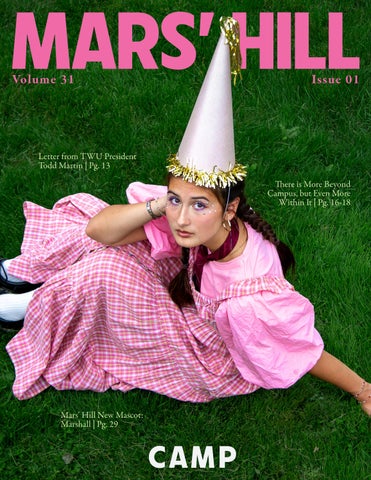
MARS’ HILL Volume 31
Issue 01
Letter from TWU President Todd Martin | Pg. 13 There is More Beyond Campus, but Even More Within It | Pg. 16-18
Mars’ Hill New Mascot: Marshall | Pg. 29
C AM P
TH E
TE A M
Emma Helgason Editor-in-Chief
Anika Idreou Chief Copy Editor
Geneva Schut Visual Editor
Shiya Liu Layout Editor
Trinity Kirchtag Arts & Culture Editor
Gnana Damarla News Editor
Hamdan Sadiq Chaudhry Sports Editor
2
Sofia Carter Cruz Illustrator
Isabella Gibbons Photographer
Tanya Aggarwal Web Editor
Sebastian Roque Staff Writer
Solee Lee Staff Writer
Eva Agbonkhese Social Media Manager
Marshall Mascot
Mars’ Hill
From the Editor
Dear Reader, The word “camp” can take you in a lot of different directions. There is the camp you might have spent your summer working at–the campfire, the cabins, the bug spray. And then there is Camp—the kind Susan Sontag wrote about in her 1964 essay, “Notes on Camp.” For something to be Camp, Sontag suggests the need for something to be exaggerated. It is theatrical, extravagant and a little ridiculous at the same time. If you were to look at the world through a Camp lens, you would find beauty in the tacky and humour in the serious. During this semester, Dear Reader, I challenge you to find joy in being a little bit absurd. In the Book of Ecclesiastes, we read that “There is nothing better for people than to be happy and to enjoy themselves as long as they live . . . it is God’s gift that all should eat and drink and take pleasure in all their toil.” - Ecclesiastes 3:12–13 New Revised Standard Version. I love that this comes from Ecclesiastes, a book so willing to stare directly at the uncertain nature of life, and then tells us to enjoy it. Maybe that is why having a Camp outlook on life can be so important. Camp reminds us that there is something sacred about enjoying what is right in front of us, even if it is a little ridiculous.
Susan Sontag further lists that camp is a Tiffany lamp, it is Gaudí architecture and it is Oscar Wilde. And, apparently, it is also Tanya Aggarwal. Our Website Manager who dressed in a Camp outfit for a Mars’ Hill Magazine photoshoot. One that she definitely did not sign up for when she applied for the website position. Sorry, Tanya. Inside these pages, you will hear from TWU President Todd Martin, students Arturo Lombardo and Gnana Damarla, and the fourth floor of DeVries. You will also meet our new staff writers, Solee Lee and Sebastian Roque, alongside the rest of the team. We have added a new Culture Corner, where each issue we will introduce you to words and pieces of culture worth knowing. After all, being educated can be a little Campy too. As your new Editor-in-Chief, I certainly do not have everything figured out. But I hope Mars’ Hill can be a place where we take people seriously without always taking ourselves too seriously; where difficult things can sit beside laughter; where strange, beautiful and funny stories all have a place. Because people are like that. And perhaps that is what I love about Camp most: it looks at the strange things we do and the things we love and asks us to see them a little differently. So, as October begins, I hope you let yourself be a little more human, and maybe a little more Camp. Welcome to a new year of Mars’ Hill.
CAMP
3
DECLASSIFIEDS Don’t cry because it happened. Smile because it’s over.
It’s September. You know what that means.
ADAAAAAAA AAAM!!!!!!!
I have a rash :(
WHY WOULD YOU PLAY GAMES WITH ME?!!!!!!!
I LOVE the new photographer
Please remember to take care of yourself
Sign up for homelessness local outreach
They made me write this during O-Day
They made me write another one at EXPO
You are loved
Love like Jesus, eat like hippos and period.
Westcoast is the Best Coast! #yohandreel%
What do we think of Tottenham!?
The moon might not be cheese but cheese is the moon
I LOVE Pippa
RYAN <3
The girls soccer team scares me
#EyesOutForLegacy
CHEESEMAN
Listen to “All Things God” on Spotify by Terrance Richmond
[Redacted] has a crush on [Redacted]
I’m Asian YOU’RE SUPPOSED TO BE MY FRIEND!!!!!!!!!!!!!!
I love Elijah Bean
no pablo español
Perry for your thoughts?
I want to write for Mars’ Hill
We don’t just raise the bar... ... we BREAK the bar.
Mars’ Hill reserves the right to edit or reject submissions based on content and/or length. A printed submission does not reflect an endorsement of any kind, nor does it reflect the opinions of Mars’ Hill or its staff, the student association, or Trinity Western University.
Too scared to ask out that hot girl from RELS class? Have a thought you’re dying to share? Did a professor say something strange or funny? Do you have some information that you want to get out to the student body? Whatever it is, the declassifieds are here for you. Submit yours at www.marshillmagazine.com
4
Mars’ Hill
arts &
CULTURE
CAM P a curated playlist DARE (ft. Shaun Ryder & Roses Gabor)
Gorillaz
I WANNA LOVE YOU BABE
Laundry Day
End of Summer
Tame Impala
Matsuri
Fujii Kaze
Me and Your Mama
Childish Gambino
oh baby
LCD Soundsystem
Iceblink Luck
Cocteau Twins
Killing My Borrowed Time
Geese
SAUCIN’
NEXZ
Army Dreamers Did i tell you that i miss you
Kate Bush adore
THE ROM-COM REVIVAL Trinity Kirchtag I often find myself reminiscing on the golden era of romantic comedies: the late 90s and early 2000s. Was I alive during these years? No. However, I would be lying if I said 10 Things I Hate About You and Notting Hill are not two of my favourite movies. Yet somewhere between then and now, the genre seemed to slowly disappear. Mid-budget rom-coms, the type that used to fill theatres every couple months, started getting quietly released straight to streaming services. That’s if they got made at all. Studios began to focus on superhero universes and the millionth installment of franchises that should’ve ended years ago. They began to bet on spectacle over the low-stakes charm of two people finding love. Thus, an entire generation grew up without the theatrical rom-com experience, myself included. Then, in early 2024, Anyone But You broke onto the scene. While not a personal favourite of mine, I cannot ignore its cultural impact. It felt like the first time in years, certainly pre-pandemic, that a romantic comedy was at the forefront of pop culture, the “it” thing that everyone was talking about. This movie was undeniable proof that audiences had not fallen out of love with the genre. They had just been deprived of good options. This year the genre finally feels alive again. On Netflix, People We Meet on Vacation and Voicemails for Isabelle captivated 37 million and 84.3 million people respectively. Not to mention, featuring incredible chemistry between their lead actors. In the box office The Invite and The Drama both found ways to twist the traditional rom-com troupes into some-
thing sharper and sometimes darker, proving the genre could still surprise people. Then Finding Emily released this past August: a British indie that opened to an unbelievable Rotten Tomatoes score of 96%, putting it in the same conversation as this year’s best-reviewed films overall, not just best-reviewed rom-coms. For a genre that studios had all written off a decade ago, that kind of critical and cultural attention feels like redemption. There’s a particular kind of snobbery that rom-coms have always had to fight against: the assumption that if a film is not grappling with the human condition or throwing its lead through a glass window during a fight sequence, it isn’t really saying anything. And sure, nobody is going to mistake People We Meet on Vacation for The Odyssey. Nobody is walking out of The Invite comparing its artistry to a Spider-Man film’s meticulously choreographed action. That was never the point though. Rom-coms are not trying to fulfill the same function as prestigious dramas or superhero blockbusters, and holding them to that standard misses what they’re actually built to do.
What a good romcom offers is something simpler and, in its own way, harder to fake: it makes you feel good. It introduces you to two people you want to see end up together, with just enough obstacles to make you nervous. Then it rewards your patience with a climatic ending, exciting enough to make you
CAMP
almost spill your popcorn. That is not a lesser form of storytelling. I remember leaving the theatre after watching Finding Emily and looking up the soonest showtime so I could watch it again. Admittedly, the plot was silly at times, but it made me feel giddy and hopeful in a way I haven’t felt in a long time. At the end of the day, that’s its whole job. Entertainment doesn’t always need to wound you to be worthwhile. Often the most valuable thing a movie can do is remind you of connection’s value, that love, even at its most cliche movie form, is still worth rooting for. A film that leaves an audience lighter than prior is no small feat. It’s doing something a lot of “important” cinema forgets to do. The timing of this matters too. We are living in an era where news and social media consistently feel heavy. Where even our prestigious entertainment tends to lean into melancholy, moral ambiguity and grief as an indication of seriousness. Therefore, a genre built entirely around the promise that things will work out is not naive — it’s necessary. That certainty is the whole appeal. It’s not a flaw in the formula: it is the design. So no, rom-coms will probably never be cemented in history the same way films that reshape cinema are. But that was never their goal. Their purpose was to make us feel hopeful in our current dark political and socioeconomic state, and recently they have been doing that job better than they have in years. While we may never reach the peak of rom-coms, like we did in the late 90s and early 2000s, I can’t help but be grateful for the small revival we are currently living in.
7
Artist Spotlight:
ANDREW ROIDGARE Sebastian Roque We all have passions, whether they are dormant or out in the open. It is innate within us, a God-given gift we steward. You may be a master of one or a jack of all trades; we all have something to run towards. Andrew Roidgare is one of those people who is a master of everything that he is passionate about. He is a 4th-year game development student and has worked on multiple Cinergy award-winning film projects. He has also worked as a photographer for bands like Eden during their tour. If you need a camera, Drew is the guy to call.
MH: You have gotten a good amount of exposure to the creative space, and it shows in your work. All this in mind, why cinematography and photography? What is your “why?”
MH: Tell us about yourself, your name, where you are from and your major?
MH: I can see your passion in all of this, and I am glad you care about telling stories. What inspired you to continue in this space? What was your awakening, if you will?
AR: Hi, my name is Andrew Roidgare. I am a 4th-year game development major, and I mainly do short films and concert photography. I am from Terrace, BC, a small town up north in British Columbia. MH: In cinematography and photography, what are the most notable pieces of work that you have been involved in. AR: I have worked on 4 award-winning films, which were all submitted to Cinergy. Two of the films won best cinematography, one won best editing, and the other won best picture. I have recently done concert photography for notable music artists in the industry like Eden and Mateo Chu. In addition, I have worked at local music festivals up north like Valhalla Fest.
8
AR: Oh, that is a deep cut. I do what I do because I love deep stories through different mediums, whether that is music, short films or photos. I want to reach people, and hopefully they can relate to what I am trying to convey.
AR: It is cringy to say, but Minecraft YouTubers. When I was 5 years old, I stumbled upon Captain Sparkles, DanTDM and PopularMMOs. During COVID, I started a YouTube channel and learnt to edit and use a camera. I made music and started editing my own music videos. From all of this, that’s where everything clicked. MH: Do you plan to pursue this career, considering it is somewhat different from your major? AR: I do. I have many things I really enjoy, and I think it is good to do whatever sticks. If you love all of them, do whatever sticks and go all in, whether it is in the game industry or filmmaking.
Mars’ Hill
MH: So, it is better to be a jack of all trades than a master of one?”
MH: With that being said, what do you aspire to be?
AR: Exactly!
AR: I want to go higher than I already am. In all that I do, I want to do better and go higher.
MH: In addition, with the work you have listed, have you done any projects recently? AR: I have! I did my first modelling shoot for a vintage clothing drop and I got to meet some amazing people. I am planning to do another shoot and I am very excited as it is bigger than the last one!
CAMP
MH: Any words for the people reading this? AR: If you want to make it big in any field, you must stay consistent as much as you possibly can. Show up, even though you do not want to do it. Stay consistent, believe in yourself and don’t care about what others think and be shameless about it.
9
NEWS &
community living
ARTIFICIAL INTELLIGENCE Gnana Damarla
AI is changing governments, phones, chips and even the infrastructure countries are building from the ground up.
Canada:
Canada is continuing to put technology at the centre of its plans for the future. At the 2026 G7 Digital Ministers’ Meeting, Canada highlighted artificial intelligence, quantum technologies and digital innovation as important areas for international cooperation. Rather than just focusing on AI itself, Canada is also looking at how countries can develop these technologies safely and responsibly. With AI becoming a bigger part of business, government and everyday life, Canada’s focus shows how technology is becoming more than just a tech industry issue. It is increasingly becoming part of how countries think about their economy and global competitiveness.
United States:
The United States is continuing to put artificial intelligence at the centre of its national defense plans for the future. With the recent rollout of new Pentagon guidelines, the U.S. highlighted AI as a crucial tool for modernizing its mission-critical military software. Rather than just focusing on adopting AI quickly, the U.S. is also looking at how to deploy these technologies securely
with strict human oversight. With AI becoming a bigger part of military operations, public services, and everyday government work, the U.S. approach shows how technology is becoming more than just a tech industry issue. It is increasingly becoming part of how countries think about their national security and global strategic advantage.
South Korea:
Samsung is pushing AI into both massive data centers and everyday homes. On the hardware side, Samsung and OpenAI are deepening their partnership to develop next generation AI semiconductors, proving that control over physical memory chips is just as critical as the software itself. On the consumer side, Samsung just launched its new “Bespoke AI” appliance lineup, integrating AI models like Google Gemini directly into smart refrigerators and air conditioners. This dual approach shows that Samsung is embedding AI everywhere from the server rooms that train it, straight into your kitchen.
China:
China is pouring massive amounts of money into building its own artificial intelligence chips so it no longer has to rely on American technology. To lead this push, the Chinese tech giant Ten-
CAMP
cent is heavily funding and buying chips from a newer company called Enflame to ensure its success. When Enflame recently opened its business to the public stock market in Shanghai, the demand from investors was so high that its stock value immediately skyrocketed. This rush of money proves a major shift: the global AI race is not just about building the smartest chatbots anymore. Countries have realized that controlling the physical hardware behind the scenes is now just as critical to their global power and economic future.
United Arab Emirates:
The United Arab Emirates is taking a different approach to the AI race by focusing heavily on the infrastructure needed to run it. The country has been investing in data centres and positioning itself as an important technology and AI hub in the Middle East. AI may look like something that happens through an app or chatbot, but behind every AI model are huge amounts of computing power, electricity, cooling and physical space. The UAE’s focus on this infrastructure shows another side of the technology race: countries are not only competing to create AI, but also to become places where the technology can actually be built and operated.
11
“DO NOT BE ANXIOUS ABOUT ANYTHING, BUT IN EVERYTHING BY PRAYER AND SUPPLICATION WITH THANKSGIVING LET YOUR REQUESTS BE MADE KNOWN TO GOD.” — Philippians 4:6 (ESV) 12
Mars’ Hill
Letter from
PRESIDENT TODD MARTIN As we begin a new year at Trinity Western, I’m drawn again to our theme verse: “As we have opportunity, let us do good to all people, especially to those who belong to the family of believers” (Gal. 6:10). It’s a simple charge, but a profound one. It reminds us that campus culture isn’t an accident — it’s the cumulative result of thousands of small choices to do good, to show care, and to build one another up. Viktor Frankl once wrote that “being human always points, and is directed, to something or someone other than oneself.” In other words, we discover our purpose most clearly when we live for the good of others. That is the heartbeat of a healthy campus. When students choose to serve, to listen, to lead, and to invest in one another, TWU becomes a place where people flourish. This year, you have countless opportunities to shape the life of this community. Step into leadership. Participate in Town Halls. Contribute an article to Mars’ Hill. Encourage your peers. Your voices and actions along with those of the faculty and staff makes this place what it is. Do not underestimate the importance of your roles as students in contributing to a flourishing Trinity Western culture. My hope is that you will see this year not just as something to get through, but as a chance to do good, and as a result, leave TWU stronger because you were here. Welcome back. Let’s build this place together.
CAMP
13
FOR THE NEWCOMERS Sebastian Roque It’s September; the fall is slowly coming our way, and most importantly, it is the start of a new school year. We all share this overwhelming feeling about a new school year. Whether it is your first year, midway through or your last year of university, this uncertainty is present. However, this is not the end of the world. You will experience new things this year. A new environment, new people and new classes. Maybe it is your first time being away from home, and you are feeling homesick, or you feel exhilarated to have some freedom. Whatever it is, enjoy every moment of it. This is just the beginning of your journey. To get you through your semester and the rest of the year, here’s some advice: Try everything within your capacity. Sign up for clubs, play intramurals, go to campus events and heck, ask that person out for coffee.
14
Do not stay cooped up in your room and expect any results. Find God in all things. God is present all the time, and He seeks us out every day and through His Holy Spirit, you can connect with Him and in the busyness, in the boredom, seek Him out. Lastly, find who you are in God and in your participation. You have a long way to go, and this is just the start. You will start to know yourself more during your time here.
Do not let the world tell you who you are, because God gives you your identity. I am thrilled that you chose to be here at TWU and I am excited to see what God will do this year. So, get ‘em, tiger!
Mars’ Hill
feature
TH E R E I S MO R E B EY EVE N MO R E
A look at walkability, nature and com Emma Helgason
As Trinity Western University (TWU) students, we are fortunate to have a community built around more than academics. We are surrounded by people who share a faith in Christ, giving us opportunities to serve and build relationships with one another. Yet, for some students, it can still feel like something is missing. Why do some of us feel disconnected from the world around us?
having a sidewalk; rather, it is about how convenient it is to get around on foot.
Perhaps the answer is simpler than we think. It is important to recognize that many students share these feelings of disconnection, but perhaps we are overlooking the community God has already placed around us. TWU is more than classrooms and dormitory rooms; it is a community of people brought together by a shared faith in Christ, giving us opportunities to worship and grow together.
Some students on campus agree with the phrase “there is nothing to do here.” These students cannot see a future for themselves in British Columbia and are eager to return home after graduation. In some cases, students find themselves wanting to relocate completely. For instance, student Yasas Achintha is eager to leave Canada to explore the opportunities Europe has to offer.
What is Walkability?
The Lower Mainland has so much to offer, yet many international students have barely ventured beyond Langley’s borders. Most have never visited Granville Island, the PNE, or even Science World. The feeling of being stuck in Langley is real, and the transit system is not helping.
If you came to TWU expecting “Vancouver life,” you are not crazy for feeling confused. Many internationav l students arrived with the same picture in mind: coffee shops, bookstores, spontaneous plans and easy transit. Student Solee Lee adds that this image we have is thanks to the micro-influencers who have romanticized Vancouver’s social life—it seems they have never been past the Golden Ears Bridge.
Our walkability problem is not just about buses either. Student Serin Park
Student Ben Kim comments, “In Langley, a basic hangout takes planning and
The Walkable and Livable Communities Institute defines walkable communities as being “at the center of the design scale, planners consider persons, not cars. Walkable cities are a livable built environment that leads to whole, happy and healthy lives for the people who live in them.” Walkability is not just about
16
Student Solee Lee notes that in Seoul, South Korea, everything she needs—a convenience store, a doctor’s office, a coffee shop and her workplace—are all within walking distance. That kind of convenience contrasts with needing to bus over an hour just to get to school.
Mars’ Hill
comments that it is about the lack of cool places to hang out, community centers that feel outdated and malls that just are not the same social spots as they once were. She emphasizes that “even owning a car or getting an Uber can be expensive.” When considering walkability, all these concerns connect. Feeling stuck is understandable. While our campus is beautiful and worth exploring, it is also important to explore what lies beyond our campus borders.
When “Vancouver” is not the Vancouver You Live In
YO N D CAMPU S , B UT E WITH I N IT
mmunity waiting just outside our doors a grocery run needs a ride. Even places that look close on a map can feel far in real life.” If this has been your experience, you are not overreacting and you are not alone.
For those new to British Columbia: People here use the term “Vancouver” loosely. In everyday conversation, locals will call a huge area “Vancouver” even when they mean Burnaby, Coquitlam, Langley, Surrey, Maple Ridge or other nearby cities. Technically, those places are part of the Lower Mainland, not the city of Vancouver itself.
Why does that matter to the students at TWU? This matters because international students hear “Vancouver” and understandably expect one kind of lifestyle. But the downtown experience is not the same as life in Langley. Not even close. Thus, if you are feeling misled, you are not alone. You were expecting one image, but are now living in another reality. This is not just a “bus student” issue either. If you drive, you are just as involved.
Having a car gives more freedom, but it also means more money put towards gas, insurance, maintenance, parking and traffic. Anyone between Langley and surrounding areas already knows how draining that can be. This is not a transit versus driver debate, nor is it an international student versus Canadian debate; it is a shared student issue. Students are spending too much time, money and energy to just get around.
Why this matters more than simply urban design: Walkability is more than just sidewalks, as it encompasses whether life feels open or closed. When places are easier to reach, we say yes to more things. • • •
Seeing friends Trying new sports Joining community events
When everything feels hard to access, people start to stay in dormitories. Plans start to get cancelled and social life becomes “maybe next week.” This turns our conversation from walkability into what belonging really means to the students of TWU.
CAMP
Should we only live on campus? During a conversation about the walkability of the Lower Mainland, TWUSA President Sena Tese emphasized the importance of focusing on our campus. She pointed out improvements like the new walkways and turf field, and mentioned that with Fraser Hall and Mattson Centre coming down, TWU is actively working to make the campus more community-oriented. This point is worth exploring. Yes, university is about experiencing the world beyond campus. We should explore Langley, Fort Langley, Vancouver and the rest of the Lower Mainland. We should discover what kind of life we want after graduation. But perhaps exploring beyond campus does not mean we should overlook what is right in front of us. For some students, British Columbia’s appeal was never the skyscrapers. Instead, it was the mountains, rivers, fresh air and open spaces. Student Michelle Andersson notes that she loves walking the Fort-to-Fort Trail, serving as a reminder that exploring does not always have to be
17
in the city. For Brooklynn Delainey, it is the fresh air that makes living here special. She points out that in Tokyo, Japan, birdsong and natural spaces can be harder to come by. The sounds of birds are sometimes played to recreate the feeling of nature in Tokyo, so next time you hear a bird’s song, appreciate it. In British Columbia, we find ourselves complaining about the rain while surrounded by trees–maybe that is worth noticing. We are so privileged to have a campus where a hammock can be hung between trees, where a short walk can take you from a classroom into the forest and where studying outside is actually an option. Art Professor Erica Grimm even incorporates nature sounds into lectures as a way of creating focus.
Not everyone is a nature person, and that is okay Maybe your idea of getting out of your room is not a hike. Maybe it is sitting somewhere with a friend sipping on a cup of coffee. Student Sarah Korstrom points to the TWUSA Lounge as one of the best places to do exactly that. Free coffee, outlets, printing and music–TWUSA offers us something different from the overpriced café experience many students imagine when they picture university life. And that is not the only place, as there are pockets of connection happening all over campus. Whether you are in the Robert G. Kuhn Centre, Robert N. Thompson Academic Building or in the Trinity Common, you will find conversations. These moments might not look like the Vancouver life online, but they are a different part of life that is rooted in community. Student Ben Kim adds
18
that “People sometimes call TWU a small campus, and I think that is actually one of the best things about it. It is small enough that you run into friends between classes and actually know the people sitting beside you. You can walk from one side of campus to the other, and somehow still feel like there is always somewhere new to go.” Our campus may be small compared to other universities, but that does not mean our community is. We are constantly surrounded by people—in classrooms, residence, the cafeteria, study spaces and chapel. You might walk across campus expecting to get to your next class and end up stopping to talk to someone you know. In a world where university can mean sitting in a lecture hall with hundreds of strangers, there is something special about being in a place where the people around you can become your community.
A message to students: During our university years, it is easy to become so focused on what we are missing that we forget to appreciate what we already have. Our walkability issue in Vancouver is real. However, we also have a choice of how we experience the place we are already in. A free afternoon does not have to mean finding a new coffee shop. It could mean walking the Fort-to-Fort Trail and stopping by the Blacksmith Bakery. It could mean studying outside at the Ubuntu Pavilion with amazing heating. It could also mean taking the longer route back to your dorm or car and counting the wildflowers that pop up throughout our campus.
Mars’ Hill
And if nature is not your thing, find your place inside. Sit in the TWUSA Lounge, put your feet up and pour yourself a free coffee, print your homework for free and charge your laptop. Find the people who make campus feel less like a place you attend and more like somewhere you belong. Maybe this is what TWUSA President Sena Tese’s point about campus comes down to.
We should stop assuming that everything meaningful is somewhere else. While there is a world beyond our campus borders, there is also a world within them. There is so much to appreciate when you take the time to look around. So, whether you love a busy urban life or a more quiet setting surrounded by nature, it is worth stepping outside your room and your routine to experience what TWU has to offer. Try taking the long way back to your dorm without headphones, as you might just uncover something God has placed there for you.
opinions
WHEN HEADLINES WRITE THEMSELVES Gnana Damarla
20
Remember when hearing bad news used to make us stop in our tracks? Now, the world can be falling apart on a random Tuesday, and before we even understand the crisis, three different people have already sent us memes about it. The government could strike down student loan relief overnight, and even before the panic sets in, the whole thing is already a sarcastic financial meme on your feed. A terrifying headline about ecological collapse pops up, and before we can process it, the whole thing gets reformatted into content while the rest of us scroll through the spectacle. Next come the reaction videos, the parodies and the inevitable question of whether we have accidentally slipped into a bad episode of The Office. We have turned doom scrolling through disasters into our favorite spectator sport. But does finding a laugh in every tragedy actually help us process it, or does it just numb us to the chaos until we lose our ability to care? I do not think we laugh because we do not care. In “Notes on Camp” (1964) by Susan Sontag, she notes that when life gets too surreal, people naturally lean into camp, treating absolute nonsense seriously while treating absolute chaos with a smirk. Internet culture just took that instinct and turned it into our default setting. Humor has become the buffer we put between ourselves and the weight of the world. A quick, witty post strips the initial panic away from a scary headline. This makes the news easier to stomach— after all, a ridiculous meme may be the only reason we click and read what is actually happening around the world. Staying informed right now is genuinely exhausting. Between economic meltdowns, climate panics and endless political drama, packing up and moving into a quiet cave sounds like a pretty
solid plan. Sarcasm does not mean we are ignoring the damage; it simply buys us a quick second to catch our breath. The trouble starts when everything gets flattened into the exact same joke. When an actual, human tragedy shares the feed with a celebrity’s bad haircut, both competing for the exact same double-tap, it gets tricky to separate what is funny from what is terrifying. If every headline is just content to be packaged and mocked, then nothing feels like a real event anymore. It is all just digital fast food, designed to be consumed in three seconds and promptly forgotten. It is totally fine to laugh off the stress, but the real problem starts when our first instinct is to turn a crisis into a post before we (even clock it) have even let the reality of it sink in. The goal is not to survive the news cycle by feigning ignorance or pretending that real crises do not exist. Susan Sontag’s Notes on “Camp” (1964) reminds us that “dethroning the serious” is not the same as abandoning seriousness. Camp gives us permission to laugh at the absurdity of the world without becoming blind to its consequences. To be “campy” is not to be uneducated, and being in on the joke should never come at the cost of knowing what is actually happening. Humor can get us through the door, but it cannot be the whole house. Laugh at the absurdities. Share the meme. Enjoy the spectacle. But when the joke ends and something real is at stake, pause the scroll, look past the headline and pay attention. Because the danger is not that we laugh at the news. It is that we laugh so much that we stop listening.
CAMP
21
BREAK IT! In Silicon Valley there’s a famous quote from Mark Zuckerberg: “Move fast, break things.” His aim with this quote was to move as fast as possible without looking too deeply into the mistakes, but then he found out that this approach was costing him more money and time than what he could be making from it.
Arturo Lombardo Now, the “break things” part has backfired many times. I was taking that part the wrong way, since I believed I could break anything without big repercussions, but what I never understood is that there are things you cannot simply break and expect to fix themselves. I broke many friendships and the trust of many people (friends, family, and even
As young adults we should be moving fast; we should be learning, meeting people, going out and absorbing as much knowledge as possible. However, how are you going to do this if you don’t move fast? Your time is limited, especially during university. You only have four years before getting into the work force, or, as I call it, “the real world.” I still remember my first year as if it were yesterday. I thought I had infinite time to learn, so I focused most of my time on wasteful activities that did not contribute to my growth. Since then, I’ve learned two things: my main task during university is to learn as much as possible about everything. The second thing I learned is that if I’m passionate about something, I need to be the best if I want to make a living out of that passion. When I heard Zuckerberg’s quote, “Move fast, break things,” I fell in love with it, and to be honest, I incorporated it into my personality. If you know me, you also know that I like moving fast. When I have something in mind I will move to accomplish it, and I will always want it to happen as soon as possible.
22
error signals when we make mistakes, and those signals are what drive learning. In other words, your brain has dedicated machinery for learning from error. For many people, making mistakes is scary, but at the end of the day it is part of our lives. We will make many mistakes in our lives, which will help us learn and grow. Thus, it is important to not be afraid of making mistakes as it is the only way that you will learn and grow in character and in skill. But this is where the “valuable” mistakes come in. We need to learn how to analyze which mistakes are worth making, and which ones will help you grow as a person and improve the environment around you. Now, how do we put all of this together? Don’t stop moving fast, but before taking the next step, analyze the risks. Write them down, either in a notebook, in your phone’s notes, or on a sticky note. Move fast, but keep looking ahead to the consequences. Break things, but know which ones stay broken.
faculty members), which I’m still trying to fix. I never wanted to stop moving fast, but I couldn’t keep breaking things. This is the moment when I decided to change the narrative: “Move fast, make valuable mistakes.” Mistakes will always be in the equation, but the type of mistake is what matters. Based on a study from the Duke University School of Medicine, the brain fires
Mars’ Hill
For this academic year, my challenge for you: move fast and make valuable mistakes that will help you grow as a person.
Solee Lee
DORM THOUGHTS
With everyone on campus moved in, let us take a look at the different residence buildings that are home to students and a big part of campus life. Douglas: Douglas definitely has personality and different floors and sections. The rooms and hallways can feel tight, but that is also what makes the community so close. The communal bathrooms are where some of the best conversations happen. Dorm hours become important when you are walking out of the bathroom in a towel. If you’re ever lonely, the shower curtains give you hugs each time. Skidmore: Skidmore generally has smaller rooms, but they are neat and have newer furniture. There are also options for single rooms and a small lounge or living space within the dorm room. The first floor general lounge is spacious and clean, sometimes bringing laughter and other times good study spaces. There is also a vending machine that will keep you there. Each dorm in Skidmore has two RAs, and did I mention it is an all-girls dorm?
McMillan: The apartments in McMillan come with a stove, microwave, oven and the furniture you need. The rooms can be small or spacious depending on the apartment, and you can choose to be in a two-person or four-person living space. One of the best things McMillan has to offer is location: it is close to Starbucks and central to other buildings as well.
DeVries: DeVries may be smaller than some of the other residences, but that gives it a cozy feeling that makes it easy to settle into. The lounges are like cozy attics and have air conditioning, which can feel like a luxury when the weather gets warm, and the washrooms are clean and comfortable. There are several floors in DeVries, but no need to worry about walking up the stairs! We have an elevator.
Robson: Robson has a large lounge space and kitchen, making it a great place to attract people in and out of the dorm community. If anyone wants to express their love of cooking, Robson is a great place to be. With two ovens, dishwashers, sinks and microwaves, plus plenty of counter space to bring your own coffee machines and other kitchenware, you get a chance to test out your potential as a chef. You get to share bathrooms with your next door neighbors and get a sink in your room. If you are too lazy to leave the building but want to see people, just walk out the door. Chances are there are people laughing in the lounge already.
Jacobson: Jacobson has some of the better bathrooms, with separate doors for the toilets and showers, so you do not have to worry about someone accidentally opening the shower door. The kitchen is good, and the study rooms are a nice place to work, with cafe-style seating, good lighting, and temperature. The first floor has an art gallery where you can appreciate other people’s work and play pool. The best thing is you can make your own community and choose to live with people you like.
Fraser: RIP. This dorm no longer stands, but it was around for a long time and is missed by many. The memories and connections that were made still continue in other dorms.
Each dorm building and dorm group have different people that top the environment of the dorm. Also thank you to my dorm mates that shared their experiences in the different dorm buildings.
CAMP
23
SPORTS
MORE THAN A GAME:
A TWU Student’s World Cup Experience Hamdan Sadiq Chaudhry Every four years, a sporting event takes place that seems to put the world on hold. Nations, cultures and people come together to celebrate, rivalries take center stage, and millions of fans share in the excitement of the beautiful game. In 2026, that excitement came closer to home as Canada co-hosted the World Cup with the USA and Mexico. For those of us in the province of British Columbia, we had the unique opportunity to experience the world’s biggest soccer tournament taking place in Vancouver. I had the opportunity to speak with one of Trinity Western’s most passionate football fans, Nathan (known as “Trillin”), and hear him share his unforgettable experience of the 2026 World Cup. MH: What made the 2026 FIFA World Cup such an unforgettable experience for you? NT: This was my first time experiencing a World Cup in a country that was actually hosting the tournament, so it was something I had been looking forward to for a long time. Being able to witness the energy, and diversity of the World Cup right here in Canada was extraordinary. MH: What was the overall experience of the World Cup like for you?
NT: Overall, the World Cup was incredibly exciting, although there were a few aspects I did not agree with. One of the biggest issues for me was the price of the tickets. The ticket fees were absolutely diabolical and made it difficult for many people to enjoy the matches. However, despite the high ticket prices, the atmosphere and overall vibe were incredible. MH: What was your favourite part of experiencing the World Cup in Vancouver? NT: One of my favourite parts was meeting people from different countries and experiencing different cultures. My friends and I went to almost every match that was held in Vancouver, and we made sure to celebrate with fans from all over the world. During the Australia vs. Turkey match, my friends and I went to Granville Street, where we experienced the incredible atmosphere of fans. We watched the match, joined the celebrations around the city and enjoyed the atmosphere with people supporting their countries. The energy on Granville was something I will never forget. MH: Did you have any unforgettable moments from the World Cup? NT: Another unforgettable moment was getting the opportunity to meet some
CAMP
soccer players, like Canada’s very own soccer star Alphonso Davies. I even got him to sign my shirt. That shirt became so special to me that I ended up not washing it. It became a memory of one of the best experiences I had during the tournament. MH: What did the World Cup mean to you beyond the soccer itself ? NT: For me, the World Cup was more than just soccer. It was about bringing people from different countries together, celebrating our love for the game and creating memories that will last a lifetime. From meeting people from different nations, watching incredible matches, meeting players and celebrating with my friends, I created memories that I will carry with me for a very long time.
25
Spartan Spotlight:
SAVANNAH VANDER KOOI Hamdan Sadiq Chaudhry
MH: Could you introduce yourself by sharing your name, position, year of study and major? SV: My name is Savannah Vander Kooi. I am on the women’s basketball team and play power forward. I am in my fourth year and I am studying elementary education with teachables in inclusive education and art. MH: What initially sparked your interest in basketball? SV: I started playing basketball through camps because my parents enrolled me in them. Over time, I became more interested in the sport by playing in clubs. I was drawn to the competitive atmosphere and the ability to constantly challenge myself and improve. Over time, I also grew to love the relationships I built through the sport.
26
Mars’ Hill
MH: Could you tell us about your journey to joining the Spartan Women’s Basketball team? How did you get recruited or signed? SV: At first, Trinity Western wasn’t on my mind as a place where I would play basketball. It wasn’t until I tore my ACL that my focus shifted from solely pursuing basketball to prioritizing attending a Christian university. I started talking with Coach Cheryl, and she offered me a spot on the team despite my injury. Through prayer, it wasn’t a difficult decision for me. I knew that Trinity Western was where the Lord wants me to be, and I’m so grateful that He led me here. MH: Looking back on your basketball career so far, what has been one of your favourite or most memorable moments?
SV: There have been so many highlights that basketball has brought me, but some of the most memorable moments have been through the relationships I’ve built. Whether it’s been on the court, going on road trips, studying together or simply hanging out, the relationships I’ve made are something I wouldn’t have experienced without basketball. For me, my friendships have been one of the greatest parts of my basketball journey. MH: What are your goals and aspirations for the future when it comes to basketball? SV: After my time at Trinity Western, I would still love to be involved in basketball in some way, whether that means continuing to play, getting involved in coaching or finding another way to stay connected to the sport. Basketball is a big part of my life, and I hope to continue being involved in it even after my playing career at Trinity Western.
CAMP
27
HUMOUR
NEW MEMBER OF THE TEAM The Mars’ Hill team is proud to introduce the newest member, Marshall the Martian! Travelling from planet to planet and across the stars, Marshall has landed on earth in search of new art and culture. He wants to know what it means to be a human being, dwelling on this planet. He is excited to be part of the magazine, reading wonderful works of literature, experiencing new art forms, and perhaps even contributing. Stay tuned for more!
CAMP
29
CULTURE CORNER: GERMAN Destination: Germany
Language: German
Contributor: Emma Helgason
WELCOME TO GERMANY: What better place to start our culture corner than with a country I call my own. While I was not born in Germany, I hold German citizenship and have family ties there—so here are a few things you might not learn from a textbook! • •
•
Did you know that Germany has over 1,500 types of sausage. Germany is home to the Autobahn. Contrary to popular belief, not every part has no speed limit. Some sections still have speed limits. Germany invented Kindergarten. The word Kindergarten literally means “children’s garden” and was coined by German educator Friedrich Fröbel in the 19th century.
Next stop: South Korea with Solee Lee
WORDS YOU SHOULD KNOW: German Pronunciation English Hallo
[HAH-loh]
Hello
Danke
[DAHN-kuh]
Thank you
Bitte
[BIT-tuh]
Please/You’re welcome
Tschüss
[chooss]
Bye
Prost!
[prohst]
Cheers!
Genau
[geh-NOW]
Exactly/That’s right
GERMAN WORDS ENGLISH SHOULD HAVE: Wanderlust — VAHN-der-loost. A strong desire to travel or wander. Schadenfreude — SHAH-den-froy-duh. The strange pleasure you get from someone else’s misfortune.
FROM SOMEONE WHO KNOWS GERMANY: “Is it true that Germans are always serious?” This is not true! Germans can be just as loud and sarcastic as anyone else. We just have a reputation for being very direct and organized. I think this misconception comes from the infamous German stare. If you are wondering what this is, then you have probably never been stared at by a German. This is the look a German gives you when you have done something confusing, broken an unspoken social rule or are simply just existing in society. It is usually silent, lasts just long enough to make you question your life choices, and somehow says everything without a single word. So, consider yourself officially introduced to Germany—now you just need to learn how to survive the stare.
30
Mars’ Hill
4TH FLOOR DEVRIES LAUNCHES HUNT FOR THE TWU SWAMP GUPPY Andrew Orr Something is lurking in the waters of Trinity Western University. Known only as the TWU Swamp Guppy, the mysterious figure first appeared swimming in the lake at the front of campus wearing a fish mask. Footage of the sighting was posted to Instagram, and the account quickly gained attention across campus. Naturally, this raised a serious question... Who is the Swamp Guppy? As residents of 4th Floor DeVries, we decided somebody had to investigate. And apparently, that somebody was us.
Our team launched an official Swamp Guppy hunt, searching the lake and surrounding territory for any sign of the creature. The goal was simple: locate, identify, and if possible, catch the Guppy. Our first major operation appeared promising. A suspicious figure was spotted near the water. The team moved in. After intense pursuit, we successfully intercepted our suspect. There was only one problem. It was a weird man. The fisherman was released, and the Swamp Guppy remained at large. Despite this early investigative setback, 4th Floor DeVries has not abandoned the case. The Guppy has already demonstrated an ability to appear without warning, disappear into the waters, and generate curiosity across TWU. We believe another sighting is only a matter of time. Until then, students are encouraged to remain alert around the lake. Any suspicious splashing, gulping sounds, or unusually amphibious behaviour should be treated seriously. The identity of the Swamp Guppy remains unknown. But 4th Floor DeVries won’t rest until the Swamp Guppy is found.
31
MOTHER’S LOVE Solee Lee
I didn’t regularly attend camp, so I remember more summer activities that I did with my family. One summer we went strawberry picking at a farm. I was picking through the path of strawberries and my mom was next to me. As I was walking, something caught my eye. A snake. Right in front of me. Seeing one right in front of me made me forget how I reacted; I can’t remember if I was calm or frozen, but it was small and completely still. Right after I pointed it out to my mom, she screamed and hid behind me, grabbing my shoulders. That’s right. She hid behind me. I was left unprotected.
I felt two things at that time: betrayal and betrayal. I took a closer look and it was a rubber snake. I knew one of mom’s biggest fears was snakes; I just didn’t know it was to this degree. After assuring my shaken mother disappointedly, I started wondering whether our natural instinct of fear would take over when it came to someone we loved. I remember talking about this “incident” to one of my teachers, and apparently, my mom wasn’t the only one. My teacher was walking with her kids when they heard a really big noise. Her natural instincts kicked in and she pushed her daughter and ran. Somehow, this story gave me comfort knowing other people experienced this kind of betrayal. My mom still tells me she loves me to this day, but when snakes are involved, it’s better not to ask.
32
Mars’ Hill
CAMP
33
34
Mars’ Hill
Mission to Mars
Mars’ Hill is a student publication of Trinity Western University located on the traditional ancestral territory of the Stó:lō people. Floated with funds raised by the Student Association, Mars’ Hill seeks to be a professional and relevant student publication, reflecting and challenging the TWU community, while intentionally addressing local, national and international issues.
The mission of Mars’ Hill, as the official student magazine of Trinity Western University, is to inform and entertain its readers, cultivate awareness of issues concerning the TWU community and provide a forum for purposeful, constructive discussion among its members in accordance with the Community Covenant, Statement of Faith and Core Values of the university.
Mars’ Hill
Editorial Policy Mars’ Hill encourages submissions and Letters to the Editor. Mars’ Hill reserves the right to edit submissions for style, brevity, and compatibility with the Mission, the Statement of Faith, the Student Handbook and the Core Values of the University. Anonymous authorship of any material may be granted at the discretion of the Editor-in-Chief. Opinions expressed in Mars’ Hill belong to the individual authors and do not necessarily reflect those of the editorial board, Trinity Western University, its officials or its Student Association.
CAMP
35
Write for Mars’ Hill! Is there a story you’ve been wanting to tell? Are you looking for an opportunity to share your writing with a larger audience? Send your pitches or articles to us by emailing marshill@gmail.com. Sections: Arts & Culture News Community Living Creative Writing Feature Opinions Sports Humour
marshill@gmail.com marshillmagazine.com/ IG: @marshillmagazıne
22500 University Drive, Langley Twp, British Columbia, Canada V2Y 1Y1