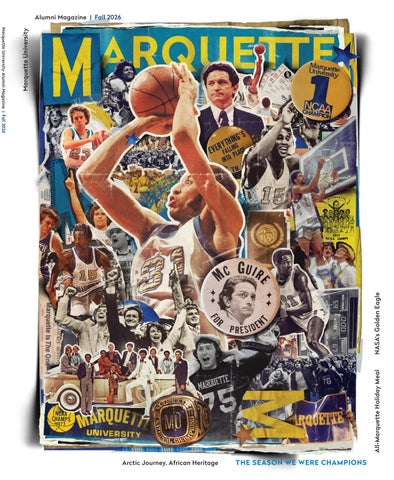
NASA’s Golden Eagle All-Marquette Holiday Meal
Marquette University Alumni Magazine | Fall 2026
Marquette University
Alumni Magazine | Fall 2026
Arctic Journey, African Heritage
THE SEASON WE WERE CHAMPIONS
PHOTO BY PATRICK MANNING
Postcard
2
FAL L 2 02 6
Contents IN EVERY ISSUE
President’s Letter................. 7 MU 360.............................. 8 MU In Focus ...................... 16 Class Notes....................... 45 F E AT U R E S
Breaking Bread In time for Thanksgiving, we’ve prepared your all-Marquette-made meal, from cranberries to cannoli. Page 24
When Marquette Won It All Fifty years ago, an unbreakable team made it through a crucible of a season to help its legendary coach go out on top and its fans taste greatness. Page 30
A King’s Journey to the Arctic Dr. Chima Korieh, history professor and acting king of the Umuchieze, works tirelessly to save his clan’s history in a most unexpected place: the Arctic Circle. Page 36
Lemons, Meet Lemonade Making Waves Here come the newest Golden Eagles, gliding swiftly through their first season. The launch of women’s swimming improves gender equity in athletics while serving as an enrollment draw and tuition revenue generator. Head coach Joel Rollings confirms that the prospect of studying at Marquette, competing in Division I and training in the gleaming Wellness + Helfaer Recreation facility hasn’t been a tough sell. The team’s 21 student– athletes, he says, are “hungry, committed and setting the tone for what Marquette swimming stands for.”
Junior Lucy McGovern recounts harrowing days leading up to her transplant surgery during her semester abroad, and the profound gratitude that followed. Page 40
Marquette Goes to Mars Alumna Elise Rimsa operates the rover cameras on Mars’ surface as part of a NASA team pushing the boundaries of space exploration. Page 42
MAR Q U E T T E MAGA Z I N E
3
Seen & Heard Mission Ignition
A New Handle on Recovery Editor: Stephen Filmanowicz Assistant Writer/Editor: Rachel Gintner Orlando Leadership Team: Lynn Griffith, Comm ’09, Grad ’15; Thomas Pionek, Grad ’98 Art Director: Chelsea Mamerow Editorial Team: Sarah Koziol, Arts ’92; Patrick Manning;Jennifer Russell; Stacy Tuchel; Kasie Van Sistine Copy Editor: Jaime Brockway Cover Illustration: Neil Jamieson Marquette Magazine (Fall 2026, Vol. 44, Issue No. 2), for and about alumni and friends of Marquette, is published two times a year by Marquette University, 1250 W. Wisconsin Ave., Milwaukee, WI 53233 This issue’s contents are current as of October 1, 2026. For up-to-date Marquette news, visit today.marquette.edu. Postage paid at Milwaukee, WI Address correspondence to Marquette Magazine, P.O. Box 1881, Milwaukee, WI 53201-1881 USA mumagazine@marquette.edu. Publications Agreement No. 1496964
4
FAL L 2 0 2 6
Recovery at Marquette has been turning wheels and expanding minds on the benefits of sober living since 2024. As of this September, its coffee cart moved by bike power has already served its 10,000th cup of flavorful, free java. “If we just sat at a table in AMU, few people would come and chat. With the bike, we have lines of people,” shares Tim Rabolt, assistant director of the program. The cart, along with innovative programming at sober tailgates for Brewers, Bucks and Admirals games, encourages a more positive view of recovery than students may have encountered before. Rabolt adds, “We’re aiming to dismantle the stigma, one cup at a time.”
Mission Week — a burst of faith-based programming that invites members of the campus community to listen, reflect and pray — saw some changes this year. Moved from February to late September, Mission Week now coincides with the anniversary of the Society of Jesus’ founding in September 1540 and Family Weekend. “We’re excited for this new era,” says Rev. Jim Pribek, S.J., acting vice president for mission and ministry. “As we deepen our connection to St. Ignatius, we are also carrying the Mission Week theme — ‘Let Your Light Shine’ — throughout the academic year.” With those words, he reminds us, “We are called to be a light for each other.”
Blue and Bold Thanks to the new 4-foot-high metal Marquette sign at the corner of 12th Street and Wisconsin Avenue, visitors from downtown Milwaukee know better than ever when they’ve arrived at this distinguished campus. And students, alumni and especially new graduates (trust us) have a must-visit photo op for expressing their school pride. For Ana-Maria Roback-Troast, Jour ’79, it’s a positive sign. “In 1974, as an interested high school senior, I made the drive with my parents from northern Illinois to look at MU. Traveling down Wisconsin Avenue, we were able to easily identify Marquette High School but had no idea where the university was located.” That won’t happen now, she notes. “My alma mater’s campus definitely makes itself known.”
Contents “I’m lucky that Marquette views it as our mission to engage the community and attack problems we can help solve.”
PHOTOS BY PATRICK MANNING, EXCEPT TOP RIGHT IMAGE PROVIDED BY MARQUET TE UNIVERSIT Y ARCHIVES, R AYNOR LIBR ARY
— D R . D E N N I S B R Y LOW, P R O F E S S O R O F C O M P U T E R S C I E N C E , PAG E 1 6
Making a Stellar First Impression For prospective students and families, the Admissions Office in Zilber Hall is the university’s front door. And after a thorough refreshing, Marquette’s could hardly look better. From check-ins at the welcome desk to introductory sessions in the presentation room, with its vivid 6.5-by-17-foot LED screen, the renewed space supports what Marquette has long done well. Those who arrive early can get drawn into the discovery nook (below) where student-generated videos help them “Meet Marquette,” and a wall of photos, facts and doodles introduces them to more than 50 tour guides. The often one-on-one tours that follow are a key part of Marquette’s top-tier visit experience — and its admissions success.
Explore legendary and lesser-known scenes from Marquette’s championship season, starting on p. 30. And look farther inside for your own 1977 poster, ready for your wall or refrigerator.
From the Editor At Marquette, it’s hard to imagine another number that means as much as 1977. Those four digits bind together generations of alumni and fans through a legendary story that is seared in our memories, at least in outline form. The 50th anniversary of Marquette’s men’s basketball national championship — which will be celebrated in many ways through late March 2027 — is a perfect reason to revisit that championship season and to realize how extraordinary it was. Fortunately, for this issue, Marquette has two storytellers who were up to this epic task. Mary Schmitt Boyer, Jour ’77, and Steve Aschburner, Jour ’78, were close to the team that year before ascending to distinguished careers in sports journalism. They capture an unforgettable picture of competitors so talented and uniquely colorful that they seemed destined for their place in sports annals (and for Coach Al McGuire, in two stage shows), though countless close calls nearly derailed their dreams. As editor, I am thrilled whenever one of Marquette’s many distinguished alumni writers takes an assignment; in this issue, that also includes Michael Huang, Comm ’93, and Patrick Sauer, Comm ’93. So, it’s with much gratitude that I initiate this note to start a conversation that some readers have said they’d appreciate. Consider it an invitation to reach out and share the aspects of Marquette that you think would make for memorable stories in this magazine.
MAR Q U E T T E MAGA Z I N E
5
SUPPORT THE ANNUAL FUND
Be The Difference students need today. Support for The Annual Fund is a top priority at Marquette. Your generosity has power to immediately change student lives through our Scholars Funds and beyond, with resources distributed in the same fiscal year as your gift or annual pledge. The Annual Fund also allows Marquette to nimbly respond to student, faculty and university needs and strategic opportunities in real time. Walk alongside our students by committing to The Annual Fund today. Scan to Be The Difference for students today.
President’s Letter
President Kimo Ah Yun; his wife, Catherine; and fellow leaders from Jesuit higher education met with Pope Leo XIV in the Vatican in June.
Earlier this fall, we welcomed the Marquette Class of 2030 to campus. Their first official day was a busy one.
They moved into residence halls, participated in orientation activities, attended Family Liturgy and pledged their commitment at Convocation to living the Marquette mission. These new students arrived at Marquette filled with a sense of excitement and anticipation, seeking a pathway to achieve personal and professional dreams that will contribute to the universal common good. As we began the academic year, campus came alive with a boundless spirit of opportunity and potential that energized our students, faculty and staff.
My wife, Catherine, and I made a pilgrimage to Rome this summer with leaders of other Jesuit colleges and universities. We had the opportunity to meet with His Holiness Pope Leo XIV at the Vatican. During our time together, he affirmed that the Society of Jesus’ Universal Apostolic Preferences serve as a blueprint that helps us navigate the many complex challenges we face in today’s world and in higher education. The Holy Father reminded us that our institutions are “natural places for accompanying young people in the creation of a hope-filled future.” I am inspired by Pope Leo’s call to “continue the Jesuit tradition of forming those entrusted to your care to be ‘men and women for others.’” Our unwavering commitment to our Catholic, Jesuit mission, particularly St. Ignatius of Loyola’s call to “live with one foot raised,” has been central to the tremendous momentum we are experiencing at Marquette. The Holy Father concluded our meeting by imparting his Apostolic Blessing to those of us gathered with him and extending it to the communities of our respective institutions. I am pleased to share his blessing with Marquette Magazine readers. We Are Marquette!
Dr. Kimo Ah Yun President
MAR Q U E T T E MAGA Z I N E
7
What’s new on campus & beyond
Bring It In
8
FAL L 2 0 2 6
Inevitably, the teamwork, sweat and emotion of move-in day builds toward an embrace. It’s become a Marquette tradition especially after the evening’s Convocation ceremony, as families spill out from the Al McGuire Center and come together for a final hug before their freshmen depart for their first night away from home. “You got this,” the parents say without words, “and, probably, so do we.”
S A C R E D S PA C E S
Back to the Beginning
PUBLIC SAFETY
In Case of Emergency Thanks to student persistence and support from key partners, Marquette has the first student-run EMS unit in Wisconsin.
PH OTOS BY PATR I CK M AN N IN G
B Y E L E N A M E T I N I D I S , M A R Q U E T T E C O M M U N I C AT I O N S T U D E N T
Avary Benavides Shefland was a Marquette junior when she started dreaming of forming a student-run emergency medical services unit, never imagining the unit could debut before her graduation day arrived. But that’s what happened in March when Marquette’s 20-student EMS crew hit the ground running. Serving alongside fellow students with EMT certification, Benavides Shefland, Nurs ’26, was overcome with pride. “I can’t even describe the feeling of taking our first run,” says the May graduate, now a nurse at Milwaukee’s Froedtert Hospital. “I cried afterward because it was just that cool.” Hard work and collaboration put the project on the fast track. Shortly after her friend shared the idea at a student government open forum, Benavides Shefland found herself meeting with student government leaders and representatives of Marquette’s Medical Clinic and the Marquette University Police Department. With support from these partners, she spent eight months developing the
program while keeping up with her studies and working full-time. In the early stages, Benavides Shefland drove across the country to visit EMS units at Villanova and Georgetown universities. After staying with student EMTs and shadowing them on calls, she realized, “This is what we could be — [students] running full-blown emergency services.” Marquette’s student-run EMS unit is the only one in Wisconsin. “It’s a group of students who put forth a grassroots effort ... to help the campus and community,” Assistant Police Chief Jeff Kranz, Grad ’19, says. “When you bring that attitude to the table, you can’t help but succeed.” The unit responds to nearly all immediate medical needs in the MUPD patrol zone, providing services at the EMS level until paramedics arrive. The unit’s services are free to students and community members. After transferring leadership to current students this summer, Benavides Shefland maintains high hopes for the unit: “It’s fair to say that, at some point, we’ll save some lives, which is a cool thing to imagine.”
More than 60 years after it arrived at Marquette, St. Joan of Arc Chapel is helping to forge new bonds across the Atlantic. In November 2025, a delegation from the chapel’s original home, Chasse-sur-Rhône, France — including 12 high school students and the town’s mayor — visited campus to reconnect with a piece of their town’s medieval history and develop a documentary on the chapel’s remarkable journey. The exchange came full circle last summer when President Kimo Ah Yun and his wife, Catherine, traveled to Chasse-surRhône and dedicated a plaque to the chapel at its original site. “While the historic chapel now has a home on our campus and draws thousands of visitors every year, it was special to honor its roots alongside those who have preserved its history for generations,” Ah Yun says. — Jack Goods, Comm ’17, Grad ’26
MAR Q U E T T E MAGA Z I N E
9
Disruption-Ready As AI handles work once assigned to new hires in accounting and other fields, Marquette Business prepares graduates for new industry demands. B Y J A M E S C A R LT O N A N D A L E X I A B E E C H E R
As a top New York–based executive for the big-four accounting firm EY, Marcelo Bartholo, Bus Ad ’01, has a highly informed perspective on a field that’s evolving at a head-spinning pace. “There’s been more change in accounting in the last three years than in the 20 before that — and more in the last six months than those last three years,” says Bartholo, EY Americas deputy managing principal and COO. “And it’s all driven by AI.” To put it another way, new graduates of Marquette Business’ Accounting program are entering a field where artificial intelligence agents tackle routine calculations, such as transaction audits, once performed by entry-level accountants. Instead, new hires are called on to perform higher-value work: guiding AI tools, leading small teams, overseeing processes, communicating insights and interacting with clients. As Dr. Kevin Rich, chair and Charles T. Horngren Professor of Accounting, puts it, “The job I did as a first-year public accountant doesn’t exist anymore.” Fortunately, Marquette’s accounting students — like their peers in other business programs at the university — are well prepared for these new trends and expectations. As part of a renewed
10
FAL L 2 02 6
ILLUSTR ATION BY PETE RYAN
BUSINESS
curriculum, accounting majors take new and reimagined courses, including AI for Accounting, during which they work with large datasets and automation tools to simulate technology use in the field. Technical skills remain fundamental, but the ability to think critically, adapt quickly, act ethically and communicate clearly is becoming even more important, as is the foundation provided by Marquette’s liberal arts core. In anticipation of the key roles they’ll play in guiding clients, students take another highly valued new course, Accounting Communications. It helps them translate complex financial information for nonexperts — a vital skill in client-facing roles. That course took then senior Aiden Beeskow, Bus Ad ’26, out of his comfort zone, before becoming one of his favorites. His late-semester presentation to the college’s advisory board, a group of senior professionals, led to job prospects, a sense of accomplishment and an appreciation for how the program helps students succeed. “If you’d told me my freshman year I’d be doing that, I would have called you crazy,” Beeskow says. “But Marquette prepared me for it. There are thousands of accounting programs in the country, and I’m sure they all do a great job teaching financial accounting. What separates top candidates from the rest is their ability to communicate and their exposure to these experiences.” Experiences like his are common across the College of Business Administration, where every business major now takes the introductory course AI for All. A new undergraduate major, Applied Artificial Intelligence in Business, prepares students with both technical expertise and an ethical framework for leading in AI-boosted economies. At the graduate level, the AI-augmented MBA integrates AI best practices throughout its curriculum, emphasizing real-world application and immediate impact. “Preparing students for leadership in a data-driven economy requires fluency in AI application and implications,” says Andrew DeGuire, Arts ’93, Keyes Dean of Business. “Integrating AI into our curriculum at all levels ensures that graduates not only understand emerging technologies but can use them strategically to drive innovation, maintaining an ethical lens all the while.” That approach paid off for Beeskow, who has joined Baird as a data solutions developer on its private asset management team. And Bartholo reports EY has tripled its recruits from Marquette over the past three years. “They’re coming in with a broader skill set,” he says. “They understand the technical side, but also how to apply it.” The mindset they embrace — curiosity, hunger, adaptability — will define the next generation of successful professionals, he says.
Curated Clockwise from top lef t: Verso Books (Sublime Object of Ideology); W.W. Nor ton & Company (Jonathan Swif t); Penguin Press (The Black Church); © 2010 Universit y Science Books, by permission of The MIT Press (Organotransition Metal Chemistr y); by permission of the Universit y of Wisconsin Press (Aldo Leopold); Penguin Random House (Educated); cour tesy of HarperOne (Jesuit Guide); Wikimedia Commons (Winnie-the-Pooh, 1926 edition).
The Self on a Shelf
Faculty and staff members who reach 10 years at the university (and every five years thereafter) have an opportunity to participate in a special tradition: having their name inscribed within a beloved book in Raynor Library. Here, see eight books that carry deeper meaning for those whose names reside inside. BY R AC H E L G I N T N E R O R L A N D O
D R . MI C HAE L WE R T
D R . AL B E R T R IVE R O
SAU N D R A SAN D E R S
D R . C HAE S. YI
Associate professor of history
Professor of English
Accounts payable associate
Professor of chemistry
19 YEARS AT MARQUETTE
45 YEARS AT MARQUETTE
40 YEARS AT MARQUETTE
33 YEARS AT MARQUETTE
“Still informs my thinking, writing and especially teaching. I’ve always identified with that intermingling of highbrow and lowbrow.”
“Swift is my favorite author. I’m editor of the Norton Critical Edition of Gulliver’s Travels, a political satire originally published in 1726.”
“It helped me understand that the Black church is more than a place of worship — it is a place of hope.”
“It covers major topics in transition metal catalysis — essential for students and researchers in the field.”
E R I C KOWAL I K
DR. LIZZIE KERRICK
DAN S C H L I T Z
Grad ’14, director of Graduate School operations
Nights/weekends supervisor of access services at Raynor Library
19 YEARS AT MARQUETTE
Comm ’02, Grad ’20, ’25, Instructional designer for the Center for Teaching and Learning
“When your parents name you Christopher Robin, you either hide from it or run at it. I finally chose the embrace with a tattoo in its honor.”
“A spiritual self-help book” that says don’t box up part of your life: “Open it up and trust God will help you look inside.”
C H R I S TO P H E R R O B I N S TO L AR S K I
Associate director of university communication
16 YEARS AT MARQUETTE
13 YEARS AT MARQUETTE
“A powerful reminder that education challenges inherited beliefs and empowers us to imagine new possibilities.”
34 YEARS AT MARQUETTE
“Leopold’s environmental philosophy had a big influence on me. I’ve gone on to volunteer with many nature groups.”
MAR Q U E T T E MAGA Z I N E
11
COMMUNITY SAFETY
Beyond Policing
12
FAL L 2 02 6
Oral surgery training is coming to Marquette.
DENTISTRY
A New Dental Care Pipeline An oral surgery internship expands access to needed care in Wisconsin and lays the foundation for a full residency program. BY DA N R E I N E R , C O M M ' 1 6
Starting this year, degree-holding dentists will receive training that’s a first for Marquette. A new postdoctoral internship in oral and maxillofacial surgery will provide up to two dentists each year with valuable training in diagnosing and treating conditions of the mouth, jaw and face. Interns will have firsthand experiences contributing to clinical services including trauma care, anesthesia-supported procedures and complex cases in Marquette’s clinics and hospital settings. As they focus on dental implants, jaw alignment, bone grafts, and treating infections, cysts and injuries, the interns will learn alongside licensed expert faculty members. The effort addresses a surgeon shortage and strengthens access to specialized care. “By welcoming interns each year, we will provide intensive oral and maxillofacial surgery training to clinicians with hospital-based experience while building capacity to serve more patients, particularly those from rural and
underserved communities,” says Dr. Elsbeth Kalenderian, dean of the School of Dentistry. Interns who complete the program are expected to pursue residencies to become certified practicing surgeons. The internship program, in fact, lays the clinical, educational and operational foundation for a future accredited residency program at Marquette. Since 2025, eight Marquette dental graduates have left the state for residencies elsewhere; a new program would add an in-state residency option for new dentists eyeing oral and maxillofacial surgery as a career path and increase the likelihood that they remain to practice in Wisconsin. Based on demonstrated regional need, the program has received federal support and been strengthened by a $2 million gift from Michael J. Miskella, D.D.S., Dent ’69, and his wife, Rosaleen. Their gift will establish the School of Dentistry’s first endowed directorship for the program.
PHOTO BY PATRICK MANNING; PHOTO OPPOSITE PAGE PROVIDED BY UNIVERSITY ARCHIVES, RAYNOR LIBRARY
Since 2022, the Marquette University Police Department’s Behavioral Health Unit has addressed a gap that police faced in responding to calls about people with mental health challenges and related personal needs in the campus patrol area. Rather than responding with standard law enforcement tools such as disorderly conduct citations or basic referrals to a social service agency, a behavioral health coordinator and a trained sworn officer bring a case-management approach. “Instead of having several calls for service regarding this person and the behavior they engage in, we can help them get the help they need, so that they’re healthy and whole,” Chief Edith Hudson says. The unit has been so effective in addressing root causes that it’s expanding. Aided by a federal grant, MUPD will help Near West Side Partners establish a second behavioral health unit, supported by the Milwaukee Police Department and the nonprofit Scaling Wellness in Milwaukee. That will extend case management to neighborhoods such as Miller Valley, Concordia and Piggsville.
Lookback The College of Nursing’s anniversary recognizes the role of its precursory school, St. Joseph’s Hospital School of Nursing, which became a constituent college of Marquette in 1936.
Nursing Turns 90
The joy of new beginnings! Ninety years after the university welcomed its first cohort of Marquette nurses in 1936 (the first in the state to graduate with a bachelor’s in nursing), today’s students join a distinguished legacy of nursing excellence. Here, a student poses in her 1941 uniform at the door of the nursing dormitory. The shorter dress, capelet and low-heeled oxford shoes were a welcome reprieve from the floor-length Victorian dresses typical a few decades prior but stand in stark contrast to today’s casual, efficient scrubs. All since the 1930s, though, have proudly borne the Marquette insignia. The college would go on to educate cadet nurses through an expedited curriculum created in 1943 to meet wartime demand. — Rachel Gintner Orlando
MAR Q U E T T E MAGA Z I N E
13
Class Act Where the Wild Things Are
When campus partners set out to replace grass near 14th Street and Wisconsin Avenue with a native prairie, they envisioned both a more sustainable landscape and a living laboratory for student learning. For Avery Pugh, an environmental studies and international affairs double major who started working in Dr. Nathan Lemoine’s ecology lab early in her junior year, that vision became personal. An independent study course in philosophy gave the current senior the opportunity to reflect on the pocket prairie and her desire to give back through environmental stewardship. Inspired to take action, Pugh organized student restoration efforts and led an application that earned the prairie a designation as a National Wildlife Federation Certified Wildlife Habitat. “Authentic progress begins with belief in one’s purpose,” she says. — Kirsten Boeh
14
FAL L 2 02 6
L AW
Justice for All
ARTS & SCIENCES
PHOTO BY PATRICK MANNING (PR AIRIE); JOE DAVIS (STARRY SKY OVER SALINAS PUEBLO)
The Sky’s Many Languages A research trek explores astronomy as practiced by diverse cultures. BY S T E P H E N F I L M A N OW I C Z
As a researcher of supernovas and teacher of Marquette’s main astronomy course, Dr. Christopher Stockdale, associate professor of physics, has had many trips to the Southwest to consult with partners at facilities such as the Very Large Array, a radio telescope in New Mexico comprising 27 antennae, each miles apart. Then, last summer, Stockdale returned to this familiar landscape to look skyward with a different lens. With support from a grant from the Wisconsin Space Grant Consortium, he visited sites in New Mexico and Arizona to gather knowledge for a course that will immerse students in how Indigenous tribes and other cultures interact with the heavens. “We all look at the same sky,” Stockdale says, “but we have different constellations and different understandings of what we see.” What he found left him eager to start
teaching the course starting in 2027–2028. Near Tularosa, New Mexico, he saw evidence that the Mogollon civilization practiced astronomy as early as A.D. 680. There, an ancient ceremonial amphitheater, or kiva, has entrances that align with the rising sun on the summer and winter solstices. In Arizona, a historic pueblo had four holes dug into a wall where shadows fall on solstices, equinoxes and another day perhaps tied to spring corn planting, according to one theory. Work on the course comes at a time of rising awareness among academic astronomers that they share the land and skies with diverse people. “Whenever we build a telescope, it’s almost always in a remote place, on land that is sacred to an Indigenous community,” Stockdale says. “In the past, there’s been a lack of consultation with these communities, but as we move forward, we can do better.”
The Marquette Volunteer Legal Clinics have legs as well as expertise — and others have taken notice. The American Bar Association recently recognized the Law School with a top honor, its 2026 Pro Bono Publico Award. This accolade acknowledges the school’s enduring commitment to aiding low-income and disadvantaged individuals through multiple free, volunteer-staffed clinics, including the Mobile Legal Clinic and a remote legal clinic accessible statewide. All clinics are staffed by volunteer attorneys and law students, who gain meaningful, practical experience under supervision. This is the fourth time in more than 40 years that a law school has been recognized with the esteemed award. “The clinics began in 2002 with a spark from students and alumni,” Dean Joseph D. Kearney says. “It’s a widespread embrace of the university mission.” — Rachel Gintner Orlando
MAR Q U E T T E MAGA Z I N E
15
Where Marquette leads in ideas, innovation and research
ENGINEERING
Next-Gen Stents
Creating Computer-ScienceSavvy Educators Brighter futures follow from new STEM training. B Y J A M E S C A R LT O N
When Dr. Dennis Brylow recalls his career start, he doesn’t think about computers. He thinks about his teachers. They recognized his curiosity, encouraged him to pursue computer science and set him on the path toward teaching. Today, they’re still shaping him. Supported by a $1 million National Science Foundation grant, Brylow, professor and chair of computer science, leads an effort to prepare Milwaukee Public Schools to better teach computer science — strengthening STEM education by investing in the people who inspire students to learn it. The project grew out of a question Brylow kept asking: Why were fewer students arriving at Marquette with computer science experience? The answer, he discovered, was that a statewide shortage of computer science teachers has made interest in the field increasingly rare. “I thought, ‘Boy, I wish someone was in a position to do something,’” Brylow
16
FAL L 2 0 2 6
says. “Eventually, I realized, ‘Oh, I am.’” Adapting a professional bootcamp, collaborators will train a cohort of 15 teachers in STEM content over two years. Equipping teachers is just the start; closing the gap for a heavily Black and Hispanic student population without sufficient access to computer science education remains the larger goal. “I’m lucky that Marquette views it as our mission to engage the community,” says Brylow, “and attack problems we can help solve.” Brylow represents a broader Marquette commitment to address community needs through education. Dr. Marta Magiera, mathematics professor, whose $300,000 NSF-funded research prepares future elementary teachers to integrate STEM thinking into their instruction, says her project “creates a powerful multiplier effect” for the next generation. “Teachers who understand STEM are naturally positioned to support their students, helping them move from passive consumers to active solutions designers,” Magiera says. Adds Brylow, “We have to make more of them.”
The stents used to repair arteries typically last forever, but could they be designed to heal and fade away, preventing common risks such as inflammation and scarring? With a $2.1 million grant from the National Institutes of Health, Dr. Roger Guillory II, assistant professor of biomedical engineering, explores how bioabsorbable materials such as magnesium break down in the body and potentially make way for healed tissue. Guillory heads the Regenerative Engineered Biomaterials Lab and is learning how material modulation strategies such as alloying or applying coatings change the way stents break down and regenerate tissue, allowing scientists to tune them for specific purposes. As Guillory’s lab works to identify how bioabsorbable metals behave in specific microenvironments, he says, there is hope for future stents that address individual needs and accelerate healing. It’s a welcome goal for millions of people affected by heart disease, the leading cause of death and disability worldwide. — Nate Scharping
TOP
15
Marquette has been recognized as one of the nation’s 15 best colleges and universities for career services, real-world experiences and postgraduation placement rates by Town & Country magazine and IvyWise.
NURSING
Healing a Health Gap Pre-exposure prophylaxis, or PrEP, is one of the most successful pharmaceutical interventions for HIV prevention. Yet many at-risk women have no idea the medication exists. As PrEP program coordinator with the Benedict Center, a Milwaukee interfaith nonprofit helping women affected by the criminal justice system, Dr. Jessica Zemlak, associate professor of nursing, works to increase access to PrEP for women from vulnerable populations who visit the center’s two drop-in locations for care.
Zemlak’s state grant with the Medical College of Wisconsin is helping fund a PrEP navigator to reach even more at-risk women in a trusted community space. “In my research, women use phrases like ‘I feel betrayed’ when they learn this has been around for more than a decade and they had never heard of it despite regular contact with healthcare professionals,” Zemlak says. “That’s well established in scientific literature, but it’s incredibly powerful when you hear it from the women themselves.” — Shannon Shelton Miller
ENGINEERING
ILLUSTR ATIONS BY DARREN BOOTH
Rooting Out Superbugs When Waukesha, Wisconsin, won the battle to divert drinking water from Lake Michigan, the city agreed to return its wastewater to the watershed via the Root River. This effluent gives Dr. Patrick McNamara, Eng ’06, professor of engineering, a chance to study how wastewater influences antibiotic resistance, a threat to human health. “We have this unprecedented opportunity to study a river that’s never received wastewater before,” he says. “I can’t study this process in the lab.” The team, including doctoral student Sofia Heaps, Eng ’24, and Dr. Ryan Newton of the University of Wisconsin–Milwaukee, sampled the river before, during and after the 2023 diversion. Supported by Marquette’s Way Klingler Fellowship, the team is extracting DNA to measure the presence of resistance genes. Treated wastewater in the U.S. is clean enough to swim and fish in but unsafe to drink. When human waste, including remnants of people’s bacteria and antibi-
otics, mingles at a treatment plant, the slurry may become a breeding ground. Even if most bacteria are killed, genetic material passing through can corrupt bacteria in river water. “If this is a hot spot, we will make it a control point,” McNamara says. — Anna Funk
H E A LT H S C I E N C E S
Decoding Key Speech Disorders Techniques for diagnosing childhood apraxia of speech (CAS) and dysarthria, two motor speech disorders, are a bit of a black box. Diagnosis is often simply based on “expert clinical opinion.” “It’s not a transparent process, you can’t replicate it, and what are clinicians going to do with that information?” says Dr. Jenya Iuzzini-Seigel, associate professor of speech pathology and audiology. Both disorders occur in 1 in 1,000 children — rare, but not that rare, Iuzzini-Seigel says. The speech characteristics of both disorders overlap to some degree, and so clinicians struggle to distinguish them. To clarify the process, Iuzzini-Seigel and Dr. Kristen Allison of Northeastern University spent months poring through the literature and speech samples to determine which speech features best differentiate the disorders. With $3.8 million from the National Institutes of Health, they are working to set norms for and clinically validate a diagnostic tool they’ve created, the ProCAD protocol, giving clinicians a muchneeded checklist to guide them when encountering these disorders.
MAR Q U E T T E MAGA Z I N E
17
18
FAL L 2 0 2 6
ARTS & SCIENCES
Civil-Military Bridge Builder Dr. Risa Brooks has the ear of leaders worldwide, advising that the military and the public need each other to achieve success.
PHOTO BY PATRICK MANNING
B Y P AT R I C K S A U E R , C O M M ’ 9 3
In 1783, two days before Christmas and four months after the Treaty of Paris officially ended the Revolutionary War, Gen. George Washington stood before Congress and voluntarily resigned as commander-in-chief of the Continental Army. It was a watershed moment in the founding of the American Republic. Washington surrendered his power to the civilian authority, assuring the fledgling nation, recently freed from a monarch, would also not be run by a militaristic dictator. During his two terms as president, Washington never wavered in military subordination to the democratically elected state. He set a profound precedent that’s wobbled but held up throughout U.S. history, although a leading scholar of the dynamic believes a deeper appreciation would benefit us all. “I would like it if American citizens had more interest in what the military is doing abroad and the issues veterans face, and were part of an overall higher level of engagement between both sides, which is a theme that comes up repeatedly when I speak to military leaders,” says Dr. Risa Brooks, who is not only Marquette’s Allis Chalmers Professor of Political Science but also author of multiple books on civil-military relations, home and abroad. She has served as a senior fellow at West Point’s Modern War Institute and in other influential positions. Ironically, at the outset of her academic career, Brooks knew little about the subject that has made her a widely cited rock star in her chosen field. Growing up in the San Francisco Bay Area with parents who didn’t serve in the armed forces, she had little exposure to the military. There was little career design when she enrolled in graduate study in political science at the University of California–San Diego and made a discovery. “I found these two institutions — the civilian state and the military — to be fascinating animals and wanted to understand them better,” says Brooks. “I found the civil-military relationship intellectually intriguing and important from a policy perspective.”
For a deeper introduction to Brooks’ work, read her op-eds and public commentary at mu.edu/brooks.
That budding interest ultimately led to Brooks becoming a sought-after expert around the world. She’s delivered high-level lectures in Denmark, Sweden and France, and in 2025, she served as the visiting 2025 Keough Chair of the Australian Army Research Centre. In that role, she gave a series of talks throughout the country, including at the 700-person Chief of Army Symposium at the Parliament House in Canberra. At Marquette, Brooks was the 2024 recipient of the Lawrence G. Haggerty Award for Research Excellence, the university’s highest research honor. Her heavyweight status makes her a respected figure in the classroom and a trusted guide for students figuring out their place in an increasingly globalized world of ever-shifting hot spots. Her favorite course to teach is World Conflict and Security, which examines conflicts such as those in Iraq and Afghanistan, the Rwandan genocide, the ongoing crisis in Iran and the humanitarian interventions in wars spanning the globe. In nominating Brooks for the Haggerty, departmental colleagues praised “how wonderful it is for Marquette students … to learn directly from a scholar who is shaping the discipline and whose work is assigned to undergraduate and graduate students across the country.” Through her research, appearances and op-eds, Brooks’ influence extends beyond students and scholars, helping broader audiences understand essential facts about the U.S. military. She believes the long-standing institutions of American civilian oversight are well developed and strong, but ordinary citizens lead busy lives. They don’t have deep knowledge of the wars fought on the country’s behalf or the workings of the military’s trillion-dollar budget. “The U.S. armed forces are very diverse organizations made up of people from all walks of life, but there remains a lot of work to be done familiarizing Americans with them,” she says. “Asking real questions of service members about what they actually do is a good way for people to gain an understanding and honor the troops. And I find, generally, current service members and veterans welcome it.” Relationships between societies and their militaries benefit from being two-way, she concludes. In her keynote delivered as a guest of Australia’s chief of army, she called for “respectful scrutiny,” a stance by which society appreciates the military’s role while contributing to its guidance. And for its part, she argued, the military positions itself for ultimate success when it wins people’s respect through its excellence and performance.
MAR Q U E T T E MAGA Z I N E
19
Intersection How Well Is the Housing Market Working for Us?
Kali Murray, J.D. Professor of law
Professors from three fields examine how well Americans’ housing needs are being served.
Dr. George Cashman Robert B. Bell, Sr., Chair in Real Estate; professor of finance
Dr. Matthew Mleczko Assistant professor of political science
20
FAL L 2 02 6
Concerns about living costs are weighing on many Americans, as reflected in a Harris Poll last summer that found 95 percent of adults in the United States believe the country is experiencing an “affordability crisis.” As those concerns have grown, scrutiny has fallen on Americans’ single biggest expense: housing. How well is the housing market serving people in this country, whether that’s hourly workers focused on making the rent, couples in their 20s and 30s hoping to purchase their first home or those with long-term mortgages wanting to move on after years in the same home or condominium? Marquette happens to be an excellent place to ask these types of questions, with disciplines such as real estate, political science, law and more all serving as sources of faculty expertise on topics ranging from real estate economics to housing policy and property law. Marquette’s Vieth Institute for Real Estate Leadership, established in 2024, even brings together experts and resources from business, law and engineering to support leadership in the field and applied, experiential learning. So, when we gathered faculty members from three diverse fields for a panel discussion on housing, they were eager to share insights and solutions. How well is the housing market serving working people in America today? Dr. George Cashman: I think it’s doing the best it can right now. We’re in a weird situation. The costs of building a house are rising.
ILLUSTR ATIONS BY DARREN BOOTH
BY S T E P H E N F I L M A N OW I C Z
Lumber is going up because of tariffs and other issues. It’s harder to find workers to put up homes. … And for people who currently have a house, there are still a lot of people who are locked in with low rates. They say, “I can’t afford to move because I refinanced when rates were around 3 percent, and they’re much higher now.” The supply is having a hard time catching up with demand because few are willing to put their house on the market — and because it’s expensive to build new homes or new apartments. Kali Murray, J.D.: I agree with George that we have both a supply problem and a demand problem, in the classic sense of the phrase. We’ve gotten locked into thinking about housing as bigger. Entry-level housing in the 1940s and ’50s was between 1,200 and 1,500 square feet, whereas now it’s closer to 2,000 square feet. So, as we need more new housing, we have an idea of physical housing infrastructure that is relatively limited. That is a real problem within the market. Another is that our financing model may not be sufficient for how people enter into the market. Dr. Matthew Mleczko: It’s an interesting question because I’m not convinced that we have a housing market designed for regular working people. Instead, it is largely designed to maximize property values. And by that measure, it’s astoundingly successful. We have record housing prices, record rents. Unfortunately, the flip side is we have record levels of unaffordability, a huge supply problem. We have record levels of homelessness, of rent burden and housing instability. These things all move in lockstep. The median age of a first-time homebuyer is near 40. So, if you’re now a homeowner, in many places, that’s great. If you are an aspiring homeowner or renter, it’s almost never been worse. As a political scientist, what I’m getting at is we have a political problem when it comes to housing. It’s a solvable problem, but it first requires us to recognize how we all play a part in this.
Let’s dig deeper into the challenges and what’s causing problems in the market. KM: One way to think about it is that you have two paradigms for understanding property. The first is real property: the idea that ownership of a house or some type of property is a key element of democratic participation. This frame of understanding may narrow how we understand the issues confronting the market, which Matt just pointed out. Another framework that is helpful is to see the issue as a shelter
“WE WANT HOUSING TO BE AFFORDABLE, BUT WE ALSO WANT IT TO MAKE US RICH. AND IT JUST CANNOT DO BOTH.” — D R . M AT T H E W M L E C Z K O
problem rather than a real property problem. We’ll then understand housing in terms of people’s ability to live in a space in a range of ways, through ownership, through renting, through cohousing. Then, we start to understand the market as a housing market and not a real property market. It helps clarify the types of affordability issues that we have. MM: I’ll build off those really good points, as I go a little broader. We have a lot of specific problems, but we have this fundamental contradiction at the heart of our housing policy. We want housing
to be affordable, but we also want it to make us rich. And it just cannot do both. That drives a lot of policymaking and which policies and programs win out. For instance, we’ve all pointed to a supply problem. Well, it becomes very difficult to build new, more diverse, more affordable types of housing when many neighborhoods reject that kind of housing. They think it will reduce their property values. There is a lot of empirical evidence that suggests that’s not true, but that’s the perception. This points to a fundamental problem. If housing is meant just to maximize property values — and we have a long tradition of that in the U.S. — then that works directly against this idea of adding to the supply of more sustainable, diverse, affordable types of housing. It also butts up against the idea of ensuring that everyone can pay their rent, of bringing prices down or at least leveling them so that it works for as many people as possible. We spend a lot more money subsidizing homeownership than we do low-income housing and housing assistance. If you have a mortgage, you almost certainly live in subsidized housing. All of these things should get us to rethink how we are spending our dollars and how we could do that in a more equitable way. GC: I think you’re both kind of right. We have a fundamental disconnect in answering “Is a house housing or is it a financial asset?” And we have seen people treating their houses as financial assets. It is a major way of accumulating wealth. For most people with wealth in the economy, it’s the biggest investment they will make. Unless you fundamentally change the whole system, you’d be asking people to walk away from a lot of their nest eggs. That’s a big change.
The conversation continues online with a robust exchange about potential remedies and policy prescriptions for the housing market. Visit mu.edu/housing-panel to read it all.
MAR Q U E T T E MAGA Z I N E
21
ARTS & SCIENCES
Each Stitch a Story A professor’s research examines the cultural heritage and layered meaning of traditional embroidery. BY R AC H E L G I N T N E R O R L A N D O
Dr. Enaya Othman arrives for the photo shoot in her late mother’s thob, an ankle-length traditional Palestinian dress. But soon she is debating which thob to wear, and switches into this striking red and black dress that she painstakingly designed and commissioned for her only daughter’s wedding. As she sits and sews, the deeper meaning of the dress sinks in. Thobs are not just clothing — their blend of material, color and embroidery communicates one’s town, identity and marital and social status. For Othman, dress is a historical archive through which to trace Palestinian women’s experiences. “Thobs are a material record,” Othman, Grad ’09, says, “preserving place, family and identity.” As a Marquette professor and historian of Arabic and Middle Eastern cultures, she specializes in Palestinian ethnography. Her extensive fieldwork in various countries, supported by a Fulbright fellowship and other grants, draws on oral histories and women’s material culture. After the Arab-Israeli War of 1948, thobs took on new meaning for Palestinians as tethers back to their villages and communities. In refugee camps and later across the diaspora, embroidery developed into a creative source of women’s income. Supported by Marquette’s Way Klingler Fellowship, Othman is completing research for her book that traces the transformation of cultural dress and examines how women’s embroidery intersects with cultural continuity, entrepreneurship, labor and the global market. “Through dress, women preserve memory, assert belonging and their identity,” Othman says. As part of this tradition, mothers and grandmothers pass thobs and knowledge of stitching to daughters and granddaughters.
22
FAL L 2 02 6
Wedding Art: Othman commissioned this richly hued red and black thob to wear for the henna celebration on the eve of her daughter, Leean Othman’s, Arts ’15, wedding. The eight-month process involved a woman in Al-Bireh (Othman’s hometown) who coordinated embroiderers from surrounding villages and refugee camps to produce different panels, which were then assembled into the finished thob. Othman continues to wear this thob for special occasions; her mother, by contrast, wore her thob as part of everyday dress.
Brooch Power: The coin brooch references an older tradition in which coins displayed on women’s dress, hats and jewelry communicated wealth and social status.
PHOTO BY ALIZ A BAR AN
Imbued Meaning: Tatreez, or Palestinian embroidery, is a visual and social language conveyed through motifs, colors and placement. Plant and floral patterns have a long presence in this embroidery and draw upon the agricultural landscape. Red is among the most prominent colors in the tradition. The embroidered panels shown here combine commonly seen motifs. “I chose the sunbula, or wheat motif, for the manajil, the decorative joining work that connects the panels. The other motifs are floral and geometric,” explains Othman. “Historically, a woman could be recognized for the village she is from simply by the dress she wears.”
Blue Emerges: The blue cushion fabric Othman holds was purchased in Jordan from a full-time embroiderer. “Embroidery has expanded beyond the thob into pillows, bags, accessories and household objects,” she says. Thobs continue to evolve as designers and consumers preserve older forms while creating new ones. For Othman, this revival raises questions about cultural continuity, innovation and fair compensation in an expanding global market: “Its revival challenges notions of backwardness. Our cultural dress doesn’t belong to the past.”
MAR Q U E T T E MAGA Z I N E
23
BR E A K I N To create the perfect holiday meal, all you need is great food and drink — and a love of community. These Marquette alumni bring it all. BY C H R I S TO P H E R S TO L A R S K I
24
FAL L 2 0 2 6
G BREAD Food is the great uniter, at once essential for survival and important to how we gather. It is nourishment and community. This is never more apparent than at the holidays, when family and friends come together to share memories, laughs, tears — and a great meal. Few understand this better than Marquette alumni who grow, produce, make and purvey food and drink. They passionately believe that “food is medicine” and that it’s necessary for community building. And they have all the ingredients you’ll need to gather loved ones around a table and celebrate Thanksgiving, Christmas and other sources of light this season.
MAR Q U E T T E MAGA Z I N E
25
Make This Stuffing With a Twist Bavarian-style soft pretzels from Milwaukee Pretzel Co. not only make a one-of-akind welcome gift to admitted Marquette students; owner and CEO, Katie (Spaulding) Wessel, Arts ’07, a former private chef, also incorporates them into an elevated version of a holiday staple.
PHOTOGR APHY BY BLUE MOON STUDIO; FOOD ST YLING BY K ATHRYN CONR AD AND JOSHUA RINK
Ingredients: 4 cups cubed day-old pretzels 1 lb. Italian sausage ½ cup diced onion 2 celery stalks, diced 1 large carrot, diced ¼ cup dried cranberries 1 tbsp. fresh parsley, chopped 1 tbsp. fresh sage, chopped ½ tsp. garlic powder 2 cups chicken stock
T HE BREAD “I think most people have a particular way they like to interact with others. … For me it’s always been cooking and serving,” says Gene Webb, Arts ’88, Grad ’91, owner and head baker at North Shore Boulangerie, just outside Milwaukee. As a student, he hosted dinner parties for friends at the Varsity Apartments at 15th and Wells streets. Today, he creates artisan breads, breakfast pastries and desserts at his charming French bakery. “From my earliest memories as a child, I was in the kitchen with my mom,” Webb says. “I had — and still have — an undeniable attraction to the kitchen.” At Thanksgiving and Christmas, Webb’s draw toward la cuisine is almost ritualistic. “I do the complete grocery run for these meals without shopping lists and cook the entire meals without recipes,” he says. “Despite decorating the house weeks before, these holidays do not really start for me until I start cooking. Food is central to grounding me these two days.”
T HE SID ES
Instructions: 1. Preheat oven to 350 degrees. 2. Place the cubed pretzels on a baking sheet. Lightly spray with cooking spray and bake in the oven for 12–15 minutes until golden brown. 3. While the pretzels are toasting, brown the sausage until no longer pink. 4. Add the cooked sausage and toasted pretzels to a large bowl and add the onion, celery, carrot, cranberries, parsley, sage and garlic powder. Mix until well combined. 5. Add 1 cup of chicken stock to the bowl and mix well. Gradually add the remaining stock ¼ cup at a time until the stuffing is wet but not dripping with excess liquid. 6. Add stuffing to 9-by-13-inch oven-safe baking dish and bake for 20 minutes until stuffing is heated through and golden brown on top.
Invariably, everyone’s Thanksgiving favorites are the side dishes. Dressing or
stuffing; green bean casserole; mashed potatoes; cranberry sauce. Two Marquette alumni are responsible for a few of these. For those buttery mashed potatoes, there’s Mitchell Bushman, Bus Ad ’90, co-owner of Bushmans’ Inc., a major producer and marketer of potatoes near Wausau, Wisconsin. And you can skip that canned cranberry concoction this year — Ray Habelman Jr., Bus Ad ’97, brings the real deal as CEO of Tomah, Wisconsin-based Habelman Bros. Co., the world’s largest grower and packager of fresh cranberries.
T HE MAINS A perfectly browned turkey. A pink-inside standing rib roast. It’s said we eat first with our eyes, and these are the showstoppers. Julie (Bogaard) Dietlin, Bus Ad ’99, will bring one right to your door. (Well, she’ll have it delivered.) She’s the founder and chief executive of Milwaukee-based Brewers Organics, an “online farmers market” delivery service specializing in organic vegetables, meats, eggs and other essentials. Dietlin’s passion for nutrition was born, in part, from an illness. “After my cancer diagnosis in 2018, we really researched how food fuels your body and what was most important to eat. We would like everyone
Hot Cup A warm after-dinner beverage can tie a meal together, aid digestion and, importantly, keep the conversation going. Jenny (Vonckx) Daniels, Bus Ad ’05, is CFO and COO of Milwaukee-based Rishi Tea, a purveyor of premium tea and botanicals imported directly from growers across the world. She says tea is all about connecting people, even across cultures. “Tea itself has been bringing communities together for thousands of years, and that spirit is especially evident during the holidays,” she says. “Knowing that something we produce can become part of someone’s morning ritual, family gathering or moment of relaxation makes the work meaningful.” Dave Tamburrino, Law ’15, agrees. “We love coffee and everything about it, especially how it has the unique ability to build community,” says the co-owner and cofounder of Idyll Coffee Roasters in Wauwatosa, Wisconsin. “We love to inspire, uplift and brighten the day for everyone.” Seeking a more potent potable? Daniels has you covered. “I also enjoy making holiday cocktails using tea-derived simple syrups,” she says. “Rishi’s cinnamon plum or masala chai teas make a great syrup to be used in an old-fashioned.”
MAR Q U E T T E MAGA Z I N E
27
Feast of Tradition Alana Yazzie’s Indigeneity does not define how she celebrates Thanksgiving, but it does inspire it.
“Growing up, Thanksgiving was always a holiday where family would come together; that is how I celebrate it today,” Alana Yazzie, Bus Ad ’10, says. “It’s also a day of appreciation for the enduring perseverance and resilience of Native peoples and their land. Because of that, I always encourage others to learn about their local Native tribes and buy from and support Indigenous food producers.” Originally from New Mexico, Yazzie operates thefancynavajo.com, a lifestyle and food blog that follows her life as a contemporary Diné (Navajo) woman living in Phoenix. By sharing recipes, fashion and gardening content inspired by her heritage, she aims to inspire others to embrace their culture, wherever they live. In 2024, Yazzie released her first cookbook, The Modern Navajo Kitchen. Navajo food is, of course, a centerpiece of Yazzie’s holidays. She enjoys making blue cornbread stuffing, her Fancy Navajo twist on a popular holiday side dish, and simple dishes such as freshly roasted pumpkin with a drizzle of maple syrup, both Indigenous ingredients. “I love being able to bring my family together with recipes that have been passed on for generations,” says Yazzie. “Food is medicine, so it nourishes our minds as well as our bodies.”
to be able to eat in this healthy way while eating as local as possible.” Around the holidays, Dietlin goes big. “We have delivered turkeys for Thanksgiving and all the produce one would want for an amazing meal to share with family and friends. We offer roasts and other meats, as well, for Christmas.”
TH E D E SSE RT S “Desserts make people smile. Smiling is contagious.” That’s the sort of joy Tony Volpentesta, Bus Ad ’11, hopes to bring to holiday tables as owner and operator of Tony Cannoli Sweets & Eats in Mundelein, Illinois, a Chicago suburb. However, the shop’s origin story begins far from the Midwest — or even Italy. “Sitting at a traditional Japanese sushi counter on a trip to Japan, I was intrigued by how traditional sushi (three ingredients, best served fresh) reminded me of Italian cannoli (three ingredients, best served fresh),” Volpentesta says. “Upon
28
FAL L 2 02 6
returning home from that trip, I got into the kitchen with my Italian grandmother and learned how to make handmade cannoli shells from scratch.” The winter months don’t typically scream for ice cream, but Katie Heldstab, Comm ’03, says the holidays are the exception for Pittsburgh-based Leona’s Ice Cream, which she co-owns and operates with her wife. “We do slow down in the winter, with the exception of the holidays,” Heldstab says. “We’ve been doing holiday packs for a decade, and they are now part of people’s holiday tradition. We make ice cream sandwiches including Pumpkin Roll, Butter Pecan, and Cranberry for Thanksgiving and Peppermint Bark and Egg Nog for Christmas.” For Heldstab, “feeding is an act of love. “Everyone needs to eat, so it’s a common starting point. You can solve the world’s problems, or at least your own, over a meal. It’s fundamental.”
All-Marquette Menu STARTER S Artisan bread North Shore Boulangerie Gene Webb, Arts ’88, Grad ’91, owner and head baker (also baker of pies, right) Cheese plate Sartori Cheese James Sartori, Bus Ad ’77, chair SI DES Mashed potatoes Bushmans’ Inc. Mitchell Bushman, Bus Ad ’90, co-owner Cranberry sauce Habelman Bros. Co. Ray Habelman Jr., Bus Ad ’97, CEO Green salad Pete’s Market (20 Illinois locations), Stephanie Dremonas, Bus Ad ’11, executive officer Pretzel stuffing Milwaukee Pretzel Co. Katie (Spaulding) Wessel, Arts ’07, and Matt Wessel, Comm ’03, owners MAINS Organic poultry and meat Brewers Organics Julie (Bogaard) Dietlin, Bus Ad ’99, founder and chief executive D ESS ERTS Tony Cannoli Sweets & Eats Tony Volpentesta, Bus Ad ’11, owner and operator Leona’s Ice Cream Katie Heldstab, Comm ’03, owner HOT BEVER AGES Rishi Tea Jenny (Vonckx) Daniels, Bus Ad ’05, CFO and COO Idyll Coffee Roasters Dave Tamburrino, Law ’15, co-owner and cofounder
MAR Q U E T T E MAGA Z I N E
29
THE
S E A S O N
T H AT
MARQUETTE
B Y M A R Y S C H M I T T B O Y E R , J O U R ’ 7 7, A N D S T E V E A S C H B U R N E R , J O U R ’ 7 8
The night of March 28, 1977?
IYKYK.
For a generation of Marquette alumni, it’s a point fixed in time and space. Whether you were cheering in the since-demolished Omni arena in Atlanta, in the crush of revelers streaming down Wisconsin Avenue, or in a home or bar somewhere else, you remember Coach Al McGuire leading Marquette to its first — and so far only — NCAA Division I men’s basketball championship. For the generations that followed, it’s legend and lore. So much was different then. There were only 32 teams in the field, and — after some shaky stretches following McGuire’s December 1976 announcement that he’d retire at season’s end — Mar-
quette did just enough to earn the final bid. There was no Selection Sunday, no wall-to-wall television coverage, no “One Shining Moment.’’ Instead, there was a coach who was part streetwise storyteller, part game psychologist, part ringleader with a band of players who believed in him (when they weren’t arguing with him). There was a team with a different name in those days, Warriors, and a horde of fervent fans. One night 50 years ago, everything came together in a way that cannot be forgotten. We were battle-tested and buoyant, urban and Midwestern — with a Queens accent supplied by our leader on the last night of his coaching career. That night, we were Marquette and we were champions.
Bringing back an intimidating core, after bowing out to No. 1 Indiana in the NCAA tournament’s Elite 8 the previous year, Marquette entered 1976–77 ranked No. 1 or No. 2 in the major polls. But any suggestions of a team on cruise control ended when coaching legend Al McGuire announced in December that the season would be his last at the university.
32
FAL L 2 02 6
PHOTOS AND MEMORABILIA PROVIDED BY UNIVERSITY ARCHIVES, RAYNOR LIBRARY AND UNIVERSITY ATHLETICS; ILLUSTRATIONS BY NEIL JAMIESON
THEN, THE UNTHINKABLE. McGuire dropped the bomb at 4:10 p.m. on Friday, Dec. 17, 1976: This would be his last season at Marquette. He was retiring to become vice chairman at Medalist Industries, a sports uniform maker. “All carnivals and merry-go-rounds stop,” he wrote in his succinct resignation letter. “With genuine sadness, I submit my resignation.” The coach had choked up the night before when he told his players he was leaving. None of them were there Friday for his media conference at the Wisconsin Club, where the mood in the room mirrored the cold, gray weather outside. Wearing a businessman’s dark threepiece suit, McGuire tried to keep the mood light with this familiar schtick. “This is no General MacArthur speech, no ‘Old soldiers never die routine,’’’ McGuire said. “I have a tremendous season in front of me. This is not a farewell, no last hurrah. But there is always a time in everyone’s life, and it’s my time to move on.’’ When Byrne had a chance to ask him why, McGuire opened up: “The kids stay 17, and I get a year older. I’m tired of telling a 17-year-old that I need him for my happiness.”
THE BOMBSHELL
HAVING MADE IT TO THE PREVIOUS
postseason’s Elite 8 before falling to eventual champion Indiana, Marquette was ranked No. 1 in some preseason polls. The team’s iconic untucked jerseys designed by star forward Bo Ellis provided plenty of additional buzz. And any internal and external hiccups were minor. Fans groused when McGuire started blue-collar Bill Neary, Bus Ad ’77, Law ’80, over gifted but cocksure Bernard Toone, Sp ’79. Yet McGuire was adamant — and had a point. “Nobody in their right mind
would do some of the things Neary does. ... If there’s ever been a guy who has gotten the most out of what he has and then some, it’s Neary,” the coach said. “He never had the press clippings, but he had a dream. It’s nice to know there are still guys like that.” After McGuire caused a few ripples referring to Saint Leo’s as a “cupcake,’’ Marquette beat them handily in the home opener, 80-39, and achieved liftoff with three more victories out of the gate.
NO. 3:
NO. 1:
there were indications 1976–77 would be unforgettable — like the iconic team photo featuring players in tuxedos gathered in and around a 1934 Packard convertible at the Brooks Stevens Automotive Museum in Mequon. The photo session was the brainchild of then Sports Information Director Kevin Byrne, Jour ’71. Leaning into Marquette’s flair, under Coach McGuire, for doing things differently, Byrne hoped a photo full of style and swagger could serve as a recruiting tool. The players
STARTING STRONG
EVEN BEFORE THE SEASON STARTED,
NO. 2:
PHOTO OP
were all in. “We were never at a loss for being out of the ordinary,’’ said Maurice “Bo” Ellis, Sp ’77. That photo featured players, but it was a surprise when the head coach missed the official team photo taken in the old gym. Byrne had thought McGuire was kidding when he had mused months earlier about wanting to retire. On the day of the photo shoot, those words returned to Byrne: “It felt like his way of saying, ‘I’m fading out of the picture.’’’
THE RECOVERY
LOOKING TO REGAIN ITS FOOTING,
THE LUCKY SPORT COAT
DESPERATE TIMES CALLED FOR
NO. 5:
Marquette did so in a big way, clobbering towering Tree Rollins and 11th-ranked Clemson, 67-49, in the annual Milwaukee Classic. “These past seven days paid off for us,’’ Ellis said. “We had a meeting and did a lot of soul searching. We finally realized we have to put out 200 percent to be a great team.’’ With a 64-57 victory over archrival Wisconsin in the Classic championship the next night, MU was on its way to a 10-game winning streak. The good vibes faded away quickly, though, as the team went on a three-game skid — against DePaul, Detroit and Wichita State — to close out the home portion of the schedule. After edging Marquette at the buzzer, Detroit coach Dick Vitale twirled his sport coat and danced at halfcourt. He still calls it his greatest college coaching victory. Perhaps fittingly, in his final home game, McGuire picked up two technicals against Wichita State and was ejected, prompting one final round of the enduring chant, “Give ’em hell, Al.”
A DAY LATER, SECOND-RANKED
NO. 4:
Marquette hosted No. 17 Louisville. Alfred “Butch” Lee, Bus Ad ’78, scored 30 points but missed a free throw that would have clinched the game in regulation. An 87 percent foul shooter, Lee uncharacteristically missed two more late in overtime as MU suffered its first loss, 78-75, ending its 22-game home winning streak. Against visiting Minnesota three days later, Marquette got booed off the
court at halftime, trailing 37-18. The team got within two late in the game, but Ellis fouled out trying to block a shot and picked up a questionable technical foul en route to the loss. Lee was asked if McGuire’s resignation had anything to do with the dip. “The players have talked about it,’’ he said. “Nobody is going to come out and say whether it is or isn’t. But something is wrong. I guess only time can tell. But I do feel this is the best team in the country [and] we’ll come back and win the NCAA.”
NO. 6
THE NOSEDIVE
Known for their iconic untucked jerseys designed by star forward Bo Ellis, Marquette’s players had style, talent and drive to burn. With Coach McGuire — a resourceful recruiter, fiery game manager and magnetic personality in his final year at Marquette — they rose through a season full of twists and turns.
desperate measures. The final home loss dropped Marquette to an underwhelming 16-6. Faced with five road games to close the schedule, the coach found a secret weapon — a black sport coat that was part of a three-piece outfit he chose for a 73-58 victory at Wisconsin on Feb. 21. That started the run, so he wore it at Virginia Tech, Tulane and Creighton, too. The superstition around the “lucky suit” became a story. “I used to stand in the corner and jump in and out of it,” McGuire joked about his ripe apparel. “In fact, it became the job of the 12th guy to carry it on and off the bus.” The suit had one last bit of luck left in it. McGuire donned it at Michigan on the season’s final day. His team led by five at halftime when he learned MU had secured the 32nd and last NCAA bid. Following some celebratory hugs from sweaty players,
MAR Q U E T T E MAGA Z I N E
33
A RARE COMFORTABLE WIN for the blue and gold against Wake Forest in the next round was hardly a trend. Seven days later, at the Final Four in Atlanta, they were locked in a tight semifinal clash with UNC–Charlotte, the score tied, 49-49, with three seconds left. Since the team needed Lee to launch a full-court pass toward the basket, McGuire strode to the far end of the floor during a timeout to gauge the height of the hovering scoreboard. The guard’s heave cleared it safely and sailed past the intended target, Ellis, through the hands of Charlotte star Cedric “Cornbread” Maxwell to Marquette center Jerome Whitehead, Bus Ad ’78, whose dunk attempt bounced off the glass, hit the rim … and dropped through. After several seconds that felt endless, referee Paul Galvan emerged from the mob at the scorer’s table to signal the basket was good. The Marquette fans-and-band section exploded. “I argued so hard about the clock because I didn’t want them to get around to Jerome’s hand being in the cylinder” for a goal tend, McGuire admitted. Whitehead had the game of his life: 21 points, 16 rebounds. Maxwell, a future NBA Finals MVP, had 17 and 12, respectively.
LAST-SECOND ELATION
NO. 7:
EMOTIONS RUN HIGH
SEASON-LONG FRICTION between McGuire and Toone over playing time boiled over in the tournament opener versus Cincinnati in Omaha, Nebraska. The coach yanked the sophomore forward late in the first half, and Toone cursed him as he stalked to the bench. Uh oh: McGuire heard it. At halftime, he rushed at Toone in the locker room, and the exchange got physical. Assistant Rick Majerus, Arts ’70, Grad ’79, separated them, ushering Toone into a crowded hallway near the press room. Rather than derailing MU’s postseason, the fracas galvanized the group, which turned a three-point halftime deficit into a 66-51 runaway. Five days later, emotions roiled again. During a round-of-16 game against Kansas State in Oklahoma City, a game official mistook McGuire’s choking gesture — a sign to his players the Wildcats were tightening up — as criticism and whistled the coach for a technical foul. Given McGuire’s history of technicals (so costly in the 1974 title game), he had endured similar storms and felt vulnerable to be the late-game focus again. “Hank, if we lose,” he said, leaning toward assistant Hank Raymonds. “I’m finished for life.” A 67-66 escape seconds later earned the team a reprieve and left McGuire erupting. “I’ve been through this [bleep] too many times in the NCAA,” he said in an epic seven-minute rant to the media. “[And every time], they end up calling
technicals on me.” Eventually McGuire wound down: “So, peace. I’m sorry and so on, but I’m glad I got it off my chest. It’s about time for some people to realize that I’m not a bum in a bowery, a wino in a hallway or a pimp on a corner. I know my profession. All my life I’ve worked at it hard.”
NO. 8:
he changed clothes for the second half — and they lost, 69-68. But his team was in.
Marquette’s tournament run featured two one-basket victories, a storybook swan song for Coach Al and a parade of jubilant students streaming toward Lake Michigan.
WHAT THE CHAMPIONSHIP MEANS TODAY “Marquette’s 1977 championship is special to me. It’s a reminder of what we’re going after now. Sometimes it feels a long way away, but from what I’ve learned about that 1977 team, there were times that season when it all felt a long way away. Then, something magical happened. I’m a believer that you do everything you can and put everything in place to allow for that possibility. Then you might need some luck and good fortune — and need things to fall your way.” — MEN’S BASKETBALL HEAD COACH SHAKA SMART
34
FAL L 2 02 6
NO. 9:
A RAINY NIGHT IN GEORGIA
NO. 10:
TEARS OF JOY
THE CAMERAS FOUND McGuire in the final seconds of the 67-59 victory. He was crying. For years afterward, he joked it was his “million-dollar cry,” softening his image and boosting his popularity. In the moment, though, the tears represented his lifetime of battles as an underdog, his feelings for this last group that had endured so much, and more. Said Lee, “When I saw him crying with five seconds left, I elbowed Bo Ellis. I didn’t want him to miss it.” Led to the locker room immediately afterward, McGuire dried his eyes with a towel and offered stream-of-consciousness thoughts on what had just happened: “I’m emotionally drained. … I’ve always been an alley fighter. I C E L E B R AT E don’t usually get into the silkLIKE IT’S 19 77 AGAI N : lace situation.” Learn about anniversary The celebration in events for alumni and Atlanta had nothing on the fans at mu.edu/alumni/ pandemonium triggered back athletics-fanin Milwaukee. Thousands fell events.php. in for a spontaneous march to Lake Michigan from the Marquette campus. Fans climbed atop lamp posts, piled on top of car hoods and trunks, and treated the roofs of Milwaukee metro buses like unofficial parade floats. Back on the Omni court, players, famto-man to satisfy the refs’ warnings. Then ilies and students crowded around and they would slip back into zone, burn the hugged. Ellis, who started all 101 games clock and force UNC out of rhythm. he played for Marquette, was hoisted on The Tar Heels blinked first, attempting teammates’ shoulders to cut down one of a layup that Ellis blocked. A minute later, the nets. “We didn’t win it just because Marquette’s Jim Boylan, Arts ’79, drove for he’s leaving,” Ellis said. “We wanted it a bucket at the other end. Two free throws because we’re the best team.” by Whitehead at 1:56 nudged the lead to four. Smith had his players foul purposely, Steve Aschburner, Jour ’78, was sports editor of The but Boylan and Ellis sank six straight foul Marquette Tribune in 1976–77, covering the chamshots, making it 59-54 with a minute to go. pionship season as beat writer. For nearly 50 years since then, he has worked as a writer and columnist in Guard Gary Rosenberger, Bus Ad ’78, sports media, most recently with NBA.com. stole the ball from UNC All-American Phil Mary Schmitt Boyer, Jour ’77, was the first female Ford and found Lee for the bucket that sports editor of The Tribune in 1976 and worked for put MU ahead by eight. That was enough. Kevin Byrne in the Sports Information Department At the horn, the calliope went quiet. The in 1977. The university's 2011 By-Line Award winner, merry-go-round stopped. And there was she covered Marquette for the Milwaukee Journal Marquette, smiling wide, the brass ring from 1981 to 1986 and then covered the NBA for 25 years in Minnesota and Cleveland. firmly in its grasp.
THE LONG TORTUOUS SEASON, the seven defeats that made Marquette a long shot heading into the biggest game in its history — none of that mattered at Atlanta’s Omni against North Carolina’s Tar Heels. Lee, Ellis and the rest looked reborn, banking a lead of a dozen points after one half. Eight minutes into the second, though, the score was tied at 45-45. That’s when UNC coach Dean Smith went to his “Four Corners” delay offense, eager to force MU out of its stifling zone defense in those pre-shot clock days. This tense stretch resembled a chess match, with McGuire instructing his guys to feign just enough man-
MAR Q U E T T E MAGA Z I N E
35
How a Professor Saved African History Near the North Pole
JOURNEY to the
ARCTIC D R . C H I MA KO R I E H ’ S D UAL R O L E S A S MAR Q U E T T E P R O F E S S O R AN D AC T I N G K I N G O F H I S N I G E R IAN C L AN L E D H IM TO A S U R P R I S I N G M I S S I O N TO P R E S E RVE C L AN H I S TO RY I N A H I G H-T E C H S U BT E R R AN E AN AR C H IVE I N T H E AR C T I C C I R C L E . By RACHEL GINTNER ORLANDO lllustration by TAJ FRANCIS
MAR Q U E T T E MAGA Z I N E
37
Dr. Chima Korieh is a humble man for being an acting king. As he speaks from his home in Milwaukee — and later his hometown in southeastern Nigeria — that reserved nature cannot tame the swell of pride he feels recalling the lengthy, turbulent and triumphant history of the Umuchieze clan that he was born into and now serves as advisory ruler. It’s a people’s history that is personal and communal, scholarly and ancestral — and incredibly precious to him. Korieh spends his days as a longtime professor of colonial African history at Marquette, where he teaches courses but also juggles advising students, editing journals and authoring books on West African societies and economies. His expertise even earned him a role in the 2024 documentary Giannis: The Marvelous Journey, in which he provided historical context for the emigration journey of basketball great Giannis Antetokounmpo’s family. During his free time and especially over the summer, Korieh is called back home to Mbaise in the Imo State of Nigeria to fulfill his duties in leadership. Over 20 years of in-person and remote service in local governance led to his appointment as acting king of the Umuchieze last December. As king, he’s been leading the conversation to convince his clan to make up for lost time — to invest in preserving their history and customs before it’s too late. Historical papers have been disintegrating in front of his very eyes, wearing away without proper preservation measures in place. A weak electrical grid and a shortage of resources have stymied Nigeria’s regional archives. National leadership has been reluctant to digitize files through international grants that stoke colonialism-steeped fears of losing control and ownership of these records. Yet there is awe — optimism, even — in Korieh’s voice and upturned corners of his smile. It reveals his excitement as a historian getting the chance to preserve his family’s history alongside his community’s. Capturing the story of Igbo perseverance is a through line in Korieh’s career. The Umuchieze and the larger 35-million-strong Igbo ethnic group are a proud people, who evolved with different norms than the more centralized groups that
38
FAL L 2 0 2 6
dominate Nigeria’s north and west. The Igbo proudly cling to their democratic forms of governance, with their clan kings as facilitators. In its consensus-driven way, the Igbo nation struggled and revolted against occupation and British colonial rule, enslavement and wars. To this day, the Igbo challenge administrative corruption and embattled infrastructure plaguing Nigeria. It is no surprise, then, that Korieh is determined to find a way to ensure their history’s survival after fighting so hard and so long for their own. As acting king, Korieh has made progress rallying the Umuchieze to safeguard as much material as possible. He’s started by securing pieces of their history in the Arctic Circle. The Arctic World Archive, or AWA, lies on a remote island in an ice-covered archipelago. It sits roughly halfway between the Norwegian mainland and the North Pole — 5,000 miles from Korieh’s hometown. Korieh will visit the archive for the first time this month to deposit the Umuchieze’s second batch of archival records. Through his guidance, the Umuchieze clan decided to use the AWA much as
other international partners do — as the best insurance policy for storing culturally important items such as documents and images on indestructible film. Like the global seed vault down the road, the AWA is run by a nonprofit that aims to use the stable conditions of an underground mine to preserve history by protecting the materials from global threats, including nuclear war, or the ravages of time. Korieh learned of this opportunity after being recommended to sit on an inaugural African history preservation board because of his vast knowledge of preservation as a scholar. He then encouraged the Umuchieze to pursue a relationship with the archive. That took hosting many community meetings and presentations to reach a consensus. “I’m trying to guarantee our endangered data is fully protected with this choice,” Korieh says. “This is our fail-safe.” A particular AWA selling point to preservationists like Korieh is its use of proprietary piqlFilm, which has also been deployed in Hollywood’s epic battle with the disintegrating master reel. For archival purposes, the film technology uses a binary code to convert documents and images into intricate gray patterns similar to QR codes, packed with up to 8 million
At the Arctic archive, Korieh (below) preserved the original manuscript of The Land and People of Umuchieze, by his royal highness, or Eze, Dr. Enyeribe Onuoha (left, wearing crown).
data points per frame. Tests have projected the film will last up to 1,000 years. Korieh admits this setup sounds rather sci-fi or even dystopian yet also incredibly practical. The film is a firstof-its-kind invention that withstands radiation. And it’s all stored well below the Arctic permafrost, where conditions are dark, dry and cool. And secure. Free from tumult in West Africa and other global hot spots, the Svalbard island is one of the most geopolitically secure places in the world. Not only is it demilitarized and free from regime change, unlike Nigeria, but also it’s surprisingly tech-friendly with strong internet and satellite connectivity. In this serene subterranean archive, the history of the Umuchieze joins works from the Vatican Library and the national libraries and archives of Mexico, Hungary and Norway. Their story resides near invaluable works such as Chopin’s compositions, a 3D scan of the Taj Mahal and much more. Because the Igbo traditionally relied on oral storytelling, there was no paper trail of Igbo history until the British came along. Korieh especially wanted to digitize hundreds of colonial-era documents. “The first time I saw the British intelligence report on my clan, I was fascinated,” he says. “Of course, all history is political, but this trove of detailed reports by Oxford and Cambridge anthropologists in the 1930s sought to understand Nigerian societies — and they’re unmatched,” he offers. The British recorded Igbo political economies, judiciaries, gender relations, agricultural practices — down to the most particular detail, in a bid to understand the “stubborn” Igbo and gain greater control. “We were considered trouble,” says Korieh with a laugh. The intelligence reports are important when Korieh as king is called to weigh in on disputes regarding land ownership and community leadership roles. Beyond the role of these records in conflict resolution, researchers rely on them to track cultural practices of the Igbo that survived Westernization. One of those researchers is Dr. James Robinson, a friend of Korieh’s and Nobel laureate in
Korieh salvaged this handmade Igbo door (right), an example of the famous design style called uli, next to be saved in the archive.
economics at the University of Chicago. “James was as interested as I was in digitizing the intelligence reports. He called me up and said, ‘Chima, can I come to Marquette and see you?’ And so for the last seven years, we’ve been collecting the intelligence reports and digitizing the Igbo ethnographic reports collected (thanks to the Institute of African Studies at the University of Nigeria) that should be available for descendants and researchers all over the world,” says Korieh. Korieh plans to next document artifacts on film, such as a handmade Igbo door in the famous design style called uli. “You do not find this traditional architecture any longer, due to Nigeria’s adaptation of Western architecture,” Korieh explains. “We’ll also deposit a documentary we’re finishing on the cultural ceremony that admits young men into adulthood in our society, called Iwa Akwa.” This is a ritual or rite of passage initiating young men, who otherwise could not speak at community meetings, Korieh says. “Even if you’re 70 years old, you cannot come to the assembly and talk unless initiated; it’s that important.”
The AWA is not Korieh’s only goal. A hub that can serve as a local center, museum and library is also taking shape in his hometown. “We need more funding, but our Eze (king) donated the land,” he says. It will be a cultural center where everyone, young and old, can stop by and see these artifacts and access the AWA online to hear audio recordings of the Iwa Akwa. “Preserving this heritage is critical for African societies today,” emphasizes Korieh. “Some people in my village have no idea, no knowledge of our past and our origin — and no knowledge about our original leadership systems.” “We must reimagine this. We’re making sure the new generation knows this history and the past,” he says. Korieh and the Umuchieze continue to explore preservation options and to fundraise. Their momentum is strong and continues to grow — to Korieh, they’re just getting started. As acting king, Marquette professor and Nigerian historian headed soon for the Arctic Circle, he’s made sure they’re in a position to succeed.
MAR Q U E T T E MAGA Z I N E
39
BY LU C Y M CG OV E R N
The Semester I Got a New Liver
now connected to my parents by WhatsApp, I spent the rest of the day working on my Italian homework. The parade continued that week. There were visits from a Jesuit priest referred by clergy in Seattle. My aunt and cousin arrived from the East Coast, followed by my mom. Support started flooding in from my friends and professors — even Marquette’s men’s basketball coach, Shaka Smart, and President Kimo Ah Yun. Between calls and texts, I squeezed in more tests, scans and procedures. After transferring to a liver unit in a big hospital, I was carted by ambulance to appointments across the campus. In texts with friends, I joked about how dramatic it all felt. Everyone was acting like I was dying, but dying is scary. I was not scared. By Friday, it was clear I needed a transplant. A biopsy showed 45 percent of my liver was dead, and my condition was worsening. The suspected diagnosis was Wilson’s disease, a rare genetic mutation that prevented my body from processing copper, leaving it building up in my liver. Returning to the United States would be too risky. I filled out authorizations and was placed at the top of the national transplant waiting list. The parade over, all I had to do was wait. The next day, I woke up excited. It was my sister’s 18th birthday and National Marquette Day. Within hours, my dad would depart to join us in Rome. As my friends in Milwaukee were waking up to begin their celebrations, a nurse walked in with a pile of paperwork. Not knowing Italian, I blindly signed every line. Next, two doctors told me the documents were for my transplant; they might have found me a liver. I followed instructions to stop eating and drinking, and felt time stop. We didn’t hear anything more until 8 p.m. Then, just as the lyrics of Thunderstruck filled Fiserv Forum before tipoff nearly 5,000 miles away, I learned an ambulance would arrive in 15 minutes to take me to the operating room. I was loaded into the back with my mom, where the EMT held my hand, repeating the only three English words he knew, “God bless you.” I said goodbye to my mom and was ready. I am now several months out from my transplant. Having returned home in March and to Marquette this fall, I have learned to navigate post-transplant life with help from English-speaking medical teams. I also have learned how lucky and blessed I am. Lucky to have turned yellow, a signal I was sick, and lucky that I didn’t turn yellow until this year, allowing me to celebrate my 21st birthday at Marquette with friends and then to begin exploring Italy. Blessed for the community who made me excited to be alive, even at my sickest, and blessed by an Italian family who, while grieving the death of their loved one, made a decision that would save a stranger’s life. Every day is an opportunity to celebrate this gift, and I hope to spend the years ahead living in a way that honors the people who made it possible.
I was on top of the world when I turned yellow. It was the second weekend of my semester abroad in Rome, and friends and I were in Budapest, Hungary, on our first overnight trip. Despite dreary January weather, we made the most of our visit by climbing all 364 steps of the dome of St. Stephen’s Basilica. At the top, taking in the unfamiliar landscape, I felt invincible. This was the start of the biggest adventure of my life, and I was ready for it. Alongside excitement, though, fatigue buried itself deep in my abdomen. Turning to my friends to share my excitement, I was instead met with concern. On the climb, a new shade of yellow had settled over my skin. I hoped some rest back at the hostel would help, but by midnight, the yellow had only grown brighter. So, I headed out for 14 hours in a Budapest emergency room, where an ultrasound, blood tests, mystery IV fluids and an incorrect diagnosis led to orders to return to Rome for more testing. From the airport, I assured my parents that returning home to Seattle wasn’t necessary, promising, “I’m fine. This is just a precaution.” At my gate, overloaded with items that wouldn’t fit into my carry-on, I was stopped and braced myself for a fine. But the agent simply wanted to compliment my complexion. I may have been bright yellow, but I also felt lucky. In Rome, I went directly to a private hospital staffed by the university doctor, where the next morning — Sunday, Feb. 1 — the parade started. By noon, I had learned what a hepatologist was and met my own. He said my liver was sick. At worst, I would need a transplant, but the doctors had plenty of ways to treat a sick liver. And if it came to that, they would try to get me home. I was not scared; I was an active young adult who had never so much as gotten stitches before. Trusting my doctors, who were
40
FAL L 2 02 6
ILLUSTR ATION BY GIANLUCA FOL Ì
Marquette junior Lucy McGovern was high atop a European basilica when her liver started failing. She tells of the dizzying days leading to an emergency organ transplant, and her deep gratitude for the community that saved her life.
MAR Q U E T T E MAGA Z I N E
41
MARQUETTE to
42
FAL L 2 0 2 6
MARS
F R O M W I T H I N N A S A’ S J E T P R O P U L S I O N L A B O R AT O R Y T O T H E M A R T I A N S U R FA C E , AN ALUMNA IS ON A MISSION TO PUSH THE B O U N D A R I E S O F S PA C E E X P L O R AT I O N . By DAN REINER, COMM ’16
The image on Elise Rimsa’s computer monitor is one no other human has seen before. It’s a vast, brownish-red landscape of rolling hills and scattered rocks of differing sizes. The next image on the screen shows a dramatic grayscale vista with a dust devil swirling in the distance. From her desk in Southern California, Rimsa, Arts ’18, is visiting Mars again. It’s part of her routine collaborating with the engineers and scientists at NASA’s Jet Propulsion Laboratory, who explore outer space each day. “Some days I’m fully on Earth, some days I’m fully on Mars. Sometimes it’s a little of both,” Rimsa says. As an instrument operator and data operations engineer, one of her assignments is commanding the engineering cameras aboard the Mars 2020 Perseverance rover roughly 140 million miles away. The feature-rich imaging system is crucial to the rover’s functioning on and around the red planet — from entry, descent and landing on the Martian surface to everyday navigation, hazard avoidance and sample collection. The images Rimsa and her team capture help inform rover planners and scientists for its next move. “Space exploration is a huge team sport,” she says. It takes hundreds of people at JPL to manage the rover’s instruments and execute the Mars 2020 mission.
The goal of the mission, according to NASA, is to search for signs that life might have been present on the ancient Martian surface, collecting core samples of Martian rock and regolith (broken rock and soil) for potential pickup by a future mission that would bring them back to Earth for detailed study. “We’re pushing the boundaries and exploring what’s out there,” Rimsa says. “We’ve sent these robots and orbiters to explore for us in places humans can’t go yet, and I hope these missions will provide results and lessons learned that allow us to push the boundaries even further.” It’s the kind of work children dream about when they look up at the night sky, as Rimsa did growing up in Illinois. Her interest in the universe and astrobiology — and her fandom of Star Wars and Star Trek — led her to major in physics with minors in astronomy and biology at Marquette. While pursuing her degree, she took part in undergraduate research with Dr. Karen Andeen, Clare Booth Luce Associate Professor of Physics, building and analyzing data from a prototype cosmic ray particle detector in collaboration with the IceCube Neutrino Observatory at the South Pole. “I loved being hands-on because physics can be very theoretical. I wanted to be more involved,” Rimsa says. As a student at Marquette, she landed an intern-
Rimsa commands cameras aboard the Perseverance rover to capture images for research, like this one of an ancient river channel on the Mars surface.
MAR Q U E T T E MAGA Z I N E
43
ship at NASA’s Goddard Space Flight Center outside Washinghad to plan and execute.” ton, D.C., an experience that helped steer her toward aerospace Some may see the images and say, “It’s just more dirt.” But engineering. She later completed another internship at Johnson each new reading and every new view from the Perseverance rover Space Center in Houston while working toward a master’s in aero- shows a previously unexplored part of the universe. The same can space engineering sciences from the University of Colorado. be said about Rimsa’s other role processing data from the Orbiting Marquette students regularly pursue aerospace experiences Carbon Observatory-3 (OCO-3), a NASA instrument on board the through co-ops and internships, undergraduate International Space Station that measures carbon research and the Marquette Rocketry student orgadioxide in Earth’s atmosphere. Those readings MORE nization. Now, the Opus College of Engineering is inform our current lives on Earth and the relationSPACE EAGLES adding a concentration to serve as a launching pad for ship with our atmosphere, while the Mars rover’s There are more careers like Rimsa’s. Through the new concentration operation explores the history and the environment Marquette alumni in aerospace engineering, students will take Introof another world. helping to take duction to Aerospace, Intermediate Fluid Mechanics Rimsa says it can be easy to forget that she’s space missions to new heights. Read and additional elective coursework — all valuable exploring an entirely foreign planet and processabout them at educational experience for a field that the U.S. Bureau ing data that scientists around the world rely on, mu.edu/ of Labor Statistics projects to grow 6 percent by 2034. but the breathtaking images and groundbreaking mu-in-space. “While there are many pathways into the discoveries are a helpful reminder that she and industry, studying aerospace engineering early the JPL team are part of the present and future of gives a really valuable foundation to students looking to enter the space endeavors. “Learning about other worlds scratches that itch field,” Rimsa says. “There’s been a new wave of public engageof human curiosity,” she says. “Humans throughout history have ment and excitement about space exploration, and it definitely explored, so it feels natural to do this. That’s really why I got into makes me hopeful for the future.” it in the first place — because I wanted to help do these things Much of that excitement can be attributed to NASA’s Artemis II that no one has done before. We’re advancing our knowledge and mission, which launched in April of this year and marked humanlearning more about our physical place in the universe. It’s excitity’s return to lunar orbit for the first time in more than 50 years. ing to contribute to the future of space exploration.”
44
FAL L 2 02 6
MARS L ANDSCAPE IMAGE ON PREVIOUS SPRE AD AND ROVER PHOTO ON THIS PAGE PROVIDED BY NASA /JPL- CALTECH/ASU/MSSS
Elise Rimsa spends hours analyzing data from Perseverance and a space station observatory. Rover testing occurs in NASA’s “Mars Yard.”
The mission was also a key step toward a return to the moon and future missions to Mars, according to NASA. “We had a watch party at JPL for the Artemis II launch, and I just teared up. It was very inspiring,” Rimsa says. While her team doesn’t work directly with Artemis missions, she says, “You always feel connected to those major milestones.” Rimsa and her team may not receive the notoriety of the Artemis astronauts, but their work hasn’t gone unnoticed. Since touching down in February 2021, the Perseverance rover has captured more than 1 million raw images of the Martian surface and atmosphere, which can be viewed on the NASA website. Images from the rover have been featured on network news shows and in national newspapers and gone viral on social media. “It’s cool when I’m doing the modeling for pictures we’re going to take, and it’s like, ‘Whoa, this is actually what it’s going to look like on Mars.’ It’s really rewarding to see those modeled images turn into real photos from the surface,” Rimsa says. “When anything is posted — like, ‘The rover took a selfie on Mars!’ — that’s a whole process that the team
News from fellow alumni Marquette Magazine and the Alumni Association accept submissions of news of personal and professional achievements and celebrations for inclusion in “Class Notes.” Visit classnotes. marquette.edu/submit to share your news or milestones photo. For this issue, the editorial team considered notes submitted on or before July 15, 2026. Publication of the news, events and milestones of our alumni does not constitute endorsement by Marquette University.
46
Rev. Theodore Zuern, S.J., Jour ’46, was honored in an art exhibition at the Schauer Arts Center in Hartford, Wisconsin. His 1969 art show at Red Cloud Indian School helped inspire the Heritage Center, now the
Chatku Art Center, in Pine Ridge, South Dakota.
65
Thomas Bellino, Arts ’65, published his third novel, Lanikai Brown and the Pink Dolphin, with Greenway Press in December 2025. The Hawaii-set adventure follows a 12-year-old surfer whose encounter beyond the reef suggests the legend of the pink dolphin may be more than merely a tale.
71
Richard Campbell, Arts ’71, helped the nonprofit newspaper, the Oxford Free Press, earn eight Ohio News Media Association honors, including Division B Newspaper of the Year. Campbell individually won first place for his column,
Find your way home to Marquette! ALUMNI REUNION WEEKEND SAVE THE DATE June 4–6, 2027 mu.edu/reunion
This year’s reunion will celebrate undergraduate class years ending in a 2 or 7, our First Reunion (Class of 2026) and alumni who graduated more than 50 years ago. Whether it’s been five years or 50, Alumni Reunion Weekend is your chance to reconnect with classmates, revisit favorite places and celebrate the friendships that shaped your journey.
2026 | 2022 | 2017 | 2012 | 2007 | 2002 | 1997 | 1992 | 1987 | 1982 | 1977
Mike Gancar, Arts ’65, Bob Blondis, Arts ’66, Law ‘69, Lou Fava, Bus Ad ’66, Joe Ganim, Arts ’66, and Chuck Keller, Bus Ad ’66 (pictured left to right), gathered to cheer on Marquette and celebrate their deep friendship that began more than 30 years ago as students. The five — along with late alumni Pete DiFrancesca, Bus Ad ’66, and Tony Chirchirillo, Arts ‘67 — were part of the Rabbits Athletics Club on campus, and they’ve been getting together every year since.
Media Matters. The retired department chair of Media, Journalism and Film at the University of Miami serves the paper in another role, newspaper boy. It’s a strictly volunteer role he took on six decades after delivering the Dayton Daily News as a child. Dr. Douglas McCabe, Arts ’71, retired as professor emeritus of management from Georgetown University’s McDonough School of Business after 45 years of teaching and research in negotiation, mediation and arbitration. McCabe earned his doctorate from Cornell University in 1977. He was elected to Marquette’s first Phi Beta Kappa cohort in 1971. He and his wife, Caroline, spend their winters in Florida and their summers in Delaware.
REUNION YEAR
72
Martin Menez, Arts ’72, was elected treasurer and an officer of the U.S. Navy Memorial Foundation’s board of directors in December 2025. Menez is a retired U.S. Navy captain.
78
Rich Agnello, Sp ’78, won first place in the faith-based novel category of the 2026 Catholic Media Association Book Awards for his young adult Catholic jazz novel, Jojay and the Joy of Anyway. Gary Seno, Bus Ad ’78, Grad ’86, retired in June 2025 after more than 47 years as an accounting professional with large public companies and small family businesses.
MAR Q U E T T E MAGA Z I N E
45
choices than us. To date, the nonprofit has reached more than 400 students and 500 educators and adults. Clark Wantoch, Eng ’79, Grad ’81, ’86, fully retired in July 2025 and is enjoying time with his five grandchildren.
80
Catherine Loomis, Arts ’80, published He Words Me: Men Writing as Women in Early Modern England through Arizona State University Press. The open-access collection expands understanding of girls’ and women’s lives in Shakespeare’s England.
Away We Go Last February, father-daughter Marquette alumni Micky S. Minhas, Eng ’89, and Kaaya Minhas, H Sci ’23, PT ’24, reached the summit of Mount Kilimanjaro’s Uhuru Peak (19,341 feet) after a seven-day trek with Kaaya’s brother (and Micky’s son) Katon. For Kaaya, an athletic training assistant with the Arizona Cardinals, the journey was as much about family as the climb. “Talking to my older brother and dad about my next career move was one of the more memorable takeaways from the trip,” she says. The trek included a grueling and cold overnight summit ascent through darkness and thin air before sunrise revealed the stunning view from the “Roof of Africa.” Kaaya says, “It was very rewarding to see that sign and take the picture with the MU flag.” — Guy Fiorita
46
FAL L 2 02 6
He and his wife, Kay, live in Brookfield, Wisconsin.
79
Anna Bartkowski, Jour ’79, released Ancestral Shadows, the second novel in her Rosalind Schmidt Genealogical Mystery Series, exploring DNA discoveries and family secrets. She also published Dreams Remembered, a guided journal for seekers, writers and genealogists. Bartkowski will appear at the Arizona Authors Festival and the Sonoran Writers Conference in spring. Jennifer Roche Sweeney, Arts ’79, celebrated three years as founder of Take a Second Look Educational Foundation. Through neuroscience-based presentations, TASL aims to explain the science behind dysregulation and teaches how to reregulate our nervous systems. The goal is to increase compassion for others who may make different
Richard Pagano, Bus Ad ’80, published his first poetry collection, Burnt Fields Under Snow, through Kelsay Books in 2026. His debut work of fiction, the novella Like Magic, is forthcoming from Type Eighteen Books.
83
Lt. Col. Michael Hokenson, Arts ’83, retired from the U.S. Army for a second time. A former judge advocate who retired as a lieutenant colonel in 2006, he later served nearly 20 years as a civilian employment-law attorney for Army Intelligence and Security Command, retiring in April.
84
Riva Heron, Bus Ad ’84, was ordained a transitional deacon in the Episcopal Diocese of West Texas on May 28, 2026. She will serve as a curate at St. John’s Episcopal Church in New Braunfels, Texas.
85
Steven Bertrand, Jour ’85, received the 2026 Lifetime Achievement Award from the Radio Television Digital News Association after 40 years at WGN Radio in Chicago. Anne Lucietto, Eng ’85, was named a fellow of the American Society of Mechanical Engineers and received the Society of Women Engineers’ Distinguished Engineering Educator Award, recognizing her contributions to engineering education, student success and inclusive excellence. Lucietto continues to advance the field through research, mentorship and leadership. John Redding, Bus Ad ’85, joined Husch Blackwell as senior counsel. With more than 35 years of consumer-finance experience, he specializes in regulatory, compliance and enforcement involving the U.S. Department of Justice, Consumer Financial Protection Bureau, Federal Trade Commission and others. He advises auto-finance and fintech clients in these matters.
86
Cassandra “Sandy” (Ratcliffe) Freschi, Arts ’86, earned a master’s degree in clinical mental health counseling from East Tennessee State University in May 2026. She received specialized integrated-care training and joined Ballad Health Outpatient Counseling to serve underserved communities in the Appalachian Highlands.
Off & Running Caption TK
ALUMNA IN MOTION
PHOTO BY PATRICK MANNING
Abloom With Potential Mixing creativity with entrepreneurial savvy, Jonalie Zamora built her idea for a blanket turned bouquet into a runaway success — all while still an undergraduate business major. LINDSEY ANDERSON RIOS
Launching a successful business was far from Jonalie Zamora’s mind in 2021 when the then freshman admired a crocheted blanket online that folded up to resemble a slice of pizza. It got her wondering: “What if I put flowers on the edge of a circular blanket, and it looked like a bouquet when folded?” Before long, Zamora had debuted the “bouquet blanket” and launched Little Artsy Aloe, a business specializing in original crochet patterns. One of her first YouTube tutorials gained more than 80,000 views, leading to more than 15,000 pattern purchases. “So many people who purchased the pattern wrote to tell me how it turned out,” says Zamora, Bus Ad ’26. She was even thrilled to learn of a future groom who taught himself to crochet so he could present a bouquet blanket to his beloved along with his marriage proposal. “These blankets have been in some very special places, and I think it’s amazing that I get to be there in a way, too.” A double major in marketing and information systems who graduated this past spring, Zamora credits the faculty of Marquette Business with helping her embrace both her artistic and analytical sides. Outside the classroom, she served as president of Kultura, Marquette’s Filipino cultural dance organization, and supported fellow student entrepreneurs through Student-Made Marquette. For Zamora — who plans to continue growing Little Artsy Aloe in her free time while working as a management analyst at Accenture — entrepreneurship has always been about more than sales. “A lot of people put down their ideas before giving them a chance,” she says, “and I think the world could use more creativity.”
MAR Q U E T T E MAGA Z I N E
47
Pause to Reflect
How has your embrace of the humanities differentiated your leadership from others in big tech? Too many leaders are enamored with the technologies they develop, rather than the people who use them. In the age of AI, humanities education reminds us that human flourishing is still the goal of economic activity. The Jesuit call to be “women and men for others” reminds us that businesses should benefit society — more important in today’s technocentric world than ever before.
THEOLO GY
Reverence for the Humanities Championing theology as foundational to his entrepreneurial success, Dr. Remington Tonar insists we need humanities education to cultivate purposeful businesses and a better world. BY R AC H E L G I N T N E R O R L A N D O
48
FAL L 2 02 6
What’s your message to young people who feel called to the humanities but question where it will lead? The most valuable professional skills are human. You’ll never be able to out-calculate, out-diagnose, out-trade, out-compose or out-code AI. But humans are still the best managers of other humans. They’re still the best caregivers. They’re still the best creators of culture and community. In one possible future, the humanities are the only academic discipline left in a world where AI can do everything except be human. There is nothing more important today, I posit, than an education grounded in the humanities. Is there a standout experience from Marquette that’s stayed with you? The latest Marquette Magazine featured the long-standing relationship between the university and the city of New Orleans — forged in the wake of Hurricane Katrina. I had the privilege of participating in the MARDI GRAS service program in its early years. That experience stands out for influencing my values and worldview. The private sector, particularly the tech sector, is often disturbingly selfish and avaricious. Too few people were taught the value, both social and personal, of serving others. I am proud that at Marquette, for our students, these values are inculcated early and are hard to avoid.
PHOTO BY CAITLIN BALL ANOS ON BEHALF OF CART.COM; PHOTO OPPOSITE PAGE BY RUST Y JONES/AP PHOTO
Dr. Remington Tonar, Arts ’09, cofounded the e-commerce and supply chain hub Cart.com, which the Financial Times has ranked in the top 10 percent of fastest-growing companies. Still, the “theologian turned entrepreneur” remains a big advocate of the humanities, as reflected in his $50,000 gift for Marquette’s Ignatian leadership and discernment minor, supporting off-site retreats and visits by influential guest speakers to enrich student learning.
REUNION YEAR
87
Michael Hoffman, Arts ’87, leads the National Healing Garden initiative at the Catholic University of America. The garden is intended to foster reconciliation, healing and peace for survivors of abuse, their families and the entire Catholic Church.
89
Gregory Borowski, Comm ’89, executive editor of the Milwaukee Journal Sentinel, was named Editor of the Year by USA Today Co. through its newsroom recognition program. It is the nation’s largest news publisher with more than 200 daily newspapers.
90
Beatriz (Negrete) Gutierrez, Eng ’90, president and CEO of Connstep Inc., received the Hartford Business Journal’s 2026 Women in Business Award for her leadership, achievements and contributions to manufacturing and economic development in Connecticut. Gutierrez has been a driving force in the region’s development initiatives and continues to champion innovation, workforce development and organizational growth.
93
Mary “Molly” (Storey) Kottmeyer, Arts ’93, joined Whitfield & Eddy Law in Des Moines, Iowa, as deputy general counsel, bringing with her experience as counsel to the chief justice of the Iowa Supreme Court and, more
recently, as part of a private practice serving nonprofit organizations. In this new position, she will lead strategic planning and legal-technology adoption while directing lateral recruiting. She is licensed in Iowa and Missouri.
1993 while serving as resident assistants in McCormick Hall. Alumni at the wedding included John Hampe, Arts ’65, Grad ’66, Matt Koll, Bus Ad ’02, Neal Johnson, Eng ’99, Karol Baumeister Laux, Comm ’96, and Frank Pilney, Med ’59.
Craig Simpson, Arts ’93, Grad ’96, published Television Is Where You Find It: A History of Feature Filmmakers in TV through Rutgers University Press on June 9, 2026. The book explores feature-film directors who brought cinematic artistry to television.
98
94
Michelle (Powell) Raasch, Arts ’94, opened Epilogue Books on Main Street in Menomonee Falls, Wisconsin, fulfilling a longtime dream. The community bookstore offers and curates gently used and new books, a children’s nook and a welcoming gathering space for readers. Perry Rettig, Grad ’94, will retire in summer 2027 after a career spanning K–12 teaching, school administration and university leadership. He has authored 12 books, with two more under contract, and many professional articles and newspaper articles. After living in various cities, he plans to move back to Wisconsin to enjoy time with his two daughters and their families.
96 ❤
Kirsten Koll, Arts ’96, and Chad Johnson, Eng ’97, wed July 12, 2025, in Hastings, Minnesota. The couple met in
Lt. Col. Thomas Azar, Grad ’98, served 24 years on active duty as a U.S. Air Force chaplain. He has published more than a dozen books addressing military life, pastoral counseling, family enrichment and religious poetry. Margaret “Meg” (Wysocki) Gardner, Bus Ad ’98, was elected alderperson of District 2 in New Berlin, Wisconsin, in April for a three-year term. She follows in the footsteps of her father, Telesfore Wysocki, Arts ’65, who held the same position.
99
Ivana Tenuta DiCastri, Arts ’99, received a 2026 Herb Kohl Teacher Fellowship Award recognizing her leadership, dedication to students and commitment to educational excellence. This award celebrates teachers who inspire a love of learning and make a lasting impact both in and out of the classroom. She teaches at Christ King Parish School in Wauwatosa, Wisconsin.
00
John Coleman, M.D., Arts ’00, received the Harvey and Bonny Gaffen Advancements in ALS Award for his impact as a pulmonologist specializing
HALL OF FAMER While attaining basketball immortality as 2026 inductee of the Naismith Basketball Hall of Fame, Glenn “Doc” Rivers, Arts ’84, harked back to one humbling Marquette moment. “I had a professor who decided I needed to be a better writer,” Rivers told the audience. “My first blue book exam … came back an F. I mean, red everywhere. I was [mad]. He said, ‘You got more right than everybody, but you wrote it poorly.’” Two rewrites resulted in more Fs. “Eventually, that taught me how to really write. That changed my life. Without that lesson, I wouldn’t ever have been a coach.” Rivers applied this learning on the court as a star point guard for Marquette and in an illustrious 13-year NBA career. His leadership and communication skills further blossomed as he became one of the NBA’s most respected coaches. “Pat Riley taught me: ‘Never treat a person as who they are today — treat them as who they should be someday.’ I learned that from Marquette, too.” — Michael Huang, Comm ’93
MAR Q U E T T E MAGA Z I N E
49
SHARE YOUR NEWS WITH FELLOW ALUMNI @ CLASSNOTES.MARQUETTE.EDU/SUBMIT.
in chronic respiratory failure. He serves at Northwestern Medicine’s Lois Insolia ALS Clinic and on the Les Turner ALS Foundation board.
Astead Herndon, Comm ’15, has built a national reputation for helping audiences make sense of complex political realities — and the Milwaukee journalism community has taken note. The former New York Times political reporter and current host and editorial director at Vox returned to the Cream City in May to receive the Milwaukee Press Club’s Sacred Cat Award, which recognizes national excellence in journalism. The honor prompted reflection on his time at Marquette, where he first wrestled with his values and journalistic voice. “I’m proud that the places that have shaped me — I feel like they see me,” says Herndon, who returned to Johnston Hall while in town to speak with grateful Marquette Wire students. “I’m glad that Milwaukee can look at my journalism and see itself.” — Jack Goods, Comm ’17, Grad ’26
50
FAL L 2 02 6
01
Marcelle Benedicta, Comm ’01, was recognized by Cook County Treasurer Maria Pappas at a May event honoring community leaders, cultural advocates and professionals from Asian American, Native Hawaiian and Pacific Islander communities whose contributions strengthen the cultural and social fabric of greater Chicagoland. The recognition of members of the Indonesian diaspora reflects their positive contributions in strengthening community ties. Tina (Sosnowski) Lowry, Arts ’01, volunteered as a swimming official at the 2026 Special Olympics USA Games in Minneapolis. She celebrated with competitors as they reached goals, shared in moments of triumph and watched friendships and confidence grow in and out of the pool. She applauds the athletes’ determination, inclusion and achievements, including a gold-medal performance for the 200 free swim by an Illinois athlete with whom she regularly trains.
Preston Towers, Comm ’18, left, and Ben Vazirani, Arts ’18, were reunited as students of the Marine Corps Expeditionary Warfare School for the 2026 academic year. Both graduated in May, and Vazirani was named a distinguished graduate. They have been friends since enrolling in Marquette’s Naval Reserve Officers Training Corps program in 2014.
REUNION YEAR
02
Brian Hardin, Comm ’02, athletics director at Drake University and a former Marquette associate athletics director, received a NACDA Athletics Director of the Year award.
03
Dr. Juliann (Massey) Stanis, Arts ’03, completed her doctorate in nursing practice and leadership at Washington State University.
04
John Schulze, Law ’04, received an Excellence in Government Relations C-Level and Leadership Award. He serves as director of legal and government affairs for Associated Builders and Contractors of Wisconsin.
06
Jennifer Binneboese, Grad ’06, serves as the chair of school counseling at Washington Park High School in Racine, Wisconsin, and also serves on the Wisconsin School Counselor Association Board of Directors. This year, she received the WACAC Jim Miller Commitment to Service Award and was named a National Association of Pupil Services Administrators scholarship recipient. Binneboese recently earned her master’s in educational leadership at the University of Wisconsin–Superior and awaits licensure as a principal and director of special education and pupil services. Dr. Kimberly (Baker) Sawall, PT ’06, is a physical therapist with ProHealth Care in Waukesha, Wisconsin. Her practice emphasizes compassionate, evidence-based
PHOTO OF ASTE AD HERNDON BY VOX
Honor Role
Kelly (Roethe) Hodges, Arts ’00, was inducted into the Wisconsin Soccer Hall of Fame’s Class of 2026. She remains Marquette women’s soccer’s all-time leading scorer and was the first women’s soccer player inducted into Marquette’s Hall of Fame. She was also selected to the Conference USA All-Decade Team.
therapy, active listening and collaborative goal-setting to improve patients’ mobility and quality of life. She’s married with two children.
08 🐥
Elena Braun, Bus Ad ’08, and her husband, Sean Burbank, welcomed daughter Aelin Marie on February 8, 2026.
09
Kelly Condon Spott, Bus Ad ’09, Law ’13, leads O’Neil Cannon’s Trust, Estates and Succession Planning group. Licensed in Wisconsin and Florida, she advises clients on estate and succession planning, probate, trust administration and inheritance litigation.
10
Bradley Armstrong, Grad ’10, Grad ’15, was selected as chief operating officer of Habitat for Humanity of Dane County. He brings more than 18 years of executive experience at UnityPoint Health–Meriter and previously served as a Madison police officer. He also
serves as board vice president of Ronald McDonald House Charities of Madison. Dr. J. Andrea Carrillo, Arts ’10, Grad ’12, earned a doctorate in Hispanic literatures and cultures from Indiana University Bloomington in May 2026. She also holds a master’s degree in Hispanic literatures from the University of Wisconsin–Madison. She is the daughter of former Marquette Spanish professors Dr. Germán D. Carrillo and Consuelo Carrillo, Grad ’85.
🐥 Amanda (DeCock) Tate,
Comm ’09, and John Tate, Bus Ad ’10 welcomed daughter Eliza on June 27, 2025. REUNION YEAR
12
Matthew D’Arcy, Arts ’12, was promoted to senior vice president at Northern Trust in Chicago. Marissa Blomstrom, Grad ’12, is applying her marketing experience to the mission of a lifetime. After her son, Everett, was diagnosed with
an ultra-rare HK1 neurodevelopmental genetic condition with a high mortality rate, she launched A Cure for Everett, a grassroots initiative to raise $3 million to develop personalized genetic treatment through Alpha Rose Therapeutics' Rare Labs. Fellow alumni can learn more or support the mission at acureforeverett.org. Emily Hahn, D.D.S., H Sci ’09, Dent ’12, was installed as president of the Greater St. Louis Dental Society during its annual Installation of Officers and Awards Ceremony on April 19, 2026, in Cottleville, Missouri.
🐥 Sophia Sanders McAnally, Comm ’12, and Jonathan McAnally, Eng ’13, welcomed son Ellis born April 24, 2026. He joins brother Bennett, 4.
13 🐥
Justin Lemminger, Eng ’13, Grad ’24, and his wife, Kristine, baptized their daughter, Molly, in April.
🐥 Kathryn (DeLapp) Powers,
Ed ’13, and Lukas Powers, Eng ’17, welcomed daughter Maria Elizabeth on April 1, 2026. See photo, left.
15
Astead Herndon, Comm ’15, received a top award from the Milwaukee Press Club. Read more about Herndon’s accomplishments on page 50.
❤ Kelly (Taylor) Walczak, Bus Kathryn (DeLapp) Powers, Ed ’13, and Lukas Powers, Eng ’17, welcomed daughter Maria Elizabeth on April 1, 2026.
Ad ’15, and Matthew Walczak, Eng ’15, wed April 11, 2026, surrounded by many alumni. Though they never met as
Swimming Till the End
Eighteen inches of snow had buried Milwaukee, but thirdyear chemistry student Jean (Jennings) Toepfer had a project to finish. So, she did what she always did — she walked. Miles from campus, in her required dress and nylons, books and lunch in tow, she trudged through the Blizzard of ’47. The story is emblematic of Toepfer’s life, which covered more than a century. One of three women among Marquette’s 100 chemistry graduates in 1949, she broke barriers when women were steered toward more traditional careers. After graduating, Toepfer, Arts ’49, worked briefly in a chemical division before raising three daughters on Milwaukee’s southwest side. In her later years, that same drive carried her to the pool twice a week, where she logged sidestroke laps from age 93 to beyond her 100th birthday earlier this year until she grew sick and passed away from a brief illness in August. "Whatever you choose to do, it has to come from the inside,” Toepfer said earlier this year. “Nothing is easy. If you want something, keep after it.” — Drew Dawson, Comm ’16
MAR Q U E T T E MAGA Z I N E
51
W H AT ’ S S H A K I N ’ Find a club near you today! Explore regional clubs: alumni.marquette.edu/regional-clubs-and-chapters
Deeds Not Words Music, Memories and MU What began as a Labor Day gathering of Marquette friends around a campfire in the 1980s has grown into the annual Hodie Bash, a beloved Chicago tradition created by married couple Brian Hodous, Bus Ad ’85, and Michele “Micki” Hodous, Sp ’85, that now draws 1,000 attendees from across the country and around the world. Micki and Brian each have Marquette family ties, so the closeknit alumni atmosphere of the bash has become multigenerational. “Part of our ‘pitch’ is to inspire the young kids and families to visit Marquette or another Jesuit school. Dozens have ended up at Marquette over the years,” Brian says. As the bash expanded, so did its service impact; it helps raise funds for pediatric health at Ann & Robert H. Lurie Children’s Hospital of Chicago. At this year’s Bash, crowd members showed their best Marquette spirit as they posed and anticipated the headliners, Collective Soul. It’s a snapshot of friendship, love for Marquette and the longing to catch up over a night of good music and conversation. After 45 years, that’s still the heart of Hodie Bash.
ral football team at Marquette, they had many moves and adventures together that led them to Nashville. Mark proposed on a beautiful hike near Chattanooga before the couple joined a celebration at a lake cabin. Preston Towers, Comm ’18, and Ben Vazirani, Arts ’18, graduated from Marine Corps Expeditionary Warfare School in May. See photo, page 50.
19
Ellen (Bakke) Fruzyna, Arts ’19, earned a doctorate from Northwestern University’s Feinberg School of Medicine. Her dissertation examined how hepatic BCL6 directs communication between organs to regulate nutrient metabolism.
🐥 Amanda (Hodgson) Graf,
Arts ’19, and Eric Graf welcomed son Beau Fowler on Jan. 22, 2026; Beau celebrated his first National Marquette Day two weeks later with family. They also held his baptism this summer. REUNION YEAR
students, the legacy graduates connected on National Marquette Day 2023.
17
16 🐥
and Sophie Knecht Bice wed Aug. 10, 2024, in Utica, Indiana.
Kimberly Dawson, H Sci ’16, and Samuel Dawson, Arts ’16, baptized their baby in June. Ryan Pawlowski, Bus Ad ’16, was elected president of the board of trustees at the First Unitarian Society of Milwaukee. He previously served as the historic downtown congregation’s vice president.
52
FAL L 2 02 6
❤ Benjamin Teich, Eng ’17,
18 ❤
Dr. Alexandria (Arnston) Bouwmeester, H Sci ’18, PT ’20, and Dr. Mark Bouwmeester, H Sci ’19, PT ’21, wed in Lebanon, Tennessee, surrounded by friends and family. After meeting on an intramu-
20 ❤
Elinore Hope, Arts ’20, Grad ’22, and Dr. Bradley Ng, H Sci ’18, PT ’20, wed April 12, 2026, at Mercantile Hall. They met while Elinore attended Marquette graduate school, and they bonded over a shared love of Marquette basketball. With their many Marquette friendships, they say their bond wouldn’t be as strong without their time together on campus and their continuing relationship with Marquette.
❤ Aileen Stanton, Comm ’20,
and Jack Lawder, Bus Ad ’20, wed August 2, 2025, at Old St. Mary’s Church, followed by a reception at The Pfister Hotel. More than 60 Marquette alumni, family members and friends joined the celebration, including parents Joe, Bus Ad ’88, and Teresa (Traxler) Lawder, Bus Ad ’88, as well as John, Arts ’91, and Meggan (Conway) Stanton, Comm ’91.
21 ❤
Catherine Alioto, Nurs ’21, is engaged and plans to marry at the Church of the Gesu in 2027. REUNION YEAR
22
❤ Brendan Charles, Eng ’22,
and Mary (Schumar) Charles, Eng ’23, wed surrounded by many Marquette alumni. The couple are grateful to National Marquette Day (which they refer to as “every good Golden Eagle’s favorite holiday”) for bringing them together.
❤ Madelyn (Schlais) Frisk,
H Sci ’22, Grad ’24, and Adam Frisk, H Sci ’22, wed surrounded by Marquette alumni.
❤🐥 Julia Jarman, Comm
’22, and Sean Lessila celebrated their wedding with a bridal party rich in Marquette connections, with over half the party comprising Marquette alumni. The couple met while working as desk receptionists in Schroeder Hall in 2019. They have welcomed two daughters, Violet and Scarlet.
❤ Jared Wondra, Bus Ad ’22, and Samantha De Leon, Ed
’24, wed June 26, 2026, at the Church of the Gesu, followed by a Milwaukee reception at The George and Madcap Lounge. The couple shared their first kiss on National Marquette Day, writing, ”What’s more ‘Marquette’ than that?” They had set their sights on a Church of the Gesu ceremony, as they are both Catholic, and a reception in the city where they fell in love.
23
Kaaya Minhas, H Sci ’23, Grad ’24, and Sandip “Micky” Minhas, Eng ’89, completed an ascent of Mount Kilimanjaro. Read more on page 46.
❤ Joseph Potempa, Eng
’23, and Clare (Sweetman) Potempa, H Sci ’23, Grad ’25, wed surrounded by Marquette alumni, graduate school friends, coworkers and basketball season-ticket holders.
24
Jori LaRosa, Arts ’22, Law ’24, was named Reinhart’s 2025 Pro Bono Attorney of the Year after dedicating more than 200 hours of pro bono legal work representing an inmate on a constitutional claim under the Eighth Amendment, including appellate representation before the Seventh Circuit.
25 ❤
Jack Martin, Eng ’25, and Elise Raschke, Eng ’25, wed Dec. 6, 2025. The couple met as first-year students in the Engineering Living Learning Community in Eckstein Hall.
In Memoriam Recognizing Marquette alumni who have passed away (as of August 15, 2026).
30s
Isabell J. (Titch) Tusin, Dent Hy ’38
40s
Henry W. Lorisch, Eng ’43; Marianne A. (Heller) Kleczka, Jour ’48; Mary A. (Rasche) Leeman, Arts ’48; Jack Chernin, Bus Ad ’49; Mary P. (Jaeger) Suttinger, Arts ’49; Charlotte P. (Gervason) Udovich, Nurs ’49
50s
Virginia A. (Altenburg) Catezone, Bus Ad ’50; Grace M. (Meister) Goodwin, Dent Hy ’50; Theresa G. (Grabski) Reilly, Nurs ’50; Carol C. (Schubert) Ryan, Bus Ad ’50; Louis J. Sanfilippo, Med ’50; James E. Biechler, Arts ’51; Louis J. Ceci, Arts ’51, Law ’54; Ellen (Coutchie) Hanley, Grad ’51; Carl H. King, Eng ’51; Thomas E. Knab, Arts ’51, Law ’54; Robert E. Lange, Dent ’51; Walter A. Pitz, Law ’51; Sherman E. Stock, Bus Ad ’51, Law ’58; Lawrence W. Weidmann, Eng ’51; Philip J. Blank, Arts ’52, Grad ’60; John E. Dallman, Arts ’52, Law ’57; John F. Degen, Eng ’52; Leo C. Moersen, Eng ’52; Joseph F. O’Callaghan, Grad ’52; Sally A. (Steinhagen) Pianalto, Arts ’52; Mary A. (Adamkiewicz) Russell, Arts ’52; Gordon W. Sheahen, Arts ’52; Lois M. (Sommer) Stodghill, Nurs ’52; Alphonse A. Wisniewski, Arts ’52, Dent ’55; Barbara W. (Wallace) Bastien, Arts ’53; Janet K. (Kaufman) Breuer, Arts ’53; JoAnn (Bachhuber) Fiorenza, Nurs ’53; Richard H. Gagan, Eng ’53; Walter A. Gronemeyer, Bus Ad ’53; Thomas A. Hofbauer, Arts ’53, Med ’56; Thomas A. Ippolito, Eng ’53; Stanley N. Kenwood, Arts ’53, Med ’56; Patricia J. (Flynn) Kloiber, Jour ’53; Patricia L. (Buerger) Latkin, Jour ’53; Anne R. (Waldmann) Laurance, Arts ’53; James E. Love, Arts ’53; Richard P. Meyerring, Bus Ad ’53; Alex E. Molchan, Med ’53; Anna M. (Malia) Robinson, Arts ’53; Veronica E. (Wambach) Sudbrink, Dent Hy ’53; Donna M. (Sievers) Taugher, Dent Hy ’53; Charles E. Washbush, Bus Ad ’53; Robert C. Weber, Dent
’53; Beverly C. (Roggenbauer) Wintheiser, Arts ’53; Robert J. Butcher, Eng ’54; Mary Ann (Steinmetz) Callahan, Nurs ’54; Mary A. Dodich, Dent Hy ’54; Edward J. Frank, Arts ’54, Grad ’57; Paul P. Gergen, Bus Ad ’54, Law ’56; Antonette D. (Dujick) Gorske, Med Tech ’54; Milton L. Karsten, Bus Ad ’54; Patricia N. (Nequette) LaFalce, Arts ’54; Lou Ann (Heilman) Ocheltree, Nurs ’54; Jean K. (Gallagher) Phillips, Arts ’54; Gerald F. Powell, Arts ’54, Med ’57; Ruth M. (Kane) Reid, Nurs ’54; Henry A. Tessmer, Arts ’54, Law ’57; Virginia F. (Lorence) Walters, Dent Hy ’54; William J. Benes, Dent ’55; James F. Biagi, Eng ’55; James A. Bieser, Eng ’55; Robert A. Castleton, Bus Ad ’55; Quin J. Girolami, Bus Ad ’55; Robert C. Hansen, Eng ’55; Henry J. Kosidowski, Bus Ad ’55; Marvin A. Lichtig, Law ’55; Carroll R. Luedtke, Eng ’55; Adolph A. Maruszewski, Arts ’55; Donald E. McHugh, Jour ’55; Jane P. (Pavela) Miller, Arts ’55; James R. Ocheltree, Bus Ad ’55; Ignatius H. Robers, Eng ’55; Richard J. Taugher, Dent ’55; Robert A. Van Vooren, Bus Ad ’55; Richard M. Asma, Arts ’56, Med ’59; Eleanor T. (Bernard) Baldus, Arts ’56; Charles R. Ewert, Bus Ad ’56; JoAnn P. Foote Doyle, Arts ’56; Maureen C. (Treacy) Isaacson, Arts ’56; Doris J. (Granrath) Kuhn, Jour ’56; Robert L. Sachs, Bus Ad ’56; Richard A. Stefani, Jour ’56; Gerald F. Stollenwerk, Bus Ad ’56; Alfred P. Szews, Eng ’56; Robert T. Trecek, Jour ’56; J. Allen Betzold, Jour ’57; Richard T. Brandt, Eng ’57; Robert W. Casey, Bus Ad ’57; Gretchen I. (Wettlaufer) De Paull, Arts ’57; Jo Ann (Baranowski) Duffey, Arts ’57; Barbara J. (Seaman) Evenson, Dent Hy ’57, Dent Hy ’69; Harold D. Gehrke, Bus Ad ’57, Law ’62; Carol L. (LeVan) Grabow, Nurs ’57, Grad ’72; John F. Gruber, Arts ’57; Monica E. (Rick) Hamkins, Med Tech ’57; Jacquelyn M. (Vaccaro) Hinkle, Sp ’57; Lillian A. (Vedder) Klotz, PT ’57; James L. Lederer, Arts ’57; Mary Ann (Scholten) Lies, Arts ’57; Richard E. Limbach, Bus Ad ’57; Thomas E. McCauley, Arts ’57, Med ’61; Anita (Hodsdon) McDermott, PT ’57; Nancy E. (Thill) McGinn-Lucey, Arts ’57; Michael J. Murawski, Bus Ad ’57; Gloria M. (Pasquesi) Oswald, Arts ’57; Peter N. Puerling, Arts ’57; James P. Regan, Eng ’57; Judith A. (Sanville) Ruzicka, Nurs ’57; Charles E. Stewart, Arts ’57; Lawrence R. Balbierz, Eng ’58; Elaine (Hilton) Baron, Nurs ’58; James T.
MAR Q U E T T E MAGA Z I N E
53
Impact Player
54
FAL L 2 0 2 6
DISCOGRAPHY
Lost and Found
A Grammy-winning alumna digs into the archives to give yesterday’s music another day in the sun.
PHOTO BY BENJO ARWAS/GET T Y IMAGES
B Y J E N N I F E R WA LT E R , C O M M ’ 1 9
As a kid, Cheryl Pawelski was obsessed with two things: playing sports and collecting records. The latter was laying the groundwork for a career she couldn’t envision at the time. Pawelski, Comm ’89, an acclaimed record producer and cofounder of the label Omnivore Recordings, spends her days surrounded by music from decades past. Much of it is unreleased or buried in an artist’s archive; her job is to resurrect the most significant recordings and reissue them for modern audiences. That work has won her four Grammys and eight nominations, most recently in 2026 for a collection of demo tracks by legendary songwriter Doc Pomus. She has reissued and uncovered music by legends of many genres: Miles Davis, Nina Simone, Wilco, Bette Midler and The Beach Boys, to name a few. “There’s not a pathway to what I do,” Pawelski says. Growing up in Milwaukee, she didn’t have a specific goal in mind for her future career. “I just knew I had to do something with music, and it took a long time to get there.” While she studied journalism at Marquette, the path started to click into place. Pawelski worked on broadcasts for MUTV, where she learned to combine different pieces of multimedia to create something new. That experience ignited her love of producing, which she took with her into a nearly 20-year career working for recording giants EMI-Capitol and Rhino Entertainment. Now with her own label, she’s on a mission to keep historical recordings alive. “I would like to throw as much music as I can into the future so that it can be found,” she says.
Bayorgeon, Law ’58; Elizabeth A. (Bosch) Casey, Arts ’58; John B. Cleary, Arts ’58; Thomas J. Cleary, Bus Ad ’58; Patricia A. (Teuschl) Fleming, Arts ’58; Robert E. Harlan, Jour ’58, Hon ‘97; Arthur N. Heimbold, Arts ’58; William A. Heipp, Bus Ad ’58; Ronald E. Heithoff, Bus Ad ’58; William R. Kennedy, Med ’58; Richard R. Kofler, Arts ’58; John W. Lumber, Arts ’58, Grad ’60; Eugene A. Marks, Arts ’58; Edward J. Mavetz, Bus Ad ’58; Teruko (Takaesu) Noto, Nurs ’58; Sybil M. (Weber) Novinski, Arts ’58; Robert G. Pumford, Grad ’58; Otto R. Radke, Bus Ad ’58; Celeste R. Raspanti, Grad ’58; Clarence T. Rief, Bus Ad ’58; Barbara J. (Kienlen) Salsini, Jour ’58; Werner E. Scherr, Arts ’58, Law ’61; Jonella (Dierekx) Schwaller, Nurs ’58; Twila P. (Guenther) Sheskey, Nurs ’58; Salvatore A. Spicuzza, Arts ’58, Med ’62; Donald H. Tushaus, Bus Ad ’58; Gloria C. (Blazek) Whalen, Arts ’58; Jerome R. Widauf, Eng ’58; Robert T. Winings, Eng ’58; John R. Adams, Eng ’59; Thomas L. Atkinson, Bus Ad ’59; Gary A. Backes, Bus Ad ’59; Kenneth A. Bonneau, Arts ’59; Mary E. (Tennis) Donarski, Arts ’59; David J. Foran, Jour ’59; Francis A. Foti, Arts ’59; Charles R. Galasinski, Arts ’59, Eng ’63; William P. Hanrahan, Jour ’59; Vincent P. Kennedy, Arts ’59; Richard D. Kerckhoff, Bus Ad ’59; Roland L. Keuler, Bus Ad ’59; Jan R. Kieser, Dent ’59; Thomas H. Kowalski, Arts ’59, Med ’63; Catherine M. (Avery) Marley, Arts ’59; Cecilia A. Mehlick-Gregory, Arts ’59; Mary H. (Healy) Mentink, Sp ’59; Msgr. Rex E. Nicholl, Jour ’59; Peter W. Reiss, Arts ’59, Law ’63; John W. Smilanich, Bus Ad ’59; Richard D. Waller, Eng ’59; Thomas F. Wolf, Eng ’59; Raymond J. Zagar, Arts ’59
60s
Cecilia A. (Briick) Bona, Arts ’60; Ronald F. Chapuran, Eng ’60; Patrick M. Czerwinski, Arts ’60; Charles P. Donahue, Bus Ad ’60; Diane (Peterson) Fox, Arts ’60; George H. Gordon, Bus Ad ’60; James P. Harter, Arts ’60; F. James Heider, Eng ’60; Gerald J. Hoffmeister, Eng ’60; Robert C. Hornick, Bus Ad ’60; Donald A. Junta, Bus Ad ’60; Susan M. (Borer) Kirwan, Arts ’60; Dorothy A. (Kools) Klemmer, Arts ’60; Kathleen M. (Cain) Lawton, Arts ’60; Mark N. McGargill, Eng ’60; Mary A. (Dombeck) Ocel, Nurs ’60; Lois M. (Leonardi) Pence, Arts ’60; Joan E. (Stout) Roe, Arts ’60; Michael E. Rogers, Bus Ad ’60; Roger M. Rose, Dent ’60; Judy K. (McIntosh) Sabatini, Dent Hy ’60; Robert E. Sepanski, Arts ’60; Adrienne L. (Lemos) St. Amand, Med Tech ’60; Thomas M. Trecker, Bus Ad ’60; Charles A. Wagner, Bus Ad ’60, Grad ’62; Fredric M. Weber, Dent ’60; Daniel J. Weiss, Law ’60; Paul J. Weitzer, Eng ’60; Raymond H. Wenneman, Bus Ad ’60; Mara (Libants) Zeps, Nurs ’60; Steve J. Zigan, Eng ’60; Thomas J. Zimmer, Arts ’60, Grad ’62; Rev. Hal L. Barber, Bus Ad ’61; Michael J. Borer, Arts ’61, Med ’65; Katherine L. (Garson) Cleary, Arts ’61; Michael A. Donlan, Med ’61; Loretta R. (Kane) Golden, Arts ’61; Allan E. Iding, Bus Ad ’61, Law ’63; Mary C. (Griffith) Jackson, Arts ’61; Sr. Joan Kaepplinger, Grad ’61; Roger W. Kloehn, Med ’61; Cecil Lue-Hing, Eng ’61; Ronald H. Lum, Bus Ad ’61; Thomas G. Moore, Eng ’61; Sava D. (Prijic) Novakovic, Nurs ’61; Wayne G. Pullen, Dent ’61; Raymond J. Rausch, Bus Ad ’61, Law ’64; Robert M. Riddle, Bus Ad ’61; Rosemary M. (Marchese) Rigali, Arts ’61; Gordon A. Schuetz, Bus Ad ’61; Rosalie J. (Cicciarelli) Shealy, Arts ’61; Harvey A. Thelen, Bus Ad ’61; Stephen H. Treacy, Eng ’61; James J. Ziehr, Eng ’61; Leonard N. Bowe, Bus Ad ’62; John H. Brunner, Eng ’62; Peter Casciaro, Grad ’62; Judith A. (Wilson) Condon, Arts ’62; John L. Eilers, Bus Ad ’62; Daniel R. Frisby, Bus Ad ’62; Anthony F. Gramza, Arts ’62; Nancy (Staley) Guenin, Arts ’62; Marie A. (Puetz) Gumz, Arts ’62; Aloys W. Hospel, Eng ’62; Robert L. Huber, Eng ’62; Thaddeus J. Kaczmarowski, Eng ’62; Raymond R. Kopp, Eng ’62; Mary Jo Liegler, Arts ’62; Thomas D. McCann, Arts ’62; Marie A. (Mehr) Miller, Arts ’62; Kathleen E. Mulaney, Jour ’62; Mary E. (Heyl) Murphy, Arts ’62; Marcia M. (Arnoldussen) Navarrete, Dent Hy
MAR Q U E T T E MAGA Z I N E
55
’62; James N. Sauer, Dent ’62; Gerald D. Schultz, Bus Ad ’62; Russell G. Smith, Bus Ad ’62; Thaddeus C. Stawicki, Arts ’62; Susan J. (Kelly) Thill, Nurs ’62; Mary Anne (Kelly) Walke, Nurs ’62; Charles E. Andrews, Eng ’63, Grad ’78; Frederick R. Boness, Eng ’63; Stanley R. Cherwin, Arts ’63; Nancy D. (Itnrye) Christopher, Grad ’63; Peter J. Conigliaro, Arts ’63, Grad ’65; James P. De Rose, Arts ’63; Thomas P. Devitt, Arts ’63; Patience Dirkx, Med Tech ’63, Grad ’86, ’88; Betty A. Egan, Arts ’63; Karyl F. Hahn, Grad ’63; Dennis G. Lindner, Law ’63; Robert P. Lipscomb, Bus Ad ’63; Terrence L. Maskel, Arts ’63; Susan K. (Moore) Nelson, Bus Ad ’63; Carl B. Shuler, Dent ’63; James E. Spiegel, Bus Ad ’63; Eugene W. Till, Med ’63; Gerald A. Wahmhoff, Grad ’63; Thomas J. Wise, Eng ’63; Cirilo L. Adan, Dent ’64; Gregory E. Bethke, Eng ’64; Eldon J. Bloedorn, Bus Ad ’64; Helen A. (Fink) Eckert, Nurs ’64; Nanka B. (Castulik) England, Arts ’64; Patrick F. Fallon, Eng ’64; Angela B. (Buttar) Fine, Sp ’64; James R. Finkler, Arts ’64; Thomas E. Gibes, Bus Ad ’64; Glenn E. Grage, Dent ’64; John W. Grignon, Dent ’64, Arts ’23; Frederick A. Haerter, Eng ’64; Martin Hatscher, Eng ’64; Thomas M. Kidder, Arts ’64, Med ’68; Thomas J. Krueger, Bus Ad ’64; Michael B. Kutschera, Arts ’64; Craig P. Landre, Bus Ad ’64; Robert A. Larka, Sp ’64; Charles S. Lassen, Eng ’64; James P. Leahy, Arts ’64; Francis W. Matusinec, Arts ’64; James E. McNeil, Eng ’64; Richard E. Nensel, Arts ’64, Med ’68; Martin C. Ostransky, Eng ’64; Ronald A. Pierce, Eng ’64, Grad ’70; James D. Poulsen, Bus Ad ’64; Paul L. Rempe, Arts ’64, Grad ’67; James P. Samster, Law ’64; David L. Snyder, Bus Ad ’64; Michael E. Sokolski, Eng ’64; Arthur L. Taitel, Med ’64; Richard T. Travis, Med ’64; Marcia K. (Magiera) Zurawski, Grad ’64; William A. Bagley, Dent ’65; MaryAnn L. (Lewandowski) Cochrane, Nurs ’65; David W. Eggebrecht, Grad ’65, ’73; James J. Eischen, Grad ’65, Dent ’65; Kent J. Frisby, Bus Ad ’65;Arlene M. (Shestak) Jensen, Arts ’65; Judith A. Kalinowski, Arts ’65, Grad ’02; James A. Kneeland, Bus Ad ’65; John E. McRoberts, Eng ’65; Glennon D. Mueller, Arts ’65, Grad ’68; Mark J. O’Neill, Dent ’65; David M. Paulus, Bus Ad ’65; Patrick M. Reardon, Bus Ad ’65; Kathleen A. (Leuschner) Riordan, Arts ’65; Wayne A. Ross, Bus Ad ’65, Law ’68; Raymond L. Schweiger, Bus Ad ’65; Henry H. Takei, Dent ’65, Grad ’67; Carol L. (O’Brien) Ashamalla, Arts ’66; Robert E. Auer, Bus Ad ’66; Richard B. Cook, Arts ’66; Louis
E. Daugherty, Med ’66; Daniel D. Dean, Arts ’66; Michael T. Evert, Arts ’66; Peggy S. Fisher, Arts ’66; Dennis F. Hanrahan, Jour ’66; Raymond G. Hanslits, Grad ’66; James V. Harshman, Eng ’66; Lillian M. Haytman, Grad ’66; Thomas G. Healy, Arts ’66, Law ’72; Charles M. Kronenwetter, Eng ’66; Jean (Hannon) Lamoureux, Jour ’66; Ronald L. Lampe, Law ’66; Lawrence J. Marowsky, Grad ’66; Roger S. McCabe, Bus Ad ’66; Kenneth B. Mudge, Eng ’66; Robert W. Plumpe, Arts ’66; John J. Podkomorski, Eng ’66; Rosalie M. (Kortenhof) Poss, Nurs ’66; Henry L. Reichert, Med ’66; Sr. M. Alice Slowey, Grad ’66; James A. Tewes, Bus Ad ’66; Donald L. Timmerman, Arts ’66; James E. View, Sp ’66; Arlo W. Bauer, Eng ’67; Marilyn A. (Grimm) Beaver, Arts ’67; Peter J. Becker, Eng ’67; Roger C. Bond, Med ’67; Linda A. (Heinz) Cain, Arts ’67; Michael R. Cesarz, Eng ’67; Richard J. Conrad, Eng ’67; Frank L. Decaria, Arts ’67; Marilyn A. (Clark) Doerr, Nurs ’67; Lenore J. Domers, Nurs ’67; J. Stephen Fitzgerald, Arts ’67; Philip A. Fraterrigo, Grad ’67, Med ’68; Kenneth J. Griesemer, Bus Ad ’67; Robert W. Hoenecke, Bus Ad ’67; Richard W. Kramp, Eng ’67; Joseph J. Krumplitsch, Arts ’67; Carol A. (Dorgan) Linstroth, Arts ’67; Robert J. Mietus, Arts ’67; Nathan S. Nassif, Grad ’67; Kathleen M. Neidhoefer, Arts ’67; Robert A. Nevsimal, Eng ’67; Barbara J. Pettit, Grad ’67; Gary F. Silc, Law ’67; James C. Smith, Med ’67, Grad ’67; James R. Snyder, Eng ’67; Kenneth J. Spengler, Grad ’67; Jerold W. Breitenbach, Arts ’68, Law ’73; Brian J. Brunkhorst, Arts ’68; James F. Clark, Bus Ad ’68; William J. Dunaj, Law ’68; John J. Dwyer, Jour ’68; Catherine C. (Roach) Gawlik, Arts ’68; Elie G. Ghawi, Eng ’68; Larry L. Gillis, Bus Ad ’68; William G. Jage, Bus Ad ’68; Thomas E. Kadow, Bus Ad ’68; James J. Kagan, Sp ’68; Dennis C. Koukol, Med ’68; Paul D. Laity, Eng ’68, Grad ’73; Thomas E. Liker, Bus Ad ’68; Anna M. (Margo) Louser, Arts ’68; Walter P. McCarty, Bus Ad ’68; Bruce F. Mize, Med ’68; R. Timothy Monnig, Arts ’68; Constance A. (Griesbach) Paskell, Arts ’68; Patricia A. (Souers) Sexton, Arts ’68; Ronald A. Ward, Dent ’68, Grad ’74; Romeo T. Bachand, Grad ’69; William J. Bentley, Arts ’69; Marie E. (Vandagrift) Blahnik, Arts ’69; Julian C. Derridinger, Bus Ad ’69; Niel M. Fishback, Dent ’69; Stanley R. Fisher, Eng ’69; James E. Funke, Arts ’69, Dent ’74; Christopher M. Gregory, Arts ’69; William E. Grelecki, Bus Ad ’69; Warren E. Hager, Bus Ad ’69; Linda F. (Terone) Hurney, PT ’69; Alan J. Koschnick, Grad ’69; Theresa A. (Kowalski) Koss, Grad ’69; Jerome M. Krawczyk, Arts ’69; Philip L. Major, Arts ’69; Maureen M. Mullen, Arts ’69; Robert R. Neuman, Grad ’69, ’73; William T. O’Hare, Grad ’69, ’73; Helen J. Scoblic, Med ’69; Clarence A. Topp, Dent ’69; Richard J. Tyszka, Arts ’69; Christine L. (Wolfe) Wright, Arts ’69
70s
Jeffrey L. Abraham, Law ’70; George S. Bootz, Arts ’70; Robert W. Curry, Bus Ad ’70; Sharon M. (Arnold) Daly, Dent Hy ’70; Robert H. Hodgson, Grad ’70; John F. Quilter, Bus Ad ’70; Thomas G. Schober, Bus Ad ’70, Law ’72; John C. Sherwood, Eng ’70; Corrinne H. Strandell, Grad ’70; Jeanne (Fischer) Clark, Nurs ’71; Therese A. (Dorszynski) Corrigan, Arts ’71; Thomas F. Enright, Arts ’71; Edward J. Gumz, Grad ’71; Michael E. Kehoe, Law ’71; Richard B. Kilby, Arts ’71; Frank G. Manders, Law ’71; Robert G. Moulton, Dent ’71;
56
FAL L 2 0 2 6
William B. Olhasso, Arts ’71; Thomas W. Sheehan, Jour ’71; Joan K. (Dolan) Swain, Arts ’71; Gregory G. Wisniewski, Bus Ad ’71; Charles B. Yerkes, Arts ’71; Paul M. Zelisko, Bus Ad ’71; Richard J. Derse, Arts ’72; Janice M. Leannais, Arts ’72; Robert W. Martin, Dent ’72; Phillip J. Naylor, Grad ’72, ’80; Paul A. Palmer, Eng ’72; Ernest F. Panacek, Bus Ad ’72; James T. Reuter, Bus Ad ’72; Donald W. Bechtold, Arts ’73; Frank V. Bialek, Sp ’73; Roberta J. (Ingebretson) Erickson, Dent Hy ’73; Jane F. (Thomas) Kirchgessner, Med Tech ’73; Dennis J. Klein, Bus Ad ’73; John N. Rave, Eng ’73; Jerry R. Rodenberg, Grad ’73; Sharon L. (Florine) Saron, Grad ’73; John H. Schremp, Eng ’73, Grad ’76; Thaddeus J. Schwaba, Bus Ad ’73; Joseph E. Slezak, Sp ’73, Grad ’75; Sr. Rosalyce L. Tinglof, Grad ’73; John W. Bailey, Grad ’74; Terry Y. Chang, Arts ’74; Susan A. (Smith) Hershberger, Arts ’74; Jerome A. Lang, Dent ’74; Teresa J. (Spinoso) Masterson, Nurs ’74; Edgar T. Mooney, Arts ’74; William B. Moriarty, Eng ’74; Helen M. (Burress) Saur, Nurs ’74, Grad ’84; Mary L. (Downes) Singelmann, Arts ’74; Rosalie K. Tocco, Arts ’74, Grad ’82; David A. Volk, Bus Ad ’74; Michael B. Clow, Arts ’75; Mark R. Fennema, Law ’75; Cheryl K. (Vaillancourt) Gedemer, Dent Hy ’75, ’78; Audrey A. (Brenny) Glynn, Grad ’75; Joseph M. McCook, Arts ’75; Mark A. Sands, Dent ’75; Daniel D. Sullivan, Bus Ad ’75; Patricia M. Tonelli-Hurley, Dent Hy ’75; Sharon A. (Depka) Zalewski, Nurs ’75; Michael H. Barnes, Grad ’76; Gregory F. Gutoski, Eng ’76; Paul G. Healy, Arts ’76; Alyerd L. Luelloff, Grad ’76; David J. Matyas, Law ’76; Mary E. Powers, Bus Ad ’76; Katherine A. Schleiter, Bus Ad ’76; James C. Schmidt, Grad ’76; Robert L. Winter, Jour ’76; Rev. David C. Bittner, Arts ’77; Jean M. Dale, Grad ’77; Charles S. Goldsworthy, Eng ’77; Robert J. Hoffman, Grad ’77; Richard F. Mason, Arts ’77; Paul A. Michalski, Eng ’77; Eva E. (Augustin) Rumpf, Grad ’77; Dale K. Scheffs, Bus Ad ’77; Donald J. Wall, Law ’77; Donald V. Kozlovsky, Bus Ad ’78, Law ’81; Judith J. Smolen, Jour ’78; William K. Duncan, Grad ’79; Michael F. Hammett, Bus Ad ’79; Curtis J. Jepson, Bus Ad ’79; Robert L. Larson, Grad ’79; Mary C. Sobeck, Grad ’79; Susan E. (Brown) Waters, Nurs ’79
80s
John W. Dahlie, Dent ’80; Brian D. Duffy, Arts ’80; James H. Gormley, Law ’80; James S. Gribschaw, Grad ’80; Francis A. Lubinski, Eng ’80; James H. Pendergast, Bus Ad ’80; Francis P. Scott, Arts ’80; Jay A. Zierhut, Law ’80; Luke C. Zimmer, Arts ’80; Thomas E. Daniel, Dent ’81; Timothy R. Ewert, Jour ’81; John D. Fitzgerald, Law ’81; Kevin M. Kelsay, Arts ’81, Law ’84; John A. Cianciolo, Eng ’82; Susan E. (Seanor) Roberts, Eng ’82; Nancy J. (Rice) Gruber, Law ’83; James W. Harasymiw, Grad ’83; C. Everett Koop, Hon ’83; Terri McKenzie, Sp ’83; Mary R. (Wimmer) Scharmach, Grad ’83; Mary L. (Klomparens) Taft, Grad ’83; Nicholas T. Djordjevic, Bus Ad ’84; James Chaplin, Grad ’85; John W. Condon, Bus Ad ’85; Thomas E. Ellis, Eng ’85; Gladys R. Harvey, Grad ’85; Andrew E. Hopkins, Arts ’85; William H. Katt, Grad ’85; Stephen R. Leopold, Law ’85; Fausto R. Moncada, Dent ’85; Ruben M. Perez, Eng ’85; Gary D. Schlender, Eng ’85; Mark R. Carey, Bus Ad ’86; Susan D. Katz McFall, Law ’86; Gary M. Major, Grad ’86; Janet H. (Radosevich) Matthews, Grad ’87; Janie F. Miller,
Arts ’87; Rick J. Tourtillott, Arts ’87; Corrine W. Burnett, Grad ’88; Paul A. Milakovich, Law ’88; Kimberly M. (Piccin) Stiava, Arts ’88; James P. Stroschin, Grad ’88; Margaret L. (Komppa) Treland, Nurs ’88; Kevin D. Krier, Arts ’89
90s
Sr. Maura De Crans, Grad ’90; Richard A. Haldemann, Grad ’90; Kevin J. Harrington, Comm ’90; Sarah L. Hillmert-Gallitz, Arts ’90; Sarah L. (Rudolph) Ruffi, Bus Ad ’90, Law ’96; Jonathan A. Edwards, Eng ’91; Charee R. Hampton, Bus Ad ’91; Aida A. (Aguilar) Michlowski, Law ’91; Dwarika N. Singh, Grad ’91; Scott B. Taylor, Law ’92; Roy G. Biedlingmaier, Eng ’93, Grad ’99; Michael Blumenfeld, Bus Ad ’93; William P. Donaldson, Law ’93; Cynthia L. Gilmore, Nurs ’93; Michelle M. (Wilson) Sipula, Bus Ad ’93; Julie L. (Ochs) Tadlock, Bus Ad ’93; Anthony L. Winters, Comm ’93; Jeffrey H. Hoff, Eng ’95; Anne M. Sentowski, Arts ’95, Grad ’03; Michelle L. Danielson, Law ’96; Betty L. Hafemeister, Grad ’96; Andrew P. Rajec, Bus Ad ’96; David P. Rohan, Arts ’96; Gerald E. Lange, Grad ’97; Timothy L. Ross, Eng ’98; David P. Schultz, Grad ’98; Susan K. Simon, Grad ’98; Roy C. Backus, Grad ’99; Ryan E. Ringelman, Arts ’99
00s
David E. Kirk, Grad ’01; Rosalie I. (Schlitz) Gellman, Law ’02; Brian S. Leslie, Arts ’02; Brian W. Grandaw, Grad ’03; Kimberly B. Lekman, Law ’07; Amanda D. Frahm, Comm ’08
10s
Ryan P. Corr, Arts ’11; Mark F. Hering, Eng ’11; Katie M. Cottrell, Dent ’12; Emily E. Higgins, Bus Ad ’14; Eli J. Marten, Arts ’15, Grad ’19
20s
Jennifer C. Gray, Grad ’20
MAR Q U E T T E MAGA Z I N E
57
Championing Opportunity for Students and Communities. Hundreds of students are pursuing hope-filled futures at Marquette and in their communities, thanks to life-changing scholarship from the Wintrust Ignatian Promise Scholarship Fund. Scan the code to learn how Wintrust is being the difference as Marquette’s commercial banking partner, proud supporter and community leader.
Greater Good
Reaching the Marq
In July 2025, Marquette dad Matt Lindroth decided to use his cycling goal of riding the Pacific coast from Seattle to his home in Santa Cruz, California, to raise funds for On Your Marq, Marquette’s award-winning program for neurodivergent students. “We’d seen firsthand the impact the program has made on our son Luke, and we wanted to give something back,” says Lindroth. Luke was tapped to chronicle the 1,200-mile trek with daily Facebook posts, and the donations poured in, raising $30,000 for On Your Marq, the College Autism Network’s 2025 program of the year. Lindroth admits the first days were tough. “I wasn’t used to consecutive 85-mile days, but a lot of coffee and shoulder rubs from my wife, Melissa, got me back on the bike every morning.” — Guy Fiorita
MAR Q U E T T E MAGA Z I N E
59