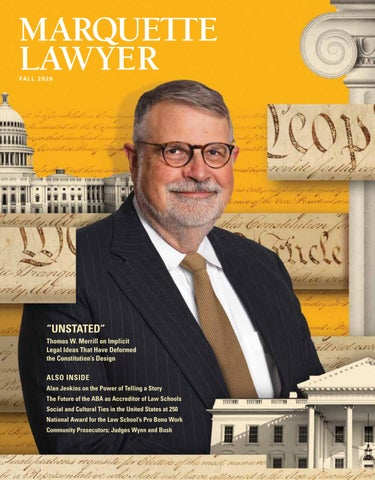
FA L L 2 0 2 6
“UNSTATED” Thomas W. Merrill on Implicit Legal Ideas That Have Deformed the Constitution’s Design
ALSO INSIDE Alan Jenkins on the Power of Telling a Story The Future of the ABA as Accreditor of Law Schools Social and Cultural Ties in the United States at 250 National Award for the Law School’s Pro Bono Work Community Prosecutors; Judges Wynn and Bush
FROM THE DEAN
Legal Education and Mary Poppins
S
hortly after becoming dean in 2003, I began to explore with colleagues how we might further develop our advocacy program with a first-rate intramural moot court competition, with some permanence, at Marquette Law School. My intuition took us only that far, and a faculty committee thereupon did the hard work. In particular, it proposed the creation of our Appellate Writing and Advocacy course, as an upper-level gateway to all moot court experiences (intramural and interscholastic), including our Jenkins Honors Moot Competition. This past spring marked the 20th anniversary of the first Jenkins Finals, now a premier event at the Law School, and the photo below captures this year’s student organizers, finalists, and presiding judges. (Permit us to note that, for the first time, all three “Jenkins jurists” were Marquette Law School alums.) The success of this year’s Jenkins Competition owed a good deal to the hard work of both those involved and those who, 20 or more years ago, began it well. This seems to me rather a theme for this new issue of the Marquette Lawyer. Two contributors—Hon. John K. Bush, judge of the U.S. Court of Appeals for the Sixth Circuit, who spoke at our graduation this past May (pp. 58–59), and Alan Jenkins, professor of practice at Havard Law School, who earlier that week delivered our Boden Lecture (see pp. 22–31)—were invited to speak at the Law School certainly because of their accomplishments and prominence over the decades. Yet they accepted, no doubt, in part because of circumstances that began well: I had met both of them on the first day of law school, in 1986, when the three of us were all new students together and part of the same small orientation group (14 people, if I recall correctly). I don’t remember the first time I met Tom Merrill, whose Hallows Lecture provides our cover story, in the hallways of the law firm where I practiced in Chicago in the 1990s, but with him, too, we may presume that things got off to a good start.
Lest the point be stated inadequately, or seem to be just personal, permit me to state it in more memorable terms: Well begun is half done. If the phrase sounds vaguely familiar, you may have heard Julie Andrews saying it to her charges, Jane and Michael, in Mary Poppins, as she seeks to make a game out of straightening up the nursery. (I tend to picture myself as more like the Mr. Banks character in the movie, but let’s leave that aside.) For me, the phrase was unfamiliar until Tom Ganey, who was the university architect and the Law School’s indispensable partner in the design and construction of Eckstein Hall, used it on one occasion or another to describe our progress in that 2007–2010 project. Any of you who have ever been in Eckstein Hall, which remains the best law school building in the country more than a decade and a half after its opening, will know that it must have been quite the beginning, indeed. And we are not just talking history: Rather, to this very day, Eckstein Hall helps us in the annual effort to get our law students off to a good start, beginning with the well-designed orientation program that launches them as Marquette law students and future Marquette lawyers. This issue of the magazine, even beyond the personalities mentioned, reflects this same basic theme: specifically, that a good foundation is essential to permanence and to solid further construction. It seems right to put it in such more high-minded terms given that the topics include the U.S. Constitution (Merrill’s Hallows Lecture, pp. 8–21) and the Declaration of Independence and where American society stands today (pp. 32–44). We were “well begun” as a polity by the Declaration of Independence and the Constitution. Law schools such as Marquette University’s, because of their direct educational work and their role as conveners, are unusually well-positioned to build upon this work, which, we may fervently hope, will never be done. Joseph D. Kearney Dean and Professor of Law An All-Marquette-Lawyer Jenkins Finals On March 18, 2026, Marquette Law School marked the twentieth anniversary of its first Jenkins Honors Moot Court Competition, held each spring. Gathered together in Eckstein Hall’s Lubar Center for the Jenkins Finals, with a large crowd, were the following (in each caption group proceeding left to right): on the sides of the photo, respectively, Michael Klein and Ananda Deacon, third-year students (now graduates), members of the Moot Court Executive Board who helped lead in organizing the competition; next in, Zachary McClenathan and Alexander Fountain (on left) and Karli Ring and Elizabeth TenBarge (on right), second-year students arguing in the finals in teams of two; and the three individuals in the middle, judging the finals, Hon. Byron Conway, L’02, U.S. District Judge for the Eastern District of Wisconsin, Hon. Janet Protasiewicz, L’88, Justice of the Wisconsin Supreme Court, and Hon. Michael Iasparro, L’01, U.S. Magistrate Judge for the Northen District of Illinois.
2
MARQUETTE LAWYER
FALL 2026
Contents
FALL 2026
8
“UNSTATED”
In Marquette Law School’s annual E. Harold Hallows Lecture, Columbia Law School Professor Thomas W. Merrill discusses implicit legal ideas that have sidelined Congress and empowered the President and the Supreme Court.
15
“A Centrist Kind of Guy,” with Impact Thomas W. Merrill’s breadth and depth of knowledge of the law have made him an influential figure in the American legal profession.
2
From the Dean
32
4
Law School News A national award and a new endowment recognize the accomplishments of the Law School’s Office of Public Service and strengthen its future. Also, three new professors join the faculty.
22
The Essential Power of Storytelling Based on his Robert F. Boden Lecture at Marquette Law School, Harvard Law Professor Alan Jenkins describes the value of supporting legal action with effective narratives.
Marquette University Law School Eckstein Hall P.O. Box 1881 Milwaukee, Wisconsin 53201-1881 Phone: (414) 288-7090 law.marquette.edu
Four Leaders Honored with Alumni Awards
Some Reflections on the Declaration of Independence Dean Joseph D. Kearney offers a civic group his perspective on what the nation’s Founding document of 1776 can still teach us, 250 years later.
38 22
56
America at 250
The State of the People of the Union Results of a special Marquette Law School Poll national survey provide insights into the lives of Americans today and their attitudes toward faith, family, government, and one another.
Kelly O’Neill
45
58
45
“Always Be a Problem Solver” While they are called “community prosecutors,” assistant district attorneys working out of police district stations across Milwaukee put the emphasis on proactively helping communities.
50
What Is the Future of Law School Accreditation? Daniel R. Thies, outgoing chair of the American Bar Association Accreditation Council, gives an interview at a turbulent time in the accreditation of universities and legal education in particular.
EDITOR: Alan J. Borsuk
COPY EDITOR: Amy Bauman
DESIGN: Kristin Pelisek
COVER ILLUSTRATION: Taylor Callery
Careers marked by success in helping others underlie recognition from the Law Alumni Association for Judge Joe Donald, Kathy Nusslock, Richard Esparza, and John G. Long.
From the Podium Excerpts of remarks by Judge John K. Bush at the Law School’s 2026 commencement. Excerpts of remarks by Mike Gousha, now senior advisor at the Law School, as he was given an honorary degree by Marquette University. Judge James A. Wynn on originalism and what happens when judges must answer questions of history. Professors Melissa Love Koenig and Kali Murray praise Professor Judith McMullen as McMullen retires.
Copyright 2026 Marquette University All rights reserved.
PHOTOGRAPHY: Mike Gryniewicz
FALL 2026
MARQUETTE LAWYER
3
LAW SCHOOL NEWS
National Recognition and Major New Support Fuel the Law School’s Pro Bono Initiatives Y
ou’ve been doing great work. Now do more. That’s the happy if challenging state of Marquette Law School’s Office of Public Service, the result of two developments this past June. First, the Ray & Kay Eckstein Charitable Trust made a $3 million gift to Marquette University to create an endowment to support the Law School’s Office of Public Service (OPS) and the Marquette Volunteer Legal Clinics (MVLCs), which are a core part of the work of OPS. The gift further includes a challenge to Marquette to raise $2 million by the end of June 2027. If the challenge is met, the Eckstein Trust itself will donate an additional $2 million, bringing the total endowment to $7 million. Second, the American Bar Association (ABA) announced that Marquette Law School is receiving the organization’s 2026 Pro Bono Publico Award in recognition of the MVLCs and the Law School’s commitment to serving low-income and disadvantaged people. This is only the fourth time that the award program, which began in 1984, has recognized the work of a law school. In its citation for the national award, the ABA said, “The Marquette Volunteer Legal Clinics . . . have developed into a lifeline for unrepresented litigants facing civil legal challenges. From modest beginnings in 2002, handling just 106 client visits, the MVLCs have grown exponentially, recording 6,160 visits in 2025 alone. . . . [P]ro bono programs like the MVLCs both serve as a legal aid ecosystem and engage with legal aid providers, helping ensure that individuals seeking assistance do not fall through the cracks.” Building on the Eckstein legacy The Eckstein gift has particular resonance for the Law School. The law school building is named, of course, in honor of the late Ray and Kay Eckstein, who in 2007 made the lead gift of $51 million to support the project. Dean Joseph D. Kearney praised the legacy of the Ecksteins and the way their family is continuing to support Marquette. “Throughout my relationship with Ray and Kay, they wanted one thing from us at Marquette,” Kearney
4
MARQUETTE LAWYER
FALL 2026
said. “They wanted excellence. We met that challenge in the concept, design, and construction of Eckstein Hall, which since its opening in 2010 has been acclaimed across the country.” Kearney expects the new gift from the Ray & Kay Eckstein Charitable Trust to support continued and increased excellence in the Law School’s pro bono program. “It is all about advancing the Marquette University mission,” Kearney said. “The Law School’s work of educating legal professionals who rely on their knowledge, skills, and values to serve people in need is an important example of developing ‘men and women for others,’ in the longstanding Jesuit phrase.” The growth of pro bono services The Law School created the Office of Public Service 20 years ago, partly to help secure a legacy of Howard B. Eisenberg, the Law School’s late dean, who himself had modeled public service and pro bono work before his death in 2002. Yet Kearney, his friend and successor as dean, who led the creation of OPS in consultation with the faculty, nonetheless regards the key development as not having been an administrative initiative from the dean’s office during either Eisenberg’s or his own tenure. Rather, it was a group of women graduates and students, such as Julie Darnieder, L’78, Tanner Kilander, L’02, and Bridget Kenney McAndrew, L’02, “who imagined and launched” the first Marquette Volunteer Legal Clinic in 2002, Kearney said. “Howard’s and my principal contribution to the MVLCs has been to help channel and support the work of extraordinary lawyers and students.” In the almost 25 years since the first clinic opened, pro bono and public service work has become a hallmark of the Law School’s identity and the experience of students. More than 70 percent of Marquette law students take part in pro bono work each year, and half of them graduate wearing an honor cord that reflects their having performed 50 or more hours of pro bono legal work. Along with the students, some 250 lawyers volunteer every year, many but not all Marquette
Marquette Law School’s Office of Public Service includes (left to right) Katie Mertz, L’11, director of public service; Mindy Schroeder, part-time program assistant; Angela Schultz, assistant dean for public service; Joshua Hernandez, L’22, assistant director of the Marquette Volunteer Legal Clinics; and Maggie Klatt, part-time program assistant.
graduates. The leadership of alumni has continued to be essential, as in the 2013 proposal by an alumni couple, Frank Daily, L’68, and Julie Ebert, L’81, to fund the creation of the Mobile Legal Clinic in honor of their law partner, Michael Gonring, L’82. The Posner Foundation, remembering Gene Posner, L’36, and his wife, Ruth, and led by their grandson, Josh Gimbel, a Milwaukee lawyer, has provided substantial operational support for the Office of Public Service for more than a decade and a half. Generally, the volunteer legal clinics offer brief legal advice sessions to a wide range of low-income individuals and those with special needs. About 40 percent of the people present family and safety issues, a quarter have housing needs, and one in five have debt or other money problems. Angela Schultz, assistant dean for public service, said estate planning may strike some as not a widespread need among low-income people. In fact, helping people secure titles to their homes, often a family’s sole asset, and address other estate-related questions often proves to be valuable. “It can begin to preserve a form of generational wealth among community members previously without access to such planning,” Schultz said.
Over the years, from the one original 2002 location, the MVLCs have expanded. They now include the Mobile Legal Clinic and a location in the Milwaukee County Courthouse’s Milwaukee Justice Center, which is a partnership among the Milwaukee County Clerk of Courts, the Milwaukee Bar Association, and Marquette Law School. Other locations are the House of Peace on Milwaukee’s north side; the United Community Center, serving especially the Hispanic community on Milwaukee’s south side; and the Milwaukee County Veterans’ Service Office, just to the city’s west. And, for a “silver lining” legacy of the pandemic era, the MVLCs offer Zoom clinics reaching across the State of Wisconsin. Schultz, grateful for the ABA award, is especially excited about the gift from the Eckstein Trust, assuring that the Law School’s Office of Public Service will stay strong and can even expand its efforts. Katie Mertz, L’11, director of pro bono and public service, who has worked with Schultz in OPS for more than a decade, said that a guardianship clinic will be offered during the 2026–2027 school year and efforts will increase to build partnerships with the legal community and the business community. Continued on page 6
FALL 2026
MARQUETTE LAWYER
5
LAW SCHOOL NEWS
Continued from page 5
Schultz said that while the Office of Public Service oversees help for thousands of people each year and while its reach has begun to extend to almost all of Wisconsin (68 out of 72 counties in recent years), there is a great need to do more. “We are so far from meeting the need,” she said. From student to colleague Joshua Hernandez, L’22, wants to help advance the Law School’s efforts. In July, he joined Schultz and Mertz, becoming the third lawyer in the Office of Public Service. Working alongside them are program assistants Maggie Klatt and Mindy Schroeder. Hernandez is assistant director of the Marquette Volunteer Legal Clinics. His hiring was made possible by Daily and Ebert’s longtime support for OPS and the new gift from the Eckstein Trust. Hernandez’s personal story reflects a good deal about the Marquette Law School of the past several decades. A native of Texas, he had a big interest in sports and worked in the athletics department at The University of Texas at Austin for three years after graduating from the university. That sports affinity drew him to Wisconsin— to enroll at Marquette Law School, with its nationally prominent sports law program, in 2019. But he also had a strong interest in helping people through the public service program. “I jumped in as soon as possible,” said Hernandez, who joined fellow students and volunteer lawyers in the family forms clinic at the Milwaukee Justice Center in the Milwaukee County Courthouse. He did 300 hours of pro bono work as a law student and won the Milwaukee Bar Association’s pro bono publico student award in 2021. After graduating from the Law School in 2022, he joined the Reinhart Boerner Van Deuren law firm in Milwaukee, working in employee benefits and institutional investment services. But he continued to be active in volunteer legal work. As soon as he saw the posting for the new position in the Law School’s public service office, Hernandez responded. “I was looking for the next step in my development,” he said. And he already knew the office has “an amazing staff that is doing amazing things.” Now he is part of growing the reach and strength of the pro bono efforts. His duties will include helping lead the work of the Mobile Legal Clinic, a van-based program that travels to underserved areas in Milwaukee. He is also aiming to increase community engagement with the services the office offers. A national award, a new endowment, and an expanded office—quite the set of developments as OPS celebrates its 20th anniversary and the MVLCs approach their 25th. Yet the focus is on the journey ahead.
6
MARQUETTE LAWYER
FALL 2026
Distinctive Routes Lead New Faculty to Marquette S
ometimes it’s not a straight line that leads you to a good destination. That’s the case for each of three new faculty members at Marquette Law School this fall. As much as each is enthusiastic about arriving at the Law School, none of them made it to Eckstein Hall on a nonstop ticket. An indirect, even complicated route has delivered each of them, eager to be part of the law school community.
Aaron Hernandez returns to Marquette The closest to a simple path is Aaron Hernandez. A 2013 Marquette Law graduate, he immersed himself in the Law School’s sports law program from the time he arrived as a law student, after getting an undergraduate degree from the University of Notre Dame. He was successful in pursuing a career in sports law. He spent six years working for the National Collegiate Athletic Association, where he focused on enforcement operations in football. In 2019, he took a position at Arizona State University, where he became executive director of the Allan “Bud” Selig Sports Law and Business Program at the Sanda Day O’Connor College of Law. He maintained strong connections with Marquette Law School, taking part in programs for current students every year except during the 2020 pandemic period. He received Marquette’s Charles W. Mentkowski Sports Law Alumnus of the Year award in 2019. Hernandez, a native of El Paso, Texas, says he felt “firmly entrenched” at Arizona State. “I wasn’t looking for a job. I was quite content.” Then the Law School approached him about returning to Marquette and becoming the director of the National Sports Law Institute (NSLI), based at the school. Paul Anderson, associate professor of law and director of the Sports Law Program, was prepared to give up his NSLI title to recruit his former student. Hernandez says he considered the move for nine months, talking with people in the sports world and consulting Aaron Hernandez with what he called his informal “board” for
career advice. The feedback was unanimous: “This is Marquette” and he should say “yes.” “The cachet, the credibility of the program, is the best in the world,” Hernandez says. So he has returned, as associate professor of practice and head of the NSLI. And he is excited about the opportunity for him—and, more so, the opportunities ahead for the institute. This semester he is teaching with Professor Matt Mitten, one of his mentors, who has stepped down as executive director of the NSLI but is remaining as a member of the full-time faculty and serving as senior advisor to the institute. Hernandez says he wants the institute to continue to do its “amazing work,” even while it seeks to raise further the Law School’s national profile. Working with Mitten and Anderson, he wants Marquette to be recognized as “the first stop for everything sports law related.”
Life lessons shape José Girón’s commitment to the law and others José Girón traces his commitments to working on criminal justice issues and to increasing respect for others to his childhood in Colombia, a time when violence and extreme disorder were a part of daily life. The country was “traumatized by the struggles to be governed by and to live by the rule of law,” he says. Girón’s family moved to Florida when he was six. He graduated from the University of Southern California and from Yale Law School. He served as a law clerk to Judge Stephanos Bibas of the U.S. Court of Appeals for the Third Circuit, for whom he has immense respect—“the best man I know,” Girón says. “The most lasting lesson he taught me was how to be a wonderful mentor.” After several years practicing in Washington, D.C., in the appellate and Supreme Court practice at Covington & Burling, Girón was looking to be involved in teaching. He had never been to Milwaukee, but when Marquette Law School posted an opening for an assistant professor of law, focusing on teaching criminal law and procedure, the opportunity strongly appealed to him. Growing up and into his professional life, he was boosted by people who José Girón believed in him and
mentored him. He wants to do likewise for others at Marquette. “I’m fortunate that this desire of mine is so congenial to the mission of this Jesuit institution,” Girón says. “I can’t believe my luck.” Another important goal: cooling the emotions that divide people. “The world can’t be painted as a canvas in black and white,” he says. He wants to be an advocate for tolerance and respect through rigor and humility, while teaching students both the rules of the criminal justice system and how to develop professional attitudes and conceptions of justice.
Life lessons prepare Eric Liberatore to help students succeed Eric Liberatore took an unusual path to his new role at Marquette Law School. “I tried a lot of different things,” he says. These included studying accounting, being a substitute special ed teacher and a job coach for people with disabilities, getting a master’s degree in strategic leadership, working as a lawyer in the Wisconsin governor’s office, and, most recently, teaching courses remotely for an undergraduate program at the University of Cincinnati. Even his law school path was varied. Liberatore excelled in law school at the University of North Carolina before dropping out in his second year because he wasn’t sure he was ready for a legal career. He later finished law school at the University of Wisconsin, where he found himself also serving as a teaching assistant in a statistics course. Through everything and more than anything, Liberatore came to realize his deep interest in helping others succeed. His path makes him a good candidate to help law students, he says. “Been there, can help you with that,” one might say of his approach. And that’s what Liberatore is doing as assistant teaching professor and assistant director of student success at Marquette Law School. His work includes overseeing the Academic Success Program, a structured program for first-year students that Marquette has developed over the past three decades. When he saw the posting for the Marquette Law School position, “I had to go for it,” Liberatore says. “I was so impressed with the institution.” In particular, he says he saw the compassion and the bigger holistic picture that the Law School shows students. And now he is part of Eric Liberatore offering these to students.
FALL 2026
MARQUETTE LAWYER
7
“Unstated” How Three Implicit Legal Ideas Have Sidelined Congress and Empowered the President and the Courts BY THOMAS W. MERRILL
F
or several decades, we have been witnessing a Congress in long decline and a corresponding ascent of the President and the courts. I see this as a fundamental deformation of the Constitution—a deviation from its original and better design— and this deformation is the subject of my lecture today.
Congress has long been regarded as the keystone of the federal government. James Madison, in The Federalist No. 51, thought it self-evident that “[i]n republican government, the legislative authority necessarily predominates.” Under the Constitution, only the Congress is given the power to enact laws, levy taxes, and appropriate monies for the government. The President, by contrast, is given a short list of powers and duties, some rather inconsequential, such as the duty to receive ambassadors, presumably in a reception at the White House or the like. Over time, the President’s power has tended to wax during times of war and wane in times of peace. But at least in matters of domestic policy, the President has been subordinate to Congress. As for the third branch: The federal courts have always been small in number relative to state courts, and historically they have largely directed themselves to questions that state courts cannot effectively or appropriately decide. Today, Congress passes relatively few laws, follows the President’s lead on taxes, and stands by while the President reallocates appropriations without sanction. Meanwhile, the President issues a blizzard of executive orders, in the manner of an elected monarch. And the Supreme Court is
expected to issue blockbuster decisions on a routine basis, informing the country what it can and cannot do with respect to gun control, abortion, affirmative action, religious freedom, takings of property, and myriad other issues. The deformation of the Constitution by this new distribution of authority has immense consequences. When Congress passes few laws, new problems tend to be addressed by federal agencies or, worse, by presidential executive orders, which are inherently impermanent. When Congress becomes inactive, the healthy back and forth between the legislature and the courts breaks down. Courts benefit from feedback from Congress, whether in the form of revisions to statutes that have been interpreted by courts, or in the form of threats to strip away the courts’ jurisdiction when they interpret the Constitution in a way that stirs up popular discontent. There are a number of plausible reasons why Congress has been sidelined relative to the Executive and the courts. One is simply a matter of numbers. We have one president, nine Supreme Court justices, and 535 members of Congress. In a rapidly changing world, it is no surprise that it is easier for one person to act, or for a majority of nine persons to act, than for majorities (or more) of
Thomas W. Merrill is the Charles Evans Hughes Professor of Law at Columbia University. This is a lightly edited version of the E. Harold Hallows Lecture, delivered at Marquette University Law School, on March 2, 2026. The lecture will appear as a longer article in the Marquette Law Review. A profile of Professor Merrill appears on page 15.
Illustrations by Taylor Callery
FALL 2026
MARQUETTE LAWYER
9
both houses of Congress to agree on the solution to emerging problems, especially when Congress is deeply divided. Other factors are also plausibly relevant. The enormous costs of seeking reelection require that members of Congress spend more time fundraising than legislating. The invention of the jet airplane means that members of Congress can spend four days out of every week in their home district rather than hanging around Washington getting to know their colleagues. The emergence of the internet and social media means that members of Congress, like other elected politicians, prefer appearing in tweets and videos rather than studying white papers devoted to serious policy analyses. I am not competent to discourse on the effects of these factors. Instead, I propose to discuss three legal ideas that have contributed to the decline of Congress and the concomitant transfer of power to the President and the courts. I call these “unstated ideas,” because, remarkably, they have emerged without any debate about whether they are sound. They are just assumed to be correct by relevant actors. My objective is to make these ideas explicit and to raise questions about whether they are sound. As I have briefly indicated, there are other plausible reasons for the relative decline of Congress and the
10
MARQUETTE LAWYER
FALL 2026
rise of the Executive and the courts. So debunking ideas quite likely will not result in correcting the deformation of the Constitution that we are witnessing. But to the extent that these unstated ideas serve to legitimize the transformation taking place, exposing them to the light of day may encourage greater pushback against it.
The Three Buckets Picture The first of the unstated ideas I call the “three buckets” picture of the federal government’s structure. We usually speak of the three major divisions of the government—legislative, executive, and judicial—as the three “branches.” This is an attractive metaphor, suggesting that each of the divisions emanates from a single tree. My claim is that the three branches have silently morphed into three buckets, with the further implication that every agency, commission, or chartered federal corporation must be located “in” one of the buckets. The unstated idea that every federal entity must be “in” one of the three branches is why I call this the “three buckets” idea: Everything must go in one bucket or another. Why has the three buckets picture contributed to the deformation of the Constitution? The reason is that we have a pretty clear notion of the basic function of two of the three buckets. The basic
UNSTATED IDEAS AND THE CONSTITUTION
function of the legislature is to enact federal statutes—the laws of the United States. The basic function of the judiciary is to resolve cases and controversies between adverse parties. The basic function of the Executive is . . . much less certain. As Michael McConnell shows in his recent book, The President Who Would Not Be King, the Framers had no clear conception of what is entailed by the “executive power.” They basically took Blackstone’s list of the prerogatives of the King of England and gave some to Congress, some to the President, and eliminated others altogether. Over time, some aspects of the executive power have come into focus. We have come to regard the President as the “sole organ” who speaks for the United States in matters of international relations, even though the text of the Constitution sends mixed signals about this. But in domestic affairs, the exact role of the President has remained contested. A key dilemma is what the Framers had in mind by imposing a duty on the President to “take Care that the Laws be faithfully executed.” Does this mean (for one, very current example) that the President must be able to fire any employee in the federal government (a workforce more than 2 million in number) whom he deems to be “unfaithful”? Or does it mean simply that the President must make do with his power to appoint principal officers of the government (subject to confirmation by the Senate) and otherwise abide by whatever provisions regarding removal from office Congress has enacted? What is the upshot of the uncertainty about what is included in the executive power, once we have embraced the three buckets picture of the federal government? It is quite simple. If some federal entity is not part of Congress, or is not part of the judiciary, then under the “three buckets” idea, it inevitably follows that it must be in the executive branch. The executive bucket becomes a kind of residual container into which everything pours that cannot be clearly located in one of the other two buckets, which are much more clearly delineated. This picture of the three buckets becomes deformative when combined with another idea that is explicitly and repeatedly asserted by the President’s lawyers—the idea of the “unitary executive.” Ever since the Reagan administration, lawyers working in the executive branch have asserted that the President must have the authority to control everything that happens in the executive branch. This advocacy has paid off: The Supreme Court has embraced the idea nearly in full—from
I call these “unstated ideas,” because, remarkably, they have emerged without any debate about whether they are sound. They are just assumed to be correct by relevant actors. the 2024 Trump immunity decision to a series of decisions giving the President the authority to remove the heads of administrative entities. The justification for the unitary executive idea is the vesting clause of Article II of the Constitution, which says that “[t]he executive Power shall be vested in a President of the United States of America.” The unitarians argue that this means all executive power must be subject to the control of a single person—the President. This is a lot of weight to put on the use of a singular indefinite article— “a”—in an introductory clause of an Article of the Constitution, but let that pass. The point is this: Once the legal system encompasses an unstated idea—that the executive branch is a residual bucket into which all government activity flows that cannot be ascribed to the legislative or the judicial buckets—and this is combined with an expressly stated idea that everything in the executive bucket must be controlled by the President, what do you get? You get a federal government in which the President exercises enormous power. Perhaps if we had a fairly narrow conception of the executive power—as, say, the power to determine when to initiate enforcement actions by the federal government—the unitary executive thesis would not be so destabilizing. Maybe the Federal Trade Commission, which has the power to sue to enjoin certain mergers, should lose its ability to perform this function without presidential control. But once the unstated idea of three buckets takes hold, and is combined with a zealous faith in the notion of a unitary executive, then everything in a very large and residual bucket falls within the discretionary control of the President. But wait, you may be thinking, the Constitution mentions only three branches of government. If that is the foundation of the three buckets idea, what is the alternative? The answer may be “departments.” The Constitution mentions “departments” several times, but it does not consistently indicate that they must be subordinate to the President. At one
FALL 2026
MARQUETTE LAWYER
11
point, it refers to “executive Departments”: The President has the authority to request the opinion in writing of “the principal Officer in each of the executive Departments, upon any Subject relating to the Duties of their respective Offices.” Conceivably, this betrays an assumption that all “Departments” are in the executive branch. But if the unitary executive proponents are correct, it is puzzling, to say the least, why the Framers felt that it was necessary to give the President explicit authority to request the opinion in writing of the heads of executive departments. According to the unitarians, the President can fire any principal officer in the executive branch at any time for any reason; if so, then there would obviously be no need to authorize the President to request this person’s opinion in writing. (The President could just say, “Your opinion, please, or you are fired.”) In other places, the Constitution simply refers to “Departments” without the qualifier “executive.” Congress has the power to make all laws necessary and proper for carrying into execution the powers vested “in any Department.” And appointments of inferior officers may by law be vested in the “Heads of Departments.” The fact that references to “Departments” in these instances are not qualified by the modifier “executive” suggests that the Framers did not rule out the creation of “Departments” having no specific location within the three principal branches. All of which suggests another way to picture the structure of the federal government established by the Constitution: The Constitution clearly spells out the powers of what can be called, in Professor Peter Strauss’s term, the three “apex” institutions—the Congress, the President, and the Supreme Court. But as to other federal institutions that may be created by Congress, pursuant to its powers under the Necessary and Proper Clause, the Constitution does not mandate any particular “location” of the entity in terms of the three named branches. To be sure, these lesser entities must be established by
[As] to other federal institutions that may be created by Congress . . . , the Constitution does not mandate any particular “location” of the entity in terms of the three named branches.
12
MARQUETTE LAWYER
FALL 2026
law, and they have only the power given to them by the laws that create them. And if Congress is wise, it will provide for judicial review of the exercise of power by these entities to assure that they do not exceed the powers given them by law. There is reason to believe that this alternative picture of the architecture of the federal government is the one that has prevailed through most of our history. Consider the creation of the Interstate Commerce Commission (ICC) in 1887. Congress created the ICC in response to a practical problem. The Supreme Court had held that state railroad commissions could not constitutionally regulate the rates charged by railroads on interstate movements. So unless these rates were to remain unregulated, it was necessary to create a federal regulator. Congress responded by establishing a fivemember commission, with members appointed by the President subject to Senate confirmation, serving for staggered six-year terms. No more than three commissioners could be from the same political party, and commissioners could be dismissed only for “inefficiency, neglect of duty, or malfeasance in office.” Complaints about railroad rates were filed by aggrieved shippers. The commission’s resolution of these complaints was subject to review by the federal courts, which had exclusive authority to enforce the commission’s orders. Was this an unaccountable “fourth branch” of government, whose very existence violated the Constitution? No, the ICC was “multiply” accountable. Its powers and duties were established by law, enacted by Congress with the President’s approval. Its commissioners were appointed by the President, with the advice and consent of the Senate. Its decisions and orders were reviewed by the federal courts, to assure that they complied with the law. No one at the time agonized over whether this was an entity located in the executive branch, the legislative branch, the judicial branch, or no branch at all. If anything, it was regarded as a kind of specialized court, whose orders could only be enforced by an Article III court. As a practical solution to a pressing problem, the ICC served as the model used by Congress in creating a slew of federal regulatory agencies, including the Federal Reserve Board, the Federal Trade Commission, the Federal Communications Commission, the Securities and Exchange Commission, the National Labor Relations Board, and the Federal Energy Regulatory Commission.
UNSTATED IDEAS AND THE CONSTITUTION
The Supreme Court has concluded this year that “for cause” limitations on removal of the members of most of these independent commissions are unconstitutional, because under the three buckets picture of the structure of the federal government, they all belong in the executive branch, and under the unitary executive theory, all such commissioners must be removable at the will of the President. This ruling means these specialized regulatory bodies have become, effectively, departments of the executive branch. The Court is uncomfortable, as it should be, with the idea that this means the independence of the Federal Reserve Board will be destroyed and the President will henceforth be in charge of setting interest rates. But the Court should be worried about much more. Most of these commissions make decisions that have profound implications for economic actors who need some assurance of stability in government policy. However imperfectly, commissions composed of multiple members from both political parties serving staggered terms are designed to promote stability in policy relative to what one would get under a regime of presidential executive orders. Moreover, consider that the model of three buckets has resulted in extravagant claims of presidential authority over other types of government activities such as remodeling the White House and the reflecting pool on the National Mall in Washington, D.C., modifying the captions on exhibits in the Smithsonian Institution, and renaming the John F. Kennedy Center for the Performing Arts (as the Trump-Kennedy Center). By the same logic, the three buckets model would seem to allow the President to dictate the routes served by Amtrak, a federal corporation, or the rates for electricity charged by the Tennessee Valley Authority, another specialized federal entity. If all this seems like extremism, it is, and we can thank President Trump for revealing the ultimate implications of the unstated three buckets model of the federal government. The Framers of the Constitution were clearly influenced by the idea of separation of powers, and they followed Montesquieu in organizing the federal government into three major branches. But they also rejected any notion that the three branches should be strictly confined to the performance of a single function. Instead, the Constitution was designed so as to “divide and arrange the several offices in such a manner as
FALL 2026
MARQUETTE LAWYER
13
UNSTATED IDEAS AND THE CONSTITUTION
that each may be a check on the other” (again, Madison in The Federalist No. 51). Or as Madison wrote in another essay (The Federalist No. 48), quoting his friend Thomas Jefferson, “the powers of government should be so divided and balanced among several bodies of magistracy, as that no one could transcend their legal limits, without being effectually checked and restrained by the others.” The three buckets picture of the government represents an unstated reversion to the concept of a strict separation of powers, with each branch performing its designated function, except that one branch—the executive, originally thought to be inconsequential relative to the legislature—can now perform any function. The more important idea of checks and balances has evidently been forgotten.
One-Way Delegation by Congress The second “unstated idea” concerns the delegation of authority by Congress. There is, of course, the longstanding complaint that delegations by Congress should be reined in, so as to force Congress to legislate with greater specificity. This has given us agitation, most prominently by Justice Gorsuch, to overturn the longstanding doctrine that delegations are permissible so long as they include an “intelligible principle” guiding the exercise of discretion (the oft-quoted phrase comes from a 1928 case). The claim is that a more restrictive doctrine is required. More recently, it has given us the “major questions doctrine,” which says that far-reaching and controversial exercises of delegated authority will be set aside by the courts absent clear authorization by Congress. These are not unstated ideas—they are quite vigorously asserted and debated. Rather, I am concerned with two other aspects of congressional delegation that are unstated but have contributed greatly to the deformation of our constitutional structure. The first concerns an extremely casual attitude to certain types of delegation to the President or one of the many administrative agencies. The case against delegation rests on the proposition that the Constitution, in the first sentence of Article I, gives “[a]ll legislative Powers” to Congress. One would therefore assume that sensitivity to delegation would be at its height when the President or some regulatory agency claims the power to issue so-called “legislative rules”— regulations that have a force and effect similar to a statute’s. At one time, the courts were very cautious
14
MARQUETTE LAWYER
FALL 2026
about such delegations, and said they would refuse to recognize agency rules having the force of law unless Congress explicitly authorized them. In more recent decades, however, the Court has adopted something of the opposite presumption: that any statute that mentions “rules” or “regulations”—even if this could plausibly mean housekeeping or procedural rules—also includes the authority to issue legislative regulations, i.e., rules that are functionally equivalent to ministatutes. This newer presumption, which has never been justified by the Court in any considered decision, has the effect of permitting the transfer of lawmaking authority from Congress (whether this was intended or not) to administrative actors and the President. To make the obvious point explicit: The unstated assumption that any reference to rules means authority to make binding legislative regulations has resulted in a very large transfer of legal authority from Congress to the Executive. The other aspect of delegation that remains unstated works in the opposite direction: the assumption that Congress cannot delegate legislative authority to itself or to any entity that Congress controls. The starting point for this development is the famous 1983 case, Immigration and Naturalization Service v. Chadha, that held that the so-called legislative veto is unconstitutional. The decision includes an elaborate discussion of the Constitution’s provisions for enacting a law: A bill must be adopted by both houses of Congress in identical form and must then be presented to the President for signature or veto. The statute at issue in Chadha had followed these procedures; it passed both houses and was signed by the President. The statute delegated broad authority to the attorney general to withhold the deportation of undocumented immigrants if certain equitable conditions were met. But there was a condition: the decision to withhold deportation had to be communicated to the relevant committees of Congress with an explanation, and if either the Senate or the House committee disagreed with the decision, it would be disapproved. The Court held that the provision allowing a committee to disapprove the decision to withhold deportation was a “legislative act,” because it changed the legal status of persons outside the legislative branch. As such, it violated the provisions of the Constitution spelling out how Congress can enact a statute. Continued on page 18
“A Centrist Kind of Guy,” with Impact AS A TEACHER, SCHOLAR, AND ADVOCATE, TOM MERRILL HAS BECOME A LEADING FIGURE IN MULTIPLE AREAS OF AMERICAN LAW.
C
harles Evans Hughes had a distinguished career of the first order. He was nearly elected president of the United States in 1916. He served before that as a justice of the Supreme Court of the United States and, from 1930 to 1941, as the nation’s Chief Justice. Governor of New York, U.S. secretary of state, and judge of the Permanent Court of International Justice in the Hague—he was each of those, too. He had a three-year stint as a Cornell University law professor and several multiyear periods as a Wall Street lawyer when he was one of the country’s most sought-after advocates. “I’ve always had immense admiration and respect for Charles Evans Hughes,” says Thomas W. Merrill. He described Hughes as a progressive Republican with a wide-ranging and impressive record of public service. Since 2010, Merrill has been the Charles Evans Hughes Professor at Columbia Law School, Hughes’s alma mater, in New York City. Merrill, too,
has had a wide-ranging and impressive career. As a practicing lawyer, as a teacher, and as a legal scholar, he has become one of the most respected figures in American law. He is among the most frequently cited figures in the legal world today. One major reason for Merrill’s prominence is the breadth of his interests and his expertise in multiple areas of the law. From property law to environmental law to administrative law to public law more generally, his range has been remarkable. Yale Law Professor Robert C. Ellickson, in an essay on the occasion of Merrill’s winning the Brigham-Kanner Prize for property scholarship in 2013, noted this distinction. First, “[u]nlike many awardees of the Brigham-Kanner prize, Tom also is a master lawyer.” Second, and perhaps as a result, “he possesses exceptional analytic abilities and expository skills. Aware of these comparative advantages, Tom, when turning to a fresh topic of law, typically starts by laying out, with enviable clarity, both the issues and the landscape of the current scholarly debate. These attributes have enabled him to become a central figure in two relatively disparate fields—property law and federal administrative law.” Merrill described his work in an interview in conjunction with giving the 2026 E. Harold Hallows Lecture at Marquette Law School. The text of the lecture accompanies this article.
an area in which I’ve written a little bit. I’ve been responsible for a fair number of sections on basic principles, such as what does possession mean, what does abandonment mean, and so forth.” The work is not yet finished. “My most recent task is to do the last volume we anticipate, which is on public rights. So I spent my summer writing chapters on federal public lands, the public trust doctrine, the implied doctrines of private right of access on public lands, and the public use doctrine in the law of eminent domain.” And he’s working on a chapter about the law of unclaimed property. “I had never given any thought to unclaimed-property laws,” he says, “and it turns out they’re very interesting and they’re very important. People get all kinds of little claims to money, like traveler’s checks or dividend checks or gift cards or stock shares in dissolved corporations, and they forget about them or never bother to do anything about them. What happens to all these little intangible rights, which accumulate? It turns out eventually they end up in the pockets of state governments, one way or another, and the state governments are very dependent on them.” In Delaware, he noted, unclaimed property is the thirdlargest source of revenue to the state. The Restatement work, which will help shape the future of American property law, is just one of the many roles Merrill has played in his career.
Tackling property law issues Consider one of Merrill’s current roles, as a co-reporter for the American Law Institute’s Restatement (Fourth) of Property, an extensive effort that will impact civil legal practice nationwide. What has Merrill done as part of the project? “I have done a volume for the Restatement on the law of leasing, which is
The path to the law Merrill grew up in Des Moines, Iowa, and enrolled at Grinnell College, an hour away. “I wanted to go east for college, and Poweshiek County was as far as my parents would let me go,” he says. After graduating in 1971 with a bachelor’s degree in history, he was awarded a Rhodes Scholarship to study at Oxford University in England, earning a degree in philosophy, politics,
FALL 2026
MARQUETTE LAWYER
15
A PROFILE OF TOM MERRILL
and economics. He received his law degree from the University of Chicago Law School in 1977. He clerked for David L. Bazelon, chief judge of the U.S. Court of Appeals for the D.C. Circuit, and then for Supreme Court Justice Harry A. Blackmun. He was a full-time lawyer at Sidley & Austin in Chicago from 1979 to 1981, before taking a teaching position at Northwestern University. “I fibbed,” Merrill says. When asked whether environmental law was among his teaching interests, he said “Yes.” For an unusual matter, he remained at the law firm in a part-time of counsel role. Then came three years as deputy solicitor general of the United States, beginning in 1987. Merrill argued 12 cases before the Supreme Court, winning all but one. And he developed a greater interest in constitutional law, adding to his areas of expertise. “It was a nice learning experience,” as he puts it. He returned to Northwestern University in Chicago and a part-time role at Sidley & Austin in 1990. At Northwestern, Merrill was named the John Paul Stevens Professor of Law. Stevens, for whom Merrill expresses great respect (and who was on the Court during Merrill’s clerkship and when he argued cases as deputy solicitor general), was also a longpracticing private lawyer as well as public servant before becoming a court of appeals judge and then a justice. The appeal of teaching law Merrill found the academic side of the law appealing. “The academic world has enormous advantages,” he says. Alongside teaching opportunities, there is immense opportunity to do research and writing, and Merrill has been prolific on those scores. Ellickson again: “He works ceaselessly and produces more high-quality work in an hour than many of us can produce in three.” “Most of my writing and research has been generated by teaching,” says Merrill. “In that respect, I think I’m a little bit strange.” Many professors, both in law and other fields, “get
16
MARQUETTE LAWYER
FALL 2026
their training in Ph.D. and graduate programs, and a lot of their work is generated by controversies in the academy. They look for a special take on a controversy.” Merrill’s orientation is to a wide range of subjects generally based outside the academy. “I found that teaching is a better stimulus to writing,” he says. “You discover interesting issues that can lead to writing an article or a broader piece of work. You do get a stimulus from the latest decisions that are being rendered or trends that are emerging in the courts or the legislature.” In 2003, he joined the faculty of Columbia Law School. He later taught at Yale Law School from 2008 to 2009, before returning to Columbia in 2010 to take the Charles Evans Hughes chair. Across his career, Merrill has authored or coauthored four books, including Lakefront: Public Trust and Private Rights in Chicago, coauthored with Marquette Law School Dean Joseph D. Kearney and published in 2021. Kearney met Merrill in 1990, when the former began as an associate at Sidley & Austin and the latter returned to Chicago from his work as deputy solicitor general. “I knew of Tom from reading that I had done in law school,” said Kearney. “I had an interest in possibly going into teaching someday, so perhaps I would have welcomed a connection in any event. But in fact it was his skills as a lawyer that impelled me to seek him out again and again on projects. To this day, I tell people that if they can get 15 minutes of Tom’s attention on a legal problem, it will likely result in a major advance in their understanding and approach to it.” Merrill also authored The Chevron Doctrine: Its Rise and Fall, and the Future of the Administrative State, published by Harvard University Press in 2022, and coauthored books on principles and policies related to property and an introduction to American property law. He has also written chapters for more than a dozen books and more than 120 academic articles and similar professional pieces.
Through Kearney, Merrill has developed a longstanding relationship with Marquette Law School. He delivered the Law School’s Robert F. Boden Lecture in 2010, describing how a Wisconsin Supreme Court decision in the late 19th century applying the doctrine of waste to a property on Milwaukee’s south side became a part of legal history. With this year’s Hallows Lecture, Merrill became the only person to give two of the Law School’s spotlighted annual lectures. “A centrist kind of guy” Merrill places high value on the principles and structures of the American system of government and of law—and he believes both are in troubled states now. He regards himself as a moderate when it comes to political and legal philosophy, and he has concerns about what is happening on both ends of these spectrums. “I’m a centrist kind of guy,” he says. “I don’t think I’m a stick-in-the-mud guy, but I’m a centrist.” In the academic world of law, “it’s gotten a little weird in these later years in the sense that a lot of people who
teach in law schools have unorthodox ideas about the law and how the law should interact with the larger society,” he says. Practicing lawyers “tend to be much more grounded—they have clients, they have to win cases before judges, and so forth. So they are constrained to be more pragmatic and to be more realistic about what sort of ideas should be advanced and which ones should not be advanced.” Merrill adds, “I get a little impatient sometimes with people who advance farout legal theories and get lots of attention for that in the academy. I’m thinking, for example, about theories that the United States Constitution was adopted in order to preserve slavery and that slavery is the key to understanding all American history or other types of theories that have been propounded in the academy these days.” He is also critical of some on the conservative side. He recalls that the legendary Justice Antonin Scalia called himself “a faint-hearted originalist.” Merrill says, “There are people on the Supreme Court who are not so fainthearted, who seem to think originalism is the answer to every constitutional question, and I think that’s far out; I think that’s an unsupportable proposition.” Merrill says his Hallows Lecture at Marquette was affected by his teaching of administrative law, an area that is in turmoil because the Supreme Court “is remaking administrative law on a fairly regular basis.” When he taught an administrative law course in the fall of 2025, he says, he used a book from 2023 and needed to provide students with 13 supplements reflecting recent decisions. “That’s pretty astonishing,” he says. “There are far-out people on both sides of the political spectrum,” he says. Losing the equilibrium underlying the law And what does that say about the big picture for America today? “I think American society as a whole is in kind of a dysfunctional state. Every society, if it is going to endure and prosper, hopefully has some kind of diversity,
Tom Merrill, outside the Supreme Court in Washington, D.C., with his mother, Dorothy Merrill, on April 16, 1990, after arguing for the government in Maislin Industries, U.S., Inc. v. Primary Steel, Inc.
which is kind of the yeast that keeps things evolving,” Merrill says. “But it also needs to have a strong basis of consensus, and I think we’ve kind of lost that recently in the United States, not just in the political sphere, but more broadly, and that is troubling to me.” As for American law in broad terms, Merrill says, “I am quite troubled by the state of the law. . . . I dearly hope that the equilibrium that has been established over the eons . . . can be restored or perpetuated and the legal profession and the courts can remain on the same page, more or less, and continue to try to adhere to a body of settled principles of the law, particularly in deciding cases between parties that have disputes with each other.” He adds, “That is still kind of the case with less controversial issues— everyday or mundane issues. But there’s a lot of controversy out there, and when this is true, there is a tendency by lawyers and judges to implement political preferences through the law. That, I think, is a recipe for very bad things if it becomes the general practice.” Merrill says he is generally alarmed about efforts “to use the law to implement fundamental changes in social practices.” He says, “Historically,
legislatures or bargaining or whatever could meld together settlements and practices. Maybe legislatures are overwhelmed, and they can’t do this job anymore, so we’re just going to depend on courts. But you’re asking judges to be legislators. I think that would be tragic if it was extended over a wide range of issues.” Merrill will retire from teaching in 2027. Beyond that, he expects to continue to write, working on undertakings such as the Restatement of Property. Together with family interests, he also wants to travel and do things he finds intellectually stimulating. He hopes that some of his work will have lasting value, but he expresses modest expectations. Most legal research, even when it is very good, has impact for a decade or less, he says. Kearney, a great admirer of Merrill, sees things differently in this instance. “One does not have to have served in all the various roles of Charles Evans Hughes to make a lasting intellectual contribution to the law and even present a model of public service,” says Kearney. Merrill’s work, informed by practice, teaching, and a broad lens, seems certain to have continuing influence beyond his long career.
FALL 2026
MARQUETTE LAWYER
17
Continued from page 14
But what about the delegation to the attorney general? This, too, changed the legal status of persons outside the legislative branch. In a footnote, the Court said that the delegation to the attorney general to withhold deportation was not a legislative act because . . . well, because this was a decision by the Executive, and each branch is presumed to act in accordance with its designated constitutional authority. Justice White, dissenting in Chadha, pointed out the question-begging nature of the Court’s analysis. What the decision amounted to, as would be confirmed by later decisions, is that Congress may delegate legislative authority to the executive branch, but may not delegate similar authority to itself, a subunit of itself, or a legislative agent. The proposition that a principal, in an otherwise proper act of delegation, can delegate only to a stranger and not to a subordinate with express authority is not reflected in general agency law. The Court in Chadha held that the “single, finely wrought” procedure for enacting a law binds Congress but does not bind the Executive. Maybe there were sound reasons for the distinction between delegations of legislative powers to executive agencies and delegations to congressional agents. But if so, they were basically unstated. To make matters worse, Chadha and follow-on decisions declared that any legislative veto could be severed from the statute and the remainder of the act upheld without it. The effect was to declare unconstitutional legislative vetoes that had been enacted by Congress in nearly 200 statutes as a condition of delegating authority to various executive authorities. Rather than giving Congress an opportunity to reconsider these delegations, the Court decided that the provision for the veto could be struck from the acts, leaving an unconstrained delegation to the Executive.
Maybe there were sound reasons for the distinction between delegations of legislative powers to executive agencies and delegations to congressional agents. But if so, they were basically unstated.
18
MARQUETTE LAWYER
FALL 2026
Finally, the Court extended the principle of Chadha beyond units of Congress itself to officers and agents of Congress insofar as they can be characterized as “executing” the law. In particular, in Bowsher v. Synar (1986), the Court found major legislation designed to reduce chronic deficit spending unconstitutional, because it called for the participation of the comptroller general, deemed a “legislative” officer, in certifying the magnitude of the needed cuts in spending. The Court held that the Constitution permits no sharing of the executive power with a congressional agent; by placing responsibility for executing the law partly in the hands of an officer responsible to the legislature, “Congress in effect has retained control over the execution of the Act and has intruded into the executive function.” Cumulatively, these decisions—invalidating the legislative veto, declaring such vetoes severable from the underlying delegations to the Executive, and barring congressional agents from participating in any execution of law—transferred enormous power from the Congress to the Executive. The policy impact has been considerable. Starting in 1929, Congress enacted a series of statutes delegating broad authority to the President to reorganize the federal government, subject to disapproval. Over the years, Justice White explained in his Chadha dissent, “Presidents submitted 115 Reorganization Plans to Congress of which 23 were disapproved by Congress pursuant to legislative veto provisions.” In the wake of Chadha, Congress allowed these authorities to lapse. The result has been to make it much more difficult to improve the efficiency of the federal government. Two justices, in the recent argument and decision concerning President Trump’s effort to impose tariffs under the International Economic Emergency Powers Act or IEEPA, have belatedly recognized that the Chadha decision has created a one-way ratchet transferring unchecked power to the President. Broad emergency powers like those given in IEEPA were delegated to the President in statutes passed before the Chadha decision— the expectation being that the power would be exercised reasonably, and if not, Congress could override the President’s action with a legislative veto. Now, the only way to rescind these broad delegations is by new legislation, which the President would almost certainly veto. Chadha’s unstated principle that Congress cannot delegate to itself or to a legislative agent has resulted in an
UNSTATED IDEAS AND THE CONSTITUTION
enormous transfer of power to the Executive, and a corresponding deformation of the Constitution.
The Rise of Law Declaration by the Supreme Court My third and last unstated idea concerns the Supreme Court’s conception of its role. Students of the Court have identified two polar ideas about how the Court conceives of its role. One, which should be familiar, is called “dispute resolution.” The Court conceives of its job as resolving disputes between adverse parties, especially when the lower courts have disagreed about the proper disposition of the matter. The other, which commentators have labeled “law declaration,” conceives of the Court’s role as identifying certain important legal issues and resolving those issues without actually deciding disputes between adverse parties. Instead, the Court concentrates on clarifying contested questions about the law and lets the lower courts sort out how to apply the law in the case at hand. The Court’s conception of its role in its recent opinions must be regarded as mixed; one in an uncharitable mood might call it schizophrenic. For one thing, the Court insists that the authority of federal courts must be confined to resolving
actual disputes. This is encapsulated in the law of standing. Federal courts, including the Supreme Court, can only hear actual cases and controversies between adverse parties. The plaintiff must show that it has suffered an injury that is concrete and particularized and actual or imminent, the defendant’s action caused the injury, and a ruling for the plaintiff would make the injury go away. Every term, the Court declines to decide one or more cases for failing to qualify for standing under this elaborate matrix of factors. I will not say much about this aspect of the Court’s jurisprudence, other than to note that the law of standing has become so complex and unpredictable that, for the Court itself, it serves primarily as a docketcontrol device. One day the Court decides that it wants to decide whether the government can cancel student loans. Another day it decides that it does not want to decide whether government pressure on social media firms to censor speech violates the First Amendment. And so forth. The Court also operates in a dispute-resolution mode in an increasingly important part of its work, variously called the shadow or interim or emergency docket. This often involves cases in which federal district courts have granted injunctions against various executive actions,
FALL 2026
MARQUETTE LAWYER
19
whereupon stays are sought on an accelerated timetable from the appeals courts and ultimately the Supreme Court. It is common for the Court either to grant or to deny a stay in a one-line judgment with no explanation. Sometimes one can figure out the rationale from reading opinions concurring in or dissenting from the judgment; other times the Court will hastily draft an opinion explaining its action. Frequently, however, the Court enters judgments—stay or no stay—without any substantial explanation. Let us turn more squarely to the plenary docket, the mainland of the Court’s work, even if it has been steadily shrinking the past several decades. Here the Court increasingly operates in the law-declaration mode. Frequently, the Court grants full review only in cases presenting questions of general importance; concentrates on resolving those questions, often in lengthy opinions with multiple concurrences and dissents; and then sends the case back to the lower courts to apply the new or clarified understanding of the law to the facts presented by the case. In effect, the Court proceeds in the disputeresolution mode when discussing the law of standing and resolving applications for stays on its emergency docket and then shifts to the lawdeclaration mode in deciding cases on the merits on its plenary docket. To overstate the matter in a deliberately provocative way, the Court either issues judgments without opinions or opinions without judgments. That this is the proper way for the Court to proceed is an unstated idea that it has never expressly addressed or defended. As to the law-declaration mode that increasingly prevails on the shrinking plenary docket, there are several reasons for concern. One is that it encourages the Court to make broad pronouncements about the law, in a way that may overlook certain nuances or complications that would be revealed if the Court actually undertook, well, to decide the case. A good example might be Loper Bright Enterprises v. Raimondo, the 2024 case that overruled the Chevron doctrine. The doctrine was named after the Court’s 1984 decision in Chevron U.S.A. Inc. v. Natural Resources Defense Council, Inc., which gave rise to a presumption that courts should defer to agency interpretations of ambiguities in their authorizing legislation. The Court’s opinion offered a detailed exposition of the dispute that gave rise to Loper Bright, but it then proceeded to ignore that dispute and discoursed in very broad terms about the proper
20
MARQUETTE LAWYER
FALL 2026
relationship between courts and agencies in resolving questions of law. The broad holding was that courts must exercise independent judgment about the meaning of the law in every case and should not defer to agency interpretations except in limited circumstances. The Court then remanded to the lower courts to apply the new understanding. It did not concern itself at all in its legal analysis with the substance of the regulation by the National Marine Fisheries Service requiring herring fishing ships in the Atlantic to provide on-board monitors in order to ensure compliance with rules against overfishing. The statute sent conflicting signals about whether the ships could be required to pay for the monitors at their own expense, Congress having appropriated insufficient funds for this purpose. If the Court had actually applied the new regime to the dispute, it would have had to struggle with a knotty legal problem and grapple with serious practical considerations. Who knows? Perhaps this might have produced a more qualified ruling. In all events, it would have been more illustrative. A weightier concern is that the law-declaration mode casts the Court in the role of lawmaker. To be sure, the Court generally frames its exercises in lawmaking as interpretations of enacted laws. But as these enactments become more infrequent and increasingly remote in time, the Court inevitably relies on cobbling together pronouncements appearing in its own past decisions. In so doing, the Court increasingly takes on the aspect of a Council of Revision, something the Framers of the Constitution specifically rejected. Flexing its law-declaration muscles, the Court becomes an ever-more consequential policymaker, occupying territory previously belonging to Congress or the states. Not across the board: For the most part, the Court leaves foreign and military policy to the President, as well as economic regulation, and confines itself to domestic affairs, especially questions of social policy. But it is not too far-fetched to see where this might be headed: foreign, military, and economic policy run by an imperial presidency, and social policy run by a Council of Revision called the Supreme Court. Whether or not this makes sense as a division of governmental authority, it bears little resemblance to the framework established by the Constitution. Perhaps the greatest risk posed by the Court’s turn to the law-declaration mode is that a powerful president may someday call its bluff. Over the years, a number of thoughtful observers, including
UNSTATED IDEAS AND THE CONSTITUTION
Abraham Lincoln, have concluded that the Executive has an unyielding duty to obey judgments rendered by courts but is free to disagree with the explanations for those judgments given in the courts’ opinions. By adopting the law-declaration mode in its plenary docket, the Supreme Court has implicitly decided that it does not do judgments. What matters is the view of the law expressed in its opinions. Indeed, the Court has come to regard its opinions as a type of law, binding on lower courts and other government and nongovernment actors alike. This raises the danger that some self-confident president will simply refuse to comply with the Court’s view of the law as expressed in its opinions. It is not even clear that the President would be wrong to do so. The United States Marshals Service has a statutory duty to enforce not opinions but judgments (“all lawful writs, process, and orders”). Indeed, it is possible—I have no proof of this—that the Court is already sufficiently anxious about this happening that it has gone out of its way to avoid crossing the President. If so, there goes another possible constraint on the President, and here comes another deformation of the Constitution.
••••
As I said at the outset, there are many possible explanations for the decline of Congress and the rise of the President and the courts. Perhaps the unstated legal ideas I have discussed are merely rationalizations for the deformation of the Constitution brought about by these other forces. But I think ideas have consequences. The three buckets idea has resulted in the assumption that the President must be in charge of everything not given to Congress or the courts, and has been invoked repeatedly to augment the power of the presidency. The unstated idea that legislative power can be delegated to the Executive, but not to a subpart or agent of Congress to provide a check on the Executive, has created a one-way ratchet expanding the power of the President and sidelining the role of Congress in constraining the President. The Supreme Court’s turn to the law-declaration mode in deciding cases has given it authority over matters of social policy formerly enjoyed by the people or the legislatures, but in so doing has rendered the authority of the Court itself precarious. It is quite important that these ideas be exposed and debated. Otherwise, we have no realistic hope of restoring the oldest continuing constitution in the world to its recognized form.
FALL 2026
MARQUETTE LAWYER
21
THE ESSENTIAL POWER OF STORYTELLING “IN MY EXPERIENCE, NARRATIVE IS OFTEN THE ‘SECRET SAUCE’ TO EFFECTIVE BRIEF-WRITING AND ORAL ARGUMENT.” BY PROFESSOR ALAN JENKINS
P
rofessor Alan Jenkins of Harvard Law School delivered the annual Robert F. Boden Lecture, titled “Why Stories Matter: Narrative, Law, and Justice,” on May 12, 2026, at Marquette Law School. Marquette Lawyer also engaged him in a written exchange, and we excerpt his comments here. THE VALUE OF “COMPELLING NARRATIVE”
I’ve been fortunate to have had a diverse career spanning litigation, philanthropy, strategic communications, writing, and now teaching. What connects those choices are the themes of storytelling, law, and justice. I’ve tried through my work to defend human rights and expand opportunity for all, and I’ve come to understand that the power of storytelling is an essential element in that endeavor. In one of my first legal jobs, as associate counsel at the NAACP Legal Defense and Educational Fund (long called the “Inc. Fund” and now known simply as LDF), I represented a Black community in the South Carolina Sea Islands that was facing both racial discrimination and economic exploitation. Working with colleagues, I developed a legal case and also a communications strategy designed to advance our position in the court of public opinion. The case settled quickly and relatively favorably for my clients, in contrast to civil rights cases that I’d seen take years or even decades to resolve. The outcome reinforced
Illustrations by Traci Daberko
my intuitive sense that the law is a more powerful tool when paired with a resonant public story. My time in the Office of the Solicitor General in the U.S. Department of Justice further bolstered that conclusion, but from a much different perspective. In working on dozens of Supreme Court cases and arguing four during my time there, I saw that storytelling is important in that rarified context as well. Mastery of the relevant law and facts is crucial and primary. But even a strong legal and factual case can fail without a compelling narrative rooted in values that at least five justices share. In my experience, narrative is often the “secret sauce” to effective brief-writing and oral argument. In my next job, at the Ford Foundation, I was able to pursue these ideas with more intentionality. As a program officer and then the director of human rights at Ford, I was exposed to hundreds of advocacy organizations and dozens of legal systems around the world. I saw that some of the most effective nongovernmental organizations or NGOs—especially outside of the United States—seamlessly integrated legal and policy advocacy with public education and cultural
Alan Jenkins is a professor of practice at Harvard Law School, where his courses include Supreme Court Jurisprudence, Race and the Law, and Strategic Communication. His previous positions have included assistant to the solicitor general of the United States in the Department of Justice, director of human rights at the Ford Foundation, associate counsel to the NAACP Legal Defense and Educational Fund, and president of The Opportunity Agenda.
FALL 2026
MARQUETTE LAWYER
23
THE POWER OF STORYTELLING
A large body of research across disciplines and over several decades shows that the way in which we communicate information influences how audiences receive, process, and act upon that information.
engagement. I’m reminded, for example, of an organization that we supported in Uruguay devoted to fighting racial discrimination and upholding the human rights of people of African descent. The group investigated rights violations, submitted reports to international bodies, and assisted displaced communities. It also maintained a book repository, an Afro-descendant music program, and an exhibition of Black culture. The organization’s leaders recognized that communicating the history, struggle, and humanity of Black communities was vital to securing full and equal rights under the law. I wanted to learn more. So I obtained a master’s degree in media studies while working at Ford and began supporting communications and cultural interventions in the United States as well as abroad. That work ranged from building the communications capacity of human rights organizations, to supporting independent investigative journalism, to underwriting documentary and fictional film and television shows exploring issues of rights and justice. Many of those projects proved to be game changers over time, moving hearts, minds, and policy on issues such as the death penalty, marriage equality, and racial profiling. And, for me, they were critical sources of learning about the theory and practice of narrative change.
ARTISTS AND ENTERTAINERS AS SOCIAL CHANGE AGENTS I eventually left the Ford Foundation to cofound The Opportunity Agenda, a social justice communication lab. Working with cofounders Phoebe Eng, Brian Smedley, and Bill Lann Lee, we built an organization that collaborated with social justice leaders on media campaigns, while building the communications capacity and coherence of the sector. Our work traversed tough issues such as immigration, housing, criminal justice, racial equality, and poverty, and our partners included advocates, organizers, faith leaders, labor and business leaders, and others. Over the course of a dozen years, we helped score important victories at the federal, state, and local levels. Over time, moreover, we found that artists and entertainers were important—and often neglected—social change agents. Research and experience show that art and culture can engage and persuade people who might be resistant to traditional argumentation. They can inspire even cynical audiences and build empathy across lines of difference. And, crucially, artists can depict not only the world as it is, but also the world as it
24
MARQUETTE LAWYER
FALL 2026
could be—what John Paul Lederach calls “the moral imagination.” With that insight in mind, we hosted an annual “Creative Change” retreat that brought together artists, entertainers, advocates, and donors around the shared values of opportunity, human rights, and the common good. Those convenings, in turn, hatched a steady stream of cultural interventions that moved the needle on critical policies and mass behavior. A great example is The Climate Ribbon, a public art installation first displayed in New York City, described by its creators as “an arts ritual to grieve what each of us stands to lose to Climate Chaos, and affirm our solidarity as we unite to fight against it.” Born during one of our Creative Change retreats and carried out by a coalition of artists and advocates, The Climate Ribbon has since engaged hundreds of thousands of people around the world through a unique form of storytelling and cultural exchange. At The Opportunity Agenda, we also amplified traditional legal advocacy through strategic communications. We filed Supreme Court amicus briefs on questions of fair housing, voting rights, language discrimination, and other civil rights issues, while building support for our position in the court of public opinion. We also combined policy advocacy with narrative change efforts to, among other things, improve the executive branch’s response to the economic recession, foster investment in fair and affordable housing, and recognize a state-based right to health care. My position at Harvard Law School since 2019 gives me the privilege of sharing these insights with students and colleagues while learning from them in return. It’s been inspiring to see my students take these principles in new directions on the issues that they care about.
TEACHING STORYTELLING TO LAW STUDENTS In my course on narrative and Supreme Court jurisprudence, for example, we begin with the social science and theory of framing and narrative for persuasion. A large body of research across disciplines and over several decades shows that the way in which we communicate information influences how audiences receive, process, and act upon that information. A striking study that I described during my Boden Lecture at Marquette was conducted by Lera Boroditsky and Paul Thibodeaux in 2011.
They shared with two groups of randomly selected people a set of facts about crime in the fictional city of Addison. The facts were the same for each group, but in one group they used the metaphor of crime as a virus infecting Addison, and in the other group they used the metaphor of crime as a beast preying on the city’s residents. They then asked members of each group to suggest solutions to Addison’s crime problem. Members of the “virus” metaphor group were significantly more likely to suggest addressing root causes and investing in prevention strategies such as reducing poverty and improving education, whereas members of the “beast” group were more likely to propose incarcerating perpetrators and enacting harsher punishment. The researchers found that placing the operative metaphors near the beginning of the story had a greater effect on participants’ proposed solutions, suggesting that the metaphors shaped how respondents “heard” and processed the information that followed. In fact, the choice of metaphor had a stronger predictive effect than did participants’ stated party affiliation (though that mattered, too). And, importantly, participants were largely unaware that the prevailing metaphor had influenced their thinking; when asked why they proposed particular solutions, they typically responded that it was based on facts and logic. The influence of metaphors is only one of the “framing effects” that researchers in linguistics, sociology, political science, economics, and other disciplines have identified. Others that we explore in my classes include leading with shared values, using episodic versus thematic fact patterns, and choices about what information to include, exclude, or emphasize. We then explore the broader question of how storytelling or “narrative” influences understanding and decision making. Narratives inevitably include framing selections, but they also often include heroes, villains, and victims; defining character choices; a clear beginning, middle, and end; and an explicit or implicit moral. Taken together, they inevitably convey unstated assumptions about how the world works, or how it should—what literary scholar Peter Brooks has called “doxa.” When they work, narratives help to establish the accepted “common sense.” Story structure is a particularly important part of narrative. Effective stories move from an initial state of balance to a state of imbalance or “trouble,” following an inciting incident, to a restored or
FALL 2026
MARQUETTE LAWYER
25
Reading Supreme Court opinions through a narratological lens can tell us much about justices’ unstated assumptions, worldviews, intended audiences, and long-term agendas.
new balance. Consider, for example, the classic 1939 film The Wizard of Oz. In her initial balance, Dorothy Gale lives at home with her Aunt Em and “family” of farmhands in Kansas, but is deeply dissatisfied, desiring to go “over the rainbow.” There is an inciting incident—a tornado—that ostensibly grants her wish, taking her to the land of Oz. But there is trouble in this new state of affairs, including a threatening Wicked Witch of the West, news of Aunt Em’s illness back home—and lions, tigers, and bears, oh my! After defeating the witch, finding the wizard, and learning that she (and the other characters) had what they sought inside them all along, she returns to Kansas and her family. Although she is physically back where she started, it is an entirely new balance because she now understands that “there’s no place like home.” The moral, of course, is that we already have what we need—love, smarts, courage—if only we can recognize and claim it. The film also possesses some attendant “doxa” or implicit worldviews, including that a teenage girl’s proper moral center is the home rather than exciting but dangerous adventures and that authority figures (embodied by the wizard) can be fraudulent but still socially useful.
THE POWER OF STORYTELLING IN THE SUPREME COURT Reading Supreme Court opinions through a narratological lens can tell us much about justices’ unstated assumptions, worldviews, intended audiences, and long-term agendas. Decoding legal narrative, it turns out, is invaluable to understanding, practicing, and making the law. An interesting example is Justice Neil Gorsuch’s concurrence in Loper Bright Enterprises v. Raimondo (2024). The Court in Loper Bright abandoned the interpretive principle of “Chevron deference,” under which federal courts had deferred to agencies’ reasonable interpretations of ambiguous statutes. Justice Gorsuch, who has emerged as a leader in the Roberts Court’s remaking of administrative law, tells us the story of the rise and fall of Chevron deference succinctly in the first paragraph of his opinion: In disputes between individuals and the government about the meaning of a federal law, federal courts have traditionally sought to offer independent judgments about “what the law is” without favor to either side. Marbury v. Madison, 1 Cranch 137, 177 (1803). Beginning in the mid-1980s, however, this
26
MARQUETTE LAWYER
FALL 2026
Court experimented with a radically different approach. Applying Chevron deference, judges began deferring to the views of executive agency officials about the meaning of federal statutes. See Chevron U. S. A. Inc. v. Natural Resources Defense Council, Inc., 467 U. S. 837 (1984). With time, the error of this approach became widely appreciated. So much so that this Court has refused to apply Chevron deference since 2016. Today, the Court places a tombstone on Chevron no one can miss. In doing so, the Court returns judges to interpretive rules that have guided federal courts since the Nation’s founding. I write separately to address why the proper application of the doctrine of stare decisis supports that course. Consider the rhetorical choices that Justice Gorsuch makes in this brief introduction to his opinion. He describes an original steady state of independent judicial interpretation of statutes; an inciting incident (Chevron) and troubled disequilibrium of ill-advised judicial deference to executive agencies on such matters; and, in the Loper Bright case now before the Court, a restoration of the original balance with the demise of Chevron and a return to (in his view) the proper role of the judiciary. (I’m describing, not endorsing.) Along the way, he invokes the words of Chief Justice John Marshall (the original and, in a sense, ultimate narrator of the federal judiciary’s role); describes Chevron as a “radical” kind of “experiment”; and gives us the powerful metaphor of a “tombstone” to confirm the death of the old regime. In the body of his opinion, he identifies not only the Chevron precedent, but also executive agencies as powerful villains, “ordinary people” as victims of “the worst kind of regulatory whiplash,” and the Loper Bright majority as the vindicating heroes of the story. None of these rhetorical choices are doctrinally necessary to Justice Gorsuch’s opinion. But together they tell a powerful and informative story. It’s a story that conveys volumes about the justice’s underlying factual assumptions, moral suppositions, and worldview regarding the administrative state and the Court’s role in it. For students of the law, perceiving and deconstructing that story will help immeasurably in understanding what the Court’s recent administrative law jurisprudence is about. For advocates, it provides crucial intelligence on how to choose and present future cases—and which cases to avoid bringing to the High Court.
THE POWER OF STORYTELLING
And for stakeholders in administrative law, it offers valuable insights into where the law may be headed, at least under the Court’s current composition.
FRAMING THE NARRATIVES OF THE BROWN AND OBERGEFELL DECISIONS Not all decisions are as “narratively rich” as Justice Gorsuch’s Loper Bright concurrence. But once we know what to look for, most opinions contain an informative and useful story. This is especially true of high-profile cases where the justices have an interest in public acceptance of their opinion as legitimate and correct. Not surprisingly, Brown v. Board of Education in 1954 was such a case, in which a unanimous Court struck down school segregation in an opinion that at times reads more like an op-ed than a traditional judicial opinion. For similar reasons, Obergefell v. Hodges (2015), in holding that the Constitution requires marriage equality, employs a wealth of narrative tools. We spend a lot of time on Obergefell in my class, dissecting the framing and storytelling
choices made by the justices on different sides of the decision. A framing question is at the heart of Obergefell: Were the plaintiff couples seeking to join the institution of marriage in the face of state exclusion, or were they seeking to change marriage from an inherently opposite-sex institution to one that also embraces same-sex couples? Chief Justice John Roberts raised this framing choice explicitly during oral argument, asserting to the plaintiffs’ counsel, “[Y]ou’re not seeking to join the institution, you’re seeking to change what the institution is. The fundamental core of the institution is the opposite sex relationship and you want to introduce into it a same-sex relationship.” Justice Anthony Kennedy’s opinion for the Court rejects that framing. Saying that “[t]he history of marriage is one of both continuity and change,” he tells us that “[i]t demeans gays and lesbians for the State to lock them out of a central institution of the Nation’s society.” (Emphasis added.) Attending to story structure and characters also helps us to fully understand Obergefell. Justice
FALL 2026
MARQUETTE LAWYER
27
Kennedy’s opinion describes how each of the plaintiff couples fell in love (the initial balance), were denied the right to marry or have their marriage recognized by their state of residence (the trouble or imbalance), and must be allowed to honor their love through equal access to civil marriage (the new balance)—an institution that he describes as “intimate to the degree of being sacred.” The heroes of Justice Kennedy’s story are the plaintiff couples, but also the LGBTQ+ community and other activists, who through “pleas or protests,” have changed public perception and the constitutional understanding of the equal dignity of their community and their equal claim to marriage. Notably, however, there are no villains in Justice Kennedy’s story. He tells us, instead, that “[t]he nature of injustice is that we may not always see it in our own times” and that “changed understandings of marriage are characteristic of a Nation where new dimensions of freedom become apparent to new generations.” In other words, as petitioners’ counsel Mary Bonauto said during oral argument, “times can blind,” and the states that
28
MARQUETTE LAWYER
FALL 2026
denied marriage equality were among those so blinded. In this respect, Obergefell is again similar narratologically to Brown, where the Court avoided any normative judgements about segregationists in its storytelling. But it is a stark contrast with Loving v. Virginia, the 1967 decision, 13 years after Brown, in which the Court invalidated antimiscegenation laws as violative of the Fourteenth Amendment. In Loving, a unanimous Supreme Court asserted that “[t]here is patently no legitimate overriding purpose independent of invidious racial discrimination which justifies this classification” and that “the racial classifications must stand on their own justification, as measures designed to maintain White Supremacy.” In contrast to Justice Kennedy’s Obergefell opinion, Chief Justice Roberts’s dissent identifies clear villains (the Court majority) and victims (“the people” of the various states with differing marriage laws). “Five lawyers have closed the debate and enacted their own vision of marriage as a matter of constitutional law,” he tells us, thereby “[s]tealing this issue from the people.” Of course, every 5–4
THE POWER OF STORYTELLING
Supreme Court decision is determined by “five lawyers,” but the Chief Justice’s labels, including the metaphor of “stealing,” perform both normative and descriptive narrative functions. Here, as in so many cases, reading opinions as narratives conveys insights and information that extend far beyond the facts and holding of the case.
HOW PUBLIC NARRATIVES CAN INFLUENCE COURT DECISIONS—FROM SAME-SEX MARRIAGE TO THE SECOND AMENDMENT Social movements sometimes engage in public narrative change that can affect Supreme Court jurisprudence. Many of the most powerful examples of this come from the Civil Rights Movement of the 1950s and ’60s, where ordinary people put their lives on the line to change both public and judicial understanding of our Constitution’s Reconstruction Amendments. The protest, direct action, litigation, and skilled communication all came together to tell a new story about the meaning of those amendments and, more fundamentally, what it means to be an American. In upholding the constitutionality of the Voting Rights Act for the first time in South Carolina v. Katzenbach (1966), for example, the Supreme Court’s majority opinion noted that “[a]ny possibility that [depressed Black voter registration] figures were attributable to political apathy was dispelled by the protest demonstrations in Selma in the early months of 1965.” The nation had watched, spellbound, on the relatively new medium of television, as Alabama state troopers savagely beat peaceful voting rights demonstrators marching from Selma to Montgomery on “Bloody Sunday,” March 7, 1965. Civil rights leaders carefully planned the Selma campaign to highlight the true, but underreported, story of everyday Americans righteously demanding equal democracy in the face of white supremacist violence. Katzenbach was decided one year later, to the day. The road to Obergefell also included narrativeshifting tactics by social movements outside of the courtroom. Marriage-equality activists closely studied Americans’ conscious and subconscious attitudes toward marriage, LGBTQ+ couples, and rights. That research, in turn, informed their organizing and communications, as well as their litigation strategy. A turning point in the movement’s efforts, for example, was research
showing that most straight voters believed gay and lesbian couples wanted to get married for rights and benefits, whereas straight couples wanted to marry for love and commitment. Understanding this misperception enabled the movement to tell a new, more accurate, and more compelling story—“Love is Love”—that quickly began to move hearts, minds, and policy toward its goal. By the time the Supreme Court considered the issue, a majority of Americans supported marriage equality. Justice Kennedy’s eventual opinion in Obergefell adopted this framing, including using the words love or loving a half-dozen times and commitment or committed even more frequently. The Court was certainly aware, moreover, of growing public support for equal access to marriage. In the words of my colleague Cass Sunstein, the shift in public perception provided the Court with a “permission slip”: assurance that the majority’s decision would be accepted by most Americans. Movement-based narrative change strategies also contributed, albeit over a longer period of time, to judicial transformation of the Second Amendment from a seemingly archaic, collective, state-militia precept to a modern individual right to bear firearms. Starting in the mid-1970s, gun rights activists took over the National Rifle Association—previously a group focused on hunting and target practice—and began a decadeslong communication, organizing, legal, and political campaign to transform public and judicial understanding. The organization funded law review articles and speakers, supported pro-gun politicians, and used the media of the day to craft and promote its new narrative. By 2008, when the Supreme Court recognized an individual right to bear firearms in District of Columbia v. Heller, a majority of Americans believed this to be the meaning of the Second Amendment as well. A fascinating study by Professor Jessica Dawson identified an additional NRA narrative change strategy that has proven impactful. She found that, between 1975 and 2019, the NRA increasingly used Christian nationalist metaphors, imagery, and vocabulary to tell the story of a God-given right to bear arms that transcends law and politics. “Drawing on the New Christian Right’s belief in moral decay, distrust of the government, and belief in evil,” she explained, “the NRA used shared metaphors to link the Second Amendment to religious nationalism, moving clearly toward Second Amendment absolutism.” And so it was distinctly
FALL 2026
Social movements sometimes engage in public narrative change that can affect Supreme Court jurisprudence. Many of the most powerful examples of this come from the Civil Rights Movement of the 1950s and ’60s . . . .
MARQUETTE LAWYER
29
THE POWER OF STORYTELLING
“on brand” when, in 1998, the organization picked as its president actor Charlton Heston, who had famously portrayed Moses in the classic 1956 film The Ten Commandments. Christian nationalist narratology is easily detectable in today’s public discourse on firearms, with the slogan “God, guns, and guts made America free” occupying a prominent role among supporters of gun rights. The point is that while facts, law, and logic are crucial to legal victories, competing narratives inside and outside of the courtroom also play an important role, especially when it comes to high-profile social issues.
TURNING TO COMIC BOOKS TO REACH AUDIENCES
. . . I know that mass media vehicles such as comics can reach and move large, new audiences . . . .
30
Like many Americans, on January 6, 2021, I was shaken when hundreds of insurrectionists stormed the U.S. Capitol and attempted to overturn the results of a free and fair presidential election. We also quickly learned that, in addition to the physical attack on the Capitol, President Donald Trump and his supporters intimidated election workers, threatened Vice President Mike Pence, and sent fraudulent electors to battleground states as part of a larger scheme to subvert the election results. But just as quickly, we saw an attempt by supporters of the then-ex-president to deny that the insurrection had happened, while praising the violent mob that carried it out. More ominous for me was the rise of authoritarianism and sanctioned bigotry that, in my view, pose an even greater threat to our democracy. I wrote and spoke out about these challenges in a variety of professional venues, but I also wanted to reach everyday Americans who care about our democracy but might not be closely following political news—much less reading the 814-page report of the House Select Committee to Investigate the January 6th Attack on the United States Capitol. And as a lifelong pop culture junkie and comic book nerd, I know that mass media vehicles such as comics can reach and move large, new audiences—so long as they are genuinely entertaining. I recruited New York Times bestselling graphic novelist Gan Golan, with whom I’d worked on several past projects, and we embarked on the journey that became 1/6: The Graphic Novel, asking the question “What if the January 6th Insurrection had succeeded?” We chose speculative, dystopian fiction because of its capacity to offer cautionary tales about our current reality—think of George Orwell’s 1984 or Margaret Atwood’s The
MARQUETTE LAWYER
FALL 2026
Handmaid’s Tale—as well as brighter alternatives. We tapped veteran Marvel and DC Comics artists to make sure that the art was top-notch. And we teamed up with the pro-democracy organization Western States Center and educators at San Diego State University to create a guide for activists and a lesson plan for teachers, respectively. The four-issue series has now been read by thousands of pop culture fans, received broad media coverage, been used by teachers and activists around the country, and sparked conversations with new audiences about our Constitution and democracy under stress. That’s definitely what we had in mind when we chose the comic book vehicle for our story.
BRINGING MORE VOICES INTO TELLING THE NATION’S STORY The 250th anniversary of the Declaration of Independence offers a rare opportunity to reflect as a nation on our origin story and what it means for us today. My latest scholarship focuses on how courts tell that story and, particularly, whom they choose as “narrators” when it comes to interpreting our Constitution. I’ve been fortunate, in pursuing this research, to serve as a Steven M. Polan Fellow in Constitutional Law and History with the Brennan Center for Justice. As one would imagine, in discerning the meaning of the Constitution, courts frequently quote the men who drafted, debated, and signed the document. In addition, though, they often look to a range of other figures, many of them Europeans who were neither present nor even alive when the Constitution was adopted. I’ve been particularly struck by judicial reliance on Alexis de Tocqueville, a French aristocrat who was 26 years old when he toured America for nine months in 1831–1832. This was four decades after the U.S. Constitution was adopted. Federal and state court judges have quoted de Tocqueville more than 300 times in their opinions, mostly as evidence of our national character. Here’s my assertion: Alongside de Tocqueville and other mostly European thinkers such as Locke, Rousseau, and Montesquieu, we should also be consulting American “outsider” voices from the Founding Era—prominent figures who were excluded from power, yet eloquently articulated the early American spirit of freedom and independence. I’m exploring, for example, the “history and tradition” of human rights as articulated by Phillis
Wheatley, an enslaved poet. Wheatley, abducted from her family in West Africa at about age 7 and held in bondage in Boston, nonetheless became a widely read poet who corresponded with George Washington and other Founding Era figures. In poetry and prose, she linked enslaved Africans’ quest for freedom with the American colonies’ struggle against “the iron chain,/ Which wanton tyranny with lawless hand/ Had made” (to quote from a 1772 poem). Another fascinating voice from the Founding Era is Mohawk military and political leader Thayendanegea (known also as Joseph Brant). His 1794 speech at Buffalo Creek provides insight into the meaning of both tribal and federal sovereignty: We are of the same opinion with the people of the United States; you consider yourselves as independent people; we, as the original inhabitants of this country, and sovereigns of the soil, look upon ourselves as equally independent, and free as any other nation or nations. This country was given to us by the Great Spirit above; we wish to enjoy it, and have our passage along the lake, within the line we have pointed out. And in a more familiar example, most of us know that, in 1776, Abigail Adams implored her husband, John, to “remember the ladies” in framing the nation. (He did not.) But fewer are familiar with her fuller assertion, perhaps more accurately described as a threat: [I]n the new Code of Laws which I suppose it will be necessary for you to make I desire you would Remember the Ladies, and be more generous and favourable to them than your ancestors. Do not put such unlimited power into the hands of the Husbands. Remember all Men would be tyrants if they could. If p[a]rticular care and attention is not paid to the L[a]dies we are determined to foment a Rebellion, and will not hold ourselves bound by any Laws in which we have no voice, or Representation. That revolutionary spirit, in my view, speaks volumes about public understanding of democracy and the guarantee of equality at the time of the Founding, as well as its often-unfulfilled promise. More broadly, these are profoundly American stories that should be part of our collective consciousness as well as our state and federal jurisprudence. They expand the we in “We the People” and give us guidance as we face our national future together.
FALL 2026
MARQUETTE LAWYER
31
Some Reflections on the Declaration of Independence Dean Joseph D. Kearney addressed the Rotary Club of Milwaukee concerning the 250th anniversary of the Declaration of Independence. This is a lightly edited version of his remarks on July 14, 2026, at Milwaukee’s War Memorial Center. James T. Barry III introduced the dean.
T
hank you, Jim, for your kind introduction. This is a humbling invitation, for two reasons in particular. First, we could save time by my simply reading aloud here the full Declaration of Independence. We would begin with the first sentence: When in the Course of human events, it becomes necessary for one people to dissolve the political bands which have connected them with another, and to assume among the powers of the earth, the separate and equal station to which the Laws of Nature and of Nature’s God entitle them, a decent respect to the opinions of mankind requires that they should declare the causes which impel them to the separation.
32
MARQUETTE LAWYER
FALL 2026
The entire effort would require scarcely 12 minutes, and we would all be sure to learn something. Such a public reading of the Declaration of Independence would also be in keeping with an American civic tradition of sorts, if not quite so widespread today as once was the case. Yet, tempting though that purely oratorical approach would be, I have taken it not to be consistent with my charge. The second reason for my humility is that this 250th anniversary has occasioned a substantial number of books exploring the birth of our nation generally and the Declaration more specifically. I am not among the authors. I make this second point to persuade you not that the organizers of this program made a mistake in
inviting me but rather that much very good learning in longer form, about 1776 and the origins, meaning, and legacy of the Declaration of Independence, is available to you (at Boswell Books and elsewhere). Yet I believe myself to be in a position to make some suggestions as to the place of the Declaration in our legal and broader political system—and the way in which it variously is both a statement of founding principles and an exquisite piece of lawyering in its own right. Do let me begin with an important point: The Declaration of Independence is not itself law as we Americans today tend to understand the concept—as a set of mandatory instructions or prohibitions. To give you a quick feel
for this, we did a bit of research: since statehood, the Wisconsin Supreme Court or a justice of the court has invoked the Declaration of Independence in only some three dozen judicial writings over the past 178 years. To be sure, the Wisconsin Constitution begins with a declaration of rights, the first sentence of which borrows from the Declaration of Independence, but the very scarcity of references is a telling point with respect to what the Declaration is (or is not): It is not law as we experience it every day or as our courts, state or federal, understand their work to involve. Yet no one should doubt the centrality of the Declaration to the American experiment and experience. The Declaration’s second sentence speaks of rights even more directly than would the subsequent 1787 Constitution (before the first ten amendments, which we have come to know as the Bill of Rights). While I do not plan intermittently to smuggle in a reading of the entire Declaration, here is that second sentence: We hold these truths to be self-evident, that all men are created equal, that they are
Illustrations by Robert Neubecker
endowed by their Creator with certain unalienable Rights, that among these are Life, Liberty and the pursuit of Happiness.—That to secure these rights, Governments are instituted among Men, deriving their just powers from the consent of the governed, —That whenever any Form of Government becomes destructive of these ends, it is the Right of the People to alter or to abolish it, and to institute new Government, laying its foundation on such principles and organizing its powers in such form, as to them shall seem most likely to effect their Safety and Happiness. The title of a recent book by Walter Isaacson has proclaimed this The Greatest Sentence Ever Written. The superlative in particular is a matter of opinion and taste, but the power of the sentence is plain. Over time, we have come to emphasize rather more—and to develop—the first portion of this sentence concerning equality than, say, the latter, asserting the right of the
people to alter or to abolish the government. Indeed, the Declaration’s allusion to equality helped stir the American conscience in the nineteenth century in such a way that we eventually confronted and abolished the institution that had blighted and belied American ideals from the beginning: I refer, of course, to slavery. Certainly, the 1787 Constitution was of quite limited help in any direct sense. Consider Frederick Douglass’s famous 1852 speech, to the Rochester Ladies’ Anti-Slavery Society, “What to the Slave Is the Fourth of July?” In this searing indictment of “the gross injustice and cruelty” of slavery, Douglass nominally relied on the Constitution. But it was the “great principles” of the Declaration of Independence that gave his jeremiad true power. Liberty and equality are often seen as in tension with one another, and to my mind, one of the greatest accomplishments of the Declaration of Independence is that it speaks so comfortably and enduringly to both concepts and helps us in part to reconcile them—as Douglass’s effort sought to require. In fact, the Declaration’s early, almost prefatory, reference to equality is scarcely central to the document’s
FALL 2026
MARQUETTE LAWYER
33
AMERICA AT 250 — DECLARATION OF INDEPENDENCE
essential logic. But the assertion was and is there, available to Douglass and all, for such use and value as can be fashioned from it. Such a summary or account as I have given so far may give the misimpression that the Declaration of Independence, being not law for us, rather is simply a statement of political philosophy. In fact, the Declaration is an intensely practical document. Not only does it do something, but it grounds its action in particulars—and rather quickly and extensively. After only one more sentence (beyond what we have already read together), the Declaration turns to what might be called a bill of particulars against King George III, detailing the “long train of abuses and usurpations” that formed or sought to form “the establishment of an absolute tyranny over these States.” “To prove this,” the Declaration says, “let Facts be submitted to a candid world.” There then follows an interesting catalogue, which forms the bulk of the document. Let me give three of the 27 or so grievances, as they are often called (the he refers to the king): • “He has dissolved Representative Houses repeatedly, for opposing with manly firmness his invasions on the rights of the people.” • “He has made Judges dependent on his Will alone, for the tenure of their offices, and the amount and payment of their salaries.” • “He has affected to render the Military independent of and superior to the Civil power.” It is hard to stop there, particularly with other powerful indictments, such as this: “He has plundered our seas, ravaged our Coasts, burnt our towns, and destroyed the lives of our people.” My interest is to note, if I may, that this is good lawyering. It is a fine thing eloquently to have articulated governing principles, as already summarized, even if the best one can do in terms of authority has been to say that he is relying on “truths [that are] self-evident.” (Please know, by the way, that I say that wryly: Thomas Jefferson’s original draft had stated, “We hold these truths to be sacred & undeniable.” It was Benjamin Franklin who in the editing process made the felicitous revision to describe these truths as “self-evident.”) Yet a legal precept standing alone isn’t enough; a good lawyer must marshal the facts that, together with the law, point toward judgment in one’s favor. So we have been given the law or legal precepts, in a few elegant opening sentences, and then, in some considerable detail, the facts. One might
34
MARQUETTE LAWYER
FALL 2026
think us to be ready for the judgment—the decree, if you will—or at least the application of the law to the facts. Yet the signers of the Declaration are careful next to say that they have exhausted their remedies, if I may borrow a familiar phrase in the modern law: In every stage of these Oppressions We have Petitioned for Redress in the most humble terms: Our repeated Petitions have been answered only by repeated injury. A Prince, whose character is thus marked by every act which may define a Tyrant, is unfit to be the ruler of a free people. That is, by the way, the fourth (and final) reference to a “tyrant” or “tyranny” in the Declaration. This was an important classical concept that John Locke, among others, had further developed in the late seventeenth century, to explain when the executive’s misconduct makes the people’s rebellion or “an appeal to heaven” appropriate. Let me complete the point about the Declaration’s being a last resort: Nor have We been wanting in attentions to our Brittish brethren. We have warned them from time to time of attempts by their legislature to extend an unwarrantable jurisdiction over us. We have reminded them of the circumstances of our emigration and settlement here. We have appealed to their native justice and magnanimity, and we have conjured them by the ties of our common kindred to disavow these usurpations, which, would inevitably interrupt our connections and correspondence. They too have been deaf to the voice of justice and of consanguinity. We must, therefore, acquiesce in the necessity, which denounces our Separation, and hold them, as we hold the rest of mankind, Enemies in War, in Peace Friends. To my mind, this is a political rather than a legal point, even in the context of the Declaration itself. That is not to denigrate it. We sometimes use the word politics to suggest something common, even base: the former it certainly is, or should be, but mostly unapologetically so. Politics is nothing more—or, more pertinently here, nothing less—than the sorting out of relations among individuals who live in the same community. For example, when Aristotle referred to man as a “political animal,” as it
is often translated, the basis of the adjective in his phrase (πολιτιĸὸν ὁ ἄνθρωπος ζῷον) is the noun πόλις, or city-state. This is why the phrase can be equally well translated that “man is a social animal.” But my focus should be the eighteenth century, not more than two millennia earlier, and it is fine rhetoric to express an interest in a good future relationship with the British people, beyond the king. This certainly supported the reminder to them that they had been, well, “on notice” (as we might say) and a reassurance that there was no inherent enmity but a long-term interest in friendship. Let me get to the declaring clause itself: We, therefore, the Representatives of the united States of America, in General Congress, Assembled, appealing to the Supreme Judge of the world for the rectitude of our intentions, do, in the Name, and by Authority of the good People of these Colonies, solemnly publish and declare, That these United Colonies are, and of Right ought to be Free and Independent States; that they are Absolved from all Allegiance to the British Crown, and that all political connection between them and the State of Great Britain, is and ought to be totally dissolved; and that as Free and Independent States, they have full Power to levy War, conclude Peace, contract Alliances, establish Commerce, and to do all other Acts and Things which Independent States may of right do. This is a magnificently stated sentence (“General Congress,” “Supreme Judge of the world,” “solemnly publish and declare,” etc.); it is also an intensely practical one. It announces to the world at large (especially other nations) our arrival as independent states and some of the rights appurtenant thereto. Such an announcement would be important given that the new country was engrossed in a war that was not going well. It had been going better earlier that year, when General George Washington had caused General William Howe to withdraw the British forces from Boston and decamp to Nova Scotia. In June 1776, however, the British had begun to sail from there to New York. It would take some weeks or months for the British, under the command of Howe’s older brother, Admiral Richard Howe, to assemble one of the largest naval fleets the world had ever known, but it was already clear that the action was coming a lot closer to Philadelphia and the Second Continental Congress.
. . . the signers of the Declaration are careful next to say that they have exhausted their remedies . . . . It was in this general context that Jefferson and the other members of the Committee of Five charged with drafting a proclamation of independence ( John Adams, Benjamin Franklin, Robert Livingston, and Roger Sherman) undertook their work. This was one of three concurrent committees formed to build a case for the Lee Resolution, pending before the Congress, whose other two parts (and thus the other two committees) concerned taking “effectual measures for forming foreign Alliances” and preparing “a plan of confederation.” In other words, one needed a declaration of independence in order to be in a position to treat with other nations (in particular, to seek their military and financial support) and to govern oneself. In a sense, such a declaration was just a necessary formality. The fact of a committee—of an editing process involving multiple people—is one of my own favorite facts about the Declaration. We often refer to the Declaration simply as Jefferson’s handiwork, and he was unquestionably the principal author. Yet editing was involved, as we already noted in discussing the “self-evident” truths. Most of the editorial attention in the Second Continental Congress concerned the “facts” (that is, the grievances). We today have the liberty, perhaps
FALL 2026
MARQUETTE LAWYER
35
AMERICA AT 250 — DECLARATION OF INDEPENDENCE
even the responsibility, to regret one deletion, in which Jefferson, whom we famously remember as a slaveowner, excoriated the British for the slave trade. But the point’s exclusion may have been not only necessary to keep South Carolina and Georgia onboard but also almost essential to avoid immediately discrediting or too obviously belying the claim of equality. Nor would any of us suggest that a document referring to “the merciless Indian savages” reflects all of our best ideals as Americans. For my point of focus here: Without doubting Jefferson’s centrality in the draftsmanship or its falling short in some respects, the Declaration was a better document for not having been the product of only one person. My own experience on somewhat less important documents reflects the value of such an approach, time and again. Beyond its immediate practical value, the Declaration of Independence has enduring value as a cultural document. The Declaration establishes us as a creedal nation, it has been said—one that belongs to newcomers who embrace its defining principles and ideals no less than to those whose direct ancestors were present at the creation or who are of a particular race, religion, or ethnicity. This is a good thing for me, all of whose forebears were nowhere near Philadelphia or even North America in the late eighteenth century. (To be sure, being all in Ireland at the time, my people would not have been outflanked in terms of righteous grievances against the king of Great Britain.) None of them was here at the time of the Civil War either. Yet all of them—and thus I— benefited upon their immigrating to the United States from not just the laws that enabled them to become citizens but also from the culture that sufficiently if imperfectly welcomed them. Even in our darker times, we have had available to read not only the text of the document that establishes the government of the United States of America, the Constitution, but its context, in particular the Declaration that preceded it. To speak of “text” and “context” is not very poetic. Thus, I am rather more drawn to a metaphor, from Abraham Lincoln (which I am grateful to Jim Barry for having noted to me). You need no tutorial on the circumstances in which the Union and Lincoln found themselves as he journeyed in February 1861 from Springfield, Illinois, to Washington, D.C., to take the oath of office as the sixteenth president of the United States.
36
MARQUETTE LAWYER
FALL 2026
His notes and jottings have helped one modern student of Lincoln (Harold Holzer) capture Lincoln’s thinking. Here’s Holzer, in a 2023 article in History Now, liberally quoting Lincoln’s personal notes: [I]n a fragment crafted before leaving his hometown, [Lincoln] imagined that the nation might yet be saved precisely because it had been inspirited by a declaration of principles and then protected by a constitution of laws. Without the aspirational expressions in the Declaration, he opined [to himself], “we could not, I think, have secured our free government, and consequent prosperity.” Echoing the Book of Proverbs—[among the] proof that Lincoln considered the Declaration equivalent to American scripture—he described Jefferson’s gem as “the word, ‘fitly spoken’ which has proved an ‘apple of gold’ to us.” The “Union, and the Constitution,” he perpetuated the biblical metaphor, “are the picture of silver subsequently framed around it. . . . The picture was made for the apple—not the apple for the picture. So let us act, that neither picture, or apple shall ever be blurred, or bruised or broken.” Then, stopping in Philadelphia and now speaking publicly, at Independence Hall on Washington’s birthday in 1861, Lincoln made the general point (without the apple metaphor). Here’s Holzer again (mostly quoting Lincoln): “I have never had a feeling politically that did not spring from the sentiments embodied in the Declaration of Independence,” [Lincoln] proudly admitted to “great cheering” from the audience filling the shrine where the document had been signed. “It was not the mere matter of the separation of the colonies from the mother land; but something in that Declaration giving liberty, not alone to the people of this country, but hope to the world for all future time. It was that which gave promise that in due time the weights should be lifted from the shoulders of all men, and that all should have an equal chance.” Lincoln was, of course, an exceptional lawyer, and his skills in that regard (and other respects) helped save the Union. Yet he ranked
. . . the Declaration also reflects the value of our tolerating not only difference but also some ambiguity, irresolution, and even avoidance . . . . the Constitution behind the Declaration of Independence in importance to the success of the United States, not only in the late eighteenth century but in the face of our greatest crisis as a nation, a civil war in the mid-nineteenth. Time permitting (as it does not), we could adduce other examples, including women’s rights and women’s suffrage into the twentieth century and the civil rights movement of the 1960s, where the Declaration of Independence and its ideals, as we had come to understand and refine them, made a powerful positive contribution to the course of events. Candor would require us to acknowledge, with dismay, some less admirable invocations as well. In short, let no one doubt that the “political bands” (in Jefferson’s phrase) or the social connections (if you prefer) that we have with one another—these aspects of our culture—make an extraordinary contribution to our survival and our growth. This is why, with apologies to Mr. Isaacson, it is the last sentence of the Declaration that is my own favorite: “And for the support of this Declaration, with a firm reliance on the protection of divine Providence, we mutually pledge to each other our Lives, our Fortunes and our sacred Honor.” Its very rhetoric is elegant—what an accomplishment to write a phrase that begins with a mutual pledge of “our Lives” yet does not turn anticlimactic. Its substance, too, is essential. It is true that we may look to our constitution and our other laws—including, not least, the courts that they create—to preserve our rights. Yet we must ultimately rely on ourselves and one another together to preserve the American republic. To return, finally, to the Declaration’s first sentence, we must be “one people.” And as “one people,” we must be confident in certain basic propositions—as, most obviously, in declaring ourselves an independent nation. Yet let me submit that the Declaration also reflects the value of our tolerating not only difference but also
some ambiguity, irresolution, and even avoidance on certain points or at least at certain moments. The Declaration of Independence’s precise attitude toward equality, toward slavery, toward some underlying questions of theology or philosophy is hard to pin down. Some of these questions could be deferred only briefly (such as the form of government), others for a longer time (into the nineteenth century), and still others remain our society’s work to take up or not today. While the legislatures or other republican devices (for example, school boards) should continue as central venues for our unfolding work as a people, so, too, should be gathering places like this where we come together with others beyond our tribes of religion, political party, or the like— where we gather as Americans. In that regard, I want to say that I can think of no place where I would have been gladder to speak on this topic than the Rotary Club of Milwaukee. Kudos to you and other such civic groups for promoting and helping continue to secure the premise and promise of American independence.
FALL 2026
MARQUETTE LAWYER
37
The State of the People of the Union Special Marquette Law School Poll national survey sheds light on Americans’ lives, 250 years after “Life, Liberty, and the pursuit of Happiness” were proclaimed as “unalienable Rights.”
I
BY ALAN J. BORSUK
n God we trust. It says so right there on the money in your wallet. But how much does the national motto accurately describe Americans in 2026? That’s just one of the questions that ring out as the nation marks the 250th anniversary of the signing of the Declaration of Independence. There are many others: On the earthly level, do we trust other people? Which institutions are worthy of trust, and which not? What are our families like? How connected are people to their communities? How do we express our religious lives? Shedding light on questions such as these was the goal of a special national survey by the Marquette Law School Poll this past summer. There were no “horse race” political matchups. Instead, the poll took an in-depth look at how Americans live and what matters to them. The survey was conducted June 9–15, 2026, interviewing 1,514 adults across the country, with a margin of error of +/-2.7 percentage points. The results were the subject of four releases in late June and early July.
Trust in other people Society rests on connections between people, and trust is one vital element in social bonds of cooperation, business, friendship, and family. In 2026 America, whom do Americans trust, and how much trust do we have in each other? One striking finding in the poll is that trust in other people is dramatically lower among those born since 1990 than those born in the 1960s or before. “Among those born before 1960, for example, 77% say most people can be trusted, while for those born in the 2000s, just 35% say most can
Illustration by Robert Neubecker
be trusted,” said Charles Franklin, professor of law and public policy and director of the Marquette Law School Poll. “That’s a huge difference, and trust declines with each successive cohort born in the 1960s, 1970s, and through to the 2000s.” It is tempting to reach for a handy explanation for the decline in trust, but the fact that trust has declined with each new cohort makes recent changes, such as the growth of social media, not generally persuasive. It is true that heavy users of social media are less trusting, and they are also younger and thus a larger proportion of recent birth cohorts than of earlier ones, but the gap in trust between heavy users and light users is some 13 percentage points, considerably less than the gap between young and old cohorts. More telling is that within birth cohorts, those who use social media the most hardly differ in trust from those who make the least use of social media. For example, consider the 1970s cohort. Among those who use one or no social media app, 62% say most people can be trusted, while among those who use five or more social media platforms, 63% say most can be trusted. For the cohort born in the 2000s, 34% of the lightest users say most can be trusted, while among the heaviest users 35% trust others. The interpersonal trust gap between the old and the young carries over to more specific questions about trust in people. Among adults in June 2026, 59% said that most people would “try to take advantage of you if they got a chance,” while 41% thought most would “try to be fair.” A majority of each cohort except those born before 1960 think most people would try to take advantage, and that majority grows with each younger cohort.
FALL 2026
MARQUETTE LAWYER
39
AMERICA AT 250 — MARQUETTE LAW SCHOOL POLL
Sixty-four percent say that people just look out for themselves, while 36% say that people try to help others. A small majority of the pre-1960 cohort think people try to help others. The majority saying that people look out for themselves grows to 76% in the youngest cohort. One area in which the old and the young see trust the same way is that all agree that Americans’ level of trust in one another has been shrinking. Among all adults, 82% say trust is declining, just 5% say it has been growing, and 13% say it is staying about the same. Although the older cohorts have longer experience to inform their answers, there is hardly any difference across cohorts in views of this aspect of trust.
Trust in institutions The Marquette Law School Poll asked about confidence in 18 different institutions. Doctors have the highest net-confidence rating (percentage of people with a great deal/quite a lot of confidence, minus percentage with very little/no confidence), followed by the U.S. military, the police, and local schools. Other positive net ratings go to colleges and universities and the people who administer state elections. The other 12 institutions have net negative confidence ratings. Only slightly negative are local
news media, the U.S. Supreme Court, and the Food and Drug Administration, each less than 10 percentage points net negative. State legislatures are viewed negatively at -16 net, but far better than Congress at -43. Other federal institutions with negative net ratings are the U.S. Department of Justice (-21) and the executive branch (-30). Business fares rather poorly: business leaders are at -24, companies developing artificial intelligence are at -47, and Facebook has the lowest rating of all at -66. National news media get a very negative -31 rating, much worse than local news media’s -2. Partisans differ in trust of some institutions but not of others. Both Republicans and Democrats have positive net ratings of doctors, the military, and the police, and they also agree in holding negative views of Congress, artificial intelligence companies, and Facebook. Partisans differ on the U.S. Supreme Court and the executive branch (with Republicans positive and Democrats negative) and on colleges/universities and local news media (with Democrats positive and Republicans negative).
After the kids leave home Many government statistics focus on fertility and child-rearing, but pay little attention to family life after children reach age 18. This Marquette
Trust in people, by birth cohort
Net confidence in institutions, by party ID
Among adults in polls conducted in 2026
Among adults; net is percent confident minus percent not confident
80
Net confidence among Republicans (percent)
Most people can be trusted (percent)
80 70
60
50
40
30
U.S. military Police
60
Your doctor
40
U.S. Supreme Court 20
Executive branch 0
Local schools
U.S. DOJ
Business leaders
FDA
Universities American voters State legislature Congress Local news media AI companies National news media Facebook
20 1960s
1970s
1980s
1990s
Birth cohort Marquette Law School Poll, national surveys, latest June 9–15, 2026
40
MARQUETTE LAWYER
FALL 2026
2000s
0
Net confidence among Democrats (percent) Marquette Law School Poll, national survey, June 9–15, 2026
survey examined aspects of family Where and how often adults interact with other people life among parents of adult offspring, How Often including the role of grandparents. Where This provided glimpses of family Monthly or Few per year relationships across the later part of more or never life. Text messages 84 16 The survey found that large Telephone call 72 28 numbers of families have active Social media 63 37 multigenerational lives, including At work 58 42 grandparents who frequently care for grandchildren and families in which Visiting someone’s house 47 53 all the grandparents, parents, and Child’s school 41 59 grandchildren live within 50 miles of Coffee shop/restaurant 40 60 each other. Relatively few of those Religious services 33 67 in later life, including after 70, are Parties or meals organized by others 33 67 isolated from their children. Among Americans age 18 and Neighborhood events/parks 28 72 older, 38% don’t have any children. Social organization/club 26 74 Making up the 62% of adults with Parties or meals organized by yourself 23 77 children, 20% have only children Bar or tavern 22 78 younger than 18, 8% have children both younger than 18 and 18 or older, Class or group/knitting/book club 18 82 and 34% have children only 18 or Sporting event 17 83 older. Marquette Law School Poll, national survey, June 9–15, 2026 For people in their 40s and beyond, more than half have two or and connections with grandchildren playing a more children. Barring untimely death, these adult prominent role in the lives of older Americans. children will define and extend family for their (It should be noted that this particular analysis parents through the end of the parents’ lives. Adult focused exclusively on those with children.) children extend their parents’ family by creating Not all families are happy families. Looking at grandchildren. In this survey, 43% of parents have trust of immediate family, 62% say they can trust at least one grandchild, but the adult children their immediate family a great deal, 30% trust their include those too young to have their own children family a fair amount, 6% say they trust family not yet. very much, and 2% trust them not at all. Grandchildren are a prominent part of family Financial stress plays a substantial role in life for older Americans, many having four or more. reducing trust in family. Among those who say they Grandparents engage with their grandchildren are struggling financially, 42% say they trust their in many ways, but a prominent one is through family a great deal, compared to 61% among those providing childcare of one sort or another. who are “just getting by” and 70% among those Among grandparents, 50% said they take care of a who say they are living comfortably. Similarly, trust grandchild at least once a month, with 31% doing in family is related to income levels. so a few times a year and 20% who never take care Compared to the standard of living they of a grandchild. experienced growing up, about half of adult Among those with adult children, 45% of these Americans say they are now better off. That parents have all of their adult children living within includes 21% who say they are much better off and 50 miles of them. Another 37% have some children 31% who are somewhat better off, while 20% are near and others far, while 18% have all of their somewhat worse off and 9% are much worse off. children living more than 50 miles away. The remaining 20% say their standard of living is This picture of families with adult children about the same as when they were young. and grandchildren shows there is considerable Faith and family interaction throughout life, with most families Most Americans identify themselves as adherents remaining, at least in part, in geographic proximity to a religious group, though in recent years the
FALL 2026
Question: In each of the following settings, how often do you interact with other people outside of your immediate family?
MARQUETTE LAWYER
41
AMERICA AT 250 — MARQUETTE LAW SCHOOL POLL
Religious service attendance, by birth cohort Among adults Regularly (monthly or more)
Never
40
Percent
35
30
25
20 1960s 1970s 1980s 1990s 2000s
1960s 1970s 1980s 1990s 2000s
Birth cohort Marquette Law School Poll, national survey, June 9–15, 2026
percentage not affiliated has grown. In this survey, 28% say they are not adherents, while more than 70% identify themselves with a religious tradition. While fewer than a third of Americans say they are not affiliated with a religion, more than half, 56%, say they seldom or never attend worship services. Attendance at religious services has declined across birth cohorts, with older people attending most frequently and younger people attending the least. In the Marquette Law School Poll, there is some hint that attendance may be on the rise for those born in the 2000s, though this group also has the highest rate of never attending. (Those attending occasionally or seldom are omitted in the charts on this page.) Beyond affiliation and attendance, religious practice includes prayer. Given relatively low attendance rates of respondents, a surprisingly large number of people (55%) say they pray at least a few times a week. This contrasts with just 21% who attend religious services weekly. Furthermore, prayer is frequent even among those who attend services only rarely. For example, 24% of those who say they never attend religious services say they pray at least a few times a week. Forty-four percent say it is important for children to learn moral values through religion, and 71% say it is important for children to learn moral
42
MARQUETTE LAWYER
FALL 2026
values apart from religion. (People could answer “yes” to more than one of those questions.)
How people interact A powerful image of modern social isolation is a group of people sitting together while all of them are mesmerized by their cell phones, not speaking to anyone around them. In this survey, 41% say they turn to their phone all or most of the time, rather than talk to people around them. Another 40% say they do this sometimes, while 20% say they seldom or never do so. A few other glimpses into how people interact with others: Nearly 60% of adults say that they start a conversation with strangers at least once a month. Eighty percent of adults report that they say “hello” to strangers in passing at least monthly. Over half of adults spend a social evening with friends at least monthly. Thirty-three percent say they go to parties or meals organized by other people at least monthly, while 23% say they host parties or dinners at least monthly. Text messages are the most frequent electronic interaction, followed by telephone calls and social media. The most common face-to-face interaction comes at work, though this is naturally much less
common for retired people and others not in the labor force. While it is obvious that work involves interaction with others, it is important as a source of contact with other people who may become friends and who provide different perspectives from those within the immediate family. For parents of school-age children, schools offer a frequent point of contact with others. Likewise, coffee shops and restaurants are frequent locations for personal interactions. About one in five say they meet other people at bars or taverns regularly. Less common locations come from participating in groups with special interests, such as knitting circles and book clubs, or attending sporting events. Regardless of how singles meet people, they go on dates more often than they use dating apps. Among singles, 27% say they go on a date at least once a month, 24% go out a few times a year, and 49% are not dating at all. Dating is most frequent for singles in their 30s, with those in their 20s dating the next most frequently. The 20-somethings, however, also have a relatively high level of never dating. Beyond the 30s, dating among singles is fairly stable in the 40s through the 60s, dropping for those 70 and over. It is worth noting, however, that about half or more of singles over 40 say they never go on dates.
Declining trust in federal government The poll found that trust in the federal government to do what is right all or most of the time has declined over the long term. While overall levels of trust in the government have not changed much in recent years, partisanship has increasingly shaped levels of confidence. More generally, satisfaction with many institutions, both governmental and nongovernmental, varies widely. Eighteen percent of American adults say that they trust the federal government to do what is right all or most of the time, while 19% say they can never trust the government. The remainder, 63%, say they trust the government only some of the time. In the late 1950s and early 1960s, trust in the federal government was much higher, and partisan differences in opinion were much smaller. In 1958, almost three-quarters (73%) said they trusted the federal government all or most of the time, according to polling by the American National Election Study. That percentage fell to 25% by 1980. Except for brief and limited increases during the mid-1980s and the late 1990s and early 2000s, trust has remained much lower than it once was.
Unlike in the period before 2000, trust in the government has become substantially dependent on partisanship and which party controls the White House at the time. For example, in Marquette Law School Poll surveys during the Biden administration, beginning in 2021, 31% of Democrats trusted the government all or most of the time, compared to 12% of Republicans. In the second Trump administration, beginning in 2025, 31% of Republicans say they trust the government that much, compared to 11% of Democrats. These partisan discrepancies in trust were much smaller in the past. For example, in 1968, under Democratic President Lyndon Johnson, 65% of Democrats trusted the government, as did 59% of Republicans. And during Republican President Ronald Reagan’s second term in 1988, 48% of Republicans and 35% of Democrats mostly trusted the government. Partisan gaps grew in the 2000s.
Views of the country The poll found that a majority of adults have positive views of the country, but more are moderately positive rather than strongly so. Thirty-five percent of those polled strongly agree that America is a better country than most other countries, while 40% somewhat agree. Only 7% strongly disagree, with 19% somewhat disagreeing. The gap is sharper when it comes to opinions on how much the United States has succeeded in achieving the ideals of the nation’s Founding, with 18% saying a great deal but 53% saying a fair amount. Almost a quarter (24%) say the United States has “not very much” achieved its ideals, while 5% say that those ideals have been not at all achieved. How proud of America are Americans? Twentyeight percent say they are very proud, 38% say they are somewhat proud, 24% are not very proud, and 10% are not at all proud. Americans are about evenly divided on the country’s future as a democracy, with 11% who are optimistic, 41% somewhat optimistic, 36% not very optimistic, and 12% not at all optimistic.
Interest in the 250th Interest in the “semiquincentennial,” to use the formal term, was limited among those polled. As July 4 approached, only 26% of Americans had read or heard a lot about the 250th anniversary of the Declaration of Independence. Another 57% said they had heard some about it, while 17% had heard nothing at all.
FALL 2026
MARQUETTE LAWYER
43
AMERICA AT 250 — MARQUETTE LAW SCHOOL POLL
Favorability toward figures from the Founding Era Among adults, ordered by percent favorable Who
Favorability Favorable
Unfavorable
Not Heard Enough
Benjamin Franklin
84
9
7
George Washington
81
13
6
Thomas Jefferson
76
16
9
John Adams
66
13
21
Alexander Hamilton
64
14
22
James Madison
59
13
28
Aaron Burr
22
29
49
Benedict Arnold
15
53
32
Question: Do you have a favorable or an unfavorable opinion of the following people, or haven’t you heard enough yet to have an opinion?
Marquette Law School Poll, national survey, June 9–15, 2026
One might think this a particularly low level of attention, but this pattern was found 50 years ago also, on the 200th anniversary. In a Roper Organization poll conducted June 12–19, 1976, 28% said they were following news about the Bicentennial closely, 50% were following casually, and 22% were paying no attention. Raw data from the 1976 survey were provided by the Roper Center data archive at Cornell University, with analysis conducted by Marquette poll director Franklin. One substantial difference from 50 years ago was found in the partisan patterns of interest and attention to the Declaration’s anniversary. Opinions of President Donald Trump, who took a substantial interest in marking the anniversary, were reflected in interest in the 250th. Seventy-six percent of Republicans were very interested, as opposed to only 46% of Democrats. For the Bicentennial in 1976, during Republican Gerald Ford’s presidency, there was much less correlation between interest levels and partisanship, with 66% of Republicans and 63% of Democrats very interested.
Opinions of the nation’s Founders This Marquette Law School Poll applied a modern survey question to opinion of members of the Founding generation, asking respondents if they have a favorable or unfavorable opinion of eight historical figures. Benjamin Franklin is someone Americans still like: he is seen favorably by 84%, a figure modern politicians can only envy. George Washington comes in second with 81% favorable, and Thomas Jefferson third at 76%, among eight figures from the American Revolution. Six of the eight have favorable ratings overall.
44
MARQUETTE LAWYER
FALL 2026
You might think Alexander Hamilton would be particularly popular since his life was the subject of a popular Broadway musical in recent years, but, at 64% favorable, he comes in fifth, behind John Adams (66% favorable). From the same musical, you might expect considerable unfavorable opinion of Aaron Burr, but almost half, 49%, say they haven’t heard enough about him. Twenty-two percent are favorable and 29% unfavorable. And the least favorable of the eight? An unsurprising choice: Benedict Arnold, who switched sides, joining the British in the middle of the Revolutionary War, and whose name became synonymous with treason. The poll didn’t ask for reasoning, but 15% have a favorable view of him, as against 53% unfavorable. Perhaps there are a few British loyalists still in America.
••••
Broadly speaking, the poll found that the fabric of American life continues to have strength and has frayed less than might sometimes seem to be the case in a world of polarized politics. There are a wide range of colors in the fabric, and some shine brighter than others. Is it “one Nation under God, indivisible, with liberty and justice for all,” as the Pledge of Allegiance says? Do Americans feel themselves successful in “the pursuit of happiness” endorsed by the Declaration of Independence? The picture of the United States is complex, but the Marquette Law School Poll shows that there is still strength in the many ways we live.
“Always Be a Problem Solver”
WHILE THEY ARE CALLED “COMMUNITY PROSECUTORS,” ASSISTANT DISTRICT ATTORNEYS WORKING OUT OF POLICE DISTRICTS ACROSS MILWAUKEE EMPHASIZE PROACTIVELY HELPING COMMUNITIES.
I
BY BILL GLAUBER
t’s another long workday in the legal life of Kelly O’Neill. She’s one of eight community prosecutors in the Milwaukee County District Attorney’s Office. Instead of spending hours daily at the courthouse, she’s in some of Milwaukee’s more challenging neighborhoods.
To be sure, she rubs shoulders with police officers inside a fortress-like station where she has a desk in an office that looks out onto a hallway. But on this day, like most, O’Neill is on the ground, in the community, meeting with groups and residents.
(At left) Savanah Brooks, safety manager, Near West Side Partners, and Jeff Kranz, assistant chief, Marquette University Police Department, and (far right) Kent Lovern, district attorney for Milwaukee County, listen as Kelly O’Neill, assistant district attorney, speaks at a safety working team meeting of the Near West Side Partners in Milwaukee in September 2026.
What she does mostly is gather information and offer advice. So she listens. To the hopes and dreams of those overseeing the opening of a residential treatment facility for women experiencing substance abuse issues. To the promises made by a landlord to upgrade security
FALL 2026
MARQUETTE LAWYER
45
“ALWAYS BE A PROBLEM SOLVER”
at an apartment property where weeks earlier a young woman was shot. To concerns raised by the leaders of a local Montessori school that sits across the street from the troubled apartments. “It’s much more proactive work,” O’Neill said about her role. “Knowing the areas. Connecting with people. I think a lot of my job is knowing the resources, knowing where their use is appropriate, knowing who to contact and who to involve when addressing an issue.”
Why the DA’s office calls it “the Community Partnership Unit”
“Our goal is to improve the quality of life for people who live in the neighborhood.” — Kelly O’Neill, community prosecutor in Milwaukee
46
Community prosecutors are part of what the district attorney’s office calls the Community Partnership Unit. They are assigned to each of the City of Milwaukee’s seven police districts, the positions funded with a mix of private and public dollars. The eyes and ears of the district attorney’s office, they are the “prosecutor next door,” who can be easily contacted by residents, community organizations, and police. Their aim is to identify and deal with problem properties and people. And they help stitch together a diverse coalition to make communities safer, bringing together city and county attorneys, an array of agencies such as city health and public works departments, community-based organizations, and citizens. O’Neill, a 2013 Marquette University Law School graduate, has been part of the program since 2019, starting out in the Third District police station on the city’s west side. Since 2021, she has overseen a smaller slice of turf closer to downtown. These are the seven neighborhoods on Milwaukee’s near west side, which includes anchor institutions: Marquette University, Aurora Health Care, Molson Coors, Potawatomi Ventures, and Harley-Davidson. She is the team captain for the community prosecutors. Her position is funded by Near West Side Partners, a nonprofit charged with revitalizing the area’s neighborhoods to make them unique places to live, work, and play. “Kelly is the glue between the community and the police,” said Savanah Brooks, safety manager for Near West Side Partners. To Milwaukee County District Attorney Kent Lovern, the work of O’Neill and the other community prosecutors is vital to keeping streets safe. “The community prosecution program has become an absolute central part of our prosecution program in Milwaukee County,” Lovern said. “For more than 20 years, we’ve had prosecutors
MARQUETTE LAWYER
FALL 2026
work with neighbors throughout the city—and with police and other organizations—to identify concerns at the local level. We work to solve problems at the local level before they become larger concerns.” “You have to want to work with everyone you encounter in a very proactive way,” Lovern added. “The criminal justice system is generally seen as an adversarial process, for understandable reasons. Yet a community prosecutor has to have enormous skills in working, even outside that process, with people from all walks of life. Lawyers who are community prosecutors are incredible listeners.”
Marquette Law School links, from the classroom to the street Over the decades, the program has forged strong links with Marquette Law School. Marquette law grads including O’Neill have dotted the community prosecutor roster from the beginning. Currently, six of the eight community prosecutors are Marquette lawyers. It was another Marquette lawyer, Derek Mosley, who first filled the community prosecutor role locally, in 1999. Mosley, who went on to serve as a judge of the Milwaukee Municipal Court for 20 years, now directs Marquette Law School’s Lubar Center for Public Policy Research and Civic Education. And for 13 years, Jeffrey Altenburg, now Milwaukee County’s chief deputy district attorney, co-taught a course at the Law School in community prosecution, encouraging students to “always be a problem solver.” His co-teachers were Christopher Ladwig and Benjamin Wesson, who have become part of the U.S. Attorney’s Office in Milwaukee. With the changes in their roles, there is a plan for O’Neill and Assistant District Attorney Jesica Ballenger to take over teaching the course, beginning with the spring term of 2027. “To use your skills as a lawyer to always be looking at how to solve problems via the law, but also through collaboration and partnerships, that’s the gist of the class,” said Altenburg. Community prosecution programs became established nationally several decades ago. A 1990 initiative in Portland, Oregon, created by Multnomah County District Attorney Michael Schrunk, was influential. In a 2007 interview with the Center for Justice Innovation, Schrunk recalled the program’s genesis in a Portland neighborhood that was underutilized, prone to crime, and yet ripe for a renaissance
and development. A local safety action committee was formed. Schrunk attended meetings and later assigned a senior deputy to take over. Eventually, the local committee asked for a lawyer to be assigned to the area. It was a success. “Well, the goal is to get ahead of the curve, to take a look at what is causing the drug dealing in the park or the theft from the shopping centers or the home break-ins, etc.,” said Schrunk, who served as district attorney in Portland for 32 years and died in 2023. “It’s getting people at the table to talk about how this affects us, how this affects you, how can we work together. We want to get ahead of crime before the police or SWAT teams have to come in to arrest people, before you get a knifing or a shooting or drug dealing taking over a park.” Interest in the Portland program grew across the country, eventually gaining the attention of E. Michael McCann, then-Milwaukee County district attorney. He approached one of his young prosecutors, Mosley, taking him to a conference in Washington, D.C., to explore the community prosecutor idea. The program wasn’t part of the “broken windows” theory of law enforcement, which holds that signs of lawlessness and disorder can lead to deeper problems. Instead, Mosley said, “This was more focused on making law enforcement, the district attorney’s office, more accountable to the public and also a partner with the public, as opposed to people sitting in the courthouse.”
Step one: Getting to know the neighborhoods Mosley became a believer in the initiative and in 1999 became the county’s first community prosecutor, focusing on the Harambee and Williamsburg Heights neighborhoods on Milwaukee’s north side. The position was funded by a federal grant around quality-of-life issues. He was joined in the role by another young prosecutor, Shannon Wittenberger. Mosley said he spent the first three weeks on the job “getting to know the neighborhoods.” “We held meetings,” he recalled. “It was so long ago, we were given pagers and gave everyone our pager numbers. We were a conduit between the police department and the neighbors. And relationships improved.” Prosecutors became so embedded in the community, he said, that they were invited to kids’ birthday parties. “We did more than just typical
(Left to right) Quintin Harris, Marquette University police officer, and Kelly O’Neill, following a meeting at Near West Side Partners in Milwaukee.
district attorney’s office work,” he said. “We showed the neighborhood we were committed to that actual neighborhood.” Under the original program, there was an intense focus on identifying nuisance properties to hold landlords accountable for apartments or businesses where illicit activity such as drug dealing and prostitution was taking place. “Instead of going fully heavy-handed, what you would do is, you just reach out to the landlord, and you’d reach out to the neighbors, and you’d say, ‘Hey, look, is there any way that we can address this problem up front?’” said John Chisholm, who won election in 2006 to succeed McCann as Milwaukee County’s district attorney. “You’ve got quality of life issues going on here. As you started working with the neighbors, they actually saw a responsiveness and actual dedicated police officers who work closely with the prosecutors, with the city attorney, and with this neighborhood organization.” “It wasn’t all about ‘How many people are we going to round up and put in jail?’ It was more like, ‘Let’s identify what’s going on here and see if we can change some of those conditions and see if we can’t actually invite the property owners, but even more so the businesses, to start thinking in terms of working together to reduce some of these problems.’” Chisholm made expanding the community prosecutor program a linchpin of his first campaign run for district attorney, promising to roll out prosecutors in several police districts across the city. The mandate he gave the prosecutors: “You’re not cookie cutters.” “You have to meet the people where they’re at and identify the problems that they’re experiencing,” said Chisholm, who served as district attorney until 2025 and now is senior lecturer at
FALL 2026
MARQUETTE LAWYER
47
“ALWAYS BE A PROBLEM SOLVER”
Marquette University Law School. “And they’re going to be different depending on what part of the community you’re in.”
Aiming to solve problems before they grow So how does the program work now? Ann Romero López, a Milwaukee County deputy district attorney who supervises the Community Partnership Unit, said the aim is “to decrease crime in the neighborhoods we serve.” That doesn’t just mean working with landlords on nuisance properties. It means dealing with those who cause problems in the neighborhoods. The goal isn’t to prosecute more people, but oftentimes to solve problems by getting people the help they need to overcome underlying problems of drug use, mental health, and homelessness. “We focus on more of the prolific offenders, high-value targets, if you will,” said López, who worked a dozen years as a community prosecutor on the city’s south side, where she was born and raised. “It’s a small group of people, a minority of people, who are causing the majority of crime in certain areas.” She recalled one story from several years ago involving a McDonald’s on the city’s south side, where every month police were dispatched for dozens of calls for service. “As a community prosecutor, you have more time to really take a look at what is the root of the issue,” she said. There was an intense focus on making physical changes to reduce crime. Keypads were installed on the restrooms. Registers were relocated. A Wi-Fi connection was hardened. A dumpster area was changed. “They hired Milwaukee Police Department
“We work to solve problems at the local level before they become larger concerns.” — Kent Lovern, Milwaukee County district attorney
48
MARQUETTE LAWYER
FALL 2026
officers, working on overtime for security, who assisted in addressing the loitering and the drug dealing outside,” López said. The changes saw calls to police plummet by more than half, López said.
Different neighborhoods, different needs Other areas of the city call for different solutions. “Every day is different,” said Dax Odom, the community prosecutor based in the police department’s First District, which encompasses downtown Milwaukee. The work is important and meaningful, said Odom, a Marquette Law School graduate. The successes are built one case and one story at a time. “It’s hard to prove a negative—that, because of efforts we made, something isn’t happening,” Odom said. “But you hear it at community meetings, where people thank you.” One success Odom points to is the push to clean up Swing Park at Water Street under the Holton Street Bridge in the Tannery Row neighborhood, just north of downtown along the Milwaukee River. “Three summers ago, we had a lot of issues at Swing Park,” he said. “Young people were gathering en masse during the evening, causing quite a bit of property damage, shots fired in the air. A lot of people in the condos and apartments were at their wit’s end.” Odom and others met with community members, talked about efforts that could be made to deal with the problems. Eventually, the park was fenced off for nearby construction. Plans are now underway to redevelop the park into a safe, secure neighborhood jewel. Christine Caponigro, one of the community leaders, credited Odom with giving residents vital information on how to work with police and agencies. She said he is a constant presence at neighborhood meetings and also participates in community cleanups. “These past couple of summers were the first quiet nights of summer in many years,” she said. “We need to claim this space, something that is a benefit to the neighborhood.” Sam Rampulla, executive director of The Brewery Neighborhood Improvement District No. 1, said Odom “has been an amazing partner in the effort to help put a stop to some of the continued nuisances we face in our district.” In one case, Odom spent years helping the district deal with an individual who flouted court orders with aggressive panhandling and causing
disturbances. Odom had three different sets of cases with the individual, who was ultimately incarcerated. “The name of the game with the Community Partnership Unit is in the title,” he said. “It’s partnership and collaboration.”
“This isn’t a 9-to-5 job” Follow O’Neill on a single day, and it’s apparent that communication is a big part of the job. “This isn’t a 9-to-5 job,” she said, at the beginning of an 11-hour workday. First stop: The new home for the residential treatment facility created by Meta House and located at 535 N. 39th Street. It’s a chance for O’Neill and Milwaukee Police Officer Isaac King to meet with the facility’s leadership—a getacquainted session for a new neighbor. They discuss resources in the area, including designated bicycle police officers. They go over what happens if police officers are called to the building. And O’Neill and King discuss some of the nearby challenges to be on the watch for, including drug use on a nearby main street. “We want to be good partners with you,” she tells the Meta House leadership. Second stop: A safety strategy meeting at Near West Side Partners with property management from an apartment complex where they discuss concerns about safety at apartments in the 1800 block of West Juneau Avenue. A recent shooting has shaken the neighborhood, adding another chapter to problems that have plagued the apartments, despite changes in management and security personnel. Management promises to make changes, including beefing up security and making repairs to damaged outer doors. They agree to a date when Near West Side Partners can set up an information booth and convene neighbors. At the agreed date, O’Neill and others will be there to distribute information, meet with residents, and engage with families. Those actions alone won’t put an end to problems. But they’re a start. “Our goal is to improve the quality of life for people who live in the neighborhood,” O’Neill said later. Third stop: Meeting with top administrators at Highland Community School, a Montessori school across the street from the Juneau Avenue apartments. The administrators want to build a relationship with O’Neill and the Community Partnership Unit, especially with increased police activity at the apartments. O’Neill offers advice on how to get
information quickly as police activity unfolds. When asked how police might meet with parents at the school, she suggests setting up a table for officers at a back-to-school night event. Last stop: Back at the Third District station for a dinnertime meeting with community members, to go over monthly crime figures with the district’s top police leadership and to hear of any concerns residents may have. In an interview, Milwaukee Police Captain Raymond Bratchett, the Third District commander, called O’Neill the “cream of the crop.” “Having the community prosecutor in our district is truly invaluable,” he said. “I think it definitely strengthens the relationship between the justice system and our community.” “Kelly is a wealth of information. She’s been here longer than I have,” he added, emphasizing the relationships she has built with residents over the years. “She sees some of the crimes that are impacting our neighborhood, and it really helps, particularly when it comes to charging, to know you’re doing this to benefit this person, to benefit this neighborhood.” In a recent year, O’Neill and others with the unit participated in neighborhood cleanups, a park opening, a gunlock event, and a turkey giveaway. She reviewed cases and warrants with officers and followed up on cases and concerns expressed by residents and police. Key cases included getting a restraining order against a serial trespasser at a Milwaukee Housing Authority location. Another involved dealing with repeated thefts at a local pharmacy and staying on top of the case as the accused individual made his way through the court system. There also was intense monitoring of problem properties, including scheduling meetings between residents and owners of the properties so they could talk through issues. “The beauty of the job,” O’Neill said, is that it can be tailored to each district and its current problems, whether burglaries, car thefts, or other issues. “You have to be dependable,” she said. “If you say you’re going to be somewhere, you have to be there.” And you have to listen. Only then can O’Neill or her colleagues say, “I hear you. And we’re going to figure out how we can address this.”
“Having the community prosecutor in our district is truly invaluable. I think it definitely strengthens the relationship between the justice system and our community.” — Raymond Bratchett, Milwaukee Police Department captain
Bill Glauber is a retired daily newspaper journalist who has covered a wide range of stories in Milwaukee, across Wisconsin, and around the world.
FALL 2026
MARQUETTE LAWYER
49
WHAT IS THE FUTURE OF LAW SCHOOL ACCREDITATION? A CONVERSATION WITH THE OUTGOING CHAIR OF THE ABA ACCREDITATION COUNCIL
I
n July 2026, Daniel R. Thies was coming to the end of his term as chair of the Council of the American Bar Association’s Section of Legal Education and Admissions to the Bar. The council is the nationally recognized accrediting body for American law schools. Thies has been involved in law school accreditation matters since his days as a student at Harvard Law School, from which he graduated in 2010. He is a member of Webber Thies in Champaign–Urbana, Ill., where he has practiced since 2018. Before returning to his hometown, Thies practiced at Sidley Austin in Chicago and clerked for judges on the U.S. Court of Appeals for the Fifth Circuit and the U.S. District Court for the Northern District of Illinois. The Marquette Lawyer interviewed Thies about his experience in law school accreditation and what he sees ahead. Joseph D. Kearney, dean of Marquette University Law School, and James B. Speta, the Elizabeth Froehling Horner Professor at Northwestern University Pritzker School of Law, conducted the interview. This is an edited and excerpted transcript of the conversation.
50
MARQUETTE LAWYER
FALL 2026
Joseph Kearney – Daniel, your service to the profession and to law school accreditation in particular—that started rather early in your career, even as a law student. Can you just give us a sense as to how that came about?
Daniel Thies – Sure. I come from a family that’s been involved in service to the profession for a long time. My grandfather was on the board of governors of the American Bar Association back in the late ’80s, early ’90s. And he stayed involved up until the time I went to law school. He encouraged me to get involved in service to the profession as a 1L. And I did, by going to the dean of students at Harvard and asking for money to attend the ABA’s midyear meeting. And she—Dean Ellen Cosgrove—was gracious enough to offer me money to go out to Los Angeles for that year’s meeting. I showed up at an info session where the chair of the law student division was speaking about how to get more involved. At the end of the presentation—there were about four people in the audience—I went up to talk to him. We got chatting, and he said, “Well, I’ve got one more liaison spot that we need to fill. How would you like to be a liaison to the section of legal education?” My work as liaison was my first connection to the Accreditation Council, and I ended up serving two years as the law student member of the council. Of course, I’m from Illinois, and I was frequently transiting through Chicago on my way home during school breaks. So I stopped by the accreditation office and met Bucky Askew, who was the consultant at the time. He was extremely gracious in explaining to me what the council did. I just stayed involved from that point. It’s always been interesting work. I feel like some of the most important questions facing the profession are addressed by the Accreditation Council. And I’ve always enjoyed the sincerity and the intellect of council members as they wrestle with those questions. So it’s kept me coming back over the years.
James Speta – Also as a law student, you published an article in the Journal of Legal Education. You said, in part, that legal education was being pushed toward a breaking point, by cost, debt, employment conditions, and insufficient practical preparation. We’re a decade and a half later now, a little more than that, in fact. Do you have a take on the state of legal education today?
Thies – Well, back then, there was a lot of criticism of legal education, including the complaints about the “law school scam.” My article was attempting to grapple with that reality— to answer the question, “Where are the market forces going to push law schools over the next decade, and what, if any, role should the council play in that?” And just to highlight a success, before going to the current day, the council did have a role with respect to a few law
schools in that era that were throwing open the doors of their admissions office to admit too many students who may not have had a good chance of passing the bar and becoming lawyers. It was really giving legal education a bad name across the board—unfairly. And over the next decade, the council was able to help curtail that. Nine institutions closed or lost their accreditation over that period, after facing action from the council. So that is an example of the positive contribution that the council can make to the good name of legal education as a whole, making sure that certain schools aren’t able to continue to operate in a way that might harm students or harm the public. We’re facing a different set of challenges today. I still think that the underlying quality of legal education in the United States is the highest in the world. Enormously good things are going on at all of our law schools. But there are some real challenges that have not been addressed and maybe have continued to get worse from the era of the recession. That was an era when there really was more of a gap created between the training that law students had at the end of law school and what law firms expected them to have when they showed up to work first day. I phrase it that way because I don’t want to cast blame in any direction. It’s a gap that could be filled in all sorts of ways, but there is a gap. Law firms have expected law schools to do more and more, as clients are less willing to pay for training of new lawyers. That’s a systemic problem that hasn’t been completely addressed. There are some promising movements. The effort to have admission-by-practice programs like in Oregon is a promising thing that’s trying to fill that gap. It remains to be seen whether those kinds of programs can be scaled to much bigger states or to take any significant percentage of new lawyers each year. But legal education and the profession are on the cusp of thinking again about how we can close that gap more effectively than we have in the past—such as pathways that are alternatives to the bar exam.
Kearney – We’re big on alternative pathways here in Wisconsin. Thies – Right, absolutely. The diploma privilege is an alternative pathway. You’ve had it for a long time. Kearney – In fact, we think the bar exam is an alternative to the historical norm of the diploma privilege.
Thies – Yes, absolutely. That makes sense—it’s all where you’re sitting. But when it comes to alternatives to council accreditation, it has never been the case that the council has been the sole accreditor of law schools across the country or the sole pathway into licensure in the states. There’s an interesting statistic that was put together by Adam Chilton, the dean of the University of Chicago Law School, along with scholars Guilia Cusenza, Lorenzo
FALL 2026
MARQUETTE LAWYER
51
THE FUTURE OF LAW SCHOOL ACCREDITATION
Luisetto, and Kyle Rozema, in a recent paper. He described that between 1984 and 2019, 39 jurisdictions—39 states plus the District of Columbia, so 40 jurisdictions—had parts of their admissions rules that were an alternative to council accreditation. California is obviously the most well-known of those, the Cal Bar accredited schools, of which there are a couple of dozen, but it’s also the Massachusetts School of Law at Andover, for example. It’s also now, more recently, Purdue Global, which is recognized in a handful of states. So this is not uncommon—that the states are experimenting with alternatives to council accreditation. Throughout this period, council accreditation has remained the gold standard for accreditation. By this I don’t mean that we are imposing best practices on law schools, as we are not. Rather, I mean we are the premier law school accreditor, as demonstrated by outcomes that are far superior to the non-council-accredited schools. Bar pass rates that are two to three times higher, career outcomes in terms of number of graduates becoming judges or partners in law firms, those are the sorts of things that are much better than in non-council-accredited schools— and even professional discipline rates that are about half as high for council graduates as compared to non-councilaccredited graduates. And so it’s important that we continue to provide that system of national accreditation that gives a baseline of quality across the whole country—and that, of course, then allows the portability of the degree across the whole country, even while states might experiment with their own alternatives to council accreditation, on a smaller scale.
Speta – We want to talk about one of the things that you have done, which late last year was to create the special advisory committee on the standards. The council’s described it as helping to prioritize standards, gather information, and advise the standards committee. Is there a more specific set of charges or list of standards that are under consideration at this point?
Thies – There is. Just last month we had our first in-person meeting, in Annapolis, and we saved what I would call the hardest issues for that meeting. I wish we’d had more time, but we had time to really dig into three things. Those would be security of position, number one; experiential learning, number two; and learning outcomes, number three. It’s fair to say that those areas have caused maybe the most consternation—as the council has proposed different things over the last several years. So it was very important for the advisory committee to help us navigate those things. I don’t yet have a report on where we’re headed exactly. We got a lot of good feedback from the advisory committee. We’ll have more follow-up discussions to come. But it’s something that the standards review committee and the advisory committee are taking very seriously because of the criticism that the council has received. My charge to
52
MARQUETTE LAWYER
FALL 2026
them, as you know, was to say, “Look at the core principles and values that the council published last year—a four-page document, it’s on our website. And then consider each of these areas in the light of those core principles. And let’s make sure that we’re really calibrating the standards to what we think we should be trying to achieve as stated in the core principles.” So that’s what we’re trying to do.
Kearney – Are you far enough along based on those conversations to think about what the timeline is or what the output is or what opportunities for, say, broader public participation there might be in the work of the advisory committee?
Thies – Let me point to the learning outcomes piece. We’re trying to consider it first, if only because there was a set of changes that the council has already passed that now is not going to go into effect immediately. That’s at the top of our agenda, so that schools have time to react before the changes take effect. The other two issues are obviously also important, but are coming, following on, behind that. We don’t have any more concrete plans than that at this point. Speta – Let’s linger on the special advisory committee for a minute. Can you tell us about its future?
Thies – A couple things there: I appointed the group with terms starting in January, and they all agreed they signed up for a year, which our bylaws say is how long a special committee lasts. So the group’s going to stay in effect. Also, in August, the council is considering a proposal to make the advisory committee a permanent standing committee of the council. It’d actually be written into our bylaws. And, obviously, the leaders following behind me, including Carla Pratt and then Tom Galligan, have all expressed support and are committed to continuing the advisory committee. And if I could give you just a bit of historical perspective, you both may remember that, prior to 2018, we had a separate body to review the standards, separate from the council. The accreditation committee was also separate. And both of those then would send proposals or resolutions of school matters up to the council. In 2018, we combined everything into the council, really for efficiency’s sake. We achieved that, but we lost a little something in terms of openness and transparency and means of getting feedback before a proposal came to the council. So we’ve been trying various things to make sure that we’re open to that feedback. And the advisory committee, it’s fair to say now, a few months into it, has been one of the most successful things we’ve done. And that’s because it allows feedback from our core constituencies, deans and state supreme court justices. It allows it in an informal setting where we can go back and forth and really flesh out an issue. And it even allows the members of the advisory committee to
remain anonymous with their concerns. We’ve been following kind of the Chatham House rules so that members can talk about what we’ve talked about, but they can’t associate an idea with a name.
Speta – You’ve been pretty clear as you think about the standards that one of your overarching principles is that they should set a floor—minimum acceptable standards. How do you think about what more specific criteria should be involved in assessing whether any standard ought to be eliminated, retained, or modified, as the advisory committee undertakes this really broad review?
Thies – You’re right. I mean, a group can agree on the principle of setting minimum standards and have pretty sharp disagreements over what a minimum standard should be. And some of the sharpest disagreements arise between our supreme court justices and our deans, which is another value of the structure of the advisory committee: We have good representatives of lots of different views on that. I don’t want to say that there’s one formula, because that would be too simplistic. There is some professional judgment involved in accreditation. But I would say we are trying to set rules that make sure, number one, that there’s consumer protection for the law students and prospective students. That’s Standard 509, and a lot of the disclosure rules that come out of that. Then there also are rules that make sure students get the minimum support necessary when they arrive at law school so that their degree is worth something, right? It’s not worth anything if they get to the end of it and can’t pass the bar. And then there is an element also of thinking, “What skills do law students need to have upon graduation in order to succeed in their careers? What are the minimum standards that allow them to build on that as lawyers?” And that’s where there’s much debate. We do have some more empirical evidence on that than before, coming from places like the Building a Better Bar and Foundations 2.0 projects done by the IAALS [Institute for the Advancement of the American Legal System] out at the University of Denver, or also even the work of the NCBE [National Conference of Bar Examiners] on practice competencies that they’ve incorporated into their next-gen bar exam. Those are very rigorous studies, going out and asking the question, “What are the basic skills that law students need?” The next era of accreditation and of legal education needs to take that sort empirical evidence seriously as we’re asking the question, “What should the minimum standards be?” And that might give us different answers than we’ve had over the last several decades. Speta – I’m intrigued by what sort of gap you mean—a specific example of something where the state supreme court justices and the deans are not yet, let’s say, seeing eye to eye on matters.
Thies – The biggest would be security of position. They’re just coming from different institutional contexts, right? Deans are in academia, they understand the way tenure or security of position has come to have such a prominent role in academia, and they see that as something of an essential foundation for attracting the type of teachers and scholars they want to have in their institutions. Justices don’t necessarily see it that way. Most of them have come from practice rather than out of academia. And they are inclined to view security of position as an obstacle to reform. So that’s one where we’ve done a lot of unpacking. More than figuring out a way forward in terms of what the standards are, we’ve just been trying to make sure everyone understands where everyone else is coming from. And I hope that, over time, that’ll give us a platform to try to bridge that gap. But it’s a real gap, and it’s challenging. Speta – Switching gears a bit, we want to talk about a couple of things that are sort of more recent and forward-looking across higher education, I suppose. In large part in the years since the pandemic, online education has exploded across all kinds of disciplines. And the council has thoughtfully granted a number of permissions for online J.D. programs. Where do you see this going, whether personally or from the perspective of the council’s approach to it?
Thies – It’s a good example of how the variance process and experimentation can work, because the first distance programs that we allowed came through the variance process. Subsequently there were revisions that normalized it, so it wasn’t a variance, but we said, you have to—if you’re going to offer more than 50 percent of your degree online—you have to come to us for a substantive change, and we’ll kick the tires and make sure you’re offering the same quality of education online as you are in person. As you say, that’s led us to allow several fully online J.D. programs. And so the way we’ve done this has allowed a sort of incremental experimentation, and it’s allowed us to start getting data about those programs now. It’s a long experimental life cycle—from approval through the first group passing the bar exam could be five years. And if the first group’s really small, maybe you don’t have a lot of good data after one year, you need two or three. And so we’ve been very intentional about looking at that data and using it to inform what happens going forward. So we’ll see more of that. The big question for the council will be whether or not to allow a fully online law school without a brick-and-mortar presence, right? Right now, all of the fully online programs are connected with brick-and-mortar schools. And that’s a product of several of our standards and the fact that you have to be a fully accredited brick-and-mortar school before you can apply for the substantive change to offer a fully online program. And there’s certainly appetite on the council
FALL 2026
MARQUETTE LAWYER
53
THE FUTURE OF LAW SCHOOL ACCREDITATION
to look at that in the next couple of years and see if we should take the next step, informed by the data that we’ve gathered to date, and what we’re going to get over the next couple of years in more of the online students taking the bar exam, and we can, for example, look at outcomes for that cohort.
Speta – One of the other current issues is artificial intelligence. What does the AI revolution mean for the skills that lawyers need, how we teach in the age of AI, and how we assess student development, from the outcomes side? Do you see a role in the council responding to this question of AI?
Thies – Right at the moment, our aim is to allow law schools flexibility on AI—to explore different ways of training students to use it in practice and even to give flexibility in how they incorporate it into the program of legal education. So we’re at that phase where there’s not a clear minimum standard to apply across all law schools. I mean, we do have Standard 301, which is the core of the standards: a rigorous legal education that prepares students for admission to the bar and to practice as a lawyer. And at some point, you’ll probably be able to say, “Students who don’t have any familiarity with AI aren’t prepared to practice in this day and age.” I don’t know that we’re quite there yet. But that’s likely to be a question for future councils to grapple with. We haven’t seen any law schools that are completely burying their heads in the sand. Many schools are experimenting in different ways. And that’s what we want to happen at this stage of the ball game. Kearney – Let’s switch gears again. What’s next in the unfolding proceeding with the Department of Education?
Thies – So we will go before the department’s advisory committee in late September. That body then makes a recommendation to the secretary’s designated official, and there are further opportunities for comment from the department and from us. Then, by the end of the year, we expect a decision from the secretary’s designated official on our re-recognition. We fully are working toward being recognized again and expect to be recognized again. Our staff’s been working very hard for a year and a half now on the application and making sure that we meet all the criteria. So that’s what we’re looking forward to.* Speta – One of the possibilities that’s been discussed, at least in some quarters, is to continue the recognition of the ABA and then recognize other accreditors as well. What does the future look like if that’s an outcome?
Thies – Well, to date, no alternative accreditors have emerged, and there is a process. At the moment, it takes a couple of years * Since this interview, the Education Department staff recommended, in late August, that the Council be denied re-recognition, and in September the department’s advisory committee deadlocked without a recommendation. As of press time, the re-recognition process was still ongoing, and the final outcome is not expected to be known for some time.
54
MARQUETTE LAWYER
FALL 2026
for alternative accreditors to come on the scene. More generally it’s important that we don’t lose the benefits of a single national accreditor, meaning portability of the law degree to all states. I would worry if there were lots of different accreditors, as it’s not obvious that reciprocity would develop among them. And as a result, you’d lead to a lot of confusion for law students and prospective law students—if you don’t know for sure that if you go to one law school in one state that upon graduation, you can decide to practice in a different state. That type of flexibility is something that law students have taken for granted for a generation. And we really don’t want that to be called into question, right? That’s not going to help the access to justice crisis or anything else if we’re artificially restricting where law graduates can practice. And particularly in a volatile environment, we don’t want the cost of that uncertainty to be put on the students. And so it’s important to preserve a national accreditor. Again, that doesn’t preclude other experiments—like what California has done for decades. But keeping national accreditation is important.
Speta – Are there—now maybe the answer is that there are not and accreditation is an issue that has received far more attention than you would like or that the council would like—but are there issues of accreditation or legal education that you think are not getting enough attention in the discussions these days?
Thies – I really see a lot of value in bringing together different parts of the profession to talk with one another. That’s the whole idea behind the advisory committee. Getting deans and supreme court justices and other thought leaders together when they might not otherwise mix. And that is actually part of the logic behind the council’s construction—to get representatives of lots of different parts of the profession on the council. We’re having too many discussions in our own bubbles—whether that’s academia, or practicing lawyers, or judges, or, for that matter, podium faculty, or clinicians, or legal writing faculty. We just need more opportunities to get everybody at the table and appreciate alternative perspectives. The council tries to do that, and one of my overarching goals as chair has been to try to create more opportunities for that kind of interaction. It’s actually also one of the things that CLEAR [the Committee on Legal Education and Admissions Reform] called for—this was the work of the Conference of Chief Justices and Conference of State Court Administrators. And they correctly identified that there’s a lot of benefit in just getting everybody to the table. Kearney – We haven’t asked this question, because Jim and I know the answer, but for those readers who might not, and since you’re mentioning the profession, let us say that the council’s association with the ABA is a frequent talking point. Will you take the opportunity to talk a little bit about that?
Thies – As you know, it’s a requirement of the Department of Education that we [the council] as an accreditor be separate and independent from the professional association we’re affiliated with. And that’s really a term of art described in the Higher Education Act. It means essentially a separate budget. So the ABA doesn’t send us money. And we pay fair market value for the services we get from it, but otherwise don’t send it any money. It means that decision-making stays with the council. So we make all the decisions with respect to particular schools. We have the final say on what the standards are. Our personnel selection is entirely internal. The larger ABA doesn’t have anything to say about who becomes chair of the council or who the council members are. We have an internal nominating process that determines that. The Department of Education has found now for decades that we’ve satisfied the requirement. What if we all were stepping back from the regulations and saying, “What should the relationship be?” In fact, there is value in having an accreditor that has some substantive connections to the profession, so that we don’t become an echo chamber. It’s important to have practicing lawyers in the process, important to have judges involved in the process. Over the decades that we’ve been doing this, the connection to the ABA has helped facilitate that. And that’s a value that we don’t want to give up, that we want to maintain, even if the details of the institutional relationships might change. Speta – Your term as chair is nearly up, though it’s not quite up yet. In terms of things that the council has done under your leadership and in the recent past, what do you think are the highlights, the most beneficial, that you’re proud of having accomplished during your tenure?
Thies – The advisory committee would top the list, because it’s going to be an enduring change to our process that will make us more open and lead to better decisions. Related to that is the initial charge of that group—what we call the “core principles review”—to make sure the standards will align with our core principles. And it remains to be seen exactly what changes will come out of that, but there will be changes, and they will be, I hope, improvements to our standards. And even more than that, I want them to be broadly seen as improvements, among different constituencies. So if we have the process right, we have a better chance of that happening. We’re in an era of new openness to involvement from the courts. I mentioned the work of CLEAR, and we welcome the supreme court justices being engaged with legal education. That’s a good thing. And it will ultimately allow for more of these conversations and more alignment between them as licensors of the profession and us as an accreditor that’s a part of that process. The big outstanding question is, as you know, the Department of Education process. I would see it as a big
victory if we’re able to retain our federal recognition. We’ve put ourselves in as good a position as we can in showing that we meet all of the criteria. And the verdict on that’s just going to come a little bit after the end of my term, but obviously I’ve been very involved with that from the beginning, and that’s been an important consideration in just about all our work.
Speta – If you look in your crystal ball five years from now, what does the accreditation landscape look like?
Thies – The council will still be in its position as the national accreditor and providing portability across the country. Some states will be experimenting, and that’s not a bad thing. My hope is that the political aspect of the criticism will have died away and that people will be more focused on accreditation as securing some very basic values that everybody can get behind. I mean such things as minimum standards of quality, consumer protection, making sure clients are protected because they know that lawyers graduating from a council-accredited school have the basic skills they need to succeed in practice. Those should not be controversial things. So my hope is that the council’s process will be appreciated for how it secures those things and that we’re not as distracted by some of the political debates that are going on. Kearney – So a last question from me: Five years from now, for yourself, do you envision further ABA-type involvement? I’m curious, as you have more than the ordinary interest in public service, if you will, while a member of the private practice.
Thies – I will want to be involved in bar leadership at some level, national or state. But I don’t know yet. I’m going to rest up and kind of see what I find interesting and where the opportunities are, and then I’m sure I will be involved somewhere. Speta – I’m tempted to ask about finding time to practice. Thies – Well, having a good staff that you can hand things off to, or other lawyers in your firm, is obviously key. And our firm has been designed for bar service for a long time. I mentioned my grandfather, who was part of our firm. He was president of the Illinois State Bar Association, as well as serving on the ABA board and doing other things in the profession. My uncle since then has been Illinois State Bar Association president, and he’s still an active practicing lawyer. So we basically trade off in having years that are more dedicated to bar service and those that are more dedicated to practice. And it tends to work. You make do when you’re busy and try to keep up with the practice, but hand off things where you need to.
Kearney – We appreciate your generosity, Daniel, with your time and with us.
Thies – Yes, happy to.
FALL 2026
MARQUETTE LAWYER
55
ALUMNI AWARDS Honorees Focus on the Help They Got and the Help They Can Give
W
hen Kathy Nusslock was a college student, she worked as a server in a Milwaukee restaurant. That might not seem an important matter to bring up when you are receiving a major honor: the Lifetime Achievement Award from the Marquette Law School Alumni Association, in front of an audience of 300 people in Eckstein Hall. But to Nusslock, it still carried meaning. “We had the servers, we had the bartenders, we had the hosts, we had the hostesses; everyone took a picture in front of a statue that was present in the restaurant,” she said at the ceremony. “When I graduated from law school, I asked the owners of the restaurant for a copy of that photo, and I framed the photo, and I put it on my wall with my certificates. It’s there today with my certificate that says I can practice in front of the United States Supreme Court.” Why? “I did that to remind me where I came from, to remind me of what we all know is inside of us,” Nusslock said. “As we go through our profession, these are the people who matter.” Nusslock articulated two themes that ran through the remarks of all four of the recipients at the Law School’s alumni awards ceremony on April 23, 2026: an appreciation for their good fortune in building their careers from modest beginnings and the importance, upon success, of giving back to others. Hon. M. Joseph Donald, L’88 Judge Joe Donald, chief judge of the Wisconsin Court of Appeals, received the Alumnus of the Year Award. In presenting the award to Donald, Dean Joseph D. Kearney said, “Joe is the sort of steady leader from whose service our justice system and the larger society benefit immensely. Even in a public profession such as the judiciary, often this service is behind the scenes.” As a trial court judge and appeals judge for more than 30 years, Donald has been continually looking for ways to make the system serve people better. One major accomplishment: He was
56
MARQUETTE LAWYER
FALL 2026
closely involved in launching treatment courts in Milwaukee County, which have helped large numbers of people overcome the issues that got them into legal trouble. In accepting the award, Donald recalled his family’s roots in Milwaukee and the people who have helped him. He particularly praised Marquette University’s Educational Opportunity Program, which boosted him greatly as an undergraduate. “I stand here tonight because people chose to invest in me,” Donald said. “They saw something in me that I didn’t necessarily see in myself. That is what Marquette means by telling us all to ‘Be The Difference.’” He called on everyone to have the courage to face truths about the needs of many people in Milwaukee, to respond by doing what they can to help others, and “to recognize the dignity of every person, to listen, and to act in service of others.” Kathy Nusslock, L’85 Nusslock described herself as a person who gained opportunities because of her law degree and who has learned new things and stretched herself through everything she has become involved in. That includes cases involving product liability (“I learned how to make plastic spatulas, for Pete’s sake”) as well as leadership in the broader legal community. She has been a longtime litigator at the firm now known as Amundsen Davis, which she has also helped lead. In recent years, she has expanded her work in the law to include alternative dispute resolution. Kearney particularly praised Nusslock’s involvement in launching and growing the Eastern District of Wisconsin Bar Association. He quoted one of Nusslock’s collaborators in that effort: “Kathy Nusslock shows up. She rolls up her sleeves. When she says she will do something, she does it well and on time. She understands the responsibility. She is able to articulate the mission. She connects and engages with people.” In presenting the award, Kearney told Nusslock, “During the course of your more than four decades in the law, as described by your nominators, you
Dean Joseph D. Kearney (left), Marquette University President Kimo Ah Yun (second from right), and Law Alumni Association Board President Ashley Smith (far right) flank the law alumni award winners at the conferral ceremony on April 23, 2026: (left to right) Joe Donald, L’88, Kathy Nusslock, L’85, Richard Esparza, L’21, and John G. Long, L’09.
have been a student and learner, mentor, counselor, advocate, collaborator, leader, and mediator. This work has been in firms, in associations, and in the broader community. The beneficiaries have been not just your clients and partners but also the profession and society more generally.” Richard Esparza, L’21 Richard Esparza began volunteering for pro bono work at the first opportunity he encountered as a new law student, Kearney said. A native of Milwaukee, Esparza understood the needs of the community. He has continued to be dedicated to pro bono work since becoming a lawyer, particularly as part of the Marquette Volunteer Legal Clinic at the United Community Center on Milwaukee’s south side. Now an in-house counsel for Fiserv, he also serves on several nonprofit boards and mentors law students and young lawyers. In presenting Esparza with the alumni association’s Howard B. Eisenberg Service Award, Kearney quoted from Esparza’s application for admission to the Law School, in which he wrote, “As a Spanish speaker, child of immigrants, and advocate for others, I believe I can be the change the immigrants of Milwaukee need. This change starts at Marquette Law.” Kearney told Esparza, “To the extent it does—and we believe it does—it depends on alumni such as you. How inspiring for all of us that you elect to continue to serve our and your community in part through the opportunities that Marquette presents.” In accepting the award, Esparza said, “I don’t like attention, so I’m outside my comfort zone right now.” He said he hopes the award encourages
others to volunteer. “Even a small amount of time helps make a big difference,” he said. John G. Long, L’09 In accepting the Charles W. Mentkowski Sports Law Alumnus of the Year Award, John G. Long maintained that in the early part of his time as a law student, no one would have bet on his becoming a successful lawyer. The first person in his family to become a lawyer, he came to Marquette Law School from Texas, and he has returned there to build a successful practice in sports law. He praised his professors at Marquette, particularly Matt Mitten and Paul Anderson, “for somehow molding me into an attorney.” Long has continued to be involved in mentoring Marquette law students and supporting the sports law program. Kearney explained, “He has formed himself into a trusted advocate on behalf of universities and coaches in the sports law sphere. More particularly: John has gone about the learning and the hard work necessary for representing clients in a wide range of matters concerning NCAA rules compliance and infractions; student-athlete name, image, and likeness (or NIL) issues; and Title IX gender equity—to name only a few of the burgeoning areas of sports law through which John makes his way on a daily basis.” All four of the award recipients have built their success with help from others and with a commitment to helping others as they enter the profession or make their way in their communities. Beyond expressing gratitude, their messages in receiving these recognitions can be summed up in two words from Nusslock: “Get involved.”
FALL 2026
MARQUETTE LAWYER
57
FROM THE PODIUM HON. JOHN K. BUSH
Commencement Speaker Draws on American History in Looking Forward for Graduates Hon. John K. Bush has served since 2017 as a judge of the U.S. Court of Appeals for the Sixth Circuit, headquartered in Cincinnati. On May 16, 2026, this Kentucky judge was the speaker at the Marquette Law School commencement at the Miller High Life Theatre in downtown Milwaukee. This is an edited and excerpted transcript of Judge Bush’s remarks to the graduating law students.
I
t is an honor to speak before you today. The very venue is storied. More than 100 years ago, at this very spot, former President Teddy Roosevelt spoke—delivering the famous Bull Moose speech. His 50 pages required about an hour. I’ll not try to match that today. The last time I attended a law school graduation with Dean Kearney was 37 years ago. We have not changed one bit—have we? Res ipsa loquitur. And 1989. It seems so old. How many of you even remember that Taylor Swift album? Of course, I’m talking about the year 1989. It was two decades after the first lunar landing but only three years after the Space Shuttle Challenger explosion. In 1989, landline telephones were the norm. Only a few people had what we called modular phones. They were not “smart.” The internet existed but mostly at the Department of Defense. Home computers were scarce. No laptops or tablets. Dean Kearney introduced me to word processing. He typed our moot court brief on a roommate’s computer in a format that looked like a printed brief. We used paper maps and debated whether to ask for directions. Most people still read printed newspapers. There was no social media, texting, email, or video calls. We asked for first dates face-to-face or over the telephone. Talk about courage. My, how the world can change over a legal career. If you attend a law school graduation 37 years from now— that will be in 2063—how will the world look? What will be your contributions to it? That much would be hard to say. Yet here is some advice, with the acknowledged backdrop that I encourage you to do as I say and not as I have sometimes done. First, do not treat graduation as the end of your education: you should be a lifelong learner. Second, adapt based on what you learn. And third, despite the inevitable change in
58
MARQUETTE LAWYER
FALL 2026
the world, protect the things worth saving—the Constitution, foremost. Let me begin by considering our education. It finds root in the First Amendment. Learning comes from the exercise of the freedoms of speech, religious conscience, and the press, and the rights to peaceably assemble and petition government. First Amendment freedoms do not produce conformity, no matter how much we try. Sometimes our side of the debate will prevail, and other times not. With the right to communicate also comes the responsibility to listen, which is harder to do. A good model of that trait is my favorite American Founder, Gouverneur Morris. He was a lawyer who wrote the Constitution’s Preamble, which begins with “We the People.” He also fashioned the final wording of the Constitution. James Madison wrote that Morris could change his opinions “when the lights of discussion satisfied him, that they had been too hastily formed,” and also make “the best of measures in which he had been overruled.”
Morris dreamed of perfection. He wrote that “We the People” formed the United States “in order to form a more perfect Union.” But he also acknowledged that “there is nothing perfect in this world.” Partly for this reason, the First Amendment allows us to be mistaken. In addition, in my estimation, nonviolent words or mere silence cannot equal violence. If speech is to be free, it can have a triggering effect. If it did not, then we would live in an echo chamber. We should listen to, rather than cancel, an opponent. For one thing, it helps promote understanding. The Prayer for Peace associated with St. Francis of Assisi says it best: “O divine Master, grant that I may not so much seek . . . to be understood as to understand . . . .” In fact, the vast majority of your legal education came not from your own speech but from engagement with that of others—cases you have read, observations by your professors and other students, and the like. After graduation, maintain that same ratio of attention to other points of view. Also, continue to educate yourself broadly not only about the law but also in other areas of knowledge. Explore subjects you have not considered before. Listen to podcasts if you must, but also actually read. It will both teach and humble you. As Abraham Lincoln remarked before a group gathered here in Milwaukee in 1859, “A capacity, and taste, for reading, gives access to whatever has already been discovered by others.” I imagine that you recognize the words, as they appear on Lincoln’s portrait in Eckstein Hall’s Aitken Reading Room. Never accept assertions at face value or rely on blackbox logic. So, what about artificial intelligence (AI)? I am not against it. In fact, I encourage its use in the law. But as President Ronald Reagan used to say about the Soviets: trust but verify. Like everyone, lawyers worry that AI will replace their jobs. No doubt some legal tasks for humans will go away, just as online research eliminated the need to read and Shepardize cases using printed books. But there still will be a need for lawyers. Not even AI will be able to carry out Shakespeare’s supposed aspiration for our profession. Having spoken to both education and adaptation, I come to my third and final point: you should be ready to defend those principles that embody what we call the rule of law. Foremost are the duties of honesty and candor to the court. If you use AI for a brief or in other ways permitted by a court, always comply with the rules concerning verification of the accuracy of legal citations, quotations, and argument. AI presents significant challenges for the proper administration of justice. But so do old-fashioned disrupters—also known as humans. Our Founders established parameters for the exercise of government power intended to safeguard our liberty against
other humans. This year, of course, we celebrate the 250th year of our nation’s independence. Lawyers can take part of the credit. Attorneys drafted the Declaration of Independence. “We hold these truths to be self-evident, that all men are created equal, that they are endowed by their Creator with certain unalienable Rights, that among these are Life, Liberty and the pursuit of Happiness.” Those words came primarily from a lawyer, Thomas Jefferson. But when it comes to racial justice, I have more respect for another attorney who was on the drafting committee with Jefferson—John Adams. He never enslaved anyone. Adams also showed sincere dedication to application of the rule of law, even for the British. Six years before he signed the Declaration of Independence, Adams served as counsel for the British soldiers charged with deaths of American patriots in the Boston Massacre. He truly believed in the right to counsel and the presumption of innocence until proven guilty. And the Federalist Papers came from three other lawyers—Alexander Hamilton, James Madison, and John Jay. The Founders compromised to achieve unity, but one of the compromises was the tragedy, the sin, of slavery. Nonetheless, some Framers spoke out against what Morris called the “nefarious institution.” They built a constitutional structure, including its amendment process, that might fulfill the Constitution’s promise to serve as a “glorious liberty document,” as the abolitionist and former enslaved person Frederick Douglass described our nation’s charter. Four score and seven years after the Declaration of Independence, Abraham Lincoln likewise recognized that our attorney Founders “brought forth on this continent, a new nation, conceived in Liberty, and dedicated to the proposition that all men are created equal.” Lincoln is the lawyer I most admire and the reason I went to law school. I was at Gettysburg last week. Our tour guide recited by memory Lincoln’s words at the spot where President Lincoln spoke in 1863. The Gettysburg Address concludes with a resolve that “this nation, under God, shall have a new birth of freedom—and that government of the people, by the people, for the people, shall not perish from the earth.” That remains our challenge today. We must defend constitutional principles no matter who holds the reins of power. And, in doing so, we should not demonize those who disagree with us politically. There remains more to be done to promote all constitutional principles and the rule of law. More cases to be argued by you. As Belva Lockwood, the first woman admitted to practice before the U.S. Supreme Court, wrote, it is “[t]he glory of each generation . . . to make its own precedents.” Congratulations to all of you in the Marquette Law School Class of 2026. Welcome to the profession of law.
FALL 2026
MARQUETTE LAWYER
59
FROM THE PODIUM
MIKE GOUSHA
“It Doesn’t Have To Be This Way”
I
have enormous respect for facts, knowledge, and expertise. And yet, we live in a time when those once foundational “givens” of a functional, democratic society seem under assault. It’s a symptom, I’m afraid, of something larger and more concerning. I think most of us would agree that civility in America sometimes feels like a quaint relic of the past, that there is a fraying of what some call the social fabric of America. Research indicates that we have grown increasingly isolated from each other, choosing to spend our time with devices rather than with our fellow human beings. Sadly, optimism about our future
Mike Gousha received an honorary Doctor of Letters degree at a Marquette University commencement ceremony on May 9, 2026. Gousha was distinguished fellow in law and public policy at Marquette Law School from 2007 to 2022 and continues as a part-time senior advisor at the Law School. In commending Gousha to Marquette University President Kimo Ah Yun at the commencement, Law School Dean Joseph D. Kearney described how Gousha was the Milwaukee region’s “go-to source” for news during his career as a broadcast journalist. In his work at Marquette, Gousha was a central figure in the creation of the Marquette Law School Poll and helped inspire formation of the Law School’s Lubar Center for Public Policy Research and Civic Education. This is an edited and excerpted transcript of Gousha’s remarks to the graduates.
60
MARQUETTE LAWYER
FALL 2026
is increasingly being replaced by cynicism and disillusionment. A Gallup Poll in February showed that satisfaction with our lives today has declined over the last decade, and our optimism about the future has fallen even more. We’ve also become more insular. Depending on our politics, we can choose to live in our own little bubble, consuming media and information that reflects our world view, socializing only with those who agree with us. But is this the world we want? I don’t think so. And here’s the good news: It doesn’t have to be this way. And so, as we celebrate your professional achievements today and the work you’re about to undertake, let me also encourage you to think a bit about how you might help rebuild our sense of shared community and, in the process, help civility make a comeback. One of the things I’m most grateful for in my career is having had the opportunity to meet and speak with thousands of people from all walks of life. What I’ve learned from all those people is that we share far more in common than we think or we’re told; that our life experiences connect us in a much deeper way than how we just identify politically; that our differences are greatly exaggerated by those who want to exploit them for personal and political gain or, perversely, for profit. And so, I remain hopeful that we can find a way to restore civility to our discourse and heal our nation’s wounded soul. But I believe the only tonic for this current toxicity is openness: an openness to new ideas, perspectives, and possibilities, to new personal relationships. We need more civic participation. More social interaction. More human connection. As you begin this next chapter of your life, I know you’ll be focused on your careers, and understandably so. But let me also encourage you to find time to be a fully engaged citizen. I’m talking about being actively involved in our civil society; doing charitable work; joining community, school, or faith groups; helping organizations that make a positive difference in our community. Let me suggest that, as your career unfolds, you remain open to change. Each of us, as we walk through life, has career ups and downs, unexpected opportunities and disappointments. About 20 years ago, I had a job in the television news business that, on the surface, seemed like a dream job to most of my peers. But I was miserable, unhappy with the direction of our newsroom. So, I decided to leave that job, not knowing what would come next. As it turned out, “next” would be my career at Marquette University Law School, which has been richly rewarding and fulfilling in so many ways. “Next” was also a new opportunity at the Hearst Corporation to help create a statewide television
program I had long wanted to do. And “next” was the chance to make documentary films. But if I hadn’t been open to the possibility of change, I would never have had those opportunities. Now I know that family obligations, tight job markets, and our rapidly evolving technology can make change daunting and that change isn’t always chosen. Sometimes it’s forced. Still, I think it’s healthy that, periodically, you ask yourself a few basic questions. Is my work bringing me joy? If not joy, do I at least find satisfaction in what I’m doing today? Would I be happier doing something else and, if so, what would that be? My wife, Lynn Sprangers, in her conversations with younger friends, puts it more succinctly: “Are you where you need to be?” she asks them. “Not where others need you to be, but where you need to be.” I really believe that our unhappiness with our jobs and careers contributes to the anger and cynicism we see too often in America today. But it doesn’t have to be this way. I am not encouraging you to compromise on your principles or core values. In fact, as fully engaged citizens, all of us will likely be called to take a stand some day; to have the courage of our convictions and help, in our own way, find solutions to the problems we face and restore our belief in a shared American experience. Courage comes in many forms, but for me, I am always reminded of what happened in Little Rock, Arkansas, in September of 1957. Backed by the Supreme Court’s 1954 decision in Brown v. Board of Education, nine black teenagers, none even 17, chose to enroll in historically all-white Little Rock Central High School. Their reasoning was simple. They wanted the best education they could get. But the end of segregation at Little Rock Central did not come easily. When they went to school on September 4, the nine black students were met by the Arkansas National Guard, who refused to let them enter. Hundreds of angry white students and adults gathered at the school, yelling racial slurs and physically threatening them. Eventually, three weeks later, President Eisenhower intervened and ordered U.S. troops to escort the students into the school so they could continue their studies. In February of 2010, this University presented the Little Rock Nine with its prestigious Père Marquette Discovery Award, and I had the privilege of leading a conversation with six of the nine members. I asked them if after their first day of denied entry and physical threats, they ever thought about not returning to Little Rock Central, of not going back. And I’ll always remember the words of Gloria Ray Karlmark. She told me she went home after that first, tumultuous day, thought about what she had experienced, and then decided she would not back down. These were her words: “If life, for me, meant I would not have access to higher education, if I were to be denied access to knowledge and learning skills, simply because of my appearance, then there really wasn’t anything to live for.” Those nine teenagers knew then what we, in our hearts, know today: It doesn’t have to be this way. Thank you, congratulations, and good luck.
HON. JAMES A. WYNN
How Do Judges Decide Which History Counts? Hon. James A. Wynn, L’79, is a judge of the U.S. Court of Appeals for the Fourth Circuit. He contributed this essay as a guest post on the Marquette Law School Faculty Blog on September 21, 2026. riginalism has quietly transformed one of the judiciary’s central responsibilities. Judges are no longer asked merely to interpret constitutional text and precedent. Increasingly, they are asked to resolve contested questions of professional history—and their historical judgments often determine the scope of constitutional rights. That transformation raises institutional questions that deserve far more attention than they have received. In particular: How do judges decide which history counts? Or how should courts go about determining relevant history? Two Supreme Court decisions this past summer, in June 2026, highlight the crux of the problem. In the birthright citizenship case, Trump v. Barbara, Justice Clarence Thomas penned a dissent that ostensibly presents an extensive historical argument supporting its interpretation of the Fourteenth Amendment’s citizenship clause as one narrowly tailored to restoring the rights of former slaves. But Justice Ketanji Brown Jackson’s concurrence surveyed that same history and rejected it as a “narrow vision of the Fourteenth Amendment [that] bears little relationship to the history of its ratification.” And in United States v. Hemani, the Court held that a federal law barring an occasional user of marijuana from owning a firearm violated the Second Amendment because the government could not point to any Founding Era historical analogue for such prohibitions. In her concurrence, Justice Jackson spoke plainly. Thrusting such historical research on judges had become “unworkable”: “It imposes on judges the unfamiliar and difficult tasks of sifting through centuries-old evidence in order to answer contested historical questions, and applying those answers to resolve contemporary problems.”
O
FALL 2026
MARQUETTE LAWYER
61
I am no originalist. But if modern originalism is here to stay, the increasing reliance on contested historical narratives requires us to confront a problem the judiciary has largely avoided: When the historical record is extensive and capable of supporting competing interpretations, by what method should judges determine which account governs? Consider how the judiciary treats contested facts. We begin with a trial. Adversarial advocates present competing evidence. Expert witnesses may be challenged. Judges assess whether expert methods are reliable. Fact finders weigh competing accounts. And appellate courts ordinarily defer to factual findings unless the fact finder clearly erred. None of those safeguards necessarily governs historical claims that decide constitutional cases. There may be no trial-level fact-finding, no examination of competing experts, no settled standard for determining whether a historical methodology is reliable, and no findings to which an appellate court owes deference. Appellate judges may instead begin anew, confronting historical sources selected by advocates seeking particular legal outcomes. Inevitably, judges must decide not only what the Constitution means but which historical sources deserve emphasis, which deserve less weight, and how conflicting evidence should be reconciled. Yet we have developed remarkably little law governing how judges should make those choices. Indeed, even to when we should look often remains a mystery— for example, in Hemani, the Court again declined to decide whether courts should interpret the Second Amendment through historical sources adjacent to the Founding (the time of the Bill of Rights) or to the Reconstruction Era (because of the incorporation doctrine under the Fourteenth Amendment). The central institutional question is not whether Justice Thomas or Justice Jackson can unearth the right morsels of history to support their legal conclusions. They can. The harder question is methodological:
62
MARQUETTE LAWYER
FALL 2026
What obligation does a court have to identify materially competing historical evidence, to confront it, and to explain why one historical methodology is more persuasive than another? For example, a substantial body of scholarship examines Reconstruction and birthright citizenship through a broader constellation of evidence than did Justice Thomas’s dissent. This includes the repudiation of Dred Scott v. Sandford (1857), the Civil Rights Act of 1866, debates surrounding the Fourteenth Amendment before its ratification in 1868, post-ratification governmental practice, and subsequent constitutional precedent. Of course, merely invoking those sources does not automatically defeat Justice Thomas’s account. But their existence creates the very problem a court must resolve. If one historical account emphasizes particular statements from congressional debates, while another places greater weight on common-law background, legislative enactments, broader Revolutionary and Reconstruction purposes, and subsequent practice, a judge cannot resolve the conflict merely by accumulating more quotations for one side. The court must decide which sources are relevant, how representative they are, what level of generality is appropriate, and why one method of reconstructing constitutional meaning should prevail. Those are methodological judgments. Yet they can determine important constitutional rights. This is not a criticism unique to any particular justice. It is a structural feature of modern originalism. Judges across the ideological spectrum can select historical evidence congenial to their conclusions. The difficulty does not simply involve “cherry-picking.” It is that courts lack a sufficiently developed process for distinguishing legitimate historical selection from result-oriented historical selection. We should consider creating more structure.
First, courts should develop procedures for assessing competing historical methodologies, not merely competing historical conclusions. In medicine, engineering, economics, and science, courts routinely ask whether experts are using reliable methods. As constitutional history assumes a more determinative role, historical methodology deserves comparable scrutiny. Second, that process should begin more often in trial courts. Trial judges are institutionally better positioned to examine experts, test methodologies, and develop records. Appellate courts could then review constitutional questions independently while giving appropriate respect to properly developed historical findings. Finally, courts should consider greater use of neutral historical expertise, including court-appointed experts or, in exceptional cases, special masters. Party advocacy has obvious value, but a neutral expert may help a court in identifying significant evidence or data points that neither side has an incentive to emphasize and in distinguishing genuine historical consensus from selective advocacy. Originalism has changed the work of judging. The modern constitutional judge is increasingly an arbiter of competing historical narratives. The recent historical debates at the Supreme Court demonstrate both the promise and the challenge of that transformation. The ultimate question is not simply whether any particular advocate’s reading of history is right or wrong. It is whether constitutional adjudication has a sufficiently disciplined method for deciding why one contested historical account should govern over another. As history assumes an ever-greater role in constitutional law, that may become one of the judiciary’s most consequential challenges. The future of constitutional interpretation may depend not simply on what history says but on how courts decide which history counts.
FROM THE PODIUM
Professor Judith McMullen: Law School Lodestar Professor Judith G. McMullen joined the Marquette Law School faculty in 1987. During the ensuing 39 years, she has taught courses in family law, trusts and estates, alternative dispute resolution, and the law and mental health. At the end of the past academic year, she became professor emerita. On May 5, 2026, at the last faculty meeting of the year, two of her colleagues described her impact. Here are edited versions of their remarks.
PROFESSOR MELISSA LOVE KOENIG, L’99
I
have been fortunate as a law student to take two classes with Professor McMullen and, for more than 20 years, to work with her as a colleague on the law faculty. She is a wonderful professor and an asset to our community. Judi is smart, intellectual, grounded, and kind. In her work, which will be remembered for a long time in our community, she has touched the lives of countless students and faculty. I want to emphasize the word grounded as a theme. Judi’s teaching, scholarship, and service all demonstrate her mission to consider the practical and real-world problems that individuals face and how lawyers can play a positive role in helping clients. In class, Judi was a standout professor. She made the law come alive for me. I can still remember various lessons and examples Professor McMullen offered in my two courses with her, Trusts and Estates and, then, Parent, Child, and State. Judi is very good at describing real-life scenarios and helping students see and feel what a legal problem looks like. I can recall Judi describing the unique needs of parents planning their estate when they have children with special needs. That really stuck with me. The way Judi described the issue made me more empathetic and helped me mature in my thinking about the role of a lawyer as a problem solver. I remember being astounded by the law’s treatment of the relationship between parents and their children, especially the role of a father. Again, Judi’s description of various scenarios, both in the textbook and through other examples she provided, allowed me to envision people’s problems three-dimensionally. Her lessons stuck with me, and at various times in my career, I have been able to picture and hear her lessons as I have worked on cases, for instance, pending in the Wisconsin Supreme Court that involved termination of parental rights. Judi
provided a lasting, grounded framework for my understanding of the law in relation to the complexities of family life. Judi has served as a role model for my teaching. I have tried to picture what Judi did well in the classroom and to emulate that approach. She mentored me as a new professor. Through her guidance, I came to understand what students appreciate from a law professor. I welcomed her sincere guidance, which I took to heart and have tried to follow over these years. Many times I have used her advice to shape my courses. She has always been thoughtful, direct, and approachable. I have appreciated reading Judi’s scholarship, which has taken an intelligent, practical, and heartfelt approach in connecting the theoretical aspects of law with problem solving. Judi, thank you for being an outstanding professor, colleague, and friend all these years.
PROFESSOR KALI MURRAY Very often, when we refer to “first(s)” in any given profession, we refer to them as a pioneer, and it is often an apt word, given the bravery and curiosity of pioneers. Pioneer is an appropriate term for the career of Professor Judith McMullen at Marquette, one of the first women hired at the Law School and one of the first three women to achieve the status of (full) professor of law. I prefer, though, the term lodestar. Judi was a lodestar on our faculty in the sense that no matter where you were, whether a junior or senior scholar, a first-generation student, or an active alumnus, her steady, fiercely intelligent presence served as a guide for best practices in our community. In scholarship, Judi’s scholarly impact on family law was nationally recognized. Judi produced groundbreaking work on the law of children, including the impact of criminal records in youth, the effect of sexual and emotional maltreatment on children, issues related to underage drinking, and more. Her range has included trust and estate law, disability, and elder care. And she has served as a role model for how to build a sustained curiosity throughout a scholarly career. In teaching, Judi was a rock star in our family law curriculum, teaching numerous courses related to family law and serving as a mentor to countless new professors in teaching the intricacies of trusts and estates in Wisconsin. In service, Judi calmly guided various faculty past the rocky shoals of promotion and tenure and countless students through those pivotal years of studying family law and trusts and estates. In a faculty, it is useful to know where to look to learn the best values of a community, and it was a great privilege to look to Judi, our lodestar, to learn the best values of Marquette University Law School.
Professor Judith G. McMullen
FALL 2026
MARQUETTE LAWYER
63
Marquette University, P.O. Box 1881, Milwaukee, Wisconsin 53201-1881 USA
A Law Lifeline That’s what the American Bar Association called Marquette Law School: “a lifeline for unrepresented litigants facing civil legal challenges.” The national organization praised the Marquette Volunteer Legal Clinics (MVLCs) in presenting the Law School with the ABA Pro Bono Publico Award in 2026. It is only the fourth time in more than 40 years that the ABA has recognized a law school with the award. In its citation, the ABA said that “pro bono programs like the MVLCs both serve as a legal aid ecosystem and engage with legal aid providers, helping ensure that individuals seeking assistance do not fall through the cracks.” Read more about the success and growth of the Law School’s Office of Public Service on page 4. More than 70 percent of Marquette Law School students take part in pro bono work each year. They help make a reality of the Marquette University mission.