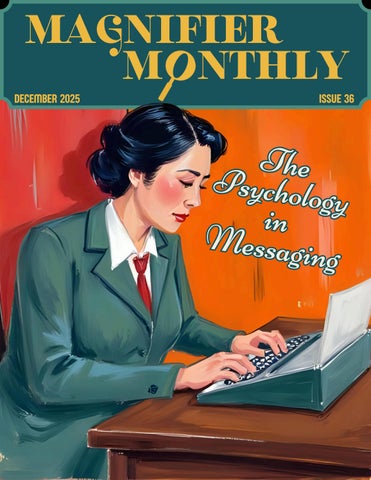
MAgNIFIER O M NTHLY DECEMBER 2025
ISSUE 36
Thhee T Ps P sy ycchhoollooggyy inn i Meessssaaggiinn M gg
CONTENTs 1
FEATURES LETTER FROM THE EDITOR................................. 3 The Message Maketh The Money
STRATEGY SECRETS............................................... 5 The Guidelines of The Rule of 7
USEFUL BUSINESS GADGETS.............................. 7 Engagement Rates
2
DIY SOLUTIONS MONTHLY PUZZLE................................................... 10 Cryptogram
DIGITAL TRENDS...................................................... 12 Enshittification, social media, and teens
3
CURRENT EVENTS
PROJECT PORTFOLIO........................................... 13 LOCAL & SOCIAL..................................................... 15 Client Event Calendar
4
laughs MEME OF THE MONTH.......................................... 17
Cover image by Magic Media
THE MESSAGE MAKETH THE MONEY About a week before Thanksgiving, I went shopping for a pair of loafers at Macy’s. I was in desperate need of a versatile, classic shoe that goes with anything and is comfortable enough for a full day’s work. I was so desperate, in fact, that it didn’t even cross my mind to wait a week for a Black Friday discount. But lo, while I was browsing the extensive loafer selection, I noticed red signs all over the place: 50% off for Black Friday sales! What great fortune! (My fortune ended there. They didn’t have any options in my bigfoot size and I had to order online and have them shipped to my house in order to get the final fit.) This isn’t new. Black Friday sales have been creeping earlier every year, and the actual ‘Friday’ part has become a bit of a moot point. Now, we get inundated with sales messaging while we’re still taking down our Halloween decorations. In fact, we get inundated with sales messaging everywhere we turn. Digital platforms have made advertising so ubiquitous that even when we’re taking a break from the
3
physical world, we’re still seeing ads. Case in point: Remember all of the “THIS IS KAMALA” messages we got during the campaign? Maybe you’re not a registered democrat, or maybe you live off the grid, but it really felt like her marketing managers had somehow penetrated every. single. digital. channel. known to humankind. Texts, emails, calls, Hulu ads, YouTube ads, Instagram ads, all asking for “urgent” donations to the campaign. Let me tell you, I’m as pro-democracy as the next gal but being on the receiving end of the flood of all that messaging was pretty fkn annoying. It’s pretty hard to not get cynical about it, or the holiday season, when it all becomes so dominated by sales pitches. I suppose that’s the natural course of capitalism, but who wants to be sold to all the time? I work hard for my money, and I don’t want to give it up to organizations that seem to have a disregard for privacy and lack a sense of communication decorum. It makes one wonder: Why do they do it?
A LETTER FROM THE EDITOR Madelyn Veith
To a certain degree, it works. Otherwise, companies wouldn’t invest so much in Black Friday messaging if it didn’t lead to products flying off the shelves every year. And, Kamala might not be president (ugh) but her campaign did ultimately raise over a billion (!!) dollars. There’s literal science behind why repetitive messaging works (and I’ll be tapping into my psychology degree to share more about that later), but it also begs a few questions, like how much messaging is too much? How much is not enough? And how do I get any messages at all to penetrate the impenetrable wall of an overcrowded, AI-slop-riddled digital fortress? You’re so welcome for bringing these dreary existential questions to your door right in the midst of a busy holiday season when your brain is already occupied with all of the gifts you still have to buy and all the cookies you still have to bake.
Debuted the new loafers at the WIFS PDX Jingle & Mingle party this month!
with my favorite sleuths? That while I wish you a restful, low-stimulus holiday season, and I’ll see you in 2026 (in my new loafers, of course)!
And now for the issue at hand… But hey, what kind of digital mastermind would I be if I didn’t capitalize on a seasonal moment to share relevant marketing secrets
The psychology of messaging and what how it translates into your marketing strategy awaits!
4
STRATEGY SEC
S T E R
The Guidelines of The Rule of 7
1
As an industry that stakes its reputation on creativity and innovation, you might not think of marketing as a field governed by rules. But, its foundational mechanism is human connection, inevitably linking it to psychology, a field very much characterized by principles and theories that seek to classify behavioral patterns. However, by the time said human behavior gets filtered through a scientific lens and subsequently applied to a marketing practice, you can simply think of marketing “rules” in Pirates of the Caribbean terms: They’re more like guidelines.
2 One such guideline is The Rule of 7, which posits that it takes an average of seven “touchpoints” with your brand/product before a customer is convinced to officially make a purchase. This concept was first identified in the 1930s when Hollywood movie marketers realized it was taking more than just a few messages to convince audiences to purchase a movie ticket, and the magic number they landed on was seven ‘exposures’. The science behind this pattern was later studied in 1956 by cognitive psychologist George Miller. His research, now known as Miller’s Law, showed that humans can hold about seven “items” of information in their immediate memory, and that they use a strategy called “chunking” to overcome this limit (grouping smaller pieces of information into larger recognizable patterns).
5
3
This means that there are real (scientific) limits to how humans receive and process information, and that if we want to really reach people, we can’t just be throwing messages out there like pasta at the wall. We have to be intentional and repetitive, especially in the digital landscape where our brains are already overwhelmed with social media content and AI slop. In fact, marketing trends are showing that it takes about 10-20 exposures (repetitions) to compel a customer conversion these days. But, don’t mistake repetitiveness for randomness: Effective messaging requires a coordinated approach that strategically leverages multiple channels and creates a congruent narrative around your brand.
The first place to start is with some market research. Figure out who your audience is (their buyer persona), then figure out where they spend their time. Everyone uses multiple digital applications throughout their day, and 4 you want your message to show up as many of the the places where their attention is already focused. That, combined with their buyer persona, narrows down your options for where marketing makes sense. The content you put in the message is what will differentiate your repetitions from that of a sketchy, telemarket-y brand as that of a trusted one. Your content is ultimately an expression of your brand, so being consistent with it (in both frequency and design) is crucial. The design itself should be unique to your brand, speak to your audience, and adapt to the formatting of the channel it’s on. Ultimately, you won’t know what your magical combination of frequency, placement, and relevance is until you try it. You’ll probably need to try various combinations, measure results and tweak your formula as you work your way through iterations of your message (this is the premise of A/B testing). But, like a somebody famous and probably athletic once said: You miss 100% of the shots you don’t take.
5
6
USEFUL BUSIN
ENGAGEM ABOUT A good marketing strategy includes monitoring the engagement metrics. A great marketing strategy makes a practice of interpreting the engagement rates. While both the metric and the rate can tell you how your audience interacts with your content, a metric is simply one data point, a quick glance at how many people are doing something—liking, sharing, commenting, clicking, opening, etc. The rate takes this a step further and tells you how that behavior can be characterized in the context of your overall marketing strategy. Engagement rates are calculated as a ratio: # of people who actually participated in the behavior “Getting warmer...”
# of people who could’ve participated in the behavior
That percentage gets you a few degrees closer to the meaningful information, like identifying where people move within your content, or where there may be gaps in your pathways. The more you know about how people actually interact with your content, the better you can curate your content to elicit the behavior you want.
...IN ACTION! Imagine you own an online jewelry store and you want to use email campaigns to drive sales. You have a mid-size audience and send them weekly emails that feature new items and include a flash sale discount code. You’ve noticed that your email open rates have gradually declined and you want to know why. You use a few engagement rates to pinpoint the drop-off and understand what compels people all the way through your final call-to-action.
7
NESS GADgETS
MENT RATES INSTRUCTION MANUAL 1. Locate the analytics for the content in question.
Mailchimp > Campaigns > Report Squarespace > Analytics > Engagement > Page Views
2. Identify the reach metric (the viewing audience).
Delivered to 504 people.
3. Identify the engagement metric(s) (audience behavior).
200 opens 175 link clicks Time spent on link page: 1m10s
4. Calculate the engagement rate(s).
200 opens/504 deliveries = 39% open rate 175 clicks/200 opens = 87% click rate
5. Analyze the engagement rates and their possible interpretations.
Out of the entire viewing audience, 200 people opened the campaign. Of the 200 who opened, 175 actually clicked the link to the landing page. Once they were on the landing page, they spent an average of 1m10s. The click rate is high, which probably means that of the people who are already compelled to open the email are equally as interested in my additional content. The open rate is low, which means that there’s something missing that compels people to open the initial email... think of what this could be? Try A/B testing with different sending times. Maybe I’m sending too many emails, could reduce frequency and build anticipation between messages.
8
9
T H N L O Y M
Puzzle Solution on next page...
CRYPTOGRAM THE PSYCHOLOGY OF REPETITION
The key mechanism of The Rule of 7 is repetition, but why? Uncover the psychology in these statements.
13 17 26 6 26 22 26-26 24 12 7 11 19 22 26 26 20 20 26 3 13. 22 26 12 26 13 5 13 5 7 21 1 19 5 18 15 11 22 26 3 7 16 21 5 13 5 7 21. 20 8 6 5 18 5 8 22 5 13 9 22 26 15 19 3 26 11 22 5 11 14. CLICK TO PLAY
10
FINAL
SOLUTION The Mere-Exposure Effect. A psychological phenomenon where repeated exposure to something increases our preference for it. Subconsciously, familiar things feel safer and the more we see a message/brand, the more we come to like and trust it. Like how you didn’t like that one album on the first listen but now you can’t get it out of your head.
Repetition Builds Recognition. Our brains naturally filter all of the messages we receive because there’s a limit to how much detail that can be stored in our memory centers. Repeated exposure makes it easier to recall the brand, and it also begins building trust—the foundation of every buying decision.
Familiarity Reduces Risk. There’s a reason that Craigslist has a dodgy reputation: Buying things from strangers is risky. You don’t know whether or not you can trust that what the seller says actually matches what they’re selling. The longer you get to know a brand, the safer you’ll feel about making a purchase.
11
1. Enshittification is a published concept. First coined by author and journalist Cory Doctorow in 2022, enshittification is the degradation of the quality of online platforms over time in the pursuit of profits. He recently published a book about it, and it contains relevant cautionary tales for anyone who uses digital platforms to reach consumers. 2. Australia pushes back on social media. Australia recently became the first country to limit social media use, enacting a ban on social media for people under the age of 16. You may not market to Australians under 16, but it’s worth monitoring tech policy changes and how that impacts your future strategies. 3. The social media trifecta for teens is clear. Pew Research published its latest report on social media usage amongst teens: YouTube is the leading app, followed by TikTok, Instagram and Snapchat; X was last.
Digital
TRENDS
12
S
N
M
E
RATIO
Monthly services to help grow the national brand and provide a seamless member experience with efficient digital operations.
SOCIAL MEDIA
WEBSITE
OPERATIONS
EBSIT
E
W
Viewable work is linked via the icon.
OP
You can find all of Marove Agency’s current client collaborations on these pages.
KETIN AR
G
t c e j o r P ortfolio P
Monthly services to build a foundational brand through website design and grow business tiers with digital store design.
WEBSITE
1311
CLIENT SPOT AVAILABLE
e r i u q En ithin! w
e r i u q En ithin! w
CONTACT
CONTACT
KETIN AR
E
CO
M
E
G
M
CLIENT SPOT AVAILABLE
MITT
SOCIAL MEDIA
Volunteer work with WIFS PDX as a co-chair on the marketing committee.
14
EVENT
FEBRUARY
JANUARY
DECEMBER
Hyperlinked events are open for attendance/registration.
15
4 Oregon Sports Angels Pitch Day
CALENDAR DECEMBER
WIFS PDX Book Club
JANUARY
20
FEBRUARY 16
O F T M ON HE
17
HT
E M E M
telemarketers and their absolute disregard for The Rule of 7:
18
S IS A THI
PUB LICATION
, k r o w Get to hs! sleut