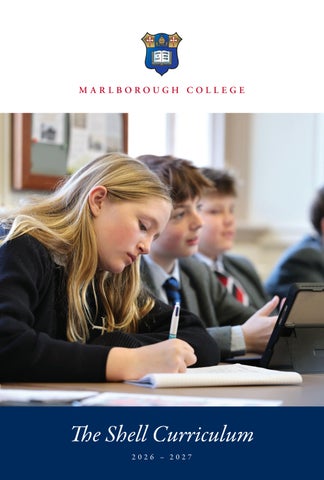
The Shell Curriculum 2026 – 2027
DEPUTY HEAD (ACADEMIC) Ms Alys Langdale tel. +44 (0)1672 892421 acl@marlboroughcollege.org DIRECTOR OF ADMISSIONS Mr James Lyon Taylor tel. +44 (0)1672 892300 admissions@marlboroughcollege.org
Contents The Shell Curriculum
3
Art
4
Classics
4
Computing, AI and Data Science: The Shell Program
5
English
7
Exercise & Sport Sciences
8
Geography
8
History
9
Mathematics
10
Modern Languages
11
Music
12
Product Design Engineering
13
Sciences
14
Biology
15
Chemistry
15
Physics
16
Theology, Philosophy and Ethics
17
Academic Support
18
1
2
The Shell Curriculum Central to the Marlborough education is a commitment to learning as a skill for life; learning for its own sake rather than as a means to an end. A strong performance in public examinations provides a valuable passport to opportunity; however, true academic excellence is born of intellectual curiosity and academic rigour, not of relentless focus on assessment and results. Thus, we support our pupils to develop skills and habits of mind that will serve them through the rest of their lives, well beyond their comparatively short time with us. Pupils in Shell study a broad curriculum, including humanities courses in English, History and Religious Studies. They will also study Mathematics, Science (taught separately as Biology, Chemistry and Physics), Modern Languages (two chosen after a three-week carousel of six different languages), Latin (and for some, Greek), Geography, Art, Design Technology, Music, Exercise and Sport Sciences, and Computer Science. Pupils also have Personal, Social, Health and Economic education lessons, while careers and digital citizenship are taught across the curriculum and through a series of key events through the year, such as workshops and lectures. Pupils are set in relatively few subjects in the Shell year. In Mathematics, the year group is divided into two halves, and pupils are set from 1 – 6 in each half. In Science, the year group is also split into two halves, and pupils are set from 1 – 6 in each half across all three sciences, so that a pupil in Set 1 for Biology is in the same set for Chemistry and Physics. Setting is always considered approximate in the first instance, and it is an expected feature of the first term that there will be one or two re-setting opportunities to ensure that pupils are in the class most suited to maximising their progress. This is also true as a pupil moves into Remove and Hundred, where re-setting takes place following major assessment points. There is no setting in the Humanities subjects, though pupils are placed in broad ability streams by design, and movement between classes in these subjects is uncommon. The Shell year should be one of discovery and opportunity, of feeding current interests and igniting new passions. It is a significant transition phase in the academic life of your son or daughter, during which foundations for future success, within the College and beyond, should be laid. I sincerely hope that he or she enjoys this initial stage of their journey.
Alys Langdale Deputy Head (Academic)
3
Art All Shell pupils study a stimulating, informative and engaging introductory course which offers a balanced programme of art practice. The essential skills of drawing, recording painting, printmaking, textiles, sculpture, ceramics and lens based as well as digital media are explored, partly through a focus on the work of relevant contemporary and preceding artists. Pupils acquire a deeper understanding of artistic language through their practical studio work and written responses as seen across their Art workbook. They are also encouraged to discuss art in class, enabling a more mature insight, greater visual inquiry and awareness. Individual teachers formulate their own course content, with prep being set fortnightly. Our rich, varied and thorough teaching of Art during the Shell year, will give pupils an opportunity to make an informed and confident decision when making their GCSE choices.
Classics The Shell Classics course aims to develop the linguistic skills necessary for the study of Latin and Greek, and to foster a natural curiosity about the ancient world. The Classics Department is home to a 2,000 year old Egyptian Mummy and an excellent cast collection of Greek sculpture. Many places of archaeological interest, such as Avebury, Bath and Stonehenge, are within easy distance of the College. All pupils study Latin in the Shell, using Cullen & Taylor’s Latin to GCSE 1. There is a strong emphasis on exploring the derivations of Latin words in English, to appreciate how Latin still lives today within English and Romance languages. The narrative in the textbook gives pupils access to the foundational myths of classical culture, especially the Trojan War. In the Lent term, pupils (for whom Latin is no longer appropriate) examine how these stories are portrayed in both literature and art. Greek is taught to pupils in the higher Latin sets during some of the time normally allocated to Latin, and the course lays the necessary foundations for GCSE Greek. Pupils are also encouraged to enter the district reading competitions (for the reading aloud of Latin) in which we have an excellent record.
4
Computing, AI and Data Science: The Shell Program “ The Fourth Industrial Revolution is blurring the lines between the physical, digital, and biological spheres.” Klaus Schwab, World Economic Forum The Shell program is designed to transform pupils from passive consumers of technology into innovative architects of the digital age. In an era defined by the exponential growth of machine intelligence, we equip Marlburians with the technical fluency, algorithmic logic, and ethical grounding required to lead in a world reshaped by code. A Journey Through the Digital Landscape Our curriculum is structured into six immersive modules that bridge the gap between abstract theory and tangible creation: 1. Computer Systems – Pupils begin by deconstructing the machines they use daily. We move beyond the interface to explore the “engine room” of computing—from the physical architecture of CPUs and memory to the binary logic that governs all digital information. This module includes a study of the history of computers, tracing the evolution from early mechanical calculators to the silicon revolution. 2. Python Programming Basics – Programming is the new literacy. Using Python, the industry standard for data science and research, pupils learn to translate complex ideas into executable code. By mastering variables, loops, and conditional logic through the Turtle graphics library, they move from basic scripts to creating visual art through logic. 3. Python Programming Advanced – Building on their foundational skills, pupils tackle more sophisticated challenges. This module introduces complex data structures, such as lists and the use of external APIs and web-scraping tools. A central theme here is Encryption, where pupils apply their coding skills to simulate historical ciphers, understand the mathematics of secret communication and recognise the contributions of the Bletchley Park codebreakers. 4. Artificial Intelligence & Machine Learning – In this forward-looking module, pupils move from using AI to understanding it. They explore the mechanics of Machine Learning, practice the art of Prompt Engineering, and debate the ethical implications of algorithmic bias. Pupils will experiment with classification and prediction models, gaining insight into how machines “learn” from data. 5
5. Data Science – In a world of “Big Data,” the ability to interpret information is power. Pupils interact with real-world datasets to uncover trends and tell compelling stories. This module focuses on Data Visualisation, teaching pupils how to transform raw numbers into impactful charts and graphs to drive decision-making. 6. App development – The year concludes by bringing all previous skills together to build functional software. Embracing the modern “vibe coding” workflow, pupils use AI-assisted tools to architect, design, and code their own applications. The module culminates in pupils creating standalone executable files, allowing them to share and run their original software on any machine. Beyond the Computing Classroom The Shell program provides a significant head start for those choosing GCSE Computer Science in the Remove and Hundred. It also supports the College’s digital drive and PSHEE program by: • Investigating History: Highlighting the contributions of pioneering cryptographers and OMs, such as Gordon Welchman (C3), to connect modern tech with our heritage. • Ethical Inquiry: Critiquing the privacy concerns and environmental impact of global data centers. • Digital Agency: Empowering pupils to navigate the digital world with skepticism, skill, and a “architect’s” mindset. By the end of the year, Marlburians are not just users of technology—they are the doers, thinkers, and dreamers equipped to excel in the digital future.
6
English The Shell English course aims to generate creativity and imagination within the reading and writing of our pupils, as well as consolidating and developing literacy. Pupils will experience diverse texts and authors, ranging from Shakespeare to contemporary writers, both fiction and non-fiction. They will be introduced to the rich literary heritage of the College through the study of Old Marlburian writers such as the war poets Charles Hamilton Sorley and Siegfried Sassoon as well as John Betjeman and Bruce Chatwin, amongst others. There will be a focussed study at a thematical and contextual level of Shakespeare’s plays concluding with a Shakespeare essay competition, as well as further study of modern drama. Creative writing is at the heart of our teaching and learning. Pupils will compete in poetry and prose competitions, with a focus on descriptive writing. The best pieces will be published in our Piccalilli magazine and entered into external competitions. Throughout, they will be asked to respond to texts at both an analytical and an imaginative level. With the support of the Memorial Library, pupils will engage with the ‘Read-oRama’ programme and be pushed to develop the ambition and sophistication of their independent reading. Lesson time will be devoted to reading skills and each pupil will keep a reading log of their own progress. Alongside that, in class, they will study a variety of classic novels and short stories. Through their study of prose, poetry and drama we will develop analytical skills so that all pupils can complete effective analytical essays by the end of the year, which will prepare them for their GCSE courses. Language and literacy skills will be enhanced with a focus on SPAG (spelling, punctuation and grammar) via the online Century programme and exploration of non-fiction genres. In the summer term, there will be a focus on oracy and pupils will deliver speeches and talks to their classmates. Overall, our intention is to inspire the pupils to sophisticated reading and writing through exposure to great literature.
7
Exercise & Sport Sciences The Shell Exercise & Sport Sciences curriculum is designed to assist pupils to develop their ability to move well through a series of fun and active teaching activities. Pupils are taught in small, co-educational classes, with the support of a teacher, graduate assistants, and input from the strength & conditioning team. The entire programme is spread across our fantastic sports facilities, championed by the state-of-the-art physical conditioning suite. The Lower School Exercise & Sport Sciences curriculum has been redesigned to be progressive across the Shell and Remove years. The Shell are introduced to a number of physical activities, such as: “Athleticism”, where pupils challenge their ability to apply fundamental movements like accelerating, squat, lunge, jump, and land in a range of physical settings; Free Flow (a series of movement challenges based on the principles of gymnastics, play and climbing); Fundamental Movement, where pupils develop their fundamental skills and challenge their movement patterns; traditional track and field athletics, with a focus on the functional movements required for success. The Shell Curriculum is supported by relevant Sport Sciences theory wherever applicable to help educate pupils on the benefits of a commitment to physical activity on their wellbeing, as well as introduce theoretical concepts taught on our GCSE course in the Remove and Hundred.
Geography The Shell Geography course encourages pupils to look more closely at their immediate surroundings and to develop a broader interest in the world that lies beyond it. The themes that we study give pupils a good grounding in the core topics that they will encounter at GCSE. There are three core components of the course: Wilderness Environments, Hazards and Oceanography. Core topics include the wilderness environments of Antarctica and Siberia, as well as primary and secondary hazards associated with Tsunamis and Avalanches. Oceanography includes issues surrounding plastic pollution and oceanic dead zones. In addition, one or two special topics are chosen by individual beaks. Throughout the course there are structured units of work that allow pupils to develop their IT skills and to take advantage of the vast amount of electronic resources. We introduce Geographical Information Systems (GIS) which provide IT tools for investigating important and relevant physical and human phenomena. 8
History Our Shell History course is designed to give pupils a knowledge and experience of a wide range of historical events as well as important skills. It is structured thematically rather than by topic, so that pupils and their beaks can explore connections between a number of related historical themes and developments. It is designed with an eye to allowing pupils to develop particular historical enthusiasms. When they arrive, pupils will study historical themes associated with the College and the local area. They will then learn the major features of ‘Politics’ and ‘Political Systems’, in order to set them up for a study of ‘How and why wars start’. This will coincide with Remembrance Sunday and the last part of the Michaelmas Term will be given over to an investigation of memorialisation, including its role in politics and propaganda. In the Lent Term we will study oppression and genocide, and we will focus on the Holocaust. The live issues of Holocaust denial, conspiracy theories and fake news will be discussed, and pupils will have ample opportunity to learn techniques to sort out truth from fiction, so far as possible. We will study some of the more creative and impressive aspects of propaganda too, such as the projection of kingship or religious power. The course will conclude with a consideration of ‘what is civilisation?’ and ‘what makes civilisation?’, questions that allow ample scope for debate, as well as a reflection on our own society. Much of the course forms a solid – but also creative – introduction to the IGCSE History course. There will also be ample opportunities for trips, near and far, and we have been blessed with remarkable speakers.
9
Mathematics The Mathematics Department has two aims: to introduce pupils to the beauty and excitement of mathematics and to provide the skills necessary for the productive study of other subjects. The ability to think logically and to solve problems is an essential life skill. Pupils at Marlborough College are encouraged to think critically, creatively and, above all else, to engage whole-heartedly with the mathematical puzzles to which they are introduced. In the Shell, pupils will consolidate their knowledge in areas of algebra, geometry and numeracy and master key skills in trigonometry, quadratic expressions, negative and fractional indices, Pythagoras’ Theorem in three dimensions, probability and circular sectors. With secure understanding of these skills, pupils are encouraged to consider reallife contexts in which they can be applied and so identify their relevance outside the classroom. Both within and beyond the curriculum, pupils will be supported and challenged, building confidence and extending understanding. In addition to the normal work of the classroom, pupils have the opportunity to compete in national competitions, such as the UKMT Intermediate Mathematical Challenge and the National Cipher Challenge.
10
Modern Languages Pupils in the Shell are required to study two modern languages. The Department enables each pupil to make an informed choice from the languages on offer, by holding a two week Language Circus of six languages: French, German, Italian, Mandarin, Russian and Spanish. This takes place during the first two weeks of the Michaelmas Term. Pupils are encouraged to approach this opportunity with an open and enquiring mind, and they express their preferences at the end of the process. The decision as to which languages pupils proceed with is taken in consultation with the language beaks, tutors and Housemaster/ Housemistress. The Department aims to satisfy language choices as far as possible. In the case of German, Italian, Mandarin, Russian and Spanish, the study of a language ab initio provides a novel intellectual challenge and the opportunity to discover a different culture. In the case of French, pupils improve and deepen their knowledge of the language, laying the necessary foundations for success at IGCSE, and also spend part of the course learning about interesting aspects of French society and culture. It is also possible for pupils with previous knowledge of Spanish and Mandarin to join a continuation group, following initial assessment. It is expected that (I) GCSE choices will be based upon the two languages which pupils choose in the Shell. In exceptional cases, if a pupil wishes to revert to a language which they have previously studied this will be possible up until Christmas. After the Shell, pupils must continue one language to IGCSE (French, German, Italian & Spanish) or GCSE (Mandarin & Russian) and may continue both as two (I) GCSE options.
11
Music The Shell Academic Music course is designed to give pupils a broad and practical introduction to music. The scheme of work explores a range of musical styles and skills, including the basics of musical elements, listening and analysis, songwriting, West African drumming or Samba, the history of Western Art Music, and composition. Pupils begin by learning fundamental musical concepts and considering what music is and how it is created, through the philosophy of music and studying the elements. They explore developments in Western Art Music through programmatic music, looking at how composers use musical elements to tell a story without words from the Baroque era to the present day. This is followed by a study of West African drumming or Samba, including traditional music from Mali or Brazil, developing ensemble skills and an understanding of music from different cultures. As an introduction to GCSE Music, pupils study music from Star Wars by John Williams, one of the Edexcel GCSE Music set works. Through this, pupils are introduced to GCSE-style listening and analysis, learning how composers use melody, harmony, texture, rhythm and instrumentation to create character and mood. This unit helps pupils become familiar with the expectations and language of GCSE Music in an accessible and engaging way. In the songwriting unit, pupils take on the role of music producers, creating their own track based on a contemporary genre. Practical musicianship is further developed through composition using the music notation software Sibelius, allowing them to craft and notate their own musical ideas. This course provides a solid foundation for progression to GCSE Music by developing key skills in listening, performing and composing. Pupils gain confidence in analysing music, working creatively and collaboratively, and understand how music is formed through the elements, supporting a smooth transition into further music study.
12
Product Design Engineering Our Product Design Engineering foundation course blends design principles, ergonomics, engineering science and material knowledge to enable pupils to tackle emerging global issues and develop potential solutions. This is integrated with digital, additive and traditional prototyping processes, technological interventions and engagement with contemporary practitioners to enable pupils to turn their ideas into reality. Problem-solving is at the heart of all design activity and each pupil will tackle a series of structured design modules as part of our internal carousel. Some of these challenges will have an aesthetic bias whilst others draw on a developing awareness of technology; most will result in a manufactured product. Our ICT facilities provide opportunities for pupils to experience 3D printing, graphics, laser work and computer aided design. Critical thinking is a key ingredient in future-proofing careers and we want our pupils to be the ones leading with initiative. Ensuring the doers, thinkers and dreamers are equipped with the skills necessary to devour any challenge put in front of them. As a foundation course we aim to encourage pupils to think logically and clearly through problems, whilst providing a sound platform for continuing to study Product Design at GCSE and A Level. The foundation course will also support pupils in moving on to other STEM curriculum options such as the BA Crest Award, Engineering Education Scheme, Arkwright Scholarship Applications and Artefact based EPQ. By combining a thorough design education with a sound engineering base, all Shell pupils are ideally placed to conceive and develop innovative designs while empathising and communicating effectively with a range of stakeholders.
13
Sciences: Biology, Chemistry and Physics are compulsory to IGCSE. The Shell year forms the foundation for Pearson Edexcel’s International GCSE Science examinations in the Hundred. Following the Shell end of year examinations, those pupils with a demonstrable need for additional support with their sciences are offered the chance of a place in a dedicated Science (Double Award) set from the start of the Remove. Otherwise, we offer two routes to IGCSE, outlined below. Pupils are entered for the examination which is most appropriate to their aptitude, ability, and future aspirations, and decisions on whether to follow the Separate Science route or Science (Double Award) route are not made until the end of the Remove year. 1 – The Separate Sciences • International GCSE Biology, Chemistry and Physics (9-1) 4BI1, 4CH1 and 4PH1 Pupils taking this route study all three sciences as individual IGCSEs and will be awarded an examination grade on the 9-1 scale for each science. Pupils sit two examination papers in each subject in the Hundred. 2 – Science (Double Award) • International GCSE Science (Double Award) (9-1) 4SD0 Pupils taking Science (Double Award) also study the three sciences but sit only one examination paper in each subject in the Hundred. Two IGCSE grades are awarded for Science (Double Award), reflecting the reduced content of this course in comparison to opting for the three Separate Sciences.
14
Biology The Shell course covers the following topic areas: ‘The nature and variety of living organisms’ – reviews and expands on the foundations of biology such as microscopy, cells and the diversity of life. ‘Nutrition’ – explores photosynthesis and plant nutrition as well as human nutrition, the digestive system and the need for a balanced diet. ‘Enzymes’ – introduces the chemistry of life. ‘Ecology’ – considers living organisms in their environment, including how man’s activities affect them. ‘How Science works’, which considers the principles of investigations – how data are collected, presented and interpreted, is incorporated into all four of the topic areas shown above.
Chemistry The Shell course covers the following topic areas: Topic 1: Atomic Structure and the Periodic Table. Topic 2: States of Matter and Solubility. Topic 3: Elements, Compounds and Mixtures. Topic 4: Ions and Ionic Formulae. Topic 5: Ionic Bonding. Topic 6: Chemical Tests and Equations. Topic 7: Acids and Bases. Topic 8: Calculations I – Moles and Reacting Masses.
15
Physics This Shell Physics course introduces students to a broad range of fundamental concepts drawn from the Pearson IGCSE Physics specification. Each topic is taught as an accessible introduction rather than in full depth, allowing key ideas and skills to be revisited and developed further in later years. The curriculum is structured as a spiral, supporting longterm understanding through spaced repetition and regular retrieval practice. Maths Skills – Develop the mathematical foundations required for physics, including rearranging equations, using standard form, interpreting graphs, and applying proportional reasoning in scientific contexts. Magnets – Explore magnetic materials, magnetic fields, and the behaviour of permanent magnets and electromagnets through practical investigations. Motion – Examine how objects move, introducing concepts of speed, distance, time, and acceleration, and using graphs to describe and interpret motion. Forces – Understand the effects of forces on objects, including contact and non-contact forces, resultant force, and basic ideas of Newton’s laws through real-world examples. Wave Properties – Learn the fundamental characteristics of waves, including wavelength, frequency, amplitude, and wave speed, and how these properties are related. Sound – Investigate sound as a longitudinal wave, exploring how sound is produced, transmitted, and perceived, including pitch, loudness, and echoes. Electricity – Discover the basics of electric circuits, including current, voltage, resistance, and the safe construction and testing of simple circuits. Radioactivity – Gain an introduction to atomic structure and radioactive decay, including the properties and uses of alpha, beta, and gamma radiation. Density and Pressure – Build understanding of density and pressure in solids, liquids, and gases, applying these ideas to everyday situations and simple calculations. Energy and Generation of Electricity – Explore different forms of energy, energy transfers, and methods of generating electricity, with consideration of efficiency and environmental impact.
16
Theology, Philosophy and Ethics The Shell Theology, Philosophy and Ethics curriculum provides pupils with a comprehensive understanding of different worldviews, philosophical concepts, and ethical theories, setting a solid foundation for their future studies and fostering critical thinking skills. Theology Pupils delve into the beliefs and practices of Judaism, Hinduism, and Buddhism, gaining insight into diverse cultural perspectives and religious traditions. This knowledge serves as a strong foundation for the GCSE Religious Studies, where the focus shifts to Islam and Christianity. Philosophy Through engaging thought-experiments, pupils will develop their abstract thinking skills and explore key ‘problems’ in Philosophy. This component of the curriculum aims to cultivate pupils’ ability to analyse complex ideas and engage in intellectual discourse, encouraging them to ponder deeper questions about free will, the self, and the nature of reality. Ethics Pupils will also learn about several ethical theories, chosen from Utilitarianism, Kant, Virtue ethics and Natural Law. They will examine how these theories can be applied to real-world situations and consider ethical dilemmas and moral decision-making processes. Lessons are interactive and discursive, encouraging pupils to engage in dialogue and articulate their viewpoints. They will learn how to justify their arguments and how to construct evaluative essays, a skill crucial for academic success.
17
Academic Support Our goal is to help pupils develop the skills that they need to think and learn independently. To ease the transition at the start of Shell, we try to continue exam arrangements from Prep School. However, the exam boards do expect us to reassess GCSE access arrangements after the start of Year 9. We identify pupils’ needs through close liaison with Prep Schools and the use of screening tools at the beginning of the Shell Year. In addition, we have an ongoing system for internal referrals from Housemasters and Housemistresses, Heads of Year, class teachers, and careful reviews of internal data. When a concern is raised, we meet with pupils for an initial interview to gather information and carry out additional screeners. This may result in a recommendation to consider an assessment by an Educational Psychologist who has a working relationship with the College. We can also offer in-house specialist teacher assessments, which are typically taken up by pupils who have already had a full Educational Psychologist report. Where the query is around Attention Deficit Hyperactivity Disorder (ADHD) or Autism, we can provide information on assessment centres that Marlburians have found helpful. The exam boards are very clear that rest breaks have to be trialled and evidenced before extra time is put in place, so please be aware that even if a consultant recommends extra time, rest breaks will be trialled first. For this reason, it would be helpful if a diagnosis could be sought as early as possible. In order to ensure that our pupils are as independent as possible, we offer a targeted, tiered approach to support: Tier 1 support provides a short-targeted series of up to 6 sessions developing a particular study skill. Tier 2 is available for pupils who would benefit from more sustained support. Pupils with a diagnosis or who are entitled to 25% extra time may discuss with the Deputy Head Academic taking one fewer subject from the Michaelmas half-term and instead having additional small group sessions within the Academic Support Centre. Tier 3 adds 1:1 support to the Tier 2 offer. A variety of support is offered to address gaps in pupils’ learning. The development of effective higher-level reading and writing skills is crucial to academic success and plays a central role in academic support lessons. Pupils are also encouraged to develop their organisational skills and have the opportunity to explore a range of approaches to revision and exam techniques. Sessions are also available to support pupils who have English as an Additional Language. Our aim is for pupils to develop confidence in their own learning so that they can succeed academically whilst developing the skills that will equip them for life. 18
19
03/26
20
Marlborough College (Registered Charity No, 309486) incorporated by Royal Charter to provide education.
Marlborough College, Marlborough, Wiltshire SN8 1PA Tel: +44 (0)1672 892300 www.marlboroughcollege.org