SALUTATIONS

Madam Speaker, I rise today, grateful for the opportunity afforded by my constituents, the good people of South St Andrew to stand before you. I hail them all, some of whom have taken the time to be here today, including our Councillors, Councillor Candidates and members of our Constituency Executive. To my wife, my soulmate, my partner, dearest friend and foundation of my support system, Sandra - I thank you; and I thank our children for their understanding and patience, as I move forward daily to fulfil the charge of leadership that I have been given in taking the People’s National Party forward, onward and upward.
I hail too my fellow elected representatives in this House, on both sides of the aisle, and those who sit in the Upper House of this Parliament. Thank you for all that you bring to this Parliament to make it the unique place that it is. Even if we get a little heated sometimes, at other times we work together and that is when we are at our best.
In particular, I want to extend a hand of fellowship to acknowledge my colleagues on this side who have stood with me as we work to fulfil our Party’s vision of social justice, equality of access to opportunity and the rights and freedoms of all Jamaican people, which are the core values that our Party holds dear to its very heart.
I hail too, the team at the Office of the Leader of the Opposition; the team at our Headquarters; all members of the Party, and indeed, all Jamaicans. In our heart-of-hearts, most of us want nothing more than to see our island home grow, develop and flourish, with our friends and families in tow. We, as Jamaicans, yearn for a productive, island home and to live our best lives as content and happy people.
Now, perhaps more than ever, Madam Speaker, as we meet well into this sixtieth year of Jamaica’s political independence, as citizens of this remarkable nation, blessed with a world-renowned spirit of creativity and resilience, we are forced to evaluate the route in which our people are being taken in the name of nation-building.
2
It provides an appropriate juncture for us to consider once again - How do we achieve the state of national contentment and security that our people seek and deserve? How do we make Jamaica a place where all our people can thrive and achieve progress in their lives to build their own individual versions of the Jamaican Dream?
Madam Speaker,
Over 40 years have passed in which we have accepted the view that the role of the state is merely to facilitate the private sector, who will then lead growth and growth will trickle down to the people. I suspect most Jamaicans no longer accept this.
We have to look around us and assess what is happening in our nation. We have to ask: what does the state of the nation have to do with the government that we have? Who is the government serving? Is it serving the broad base of the people?
With this current government, people’s lives are not a priority. They are not doing what the Most Hon. Portia Simpson Miller used to call “Balancing the books while Balancing people’s lives”.
I speak today from the premise that the role of government is to facilitate the people, all types of people, and facilitate their potential for growth. When we look at the state of the nation and listen to the daily frustrations of the people, it is clear that the Government is out of step with the people. They are still practising trickle-down economics, when the world is moving on. If people cannot feel the reform and the recovery that the Finance Minister is celebrating, it simply means we are not focused on the right things.
The time has come to move our country in a new direction.

3
SETTING THE CONTEXT
We have closely scrutinised the Budget projections presented by the Andrew Holness Government for fiscal year 2023-2024. The Budget tells you the priorities of the government. I cannot see the change we need. We need to see the nation move to fair labour practices, improving broad access to the resources of the nation, to opportunity, and to sustainable and good living. This government is not prioritising the change we need to see.
This is not a budget for the people. It reflects the character and interests of those who this Government primarily serves. Here are two examples: Why wouldn’t the Government find a way to extend the period for the public sector salary negotiations, to allow the groups to make measured, well-informed and transparent decisions on the wage offer, instead of being bullied and cajoled by “take it or lose it”?
Why is there no budget for the overdue, constitutionally-required Local Government Elections?
It is because they do not prioritise fairness in economics or the deepening of our democracy.
The annual budget exercise is a serious exercise. It has made me reflect on the role of leadership. Standing before you as Leader of the Opposition and President of the People’s National Party, is truly an awesome responsibility. I know that there are many relying on my voice to stand in the defence of the people and the democracy we believe in.
The conditions of life that Jamaicans are suffering through today are very challenging, and are intensifying. To face them requires leadership with the people’s interests at heart. It requires leadership of good character to create a nation where we live good with each other. I will stand in defence of:
• Every Jamaican who is now languishing on a hospital bench or chair when they should be resting in a hospital bed.
• Every Jamaican who has to be making hard choices between having breakfast or giving the children lunch money.
4
• Every student who is second-guessing the path they have chosen, because they aren’t confident that when they complete their education they will be able to find meaningful employment and to make a good quality of life for themselves.
The budget should speak to those realities, that are faced by real people, with real lives, real families, real hopes and real dreams. This Budget should be about building Jamaican dreams. But it is not about that at all. It is more of the same, when people want a New Direction.
Where are we coming from?
Reviewing Fiscal Year 2022/2023
Last year, the Andrew Holness Government came to the people with a Budget that they said was meant to respond to the social and economic challenges left in the wake of the period of the COVID 19 Pandemic. They acknowledged the rising global interest rate environment, and the severe supply chain disruptions due to a war between Russia and Ukraine being fought on the other side of the Atlantic. Food costs were rising. Energy costs were increasing dramatically.
The government tabled a budget of 912 billion dollars. We, on this side, looked at the projections and knew that, with the spike in inflation and the sharp increases in the cost of living, especially food, transport and electricity costs, the provisions for social support were inadequate.
The weakened Jamaican economy had not yet recovered the lost ground from the severe dislocation of the Pandemic. Prices of basic necessitiesfood, electricity, transportation, medication – were rising above and beyond people’s stagnant incomes; and have continued to rise week in, week out.
With all that was then happening in the world, and with the conditions already being experienced by our people locally, it was clear to us that budget would not see the nation through what was going to be among the people’s most difficult year in our modern history. As basic conditions of life worsened for most Jamaicans, with most struggling to survive, we put our heads down, spent the time, put in the work to double-check.
5
Madam Speaker, I stood right here in this very space and told them that it would take another 40 billion dollars (about 2% of GDP) to get the people of Jamaica through this period without the society unravelling. I asked them…I begged and implored them to make the appropriate adjustments. I said further support of 40 billion dollars for vulnerable Jamaicans would be needed to cushion the crisis. It could be financed by slowing the pace of debt reduction for the year.
The usual voices jumped out. The budget crafters put their greatest strategic asset, their media apologists, into action. The result? Gaslighting and pure chat. They spun and they spun…called us every name in the book. They tried to make us out as fiscally irresponsible. They rubbished our warnings, instead saying that if another 40 billion dollars was added to the budget the sky would fall in; the country would mash-up.
We ignored the noise and watched the sale, continuing to advocate for more social support to cushion the crisis on the people.
Madam Speaker, last month, the Minister of Finance, as is customary, tabled and presented the budget for the upcoming Fiscal Year. But then, for the first time ever in this country, he came back to the House to present a new supplementary estimate for the previous budget. So after he tabled the next budget he was still adjusting the last one. History was indeed made in this House.
Even more than that Madam Speaker, this supplementary estimate, brought suddenly to this House by the Andrew Holness government between the tabling of the old budget and the budget debate for the new one, was their fourth supplementary budget in one year. Fiscal confusion!
Yes, Madam Speaker, so here we are, four Supplementary Estimates later. Four! Having started with an estimate of 912 billion dollars for year 20222023, the Government ended the fiscal year with a spend of 1.02 Trillion dollars; Yes, expenditure of 1.02 Trillion dollars was the budget year 2022 – 23; that is the final budget for this fiscal year now ending.
So last year’s budget, the one for the year 2022 - 2023, was actually Jamaica’s first trillion dollar budget! The budget for the coming year 2023-2024, so proudly announced, was NOT the first trillion dollar budget. In truth and in fact, last year’s budget, the one that just ended, actually was.
6
Do you know what that means, Madam Speaker? It means that amidst their bluster and noise, much more could have been done, and much earlier, to ease the suffering of Jamaican people.
Choices were indeed made, but they have failed to cushion the crisis. All know, Santa Clarke nuh come to the ghetto.
But instead of using $40 billion out of the $95 Billion in additional taxes this year to cushion the crisis, as we proposed, the Government has gone about frustrating and upsetting the Jamaican people:
The public sector workers are frustrated and upset that they are being pressured and bullied by the Government and its sycophant mouthpieces to agree to the terms of a public sector pay restructuring which they don’t understand, where uncertainties abound and where, for many, it seems that they will be worse off after all the additional tax is taken out of their pay. We say, don’t tell our police, teachers and other dedicated public servants to “take it or lose it”. That is disrespectful fear mongering.
The people of Western Jamaica are upset and frustrated by the debacle at Cornwall Regional Hospital. It has become the mother of all cost overruns and delays. The overall restoration project was originally to have cost $2 billion, but is now at $14.1 billion and counting. The facility has been unable to function normally for six years now, with no end in sight.
What is happening to taxpayers’ money? Surely the West deserves the best? There has been no accountability for this monumental incompetence that this Government has inflicted on the people of Western Jamaica.
The people of St Thomas and Portland are frustrated and upset with the negligent and uncaring way in which the South Coast highway Project has been implemented, leaving to live in the terrible dust with respiratory ailments, and to have to traverse miles and miles of terrible dug-up roads every day, for two years and counting. Our brothers and sisters in the East are begging for a new direction!
The high levels of fines under the new Road Traffic Act seems like the Government is trying to extract more revenues out of an already struggling population. Doesn’t the Government know that pressure buss pipe? The amnesty for the tickets and demerit points left many feeling like the system is a fraud; and a month later the responsible Minister still hasn’t
7
fulfilled his promise to fix the child seat issue, after the JLP MPs voted down the Bill I prepared and brought here, in less than a week, to fix that problem.
The whole transportation system needs a brand-new direction. Madam Speaker, The investors in our emerging medicinal cannabis industry are frustrated and upset that the Government is licensing imports of large quantities of surplus ganja from Canada to be imported and dumped on the local market. The brethren across the country want to be part of a new direction for the Ganja trade! Why shouldn’t they, the originators, who took the blame and bore the oppression, not be able to profit from the gains?
Many Jamaicans are frustrated and upset by the way this Government treats vulnerable Jamaicans when it comes to land and housing, demolishing the homes of single mothers and running them off public land without making any provision to provide them with alternative shelter for them and their children.
Many Jamaicans are frustrated and upset by the SSL scandal, where our national icon Usain Bolt was robbed of his retirement savings while others in Government closed their accounts before the you-know-what hit the fan. That whole process is so obscured… the new direction must include transparency and equity.
Many Jamaicans who believe in the democratic system of local government that is enshrined in the Constitution are frustrated and upset by the Government once again using its majority in Parliament to subvert democracy by pushing through last-minute legislation to again put back the local government elections, which are three years overdue, on totally spurious grounds, because they are afraid to face the people.
And what is worse, the Government’s Fiscal Policy Paper says it is collecting $766 billion in taxes from the people this fiscal year. That is $150 billion (or over 24%) more taxes than the $616 billion it collected in the prior 2021/22 fiscal year. It is also $95 billion more than the $671 billion in taxes it originally budgeted to collect for this fiscal year. $95 billion in surplus taxes from the people this year, above what was originally budgeted!
It is worth noting that the Government projects that it will collect $824 billion in taxes in the coming 2023/24 fiscal year. That is an increase in tax collections of over 34% over the two fiscal years from April 2022 to March
8
2024. 34% increase in taxes over just two years! An increase in taxes of $208 billion dollars!
The massive increase in the amount of taxes collected from the people over the past two years brings to light just how hollow is the refrain of “No New Taxes” that was bellowed in this House, to the predictable but fundamentally empty beating of tables, last week Tuesday. The 34% ($208 billion) increase in taxes over the past two fiscal years is significantly greater than (nearly triple) the accumulated inflation over that two-year period, which is projected to be 12.3% (7.1% in 2022/23 and 5.2% in 2023/24). It comes in a period where people’s living standards are being ravaged by the cost-of-living increases.
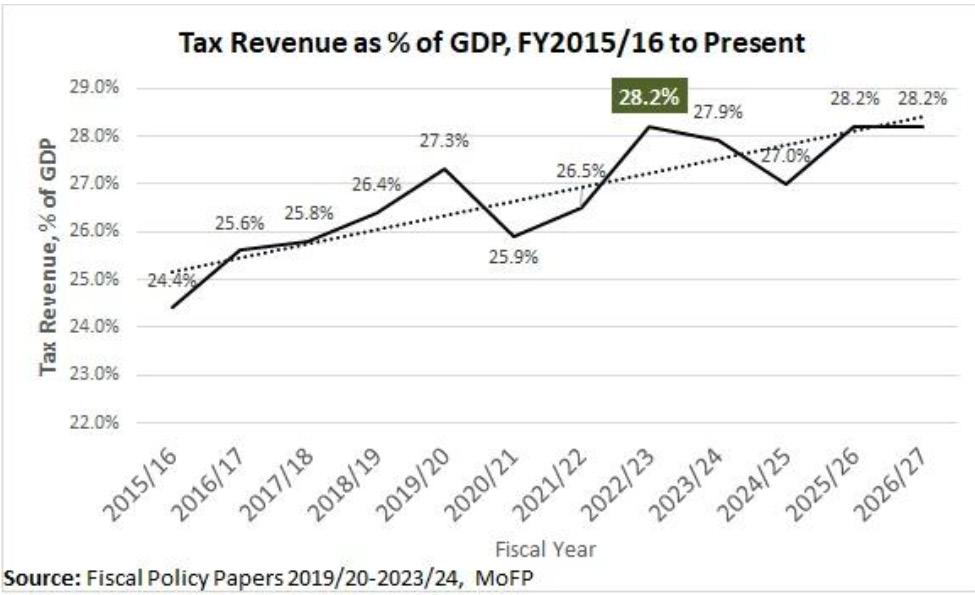
And these massive increases in taxes weren’t limited to the last two years, but if we look at the last seven fiscal years the tax take has increased from 24.4% of GDP to 28.2% of GDP placing Jamaica amongst the highest taxed countries in the world. (See the Tax Revenue as % of GDP graph below).
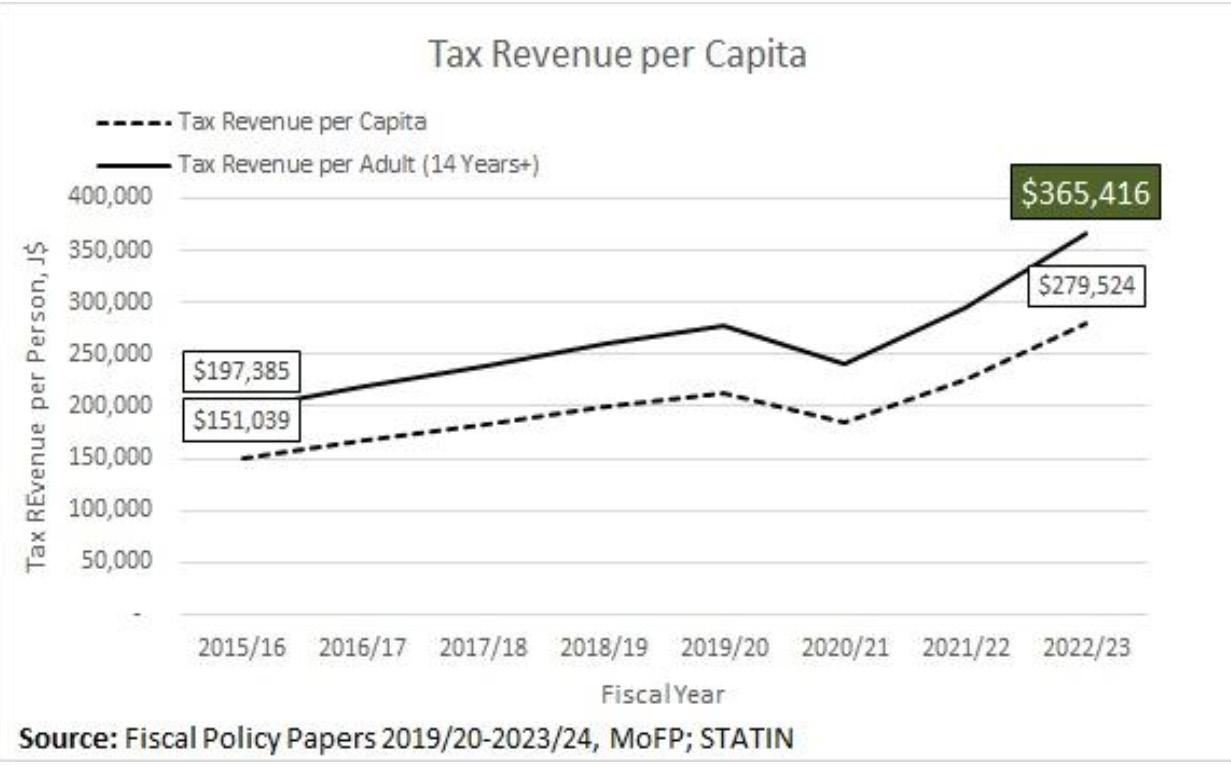
And if we want to think about it another way, to look at it from the perspective of the individual, then over the last seven years of JLP administration, the tax take from every Jamaican (15 years and older) has increased from $197K in 2015/16 to $365K in 2022/23, an increase of 85%. This JLP administration is now extracting an additional $168K from the pockets of every Jamaican! Then they come with the samfie statement bout no new taxes. (See the Tax Revenue per Capita chart below).
9
And since the vast majority of the taxes in Jamaica are now indirect taxes, the poor and lower income earners bear the brunt of it in the GCT on local purchases (projected to increase by 31% to $156 billion in the coming year over what was originally budgeted for this year) and the taxes paid on the importation into Jamaica of basic necessities of life.
One aspect of this which was particularly aggravating this year was the ad valorem special consumption tax on gas, which was based on an average projected world oil price of US$67.50 for the year. The ad valorem gas tax is a percentage of the price of gas and other petroleum products, so that the higher the oil price the higher the amount of tax charged in each litre of gas. In last year’s budget debate, when it was already apparent that the oil price would be much higher than that, I called on the Government to give motorists, transport operators and electricity consumers a break on the ad valorem gas tax.
The mechanism I proposed was to cap the tax at the budgeted oil price of US$67.50, so that the people would not suffer any additional tax if and when the oil price went above US$67.50, and the fiscal targets for the year would not be affected. I even went so far as to personally draft the Order capping the gas tax on that basis, and I personally went to the Ministry of Finance to deliver the draft Order to him. Well, I never received a reply, and never heard a word from the Minister on the gas tax cap.
10
As it has turned out, the average oil price over this fiscal year has been above US$90.00, and the Government has benefitted from billions of dollars of gas tax by refusing to cap the tax at the budgeted price of US$67.50.
The SCT on imports for the first nine months of the year was J$7.8 billion (or 18%) above budget, which accords with my own projection as to how much the people would have been saved if the cap had been put in place.
Well, since you didn’t listen last time and it has bitten everyone in their algorithms, please, for the sake of the Jamaican people, listen this time. Time Come for a new direction. We saw what you did there when you said no new taxes! We know it means much more taxes. It is just like telling us that the number of serious crimes is going down, while we all watch, in terror, the dastardly nature of crimes intensifying!
One of the things Jamaicans resent most is being taken for a fool. “Yu tink me a eediat?” is a core question that this country has been asking this Andrew Holness government in recent times.
The disregard for our people heightens their anger and frustration. Another example is the manner in which the new Road Traffic Act was rolled out. The police who enforce the new Act have shared with us the total amounts of traffic fines imposed under the new law. This has sent the signal to the population that the much higher high fines for minor traffic infractions under the new Act is less about road safety and more about collecting revenue.
And while I am on this topic, where is the amendment to the Regulations that we were promised on the 7th February? Remember the Government used its majority here to block the Bill I had sought to table that would have fixed the child seat problem? The Minster promised us that day that it would be ready by the end of that week. Well, more than a month has passed and all now we have not seen and heard about those Regulations. In the meantime, taxi operators remain uncertain as to their legal exposure in transporting children.
Heaven knows, and so do Jamaicans, that we need a new direction!
How is the Government deploying the massive amounts of additional taxes it is taking from the people? Instead of strengthening the safety net and investing heavily in the developmental needs of the people, they are intent on reducing the public debt at any even faster rate than is required by the fiscal rules. They are projecting to bring the public debt to below 60% of GDP by March 2027, which is a year earlier than the target in the fiscal rules.
11
It sounds good, but is it wise and prudent? Why accelerate and bring forward the repayment of debt when the society is under so much pressure. People are losing hope for the future, and the social fabric is unravelling rapidly with the ongoing daily diet of depraved murders and domestic violence?
I should mention here that the recovery from the economic shock of the pandemic was not growth in any meaningful sense – the nation’s productive capacity has not grown since the pandemic struck in 2020. What has happened is that, as social distancing ended, tourists returned to our island and business returned to normal and once again utilised our existing productive capacity, we have recovered to ground zero of 2019 from the precipice of 11% of GDP that we fell into with the pandemic.
Indeed, our rate of recovery has been, in comparative terms, really nothing to crow about. In 2022 Barbados, St. Lucia and Bahamas, each of those countries with progressive governments in charge, recovered GDP at faster rates than Jamaica. They grew at 10.5%, 9.1% and 8.0% respectively in 2022, versus Jamaica’s 5.1%.
The better and more sustainable strategy is to invest heavily in our people NOW, through better education and training, better healthcare, and land and housing for those who are excluded under the current system. Investing in our people is the only way that our national productivity will increase, our economy will grow rapidly and in an inclusive way, our people can generate significant wealth for themselves, and the raging crime monster will be tamed, even as we steadily reduce the public debt to the targeted level of 60% of GDP.
Jamaica cannot afford to continue as we are going now. People are fed up. Those who can migrate are doing so, whether it is nurses and teachers who have been leaving at an alarming rate, or others who have become asylum-seekers, crossing the Mexico/US border.
12
Police and soldiers are fighting each other in our streets
Bandits are breaking into ATM Machines
The corner shop and community bar are no longer safe places to hold a vibz
Not even the armed guards of an armoured courier service are safe in today’s Jamaica
Society is unravelling under this Government:
Disorder is the new order.
Government badness run weh good governance.
There is despair, instead of repair.
Aggression and violence instead of love and care.
Time Come for a change in the way things are done and a new set of priorities. What is in effect is not working. Jamaica must address the deep challenges that must be successfully confronted and overcome if we are to achieve the full potential of greatness that is the Jamaican Dream. Time has come for a new direction!
The new direction we take as a country must address the concerns about two specific the weight bearing structures, two pillars of the 23/24 budgetTaxation and, Recovery and Growth
13
THE 5-IN-4 ILLUSION
Mme Speaker, I want to look first at the painfully slow rate of growth of the Jamaican economy in the past seven years. When this government took over in 2015 the debt to GDP was down to 120% the fiscal surplus was 0.6% of GDP. The Current account deficit was only 2% of GDP. Inflation was 3.7% and unemployment was below 10%. Given the history of our economy, what that all means is that they got a relatively good wicket to bat on. Certainly good enough to give them the confidence to say that they could achieve 5% annual growth of the economy by 5% by the end of 4 years.
That 5-in-4 promise, of course, turned into a pipe dream. Meaningful GDP growth has proved elusive. The average rate of real GDP growth for the four fiscal years from 2016/17 through to 2019/20 was negligible, just 1% per annum. In fact, in the fourth year of the 5-in-4 period, there was negative growth of 0.1%.
That four-year period of very low growth performance was before the major hit of the pandemic which collapsed Jamaica’s GDP in 2020/21 to negative 11%, from which we have just recovered back to where the economy was before Covid.
When the Finance Minister speaks of ‘rapid growth’, he is really speaking about the rate of recovery of the economy – climbing back up out of the pandemic hole. He boasts about how quickly we have recovered, relative to past crises. As I have indicated, other countries in our region have recovered faster than we have. Furthermore, I would argue that the dramatic slump in mid-2020 was very different to the deep and prolonged structural challenges flowing from crises of the past. Our productive capacity was unaffected by the pandemic, though it was temporarily under-utilised. As the tourists resumed travelling in droves, we quickly returned to where we were.
We are going in the wrong direction, and about 54% of Jamaicans have told us so. This can only mean one thing. Time come for a new direction.
14
SLOW PACE OF GROWTH
Having recovered back to 2019 levels of economic output, Jamaica once again faces the challenge of achieving meaningful levels of economic growth. The outlook is not pretty. The Government’s economic strategy is failing to generate meaningful growth.
Despite all the reforms and sacrifices to improve the fiscal management of the country over the past 10 years, the Government’s Fiscal Policy Paper, tabled with the budget for the coming year, projects an average annual growth of a mere 1.175% per year over the next four years, even after recovery from the pandemic.
In fact, it shows growth sloooowing down over the next four years, from 1.6% in the coming year 2023/24, to just 1.0% in the last two years of the four-year period ending in March 2027.
This slow growth rate will impair the ability to make much-needed investments in our people, to make the nation’s human capital more productive so that higher rates of economic growth can be achieved.
It is because we have taken the wrong direction, and it’s like a Catch-22 situation. Low growth means less money for investment in uplifting our people. But unless we invest in uplifting our people, we will never achieve meaningful and sustained levels of economic growth of 3-5%.
As the Shadow Minister of Finance eruditely illustrated last Thursday, Jamaica needs to escape the low wage, low tech model of development that this Government is pursuing, the inevitable outcomes of which are low productivity and low economic growth. Repressed wages lead to repressive government. Even if they deny it, it is manifest for all to see.
A major difference between the PNP and JLP strategies is that we prioritise investment in human capital, through education, training and programmes to get youths-at-risk back on track, while this Government prioritises building a grand new Parliament for us politicians to make speeches in.
Meanwhile, expenditure on delivery of instruction (i.e. teaching) at pre-primary, primary and secondary schools has declined in real terms over the past six years. The $73.7 billion tabled in the budget for the upcoming fiscal year is equivalent to $50.4 billion in FY 2016/2017,
15
due to 46% accumulated inflation since then. That is less than the $51.2 billion that was spent on delivery of instruction in FY 2016/2017. It has declined by 1.6% in real terms over the period.
The decline primarily reflects the reduction on delivery of instruction at the primary education level by 9.4% in real terms. So while the Information Minister has been complaining about “dunceness” in dancehall music, his Government has been reducing its investment in education at primary schools. And this Government has yet to outline any effective measures to address the two years of serious learning loss because of Covid school lockdown. This Government clearly does not value education.
To move Jamaica forward, we need to change priorities and put the people first. Invest in the Jamaican people to build Jamaica!
THE RT. EXCELLENT MARCUS MOSIAH GARVEY
The Finance Minister had an interesting section of his presentation last Tuesday in which he waxed eloquently on the Rt. Excellent Marcus Garvey. Much of what he said on Garvey, I agree with. Building and reinforcing self-belief, self-confidence and self-love in our people is essential to our national development, given our brutal past of slavery and colonialism which did so much long-term damage to our people. Marcus Garvey is a national treasure, whose message to the world is a powerful tool for achieving personal and national greatness in a country where the vast majority is of African descent.
However, where Nigel and I part company is in how to give expression to the power of Marcus’s greatness. Putting his face on a J$100 bill, as much as we support it, really won’t move the needle.
In fact, how can this Government dare to use the name and image of Marcus when:
• We see them mashing down people’s homes, dashing the hopes and dreams of a poor young women who says she holds receipts for her payment for the land;
16
• They have locked up thousands of youths who have never been charged, using State of Emergency provisions;
• They sit back while State agents cut off the locks of a young woman held in the police lockup to shame and tame her, and do nothing to right the wrongs committed against her!
• So many premature new-borns have died in public hospitals due to a failure to maintain basic hygiene standards, and until this day there has been no accountability to the grieving parents by those with whom the buck stops.
• They disband the Rastafari Advisory Council and exclude Rasta from the lawful ganja economy to empower their community, and refuse to meet with the Accompong Maroons to have respectful dialogue about their historical status and their land.
When we speak of Marcus Garvey, it re-enforces that a new direction is needed. Marcus said – “It is by education that we become prepared for our duties and responsibilities in life. If one is badly educated he must naturally fail in the proper assumption and practice of his duties and responsibilities”. Marcus would frown on the disrespectful way this Government has been treating our teachers.
We must be ready to truly harness the empowering greatness of Marcus Garvey’s philosophy by building it into our education system, teaching it in age-appropriate terms from the early childhood level upwards, as part of a system of education in civics which seeks to inculcate the positive values and attitudes in our people on which building a strong and cohesive society depends. We are ready to take the country in that new direction!
The best way we can honour Marcus is to utilise his philosophy and opinions in a deliberate and strategic way through the educational system to transform negative and dysfunctional behaviours so that a new generation of young Jamaicans emerges who embrace positive values and attitudes of discipline, personal responsibility, self-belief and self-awareness.
That is the right direction to take!
And the Government of Jamaica must honour his name and memory by participating actively in the ongoing struggle for exoneration for the
17
unfounded and unjust charges in the United States, in support of the valiant efforts by his son Dr Julius Garvey and most recently by Congresswoman Yvette Clarke who has co-sponsored legislation in Congress.
I am aware of (and I support) a pilot project that has recently started. Let it not be like the pilot project on using the Jamaican language in schools to help teach children to become fluent in English, which despite the successful results has not been embraced and developed into part of the national system of teaching English in our primary schools.
DEFENDING THE PEOPLE & THE CONSTITUTION
The Opposition has had to be vigilant in standing up for the people and defending their constitutional rights.
We have assisted 65 families who have been living for many decades in the rural community of Providence, near Lluidas Vale in St Catherine on lands which were purchased for them by the Michael Manley Government in the 1970s. Last October they were, unceremoniously and without prior discussion, served notices by the Government to vacate their homes.
We have been assisting these families to protect their rights to live in the homes they have built there over many years. When our lawyers were not provided with clear and firm assurances that were requested of the Government, an action was filed on their behalf in the Supreme Court. I am happy to say that I have been advised that an interim injunction has been granted by the Supreme Court to prevent any action being taken against them until the matter has been finally determined by the court.
Similarly, we are preparing a claim to be filed in the Supreme Court for compensation for the vulnerable families of Clifton, near Bernard Lodge in St. Catherine, whose homes were demolished last October in what can only be described as a most cruel and inhumane act by agents of the State.
The Opposition will continue to be vigilant when it comes to the hard-won rights of the people. As is well known, we have parted company with the Government in its repeated and ongoing use of States of Emergency (SOEs) as a routine policing tool in areas where there is a flare up of violence. Our clear understanding is that a State of Emergency is the constitution’s measure of last resort to protect the State from being subverted.
18
We know this is the right direction, because it stands for the rights of Jamaican people, all Jamaican people, and in particular the voiceless.
In late December, a month in which the Government twice declared SOEs without coming to Parliament for approval, I advised the public that this was of such great significance to the future of the country that we would be seeking the guidance of a court ruling on the matter. In the public interest, an action has now been filed in the constitutional court seeking declaration that the manner in which the Government has repeatedly been using SOEs since 2017, violates the Charter of Rights and is unconstitutional.
This is the context in which, when the Minister asked me to name two Opposition representatives to a constitutional reform committee, I sought clarity on the changes that the Government is intending to pursue in relation to two critical elements of the Constitution – the Charter of Fundamental Rights and Freedoms, and the matters in the Constitution which can be changed only via a referendum.
Most of the important provisions in our Constitution cannot be changed with support from at least two-thirds majorities of both Houses and, in some cases, a majority vote in a referendum, and it is therefore imperative that constitutional reform proceeds as a bipartisan process. After a great deal of to-ing and fro-ing with the Minister which did not provide the clarity I was seeking, the mechanism of the Vale Royal talks, which I have been calling for ever since I became Leader of the Opposition, once again proved its usefulness.
At our meeting with the Prime Minister and his team on the 19th February, we were able to have open and frank discussions on these matters, and we left with a much clearer understanding of our respective positions. I was thus in a position to name the Opposition’s two representatives to the committee, Senator Donna Scott-Mottley and Mr Anthony Hylton MP.
We will also be vigilant in ensuring that no changes are made to the Constitution which could dilute, weaken or undermine the rights of the Jamaican people.
We will also maintain our position that the time has come for Jamaica to move forward to full decolonization from Britain. This requires both the removal of the British Monarch as our head of state, to be replaced by a President who is a Jamaican; and also the removal of the British monarch’s
19
Privy Council in London as Jamaica’s final court of appeal, to be replaced by the Caribbean Court of Justice which Jamaica helped to design, establish and finance.
The Jamaican people must no longer be denied access to justice by having a final court in a country which Jamaicans cannot travel to without a visa and which involves massive costs which are way out of reach of ordinary Jamaicans.
INTEGRITY IN GOVERNMENT
We live in an era where the people have lost faith in politicians and the institutions of governance. We have passed laws to put in place a robust anti-corruption framework, but there is no demonstrated political will to deliver accountability. At least five Ministers of this JLP Government, and numerous politically-appointed board chairmen, have had to step down for various misdeeds and corruption. It is only the reports of the Auditor General, the pressure of the Opposition, and the revulsion of the wider public that forced them to step back in each of these occasions.
This has to stop. Without effective accountability, misconduct continues, and the public becomes increasingly cynical.
I pledge to the people of Jamaica that the next PNP Government will be different. We will make whatever further adjustments to the anticorruption laws and institutional framework are required to make them effective. I brought Impeachment Legislation to this House to hold parliamentarians to account for their serious misdeeds, and we will seek to pass it when we form Government.
And I have told my colleagues on this side – when we form Government under my leadership, don’t expect leniency and accommodations when it comes to wrongdoing. Expect full accountability. We will govern with integrity. Public resources are for the benefit of the People, and not for any individual’s personal gain or profit.
20
TIME COME
As representatives called to leadership we have to get to know and understand our people. Jamaicans have a propensity to ‘watch de ride’ until they have had enough. They will stay “down in the valley for a very long time” but dem “neva get weary yet”.
I have been on the ground in the last few weeks. It is clear. Jamaicans are not willing to sit back and be taken for a ride in the direction this government is going. New direction!
We have developed a raft of policies for immediate implementation following the next election, when we walk into the house and sit on that side. Madam Speaker, I will share some of these with you now.
A NEW DIRECTION
The policies of the New Direction to be implemented by a People’s National Party Government have been developed on the economic premise that the Shadow Spokesperson on Finance, and Member from South East St Andrew described to us last Thursday. He spoke of the current realities of Jamaica’s existing low wage, low tech economic model, with its inevitable outcomes of low productivity and low economic growth.
It is a trickle-down model, but virtually nothing is trickling down! Crumbs alone! Ask the security guards and the other contract workers! Ask the minimum wage earners in the retail and wholesale trade!
Ask the 739,600 Jamaicans living here who are outside the labour force and don’t even count in the unemployment statistics. They see no evidence of wealth trickling down to them! The people of Jamaica want to see a different approach to national development, that enables all our people to build a good quality of life and achieve the Jamaican Dream.
21
We are ready to implement transformational policies that lead to a more competitive labour force in higher paying jobs. Policies that promote an economy that encourages research and development and the deeper use of technology, accelerating productivity and growth.
A streamlined, integrated all-of government plan, with clear targets and timelines, where the left hand and right hand know what each other are doing, and both are working together. I agree that Job descriptions for the Executive is a good idea. But we must actually do it.
A PLAN OF ACTION
Madam Speaker, first, our direction is decidedly new because we will begin with a plan of action. Our action-plan includes and integrates every portfolio in a singular vision.
Now it is time for the real deal. Time Come for a new direction. Jamaica must address the deep challenges that bedevil our society; these challenges must be successfully confronted and overcome if we are to achieve the full potential of greatness that is the Jamaican Dream.
Grammy Award Winning Reggae Artist, Kabaka Pyramid said it well: Somehow,
If our country is to ascend from the social decay, behavioural dysfunction and high levels of violent crime where we find ourselves today, we must tackle the deep structural disadvantages faced by the vast numbers of historicallydisadvantaged Jamaicans.
In the interest of time, I will share a few that fall within the framework.
22
way
work
some
Got to make things
Long life, more pay That’s what I deserve No time, no day Hand to mouth cyaan’ work I got to rule my destiny I know what my life is worth
REPAIRING THE BREACH
There is much to repair in our island home Madam Speaker. I will start by focusing on the two main structural fixes that we believe are priorities. These will occupy the full remedial attention of the PNP government following the next election. They are Land, and by extension housing; and Education, and by extension skills training.
We know that by addressing land distribution and ownership we increase the confidence of Jamaicans, so that they are confident and secure in the knowledge that they have somewhere to call their own, to house and raise their families, grow food, and trade goods and services within their communities.
Similarly, we must create a society of self-aware and critical thinking society with globally-marketable skills, aptitude and competence, dedicated to building Jamaica but also trained and able to operate anywhere in the world. Everything, we believe, revolves around that.
LAND
Our approach to the distribution of land in Jamaica has failed the least resourced people of Jamaica for centuries. Bogle and William Gordon were allied on land reform to transform post-Emancipation Jamaica and to enfranchise the formerly enslaved.
23
The PNP under my leadership is dedicated to transformational development of Jamaica, beginning with the belief that fairness and social justice must be at the heart of how land is deployed for housing, community building and agricultural use in the development of our nation.
We believe that regularising land tenure, giving greater legal access to land to more people more efficiently, brings greater order in society, gives hope and builds trust among people. Regularising land tenure, for us, is not condoning lawlessness. It provides a real sense of ownership and something to work for. It is a basis of creating intergenerational wealth, and the elimination of inter-generational poverty. It is your own soil to till and your place to build. The very psyche of a people, their sense of responsibility, dignity and pride begin with owning a piece of the rock.
First and foremost, our land policy is based on regularisation, not redistribution. It is grounded in equity, not exclusivity. We believe in parity, not patricians. We build up homes, communities and spirits. We don’t mash dem down!
The establishment of communities across Jamaica is at the core of our Land plan. Communities are vital to any nation, and where adequate infrastructure exists, then families are more resilient and communities are more cohesive and stronger.
The absence of infrastructure is an indication that something is amiss in a society. Housing is a basic need for all human beings; without it, living a decent life is very difficult and mere survival is the name of the game. Too many informal settlements in Jamaica are without basic infrastructure, such as proper roads, water, sewage, drainage, street-lighting on streets, and garbage disposal services; and too many low-income communities have infrastructure that is old and decrepit, has long out-served its useful life, and is in dire need of rehabilitation.
I have seen with my own eyes the beautiful, impressive homes that our people have built for themselves, through their own, tremendous resourcefulness, having got the benefit of proper infrastructure and land tenure to turn informal settlements into vibrant communities, the result of proactive, visionary government policy in the interests of the people under the PNP.
The next PNP Government will complete any outstanding infrastructure and land titling in those communities where the work was started but has been
24
left incomplete for many years; and we will adopt a policy of proactively bring infrastructure and land titling services to informal settlements, with reasonable and affordable terms of cost reimbursement, and backed up by support from state agencies such as the NHT to provide financing so that the people can create immense wealth for themselves by investing in their homes. The basic development model is proven and sound, and will be buttressed by robust, transparent and accountable governance.
We have also now developed a far-reaching set of legislative proposals that will, for the first time, comprehensively tackle the intractable issues of land titling for our people.
The PNP is also committed to the creation of legislation which will better enable the development of a land titling system that will be accessible and beneficial to all Jamaicans. To that end, the Opposition suggests the following:
• A comprehensive review and overhaul of existing legislation to make land ownership more affordable and accessible.
• The period of ownership by possession for Crown land should be changed to a shorter, less oppressive period. Working alongside municipal corporations and relevant governmental agencies to undertake incremental in frastructural development and land titling in support of vulnerable residents, where informal settlements already exist.
• All of this will be guided by consultation and engagement with citizens.
This relates directly to the 700,000 persons living in informal settlements in a country our size. All of us have to face the fact that there is a deep problem. Fixing these problems - sustainably, equitably, transparently ….. not in a piecemeal fashion, but in creative, practical ways over the shortest possible time, that’s what we’re about. We must provide all our people with pathways to a decent quality of life and productive citizenship. Land tenure, infrastructure and housing must be transformed if we are to achieve a cohesive and sustainable society that can underpin a strong and productive economy.
The Jamaican people deserve no less. This takes us directly to educating the Jamaican people, and I turn now to education.
25
The education system needs a new direction. Time Come. The Patterson Report and the Davies Report speak to the systemic changes needed in the education system. We are committed to implementing the recommendations of the Patterson report. But we have three additional programmes that we want to see put in place.
• Early Childhood Development will be the priority of the New Direction for Education. This will be supported by a comprehensive policy to address the broader needs of children from birth onwards.
• A system of early childhood development gets all our children off to the right start. The New Direction will hone in on basic schools that are struggling to survive. Many are closing under the weight of high operating costs. We will make the investments required to raise the standard of our early childhood education system, and provide support so that teachers at basic schools can earn a reasonable salary. Time come to repair the foundation of our education system and set it in the right direction, a New Direction.
• The New Direction also focuses on transforming the first eleven years of every Jamaican child’s life. Jamaica must achieve the outcome that all our children are able to read, write and do basic arithmetic by Grade 4. In our primary schools:

- Teaching will be supported by proper nutrition and deepening this use of educational technology
- Equipping students with social skills will be another priority
- The link between wholesome values and active citizenship will also be emphasised
26
- Particular attention and emphasis will be placed on under-achieving primary schools, to raise standards across the board. Several of the school based social development interventions that they abandoned will be re-evaluated, updated and returned to schools across the island
- Remove the taxes from laptops and tablets for students and teachers, as has been done for racehorses.
• At the secondary level we will provide the support to education that is necessary to mitigate the effects of the negative social issues that are impacting students - teenage pregnancy, weak family structures, substance abuse, anger management and aggression.
• We have always seen education as the antidote to inter-generational poverty. Tertiary education must be accessible to those who need it most, so that they can positively transform their prospects in life.
On the matter of student loans, a year ago I spoke these words, and wish to recommit to them today:
“We will cap the student loan borrower’s loan payments at a manageable percentage of his or her income, so that the State, not the student, bears the risk of the economy generating adequate employment opportunities; in periods of unemployment, we will suspend loan payments and tack them onto the back end of the loan, without penalties.
We will eliminate the requirement of a guarantor for a student to access a student loan; we will cap the student loan borrower’s loan payments at a manageable percentage of his or her income, so that the State, not the student, bears the risk of the economy generating adequate employment opportunities; in periods of unemployment, we will suspend loan payments and tack them onto the back end of the loan, without penalties”.
• Teachers also remain top of mind, with the need to retain our teachers being greater than ever. The New Direction has required creative thinking, and our spokesperson for Education and Training has proposed a series of benefits with that objective in mind. We will ensure that teachers get student debt reductions and motor vehicle concessions at levels which increase with their years of service; that teachers benefit from enhanced access to NHT loans and priority in housing allocations in NHT-financed schemes. We will also negotiate a package deal to provide our teachers with free internet service as a tool of their trade. These are all practical measures of support for our teachers, and form a part of the New Direction.
27
• HEART will be reinvigorated and re-purposed so that it provides the training opportunities needed to build a workforce that is fit for purpose for the em ployment opportunities of the 21sr century global economy. Stronger linkages with business and industry will be forged, to ensure the relevance and cutting-edge nature of our training programmes. The New Direction will include incentives to encourage employers to establish internship programmes that match the needs of business and industry with the course offerings of tertiary and skills-training institutions.
SOCIAL TRANSFORMATION
Social transformation is a pivotal element of repairing the breaches in our society, and we must focus on this as a central part of our formula for development. Transforming our society goes hand in hand with education and culture. When former Prime Minister P.J. Patterson spoke of implementing a ‘Values and Attitudes’ programme, his political adversaries of the day laughed him out of this chamber. But he saw what was happening to society from then. That won’t happen to us. Daily life in Jamaica confirms the descriptions of the country as a place of fear, struggle and suffering, with low social trust. In such a society life is insecure and seems to be of little value. Insecurity also speaks to some of the creeping things we see around us that rattle our national wellbeing:
• Our people feel insecure when Friday evening comes around and it is a battle to get money from an Automated Teller Machine, when our banks are going cashless and branches are being closed all over Jamaica.
• We feel insecure when we go to buy a little food and the card machines don’t work
• Insecurity comes from the exclusion felt by many:
- Who are told they are too this or too that, when it comes to the colour of their skin
- Who face less pay in their areas of work because of gender disparities
- Who are excluded from access to so many basic needs of life because they are Persons with Disabilities
28
- Who struggle to keep themselves and their families alive the mere pittance provided by PATH, NIS pension or poor relief, as the Shadow Finance Minister illustrated so clearly last Thursday.
These problems of heightened insecurity in the nation are reflective of intractable poverty, inequality, alienation and exclusion.
• The Shadow Finance Minister told us last Thursday, but it is worth repeating20% percent of the population is estimated to live below the poverty line, and over 30% of the population are deemed squatters
• Though the category of poor typically emphasises those living below the poverty line, it overlaps with the working poor on minimum wage or who are earning close to that
• World Bank figures illustrate that 3/5 of the country’s wealth is owned by 10 percent of the population.
These factors cause the insecurity and complex trauma that our people endure.
We want to see confident and productive Jamaicans, producing wealth, in an environment of respect, gentility, gender balance and care.
To do this we will be placing great emphasis on community-based interventions that focus on anti-violence, anger-management, parenting skills and overall civility. We will substantially increase the number of social workers to take on these critical tasks, and revamp and expand proven and effective crime reduction programmes like the Peace Management Initiative, Unite for Change and Restorative Justice.
29
SECURING OUR PEOPLE
Jamaicans are living with a heightened sense of insecurity, and just about everyone feels compelled to sleep with their windows and doors locked tight.
The exceptionally high crime rate has been a burden on Jamaicans for decades, and Jamaica remains one of the most violent countries in the World. Crime and violence are conditions created by our whole society, and we cannot ignore the links between inequality and crime. We must think in terms of social responsibility, which is why we favour interventions for youth-at-risk to give up our fundamental constitutional rights.
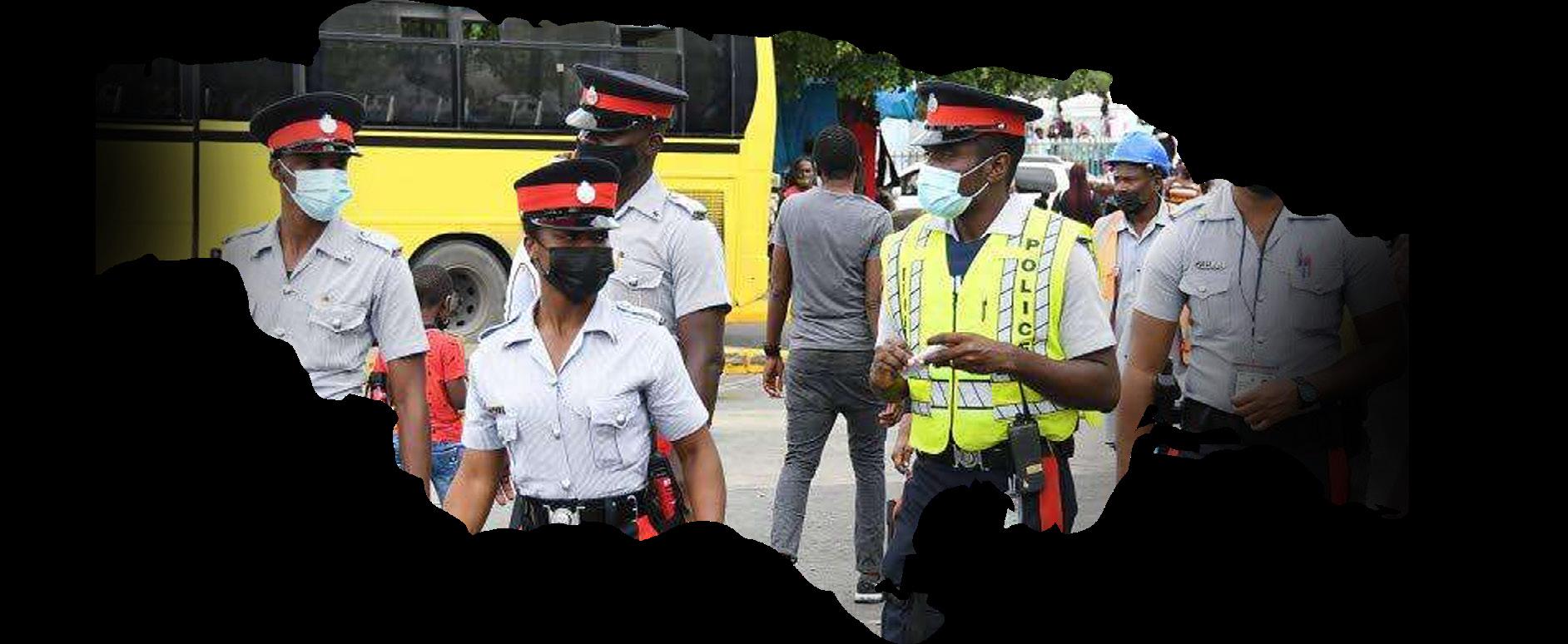
The increasing militarization of law enforcement is not a strategy that we endorse. It is dangerous, and it has not proved to be effective.
The ineffectiveness of the Government’s approach is underscored by the fact that in 2022, there were approximately 52.9 homicides per 100,000 inhabitants in our nation, and Jamaica maintained the position of the highest homicide rate in Latin America and the Caribbean that year. Globally, militaries defend against external threats. Why is our military being increasingly involved in policing work? Two years ago, I observed that the size of the military (JDF) was growing rapidly. I noted that on the trajectory it was on, it would exceed that of the police force within a few years. Similarly, the capital budget of the military has systematically and massively outstripped that of the police force.
Military expenditure, spending on the JDF, more than doubled to $36 billion
30
over the seven years that the JLP has been in power. This represents an increase in real terms of over 40% since 2017 – double the rate at which spending on the police force increased.
Increased spending on the military is attached to the continued use of States of Emergency as routine crime fighting tools. Under States of Emergency, citizens can be detained without charge for indefinite periods. This is a threat to our democracy, and we have filed an action asking the Supreme Court to rule definitively that it is unconstitutional.
Our position on crime, violence and the delivery of justice for our people remains consistent. We believe in a balanced approach, using both crime control as well as crime prevention measures. A balanced approach is essential to social harmony and crime reduction. It cannot be achieved through oppressive laws that trample on the rights of the people.
We will vigorously tackle the major root causes of violent crime in a systematic way, while also properly equipping the security forces and the justice system with the legislation, tools, technology and human resources to carry out their work. It is not possible to be successful doing one without also doing the other.
We believe that community intervention and targeted resources are essential to achieve sustained violence reduction. We will prioritise and invest in effective forms of social investment for crime prevention, to accelerate the sustained reduction of violent crime.
As I have mentioned, the Peace Management Initiative will be revamped, revitalised and made to work in all the hot spots across the country. We have seen, over and over again, how reprisals kill and maim the innocent, including our precious children. We must train and resource teams of violence interrupters on the ground in these communities, to intervene in conflicts and avert escalation into a spiral of reprisals.
We will train and empower 500 violence interrupters across Jamaica, to help to maintain calm and good order in areas prone to high levels of violence. This must be supported in our schools, with school-wide positive behavioural interventions through the Ministry of Education.
From the enforcement perspective, what is required is spear-fishing that targets dangerous criminals - the violence producers; not casting a wide net that snares both the good and the bad.
31
The Government must fashion legislation that allows known vicious purveyors of criminal violence to be taken off the streets, so that an effective case for prosecution can be brought against them. They are taking innocent lives, destroying families and sapping our collective hope for the future.
The procedure needs to have proper checks and balances to ensure that reliable intelligence, not suss and gossip, is the basis for their detention. Last December I put forward detailed proposals for a court-supervised process of pre-charge detention that targets persons on whom there is credible evidence that they pose a high level of danger of violence. The procedure is designed to allow credible intelligence to be strengthened into prosecutable evidence within a reasonable period of time (I have suggested 42 days), after which the detained person must either be charged or released.
In our prison system, the inadequate attention to rehabilitation and postrelease employment opportunities, despite the valiant efforts of NGOs, has resulted in unacceptably high rates of persons reoffending and returning to prison. The Minister of State has said that the rate of recidivism is 40%. SO, for far too many convicted criminals, the prison gates are a revolving door.
We must invest in programmes so that incarceration becomes an opportunity for rehabilitation, in addition to being punishment for transgressions; and we must find ways to assist persons leaving prison to be able to earn a lawful living for themselves and their families. The whole society benefits when a former criminal turns his life around and becomes a constructive member of society.
A worrying development is the plan to develop a for-profit prison in Jamaica, and to use taxpayers’ money to facilitate it. Very little has been disclosed to the public about this plan, other than the Government announcing that they identified 300 acres of land in St. Catherine for a new purpose-built correctional facility via a public/private partnership.
In the US, they call this the prison industrial complex, where mass incarceration allows for private companies to profit from prison labour. Why do we want to import this model into Jamaica?
Crime and violence are taking a multifaceted toll on Jamaica - socially, psychologically and economically. The Government’s expenditure on national security, which in our case has been inflated by increased military spending, reflects a sizeable part of the economic cost of crime. At $105 billion, it represents more than 85% of what is budgeted for spending on educating
32
our children. A more balanced approach to national development will facilitate a rebalancing of this expenditure.
In our last term in office, programmes like Unite for Change and the Peace Management Initiative helped to bring the murder rate down. We took it down to over 20% lower than it has been during the past seven years of this Government. We did it before, and we will do it again, as the economy grows and opportunities for a good quality of life open up for all our people. Time Come to set things in the right direction - the New Direction.
HEALTH
Few things shake an individual’s self of security than being unable to access or afford healthcare.
As it now stands, the public health care system in Jamaica is incapable of dealing with the needs of the general population.
• Patients having to sleep in chairs and on benches for days while they wait to be admitted
• The very high costs of diagnostic tests, surgical implants and medications that are not covered by the Regions, the Ministry of National Health Fund are out of reach of most Jamaicans

33
• Congestion in the hospital emergency rooms, and frequent breakdowns in equipment, from basic things like elevators, air-conditioning systems to critical tools like CT Scan and MRI machines
• Overcrowded wards
A New Direction for healthcare is imperative! If our hardworking healthcare workers are going to be able to treat our people effectively, the facilities at the public hospitals and health centres must improve.
Madam Speaker, there are 23 public hospitals in Jamaica. This does not include the University Hospital of the West Indies. There are also 316 active health centres across the country. Still, there are many patients who cannot access adequate care. These are mainly our elders who suffer from chronic Non-Communicable Diseases (or NCDs), particularly hypertension (high blood pressure) and diabetes.
• 1 in every 3 Jamaicans has Hypertension
• 1 in every 8 Jamaicans suffers from Diabetes
• 4 in every 10 Jamaicans suffer from mental illness over their lifetime, where the international average is about 3 in 10.
• The rapid increase in NCDs in this country is causing a growing number of Jamaicans to suffer renal failure. Many Jamaicans are unable to afford the necessary treatment - renal dialysis.
These are real and growing problems. To address this adequately, the World Health Organisation recommends that the spend on Health should be a minimum of 5-6% of GDP. In Jamaica we have allocated 4.3% of GDP. The Health Sector is therefore comparatively underfunded. Bringing the health budget closer to 5 to 6% of GDP will be necessary to take the healthcare system in a New Direction.
34
This New Direction under the next PNP Government would include the following priorities:
• Increase the number of renal dialysis centres, with the aim initially being to have one at all regional hospitals
• A National Health Insurance scheme will be a priority of our next administration. It would cost the national budget about $22 billion each year, and is essential to make the difference between treating an illness or waiting to suffer and die because of lack of resources, as is all too often the case now.
• A third priority programme is the expansion of primary healthcare across the country. This will involve upgrading of health centres, establishing mobile clinics in the deep rural areas, and expanding the numbers of community health aides across the country and deploying them out in communities. This is particularly needed for the treatment of NCDs and mental health patients island-wide.
• Greater emphasis will be placed on the training and retention of healthcare professionals:
- For nurses, we will resume the allocation of resources for scholarships and grants to nursing students and expand the number of permanent posts in the health system for nurses.
- For doctors, following the completion of their internship and a Senior House Officer 1 position, we will deploy them to serve in Jamaica’s rural areas. Incentives will be provided, to include scholarships for post-graduate training after a period of service in rural areas.
- We will upgrade all Type-B hospitals to offer more clinical speciality services, thereby reducing the burden on the regional hospital system.
35
Sustainable recovery also means that food security must be high on the agenda. This entails a robust agricultural policy.

We must also improve farm roads, irrigation and storage systems. We must encourage greater flows of capital into agro-processing. We must assist exporters to penetrate new markets and protect our valuable national brands. We must incentivize productive relationships between well-capitalised mother facilities and small farmers to improve their production techniques, transfer technology and generally support their development.
Farmers need greater protection from the ravages of the two-foot puss. The next PNP Government will significantly stiffen the penalties for large-scale praedial larceny, and bring that offence under the Proceeds of Crime Act so that the profits they make from robbing our farmers can be taken from the criminals and used to compensate the farmers.
Last year the Minister told this House that he was considering issuing permits for imported chicken parts from subsidised producers overseas, that would have unleashed unfair competition against the local industry and threatened the livelihoods of many thousands of backyard growers. Experience has taught Jamaica, the hard way, that undermining local producers is not good policy. Therefore, we spoke out against it, and it seems to not have been pursued. More recently, we heard about the importation of non-compliant rice by the politically connected, which was initially detained by the Bureau of Standards but then hastily released into the local market.
36
Clearly, the protocols and procedures governing basic food imports require an overhaul, and must be placed on a transparent footing to minimise the possibility of corruption. This is a commitment from the new PNP government, as we move the country in a New Direction.
As the Shadow Finance Minister graphically demonstrated last Thursday, food prices have dramatically increased due to the post-pandemic world inflation, and will be pushed even higher as a result of the terrible drought now impacting farmers across Jamaica.
I am once again calling on the Government to provide subsidies to reduce the cost to farmers for fertiliser, seeds and animal feed for chickens and other livestock, for the remaining duration of the current spike in inflation, so that consumers are spared further ravages in the spiralling price of food. This can be managed by the Ministry of Agriculture and the Consumer Affairs Commission, with the aid of the public, to ensure that the benefit of the subsidy is passed through to consumers.
The local ganja industry, and the public in general, were alarmed to hear that licences have been granted for the importation into Jamaica from Canada of commercial quantities of ganja for sale on the local market. Canada has repeatedly blocked the importation of Jamaican ganja for commercial sale, so there is no reciprocity to justify our market being opened to Canadian ganja.
Furthermore, there is an oversupply of ganja in the Canadian market, so that these imports may well be dumped on the Jamaican market at prices well below cost, causing further damage to the relatively young and fragile local industry.
The reasons given by the Minister for such importation to be permitted are absurd, and once again illustrate the need for a strategic policy to guide the broad-based development of the local medicinal and therapeutic ganja industry.
Last year, I made some specific proposals for improving the situation now faced by the local industry. When the PNP comes to office, participants in the regulated ganja industry can rest assured that we will pick up where we left off in 2016. We will ensure that the industry is taken in a New Direction for the inclusive development of a vibrant ganja industry that is guided by principles of equity and gives a helping hand to small farmers to get involved and make money for themselves and their families.
37
LABOUR AND LABOUR REFORM
The current Public Sector Compensation Restructuring process and negotiations has provided all of Jamaica with an insight into the attitude of this Government to labour and industrial relations.
The same is true of the Government’s piecemeal response to the Supreme Court’s ruling as to the status of the Security Guards as employees rather than independent contractors. Instead of pursuing a long overdue structural reform to protect all workers in Jamaica, whether in the public or private sector, who are being denied their full rights as employees by the misuse of the legal device of contract work, the Government has preferred merely to tinker with the problem by singling out a few public bodies to have their employment relations regularised.
In avoiding the real issue in this way, they have missed an important opportunity and have therefore taken industrial relations backwards. We intend to move it in a New Direction, in keeping with our historical commitment to the rights of workers.
Successive PNP governments have had a track record of defending workers and enacting important progressive employment legislation. Our New Direction will be grounded in the four pillars of Decent Work of the International Labour Organization (ILO):
• Promoting jobs and enterprise
• Guaranteeing rights at work
• Extending social protection for all workers; and
• Promoting constructive and respectful dialogue and consultation at the workplace.
It is in Jamaica’s long-term interest to promote an equitable and mutuallybeneficial relationship between capital and labour. It is in Jamaica’s interest to have our workers treated with dignity, to increase their commitment and productivity in the organisations in which they work.
• The next PNP Government will pursue a series of reforms to ensure greater fairness at work, improve industrial harmony in the country, and increase productivity and competitiveness in our economy:
• The next PNP government will put in place a framework that examines more
38
inclusive structures to protect freelance and independent workers in what we now call the ‘informal economy’. The ILO describes these workers - the social media influencers, the cultural and creative practitioners and others, as engaging in precarious work. They have no social protections, no representation, are often categorised as un-bankable and are dependent on being able to use their intellectual property as collateral. We will consult with them and together find practical ways of empowering them through access to benefits that other workers enjoy in formal employment settings. This will see the evolving labour market taking on new shapes and structures as we build a more fair and balanced society.
• A National Labour Market Survey is well overdue. We need to determine the demand for jobs, and the factors affecting the supply of services across the different sectors of the economy. This will be a priority, to inform decisions for the content and methods of training at HEART and CPTC. It will also en able us to address the issues that are now being characterised as a labour and skills shortage and are being held up as justification for the importation of workers from overseas, a response which is not good for national development.
Evidence based and data driven decision making is essential to our New Direction!
• The next PNP government will do more than talk about ending the practice of employing people for extended periods under repeated fixed term contracts. We will bring comprehensive legislation to eliminate abusive contractual arrangements which circumvent employment rights, right across the economy. We will ensure the equal treatment of workers, regardless of the legal form of their contracts.
• The Sugar Industry was once Jamaica’s major employer, and its demise has left an insidious vacuum in parts of Jamaica, such as Westmoreland and Clarendon, where the sugar industry was once dominant. The social and economic transformation of these communities has been inadequate, and this has contributed to the spread of violent crime into these formerly peaceful communities.
- We will establish a Commission to examine the situation faced by communities in former sugar areas, and develop a comprehensive plan for the economic revitalization of those areas. The objective is to provide new employment and entrepreneurial opportunities for the displaced sugar workers, cane farmers and their families to earn an honest living and to live in dignity.
39
- Proper and dignified relocation arrangements will be put in place for the families of former sugar workers, whose tenure on sugar lands is tenuous and who have been subjected to ad hoc and inhumane episodes of relocation by this Government.
• We will encourage the establishment of Joint Industrial Councils in industries where there are high levels of employment but there is no common standard for working conditions and no union representation. The security guard industry, the tourism industry and the global services industry (BPO) are cases in point.
While some employers in these industries have made strides in introducing enlightened employment practices, others are lagging behind in important areas such as pension benefits, medical benefits, vacation leave and maternity leave.
Joint Industrial Councils provide a mechanism for addressing these issues in a cohesive way, facilitating industrial harmony while at the same time as improving working conditions and equity for people working in these industries. This approach will promote the long-term sustainability of these industries, and strengthen the overall economy.
• We will review and revitalise the incentive legislation for Employee Share Ownership Plans, making it more user-friendly and easier to comply with and administer. We will then undertake a promotional exercise to encourage Jamaican firms to establish Employee Share Ownership Plans which align employer and employee interests and create wealth for their workers at all levels, from the bearer and the janitor to the CEO.
40
ENERGY
The issue of energy is a serious challenge for the competitiveness of Jamaica’s economy. The PNP established Wigton as Jamaica’s first supplier of windpowered energy, and established the Energy Sector Enterprise Committee (ESET) which charted the course to introduce LNG and Renewables as the major sources of energy for Jamaica. This resulted in substantial investment in LNG facilities to replace old JPS capacity and the introduction of 115 MW of Renewables, especially solar, now being sold to the grid.
However, since this Government took over in 2016 the energy sector has been adrift, without clear policy guidance or proactive action. The Generation Procurement Entity (GPE, which is the statutory successor to ESET), which is the body established by the Electricity Act 2015, has not issued any Request for Proposals to invite investment in power generation projects, whether renewables or fossil fuels, since this Government assumed office in 2016. In July last year the Minister for Energy prematurely terminated the work of the joint select committee that was undertaking the statutory review of the Electricity Act 2015, leaving a vacuum in relation to energy policy going forward.
Another failure of this Government is its non-performance in the critical areas of energy conservation and efficiency. The previous Government was able to secure funding from the international lending agencies to finance a very ambitious project to lower the Government’s carbon footprint in the use of electricity. This is the lowest hanging fruit, to diminish our use of imported energy, build climate resilience and save on foreign exchange. However, like so much else in that Ministry, this programme is at a standstill and very little has happened since 2016.
41
This Government’s unprecedented expropriation of Pedevesa’s 49% shareholding in Petrojam, which remains an unresolved matter, together with Jamaica’s unprincipled siding with other reactionary governments at the OAS against Venezuelan rather than standing with Caricom’s principled position, have placed Jamaica in a disadvantageous position to take advantage of the revival of the PetroCaribe financing facility, while other countries in the region are benefiting from that.
The upshot of the overall mismanagement of the energy sector by this Government, coupled with its ill-advised foreign policy stance, is that the price of electricity to the Jamaican consumer, which was US$0.25/KwH in 2016, is now US$0.42/KwH. At that very high price of electricity, Jamaican consumers continue to suffer, manufacturing and other businesses are at a competitive disadvantage versus goods produced in countries with lower energy costs. It is a bad situation for Jamaica.
The next PNP Government will build in its proven competence in this area, complete the review of the Electricity Act, finalise a modern policy based on a sound strategic framework that takes into account the goal of reducing carbon emissions and building climate resilience, and get the procurement of diversified sources of Renewables for the grid back on track.
The next PNP Government will also prioritise supporting Jamaicans to regularise their electricity connections and become lawful customers. NESOL, the successor to the Rural Electrification Programme, has been disbanded by this Government, and its remnant resources transferred to JSIF. However, the funding currently available from JSIF to support electricity regularisation is woefully inadequate.
Many low-income communities across Jamaica where illegal electricity connections prevail, are subject to frequent prolonged power outages as JPS steps up its efforts to reduce losses from theft. Families are tired of the harassment and want to regularise, but just cannot afford to cover the $150,000 it costs to professionally rewire their houses and have it inspected and certified, without which they cannot become lawful customers.
Regularisation brings both peace of mind and the benefit of being able to provide proof of address for a variety of formal processes in everyday life. It will also reduce the prevalence of fires in these communities, that all too frequently devastate the lives of residents.
42
We will undertake a massive regularisation support drive, including a subsidy to help families meet the preparatory costs and providing these families with solar panels to help them to manage their energy costs and build climate sustainability. This would be a legitimate use of the oil hedge tax, which this Government has retained even after abandoning the oil hedge insurance against high oil prices.
TOURISM
Tourism has been a mainstay of the Jamaican economy, providing employment for a significant number of Jamaicans. Thousands of housekeepers and groundsmen. Thousands of front desk clerks, bartenders, culinary and other service personnel. Parts of our agriculture, transport and manufacturing sectors depend on the viability of the robust Tourism sector that provides ready markets and consistent turnover.
The introduction of the all-inclusive model and subsequent increases in allinclusive hotel investments have made Jamaica a significant player in the world tourism market. Strong levels of investment in all-inclusives have prompted successive governments to undertake significant development of infrastructure, including roads, water supply, and housing and is part of the reason successive governments have boasted of continuous increases in investment in this area.

43
However, analysts have observed a worrying trend within this robust and growing sector. Instead of seeing more opportunities emerging for local Jamaicans, we see increased vertical integration by large existing hotel interests. They are expanding into upstream and related businesses, such as transportation services, entertainment services and tours, taking market share from smaller, locally-owned businesses. This will result in more profits from the industry staying overseas, and exclude local players from these sectors of the industry which were traditionally locally owned.
For example, many local, independent water sports operators, with their glass-bottom boats and catamarans, lifeguards and other ocean-based activities, are being excluded, as more and more hotels have begun to provide their own watersports operations. Our Senator and Spokesperson on Tourism wrote about this worrying trend last Sunday in the newspaper.
Another issue is the employment model of the tourism industry. Approximately 60% of workers in the industry are employed on a contractual basis, within a system of renewed short-term contracts. This makes them temporary workers who are denied some of the basic employee benefits that permanent employees enjoy. As part of the emphasis on phasing out systems of contract work, we must provide security of tenure to our workers in this industry. We need to have these difficult discussions. We must encourage more inclusive, community-based models of tourism delivery, and employment arrangements that deliver the full range of basic benefits to tourism workers.
This analysis was included in the Master Plan for Sustainable Tourism which we left to guide the development of the tourism sector at the turn of the twenty-first century. It exists in subsequent policies, like the Craft Policy that we initiated. We must find ways to make our tourism sector more inclusive, to increase the benefits for all Jamaicans.
Jamaica’s Tourism needs to be refocused on building an industry that is beneficial to the small and medium-sized Jamaican business owner. It must contribute more meaningfully to the growth and wealth creation for more Jamaicans through the seven major linkage industries - manufacturing, agriculture, sports and entertainment, health and wellness, shopping and gastronomy.
In keeping with our New Direction:
• The Labour and Tourism Ministries will together develop a Comprehensive
44
Labour Policy to address the issues of contract employment, housing and other concerns affecting tourism workers.
• We will move towards diversification through the solidification of an EP (European Plan) development strategy/policy, to incentivize investors above and beyond the current fiscal incentive provisions. This would prioritise EP in prescribed areas to drive economic activities for the benefit of restaurants, shopping, transportation, etc. leading to a more inclusive product.
• We will review the permitting of vertically integrated operations (water sports, transportation, gift shops among many other attendant services) to determine the extent to which these should be allowed.
• We will work with the industry to ensure that more Jamaican singers, dancers, musicians and other entertainment professionals can benefit from more opportunities in the Tourism sector.
It is time for a New Direction in Tourism and a new way of thinking in general about how we move to the next phase of accelerated and equitable growth of our economy.
CULTURAL AND CREATIVE INDUSTRIES
Now I turn to another area that is near and dear to me - the Cultural and Creative Industries. I want to talk a little about this because administration after administration has paid lip service to this sector. We often speak glowingly about the benefits it brings, but there is no credible, sustainable plan of action to really develop the sector and take it in a new direction. WE have a new direction plan for the cultural and creative industries.
45
Madam Speaker, while I was studying law in my 20’s, one of my first areas of interest was the music business. I started a record label, Riverside Music, and we produced three albums. My love for the law and for music converged - so this is important to me.
When I was Justice Minister, we strengthened legislation to protect Jamaican cultural and creative practitioners. We amended the Copyright Act to extend the period of copyright substantially, because some of Jamaica’s best recordings from the 60s and early 70s were about to lose their copyright protection.
The Security Interests in Personal Property Act was another piece of legislation we shepherded, providing a legal framework to allow Jamaican creators to leverage their intellectual property as collateral for financing. This means that an artist can, under Jamaican law, use their music, art or any other intellectual property - books, films, television and radio programmes, film scripts, choreography, beats, animation, designs - as collateral in any financial institution that will take it.
Unfortunately, since then the follow-up work has not been done with the financial sector and its regulators to ensure that this becomes reality. Getting that law to work as intended requires another coordinated step - ensuring that both the cultural and creative sector and the financial sector are in lockstep.
This requires sensitization all around. Creative practitioners need to deepen their financial literacy, and financiers need to embrace ‘creative and digital literacy’ to acquaint themselves with the models and processes that exist both in other economies where these industries support the growth of each other, and right here at home where we have developed some unique home-grown cultural and creative business processes.
I raise this matter of convergence and integration because it is at the centre of understanding how to develop the emerging cultural and creative sector. There are two levels of work that need to be happening simultaneously to develop Jamaica’s cultural and creative economy.
The first is to provide an enabling environment to help creatives to thrive. The second is doing the technical work required to support our cultural and creative economy, locally and globally. These are the primary roles of
46
government in the development of the cultural and creative sector.
Our first strategy is to provide support and facilitation for the thousands of individuals who The Shadow Finance Minister spoke about last Thursday, who work in the twenty or more operational subsectors in Jamaica’s cultural and creative industries.
Many of them are young people. They include the sound system ‘selecta’, the round robin promoter, the youth who lifts the sound system boxes on and off the trucks, the one who rolls up the cables, the cameraman, the engineer, the lighting designer, the makeup artist, and many more. It also includes the movie director, the production manager, the event executive, the digital communication specialist and the publicist. It includes athletes, their trainers and management teams.
The cultural and creative sector is a vast area that provides many categories of jobs, and thousands of Jamaicans work in the sector across different income brackets. However, a 2021 mapping study on the Jamaican cultural and creative economy tells us that most of Jamaica’s cultural and creative workers are among the working poor.
As I said earlier, their jobs are considered ‘precarious’ - most are independent, contract or freelance workers. The difference with cultural and creative workers, however, is that they are hit with a double whammy. Not only are they mostly independent contractors, but they operate within a largely informal economic ecosystem. This must be an area of focus for development of the sector.
How will we do it?
We have identified twelve areas of common need by creatives, across the cultural and creative sector - things they all can benefit from. We call this the enabling environment. We have a specific plan to develop this enabling environment to directly help cultural and creative industries thrive.
• We know that there are certain things that all cultural and creative practitioners need to thrive. Many need to be included in the formal banking and financial services system - financial inclusion.
• Others need to find new markets - Our artists and artisans depend on Christmas time to set up tables at fairs across the country to sell their
47
products. For many, that is the extent of their ‘market’. We want to assist them to find ways to access global markets.
• Some need training; others need various forms of facilitation.
• Incentives too, must be a part of structuring this sector for growth.
A 2022 study tells us that:
• The Ministry of Culture, Gender Entertainment and Sport is the main portfolio holder for the cultural and creative industries.
• Yet the Ministry of Industry will implement the recently announced film fund through the Film Commission at JAMPRO. That Ministry is also doing the economic impact research through the Jamaican Building Development Corporation
• Animation is housed at Jamaica House - so is Information which is responsible for communication infrastructure, policy and legislation; which is also part of the cultural and creative industries.
• The Digital Agenda falls under the Ministry of Energy, Science and Technology. The Ministry of Tourism is implementing the training plan for the cultural and creative sector
• While the Ministry of Education is responsible for the Region’s only Arts College - The Edna Manley College of the Visual and Performing Arts.
The left and right hands are not clapping. There is no holistic, sustainable plan, while the subsectors of the industry have been clamouring for one.
Governments around the world are being encouraged to plan their cultural economies. CARICOM has called on countries of the region to make national plans for their cultural sectors. Belize and Barbados are way ahead. St. Kitts and Nevis and Grenada have picked up the pace with dedicated ministries. Meanwhile, Jamaica seems satisfied to allow its cultural and creative economy to exist in its fragmented state, working in silos.
The United Nations Conference of Trade and Development UNCTAD has listed
48
countries of the world with national strategies or national plans. Jamaica, a cultural and creative powerhouse, is not on this global list of countries serious about cultural and creative production.
Our second strategy is therefore to coordinate all the technical work that needs to be done across ministries to streamline the cultural and creative economy. This is necessary to create a structure of the sector and include it in our national economy and accounts, alongside other sectors like tourism, mining, energy and the financial sector. This requires a policy and a clear plan where none currently exists.
Our Ministries, Departments and Agencies must add value to the cultural and creative sector by doing those things that only governments can do –policy, legislation and programmatic implementation; put in place the systems to record statistics for sound policy decision-making; and the pursuit of transparent, efficient, inclusive programmes that enable, empower and support this dynamic, growing sector and building out meaningful legislation in fulfilment of a national plan.
We know what we are doing in this regard, and we are ready to take the cultural and creative industries in a New Direction. Time Come.
49
CLOSING
We spent our last time in government putting out the public finances of the country on a sustainable footing, which has enabled the revenue growth that has brought the public debt down from the perilous 147% of GDP we inherited in 2012/13 to 80% where it is today, creating the fiscal space where there are expanding options in public policy as to how to approach national development.
The Jamaican people need not worry. When the time is right, the full plan will be revealed as to the positive New Direction in which we will take Jamaica when the People’s National Party forms the next government.
I close this afternoon with a warning. If we continue on the path Jamaica has been taken by this JLP Government, we will continue to see the entrenchment of the power and reach of the already rich; the enrichment of those who are politically-connected; and a deepening of the dependency of the working poor and most vulnerable on the inadequate hand-outs of the State - all in the name of a distorted and disfigured caricature of Prosperity.
Every leader has their own unique style. My response to the cases of injustice is not to get riled up and make a whole heap of noise, threats, manipulation and intimidation. That’s not my style. My fury and disappointment in the direction of this government takes me to a place of reason, of deep contemplation, effective strategy and a commitment to hard work to deliver tangible results. It leads me to work out ways to make things better.
This is what accounts for a professional history I can prove - It is what accounts for my recognized success as a top commercial lawyer; It is what accounts for my proven prowess as a businessman; It is what accounts for my effective results as a legislator. It is what I bring to this struggle on behalf of the Jamaican people for a better quality of life for all.
50
Empty hype and bluster are not my style. Yet every Jamaican must know I have their back. And no matter how many trips around this country it takes for me to meet the people of Jamaica; for you to learn about me, who I am and understand that stand for you and with you; for me and our team to engage with you - we will do what it takes.
I want you to ask me questions. I want you to tell me when you don’t agree with me, and tell us the things you want us to do for you. I want to meet your parents and your children. We want to know the things that concern you, because that is how we can plan on your behalf. When we move in the New Direction, we must do it together.
Time come!
51