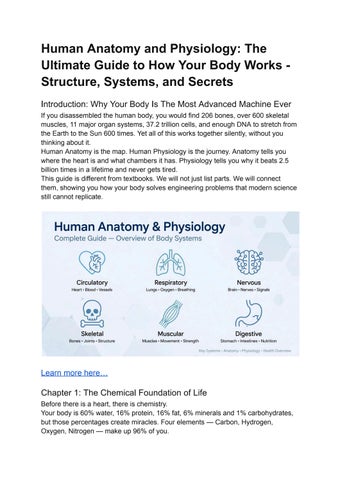
Human Anatomy and Physiology: The Ultimate Guide to How Your Body Works Structure, Systems, and Secrets Introduction: Why Your Body Is The Most Advanced Machine Ever If you disassembled the human body, you would find 206 bones, over 600 skeletal muscles, 11 major organ systems, 37.2 trillion cells, and enough DNA to stretch from the Earth to the Sun 600 times. Yet all of this works together silently, without you thinking about it. Human Anatomy is the map. Human Physiology is the journey. Anatomy tells you where the heart is and what chambers it has. Physiology tells you why it beats 2.5 billion times in a lifetime and never gets tired. This guide is different from textbooks. We will not just list parts. We will connect them, showing you how your body solves engineering problems that modern science still cannot replicate.
Learn more here…
Chapter 1: The Chemical Foundation of Life Before there is a heart, there is chemistry. Your body is 60% water, 16% protein, 16% fat, 6% minerals and 1% carbohydrates, but those percentages create miracles. Four elements — Carbon, Hydrogen, Oxygen, Nitrogen — make up 96% of you.
Water is your universal solvent, lubricant for joints, transport medium for blood, and coolant through sweat. Proteins are your workhorses. As enzymes, they speed up chemical reactions. As structural proteins like collagen in skin and keratin in hair, they give you shape. As hemoglobin in blood, they carry oxygen. pH Balance: Your blood must stay between 7.35 and 7.45. If it drops to 7.0, you go into coma. This narrow range is maintained by buffer systems, respiration, and kidneys working together every second. Energy Currency: Every cell runs on ATP - Adenosine Triphosphate. You make and use your body weight in ATP every single day. It is made in mitochondria, the powerhouses that convert glucose and oxygen into usable energy.
Chapter 2: The Cell - The City Within Your body is a nation of cities. Each of your 37 trillion cells is a city with walls, power plants, factories, and waste disposal. The Cell Membrane: A double layer of phospholipids with embedded proteins that acts as a smart border patrol. It decides what enters and leaves through diffusion, osmosis, active transport, and vesicular transport. Organelles: Nucleus: The library containing 46 chromosomes, 3.2 billion base pairs of DNA. Ribosomes: Protein factories. Endoplasmic Reticulum: Rough ER makes proteins, Smooth ER makes lipids and detoxifies. Golgi Apparatus: The post office that packages and ships proteins. Mitochondria: Burns fuel to make ATP. Lysosomes: Recycling centers filled with digestive enzymes. Cell Division: Your skin cells divide every 30 days, red blood cells every 120 days, intestinal lining every 3-5 days. This constant renewal heals wounds and keeps you young.
Chapter 3: The Four Tissues That Build Everything All organs are made from just four tissue types. 1. Epithelial Tissue: Your covering and lining tissue. Simple squamous epithelium is one cell thick in lungs for gas exchange. Stratified squamous forms your skin. Pseudostratified ciliated epithelium in your trachea sweeps mucus with tiny hairs. Glandular epithelium forms glands that secrete sweat, oil, hormones. 2. Connective Tissue: The most abundant and diverse. Loose connective holds organs. Dense connective forms tendons and ligaments. Adipose stores energy. Blood is a fluid connective tissue. Cartilage cushions joints. Bone is the hardest connective tissue, with collagen for flexibility and hydroxyapatite crystals for hardness. 3. Muscle Tissue: Built to contract.
Skeletal muscle: Voluntary, striated, multinucleated. You have 600+ of them. Cardiac muscle: Involuntary, striated, branched with intercalated discs that let your heart beat as one. Smooth muscle: Involuntary, non-striated, found in blood vessels, stomach, uterus. It contracts slowly and never tires. 4. Nervous Tissue: Neurons and glial cells. Neurons are the longest cells in your body — a sciatic nerve cell can be 1 meter long. Glial cells outnumber neurons 10 to 1 and support, nourish and protect them.
Chapter 4: Skin, Bones, and Muscles - Your Outer Armor Integumentary System: Your skin is 20 square feet and weighs 8 pounds. It has 3 layers. Epidermis with melanocytes that give skin color and protect from UV. Dermis with Meissner corpuscles for light touch, Pacinian corpuscles for pressure, hair follicles, and sweat glands that can produce 3 liters of sweat per hour. Hypodermis is fat insulation. Your skin is also a sensory organ with 5 million touch receptors, a Vitamin D factory when exposed to sun, and a waterproof barrier. Skeletal System: 206 bones after childhood, starting from 270 at birth. The skeleton is not dead scaffolding. It is alive and constantly remodeling. Long bones like femur have epiphysis at ends covered with articular cartilage, diaphysis shaft with yellow marrow, and medullary cavity. Growth occurs at epiphyseal plates. After puberty, plates close. The skull protects brain with 22 bones. Vertebral column has 33 vertebrae with intervertebral discs that act as shock absorbers. Rib cage has 12 pairs of ribs protecting heart and lungs. Muscular System: 40% of your body weight is muscle. Muscles only pull, never push. Movement requires antagonistic pairs. When biceps contracts, triceps relaxes. At the molecular level, muscle contraction is calcium binding to troponin, which moves tropomyosin, exposing binding sites for myosin heads to pull actin filaments. This power stroke uses ATP. This happens 5 times per second in fast muscles. Muscle fatigue is not due to lactic acid alone, but due to depletion of calcium, ATP, and accumulation of phosphate. Training increases mitochondria, myoglobin, and capillary density.
Chapter 5: The Control Systems - Brain and Hormones Nervous System: Divided into Central Nervous System with 86 billion neurons in brain, and Peripheral Nervous System with cranial and spinal nerves. The brain uses 20% of your energy despite being 2% of body weight. It has 100,000 miles of blood vessels. Cerebral cortex has four lobes: Frontal for decision and motor, Parietal for sensation, Temporal for hearing and memory, Occipital for vision. Broca's area produces speech, Wernicke's area understands speech.
Limbic system handles emotion and memory. Hippocampus converts short-term to long-term memory. Amygdala processes fear. Cerebellum has 50% of your neurons despite being small. It perfects movement. Brainstem controls breathing, heart rate, and wakefulness. A failure here is fatal. Spinal cord has reflex arcs that protect you before brain knows. Touching a hot pan, you pull back in 50 milliseconds via spinal reflex, brain learns later. Autonomic nervous system is automatic. Sympathetic uses norepinephrine, increases heart rate, dilates pupils, mobilizes glucose for emergency. Parasympathetic uses acetylcholine, slows heart, constricts pupils, promotes digestion. Endocrine System: If nerves are fast internet cables, hormones are slow postal letters that last longer. Pituitary gland is pea-sized but controls growth, thyroid, adrenal, reproduction via releasing hormones like Growth Hormone, TSH, ACTH, FSH, LH, Prolactin. Thyroid gland controls basal metabolic rate. Hyperthyroidism makes you anxious, thin, sweaty. Hypothyroidism makes you tired, cold, weight gain. Pancreas is dual organ. Islets of Langerhans contain alpha cells making glucagon and beta cells making insulin. In diabetes, this regulation fails. Adrenal glands sit on kidneys. Cortex makes cortisol for long stress and aldosterone for salt balance. Medulla makes adrenaline for immediate fight or flight.
Chapter 6: Heart and Blood - The River of Life Your cardiovascular system is a closed loop of 60,000 miles of vessels, enough to circle Earth twice.
Heart: Two pumps in one. Right side pumps to lungs, left side pumps to body. It beats 100,000 times per day, 35 million times per year. Each beat pumps 70 mL, total 7,500 liters per day. Electrical system: SA node is natural pacemaker with 60-100 beats per minute, AV node delays signal, Bundle of His and Purkinje fibers spread signal to ventricles. This produces ECG waves P, QRS, T. Heart sounds S1 and S2 are valves closing. Murmurs are turbulent flow. Blood Vessels: Arteries are high pressure with elastic recoil. Aorta withstands 120 mmHg. Arterioles are resistance vessels controlling blood pressure. Capillaries are 8 microns wide, one red cell at a time passes, total surface area 1000 square meters. Veins are low pressure reservoirs holding 70% of blood, with valves and skeletal muscle pump. Blood: Plasma is 55% of blood, 90% water with albumin, globulins, fibrinogen. Red blood cells have no nucleus, live 120 days, contain 270 million hemoglobin molecules each carrying 4 oxygen. White blood cells are immune soldiers. Platelets are clotting fragments. Blood types A, B, AB, O are due to antigens. Rh factor adds positive or negative. Transfusion must match.
Chapter 7: Defense, Breathing, and Eating Lymphatic System: Returns 3 liters of fluid daily to blood. Lymph nodes in neck, armpit, groin filter pathogens. Spleen filters blood, tonsils guard throat. Lymphocytes: B cells make antibodies in bone marrow, T cells kill infected cells and mature in thymus. Vaccination trains this memory. Respiratory System: You breathe 12-20 times per minute, 20,000 times per day. Upper airway warms air to 37C and humidifies to 100%. Trachea has C-shaped cartilage to prevent collapse. Lungs have right 3 lobes, left 2 lobes to make room for heart. Alveoli are 300 million grape-like sacs with surfactant to prevent collapse. Gas exchange occurs across respiratory membrane only 0.5 microns thick. Oxygen binds hemoglobin, CO2 is carried as bicarbonate. Diaphragm is main breathing muscle, does 75% of work. Intercostals assist. Brainstem respiratory center monitors CO2, not oxygen primarily. High CO2 drives you to breathe. Digestive System: A 30-foot tube from mouth to anus. Mouth: Salivary amylase starts starch digestion. Teeth: 32 teeth, incisors cut, canines tear, molars grind. Stomach: Holds 1.5 liters, pH 2 due to HCl kills bacteria, pepsin digests protein, intrinsic factor needed for B12 absorption, mucus protects from self-digestion. Small intestine: 20 feet, 90% digestion and absorption here. Duodenum receives bile from liver that emulsifies fat like soap, and pancreatic enzymes: trypsin for protein, lipase for fat, amylase for carbs. Jejunum and ileum have villi and microvilli increasing surface to tennis court size. Lacteals absorb fat.
Visit our home page… Large intestine: 5 feet, absorbs water and vitamins made by bacteria. Appendix is lymphoid tissue. Rectum stores feces, defecation reflex. Liver is largest internal organ, 1.5 kg, 500 functions: detoxifies, makes bile, stores glycogen, makes plasma proteins, regulates cholesterol.
Learn more here…
Chapter 8: Waste Management and Reproduction Urinary System: Kidneys filter 180 liters of blood per day, but only make 1.5 liters urine. 99% is reabsorbed. Nephron is functional unit with glomerulus filtering via pressure, proximal tubule reabsorbing 65%, loop of Henle creating concentration gradient, distal tubule and collecting duct fine-tuning under ADH and aldosterone. Kidneys regulate blood pressure via renin-angiotensin-aldosterone system, make erythropoietin for red cells, activate Vitamin D. Bladder holds 400-600 mL, detrusor muscle contracts via parasympathetic nerves. Reproductive System: Purpose is species survival. Male: Testes in scrotum 2C cooler for sperm production. Spermatogenesis takes 64 days, makes 100 million sperm daily. Sperm has head with acrosome enzymes to penetrate egg, midpiece with mitochondria for energy, tail for motility. Semen is sperm plus fructose from seminal vesicles, alkaline fluid from prostate to protect from acidic vagina. Female: Ovaries contain 1-2 million oocytes at birth, only 400 ovulate in lifetime. Menstrual cycle 28 days controlled by FSH, LH, estrogen, progesterone. Follicular phase grows follicle, ovulation releases egg day 14, luteal phase corpus luteum makes progesterone to maintain endometrium. If no pregnancy, progesterone drops, menstruation occurs. Fertilization in fallopian tube, implantation in uterus day 6-7, placenta develops, pregnancy 40 weeks.
Visit our home page…
Chapter 9: The Miracle of Homeostasis Homeostasis is your body's obsession with stability. Temperature 37C, pH 7.4, glucose 80-100 mg/dL, sodium 135-145 mEq/L, water balance. Negative feedback is main mechanism. Like thermostat, receptor detects change, control center decides, effector corrects opposite direction. Thermoregulation: cold detected by skin, hypothalamus signals shivering and vasoconstriction. High glucose: pancreas beta cells release insulin, liver and muscle store glucose. Positive feedback is rare, amplifies change. Childbirth: oxytocin causes uterine contraction, which causes more oxytocin until baby is born. Blood clotting also.
All systems fail together. Heart failure leads to kidney failure due to low perfusion, leads to lung edema, leads to brain hypoxia. Health is interconnected.
Conclusion: You Are More Than Parts Knowing anatomy and physiology changes how you see yourself. A headache is not just pain, it is trigeminal nerve irritation. A workout is not just lifting, it is micro-tears, inflammation, satellite cell repair, protein synthesis. A meal is not just taste, it is enzymatic breakdown, hormonal orchestration, selective absorption. Your body is not a machine that breaks, it is a garden that adapts. Bones get stronger with load, muscles grow with stress, brain rewires with learning, immune system learns with exposure. Take care of this system. Drink water for your 60% water content. Sleep for memory consolidation in hippocampus. Exercise for mitochondrial biogenesis. Eat protein for enzyme and muscle building. This guide is just the surface. Each organ, each cell, each molecule has its own story that could fill a library. But now you have the map and the compass.
Learn more here…