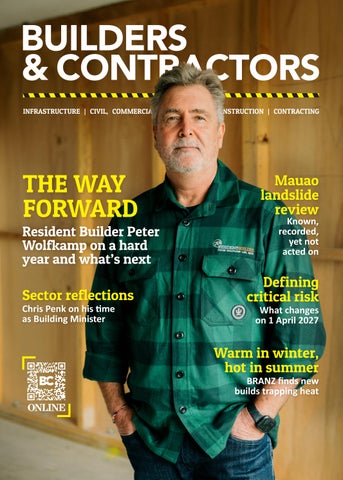
ISSUE NO.167 - 2026 WWW.BUILDERSANDCONTRACTORS.CO.NZ
THE WAY FORWARD
Mauao landslide review
Sector reflections
Defining critical risk
Resident Builder Peter Wolfkamp on a hard year and what’s next
Chris Penk on his time as Building Minister
Known, recorded, yet not acted on
What changes on 1 April 2027
Warm in winter, hot in summer
BRANZ finds new builds trapping heat
ONLINE
Simplify the Resource Consent Process About Us
Recognised for excellence in planning and client service. Development can be complex — but it doesn’t have to be. Plan Co. is a specialist planning consultancy that helps property owners, developers, and investors successfully navigate the resource consent process from concept through to council approval. Founded in 2016, the firm brings together experienced planners with
backgrounds in local government and international planning, offering practical guidance that keeps projects moving forward. With a collaborative approach and deep understanding of regulatory processes, Plan Co. helps clients unlock the full potential of their sites. From small residential projects to large-scale developments — no project is too big or small.
021 167 1873
info@planco.co.nz 84 Birkenhead Avenue Birkenhead, Auckland
What We Do
Why Work With Plan Co?
Resource Consents
Extensive experience with councils across New Zealand
End-to-end management of consent applications — from coordinating specialists to preparing and lodging submissions with council.
Clear, honest communication throughout the process Collaborative approach with industry specialists
Due Diligence
Proven track record delivering successful consent outcomes
Strategic planning advice and feasibility assessments to help you make informed development decisions.
These principles allow projects to move efficiently through regulatory processes while maximising site potential.
Development Planning Expert guidance for residential, subdivision, and commercial developments of any scale.
www.planco.co.nz
Contents Page: 14
ISSUE NO.167 - 2026 WWW.BUILDERSANDCONTRACTORS.CO.NZ
THE WAY FORWARD
Mauao landslide review
Sector reflections
Defining critical risk
Page: 46
Known, recorded, yet not acted on
Resident Builder Peter Wolfkamp on a hard year and what’s next
Chris Penk on his time as Building Minister
Page: 26
What changes on 1 April 2027
Warm in winter, hot in summer BRANZ finds new builds trapping heat
Contents
ONLINE
We open with Peter Wolfkamp, who thinks the ongoing changes are the biggest since the Building Act 1992. Granny flats up to 70m² without a consent, plumbers and drainlayers signing off their own work, and a sector watching to see how it goes. This B+C reads as an industry finding its feet. Consents are up and reports expect that to mean more tradies on site through the back half of 2026. Te Waihanga says the 20-year run of infrastructure prices outpacing the wider economy isn't inevitable, and points at scope and design as the first things to fix. In other news, a review into the Mauao landslide found the tragedy was largely preventable. The law around critical risk is changing, and internal waterproofing is heading into the LBP scheme. Plus, BRANZ on new homes that are now too hot, HERA's route to net-zero steel, and the new Dunedin Hospital rising on the old Cadbury site.
Viewpoints 8 9
12
Building smarter, not just harder OffsiteNZ on the lever nobody mentions
30
www.buildersandcontractors.co.nz
Schools don't have to do it all Skills Group on the nine new subjects
News
The team at
/buildersandcontractorsmagazine
Reflections from outside the Beehive Penk on three years in the portfolio Turning enquiries into jobs Mitre 10 on winning work in a slow market
18
Enjoy!
The biggest change since 1992 Wolfkamp on 40 years of reform
10
14
35
New home consents surge 21% 40,908, the first 40,000 year since 2023 Mapping flood risk and cultural loss Rangitāne o Wairau's first-of-its-kind model Mauao landslide was preventable A known hazard nobody owned
Builders and Contractors, a national
Head Office
Auckland Office
38 Lowe Street Addington Christchurch 8011
Level 3/205 Queen Street Auckland CBD, Auckland 1010
PO Box 1879, Christchurch, 8140
Readers: Construction/building industry
leaders and decision makers: government & trade organisations, site safe members, business owners and professionals in the industry.
Nationwide Distribution: Mailed directly to a carefully maintained list of decision makers and subscribers for 25 years.
54
trade newspaper targeted directly at New Zealand's building and construction industry. For some time we were aware that, although the building and related trades were generally covered individually by some trade journals, there was no amalgamated news link for trades as a whole, especially on a nationwide basis. This void has been successfully filled by Builders & Contractors. Distribution is by way of various outlets: PlaceMakers, Mitre 10, Builders Hardware, Site Safe Members, timber companies, hire companies, together with our database direct mail drop to architects, draughting professionals, consulting engineers, building consultants, designers and local Councils. By these means we aim to reach one of the most powerful buying groups in the industry.
Wellington and Wairarapa's best homes Nine Golds, four in the national Top 100
60
Southern Apprentice of the Year Three BCITO-trained finalists
61
Building the new Dunedin Hospital Outpatients opens, inpatient steel goes up
Who pays for the roads? No fuel tax rise, two plans for the fund
38
Infrastructure costs can come down Te Waihanga on 20 years of cost growth
Materials & methods
Safety & wellbeing 26
24
Managing fatigue when it's not 9 to 5 Construction has no prescribed hours limit
32
Defining critical risk on site What changes on 1 April 2027
62
Height safety reform targets falls The case for passive protection
63
Do it once, do it well When DIY stops being a virtue
22
A new waterproofing licence Internal wet areas join the LBP scheme
40
Warm in winter, hot in summer BRANZ finds new builds trapping heat
42
What's under the wall Retaining walls and seismic load
44
A second life for construction waste Where the skip actually goes
52
Who is checking your steel? The gap after the mill gate
54
HERA maps a net-zero pathway What 2050 asks of steel
Economy 13
The subcontractor vs employee problem IRD is looking at construction
Are there any captivating projects or products within your company that you'd like to showcase in the upcoming edition of Builders & Contractors? Please contact us to discuss Managing Director Gary Collins
Sales Manager
GM of Operations
Angela Elley Phone: (03) 961 5184 sales@academygroup.co.nz
Art Director
Product Co-ordinator Manager Administration
Kylie Palermo kylie@academygroup.co.nz
Jarred Shakespeare Amber Mundy Phone: (03) 961 5088 Phone: (03) 961 5075 jarred@academygroup.co.nz amber@academygroup.co.nz
Phone: (03) 961 5050 admin@academygroup.co.nz
www.buildersandcontractors.co.nz
Disclaimer This publication is provided on the basis that AMark Publishing NZ Ltd is not responsible for the results of any actions taken on the basis of information in these articles, nor for any error or omission from these articles and that the firm is not hereby engaged in rendering advice or services. AMark Publishing NZ Ltd expressly disclaim all and any liability and responsibility to any person in respect of anything and of the consequences of anything done, or omitted to be done, by any such a person in reliance, whether wholly or partially upon the whole or any part of the contents of this publication. This publication may include content created, edited, or assisted by Artificial Intelligence (AI) tools. Advertising feature articles are classified as advertising content and as such, information contained in them is subject to the Advertising Standards Authority Codes of Practice. Contents Copyright 2013 by AMark Publishing NZ Ltd. All rights reserved. No article or advertisement may be reproduced without written permission. You can read the full list of T&C’s on: www.academygroup.co.nz/terms-conditions | www.academygroup.co.nz/competition-terms/
4 | WWW.BUILDERSANDCONTRACTORS.CO.NZ
Your work Christmas sorted.
Four festive race nights throughout November and December. Christmas buffet, live entertainment, and thrilling racing. Tickets from $80 per person - just book and show up!
Book now at addington.co.nz Wanting a private Christmas function on another night? We have plenty of options. Get in touch with our team to discuss your requirements hello@addington.co.nz
Tools down. Drinks up. Tradies Night at adDington
5pm - 10pm, Friday 29 January 2027
Live music, great prizes, and a brilliant atmosphere on the Trackside Lawn.
Get your tickets at addington.co.nz
$
30
includes a drink and food
WWW.BUILDERSANDCONTRACTORS.CO.NZ | 5
care e k a t We ects p s a l l of a fing o o r f o ing d l o f f a and sc
Why Choose Roof Restorers Otago? 4 High-Quality Materials – We use premium Colorsteel®, aluminium, and custom-fabricated metal solutions. 4 Expert Installation – Our team ensures precise fitting for leak-proof and long-lasting performance. 4 Tailored Solutions – Custom gutter, flashing, and downpipe options to suit any architectural style. 4 Competitive Pricing & Free Quotes – Get a no-obligation assessment and quote for your project.
For quality roofing at affordable prices, across Dunedin, contact Roof Restorers today.
CALL 0800 776583
OUR SERVICES
• Commercial Roofs • Residential Roofing • New Builds • Gutters & Downpipes • Historic Slate Roofs • Membrane Roofing NO JOB TOO BIG OR TOO SMALL
k info@roofrestorers.co.nz K www.roofrestorers.co.nz 6 | WWW.BUILDERSANDCONTRACTORS.CO.NZ
KITCHENS • CABINETRY • SHOPFITTING • BATHROOMS
www.sleekjoinery.co.nz WWW.BUILDERSANDCONTRACTORS.CO.NZ | 7
News
‘Adapt, rebuild, find a way forward’ By Peter Wolfkamp
Thanks for the opportunity to engage with your readers and offer some thoughts on the construction sector, a place that, for almost 40 years, has been my home in a very real sense. When you’ve spent that long in an industry, you get a feel for its rhythms, its people, and the way it responds to change. And reflecting on those decades, I’m convinced that the shifts we’re seeing now, both in legislation and in everyday practice, are among the most significant in a generation. In fact, I’d go so far as to say they’re the biggest changes since the introduction of the Building Act in 1992. Change, of course, is never straightforward. As a sector, we’ve often been reluctant to embrace it, and when we have, the outcomes haven’t always been positive. But there’s no question that the reforms now in motion will reshape the landscape of residential building in New Zealand. One of the most talked-about developments is the legislation allowing a granny flat of up to 70 square metres to be built without a building consent. To date, around 580 applications have been lodged, and projections suggest we could see more than 13,000 of these dwellings over time. That’s a substantial shift in how small-scale residential building might occur.
There’s no denying it’s been a tough period. Someone said to me that if they hear one more person talk about “green shoots,” they might not be responsible for their reaction. That comment probably sums up the fatigue many people are feeling.
Peter Wolfkamp
Another major change arrived on 7 September: plumbers and drainlayers can now self-certify their work. This aligns with the long-standing approach for gasfitters and electricians, who sign off their own work and issue certificates of compliance. After speaking with Greg Wallace from Master Plumbers, it’s clear this shift has been welcomed. With the right checks and balances, it should improve productivity and reduce delays tied to inspections, something every builder on a tight timeline will appreciate.
I’ve had many conversations with builders, inspectors, and building surveyors about what this means in practice. Without a local inspector looking over your shoulder, do we trust our competent, professional LBPs to deliver simple structures that meet the Building Code and provide warm, safe, comfortable homes? Or are we opening the door to a wave of poorly built backyard projects that become tomorrow’s problems?
Recently, I’ve had the chance to attend the annual conferences of both New Zealand Certified Builders and Master Builders. I’m not a member of either organisation, but attending gives me a valuable window into the sector, the stories, the sentiment, and the mood about the future. There’s no denying it’s been a tough period. Someone said to me that if they hear one more person talk about “green shoots,” they might not be responsible for their reaction. That comment probably sums up the fatigue many people are feeling.
By nature, I’m an optimist. I’d like to believe that LBPs will rise to the challenge and deliver code-compliant dwellings efficiently and to a good standard. But others’ caution is grounded in experience. Historically, when regulations loosen, standards often follow, and the people who pay the price are the ones living in the buildings.
Yet, interestingly, the conversations we’re having today are the same ones we’ve had after every downturn over the last 30 or 40 years. People leave the industry, and before long we’re all standing around asking where the tradespeople have gone. It’s a cycle we know well, and one we never seem to fully break.
When this legislation was first floated, I thought the better pathway was limiting these dwellings to off-site manufacturers. They already operate with robust qualitycontrol systems, repeatable designs, and proven methodologies. That approach would have ensured consistency and reduced risk. But that’s not where the legislation landed, and like everyone else, I’m watching closely to see how these buildings turn out.
There’s no question that the reforms now in motion will reshape the landscape of residential building in New Zealand. 8 | WWW.BUILDERSANDCONTRACTORS.CO.NZ
Despite the challenges, I remain hopeful. The construction sector has always been resilient. It adapts, it rebuilds, and it finds a way forward. The changes we’re seeing, whether around consenting, certification, or industry practice, will require us to lift our game, stay informed, and keep talking to one another. But they also present opportunities: streamlining processes, improving productivity, and rethinking how we deliver homes for New Zealanders. I’m looking forward to sharing more insights with you over the coming months, and I welcome your thoughts, challenges, and feedback. The best conversations in our industry are the ones where we learn from each other, and after 40 years, I’m still learning every day.
News
Reflections from outside the Beehive By Chris Penk MP Minister of Building and Construction: 2023-2026
From my vantage point of outside the Beehive, having just left the role of Minister for Building and Construction, I find myself reflecting on what has been an extraordinary three years. First things first: I’m so grateful to everyone in the sector (including you, dear reader!) for the huge contribution that you make to New Zealand. It almost goes without saying that every Kiwi relies on your skills, experience and passion for the places in which we live, work and play. And of course, there are the direct benefits to those employed in the sector roughly one in ten workers - and the massive part that you play in our nation’s economic growth. So, thank you. And I should also mention early on how much I appreciate all the advice and encouragement that I’ve been given about what needs to change in building regulation. From the outset my approach has been to acknowledge that those most directly involved in planning, consenting and building (again that’s you) will be more knowledgeable than any Minister can ever be. As you’re well aware, there has been no shortage of reform needed in building and construction. Not through the fault of individual players, but rather the rules of the game, we’ve seen increasing levels of cost, complexity and delay. Sharing the ambition of those who spend their working lives on building sites made our collective task clear: reform our rules and regulations to make easier, faster and more affordable to build in New Zealand. It probably goes without saying that building regulation is inevitably complex and the stakes are high. We need buildings that are safe, durable and fit for purpose. But we also need a regulatory system that recognises the realities of building a house, an apartment, a school, a commercial development or infrastructure. Some reforms have been pretty high profile, whereas others have been more technical and relatively obscure to those outside the industry. But each has been driven by the same basic objective: removing unnecessary barriers to getting things built, without compromising on quality, sustainability or safety. This isn’t the time or place to run through all the changes we’ve made together. In very broad terms, though, I’ve been proud of our work on reducing the cost and complexity associated with building products and standards, modernising the building control system and refocusing the earthquake-prone building system.
Chris Penk MP
I am proud of the progress made over the past three years, but I certainly don’t regard the job as finished. I’ll be quietly cheering on the next Minister of Building and Construction from the sidelines ... and may yet end up with a role inside the construction sector.
with high quality infrastructure to match. To do that, we need the construction sector to have the confidence to invest, employ and innovate. I am proud of the progress made over the past three years, but I certainly don’t regard the job as finished. I’ll be quietly cheering on the next Minister of Building and Construction from the sidelines ... and may yet end up with a role inside the construction sector. Concluding for now, therefore, I’d like to thank everyone in the Builders and Contractors community for the support, advice and encouragement you have given me during my time as Minister. It has been a privilege to work with an industry that quite literally builds the country around us. I leave politics very grateful for the opportunity to have played a part in the reform programme. And I leave optimistic that, by continuing to make it easier, faster and more affordable to build, we can help create a more productive and prosperous New Zealand. On that note, best wishes, thanks again and I hope to see you around the traps!
BUILD A BETTER FUTURE IN CONSTRUCTION. HUNDREDS OF JOB LISTINGS CONNECT WITH EMPLOYERS GET ON SITE FASTER FIND YOUR NEXT JOB AT
WWW.JOBSPACE.CO.NZ Head office - 38 lowe Street, Addington, Christchurch 8011 Auckland office - level 3/205 Queen Street, Auckland CBD, Auckland 1010
Looking forward, New Zealand needs to build more residential and commercial structures, WWW.BUILDERSANDCONTRACTORS.CO.NZ | 9
News
Turning enquiries into jobs By Mark Moffitt, Head of Trade, Mitre 10 New Zealand
Most builders know the feeling. The phone rings, an enquiry comes through, and it sounds promising. But getting from that first conversation to a signed contract can be the tricky part, especially when customers are keeping a close eye on their spending and taking longer to commit. That’s something that came through clearly in this year’s Master Builders State of the Sector research. There’s work out there, but customers are looking for more certainty before they make a decision. For builders, that means understanding what’s important to the customer, building trust early, and clearly showing the value you bring to the job. At this year’s Master Builders Constructive event, Mitre 10 Trade invited Michael Fooks, Head of Training at sales specialists Indicator, to share some practical tips on having better customer conversations and helping turn enquiries into confirmed work. Understand what’s really driving the decision One of Michael’s key messages was that price isn’t always the deciding factor builders think it is. 10 | WWW.BUILDERSANDCONTRACTORS.CO.NZ
Mark Moffitt
When someone’s considering a new build or renovation, they’re weighing up a lot more than the dollar figure. Of course, budget matters, but customers are also thinking about how the project will improve their day-to-day life. Will it make the home work better for their family? Give them more space? Solve a problem they’ve been living with for years? Things happening around them can influence decisions too, whether it’s changing regulations, what’s happening in the local market, or inspiration they’ve picked up from friends and neighbours. The important point is that customers don’t always make decisions based purely on logic. If the conversation only focuses on cost and specifications, you can miss what really matters to them.
When someone’s considering a new build or renovation, they’re weighing up a lot more than the dollar figure. Of course, budget matters, but customers are also thinking about how the project will improve their day-to-day life. Ask more, tell less One of the simplest ways to understand a customer’s priorities is to ask good questions and genuinely listen to the answers. Michael talked about how customers quickly switch off if they feel they’re getting a sales pitch. Listing every feature of your business or solution without first understanding the customer’s situation can make it harder to build trust. Instead, ask questions that uncover what’s motivating the project. Pay attention to phrases like “We’re sick of not having enough room” or “The current layout just doesn’t work for us.” Those comments often reveal the real reasons behind the enquiry and give you an opportunity to show how your solution can help.
Connect features to real-life benefits Another useful reminder was not to assume customers automatically understand the benefits of what you’re proposing. You might know that better insulation, quality windows, or a smart heating solution will make a big difference, but it’s worth explaining what that actually means in everyday life. Will the house be warmer in winter? Quieter? Cheaper to run? Easier to live in? Customers connect with outcomes more than technical details. When they can picture the end result and how it improves their life, they’re more confident about moving forward. It also helps to back up your recommendations with evidence. Share examples from similar projects, testimonials from previous clients, or real-world results you’ve seen. That reassurance can be enough to help a customer feel comfortable taking the next step. The more often you have these conversations, the easier they become. By focusing on understanding your customer, building trust, and clearly explaining the benefits of your solution, you’ll put yourself in a stronger position to turn more enquiries into jobs.
We carry out all types of memorial headstone and stone works across Taranaki. • New headstones • Restoration work • Repainting and cleaning of existing headstones
]
• Second inscriptions
We also specialize in unique headstones made from local stone with carved art work and inscriptions, created by local artists.
Tiny Austin: 021 663 199 tiny@headstonestaranaki.co.nz headstonestaranaki.co.nz
WWW.BUILDERSANDCONTRACTORS.CO.NZ | 11
News
Building smarter, not just harder Why Advanced Offsite is this election’s quiet construction fix By Dan McNelis, Interim CEO, OffsiteNZ
New Zealand’s construction sector is heading into an election facing the same problems it’s faced for a decade: a housing shortfall that’s shaped a generation, a workforce stretched thin, and a pipeline of ageing schools, hospitals, police stations and defence facilities all needing renewal at once. Every party will have something to say about fixing housing delivery. Fewer will mention the one lever that’s already proven, already growing, and doesn’t need a single new law to work harder: Advanced Offsite construction. For readers who haven’t worked alongside it yet, offsite — the umbrella term is Modern Methods of Construction, or MMC — simply means moving more of the build into a factory: pre-nailed trusses and frames most builders already use, flat-packed wall and floor panels built to precise tolerances, right up to fully fitted-out bathroom pods or entire modules craned onto site ready to connect.
Dan McNelis
Advanced Offsite sits at the top of that spectrum — MMC backed by digital design, automation, real quality control and a supply chain that plans ahead instead of scrambling project to project. None of it removes the tradesperson from the job. It changes where a chunk of the work happens — off the critical path, out of the weather, done by the same skilled workforce in a factory rather than on scaffolding in the rain. It’s already working. Offsite-manufactured components now go into an estimated 9 percent of New Zealand builds, up from around 3 percent a decade ago. OffsiteNZ’s newly released Offsite Construction Roadmap
Papakura Courthouse
2026–2036 sets out what it will take to push that to 25 percent by 2036 — and further still for housing programmes government controls directly: a minimum 30 percent Advanced Offsite component in Kāinga Ora and Going for Housing Growth builds from 2027, rising to 50 percent by 2030. Here’s the part that should matter to anyone running a business in this sector, regardless of who’s in government after October: this isn’t a new ask sitting in front of politicians for the first time. Back in December 2022, the Commerce Commission recommended government adopt an all-of-government strategy to coordinate and scale up offsite manufacturing. Government agreed to it. Three years on, that strategy still hasn’t materialised. OffsiteNZ’s Roadmap isn’t a wishlist — it’s a plan for finishing something already promised, built around ten concrete actions industry itself is willing to commit resource against. Some of those actions go directly to what keeps builders and contractors up at night. Kāinga Ora, the Ministry of Education, Health NZ, Defence and Police between them run some of the biggest, most predictable construction pipelines in the country, yet none currently publish the forward programme that would let a manufacturer justify investing in more factory capacity. Fix that, and manufacturers can plan, tradespeople get more certainty around workload, and government gets houses, schools and hospitals built faster against budgets that aren’t getting any bigger.
Nelson Hospital 12 | WWW.BUILDERSANDCONTRACTORS.CO.NZ
Then there’s BuiltReady — MBIE’s scheme to let offsite components get signed off once in the factory rather than inspected repeatedly on every site. The logic is sound, but uptake has been close to zero, because there’s little incentive to pay for certification that isn’t yet recognised consistently at the consenting counter or weighted in government tenders. OffsiteNZ is running a certification drive with members to fix that from our side; the Roadmap calls on MBIE
Advanced Offsite offers a proven, growing solution that operates within existing laws to relocate construction work off the critical path. The strategy aims to increase the current 9% utilization of offsite components in New Zealand builds to 25% by 2036. to back it with real tender preference and consistent consenting nationwide. None of this is about replacing site trades with robots. The Roadmap’s workforce actions are explicit about building apprenticeship pathways into offsite manufacturing, and about lifting Māori and Pacific participation and gender diversity in a sector that badly needs more hands, wherever those hands end up working. A builder or contractor reading this shouldn’t see Advanced Offsite as competition. It’s more likely to be where your next subcontractor, your next supply chain partner, or your own next project already sits. The election will bring plenty of noise about housing targets and infrastructure funding. Worth asking your local candidates a more specific question: will they finish implementing a strategy government already agreed to nearly four years ago? OffsiteNZ’s Roadmap — and the industry standing behind it — is ready to hold up its end regardless of the answer. OffsiteNZ is New Zealand’s peak body for Advanced Offsite and modern methods of construction. The Offsite Construction Roadmap 2026–2036 is available from info@offsitenz.com.
The Subcontractor vs Employee Problem If you use subcontractors in your business, this is worth reading. IRD has been actively looking at the construction sector and the distinction between a genuine subcontractor and someone who should properly be classified as an employee. Getting it wrong can be expensive, and the obligation to fix it sits with you, not them. Why it matters The difference between a subcontractor and an employee is not just about paperwork. It determines who pays PAYE, who is entitled to ACC levies, who gets KiwiSaver contributions, and whether your arrangement holds up if IRD decides to take a closer look. A lot of construction businesses have people working for them who look, on paper, like subcontractors but in practice operate more like employees. They work set hours, they work exclusively for you, they use your tools and your ute, and they do not have other clients. That profile depending on their structure may not be a subcontractor under NZ law regardless of what their invoice says.
The tests IRD uses IRD applies a series of factors to determine the real nature of a working arrangement. No single factor is decisive but the overall picture matters. Things like whether the
person works for other businesses, whether they supply their own equipment, whether they can subcontract the work themselves, whether they set their own hours, and whether they bear any real financial risk in the engagement. If your subbies fail most of those tests, the classification may be wrong. And if IRD reaches that conclusion, they can go back several years and reassess PAYE and impose penalties and interest.
What to do The first step is to review your arrangements and be objective about the agreements you have in place. Some of your subcontractors will be genuine. Some may not be. A straightforward review of each arrangement against the IRD criteria will tell you where you stand. If there are arrangements that need to change, it is far better to change them proactively than to wait for an IRD audit.
Some of your subcontractors will be genuine. Some may not be. A straightforward review of each arrangement against the IRD criteria will tell you where you stand
This is about making sure your business is not carrying a liability and risk you don’t know about. The timing IRD attention on this sector is ongoing, so if you have not looked at your subcontractor arrangements recently, now is a good time to do it. The cost of getting it wrong can compound over time, while reviewing it now is a fraction of that cost. Call Logan Granger at Johnston Associates on 027 283 8331, email lgranger@jacal.co.nz or visit johnstonassociates.co.nz
B U S I N E S S A DV I S O R Y C H A R T E R E D AC C O U N T I N G TAXAT I O N
Taking care of business
Let’s catch up.
We want you to get more from your business. Visit us online:
At Johnston Associates we listen and offer tailored business advice for you to be strategic with your numbers, and make the most of your hard work. www.johnstonassociates.co.nz
We’ll give an hour of our time to hear how your business is going and discuss the services and strategies you could benefit from.
Call Logan on 027 283 8331 Johnston Associates Auckland: Level 1, One Jervois Road, Ponsonby. Gisborne: Office 501, Level 5, 74 Grey Street. Office 09 361 6701 or email: info@jacal.co.nz
WWW.BUILDERSANDCONTRACTORS.CO.NZ | 13
Education - Upskilling
Schools don’t have to do it all – and they shouldn’t The announcement of nine new industry-led subjects for senior secondary students is exactly the kind of bold, forward-looking move New Zealand’s education system needs. From Construction and Built Environment to Applied Intelligent Systems, these subjects will give young people genuine, curriculum-integrated pathways into industries that are crying out for skilled workers. Skills Group welcomes both the announcement and the signal it sends that vocational and applied learning deserve the same standing as traditional academic subjects. These nine subjects have the potential to replace a fragmented patchwork of add-on programmes with clear, recognised pathways into further training and employment. The fact that they will sit alongside English, maths and science as fully integrated curriculum choices is significant. For too long, vocational options in senior secondary school have been treated as alternatives for students who weren’t suited to the academic track. That framing was always wrong, and it is encouraging to see it being dismantled. But in the days since the announcement, much of the commentary has focused on a question that, while understandable, rests on a faulty assumption: how will schools deliver all of this? 14 | WWW.BUILDERSANDCONTRACTORS.CO.NZ
workshop facilities, the tertiary system already has those too. Organisations like Skills Group exist precisely to bridge this gap. We have trained and assessed thousands of apprentices and trainees, and we have the infrastructure, the industry relationships and the expertise to partner with schools on delivery.
Rosanne Graham, CEO, Skills Group
The short answer is that they won’t, and they shouldn’t have to. The PPTA has raised concerns about recruiting specialist staff and acquiring technical equipment and facilities. These are legitimate operational questions. But they only become overwhelming if you assume that all the delivery has to happen inside the school gate. It doesn’t. The core purpose of these final two years of schooling is to support young people to find and get started on their pathways beyond school. That means students learning things outside the classroom: working with tertiary education providers, undertaking work experience, meeting employers, seeing possibilities first-hand, and developing the employability skills that matter so much to their futures. Schools are a vital part of that picture, but they are not the whole picture. If schools are worried about where to find specialist trainers, they should know: we have them. If they are concerned about investing in expensive equipment and
This is not about diminishing the role of schools. It is about recognising that the most effective model for industry-led subjects is a genuinely collaborative one, where schools, tertiary providers and employers each contribute what they do best. The Minister herself acknowledged this when she noted the Government is working to ensure there will be some in-school provision alongside delivery through tertiary and industry partnerships. That is the right instinct. Skills Group has a long history of working with secondary schools. Through Gateway and Trades Academies, we have relationships with schools across the country. But if we are honest, those partnerships have often felt tacked on. Vocational and employment-facing programmes have too often been treated as side options for students who were struggling, rather than as serious curriculum choices. That perception feeds directly into the parity of esteem problem this reform is trying to solve. And it is a perception that does not match reality. More than half of last year’s intake of trainees and apprentices were already tertiary qualified. Modern industry is sophisticated, technological and complex.
They only become overwhelming if you assume that all the delivery has to happen inside the school gate. It doesn’t.
Just look at the names of the nine subjects announced last week: Applied Intelligent Systems, Energy and Infrastructure, Next-Gen Manufacturing. These are not soft options. They represent sectors with massive depth, breadth and skill requirements. We therefore applaud the promotion of industry-led subjects as fully integrated curriculum choices. And we are looking forward to partnering with schools to deliver them, bringing our training expertise, our facilities and our employer networks to the table. Schools can’t do it alone and no-one should expect them to. The end of school is just the beginning of a lifelong learning and work journey. These new industry-led subjects will help give purpose and direction to more young people, and they offer a powerful chance for employers, tertiary providers and schools to work together effectively to support young New Zealanders on the cusp of their working lives.
Education - Upskilling
Investing in a skilled new generation For XP Electrical in Hamilton, apprentices are a key part of the business plan. The company, owned and operated by directors John Kane and Dylan Pehi, has been in business for about eight years, now employing 12 people, including four apprentices, all at different stages of their training. “Our most recent apprentice is about eight months in. Then we have Leon, who’s training with EarnLearn, who’s almost finished and two others who are part-way through,” John says. Regularly taking on apprentices is good for both the business and the industry as a whole, he adds. “It’s important to make sure there are guys who are coming up to replace people who might move on. It’s just a good way of making sure the knowledge is getting passed along.” Passing on that knowledge and experience is crucial as XP Electrical takes on a wide variety of electrical work. “We do anything and everything electrical, really. We do commercial, residential and industrial, and we bought an automation business last year as well.” While that means it’s important that apprentices are supported and capable of working across a range of jobs, it also gives them opportunity, John says. “We want all our team to be all-round, good electricians, rather than just being
pigeonholed into one part of the industry. So we try to give them exposure to good work across the board.” The variety of work also means apprentices can see how different parts of the trade fit together, rather than developing their skills in isolation. As they progress through their training, they can build on what they have learned and gain a better understanding of the different opportunities available within the industry. But the advantages aren’t all one-way in favour of the apprentices, he adds. “Apprentices can also bring new ideas into the business. Everyone has different ways of thinking and working, and we do encourage them to offer up their ideas if they come up with some new or different way of doing something. It also adds a bit of youth to the team!” The whole XP Electrical team gets behind each apprentice, taking them under a wing to show them the ropes to help build confidence, and make sure they’re trained properly, with apprentices able to ask questions, learn from mistakes and gradually take on more responsibility as their skills develop. That on-the-job support is backed up by excellent support by training providers, EarnLearn, particularly Account Manager Jared Agent, who helps keep XP’s apprentices training on track and makes the administrative side easier for everyone involved.
“Jared has been awesome to deal with. We don’t have to chase him. He’s always touching base with us, at least once a quarter. He checks where Leon is in his training, how he’s doing and if there’s anything he needs. He’s also been great at helping with the paperwork side of things and making that easy to navigate for all of us.”
For XP Electrical, taking on apprentices is an investment in the future of the business as well as the wider electrical industry, helping ensure skills and experience are passed on while giving the next generation the opportunity to build rewarding careers in the trade. For more information about taking on apprentices visit earnlearn.ac.nz or call 0800 EARN IT.
Local knowledge. Nationwide support.
Need more hands on deck? Train them with EarnLearn. EarnLearn delivers practical, real-world training across Plumbing, Gasfitting & Drainlaying, Electrical, and IMC. Our flexible training and nationwide support make taking on an apprentice straightforward, helping you grow your team, build skills on the job and add value to your business. Get your next apprentice started with EarnLearn. earnlearn.ac.nz 0800 327 648 (0800 EARN IT)
WWW.BUILDERSANDCONTRACTORS.CO.NZ | 15
One screen, no remotes Think about what a meeting room or a lecture theatre actually holds. Displays, audio, a document camera, video conferencing, a TV feed with 70 channels. Every one of them turns up with its own remote. “Typically, you’d have a dozen remote controls on your desk, and each one has about 50 buttons,” says Paul Monaghan of Provision Technologies. “We can remove all of those.” What goes in instead is one touch screen, driven by icons. Turn the projector on and it picks up the laptop and sets the audio itself. The point, Paul says, is that nobody has to be trained to use the room. “Even if you weren’t technically proficient, you could come into a space we’ve installed equipment into and operate it pretty much immediately.” Without that customisation Paul states the same room would be difficult to run, with that control that room would simply be plug and play
there are the big LED screens and video walls that go into large retail stores, usually with background music running behind them. Hotels and shopping centres want digital signage and wayfinding. Very little of it comes out of a box. “Not everything is off the shelf,” he says. “There’s a lot of customisation.” The company has spent a fair bit of time on construction sites. Five years alongside CPB Contractors on Parakiore in Christchurch, and it starts soon on the new medical school
Even if you weren’t technically proficient, you could come into a space we’ve installed equipment into and operate it pretty much immediately.
Provision started in 1999 and is still entirely New Zealand owned, which Paul raises because global firms have recently bought two of his competitors. There are offices in Auckland and Christchurch, and a contractor network handling installation, service and support everywhere else.
at the University of Waikato with Fosters Construction. “We work side by side with building companies,” Paul says. If you’re putting up a hotel that needs music through it, or a mall where people have to find their way around, that’s the same job.
Video conferencing rooms are the bread and butter. Teams, Zoom, Google Meet. Then
Last year Provision fitted out Stadium Taranaki in New Plymouth with Broadcast Bluetooth
hearing assistance called Auracast, which Paul says was a New Zealand first. People with hearing aids tune in and hear the commentator live while they watch the game.
the space up for the day and clears it out afterwards. It also covers the case where you just want a data projector. Bigger jobs go out with technicians.
Provision also hires gear out, which most installers don’t. There’s enough of it to run an event for 400 people. If a firm has a presentation for 200 and no room set up for it, that’s the call to make. Provision sets
Visit www.provision.co.nz or call the Auckland office on 09 379 3792 or the Christchurch office on 03 260 2759.
NEW ZEALAND’S AUDIO VISUAL & PROJECTION SPECIALISTS With the fast pace of business environments, unreliable technology and poorly integrated AV systems just won’t do. As Auckland and Christchurch’s AV experts, we know that when your system fails, it affects more than your equipment, impacting productivity, professionalism, and your bottom line.
OUR AUDIO VISUAL SERVICES • AV Installation • Event and Hire
• Digital Signage • ProvisionLED
• Projector Hire Auckland • Sound Masking
¼ 09 379 3792 | º ask@provision.co.nz
www.provision.co.nz
AUCKLAND OFFICE Unit 6, 88 Cook Street, Auckland City
16 | WWW.BUILDERSANDCONTRACTORS.CO.NZ
CHRISTCHURCH OFFICE Unit 3, 93 Main South Rd, Sockburn, Christchurch
What Contractors Don’t See Behind a Safe Hire When people think about health and safety on a construction site, the focus is usually on what happens once work begins. Toolbox talks, site inductions, hazard assessments, and supervision are all visible parts of a safe operation. Yet some of the most important safety measures take place long before a machine arrives on site. Every day, builders and contractors rely on hired plant and equipment to keep projects moving. Whether it’s a MEWP, generator, excavator, or compactor, there is an expectation that it will arrive reliable, compliant, and ready for use. What is often unseen is the work that takes place behind the scenes to make that happen. Under the Health and Safety at Work Act 2015, health and safety responsibilities are shared across the supply chain. For hire companies, that means ensuring, so far as is reasonably practicable, that equipment is fit for its intended use, properly maintained, inspected before hire, and supplied with the information needed for safe operation, including the manufacturer’s operating manual. For contractors and operators, responsibilities begin when the equipment arrives on site. This includes carrying out pre-
operational inspections, reporting defects, managing site-specific hazards, and ensuring operators are trained and competent. Put simply, the hire company provides assurance at the point of hire. The operator provides assurance at the point of use. Before equipment reaches a customer, it will typically have undergone inspections, servicing, maintenance, and repairs by qualified technicians. Leading hire companies also invest in reputable equipment supported by proven engineering, technical expertise, and strong parts availability. While no machine is immune from unexpected faults, these processes help minimise risk and maximise reliability. The Ready to Hire (R2H) programme provides visible confirmation that equipment has been inspected and assessed as ready for hire
Leading hire companies also invest in reputable equipment supported by proven engineering, technical expertise, and strong parts availability. While no machine is immune from unexpected faults, these processes help minimise risk and maximise reliability. before leaving the depot. Importantly, the tag reflects the condition of the equipment at the point it left the hire company’s control. It is not a substitute for the daily checks and
pre-operational inspections that must be carried out throughout the hire period. Information and competency are equally important. Equipment Safety Data Sheets, operating manuals, handovers, and recognised training programmes help ensure operators understand a machine’s capabilities, limitations, and safe operating requirements. The hire industry delivers far more than equipment. Every inspection, maintenance check, safety document, competency verification, and handover contributes to safer and more productive worksites. Because the safest hire is not simply the one that works. It’s the one supported by the people, systems, and processes that help everyone get home safely at the end of the day.
Silvercard are raising the bar for MEWP and Forklift safety and competency training. Nationally recognised, industry-backed, and built on the trusted Silvercard reputation. Choose Silvercard MEWP Unit Standard & Forklift Skills Standard Courses
silvercard.co.nz WWW.BUILDERSANDCONTRACTORS.CO.NZ | 17
News
New home consents surge 21% New Zealand consented 40,908 new homes in the year ended July 2026, up 21% on the 33,879 the year before, according to new Stats NZ figures. The annual total passed 40,000 in the June year for the first time since 2023, and July extends the run. “Annual home consent numbers have continued to strengthen in recent months, with increases in both stand-alone houses and multi-unit homes,” economic indicators spokesperson Michelle Feyen said. But consents are approvals, not jobs on the ground, and Westpac senior economist Satish Ranchhod expects that gap to close. “We expect the rise in consents will flow through to a lift in home building activity through the latter part of this year, continuing into 2027,” he said. There’s a clock on that gap. Section 52 of the Building Act lapses a consent if building work hasn’t commenced within 12 months of the date it was issued, unless the building consent authority, usually the council, allows a further period. A lapsed consent has no effect, so the project may need a new application and another round of fees. Building work on a consent issued in July 2026 has to commence by July 2027, or the consent drops out of the pipeline. One issued in August 2025, the first month in this count, has already reached its deadline. Fourteen of the 16 regions consented more homes than a year earlier, but the work isn’t spread evenly. Auckland consented 17,260 homes, up 20%, which is 42% of the national total. Canterbury consented 8,732, up 33%. Christchurch city accounted for 4,773 of those, up 28%, and Selwyn district 2,355, up 59%. Per 1,000 residents, Canterbury is consenting 12.5 new homes and Otago 11.6, against a national 7.7. At district level
Queenstown-Lakes leads on 38.7, with Selwyn on 26.9. Both legs of the market grew at much the same rate. Stand-alone houses reached 18,884 for the year, up 20%, and multi-unit homes 22,024, up 21%. Townhouses, flats and units make up 81% of the multi-unit figure, at 17,829, up 23%. Apartments reached 2,509, up 11%, and retirement village units 1,686, up 14%. July looked the same, with 1,769 stand-alone houses and 1,567 townhouses, flats and units consented against 196 apartments and 47 retirement village units. That’s work for firms set up for repetitive framing and shorter spans. A townhouse block is a different business to a one-off build, and different again to a tower.
We expect the rise in consents will flow through to a lift in home building activity through the latter part of this year, continuing into 2027. On costs, Ranchhod pointed to “some large increases in building costs in the wake of the Middle East war” in the bank’s previous note, and to “increasing concerns about increasing build costs and rising interest rates” in the September one. MBIE’s 2023 sector trends
report put 18.8% of construction workers at 55 or older in the year ended December 2022. Whichever of the extra 7,029 homes get built will need crews from that same ageing workforce. Commercial contractors get a different story from the same release. Non-residential consents totalled $8.8 billion for the year, down 2.5%. Offices, administration and public transport buildings fell 2.3% to $1.7 billion and storage buildings 1.2% to $1.3 billion. Education was the only one of the three largest categories to grow, up 8.4% to $1.3 billion, level with storage. Stats NZ notes the series moves with prices as well as volume, and non-residential construction prices rose 2.2% in the year to June. Floor space tells a steadier story. Non-residential floor space consented is down 0.3% for the year, Westpac notes. Within that, the bank says industrial and storage space has been more resilient, while new office space has been easing back. The residential pipeline is filling while the value of the commercial pipeline thins. The constraint has moved from finding work to staffing and pricing it. For builders, that argues for locking in labour and key subbies before the lift Ranchhod expects, particularly in Canterbury and Queenstown-Lakes. The monthly line is softer. Seasonally adjusted, July’s consents fell 4.3%, after a 3.7% fall in June. Unadjusted, July’s 3,579 homes were still up 10% on July 2025. Stand-alone houses were close to flat on the month, down 0.1% seasonally adjusted, and Stats NZ notes monthly numbers can swing with the timing of large multi-dwelling projects such as townhouses and apartment buildings. Ranchhod put July’s drop “well within the bounds of the normal month-to-month swings we typically see”. His worry is costs. Build costs, rising interest rates and a soft housing market are what he reads as “some increasing headwinds for the residential construction sector over the coming year”.
18 | WWW.BUILDERSANDCONTRACTORS.CO.NZ
A L E XA N D R A N I S S A N
Fully equipped workshop providing an on-site service
Martin O’Connor Auto Services, Alexandra, provides full automotive servicing and repairs for all makes and models of vehicles, including farm machinery, horticultural pumps and sprays, and classic cars.
AUTOMOTIVE REPAIRS RURAL REPAIRS NISSAN PARTS & SERVICES 4 Ngapara Street, Alexandra | (03) 448-5121 | martin@oconnorautoservices.co.nz www.oconnorautoservices.co.nz
WWW.BUILDERSANDCONTRACTORS.CO.NZ | 19
Umbrella Group
Abby's got you covered Deciphering insurance, policy documents, what you’re covered for and how to navigate a claim can be an overwhelming task and experience. Having an Insurance Adviser can really help with ensuring you are covered correctly and having a “go to” person when a claim arises. It’s important to have a relationship with an Adviser because you know they have your best interests at heart and will support you through reviewing different cover options and assisting you through processes, like setting up policies and lodging claims. Abby Eslerhas been an Insurance Adviser for a little over 5 years but has a long history with insurance and a clear love for her job. After working as a Claims Case Manager and then a Team Leader in Superannuation Insurance for a large super fund in Melbourne for 8 years, Abby has a wealth of knowledge from the claims perspective and knows the importance of having the right covers in place when things go wrong. However, the call for home was strong and Abby had the opportunity to work with her father who has been working as an Insurance Adviser for over 40 years. Growing up with her dad meant she has heard about insurance all her life and saw the industry as a not only a great career choice but also because it meant she got to work with people, helping them when they were in need. When her father decided to retire,
PERSONAL INSURANCE
With the recent natural disasters occurring, both abroad and in New Zealand, the importance of having yourself, your assets and your livelihood protected is well illustrated. Abby took on the responsibility and privilege of looking after her father’s business and clients who are based from Auckland down to Christchurch and everywhere in between.
Abby is one of three Directors of Umbrella Group which has their main office based in Masterton and another office in Greytown. With the recent natural disasters occurring, both abroad and in New Zealand, the importance of having yourself, your assets and your livelihood protected is well illustrated. Abby is fully qualified to assist clients in a range of insurances from home, car and contents policies, to a variety of business insurances and commercial covers and
also for Life, Trauma, Income Protection and Health insurance. Umbrella Group has access to a wide range of insurance providers so the best product that suits client’s needs is easily found. Abby is passionate about people having the right covers in place to ensure that when bad things happen, her clients will be looked after, and money is one less thing to worry about. If you are wanting to review your current insurance covers or discuss taking out insurance cover, give Abby a call.
WE ARE COMMITTED TO DELIVERING THE BEST INSURANCE SOLUTIONS FOR OUR CLIENTS NEEDS
COMMERCIAL INSURANCE
ABBY ESLER INSURANCE ADVISER LIFE, TRAUMA & HEALTH INSURANCE
(W) 06 378 2502 (M) 021 637 537 (E) ABBY@UMBRELLA-GROUP.CO.NZ WWW.UMBRELLA-GROUP.CO.NZ
WE’VE GOT YOU COVERED ADVICE
20 | WWW.BUILDERSANDCONTRACTORS.CO.NZ
Let one of our experts help you find just what you need
GET IN TOUCH TODAY
MT DRUMS 2026 LTD ON THE COAST WITH THE MOST Visit our website: www.mtdrums.co.nz
Under New Ownership Ross and Rebecca Blackburn and the team service Hokitika Monday to Thursday, and Greymouth on Wednesday. Remember if your rubbish bin is too small and you need something bigger, we have your needs sorted.
• Skip bins available • We can do green waste • Bins out the night before Ross 021 023 054 78
Truck 027 4358 957
mtdrums2026@gmail.com WWW.BUILDERSANDCONTRACTORS.CO.NZ | 21
Waterproofing
A new waterproofing licence Internal waterproofing is heading into the Licensed Building Practitioner scheme. The Government is progressing work to establish a new LBP waterproofing class, putting wet-area work under the same licensing and accountability regime that already covers carpentry, roofing, brick and blocklaying and external plastering. As at September 2026, the new class is not in force. The Government confirmed the direction in April 2025, listing three changes affecting LBPs, with changes intended to take effect in 2026. The Registrar gains the ability to triage complaints and appoint investigators. Details of LBPs suspended for disciplinary reasons will be published. And work is being progressed on a new waterproofing licence class so that, in the Government’s words, consumers can be confident those completing wet-area bathrooms and levelentry showers are suitably qualified and accountable for their work. Wet areas earn that attention. A failure at a substrate junction, a membrane upstand or a shower tray is invisible until it isn’t, and the remediation bill can far exceed the cost to install. 22 | WWW.BUILDERSANDCONTRACTORS.CO.NZ
The trade currently has no dedicated licence or recognised qualification of its own. Practitioners specialising in tanking and internal waterproofing rely on manufacturer accreditation and ad hoc training rather than a Building Code pathway, which is part of why regulators have looked at licensing instead of leaving competence to the market for now.
What would become restricted During consultation, MBIE proposed creating an Internal Waterproofing licence class and expanding the definition of restricted building work to include the application of internal waterproofing. If that approach is adopted, internal waterproofing could only be carried out, or supervised, by an LBP holding the appropriate licence class. The proposal received support during consultation, with 261 of 329 submissions agreeing with the internal waterproofing proposal. Plenty is still unsettled. The final scope, competency requirements and transition arrangements have not been confirmed, and Building Performance still lists seven LBP licence classes, with waterproofing not among them. If internal waterproofing is added to restricted building work, the existing documentation requirements would also apply. Restricted building work already requires the LBP who carried out or supervised it to provide a Record of Building Work to the owner and territorial authority. That would put a named practitioner against the work and create a formal record of who carried it out or supervised it.
The practical impact is likely to be felt most directly by businesses applying internal waterproofing systems, but the eventual scope will determine how far the changes extend into tiling, shower installation, bathroom flooring, vinyl work and other trades. Builders, plumbers, designers and architects will feel it where they coordinate bathrooms, laundries or level-entry showers, because the licensing question moves upstream into who gets booked and when.
Records will do the talking A new waterproofing licence class would require practitioners to demonstrate the necessary competence, as existing LBP licence classes do, and keep those skills current. Good photographic records will also be worth keeping, a habit worth having for a trade whose work disappears under tile within days. LBPs are already assessed before getting a licence and must keep their knowledge up to date. For main contractors, the practical change starts at programming rather than at sign-off. Knowing early who is applying the membrane, whether they will hold the required licence or be properly supervised, and how the work will be documented before it gets covered, is the difference between a clean handover and a scramble at code compliance stage. There is a supervision question sitting underneath all of this. The scheme allows licensed practitioners to supervise non-LBPs undertaking restricted building work, but the supervisor must hold the appropriate
A failure at a substrate junction, a membrane upstand or a shower tray is invisible until it isn’t, and the remediation bill can far exceed the cost to install. licence for the work being supervised. If internal waterproofing becomes its own restricted class, a carpentry LBP would not automatically be able to supervise or sign off the membrane simply because they hold a carpentry licence. None of that needs to wait for the regulations. The paperwork habits are worth building now. Keep clear records of the product system used and its specification, training completed, supplier accreditations held, substrate preparation, application detail, site photographs at each stage, inspections and sign-offs. Those records may not all form part of the eventual licence application requirements, which have not yet been confirmed, but they give businesses a much stronger evidence trail than trying to reconstruct past jobs from memory. Further detail will be published by Building Performance, and the announcements worth watching are the final scope and transition arrangements. Those details will decide how a small tiling or membrane business moves into the new regime, and they have yet to be nailed down.
Waterproofing
WWW.BUILDERSANDCONTRACTORS.CO.NZ | 23
News
Who pays for the roads? Fuel tax won’t rise next year, and National and Labour have different plans for how transport funding should be handled. Firms running utes and trucks won’t face a fuel tax or road user charge increase in January. Neither major party will go ahead with the 12-cent-a-litre excise increase that was due at the start of 2027. The Government would pause the increase for a year and top up the transport fund to cover the resulting shortfall. Labour would freeze for three years, at a cost the two parties dispute. Finance Minister Nicola Willis and Transport Minister Chris Bishop announced the Government’s plan on 31 August as cost-ofliving relief. If the Government is re-elected, the old schedule of 12 cents in January 2027, 6 cents in January 2028 and 4 cents a year from 2029 goes. In its place is a first rise of 5 cents a litre from 1 January 2028, three more 5-cent increases at six-monthly intervals, and annual 5-cent increases from 1 January 2030. Road user charges follow an equivalent schedule. The Government has also committed to topping up the National Land Transport Fund to account for the lost fuel excise revenue. Ia Ara Aotearoa Transporting New Zealand, the national road freight association, welcomed that. “We welcome Minister Willis and Bishop’s acknowledgement that pausing fuel excise and RUC [road user charges] increases would result in a funding shortfall, and that this gap will be bridged with $1.476 billion in funds from alternative sources,” chief executive Dom Kalasih said. 24 | WWW.BUILDERSANDCONTRACTORS.CO.NZ
Willis had signalled the pause on Budget day in May. “Look, let’s just be realistic, [if] petrol prices are still where they are now, I’m not going to be increasing the petrol tax,” she said. The Budget had set aside $450 million in a time-limited contingency for fuel-related support, and that money now covers part of the top-up. The rest, about $1 billion, is to be set out in Treasury’s pre-election fiscal update. The Crown is forecast to collect $4.9 billion in land transport tax revenue in 2026/27, about $2.2 billion of it from fuel excise. That land transport tax revenue feeds the National Land Transport Fund, which pays for building, maintaining and upgrading the road network as well as public transport and other land transport activities.
For civil contractors, the fund’s roading spend is the work pipeline.
A longer freeze Days before the Government’s announcement, Labour promised not to increase fuel excise or road user charges for the next three years. Bishop put the cost of that at $4.6 billion in lost revenue to the fund and called the position “irresponsible”. Labour disputes the figure, and transport spokesperson Tangi Utikere said the cost would be lower. The party says its own costing will come with its fiscal plan. Labour leader Chris Hipkins has committed to prioritising road maintenance, potholes included, and hasn’t ruled out borrowing to cover the gap.
Labour is also proposing to fund a public transport policy from the same fund. In June it announced a weekly public transport fare cap, to start on 1 July 2027 if Labour is elected. The cap would be $20 in Auckland, Wellington and Christchurch and $10 in other regions, and Labour costed it at “approximately $65 million per year or less than 1% of the National Land Transport Fund”. National campaign chairperson Simeon Brown said the fund was already oversubscribed and called diverting money from it to pay for the cap “fanciful”. “For New Zealanders that means more taxes and more borrowing, which ultimately means higher inflation and interest rates, and greater pressure on the cost of living,” he said.
News The freight sector’s case Transporting New Zealand wants road investment to keep pace with costs, whoever wins. Fuel excise duty hasn’t increased since 2020, and scheduled RUC increases have also been deferred. The association says the fund has lost ground over that time. “Flatlining revenue from fuel tax and RUC alongside a significant increase in road construction costs means the actual purchasing power of our National Land Transport Fund has plummeted,” Kalasih said. “New Zealand’s road network is a national asset. Keeping it in good shape is essential for moving freight, growing the economy, and keeping communities connected.” “Poor roads increase freight times, spike vehicle maintenance costs, and waste fuel,” he said, calling chronic underinvestment “a hidden tax on every single good moved in this country”.
Changes for the fleet The Government is working towards replacing petrol tax by moving the whole fleet onto road user charges. The Land Transport (Revenue) Amendment Bill, which is part of the legislative work needed to move light vehicles from petrol tax to RUC, passed its second reading on 30 June and remains before Parliament. The Government’s transition work covers about 3.5 million light vehicles. No date has been set for the full transition, with Cabinet due to consider next steps in June 2027 after the market response has been assessed. Diesel utes, trucks and heavy plant already pay RUC by the kilometre, so for those the change is in the rate, not the mechanism.
Light electric vehicles have paid RUC since 1 April 2024, at $76 per 1,000 kilometres, the same as a light diesel. A petrol ute that pays its tax at the pump would instead pay distance-based RUC. Every RUC licence also carries an administration fee of $12.44 online or through NZTA’s app, or $13.71 at an agent. Heavy electric vehicles stay exempt until 1 July 2027. One saving is already available. Any RUC vehicle that travels off road can have that distance refunded, which can be relevant to machinery and vehicles doing site work away from public roads. Claims go in on NZTA’s RUCOR form. The total must be $20 or more, and a claim can be made once all the distance on the licence has been used, or if the vehicle has been sold or deregistered. Apply within two years of the licence issue date, keep off-road records for two years after claiming, and allow NZTA at least 10 working days. Claims have to rest on actual distances, not estimates or averages.
We welcome Minister Willis and Bishop’s acknowledgement that pausing fuel excise and RUC [road user charges] increases would result in a funding shortfall, and that this gap will be bridged with $1.476 billion in funds from alternative sources. - Dom Kalasih
Some fleet systems can automate the process, using GPS and geofencing to record off-road travel and, in some cases, populate the RUCOR claim. Check with NZTA before claiming distance travelled on a public road designated as a construction zone. Kalasih said the association would be “seeking clarification from whoever forms the next Government on how it intends to deliver on the commitments in the current National Land Transport Programme”. For the contractors who build and maintain the network, the next Government Policy Statement on land transport will help determine how the fund is prioritised and how much roading work can be supported.
• PLUMBING • ROOFING • DRAINLAYING • GAS SUPPLIER & FITTING 11 Purkiss Street, P O Box 925, BLENHEIM 7240
t: 03 578 0060 e: info@morganplumbing.co.nz
www.morganplumbing.co.nz
WWW.BUILDERSANDCONTRACTORS.CO.NZ | 25
News
Managing fatigue when the job isn’t 9 to 5
Three of the questions on WorkSafe’s fatigue checklist are about hours. Does anyone regularly work more than 12 hours including overtime? Does anyone get less than 10 hours between shifts? Does anyone travel more than an hour to the job? A yes to any question on the list means fatigue risks may need assessing and controls put in place. On a night shutdown, a weekend pour or a regional job with an hour’s drive at each end, a crew can answer yes to all three before smoko. Construction has no prescribed hours limit, unlike heavy vehicle driving. Under HSWA, a PCBU must eliminate the fatigue risk so far as is reasonably practicable, and minimise it to the same standard where it can’t. Applying that test to its own rosters falls to the firm. WorkSafe’s shift work guidance calls shift work any work that requires a worker to be awake when they’d normally be asleep. Long days count too, if they start early or finish late, and the guidance names construction among the industries where small businesses run shift work. A 4.30am start to beat the traffic is a shift. For most people alertness bottoms out between 3am and 5am, then again between 3pm and 5pm. WorkSafe tells employers to avoid critical jobs in those windows, and lists examples. Work at height. Manual handling. Confined space entry. Anything using mobile plant. Read that list back and you have described a night roadworks shift. WorkSafe’s roster advice is to avoid starts before 7am where possible, limit 12-hour night shifts to two or three in a row, rotate shifts forward and steer clear of permanent 26 | WWW.BUILDERSANDCONTRACTORS.CO.NZ
nights. Where the work is monotonous, isolated, or mentally or physically demanding, keep shifts to eight hours. The checklist’s examples of physically demanding work are bricklaying and shifting bags of cement. WorkSafe puts the sleep need at seven and a half to nine hours a night, and warns that sleep loss accumulates. A roster that never allows two consecutive nights of proper sleep builds a debt no Sunday sleep-in clears.
in, NZTA’s Road Code says, “no amount of willpower will keep you awake”, and the only answer is sleep, either a short nap or help getting home. NZTA tells shift workers in doubt not to drive, and to take public transport or a taxi, get a lift or nap at work first. WorkSafe also backs a nap before the drive home, as long as it isn’t a routine way to stretch shifts.
The drive home is risky too. NZTA says people who work long hours or do shift work are six times more likely to be involved in a car crash than other workers. A drowsy driver can nod off for seconds at a time without noticing.
Tiredness also shows up at the start of a shift. NZI’s analysis of commercial vehicle accident data, published in 2021, found incidents often happen in the first two hours of a driver’s shift, with almost half close to the depot. Michael Stirk of NZI’s Fleet Risk Management team said that could point to drivers not getting enough sleep before they start.
WorkSafe says coffee and nicotine give only short-term relief, and there’s usually a crash when they wear off. Once fatigue has set
NZTA’s work time rules are narrower than often quoted. They apply when the driver needs a class 2 to 5 licence, or the vehicle
is used in a transport service, or it carries goods for hire or reward. They don’t apply to a goods or service vehicle needing a class 2 licence that isn’t used for hire or reward and stays within 50km of the driver’s base. A site office set up for at least 24 hours counts as a base. Where they bite, the standard limits are a 30-minute break every five and a half hours and 13 hours of work time in a cumulative work day, then 10 hours off. None of it reaches the labourer on a class 1 licence with an hour’s drive home after 13 hours on site. A policy meeting WorkSafe’s expectation covers maximum shift length, average weekly hours, work-related travel, how a worker reports fatigue, and what a supervisor does with someone who turns up unfit. If your firm investigates nearmisses and has never recorded fatigue as a contributing factor, check that before you programme the next shutdown.
UNLOCK MORE BUILDABLE AREA As granny flats and infill housing accelerate across New Zealand, site coverage limits are becoming a common constraint on otherwise straightforward projects. Permcon permeable concrete offers builders a practical way to stay compliant while still delivering functional, high-quality hardstand areas – with the added benefit of improved stormwater performance. As sites get tighter and expectations around stormwater management increase, builders are under more pressure to deliver hard surfaces that perform – without creating drainage headaches or holding up the job. Permcon permeable concrete is designed to manage water where it falls. Its open structure allows rainwater to pass through the surface and into the basecourse below, reducing runoff and easing pressure on stormwater systems during heavy rainfall. At the same time, it’s considered a pervious surface by most councils in New Zealand, making it a practical option where impermeable limits come into play. For builders, that means hardstand areas like driveways, paths and patios can be delivered without eating into a site’s impermeable allowance – while also supporting better on-site drainage outcomes.
MAKING GRANNY FLAT PROJECTS WORK
With granny flats (minor residential units) now easier to deliver under the latest rule changes, many builders are seeing increased demand for small, standalone dwellings. Under the National Environmental Standard (NES), the principal dwelling and any minor residential unit can now cover up to 50% of the site. However, this relates to building coverage only – overall impermeable surface limits still apply under District Plans. In many urban areas, those limits typically sit between 60% and 80% of the site, including buildings, driveways and parking, with around 70% a common benchmark. That creates a familiar challenge: once the new dwelling is in place, there’s often limited allowance left for traditional concrete surfaces.
This is where permeable concrete comes into its own. By using Permcon for driveways and accessways, builders can stay within site coverage limits while still delivering functional, high-quality outdoor spaces – without having to redesign the job or drop scope.
SCALING UP FOR HIGHER-DENSITY SITES The same challenge becomes even more pronounced on multi-unit developments, where maximising yield is key.
Whether it’s townhouses, duplexes or infill housing, every square metre counts. Traditional concrete can quickly eat into allowable coverage, which can limit unit numbers or force changes late in the design. Permcon offers a way to unlock more of the site. By converting hardstand areas into permeable surfaces, developers can make better use of available space while remaining compliant with District Plan requirements.
BUILT FOR PERFORMANCE
Alongside compliance benefits, Permcon delivers the durability expected of concrete, making it suitable for driveways, carparks and accessways. It also supports better stormwater outcomes by reducing peak flows and filtering water before it enters the system. For projects where sustainability is a priority, Permcon CarbonLow offers up to 62% lower embodied carbon – with no change to how it’s specified or installed on site. As demand for smarter land use grows, permeable concrete is becoming a practical tool for builders looking to deliver more – without pushing sites beyond their limits.
TALK TO US TODAY! PERMCON.CO. NZ | Stuart Girvan +64 27 224 1361 | sgirvan@permconnz.co.nz
PERMCON SOLUTIONS. WATCH OUR VIDEO HERE:
WWW.BUILDERSANDCONTRACTORS.CO.NZ | 27
News
How would NZ’s vital freight system handle a big earthquake? By Cécile L’Hermitte Senior Lecturer in Logistics and Supply Chain Management, University of Waikato This article is republished from The Conversation under a Creative Commons license
When we think of a major earthquake striking Aotearoa New Zealand, our minds first turn to collapsed buildings and the immediate toll on human lives.
We found the ferry terminals present a vulnerability, with participants describing them as ageing infrastructure not built to modern resilience standards. If knocked out, freight operators would immediately need to find other ways of moving goods between the islands.
Few of us might ponder what happens in the days and weeks that follow, when supermarkets need restocking, fuel stations need replenishing and businesses need to keep goods moving around the country.
But the alternatives are far more limited than they first appear.
One of the most critical links in the supply chain is the Cook Strait ferry network. It bridges State Highway 1 and New Zealand’s main rail corridor, carrying more than 500 trucks a day and 5.5 million tonnes of freight each year. Yet this system is reliant on just four roll-on, roll-off ferries operated by Interislander and Bluebridge’s StraitNZ. Our newly published research explored a disaster scenario in which Wellington and Picton’s ferry terminals are put out of action for three months, along with several ports, fuel facilities and parts of the road and rail networks. Such disruption might simply appear an unavoidable consequence of the earthquake. But our findings suggest many of the biggest transport problems would stem not from the disaster itself, but from policy decisions made years earlier. How NZ’s freight network breaks down Our scenario centres on a magnitude 8.5 earthquake and tsunami generated by the Hikurangi Subduction Zone – New Zealand’s largest and most active fault – which damages infrastructure across the lower North Island and upper South Island. Scientists have calculated a roughly one-infour probability of such an event occurring within the next 50 years. 28 | WWW.BUILDERSANDCONTRACTORS.CO.NZ
Although air freight could move urgent goods, such as medicines and high-value products, it is expensive, has limited capacity and already faces shortages of pilots, engineers and specialised ground staff. That would leave coastal shipping carrying much of the burden. Yet it too has limited spare capacity. There are not enough vessels, containers, refrigerated equipment and trained personnel to suddenly accommodate a large increase in demand. That challenge has been compounded by the recent closure of Pacifica’s domestic service. The remaining ports would also come under pressure. Vessels and containers would be redirected to a smaller number of available locations, while existing labour shortages would make it difficult to expand capacity quickly. Trucks collecting and delivering freight would add further congestion. Road networks would face similar pressures. Alternative routes would be longer, creating delays and increasing demand for trucks and drivers, worsening existing workforce shortages. Many roads would also carry more heavy vehicles than they were designed for, increasing wear and tear and maintenance needs. The disruption would extend well beyond transport itself. Fuel pumps depend on electricity. Truck drivers rely on electronic payment systems to fill up. Freight operators
need telecommunications to coordinate deliveries and share information. If these systems failed after a disaster, the disruption would quickly cascade through the freight network. Can NZ avert a disaster after a disaster? While the earthquake is what exposes many of these vulnerabilities, they often are not what creates them. Take ports. Congestion on the country’s docks after a disaster may seem inevitable. But it would also reflect years of underinvestment or lengthy approval processes that limit spare capacity.
Difficulties finding enough truck drivers, port workers, or shipping and aviation personnel similarly reflect workforce shortages that existed long before the earthquake. Overall, we identified 43 constraints linked by 99 cause-and-effect relationships. But they ultimately traced back to just 18 root causes spanning six broad areas of government policy. This suggests freight resilience is not only about how quickly infrastructure can be repaired after a disaster. It also depends on the policy settings already in place.
The country’s largest port, Tauranga, has spent years seeking resource consent to expand its berths, leaving it less able to absorb sudden surges in freight demand if other ports become unavailable.
That means investing over the long term in critical infrastructure, coastal shipping, transport network redundancy and workforce development, while ensuring timely resource consent processes for infrastructure expansion.
The same pattern can be seen elsewhere. A shortage of coastal shipping vessels can come back to uncertainty over marine fuel policy and limited support for the sector, discouraging investment in new ships.
Natural disasters are costly, unavoidable and will always disrupt freight movement. But how severe that disruption becomes depends partly on choices made long before the ground starts shaking.
We're keeping Wellingtonians switched on!
OUR ELECTRICAL SOLUTIONS AND SERVICES ● Emergency Solutions ● Led Lighting ● Wiring ● Switchboards ● Kitchen/Bathroom Rewiring ● Heatpumps
● Water Heaters ● Outdoor Lighting ● Electric Vehicle ● Fault Finding ● Maintenance
Chris Pankhurst, your local family electrician. m 027 699 4179 k chris@pankhurstelectrical.co.nz K www.pankhurstelectrical.co.nz
WWW.BUILDERSANDCONTRACTORS.CO.NZ | 29
News
Mapping flood risk and cultural loss Marlborough iwi (tribe) Rangitāne o Wairau has a flood model that measures a storm’s impact on culture and identity as well as land, the first of its kind in Aotearoa, its researchers say. It shows up to 75% of the low-lying area at the Wairau Bar, one of the country’s earliest human settlements, could be affected in a one-in-100-year storm by 2130 under projected sea level rise. “Collectively, we’re good at modelling financial and economic loss, but that’s only part of the picture,” says Corey Hebberd, Rangitāne general manager. “For us, the real question is what happens to our identity, our history, and our connection to this place.” Te Pokohiwi o Kupe, the Wairau Bar, sits where the Wairau River meets the sea at Cloudy Bay. Artefacts from the site have been radiocarbon dated to around 1300 CE, and it holds wāhi tapu (sacred sites), urupā (burial grounds) and ancestral remains. Rangitāne o Wairau is based in Blenheim, with a rohe (tribal territory) running from the Clarence River north to Nelson and d’Urville Island. Schoolboy Jim Eyles found a moa egg, human bones and artefacts at the bar in 1939. After his 1942 finds, Canterbury Museum researchers excavated the site through to 1964, removing kōiwi (human remains) and taonga (treasures) to museum collections. The kōiwi were returned and reburied there in 2009, and the iwi’s Treaty settlement, signed in 2010, returned sites at the bar to Rangitāne. Rangitāne built the model with Earth Sciences New Zealand and Marlborough District Council, and the work was named a finalist in the Science New Zealand Awards. “The region has been hammered by socalled ‘one-in-100-year’ events since 2022. Flooding is accelerating coastal erosion and increasing the risk of exposing and washing away archaeological artefacts and ancestral remains,” Hebberd says. The work ran in two phases. The first mapped the water. The second, funded by the Natural Hazards Commission, added mātauranga Māori (Māori knowledge) gathered through wānanga (gatherings) and interviews with kaumātua (elders). Their intergenerational knowledge of flooding and coastal change became indicators of cultural impact inside the model. Dr Shaun Williams, project lead at Earth Sciences NZ, says the model links flood intensity to outcomes such as disruption to ancestral connections, impacts on urupā and loss of mahinga kai (food gathering places and practices). “This is the first time in Aotearoa that we’ve been able to represent cultural loss in a hazard model in a meaningful, measurable way,” he says. In February 2026 Rangitāne and the Department of Conservation signed a Control and Manage Agreement that makes the iwi the administering body of Te Pokohiwi o Kupe, the Boulder Bank Site Historic Reserve. Rangitāne will use the model to guide how 30 | WWW.BUILDERSANDCONTRACTORS.CO.NZ
Te Pokohiwi o Kupe, the Wairau Bar.
it looks after the site. “It’s the first time in generations that we’ll have a meaningful say in how this land is managed,” Hebberd says. “This model makes future risks more tangible and gives us a stronger foundation for practical actions like erosion mitigation, planting and monitoring.” Dr Natalie Balfour, head of research at the Natural Hazards Commission, says “this turns hazard science into something people can use right now to make real decisions about what to protect and prioritise. It also has strong potential to be adapted for other coastal communities in Aotearoa and across the Pacific.”
The region has been hammered by so-called ‘one-in-100-year’ events since 2022. Flooding is accelerating coastal erosion and increasing the risk of exposing and washing away archaeological artefacts and ancestral remains. - Corey Hebberd
Earth Sciences NZ research for the Infrastructure Commission Te Waihanga puts inland flood damage to New Zealand infrastructure at about $300 million a year, measured at book value rather than replacement cost. Under a high-emissions scenario that reaches almost $465 million a year by 2075. Counting coastal flooding too, the same research has Canterbury’s infrastructure losses reaching around $113 million a year by 2075 under that scenario, overtaking Auckland’s. “Flooding isn’t a future problem for our region. It’s here, and it’s being felt by real communities right now,” Canterbury Regional Council chair Dr Deon Swiggs said. He said every dollar invested in preparedness “can save around four dollars in recovery costs.” Victoria University of Wellington climate scientist Professor James Renwick said that “since 2010, of government expenditure on natural hazards, 97% has gone into responding to and recovering from disasters, while only 3% has been directed to risk reduction and resilience.” Iwi in other regions are looking at the model for their own sites, and the National Emergency Management Agency has signalled interest in bringing mātauranga Māori into wider hazard and risk frameworks. Williams says the work has reached the Pacific. “It’s something we’re beginning to apply in places like Samoa, Tonga and Vanuatu.” Hebberd says the project shows what’s possible when different knowledge systems work together. “This is about protecting cultural identity while also considering environmental and economic realities. It’s about finding a path forward that works for everyone.”
Expert Carpet Cleaning & Restoration in Central Otago and Southern Lakes
SERVICES: • Steam Carpet Cleaning • Upholstery Cleaning • Pest Control • Hard Floor Maintenance • Water Restoration
• Solar Panel Cleaning • Gutter Cleaning • Carpet Repair • Window Cleaning
SERVICE AREA: Wanaka / Queenstown / Cromwell / Clyde / Alexandra
office@advancedcarpet.co.nz Ph: 021-333-354 • www.advancedcarpet.co.nz
So rte iled wo df r or >$ kwea 10 in r? >1h ou r
So
With locations in Katikati, Omokoroa, Tauranga, Opotiki, Palmerston North and Raumati.
You can wash small, large or extra-large loads from $3*.
Our large commercial dryers will blast through your clothing, towels, and bulky bedding in as little as 25 minutes from $4*.
SELF-SERVICE LAUNDROMAT
Open daily: 5am - 11pm
|
www.thelaundryroom.co.nz
*Prices vary by location, see website for details. WWW.BUILDERSANDCONTRACTORS.CO.NZ | 31
Workplace Health & Safety
Defining critical risk on site Amendments to the Health and Safety at Work Act 2015 received Royal Assent on 9 July 2026, and the changes take effect on 1 April 2027. They rebuild New Zealand’s main workplace safety law around one idea: critical risk.
Safety to approve. A business that follows an applicable approved code is treated as having met the legal duty the code covers. The amendments also clarify which injuries and illnesses go to WorkSafe as notifications, and they split officer duties between governance and day-to-day management. WorkSafe itself gets a shorter list of functions to prioritise, among them guidance, approved codes, Safe Work Instruments and enforcement.
The change means construction businesses should look beyond hazards to the risks most capable of causing serious harm, and make those controls visible in planning, supervision and everyday site decisions.
Safe harbour is what makes that route worth taking. A code written by the sector and approved by the Minister gives the businesses that follow it certainty over the duties it covers. That safe harbour applies to codes approved from 1 April 2027, plus two existing ones covering forestry and cargo work at ports. Other existing codes still count as evidence that a duty has been met without conferring safe harbour, and there is no construction-specific code in the initial safe-harbour set.
The amendments define critical risks as those associated with scheduled hazards such as asbestos and hazardous substances, plus any risk likely to result in death, a notifiable injury or illness, a notifiable incident or certain occupational diseases. From the commencement date, businesses with fewer than 20 workers have specific duties to manage their critical risks, and must prioritise them when complying with other provisions of the Act and its regulations. Larger businesses still manage all risks, but they too put the critical ones first. Every business has to identify its critical risks based on what it knows or ought reasonably to know about its work. The rest of the package changes the machinery around that duty. Industry, worker and employer organisations can develop their own codes of practice for the Minister of Workplace Relations and 32 | WWW.BUILDERSANDCONTRACTORS.CO.NZ
Guarding, isolation, inventory WorkSafe has spent the past quarter showing what that looks like in another industry. Since July, inspectors have visited more than 300 food manufacturing businesses as part of a proactive assessment programme running to the end of September. “At this midway point, the common issues requiring improvements are machinery safety and hazardous substances management,” WorkSafe project lead Loren Molloy said in a statement on 28 August.
Guarding, isolation before cleaning or maintenance, trained operators and a current inventory of what is stored on site read the same whether the machine is a dough roller or a concrete saw.
Machinery is a main cause of harm in manufacturing, WorkSafe says, causing around 200 injuries a year that keep a worker off the job for more than a week. Many of those involve workers caught in moving parts such as rollers, belts or blades, on machines that were not adequately guarded or locked out. French Bakery was fined $200,000 in the Christchurch District Court on 24 February, with $45,500 in reparations, after a worker’s hand was pulled into machine rollers. He lost his index finger and part of his thumb, and his middle finger was crushed. A colleague had switched the machine on while his hand was inside it. “WorkSafe expects businesses to identify their hazards and put effective controls in place,” Molloy said in the same statement.
“For machinery, that means proper guarding, isolating machines before cleaning or maintenance, and making sure workers are trained to work safely.” Hazardous substances were the other recurring gap. Recordkeeping and safe storage often needed improvement, and Molloy said too many businesses did not hold a hazardous substances inventory at all. Those controls apply in any sector. Guarding, isolation before cleaning or maintenance, trained operators and a current inventory of what is stored on site read the same whether the machine is a dough roller or a concrete saw. Inspectors also found good worker engagement, participation and representation at many sites, with workers suggesting improvements and raising concerns.
What comes next WorkSafe has said it will publish more information about the changes, and what they mean for businesses, before commencement. That leaves firms time to work out which of their risks are critical, and to document how they control them. Further detail is likely once the assessments finish. Manufacturing records more injuries than any other sector, and food product manufacturing is one of three subsectors WorkSafe is concentrating on, alongside wood product manufacturing and metal fabrication. The findings from those 300-plus visits indicate the hazards likely to attract attention under a critical-risk approach.
Workplace Health & Safety
Spring is coming, so is the pressure on NZ worksites Unstable weather, road closures, and ground thaw are easing work conditions and that is good news for businesses keen to get rumbling. However, before the high season for builders and contractors hits its national peak, take a minute to pause and reexamine your health and safety policies and practices. The closer we get the more pressure builds while securing new machinery and operators and in ensuring that you’ve got the right people in the right places to do the work that needs doing. Now is a critical time to take a look at new and old staff alike, along with your drug and alcohol policy and testing programme. This welcome but chaotic period tends to be the time when TDDA is at its busiest, because it’s also the moment where drug and alcohol issues slip into workforces. Of immediate concern, and showcased in our latest Imperans Report, is an eyeopening rebound in stimulants, particularly cocaine. It’s no longer a white-collar drug and is showing up broadly across the building industry. Detections for cocaine are up 68.5% year-on-year nationwide.
By Glenn Dobson, CEO, The Drug Detection Agency
Stimulants require caution because they affect your judgement. They cause overconfidence, make you underestimate risks, and slow reaction times when you need to make critical decisions the fastest. When you’re in a safety-sensitive area, those decisions can have catastrophic to deadly ramifications. Conducting workplace testing, preemployment, random, and reasonable cause testing is the most effective form of preventing workplace issues and accidents. TDDA helps companies design fit for purpose programmes that help businesses achieve HSWA 2015 compliance. Pre-employment tests prevent employees with drug issues from entering a business to begin with. Random testing is a critical deterrent to regular drug use. Reasonable cause and post incident testing works hand in hand with education. Managers are trained to notice or react to a situation and then trigger the proper test according to simple guidelines. Testing and education lead to prevention, and we all know prevention is better than cure. Before the high season hits, at the very least ensure your business has reviewed and updated its policy and has a testing programme in place. Having those foundations protects a company from legal challenges and its bottom line.
Before the high season hits, at the very least ensure your business has reviewed and updated its policy and has a testing programme in place. Having those foundations protects a company from legal challenges and its bottom line.
Drug and alcohol issues affect building sites everywhere.
At TDDA our mission is to “protect a girl on a bike.” She’s the one sharing the road with trucks and trailers, standing in for every person whose safety depends on a worker being fit for duty. We’re here for her as well as workers, their families and communities. Because at the end of the day, we all need to make it back to the people who love us. For more information visit tdda.com or simply scan the QR code. You can also learn about TDDA’s mission from here https://tdda.com/ protecting-the-girl-onthe-bike/
That’s why we go anywhere! Whether you need workplace drug testing, pre employment testing & medicals, drug testing & training classes, substance policy design services, annual health monitoring, DL9’s and flu vaccinations, TDDA goes where you need us, when you need us. Your complete solution for workplace drug testing & occupational health needs. Our Mission: To Protect The Girl on the Bike
Visit tdda.com or healthtick.com or call 0508 3784 8378 to learn more.
Accredited to AS/NZS 4308:2008 and AS/NZS 4760:2019 Industry Standard.
WWW.BUILDERSANDCONTRACTORS.CO.NZ | 33
Quality Electrical Components for Industry
With over 10,000 products in stock, we pride ourselves on being a dynamic and innovative company, providing custom solutions to meet the needs of our clients.
Our products cover: • Contactors • Metal Enclosures • Circuit Breakers • Solid State Relays • Pendants
34 | WWW.BUILDERSANDCONTRACTORS.CO.NZ
• Motor Starter • Plastic Enclosures • IEC309 Connectors • Limit Switches • Power supplies & so much more.
ww w.e icnz .co
Electrical Importing Company was established in 1988 and is recognised for importing and supplying quality electrical components for the industrial electrical industry. We are one of the top Electrical Suppliers in New Zealand offering over 6000 products in stock with various options to suit your every need.
m
Global Solutions for Industrial Automation
Electrical Importing Company 117A Captain Springs Road, Onehunga, Auckland 1061, New Zealand P: (09) 634 2978 E: sales@eic.nz
News
Mauao landslide was preventable, review finds
Six people staying at Mount Maunganui Beachside Holiday Park died in January when a landslide came off Mauao onto the campground, which Tauranga City Council owns and runs. The external review the council commissioned, led by retired High Court judge Paul Davison KC, has found the deaths were preventable. Consultants identified the hazard over more than two decades, the review found, and placed it on the slope that later failed. Twice in the past three years, geotechnical consultants recommended the council adopt a trigger action response plan, or TARP, for the campground. Davison called it an effective and inexpensive way to manage the risk. Neither recommendation was put in place. A TARP ties measurable triggers to set actions. Davison’s recommended approach includes rainfall thresholds, soil moisture and visible signs, such as turbid water coming from the toe of a slope, with staged responses up to full evacuation. It lets designated staff on site act on a trigger straight away, without waiting for approval, and he wants one at every populated council site where the natural hazard risk to life is rated medium or higher. The slip came after Tauranga’s wettest day on record, and by that morning muddy
water was running from the foot of the slope above the campground. The review found that either the rainfall or the muddy water, on its own, would have triggered an evacuation under an appropriate TARP. The rainfall trigger would have been reached during the night, well before the slope failed. Without a plan, nobody was tasked with making an informed evacuation decision. Davison said he made no criticism of the campground staff for not recognising the warning signs, and placed it on the organisation that left them without a plan or the training to act. The review didn’t find any one person responsible. It traced the failure to a system that let a known risk to life go unowned and unescalated. The hazard sat between the teams looking after the mountain reserve and the campground, there was no mandatory way to record, escalate or track risks, and restructures had dispersed the staff who knew its history. Davison’s ten systemic recommendations are aimed at giving every risk to life a single accountable owner. Five more cover emergency response, including making sure warnings from the public reach someone able to assess them. The council has accepted the review in full. Chief executive Marty Grenfell said it would implement every recommendation, and the council is setting up an organisationwide improvement programme covering risk ownership, reporting systems and emergency management. It has also proposed powers for its Audit and Risk Committee to test whether controls on
The review didn’t find any one person responsible. It traced the failure to a system that let a known risk to life go unowned and unescalated. The hazard sat between the teams looking after the mountain reserve and the campground, there was no mandatory way to record, escalate or track risks, and restructures had dispersed the staff who knew its history.
critical risks actually work, including through site visits. WorkSafe is investigating whether there has been a breach of the Health and Safety at Work Act 2015 by businesses and organisations involved in running the holiday park. It has begun engaging with the council as the park’s operator and says it will also consider the roles of other parties. WorkSafe’s guidance says officers of a PCBU, such as company directors, have a personal duty of due diligence and
can be held liable for failing it. Under the Act, elected councillors acting in that role can’t be prosecuted for failing that duty. The review made no finding on civil, criminal or disciplinary liability. Structural and geotechnical engineer Dr Paul Jaquin of eZED said the gap between council teams would, in his experience, be present at most councils. Consent teams can identify and mitigate geotechnical risk on new construction, he said, but existing sites are harder. He backed site-specific TARPs as a proposal that could be taken up nationally, and said a hazard database wouldn’t reduce risk on its own without the power to force changes on the ground. David Buxton, principal geotechnical engineer at Northland Geotechnical Specialists, pointed to the human side, saying it’s hard to change the status quo and hard to say no. Warnings consultant Dr Sally Potter of Canary Innovation listed the signs everyone should know as muddy water flowing from within a slope, small slips, and cracking or bulging, and said people should move away from the slope as soon as they see them. A separate Government inquiry, led by retired Supreme Court judge Sir Mark O’Regan, is examining both of that day’s fatal slips, including one on Welcome Bay Road in Pāpāmoa where two people died. It will set out lessons to reduce the risk of a repeat, and its report is due on 18 February 2027. Jaquin said there’s always a balance between administrative burden, complexity and life safety, “but life safety must always win out.” WWW.BUILDERSANDCONTRACTORS.CO.NZ | 35
Hydrodemolition
When is hydrodemolition necessary? Hydrodemolition takes concrete out with a high-pressure water jet instead of a hammer. It’s rarely the only way to do that. It becomes the necessary way when what has to survive the removal matters more than what has to come out. That’s the test worth applying before it goes into a tender. The operator sets working pressure and traverse speed against the concrete strength and condition, and the jet removes weaker material while leaving stronger concrete behind. Weak, delaminated or chloride-contaminated concrete goes. Sound concrete can stay. Existing reinforcing steel can be exposed and cleaned by the same pass, which is why the method gets specified on repair work where the existing bar has to survive. So, the case for it is strongest where the damage is patchy and the boundary between good and bad concrete is irregular. A bridge deck, a wharf beam, a tank wall. A breaker operator working the same area has to judge where to stop, and every over-break is concrete that has to be poured back. Removal rate is the number that ends up in the tender, and it moves with concrete strength, aggregate type, pressure, traverse speed and the depth being taken out. The comparison with jackhammering usually gets argued on productivity. The stronger case is exposure. WorkSafe’s guidance notes that respirable crystalline silica dust is created whenever concrete is cut, ground, drilled or otherwise disturbed, and that silicosis is progressive, permanent and can keep developing after exposure has stopped. New Zealand’s workplace exposure standard for crystalline silica is an eight-hour timeweighted average of 0.025mg per cubic metre, adopted in 2023, and WorkSafe carries a Category 1 carcinogen notation against it, meaning a known or presumed human carcinogen. Using water instead of dry mechanical removal cuts airborne dust at the point of work. Running the job from a remotecontrolled rig can also remove the operator
from direct hand-arm vibration exposure that comes from a day on a breaker. Neither necessarily changes the programme, but both change the way the health risk has to be controlled and managed. The bond surface is the other gain. A jetted face is rough and, with appropriate preparation, can provide a good key for a repair pour. The constraints are set-up and water. The rig needs a reliable supply, pump space and time to establish, so the economics favour a decent quantity of removal in one place rather than scattered patches. The equipment is still noisy. And the slurry running off carries concrete fines and needs containing and managing before it reaches a stormwater drain. Where nothing in the structure has to survive, none of that cost is buying anything a breaker or a crusher would not deliver. Post-tensioned structures need particular care. ACI guidance warns that hydrodemolition may not be suitable around
Using water instead of dry mechanical removal cuts airborne dust at the point of work. Running the job from a remote-controlled rig can also remove the operator from direct hand-arm vibration exposure that comes from a day on a breaker. Neither necessarily changes the programme, but both change the way the health risk has to be controlled and managed. post-tensioned tendons because water can enter tendon sheathing and create longterm durability problems. Removal around anchorages can also create a risk of sudden de-tensioning. That assessment needs to happen before equipment arrives, not after removal begins. WorkSafe issued a safety alert on 20 August reminding businesses to establish whether asbestos-containing material may be present before carrying out high-pressure water spraying or using compressed air.
The alert followed a series of notifications about waterblasting on roofs that contained asbestos. In the most recent case, work was done on a 1970s residential property with decramastic roof tiles. Debris was later found across the property and inside the house, testing confirmed the tiles contained chrysotile asbestos, and specialist assessment found remediation was needed to deal with the contamination indoors and out. High-pressure water spraying and compressed air must not be used on asbestos or asbestos-containing material under the Health and Safety at Work (Asbestos) Regulations 2016, outside the limited exceptions the regulations set out. WorkSafe’s advice is to treat buildings built before 1 January 2000 as potentially containing asbestos, assess the risk before any work that could disturb roofing or cladding, and stop immediately and get specialist advice if material is found once work has started. That check carries more weight from 1 April 2027. The amendments to the Health and Safety at Work Act introduce a critical-risk framework. Businesses with fewer than 20 workers will have to manage and prioritise critical risks, while larger businesses will have to manage all risks and prioritise critical risks, including those specified under Schedule 1A. On an older structure, the first question isn’t whether hydrodemolition is necessary, it’s whether asbestos or asbestos-containing material could be disturbed by the work.
36 | WWW.BUILDERSANDCONTRACTORS.CO.NZ
Hydrodemolition
Aquamax introduces robotic technology Aquamax has expanded its infrastructure service offering with the addition of an Aquacutter hydro-demolition robot. Aquajet Systems, a Swedish firm, are the world leader in this technology.
Hydrodemolition robots dramatically increase the productivity and safety margins of the hydrodemolition process by taking the operator off the gun.
Hydrodemolition is a process utilising ultrahigh pressure (1450 bar or 20,000 pounds per square inch) water blasting to cut away concrete without impact to surrounding structure or damage to steel reinforcing. Engineers specify hydrodemolition particularly when remediating or modifying existing concrete structure. Concrete is stripped away prior to welding in repairs or additions to the existing rebar. The process ensures there is no damage or microcracking of the existing concrete that might weaken the structure or reduce the pull-out performance of the rebar. Hydrodemolition robots dramatically increase the productivity and safety margins of the hydrodemolition process by taking the operator off the gun. The machine is mounted on a tracked crawler chassis and is electrically powered. The operator controls the machine remotely via a wireless controller. The machine can handle significantly higher reaction loads arising from the jet lance and therefore much higher fluid flow rates. There is a direct relationship between
has a role, tidying up or reaching those hard-to-get places.
the flow rate and productivity. Doubling the flow rate will result in twice as much concrete removal. The Aquacutter receives high-pressure water from a large, containerized pump delivering 95 lpm at 20,000 psi. The pump is contained in a purpose-built sound-proof container which can be located up to 150 metres from the robot if required.
Manual gunning can be very tiring and requires operators to take plenty of breaks during the work day. The robot never tires and is just as productive at the end of the day as the beginning of the shift. Manual blasting can deliver productivity in the range of 0.2 – 0.3 cubic metres of concrete per day. A robot can easily cut one cube per day representing a four to five-fold improvement. Manual blasting still
The robot is programmed to cut complex shapes with varying parameters depending on the situation. The waterjet lance is also ‘wobbled’ to simulate hand-gunning and reduce the likelihood of ‘shadowing’ – leaving uncut concrete behind rebar. The cutting head is mounted on an articulated arm that allows for blasting on horizontal, vertical and overhead surfaces. In addition to hydrodemolition, the robot can also be fitted with a scabbling head with similar productivity benefits. The machine has been used to scabble large areas of sewer prior to re-surfacing. Weighing around a tonne, the robot is easily craned into tanks or onto upper floors of buildings.
ULTRA-HIGH PRESSURE WATER JETTING Health and safety paramount State-of-the-art equipment, experienced crew Blasting in accordance with AS/NZS 4233 Water jetting experts since 1996 Contact Hamish Coop on 021 316 844 WWW.AQUAMAX.CO.NZ WWW.BUILDERSANDCONTRACTORS.CO.NZ | 37
News
Infrastructure costs can come down For more than 20 years, infrastructure construction prices in New Zealand have climbed faster than prices across the wider economy. The New Zealand Infrastructure Commission, Te Waihanga, the Crown entity behind the National Infrastructure Plan, says the rise has come to feel inevitable. Its new review of what drives those costs finds slower growth is possible. “New Zealand invests heavily in infrastructure but doesn’t always get the best results. Compared with other high-income countries, we spend more but achieve less,” said Te Waihanga chief executive Geoff Cooper. The report finds infrastructure prices grew more slowly than prices overall during the 1920s, 1950s, 1980s and 1990s. “At some points over the last 150 years, we have evidence that infrastructure prices actually fell,” Cooper said. Solar panel prices dropped more than 90% between 1980 and 2012, and wind turbine costs fell more than 30% between 2005 and 2017 after inflation. Motorways went the other way, with costs per lane kilometre more than tripling in real terms over the past two decades. In the report’s analysis, solar and wind use more standardised designs and need 38 | WWW.BUILDERSANDCONTRACTORS.CO.NZ
less customisation for each site. Networks built from bespoke components, such as transport, tend to show more cost growth. The first of the three drivers the commission examined, input costs, gives decision-makers limited control. New Zealand prices for imported steel, diesel and timber follow world commodity prices, usually within about three months, and construction wages track wages across the wider economy. NZTA modelling cited in the report found oil at around US$100 a barrel could mean 5% annual cost inflation for capital projects with active cost fluctuation clauses, and 10% at around US$150. The second is productivity. “Productivity is more controllable, but it can take several years or decades for sustained improvements to be realised,” Cooper said. Between 2000 and 2020, labour productivity rose 21% in building construction and 27% in construction services, but just 7% in heavy and civil engineering. Had civil construction matched building construction’s productivity performance, the commission estimates infrastructure prices would be about 10% lower and workforce requirements about 11% lower. Civil productivity then fell 6% between 2020 and 2024 and, unlike the other subsectors, hasn’t recovered. The report lists uncertain ground conditions, and larger, more complex projects that offer fewer chances to learn by repeating standardised designs, as possible reasons. That leaves the third driver. “In the short to medium term, our research highlights that the scope of projects and how we design them are particularly important levers for improving affordability,” Cooper said.
New Zealand’s delivery costs are broadly in line with other high-income countries for simpler work such as onshore wind farms and transmission lines. The premiums sit in large, complex projects, with statistically significant ones for motorways, road tunnels and underground rail tunnels. For urban rail, building on an elevated structure can cost 1.5 to 2.5 times as much as an at-grade route, and tunnelling 2 to 10 times as much, depending on conditions.
In the short to medium term, our research highlights that the scope of projects and how we design them are particularly important levers for improving affordability. Assessors in the commission’s Infrastructure Priorities Programme, which received nearly 150 proposals over three rounds, found a bias towards larger scopes. Of 64 proposals at the stage where options needed robust analysis, only 14 gave enough information to be assessed. Only two of those narrowed their options with enough weight on cost, and in several cases benefits were weighted much more heavily than costs. Cost estimates on big projects also tend to keep moving once work is committed.
In the commission’s National Infrastructure Pipeline data, projects valued at more than $100 million when they reached procurement or construction had their estimates rise after that point more than half the time, against 28% for other initiatives. For planned major roading and public transport projects, the report finds unit costs well above international benchmarks, NZTA’s own benchmarks and historical figures, and calls the reasons unclear. It notes the 2024 Government Policy Statement on land transport required most of the major roading projects to be four-laned, grade-separated highways regardless of current traffic volumes or physical context, which may have lifted unit costs. The report says NZTA’s contingency and escalation allowances seem unlikely to explain the whole gap on their own. The report points to greater use of standardised and repeatable approaches, better planning and sequencing, and discipline on scope and design. It suggests weighing lower-cost options such as early land purchase and demand management first, and setting demand triggers, such as daily traffic volumes reaching a set level, before planning a road upgrade. “This research improves our understanding of the actions we can take to get better bang for buck,” Cooper said. The findings will feed into the commission’s examination of cost growth in land transport, which the Government recently directed it to carry out.
“Where professional service speaks for itself”
218B GLENDA DRIVE , FRANKTON
• All makes & models • Light and heavy commercials • COF repairs • General repairs • Fleet services • Batteries • Scheduled maintenance • Inspections • WOF • Oil changes • Tune - ups • Tyre fitting & balancing • Engine exchanges Our mission is to bring the highest level of specialised maintenance, servicing and repair to your vehicle with competitive pricing, professional workmanship and attention to detail.
03 441 4421 | service@torqueautomotive.co.nz WWW.BUILDERSANDCONTRACTORS.CO.NZ | 39
News
Warm in winter, hot in summer New Zealand’s building sector has spent two decades chasing warmer homes through insulation, double glazing and heat pumps. Now research suggests many new builds have swung the other way, trapping heat.
it’s properly ventilated and glazing heat gain is controlled, but BRANZ warns extra insulation by itself could make overheating worse. It puts the problem partly down to airtightness, larger windows and a changing climate.
Insulation can help keep a house cool when it’s properly ventilated and glazing heat gain is controlled, but BRANZ warns extra insulation by itself could make overheating worse. It puts the problem partly down to airtightness, larger windows and a changing climate.
BRANZ’s second Household Energy End-use Project, its most comprehensive study of indoor temperatures and energy use in 20 years, found winter living rooms average 2.6 to 3.5 degrees warmer than in the early 2000s. In its preliminary summer analysis, 111 of 310 monitored bedrooms (36%) spent 33 or more night-time hours above 26°C, meeting the industry-standard CIBSE overheating criterion. In Auckland it was 58% of 45 bedrooms. The New Zealand Green Building Council (NZGBC) says new townhouses and apartments are particularly affected. Andrew Eagles, NZGBC chief executive, said the results backed years of pushing for homes built above the Building Code minimum. “It shows clearly that interventions can deliver improvements for Kiwi families,” he said. BRANZ says research has dispelled the idea that insulation causes overheating, since it slows heat moving in both directions. Insulation can help keep a house cool when
Dr Nigel Isaacs, a reader in building science at Victoria University of Wellington, said it was probably down to “aspects of design and increased glazing”, made worse by poor understanding of how whole buildings perform. “This is highlighted by the excellent monitored performance of the well-designed, high-performance Christchurch houses,” he said.
Those Canterbury homes were built well above Code for thermal performance. University of Otago researcher Helen Viggers said they had warmer bedrooms on winter nights than homes built to the Code minimum, and appeared better at shielding residents from summer heat extremes than homes built to earlier Codes. BRANZ’s design guidance starts with windows. Size, orientation and external shading such as eaves control solar gain, but eaves can’t stop low morning and evening sun, so BRANZ says the best fix on west-facing walls is less glazing. Window placement also decides whether a house can cross-ventilate, which BRANZ says is harder in medium-density builds.
EECA’s Warmer Kiwi Homes programme covers 50%, 80% or 90% of ceiling and underfloor insulation costs for eligible homes. In August 2025, EECA opened the 50% grant to more middle-income households, saying up to 300,000 more homes could now be eligible. Heater grants are only for households in most need. NZGBC says future funding wasn’t in the most recent Budget. NZGBC wants overheating checks at design stage, which it says are already done across the OECD, including Australia. The Building Code has no specific overheating requirement. MBIE lists a methodology for assessing overheating risk among its future Code work, and the next three-yearly update is due in 2028.
Local Surfacing Contractor Supplying Quality Solutions for the Gisborne and East Coast Region.
BITUMEN CHIPSEAL
ASPHALT
CONCRETE
Driveways | Carparks | Farm Roads | Kerbing | Cement Stabilizing Digger and Grader Work | Metal Cartage | Transports | Plant Hire
0274 859 882 40 | WWW.BUILDERSANDCONTRACTORS.CO.NZ
andy@eagltd.co.nz
E eastlandasphalts
CELEBRATING 30 YEARS IN CIVIL CONSTRUCTION AND TRUCKING WITH CONTINUED GROWTH ACROSS THE WAIKATO AND SURROUNDING REGIONS.
Our strength is the ability to operate across multiple sectors with a rural division specialising in farm infrastructure, including obtaining consents, construction and installation of stock underpasses, box culverts and bridges. Call us to discuss your needs
07 827 1869
office@curincontractors.co.nz www.curincontractors.co.nz
WWW.BUILDERSANDCONTRACTORS.CO.NZ | 41
Brick & Block
What’s under the wall An earthquake does something to a retaining wall its static design never accounted for. The retained soil accelerates sideways against the back of the wall, and that push lands on top of the load the wall was already holding. Walls sound under normal conditions have gone over for exactly this reason. How much extra push depends on the ground under the site, and that’s the part changing. The seismic loadings standard the Building Code cites sorts a site into one of five subsoil classes, strong rock through to very soft soil, then works from assumed properties behind the label. For retaining structures, however, the seismic loading provisions of NZS 1170.5:2004 do not themselves cover soil retaining structures.
The newer document, SNZ TS 1170.5:2025, published last year and usable now as an Alternative Solution, uses seven classes based principally on a measured number. The number is the time-averaged shear-wave velocity through the top 30 metres of ground. Surface-wave testing can measure it without breaking ground, while CPT-based methods and other ground investigation information can also
We design and manufacture timeless concrete products for the New Zealand market. ⊲ Structural ⊲ Brick ⊲ Landscape
contribute to an estimate of site classification. Both documents are currently available, but the compliance pathway needs to be established. Loads generally rise under the newer one, because the 2022 national seismic hazard model put forecast shaking higher across most of the country. The increase varies. Some sites barely move, and because assumed properties are conservative, a measured site can come back with lower seismic demand than the assumption allowed. So, a site investigation now has a second job. A hand auger and a lab test identify the soil. Neither directly tells you how fast a wave moves through it.
0800 842 562 | www.viblock.co.nz
For retaining work, the reference is Module 6 of the earthquake geotechnical guidelines, published jointly by MBIE and the New Zealand Geotechnical Society. It came out of
Powder Coating
the Canterbury rebuild and was generalised to cover routine retaining structures nationally, though the current version dates from 2021 and its hazard basis predates the 2022 model. It is guidance rather than a requirement, though that distinction may wear thin in a dispute. For reinforced concrete masonry retaining walls, continuity between the wall reinforcement and footing matters, as does complete and properly specified grout filling. Grout strength is the detail that goes missing. NZS 4229 sets minimum 28-day strengths for grout fill of 17.5 MPa in exposure zone B, 20 MPa in zone C and 25 MPa in zone D, the high-risk exposure zone. Its Appendix A carries details for some walls retaining soil, where its scope and limits apply. Materials and workmanship sit under NZS 4210, design under NZS 4230. Ask early which loadings document the engineer intends to use as that changes the steel.
We specialise in commercial powder coating services and we are Approved Applicators of Dulux and Interpon Powders.
Realistic High Definition Timber Finish Now you can have the practicality of long lasting Aluminium or Steel with fine timber grains. No more sanding or painting just a fine timber fine year after year.
09 276 7253 42 | WWW.BUILDERSANDCONTRACTORS.CO.NZ
karl@colourtec.co.nz
www.colourtec.co.nz
SERVICES
Keeping it local since 2003
• Subdivisions • House Sites • Roading • Earthmoving • Metal Supplies • Retaining Walls • Mulching • Water Supply • Clean Fill Site • Machinery Transport
AREAS COVERED 9 Mangawhai 9 Te Arai 9 Tomarata 9 Kaiwaka 9 Wellsford 9 Waipu 9 Maungaturoto
Tel: 09 431 5773 Mob: 027 281 0659 21 Garbolino Rd, Mangawhai, RD 5, Wellsford 0975 info@shanecullen.co.nz www.shanecullencontracting.co.nz WWW.BUILDERSANDCONTRACTORS.CO.NZ | 43
News
Building a circular future: a second life for construction waste For many tradies on large construction projects, the last they see of any waste is it leaving site in a skip or hook bin. But what happens to it next? Construction and demolition (C&D) waste is typically taken to a resource recovery and transfer station (RRTS), where materials are sorted and prepared for their next use. While most materials are received as single-stream loads, some regions offer services to collect bins with mixed material that require sorting at the RRTS. The aim of a RRTS is simple: once it arrives, the job is to recover what we can and find somewhere useful for it to go. Here’s where it typically goes. Green waste and untreated timber Green waste and untreated timber collected from construction sites can get a second life as landscaping products. In Auckland, WM sends green waste to its Living Earth facility on Puketutu Island, where it’s processed over the course of many months into compost and garden mulch. These products are then used across parks, public spaces, commercial landscaping projects and even bagged and sold for residential use. Untreated timber gets chipped up and utilised for a variety of purposes, such as landscaping. Metal Most metals are easily recovered and recycled, and as such it’s one of the most established recycling streams in the construction arena. Getting paid for your scrap metal also helps with motivation,
as this often funds those famous Friday afternoon BBQs. Recovered steel, aluminium and copper are sent to specialist scrap recyclers to be processed and used again. Many of these recycled materials ultimately find their way back into infrastructure, manufacturing and new construction projects – think window framing, rebar and electrical wiring. PVC and HDPE pipes Thanks to a recent joint venture between WM New Zealand and Aliaxis (the owners of the Marley brand), plastic pipe products
also have recycling opportunities, providing they’ve been properly separated and kept relatively free from contamination. PVC and HDPE pipe offcuts can be sent to Plastics Recycling New Zealand (PRNZ) to be processed and used as feedstock for new pipe products. That keeps the material in use and reduces the amount of virgin resin that needs to be imported. Marley currently use recycled content in over 110 locally-manufactured products including the Drainflo range of spouting, a great example of these scraps coming full circle.
Plasterboard Plasterboard recovery options are expanding across the country. Clean plasterboard is supplied to specialist partners who extract the gypsum, where it is used as a soil activator. Further recovery options to turn board back into board are starting to emerge as well, creating a truly circular loop. Hardfill materials Bricks, concrete, pavers, stone and soil can also be recovered and sent to specialist processors. Depending on the material quality and project requirements, hardfill can be used for quarry management, roading projects, infrastructure works and other civil applications. Recovery starts before materials leave site An RRTS consolidates waste, removes contamination where possible, and identifies recovery opportunities. But while recovery facilities play an important role, waste minimisation begins much earlier. Some of the best recovery opportunities happen before materials even leave site, particularly through reuse and repurposing. That means thinking about waste early, from how a building is deconstructed to ordering materials and separating them on site. And as re-manufacturers continue to increase the use of recycled content, maintaining the quality of recovered material (for example, ensuring it’s free of contamination) becomes increasingly important too. If you’d like to explore opportunities for waste minimisation on your construction or demolition project – whether it’s material reuse, deconstruction planning and other strategies that can help keep valuable resources in use for longer – keep an eye out for our future articles or touch base with the WM Sustainability team at sustainability@wm.nz
44 | WWW.BUILDERSANDCONTRACTORS.CO.NZ
Award winning specialists in premium architectural builds & fast-track commercial construction.
06 368 8718 admin@ccal.co.nz www.croweconstruction.co.nz
WWW.BUILDERSANDCONTRACTORS.CO.NZ | 45
Cement & Concrete
Concrete NZ’s Concrete Conversations: Exploring the road to a lower-carbon future Concrete NZ has launched Concrete Conversations, a new podcast exploring the issues, ideas and people shaping the future of cement and concrete in Aotearoa New Zealand and beyond. Concrete is fundamental to New Zealand’s built environment, forming the homes, schools, hospitals, transport networks and water infrastructure communities rely on every day. As the country works towards a lower-carbon future, the cement and concrete industry faces the challenge of reducing emissions while continuing to deliver the resilient, durable and costeffective infrastructure New Zealand needs. These are complex questions, but they are also practical ones, with decisions being made today influencing materials, projects and emissions for decades ahead. Addressing them will require collaboration across the value chain and a clear understanding of the solutions already available. Hosted by Concrete NZ Sustainability & Policy Director Tim Kleier, Concrete Conversations brings together industry leaders, researchers and other experts for informed and accessible discussions about decarbonisation, innovation and the transition towards a lower-carbon built environment. The opening episode introduces the New Zealand cement and concrete industry’s 2050 Roadmap to Net Zero Carbon. Tim is joined by Concrete NZ Chief Executive Rob Gaimster and Prospect Consulting Director Bernie Napp, who discuss why the roadmap was developed and how it provides a shared direction for the industry. Their conversation examines the collaborative work behind the roadmap, including the importance of bringing together organisations from across the cement and concrete value chain. It also looks at the progress already being made and the mix of practical measures required to reach net zero, from lowercarbon binders and more efficient concrete
These are complex questions, but they are also practical ones, with decisions being made today influencing materials, projects and emissions for decades ahead.
production to improved design and construction, carbon uptake and emerging technologies. The discussion makes clear that there is no single solution. Progress will depend on multiple pathways being advanced together, supported by investment, evidence and
Leaders in Leveling.
Exclusively available at YRCO.CO.NZ
46 | WWW.BUILDERSANDCONTRACTORS.CO.NZ
cooperation between industry, government, researchers, designers, contractors and clients. The episode also considers the next phase: turning the roadmap’s ambitions into coordinated action. Episode two widens the lens to examine the Australian experience. Tim speaks with Clare Tubolets, Chief Executive Officer of SmartCrete CRC, about the organisation’s role in accelerating concrete innovation by connecting industry needs with research capability. Clare explains how collaboration between researchers, suppliers, contractors, asset owners and other industry participants can help promising ideas move beyond the laboratory. The discussion covers emerging technologies, lower-carbon materials and the demanding pathway from research and trials to commercially viable solutions that can be applied with confidence at scale. It also highlights the importance of demonstrating performance, managing risk and ensuring innovation responds to real construction and infrastructure needs. Together, the first two episodes establish the direction for Concrete Conversations: practical, informed discussions about the
challenges and opportunities shaping concrete’s lower-carbon future. Upcoming episodes will continue to bring international perspectives to the conversation. Michelle Wilson, Senior Director of Concrete Technology and Industry Outreach with the American Cement Association, will feature in a future episode, sharing insights from her experience in concrete technology, standards and technical leadership. The podcast will also seek the views of stakeholders from across the construction and infrastructure sectors, exploring their expectations of concrete and their perspectives on the industry’s key issues, challenges and opportunities. To listen to Concrete Conversations, visit www.concretenz.org.nz, go directly to https://concrete-conversations-nz. podbean.com/, or search for the podcast on your favourite podcast platform.
Cement & Concrete
Concrete NZ’s Concrete Shield shares practical safety learnings Health and safety lessons are most valuable when they are shared. An incident at one workplace can reveal a hazard, weakness or unsafe assumption that may also exist elsewhere. Making those lessons available across the industry can help businesses start conversations, review their systems and prevent similar events. Concrete NZ is now circulating Concrete Shield, a fortnightly health and safety alert for Producer members across its Cement, Precast, Masonry, Readymix and Reinforcing groups. Each alert draws on an incident from the cement and concrete sector. It outlines what happened, identifies the key learnings and provides points members can discuss with their teams. The alerts are designed to be easily shared and used during toolbox meetings, inductions, driver briefings and other workplace health and safety discussions.
The first five issues demonstrate the range of risks present in concrete production, delivery and pumping operations.
jump start vehicles, approved procedures must be followed, and an auto electrician should be contacted when difficulties arise.
One alert examines an operator who suffered chemical burns after concrete slurry splashed onto his bare lower legs while cleaning a pit. Wet concrete and slurry are highly alkaline, and injuries may not be painful or immediately visible. The issue reinforces the importance of personal protective equipment, safer cleaning methods, immediate decontamination and early medical attention.
Heavy-vehicle stability is the focus of two issues. The first describes a concrete truck becoming unstable on a narrow site access track after the supporting bank gave way. It highlights the need to assess site access, recognise that ground conditions can change and empower drivers to stop when conditions are unsafe.
Wet concrete and slurry are highly alkaline, and injuries may not be painful or immediately visible.
Another covers a vehicle battery explosion during an attempted jump start at a concrete plant. Battery fragments and acid were ejected, creating the potential for severe burns and eye injuries. The alert stresses that only trained personnel should
The second examines a fully laden mixer truck that tipped over while negotiating a roundabout, injuring the driver. It explains how shifting concrete, bowl rotation and a high centre of gravity increase rollover risk. Drivers must travel according to the road conditions and capabilities of the vehicle, rather than relying solely on posted speed limits or familiarity with a route. The latest alert concerns a pump line disconnection. A pipe separated from a 90-degree elbow because the clamp’s safety pin was missing, sending the clamp airborne and striking a concrete truck driver’s hand. The minor injury could have been far more serious. Drivers and pump operators must confirm clamps and locking pins are fitted before discharge. If a safety control is missing or defective, work must stop, with
everyone remaining clear of the line of fire and maintaining a safe position. Concrete Shield complements, rather than replaces, each business’s health and safety systems, legal responsibilities and professional advice. Concrete NZ will continually expand the collection with information about incidents, observations and lessons contributed by members. This industry knowledge, including examples where no injury occurred, can help businesses recognise hazards earlier and act before someone is harmed. To access Concrete Shield, visit the Concrete NZ website at www.concretenz.org.nz. Be aware. Be alert.
The Plant Audit Scheme audits Concrete NZ Readymix Sector Group member’s concrete plants as defined in NZS 3104:2021 Specification for Concrete Production. The Scheme provides a rigorous audit of the quality systems in place at a ready mixed concrete plant. FOR A FULL LIST OF SCHEME MEMBERS AND THEIR AUDITED READY MIXED CONCRETE PLANTS VISIT THE SCHEME WEBSITE www.rmcplantaudit.org.nz
WWW.BUILDERSANDCONTRACTORS.CO.NZ | 47
Cement & Concrete
The few minutes that can make or break concrete quality W W W. O L I V I B R A . C O M
VIBRATING SOLUTIONS FOR CONCRETE
When we talk about concrete quality, the conversation usually centres around mix design, cement content, reinforcement, curing and the strength specified by the engineer. All of these are important, but there is another part of the process that can have a significant impact on the finished product, what happens in the few minutes immediately after the concrete is placed.
PNEUMATIC VIBRATORS
ELECTRIC VIBRATORS
with Fastening Systems
with Fastening Systems
CONTROL PANEL Mobile or Stationary
EWO
VH
High frequency internal vibrators with built-in converter
Electric high frequency internal vibrators
VHPG
VHA
Internal high frequency vibrators with pistol grip
High frequency pneumatic immersion vibrators
CM
Frequency and voltage converters OLI Vibrators Pty Ltd 141 Discovery Road, 3175, Dandenong South VIC, Melbourne - Australia Phone: +61 3 9764 9988 Contact us for you closest NZ Stockist 48 | WWW.BUILDERSANDCONTRACTORS.CO.NZ
Concrete needs to be properly consolidated. Without effective vibration, air can remain trapped within the mix, creating voids, honeycombing and weak spots around reinforcement and formwork. These defects may not always be obvious when the formwork is removed, but they can affect both the appearance and long-term performance of the structure. This is where high-frequency concrete vibrators play a critical role. The purpose of vibration is not simply to make the concrete “move”. The vibrator temporarily reduces the internal friction within the concrete, allowing it to flow around reinforcement and into difficult areas of the formwork while helping entrapped air rise to the surface. The result is a denser, more homogeneous concrete structure. However, effective consolidation is about more than simply putting a vibrator into the concrete. The right equipment, frequency, diameter, insertion pattern and operating technique all contribute to achieving consistent results. Modern high-frequency vibrators provide contractors with a reliable and efficient way of achieving this. Their high operating frequency allows the concrete to consolidate quickly, which is particularly valuable on larger pours where productivity and consistency are critical. There is also a practical benefit that is sometimes overlooked. Good vibration can help reduce surface defects, meaning less remedial work after formwork is removed. In an industry where labour, materials and project time continue to come under
pressure, preventing a problem is generally far more cost-effective than repairing one. For contractors, the vibrator should therefore be viewed as more than just another piece of equipment on the jobsite. It is an important part of the concrete placement process and, when used correctly, a form of quality assurance.
The vibrator is more than another piece of equipment on the jobsite; it’s an important part of concrete quality assurance. At OLI, we believe that concrete consolidation equipment should be selected around the application rather than simply choosing the largest or most powerful vibrator available. Different concrete mixes, reinforcement densities, formwork configurations and pour sizes can all influence the equipment required. Ultimately, concrete is only as good as the process used to place it. The few minutes spent properly consolidating a pour can make a considerable difference to the finished structure, improving density, reducing trapped air and helping contractors deliver the quality their projects demand. Sometimes, the smallest part of the construction process can have the biggest impact on the finished result.
Cement & Concrete
NEW from MAX® – The RB823T XL Jaw TwinTier™ Rebar Tying Tool – with 5.0Ah battery and wire load assist New generation MAX® RB823T Rebar-Tier has been added to the TwinTier™ range. The NEW MAX® TwinTier™ RB823T is the first battery powered tool with the ability to tie D40 x D40 rebar, up to 82mm of rebars. It can also tie D25 x D25 x D25 x D25. This NEW rebar tier has been designed for grout tube at precast concrete plants, steel rebar fixing, civil engineering, road and bridge work, and wind turbine power plant foundations. “We thought 50mm Grout Tubes had to be tied by hand – until the RB823T.” During recent market research in Australia, the MAX® RB823T XL Jaw TwinTier™ was tested at a precast concrete factory and proved it could easily tie 50mm grout tubes to 12mm rebar – a task previously done by
hand. Impressed by the efficiency gain, the factory became the first in Australia to adopt the tool, showcasing its potential for similar facilities. The MAX® RB823T XL Jaw TwinTier™ features a NEW wire load assist that helps during tie wire replacement. Loading can be done without pressing the release button, eliminating the risk of forgetting to reset it. The tool’s 6-step torque adjustment dial allows its user to adjust the strength of the tie based on the application.
RB823T XL Jaw TwinTier™ Rebar Tying Tool
The MAX® TwinTier™ simultaneously shoots 2 x 1.0mm wires around rebar intersections, wrapping once to form a tie equivalent to the strength of a hand snap tie. The TwinTier™ uses TW1061T series tie wire, available in
black, electro-galvanised and stainless steel options. The tool’s NEW 5.0Ah lithium-ion battery will complete approximately 4,100 ties from the RB823T before needing to be recharged. The MAX® RB823T XL Jaw TwinTier™ features an enclosed design offering greater protection against debris and moisture entering the tool. Like other MAX® rebar tying tools, the simple operation of the MAX® TwinTier™ helps reduce muscular skeletal injuries when compared to manual
alternatives — a position supported by NIOSH in USA. Overall, no matter the application, the MAX® TwinTier™ works at double the speed and produces double the number of ties from a single roll of wire, and reduces the time it takes to complete a job. This saves businesses money by cutting man hours needed for each project and increases the productivity of its workers. For more information visit the SIFCO website - www.sifco.co.nz
TM
XL Jaw Size
NEW!! - RB823T
More Speed - Larger Bar Sizes - Wire Load Assist Simple to operate - fast to use - wraps 2 x 1.0mm tie wires, tensions and ties tight, with a 50% shorter tie height than other models. Ties a combined size of 40mm, up to 82mm, approximately 165 ties per coil, 4,100 ties per charge, with the MAX® 60 minute fast charger. The MAX® RB823T TwinTier Re-bar Tier is lightweight at 2.7kg, with a compact body. bod New 5.0Ah Lithium-ion battery. Made in Japan.
NEW L E D O M
www.sifco.co.nz
Battery operated re-bar tying tool for: • Wind turbine power plant foundations • Precast concrete products • Civil engineering • Floors and walls • Building foundations • Road and bridge construction • Swimming pool walls
NZ Distributors
For a demo, contact sales@sifco.co.nz WWW.BUILDERSANDCONTRACTORS.CO.NZ | 49
Local knowledge, honest advice Ian Pepper understands hard work, honest graft, and doing a job properly the first time. Before he moved into real estate, he was an electrician for a local business, so when he talks about building something solid, he means it literally. Today, Ian is a sales consultant with Property Brokers Te Awamutu and one of North Waikato’s most trusted names in residential and lifestyle real estate. With more than 12 years selling in the region and 34 years living in the district, he brings a depth of local knowledge that simply cannot be manufactured. He knows the streets, the schools, the soil and the people, because they are his own community.
IAN PEPPER S A L E S C O N S U LTA N T
With over 12 years of experience selling real estate in the North Waikato, I bring both local knowledge and genuine passion to every property transaction. Having lived in the district for more than 34 years, I know the area, the people, and the community inside out.
Have you considered buying or selling a property? Or do you know of a family member, friend or colleague who is considering buying or selling a property? Reach out to me to experience next level service.
M 022 126 6852 E ian.pepper@pb.co.nz www.ianpepper.pb.co.nz
50 | WWW.BUILDERSANDCONTRACTORS.CO.NZ
“With over 12 years of experience selling real estate in the North Waikato, I bring both local knowledge and genuine passion to every property transaction,” Ian says. That passion shows. Whether a client is buying their first home, selling a treasured lifestyle block, or expanding an investment portfolio, he approaches every transaction with the same straightforward, no-nonsense honesty that defines the best tradespeople. His track record speaks for itself. Ian is a Centurion Producer and a Masters Club member across the Sapphire, Ruby and Diamond tiers, with quarterly sales awards to his name. As part owner of the Rural and Residential Real Estate 2018 company, he understands the property business from the ground up, and once sold an entire seven-lot lifestyle development inside a single fifteenmonth campaign. But awards are not what clients remember. They remember how he made them feel. “From start to finish, he was kind,
compassionate, friendly and incredibly helpful,” one recalls. Another sums it up simply: “Integrity and honesty are what comes to mind when I think of Ian.” Selling a home is rarely just a financial decision. It is an emotional one, and Ian gets that. He keeps communication transparent, answers questions promptly, and stays in touch at every step, so his clients never feel left in the dark. It is an approach built on respect, and it is why so much of his business comes from referrals and repeat clients who happily send friends and family his way.
With over 12 years of experience selling real estate in the North Waikato, I bring both local knowledge and genuine passion to every property transaction. - Ian Pepper
“What I enjoy most are the great people I meet every day and the opportunity to connect them with the right property,” he says. For Ian, that means taking the time to understand what matters to each client, then working hard to achieve the best possible result without unnecessary fuss or pressure. If you are thinking of buying or selling in the North Waikato, talk to a local who has built his reputation the honest way, one handshake and one happy client at a time. Call 022 126 6852 or email ian.pepper@pb.co.nz today.
Steel Construction
Build with
ESG-Certified Steel SOURCE IT at SteelCertification.com
USE IT Clear data for ESG & Scope 3 reporting Hit emissions reduction targets Most Green Star RPV credits of any scheme
CHECK IT on ACRS Cloud app
ACRS
Sustainable Constructional Steel
Recognised by
Certification Scheme WWW.BUILDERSANDCONTRACTORS.CO.NZ | 51
Steel Construction
Who is checking your steel? With an expected increase in volumes in the New Zealand construction market, the compliance of reinforcing and structural steel in New Zealand has never been more important. Recognising the increasing regulatory scrutiny, heightened expectations around building quality, and a growing focus on supply chain accountability, there is understandable attention on whether steel entering the market complies with the relevant AS/NZS Standards. However, one critical question often receives far less attention than it deserves: Who is checking the processors/ fabricators? Much of the industry focus remains on the steel mill. Manufacturers are expected to demonstrate compliance through testing, quality systems, certification and traceability. Yet compliance does not end when steel leaves the mill gate. In reality, the
52 | WWW.BUILDERSANDCONTRACTORS.CO.NZ
steel installed in a building or infrastructure project is often very different from the product that originally left the manufacturer. Reinforcing steel may be cut, bent, coupled or welded. Structural steel may be drilled, welded, fabricated, coated or assembled into components before reaching the construction site. Every one of these downstream activities has the potential to affect compliance, traceability, and ultimately, safety. The industry assumes that if the original steel was compliant, the finished product must also be compliant. That assumption is not always correct. A compliant reinforcing bar can become non-compliant if improperly bent, welded or coupled. Structural steel fabricated outside specification may no longer satisfy the requirements of the relevant standards or project specifications. Perhaps more importantly, traceability can be lost, making it impossible to demonstrate that the installed steel is the same steel that was originally certified. This risk is specifically recognised within various steel certification schemes, which require processors/fabricators to be certified because conforming steel can become nonconforming through incorrect processing or loss of traceability. New Zealand relies on imported steel products to support local manufacturing.
With increasingly complex international supply chains, steel may pass through traders, distributors, processors and fabricators before reaching a project. Each handoff introduces additional risk. Traceability becomes more difficult, and verification relies heavily on records, procedures and independent oversight. As supply chains become longer, the importance of robust certification and audit processes increases accordingly. Independent certification systems have evolved precisely because declarations alone are often insufficient to provide market confidence. The consequences of getting this wrong can be significant. Building failures, project delays, remediation costs and reputational damage have repeatedly shown that compliance failures can have far-reaching impacts. Independent certification exists to provide an additional layer of confidence through auditing, testing, monitoring and verification, helping identify problems before they become costly failures. The challenge for New Zealand is that responsibility for compliance is complex and distributed throughout the supply chain. Designers specify products. Contractors procure them. Importers source them. Processors modify them. Builders install them. Regulators oversee the system. In such an environment, relying solely on mill certificates is no longer enough.
Compliance does not end when steel leaves the mill gate. A compliant product can become noncompliant through incorrect processing, fabrication or loss of traceability — which is why the industry must ask not only who made the steel, but who processed it and who independently checked them. The market should therefore ask a simple but important question whenever reinforcing or structural steel is supplied to a project: Has the processor/fabricator been independently assessed and certified as well?
Steel Construction
If the answer is unclear, there may be a significant gap in the compliance chain.
verification, such tools support transparency and make verification easier.
This is particularly relevant as governments, building owners and insurers increasingly look for evidence rather than declarations. The broader construction sector is moving towards enhanced accountability, traceability and independent verification across supply chains. Independent thirdparty certification, supported by rigorous auditing and accredited oversight, provides one way to achieve that assurance.
By scanning steel documentation, project teams, procurers and certifiers can verify ACRS certificates in ACRS Cloud app before accepting the steel. ACRS Cloud is the first digital certification system of its kind for AS/NZ Standards, providing a secure environment for industry to verify products’ conformance and that they are independently certified.
ACRS Cloud should therefore be used as the live verification point for ACRS certification. For structural steelwork, builders and Rather than relying only on a paper end-users should look for holders of the certificate or supplier declaration, project Steel Fabricators Certification (SFC) and teams should confirm that the certificate for reinforcing steels, they should look for is current, the certificate holder is the ACRS-certified processors. If procuring steel, look for products with ACRS product actual manufacturer, processor or trader certification or from an ACRS-certified steel supplying the steel, and the listed product trader. These schemes provide an important scope matches the material being delivered. They should also check that the relevant framework for assessing processing/ fabrication capability, quality management, site, product standard, processing activity traceability and consistency of workmanship, and validity period align with the project documentation. If the certificate cannot and should be considered part of the broader compliance chain alongside product be found, has expired, does not cover the certification and independent verification of product supplied, or relates to a different company or site, the steel should not be steel supply. treated as independently verified until the discrepancy is resolved. The risk is not only non-compliant processing, but also fraudulent or misleading As New Zealand continues to demand higher certificates. Paper certificates and supplier standards of quality, sustainability and declarations can be copied, altered, used compliance in construction, attention must beyond their scope, or presented after extend beyond the steel mill. The critical certification has lapsed. Certificates should compliance question is no longer simply: therefore not be accepted at face value. “who made the steel?”. It should also be: ACRS certificates are all publicly listed on its “how was it procured? Has there been live online database. Any certificate provided substitution? Who processed/fabricated it, and who checked them?” for a steel delivery should be checked against this to ensure it matches. Because compliance is only as strong as the weakest link in the supply chain. But technology has advanced this a step further – making it easier and even more secure. Digital traceability systems now allow product provenance to be verified from mill to processor and onward through the supply chain, helping ensure that certified material remains identifiable and compliant. Used together with live certificate
WWW.BUILDERSANDCONTRACTORS.CO.NZ | 53
Steel Construction
HERA maps a practical pathway to net-zero emissions for New Zealand’s steel industry Aotearoa New Zealand has committed to net-zero greenhouse gas emissions by 2050. HERA is helping the steel and construction sectors understand what that transition requires and, importantly, how industry can begin reducing emissions now. Steel remains essential to New Zealand’s buildings, infrastructure and renewable energy assets. Its strength, durability and adaptability make it central to a resilient built environment. The challenge is to retain these benefits while reducing emissions across steel production, design, construction, use and end-of-life recovery. HERA’s latest research provides a practical pathway forward. Developed by HERA researchers Dr Kaveh Andisheh, Amir ShahMohammadi and Dr Troy Coyle, the Low-Carbon Circular Design Framework brings lower-carbon material specification, efficient design and circular economy principles together within one approach. The framework was tested through a case study of a three-storey commercial building in Christchurch. Applying practical strategies reduced its carbon footprint by 57%. Lower-carbon concrete, structural
steel and reinforcing steel delivered 46 percentage points of that reduction, showing the critical contribution of lower-carbon material production and specification. Design efficiency and circular strategies provided further reductions. This combined approach matters. Decarbonising steel production remains central to achieving net zero. HERA’s framework shows how industry can extend those gains through decisions made during planning and design, when there is greater potential to reduce carbon at a lower cost. At the heart of HERA’s framework is a hierarchy that helps project teams identify the most effective available options. It considers retaining and repurposing existing buildings, designing new structures for longevity and adaptability, using materials efficiently, specifying lower-carbon products, and planning for future disassembly and reuse.
HERA’s work extends beyond research. Through industry guidance, technical publications and collaboration with steel producers, designers and contractors, HERA is helping organisations understand where emissions occur and how practical interventions can deliver measurable reductions across projects and supply chains. HERA is also developing resources to turn research into action. Its updated How to specify low-carbon structural steel guide establishes carbon benchmarks for different steelmaking routes and provides specification targets, example clauses, and evidence requirements. This helps engineers, architects, contractors, and clients make verifiable material decisions without compromising structural performance.
Digital technologies will strengthen this work. HERA’s framework identifies building information modelling, digital twins, material passports and structural health monitoring as tools that can improve traceability, support maintenance, and make future steel reuse more practical. As New Zealand’s metals-based research association, HERA continues to develop the evidence, tools and technical guidance needed to support the transition. From lower-carbon steel specification and circularity research to whole-of-life design methodologies, HERA is working alongside industry to turn net-zero ambitions into practical outcomes across Aotearoa New Zealand’s wider built environment sector.
Four Hours of Fire Testing and the Tray-dec floor is still intact
Contact us to get our updated BRANZ Appraised design software incorporating our latest fire and structural updates
www.traydec.co.nz
54 | WWW.BUILDERSANDCONTRACTORS.CO.NZ
Tray-dec
Nelson Stud Welding
09 820 9133 info@traydec.co.nz
09 820 9133 sales@nelsonstud.co.nz
Steel Construction
For Steel Professionals
PFERD is one of the leading brands in metalworking. Steel professionals around the world rely on PFERD and trust blue. If you are a steel professional looking for performance and cost effectiveness contact us.
FREEPHONE 0800 657 894 | www.ppsindustries.co.nz AUCKLAND - WHANGAREI - HAMILTON - TAURANGA - HASTINGS - ROTORUA - TAUPO - PALMERSTON NORTH - CHRISTCHURCH - DUNEDIN
WWW.BUILDERSANDCONTRACTORS.CO.NZ | 55
News
Why brass keeps going missing Thieves took nine brass plaques from St John's Cemetery in Invercargill late last year, four of them from the graves of returned service personnel. Three brass memorial plaques went from Whakatāne's Mitchell Park in March, came back, then went again between April and May. Overnight on 11 August, plaques disappeared from Latimer Square and the Bridge of Remembrance in central Christchurch, including the one honouring the staff and students killed in the CTV building collapse. Brass is mostly copper, and copper is at record money. Three-month copper on the London Metal Exchange has averaged about US$13,150 a tonne this year and hit an all-time high near US$14,900 on 10 September. Southern District police said in March that scrap copper values had risen over the previous month and reports of copper theft had risen with them, taking in cylinders, wire and copper pulled from buildings and power company assets. The jobs are getting bigger. Canterbury police recovered about $200,000 of copper cable at a Lincoln commercial property in July. In Waikato, three people were charged over more than 200kg of copper taken from
Southern District police said in March that scrap copper values had risen over the previous month and reports of copper theft had risen with them, taking in cylinders, wire and copper pulled from buildings and power company assets.
AUTOMOTIVE PAINTING & PANELBEATING SPECIALISTS
P/F: 827 4947 Darren: 021 237 2951 E: accounts@leecollisionrepair.co.nz A: 5-7 Carters Crescent, PO Box 138, Cambridge 3450 56 | WWW.BUILDERSANDCONTRACTORS.CO.NZ
The jobs are getting bigger. Canterbury police recovered about $200,000 of copper cable at a Lincoln commercial property in July. In Waikato, three people were charged over more than 200kg of copper taken from a Frankton site across several break-ins in a week and allegedly on-sold in Auckland. a Frankton site across several break-ins in a week and allegedly on-sold in Auckland. "This investigation highlighted the importance of quality, multi-layered security systems on commercial premises including CCTV, alarm systems and outer perimeter measures," Sergeant Michael Palmer of the Waikato Tactical Crime Unit said. Dealers carry real duties. Under the Secondhand Dealers and Pawnbrokers Act 2004, a licensed dealer must record a seller's full name, address, phone number, date of birth, signature and how their identity was checked. Every item has to stay unaltered for 14 days after the transaction, stored where police can inspect it. Getting either wrong carries a fine of up to $10,000. Copper is caught "in any form", so offcuts and stripped wire count. Brass is caught through items "made substantially of" it, which puts a plaque in scope.
Those duties catch some of it. The man later sentenced over the Invercargill plaques sent his son to a local scrap business with them in a bag. The manager opened it, seized the lot and told him they were going to police. Christchurch won't put brass back in Latimer Square. "We are looking to replace it as soon as possible with a different material to prevent this happening in future," Rupert Bool, head of parks at Christchurch City Council, said. Material choice is a security question worth raising at design stage. On site, the cheapest protection is paperwork. When Counties Manukau police searched a Papakura address in May and found eight stolen gas califonts, the serial numbers one owner had recorded let officers return five of them. "Record the serial numbers of tools and valuable items," Detective Senior Sergeant Natalie Nelson said.
We're keeping Wellingtonians switched on!
OUR ELECTRICAL SOLUTIONS AND SERVICES ● Emergency Solutions ● Led Lighting ● Wiring ● Switchboards ● Kitchen/Bathroom Rewiring ● Heatpumps
● Water Heaters ● Outdoor Lighting ● Electric Vehicle ● Fault Finding ● Maintenance
Chris Pankhurst, your local family electrician. m 027 699 4179 k chris@pankhurstelectrical.co.nz K www.pankhurstelectrical.co.nz
WWW.BUILDERSANDCONTRACTORS.CO.NZ | 57
Focus on Wellington & Lower North Island
Wellington and Wairarapa’s best-built homes
Planit Construction's Martinborough home. Image by Julius Rodil
A Martinborough home set in an olive grove and a builder’s own home on a steep Roseneath site took the top awards in this year’s Master Builders House of the Year competition for Wellington and Wairarapa. Nine homes won Gold, from Wellington’s harbour hills to the Kāpiti Coast and the Wairarapa, and four of them are now in the national Top 100.
guest and rumpus wing.” It also won the new home over $4 million category and the region’s interior design, kitchen and outdoor living awards. The Supreme House of the Year under $1 million went to Class E Build for its own home in Roseneath, a 98 square metre infill build on a steep, constrained site. Access shaped almost every stage, from excavation and concrete placement to material deliveries. Structural materials and machinery were helicoptered in, and the job needed directional drilling for stormwater, longdistance concrete pumping and crane lifts. Master Builders said the home “responds exceptionally well to a demanding hillside setting. It sits comfortably within the
landscape, while its design and construction provide the strength needed to withstand an exposed and challenging weather environment.” It’s clad in thermally modified timber, with high-performance glazing, airtight construction and hydronic heating in the concrete floor. Planit Construction’s second winner is also in Roseneath, a 390 square metre penthouse high above Wellington Harbour in a building about 25 years old. Exposed to coastal weather, it needed a full structural upgrade, every part of the façade was rebuilt to improve weathertightness and thermal performance, and a warm roof system went on top. It won the renovation over $2 million category.
The awards land in a mixed market. The Wellington region consented 2,301 new dwellings in the year to July, up 17% on the year before, Stats NZ figures show. But Master Builders’ 2026 State of the Sector survey found a softer market in its Cook Strait region, which includes Wellington, than in Southland or Canterbury. “What stands out this year is the confidence and care shown across such a wide range of project types and price points,” Master Builders chief executive Ankit Sharma said. He said members were “not only delivering homes of an incredibly high standard but are also helping shape what quality residential building looks like for New Zealand’s future”. Planit Construction’s Martinborough home, designed by Ponting Fitzgerald Architects, won the Supreme House of the Year over $1 million and the Mitre 10 Trade Craftsmanship Award. Master Builders said the home, which stretches 45 metres across its site, “has been delivered with impressive control”. “Its scale is balanced by thoughtful planning, with the covered outdoor area creating a natural separation between the main living spaces and the 58 | WWW.BUILDERSANDCONTRACTORS.CO.NZ
Class E Build's Roseneath home. Image by David Hensel and Stefan Mokrezecki
In the Wairarapa, Scotty’s Construction’s Greytown home was designed by architect Gregg Crimp to hold a steady temperature through the region’s extreme climate. High levels of insulation, thermally efficient joinery, triple glazing and a heat-exchange system do the work, and independent passive modelling led to slightly smaller windows and external blinds to manage summer heat. It won the $1.5 million to $2 million new home category and the region’s environmental and sustainable excellence and smart home awards. Ridgeline Construction’s Greytown home, a 260 square metre house with strong gabled forms and natural timber detailing, won the $750,000 to $1 million category. K B Gleeson Building’s 470 square metre home
Focus on Wellington & Lower North Island
What stands out this year is the confidence and care shown across such a wide range of project types and price points. at Wharekauhau, near Featherston, sits on robustly engineered foundations and won the $2 million to $4 million category. On the Kāpiti Coast, Elevation Homes’ 269 square metre Waikanae home won the $1 million to $1.5 million category. It’s clad partly in kiln-dried Italian brick, has engineered low-carbon concrete in its foundations and runs a 7.04kW solar array. Abode Homes’ 300 square metre Porirua home, looking out over Porirua Harbour and Tītahi Bay, took Gold, as did Landmark Homes Wellington’s 200 square metre Paraparaumu show home. The award credits also show which suppliers keep turning up on the region’s best work. Flett Painters worked on three of the winners, both Planit Construction homes and Class E Build’s. Prenail Frames and Trusses supplied the Martinborough and Waikanae homes, Renalls Joinery and Four Star Flooring each appear on two winners, and Prestige Joinery is credited on the Roseneath builder’s own home and Scotty’s Construction’s Greytown house. Planit Construction’s two homes and those by Class E Build and Scotty’s Construction now go forward to national judging, with the results announced on 21 November in Auckland.
Planit Construction's Martinborough home. Image by Julius Rodil
Little Sparky – where power meets personality! Little Sparky is an electrical service with a difference. Little Sparky isn’t your average electrician, he’s the electrifying hero your neighbourhood has been waiting for. Maintenance
EV chargers
Solar
Lighting
Smartvent
029 129 3056 www.littlesparky.co.nz
Dave’s Homekill We offer professional homekill and butchery services We specialise in slaughtering, butchering, cutting and processing. From sausages, roasts and mince to chops, steaks and more!
We are your double glazing solution experts. Get your home warm and cozy for winter. • Retrofit Double Glazing • Insert Windows • Full Replacement Windows & Doors LOCALLY OWNED AND OPERATED DOUBLE GLAZING SOLUTIONS, SERVICING THE LOWER NORTH ISLAND AND HAWKES BAY
40 Russell street Marton m 06 327 5551 # 0211 46 7778 Operating in Whanganui, Rangitikei and Manawatu areas.
0800 277 748 | hello@cozy.nz | www.cozy.nz WWW.BUILDERSANDCONTRACTORS.CO.NZ | 59
Dunedin & The Great South
Celebrating emerging talent in the Southern construction industry Jack McFarlane of Steve Mowat Building and Construction in Dunedin has been named the Southern 2026 Master Builders CARTERS Apprentice of the Year. Matt Kuriger of Breen Construction in Alexandra placed second, and Matthias Caudy of Hunter & Craig Architectural Design & Build in Cromwell placed third. All three were trained through BCITO. McFarlane impressed judges with his passion for the industry, technical knowledge and clear understanding of his church build, including his involvement across several stages of the project, which covered hanging doors, concrete work and steelwork. His site walkthrough, planning, time management and tool skills made him a deserving regional winner. Now in its 23rd year, Apprentice of the Year, delivered in partnership with CARTERS, is billed as New Zealand’s leading national competition for carpentry apprentices, recognising those building strong skills and showing promise as future industry leaders. BCITO and Builders Academy are event partners, and ACC is the regional sponsor. Master Builders chief executive Ankit Sharma said the competition lets apprentices demonstrate not just practical ability but the professionalism and leadership they’re developing.
It is encouraging to see such strong talent coming through the industry, and the standard displayed throughout this year’s competition. - Ankit Sharma
Matt Kuriger, Jack McFarlane, Matthias Caudy
“It is encouraging to see such strong talent coming through the industry, and the standard displayed throughout this year’s competition gives us real confidence in the next generation of builders and our future industry leaders.” Across New Zealand, 95 apprentices from nine regions took part in the 2026 regional competition, submitting a project overview
and completing a practical challenge before the top 10 were interviewed and assessed on-site. The leading apprentice from each region now progresses to the national competition, running 7-9 October 2026 at The Cloud in Auckland, which includes a 45-minute interview and a six-hour practical challenge. The national winner receives a
CARTERS Career Advancement Grant and the use of a brand-new ute for a year. Regional winners also receive a ticket to the National House of the Year gala event, including travel and accommodation, and the opportunity to attend a 16-day Outward Bound course. For more information about the competition, visit www.apprenticeoftheyear.co.nz
MUCH MORE THAN WATERPROOFING Adhesion Sealing is a leader at waterproofing, sealing, and seismic strengthening. We identify, plan, and apply industry-best solutions for keeping moisture out and pool water in.
ONE PURPOSE SEAL IT TIGHT SERVICES • Waterproofing and Tanking • Concrete Protection and Repairs • Structural Repairs and Strengthening • Floor Levelling, Toppings, and Coatings • Grouting and Sealants • Flat Roof and Deck Membranes • Flooring Screeds - Epoxy and Polyester • Swimming Pool Sealing and Coating • High Pressure Injection - Epoxy and Polyurethane
60 | WWW.BUILDERSANDCONTRACTORS.CO.NZ
CONTACT US TODAY (03) 453 0791 292 Kaikorai Valley Road, Dunedin www.adhesionsealing.co.nz
Dunedin & The Great South
Building the new Dunedin Hospital Health New Zealand officially opened the New Dunedin Hospital’s outpatient building in late August, ahead of its first patients, and the steel frame of the much larger inpatient building is now going up on the former Cadbury site. The outpatient building runs to five storeys and 15,000 square metres and came in within its $439.9 million budget. Foundation works started in 2022 and about 300 people were on site at the peak. Quin Henderson, chief executive of builder Southbase Construction, said, “A hospital is about the most complicated thing you can build, and this one has a working hospital next door and a state highway nearby. We used a construction robot to drill the seismic restraint bolts, which took 30% off both the time and the cost.”
John Jones Steel in Auckland and brought south by road and sea. CPB Contractors project manager Jason Tutty said the company had focused from the outset on maximising opportunities for local businesses. “The significant amount of New Zealand-manufactured steel being used on this project is a strong example of that commitment in action.” Neither main contractor is Dunedin-based. Christchurch-based Southbase built the outpatient building, while Australian contractor CPB Contractors leads the inpatient build. For Dunedin businesses, the opportunity sits at the subcontract and supply level.
through South Island-owned and operated businesses, a figure that covers the whole island rather than Dunedin alone. At the construction peak, Government modelling has the project supporting 914 full-time-equivalent jobs, with $429 million in additional GDP for Dunedin over the 10year build. Fitout of the inpatient building starts in March 2027, and practical completion is scheduled for October 2030.
A hospital is about the most complicated thing you can build.
The inpatient building is the bigger job by some distance. It covers 72,000 square metres over 11 storeys and is due to open in 2031 with 351 beds, with capacity to expand to 404. Its steel package alone runs to about 11,000 tonnes in more than 15,200 pieces, an estimated 330,000 fabrication hours and about 550 truckloads.
Foleys, a Dunedin plumbing, drainlaying and electrical firm, has won more than $50 million of subcontract work on the inpatient building, covering its hydraulics and civil drainage. It’s the largest job in the firm’s history. Foleys was founded in the city in 1934, has been on the project since 2023, and worked on Southland Hospital and Milton Prison before this.
Much of that steel is New Zealand-made, fabricated by DH Steel in Christchurch and
Southbase says 91% of the outpatient building’s procurement was contracted
Kitchens ,Wardrobes, Storage units, Laundries, Shop, Office & Motel Joinery
P 0800 826 733 M 027 2811 290 www.kitchensrevamped.co.nz
y, t i l i b Relia ship man t k r o W duc o r P and d! e e t n Guara
WE HAVE THE SKILL, THE EXPERIENCE AND THE MACHINERY TO TACKLE YOUR PROJECT WITH EASE.
021 55 7788
www.robertlaingcontracting.nz
DUNEDIN 4 Brick Hill Rd Sawyers Bay WWW.BUILDERSANDCONTRACTORS.CO.NZ | 61
Insight - Inform
Height safety reform targets falls Falls from height remain one of the most persistent causes of serious injury and death on our nation’s construction sites, with new data showing much of that harm could be avoided through better planning and equipment at the outset. Reports say fall-related incidents still account for a disproportionate number of notifiable events reported to WorkSafe each year, many on residential builds where scaffolding, edge protection or netting was either absent or installed incorrectly. The issue is squarely on the Government’s radar too. Amendments introduced to Parliament earlier this year aim to sharpen how workplace health and safety law is applied, shifting focus toward the hazards most likely to cause serious harm or death. Falls from height sit firmly in that category, with the reforms expected to pass before Parliament rises later this year. For contractors, the message hasn’t changed: getting height safety right means addressing the risk statistically most likely to kill someone on site, not ticking a compliance box. Industry figures repeatedly remind us that falls are rarely the result of a single failure, but of small gaps in a site’s overall protection strategy compounding under pressure. This is where a properly engineered fall arrest system earns its place in the conversation.
Personal fall arrest equipment such as harnesses and lanyards has long been the default response to working at height, but it carries an inherent weakness: it depends entirely on the worker correctly securing themselves, every time, to the right anchor point. Get that step wrong just once, and the system offers no protection at all. It’s this reliance on individual action, repeated across a build, that safety net systems are designed to remove from the equation. Safety Nets NZ has built its reputation on exactly this kind of passive, collective protection. Rather than depending on a
worker’s own actions, its netting systems create a continuous safety envelope around a site, catching a fall before it becomes a serious injury and doing so regardless of how many people are working above or below at any given time. The nets themselves are sourced to meet the European EN 1263-1 standard, made from a high-tensile, knotless polypropylene mesh engineered to sit flatter under load, shortening fall distance and reducing force on both the worker and the structure. Because the system doesn’t depend on individual securing or supervision, crews
can work above and below the net line simultaneously, sidestepping the stopstart disruption other fall protection methods often create. With regulators sharpening focus on exactly this risk, that combination is harder for contractors to ignore. Safety Nets NZ operates branches across both the North and South Islands and promises a 24-hour turnaround from first enquiry to information in hand. Don’t wait to fix it after something has gone wrong. Instead, get height safety right at the start.
SPECIALISING IN RESIDENTIAL & COMMERCIAL FALL PROTECTION, DEBRIS & ASBESTOS CONTAINMENT • • • •
•
The country’s largest independent safety-netting specialist. Our fall through protection system has been independently tested and certified by Massey University. Our system ensures that as a PCBU, you have taken all reasonably practicable steps to ensure the safety of your workforce. Bespoke debris and asbestos containment, fall protection system for uninterrupted work processes during industrial property re-roofing. A nationwide network of local installers providing exceptional customer-focused fall arrest solutions.
62 | WWW.BUILDERSANDCONTRACTORS.CO.NZ
NORTH ISLAND 0800 NETSNZ (638 769) SOUTH ISLAND 0800 NETS4U (638 748) WWW.SAFETYNETSNZ.CO.NZ
Insight - Inform
Do it once, do it well DIY is only one part of that wider picture, which also includes gardening, ladders, steps, animals and other activities around the home.
It’s satisfying to stand back from a finished job knowing you did it yourself. It might be a rebuilt deck, a repainted fence or a tiled splashback that turned out better than expected. New Zealanders have built something of a national identity around this instinct. Give it a go, work it out, save the call-out fee. Often that approach makes complete sense.
That matters because the jobs that seem most manageable aren’t necessarily the ones with the smallest consequences. A ladder, a roof edge, a heavy object or unfamiliar machinery can turn a routine weekend job into an injury before there’s been much time to reconsider. Height is an obvious example. WorkSafe says more than half of the falls it has investigated were from less than three metres, with most of those falls involving ladders and roofs. It also makes clear that there’s no minimum height below which fall risks can simply be disregarded.
But sometimes you have to be the paysomeone-else-to-do-it type. Sometimes confidence and enthusiasm stop being enough. The tools change, the risks change and the margin for error narrows. A moment comes when doing it yourself stops being a virtue and starts being a gamble. It’s worth asking yourself whether the job in front of you has crossed that line. The numbers give that instinct some backing. ACC accepted 22,773 DIY-related injury claims in 2024, costing $41 million to help people recover. DIY sits deep in New Zealand life, but ACC’s own advice is to slow down and stop to assess the risks. There’s also a clear pattern in the kinds of things that go wrong. ACC’s figures for 2024 show that falls or loss of balance accounted for around 42% of home-related injuries, while lifting, carrying and straining accounted for about 16%.
That makes the familiar Kiwi attitude of “she’ll be right” a poor safety system.
There’s also a clear pattern in the kinds of things that go wrong. ACC’s figures for 2024 show that falls or loss of balance accounted for around 42% of home-related injuries, while lifting, carrying and straining accounted for about 16%. DIY is only one part of that wider picture, which also includes gardening, ladders, steps, animals and other activities around the home.
“Working at height cannot be treated as business-as-usual until something goes wrong. Businesses need to plan the work, involve workers, put the right controls in place, and make sure they stay in place for as long as the risk exists,” said Parani Wiki, WorkSafe area manager. Wiki was commenting after an Auckland company was sentenced and fined for allowing workers to work at height while a prohibition notice was in place. “A prohibition notice is issued because an inspector believes there is a serious risk to health and safety. It is not a suggestion, and it’s not something a business can ignore.
Your Hardworking Scaffolding & Edge Protection Provider • Commercial Scaffolding • Residential Scaffolding • Edge Protection • Scaffold Hire North Island 021356429 | South Island 0273440978
www.absolutescaffolding.nz
BENCH TOPS
Kitchens • Vanities • Laundries • Caravans • Bars • Buses Anything Considered • Custom Made or Made to Specifications
RETAIL & WHOLESALE LAMINATE FABRICATOR
Phone 03 684 8477
FIND US ON
• Driveways • Earthquake Repairs • New Home Specialists • Patios & Paths Phone: 0508 873 7483 Email: sales@affordableconcrete.co.nz www.affordableconcrete.co.nz
14 Redruth St, Timaru blacksbenchtops@xtra.co.nz WWW.BUILDERSANDCONTRACTORS.CO.NZ | 63
Insight - Inform
A prohibition notice is issued because an inspector believes there is a serious risk to health and safety. It is not a suggestion, and it’s not something a business can ignore. In this case, workers could have been severely injured, or worse.
will hold up over time. They’ve also had the opportunity to learn from jobs that didn’t go according to plan, something a first-time DIYer can’t easily replicate. There’s another cost to getting it wrong. A job done poorly rarely stays a one-off expense. It may need to be redone properly, sometimes after damage has already been done to a property or person. The saving
from doing it yourself can disappear quickly when the job has to be repaired by someone else.
at height, for example, points to planning, training, supervision and the correct equipment as factors in preventing injuries.
The same principle applies to work where compliance or specialist knowledge is part of the job. Knowing when you need a qualified, experienced or otherwise appropriately competent person is part of making a good decision. WorkSafe’s guidance on working
There’s no prize for doing a job yourself if the only reason was avoiding the cost of calling someone who knows exactly what they’re doing. Sometimes the smartest DIY decision is to put the tools down, pick up the phone and pay someone else to do it once, and do it well.
- Parani Wiki
In this case, workers could have been severely injured, or worse.” None of this is an argument against having a go. Painting a room, assembling flat-pack furniture and general garden maintenance can remain perfectly reasonable weekend projects. The real question isn’t whether you’re capable of picking up a tool. It’s whether your competence extends as far as the job actually requires. That’s the point where hiring a professional begins to make sense, and it has very little to do with simply paying for someone else’s labour. A tradesperson with a proven track record brings judgement about the job itself, an understanding of the risks involved, the right equipment for the task, a sense of the correct sequence of work and an eye for a finish that
“Put our experience to work on your project”
ASBESTOS REMOVAL Call the professionals for removal of asbestos materials:
textured ceilings flooring soffits
roofing claddings ... and more
CITY SALVAGE CONTRACTORS Licenced Asbestos Removalists Members of the NZ Demolition and Asbestos Association
W: www.citysalvage.co.nz E: contracts@citysalvage.co.nz 544 Tuam Street, Christchurch, PO Box 32139 Christchurch 64 | WWW.BUILDERSANDCONTRACTORS.CO.NZ
CONTACT: 0274 324 878 OFFICE PHONE: 03 389 9650
TIGER GLOW: THE APEX IN MOBILE DETAILING AUCKLAND At TIGER GLOW, outstanding results are built on a passion for our craft and a commitment to our clients. While we specialise in luxury and classic automobiles, our greatest pride is forging personal relationships with anyone who truly loves their car.
SERVICES EXTERIOR
INTERIOR
PAINT CORRECTION
CERAMIC COATINGS
021 0821 6684 hello@tigerglow.co.nz
www.tigerglow.co.nz
WWW.BUILDERSANDCONTRACTORS.CO.NZ | 65
ANY LIFT, ANYWHERE, ANY TIME U ni vers al Cranes N e w Zeal and of fe r a d i ve rs e f l e et rang i ng f ro m 2.5T to 450T
AUCKLAND | WAIKATO | TAUPO REGION
Formerly known as Auckland Cranes and now proudly operating as Universal Cranes, we’ve emerged as a trusted, leading brand in the industry, drawing on our legacy since 1970. Our track record speaks for itself, with a strong reputation for providing secure and highly efficient solutions for all your lifting and shifting needs.
In collaboration with Smithbridge Group and Universal Cranes Australia, our trans-Tasman partnership enhances our service offerings across Australia and New Zealand. This cross-border collaboration leverages our expertise, resources, and knowledge, offering seamless solutions for clients in both locations.
With locations in Auckland and Hamilton, we offer comprehensive mobile crane rental services, serving diverse industries and businesses. Our commitment to delivering precision lifts remains unwavering, no matter how complex the task.
Exciting times lie ahead as the next generation leads us into a new era. Contact us today to discover our extensive national and international fleet and dependable crane rental services.
AUCKLAND Ph: 09 277 2227 Address: 12 Langley Rd, Wiri, Auckland Email: enquiries@universalcranes.co.nz
WAIKATO Ph: 07 849 3846 Address: 86 Sunshine Ave, Te Rapa, Hamilton Email: enquiries@universalcranes.co.nz
WHAT WE DO • CIVIL CONSTRUCTION & INFRASTRUCTURE • GENERAL CONSTRUCTION • MANUFACTURING & INDUSTRIAL • RENEWABLE ENERGY OUR CAPABILITIES • CRANE AND TRANSPORT • HIRE PROJECTS & HEAVY LIFT • LIFT PLANNING & ENGNEERING • TILT UP PANELS AND PRECAST ERECTION
TAUPO Ph: 021 214 6763 Address: 95 Miro Street, Tauhara, Taupo Email: enquiries@universalcranes.co.nz
www.universalcranes.co.nz
Custom Renewable Energy & Electrical Solutions
Customised Grid Connected Energy Solutions
Off-Grid Power Solutions for Every Lifestyle & Location
Electrical Services
Whether you’re seeking an off-grid, solar, electrical or grid-connected solution, we work closely with you, designing systems from start to finish to ensure they meet your energy goals seamlessly. From initial consultation to final installation, we’re here to create a solution that truly works for you— efficient, effective, and built around your vision.
P. 021 946 915
|
E. nic@poweroptions.nz
|
www.poweroptions.nz