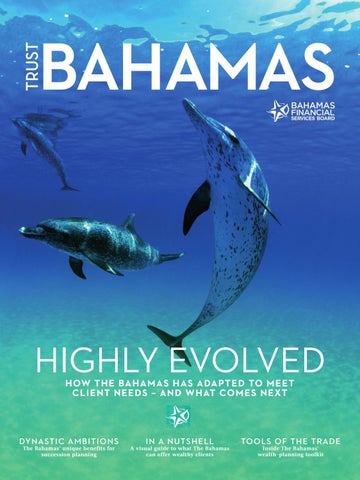
HIGHLY EVOLVED HOW THE BAHAMAS HAS ADAPTED TO MEET CLIENT NEEDS – AND WHAT COMES NEXT
DYNASTIC AMBITIONS The Bahamas’ unique benefits for succession planning
001_BAHAMAS_COVER_V2.indd 1
IN A NUTSHELL
A visual guide to what The Bahamas can offer wealthy clients
TOOLS OF THE TRADE Inside The Bahamas’ wealth-planning toolkit
13/06/2016 14:10
IFC_Step_Bur_16.indd 1
08/06/2016 10:07
SPONSORED BY THE BAHAMAS FINANCIAL SERVICES BOARD Montague Sterling Centre, 2nd Floor, East Bay Street, PO Box N-1764, Nassau, NP, Bahamas Tel: (242) 393-7001 Fax: (242) 393-7712 info@bfsb-bahamas.com www.bfsb-bahamas.com
PUBLISHED BY THINK Capital House, 25 Chapel Street, London NW1 5DH Tel: +44 020 3771 7200 www.thinkpublishing.co.uk Publisher Polly Arnold Senior Account Manager Kieran Paul Editorial Director Matthew Rock Managing Editor Charles Kloet Art Editor Clair Williams Senior Advertising Executive Tony Hopkins
COVER IMAGE: ALAMY
This is a sponsored supplement, the content of which is paid for and controlled by the sponsor. STEP’s editorial team, including the STEP Journal Editorial Board, has not been involved in the production of this supplement. The views expressed in this supplement are not necessarily those of STEP and readers should seek the guidance of a suitably qualified professional before taking any action or entering into any agreement in reliance upon the information contained in this publication. Whilst the publishers have taken every care in compiling the content to ensure accuracy at the time of going to press, neither they nor STEP accept liability or responsibility for errors or omissions therein, however caused. STEP does not endorse or approve any advertisement and has no liability for any loss caused by any reliance on the content of any such advertisement. Print: Full Spectrum, Basildon
C NTENTS 05 WELCOME Your introduction to the supplement
15 ATLANTIC VIEWS US and UK opinions on Bahamian trusts
06 THE BAHAMAS IN A NUTSHELL An at-a-glance guide to The Bahamas’ wealth-planning offering
19 STURDY FOUNDATIONS Bahamian foundations have come of age
09 EVOLUTION IN ACTION The past and future of Bahamian trust law
20 DYNASTIC AMBITIONS The unique benefits of Bahamian family offices for succession planning
12 THE BAHAMAS TOOLKIT An overview of Bahamian planning tools
22 F AMILY DESTINATION The Bahamas’ appeal for wealthy families
03 TRUST BAHAMAS
003_BAHAMAS_CONTENTS.indd 3
13/06/2016 14:20
Confidence, strength, integrity and independence have been the pillars of our reputation and the basis of our clients’ success for 30 years. They will remain our pillars for the decades to come. Equity Trust House, Caves Village, West Bay Street, PO Box N-10697, Nassau T/ 242. 676. 8188 F/ 242. 676. 8199 E/ info@equitybahamas.com BAHAMAS | DUBAI | SWITZERLAND
equitybahamas.com
004_Step_Bur_16.indd 4 Equity Trust_Step_Bur sup_16.indd 1
08/06/2016 09:10 10:11 25/05/2016
WELCOME TO
THE BAHAMAS very warm welcome to this Bahamas supplement to the STEP Journal. Within these pages, you will find a wealth of information explaining why The Bahamas is the jurisdiction of choice for international financial services. But the case can perhaps be put here briefly, too. A leading international financial centre (IFC), The Bahamas has always sought to provide superior financial products and services, and a world-class client experience. We have proven to be nimble and responsive to global changes – and always mindful of the need to adhere to international standards on compliance, cooperation and transparency. Indeed, four vital factors distinguish The Bahamas as an IFC: regulation, expertise, innovation and location. These four words define everything that The Bahamas offers, and everything that makes The Bahamas a leading IFC.
A
REGULATION
The strong regulatory regime that characterises the financial-services sector ensures that the integrity of The Bahamas as an IFC is maintained. As a sovereign nation for over 40 years, successive governments have demonstrated the country’s commitment to international best practices, and cooperation in the administration of justice, international tax transparency, and anti-money laundering and counterterrorist financing initiatives. Bahamian regulators are well-regarded and active partners with international peer groups and agencies. And the government and private sector collaborate to ensure
The Bahamas remains a well-regulated, compliant IFC.
EXPERTISE
With over 80 years of experience in financial services, few jurisdictions can match the wealth-management credentials of The Bahamas. Local talent is readily available. Bahamian professionals are well trained, boasting internationally recognised designations, supported by years of experience. This professional excellence is the basis for The Bahamas’ strong financial-services framework, an investment climate that has been nurtured through years of maturity, and a stable and predictable business environment. Thousands of Bahamian wealthmanagement professionals work side by side with expatriate colleagues in the roughly 250 financial institutions that have their home in The Bahamas. This blend of local and international talent ensures solutions are readily available to meet diverse client needs; it is also now creating an environment that is conducive to the growth of indigenous boutique firms.
INNOVATION
Market-responsiveness has long been key to The Bahamas as a forwardthinking IFC. Such innovation can be seen in the country’s evolving and often groundbreaking trust legislation. This innovative approach led The Bahamas to become the first common-law jurisdiction to introduce foundations. This approach also led to the creation of the Bahamas Executive Entity and, with the introduction of SMART funds
and the Investment Condominium (ICON) fund, has thrust The Bahamas into the vanguard of the investment funds industry. Given The Bahamas’ innovative spirit, it should come as no surprise that the country is also re-emerging, after a period of dormancy, as a sought-after destination for captives, in particular private placement insurance.
LOCATION
Just 50 miles or so from Florida, The Bahamas is the gateway to the Americas, enjoying all the business advantages that proximity to the US, Central and South America affords. Indeed, with a pristine environment, The Bahamas has become the destination of choice for those who seek an excellent quality of life while being able to easily manage their financial affairs. Most importantly, individuals, family offices and commercial institutions will enjoy a convivial atmosphere when they come to The Bahamas; the country is committed to creating an environment that is not only attractive to foreign direct investment and business-friendly, but also favourable to enjoyment of life generally. As you will discover as you read on, few competitive jurisdictions can offer The Bahamas’ mix of business and pleasure.
TANYA McCARTNEY is CEO and Executive Director of the Bahamas Financial Services Board
05 TRUST BAHAMAS
005_BAHAMAS_WELCOME.indd 5
13/06/2016 14:21
FLORIDA
THE ABACOS
T H E
BAHAMAS
GRAND BAHAMA ISLAND
IN A NUTSHELL
THERE ARE COUNTLESS PORTS OF ENTRY, AND MARINAS THAT CAN ACCOMMODATE THE LARGEST YACHTS
ELEUTHERA/ HARBOUR ISLAND
HIGH-NET-WORTH MAGNET
NASSAU/PARADISE ISLAND
$29.7
TRILLION
THE WEALTH HELD BY THE WORLD’S 211,275 ULTRA-HIGHNET-WORTH INDIVIDUALS (UHNWIs) GLOBALLY IN 2014
$190
BILLION THE WEALTH HELD BY THE 1,155 UHNWIs LIVING IN THE CARIBBEAN IN 2014
$10
BILLION THE WEALTH HELD BY THE 45 UHNWIs LIVING IN THE BAHAMAS IN 2014
ANDROS
FOLLOW YOUR MONEY The Bahamas has a liberal process for granting ‘economic permanent residency’. Once granted, there is no requirement to be present for a minimum or maximum number of days
$500,000
An accelerated permanent residence application is available for those who spend at least $500,000 on a residence
$1.5 MILLION
The applications of those who invest $1.5 million or more in a residence will be reviewed within 21 days
$10,000
Spouses and children can be endorsed on the residence permit for a one-time government fee of $10,000
INNOVATIVE STRUCTURES
The Bahamas prides itself on developing marketresponsive, compliant and innovative products, such as:
THE INVESTMENT CONDOMINIUM (ICON): An alternative legal structure for investment funds, aimed at Latin American investment managers SMART FUNDS: A flexible collective investment vehicle, benefiting from risk-based regulatory supervision THE BAHAMAS EXECUTIVE ENTITY (BEE): The BEE can perform governance, office-holding and fiduciary functions, but has limited liability FOUNDATIONS: In 2004, The Bahamas became the first leading commonlaw jurisdiction to introduce foundations legislation TRUSTS: Trust law is regularly updated to meet client needs – e.g. the rule against perpetuities was abolished in 2011
TAX NEUTRALITY
0%
No income, capital gains, gift, inheritance or estate tax applies to those who conduct business or reside in The Bahamas
10%
The stamp tax on the purchase of a new home
1.5%
Real property taxes are 1.5 per cent of the property value
7.5%
The VAT payable on most goods and services imported into The Bahamas or purchased locally
* ALL MONETARY SUMS ARE GIVEN IN US DOLLARS, WITH WHICH THE BAHAMIAN DOLLAR IS ON A PAR
006-007_BAHAMAS_INFOGRAPHIC.indd 6
13/06/2016 14:21
21 INTERNATIONAL
AIRPORTS
25°C
ARE SITUATED THROUGHOUT THE ARCHIPELAGO
GATEWAY TO THE AMERICAS
THE AVERAGE TEMPERATURE IN THE BAHAMAS
THE BAHAMAS LIES
65 MILES
VENERABLE LEGAL SYSTEM
OFF THE EAST COAST OF FLORIDA
English common law remains the basis for the legal system of The Bahamas, which, as a former British colony, gained independence in 1973
26°C
THE AVERAGE TEMPERATURE OF THE BAHAMAS’ WATERS, YEAR ROUND, WITH THE ISLANDS’ BEACHES REGULARLY VOTED AMONG THE WORLD’S BEST
The UK Privy Council remains The Bahamas’ final court of appeal
CAT ISLAND
The Bahamas is home to over 270 LICENSED BANKS AND TRUST COMPANIES...
RUM CAY/ SAN SALVADOR
THE EXUMAS
ISLANDS FORM THE BAHAMAS
MANHATTAN
IMPRESSIVE INFRASTRUCTURE
IN THE SAME TIME ZONE AS NEW YORK, THE BAHAMAS IS AN IDEAL HUB FOR INVESTMENT IN NORTH AND SOUTH AMERICA
LONG ISLAND
... more than 9,000 FINANCIAL PROFESSIONALS...
... and around 1,000 LAWYERS
THE BAHAMAS IS
5 HOURS BEHIND LONDON
TRANSPARENT… The Bahamas was deemed ‘largely compliant’ by the OECD Global Forum on Transparency and Exchange of Information for Tax Purposes in November 2013
MAYAGUANA
ACKLINS/CROOKED ISLAND
Trustees are obliged to perform due diligence on settlors, beneficiaries and other parties, but trust deeds in The Bahamas are not publicly registered
The Bahamas has signed 33 tax information exchange agreements The Bahamas will implement the OECD’s Common Reporting Standard in 2018 The Bahamas signed an intergovernmental agreement with the US under the Foreign Account Tax Compliance Act (FATCA) in 2014
006-007_BAHAMAS_INFOGRAPHIC.indd 7
… BUT RESPECTFUL OF PRIVACY
INAGUA
Under FATCA, trustees in The Bahamas are required to report in respect of trusts with US beneficiaries only Under Bahamian trust law, disclosure to contingent beneficiaries is limited
08/06/2016 17:36
are many trust companies There There are many trust companies but only one Private Trust but only one Private Trust Private Trust is the largest independent trust company in The Bahamas. We earned this distinction by doing things differently. Not beholden to corporate parents, Private Trust can craft innovative, dynamic and entrepreneurial solutions from the widest universe. Only the very best will do for our clients around the world. A classic trust company, Private Trust acts as trustee of relationships as well as assets. Our success comes from our ability to nurture long-standing, personal and confidential associations with our clients and their professional advisors.
Private Trust is the largest independent trust company in The Bahamas. We earned this Independence, creativity and flexibility make us unique. Contact us for an distinction by doing things differently.
appointment to see how you can benefit from the freedom of our thinking.
Not beholden to corporate parents, Private Trust can craft innovative,The dynamic and Private Trust Corporation Limited House, Charlotte Street, entrepreneurial solutions from the widest universe. Only the very bestCharlotte will do for ourBahamas PO Box N-65, Nassau, T 242-397-8000 clients around the world. F 242-326-8388
There are many trust companies but only one Private Trust A classic trust company, Private Trust acts as trustee of relationships as well as assets. info@privatetrustco.com privatetrustco.com
Private Trust is thefrom largest independent trust company ing, in The Bahamas. Our success comes our ability to nurture long-standpersonal and confidential ❙ Trusts & Foundations ❙ Company & Corporate Services ❙ Private Trust Companies ❙ Fiduciary Services ❙ Insurance ❙ Funds We earned this distinction by doing things differently. associations with our clients and their professional advisors. Not beholden to corporate parents, Private Trust can craft innovative, Half Page Horizontal.indd 1
dynamic and entrepreneurial solutions fromusthe widest universe. Only the Independence, creativity and flexibility make unique. Contact us for an appointment to very best will do for our clients around the world. see how you can benefit from the freedom of our thinking.
13/02/2013 14:24
A classic trust company, Private Trust acts as trustee of relationships as well as assets. Our success comes from our ability to nurture long-standing, personal and confidential associations with our clients and their professional advisors. Independence, creativity and flexibility make us unique. Contact us for an appointment to see how you can benefit from the freedom of our thinking.
The Private Trust Corporation Limited Charlotte House, Charlotte Street, PO Box N-65, Nassau, Bahamas T 242-397-8000 F 242-326-8388 info@privatetrustco.com ❙ Trusts & Foundations ❙ Company & Corporate Services ❙ Private Trust Companies ❙ Fiduciary Services ❙ Insurance ❙ Funds privatetrustco.com The Private Trust Corporation Limited Charlotte House, Charlotte Street, PO Box N-65, Nassau, Bahamas T 242-397-8000 F 242-326-8388 info@privatetrustco.com privatetrustco.com
Half Page Horizontal.indd 1
13/02/2013 14:24
❙ Trusts & Foundations ❙ Company & Corporate Services ❙ Private Trust Companies ❙ Fiduciary Services ❙ Insurance ❙ Funds
008_Step_Bur_16.indd 8 Private Trust_Step_Bur_16.indd 1
14/06/2016 16:28 09:24 09/06/2016
EVOLUTION
IN ACTION Heather L Thompson and Sharmon Y Ingraham survey milestones in the development of Bahamian trust law, and consider what comes next
ahamian trust law has a long history, rooted in The Bahamas’ colonial past and ties to the UK. As a colony, The Bahamas inherited the English common law, supplemented by the doctrines of the English Court of Chancery, including the equitable doctrines relating to the law of trusts. In its early years as an independent nation, Bahamian trust law was still derived from the then existing English trust legislation. Until the enactment of the Trustee Act, 1998, the principal trust legislation in The Bahamas was the Trustee Act 1893, which was inadequate to deal with the complexities of a competitive trust industry. With the recent growth and sophistication of the financial services industry, The Bahamas’ trust law has been modernised to meet the needs of clients. The evolution of Bahamian trust law is landmarked by the following legislation: the Trusts (Choice of Governing Law) Act, 1989, the Fraudulent Dispositions Act, 1991, the Perpetuities Act, 1995, the Trustee Act, 1998, the Purpose Trusts Act, 2004, the private trust companies suite of legislation in 2007, and the Rule Against Perpetuities (Abolition) Act, 2011.
B
THE PROCESS OF EVOLUTION
The Trusts (Choice of Governing Law) Act, 1989 was the first step in the
transformation of Bahamian trust law beyond the 19th century English legislation. The 1989 Act is designed to address problems over jurisdiction and conflict of laws in respect of trusts created in The Bahamas. The provisions of the 1989 Act include: i) permitting Bahamian law to apply to particular aspects of a trust; ii) designating The Bahamas as the forum for the administration of trusts; iii) the determination, with certain exceptions, of questions regarding a trust, including the capacity of a settlor or donor, its validity and administration, and the existence and extent of powers conferred or retained by Bahamian law. The 1989 Act was amended in 1996, to add protection for assets held in a Bahamian trust from forced-heirship claims or the enforcement of other foreign law rules that are adverse to the free disposition of property. The 1996 amendments clarified the definition of heirship rights and made foreign judgments relating to heirship and matrimonial claims unenforceable in The Bahamas. The Fraudulent Dispositions Act, 1991 closely followed the 1989 Act. It became law on 5 April 1991 to facilitate the establishment of asset-protection trusts in The Bahamas. Prior to the Act coming into force, a settlor could be held hostage by creditors who were entirely
unknown to the settlor and of whom the settlor would have been unaware at the time the trust was established. No action to set aside a transfer into trust on the ground of fraudulent intent can be brought after two years from the date of the transfer. Any disposition of property made with the intent to defraud is voidable at the instance of the creditor seeking to set aside the disposition. In instances where a disposition is set aside within the provisions of the Act, s6 further provides that the disposition shall be set aside only to the extent necessary to satisfy the obligation to the creditor at whose instance the disposition had been set aside, together with such costs as the court may allow. The limitation period and other provisions of the Act compare favourably with those of other jurisdictions as they balance protection to both creditors and the settlor. The Perpetuities Act, 1995 introduced a statutory perpetuity period for trusts so that a perpetuity period was determined by a life or lives in being plus 21 or 80 years. A 2004 amendment to the 1995 Act extended the period to 150 years. Subsequent amendments to the Trustee Act in 2011 enabled the Bahamian Supreme Court to extend the perpetuity period on applications made to it by up to 150 years. Additionally, under s3, a power holder, exercising the trust’s power of amendment, may extend the perpetuity period in the trust instrument by up to 150 years from the date the trust was established. Bahamian trust law took a more radical step in its evolution with the Rule Against Perpetuities (Abolition) Act, 2011. The Act automatically abolished the rule against perpetuities for every disposition of interest in property created after 30 December 2011, when it came into force. The Act defines ‘disposition’ to include the conferring of a power of appointment and any other disposition, or creation of an interest in, or right over, property. Under the Act, a disposition by will is deemed to take place on the testator’s date of death, and, under a special power of appointment, on the date of disposition. By a court order, the 2011 Act can also have retrospective effect. The Act permits an application to the court in respect of existing trusts by a trustee for a declaration that the Act applies to the trust. The court order may include terms that anything done prior to the order on the basis that the disposition was void due to the application of the perpetuity shall continue to have effect as if the order was not made, protecting or preserving
09 TRUST BAHAMAS
009-011_BAHAMAS_THOMPSON.indd 9
08/06/2016 17:35
Legislative landmarks Trusts (Choice of Governing Law) Act, 1989 allows settlors to choose Bahamian law as the law governing their trust
Perpetuities Act, 1995 imposed a statutory perpetuity period for trusts (abolished in 2011)
1990
2000
Purpose Trusts Act, 2004 provides for the creation of non-charitable purpose trusts
2001
2002
2003
2004
1980 Fraudulent Dispositions Act, 1991 creates a twoyear time period after which a creditor will be barred from challenging a trust on the ground of fraudulent disposition
the interest of the person in the property which is subject to the disposition, and varying or deleting any provision in the trust that may restrict any power which arises by virtue of the disposition. A major piece of legislation modernising Bahamian trust law was the Trustee Act, 1998. The Act was the first of its kind and sought to resolve doubts over the core content of a trust and concerns over powers reserved to settlors. The Act applies generally to trusts and estates constituted or created before or after the coming into force of the Act, with some exceptions. The 1998 Act clarified trust law in The Bahamas by allowing for a settlor to retain certain powers without necessarily rendering the trust invalid or causing a trust created inter vivos to be characterised as a testamentary disposition. Powers that may be reserved to the settlor include a power of revocation, a power of appointment over any part of the trust property, a power of amendment, and powers of addition or removal of trustees, protectors and beneficiaries. The 1998 Act also gave trustees ‘full powers of investment and of changing investments of individual beneficial owners absolutely entitled’. Further, it introduced maintenance, accumulation of income, advancement and protective trusts into Bahamian law. The 1998 Act sanctioned the position of ‘protector’ too. The protector may be bestowed with ‘any powers, including the power to remove trustees, appoint new or additional trustees and exclude any beneficiary of the trust’. At the time the 1998 Act was enacted, it clarified the position concerning disclosure to beneficiaries. Under its provisions,
Trustee Act, 1998 permits, inter alia, settlors to reserve certain powers; gives trustees ‘full powers of investment’; introduces maintenance, accumulation of income, advancement and protective trusts; and abrogates the rule in Saunders v Vautier in certain circumstances
trustees are obliged to take reasonable steps to inform beneficiaries with vested interests of the existence of the trust and of the general nature of that interest. If there are no beneficiaries with vested interests, the trustees must take reasonable steps to ensure that one person capable of enforcing the trust is aware of the existence of the trust and of the general nature of the interest entitling that person to enforce it. However, trustees are given an overriding discretion to withhold information from a beneficiary if they consider it is not in the best interest of the beneficiary to give such information. Additionally, trustees are under no obligation to disclose the existence of the trust to contingent or
often more familiar and comfortable with guiding investment decisions under their trust structures. In recognition of this, s81A, on directed trusts, permits the investment or management of the trust fund to be undertaken by the trustee pursuant to directions from another person, a power holder. Investment powers that may be subject to directions include the appointment of custodians, investment advisors and managers, delegation of investment powers, and acquiring, borrowing and lending trust property. The 2011 amendment also allows a settlor to incorporate into the trust instrument provisions to terminate the interest of a beneficiary who challenges,
‘Since 1989, Bahamian trust law has continued to evolve to meet the changing needs of the fi nancial services industry’ discretionary beneficiaries or objects of a power. With the 2011 amendment to the Act, the trust instrument may provide that the provisions of s83 are inapplicable to it. The 1998 Act also abrogated the rule in Saunders v Vautier. Under the Act, the rule will not apply where its application would defeat a material purpose of the settlor or testator in creating the trust, unless the settlor is alive and consents to a modification or termination of the trust. Other significant amendments to the Trustee Act in 2011 included new provisions regarding directed trusts, in terrorem clauses, and the arbitration of trust disputes. Modern settlors are
or assists in a challenge on, the validity of the trust. The validity challenge is not restricted to actions in The Bahamas, but applies to challenges commenced outside the jurisdiction of the Bahamian court too. Sections 91A to 91C, and the second Schedule to the Act, allow for trust disputes to be resolved by arbitration. Section 91A permits the inclusion of an arbitration clause in a trust instrument, enabling trust disputes or questions on the administration of a trust to be submitted for determination by arbitration; the decision of the arbitral tribunal will bind beneficiaries. Sections 91B and 91C provide the mechanism for the arbitration
10 TRUST BAHAMAS
009-011_BAHAMAS_THOMPSON.indd 10
08/06/2016 17:34
Trustee Amendment Act, 2011 introduces trust arbitration provisions, affirms the validity of hostile beneficiary clauses, and establishes the concept of directed trusts
2005
2006
2007
2008
2009
2010
2011 Banks and Trust Companies (Private Trust Companies) Regulations, 2007 facilitate the establishment of private trust companies in The Bahamas
proceedings, setting out the powers of the tribunal and the interpretation provision. The Purpose Trusts Act, 2004 came into effect on 17 August 2004 and provided for the creation of non-charitable purpose trusts, the Bahamian alternative to the Cayman STAR and BVI VISTA vehicles. The 2004 Act allows trusts without named, or classes of, beneficiaries to be created, provided: the purpose is possible and sufficiently certain to allow it to be carried out; the purpose is not contrary to Bahamian public policy or unlawful in The Bahamas; and the trust provides for termination and the disposition of surplus assets on termination. The 2004 Act provides for an authorised applicant who has powers similar to an enforcer in other jurisdictions. Such powers enable the authorised applicant to bring and prosecute proceedings for the benefit of the trust, including administration proceedings, breach-of-trust proceedings, recovery-of-trust-property proceedings and other proceedings against trustees or third parties. An amendment to the Purpose Trusts Act in 2011 clarified that any rule of law that prohibits trusts of excessive duration or restricts the period during which income may be accumulated is inapplicable to an authorised purpose trust. In 2007, s2 of the Banks and Trust Companies Regulation Act, 2000 (the BTCR Act) was amended to enable the creation of private trust companies (PTCs). In addition to the amendment to the 2000 Act, the Banks and Trust Companies (Private Trust Companies) Regulations, 2007 were promulgated to facilitate and regulate PTCs. Among other advantages,
Rule Against Perpetuities (Abolition) Act, 2011 abolishes the rule against perpetuities, which formerly limited the duration of Bahamian trusts to 150 years
PTCs can accommodate the holding of commercial and unusual assets in trust. A PTC, which can be organised under either the Companies Act, 1992 or the International Business Companies Act, 2000, must act as trustee for only a trust or trusts created by or at the direction of a ‘designated person’ named in a ‘designating instrument’. The PTC legislation allows for more than one person to be named in a designating instrument if those persons are related by blood or some other family relationship to the designated person. Beneficiaries are not restricted in any way under trusts administered by a PTC. The PTC legislation exempts PTCs from certain requirements imposed on banks and trust companies under the BTCR Act, subjecting PTCs to a light-touch form of regulation. In particular, PTCs are not required to have a licence from the Central Bank, issued under the BTCR Act, to operate. However, PTCs are required to have a minimum share capital of BSD5,000 and pay annual fees to the Central Bank. PTCs are also required to have a ‘registered representative’, which must be a separate legal entity and either a licensee of the Central Bank or a financial and corporate service provider that has obtained prior approval of the Central Bank. The registered representative provides certain functions for a PTC including secretary, officer, director and Bahamas agent services. The registered representative must also ensure the PTC is established for a lawful purpose and operates as a PTC. The registered representative will provide annual certifications to the Central Bank, including confirmation from both the
PTC and the registered representative of the PTC’s continued adherence to the legislation.
ONGOING ADAPTATION
Since 1989, Bahamian trust law has continued to develop, evolving to meet the changing needs and requirements of the financial services industry. Current changes under consideration include the incorporation of legislative measures to: introduce Hastings-Bass protection; address trustee concerns regarding twoparty contracts; extend protection under the Trusts (Choice of Governing Law) Act, 1989 to beneficiaries, as well as settlors; and codify unit trusts. The rule in Hastings-Bass was previously applied to permit the courts to reverse a trustee’s decision that was made in good faith but that resulted in unintended consequences or was a mistake. The principle distilled in the Hastings-Bass line of authority was severely eroded by the recent decision of the House of Lords in Pitt v Holt and Re Futter. Legislative measures to address the treatment of mistakes by trustees following Pitt v Holt would clarify this area. Likewise, legislation to address valid and effective execution by a trustee acting on both sides of a transaction would be particularly useful.
HEATHER L THOMPSON TEP is a Consultant, and SHARMON Y INGRAHAM TEP is a Senior Associate, at Higgs & Johnson
11 TRUST BAHAMAS
009-011_BAHAMAS_THOMPSON.indd 11
13/06/2016 14:13
are many trust companies There There are many trust companies but only one Private Trust but only one Private Trust Private Trust is the largest independent trust company in The Bahamas. We earned this distinction by doing things differently. Not beholden to corporate parents, Private Trust can craft innovative, dynamic and entrepreneurial solutions from the widest universe. Only the very best will do for our clients around the world. A classic trust company, Private Trust acts as trustee of relationships as well as assets. Our success comes from our ability to nurture long-standing, personal and confidential associations with our clients and their professional advisors.
Private Trust is the largest independent trust company in The Bahamas. We earned this Independence, creativity and flexibility make us unique. Contact us for an distinction by doing things differently.
appointment to see how you can benefit from the freedom of our thinking.
Not beholden to corporate parents, Private Trust can craft innovative,The dynamic and Private Trust Corporation Limited House, Charlotte Street, entrepreneurial solutions from the widest universe. Only the very bestCharlotte will do for ourBahamas PO Box N-65, Nassau, T 242-397-8000 clients around the world. F 242-326-8388
There are many trust companies but only one Private Trust A classic trust company, Private Trust acts as trustee of relationships as well as assets. info@privatetrustco.com privatetrustco.com
Private Trust is thefrom largest independent trust company ing, in The Bahamas. Our success comes our ability to nurture long-standpersonal and confidential ❙ Trusts & Foundations ❙ Company & Corporate Services ❙ Private Trust Companies ❙ Fiduciary Services ❙ Insurance ❙ Funds We earned this distinction by doing things differently. associations with our clients and their professional advisors. Not beholden to corporate parents, Private Trust can craft innovative, Half Page Horizontal.indd 1
dynamic and entrepreneurial solutions fromusthe widest universe. Only the Independence, creativity and flexibility make unique. Contact us for an appointment to very best will do for our clients around the world. see how you can benefit from the freedom of our thinking.
13/02/2013 14:24
A classic trust company, Private Trust acts as trustee of relationships as well as assets. Our success comes from our ability to nurture long-standing, personal and confidential associations with our clients and their professional advisors. Independence, creativity and flexibility make us unique. Contact us for an appointment to see how you can benefit from the freedom of our thinking.
The Private Trust Corporation Limited Charlotte House, Charlotte Street, PO Box N-65, Nassau, Bahamas T 242-397-8000 F 242-326-8388 info@privatetrustco.com ❙ Trusts & Foundations ❙ Company & Corporate Services ❙ Private Trust Companies ❙ Fiduciary Services ❙ Insurance ❙ Funds privatetrustco.com The Private Trust Corporation Limited Charlotte House, Charlotte Street, PO Box N-65, Nassau, Bahamas T 242-397-8000 F 242-326-8388 info@privatetrustco.com privatetrustco.com
Half Page Horizontal.indd 1
13/02/2013 14:24
❙ Trusts & Foundations ❙ Company & Corporate Services ❙ Private Trust Companies ❙ Fiduciary Services ❙ Insurance ❙ Funds
012_Step_Bur_16.indd 12 Private Trust_Step_Bur_16.indd 1
16:46 09/06/2016 16:28
WEALTH-PLANNING TOOLS
in popularity, as they afford wealth creators greater control and efficiency, and better governance. A PTC is a trust company that acts as trustee of one or more trusts for a ‘designated person’ or designated persons, or an individual or individuals who are related by consanguinity or other family relationships to the designated person. PTCs that are not institutional trustees but private companies can then be established to administer trusts for family members.
PURPOSE TRUSTS
‘Close collaboration between the government and businesses ensures market needs are met’ • is ‘ownerless’ and self-contained and thus lends itself extremely well to the executive purpose of holding the shares of, and exercising voting rights in respect of, a private trust company or other company; and • can operate in multi-jurisdictional structures, not just Bahamas ones.
ADDITIONAL PLANNING TOOLS FOUNDATIONS
Central to the development of the Bahamas foundation was the typical Latin American client’s resistance to the idea of surrendering control of their money, which is key to a conventional Anglo-Saxon trust. While the landmark Trustee Act, 1998 provided for settlor-reserved-powers trusts, a consensus developed that a foundation was an essential tool for clients originating from both Latin America and Europe, as a legal entity recognisable under the laws of such clients’ home countries. Clients from civil-law jurisdictions now have a product that they are familiar with.
PRIVATE TRUST COMPANIES
The recent financial crisis led to a loss of confidence in institutional service providers. As such, private trust companies (PTCs) have grown
The Purpose Trusts Act, 2004 permits the establishment of trusts for noncharitable purposes. This makes it a commonly used structure for holding the shares of PTCs and other legal entities. Alternatively, a BEE may also be used for that purpose, eliminating the need to appoint an authorised applicant/enforcer and a professional trustee.
INVESTMENT FUNDS
Investment funds are a long-standing component of wealth-management strategies and, in some jurisdictions, they are more acceptable entities than trusts or foundations for certain types of transactions. The Bahamas has recognised the potential of this market and designed an innovative fund for those active in the wealth-management sector: the ‘specific mandate alternative regulatory test fund’ (SMART fund). These funds are increasingly playing a role in wealth structures for clients and family offices that are seeking greater control and transparency, while accessing important investment opportunities. ‘Professional funds’, a class of funds for sophisticated investors, and ‘recognised foreign funds’, which are licensed or registered in a prescribed jurisdiction, are core components of The Bahamas’ funds industry. The newest addition to the portfolio is the ‘investment condominium’ (ICON). While designed to be fully compliant with Brazilian laws and to operate like one of Brazil’s products, it is an alternative legal structure for investment funds in countries with similar civil-law constructs.
CORPORATE STRUCTURES
Individuals and institutions may wish to establish customised corporate
structures, tailored to the specific demands of their international business transactions, and asset-management and estate-planning strategies. The ‘international business company’ (IBC) is a staple tool in creating structures to preserve and accumulate wealth, with the flexibility to adapt to almost any need. An IBC may be used to set up a holding company or to create an investment fund. It is an equally ideal structure to hold title to a ship, or to establish a family office, and it is the vehicle of choice for private trust and captive insurance companies. Other corporate structures include ‘limited duration companies’, which are restricted to an existence of 30 years or less and must have a specific purpose, and sophisticated ‘segregated accounts companies’.
CAPTIVE INSURANCE
Cell legislation is a prime example of The Bahamas applying its wealthmanagement expertise to the captive market. The cell legislation provides robust statutory protection to ensure that the assets and liabilities of each account are truly separate and distinct. Cell captives benefit from the natural economies of scale created within such structures, and the regulatory regime in The Bahamas is a clear response to the demand for costeffective means of entering into captive or self-insurance for small to medium-sized enterprises, while satisfying international standards. Creative use of different types of insurance can provide benefits at all phases of the wealth life cycle. Captive insurance can be an effective mechanism for the initial transfer of assets into a wealth-management structure on a pre-tax basis.
FINAL THOUGHTS
Professionals in The Bahamas are able to assess client needs and select from a range of compliant structures within the jurisdiction’s toolkit to create suitable solutions. All the while, The Bahamas continues to be a responsible, innovative international financial centre.
IVYLYN CASSAR CPA TEP ACLARB is Vice Chairman of Equity Bank and Trust Bahamas Ltd
13 TRUST BAHAMAS
012-013_BAHAMAS_CASSAR_v2.indd 13
13/06/2016 14:16
014_Step_Bur_16.indd 14
13/06/2016 15:56
There are many reasons why US practitioners consider The Bahamas a leading offshore trust jurisdiction. Take my firm, for example. Based in Miami, our practice is focused on ultrahigh-net-worth international families that have some sort of contact with the US. We often assist in coordinating the global estate planning of families whose members include both US and non-US taxpayers. Such fiscal diversity within a family presents a complex planning scenario for which the use of a Bahamas trust may prove the proper solution. We consider many factors in assisting our clients to determine which jurisdiction to use for their global estate planning. With the caveat that I am not a Bahamas attorney and should not be considered to be providing you with any Bahamas legal advice, let us examine some of these factors and consider how The Bahamas can be viewed as a leading trust jurisdiction.
EASE OF COMMUNICATIONS
The US and The Bahamas share a common tongue, English. The east coast of the US is also in the same time zone as The Bahamas. And, culturally, we in Miami have much in common with The Bahamas – including our allegiance to the Miami Dolphins and Miami Heat sports teams.
STABILITY
The Bahamas is an extremely economically and politically stable developing country, with a per capita income considerably higher than most of its Caribbean neighbours. Its proximity to the US assures its strategic importance on many levels.
S
LEADER OF THE FLOCK Why is The Bahamas so highly rated as a trust jurisdiction by US and UK advisors? We put the question to two prominent practitioners: Steven L Cantor and Rose Chamberlayne
FAVOURABLE TAX REGIME
There are no personal income, capital or estate taxes in The Bahamas. The Bahamas is tax-neutral for non-residents.
FAVOURABLE TRUST LAW
Certainty is a critical factor in evaluating a trust jurisdiction. We understand that, under Bahamas trust law, a planning structure, whether a trust or a foundation, once validly formed, cannot be invalidated by reference to a foreign (non-Bahamas) law that may provide otherwise. We further understand that Bahamas trust law greatly restricts the rights of ‘hostile’ beneficiaries to challenge a validly formed trust. The Bahamas also has legislation providing for the arbitration of trust disputes, thus ensuring a way to resolve sensitive family disputes in a binding manner but without exposure to public legal proceedings. The Bahamas also offers the flexibility required by complex planning scenarios:
• A settlor of a Bahamas trust can reserve rights and discretionary powers over trust property, without invalidating the trust structure. • A family-owned private trust company (PTC), often used by sophisticated clients, is also available as a planning option under Bahamas law. • The Bahamas Executive Entity offers an innovative approach to the governance of wealth structures and other entities, while providing limited liability. Meanwhile, the investment condominium (ICON) provides an alternative legal structure for investment funds. • Bahamas trust law allows a process for the trustee to seek advice and directions from a judge in chambers without filing an action. • In instances where there may be a dispute, Bahamas law specifies with certainty which parties may be able to have access to trust documents.
15 TRUST BAHAMAS
015-017_BAHAMAS_CANTOR.indd 15
08/06/2016 17:31
A comprehensive range of legal services
Lennox Paton is a leading offshore commercial law firm with offices in The Bahamas, the British Virgin Islands, and London. It is widely recognised for its expertise, professionalism, responsiveness and commitment to excellence. • Banking & Finance • Litigation • Insolvency & Restructuring • Corporate & Commercial
• • • • • •
Trust & Foundations Investment Funds Private Client Real Estate Resort Development Shipping
For sound legal solutions, a world-class service, a proven track record, and a commercial approach, please contact us: Bahamas: BVI: London:
+1 242 502 5000 +1 284 494 6864 +44 (0) 20 7743 6490
www.lennoxpaton.com Lennox Paton is recommended by Chambers Global and is recognised as a Tier 1 law firm by IFLR.
J005593_SERVICES_AD_V2.indd 1
016_Step_Bur_16.indd 16
12/02/2016 07:47
08/06/2016 10:13
TRUSTS
EXPERTISE
I have over 35 years’ experience of working closely with many attorneys, bankers and trust officers in The Bahamas, and I have always been pleased by their professional talent, knowledge and responsiveness. Furthermore, the wide variety of financial institutions and trust companies, both in size and focus, has always been a major attraction of The Bahamas in international planning. The dedication and focus of the Bahamas Ministry of Finance and the Bahamas Financial Services Board (BFSB) also set The Bahamas apart from much of the competition. Many people have worked tirelessly to advocate the trust and financial industry of The Bahamas in a way that has been unmatched. I have personally attended various BFSB programmes in the various out islands of The Bahamas, Latin America and Europe, where representatives of The Bahamas, who I am proud to call friends, have very eloquently described the clear-cut advantages of The Bahamas as a trust jurisdiction. STEVEN L CANTOR TEP is Managing Partner at Cantor & Webb in Miami, Florida
Over the past 80 years or so, The Bahamas has worked hard to lay strong foundations for its financial-services sector. In doing so, it has become one of the preeminent jurisdictions for the sophisticated wealth-planning demands of today’s global business families, creating dynastic, best-practice wealth structures, typically including trusts and often combining different entities, depending on what a family wants to achieve. As such, its trust models and complementary tools are widely and successfully used by the UK’s wealth-management profession, with which The Bahamas maintains unique and robust ties. I have always considered The Bahamas an excellent trust jurisdiction – not just on paper, but also when actually engaging first-hand with industry stakeholders. Experience shows that this is an industry that listens to the needs of the ultrawealthy, and then plans and innovates accordingly – for example, bolstering its trust legislation in 2011, thereby enabling trust arbitration and promoting alternative dispute resolution; creating a suite of
pioneering, complementary or standalone entities around specific client scenarios, including the Bahamas Executive Entity, the ICON, and the SMART Fund Model 007; and leading with common-law private foundations way back in 2004. Moreover, The Bahamas is a safe, stable country where discretion is second nature; celebrity residents move around freely, generating little interest and certainly suffering no intrusion. It is a jurisdiction not only in which to house wealth, but to which families can relocate, moving with their money. Indeed, The Bahamas is creating a family-office infrastructure positioned to capitalise on the increasing mobility of people and capital. The Albany development beautifully demonstrates how ultra-wealthy individuals can attract other wealthy, like-minded families to enjoy the advantages that The Bahamas offers, in a luxury family-office-esque enclave. While The Bahamas has many supporters in the UK, it has also been agile in doing business with other global powerhouses, looking west to Latin America and east to Asia, for example. This global approach is essential to the long-term success of offshore jurisdictions, particularly given the dramatic changes and new opportunities emanating from the global economic and eurozone crises and the patchy recovery; increasing compliance, regulation and international exchange of information; politically motivated tax reforms and agendas; scientific and technological advances; cultural change; and geopolitical risks. There are clear opportunities for The Bahamas in, for example, Asia and the Middle East, where demand for trusts continues to rise in line with the coming wave of wealth transfer (with trillions of dollars set to pass to the next generations
‘I have always considered The Bahamas an excellent trust jurisdiction – not just on paper, but also when actually engaging with industry stakeholders’
of families in those regions over the next 15 years or so). The Bahamas has been a keen promoter of PTC structures, which have been so popular with founders around the world, no more so than those from the Middle East and Asia, where the good governance benefits they can enshrine are highly valued. Conversely, in the light of the global tax-transparency agenda and its flow into mainstream politics, there may well be a decline in the use of offshore trusts in some parts of the world, including, potentially, the UK, if its anti-avoidance regime becomes too aggressive. This underlines the need for a dynamic global approach to succession structuring and wealth protection that reflects the bigger footprint of today’s ultra-wealthy, international business families. This must be a holistic approach, one that integrates a range of complementary skills. Wealth structures are now less tax-driven – tax is a factor, but not an exclusive one. Wealth structures need to: incorporate best-practice governance principles at each level of control; be made as strong as possible so that they can withstand internal and external attacks from thirdparty aggressors; be run properly, with their systems and processes regularly reviewed so as to protect their practicality and integrity; and retain sufficient flexibility to adapt and evolve in line with changing family, business and external dynamics. The trusts and alternative wealth-planning tools offered by The Bahamas are fit for purpose for this type of planning. Looking to the future, I trust The Bahamas will remain confident about its value proposition, and proactive in remodelling to meet client demands and the current and future challenges of the wealth-management industry. I also trust it will set a strong precedent for a practical and robust approach to big-money cases that may follow the coming wave of wealth transfer. Finally, I would be pleased to see the growth of its human capital, as advocated by many of its talented legal advisors; opening the doors to international lawyers to share their experience and contacts with The Bahamas will only help to grow and better equip its talent pool to deal with what may be a bumpy road ahead. ROSE CHAMBERLAYNE TEP is a Partner at Wiggin Osborne Fullerlove in Cheltenham, UK
17 TRUST BAHAMAS
015-017_BAHAMAS_CANTOR.indd 17
13/06/2016 14:17
A leading firm of corporate and commercial attorneys advising financial, business and private clients. • • • • • • •
Commercial Litigation & Insolvency Securities Commercial Transactions Financial Services Law & Regulation Real Estate & Development Private Client Wealth & Immigration Trusts & Foundations
Lyford Manor (West Bldg), Western Road, Lyford Cay, P O Box CB-13007, Nassau, The Bahamas T. +1 (242) 702-4500 | F. +1 (242) 702-4524 | E. info@delaneypartners.com
018_Step_Bur_16.indd 18
09/06/2016 16:47
FOUNDATIONS
ike many other common-law jurisdictions, The Bahamas has embraced the foundation, a civil-law concept. In doing so, The Bahamas copied provisions in its trust law and applied them, context permitting, to the foundation. These adaptations recognise the supremacy of the governing law of the foundation and protect against forced-heirship claims, as with Bahamas trusts. Quite apart from the statutory provisions, which usually give a wide degree of flexibility, it is now also standard practice to establish foundations that afford the governing council the discretion to appoint among a class of beneficiaries or to add to or exclude from the class, rather than to set up foundations that provide for a defined interest for beneficiaries. With foundations sharing so much in common with trusts in terms of legislative protections, the question arises whether there was any point in introducing foundations legislation at all. But, in my view, there are various reasons why a client may choose a foundation over a trust. First, there is the issue of registration. For some clients and goals, establishing a legal entity with conclusive proof of status is beneficial: the client’s domicile may more readily recognise the concept of foundations, or the client may be using the foundation for charitable purposes, where a legal entity is advantageous. Second, there is the question of family involvement and control. With clients seeking less involvement of institutional trustees, foundations are becoming increasingly popular for many of the same reasons that private trust companies are. Third, there are considerations of confidentiality. While the register of foundations is public, the charter and
L
the articles of the foundation need not be filed. Also, only beneficiaries with vested interests can request disclosure of foundation documents. Unlike a trust, there is no requirement that any beneficiary who has not requested such information be informed of its existence.
FOUNDATIONS FOR CHARITABLE PURPOSES
In The Bahamas, the company limited by guarantee was for many years the vehicle of choice for charitable planning, followed closely thereafter by charitable purpose trusts. Both proved beneficial, because the rule against perpetuities did not apply to companies limited by guarantee and charitable purpose trusts were specifically exempted from the operation of the rule. Before The Bahamas abolished the rule against perpetuities in 2011, one of the main advantages of the foundation was its perpetual nature; it allowed for truly dynastic planning. The Bahamas foundation no longer holds this advantage over the Bahamas trust, but it retains an edge for public charities, in particular, due to its legal nature, the ability to implement corporate-style governance, and the ability to file and disclose publicly substantive governance documents, thereby ensuring the public accountability that in charitable circles is key for the sake of transparency. For private charities and mixed-purpose foundations, this disclosure is unnecessary; the Foundations Act, 2004 gives clients the flexibility to choose not to disclose these substantive documents in a public registry, thereby providing the best of both worlds.
MIXED-PURPOSE FOUNDATIONS
Families often have a complex mix of needs that must be met even within a structure
The Bahamas foundation has come of age, with advisors increasingly recognising its advantages over other planning vehicles, explains Aliya Allen
STURDY
FOUNDATIONS
predominantly intended for private planning. In The Bahamas, it is possible to have a foundation with primarily charitable purposes, with ancillary private benefit purposes, and vice versa.
FOUNDER’S PATRIMONY
In The Bahamas, the founder retains no patrimony in the assets of the foundation; once an endowment has been made on the foundation, it owns the assets legally and beneficially. However, despite the idea of endowing assets on a legal entity generally causing less discomfort than the idea of transferring assets to a trustee, founders still wish to retain at least some control. In The Bahamas, the founder is able to retain certain rights to terminate the foundation or amend its governing documents, and these rights may be capable of assignment. It is possible to build into the governing documents some triggering event upon which the assignment can be deemed to take effect, like a disability affecting the founder. Control is always a thorny issue. In the context of trusts, a number of commonlaw countries have allowed for incredibly extensive reservation of powers. The Bahamas has gone further and introduced directed trust provisions. However, reserved powers still cause unease among some advisors, and there is a perception at least that the foundation should, as a legal entity, be immune from being invalidated on the basis of reservation. On the other hand, by applying Salomon principles, one might, theoretically at least, be able to pierce the quasi-corporate veil of a foundation. Unfortunately, this question cannot be answered with any certainty given the dearth of case law on this issue.
A PROGRESSIVE JURISDICTION
In 2004, The Bahamas was one of the first common-law jurisdictions to introduce foundations, proving its commitment to leadership in wealth management. The cutting-edge amendments made to The Bahamas’ trust legislation in 2011, and other changes due this year, are further evidence of this forward-thinking approach, which will stand The Bahamas in good stead in years to come.
ALIYA ALLEN is a Partner at Graham Thompson
19 TRUST BAHAMAS
019_BAHAMAS_ALLEN2.indd 19
13/06/2016 14:18
any wealthy families want to gain greater control over their financial and personal affairs. Family offices can play a vital role in helping them do so.
M
WHAT IS A FAMILY OFFICE?
A family office is a vehicle that can provide a broad range of services to the family or families it represents, from dealing with domestic administrative matters (e.g. travel arrangements and household upkeep) to sophisticated support of long-range business, tax and estate planning, including supervision of trusts and investments. Family offices offer several key benefits. First, using one structure to support a broad range of interests affords family members a structured way to evaluate evolving opportunities and obligations, and consider overarching objectives. Second, creation of centralised control and responsibility for integral functions in regards to the family’s interests provides long-term stability. Third, consolidation of oversight enhances the family’s ability
to provide specific direction as to facilities sought from external providers, and to monitor the effectiveness of the services received. Finally, a family office can help to ensure confidentiality, as it consolidates advisory, wealth-management, incomedistribution and other services within a structure owned by the family itself. In sum, family offices support an inclusive approach to oversight, rather than piecemeal review of disparate elements.
GENERATIONAL PLANNING
A family office is uniquely qualified for generational planning. It can provide for succeeding generations by using a wide variety of tools. Wills are a common means of generational planning, but they are rarely well suited to management of dynastic interests. Trusts and foundations, however, have developed specifically to afford the opportunity to plan across decades, and perhaps even centuries. The oversight and management of trusts or foundations can be put into the hands of third parties who report to a family
office. Alternatively, the family office may establish a Bahamian private trust company (PTC) for the express purpose of acting as the trustee of a trust; equally, it can act as the founder or supervisory party of a foundation. A PTC commonly takes the form of a limited liability company, and its board of directors can include family members, as well as trusted advisors and independent third parties. So the family may retain some supervisory authority over strategic management of assets, without prejudicing the validity of the underlying trust or foundation. If set up with unlimited duration, subsequent generations of family members can be included in the governance structure. A particularly intriguing use of a PTC by family offices involves trusts that contain unusual or ‘risky’ assets with which a traditional trustee may not be comfortable. Operating businesses, art or jewellery collections, yachts, planes and other nonfinancial assets often require specialised managerial and operational skills, which can be more readily provided via a PTC.
Linda Beidler-D’Aguilar explains the distinct advantages of Bahamian family offices for succession planning
DYNASTIC AMBITIONS 20 TRUST BAHAMAS
020-021_BAHAMAS_D'AGUILAR.indd 20
08/06/2016 17:26
FAMILY OFFICES
Similarly, a Bahamas Executive Entity (BEE) is a legal entity designed to fill governance roles such as those arising in family-office structures. However, a BEE is not subject to oversight by a specific regulatory body. A BEE’s only role is to fulfil and perform ‘executive functions’, namely those that are administrative, supervisory, fiduciary or office-holding in nature. Thus, it has neither shareholders nor beneficiaries, as it holds assets solely for the purpose of exercising the executive functions outlined. For instance, a BEE can hold the shares of a PTC; if acting as a trustee, it may hold trust assets; it may also hold shares that entitle it to exercise managerial functions, such as the management shares in an investment fund. A family office can also elect to enhance transparency by establishing and licensing an asset-management entity in The Bahamas, or establishing a licensed investment fund for its investment activities. Successful generational planning necessitates that close consideration be given to the laws of the jurisdiction in which the family office is established, as well as the laws of the jurisdictions of the trusts and foundations formed as part of the family’s planning. The Bahamas offers the following significant advantages, among others: • anti-forced heirship provisions are supported by domestic legislation; • protections against claims and creditors are afforded two years after the transfer of assets and interests into a fiduciary structure; • a settlor (even if non-resident in The Bahamas) may declare in the trust instrument that the trust will be governed by the laws of The Bahamas; • statutory limitations on the liability of a trustee, particularly in the context of actions taken by the trustee on the direction of a third party; • the recognition as valid of clauses in a trust deed that preclude ‘hostile’ beneficiaries from overturning a longterm structure, by extermination of interests upon challenge; and • no obligatory disclosure of fiduciary structures in public registers.
SUCCESSION PLANNING
An increasing number of family offices are being established by patriarchs and matriarchs who have, through their own efforts, created the businesses and interests
that will be overseen. However, for the long-term viability of a family office, their knowledge and expertise cannot be the sole basis for current and future planning; it is essential to acknowledge the possibility of unanticipated disruptions to family leadership in order to prepare for a smooth succession. The family office provides an ideal platform for creating succession plans, through a variety of means, including:
there are training and degree programmes expressly aimed at the professionals and executives who work with family offices, as well as a wide variety of software packages produced expressly for family-office use. The use of multi-family offices to manage the finances and affairs of a group of families may present highly attractive economies of scale. Related family groups (e.g. siblings), or groups consisting of the families of business partners, or even
‘The Bahamas’ legislative and regulatory regime allows the creation of compliant, effective and efficient structures for family offices’ • Preparation of a family constitution or charter, which may encompass, in a single document, the family’s overarching aspirations and goals; its values; the missions of its businesses; the roles and responsibilities of family members and the third parties (persons and entities) that the family engages; policies and procedures; and dispute-resolution processes. • Regular evaluation of the executives involved in the office, whether family members or external personnel, and ongoing assessment of the roles and responsibilities within the office. • Ongoing development of knowledge and skills through formal training programmes, as well as encouraging the flow of information within the office and between family members and internal and external advisors. • Creation of programmes that address the family’s social-responsibility concerns and philanthropic interests. How a family elects to achieve the goals implicit in planning of this nature varies widely, depending on the amount of time its members wish to devote to the office, their willingness to engage with internal and external advisors, and their sensitivities to the disclosure of family information outside the office.
A SIZE TO SUIT YOU
The spectrum of structuring opportunities ranges from the creation of a family office in which specific services are outsourced to third parties, to the establishment of an all-inclusive, full-service office with full-time, dedicated executives and staff. In this regard, support for family offices is increasingly sophisticated and immersive:
unrelated families, may find it more appealing to aggregate their requirements, whether to reduce administrative burdens and costs, or to address their combined interests in a way that affords access to multifaceted and complex planning that may not be available individually.
FAMILY OFFICES IN THE BAHAMAS
Although there is considerable discussion about the optimal governance structure for family offices and their associated structures, there is no question that present political and regulatory conditions suggest that substance prevails over form. Permanent-establishment regulations and controlled-foreign-companies rules must be taken into account when establishing an offshore family office; fiscal, residency and immigration requirements also require active oversight and management. The Bahamas’ legislative and regulatory regime offers the opportunity to create compliant, effective and efficient structures for family offices. Also, service providers, including financial institutions, lawyers and accountants, as well as staff, are readily available. Finally, The Bahamas’ proximity and ready access to major cities, including Miami, New York, Toronto and London, as well as the opportunity for families and their trusted advisors to take up residence and purchase property in The Bahamas, are highly advantageous for long-term strategic planning.
LINDA BEIDLER-D’AGUILAR is a Partner at Glinton Sweeting O’Brien
21 TRUST BAHAMAS
020-021_BAHAMAS_D'AGUILAR.indd 21
13/06/2016 14:22
Three experts explain The Bahamas’ appeal for high-net-worth families WHAT ARE THE BAHAMAS’ MAIN MERITS FOR WEALTHY FAMILIES?
The Bahamas offers many advantages for high-networth families that wish to optimise their asset holdings and wealth planning. Key among them is a comprehensive suite of innovative products. Indeed, the Bahamian financial services model is built on innovation; products are constantly being tailored to satisfy the changing demands of clients. With a century of experience in private banking and wealth management, The Bahamas also prides itself on its reputation for consistency of service, an expansive skill set and a robust regulatory environment, from all of which highnet-worth families stand to benefit. And that is not to mention the fact that there are thousands of professionals available to cater to client needs, offering internationally recognised expertise. The Bahamas also boasts a stable and independent judiciary, and offers certainty through its laws, rooted in English common law. These factors, combined with political stability, make The Bahamas a sound choice for high-net-worth families seeking to safeguard their assets and investments. In fact, The Bahamas is the premier jurisdiction for high-net-worth individuals, thanks to its keen sense of their needs and recognition that those needs will only be met via exemplary service and the delivery of sound investment vehicles and products. NICHOLAS MITCHELL is a Client Relationship Associate at Baycourt Chambers
HOW IS THE BAHAMAS BALANCING GREATER GLOBAL TRANSPARENCY AND INDIVIDUALS’ REASONABLE DESIRE FOR PRIVACY? Over the past decade, The Bahamas has taken concrete steps towards meeting its international obligations around greater transparency in financial matters. This includes signing over 30 tax information exchange agreements; committing to compliance with the US Foreign Account Tax Compliance Act;
FAMILY
DESTINATION and agreeing to adopt in 2018 the OECD’s Common Reporting Standard (CRS). As a result of such steps, The Bahamas met the G20 standard on transparency and cooperation in tax matters on 20 March 2010. The pursuit of global transparency, however, has resulted in a direct conflict with individuals’ right to privacy – and striking a balance between transparency and privacy is not easy. One step towards achieving that balance is The Bahamas’ Data Protection (Privacy of Personal Information) Act , 2003. It provides that personal data must be kept safe and only be used for the purposes for which it was collected. That Act, along with the duty of confidentiality in the Banks and Trust Companies Regulations Act, 2000, the fundamental right to privacy enshrined in the Bahamas Constitution, and the residue of common-law principles on breach of confidentiality (capable of existing conterminously with the CRS), represent the full measure of The Bahamas’ attempt to balance these competing objectives. APRIL TURNER is a Partner at McKinney, Bancroft & Hughes
WHAT ARE THE REQUIREMENTS FOR ESTABLISHING RESIDENCE OR DOMICILE IN THE BAHAMAS?
There is a pathway to permanent residency (not the same as citizenship) that allows individuals to live and work
in The Bahamas. This is supported by a flexible immigration policy suited to the needs of international firms, individuals and families. A permanent-residence certificate is a document of legal status issued to someone for the duration of their life, unless revoked, giving them the right to reside and/or work in The Bahamas. Permanent residents are allowed to pass freely through immigration and to remain in The Bahamas for as long as they wish. Usually, spouses and children are endorsed on the permit for a one-time government fee. Financially independent individuals or investors who are owners of a residence in The Bahamas qualify for permanent residence. Currently, the minimum investment threshold for economic permanent residence is BSD500,000. Permanent residency with the right to work in one’s own business is also available; this is suited to individuals with a family office or who simply want to manage investments. The application of those who purchase a residence for BSD1.5 million or more will receive expedited consideration. ‘Annual residence’ is another form of residency in The Bahamas. As the name suggests, it is renewed annually. Finally, a ‘homeowners resident card’, while not conferring any of the privileges of permanent residency, does assist the holder to move freely through immigration at any port of entry. TANYA McCARTNEY is CEO and Executive Director of the Bahamas Financial Services Board
22 TRUST BAHAMAS
022_BAHAMAS_Q&A.indd 22
13/06/2016 14:19
Graham Thompson STEP Ad-02.pdf
IBC_Step_Bur_16.indd 1
1
3/5/14
12:50 PM
08/06/2016 10:09
OBC_Step_Bur_16.indd 1
08/06/2016 10:10