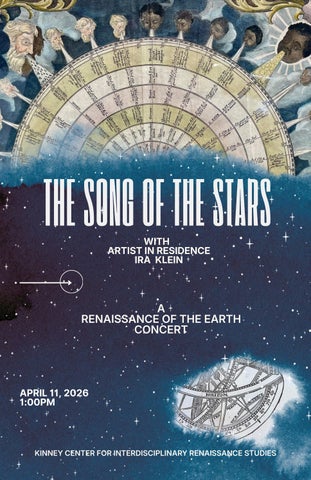
THE SONG OF THE STARS WITH ARTIST IN RESIDENCE IRA KLEIN
A RENAISSANCE OF THE EARTH CONCERT
APRIL 11, 2026 1:00PM
KINNEY CENTER FOR INTERDISCIPLINARY RENAISSANCE STUDIES
A RT I ST ’ S STAT E M EN T The Song of the Stars emerges from an exploration of early modern ideas about wind, space, and the sounding universe. Drawing from early modern maps and classical mythologies in the Kinney Center’s rare book collection, this project begins by engaging with personifications of the winds. These figures once animated world maps with breath, direction, temperament, and weather. Alongside these terrestrial and mythological inquiries, my compositions turn to the cosmological, working with the ancient concept of the music of the spheres, in which harmony is understood as a reflection of planetary motion. Together, these works consider how sound might mediate between earth and cosmos, between the winds that move across maps and the silent rotations of far away planets. These original works-in-progress invite listeners to hear the universe not as an empty space, but as a field of imagined, historical, and resonant motion.
THE PROGRAM “The Conference of The Winds” / Ira Klein (2026) I. Notus (Rain) II. Boreas (Snow) III. Eurus (Heat) In Greek mythology, the winds represent powerful directional forces, often associated with seasons and specific weather trends. These figures are commonly depicted in world maps from the Renaissance period either as personifications of wind gods or as a compass rose. Associated with weather patterns, mythologies of wind invite us to consider how the early moderns made meaning out of what cannot be seen but is constantly felt. Today, I focus on three of the twelve winds whose distinct meteorological qualities become translated into sonic characters, shaping the gestures and textures of this original composition: “The Conference of The Winds.”
Cosmographia / Sebastian Münster (1628) Cosmographia by Sebastian Münster is an attempt to gather the entire world, its geographies, peoples, winds, and wonders, into a single, legible volume. Münster blends empirical observation with commonly held beliefs, pairing detailed maps of city views and landscapes with accounts that move fluidly between fact and imagination. Rather than attempt to resolve the unknown, Münster dwells in it, presenting a world that is composed of forces that are both measurable and mysterious, where wind systems, landscapes, and human cultures all participate in an interconnected and rapidly expanding field of knowledge. “Orbits” / Ira Klein (2026) According to “the music of the spheres,” a theory which started in ancient Greece and developed well into the Renaissance, human-crafted music strives to mirror the movements of the planetary system. At the heart of this tradition is the idea that the cosmos itself is structured like a musical scale, with the Sun occupying the central note that links two four-note clusters, binding the heavens into a unified, resonant whole. German astronomer, mathematician, and musical theorist Johannes Kepler (1571-1630) imagined musical ratios and scales as echoes of the relationship and distance between celestial bodies. Taking inspiration from this concept, I composed “Orbits” using a system that unfolds from a single tone and gradually expands outward, tracing patterns of resonance, distance, and return.
A Week's Conversation on the Plurality of Worlds / Bernard Le Bovier de Fontenelle (1737) Presented as a series of informal conversations between a philosopher and a marquise, A Week’s Conversation on the Plurality of Worlds (1737) gently guides its reader beyond an Earth centered universe to imagine a cosmos filled with countless inhabited worlds. Fontenelle aimed to make astronomy and explanations for planetary motion accessible to readers, inviting them to see the night sky not as distant and silent, but as lively, populated, and cacophonous.
“Blowin’ in the Wind” / Bob Dylan (1962) This popular song resonates with early modern cosmologies by returning us to wind as a carrier of meaning that is mutable. Like the personified winds of early modern maps or the harmonies imagined in “the music of the spheres,” Dylan’s refrain locates truth in motion as the answers drift, circulate, and elude. I have always loved this song, and the open-ended meaning of its provocative lyrics. I enjoy the challenge of arranging a vocal song into a full-sounding instrumental guitar arrangement.
Choice Emblems / John Wynne (1784) In the emblem “Of Fortitude,” a rock stands steadfast amid a tumultuous sea and raging tempests, as it embodies endurance through adversity. Boreas, the cold north wind, blusters its forceful gales, testing the strength of all it encounters. Here, Wynne uses the rock to suggest that resilience is not gentle, but forged in resistance as the force of the wind is tested against the rock, its severity recast as a model for adversity.
ABOUT THE ARTIST Ira Klein is a Brooklyn-based guitarist, composer, and educator. Specializing in Middle-Eastern music and American folk, he seamlessly combines a lifelong passion for musical traditions with a love of experimentation.He takes special joy in interdisciplinary projects, and collaborates often with dancers and visual artists. A recipient of awards from foundations such as LABA New York, J Arts Boston, and Mass Cultural Council, Klein has appeared on NPR, WGBH, CBC, Jewish Renaissance, and Americana UK. He has performed with worldrenowned artists including MacArthur Fellow Claire Chase, saxophonist Neil Leonard, and guitarist Kevin Barry (Jackson Browne). He has served as a music curator for Intentional Beauty and the Judaica gallery at the Museum of Fine Arts, Boston. Klein has offered talks and clinics at Berklee, Harvard, Yale, Brandeis, and Bard College.He holds degrees from Berklee College of Music and Bard College, and is a certified K-12 educator. For more about his work: https://www.irakleinmusic.com/
RENAISSANCE OF THE EARTH
The Renaissance of the Earth revolutionizes what it means to engage the early modern past with questions about our environmental future. Through a range of cross-disciplinary collaborative models, it puts students, artists, and scholars at the center of an interdisciplinary research agenda with the goal of discovering diverse avenues for creating sustainable and equitable life. Learn more about the project: www.renaissanceoftheearth.com
The Kinney Center for Interdisciplinary Renaissance Studies advances research in the early modern humanities. Our mission is to support and promote interdisciplinary scholarship and public-facing humanities programming with the goal of exploring connections between the early modern world (c. 1400-1700) and our own.