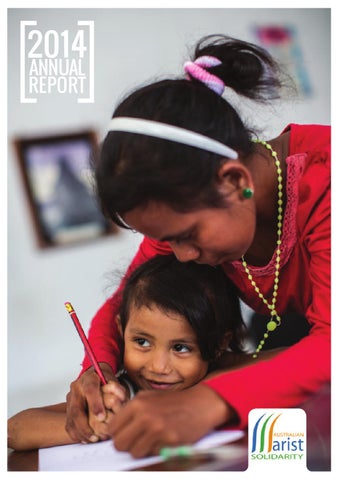
2014 ANNUAL REPORT
SYRIA
PAKISTAN
INDIA BANGLADESH THAILAND
THE PHILIPPINES
CAMBODIA
ASIA TIMOR-LESTE SOUTH AFRICA
2014 AT A GLANCE... Our supporters contributed a total of $957,921 which was allocated to 49 projects across Asia and the Pacific.
2
CAMBODIA**
$646,179
SOLOMON ISLANDS
$740
FIJI
$5,718
THAILAND
$7,996
INDIA
$34,986
TIMOR-LESTE
$120,942
THE PHILIPPINES
$8,280
OTHERS
$14,014
| AUSTRALIAN MARIST SOLIDARITY$46,501 2014 ANNUAL REPORT SOUTH AFRICA
**(see ямБnancial overview notes)
INSIDE ABOUT US
4
CHAIRMAN’S REPORT
6
EXECUTIVE DIRECTOR’S REPORT
7
ORGANISATIONAL STRUCTURE OUR PROGRESS IN 2014
6-7 8-14
BOARD OF DIRECTORS OUR FINANCES
15 16-23
ACFID MEMBERSHIP
BOUGAINVILLE (AR)
SOLOMON ISLANDS
25
PACIFIC FIJI
AUSTRALIA
www.australianmaristsolidarity.net.au
|
3
ABOUT US
18 year old Sreynick lives at home with her parents in Kampong Cham Province, Cambodia and is studying grade 11 with a dream to attend university. 4 | AUSTRALIAN MARIST SOLIDARITY 2014 ANNUAL REPORT
WHO WE ARE
AMS is the international aid and development agency of the Marist Brothers Province of Australia. AMS facilitates partnerships with communities focussed on overseas aid, education and community development activities of the Marist Brothers in Asia and the Pacific Islands. AMS is an Australian not-for-profit company limited by guarantee and became a signatory organisation to the Australian Council for International Development (ACFID) Code of Conduct in 2008. Through the extensive network of Marist Schools around Australia, AMS is ideally placed to engage current and former students, associates and the wider Marist Community and to present a national forum for awareness, immersion, volunteer and fundraising campaigns.
OUR HISTORY
Australian Marist Solidarity Limited (AMS) has evolved from a long heritage of aid and development activities conducted by the Marist Brothers Province of Australia. The Brothers have financially supported and managed overseas aid and development programs in the Solomon Islands since 1938, on Bougainville since 1941 and in other parts of Papua New Guinea since 1950. Today, the Marist Brothers have a presence in Bougainville, Cambodia, Timor-Leste, Fiji, India, Kiribati, New Caledonia, Pakistan, The Philippines, Samoa, Solomon Islands, Sri Lanka, Thailand and Vanuatu while AMS currently supports projects in ten of these countries. In the tradition of St Marcellin Champagnat...
OUR VISION... is of a world that reflects Marists’ desire that vunerable young
people are brought towards the centre from the margins through access to education. OUR MISSION... is to empower young people by enhancing their human dignity and developing their capacity to transform their lives and communities.
OUR WORK
AMS believes in investing in people – empowering them to take their own path to development and as such supports programs that are conducted in partnership with local communities. We focus on sustainable growth through the enhancement of community development, building a community’s capacity to deliver a better quality education, to develop skills and to promote leadership. Our in-country local partners develop projects around three key foci.
FORMAL EDUCATION Our support of primary, secondary and tertiary education programs seek to support and expand education systems that exist in communities across Asia and the Pacific. This work includes support for school programs, school facilities and classroom resources.
NON-FORMAL EDUCATION In communities where there is a lack of educational opportunities and minimal access to formal education, AMS supports learning centres that offer young people tutoring and classes to provide key skills for further education, employment and self sufficiency.
COMMUNITY DEVELOPMENT For young people in Asia and the Pacific, access to and effective participation in educational opportunities relies on maintaining good health and wellbeing. AMS supports a range of suplementary projects based around the development of the health and nutrition of young people with a focus on those with disabilities. www.australianmaristsolidarity.net.au
|
5
FROM THE CHAIRMAN The past year has seen a rapid growth in Australian Marist Solidarity’s activities throughout 10 countries of Asia and the Pacific Islands. More children on the margins of life have moved to access education through AMS projects. Traditionally, Marists have “planted” formal schools, and still continue to do so, however, many projects are in countries where this is not possible. Thus our project partners have been very creative using after hour study centres or community vocational training programmes. Aligned to this has been our extension into community health care, especially in Cambodia, and thus enhanced the educability of young people.
experience especially in Timor-Leste. The AMS team, as part of the broader MSol team in Brisbane, continues to give maximum attention to our partners in the field whom we depend on to deliver our outcomes for change with communities. Our supporters and donors, and people offering AMS probono services, are deeply appreciated for their ongoing generous support. To all who desire a different world that is more just for young people in their access to education and health, we trust you will continue to partner with us in the coming years.
I am indebted once again to my fellow board members for their engagement with the mission of AMS and their support of the AMS team. We farewell Br Mark Paul fms from the board this year and thank him for his shared
Mr Peter Sheehan Chairman, AMS Board
Two young people who attend Ponta Leste learn to play traditional drums.
ORGANISATIONAL STRUCTURE
We invest in partnerships with local people who show strong initiative and leadership in the development of new educational opportunities in their own communities. Our structures support these local partners in the Project Management roles within their projects. In locations where direct communication is sometimes difficult, particularly in the Pacific and in remote areas of Timor-Leste, Regional Managers have been established. These Managers are respected locals who receive ongoing formation through AMS in order to assist us in maintaining communication, monitoring progress and in reporting on our projects. With the AMS Board meeting at the AMS national office in Brisbane the AMS Team and the Board are now able to work more closely on enhancing these processes and other developments in organisational efficiency.
AMS BOARD
EXECUTIVE DIRECTOR 6
| AUSTRALIAN MARIST SOLIDARITY 2014 ANNUAL REPORT
AMS TEAM
REGIONAL MA
>> Currently positioned in: Papua New Guinea, Timor(servicing parts of the Pacific)
FROM THE EXECUTIVE DIRECTOR During 2014 AMS experienced significant expansion across all areas of our mandate. We are grateful for our supporters, new and “rusted on”, who enable us to activate projects with communities’ initiatives in Asia and the Pacific Islands. One standout development has been AMS’s formalizing of our relationship with the Marist District of the Pacific. This extends our mandate as a team to fund search and assist in local project management in Kiribati, Samoa and Fiji. A workshop in Fiji has prepared our Pacific project managers for this new role.
supporters’ commitment to AMS.
Our principal country focus in 2014 have been Timor Leste and Cambodia. Here young people, especially those with disabilities, are particularly vulnerable. Our partners Katilosa, a local East-Timorese NGO, and Marist Solidarity Cambodia expanded their outreach due to our
May the spirit of solidarity, at the heart of what all Marists hope for in the world, continue to be on the horizon of each of us connected to this newly established agency.
The AMS board recently approved a new tag line for the organization: “Working in partnership for change”. It captures so much of local communities aspirations for their young people. The AMS team values the active involvement of our AMS board members, volunteers and supporters at the office, at events and on the board sub-committees. In an organization mandated to grow, these contributions are invaluable.
PROJECT MANAGERS >> Contact through Regional Desks
ANAGERS
Br Allen Sherry fms Executive Director
BENEFICIARIES >> Young people and families who live on the margins of developing countries in Asia and the Pacific.
-Leste & Cambodia
PROJECT MANAGERS >> Direct contact with AMS
www.australianmaristsolidarity.net.au
|
7
OUR PROGRESS IN 2014
Br Donavon working with students at St Joseph’s School in Mabiri, Autonomous Region of Bougainville.
BANGLADESH | BOUGAINVILLE | CAMBODIA | FIJI | INDIA | PAKISTAN | THE PHILIPPINES | SOLOMON ISLANDS | SYRIA | THAILAND | TIMOR-LESTE Our supporter network continues to grow and in 2014 has enabled AMS to support projects in ten coutries across Asia and the Pacific. As part of the Marist Brothers international presence we were also able to continue to respond to the special needs of Marist projects in Syria especially considering the current climate there.
49
projects across Asia & the Pacific in 2014
Throughout 2014 we have improved our visibility and have again held AMS gatherings in key locations on the east coast of Australia. This continues to stimulate growth in support of our projects and has enabled the expansion
of education projects for the poorest and most marginalised young people of Asia and the Pacific. AMS now supports forty-nine locally initiated projects led by local project managers. We thank our supporters for assisting us in making this happen. What follows is a report on our most significant works throughout 2014.
NOTE: We did not have new major works taking place in the Pacific in 2014 and as such projects in the Pacific do not feature here. For details of the projects please contact AMS.
A high school student supported through Villa Maria chats with friend before the day starts, Cambodia
8
| AUSTRALIAN MARIST SOLIDARITY 2014 ANNUAL REPORT
CAMBODIA
LAVALLA SCHOOL (FORMAL EDUCATION) BACKGROUND TO THE NEED
>>>
Young Cambodians with a physical disability are a highly vulnerable group, suffering multiple disadvantages. Stigmatised by society as deserving their misfortune, many live in extreme poverty with limited access to education or basic health care. Founded by the Marist Brothers of Australia in 1998, the LaValla School is designed specifically to cater for the needs of students excluded from mainstream schooling because of disability. In conjunction with the Cambodian Ministry of Education, LaValla offers an accelerated program, enabling students to complete six years of primary education within three years. Many proceed to high school and further study or training thereby greatly improving their chances of obtaining gainful employment.
RESPONSE
>>>
Assisting students with physical disabilities to solve issues related to mobility, balance and muscle strength can lead to significantly improved educational outcomes, as demonstrated at LaValla. Weekly health checks and regular treatment from a team of dedicated physiotherapists, in conjunction with the provision of assistive devices such as crutches, splints and walking frames, are giving students greater control of their learning environment, leading to higher academic achievement. In particular, students are showing remarkable improvement from a recently introduced form of rehabilitation: hydrotherapy.
Children with disabilities are often refused access to education.
PROGRESS
98
Children with disabilities attended school at LaValla School.
26
Children with disabilities graduated from their primary education.
>>>
In 2014 under the direction of the Marist Solidarity Cambodia (MSC): > 98 students were enrolled in the LaValla School’s accelerated primary education program. > Prosthetics, crutches, built-up shoes and other assistive devices were provided as means permitted. > Good working relationship established with local hospitals and rehabilitation centres.
>>>
CHALLENGES/KEY LEARNINGS
Improving children’s mobility not only enhances their educational experience, but it promotes their human dignity and capacity for selfdetermination. The students at La Valla obviously benefit greatly from the health and rehabilitation services on offer, however the cost of employing trained medical staff is significant, as is the purchase of wheelchairs, splints, braces and other mobility devices. Transporting students to and from hospital for appointments also remains a challenge.
above middle: Students participate in a morning warm-up program. above right: Students attending after school study. bottom: Students in class with one of the teachers at the LaValla School.
This health and rehabilitation program provides the best possible medical support to vulnerable young people so that they can live a life of dignity.
www.australianmaristsolidarity.net.au
|
9
CAMBODIA
PAILIN RURAL HEALTH OUTREACH (COMMUNITY DEVELOPMENT) BACKGROUND TO THE NEED
>>>
Although access to healthcare is a basic human right, 5% of the children in Cambodia do not survive beyond the age of five because of a lack of essential medical care. This figure is even higher for those living in rural areas such as Pailin Province, where limited knowledge of health, nutrition and diet, combined with a lack of facilities, roads and transport compound the problem. Villagers with acute cases of dengue fever, malaria, malnutrition, infected wounds and abdominal parasites are frequently unable to obtain medical attention.
RESPONSE
>>>
With the approval of the Cambodian Ministry of Health, a first-aid clinic and sick-bay have been established at the Catholic Church Pastoral Centre in Pailin, alongside the Marist Education Centre. Both centres work together to provide health services and education to the households of the surrounding villages. The clinic in Pailin is open once a week for consultations, medication, basic treatment and referral to hospital if required. It is currently managed by the Marist Brothers and staffed by international volunteers, however it is hoped that local Cambodians will soon be able to take on this responsibility. Outreach clinics are held in the surrounding villages on three other days of the week.
12.3
million people live in poor rural locations such as Pailin.
2000 patients given free medical check-ups and medication
2000 local Cambodians received healthcare education
The World Fact Book, CIA, 2013.
PROGRESS
>>>
In 2014 the Marist Brothers, international volunteers and local Cambodians have provided: > Over 2000 free medical consultations for villagers in the Pailin region. > Lower rates of death and permanent disability from preventable causes. > Workshops on healthcare, basic hygiene and nutrition for more than 2000 people. > Support networks with other health providers in the region. > Outreach health workers with the chance learn from other health providers within the region through observation.
>>>
CHALLENGES/KEY LEARNINGS
In terms of sustainability, one of the key goals of this project is to develop the capacity of local health workers and community educators. In the wet season, it is difficult to reach outlying villages and there is a higher the incidence of vector-borne diseases. Given Cambodia’s recent violent history, another significant challenge for the Marist team is to help people understand that they are now able to change their own circumstances.
above middle: Mother and daughter attend the free medical check-up in Pailin. above right: A young girl smiles after receiving her medical check-up. below: Local families wait to be seen in a poor village within the Pailin region.
10 | AUSTRALIAN MARIST SOLIDARITY 2014 ANNUAL REPORT
INDIA
OPERATION RAINBOW (COMMUNITY DEVELOPMENT) BACKGROUND TO THE NEED
>>>
In India an estimated 2.4 million people live with HIV/AIDS (UNICEF, 2013). The HIV virus continues to affect families often leaving their survival in the hands of the oldest child who is frequently the only uninfected family member. The families and individuals living with HIV/AIDS are often disadvantaged due to the stigmas and lack of education about HIV/AIDS. Operation Rainbow aims to provide these families and individuals with the community support that enables them to continue to live with dignity while also providing necessary education to prevent the spread of HIV/AIDS.
RESPONSE
>>>
Operation Rainbow, based in the city of Tiruchirappalli, known locally as Trichy, is a Marist project run by professional staff and volunteers. Together in the new facilities they provide:
2.4
800
million people living with HIV/AIDS in India.
in home visits with families living with HIV/AIDS.
UNICEF.org, 2013.
PROGRESS
18
women living with HIV/AIDS have completed a certificate in tailoring.
>>>
Operation Rainbow continues to provide support for over three hundred individuals across its programs. These include: > 250 in attendance at the monthly “Rainbow Family Gatherings”. > 800+ in home family visits in 2014. > 18 women have completed the six month tailoring course. > 25 young people from nearby villages have participated in evening classes at the centre. These young people and families are now able to support each other in community so that they do not feel isolated.
>>>
CHALLENGES/KEY LEARNINGS
Operation Rainbow is a program that has grown steadily and at a manageable rate. The number of students now aiming for higher education has increased which also increases the investment required to enable the program to support these students. This is a positive shift for young people with HIV/AIDS and reveals the positive impact that the project is making.
> a place and program that enables children and families with HIV/AIDS to gather in support of one another. These include social outings and the monthly “Rainbow Family Gatherings”. > in-home visits to provide education and support for those with HIV/ AIDS. > free hospital organised medical camp in Trichy about specific health care and medication.
above middle: The recently completed Marcellin Trust Hall being used for the monthly the Rainbow Family Gathering. above right: Local Parish Priest, Rev. Fr. Kulandaisamy and Br. Shanthi open the Marcellin Trust Hall. below: Local women from the program participate in a chalk art competition.
> counselling and assistance around the death of HIV positive family members. > HIV awareness and education for young people in schools and colleges. > financial education support for children whose families are unable to afford the school fees. > a certificate course in tailoring as well as other capacity building workshops. www.australianmaristsolidarity.net.au
|
11
THAILAND
SAMUT SAKHON STUDY CENTRE (COMMUNITY DEVELOPMENT) BACKGROUND TO THE NEED
>>>
One of the biggest seafood processing areas in Thailand, the province of Samut Sakhot attracts a large number of unskilled migrant workers from across the South East Asian region, particularly from Burma. As undocumented labourers, they are are vulnerable to exploitation, harassment and discrimination, as are their children, who often work alongside them. The lack of legal protection and inability to access basic educational or health services make the process of resettlement difficult and precarious for these marginalised people.
RESPONSE
>>>
In 2011 the Marist Brothers, in association with the local parish, established the Marist Centre for Migrants in Samut Sakhon to respond to the educational needs of Burmese migrant children and youth. Students aged from 5-14 are given a basic education, which includes instruction in the Thai language to facilitate their integration within the host country. Youth and young adults are offered a two-year computing and information technology program as preparation for skilled employment and given assistance with job placement. A third level of tuition is offered on weekends to young adults with an emphasis on basic literacy, English and computing.
115
Burmese children given education in Thai for integration into school
PROGRESS
58
young Burmese trained in computing and IT skills
2
young Burmese were assisted with job referrals on completion of the program
>>>
With support from the local community, the staff of the Marist Migrant Centre were able to provide the following services to the Burmese community last year: > 115 Burmese children were given basic education and tuition in Thai to facilitate their integration within the country. > 58 young Burmese were trained in computing and IT skills. > 2 young Burmese were assisted with job referrals on completion of the computing program. > Issues of malnutrition and health were addressed for those attending the Marist Education Centre. Children who left the centre and returned to Myanmar were able to continue their studies in the local Army schools or state schools.
>>>
CHALLENGES/KEY LEARNINGS
It has proved quite a challenge to design and conduct programs to meet the learning needs of students ranging from five-years-old to adult nevertheless the staff at the Marist Centre for Migrants have made an impressive start on this task. Assisting young people to find work in a country other than their own provides its own particular set of challenges as well.
above middle: Young adults participate in a computing and information technology class at the Marist Migrants Centre. above right: Young children of migrant workers in Samut Sakhon participate in celebrations at the centre. below: Young adults participating a weekend computing class.
12 | AUSTRALIAN MARIST SOLIDARITY 2014 ANNUAL REPORT
TIMOR-LESTE
LEPROSY CLINIC (COMMUNITY DEVELOPMENT) BACKGROUND TO THE NEED
>>>
Leprosy remains a significant public health issue in parts of TimorLeste, despite determined efforts to eliminate it. Because of its long incubation period, many cases remain undiagnosed, increasing the risk of infection from close and frequent contact with untreated cases. Early detection, medication, improved hygiene and nutrition are key in arresting the progression of this disfiguring and feared disease. Since 1989 the CIJ (Congregation of the Imitation of Jesus) have operated St Damian’s Clinic in Baucau, providing general healthcare for the population and specific medical attention for those affected by leprosy, however the land on which the clinic is built is owned by the local bishop, who now wants to use it for another purpose.
RESPONSE
21
leprosy patients admitted to the clinic for management of their disease
PROGRESS
3000 patients were treated at the St Damian Clinic
1
assistant nurse has been trained to work in the St Damian Clinic
>>>
In 2014 under the direction of the CIJ sisters: > 21 patients with leprosy were treated and 18 of their family members were supported. > Between 200-400 people were treated at the clinic each month with more presenting during the wet season than the dry. > 24 out-reach clinics and 8 skin-camps were held in the Baucau region. > Visited many outlying villages to detect undiagnosed cases of leprosy and educate the community about preventing the spread of leprosy.
>>>
CHALLENGES/KEY LEARNINGS
The CIJ sisters belong to an Indonesian congregation, founded in 1935, with limited access to major funding. As the population of Timor-Leste and centres like Baucau increases, there is a greater risk of infection arising from people living in crowded conditions without sufficient knowledge about hygiene and nutrition. Living simply and working with great dedication, the CIJ sisters provide an invaluable service to the community and are held in high esteem. This continues to be a very successful partnership.
>>>
The sisters have raised funds themselves and secured a matching amount from the government, but they require significant co-financing and reporting support in order to purchase land and construct a new clinic. Their work consists of in-patient and out-patient care; education in early detection of the disease and its prevention; informing people of the services available to them; and advocacy at both the local and national level on behalf of those with leprosy. They focus especially on encouraging patients to take responsibility for their own care by maintaining a clean and healthy lifestyle, taking their medication and having regular medical check-ups.
above: CIJ Sister and nurse demonstrating how to take blood and how to carry out testing. bottom: East-Timorese nurse, Anastazia, works at the clinic in Baucau, Timor-Leste.
www.australianmaristsolidarity.net.au
|
13
TIMOR-LESTE
ICFP (TEACHER TRAINING PROGRAM) (FORMAL EDUCATION) BACKGROUND TO THE NEED
>>>
As the least developed nation in Asia and with one of the highest population growth rates in the world, Timor-Leste faces numerous problems. During the post referendum violence, 95% of its buildings were destroyed and four out of every five teachers left the country. To meet this massive need, untrained teachers with limited academic background were employed to teach, thereby creating a new set of problems for this fragile, new country. Research has shown that the negative impact of low performing teachers is severe, particularly during the early years of schooling and that young students, placed with poorly qualified teachers for several years in a row, suffer an educational loss that is largely irreversible.
RESPONSE
45% of the population will be below the age of fourteen by 2020
PROGRESS
424
students have graduated with a Bachelor of Teaching (Primary) since 2006
16
teachers gained a Masters in Educational Leadership since 2006
>>>
With the support of generous donors, ICFP has made a major contribution to education in Timor-Leste. Since 2006: > 424 students have graduated with a Bachelor of Teaching (Primary). > 16 teachers have gained a Masters degree in Educational Leadership. > High quality educational resources have been produced in four languages. Trained in critical thinking, pedagogy and child development, ICFP graduates become leaders in the field of education and also in their local communities.
>>>
CHALLENGES/KEY LEARNINGS
An educational enterprise of this size and scope requires a significant investment of funds each year. One particular challenge is the need to produce culturally appropriate curriculum resources in the child’s mother tongue as well as in Portuguese and Tetum, the official languages of instruction. ICFP has a proven record of quality teaching and is recognised, both internationally and nationally, as a hallmark of excellence in the country.
>>>
To address this issue, the Marist Brothers of Australia responded to an invitation from the bishop of Baucau by opening an educational resources centre and establishing a training college (ICFP) for primary teachers. As one of the few fully functional tertiary institutions in the country, the college quickly gained an enviable reputation for the high quality of programs, obtaining accreditation with the Australian Catholic University in 2003. Until recently, classes have been held in leased premises in spaces that are ill equipped for teaching and learning, and so it was amidst great rejoicing that the college opened its first specially designed, dedicated building in May 2015.
above left: Student at ICFP learn the recorder in order to teach their primary students in schools across Timor-Leste. above right: Active participation in classes at ICFP is enthusiastically embrased. bottom: Students take down notes during a lecture at ICFP.
14 | AUSTRALIAN MARIST SOLIDARITY 2014 ANNUAL REPORT
One of the long winding roads of the Autonomous Region of Bougainville.
BOARD OF DIRECTORS MR PETER SHEEHAN | Chairperson (Appointed April 2013) MR MICHAEL SINCLAIR | Company Secretary (Appointed August 2013) MR BERNARD KENNA | Treasurer (Appointed July 2008) DR DAVID BUCKLEY | (Appointed July 2008) BROTHER JEFFREY CROWE | Provincial Superior, Province of Australia (Appointed 2008) BROTHER JULIAN CASEY | (Appointed July 2008) MRS ANNE-MARIE HUNTER | (Appointed February 2014) MR DAVID L’ESTRANGE | (Appointed July 2013) BROTHER MARK PAUL | (Appointed July 2008) MR MARCUS RILEY | (Elected AMS Board Member: 2013) BROTHER ANTHONY ROBINSON | (Elected AMS Board Member: 2007) www.australianmaristsolidarity.net.au
|
15
OUR FINANCES
A student on the LaValla School, Cambodia, completes and example for the class. 16 | AUSTRALIAN MARIST SOLIDARITY 2014 ANNUAL REPORT
FINANCIAL OVERVIEW
FOR THE YEAR ENDED 31 DECEMBER 2014 (ALL FIGURES IN AUSTRALIAN DOLLARS)
Other Income - 2.2% ($23,204)
Grant Received - 6.6% ($68,165) Interest Received - 0.2% ($1,963)
WHERE THE MONEY COMES FROM... GRANTS RECEIVED
$
68,165
INTEREST RECEIVED
$
1,963
OTHER COMPREHENSIVE INCOME: DESIGNATED FUNDS MAPS
$ 932,702
ADMINISTRATION FEE
$
OTHER INCOME
$ 23,204
TOTAL
$ 1,036,636
Marist Province contribution Income received from financial investments
Projects managed by MAPS 2% of donations
Restricted funds interest
SOURCE OF INCOME
Solomon Islands - .23% ($740) South Africa - 14.91% ($46,501)
Thailand - 2.56% ($7,996) Timor-Leste - 38.79% ($120,942)
The Philippines - 2.65% ($8,280)
$ 72,565 $ 5,718 $ 34,986 $ 8,280 $ 46,501 $ 740 $ 7,996 $ 120,942 $ 14,014 $
311,742
GRANT TO LAVALLA SCHOOL CAMBODIA
$
55,448
OPERATING EXPENSES
$
68,115
TOTAL
$ 435,305
TOTAL COMPREHENSIVE INCOME/(EXPENSE) FOR THE YEAR**
$ 601,331
Administration and Accountability
Designated Funds MAPS - 90% ($932,702)
10,602
HOW THE MONEY IS SPENT... INTERNATIONAL PROJECTS* CAMBODIA FIJI INDIA THE PHILIPPINES SOUTH AFRICA SOLOMON ISLANDS THAILAND TIMOR-LESTE OTHER TOTAL
Administration Fee - 1.0% ($10,602)
India - 11.22% ($34,986)
PROJECTS EXPENDITURE
Fiji - 1.83% ($5,718)
* “International Projects” are both Formal and Non-Formal Education Projects and Community Development Projects with necessitous persons in developing countries across Asia-Pacific. The development projects of AMS have seen a considerable rise in number due to the management possibilities within the partnership of Marist offices including Australian Marist Solidarity (AMS), Marist Asia Pacific Solidarity (MAPS) and Marist Volunteers Australia (MVA).** AMS received a grant of AU$518,166 in 2014 that was allocated to a project in Cambodia, which is to be distributed in January 2015.
Other - 4.49% ($14,014)
Cambodia - 23.27% ($72,565)
Projects Pending 2015 Cambodia - 54.34% ($518,166)**
Operating Expenses - 7.14% ($68,115) Grant to LaValla School - 5.81% ($55,448)
International Aid Projects - 32.69% ($311,742)
RATIO OF EXPENSES
www.australianmaristsolidarity.net.au
|
17
FINANCIAL OVERVIEW
STATEMENT OF COMPREHENSIVE INCOME FOR THE YEAR ENDED 31 DECEMBER 2014 (ALL FIGURES IN AUSTRALIAN DOLLARS)
2014 $ REVENUE
Grants received Interest received
2013 $
68,165 1,963
56,305 2,347
932,702 10,602 12,959 10,245
271,061 7,527 29,584 552,145
1,036,636
918,969
311,742 55,448 68,115
271,061 50,000 164,798 60,819
435,305
546,678
601,331
372,291
-
-
601,331
372,291
OTHER COMPREHENSIVE INCOME: Designated donations MAPS Administration fee income Interest income on reserve principal Other income
TOTAL REVENENUE
EXPENDITURE
INTERNATIONAL PROJECTS: Funds to international projects Grant to Lavalla School in Cambodia Other grants Accountability and administration
TOTAL EXPENDITURE NET SURPLUS/(DEFICIT) OF INCOME OVER EXPENDITURE OTHER COMPREHENSIVE INCOME TOTAL COMPREHENSIVE INCOME/(EXPENSE) FOR THE PERIOD
During the financial year 2013, AMS had no transactions for international political or religious proselytisation programs. At the end of the financial years 2013 and 2012 AMS had nil balance for Fundraising Costs. As a part of the partnership between Marist Asia Pacific Solidarity (MAPS) and AMS fundraising is carried out by MAPS.
18 | AUSTRALIAN MARIST SOLIDARITY 2014 ANNUAL REPORT
FINANCIAL OVERVIEW
STATEMENT OF FINANCIAL POSITION FOR THE YEAR ENDED 31 DECEMBER 2014 (ALL FIGURES IN AUSTRALIAN DOLLARS)
2014 $ CURRENT ASSETS
2013 $
Cash and cash equivalents Trade and other receivables
2,372,702 47,938
1,296,261 525,755
TOTAL CURRENT ASSETS
2,420,640
1,822,015
TOTAL ASSETS
2,420,640
1,822,015
Trade and Other Payables
2,400
5,107
TOTAL CURRENT LIABILITIES
2,400
5,107
TOTAL LIABILITIES
2,400
5,107
2,418,240
1,816,908
Reserves Retained Earnings
2,294,070 124,170
1,705,354 111,555
TOTAL EQUITY
2,418,240
1,816,908
CURRENT LIABILITIES
NET ASSETS
EQUITY
At the end of the financial years 2014 and 2013 AMS had nil balances for Current Assets Inventories, Assets held for sale and Other financial assets and for Non-Current Assets Investment property, Intangibles and Other non-current assets, for Current Liabilities Net current tax liabilities, Other financial liabilities and Other, for Non-Current Liabilities Other financial liabilities and Other.
www.australianmaristsolidarity.net.au
|
19
FINANCIAL OVERVIEW
STATEMENT OF CHANGES IN EQUITY FOR THE YEAR ENDED 31 DECEMBER 2014 (ALL FIGURES IN AUSTRALIAN DOLLARS)
ACCUMULATED FUNDS $ BALANCE AT 1 JANUARY 2014 TOTAL COMPREHENSIVE INCOME FOR THE YEAR Profit for the year
1,816,909
12,615
OTHER COMPREHENSIVE (EXPENSE)/INCOME Designated funds Funds to international projects Designated funds expense Other disbursements
TOTAL OTHER COMPREHENSIVE INCOME/(EXPENSE) BALANCE AT 31 DECEMBER 2014
932,702 (311,742) (28,645) (3,599)
588,716 2,418,240
FINANCIAL OVERVIEW
TABLE OF CASH MOVEMENTS FOR DESIGNATED PURPOSE FOR THE YEAR ENDED 31 DECEMBER 2014 (ALL FIGURES IN AUSTRALIAN DOLLARS) A table of cash movements is not required as no single appeal or other form of fund raising for a designated purpose generated 10% or more of total international aid and development revenue for the financial year.
20 | AUSTRALIAN MARIST SOLIDARITY 2014 ANNUAL REPORT
www.australianmaristsolidarity.net.au
|
21
FINANCIAL OVERVIEW
22 | AUSTRALIAN MARIST SOLIDARITY 2014 ANNUAL REPORT
www.australianmaristsolidarity.net.au
| 23
THIS PAGE HAS BEEN INTENTIONALLY LEFT BLANK.
24 | AUSTRALIAN MARIST SOLIDARITY 2014 ANNUAL REPORT
ON THE COVER...
TIMOR-LESTE, 2013 A student of the Teacher Training College (ICFP) assisting a young girl with her schoolwork in Baucau, Timor-Leste. Photos by Conor Ashleigh, Newcastle, NSW w w w. c o n o r a s h l e i g h . c o m
ACFID MEMBERSHIP In 2008 Australian Marist Solidarity became a full member and signatory to the Australian Council for International Development (ACFID) Code of Conduct. ACFID is the peak council of Australian non-government organisations (NGOs) which aim to promote conditions of sustainable human development in which people are able to enjoy a full range of human rights and fulfil their needs free from poverty, and live in dignity. Australian Marist Solidarity seeks and appreciates your feedback. If you wish to provide feedback or lodge a complaint against the organisation, please contact Br Allen Sherry, Executive Director on (07) 3354 0600 or email: al.sherry@marists.org.au. All feedback is confidential.
THE ACFID CODE OF CONDUCT The ACFID Code of Conduct defines standards of best practice for international development organisations and represents the active commitment of its signatories to conduct their activities with integrity and accountability. The Code is a voluntary, self-regulatory sector code of good practice that aims to improve international development outcomes and increase stakeholder trust by enhancing the transparency and accountability of signatory organisations. It was developed in 1997 and comprehensively revised in 2010. Marist Solidarity is committed to full adherence of its requirements. For more information regarding ACFID and the Code of Conduct and how to make a complaint relating to a breach of the Code visit www.acfid.asn.au. www.australianmaristsolidarity.net.au australianmaristsolidarity.net.au
| 25
AUSTRALIAN
arist
SOLIDARITY
Thank you to all our of our supporters for your generous contributions toward the young people across Asia and the PaciďŹ c! To support the projects contained in this report and more visit us online: www.australianmaristsolidarity.net.au
POSTAL ADDRESS Australian Marist Solidarity (AMS) PO Box 273,Ashgrove West, QLD 4060 AUSTRALIA
OFFICE PHONE
(+617) 3354 0600
ams@marists.org.au
BANGLADESH | BOUGAINVILLE | CAMBODIA | FIJI | INDIA | PAKISTAN | THE PHILIPPINES | SOLOMON ISLANDS | SYRIA | THAILAND | TIMOR-LESTE 29 MAY2015
ABN 46 373 535 209