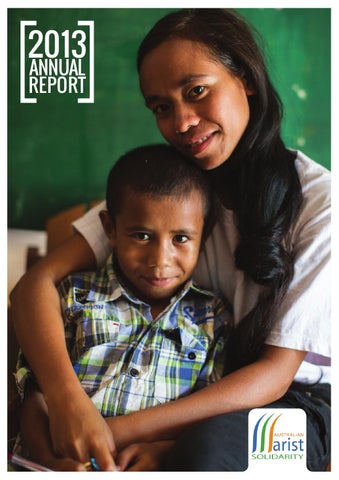
2013 ANNUAL REPORT
SYRIA
PAKISTAN
INDIA
THAILAND
THE PHILIPPINES
CAMBODIA
ASIA TIMOR-LESTE SOUTH AFRICA
2013 AT A GLANCE... Our supporters contributed a total of $271,061 in support of 24 projects across Asia and the Pacific. CAMBODIA
2
$29,483
SYRIA $833
FIJI $1,764
THAILAND $862
INDIA $34,300
TIMOR-LESTE
THE PHILIPPINES $1,999
OTHERS $9,758
| AUSTRALIAN MARIST SOLIDARITY$56,517 2013 ANNUAL REPORT SOUTH AFRICA
$135,545
INSIDE ABOUT US
4
CHAIRMAN’S REPORT
6
EXECUTIVE DIRECTOR’S REPORT
7 6-7
ORGANISATIONAL STRUCTURE OUR PROGRESS IN 2013
8-16
BOARD OF DIRECTORS OUR FINANCES
17 18-25
ACFID MEMBERSHIP
BOUGAINVILLE (AR)
27
PACIFIC FIJI
AUSTRALIA
www.australianmaristsolidarity.net.au
|
3
ABOUT US
Florio taking notes in a lecture at ICFP (Teacher Training College) in Baucau, Timor-Leste. 4 | AUSTRALIAN MARIST SOLIDARITY 2013 ANNUAL REPORT
WHO WE ARE AMS is the international aid and development agency of the Marist Brothers Province of Australia. AMS facilitates partnerships with communities focussed on overseas aid, education and community development activities of the Australian Marist Brothers. AMS is an Australian not-for-profit company limited by guarantee and became a signatory organisation to the Australian Council for International Development (ACFID) Code of Conduct in 2008. Through the extensive network of Marist Schools around Australia, AMS is ideally placed to engage current and former students, associates and the wider Marist Community and to present a national forum for awareness, immersion, volunteer and fundraising campaigns.
OUR HISTORY
Australian Marist Solidarity Limited (AMS) has evolved from a long heritage of aid and development activities conducted by the Marist Brothers Province of Australia. The Brothers have financially supported and managed overseas aid and development programs in the Solomon Islands since 1938, on Bougainville since 1941 and in other parts of Papua New Guinea since 1950. Today, the Marist Brothers have a presence in Bougainville, Cambodia, Timor-Leste, Fiji, India, Kiribati, New Caledonia, Pakistan, the Philippines, Samoa, Solomon Islands, South Africa, Sri Lanka, Thailand and Vanuatu while AMS currently supports projects in ten of these countries.
OUR VISION... OUR MISSION...
is of a world where young people are brought to the centre from the margins through access to education. is to empower young people by enhancing their human dignity and developing their capacity to transform their lives and communities.
OUR WORK AMS believes in investing in people – empowering them to take their own path to development and as such supports programs that are conducted in partnership with local communities. We focus on sustainable growth through the enhancement of community development, building a community’s capacity to deliver a better quality education, to develop skills and to promote leadership. Our in-country local partners develop projects around three key foci.
FORMAL EDUCATION Our support of primary, secondary and tertiary education programs seek to support and expand education systems that exist in communities across Asia and the Pacific. This work includes support for school facilities, classroom resources and school programs.
NON-FORMAL EDUCATION In communities where there is a lack of educational opportunities and minimal access to formal education, AMS supports learning centres that offer young people tutoring and classes to provide key skills for further education, employment and self sufficiency.
COMMUNITY DEVELOPMENT For young people in Asia and the Pacific, access to and effective participation in educational opportunities relies on maintaining good health and wellbeing. AMS supports a range of suplementary projects that focus on the development of the health and nutrition of young people. www.australianmaristsolidarity.net.au
|
5
FROM THE CHAIRMAN On behalf of the AMS Board I am very grateful to the AMS team in Brisbane for their professionalism and creativity in making the organization known more widely in the public domain in 2013 and in the effective management of AMS projects. The time invested in public events across five major cities across Australia has solidified the support network that makes the work of AMS possible. Significant work carried out in streamlining office processes and in maintaining transparency across all projects enables this supporter network to confidently contribute to our work. The year has been marked by growth in project activity in both Asia and the Pacific countries where AMS is working with local partners to enhance their educational and social opportunities. Through close collaboration with project partners, reporting and transparency has
improved considerably and become easier for these partners to complete. I am indebted to my fellow AMS board members for their engagement with the work of the board and the team. The expansion of the board membership has widened its experience to continue our advancement of a development agency focused on educational access for young people in Asia and the Pacific. To our donors and supporters with their offer of probono services, I am very grateful. Your partnership has enhanced our movement forward as a new Marist nonprofit development organisation in our region. Mr Peter Sheehan Chairman, AMS Board
A young child shares his banana with his elders, Bougainville.
ORGANISATIONAL STRUCTURE We invest in partnerships with local people who show strong initiative and leadership in the development of new educational opportunities in their own communities. Our structures support these local partners in the Project Management roles within their projects. In locations where direct communication is sometimes difficult, particularly in the Pacific and in remote areas of Timor-Leste, Regional Managers have been established. These Managers are respected locals who receive ongoing formation through AMS in order to assist us in maintaining communication, monitoring the progress and in reporting on our projects. With the AMS Board now meeting at the AMS national office in Brisbane the AMS Team and the Board are now able to work more closely on enhancing these processes and other developments in organisational efficiency.
AMS BOARD
EXECUTIVE DIRECTOR 6
| AUSTRALIAN MARIST SOLIDARITY 2013 ANNUAL REPORT
AMS TEAM
REGIONAL MA
>> Currently positioned in: Papua New Guinea, Timor(servicing parts of the Pacific)
FROM THE EXECUTIVE DIRECTOR In 2013 AMS sustained its growth in support of young people through educational projects across the AsiaPacific region. This was possible due to the broadening of our supporter network leading to an increase in our financial capacity. AMS continues to support our priority countries in Asia, Timor-Leste and Cambodia, while exploring opportunities to further develop our support for young people in the Pacific. In 2013 AMS supported twenty-four projects, in ten countries, ranging from teacher training to study centres and new schools; all to support liberation through education. These are initiated by local partners, be they members of the local community or locally based Marist Brothers. AMS has been privileged to work with these knowledgeable partners to support them financially and through training. The AMS Team hosted photographic exhibitions in Melbourne, Sydney, Adelaide, Brisbane and Canberra. It attracted new supporters and brought them face to
face with the people and local partners supported by our projects in Bougainville and Timor-Leste. It was accompanied by the in-house publication of “The Little Blue Book on Marist Solidarity” setting out our vision, organization and scope of partnerships. These events have widened our audience and proved to be of value to our supporters and to our project partners. The AMS team has again been strongly supported by the board members and other volunteers at events and in our committees. We are very grateful for their counsel and time and look forward to their continued support. Moving forward to 2014 our tag line summarizes the horizon of our work and our motivation: “Marist Solidarity… because young people matter.” May we continue to reflect this with our growing supporters’ assistance in the spirit of solidarity.
PROJECT MANAGERS >> Contact through Regional Desks
ANAGERS
Br Allen Sherry fms Executive Director
BENEFICIARIES >> Young people and families who live on the margins of developing countries in Asia and the Pacific.
-Leste & Cambodia
PROJECT MANAGERS >> Direct contact with AMS
www.australianmaristsolidarity.net.au
|
7
OUR PROGRESS IN 2013
Andre, graduate of ICFP (Teacher Training College), with his students in Baucua, Timor-Leste
BOUGAINVILLE | CAMBODIA | FIJI | INDIA | PAKISTAN | THE PHILIPPINES | SOUTH AFRICA | SYRIA | THAILAND | TIMOR-LESTE Our supporter network continues to grow and in 2013 has enabled AMS to grow to support projects in eight coutries across Asia and the Pacific. As part of the international Marist Brothers we were able to respond to the special needs of Marist projects in Syria especially considering the current climate there.
24
8
| AUSTRALIAN MARIST SOLIDARITY 2013 ANNUAL REPORT
AMS now supports twenty-four locally initiated projects led by local project managers. We thank our supporters for assisting us in making this happen. What follows is our most significant works throughout 2013.
projects across Asia & the Pacific in 2013
Throughout 2013 we have also focussed on being more visible and have held AMS gatherings in key locations on the east coast of Australia. This has stimulated a growth in support of our projects and has enabled the continued
Boarding students of St Joseph’s High School, Mabiri
expansion of education projects for the poorest and most marginalised young people of Asia and the Pacific.
NOTE: We did not have new major works taking place in the Pacific in 2013 and as such projects in the Pacific do not feature here. For details of the projects please contact AMS.
CAMBODIA
LAVALLA SCHOOL (FORMAL EDUCATION)
>>>
BACKGROUND TO THE NEED
Young people with a disability in Cambodia are often refused education due to the strong cultural belief in Karma. This means that disabilities are believed to be the result of a person’s misdeeds in their previous life. The LaValla School, under guidance of the Marist Solidarity Cambodia board, aims to give these young people a positive start and a chance to catch up in their education so that they will be accepted into further education or enter skilled work.
>>>
RESPONSE
Young people from across Cambodia come to the LaValla School to receive an education. It is the only Government approved school providing a full primary education to students with a physical disability. In order for the students to catch up on missed years in school, the Ministry of Education, Youth and Sport (MoEYS) approved the accelerated program at LaValla School in 1998. In line with the values of AMS, the staff of the LaValla School believe in providing education for these children. Many of the staff also have disabilities and work hard so the young people have the best chance of entering further education and the skilled workforce in Cambodia.
Children with disabilities are often refused access to education.
PROGRESS
95
Children with disabilities attended school at LaValla School.
25
Children with disabilities graduated from their primary education.
>>>
Under the direction of the Marist Solidarity Cambodia board in 2013: >> 30 new students were enrolled making a total of 95 students enrolled in the LaValla school program. >> 86 of the students enrolled also boarded in the onsite LaValla School Hostel. >> 75% of students passed their final classes while those who did not are able to restudy and resit assessment. >> 25 students graduated from the LaValla School in 2013 and 19 will enter into full secondary school.
>>>
CHALLENGES/KEY LEARNINGS
Although leaving the LaValla School with a full primary education the reality is that it is still difficult for students to live without the specialised care that the school offers. Marist Solidarity Cambodia provides support for some graduates of the LaValla School in other programs however it is not possible to offer this support to all graduates.
above middle: Students participate in the physiotherapy program. above right: MSC Director, Mr Nimul Ouch, presents a student with his graduation certificate. bottom: Graduating class of the LaValla School 2013, Cambodia
www.australianmaristsolidarity.net.au
|
9
CAMBODIA
PAILIN AD GENTES STUDY CENTRES (NON-FORMAL EDUCATION)
>>>
BACKGROUND TO THE NEED
80% of the population in Cambodia live in poor rural locations (The World Fact Book, 2013) such as Pailin. Children in these areas rarely have the educational opportunities that prepare them for further education or even skilled employment. The families in these locations understand their children’s need for education however they have little or no means of providing it. These children therefore have no other option but to work to providing for the family or wander the often dangerous streets. The Pailin Ad Gentes Study Centres aims to provide these children an opportunity to receive meaningful education.
>>>
RESPONSE
The project includes both the Marist Education Centre (MEC) (est. 2009) and the Catholic Church Pastoral Centre (est. 2010). Both of these centres continue to provide:
12.3
420
million people live in poor rural locations such as Pailin.
children learning English and Computer skills.
10
local Cambodian teachers have been employed to teach
The World Fact Book, CIA, 2013.
PROGRESS
>>>
In 2013 the Marist Brothers and local Cambodians working across the Pailin Ad Gentes Study Centres have provided: >> English classes for 220 children each day. >> computer classes for 200 children each day. >> secured scholarship positions in tertiary education. >> 2 local Cambodian teachers with employment in computer classes. >> 6 local Cambodian teachers with casual employment in language classes.
>>>
CHALLENGES/KEY LEARNINGS
The staff, both locals and Marist Brothers of the Pailin Ad Gentes Study Centres are strongly linked with the local Cambodians of the Pailin region. Through consistent dialogue with families in the area support has strengthen and the project is now successfully integrated into the community. We have found this to be the key to successful projects that AMS supports.
>> English and computing classes for the children in the surrounding areas each day. >> a nutrition program is provided for thirty children three times per week to support the children in their learning and is for those who have little means of receiving enough food at home.
above middle: Students in an English class at the Catholic Church Pastoral Centre. above right: Local Cambodian teacher tutoring students. below: Volunteers from Singapore working with English language students in the Catholic Church Pastoral Centre.
>> support for applications to scholarships programs for those students who wish to further their education. >> a library that is open on a daily basis for the children and the local families. As a part of the movement of projects to local ownership local Cambodians are employed to work with the children in the classes across both of the centres.
10 | AUSTRALIAN MARIST SOLIDARITY 2013 ANNUAL REPORT
INDIA
OPERATION RAINBOW (COMMUNITY DEVELOPMENT)
>>>
BACKGROUND TO THE NEED
In India an estimated 2.4 million people live with HIV/AIDS (UNICEF, 2013). The HIV virus continues to affect families often leaving their survival in the hands of the oldest child who is frequently the only uninfected family member. The families and individuals living with HIV/AIDS are often disadvantaged due to the stigmas and lack of education about HIV/AIDS. Operation Rainbow aims to provide these families and individuals with the community support that enables them to continue to live with dignity while also providing necessary education to prevent the spread of HIV/AIDS.
>>>
RESPONSE
Operation Rainbow, based in the city of Tiruchirappalli, known locally as Trichy, is a Marist project run by professional staff and volunteers. Together they provide:
2.4
800
million people living with HIV/AIDS in India.
in home visits with families living with HIV/AIDS.
UNICEF.org, 2013.
PROGRESS
18
women living with HIV/AIDS have completed a certificate in tailoring.
>>>
Operation Rainbow continues to provide support for over three hundred individuals across its programs. These include: >> 250 in attendance at the monthly “Rainbow Family Gatherings”. >> 800+ in home family visits in 2013. >> 18 women have completed the six month tailoring course. >> 25 young people from nearby villages have participated in evening classes at the centre. These young people and families are now able to support each other in community so that they do not feel isolated.
>>>
CHALLENGES/KEY LEARNINGS
Operation Rainbow is a program that has grown steadily and at a manageable rate. The number of students now aiming for higher education has increased which also increases the investment required to enable the program to support these students. This is a positive shift for young people with HIV/AIDS and reveals the positive impact that the project is making.
>> a place and program that enables children and families with HIV/AIDS to gather in support of one another. These include social outings and the monthly “Rainbow Family Gatherings”. >> in-home visits to provide education and support for those with HIV/ AIDS. >> free hospital organised medical camp in Trichy about specific health care and medication.
above middle: Students positioning the Operation Rainbow sign at the Marcellin Trust Hall. above right: Some of the Operation Rainbow leaders leading the monthly Rainbow Family Gathering in prayer. below: Over 200 local people gather at the monthly Rainbow Family Gathering.
>> counselling and assistance around the death of HIV positive family members. >> HIV awareness and education for young people in schools and colleges. >> financial education support for children whose families are unable to afford the school fees. >> a certificate course in tailoring as well as other capacity building workshops. www.australianmaristsolidarity.net.au
|
11
INDIA
MANGAMANUTHU COMPUTER SUPPORT (FORMAL EDUCATION)
>>>
BACKGROUND TO THE NEED
St Marcellin Secondary School (1999), Mangamanuthu, provides education for the Dalit community (formerly known as untouchables). The Dalits make up an estimated 25% of the population of India and due to the descrimination held against them they make up some of the poorest people in the country. As 454 million people are unable to read and write (World Fact Book, 2013) the local community believes education is crucial to their children’s development out of poverty. The school provides this opportunity. In 2013 the Indian Government approved the expansion to higher secondary, ie. grades eleven and twelve. In order for this to be approved the school was required to fulfil the national curriculum by providing a well equipped computer lab and appropriate computing classes before the end of the school year. This project assisted the school in achieving this goal.
20
454
computers were purchased to meet Indian curriculm requirements.
million people over 15 years of age are unable to read and write in India.
85
can now complete grade 11 and continue on to further education.
The World Fact Book, CIA, 2013.
PROGRESS
>>>
In October the computers were purchased and installed in one of the existing classrooms and computing classes began. Where once only fifty-five of the eighty-five year eleven students had access minimal computing training, all of these students are now able to access computers. Construction of the purpose built computer lab has begun and it is hoped that the computers purchased with the support of AMS will be installed in the building in 2014.
>>>
CHALLENGES/KEY LEARNINGS
As is common in schools in developing communities it is often difficult to finance projects such as these. In order for St Marcellin Higher Secondary to continue to provide high quality education the facilities must be maintained and updated to ensure that they continue to meet the national standards. It has been a positive move for the Indian Government to recognise the value of St Marcellin Higher Secondary school especially for the poorer Dalit community of Mangamanuthu.
>>>
RESPONSE
St Marcellin Higher Secondary’s computer laboratories could not provide adequate training. In order for computing classes to commence as quickly as possible AMS assisted with the purchase of twenty computers sourced locally. This was part of a plan that includes new essential furniture and, in 2014, a purpose built computer lab. The first in Mangamanuthu and for this Dalit community.
above: Students using the newly purchased computers in a computer skills class. below: St Marcellin High School main building. 600 students attend classes in the 12 classrooms here.
12 | AUSTRALIAN MARIST SOLIDARITY 2013 ANNUAL REPORT
THE PHILLIPINES KUYA CENTRE (NON-FORMAL EDUCATION)
>>>
BACKGROUND TO THE NEED
The Kuya Centre was established in 1991 and since then has been working to rehabilitate and prepare children who experience homelessness for reintegration into the Filipino society. The children who are assisted by Kuya Center are children aged 18 years and below. Many have been abandoned, orphaned or have run away from families or situations that have caused them distress. All of these children have lost touch with their families and have experienced the detrimental effects of neglect.
>>>
RESPONSE
The staff of the Kuya Center work hard to provide a caring and trusting environment where the children are encouraged to make positive changes in their lives. This is done through street education sessions which focus on: >> their rights as children,
246
thousand children living on the streets of the Philippines. Lamberte, E., 2002.
PROGRESS
200
children have been rehabilitated with families/reintegrated into the local community.
23
children gained entry into formal schooling.
>>>
In 2013 the Kuya Centre assisted with: >> the rehabilitation and reconciliation of 200 children who experience homelessness on the streets of Manilla. >> 30 of these children were residents in the Kuya Centre residential program. >> 23 children gaining entry into formal schooling. >> others continuing to participate in the non-formal education programs provided by the Kuya Centre.
>>>
CHALLENGES/KEY LEARNINGS
The Kuya Centre was established by a group of religious men and women in partnership with local Filipino people. AMS continues to work on reporting procedures to ensure that they are clear to our partners especially when definitions of activities differ from culture to culture. Having a range of perspectives has however, continued to provide creative solutions and consolidates the comprehensive programs provided at the Kuya Centre.
>> substance and drug use prevention, >> sex education, and >> life skills training. The Kuya Center’s also offers a residential program for the boys who wish to find a life off the streets while girls are referred to partner agencies. This residential program provides: >> alternative education classes,
above middle: Children living on the streets participating in an information session on the streets of the Philippines with a Kuya Centre worker. above right: A group of children gather at the Kuya Centre. bottom: Kuya Centre staff present a night time information session to children on the streets.
>> psychological assessment and ongoing counseling, >> basic essentials such as balanced meals, clothing and medical assistance. These programs all work toward reconciliation with families where possible or entry into long term residential centres and entry into formal schooling where their development and education can continue.
www.australianmaristsolidarity.net.au
|
13
SOUTH AFRICA
BOSELE HOUSE (NON-FORMAL EDUCATION)
>>>
BACKGROUND TO THE NEED
Almost four million children are estimated to be orphaned (UNICEF, 2012) in South Africa and the alternative care programs struggle to ensure that these young people are receiving adequate care and the education to which they have a right. Bosele House, aims to provide the orphaned children of Laxey, a small village in the Moshaweng Valley, the opportunity to be cared for and nourished so that daily attendance at Bojelakgomo Primary School, located next door, is possible.
>>>
RESPONSE
Bosele House is a project that was planned thoroughly in close partnership with Laxey community and school representatives. It is a boarding house that provides thirty-two children, sixteen girls and sixteen boys, with weekday boarding while they are able to return to their extended families on weekends. The children at Bosele House are provided with correct nutrition and support in aid of their schooling. The facilities include a water purification plant and internally plumbed water, showers and flush toilets, some of the first in the region.
16 16
3.7
+
million children orphaned in South Africa. UNICEF, 2012.
PROGRESS
GIRLS
BOYS
5
local people from Laxey village will have work at Bosele House
will now be able to attend school while boarding at Bosele House.
>>>
As of March 2014 the thirty-two children will move into the new facilities with the carers and will begin to attend school on a more regular basis. As part of the program five employment opportunities have also been provided: two carers, a cook, a cleaner and a handyman.
>>>
CHALLENGES/KEY LEARNINGS
The success and the quality of Bosele House was a product of the close partnership that was established between the Kalahari Experience Education Trust and the Laxey community throughout the entirety of the project.
above middle: Laxey community members meet at the newly constructed Bosele House prior to it’s opening. above right: The outdoor gathering space for those who will live at Bosele House. bottom: Children of the Laxey community gather at Bosele House.
14 | AUSTRALIAN MARIST SOLIDARITY 2013 ANNUAL REPORT
TIMOR-LESTE
KATILOSA PROGRAM (NON-FORMAL EDUCATION)
>>>
BACKGROUND TO THE NEED
It is still common in Timor-Leste for children with disabilities to be hidden by their families from the wider community because of traditional beliefs. It is the aim of Laurentino Guterres, Timorese Director and Founder of the local NGO KATILOSA and the four staff to provide the critical support for families of children with disabilities and to improve the views held by the local community about disability.
>>>
RESPONSE
The KATILOSA services, developed by the physiotherapists on staff, at the Darasula Rehabilitation Centre provides a range of programs. These include: >> motor skills development >> physiotherapy
Children with disabilities are often hidden from view and are refused education.
PROGRESS
412
children with a disability and families supported through KATILOSA.
141
children and adults provided with physiotherapy at the centre and in remote locations.
>>>
In 2013 the KATILOSA program was able to >> support 412 children with a disability and family members. >> provide physiotherapy and training to 77 children and adults at the Darasula Rehabilitation Centre and in the local community. >> provide physiotherapy and training to 64 children with a disability and parents in remote homes. >> referred 35 children and adults for specialised treatment.
>>>
CHALLENGES/KEY LEARNINGS
KATILOSA’s location, Darasula, is a remote village however it’s location enables the staff to service locations that are even more isolated. As the program gathers support from the wider community the number of people with a disability who are seeking support also grows. Keeping up with demand for the services is proving to be difficult. Other challenges have included the lack of reliable water and electricity supplies however, upgrades to the facilities will take place in 2014.
>> physiotherapy training for parents and guardians of the children >> play groups to provide support networks for the families. KATILOSA staff also carry out visits to remote families to ensure that those who are unable to travel to Darasula are still able to receive the necessary care and training. In order to do this the KATILOSA continues to source a range of specialised equipment for the children’s developmental needs. Other programs include:
above middle: Jerry performs physiotherapy for a child at KATILOSA’s Darasula Rehabilitation Centre. above right: KATILOSA staff assist family members with correct positioning of their child in her wheelchair. bottom: KATILOSA staff, children and family members gathering together at the centre.
>> monitoring of children with disabilities in schools. >> encouraging participation of people with disabilities in local events. >> referral of clients to appropriate specialised care. >> vocational training of people with a disability for independence.
www.australianmaristsolidarity.net.au
|
15
TIMOR-LESTE
ICFP (TEACHER TRAINING) PROGRAM (FORMAL EDUCATION)
>>>
BACKGROUND TO THE NEED
The current Timorese education system struggles to provide the necessary education opportunities for all children (586,195 under 18 years of age) to attend a school. With just over half of all teachers reported to have studied at university, though not necessarily having studied education, and many others not having completed school themselves it is clear that there is a shortage of qualified teachers to educate the future generations of Timor-Leste. To provide education for the growing young population Timor-Leste needs 200 new teachers each year.
>>>
RESPONSE
In consultation with the Timorese Government and in partnership with the Australian Catholic University (ACU), the Catholic Teachers College (Insitutio Catholicio Para Formacao De Professores, ICFP) was established and has been in operation since 2003. ICFP offers a three year full time “Bachelor of Teaching” degree for years 1 to 9. The college also facilitates a Masters in Education degree through ACU that enables graduates to continue studies and to be able to lecture at ICFP.
>50% of teachers in Timor-Leste are not qualified as teachers.
49
students graduated in 2013 as fully qualified teachers.
Howse, G., 2009
PROGRESS
33
2013 graduate teachers have accepted positions in the education sector
>>>
Since 2006 ICFP has supported the Timor-Leste education sector with three hundred and sixty-five graduate teachers from their Bachelor program and seven hundred and twenty-three graduates with certificates in Education. In 2013 ICFP had a student population of one hundred and fifty-seven students. Of these students: >> 49 students graduated as teachers. >> 35 graduate teachers applied to Portuguese language schools. >> 33 graduate teachers are now employed in the education sector. 95% of 2013/14 graduates have already been offered employment in the education sector for 2014. These results reflect the high standard of teachers produced through this program.
>>>
CHALLENGES/KEY LEARNINGS
Since it’s inception ICFP has been under the directorship of Australian Marist Brothers with the support of the local Timorese in Baucau. For longterm sustainabilitiy the goal is for this directorship to be handed over to the Timorese. This process is challenging and takes considerable time. The current Deputy Director is a local Timorese man and is being formed for the role of Director however it is not yet clear as to when he will step into this role.
above middle: An ICFP student studies in the library in Baucau. above right: Graduate of ICFP now lecturing in class at ICFP. bottom: A full class at the ICFP Teacher Training College.
16 | AUSTRALIAN MARIST SOLIDARITY 2013 ANNUAL REPORT
Locals point out feature of the land that can be seen from the mountains in the southern Buin District of Bougainville.
BOARD OF DIRECTORS MR PETER SHEEHAN | Chairperson (Elected AMS Board Member: 2013) DR DAVID BUCKLEY | Company Secretary (Board Member since 2005/Secretary since 2007) MR BERNARD KENNA | Treasurer (Elected AMS Board Member: 2007) BROTHER JEFFREY CROWE | Provincial Superior, Province of Australia (2013) (Elected AMS Board Member: 2007) BROTHER JULIAN CASEY | (Elected AMS Board Member: 2007) BROTHER MARK PAUL | (Elected AMS Board Member: 2007) BROTHER ANTHONY ROBINSON | (Elected AMS Board Member: 2007) MR DAVID L’ESTRANGE | (Elected AMS Board Member: 2013) MR MARCUS RILEY | (Elected AMS Board Member: 2013) MR MICHAEL SINCLAIR | (Elected AMS Board Member: 2013) www.australianmaristsolidarity.net.au
|
17
OUR FINANCES
First year students taking part in class at ICFP (Teacher Training College) in Baucau, Timor-Leste. 18 | AUSTRALIAN MARIST SOLIDARITY 2013 ANNUAL REPORT
FINANCIAL OVERVIEW
FOR THE YEAR ENDED 31 DECEMBER 2013 (ALL FIGURES IN AUSTRALIAN DOLLARS)
Grant Received - 6.1% ($56,305) Interest Received - 0.3% ($2,347)
WHERE THE MONEY COMES FROM... GRANTS RECEIVED
$ 56,305
INTEREST RECEIVED
$
OTHER COMPREHENSIVE INCOME: OTHER INCOME
$ 552,145
DESIGNATED INCOME MAPS
$ 271,061
INTERST INCOME - RESERVE PRINCIPAL
$ 29,584
ADMINISTRATION FEE
$
Income received from Marist Province and colleges, in the form of cash and project grants.
Income received from financial investments such as term deposits and bequests.
LaValla designated donations Projects managed by MAPS
Interest from reserve principle 2% of donations
Administration Fee - 0.8% ($7,527) Grant to LaValla - 60.1% ($552,145)
Designated Income MAPS - 29.5% ($271,061)
SOURCE OF INCOME
2,347
Interest Income Reserve - 3.2% ($29,584)
7,527
International Aid Projects - 50% ($271,061)
Operating Expenses - 11% ($60,819)
TOTAL $ 918,969
WHERE THE MONEY IS SPENT... RATIO OF EXPENSES
FUNDS ALLOCATED TO INTERNATIONAL PROJECTS $ 271,061 GRANT TO LAVALLA SCHOOL CAMBODIA
$ 214,798
OPERATING EXPENSES
$ 60,819
Administration and Accountability
TOTAL $ 546,678 TOTAL COMPREHENSIVE INCOME/(EXPENSE) FOR THE YEAR
Grant to LaValla School - 39% ($214,798)
$ 372,291
WHERE THE PROJECT FUNDS ARE SPENT... INTERNATIONAL PROJECTS CAMBODIA $ 29,483 FIJI $ 1,764 INDIA $ 34,300 THE PHILIPPINES $ 1,999 SOUTH AFRICA $ 56,517 SYRIA $ 833 THAILAND $ 862 TIMOR-LESTE $ 135,545 OTHER $ 9,758 TOTAL $ 271,061
The Philippines - 0.7% ($1,999) Cambodia - 10.9% ($29,483) Other - 3.6% ($9,758) Thailand - 0.3% ($862) Syria - 0.31% ($833)
India - 12.7% ($34,300) Fiji - 0.7% ($1,764)
PROJECTS EXPENDITURE
South Africa - 20.9% ($56,517)
“Projects” are both Formal and Non-Formal Education Projects and Community Development Projects with necessitous persons in developing countries across Asia-Pacific. The development projects of AMS have seen a considerable rise in number due to the management possibilities within the partnership of Marist offices including Australian Marist Solidarity (AMS), Marist Asia Pacific Solidarity (MAPS) and Marist Volunteers Australia (MVA).
Timor-Leste - 50% ($135,545)
www.australianmaristsolidarity.net.au
|
19
FINANCIAL OVERVIEW
STATEMENT OF COMPREHENSIVE INCOME FOR THE YEAR ENDED 31 DECEMBER 2013 (ALL FIGURES IN AUSTRALIAN DOLLARS)
2013 $ REVENUE
Grants received Interest received Designated donations MAPS
2012 $
56,305 2,347 271,061
60,612 3,960 203,438
Other income (Lavalla) Interest income on reserve principal Administration fee
552,145 29,584 7,527
1,000 52,043
TOTAL REVENENUE
918,969
321,053
56,517
52,675 3,100 13,705 64,875
OTHER COMPREHENSIVE INCOME:
EXPENDITURE
INTERNATIONAL PROJECTS: Africa Bougainville Island Cambodia East Timor Fiji India Philippines Pakistan Papua New Guinea Solomon Islands Syria Thailand Vanuatu MAPS non-designated
TOTAL PROJECTS
29,483 135,545 1,764 34,300 1,999
833 862 9,758
30,363 25,110 100 2,050 3,210 8,000 250
271,061
203,438
Grant to Lavalla School in Cambodia AMS non-designated grants Accountability and administration
50,000 164,798 60,819
134,695
TOTAL EXPENDITURE
546,678
389,366
NET SURPLUS/(DEFICIT) OF INCOME OVER EXPENDITURE
372,291
(68,313)
-
-
372,291
(68,313)
OTHER COMPREHENSIVE INCOME TOTAL COMPREHENSIVE INCOME/(EXPENSE) FOR THE PERIOD
51,233
During the financial year 2013, AMS had no transactions for international political or religious proselytisation programs. At the end of the financial years 2013 and 2012 AMS had nil balance for Fundraising Costs. As a part of the partnership between Marist Asia Pacific Solidarity (MAPS) and AMS fundraising is carried out by MAPS.
20 | AUSTRALIAN MARIST SOLIDARITY 2013 ANNUAL REPORT
FINANCIAL OVERVIEW
STATEMENT OF FINANCIAL POSITION FOR THE YEAR ENDED 31 DECEMBER 2013 (ALL FIGURES IN AUSTRALIAN DOLLARS)
2013 $ CURRENT ASSETS
2012 $
Cash and cash equivalents Trade and other receivables
1,296,261 525,755
1,442,010 34,162
TOTAL CURRENT ASSETS
1,822,015
1,476,172
TOTAL ASSETS
1,822,015
1,476,172
Trade and Other Payables
5,107
31,555
TOTAL CURRENT LIABILITIES
5,107
31,555
TOTAL LIABILITIES
5,107
31,555
1,816,908
1,444,617
Reserves Retained Earnings
1,705,354 111,555
1,338,422 106,195
TOTAL EQUITY
1,816,908
1,444,617
CURRENT LIABILITIES
NET ASSETS
EQUITY
At the end of the financial years 2013 and 2012 AMS had nil balances for Current Assets Inventories, Assets held for sale and Other financial assets and for Non-Current Assets Investment property, Intangibles and Other non-current assets, for Current Liabilities Net current tax liabilities, Other financial liabilities and Other, for Non-Current Liabilities Other financial liabilities and Other.
www.australianmaristsolidarity.net.au
|
21
FINANCIAL OVERVIEW
STATEMENT OF CHANGES IN EQUITY FOR THE YEAR ENDED 31 DECEMBER 2013 (ALL FIGURES IN AUSTRALIAN DOLLARS)
ACCUMULATED FUNDS $ BALANCE AT 1 JANUARY 2013 TOTAL COMPREHENSIVE INCOME FOR THE YEAR Profit for the year
1,444,617 5,360
OTHER COMPREHENSIVE (EXPENSE)/INCOME Lavalla School designated grant Interest income on reserve principal Designated income MAPS Designated expense MAPS Operating Grant to Lavalla school & non-designated projects
TOTAL OTHER COMPREHENSIVE INCOME/(EXPENSE) BALANCE AT 31 DECEMBER 2013
552,145 29,584 271,061 (271,061) (214,798)
366,931 1,816,908
FINANCIAL OVERVIEW
TABLE OF CASH MOVEMENTS FOR DESIGNATED PURPOSE FOR THE YEAR ENDED 31 DECEMBER 2013 (ALL FIGURES IN AUSTRALIAN DOLLARS) A table of cash movements is not required as no single appeal or other form of fund raising for a designated purpose generated 10% or more of total international aid and development revenue for the financial year.
22 | AUSTRALIAN MARIST SOLIDARITY 2013 ANNUAL REPORT
FINANCIAL OVERVIEW
www.australianmaristsolidarity.net.au
| 23
24 | AUSTRALIAN MARIST SOLIDARITY 2013 ANNUAL REPORT
www.australianmaristsolidarity.net.au
| 25
THIS PAGE HAS BEEN INTENTIONALLY LEFT BLANK.
26 | AUSTRALIAN MARIST SOLIDARITY 2013 ANNUAL REPORT
ON THE COVER...
TIMOR-LESTE, 2013 A mother and child at the clinic run by the Cogregation of the Imitation of Jesus in Baucau, Timor-Leste. Photos by Conor Ashleigh, Newcastle, NSW w w w. c o n o r a s h l e i g h . c o m
ACFID MEMBERSHIP In 2008 Australian Marist Solidarity became a full member and signatory to the Australian Council for International Development (ACFID) Code of Conduct. ACFID is the peak council of Australian non-government organisations (NGOs) which aim to promote conditions of sustainable human development in which people are able to enjoy a full range of human rights and fulfil their needs free from poverty, and live in dignity. Australian Marist Solidarity seeks and appreciates your feedback. If you wish to provide feedback or lodge a complaint against the organisation, please contact Br Allen Sherry, Executive Director on (07) 3354 0600 or email: al.sherry@marists.org.au. All feedback is confidential.
THE ACFID CODE OF CONDUCT The ACFID Code of Conduct defines standards of best practice for international development organisations and represents the active commitment of its signatories to conduct their activities with integrity and accountability. The Code is a voluntary, self-regulatory sector code of good practice that aims to improve international development outcomes and increase stakeholder trust by enhancing the transparency and accountability of signatory organisations. It was developed in 1997 and comprehensively revised in 2010. Marist Solidarity is committed to full adherence of its requirements. For more information regarding ACFID and the Code of Conduct and how to make a complaint relating to a breach of the Code visit www.acfid.asn.au. www.australianmaristsolidarity.net.au
|
27
AUSTRALIAN
arist
SOLIDARITY
Thank you to all our of our supporters for your generous contributions toward the young people across Asia and the Pacific! To support the projects contained in this report and more visit us online: www.australianmaristsolidarity.com.au
POSTAL ADDRESS Australian Marist Solidarity (AMS) PO Box 273,Ashgrove West, QLD 4060 AUSTRALIA
OFFICE PHONE
(+617) 3354 0600
ams@marists.org.au
AUTONOMOUS REGION OF BOUGAINVILLE | CAMBODIA | FIJI | INDIA | PAKISTAN | THE PHILIPPINES | SOUTH AFRICA | SYRIA | THAILAND | TIMOR-LESTE 17SEPTEMBER2014
ABN 46 373 535 209